Ross John
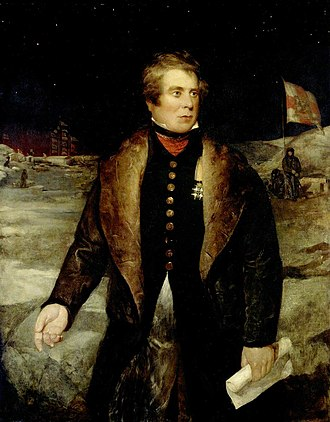
ACHIEVEMENT(S): Scottish Arctic explorer and naval officer who led two
expeditions (1818-19 and 1829-33) in search of the Northwest Passage.
NICKNAME/ALIAS: None.
DATE/PLACE OF BIRTH: 24th June 1777, in Inch, Wigtownshire, Scotland.
DATE/PLACE/AGE AT DEATH: 30th August 1856, in London, England. Aged 79.
DISCIPLINE: Military / Arctic navigator.
FIELD: Exploration.
LANGUAGE: English.
PARENTS: Andrew Ross and Elizabeth Corsane.
SIBLINGS: Andrew (elder brother).
SPOUSE: Married twice.
CHILDREN: One son.
EDUCATION: Little formal education.
MAJOR WORK: 'Narrative on a Second Voyage in search of a Northwest Passage
and of a Residence in the Arctic Regions during the years 1829-1833', 1835.
LIFE AND TIMES: Ross joined the Royal Navy at the age of nine and sailed to the Mediterranean on board ‘HMS Pearl’. Four years later, he transferred to ‘HMS Impregnable’, whose captain told him that he should move to the civilian Merchant Navy to widen his experience.
Ross took his suggestion and joined the ‘Merch’ as an apprentice in Greenock, Scotland. Across the next four years, he made six voyages: three to the West Indies and three to the Baltic. Then in 1794, Ross took a job with the East India Company* and gained five years’ valuable experience of astronomy and navigation.
In September 1799 he re-joined the Royal Navy as a midshipman on ‘HMS Weasel’ which sailed the North Sea and round the coast of Holland. His career with the Royal Navy developed over the next decade and, in February 1812, Ross was promoted to Commander in the Baltic and North Seas fleet.
During 1814 and 1815, he commanded ‘HMS Actaeon’ in the North Sea and, briefly, in the White Sea. There, he gained his first experience of the Arctic and carried out coastal surveys.
During this time, he worked out the longitude of the Arctic port of Archangel, by observation of Jupiter’s lunar eclipses.
From 1815 to 1817, Ross was stationed on the coast of Scotland until, in January 1818, he was given command of the whaling ship ‘Isabella’. She had been hired by the Admiralty for an expedition to find the Northwest Passage, the sea route that was thought to link the North Atlantic and the North Pacific.
In the company of a second ship, ‘Alexander’, Ross set sail in 1818, accompanied by his nephew, James Clark Ross*, and Edward Sabine.
As well as attempting to find the Passage, his orders were to collect information and specimens of the geography, hydrography and natural history of the region.
Ross showed himself to be a careful and highly-organized commander, who fitted out his ships meticulously for the demands of an Arctic voyage. The ships carried enough provisioning for several months, much of which was preserved by the new method developed by the French chef Nicolas Appert, in cans produced in England for the Royal Navy by Donkin*.
During the voyage, Ross sailed north beyond latitude 77 degrees N, where he came across an unknown group of isolated Eskimos and then, after turning south towards Jones Sound in August, rediscovered Baffin Bay, first discovered by William Baffin two hundred years before.
On 31st August, Ross made the biggest mistake of his career, when ‘Isabella’ entered Baffin’s Lancaster Sound. In the afternoon of that day, he spotted a range of mountains, that he named ‘Crocker’s Mountain’, which appeared to be blocking any further passage to the west.
Ross turned south, exploring the remaining 400 miles of the western shore of Baffin Bay before going back to Britain in late 1818. Unfortunately the mountains he had seen were a mirage.
Ten years later, Ross published, 'A Treatise on Navigation by Steam' and, in the same
year, proposed that the Admiralty finance another Northwest Passage expedition, this time by steamship. The Admiralty rejected the proposal, because they wanted to use their available resources finding the Polar Sea, if it existed, before the Russians did. Ross then went to his old friend, distiller Felix Booth*, who added £17,000 to the £3,000 that Ross already had, which was enough to finance the expedition, in which Ross’ nephew, James Clark Ross, sailed as joint leader.
A steamship, the ‘Victory’, a mail packet running between Liverpool and the Isle of Man, was bought and modified and, in 1829, steamed north along the west coast of Greenland and then through Lancaster Sound.
From there, they went into to Prince Regent Inlet and turned south to begin their search for the Northwest Passage. As they went, Ross named many locations for the first time, and then, in late 1829, the ships passage was blocked by ice, forcing the party to winter in Felix Harbour. During their stay it was decided that when the winter was over they would abandon steam in favour of sail, because the engine had become unreliable.
Ross didn’t waste his time during the winter break. He carried out a number of surveys and established good relations with the neighbouring Eskimo settlements. When summer came, the ‘Victory’ travelled just a few miles south before being trapped by winter again, in Victoria Harbour.
The following June, while still trapped, James Clark Ross made his name when he went on a sledge trip during which he located the Magnetic North Pole.
A third Arctic winter passed and in May 1832 Ross decided that the time had come to abandon ship, so he and his men sledged to the open water of Fury Beach. They spent their fourth winter there in a hut and, in the summer of 1833, managed to reach a whaling ship (by coincidence Ross’ old ship, the ‘Isabella’) in Lancaster Sound. They finally arrived home in October.
During their enforced stay, Ross and his nephew explored the Boothia Peninsula, the Gulf of Boothia and part of King William Land. They established that the most north-easterly point of the American continent extended to latitude 74 degrees North. Two years after arriving back in Britain, Ross published 'Narrative on a Second Voyage in search of a Northwest Passage and of a Residence in the Arctic Regions during the years 1829-1833'.
In 1839, Ross became British Consul in Stockholm, a job he held until 1846. In 1845, however, he visited England to try for a place on the proposed Arctic expedition under the command of John Franklin*, but was turned down.
Ten years later, a grant from the Hudson’s Bay Company* and by a donation of £1,000 from Sir Felix Booth, meant that Ross was able to fit out a small ship, the 'Felix', which sailed to the Arctic from Stranraer, Scotland, in May 1850.
In 1850, at the age of 72, Ross undertook a third voyage to the Arctic regions, this time in search of the expedition party of Sir John Franklin which had not been heard from for four years.[4] With financial support from HBC, he sailed a private vessel, the schooner Felix, to Lancaster Sound. His vessel was not particularly robust and other ships in the area had to provide food to help Ross combat scurvy which had set in amongst his crew
In what was his last voyage, Ross, now an old man, successfully negotiated Lancaster Sound, returning to England the following year.
ASSESSMENT: Notable Arctic explorer and naval officer who led two unsuccessful attempts to find the Northwest Passage.
EXTRA CONNECTIONS: Sailed with students of William Hooker*
The Admiralty was not interested, but he was able to convince the gin-magnate Felix Booth to finance this second Arctic expedition, which began in 1829. His ship was the Victory, a side-wheel steamer with paddles that could be lifted away from the ice and an experimental high-pressure boiler built by John Ericsson.
ONELINER: John Ross. Arctic explorer
BIBLIOGRAPHY:
Dodge, Ernest S., The Polar Rosses, London, Faber and Faber, 1973.
Savours, Ann, The Search for the North West Passage, London, Chatham Publishing, 1999.
Ross, M. J., Polar Pioneers: John Ross and James Clark Ross, 1994.
[Wikipedia [https://en.wikipedia.org/wiki/John_Ross_(Royal_Navy_officer](https://en.wikipedia.org/wiki/John_Ross_(Royal_Navy_officer)