Nash, John
Not to be confused with mathematician
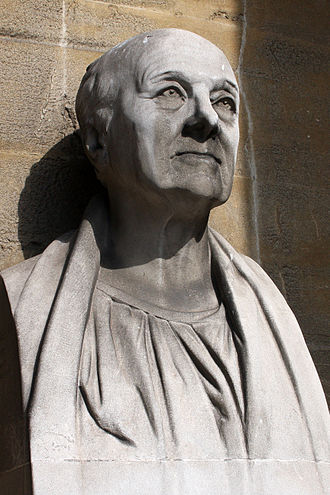
John Nash (18 January 1752 – 13 May 1835) was one of the foremost British architects of the Georgian and Regency eras, during which he was responsible for the design, in the neoclassical and picturesque styles, of many important areas of London. His designs were financed by the Prince Regent and by the era's most successful property developer, James Burton. Nash also collaborated extensively with Burton's son, Decimus Burton.[1]
Nash's best-known solo designs are the Royal Pavilion, Brighton; Marble Arch; and Buckingham Palace. His best-known collaboration with James Burton is Regent Street and his best-known collaborations with Decimus Burton are Regent's Park and its terraces and Carlton House Terrace. The majority of his buildings, including those that the Burtons did not contribute to, were built by James Burton's company.
Background and early career
Nash was born in 1752, probably in Lambeth, south London.[a] His father was a millwright also called John (1714–1772).[5] From 1766 or 1767, Nash trained with the architect Sir Robert Taylor. The apprenticeship was completed in 1775 or 1776.[6]
 Cronkhill, Shropshire - one of Nash's earlier buildings and the first "Italianate villa in England"[7
On 28 April 1775, at the now-demolished church of St Mary Newington, Nash married his first wife Jane Elizabeth Kerr, daughter of a surgeon.[6] Initially, he seems to have pursued a career as a surveyor, builder and carpenter. This gave him an income of around £300 a year (£49,850 in 2020 money).[8] The couple set up home at Royal Row, Lambeth.[6] He established his own architectural practice in 1777 as well as being in partnership with a timber merchant, Richard Heaviside.[6][9]
The couple had two children, both were baptised at St Mary-at-Lambeth, John on 9 June 1776 and Hugh on 28 April 1778.[6] In June 1778, Nash, "by the ill conduct of his wife found it necessary to send her into Wales in order to work a reformation on her."[10] The cause of this appears to have been the claim that Jane Nash, "had imposed two spurious children on him as his and her own, notwithstanding she had then never had any child", and she had contracted several debts unknown to her husband, including one for milliners' bills of £300.[11]
The claim that Jane had faked her pregnancies and then passed babies she had acquired off as her own was brought before the Consistory court of the Bishop of London.[12] His wife was sent to Aberavon to lodge with Nash's cousin, Ann Morgan, but she developed a relationship with a local man, Charles Charles. In an attempt at reconciliation, Jane returned to London in June 1779, but she continued to act extravagantly so he sent her to another cousin, Thomas Edwards of Neath. She gave birth just after Christmas and acknowledged Charles Charles as the father.[13] In 1781, Nash instigated action against Jane for separation on grounds of adultery. The case was tried at Hereford in 1782, Charles who was found guilty was unable to pay the damages of £76 (£13,200 in 2020 money) and subsequently died in prison.[13] The divorce was finally read 26 January 1787.[12]
His career was initially unsuccessful and short-lived. After inheriting £1000 (£162,000 in 2020 money)[14] in 1778 from his uncle Thomas, he invested the money in his first independent works, 15–17 Bloomsbury Square and 66–71 Great Russell Street in Bloomsbury. However, the property failed to let and he was declared bankrupt on 30 September 1783.[15] His debts were £5000 (£760,000 in 2020 money),[12] including £2000 he had been lent by Robert Adam and his brothers.[15] A blue plaque commemorating Nash was placed on 66 Great Russell Street by English Heritage in 2013.[16]
...
Retirement and death
Nash's career effectively ended with the death of George IV in 1830. The King's notorious extravagance had generated much resentment, and Nash was now without a protector.[100] The Treasury started to look closely at the cost of Buckingham Palace. Nash's original estimate of the building's cost had been £252,690, but this had risen to £496,169 in 1829;[101] the actual cost was £613,269 (£69.5 million in 2020 money), and the building was still unfinished. This controversy ensured that Nash would not receive any more official commissions, nor would he be awarded the knighthood that other contemporary architects such as Jeffry Wyattville, John Soane and Robert Smirke received. Nash retired to the Isle of Wight to his home, East Cowes Castle.[102]
[ ](https://en.wikipedia.org/wiki/File:St_James%27s_Church,_Church_Path,_East_Cowes_%28May_2016%29_%28Tomb_of_John_Nash%29_%282%29.JPG)Nash's tomb at St James's Church, East Cowes
On 28 March 1835 Nash was described as "very poorly and faint".[103] This was the beginning of the end. On 1 May Nash's solicitor John Wittet Lyon was summonsed to East Cowes Castle[103] to finalise his will. By 6 May he was described as 'very ill indeed all day',[104] he died at his home on 13 May 1835. His funeral took place at St. James's Church, East Cowes on 20 May, where he was buried in the churchyard with a monument in the form of a stone sarcophagus.[105]
His widow acted to clear Nash's debts (some £15,000; £1.97 million in 2020 money),[105] she held a sale of the Castle's contents, including three paintings by J. M. W. Turner painted on the Isle of Wight, four by Benjamin West and several copies of old master paintings by Richard Evans. These artworks were sold at Christie's on 11 July 1835 for £1,061 (£139,500 in 2020 money).[105] His books, medals, drawings and engravings were bought by a bookseller named Evans for £1,423 on 15 July (£187,078 in 2020 money). The Castle itself was sold for a reported figure of £20,000 (£2.63 million in 2020 money) to Henry Boyle, 3rd Earl of Shannon, within the year.[105] Nash's widow retired to a property Nash had bequeathed to her in Hampstead where she lived until her death in 1851; she was buried with her husband on the Isle of Wight.[106]