Fox CJ

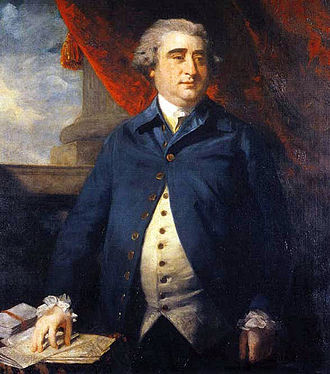
Charles James Fox PC (24 January 1749 – 13 September 1806), styled The Honourable from 1762, was a prominent British Whig statesman whose parliamentary career spanned 38 years of the late 18th and early 19th centuries and who was the arch-rival of William Pitt the Younger. His father Henry, a leading Whig of his day, had similarly been the great rival of Pitt's famous father.
He rose to prominence in the House of Commons as a forceful and eloquent speaker with a notorious and colourful private life, though his opinions were rather conservative and conventional. However, with the coming of the American War of Independence and the influence of the Whig Edmund Burke, Fox's opinions evolved into some of the most radical ever to be aired in the Parliament of his era.
Fox became a prominent and staunch opponent of George III, whom he regarded as an aspiring tyrant; he supported the American Patriots, even dressing in the colours of George Washington's army. Briefly serving as Britain's first Foreign Secretary in the ministry of the Marquess of Rockingham in 1782, he returned to the post in a coalition government with his old enemy Lord North in 1783. However, the King forced Fox and North out of government before the end of the year, replacing them with the twenty-four-year-old Pitt the Younger, and Fox spent the following twenty-two years facing Pitt and the government benches from across the Commons.
Though Fox had little interest in the actual exercise of power[1] and spent almost the entirety of his political career in opposition, he became noted as an anti-slaverycampaigner, a supporter of the French Revolution, and a leading parliamentary advocate of religious tolerance and individual liberty.
His friendship with his mentor Burke and his parliamentary credibility were both casualties of Fox's support for France during the Revolutionary Wars, but he went on to attack Pitt's wartime legislation and to defend the liberty of religious minorities and political radicals. After Pitt's death in January 1806, Fox served briefly as Foreign Secretary in the 'Ministry of All the Talents' of William Grenville, before he died on 13 September 1806, aged 57.
Contents
- 1 1749–1758: Early life
- 2 1758–1768: Education
- 3 1768–1774: Early political career
- 4 1774–1782: American War of Independence
- 5 1782–1784: Constitutional crisis
- 6 1784–1788: His Majesty’s Loyal Opposition
- 7 1788–1789: The Regency Crisis
- 8 1789–1791: The French Revolution
- 9 1791–1797: "Pitt's Terror"
- 10 1797–1806: Political wilderness
- 11 1806: Final year
- 12 Death
- 13 Private life
- 14 Legacy
- 15 Ancestry
- 16 Popular culture
- 17 Notes
- 18 References
- 19 Further reading
- 20 Primary sources
- 21 External links
...Fox's stay in France enabled him, through his connections with Talleyrand and Lafayette, to search the French archives for his planned history of the reign of James II, the Glorious Revolution and the reign of William III. Fox left the work unfinished at his death, however, and only covered the first year of James' reign (1685). It was posthumously published in 1808 as A History of the Early Part of the Reign of James II.[3]
Fox confessed in December 1802 that he was "obstinate" in his belief that Napoleon's "wish is Peace, nay that he is afraid of war to the last degree".[63] In March 1803 he believed that Napoleon's belligerence towards Piedmont, Malta and Switzerland was regrettable but did not constitute a casus belli, writing to the Duchess of Devonshire "if I am to shew a feeling for the wounded honour of the country you or somebody must shew me the wound, for the life of me I cannot find as single instance since the definitive treaty where the Govt. of France has behaved ill to us".[63]
When war broke out again in May 1803, Fox blamed the Prime Minister Henry Addington for not standing up to the King. The British government had not left Napoleon "any alternative but War or the most abject humiliation" and that the war "is entirely the fault of our Ministers and not of Bonaparte".[64]
Upon hearing of the spectacular French victories at Ulm and Austerlitz later in 1805, Fox commented: "These are wonders indeed but they are not much more than I expected".[65] When Pitt (who had taken over from Addington as premier in 1804) tried to persuade Prussia into an anti-French alliance, Prussia refused, to Fox's delight.[65] He was a close friend and colleague of Samuel Whitbread and supported by Fox, Whitbread in 1805, led the campaign to have Viscount Melville removed from office; Melville resigned. However, The House of Lords found Melville not guilty and he was acquitted of all charges.[66]
Final year

In Visiting the Sick (1806), James Gillray caricatured Fox's last months.
When Pitt died on 23 January 1806, Fox was the last remaining great political figure of the era and could no longer be denied a place in government.[citation needed] When Grenville formed a "Ministry of All the Talents" out of his supporters, the followers of Addington and the Foxites, Fox was once again offered the post of Foreign Secretary, which he accepted in February. Fox was convinced (as he had been since Napoleon's accession) that France desired a lasting peace and that he was "sure that two civil sentences from the Ministers would ensure Peace".[67]
Therefore, peace talks were speedily entered into by Fox and his old friend Talleyrand, now French foreign minister. The mood had completely changed by July, however, and Fox was forced to acknowledge that his assessment of Napoleon's pacific intentions was wrong.[68] Negotiations over Hanover, Naples, Sicily, and Malta faltered and Talleyrand vetoed Russian participation in the negotiations. King George believed this was a ploy to divide Britain and Russia as French interests would suffer if she had to deal with an Anglo-Russian alliance. Fox was forced to agree that the King's belief was "but too well founded".[33]
In June, Lord Yarmouth was sent on a peace mission to Paris. Fox wrote to him: "I feel my own Glory highly interested in such an event, but to make peace by acceding to worse terms than those first suggested...wd. be as repugnant to my own feelings as it wd. be to the Duty I owe to K. & Country".[69] Yarmouth confirmed that Russia was negotiating separately with France. Fox was appalled at what he called this "extraordinary step".[69] When Yarmouth reported successive new French demands, Fox replied that the British government "continues ardently to wish for the Conclusion of Peace". In August, Lord Lauderdale was sent to join Yarmouth (with full negotiating powers), and he reported back to Fox of "the complete system of Terror which prevails here". Fox's French friends were too frightened to call on him.[70]
[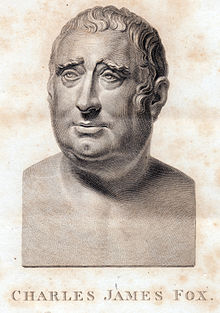
Engraving of Joseph Nollekens' "last bust" of Charles James Fox (1808)
Fox's biographer notes that these failed negotiations were "a stunning experience" for Fox, who had always insisted that France desired peace and that the war was the responsibility of King George and his fellow monarchs: "All of this was being proved false...It was a tragic end to Fox's career".[70] To observers such as John Rickman, "Charley Fox eats his former opinions daily and even ostentatiously showing himself the worse man, but the better minister of a corrupt government", and who further claimed that "He should have died, for his fame, a little sooner; before Pitt".[71]
Though the administration failed to achieve either Catholic emancipation or peace with France, Fox's last great achievement would be the abolition of the slave trade in 1807. Though Fox was to die before abolition was enacted, he oversaw a Foreign Slave Trade Bill in spring 1806 that prohibited British subjects from contributing to the trading of slaves with the colonies of Britain's wartime enemies, thus eliminating two-thirds of the slave trade passing through British ports.
On 10 June 1806, Fox offered a resolution for total abolition to Parliament: "this House, conceiving the African slave trade to be contrary to the principles of justice, humanity, and sound policy, will, with all practicable expedition, proceed to take effectual measures for abolishing the said trade..." The House of Commons voted 114 to 15 in favour and the Lords approved the motion on 24 June.[citation needed][72] Fox said that:
So fully am I impressed with the vast importance and necessity of attaining what will be the object of my motion this night, that if, during the almost forty years that I have had the honour of a seat in parliament, I had been so fortunate as to accomplish that, and that only, I should think I had done enough, and could retire from public life with comfort, and the conscious satisfaction, that I had done my duty.[3]
Death

In Comforts of a Bed of Roses (1806), Gillray depicts Death crawling out from under Fox's covers, entwined with a scroll inscribed "Intemperance, Dropsy, Dissolution".
Fox died – still in office – at Chiswick House, west of London, on 13 September 1806, not eight months after the younger Pitt. An autopsy revealed a hardened liver, thirty-five gallstones and around seven pints of transparent fluid in his abdomen.[3] Fox left £10,000-worth of debts, though this was only a quarter of the £40,000 that the charitable public had to raise to pay off Pitt's arrears.[3][73] Although Fox had wanted to be buried near his home in Chertsey, his funeral took place in Westminster Abbey on 10 October 1806, the anniversary of his initial election for Westminster in 1780. Unlike Pitt's, Fox's funeral was a private affair, but the multitude that turned out to pay their respects were at least as large as those at his rival's service.[3]
Private life

Le Coup de Maitre. – This Print copied from the French Original, is dedicated to the London Corresponding Society (1797): a caricature of Fox by Gillray, showing the Whig as a sans-culottes taking aim at the constitutional target of Crown, Lords and Commons.
[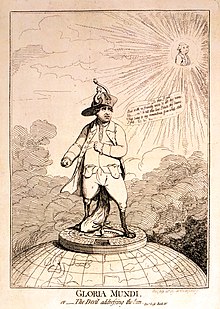
A caricature showing Fox standing on a roulette wheel perched atop a globe showing the British Isles and continental Europe. The implication is that his penniless state, indicated by turned-out pockets, is due to gambling.
Fox's private life (as far as it was private) was notorious, even in an age noted for the licentiousness of its upper classes. Fox was famed for his rakishness and his drinking; vices which were both indulged frequently and immoderately. Fox was also an inveterate gambler, once claiming that winning was the greatest pleasure in the world, and losing the second greatest. Between 1772 and 1774, Fox's father – shortly before dying – had to pay off £120,000 of Charles' debts; the equivalent of around £16 million in 2021. Fox was twice bankrupted between 1781 and 1784,[3] and at one point his creditors confiscated his furniture.[citation needed] Fox's finances were often "more the subject of conversation than any other topic."[74] By the end of his life, Fox had lost about £200,000 gambling.[75]
In appearance, Fox was dark, corpulent and hairy, to the extent that when he was born his father compared him to a monkey.[3] His round face was dominated by his luxuriant eyebrows, with the result that he was known among fellow Whigs as 'the Eyebrow.' Though he became increasingly dishevelled and fat in middle age, the young Fox had been very fashionable; he had been the leader of the 'Maccaroni' set of extravagant young followers of Continental fashions. Fox liked riding horses and watching and playing cricket, but his impulsive nature and considerable bulk led to his often being run out between wickets.[3]
Fox was frequently ridiculed – most famously by Gillray, for whom he served as a stock Jacobin villain. The King disliked Fox greatly, regarding him as beyond morality and the corrupter of his own eldest son, and the late eighteenth-century movements of Christian evangelism and middle-class 'respectability' also frowned on his excesses. Fox was apparently not greatly bothered by these criticisms and kept a collection of his caricatures, which he found amusing.[3] His friend, Frederick Howard, 5th Earl of Carlisle, said of him, since "the respect of the world was not easily retrievable, he became so callous to what was said of him, as never to repress a single thought, or even temper a single expression when he was before the public."[76] Particularly after 1794, Fox rarely consulted the opinions of anyone outside of his own circle of friends and supporters.[3]
Fox was also regarded as a notorious womaniser. In 1784 or 1785, Fox met and fell in love with Elizabeth Armistead, a former courtesan and mistress of the Prince of Wales who had little interest in politics or Parliament.[77] He married her in a private ceremony at Wyton in Huntingdonshire on 28 September 1795, but did not make the fact public until October 1802, and Elizabeth was never really accepted at court. Fox would increasingly spend time away from Parliament at Armistead's rural villa, St. Ann's Hill, near Chertsey in Surrey, where Armistead's influence gradually moderated Fox's wilder behaviour and together they would read, garden, explore the countryside and entertain friends. In his last days, the sceptical Fox allowed scriptural readings at his bedside in order to please his religious wife. She survived him by thirty-six years.[3]
Despite his celebrated flaws, history records Fox as an amiable figure. The Tory wit George Selwyn wrote that, "I have passed two evenings with him, and never was anybody so agreeable, and the more so from his having no pretensions to it". Selwyn also said that "Charles, I am persuaded, would have no consideration on earth but for what was useful to his own ends. You have heard me say, that I thought he had no malice or rancour; I think so still and am sure of it. But I think that he has no feeling neither, for anyone but himself; and if I could trace in any one action of his life anything that had not for its object his own gratification, I should with pleasure receive the intelligence because then I had much rather (if it were possible) think well of him than not".[78]
Sir Philip Francis said of Fox: "The essential defect in his character and the cause of all his failures, strange as it may seem, was that he had no heart".[78] Edward Gibbon remarked that "Perhaps no human being was ever more perfectly exempt from the taint of malevolence, vanity, or falsehood."[citation needed] Central to understanding Fox's life was his view that "friendship was the only real happiness in the world."[79] For Fox, politics was the extension of his activities at Newmarket and Brooks's to Westminster.[3] "Fox had little or no interest in the exercise of power."[1] The details of policy – particularly of economics – bored him, in contrast with the intensity of Burke's legal pursuit of Warren Hastings, and of Pitt's prosecution of the war against France. Moreover, the Foxites were "the witty and wicked" satellites of their leader, as much friends as political allies.[80]
In a letter published in The Daily Telegraph in 2020, Lord Lexden compared him to Prime Minister Boris Johnson, saying that "Johnson is an 18th Century figure in many ways" and that the two leaders may be commended in similar ways.[81]
Legacy
[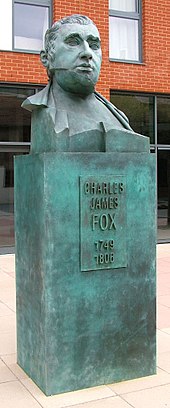
Bust of Fox in Chertsey, erected in 2005

Statue of Charles James Fox in Bloomsbury Square, London
In the 19th century, liberals portrayed Fox as their hero, praising his courage, perseverance and eloquence. They celebrated his opposition to war in alliance with European despots against the people of France eager for their freedom, and they praised his fight for liberties at home. The liberals saluted his fights for parliamentary reform, Catholic Emancipation, intellectual freedom, and justice for the Dissenters.
They were especially pleased with his fight for the abolition of the slave trade. More recent historians put Fox in the context of the 18th century, and emphasize the brilliance of his battles with Pitt.[82] A statue of Fox stands, alongside other notable Parliamentarians, in St Stephen's Hall in the Palace of Westminster.[83]
While not wholly forgotten today Fox is no longer the famous hero he had been, and is less well remembered than Pitt.[3] After 1794, the word 'Whig' gave way to the word "Foxite" as the self-description of the members of the opposition to Pitt. In many ways, the Pittite-Foxite division of Parliament after the French Revolution established the basis for the ideological Conservative-Liberal divide of the nineteenth century. Fox and Pitt went down in parliamentary history as legendary political and oratorical opponents who would not be equalled until the days of Gladstone and Disraeli more than half a century later. Even Fox's great rival was willing to acknowledge the old Whig's talents. When, in 1790, the comte de Mirabeau disparaged Fox in Pitt's presence, Pitt stopped him, saying, "You have never seen the wizard within the magic circle."[84]
The Fox Club was established in London in 1790 and held the first of its Fox dinners – annual events celebrating Fox's birthday – in 1808; the last recorded dinner took place at Brooks's in 1907.[3] As Charles Grey, 2nd Earl Grey asked a Newcastle-upon-Tyne Fox dinner in 1819: "What subject is there, whether of foreign or domestic interest, or that in the smallest degree affects our Constitution which does not immediately associate itself with the memory of Mr Fox?"[3]
Fox's name was invoked numerous times in debates by supporters of Catholic Emancipation and the Great Reform Act in the early nineteenth century. John Russell, 6th Duke of Bedford kept a bust of Fox in his pantheon of Whig grandees at Woburn Abbey and erected a statue of him in Bloomsbury Square. Sarah Siddons kept a portrait of Fox in her dressing room. In 1811, the Prince of Wales took the oaths of office as regent with a bust of Fox at his side. Whig households would collect locks of Fox's hair, books of his conflated speeches and busts in his likeness.

Memorial to Fox erected by William Chamberlayne on his estate at Weston, now within Mayfield Park, Southampton.
The town of Foxborough, Massachusetts, was named in honour of the staunch supporter of American independence. Fox is remembered in his home town of Chertsey by a bust on a high plinth (pictured left), erected in 2006 in a new development by the railway station. Fox is also commemorated in a termly dinner held in his honour at his alma mater, Hertford College, Oxford, by students of English, history and the romance languages.[citation needed]
A statue of Fox by Edward Hodges Baily was erected in Westminster Hall in 1857.[85]
Fox was the subject of the epigraph in John F. Kennedy's Pulitzer-prize winning book Profiles in Courage: "He well knows what snares are spread about his path, from personal animosity…and possibly from popular delusion. But he has put to hazard his ease, his security, his interest, his power, even his…popularity. …He is traduced and abused for his supposed motives. He will remember that obloquy is a necessary ingredient in the composition of all true glory: he will remember…that calumny and abuse are essential parts of triumph. …He may live long, he may do much. But here is the summit. He never can exceed what he does this day." — Edmund Burke’s eulogy of Charles James Fox for his attack upon the tyranny of the East India Company. House of Commons, 1 December 1783 [86]
Fox has been portrayed on screen by many actors: