Louis XV
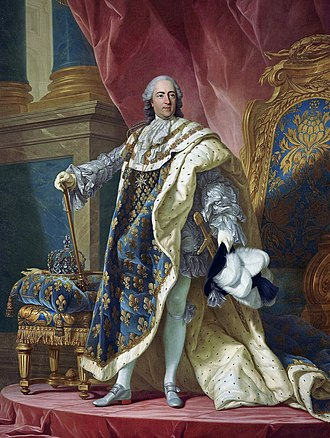
Achievements: During his reign, France regained the territories of Corsica and Lorraine.
Born: February 15, 1710; Versailles, France
Died: May 10, 1774; Versailles, France
Field & Discipline: Royalty; King
Language: French
Father: Louis, Duc de Bourgogne (Duke of Burgundy)
Mother: Marie Adelaide of Savoy
Siblings: one brother who died young
Spouse: Maria Lesczinska of Poland (daughter of Stanislaw Leczinska, King of Poland)
Children: Louise-Elisabeth (August 14, 1727 - December 6, 1759); Henriette-Anne (August 14, 1727 - February 10, 1752); Marie-Louise (July 28, 1728 - February 19, 1733); Louis (dauphin) (September 4, 1729 - December 20, 1765); Philippe (August 30, 1730 - April 17, 1733); Adélaide (March 23, 1732 - February 27, 1800); Victoire-Louise (May 11, 1733 - June 7, 1799); Sophie-Philippine (July 17, 1734 - March 3, 1782); Thérèse-Félicité (May 16, 1736 - September 28, 1744); Louise-Marie (July 5, 1737 - December 23, 1787)
Education: Royal tutor: André-Hercule de Fleury, the Bishop of Fréjus.
Life & Times:
Louis XV, King of France, was part of the Bourbon Dynasty. Born in Versailles, France, he became heir to the throne when his immediate family fell victim to the measles – a fatal disease at the time made worse doctors who, in attempting to save their patients, practiced such techniques as blood letting. Madame de Ventadour was governess to the royal children, a position she inherited from her mother, and is credited with having saved the life of Louis XV by hiding him from the doctors.
Louis XV's father was Duke Louis of Burgundy (1682-1712). The Duke's father was the Dauphin Louis (1661-1711) eldest son of King Louis XIV. Louis XV was the great-grandson of Louis XIV. When Louis XIV died in 1715, Louis XV was crowned King of France. The young boy was only five years old and under the care of his governess. A Regent, the Duke of Orleans, was appointed to care for affairs of state until the boy was old enough to rule. The Duke of Orleans proved to be a very capable manager. He moved the royal household back to Paris from Versailles. This was popular with the people of Paris and Louis the XV became “Louis the Beloved”.
Louis XV benefited from an excellent tutor, André-Hercule de Fleury (who later became Cardinal Fleury). Louis XV became an excellent horseman and learned Latin, geography, natural sciences, mathematics and the art of war. The King worked every day without exception, but he was an intelligent young man and enjoyed his studies.
He reached the age of majority (thirteen) in 1723, but continued to rule through his Regent. The Council of the Regency became the King’s Council but was still dominated by the Duke of Orleans. The king’s tutor, Fleury, was an important part of the Council. The king was married at age fifteen to Princess Maria Leczinska of Poland,. He followed the tradition of the time and had many mistresses. The most powerful of these was Mme de [mistress was] Pompadour*. She persuaded the King to support intellectuals and artists such as Voltaire and the Encyclopédie compilers – a group of intellectuals who set out to write down a compendium of human knowledge. Since these artists and intellectuals often contradicted the teachings of the Catholic Church, they were often controversial.
One of the great legacies of Louis XV was his tolerance for new thinking and his patronage of arts. It was Mme de Pompadour’s doctor, [mistress’ personal doctor was] Quesnay* who introduced the King to the intellectuals of the Encylopédie. In the later years of his reign, reforms were carried out that greatly improved the judicial system. The relationship between the Parliament and the King had been difficult for as long as anyone could remember. After the entire Parliament refused to convene, the King began to put together a new ministry. These reforms were needed and intellectuals, lawyers, and the people in general welcomed the change.
However, the government of France depended largely on the popularity of the King and the willingness of the other royals to follow his command. The ousted members of Parliament, many of whom were of royal blood, were furious with the reforms. They began to attack the character of the king.
The king was vulnerable to these personal attacks for two reasons: the loss of colonial territory, which put France behind England and other European countries in the race to build colonial empires; and Louis was seen as a kind who was ruled by his mistresses. Although many other men had mistresses, the King’s evident fondness for his mistresses was seen as a sign of weakness of character.
Louis XV made many secret treaties in an attempt to avoid costly wars. France had regained the territory of Lorraine after the death of Maria of Poland’s father. France had also gained authority over Corsica. Nonetheless, the loss of other territory was the prominent concern of the French people because of their long standing rivalry with Britain.
During the Seven Year’s War with Great Britain, France lost Canada to the British. Louisiana was ceded to the Spanish as compensation for the extensive losses to Britain. Although the borders of France remained secure and no expensive wars had been undertaken, France was perceived as having lost its great colonial empires.
Although Louis XV had made reforms to the ministry that favored many people and decentralized the King’s power, the dissatisfied members of the royal family were still spreading dissent. Their propaganda influenced the French populace, who resented the loss of territory to the British. These losses and the King’s perceived weakness for women caused the King to fall into disfavor. Louis XV, once the beloved, was now Louis XV the despised. The King died in 1774, generally hated by his subjects.
Louis XV outlived his son, and was succeeded by his oldest grandson, Louis XVI. It was under Louis XVI that the French Revolution occurred. Some historians believe that if Louis XV had just lived a few years longer, to see through tax and parliamentary reforms, the Revolution might have been avoided. The reign of Louis XV was more peaceful and prosperous in 1774, when he died, than in 1715 when he had become King. French culture was at its height throughout his reign: anyone anywhere with any pretensions to culture spoke French. The crafts, arts and intellectuals all owed the tolerant atmosphere of the era to Louis XV.
Extra Connections: His official royal historian was [official historian was] Voltaire*
A favorite was [a favorite was] Choiseul*
He commissioned music from [commissioned music from] Vivaldi*.
Assessment: Best known as the last King before the French Revolution. During his reign, France lost its great colonial empires: Canada, Louisiana and the left bank of the Mississippi River.
Oneliner: Louis XV, King of France
Bibliography:
- Bernier, Olivier,Louis the Beloved: the Life of Louis XV. Garden City, NY: Doubleday. 1984.