Quesnay
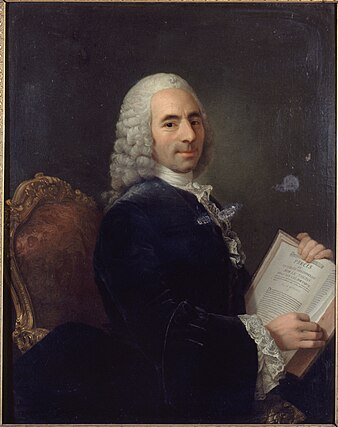
Achievements: The first theory of political economy in France
Born: June 4, 1694; Paris, France
Died: December 16, 1774; Versailles, France (Aged 82)
Field & Discipline: Politics; Economics
Language: French
Education: Unknown
Major Work:
"Tableau economique" (1758)
Life & Times:
Quesnay studied surgery at the public hospitals, and began to achieve some distinction as a surgeon. He arrived in Paris in 1730 as the private surgeon of the Duc de Villeroi and was soon recommended to Madame de [doctor to] Pompadour*, the king's mistress. Quesnay was made her private physician and was installed at Versailles as a consulting physician to [physician to] Louis XV*.
The king raised him to the nobility and gave him a coat of arms with three pansies on it: the word for pansy in French is “pensee” (“thoughts”)and Louis referred to Quesnay as his “thinker.”
Quesnay was also friendly with the Marechal de Noailles who introduced him to Peyronie, who founded the French College of Surgeons and appointed Quesnay its permanent secretary in 1737.
Quesnay wrote several medical treatises and was elected to the [member of] Royal Society* in London in 1752.
He eventually had to give up surgery because of gout and he concentrated on medicine instead. He moved among intellectual circles in Paris and began to study economics. He became the leader of a group known as the "economistes" because they were always arguing for economy in government expenditure. They held regular meetings and gave public lectures.
Social and economic matters were a major subject of discussion. [work related to] Rousseau*, for example, had written a discourse about social inequality in 1754. Quesnay's first economic publications, on farming and the production and distribution of grain, were written for [wrote for] Diderot’s* new Encylopaedia. These articles laid the foundations for his theory about the way in which economics worked in real life, and the measures needed to reinvigorate the French economy, depleted by war and rural depopulation.
Quesnay reduced economic issues to mathematical and scientific principles because his economic theory was based on the belief that the market process was governed by objective economic laws that had nothing to do with human behavior. Quesnay believed that these laws could be discovered by applying reason.
In 1758 he published the first edition of his "Tableau economique" in which diagrams were used to describe the distribution of wealth between the farmers and the rest of society. He described what he called the "net product" as the surplus remaining after wages, costs and current rate of profit had been deducted. In agriculture this related to the value of land, and the surplus provided a good source of taxation.
Circulation of wealth was important and [work related to] Condillac* was one of those who warned against the danger of a block in circulation which would destroy the system. In the following years, Quesnay modified and refined his ideas and produced further editions of his "tableau" until he had produced a complete diagrammatic model of dynamic economics.
Many people referred to the "Tableau economique" as "le zigzag.” However, his ideas also attracted others such as [admired by] Pierre-Simon du Pont* and [admired by] Turgot*.
In 1760 Quesnay and the Marquis de Mirabeau wrote a book called "The Theory of Taxation" in which they said there was no money in the royal treasury and its revenue was poorly managed. This annoyed Louis enough to put Mirabeau in jail.
Quesnay urged the adoption of "laisser-faire" (“leave things alone”) in all government, believing that there were natural laws which would order events. From 1767, some of his followers formed themselves into a group called the "Physiocrats" (“those who follow the laws of nature”).
After de Pompadour died (in 1764) Quesnay was out of favor at Versailles and at the end of the decade he gave up economics for geometry and became obsessed with trying to square the circle and trisect the angle.
The influence of the "Physiocrats" diminished, they were criticised by [criticized by] Voltaire* and Rousseau, and in 1772, two years before Quesnay died, their journal was suppressed.
Extra Connections: Influenced by the work of [influenced by] Tull*.
Knew [knew] Buffon*.
Assessment: He was a major influence in the development of laissez-faire economics.
Oneliner: Francois Quesnay, inventor of “laissez-faire.”
Bibliography:
- Blaug, Mark, ed., Pioneers in Economics 10, Francois Quesnay, 1694-1774), Volumes I and II, Edward Elgar Publishing Ltd., Hampshire, England, 1991.
- Hill, Malcolm, Statesman of the Enlightenment, The Life of Anne-Robert Turgot, Othila Press, London, 1999.
- Meek, Ronald L, The Economics of Physiocracy, George Allen & Unwin Ltd., London, 1962.
Father: Unknown
Mother: Unknown
Siblings: Unknown
Spouse: Unknown
Children: Unknown