De Gaulle
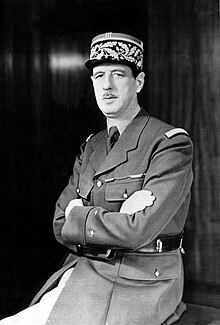
Charles Andre Joseph Marie de Gaulle
Achievements: Leader of the Free French during the Second World War, later President of France
Born: November 22, 1890; Lille, France
Died: November 9 , 1970; Colombey-les-deux-Eglises, France (Aged 79)
Field & Discipline: Military; Politics; Soldier; Statesman
Language: French
Father: Henri de Gaulle
Mother: Jeanne Maillot-Delannoy
Siblings: Xavier; Jacques; Pierre; Marie-Agnes
Spouse: Yvonne Vendroux
Children: Philippe; Elizabeth; Anne
Education: Jesuit school, Paris (Brothers of the Christian Schools of St. Thomas Aquinas); Jesuit College of the Immaculate Conception, Paris; Jesuit College of the Sacred Heart, Antoing, Belgium; Stanislas College, Paris; Military Academy, Saint-Cyr, France
Major Work:
War memoirs:
"The Call to Honor"
"Unity"
"Salvation"
"Discord Among the Enemy"
"The Edge of the Sword"
"The Army of the Future"
"France and Her Army"
Life & Times:
During World War I, De Gaulle was wounded and taken prisoner by the Germans in 1916. In captivity, he wrote "Discord Among the Enemy" (1924). After the war, he was attached to Marshal Henri Philippe Petain's staff, and during the 1930s, wrote several military books.
As the Second World War approached, he urged French authorities to mechanize the army and build air power. In June, 1940, as undersecretary of state for war, appointed by Premier Reynaud, he proposed the government escape if necessary to North Africa, and function from there. Reynaud was replaced by Marshal Petain, who was committed to an armistice with the Germans. Considering armistice a dishonor, De Gaulle took refuge in England.
On June 18, 1940, de Gaulle appealed to his countrymen by radio to continue to fight Germany. It was the beginning of his role as the symbol of the Free French. In July, a French court martial sentenced him to death for desertion. British Prime Minister [supported by] Churchill* recognized the importance of de Gaulle's symbolic role, but President [difficulties with] Franklin D. Roosevelt* saw him as a hindrance to U.S. relations with Petain's Vichy government.
In May, 1943, de Gaulle moved his headquarters to French North Africa, where he organized the French Committee of National Liberation. By 1944, he was recognized as a political force within the resistance in France, and in June, 1944, he transformed the Committee of National Liberation into a provisional government.
A week after D-Day (June, 1944), when the allies launched their massive invasion of the continent, de Gaulle arrived in France and on August 25, entered Paris at the head of the Free French.
After the war ended in 1945, de Gaulle was elected president of the provisional government. His government initiated major economic reforms, demanded by the largely left-wing resistance forces, including the nationalization of some industries. De Gaulle insisted upon a strong executive and when the constitution of the Fourth Republic was passed in 1946, he resigned in protest, believing the legislative body was overwhelming the executive.
In 1947, de Gaulle formed the RPF, a national coalition that he promised would be "above parties.” The RPF swept the municipal elections, but the left-wing saw it as a threat and resisted it, preventing it from making much impact. In 1953, de Gaulle resigned again.
In 1954, France's war against the communists in Indo-China was going badly and the national unrest in the French territory of Algeria was just beginning. In 1958, French military leaders and the European civilian settlers in Algeria joined forces to halt any government move to make concessions to Algerian nationalists.
Civil war appeared imminent and de Gaulle was seen as the only man who had the stature to avert disaster. In June, 1958, the National Assembly named him prime minister and gave him emergency powers, including the right to prepare a new constitution.
The new constitution, which adopted a presidential style of government, was presented to the electorate in September 1958 and received 83% of the vote. In December, de Gaulle was elected President of the Fifth Republic.
De Gaulle's presidential powers gave him the final say in foreign affairs, national defence, and key domestic issues as well as the power to rule by decree in emergencies, dissolve the legislative assembly, and call new elections.
In the 1960s, with the French economy in particularly good shape, de Gaulle blocked Britain's entry to the European Economic Community, determined to make France the leader of Europe, independent of both the U.S. and the Soviet Union.
With unrest getting more heated in Algeria, de Gaulle began to consider granting independence to Algeria, a move that turned France's right-wing against him. The right-wing Secret Army Organization (the OAS) conducted terrorist acts in Paris and made attempts on de Gaulle's life.
But by 1962, he had obtained a ceasefire with the Algerian National Liberation Front and in 1963 called a popular referendum on Algerian independence. It was voted in by a wide margin. Over the next few years, the rest of the French possessions in North Africa became independent.
De Gaulle's autocratic manner and strong government had always irked many members of the French parliament and when he decided to revise the constitution so that it would allow the president to elected by direct popular vote, he bypassed the National Assembly (parliament) and insisted the revision be put to a popular referendum. When much of the Assembly objected, de Gaulle dissolved parliament and called new elections. His revision was accepted in a popular referendum and the Gaullists did well in elections at the end of 1962.
In 1965, de Gaulle was elected for another seven-year term, but his excessive nationalism and arrogance worried many. Political protesters took to the streets and workers went on strike. Even so, de Gaulle carried on with his agenda.
He forced NATO (North Atlantic Treaty Organization) troops to leave French soil, criticized American involvement in Vietnam, encouraged the French Canadians in Quebec in their separatist aims, and showed sympathy for the Arabs in the war with Israel.
In 1968, Paris students occupied the Sorbonne, demanding educational reforms. Their demonstrations set off a series of massive labor strikes, involving more than eight million workers, over one-third of the working force, and the economy was paralyzed. But by stressing the threat of Communism, the Gaullists were elected with a landslide victory in the next election. Shortly after, however, de Gaulle's constitutional reforms were rejected in a referendum and he resigned the presidency.
Extra Connections:
During WW2 de Gaulle accompanied the deputy Soviet leader Vyacheslav Molotov on a tour of the former battleground at Stalingrad, where he was deeply moved at the scene of carnage he witnessed and surprised Molotov by referring to "our joint sacrifice".
Met [met] Khruschev*.
Was a friend of [a pal of] Malraux*
He served under [served under] Eisenhower*
He was hostile to President [difficulties with] Kennedy*
Assessment: As a statesman, he concentrated on restoring the status of France as a great power, and was the architect of France's Fifth Republic
Oneliner: Charles de Gaulle, President of France
Bibliography:
- Williams, Charles, The Last Great Frenchman, Little, Brown & Company, London, 1993.
Pantheon rank 224
Father: Henri de Gaulle
Mother: Jeanne Maillot-Delannoy
Siblings: Xavier; Jacques; Pierre; Marie-Agnes
Spouse: Yvonne Vendroux
Children: Philippe; Elizabeth; Anne