Constant, Benjamin
Henri-Benjamin Constant de Rebecque[a]^ (25 October 1767 – 8 December 1830), or simply Benjamin Constant, was a Swiss and French[3]^ political thinker, activist and writer on political theory and religion.
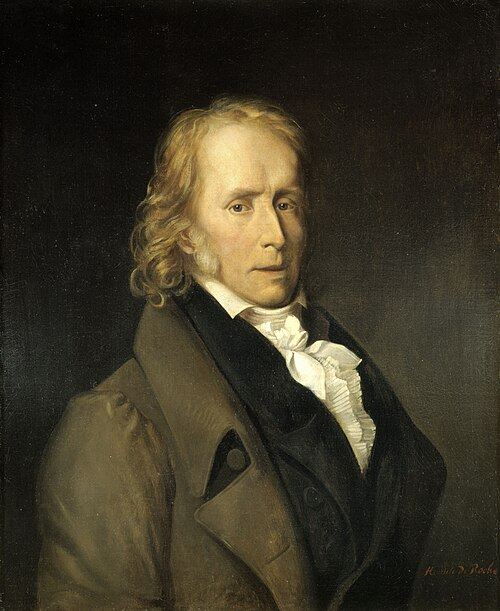
A committed republican from 1795, Constant backed the coup d'état of 18 Fructidor (4 September 1797) and the following one on 18 Brumaire (9 November 1799). He became the leader of the Liberal opposition in 1800, during the Consulate. Having upset Napoleon and left France to go to Switzerland then to the Kingdom of Saxony, Constant nonetheless sided with him during the Hundred Days, drafting the Charter of 1815, and became politically active again during the Bourbon Restoration. He was elected to the Chamber of Deputies in 1818 and remained in office until his death in 1830. As the head of the Liberal opposition, known as Indépendants, Constant was one of the most notable orators of the Chamber as a proponent of the parliamentary system. During the July Revolution, he was a supporter of Louis Philippe I ascending the throne.
Besides his numerous essays on political and religious themes, Constant also wrote on romantic love. His autobiographical Le Cahier rouge (1807) gives an account of his love for Madame de Staël, whose protégé and collaborator he became, especially in the Coppet circle, and a successful novella, Adolphe (1816), are good examples of his work on this topic.[4]^ Constant was a fervent liberal of the early 19th century.[5][6]^ He refined the concept of liberty, defining it as a condition of existence that allowed the individual to turn away interference from the state or society.[7]^
Biography
Henri-Benjamin Constant was born in Lausanne to the Constant de Rebecque family, descendants of French Huguenots who had fled from Artois[citation^ ^needed]^ to Switzerland during the French Wars of Religion in the 16th century. His father, Jules Constant de Rebecque, served as a high-ranking officer in the Dutch States Army, like his grandfather, his uncle and his cousin Jean Victor de Constant Rebecque. When Constant's mother, Henriette-Pauline de Chandieu-Villars, died soon after his birth, both his grandmothers took care of him. Private tutors educated him in Brussels (1779) and in the Netherlands (1780).
While at the University of Erlangen (1783), he gained access to the court of Duchess Sophie Caroline Marie of Brunswick-Wolfenbüttel. He had to leave after an affair with a girl, and moved to the University of Edinburgh. There he lived at the home of Andrew Duncan and was befriended by James Mackintosh and Malcolm Laing.[8][9]^ When he left the city, he promised to pay back his gambling debts.
In 1787, Constant returned to continental Europe, travelling on horseback through Scotland and England. In those years European nobility, with their prerogatives, came under heavy attack from those, like Constant, who were influenced by Jean-Jacques Rousseau's Discourse on Inequality. Constant's family criticized him for leaving out part of his last name.[10]^
In Paris, at the home of Jean-Baptiste-Antoine Suard he became acquainted with Isabelle de Charriere, a 46-year-old Dutch woman of letters, who later helped publish Rousseau's Confessions, and who knew his uncle David-Louis Constant de Rebecque extremely well by virtue of a 15-year correspondence. While he stayed at her home in Colombier Switzerland, together they wrote an epistolary novel. She acted as a maternal mentor to him until Constant's appointment to the court of Charles William Ferdinand, Duke of Brunswick-Wolfenbüttel that required him to move north. He left the court when the War of the First Coalition began in 1792.
In Braunschweig, Constant married Wilhelmina von Cramm, but she divorced him in 1793. In September 1794, he met and became interested in the famous and wealthy already married Germaine de Staël, herself brought up on the principles of Rousseau. They both admired Jean Lambert Tallien and Talleyrand. Their intellectual collaboration between 1795 and 1811 made them one of the most celebrated intellectual couples of the time.[11]^
Paris

Anonymous portrait, 1810s
After the Reign of Terror in France (1793–1794), Constant became an advocate of bicameralism and of an assembly like the Parliament of Great Britain. In revolutionary France this strand of political thought resulted in the Constitution of the Year III, the Council of Five Hundred and the Council of Ancients. In 1799, after 18 Brumaire, Constant was reluctantly appointed, on the insistence of Abbe Sieyes, by Napoleon Bonaparte to the Tribunat, despite grave reservations on the latter's part. Eventually, in 1802, the first consul confirmed in his doubts, forced Constant to withdraw because of the tenor of his speeches and his close connection with Mme de Staël.[12]^ Constant became acquainted with Julie Talma, the salonnière wife of actor François-Joseph Talma, who wrote many letters to him of compelling human interest.[13]^
In 1800, the Plot of the rue Saint-Nicaise, an attempt to assassinate Napoleon, failed. Nevertheless, in 1803, at a time when Britain and France were at peace, Jean Gabriel Peltier, while living in England, argued that Napoleon should be assassinated.[14]^ The lawyer James Mackintosh defended the French refugee Peltier against a libel suit instigated by Napoleon – then First Consul of France. Mackintosh's speech was widely published in English and also across Europe in a French translation by Madame de Staël. She was forced to leave Paris as a result.
De Staël, disappointed by French rationalism, became interested in German romanticism. She and Constant set out for Prussia and Saxony and travelled with her two children to Weimar. Duchess Anna Amalia of Brunswick-Wolfenbüttel welcomed them the day after their arrival. In Weimar they met Friedrich von Schiller. Due to illness Johann Wolfgang Goethe at first hesitated.[15]^ In Berlin, they met August Wilhelm Schlegel, and his brother, Friedrich Schlegel. Constant left de Staël in Leipzig and in 1806 lived in Rouen and Meulan, where he started work on his novel Adolphe. In 1808, he secretly married Caroline von Hardenberg, a woman who had been divorced twice, (she was related to Novalis and to Karl August von Hardenberg). He moved back to Paris in 1814, where the French Restoration took place and Louis XVIII had become king. As a member of the Council of State, Constant proposed a constitutional monarchy.
He became friends with Madame Récamier while he fell out with Germaine de Staël, who had asked him to pay back his gambling debts when their daughter, Albertine, married Victor de Broglie. During the Hundred Days of Napoleon, who had become more liberal, Constant fled to the Vendée, but returned when he was invited several times to the Tuileries to set up changes for the Charter of 1815.
After the Battle of Waterloo (18 June 1815), Constant moved to London with his wife. In 1817, the year when Madame de Staël died, he was back in Paris and was elected to the Chamber of Deputies, the lower legislative house of the Restoration-era government. One of its most eloquent orators, he became a leader of the parliamentary bloc first known as the Independents and later as "liberals". He became an opponent of Charles X of France during the Restoration between 1815 and 1830.[16]^
In 1822, Goethe praised Constant in the following terms:
I spent many instructive evenings with Benjamin Constant. Whoever recollects what this excellent man accomplished in [later] years, and with what zeal he advanced without wavering along the path which, once chosen, was forever followed, realizes what noble aspirations, as yet undeveloped, were fermenting within him.[17]^
A Freemason,[18]^ in 1830 King Louis Philippe I gave Constant a large sum of money to help him pay off his debts, and appointed him to the Conseil d'Etat.[citation^ ^needed]^ Constant is said to have fathered Albertine de Staël-Holstein (1797–1838), who later married Victor de Broglie (1785–1870). Constant died in Paris on 8 December 1830 and was buried in the Père Lachaise cemetery.[19]^