Rousseau
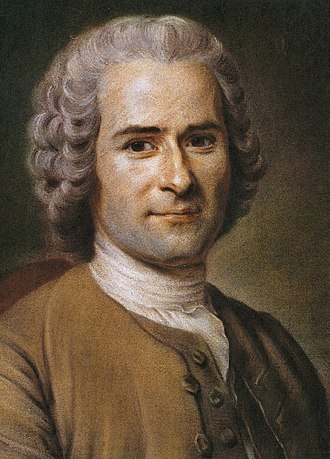
Name: Jean Jacques Rousseau
Achievements: One of the great Romantic philosophers, who introduced the concept of the Noble Savage.
Born: June 28, 1712; Geneva, Switzerland
Died: July 2, 1778; Ermenonville, France (Aged 66)
Field & Discipline: Art; Literature; Philosophy; Writer
Language: French
Father: Isaac Rousseau
Mother: Suzanne Bernard
Siblings: Francois
Spouse: Therese Levasseur
Children: 5 (all put into Foundling Hospital)
Education: Informally at home; Country school, Bossey
Major Work:
"Emile" (1762)
"The Social Contract' (1762)
Life & Times:
In 1725 Rousseau met the Baroness de Warens, a pretty twenty-nine year-old adventuress who had left her husband and taken his money. She befriended Rousseau and over the next fifteen years provided a base from which he made long wandering journeys, earning a living by his wits. His relationship with the Baroness was variously that of protegee, lover and steward.
At her country house in Savoy he began to read seriously, write poetry and to study and compose music. In 1741, through the Baroness, Rousseau was employed as a tutor to the children of the Prevot-General of Lyonnais, where he met his employer's brother, the philosopher [met] Condillac*.
In 1742 Rousseau went to Paris for the first time and struck up a friendship with [a pal of] Diderot*. The following year Rousseau accompanied the French Ambassador to Venice and for the first time came into contact with politics and political institutions. He returned to Paris in 1744 and set up house with Therese Levasseur, who bore him five children.
In Paris, Rousseau became part of a circle involved in writing Diderot’s Encylopedia. Although Rousseau wrote some articles on music for Diderot, Rousseau wrote an opera and was engaged by [hired by] Richlieu* to recast [rewrote] Rameau's* score for an opera based on a tragedy written by [work related to]Voltaire*. Rousseau championed Italian opera and praised it for its use of melody while Rameau upheld the view of French classicism that the rules of harmony should prevail over melody.
Rousseau's interest in social and philosophical questions was stimulated by the contacts with men such as the economist [knew] Quesnay* and the philosopher [knew] d'Holbach*.
He began to be known as a writer after publishing his prize essay entitled "A Discourse on the Sciences and Arts" (1750) in which he first set out his view that man deteriorated throughout history because society and institutions corrupted his innate qualities; the more complex and advanced the society, the more corrupting the influence they had on the natural good in men.
In 1753 he wrote "The Origin of Inequality" in which he distinguished between natural inequality (such as the possession of talent and good health), and social inequality (which depends on rank, inherited wealth, ownership of property etc). His views were criticized by the scientist [criticized by] Bonnet* who claimed that modern civilized society is natural.
In 1754 Rousseau returned briefly to Geneva to reclaim his citizen's rights and in 1756 he moved out of Paris to a cottage near Montmorency to live the simple life. Rousseau had taken great offence at a pamphlet written about Geneva by [offended by] d'Alembert* at the suggestion of Voltaire, and in 1758 he published his "Letter to Monsieur d'Alembert" in which he defended the Genevan clergy.
During the next six years, Rousseau wrote his most famous three works. "New Heloise"(1761) was a romantic novel in which rigid social and class divisions are contrasted with the natural feelings of the characters. Some years earlier, a novel in the same vein by the English writer [work related to] Samuel Richardson* had been an enormous success in France and "The New Eloise" was as successful.
"Emile" (1762) was an educational treatise written as a fictionalized account of the upbringing of an imaginary child by his tutor. Rousseau's basic principle of education was that it should interfere as little as possible with the natural development of the child. The education given should be suited to the individual child rather than vice versa, and a child's bad behaviour was the result of interference by society. Teachers who taught by rote stifled the innate creativity of their pupils. The imposition of rules did not allow a child to develop its own natural virtues. Within this framework the dogmas and authority of conventional religion were discarded in favour of a religion which laid stress on the individual conscience.
Rousseau's political treatise, the "Social Contract", was also published in 1762. It opened with the famous sentence, "Man is born free, yet everywhere he is in chains" and discussed the ideal state for achieving the freedom necessary to allow man's natural goodness to flourish. Rousseau took the Geneva of Calvin's day as his republican model and criticised the contemporary government there.
The “social contract” referred to a pledge between individuals and the state whereby individuals exchanged their natural rights for civil rights. They surrendered their freedom in return for a society in which they obeyed self-imposed laws enacted for the common interest even when such an action would go against their own individual interest. Rousseau inspired many of the attempts at communal living in the early nineteenth century, such as that of [inspired] Robert Owen* in Indiana.
"Emile" offended the Church and was condemned to be burned. Rousseau was forced to flee from Paris and went to Switzerland in 1762 but the government there had been offended by his description of them as the "twenty-five despots” in the "Social Contract" and Rousseau had to leave the district of Bern. He settled for a time in the village of Motiers where he received many visitors including the English writer [visited by] Boswell*.
At the end of 1765 he went to England at the invitation of the philosopher [corresponded with] Hume* with whom he had been corresponding. Rousseau was feted in London and having expressed his desire to live in the country, eventually settled in the house of a well-wisher in the north of England (Dovedale, Derbyshire) where he met, among other eminent men, the physician [met] Erasmus Darwin*.
Rousseau was warmly welcomed in England and admirers such as Daniel Malthus, the father of [met father of] Malthus* who was brought up according to Roussseau's precepts, tried to persuade him to take up the offer of a pension. Rousseau managed to quarrel with nearly everybody and returned to France in 1767.
He completed his autobiography, "Confessions," in 1770. In the same year, Rousseau finally returned to Paris in 1770, having visited Montbard on the way, where he was received by the naturalist [visited] Buffon*. He was left alone by the authorities and spent the last years of his life copying music to supplement his pension and indulging his passions for botanising and opera.
He once went out with [knew] Bernard de Jussieu* as far as Montmorency and he attended a rehearsal of "Iphigenia" by [met] Gluck*. Rousseau was received in society and was an object of fascination for many, including [influenced] de Stael* who later achieved notoriety with her book on Rousseau.
Extra Connections: He knew the philosopher [knew] Helvetius*
Visited by the writer [visited by] Goldoni*.
Met the painter [met] Fuseli* in England.
The American critic [written about by] Babbitt* wrote about him.
Influenced [influenced] Napoleon* , educators [influenced] FWA Froebel* and [influenced] Pestalozzi*, and geographer [influenced] Ritter*.
His work related to [work related to] Herder*
[his funeral music conducted by] Salieri* conducted his funeral music.
His ideas affected the upbringing of [influenced] Magendie*
Was attacked in a pamphlet by mystery man [attacked by]Dutens*
Assessment: Rousseau marks the end of the celebration of Reason and the beginning of the Romanticism. He is also associated with the movement towards child-centred education, and the idealisation of freedom as seen in the French Revolution.
Oneliner: Jean Jacques Rousseau, great Romantic philosopher
Bibliography:
- Green, FC, Jean-Jacques Rousseau, A Critical Study of His Life and Writings, Cambridge University Press, Cambridge, 1955.
Jean-Jacques Rousseau - Wikipedia