Battery
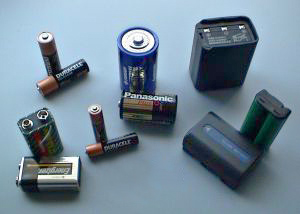
Batteries are generally sorted into two different groups: the primary battery, which is thrown away after use, and a secondary or storage battery, which is rechargeable. Batteries basically work by having two different metals submerged in an electrolyte solution. An electrolyte is a liquid that permits an easy flow of electrons through it. The two metals consist of an anode and a cathode.
The anode gives up electrons and sends them through a wire attached to the cathode. The cathode in the meantime takes the electrons from the anode and transfers some back through the electrolyte solution to create a current of electrons. Eventually the metals fully oxidize and reduce; then the battery has been used up.
The invention of the first battery is usually associated with Alessandro [first developed by] Volta*, an Italian physicist who experimented with static electricity. He created the first battery known as the “voltaic pile” consisting of alternating zinc and silver discs separated by sodium hydroxide cloth.
English scientist Michael Faraday used the voltaic pile to do experiments and derived the “quantitative laws of electrochemistry”. These laws showed the relationship between the amount of electrode material and the amount of electric power that will be generated. The most notable batteries in the commercial market are lithium batteries (pioneered by Exxon research before they abandoned them for climate denial). The nickel-hydrogen cell is the type used in spacecraft.
ONELINER: The battery
BIBLIOGRAPHY:
- Faraday.” Encyclopædia Britannica. 2004. Encyclopædia Britannica Online.29 Jan. 2004 [http://search.eb.com/eb/article?eu=34313].
...Main article: History of the battery
Invention
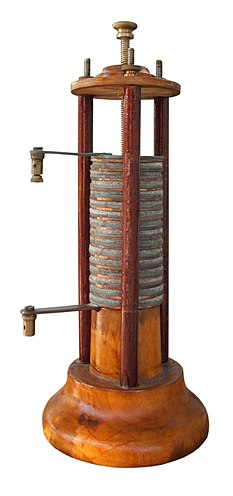
A voltaic pile, the first battery
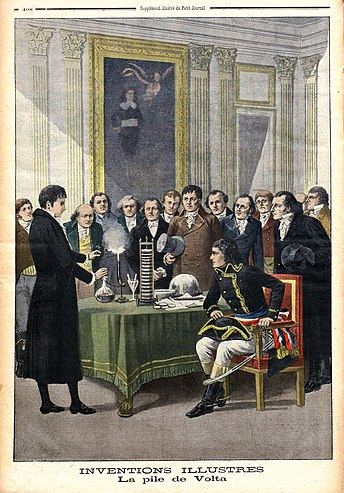
Italian physicist Alessandro Volta demonstrating his pile to French emperor Napoleon Bonaparte
In the 1930s, the director of the Bagdad Museum and Iraq Antiquities Department Wilhelm König reported the discovery of the Baghdad battery, a first century device consisting of a ceramic pot, copper, and iron. His assumption was that it was used for electroplating, but later theories suggest it may have been a medical device used for electrotherapy.[4]
Benjamin Franklin first used the term "battery" in 1749 when he was doing experiments with electricity using a set of linked Leyden jar capacitors. [5] Franklin grouped a number of the jars into what he described as a "battery", using the military term for weapons functioning together. [6] By multiplying the number of holding vessels, a stronger charge could be stored, and more power would be available on discharge.
Italian physicist Alessandro Volta built and described the first electrochemical battery, the voltaic pile, in 1800.[7] This was a stack of copper and zinc plates, separated by brine-soaked paper disks, that could produce a steady current for a considerable length of time. Volta did not understand that the voltage was due to chemical reactions. He thought that his cells were an inexhaustible source of energy,[8] and that the associated corrosion effects at the electrodes were a mere nuisance, rather than an unavoidable consequence of their operation, as Michael Faraday showed in 1834.[9]
Although early batteries were of great value for experimental purposes,[10] in practice their voltages fluctuated and they could not provide a large current for a sustained period. The Daniell cell, invented in 1836 by British chemist John Frederic Daniell, was the first practical source of electricity, becoming an industry standard and seeing widespread adoption as a power source for electrical telegraph networks.[11] It consisted of a copper pot filled with a copper sulfate solution, in which was immersed an unglazed earthenware container filled with sulfuric acid and a zinc electrode.[12]
These wet cells used liquid electrolytes, which were prone to leakage and spillage if not handled correctly. Many used glass jars to hold their components, which made them fragile and potentially dangerous. These characteristics made wet cells unsuitable for portable appliances. Near the end of the nineteenth century, the invention of dry cell batteries, which replaced the liquid electrolyte with a paste, made portable electrical devices practical.[13]
Batteries in vacuum tube devices historically used a wet cell for the "A" battery (to provide power to the filament) and a dry cell for the "B" battery (to provide the plate voltage).