Volta 2
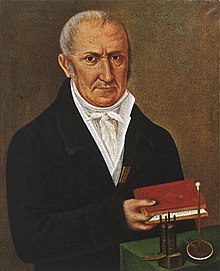
Alessandro Giuseppe Antonio Anastasio Volta (/ˈvoʊltə, ˈvɒltə/, Italian: [alesˈsandro ˈvɔlta]; 18 February 1745 – 5 March 1827) was an Italian physicist, chemist and lay Catholic who was a pioneer of electricity and power[2][3][4] who is credited as the inventor of the electric battery and the discoverer of methane.
He invented the voltaic pile in 1799, and reported the results of his experiments in 1800[5] in a two-part letter to the president of the Royal Society.[6][7] With this invention Volta proved that electricity could be generated chemically and debunked the prevalent theory that electricity was generated solely by living beings. Volta's invention sparked a great amount of scientific excitement and led others to conduct similar experiments, which eventually led to the development of the field of electrochemistry.[7]
Volta also drew admiration from Napoleon Bonaparte for his invention, and was invited to the Institute of France to demonstrate his invention to the members of the institute. Volta enjoyed a certain amount of closeness with the emperor throughout his life and he was conferred numerous honours by him.[1] Volta held the chair of experimental physics at the University of Pavia for nearly 40 years and was widely idolised by his students.[1]
Despite his professional success, Volta tended to be a person inclined towards domestic life and this was more apparent in his later years. At this time he tended to live secluded from public life and more for the sake of his family until his eventual death in 1827 from a series of illnesses which began in 1823.[1] The SI unit of electric potential is named in his honour as the volt.
Early Life and Works
Volta was born in Como, a town in northern Italy, on 18 February 1745. In 1794, Volta married an aristocratic lady also from Como, Teresa Peregrini, with whom he raised three sons: Zanino, Flaminio, and Luigi. His father, Filippo Volta, was of noble lineage. His mother, Donna Maddalena, came from the family of the Inzaghis.[8]
In 1774, he became a professor of physics at the Royal School in Como. A year later, he improved and popularised the electrophorus, a device that produced static electricity. His promotion of it was so extensive that he is often credited with its invention, even though a machine operating on the same principle was described in 1762 by the Swedish experimenter Johan Wilcke.[2][9] In 1777, he travelled through Switzerland. There he befriended H. B. de Saussure.
In the years between 1776 and 1778, Volta studied the chemistry of gases. He researched and discovered methane after reading a paper by Benjamin Franklin of the United States on "flammable air". In November 1776, he found methane in the marshes of Angera on Lake Maggiore,[10] and by 1778 he managed to isolate methane.[11] He devised experiments such as the ignition of methane by an electric spark in a closed vessel.
Volta also studied what we now call electrical capacitance, developing separate means to study both electrical potential difference (V) and charge (Q), and discovering that for a given object, they are proportional.[12] This is called Volta's Law of Capacitance, and for this work the unit of electrical potential has been named the volt.[12]
In 1779, he became a professor of experimental physics at the University of Pavia, a chair that he occupied for almost 40 years.[1] Volta's lectures were so crowded with students that the subsequent emperor Joseph II ordered the construction (based on a project by Leopold Pollack) of a new "physical theater", today the "Aula Volta".[13] Furthermore, the emperor granted Volta substantial funding to equip the physics cabinet with instruments, purchased by Volta in England and France. At the University History Museum of the University of Pavia there are 150 of them, used by Alessandro Volta.[14][15]
Volta and Galvani
Luigi Galvani, an Italian physicist, discovered something he named, "animal electricity" when two different metals were connected in series with a frog's leg and to one another. Volta realised that the frog's leg served as both a conductor of electricity (what we would now call an electrolyte) and as a detector of electricity. He also understood that the frog's legs were irrelevant to the electric current, which was caused by the two differing metals.[16] He replaced the frog's leg with brine-soaked paper, and detected the flow of electricity by other means familiar to him from his previous studies. In this way he discovered the electrochemical series, and the law that the electromotive force (emf) of a galvanic cell, consisting of a pair of metal electrodes separated by electrolyte, is the difference between their two electrode potentials (thus, two identical electrodes and a common electrolyte give zero net emf). This may be called Volta's Law of the electrochemical series.
In 1800, as the result of a professional disagreement over the galvanic response advocated by Galvani, Volta invented the voltaic pile, an early electric battery, which produced a steady electric current.[17] Volta had determined that the most effective pair of dissimilar metals to produce electricity was zinc and copper. Initially he experimented with individual cells in series, each cell being a wine goblet filled with brine into which the two dissimilar electrodes were dipped. The voltaic pile replaced the goblets with cardboard soaked in brine.
Early battery
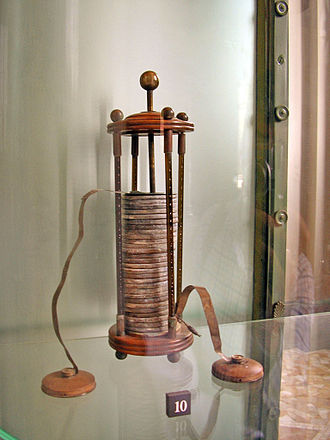
In announcing his discovery of the voltaic pile, Volta paid tribute to the influences of William Nicholson, Tiberius Cavallo, and Abraham Bennet.[18]
The battery made by Volta is credited as one of the first electrochemical cells. It consists of two electrodes: one made of zinc, the other of copper. The electrolyte is either sulfuric acid mixed with water or a form of saltwater brine. The electrolyte exists in the form 2 H+ and SO2−4. Zinc metal, which is higher in the electrochemical series than both copper and hydrogen, is oxidized to zinc cations (Zn2+) and creates electrons that move to the copper electrode. The positively charged hydrogen ions (protons) capture electrons from the copper electrode, forming bubbles of hydrogen gas, H2. This makes the zinc rod the negative electrode and the copper rod the positive electrode. Thus, there are two terminals, and an electric current will flow if they are connected. The chemical reactions in this voltaic cell are as follows:
Zinc:Zn → Zn2+ + 2e−Sulfuric acid:2H+ + 2e− → H2
Copper metal does not react, but rather it functions as a catalyst for the hydrogen-gas formation and an electrode for the electric current. The sulfate anion (SO2−4) does not undergo any chemical reaction either, but migrates to the zinc anode to compensate for the charge of the zinc cations formed there. However, this cell also has some disadvantages. It is unsafe to handle, since sulfuric acid, even if diluted, can be hazardous. Also, the power of the cell diminishes over time because the hydrogen gas is not released. Instead, it accumulates on the surface of the copper electrode and forms a barrier between the metal and the electrolyte solution.
Last Years and Retirement
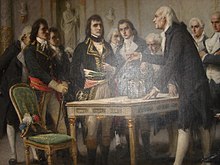
Volta explains the principle of the "electric column" to Napoleon in 1801
In 1809, Volta became associated member of the Royal Institute of the Netherlands.[19] In honour of his work, Volta was made a count by Napoleon Bonaparte in 1810.[2]
Volta retired in 1819 to his estate in Camnago, a frazione of Como, Italy, now named "Camnago Volta" in his honour. He died there on 5 March 1827, just after his 82nd birthday.[20] Volta's remains were buried in Camnago Volta.[21]
Legacy
Volta's legacy is celebrated by the Tempio Voltiano memorial located in the public gardens by the lake. There is also a museum that has been built in his honour, which exhibits some of the equipment that Volta used to conduct experiments.[22] Nearby stands the Villa Olmo, which houses the Voltian Foundation, an organization promoting scientific activities. Volta carried out his experimental studies and produced his first inventions near Como.[23]
In the Old Campus of the University of Pavia there is the classroom (Aula Volta) commissioned by Emperor Joseph II to Leopoldo Pollack in 1787 for the lectures of Alessandro Volta,[13] while in the University History Museum there are many scientific instruments that belonged to Volta and his chair and his blackboard.[14]
His image was depicted on the Italian Lire 10,000 note (1990–1997) along with a sketch of his voltaic pile.[24]
In late 2017, Nvidia announced a new workstation-focused GPU microarchitecture called Volta.
The electric eel species Electrophorus voltai, described in 2019 and the strongest bioelectricity producer in nature, was named after Volta.[25]
Religious Beliefs
Volta was raised as a Catholic and for all of his life continued to maintain his belief.[26] Because he was not ordained a clergyman as his family expected, he was sometimes accused of being irreligious and some people have speculated about his possible unbelief, stressing that "he did not join the Church",[27] or that he virtually "ignored the church's call".[28] Nevertheless, he cast out doubts in a declaration of faith in which he said...
Wikipedia
Knowledge Web:
Achievements: Invented the battery
Born: February 18, 1745; Como, Italy
Died: March 5, 1827 (Aged 82)
Field & Discipline: Science; Physics; Electricity; Invention
Language: Italian
Education: Benzi Seminary, Como
Major Work: Invented the battery (Voltaic Pile)
Life & Times:
Volta taught himself physics, taking a particular interest in electrical phenomena, and at 18, began corresponding with eminent men in the field of electricity, such as [corresponded with] Spallanzani*. Volta's first scientific paper, "De vir attractiva ignis electrici, ac phaenomenis independentibus", published in 1769, was presented to Beccaria, a noted astronomer and student of electricity. In a paper on Beccaria's theory of "vengeful electricity", Volta wrote about the action at a distance of electric charge. For example, in the case of a piece of metal foil adhering to a pane of glass, he demonstrated that the insulating surface neither lost nor recovered its own charge, but conserved it permanently.
In 1771, Volta wrote a paper on insulating materials and sent it to Spallanzani as part of his suggestion for a new electrical machine. He pointed out how the electrical charge in bodies varies according to the material with which they are covered, their elasticity and their temperature, as well as to the type of electricity applied. In 1775, he became professor of experimental physics at the Como high school. In 1778, he took the position of professor of physics at the University of Pavia, and in 1795, was made University rector.
Volta accepted the evidence of attractive forces between the different particles of the "electric fluid" (electricity was believed to be a fluid). He believed that attractive forces existed between a body and the electric fluid contained in it. This force was dependent on the position of the particles making up the body. When the particles were excited by friction they changed places, and the balance of attractive forces was upset, which resulted in the body becoming electrified. To restore balance it was necessary for electric fluid to be removed or added.
In 1775, while investigating the existence of [believed theory of] miasma* (a mystery gas said to cause disease) Volta discovered flammable "marsh gas" in Lake Maggiore in northern Italy and developed the "eudiometer" to investigate it. A graduated glass tube in which a mixture of hydrogen gas and air was ignited by an electrical spark, the eudiometer was used to measure the level of oxygen in air. The quantity of oxygen was calculated by the decrease in volume following combustion. The device eventually led to the spark plug for the [developed spark plug for] internal-combustion engine*.
From 1776, Volta traveled through Europe conducting experiments and meeting other scientists. His work influenced such eminent men of science as [influenced] Franklin*, [influenced] Joseph Priestley*, [influenced] Lavoisier*, [influenced] Saussure*, [influenced] Dalton*, [influenced] Davy* and [influenced] Gay-Lussac*.
Volta developed a simple electrostatic generator -- now called an electrophore. The device was made of two tin disks, each coated on one side with a smooth layer of wax or resin. One was placed on top of the other, and a wooden handle turned one disc. The apparatus, acquiring a charge through the friction between the discs, could produce sparks and other electrical phenomena. In 1780, he converted his electrophore into a condenser, by making it semi-insulating and increasing its capacity. It could be charged either from a Leyden jar or directly from an electrical machine. With the condenser, Volta was able to identify the existence of negative electricity in: water vapor, in the gas obtained by dissolving iron in a weak solution of sulfuric acid, and in the smoke of burning coal. In 1788, Volta revealed that evaporating water was electropositive, in accordance with the positive charge of the sky. Using the results of one of Saussure's experiments, Volta found that a flame at the top of a conductor linked to an electroscope provided a highly effective method for analyzing the charge of the atmosphere.
Volta investigated [disagreed with] Galvani*'s work on the effect of electricity on nerve endings in frogs' legs, and came to disagree with him. Though other scientists confirmed Galvani's theory that animals made electricity, Volta realized that the movement in the frogs' legs was caused by an external electrical force, with the flesh acting as an agent to stimulate the nerves. He published these findings in "Memoria seconda sull'elettricit… animale (Second study on animal electricity)", in 1792.
In 1791, Volta began experiments that led to the invention of the battery. He discovered that if silver and tin were put into contact with each other, electricity passed from the silver to the tin, but not vice versa. He also discovered that in a closed circuit the electrical current flowed in the same unchanging direction. He also found that if certain pairs of metal were used in one circuit, all forces moving in the same direction were enhanced. He concluded that the greater the dissimilarity between two metals through which a current was passed, the more electric current was produced. Volta proved this theory in 1800. He connected a pile of metal pairs through a liquid conductor.
The instrument consisted of a series discs of silver and zinc disks, each pair of discs with a layer of damp material separating them. He used his hands to make contact across the poles and knew he had been successful when he felt an electric shock. With further research he proved that the current was increased by the number of metal disc pairs in the series. Volta had invented the battery (known as the Voltaic Pile).
Volta immediately made his invention of the electric pile public by communicating it to [corresponded with] Banks,* president of the Royal Society in London. He went to Paris to demonstrate his invention before the Academie de France, in the presence of [demonstrated battery to] Napoleon*, who ordered that a Gold Medal be given Volta.
Extra Connections: His work related to that of [work related to] Brugnatelli*, [work related to] Gorrie* and in his interest in the miasma theory, to [work related to] Schonlein*, [work related to] Avogadro*, [work related to] Faraday* and [work related to] Schelling*
Assessment: Volta's battery represents a seminal moment in the history of physics
Oneliner: Alessandro Volta, inventor of the battery
Bibliography:
- Soresino, Franco,Alessandro Volta, BE-ME Editrice, Milano, 1988.
Connections II #5 -
Father: Don Filippo Volta
Mother: Donna Maddelena Inzaghi
Siblings: Unknown
Spouse: Unknown
Children: Unknown