Castro 2
Fidel Alejandro Castro Ruz (/ˈkæstroʊ/;[1] American Spanish: [fiˈðel aleˈxandɾo ˈkastɾo ˈrus]; 13 August 1926 – 25 November 2016) was a Cuban revolutionary and politician who was the leader of Cuba from 1959 to 2008, serving as the prime minister of Cuba from 1959 to 1976 and president from 1976 to 2008. Ideologically a Marxist–Leninist and Cuban nationalist, he also served as the first secretary of the Communist Party of Cuba from 1961 until 2011. Under his administration, Cuba became a one-party communist state; industry and business were nationalized, and socialist reforms were implemented throughout society.
Born in Birán, the son of a wealthy Spanish farmer, Castro adopted leftist and anti-imperialist ideas while studying law at the University of Havana. After participating in rebellions against right-wing governments in the Dominican Republic and Colombia, he planned the overthrow of Cuban President Fulgencio Batista, launching a failed attack on the Moncada Barracks in 1953. After a year's imprisonment, Castro travelled to Mexico where he formed a revolutionary group, the 26th of July Movement, with his brother Raúl Castro and Ernesto "Che" Guevara.
Returning to Cuba, Castro took a key role in the Cuban Revolution by leading the Movement in a guerrilla war against Batista's forces from the Sierra Maestra. After Batista's overthrow in 1959, Castro assumed military and political power as Cuba's prime minister. The United States came to oppose Castro's government and unsuccessfully attempted to remove him by assassination, economic embargo, and counter-revolution, including the Bay of Pigs Invasion of 1961. Countering these threats, Castro aligned with the Soviet Union and allowed the Soviets to place nuclear weapons in Cuba, resulting in the Cuban Missile Crisis—a defining incident of the Cold War—in 1962.
Adopting a Marxist–Leninist model of development, Castro converted Cuba into a one-party, socialist state under Communist Party rule, the first in the Western Hemisphere. Policies introducing central economic planning and expanding healthcare and education were accompanied by state control of the press and the suppression of internal dissent. Abroad, Castro supported anti-imperialist revolutionary groups, backing the establishment of Marxist governments in Chile, Nicaragua, and Grenada, as well as sending troops to aid allies in the Yom Kippur, Ogaden, and Angolan Civil War.
These actions, coupled with Castro's leadership of the Non-Aligned Movement from 1979 to 1983 and Cuba's medical internationalism, increased Cuba's profile on the world stage. Following the Dissolution of the Soviet Union in 1991, Castro led Cuba through the economic downturn of the "Special Period", embracing environmentalist and anti-globalization ideas. In the 2000s, Castro forged alliances in the Latin American "pink tide"—namely with Hugo Chávez's Venezuela—and formed the Bolivarian Alliance for the Americas. In 2006, Castro transferred his responsibilities to Vice President Raúl Castro, who was elected to the presidency by the National Assembly in 2008.
The longest-serving non-royal head of state in the 20th and 21st centuries, Castro polarized opinion throughout the world. His supporters view him as a champion of socialism and anti-imperialism whose revolutionary government advanced economic and social justice while securing Cuba's independence from US hegemony. Critics call him a dictator whose administration oversaw human rights abuses, the exodus of many Cubans, and the impoverishment of the country's economy.
- Early life and career
- Cuban Revolution
- Premiership
- Presidency
- Final years
- Ideology
- Personal and public life
- Reception and legacy
- References
- Further reading
Early life and career
Main article: Early life of Fidel Castro
Youth: 1926–1947
Fidel Alejandro Castro Ruz was born out of wedlock at his father's farm on 13 August 1926.[2] His father, Ángel Castro y Argiz, a veteran of the Spanish–American War,[3] was a migrant to Cuba from Galicia, in the northwest of Spain.[4] He had become financially successful by growing sugarcane at Las Manacas farm in Birán, then in Oriente Province (now Holguín Province).[5] After the collapse of his first marriage he took his household servant, Lina Ruz González (1903–1963)—of Canarian ancestry—as his mistress and later second wife; together they had seven children, among them Fidel.[6] At age six, Castro was sent to live with his teacher in Santiago de Cuba,[7] before being baptized into the Roman Catholic Church at the age of eight.[8] Being baptized enabled Castro to attend the La Salle boarding school in Santiago, where he regularly misbehaved; he was next sent to the privately funded, Jesuit-run Dolores School in Santiago.[9]
[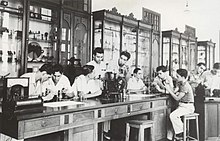
Castro, second from left, at Colegio de Belén, Havana, 1943
In 1942, Castro transferred to the Jesuit-run El Colegio de Belén in Havana.[10] Although Castro took an interest in history, geography, and debate at Belén, he did not excel academically, instead devoting much of his time to playing sports.[11] In 1945, Castro began studying law at the University of Havana.[12] Admitting he was "politically illiterate", Castro became embroiled in student activism[13] and the violent *gangsterismo* culture within the university.[14] After becoming passionate about anti-imperialism and opposing US intervention in the Caribbean,[15] he unsuccessfully campaigned for the presidency of the Federation of University Students on a platform of "honesty, decency and justice".[16] Castro became critical of the corruption and violence of President Ramón Grau's government, delivering a public speech on the subject in November 1946 that received coverage on the front page of several newspapers.[17]
In 1947, Castro joined the Party of the Cuban People (or Orthodox Party; Partido Ortodoxo), founded by veteran politician Eduardo Chibás. A charismatic figure, Chibás advocated social justice, honest government, and political freedom, while his party exposed corruption and demanded reform. Though Chibás came third in the 1948 general election, Castro remained committed to working on his behalf.[18] Student violence escalated after Grau employed gang leaders as police officers, and Castro soon received a death threat urging him to leave the university. However, he refused to do so and began to carry a gun and surround himself with armed friends.[19] In later years, anti-Castro dissidents accused him of committing gang-related assassinations at the time, but these accusations remain unproven.[20] The American historian John Lewis Gaddis wrote that Castro "began his career as a revolutionary with no ideology at all: he was a student politician turned street fighter turned guerrilla, a voracious reader, an interminable speaker, and a pretty good baseball player".[21]
Rebellion and Marxism: 1947–1950
...
Knowledge Web Content (see main node)
Fidel Castro
Achievements: Leader of first Communist state in the western hemisphere
Born: August 13, 1926, Biran district, Cuba
Died:
Field & Discipline: Politics; Government; Revolutionary
Education: Catholic School, Santiago de Cuba; Belen Catholic College; University of Havana
Major Work:
"Political, Economic and Social Thought of Fidel Castro"
"History Will Absolve Me"
"Revolutionary Struggle 1947-1958: Selected Works of Fidel Castro"
"The World Economic and Social Crisis"
Life & Times:
The son of a Spanish cane planter, Castro was born in a region whose largest property owner was the American-owned [work related to] United Fruit Co.*. While at university, in 1947, he joined a force of Dominicans and Cubans who failed to overthrow Dominican Republic leader Rafael L. Trujillo.
After getting his law degree, Castro was selected by the Ortodoxos reform party to represent a district in the House of Representatives, but before he could take his seat, Batista, the ex-premier of Cuba, overthrew the government. On July 26, 1953, at 27, Castro led some 150 young revolutionaries in an attack on an army post in Santiago de Cuba. Most of his party were killed and Castro was sentenced to 15 years in prison, but was released in an amnesty the next year.
Castro and his brother Raul went to Mexico and established a revolutionary movement called "26 July" in honor of the failed uprising. With the goal of liberating Cuba, Castro with 81 men sailed from Mexico and landed on the southern coast of Oriente province on Dec. 2, 1956. The 12 men who survived the ensuing battle, including Castro, Raul, and Ernesto (Che) Guevara, fled into the Sierra Maestre, from where they harried Batista's forces.
From his mountain headquarters, Castro directed young Cuban revolutionaries and kept up a propaganda campaign that eventually brought him victory. On New Year's Day, 1959, Batista fled and Castro, as the acknowledged head of the revolutionaries, formed a government. He appointed a president and a prime minister and made himself commander in chief of the armed forces. In February, he appointed himself prime minister and in July he removed the president.
With the help of Guevara and Camilo Cienfuegos, Castro set up schools to teach Marxism-Leninism to the military, determined that his Rebel Army be an ideological as well as a military force. When Castro visited the U.S. in 1959, [was refused meeting with] Eisenhower* would not meet him, but vice-president [met] Richard M. Nixon* did. Castro was lionized in Washington, where he was seen as a liberator, but as soon as he was home, he denounced "Yankee Imperialism" and set about enforcing Communist ideals.
Under his Agrarian Reform Law, Castro expropriated vast tracts of American-owned property and took over American businesses. Private businesses and industry were nationalized. Former officials of the Batista government were arrested and tried as war criminals. Some American nationals were either executed or given long prison sentences. He cut off all trade with the United States and in February, 1960, signed a trade treaty with Mikoyan, the deputy premier of the Soviet Union.
Soviet advisers bringing weapons and military equipment arrived in Cuba in late 1960. In April, 1961, President [defeated invasion by] Kennedy* authorized the invasion of Cuba by exiled Cubans, but when the invaders landed at the Bay of Pigs they were routed. Within three days they had all been captured or killed.
In 1962 America's discovery of Soviet missile bases on Cuba precipitated the Cuban missile crisis. On Oct. 22, Kennedy banned the delivery of offensive weapons to Cuba and authorized U.S. warships to search any approaching ships. On Oct. 24, Soviet leader [in crisis with] Krushchev* halted his ships, but the threat of nuclear war did not lift until Oct. 28, when a final exchange of letters between Kennedy and Khrushchev resolved the matter. The Soviets, however, did not tell Castro they had agreed to remove the missile bases and as a result, relations between Cuba and the Soviet Union cooled, though, with the American embargo, Cuba continued to be dependent on the Soviets for trade and military and economic aid.
Throughout the 1960s, Castro continued with his agrarian, social and economic reforms, but ruled with an iron hand. More than 1,000 former members of Batista's regime and dissidents in his own party were executed. He deported Catholic priests and took over Catholic and other private schools. During the first nine years of his rule, about 500,000 Cubans escaped. Then, in an unusual move in 1965, Castro announced anyone who wanted could leave. The exodus was enormous, and Cuba lost thousands of doctors, engineers, administrators and other professionals. Though Castro tried to diversify the economy, it remained based on the export of sugar cane.
By the 1970’s, Cuban education and modern medical treatment were available and free for all, and there was full employment. Literacy had improved dramatically and good quality ballet, music and theater were available to all classes.
The Cuban economy stagnated in the 1980s, though Castro retained his high profile and became increasingly involved with the Third World. In 1983, Cuban troops fought the Americans when the U.S. invaded Grenada.
The collapse of communism in Europe and the Soviet Union in the 1990s had a traumatic effect on Cuba. All Soviet economic aid and contributions to joint projects ceased in December, 1991. Since no other country could replace the Soviet Union as a provider, Castro was forced to relax his economic policies to accommodate free market principles. He has approached the U.S. to lift its trade embargo. He used a visit by Pope John Paul II in 1998 to publicize Cuba's needs. Despite bouts of ill health, Castro at the turn of the 21st century continued to be the de facto ruler of Cuba.
Extra Connections: Knew [knew] and was a fan of *Hemingway*
[self-proclaimed follower was] Oswald* claimed to be a follower.
Assessment: A passionate belief in revolutionary ideals and an uncompromising adherence to principle have given him a moral stature among revolutionaries
Bibliography:
- Szulc, Tad, Fidel, A Critical Portrait, Hutchinson Ltd., London, 1986.
- Leonard, Thomas M.,Castro and the Cuban Revolution, Greenwood Press, Westport, Connecticut, 1999.
Language: Spanish
Father: Angel Castro y Argiz
Mother: Lina Ruz Gonzalez
Siblings: 4, of whom: Raul (Castro's lieutenant)
Spouse: Mirta Diaz Balart
Children: Fidel