Hemingway
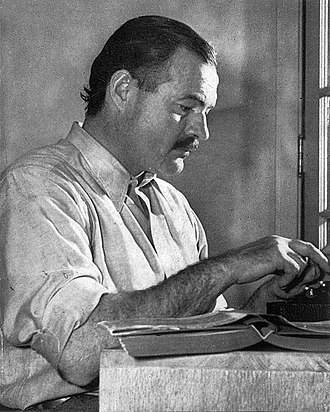
Nickname/Alias: Papa
Achievements: Great American novelist
Born: July 21, 1899; Oak Park, Illinois
Died: July 2, 1961; Ketchum, Idaho (Aged 61)
Field & Discipline: Literature; Journalist; Novelist
Language: English
Father: Clarence Edmonds Hemingway
Mother: Grace Hall
Siblings: Leicester; Carol; Madelaine; Marcelline; Ursula
Spouse: 1) Elizabeth Hadley; 2) Pauline Pfeiffer; 3) Martha Gelhorn; 4) Mary Welsh
Children: Gregory; John; Patrick
Education: Oak Park High School, Oak Park, Illinois
Major Work:
"The Sun Also Rises"
"A Farewell to Arms"
"For Whom the Bell Tolls"
"The Old Man and the Sea"
Life & Times:
In 1917, at 18, Hemingway worked briefly as a reporter in Kansas City. When the U.S. entered the First World War in 1917, he volunteered for duty, but was turned down for medical reasons, so he went to Europe and worked as an ambulance driver (as did Cocteau, Ravel, Disney, McDonald's founder Kroc and others) with the Red Cross. Hospitalized in Milan, he fell in love with Agnes von Kurowsky, a Red Cross nurse, who refused to marry him. The experience was the basis for his 1929 novel, "A Farewell to Arms". After the War, he reported for the "Toronto Star", which sent him to Paris to cover European events. He remained with the Star for five years, traveling in Italy, Spain, Switzerland, Germany and Greece.
In Paris, he made friends with American expatriate writers [a pal of] Pound* and [a pal of] Stein*, who introduced him to [a pal of] Picasso*, [a pal of] Joyce, J*, and [a pal of] F. Scott Fitzgerald*. In 1925, Hemingway's his first major work, a collection of short stories called "In Our Time", was published in New York. The following year saw the publication of his novel, "The Sun Also Rises", which was a huge success.
In 1929, "A Farewell to Arms" consolidated his reputation as a serious novelist. Now established and rich, he began to wander through the world. He skied in Switzerland in the winter and spent his summers in Spain, taking a keen interest bullfighting. He hunted in Wyoming and fished off Key West. In 1932, he wrote "Death in the Afternoon", a portrait of bullfighting. In 1933-34, he went big game hunting in Tanganyika, Africa, after which he wrote "The Green Hills of Africa."
In 1937, Hemingway bought a house in Key West, FL, where wrote "To Have and Have Not", about Key West during the Great Depression, but it was not well received. Also in 1937, Hemingway went to Madrid to report on the civil war. He supported the left wing Republicans who eventually lost to the Nationalist troops under General Francisco Franco. Hemingway wrote a play based on his experiences, "The Fifth Column", set during the siege of Madrid.
In 1939, Hemingway bought an estate near Havana, Cuba, and settled there to write "For Whom the Bell Tolls", arguably his best novel. The book is about an American volunteer who fights with the Republican guerrillas during the Spanish Civil War and falls in love with a Spanish girl. Their relationship is doomed, and the novel ends with the hero preparing for death as he covers his comrades' retreat.
During the Second World War, when Cuba was a haven for spies, Hemingway organized what he called the "Crook Factory", a group that collected intelligence on German activity. By the summer of 1942, he had equipped his fishing boat with machine guns and explosives and was running submarine patrols. He began to experience bouts of depression that would continue through the years. He had written nothing since "For Whom the Bell Tolls" and was drinking heavily.
In 1944, he went to England as a journalist. He flew with the Royal Air Force and accompanied U.S. troops across the English Channel during the D-Day invasion of June 6, 1944. He was witness to the action in Normandy and the Battle of the Bulge. He was also with the forces who liberated Paris. When the war in Europe ended in 1945, Hemingway returned to Cuba. An annual fishing tournament was held in his honor at the Havana yacht club. He spent the next few years enjoying himself, fishing, traveling in America and Europe, and also drinking heavily, but not writing.
However, in 1952, 13 years after "For Whom the Bell Tolls", he published the short novel "The Old Man and the Sea", inspired by his knowledge of Cuban fishermen in the village of Cojmar, where [inspired by home of] Castro* later lived. The novel was an instant success and Hemingway was awarded the Pulitzer prize. In 1954, he was awarded the Nobel Prize for Literature.
From 1955, Hemingway's bouts of depression increased, interspersed with bouts of manic writing. "A Moveable Feast", his account of his early years in Paris, was published in 1964, after his death. After Fidel Castro took over Cuba in 1959, Hemingway left and settled in Ketchum, Idaho.
On a visit to Spain in summer 1959 to cover the bullfighting season, his behavior and literary output became more and more erratic and little of his work was accepted for publication. He was treated in hospital for depression during 1960-61. He killed himself with his shotgun in July, 1961.
Extra Connections:
Published by [published by] Ford Madox Ford*
He met British poet Stephen [met] Spender*
Assessment: One of America's finest novelists, with a distinctive economical style. His work is still widely read
Oneliner: Hemingway, great American novelist
Bibliography:
- Lynn, Kenneth S, Hemingway, Simon and Schuster, London, 1987.
Multimedia:
On April 5, 2021, Hemingway, a three-episode, six-hour documentary, a recapitulation of Hemingway's life, labors, and loves, debuted on the Public Broadcasting System. It was co-produced and directed by Ken Burns and Lynn Novick.