Yoko Ono
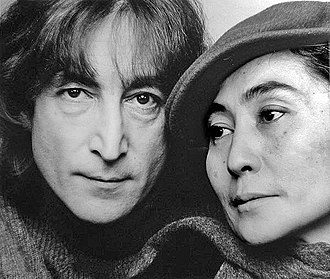
Yoko Ono (/ˈjoʊkoʊ ˈoʊnoʊ/ YOH-koh OH-noh; Japanese: 小野 洋子, romanized: Ono Yōko, usually spelled in katakana オノ・ヨーコ; born February 18, 1933) is a Japanese multimedia artist, singer, songwriter, and peace activist. Her work also encompasses performance art and filmmaking.[1]
Ono grew up in Tokyo and moved to New York City in 1952 to join her family. She became involved with New York City's downtown artists scene in the early 1960s, which included the Fluxus group, and became well known in 1969 when she married English musician John Lennon of the Beatles, with whom she would subsequently record as a duo in the Plastic Ono Band. The couple used their honeymoon as a stage for public protests against the Vietnam War. She and Lennon remained married until he was murdered in front of the couple's apartment building, the Dakota, on December 8, 1980. Together they had one son, Sean, who later also became a musician.
Ono began a career in popular music in 1969, forming the Plastic Ono Band with Lennon and producing a number of avant-garde music albums in the 1970s. She achieved commercial and critical success in 1980 with the chart-topping album Double Fantasy, a collaboration with Lennon that was released three weeks before his murder, winning the Grammy Award for Album of the Year. To date, she has had twelve number one singles on the US Dance charts, and in 2016 was named the 11th most successful dance club artist of all time by Billboard magazine.[2] Many musicians have paid tribute to Ono as an artist in her own right and as a muse and icon, including Elvis Costello,[3][failed ^verification] the B-52's,[4] Sonic Youth[5] and Meredith Monk.[6]
As Lennon's widow, Ono works to preserve his legacy. She funded the Strawberry Fields memorial in Manhattan's Central Park,[7] the Imagine Peace Tower in Iceland,[8] and the John Lennon Museum in Saitama, Japan (which closed in 2010).[9] She has made significant philanthropic contributions to the arts, peace, disaster relief in Japan and the Philippines,[10][11] and other such causes. In 2002, she inaugurated a biennial $50,000 LennonOno Grant for Peace.[12] In 2012, she received the Dr. Rainer Hildebrandt Human Rights Award[13] and co-founded the group Artists Against Fracking.[14]
Biography
Early life and family
Ono was born in Tokyo City on February 18, 1933, to mother Isoko Ono (小野 磯子, Ono Isoko) (1911–1999)[15] and father Eisuke Ono (小野 英輔, Ono Eisuke), a wealthy banker and former classical pianist.[16] Isoko's adoptive maternal grandfather Zenjiro Yasuda (安田 善次郎, Yasuda Zenjirō) was an affiliate of the Yasuda clan and zaibatsu. Eisuke came from a long line of samurai warrior-scholars.[17] The kanji translation of Yōko (洋子) means "ocean child".[16][18] Two weeks before Ono's birth, Eisuke was transferred to San Francisco, California, by his employer, the Yokohama Specie Bank.[19] The rest of the family followed soon after, with Ono first meeting her father when she was two years old.[4] Her younger brother Keisuke was born in December 1936.[citation ^needed]
In 1937, the family was transferred back to Japan, and Ono enrolled at Tokyo's elite Gakushūin (also known as the Peers School), one of the most exclusive schools in Japan.[19] Ono was enrolled in piano lessons from the age of 4, until the age of 12 or 13.[20] She attended kabuki performances with her mother, who was trained in shamisen, koto, otsuzumi, kotsuzumi, nagauta, and could read Japanese musical scores.[citation ^needed]
The family moved to New York City in 1940. The next year, Eisuke was transferred from New York City to Hanoi in French Indochina, and the family returned to Japan. Ono was enrolled in Keimei Gakuen, an exclusive Christian primary school run by the Mitsui family. She remained in Tokyo throughout World War II and the fire-bombing of March 9, 1945, during which she was sheltered with other family members in a special bunker in Tokyo's Azabu district, away from the heavy bombing. Ono later went to the Karuizawa mountain resort with members of her family.[19]
Starvation was rampant in the destruction that followed the Tokyo bombings; the Ono family was forced to beg for food while pulling their belongings in a wheelbarrow. Ono said it was during this period in her life that she developed her "aggressive" attitude and understanding of "outsider" status. Other stories tell of her mother bringing a large number of goods to the countryside, where they were bartered for food. In one anecdote, her mother traded a German-made sewing machine for 60 kilograms (130 lb) of rice to feed the family.[19] During this time, Ono's father, who had been in Hanoi, was believed to be in a prisoner of war camp in China. Ono told Amy Goodman of Democracy Now! on October 16, 2007, that "He was in French Indochina, which is Vietnam actually.... in Saigon. He was in a concentration camp."[21]
After the war ended in 1945, Ono remained in Japan when her family moved to the United States and settled in Scarsdale, New York, an affluent town 25 miles (40 km) north of midtown Manhattan. By April 1946, Gakushūin was reopened and Ono re-enrolled. The school, located near the Tokyo Imperial Palace, had not been damaged by the war, and Ono found herself a classmate of Prince Akihito, the future emperor of Japan.[16][17] At 14 years old, she took up vocal training in lieder-singing.[citation ^needed]
College and downtown beginnings
Ono graduated from Gakushūin in 1951, and was accepted into the philosophy program of Gakushuin University as the first woman to enter the department. However, she left the school after two semesters.[19]
Ono joined her family in New York in September 1952,[22] and enrolled at nearby Sarah Lawrence College. Ono's parents approved of her college choice, but disapproved of her lifestyle and chastised her for befriending people they felt were beneath her. In 1956, Ono left college to elope with Japanese composer Toshi Ichiyanagi,[17][23] a star in Tokyo's experimental community, then studying at Juilliard.[24]
At Sarah Lawrence, she studied poetry with Alastair Reid, English literature with Kathryn Mansell, and music composition with the Viennese-trained André Singer.[20] Ono has said that her heroes at this time were the twelve-tone composers Arnold Schoenberg and Alban Berg. She said, "I was just fascinated with what they could do. I wrote some twelve-tone songs, then my music went into [an] area that my teacher felt was really a bit off track, and... he said, 'Well, look, there are people who are doing things like what you do, and they're called avant-garde.'" Singer introduced her to the work of Edgar Varèse, John Cage, and Henry Cowell. Ono left college and moved to New York in 1957, supporting herself through secretarial work and lessons in the traditional Japanese arts at the Japan Society.[25]
Ono has often been associated with the Fluxus group, a loose association of Dada-inspired avant-garde artists which was founded in the early 1960s by Lithuanian-American artist George Maciunas. Maciunas admired and enthusiastically promoted her work, and gave Ono her first solo exhibition at his AG Gallery in New York in 1961. He formally invited Ono to join Fluxus, but she declined because she wanted to remain independent.[26] However, she did collaborate with Maciunas,[27] Charlotte Moorman, George Brecht, and the poet Jackson Mac Low, among others associated with the group.[28]
 112 Chambers Street, the location of Ono's 1960s loft where Fluxus events took place.
Ono first met John Cage through his student Ichiyanagi Toshi, in Cage's experimental composition class at the New School for Social Research:[29] She was introduced to more of Cage's unconventional neo-Dadaism first hand, and via his New York City protégés Allan Kaprow, Brecht, Mac Low, Al Hansen and the poet Dick Higgins.[28]
After Cage finished teaching at the New School in the summer of 1960, Ono was determined to rent a place to present her works along with the work of other avant-garde artists in the city. She eventually found an inexpensive loft in downtown Manhattan at 112 Chambers Street and used the apartment as a studio and living space, also allowing composer La Monte Young to organize concerts in the loft.[28] They both held a series of events there from December 1960 through June 1961;[25] the events were attended by people such as Marcel Duchamp and Peggy Guggenheim.[30] Ono and Young both claimed to have been the primary curator of these events,[31] with Ono claiming to have been eventually pushed into a subsidiary role by Young.[29] Ono presented work only once during the series.[25]
In 1961, some years before meeting John Lennon, Ono had her first major public performance in a concert at the 258-seat Carnegie Recital Hall (smaller than the "Main Hall"). This concert featured radical experimental music and performances.[citation ^needed]
The Chambers Street series hosted some of Ono's earliest conceptual artwork, including Painting to Be Stepped On, a scrap of canvas on the floor that became a completed artwork upon the accrual of footprints. With that work, Ono suggested that a work of art no longer needed to be mounted on a wall and inaccessible. She showed this work and other instructional work again at Macunias's AG Gallery in July 1961.[30] After Ono set a painting on fire at one performance, Cage advised her to treat the paper with flame retardant.[17] She is credited for the album cover art for the album Nirvana Symphony by Toshiro Mayuzumi, released by Time Records in 1962.
After living apart for several years, Ono and Ichiyanagi filed for divorce in 1962. Ono returned home to live with her parents, and, suffering from clinical depression, was briefly placed into a Japanese mental institution.[16][32]
Early career and motherhood
On November 28, 1962, Ono married Anthony Cox, an American jazz musician, film producer, and art promoter who had been instrumental in securing her release from the mental institution.[17] Ono's second marriage was annulled on March 1, 1963, because she had neglected to finalize her divorce from Ichiyanagi. After finalizing that divorce, Cox and Ono married again on June 6, 1963. She gave birth to their daughter Kyoko Chan Cox two months later, on August 8, 1963.[16]
The marriage quickly fell apart, but the couple continued working together for the sake of their joint careers. They performed at Tokyo's Sogetsu Hall, with Ono lying atop a piano played by John Cage. Soon, the couple returned to New York with Kyoko. In the early years of the marriage, Ono left most of Kyoko's parenting to Cox while she pursued her art full-time, with Cox also managing her publicity.
Ono had a second engagement at the Carnegie Recital Hall in 1965, in which she debuted Cut Piece.[33] In September 1966, Ono visited London to meet artist and political activist Gustav Metzger's Destruction in Art Symposium in September 1966. She was the only woman artist chosen to perform her own events and only one of two invited to speak.[34] She premiered The Fog Machine during her Concert of Music for the Mind at the Bluecoat Society of Arts in Liverpool, England in 1967.[35]
Ono and Cox divorced on February 2, 1969, and she married John Lennon later that same year. During a 1971 custody battle, Cox disappeared with their eight-year-old daughter. He won custody after successfully claiming that Ono was an unfit mother due to her drug use.[32] Ono's ex-husband changed Kyoko's name to "Ruth Holman" and subsequently raised the girl in an organization known as the Church of the Living Word (or "the Walk").[36] Ono and Lennon searched for Kyoko for years, but to no avail. She would finally see Kyoko again in 1998.[32]
Relationship with John Lennon
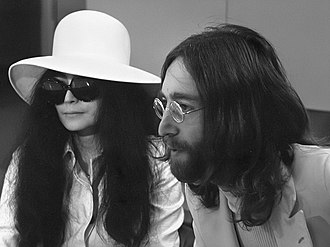
Yoko Ono and John Lennon when they married, March 1969
Ono's first contact with any member of the Beatles occurred when she visited Paul McCartney at his home in London to obtain a Lennon–McCartney song manuscript for a book John Cage was working on, Notations.[37] McCartney declined to give her any of his manuscripts but suggested that Lennon might oblige.[37] Lennon later gave Ono the original handwritten lyrics to "The Word".[38]
Ono and Lennon first met on November 7, 1966, at the Indica Gallery in London, where she was preparing Unfinished Paintings, her conceptual art exhibit about interactive painting and sculpture. They were introduced by gallery owner John Dunbar.[39] One piece, Ceiling Painting/Yes Painting, had a ladder painted white with a magnifying glass at the top. When Lennon climbed the ladder, he looked through the magnifying glass and was able to read the word YES which was written in miniature. He greatly enjoyed this experience as it was a positive message, whereas most concept art he encountered at the time was anti-everything.[40]
Lennon was also intrigued by Ono's Hammer a Nail where viewers were invited to hammer a nail into a wooden board painted white. Although the exhibition had not yet opened, Lennon wanted to hammer a nail into the clean board, but Ono stopped him. Dunbar asked her, "Don't you know who this is? He's a millionaire! He might buy it." Ono feigned not knowing of the Beatles (even as she had gone to see Paul McCartney asking for a Beatle song score), but relented on the condition that Lennon pay her five shillings, to which Lennon replied, "I'll give you an imaginary five shillings and hammer an imaginary nail in."[40][41]
In a 2002 interview, Ono said, "I was very attracted to him. It was a really strange situation."[42] Ono started writing to Lennon, sending him her conceptual artworks, and soon the two began corresponding. In September 1967, Lennon sponsored Ono's solo Half-A-Wind Show, at Lisson Gallery in London.[43] When Lennon's wife Cynthia asked for an explanation of why Ono was telephoning them at home, he told her that Ono was only trying to obtain money for her "avant-garde bullshit".[44]
In early 1968, while the Beatles were making their visit to India, Lennon wrote the song "Julia" and included a reference to Ono: "Ocean child calls me", referring to the translation of Yoko's Japanese spelling.[18] In May 1968, while his wife was on holiday in Greece, Lennon invited Ono to visit. They spent the night recording a selection of avant-garde tape loops,[43] after which, he said, they "made love at dawn".[45] The recordings made by the two during this session ultimately became their first collaborative album, the musique concrete work Unfinished Music No. 1: Two Virgins. When Lennon's wife returned home, she found Ono wearing her bathrobe and drinking tea with Lennon, who simply said, "Oh, hi."[46]
On September 24 and 25, 1968, Lennon wrote and recorded "Happiness Is a Warm Gun",[47] which contains sexual references to Ono. Ono became pregnant, but had a miscarriage on November 21, 1968, a few weeks after Lennon's divorce from Cynthia was granted.[48][49] On December 12, 1968, Lennon and Ono participated in the BBC documentary about The Rolling Stones, The Rolling Stones Rock And Roll Circus, along with several other high-profile musicians. Lennon performed his Beatles composition "Yer Blues" towards the end, with an improvised vocal performance by Ono rounding out the set.[50] The film would not be released until 1996, due to the death of The Rolling Stones' founding member Brian Jones a few months after it was shot.
Early collaborations, marriage and "Bed-ins"
Main articles: Bed-In, Give Peace a Chance, Bagism, and Unfinished Music No. 1: Two Virgins
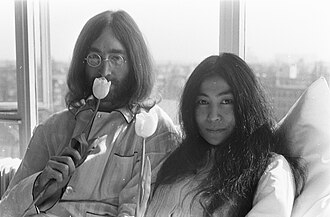
Lennon and Ono at a Bed-in at Hilton Amsterdam, March 1969
During the final two years of the Beatles, Lennon and Ono created and attended public protests against the Vietnam War. They collaborated on a series of avant-garde recordings, beginning in 1968 with Unfinished Music No.1: Two Virgins, which notoriously featured an unretouched image of the two artists nude on the front cover. The same year, the couple contributed an experimental sound collage to The Beatles' self-titled "White Album" called "Revolution 9", with Ono contributing additional vocals to "Birthday",[51] and one lead vocal line on "The Continuing Story of Bungalow Bill", marking the only occasion in a Beatles recording in which a woman sings lead vocals.[52]
On March 20, 1969, Lennon and Ono were married at the registry office in Gibraltar and spent their honeymoon in Amsterdam, campaigning with a week-long Bed-in for Peace. They planned another Bed-in in the US, but were denied entry to the country.[53] They held one instead at the Queen Elizabeth Hotel in Montreal, where they recorded "Give Peace a Chance".[54][55] Lennon later stated his regrets about feeling "guilty enough to give McCartney credit as co-writer on my first independent single instead of giving it to Yoko, who had actually written it with me."[56] The couple often combined advocacy with performance art, such as in "bagism", first introduced during a Vienna press conference, where they satirised prejudice and stereotyping by wearing a bag over their entire bodies. Lennon detailed this period in the Beatles' song "The Ballad of John and Yoko".[57]
During the Amsterdam Bed In press conference, Yoko also earned controversy in the Jewish community for saying during the press conference that, "If I was a Jewish girl in Hitler's day, I would approach him and become his girlfriend. After 10 days in bed, he would come to my way of thinking. This world needs communication. And making love is a great way of communicating."[58] It was acknowledged that some Nazis, including Nazi "First Lady" Magda Goebbels, had Jewish lovers at one point in their lives.[58]
Lennon changed his name by deed poll on April 22, 1969, switching out Winston for Ono as a middle name. Although he used the name John Ono Lennon after that, official documents referred to him as John Winston Ono Lennon.[59] The couple settled at Tittenhurst Park at Sunninghill, Berkshire, in southeast England.[60] When Ono was injured in a car accident, Lennon arranged for a king-sized bed to be brought to the recording studio as he worked on the Beatles' last recorded album, Abbey Road.[61]
The Plastic Ono Band
...