Duchamp
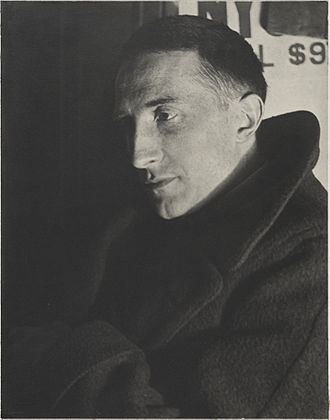
NAME: Duchamp, Marcel
OTHER-NAME: Henri-Robert-Marcel Duchamp; R. Mutt; Rrose Selavy
BIRTH: 28 July 1887; Blainville, France
DEATH: 1 October 1968; Neuilly, France
CATEGORY: Fine Arts & Crafts
CATEGORY: Painting, sculpture
ASSESSMENT: Marcel Duchamp is called, variously, a dadaist or a surrealist. He is regarded as the fountainhead of such modern movements as Pop art and kinetic sculpture and has been a major influence on the artists who have followed him. His concern with the concepts of art, questioning what is art and what is not, and how art works in concert with the spectator, have remained topics for lively debate to the present day.
LANGUAGE: French; English
EDUCATION: Ecole Bossuet, Rouen, France (1898-1904); Academie Julian, Paris, France (1904-1905)
ACHIEVEMENTS: Editor, The Blind Man and Rongwrong (art magazines, dadaist in slant). He was one of the organizers of the Independents Exhibition, April 1917, New York, New York, USA
MAJOR-WORK:
Nude Descending a Staircase, No. 2 (1912, oil on canvas); The Bride Stripped Bare by Her Bachelors, Even (1915 - 1923, mixed media, also known as The Large Glass); Readymades [1913 - 1917, a series of ‘found objects’ (which might be altered, or presented as found) given a title and signed by Duchamp and declared by him to be art]
DETAILS:
Marcel Duchamp was born on July 18, 1887, into a middle-class family. He and three of his siblings decided to become artists rather than aim for more acceptable middle-class professions. His parents were supportive of all their children and provided them with allowances while their artistic careers were being established.
Duchamp married twice, the first time for approximately a year and the second time for some fourteen years (from 1954 to his death in 1968). Neither marriage produced any children, but from a youthful relationship he had a daughter, who also became an artist.
Duchamp was not only those of a painter and a sculptor. Among other things he edited art magazines, wrote poetry and works on art theory, composed music, created experimental films, and played championship chess.
Duchamp's art is sometimes described as dadaist, sometimes as cubist and sometimes as surrealist, but he pursued a unique course which is not easily slotted into any particular school.
"What he was interested in above all was freedom – complete personal and intellectual and artistic freedom – and the manner in which he achieved all three was, in the opinion of his close friends, his most impressive and enduring work of art. . . . Approach his work with a light heart, though, and the rewards are everywhere in sight. Duchamp's work sets the mind free to act on its own." (Tomkins)
His view of the creative act was that it was not performed solely by the artist but also involved the spectator.
Duchamp's artistic aims included efforts to free art from its traditional academic bias. One way he chose to question the definition of art was to create what he called Readymades. These were everyday objects such as a snow shovel or a bottle rack, sometimes left as found and sometimes combined with other objects. In either case, he signed these ‘found’ objects, gave them titles which had nothing to do with their everyday use, and, since they were titled works and signed by an artist, called them art.
One of Duchamp's best known paintings is Nude Descending a Staircase, No. 2 (painted in 1912). This work is cubist in nature and shows several overlapping views of a nude woman as she walks down a staircase. This produces a sense of movement as we can see the figure moving through space. It also is a way of showing us what we know is true (that the nude, for instance, was on every step in her descent) rather than the traditional a single slice of life (for instance, the nude at the foot of the stairs). Duchamp is more interested in the idea of movement than in a picture of some actual or real movement frozen in time.
One of his more baffling and controversial works is a large mixed-media creation titled The Bride Stripped Bare by Her Bachelors, Even (1915 to 1923). In 1923, he finished work on this project even though unfinished. Argument on the meaning of the various components and their relationships continues to this day.
Among the products of Duchamp's art are such innovative 20th century artistic concepts as kinetic art, ready-made art, and crucial contributions to dadaism, surrealism, and pop art. Such artists as Fernand Leger*, Alexander Calder* and Tristan Tzara* were influenced and inspired by his work. His influence also affected the poet Guillaume Apollinaire* who was both a friend and a supporter of surrealism and Dadaism.
Though Duchamp is generally regarded as a founder of, or contributor to so many schools of art, he declined to categorize himself in any way. He constantly pushed the boundaries of art and, by the time a name had been invented for what he was doing he had generally moved on to something else.
In 1923, he declared that he was no longer an artist, since he had said all he had to say. From then on he generally described himself as a chess player or, alternatively, as a cheese dealer, or a breather. In spite of this he continued to interest himself in the concepts of art and in the discussion of what art is and how it works.
In addition, he made experimental films and in 1934 published a selection of drawings and other items relating to his monumental work The Bride Stripped Bare by Her Bachelors, Even.
EXTRA CONNECTIONS: He was a friend of Peggy Guggenheim*
The theoretical writings of Henri Poincaré particularly intrigued and inspired Duchamp.
Nude Descending a Staircase, No. 2 combines elements of both the Cubist and Futurist movements. In the composition, Duchamp depicts motion by successive superimposed images, similar to stroboscopic motion photography. Duchamp also recognized the influence of the chronophotography of Étienne-Jules Marey and others, particularly Muybridge's Woman Walking Downstairs from his 1887 picture series, published as *The Human Figure in Motion.
ONELINER: Marcel Duchamp, multi-talented modern French artist
BIBLIOGRAPHY: Tomkins, Clavin, Duchamp: A Biography. New York: Henry Holt and Company, 1996.
"Marcel Duchamp." Brain-Juice.Com, Inc., c2000-2002.http://www.brain-juice.com/cgi-bin/show_bio.cgi?p_id=12 Accessed March 21, 2004.
"Making Sense of Marcel Duchamp." Andrew Stafford, c2002-2004.
http://www.understandingduchamp.com/ Accessed March 21, 2004.
"Marcel Duchamp World Community." Art Science Research Laboratory, Inc. and Succession Marcel Duchamp, c2003. http://www.marcelduchamp.net/ Accessed March 21, 2004.
PARENTS: Eugene (formerly Justin-Isidore) Duchamp (1848-1925); Marie-Caroline-Lucie Nicolle (1856 ? -1925, m. 1874)
SPOUSE: Lydie Sarazin-Levassor (m. 1927; div. 1928); Alexina "Teeny" Sattler (m. 16 January 1954, 1906-1995)
SIBLINGS: Jacques Villon (half-brother, 1875-1963); Raymond Duchamp-Villon (1876-1918); Suzanne Duchamp (m. Jean Crotti, 1889-1963); Yvonne Duchamp (m.Alphonse Duvernoy, 1895-); Magdeleine Duchamp (1898-)
CHILDREN: Yvonne Mayer (m. Jacques Savy, born 1911; mother Jeanne Serre)