Guggenheim, Peggy
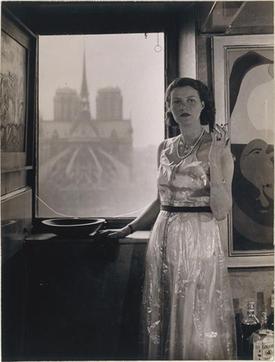
ACHIEVEMENTS: Patron and collector of 20th century modern art.
NICKNAME/ALIAS: Peggy.
DATE AND PLACE OF BIRTH: 26 August 1898, New York, US.
DATE/PLACE OF DEATH/AGE AT DEATH: 23 December 1979, Italy. Aged 81.
DISCIPLINE: Patron.
FIELD: Art.
LANGUAGE: English.
PARENTS: Father, Benjamin Guggenheim, mother, Florette Seligman.
SIBLINGS: two sisters.
SPOUSE: First, Laurence Vail, second Max Ernst.
CHILDREN: 1 son, Michael Cedric Sinbad Vail, 1 daughter, Dierdre
(Pageen) Vail.
EDUCATION: Jacoby School (private high school).
MAJOR WORK: Out of This Century (1946) and Confessions of an Art Addict (1960).
LIFE AND TIMES:
Peggy Guggenheim was born into rich and influential New York Jewish family. Guggenheim's father, Benjamin Guggenheim, a member of the Guggenheim family, who died in the sinking of the Titanic, and thus had less wealth. Following high school, Guggenheim worked, for a short time in 1918, for the Defense Department during the war. She then did volunteer work at the Sunwise Turn Bookshop, a center for radical and bohemian artists and thinkers in New York City. It was at the shop that she met her first husband, the American author, Laurence Vail.
In 1919 Guggenheim moved to Paris, where she became part of the bohemian and expatriate community thriving in Paris at this time, and began her career as a patron of the arts. At this time she began supporting author Djuna Barnes, became romantically involved with English writer John Holms (following her divorce from Vail) and following Holms early death lived with English writer Douglas Garman.
During this period she met and became friends with artists such as Duchamp*. Duchamp would become her advisor and curator as she became a more serious art collector and patron. In the late 1930s she began her involvement with modern art. In 1938 she opened Guggenheim Jeune, a London art gallery, where her first show, curated by Duchamp, was a showing of the works of Jean Cocteau. With Duchamp’s help Guggenheim began collecting work by Kandisky, Calder, Ernst, Picasso, and others.
In 1939, because unpopular modern art was hurting sales of works in the gallery, Guggenheim decided to open a museum of modern art in London, hiring author and art critic Herbert Read as director. However, the war made the opening of a museum impossible, so she purchased paintings for herself before leaving Paris for New York in 1941.
Guggenheim arrived with hundreds of works of art in New York, and in 1942 opened a gallery named Art of This Century, which showed Guggenheim’s collection of surrealist and cubist art. She continued to collect early twentieth century artists, such as Dutch abstract artist Mondrian*, while at the same time collecting and giving the first shows to young American artists such as the abstract expressionist Jackson Pollock.
In 1946, Guggenheim published the first volume of her autobiography, ”Out of This Century,” which shocked many people by its frank discussion of her love life. That same year she divorced Max Ernst. In 1960 she would publish the second volume, “Confessions of an Art Addict.”
In 1947 Guggenheim decided to again leave New York, this time for Venice, where she bought a large palace on the Grand Canal to house her collection.
In 1948, she was invited to show her collection at the Venice Biennale, the first “official recognition” of her collection and its value. During the 1950s she continued to live in Venice, turning her home into a museum and providing studios for artists she supported.
In 1969 the new Guggenheim Museum, commissioned in New York by her uncle and designed by Frank Lloyd Wright* invited her to show her collection. Following
the exhibition, Guggenheim in 1974 decided to give her collection and her palace in Venice to the museum. The Guggenheim foundation continues to run the Venice museum today.
ASSESSMENT: Peggy Guggenheim may be credited with collecting and serving as a patron to some of the most important twentieth century modern artists.
EXTRA CONNECTIONS: She gave a house in St Tropez to Goldman*.
The 1938 Cocteau exhibition was followed by exhibitions of Wassily Kandinsky (his first one-man-show in England), Yves Tanguy, Wolfgang Paalen and several other well-known and some lesser-known artists. Peggy Guggenheim also held group exhibitions of sculpture and collage, with the participation of the now-classic moderns Antoine Pevsner, Henry Moore, Henri Laurens, Alexander Calder, Raymond Duchamp-Villon, Constantin Brâncuși, John Ferren, Jean Arp, Max Ernst, Pablo Picasso, Georges Braque and Kurt Schwitters. She also greatly admired the work of John Tunnard (1900–1971) and is credited with his discovery in mainstream international modernism.
She had an affair with Samuel Beckett*.
ONELINER: Peggy Guggenheim, modern art patron
BIBLIOGRAPHY:
Neubauer, Bethany. “Guggenheim, Peggy,” http://www.anb.org/articles/17/17-01387.html; American National Biography Online. Feb. 2000.
“Peggy Guggenheim Biography” Peggy Guggenheim Collection. The Solomon
R. Guggenheim Foundation, 1997-2002, http://www.guggenheim-venice.it/english/index.htm,
Shenker, Isreal. “Patron of Artists” [obituary] New York Times, 24 December 1979, p. A1, A13.