Mike Selig Cftc Chr
this is basically cftc 2 3 26 trump term 2
---
mma
Kalshi is aggressively advertising on TikTok, seemingly targeting young people while promising a “money hack”
Leading expert on gambling behavior tells Media Matters: “The younger you are when you start and the more frequent you do these activities, that’s where the likelihood of addiction and harm go up”
Written by Olivia Little
Updated 03/30/26
Update (3/30/26): Following publication of this article, Kalshi spokesperson Elisabeth Diana notified Media Matters that the company no longer works with any of the influencers in the advertisements featured below. Diana added: “We don't 'skirt regulation' — we're federally regulated by the CFTC. On Kalshi, unlike with sportsbooks and casinos, there is no 'house,' which means our revenue doesn't come from incentivizing people to lose. It's fairer and less predatory than gambling.”*
Kalshi has been flooding TikTok with advertisements seemingly targeting young people. The ads, which often promote using the platform regularly as a type of “side hustle,” set off alarm bells for a leading expert, who tells Media Matters that they could increase the likelihood of gambling addiction.
Kalshi is a prediction market platform that allows users to buy positions on the outcome of nearly any “economically relevant event.” Like Polymarket, the other major player in prediction markets, Kalshi is regulated by the Commodity Futures Trading Commission as a derivatives exchange listing futures contracts, which were traditionally reserved for major commodities, stock indexes, or interest rates. On Kalshi, prediction options range from the innocuous — who will win Survivor 50 — to more politically charged and morally dubious subjects — like how many deportations will occur this year.
Prediction markets have entered a “hypergrowth phase,” generating nearly $64 billion in trading volume last year — an increase of more than 400% from 2024. Sporting event contracts accounted for more than 80% of prediction market activity in 2025, though Kalshi fervently denies that trading on sports is the same as gambling.
Sports gambling is primarily regulated at the state level, and in most states the minimum legal age to gamble is 21. However, prediction market platforms have skirted these regulations by offering sports event contract trading to any user 18 years or older, even in states where sports gambling is illegal.
Dr. Timothy Fong, a clinical professor of psychiatry and co-director of the UCLA Gambling Studies Program who has worked in the field for more than 20 years, told Media Matters that there is functionally very little difference between Kalshi and traditional gambling — and sometimes no difference at all.
“So I know when I download Kalshi and I want to put money on the Super Bowl — Kalshi gives me the option, I put my own real money on an event of uncertain outcome in the hopes of winning a larger reward at the expense of potentially losing my initial expense — that’s gambling,” said Fong. “It feels like gambling, it smells like gambling, and I think for some of the contract events it is identical.”
Now, TikTok users are being bombarded with ads suggesting Kalshi is a “money hack” that will enable them to make hundreds or even thousands of dollars from their phone.
Kalshi is flooding TikTok with ads that seem to target young people
Media Matters manually retrieved and documented Kalshi advertisements on TikTok because, unlike in the EU where TikTok is required to provide advertising repositories, the United States has no transparency mandates. It is impossible to know the full extent of Kalshi’s TikTok campaign, but our research helps piece together a glimpse into its advertising strategies. (This particular research focuses on TikTok, although Kalshi’s advertising wave has also hit other major social media platforms such as Instagram, Reddit, and YouTube.)
First, it is significant to note that Kalshi’s advertisements appear to predominantly feature and target young people. “We made a pact in this world where we said gambling is a 21-and-over activity, and yet these [ads] are clearly geared toward under-21 or right at that 21 level,” said Fong.
Nearly every advertisement we found features a young man or woman hyping up Kalshi’s platform and services. Often young men are featured in videos promoting sports trading and young women are featured in videos promoting Kalshi’s culture market.
:{Video
According to Fong, normalizing frequent engagement at a young age is a key contributor to future addiction. “When you borrow from the other lanes of addiction, the whole idea that this isn’t really harmful is what leads to early engagement and frequent engagement. And why that matters is that the younger you are when you start and the more frequent you do these activities, that’s where the likelihood of addiction and harm go up.”
Cait Huble, director of public affairs at the National Council on Problem Gambling, reviewed Kalshi advertisements documented by Media Matters and expressed concern about their framing. “In terms of some of the language that they’re using — if this was a regulated gambling operator, this would never pass a regulator’s test,” explained Huble. “The way they are positioning the expectation that you’re going to win, that there’s no clear explanation of the odds, things like what kind of skill it is.”
“This is functionally gambling,” Huble said.
One advertisement described Kalshi as a “money hack” and seemed to be trying to drive young people to its service by exploiting a sense of FOMO, or fear of missing out. “I don’t know why more people aren’t doing this, like, I literally made $761 and 7 cents last night,” a woman claimed. “I woke up this morning and it paid out. Why aren’t you guys doing this? It felt stupidly easy.”
:{Video
“The implication is that if you don’t bet on these things, you are missing out,” said Fong. “If you don't bet on this thing, you’re slow to uptake, you’re not cool. There’s kind of a Joe Camel kind of thing, with the smoking, where by association if you don’t do it you’re being left off the train.”
Another advertisement framed making weather predictions on Kalshi as a “side hustle” users can participate in from the comfort of their own home. The video shows a young woman on a couch lounging under a blanket, with on-screen text claiming to have “made $270 this week from my bed.”
:{Video
Of course, trading on Kalshi is fundamentally different from actual employment. “The side gig and the hustle [are] obviously very concerning — this is not a job,” said Fong. “That’s false advertising. The idea that, oh, there’s all this magic and partying and spectacular financial success, that this is a roadmap for you to have freedom financially is completely false.”
That doesn’t stop Kalshi’s advertisements from promising an easy way to earn money. “Trying to explain to myself how i just made $170 this week doing literally nothing but checking if it would rain (2026 is different),” read one, adding that the platform is “legal in all 50 states.”
But Kalshi is facing mounting legal challenges, particularly around allegations of sports betting. Arizona’s attorney general recently filed criminal charges against the platform over “illegal gambling,” a Massachusetts judge last month banned Kalshi from offering sports contracts without a state gaming license, and Nevada won a temporary restraining order on March 20 preventing Kalshi from offering event contracts related to sports, elections, and entertainment.
On March 23, Sens. Adam Schiff (D-CA) and John Curtis (R-UT) introduced a bipartisan bill that would ban prediction markets from accepting or listing sports events and casino-style games. “Sports prediction contracts are sports bets — just with a different name,” said Schiff. “These contracts are currently offered in all fifty states in clear violation of state and federal law.”
And the industry’s controversies don’t end with sports gambling. Prediction market users placing suspicious bets on the capture of Venezuelan President Nicolás Maduro and the start of the war in Iran have heightened scrutiny about the possibility of insider trading, leading the company to announce new efforts to crack down on market manipulation.
Meanwhile, Kalshi has a partnership “to incorporate real-time prediction data into CNBC’s editorial coverage,” a data integration agreement with CNN featuring “a new Kalshi-powered real-time news ticker that will run during segments that feature Kalshi data,” and a deal with The Associated Press ahead of this year’s midterms to “help campaigns and everyday citizens track market expectations for election outcomes.”
---
https://popular.info/p/days-after-5m-donation-trump-administration
REFTHOM 3 3 26
https://popular.info/p/days-after-5m-donation-trump-administration
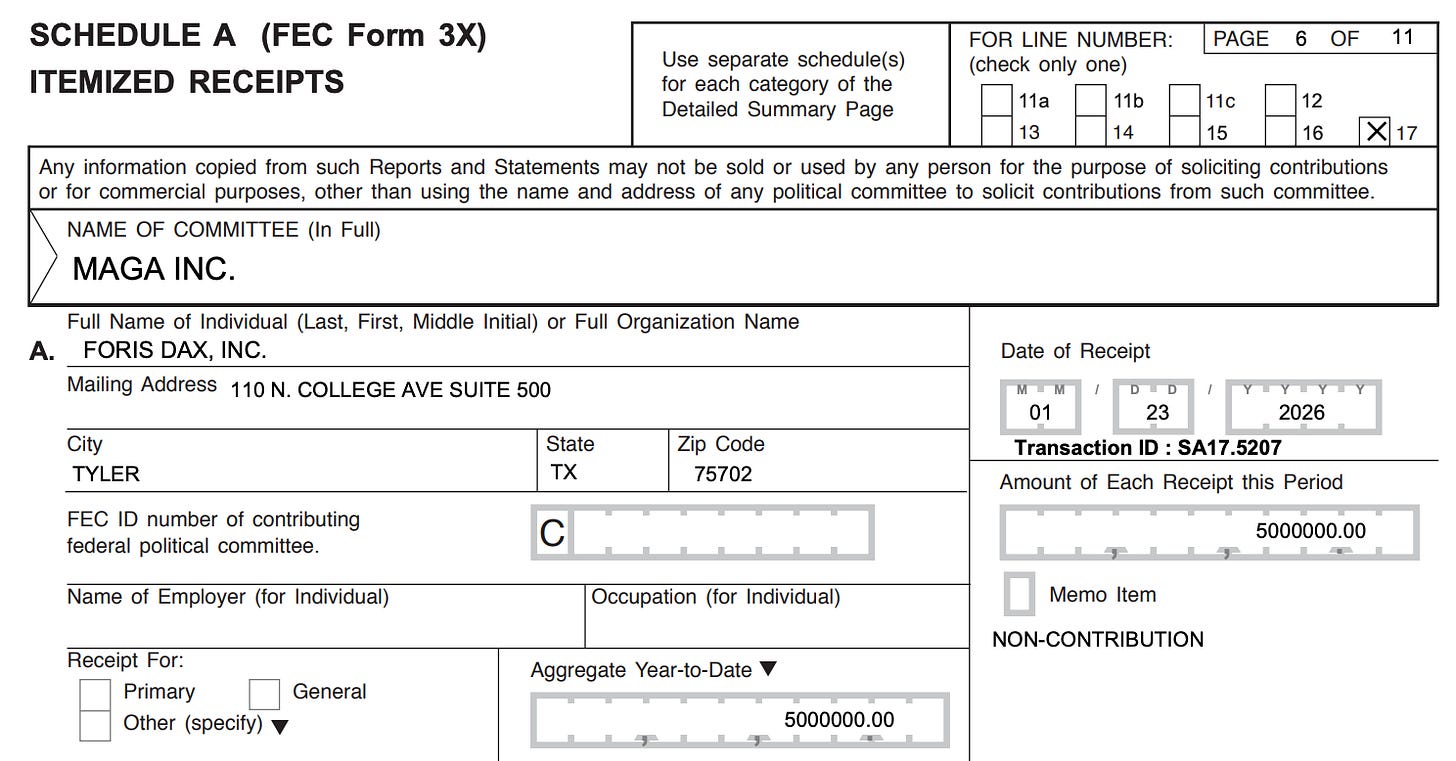
In a document quietly filed with the Federal Election Commission on Friday night, MAGA Inc., the primary Super PAC supporting President Trump, revealed that it received a $5 million donation from Crypto.com on January 23, 2026. The donation was made in the name of Crypto.com’s parent company, Foris Dax, Inc.1
[ ](https://substackcdn.com/image/fetch/$s_!-wdV!,f_auto,q_auto:good,fl_progressive:steep/https%3A%2F%2Fsubstack-post-media.s3.amazonaws.com%2Fpublic%2Fimages%2F21ce65d6-4c52-4c62-8b01-42836f6e0187_1488x778.png)
25 days later, on February 17, the Trump administration’s Commodities Futures Trading Commission (CFTC), intervened on Crypto.com’s behalf in high-stakes lawsuit in federal court.
Last year, Crypto.com sued the Nevada Gaming Control Board, arguing that it has the right to offer “prediction markets” on the outcome of sporting events without obtaining a Nevada gaming license. In October 2025, a federal court denied Crypto.com an injunction, and the company is now appealing the decision.
In addition to filing a formal amicus brief in support of Crypto.com’s appeal, CFTC chairman Mike Selig published an op-ed supporting Crypto.com’s position in the Wall Street Journal and posted a video supporting Crypto.com on X.
The timing of CFTC’s intervention raises serious ethical questions.
Selig, during his November 2025 confirmation hearing, was asked whether he believed it was legal for prediction markets to offer contracts on sporting events without complying with state law. Selig testified that the issue is “working its way through the courts, and so I will respect the decisions of those courts.”
He was also asked directly if he considered placing a bet on the outcome of a football game to be “gambling,” which would place it outside the jurisdiction of the CFTC:
Senator SCHIFF. Well, I mean, let me just ask—maybe even break it down more simply. If you and I bet on who wins the Bills game tomorrow, would you consider that gambling?
Mr. SELIG. Senator, on this issue, I would look to the courts, so I would look to what the courts say about that issue.
In a matter of weeks, Selig went from telling Senators under oath that he would defer to the courts on the issue to arguing on behalf of Crypto.com that the courts have erred.
He publicly announced he was considering intervening in the case during a public appearance on January 29 — less than a week after Crypto.com’s $5 million contribution to MAGA Inc. “I’ve directed CFTC staff to reassess the commission’s participation in matters currently pending before the federal district and circuit courts,” Selig said during his first public remarks as CFTC chairman.
On February 5, Selig explicitly stated that he believed it was legal for prediction markets to offer bets on sports, regardless of whether the company complied with state law.
[Mike Selig@MichaelSelig Strong Disagree.
Chris Christie @GovChristie
I believe Prediction Markets are violating the law. In 40 states we have regulated betting that can’t market to teenagers, pays state taxes, protects game integrity & reports suspicious activity to law enforcement. Prediction markets do none of that at all https://t.co/3dMAnS44Ex
2:06 PM · Feb 5, 2026 · 237K Views
114 Replies · 87 Reposts · 645 Likes](https://x.com/MichaelSelig/status/2019533204068393280?s=20)
Few companies have spent more money to ingratiate themselves politically with Trump than Crypto.com. Including the $5 million in January, Crypto.com has donated a total of $35 million to MAGA Inc. since 2025. It is the Super PAC’s largest donor, accounting for more than 10% of total funds.
Prior to its support for MAGA Inc, Crypto.com’s only political giving was a $1 million donation to Trump’s second inauguration in 2025.
Crypto.com has also formed an extensive partnership with Trump Media and Technology Group (TMTG), Trump’s money-losing media conglomerate that has recently pivoted into cryptocurrency and nuclear fusion. Among other integrations, Crypto.com and TMTG announced in October that Crypto.com would integrate its prediction market with Truth Social, TMTG’s social network. The joint venture will be called Truth Predict. President Trump is TMTG’s largest shareholder.
Crypto.com’s thin legal argument
Crypto.com and other prediction markets — and now the CFTC — argue that creating markets for sporting events is fundamentally different than sports gambling. In practice, however, it looks identical.
[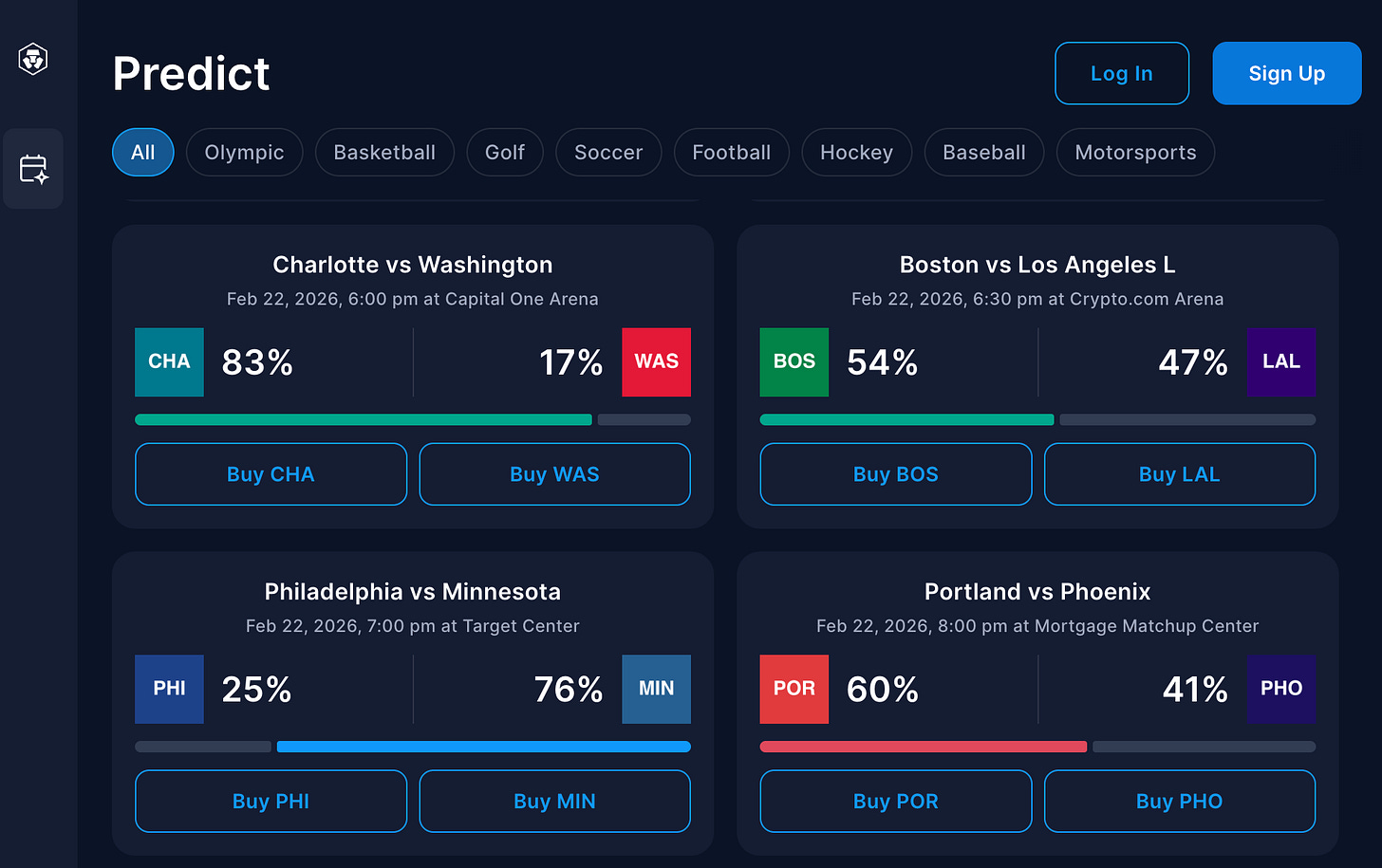 ](https://substackcdn.com/image/fetch/$s_!4ZwJ!,f_auto,q_auto:good,fl_progressive:steep/https%3A%2F%2Fsubstack-post-media.s3.amazonaws.com%2Fpublic%2Fimages%2F39b482a5-9a7e-475a-8dfa-353636dc271f_1926x1210.png)A screenshot from Crypto.com’s prediction market.
The CFTC has jurisdiction over event-related contracts or “swaps” that provide “for any purchase, sale, payment, or delivery… that is dependent on the occurrence, nonoccurrence, or the extent of the occurrence of an event or contingency associated with a potential financial, economic, or commercial consequence.” (Emphasis added.)
The traditional example of this is a contract to buy corn at a certain price in the future. This serves as an economic hedge against price fluctuations that can affect producers of tortilla chips, for example.
There are theoretical arguments that betting on the outcome of a sporting event could serve as an economic hedge. The CFTC, in its brief in support of Crypto.com, tries to make this argument:
Broadly speaking, sporting events are economic enterprises that generate billions of dollars in economic activity and materially affect both regional and national markets… For these reasons, hotels likely adjust pricing models, restaurants expand staffing to accommodate increased demand, vendors increase supply orders, and cities allocate resources to accommodate projected crowds. All of these decisions pose economic risk, which is precisely the type of economic exposure that derivatives markets are designed to mitigate.
Of course, this is not how prediction markets on sporting events are used. No one is wagering on a basketball game to hedge against hotels raising prices. They are used by people who want to gamble on sports, particularly in states where sports gambling is not currently legal. On popular prediction markets like Kalshi, sports betting accounts for over 90% of all trading volume.
Utah Governor Spencer Cox (R) mocked Selig’s position on X. “I don’t remember the CFTC having authority over the ‘derivative market’ of LeBron James rebounds,” Cox wrote. “These prediction markets you are breathlessly defending are gambling—pure and simple.”
The district court noted that, under Crypto.com’s interpretation, if every bet on a sporting event qualified as a “swap” subject to the exclusive jurisdiction of the CFTC. That would mean it would no longer be permissible for people to place sports bets in casinos. “Had Congress intended such a sea change in the regulatory landscape, it surely would have said so,” the district court wrote.
The designation of the $5 million from Foris Dax as a “NON-CONTRIBUTION” in the image refers to the fact that it is a donation to a Super PAC, which is not subject to FEC contribution limits or the prohibition on corporate contributions.
---