Kennedy, A Justice
got in after bork bounced
no merri
promoted primary 8/18 resignation, son deutsche bank, his swing votes eg CU 2010 coming back to bite us in ass.
---
much reassess of his swing status after bailled to give trump another pick
:{===
KENNEY BIO BK OUT;
648 views Oct 24, 2025 Lever Time
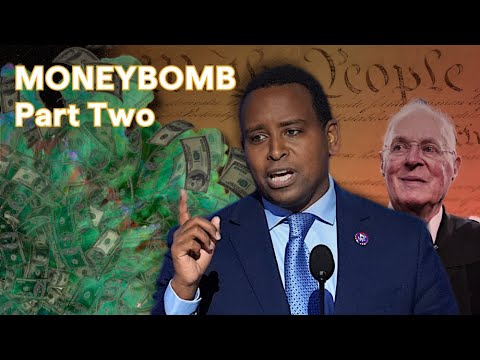
For 15 years, lawmakers have been trying — and failing — to overturn Citizens United, the landmark Supreme Court decision that allows corporations and billionaires to overrun our political system with money. Now, some Congressional Democrats are going big — by trying to enshrine campaign finance protections in the Constitution. In the second episode of Lever Time’s MONEYBOMB series, David Sirota sits down with Rep. Joe Neguse (D-Colo.), cosponsor of the new Citizens Over Corporations Act, which would introduce a Constitutional amendment to overturn the Citizens United ruling. Does the effort have a real shot at fixing our democracy crisis?
...
access will not cause the electorate to lose faith in this democracy. Let me say
4:00
that last line again for the folks in the back because it's so wild. Quote,
4:06
"The appearance of influence or access will not cause the electorate to lose
4:12
faith in this democracy." Yeah, that did not age well. When you claim that a
4:18
fictitious entity, a corporation, has more rights than flesh and blood people,
4:25
you are beginning to distort democracy to a point where it becomes meaningless. The American people know this is wrong. AL FRANKEN?
4:33
The American people know that the protesters feel that this Supreme Court ruling is a threat to the
4:39
democratic values of the United States. This is something that's got to turn around or else we won't have an America
4:46
the way we knew America to be. Citizens United was the worst court decision in modern American history.
4:53
[Music] Contrary
5:04
to what Kennedy wrote in the Citizens United decision, survey data tell us that a majority of Americans believe
5:10
that corruption is destroying democracy. A Pew Research survey found that 80% of
5:16
American adults say campaign donors have too much influence over Congress. More
....
5:33
views when every day on the news, Americans hear things like this? Trump promised the big oil executives
5:41
that he would deliver their wish list if they spent a billion dollars to return
5:48
him to the White House. In his new memoir, Anthony Kennedy, the author of the Citizens United decision, says,
5:55
quote, "All of us are concerned about money in politics." In a recent interview with CBS, Kennedy also says
6:02
he's worried about the state of democracy. I'm concerned democracy presumes an
6:08
open, rational, thoughtful, decent discussion where you respect the dignity
6:14
of the person with whom you disagree. And if it doesn't have that, then the then democracy as we know it is in
6:22
danger. This is truly incredible. Anthony
6:28
Kennedy wrote the ruling that floods American politics with unlimited money.
6:34
The ruling that created the dark money groups and super PACs that drown out
6:39
every other voice with negative ads. And now he's saying he's worried about
6:45
democracy. This is like that meme where the hot dog guy crashes his car.
6:50
Yeah, we're all trying to find the guy who did this. Yeah. Apparently, Citizens United author
6:55
Anthony Kennedy is trying to find the Anthony Kennedy who did this to our democracy. It's clear from his memoir
7:02
that Kennedy overwhelmingly places the responsibility of keeping money out of politics on voters. It's a tired claim
7:10
that feels increasingly ignorant, but voters are getting fed up. At least on
7:16
the surface, it seems like lawmakers are beginning to recognize the outrage.
7:21
Every year since the 2010 Citizens United ruling, there have been congressional efforts to try to overturn
7:26
it. Needless to say, none of them have stuck. But certain lawmakers keep
7:31
trying, and some of those lawmakers want to go big by passing an amendment to the
7:37
Constitution. Passing an amendment is no easy task.
7:42
It's been 33 years since the last time we did it. During today's session, members of the
7:48
House of Representatives engaged in debate over the recently ratified 27th Amendment to the Constitution. The 27th
7:54
Amendment says that if members of Congress vote to raise their own pay, they won't get that increase until after
the next election. It's an anti-corruption amendment that prevents immediate pay increases for lawmakers
who've already been elected. This constitutional amendment was ratified in 1992. When was the amendment first
8:14
proposed? 1789, more than 200 years earlier. It was
8:19
actually one of the very first constitutional amendments ever proposed in the history of the United States.
8:25
James Madison, a representative from Virginia who went on to become the fourth president of the United States,
8:32
came up with the idea. Admittedly, the 27th amendment had an exceptional path to the Constitution. But the point is
8:39
that constitutional amendments are really difficult to pass. For an amendment to be ratified, 3/4s of the
8:46
states in America have to approve it. That means 38 of these quote unquote
8:51
United States have to agree on something.
8:57
So, let's fast forward to today. Democratic lawmakers from four different states introduced the Citizens Over
Corporations Act. If ratified, it would become the 28th Amendment to the US
Constitution. One of the lawmakers behind that bill is from my own state of Colorado.
9:15
Good to be with you, Joe Nagus. I represent Colorado's second congressional district in the United States Congress.
lever master plan 2nd choice RR after Bork, smoke pot --> kennedy ex CA lobbyist?! bopp saw openeing, bossie fired him for ted O on CU 2010
souter smoking dissent never public?!
lever bopp --> CU
...
DAVID:Back at his storefront office in Terre Haute, Indiana, James Bopp had his eye on deregulating the campaign finance system, a cause that Kennedy seemed especially amenable to. So Bopp elbowed his way to the front of the queue with a case that brought his two pet causes together, the crusade against abortion and the crusade to deregulate campaign finance laws.
JAMES BOPP JR.: I can't tell the story without talking about Wisconsin right to life.
DAVID:James Bopp saw a new chance to try to go big. It was absolutely critical. Bopp is talking about FEC v Wisconsin right to life, a Supreme Court case that was heard right after John Roberts and Sam Alito were installed, right when Anthony Kennedy was the new swing vote
JAMES BOPP JR.:Wisconsin Right to Life contacts me and says that there's an upcoming vote on Bush's judicial nominees, Feingold of McCain, Feingold fame is up for election, and we want to lobby him, and the vote is going to be in September.
ARCHIVAL NEWS FOOTAGE: The special interest anti-abortion group Wisconsin Right to Life is now airing this TV spot. There are a lot of judicial nominees out there who can't go to work, but come this weekend, this ad and corresponding radio hits will be illegal. Why nominees because Wisconsin Right to Life or WRTL talks about in its ad, contact Senators Feingold and Cole and tell them to oppose the filibuster.
DAVID: Wisconsin Right To Life ads fell within the 60-day window or blackout period before that year's general election, which made it subject to the restrictions of the McCain-Feingold campaign finance law, which, as you heard before, had been upheld by the pre-Roberts, pre-Alito Supreme Court. Under that law, the group couldn't mention Senator Feingold by name, because that would be considered electioneering. So Bopp sued on the grounds that those restrictions were a violation of free speech.
On April 25, 2007, James Bopp argued that case in front of the Roberts and Alito Supreme Court. The questioning focused on whether the Wisconsin right-to-life ads were just issue ads designed to lobby, or whether they were a stealthy form of electioneering against the candidate in the election. Here's Justice Stevens questioning Bopp about the distinction.
ARCHIVAL SUPREME COURT AUDIO (JOHN PAUL STEVENS):Are you trying to convince us? The purpose of these ads was to convince Senator Feingold to change his position on filibuster.
JAMES BOPP JR.: It was, indeed it was to lobby him.
ARCHIVAL SUPREME COURT AUDIO (JOHN PAUL STEVENS):Did you think that was a realistic goal?
JAMES BOPP JR.:Yes, as it turns out, because in 2006 we ran the same sort of anti-filibuster as and Senator Cole, now up for reelection, changed his position on the filibuster. So these things happen. In other words, people, people's positions are affected by grassroots lobbying, and at least people should have the opportunity.
DAVID: Then, Anthony Kennedy chimed in.
Archival Clip, Justice Anthony Kennedy: Is that called democracy?
DAVID:Senators Feingold and Cole and tell them to oppose the filibuster those
Archival Clip, JAMES BOPP JR.:We are hopeful. Your Honor.
DAVID: Ultimately, the conservative majority on the court, including the key swing vote, Anthony Kennedy narrowly agreed with Bopp, saying that Wisconsin right to life's ads were not express political advocacy, since they didn't literally tell people whether or not to vote for specific candidates. The Court declared that Wisconsin right to life's ads could not be regulated by the McCain-Feingold campaign finance law. Here's Chief Justice John Roberts once again, play acting as a baseball umpire.
Archival Clip, John Roberts: Discussion of issues cannot be suppressed simply because the issues may also be pertinent in an election where the First Amendment is implicated, the tie goes to the speaker, not the censor.
DAVID: Put another way, a mere four years after the old Rehnquist Court dunked on the master planners and upheld McCain's campaign finance law, the new Roberts Court had just sided with those same master planners and overturned a major part of that law. This was an Empire Strikes Back moment for the ages.
SEN. SHELDON WHITEHOUSE (D-R.I.): I call that the ‘Magic words’ case.
DAVID: This is Senator Sheldon Whitehouse. White House first took his seat as the junior senator from Rhode Island just six months before the decision in FEC versus Wisconsin right to life came down. He told us just how significant this little noticed case really was. That was the case in which Supreme Court decided what the magic words were, that if you used them in an ad, it became a political ad and was subject to a variety of regulations and limitations. But if you didn't use those magic words, then you could say that your ad was not a political ad, but it was issue advocacy. You weren't recommending a vote against Senator Whitehouse. You were just recommending that voters call up Senator Whitehouse and ask why he was a thieving, dirty, puppy-hating, anti-American scoundrel, right? The effect on the airwaves is the same, but if you didn't use the magic words about vote or elect then this whole new avenue opened up for dirty political TV advertising.
DAVID: Whitehouse said that the little magic words loophole started opening up the floodgates for unregulated, anonymous, dark money ads that buy elections, all under the guise of educating the public with so-called ‘issue ads’ rather than electioneering. I think that was the purpose of the exercise. Here are the words that if you don't use them, you're good to go on election spending.
DAVID: So you can see why. James Bopp told us that the decision in FEC v Wisconsin Right To Life was absolutely critical. It was a huge blow to the McCain-Feingold campaign finance law, but perhaps more importantly, it showed Bopp how this new Roberts Alito court was inclined to rule on all of these campaign finance issues}:. :{Bopp also noticed something else. Arch conservative justice Antonin Scalia wrote a concurrence, agreeing with the court's decision, but saying it should have gone a step further and completely eliminated McCain-Feingold's prohibitions against unlimited corporate spending to sway elections.
The concurrence was backed by Clarence Thomas, hardly a surprise, but there was a third signature on the document, you guessed it, Anthony Kennedy. That was a signal to James Bopp that perhaps he could get Kennedy, the old Sacramento Swamp Thing, to channel his predecessor, Lewis Powell, and go huge.
ARCHIVAL CAMPAIGN SPEECH (HILLARY CLINTON):I announced today that I'm forming a presidential exploratory committee. I'm not just starting a campaign, though. I'm beginning a conversation with you, with America.
DAVID: It's early 2007. Hillary Clinton has announced her campaign for president. James Bopp is in Terre Haute, working on arguments that might get justices to go big in that Wisconsin right to life case.
ARCHIVAL CAMPAIGN SPEECH (HILLARY CLINTON):So let the conversation begin, I have a feeling it's going to be very interesting.
DAVID: And then one day, James Bopp’s phone rings,
JAMES BOPP JR.: So I'm sitting in my office, and I get a phone call from David Bossie.
DAVID: David Bossie is a conservative activist. In 1992 he was working for a non-profit that was first founded by the same people who made one of the sleaziest dark money ads in American history, the Willie Horton ad that shifted the 1988 presidential election that you heard about in episode six. By 2000, Bossie was the organization's president, so James Bopp picks up the phone to talk to David Bossie and Bossie asks Bopp if he'd represent his organization in a juicy lawsuit about Hillary Clinton that could end up letting corporations spend unlimited amounts of money in politics.
ARCHIVAL AD: Oh, baby. You know what I like.
DAVID:James Bopp likes big campaign finance cases, and this one might be the biggest of them all.
JAMES BOPP JR.: And he said, ‘I'm working on a movie called Hillary: The Movie, alright?’ And this is now in early 2007, I'm working on a movie, and she's running for president.
DAVID:Hillary: The Movie was promoted by Bossie as a documentary, but it was functionally just a hyper conservative 90-minute anti-Clinton campaign ad with Sad, Scary Music, all funded by a boatload of anonymous money.
“HILLARY: THE MOVIE”: She's deceitful. She'll make up any story, lie about anything, as long as it serves her purpose of the moment, and the American people are going to catch on to it. I can't think of any other politician in history who has shown such a disrespect and a contempt for the Constitution and the rule of law as Hillary.}:
DAVID: Bossie was calling bopp to figure out how to drop this thing into the 2008 election cycle while skirting campaign finance laws that apply to political ads during elections.
JAMES BOPP JR.:I want to broadcast this movie, and I need your help two ways. Okay, first way is to make sure that our movie script does not have an appeal to vote for or against a candidate, because I want to be able to do this, and if it has an appeal to vote, I'm prohibited, so I want you to give me the advice to make sure that they could still do this movie.
DAVID:The second thing Bossie wanted Bopp's help on was finding a legal way to get around the requirement to file a disclosure report about who exactly was funding the project.
JAMES BOPP JR.: The report would have required him to reveal his donors, and people would not want to contribute if they are going to be outed as funding an anti-Hillary certainly critical Hillary movie, right? So he doesn't want to have to do this report of their donors.
DAVID: This is something we've seen over and over again in our reporting, conservatives want to be able to broadcast whatever messages they want, but they don't want to have to admit who is actually funding the message. And this quote, unquote movie was pretty nasty.
“HILLARY: THE MOVIE”:I knew Richard Nixon, and I'll tell you something, she's no Richard Nixon. She's worse, ruthless, vindictive, venal, sneaky, ideological, intolerant, liar is a good one…scares the hell out of me.
DAVID: So Bopp took the lessons he learned in the Wisconsin case, and he set about strategically assembling this new case using arguments that Roberts and Scalia and Kennedy had signaled they were sympathetic to, and just like his inspiration, Thurgood Marshall in Brown v Board of Education, James Bopp hoped this case would be the big one.
Bossie's organization had run into issues with federal election regulators in the past. They tried to make some so-called documentaries before, but the dark money group was clearly a political organization and not a movie studio. So more than once, the Federal Election Commission insisted that they were subject to McCain-Feingold's restrictions. Bopp anticipated a similar pushback on Hillary: The Movie, but rather than waiting for federal election regulators to send a cease-and-desist letter to Bossie, Bopp had a genius idea. He went to a lower court demanding a declaratory judgment up front one that would officially allow Bossie to air his documentary right up until the 2008 primaries. In other words. Courts. Bopp took a play out of the Powell memo and used this case as a preemptive attack.
LEWIS BLACK AS LEWIS POWELL:The greatest care should be exercised in selecting the cases in which to participate.
DAVID: He used this obscure movie to create a case out of thin air, the lower court said, essentially no campaign finance restrictions obviously apply to this, but that ruling gave Bopp what he really wanted, a way to appeal the case up to John Roberts, Sam Alito, and Anthony Kennedy on the Supreme Court. When Hillary: The Movie became a legal case, it ended up being named after Bossie’s non-Movie Studio, nonprofit, maybe you've heard of it:
…
DAVID: Citizens United was appealed up to the Supreme Court in August of 2008 Hillary Clinton was long gone from the presidential race, defeated by Barack Obama, but that didn't matter, the master planners were after something much bigger. The Court agreed to hear the case three months later, and then David Bossie replaced James Bopp.
Bossie bumped bop for a new Hot Shot attorney named Ted Olson. By 2008 Olson was already famous in master plan circles. He'd been a founding member of the Federalist Society and the bush campaign's mouthpiece at the Supreme Court in Bush v Gore, which decided the 2000 election. Supposedly, David Bossie had seen Olson win a Republican lawyer of the Year Award at an event in Washington, DC in October 2008 where another attorney called Olson the quote, “winningest Supreme Court lawyer.”
So when bossie’s challenge was accepted at the High Court The following month, he told his co-founder that they should ditch old James Bopp in Terre Haute and pick up Olson instead like leaving prom with the popular girls.
When Olson took over the Citizens United case, he slightly reformulated Bopp's argument. He focused on the idea that Hillary: The Movie was not what the McCain Feingold campaign finance law was actually supposed to prohibit. It was a documentary movie that viewers had to seek out on video on demand, not a screeching election ad that couldn't be avoided on cable TV.
ARCHIVAL SUPREME COURT AUDIO (TED OLSON):Mr. Chief Justice, and may it please the Court, participation in the political process is the First Amendment's most fundamental guarantee yet, that freedom is being smothered by one of the most complicated, expensive and incomprehensible regulatory regimes ever invented by the administrative state.
DAVID: It was Olson who first brought up the word “corruption.”
ARCHIVAL SUPREME COURT AUDIO (TED OLSON):The government cannot prove, and has not attempted to prove, that a 90-minute documentary poses any threat of quid pro quo, corruption or its appearance. Indeed, this documentary is the very definition of robust, uninhibited debate about a subject of intense political interest, that the First Amendment is there to guarantee.
DAVID: Olson argued with a straight face that Hillary the movie wasn't an election focused ad governed by campaign finance laws, despite the fact that it was dropped in the middle of an election and spends 90 minutes insisting that Hillary Clinton was unqualified for the presidency and was, I'm paraphrasing here, basically the Antichrist. Justice Souter for one wasn't buying. It.
ARCHIVAL SUPREME COURT AUDIO (DAVID SOUTER):Doesn't this one fall into campaign advocacy. I mean, I've got the government's brief open at pages 18 and 19, with the quotations. She'll lie about anything. She's deceitful. She's ruthless, cunning, dishonest. Do anything for power. Will speak dishonestly, reckless, a congenital liar, sorely lacking in qualifications, not qualified as commander in chief. I mean, this sounds to me like campaign advocacy.
DAVID: Yeah, you think? In response, the master planners on the Supreme Court pretty much hijacked the oral arguments the same way your crotchety uncle pulls the ‘well actually’ move to steer the Thanksgiving dinner conversation towards his bizarre theories. For example, instead of a discussion about money, influence, election buying and corruption, what the case was actually about justice, Sam Alito forced the government's defense lawyer into an absurd debate about book banning. Here's Kennedy.
ARCHIVAL SUPREME COURT AUDIO (ANTHONY KENNEDY):Suppose it were an advocacy organization that had a book, your position is that, under the Constitution, the advertising for this book or the sale for the book itself could be prohibited within the 60 or 30 day period
ARCHIVAL SUPREME COURT AUDIO (TED OLSON):if the book contained the functional equivalent of Express advocacy, that is, if it was subject to no reasonable interpretation
DAVID: They proceeded to get into an even more ludicrous debate about e-books that are accessed via satellite
ARCHIVAL SUPREME COURT AUDIO (TED OLSON):within the 60 30, day period. If it comes from a satellite, it can be prohibited under the Constitution and perhaps under the statute.
DAVID:I mean, this is a case about a movie. What are they even talking about? I feel like I'm Steve Martin in Planes, Trains and Automobiles.
“Planes, Trains and Automobiles”:When you're telling these little stories, here's a good idea: Have a point. It makes it so much more interesting for the listener.
DAVID:The FEC’s lawyer tried to steer the justices back on track.
ARCHIVAL SUPREME COURT AUDIO:It can't be prohibited, but a corporation could be barred from using its general treasury funds to publish the book, and could be required to raise funds to publish the book using its PAC.
DAVID:That was the actual point. And unfortunately, the FEC’s lawyer didn't make it very well. It wasn't really about whether the government could or would prohibit the publication of a book that urged its readers to vote or not vote for a specific candidate. It was about a corporation being able to anonymously funnel money from its coffers into election communications with no restrictions, and the government was arguing that they'd have to use a regulated PAC or explicitly disclosed political money instead.
It's worth reiterating that none of this is what the original case was asking about. But as the ever more twisted and deranged arguments went on, the conservative justices like Anthony Kennedy kept insisting that it was a free speech question, even though it really wasn't. Then an hour later, it was over.
ARCHIVAL SUPREME COURT AUDIO (JOHN ROBERTS): Thank you, Counsel. The case is submitted.
ULA:What happens behind the scenes when the justices vote on this case is kind of my favorite part of the story.
DAVID:This is producer Ula Culpa, to tell us about when things got really interesting.
ULA:So after oral argument, the justices meet in private and have a round of initial votes on the case. It falls basically along ideological lines, with the four liberals against Citizens United and the five conservatives, including Anthony Kennedy, in favor of saying that McCain-Feingold [Bipartisan Campaign Finance Reform Act] did not apply to Hillary: The Movie, Roberts gets to work on a narrow opinion saying that, but Kennedy writes a concurrence that argues that they should go way bigger and invalidate any campaign finance restrictions on allegedly independent political groups like Citizens United.
DAVID: So Roberts and the other conservatives then compare drafts, and they love Kennedy's idea so much that Roberts withdraws his more narrow opinion and lets Kennedy write the majority
ULA: Exactly. And this is where the drama hits after Justice Souter sees what Roberts and Kennedy are planning to do. He gets pissed and writes a dissent, and it has become infamous in legal circles because it was this Full Tilt bridge burning attack on the logic of his fellow justices, which is something that almost never happens, and definitely not like this. Reportedly, Souter berated not only the conclusions that Roberts and Kennedy had come to, but the like intellectual depravity to step outside of and way beyond what this case was asking in the first place.
DAVID: Finally, someone was calling bullshit. Okay, so read us some excerpts.
ULA:Well, I can't.
DAVID: Wait. Why?
ULA:Because very few people have actually ever seen Souter's dissent, and that's because not long after he drafted it, just as David Souter has informed the White House, he will retire at the end of a Supreme Court term in June. God, it's exactly like that scene from Half-Baked.
“HALF-BAKED”: Fuck you, Fuck you, fuck you… You're cool…Fuck you. I'm out
ULA: Totally and then John Roberts basically makes sure Souter’s dissent never gets published as part of the official record. Because instead of the ruling coming out at the end of the court's term, like you might expect, Citizens United is suddenly scheduled for re-argument in the fall.
DAVID:What the hell is reargument?
ULA: It's when the Court asks the lawyers to write all new briefs about all new questions. In this case, Roberts asked them to address big constitutional questions that signaled that the court wasn't going to issue a narrow ruling about one movie. It was going to follow Kennedy's lead and go really, really big.
DAVID: So here we are in the fall of 2009, things still seem all Hopey-and-Changey over in the White House, but only a few blocks away at the Supreme Court. Shit is about to go down. The Master planners had taken over the court with Roberts and Alito. James Bopp had given Anthony Kennedy the chance to go big, and Roberts figures out a way to make it all happen. This is like the master planners a team moment.
DAVID: So six months after the first argument in the Citizens United case, David Souter is retired. His barn burning warning about the end of democracy is nowhere to be found. The ideological Terminator John Roberts rewinds the clock and lets Federalist Society luminary Ted Olson make a whole new argument to the court,
ARCHIVAL SUPREME COURT AUDIO (TED OLSON):Mr. Chief Justice, and may it please the Court.
DAVID: This was no longer a little argument about a specific campaign finance law and a dumb documentary, but a robust debate about candidates for elective office is the most fundamental value protected by the First Amendment's guarantee of free speech.
Olson and his client Citizens United were now resurrecting the old free speech arguments from Buckley v. Valeo and from Lewis Powell's Bellotti ruling that you heard about in episode five. Essentially, they argued that money is protected speech. They also argued that corporations, therefore have a constitutional right to spend unlimited money in elections, as long as it's not directly coordinated by candidates, and that such independent spending isn't a corrupting force. The justices seem supportive of that view. John McCain said they seemed totally out of touch with reality.
ARCHIVAL NEWS FOOTAGE (JOHN MCCAIN): I was rather disappointed in some of the justices apparent naivete as to how corporate and union and unlimited money affects the legislative process. Does anyone believe that the rights of average citizens to be heard in Washington would not be overridden by massive, unlimited campaign contributions from corporations and unions?
DAVID: McCain was correct. Nobody believed that, but that was a feature of the Citizens Unitedcase, not a bug. A ruling in favor of Citizens United would override average citizens' voices and create a society run by corporations and oligarchs, just as James Bopp's fellow Hoosier Ron Swanson had dreamed of back in fictional small town, Indiana.
“PARKS AND RECREATION”:I think that all government is a waste of taxpayer money. My dream is to have the park system privatized and run entirely for profit by corporations like Chuck E. Cheese. They have an impeccable business model. I would rather work for Chuck E. Cheese.}:
DAVID: McCain, Feingold and all the Reformers warned that ruling for Citizens Unitedwould deregulate the campaign finance system and basically make Ron Swanson's vision a reality. Politicians and public officials would work for Chuck E. Cheese and every other corporation, and those corporations would be allowed to buy elections. I mean, the Supreme Court was pretty radical, but would it really go that far? That's after the break.
ARCHIVAL SUPREME COURT AUDIO (JOHN ROBERTS): In case 08205, Citizens United v. the FEC, Justice Kennedy has the opinion of the court.
DAVID: On January 21, 2010, just over four months after the second round of arguments, the decision in Citizens United came down this time. It wasn't Chief Justice John Roberts writing the majority opinion. It was the old Sacramento Swamp Thing, former lobbyist and influence peddler Anthony Kennedy in announcing the decision to the public. Kennedy first laid out why the majority had decided to go big. He identified the precedents that were relevant to the case, like the court's ruling a few years prior, that had held up the McCain Feingold campaign finance law. And then, he said, we conclude that those precedents now must be reexamined. The Court has recognized that First Amendment protection extends to corporations. If the First Amendment has any force, it prohibits Congress from fining or jailing citizens or associations of citizens for simply engaging in political speech.
DAVID: The precedents the court's majority was now dismantling, according to Kennedy, would
ARCHIVAL SUPREME COURT AUDIO (ANTHONY KENNEDY): —allow the government to ban corporations from expressing political views through any media, including media beyond those presented here and in this case, such as by printing books, political speech is indispensable to decision making in a democracy. And this is no less true because the speech comes from a corporation rather than an individual.
DAVID:This is the radical corporations are people concept on steroids, and the opinion was directly built from that Belotti ruling, first authored by Kennedy's immediate predecessor, Lewis Powell, even more radical, Anthony Kennedy, who spent his early years as a lobbyist doling out campaign cash to sway legislators. That same Anthony Kennedy was now also insisting that money in politics was only corrupting when there was an explicit quid pro quo, but all the other things that Anthony Kennedy himself had helped his Sacramento lobbying clients use money to buy stuff like access and influence that stuff was apparently not corrupting. That sounds like an exaggeration, but in his written opinion, Kennedy asserted that campaign donors, quote, may have influence over or access to elected officials, but that did not quote mean that these officials are corrupt. And then Kennedy wrote something so crazy that — hold on, hold on. Can I get a special effect on my voice for this so that it sounds extra evil? Okay, there we go.
Kennedy said, quote, independent expenditures, including those made by corporations, do not give rise to corruption or the appearance of corruption. I mean, think about how insane that is. Anthony Kennedy non ironically, wrote a ruling with the force of law that essentially declares that when a corporation spends $50 million blanketing your state to help one candidate win a US Senate election, there's no corruption or even appearance of corruption when that candidate then does legislative favors for that corporation. Justice Stevens wrote the dissent on behalf of the liberals. It may not have been Souter's barn burner, but it was pretty close. It was 90 pages long and probably bolstered by the fact that Stevens was 90 years old and also nearly ready to retire.
ARCHIVAL SUPREME COURT AUDIO (JOHN PAUL STEVENS): As one of the joint authors of the opinion in McConnell, I must emphatically disagree with today's law changing decision…
DAVID: Stevens’ dissent made the point that up until O'Connor and Rehnquist were replaced by Roberts and Alito, the court had upheld at least some restrictions on corporate spending in elections.
ARCHIVAL SUPREME COURT AUDIO (JOHN PAUL STEVENS): The Court has the point exactly backwards. At the founding Americans took it as a given that corporations could be comprehensively regulated in the service of the public welfare. It is doubtful that the framers believed the freedom of speech would extend to corporations who cannot themselves engage in speech. And is even more doubtful that when they ratified the First Amendment, they thought they were laying down a principle that could be used to insulate corporations from even modest restrictions on electioneering expenditures.
goes ORIGINALIST ON THEIR ASSES?
DAVID: After speaking for 20 minutes, twice as long as Kennedy had, Stevens had his mic drop moment.
ARCHIVAL SUPREME COURT AUDIO (JOHN PAUL STEVENS): While American democracy is still imperfect, few outside the majority of this court would have thought its flaws included a shortage of corporate money in politics.
DAVID: Unsurprisingly, when the ruling came down, David Bossie of Citizens Unitedwas giddy.
ARCHIVAL NEWS FOOTAGE (DAVID BOSSIE):This is a monumental day for Citizens United, and more importantly, for the First Amendment and the fundamental rights of people to participate in the political process and the marketplace of ideas, whether you're an individual, whether you're a corporation or a union, it doesn't matter. You can now participate fully and freely in the election process.
DAVID:Here is Senator Sheldon Whitehouse again.
SEN. SHELDON WHITEHOUSE:My recollection, I was on the Senate floor and came back to read the decision.
DAVID: He said the decision was painful to read.
SEN. SHELDON WHITEHOUSE: I live in the immediate political world, and I was watching the Supreme Court buy into a notion about that political world that I knew to be false. They have applied a conceptual paradigm over politics that is complete and utter nonsense.
DAVID:While much of the country reacted to the decision with surprise and anger, White House says that conservative must have had an inkling that this was coming, because right after the decision came down, conservative and business interest groups immediately filed papers to create scores of unregulated dark money groups that could exploit the ruling.}:
SEN. SHELDON WHITEHOUSE:The fact that they had this whole 501(c)(4) apparatus ready to go sort of proved that this was an expected decision. In fact, you even have Virginia Thomas setting up her organization while the decision is being deliberated, so that on the day it's announced she's ready to go.
DAVID: Whitehouse is referring to Virginia Ginni Thomas, wife of justice, Clarence Thomas, just weeks before the ruling in Citizens United came down, she and Leonard Leo of the Federalist Society filed initial paperwork for a not for profit lobbying group called Liberty Central, a group designed to take advantage of the Citizens Unitedruling Liberty Central is America's public square. We inspire, we listen, we activate ordinary citizens to secure the blessings of liberty.
DAVID: Though it was hidden at the time, later, reporting revealed that Liberty Central's initial $500,000 of funding came from who else the Thomas's favorite billionaire, a guy named Harlan Crow, who'd been funding lavish trips for justice, Thomas on the other side of the aisle, Democrats openly criticized the Citizens Unitedruling. Here's President Obama in his State of the Union address less than a week after the decision
ARCHIVAL SPEECH AUDIO (BARACK OBAMA): Last week, the Supreme Court reversed a century of law that I believe will open the floodgates for special interests including. Foreign corporations to spend without limit in our elections.
DAVID: In the video of the speech, you can see the justices stay seated and look stone-faced as much of the room stands to applaud Obama around them, and then there's Samuel Alito shaking his head and muttering, not true.
SEN. SHELDON WHITEHOUSE: It made me grieve for Sandra Day O'Connor, whose departure had opened the door for Alito particularly, and whose common sense and experience as somebody who had run for office, I think would have headed off Citizens Unitedhad she stayed on the court. So the whole thing was just sort of imbued with sorrow and missed chances, but the result at the end was a completely manufactured simulacrum of what the political world is like, created by the court and imposed on all of us.
DAVID:Whitehouse and John McCain tried to quickly limit the rulings effects. They asked the Supreme Court to at least prevent a lower court in Montana from now using Citizens United to gut that state's 100 year old anti corruption law the Supreme Court refused to even hear the case.
SEN. SHELDON WHITEHOUSE: So at that point, I realized, Oh, my God, this is not an innocent mistake. They are actually deliberately trying to open our political world to right wing political dark money.
DAVID: In my imagination, James Bopp was celebrating back home in Indiana when he read the Citizens United ruling.....
DAVID: He was psyched. But if he doesn't sound 100% excited about the ruling, it's because he kind of wasn't sure he had gotten most of what he wanted. He had created a case that convinced the court to go huge and eviscerate campaign finance laws in a world changing ruling, four years before Citizens United, nonprofits and other non disclosing political groups had spent $0 in the 2006 election cycle. In 2010 right after the ruling, those groups accounted for 47 percent of political spending, $134 million but still, there was one part of the Citizens Unitedruling that stuck in James Bopp's craw.
JAMES BOPP JR.: They upheld a report, the disclosure Yeah, the disclosure report.
DAVID: Remember David Bossie originally asked Bopp to help his group circumvent the McCain Feingold law and letCitizens United air its glorified anti-Hillary campaign ad in the middle of the election. But Bossie also told Bopp he wanted to ignore the McCain-Feingold law's disclosure provisions and hide the names of the ad's funders from the public on that disclosure issue, the court actually ruled against Citizens United
The court ruled that laws requiring big spenders in elections and politics to be disclosed, those laws were constitutional. We reject Citizens United's challenge to the disclaimer and disclosure provisions. Those mechanisms provide information to the electorate, the resulting transparency enables the electorate to make informed decisions and give proper weight to different speakers and different messages.}:}:
DAVID: When he heard this caveat, Senator Sheldon Whitehouse saw an opportunity to call the Supreme Court's bluff. He introduced a bill called the Democracy Is Strengthened by Casting Light On Spending in Elections. Act, a hilariously wordy attempt to get a pithy acronym the DISCLOSE Act.
SEN. SHELDON WHITEHOUSE:The DISCLOSE Act was originally designed to require that you trace back to the actual source of political contributions for any contribution to a political campaign, or a PAC or a Super PAC, over $10,000 in a individual race. That's not a whole lot of people, but at that level, you really are buying influence. And so I think it's important for voters to understand what's going on in their political world around them.
DAVID: Democrats rallied behind the DISCLOSE Act right away, while Republicans like Mitch McConnell contorted themselves to swat it down.
...
====
===
Oct 8, 2024
MASTER PLAN, Ep 9: The Swing Vote That Changed America
bork --> kennedy
...Indiana attorney James Bopp engineered the case allowing dark money in politics specifically with the court’s “swing vote” in mind.
...Carefully watching this appointment was an Indiana lawyer who’d made it his life’s mission to outlaw abortion and gut campaign finance laws. James Bopp knew that Kennedy had a moderate reputation after siding with liberal justices on social issues, but his rulings on campaign finance cases began to signal that he could be open to helping the master planners further open the floodgates of dark money.
Bopp got a chance to test his theory when the political advocacy group Citizens United planned to release Hillary: The Movie.Knowing that a film criticizing then-presidential candidate Hillary Clinton would likely violate the McCain-Feingold campaign finance law’s restrictions on electioneering, Bopp challenged the constitutionality of the law.
A hidden drama at the Supreme Court began as Chief Justice Roberts proposed a narrow ruling in the Citizens United case, while Justice Kennedy pushed for a far-reaching decision. Behind the scenes, a scathing dissent has since vanished from the record — and the final ruling would live in infamy, reshaping campaign finance law for years to come.
Bopp was about to find out that Kennedy wasn’t just an ally.
evid
early in his career, Anthony Kennedy helped draft an anti-tax ballot initiative for then-Governor Ronald Reagan. Theagenda for a "confidential" two-day meeting of Reagan’s Tax Reduction Task Force in late 1972 listed Kennedy among a select group of participants, including economist Milton Friedman, management consultant Peter Drucker, and William Baroody, head of the American Enterprise Institute.
- Read theWhite House talking points from President Reagan's December 1987 nomination of Anthony Kennedy.
- An *LA Times* profile of Kennedy highlighted his background as a Sacramento lawyer and lobbyist, noting that in the '60s and early '70s, he "passed out generous campaign contributions" — a practice banned by a 1974 reform law
- ReadSenator Sheldon Whitehouse's paper, which argues that the Supreme Court has overstepped its role by engaging in flawed fact-finding — traditionally a trial court function — resulting in biased, partisan decisions in cases like Citizens United, Shelby County, and Dobbs.
---
https://www.alternet.org/msn/supreme-court-2659946340/}:
an 5 23
New documents reveal how Sandra Day O’Connor helped George W. Bush claim victory in 2000
Alex Henderson May 03, 2023
Compared to the tensions and violence that followed the United States' 2020 presidential election, 2000's Bush v. Gore looks like a minor skirmish. Then-Vice President Al Gore, the Democratic presidential nominee, initially questioned his loss in Florida. But eventually, Gore conceded, acknowledged Republican George W. Bush as president-elect and offered his congratulations.
Whenever Gore was later asked if he believed the 2000 election was stolen from him, he would respond, without hesitation, that he considered Bush the loyal opposition. Gore criticized Bush from a policy standpoint during his eight years in office, but never questioned his legitimacy as president. Former President Donald Trump, in contrast, continues to make the false, thoroughly debunked claim that the 2020 election was stolen from him through widespread voter fraud.
But in 2000, the U.S. Supreme Court's controversial ruling in Bush v. Gore inspired a lot of heated debates. Joan Biskupic, CNN's Supreme Court analyst, looks back on Justice Sandra Day O'Connor's influence in Bush v. Gore in an article published on May 3.
READ MORE: Here are 6 ways to combat an imperial Supreme Court
According to Supreme Court documents released on May 2, Biskupic emphasizes, Ronald Reagan appointee O'Connor, "provided the early framework that steered the outcome in the dispute over the 2000 presidential election and ensured George W. Bush would win the White House over Al Gore."
The High Court's 5-4 Bush v. Gore ruling, much to the chagrin of many Democrats, stopped county vote recounts in Florida. And all five of the justices in the majority were Republicans: O'Connor, fellow Reagan appointees Anthony Kennedy and Antonin Scalia, George H.W. Bush appointee Clarence Thomas and then-Chief Justice William Rehnquist (a Richard Nixon appointee).
"The documents opened at the Library of Congress help reveal how the now-retired O’Connor, the first woman on the High Court and a justice steeped in politics from her early days in the Arizona Legislature, partnered with Justice Anthony Kennedy, effectively squeezing out an argument advanced by then-Chief Justice William Rehnquist," Biskupic explains. "The strong hand of O'Connor, who was at the ideological center of the Court in this era, is not wholly surprising. O'Connor was also known for trying to get out ahead of deliberations, and her four-page memo was circulated to colleagues even before oral arguments."
The four dissenters included two Democratic appointees (Ruth Bader Ginsburg and Stephen Breyer) and two GOP appointees (David Souter and John Paul Stevens).
READ MORE: How two conflicting federal court decisions led to the Supreme Court’s abortion pill ruling
Biskupic notes, "O'Connor's views, expressed in a December 10, 2000, memo, were endorsed byfellow conservative-centrist Kennedy as he took the lead in writing the unsigned 'per curiam' opinion issued late on the evening of December 12, the new documents show. The shared views of O'Connor and Kennedy eventually forced Rehnquist to abandon his effort to author the main opinion with a boundary-pushing view of federal election principles — views that would come up during Donald Trump's attempt to overturn the 2020 presidential election."
READ MORE: AOC rebukes Alito 'tantrum' and 'highly politicized' Supreme Court
Read Joan Biskupic's full CNN article at this link.
FROM YOUR SITE ARTICLES
Supreme Court’s 'unsigned, unexplained orders' are creating havoc: expert ›
Scathing parody mocks Supreme Court justices’ excuses for dodging ethics code ›
Supreme Court stays order banning abortion drug mifepristone ›
RELATED ARTICLES AROUND THE WEB
Chief Justice John Roberts will not testify before Congress about ... ›
Supreme Court's Clarence Thomas defends luxury trips - BBC News ›
Democrats call for new supreme court ethics rule amid Clarence ... ›
---
---
https://theintercept.com/2018/06/28/farewell-to-anthony-kennedy-author-of-some-of-the-most-ludicrous-words-in-supreme-court-history/
sUPREME COURT JUSTICE Anthony Kennedy announced Wednesday that he will retire effective July 31.
While appointed by Ronald Reagan, and quite conservative, Kennedy has occasionally been a wild card. For instance, he wrote the opinion for the 5-4 majority in Obergefell v. Hodges, in which the court ruled that same-sex couples have a constitutional right to marry. He likewise authored the majority decision in Boumediene v. Bush, when the court held that prisoners held at Guantánamo Bay had the right to habeas corpus review.
But Kennedy’s greatest legacy will likely be writing the notorious 2010 decision in Citizens United v. FEC, which declared that the First Amendment prohibits restrictions on so-called independent expenditures by corporations and unions. Kennedy’s ruling contains some of the silliest, wackiest, most preposterous pronouncements in the tens of millions of words extruded by the Supreme Court in its 229-year history:
[W]e now conclude that independent expenditures, including those made by corporations, do not give rise to corruption or the appearance of corruption. …
The fact that speakers [i.e., donors] may have influence over or access to elected officials does not mean that these officials are corrupt. …
The appearance of influence or access, furthermore, will not cause the electorate to lose faith in our democracy.
Kennedy might as well have written, “We now conclude that the sky is green, and everyone in America will agree that that’s definitely true.”
Kennedy’s bizarre assertion is based on a belief that money in politics only amounts to corruption if it involves notarized memos. “Kennedy argued that independent expenditures by definition could not have a corrupting effect on elected officials,” says Robert Weissman, president of Public Citizen. “By definition, because the political spender did not obtain a signed agreement for a favor in exchange for the political spending. There are perhaps five people in Washington, D.C. who think this reflects how political spending works. That would be Justice Kennedy and the four justices who joined him.”
All the available evidence, of course, is that essentially all Americans except Kennedy and Co. despise our campaign finance system, Citizens United in particular – because they accurately believe it is, to use a term picked totally at random, a corrupt “swamp.”
An extensive 2015 poll by the New York Times found that zeropercentof Americans believe no changes are needed in the U.S. campaign finance system. Thirteen percent think “minor changes” would suffice. Thirty-nine percent want “fundamental changes,” while 46 percent go further and say we should “completely rebuild” how it works. That’s a combined total of 85 percent in favor of major reform. This perspective is completely bipartisan: Eighty-one percent of Republicans fall in the “fundamental changes”/”completely rebuild” camp, while 84 percent of Democrats do.
The Times survey also found that 84 percent of Americans think money has “too much” influence on political campaigns, and 55 percent believe that “most of the time” officeholders “directly help” their financial supporters.
So it should be no surprise that the poll showed that 78 percent of all adults – including 73 percent of Republicans and 85 percent of Democrats – feel that independent expenditures “should be limited by law.” In other words, big supermajorities all across the political landscape oppose the central effect of Kennedy’s Citizens United decision.
Similar results on related questions have been found in poll after poll since 2010. In 2015, majorities of Americans declared that most members of Congress are corrupt, out of touch, and favor special interests. This past May, 75 percent of respondents said that they would like their member of Congress to vote for a constitutional amendment to overturn Citizens United.
Both Hillary Clinton and Donald Trump responded to America’s deep distain for Citizens United in 2016. Clinton’s platform stated that she would “overturn Citizens United.” Trump proclaimed that the Super PACs that Citizens United helped make possible were “a total phony deal,” and attacks on a “rigged” system were a central part of his campaign. (Even Jeb Bush – after blessing his own gigantic Super PAC – said he opposed Citizens United, and it would be “ideal” to overturn it.)
There is only one defense that Kennedy could make for his bizarre Citizens United assertion: That Americans alreadythought the U.S. campaign system was totally corrupt before the case was decided. There is some truth to that, but the numbers have gone up noticeably since 2010. However, there is no trace in Kennedy’s ruling of a recognition that corruption was a significant concern of voters.
By contrast, there was recognition of the real world in the Citizens United dissent written by former Justice John Paul Stevens. According to Stevens, Kennedy’s claim that “independent corporate expenditures ‘do not give rise to [quid pro quo] corruption or the appearance of corruption’” was “unfair as well as unreasonable. Congress and outside experts have generated significant evidence corroborating this rationale … If our colleagues were really serious about the interest in preventing quid pro quo corruption, they would remand to the District Court with instructions to commence evidentiary proceedings.”
But Kennedy was not interested in something as banal as “evidence” involving reality. He had an ideological commitment to opening the floodgates to as much money in politics as possible and was willing to say absolutely anything to make it happen.
---
:{new revelations show the close financial ties between President Trump and Justice Anthony Kennedy’s son, Justin Kennedy, who served as the global head of real estate capital markets for Deutsche Bank. The New York Times reports that under Justin Kennedy’s leadership, Deutsche Bank loaned Donald Trump $1 billion for renovation and construction of buildings in New York and Chicago, at a time when many other banks refused to lend to Trump because of his troubled financial history.}:
==
trump-family-anthony-kennedy-brett-kavanaugh-dark-towers
Trump family carried out a “coordinated White House charm offensive” to persuade Anthony Kennedy, a swing vote on the supreme court, to retire and clear the way for Brett Kavanaugh, according to a forthcoming book.
In Dark Towers: Deutsche Bank, Donald Trump and an Epic Trail of Destruction, David Enrich, the finance editor of the New York Times, describes how the German bank became the last major financial institution willing to lend to Donald Trump’s repeatedly defaulting business empire.
Long before Trump ran for the White House, Justice Kennedy’s son, Justin, worked as an investment banker at Deutsche. Enrich describes how he developed a relationship with Trump, his daughter Ivanka and son-in-law Jared Kushner, helping to finance real-estate deals no other bank would touch because of Trump’s record of failing to pay his debts to lenders, contractors and business partners.
“Even Trump’s friends would go to considerable lengths to avoid lending him money,” Enrich writes, adding that virtually the only person who would loan money to Trump was his father, Fred, who is widely known to have repeatedly bailed out his son.
Dark Towers will be published on 18 February. The Guardian obtained a copy.
Justin Kennedy was part of the US branch of Deutsche Bank from 1998 to 2009. Drawn to Trump’s risk-taking and glamour, he became a Trump confidant, sitting with the real estate impresario at the US Open tennis or in Manhattan nightclubs, and chaperoning huge loans to finance Trump’s real estate spending sprees.
Kennedy, who ran the bank’s commercial real-estate team, continued to lend to Trump even though Deutsche clients had suffered severe losses when Trump’s casino business collapsed and he declared bankruptcy.
After Kennedy set up his own finance and property firm in Florida, Enrich writes, he continued to help other members of the Trump family – Ivanka, Kushner and Donald Trump Jr – arrange financing for projects in New York. The New York Observer, which was owned by Kushner, put Kennedy on a list of the 100 most powerful people in New York real estate.
Once Trump was in office, he went out of his way to congratulate Justice Kennedy on his son, calling him a “special guy” and saying how much his own children loved him.
“Trump’s flattery,” Enrich writes, “was part of a coordinated White House charm offensive designed to persuade the ageing justice – for years, the court’s pivotal swing vote – that it was safe to retire, even with an unpredictable man in the Oval Office.”
Dark Towers describes how Ivanka Trump befriended the judge, sitting next to him at an inaugural lunch, regaling him with accounts of her close friendship with his son, then visiting the elder Kennedy at the supreme court, bringing her five year-old daughter to hear a case about arbitration agreements.
When Anthony Kennedy announced his retirement in June 2018, it gave Trump an opportunity to tip the court right with his nomination of Kavanaugh, in turn solidifying support among conservatives otherwise sceptical about Trump’s character.
Enrich writes that having helped to stabilise Trump’s business, Deutsche Bank now “indirectly” helped to stabilise his “floundering presidency”.
Trump’s relationship with Deutsche Bank was much discussed during special counsel Robert Mueller’s investigation of Russian election interference and links between Trump and Moscow.
Enrich points to the separate relationships Deutsche Bank and Trump had with a Kremlin-linked Russian bank, VTB, suggesting: “Perhaps this was more than a coincidence.”
But he provides no direct evidence to support suspicions that funds supplied by Deutsche Bank to Trump over two decades came from Russian sources, and also notes that Deutsche executives deny any such direct financial relationship.
Rather, Enrich portrays the bank’s investments in Russia and in Trump as both being symptoms of a reckless investment culture and a pursuit of prestige, with insufficient checks from senior management and an outdated and fragmented computer data system.
Trump’s supporters inside the bank have also argued he had a relatively low overall debt burden, and that his real estate purchases were fundamentally sound investments.
Justin Kennedy did not immediately reply to a request for comment.
In a statement, Deutsche Bank said: “While elements of the narrative seem to be exaggerated to fit into a storyline, we have long acknowledged and sought to learn from our historical shortcomings.”
==
https://www.alternet.org/news-amp-politics/heres-corrupt-financial-web-links-trump-and-kennedy-families
==
nancy mcl:
-Larry, scaife fdn, train JC teachers b/c its grads will go into gov't and biz in So and elite univ not fixable 119 (met w/ RR team incl meese)
Ca base Inst for Contemporary Studies scaife, fut scotus Ant M Kennedy 121
exxon mobil, shell texaco, forn, IBM, chase bank GM, olin, scife smith Rich fdn
122 run by manne; GMU? law school to change minds (protect prop cornerstone of law?] 2 wk summer institutes; paid students? 1k$ to write a paper; manne hit up general counsels, not the charity ppl at fdns for $; book: Attack on Corpo Am. syndor CoC ~ increasing federal intrusion
rw $ /pgm in law #1 126
==
https://www.alternet.org/news-amp-politics/did-justice-kennedys-son-bail-out-jared-kushner-666-building
nice chat w/ djt at sotu
...relevant part:
According the New York Times, in 2007 Kushner Companies purchased “an aluminum-clad office tower in Midtown Manhattan, for a record price of $1.8 billion.” At the time the NYT wrote that this deal was “considered a classic example of reckless underwriting. The transaction was so highly leveraged that the cash flow from rents amounted to only 65 percent of the debt service.” The Times continues:
“As many real estate specialists predicted, the deal ran into trouble. Instead of rising, rents declined as the recession took hold, and new leases were scarce. In 2010, the loan was transferred to a special servicer on the assumption that a default would occur once reserve funds being used to subsidize the shortfall were bled dry. But the story may yet have a happy ending for Kushner, a family-owned business that moved its headquarters from Florham Park, N.J., to 666 Fifth, its first major acquisition in Manhattan.”
Who came to the rescue? None other than LNR Property, the company whose CEO at the time was Justin Kennedy. According to the NYT and the Real Deal, Mr. Kushner and LNR “reached a possible agreement with LNR Property, a firm specializing in restructuring troubled debt and which oversees the mortgage, that would allow him to retain control of the tower by modifying the terms of the $1.2 billion mortgage tied to the office portion of the building.” A spokesman for Mr. Kushner told the Wall Street Journal in March of 2011 that “[t]he Kushner’s are ready and willing to invest more money into the property as soon as they can come to mutually satisfactory terms with the servicing agent.” In that same article Kushner’s father-in-law and the future President commented on the negotiations with Justin Kennedy’s company. Speaking about the deal, Trump told the WSJ that Kushner is “a very smart young man…I think it (loan renegotiations) will come out well for him and everybody.” At this point there is no doubt that there was a direct business relationship between LNR and Kushner Companies at the time Justin Kennedy and Jared Kushner were both CEO. Even the future President was aware of the deal and commented on its respective merits. (That being said, it is not impossible that Jared Kushner and Justin Kennedy did not meet in connection with the specific deal in question; however, given the stakes involved it does seem more than likely that the two CEO’s would have interacted as negotiations were being conducted.)
So Kennedy’s son bailed out Jared on the Antichrist property, and also Trump himself while he was at Deutschbank.
In re — this exchange after last year’s SOTU address….
(Justice) Kennedy: [Inaudible]
Trump: Very nice, thank you, and coming from you. And say hello to your boy. Special guy.
Kennedy: Your kids have been very nice to him.
Trump: Well, they love him and they love him in New York. He’s a great guy. (Pointing to Chief Justice Roberts) Good swearing-in. You’ve got a good guy.
[Link to video. Readers can listen for themselves at 5:15 remaining]
We know how Kennedy’s son was nice to Trump and ...
==
yikes, swing will go hard right always
Justice Anthony Kennedy plans to retire, Reuters reports.
The move gives Donald Trump the opportunity to replace a pivotal vote on the Supreme Court. Kennedy is viewed as a key swing vote and any replacement by the president will likely shift the bench to a more conservative ideology.
In a letter to the president, Kennedy “[expressed] profound gratitude for having had the privilege” of working on the Supreme Court and “defend the Constitution and the laws hat must always conform to its mandates and promises.”
...
https://www.alternet.org/anthony-kennedy-retire-supreme-court-giving-trump-chance-appoint-yet-another-conservative-justice
==
==
https://www.alternet.org/news-amp-politics/former-supreme-court-justice-john-paul-stevens-pens-passionate-plea-repeal-secon-0
==
Kids Climate Lawsuit Heads to Trial, Judge Denies Trump Administration's Appeal
U.S. District Court Judge Ann Aiken issued an order Thursday denying motions filed by the Trump administration and the fossil fuel industry that sought to appeal her Nov. 10, 2016 order in Juliana v. United States to the Ninth Circuit Court of Appeals.
The order follows the Trump administration's remarkable Tuesday night filing of a notice giving Judge Aiken a deadline of June 9 to issue her order.
In that notice, the Department of Justice threatened, "In the absence of such resolution by this Court, the United States will seek … review and relief in the Court of Appeals." The Trump administration is alluding to an intention to seek a writ of mandamus, an extraordinary remedy that is rarely granted, from the higher court.
"We are on our way to trial!" said Julia Olson, co-lead counsel for plaintiffs and executive director of Our Children's Trust. "With industry walking away from the case and the Trump administration's effort at procedural delay firmly rejected, we can focus on the merits of these youths' constitutional claims."
From Judge Aiken's June 8 order:
"Defendants' threat to run directly to the Ninth Circuit if this Court does not abide by a unilaterally imposed 'deadline' is another matter … belief that it is legally entitled to an immediate ruling on a motion it submitted three months ago is rather ironic given that it waited four months to file the request for interlocutory certification in the first place."
Judge Aiken's order was an adoption of the May 1 findings and recommendation issued by Magistrate Judge Thomas Coffin, who is overseeing the pretrial and discovery portion of the case. Judge Coffin has ruled that an interlocutory appeal "would put the cart before the horse, and thus fail to satisfy the standards for interlocutory appeal."
"The more evidence we gather for our case, the more I realize how decisively we can win at trial," said 20-year-old Alex Loznak of Roseburg, Oregon, one of 21 youth plaintiffs. "It's no wonder the Trump administration wants to avoid the trial by seeking an unwarranted, premature appeal. Today's ruling brings us one step closer to trial and to winning our lawsuit."
Justice Anthony Kennedy, writing for the majority of the Supreme Court, has explained that mandamus is a "drastic and extraordinary remedy" reserved for "only exceptional circumstances." Cheney v. U.S. Dist. Court for D.C., 542 U.S. 367, 380 (2004).
Last month, motions were filed by three fossil fuel industry intervenor-defendants: the National Association of Manufacturers, the American Petroleum Institute, and the American Fuel & and Petrochemical Manufacturers, requesting the court's permission to withdraw from the litigation. For any defendant to leave the litigation, U.S. Magistrate Judge Thomas Coffin must grant permission. That matter is still pending.
Juliana v. United States was brought by 21 young plaintiffs who argue that their constitutional and public trust rights are being violated by the government's creation of climate danger. The case is one of many related legal actions brought by youth in several states and countries, all supported by Our Children's Trust, seeking science-based action by governments to stabilize the climate system.
==
epa mercury: no sense to spend billions to save millions on health and envir. UpR 6/30 dar jamel: tho AGW will cost trillions (but later vs biz 1/4)
http://www.nytimes.com/2015/06/30/us/supreme-court-blocks-obamas-limits-on-power-plants.html?_r=0
5-4 w/ kennedy
The Supreme Court on Monday blocked one of the Obama administration’s most ambitious environmental initiatives, an Environmental Protection Agencyregulation meant to limit emissions of mercury and other toxic pollutants from coal-fired power plants.
Industry groups and about 20 states had challenged the E.P.A.’s decision to regulate the emissions, saying the agency had failed to take into account the punishing costs its rule would impose.
The Clean Air Act required the regulation to be “appropriate and necessary.” The challengers said the agency had run afoul of that law by deciding to regulate the emissions without first undertaking a cost-benefit analysis.
Writing for the majority, in the 5-to-4 decision, Justice Antonin Scalia wrote: “It is not rational, never mind ‘appropriate,’ to impose billions of dollars in economic costs in return for a few dollars in health or environmental benefits. Statutory context supports this reading.”
The E.P.A. had argued that it was not required to take costs into account when it made the initial determination to regulate. But the agency added that it had done so later in setting emissions standards and that, in any event, the benefits far outweighed the costs.
The two sides had very different understandings of the costs and benefits involved. Industry groups said the government had imposed annual costs of $9.6 billion to achieve about $6 million in benefits. The agency said the costs yielded tens of billions of dollars in benefits.
In dissent, Justice Elena Kagan wrote: “The agency acted well within its authority in declining to consider costs at the opening bell of the regulatory process given that it would do so in every round thereafter — and given that the emissions limits finally issued would depend crucially on those accountings.”
The decision, Michigan v. Environmental Protection Agency, No. 14-46, does not strike down the rule, but it means the E.P.A. will have to review and rewrite it, taking costs into consideration.
vs
http://thinkprogress.org/climate/2015/06/29/3675111/scotus-epa-kagan-dissent/
In a 5-4 ruling Monday, the Supreme Court found fault with the EPA’s regulation of toxic heavy metal pollution from coal and oil-fired plants, claiming that the agency failed to prove the regulations “appropriate and necessary” because they did not initially take costs into consideration.
To Justice Elena Kagan, who wrote the Court’s dissent, that reasoning failed to acknowledge all the other times the EPA took cost into consideration throughout the regulatory process.
==
http://en.wikipedia.org/wiki/Anthony_Kennedy
Anthony McLeod Kennedy (born July 23, 1936) is anAssociate Justiceof theU.S. Supreme Court, having been appointed byRepublicanPresidentRonald Reaganin 1988. Since the retirement ofSandra Day O'Connor, Kennedy has often been the swing vote on many of the Court's politically charged 5–4 decisions. Conservatives have felt betrayed by some of his decisions, but other observers say he reaches conservative results more often than not.[3][4][5]
|
{nl}* 1 Personal history{nl}* 2 Appointment{nl}* 3 Supreme Court tenure{nl} * 3.1 Jurisprudence{nl} * 3.1.1 Abortion{nl} * 3.1.2 Gay rights and homosexuality{nl} * 3.1.3 Capital punishment{nl} * 3.1.4 Gun control{nl} * 3.1.5 The environment{nl} * 3.1.6 Habeas corpus{nl} * 3.1.7 Other issues{nl}* 4 Analysis of Supreme Court tenure{nl}* 5 Conservative criticism{nl}* 6 Outside activities{nl}* 7 See also{nl}* 8 References{nl}* 9 Further reading{nl}* 10 External links|
Personal history
Kennedy was born and raised in Sacramento, California, the son of Anthony J. Kennedy, an attorney with a reputation for influence in the California legislature, and Gladys McLeod, who participated in many local civic activities.[6] As a boy, Kennedy came into contact with prominent politicians of the day, such as California Governor and later U.S. Chief Justice Earl Warren. He served as a page in the California State Senate as a young man.[7] He is not a member of theKennedy political family.
Kennedy graduated from C. K. McClatchy High School in 1954. He was an undergraduate student at Stanford University from 1954–58, graduating with a B.A. in Political Science, after spending his senior year at the London School of Economics.[8] He earned an LL.B from Harvard Law School, graduating cum laude in 1961.
Kennedy was in private practice in San Francisco, California, from 1961 to 1963, then took over his father's practice in Sacramento from 1963 to 1975 following his father's death.[7] From 1965 to 1988, he was a Professor of Constitutional Law at the McGeorge School of Law, University of the Pacific[8] and currently continues teaching law students (including legal seminars during McGeorge's European summer sessions in Salzburg, Austria). He remains Pacific McGeorge's longest-serving active faculty member.
During Kennedy's time as a California law professor and attorney, he assisted then-California Governor Ronald Reagan with drafting a state tax proposal.[7]
Kennedy has served in numerous positions during his career, including the California Army National Guard in 1961 and the board of the Federal Judicial Center from 1987-1988. He also served on two committees of the Judicial Conference of the United States: the Advisory Panel on Financial Disclosure Reports and Judicial Activities (subsequently renamed the Advisory Committee on Codes of Conduct) from 1979–1987, and the Committee on Pacific Territories from 1979–1990, which he chaired from 1982–1990.
On March 3, 1975, upon Reagan's recommendation,[7] President Gerald Ford nominated Kennedy to a seat on the United States Court of Appeals for the Ninth Circuit vacated by Charles Merton Merrill. Kennedy was unanimously confirmed by the United States Senate on March 20, 1975, and received his commission on March 24, 1975.
Appointment
On November 30, 1987, Kennedy was nominated to the Supreme Court seat vacated by Lewis F. Powell, Jr., after Reagan's failed attempts at placing Robert Bork (formally rejected by the Senate) and Douglas Ginsburg (withdrew from consideration).[9][10] Following Ginsburg's withdrawal for admitted marijuana use, Kennedy was subjected to a then unprecedentedly thorough investigation of his background, which he easily passed.
In a lower court dissent that Kennedy had written before coming to the Supreme Court, he criticized the police for bribing a child into showing them where the child's mother hid drugs, believing such conduct was offensive and destroyed the family; Kennedy wrote that "indifference to personal liberty is but the precursor of the state's hostility to it."[11] However, Kennedy had written an article the year before about judicial restraint, and this excerpt was read aloud at his confirmation hearing:
One can conclude that certain essential, or fundamental, rights should exist in any just society. It does not follow that each of those essential rights is one that we as judges can enforce under the written Constitution. The Due Process Clause is not a guarantee of every right that should inhere in an ideal system. Many argue that a just society grants a right to engage in homosexual conduct. If that view is accepted, the Bowers decision in effect says the State of Georgia has the right to make a wrong decision--wrong in the sense that it violates some people's views of rights in a just society. We can extend that slightly to say that Georgia's right to be wrong in matters not specifically controlled by the Constitution is a necessary component of its own political processes. Its citizens have the political liberty to direct the governmental process to make decisions that might be wrong in the ideal sense, subject to correction in the ordinary political process.[12]
Kennedy said about Griswold v. Connecticut (a privacy case regarding contraceptives): "I really think I would like to draw the line and not talk about the Griswold case so far as its reasoning or its result."[13] He also discussed "a zone of liberty, a zone of protection, a line that's drawn where the individual can tell the Government, 'Beyond this line you may not go.'"[14][15] Ultimately, Kennedy gained more bipartisan support than Bork and Ginsburg. The United States Senate confirmed him on February 3, 1988, by a vote of 97 to 0.[15] Kennedy received his commission on February 11, 1988.
\ Supreme Court tenure
\ Jurisprudence
Appointed by a Republican president, Kennedy’s tenure on the Court has seen him take a somewhat mixed ideological path; he looks at cases individually rather than adhering to any rigid ideology.[7] As Kennedy told a reunion of his law clerks, "We always tried to get it right." Georgetown University Law Center professor Randy Barnett has described Kennedy's jurisprudence as "libertarian,"[16] although other legal scholars have disagreed.[17]
Kennedy and Sandra Day O'Connor have been swing votes in many 5-4 and 6-3 decisions during the Rehnquist and Roberts Courts. On issues of religion, he holds to a less separationist reading of the Establishment Clause than did O'Connor, favoring a "Coercion Test" that he detailed in County of Allegheny v. ACLU.[citation ^needed]
Kennedy has supported adding substance to the "liberty" interest protected by the Due Process Clause of the Fourteenth Amendment, which means he supports a constitutional right to abortion in principle, though he has voted to uphold several restrictions on that right, including laws to prohibit partial-birth abortions. He is "tough on crime" and opposes creating constitutional restrictions on the police, especially in Fourth Amendment cases involving searches for illegal drugs, although there are some exceptions, such as his concurrence in Ferguson v. City of Charleston. He also takes a very broad view of constitutional protection for speech under the First Amendment,[citation ^needed] invalidating a congressional law prohibiting "virtual" child pornography in the 2002 decision, Ashcroft v. ACLU.[18]
\ Abortion
In Hodgson v. Minnesota (1990), Kennedy upheld a restriction on abortion for minors requiring both parents to consent to the procedure.
In 1992, he joined O'Connor's plurality opinion in Planned Parenthood v. Casey (1992), which reaffirmed in principle (though without many details) the Roe v. Wade decision recognizing the right to abortion under the Due Process Clause of the Fourteenth Amendment. The plurality opinion, signed jointly by three justices appointed by Ronald Reagan and George H.W. Bush, ignited a firestorm of criticism from conservatives. Kennedy had stated at least as early as 1989 that to uphold precedent he might not overrule Roe.[19] At the same time, Kennedy reportedly had considered overturning Roe, according to court insiders, but in the end decided to uphold restrictions without overturning precedent.[20]
In later abortion decisions, it became apparent that Kennedy thought Casey had narrowed Roe and allowed more restrictions. Because of a changed composition on the Court under President Clinton, Kennedy was no longer the fifth vote to strike down abortion restrictions. Thus, O'Connor became the justice who defined the meaning of Casey in subsequent cases while Kennedy was relegated to dissents in trying to explain what he thought Casey meant. For example, Kennedy dissented in the 2000 decision of Stenberg v. Carhart, which struck down laws criminalizing partial-birth abortion.
After the judicial appointments of President George W. Bush, Kennedy again became the needed fifth vote to strike down abortion restrictions. Since Kennedy's conception of abortion rights is more narrow than O'Connor's, this has led to a slightly more lenient review of abortion restrictions since 2006. Kennedy wrote the majority opinion in 2007's Gonzales v. Carhart, which held that a federal law criminalizing partial-birth abortion did not violate Casey because it did not impose an "undue burden." The decision did not expressly overrule Stenberg, although many commentators saw it having that effect.[21]
\ Gay rights and homosexuality
Kennedy's concept of "liberty" has included some protections for sexual orientation. He wrote the Court's opinion in the 1996 case, Romer v. Evans, invalidating a provision in the Colorado Constitution denying homosexuals the right to bring local discrimination claims. In 2003, he authored the Court's opinion in Lawrence v. Texas, which invalidated criminal prohibitions against homosexual sodomy under the Due Process Clause of the United States Constitution, overturning the Court's previous ruling in 1986's Bowers v. Hardwick. In both cases, he sided with the more liberal members of the Court. Lawrence also controversially referred to foreign laws, specifically ones enacted by the Parliament of the United Kingdom and the European Court of Human Rights, in partly justifying its result.
Kennedy voted, with four other Justices, to uphold the Boy Scouts of America's organizational right to ban homosexuals from being scoutmasters in Boy Scouts of America v. Dale in 2000.
On October 19, 2009, Kennedy temporarily blocked Washington state officials from releasing the names of people who signed petitions for a referendum ballot measure that would repeal a gay rights domestic partnership law but joined the subsequent majority decision in Doe v. Reed that the Washington law permitting signature release was constitutional, but remanding the matter to the lower court to determine whether the release of this particular petition's signatures was constitutional.
In the 2010 case Christian Legal Society v. Martinez, the Court held that a public law college's policy requiring that all student organizations allow any student to join was constitutional. The Christian Legal Society wanted an exemption from the policy because the organization barred students based on religion and sexual orientation. Hastings College of Law refused to grant the exemption. The Court found that Hastings' policy was reasonable and viewpoint neutral. Kennedy wrote a concurrence joining the majority.
\ Capital punishment
Kennedy has shown an open mind with regard to capital punishment, upholding it in specific cases, voting to restrict the right of unlimited habeas review by federal courts, while voting to restrict the use of the death penalty with regard to minors and the mentally ill. With the Court's majority in Atkins v. Virginia and Roper v. Simmons, he voted to hold unconstitutional the execution of the mentally ill and those under 18 at the time of the crime. However, in Kansas v. Marsh, he declined to join the dissent, which questioned the overall "soundness" of the existing capital punishment system.
On June 25, 2008, Kennedy authored the 5-4 majority opinion in Kennedy v. Louisiana. The opinion, which was joined by the court's four more liberal judges, held that "[t]he Eighth Amendment bars Louisiana from imposing the death penalty for the rape of a child where the crime did not result, and was not intended to result, in the victim's death." The opinion went on to state, "The court concludes that there is a distinction between intentional first-degree murder, on the one hand, and non-homicide crimes against individuals, even including child rape, on the other. The latter crimes may be devastating in their harm, as here, but in terms of moral depravity and of the injury to the person and to the public, they cannot compare to murder in their severity and irrevocability." The opinion concluded that in cases of crimes against individuals, "the death penalty should not be expanded to instances where the victim's life was not taken." The Court declined to address the use of the death penalty for crimes against the State such as terrorism, espionage, treason or drug kingpin activity.[22]
Gun control}:
On June 26, 2008, Kennedy joined the majority in District of Columbia v. Heller, which struck down the ban on handguns in the District of Columbia. At issue was whether Washington, D.C.'s ban violated the right to "keep and bear arms" by preventing individuals—as opposed to state militias—from having guns in their homes. Kennedy sided with the conservative side of the Court, holding that the Second Amendment conferred an individual right to keep and bear arms. (The decision came the day after the Court's ruling in Kennedy v. Louisiana, a capital punishment decision authored by Kennedy, in which he sided with the liberal justices.) Kennedy similarly voted to extend Heller's holding to the states in McDonald v. Chicago, which was filed on June 28, 2010.
\ The environment
Kennedy authored the majority decision in Coeur Alaska v. Southeast Alaska Conservation Council (2009), which involved an Alaskan mining company that planned to extract new gold from a mine that had been closed for decades using a technique known as “froth-flotation.” This technique would produce approximately 4.5 million tons of “slurry,” thick waste product laced with toxic elements such as lead and mercury.
The company intended to dispose of the waste in a nearby lake, which would eventually decrease the depth of the lake by fifty feet and flood the surrounding land with contaminated water. While federal law forbids “[t]he use of any river, lake, stream or ocean as a waste treatment system,” Kennedy’s decision states that pollutants are exempt from this law so long as they have “the effect of . . . changing the bottom elevation of water.” Justice Ginsburg's dissent states that such a reading of federal law “strains credulity” because it allows “[w]hole categories of regulated industries” to “gain immunity from a variety of pollution-control standards.”}:}:
...
Justin Kennedy worked for Goldman Sachs, and then for Deutsche Bank from 1997 to 2009; he became its global head of real estate capital markets. During his time at Deutsche Bank he helped Donald Trump secure a $640 million loan for a Chicago real estate project.[112][113][114][115]
Gregory attended Stanford Law School and was a president of the Stanford Federalist Society.[116] He was an associate at Sullivan & Cromwell in the 1990s, later worked at UBS, and, since October 2016, is the chief operating officer at the investment bank Disruptive Technology Advisers, which works closely with Dropbox, 23andMe, and Peter Thiel's Palantir Technologies.[111][117]
Kennedy is one of 15 Roman Catholics to have served on the Supreme Court (out of a total of 116 justices).[118]
---
vanity fair brookes bros
At this point, the clerks had been at the Court only two months, but, for many of them, Justice Kennedy, appointed by President Reagan after the Senate had spurned the arch-conservative Robert Bork, was already a figure of ridicule and scorn. It was not a matter of his generally conservative politics—despite Clarence Thomas’s public image of smoldering rage, most of the liberal clerks had found him quite personable. But Kennedy, they felt, was pompous and grandiloquent. His inner office was filled with the trappings of power—an elaborate chandelier and a carpet with a giant red star—and his writing, too, was loaded with grandstanding flourishes. The clerks saw his public persona—the very public way in which he boasted of often agonizing over decisions—as a kind of shtick, a very conspicuous attempt to exude fairness and appear moderate, even when he’d already made up his mind.
Conservatives, however, were not always happy with Kennedy, either. They had never forgiven him for his votes to uphold abortion and gay rights, and doubted both his intelligence and his commitment to the cause. Convinced he’d strayed on abortion under the pernicious influence of a liberal law clerk—a former student of the notoriously liberal Laurence Tribe of Harvard Law School, who was representing Gore in this case—they took steps to prevent any reoccurrences. Applicants for Kennedy clerkships were now screened by a panel of right-wing stalwarts. “The premise is that he can’t think by himself, and that he can be manipulated by someone in his second year of law school,” one liberal clerk explains. In 2000, as in most years, that system surrounded Kennedy with true believers, all belonging to the Federalist Society, the farm team of the legal right. “He had four very conservative, Federalist Society white guys, and if you look at the portraits of law clerks on his wall, that’s true 9 times out of 10,” another liberal law clerk recalls. “They were by far the least diverse group of clerks.”
---
http://www.voiceoffreedom.com/electionstuff/electionlaw.html
404
http://www.voiceoffreedom.com/electionstuff/electionlaw ...
.... According to Judge Hooper’s 36-page order, Roger Stone, through his Washington, D.C.-based firm, "Ikon Public Affairs", was the real agent behind the campaign in late 2000 and 2001 to defeat the Florida Justices in the 2002 merit retention election. But who, if anyone, was paying Roger Stone and giving him orders remains unclear. ....
http://www.latimes.com/news/politics/2004/la-091704buck ...
Blogger Who Faulted CBS Documents Is Conservative Activist