Bolton, John Amb
see BOLTON 2 404 lost? --> new content 12 24
tag boltn evil pending
capt/bak 519
chickenhawk, along with b2, cheney, bonespurs...
not to be confused with Josh BoltEn
cheney and jud watch keep showing up? 3/18
anti-UN
see venezuela coup/war
==
punked by butina?
--===
new
an 12 24
Rep. Elise Stefanik (R-N.Y.), who is the presumptive next United Nations (U.N.) ambassador is one of President-elect Donald Trump's more traditional Cabinet appointments, and is unlikely to face a tough confirmation battle in the Senate. But one former Trump administration official is hoping she'll usher in drastic cuts to the U.N.'s budget during the president-elect's second term.
In an op-ed for the Wall Street Journal, John Bolton — who was former President George W. Bush's U.N. ambassador before briefly serving as Trump's National Security Advisor in 2018 — laid out his proposal for what he hopes Stefanik and Sen. Marco Rubio (R-Fla.), who is Trump's secretary of state-designate, accomplish at the U.N. over the next four years. Bolton is particularly hoping Stefanik, Rubio and Trump will do away with a U.N. funding mechanism that he likened to "taxation of America by other U.N. members."
"Funding for U.N. components falls into two categories: mandatory 'assessed' contributions and voluntary contributions. Assessments are calculated by opaque 'capacity to pay' formulas, which have historically made America the largest contributor," Bolton wrote. "A majority of member governments tells us what we owe, on pain of losing our vote in U.N. governing bodies if we don’t pay up. That alone is sufficient reason to reject the concept of assessments, since it isn’t our votes in these bodies that matter... This approach rests on the revolutionary assumption that we fund the U.N. based on its performance, paying only for what we want and insisting that we get what we pay for."
READ MORE:**Trump nomination of Stefanik to UN resurfaces 'ultra MAGA' transformation**
Bolton elaborated that because the U.S. has a vote and veto on the vaunted Security Council that's written into the U.N. charter, it will effectively face zero consequences for doing away with assessed contributions. He also argued that "U.N. bureaucrats, U.S. officials and nongovernmental organizations" claiming that that the U.S. gets "enormous credit" for its U.N. funding commitment is "false."
"Special-interest advocates simply take our current level of funding for granted, complain that it’s inadequate and demand more," Bolton wrote. "It’s time they get their comeuppance."
The former U.N. ambassador went on to applaud Trump's previous withdrawal of the U.S. from the United Nations Educational, Scientific and Cultural Organization (UNESCO), which President Joe Biden rejoined in 2021. Bolton predicted that Trump would again withdraw the U.S. from UNESCO (which leads U.N. efforts to fight poverty, increase literacy and build "a culture of peace") and other U.N. agencies that "prove unreformable." He also hoped that the U.S. would redirect funding previously appropriated for the U.N. to the military budget, which is currently the largest in the world at $916 billion in 2023 and accounts for 40% of all global military spending combined.
"Using America’s money as an existential threat will rock the U.N. system," he wrote. "While many other reforms are possible, they won’t match the power of unilaterally controlling our contributions."
READ MORE:['Your views have changed': CNN host reminds Elise Stefanik of her past Trump disdain
===
new
no lnx
John Bolton is not a hero of the #resistance — not even in Trump’s gritty mob-thriller
Written by Andrew O'Hehir / Salon October 27, 2019
In the forthcoming movie version of the downfall of the Trump administration — which may be more fun than watching the actual event in real time — no character will be more compelling, or more coveted by name actors, than John Bolton. (Who do you like for the role? I mean, if for some reason Jeff Bridges turns it down.) President Trump’s former national security adviser has evidently turned against the boss, and the consequences could be devastating. It seems clear that Bolton has already played a pivotal backstage role in exposing the Ukraine scandal, and that sooner or later he will be a star witness at impeachment hearings.
As Shakespearean or “Game of Thrones”-style revenge drama, this makes for an irresistible narrative. As a political power struggle in the real world, it’s so full of contradictions and so overloaded with irony that it’s much harder to read. Two truisms may be helpful here, which are overused because they are true: The enemy of my enemy is not necessarily my friend, and not every story has a good guy and a bad guy.
Is John Bolton now a hero of the anti-Trump “resistance”? Well, the short answer is, Ha ha ha, oh hell no. Anybody who is trying to sell that line, even with a nod and a wink, is either trolling themselves or trolling the rest of us.
Bolton is only slightly more likely to support the Democratic Party on anything, ever, than he is to sign up with ISIS — and in his heart of hearts, he might think the latter course of action was less cowardly.
But the longer and more truthful answer is more like, Hmm, it depends what those words mean. If the principal or primary goal of “resistance” is to get rid of Trump by whatever means necessary, and worry about the other stuff later, and if you see this as one of those plot points in a comic-book movie where superhero and supervillain must forge a temporary alliance to battle a galactic menace, then, sure, I guess the walrus-mustached warmonger is one of the Avengers now.
Bit of a puzzler, am I right? I think where I come down is in a different film genre: Bolton is like the renegade antihero of a mob thriller, who is now plotting a hit on his corrupt former overlord, knowing full well he is likely to go down in the crossfire. His motives and worldview are almost entirely reprehensible, and the world is much better off with him far away from the levers of political and military power. Yet within that frame, it’s fair to say that Bolton has conducted himself with integrity and honor, as he understands those things. He has certainly never been dishonest about his principles or goals, which are largely about reasserting American hegemony everywhere in the world, at almost any cost.
Bolton was reportedly outraged by the Trump administration’s back-door amateur-hour diplomacy with Ukraine, partly on policy grounds and partly on process grounds. In an NPR interview last week, former Bolton aide Mark Groombridge described him as a stickler for proper procedure, as a way of forcing weak-willed libtard foes to engage him on policy. That’s an important key to understanding his recent decisions.
Although it does not appear that Bolton was the whistleblower who eventually alerted Congress to Trump’s infamous July phone call with Volodymyr Zelensky, I’d be shocked if he didn’t know it was coming, and not the least bit surprised if he orchestrated it. He urged subordinates and diplomats — including Fiona Hill, then the National Security Council’s Russia expert, and Bill Taylor, the acting U.S. ambassador in Ukraine — to create paper trails to protect themselves. Those two people have already given congressional depositions that were immensely damaging to Trump. According to Hill, Bolton described Rudy Giuliani, the president’s personal lawyer, as a “hand grenade who’s going to blow everybody up.” (Admittedly, that falls under the heading of “no shit, Sherlock.”)
Writing what sounds like Aaron Sorkin’s next screenplay in advance, Bolton also supposedly told his staff he wanted no part of “whatever drug deal [Gordon] Sondland and [Mick] Mulvaney are cooking up.” That was a reference to the malevolent but idiotic scheme, personally directed by the president and his most loyal underlings — including his EU ambassador and acting chief of staff, respectively — to use $391 million in military aid to arm-twist the Ukrainian government into launching phony investigations of Joe and Hunter Biden, the Democratic National Committee’s mythical server and God knows what else.
This is undeniably delicious material: You can hear the withering contempt in the phrase “whatever drug deal.” Bolton is encrusted with many hardened layers of neocon ideology, but he also went to Yale Law School, and no one has ever suggested he was a low-grade crook or a dumbass.
I’m quite sure he has zero problem with the “unitary executive” theory holding that the president of the United States is essentially an elected monarch. But he found this particular elected monarch unbearably stupid, sloppy and underhanded, and resented seeing his “muscular” foreign policy goals — staging a coup in Venezuela, invading Iran and nuking North Korea into smoldering ruins — undermined by a global snipe-hunt conducted by untrustworthy morons. So Bolton got out of the burning building with his head held high (according to him), and now he’s gonna make those bastards pay.
Beyond the appealing concept that karma is a bitch and that what goes around comes around, and beyond the delightful irony that Trump’s decision to hire the most hawkish commentator on Fox News may have been a fatal mistake — well, where the hell are we? Some commentators on the left have suggested that after his Trump divorce Bolton could become the next object of liberals’ long-running romance with foreign policy hawks (and/or war criminals) like Henry Kissinger, Madeleine Albright and Zbigniew Brzezinski.
Anything’s possible, in an upside-down world where Democrats have somehow convinced themselves that the CIA and FBI are their friends. But Bolton would probably tell you that Kissinger and Albright were insufferable hypocrites on the subject of human rights. (He would have a point.) As mentioned above, he might rather self-deport to Tajikistan than knowingly consort with liberals.
Bolton might fit in slightly better, actually, as a fringe member of what Salon columnist Bob Cesca has dubbed the “coalition of normals” — that is, a short-term alliance of liberals, moderates and NeverTrump conservatives determined to address two near-term goals: Getting Trump out of the White House and correcting the failures of constitutional democracy that allowed him to get there in the first place. Bolton’s critique of Trump, as far as I can tell, is perfectly aligned with the CoN agenda: Trump is an embarrassing clown who breaks the rules and commits dipshit little crimes. (Whereas John Bolton has his paperwork in order, and prefers crimes on a global-historical scale.)
I grasp the pragmatic impulse at work behind the CoN project, which is no doubt admirable: We have to repair the machinery of democracy before it gets wrecked for good, and can get back to fighting over policy and ideology after that. I also don’t trust it. NeverTrumpers like Bill Kristol, George Will and Tom Nichols (and most certainly John Bolton) were not innocent bystanders during the process by which the Republican Party transformed itself into an authoritarian, white supremacist cult of personality. At best, they politely ignored the racist paranoia, the woman-hating, the gay-bashing, the pandering to religious fundamentalism, the know-nothingism and all the rest of it. There is no reason to believe they are now less duplicitous and self-serving because they couldn’t stomach the vulgarity of Donald Trump.
What fully-online NeverTrumpers like Nichols and Rick Wilson want, to be fair, is no secret: They want to rebuild or rebrand the conservative movement, either by reconquering the post-Trump Republican Party, or if they can’t do that, by constructing a new party from its ruins, or if they can’t do that, by pulling the Democratic Party as far in their direction as it’s willing to go, which based on recent history is pretty fucking far. It goes without saying that they’re welcome to advocate for their views and support whomever they like — but it’s hopelessly naive to claim that any coalition that includes that faction has no ideology or no policy goals. I see no reason why leftists or progressives who have a dramatically different vision of post-Trump America and its priorities should play along.
Furthermore, I can’t help perceiving an implicit (and ambitious) policy goal behind the entire conception of a return to “normal,” which is the same policy goal behind Joe Biden’s presidential campaign: Restoring the unquestioned validity of the “Washington consensus,” meaning the set of interlocking economic and foreign-affairs policies that have dominated the Western world since at least the end of the Cold War.
One accidental byproduct of the Trump presidency has been the revelation that U.S. foreign policy largely is conducted by “unelected bureaucrats,” according to principles that are hardly ever discussed in public, and almost never debated in election campaigns. None of which is even remotely an endorsement of Trump’s erratic drift from one photo-op to the next, his incoherent trade wars, his on-again, off-again relationship with traditional U.S. allies or his bromances with tyrants of all persuasions. But I don’t think anyone would deny that he’s making these decisions himself.
Do you and I understand why the United States is so deeply involved in sustaining the precarious, corruption-plagued Ukrainian government, and supporting its border war with Russia? Because I definitely don’t remember getting to vote on that, or any presidential candidate explaining to us why it was a matter of urgent national security. Whatever you make of Russian intervention in the 2016 election and whether it made a decisive difference in electing Trump (something we will never know for sure), most Americans appear unaware that it didn’t come out of nowhere, and from the Russian point of view was partial payback for a long campaign of aggression and subversion conducted right on Vladimir Putin’s doorstep.
Maybe this newer, quieter version of the Cold War is necessary to maintain international order, and maybe it’s not. My point is that people like Hillary Clinton and Joe Biden and Jim Clapper, and John Bolton and the NeverTrumpers, whatever their internal disagreements, all believe they belong to the class of people qualified to make such decisions, and the rest of us do not. If a return to “normal,” following the defenestration of the Idiot King, means returning that mandarin caste to power in the secret rooms at the top of the castle, so the peasantry can Netflix-and-chill in peace, I’d have to say I’m not down.
In fact, I think the greatest respect I can show to John Bolton, at this moment, is to suggest that he’s far too intelligent not to view that entire line of reasoning with contempt, and not to understand that, in walking away from the Trump White House, he has almost certainly surrendered power for the last time. (Yes, there’s an argument that President Mike Pence might be more congenial to Bolton’s dreams of world conquest. I don’t think Bolton is shallow enough to put all his chips on that number.)
If I’m writing Bolton’s character from here on out, he tells the #resistance and the NeverTrumpers and the can’t-we-just-get-along Democrats to kiss the fine Corinthian leather of his entire ass. If they want to run American foreign policy by girly-man consensus where everyone gets an orange slice, they are welcome to it. If I’m not misusing the expression, he is fresh out of fucks. He just wants to shiv the incompetent orange lard-ass in the prison yard and stand over him while he bleeds out and his henchmen disappear into the shadows.
What happens after that is anyone’s guess. But at the end of the movie, after the credits roll, we might get one of those coda sequences: John Bolton, in a bar somewhere on the other side of the world. Buy him an expensive brandy and a good cigar — a Cuban, for Christ’s sake — and he’ll tell you the whole story. OK, yeah, his version of it anyway.
==
https://www.vox.com/world/2018/4/12/17230078/mike-pompeo-secretary-of-state-confirmation-cory-booker
Cory Booker just excoriated Trump’s secretary of state nominee, Mike Pompeo, during his confirmation hearing over Pompeo’s past associations with prominent anti-Muslim ideologues.
For most of his hearing on Thursday morning, Pompeo (who’s currently the CIA director) seemed prepared and capable of handling every question the Senate Foreign Relations Committee threw at him. But the nominee stumbled — badly — under a cleverly prepared series of questions from the New Jersey Democrat.
First, Booker asked Pompeo about a 2013 speech in which Pompeo blasted American Islamic leaders for their “silence” in the wake of the Boston Marathon bombings and said that made them “potentially complicit” in terrorism. (American Muslim leaders in fact spoke out forcefully against terrorism and extremism in the wake of the attacks and organized effortsto help victims.)
Pompeo responded by saying that he wasn’t trying to cast aspersions on all Muslims but was simply pointing out that Muslims have more ability to discourage other Muslims from joining militant groups. “For certain forms of violence, there are certain people who are better positioned” to act, he said.
Pompeo added, “Each and every human, not just Americans, each human being has an obligation to push back against this extremist use of violence.”
This seemed like a decent evasion at first — but it soon became clear that Pompeo had walked into a dangerous trap.
Booker said he agreed with Pompeo that “silence in the face of injustice lends strength to that injustice.” Then he sprang the trap: He brought up Pompeo’s long history of association with two of America’s most prominent Islamophobes, Frank Gaffney and Brigitte Gabriel, and asked whether Pompeo had ever used his “position” to denounce their extremist views.
Gaffney, a conspiracy theorist who has accused most American Muslim civic organizations of being fronts for Islamist groups, had hosted Pompeo on his radio show. Gabriel, an anti-Islam activist who has described Islam as “a political movement cloaked in religion,” hosted a dinner in Pompeo’s honor in 2016 — where she gave him an award that he accepted. Did Pompeo ever condemn them in the way he expects all Muslims to condemn terrorists?
Pompeo had no good answer: “Senator, I couldn’t tell you,” he responded. “I don’t recall each statement I’ve made over 54 years.”
Here’s the exchange a transcript, if you prefer reading:
BOOKER: I’m wondering, Sir — do you know Frank Gaffney?
POMPEO: Yes, I do.
BOOKER: And you’ve been on his show dozens of times?
POMPEO: I was on his show some, yes.
BOOKER: I have here over 20 times. And he has talked about [how] Muslims who abide by the adherence of the faith should be considered to be tried for acts of sedition and prosecuted. I have a lot of his statements. Did you remain silent — and, from my notes at least, you’re a friend of his — were you silent in your position of authority in these words that devalue the American constitution?
POMPEO: Sir, my record on this is unambiguous ...
BOOKER: If that’s your response, you did not say anything to call out his remarks. What about Brigitte Gabriel. Do you know her?
POMPEO: I do.
BOOKER: Someone who runs an organization that has been considered a hate group by the Anti-Defamation League and the Southern Poverty Law Center. Were you silent? Did you ever call her out on her remarks that are hateful or bigoted?
===
ref
https://www.vox.com/world/2018/3/27/17157534/john-bolton-mike-pompeo-trump-islam-jihad
National Security Adviser John Bolton is making headlines — and not for good reasons. NBC reported on Monday morning that Bolton had served as the chairman of the Gatestone Institute, a far-right think tank known for publishing anti-Muslim agitprop. Gatestone had published pieces claiming, among other things, that Muslim immigration heralded a “Great White Death” in Europe, and had already turned the UK into a “Islamist colony,”
Bolton’s links to Gatestone were never hidden; The Intercept had reported on them a month ago. This goes to show just how brazen Bolton has been about his association with anti-Muslim extremists. In fact, both Bolton and Mike Pompeo, Trump’s pick for next secrtary of state, have deep and extensive ties to an organized group of anti-Muslim writers and activists known as the “counter-jihad.”
The members of the counter-jihad movement aren’t exactly household names. But its leading lights — people like Reagan Defense Department official Frank Gaffney,activist Brigitte Gabriel, and blogger Pamela Geller — are surprisingly well-financed and influential.
Their major arguments include the idea that and that most mainstream American Muslim organizations are involved in a secret plot to replace American law with Islamic law. One “study” published by Gaffney’s organization, the Center for Security Policy, argued that 80 percent of mosques in America “are incubators of, at best, subversion and, at worst, violence and should be treated accordingly.”
Neither Bolton nor Pompeo has endorsed views this radical, though both have come relatively close. In February 2015, Pompeo appeared on Gaffney’s radio show and warned darkly of an Islamic conspiracy against America.
“There are organizations and networks here in the United States tied to radical Islam in deep and fundamental ways,” Pompeo said in a February 2015 interview on Gaffney’s radio program. “They’re not just in places like Libya and Syria and Iraq, but in places like Coldwater, Kansas, and small towns all throughout America.”
Bolton, for his part, has defended the Islamophobic attacks against Huma Abedin, a Muslim American who spent years as a top aide to Hillary Clinton. Some Republican members of Congress accused Abedin being a secret Islamist operative (which, it goes without saying, is wholly unfounded) in 2012; that July, Bolton went on Gaffney’s show and said there was nothing wrong with that line of attack. “What is wrong with raising the question?” Bolton asked.
These radio appearances aren’t one-offs: Bolton and Pompeo have been on Gaffney’s show dozens of times. The two men have also appeared at counter-jihadist events, accepted the endorsement of prominent counter-jihadists, and (in Bolton’s case) penned a glowing foreword to a counter-jihadist book. Gatestone isn’t the exception; it’s the rule.
There are no signs that either Bolton or Pompeo has cut ties with Gaffney or others like him, or that either is willing to disavow their past affiliations with them. That means that some of the most extreme anti-Muslim voices in the US have friends in some of the Trump administration’s most powerful national security personnel.
Bolton’s ties to the counter-jihad
In 2010, two prominent counter-jihadist writers — Pamela Geller and Robert Spencer — co-wrote a book called *The Post-American Presidency*. In it, they alleged that President Barack Obama took part in the Islamist war on America. Obama, they wrote, was helping with the “implementation of a soft sharia: the quiet and piecemeal implementation of Islamic laws that subjugate non-Muslims.”
Bolton penned the book’s foreword. While he doesn’t explicitly endorse its most inflammatory claims, he praises the book for “[carrying] forward the ongoing and increasingly widespread critique of Barack Obama as our first post-American president.” What The Post-American Presidency “recounts is disturbing, and its broader implications more disturbing still,” Bolton writes.
Praising counter-jihadist work, courting their support, but not outright endorsing their most radical claims: Those are the hallmarks of the Bolton approach to the movement. He advances their priorities without openly committing to their hardest-line positions.
One of the core counter-jihadist arguments is that mainstream American Muslim organizations, like the Council on American-Islamic Relations, are fronts for the Muslim Brotherhood, a Sunni Islamic movement that aims to establish Islamist governments in a number of predominantly Muslim countries.
These organizations, they contend, are secretly working on the Brotherhood’s behalf to subvert the United States from within. Their goal is to replace American legal codes with Islamic law (Sharia).
“The majority of Islamic organizations in America are affiliates of or associated with the Muslim Brotherhood in some way,” a report issued by Gaffney’s Center for Security Policy (CSP) argues. “Any organization that does not embrace sharia and the MB line has not been able to gain broad recognition as a Muslim-American force.”
Bolton has not explicitly endorsed this view. However, he used an appearance on Gaffney’s show to endorse CSP’s principal policy proposal for dealing with the group, which is to “get on with the business of declaring the Muslim Brotherhood a foreign terrorist organization.”
This may seem unimportant, given that the Brotherhood has not been linked to a terrorist attack in decades. But it takes on much darker tones when you recall that counter-jihadists think the majority of Muslim American groups in the United States are Brotherhood fronts. It’s illegal for any American to provide assistance to a designated foreign terrorist organization.
This policy change would, in the counter-jihadist imagination, set the stage for a massive federal inquisition into America’s major Muslim organizations based on counter-jihadists’ own conspiracy theories.
Bolton is endorsing a core policy idea of the counter-jihad — effectively, serving as their voice without the most extreme baggage.
Another illustrative example: In 2011, Gaffney was banned from CPAC, the country’s premier conservative political conference, on grounds of being too aggressively anti-Muslim. In 2016, the Atlantic’s Peter Beinart reports, Bolton lobbied to get Gaffney back in — and won.
This is Bolton’s role in the movement. He doesn’t endorse their views, explicitly, but he serves as connective tissue between the anti-Muslim right and the mainstream conservative world, in which he’s deeply connected. Now, he’s poised to be national security adviser.
Pompeo and the counter-jihad
Trump’s pick for secretary of state has, like Bolton, aligned himself with the counter-jihad without endorsing their most extreme ideas.
In a 2013 speech, shortly after the Boston Marathon bombing, Pompeo criticized the “silence in the face of extremism coming from the best-funded Islamic advocacy organizations and many mosques across America.” This alleged silence, according to Pompeo, “casts doubt upon the commitment to peace among adherents of the Muslim faith” and “has made these Islamic leaders across America potentially complicit in these acts.”
While in the House of Representatives, Pompeo sponsored a briefing for Republican Congress members from a group called ACT for America. ACT, which bills itself as the NRA of national security, is the activist arm of the counter-jihad. Its president, Brigitte Gabriel, believes Islam is an intrinsically violent religion.
“Islam went from being strictly a spiritual movement, after 12 years, to becoming a political movement cloaked in religion,” she said in one address. “Jihad is mentioned in the Quran 40 times — 36 times out of 40 as a holy war against the infidels, to either kill them or subjugate them.”
Pompeo believed Gabriel’s group was the kind of organization that should be briefing Republicans in Congress. ACT returned his affection: In 2016, Pompeo received the organization’s National Security Eagle Award, its highest honor.
The game that Pompeo and Bolton are playing — use rhetoric that counter-jihadists find appealing, move them closer to the mainstream, all without endorsing their full conspiracy theories — is fairly transparent. It’s anti-Islam dog whistling.
It’s possible that they merely recognize that counter-jihadists are a powerful constituency on the right, and are working with them as a way of building political support. It’s also possible that they share the counter-jihadist view of Islam as a fundamentally evil religion but know that saying so publicly would be risky politically. It’s very hard to tell from their public record, and I’m not going to hazard a guess either way.
But we know that Bolton and Pompeo — Trump’s picks for two of the highest offices in the land — are at very least willing to listen to counter-jihadist arguments, and work to help them reach a larger audience. It’s very plausible they could convey these ideas to President Trump, whose views on Islam are already unfavorable.
There’s a shockingly low level of public outcry about allies of Islamophobic groups taking over US national security infrastructure. The two men have not, to date, renounced their ties to Gaffney, Gabriel, Gatestone, and the rest. It’s time to ask them why.
==
==
|
"The latest indication that this administration is running full speed… |
==
DN
- John Bolton Praises Monroe Doctrine as U.S. Sanctions Cuba, Venezuela, Nicaragua
- New U.S. Sanctions to Target Remittances & Companies Doing Business in Cuba
==
https://www.commondreams.org/news/2019/01/26/trumps-axis-evil-pompeo-bolton-abrams
, January 26, 2019
byCommon Dreams
Trump's 'Axis of Evil': Pompeo, Bolton & Abrams
'This is truly an ominous development for the poor people of Venezuela.'
byCommon Dreams staff
105 Comments
United States Secretary of State Mike Pompeo votes before addressing the United Nations (U.N.) Security Council in a meeting which was requested by the United States to offer a statement on the current situation in for Venezuela on January 26, 2019 in New York City.
NEW YORK, NEW YORK - United States Secretary of State Mike Pompeo votes before addressing the United Nations (U.N.) Security Council in a meeting which was requested by the United States to offer a statement on the current situation in for Venezuela on January 26, 2019 in New York City. Both China and Russia, who have permanent seats on the council, opposed the move. Newly appointed US special envoy for Venezuela Elliott Abrams sits just behind and to the right of Pompeo. (Photo by Spencer Platt/Getty Images)
US Secretary of State Mike Pompeo called on countries to "pick a side" on Venezuela, urging them to back opposition leader Juan Guaido in a Saturday speech at the UN Security Council in New York.
"Now, it is time for every other nation to pick a side. No more delays, no more games. Either you stand with the forces of freedom, or you're in league with Maduro and his mayhem," Pompeo told the Security Council.
Russia accused Washington of plotting a coup attempt and had tried to stop the meeting requested by the United States. "Venezuela does not represent a threat to peace and security. If anything does represent a threat to peace, it is the shameless and aggressive action of the United States and their allies aimed at the ouster of the legitimately elected president of Venezuela," Russia's UN ambassador, Vassily Nebenzia, told the UN Council.
On Friday, neoconservative Elliott Abrams was appointed US special envoy for Venezuela.
“Elliott will be a true asset to our mission to help the Venezuelan people fully restore democracy and prosperity to their country,” Mr Pompeo said, according to Reuters.
“It’s very nice to be back. This crisis in Venezuela is deep and difficult and dangerous,” Abrams said Friday. “And I can’t wait to get to work on it.”
Abrams is known as the "Assistant Secretary of Dirty Wars," a title he earned during his stints with the Reagan and George W. Bush administrations:
In 1993, after a UN truth commission which examined 22,000 atrocities that occurred during the twelve-year civil war in El Salvador, attributed 85 per cent of the abuses to the Reagan-assisted right-wing military and its death-squad allies, assistant Secretary of State for Human Rights Abrams said: “The administration’s record on El Salvador is one of fabulous achievement.”
Abrams organized the illegal, covert financing of Contra rebels in Nicaragua behind the back of Congress, which had cut off funding.
Abrams lied to Congress twice about his role with the Contras. He pleaded guilty to both counts in 1991 but was pardoned by George HW Bush.
Abrams, a decade later, while working as special Middle East adviser to former president George W Bush, Abrams was an enthusiastic advocate of the disastrous Iraq invasion.
Abrams was in the Bush White House at the time of the abortive coup in 2002 against the late Venezuelan President Hugo Chavez.
Abrams helped lead the US effort to stage a coup to overturn the results of the 2006 Palestinian elections, complete with murder and torture.
Also on Friday, a Wall Street Journal report confirmed suspicions that opposition leader Juan Guaido's move to declare himself "interim president" of Venezuela this week was highly coordinated with the Trump White House and Republican lawmakers.
Guaido's move and U.S. President Donald Trump's rapid endorsement were quickly decried as a dangerous intervention—or the beginnings of a coup d'etat—which progressives argued would dramatically worsen the country's economic and political crisis. As Common Dreams reported, over 70 academics and experts signed an open letter demanding that the U.S. "cease encouraging violence by pushing for violent, extralegal regime change."
===
https://www.alternet.org/2019/02/fake-science-the-white-house-reportedly-wants-a-new-dodgy-panel-of-scientists-to-challenge-the-governments-climate-change-findings/
==
Pentagon: Climate Change Is Real and a 'National Security Issue' 1/19.
==
Date-Of-Birth:
November 20, 1948
Home State:
Maryland
Missed Opportunity:
Vietnam War
Excuse:
None whatsoever
Preferred Activity:
Weekend Warrioring
Occupation:
Mustache Cultivator
This belligerent flamer actually had the nerve to write in his Yale 25th reunion book, "I confess I had no desire to die in a Southeast Asian rice paddy. I considered the war in Vietnam already lost."
Offensive as that is — who the hell did you think wanted to die like that, John? — he managed to top it with this: "by the time I was about to graduate in 1970, it was clear to me that opponents of the Vietnam War had made it certain we could not prevail, and that I had no great interest in going there to have Teddy Kennedy give it back to the people I might die to take it away from."
Try selling that line to Vietnam Veterans Against the War.
==
alt fact post truth:
https://www.mintpressnews.com/john-bolton-threatens-iran-over-debunked-pursuit-of-nuclear-weapons/255032/
no lnx twit
As Iranians this week mark the 40th anniversary of their country’s 1979 revolution, President Donald Trump’s national security adviser John Bolton declared in a message to Iranian leaders on Monday that he doesn’t think they will “have many more anniversaries to enjoy”—a comment that was immediately perceived as a direct threat of war.
In a video posted to the White House’s official Twitter page on Monday, Bolton echoed false assertions and repeatedly debunked claims by the Trump that Iran is pursuing nuclear weapons and described the Iranian government as the “central banker of international terrorism.”
Responding to Bolton’s video, Sen. Chris Murphy warned in a tweet on Tuesday that Trump’s hawkish national security adviser is knowingly lying to build momentum for a U.S. military attack on Iran.
Chris Murphy
?
@ChrisMurphyCT
Here Bolton says Iran is seeking nuclear weapons. This simply isn’t true. The intelligence says the opposite and he knows it. He is laying the groundwork for war and we all must be vigilant.
The White House
?
@WhiteHouse
A message to the Ayatollah of Iran: "For all your boasts, for all your threats to the life of the American President, YOU are responsible for terrorizing your own people." #40YearsofFailure
Embedded video
21.2K
5:51 AM - Feb 12, 2019
Twitter Ads info and privacy
11.4K people are talking about this
“Here Bolton says Iran is seeking nuclear weapons. This simply isn’t true. The intelligence says the opposite and he knows it,” Murphy wrote.
He is laying the groundwork for war and we all must be vigilant.”
Watch Bolton’s video message:
Embedded video
The White House
?
@WhiteHouse
A message to the Ayatollah of Iran: "For all your boasts, for all your threats to the life of the American President, YOU are responsible for terrorizing your own people." #40YearsofFailure
27.1K
12:44 PM - Feb 11, 2019
13.5K people are talking about this
Twitter Ads info and privacy
Flipping the White House’s claim that the Iranian Revolution has resulted in “40 years of failure,” Javad Zarif—Iran’s foreign minister—declared in a tweet on Monday, “After 40 years of wrong choices, [it is] time for Donald Trump to rethink failed U.S. policy.”
Javad Zarif
?
@JZarif
#40YearsofFailure to accept that Iranians will never return to submission. #40YearsofFailure to adjust US policy to reality. #40YearsofFailure to destabilize Iran through blood & treasure.
After 40 yrs of wrong choices, time for @realDonaldTrump to rethink failed US policy.
3,498
1:50 PM - Feb 11, 2019
Twitter Ads info and privacy
1,840 people are talking about this
Bolton’s assertion that Iran is currently pursuing nuclear weapons contradicts the findings of both the International Atomic Energy Agency (IAEA) and the Trump administration’s top intelligence officials, who just last month concluded that “Iran is not currently undertaking the key nuclear weapons-development activities we judge necessary to produce a nuclear device.”
“John Bolton’s claim that ‘Iran continues to seek nuclear weapons’ is another bald-faced lie,” said Ryan Costello, policy director at the National Iranian American Council. “He clearly wants a war before Trump leaves office and shouldn’t be underestimated.”
As Common Dreams reported last month, Bolton in 2018 called on the Pentagon to provide the Trump White House with “military options” to launch a strike on Iran. The Pentagon reportedly complied with Bolton’s request, but it is unclear whether the requested information ever reached Trump.
Bolton has also teamed up with Secretary of State Mike Pompeo—who has called for regime change in Iran—in an effort to “foment unrest” inside Iran with “offensive of speeches and online communications.”
William Hartung, director of the Arms and Security Project at the Center for International Policy, concluded on Tuesday that “we need to be speaking out early and often against the administration’s push for regime change in Iran.”
==
https://www.democracynow.org/2019/1/30/a_war_for_oil_bolton_pushes
GOODMAN: So, let’s go to John Bolton, the national security adviser, on Fox Business.
JOHN BOLTON: We’re in conversation with major American companies now that are either in Venezuela or, in the case of Citgo, here in the United States. I think we’re trying to get to the same end result here. You know, Venezuela is one of the three countries I call the troika of tyranny. It will make a big difference to the United States economically if we could have American oil companies really invest in and produce the oil capabilities in Venezuela. It’d be good for the people of Venezuela. It’d be good for the people of the United States.
AMY GOODMAN: So, that’s the quote of John Bolton on Fox. And at the same time, you have the United States imposing sweeping new U.S. sanctions on Venezuela’s state oil company.
ALLAN NAIRN: Well, that statement from Bolton is remarkable. And it sounds like he’s implementing the Trump doctrine of “to the victor belong the spoils, take the oil,” because what Bolton is proposing there is not just to overturn the policy of the Bolivarians, the Chávez movement; he’s talking about overturning the oil policy that existed before Chávez came to power, under the previous U.S.—essentially, U.S.-directed conservative governments in Venezuela.When Chávez came to power, the oil company in Venezuela was already nationalized. He inherited that. He did not suddenly nationalize an oil industry that was controlled by American corporations. It was already done by his predecessors. So, he’s actually—Bolton is actually proposing a radical change in the traditional economic policy of Venezuela.
And also, by the way, the idea that the Venezuelan oil company is some alien force to Americans is not true. Many of your viewers have probably been to what used to be called Cities Service, what now are called Citgo, gas stations across the United States. These are the stations of Citgo, which is the American subsidiary of the Venezuelan state-owned oil company, and they’ve been doing business, you know, in a normal business fashion in the United States for decades upon decades.
And another thing that’s interesting about that comment from Bolton is it doesn’t—if you really study it, it doesn’t even have an economic rationale. Let’s say if you’re just thinking in strictly self-interested economic terms for the United States as an entity, that wouldn’t even make sense, because in today’s world, your worst enemy will still sell you oil at the market price. And there’s not a whole lot of difference economically between controlling the oil fields yourself and buying the oil that’s produced by them on the open market, regardless of who does the production. The discipline of the market ensures basically a uniform price that’s determined by the market and not by the political wishes of the oil producer. That’s the way it works in today’s world.
So, the reason for Bolton advocating having the U.S. companies coming in and seizing the oil is more political, making—one, giving the U.S. a source of leverage, deciding where that oil can go and where the—how the oil revenues can be used, because, up to now, first under Chávez and continuing, to a certain extent, under Maduro, the Venezuelan government, the Bolivarian government, has used those oil revenues for several political purposes. One is to fund social programs that have helped the poor. And, in fact, that was the specific reason that the rich, after ’02, went on strike against Chávez, trying to bring down the economy, because they objected to the oil revenues being used for social programs for the poor. They wanted the oil revenue to flow somehow into their pockets.
And secondly, Venezuela has sometimes used that oil revenue—or, that oil for foreign political purposes. For example, they assisted Haiti, in providing oil to Haiti and canceling—announcing a cancellation of Haiti’s oil debts, a number of years back, under Chávez, when Haiti was in particularly desperate straits.Even in the United States, even in Boston, Congressman Joe Kennedy, the former congressman, years ago, established a program in Boston to provide low-cost heating oil to his lower-income constituents in the Boston area, and part of the way he did that was by making an arrangement with the Venezuelan oil company.
So, if you had American corporations in control of the Venezuelan oil, these kind of political choices could of course be reversed. But in raw economic rationale terms, it wouldn’t make sense at all. It’s a very bold, I think very revealing, initiative by Bolton, and it shows where the U.S. is going on Venezuela now. It shows that the U.S. is seeking to impose what is really a radical-rightist revolution now on Venezuela, because they’re not just proposing to overturn the economic legacy of Chávez, but even of his more conservative predecessors, if they’re talking about privatizing the oil.
And by the way, the economic policy of Chávez, and later Maduro, it’s depicted in the U.S. press as being, you know, communist or even socialist, to a very strong extent. But it actually isn’t. If you look at the figures of how the—structurally, how the Venezuelan economy operates, the government controls about a third of the private corporate equity in Venezuela. The level of government spending for social programs in Venezuela is not that much higher. It’s only about two points higher than the level in the United States. There are all sorts of private businesses that operate freely. And then, in fact, in the past few years, as the crisis has intensified, while many of the private businesspeople, oligarchic types have been funding the opposition, others—and maybe even some of the same people, behind the scenes, have been cozying up to the Maduro government, and there have been number of—there have been a number of deals between them.
But what Venezuela basically has is a mixed economy, where there’s been a big emphasis on doing things like encouraging cooperatives and so on. But in recent years it’s been run into the ground, in part by bad decisions by the government. For example, there was just a catastrophic monetary policy that they adopted for quite a few years, where Venezuela, on what they said were anti-imperialist, revolutionary grounds, they essentially adopted the monetary policies proposed by the U.S. right-wing politician Ron Paul, and they kept the currency exchange rate fixed, with catastrophic consequences,creating this massive gap between the official exchange rate and the black market. And that ended up benefiting rich people, who had—who were able to—it helped them to buy imports. But it completely disrupted the rest of the economy. So, it’s been very far from a leftist—a far-leftist government.
AMY GOODMAN: Award-winning investigative journalist Allan Nairn, speaking to us from Jakarta, Indonesia. Allan has won some of the most prestigious honors in journalism. He’s a two-time winner of the George Polk Award and a recipient of the R.F. Kennedy Journalism Award, as well as the Alfred I. duPont-Columbia Award.
To see all of our coverage on the crisis in Venezuela, go to democracynow.org.
Special thanks to Park City Television for hosting us here in Utah this week. We’ll continue our coverage of the Sundance Film Festival tomorrow.
hmmn neo-con? univison
The Irony of the 'Troika of Terrorism' and Trump's Disdain for Multilateralism
The United States has had a major role in the evolving drama of the fight for democracy in Venezuela and Nicaragua. And so far, it’s been surprisingly coordinated, a veritable model of multilateralism.
OPINION
JOHN FEELEY
John Feeley was US Ambassador to Panama and is a Univision consultant.
2019-01-28T18:58:59-05:00
In an administration whose foreign policy has been characterized by the president’s personal improvisation, the gelding of the State Department, and amateurish nepotism, there are one or two aspects of the Trump team’s approach that have been remarkably consistent: looking at the world through an outdated and Manichean lens of anti-communism and demonstrating a visceral disdain for multilateralism.
To the extent the administration has a comprehensive Latin America policy - the so-called fight against 'the Troika of Terror' - it contains both of these elements. Trump has ordered that Obama’s Cuba policy be rolled back, reverting to the stale tactic of unilateral diplomatic isolation. For over half a century, this Cold War relic of a policy failed to produce an island-based movement to establish a democracy instead of the dictatorship in Havana, but it was the price the Cuban-American congressional delegation exacted to support Trump.
Yet when Honduras’ center-right government of President Juan Orlando Hernández changed the constitution so that he could run for re-election, something Team Trump rightly criticized in Venezuela and Nicaragua, Washington remained mute, despite the Organization of American States’ decision not to certify the election as fair and transparent. Washington's silence was also despite the claims of former National Security Adviser General H.R. McMaster that “America First does not mean America alone,” there were no buyers for that empty rhetoric in Latin America. Actions speak louder than the President’s Twitter account.
But like a broken clock that tells the correct time twice a day, Trump’s policies to date regarding Nicaragua and Venezuela have been right.
The irony is that in both cases, but particularly in Venezuela, anti-multilaterist-in-chief and National Security Advisor John Bolton and Secretary of State Mike Pompeo have used a multilateral approach (diplo-speak for a group effort) to help energize the Venezuelan opposition. Historians will debate where the strategy was hatched, but it is clear that, although not the scriptwriter, the United States has had a major role in this drama. And so far, it’s Oscar worthy.
It started with a video message to the Venezuelan people by VP Mike Pence on January 22 nd in which he all but welcomed National Assembly president Juan Guaido to swear himself in as interim president under Venezuela’s constitution. Guaido did so the next day, and almost immediately President Trump tweeted U.S. recognition. That was followed in short order with a statement by Pompeo, setting off a chain reaction of recognition declarations from other Latin countries that looked like intricately coordinated falling dominos. Rarely does any diplomatic maneuver move that rapidly or in such a synchronized fashion. And in all cases, it requires good multilateral coordination. That is what diplomats do and it was refreshing to see it happen successfully in this case.
To be sure, the OAS Secretary General and Brazil’s Jair Bolsonaro were out ahead of the United States in recognizing Guaidó’s legitimacy. However, Assistant Secretary of State Kim Breir and NSC Senior Director Maurico Claver Carone spent hours talking to counterparts in the region prior to January 23rd. Whether leading or following, they and their bosses - Pompeo and Bolton - appear to have conducted the kind of effective multilateral diplomacy that moves the policy needle and results in changes on the ground. In this case, hemispheric solidarity is contributing to the first genuine moment in the past two decades when Venezuelans might take back their country from a band of corrupt, narco-state mafia bosses. No small feat.
Great Britain’s Foreign Minister Jeremy Hunt announced on January 26th that the UK would recognize interim president Guaidó, and at the same time halt any gold shipments to Venezuela. The $1.2 billion held in specie by the British Central Bank represent almost 25% of the estimated $8 billion in reserves the Maduro government has, most of which is located outside the country for ease of pilfering. This crippling decision for the Maduro regime resulted from yet another multilateral lobbying led by … Bolton and Pompeo. It is an effective pincer movement to weaken Maduro by coordinating with another sovereign state instead of going at it solo.
Maduro retains the loyalty of the senior military … for now. Whether that holds will be the key to his and Venezuela’s future. But so, too, will be the actions and statements of the United States. A skeleton crew of diplomats remains in our Embassy in Caracas. They are skilled and committed, and the fact that the American flag still flies over the compound represents another small ray of hope for the Venezuelan street. But they will not be the negotiators of any final deals. That locus of power remains in the hands of the Maduro and Guaidó camps, and the Venezuelan people, who will continue to protest peaceably for new elections by the opposition.
However, the role of foreign leaders will also be critical. China, Russia, Cuba, and Iran still recognize Maduro, but none of them genuinely care for or admire the man. He has been the useful idiot for their exploitation of Venezuela in line with their interventionist interests in that country, which mostly revolve around oil.
If Trump and company decide to continue their experiment in multilateral diplomacy, might I suggest the President call Vladimir Putin. Instead of talking about the Mueller investigation, or Russia’s support for Syria’s brutal dictatorship, or its illegal occupation of the Crimea, perhaps Trump could suggest that Russia get its nose out of the Western Hemisphere and withdraw its support for a cowardly, drug dealing dictator and his cronies. They have impoverished Venezuela to a level not seen in this region ever before.
I’m sure President Trump has Putin on speed dial. That’s a call I urge him to make.
==
https://www.washingtonpost.com/opinions/global-opinions/bolton-promises-to-confront-latin-americas-troika-of-tyranny/2018/11/01
Sections
The Washington Post
Democracy Dies in Darkness
Opinions
Bolton promises to confront Latin America’s ‘Troika of Tyranny’
National security adviser John Bolton promised a tough stance by the Trump administration toward a group of oppressive Latin American dictators. (Reuters)
By Josh Rogin
Columnist
November 1, 2018
The George W. Bush administration had its “Axis of Evil.” Now the Trump administration has coined the term “Troika of Tyranny” to describe the group of oppressive Latin American dictators it is pledging to confront. The administration is right to call out the crimes of the leaders of Cuba, Venezuela and Nicaragua. But it remains to be seen whether the White House can deliver a comprehensive strategy to go along with the rhetoric.
National security adviser John Bolton gave a speech Thursday afternoon at the Freedom Tower in Miami to a crowd filled with people who fled Cuba and Venezuela to escape the cruelty and oppression of the Castro and Maduro regimes. Linking those situations with the escalating repression of the Daniel Ortega government in Nicaragua, Bolton promised a new, comprehensive U.S. approach that will ramp up U.S. involvement in pushing back against what the administration sees as a leftist, anti-democratic resurgence in the region.
“This Troika of Tyranny, this triangle of terror stretching from Havana to Caracas to Managua, is the cause of immense human suffering, the impetus of enormous regional instability, and the genesis of a sordid cradle of communism in the Western Hemisphere,” Bolton said. “The United States looks forward to watching each corner of the triangle fall. .?.?. The Troika will crumble.”
It’s no coincidence that Bolton is in South Florida just days before the 2018 midterm elections. Rep. Carlos Curbelo (R-Fla.), the son of Cuban immigrants, is defending his seat in a district that favored Hillary Clinton in 2016 by 16 points. Former journalist Maria Elvira Salazar, also born to Cuban immigrant parents, is running as a Republican against Bill Clinton administration official Donna Shalala to replace Rep. Ileana Ros-Lehtinen (R-Fla.), who is retiring.
There’s also a neck-and-neck gubernatorial race between Tallahassee Mayor Andrew Gillum and Rep. Ron DeSantis (R-Fla.), and while Hispanics overall favor Gillum, Cuban Americans strongly favor DeSantis.
But administration sources insist this new Latin America policy is not just to get out the vote. Once the election is over, the White House is vowing to use all the tools of national power to raise the pressure on the leaders of these three governments, especially targeting their ability to corruptly enrich themselves.
John Bolton attends a news conference in Moscow on Oct. 23. (Sergei Ilnitsky/EPA-EFE/Shutterstock)]
Last year, President Trump signed a presidential memorandum (NSPM-5), titled, “Strengthening the Policy of the United States Toward Cuba,” which set the broad outlines of what the larger campaign will prioritize. The policy aims not only to roll back the Obama administration’s efforts to normalize the U.S.-Cuba relationship but also to ramp up efforts to contain the regime and support those inside the country struggling for greater political, economic and religious freedom.
Experts said the test will be whether the Trump administration can maintain focus and follow through with real results after the U.S. midterm elections are over.
“It is true what they say that these are three regimes that are horrible and deserve to be treated as pariahs, but nothing has worked so far,” said former Venezuelan minister of industry and trade Moisés Naím, now a distinguished fellow at the Carnegie Endowment for International Peace. “Cuba has been a challenging issue for every administration since the Bay of Pigs invasion and no American president has been able to solve that puzzle. So let’s see if they have come up with a new remedy, a new strategy, a new regional approach. Right now, we don’t know.”
So far, the Trump administration’s approach to Latin America has been ad hoc. Most recently, Trump has threatened to cut off U.S. aid to Honduras, a country that cooperates extensively with the United States, unless that government stopped a “caravan” of migrants heading toward the U.S. southern border. The Trump administration’s relationship with Mexico has been contentious because of Mexico’s refusal to pay for Trump’s border wall. Trump has floated the idea of using the U.S. military to invade Venezuela, which evoked fears of past U.S. intervention in the region.
But there are positive signs that there is opportunity for a reset. The United States and Mexico have come to a new trade agreement that the incoming Mexican president — not a natural Trump ally — seems to accept. Brazil’s new president-elect has a terrible record of past statements but is someone with whom Trump might be able to do business. If the United States led a true regional approach aimed at addressing the continent’s growing humanitarian crises, most Latin American countries might be persuaded to come on board.
Absent such an approach, the deteriorating situations in Venezuela and Nicaragua are likely to create more refugees, more mass migration, more regional economic strife and, as a result, more repression, suffering and instability. Bolton’s “Troika of Tyranny” label won’t solve anything by itself. But if it’s followed up with a real strategy, it could be the beginning of what’s needed to prevent Latin America’s failing states from dragging the rest of the hemisphere down with them.
Read more from Josh Rogin’s archive, follow him on Twitter or subscribe to his updates on Facebook.
==
kiss ruskie vlad? ass
https://www.alternet.org/john-bolton-takes-command-he-now-power-behind-trump-throne
We knew politics was going to be tumultuous in the post-election period, and that's certainly been true. The days of dealing with some boring last-minute business in the lame-duck Congress, followed by a long holiday break after midterm elections are long over. With Donald Trump in the White House, it's obviously crazier than ever.
The president visited California on Saturday and mercifully didn't throw any paper towels at the victims of the horrific wildfires that have left more than 70 people confirmed dead, with more than 1,000 still missing. He screwed it up anyway, of course:
This assurance that forest fires will soon be fixed "spectacularly" is reminiscent of his other recent assurance that the nuclear threat had been eliminated because of his love affair with Kim Jong-un. It was reported last week that the U.S. intelligence community has determined that Kim is actually building 16 new missile facilities. In an interview with Chris Wallace which aired on Sunday, Trump dismissed that finding, saying that he simply doesn't believe it's true.
Trump also told Wallace that despite the CIA's "high confidence" that Saudi Crown Prince Mohammed bin Salman ordered the killing of journalist Jamal Khashoggi in Turkey last month, the prince told him he didn't do it, so what can you do? You'll recall that he used the same excuse for Russian President Vladimir Putin's apparent interference in the 2016 election. If an authoritarian lies to him he just shrugs his shoulders and says, well, that's it then. If the prime minister of Canada or a European ally even whispers a complaint he immediately starts threatening them. This pattern is now firmly established and can no longer be ignored. His most valued allies are what we used to think of as adversaries, and vice versa.
The Wallace interview featured a number of interesting exchanges, including one shocking response to a long line of questions by Wallace about Trump and the media. Responding to some comments that the president's attacks on the press are the greatest threat to our democracy, Trump insulted retired Adm. Bill McRaven, a Navy SEAL and former head of special operations, by suggesting that he dropped the ball by not getting Osama bin Laden sooner. Then he went on a weird rant about how he'd seen better compounds than the one in Pakistan where bin Laden had been living.
Trump just can't seem to stop showing his contempt for the military and its leaders lately. Indeed, one of the more important bits of news in the interview was his tepid show of support for White House chief of staff and retired Marine Gen. John Kelly. Wallace asked Trump if he planned to keep Kelly on.
Trump: We -- I wouldn’t -- look, we get along well. There are certain things I love what he does. And there are certain things that I don’t like that he does -- that aren’t his strength. It’s not that he doesn’t do -- you know, he works so hard. He’s doing an excellent job in many ways. There are a couple of things where it’s just not his strength. It’s not his fault, it’s not his strength ...
Wallace: So 2020 is no longer written in stone?
Trump: It could happen. Yeah, it could -- I mean, it could be. But let’s see what happens. I have not -- look, I have three or four or five positions that I’m thinking about. Of that, maybe it’s going to end up being two. Maybe, but I want to -- I need flexibility.
It's also pretty clear that the rumors about Homeland Security director Kirstjen Nielsen being on the chopping block are true. Trump told Wallace that she just isn't "tough" enough on the border. It's hard to imagine what being tougher than putting babies is cages will look like, but it appears we're going to find out. As for the other three cabinet members likely to get the ax, the ones most often discussed are yet another military man, Defense Secretary James Mattis, along with Commerce Secretary Wilbur Ross and Interior Secretary Ryan Zinke, whose corruption charges are starting to pile up to a level that can't be ignored. But who knows? With the exception of the family, it could be anybody.
One person who is actually solidifying his relationship with the president (and who may be the ultimate catalyst for Kelly being fired) is National Security Adviser John Bolton. Despite recently having his second-in-command exiled to a different department by the first lady, according to the Wall Street Journal, Bolton is consolidating his power and consolidating his authority in the White House. Eschewing the adviser's traditional role as an honest, impartial broker for the various departments, he is imposing his worldview. This isn't really too difficult as long as he pays lip service to Trump's policy of ranting incoherently about trade, whining childishly about "fairness" and making foreign countries stop "laughing at us." He seems to have figured out how to flatter the boss while still advancing his own agenda, which is best described as good old-fashioned right-wing hawkishness.
The Wall Street Journal article points out one possible pitfall, however:
Mr. Bolton’s ability to shape Mr. Trump’s priorities and pursue his own causes have given rise to a new nickname among some critics: President Bolton. His allies know the term could earn him the ire of Mr. Trump, who has been known to turn on others seen as stealing his spotlight.
“If John ever behaved in a way that led people in the administration to refer to him as ‘President Bolton,’ his effectiveness would be destroyed,” said Elliott Abrams, a longtime Bolton friend and one-time member of President George W. Bush’s National Security Council. “It’s critical that the president never think that, and no one understands that better than John.”
That's something he really can't control. Trump will hear about it eventually. He's got a lot of "executive time" to fill.
Toward the end of their interview, Wallace asked Trump where he ranked himself in the pantheon of great presidents. He said, "There’s Lincoln and Washington, there’s FDR and Reagan, do you make the top 10?" Trump doesn't have the capacity to do such an analysis so he just said he's doing a great job and that we'd be at war with North Korea if Obama were still president. And then he added:
I would give myself, I would – look, I hate to do it, but I will do it, I would give myself an A+, is that enough? Can I go higher than that?
I think he actually believes that, which may be the most alarming thing about him. It's one thing to survive each day, barely balancing on the high-wire act of this crazy presidency. It's quite another to imagine you're actually flying.
==
http://www.risingupwithsonali.com/putting-deadly-nicaragua-protests-into-context/
COURTNEY MORRIS – The US State Department has ordered family members of US Embassy staff in Nicaragua to evacuate the Central American nation. Deadly protests that have claimed at least 27 lives have rocked the nation after President Daniel Ortega announced an overhaul to the social security system.
Among those who died was a journalist who was shot while in the middle of a Facebook live video. Protesters have been firing homemade mortars while police are being accused of heavy handedness. On Friday the government ordered National Army troops to protect government buildings.
Even though President Ortega has said the pension reforms were canceled, a broader disaffection with his presidency has set in and protests have continued.
ref vox
https://www.axios.com/john-bolton-latin-america-speech-bolsonaro-troika-c7d41d0c-f0c7-4bb9-b19a-9ac0b693ca0e.html
...Bolton will declare the election of right-wing firebrand Jair Bolsonaro in Brazil as a "positive sign" for Latin America while denouncing Cuba, Venezuela and Nicaragua as a "Troika of Tyranny," according to excerpts seen by Axios of a speech he will give at 1 p.m. ET in Miami.
Why it matters: Bolton’s speech is among the clearest statements of the administration’s views on Latin America that we’ve seen so far, and Bolton depicts it almost as a struggle of good versus evil. That he considers Bolsonaro, who has made numerous homophobic and sexist remarks and spoken fondly of military rule, an ally in the fight to "advance the rule of law and increase security and prosperity" is likely to garner attention. So too will his inclusion of Nicaragua, where President Daniel Ortega has brutally suppressed protests calling for his ouster, alongside Venezuela and Cuba in the "troika." Jason Marczak of the Atlantic Council notes that "there is a high degree of alignment between the Trump administration's key priorities and those of the incoming Bolsonaro administration," most notably when it comes to Venezuela. Like Trump, Bolsonaro also campaigned in direct opposition to the establishment.
- Bolton appears to be evoking communism with his use of the word "troika," and there are parallels between his "Troika of Tyranny" and George W. Bush’s "Axis of Evil."
- Worth noting: Bolton's remarks come in the lead-up to two crucial elections in Florida — for governor and senator —where the Cuban vote could play a significant role.
What he'll say:
- "The United States is thrilled to be partnering with nations such asMexico, Colombia, Brazil, Argentina and many others to advance the rule of law and increase security and prosperity for our people. The recent elections of likeminded leaders in key countries, including Ivan Duque in Colombia, and last weekend Jair Bolsonaro in Brazil, are positive signs for the future of the region, and demonstrate a growing regional commitment to free-market principles, and open, transparent, and accountable governance."
- "Under this administration, we will no longer appease dictators and despots near our shores in this Hemisphere. We will not reward firing squads, torturers, and murderers. We will champion the independence and liberty of our neighbors. And this President, and his entire administration, will stand with the freedom fighters. The Troika of Tyranny in this Hemisphere — Cuba, Venezuela, and Nicaragua — has finally met its match."
- "In Cuba, we continue to stand firmly with the Cuban people, and we share their aspirations for real, democratic changes. … Our concern is with sanctions, not selfies."
- "The crisis in Venezuela has led to a massive humanitarian disaster and the largest mass migration in the Hemisphere. More than 2 million desperate Venezuelans have fled Maduro’s oppressive rule since 2015. Sadly, this human tragedy was entirely preventable. Maduro and his cronies are the singular cause of all of this suffering."
Go deeper:
- Disgusted by their government, Brazilians look to far right
- The White House roadmap for intervening in Venezuela
- Why Trump skipping a Latin American summit earlier this year mattered
==
https://www.vox.com/policy-and-politics/2018/11/1/18052666/john-bolton-troika-tyranny
N ational Security Adviser John Bolton’s ultra-hawkish speech on US foreign policy toward Cuba, Venezuela, and Nicaragua scheduled for delivery this afternoon in Miami is, in part, about John Bolton’s longtime ultra-hawkishness. But the timing of the speech is all about cynical politics.
There’s a certain irony in Bolton appealing to a community that fled oppression in Cuba and found prosperity on American shores even as President Donald Trump’s closing argument in the 2018 midterms is demagogic fear-mongering about would-be asylum-seekers from Central America. But Bolton’s charge against the “Troika of Tyranny” encompassing Cuba, Venezuela, and Nicaragua comes today not despite Trump’s anti-immigrant rantings, but precisely because of them.
After all, while an effort to put anti-immigrant themes front and center is a plausible strategy for shoring up the GOP’s position in a boatful of Midwestern races, it’s also a potential problem in the Sunshine State.
Republicans have relied for generations on the loyal support of Cuban-American voters in South Florida, and the risk of alienating them with nonstop politics of racial fear-mongering is very real. The Cuban vote is influential in a troika of South Florida House seats — FL-26 (currently rated as a tossup), FL-27 (currently rated as likely Democratic), and FL-25 (currently rated as leaning Republican). These three seats, all currently GOP-held, would on their own represent more than 10 percent of the gains Democrats need to secure a majority in the House.
Meanwhile, Democrats have also opened up narrow leads in the statewide races for both governor and senator in Florida.
This is all just one slice of the overall midterm battleground. And across the country as a whole, a focus on immigration likely does work in the GOP’s favor — which is exactly why Democrats are trying to keep attention on health care. But there’s enough at stake in Florida that Republicans can’t afford to just write it off, and the anti-Latino themes the president is emphasizing are likely counterproductive in these key races.
A renewed emphasis on the Latin American Cold War to help remind Florida’s Cuban-American population of why they became Republicans in the first place and to try to convince them that the GOP is still the party of Ronald Reagan could be just what the doctor ordered.
It’s unusual to deliver a major foreign policy speech not pegged to any particular external event right in the closing days of a political campaign. But it’s also unusual to be dispatching thousands of soldiers to the border to stop a caravan that is still weeks away from arriving — if it ever does arrive.
Drastic last-minute moves on both fronts — moves that invoke contradictory themes — are confusing and likely unproductive from a foreign policy standpoint. But Trump is not one to put the niceties of the policymaking process over the partisan political needs of the moment. And he’s certainly not one to worry too much about whether or not he is putting forward a coherent agenda regarding the merits of people who flee bleak conditions in Latin America to seek a better life in the United States.
==
- U.S. Imposes Sanctions on Venezuela and Cuba
- U.N. Adopts Resolution to End U.S. Embargo on Cuba for 27th Time
==
blew up korea talks?
==
The John Bolton Super PAC, run by the same John Bolton who is now the National Security Advisor of the United States, has spent $560,570supporting Nicholson. The PAC plans to spend $1 million to help Nicholson defeat Vukmir in the primary.
The Super PAC has been largely funded by hedge fund manager Robert Mercer, one of the “blow it all up” billionaire backers behind Trump and one of the first investors in the controversial “psy-ops” organization Cambridge Analytica. Good governance groups Democracy 21 and Citizens for Ethics and Responsibility in Washington (CREW) filed a complaint against the John Bolton Super PAC in March 2018, claiming that the PAC’s work with Cambridge Analytica and SCL Industries violated election laws prohibiting foreign nationals from “directly or indirectly” participating in American political campaigns....
https://www.counterpunch.org/2018/07/11/bolton-mek-and-trump-iran-strategy/
leupp
There are growing indications that the Trump administration plans to use the Mojahedin-e Khalq (People’s Mojahedin of Iran, or MEK) as a key element in its strategy to destabilize Iran preparatory to regime change.
On June 30 Trump’s personal lawyer Rudolph Giuliani told the group in Paris: “We are now realistically being able to see anend to the regime in Iran. Trump doesn’t turn his back on freedom fighters.”
On July 1, 2017 John Bolton, former State Department official and Trump supporter, addressed a large gathering of MEK supporters in Paris.
“There is a viable opposition to the rule of the ayatollahs,” he told the enraptured crowd, “and that opposition is centered in this room today…I have said for over 10 years since coming to these events that the declared policy of the United States should be the overthrow of the regime in Tehran. The behavior and the objectives of the regime are not going to change. And therefore the only solution is to change the regime itself. And that’s why before 2019 we here will celebrate in Tehran!”
Yes, the man who has been U.S. National Security Advisor since April 9 predicted to MEK that he would celebrate with them the downfall of the Iranian regime by next year. On May 8 of this year Bolton’s boss withdrew from the Joint Comprehensive Plan of Action (JCPOA).
So it’s virtually official. MEK freedom fighters will be chief U.S. proxy in the coming confrontation, or rather the ongoing confrontation renewed when Trump withdrew the U.S. from the Iran deal, threatening all countries with sanctions if they so much as buy Iranian oil. They are comparable to the peshmerga of Syria, or the Northern Alliance warlords in Afghanistan, or the motley array of militia that overthrew Gaddafi in Libya with U.S.-NATO support—willing accomplices in a regime-change effort directed from Washington.
Who are these people? MEK was founded in Iran in 1965 as a revolutionary anti-capitalist, anti-imperialist organization dedicated to the violent overthrow of the U.S.-backed regime of the Shah. It sought to produce a synthesis of Shiite Islam and Marxism, an inherently problematic project that has been more or less abandoned, especially as MEK has in recent years courted U.S. officials like Bolton. (A huge number of prominent U.S. officials and former officials have spoken in recent years, often for large fees, at MEK events. They include Howard Dean. Gen. Wesley Clark, Rudolph Giuliani, Porter Goss, Gen. Michael Hayden, Gen. Richard Myers, Bill Richardson, and Gen. Anthony Zinni.)
Embracing urban guerrilla warfare tactics in the 1970s, MEK targeted the regime and the U.S. military presence, conducting many attacks on U.S. personnel and gunning down Lt. Col. Louis Lee Hawkins, a U.S. Army comptroller, in 1973. Its members trained with the PLO and al-Fatehand the Popular Front for the Liberation of Oman.
During the revolution of 1979 that toppled the Shah, MEK was the largest of the radical left parties (if we exclude the Tudeh or Communist Party founded in 1941, dismissed by MEK as “revisionist”). It worked with smaller communist groups, notably Sardedaran (Union of Iranian Communists) founded in the U.S. by Iranian students in 1976 under the strong influence of the Revolutionary Communist Party, USA.
Initially, MEK aligned itself with Ayatollah Ruhollah Khomeini, whose triumphant return from French exile had met with a rapturous response. They perceived him as a popular nationalist leader. But when he denied its leaders input into the writing of a constitution, and forbade them from running for political office, they revolted. Results of their uprising were disastrous; about 10,000 perished and thousands of its members including the leadership fled to Iraq or France. Hosted by Saddam Hussein, they fought alongside the Iraqi Army against their countrymen throughout the 1980s. This is one reason they are generally, according to plausible reports, despised in Iran even by those who chafe under the mullah’s rule.
:{Camp Ashraf in Iraq was created by the MEK to accommodate its 3500 soldiers in the country. This camp was taken over by the U.S. following the 2003 invasion. Indeed the U.S. protected MEK from the Iraqis’ intention to deport them and indeed housed them at Camp Fallujah and arranged for some to be relocated to Albania.
In 1975 MEK split into its component parts; that is, a faction arguing rather simply that Marxism, not Islam, is the revolutionary path, and the dominant faction arguing the opposite. This is the MEK that hosts the most reactionary U.S. officials and—after inveighing against Zionism for decades—now cultivates ties with Israeli intelligence.}: In 1997 it was listed as a “terrorist” organization by the U.S. State Department. The UK and EU soon followed suite. But MEK wasdelisted as terrorist by Britain in 2008, the EU in 2009, and the U.S. in 2012.
Why? Hillary Clinton determined that MEK had changed its ways and given up terrorism. Plus, MEK was so useful, cooperating as it was and is with U.S. and Israeli intelligence, smuggling intelligence out of Iran, abetting U.S.-Israeli disinformation schemes, maintaining an underground presence in Iran that will be useful (some suppose) when the regime-change moment comes.
Analysts agree that MEK is a very unusual organization. Led by a married couple, Massoud Rajavi and his wife Maryam Rajavi, it imposes strict discipline including life-long celibacy on its members. It forbids them to entertain sexual thoughts. It punishes rules infractions with public shaming and sleep deprivation. It is often termed a cult.
That this group should become a key U.S. ally—as Secretary of State Mike Pompeo virtually declares war on Iran—is truly perplexing. Surely U.S. officials know that MEK is hated in Iran, and that its tactics in Iran have not produced mass support. Other underground opposition parties, such as the National Front of Iran, founded by Mohammed Mossadegh (toppled by the CIA in 1953), will not likely cooperate with them in producing a second regime change. The idea is as wild as Bolton’s idea that Cuba’s pharmaceutical plants are producing biological weapons.
Can it be that Pompeo does not understand the enduring outrage felt among Iranians about that 1953 coup? The U.S. didn’t just “interfere” in somebody else’s election, it toppled a democratically elected prime minister because he had the temerity to try to nationalize the nation’s petroleum industry. The world knows the U.S. interferes in other nations’ politics and electoral processes habitually, and that the “bi-partisan” National Endowment for Democracy “NGO” funnels billions into pro-U.S. forces in countries targeted for “color revolutions.” Only the cable anchors on CNN, MSNBC and Fox seem clueless, wide-eyed, indignant and outraged at the thought that “Russia interfered in OUR election!” As though we, as a people, ever had a real election in 2016.)
Bolton resembles his boss in that he cares nothing for the truth; lies boldly with angry, smug confidence, daring his audience to differ; is a loud bully with an ego and an agenda to which he hopes to commit the president. His main project is the Iranian regime change, much as Iraqi regime was Paul Wolfowitz’s preoccupation from 9/11/2001 to March 2003 when the plot to conduct a war-based-on-lies was finally consummated. (Bolton continues to say: “I still think the decision to overthrow Saddam was correct,” and that the U.S. has the right to overthrow sovereign states at will.)
Bolton has told reporters (who note his changing stance on war with North Korea) that anything he may have said in print or on television in the past is irrelevant now since he is in the service of the president and committed to his policies. But he happily realizes his boss is an air-head, ignorant and impressionable, generally Islamophobic, committed to a hawkish anti-Iran policy because (1) he wants to reverse any Obama policy; (2) he made a campaign promise; (3) he’s slavishly deferential to Binyamin Netanyahu, who wants the U.S. to bomb Iran; and (4) hostility towards Iran invites little opposition in Netanyahu’s fan club, Congress. Bolton has lots to work with there.
Congressional attitudes could change if U.S. secondary sanctions applied on European allied nations further strain the Atlantic Alliance already stressed by the trade wars Trump has unleashed. The EU, Russia and China all need to unite in demanding that the U.S. not only end its threats to attack Iran but respect other nations’ rights to trade with that great, large, relatively wealthy nation. (The IMF ranks Iran as 27th of 191 nations in terms of GDP; that is, it’s among the world’s top 15%. China, UAE, Germany and India are main trade partners.)
As U.S. Secretary of State Mike Pompeo provokes Iran with his arrogant demands—“preconditions” for a U.S. return to the deal, which essentially demand that it grovel at America’s feet—the U.S. provokes the rest of the world too, for multiple reasons. Its demand for allies’ cooperation in its efforts to undermine Tehran conflict with their efforts to improve both diplomatic and trade relations, to say nothing of their hopes for more stability in the region flooding Europe with refugees....
an digby
...But it appears that Kim sized up Trump as an inexperienced and uninformed buffoon who would allow him to carry on his nuclear program and simply tell the public that it wasn't happening rather than admit that his "deal" was a sham. (He didn't actually have to meet him to know that: After all Trump is one of the only people in history who went bankrupt running casinos.) And that is exactly what's happening.
I mentioned last week that satellite analysis showed that North Koreans were building up their nuclear research facility. But that's not all. The Wall Street journal reported this on Sunday:
North Korea is completing a major expansion of a key missile-manufacturing plant, said researchers who have examined new satellite imagery of the site, the latest sign Pyongyang is pushing ahead with weapons programs even as the U.S. pressures it to abandon them.
The facility makes solid-fuel ballistic missiles — which would be able to strike U.S. military installations in Asia with a nuclear weapon with little warning — as well as re-entry vehicles for warheads that Pyongyang might use on longer-range missiles able to hit the continental U.S.
NBC reportedlast week that more than a dozen intelligence sources confirmed to them that "North Korea has increased its production of fuel for nuclear weapons at multiple secret sites in recent months — and that Kim Jong-un may try to hide those facilities as he seeks more concessions in nuclear talks with the Trump administration." They see "a regime positioning itself to extract every concession it can from the Trump administration — while clinging to nuclear weapons it believes are essential to survival." Japan’s Yomiuri Shimbun newspaper reported that Kim has asked Chinese President Xi Jinping for early relief of sanctions and Xi told him he would make the “utmost effort” to help out.
In an interview with Fox Business News' Maria Bartiromo on Sunday, Trump reassured his followers for the hundredth time that he had great "chemistry" with Kim and said, "I made a deal with him. I shook hands with him. I really believe he means it." He finally shrugged, reluctantly admitting that it "may not work out," as if it were a development deal for some hotel in Miami Beach rather than the possible annihilation of millions of people.It's all working out quite well for North Korea. Sanctions are being relaxed, the U.S. is pulling back militarily and the regime is continuing to build up its nuclear arsenal. Kim must have read "The Art of the Deal" before the summit.
Meanwhile, Secretary of State Mike Pompeo seems to be feeding Trump's delusional thinking by saying things like, "[Kim] made a personal commitment. His reputation is on the line in the same way that we are, that says we're going to create a brighter future for North Korea and denuclearize as quickly as we can achieve that." That sounds suspiciously like the neocon fever dreams that led to the Iraq war, but perhaps in this case it's the only thing keeping Trump from doing something truly crazy.
The Bartiromo interview also featured more of Trump's Euro-bashing, which seems to be ratcheting up in advance of the upcoming NATO meeting and his summit with Putin in Helsinki.
Trump told Bartiromo that he didn't want to single out China on trade, which was surprising to say the least. He also reiterated his how much he likes Xi personally, noting that he's "president for life, you can call him the king, right?" Which clearly sounds great to him.
It was national security adviser John Bolton who made real news about the Helsinki summit on CBS' "Face the Nation" on Sunday, when he confirmed that Trump is seriously thinking of recognizing Russia's illegal annexation of Crimea. He did this in an especially weird way:As for the big Putin summit, Trump tweeted last week that Russia continues to insist it had nothing to do with any interference in the 2016 election. But apparently he will grudgingly bring it up again:
That's not something you hear someone in Bolton's position say every day. The above-referenced exchange about Putin seems equally odd. Perhaps there is trouble brewing again in Trump's national security team?
The upshot of this interview was that Trump is planning on rewarding Putin's interference in the 2016, and potentially in the 2018 midterms as well, by starting a trade war with Europe, degrading the NATO alliance and deciding to let bygones be bygones when it comes to the incursion into Crimea.
No word on what Trump might ask for from the Russian leader in return. If it's anything like the North Korea deal, since Putin and Trump have such "chemistry," we can assume it will be nothing.
Bolton told "Fox News Sunday" that people shouldn't "have a case of the vapors over discussions we have in NATO or the G7 versus discussions we have with Putin or Kim Jong-un," because they're "very different." Actually, they're not. Trump responds positively to flattery from anyone, but gives away the store to strongmen and treats allies like dirt.
Bolton is proving to be just as much over his head as Trump is.
Oh, and by the way, Axios reported on Sunday night that Trump is also considering a unilateral withdrawal from the World Trade Organization. He's had draft legislation drawn up called the "United States Fair and Reciprocal Tariff Act," which "provides Trump a license to raise U.S. tariffs at will, without congressional consent and international rules be damned."...
==
Tomgram: Arnold Isaacs, Promoting Islamophobia in America
Honestly, if you’re trying to grasp our strange new world, this *Washington Post*headline gets you at least part of the way there: "New NSC Chief of Staff Is From Group That Believes Muslims Are Plotting to Take Over U.S." No, that NSC isn’t the National Student Clearinghouse or the Norfolk Southern Corporation or the National Sports Center. It’s the National Security Council, the outfit that advises the president on, well, national security, and that happens to be headed by new National Security Advisor John Bolton, a man who never saw a country he couldn’t imagine bombing. Now, as its Bolton-appointed chief of staff, it has a genuine Islamophobic crackpot by the name of Fred Fleitz. He previously was vice president for policy at Frank Gaffney’s Center for Security Policy, an outfit that, as the Postputs it, "propagates the conspiracy theory that Islamists have infiltrated the U.S. government in a plot to take over the country" (and that’s barely to crack the surface of its mania about Islam).
By the way, you remember that flap about Roseanne Barr calling former Obama aide Valerie Jarrett a spawn of the Planet of the Apes, right? If not, it’s not your fault. Since that controversy exploded across the Twitternet ("Muslim Brotherhood & Planet of the Apes = VJ"), our president has been transforming himself into King George III, claiming unprecedented powers over this country and, if he has his way, the world, while there have been so many other manic explosions in our media world that it’s mindboggling. On such a planet, attention spans are understandably short. Nonetheless, it might be worth revisiting the Barr controversy briefly, in light of the Fleitz appointment, since the racist comparison of Jarrett, an African American woman, to an ape proved explosive, yet the other half of Barr’s insulting equation ("Muslim Brotherhood") was barely noticed.
As the invaluable Juan Cole writes at Informed Comment, however, Barr seems to have picked up much of her Jarrett slam from Gaffney and Fleitz’s center,which has worked hard to “single out Jarrett as a baleful influence on Obama and... connect her to Iran [where she was indeed born], and then implicitly to the Muslim Brotherhood. (Only, the Muslim Brotherhood is a Sunni Muslim organization and Iran is Shiite).” Oh yes, and Jarrett isn’t Muslim.
Well, small points indeed in an American world where wearing the label Islamophobe seems to disqualify you from nothing -- certainly not the presidency or becoming secretary of state or, for that matter, chief of staff of the NSC. It's no longer a problem at all, as *TomDispatch*regular Arnold Isaacs makes all too clear today. Tom
Giving a Pass to Anti-Muslim Bigotry
Islamophobia Enters the Government, Is Incorporated into the Law, and Becomes Increasingly Acceptable in America
Imagine that a nominee for secretary of state had shared platforms with white nationalist Richard B. Spencer and been given a major award by his National Policy Institute, which describes itself as "an independent organization dedicated to the heritage, identity, and future of people of European descent in the United States and around the world." With that on his record, is it likely the nominee would have been confirmed, or nominated in the first place, to head the State Department?
Or what if someone under consideration for a top White House job had written an admiring foreword for a book by Holocaust denier David Irving or perhaps one by the psychologist and alt-right sympathizer Kevin MacDonald, who describes Jews as "a hostile, adversary elite” conducting "ethnic war" against Christianity and "traditional institutions of European-American culture"? Would such an endorsement keep him from being named as the president's national security advisor?
Click here to read more of this dispatch.
http://www.tomdispatch.com/post/176434/tomgram%3A_arnold_isaacs%2C_promoting_islamophobia_in_america
==
==
many mercer $
https://www.opensecrets.org/donor-lookup/results?name=Robert+Mercer&order=desc&sort=A
https://investigaterussia.org/media/2018-03-23/boltons-cambridge-analytica-connection
Former United States Ambassador to the United NationsJohn Bolton, President Trump's incoming national security advisor, hired Cambridge Analytica in August 2014 to work for his political committee called the The John Bolton Super PAC.
In the two years that followed, Mr. Bolton’s super PAC spent nearly $1.2 million primarily for “survey research,” which is a term that campaigns use for polling, according to campaign finance records.
But the contract between the political action committee and Cambridge, a copy of which was obtained by The New York Times, offers more detail on just what Mr. Bolton was buying. The contract broadly describes the services to be delivered by Cambridge as “behavioral microtargeting with psychographic messaging.”
To do that work, Cambridge used Facebook data, according to the documents and two former employees familiar with the work.
“The data and modeling Bolton’s PAC received was derived from the Facebook data,” said Christopher Wylie, a data expert who was part of the team that founded Cambridge Analytica. “We definitely told them about how we were doing it. We talked about it in conference calls, in meetings.”
(...)
“The Bolton PAC was obsessed with how America was becoming limp wristed and spineless and it wanted research and messaging for national security issues,” Mr. Wylie said.
“That really meant making people more militaristic in their worldview,” he added. “That’s what they said they wanted, anyway.”
Using the psychographic models, Cambridge helped design concepts for advertisements for candidates supported by Mr. Bolton’s PAC, including the 2014 campaign ofThom Tillis, the Republican senatorfrom North Carolina, according to Mr. Wylie and another former employee ...
(...)
Cambridge Analytica, which grew out of the London-based SCL Group, was founded in 2014 with a $15 million investment from Mr. Mercer, whose daughter Rebekah sits on the firm’s board of directors. Stephen K. Bannon was also a co-founder.
At the same time, Mr. Mercer was financially supporting Mr. Bolton’s PAC, donating $5 million between April 2014 and September 2016, according to Federal Election Commission filings.
Mercer ... gave Bolton's super PAC $1 million during the 2018 election cycle alone, according to the FEC. That's more than one-quarter of the nearly $3.9 million the PAC has raised so far in this cycle.
*The New York Times* obtained the agenda of a July 2014 meeting between Cambridge Analytica and another Bolton PAC contractor which describes the kind of work being done.
The firm took the psychographic profiles it was building off the Facebook data at the time and combined them with voter databases and other sets of data.
The profiles would be used to “identify the personality traits of individuals” in states to be targeted by the Bolton PAC, said the agenda ... “Individuals can be targeted with the right message,” it said.
(...)
Months later, the relationship between Cambridge and the Bolton PAC had grown so close that the firm was writing up talking points for Mr. Bolton.
Cambridge staff sent Bolton an email on Oct. 1, 2014 email telling him what to say about the data firm's work.
The subject line of the email: “Did Bannon come back to you on this?”
The Guardian revealsBolton also collaborated with Cambridge Analytica "on an experiment to target YouTube videos to different 'psychographic' profiles of US voters."
The project, to explore how different types of political campaign ads would resonate with an electorate divided into different personality types, involved Bolton appearing on-screen endorsing candidates in New Hampshire, North Carolina and Arkansas in the run-up to the 2014 midterms.
(...)
In an email about the 2014 collaboration with the John Bolton Super Pac, Robert Murtfeld, a Cambridge Analytica executive who left earlier this year, described the video project as having “used our psychographic data to create ads targeting people based on their personalities”.
Bolton, a national security hawk, adopts significantly different tones in the videos, depending on the personalities of the voters the videos were targeted at. The voters were partitioned according to personality analysis conducted by Cambridge Analytica.
(...)
The video project appears to have been part of a wider service provided to Bolton’s Super Pac, which paid Cambridge Analytica more than $1.1m since 2014 for “research” and “survey research,” according to Center for Public Integrity analysis of campaign finance filings.
(...)
Garrett Marquis, a spokesperson for Bolton commented: “With respect to any allegations of impropriety, the John Bolton Super Pac was completely unaware of anything Cambridge Analytica did until recent press reports. Furthermore, the John Bolton Super Pac hasn’t worked with Cambridge Analytica on any independent-expenditure effort since 2016.”
Watch the videos here and here.
Read More: Trump adviser John Bolton worked with Cambridge Analytica on YouTube voter experiment(The Guardian)
Bolton Was Early Beneficiary of Cambridge Analytica’s Facebook Data (NYT)
John Bolton's super PAC paid more than $800,000 to Cambridge Analytica (USA Today)
https://www.dailykos.com/stories/2018/3/23/1751595/-John-Bolton-s-Super-PAC-Got-5-Million-From-Cambridge-Analytica-s-Robert-Mercer
largest funder of John Bolton’s super PAC is Robert Mercer, co-founder of Cambridge Analytica. He’s given Bolton $5 million since 2014. Keep in mind Bolton paid Cambridge Analytica $1.1 million in the same timeframe. You can see the records on Twitter here. Bolton should be fired, before he’s hired. Also it was just revealed on CNN that ex-Cambridge Analytica staff said Bolton’s super PAC used compromised Facebook data. www.cnn.com/…
Here are Bolton’s records from the 2018 campaign cycle: www.fec.gov/...
Here are Bolton’s records from the 2016 campaign cycle: www.fec.gov/…
Here are Bolton’s records from the 2014 campaign cycle: www.fec.gov/...
John Bolton chaired an anti-Muslim group promoted by Russian trolls ...
www.businessinsider.com/john-bolton-chaired-anti-muslim-group-promoted-by-russi...
1.
John Bolton's Cambridge Analytica connection.
https://slate.com/news-and.../03/john-boltons-cambridge-analytica-connection.html
1.
John Bolton's Super PAC Got $5 Million From Cambridge Analytica's ...
https://www.dailykos.com/.../-John-Bolton-s-Super-PAC-Got-5-Million-From-Cambri...
1.
John Bolton's super PAC paid more than $800000 to ... - USA Today
https://www.usatoday.com/story/news/politics/2018/03/...bolton-pac.../453596002/
1.
Bolton's Cambridge Analytica Connection | Committee to Investigate ...
https://investigaterussia.org/media/2018-03.../boltons-cambridge-analytica-connection
1.
Whistleblowers: John Bolton super PAC used compromised Facebook ...
https://www.cnn.com/2018/03/23/politics/john-bolton-super-pac.../index.html
1.
==
6/18 perry new BS nat security subsidy coal and nuke
https://www.bloomberg.com/news/articles/2018-06-01/trump-said-to-grant-lifeline-to-money-losing-coal-power-plants-jhv94ghl
trump administration officials are making plans to order grid operators to buy electricity from struggling coal and nuclear plants in an effort to extend their life, a move that could represent an unprecedented intervention into U.S. energy markets.
The Energy Department would exercise emergency authority under a pair of federal laws to direct the operators to purchase electricity or electric generation capacity from at-risk facilities, according to a memo obtained by Bloomberg News. The agency also is making plans to establish a "Strategic Electric Generation Reserve" with the aim of promoting the national defense and maximizing domestic energy supplies.
“Federal action is necessary to stop the further premature retirements of fuel-secure generation capacity,” says a 41-page draft memo circulated before aNational Security Council meeting on the subject Friday.
The plan cuts to the heart of a debate over the reliability and resiliency of a rapidly evolving U.S. electricity grid. Nuclear and coal-fired power plants are struggling to compete against cheap natural gas and renewable electricity. As nuclear and coal plants are decommissioned, regulators have been grappling with how to ensure that the nation’s power system can withstand extreme weather events and cyber-attacks.
Although the memo describes a planned Energy Department directive, there was no indication President Donald Trump had signed off on the action nor when any order might be issued. The document, dated May 29 and distributed Thursday, is marked as a "draft," which is "not for further distribution," and could be used by administration officials to justify the intervention.
While administration officials are still deciding on their final strategy -- and may yet decide against aggressive action -- the memo represents the Energy Department’s latest, most fully developed plan to intervene on behalf of coal and nuclear power plants, pitched to the president’s top security advisers.
Energy Department representatives did not respond to an emailed request for comment.
Always-On
Trump administration officials who advocate taking action say they want to preserve nuclear and coal-fired plants that have fuel on site and provide reliable, always-on power capable of snapping back after intense storms and emergencies.
"Too many of these fuel-secure plants have retired prematurely and many more have recently announced retirement," only to be replaced by less-secure, less-resilient natural gas and renewable power sources, the memo said.
Over dozens of pages, the memo makes the case for action, arguing that the decommissioning of power plants must be managed for national security reasons and that federal intervention is necessary before the U.S. reaches a tipping point in the loss of essential, secure electric generation resources. U.S. Defense Department installations are 99 percent dependent on the commercial power grid, one reason that electric system reliability is vitally important to national defense and homeland security, the memo asserts.
For two years, the Energy Department would direct the purchase of power or electric generation capacity from a designated list of facilities “to forestall any future actions toward retirement, decommissioning or deactivation,” according to the memo. The proposed Energy Department directive also would tell some of those facilities to continue generating and delivering electric power according to their existing or recent contracts with utilities.
The department’s intervention is meant to buy time for a two-year study of vulnerabilities in the American energy delivery system -- from power plants that provide electricity to the natural gas pipelines that supply them. According to the memo, the planned action is a "prudent stop-gap measure" while the department addresses the nation’s "grid security challenges."
The Trump administration is moving to embrace two rarely used authorities under federal law to take the action, after weighing a broad array of strategies for preserving coal and nuclear power plants.
Cold War-Era Authority
The Energy Department would be relying partly on the Federal Power Act -- the so-called Section 202 authority -- that lets the administration order guaranteed profits for power plants that can store large amounts of fuel on site. And the Energy Department would be tapping the 68-year-old Defense Production Act, a Cold War-era statute once invoked by President Harry Truman to help the steel industry.
Read More: Trump’s Latest Plan for Saving Coal Comes From the Cold War
American power generators are expected to retire -- or announce the retirements of -- 16,200 megawatts of coal-fired and 550 megawatts of nuclear plant capacity this year, according to Bloomberg New Energy Finance. Nationwide, BNEF said, two dozen nuclear plants -- representing nearly 33 gigawatts -- are either scheduled to close or probably won’t make money through 2021.
The issue is a priority for some of the president’s top supporters, including coal moguls Robert E. Murray and Joseph Craft of Alliance Resource Partners, who donated a million dollars to the president’s inauguration. The move would be one of the most direct efforts by Trump to make good on campaign promises to revive the nation’s shrinking coal industry.
“This action is essential in order to protect the resiliency and reliability of our nation’s electric power grids,” Murray said Friday in an email.
Trump administration officials have contemplated action for more than a year. After the Energy Department conducted a reliability study last year, Energy Secretary Rick Perry proposed a rule that would have compensated coal and nuclear plants for their ability to store months’ worth of fuel on site. Federal regulators shot down the ideain January.
That didn’t quell requests for help. A FirstEnergy Corp. subsidiary requested immediate intervention from Perry’s agency in late March. That plea followed the Akron, Ohio-based company’s announcement to shut three nuclear power plants that feed the grid operated by PJM Interconnection LLC, the largest in the country. FirstEnergy Solutions filed for bankruptcy within days of its emergency request.
Opponents of the new plan contend bailouts are a solution in search of a problem. They argue there are many ways to back up the grid that won’t cost ratepayers billions of dollars. A coalition of natural gas and renewable power advocates told Perry that “power plant retirements are a normal, healthy feature of electricity markets,” and therefore there is no emergency that would justify Energy Department action.
Representatives of FirstEnergy did not immediately respond to emails seeking comment.
Invoking national security concerns could bolster the Trump administration’s case in any legal challenges over the intervention, said Ari Peskoe, director of the Electricity Law Initiative at Harvard University.
"It’s going to be tough to get a court to question DOE’s factual finding -- particularly if it relates to national defense," Peskoe said in an interview. Tapping two statutes simultaneously also could give the administration more "legal room," Peskoe said.
The Energy Department can invoke its Section 202 authority under the Federal Power Act after determining a grid emergency exists because of spiking demand, electric shortages or other issues. That authority has generally been reserved for potentially widespread blackouts and disruptions.
The government last invoked the Defense Production Act to address the California energy crisis in early 2001, ordering natural gas sellers to prioritize contracts to sell supplies to utility Pacific Gas and Electric Co.
==
==
https://www.newyorker.com/news/news-desk/john-bomb-iran-bolton-the-new-warmonger-in-the-white-house
Hawks are closing in on the White House. John Bolton, arguably the most abrasive American diplomat of the twenty-first century, will soon assume the top foreign-policy job at the National Security Council. As is his wont, President Trump announced yet another shakeup of his inner circle in a tweet late on Thursday. He dismissed General H. R. McMaster, who couldn’t survive a testy relationship with the impatient President despite his battle-hardened career and three stars on his epaulets. Trump tapped Bolton to take over. A former U.N. Ambassador currently best known as a Fox News pundit, Bolton has advocated far harder positions than Trump, including bombing campaigns, wars, and regime change. The late-day news flash sent chills across Washington, even among some Republicans.
With Mike Pompeo, the C.I.A. director, due to take over from the ousted Rex Tillerson at the State Department, the team deciding American actions across the globe will now be weighted by hard-liners and war advocates. Defense Secretary James Mattis, a retired marine general, is the most pragmatic policymaker left. What an irony. (And how long will Mattis stay? He was photographed having dinner with Tillerson on Tuesday.)
Bolton, a Yale-educated lawyer whose trademark is a white walrus mustache, championed the invasion of Iraq in 2003, which produced chaos followed by waves of extremist violence in the region. He also advocated international intervention to oust Syria’s Bashar al-Assad. He has repeatedly urged military action in Iran and North Korea, which he has called “two sides of the same coin.”
In an op-ed for the Wall Street Journal, written two months ago, Bolton condemned the 2015 nuclear deal with Iran as a “massive strategic blunder”—then went further. American policy, he wrote, “should be ending Iran’s 1979 Islamic Revolution before its fortieth anniversary,” next February. “Recognizing a new Iranian regime in 2019 would reverse the shame of once seeing our diplomats held hostage for four hundred and forty-four days. The former hostages can cut the ribbon to open the new U.S. Embassy in Tehran.”
Shortly before the Iran deal—brokered by the world’s six major powers—Bolton wrote a piece in the Times entitled “To Stop Iran’s Bomb, Bomb Iran.” In it, he predicted, “Iran will not negotiate away its nuclear program. Nor will sanctions block its building a broad and deep weapons infrastructure. The inconvenient truth is that only military action like Israel’s 1981 attack on Saddam Hussein’s Osirak reactor in Iraq or its 2007 destruction of a Syrian reactor, designed and built by North Korea, can accomplish what is required. Time is terribly short, but a strike can still succeed.” Three months later, Iran accepted the nuclear deal, the most significant nonproliferation treaty in more than a quarter century. The deal was endorsed unanimously in a U.N. resolution. Trump has vowed that he will withdraw from the deal without fixes by mid-May, a move that Bolton clearly supports.
Bolton has also long backed a cultlike Iranian opposition group, the Mujahideen-e Khalq, or M.E.K., which has been held responsible for the murder of multiple American military personnel, the attempted kidnapping of a U.S. Ambassador, and other violent attacks in Iran before the 1979 revolution. The M.E.K. was based in Iraq during the regime of Saddam Hussein, who provided arms, financial assistance, and political support. In 1997, it was among the first groups cited on the U.S. list of foreign terrorist organizations. It wasn’t removed until 2012. Bolton spoke at an M.E.K.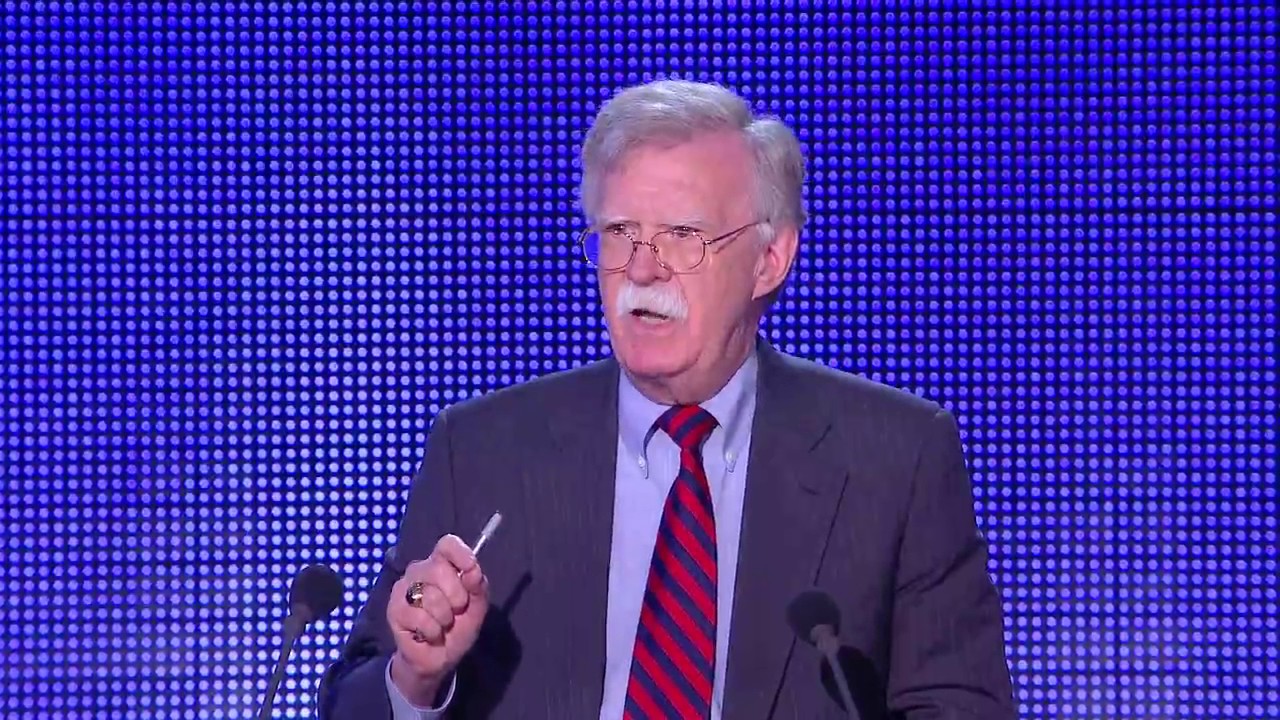 last year—for the—in Paris. Other speakers at M.E.K. rallies have reportedly been paid tens of thousands of dollars for their appearances.
Bolton’s policy recommendations on North Korea are also militant, and they break with the man who just hired him. Earlier this month, Trump pledged to meet Kim Jong Un by May. “Talking to North Korea is worse than a mere waste of time,” Bolton wrote in The Hill, in August. “Negotiations legitimize the dictatorship, affording it more time to enhance its nuclear and ballistic-missile capabilities. Today, only one diplomatic option remains, and it does not involve talking to Pyongyang. Instead, President Trump should urge President Xi Jinping that reunifying the Korean Peninsula is in China’s national interest.”
The answer to China’s fear of an uncontrolled collapse, Bolton wrote, “is a jointly managed effort to dismantle North Korea’s government, effectively allowing the swift takeover of the North by the South.” Not even the South Korean President, Moon Jae-in, supports that idea; he has been trying to broker a rapprochement with the Nort
...
==
https://www.commondreams.org/views/2018/03/27/**10-reasons-fear-**john-bolton
Let’s not mince words: John Bolton is a war-monger and his appointment to be Donald Trump’s National Security Advisor is a threat to global security. Bolton advocates a foreign policy that exaggerates threats, belittles diplomacy, shows contempt for international institutions and is quick to use violence. The National Security Advisor position does not need Senate confirmation, so starting April 9, the hawk of all hawks will be perched at the White House.
Need specifics on why we should oppose Bolton? Here are some. Add your own.
1. Bolton wants to shred the Iran nuclear deal...and bomb Iran. Bolton hates the nuclear deal that was signed under Obama’s watch not only by the U.S. and Iran, but also by Britain, France, Germany, China, Russia, and the EU. Although the deal is working and even Secretary of Defense Jim Mattis said it is in our national interest, Bolton calls the Iran deal a massive strategic blunder. On May 12, when Trump is required to re-certify that Iran has been complying with the deal, Bolton makes it more likely that the US will pull out of the deal, triggering a major international crisis. Trita Parsi, president of the National Iranian American Council, says, “People, let this be very clear: The appointment of Bolton is essentially a declaration of war with Iran.”
2. Bolton is in bed with an Iranian terrorist organization called MEK, a fringe group that was listed as a Foreign Terrorist Organization by the United States until 2012 and is still considered a terrorist organization inside Iran. Bolton routinely meets with and accepts payments from the group, which has beenresponsible for the murder of American soldiers, the attempted kidnapping of a U.S. Ambassador, and many violent attacks inside Iran. Bolton considers the MEK a
’ that he wants touse to overthrow the Iranian government. With Bolton in power, one of the most detested Iranian cults will be treated by the US government as legitimate representatives of the Iranian people.
3. Bolton will jeopardize talks with North Korea. The world breathed a sigh of relief at the announcement that Presidents Trump and Kim Jung-un would meet in May. But with Bolton, that meeting may never take place, or could be disastrous. Bolton says, “Talking to North Korea is worse than a mere waste of time. Negotiations legitimize the dictatorship, affording it more time to enhance its nuclear and ballistic-missile capabilities.” Instead of talks, Bolton has called for the United States to launch a preemptive strike against North Korea, a strike that could spark a nuclear war.
4. Bolton hates the United Nations and international law. When George Bush nominated Bolton to be UN ambassador in 2005, he proved so controversial to even the Republican-controlled Senate that Bush had to sneak him in as a “recess appointment” when Congress was not in session. It is one thing to be critical of the UN but Bolton opposes its very existence. “There is no such thing as the United Nations,”he once said, adding, “If the U.N. Secretariat building in New York lost 10 stories, it wouldn’t make a lot of difference.” More than that, he is hostile to the concept of international law, having oncedeclared, “It is a big mistake for us to grant any validity to international law even when it may seem in our short-term interest to do so—because over the long term, the goal of those who think that international law really means anything are those who want to constrain the United States.”
5. Bolton was a key instigator of the Iraq war and has no regrets. He was a major figure (along with Dick Cheney and Donald Rumsfeld) pushing for the invasion of Iraq. During the Bush presidency, when he was Under-Secretary of State for Arms Control, he helped fabricate evidence about weapons of mass destruction that led to the March 2003 invasion. And he is one of the few original advocates for that war who still insist it was a good idea.
6. Bolton provided false information about Cuba. As Undersecretary of State, Bolton claimed that Havana was attempting to develop biological weapons and sell them to rogue regimes. Then he tried to fire two intelligence analysts who challenged his erroneous allegations. Bolton has also urged that stronger sanctions be imposed on Cuba, and put Cuba on his “axis of evil” list.
7. He is no friend of the Palestinians. When he was at the United Nations, he constantly protected Israel by vetoing all UN resolutions targeting Israel. Bolton praised Trump's decision torecognize Jerusalem as Israel's capital, breaking with decades of international consensus that the disputed city's status must be negotiated between the two sides. He opposes a Palestinian state, saying, “I don’t think there are institutions on the Palestinian side that can live up to the commitments of a treaty with Israel….or could resist takeover by terrorist elements.” His solution? Get rid of Palestinians by merging Gaza with Egypt and the West Bank with Jordan.
8. Bolton will create new problems with China. He has been an ardent supporter of diplomatic recognition of Taiwan, and waspaid by the Taiwanese government. He advised the Trump administration toreconsider the “One China” policy, an agreement made in 1972 that requires countries to choose between diplomatic relations with China or diplomatic relations with Taiwan. His antagonistic stance toward China could have a negative impact on issues ranging from North Korea and the South China Sea to cyberspace and trade.
9. He hangs out with Islamophobes. Bolton has a decade-long history of associating with anti-Islam activist Pamela Geller, appearing on her internet radio program "Atlas on the Air" and on her video blog. Geller is well-known for her inflammatory public comments about Muslims and the idea that they are trying to impose Sharia law in the US. Bolton wrote the foreword to the book she co-wrote with fellow anti-Islamist Robert Spencer called “The Post-American Presidency: The Obama Administration’s War on America.”
10. His white walrus mustache should immediately disqualify him.According to former White House Chief Strategist Steve Bannon, president-elect Trump passed on nominating John Bolton to a senior Cabinet position because he didn’t like Bolton’s signature mustache. With his hairy upper lip, Bolton just didn’t “look the part." We agree. Trump should immediately rescind the offer in favor of someone with less facial hair.
==
clayton williams sold to noble, big NRA funder
==
cambr anal 2014 test run for 2016?
mercer money launder?
==
https://www.alternet.org/news-amp-politics/john-bolton-essential-profile
...
brazen nature of Bolton’s appointment was underscored by the fact that it came the same day that news broke of Bolton having recorded a video for a Russian gun group in 2013, after being introduced to the group by the National Rifle Association (NRA). Given the scandals around Russia and the NRA of late, the indifference to the politics of this news speaks volumes about the White House’s commitment to Bolton.
As outraged as many supporters of diplomacy have been at Trump’s appointments and policies, Bolton’s appointment reaches a new level. Here at LobeLog, we are reprinting, with permission, the profile of John Bolton from Right Web, a site which tracks the activities of a vast array of right wing and militaristic figures and organizations.
(Note: Right Web generally relies on footnotes for its citations. While LobeLog does not usually employ footnotes, we feel that getting Bolton’s profile to our readers is important enough to make an exception here.)
John Bolton is a senior fellow at the neoconservative American Enterprise Institute and the chairman of the Gatestone Institute, a right-wing “pro-Israel” activist group that has been accused of fomenting anti-Muslim sentiment. A longtime national security hawk, Bolton is a former board member of the Project for the New American Century and a past adviser to the Jewish Institute for National Security Affairs. He is a frequent contributor to Fox News, the Wall Street Journal, the Washington Times, the *Weekly Standard*, and other right-wing media outlets.
Bolton has been a key Republican Party figure since he was tapped to serve in the Reagan administration in the 1980s, where he held a series of posts at USAID before joining a team of Federalist Society lawyers under Attorney General Edwin Meese.[[1]](https://lobelog.com/john-bolton-the-essential-profile/#_ftn1) He later worked in several high-level positions in the George W. Bush administration, including as the State Department’s chief diplomat on arms control and as the U.S. ambassador to the United Nations. A major focus of his work in and out of government has been to free U.S. military power from international constraint.
Bolton has long dismissed the legitimacy of the United Nations and other international institutions. In a 1994 speech at the World Federalist Association, Bolton infamously declared, “If the UN secretary building in New York lost ten stories, it wouldn’t make a bit of difference.”[[4]](https://lobelog.com/john-bolton-the-essential-profile/#_ftn4) He has also dismissed international treaties as nonbinding “political obligations”[[5]](https://lobelog.com/john-bolton-the-essential-profile/#_ftn5) and was a leading opponent of the International Criminal Court, which he once claimed would turn the “senior civilian and military leaders responsible for our defense and foreign policy” into “potential targets of the politically unaccountable Prosecutor in Rome.”[[6]](https://lobelog.com/john-bolton-the-essential-profile/#_ftn6)In late 2016, Bolton was rumored to be the leading candidate for the position of Secretary of State for President-elect Donald Trump.[[2]](https://lobelog.com/john-bolton-the-essential-profile/#_ftn2) After being passed over for that position, he was rumored to be the leading candidate for National Security Adviser if H.R. McMaster resigned or was ousted.[[3]](https://lobelog.com/john-bolton-the-essential-profile/#_ftn3)
In the Trump Era
During the 2016 election campaign, Bolton broke with other neoconservative pundits like Robert Kagan in praising Donald Trump‘s foreign policy positions. He commended Trump for saying that Islamic militants are waging an “ideological war” on the West, for calling the planned withdrawal of troops from Iraq as “reckless,” and for urging more military action against ISIS.[[7]](https://lobelog.com/john-bolton-the-essential-profile/#_ftn7)
Shortly after Trump’s election, press accounts reported that Bolton was being “eyed” by Trump for Secretary of State. He subsequently became a contender to replace the controversial retired Gen. Michael Flynn, who was forced out of his position as National Security Adviser (NSA) only weeks after Trump’s inauguration because of his controversial contacts with Russian officials. The idea of Bolton as NSA, overwhelmingly opposed by Democrats, divided Republicans, with the hawkish Sen. Ted Cruz (R-TX) pushing the candidacy[[8]](https://lobelog.com/john-bolton-the-essential-profile/#_ftn8) and libertarian Sen. Rand Paul (R-KY) calling him a “bad choice” who could end up promoting “secret wars.”[[9]](https://lobelog.com/john-bolton-the-essential-profile/#_ftn9)
In March 2018, Bolton’s name once again surfaced as a candidate for the NSA position. H.R. McMaster was rumored to be seeking an exit from the Trump administration, and Bolton met with Trump in the Oval Office while these rumors were circulating.[[10 ]](https://lobelog.com/john-bolton-the-essential-profile/#_ftn10)
Bolton used his frequent appearances on Fox News to promote his policy ideas. He has strongly opposed any negotiations with North Korea, for example.[[11]](https://lobelog.com/john-bolton-the-essential-profile/#_ftn11)
He also expressed much more radical ideas, such as resolving the Israel-Palestine conflict by having Jordan annex the West Bank, something the kingdom has made clear it would never do.[[12]](https://lobelog.com/john-bolton-the-essential-profile/#_ftn12)
Bolton’s long track record of aggressive promotion of military action and disdain for diplomacy, prompted Mieke Eoyang, the vice president for foreign policy at the center-left think tank Third Way to say that, “Bolton is so much of an ideologue that I don’t think he would accurately portray consequences [of policy options] to the president… If Bolton becomes the national security adviser, the United States has not hit rock bottom in our international relations. We could go lower.”[[13]](https://lobelog.com/john-bolton-the-essential-profile/#_ftn13)
Presidential Aspirations
Bolton’s recent involvement in politics has included serving as a foreign policy surrogate for the 2012 Mitt Romney/Paul Ryan presidential campaign, as an informal adviser to 2016 presidential candidate Sen. Ted Cruz (R-TX),[[14]](https://lobelog.com/john-bolton-the-essential-profile/#_ftn14) and repeatedly suggesting that he will run for president.
In October 2013, he launched an eponymous PAC and Super PAC, anointing them with a mission to “seek out and support candidates for nomination and election to federal office who are committed to restoring strong American national security policies.” Seeking to roll back an increasing libertarian influence on the GOP’s foreign policy, Bolton said in a statement that “We must be prepared to do what it takes to protect the idea of American exceptionalism and our basic Constitutional priorities—the preservation of which are essential not only to our security, but to our prosperity as well.”[[15]](https://lobelog.com/john-bolton-the-essential-profile/#_ftn15)
Bolton’s PAC and SuperPAC raised a total of $7.5 million during the 2014 midterm elections and contributed to the campaigns of 87 Senate and House candidates.[[16]](https://lobelog.com/john-bolton-the-essential-profile/#_ftn16)The PACs made contributions to Republican candidates who espoused aggressive foreign policy positions and sponsored numerous hawkish online advertisements.[[17]](https://lobelog.com/john-bolton-the-essential-profile/#_ftn17)The advertisements were described as “customized national security messages intended to sway distinct clusters of swing voters,” relying on tactics such as positing that “President Obama is a better strategist for aiding ISIS than eliminating it.”[[18]](https://lobelog.com/john-bolton-the-essential-profile/#_ftn18)
Bolton was mentioned in an April 2015 New York Timespiece that examined why Republicans are “more fervently pro-Israel than ever.” The article linked such sentiment to being “partly a result of ideology, but also a product of a surge in donations and campaign spending on their behalf by a small group of wealthy donors.” The piece revealed how Bolton’s PAC is partly financed by “major pro-Israel donors” like Irving Moskowitz and that it “spent at least $825,000” to support the successful 2014 Senate bid of Tom Cotton (R-AL).[[19]](https://lobelog.com/john-bolton-the-essential-profile/#_ftn19)
In February 2015, Bolton launched the Foundation for American Security and Freedom (FASF), an advocacy organization that describes itself as “committed to restoring and protecting our vital national security interests and preserving our way of life for our children.”[[20]](https://lobelog.com/john-bolton-the-essential-profile/#_ftn20) FASF states on its website that it aims to “strengthen our public discourse, making clear the inextricable links between strong foreign and domestic national policies.”[[21]](https://lobelog.com/john-bolton-the-essential-profile/#_ftn21) The conservative Breitbart reported of FASF’s launch: “The staunchly pro-American diplomat explained that the FASF was designed to help America avoid the mistake of electing a president who doesn’t care that much about America’s national security, as it did when electing Barack Obama in 2008 and 2012.”[[22]](https://lobelog.com/john-bolton-the-essential-profile/#_ftn22)
In August 2015, FASF ran a TV ad attacking comments made by Sen. Rand Paul (R-KY) about a hypothetical Iranian nuclear weapon. The ad featured an American family happily sitting down to dinner when suddenly a nuclear explosion apparently occurs. The ad then transitions to a speech where Paul states that U.S. “national security is not threatened by Iran having one nuclear weapon.” The ad ended with the caption: “It only takes one. A nuclear Iran is a threat to our national security.”[[23]](https://lobelog.com/john-bolton-the-essential-profile/#_ftn23)
Bolton was rumored for a time to be considering a bid for president in 2016, and he made visits in 2013 to early primary states as part of what journalist Robert Costa described as “an informal national tour” to “give speeches, huddle with GOP leaders, and push back against the party’s libertarian shift. He’ll make the case for a muscular foreign policy.”[[24]](https://lobelog.com/john-bolton-the-essential-profile/#_ftn24) In May 2015, however, Bolton ruled out running. “While I’m not a candidate, I am certainly not going to sit this election out,” Bolton said in a statement. “I’m also going to focus on the 2016 presidential race, to make certain that foreign policy is critical to winning the nomination.”[[25]](https://lobelog.com/john-bolton-the-essential-profile/#_ftn25)
Bolton had previously considered running in 2012, a move he ultimately decided against even as he hinted that he viewed himself as the only “ideal conservative” in the race.[[26]](https://lobelog.com/john-bolton-the-essential-profile/#_ftn26) “I hope he runs,” said MSNBC’s Chris Matthews at the time, “to remind the country of what everybody voted against in 2006 and 2008, and the ideology that led us into attacking a country that never attacked us, an ideology that wants to make some sort of permanent garrison in the Middle East.”[[27]](https://lobelog.com/john-bolton-the-essential-profile/#_ftn27)
In the Obama Era
Bolton has been a prolific commentator on foreign affairs. He was among the Obama administration’s most strident critics, particularly on Middle East issues, and repeatedly accused the Obama White House of “weakness” and “fecklessness.”[[28]](https://lobelog.com/john-bolton-the-essential-profile/#_ftn28)
Bolton was a particularly vocal proponent of the claim that Iran is developing nuclear weapons, despite U.S. intelligence judgments to the contrary, and has accused the Obama administration of enabling Tehran by engaging with it diplomatically. “By negotiating with Iran,” Bolton wrote in April 2014, Obama “has not only allowed it a path to legitimize its nuclear-weapons program, but objectively facilitated the deadly global menace in Tehran.”[[29]](https://lobelog.com/john-bolton-the-essential-profile/#_ftn29) While nuclear negotiations between Iran and the United States were ongoing in late 2013, Bolton insisted that “Iran’s nuclear-weapons and ballistic-missile programs will proceed unimpeded in unknown, undisclosed locations.”[[30]](https://lobelog.com/john-bolton-the-essential-profile/#_ftn30) Bolton later added that “we shouldn’t trust and can’t verify Iranian promises not to fabricate nuclear weapons,” concluding that “We have only two very unpleasant choices: either Iran gets nuclear weapons in the very near future, or pre-emptive military force, fully justified by well-established principles of self-defense, must break Iran’s control over the nuclear fuel cycle and prevent (or, at least, substantially delay) weaponization.”[[31]](https://lobelog.com/john-bolton-the-essential-profile/#_ftn31)
Bolton says that that Iran should not be permitted to have an indigenous uranium enrichment program. “The right amount is zero. Iran should not be permitted to conduct any nuclear-related activity as long as the ayatollahs remain in power, given their record of dissimulation and obstructionism and their obvious intention of becoming a nuclear-weapons state,” he wrote in September 2014.[[32]](https://lobelog.com/john-bolton-the-essential-profile/#_ftn32)
In a March 2015 op-ed for The New York Times, published just before Iran and the P5+1 reached a political framework agreement over Iran’s nuclear program, Bolton explicitly called for military strikes against Iran. Titled, “To Stop Iran’s Bomb, Bomb Iran,” Bolton’s op-ed claimed that, “President Obama’s approach on Iran has brought a bad situation to the brink of catastrophe.” Bolton further asserted that “the inconvenient truth is that only military action like Israel’s 1981 attack on Saddam Hussein’s Osirak reactor in Iraq or its 2007 destruction of a Syrian reactor, designed and built by North Korea, can accomplish what is required.”[[33]](https://lobelog.com/john-bolton-the-essential-profile/#_ftn33)
He added: “The United States could do a thorough job of destruction, but Israel alone can do what’s necessary. Such action should be combined with vigorous American support for Iran’s opposition, aimed at regime change in Tehran.”[[34]](https://lobelog.com/john-bolton-the-essential-profile/#_ftn34)
Responded Sally Kohn of The Daily Beast, “Would that be the same evidence you relied on to assert that Saddam Hussein was developing WMDs—the same intel the Bush administration used as the justification for going to war in Iraq? Bolton provides little solid evidence of his sky-is-falling assertions. We’re just supposed to trust him, I guess, based on his reputation.”[[35]](https://lobelog.com/john-bolton-the-essential-profile/#_ftn35)
After Iran and the P5+1 group of nations reached a comprehensive nuclear agreement in July 2015, Bolton vociferously denounced it and reiterated his call for U.S. military action against Iran. “Obama’s deal is a born failure for reasons we need not elaborate further here,” he wrote in an August 2015 op-ed for the conservative National Review. “Accordingly, as of today, only a preemptive military strike can block Iran from becoming a nuclear-weapons state.”[[36]](https://lobelog.com/john-bolton-the-essential-profile/#_ftn36) Bolton then expressed support for Israel launching a military attack on Iran’s nuclear facilities and stated that the United States should support if it does so.[[37]](https://lobelog.com/john-bolton-the-essential-profile/#_ftn37)
In 2009, speaking before an audience at the University of Chicago, Bolton suggested that Israel should consider a nuclear strike against Iran and chastised the Obama administration’s position that Iran could be deterred from using nuclear weapons as “a dangerously weak approach.” Bolton declared “we’re at a very unhappy point—a very unhappy point—where unless Israel is prepared to use nuclear weapons against Iran’s program, Iran will have nuclear weapons in the very near future.”[[38]](https://lobelog.com/john-bolton-the-essential-profile/#_ftn38) Commented Inter Press Service blogger Daniel Luban: “An Israeli strike, nuclear or otherwise, without U.S. permission remains unlikely. But as is often the case, I suspect that Bolton’s intention is less to give an accurate description of reality than it is to stake out positions extreme enough to shift the boundaries of debate as a whole to the right.”[[39]](https://lobelog.com/john-bolton-the-essential-profile/#_ftn39)
Bolton was also critical of the Obama administration’s position on Syria, writing in September 2013 that Obama had “failed in his stated objective to oust Syria’s Assad regime from power; failed to impress Assad that his ‘red line’ against using chemical weapons was serious; failed to exact retribution when that red line was crossed; failed to rally anything but small minorities in either house of Congress to support his position; and failed to grasp that agreements with the likes of Syria and Russia prolong, rather than solve, the chemical-weapons problem.”[[40]](https://lobelog.com/john-bolton-the-essential-profile/#_ftn40) Yet Bolton later said that he himself “would vote against an authorization to use force here,” adding, “I don’t think it is in America’s interest. I don’t think we should in effect take sides in the Syrian conflict.”[[41]](https://lobelog.com/john-bolton-the-essential-profile/#_ftn41)
In April 2014, Bolton called the Syrian civil war a “strategic sideshow” and wrote that the United States should instead be preparing for war with Iran. “The Assad regime, loathsome as it is, couldn’t survive without substantial Iranian assistance,” Bolton wrote. “And it is Iran, through its pursuit of nuclear weapons and its decades-long role as international terrorism’s central banker, which poses the central danger. Instead of focusing on overthrowing Assad or aiding his enemies, we should be vigorously pursuing regime change in Iran.”[[42]](https://lobelog.com/john-bolton-the-essential-profile/#_ftn42) Bolton accused Iran of “relentlessly” pursuing a nuclear weapon despite evidence that Tehran had reduced its stockpile of enriched uranium in accordance with an interim agreement it had made with international negotiators earlier that year.[[43]](https://lobelog.com/john-bolton-the-essential-profile/#_ftn43)
After Russia’s decision in October 2015 to bolster its military presence in Syria and launch airstrikes against Syrian rebel groups, Bolton stated in a Washington Times piece that the United States should pursue the goal of defeating ISIS and forming a new state in the territory of Syria and Iraq currently controlled by ISIS. Calling for a “forceful U.S.-led effort to destroy ISIS” that excludes Russia and Iran, Bolton stated that “our objective should be a new Sunni state where ISIS now rules, carved from Iraq and Syria, one that is either democratic or led, to paraphrase Franklin Roosevelt, by one of our SOB’s.” He also added that “sooner or later, we should recognize the reality that an independent Kurdistan now exists, even if not declared de jure.”[[44]](https://lobelog.com/john-bolton-the-essential-profile/#_ftn44)
In a November 2015 New York Timesop-ed, Bolton reiterated his call for an independent “Sunni state” to be formed out of Syrian and Iraqi territory, stating it “could be a bulwark against both Mr. Assad and Iran-allied Baghdad.”[[45]](https://lobelog.com/john-bolton-the-essential-profile/#_ftn45)
Bolton is a steadfast supporter of the right-wing Israeli government of Prime Minister Benjamin Netanyahuand, like many members of Netanyahu’s cabinet, an opponent of Palestinian statehood. Claiming that it “would inevitably lead to a terrorist state on the other side of the border with Israel,”[[46]](https://lobelog.com/john-bolton-the-essential-profile/#_ftn46) Bolton has fervently criticized the Obama administration for seeking a two-state solution to the Israeli-Palestinian conflict. Instead, Bolton has echoed the arguments of some Israeli nationalists that the Palestinian territories of the West Bank and Gaza—which he called “bits and pieces of the collapsed Ottoman Empire” with “no particular history either of national identity or of economic interdependence”—should be ceded respectively to Jordan and Egypt rather than incorporated into an independent Palestinian territory. “The only logic underlying the demand for a Palestinian state,” Bolton has claimed, “is the political imperative of Israel’s opponents to weaken and encircle the Jewish state, thereby minimizing its potential to establish secure and defensible borders.”[[47]](https://lobelog.com/john-bolton-the-essential-profile/#_ftn47)
Bolton has also been a defender of Israeli aggression against its neighbors. In late 2009, Bolton joined a chorus of neoconservative voices—including UN Watch and the Atlantic’s Jeffrey Goldberg—in attacking the UN Human Rights Council’s “Goldstone Report,” which detailed war crimes committed by Israel as well as Hamas during Israel’s 2008-2009 invasion of the Gaza Strip. Bolton called the report’s conclusion, that Israel had targeted civilians in Gaza, an attempt “to criminalize Israel’s strategy of crippling Hamas.”[[48]](https://lobelog.com/john-bolton-the-essential-profile/#_ftn48) Bolton’s comments echoed earlier remarks he had made about Israel’s 2006 invasion of Lebanon, when he said there was “no moral equivalence” between Lebanese civilian casualties of Israeli bombing and Israelis killed by “malicious terrorist acts.”[[49]](https://lobelog.com/john-bolton-the-essential-profile/#_ftn49)
Bolton has also remained unapologetic about the U.S. war in Iraq. “Despite all the criticism of what happened after Saddam’s defeat,” he argued in February 2013, it is “indisputable” that the U.S.-led coalition “accomplished its military mission with low casualties and great speed, sending an unmistakable signal of power and determination throughout the Middle East and around the world.” Dismissing critics who said the war was unnecessary or disproportionate, Bolton claimed that Saddam Hussein “would have immediately returned to ambitious WMD programs” in the absence of international action, adding that if anything, the United States should have toppled Hussein in 1991 and then immediately “turned its attention to the regimes in Iran and Syria.” Bolton quipped that anyone who claims that Iraqis were better off under Hussein than they were in the tumultuous decade that followed his ouster must have “a propensity to admire totalitarianism,” but in any case, “the issue was never about making life better for Iraqis, but about ensuring a safer world for America and its allies.” Invoking World War II, Bolton added, “we didn’t wage war after Pearl Harbor to do nation-building for our enemies.”[[50]](https://lobelog.com/john-bolton-the-essential-profile/#_ftn50)
After the November 2015 Paris attacks, Bolton called for more leeway to be given to U.S. intelligence agencies. “We need a more sensible national conversation about the need for effective intelligence gathering to uncover and prevent such tragedies before they occur,” he opined in a Fox Newsop-ed. “Knee-jerk, uninformed and often wildly inaccurate criticisms of programs (such as several authorized in the wake of 9/11 in the Patriot Act) have created a widespread misimpression in the American public about what exactly our intelligence agencies have been doing and whether there was a ‘threat’ to civil liberties.” He added: “Now is the time to correct these misimpressions.”[[51]](https://lobelog.com/john-bolton-the-essential-profile/#_ftn51)
Bolton has also struck a hard line on the South China Sea territorial dispute between China and several of its neighbors. In October 2015, after a U.S. military ship sailed through waters claimed by China in the South China Sea, Bolton declared: “If we are going to do this in a serious way, we have to have more ships in the water.”[[52]](https://lobelog.com/john-bolton-the-essential-profile/#_ftn52) He heaped criticism on the Obama administration for sending the single ship, telling the conservative Newsmax that he is “worried the White House may have not thought the action through completely, because ‘if we get in a situation where the Chinese crowd our ships and impede their passage and there is a collision at sea, what do we do then?’”[[53]](https://lobelog.com/john-bolton-the-essential-profile/#_ftn53)
In the Bush Administration
In the aftermath of the 2000 presidential election, Bolton worked in collaboration with his former boss James Baker to block recount efforts in Florida. According to the Wall Street Journal, after the U.S. Supreme Court ordered a halt to the recount, Bolton entered a venue where the count was still taking place and declared: “I’m with the Bush-Cheney team, and I’m here to stop the count.” This marked Bolton’s entrée into the administration of George W. Bush. At the time, Vice President-elect Dick Cheneycommented: “People ask what [job] John should get. My answer is, anything he wants.”[[54]](https://lobelog.com/john-bolton-the-essential-profile/#_ftn54)
As undersecretary of state representing the administration in various international fora, Bolton gained a reputation as an arrogant and hawkish unilateralist willing to redefine U.S. positions in the global arena, diplomatic consequences notwithstanding. In an exemplary display of what the Wall Street Journal described as his “combative style,” Bolton warned an international conference on bio-weapons that a hotly disputed verification proposal, widely supported by arms control experts, was “Dead, dead, dead, and I don’t want it coming back from the dead.”[[55]](https://lobelog.com/john-bolton-the-essential-profile/#_ftn55)
Among Bolton’s more notable actions during this period was withdrawing the United States from the 1972 Anti-Ballistic Missile Treaty. This bilateral treaty with the Soviet Union was the bedrock of efforts to reduce nuclear brinksmanship, but Bolton dismissed it as a relic that impeded the development of a U.S. national missile defense system. Also significant was Bolton’s effort to block progress on the Comprehensive Test Ban Treaty, viewed as a cornerstone of the global nonproliferation regime.[[56]](https://lobelog.com/john-bolton-the-essential-profile/#_ftn56)Bolton was also given the task of officially rescinding the U.S. signature on the treaty that established the International Criminal Court, which he later called “the happiest moment in my government service.”[[57]](https://lobelog.com/john-bolton-the-essential-profile/#_ftn57)
Bolton was a key proponent within the Bush administration of taking military action against the so-called “Axis of Evil,” or countries identified by the Bush administration as “rogue state” rivals of the United States. Two months before the Iraq invasion, Bolton met with Israeli Prime Minister Ariel Sharon to discuss strategies for “preventing the spread of weapons of mass destruction,” focusing on the Bush administration’s disarmament targets following the planned invasion of Iraq. Shortly after the visit, Bolton said once regime change in Iraq is complete, “It will be necessary to deal with threats from Syria, Iran, and North Korea.”[[58]](https://lobelog.com/john-bolton-the-essential-profile/#_ftn58)
Speaking before an audience at the Heritage Foundation in May 2002, Bolton argued that Cuba should also be included among the “axis of evil” countries because of its alleged development of bio-warfare capacity. Cuba is world-renowned for its biomedical industry, but Bolton claimed that the industry was concealing a WMD project. Providing no evidence, he insisted that Cuba was involved in the sales of illicit bio-warfare technology to boost its cash-short economy. Other administration officials declined to support Bolton’s accusations.[[59]](https://lobelog.com/john-bolton-the-essential-profile/#_ftn59) A congressional investigation of Cuba’s alleged WMD program found no evidence supporting Bolton’s assertions.[[60]](https://lobelog.com/john-bolton-the-essential-profile/#_ftn60)
Bolton was also one of the administration’s leading hawks on Asia policy and one if its strongest advocates of Taiwan. According to a 2001 Washington Post investigation, Bolton had been on the payroll of the Taiwanese government before joining the Bush administration.[[61]](https://lobelog.com/john-bolton-the-essential-profile/#_ftn61) Bolton also received $30,000 for “research papers on UN membership issues involving Taiwan” at the same time he was promoting diplomatic recognition of Taiwan before various congressional committees.[[62]](https://lobelog.com/john-bolton-the-essential-profile/#_ftn62) “Diplomatic recognition of Taiwan would be just the kind of demonstration of U.S. leadership that the region needs and that many of its people hope for,” wrote Bolton in a 1999 *Weekly Standard* article. “The notion that China would actually respond with force is a fantasy.”[[63]](https://lobelog.com/john-bolton-the-essential-profile/#_ftn63)
Bolton’s penchant for intemperate statements often compromised his work as a diplomat. In July 2003, during the run-up to the six-party talks with North Korea, Bolton characterized North Korean President Kim Jong Il as the “tyrannical dictator” of a country where “life is a hellish nightmare.” North Korea responded in kind, saying that “such human scum and bloodsucker is not entitled to take part in the talks. … We have decided not to consider him as an official of the U.S. administration any longer nor to deal with him.” The State Department had to send a replacement for Bolton to the talks.[[64]](https://lobelog.com/john-bolton-the-essential-profile/#_ftn64)
After Condoleezza Rice became U.S. secretary of state at the outset of Bush’s second term, Bolton expressed an interest in becoming deputy secretary of state. However, Rice selected Bolton as ambassador to the UN, “thus appointing to this unique post the U.S. official most publicly contemptuous of the world organization,” wrote Brian Urquhart.[[65]](https://lobelog.com/john-bolton-the-essential-profile/#_ftn65)
Bolton served as UN ambassador from August 2005—when President Bush gave him a recess appointment after the Senate blocked his nomination—to January 2007. His resignation, announced in December 2006, came at the end of a controversial tenure marked by severe criticism from U.S. senators and international diplomats.His resignation also came less than three weeks after President Bush resubmitted Bolton’s nomination for Senate confirmation—the second time in six months.
During his first confirmation hearings, Bolton’s record as undersecretary of state came under intense criticism, particularly regarding his contacts with Israel. According to The Forward and other news sources, Bolton had met with officials of Israel’s intelligence agency, the Mossad, without first seeking “country clearance” from the State Department.[[66]](https://lobelog.com/john-bolton-the-essential-profile/#_ftn66)
There was enormous domestic and international opposition to Bolton’s nomination. In late July 2006, the New York Times reported deep scorn for Bolton among UN ambassadors. According to the Times, “[M]any diplomats say they see Mr. Bolton as a stand-in for the arrogance of the administration itself.” Rather than furthering his stated mission of UN reform, according to the Times, “envoys say he has in fact endangered that effort by alienating traditional allies. They say he combatively asserts American leadership, contests procedures at the mannerly, rules-bound United Nations, and then shrugs off the organization when it does not follow his lead.” One unnamed UN ambassador “with close ties” to the administration said: “He’s lost me as an ally now, and that’s what many other ambassadors who consider themselves friends of the United States are saying.”[[67]](https://lobelog.com/john-bolton-the-essential-profile/#_ftn67)
One of Bolton’s more controversial acts as ambassador came in 2005, when he sabotaged efforts to complete a joint UN declaration in connection with the organization’s 60th anniversary. According to Brian Urquhart, “UN delegations, including the United States and the Secretariat, had for the previous six months been working on this document, which originally contained a fairly ambitious mixture of global objectives and UN reform proposals. Bolton’s seven hundred or so amendments, designed, he believed, to increase the influence and reflect the interests of the United States, caused considerable confusion and resentment and reopened many disagreements that had previously been resolved. Among other things, he insisted that there be no mention of the Millennium Development Goals to eradicate global poverty, which the US had supported in 2000. (Condoleezza Rice overruled Bolton on this at the last minute.) Bolton also insisted on the elimination of any mention of the Comprehensive Test Ban Treaty, theICC, and global warming.”[[68]](https://lobelog.com/john-bolton-the-essential-profile/#_ftn68)
In accepting Bolton’s resignation in December 2006, Bush blamed a “handful” of senators who were determined to block a full Senate vote on the nomination.[[69]](https://lobelog.com/john-bolton-the-essential-profile/#_ftn69)Bolton himself asserted that his resignation was not about his policies or performance, but about “whether I was a nice person, thereby inviting every person in government whom I had ever defeated in a policy battle, of whom there were many, to turn the issue into one of personal disparagement.”[[70]](https://lobelog.com/john-bolton-the-essential-profile/#_ftn70)
Controversies
Bolton has been closely associated, both in and out of government, with several political and financial controversies.
As an assistant attorney general under Edwin Meese, Bolton thwarted the Kerry Commission’s efforts to obtain documentation, including Bolton’s personal notes, about the Iran-Contra affair and alleged Contra drug smuggling. Working with congressional Republicans, Bolton also stonewalled congressional demands to interview Meese’s deputies regarding their role in the affair.[[71]](https://lobelog.com/john-bolton-the-essential-profile/#_ftn71)
In 1978, as an associate at the high-powered Covington law firm, Bolton worked with Sen. Jesse Helms (R-NC)and the National Congressional Club, the senator’s campaign-financing organization, to help form a new campaign finance organization called Jefferson Marketing. According to the Legal Times, Jefferson Marketing was established “as a vehicle to supply candidates with such services as advertising and direct mail without having to worry about the federal laws preventing PACs, like the Congressional Club, from contributing more than $5,000 per election to any one candidate’s campaign committee.” After its formation, Jefferson Marketing became a holding company for three firms—Campaign Management Inc., Computer Operations & Mailing Professionals, and Discount Paper Brokers.[[72]](https://lobelog.com/john-bolton-the-essential-profile/#_ftn72)
In 1987, the National Congressional Club reported a debt of $900,000. Itsmajor creditors were Richard Viguerie, Charles Black Jr., Covington and Burling, and the DC law office of Baker & Hostetler—all of which maintained good relations with the right-wing PAC despite its failure to pay. Jefferson Marketing was the Congressional Club’s largest creditor, with more than $676,000 owed. By the end of the decade, FEC documents showed that Helms’ PAC owed Covington $111,000. But this was not considered a major concern for Covington, according to firm spokesman H. Edward Dunkelberger Jr.[[73]](https://lobelog.com/john-bolton-the-essential-profile/#_ftn73)
A decade later, Bolton was again entangled in controversial schemes to support Republican candidates, this time involving money channeled from Hong Kong and Taiwan via a “think tank” linked to the Republican National Committee (RNC). In 1995-1996 Bolton served as president of the National Policy Forum (NPF), which according to a congressional investigation functioned as an intermediary organization to funnel foreign and corporate money to Republicans.[[74]](https://lobelog.com/john-bolton-the-essential-profile/#_ftn74)
The NPF had been established in 1993 in anticipation of the 1994 general election. Founded by then-RNC chair Haley Barbour, the forum was organized as a nonprofit, tax-exempt education institute, although the IRS later ruled that as a subsidiary of the RNC, NPF was not entitled to tax-exempt status. A 1996 congressional investigation brought to light the role of the NPF, which reportedly channeled $800,000 in foreign money into the 1996 election cycle—after having used similar tactics to fund congressional races in 1994.[[75]](https://lobelog.com/john-bolton-the-essential-profile/#_ftn75)
When Bolton became NPF president in 1995, the forum began organizing “megaconferences”with a fundraising hook. These events brought together Republican members of Congress, lobbyists, and corporate executives to discuss matters that were frequently the object of pending legislation. An NPF memo laid out the funding strategy: “NPF will continue to recruit new donors through conference sponsorships. … In order for the conferences to take place, they must pay for themselves or turn a profit. Industry and association leaders will be recruited to participate and sponsor those forums, starting at $25,000.” Corporate representatives professed surprise at the size of the contribution requests. “It’s pretty astounding,” said one invitee. “If this doesn’t have ‘payment for access’ [to top GOP lawmakers] written all over it, I don’t know what does.”[[76]](https://lobelog.com/john-bolton-the-essential-profile/#_ftn76)
In another NPF memo, two NPF employees told Bolton that, in return for a $200,000 donation by U.S. West, the telecommunications company should be assured its top policy issues would be incorporated into the agenda for NPF’s upcoming telecommunications “megaconference.”[[77]](https://lobelog.com/john-bolton-the-essential-profile/#_ftn77)
Bolton left his position at the NPF shortly before Congress launched its probe into whether the group illegally accepted foreign contributions. No charges were ever filed because of the congressional hearings.[[78]](https://lobelog.com/john-bolton-the-essential-profile/#_ftn78)
Mitchell Plitnick is the former director of the U.S. Office of B'Tselem and former co-director of Jewish Voice for Peace.
Opinion
JUL 10, 2012 @ 12:45 PM 156,094 The Little Black Book of Billionaire Secrets
The U.N. Arms Trade Treaty: Are Our 2nd Amendment Rights Part Of The Deal?
Larry Bell , CONTRIBUTOR
I write about aerospace, environment, energy, Second Amendment policy
Opinions expressed by Forbes Contributors are their own.
US President Barack Obama addresses the United Nations General Assembly. "As a former lecturer in constitutional law, wouldn’t President Obama realize that the U.N.’s gun- grab agenda violates our sovereign rights? Perhaps the answer to that question warrants some serious reflection. " (Image credit: AFP/Getty Images via @daylife)
One year ago I wrote an article titled “U.N. Agreement Should Have All Gun Owners Up In Arms” which has recently gained a great deal of renewed public interest. This update reviews some more recent developments, offering additional perspective about an immediate matter which should be of great concern to all who value rights guaranteed by our Second Amendment.
The Obama administration is actively engaged in negotiations to finalize details for a new global agreement premised to fight “terrorism”, “insurgency” and “international crime syndicates”. As U.N. Secretary-General Ban Ki-Moon describes its purpose, “Our goal is clear: a robust and legally binding Arms Trade Treaty that will have a real impact on the lives of those millions of people suffering from consequences of armed conflict, repression and armed violence…It is ambitious, but it is achievable.”
Under the George W. Bush administration, the U.S. originally voted against a resolution that began the process in 2006. However, the current administration reversed that policy, and strongly supports its enactment. In January 2010, U.S. representatives joined with those of 152 other countries in endorsing a U.N. Arms Treaty Resolution to draft a blueprint for enactment in 2012. This activity is planned to be completed by July 27, and Secretary of State Hillary Clinton has pledged to push hard for Senate ratification. Previously led by the United Kingdom, there can be no doubt that the U.N.’s 193-member General Assembly will approve it.
Foreign ministers of the U.K., France, Germany and Sweden want the treaty to cover all types of conventional weapons, notably including small arms and light weapons, all types of munitions, and related technologies. They also advocate that it include strong provisions governing human rights, international humanitarian law and sustainable development. (More about sustainable development later.)
U.S. Assistant Secretary of State for Internal Security and Nonproliferation, Thomas Countryman, has stated that the Obama administration does not support regulation of ammunition, but only wants to make it more difficult to “conduct illicit, illegal and destabilizing transfers of arms”. In addition, a press release issued by the U.N. Office for Disarmament Affairs says that “The outcome will not seek to prohibit citizens of any country from possessing firearms or to interfere with the legal trade in small arms and light weapons.”
Such statements have many very strong skeptics, both inside and outside Congress. One reason, among many, is that Iran, a country that is one of the world’s worst human rights violators, yet often chaired the U.N. Human Rights Council…yes Iran, arms supplier to many of America’s most determined adversaries… was selected for a top Arms Trade Treaty (ATT) planning conference position. The members, apparently including U.S. representatives, authorized this selection shortly after the same U.N. found the very same Iran guilty of transferring guns and bombs to the Syrian regime of Bashar Assad who is presently slaughtering thousands of its own citizens. Meanwhile, the U.N., America included, purporting to be distraught about illicit, illegal and destabilizing transfers of arms, watches in the wings as these tragedies unfold. Of course, they’re very busy. Those arms control planning conferences require a lot of attention.
On June 29, 130 Republican House members sent a letter to President Obama and Secretary Clinton arguing that the proposed treaty infringes on the “fundamental, individual right to keep and bear arms”. The letter charges that “…the U.N.’s actions to date indicate that the ATT is likely to pose significant threats to our national security, foreign policy, and economic interests as well as our constitutional rights.” The lawmakers adamantly insist that the U.S. Government has no right to support a treaty that violates the Constitution and Bill of Rights.
Democrats have accused Republicans of making this a political issue, maintaining that the treaty poses no Second Amendment threat.Others, such as former U.N. ambassador John Bolton, caution gun owners to take this initiative seriously. He believes that the U.N. “is trying to act as though this is really just a treaty about international arms trade between nation states, but there is no doubt that the real agenda here is domestic firearms control.”
So let’s review some recent history and see if gun owners and other Second Amendment defenders might have very good reasons to take issue with this treaty. Actually, we don’t have to look back very far at all.
Consider the Fast and Furious debacle, an operation that was represented to be all about targeting bad guys who are committing violent crimes on both sides of our border with Mexico. There can be no remaining doubt that the program was really aimed at border gun shops and their right to conduct legal civilian firearms sales.
And after the 2010 Republican House cleaning dashed President Obama’s dream of a carbon cap-and-trade program, he wasted no time finding a way to circumvent that pesky obstacle. His EPA is gleefully pursuing that same anti-fossil energy agenda. Meanwhile, Congress sits idly by and allows this breach of its constitutional responsibility established by separation of powers to continue.
Then there’s the currently proposed, Obama-endorsed, Law of the Sea Treaty (LOST) which would subordinate U.S. naval and drilling operations beyond 200 miles of our coast to a newly established U.N. bureaucracy. If ratified by Congress, it will grant a Kingston, Jamaica-based International Seabed Authority (ISA) the power to regulate deep-sea oil exploration, seabed mining, and fishing rights. As part of the deal, as much as 7% of U.S. government revenue collected from oil and gas companies operating off our coast will be forked over to ISA for redistribution to poorer, landlocked countries.
Page 1 / 2 Continue ...
==
John Bolton is the Wise Choice - American Greatness
https://amgreatness.com/2018/03/23/bolton-is-the-wise-choice2/
1.
JOHN BOLTON NAILED the INTERVIEW with REASON MAGAZINE ...
www.varight.com/.../john-bolton-nailed-the-interview-with-reason-magazine-attacks-t...
1.
:{ :(style="word-wrap:break-word"):}:
:{blog:(style="word-wrap:break-word"):}:
:{2014:(style="word-wrap:break-word"):}:
:{:(style="word-wrap:break-word"):}:
I was excited to listen tothis interview with former UN Ambassador John Bolton, perhaps future President John Bolton, and he NAILED it!
1. He calls for actual CUTS in spending! He has a useful, although politically dangerous idea about entitlement programs – by block granting Medicaid and Medicare back to the states. I would use this to show: Bolton will tell you straight – even if it isn’t politically wise – and after years of Bush and Obama lies (not to mention Congressional lies) a truthteller will be refreshing.
2. Bolton’s for gay marriage and says something somewhat Sandyesque about it: Marriage is a religious issue and the churches can define it as they see fit. He’s not crazy about it but feels a civil union for gays is acceptable. It appears Bolton also favored gays in the military.
3. Bolton praised President Calvin Coolidge (one of my favorites – thanks to Ronald Reagan for showing the nation the truth about Coolidge) for cutting the budget and ties the size of government to the amount of personal freedom.
4. Bolton make have joked about it, but he’s willing to listen to libertarians and go to them.
5. Bolton exposes the Agenda 21 goal: Impoverish the Western powers like the USA and Bolton believes in American Exceptionalism!
And remember – Bolton will stand for sovereignty and the Constitution. He’s the right guy for 2016, Bolton can unite the party and win in November
John Bolton on Law, "International Law," and American Sovereignty
www.aei.org/.../john-bolton-on-law-international-law-and-american-sovereignty/
1.
===1/11
To President Obama, the concept of international law is palpable, as his September 2009 speech to the U.N. Security Council emphasized: “[W]e must demonstrate that international law is not an empty promise, and that treaties will be enforced.” Many in his administration are doing their utmost to subvert America’s well-deserved reputation as an adherent of the rule of law by subordinating it to the dangerous concept that international law, as defined by its high priests, overrides our domestic law, including in the judiciary.
What is or is not legally binding about international law, particularly customary international law, is wide open to dispute. Customary international law used to refer to “state practice” in international affairs, a generally sensible way of deciding such questions as navigation protocols, reflecting what seafaring states have done over the centuries. In recent decades, however, the academic Left has seized on customary law as a fertile field for imposing its own ideological standards internationally and binding countries to “laws” they never explicitly approved.
Because democratic debates in constitutional systems like ours are so unsatisfying and often so unproductive for America’s statists, they have, in essence, launched an international power play to move outside of our legal systems. They find much greater prospects for success in international forums like the United Nations than in the U.S. Congress. Hence, the role and limits of international law, determining what is legally binding for our international conduct and domestic policy, will be a critical area of debate in the coming years.
President Obama should adjust his antiterrorism policy in America to reflect the war paradigm in central Asia.
The most visible, immediate impact of President Obama’s fascination with international law appears in the global war against terrorism, a term he tries to avoid. Instead, he adopted the view widely held in Europe and among legal theorists that terrorist threats and attacks should be treated under the criminal law enforcement paradigm, rather than as attacks on America subject to the law of war. The question is whether we treat terrorists simply as bank robbers on steroids or as national security threats to which we should respond in legitimate self-defense. The Obama administration strongly supports the criminal law paradigm, which most Americans emphatically reject.
Closing Gitmo is not just good policy but “norms” America
Thus, reflecting the law-enforcement approach, Obama rapidly ordered the closure of the Guantanamo Bay terrorist detention facility and either the release of those still detained or their transfer to the United States. He also pushed to abandon “enhanced interrogation” techniques and insisted upon trying as many terrorists as possible in civilian courts, under ordinary criminal law procedures rather than in military tribunals. This mindset’s strong ideological roots reflect the administration’s fundamental acceptance of leftist conventional wisdom on international law. Under this view, for Obama, closing Gitmo is not just good policy but, more importantly, “norms” America with international opinion on handling terrorists.
Why we should defer to international norms on terrorism is, to say the least, unclear. The U.N. has repeatedly tried and failed to reach a comprehensive definition of terrorism. Its continuing inability to agree on something so fundamental helps explain why the U.N., particularly the Security Council, has been AWOL in the war on terrorism, and why international norms should not dissuade us even slightly from legitimate self-defense efforts.
Unfortunately, mishandling the war against terrorism doesn’t end with distorting the correct legal and political paradigms to combat it. The Obama administration has broader ambitions as well, including an ill-concealed desire to join the International Criminal Court (ICC). Although billed as a successor to the Nuremberg tribunals, the ICC, in fact, amounts to a giant opportunity to second-guess the United States and the actions we take in self-defense. The ICC’s enormous potential prosecutorial power awaits only the opportunity to expand almost without limit.
“Universal jurisdiction,” permits countries utterly unrelated to an event to initiate criminal prosecutions
The Clinton administration initially signed the ICC’s founding document, the Rome Statute, in June 1998, but there was no prospect that the Senate would ratify it. The Bush administration unsigned the treaty and entered into more than 100 bilateral agreements with countries to prevent our citizens from being delivered into the ICC’s custody. To date, the ICC has proceeded slowly, partly in the hope of enticing the United States to cooperate with it, and the Bush administration succumbed to it in its final years. The ICC’s friends under President Obama want to go even further. Secretary of State Hillary Clinton said in 2009, for example, that it was “a great regret but it is a fact we are not yet a signatory” to the Rome Statute, signaling unmistakably what she hopes to do.
The Obama administration’s willingness to submit U.S. conduct to international judicial review also extends to the concept of “universal jurisdiction,” which permits even countries utterly unrelated to an event to initiate criminal prosecutions regarding it. The administration has yet to say, for example, that it will oppose potential European efforts to prosecute those responsible for enhanced interrogation techniques. This devotion to international norms is designed to intimidate U.S. decision makers, military forces, and intelligence agents, and violates basic democratic precepts that we are responsible for and fully capable of holding our government to its responsibilities under our Constitution.
Limiting America’s military options is a high priority for the Obama administration.
In fact, limiting America’s military options and capabilities through international agreements and organizations is a high priority for the Obama administration. It has been hard at work since Inauguration Day negotiating with Russia to significantly reduce both America’s nuclear weapons and delivery systems. The administration appears open to imposing new constraints on our missile defense programs. These were previously eliminated in 2001 by the Bush administration’s withdrawal from the 1972 Anti-Ballistic Missile Treaty, which barred us from building national missile defenses. President Obama has already abandoned missile defense sites in Poland and the Czech Republic that were intended to protect the continental United States. Any missile defense budget cuts will cause enormous damage, no matter what is agreed with Moscow.
Moreover, the president’s aspiration, articulated in his 2009 Prague speech, to achieve a world without nuclear weapons is well on track, whether or not other nuclear nations (and proliferators) follow suit. Obama has committed to a multitude of multilateral arms-control treaties and negotiations, such as again pressing for Senate ratification of the Comprehensive Nuclear Test Ban Treaty (previously defeated by a Senate vote of 51-48 on October 13, 1999). Undoubtedly, the Landmines Convention, another Clinton administration legacy (adopted in Ottawa in December 1997) will also reappear on the administration’s agenda. In addition, the president wants to negotiate treaties to stop new production of fissile material, to prevent an outer space “arms race,” and to regulate trade in conventional weapons that will have potentially enormous implications for our domestic debate over the Second Amendment and firearms control.
In addition, many senior administration officials have demonstrated their sympathy for using international “human rights” norms on the conduct of war to constrain the United States. Of course, no one advocates uncivilized or inhumane behavior, but the critical point is who defines such behavior and who holds those who violate the accepted standards accountable. Under our Constitution, we are fully capable of deciding how and when to use military force, how our warriors should conduct themselves, and how to deal with those who violate our standards. We do not need international human rights experts, prosecutors, or courts to satisfy our own high standards for American behavior.
Having failed to win within our political system, they retreat into international organizations.
This is not the view, however, of those who want to constrain our sovereignty. After all, if we decided what is right and wrong, they couldn’t second-guess us and bend us to their views. Having failed to win this point within our political system, however, they simply retreat into international organizations, hoping they and their international leftist allies can win there what they failed to win at home.
Israel is often a preferred target because it is small and even less popular in the elite circles of international law and norming than the United States. Thus, the U.N.’s recent Goldstone report on Israel’s 2008-2009 Operation Cast Lead against Hamas in the Gaza Strip criticized Israel for violations of the law of war, such as the “disproportionate use of force,” in ways that severely undermine Israel’s inherent right of self-defense. If such conclusions become widely accepted, they will obviously have direct and substantial effects on our ability to undertake our own self-defense, which is, of course, exactly what the globalists have in mind. The U.N. Human Rights Council, established in 2006, has proven to be even worse than its completely discredited predecessor, spending most of its time examining Israel’s defects rather than the world’s worst human-rights violators. Nonetheless, based on its post-American ideology, the Obama administration rejoined the council. Unsurprisingly, U.S. membership has had no effect on council decisions, but our return has given it a legitimacy utterly lacking in our absence.
President Obama has used military force to protect America, but almost apologetically and with undisguised longing to do exactly the opposite. Thus, even when announcing a substantial increase in U.S. forces in Afghanistan to combat the Taliban, he avowed simultaneously his hope to begin withdrawing those forces in mid-2011.
Such a clear signal of weakness only encourages the Taliban and al Qaeda to hold on until that point, when Obama could begin bringing troops home, perhaps even proclaiming “mission accomplished.” Ironically, of course, the campaigns in Afghanistan and Pakistan employ armed drone aircraft to target and kill terrorist leaders and supporters, although, needless to say, the targets don’t get Miranda rights read to them. The administration seems unwilling to reconcile these strikes with how it handles terrorists captured in the United States. Already, there are international complaints that the drone attacks are precisely the kinds of “targeted” or “extra-judicial” killings complained about for years when undertaken by Israel. But what conclusion will terrorists draw if they realize that, as with the Christmas Day 2009 bomber, you are likely to be safer if you attack the United States in its homeland rather than in the “Af-Pak” mountains? President Obama should adjust his antiterrorism policy in America to reflect the war paradigm in central Asia.
John R. Bolton is a senior fellow at AEI.
==
I first started covering John Bolton in 2005. At the time, the United Nations was gearing up for its largest-ever meeting of heads of state to mark the organization’s 60th anniversary. The fete was to take place at the annual United Nations General Assembly that September, the focal point of which was a major package of reforms that had been painstakingly negotiated by countries prior to the summit.
But weeks before presidents and prime ministers were to arrive to celebrate the successful signing of these reforms, John Bolton entered the picture. Bolton was granted a recess appointment by George W. Bush on Aug. 5, just as negotiations entered their final stages.
The talks were immediately thrown into disarray.
At the time, he seemed to relish in the chaos that he had sown. During late-night press encounters, he would quip “All night, all right!” as if his goal was less to negotiate in good faith and more to just drag out the negotiations as a deadline loomed.
Eventually, as I reported at the time, then-Secretary General Kofi Annan got so fed up with Bolton’s antics that he called then-Secretary of State Condoleezza Rice and asked her to rein him in. She did. The reform packages passed at the eleventh hour.
...
they're baaaaack
Once upon a time there were hopes that Donald Trump as president might pursue a different kind of American foreign policy; call it non-interventionist, or isolationist, or transactional.
He certainly broke with conventional Washington discourse. When the foreign policy establishment of Washington almost unanimously urged President Obama in September 2013 to punish the Syrian government for a chemical gas attack, Trump tweeted, “Do not attack Syria” three times in two days.
Trump denounced previous administrations, Democratic and Republican, for casting America as the "policeman of the world.” He criticized President George W. Bush even more harshly than many liberal critics did. ...No longer. For the first year of his presidency, Trump intensified U.S. military action in every war theater he inherited from Obama. He sent more troops to Afghanistan. He dropped more bombs on Somalia than Obama and Bush combined. He loosened the rules of engagement in Syria. And he supplied Saudi Arabia with the bombs to besiege the civilians of Yemen.
Only on the issue of Iran did Trump exercise a degree of restraint. While he repeatedly disparaged the 2015 international agreement on Iran’s nuclear program, he deferred to the triumvirate of his national security advisers: Secretary of State Rex Tillerson, Defense Secretary James Mattis and National Security Adviser H.R. McMaster.
They all told Trump that international inspectors confirm Iran is abiding by the terms of the deal, and the results serve American security interests by blocking Iran’s path to a nuclear weapon at least until 2025.
But Tillerson’s "differences" with Trump on Iran chafed the president and finally cost Tillerson his job.
Neo-Continuity"When you look at the Iran deal, I thought it was terrible,” Trump said of Tillerson Tuesday. “He thought it was okay. I wanted to either break it or do something, he felt a little differently.”
Trump is now moving toward renouncing the deal in May, a move Pompeo has long advocated. Along the way, Trump is adopting the worldview of the neoconservatives he once scorned.
“For anybody who thought that Trump was bluffing about his May 12 deadline to fix the deal or nix it, the appointment of Mike Pompeo as secretary of state should be a wake-up call,” said Mark Dubowitz, an executive at the Foundation for Defense of Democracies, which has close ties to the Trump administration.
The foundation, created in 2001, embodies the continuity between the neoconservative policies of the Bush administration and the Trump administration. Founded by a “group of visionary philanthropists and policymakers who understood the threat facing America, Israel and the West,” the foundation's advisers include former Sen. Joe Lieberman, columnists Bret Stephens and Charles Krauthammer, and neoconservative guru William Kristol.
The personnel has changed—Kristol is now a Never Trump conservative—but the song of “regime change” in Iran remains the same.Even before the invasion of Iraq, the foundation’s ideologues were dreaming of invading Iran. “Everyone talks about going to Baghdad,” said one British official of the neoconservatives. "Real men talk about going to Tehran."
“The potential for a democratic transition exists in Iran, where such aspirations have been growing for over 100 years,” Reuel Marc Gerecht, senior fellow at the foundation, wrote last week in the Wall Street Journal. “As regime-shaking street protests have repeatedly revealed, the country is a volcano. We want it to erupt. For the U.S. and the Middle East, sooner is better than later.”
The ostensible goal of reaching a better agreement with Iran cannot conceal a larger ambition. In 2016, Pompeo said, “Congress must act to change Iranian behavior, and ultimately, the Iranian regime."
Pompeo, much more than Tillerson, identifies with Israel, which has sought to kill the Iran agreement even while it was being negotiated. He was much more energetic than Tillerson in cultivating the Persian Gulf oil states that feel most threatened by Iran.
Jim Lobe notes that Pompeo met with Crown Prince Mohammed bin Salman in Saudi Arabia in December to promote an anti-Iran coalition of Israel and the Gulf Arab states. The Jerusalem-Riyadh axis wants to enlist the United States in their campaign to confront and disrupt Iran.
“We absolutely need Sunni partners,” Pompeo said in a talk at the neoconservative American Enterprise Institute. “This administration has broadly reached out to Sunni countries all throughout the Middle East to form coalitions… not only against ISIS, but against Iran as well.”
Enter Bolton?
“Tillerson’s dismissal has also deepened speculation about the departure of the national-security adviser, General H. R. McMaster,” says Robin Wright of the New Yorker. “The former U.N. Ambassador John Bolton, an über-hawk on foreign policy, visited the White House last week; Republicans in previous administrations told me that he is an increasingly likely candidate to replace McMaster, whose long-winded lectures Trump has grumbled about.”
Bolton's policy goals are not subtle. In a 2015 New York Times opinion column, he advocated bombing Iran immediately.
Trump’s firing of Tillerson and his chumminess with Bolton is a reminder that the president once harbored the belief that instigating war with Iran would be a good move for a president in need of a boost at the polls.
In 2011 and 2012, Trump tweeted six times that Obama was going to attack Iran in order to win the election.
...[tweets]
https://www.alternet.org/return-neoconservatives-trump-administration
==
On July Fourth weekend in 2014, members of the Mercer clan (Robert, Rebekah and her husband, Sylvain Mirochnikoff) went to visit some new friends. They traveled on Robert’s 203-foot luxury superyacht, the Sea Owl, and anchored just off the WASP enclave of Fishers Island in New York’s Long Island Sound. Their destination, a medieval-style granite castle called White Caps, towered over the shoreline. This was the summer home of Lee and Alice Hanley, Reagan conservatives who’d made their fortune in Texas oil and gas but lived mostly between Greenwich, Connecticut, and Palm Beach, Florida. Like the Mercers, the Hanleys were convinced that the American political establishment was rotten to its foundations. Unlike the Mercers, though, they were popular and vigorous socialites. They loved to entertain and to act as connectors between politicians and donors in their assorted properties, even on their private jet.
That holiday weekend, Lee Hanley revisited the subject of a poll he’d commissioned in 2013 fromPat Caddell, a longtime friend. Hanley had wanted to truly understand the mood of the country and Caddell had returned with something called the “Smith Project.” The nickname alluded to the Jimmy Stewart movie “Mr. Smith Goes to Washington,” because its results were so clear: Americans were hungry for an outsider. It didn’t matter whether the candidate came from the left or the right; voters just wanted somebody different. They had lost all faith in the ruling class—the government, the media, Wall Street. “It showed the entire blow-up of the country coming,” Caddell told me. “A whole new paradigm developing.”
No Republican had yet emerged as a front-runner in the 2016 primary, but the Hanleys believed Ted Cruz could take Caddell’s insights and ride them all the way to the White House. They saw Cruz as a unicorn: a dedicated fiscal and social conservative who had broken with his party repeatedly. They were dismissive of Trump. “He doesn't understand politics or geopolitics or anything about the running of the government,” Alice Hanley told me recently.
REBEKAH MERCER SAW THE KOCH NETWORK AS HOPELESSLY SOFT ON TRADE AND IMMIGRATION AND WAS HUNGRY FOR A WAY TO PROMOTE HER OWN MORE HARD-LINE IDEOLOGY.
Robert Mercer and Cruz had met before during a conference in February 2014, when Lee Hanley had invited them to the five-diamond Breakers resort in Palm Beach for a grilling session. Robert was impressed by Cruz’s intellect, according to a person at the meeting, but worried that the 43-year-old senator was too young and might struggle to capture voters’ imaginations. Still, Robert warmed to him over the course of many weekends at various Hanley homes. Apparently, Cruz can hold his alcohol (his preference is cabernet), which is a prized attribute in the Hanleys’ circle.
As the Mercers weighed whether to get involved in a presidential race, their calculus was quite different from that of other megadonors, most of whom run massive corporate empires. Various people who have worked with the Mercers on campaigns told me they didn’t pressure their candidates to adopt policies that would benefit the family’s financial interests, such as favorable regulations for hedge funds. Instead, their mission was a systemic one. Steve Hantler, a friend of Rebekah’s, says she was determined to “disrupt the consultant class,” which she saw as wasteful and self-serving. She wanted to disrupt the conservative movement, too. Rebekah saw the Koch network as hopelessly soft on trade and immigration and was hungry for a mechanism to promote a more hard-line ideology. According to Politico and other sources, she was frustrated at the time that no one was taking her seriously. As it happened, however, the family owned what seemed to be an ideal vehicle for achieving her goals.
Around 2012, Robert Mercer reportedly invested $5 million in a British data science company named SCL Group. Most political campaigns run highly sophisticated micro-targeting efforts to locate voters. SCL promised much more, claiming to be able to manipulate voter behavior through something called psychographic modeling. This was precisely the kind of work Robert valued. “There’s no data like more data,” he likes to say. Robert had made his money by accumulating piles of data on human behavior (markets might move in a certain direction when it rains in Paris, for instance), in order to make extremely precise and lucrative financial bets. Similarly, SCL claimed to be able to formulate complex psychological profiles of voters. These, it said, would be used totailor the most persuasive possible message, acting on that voter’s personality traits, hopes or fears. The firm has worked on campaigns in Argentina, Kenya, Ghana, Indonesia and Thailand; the Pentagon has used it to conduct surveys in Iran and Afghanistan. Best of all, from the Mercers’ perspective, SCL operated entirely outside the GOP apparatus. (A source close to Rebekah said she wanted a “results-oriented” consultant.) As Rebekah saw it, SCL would allow the Mercers to control the data operation of any campaign they supported, giving the family enormous influence over messaging and strategy.
And it would be Rebekah who would actually carry out this plan. Robert preferred to focus on his work at Renaissance, often operating from his Long Island mansion, Owl’s Nest. “He wouldn’t look under the hood, because that’s not what he does,” says Bob Perkins, one of Caddell’s associates who worked on the Smith Project. Besides, Rebekah was the political animal in the family. (Her older sister Jenji has practiced law; her younger sister Heather Sue is, like Robert, a competitive poker player).
This was a relatively new phenomenon. Rebekah isn't known to have been particularly political earlier in adulthood, while gaining a master’s degree in management science and engineering from Stanford, or in early motherhood. (She has four children with her French-born husband, who became an investment banker at Morgan Stanley.) But, after the Supreme Court’s Citizens United decision in 2010, which significantly loosened restrictions on political spending, Rebekah decided it was time to “save America from becoming like socialist Europe,” as she has put it to several people. She started attending Koch events and donating to the Goldwater Institute, a right-wing think tank based in Arizona. The family’s political advocacy accelerated rapidly. It was in 2012 that she really attracted attention in GOP circles when, not long after Mitt Romney lost the presidential race, she stood up before a crowd of Romney supporters at the University Club of New York and delivered a scathing but detailed diatribe about his inadequate data and canvassing operation. “Who is that woman?” people in attendance asked.
With SCL, Rebekah finally had the chance to prove she could do better. The company’s American branch was renamed Cambridge Analytica, to emphasize the pedigree of its behavioral scientists. And Rebekah started flying Alexander Nix, the firm’s Old Etonian CEO, around the country to introduce him to her contacts. Nix, 41, is not a data scientist (his background is in financial services), but he is a showy salesman. Dressed in impeccably tailored suits, he is in his element on stage making presentations at large conferences. He can, however, come across as arrogant. (“I love the fact that you're telling your story, but I'm the one giving the interview,” he told me in a conversation.)
Alexander Nix at Cambridge Analytica's New York office. Rebekah Mercer was impressed by Nix's command of data and artistry on the polo field.
According to Perkins and Caddell, Rebekah and Nix met with them a few times to discuss how CA could use the Smith Project. Rebekah was clearly impressed by Nix. In one meeting, according to Perkins, she gushed about his polo prowess and asked him to show off cellphone photos of himself on horseback. (Nix says he doesn’t recall this meeting or others with the three. He also doesn’t remember displaying such a picture and can “think of no good reason why Bob or Pat would be interested in horses.") Thepolitical veterans were skeptical. “I didn’t understand what Nix was talking about,” Perkins told me bluntly. Caddell says he was perplexed when Nix wouldn’t show him the instruments CA used to predict voter behavior. He also thought the firm didn’t grasp the seismic shift underway in American politics. And yet to his great surprise, Bannon vouched for CA, telling Caddell its scientists were “geniuses.” Caddell knew that Bannon was beholden to the Mercers—they were, after all, Breitbart’s part-owners. According to The New York Times, however,Bannon was also vice president of CA’s board.“Even if he did not have a financial investment, he intellectually owned it, which was invaluable,” says a fellow political strategist. After he learned of Bannon’s involvement, Caddell stopped asking Bannon questions about CA.
In the end, Bannon helped seal the deal between the Mercers and Cruz, with CA as the glue. In the fall of 2014, Toby Neugebauer, a garrulous oil-and-gas billionaire from Texas, took Cruz and his campaign manager, Jeff Roe, to the “Breitbart Embassy,” the website’s Washington headquarters near the Capitol. Bannon flitted in and out. Nix, as usual, did most of the talking. After Neugebauer and Roe visited SCL’s London headquarters, the Cruz team agreed that CA could play a key role in their operation, running models and helping with research. However, it was made clear to Rebekah and Nix that the entire data analytics operation would be supervised by Chris Wilson, CEO of the research firm WPA. A source close to Cruz told me that Wilson’s operation had played a crucial role when Cruz ran for the Senate with only 2 percent name recognition in Texas and defeated a far better-known opponent. Why, then, was CA necessary at all? “No one ever said directly that the quid pro quo for hiring CA was that the Mercers would support Cruz,” says someone close to Roe. Nevertheless, after CA was engaged, Neugebauer took a private jet to the Bahamas to meet Robert Mercer on the Sea Owl. When Neugebauer asked him to donate to Cruz’s bid, Robert was matter-of-fact. The family would start with $11 million.
(Clockwise, starting top right) Jeff Roe, Ted Cruz, Alexander Nix
All modern political campaigns have to balance their need for exorbitant sums of money with the obsessions of the people who want to give them that money. Roe, the straight-talking manager of the Cruz operation, has observed that running a campaign is like trying to solve a Rubik’s cube of complicated personalities and uncomfortable dependencies. He has also told people that he is careful not to get too close to the donors who make his campaigns possible, because they can be so easily annoyed by the most trivial of things—his laugh, for instance, or the way he eats a bread roll.
In the case of the Cruz campaign, the donor obsession in question was Cambridge Analytica. And it wasn’t long before Roe and his team suspected that Nix had promised them a more impressive product than he could deliver. On March 4, 2015, Cruz, Roe, Wilson and others gathered in the Hyatt in Washington D.C. for an all-day meeting with Nix and a group of CA senior executives. Wilson took notes on his computer. According to multiple members of the Cruz team, Wilson was dismayed to learn that CA’s models weren’t fully ready for his focus groups the following week. As far as the team could tell, the only data CA possessed that the campaign didn’t already have appeared to be culled from Facebook. In addition, they recalled, CA hadn’t set itself up with Data Trust, the Republican National Committee’s repository of voter information. At one point, they recall, Nix explained that the National Rifle Association’s database of members would be a valuable way to target donors. Wilson typed an emoji with rolling eyes next to the statement because it was so obvious. He told people that he came away thinking, “Red flag, red flag, red flag.”
In response to an extensive set of questions, Nix disputed this account of the meeting. He denied that Cambridge Analytica had obtained any data via Facebook—a source of controversy for the firm ever since The Guardian reported in 2015 that CA based its data on research “spanning tens of millions of Facebook users, harvested largely without their permission.” Nix also claimed that it was the Cruz team that didn’t have access to the RNC’s Data Trust for much of the cycle and that “all data used for the majority of the campaign was provided by Cambridge Analytica.”However, Mike Shields, then the RNC’s chief of staff and Data Trust’s senior adviser, told me the Cruz campaign was in fact the second to sign an agreement with Data Trust, in 2014.
Meanwhile, the red flags kept coming. Wilson found the data scientists that CA sent to Houston to be highly efficient at the day-to-day work of his research operation. But according to Cruz staffers, when he began to test CA’s specialized models, he found that they were notably off, with, for example, some male voters miscategorized as women. In phone surveys, staffers said, CA’s predictions fell short of the 85 percent accuracy the campaign expected. (“Different models have differing levels of accuracy,” Nix said in his response. “I suspect these numbers have been taken out of context to make us look bad. In many previous articles the Cruz campaign have highly rated the quality of our data scientists.”) By September, CA’s first six-month contract was up. A CA employee in the campaign’s Houston office accidentally left the invoice in the photocopier, and Wilson happened to fish it out. The invoice totaled an eye-popping $3,119,052 for work that Wilson estimated to be worth $600,000 at most. “I can’t fucking believe it,” Wilson told Roe, who concurred.
Jeff Roe (left) with Ted Cruz (right), who ultimately fell out of Rebekah Mercer's favor. “We felt to some extent she was being manipulated by Bannon," a Cruz adviser said.
Nix disputed this account too, noting that the firm’s fee was “clearly stated in our statement of work and contract.” However, a former consultant for the campaign, Tommy Sears, attended budget meetings “for two if not three days” over the matter. “There was an understanding between both parties that the totality of the contract through March 2016 would be $5.5 million,” he says. “The heartburn felt by the Cruz team was that over $3 million had already been spent by September 1, 2015.”
When the Cruz team decided not to pay the full $3 million, bedlam ensued. A phone call was scheduled with Rebekah, Bannon and CA’s attorney. “I understand she’s a nice lady,” Wilson says politely of Rebekah. According to multiple people on the call, she accused Wilson of undermining CA. Bannon, meanwhile, unleashed a torrent of profanities at the Cruz team. Someone on the call gave me a censored version of his outburst: “The only reason this campaign is where it is right now is because of our people and I. My recommendation to the Mercers is just to pull them out of there and we’ll have them on another campaign by Monday.” Bannon’s language was so foul it was difficult to listen to, says one person on the call who had never met him before. Another of the political pros, who knew Bannon well, wasn’t shocked. “That’s Steve doing business,” he says.
The Cruz team was taken aback by Rebekah’s reaction. Some even wondered if she’d been given all the facts. One person who was close to the campaign says, “She is somewhere between the daughter of a brilliant hedge fund manager and mathematician and somebody who runs a bakery in New York. She clearly has a skill set, but the skill set we’re discussing here regarding the understanding of the value of data and analytics doesn’t fall into that area. She is operating under the information she’s been given.”
“IF REBEKAH MERCER WAS BROKE AND WASN’T A MAJOR DONOR IN THE REPUBLICAN PARTY,” SAYS A CRUZ ADVISER, “NOBODY WOULD SPEND TWO SECONDS TRYING TO KNOW HER… SHE’S NOT FUN. SHE’S JUST LIKE A SERIES OF AMOEBA CELLS.”
The two sides were also diverging ideologically. In the summer of 2015, according to two sources, Rebekah reprimanded Cruz for an April article he’d co-authored with House Speaker Paul Ryan in The Wall Street Journal in support of free trade. She and Bannon told Cruz that he should adopt the positions of Jeff Sessions, whose views on trade and immigration were more in line with the conservative base. By this time, Cruz and his team were becoming increasingly concerned about Bannon’s relationship with Rebekah. Bannon (who declined to comment for this article) was now blatantly pro-Trump. Over the course of the primary, Breitbart would publish around 60 pieces disputing that Cruz was eligible to be president because he had been born in Canada. Cruz repeatedly called Rebekah to complain, but she insisted that she had to be “fair and impartial.” One of his advisers says, “We felt to some extent she was being manipulated by Bannon.” A person close to Bannon counters: “There's absolutely no way anyone could manipulate Rebekah Mercer."
After the first debate in South Carolina, Rebekah gave Cruz a “dressing down” on his performance, according to three sources. “Given what was going on around him—and what he must have truly felt—he behaved like an absolute gentleman,” says a person close to Cruz. Rebekah was incensed that Trump had a tougher immigration policy than Cruz did—she particularly liked Trump’s idea for a total ban on Muslims. Subsequently, Cruz proposed a 180-day suspension on all H1-B visas.
Meanwhile, even though the Cruz staffers generally got along well with their CA counterparts—they sometimes took the visitors country-western dancing —the firm remained a source of friction. In retrospect, Wilson told people, he believed that Nix resented the campaign for allocating work through a competitive bidding process, rather than favoring CA. Two weeks before the Iowa caucuses, Wilson assigned a contract to a firm calledTargeted Victory. CA then locked its data in the cloud so it couldn’t be accessed by Roe’s team. The data remained unavailable until, a Cruz campaign source said, it was pretty much too late to be useful. Cruz won the Iowa caucuses anyway.
The Cruz operation became so fed up with Nix that they pushed back, hard, on CA’s bill for its second six-month contract. Wilson was able to negotiate the fees down after, as Cruz staffers recalled, a CA representative accidentally emailed him a spreadsheet documenting the Houston team’s salaries. (Nix said CA had intended to send the spreadsheet.) Still, the campaign wound up paying nearly $6 million to CA—which represented almost half of the money the Mercers had pledged to spend on Cruz’s behalf.
The acrimony lingered long after Cruz exited the race in May. When he decided not to endorse Trump at the GOP convention, the Mercers publicly rebuked him. In a statement, Cruz was diplomatic: “We were delighted to work with Cambridge Analytica, they were a valuable asset to my campaign, and any rumors to the contrary are completely unfounded.” (The source close to Rebekah added, “I was with Rebekah the other day and Ted Cruz was falling all over her. It’s not fair to blame CA's methodology for Cruz's loss.”) Others from Cruz’s team, however, remain bitter about the whole experience. “If Rebekah Mercer was broke and wasn’t a major donor in the Republican Party,” says one, “nobody would spend two seconds trying to know her. … She’s not fun. She’s just like a series of amoeba cells.”
(Clockwise, starting bottom left) The Mercers, Kellyanne Conway, Brad Parscale, David Bossie, Stephen Bannon, Jared Kushner
One of the great challenges in reporting this story was that almostevery single person in Trump’s orbit claims sole credit for his extraordinary victory on November 8. The multiplying narratives of his win can be difficult to untangle, but it is true that his operation ran somewhat more smoothly after Rebekah Mercer helped to replace Manafort with Bannon. This wasn’t necessarily because Bannon himself was a particularly deft manager—he much preferred to focus on big-picture strategy, especially Trump’s messaging in rallies. Most of the details were left to his deputy, David Bossie—at least until October, when Bossie and Trump got into an argument over Trump’s impetuousness on Twitter and Bossie was kicked off the campaign plane, according to multiple sources. But one undeniable benefit of having Bannon in charge was that Rebekah trusted him.
Bannon, several sources said, can be charming when he chooses to be. And he has a record of successfully cultivating wealthy patrons for his various endeavors over the years. At the same time, certain of his ventures have involved high drama. The most spectacular example is the Biosphere 2, a self-contained ecological experiment under a giant dome in the Arizona desert that was funded by the billionaire Texan Ed Bass. Hired as a financial adviser in the early 1990s, Bannon returned in 1994 and used a court order to take over the project, following allegations that it was being mismanaged. He showed up one weekend along with “a small army of U.S. marshals holding guns, followed by a posse of businessmen in suits, a corporate battalion of investment bankers, accountants, PR people, and secretaries,” according to a history of the project called Dreaming the Biosphere. In an effort to thwart Bannon’s takeover, some of the scientists broke the seal of the dome, endangering the experiment.
Because of his relationship with the Mercers, Bannon was able to avoid some of the tensions over Cambridge Analytica that had plagued the Cruz campaign. Before taking the job, he phoned Brad Parscale, a 41-year-old San Antonio web designer who had made websites for the Trump family for years. Although Parscale had never worked in politics before, he now found himself in charge of Trump’s entire data operation. According to multiple sources, Parscale told Bannon that he had been hauled into an unexpected meeting with Alexander Nix earlier that summer. Parscale, who is fiercely proud of his rural Kansas roots, immediately disliked the polished Briton. He informed Nix he wasn’t interested in CA’s psychographic modeling. Parscale and Bannon quickly bonded, seeing each other as fellow outsiders and true Trump loyalists. Bannon told Parscale: “I don't care how you get it done—get it done. Use CA as much or as little as you want.” Parscale did ultimately bring on six CA staffers for additional support within his data operation. But he had his own theory[4]
4.
Parscale has told people that the campaign’s previous models had been based on high turnout figures. “I started to run models with lower turnout which looked like the midterm elections of 2014,” he has said. “I mapped out how, based on that, we could get to 305 electoral college votes.” Trump got 304. of how Trump could secure victory—in the final weeks, he advised Trump to visit Wisconsin, Pennsylvania and Michigan, three states no one thought Trump could take. The campaign never used CA’s psychographic methodology,as a CA staffer who worked on the campaign later publicly acknowledged at a Google panel.
For the most part, Rebekah kept a low profile during the last phase of the election. On the few occasions that she appeared at Trump Tower, she sat in Bannon’s 14th-floor office. “Most people had no idea who she even was,” says one person who was there regularly. “The idea that she was on the phone to Trump or anyone all the time, that’s nonsense,” says a different source from the transition. The Mercers did intervene when a tape surfaced of Trump bragging to NBC’s Billy Bush about sexually assaulting women—by making a rare statement in Trump’s defense. In a statement to The Washington Post, they said: “If Mr. Trump had told Billy Bush, whoever that is, earlier this year that he was for open borders, open trade and executive actions in pursuit of gun control, we would certainly be rethinking our support for him. …. We are completely indifferent to Mr. Trump’s locker room braggadocio.”
Bannon in the East Wing of the White House on January 22, with Mercer (uncredited) in the background. ANDREW HARRER-POOL/GETTY IMAGES
On election night at Trump Tower, Robert Mercer was nowhere to be seen. Rebekah was in Bannon’s office. Staffers and Trump children wandered in and out of Parscale’s office, because he was usually the first person to have any actual information. Parscale, unlike almost everyone else, including Trump’s children, was convinced his boss was going to win. Trump himself remained glued to the television, refusing to believe anything until victory was officially declared. No one I talked to recalls where Rebekah was in the blur of the celebration.
But people certainly remember her presence during the transition. One night, Rebekah called Trump and told him he absolutely had to make Bannon his White House chief of staff. Trump himself later described the phone call—in a manner an observer characterized as affectionately humorous—to a crowd of about 400 people at the Mercers’ annual costume party at Robert’s mansion on December 3. This year’s theme: “Heroes and Villains.” A guest recalls that Rebekah was dressed in something “that fitted her very well, with holsters.” To the gathering, Trump recounted being woken up at around midnight— Rebekah told friends it was around 10 p.m.—and being bewildered by the late-night tirade. “Rebekah who?” he eventually asked. Everyone laughed,” says the observer. As it happened, Bannon didn’t actually want to be chief of staff, believing himself to be ill-suited to the role. He was named chief strategist instead.
Rebekah had more than personnel decisions on her mind, however. She was particularly focused on what was referred to on the transition as the “outside group.” After the election, it was widely agreed that the GOP needed a nonprofit arm, supported by major donors, to push the president’s agenda across the country, much as the Obama team had set up Organizing for America in 2009. The most important component of any organization like this is its voter database, since it can be used to seek donations and mobilize supporters behind the president’s initiatives. Rebekah wanted CA to be the data engine, which would essentially give her control of the group. And if the venture were successful, she would have an influence over the GOP that no donor had ever pulled off. Theoretically, if the president did something she didn’t like, she could marshal his own supporters against him, since it would be her database and her money. A friend of Rebekah explains: “She felt it was her job to hold the people she’d got elected, accountable to keep their promises.”
“I’M EXPECTING TO BE FIRED BY THE SUMMER,” BANNON HAS TOLD FRIENDS.
On December 14, there was a meeting to discuss the outside group in a glass-walled conference room on the 14th floor of Trump Tower. Brad Parscale sat at the head of the table. Around him were roughly 12 people, including Rebekah; Kellyanne Conway; David Bossie; Michael Cohen, Trump’s lawyer; Jason Miller, then Trump’s senior communications adviser; and Marc Short, Mike Pence’s senior adviser. Parscale was known to be livid that Alexander Nix had gone on a PR blitz after the election, exaggerating CA’s role. Even worse, Parscale had heard that Nix had been telling people, “Brad screwed up. We had to rescue Brad.” (Nix denied this, saying, “Brad did a brilliant job.”)
And so when Rebekah pushed for CA to run the new group’s data operation, Parscale pushed back. “No offense to the Mercers,” he said, according to multiple attendees. “First, this group is about Trump, not about the Mercers. Second, I don’t have a problem with hiring Cambridge, but Cambridge can’t be the center of everything, because that’s not how the campaign ran.” (He did, however, suggest that Rebekah be on the board.) “No offense taken,” Rebekah replied.
But she would subsequently complain about the exchange to Bannon and others, and continued to lobby for CA to be at the center of the new organization. The situation became so testy that before the inauguration, Jared Kushner brought inSteve Hantler,Rebekah’s friend, to referee. Hantler, a quiet, gentlemanly sort, proposed that the venture be led by someone he knew would be acceptable to both sides: Nick Ayers, a senior adviser to Pence. The “outside group” is now named America First Policies. Parscale is a member, and its first national TV ads have appeared. Ayers has also been cultivating a friendship with Donald Trump Jr., who, sources say, may eventually want to lead the group himself.
The Mercers, however, have withdrawn completely. When it came to the question of whether America First should employ CA, it was Parscale’s view that prevailed: CA has no role in the group at all. “Tens beat nines in poker,” says someone involved with the formation of America First, meaning that Parscale’s close rapport with the Trump family carried greater weight than Rebekah’s connection with Bannon. Rebekah’s relationship with Jared and Ivanka is said to be diminished. Nearly every person I spoke to—Trump supporters, Cruz supporters, fellow donors, friends of Rebekah—agreed on one point: to regain some of her standing, she should fire Alexander Nix. (“We are hoping that she reads your piece and does it,” says a person she works with closely.)
On December 19, Rebekah attended a memorial service in Palm Beach for Lee Hanley, who had died four days before the election. Someone who spoke to her there was expecting her to be thrilled about the election and the position she now occupied. Instead, Rebekah was very low, says this person. She complained about John Bolton being passed over.[5]
5.
Trump's flirtation with Bolton sends shivers through Senate
Republicans and Democrats have pledged to battle Trump if he names the least diplomatic diplomat to a top State Department post.
no links
Trump’s selection of ExxonMobil chief Rex Tillerson as secretary of state threatens to touch off a confirmation fight, but the man in the running to be Tillerson’s deputy could spark an all-out war in the Senate.
John Bolton, the mustache-sporting, Iraq War-cheering former United Nations ambassador, is possibly one of the least diplomatic diplomats ever to serve in the U.S. government. He has argued the U.S. should bomb Iran to stop its nuclear program, dismissed the idea of a Palestinian state and called the United Nations a "twilight zone."
Trump has shown a contrarian streak in his appointments so far, so the odds are good that the president-elect will tag Bolton for a powerful Foggy Bottom job. But signs are that senators will put up more resistance to Bolton than Tillerson.
Already, Republican Sen. Rand Paul, a Kentuckian with a libertarian bent, has threatened to block Bolton, a man he considers a warmonger. On Tuesday, Chuck Schumer, the incoming leader of the Senate Democrats, explicitly compared Tillerson and Bolton in a statement that clearly laid bare his preference, saying: "Mr. Tillerson’s worldview may not seem to be as dangerously interventionist as Mr. Bolton’s."
Back in 2005, Bolton, who was serving as undersecretary of state for arms control, failed to get confirmed by the Senate when then-President George W. Bush nominated him as U.N. ambassador. Bush circumvented the process by appointing Bolton during a recess, but not before significant doubts were aired about him by Democrats and State Department colleagues.
According to media accounts at the time,Bolton was a highly opinionated, intense boss who brooked little opposition to his point of view. One colleague testified that Bolton was a "kiss-up, kick-down kind of guy."
His time at the U.N. did little to endear him to Democrats or the international community. Bolton harbors a deep distrust of multinational institutions, and organizations such as the U.N. and the European Union, to him, are threats to national sovereignty and bloated, often-useless bureaucracies.
A Yale Law School graduate who often brushes off the views of those he calls the "High Minded," Bolton once said of the U.N.: "The Secretariat building in New York has 38 stories. If it lost 10 stories, it wouldn't make a bit of difference." In his 2007 book, "Surrender Is Not an Option: Defending America at the United Nations and Abroad," Bolton devoted a lengthy passage to his frustrations over how late U.N. meetings often started and how long they could drag.
Bolton quit the U.N. post after Democrats took control of Congress in the 2006 elections. While he had been considered one of the most hard-line Republicans on the Bush team — thanks in no small part to his support for the 2003 invasion of Iraq — Bolton hinted in his book that he became disillusioned with the Republican president as the years went on because he appeared to succumb to political pressure from the left to be more moderate.
On the Bush administration's struggle to deal with North Korea and its nuclear program, for instance, "the permanent government has triumphed over Bush, or at least over his principles," Bolton wrote, adding that as some Bush aides left, "the departure of many 'hardliners' was like eliminating players from the defense team in football."
A Bolton aide on Tuesday said he was not granting interviews, and Trump transition officials did not immediately respond to a request for comment. In recent years, however, Bolton has been a reliable presence on Fox News and other conservative media outlets, using his platforms to bash President Barack Obama at every turn and cultivate his own reputation as a force fetishist.
In 2015, John Bolton called on the U.S. to bomb Iran to stop its nuclear program.
In 2015, John Bolton called on the U.S. to bomb Iran to stop its nuclear program. | Getty
In 2015, Bolton called on the U.S. to bomb Iran to stop its nuclear program, and he's urged Trump to abandon the nuclear agreement Obama reached with the Islamic Republic later that year. He's accused Obama of being weak and indecisive on the world stage, laying the blame for the violence in Syria at his feet. Bolton, now a senior fellow at the American Enterprise Institute, also has voiced major concerns about the nuclear trajectory of North Korea, even alleging that Pyongyang and Tehran are in a secret nuclear alliance.
Bolton is deeply pro-Israel, so much so that he's suggested forgetting the idea of creating a Palestinian state. Instead, he's argued for placing the Gaza Strip under Egyptian control and handing the West Bank to Jordan. The left-leaning Jewish advocacy group J Street is among those urging Trump not to place Bolton at State.
"We oppose his nomination and believe his confirmation would greatly set back American diplomacy, our country’s national standing and the foreign policy and security interests of the United States and our allies, including Israel," the group said in a statement.
Bolton's disdain for multilateral institutions hasn't faded since he left the U.N. He cheered Britain's decision to leave the EU, calling it "a revolution in human affairs, opening up vistas for Britain once buried in European Union bureaucracy."
Bolton also has a wariness of treaties and international law. While serving as undersecretary of state for arms, Bolton helped engineer the withdrawal of the U.S. from the 1972 U.S.-Soviet Anti-Ballistic Missile Treaty. During his tenure at the U.N., he came out against proposals that the U.S. believed would have imposed new legal obligations on nations to intervene in other countries to prevent mass atrocities.
Bolton also has flirted with the fringes of the right, including people who traffic in anti-Muslim conspiracy theories. He wrote the forward to "The Post-American Presidency: The Obama Administration's War on America," a book co-authored by Pamela Geller and Robert Spencer, two figures viewed as stridently anti-Muslim by civil rights activists. He's also been friendly with far-right European leaders such as Britain's Nigel Farage.
During the 2016 presidential campaign, Bolton repeatedly said Democratic nominee Hillary Clinton should be in jail.Just this week Bolton suggested that the intelligence-assessed evidence that Russia tried to interfere in this year's election may have been a "false flag"; after an uproar, he clarified that he did not mean to imply that the Obama administration had planted it.
Not all members of the foreign policy establishment are writing off Bolton's chances in the Senate this time. Lawmakers may be open to someone who can balance out Trump's isolationist streak and who understands the U.S. bureaucracy. Trump's lack of foreign policy knowledge and Tillerson's lack of government experience also could boost Bolton.
"Normally he would be seen as an extreme outsider and pushing in a direction a lot of traditional foreign policy types would be uncomfortable with, but in this administration ... some people may see Bolton as a steadying force," said Tom Wright, director of the Project on International Order and Strategy at the Brookings Institution.
The State Department presently has two deputy secretary of state slots. One is more of a chief operating officer position that deals with allocating resources and management issues. The other is more involved in formulating policy, and, if the Trump administration decides to keep the same structure, it will likely be the slot Bolton would slip into.
In his book, Bolton expressed strong displeasure with the way U.S. diplomats think and operate, suggesting a good deal could change if he gains much power over the foreign service. He argued the State Department needs a "cultural revolution" in which its diplomats understand that their client is the United States, not the country they are dealing with, and in which they act more like litigators defending American interests.
Within the State Department, feelings about Bolton are mixed. On the one hand, there's deep concern about animus toward the U.S. foreign service. On the other hand, there's an appreciation whenever Trump chooses someone with knowledge of the field.
“John Bolton, while he is a divisive figure, people understand that he knows how the State Department works," an employee of the department said in a recent interview. "He’s often viewed as hostile toward the bureaucracy, but he also knows how to use it and take advantage of its strengths.”
Even if Bolton could prove a capable manager or a necessary change agent when it comes to the role of the foreign service, he might find himself clashing with Trump and Tillerson on key policy issues such as how to deal with Russia.
The president-elect has repeatedly spoken fondly of Russian President Vladimir Putin and has indicated he might let the Russians have their way in Syria, where Moscow is backing Syrian regime forces battling rebels. And Tillerson has long-standing ties to Putin thanks to his work in the oil world — it's one of the reasons even some Republican senators are wary of him.
But Bolton has been a hawk on Russia for many years, and he's slammed Obama for seemingly being unwilling to stand up to the Kremlin. “I think in order to focus Putin’s thinking, we need to do things that cause him pain as well,” Bolton told Fox News in 2013.
http://www.politico.com/story/2016/12/john-bolton-state-trump-232573
==
==
Why he gives: Mercer is one of the top moneymen in American politics. He's a member of the Koch network — he gave $2.5 million to Freedom Partners Action Fund in 2014. He's donated at least $1 million to the Heritage Foundation, where his daughter is a trustee. Mercer's pet issues are Ted Cruz's. The Senate has accused Mercer's hedge fund of abusive tax avoidance (misclassifying high-tax, short-term capital gains as low-tax, long-term gains) costing U.S. taxpayers some $6.8 billion; Ted Cruz calls for abolition of the IRS, and a single flat tax on all income. Mercer has given more than $1.7 million to the Heartland Institute, which promotes climate denial; Cruz parrotsHeartland's talking points. Mercer is a gold bug; Cruz calls for a return to thegold standard. RenTec has lobbied against Dodd Frank; Cruz calls for its repeal. Mercer donated $2 million to John Bolton's Super PAC in 2015; Cruz has floated **Bolton** — the neocon former UN ambassador — as a potential secretary of state.
http://www.rollingstone.com/politics/news/meet-the-gop-mega-donors-of-the-2016-election-20160311
==
on fox w/ beck and moncton attack on sovereignty //cop15 newsweek global cooling
http://www.youtube.com/watch?v=agyjz9pZfB4&feature=related
Of course, we all know that Bush has rewarded a number of people who went to bat for him in Florida in 2000 with plum jobs. One of those is his new UN ambassador John Bolton, who -- as the Herald article reminds us -- "[burst] into a Tallahassee library on behalf of the Bush-Cheney campaign to stop a recount of Miami-Dade County ballots." Another was recently picked by Bush to become chief justice of the U.S. Supreme Court, John Roberts.
==
John Bolton
John Robert Bolton, appointed August 1, 2005, as ambassador to the United Nations by President George W. Bush and was unable to "win" confirmation by the U.S. Senate, will "step down when his temporary appointment expires" in January 2007. [1]
In 2005, Bush "sidestepped" the Senate and "installed [the] embattled nominee ... ending a five-month impasse with Democrats who accused Bolton of abusing subordinates and twisting intelligence to fit his conservative ideology. 'This post is too important to leave vacant any longer, especially during a war and a vital debate about UN reform,' Bush said. He said Bolton had his complete confidence." [2]
"Mr. Bolton did not win the support of a majority of members of the Foreign Relations Committee, and the Senate refused to make a final decision on this nomination pending review of documents that the Administration declined to provide in blatant disregard for the Senate's constitutional rights and responsibilities." [3]
- Former member, US Commission on International Religious Freedom [1]
Contents[hide] |
John R. Bolton: U.S. Ambassador to the United Nations
Background on Nomination and Opposition
Bolton, who has served as the Undersecretary of State for Arms Control and International Security (sworn in May 11, 2001), and "whose strong statements on North Korea's nuclear program irked the leaders in Pyongyang," was nominated March 7, 2005, by President Bush as U.S. ambassador to the UN to fill the vacancy created when John C. Danforth resigned on November 22, 2004. [4][5][6][7]
Secretary of State Condoleezza Rice told journalists that "The president and I have asked John to do this work because he knows how to get things done. He is a tough-minded diplomat." [8]
Indiana Republican Senator Richard Lugar scheduled hearings on Bolton's nomination for April 7, 2005. However, 59 former American diplomats sent Lugar a letter "urging the Senate to reject John R. Bolton's nomination to be U.S. ambassador to the United Nations." The diplomats' criticism centered "primarily on Bolton's stand on issues as the State Department's senior arms control official," saying that Bolton had "an 'exceptional record' of opposing U.S. efforts to improve national security through arms control." AP, March 28, 2005.
Key statements of Bolton
Bolton is known for his strident criticisms of the United Nations, international treaties and in favour of the U.S. taking unilateral measures to pursue what it sees as in its national interest. The nomination of Bolton has "shocked diplomats at the United Nations." [9]
Bolton's confirmation will not be without controversy, however, as "Bolton, who has been a leading hawk against Iran and North Korea as the top arms control policies diplomat, has complained the United Nations does not take strong enough action against such nations. He also is a leading critic of international treaties." [10]
Some of Bolton's controversial statements include:
- At a 1994 panel discussion sponsored by the World Federalist Association Bolton stated "There is no such thing as the United Nations". He added that "if the U.N. secretary building in New York lost 10 stories, it wouldn't make a bit of difference." [11]
- "...treaties are law only for U.S. domestic purposes. In their international operation, treaties are simply political obligations". John Bolton, Wall Street Journal November 17, 1997.
- Responding to moves by a lawyer seeking to indict the then President Clinton and Secretary of Defense William Sebastian Cohen for war crimes and crimes against humanity in Yugoslavia, Bolton said: "It is a big mistake for us to grant any validity to international law even when it may seem in our short-term interest to do so - because, over the long term, the goal of those who think that international law really means anything are those who want to constrict the United States. We ought to be concerned about this so-called right of humanitarian intervention - a right of intervention that is just a gleam in one beholder's eye but looks like flat-out aggression to somebody else. What we did was bomb innocent civilian Serbs into the ground in order that the Albanians can come back and ethnically cleanse the Serbs' relatives out of what's left of Kosovo." [12]
- "United Nations Secretary General Kofi Annan has begun to assert that the U.N. Security Council is 'the sole source of legitimacy on the use of force.' If the United States allows that claim to go unchallenged, its discretion in using force to advance its national interests is likely to be inhibited in the future." [13]
- In 2001 Jim Lobe reports Bolton told foreign delegations and non-governmental organizations (NGOs) at the UN Conference on the Illicit Trade in Small Arms and Light Weapons that the US would reject any attempt to regulate the trade in firearms or non-military rifles as it would "abrogate the constitutional right to bear arms." (Jim Lobe, "Ultra-right State Dept. official clashes with Pyongyang", Inter Press Service, August 4, 2003).
- Bolton suggested that "A sounder US policy [towards North Korea] would start by making it clear to the North that we are indifferent to whether we ever have 'normal' diplomatic relations with it, and that achieving that goal is entirely in their interests, not ours." [14]
- Bolton said of the UN that "many Republicans in Congress - and perhaps a majority - not only do not care about losing the General Assembly vote but actually see it as a ‘make my day’ outcome. Indeed, once the vote is lost, and the adverse consequences predicted by the U.N.’s supporters begin to occur, this will simply provide further evidence to many why nothing more should be paid to the U.N. system." Christy, Think Progress, March 7, 2004.
- In an interview in 2000 on National Public Radio, Mr. Bolton told Juan Williams that "If I were redoing the Security Council today, I'd have one permanent member because that's the real reflection of the distribution of power in the world."[15]
Biography
Bolton, born November 20, 1948, in Baltimore, is considered to be a neo-conservative. Bolton is one of the signers of the January 26, 1998, Project for the New American Century letter sent to President William Jefferson Clinton. [16]
"Before joining the current administration, John Bolton was Senior Vice President for Public Policy Research at the American Enterprise Institute." Bolton was a member of the Council on National Policy in 1988. [17][18]
"During the Ronald Reagan and George Herbert Walker Bush administrations, he served in several positions within the Department of State, the U.S. Department of Justice and the U.S. Agency for International Development. He is the former executive director, Committee on Resolutions, Republican National Committee. [19]
Bolton served as Assistant Secretary for International Organization Affairs at the Department of State (1989-1993); Assistant Attorney General, Department of Justice (1985-1989); Assistant Administrator for Program and Policy Coordination, U.S. Agency for International Development (1982-1983); and General Counsel, U.S. Agency for International Development (1981-1982). [20][21]
Also an attorney, Bolton was an associate at the Washington office of Covington & Burling, where he returned as a member of the firm from 1983-1985. From 1993-1999, Bolton was a partner in the law firm of Lerner, Reed, Bolton & McManus. Bolton received both his undergraduate and law degrees from Yale University." [22][23]
What others say
Carl Ford, Jr.
At a Senate Foreign Relations hearing into the appointment of John Bolton, Carl Ford, Jr., former assistant secretary of state for intelligence and research, described Bolton as a 'kiss-up, kick-down sort of guy' who abused analysts who disagreed with him.[24]
Bolton Scandals
National Congressional Club
"As a young lawyer Bolton in 1978 Bolton helped Sen. Jesse Helms' National Congressional Club form Jefferson Marketing, Inc. 'as a vehicle to supply candidates with such services as advertising and direct mail without having to worry about the federal laws preventing PACs, like the Congressional Club, from contributing more than $5,000 per election to any one candidate's campaign committee' (Legal Times). He later defended the club against charges from the FEC that led to a $10,000 fine in 1986. As a reward for his service Sen. Helms 'helped the career of John Bolton' by supporting him for his Department of Justice and State positions (Legal Times)." [25]
Iran-Contra
"At the Justice Department, Bolton acted as the Department's 'no man' refusing to provide congressional committees documents on Supreme Court nominees William H. Rehnquist, Antonin Scalia and Anthony Kennedy. He also refused to provide information, including his personal notes regarding the Iran-Contra scandal, and aided congressional Republicans who attempted to stop investigations of Contra drug smuggling." [26]
Taiwangate
"The Taiwangate affair--which involves a $100 million secret Taiwan government slush fund that financed intelligence, propaganda, and influence activities within the United States and elsewhere--seems to be in the latter category ['fizzle'] at the moment. The beneficiaries of the lack of attention include three prominent Bush appointees at the State Department who, before joining the Bush administration, received money from this account. And one of these officials, John Bolton, the undersecretary of state for arms control and international security, submitted pro-Taiwan testimony to Congress in the 1990s without revealing he was a paid consultant to Taiwan. His work for Taiwan, it turns out, was financed by this slush fund." [27]
Abolition of International Law
Bolton was instrumental in undermining international law, undermining the International Criminal Court (ICC), abrogating key international treaties, and scuttling attempts to implement important international agreements. Law is "only domestic law"; the remainder for Bolton is an issue of unhindered US power.
Pushing the Iraq war
Bolton was one of the key cheerleaders for the US-led war in Iraq in 2003, and appeared often on CNN and Fox News making the case for the war.
Foreign travel
Bolton stated at a congressional hearing in October 2005 that it was important to travel beyond New York. Bolton said:
"Well, I think that’s why it’s so important to work not only in New York…but to work in capitals as well. It is the phenomenon that sitting up there at Turtle Bay, that you operate in a little bit of a bubble... So that’s why this effort, I think, really does require a lot of attention not just in New York. If we left it only in New York I think we’d have the bubble problem and trying to break through that bubble should be one of our main diplomatic efforts."
However, in June 2006 the United Nations Security Council reported that Bolton had not attended any of the four missions undertaken by the Council to foreign countries.[28]
Affiliations
- American Enterprise Institute, Senior Vice President for Public Policy Research 1997-2001
- Committee for Peace and Security in the Gulf [Barry, op. cit.]
- Council on Foreign Relations, 2001
- Federalist Society – "Prominent role together with Ed Meese"– Jim Lobe (Mar. 9, 2005, DemocracyNow).
- Jewish Institute for National Security Affairs, Advisory Board
- Institute of East-West Dynamics
- Manhattan Institute for Policy Research, Research Fellow 1993
- National Policy Forum, President (1995-1996)[29][30]
- National Rifle Association
- New Atlantic Initiative [Barry op. cit.]
- Project for the New American Century, Signatory 1998
- Project on Transitional Democracies
- USAID, General Counsel 1981-1982; Assistant Administrator for Program and Policy Coordination 1982-1983
- Taipei Times – Contributing columnist [Barry op. cit.]
- Yale University, B.A. 1970, J.D. 1974
- Diamond Offshore Drilling, Board Member [2]
Related SourceWatch Resources
- arms control
- axis of evil
- Bush administration
- David Wurmser
- globalization
- International Court of Justice
- non-proliferation
- nuclear weapons
- outposts of tyranny
- preemptive war
- Proliferation Security Initiative
- rogue nation
- war in Iran
- weapons of mass destruction
External links
John R. Bolton: External Links: Articles & Commentary
John R. Bolton: External Links: Speeches & Commentary
John R. Bolton: External Links: Nomination to UN
Biography
- Individual Profile: "John R. Bolton", RightWeb.
- Who is John Bolton?, Center for American Progress.
- "John R. Bolton" in the Wikipedia.
- John R. Bolton, U.S. Department of State.
- Chris Suellentrop, "No Relation No. 14: The Bush White House Edition," Slate, November 6, 2001: "How do you tell the difference between Bush administration officials Josh Bolten and John Bolton? Both worked in the Reagan administration, both worked for Bush's dad, and both worked on Bush's legal team during the Florida recount before landing jobs with the administration. And their names sound alike. But the similarities end there."
- Ben Ehrenreich, John R. Bolton, Foreign Policy In Focus (from Mother Jones), November 9, 2001.
- Biographical Profile: John R. Bolton (cache file), Warstories:CC.
- Biographical Profile: John R. Bolton, NNDB.com.
- John R. Bolton, "Weapons of Mass Destruction: The New Strategic Framework," Biographies of the Authors.
Bolton Publications
- Kenneth Roth, John R. Bolton, Anne-Marie Slaughter, and Ruth Wedgwood, "Toward an International Criminal Court?", Council on Foreign Relations, 1999. ISBN 0-87609-261-x
http://www.sourcewatch.org/index.php?title=John_R._Bolton
From Powerbase
John Bolton is a leading neocon and the current US ambassador to the UN. He is the winner of Zionist Organization of America's 2006 Defender of Israel Award – given to him for the role he played in undermining the "Zionism is Racism" declaration at the United Nations Anti-Racism conference in Durban, South Africa.
Affiliations
- Friends of Israel Initiative – founder member [1]
- Project for the New American Century
- Jewish Institute for National Security Affairs (JINSA)
- Manhattan Institute
- MEMRI - Board of Advisors
- National Policy Forum
- New Atlantic Initiative
- American Enterprise Institute – senior vice president for policy (2001)
- Federalist Society
- Pamela Geller - Bolton endorse Geller's blog "Atlas Shrugs"[2]
- National Council of Resistance of Iran[3]
External Resources
- Tom Barry, Israel's Man at the UN, International Relations Center, 26 July 2006.
Notes
- ↑ PDF Copy of The Friends of Israel Initiative > About > Founder Members <http://www.friendsofisraelinitiative.org/about-advisors.php> created 15 July 2010.
- ↑ Pamela Geller, "About", Atlas Shrugs, accessed on 23 November 2010
- ↑ NCRI, "International legal symposium in defense of Ashraf", National Council of Resistance of Iran, 5 December 2010, accessed on 21 December 2010