GORSUCH, neil
---
NO MERRI
see 3 horsemen
will break ties wrong way
obamacare?
SEE KOCH
SEE LEO 3X
MCCONNELL
WELLSPRING GINNI?
another eg
see greenberg traurig anschutz west va v EPA
bak capt 619
---
po at mom 15 yo quit RR superfund (20 resign?)
contempt of congress refuse subpoena?
---
---
CPP SHADOW DOCKET; LEO 3 ACTUALLY KOCH?! MAJOR QUESTIONS GROOMED
1 END LEGIS 2 REGULATION 3 LITIGATION
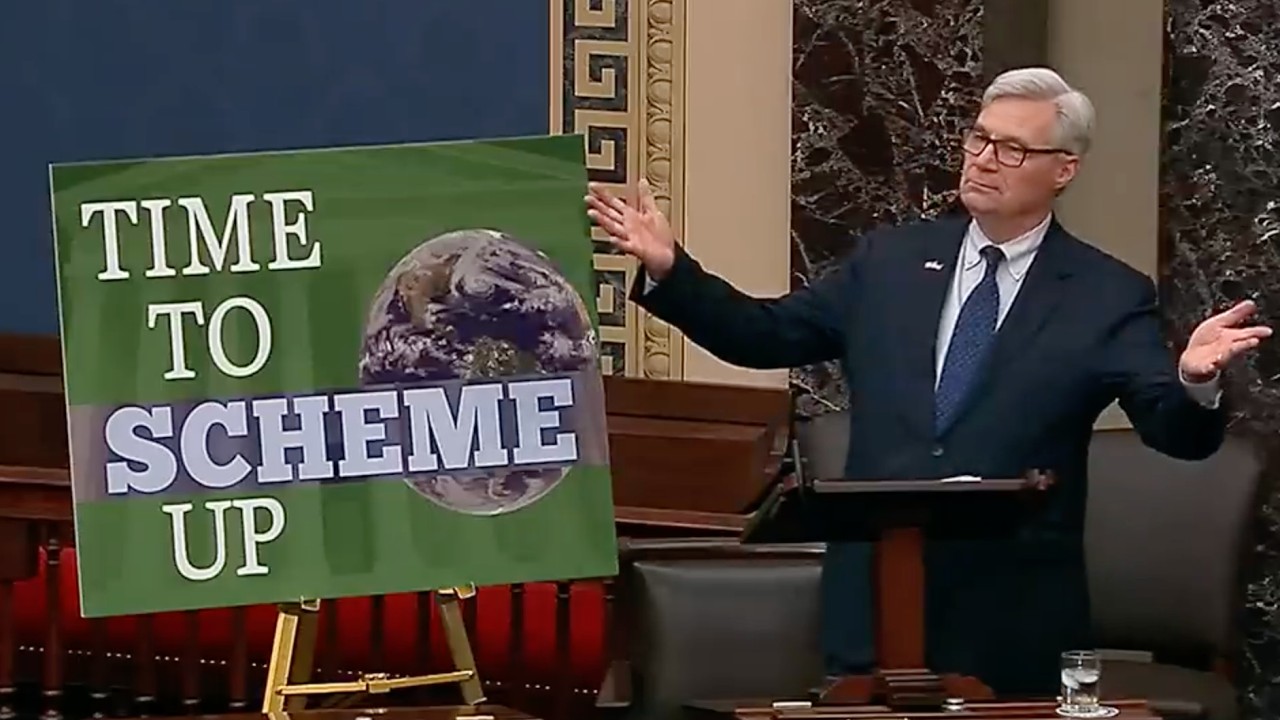
The Scheme Time to Wake Up | Senator Whitehouse's Speeches Converge
Apr 23, 2026
April 22 | Senator Sheldon Whitehouse (D-RI) delivers his 306th speech in his Time to Wake Up series, converging with his 36th Scheme speech. The billionaire-backed scheme to capture and control the Supreme Court was developed largely to protect the fossil fuel industry’s free-to-pollute business model. Here’s the proof.
---
https://www.politico.com/news/2023/04/25/neil-gorsuch-colorado-property-sale-00093579
politico bad code box size]
no lnx
Supreme Court Justice Clarence Thomas has [lnx] to overturn the 2020 presidential election results. Now, according to Politico reporter Heidi Przybyla, another relationship involving a High Court justice could merit close scrutiny — and this time, the justice is Donald Trump nominee Neil Gorsuch.
Przybyla, in an on April 25, reports, "For nearly two years beginning in 2015, Supreme Court Justice Neil Gorsuch sought a buyer for a 40-acre tract of property he co-owned in rural Granby, Colorado. Nine days after he was confirmed by the Senate for a lifetime appointment on the Supreme Court, the then-circuit court judge got one: The chief executive of Greenberg Traurig, one of the nation’s biggest law firms with a robust practice before the High Court. Gorsuch owned the property with two other individuals."< according to Przybyla, Brian Duffy of Greenberg Traurig "put under contract the 3000-square-foot log home on the Colorado River and nestled in the mountains northwest of Denver, according to real estate records. >READ MORE:
"He and his wife closed on the house a month later, paying $1.825 million, according to a deed in the county’s record system," Przybyla reports. "Gorsuch, who held a 20 percent stake, reported making between $250,001 and $500,000 from the sale on his federal disclosure forms. Gorsuch did not disclose the identity of the purchaser. That box was left blank. Przybyla adds, "Since then, Greenberg Traurig has been involved in at least 22 cases before or presented to the Court, according to a Politico review of the Court's docket. They include cases in which Greenberg either filed amicus briefs or represented parties.
In the 12 cases where Gorsuch's opinion is recorded, he sided with Greenberg Traurig clients eight times and against them four times." zxz for nearly two years beginning in 2015, Supreme Court Justice Neil Gorsuch sought a buyer for a 40-acre tract of property he co-owned in rural Granby, Colo. Nine days after he was confirmed by the Senate for a lifetime appointment on the Supreme Court, the then-circuit court judge got one: The chief executive of Greenberg Traurig, one of the nation’s biggest law firms with a robust practice before the high court. Gorsuch owned the property with two other individuals.>
On April 16 of 2017, Greenberg’s Brian Duffy put under contract the 3,000-square foot log home on the Colorado River and nestled in the mountains northwest of Denver, according to real estate records....federal disclosure forms.<...Since then, Greenberg Traurig has been involved in at least 22 cases before or presented to the court, according to a POLITICO review of the court’s docket....one of the more highly publicized rulings in recent years, a multistate suit which reversed former President Barack Obama’s plan to fight climate change through the Clean Air Act.
Gorsuch joined the court’s other five conservative judges in agreeing with the plaintiffs — including Greenberg’s client — that the Environmental Protection Agency had overstepped its authority by regulating carbon emissions from power plants in the decision that makes it more difficult for the executive branch to regulate emissions without express authorization from Congress.
Duffy, who in addition to serving as CEO is chief of Greenberg’s entire 600-lawyer litigation department, said he has never personally argued cases before Gorsuch or met the justice socially.
“I’ve never spoken to him,” Duffy said. “I’ve never met him.”
Once he learned Gorsuch was among the owners, Duffy said, he cleared the sale with his firm’s ethics department.
Gorsuch did not respond to inquiries about the sale, his disclosures or whether he should have reported Duffy’s identity as the purchaser.
Supreme Court rules do not prevent justices from engaging in financial transactions with people with interest in court decisions, but Gorsuch’s dealings with Duffy expose the weakness of the court’s disclosure procedures. For instance, in reporting his Colorado income, Gorsuch listed as his source only the name that he and his two co-owners gave themselves, Walden Group, LLC. The report didn’t indicate that there had been a real estate sale or a purchaser.
Such a sale would raise ethical problems for officials serving in many other branches of government, but the Supreme Court sets its own rules. It has largely left justices to make their own decisions about when and how to report outside gifts and income.
Justice Clarence Thomas is currently under scrutiny for accepting lavish trips from GOP billionaire donor Harlan Crow, who also purchased three Georgia properties from the justice. Thomas did not report the property sales. Of the vacations, Thomas said he had been advised that “personal hospitality from close friends” need not be disclosed.
Senate Judiciary Chair Dick Durbin (D-Ill.), a frequent critic of Supreme Court ethics rules, sent a statement responding to POLITICO’s inquiry about Gorsuch’s sale of the Colorado property.
“We have seen a steady stream of revelations regarding Supreme Court Justices falling short of the ethical standards expected of other federal judges and of public servants,” said Durbin. “The need for Supreme Court ethics reform is clear, and if the Court does not take adequate action, Congress must. The Senate Judiciary Committee will be closely examining these matters in the coming weeks,” said Durbin, who has asked Chief Justice John Roberts to testify next month on the court’s ethics rules.
Kedric Payne, director of ethics at the nonpartisan Campaign Legal Center, said he believes “investments in LLCs require more details than the justice includes in his financial disclosures.“
“This transaction appears to also require naming the buyer. The public has a right to know that justices will fully comply with disclosure rules instead of providing only a tiny peek into their financial disclosures,” he said, noting more facts are needed to distinguish whether it’s a disclosure omission or violation. The center was founded by a Republican former chair of the Federal Election Commission.
Unlike Crow, who bought properties from Thomas, Duffy says he is neither a friend nor a confidant of Gorsuch. But he is one of the nation’s most powerful attorneys.
His Greenberg bio describes him as “A true ‘working CEO,’” and says he “focuses his practice on trial and appellate work in the class action, employment, energy, commercial contract, and product liability areas, serving as counsel in high-profile cases throughout the United States.”
At the time of the sale, Duffy had headed Greenberg Traurig for about a year. A search of his contributions to political candidates revealed that they went primarily to Democrats, including Sen. Kirsten Gillibrand, (D-N.Y.). He contributed the maximum amount allowable for individual donors to Democratic presidential nominee Hillary Clinton in the 2016 election, though he also made contributions in the past to Republicans such as former Sen. John McCain of Arizona and a GOP New York City mayoral candidate, Joe Lhota.
The Duffy family has long resided in Colorado. Duffy attended the University of Colorado Law School and, in 2019, he was the recipient of the “most admired CEO” award by the Denver Business Journal.
Duffy, who described himself as an avid fly fisher, said he’d been looking for the right property for his family for many years. Duffy said he did not know Gorsuch was one of the owners when he made his first offer.
“The fact that he was going to be a Supreme Court justice was absolutely irrelevant to the purchase of that property. It’s a wonderful piece of property and we’re so glad we bought it,” said Duffy.
Gorsuch and his associates purchased the property in 2005 through theirLLC, the Walden Group,which was dissolved after the 2017 sale. The home was originally listed, in July of 2015, for $2.495 million. The fact that the property had sat on the market for so long and that its price had been lowered a couple times suggests the partners were having trouble finding a buyer.
The real estate transaction is another example of how the lack of a firm code of ethics for the court stands in contrast to most other branches of the U.S. government, including the White House and Congress as well as lower court judges.
The code of conduct for lower court U.S. judges says judges should “avoid impropriety and the appearance of impropriety in all activities,” and “discourages frequent transactions or continuing business relationships with lawyers or other persons likely to come before the court” on which the judge serves. Unlike many of the country’s state and federal courts, the Supreme Court lacks a code of conduct.
“This is exactly the type of situation that an ethics code that included vetting of transactions and full disclosure would clear up,” said Kyle Herrig, president of Accountable.US, a progressive research organization. “Without decisive action, the conservatives on the Supreme Court will forever tarnish its reputation in our public life,” he said.
At the time of Gorsuch’s appointment, his ownership of the Colorado property drew attention only for the fact that his co-owners were major figures in the oil and gas industry. Gorsuch’s ties to the oil and gas industry run deep.
As a lawyer at a Washington law firm nearly 20 years ago, Gorsuch represented oil and gas billionaire Philip Anschutz on a variety of matters as outside counsel, and it was through this connection that Gorsuch befriended his future real estate partners.
Anschutz helped Gorsuch win an appointment to an open seat on a federal appeals court in Denver, including directly lobbying the George W. Bush White House....Gorsuch’s connections to Anschutz extend to .
The Walden Group included Kevin Conwick, who had advised Anschutz in deals to buy sports teams and other projects like the Staples Center in Los Angeles, and Cannon Harvey, who oversaw Anschutz’s venture capital investment division...
fac so index:
May 26, 2019by Facing South
Rank of Brett Kavanaugh's 2018 appointment to the U.S. Supreme Court among the reasons there's a new push to ban abortion in state legislatures across the South and elsewhere: 1
In the fiscal year before it spearheadedKavanaugh's confirmation, amount the Judicial Crisis Network (JCN)— a secret-money 501(c)(4) "social welfare" nonprofit that promotes conservative judges — received in anonymous donations, according to a tax return recently obtained by campaign finance watchdogs: $22 million
Size of a single anonymous donation JCN got during the period between July 2017 and June 2018, when abortion rights-protecting Justice Anthony Kennedy resigned, opening the door to Kavanaugh, who was backed by anti-abortion groups: $17 million
Number of other anonymous donations JCN got that year, all of them at least six-figure: 9
JCN's spending in 2017 to support the confirmation of President Trump's other Supreme Court nominee, Neil Gorsuch, who has also shown hostility to the Court's 1973 Roe v. Wade decision legalizing abortion: $10 million
Year in which Carrie Severino — a former law clerk for Supreme Court Justice Clarence Thomas and spouse of Catholic anti-abortion lawyer Roger Severino, who now runs the Department of Health and Human Services' Office of Civil Rights and opposes contraceptive access under the Affordable Care Act — took the helm of JCN: 2014
Among JCN's top funders, rank of the Wellspring Committee, a secretive nonprofit that serves as a conduit for anonymous contributions to conservative causes and is led by hard-line Opus Dei Catholic Ann Corkery and her husband, Neil Corkery, who has served as JCN's treasurer: 1
Amount Wellspring funneled to JCN between 2010 and 2018: more than $54.2 million
According to the newly released tax return, amount JCN paid that fiscal year to the BH Group, a Virginia limited liability company connected to Trump advisor Leonard Leo, who's also the executive vice president of the Federalist Society, an influential conservative legal organization whose current or former members include five sitting Supreme Court justices: $241,000
Decades for which Leo — also reportedly an Opus Dei member who plays a key role in hiring at George Mason University's law school in Virginia — has worked to push the judiciary to the right in order to enable an abortion crackdown: 3
According to conservative commentator Ed Whelan, number of people "more dedicated to the enterprise of building a Supreme Court that will overturn Roe v. Wade" than Leo: 0
Month in which Leo told a gathering of conservative activists in Florida that they had to mobilize in "very unprecedented ways" to finish their transformation of the U.S. Supreme Court: 2/2019
Between 2014 and 2017 alone, amount Leo and his allies raised for JCN and other secret-money nonprofits to carry out their court-transforming agenda: more than $250 million
Year since JCN has also been funneling millions of dollars to state supreme court races, money that has bought misleading or even libelous ads: 2012
https://www.alternet.org/2022/06/supreme-court-states-establishment-clause/
no lnx many twt
A far-right legal group believes states are exempt from the Establishment Clause. Some Supreme Court justices agree
Alex Henderson June 29, 2022
During the 1990s, Justice Clarence Thomas and the late Justice Antonin Scalia were viewed as the lunatic fringe of the U.S. Supreme Court. But their theocratic views and far-right social conservatism were balanced out by other justices, from liberal Justice Ruth Bader Ginsburg to moderate Justice Sandra Day O’Connor to Justice Anthony Kennedy — a Ronald Reagan appointee and right-wing libertarian who, although fiscally conservative, was quite protective of abortion rights and gay rights.
Those days are long gone. Theocrats, thanks largely to Senate Minority Leader Mitch McConnell and former President Donald Trump, now dominate the High Court— a fact that was painfully evident when the Court announced, on Friday, June 24, that it had voted to overturn Roe v. Wade and Thomas argued in favor of reconsidering protections for contraception and gay rights as well.
Freedom of religion is guaranteed in the U.S. Constitution — specifically, the 1st Amendment’s Establishment Clause, which states, “Congress shall make no law respecting an establishment of religion, or prohibiting the free exercise thereof.” The Establishment Clause makes it abundantly clear that while people of all faiths can freely practice and promote them, the government cannot establish an official religion. This means that while Catholics, Protestants, Jews, Muslims, Hindus, Sikhs, Buddhists and Bahais are more than welcome to gather on New York City’s 5th Avenue and promote their faiths, the government itself has a strict separation of church and state.
[Read more: Columnist likens U.S. Supreme Court’s right-wing supermajority to a ‘junta in long black robes’
But in Christian Right legal circles, some theocrats, including the far-right group America First Legal, are arguing that individual states are exempt from the Establishment Clause — and Reuters reporter Lawrence Hurley notes that the group believes that states have a right to decide “whether and to what extent they will establish religion within their borders.”
Moreover, America First Legal is hoping that the U.S. Supreme Court will officially take that position in a future ruling.
According to Religion News Service (RNS) reporter Jack Jenkins, Thomas and Justice Neal Gorsuch share America First Legal’s view of the Establishment Clause — and Justice Amy Coney Barrett has “expressed interest in the idea.”
Thomas, Gorsuch and Barrett are among the justices who voted to strike down Roe v. Wade in the case Dobbs v. Women’s Health Organization.
ginni hired i hate blk ppl
https://www.alternet.org/2021/10/neil-gorsuch/
travis g raw
the U.S. Supreme Court's newly tilted right-wing majority will have a chance to leave its stamp on cases involving abortion, gun rights and torture, and the rulings will reveal who controls the court after Donald Trump jammed through three hardline conservatives.
The confirmation of Amy Coney Barrett to replace the late Ruth Bader Ginsburg takes away Chief Justice John Roberts' power to cast the deciding vote on any ruling, but legal experts disagree who will drive the majority's opinions in the session that starts this week, reported The Guardian. GUK
"Roberts's ambition is to keep the law as narrow as possible and keep as much of the court's legitimacy as possible while twirling ever toward the Republicans' agenda," said Elie Mystal, a justice correspondent for The Nation. "[Brett] Kavanaugh likes beer. Amy Coney Barrett likes Jesus. These are fundamentally narrow positions. Gorsuch wants to fundamentally change the law and reframe the way we think about the law. [Neil] Gorsuch wants to do horrible things, but ambitious things. He's got the intellectual tools to accomplish it."
Another court watcher thinks Justice Clarence Thomas will emerge as the most powerful member of the court.
"Roberts is only marginally in charge to the extent that he can bring Kavanaugh or Barrett with him," said Josh Blackman, of the South Texas College of Law Houston. "I think we are living in Justice Thomas's world. He is always thinking ahead several steps and has built an army of supporters."
Barrett and Justice Samuel Alito recently made unusually defensive remarks about the court's legitimacy after Mitch McConnell used his power as Senate majority leader to engineer a 6-3 conservative majority, which then allowed Texas to outlaw most abortions through its controversial "shadow docket" process.
"I think the thing to watch is whether Roberts can pick off one of the members of the [conservative] super majority to have the result come out differently than the hard right would want," said Garrett Epps, a professor at the University of Baltimore School of Law. "I think it may not be his court, but his role is by far the most interesting of any of the justices because he is – and he alone – an institutionalist, in the sense that he really cares about the Supreme Court and his place in history, more than he really cares about his own policy goals."
FROM YOUR SITE ARTICLES
- Right-wing Supreme Court may be looking to deal 'massive blow' to ... ›
- Susan Collins draws outrage as she shows her true colors in two ... ›
- Donald Trump and Neil Gorsuch Have the Religious Right Thinking ... ›
RELATED ARTICLES AROUND THE WEB
- Who Is Neil Gorsuch, President Donald Trump's Pick For Supreme ... ›
- Neil Gorsuch Confirmed by Senate as Supreme Court Justice - The ... ›
- Neil Gorsuch: Who is he? Bio, facts, background and political views ... ›
https://www.alternet.org/2021/09/supreme-court-2655063879/
It is a central principle of law: Courts are supposed to follow earlier decisions – precedent – to resolve current disputes. But it's inevitable that sometimes, the precedent has to go, and a court has to overrule another court, or even its own decision from an earlier case.
In its upcoming term, the U.S. Supreme Court faces the question of whether to overrule itself on abortion rights. Recent laws in Texas and Mississippi restrict the right of women to terminate pregnancies in ways that appear to challenge the long-standing precedent of the Supreme Court's 1973 decision in Roe v. Wade, which allowed women to have abortions in most circumstances.
Over the centuries, courts have stated many reasons they should adhere to precedent. First is the idea of equity or justice, under which “ like cases should be decided alike," as one senior federal judge put it. If a court in the past reviewed a particular set of facts and decided a case in a specific way, fairness dictates it should decide another similar case the same way. Precedent promotes uniformity and consistency in the law.
In addition, precedent promotes judicial efficiency: Courts do not have to decide from scratch every time. Finally, following precedent promotes predictability in the law and protects people who have come to rely on past decisions as a guide for their behavior.
But not all precedents are equal, and several current Supreme Court justices have signaled that they might be open to overturning even long-standing rulings that interpret the Constitution.
Reversing precedent is unusual
The Supreme Court rarely overturns its past decisions or precedents.
In my forthcoming book, “Constitutional Precedent in Supreme Court Reasoning," I point out that from 1789 to 2020 there were 25,544 Supreme Court opinions and judgments after oral arguments. The court has reversed its own constitutional precedents only 145 times – barely one-half of one percent.
The court's historic periods are often characterized by who led it as chief justice. It was not until the 1930s under Chief Justice Charles Evans Hughes that it started to overturn precedents with any frequency. These were cases such as United States v. Darby, in which the court began to affirm President Franklin Roosevelt's New Deal economic policies after previously rejecting them as unconstitutional.
Before then, of course, many cases asked the court to interpret clauses of the Constitution for the first time, so there were often no precedents to confront or overturn.
Under Chief Justices Earl Warren, Warren Burger, William Rehnquist and now John Roberts, the court overturned constitutional precedent 32, 32, 30 and 15 times, respectively. That is well under 1% of decisions handled during each period in the court's history.
When is precedent overturned?
For most of its history the court changed its mind only when it thought past precedent was unworkable or no longer viable, perhaps eroded by its subsequent opinions or by changing social conditions.
This happened in Erie Railroad v. Tompkins, a 1938 Supreme Court case overturning a 96-year-old precedent in which the court had constructed rules about how federal courts should handle cases involving parties from different states. The court in Erie said that the original decision proved to be unworkable and had been undermined by the court's own later decisions.
The court has also said that its precedents based on constitutional grounds deserve less respect than those in which the court interprets statutes or laws. The reason is that if Congress thinks the court has erred in a matter of interpreting a statute or law, it is relatively easy for them to overturn it by passing a new law. But it's quite hard to pass a constitutional amendment, so the only real way to update the judicial understanding of the Constitution is to overrule a precedent.
Of course the most famous reversal of precedent is the 1954 Brown v. Board of Education under the Warren Court, in which it reversed Plessy v. Ferguson and struck down segregation under the “separate but equal" doctrine.
Roe v. Wade is an important precedent. In 1973 the Supreme Court ruled that women have a right to terminate their pregnancies. That right was reaffirmed in 1991 in Planned Parenthood v. Casey, with Justices Sandra Day O'Connor, Anthony Kennedy and David Souter noting that an entire generation of women came of age relying upon their right to control their bodies and terminate pregnancies in most circumstances. The justices said it would be wrong to upset that expectation.
Roe has also spurred opposition, with many wanting to overturn it. For years, presidents including Ronald Reagan, George H.W. Bush, George W. Bush and Donald Trump sought to appoint justices to the Supreme Court with the goal of overturning Roe and, with it, abortion rights. Now with a 6-3 conservative majority, the court may be poised to do that.
Justices get more comfortable reversing precedent
Beginning with the Rehnquist court, justices have become more willing to reject precedents they think were badly reasoned, simply wrong, or inconsistent with their own senses of the constitutional framers' intentions. Justice Clarence Thomas has taken this position on abortion. Justice Amy Coney Barrett during her Senate confirmation hearing argued that Roe is not a so-called superprecedent, a decision so important or foundational that it cannot be overturned.
Chief Justice Roberts has been willing to overturn settled law when he thinks the original opinion was not well argued. He did so in Citizens United, a 2010 decisionoverturning two major campaign finance decisions, Austin v. Michigan Chamber of Commerce and part of McConnell v. FEC.
In 2020, Justices Neil Gorsuch and Brett Kavanaugh in Ramos v. Louisiana went out of their way to explain and justify their views on when constitutional precedent may be overturned. They echoed Justice Samuel Alito's discussion in 2018 in Janus v. American Federation of State, County, and Municipal Employees Council Number 31. All three justices said constitutional precedent is merely a matter of court policy or discretion, more easily overturned than a precedent about a law. Sometimes, they said, constitutional precedents can be overruled if later judges view them as wrongly decided or reasoned.
Abortion foes have been preparing practically since Roe was decided to overturn it. They have set both the political conditions and legal justification to overturn Roe, and perhaps this year it will be the time when it finally happens. 
David Schultz, Professor of Law, University of Minnesota; Professor of Political Science, Hamline University
https://www.alternet.org/2021/05/amy-coney-barrett/
alexh
Although Donald Trump went down in history as a one-term president when he was voted out of office in 2020, he accomplished something that the United States' last two one-term presidents—Democrat Jimmy Carter and Republican George H.W. Bush — didn't: Trump appointed three justices to the U.S. Supreme Court. Justice Neil Gorsuch in 2017, Justice Brett Kavanaugh in 2018 and Justice Amy Coney Barrett in 2020 were all Trump nominees. In an article published by CNN's website on May 5, legal analyst Joan Biskupic lays out some reasons why Barrett has been more of a game-changer on the High Court than Kavanaugh.
Kavanaugh was a game-changer in that he replaced a libertarian: former Justice Anthony Kennedy, who retired in 2018. Appointed by President Ronald Reagan in 1987, Kennedy was a right-wing libertarian who was fiscally conservative but socially liberal and often sided with the late Justice Ruth Bader Ginsburg over far-right social conservatives such as Justice Clarence Thomas and the late Justice Antonin Scalia when it came to abortion or gay rights. And Trump replaced a libertarian with a social conservative.
But the change from Ginsburg to Barrett was more dramatic, as Trump replaced Ginsburg — the High Court's most famous liberal — with a severe social conservative who is even more to the right than Kavanaugh. Barrett is very much in the Scalia/Thomas vein.
Yet Barrett, as Biskupic explains in her article, is more low-key in her demeanor than Scalia.
Biskupic explains, "Supreme Court Justice Amy Coney Barrett hasaligned most often withClarence Thomas and Neil Gorsuch in her first months on the bench…. As she has adopted the legal method of her mentor, the late Justice Antonin Scalia, Barrett has avoided the flamethrower rhetoric that defined him and some followers on the bench today. Of the cases heard in oral arguments and resolved already this term,she has voted 100% of the time with Thomas and Gorsuch."
Comparing Kavanaugh and Barrett, Biskupic observes, "Barrett's pattern so far contrasts with that of Justice Brett Kavanaugh, who in the conservative bloc, has sided mainly with Roberts on the center-right. Differences between the newest appointees of former President Donald Trump could play out in major cases to be decided in the next two months over the Affordable Care Act, voting rights, and religious liberties when tested against LGBTQ interests, as well as next session in a 2nd Amendment gun rights case already on the calendar. The justices are also considering an abortion rights case for the 2021-22 term that would further illuminate Barrett's brand of conservatism."
Chief Justice John Roberts, appointed by President George W. Bush, has been right-wing in his judicial philosophy but more nuanced than Thomas or Scalia. And Biskupic notes that when Kavanaugh and Barrett are compared, Kavanaugh has been more likely to agree with Roberts.
"Kavanaugh has sidled since his 2018 appointment toward Roberts," Biskupic observes. "The chief and Kavanaugh have shared among the highest voting alignments for the past three years, according to statistics compiled by SCOTUSblog. Yet patterns of statistical togetherness go only so far. In several important cases when Roberts joined the liberal side, Kavanaugh remained with the right wing…. Barrett has voted so far in only a dozen cases that have been argued. That's where she has consistently been with Thomas and Gorsuch."
an 1120
The core of the Republican Party strength is concentrated in the 27 Right to Work states.As discussed in a previous article, Right to Work laws are designed to weaken unions by cutting their revenue and membership. Unions represent just 7.5% of the workforce in right to work states but almost 16% in "fair share" states. The 27 "right to work" states account for 83% of the currently seated Republican Senators and 70% of their Representatives. In 2016, Trump carried 25 of the 27 these states.
JUDICIAL BRANCH – Anti-Union/Pro Business Judges Dominate the Supreme Court and Appellate Courts
The Republican Party has worked for a long time to ensure that the federal court system is dominated by conservative, pro-business/anti-union judges over the long term. Indeed, Republicans basically packed the court system when Senate Majority Leader McConnell refused to allow the Senate to vote on 105 judicial vacancies during the Obama administration which were later filled by Trump appointees.
Supreme Court. The Supreme Court now has 6 Republican appointed justices and 3 Democratic Justices. Each of the three Trump appointees had a proven anti-union/pro-corporate bias before being nominated.
Amy Coney Barrett. During her term on the 7th Circuit Court of Appeals, Barrett ruled in favor of corporate interest more than 75% of the time. She ruled that corporations are entitled to set job requirements that exclude older workers and that they may segregate workers at different locations by race. She has also expressed support for striking the entire Affordable Care Act which would deprive health insurance for 20 million people and end protections for 100 million people with pre-existing conditions.
Neil Gorsuch. During his term on the 10th Circuit Court of Appeals, Gorsuch repeatedly ruled against workers and in favor of corporations. For example, Gorsuch dissented from a majority ruling upholding a National Labor Relations Board decision that an employer must give full back pay to workers it illegally fired for union activity. Gorsuch dissented in cases in which the circuit court majority supported pro-worker NLRB decisions stating that the NLRB exceeded the scope of its authority. However, Gorsuch made no such dissent when the court ruled in favor of NLRB decisions that supported management.
Brett Kavanaugh. Kavanaugh served on the extremely important US District Court of Appeals for the District of Columbia Circuit. This court is second only to the Supreme Court in terms of prestige and power because it has jurisdiction over Congress and most federal regulations and agencies. The People for the American Way compiled a list of rulings showing that Kavanaugh consistently ruled against workers and for corporations during his 12½ years on the DC Circuit Court. Examples include Kavanaugh's opinions that would "entirely eviscerate collective bargaining;" his support for corporations seeking criminal citations for lawful union protests; and support for corporations that failed to protect workers health and safety.
Other Federal Courts. In almost 4 years Trump and the Republican Senate have appointed 24% of all active federal judges (194 of 792). There are 35 more nominations currently pending. Trump has appointed 30% of all active federal appeals court judges (54 of 179). This is more than any other president over the last 40 years. Overall, Republican appointees now account for 54% of all federal circuit court judges. The circuit courts are especially powerful because they function as final arbiter for the vast majority of cases since the Supreme Court accepts fewer than 2% of the 7-8,000 cases filed with it annually. These courts ultimately determine what the federal government can and cannot regulate – this is especially important to unions in relation to the right to organize and collectively bargain for wages, benefits and working conditions as well as the relative power of unions and corporations....
==
https://www.alternet.org/2020/06/cry-me-a-river-head-of-right-wing-group-that-spent-millions-on-gorsuch-mocked-for-fury-over-lgbtq-rights-opinion/
head of a far right wing activist group is furious conservative Justice Neil Gorsuch wrote Monday’s majority Supreme Court opinion that finds discriminating against LGBTQ workers is illegal.
Judicial Crisis Network, a “powerful dark money group pushing [the] court to right,” ran a $10 million campaign in 2017 to force Gorsuch onto the bench. He is President Donald Trump’s first Supreme Court nominee. The group also spent $1 million to block President Barack Obama from putting Merrick Garland on the bench.
In a series of tweets **Carrie Severino** blasted Justice Gorsuch and the five others who sided with his opinion. She even claims they are merely trying to appeal to college students by finding that Title VII of the Civil Rights Act of 1964 protects LGBTQ workers from discrimination.
Gorsuch, a textualist who replaced Justice Antonin Scalia on the bench, decided that as written, the actual words of the Civil Rights Act make clear that discriminating on the basis of sex is illegal.
severino, who also happens to be married to the **Roger Severino**, a far right wing religious activist who heads the Dept. of Health and Human Services Office of Civil Rights under Trump, is furious....
https://www.alternet.org/2020/04/conservative-supreme-court-justices-tortured-reasoning-in-the-disastrous-wisconsin-case-is-a-thin-excuse-for-their-true-purpose/
==
https://www.alternet.org/2020/04/the-supreme-court-is-poised-to-extend-gun-rights-at-the-worst-possible-time/
no lnx
The Supreme Court is poised to extend gun rights at the worst possible time
Supreme Court of the United States
Written by Bill Blum / Independent Media Institute April 8, 2020
“A well regulated Militia, being necessary to the security of a free State, the right of the people to keep and bear Arms, shall not be infringed.” —Second Amendment to the United States Constitution
As the deadly COVID-19 contagion sweeps across the country, gun sales are surging, spurred in many regions by panic buying and purchases by first-time firearm owners. Fearful and insecure Americans are taking advantage of weak and ineffective gun-control laws and stocking up, as President Trump might say, “like never before.”
Meanwhile, the Supreme Court is poised to issue its first major Second Amendment opinion in more than a decade in a case that originated, fittingly, in New York City, now the epicenter of the COVID-19 outbreak in the United States. The case—New York State Rifle & Pistol Association Inc. v. City of New York—has the potential to vastly extend the rights of gun owners, and not just in New York, but throughout the entire nation.
At issue is a New York City “rule” (the term the city uses for its local ordinances) that was adopted in 2001 to prohibit residents from transporting licensed handguns beyond municipal limits. The rule was challenged in a federal lawsuit filed in 2013 by the NRA’s New York affiliate and three individuals. A district court judge ruled in the city’s favor in 2015, as did the Second Circuit Court of Appeals in 2018. The Supreme Court, however, agreed to review the case at the NRA’s request in January 2019, and heard oral arguments in December.
The plaintiffs contend that the city’s handgun transportation ban should be declared unconstitutional because it conflicts with the Supreme Court’s landmark 2008 decision on the Second Amendment, District of Columbia v. Heller.
In Heller, the Supreme Court struck down a ban on handgun possession in the nation’s capital, ruling for the first time that the Second Amendment protects an individual right to gun ownership. Deeply controversial and hotly contested, Heller split the Supreme Court along strict ideological lines, and was resolved on the basis of a 5-4 vote of the justices. The late Justice Antonin Scalia’s majority opinion stood the prior judicial consensus on the Second Amendment on its head, rejecting the great weight of prior scholarship and earlier court opinions, including the Supreme Court’s 1939 decision in United States v. Miller, that had construed the amendment as protecting gun ownership only in connection with service in long-antiquated state militias.
Scalia’s opinion was met by a blistering dissent written by Justice John Paul Stevens, who retired from the bench in 2010 and passed away last year. Drawing on a wide array of historical sources, Stevens chided Scalia for ignoring the actual debates that took place during the founding era on the ratification of the Constitution and the drafting of the Second Amendment. Those debates, in Stevens’ view, demonstrated the amendment’s purpose was not to safeguard individual gun rights, but to guarantee the survival of the militias as a “collective right” of the citizenry as an alternative to the creation of a large federal standing army.
Stevens lost the battle of persuasion in Heller, and in 2010, in another 5-4 decision that also featured a Stevens dissent—McDonald v. Chicago—the Supreme Court extended Heller, holding that the individual right to keep and bear arms was incorporated by the 14th Amendment’s due process clause and hence was applicable to the states and local governments. The Second Amendment, as interpreted by Scalia, thus became the law of the land.
Although Scalia and Stevens are no longer with us, the ideological divisions they represented remain on the Supreme Court today. Indeed, when it comes to gun rights, the current court is even more conservative than it was in 2008. Justices Neil Gorsuch and Brett Kavanaugh, both appointed by Trump, are outspoken proponents of Scalia’s vision of the Second Amendment. And the tribunal’s remaining conservatives—Chief Justice John Roberts and Justices Clarence Thomas and Samuel Alito—participated in Heller and joined Scalia’s majority opinion.
Still, Heller by no means precluded all measures of gun control. As the Second Circuit noted in its evaluation of the New York handgun transportation ban that is now before the court, Heller was technically limited to possession of guns in the home, and established no clear limits on legislation aimed at regulating gun rights outside of the home.
“Like most rights,” Scalia wrote in Heller, “the right secured by the Second Amendment is not unlimited… [N]othing in our opinion should be taken to cast doubt on longstanding prohibitions on the possession of firearms by felons and the mentally ill, or laws forbidding the carrying of firearms in sensitive places such as schools and government buildings, or laws imposing conditions and qualifications on the commercial sale of arms.”
And in an enigmatic footnote to the above paragraph, Scalia added: “We identify these presumptively lawful regulatory measures only as examples; our list does not purport to be exhaustive.”
Adhering to Scalia’s reasoning, in the years following Heller, lower courts have upheld a broad range of state and local gun-control regulations, a dynamic that has prompted the NRA and other gun-lobby groups to urge the Supreme Court to take up another Second Amendment appeal to reaffirm the amendment’s importance and place stricter limits on gun control. They may have found the perfect test case in the New York transportation ban. Like Heller, the New York ban concerns an outright prohibition, which will be hard, if not impossible, to justify before the court’s conservative majority.
Realizing it would likely lose the case, New York City amended its transportation rule in June to permit residents to take their handguns to second homes, businesses or shooting ranges outside city limits. And in July, the city filed a formal motion with the Supreme Court, requesting that the case be dismissed as moot. The court denied the motion in October, setting the stage for another Second Amendment showdown.
In December’s oral arguments, the city again asked the court to moot the case. The city made no attempt to defend the transportation ban.
Unfortunately, given the city’s capitulation and the Supreme Court’s right-wing orientation, the only real remaining question is the scope of the NRA’s inevitable victory. Even if the court reconsiders the city’s request and enters a dismissal order, the NRA will walk away with a significant win, having forced the city to rescind one of the most stringent gun-control laws in the country. On the other hand, a decision on the merits on constitutional grounds in the NRA’s favor would reward the organization with an even bigger triumph, endangering gun-control laws everywhere.
A nation awash in firearms in the grip of the COVID-19 pandemic awaits the court’s decision, which is expected by the end of June.
Bill Blum is a retired judge and a lawyer in Los Angeles. He is a lecturer at the University of Southern California Annenberg School for Communication. He writes regularly on law and politics and is the author of three widely acclaimed legal thrillers: Prejudicial Error, The Last Appeal, and The Face of Justice.
This article was produced by the Independent Media Institute.
==
==
trms had head of legis in full ppe saying perfectly safe mofo
republicans can’t seem to help themselves from weaponizing this public health crisis to advance their own self interest and cement their grip on power. And they’re getting help from right-wing judges – including the far-right majority on the U.S. Supreme Court!
Yesterday, the Wisconsin GOP – with the help of the right-wing majority on the Supreme Court – forced Wisconsin voters to choose between risking their health and the health of others and exercising their right to vote ... during the pandemic ... with the number of polling places drastically reduced so, for instance, voters in Milwaukee, who usually have nearly 200 polling places, would have to crowd into FIVE.
==
==
https://www.alternet.org/2019/06/everybody-hates-john-roberts/
no lnx
Everybody hates John Roberts
THE WASHINGTON MONTHLY
30 JUN 2019 AT 14:08 ET
If a successful compromise is one that leaves both sides disappointed, then John Roberts had a banner day on Thursday. Liberals inclined to view the Supreme Court chief justice as a loyal Republican operative saw bitter confirmation in his decision that federal courts have no power to stop partisan gerrymanders. But conservative die-hards who questioned Roberts’s commitment to the movement will shake their heads at his decision to block the Trump administration, at least temporarily, from adding a citizenship question to the 2020 census. That’s not to say that the partisan impact of the two rulings will be symmetrical. Roberts, who once famously insisted that his job is “to call balls and strikes,” tends to afford Republican pitchers a wider strike zone. But the pair of rulings gave each side plenty to fume about.
If you don’t believe me, just read Justice Clarence Thomas’s dissent in Department of Commerce v. New York, the census case. The question was whether the U.S. Census Bureau, which is part of the Commerce Department, would be allowed to add a question to the 2020 census asking whether respondents are U.S. citizens or not. While Roberts agreed with the other four conservatives that the answer ordinarily would be yes, he joined the liberal bloc in ruling that Commerce Secretary Wilbur Ross’s stated rationale for adding the question—that it was necessary to allow the Department of Justice to protect minority voters—was transparently false. The real reason was that the Census Bureau’s own research showed that a citizenship question would suppress response rates among undocumented immigrants, thereby leading to an undercount in Democratic-leaning areas and further enhancing Republican power after the 2021 round of redistricting.
The proof of this was overwhelming. As Roberts put it in an understated summary:
That evidence showed that the Secretary was determined to reinstate a citizenship question from the time he entered office; instructed his staff to make it happen; waited while Commerce officials explored whether another agency would request census-based citizenship data; subsequently contacted the Attorney General himself to ask if DOJ would make the request; and adopted the Voting Rights Act rationale late in the process.
In short,Roberts concluded, the voting-rights rationale was a pretext. Judges should give government officials the benefit of the doubt, he wrote, but “[a]ccepting contrived reasons would defeat the purpose of” judicial review.
You might think that would be an uncontroversial notion. But all four of Roberts’s conservative colleagues would have allowed the government to go forward with the question. Thomas’s dissent, which was joined by Trump appointees Neil Gorsuch and Brett Kavanaugh, was dripping in indignant contempt, all but accusing the majority of discriminating against the Trump administration: “The Court therefore upholds the decision of the District Court—which, in turn, was transparently based on the application of an administration-specific standard.” Later, in a passage that, other than syntactically, would not seem out of place in a Sean Hannity monologue, Thomas added: “I do not deny that a judge predisposed to distrust the Secretary or the administration could arrange those facts on a corkboard and—with a jar of pins and a spool of string—create an eye-catching conspiracy web.”
From the pitch of his outrage, you could almost forget that Thomas and the conservatives claimed victory in the day’s more consequential ruling, on partisan gerrymandering.
There’s nothing inherently conservative about gerrymandering—indeed, Thursday’s case, Rucho v. Common Cause, involved both a Republican gerrymander in North Carolina and a Democratic one in Maryland—but the decision is a boon to Republicans for the simple reason that they currently benefit far more from it. There are, in other words, more North Carolinas than Marylands. When Republicans swept into power in statehouses around the country in 2010, just in time for redistricting, they were armed both with both sophisticated new technology and an unprecedently rigorous plan for deploying it. The result is that in many states, Democrats are effectively locked out of taking back the legislature. In Wisconsin, for example, Democrats won 53 percent of the popular vote last year—and only 36 percent of legislative seats.
In his majority opinion in Rucho, Roberts didn’t deny that partisan gerrymandering is bad for democracy. Rather, he argued, there’s simply no manageable way for federal courts to police it. Since districting decisions made by elected officials will inevitably take political considerations into account, everyone knows some element of partisanship must be allowed. Therefore, Roberts reasoned, striking down a partisan gerrymander would require the Court to answer an unanswerable question: “How much is too much?” As distasteful as gerrymandering is, he concluded, it’s up to the political process (and perhaps state courts), not federal judges, to address the problem.
This line of reasoning drove liberals up the wall. The problem with egregious partisan gerrymandering is precisely that it makes it all but impossible for the disadvantaged side to win back power. To say that it’s up to the North Carolina legislature to undo its gerrymander is to say that the state’s Republicans should voluntarily cede their advantage. The practical upshot of Thursday’s ruling will be to help Republicans (and Democrats, in states like Maryland) hang onto power without actually winning over a majority of voters.
In her dissent, Justice Elena Kagan excoriated the conservative majority for failing to recognize that lower federal courts have already been converging on a manageable test for identifying excessive partisan gerrymanders, one that looks at whether the purpose and effect of districting is to “substantially” entrench the dominant party in power by diluting the other party’s votes. “But in throwing up its hands,” she wrote, “the majority misses something under its nose: What it says can’t be done has been done.” Liberal commentators have gone farther. Prominent election law scholar Rick Hasen wrote in the New York Times that “the opinion written by Chief Justice John Roberts is disingenuous” because the Supreme Court regularly imposes vague-sounding standards like “reasonable” or “substantial” to draw boundaries in other areas of the law.
But while Roberts’s liberal critics have landed some punches, it’s a stretch to treat the gerrymandering ruling as a clear case of bad-faith partisan judging. Drawing the constitutional line between “partisan” and “too partisan” is no easy task. Consider Kagan’s response to Roberts’s question, “How much is too much?” Pointing to the truly extreme level of partisan precision in the North Carolina case, she treated the concern as trivial. “How about the following for a first-cut answer,” she wrote: “This much is too much.” It’s a cute line, but it’s not really an adequate answer. If the Court is to weigh in on these cases, it’s fair to expect it to establish a rule that goes beyond ad hoc judgments.
We may ultimately get a clearer answer to the question of whether Roberts’s ruling was really disingenuous. To show that the democratic process is up to the challenge of curtailing gerrymandering, he cites a litany of reforms, including nonpartisan redistricting commissions, which voters in Michigan and Colorado approved last fall. As it happens, the Court affirmed the constitutionality of such commissions in 2015, in a 5-4 decision with the now-retired Anthony Kennedy joining the liberals. Do you know who wrote the dissent? John Roberts. With Kennedy now replaced by Kavanaugh, it’s a safe bet that there are enough votes to overturn that precedent. But if Roberts chooses that path, it will be yet another blow to the flagging legitimacy of the institution he leads. And that much might really be too much.
Note these 2 cases undermine 2020 election, demo political partisan hacks
also scotus on gerrymander
https://www.alternet.org/2019/06/supreme-court-sends-census-citizenship-case-back-to-lower-court-after-bombshell-evidence-reveals-gops-true-motives/
also scotus on gerrymander
https://www.alternet.org/2019/06/supreme-court-sends-census-citizenship-case-back-to-lower-court-after-bombshell-evidence-reveals-gops-true-motives/
no lnx
Supreme Court sends census citizenship case back to lower court after bombshell evidence reveals GOP’s true motives
STEPHEN WOLF / DAILY KOS
27 JUN 2019 AT 15:30 ET
In a surprise decision that will help preserve fair political representation, the Supreme Court temporarily blocked the Trump administration from adding a question to the 2020 census asking U.S. residents about their citizenship status, instead sending the case back to lower court for it to explore explosive new evidence behind the GOP’s motives for including the question.
The addition of this citizenship question would have likely had a chilling effect, intimidating millions of people in immigrant communities into not participating in the census. That in turn would haveturbocharged a new wave of hyperpartisan Republican gerrymandering nationwide, since census data is the bedrock of redistricting.
This impact was in fact the entire rationale behind this question: In a recent bombshell report, based on newly unearthed documents from a deceased GOP political consultant, Thomas Hofeller, Republicans admitted that rigging the census would eviscerate the political power of Democrats and voters of color.
The Constitution mandates that every person in the U.S. be counted in the decennial census, without regard to their legal status. A question on citizenship hasn’t been included in the census since 1950, and even when it has appeared, it has never been asked of every single participant, as the Trump administration intended it to be in 2020. Furthermore, multiple lower courts had ruled that Trump’s attempt to add the question violated both federal law and the Constitution.
Those courts uniformly dismissed the Trump administration’s claim that the Justice Department needed data on citizenship to enforce the Voting Rights Act as a bogus pretext that masked their true motives. Hofeller’s document trove revealed the GOP’s racist and partisan intent: allowing mapmakers to use citizenship statistics result in “a disadvantage to the Democrats” and to be “advantageous to Republicans and non-Hispanic whites.”
Although the Census Bureau had planned to print millions of census forms in July, plaintiffs argued that it could delay printing until October to give the courts time to resolve the case. Now, the case will go back to the federal district court in New York that originally heard the matter. That will allow the judge to conduct an in-depth review of the new evidence and craft a ruling that addresses the Trump administration’s racial and partisan animus. In the likely event that the lower court once again blocks the question, the Supreme Court may let such a ruling stand following its latest decision.
Given the blatant display of partisan and racial bigotry behind the GOP’s plans, this ruling averted a major blow to democracy that would have rivaled the harms of both 2000’s Bush v. Gore decision and the 2013 ruling that crippled the Voting Rights Act. Although the Supreme Court’s Republican majority has advanced an increasingly partisan agenda that undermines the rule of law, Trump’s malicious effort to weaponize the census simply proved to be too extreme for the court to accept.
==
==
new
‘A requiem for American democracy’: 5-4 Supreme Court vote rules partisan gerrymandering is ‘beyond the reach of the federal courts’
Elizabeth Preza June 27, 2019
The Supreme Court on Thursday in a 5-4 ideological split rejected limits to partisan gerrymandering, quashing an effort by advocates of political reform to rein in manipulative electoral district boundaries
==
https://www.alternet.org/2019/03/justice-neil-gorsuch-says-no-one-can-sue-to-stop-the-government-from-establishing-religion/
kos
Theocrat Gorsuch says no American can challenge a Christian religious display on government property.
One inherent danger of allowing a religious minority to install a puppet controlled by religious fanatics in the White House is the now unfolding threat of government officially establishing religion – the Christian religion. Any American’s confidence that the U.S. Constitution is a protection against government establishing religion is grossly misplaced and, that belief is about to be disabused by the current religious conservatives responsible for adjudicating the law of the land.
Because a nearly half-century-old Supreme Court ruling prevented the government from advancing religion, the wall of separation between church and state is almost certainly going to be eviscerated by the Christian conservatives on the current Supreme Court. The crusade to demolish the wall of separation is being advanced by one of the Heritage Foundation SCOTUS nominees confirmed shortly after Trump corrupted every aspect of the government his tiny little hands touched. However, it is noteworthy that Neil Gorsuch’s theocratic crusade is wholly supported by Trump’s other SCOTUS appointee, religious _{serial}_ _{liar}_ and _{sexual abuser}_ Brett Kavanaugh.
The reason the “_{Establishment}__{ Clause}_” is going to be found unconstitutional by the current Court’s Christian conservatives is crystal clear; they believe a 1970’s-era _{ruling}_ prohibiting government establishment of religion adhered to the U.S. Constitution and is patently wrong. The prohibition on government establishing religion is appalling to evangelicals and the theocrats on the High Court are not going to tolerate it any longer.
The High Court recently heard two cases, _{American Legion v. American Humanist Association}_ and _{Maryland-National Capital Park and Planning Commission v. American Humanist Association}_, brought by Americans who errantly believed the Supreme Court would rule according to the U.S. Constitution like lower federal courts; but that prospect is highly unlikely. Those Americans failed to comprehend that there are few conservatives who actually fulfill their oath to uphold the nation’s founding document and law of the land; this is particularly true any time the Constitution is at odds with the theocracy-minded _{Christian **Dominionis**}__{**ts**}_. Christian Dominionists have lusted for the day the federal government will establish the Christian religion as the law of the land, and it is something Justice Neil Gorsuch contends cannot be challenged.
Based on comments by Trump’s more vocal and radical theocratic justice, it is all but certain that the Court will uphold the so-called “_{Peace Cross}_” as the initial step in a long sought-after demolition of the so-called wall of separation enshrined in the U.S. Constitution’s 1st Amendment. The case centers on a 40-foot tall Christian cross-shaped monument on government land in Maryland. The Christian cross, a well-known Christian symbol, was erected to honor fallen Christian soldiers from the First World War; as if no Buddhists, Jews, Hindus, or atheists sacrificed their lives for what they believed was a nation with a secular Constitution banning the government from establishing any religion.
Trump’s theocratic Justice Neil Gorsuch proffered a truly radical position regarding the unconstitutionality of the government establishing religion, as if he was a hired lawyer and spokesman for the theocratic Dominionist movement. Although not going so far as asserting the First Amendment’s “_{Establishment Clause }__{is unconstitutional}_” like former Attorney General J. Beauregard Sessions, he may as well have.
Gorsuch did, in fact, claim that any plaintiffs who challenge government establishment and endorsement of one specific religion should be banned from suing the government to force it to uphold the Constitution’s Establishment Clause. According to Gorsuch, there is no situation that allows any American to have “legalstanding to challenge” a Christian religious display on government property; something that is in fact establishing religion. He claims that because “their only injury is that they take offense” at the religious display on taxpayer’s land, in his theocratic mind being offended is not enough to demand the government abide by the law of the land – any more than expecting Christian conservative justices to support, uphold, and decide cases based on the Constitution.
It is noteworthy that in Gorsuch’s Catholicmind there in no law, no part of the Constitution, or no civil rights protections that an evangelical extremist’s religious freedom cannot abridge. In fact, any time he has been involved with cases regarding basic civil rights, especially women’s and gays’ human rights, Gorsuch plays the religious liberty card – it is what his Catholic religious_{ leaders}_ taught evangelicals a few decades ago as an electoral tool to engender unwavering religious support for Republican candidates in the South.
During the evangelicals’ argument that the Court has to tear down what Founding Father Thomas Jefferson labeled “a _{wall of separation}_ between church and state,” Gorsuch condemned the High Court’s 1971 ruling in Lemon v. Kurtzman. In that particular case, the Supreme Court had to defend, support, and enforce the 1st Amendment’s “Establishment Clause” because malcontent religious freaks opposed the idea of a Constitution that prohibits theocrats from using the government to establish their religion. In that decision the Court ruled correctly.
“The nation’s laws must have a secular legislative purpose and a primary effect that neither advances nor inhibits religion.”
The Court also held that “the nation’s laws cannot foster government entanglement with religion.”
Gorsuch disagrees and complained bitterly about that kind of originalist argument he asserted was too confusing for judges in lower courts leading him to declare:
“It’s time to thank Lemon for its service and send it on its way.”
Gorsuch’s arguments were aligned closely, and likely carefully coordinated, with one of three theocratic attorneys _{arguing in favor}_ of the Peace Cross as a cudgel to tear apart the wall of separation between the Christian church and state. According to “archconservative lawyer” and theocrat Michael Carvin, any law that advances religion should be upheld by the High Court unless it coerces individuals into religious activity.
It is noteworthy that all Americans are already “coerced” into providing _{tens-of-billions of dollars}_ annually in free, tax-exempt welfare to churches, and that is on top of the several billions worth of tax-free faith-based initiative dollars to shove their religion down other Americans’ throats.
There was a time, not so long ago, that the idea of a Supreme Court justice openly arguing that the government has a right to establish religion, and that no citizen has standing to sue to force said government to adhere to the law of the land, would be considered lubridious. However, that was before a fanatical religious minority seized absolute control of the federal government, including the federal judiciary, on the day of Trump’s poorly-attended inauguration. It is curious that religious extremists like Gorsuch and Kavanaugh claim to be devotees of “Constitutional originalist” Antonin Scalia, and yet they are staunch crusaders for violating the Founders’ original intent and support giving other Christian extremists the religious freedom to control all American citizens.
Look, anyone who is remotely aware of world history, especially the bloody and brutal Christian world history, knows full well that these Taliban-ISIS-like fanatics will never stop until they rule with a theocratic iron fist. The _{Handmaid}__{’s}__{ Tale}_ was probably written as fiction, and possibly as a cautionary tale, but the fictional events that led to the overthrow of the democratic United States and creation of the “_{Republic of }__{Gilead}_” are playing out before American citizen’s eyes – and people are still terrified of uttering an unkind word against the religious minority running America. Sadly, the same “who cares” attitude that allowed America to get to this extremely tragic situation will continue unabated until America is Gilead.
The Republicans advancing the Dominionists’ agenda may not comport changing America’s name to Gilead, but they damn sure countenance America’s lurch toward theocracy. Moreover, they will continue unabated providing a vile group of “mean god” evangelicals with all the “religious liberty” they demand to control every aspect of American life. Even more tragic is that their first victims will be mothers, daughters, sisters, girlfriends and wives of the men who claim to love them while remaining silent and therefore complicit.
Gorsuch just handed down the most bloodthirsty and cruel death penalty opinion of the modern era
she prolly regrets voting for gorsuch now:
https://www.alternet.org/election-03918/supreme-court-heidi-heitkamp-voter-id-tribal-reservations
on Tuesday, the Supreme Court denied an emergency request to reverse an Eighth Circuit Court of Appeals ruling that reinstated a set of draconian North Dakota voter ID restrictions — restrictions which disproportionately impact Native Americans living on tribal lands, and which could threaten the re-election of Democratic incument Sen. Heidi Heitkamp.
The denial, issued by Neil Gorsuch, was 6-2, with Ruth Bader Ginsburg and Elena Kagan dissenting, and Brett Kavanaugh — who was only just sworn into office after a bitter confirmation fight — not taking part.
North Dakota is unique among states in not having voter registration at all, meaning that voters are confirmed solely by presenting identification that proves their residency. But the new law, enacted by the Republican-controlled state legislature in 2017, places new restrictions on the type of state-issued ID that is acceptable: specifically, North Dakota voters must now present a photo ID card that bears a residential street address.
That could be a serious problem for thousands of Native American voters who live on tribal lands, because many of them do not actually have residential street addresses. The Postal Service does not deliver directly to many tribal reservations, so many state-issued tribal ID cards simply bear a P.O. box, which will not be sufficient under the new law.
A federal district court previously blocked the law from taking effect after Native American groups sued, and North Dakota conducted its primaries without it. But the Eighth Circuit reversed the lower court in September — and with the Supreme Court refusing to intervene, the law will now take effect for the general election.
Native American voters whose tribal ID cards do not show a residential street address will not be completely without options. They may be able to call their local 911 coordinator, register the location of their address, and have a document mailed to them bearing that address, which can then be used to supplement their ID. But early and absentee voting has already started, and the new rules are bound to create mass confusion, potentially causing thousands of people to stay home or bring the wrong identification.
This, indeed, was Ginsburg's main complaint in her dissent. "The risk of voter confusion appears severe here because the injunction against requiring residential-address identification was in force during the primary election and because the Secretary of State’s website announced for months the ID requirements as they existed under that injunction," she wrote. "Reasonable voters may well assume that the IDs allowing them to vote in the primary election would remain valid in the general election. If the Eighth Circuit’s stay is not vacated, the risk of disfranchisement is large."
Heitkamp is already facing a tough election fight against GOP Rep. Kevin Cramer, who currently leads her in all polls. She won in 2012 by a margin of fewer than 3,000 votes, and Native Americans make up a huge portion of her voter base. Absent a broad awareness and organizing campaign to help people obtain the required documents, the court decision could be a disaster for voter turnout.
==
https://www.alternet.org/election-03918/supreme-court-decides-let-political-extremists-run-wild-key-election-case
U.S. Supreme Court on Monday all-but dismissed one of the most-watched election law cases in recent years, saying those in Wisconsin filing a lawsuit that sought to show how extreme partisan gerrymandering was anti-democratic had no basis to sue.
It also took no action on a second partisan gerrymandering case from Maryland.
“The Court has not found that this presents an individual and personal injury of the kind required for Article III standing,” the majority said in the Wisconsin case, sending it back to a lower court. “A citizen’s interest in the overall composition of the legislature is embodied in his right to vote for his representative. The harm asserted by the plaintiffs in this case is best understood as arising from a burden on their own votes.”
The Wisconsin case sought to show how the state’s GOP-led legislature in 2011 segregated each party’s reliable voters by party to draw legislative districts after the 2010 Census to create a red super-majority. In the Maryland case, those suing said a Democratic-led legislature had overreached to erase a GOP-held House seat.
The Wisconsin suit was the most carefully watched of the two gerrymandering cases, because it involved statewide jockeying of political districts, as opposed to a single congressional seat. It was also the platform for advanced analysis that showed how the use of technology was able to tilt the electoral playing field to game political advantage based on voter turnout patterns.
The decision will reverberate on many political and cultural levels. Seen from a partisan standpoint, the Court is saying that the plaintiffs’ efforts to demonstrate that Wisconsin’s Republican mapmakers were able create a structural head start in the likely popular vote was fair game—even if it led to one-party rule for most of this decade. Beyond the technicalities of how the GOP nullified their opposition’s ability to win in typical election cycles (2018 is not a typical year), the Court’s majority is saying that rebalancing elections to create greater equality among voters is not a constitutional priority.
Going deeper, the Court’s action is likely to signal that ruling parties in supermajority state legislatures are free to tinker with the rules of voting and elections as they see fit—to preserve their power. (Wisconsin was one of more than a dozen red states that drew extreme gerrymandered maps after the 2010 census, leading to super majorities in their state legislatures and House delegations. Those ultra-red majorities then passed many of this decade’s voter suppression, anti-union, anti-abortion, anti-LGBT and anti-safety net laws.
On a cultural level, the Court is signaling that American democracy will remain a deeply uneven system, where governing classes can advantage themselves and take steps to undermine the participation and power of their opponents or under-represented constituencies.While there is a tendency among the judiciary to keep a certain distance from the political process—as a co-equal branch of government and separation of powers—the fact remains that the Court is not seeking to rebalance the most glaring anti-democratic features in the fundamentals that shape the electoral process.
Inequality in elections is going to remain a formidable obstacle. Only last week, in purple North Carolina, did the Republican-led legislature propose anew series of election rules that would disadvantage a key Democratic voting block—African Americans who voted on the weekend before the Tuesday general election. The state’s GOP proposed, among several measures, to eliminate the early voting option used by 200,000 citizens in 2016.
That move came despite a federal appeals court in 2016 rejecting an earlier slate of anti-participatory election reforms, saying those measures targeted the state’s black voters “with almost surgical precision.” But now, with the Supreme Court not acting on the partisan gerrymandering cases, the political process will be freer to revert to more aggressive tactics to advantage one side—where partisan power apparently carries more constitutional weight than equality among the electorate.
==
for example:
https://www.alternet.org/news-amp-politics/supreme-court-gives-republicans-another-tool-rig-elections-voter-purge-decision
Supreme Court dealtyet another blow to voting rights on Monday, this time giving states the go-ahead to purge their voter rolls, a practice that disproportionately targets Democratic-leaning populations and in particular people of color:
The case hinged on interpretation of the National Voter Registration Act (NVRA), a 1993 civil rights law intended to increase voter registration and participation. But in recent years, some conservative activists began using certain provisions of the law to force states to more aggressively purge their rolls. Those provisions govern what’s known as “list maintenance,” and their stated purpose is to remove people who have moved or passed away. But election officials instead sometimes use list maintenance to remove eligible voters—particularly poor ones and people of color—because they haven’t voted frequently enough. [...]
The court’s 5-4 decision is likely to resurrect an era that the NVRA was meant to end. The practice of purging voters dates back more than 100 years. Just as today, it was justified as a necessary tool to thwart fraud and maintain the integrity of elections. But in practice, it was often used to suppress the votes of those who might not support the party in power. The result of the aggressive purges was that Americans participated in elections at a far lower rate than citizens of other Western democracies. and low election participation rates is just what Republicans want—so Republican-controlled states will doubtless take this anti-democratic Supreme Court decision and run with it, giving Republicans yet another advantage in an increasingly rigged system.
another eg
game over tipping pt?! rbg v gorsuch
https://www.democracynow.org/2018/5/23/supreme_court_deals_blow_to_workers
a major blow to workers’ rights, the Supreme Court ruled 5 to 4 Monday that employers can use arbitration clauses to prohibit workers from banding together to challenge violations of federal labor laws in class-action lawsuits. Arbitration is often confidential. Many workers may agree to mandatory arbitration clauses without even being aware of it when they sign a contract with their employer. In a rare show of public displeasure, Justice Ruth Bader Ginsburg read her dissent from the bench, calling the majority opinion “egregiously wrong” and saying, “The court today holds enforceable these arm-twisted, take-it-or-leave-it contracts—including the provisions requiring employees to litigate wage and hours claims only one-by-one. Federal labor law does not countenance such isolation of employees.” For more, we speak with Terri Gerstein, former labor bureau chief for the New York State Attorney General’s Office
==
https://www.exposedbycmd.org/2018/05/22/epic-fail-supreme-court-strips-non-union-workers-power/
no link chart
EPIC FAIL: SUPREME COURT TURNS BACK THE CLOCK TO STRIP WORKERS OF POWER
==
--eg-
https://www.alternet.org/news-amp-politics/heres-right-wing-plan-destroy-unions-and-hinder-democratic-fundraisin
Monday, the Supreme Court heard a major case that will substantially weaken public-sector unions and diminish the strength of the Democratic Party.
That case is Janus v. American Federation of State, County, and Municipal Employees, which will determine whether public-sector unions can collect fees from non-union employees.
It sounds like a simple and technical issue, but the outcome could change the fate of public-sector unions, the strongest-standing bulwark of labor organizing in a time when many private unions have largely faded.
Unions need to be able to enforce fees on non-members because these employees could otherwise reap the benefits of collective bargaining, such as higher payer, job protection, and good working conditions. Without the power to enforce fees on non-members, unions could be substantially weakened because there would be a strong incentive for employees to free-ride and not pay the fees — ultimately undermining the benefits of collective bargaining.
Opponents say that forcing non-member to pay union fees violates the First Amendment because unions engage in political speech. However, the court already ruled on those arguments in 1977 in Abood v. Detroit Board of Education, coming down in favor the unions. There's no reason for the court to take the issue again. Even many conservative legal analysts disagree with that the court should hear Janus.
But the court heard a similar case last year, and it came down 4-4 after Justice Antonin Scalia died. It's widely believed that Scalia would have voted against the unions. Justice Neil Gorsuch is almost certain to follow this path.
As the New York Timesreports, major conservative donors have backed this aggressive legal attack on public sector unions. And it's not just about labor — it's a political attack to weaken the Democratic Party, which draws substantially on public-sector unions for financial and organizational support.
As Eric Segall, a law professor at Georgia State, argues, there's no constitutional basis for the conservative justices to rule against unions and overturn Abood.
"If the Justices were to take their prior rules regarding precedent (and federalism interests) seriously, they would not overturn Abood," Segall writes. "[I]t will demonstrate yet again that the values and politics of the Justices trump their alleged commitments to legal principles and the rule of law. Moreover, if the Justices overturn Abood, it will be because Justice Gorsuch, not Judge Garland, now sits on the Court, not because the first amendment forbids states from making the decision to require all public sector employees to financially support the unions that represent their best interests."
The memo notes that they believe Justice Anthony Kennedy will soon retire, and the effort to replace him will be “far more contentious” than the effort to confirm Justice Neil Gorsuch.
“If President Trump nominates a principled, constructionist nominee for Justice Kennedy’s seat or any other vacant seat, we anticipate engaging with both grassroots and under-the-dome tactics, bringing paid and earned media and events to support the confirmation.” The memo notes that the network sponsored pressure effort on Sens. Joe Manchin, D-W.V., Heidi Heitkamp, D-N.D.; and Joe Donnelly, D-Ind., all of whom eventually voted to confirm Gorsuch.
In Indian Wells, California, last month, the network held a retreat with 700 donors. Several journalists were invited to attend as long as they promised not to name the donors present.
Operatives from the network also led sessions to explain how to move forward into the midterm elections. The Koch brothers intend to spend $400 million to preserve the Republican majority in Congress and maintain GOP power at the state level.
In recent days, Koch network groups have purchased ads targeting Democratic lawmakers in key elections across the country. This week, a new ad began airing in Missouri criticizing DemocraticSen. Claire McCaskill,who is up for re-election this year.
“We’ve made more progress in the last five years than I had in the last 50,” Charles Koch reportedly said. “The capabilities we have now can take us to a whole new level.”
==
==
https://www.alternet.org/news-amp-politics/supreme-court-just-blocked-order-north-carolina-redraw-gerrymandered-congressional
North Carolinians may vote in the 2018 midterm elections under a congressional map that has beengerrymandered by Republicans. The U.S. Supreme Court has blocked a lower court ruling ordering the U.S. House of Representatives district lines be redrawn by January 24.
Justices Ruth Bader Ginsburg and Sonia Sotomayor both objected to the order.
Reuters explains the initial ruling that ordered the district lines be redrawn:
"The three-judge panel ruled that the Republican-drawn districts violated the U.S. Constitution’s guarantee of equal protection under the law by intentionally hobbling the electoral strength of non-Republican voters. Two of the three judges also said the plan ran afoul of the Constitution’s First Amendment by discriminating based on political belief and association."
The Supreme Court is reviewing cases of alleged gerrymandering in Wisconsin and Maryland. The implications of these cases on other states, including North Carolina, remain to be seen.
...
==
==
tagami suing, could go scotus, ~ local regs (even state?!)
refurbish rotunda bldg; boycott;
kty ($50 mil pledge, montreal guy wants pension for 250) and utah need export term; thin green line ecotpia cascadia oil and coal exports
10 microns, even 2.5 (2x any other rr freight)
ted franklin erin revin sp and __ No coal in Oakland
https://kpfa.org/episode/talkies-december-26-2017/
tagami said no coal, but was talking to kinder secret?
Bowie co
rich lawyers 20 min in; gorsuch and __ want to reverse commerce clause/interstate commerce b/c of pipelines?!
amicus by becerra, cbd, cbe
vs earth justice; could be summary judgment w/o trial jan 10 2018
==
==
https://maplight.org/story/tax-returns-identify-dark-money-organization-as-source-of-gop-supreme-court-attacks/
A dark money organization that has spent millions to finance conservative causes was the source of the $17 million spent to keep Supreme Court Justice Antonin Scalia’s seat in Republican hands, tax documents reviewed by MapLight reveal.
The Wellspring Committee, a Virginia-based nonprofit, donated more than $23 million last year to the Judicial Crisis Network, which spent $7 million on advertisements pushing Republican senators to block President Barack Obama’s court pick, Merrick Garland. After the election, the network spent another $10 million to boost President Donald Trump’s pick, Justice Neil Gorsuch.
Wellspring received more than $32 million in donations last year, with $28.5 million coming from a single, anonymous donor. Before 2016, Wellspring had never received more than $13.2 million in annual donations. As a social welfare organization, Wellspring is not required to disclose its donors.
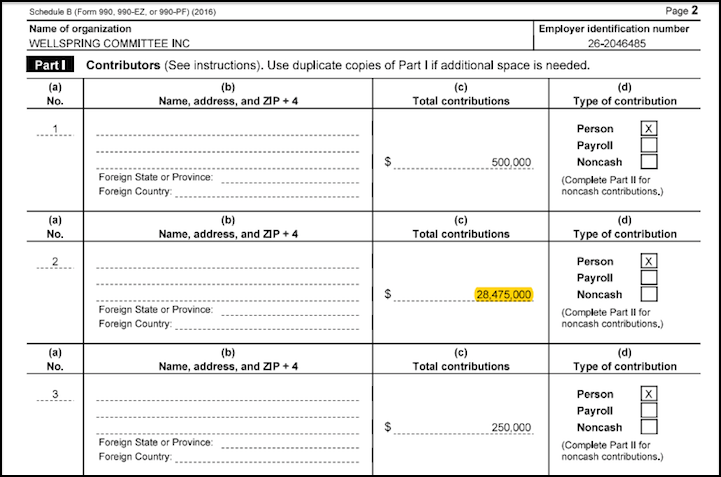
A tax form from the Wellspring Committee shows $28.5 million coming from a single, anonymous donor. Wellspring gave $23.5 million to another dark money organization that spent millions to keep Supreme Court Justice Antonin Scalia’s seat in Republican hands.
JCN and Wellspring share personal ties. Ann Corkery, a Washington lawyer, has served as Wellspring’s president. Her husband, Neil, has been JCN’s treasurer and has apparently succeeded Ann as Wellspring’s president, according to the committee’s tax return; JCN’s most recent tax filing doesn’t mention him.
Last year, Wellspring gave $100,000 to the Federalist Society, a conservative lawyers organization that has emerged as one of the most influential players in Washington during the Trump era. The organization recommended Trump nominate Gorsuch for the Supreme Court, and one of its top executives, Leonard Leo, is reportedly advising the Trump administration on judicial selections. JCN and Wellspring provided almost 80 percent of the money raised by the Rule of Law Project, a conservative nonprofit that listed Leo as a director in tax filings.
JCN has put Wellspring’s money to use in other ways. JCN reported giving $8.5 million in grants to conservative nonprofits and political groups on its latest tax return, covering July 2015 to June 2016. Beneficiaries included the Republican Governors Association and the Republican Attorneys General Association, as well as organizations that supported conservative court justices in Wisconsin and North Carolina
Wellspring also donated $2 million to the American Future Fund, an organization that spent more than $12 million on ads boosting Sen. Marco Rubio, R-Fla., in his presidential and Senate campaigns, during the 2016 election cycle. It gave another $2.5 million to Illinois Policy Action, a dark money organization that supports conservative policies in Illinois.
==
https://movetoamend.org/gorsuch%E2%80%99s-gory-expansion-corporate-personhood
https://www.alternet.org/news-amp-politics/neil-gorsuch-reportedly-alienating-his-colleagues-supreme-court-left-and-right
Long after his presidency is over and Trump has finally shuffled off this mortal coil, Neil Gorsuch will likely still be sitting on the Supreme Court, much to the delight of American conservatives. Gorsuch's fellow Supreme Court justices do not appear to share their glee. Multiple reports indicate that almost from the moment he was confirmed, the dyed-in-the-wool constructionist has rubbed members of the court the wrong way—and not just the liberals on the bench.
Last month, Jeffrey Toobin of the New Yorker cataloged all of the judicial norms and practices the Trump appointee has violated during his brief tenure. He has dominated oral arguments where new associates are expected to defer to their seniors, penned condescending dissents challenging the wisdom of a court whose justices claim more than 140 years of experience between them, and barely concealed his contempt for Anthony Kennedy's majority opinion in Obergefell v. Hodges, a landmark decision legalizing same-sex marriage.
Gorsuch has also broken SCOTUS' unwritten rule that no justice embarrass the high court with any kind of overt political advocacy. In less than a year of service, he has delivered speeches at the conservative Fund for American Studies (at the Trump International Hotel in Washington, no less), as well as at the University of Louisville, where he was introduced by Senate Majority Leader Mitch McConnell. (McConnell was instrumental in blocking the appointment of Merrick Garland, whom Gorsuch ultimately supplanted.)
"There is nothing unlawful about Gorsuch’s speeches, though it’s hard to say just what the ethical rules are for Supreme Court Justices," Toobin writes. "They are exempt from the code that governs the conduct of other federal judges, so the Court has traditionally relied on informal self-policing."
John Roberts, who was appointed by George W. Bush in 2005, has reportedly taken exception with Antonin Scalia's successor.According to CNN, a "rivalry" has emerged between the two conservatives, with the chief justice refusing to join Gorsuch's dissent in a case overturning an Arkansas law that prohibited same-sex partners from being listed on a child's birth certificate. (Roberts previously dissented in Obergefell.) And while he's been fairly consistent throughout his judicial career, the piece notes, "Roberts may be more open to negotiating with liberals if Gorsuch continues to bolster the hard right."
Gorsuch's relationships with Ruth Bader Ginsburg and Elena Kagan appear markedly more contentious. During oral arguments in Gill v. Whitford, a case that could determine the future of partisan gerrymandering in U.S. congressional districts, Ginsburg appeared to bristle at the associate justice's originalist line of questioning, asking him curtly, "Where did one person/one vote come from?"—a reference to Chief Justice Earl Warren's ruling in 1964's Reynolds v. Sims.
Earlier this week, NPR's Nina Totenberg, who has covered the court for decades, told the Supreme Court podcast First Mondays that Kagan has "really taken him on" in conference. "It’s [been] a pretty tough battle," she said, "and it’s going to get tougher."
"Why is Totenberg’s reporting here so extraordinary?" asks Mark Joseph Stern of Slate. "Because it’s astonishing that any reporter would hear details from conference, let alone score some genuinely juicy scuttlebutt...If rumors leak about a justice’s behavior in conference—and they basically never do—it is almost certainly a justice who leaked them. And when justices leak—which again, happens very rarely—they do so on purpose."
Gorsuch is an illegitimate justice occupying a stolen Supreme Court seat. If he leaves behind a legacy of corporate plunder and institutional rot, he will have honored the man who nominated him.
Gorsuch’s Gory Expansion of Corporate Personhood

March 22, 2017
Greg Coleridge
Programs on Corporations, Law & Democracy
Supreme Court Justice nominee Neil Gorsuch didn’t invent “corporate personhood,” the shorthand term used to describe the ludicrous decisions by U.S. Supreme Courts to sanctify corporate entities with inalienable constitutional rights intended exclusively for human beings.
As a federal judge, however, Gorsuch contributed to its expansion by applying it in creatively delusional ways in Burwell v. HobbyLobby1(https://movetoamend.org/gorsuch%E2%80%99s-gory-expansion-corporate-personhood#1). That 2014 case established that a “closely held”2(https://movetoamend.org/gorsuch%E2%80%99s-gory-expansion-corporate-personhood#2) for-profit corporation, apart from the human beings connected to it, possesses religious rights.
Corporations were originally subordinate to We the People
Supreme Court Justices began more than a century ago twisting existing constitutional doctrines into a pretzel to justify with straight faces that, indeed, legal documents issued by the federal and individual state governments possessed constitutional rights.
As followers of the Program on Corporations, Law & Democracy (POCLAD) are well aware, corporate entities were not intended originally at the nation’s founding to possess inalienable constitutional rights. They were granted charters, or licenses, one at a time by We the People via legislatures that precisely defined their actions. These included, among many others, limited charter durations and purposes, limits on the amount of land ownership, and stipulations of who could be corporate directors
Corporate charters were deemed to be democratic tools wielded to ensure public authority and control over subordinate corporate creations by the public. The corporate charter conferred “privileges,” not “rights.” Corporations were designed to be publicly accountable. If a corporation violated the democratically determined terms of its charter, state legislators or courts often revoked its charter with its assets distributed to those negatively impacted.
In a 1900 ruling to revoke the charter of a dairy corporation, the Ohio Supreme Court stated:
The time has not yet arrived when the created is greater than the creator, and it still remains the duty of the courts to perform their office in the enforcement of the laws, no matter how ingenious the pretexts for their violation may be, nor the power of the violators in the commercial world. In the present case the acts of the defendant have been persistent, defiant and flagrant, and no other course is left to the court than to enter a judgment of ouster and to appoint trustees to wind up the business of the concern.3(http://3)
The role of a corporation was to provide useful goods or services. It wasn’t to lobby, contribute or invest in political campaigns, or even to engage in charitable activities.
Corporations become legal “persons”
All this changed when corporate agents began effectively influencing state legislatures and in the appointment of corporate attorneys to the Supreme Court. Corporations escaped democratic controls by influencing legislatures to adopt general incorporation laws (vs one at a time charters); and by shifting corporate decision making from:
- The state to federal level,
- Legislatures to regulatory agencies, and,
- The legislative and executive branches to the judiciary (i.e. courts, including the Supreme Court).
It didn’t take long for corporate lawyers to appeal decisions limiting corporate actions to their peers on the Supreme Court, which ending up finding corporations as legal persons in a wide number of unforeseen places in the constitution. These included within the 1th Amendment (right to speak and right not to speak), 4thAmendment (right against search and seizure), 5th Amendment (right against “takings”) and 14th Amendment (right of due process and equal protection). Corporate attorneys also hijacked the Contracts and Commerce clauses, which became anti-democratic battering rams.
Scores of federal court decisions over the last century have widened and deepened corporate constitutional rights. These decisions overturned local, state and federal laws that had previously protected workers, consumers, communities and the environment. By doing so, corporations increased political and economic power at the expense of individuals without wealth and the keys to the corporate boardroom.
As evident from this brief historical account and despite what many believe, the 2010 Citizens United vsFEC4(https://movetoamend.org/gorsuch%E2%80%99s-gory-expansion-corporate-personhood#4) Supreme Court decision didn’t initiate the anointment of inalienable constitutional rights to corporate entities. The controversial 5-4 split decision by the Supremes merely widened the already existing 1st Amendment free speech rights of corporate entities to make political donations (or investments) in elections.
Gorsuch further expands “corporate personhood”
While serving on the 10th Circuit Court of Appeals, Neil Gorsuch played a prominent role in further widening and deepening constitutional rights to corporate entities, specifically for-profit corporations, into an entirely new arena: religion. He was among the majority who ruled in the Hobby Lobby case that federal law prohibited the Department of Health and Human Services from requiring closely held, for-profit secular corporations to provide contraceptive coverage as part of their employer-sponsored health insurance plans under the Affordable Care Act if it violated the corporation’s religious beliefs.
You read it right: the corporation’s “religious rights.” The U.S. Supreme Court upon appeal affirmed the decision in a controversial 5-4 split decision.
Hobby Lobby’s owners claimed they shouldn’t have had to be forced to comply with federal laws that violated their personal religious convictions. They referenced the 1993 federal Religious Freedom Restoration Act, which prohibits the government from imposing a "substantial burden" on a person's exercise of religion, even in a generally enforced law.
Just to be clear about the decision: Gorsuch and others didn’t just rule that Hobby Lobby’s owners had constitutionally-protected religious beliefs, but that the artificial legal creation of the state itself, Hobby Lobby Incorporated, possessed religious convictions.
To extend and pretend that private, personal religious rights apply to public entities such as business corporations is a breach of a constitutional firewall with potential lethal discriminatory implications. Dissenting in the case, Justice Ruth Bader Ginsburg said, "[ t ]he exercise of religion is characteristic of natural persons, not artificial legal entities," the ruling was “a decision of startling breadth.” and "[ t ]he court...has ventured into a minefield."5(https://movetoamend.org/gorsuch%E2%80%99s-gory-expansion-corporate-personhood#5)
The Hobby Lobby case opens the door as never before to requests for exemptions by private business corporations to laws that apply to all of us based on any number of claimed religious beliefs. Some individuals, for example, currently hold strong religious convictions about everything from racial, religious and sexual-orientation discrimination to the role of women in society. Hiring, paying, treating and providing benefits to employees are potentially up for grabs. Providing service (or not) to customers based on any number of factors is potentially at the whim of certain businesses. Even specific for-profit charter schools could impose religiously motivated racial segregation policies on their students.
What existing or potential civil rights laws would not be impotent to claims where the discrimination by a business corporation was motivated by strongly held religious beliefs of its owners? Thanks to Hobby Lobby, the corporation provides the cover for individuals to impose racism, sexism, homophobia and classism. Those wishing to discriminate toward others were handed a powerful weapon in the Hobby Lobby decision.
This isn’t just fantasy. It’s already happening. A federal district judge last year ruled that a transgender employee could be fired by a funeral home because its owner believed that gender transition violated his biblical teachings6(https://movetoamend.org/gorsuch%E2%80%99s-gory-expansion-corporate-personhood#6).
Ending corporate personhood
==
seattle times
How his mother’s downfall as Reagan’s EPA chief affected Court nominee Gorsuch
Originally published February 4, 2017 at 3:24 pm Updated February 4, 2017 at 4:38 pm
Former Environmental Protection Agency Administrator Anne Gorsuch Burford, with husband, Robert, gestures at farewell news conference in Washington in 1983. (IRA SCHWARZ/AP)
Judge Neil Gorsuch is no stranger to political infighting. His mother was criticized for spending cuts and easing rules as head of the EPA, eventually resigning after Congress cited her for contempt for refusing to turn over documents related to a toxic-waste program.
By ADAM LIPTAK, PETER BAKER, NICHOLAS FANDOS and JULIE TURKEWITZ
The New York Times
WASHINGTON — Judge Neil Gorsuch’s first taste of rough-and-tumble Washington, D.C., politics was bitter and lingering.
He was 15 and his mother was a high-ranking official in the Reagan administration caught in an ugly showdown with Congress. When she was forced to step down, her reputation in tatters, young Neil was furious.
“You should never have resigned,” he told his mother, Anne Gorsuch Burford, by her later account. “You didn’t do anything wrong. You only did what the president ordered. Why are you quitting? You raised me not to be a quitter. Why are you a quitter?”
More than three decades later, Neil Gorsuch, a federal appeals court judge in Denver, has been nominated to the Supreme Court by President Trump and faces a political culture even more caustic than the one that destroyed his mother’s public career. Like her, he is a committed conservative and can expect strong opposition, but where she was bold and brash, he has advanced to the pinnacle of the judiciary with understatement and polish.
Now 49, he arrives at his own moment of testing as a child of the Reagan revolution who saw up close the promise and the perils. He inherited a frontier skepticism of government rooted in his home of Colorado and nurtured in Washington, D.C., during the 1980s. While studying at the liberal enclaves of Columbia and Harvard, he rebelled against the dominant thinking to develop a conservative philosophy that has propelled him to the threshold of the Supreme Court.
Despite the family ordeal, friends and relatives said, he emerged from his youth tempered about politics yet not soured on public service. He decided to pursue goals similar to his mother’s, but along a different path.
Burford, known as Anne Gorsuch until she remarried in 1983, was the first woman to lead the Environmental Protection Agency (EPA). She argued that states were better custodians of resources and that market forces would bring more discipline to regulation. As she cut spending and pared back rules, critics called her an enemy of the environment. Her downfall came when, at White House direction, she refused to turn over documents related to a toxic-waste program. Congress cited her for contempt.
“It was an example to him of what the realpolitik of Washington could be like,” said Richard Segal, a Harvard Law School classmate who is a lawyer in San Diego. “He viewed his mother as an environmentalist, and his mother viewed herself as an environmentalist. And meanwhile she was made the poster child of the view that the Reagan administration was just out there to rape the environment.”
The teenager was his mother’s conscience. “Neil knew from the beginning the seriousness of my problems,” she wrote in a memoir before her death in 2004. He was “smart as a whip” and “had an unerring sense of fairness, as do many people his age.” When she resigned, “he was really upset.”
By most accounts, he did not dwell on it later in life, but it clearly echoed in his work. In preparing a moot court brief at Harvard on workplace safety, he tried to add material concerning the EPA that did not fit, recalled a classmate, Ellen Bublick, who is now a law professor at the University of Arizona. In his time as an appeals court judge in Denver, his most notable writings have concerned the power of government regulators.
“We talked about that prior history in relation to that,” Bublick said. “He definitely was proud of his mom and had a sense that in the Reagan era certain people took a fall for him in order to protect him. And I think that was really his view of what happened to his mom.”
Rugged individualism
Neil McGill Gorsuch’s earliest years were spent in the West, where at Rocky Mountain campsites and fishing streams he internalized a faith in rugged individualism.
He grew up in a three-bedroom ranch-style house in the east Denver neighborhood. of Hilltop. His parents, Anne and David Gorsuch, were lawyers who had three children: Neil in 1967, Stephanie in 1969 and J.J. in 1973. His mother raised them Roman Catholic; his father was not religious. (Neil Gorsuch is now Episcopalian, according to his brother, possibly inspired by his time studying at Oxford University.)
Studious but not standoffish, Neil shared a bedroom with his brother and attended Christ the King, a Roman Catholic school. Relatives and friends recalled him lugging stacks of books and once rounding the baseball diamond in well-worn cowboy boots after leaving his athletic shoes at home. “If anybody was going to be the president, it was going to be Neil Gorsuch,” said Gina Carbone, 49, a classmate.
In 1976, Anne Gorsuch was elected to the state Legislature, often aligning herself with a small but powerful group of conservatives, dubbed the “House Crazies,” who were determined to cut taxes and loosen regulations. Women’s groups supported her campaign, but in office she led a fight to kill the Colorado State Commission on Women. Fervently anti-abortion rights, she was, one politician told The Washington Post in 1983, “almost paranoid about any kind of abortion legislation.”
She rose quickly. “She was very prominent in the shaping of policy,” said Steve Durham, a leader of the House Crazies. She had a “knack and ability to get along with people and put them at ease.” She also was famously tough. The Rocky Mountain News wrote that she “could kick a bear to death with her bare feet.”
After two terms, Anne Gorsuch became one of three Coloradans to take prominent posts in the Reagan administration, along with James Watt, the interior secretary, and Robert Burford, director of the Bureau of Land Management. Dubbed the “Colorado mafia,” they managed the nation’s natural resources with a fierce belief that the government had gone too far in regulating private enterprise. It was widely believed that they had the backing of Joseph Coors, the conservative Colorado beer magnate.
By the time Anne Gorsuch moved to Washington, D.C., in 1981, she was headed for a divorce, and the children toggled between the capital and Colorado.
Acting the part
Neil Gorsuch soon had a stepfather when his mother married Robert Burford, whom his mother had met in the state Legislature.
Known for wearing furs and smoking two packs of cigarettes a day, Anne Gorsuch Burford became a prominent face of the new administration as she cut back lawsuits against polluters and tried to relax parts of the Clean Air Act.
“There was obviously a lot of controversy regarding her work as she was carrying out the president’s program,” Ed Meese, a top Reagan adviser, recalled. “I’m sure that undoubtedly had an impact on her son.”
J.J. Gorsuch, 43, now a vice president of a Denver marketing-technology company, said his mother’s political life had shaped the family psyche but ultimately made his brother stronger. “If anything, it probably prepared him for the experience ahead in a great way,” he said. “He knows better than most how ugly the political process might get. So in that sense it’s hopefully prepared him for the nomination process.”
A dissenting voice
Gorsuch arrived at Columbia in 1985 as the historically liberal university was recovering from student protests the previous spring and beginning to divest from corporations operating in South Africa. In three years on campus — he graduated a year early — he emerged as the intellectual leader of a resurgent right. It was “a happy band of dissenters,” as Brian Domitrovic, a classmate and fellow conservative, put it.
His eloquence impressed many. That he was tall, clean cut and handsome only helped. He danced and drank Manhattans and martinis, Domitrovic said. He joined Phi Gamma Delta, a fraternity with a reputation for partying, and quietly attended religious services.
But principally, Gorsuch became known as a fierce and lucid writer in the Columbia Daily Spectator, where he published columns, and later The Federalist Paper, which he helped found. Part newspaper, part opinion journal, The Federalist Paper drew comparisons to the conservative Dartmouth Review.
In March 1987, as students debated the fraternity system’s treatment of women and minorities, Gorsuch co-wrote a piece defending all-male clubs. In a familiar rhetorical move, he reframed the issue as free speech. In their “heavy handed moralism,” he wrote, the system’s critics missed “the fact that Columbia is a pluralistic university, that its fraternity is equally pluralistic, with options available for everyone.”
That spring, as students boycotted Coors beer in a labor dispute, posters on campus alleged that The Federalist Paper, which accepted the company’s advertising, had received funding from the conservative Heritage Foundation, financed by the Coors family. Gorsuch mocked the “professional protesters” who had created the posters, and he threatened a libel suit.
“He had a real regal way of writing about this stuff that made us look small,” said Tom Kamber, a leader of the liberals. “His role was really to write these screeds that would try to take the winds out of our sails.”
An optimistic time
The battle continued at Harvard Law School, where Gorsuch arrived in 1988 along with a young man from Chicago named Barack Obama. The two did not intersect much — Obama was six years older — but they mirrored each other as intellectual leaders who managed to disagree without being disagreeable. “Neil was not quite as public a person as Barack was, but at the same time, for the people who knew him, he was very well-respected,” said classmate Segal.
Gorsuch befriended liberals, including Norm Eisen, later a White House aide and ambassador under Obama. “He stood out among the conservative group in not being loud,” Eisen said. “He managed to stay above that while making his conservative positions clear. I thought it was impressive.”
Through all of this, Gorsuch made little mention of his famous mother. Indeed, one friend who stayed close after law school said he had realized the relationship only years later. Once when a fellow student said something disparaging about her on the assumption that he was not related, he brushed it off.
“He deflected it in a very classy way that made me think it was not the first time somebody had said something like that,” Eisen said.
http://www.ecowatch.com/nuclear-option-gorsuch-2347867635.html
Senate Republicans Rig System, Trigger 'Nuclear Option' to Push Through Gorsuch
Senate Republicans rushed through a confirmation vote Thursday on President Donald Trump's nominee to the U.S. Supreme Court. Judge Neil Gorsuch has been met with widespread criticism both across the country and from the Senate before, during and after his confirmation process.
For more than 200 years, the Senate has honored a 60 vote margin for Supreme Court nominees to be confirmed. Gorsuch only received 55. According to existing Senate procedure, Gorsuch's nomination would be defeated and the Senate would move forward without confirming him to the court. Instead, Senate Majority Leader Mitch McConnell changed the rules and triggered the so-called "nuclear option" for what had been deemed the "greatest deliberative body" to force Gorsuch's nomination through.
The Senate rightfully rejected Judge Neil Gorsuch's nomination to the U.S. Supreme Court. It is their duty to advise and consent on judicial nominees and with this vote, they refused their consent and advised President Donald Trump that Gorsuch is not fit to be granted a lifetime appointment to America's highest court..
==
=
gorsuch hobby lobby
https://movetoamend.org/gorsuch%E2%80%99s-gory-expansion-corporate-personhood
==
huffpo
...The latest Democrats to join the fight include Bill Nelson of Florida, who expressed “real concerns” Gorsuch would be hostile to voting rights, sympathetic to efforts to lift campaign finance restrictions and support businesses over workers and consumers.
The other three Democrats to have newly announced their opposition were Judiciary Committee members Mazie Hirono of Hawaii and Al Franken of Minnesota, as well as Jack Reed of Rhode Island.
Democrat Patrick Leahy of Vermont, a member of the Judiciary Committee that held confirmation hearings last week, said he generally opposes filibusters but added that Gorsuch would face such a move if he does not adequately answer written questions.
“An attempted filibuster of a Supreme Court nominee is rare, and to do so in this context, with such an eminently qualified and brilliant judge, is nothing short of obstructionism,” White House spokesman Sean Spicer said, noting Leahy’s comments against taking part in a filibuster.
“He deserves a fair, up-or-down vote,” Spicer added.
The committee is due to vote next Monday on sending the nomination to the full Senate.
Nelson is one of 10 Democrats who conservative activists had hoped would join Republicans in preventing any attempt to block a Gorsuch vote. They are all up for re-election in 2018 in states Trump won in the 2016 presidential election.
Of those, four have now said they would support a filibuster. Aside from Nelson, the others were Ohio’s Sherrod Brown, Pennsylvania’s Bob Casey and Wisconsin’s Tammy Baldwin.
==
Domain Name: confirmgorsuch.com
Registry Domain ID: 2083334882_DOMAIN_COM-VRSN
Registrar WHOIS Server: whois.godaddy.com
Registrar URL: http://www.godaddy.com
Update Date: 2016-12-19T21:43:01Z
Creation Date: 2016-12-19T21:43:00Z
Registrar Registration Expiration Date: 2018-12-19T21:43:00Z
==
NRA Freedom Action Foundation buys TV ads to tout guns ahead of Supreme Court hearing
Anita Kumar, McClatchy DC, 3/13/17
Days before Neil Gorsuch’s confirmation hearings are set to begin, the National Rifle Association Freedom Action Foundation will air TV ads across the nation to highlight the importance of the Supreme Court’s makeup to gun rights. “Four Supreme Court justices believe you have the right to defend yourselves with a gun. Four do not,” the narrator in the ad begins. “The men and women of the NRA will not let anti-gun elites strip away our rights or our freedom.” The nearly $1 million ad buy will air across the nation on broadcast, cable and satellite. The ad, provided to McClatchy, will run Tuesday through March 22. Gorsuch’s hearings start March 20. …
“The Supreme Court played a pivotal role in affirming our Second Amendment rights in its historic Heller and McDonald decisions,” said Chris W. Cox, president of the NRA Freedom Action Foundation. “But it’s critical for Americans to remember that their basic right to keep a gun in their homes for self-defense survived at the court by only one vote. This ad campaign highlights that important reality.” 
==
https://www.publicintegrity.org/news/NRA%E2%80%99s-Freedom-Action-Foundation
apr 2012 GOTV
...
These outside allied drives are intended to complement voter mobilization operations by the national party committees and the presidential campaigns where Obama and the Democrats have an early money and infrastructure edge.
Plainly, both sides are aiming for a big turnout this fall.
“This election is going to be won on the ground,” saidChris Cox, the top lobbyist for NRA which has recently launched what appears to be its biggest registration drive ever with a multimillion-dollar price tag. “There are millions of gun owners who aren’t registered,” Cox said, noting that about 100 million Americans own guns.
“We’ll go door to door to do voter registration, education and outreach,” said Cox in describing how the NRA is mounting its “Trigger the Vote” drive. The NRA, whose vaunted grassroots clout is based on its 4 million members, has hired about two dozen “campaign field representatives” who are helping coordinate drives in over a dozen battleground states including Florida, Ohio and Virginia, Cox said.
The NRA registration drive will “work gun shows and retailers” and includes a six-figure television advertising blitz that it launched in February, Cox added. “Voter registration is a very expensive and difficult undertaking.”
Most of the voter registration funding comes from the NRA’s Freedom Action Foundation, a nonprofit arm that doesn’t have to disclose its donors,Cox said. The Center has reported that one prominent foundation donor is Texas energy magnate Clayton Williams, who last year boasted at a Houston luncheon that drew top NRA officials, that he gave $1 million to the foundation in 2010 and intended to do so again in 2012.
Three GOP lobbyists familiar with the expanded NRA registration and mobilization operations this year say that some sizable funds are expected to come from other conservative groups — or possibly major donors such as the billionaire Koch brothers — which are trying to share their largesse with allies with effective grassroots operations.
Cox declined to comment about funding for the NRA foundation, except to say that it mainly comes from small donors.
Likewise, other conservative stalwarts are trying to recoup their political fortunes from the 2008 elections.
Ralph Reed, who is trying to emerge from the cloud he was under because of his close ties to convicted lobbyist Jack Abramoff, said that his Faith and Freedom Coalition has chapters in 30 states and boasts some 500,000 members — of which 185,000 have made donations.
Reed said coalition chapters in key states such as Florida, Virginia and Wisconsin have begun registration efforts. The coalition will also buy ads and and focus on “earned media” in about 20 states where there are important multiple contests—presidential, congressional and gubernatorial — Reed said.
The conservative coalition, which reported in tax forms that it raised more than $5 million in 2010, hopes to spend about twice that amount this year with the bulk targeted for registration and get out the vote drives, Reed said.
To facilitate various conservative get-out-the-vote drives, two multimillion dollar data banks (one of which is reportedly bankrolled by the Kochs) filled with voter information have been assembled.
The more robust spending on voter mobilization work by the right is generating buzz among GOP operatives, some of whom attend periodic meetings hosted by American Crossroads. Crossroads and many other super PACs, both conservative and liberal, were spawned by court rulings in 2010 that gave the green light for corporations, unions and individuals to write unlimited checks for ads and other electoral drives that directly back or oppose candidates.
Crossroads President Steven Law has told the Center that it spent about $10 million in 2010 on voter mobilization operations. Some GOP consultants expect it will do more this cycle given that the super PAC and its nonprofit affiliate are aiming to raise $300 million — more than quadruple the $71 million that the two groups corralled in 2010. Jonathan Collegio, a Crossroads spokesman, said the groups “will be engaged” again in voter mobilization, but that it won’t be a “core function.”
Meanwhile, it’s expected that labor’s ground operations which have been energized this year by big battles in Ohio and Wisconsin against GOP led attempts to curtail public unions, could be more formidable.
...
==
ref
https://www.nytimes.com/2017/03/14/us/politics/neil-gorsuch-supreme-court.html
The publicity-shy billionaire Philip F. Anschutz inherited an oil and gas firm and built it into an empire that has sprawled into telecommunications, railroads, real estate, resorts, sports teams, stadiums, movies and conservative publications like The Weekly Standard and The Washington Examiner.
Mr. Anschutz’s influence is especially felt in his home state of Colorado, where years ago Judge Neil M. Gorsuch, a Denver native, the son of a well-known Colorado Republican and now President Trump’s nominee for the Supreme Court, was drawn into his orbit.
As a lawyer at a Washington law firm in the early 2000s, Judge Gorsuch represented Mr. Anschutz, his companies and lower-ranking business executives as an outside counsel. In 2006, Mr. Anschutz successfully lobbied Colorado’s lone Republican senator and the Bush administration to nominate Judge Gorsuch to the federal appeals court. And since joining the court, Judge Gorsuch has been a semiregular speaker at the mogul’s annual dove-hunting retreats for the wealthy and politically prominent at his 60-square-mile Eagles Nest Ranch.
“They say a country’s prosperity depends on three things: sound money, private property and the rule of law,” Judge Gorsuch said at the 2010 retreat, according to his speaker notes from that year. “This crowd hardly needs to hear from me about the first two of the problems we face on those scores.”
With the Senate Judiciary Committee set to take up Judge Gorsuch’s nomination next week, Democrats have based much of their criticism of him on the argument that his judicial and economic philosophy unduly favors corporations and the wealthy. But his relationship with Mr. Anschutz, 77, whose fortune is estimated by Forbes to be $12.6 billion, has received scant attention.
Democrats’ Line of Attack on Gorsuch: No Friend of the Little Guy MARCH 13, 2017
In Judge Neil Gorsuch, an Echo of Scalia in Philosophy and Style JAN. 31, 2017
In Fall of Gorsuch’s Mother, a Painful Lesson in Politicking FEB. 4, 2017
U.S. Court Rules Against Tax Deferral Strategy JULY 23, 2010
New Owner for Weekly Standard as Political Tastes Change AUG. 2, 2009
The Federalist Society and the Heritage Foundation, which developed the list of potential Supreme Court nominees from which Mr. Trump selected Judge Gorsuch, receive funding from Mr. Anschutz. But it is not clear how well the two know each other, in part because the mogul and those around him keep a low profile.
When a reporter called Mr. Anschutz’s company and asked for a press officer, a woman who answered said, “We do not respond to media requests.” She hung up when asked her name.
But he has connections with others who work with the Colorado billionaire. For nearly a dozen years, Judge Gorsuch has been partners in a limited-liability company with two of Mr. Anschutz’s top lieutenants. Together, they own a 40-acre property on the Colorado River in the mountains northwest of Denver, where they built a vacation home together.
Judge Gorsuch began representing Mr. Anschutz and his companies when he was working for the Washington law firm then known as Kellogg Huber. Mark Hansen, a senior partner at the firm, said he assigned the future judge, then a junior partner, to help on various cases involving the Anschutz Company “both because of his skills and experience and because he had expressed to me an interest in getting involved in things relating to his home state.”
A 2004 case was typical. A teachers’ retirement fund that owned shares in the Regal Entertainment theater chain sued over its decision to issue a debt-financed dividend that would permit Mr. Anschutz, who owned 58 percent of the company, to extract $368 million. The plaintiffs said this amounted to self-dealing.
Judge Gorsuch helped win a ruling in Regal’s favor by arguing that it could handle the extra debt, telling a judge, “This company is what some analysts call a cash cow.”
Another set of shareholder lawsuits in which Mr. Gorsuch represented Mr. Anschutz involved Qwest Communications International, whose stock price had collapsed amid an accounting fraud scandal after Mr. Anschutz, a Qwest board member, had sold off a large stake. Mr. Hansen said a judge dismissed Mr. Anschutz from the case, although Qwest paid a settlement.
In 2005, Judge Gorsuch left private practice to work at the Justice Department. But soon afterward, a seat on the federal appeals court in Denver became vacant, and Mr. Anschutz sought to secure it for him.
The billionaire Philip F. Anschutz helps fund the Heritage Foundation and the Federalist Society, which developed the list of potential nominees from which President Trump selected Judge Gorsuch.
In January 2006, a top lawyer for Mr. Anschutz sent a letter on the billionaire’s behalf to President George W. Bush’s White House counsel, Harriet E. Miers, suggesting that he nominate Judge Gorsuch. The letter said Mr. Anschutz had spoken to Colorado’s only Republican senator at the time, Wayne Allard, about his idea.
“I have had the pleasure of knowing Mr. Gorsuch for several years, as we worked closely together on several complex federal cases,” wrote the lawyer, Bruce Black, who is now the executive vice president and general counsel of the Anschutz Company. “I have found Mr. Gorsuch to be an exceptionally talented lawyer.”
When he was named to the appeals court, Judge Gorsuch sought to recuse himself from numerous Anschutz-related cases “because my former client” was involved, according to a list he submitted to the Senate.
In 2007 he did participate in a case involving a firm that had merged with Qwest. The disability fund of the old firm, not Qwest, was named as the defendant, although the opinion, written by another judge, noted the old firm was “now Qwest.”
Liz Johnson, a spokeswoman for Judge Gorsuch, portrayed his participation in that Anschutz-linked case as inadvertent, explaining that he did not include the old firm’s name in a recusal list he filed with the court clerk because “it did not exist as an independent company” when he became a judge.
Steven Lubet, a Northwestern University law professor who has written about judicial ethics and recusals, said that so long as Judge Gorsuch disqualifies himself on a case-by-case basis from Supreme Court cases that are too involved with Mr. Anschutz’s interests, his ties to the billionaire should not be a problem.
But the judge appears to be leaving the door open to participating in Anschutz-related cases on the Supreme Court.
Ms. Johnson said his recusal practices at the appeals court went further than what is required on the Supreme Court. The Supreme Court’s procedure is that individual justices decide for themselves whether any particular case meets a vague standard for recusal set by a 1974 statute. It does not address whether cases involving former clients raise an improper appearance of a conflict of interest.
James Sample, a Hofstra University law professor who has studied Supreme Court recusals, said, “It’s very reasonable to ask a Supreme Court nominee for a more thorough answer” about how he will weigh such decisions, especially since “it seems as though there is a kind of continuous relationship — this is not just a past client.”
One of the Anschutz executives Judge Gorsuch represented in a Qwest lawsuit was Cannon Harvey, the head of the venture capital investment arm of Mr. Anschutz’s empire. In 2005, a company called the Walden Group filed paperwork with the Colorado secretary of state that listed Mr. Harvey as the company’s registered agent, but did not disclose any other partners’ identities.
But when he was nominated for the appeals court, Judge Gorsuch disclosed in his Senate questionnaire that he was a partner, too. The Walden Group attracted little attention until his nomination to the Supreme Court, when American Bridge, a liberal research group, identified public records about it that linked Judge Gorsuch to Mr. Harvey.
Days after its formation, the Walden Group purchased a 40-acre property along the Colorado River’s headwaters in the mountains northwest of Denver. The group then built a 2,923-square-foot log house there overlooking “the quiet seclusion of the private fishery,” including both sides of 2,000 feet of the river, according to a real estate listing.
Ms. Johnson said the Walden Group has three partners: Judge Gorsuch, Mr. Harvey and Kevin Conwick. The judge befriended Mr. Harvey while representing Anschutz companies, and Mr. Conwick was a friend of the judge’s late father, a Denver lawyer, she said.
Mr. Conwick is also another important member of Mr. Anschutz’s network. His law firm profile focuses on his work through the years as the billionaire’s counsel in deals to buy sports teams and develop stadium and entertainment district projects, like the Staples Center in Los Angeles.
The Walden Group, including Judge Gorsuch, purchased a 40-acre property along the Colorado River’s headwaters in the mountains northwest of Denver. Credit Julie Turkewitz/The New York Times
Ms. Johnson said Judge Gorsuch contributed $360,000 to the Walden Group, giving him a 20 percent stake; Mr. Harvey and Mr. Conwick each own 40 percent. She said the partners divide the time when each has a right to vacation on the river property, as well as taxes and utilities, based on their respective shares.
Although the judge’s stake is smaller than his partners’, county records direct correspondence about the property to him at the federal courthouse in Denver.
A longtime friend of Judge Gorsuch’s whom Ms. Johnson made available to discuss the property said the partnership had its origin years ago, when Judge Gorsuch’s father and a dozen friends — including Mr. Conwick — bought an adjoining property to be a timeshare they called the Walden Hollow Fishing Club. When the 40-acre property became available, the judge persuaded Mr. Harvey and Mr. Conwick to partner with him to buy it for a similar timeshare, the friend said.
Mr. Conwick and Mr. Harvey declined to discuss the partnership, but since 2015, the Walden Group has been trying to sell the property, and few neighbors know who owns it.
“They’re very protective of their fishing,” said Dawn Murphy, 46, who said she was one of only a few year-round residents nearby.
But down the gravel road from Ms. Murphy’s cabin, a man outside a ranch house identified himself as the river property’s caretaker.
“I’m one of maybe half a dozen people in this valley who know of Neil Gorsuch,” he said.
Then, emphasizing that he was a former law enforcement official, he asked a reporter to leave.
=
daILY MAIL UK
...Gorsuch founded the ‘Fascism Forever Club’ during his freshman year at Georgetown Preparatory, a now-$30,000-a-year private Jesuit school that is one of the most selective in the United States
Supreme Court nominee Neil Gorsuch makes the rounds in D.C.
The yearbook described the ‘Fascism Forever Club’ as an anti-faculty student group that battled against the 'liberal' views of the school administration.
‘In political circles, our tireless President Gorsuch’s “Fascism Forever Club” happily jerked its knees against the increasingly “left-wing” tendencies of the faculty,’ said the yearbook.
It is not the only example of Gorsuch’s early conservative political views. One yearbook photo showed the high school senior kicking back in a chair in a button-down shirt and tie while reading William F. Buckley’s 1959 book ‘Up from Liberalism', a key text of the conservative movement.
Another photo shows Gorsuch leaning over a railing with his tie undone while sticking his tongue out at the camera.
The new Supreme Court pick (seen with Trump after his nomination was announced on Monday) served as president until he graduated in 1985, according to his senior yearbook
+14
The new Supreme Court pick (seen with Trump after his nomination was announced on Monday) served as president until he graduated in 1985, according to his senior yearbook
Second reference: While some friends claimed it was Gorsuch's own joke, others said it was made by yearbook editors. It did however appear in another section of the yearbook - with no suggestion it was in any way a joke
+14
The club was set up to rally against the ‘left-wing tendencies’ of his professors while attending a Jesuit all-boys preparatory high school near Washington D.C.
Georgetown Preparatory is one of the top all-boys prep schools in the United States. This archive shot shows Gorsuch (bottom row on the right) as part of a six-boy pyramid
+14
Georgetown Preparatory is one of the top all-boys prep schools in the United States. This archive shot shows Gorsuch (bottom row on the right) as part of a six-boy pyramid
Justice in the making: Another photo shows Gorsuch leaning over a railing with his tie undone while sticking his tongue out at the camera
+14
Justice in the making: Another photo shows Gorsuch leaning over a railing with his tie undone while sticking his tongue out at the camera
At 49 years old, Gorsuch (pictured left in an archive shot) would be the youngest nominee to the Supreme Court in 25 years. He currently lives in Boulder, Colorado with his wife
+14
At 49 years old, Gorsuch (pictured left in an archive shot) would be the youngest nominee to the Supreme Court in 25 years. He currently lives in Boulder, Colorado with his wife
Gorsuch was the editor and founder of The Federalist Paper at Columbia University, where he chose a quote from Henry Kissinger to go next to his photo
+14
Gorsuch was listed as the editor and founder of The Federalist Paper at Columbia University, where he chose a quote from Henry Kissinger to go next to his photo the illegal we do immediately, the unconst takers longer
He listed his other student activities as ‘President of the Yard, Student Government’ and ‘Lousy Spanish Student.’ He said he was also president of a group called the ‘Committee to reform The Beast.’
His senior quote was: ‘I am not an alkie; I never wrote a debate case!’
Gorsuch is shown in another senior photo waving his hand mid-speech outside one of the campus buildings while wearing a blue and black tie. In another, he is pictured at the bottom of a six-boy pyramid while balancing another student on his shoulders.
Georgetown Preparatory is one of the top all-boys prep schools in the United States. Former students include Sen. Chris Dodd, a handful of U.S. congressmen, and multiple members of the Kennedy family. Current tuition is $30,000 a year for day students and $50,000 a year for boarding students.
At 49 years old, Gorsuch would be the youngest nominee to the Supreme Court in 25 years. He currently lives in Boulder, Colorado with his wife, Marie Louise.
Read more: http://www.dailymail.co.uk/news/article-4182852/Trump-s-SCOTUS-pick-founded-club-called-Fascism-Forever.html
DailyMail
==
==
https://www.usnews.com/news/politics/articles/2017-02-03/judicial-crisis-network-releases-ad-supporting-neil-gorsuch-for-supreme-court
day after a liberal activist group unveiled an ad criticizing the conservative views of Supreme Court nominee Neil Gorsuch, the conservative Judicial Crisis Network countered Friday with an ad extolling the judge's fair-mindedness -- starring a young woman who worked for former President Barack Obama.
"I don't think folks on the left should be concerned about Judge Gorsuch becoming a Supreme Court justice," Jane Nitze, one of his former law clerks on the federal appeals court,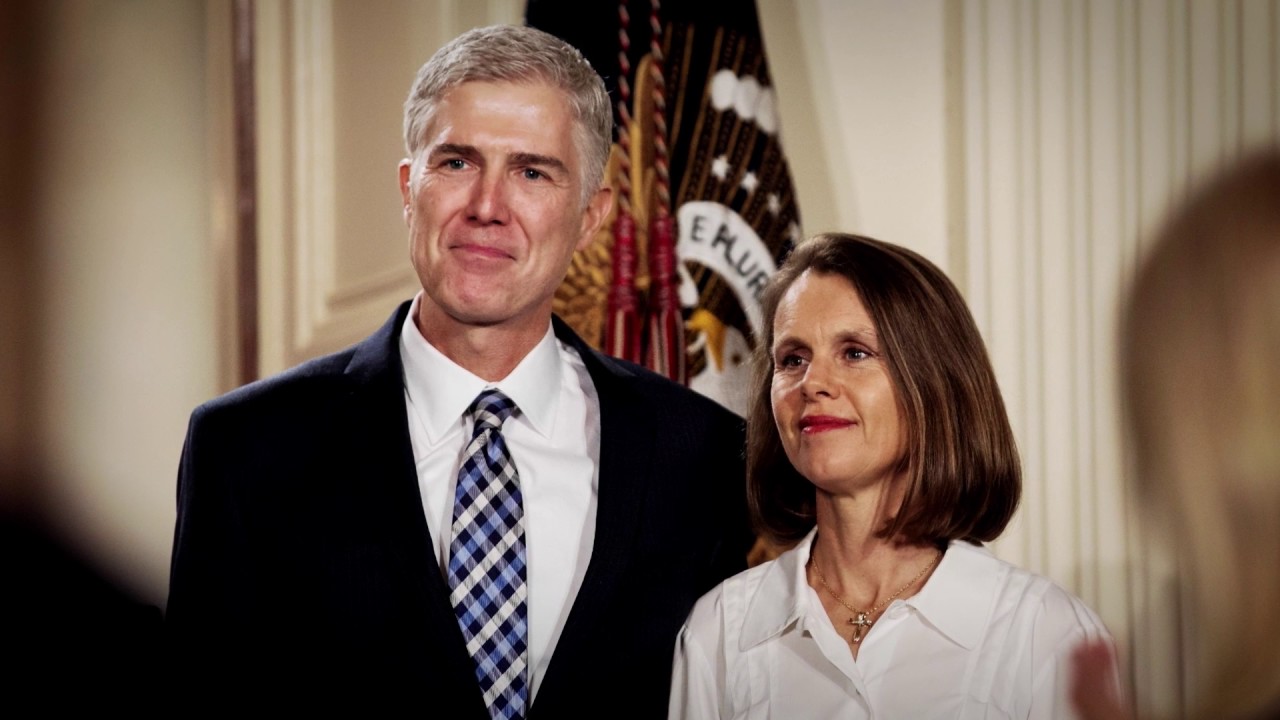 , titled "Jane."
[vid]
The JCN ad is the latest shot in what's likely to be highly partisan, take-no-prisoners political warfare in the Senate over Gorsuch, a 49-year-old federal appellate judge whom President Donald Trump introduced to the nation Tuesday night.
While Republicans hail Gorsuch as an outstanding writer and brilliant legal thinker with impeccable credentials, some Democratic senators -- still seething that Gorsuch may get to fill a Supreme Court vacancy "stolen" by Republicans from Obama -- say the Colorado judge is a right-wing ideologue who won't ensure justice for all.
In an ad released Thursday, People for the American Way, a liberal activist group, portrayed Gorsuch as a jurist beholden to "powerful interests," including Trump.. If confirmed by the Senate, according to the ad, Gorsuch would disregard the Constitution and trample on the rights of women and minorities.
The testimonial in Friday's ad from Nitze directly counters that portrayal.
####
Seated in a warmly lit room, Nitze -- identified onscreen as "A Former Obama Administration Attorney" -- says she clerked for Gorsuch from 2008 to 2009, and found him to be "extraordinarily fair-minded."
As pleasant piano music plays in the background, photos from Gorsuch's White House introduction Tuesday appear onscreen. Nitze continues, saying Gorsuch "will approach each case the same, regardless of the issues or the parties before him."
Then, she delivers the kicker: "I worked for the Obama administration" and "I have to say, I am 100 percent comfortable with Judge Gorsuch becoming the next Supreme Court justice."
JCN officials said the ad will start airing Friday in a $2 million broadcast, cable, satellite and digital ad buy in Washington, D.C., as well as Indiana, Missouri, North Dakota and Colorado -- states with vulnerable Democratic incumbents. The organization has pledged to spend a total of $10 million in advertising and lobbying efforts to get the Republican-majority Senate to confirm Gorsuch over strong Democratic opposition.
"Neil Gorsuch is exceptionally qualified, a fair and independent judge who bases his decisions on the Constitution, and he is widely respected on both sides of the aisle," Carrie Severino, JCN's chief counsel, said in a statement announcing the offensive.
"Some Democrats may be tempted to obstruct his nomination, but we have already launched a robust campaign in key states and we will ultimately force vulnerable Senators to choose between obstructing and keeping their Senate seats," she said.
==
esquire
The only time Gorsuch got a little shaky was early on, when he was asked about his time in the Justice Department under C-Plus Augustus. It was right around the time when the government got a little antsy about having violated about 10,000 covenants regarding torture, and when even Republicans were beginning to realize that Dick Cheney and his pet lawyers were a claque of bloodthirsty Saracens. There was a scramble to re-establish legal delicacy in the era of the waterboard and Enhanced Interrogation, and Gorsuch was right in the middle of it.
Something called the Detainee Treatment Act was passed in 2005. And Democratic Senator Dianne Feinstein quizzed Gorsuch on his role as a DOJ lawyer in the extended aftermath, intimating that Gorsuch had advised the administration on how to get around the provisions of the new law. She asked:
After the passage of the Detainee Treatment Act, you advocated President Bush issue a signing statement to accompany the law. In an e-mail you sent…you said the signing statement would, and I quote, these are your words, inoculate against the potential of having the administration criticized some time in the future for not making sufficient changes in interrogation policy in light of the McCain portion of the amendment. This statement clearly, and in a normal way that would be hard to dispute later, puts down a marker to the effect that McCain is best read as essentially codifying existing administrative policies, unquote. To be clear, the context was that, earlier in 2005, the Justice Department's Office of Legal Counsel had concluded that CIA interrogation tactics like waterboarding and sleep deprivation did not mean cruel treatment. Saying that Senator McCain's amendment actually codified them was not true. Doesn't it mean that, when you wrote this e-mail, you were condoning waterboarding?
Gorsuch was suddenly far less sure of himself, pleading that he was "one voice among a great many," and that he would have to look at the contemporaneous documents to be sure. I don't know about you, but, if I were an American lawyer, I'd remember if I'd greenlit torture. Later, when the committee came back from lunch, Gorsuch spectacularly asserted to Senator Richard Durbin that, because he had gobbled a sandwich at lunch, he couldn't recall the substance of the e-mail.
Remember, of course, that this is the nominee of a guy who promised "waterboarding and worse" as a national policy. Even by the laws of absurdity, a sandwich is not an alibi here.
==
Neil Gorsuch Knows What Dark Money Is, and What That Money Expects of Him
Enough with the absurd notion that the Supreme Court is apolitical.
BY CHARLES P. PIERCE
MAR 21, 2017
WASHINGTON—Senator Sheldon Whitehouse, Democrat of Rhode Island, had had it up to his eyeballs. He had sat in the Senate Judiciary Committee and listened to Neil Gorsuch, a nominee for the Supreme Court, fielding juvenile questions from his Republican colleagues, most of which centered on pieces of pet legislation—Lindsey Graham's bogus "fetal pain" bill, John Cornyn's worries about religion in the public square—and the essential question of, "Tell us why you're an awesome judge."
(That started on Monday, by the way, when Nebraska's Ben Sasse presented what amounted to a middle-school civics project by way of introducing himself to the nominee.)
Whitehouse also had sat through Gorsuch's folksy-is-as-folksy-does flummery about how a nun had paddled him into being able to read, how ol' Whizzer White had skated through his hearing in 90 minutes, fueled only by unfiltered Camels, and how Gorsuch had "taken a little jog" down to the Lincoln Memorial before meeting the committee in order to Think Big Thoughts. (He got a bit flummoxed between the Gettysburg Address and the Second Inaugural.) He also had sat through Gorsuch's endless pieties about how he was as apolitical as the morning dew, and that was about where Sheldon Whitehouse had stood all he could and he couldn't stand no more.
He was done with the preposterous notion that the political act of nominating judges should contain no politics. And he had a precise example to share.
There's been a lot of talk about how this is outside of politics and how we're above politics but there is a group planning to spend $10 million in which their own press release describes as a comprehensive campaign of paid advertising, earned media, research, grassroots activity, and a coalition enterprise all adding up to the most robust operation in the history of confirmation battles.
Gorsuch, of course, for all his academic achievements and professional accomplishments, is also a product of the conservative movement and the hundreds of luxurious ideological terrariums from which they produce congresscritters, professional pundits and, yes, federal judges. (His ties to longtime wingnut sugar daddy Philip Anschutz are a matter of public record.) And there is a sophisticated and purely political campaign currently underway outside the rarefied air of a Senate committee room. (The sidewalks outside of the Hart Building were thick on Tuesday morning with fresh-faced young people waving very well-produced signs.)
RELATED STORY
Gorsuch Doesn't Mind $10 Million in Dark Money
Whitehouse had him there and, through his questioning, managed to make Gorsuch look ridiculous on the matter of money in politics. Whitehouse kept hammering at Gorsuch about whether Gorsuch thought the anonymous benefactors who are shoveling dark money into his confirmation fight should be identified. Gorsuch kept trying to throw it back on Congress. If Congress wanted this kind of transparency, he argued, it should pass a law requiring it.
(Here is where we pause to note that this argument in relationship to the Citizens United decision is fundamentally moot. As written, Citizens United pretty much preemptively ruled any attempt to limit campaign money to be an unconstitutional restriction of free speech. It also was used almost immediately to demolish state laws on campaign finance. The only real solution to Citizens United in a constitutional amendment to overturn it, but Gorsuch knows that's an almost impossible standard to meet.)
Getty
Whitehouse was having none of it. He pointed out that many of the same people funding the political operation in support of Gorsuch's nomination also were behind a $7 million drive to deny Merrick Garland even a hearing when he was nominated by former president Barack Obama. Whitehouse said:
What's interesting is that this group sees a difference between him [Garland] and you that I don't understand…now we have $10 million going the other way. That's a $17 million delta and for the life of me, I'm trying to figure out what they see in you that makes that $17 million worth the spending. Do you have any answer to that?
Gorsuch suggested that, if Whitehouse wanted to know who they were, he should ask them.
"I can't," Whitehouse said. "I don't know who they are. It's just a front group."
"I DON'T KNOW WHO THEY ARE. IT'S JUST A FRONT GROUP."
For the first time all day, Gorsuch's aw-shucks, lemme-tell-you-about-Oxford demeanor cracked just a little. Whitehouse was calling into question the legitimacy of his nomination because it was produced by a political system the legitimacy of which has been undermined by a flood of uncontrolled anonymous money that was loosed by a series of decisions from the Court that Gorsuch has been nominated to join. This is a genuinely interesting area for exploration that Gorsuch had no intention of entering without a helmet and pads.
Senator, I have no information about anything you just described. I don't know about that.
This is not remotely believable. As Senator Al Franken pointed out later, when he read from e-mails dating back to Gorsuch's days as a high-level Republican lawyer, specifically about his work for the 2004 Bush re-election campaign, Gorsuch has been a political being for his entire adult life and, at the same time, he hasn't spent a second in elected office, so his politics were formed and were exercised almost entirely through the conservative Republican institutional infrastructure.
(Hell, when he was a kid, he was a Senate page. He's been in politics as long as Orrin Hatch.)
He knows what dark money is. He knows where it comes from. He knows the use to which it is put. And he knows what is expected of him when he is confirmed. (Which is not to say we know what he'll do when he's got the robe, although I know pretty well which way to bet.) For the country, it comes down to how much disbelief you're willing to suspend to judge what is produced by this ridiculous shadow play of a process.
Late in the afternoon, while discussing a fairly famous dissenting opinion Gorsuch had written in the case of Trans-Am v. Administration Review Board, United States Department of Labor, Franken had invoked something called the absurdity rule.
In the case, a truck driver named Alphonse Maddin discovered on the highway that the brakes on his trailer had frozen. He pulled off the side of the road and called for help, which never came. The heater in his cab failed, and Maddin soon began exhibiting the symptoms of hypothermia. His bosses told him to wait with his crippled trailer which, even if Maddin were capable of driving safely, which he wasn't, would have been a hazard to his fellow motorists because the frozen brakes on the trailer would have held his speed down to 15 miles per hour. The company fired Maddin. He sued, and won, but Gorsuch dissented.
GORSUCH KNOWS WHAT IS EXPECTED OF HIM WHEN HE IS CONFIRMED.
His dissent was based on the fact that Maddin had driven the vehicle. The driver had sued on the basis of an OSHA regulation that forbade the firing of anyone for refusing to operate an unsafe vehicle. Maddin had in fact "operated" the vehicle so, according to Gorsuch, his firing was justified because of the plain reading of the regulation. Franken asked him whether or not that "plain reading" violated the absurdity rule, an ancient concept that seeks to prevent the literal reading of the law from producing ludicrous results.
It is absurd to say that this company was within its rights to fire him because he made a choice not to—of possibly dying by freezing to death or causing other people to die because he was driving an unsafe vehicle. That's absurd. Now I had a career in identifying absurdity, and I know it when I see it.
==
https://www.washingtonpost.com/posteverything/wp/2017/02/21/neil-gorsuch-always-sides-with-big-business-big-donors-and-big-bosses/
One of the most important questions for analyzing a potential Supreme Court justice is how he or she understands economic and political power: Who should govern? How should power be distributed in a society? In the case of Neil Gorsuch, the federal appeals judge President Trump has nominated for the high court, the answers are troubling. Gorsuch’s record on the bench reveals a man with a strong top-down streak, a preference for concentrated wealth and power. He has consistently been the friend of big business and monopolies at the expense of competition and open markets, and the friend of big donors at the expense of small donors. In disputes between the employee and employer, he sides with the boss.
How judges interpret antitrust law is especially important in understanding their approach to the relationship between economic and political power. It tells you a lot about what they think counts as fair and free competition between citizens. It also teaches us whether they understand markets as institutions — formed through rules and subject to public governance — or instead as some mythic set of natural forces, beyond our control.
[Trump is getting payments from foreign governments. We have no idea what they are.]
Big antitrust cases, although rare, can reshape our entire economy. When the late justice Antonin Scalia was questioned about antitrust during his confirmation hearings for the Supreme Court in 1986, he joked that he never understood antitrust in law school and “later found out … that I should not have understood it because it did not make any sense.”
The joke was on American democracy: Scalia proceeded to undermine basic tenets of competition law for the next 30 years. In Verizon v. Trinko, he narrowed the scope of the Sherman Antitrust Act when his majority opinion held that Verizon’s alleged failure to share its network as required by the Telecommunications Act of 1996 didn’t constitute an antitrust violation. Although the holding of Trinko was narrow, its logic was broad, and the ruling had a chilling effect on prosecutions. Trinko is part of the reason a handful of big companies now dominate U.S. markets for cable, drugs, hospital beds, seeds, eyeglasses, office supplies, milk, beer and books.
Antitrust law is quasi-constitutional: The founding federal documents, like the Sherman Act, are spare. Section 2 of the Sherman Act declares simply: “Every person who shall monopolize, or attempt to monopolize, or combine or conspire with any other person or persons, to monopolize any part of the trade or commerce among the several States, or with foreign nations, shall be deemed guilty of a felony.”
In the 137 years since Congress passed the Sherman Act, two sharply different philosophies have emerged as to the purpose and meaning of these words.
Our great democratic justices understood the Sherman Act as a “charter of liberty.” They required that the nation protect the freedom of the independent business owner and an open marketplace and prosecute those people who sought to dominate other people or the political system. Justices such as Louis Brandeis believed that it was vital to use antitrust law to distribute power and opportunity as widely as possible in society, because excessive concentrations of power threatened our personal liberties and our democracy itself.
Our anti-democratic justices, such as Scalia and the other students of the Chicago School’s “law and economics” philosophy, have promoted a view of antitrust law that allows the rich and powerful to do whatever they will to the independent businessman and farmer, and for the few to exercise political control over the many. They hold that, in political economics at least, might is right.
The economic ideology of the next Supreme Court justice matters particularly today because the United States — as a growing body of evidence confirms — faces a crisis of concentrated economic and political power. This crisis is affecting our politics, as a growing number of Americans think that the profits from the labor of many are unfairly taken by a wealthy few.
President Trump spoke to that anger when he promised, during his campaign, to take on abuses by Amazon (whose chief executive, Jeffrey P. Bezos, owns The Washington Post), block the AT&T-Time Warner merger and break up big banks. His promises may prove meaningless. Indeed, his choice of Gorsuch indicates that Trump actually intends to further promote this dangerous concentration of power in the United States.
Gorsuch is an authority on this subject. He has long taught antitrust law at the University of Colorado, and as a judge, he has written decisions in antitrust cases. His record shows that he is a strict follower of the formalistic theories of Chicago School economics and willfully ignores the realities of how markets and economic power work.Put into practice, Gorsuch’s theories will make the nation more unequal and less free.
[Yes, the GOP broke Supreme Court nominations. But blocking Gorsuch won’t fix them.]
On antitrust, Gorsuch has repeatedly blessed actions by big firms to exploit their dominant position.His rulings reveal a tendency to reward concentration of private power and to enfeeble the laws and public institutions tasked with keeping the economy open and competitive. In *Novell v. Microsoft* and in *Four Corners Nephrology Associates P.C. v. Mercy Medical Center of Durango*, Gorsuch found no antitrust violations despite substantial evidence that a dominant player used its power to push out rivals.
In the Novell case, Novell presented evidence that Microsoft pulled a bait-and-switch on a competitor for no reason other than to push the competitor out of the market, and 11 out of 12 jurors found Microsoft guilty. But the case was dismissed, and Gorsuch upheld the dismissal. He wrote that “antitrust laws don’t turn private parties into bounty hunters entitled to a windfall anytime they can ferret out anticompetitive conduct lurking somewhere in the marketplace.” That sounds eloquent. But its implications are immense. Gorsuch elevated the writings of conservative academics above the congressional intent underpinning antitrust law. He concluded that a monopolist’s predatory conduct is not an antitrust violation, except under extraordinary circumstances. In practice, Gorsuch’s opinion gives monopolists virtual carte blanche to perpetuate their dominance through unfair means, regardless of the consequences for consumers, competitors and citizens.
In corruption law, Gorsuch’s record is equally dismal. In a concurrence to a decision on campaign finance in 2014, he suggested that donating to a politician is a “fundamental” right that ought to be afforded the highest form of constitutional protection, which is known as “strict scrutiny review,” more protected even than the right to vote (which is not afforded “strict scrutiny”). This matters because Gorsuch could vote to strike down the existing limits of $2,700 per person for a federal candidate, allowing unlimited personal and corporate direct donations to candidates. Wealthy donors and corporations, already too powerful, would then be legally allowed to directly scheme with candidates and dictate policy and campaign strategy. This approach flies in the face of public opinion, since polling suggests that the vast majority of voters want the Supreme Court to limit the influence of big money in politics....
==
https://www.democracynow.org/2017/3/20/zephyr_teachout_supreme_court_pick_neil
Confirmation hearings begin today for Neil Gorsuch, President Trump’s pick to replace the late Justice Antonin Scalia on the Supreme Court. If confirmed by the Senate, Gorsuch would give conservatives a narrow 5-4 majority on the court. When he was first nominated, Gorsuch praised Antonin Scalia. As a judge on the Tenth Circuit, Neil Gorsuch ruled in favor of Hobby Lobby in the case deciding whether the company could refuse to provide birth control coverage to employees as required by Obamacare. Judge Gorsuch also has a long history of ruling against employees in cases involving federal race, sex, age, disability and political discrimination and retaliation claims. For more, we speak with Fordham law professor Zephyr Teachout. She recently ran for a congressional seat in upstate New York. Her recent piece for The Washington Post is headlined "Neil Gorsuch sides with big business, big donors and big bosses."
--
As confirmation hearings begin for Neil Gorsuch, Trump’s nominee for the Supreme Court, we look at his record on voting rights and speak with Ari Berman, senior contributing writer for The Nation. His recent piece is headlined "In E-mails, Neil Gorsuch Praised a Leading Republican Activist Behind Voter Suppression Efforts."
The Nation’s Ari Berman into the conversation. He recently wrote a piece headlined "In E-mails, Neil Gorsuch Praised a Leading Republican Activist Behind Voter Suppression Efforts."
https://www.democracynow.org/2017/3/20/college_classmate_neil_gorsuch_attacked_anti
GONZÁLEZ: Well, I’d also like to bring into the conversation Jordan Kushner. He’s a civil rights and criminal defense attorney in Minneapolis. He was an undergraduate student at Columbia University at the same time as Neil Gorsuch. While on campus, Gorsuch co-founded the right-wing campus newspaper The Federalist Paper. The Associated Press reports that in Gorsuch’s writing both for The Federalist Paper and the Columbia Daily Spectator, on which I worked when I was an undergraduate there, he criticized anti-apartheid protests, saying divestment could hurt the university’s endowment. He also criticized racial justice protests and black-led movements on campus, while he defended the Reagan administration during the Iran-Contra scandal.
Jordan Kushner, welcome to Democracy Now!
JORDAN KUSHNER: Thank you. Good to be here.
JUAN GONZÁLEZ: Well, tell us about your interactions with Neil Gorsuch when you were both undergraduates there.
JORDAN KUSHNER: Well, the protect—progressive activists personally got singled out for attack. I think what stands out about Neil Gorsuch was that his views were completely formed as soon as he entered college as a freshman, which I think is unusual, and he had very solid right-wing reactionary views from the beginning. He was also, on a personal level, very polished and affable. And I think this is part of a consistent pattern, where he has a real commitment to reactionary politics and is able to put an appealing face on it.
And his positions really, I think, were extreme. He did attack South African divestment, after the university had already decided to divest. And he put out a real divisive argument that it was going to hurt student aid. He attacked a protest led by black students against racism on campus, not based on the substance of the issue, but saying that people involved were revolutionaries. He did stick up for Ronald Reagan in the Iran-Contra affair, Iran-Contra scandal, which was an extreme position even for conservatives at the time. And, I think, perhaps ominously, he said that it was within Ronald Reagan’s executive power to engage in these covert operations, where he engaged—he worked with one hostile regime to finance the Iran-Contras—to finance the Contras in Nicaragua, which were—people might not know who are watching this, who weren’t around at the time, but they were a really reactionary, CIA-funded group that was trying to overthrow the legitimate government in Nicaragua. And he put in a real strong defense of the Contras and said it was really urgent that they succeed.
And I think the other aspect of him that’s really consistent here is that he—whenever he attacked, attacked these left—these progressive positions and attacked progressive activists, which he did a lot of, it was never based on the merits of the issue. It was always based on some other reason. So, the—again, so South African divestment, it’s not an issue of apartheid being wrong, it’s an issue of having student aid, or that these protests aren’t bad, but the protesters are bad because they’re revolutionaries or they’re superficial. He made a lot of claims that they didn’t really know what they were doing, and they just enjoyed protesting. And that seems consistent with a lot of what he does as a judge, where he doesn’t really address the merits of the issue, but comes up with legal reasons for making unjust decisions.
And, you know, one opinion he made that really stands out is against a—that’s gotten some publicity, is where he dissented in a case involving a truck driver who got fired because his truck broke down on the side of the road at nighttime in the winter, and he thought he was freezing to death, so he drove his—left the trailer and drove the cab of his truck to a gas station so he could save himself, and he got fired. The NLRB, or the federal agency, sided with him. Two of the three judges on the court of appeals sided with him. But Judge Gorsuch dissented, saying that the plain language of the law didn’t protect him from being fired. So here’s a case where you have an extremely, extremely inhumane treatment of the worker, and Judge Gorsuch decides that he has to just stick with what he sees as the plain language of the statute, which is something that other people disagree with. So he’s willing to interpret laws in a way that comes up—comes out to really unjust results.
And so, I think his—if you look at the kind of positions he took in college, even though he was a polished, affable person, the positions he took were really ruthless. And that seems to be a continuing pattern when he’s an appeal judge. And I think we can presume it’s going to be that way as a Supreme Court judge, as well.
AMY GOODMAN: I wanted to ask you, back in college, one, he founded The Federalist Paper, a very conservative newspaper, to counter the Columbia Daily Spectator. But in 1987, in a column he wrote in the Columbia Daily Spectator, Gorsuch opposed divesting from apartheid South Africa, arguing, quote, "Pro-divestment students call for the immediate withdrawal of University funds from all companies conducting business in South Africa. But in their haste to do the Right Thing, they are willing to overlook such mundane things as facts. Namely, that many of these companies are themselves in the act of divesting. Committee and coalition members seem willing to sacrifice the large income from the endowment—which goes to pay for our need-blind admissions policy, among other things." Can you talk about the politics at the time on campus, the divestment movement so often credited by the democratic movement in South Africa as helping to bring the apartheid movement down—the apartheid government down?
JORDAN KUSHNER: Sure. Well, you know, the interesting thing is that, I mean, I think divestment was a done deal on campus by two years by the time he wrote that column. And he was—I mean, the university had already decided to divest, in response to a massive, massive student protest, and that it really affected the national agenda. And here he is, about almost two years later, still attacking the idea of divestment. His group, I remember, also brought in a speaker from a right-wing think tank to denounce divestment, as well. And so, this is someone who’s really clinging to reactionary views and coming up with really divisive arguments, trying to turn students against the ideas, saying that these activists are your enemies because they’re going to hurt your ability to be able to continue to go to Columbia College. And so he’s coming up with real divisive arguments, as well. So, I think it’s—I think his positions certainly are disturbing and insidious on many levels.
And on one hand, you don’t want to hold against someone something that they did in college, but, again, I think it’s part of a consistent pattern here. He had really strong right-wing ties through his family connections coming into college. He got Coors beer funding, which is a notoriously right-wing advocate—corporation that had notoriously right-wing positions. And this is something that’s continued with his connections throughout his career, you know, working with billionaires, working—being a very active member of the Federalist Society, which is the main right-wing law organization that produces a lot of the judges that are on the federal bench. And so—
AMY GOODMAN: I wanted to—
JORDAN KUSHNER: So we have a—
AMY GOODMAN: Jordan, I wanted to wrap up with Zephyr Teachout in Albany, New York, professor at Fordham, about an NPR report that says a former law student of Judge Neil Gorsuch alleges that in the course she took from Gorsuch at the University of Colorado Law School last year, the judge told his class that employers, specifically law firms, should ask women seeking jobs about their plans for having children, and implied that women manipulate companies, starting in the interview stage, to extract maternity benefits. So we’re going from him in college to him this past year teaching at University of Colorado.
ZEPHYR TEACHOUT: Wow! I hadn’t seen that report. But I
...
==
http://www.salon.com/2017/03/15/supreme-court-nominee-neil-gorsuch-has-close-ties-to-conservative-megadonor-activist-philip-anschutz/
Trump’s pick for the Supreme Court, Judge Neil Gorsuch, has been variously criticized as too liberal or too conservative, or in some cases as simply being a slap in the face of good governance. Yet now there is a new controversy emerging around Gorsuch — the Supreme Court nominee who’s replacing Obama’s Supreme Court nominee, Merrick Garland — he has a long-lasting connection to Colorado billionaire Philip F. Anschutz.
Anschutz, whose business empire ranges from real estate and telecommunications to railroads and oil and gas, is first known to have been connected to Gorsuch in the early 2000s, when Gorsuch represented both Anschutz and his companies as an outside counsel from the firm Kellogg Huber, according to The New York Times. Given Anschutz’s ownership of conservative publications like The Weekly Standard and The Washington Examiner, it is quite likely that he shares a sense of ideological kinship with Gorsuch, who has long been on the conservative end of the political spectrum.
Anschultz’s support played a key role in Gorsuch’s nomination to a federal appeals court in 2006. President Trump’s list of potential Supreme Court nominees was given to him by the Federalist Society and the Heritage Foundation, both of which receive donations from Anschutz.
Although it is unclear whether Gorsuch and Anschultz are friends (Anschultz is notoriously private), Gorsuch has frequently spoken at Anschultz’s lavish retreats at his 60-square-mile Eagles Nest Ranch. Similarly, Gorsuch shares a limited-liability company with two of Anschultz’s “lieutenants,” the Times notes, with the three of them co-owning a 40-acre property in the Colorado mountains.
https://www.nytimes.com/2017/03/14/us/politics/neil-gorsuch-supreme-court.html
While Gorscuh’s past with Anschultz is not necessarily unusual, it is concerning that (as The Times reported) “the judge appears to be leaving the door open to participating in Anschutz-related cases on the Supreme Court.” That could pose a conflict of interest if Gorsuch fails to adequately address it.
==
https://www.democracynow.org/2017/2/6/headlines/neil_gorsuch_opposed_anti_apartheid_protesters_in_college
Trump’s Supreme Court nominee Neil Gorsuch has scheduled more than a dozen meetings with senators on Capitol Hill this week. The meetings come as more information is emerging about Gorsuch, including his right-wing writings and political views from his time as a student at Columbia University in the mid-1980s. While on campus, Gorsuch co-founded the right-wing campus newspaper the Federalist Paper. The Associated Press reports that inGorsuch’s writing both for the Federalist Paper and the Columbia Daily Spectator, he criticized anti-apartheid protests, saying divestment could hurt the university’s endowment. He also criticized racial justice protests and black-led movements on campus, while he defended the Reagan administration during the Iran-Contra scandal.
==
For four decades, the Supreme Court’s flawed approach to money in politics has gutted common-sense protections against the power of special interests and wealthy individuals, and shaped a system that 85% of Americans believe needs fundamental changes.
- More than 90% of voters (including 91% of Trump voters) think it’s important that President Trump nominates a Supreme Court justice who is open to limiting the influence of big money in politics. [Hattaway, 2017].
- Yet, Trump has pledged to nominate someone in the mold of Justice Scalia, an ardent opponent of limits on big money. And Trump’s nominees were vetted by White House Counsel Don McGahn, one of the commissioners most hostile to money-in-politics rules in the history of the Federal Election Commission.
Judge Gorsuch’s Money-in-Politics Record
Judge Gorsuch’s record on money in politics, while sparse, raises significant concerns.
- In his only opinion directly addressing money in politics, Judge Gorsuch expressed openness to providing a higher level of constitutional protection to a donor’s right to make political contributions than the Court currently affords the right to vote.1 Judge Gorsuch’s openness to applying rigid “strict scrutiny” review to contribution limits—one of the few remaining checks on big money we have left, thanks to the Supreme Court—puts him among the ranks of justices extremely hostile to this issue, such as Thomas and Scalia, and is cause for serious concern.2
- In Riddle v. Hickenlooper, Judge Gorsuch joined a Tenth Circuit panel in striking down an ill-advised Colorado statute that imposed lower campaign contribution limits on minor party candidates than the limits applying to major party candidates.3Because the statute wasdiscriminatory, the outcome of the case is not cause for concern in and of itself.
- What is troubling, however, is that Judge Gorsuch went out of his way to write a concurring opinion suggesting that making a political contribution is a “fundamental” right that ought to be afforded the highest form of constitutional protection, which is known as “strict scrutiny review.”4
- As the highest form of constitutional protection, strict scrutiny review is reserved for our most precious rights, like the right to be free from discrimination on the basis of race or religion, or the right to express an unpopular viewpoint. Sometimes the Court doesn’t even apply this level of scrutiny to restrictions on the right to vote itself.5
- In recent years, the Supreme Court’s 5-4 majority has applied strict scrutiny review to strike down laws governing money spent independently of candidates. If the court were to follow Judge Gorsuch’s reasoning and apply strict scrutiny to laws governing direct contributions to candidates, many remaining protections against big money in politics would similarly fall.
- It is precisely this approach that has created a system in which single individuals and corporations can spend tens of millions of dollars to influence elections, and in which candidates and elected officials are significantly more responsive to the priorities of an elite donor class that is richer, whiter, and more male than Americans on the whole.
Broader Democracy Law
- Judge Gorsuch is hostile to regulations on the corporate sector and has a record of ruling against consumers and working Americans.6
- In the Hobby Lobby case, Judge Gorsuch joined a troubling extension of the Supreme Court’s holding in Citizens United v. FEC,7 in favor of corporate personhood.Specifically, the Tenth Circuit ruled that privately held, for-profit secular corporations are “persons” under the meaning of the Religious Freedom Restoration Act (RFRA), and could qualify for religious exemptions from the Affordable Care Act’s mandate to provide reproductive health services.8
Other Causes for Concern on Money in Politics
- Like others on Trump’s short list, Judge Gorsuch has ties to the Chamber of Commerce—the single-largest lobby in the country comprised of corporate giants from the pharmaceutical, oil, and other industries, and which has spent tens of millions of dollars in elections while keeping its donors secret.9 Before becoming a judge on the Tenth Circuit, Gorsuch represented the National Chamber of Commerce, arguing in favor of rules that would make it more difficult to hold companies accountable for securities fraud.10
- Judge Gorsuch has described his own jurisprudence as backward-looking.11 On numerous occasions he has ruled against plaintiffs claiming to have been discriminated against on the basis of race, and his ruling in favor of law enforcement in an excessive use of force case raises concerns that his jurisprudence would continue to entrench systemic “colorblind” racism in the United States.12
Endnotes
==
(CNN)In only a few weeks, Judge Neil Gorsuch has gone from the federal appellate bench in Colorado, to one of the leading contenders to be President Donald Trump's nominee for the US Supreme Court.
His quick ascent is due to a combination of factors, including his track record, demeanor and the impression he has made on Trump and the small circle advising him on how to replace the late Justice Antonin Scalia. Another factor -- one beyond Gorsuch's control -- is likely also in play: the fiery atmosphere on Capitol Hill as Democrats vow to make the Supreme Court hearings one of the biggest fights in the early days of the Trump presidency.
Trump said Wednesday on Twitter that he will make his choice to fill the open seat on the court next Thursday, February 2, but he did not give any indication of whom that nominee would be.
These days Gorsuch's name -- previously unknown to many -- has been on the tip of the tongue of court watchers waiting anxiously to see who Trump eventually decides upon. Sources say that Gorsuch is one of the leading contenders of a very short list that also includes Judges William Pryor and Thomas Hardiman.
The pick could be announced as early as next week. Trump met Tuesday to discuss the upcoming nomination with Vice President Mike Pence, Senate Majority Leader Mitch McConnell, as well as Senate Democratic Leader Chuck Schumer and Sens. Chuck Grassley and Dianne Feinstein.
Gorsuch, 49, has been on the radar of some judicial conservatives for some time. He has long been a favorite of legal thinkers at the Federalist Society and the Heritage Foundation.
Conservatives welcome his opinions on religious liberty. For instance, he has sided with closely held corporations who argued that the so called contraceptive mandate violated their religious beliefs.
In another opinion, he challenged the notion that courts should defer to administrative agencies when they interpret the law. It may seem like a dry legal issue but it is central to many conservatives, including Justice Clarence Thomas.
"Judge Gorsuch has been a stern critic of a fixture of the Supreme Court's administrative law jurisprudence -- the idea that, where a federal agency is enforcing an ambiguous statute, courts should defer to how the agency understands the statute even if the courts read it differently," said Stephen I. Vladeck, CNN Supreme Court contributor and professor of law at the University of Texas School of Law.
"If he were to form part of a majority to scale back that principle, it would be a major sea change in the relationship between the executive branch and the courts, and one that would likely impose significant new constraints on the scope of federal regulatory authority on all topics -- from immigration and criminal law enforcement to environmental protection, consumer product safety, and drug regulation," Vladeck said.
"His position on this is more extreme than Justice Scalia," said Dan Goldberg of the progressive Alliance for Justice, "it would be hard to overstate the damage it would cause this nation and the American people."
Examining the top contenders on Trump's Supreme Court list
Goldberg calls Gorsuch an "extreme" candidate for his other opinions as well touching on issues such as a women's rights to access of reproductive health care and the rights of workers and consumers.
But as liberals pore through his record, conservatives stress other factors they say work in his favor.
For instance, he is from one of those square "fly over states" -- Colorado -- and could bring new perspective to the court. At the same time, he spent formative years in Washington where he lived while his mother, Anne Gorsuch Burford, held a top job in the Reagan administration. He also worked in the Department of Justice. He's an outsider -- with an insider's experience.
"I think the conservatives will love him and the liberals will find very little to fault," said Mark Hansen, a former partner of Gorsuch at Kellogg Huber Hansen. "He's an affable, collegial, unpretentious man with a good sense of humor."
Shortly after the election, Adam Feldman, who runs a blog called Empirical Scotus, wrote a piece entitled "An Alternate Take on Trump's Potential Supreme Court Nominees." He ranked the list of candidates and put Gorsuch in the top tier. The criteria for his study included decisions or positions that aligned with Trump in areas such as abortion, gun rights, the Affordable Care Act, and judicial philosophy.
"Although he has not written a decision in any of the controversial policy areas, he regularly uses originalist principles in his decisions," Feldman wrote. And he added that Gorsuch "ranks highly conservative" based on his perceived ideology.
Although Gorsuch has written on issues such as the contraceptive mandate and even penned a book making a legal and moral argument against assisted suicide, he has never had the opportunity to write an opinion on Roe v. Wade. That has raised only a few eyebrows in pro-life circles, others express complete confidence that he won't disappoint them on that front.
Gorsuch is also one of the few on Trump's list who went to an Ivy League school. Not only did he attend Columbia and Harvard Law School but he also studied in Oxford under John Finnis, who now works at the University of Notre Dame and specializes in moral, political and legal theory.
As Trump's teams compares the pros and cons of their top list they will have to deal with the fact that Democrats, led by Schumer, have made clear that the nomination hearings will be a fight. Not lost on them will be the fact that unlike Pryor, who was a part of incredibly contentious hearings, Gorsuch sailed through with no opposition. Placed side by side, McConnell might think Gorsuch, with his laid back style and easy demeanor might have a better chance with Democrats.
Gorsuch was a clerk for Justice Anthony Kennedy, but in a speech last April at Case Western Reserve University School of law, Gorsuch honored the late conservative icon Scalia.
In a speech at Case Western Gorsuch said judges should strive "to apply the law as it is, focusing backward, not forward, and looking to text, structure, and history to decide what a reasonable reader at the time of the events in question would have understood the law to be -- not to decide cases based on their own moral convictions or the policy consequences they believe might serve society best."
It was vintage Scalia.
==
or maybe no hope
eil McGill Gorsuch is a federal judge on the United States Court of Appeals for the Tenth Circuit. He was nominated by George W. Bush on May 10, 2006, and confirmed by the Senate on July 20, 2006. He is the son of Anne Burford, the first female head of the United States Environmental Protection Agency.
Judge Gorsuch, a native of Denver, is a graduate of Harvard Law School (cum laude) and holds a Doctorate in Legal Philosophy from Oxford University. After clerking for a U.S. Court of Appeals Judge, he was chosen to be a law clerk to U.S. Supreme Court Justices Byron White and Anthony Kennedy. After gaining extensive experience in litigating complex cases in federal court while in private practice, Mr. Gorsuch was named Principal Deputy to the Associate Attorney General of the United States. He is the son of former Environmental Protection Agency Director Anne Gorsuch.
Education
- Columbia University, B.A., 1988
- Harvard Law School, J.D., 1991
- Oxford University, D.Phil., 2004
The Federalist Society takes no position on particular legal or public policy issues. The people listed as Experts have spoken or otherwise participated in Federalist Society events, publications, or multimedia presentations. A person's appearance on this list does not imply any other endorsement or relationship between the person and the Federalist Society. All expressions of opinion by an expert are those of the expert.
Publications and Multimedia
13th Annual Barbara K. Olson Memorial Lecture - Event Audio/Video
2013 National Lawyers Convention
November 22, 2013 on discovery?
Dodd-Frank: Act Two and What's Next in Financial Services Laws and Regulations? - Event Audio/Video
2012 National Lawyers Convention
November 19, 2012
==
hope: http://thinkprogress.org/climate/2015/07/14/3680340/colorado-renewable-energy-decision/
Colorado’s ambitious renewable energy standard will remain in place thanks to the 10th Circuit Court of Appeals, which on Monday shielded the law from a legal attack by a right-wing litigation group.
Writing for a three-judge panel,U.S. Circuit Judge Neil Gorsuch affirmed that the clean energy law does not violate the U.S. Constitution, as the plaintiff Energy and Environment Legal Institute had argued. E&E Legal, formerly called the American Tradition Institute, is a nonprofit that advocates a “free-market approach” to environmentalism. It is the same entity that launched a high-profile lawsuit against climate scientist Michael Mann seeking to view his email communications, an effort which ultimately failed.
The case over Colorado’s renewable energy law was E&E Legal’s second most high-profile case. The group launched the lawsuit back in 2011, arguing that the clean energy standard — which requires utilities to get 30 percent of the electricity they sell to Colorado customers from renewable sources — violated the Commerce Clause of the U.S. Constitution.
More specifically, the group said that the law unfairly harmed out-of-state businesses. Colorado relies on other states to get a good portion of its electricity, the group argued, and therefore out-of-state coal producers would be disproportionately harmed.
Judge Gorsuch disagreed, saying that while out-of-state coal producers would likely be hurt, it wasn’t disproportionate. Indeed, financial harm to fossil fuel companies would likely be equal across the board.
“To be sure, fossil fuel producers like [E&E Legal]’s member will be hurt,” Judge Gorsuch wrote. “But as far as we know, all fossil fuel producers in the area served by the grid will be hurt equally and all renewable energy producers in the area will be helped equally. If there’s any disproportionate adverse effect felt by out-of-state producers or any disproportionate advantage enjoyed by in-state producers, it hasn’t been explained to this court.”
Gorsuch also noted that if the mandate raises electricity prices for Colorado residents, that didn’t matter either — because Colorado voters had approved the law in 2004 with “overwhelming support.”
“That’s a cost they are apparently happy to bear,” he wrote.
Colorado is a national leader in clean energy, in part due to the state’s ambitious renewable energy standard. The state is home to the National Renewable Energy Laboratory, which is the federal government’s primary research facility for renewable energy and energy efficiency.
https://en.wikipedia.org/wiki/Neil_Gorsuch
Neil McGill Gorsuch (born August 29, 1967 in Denver, Colorado) is a federal judge on the United States Court of Appeals for the Tenth Circuit.[1] He is the son of Anne Burford, the first female head of the United States Environmental Protection Agency.
Contents
Background
Gorsuch graduated from the Georgetown Preparatory School and received a B.A. from Columbia University (where he was co-founder and first chief editor of the alternative newspaper The Fed and won a Truman Scholarship). He earned his J.D. from Harvard Law School and Doctorate of Legal Philosophy from Oxford University, where he studied as a Marshall Scholar at University College.
Gorsuch clerked for Judge David B. Sentelle on the United States Court of Appeals for the D.C. Circuit from 1991–1992, and then for United States Supreme Court Justices Byron White and Anthony Kennedy from 1993-1994.
From 1995-2005, Judge Gorsuch was in private practice with the Washington, D.C. law firm of Kellogg, Huber, Hansen, Todd, Evans & Figel. He was a Deputy Associate Attorney General at the U.S. Department of Justice from 2005 until 2006.
His first book, The Future of Assisted Suicide and Euthanasia, was published by Princeton University Press in July 2006.
Tenth Circuit nomination and confirmation
Gorsuch was nominated by President George W. Bush on May 10, 2006 to a seat on the United States Court of Appeals for the Tenth Circuit vacated by Judge David M. Ebel (also a former clerk of Supreme CourtJustice Byron R. White) who took Senior status in 2006. Gorsuch was confirmed just over two months later on July 20, 2006 by voice vote in the U.S. Senate.[2] Gorsuch was President Bush's fifth appointment to the Tenth Circuit.
Since he took office, Gorsuch has sent many of his law clerks on to become Supreme Court clerks, and he is regarded as a "feeder judge."[3]
References
- :{Jump up:(style="top:-99999px;clip:rect(1px 1px 1px 1px);overflow:hidden;-webkit-user-select:none;position:absolute !important;padding:0px !important;border:0px !important;height:1px !important;width:1px !important"):}:^
- Neil Gorsuch at the Biographical Directory of Federal Judges, a public domain publication of the Federal Judicial Center..
- :{Jump up:(style="top:-99999px;clip:rect(1px 1px 1px 1px);overflow:hidden;-webkit-user-select:none;position:absolute !important;padding:0px !important;border:0px !important;height:1px !important;width:1px !important"):}:^ "Gorsuch wins Senate confirmation," Denver Post, July 20, 2006.
- :{Jump up:(style="top:-99999px;clip:rect(1px 1px 1px 1px);overflow:hidden;-webkit-user-select:none;position:absolute !important;padding:0px !important;border:0px !important;height:1px !important;width:1px !important"):}:^ See Feeder_judge#Feeder_judges.
See also
External links
- Neil Gorsuch at the Biographical Directory of Federal Judges, a public domain publication of the Federal Judicial Center.
- *National Review* article on litigation written by Gorsuch
- "Easy confirmation ahead for Gorsuch?" *Denver Post*, June 21, 2006
- "Gorsuch wins Senate confirmation," *Denver Post*, July 20, 2006
==
Last week, an investiture ceremony was held for Judge Neil Gorsuch, recently confirmed to the U.S. Court of Appeals for the Tenth Circuit. And it was a star-studded affair. From the Denver Post:
Seven-year-old Emma and 5-year-old Belinda helped their father, Neil Gorsuch, into his judge’s robes Monday after the newly appointed 10th Circuit Court judge was sworn in.
Munching on cookies after the formal ceremony, Emma said she thought it “was nice.”
Supreme Court Justice Anthony M. Kennedy, who was in Denver to administer the oath, spoke directly to the little girls before Gorsuch raised his right hand. “He’s doing it to remind all of us that the first obligation any American has is to defend and protect the Constitution of the United States,” he said.
Justice Kennedy’s pedagogical impulse is admirable. We suspect, however, that Emma and Belinda were thinking more about cookies than the Constitution.
Some supplementary coverage, from an ATL tipster:
The entire en banc 10th Circuit was present. Justice Kennedy administered the oath. Attorney General Gonzales read the commission. Both Colorado Senators made remarks, as did Mark Hansen of Kellogg Huber (the insanely prestigious appellate shop from which Gorsuch rose). Half of the Justice Department was there: Rachel Brand, Elisebeth Collins Cook, Brett Gerry, Wan Kim, Gregory Katsas, among others.
The Gorsuch clerks showed everyone around Denver and got trashed on consecutive nights. Good times were had by all.
Article III groupies, Judge Neil Gorsuch is one to watch. He’s brilliant, he’s young, and he’s incredibly well-connected. Look for him to rise through the ranks of Supreme Court feeder judges in the years to come — and, perhaps, to be nominated to the Court himself someday.
(Judge Gorsuch is taking the seat of Judge David Ebel, who has been the Tenth Circuit’s resident feeder judge for quite some time now. Guess that’s the 10th Circuit’s designated “feeder seat.”)
Update: Would someone be able to locate and/or send us a good photo of Judge Gorsuch for our files? Our quick Googling didn’t produce anything useful.
10th Circuit judge’s oath a family affair [Denver Post]
http://www.denverpost.com/news/ci_4696868 11/06
Seven-year-old Emma and 5-year-old Belinda helped their father, Neil Gorsuch, into his judge's robes Monday after the newly appointed 10th Circuit Court judge was sworn in.
Munching on cookies after the formal ceremony, Emma said she thought it "was nice."
Supreme Court Justice Anthony Kennedy, who was in Denver to administer the oath, spoke directly to the little girls before Gorsuch raised his right hand.
"He's doing it to remind all of us that the first obligation any American has is to defend and protect the Constitution of the United States," he said.
Dozens of members of Gorsuch's family, friends, Colorado's U.S. senators and the U.S. Attorney General packed the federal courthouse. A television monitor showed the proceeding in an overfill room.
Gorsuch's uncle and a friend, who both spoke, described a man with a sense of humor and a commitment to law. A juror once called Gorsuch - 39 years old with a full head of gray hair - Perry Mason after a moving closing argument, said Mark Hansen, a Washington attorney.
"If adversity shows the true character of a person, then Neil showed his resilience, his strength and steadfastness," Hansen said of how Gorsuch handled a difficult case.
Gorsuch was confirmed by the Senate on July 20 and was officially sworn in this summer. The ceremony Monday publicly commemorated his appointment.
Born in Denver, Gorsuch moved to Washington, D.C.
, as a teenager when President Ronald Reagan appointed Gorsuch's mother, Anne M. Gorsuch, to be the first female administrator of the Environmental Protection Agency.
Gorsuch attended Columbia University, Harvard Law School and Oxford. Most recently he served as principal associate attorney general at the Department of Justice.
"As a judge, I hope to emulate the respect for the rule of law, for the decisions and judgments of the elected branches of government, and for the equality and dignity of all persons that shines through in the work of two of my former bosses, Byron White and Justice Kennedy," Gorsuch said.
The 10th Circuit covers 560,625 square miles, nearly 20 percent of the U.S. land mass, and raises some of the most important legal issues of the time, said U.S. Sen. Ken Salazar.
"Deciding cases involving life and death, the reach of government power, the scope of our freedoms and liberties is the daily task of a federal judge. It is a task that requires intellect, compassion, and a dedication to fairness and impartiality," he said. "He has a sense of fairness and impartiality that is a keystone of being a judge."
Washington attorney, speaking of how Gorsuch handled a difficult case
==
rfk2
1980 coors etc spearheaded Sagebrush Rebellion (corp and rw) turned ctt
into pol power 25 RR: I am a S rebel" Hertiage shadow cabinet, 2k pp
Mandate for Change became blueprint (Coors in kitchen cab). Coors picked
assoc Anne Gorsuch for epa; hubby cattle baron to head BLM, tho had
declared to shut it 25