maine ~ CU superpacs
belated? 4 26
---
mpu short 4? 26
maine case 
---
no merri
see LESSIG SUPERPAC INITIATIVE SPEECHNOW
SEE MAINE SUPERPAK
see SEN SUSAN COLLINS
---
[
By Katie Brown
Published on: September 13, 2020
Why you can trust The Maine Monitor
A lawyer for the dark money conduit, Mainers for Clean Energy Jobs, said the financial ties between it and the utility would have been disclosed by Sept. 7 under new ethics guidelines. But now that the referendum is off the ballot, the extent of those connections will go unreported.
:{Electricity for the proposed New England Clean Energy Connect project will travel through Central Maine Power Co.’s substation on Larrabee Road in Lewiston — and a $250 million converter station yet to be built on Merrill Road, a key hub of the corridor. CMP and its parent company, Avangrid Inc., have been pouring money into efforts to boost public opinion for the project.
Central Maine Power Co. and its parent company funneled thousands of dollars through the Maine State Chamber of Commerce to tout a construction plan to bring Canadian hydropower to Massachusetts through western Maine — a project that’s expected to earn the utility $1.95 billion over the next 20 years.
The financial ties between the utility and chamber were obscured by tax laws that do not require nonprofits like the chamber to disclose their funders.
CMP and Avangrid Inc., the company that owns it, also skirted campaign finance disclosures because much of the chamber-involved activity occurred before a referendum calling project permits into question qualified for the ballot in March. Reporting thresholds are only triggered if a group spends money to initiate or influence a campaign, which is defined as giving direct “yes” or “no” voting orders.
The obscured spending comes on top of nearly $11.3 million the utility’s affiliated political action committee, Clean Energy Matters, poured into the race, which broke Maine’s record for spending on one side of a referendum, let alone by one group.
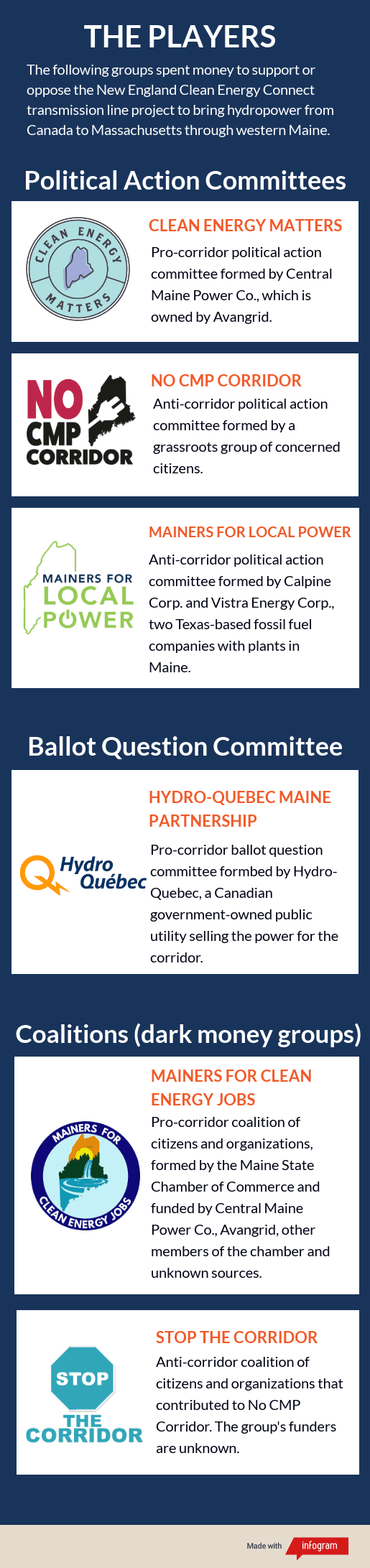
The utility coordinated the dark money through a coalition the Maine State Chamber of Commerce formed in 2018 called Mainers for Clean Energy Jobs.
:{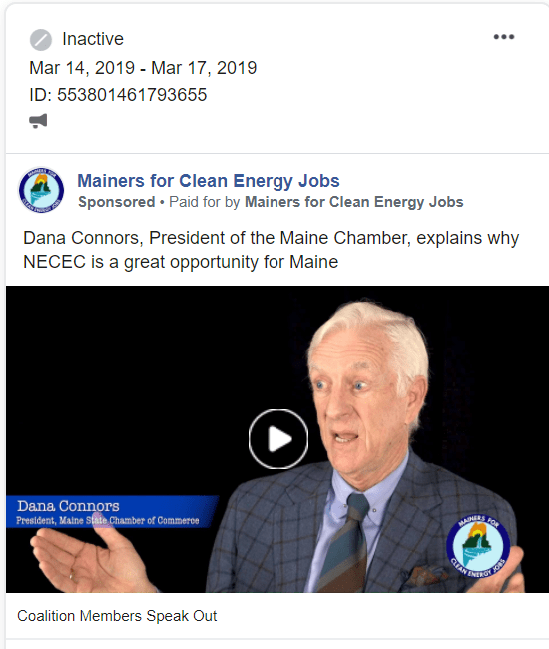 *One of the Facebook ads Mainers for Clean Energy Jobs paid for features Maine State Chamber of Commerce President Dana Connors speaking about the benefits of the corridor project. The full ad, which ran in March 2019, can be viewed on Facebook’s archive
This coalition spent nearly $10,000 on advertising — $7,280 on Facebook ads between December 2018 and May 2019, and $2,000 on radio ads, according to public filings from the Federal Communications Commission and Facebook’s Ad Library.
Because the coalition is not registered as a political committee, additional spending and sources of funding are mostly unknown.
Some of that undocumented spending supported at least six telephone town halls inviting Maine citizens to join Mainers for Clean Energy Jobs’ director, Ben Dudley, in live discussions about the merits of the corridor. Dudley said the calls reached “thousands” of Mainers each time but would not provide exact numbers. Six robocall campaigns could cost between $18,000 and $60,000 to call between 5,000 and 100,000 people, according to two companies that specialize in the technology. At least one of the Mainers for Clean Energy Jobs’ robocalls came after the referendum qualified for the ballot.
Though Avangrid and CMP’s names do not appear as donors on filings connected to Mainers for Clean Energy Jobs, the chamber’s lawyer, Ben Gilman, confirmed Mainers for Clean Energy Jobs is “funded by the Maine State Chamber of Commerce with support from CMP and Avangrid,” and specifically noted that Avangrid funded the telephone town halls.
CMP’s spokesperson, Catharine Hartnett, declined to respond to questions about whether the utility financed Mainers for Clean Energy Jobs or how much it paid the coalition. Thorn Dickinson, president of the branch of the utility overseeing the NECEC project, would only comment on financial transactions running the other direction — from the Maine State Chamber of Commerce to the utility’s PAC, which are documented on ethics reports and total around $2,000.
Mainers for Clean Energy Jobs was less than a month away from disclosing its funders to the Maine Ethics Commission in campaign finance filings when the state’s high court ruled the referendum unconstitutional, killing the ballot measure and making it no longer necessary for the coalition to file.
 *Ben Gilman, lawyer for the Maine State Chamber of Commerce
Lawyers for the CMP-affiliated political action committee, Clean Energy Matters, planned to have Mainers for Clean Energy Jobs register as a committee itself or “assimilate all of the activity supportive of the project under one entity – presumably Clean Energy Matters,” by Sept. 7, according to Gilman.
“That is now moot,” Gilman wrote in an email to The Maine Monitor.
Sept. 7 was the day that new ethics guidelines — approved just two days before the court ruling — would have kicked in. The new guidelines said any group spending $500 or more on communication related to the corridor or hydropower that close to election day was doing so “with intent to influence.”
Jonathan Wayne, executive director of the ethics commission, said the rules were “not really prompted by the large amount of money that’s being spent related to the corridor,” but by an influx of ambiguous advertising related to the project.
“This is about making organizations understand that sometimes their paid communications to voters relating to a citizen initiative have to be reported as expenditures in campaign finance reports, even if the communications don’t expressly advocate for or against the ballot question,” Wayne said, before the court ruling.
But after Maine’s high court struck down the referendum, the commission said it could no longer mandate disclosure from Mainers for Clean Energy Jobs.
“Without there being a referendum, there is no campaign for our purposes, so there’s no requirement that they register and report to us,” said Michael Dunn, the ethics commission’s political committee and lobbyist registrar. “It’s generally — fundamentally — unfair to change the rules mid-game.”
What is Mainers for Clean Energy Jobs?
In addition to lending its name and personnel to Avangrid and CMP-funded advertisements, Mainers for Clean Energy Jobs has worked alongside the utility for two years to drum up support for the corridor project in other ways.
The coalition was formed as an arm of the Maine State Chamber of Commerce in 2018. Its 30 members include unions, businesses, lobbying organizations and veteran environmental leaders. While CMP is not listed as a member of Mainers for Clean Energy Jobs, its president, Douglas Herling, sits on thechamber’s board.
 Ben Dudley, director of Mainers for Clean Energy Jobs
Only one person makes up Mainers for Clean Energy Jobs’ staff — its director, Ben Dudley.
Who funds Dudley’s pay — and its amount — is not revealed in public filings. The chamber’s most recent 990 — its nonprofit tax filing — covers the period before the coalition was created, July 2017 to June 2018, and does not include Dudley among its compensated officers. Gilman said the state chamber of commerce has Dudley on a retainer.
The Maine Monitor requested the chamber’s 2018-19 filings and did not receive them in time for publication.
Mainers for Clean Energy Jobs’ aim is to educate regulators and the public about the benefits of the New England Clean Energy Connect project, which the coalition says will provide 1,600 short-term jobs, positive climate impacts and a $1 billion economic boost for Maine over 10 years — among other items outlined on its website.
When the coalition was formed, its efforts focused on supporting proposals pending before the Legislature and permitting applications to the Public Utilities Commission, Department of Environmental Protection, Army Corps of Engineers and various Maine towns.
“Our job is to make the case for the project. It’s not our job to make the case for how people should vote one way or the other,” said Dudley, a former state legislator and chairman of the Maine Democratic Party from 2006-7.
RELATED: Listen to one of Mainers for Clean Energy Jobs’ tele town halls, from Feb. 19, 2020
When the Legislature was considering an independent greenhouse gas study of the project in February 2019, Dudley fought on behalf of the coalition to make sure it wasn’t conducted. (The bill ultimately failed; the study was never conducted.)
Dudley lobbied alongside CMP to kill the greenhouse gas bill and two others seeking to give Mainers a vote on where for-profit transmission lines would be built in 2019. Both were vetoed by Gov. Janet Mills.
 Dudley’s lobbyist reports between March and June of 2019 indicate the Maine State Chamber of Commerce paid him $5,500 for the work, but it remains unclear whether CMP or Avangrid provided the funding to the chamber.
The Chamber’s IRS designation as a 501(c)(6) allows the nonprofit to lobby as long as it doesn’t spend more than 40% of its expenses on political campaigning.
To avoid crossing that threshold, 501(c) groups can mask political activity by categorizing what some may consider to be political expenses as “educational” or “membership-building.”
“If you’re really trying to cultivate public sentiment for or against some project, you can often get your message out without triggering mandatory disclosure,” said John Brautigam, who has practiced campaign finance and election law for over 20 years. “Many people think this is a weakness in this disclosure system.”
On the federal level, the U.S. Chamber of Commerce has hid political agendas by not disclosing donors and touting educational or advocacy agendas in lieu of presenting itself as trying to influence candidate elections or referenda.
CMP’s battle for the corridor
CMP and Avangrid have mounted a concerted effort to build the corridor, pouring money into advertising and lobbying campaigns every step of the way.
The utility hired a team of lobbyists and lawyers in 2019 to defeat three bills — the same three Dudley lobbied against. One would have required an independent greenhouse gas study of the project and the others would have given Maine communities more say in the corridor route and use of eminent domain. That year, CMP spent more than $100,000 on lobbying, including on non-corridor efforts such as blocking the formation of a consumer-owned utility.
As organizers started gathering signatures to put the corridor project on the November 2020 ballot, CMP and Avangrid formed their political action committee, Clean Energy Matters. Once its opponents submitted the signatures, the PAC first challenged their validity, then challenged the validity of the ballot question itself — and won.
The referendum sought to ask voters whether to overturn the PUC’s decision to grant the project permits. Maine’s Supreme Judicial Court ruled it unconstitutional for citizens to be able to overturn the PUC’s decision because it oversteps the decision-making authority granted to the agency by the Legislature.
Of the nearly $11.6 million Clean Energy Matters has raised, CMP contributed more than $7.5 million and Avangrid gave more than $4 million. The PAC has spent just under $11.3 million.
The money CMP and Avangrid have spent on winning approval for the corridor has concerned some Mainers.
Betty Anne Listowich, who lives in Freeman Township in Western Maine, said CMP and Avangrid’s spending outside their PAC was troublesome.
“The dark money is the corporate greed,” said Listowich, who says she’s concerned about the corridor cutting through Franklin County. “If you could spend $17 million trying to wash this pill down my throat, what are you hiding?”
The $17 million includes over $11 million spent by Clean Energy Matters and over $6 million spent by Hydro-Quebec’s own ballot question committee. Hydro-Quebec is the government corporation selling the power.
A primary purpose of the New England Clean Energy Connect project is to transfer hydropower from Quebec to Massachusetts to support the Bay State’s ambitious clean energy goals. The New England Clean Energy Connect website claims the project will create 2,000 full-time jobs in Massachusetts and will save the state’s residents $150 million in electricity costs each year.
On the benefit page for Maine, the website claims Mainers will save between $14 million and $44 million in electricity costs each year and that the project will create 1,600 jobs during the construction of the corridor.
Not the only dark money group
Mainers for Clean Energy Jobs is not the only dark money group surrounding the corridor project.
The ethics commission is investigating a group called Stop the Corridor, which reported $85,000 of in-kind contributions to No CMP Corridor, an anti-corridor PAC. This included nearly $19,000 worth of staff time for “campaign coordination” and more than $48,000 for “volunteer recruitment,” according to No CMP Corridor’s campaign finance filings between October 1, 2019 and March 31.
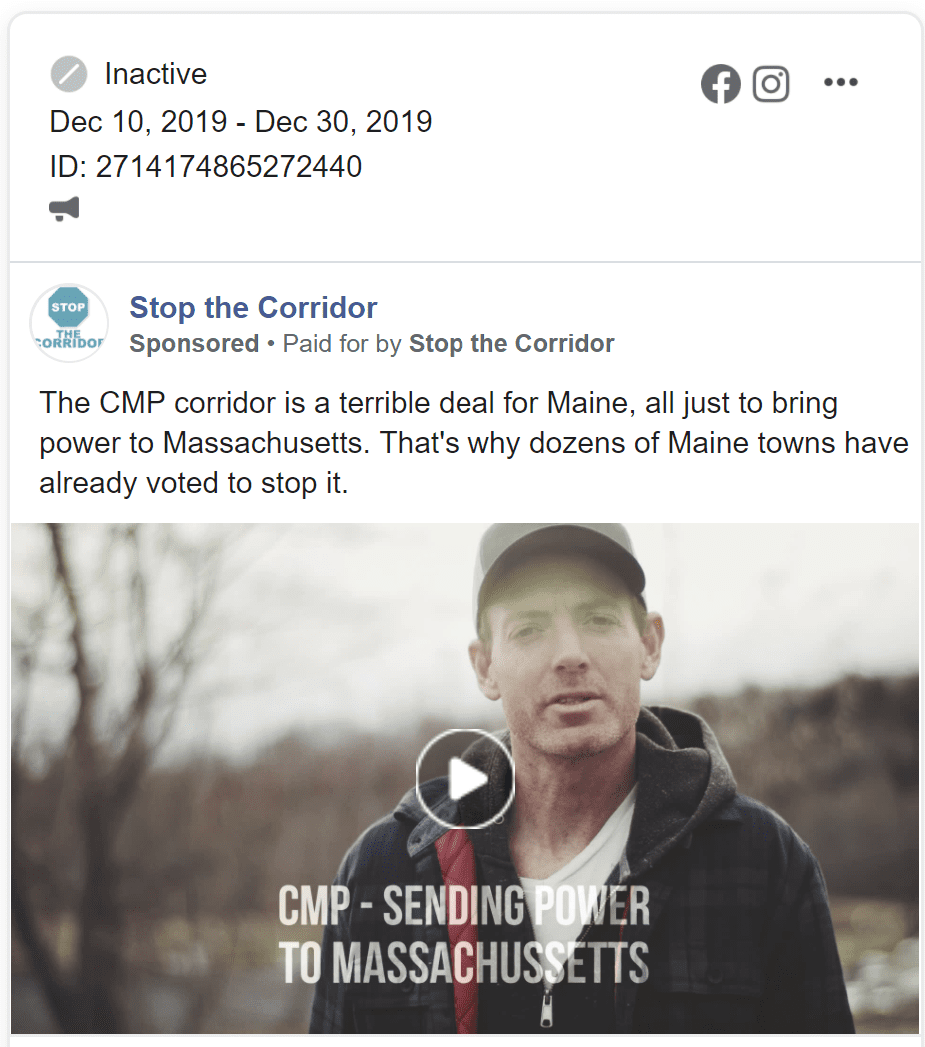 A Facebook ads paid for by Stop the Corridor calls the transmission project “a terrible deal for Maine.” The full ad, which ran in December 2019, can be viewed on Facebook’s archive.
The group also spent more than $1 million on advertising since 2019 — $1,034,000 on television advertising and $424,997 onFacebook ads.
Clean Energy Matters, which spurred the ethics investigation by filing a campaign finance complaint, alleges Stop the Corridor exceeded the spending threshold to disclose its funders.
When it announced the complaint in January, Clean Energy Matters cited concerns that out-of-state fossil fuel companies , which stand to lose millions of dollars if the clean energy project is built, were funding Stop the Corridor.
Stop the Corridor’s representatives have repeatedly declined to reveal its donors, most recently suing the Ethics Commission in June on the grounds that the commission does not have jurisdiction to investigate its finances. The commission ordered Stop the Corridor to disclose its funders in May so it could investigate whether it violated the law.
Katherine Knox, counsel for Stop the Corridor, has maintained the spending also does not meet the definition of “initiating or influencing an election,” because it funded efforts to block the project via the permitting process instead of the electoral process.
Knox did not respond to multiple calls and an email requesting comment.
“In this case, Stop the Corridor would have us believe that it is a ‘concerned coalition’ that has nothing to do with trying to influence a potential ballot campaign. But if you look at these ethics reports — or simply turn on your TV — it’s clear that their mission is to influence voters, ” said the Clean Energy Matters executive director, Jon Breed, in a news release announcing the complaint.
Though the referendum on the corridor has been struck down, Brautigam, the elections and campaign finance lawyer, said the record spending around the issue will create a legacy.
“It is nearly unprecedented in terms of the size and scope of the communications that (were) being made, to influence public opinion and arguably, at least in some cases, to influence voters as they go to the ballot box,” he said.
“Not only has the corridor itself been a subject of public debate, but all of this money has become an important and significant secondary public debate.”
DUCK 1 26
- Search Assist
The Maine energy corridor, specifically the New England Clean Energy Connect project, saw significant financial backing from foreign entities, particularly Hydro-Québec, which is a government-owned utility in Canada. This project faced opposition due to concerns about foreign influence in local referendums, leading to a ban on such contributions from foreign entities in Maine.
 Global News
More
Auto-generated based on listed sources. May contain inaccuracies.
...|Donor|Amount Contributed|Description|
| Hydro-Québec Energy Services U.S. | Over $22.3 million | A subsidiary of the Quebec government-owned utility, heavily involved in funding efforts to support the corridor. |
|---|---|---|
| NextEra Energy Resources LLC | $20 million | A Florida-based energy company, the largest donor opposing the referendum against the corridor. |
| Vistra Energy Corp. | Over $2 million | Contributed to campaigns opposing the corridor, operates natural gas plants in New England. |
| Calpine Corp. | Over $2 million | Another significant donor opposing the corridor, also operates natural gas facilities. |
Impact of Foreign Funding
The involvement of foreign entities, particularly Hydro-Québec, raised concerns about undue influence in local elections. In response, Maine voters approved a ballot measure banning foreign governments and their subsidiaries from contributing to local campaigns, closing a loophole in federal law.

The Maine Wire
Controversial $1.65 Billion Hydroelectric Power Corridor Goes Live
Jan 20, 2026Eight years in the making, a controversial power corridor running through the North Maine Woods, transporting hydroelectric power from Quebec, has now gone live. The 145-mile New England Clean Energy Connect (NECEC) will bring this power from Canada into New England, primarily Massachusetts, where it is expected to help provide power to 1.2 million households.

The Maine Monitor
CMP, Avangrid spent dark money to drum up support for power corridor on ...
What is Mainers for Clean Energy Jobs? In addition to lending its name and personnel to Avangrid and CMP-funded advertisements, Mainers for Clean Energy Jobs has worked alongside the utility for two years to drum up support for the corridor project in other ways. The coalition was formed as an arm of the Maine State Chamber of Commerce in 2018.

WMTW
https://www.wmtw.com › article › federal-judge-wont-revoke-permits-cmp-power-corridor › 64364451
'These conclusions may be unpopular.' Federal judge won't revoke ...
Apr 7, 2025'These conclusions may be unpopular.' Federal judge won't revoke permits for CMP power corridor Construction on the project resumed in August 2023, months after Maine voters rejected it by referendum.
Maine Public
Attorneys for the state and energy companies square off in federal ...
Oct 9, 2024Heavy machinery is used to cut trees to widen an existing Central Maine Power power line corridor to make way for new utility poles, April 26, 2021, near Bingham, Maine. Attorneys for the state were in federal court Wednesday to defend the constitutionality of a new law passed by voters that sought to limit foreign influence on Maine elections.

Truthout
Maine Voters and Foreign Companies Squared Off Over Energy Corridor ...
A Maine ballot referendum to halt the construction of a $1 billion cross-border corridor of high-impact electric transmission lines from Canada attracted more than $89 million in funds through ballot campaigns, more than any other referendum in Maine's history, OpenSecrets' analysis of campaign ...
Spectrum News
Maine considers ban on foreign spending on referendums
A sign with a protest message on Central Maine Power's controversial hydropower transmission corridor is displayed near Jackman, Maine. If voters grant their approval on Tuesday, Nov. 7, Maine would be the 10th state to close the loophole in federal election law that bans foreign entities from spending on candidate elections, yet allows donations for local and state ballot measures. (AP Photo ...
me.localnews.com
Anti-CMP corridor groups tied to Maine Democrats and energy firm ...
The Maine consultants "believed the contribution would help their relationships with Democratic officials," and one consultant called the former Maine Democratic Party deputy director about two weeks before the November 2018 election to discuss a donor that would give the party $150,000.

Maine Beacon
Foreign company's subsidiary poured millions into influencing Maine ...
This story originally appeared at OpenSecrets. A Maine ballot referendum to halt the construction of a $1 billion cross-border corridor of high-impact electric transmission lines from Canada attracted more than $89 million in funds through ballot campaigns, more than any other referendum in Maine's history, OpenSecrets' analysis of campaign finance disclosures showed. Supporters of the
News From The States
Foreign company's subsidiary poured millions into influencing Maine ...
A Maine ballot referendum to halt the construction of a $1 billion cross-border corridor of high-impact electric transmission lines from Canada attracted more than $89 million in funds through ballot campaigns, more than any other referendum in Maine's history, OpenSecrets' analysis of campaign finance disclosures showed.

WGME
CMP parent company ready to energize controversial corridor by ... - WGME
Nov 20, 2025CMP's parent company, Avangrid, is about to flip the switch and turn on a controversial power corridor through western Maine.
---
harvard Law professor Lawrence Lessig discusses the strategy for ongoing Maine campaign finance litigation
By Rin Pastor
Orient Staff
November 7, 2025
Abigail HebertMAINE V. DARK MONEY:Lawrence Lessig speaks in Kresge Auditorium on Wednesday night. Lessig, a Harvard Law professor and founder of the non-profit Equal Citizens, spoke about a novel legal strategy Equal Citizens is using to attempt to uphold Maine’s regulation of super PACs.
Last Wednesday in Kresge Auditorium, professor of law at Harvard Law School Lawrence Lessig discussed ongoing litigation at the Court of Appeals for the First Circuit regarding campaign finance regulations. This litigation pertains to a 2024 Maine ballot initiative limiting campaign contributions that was passed by 75 percent of voters. This law was almost immediately challenged and ruled unconstitutional at the district court level. Lessig and the organization he founded, Equal Citizens, have appealed the decision.
Maia Cook, the executive director of Equal Citizens and one of Lessig’s former research assistants, began the talk by defining super political action committees (super PACs) and outlining their impact on the amount of money involved in political campaigns. Cook explained that the modern super PAC is a product of the Supreme Court case Citizens United v. FEC (2010), which deemed limits on independent expenditures uncoordinated with specific campaigns as unconstitutional, and the D.C. Circuit Court of Appeals case SpeechNow.org v. FEC (2010), which expanded the doctrine from Citizens United and deemed contribution limits to independent expenditure super PACs unconstitutional.
“Together, these decisions created the modern super PAC, a legally distinct type of political action committee that can receive unlimited sums from corporations, individuals and unions and can spend unlimited amounts so long as they are uncoordinated [with campaigns],” Cook said.
Cook stated that while the intersection of democracy and capitalism requires some amount of campaign finance, the modern super PAC has created a vast increase of money—especially anonymous donations, also called dark money—in politics. She also noted that unrestricted super PAC activity has disadvantaged both Democrats and Republicans, leading to both parties being exorbitantly influenced by the richest top one percent of Americans.
“I don’t want the scale here to be lost on anyone, because just in 15 years, dark [money] contributions went from $6.6 million to $1.3 billion, and that is a 197 times increase from its original size,” Cook said.
:{Lessig outlined the legal theory that could reform elections to be less influenced by super PACs and billionaire spending. Citizens United built off of the Supreme Court case Buckley v. Valeo (1976), which stated that if expenditures from independent organizations are not prearranged with those running for office, there is no real or apparent corruption and thus these donations cannot be limited. Under Buckley, if expenditures are coordinated between organizations and candidates, they can be regulated.
Citizens United expanded this principle to corporations and unions. The SpeechNow decision established that contributions to these expenditures also create no corruption or appearance of corruption, a decision that Lessig takes issue with. He explained that while independent expenditures cannot be prearranged or coordinated, contributions can.}:
“It’s totally legal for [a candidate] to coordinate contributions to his super PAC, even though he is regulated not to coordinate expenditures. So the fact that contributions can be coordinated means the whole premise behind equating contributions with expenditures is just false,” Lessig said.
Lessig and Equal Citizens will be using this theory to argue the case for Maine’s ballot initiative in the Court of Appeals. In district court, the judge ruled that even if there is real or apparent corruption, Maine has no right to regulate it.
“The reason that’s a great victory is that that is the most extreme any court has ever been,” Lessig said. “It’s the first court in the history of federal jurisdiction ever to hold that even though there’s a risk of corruption, there’s nothing you can do about it.”
Lessig argued that, because of this extremity, if the Court of Appeals or Supreme Court rules against Equal Citizens, it will be a betrayal of the existing law.
“You only see how bad it would be if they struck the Maine initiative down by seeing how clear it is that the Maine initiative is constitutional.… If the court goes against us now, it is an extraordinary betrayal.… They’re changing the law to protect super PACs, not upholding Citizens United but extending Citizens United for the first time,” Lessig said.
Lessig believes that an extension of Citizens United would present a real political crisis, necessitating a bravery amongst lawyers, universities and the press.
“As we look around at this moment, there’s a certain cowardice that has become contagious. People make a judgment about what they should do, and they do the reasonable thing. And the reasonable thing is an act of cowardice,” Lessig said. “It’s understandable why they do what they do. It’s also wrong.”
Ultimately, Lessig is hopeful that the Supreme Court will agree with Equal Citizens. However, he also argues that should the Court disagree, it will be a sign for a necessary reform to the United States’ political structures.
“I’m optimistic the Court will agree with me. I think we should realize just what’s at stake if the Court goes the other way,” Lessig said in an interview with the Orient. “We need to start thinking seriously about how we bring constitutional reform through this process that involves citizens as opposed to lawyers and politicians.”
Attendee Gigi Ford ’27 admired Lessig’s ability to explain legal issues and theory in a concise and accessible manner.
“The most impactful part of the talk was Lessig explaining the logical fallacies found in the judicial system’s reasoning and practice. Being able to communicate this effectively to someone without a background in law is very important in the fight for ending super PACs,” Ford said.
---
medium
A district court in Maine has enjoined enforcement of an anti-SuperPAC initiative that had been enacted by Maine voters in November with 74.9% of the vote. 600,000 Mainers had said “enough” to SuperPACs — more Mainers voting for the initiative than had ever voted for any initiative or any person in the history of the state — and yet the court has now said, “not yet.”
I’ve written a long essay about the core mistake the district court made in interpreting Citizens United. You can read that here. In this much shorter essay, I want to show just why this district court opinion, in fact, should give us real hope.
Because the district court has conceded that the foundation to the case that gave us SuperPACs — SpeechNow v. FEC—is wrong.
The Error in SpeechNow
In 2010, three months after the Supreme Court decided Citizens United v. FEC, the DC Circuit decided the case that would give us SuperPACs — SpeechNow v. FEC.
Citizens Unitedhad held that independent expenditures could not be limited. SpeechNow held that contributionsto committees that make independent expenditures*could not be limited
The core reasoning in SpeechNowis this:
In light of the [Supreme Court’s] holding [in Citizens United that] as a matter of law [] independent expenditures do not corrupt or create the appearance of quid pro quo corruption, contributions to groups that make only independent expenditures also cannot corrupt or create the appearance of corruption. The Court has effectively held that there is no corrupting “quid” for which a candidate might in exchange offer a corrupt “quo.”
Given this analysis from Citizens United, we must conclude that the government has no anti-corruption interest in limiting contributions to an independent expenditure group such as SpeechNow.
“No anti-corruption interest,” in other words, because — “as a matter of law” — “there is no corrupting ‘quid’ for which a candidate might in exchange offer a corrupt ‘quo.’”
We had argued that premise was false. That indeed, there were plenty of examples where there was a “corrupting ‘quid’ for which a candidate might in exchange offer a corrupt ‘quo’.” The most famous of these cases was the indictment in 2015 of Robert Menendez: Menendez had been indicted for offering government benefits (the “quo”) in exchange for a contribution to Menendez’s SuperPAC (the “quid”) — the very thing the DC Circuit said could not be.
The district court in our case accepted this claim. As it found, “contributions to independent expenditure PACs can serve as the quid in a quid pro quo arrangement.”
But apparently, the court didn’t hear the “bingo” that must have then rung out across the land. Because the opposite finding had been the foundation of SpeechNow.
SpeechNow acknowledged the question it was answering had not been decided in Citizens United.Instead, it reasoned from Citizens Unitedto a premise it believed must be true: that there was “no anti-corruption interest,” because — “as a matter of law” — “there is no corrupting ‘quid’ for which a candidate might in exchange offer a corrupt ‘quo.’” And because there was “no anti-corruption interest,” the DC Circuit found it unnecessary to weigh that non-interest against a free speech interest. “The First Amendment,” the court held, “cannot be encroached upon for naught.”
But the district court in our case has now found that the interest is not a “naught.” That indeed, the core justification for regulating contributions to a political action committee — that they create a risk of quid pro quo corruption — is real. Which is to say, the whole foundation for SpeechNow is gone — leaving SuperPACs in the Wile E. Coyote position described in the gif above.
This is real progress, even if wrapped in a mistake (see my other essay about that mistake). Because though we may live in looney times, as with every Looney Tunes cartoon, eventually, gravity catches up.
You can sign up to follow the case here.
---