Lessig/mayday
---
---
mpu short 4? 26
maine case 
---
9 26 MONTANA
Montana's plan to beat Citizens United could reshape political spending
-=-=
9 26 SPEECHNOW V FEC
Take Down Super PACs: Lawrence Lessig (Full Podcast Episode)
-=-=
LESSIG SAYS 2 SUPERPACS TO KILL mAINE EFFORT ARE lEO l?
ON W KARA S 2 26
The Supreme Court could end Super PACs — here's how
Feb 5, 2026 On with Kara Swisher
Lawrence Lessig — Harvard law professor, former presidential candidate, and founder of Equal Citizens — joins Kara to explain why Super PACs are one of the root causes of political corruption in the U.S. and how a little-noticed legal case could fundamentally change how elections are funded. He breaks down why Citizens United didn’t actually create Super PACs, how the Supreme Court could dismantle them without overturning precedent, and why both parties are trapped in the same broken system. Their conversation also digs into:
- How tech leaders went from libertarian-light idealists to political power brokers
- Why billionaires and institutions so easily cave to authoritarian pressure
- The Epstein scandal, dirty money, and institutional moral failure
- Why AI-driven engagement is already undermining democracy
- How citizen assemblies could offer a real alternative to broken governance
:{Lessig argues that unless the U.S. confronts the role of money in politics, and the media systems amplifying division, democracy itself may not survive in its current form Introductio

Why money in politics is worse now than eve The lawsuit that could end SuperPAC
 Major voting rights cases in the Supreme Court
 Explaining Trump's FBI raid in Georgia
 Jeffrey Epstein, dark money, and institutional corruptio
 The message Democrats need to win the next electio
 Why AI is already breaking democracy
 Citizen assemblies and the future of governance}:
---
---
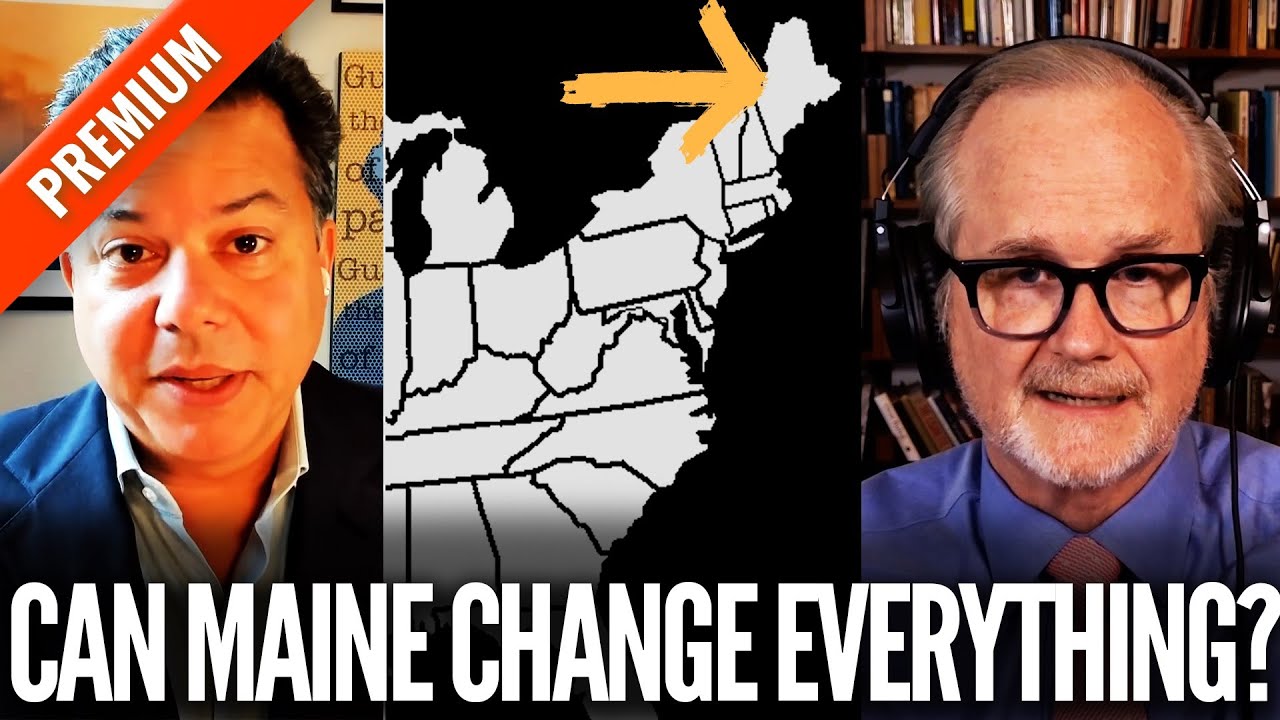
The Little State That Could Save Democracy ( with Larry Lessig) | How To Fix It with John Avlon
Oct 25, 2025
free? 
Harvard law professor and democracy reformer Larry Lessig is taking on the big money machine. In Maine, he’s helping defend a ballot initiative that bans super PACs, backed by a stunning 75% of voters. If he wins, this case could crack Citizens United wide open and bring campaign finance reform to the entire country. This might just be the moment to end dark money’s grip on American politics.
free
---
12 25
- Professor Lawrence Lessig On Congress Preempting The Article V Convention - U.S. Term Limits
Mar 11, 2025 — Lessig has also discussed the need for states to convene a call for conventions to address critical issues like term l...
U.S. Term Limits

- Testimony of - Maine Legislature
As any American knows, revolutions are possible. But as every member of this Committee knows, a large collective body governed by ...
Maine State Legislature (.gov)
- Larry Lessig on The Coming U.S. Constitutional Convention ...
Oct 29, 2023 — is for two-thirds of the house and two-thirds of the Senate to vote for proposed amendment. and then have it ratified.

YouTube·Yale Global Justice Program
48s
- Making an Article V Convention Safe for Democracy | by Lessig
Jun 6, 2023 — So far, legislatures in twenty-eight states have called for fiscal-integrity amendments — mandating a balanced budget. ...
Medium
- Testimony of - Maine Legislature
This authority could likewise be relied upon to constrain electors at an Article V convention. In the legislation selecting delega...
Maine State Legislature (.gov)
---
---
FS4PPL
Posted on July 16, 2025
On July 15, 2025, a magistrate judge of the U.S. District Court of Maine granted a permanent injunction to block a Maine state law that would end independent expenditure political action committees that can receive unlimited contributions (super PACs) in Maine. The law—arising out of a 2024 ballot measure that passed with overwhelming support of Maine voters—places no restrictions on expenditures, but does establish a $5,000 annual limit on contributions to super PACs. Maine voters recognized that unlimited contributions to super PACs create significant risk that candidates and contributors can and will engage in behind-the-scenes quid pro quo corruption by funneling payments through super PACs.
Unlimited contributions also create the appearance of corruption, thereby undermining the legitimacy of our democracy. The law was immediately challenged by two super PACs. The magistrate judge, misapplying Supreme Court precedent, dismissing fifteen years of history, and without the benefit of a full trial, has granted a permanent injunction that blocks the law from going into effect. This ruling prevents Maine voters from protecting their elections from quid pro quo corruption.
Maine voters should be applauded for their thoughtful, constitutional efforts to protect our democracy. Free Speech For People (FSFP) will continue to support this law through the appeals that will come.
Background
In its 2010 decision in Citizens United v. FEC, the Supreme Court held that limits on independent expenditures—expenditures made to support a candidate without coordination with that candidate—are unconstitutional. The ruling did not address contributions; indeed, in Citizens United and in cases since then, the Supreme Court has continued to distinguish between limits on political expenditures and limits on contributions, granting more protections to expenditures than contributions and subjecting contributions to a lesser standard of scrutiny.
A few months after Citizens United, a lower court ruling, SpeechNow v. FEC, created super PACs by striking down a federal law that limited contributions to independent expenditure committees, now known as super PACs. It improperly collapsed the Supreme Court’s two-tiered system of analysis and concluded that because independent expenditure limits are unconstitutional, so too are contributions to super PACs. The decision was wrongly decided, never reviewed by the Supreme Court, and not binding precedent in Maine. Now—just fifteen years later—super PACs dominate Maine and U.S. elections, pour billions of dollars into our elections, have created powerful incentives for candidates and super PAC funders to engage in corrupt quid pro quo agreements, and have created such an appearance of corruption that it undermines voters’ faith in our elections and our democracy.
In recognition of these risks, in November 2024, 75% of Maine voters passed Ballot Question 1, which prohibited annual contributions above $5,000 to independent expenditure PACs. Two Maine super PACs, Dinner Table Action and For Our Future, immediately sued to block the law. The parties—defendant officials of the Maine Commission on Governmental Ethics and Election Practices, nonpartisan intervenor EqualCitizens and other intervenor-defendants, and the plaintiff super PACs agreed to forgo an evidentiary hearing and to hold only oral argument on the merits of the case. The magistrate judge has now blocked the law from going into effect.
The Magistrate Judge Misapplied the Law and Misunderstands Super PACs._
- _Candidates and contributors can enter into quid pro quo agreements without involving the super PAC_. The court claimed that contributions to independent expenditures “are one step further removed from the candidate” than the super PACs themselves, so “the logic of Citizens United dictates that the danger of corruption is smaller still.” The court’s rationale here wholly misunderstands the logic of Citizens United, which is concerned not with removal but with the purported independence of independent expenditures from candidates. The Supreme Court reasoned that because independent expenditures, by definition, cannot be coordinated with candidates, they therefore cannot give rise to corrupt quid pro quo agreements between a candidate and the entity that makes the expenditures. This logic does not apply to super PAC contributors. As Free Speech For People discussed in its amicus brief, super PACs create opportunities and incentives for candidates and contributors to engage in quid pro quo agreements.
- _Contributions and expenditures are not subject to the same analysis._ The Supreme Court uses a bifurcated system of analysis that both differentiates between contributions and expenditures, and subjects contribution limits to lesser standards of review than expenditure limits. Though the magistrate judge recognizes this, she relies almost wholly on non-binding lower court rulings that wrongly collapse the two and insists that Citizens United“forecloses limits on contributions” to super PACs. It does not. Citizens United only analyzes a law that limits expenditures. It said nothing about contributions.
- _The lived experience of Maine voters should be considered when assessing whether unlimited super PAC contributions create the appearance of corruption._ Maine voters understand how super PACs operate and why they create an appearance of corruption. Voters have spent fifteen years voting under a system increasingly dominated by megadonors funneling massive contributions through super PACs and receiving favor from our elected officials. Their experience and perspective should not be so casually dismissed in any analysis of the “appearance of corruption” inquiry.
- _The disclosure portion of the law is constitutional._ By striking down this reasonable disclosure law, the court further and unnecessarily hamstrings Maine’s efforts to protect its elections from corruption.
_Maine Voters Deserve Better._
Maine voters got it right. FSFP will continue to defend this law and support all efforts to appeal this decision.
Read the decision here.
Read FSFP’s amicus brief in support of the law here.
---
---
latest-filings-campaign-finance-court-battle-argue-maine-has-legal-right-regulate-super
10 25 me morn star
The next piece of the puzzle for the group hoping to get the U.S. Supreme Court to establish greater regulations on money in elections was laid on Wednesday.
Two appeals were filed in the First Circuit Court of Appeals in Boston after a federal district court in July ruled that a 2024 Maine law overwhelmingly passed by voters was unconstitutional. The law placed limits on contributions to political action committees that independently spend money to try to support or defeat candidates, commonly referred to as super PACs.
One of the briefs is from Attorney General Aaron Frey on behalf of the state of Maine. The other is from the committee behind the referendum and the non-profit Equal Citizens, spearheaded by legal scholar Lawrence Lessig, who has been attempting to bring this issue to the high court for years.
Both make the case that the 2010 Supreme Court decision Citizens United v. Federal Election Commission actually allows for super PACs to be regulated.
The brief from the interveners incorporates a second originalism argument, which is notable since the party that instigated the lawsuit is made up of conservative political action committees.
Charles Miller of the Institute for Free Speech and Joshua Dunlap of Pierce Atwood (now nominee for the First Circuit) filed the lawsuit in U.S. District Court for the District of Maine in 2024 on behalf of Dinner Table Action, which was founded by state Rep. Laurel Libby (R-Auburn) and activist Alex Titcomb, and For Our Future, which is run by Titcomb. They argue that the law restricts free speech.
These dueling arguments have been known, but in an interview ahead of the filing Wednesday Lessig told Maine Morning Star that the intervener’s brief also argues that a component of the recent district court opinion rejects the reasoning that served as the foundation for super PACs in the first place, aiding their case.
After reviewing the filing on Wednesday, Miller said he doesn’t think that’s novel. He’ll be issuing his full rebuttal on behalf of the plaintiffs next month.
Before then, friend of the court briefs are expected next week and could add additional layers to the argument.
After oral arguments in early 2026, a ruling could come before the summer.
If the court decides in favor of the law, the issue could be in the Supreme Court by the fall of 2026. If the First Circuit rules otherwise, the path to the high court would become more difficult.
How the district court opinion plays in
Since Buckley v. Valeo in 1976, the Supreme Court has allowed contributions to be regulated when there is a risk of “quid pro quo” corruption, essentially a favor for a favor. In the case of elections, if there is a risk someone could be making a donation to a candidate in exchange for a favor, then Congress can regulate that contribution. In 2010, the Supreme Court extended this reasoning to corporations and unions in Citizens United,ruling that those entities can otherwise spend unlimited amounts of money on elections because they have free speech rights under the First Amendment.
Three months later, the D.C. Circuit Court of Appeals ruled in SpeechNow.org v. FEC that contributions to PACs cannot be regulated either, as long as the PAC is “independent” of the campaign.
The state of Maine and interveners argue SpeechNow misinterpreted Citizens United.
The ruling was never reviewed by the Supreme Court, though other lower federal and state courts agreed. In each one of those cases, the courts ruled that contributions to independent political action committees created no risk of “quid pro quo” corruption, so they couldn’t be regulated.
But in U.S. Magistrate Judge Karen Frink Wolf’s opinion in the district court in July, she essentially conceded that there is a risk of corruption. “Contributions to independent expenditure PACs can serve as the quid in a quid pro quo arrangement,” she wrote.
Lessig said that finding makes it “the most extreme opinion of any federal court in the history of this jurisprudence.”
However, Frink Wolf went on to write, “I am not persuaded that the Defendants’ arguments on this point can be squared with Citizens United.”
That’s where she and those backing Maine’s law diverge.
“The district court further erred by adopting the reasoning of out-of-jurisdiction decisions striking down similar contribution limits,” the brief filed by Frey reads. “Those cases did not bind the district court, just as they do not bind this Court.”
Maine sued over new campaign finance law, but that was supporters’ plan all along
What the state of Maine and the interveners are seeking is not to change the limits on expenditures in Citizens United. They think the question the Maine referendum raises — whether contributions to a committee that makes independent expenditures can be limited — is not answered in Citizens United.
“Nothing in Citizens United or in any subsequent Supreme Court case disturbs the longstanding precedent securing to the people the power to prevent quid pro quo corruption or its appearance by limiting the size of contributions,” the brief filed by the interveners reads.
Under the logic of Citizens United, independent expenditures are uncoordinated and create no risk of quid pro quo corruption, but donations to a committee that makes independent expenditures may or may not be coordinated. Therefore, they argue, they create the risk of quid pro quo corruption and can be regulated by Congress.
Further, Frey’s brief adds that “the district court should have recognized that the changed campaign landscape in Maine and the United States unleashed by SpeechNow supports Maine’s important interest in imposing modest limits.”
Republican-turned-independent state Sen. Rick Bennett, who is running for governor in 2026 and was on the ballot question committee, told Maine Morning Star, that the case in Maine “gives the courts a chance to correct a 15-year mistake, return power to the people, and begin restoring trust in our democracy.”
The state of Maine is giving the Supreme Court a gift. You're saying to John Roberts, here's a case where you could decide this case and the whole country will say, ‘Huzzah.’
– Lawrence Lessig
Another member of the ballot committee, Cara McCormick, said in defending Maine’s new law, “we go to court not in anger but in faith that our democracy will listen to its people and grow even stronger through them.”
Miller, the plaintiff’s lead counsel, disagrees with their interpretation.
“They’re trying to focus on the fact that, theoretically, a candidate could solicit a donation for independent expenditure, but the law doesn’t target that,” Miller said. “It targets any contribution for independent expenditure.”
As an example, Miller said someone could corrupt a politican by giving money to his daughter, “but there’s no reporting requirements on donations to daughters of senators.” In that regard, he added, “there are lots of things that can be corrupted, a donation to a presidential library arguably can be corrupted.”
An originalism argument
The overarching point the interveners are making is that the original meaning of the First Amendment would not have blocked state legislatures or the people from limiting the size of contributions to political action committees.
“The Supreme Court has never considered the question of what the original meaning of the First Amendment means in the context of campaign finance jurisprudence,” Lessig said.
The originalist argument they’re making is typically a conservative one, so Lessig believes it would fare well with the current conservative-leaning Supreme Court. He also believes that’s why the plaintiffs want to prevent that argument from advancing beyond the First Circuit.
“That’s what gave us the new Second Amendment, that’s what overturned Roe versus Wade — it’s originalism,” Lessig said. “But here, it goes against their politics.”
Last week, the plaintiffs filed a motion to dismiss the group’s appeal.
Ultimately, Lessig views the issue of regulating super PACs as a nonpartisan one. Both Republicans and Democrats benefited from hundreds of millions of dollars from super PAC spending last election, Democrats more so than Republicans.
“The state of Maine is giving the Supreme Court a gift,” Lessig said. “You’re saying to John Roberts, here’s a case where you could decide this case and the whole country will say, ‘Huzzah.’”
October 23, 202511:39 amThis story has been updated to include a statement from Cara McCormick and details of the Attorney General's brief.
---
harvard Law professor Lawrence Lessig discusses the strategy for ongoing Maine campaign finance litigation
By Rin Pastor
Orient Staff
November 7, 2025
Abigail HebertMAINE V. DARK MONEY:Lawrence Lessig speaks in Kresge Auditorium on Wednesday night. Lessig, a Harvard Law professor and founder of the non-profit Equal Citizens, spoke about a novel legal strategy Equal Citizens is using to attempt to uphold Maine’s regulation of super PACs.
Last Wednesday in Kresge Auditorium, professor of law at Harvard Law School Lawrence Lessig discussed ongoing litigation at the Court of Appeals for the First Circuit regarding campaign finance regulations. This litigation pertains to a 2024 Maine ballot initiative limiting campaign contributions that was passed by 75 percent of voters. This law was almost immediately challenged and ruled unconstitutional at the district court level. Lessig and the organization he founded, Equal Citizens, have appealed the decision.
Maia Cook, the executive director of Equal Citizens and one of Lessig’s former research assistants, began the talk by defining super political action committees (super PACs) and outlining their impact on the amount of money involved in political campaigns. Cook explained that the modern super PAC is a product of the Supreme Court case Citizens United v. FEC (2010), which deemed limits on independent expenditures uncoordinated with specific campaigns as unconstitutional, and the D.C. Circuit Court of Appeals case SpeechNow.org v. FEC (2010), which expanded the doctrine from Citizens United and deemed contribution limits to independent expenditure super PACs unconstitutional.
“Together, these decisions created the modern super PAC, a legally distinct type of political action committee that can receive unlimited sums from corporations, individuals and unions and can spend unlimited amounts so long as they are uncoordinated [with campaigns],” Cook said.
Cook stated that while the intersection of democracy and capitalism requires some amount of campaign finance, the modern super PAC has created a vast increase of money—especially anonymous donations, also called dark money—in politics. She also noted that unrestricted super PAC activity has disadvantaged both Democrats and Republicans, leading to both parties being exorbitantly influenced by the richest top one percent of Americans.
“I don’t want the scale here to be lost on anyone, because just in 15 years, dark [money] contributions went from $6.6 million to $1.3 billion, and that is a 197 times increase from its original size,” Cook said.
:{Lessig outlined the legal theory that could reform elections to be less influenced by super PACs and billionaire spending. Citizens United built off of the Supreme Court case Buckley v. Valeo (1976), which stated that if expenditures from independent organizations are not prearranged with those running for office, there is no real or apparent corruption and thus these donations cannot be limited. Under Buckley, if expenditures are coordinated between organizations and candidates, they can be regulated.
Citizens United expanded this principle to corporations and unions. The SpeechNow decision established that contributions to these expenditures also create no corruption or appearance of corruption, a decision that Lessig takes issue with. He explained that while independent expenditures cannot be prearranged or coordinated, contributions can.}:
“It’s totally legal for [a candidate] to coordinate contributions to his super PAC, even though he is regulated not to coordinate expenditures. So the fact that contributions can be coordinated means the whole premise behind equating contributions with expenditures is just false,” Lessig said.
Lessig and Equal Citizens will be using this theory to argue the case for Maine’s ballot initiative in the Court of Appeals. In district court, the judge ruled that even if there is real or apparent corruption, Maine has no right to regulate it.
“The reason that’s a great victory is that that is the most extreme any court has ever been,” Lessig said. “It’s the first court in the history of federal jurisdiction ever to hold that even though there’s a risk of corruption, there’s nothing you can do about it.”
Lessig argued that, because of this extremity, if the Court of Appeals or Supreme Court rules against Equal Citizens, it will be a betrayal of the existing law.
“You only see how bad it would be if they struck the Maine initiative down by seeing how clear it is that the Maine initiative is constitutional.… If the court goes against us now, it is an extraordinary betrayal.… They’re changing the law to protect super PACs, not upholding Citizens United but extending Citizens United for the first time,” Lessig said.
Lessig believes that an extension of Citizens United would present a real political crisis, necessitating a bravery amongst lawyers, universities and the press.
“As we look around at this moment, there’s a certain cowardice that has become contagious. People make a judgment about what they should do, and they do the reasonable thing. And the reasonable thing is an act of cowardice,” Lessig said. “It’s understandable why they do what they do. It’s also wrong.”
Ultimately, Lessig is hopeful that the Supreme Court will agree with Equal Citizens. However, he also argues that should the Court disagree, it will be a sign for a necessary reform to the United States’ political structures.
“I’m optimistic the Court will agree with me. I think we should realize just what’s at stake if the Court goes the other way,” Lessig said in an interview with the Orient. “We need to start thinking seriously about how we bring constitutional reform through this process that involves citizens as opposed to lawyers and politicians.”
Attendee Gigi Ford ’27 admired Lessig’s ability to explain legal issues and theory in a concise and accessible manner.
“The most impactful part of the talk was Lessig explaining the logical fallacies found in the judicial system’s reasoning and practice. Being able to communicate this effectively to someone without a background in law is very important in the fight for ending super PACs,” Ford said.
---
medium
A district court in Maine has enjoined enforcement of an anti-SuperPAC initiative that had been enacted by Maine voters in November with 74.9% of the vote. 600,000 Mainers had said “enough” to SuperPACs — more Mainers voting for the initiative than had ever voted for any initiative or any person in the history of the state — and yet the court has now said, “not yet.”
I’ve written a long essay about the core mistake the district court made in interpreting Citizens United. You can read that here. In this much shorter essay, I want to show just why this district court opinion, in fact, should give us real hope.
Because the district court has conceded that the foundation to the case that gave us SuperPACs — SpeechNow v. FEC—is wrong.
The Error in SpeechNow
In 2010, three months after the Supreme Court decided Citizens United v. FEC, the DC Circuit decided the case that would give us SuperPACs — SpeechNow v. FEC.
Citizens Unitedhad held that independent expenditures could not be limited. SpeechNow held that contributionsto committees that make independent expenditures*could not be limited
The core reasoning in SpeechNowis this:
In light of the [Supreme Court’s] holding [in Citizens United that] as a matter of law [] independent expenditures do not corrupt or create the appearance of quid pro quo corruption, contributions to groups that make only independent expenditures also cannot corrupt or create the appearance of corruption. The Court has effectively held that there is no corrupting “quid” for which a candidate might in exchange offer a corrupt “quo.”
Given this analysis from Citizens United, we must conclude that the government has no anti-corruption interest in limiting contributions to an independent expenditure group such as SpeechNow.
“No anti-corruption interest,” in other words, because — “as a matter of law” — “there is no corrupting ‘quid’ for which a candidate might in exchange offer a corrupt ‘quo.’”
We had argued that premise was false. That indeed, there were plenty of examples where there was a “corrupting ‘quid’ for which a candidate might in exchange offer a corrupt ‘quo’.” The most famous of these cases was the indictment in 2015 of Robert Menendez: Menendez had been indicted for offering government benefits (the “quo”) in exchange for a contribution to Menendez’s SuperPAC (the “quid”) — the very thing the DC Circuit said could not be.
The district court in our case accepted this claim. As it found, “contributions to independent expenditure PACs can serve as the quid in a quid pro quo arrangement.”
But apparently, the court didn’t hear the “bingo” that must have then rung out across the land. Because the opposite finding had been the foundation of SpeechNow.
SpeechNow acknowledged the question it was answering had not been decided in Citizens United.Instead, it reasoned from Citizens Unitedto a premise it believed must be true: that there was “no anti-corruption interest,” because — “as a matter of law” — “there is no corrupting ‘quid’ for which a candidate might in exchange offer a corrupt ‘quo.’” And because there was “no anti-corruption interest,” the DC Circuit found it unnecessary to weigh that non-interest against a free speech interest. “The First Amendment,” the court held, “cannot be encroached upon for naught.”
But the district court in our case has now found that the interest is not a “naught.” That indeed, the core justification for regulating contributions to a political action committee — that they create a risk of quid pro quo corruption — is real. Which is to say, the whole foundation for SpeechNow is gone — leaving SuperPACs in the Wile E. Coyote position described in the gif above.
This is real progress, even if wrapped in a mistake (see my other essay about that mistake). Because though we may live in looney times, as with every Looney Tunes cartoon, eventually, gravity catches up.
You can sign up to follow the case here.
---
 }:
mainemorningstar.com
Latest filings in campaign finance court battle argue Maine has legal ...
Oct 22, 2025Ultimately, Lessig views the issue of regulating super PACs as a nonpartisan one. Both Republicans and Democrats benefited from hundreds of millions of dollars from super PAC spending last election, Democrats more so than Republicans. "The state of Maine is giving the Supreme Court a gift," Lessig said.

commonwealthbeacon.org
https://commonwealthbeacon.org › the-codcast › a-super-pac-longshot
A super PAC longshot - CommonWealth Beacon
Sep 29, 2025This week on the Codcast, CommonWealth Beacon reporter Jennifer Smith talks with Harvard professor Larry Lessig about the ill-fated attempt to restrict Super PAC contributions in Massachusetts and the successful effort in Maine that was struck down by the lower court. The Maine coalition thinks it has a shot at convincing higher courts, not to overturn Citizens United but to embrace an ...
themarylandwire.substack.com
https://themarylandwire.substack.com › p › the-lessig-plan-to-eliminate-the
The Lessig Plan To Eliminate The Power Of Super PACs
Jul 23, 2025His group, Equal Citizens, backed a Maine ballot initiative to cap contributions and provoke a legal challenge that might land in front of the Supreme Court. It's a long-shot strategy, but classic Lessig: legally intricate, philosophically grounded, and aimed at the root of institutional dysfunction.
OpenSecrets
Federal judge blocks voter-approved Maine law capping super PAC ...
Maine voters — three-fourths of whom in November approved the contested law that would cap donations to super PACs at $5,000 and require full public disclosure of all super PAC donors — should therefore have the right to limit contributions made to super PACs, Lessig said. "The Maine District Court decision was unsurprising.

AP News
A voter-approved Maine limit on PAC contributions sets the stage for a ...
Maine is testing the legal limits of restrictions on so-called super PACs. Voters on Election Day approved a referendum limiting donations to political action committees that spend independently in candidate elections, setting the stage for a legal showdown.

The Bowdoin Orient
Harvard Law professor Lawrence Lessig discusses the strategy for ...
Nov 7, 2025Abigail Hebert MAINE V. DARK MONEY: Lawrence Lessig speaks in Kresge Auditorium on Wednesday night. Lessig, a Harvard Law professor and founder of the non-profit Equal Citizens, spoke about a novel legal strategy Equal Citizens is using to attempt to uphold Maine's regulation of super PACs. Last ...

Maine Beacon
Anti-super PAC campaign says they have enough signatures ... - Maine Beacon
Dec 7, 2023A ballot campaign led by campaign-finance activist Lawrence Lessig to limit contributions to super PACs says it has collected enough signatures to qualify for the Maine ballot in 2024. Super PACs, or independent expenditure-only political action committees, differ from traditional PACs in that they ...

The Maine Wire
Block on New Super PAC Contribution Limits Appealed to First Circuit
Aug 4, 2025The group behind last fall's ballot initiative placing new limits on Super PAC contributions has appealed a federal judge's ruling that voided the law early last month. In mid-July, U.S. Magistrate Judge Karen Wolf permanently enjoined the State of Maine from enforcing the law limiting Super PAC contributions as approved by voters by referendum last

Equal Citizens
https://equalcitizens.us › equalcitizens-us-announces-maine-effort-to-limit-superpac-contributions
EqualCitizens.US Announces Maine Effort to Limit SuperPAC Contributions ...
EqualCitizens.US Announces Maine Effort to Limit SuperPAC Contributions Cambridge, MA - EqualCitizens.US today announced that it is supporting an initiative in Maine to limit contributions to independent political action committees — so called, "SuperPACs." A signature drive to get the initiative on the November 2024 ballot has begun.
MSN
https://www.msn.com › en-us › news › politics › ld-2232-super-pac-contributions › ar-AA1nNLhT
L.D. 2232: Super PAC contributions - MSN
The Maine Monitor is recapping the 131st Legislature by highlighting legislative bills you should know about. View all of our recaps. Drafted by legal scholar Lawrence Lessig, this bill proposes a ...
Generate answer for lessog maine superpac
---
https://www.c-span.org/video/?466372-1/they-represent-us
NOVEMBER 20, 2019
*They Don't Represent Us
Harvard Law Professor Lawrence Lessigtalked about his book, They Don’t Represent Us: Reclaiming Our Democracy, in which provided his thoughts on how to return the power of government to the American people. Professor Lessigspoke with the National Constitution Center’s Jeffrey Rosen. Following their conversation, they spoke with Howard Rich, founder of the libertarian-oriented advocacy group U.S. Term Limits, and Washington University Professor Daniel Epps, who had recently written a piece on changing the composition of the U.S. Supreme Court.
---
==
https://www.alternet.org/2019/11/how-a-historic-ruling-in-alaska-could-provide-a-roadmap-to-defeating-citizens-united/
Eoin Higgins / Common DreamsNovember 5, 2019
A ruling in a court in Alaska Monday could open the door to imposing more restrictions on super PACs and possibly reversing the infamous 2012 Citizens United by the U.S. Supreme Court that in 2012 upended the nation’s campaign finance laws.
Anchorage Superior Court Judge William F. Morse ordered the state to impose limits on donations to political groups in Alaska, saying in the ruling (pdf) that the Alaska Public Offices Commission (APOC), which handles election enforcement, “should reinstate enforcement of the contribution limits at issue.” The decision is expected to head to the Alaska Supreme Court.
In a statement, election reform group Equal Citizens founderLawrence Lessigsaid that the decision in favor of three Alaskan citizens contesting the unlimited donations was “historic.”
“This decision gives Alaskans and all Americans a chance to revisit those destructive decisions,” said Lessig, who helped develop the legal strategy for the case. “And it will allow us to continue to make our case that the Framers did not wish to see super PACs. Just the opposite: they would have despised the kind of corruption we have seen recently, and the Constitution gives states the power to eliminate it.”
...
==
---
Publication
The New York Times, The Washington Post and Fox News were granted exclusive agreements with the book's author to pursue the story lines found in the book.[6] The Times faced considerable criticism for this arrangement from both its readers and from other media outlets.[6] The paper's own public editor, Margaret Sullivan, said the arrangement was "troubling" and lacked transparency.[6] Salon wrote that Schweizer was not a responsible journalist and that the arrangement showed that right-wing forces were luring the mainstream press into giving attention to gossip and innuendo much as they had during various supposed Clinton controversies of the 1990s.[7] In addition, Media Matters criticized these two newspapers for failing to report in a timely fashion on inaccuracies that had been discovered in the book.[8]^
Clinton campaign reaction
The day the book was published, Hillary Clinton's campaign set up a portal called "The Briefing" on its official website. The Briefing is designed to rebut the allegations made in Schweizer's book. Clinton's campaign manager, John Podesta, wrote: "The book has zero evidence to back up its outlandish claims... While we will not be consumed by these kinds of attacks, we will also not let them go unchallenged."[9] Various spokespeople for Hillary and Bill Clinton disputed the book's allegations,[10] e.g. concerning the charges that Clinton was paid for speeches by Irish billionaire Denis O'Brien of Digicel in exchange for help in securing telecommunications contracts in Haiti in 2010.[11]^
Commercial reception
Clinton Cash debuted at number two on the New York Times* Best Seller list. In its first week it sold 31,000 copies and was also second on the Nielsen BookScan ranking for adult nonfiction.[12] The book stayed on the *New York Times Best Seller list for hardcover non-fiction for five weeks.[13]^
A paperback edition of the book released in 2016 made the relevant Times best seller list as well.[14] According to Fred Barnes of The Weekly Standard, the book sold approximately 200,000 copies, in hardcover and paperback as of July 2016.[15]^
Critical reaction and actions taken
Writing for The Washington Post, academic and political activist (and briefLY 2016 U.S. Democratic presidential primary opponent of Hillary Clinton) Lawrence Lessig wrote "On any fair reading, the pattern of behavior that Schweizer has charged is corruption."[16] James Freeman reviewed the book for The Wall Street Journal, writing that "Almost every page of the fascinating Clinton Cash... will be excruciating reading for partisans on both sides of the aisle".[17]^
Ed Pilkington, writing for The Guardian,reported that it was factually correct that "large donations to the foundation from the chairman of Uranium One,Ian Telfer, at around the time of the Russian purchase of the company and while Hillary Clinton was secretary of state, were never disclosed to the public. The multimillion dollar sums were channeled through a subsidiary of the Clinton Foundation, CGSCI, which did not reveal its individual donors."[18] Following publication and in reaction to areas where it said improvements were warranted, the Clinton Foundation said it would put into place some new procedures for better financial reporting and that it would limit some kinds of foreign donations. Pilkington assessed those claims made by the Clinton Foundation as unlikely to put the matter to rest: "But with Bill refusing doggedly to give up his speaker engagements – “I gotta pay our bills” – and foreign corporations and super-rich individuals still able to donate to the family charity, it looks like this controversy may run and run."[18]^
---
- : American Promise Board member, author, and Harvard professor, Lawrence Lessig, discusses the decline of our democracy and the rise of corruption on TEDx.
https://www.youtube.com/watch?v=PJy8vTu66tE&feature=youtu.be
oct 2016
money primary is tweedism (don't care about electing, just nominating)
ineq --> tweedism --> corruption
~ gerry
==
==
critique
http://www.alternet.org/election-2016/has-lessig-lost-it-marriage-larry-and-donald
==
This morning Lawrence Lessig, candidate for president, posted this on my behalf - a statement of support for the cause of campaign funding reform and a government that represents the people. It's incredible that he did this when he's so busy with his campaign, but my need is now, so his support is now. Do take a minute and watch.
Do investigate his unique candidacy as the "referendum president" who will resign the office once a single law is passed to install reform, leaving the vice-president to serve out his term after the system is 'un-rigged'. This is far more important than my flight. lessigforpresident.com
---
lessig
Oct. 7 (UPI) -- Harvard professor and political activist Larry Lessig is throwing the power -- and coffers -- of his crowd-sourced Mayday PAC into the otherwise uneventful South Dakota senate race.
The anti-corruption super PAC will run ads on behalf of Democrat Rick Weiland, emphasizing minimum wage, closing corporate loopholes and investing in education.
Weiland's campaign against former Republican Governor Mike Rounds was initially considered uncompetitive until recent polling showed the mainstream frontrunners in the four-way senate race only seven percentage points apart, with 35 percent of voters favoring Rounds versus 28 percent who prefer Weiland.
Read more: http://www.upi.com/Top_News/US/2014/10/07/Larry-Lessig-super-PAC-jumps-into-South-Dakota-senate-race-to-boost-Democrat/8861412697377/#ixzz3G32ChUVB...
http://www.upi.com/Top_News/US/2014/10/07/Larry-Lessig-super-PAC-jumps-into-South-Dakota-senate-race-to-boost-Democrat/8861412697377/
==
---
- Big-name technology titans from different ideological backgrounds are backing a super PAC formed by Harvard professor Lawrence Lessig to reform the nation's campaign finance laws.
The Mayday PAC, launched on May 1, announced a crowd funding plan to raise $12 million to back supporters of publicly financed elections in 2014. If people help raise $1 million, with contributions of $10,000 or less, in one month, Lessig said wealthy supporters would kick in another $1 million. The group raised its first $1 million by the middle of May.
The big supporters providing the matching $1 million include LinkedIn CEO Reid Hoffman,venture capitalist and PayPal co-founder and president of ThielCapital Peter Thiel, TED curator Chris Anderson, Union Square Ventures partners Brad Burnham and Fred Wilson, Women's Entrepreneurial Festival co-founder Joanne Wilson, and Schooner Capital founder Vin Ryan.
==