Montana Plan
===
CONSERV GOP AG? ~ BC ONLY 1 PART;
-=-=
11 26 JOHN SAYS PPL SIGS IN MONTANA?
-=-=
sep? pko
https://www.politico.com/newsletters/politico-influence/2026/09/24/u-s-chamber-sues-hawaii-over-political-spending-law-01092200
-=-=
https://www.politico.com/newsletters/politico-influence/2026/09/24/u-s-chamber-sues-hawaii-over-political-spending-law-01092200
-=-=
mta 10 26
Signed into law on May 14, 2026, Act 11 uses the state’s authority over corporations and other artificial entities to remove their power to spend money influencing elections and ballot measures. The law is scheduled to take effect July 1, 2027. It targets corporate political spending rather than eliminating all money from elections.
For Move to Amend, this fight raises a fundamental question: Who governs—the people, or the artificial entities our laws create?
What Hawaiʻi’s law does
The approach begins with a straightforward principle: corporations exist because laws create them. Those laws grant privileges, including limited liability, and define the powers corporations may exercise.
Hawaiʻi’s legislature asserts that those powers should not include spending money to support or oppose candidates, political parties, political committees, or ballot measures. The legislation distinguishes the powers granted to artificial entities from the speech, petition, and association rights of human beings. It also includes exceptions for bona fide news coverage, commentary, and editorials, and provisions allowing qualifying political committees to operate.
Known as the Corporate Power Reset, this strategy seeks to address corporate election spending through the laws that define corporations themselves. Its supporters argue that states can withdraw political spending powers without directly overturning Citizens United. Whether courts accept that distinction is now being tested.
Who is challenging it?
The Grassroot Institute of Hawaii, represented by the Institute for Free Speech, filed its challenge in June. The U.S. Chamber of Commerce filed a separate lawsuit on September 24. Both seek to block the law.
The Chamber argues that Act 11 violates First Amendment protections for corporations and other organizations and conflicts with Supreme Court precedent. Hawaiʻi’s defense centers on its authority to define corporate powers.
At an October 13 hearing, U.S. District Judge Leslie Kobayashi expressed skepticism toward the state’s arguments and indicated that she viewed the law as restricting political speech. She did not issue a ruling at the hearing, taking the competing motions under advisement. The law has not been struck down by that hearing.
Why this matters beyond Hawaiʻi
Move to Amend supports efforts to challenge corporate political power at the state level. Organizing around corporate powers can educate communities, build coalitions, and put a basic democratic principle into practice: the people should determine the privileges of the entities their laws create.
But the lawsuits also expose the constitutional obstacle confronting that work. When corporations invoke constitutional rights to resist public control, communities must defend their decisions within a legal framework that grants artificial entities protections intended for people.
That is why state action and constitutional change belong together.
Overturning Citizens United alone is not enough. Move to Amend’s goal reaches beyond one decision: ending corporate constitutional rights and the treatment of money spent influencing elections as protected speech.
-=-=
9 26 MONTANA
Montana's plan to beat Citizens United could reshape political spending
-=-=
9 26 SPEECHNOW V FEC
Take Down Super PACs: Lawrence Lessig (Full Podcast Episode)
-=-=
-=-=
LEFT HOOK GMAIL
5 26 26 VID
Well, “Mop Up Michigan,” known as Michiganders For Money Out of Politics, is showing the country a way forward.The organization is holding a press conference on Wednesday, revealing their citizen-led ballot initiative that seeks to ban regulated monopolies and big government contractors from buying up local and state politicians.
The organizers need to submit at least 356,000 voter signatures to the Michigan Bureau of Elections to qualify for the November 2026 ballot. Christy McGillivray, who is co-chairing the campaign, tells me they met their mark — and have a lot more signatures.
Like, a lot.
McGillivray joins The Left Hook to explain how Michigan’s initiative can be franchised and replicated by grassroots communities across the nation. She explains how she and other organizers were able to get more than 350,000 bipartisan signatures in Michigan, a Rust Belt battleground state, to join forces against the 1% and the elite.
Give her a listen.
---
5 25 thom
Hawaii is poised to become the first state to use its long-dormant legal authority to drain corporate money from its elections.
14 states looking to CAP
Can Hawaii Break the Corporate Stranglehold on American Democracy? - YouTube
---
HAWAII MONTANA 4 21 26 ~ cu
You need to pay attention to what’s happening in Hawaii right now - YouTube
---
4 26 robt reich 3 min
Could This Actually End Citizens United? - YouTube
---
Oct 28, 2025
New polling commissioned by Issue One and conducted this month by YouGov reveals that overwhelming majorities of Americans — and Montanans — broadly believe that large-scale political spending by corporations, dark money groups, and wealthy donors undermines democracy, creates the appearance of corruption, and reduces trust in government.
The results show that voters across the political spectrum, both nationally and in Montana specifically, reject key assumptions made by the U.S. Supreme Court in its controversial 2010 decision Citizens United v. Federal Election Commission, which unleashed a deluge of big money in elections.
Montanans were polled because a new proposed 2026 ballot measure would eliminate corporate and dark money spending in elections by amending state law governing corporate charters.
Overall, Issue One’s new poll found that nearly 8 in 10 Americans (79%) agreed that large independent expenditures (the technical name for political ads that are not coordinated with a candidate) by wealthy donors and corporations in elections give rise to corruption or the appearance of corruption. This included 84% of Democrats, 74% of Republicans, and 79% of independents.
Relatedly, more than 3 in 4 Americans (76%) — including 84% of Democrats, 68% of Republicans, and 77% of independents — agreed that “the appearance of wealthy donors or corporations gaining influence over or access to elected officials causes me to lose faith in this democracy.”
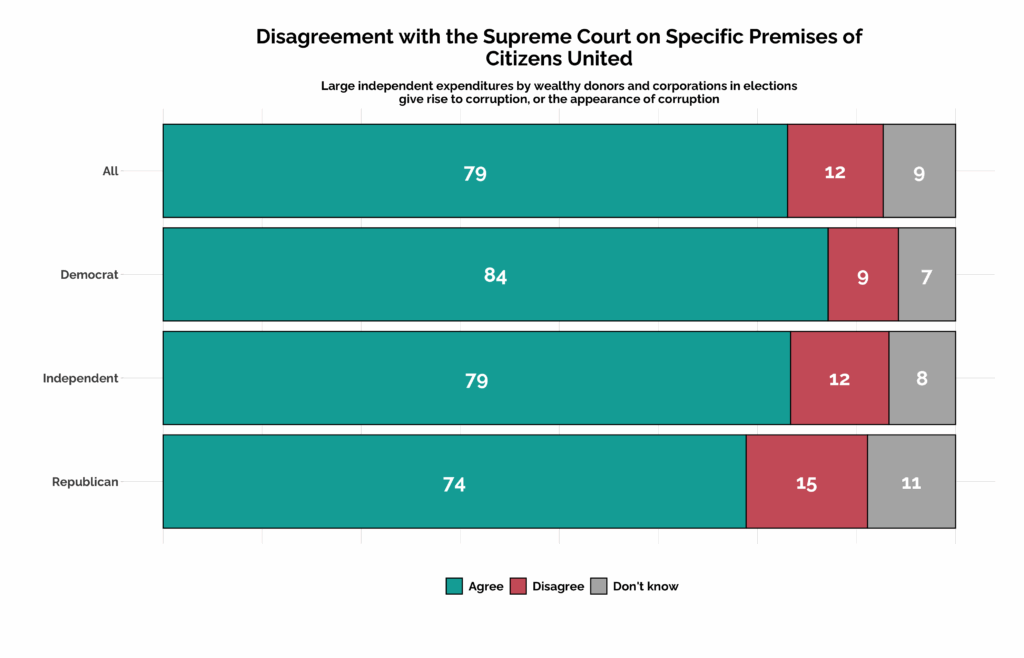 Source: YouGov national survey, Oct. 7-15, 2025
In response to these findings, Issue One Senior Research DirectorMichael Beckel, who oversaw the polling project, said: “Policymakers on both sides of the aisle should be tuning into the fact that overwhelming majorities of Americans across the political spectrum are alarmed by the huge sums being spent in elections by corporations, dark money groups, and wealthy donors.”
Beckel continued: “These findings fly in the face of two of the key assumptions that the U.S. Supreme Court made 15 years ago in Citizens United, namely that independent expenditures do not give rise to corruption or the appearance of corruption, and secondly, that the appearance of influence or access would not cause the electorate to lose faith in democracy. These perceptions of corruption are corrosive to the foundation of our democracy. Our political system cannot function if the public assumes the government is for sale to the highest bidder.”
Added Issue One Policy LeadLiana Keesing: “Montanans are sending a clear message that echoes around the country: Our democracy should be owned by voters, not bought by the wealthy few. These new findings show that people in every corner of the state — and across party lines — want a government that works for all of us, not just those with the deepest pockets. The proposed ballot measure is a bold, practical step toward restoring trust in our political system by ensuring that elections reflect the voices of citizens, not corporate interests. If Montana succeeds, it won’t just reform its own laws; Montanans can pave a path for states across the nation that want to reclaim democracy for the people.”
In Montana, Issue One’s new poll found that nearly 3 in 4 Montanans (74%) — including 84% of Democrats, 69% of Republicans, and 64% of independents — would vote in favor of this proposed ballot measure to eliminate corporate and dark money spending in elections by amending state law governing corporate charters, compared to only 11% opposed.
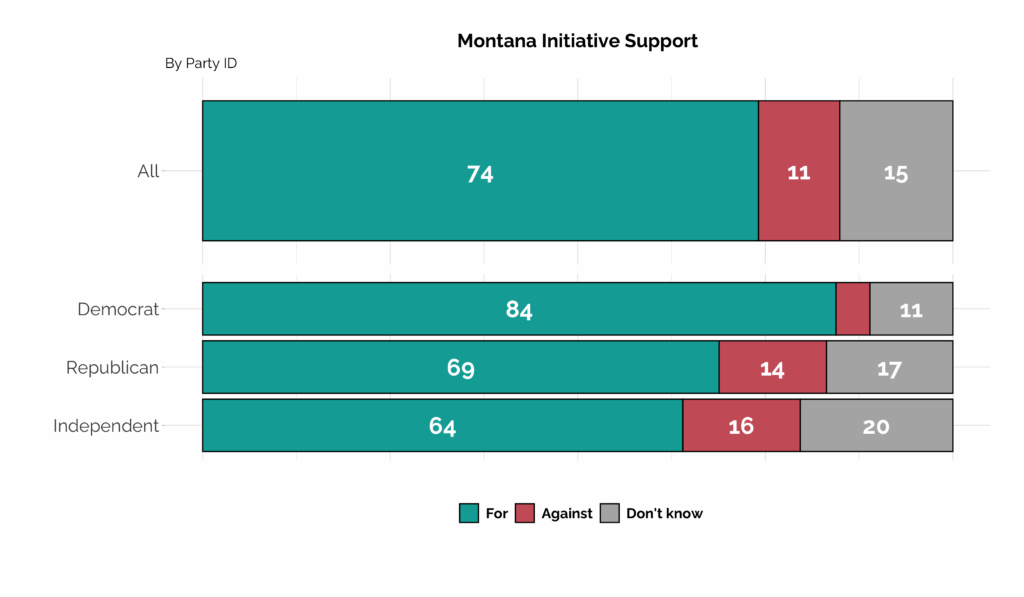 Source: YouGov survey of Montana voters, Oct. 7-20, 2025
Nationally, Issue One’s poll tested a comparable proposal — asking voters how they would respond if a similar measure were considered in their own state. Support was nearly as strong, with 72% of Americans said they would support such a reform, compared to only 12% opposed, after respondents were exposed to messaging from both supporters and opponents. That included support from 81% of Democrats, 64% of Republicans, and 60% of independents.
These high levels of support persisted even when voters were reminded that proposed reforms to curb corporate and dark money spending in elections could apply to their own preferred groups, or raise free speech concerns.
Other key findings from these two polls included:
- 77% of Americans — including 84% of Democrats, 70% of Republicans, and 78% of independents — agreed that anti-corruption rules strengthen our democracy and constitutional rights by ensuring everyone has equal political representation, regardless of money.
- 75% of Americans — including 84% of Democrats, 65% of Republicans, and 73% of independents — said unlimited spending in elections makes our democracy weaker because it gives wealthy special interests too much influence over elected officials. Only 13% of Americans said unlimited spending by people and organizations makes our democracy stronger by protecting the constitutional right to free speech.
- 73% of Americans — including 81% of Democrats, 67% of Republicans, and 71% of independents — agreed that “if a wealthy donor or corporation gains influence over or access to an elected official, I consider that official to be corrupt.”
- 69% of Americans — including 76% of Democrats, 61% of Republicans, and 64% of independents — believe that technology and social media companies have too much influence in politics.
- 63% of Americans — including 73% of Democrats, 53% of Republicans, and 61% of independents — disagreed with the Supreme Court’s Citizens United decision that corporations and labor unions have a First Amendment right to spend unlimited money to influence elections.
- 72% of Montanans — including about 70% of both Democrats and Republicans — continued to support the ballot initiative passed by roughly 75% of voters in 2012 that established a state policy that corporations are not entitled to constitutional rights, such as First Amendment free speech rights, because they are not human beings.
Read the toplines, crosstabs, and interested parties’ memo prepared by YouGov for Issue One’s national poll.
Read the toplines, crosstabs, and interested parties’ memo prepared by YouGov for Issue One’s Montana poll.
===
AN 12 25 ROBT R -->>
Not the least, we must get big money out of politics — to end the bribes and corruption that have distorted capitalism for the benefit of a handful of people at the top. (Here’s a way to do it.)
*Robert Reich is a professor of public policy at Berkeley and former secretary of labor. His writings can be found at https://robertreich.substack.com/.*
REF NOV
Several of you responded to my “Sunday thought” yesterday by saying that the first step out of the mess we’re in is to get rid of the Supreme Court’s bonkers Citizens United v. Federal Election Commissiondecision of 2010, which held that corporations are people — entitled to the same First Amendment protection as the rest of us.
Corporate political spending was growing before Citizens United, but the decision opened the floodgates to the unlimited super PAC spending and undisclosed dark money we suffer from today.
Between 2008 and 2024, reported “independent” expenditures by outside groups exploded by more than 28-fold — from $144 million to $4.21 billion. Unreported money also skyrocketed, with dark money groups spending millions influencing the 2024 election.
Most people I talk with assume that the only way to stop corporate and dark money in American politics is either to wait for the Supreme Court to undo Citizens United(we could wait a very long time) or amend the U.S. Constitution (this is extraordinarily difficult).
But there’s another way! I want to tell you about it because there’s a good chance it will work.
It will be on the ballot next November in Montana. Maybe you can get it on the ballot in your state, too.
Here’s the thing: Individual states — either through their legislators or their citizens wielding ballot initiatives — have the authority to limit corporate political activity and dark money spending, because they determine what powers corporations have.
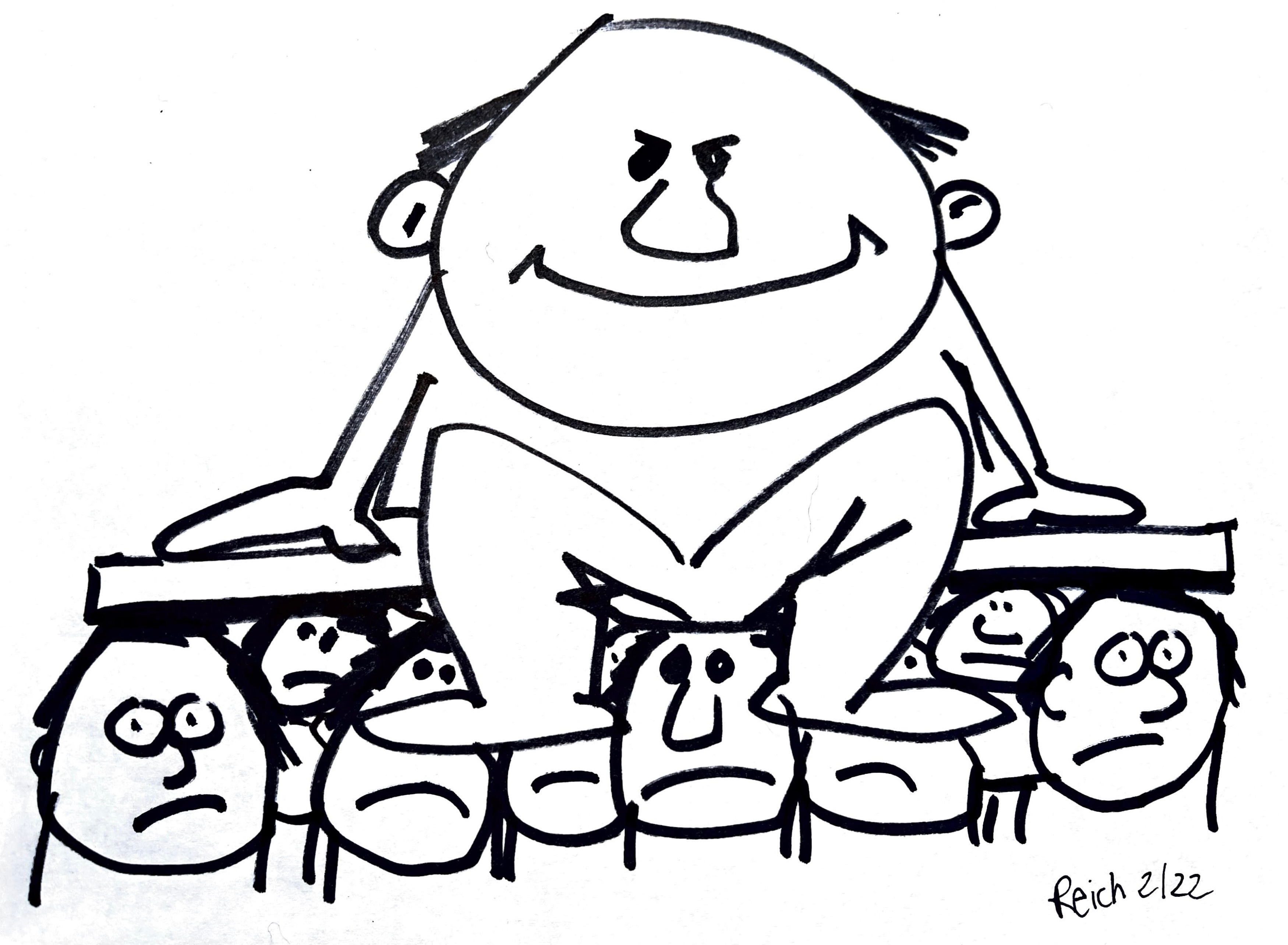
In American law, corporations are creatures of state laws. For more than two centuries, the power to define their form, limits, and privilege has belonged only to the states.
In fact, corporations have no powers at all until a state government grants them some. In the 1819 Supreme Court case Trustees of Dartmouth College v. Woodward,Chief Justice John Marshall established that:
“A corporation is an artificial being, invisible, intangible, and existing only in contemplation of law. Being the mere creature of law, it possesses only those properties which the charter of its creation confers upon it, either expressly, or as incidental to its very existence….The objects for which a corporation is created are universally such as the government wishes to promote. They are deemed beneficial to the country; and this benefit constitutes the consideration, and, in most cases, the sole consideration of the grant.”
States don’thaveto grant corporations the power to spend in politics. In fact, they could decidenotto give corporations that power.
This isn’t about corporate rights, as the Supreme Court determined in Citizens United. It’s about corporate powers.
When a state exercises its authority to define corporations as entities without the power to spend in politics, it will no longer be relevant whether corporations have a right to spend in politics — because without the power to do so, the right to do so has no meaning.
Delaware’s corporation code already declines to grant private foundations the power to spend in elections.
Importantly, a state that no longer grants its corporations the power to spend in elections also denies that power to corporations chartered in the other 49 states, if they wish to do business in that state.
All a state would need to do is enact a law with a provision something like this:
“Every corporation operating under the laws of this state has all the corporate powers it held previously,exceptthat nothing in this statute grants or recognizes any power to engage in election activity or ballot-issue activity.”
Sound farfetched? Not at all.
In Montana, local organizers have drafted and submitted a constitutional initiative for voters to consider in 2026 — the first step in a movement built to spread nationwide. It would decline to grant to all corporations the power to spend in elections.
Called the Transparent Election Initiative, it wouldn’t overturn Citizens United — it would negate the consequences of Citizens United. (Click on the link and you’ll get the details.)
The argument is laid out in a paper that the Center for American Progress published several weeks ago. (Kudos to CAP and the paper’s author, Tom Moore, a senior fellow at CAP who previously served as counsel and chief of staff to a longtime member of the Federal Election Commission.)
Note to governors and state legislators: The Citizens United decision is enormously unpopular. Some 75 percent of Americans disapprove of it. But most of your governors and state legislators haven’t realized that you have the authority to make Citizens United irrelevant. My recommendation to you: Use that authority to rid the nation of Citizens United.
Hopefully, Montanans will lead the way.
---
mta nat’l plan zoom 11 21 25 is 1/2 loaf?
Support _Corporate Power Reset_ in one or more states (i.e. the “Montana Plan”)
the-corporate-power-reset-that-makes-citizens-united-irrelevant
Promoted by the Center for American Progress, the Corporate Power Reset is a
strategy that seeks to limit corporate and "dark money" in politics by having states amend their corporate laws to stop granting corporations the power to spend money in elections. It is not a federal plan, but rather a state-level approach that argues states have the sovereign authority to define corporate powers and can choose not to grant the power of political spending. Without the power, corporations can’t have the “right” to spend money in elections. This strategy aims to make the Citizens United ruling irrelevant by cutting off political spending at its source without needing a constitutional amendment.
There is currently an effort in Montana to gain signatures to plan an initiative on the ballot in November, 2026. Montana Move to Amend supports the initiative and its members are active in the campaign.
National Move to Amend will widely educate about the plan and explore with interested supporters in key states the options for organizing a campaign. Depending on the state and the ability to gain statewide organizational support, state legislatures could place the initiative on the ballot without having to organize a people’s-driven ballot initiative campaign.
_Positives to working on this project_
- Move to Amend supporters has a history of educating on how corporate charters were used to define and authorize corporate actions
- Organizational energy is focused at the state level (i.e. state legislators, state-based organizations, state-based media, etc) rather than at the federal level
- Enacting a state constitutional amendment is more achievable that passing a federal constitutional amendment
_Negatives to working on this project_
- It diminishes the likely energy directed at passing the We the People Amendment
- It only focuses on corporate First Amendment “free speech” rights, which would reinforce the perception that corporate constitutional rights only includes these rights.
- It's unknown whether the Montana Plan will be successful and upheld constitutionally. This calls into question whether a great deal of energy should be invested in other states until its fate is known.
---
JF SENT 10 25 ~ CU
ARTL: the-corporate-power-reset-that-makes-citizens-united-irrelevant
introducing-caps-plan-to-beat-citizens-united
oct event tester
undoing-citizens-united-and-reining-in-super-pacs
panel
Panel Discussion
CAP Senior Vice President for Structural Reform and Governance Ben Olinsky will moderate a conversation with Jeff Mangan, Sarah Haan, and Tom Moore about the national debut of a bold new approach that rewrites the rules of money in politics. The panelists will take questions at the end of the discussion.
Panelists
- [Jeff Mangan
Founder
Transparent Election Initiative](https://transparentelection.org/about "Jeff Mangan")
- [Sarah Haan
Sheridan Albert ’48 Professor of Law
Brooklyn Law School](https://www.brooklaw.edu/contact-us/haan-sarah/ "Sarah Haan")
- [Tom Moore
Senior Fellow, Democracy
Center For American Progress](https://www.americanprogress.org/people/tom-moore/ "Tom Moore")
Moderator
- [Ben Olinsky
Senior Vice President, Structural Reform and Governance; Senior Fellow
Center For American Progress](https://www.americanprogress.org/people/olinsky-ben/ "Ben Olinsky")
---
Billionaires including Mark Cuban are backing a high stakes legal plot to destroy Citizens United
- 85% of top news content creators are men, Dare Market, AI podcast clones, frontal lobe breakups, AI generated Billboard hits, Curtis Silwa's babygirlification, PewDiePie vibe coding, racist TikToks
| Taylor Lorenz | Nov 3 | ∙ | Preview |
mta 8 25
john rob
Transparent Election Initiative - Our Fight Against Corporate Money in Politics
The Montana Plan, a breakthrough legal strategy, will stop corporate and dark money cold. It's how Montanans will beat Citizens United and take back our politics. Learn about what it is and how it's headed toward Montana's 2026 ballot. Montana can do it, and your state can too!