CITIZENS UNITED CASE 2
10 21 sparked by thom
cu tag
NO MERRI
SEE SYMPTOM SYS DEGRADATION WHO BRKE AMERICA ROBERTS
SEE MONTANA PLAN HAWAII // MAINE LESSIG
see montana CU do-over = ATP v Bullock 2012
see dark money superpacs
see amicus koch
see ohio first energy bribery
5-4 ~ breyer
THE dissenting opinion by Justice Stevens[39] was joined by Justice Ginsburg, Justice :{Breyer, and Justice Sotomayor}:
bad format? fonts?size/
text bak 8 23
dick morris 30 sec ad
SEE ~ PUBLIC CITIZEN BRENNAN CTR
---
introducing-caps-plan-to-beat-citizens-united
---
amicus koch
Supreme Court Justices Antonin Scalia and Clarence Thomas have attended these events. (According to Salon, "Thomas claimed he just made "a brief drop-by" at the Koch brothers' January 2008 Palm Springs political retreat to give a talk; in fact he was reimbursed for four days of “transportation, meals and accommodations” by the Federalist Society.[56]"). The attendance of Thomas and Scalia has sparked debate over judicial ethics and the2010Citizens United decision.[57] Common Cause filed a petition with the Justice Department in January 2011 alleging a conflict of interest for these Justices, as David and Charles Koch operate foundations that contribute to political groups, which might benefit from relaxed campaign finance rules. ^[58] Common Cause has also noted that the Cato Institute, which Charles Koch founded, filed an amicus brief in Citizens United opposing campaign finance. ^[59] The Center for Competitive Politics also filed a brief in the case; the Center is headed by Bradley Smith, who is affiliated with the Institute for Humane Studies where Charles Koch is Chair of the board and funder. ^[60] SW ^koch ^ind
===
ALITO
SAID CU UNFAIRLY MALIGNED 7 26
---
:{NOTE JDV SCOTUS ON STUDENT DEBT AND :{CAMP FINANCE}:
(AP) — The Supreme Court on Tuesday erased limits on how much political parties can spend in coordination with candidates for Congress and president, striking down a federal election law that is more than 50 years old.
Prodded by a Republican-led lawsuit that includes Vice President JD Vance, the court’s six conservative justices were again in the majority of the latest decision that upended congressionally enacted limits on raising and spending money to influence elections. The court’s 2010 Citizens United decision opened the door to unlimited independent spending in federal elections.
The limits on party spending stem from a desire to prevent large donors from skirting caps on individual contributions to a candidate by directing unlimited sums to the party, with the understanding that the money will be spent on behalf of the candidate.
The Supreme Court had previously upheld the limits, in 2001.
But Justice Brett Kavanaugh, writing for the court, said that decision was wrong and should be overruled. “In short, constitutional text, history and precedent establish that the political-party coordinated-expenditure limits violate the First Amendment,” Kavanaugh wrote.
Justice Elena Kagan’s dissent for the three liberal justices said the court “ushers in untold harm” by enabling parties to funnel large contributions to individual candidates, far in excess of what donors can give those candidates directly.
National parties now will be able to make direct contributions to candidates’ campaigns,
The decision is likely to give Republicans at least a short-term boost because they maintain a sizable cash advantage over Democrats.
The Republican National Committee and its Senate and House campaign fundraising arms have dwarfed Democrats’ in the months before congressional elections where the GOP is defending narrow majorities in both houses.
At the end of May, the RNC reported having more than $125 million to spend, its highest-ever cash on hand total, according to its most recent Federal Election Commission filing in May. Meanwhile, the National Republican Senatorial Committee had more than $48 million on hand in its most recent report and the National Republican Congressional Committee had more than $81 million.
In the same period, the Democratic National Committee had $14.4 million on hand, while the Democratic Senatorial Campaign Committee had roughly $37 million and the Democratic Congressional Campaign Committee, roughly $73 million.
The Republican committees for House and Senate candidates filed the lawsuit in Ohio in 2022, joined by Vance, then a senator from Ohio, and then-Rep. Steve Chabot.
After President Donald Trump took office for his second term, the Federal Election Commission dropped its defense of the law and joined with Republicans in urging that it be overturned.
Democrats had called on the court to uphold the law, even though there is wide agreement that the spending limits have hurt political parties in an era of unlimited spending by other organizations.
Last year, the coordinated party spending for Senate races ranged from $127,200 in several states with small populations to nearly $4 million in California, the most populous state. For House races, the limits were $127,200 in states with only one representative and $63,600 everywhere else.
Entrenched divisions between liberal and conservative justices over campaign finance restrictions were on display when the court heard arguments in December.
“Every time we interfere with the congressional design, we make matters worse,” said Justice Sonia Sotomayor, a dissenter in Citizens United and the court’s other campaign money cases.
By contrast, Justice Samuel Alito, a member of the Citizens United majority, described the decision as “much maligned, I think unfairly maligned.” The effect of the decision was to ”level the playing field,” Alito said, by expanding the right to spend freely that had previously belonged only to media companies.
Associated Press writer Thomas Beaumont contributed to this report.
---
//
supreme-court-strikes-down-limits-political-party-spending-candidates
Press Release
Supreme Court Strikes Down Limits on Political Party Spending for Candidates
The Court finds that spending limits violate First Amendment, overriding Congress.
Contact: Sophia Lee, Media Contact, leesophia@nyu.edu, 646-925-8734
June 30, 2026
Today the Supreme Court ruled in National Republican Senatorial Committee v. Federal Election Commission that limits on the amount of money political parties can spend on candidates violate the First Amendment.
Michael Waldman, president and CEO at the Brennan Center for Justice at NYU Law, had the following reaction.
“Today’s campaign finance ruling is part of the Roberts Court’s 16-year drive to destroy anti-corruption laws. From Citizens United forward,these justices have ushered in an era of massive money in politics. If you don’t like the way the political system is working, blame the Supreme Court.
“Here, the Court again overrode the law passed by Congress, going against the wishes of the vast majority of the American public who want reasonable campaign finance limits. The questions at the heart of this case were for Congress to answer, not nine unelected justices.
“The Court’s campaign finance vendetta has given wealthy donors outsized influence, resulting in a fusion of private wealth and political power unseen since the Gilded Age. Public trust in our institutions is plummeting. Congress must act to curb corruption arising from the flood of money in elections and restore Americans’ faith in government. Ambitious reform is long overdue.”
Brennan Center resources
- Friend-of-the-Court Brief:“National Republican Senatorial Committee v. Federal Election Commission,” October 6, 2025
- Nine Solutions for Political Corruption, by Eric Petry, Daniel Weiner, and Joanna Zdanys, January 20, 2026
- “Poll: Voters Want Solutions for Government Corruption,” by Alex Brunet and Marina Pino, June 2, 2026
---
---
CPP CU SHADOW DOCKET; LEO 3 ACTUALLY KOCH?! END OF CLIMATE LEGIS
1 END LEGIS 2 REGULATION 3 LITIGATION
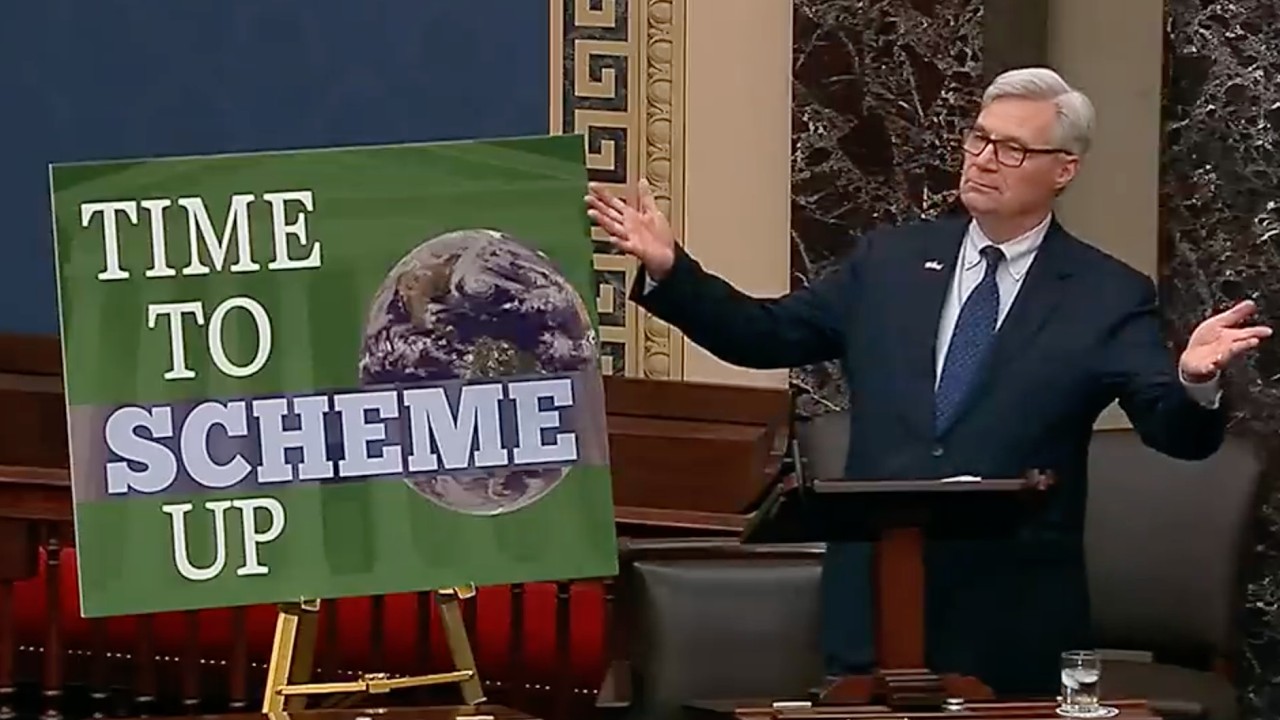
The Scheme Time to Wake Up | Senator Whitehouse's Speeches Converge
Apr 23, 2026
April 22 | Senator Sheldon Whitehouse (D-RI) delivers his 306th speech in his Time to Wake Up series, converging with his 36th Scheme speech. The billionaire-backed scheme to capture and control the Supreme Court was developed largely to protect the fossil fuel industry’s free-to-pollute business model. Here’s the proof.
---
---
NEW GRAVES BK 4 26
Apr 11, 2026
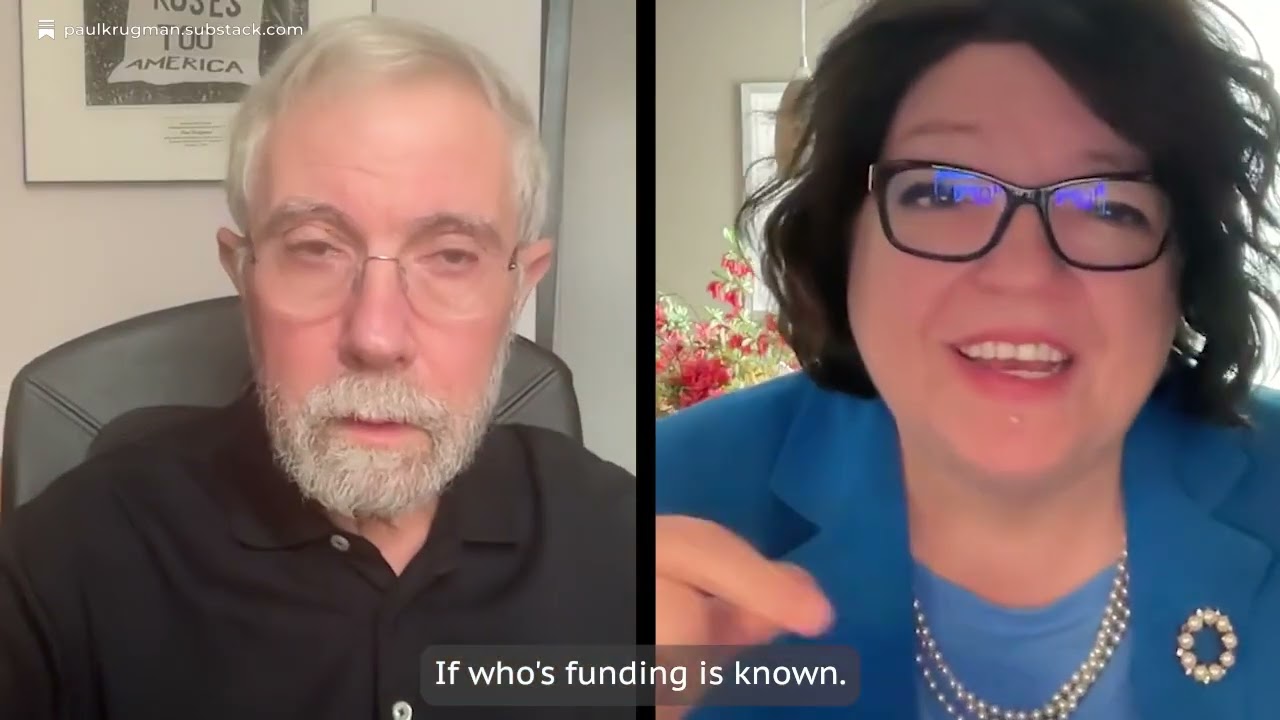
On the corruption of our politics — and the Supreme Court
bush v gore
CU
---
---
HAWAII MONTANA 4 21 26 ~ cu
---
---
root cause SYS DEGRAD SCOTUS CU an 1 26
gingrich lang memo--> POLARYSIS // CHECKS BALANCE SURRENDER
All of the dysfunction in Congress is coming from decisions that the U.S. Supreme Court ushered in, and it is completely changing the face of American government, a legal scholar explained.
Writing for The Atlantic on Tuesday, Stanford Law School fellow Duncan Hosie said that there are two key rulings that have resulted in the downfall of Congress.
"These dynamics share a root cause: the partisan polarization that has reshaped American politics over the past four decades," wrote Hosie. "But the connection is deeper and more complex than that. Whereas polarization weakened Congress, it emboldened the Court to dismantle laws and, in the process, undermine Congress’s ability to make laws at all, reinforcing Congress’s sclerosis."
The first began during the "Newt Gingrich revolution," he argued, with "rising partisanship and institutional upheaval."
Sorting members into "distant ideological camps and normalizing scorched-earth tactics" led to absolutist politics and made bipartisan politics for the greater good rare. Instead, ideological battles were launched with Supreme Court nominees with a litmus tests for partisan purity over reasonable interpretations of the law. Even justices below the High Court have become partisan as "Republican appointees began consolidating its authority at Congress’s expense."
Under Chief Justice John Roberts, Hosie said, the Court has canceled "congressional constitutionalism." Laws passed such as the Voting Rights Act, the Affordable Care Act, the Family and Medical Leave Act and campaign finance regulations have all be undermined by the Roberts cCurt.
The latter took a hit with a collection of decisions, such as Citizens United (2010), that "dismantled Congress’s two most significant efforts to regulate private money in public elections, eroding the safeguards that protect elections as conduits of public opinion," Hosie wrote.
There's a chance one case this year could make such issues even worse. The Roberts Court "dismantling" key laws "has left Congress more detached from its electorate, diminishing its claim and role as a representative authority."
Deregulating campaign finance laws has turned politics into such a huge undertaking that lawmakers and candidate spend more time trying to raise money than they do making direct contact with voters, conducting legislative oversight or fostering bipartisanship, the legal scholar said.
"Empiricalstudies confirm that reliance on large donors depresses participation in time-intensive legislative activities — things such as bill sponsorship, floor debate and committee work," Hosie wrote. "It simultaneously redirects lawmakers’ attention toward courting high-net-worth donors and away from talking to people in their districts."
The second issue is gerrymandering. Partisan legislatures draw maps that make congressional districts more one-sided. It then ensures that members of Congress appeal to the most extreme factions of their electorate.
Hosie called the court's ruling in "Rucho v. Common Cause (2019) [the most] entrenched electoral distortion in American politics. The Court has since doubled down. Last month, Justice Samuel Alito defended Texas’s gerrymandered maps on the grounds that they reflected 'partisan advantage pure and simple' — an unabashed apologia for a practice destructive to democracy."
Drawing congressional maps to craft "safe seats" means the ideologues win. That can "marginalize moderate voices," he explained. It reduces any incentive for compromise and accountability.
These rulings have ultimately reduced the power of Congress and expanded that of the judiciary branch that was meant to be equal under the Constitution. "Substantively, it has redefined what the Constitution forbids, preemptively removing entire policy domains from democratic deliberation before voters and lawmakers can even weigh in," Hosie closed.
---
===
mta email 1 26
january 16, 2026
WATCH: On Senate Floor, Kelly Leads Colleagues in Marking 16 Years Since Citizens United Ruling, Highlighting Impact of Big Money in Politics on Working Families
*“The loudest voices in Washington became billionaires, not every day Americans.”
In case you missed it, Arizona Senator Mark Kelly led a series of floor speeches with his colleagues marking the 16th ^anniversary of the Supreme Court’s Citizens United v. FEC decision, which opened the floodgates for big, dark money in our politics.
In their remarks, Kelly and his colleagues connected the rise of dark money and super PAC spending to real-world consequences for Americans, highlighting how unlimited corporate and billionaire spending has warped priorities in Washington and driven up costs for working families, underscoring the need to restore accountability and transparency so that our democracy answers to voters—not special interests.
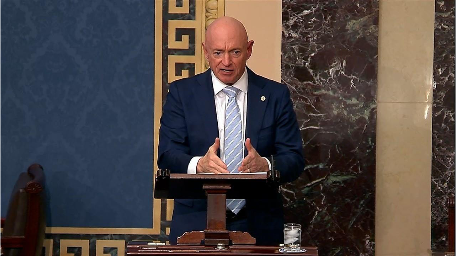
*Sen. Kelly speaks on Senate floor.
Watch Kelly’s full speech here. See key excepts from Kelly and his colleagues below:
*Sen. Kelly: “In 2010, the Supreme Court handed down a decision that put a ‘for sale’ sign on our democracy. The Citizens United ruling opened the door for corporations and billionaires to spend unlimited amounts of money to influence our elections, often without the public ever knowing who’s behind it. The Court decided that spending money in elections is the same as political speech, and that corporations should have the same political rights as individual Americans. The result was predictable – and it wasn’t limited to a courtroom. It changed how this place works. The loudest voices in Washington became billionaires, not every day Americans.
*Sen. Sheldon Whitehouse (D-RI): “I was here before the Citizens United decision. When robust meaningful bipartisan climate legislation was constant here in the Senate. I can think of four major bipartisan bills here in the Senate. And I remember my friend, John McCain, carrying the Republican banner into the presidential election with a respectable climate platform. Well, right after Citizens United, all of that stopped. The barrage of fossil fuel dark money into our politics killed bipartisanship on climate change instantly. It is still a problem today.”
*Sen. Jeff Merkley (D-OR): “The growth in dark money has been stunning because there’s so much money among the oligarchs and billionaires, they want to spend it to create laws that favor the oligarchs and billionaires and they are spending at an extraordinary rate. Six years ago, it was about $300 million, but according to the Brennan Center […] dark money hit a record high of $1.9 billion in the 2024 races. That’s a six-fold increase in six years. That’s the rich and powerful buying their government. It is an absolute travesty. No one in our founding community of our nation who wrote the Declaration of Independence, who wrote the Constitution, wanted to design a system where the mega rich ran the place as a cabal of elites. But that’s what we have and that’s what we have to change.”
*Sen. Amy Klobuchar (D-MN): “In the 2024 elections, secret money groups spent $1.9 billion – nearly double the amount spent just one cycle before. This undermines our democracy and shakes the public’s trust because unlimited, anonymous spending in our elections doesn’t encourage free speech – it drowns out the voices of American people who are seeking to participate. We must fight for a more transparent democracy where every voter’s voice is heard.”
*Sen. Andy Kim (D-NJ): “We live in the time of the greatest distrust in modern history. It doesn’t have to be this way. We can have a politics that restores and grows trust, instead of actively degrading it. This year is the 250th anniversary of the independence of our nation. This is our moment to free Americans from the influence of big money and give them their voice back in their democracy.”
*Sen. Cory Booker (D-NJ): “Since the Citizens United decision, I have watched how this body has seen clearly corrupt forces beginning to overrun the commonsense and the will of the people and policy, more and more be bent to the whim and the will of the wealthiest of the wealthy in our country, in the world, as well as corporations, many of them multinational corporations. We are in crisis. Our nation is in crisis. […] Trust is vital for a democracy to thrive. And there has been nothing more powerful in undermining that trust in the years I’ve been in the Senate that I’ve seen than the destructive force of money in our politics.”
*Sen. Dick Durbin (D-IL): “Under the current system that’s described by my colleagues on the floor, there is so much entrenched money that they virtually control the agenda and scare the living hell out of average individuals who don’t have a fortune to spend. And that’s the reality of what we face.”
*Sen. Chris Murphy (D-CT): “Individuals today make up to 16% of total spending in elections. 16%. 84% of all the spending in elections today are not done by citizens. 84% of spending are corporations and organizations. Much of that money is anonymous. You have no idea where that comes from. Let me tell you what the impact of that. The impact is corruption. Let’s just call it what it is.”
*Sen. Alex Padilla (D-CA): “Citizens United didn’t just change campaign finance law — it fundamentally altered our democracy. It was the moment where the voices of everyday Americans began to be drowned out by a small and powerful few, armed with unlimited money and unprecedented access. As Trump completely sidelines the Federal Election Commission — our country’s top campaign finance watchdog — we are entering a midterm election season with unlimited money allowed in our elections and a President who has regularly used the powers of the office to benefit his billionaire donors. I will continue to push my colleagues to enact legislation to overturn Citizens United so that our elections reflect the will of the people instead of corporations and the highest bidder.”
---
---
NO LNX
Republicans have been selling us these lies for four decades
Thom Hartmann January 29, 2026
Jack Smith’s testimony before Congress on Thursday was a master class at demonstrating how elected Republicans have become what psychiatrist and author M. Scott Peck termed People of the Lie, in his 1986 bestseller. It was the perfect example for this week being the 16th anniversary of the corrupt Citizens United decision.
For most of American history, lying in politics carried a real and immediate cost. Get caught and you’d lose credibility, maybe get voted out of office, and sometimes — as with the roughly 40 people around Richard Nixon who went to prison — even face criminal consequences.
That informal but effective enforcement mechanism depended on a shared understanding that truth mattered and that the law applied equally to everyone. Five corrupt, on-the-take Republicans on the Supreme Court, however, shattered that understanding when they handed down Citizens United.
By redefining political bribery as “free speech,” Justices Thomas, Roberts, Alito, Kennedy, and Scalia turned money into power without accountability and, in the process, turned lying into a currency that could be minted, traded, and hoarded by unscrupulous Republican politicians.
Once political power could be bought openly, the incentive structure in American politics changed. The goal of today’s GOP’s is no longer persuasion grounded in reality; instead, it’s morphed into a sophisticated system of lies and half-truths.
With social media amplification and backed up by a billionaire-owned rightwing media machine larger than any the world’s ever seen, the bigger the lie, the more emotionally gripping it is, and the faster and farther it’d travel, the more useful it became to Republicans. Lying stopped being a moral failing and became the foundation of their business and political model.
When a Republican politician can raise money, mobilize voters, intimidate opponents, or justify cruelty with a falsehood, that lie pays for itself with huge political, power, and even economic dividends. Truth, by contrast, became a liability as we saw Republican after Republican try to discredit or shut up Jack Smith, in the service of the Party’s 2020 “election fraud” lie.
The GOP has become so addicted to lies that its members can’t even say out loud the actual name of the Democratic Party, instead falling back on Joe McCarthy’s advice that “‘democratic’ sounds too nice” and instead Republicans should always “call it the Democrat Party, with an emphasis on the ‘rat’!” If you don’t know what I mean, just listen to the Republicans who appear on the Sunday political shows. And, sadly, Democrats and news people don’t even bother to call them out any more.
That’s the context in which the testimony by Smith must be understood. What we watched wasn’t just a partisan disagreement; it was an embarrassingly public demonstration of how deeply-monetized lying has woven itself into the Republican Party’s operating system, even before a pathological liar became the party’s standard-bearer.
Smith calmly laid out the facts and legal standards, and Republican members responded by repeating b------- narratives that have already been disproven in scores of courtrooms, in sworn testimony, and on the public record.
They accused him of “weaponizing” the Justice Department despite the fact that his investigations relied heavily on Republican witnesses (he didn’t have a single Democratic witness on his lists for his proposed prosecutions of Trump) and followed long-established prosecutorial rules.
Republicans desperately tried to frame routine subpoenas and phone metadata requests as “spying,” knowing full well those tools are standard operations in any serious criminal investigation.
They minimized or redirected responsibility for January 6 while Smith stated plainly that Donald Trump caused it and then set out to exploit the violence to keep himself in power.
They substituted grievance, character assassination, and personal insult for engaging with the evidence, turning the hearing into material for their fundraising emails and “sharable” or “viral” cable news clips rather than a serious attempt to find the truth.
Those moments illustrate the multiple layers of the lies Republicans have been selling us for four decades, as well as the new ones Trump is trying to get away with. They’re lying to the public about what the law allows, lying about what the evidence shows, lying about how investigations work, lying to delegitimize any person or institution that threatens their power, and lying to base voters who’ve been trained to accept the lies as gospel.
Each of those lies has value; each can be cashed in for attention, money, or even political or legal protection.
This poisoning of the GOP and its base didn’t start with Trump or on January 6.
For four decades, Republicans have lied relentlessly about taxes, promising that tax cuts for billionaires would lift working families even as wages stagnated and wealth exploded at the top.
They lied about “free trade,” insisting it would empower workers while entire communities were hollowed out and then told their suffering was just some weird but inevitable force of economic nature.
They lied about unions, portraying them as corrupt or obsolete while quietly celebrating the theft of power from labor to capital.
They lied about monopolies, calling consolidation “efficiency” while prices rose, competition vanished, and the average American family is spending $5,000 a year more than necessary because of this “monopoly tax.”
They lied about deregulation, dismissing pollution and climate damage as imaginary or exaggerated while entire communities paid the health and environmental costs and thousands lose their homes every year.
They lied about immigrants, claiming they were more likely to be criminals than American citizens when the opposite is true.
They lied about fossil fuel subsidies, calling them “energy security” while gutting green projects that threatened entrenched Republican donors.
The White House even lied about a protestor, editing her picture with AI to make it look like she was crying when arrested when the opposite was the case.
Every one of those lies followed the same pattern: ignore the data, attack the messengers, repeat the talking point, and cash the check.
Citizens United — which came into being when Clarence Thomas, himself on the take from a rightwing Nazi-memorabilia-collecting billionaire with business before the Court, became the deciding vote — supercharged that cycle. As a result, billionaires can now pour unlimited money into politics, teaching Republican politicians which stories are rewarded and which are punished.
With corruption having become the underlying foundation of the GOP, lying became not just acceptable but necessary. Telling the truth about inequality, climate change, immigration, corporate power, Trump’s crimes, the state of our health care system, or even democracy itself threatens the party’s revenue stream.
What made yesterday’s hearing so particularly revealing is that it showed how normalized lying has become for GOP politicians.
The Republican inquisitors evinced no embarrassment, no hesitation, and didn’t even attempt to reconcile their own claims with any of the known facts. The lies were delivered as ritual, as tribal identity markers, as proof of belonging. As we saw in Germany in the 1930s and the USSR in the mid-20th century, this is what happens when a political party internalizes lying as a political strategy.
M. Scott Peck warned decades ago that social systems built on lies eventually lose the capacity to distinguish reality from fantasy, loyalty from morality, or raw power from truth. We’re watching his 1986 warning play out in real time.
From the Reagan Revolution and his massive tax cuts to George W. Bush sending our young men and women off to Iraq and Afghanistan to Donald Trump pushing his claim he won 2020, when lying is rewarded by billionaire donors, complicit media, and with gullible voters, it doesn’t stay confined to campaign ads. It metastasizes through institutions, corrodes accountability, and turns governance into mere theater.
Citizens United didn’t just corrupt elections: it corrupted truth itself. And until we reverse it, until we restore the idea that democracy isn’t for sale and reality isn’t optional, lying will remain the most profitable commodity in Republican politics.
And our country will be forced to continue paying the price.
---
---
sutter 1 26
New polling illuminates how the Supreme Court got Citizens United wrong and shows bipartisan momentum for money-in-politics reforms, including proposed Montana ballot measure
Oct 28, 2025
Media Contact
Cory Combs
Director of Media Relations
- 202-204-8553
- media@issueone.org
New polling commissioned by Issue One and conducted this month by YouGov reveals that overwhelming majorities of Americans — and Montanans — broadly believe that large-scale political spending by corporations, dark money groups, and wealthy donors undermines democracy, creates the appearance of corruption, and reduces trust in government.
The results show that voters across the political spectrum, both nationally and in Montana specifically, reject key assumptions made by the U.S. Supreme Court in its controversial 2010 decision Citizens United v. Federal Election Commission, which unleashed a deluge of big money in elections.
Montanans were polled because a new proposed 2026 ballot measure would eliminate corporate and dark money spending in elections by amending state law governing corporate charters.
Overall, Issue One’s new poll found that nearly 8 in 10 Americans (79%) agreed that large independent expenditures (the technical name for political ads that are not coordinated with a candidate) by wealthy donors and corporations in elections give rise to corruption or the appearance of corruption. This included 84% of Democrats, 74% of Republicans, and 79% of independents.
Relatedly, more than 3 in 4 Americans (76%) — including 84% of Democrats, 68% of Republicans, and 77% of independents — agreed that “the appearance of wealthy donors or corporations gaining influence over or access to elected officials causes me to lose faith in this democracy.”
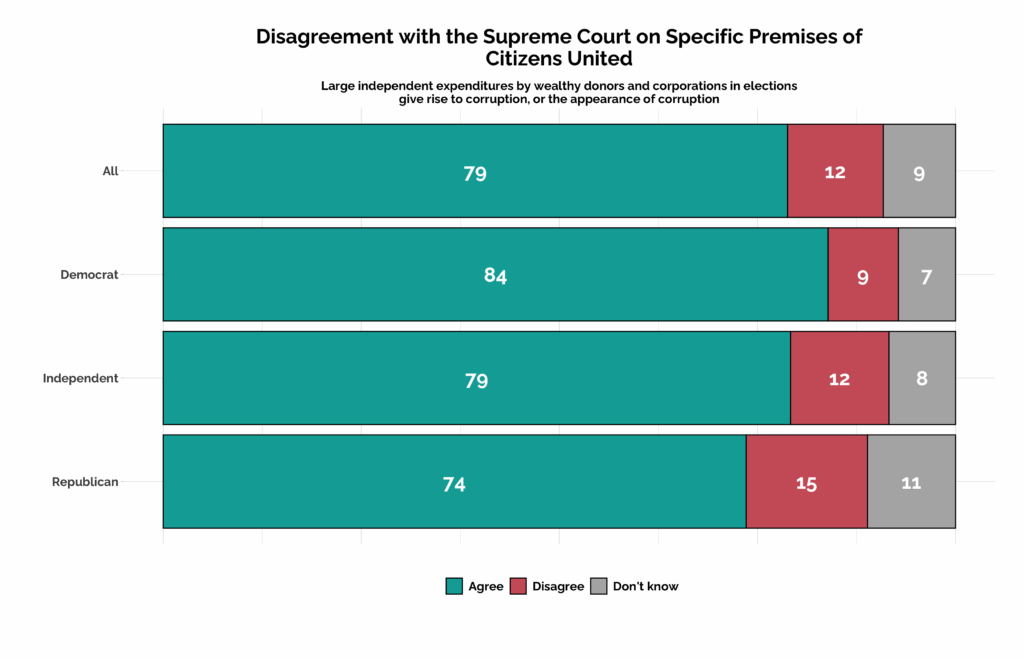 Source: YouGov national survey, Oct. 7-15, 2025
In response to these findings, Issue One Senior Research DirectorMichael Beckel, who oversaw the polling project, said: “Policymakers on both sides of the aisle should be tuning into the fact that overwhelming majorities of Americans across the political spectrum are alarmed by the huge sums being spent in elections by corporations, dark money groups, and wealthy donors.”
Beckel continued: “These findings fly in the face of two of the key assumptions that the U.S. Supreme Court made 15 years ago in Citizens United, namely that independent expenditures do not give rise to corruption or the appearance of corruption, and secondly, that the appearance of influence or access would not cause the electorate to lose faith in democracy. These perceptions of corruption are corrosive to the foundation of our democracy. Our political system cannot function if the public assumes the government is for sale to the highest bidder.”
Added Issue One Policy LeadLiana Keesing: “Montanans are sending a clear message that echoes around the country: Our democracy should be owned by voters, not bought by the wealthy few. These new findings show that people in every corner of the state — and across party lines — want a government that works for all of us, not just those with the deepest pockets. The proposed ballot measure is a bold, practical step toward restoring trust in our political system by ensuring that elections reflect the voices of citizens, not corporate interests. If Montana succeeds, it won’t just reform its own laws; Montanans can pave a path for states across the nation that want to reclaim democracy for the people.”
In Montana, Issue One’s new poll found that nearly 3 in 4 Montanans (74%) — including 84% of Democrats, 69% of Republicans, and 64% of independents — would vote in favor of this proposed ballot measure to eliminate corporate and dark money spending in elections by amending state law governing corporate charters, compared to only 11% opposed.
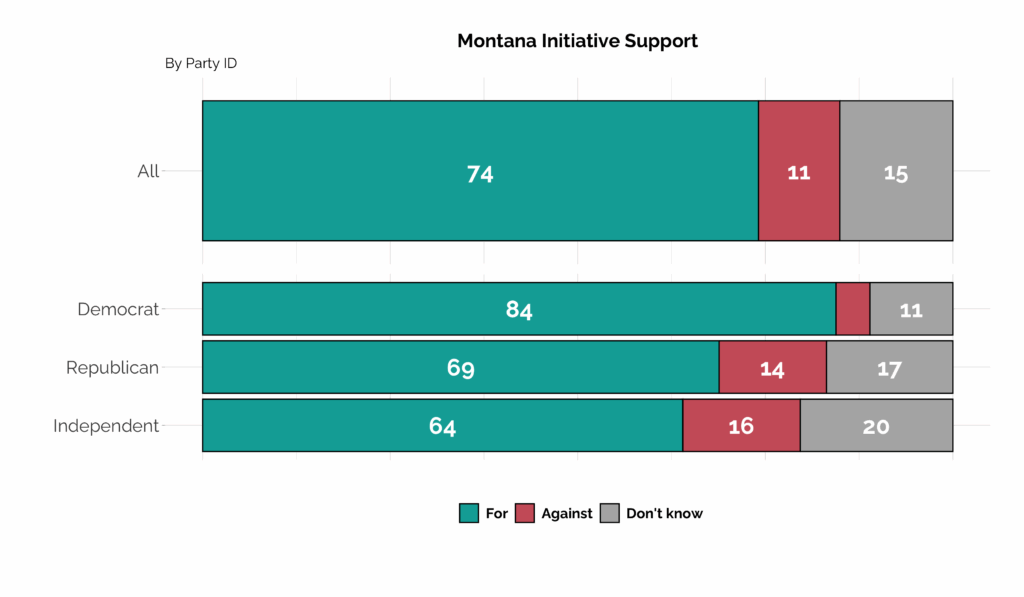 Source: YouGov survey of Montana voters, Oct. 7-20, 2025
Nationally, Issue One’s poll tested a comparable proposal — asking voters how they would respond if a similar measure were considered in their own state. Support was nearly as strong, with 72% of Americans said they would support such a reform, compared to only 12% opposed, after respondents were exposed to messaging from both supporters and opponents. That included support from 81% of Democrats, 64% of Republicans, and 60% of independents.
These high levels of support persisted even when voters were reminded that proposed reforms to curb corporate and dark money spending in elections could apply to their own preferred groups, or raise free speech concerns.
Other key findings from these two polls included:
- 77% of Americans — including 84% of Democrats, 70% of Republicans, and 78% of independents — agreed that anti-corruption rules strengthen our democracy and constitutional rights by ensuring everyone has equal political representation, regardless of money.
- 75% of Americans — including 84% of Democrats, 65% of Republicans, and 73% of independents — said unlimited spending in elections makes our democracy weaker because it gives wealthy special interests too much influence over elected officials. Only 13% of Americans said unlimited spending by people and organizations makes our democracy stronger by protecting the constitutional right to free speech.
- 73% of Americans — including 81% of Democrats, 67% of Republicans, and 71% of independents — agreed that “if a wealthy donor or corporation gains influence over or access to an elected official, I consider that official to be corrupt.”
- 69% of Americans — including 76% of Democrats, 61% of Republicans, and 64% of independents — believe that technology and social media companies have too much influence in politics.
- 63% of Americans — including 73% of Democrats, 53% of Republicans, and 61% of independents — disagreed with the Supreme Court’s Citizens United decision that corporations and labor unions have a First Amendment right to spend unlimited money to influence elections.
- 72% of Montanans — including about 70% of both Democrats and Republicans — continued to support the ballot initiative passed by roughly 75% of voters in 2012 that established a state policy that corporations are not entitled to constitutional rights, such as First Amendment free speech rights, because they are not human beings.
Read the toplines, crosstabs, and interested parties’ memo prepared by YouGov for Issue One’s national poll.
Read the toplines, crosstabs, and interested parties’ memo prepared by YouGov for Issue One’s Montana poll.
Issue: Dark Money & Super PACs
---
September 17, 2025
NEWS: Sen. Schiff, Reps. Neguse, McGovern, and Lee Introduce Constitutional Amendment to Overturn Citizens United
On Constitution Day, lawmakers resume push to ensure Congress and states can set reasonable limitations on political spending and influence by corporations on U.S. elections
Washington, D.C. — Today, U.S. Senator Adam Schiff (D-Calif.) and U.S. Representatives Joe Neguse (D-Colo.-02), Jim McGovern (D-Mass.-02), and Summer Lee (D-Pa.-12) introduced the Citizens Over Corporations Amendment, a proposed amendment to the U.S. Constitution that would overturn Citizens United v. FECand limit corporate influence and spending in American politics.
“The Supreme Court’s decision in Citizens United opened the door for corporations to pour billions of dollars of dark money into elections. This anonymous and unrestricted spending cripples transparency in the political process and weakens our democracy. Our amendment will keep big money out of politics and restore power where it should belong — with the American people,” said Senator Schiff.
“The time to confront political corruption and clean up government is now,” said Congressman Neguse.“The Citizens Over Corporations Amendment works to renew people’s faith in our democracy by ensuring transparency through campaign finance reform and preventing unrestrained spending and dark money in elections.”
“Elon Musk poured millions into electing Donald Trump and then used the influence he bought to fire federal workers, dismantle USAID, and strip health care from millions,” said Congressman McGovern. “Citizens United gives billionaires like Musk even more power to rig the system for the well-off and well-connected. That’s not a democracy—it’s an auction. I’m proud to support the Citizens Over Corporations Amendment, which will overturn Citizens United, get big money out of politics, and put power back where it belongs—in the hands of the people.”
“Some say the beginning of the collapse of our democracy was when the Supreme Court ruled in favor of Citizens United, giving the green light to corporations and billionaires to pour hundreds of millions into our elections and drown out the voices of everyday people. At the root of why we cannot make progress on so many urgent policies is a system where money speaks louder than people. The Citizens Over Corporations Amendment is about changing that. It is about putting power back where it belongs, with the people, so we can build a government that works for all of us, not just the wealthy few and their corporate interests,”said Congresswoman Lee.
Senator Schiff has introduced his constitutional amendment in the U.S. House of Representatives to overturn Citizens Unitedsince 2013 and has been a strong proponent of fixing America’s broken campaign finance system since he was first elected in 2000, after a race that was at the time the most expensive in the history of the House of Representatives. The first bill he cosponsored in Congress was the bipartisan McCain-Feingold Act to regulate the financing of political campaigns, which was later passed and signed into law.
The proposed Constitutional amendment will:
- Make clear the Constitution does not restrict the ability of Congress or states to set reasonable, viewpoint-neutral limitations on the raising and spending of money by candidates and others to influence elections
- Distinguishes between natural persons, corporations, or other artificial entities, including by allowing Congress or the State to prohibit such entities from spending money to influence elections
- Allow public financing of campaigns when states choose to enact such laws, which can restrict the influence of corporate or private wealth = public fund election
- Take further steps to protect the freedom of the press in the case of future campaign finance-related legislation
Earlier today, Senator Schiff and lawmakers rallied for Constitution Day to underscore the need to protect our democracy and curb influence by special interests on American politics. At the rally, Schiff highlighted his proposed amendment reversing the 2010 Supreme Court ruling that ended restrictions on corporate campaign spending, eliminating decades of legal precedent.
The Senator’s full remarks at the rally can be viewed.Schiff’s remarks can be downloaded here.
The bill is co-sponsored by U.S. Senators Jeanne Shaheen (D-N.H), Angus King (I-Maine), Peter Welch (D-Vt.), Sheldon Whitehouse (D-R.I.), Andy Kim (D-N.J.), and Cory Booker (D-N.J.).
The bill is endorsed by Citizens for Responsibility and Ethics in Washington, Democracy Defenders Action, Public Citizen, End Citizens United, People for the American Way, Common Cause, and Free Speech For People.
“Since the Supreme Court’s decision in Citizens United v FEC 15 years ago, unlimited and untraceable money has flowed from the pockets of corporations and the ultra-wealthy into political campaigns”,said Stuart McPhail, Director of Campaign Finance Litigation, Citizens for Responsibility and Ethics in Washington (CREW). “In the 2024 federal election cycle alone, over $2.7 billion was funneled through super PACs to various political campaigns. This dark money corrodes our democracy by allowing corporations and billionaires to hide their identities while greatly influencing elections and policy. CREW is proud to endorse the constitutional amendment introduced by Senator Schiff and Representatives Neguse, McGovern, and Lee to overturn Citizens United and ensure that the voices of average citizens are not drowned out by moneyed interests.”
“Democracy Defenders Action wholeheartedly endorses Sen. Adam Schiff and Reps. Joe Neguse, Jim McGovern, and Summer Lee’s constitutional amendment to overturn Citizens United,” said Virginia Canter, Ethics and Anticorruption Chief Counsel and Director, Democracy Defenders Action. “This crucial step will ensure that all Americans, not just the super-rich and corporations, have an equal voice in our elections–and true representation in our democracy.”
“Citizens United has turned our democracy into a government that serves the ultra-wealthy. Political spending by billionaires has surged an astonishing 160-fold since the 2010 Supreme Court decision, and working families are paying the price like never before as self-enriching politicians bankroll tax breaks for their biggest donors. Senator Schiff’s amendment is a bold and commonsense step to reclaim government for the people. We applaud his leadership to challenge the billionaire class, fight corruption in Washington, and get Big Money out of politics,” said Tiffany Muller, President, End Citizens United.
“Citizens United destroyed our nation’s safeguards against the undue influence of money in politics. For 15 years now, dark money has flowed freely, allowing the rich and powerful even more influence over our elections. This amendment is essential to preventing that continuing assault on the integrity of our elections. People For the American Way is proud to support this amendment as we work toward building a democracy truly of, by, and for the people,” said Svante Myrick, President, People For the American Way.
“The vast majority of Americans want the real voices of real people to matter more than the money that corporations and the super-rich funnel into our political system. The devastating Citizens United decision 15 years ago dramatically altered the landscape of our politics—unleashing a flood of cash and deepening the outrage that regular people feel at the inequities baked into our democracy. We must overturn this decision. Senator Schiff, and Reps. Joe Neguse, Jim McGovern, and Summer Lee have remained focused and continue pushing for a constitutional amendment to do just that. Public Citizen strongly supports their efforts,” said Lisa Gilbert, Co-President, Public Citizen.
A fact sheet on the legislation can be foundhere.
Full text of the bill is availablehere.
---
comm dr an 9 25
The first nine months of the Trump administration provide ample evidence of how much ground it has covered—or more fittingly, ravaged? We may, in fact, be running out of hyperbole to describe the magnitude of the impact.
Multiple actions, abetted by acquiescence from those who should not be acquiescing, are collectively changing our form of governance, the character of our nation, and our way of life.
Here is a considered top ten. Presenting them all in one blast emphasizes that the challenges we face at this moment are more daunting than anyone could have imagined 10 months ago.
Many of the actions on the list have been noted individually, analyzed and documented at length in various publications. I believe it useful to view them all together and ask whether anything can be done to slow down the juggernaut.
- Failure of US Congress to serve as a check and balance on President Donald Trump’s overreaches of executive authority;
- The Supreme Court’s submissiveness in the face of the president’s destruction of major governmental institutions;
- The Executive’s unchecked attempts to undermine the independence of regulatory entities including the Federal Reserve, the Federal Trade Commission, and the Federal Communications Commission;
- The president’s arbitrary and capricious downsizing of the civil service, diminishing the federal government’s capacity for competent, ethical, and well-managed operations;
- The erosion of a viable two-party system in this country, whereby two loosely structured political bodies argue fairly and reasonably about proper courses of action for the nation. We now have one remaining party, the Democrats, faced off against a propagandist machine that hides behind the label “conservative,” but spends most of its energy spouting untruths;
- The caving of an array of university leaders and media moguls to blackmail schemes foisted on them by an administration that arbitrarily withholds funds allocated by Congress;
- A series of presidential actions in patent violation of the Constitution, notably trampling citizens’ right of free speech and the constitutional mandate on the separation of church and state;
- The denigration of the Democrats as the party out of power, compounding the disarray the party has brought upon itself. The result is the lack of clear, cogent, and consistent opposition messaging and coordinated leadership;
- The realization of the full effects of the Supreme Court’s Citizens United decision on the governance of the country, whereby corporate mega contributions distort all efforts aimed at well-reasoned decision-making in service of the common good; and
- The deprivation of the constitutional rights of thousands of citizens and noncitizens through cruel and unlawful detention and deportation.
Common to all of these aggressive moves is an ideology based purely on profiteering. In contrast to a diversity of political, social, economic, or religious ideologies motivating governments past and present, the single guiding principle of this administration appears to be how much money can be extracted. Laws, ethics, social welfare concerns, all are set aside. Whether the matter is international trade, foreign citizens’ work visas, or the uses of natural resources, the focus is solely the money. No longer is there even a nod to good will, generosity, conservation, fairness, or citizens’ safety and health.
This conflagration may be impossible to extinguish. Extreme measures are in order, if not too late. As quickly as possible, a nationwide protest vote open to the entire electorate must take place, repudiating the actions of the administration and the failure of others to act in opposition. Simultaneously, a massive national resistance movement must coalesce, one that is well organized, well led, and enduring.
*A footnote: I am befuddled that defenders of the Constitution, such as previous presidents, billionaire philanthropists, and opinion leaders—those with much more agency and resources than I can muster—have not already come together to mount such top-level efforts.
---
---
an 8 25
Donald Trump is constitutionally prohibited from being elected to a third term in office, but that's not stopping his super political action committee from raising eye-popping sums of money.
A report from the Brennan Center for Justice released on Tuesday found that MAGA Inc., the main super PAC supporting Trump's political campaigns, raised an "unprecedented" sum of $200 million between last November's presidential election and the end of June 2025. This massive war chest is more than six times the amount that former President Joe Biden's super PAC raised between the November 2020 election and the end of June 2021.
The Brennan Center also said that MAGA Inc. has become "almost exclusively a game for the richest of the rich," with 96% of the money it's received over the last seven-plus months coming "from donors who gave more than $1 million each." This massive fundraising haul raises serious questions about where this money is going, presuming that Trump isn't going to try to run for an unconstitutional third term.
The biggest donors to the super PAC have been entities that might benefit from regulatory or policy changes that the government could enact: Energy Transfer, the company behind the Dakota Access Pipeline, donated $25 million; investor Jeffrey Yass, whose company Susquehanna International Group owns a large stake in the parent company of Chinese social media app TikTok, donated $16 million; and Foris Dax Inc., the firm behind Crypto.com, donated $10 million.
Advocacy group Public Citizen on Monday took a look at the donations pouring into MAGA Inc. and found that cryptocurrency companies, executives, and investors had forked over a total of $41.7 million to the PAC, while fossil fuel companies and executives had shelled out $26.8 million.
Jon Golinger, democracy advocate for Public Citizen, said that the massive sums being given to the PAC should raise real questions about corruption.
"The real question this mega-donor list raises is not 'how much,' but 'who from?'" he said. "By taking contributions from wealthy individuals and industries who want something from government, Trump's super PAC has used pay-to-play to raise big money from special interests like a legalized shakedown."
The Brennan Center similarly raised corruption concerns and said the super PAC's dealings were yet another example of how the{U.S. Supreme Court's 2010 decision in Citizens United v. Federal Election Commission to scrap all limits on campaign donations from corporations and outsized interest groups had damaged the integrity of American politics.}:
"The degree to which wealthy donors appear to be using super PAC contributions to curry favor with the Trump administration once again illustrates how wrong the Supreme Court was... when it predicted that the 'independence' of groups like super PACs would prevent them from becoming vehicles for real or perceived corruption," the Brennan Center wrote.
A report from Politico last week suggested that the MAGA Inc. war chest could give Trump unprecedented power for an incumbent president to influence the 2026 midterm elections.
"Having millions of dollars at Trump's disposal—an unheard of amount for a sitting president who cannot run again—could allow him to become one of the biggest single players in next year's midterms, alongside long-standing GOP stalwarts like the Congressional Leadership Fund and Senate Leadership Fund," explained Politico. "Trump could boost his preferred candidates in GOP primaries, or flood the zone in competitive general election races in an effort to help Republicans keep control of Congress."
Trump has not yet ruled out running for a third term in office even though the United States Constitution's 22nd Amendment explicitly states that "no person shall be elected to the office of the president more than twice."
NOW READ:The one big reason why most Republicans are acting irrationally — without consequences
---
---
omfg
no lnx
Home | Breathing is now a political act — thanks to the GOP
Thom Hartmann April 24, 2025
Breathing is no longer a basic human right in America: it’s now a political battleground.
Over 156 million Americans are inhaling toxic air today, not because we don’t know how to fix it, but because the Republican Party has decided that clean air is something only Democrats care about.
While children gasp through inhalers and wildfires choke entire cities, Trump and his fossil-fueled allies are dismantling environmental protections with surgical cruelty. This isn’t ignorance — it’s policy. It’s profit. It’s war on your lungs, your family, and your future.
The American Lung Association just released a new report documenting how over 156 million Americans are breathing poisonous air. Trump and the Republicans don’t give a damn; if anything, they’re enthusiastic about it.
Fossil fuel billionaires and the industry that made them rich have been major patrons of Republican politicians ever since Ronald Reagan floated into the White House in 1980 on a tsunami of oil and coal money. Donald Trump is no different.
Claiming that climate science research “promotes exaggerated and implausible climate threats, contributing to a phenomenon known as ‘climate anxiety,’ which has increased significantly among America’s youth,” the Trump regime last week cut millions from a Nobel Prize winning scientist’s program’s collaboration between the National Oceanic and Atmospheric Administration (NOAA) and Princeton University.
Last month they also attacked the Renew America’s Schools program that provides funding for more than 3,400 schools across the country to install heat pumps, insulation, electric school busses, and other efforts to reduce their carbon footprints.
Lost in the news of Trump’s latest stock market pump-and-dump scheme for insiders and his kidnapping legal US citizens for foreign rendition, they also announced last Friday that they were zeroing out funding for the nation’s premiere annual climate change analysis, the U.S. Global Change Research Program, and the 13 agencies that collaborate on the National Climate Assessment. The report is mandated by Congress, but Trump is ignoring the law.
This follows by a few weeks EPA Administrator Lee Zeldin’s announcement that the official position of the US government’s warning of climate change will soon be reversed. As Politico reported on March 12th:
“President Donald Trump’s environmental chief announced Wednesday that he will seek to overturn the federal government’s core scientific finding about the dangers of greenhouse gases — along with 30 other key regulatory actions stretching back years or decades.”
The report added that that Zeldin will also be gutting CO2 limits for coal-fired power plants, tailpipe emissions, methane leaks, and ending a program requiring major industries to report their CO2 emissions. In other words, “To hell with the health of our children and our climate; there’s money to be made and campaign contributions to be solicited!”
Tuesday of last week, Trump signed an executive order declaring war on individual state initiatives to dial back carbon emissions, ordering the Department of Justice to “stop the enforcement” of such state laws. The EO specifically attacked “climate Superfund” programs in Vermont and New York that would have required fossil fuel companies to reimburse those states for damages caused by climate change-fueled storms, as well as going after California’s cap-and-trade carbon credit auctions.
Fossil fuel oligarchs are, no doubt, breaking out the champagne. And the dark money for attack ads against Democrats in 2026 and 2028.
This widespread and wholesale destruction of programs intended to research and fight climate change will directly damage the future of young people in America, but Trump and the GOP frankly don’t give a damn. There are, after all, big bucks to be made and campaign contributions to be collected.
This insanity began in its modern form when five corrupt Republicans on the US Supreme Court ruled in their 1978 Bellotti decision (written by Lewis Powell) that money was the same thing as “free speech,” protected by the First Amendment, and that corporations are “persons,” protected by the Bill of Rights and the 14th Amendment. That floated Reagan into office in 1980 on a tsunami of oligarch money, as I noted in The Hidden History of the Supreme Court and the Betrayal of America.
Five corrupt Republicans on the Court doubled down on that in 2010 with Citizens United, which led to an absolute explosion of billionaire money in politics. As a result, in 2024 just 150 billionaire families spent $2.6 billion to elect candidates, money that went to the GOP on a more than 2:1 basis.
And now, in a manner demonstrative of a fully corrupt banana republic mindset, the Trump administration and Republicans in Congress are giving the fossil fuel industry everything they could want. In addition to the outrages listed above, in just the first three months of this regime, they have further gifted the industry by:
— Exempting Coal Plants from Mercury and Air Toxics Standards (MATS): The Trump administration granted two-year exemptions to 47 coal-fired power plants, allowing them to bypass MATS regulations. This decision increases the risk of mercury pollution, which can cause neurological damage (particularly in children) and respiratory illnesses.
— Declaring a National Energy Emergency: Trump declared a national energy emergency to accelerate fossil fuel development, weakening environmental reviews and potentially increasing pollution.
— Rolling Back Vehicle Emissions Standards: The administration overturned emissions standards for vehicles, leading to increased air pollution and associated health risks.
— Reducing EPA Enforcement: Under Trump, the EPA brought fewer cases against polluters and sought lower penalties, diminishing deterrents against environmental violations. Now Musk and his Doge teenagers are further gutting the EPA itself.
— Weakening Methane Emission Regulations: The administration rolled back rules limiting methane emissions from oil and gas operations, contributing to climate change and air quality issues.
— Providing Direct Channels for Pollution Exemptions: Fossil fuel companies were given a direct email line to request exemptions from air pollution regulations, undermining public health protections.
— Eliminating Climate and Environmental Justice Webpages: The removal of federal climate and environmental justice webpages hindered public access to crucial information for addressing pollution and climate impacts and served to hide or cover up Trump’s naked corruption.
— Reversing the Clean Power Plan: The administration replaced the Clean Power Plan with the Affordable Clean Energy rule, which could lead to thousands of additional premature deaths annually due to increased air pollution.
— Cutting Funding for Environmental Protections: Significant budget cuts to the EPA and other environmental programs reduced the capacity to monitor and enforce pollution controls.
— Reducing Public Land Protections: The administration reduced the size of national monuments and opened protected lands to fossil fuel extraction, threatening ecosystems and biodiversity.
— Rolling Back Clean Water Protections: By narrowing the definition of “protected waters,” the administration allowed more pollutants to enter waterways, affecting drinking water and aquatic life.
— Undermining Scientific Research: Policies were enacted to limit the use of scientific studies in policy-making, particularly those related to environmental and public health research.
— Reversing the Paris Climate Agreement Commitment: The U.S. withdrawal from the Paris Agreement under Trump signaled a retreat from global efforts to combat climate change.
— Promoting Fossil Fuel Exports: The administration lifted restrictions on fossil fuel exports, encouraging increased production and consumption globally, contributing to greenhouse gas emissions.
— Reducing Air Quality Monitoring: Cuts to air pollution monitoring programs made it more difficult to detect and address harmful emissions, posing risks to public health but increasing the profits and impunity of the fossil fuel industry.
Trump and Republican cronies in his administration and Congress are committed to trading millions of cases of asthma, childhood cancers, and environmental damage — not to mention the thousands who are dying every year from climate-change-related violent weather, floods, and fires — in exchange for blood-money cash.
Republicans refuse to do town halls, refuse to answer questions about this, and hide behind a timid media that’s afraid to even ask serious questions about this criminal corruption of the protective role of government.
Which leaves it up to us.
— Get out in the streets as often as possible.
— Call your representatives, particularly if they’re Republicans (only 4 or 5 Republicans in the House and Senate could change the course of history).
— Make your voice heard on social media, letters to the editor, calling into to talk radio, and sharing messages like these with friends and family.
— Contribute, if you can, to politicians who are taking brave stands against the oligarchy.
This is not just politics — it’s a slow-motion slaughter disguised as deregulation.
Republicans won’t answer for it, won’t debate it, and won’t hold town halls to face the people they’re sacrificing. The media tiptoes. The billionaires cheer. And Trump signs away your children’s futures with a grin and a pen.
But here’s the truth they don’t want us to grasp: If we want our children to grow up with lungs that work, we better start working and voting like our lives — and theirs — depend on it.
This isn’t just about air. It’s about whether democracy itself can breathe.
Tag—you’re it.
===
===
AN THOM 3 3 25
This is the same on-the-take Senator Joe Manchin who refused to break a filibuster and thus blocked legislation that would have reversed Citizens United and established an absolute right to vote in America.
---
Citizens United Explained | Brennan Center for Justice
....
How has Citizens United changed elections in the United States?
The ruling has ushered in massive increases in political spending from outside groups, dramatically expanding the already outsized political influence of ultra-wealthy donors, corporations, and special interest groups.
In the immediate aftermath of Citizens United, analysts focused much of their attention on how the Supreme Court designated corporate spending on elections as free speech. But perhaps the most significant outcomes of Citizens United have been the creation of super PACs, which empower the wealthiest donors, and the expansion of dark money through shadowy nonprofits that don’t disclose their donors.
These trends reached new heights in the 2024 election. Billionaire-backed super PACs helped the winning presidential candidate close a substantial fundraising gap. These groups also went beyond just running supportive ads. A group funded by Elon Musk, the world’s richest person, took on core components of the winning campaign, including voter outreach operations. And dark money from groups that do not disclose their donors topped $1 billion, including at least $182 million that was funneled through groups closely aligned with the two major parties’ congressional leadership campaigns.
===
Majority
Kennedy, joined by Roberts(bush 43 2005], Scalia [RR 1986 over bork?], Alito; Thomas(all but Part IV); Stevens, Ginsburg, Breyer, Sotomayor (Part IV)
Concurrence
Roberts, joined by Alito
Concurrence
Scalia, joined by Alito; Thomas (in part)
Concur/dissent
Stevens, joined by Ginsburg, Breyer, Sotomayor
Concur/dissent
Thomas
---
===
===
===
master plan 11 4 24
immed after ruling hockey stick dk money? politics by extortion?
montana amicus brief said 2 claims demo BS bullock WHITEHOUSE w/ mccain
11-1179-Senators-Whitehouse-and-McCain-Cert-Amicus
sep by other reps
---
---
12 24 ymail fs4ppl
2024 was another record-shattering year for campaign spending, with $16 billion spent on federal races. According to OpenSecrets, nearly $4.5 billion came from independent expenditure groups such as super PACs, and $1.1 billion came from dark money groups.
Citizens United created a massive loophole for foreign interests to acquire stakes in U.S. corporations and then use that leverage to influence or control the corporation’s political activity, including campaign contributions, contributions to super PACs, and independent expenditures. Companies like Amazon and Airbnb, which have significant foreign ownership, have circumvented direct bans on foreign influence enshrined in federal law and used their money to impact the outcome of elections and to advance political agendas in their favor.
WATCH: Re-Introducing the “Get Foreign Money Out of U.S. Elections Act”
Share this video on Facebook and X!
Congressman Jamie Raskin and Senator Sheldon Whitehouse have reintroduced the “Get Foreign Money Out of U.S. Elections Act,” a bill to ban foreign-influenced corporations from contributing to candidates, parties, or committees (including super PACs) or from engaging in their direct election spending. Free Speech For People was instrumental in drafting and helping to pass this model legislation in Minnesota, San Jose, California, and Seattle, Washington, and we have worked closely with the offices of Congressman Raskin and Senator Whitehouse to reintroduce this federal bill.
Now more than ever, we must do all we can to restore faith and confidence in our democracy. By banning multinational corporations from pouring unlimited sums of money into our elections, we are upholding the letter of the law and getting us one step closer to a democracy that is truly by and for the people.
---
---=}:
email 9 24
But a newcomer is putting those veterans to shame when it comes to the obscene amounts of money Corporate America spends corrupting our elections.
- As detailed in a recent Public Citizen report, the cryptocurrency sector alone is responsible for essentially half (48%) of ALL the disclosed corporate money lavished on political candidates so far this year.
- In other words, the crypto kingpins are spending virtually as much to distort our democracy as all other Big Businesses combined!
- Crypto is currency that exists only as digital (i.e. computer) files. It is not backed up by any government and so far it is largely unregulated. Bitcoin may be the most well known example.
- With the crypto “industry” spending so much so fast, those old-timers — Big Oil, Big Pharma, Wall Street, Big Tech, and more — will surely ramp up their spending beyond even the insane levels we’ve already seen from them.
- And we can only imagine the untold amounts they are spending in the shadows using dark money conduits.
- So the absolute dumpster fire of corporate money in politics could very well become a veritable supernova that burns everything to ash.
All of this, of course, was set off by the Supreme Court’s infamously anti-democratic Citizens United ruling back in 2010.
Public Citizen called for a constitutional amendment to overturn Citizens United within moments of the decision being handed down. We’ve also consistently fought for disclosure of the secret spending that was unleashed by the ruling. And we’ve been a leader in the fight against corporate money in politics ever since.
---
===
alternet-no lnx
Home | America's new Tokyo Rose
Thom HartmannMay 25, 2024
An international fascist movement — led by Russia, Hungary, and China — is on the march worldwide, and America is in its crosshairs.
Case in point: Ohio Republican Senator and maximally rich dude J.D. Vance, who dresses up his Trump/Putin toadyism in more elegant and acceptable garb than “bleach blonde bad-built butch body™” Marjorie Taylor Greene is capable of.
In an article for the elite Financial Times, Vance recently wrote:
“We owe it to our European partners to be honest: Americans want allies in Europe, not client states, and our generosity in Ukraine is coming to an end. Europeans should regard the conclusion of the war there as an imperative. ... And Europe should consider how exactly it is going to live with Russia when the war in Ukraine is over.”
Instead of expressing shock at such a treason-weasel statement, the wise elders at Politico ran an article quoting him that was headlined: “J.D. Vance Has a Point.”
Just a week earlier, Vance had tried to convince skeptical European officials at the Munich Security Conference that America, the largest and most powerful military force in the world, in combination with all of the European Union and NATO nations, doesn’t have the ability to produce enough weapons to help Ukraine hold off Putin’s Russia, which has an economy the size of Italy’s and is currently begging for discount missiles and drones from Iran and North Korea.
When Vance said, “The West doesn’t make enough munitions to support an indefinite war,” it’s a safe bet they were popping champagne in the Kremlin, just like they did that night in 2016 when Trump was declared president after a multi-million-dollar Russian investment in social media on his behalf. At least now Vance will definitely be able to count on continuing support from Russian and Chinese social media trolls.
His next stop was Face The Nation where, last week, he engaged in this made-for-Russian-television exchange with CBS’s Margaret Brennan (the actual dialogue is more lengthy; I’ve quoted its summary here from the Biden campaign):
Brennan: “Viktor Orbán seized control of universities and put them in foundations that were run by his allies. He rewrote the Constitution, he neutered the courts, and he has tried to control the media. Is that what you're advocating for in the US?
Vance: “I think he’s made smart decisions that we could learn from in the United States.”
The watershed moment in American history that led to this was when five corrupt Republicans on the Supreme Court ruled in Citizens United (and three other decisions) that bribing US politicians is no longer bribery or political corruption but, instead, is merely “First Amendment-protected free speech.”
The cash that rightwing billionaires, foreign governments, and corporations are stuffing into corrupt politicians’ pockets isn’t “money,” the rightwing majority on the Court ruled: it’s First Amendment protected “free speech.” Those corporations aren’t (to paraphrase John Marshall) lifeless, soulless creations of the law: they are, Republicans on the Court said, “persons” with a constitutional right to free speech.
All this made us ripe for the picking by foreign governments that see the very ongoing existence of American democracy as a threat to the legitimacy of their own oligarchies.
To the point of Vance and Greene, Justice John Paul Stevens, in his Citizens United dissent, warned us that his five conservative colleagues on the Supreme Court had not only thrown the door open to American billionaires and corporations corrupting our politicians and political process: they also, he wrote, rolled out the welcome mat to foreign governments.
“If taken seriously, our colleagues’ assumption that the identity of a speaker has no relevance to the Government’s ability to regulate political speech would lead to some remarkable conclusions.
“Such an assumption would have accorded the propaganda broadcasts to our troops by ‘Tokyo Rose’ during World War II the same protection as speech by Allied commanders.”
“Tokyo Rose,” of course, was the infamous Japanese intelligence officer who was constantly on the radio listened to by US solders in the Pacific theater during WWII, telling our people in uniform that the war was lost, Japan would win, and they should just go home. Her broadcasts — much like Trump’s and Vance’s modern day proclamations — were designed to destroy our sense of national resolve and solidarity.
“More pertinently,” Stevens added in the next sentence of his dissent, “it would appear to afford the same protection to multinational corporations controlled by foreigners as to individual Americans…”
All foreign governments or corporations have to do is set up a subsidy corporation in the United States to pour money into our political process. Opensecrets.org documents how millions in foreign money is now sloshing around in the coffers of American politicians.
Thus, today, one part of that work of ending American democracy is being done in the US by Orbán’s Hungarian oligarchs and his government, shoveling money into US lobbying and influence operations in ways legalized by Clarence Thomas’ tie-breaking Citizens United vote. Along with dozens of other governments.
Documents obtained by the Global Project Against Hate and Extremism (GPAHE) found that Orbán hired a lobbying firm and a PR company, both started by former Florida Republican Congressman Connie Mack IV, to promote his image to reporters and politicians in the US. He also, GPAHE noted, hired another GOP-aligned lobbying firm to hook up Tucker Carlson with Orbán and Hungary.
To date, Orbán has spent millions in America purchasing good will with US politicians and media figures, as revealed by The New York Times in an article titled “Hungary’s Leader Fights Criticism in U.S. via Vast Influence Campaign.”
And, of course, it’s not just Orbán who’s flooding the US with money and influence campaigns to discredit democracy and promote authoritarianism. The US example of democracy is a major threat to every iron-fisted regime in the world, and increasingly they’re finding common cause to tear us down and remove that hazard.
From the French Revolution in 1789 to the people’s uprising in Beijing in 1989, people around the world have used language and icons from the pens of Benjamin Franklin, Thomas Paine, Thomas Jefferson and their peers.
On May 29th, 1989, over twenty thousand people gathered around a 37-foot-tall papier-mâché statue in Beijing’s Tiananmen Square. They placed their lives in danger, but that statue was such a powerful archetypal representation that many were willing to die for it…and some did. They called their statue the “Goddess of Democracy”: it was a scale replica of the Statue of Liberty that stands in New York harbor on Liberty Island.
China will never again tolerate such an eruption of democracy on their soil and, having recently taken down democracy in Hong Kong, appear to be planning to extinguish the troublesome democratic example of nearby (and ethnically Chinese) Taiwan.
The tip of their spear in the US is TikTok, where pro-Trump posts, perhaps boosted by their algorithm the way some believe they are on X and Facebook, outnumber pro-Biden posts by two-to-one.
Since January 2023 on TikTok, hashtag #Trump2024 has received 427.8 million likes compared with 50.9 million likes for #Biden2024. They’re currently running a massive TV campaign promoting the site without disclosing its connection to the Chinese Communist Party.
These authoritarian regimes are definitely coming after democracies: from their point of view, this is war.
Right now a major corruption scandal is sweeping Europe, as politicians and media figures from more than a half-dozen countries have been busted for taking money from Russia in exchange for parroting Putin’s lines about Ukraine, publishing articles written by Russian intelligence operatives over their own bylines, and even introducing anti-Ukraine legislation written by Russian agents.
As Alex Finley wrote a month ago for The New Republic:
“It is naïve to think the same pattern does not exist in the United States, given the ample evidence of coordinated pro-Russian talking points from several Republican politicians. Just this week, Marjorie Taylor Greene spoke to Steve Bannon about Ukraine’s persecution of Christians, which is a Kremlin talking point aimed at boosting the pro-Moscow wing of Ukraine’s Orthodox Church.
“The U.S. should be spending money on the border with Mexico, not on Ukraine aid? That’s a Kremlin talking point. Russia invaded Ukraine to defend itself against an expanding NATO? That’s a Kremlin talking point. Call for a cease-fire, and give Russia Crimea and eastern Ukraine? That’s a Kremlin talking point.”
How much money or back-channel support are Greene, Trump, and Vance (among about 150 other Republicans) getting from Putin, Orbán or Xi? Nobody knows.
The problem, of course, is that Citizens United allows Russian, Chinese, Hungarian, and other foreign influence campaigns targeting US democracy to remain impossible to track down amidst the ocean of dark money flooding the US political system, legalized by Citizens United. Tokyo Rose, it turns out, was a piker.
When Thomas and Alito voted for Citizens United, they may have thought Stevens’ concerns were overblown; they just didn’t want the billionaire gravy train they were fully legalizing for themselves and Republican politicians nationwide to stop.
But now their twin doctrines of corporate personhood and money-as-speech have metastasized so extensively they threaten to kill their host, ending democracy here and turning America into another Putin- or Orbán-style autocracy run by Hitler-wannabee Donald Trump.
After Trump took millions from foreign governments while in the White House, Democrats this week introduced legislation to go around the Supreme Court and specifically outlaw presidents from taking such foreign bribes. Citizens United is why Trump felt comfortable asking fossil fuel executives representing several foreign based corporations for a $1 billion bribe.
Citizens United is no longer just a matter of political corruption; it’s a national security issue as well.
Which is why Congress must, as soon as Democrats regain control of that body, reverse it and allow the reinstatement of the hundreds of federal and state good-government laws which that decision overturned.
Pass it on.
===
AN 4 24
Next to gerrymandering, the biggest institutional driver of dangerous and destructive political misrepresentation in Ohio and across America is the U.S. Supreme Court’s disastrous 2010 Citizens United ruling allowing unbridled, dark money, pay-to-play corruption, which has now led to the biggest political bribery scandal in state history.
The central feature of that criminal racketeering scheme was the use of 501(c)(4) dark money groups by FirstEnergy and now-imprisoned former Ohio House Speaker Larry Householder to launder campaign donations and prop up the candidacies of politicians who would support an unnecessary $1.3 billion bailout for the utilities industry at the expense of consumers.
Corporate dark money largess
Householder’s dark money group, Generation Now, has pleaded guilty to participating in the conspiracy, and was used by FirstEnergy to funnel more than $60 million worth of bribes to Householder’s political machine to make him Ohio House Speaker and pass the bailout. Ohio Gov. Mike DeWine signed the bailout the same day it was passed.
$15 million of the Generation Now came via another dark money group, Partners for Progress. FirstEnergy gave $25 million to Partners for Progress between 2017 and 2019. A FirstEnergy lobbyist named Dan McCarthy was listed as the principal of Partners for Progress in 2017, later leaving to become DeWine’s legislative affairs director where he lobbied to pass the House Bill 6 bailout. Certain FirstEnergy executives were also involved in choosing the three directors of Partners for Progress, two of whom were FirstEnergy lobbyists.
FirstEnergy also gave $1 million in 2017 to a dark money group called Freedom Frontier supporting Jon Husted as he made a Republican Party primary bid for the nomination to run for governor. The group then supported DeWine after Husted dropped out of the primary race to become his running mate.
In 2018, FirstEnergy donated $2.5 million to a Republican Governors Association-affiliated dark money group called State Solutions backing DeWine for governor. In 2019, they gave $300,000 to another dark money group called Securing Ohio’s Future, for a grand total of nearly $4 million in dark money to support DeWine/Husted.
Leaving no pocket unfilled, FirstEnergy also made a $300,000 contribution in 2019 to a dark money group called Liberty Ohio, which a FirstEnergy lobbyist tied to now-Ohio Senate President Matt Huffman, calling it “the Huffman C4.”
As far as traditional campaign spending, now-indicted former FirstEnergy executive Chuck Jones hosted a fundraiser for DeWine at his home. The company also gave nearly $1 million in traditional campaign money to legislators, other officeholders, candidates and political parties. This included FirstEnergy’s largely employee-funded political action committee, which gave $25,202 to the 2018 DeWine campaign and $10,000 to his inaugural committee. Alongside Jones providing $12,700 in food and beverages for the DeWine fundraiser, the total in traditional funding comes to $47,902. After the scandal broke in 2020, DeWine pledged to donate $35,000 of that, noting at the time that FirstEnergy executives had not been charged.
Influence peddling
Shortly before winning the 2018 race for governor, DeWine met with FirstEnergy executives at an RGA fundraiser in downtown Columbus on Oct. 10, 2018, the Dayton Daily News first reported. Shortly after, FirstEnergy Solutions donated $500,000 to the Republican Governor’s Association, according to tax records.
Shortly after winning the 2018 race for governor, on Dec. 18, 2018, DeWine, Husted, Jones and now-indicted FirstEnergy executive Michael Dowling met at the Columbus Athletic Club. That same night, Jones and Dowling went from that dinner to the German Village condo of FirstEnergy lobbyist Sam Randazzo, where they seem to have negotiated a $4.3 million payment that FirstEnergy has admitted in a deferred prosecution agreement was a bribe.
When Randazzo was indicted by the U.S. Department of Justice in December 2023 on 11 felony counts of bribery and embezzlement, the charges included allegations that Randazzo had a corrupt relationship with the FirstEnergy executives stretching back to 2010, allegedly serving as general counsel to the Industrial Energy Users of Ohio while secretly being paid as a consultant for FirstEnergy: Randazzo settled disputes over electricity rates on terms acceptable to the energy companies, then channeled the settlement money through shell companies where he skimmed off a portion, the indictment said.
Between 2016 and 2019, FirstEnergy paid $13 million into Randazzo’s shell companies, a state-level indictment of Randazzo said. Of that, Randazzo passed $7.75 million to the industrial users and pocketed the rest, it said. DeWine’s chief of staff, Laurel Dawson, was married to a man who had been a paid lobbyist for FirstEnergy — and who had received a $10,000 loan from Randazzo in 2016, the indictment said.
In January 2019, as Randazzo was being vetted to chair the PUCO, he told Dawson, DeWine’s then-chief of staff, about the $4.3 million payment, but he did not tell her about the other millions he had received from FirstEnergy, the indictment said. Randazzo didn’t report any of the payments to the Ohio Ethics Commission, it added.
A former aide gave DeWine a 198-page dossier reporting shady financial connections between Randazzo and FirstEnergy on Jan. 28, 2019. But the governor’s office says that Dawson never told the governor about the $4.3 million payment before DeWine nominated Randazzo to chair the PUCO on Feb. 4, 2019.
According to the state indictment, Randazzo spent the rest of the year and part of the next helping to draft and openly lobby for the corrupt bailout. The bailout was passed and signed in July 2019.
Householder and four others were arrested in July 2020. But it wasn’t until the following November — when the FBI searched Randazzo’s condo — that Dawson says she told the governor about the $4.3 million payout.
DeWine has staunchly defended Dawson, just as he defended McCarthy, the former aide and FirstEnergy lobbyist with the dark money bribery pass-through group. McCarthy resigned his position in September 2021, but DeWine has kept Dawson on staff as an advisor earning more than $180,000 per year. In September 2023, DeWine appointed McCarthy to the state racing commission.
What’s happened since?
After the scandal broke, the nuclear part of Ohio House Bill 6 was eventually repealed, but the law’s gutting of the state’s renewable energy portfolio still stands, as does the bailout of two 1950s-era coal plants, one of which is in Indiana.
Householder and former state GOP Chairman Matt Borges are serving 20 years and five years respectively in federal prison for their roles. Two other lobbyists cooperated and are awaiting sentencing, while a third died by suicide wearing a “DeWine for governor” t-shirt in June 2021. Randazzo died by suicide on April 9, 2024.
FirstEnergy shareholders have filed a lawsuit, an ongoing case in which DeWine has been subpoenaed and Husted has been called on to give a sworn deposition.
Asked this week about the Oct. 10, 2018 RGA fundraiser meeting with FirstEnergy executives, DeWine claimed, “I don’t remember that. I’m not disputing it. I just don’t remember. I don’t remember the meeting.”
As for the Dec. 18, 2018 dinner with FirstEnergy executives, DeWine has said he doesn’t recall Randazzo’s name coming up.
Asked this week about the $4 million that FirstEnergy spent in dark money supporting his bid for governor, DeWine claimed he didn’t know about it.
*Sure, Jan.
After the death of Randazzo, Ohio Attorney General Dave Yost has said the state’s prosecution will proceed, and Jones and Dowling, who have pleaded not guilty, will still have to face their day in court.
U.S. Attorney for the Southern District of Ohio Ken Parker has said his team will also continue to pursue the widespread corruption case.
Citizens United
Deploying one of the most absurd, naive, and destructively dumb statements I’ve ever read in a U.S. Supreme Court ruling from my lifetime, then-Justice Anthony Kennedy in 2010 authored the landmark campaign finance decision in Citizens United v. Federal Elections Commission:
“(W)e now conclude that independent expenditures, including those made by corporations, do not give rise to corruption or the appearance of corruption. … The fact that speakers (i.e., donors) may have influence over or access to elected officials does not mean that these officials are corrupt. … The appearance of influence or access, furthermore, will not cause the electorate to lose faith in our democracy,” Kennedy claimed.
What combination of delusional hallucinogenics was Kennedy on what he made that obnoxious declaration?
As then-Justice John Paul Stevens obsesrved in his decent, the majority’s Citizens United ruling is “a rejection of the common sense of the American people.”
This entire dark money political bribery and money laundering scheme in Ohio was made possible exactly because a narrow majority of Republican justices on the U.S. Supreme Court declared that for the purposes of the constitution, corporations are people and money is speech.
They followed the Citizens United ruling with several others that removed any and all accountability for dark money political spending, including upholding the SpeechNow.org v. FEC appellate ruling months after Citizens United, and their McCutcheon v. FEC ruling in 2014 by another 5-4 vote.
Combined, these decisions have cleared the way for wealthy individual donors, corporations, and other moneyed special interests to spend unlimited dark money on elections. And oh boy, have they ever.
Outside groups have poured billions of dollars into influencing American elections since the Citizens United ruling.
Take just our races in Ohio for one of our seats in the U.S. Senate, and just outside spending for or against candidates: According to OpenSecrets.org, in 2004 the amount was just over $45,000. In 2010, it was nearly $3.5 million. In 2016, it was more than $54 million. In 2022, it was just shy of $100 million dollars.
Restoring representation
This is all so far beyond ridiculous there’s nary a word for it. Gerrymandered rigging of district maps to guarantee supermajority party power goes hand-in-hand with a system of campaign finance that allows for this kind of pervasive pay-to-play corruption infecting government.
If voters are ever to truly save Ohio and the American Republic by restoring true representation of the people and the people’s interests, poisonous gerrymandering and corrupt political spending have to be addressed as first priorities.
This should have been done here in Ohio nearly four years ago when the FirstEnergy scandal first broke. But supermajority Republican lawmakers, with DeWine by their side, instead spent 2021 and 2022 imposing more unconstitutionally gerrymandered maps. And while they’ve found time to indulge every culture war distraction on the extremist right-wing menu, they’ve done absolutely nothing to address widespread public corruption.
This relentless, belligerent misrepresentation of the people of Ohio and our best interests has only led to miserable public outcomes, and for myself, as a seventh generation Ohioan whose family moved here in 1805, it all embarrasses us deeply in the eyes of the nation.
Ohio Capital Journal is part of States Newsroom, a nonprofit news network supported by grants and a coalition of donors as a 501c(3) public charity. Ohio Capital Journal maintains editorial independence. Contact Editor David Dewitt for questions: info@ohiocapitaljournal.com. Follow Ohio Capital Journal on Facebook and Twitter.
==
No Time To Wait for the Effects of Citizens United

Brennan Center for Justice
https://www.brennancenter.org › analysis-opinion › n...](https://www.brennancenter.org/our-work/analysis-opinion/no-time-wait-effects-citizens-united)
As Supreme Court Justice John Paul Stevens predicted in his eloquent dissent on the Citizens United case, “[w]hen citizens turn on their televisions and ...
[### Citizens United v. Federal Election Commission

Britannica
https://www.britannica.com › Dissenting-opinion](https://www.britannica.com/event/Citizens-United-v-Federal-Election-Commission/Dissenting-opinion)
Jan 2, 2024 — Citizens United v. Federal Election Commission - Campaign Finance, Dissent, Money: In dissent, Justice John Paul Stevens warned that the ...
[### John Paul Stevens Was Right About Citizens United

The Intercept
https://theintercept.com › 2019/07/18 › john-paul-stev...](https://theintercept.com/2019/07/18/john-paul-stevens-was-right-citizens-united-opened-the-door-to-foreign-money-in-u-s-elections/)
Jul 18, 2019 — ... dissent in the infamous case Citizens United v. Federal Election Commission. “Justice Stevens clearly saw what most people know, that ...
[### Justice Stevens's Dissent in Citizens United Lives On!

Wisconsin Democracy Campaign
https://www.wisdc.org › news › commentary › 6381-j...](https://www.wisdc.org/news/commentary/6381-justice-stevens-s-dissent-in-citizens-united-lives-on)
Jul 17, 2019 — July 17, 2019 by Matthew Rothschild, Executive Director The death of Justice John Paul Stevens is a blow to all those who valued his clarion ...
Alito Defends 'Citizens' in Speech to Federalist Society
Law.com
https://legaltimes.typepad.com › blt › 2012/11 › alito-...](https://legaltimes.typepad.com/blt/2012/11/alito-defends-citizens-in-speech-to-federalist-society.html)
Justice Samuel Alito defended the 2010 decision in Citizens United v. Federal Election Commission on Thursday night, jabbing at critics of the U.S. Supreme ...
mta nat’l 1 24
today marks the 14th Anniversary of the Citizens United v. Federal Election CommissionSupreme Court decision. The ruling permitted corporations and labor unions to make unlimited “independent” political contributions (i.e. spending for or against candidates that are not made in consultation or cooperation with them, their campaigns or any political party).
The super rich could also shield their political “donations” (more like political “investments”) in “dark money” organizations, nonprofits not required to disclose their donors.
- In the 2010 midterm election, the first after Citizens United, total spending on all federal elections was over $4.9 billion. It rose to more than $8.9 billion in 2022, a 181 percent increase.
- For the 20 years preceding Citizens United, non-party independent groups spent $750,000,000. In the 10 years afterwards they spent $4.5 billion, a six-fold increase.
- During the decade before Citizens United,dark money groups contributed $129,000,000. In the decade following they gave $963,000,000, over seven times more.
The political voices of the super rich and corporate entities were further heard and heeded following Citizens United, while the political voices of those without money who didn’t or couldn’t afford to make political contributions were further drowned out. Citizens United further corrupted our “democracy.”
Further is the key word.
The “corruption of democracy” goes way beyond Citizens United and political elections.
Citizens United needs to be reversed, no doubt about it.
But it’s a constitutional myth to believe that the following originated with Citizens United:
- The constitutional doctrine that “political money equals speech.” That began with the 1976 Buckley v. Valeo Supreme Court ruling.
- The corporate “right” to spend money in elections. That started with the 1978 First National Bank of Boston v. Bellotti Supreme Court case.
- ”Corporate personhood.” That began in the 1880s with the Santa Clara County v. Southern Pacific Railroad Company and Minneapolis & St. Louis Railroad Co. v. BeckwithSupreme Court decisions establishing corporate due process and equal protection “rights.” Corporate constitutional rights now includes the First Amendment “right” not to speak, Fourth Amendment search and seizure “rights,” Fifth Amendment takings “rights,” among others. These hijacked corporate constitutional rights have resulted in massive and forever-increasing harms to people, communities and the natural world.
If nine of us for a day became Supreme Court Justices and (following the return from various junkets around the world) were able to simply reverse Citizens United, _none of the above would change. _
If we don’t correctly understand the problem, we’ll never correctly solve it.
Ask yourself as you think back to 2009 before Citizens United. Did you feel your voices were politically heard? That the political influence of the super rich was the same as yours? That major corporations were unable to steer laws, regulations, tax breaks, bailouts, etc in their favor?
The day Citizens United was decided was the day Move to Amend was launched. For the past 14 years, we have been educating, advocating and organizing to correct the myth that Citizens United birthed “money is speech” and “corporate personhood.”
Spend a few minutes reviewing any of the items on our Corporate Constitutional Rights Resources webpage to learn how corporate entities have hijacked existing Constitutional Amendments, using them as both shields from democratic accountability and swords to overturn democratically passed laws protecting the health, safety and welfare of people, communities and the natural world.
There is no question that “simply” reversing Citizens United, as some national groups promote, is much easier than enacting the We the People Amendment (HJR54) that calls for the abolition of money as speech and all forms of corporate constitutional rights. Who doesn’t want to take an easier path?
But we must be honest and accurate with ourselves and others. It’s fine to rail against Citizens United for its role in the “corruption of democracy” as far as it goes. The anti-democratic train of the corruption of big money in elections and corporate rule, however, left the station decades and a century ago, respectfully. If we don’t derail it and all we do is “End Citizens United,” we’ll still be democratically crushed.
We must end all forms of corporate constitutional rights and money as free speech, as the We the People Amendment demands.
Thank you for being part of this challenging, but essential ride to take on the growing multiple crises we face and can overcome.
Onwards for the democracy and world we all deserve,
---
13 Years of Impact: The Long Reach of ‘Citizens United’ - National Conference of State Legislatures
As with all Supreme Court decisions, states faced questions about the enforceability of their existing laws. In the six years following Citizens United, 14 states that banned corporate and union contributions had their laws repealed or stuck down by the courts.
With so many laws no longer enforceable, states turned to other tools in the campaign finance toolbox—notably disclosure requirements, which are intended to create transparency on the source of corporate political spending. (Learn more about state disclosure requirements on NCSL’s State Campaign Finance Disclosure Requirements page.) States have also introduced bills and resolutions, such as those in Colorado and Maine, calling for an amendment to the U.S. Constitution that would overturn Citizens United.
.
...Effects on Other Cases
Citizens United also set a course for future Supreme Court decisions. For example, in SpeechNow.org v. FEC, also from 2010, the court allowed the creation of super PACs, giving corporations the ability to make unlimited independent expenditures. While disclosure requirements apply to super PACs, they are less stringent than those for candidate campaigns. This led to a large influx of so-called dark money—funds from sources not disclosed to the public—into political campaigns. Over the last election cycle, 2,475 super PACs reported over $1.3 billion in independent expenditures, according to OpenSecrets, which tracks campaign finance and lobbying data.
:{In 2021, U.S. Sen. Ted Cruz (R-Texas) argued that the Bipartisan Campaign Reform Act’s limitations on how much money candidates could use to repay loans to their own campaigns violated the First Amendment. The court agreed, in Ted Cruz for Senate, et al. v. FEC, citing the precedent set in Citizens United and stating that the repayment cap did not create a threat or appearance of quid pro quo corruption due to other existing federal laws around individual contribution limits and disclosure. With the repayment cap no longer enforceable, candidates may use an unlimited amount of personal funds to repay campaign loans.
...
---
How Does the Citizens United Decision Still Affect Us in 2024? | Campaign Legal Center
1 24
voters have a right to know which wealthy special interests are spending big money to influence our vote and our government to rig the political system in their favor, but as the 2024 elections approach, a case decided by the U.S. Supreme Court over a decade ago continues to threaten that fundamental right.
On Jan. 21, 2010, in the case Citizens United v. Federal Election Commission (FEC), the Court ruled to strike down a prohibition on corporate independent expenditures, which has since enabled corporations and other outside groups to engage in unlimited amounts of campaign spending.
In Citizens United, the Court upheld certain disclosure provisions from the Bipartisan Campaign Reform Act (BCRA), reasoning that prompt disclosure would be enough to prevent wealthy special interests from dominating the political process because voters could see who was paying for the ads and “give proper weight to different speakers and messages.”
The Court assumed that unlimited corporate campaign spending would pose no threat of corruption or the appearance of corruption because it would be “independent.”
However, it has become clear in the years since that voters are not getting enough information about the true sources of campaign spending and this supposedly independent spending in support of candidates or their campaigns is often intentionally coordinated.
Thus, we are left with a campaign finance system where wealthy special interests can use unlimited secret spending to drown out the voices of everyday Americans.
One way this has occurred is through creation of super PACs, which can accept unlimited contributions from nearly any non-foreign source and spend unlimited amounts to influence the outcome of federal elections.
Super PACs are theoretically required to be transparent about where their money comes from by reporting their fundraising and spending to the FEC. But that transparency is undermined when super PACs report contributions from secretly funded “dark money” groups, which themselves keep their donors hidden from the public.
Simply knowing that a super PAC is mostly or entirely funded by a vaguely named group that doesn’t disclose its funding denies voters crucial information.
This is a bipartisan problem. Major super PACs aligned with the leadership of both parties have received tens of millions of dollars, and in some cases most or all of their funding, from groups that keep their donors hidden from the public.
It has also become a growing problem as each respective election cycle has seen record-breaking amounts of spending. Campaign spending by corporations and other outside groups increased by nearly 900% between 2008 and 2016. In 2020, total election spending was $14.4 billion, up from $5.7 billion in 2018, and more than $1 billion in dark money was spent.
Additionally, even though it’s illegal for outside groups to coordinate election spending with candidates or political parties, many do because by and large, the FEC has failed to crack down on candidates and super PACs that work hand-in-glove.
The prevalence of this practice shows how the Court’s assumption in Citizens United that unlimited campaign spending would be conducted independently was erroneous.
For instance, supporters of Carly Fiorina established the super PAC “Carly for America” in the run-up to the 2016 presidential primary. “Carly for America” had almost the same name as her official campaign committee “Carly For President.”
By signing up attendees of events for the super PAC’s email list, handing out campaign stickers and helping with the setup prior to events, “Carly for America” maintained an active presence at most of Fiorina’s campaign events and served functions traditionally filled by campaign staff.
While this instance was brazen, “Carly for America” is far from alone. Super PACs are routinely established by close former aides of candidates, often contracting with the same consultants as the campaigns they support and candidates regularly appear at fundraising events for their supportive super PACs.
Campaign Legal Center (CLC) has filed complaints against several Democratic and Republican-affiliated candidates and groups for violating illegal coordination laws in the years following the Citizens United ruling.
As the 2024 election approaches, the Citizens United decision will likely once again enable record-breaking amounts of campaign spending, including large sums of dark money spending, which will be coordinated by candidates and their super PACs.
The main way we could mitigate the negative effects of this decision is by having Congress approve legislation to create stronger disclosure and trace-back requirements and address dysfunction at the FEC to make the agency more able to crack down on illegal coordination, protecting voters’ right to know who is spending big money to influence their vote.
Tweetable quote:To allow voters to make their voices heard in our democracy, we need real transparency about who is spending big money on elections so that politicians can no longer receive unlimited secret money from wealthy special interests to support their campaigns.Tweet this quote.
Georgia is a Communications Assistant at CLC.
---
thom an 12 23
— Morbidly rich billionaires in America haven’t just been buying Supreme Court justices — they’ve also purchased over 100 federal judges... Lever News is reporting on research that discovered over 100 federal judges have been getting lavish vacations and trips around the world, fully paid for by some of America’s most politically aggressive billionaires and their companies and foundations. We thought the corruption was limited to Clarence Thomas, Sam Alito, Neil Gorsuch, John Roberts, Brett Kavanaugh, and Amy Coney Barrett but now it appears the rot is much deeper.
The story is truly grotesque and explains why so many Americans are losing faith in our nation’s institutions. When five corrupt Republicans on the Supreme Court legalized political bribery with Citizens United in 2010, they apparently also legalized the bribery of judges up and down the line, including themselves.
Never ones to miss an opportunity, several billionaires and their foundations have stepped forward to pick up their very own federal judges while they’re still going for cheap. Invest a few million in luxury vacations, make billions when the regulatory or tax laws are struck down or changed by the judges who took the vacations: buying judges and politicians is the best investment available in America today.
---
Will Supreme Court Reconsider Citizens United? Two Justices Hope So##
Last Friday night at the close of business, she wrote a statement in which she was joined by Justice Stephen Breyer suggesting that the controversial Citizens United case should be revisited.
Justice Ruth Bader Ginsburg knows an opportunity when she sees one.
Last Friday night at the close of business, she wrote a statement in which she was joined by Justice Stephen Breyer suggesting that the controversial Citizens United case should be revisited.
Citizens United held that the government cannot ban campaign spending by corporations in elections.
Ginsburg had voted against Citizens United in 2010, and in Friday's statement she was signaling that a new case might give the court the opportunity to look at Citizens United again.
The statement did not come out of the blue.
Last December the Montana Supreme Court issued an opinion that appears to directly contradict Citizens United, upholding a Montana law that prohibits campaign expenditures by corporations. Opponents of the decision asked the U.S. Supreme Court in Washington to step in and block the Montana decision.
"If Montana is allowed to flout this court's holdings in Citizen's United in such a willful and transparent fashion, respect for the Constitution, the rule of law, and this court will be eroded," wrote James Bopp, a lawyer for plaintiffs challenging the Montana ruling.
The Supreme Court did step in at 6 p.m. on the eve of a three-day weekend to put a temporary hold on the Montana Supreme Court's ruling. Ginsburg agreed with the decision. "Because lower courts are bound to follow this court's decisions," the stay was necessary, she said.
But then she went further.
Ginsburg and Breyer (another Citizens United dissenter) said in a statement attached to the court's order: "Montana's experience, and experience elsewhere since this court's decision in Citizens United v. FEC makes it exceedingly difficult to maintain that independent expenditures by corporations 'do not give rise to corruption or the appearance of corruption.'"
She quoted a key part of the Citizens United decision.
Ginsburg, of course, recognizes that the five justices who ruled in favor of Citizens United still sit on the bench.
Fred Wertheimer, president of Democracy 21,who is a fierce critic of Citizens United, explains her strategy.
"If the court takes this case, it will create the opportunity on the highest legal stage to present a compelling case to the Supreme Court that it was dead wrong in the Citizens United decision. That may not convince the five justices who decided the case to change their opinion, but it will be part of building the case that will ultimately prevail that Citizens United was wrongly decided and must be reversed."
Ginsburg references the current state of affairs in elections. She says, "in light of the huge sums currently deployed to buy candidates' allegiance " the Court should have the opportunity to explore whether Citizens United "should continue to hold sway."
Even though the Supreme Court granted the temporary stay, it does not mean that the court will automatically take up the case and hold hearings. It could "summarily reverse" and send the case away without merit briefs or arguments.
Tom Goldstein, publisher of the influential ScotusBlog, says that the court could summarily reverse a decision with only five votes, but a different "rule applies when four justices are willing to vote for plenary review - i.e., the "four votes to grant" rule takes precedence over the "five votes can summarily reverse" rule.
While the majority of the Montana Supreme Court distinguished its case from Citizens United by saying that the Montana case "concerns Montana law, Montana elections and it arises from Montana history" Justice James C. Nelson dissented.
Nelson said that while he "thoroughly" disagrees with Citizen's United, "the fact remains that the Supreme Court has spoken."
"Like it or not, Citizens United is the law of the land as regards corporate political speech. There is no 'Montana exception," he said.
"The Supreme Court could not have been more clear in Citizens United v. FEC: Corporations have broad rights under the First Amendment to the United States Constitution to engage in political speech, and corporations cannot be prohibited from using general Treasury funds for this purpose based on antidistortion, anticorruption or shareholder-protection interests," Nelson wrote.
Two years after the Citizens United case, those on opposing sides seemed to be getting even further apart when it came to the issue of campaign finance. But Ruth Bader Ginsburg is laying down a marker.
---
--
NYT
Court Declines to Revisit Its Citizens United Decision
David Bossie, right, head of Citizens United, with Kasey Kirby at the group’s office on Monday.Credit...Brendan Hoffman for The New York Times
By Adam Liptak
June 25, 2012
WASHINGTON — In a brief unsigned decision, the Supreme Court on Monday declined to have another look at its blockbuster 2010 campaign finance decision, Citizens United v. Federal Election Commission.
In the 5-to-4 ruling on Monday, the court summarily reversed a decision of the Montana Supreme Court that had upheld a state law limiting independent political spending by corporations. That decision, the United States Supreme Court said, was flatly at odds with Citizens United, which said the First Amendment allows corporations and unions to spend as much as they like to support or oppose political candidates.
“The question presented in this case is whether the holding of Citizens United applies to the Montana state law,” the opinion said. “There can be no serious doubt that it does.” Montana’s arguments, the opinion continued, “either were already rejected in Citizens United, or fail to meaningfully distinguish that case.”...
The four members of the court’s liberal wing dissented in an opinion by Justice Stephen G. Breyer, who said that Citizens United itself had been a mistake.
“Even if I were to accept Citizens United,” Justice Breyer continued, “this court’s legal conclusion should not bar the Montana Supreme Court’s finding, made on the record before it, that independent expenditures by corporations did in fact lead to corruption or the appearance of corruption in Montana. Given the history and political landscape in Montana, that court concluded that the state had a compelling interest in limiting independent expenditures by corporations.”
Justice Breyer added, “Montana’s experience, like considerable experience elsewhere since the court’s decision in Citizens United, casts grave doubt on the court’s supposition that independent expenditures do not corrupt or appear to do so.”
Critics of the Supreme Court’s campaign finance rulings attacked Monday’s decision, saying Citizens United had led to unprecedented levels of outside money pouring into the presidential campaign and races for the House and Senate — the vast majority of it raised not from corporations but from wealthy individuals and spent by “super PACs” and other independent groups.
Democrats in Congress have proposed measures to rein in campaign spending, strengthen disclosure requirements and even amend the Constitution to reverse Citizens United.
In Montana, the State Supreme Court had ruled that the state’s distinctive history and characteristics warranted a departure from the principles announced in Citizens United.
Chief Justice Mike McGrath of the Montana Supreme Court, writing for the majority in its 5-to-2 ruling, stressed that the state’s experience of having its political system corrupted by corporate interests early in the 20th century justified the ruling.
“At that time,” Chief Justice McGrath wrote, “the state of Montana and its government were operating under a mere shell of legal authority, and the real social and political power was wielded by powerful corporate managers to further their own business interests. The voters had more than enough of the corrupt practices and heavy-handed influence asserted by the special interests controlling Montana’s political institutions.”
This year, by coincidence, in a hotly contested election for a United States Senate seat in Montana, Senator Jon Tester, a Democrat, has been the target of $2.6 million in spending by outside groups. On Monday, he said that the Supreme Court decision had “rolled back Montana 100 years, back to the time literally when millionaires and billionaires bought elections, and they did it under the guise of free speech, which is crazy.”
In February, two of the dissenters in Citizens United — Justice Ruth Bader Ginsburg, joined by Justice Breyer — issued a statement explaining that “lower courts are bound to follow this court’s decisions until they are withdrawn or modified.”
They added, though, that the United States Supreme Court should use the Montana case to consider the aftermath of Citizens United. The case, they wrote, was “an opportunity to consider whether, in light of the huge sums deployed to buy candidates’ allegiance, Citizens United should continue to hold sway.”
A spokesman for President Obama, Eric Schultz, said, “We are disappointed that the Supreme Court did not take the opportunity presented by the Montana case to revisit its decision in Citizens United.”
Mr. Schultz said that since that decision in 2010, “we have seen unprecedented amounts of campaign spending, often by groups that won’t disclose their donors. Citizens United was wrong when it was decided, and as two Supreme Court Justices have observed since, independent expenditures by corporations are threatening the health of our democracy.”
Nicholas Confessore contributed reporting from New York.
A version of this article appears in print on June 26, 2012, Section A, Page 14 of the New York edition with the headline: Court Declines to Revisit Its Citizens United Decision. Order Reprints | Today’s Paper | Subscribe
---
---
an ah 1123
mAGA Sen. Josh Hawley (R-Missouri) has been railing against the U.S. Supreme Court's ruling in Citizens United v. FEC and has been pushing a measure attacking the controversial 2010 decision — which, he argues, conservatives never should have defended. Hawley's measure is a rare example of a pro-Donald Trump Republican attacking a High Court ruling that has drawn more criticism from the left than from the right.
But journalist Jason Linkins, in an article published by the liberal-leaning New Republic on November 4, slams the Missouri Republican's campaign to "overturn Citizens United" is a "complete joke."
"There are many — mainly on the left — who'd like to somehow overturn Citizens United v. FEC, the execrable 2010 decision that unleashed a tidal wave of funny money into our politics and demonstrated that the Supreme Court didn't need to have a 6–3 conservative tilt to cock up the entire country," Linkins argues. "It would be great if we could pass a law and set things right, but here's the rub: Congress can't fix it, sorry!"
Linkins adds, "As MSNBC's Jordan Rubin explained, overturning the decision would require one of two unlikely events: the Supreme Court choosing to reverse itself or the successful enactment of a constitutional amendment…. The fact that Hawley, even with the assent of Congress and the president, literally cannot 'overturn' Citizens United makes this matter done and dusted."
The journalist stresses that despite all of Hawley's "posturing," his Citizens United proposals "would leave unchecked the flood of dark money" in U.S. politics.
"If you're authentically aggrieved by the Citizens United decision," Linkins explains, "this is where the profound misrule lies: Political nonprofits — mainly 501(c)(4)s — can accept unlimited donations and don't have to disclose their donors, even when the nonprofit then sends the money to super PACs, which do have to disclose donors."
READ MORE:Why Josh Hawley's current 'faux populist stunt' is bound to flop: analysis
:{*:{Read Jason Linkins' full article for The New Republic at this link.}:
'Despicable': DHS secretary decimates GOP Senator Josh Hawley ›
- 'Incoming': McConnell warns Senate Republicans not to support Josh Hawley’s campaign donations bill ›
- Republicans are 'increasingly optimistic' about a lawsuit that could 'blow up campaign finance laws': report ›
RELATED ARTICLES AROUND THE WEB
- Hawley sparks McConnell battle over push to gut Citizens United ... ›
- Josh Hawley's 'Citizens United' stunt isn't what it seems ›
- GOP senator Josh Hawley joins Democrats in opposing Citizens ... ›
---
how did gop get 5?]
dissent usually direct? named names?
controversial 5-4 ruling in Citizens United v. Federal Election Commission in 2009
https://en.wikipedia.org/wiki/Citizens_United_v._FEC ruling 2010
Majority
Kennedy, joined by Roberts(bush 43 2005], Scalia [RR 1986 over bork?], Alito; Thomas(all but Part IV); Stevens, Ginsburg, Breyer, Sotomayor (Part IV)
Concurrence
Roberts, joined by Alito
Concurrence
Scalia, joined by Alito; Thomas (in part)
Concur/dissent
Stevens, joined by Ginsburg, Breyer, Sotomayor
Concur/dissent
Thomas
| Majority | Kennedy, joined by Roberts(bush 43 2005], Scalia [RR 1986 over bork?], Alito; Thomas(all but Part IV); Stevens, Ginsburg, Breyer, Sotomayor (Part IV) |
|---|---|
| Concurrence | Roberts, joined by Alito |
| Concurrence | Scalia, joined by Alito; Thomas (in part) |
| Concur/dissent | Stevens, joined by Ginsburg, Breyer, Sotomayor |
| Concur/dissent | Thomas |
DISSENT:
THE dissenting opinion by Justice Stevens[39] was joined by Justice Ginsburg, Justice :{Breyer, and Justice Sotomayor.To emphasize his unhappiness with the majority, Stevens read part of his 90-page dissent from the bench.[40] Stevens concurred in the court's decision to sustain BCRA's disclosure provisions but dissented from the principal holding of the court. He argued that the court's ruling "threatens to undermine the integrity of elected institutions across the Nation. The path it has taken to reach its outcome will, I fear, do damage to this institution." He added: "A democracy cannot function effectively when its constituent members believe laws are being bought and sold."[41]}:
Stevens also argued that the court addressed a question not raised by the litigants when it found BCRA §203 to be facially unconstitutional, and that the majority "changed the case to give themselves an opportunity to change the law".[32] He argued that the majority had expanded the scope beyond the questions presented by the appellant and that therefore a sufficient record for judging the case did not exist. Stevens argued that at a minimum the court should have remanded the case for a fact-finding hearing, and that the majority did not consider other compilations of data, such as the Congressional record for justifying BCRA §203.
Corruption concerns
Stevens argued that the court had long recognized that to deny Congress the power to safeguard against "the improper use of money to influence the result [of an election] is to deny to the nation in a vital particular the power of self protection".[42] After recognizing that in Buckley v. Valeo the court had struck down portions of a broad prohibition of independent expenditures from any sources, Stevens argued that nevertheless Buckley recognized the legitimacy of "prophylactic" measures for limiting campaign spending and found the prevention of "corruption" to be a reasonable goal for legislation. Consequently, Stevens argued that Buckley left the door open for carefully tailored future regulation.[32] Although the majority echoed many of the arguments in First National Bank of Boston v. Bellotti, Stevens argued that the majority opinion contradicted the reasoning of other campaign finance cases—in particular, of course, the two cases the majority expressly overruled, Austin v. Michigan State Chamber of Commerce and McConnell v. Federal Election Commission.
Stevens argued that the majority failed to recognize the possibility for corruption outside strict quid pro quo exchanges. He referenced the record from "McConnell v. FEC" to argue that, even if the exchange of votes for expenditures could not be shown, contributors gain favorable political access from such expenditures.[32] The majority, however, considered mere access to be an insufficient justification for limiting speech rights.
Stevens responded that in the past, even when striking down a ban on corporate independent expenditures, the court "never suggested that such quid pro quo debts must take the form of outright vote buying or bribes" (Bellotti). Buckley, he said, also acknowledged that large independent expenditures present the same dangers as quid pro quo arrangements, even though Buckley struck down limits on such independent expenditures. Using the record from "McConnell", he argued that independent expenditures were sometimes a factor in gaining political access and concluded that large independent expenditures generate more influence than direct campaign contributions.[32] Furthermore, Stevens argued that corporations could threaten Representatives and Senators with negative advertising to gain unprecedented leverage, citing Caperton v. A.T. Massey Coal Co.,[43] (holding that $3 million in independent expenditures in a judicial race raised sufficient questions about a judge's impartiality to require the judge to recuse himself in a future case involving the spender). Stevens argued that it was contradictory for the majority to ignore the same risks in legislative and executive elections, and argued that the majority opinion would exacerbate the problem presented in Caperton because of the number of states with judicial elections and increased spending in judicial races.
The appearance of corruption
Second, Stevens argued that the majority did not place enough emphasis on the need to prevent the "appearance of corruption" in elections. Earlier cases, including Buckley, recognized the importance of public confidence in democracy. Stevens cited recent data indicating that 80% of the public view corporate independent expenditures as a method used to gain unfair legislative access.[32] Stevens predicted that if the public came to believe that corporations dominate elections, disaffected voters would stop participating.
Corporations as part of the political process
Third, Stevens argued that the majority's decision failed to recognize the dangers of the corporate form. Austin held that the prevention of corruption, including the distorting influence of a dominant funding source, was a sufficient reason for regulating corporate independent expenditures. In defending Austin, Stevens argued that the unique qualities of corporations and other artificial legal entities made them dangerous to democratic elections. These legal entities, he argued, have perpetual life, the ability to amass large sums of money, limited liability, no ability to vote, no morality, no purpose outside profit-making, and no loyalty. Therefore, he argued, the courts should permit legislatures to regulate corporate participation in the political process.
Legal entities, Stevens wrote, are not "We the People" for whom our Constitution was established.[32] Therefore, he argued, they should not be given speech protections under the First Amendment. The First Amendment, he argued, protects individual self-expression, self-realization and the communication of ideas. Corporate spending is the "furthest from the core of political expression" protected by the Constitution, he argued, citing Federal Election Commission v. Beaumont,[44] and corporate spending on politics should be viewed as a business transaction designed by the officers or the boards of directors for no purpose other than profit-making. Stevens called corporate spending "more transactional than ideological". Stevens also pointed out that any member of a corporation may spend personal money on promoting a campaign because BCRA only prohibited the use of general treasury money.
Freedom of speech concerns
Stevens critiqued the majority's main argument that prohibiting limits on spending protects free speech and allows the general public to receive all available information. Citing Austin, Stevens argued that corporations unfairly influence the electoral process with vast sums of money that few individuals can match.[32] This process, he argued, puts disproportionate focus on supporting this type of speech and gives the impression of widespread acclaim regardless of actual support.
Media censorship concerns
Fifth, Stevens criticized the majority's fear that the government could use BCRA §203 to censor the media. The focus placed on this hypothetical fear made no sense to him because it did not relate to the facts of this case—if the government actually attempted to apply BCRA §203 to the media (and assuming that Citizens United could not constitute media), the court could deal with the problem at that time. Stevens described the majority's supposed protection of the media as nothing more than posturing. According to him, it was the majority's new rule in this case, that prohibited a law from distinguishing between speakers or funding sources. This new rule would be the only reason why media corporations could not be exempted from BCRA §203.
Stevens recognized that "[t]he press plays a unique role not only in the text, history, and structure of the First Amendment but also in facilitating public discourse,[39]" and even grants that the majority "raised some interesting and difficult questions about Congress' authority to regulate electioneering by the press, and about how to define what constitutes the press." In response he argued (emphasis in original) "that [this question of regulating and defining the press] is not the case before us." Stevens's opinion expresses his view that the institutional press can be distinguished from other persons and entities that are not the press while the majority opinion viewed "freedom of the press" as an activity, applicable to all citizens or groups of citizens seeking to publish views. However, while Stevens has been interpreted as implying the press clause specifically protects the institutional press it isn't clear from his opinion. In footnote 62 Stevens does argue that the free press clause demonstrates "that the drafters of the First Amendment did draw distinctions—explicit distinctions—between types of "speakers", or speech outlets or forms" but the disjunctive form of the sentence doesn't clearly entail that the distinction must have been between types of speakers rather than outlets or forms.[45]
Losing faith in our democracy
Sixth, Stevens claimed that the majority failed to give proper deference to the legislature. Stevens predicted that this ruling would restrict the ability of the states to experiment with different methods for decreasing corruption in elections. According to Stevens, this ruling virtually ended those efforts, "declaring by fiat" that people will not "lose faith in our democracy".[32] Stevens argued that the majority's view of a self-serving legislature, passing campaign-spending laws to gain an advantage in retaining a seat, coupled with "strict scrutiny" of laws, would make it difficult for any campaign finance regulation to be upheld in future cases.
Shareholders rights
Seventh, Stevens argued that the majority opinion ignored the rights of shareholders. A series of cases protects individuals from legally compelled payment of union dues to support political speech.[46] Because shareholders invest money in corporations, Stevens argued that the law should likewise help to protect shareholders from funding speech that they oppose. The majority, however, argued that ownership of corporate stock was voluntary and that unhappy shareholders could simply sell off their shares if they did not agree with the corporation's speech. Stevens also argued that Political Action Committees (PACs), which allow individual members of a corporation to invest money in a separate fund, are an adequate substitute for general corporate speech and better protect shareholder rights. The majority, by contrast, argued that most corporations are too small and lack the resources and raw number of shareholders and management staff necessary to support the legal compliance, accounting and administrative costs of a PAC. In this dispute, the opposing views essentially discussed differing types of entities: Stevens focused his argument on large, publicly held corporations, while the majority, and particularly Justice Scalia's concurring opinion, placed an emphasis on small, closely held corporations and non-profits.
Stevens called the majority's faith in "corporate democracy" an unrealistic method for a shareholder to oppose political funding. A derivative suit is slow, inefficient, risky and potentially expensive. Likewise, shareholder meetings only happen a few times a year, not prior to every decision or transaction. Rather, the officers and boards control the day-to-day spending, including political spending. According to Stevens, the shareholders have few options, giving them "virtually nonexistent" recourse for opposing a corporation's political spending.[32] Furthermore, most shareholders use investment intermediaries, such as mutual funds or pensions, and by the time a shareholder may find out about a corporation's political spending and try to object, the damage is done and the shareholder has funded disfavored speech.[47]
yahoo mail 10 23
according to Talkers Magazine, the “Bible of the Talk Radio Industry,” I talk with around 6 million people every week on my nationally syndicated call-in radio/TV show. What I’m hearing, increasingly (I’ve been doing this program for 20 years now), is frustration bordering on despair about the inability of America to get basic, necessary things done.
Why is it, people ask, that we can’t do anything about guns amidst all these mass shootings? Or homelessness? Or affordable healthcare and education? Why are we moving so slowly on climate change? How did social media get excused from responsibility for its own content and then become overrun by Putin bots and Nazis?
And why do we let the billionaires who own social media (along with all the other billionaires) get away with only paying an average 3.2% income tax when the rest of us are making up for it by paying through the nose? Why can’t Congress pass a simple budget or raise taxes enough to stop running deficits?
What happened, people ask, that caused America’s politicians — in the years after JFK — to stop listening to the people who elect them? Why is it that (other than tax cuts), when Republicans have power or the ability to block Democrats efforts, nothing gets done?
The simple and tragic answer to all these questions comes back to a single root cause: money in politics. Or, to be more specific, Republicans on the Supreme Court having legalized political bribery (and, thus, functional ownership) of judges and legislators, both federal and state.
In 1976, in response to an appeal by uber-rich New York Republican Senator James Buckley, the Court ruled that wealthy people in politics couldn’t be restrained from using their own money to overwhelm their political opponents. They then went a step farther and struck down other limitations on billionaires using their own money to “independently” promote the campaigns of politicians they like.
Their rationale was that restrictions on rich people buying political office “necessarily reduce the quantity of expression by restricting the number of issues discussed, the depth of the exploration, and the size of the audience reached. This is because virtually every means of communicating ideas in today’s mass society requires the expenditure of money.”
In other words, for morbidly rich people to have “free speech,” they must be able to spend as much money on politicking as they want. If you don’t have millions or billions, your free speech is pretty much limited to how loud you can yell: this was a decision almost entirely of, by, and for the morbidly rich.
Two years later, in 1978, four Republicans on the Court went along with a decision written by Republican Lewis Powell himself in declaring that corporations are “persons” entitled to human rights under the Bill of Rights (the first 10 amendments to the Constitution), including the First Amendment right of free speech.
And free speech, as they’d established two years earlier, meant the ability to shovel money into political campaigns. Effective in April of 1978, elections could go to whoever spent the most money.
Democrats largely ignored the rulings (until 1992). They hadn’t been the party of the rich since the 1920s, and, with a third of American workers in a union, those unions provided plenty of money for political campaigns.
But Republicans — specifically, the 1980 Reagan campaign — jumped forward with both hands out for all the cash they could grab. The gift they offered wealthy people who supported them?*Tax cuts, even if they drove the deficit sky high.
There were still quite a few campaign restrictions in place in 2010, when five Republicans on the Supreme Court did it again, striking down literally hundreds of state and federal laws and regulations by doubling-down on their assertion that “money is free speech” and “corporations are persons with human rights.”
Thus, we can track many of the worst aspects of America’s political dysfunction to these three corrupt Supreme Court decisions, as I detail in The Hidden History of the Supreme Court and the Betrayal of America and The Hidden History of American Oligarchy.
Prior to the Court’sCitizens Uniteddecision, for example, there was a bipartisan consensus in Congress that climate change was caused by burning fossil fuels and that we should do something about it, as Senator Sheldon Whitehouse so eloquently documents.
John McCain campaigned for president on a platform of doing something about climate change: he was the lead cosponsor of the Climate Stewardship Act, which had multiple other Republican cosponsors. At the time, he said:
“While we cannot say with 100 percent confidence what will happen in the future, we do know the emission of greenhouse gases is not healthy for the environment. As many of the top scientists through the world have stated, the sooner we start to reduce these emissions, the better off we will be in the future.”
The Clean Air Planning Act was supported by Republican Senators Lamar Alexander, Lindsay Graham, and Susan Collins. Republican Senator Olympia Snow was the lead cosponsor of the Global Warming Reduction Act of 2007. Multiple Republicans supported the Low Carbon Economy Act and the Clean Air/Climate Change Act.
In 2009, Republicans supported the Raise Wages, Cut Carbon Act and the Waxman-Markey carbon cap-and-trade proposal. Maine Republican Susan Collins was the lead cosponsor of the Carbon Limits and Energy for America’s Renewal Act, a bill that would have imposed a fee on burning fossil fuels. At the time, she said:
“In the United States alone, emissions of the primary greenhouse gas carbon dioxide have risen more than 20 percent since 1990. Clearly climate change is a daunting environmental challenge…”
And then, in 2010, everything changed.
Clarence Thomas, actively groomed for decades by fossil fuel and other billionaires, became the deciding vote in Citizens United, legalizing not only his own corruption but that of every Republican in Congress.
Once the fossil fuel industry could pour unlimited money into either supporting — or, perhaps more importantly, destroying — the candidacy of any Republican politician, every Republican in the House and Senate began to say, “What climate change?”
As Senator Whitehouse said on the floor of the Senate:
“I believe we lost the ability to address climate change in a bipartisan way because of the evils of the Supreme Court’s Citizens United decision. Our present failure to address climate change is a symptom of things gone awry in our democracy due to Citizens United. That decision did not enhance speech in our democracy; it has allowed bullying, wealthy special interests to suppress real debate.”
When Poppy Bush was president, the world confronted a crisis with acid rain destroying monuments and buildings; Democrats and Republicans came together and put into law a sulfur dioxide cap-and-trade “free market solution” that largely solved the problem.
Why can’t we do the same with a cap-and-trade system for carbon pollution from fossil fuels like the European Union, Australia, New Zealand, and South Korea have already done? Citizens United.
Similarly, why can’t America get our gun crisis under control? We’re the only country in the world where schoolchildren are subjected to the monthly terror of active shooter drills.
Bullets are the leading cause of death among our nation’s children. But no Republican will take on the issue because they know the firearms industry and its front groups will destroy them with a waterfall of money for their inevitable opponent in the next election. Citizens United.
Our public schools are crumbling as the charter and private school industries pour millions into politicians’ coffers. Instead of fixing our schools and raising our educational standards, the private school industry has gotten Republican governors in several states to offer vouchers to every student in the state.
It’s busting the budgets of states (once the public schools are dead, they’ll cut back on the generosity of the vouchers), but making literally billions in profits for the private school industry — money that’s then, in part, recycled back to the politicians promoting their interests. Citizens United.
We have many times more empty houses and apartments than we do homeless people, but America can’t have laws limiting investments in single-family residences (which are being snapped up as passive investments by foreigners and Wall Street) because the industry owns so many politicians.
Investment companies own about a quarter of all American single-family homes: last year, investors bought 22% of all American homes sold and “donated” millions to politicians. Many were purchased specifically to leave them sitting empty, because real estate goes up in value faster than even the stock market.
By pulling all these houses out of the housing market, these investors and speculators are driving up — intentionally — the price of housing. And as the price of housing goes up, so does homelessness: there’s a linear relationship between the two when the price of housing in a community exceeds one-third of the community’s median income.
So why can’t we regulate that? Why can’t there be at least some disincentive, some penalty, for this destructive form of investing? Citizens United.
Our healthcare and health insurance systems are the most expensive in the world — we pay around twice as much per person per year as any other country on Earth — making hospital, insurance, and drug executives and shareholders into billionaires.
It sure not helping the average American: lifespans are actually declining in our country, and were already below those of Canada and most of Europe.
The health insurance industry is running a multi-billion-dollar scam called Medicare Advantage, and even many Democratic politicians will not step up and call it out.
We can’t adopt universal healthcare like every other advanced democracy in the world has, or even clean up Medicare, because those very billionaires in the industry have a stranglehold on our politicians. Citizens United.
To kickstart the internet, in 1996 Congress gave social media companies a pass on liability for the content on their sites.
It was supposed to be a temporary thing to get them going, but today Musk and Zuck continue to allow child-damaging and democracy-destroying content on their sites and Congress trembles — because of Citizens United — before the threat of their and other billions being mobilized to take out any politician who would hold the industry to account.
The newest threats to American democracy are embodied by Christo-fascist religious leaders and organizations who are using their billions — with a “B” — to push laws and court cases that will give them more authority over the lives of average Americans.
It’s become a massive industry that employs hundreds of lawyers nationwide, pulling together and shipping off to the Supreme Court possible cases to alter the nature of American society.
This litigation mill has brought us weaker gun laws, gerrymandering, voter suppression, and the end of legal abortion. Made possible by Citizens United,
When Democrats succeeded in passing legislation out of the House of Representatives in 2022 that would have dialed back in a relatively small way the ability of corporations and the morbidly rich to buy off or threaten politicians, every single Republican in the House and the Senate voted against theFor The People Act.
It would have become law anyway had not Kirsten Sinema and Joe Manchin — both hugely on the take — voted against their fellow Democrats and killed the effort to get around the Republican filibuster. (Manchin and Sinema joined Republicans yesterday in voting to pass legislation in the Senate that would “preserve gun rights” for veterans deemed so mentally incompetent they can no longer take responsibility for their own finances.)
At the core of Congress’ dysfunction are a handful of rightwing billionaires who don’t think our government should offer any sort of help to people in need, particularly if it’s paid for with their taxes.
Because of the powerCitizens Unitedgave them, they keep Republican politicians so terrified of billionaire revenge — and dependent on billionaire largess — that they’re willing to repeatedly humiliate themselves before the nation and the world on live television.
Speaking with me shortly after five Republicans on the Supreme Court handed down their corrupt 2010 Citizens United decision, expanding their 1978 legalization of political bribery, President Jimmy Carter said:
“It [Citizens United] violates the essence of what made America a great country in its political system. Now it’s just an oligarchy, with unlimited political bribery being the essence of getting the nominations for president or to elect the president. …
“So now we’ve just seen a complete subversion of our political system as a payoff to major contributors, who want and expect and sometimes get favors for themselves after the election’s over.”
If America is to recover any semblance of meaningful democracy in our country, we must cut out the cancer of big money in our political system by overturningCitizens United.
There are two paths to this: legislative and judicial. We need to pursue both as aggressively as possible. And the White House should look into the possibility of executive action in this area.
It won’t be easy, but it’s the most important thing we can do over the next two or three years — because it will have such a huge impact on, and must necessarily predate, positive action on pretty much every other issue.
Thank you for reading The Hartmann Report. This post is public so feel free to share it.
---
2x? 12/19 tim lau
https://www.brennancenter.org/our-work/research-reports/citizens-united-explained
january 21, 2020 will mark a decade since the Supreme Court’s ruling in Citizens United v. Federal Election Commission, a controversial decision that reversed century-old campaign finance restrictions and enabled corporations and other outside groups to spend unlimited funds on elections.
While wealthy donors, corporations, and special interest groups have long had an outsized influence in elections, that sway has dramatically expanded since the Citizens United decision, with negative repercussions for American democracy and the fight against political corruption.
What was Citizens United about?
A conservative nonprofit group called Citizens United challenged campaign finance rules after the FEC stopped it from promoting and airing a film criticizing presidential candidate Hillary Clinton too close to the presidential primaries.
A 5–4 majority of the Supreme Court sided with Citizens United, ruling that corporations and other outside groups can spend unlimited money on elections.
What was the rationale for the ruling?
In the court’s opinion, Justice Anthony Kennedy wrote that limiting “independent political spending” from corporationsand other groups violates the First Amendment right to free speech. The justices who voted with the majority assumed that independent spending cannot be corrupt and that the spending would be transparent, but both assumptions have proven to be incorrect.
With its decision, the Supreme Court overturned election spending restrictions that date back more than 100 years. Previously, the court had upheld certain spending restrictions, arguing that the government had a role in preventing corruption. But in Citizens United, a bare majority of the justices held that “independent political spending” did not present a substantive threat of corruption, provided it was not coordinated with a candidate’s campaign.
As a result, corporations can now spend unlimited funds on campaign advertising if they are not formally “coordinating” with a candidate or political party.
How has Citizens United changed elections in the United States?
The ruling has ushered in massive increases in political spending from outside groups, dramatically expanding the already outsized political influence of wealthy donors, corporations, and special interest groups.
In the immediate aftermath of the Citizens Uniteddecision, analysts focused much of their attention on how the Supreme Court designated corporate spending on elections as free speech. But perhaps the most significant outcomes of Citizens United have been the creation of super PACs, which empower the wealthiest donors, and the expansion of dark money through shadowy nonprofits that don’t disclose their donors.
A Brennan Center report by Daniel I. Weiner pointed out that a very small group of Americans now wield “more power than at any time since Watergate, while many of the rest seem to be disengaging from politics.“
“This is perhaps the most troubling result of Citizens United: in a time of historic wealth inequality,” wrote Weiner, “the decision has helped reinforce the growing sense that our democracy primarily serves the interests of the wealthy few, and that democratic participation for the vast majority of citizens is of relatively little value.” PRINCETON STUDY?]
An election system that is skewed heavily toward wealthy donors also sustains racial bias and reinforces the racial wealth gap. Citizens Unitedalso unleashed political spending from special interest groups.
What are PACs and super PACs?
Political action committees, or “PACs,” are organizations that raise and spend money for campaigns that support or oppose political candidates, legislation, or ballot initiatives. Traditional PACs are permitted to donate directly to a candidate’s official campaign, but they are also subject to contribution limits, both in terms of what they can receive from individuals and what they can give to candidates. For example, PACs are only permitted to contribute up to $5,000 per year to a candidate per election.
In the 2010 case *Speechnow.org v. FEC*, however, a federal appeals court ruled — applying logic from Citizens United — that outside groups could accept unlimited contributions from both individual donors and corporations as long as they don’t give directly to candidates. Labeled “super PACs,” these outside groups were still permitted to spend money on independently produced ads and on other communications that promote or attack specific candidates.
In other words, super PACs are not bound by spending limits on what they can collect or spend. Additionally, super PACs are required to disclose their donors, but those donors can include dark money groups, which make the original source of the donations unclear. And while super PACs are technically prohibited from coordinating directly with candidates, weak coordination rules have often proven ineffective.
Super PAC money started influencing elections almost immediately after Citizens United. From 2010 to 2018, super PACs spent approximately $2.9 billion on federal elections. Notably, the bulk of that money comes from just a few wealthy individual donors. In the 2018 election cycle, for example, the top 100 donors to super PACs contributed nearly 78 percent of all super PAC spending.
What is dark money?
Dark money is election-related spending where the source is secret. Citizens Unitedcontributed to a major jump in this type of spending, which often comes from nonprofits that are not required to disclose their donors.
In its decision, the Supreme Court reasoned that unlimited spending by wealthy donors and corporations would not distort the political process, because the public would be able to see who was paying for ads and “give proper weight to different speakers and messages.” But in reality, the voters often cannot know who is actually behind campaign spending.
That’s because leading up to Citizens United, transparency in U.S. elections had started to erode, thanks to a disclosure loophole opened by the Supreme Court’s 2007 ruling in FEC v. Wisconsin Right to Life, along with inaction by the IRS and controversial rulemaking by the FEC.
Citizens United allowed big political spenders to exploit the growing lack of transparency in political spending. This has contributed to a surge in secret spending from outside groups in federal elections. Dark money expenditures increased from less than $5 million in 2006 to more than $300 million in the 2012 election cycle and more than $174 million in the 2014 midterms. In the top 10 most competitive 2014 Senate races, more than 71 percent of the outside spending on the winning candidates was dark money. These numbers actually underestimate the impact of dark money on recent elections, because they do not include super PAC spending that may have originated with dark money sources, or spending that happens outside the “electioneering communications window” 30 days before a primary or 60 days before a general election.
Finally, because they can hide the identities of their donors, dark money groups also provide a way for foreign countries to hide their activity from U.S. voters and law enforcement agencies. This increases the vulnerability of U.S. elections to international interference.
How can reformers address the consequences of Citizens United?
In the short term, a Supreme Court reversal orconstitutional amendment to undo Citizens United is extremely unlikely, and regardless, it would leave many of the problems of big money in politics unsolved. But even without a full reversal of Citizens United in the near future, there are policy solutions to help combat the dominance of big money in politics and the lack of transparency in the U.S. campaign finance system.
First, publicly funded elections would help counter the influence of the extremely wealthy by empowering small donors. Specifically, a system that matches small-dollar donations with public funds would expand the role of small donors and help candidates rely less on big checks and special interests. In recent years, public financing has gained support across the United States. As of 2018, 24 municipalities and 14 states have enacted some form of public financing, and at least 124 winning congressional candidates voiced support for public financing during the 2018 midterm election cycle.
Lawmakers on the national, state, and local level can also push to increase transparency in election spending. For example, the DISCLOSE Act, which has been introduced several times in Congress, would strengthen disclosure and disclaimer requirements, enabling voters to know who is trying to influence their votes. Congress could also pass stricter rules to prevent super PACs and other outside groups from coordinating directly with campaigns and political parties.
Fixing the U.S. elections system will also require fixing the FEC.
Long dysfunctional thanks to partisan gridlock, the FEC is out of touch with today’s election landscape and has failed to update campaign finance safeguards to reflect current challenges. For example, FEC rules do not even include the term “super PAC,” and it has declined to find violations or even open an investigation in high-profile allegations of coordination. The agency’s failure to enforce federal disclosure laws helped allow dark money to pour into U.S. federal elections since 2010.
In an April 2019 report, the Brennan Center outlined a number of structural reforms that Congress can pursue to help tackle dysfunction in the FEC.
Finally, addressing the impacts of Citizens United requires building a movement in favor of campaign finance reform. There’s public support for such reforms. In recent polls, 94 percent of Americans blamed wealthy political donors for political dysfunction, and 77 percent of registered voters said that “reducing the influence of special interests and corruption in Washington” was either the “single most” or a “very important” factor in deciding their vote for Congress.
Citizens Unitedwas a blow to democracy — but it doesn’t have to be the final word. Politicians can listen to what the vast majority of the public wants, even if big donors don’t like it.
https://www.yahoo.com/news/coming-soon-campaign-season-anti-hillary-movie-201128120.html
Coming Soon to Campaign Season: The Anti-Hillary Movie
Ted Johnson
March 22, 2016
hiillary Clinton has noted, on the campaign trail and in debates, that “Citizens United was about me.”
Her point is that she grasps campaign finance reform because it was so personal: The famous court decision has its roots in a 2008 documentary called “Hillary, the Movie,” which, to say the least, was not flattering.
Get ready for a new round of anti-Hillary projects, ones that may not instigate another Supreme Court fight, but could generate some box office business.
Late last month, Dinesh D’Souza unveiled his at the Conservative Political Action Conference, aiming to capitalize on the success of a 2012 documentary, “2016: Obama’s America,” which grossed a hefty $33.4 million at the domestic box office that year. According to Box Office Mojo, that was enough to place it as the No. 2 grossing political documentary of all time, after Michael Moore’s runaway hit “Fahrenheit 9/11.”
Meanwhile, David Bossie, the president of Citizens United who produced “Hillary, the Movie,” says that he is planning a follow-up for this year, with the tentative title “Hillary, the Sequel.”
He says that the movie will “have a host of very interesting material related to her time at the State Department and the Clinton Foundation.”
He won’t reveal other details, but noted that for the past two years, Citizens United filed 40 Freedom of Information Act requests and a dozen lawsuits against the State Department. Bossie became a familiar name in Washington in the 1990s for his investigations of the Clintons.
D’Souza’s “Hillary’s America” will be no less direct in its target. Clinton is a focus of the project — one shot in the trailer shows her on CNN with the banner, “Clinton: I deleted only personal emails.” Another features a blonde woman looking out the window of the Oval Office.
But she is not the entire focus. The trailer starts with D’Souza asking the question, “Who are these Democrats?” With a mix of news footage and reenactments, it promises to “go behind the curtain and discover the soul of the Democratic Party,” and how the party went from supporting “slavery to enslavement.”
“What if their plan is to steal America?” D’Souza says at the end of the trailer. “Who will stop them now?”
The trailer also features D’Souza’s booking photo after he was indicted and charged in 2014 with making illegal campaign contributions by using “straw donors” to a U.S. Senate campaign. He was sentenced to five years probation, including eight months in a community confinement center in San Diego.
At his sentencing, D’Souza told the judge in the case that he regretted breaking the law, but he has argued in interviews that he was selectively targeted for prosecution. In the trailer for “Hillary’s America,” D’Souza says, “It all began when the Obama administration tried to shut me up — what did I learn?”
“This movie is not just about Hillary. It is about progressivism and the Democratic party,” D’Sousa says. “It is about the Democratic party’s central claim, which is causal justice, looking out for the little guy. What we are saying is that is not true. It is not true then and it is not true now.”
If that gets those on the left crying “Southern strategy” or “Donald Trump,” in the case of a political documentary, provocative is the point, especially this year. Reactions to the YouTube video have run 5-2 positive, but more important may be the number views: more than 900,000.
“Now more than ever, movies like this have a particular resonance and relevance in the marketplace,” says Paul Dergarabedian, senior media analyst at comScore, which conducts box office and media research.
He points to the success of Michael Moore’s “Fahrenheit 9/11” in the 2004 election cycle, and “2016: Obama’s America” in 2012. The interest is even greater this year.
“This year the rules have really been changed,” he says. “There are so many contentious points of view, and it is a very highly charged political climate. Everyone is talking politics now. It is on everyone’s mind.”
There’s some irony in that other Clinton projects got sidelined well before she even got into the race. After NBC announced a Hillary Clinton miniseries and CNN unveiled plans for a documentary project, the Republican National Committeethreatened to freeze them out of debate sponsorship,arguing that they were going to be “political ads masked as unbiased entertainment.” The director of the CNN documentary said his work would be investigative and fair, but both projects were abandoned.
D’Souza says that they plan to have a premiere in July at a Cleveland theater close to the Republican National Convention, and then to open the next week, with the goal of a wide release. He is in talks with four distributors for the rights. At its peak, “2016: Obama’s America” was in more than 2,000 theaters.
“If you want to be heard politically, if you want your message to reach a wide number of people, this is the time to do it,” D’Souza says. “This year, ordinarily apathetic Americans pay attention to politics.”
The budget for “Hillary’s America,” D’Souza says, is $12.5 million, with initial prints and advertising. The production cost $5 million, double the amount of “2016.” The increase helped pay for more expensive scenes, like reenactments.
He said that it is funded by small- and medium- sized investors, but that they have no affiliation with the Republican National Committee or the campaigns, or the “Koch Brothers or any of the high-profile players in the campaign.”
“I have actually made a decision to stay out of the Republican race and not endorse anybody,” he says. “I don’t want the film to be seen as an extension of the Republican establishment or of any other candidate. This is a film about the other side of the aisle.”
The focus on the Democratic party, rather than just Clinton herself, left open the possibility that Clinton’s rival Bernie Sanders could upend the race and secure the nomination. Much of “Hillary’s America” was shot in the fall, just as it was becoming clear that Sanders was a serious challenger.
D’Souza expects what he calls “good controversy,” but argues that his project is being done in a “very responsible way.” Not too surprisingly, the trailer already has gotten some pushback.
“I would love to cross swords with Michael Moore or Van Jones or Elizabeth Warren,” he says of the potential reaction.
If there is one figure who has served as an unintended inspiration for conservative filmmakers, it is Moore.
“Fahrenheit 9/11,” which grossed almost $120 million at the box office, opened in July 2004, just as President George W. Bush was running for reelection.
After its runaway success, Bossie, a well-known Washington political activist who ran the conservative advocacy org Citizens United, rusheda response, called “Celsius 41.11,”that debuted in the waning weeks of the presidential campaign.
Box office results were minute compared with the “Fahrenheit” haul, but the experience was just the start of Bossie’s production company, Citizens United Prods., which has produced a host of conservative documentaries ever since, depending heavily on home video sales.
When Bossie set out to show “Hillary, the Movie” in 2008 on on-demand platforms, federal election officials deemed its promotional ads as electioneering, in violation of campaign finance laws prohibiting corporate and union spending on such spots so close to an election.
That paved the way for Bossie to pursue a First Amendment court challenge, eventually leading to the Supreme Court’s landmark 2010 decision that opened the door to independent corporate expenditures advocating for or against candidates.
Even as the decision has been a rallying cry for Clinton and Bernie Sanders about the corruptive influence of money in politics, Bossie defends the ruling, arguing that it has freed up filmmakers of all types to make political movies that could be distributed and advertised when it really mattered — just before an election.
“That is why we had to go to court,” Bossie says. “Whether it is ‘Fahrenheit 9/11’ or ‘Hillary, the Sequel,’ it is important to put these films out at a time when people are engaged in the election.”
To Bossie and those who backed him in his case, it didn’t make sense that “Fahrenheit 9/11,” distributed by Lionsgate, fell under a media exemption, while “Hillary, the Movie,” distributed by Citizens United, a nonprofit with corporate contributions, did not.
In 2004 Bossie had filed a Federal Election Commission challenge to “Fahrenheit 9/11,” so he was well aware that the release plans for “Hillary, the Movie” also would face scrutiny.
As the Supreme Court was about to consider the case, some surprising organizations came to Bossie’s defense, like the ACLU, which had been the target of a Citizens United documentary, “ACLU: At War With America.”
The Reporters Committee for the Freedom of the Press also arguedthat a problematic part of campaign finance law it that it left it up to courts or Congress to determine which organizations got a media exemption and which did not.
Progressive groups like People for the American Waycounter that the “real-world consequence” of Citizens United has been to expand the political power of corporations at the expense of the political freedom of citizens.
Bossie, who recently defended the ruling in a Los Angeles Times op-ed, argues that filmmakers of all partisan stripes will not have to face federal election challenges to their marketing and release plans. He said that it was too soon to reveal release plans for “Hillary, the Sequel,” although it will get a theatrical run.
Clinton has taken note on the campaign trail, citing it in her New Hampshire concession speech and at other times noting that “now I’m in their cross-hairs again.”
“They took aim at me, but they ended up damaging our entire democracy,” she said in September, according to the AP. “We can’t let them pull that same trick again.”
ref
LAT mar 2016 2x?
in 2007, my organization produced a documentary called “Hillary: The Movie” and tried to put it on TV. The name of our nonprofit? Citizens United.
Our name, of course, has become synonymous with the landmark U.S. Supreme Court ruling that followed in 2010. And ever since it unfairly has become the boogeyman of liberal politicians, blamed for opening the floodgates to excesses of money in elections. Hillary Clinton and Bernie Sanders say opposing Citizens United should be a litmus test for the next Supreme Court justice, and both support a constitutional amendment to overturn it.
To me, however, the decision represented — then and now — a sweeping victory against government censorship of free speech, especially political speech.
Simply put, since the Citizens United decision there is more free speech in America -- and, importantly, no evidence that corporations have been able to buy an election.
People upset by the repercussions of Citizens United might blame me, or maybe Justice Anthony M. Kennedy, who wrote the majority opinion. But they should turn their gaze to filmmaker Michael Moore. In June 2004 — a presidential election year — he released “Fahrenheit 9/11.” That documentary — produced and promoted with corporate money— made a tremendous impact in the run-up to election day. TV was filled with ads for the film, which made President George W. Bush look ridiculous in the aftermath of the terrorist attacks of Sept. 11, 2001. That inspired me to produce conservative films. [note he makes no mention of his attempts to stop moore, nor does he disclose his own corp $]
But when I made “Hillary: The Movie” in 2008, the Federal Election Commission argued that, unlike Moore’s film, it was a form of “electioneering” and that I couldn’t show it during an election season— the very time that free speech matters most. Under the McCain-Feingold campaign finance laws, the government could actually have thrown me in jail for showing “Hillary: The Movie” or its promotional ads on television.
Our case focused narrowly on making “Hillary: The Movie” available as video-on-demand. But the justices rightly looked at the bigger picture.
If federal election laws could be used to prevent mynonprofit organization from advertising or distributing our movie, what was to prevent other forms of speech with corporate ties — books from publishing houses, DVDs from film studios — from being limited during an election cycle if they mentioned or favored a political candidate?
It’s worth remembering that during the first round of oral arguments, Deputy U.S. Solicitor General Malcolm Stewart asserted that McCain-Feingold’s limitations “could have been applied to additional media as well.” Under that kind of broad interpretation of the law, Michael Bay’s “13 Hours” about the debacle in Benghazi, Libya, or Johnny Depp’s “Funny or Die Presents Donald Trump’s The Art of the Deal: The Movie” also could have been challenged for violating corporate political spending during an election season.
Simply put, since the Citizens United decision there is more free speech in America — and, importantly, no evidence that corporations have been able to buy an election. In fact, the candidates with the biggest super-PAC war chests have often lost. Jeb Bush, who spent more than $100 million before dropping out of the Republican primary on Feb. 20, is just the most recent example.
I don’t mean to suggest that the Citizens United ruling has had no effect.
Prior to it, American political speech was stifled by excessive and burdensome rules aimed at protecting incumbents and the establishment class of both parties. AsJustice Kennedyexplained in his opinion, since the Federal Election Campaign Act was enacted in the 1970s, the Federal Election Commission had adopted 568 pages of regulations, drafted 1,278 pages of explanations and justifications for those regulations, and issued 1,771 advisory opinions interpreting the law. There were rules for 71 distinct types of entities, each of which was subject to separate rules for 33 different types of political speech.
This regulatory scheme was thwarting the ability of anti-establishment candidates to get their messages out. And our 2010 victory knocked a hole in it. It made it clear the 1st Amendment protects everyone’s speech during the process of choosing elected leaders — and that their voices couldn’t be stifled by spending caps or blackout periods.
Almost immediately, a shift began that has put the political establishment on its heels. Marco Rubio, Mike Lee and Rand Paul defeated GOP establishment candidates in Senate primaries in the 2010 election. Scores oftea party-backed [koch?] candidates were elected to the House, returning that body to Republican control. Super-PAC spending in support of former Texas Solicitor General Ted Cruzhelped him defeat a well-funded Washington-backed opponent on his way to the U.S. Senate.
While some critics of the Citizens United decision are driven by ideology, many just preferred the status quo. Most politicians surround themselves with high-priced election consultants and lawyers who are masters of Washington’s rule book — and they want to retain the advantage they’re paying for.
For Clinton, it’s not really about ideology, corporations or money; it’s about her. After her lopsided loss in New Hampshire, she tried to out-Bern Bernie Sanders, reasserting that (despite her own super PAC backing) she’s ready to reverse Citizens United. In her concession speech Clinton ranted, “Citizens United, one of the worst Supreme Court decisions in our country’s history, was actually a case about a right-wing attack on me and my campaign. A right-wing organization took aim at me and ended up damaging our entire democracy.”
Not surprisingly, I disagree. The right of anyone to criticize political leaders and political opponents is one of the founding principles of our democracy.
That said, I do believe we need common-sense campaign finance reform. We should raise the limits on direct contributionsto candidates and traditional membership PACs — which would help make super PACs unnecessary and obsolete. Increasing the disclosure threshold for individual contributions from $200 to $1,000 also would reduce the burden of election regulations and promote more participation in politics.
In the final analysis, I will always believe that more speech is better than less speech.
David N. Bossie is the President of Citizens United, which was the plaintiff in the U.S. Supreme Court case Citizens United vs. Federal Election Commission.
2x?
https://www.alternet.org/2011/04/the_tea_party_propaganda_factory_you_probably_dont_know_about
the Tea Party Propaganda Factory You Probably Don't Know About
April 19, 2011
he 2010 Supreme Court decision permitting unlimited campaign spending by corporations, Citizens United v. Federal Election Commission, is one of the most momentous rulings in U.S. legal history. It transforms the long but unspoken truth of American politics – corporate wealth buys legislative power -- into the law of the land.
The Court’s judgment adds one more nail to the coffin of transparent governance based on popular democracy. The unlimited financing and unreported accountability of the media message complements generous campaign contributions, well-paid lobbyists and effective regulatory capture to further ensure that corporate wealth maintains political influence. The Court’s decision is the icing on the cake to an era of unprecedented class polarization, with the rich seizing an ever greater share of the nation’s wealth.
As has been much reported since the decision was handed down in January 2010, the Court overturned a lower court decision and found that a corporation’s First Amendment protections overruled the 2002 McCain-Feingold Campaign Reform Act.
At issue was Hillary: The Movie, a film produced by Citizens United, a staunch rightwing political action group. Since its founding in 1988, Citizens United has matured into one of the nation’s leading documentary production companies. Its films are produced, written and directed by reputable industry professionals and hosted by well-known rightwing figures like Newt Gingrich and Fred Thompson. To date, it has released 17 full-length documentaries on such topics as Ronald Reagan, Bill and Hillary Clinton, 9/11, Barack Obama, the UN, conservative womanhood, and religion.
Citizens United is a cornerstone member of a growing praetorian guard furthering the interests of the super-rich. This guard includes law firms, think tanks, policy groups, PR firms, astroturf organizations, co-opted civil-rights groups, talking-head bloviators and unquestioning reporters who further a well-orchestrated rightwing, corporatist propaganda agenda.
In the all-important areas of the media message, Citizens United is the leading voice and vision of the Tea Party agenda. Would-be “pranksters” James O'Keefe and Andrew Breitbart are creative hacks, having lost all credibility due to their ham-fisted manipulations of phony revelations.
In America’s secular-capitalist and corporate-religious society, the battle over ideas, beliefs and knowledge is the battle for the citizen’s soul. The Murdock enterprise and talk radio are the most obvious voices of rightwing propaganda. Citizens United is just as pernicious.
sleaze runs deep in American politics. During the Revolutionary War, British propaganda circulated scurrilous rumors that General Washington engaged in a number of illicit relations. One alleged he had a mistress; another claimed he kept a corporal’s wife at his campsite; still another alleged he had an adulterous liaison with a neighbor’s wife and she bore his out-of-wedlock child.
In our modern era, the most controversial propaganda campaign is the notorious Willie Horton adused in the 1988 presidential race. The election pitted George H.W. Bush against Massachusetts governor Michael Dukakis. The ad assailed Dukakis’ “liberal” prison polices, effectively painting him with the racist brush, the Republican party's unspoken secret weapon.
Horton was a Massachusetts felon serving a life sentence for murder; he was mysteriously granted a weekend pass, and while out of prison committed an assault, armed robbery and a rape. The ad, the brainchild of Floyd Brown, linked Horton to Dukakis and played a critical role in Bush’s victory.
Brown was the founder and first president of Citizens United. Prior to founding Citizens United, he served as political director of Americans for Bush and was president of the board of the Reagan Ranch, a division of the Young America's Foundation. Ever the opportunist, he now serves as president of Excellentia, Inc., an Internet video venture "specializing in marketing to conservatives and Christians.” Brown continues to do battle in rightwing politics, most recently serving as the media adviser to Joe Miller’s ill-fated 2010 Tea Party campaign in Alaska to unseat incumbent Republican Senator Lisa Murkowski.
The Horton ad is the leitmotif of rightwing media propaganda; it is the template for all Citizens United subsequent media productions. While Floyd Brown created the Horton ad, Citizens United's current head, David Bossie, has pushed the documentary as the vehicle of rightwing propaganda.
Bossie has a checkered career as a Republican operative. He got his start joining along-line of dirty tricksters, the most modern examples beginning with Chuck Colson and continuing on with Lee Atwater and Karl Rove. In 1996, Bossie was outed for leaking the confidential phone logs of a former Commerce Department official. In 1998, he gained national attention when then-House Speaker Newt Gingrich forced him out as chief investigator for the House Committee on Oversight and Government Reform pursuing the anti-Clinton Whitewater investigation. He took creative license selectively editing transcripts of recordings of phone conversations involving Hillary Clinton. Playing the dirty trickster’s game,Bossie edited the tapes to make it appear Clinton was complicit in billing irregularities.
Bossie hooked up with Brown and Citizens United in the early ‘90s. In 1996, in a fundraising letter, it promoted Bossie – then a Senate staffer -- as its "top investigator” and its insider “directing the [Whitewater] probe." This created quite a conflict-of-interest stir. So, when Bossie was booted off the Hill -- and in recognition of his invaluable dirty tricks against the Clintons – he was rewarded with a lucrative position at Citizens United, ultimately replacing Brown.
* * *
Over the last decade, Citizens United has become one of America’s major documentary production companies, with Bossie serving as either executive producer, producer or director of all its films. These docs frame the ultra-right’s propaganda campaign, set its agenda and give voice to the Tea Party. Its films are:
* Battle for America (2010) – a Tea Party promotion of "Constitutional Conservatives"; Bossie is executive producer/producer and Stephen Bannon is writer/director.
* Fire from the Heartland: The Awakening of the Conservative Woman (2010) – a portrait of Tea Party women; Bossie is executive producer/ producer and Bannon is writer/director.
* America at Risk (2010) -- explores the “dangers” facing America in the post-9/11 decade; Bossie is executive producer/producer and Kevin Knoblock is writer/director.
* Nine Days That Changed the World (2010) -- a Tea Party morality tale hosted by Callista and Newt Gingrich; Bossie is executive producer/ producer and Knoblock is writer/director.
* Generation Zero (2010) – offers a conservative analysis of the causes of 2008-2009 global economic crisis; Bossie is executive producer/producer and Bannon is writer/director.
* Perfect Valor (2009) – a John-Wayneish portrait of six Marines who served in Iraq, narrated by Fred Thompson; Knoblock, Craig Haffner, Chetwynd and Bossie are co-executive producers; Matilda Bode, David Taylor and Bossie are co-producers; and Taylor is writer/director.
* Ronald Reagan: Rendezvous with Destiny (2009) – an homage to Saint Gipper, hosted by the Gingrichs; Bossie, the Gingrichs and Lawrence Kadish are co-executive producers; Bossie and Knoblock are co-producers; and Knoblock is writer/director.
* Rediscovering God in America II: Our Heritage (2009) – the title speaks for itself, hosted by the Gingrichs; Bossie and the Gingrichs are co-executive producers; and Knoblock is writer/director.
* Rediscovering God in America (2008) – the original tale of “one nation under God,” hosted by the Gingrichs; Bossie and the Gingrichs are co-executive producers; and Knoblock is writer/director.
* Hype: the Obama Effect (2008) – a Tea Party slam against Obama during the ’08 campaign; Bossie is executive producer/producer and Alan Peterson is writer/director.
* Blocking the Path of 9/11 (2008) – an “investigative” report into a 2006 ABC mini-series into 9/11 that was pulled by the network; Bossie is executive producer/producer and John Ziegler is co-producer, writer and director.
* Hillary: The Movie (2008) – Hillary, the bashing; Bossie is executive producer/producer, Peterson and Lee Troxler are co-writers and Peterson is director.
* We Have the Power: Making America Energy Independent (2008) – Citizens United’s examination of alternate power sources, including nuclear, hydrogen and wind, hosted by the Gingrichs; Bossie, Newt Gingrich and Lawrence Kadish are co-executive producers; Bossie, Knoblock and Terry Moloney are co-producers; and Moloney is writer/ director.
* ACLU: At War with America (2007) – Citizens United war against the ACLU;Bossie is executive producer, producer, writer and director.
* Border Wars: The Battle Over Illegal Immigration (2006) – immigrants, the enemy; Bossie is executive producer/co-producer and Knoblock is co-producer, writer and director.
* Broken Promises: The United Nations at 60 (2005) – a dubious historical portrait of the UN; Bossie is executive producer/producer; Knoblock is the writer; and Knoblock and Ron Silver are co-directors.
* Celsius 41.11: The Temperature at Which the Brain … Begins to Die (2004) – Citizens United’s rejoinder to Michael Moore’s Fahrenheit 411; Bossie is executive producer/producer; Lionel Chewynd and Ted Steinberg are co-writes; and Knoblock is director.
* * *
In his role as head of Citizens United and executive producer of its production arm, Bossie has brought together some talented film industry pros to further the rightwing propaganda campaign.This distinguishes his efforts from those “adolescent” provocations by O'Keefe and Breitbart.Brief profiles of leading Bossie co-collaborators follow:
* Stephen Bannon runs Genius Products, a Hollywood production company, and is a co-founder of the National Tea Party Federation. He comes to filmmaking having served from 1976 to 1983 in the US Navy (including a stint at the Pentagon) and then 15 years in media investment banking and film financing at Goldman Sachs, Jefferies & Co. and his own firm. In addition to docs for Citizens United, he has a number of feature film credits.
* Kevin Knoblock is a documentary TV warhorse. In addition to docs for Citizens United, he has produced, written and/or directed programs for A&E, A&E Biography, TNN, The History Channel and the Travel Channel; he did magazine shows at NBC, MTV and KCBS was an executive at KABC-TV and "Entertainment Tonight."
* Terry Moloney is an established Hollywood writer/director who runs Proletariat Filmworks, an independent production company. In additional to work for Citizens United, his credits include a public-interest film featuring Sean Penn, a feature film and an executive position with PAX-TV.
* Alan Peterson is a Hollywood actor, producer and director. His all but forgotten 2004 doc, FahrenHYPE 9/11: Unraveling the Truth about Fahrenheit 9/11 and Michael Moore (2004), featured such luminaries as shoe-fetishist Dick Morris and former NYC mayor Ed Koch.
* David Taylor received a Peabody Award for a film about Lyndon Johnson following JFK’s assassination and an Emmy for a film exploring the rivalry between LBJ and Robert Kennedy. He has produced, written and/or director about 100 independent docs for everyone from the BBC and Channel 4 to PBS and the History Channel.
* Ron Silver was a well-known and respected actor in film, TV and on Broadway. He seems to have had an incoherent, if compelling, political outlook: He supported Bill Clinton, backed George Bush and voted for Obama.
* John Ziegler seems more a multimedia rightwing self-promoter than an established Hollywood media pro. He’s been a radio sportscaster talk-radio host, then moved to TV, authored a dubious book of the First Amendment,proudly promoted an attack on John Kerry’s presidential campaign, and has championed Sarah Palin while assailing Obama.
The Citizens United talented “team” of film industry professionals suggests how the propaganda battle has been professionalized.
Citizens United promotes what it -- and many among the conservative right and Tea Party movement -- consider “traditional values.” These values are grounded in what is known as an “originalist” interpretation of the Constitution; an imperialist- and militaristic-based expansionist foreign policy; a monopolist (as opposed to a competitive, Adam Smith) concept of “free enterprise”; a belief in a white, Judeo-Christian notion of morality; and reverence to a heterosexual, monogamous patriarchal concept of the family as the basic social unit of American society. These values codify a 20th-century mindset in a 21st-century world. They distinguish Citizens United documentaries.
Citizens United films provide a false coherence to explain the real, complex history that is America and the postmodern life. Michael Moore’s Fahrenheit 411, Errol Morris’s Fog of War and Charles Ferguson’s Inside Job are outstanding calls-to-arms confronting Citizens United’s simplemindedness. However, their very success is witness to their weakness. They are one-shots in an era when maintaining a sustained message is critical.
America is in the midst of a profound economic, social and ideological battle. An oligarchy is taking control of the nation, refashioning democracy and popular values. The nation was once defined as welcoming those considered foreign, by a spirit of civility and community, of free social beings. But today, community has been replaced by self-interest, the body politic by personal greed.
Citizens United gives voice and vision to a concerted propaganda initiative attempting to reframe America from a nation of opportunity and mobility to one of social standing and privilege. It’s time for the progressive community to mobilize the infrastructure and to engage in the sustained ideological battle needed to challenge the new praetorian guard exemplified by Citizens United.
VIDEOS
CATOhttps://www.youtube.com/watch?v=PeGlzEavpTM
simpson problem not too much $ in electios, it's gov't has too much power
The so-called Citizens United case offers the Supreme Court a chance to severely curtail the free speech abuses of the Federal Election Commission. John Samples, Director of the Cato Institute's Center for Representative Government, Institute for Justice Senior Attorney Steve Simpson and George Mason University law professor Allison Hayward weigh in. This video was produced by Austin Bragg ( http://www.twitter.com/habragg ) and Caleb Brown ( http://www.twitter.com/cobrown ).
PAC LEG https://www.youtube.com/watch?v=KKj5W5aizxU
ANASTASIA BODER scrappy indiv makes movie and LLC?!
cu a nonprofit corp // mom and pop biz
soc media levels field
target ppl o like'more sp is better
skipped appeal straight to scotus?
441b
buckley AUSTIN KENNEDY
STEVENS VS SCALIA ORIG; CLARENCE WD GO FURTHER TO STRIKE DOWN MORE
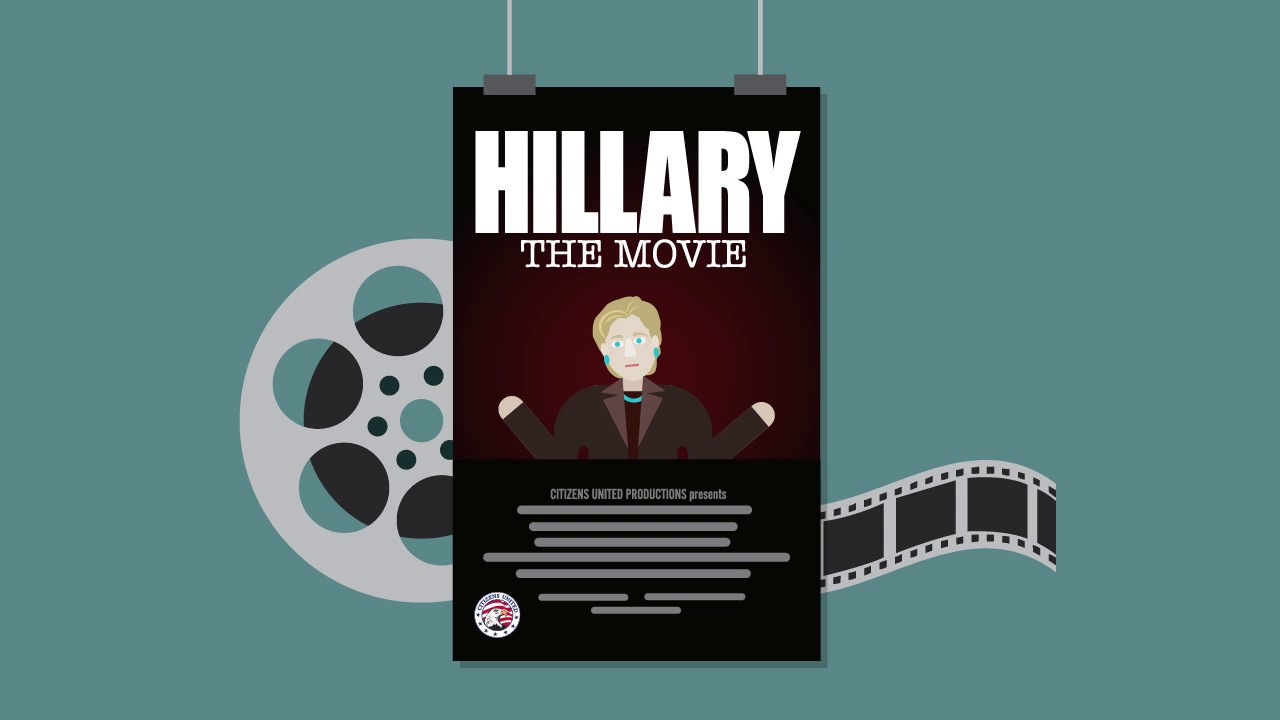
fedsoc bs vid https://www.youtube.com/watch?v=O9lYuao3sfQ
When a non-profit organization called Citizens United attempted to air and advertise a political documentary called “Hillary: The Movie” (funded in part by corporate contributors), the Federal Election Commission said that this would be a violation of the 2002 Bipartisan Campaign Reform Act, which proscribed corporations from engaging in “electioneering communication” within 30 days of a primary or 60 days of a general election.
Do corporations have a right to engage in political speech? Can corporations donate directly to political campaigns? Prof. Michael R. Dimino of Widener University’s Commonwealth Law School examines campaign finance and corporate contributions in Citizens United v. Federal Election Commission.
*******
As always, the Federalist Society takes no position on particular legal or public policy issues; all expressions of opinion are those of the speaker.
Learn more about Michael R. Dimino:
https://commonwealthlaw.widener.edu/academics/faculty/detail/13/
*******
Related Links & Differing Views:
Fordham Journal of Corporate & Financial Law: “Citizens United: 8 Years Later”
https://news.law.fordham.edu/jcfl/2018/03/07/citizens-united-8-years-later/
The Yale Law Journal: “Reconsidering Citizens United as a Press Clause Case”
https://www.yalelawjournal.org/essay/reconsidering-citizens-united-as-a-press-clause-case
Harvard Law Review: “Citizens United at Work”
https://harvardlawreview.org/2014/12/citizens-united-at-work/
The Atlantic: “How to Reverse Citizens United”
https://www.theatlantic.com/magazine/archive/2016/04/how-to-reverse-citizens-united/471504/
Engage: “Illuminating Citizens United: What the Decision Really Did”
https://fedsoc.org/commentary/publications/illuminating-citizens-united-what-the-decision-really-did
The Federalist Society: “Debate: Was Citizens United Wrongly Decided?”
https://fedsoc.org/commentary/videos/debate-was-citizens-united-wrongly-decided-audio-video
Dec 11, 2007
https://www.fec.gov/resources/legal-resources/litigation/citizens_united_complaint.pdf
to 3 judge ct = appellate?
Verified Complaint for Declaratory and Injunctive Relief Citizens United complains as follows: Introduction 1. This is an as-applied challenge to the constitutionality of (a) § 201 of the Bipartisan Campaign Reform Act of 2002 (“BCRA”), Pub. L. No. 107-155, 116 Stat. 81, 88-89, entitled “Disclosure of Electioneering Communications,” which added a new subsection “(f)” to § 304 of the Federal Election Campaign Act (“FECA”) that requires reporting of electioneering communications and (b) BCRA § 311, 116 Stat. 105, requiring that electioneering communications contain “disclaimers.” See 11 C.F.R. § 110.11.
BCRA § 201 is called herein the “Reporting Requirement,” BCRA § 311 is called the “Disclaimer Requirement,” and the requirements together are called the “Disclosure Requirements” for ease of identification. [sleight of hand?] The Reporting Requirement is codified at 2 U.S.C. § 434(f). The Disclaimer Requirement is codified at 2 U.S.C. § 441d(a
...
18. Citizens United will broadcast the 30-second, issue-advocacy ad entitled “Questions” on Fox News cable, and may broadcast it on major television network stations, too.Citizens United will broadcast the 10-second ads “Wait” and “Pants” on major television network stations, but not on Fox News. The disclaimer language mandated by FEC rule, see 11 C.F.R. § 110.11, takes about 4 seconds to narrate, making 10-second ads virtually impossible and 30-second ads extremely difficult to do and have any significant time left for substantive communication...
- One of the chief concerns with the Reporting Requirement is the disclosure of donors who may then be subject to various forms of retaliation by political opponents. On information and belief, the Clinton White House had in its possession over 1,000 FBI files on political opponents. See, e.g., Neil A. Lewis, White House Got More Files Than Disclosed, N.Y. Times, June 12, 2007 (available by query at google.com). 24. Citizens United will have donors that it will be required to disclose (as to name and address), absent the judicial relief requested here, because it will pay for the Ads “exclusively from a segregated bank established to pay for electioneering communications permissible under 11 C.F.R. § 114.15” (rule implementing WRTL II by permitting corporate electioneering communications), to which donors will have “donated an amount aggregating $1,000 or more . . . since the first day of the preceding calendar year.” 11 C.F.R. § 104.20. 25. Citizens United intends to broadcast materially-similar ads mentioning public figures who are candidates in materially-similar situations during future electioneering communication periods when public interest is at a peak. There is a strong likelihood that such similar situations will recur, given the facts that Plaintiff has engaged in similar activity in the past and that such activity is common and regularly recurring for it—as are conflicting electioneering communication periods
...
\s James Bopp, Jr James Bopp, Jr. \s Richard E. Coleson Richard E. Coleson* \s Jeffrey P. Gallant Jeffrey P. Gallant* \s Clayton J. Callen Clayton J. Callen* BOPP, COLESON & BOSTROM 1 South Sixth Street Terre Haute, IN 47807-3510 812/232-2434 telephone 812/234-3685 facsimile *pro hac vice motion pending Counsel for Plaintiff
Exhibit 1—Citizens United’s Ads “Wait” :10 [Image(s) of HRC on screen] If you thought you knew everything about Hillary Clinton . . . wait ’til you see the movie. [Film Title Card] [Visual Only] Hillary: The Movie. [Visual Only] www.hillarythemovie.com
“Pants” :10 [Image(s) of HRC on Screen]First, a kind word about Hillary Clinton: [Ann Coulter Speaking & Visual] She looks good in a pant suit. Now, a movie about everything else. [Film Title Card] [Visual Only] Hillary: The Movie [Visual Only] www.hillarythemovie.com
“Questions” :30 [Image(s) of HRC on Screen] Who is Hillary Clinton? [JEFF GERTH Speaking & Visual] [S]he’s continually trying to redefine herself and figure out who she is . . . [ANN COULTER Speaking & Visual] [A]t least with Bill Clinton he was just good time Charlie. Hillary’s got an agenda . . . [DICK MORRIS Speaking & Visual] Hillary is the closest thing we have in America to a European socialist . . . If you thought you knew everything about Hillary Clinton . . . wait ’til you see the movie. [Film Title Card] [Visual Only] Hillary: The Movie. In theaters [on DVD] January 2007. [Visual Only] www.hillarythemovie.com
filed 5 16 08
. SJ Motion 1 United States District Court District of Columbia
Citizens United, Plaintiff, v. Federal Election Commission, Defendant. Civ. No. 07-2240
(ARR, RCL, RWR) Plaintiff’s Summary Judgment Motion Citizens United (“Citizens” moves for summary judgment in its favor on Count 1 (Disclosure Requirements1 as applied to its Ads and all communications not the “functional equivalent of express advocacy” under the appeal-to-vote test of FEC v. Wisconsin Right to Life, 127 S. Ct. 2652, 2667 (2007) (“WRTL II”),
Count 2 (Disclosure Requirements as applied to Hillary: The Movie), and
Count 3 (Prohibition as applied to Hillary).2 Fed. R. Civ. P. 56. As to Count 4 (Prohibition as applied to “Questions” ad), Citizens “agree[d] to dismissal of Count 4 without prejudice because it presently appears to be moot.” Doc. 46 at 1 (Pl.’s Mem. Law Responding to FEC’s Mot. Dismiss Counts 3 & 4), to which the FEC agreed. Doc. 49 at 1.
As to Count 5 (Prohibition facially), the addition of this count was based on the FEC’s initial inability to determine whether the “Questions” ad was prohibited. Now that the FEC has determined the ad not to be prohibited Citizens considers Count 5 moot. If this jurisdiction permitted the ...
talk spase
nome379 (no longer) exists
Advertising the film was not prohibited under BCRA[
The false claims in question: "Advertising the film would have been a violation of the 2002 Bipartisan Campaign Reform Act" in the Introduction section and "The United States District Court for the District of Columbia held that §203 of BCRA applied and prohibited Citizens United from advertising the film Hillary: The Movie in broadcasts" in the Case summary section.
The District Court's actual decision clearly stated that the FEC already exempted the advertisements under safe harbor protections (but disclosure/disclaimer requirements still apply):
Advertising the film was not prohibited under BCRA
The District Court's actual decision clearly stated that the FEC already exempted the advertisements under safe harbor protections (but disclosure/disclaimer requirements still apply):
"Citizens’ proposed advertisements present a different picture. The FEC agrees that Citizens may broadcast the advertisements because they fall within the safe harbor of the FEC’s prohibition regulations implementing WRTL. They did not advocate Senator Clinton’s election or defeat; instead, they proposed a commercial transaction—buy the DVD of The Movie. See WRTL, 127 S. Ct. at 2667; 11 C.F.R. § 114.15(b). Although Citizens may therefore run the advertisements, it complains that requirements of § 201 and § 311 of BCRA, 2 U.S.C. §§ 434(f)(2), 441d, impose on it burdens that violate the First Amendment."....
:{
}:
10 sec?!
---
txt
Advertising the film was not prohibited under BCRA[
The false claims in question: "Advertising the film would have been a violation of the 2002 Bipartisan Campaign Reform Act" in the Introduction section and "The United States District Court for the District of Columbia held that §203 of BCRA applied and prohibited Citizens United from advertising the film Hillary: The Movie in broadcasts" in the Case summary section.
The District Court's actual decision clearly stated that the FEC already exempted the advertisements under safe harbor protections (but disclosure/disclaimer requirements still apply):
"Citizens’ proposed advertisements present a different picture. The FEC agrees that Citizens may broadcast the advertisements because they fall within the safe harbor of the FEC’s prohibition regulations implementing WRTL. They did not advocate Senator Clinton’s election or defeat; instead, they proposed a commercial transaction—buy the DVD of The Movie. See WRTL, 127 S. Ct. at 2667; 11 C.F.R. § 114.15(b). Although Citizens may therefore run the advertisements, it complains that requirements of § 201 and § 311 of BCRA, 2 U.S.C. §§ 434(f)(2), 441d, impose on it burdens that violate the First Amendment."....
10 sec?!
https://www.npr.org/2004/06/28/3023147/are-fahrenheit-9-11-ads-campaign-spots
june overby
as if Michael Moore and his documentary film Fahrenheit 9/11 needed any more publicity, the conservative group Citizens United weighed in just in time to help.
Citizens United has a reputation for being outspoken. Its own ads critical of former President Bill Clinton aired during his recent 60 Minutes interview. Now the group is making news again by calling for government limits on TV and radio ads for Moore's new movie, alleging they are tantamount to campaign ads and should be subject to federal laws on campaign finance.
News of the Citizens United complaint was just part of the controversy over Fahrenheit 9/11, a media storm that helped the film top all other releases at the box office last weekend (and become the most successful documentary ever).
Helping to publicize the film was obviously not part of the motivation for Citizens United. But it's hard to see how the complaint will accomplish much else. Citizens United has two problems here. First, its complaint goes to the Federal Election Commission, which never rushes to judgment. It would be stunning if the FEC ruled one way or another before Election Day. And second, even if lightning struck and Citizens United won a speedy decision, it wouldn't make all that much difference BAD CODE] To understand why, you have to look at how the First Amendment and campaign finance laws collide. The current law, authored by Sens. John McCain (R-Ariz.) and Russell Feingold (D-Wis.), sets new limits on financing political ads on TV and radio. Candidates and party committees cannot run ads financed with corporate or union money; and, at certain key times on the calendar, independent organizations such as Citizens United cannot either.
The ban on corporate or union funding applies to any broadcast ad that identifies a candidate for federal office and airs within 60 days of Election Day, or 30 days of the convention that would nominate that candidate.
Of course, these rules have an exception, for "news articles, editorials and commentary." Not even Congress wants to gag the free press. The question yet to be definitively answered: How far does the media exemption go?
Not far enough to protect the ads for Fahrenheit 9/11, according to David Bossie, president of Citizens United. He says that Moore, his producers or distributors can't advertise after July 30, since the ads -- at least those seen so far -- refer to a federal candidate: President George W. Bush. And the Republican convention begins Aug. 30. Bossie launched a full frontal assault last week:a complaint to the FEC, a copy to Attorney General John Ashcroft, letters to TV and radio stations around the country -- reminding them that they're legally required to keep records of airtime sales for political ads.
This raises a lot of questions that the FEC hasn't even begun to address up to now. For starters: Does Fahrenheit 9/11 qualify for exemption as "commentary"? If so, does the exemption cover ads for the commentary as well? Is the movie the product of a media company? And if it is, does that matter?
Or, as one WNYC listener asked me last week, what if Moore and his people rewrite the ads, so they don't show or refer to President Bush? The listener's suggestion: "Fahrenheit 9/11 -- the movie the federal government doesn't want you to see."
Bossie's strategy -- at least the legal part of it -- rests on the novel idea that the FEC will act quickly and decisively. The idea would be less outlandish if the FEC had not just punted when confronted with essentially the same issue on the same day Bossie filed. Considering whether another documentary filmmaker qualified for the media exemption, the six commissioners (three Republican, three Democratic) agonized, fretted, and then voted to decide later.
Even when the commission eventually decides, it's a good bet that if Moore loses, he'll go to court to challenge the ruling if the election hasn't already happened. And if it's after Election Day, who cares?
But Bossie may have another strategy at work too. Like Moore, he knows how to work the media. In the early 1990s, Bossie was a private investigator in the Whitewater case, equally skilled at finding information and getting it into the political debate. Later, he went to work for the House Government Reform Committee, where he spearheaded the panel's relentless probe of Clinton's campaign fundraising.[unethical acts at both]
More recently, Bossie has handled the FEC issue like a master, starting with a breathless article in a Capitol Hill newspaper, the day before the commission met. The headline: "'Fahrenheit 9/11' ban? Ads for Moore's movie could be stopped on July 30." A ban that soon seems unlikely. But we are going to see many more cases like this. McCain-Feingold significantly changed the way money flows into the political system. And with this high-stakes election getting more emotional all the time, more money than ever is pressing to get in.
Related NPR Stories
MEDIA
The 'Fahrenheit 9/11' Phenomenon
MOVIES
Box-Office Success of Moore's 'Fahrenheit 9/11'
Political Documentaries: Fact and Fiction
The Politics of 'Fahrenheit 9/11'
Web Resources
[Citizens United Complaint Against 'Fahrenheit 9/11']()
[Federal Election Commission]()
http://law2.umkc.edu/faculty/projects/ftrials/conlaw/CitizensUnitedBackground.html
Citizens United v FEC: Money, Corporations, and Politics
By Douglas O. Linder (2019)
Money has been called the mother’s milk of politics. Without money, there can be no campaign. Money is needed to buy advertising, to rent halls for rallies, to pay campaign staff, and to fly or drive candidates from one rally to the next.
Early in our history, campaigns had expenses we might find surprising today. James Madison probably lost his race for a seat in the Virginia legislature in 1777 because he refused to provide liquor at his rallies. Why go listen to James when his opponent is offering free rum? George Washington knew better. He won one election after serving roughly one half gallon of alcohol for every vote he earned.
According to Melvin Urofsky, author of the Money and Free Speech, it was the campaign of Andrew Jackson that ushered in the era of mass politicking. And it took off from there. By 1840, the presidential campaign of William Henry Harrison included rallies, parades with banners and floats, log-cabin songbooks and log-cabin newspapers, pictures of Harrison, and “Tippecanoe and Tyler Too” handkerchiefs and badges. All of this, of course, cost money.
In 1864, Abraham Lincoln worried about the influence of corporate money in politics. Lincoln said, “As a result of the war, corporations have become enthroned, and an era of corruption in high places will follow. The money power of the country will endeavor to prolong its rule by preying on the prejudices of the people until all wealth is concentrated in a few hands and the Republic is destroyed.”
But the cost of campaigns continued to shoot up—and wealthy business owners were eager to help foot the bills. It cost $125,000 to get Lincoln re-elected in 1864. Eight years later, the Republican Party spent twice that much to elect Ulysses Grant. And it took about four times that much, close to a million dollars, to win the contested election of 1876 for Rutherford Hayes. By 1892, campaign costs had more than doubled again. Democrat Grover Cleveland spent well over $2 million to win election.
William McKinley’s campaign in 1896 rested on retaining the gold standard, a policy favored by big industries. McKinley’s chief fundraiser, Marcus Hanna, told industrial leaders how much they were expected to contribute. Banks were to pay one-quarter of 1% of their capital. Other industrial leaders were assessed flat fees. Standard Oil chipped in $250,000. Chicago’s meat-packing houses sent in $400,000. Democratic candidate William Jennings Bryan got his own corporate sponsors, mainly the owners of silver mines in the West. McKinley won.
In response to the massive corporate funding of the McKinley campaign, four states enacted laws in 1897 banning all corporate contributions to political campaigns. All four states had voted for Bryan the year before.
McKinley’s successor, Theodore Roosevelt, was the first president to call for an outright ban on corporate contributions. Roosevelt told Congress in 1905, quote, “All contributions by corporations to any political campaign or for any political purpose should be forbidden by law.”
A few years later, Congress managed to pass the first federal campaign finance act. It was a toothless law called the “Publicity Act.” It required disclosure of major donors and limited the size of contributions. But the law lacked any enforcement mechanism. There would not be a single prosecution in the 46 years the Publicity Act remained on the books.
Campaign spending kept shooting skyward. And, increasingly, most of the money came from a relative handful of very wealthy people. In the 1928 Hoover-Smith race, for example, just 1% of givers gave fully half of the total raised. In the 1952 Eisenhower-Stevenson race, over two thirds of campaign funding came from donors giving more than $2500, as measured in current dollars.
In 1971 that Congress passed the first truly significant piece of campaign reform legislation. By then, television had changed politics. Among other things, it made races much more expensive. Senator Edward Kennedy said, “Like a colossus of the ancient world, television stands astride our political system demanding tribute from every candidate for public office. Its appetite is insatiable, its impact unique.” Television turned fund-raising into a nearly full-time job.
The Federal Election Campaign Reform Act was signed by President Nixon. It created a general taxpayer-paid fund for presidential elections, limited expenditures for media advertising, tightened reporting requirements, and imposed a ceiling on what candidates for federal office could spend on their own campaigns. Two years later, amendments to the law created the Federal Election Commission. Composed of three Republicans and three Democrats, serving 6-year terms. The amendments also set limits on individual contributions to campaigns.
The Reform Act became law largely for one reason. It favored incumbents. With the powers of their offices and their greater name recognition, they had an edge. With the law in place, they need not worry about millionaire opponents funding their own campaigns. Nor about opponents with unique fund-raising appeal.
The campaign reform act was challenged in court in January 1975. The challenge was brought by some odd political bedfellows. They included the liberal senator from Minnesota Eugene McCarthy and conservative senator James Buckley from New York. The ACLU and the American Conservative Union. Litigants from across the political spectrum.
They argued, first off, that money was speech. At least money donated to a political campaign or spent to further a campaign. Money spent, to say, buy a ticket to a play or football game would be conduct, not speech. Money for a campaign, they argued, is a form of political association protected by the First Amendment. Without money, no modern day campaign would be possible.
The government argued that even if the law restricted speech, it should be upheld. The law served to “level the playing field” and reduce the likelihood of corruption.
The Court gave both sides half a loaf. In Buckley v Valeo, the Court upheld the limit on individual contributions because a contributor’s money does not directly support the contributor’s free expression. It is the candidate, the recipient of the money, whose speech reaches the public. On the other hand, the law restricting the amount of money a rich candidate could spend on his or her own behalf was struck down. The candidate’s own expression was directly restricted. And besides, the Court said, a rich person can’t be corrupted by money that comes from himself.
Billionaires were freed to spend their billions. Good news for later self-funded candidates like Ross Perot.
From the 1980s on, donors increasingly exploited a large loophole in the campaign finance laws. The exclusion on limitations of so-called “soft money.” That is, not “hard money” given directly to a candidate for her campaign, but rather money given to a private entity—a “political action committee” or “PAC”—to spend in its own ways. PACs are required, theoretically, to spend their money in ways not coordinated with the candidate’s own campaign.
Soft money became the new thing. The new (some believed) corrupting influence in American politics.By the mid-1990s, the amount of soft money being spent on elections almost matched that of the campaigns themselves. PACs took many forms. There were labor union PACs, interest group PACs like the Sierra Club or NRA, and there were corporate PACs.
Scandals, fund-raising abuses, massive campaign expenditures—all of these led to another attempt at campaign finance reform. The result, in 2002, was a law formally known as the Bipartisan Campaign Reform Act. It is more commonly known by the name of two Senate sponsors, John McCain and Russ Feingold.
The McCain-Feingold Act did many things. It banned soft money contributions made directly to political parties. It imposed new limits on individual contributions of both soft money and hard money. Most importantly for our purposes, the law prohibited corporations and labor organizations from paying for any “electioneering communications” within 60 days of an election or 30 days of a primary.
President Bush put his signature on the legislation. But he did so reluctantly. There was no signing ceremony, no press conference in the Rose Garden.
On the day of the signing, Senator Mitch McConnell filed a suit challenging the new law’s constitutionality. Meanwhile, he worked to undermine the law. He did so largely by controlling the process of nominations to the Federal Election Commission. According to former commission Brad Smith, McConnell said, “We need to put Republicans on the FEC who favor our point of view on regulation.'” The new appointees essentially refused to enforce the law. The result was a number of 3 to 3 deadlocks on enforcement actions.
McConnell’s behind-the-scenes maneuvering paid off. But his legal challenge to McCain-Feingold didn’t fare so well. By a 5-to-4 vote in 2003, the Court upheld nearly the entire law. It was the high-water mark for campaign reform efforts. A day of sunshine for reformers.
But the precedent of McConnell v FEC did not last long. The Court soon decided to reconsider the Act’s key requirement prohibiting corporate “electioneering communications” around election time. The case was Citizens United v the Federal Election Commission. It became one of the most hotly debated cases of our time.
The case was heard by a newly remade Supreme Court. John Roberts and Samuel Alito joined the Court in President George W. Bush’s second term. The loss of Justice Sandra Day O’Connor, and her replacement by Justice Alito, made all the difference. When a case is decided 5 to 4, it only takes one vote to change it.
And here we make a brief digression. You might well be asking—and many people still are—how is it possible for a corporation to have First Amendment rights?
It turns out the Supreme Court decided long ago corporations were “persons” entitled to certain constitutional rights. In the 1888 case of Pembina Consolidated Silver Mining Co. v. Pennsylvania, the Court said, quote, "Under the designation of 'person' there is no doubt that a private corporation is included. Such corporations are merely associations of individuals united for a special purpose and permitted to do business under a particular name.” Over the decades that have followed, the Supreme Court has reaffirmed this holding many times.
And free press fans should be happy that corporations do have at least some First Amendment rights. After all, the New York Times is a corporation. The Washington Post is a corporation.
Now, that doesn’t mean corporations necessarily have exactly the same First Amendment rights as individuals. McConnell v FEC proved that.
But to get back to our story. David Bosse watched Michael Moore’s political documentary “Farenheit 9-11” in 2004. It seems an unlikely choice for a conservative activist. But Bosse didn’t watch the movie for entertainment. He was doing research for Citizens United. Citizens United proclaims its mission to be to “reassert the traditional American values of limited government, freedom of enterprise, strong families, and national sovereignty and security.” Citizens United receives some of its donations from corporations.
Although Bosse disagreed with just about everything in Michael Moore’s movie, he came away impressed. He said, “I saw its ability to drive discussion.” He began to think about making movies for Citizens United that pushed a conservative agenda. “I wanted to counterpunch,” he said.
He began by calling, he said, “Every friend in the conservative movement I knew.” Some were openly skeptical, others encouraging. Bosse said, “I’m just going to do it.” Even though, “I didn’t know the front of a camera from the back of a camera.”
Bosse’s first production was a movie called “Celsius 41.11.” It was a response to Moore’s film, both a tribute to George W. Bush’s war on terrorism and an attack on the 2004 Democratic candidate for president, John Kerry. The movie questioned Kerry’s anti-war record and attacked his qualifications for president. Celsius 41.11, by the way, according to film’s tagline, is "The Temperature at Which the Brain Begins to Die."
The movie was put together in record time. It opened in Washington DC in late December and was shown in 116 theaters across the country for a three-week run.
Bossie had hoped to take out television ads promoting his movie. But there was a problem. The ads would run during the 60-day period before the general election. The McCain-Feingold law prohibited outside organizations and corporations from purchasing political ads on radio and television in the two months before elections.
Bosse’s film won a lot of praise from movement conservatives. His political friends called and said, “Wow, you need to do more like that.” Bosse didn’t need convincing. He saw the medium of film as a potentially powerful force for political change. You can put a movie on television and deliver it right into people’s living rooms. You can have 90 solid minutes or more to persuade and energize voters.
Two years after the success of “Celsius 41.11,” Bosse began thinking about making a movie about Hillary Clinton. At the time, she was considered the odds-on favorite to win the 2008 Democratic nomination for president. Bosse had worked in the 1990s for a House Committee that looked into the financial affairs of the Clintions. Bosse said, “Who knows more about Hillary Clinton than me? Very few people.”
Bossie recruited a “who’s-who” list of conservative commentators to appear as interview subjects in his film called “Hillary: The Movie.” People like Ann Coulter, Dick Morris, Robert Novak, Larry Kudlow, and Newt Gingrich. Kathleen Willey appeared to discuss attacks by the Clintons that resulted from her alleging a sexual assault by Bill Clinton.
None of the commentators had anything good to say about Hillary Clinton. The Clintons were described as “power hungry.” “They’ll stop at nothing,” one said. They were accused of covering up evidence of wrong-doing. One commentator described Clinton’s Presidential Library as “Little Rock’s Fort Knox.” Dick Morris said, “Hillary Clinton is the closest thing we have in this country to a European socialist.” The movie ends darkly with Morris saying, “We must never forget the fundamental danger that this woman poses to every value we hold dear. You see, I know her.”
The movie cost over one million dollars to produce. But Citizens United was worried. It suddenly appeared that the wheels were coming off Clinton’s campaign. She unexpectedly lost the caucuses in Iowa to Barrack Obama. If the movie didn’t come out soon, and Clinton’s campaign continued to fall apart, who would pay money to see the movie?
Bosse decided to release the movie as soon as possible—well ahead of when he originally intended. He quickly put together television ads promoting the movie’s release.
Citizens United knew full well that the ads would run afoul of restrictions in the McCain-Feingold campaign finance law. In fact, that was probably the point. Part of a strategy to undo McCain-Feingold.
Bosse and Citizens United argued they had a First Amendment right to advertise their movie anytime they wanted to, even during a campaign. Bosse objected to the FEC’s insistence that ads for the movie contain an explicit disclaimer. Bosse complained that the disclaimer would turn the spot into a political ad and detract from its effectiveness. “All I’m trying to do is make people pick up a movie ticket,” he said. [was it still in theaters?]
The FEC also said it would be an illegal campaign contribution for Citizens United to pay a cable company to make the movie available on video and demand. Moreover, if the combined gifts funding the movie exceeded $3000, all the donors’ names would have to be disclosed. In the view of the FEC, what Citizens United did was no different than if General Motors or Google made a movie favoring a particular candidate.
Citizens United filed suit against the Federal Election Commission. Bosse saw the FEC’s restrictions as a blatant First Amendment violation. “It’s the First Amendment,” he said. “The first one!”
The case was first heard by a panel of three federal district court judges. The court sided with the FEC. In the court’s view the movie was a 90-minute campaign ad arguing that Senator Clinton is unfit for office and that viewers should vote against her. The court held that the FEC correctly applied the McCain-Feingold law and that the law was constitutional.
Bossie and his legal team appealed directly to the Supreme Court. They hired a Dream Team of lawyers. Chief among them was Ted Olson, former solicitor general of the United States. He was joined by Citizens United counsel, Michael Boos, and Floyd Abrams, a highly respected First Amendment lawyer who worked on the Pentagon Papers case.
For Olson, the case was special. Citizens United had dedicated the movie “Hillary” to his wife, Barbara Olson. Barbara Olson was a conservative commentator who was a passenger on American Airlines Flight 77 when it crashed into the Pentagon on Sept. 11, 2001. She was also a Clinton critic and author of the book, "Hell to Pay: The Unfolding Story of Hillary Rodham Clinton."
In Bossie’s view, Ted Olson was "singularly responsible for our winning this case." Olson decided to transform the case from a narrow one challenging a few specific provisions of McCain-Feingold into an all-out assault on the law's constitutionality.
He argued that there McCain-Feingold law created a slippery slope that could lead to an evisceration of protection for crore political speech.He urged the Court to overturn the 2003 McConnell decision and free corporations to make whatever political pitches they chose to make.
Concern about the slippery slope was evident when the Supreme Court heard oral arguments. The attorney for the FEC, Deputy Solicitor General Malcolm Stewart, was asked if the government could ban the publication of a book if it mentioned a candidate for office within the election time frame.
Stewart said that it could. "That's pretty incredible," Justice Samuel Alito said.
Then came questions about electronic devices such as the Kindle. "If it has one name, one use of the candidate's name, it would be covered, correct?" Chief Justice John G. Roberts Jr. asked.
"That's correct," Stewart replied.
"It's a 500-page book, and at the end it says, 'And so vote for X,' the government could ban that?" Roberts asked.
This was too much for the Court’s conservatives. The government’s answers to the hypotheticals sent a chill down the Supreme Court," Bossie said. Bossie said the slippery slope argument turned justices against the FEC and in favor of Citizens United.
Stewart tried to argue for the FEC that the case should be decided on narrow grounds. There was no need to reconsider the large First Amendment question about the limitations on corporate speech. But it they did go there, the law should be upheld. Even direct regulation of political speech is permissible if the government can show a “compelling need” for the regulation. And preventing corruption and the appearance of corruption was a compelling justification.
But the majority was skeptical. Why should speech from corporations be more corrupting than speech from individuals? Can’t we trust citizens to decide the value of speech for themselves?
Citizens United had its five votes.
The opinion for the majority was written by Justice Anthony Kennedy. He invalidated McCain-Feingold’s most contested provision. The provision that barred corporations from using their general treasury funds for express advocacy or electioneering communications. The law applied to broadcast electioneering communications within 30 days of a primary election and 60 days of a general election.
Kennedy said that under the law, many forms of political speech became felonies. He gave some examples: “The Sierra Club runs an ad, within the crucial phase of 60 days before the general election, that exhorts the public to disapprove of a Congressman who favors logging in national forests; the National Rifle Association publishes a book urging the public to vote for the challenger because the incumbent U. S. Senator supports a handgun ban; and the American Civil Liberties Union creates a Web site telling the public to vote for a Presidential candidate in light of that candidate’s defense of free speech.”
Justice Kennedy began his analysis by noting, “The First Amendment has its fullest and most urgent application to speech uttered during a campaign for political office.”
He said it was well established that “political speech of corporations or other associations should not be treated differently simply because such associations are not ‘natural persons.’” Political speech is no less valuable, Kennedy said, when it “comes from a corporation rather than an individual.”
Kennedy described the censorship presented by the case as “vast in its reach.” He wrote, “The Government has muffled the voices that best represent the most significant segments of the economy.” And “the electorate [has been] deprived of information, knowledge and opinion vital to its function.”
Kennedy said what the government was doing through the McCain-Feingold law amounted to nothing less than “thought control.” Kennedy wrote, “The First Amendment confirms the freedom to think for ourselves.”
Whether the movie “Hillary” was fair or not was beside the point. The Court opinion notes, “Some members of the public might consider Hillary to be insightful and instructive; some might find it to be neither high art nor a fair discussion on how to set the Nation’s course; still others simply might suspend judgment on these points but decide to think more about issues and candidates. Those choices and assessments, however, are not for the Government to make.”
Kennedy concluded, “The First Amendment underwrites the freedom to experiment and to create in the realm of thought and speech. Citizens must be free to use new forms, and new forums, for the expression of ideas. The civic discourse belongs to the people, and the Government may not prescribe the means used to conduct it.”
The decision was ironical in one sense. Citizen United’s original objections to the law were the only part of the law that survived. The Court upheld McCain-Feingold’s disclaimer and donor disclosure requirements.
Justice Stevens wrote for the Court’s four dissenters. He called the decision “profoundly misguided.” He said he “emphatically dissented” from the Court’ principal holding. It threatened, he said, to undermine the integrity of elected institutions across the Nation and damage the Supreme Court as an institution.
Stevens called the decision “backwards in many senses.” He wrote, “It elevates the majority’s agenda over the litigants’ submissions, facial attacks over as-applied claims, broad constitutional theories over narrow statutory grounds, individual dissenting opinions over precedential holdings, assertion over tradition, absolutism over empiricism, rhetoric over reality.”
In the minds of the four dissenters, the strong “societal interest in avoiding corruption and the appearance of corruption” provided more than enough justification for regulating corporate expenditures on candidate elections.
Stevens concluded by calling the decision “a rejection of the common sense of the American people.” He noted that the need to prevent corporations from undermining self-government has been recognized since the nation’s founding. And that the corrupting potential of corporate electioneering has been a major concern “since the days of Theodore Roosevelt.” Stevens wrote, “While American democracy is imperfect, few outside the majority of this Court would have thought its flaws included a dearth of corporate money in politics.”
The conservative activists at Citizens United were thrilled with the ruling. Citizens United spent about $1.25 million in legal fees on the case-- so much, Bossie said, that it "makes you cry." But, he said, it was worth every dollar.
Just days after the Citizens United decision, a new president gave his firstState of the Union speech. Near the end of the speech, President Barrack Obama had a few things to say about the decision. He said, “With all due deference to separation of powers, last week the Supreme Court reversed a century of law that, I believe, will open the floodgates for special interests, including foreign corporations, to spend without limit in our elections." Obama added, “I don't think American elections should be bankrolled by America's most powerful interests or, worse, by foreign entities. They should be decided by the American people.”
Democratic lawmakers stood to cheer and applaud. In the second row of the House chamber, a justice of the Supreme Court had a different reaction. "Not true, not true," Justice Alito appeared to say, as he shook his head and furrowed his brow.
Spending soared in the first election after Citizens United. Spending in congressional races jumped 46 percent from the election before.
Fred Wertheimer had worked long and hard on the issue of campaign reform. Wertheimer called Citizens United “a disaster for the American people” and “the most radical and destructive campaign finance decision in Supreme Court history.” The American Enterprise Institute’s Norman Ornstein compared the case to the infamous 1857 Dred Scott decision. Ornstein said, “The Roberts court is going to go down in history in the same way Chief Justice Roger Taney and his court went down in history with Dred Scott.”
Senator John McCain had a warning. “I promise you, there will be huge scandals,” he said. “There’s too much money washing around, too much of it we don’t know who’s behind it, and too much corruption associated with that kind of money.”
Polls showed that over two-thirds of Americans supported a constitutional amendment overturning Citizens United. Is that likely to happen? Constitutional amendments are hard. They are almost impossible without the broad support of both parties. Citizens Unitedis likely to remain the law, whatever most of the public might think about it.
**Exploring First Amendment Law**
clinton cash bannon april 2017
https://www.independent.co.uk/news/world/americas/steve-bannon-donald-trump-films-documentary-white-house-us-election-win-bill-hillary-clinton-a7676586.html
Stephen Bannon could barely finish his sentences as he implored the listeners of his Breitbart News radio show to see the new movie Clinton Cash.
It was July 20, the homestretch of the 2016 presidential campaign, and Bannon was describing Bill and Hillary Clinton as “scumbags” and “bandits” who had made millions of dollars through political connections.
“Hillary and Bill Clinton are the two single biggest grifters ever to run for president of the United States,” Bannon told his guest, Peter Schweizer, the author of the book behind the movie.
Bannon, now President Donald Trump's chief strategist, framed his radio show that day as an urgent effort to reveal important information for voters - but there was more to it.
The show and Clinton Cash were components of an intricate multimedia machine comprising non-profit organisations and private companies that Bannon had leveraged to advance his conservative, populist agenda and bring in millions of dollars. That effort ultimately helped propel Trump into the White House and Bannon into national prominence.
A close look behind Bannon's radio broadcast that day offers insights about how that machine worked.
As it happened, the research behind Clinton Cash had been funded by the Government Accountability Institute, or the GAI, a tax-exempt public charity that Bannon had created a few years earlier and that had paid him hundreds of thousands of dollars as executive chairman, documents show.
Clinton Cash had been produced by Glittering Steel and Bannon Film Industries, two companies owned by Bannon, who was one of the screenwriters.
Bannon also was an owner of ARC Entertainment, the firm listed as distributor of the film.
And he was receiving a six-figure salary as executive chairman of Breitbart News, which heavily promoted the film through Bannon's radio programme and its controversial website.
There's no telling how many in his audience understood the connections. Many of the links are scattered among corporate, court and tax records, as well as in a financial disclosure report for 2016 that the White House released last week.
https://www.congress.gov/event/116th-congress/house-event/LC65581/text?s=1&r=2
CITIZENS UNITED AT 10: THE CONSEQUENCES FOR DEMOCRACY AND POTENTIALRESPONSES BY CONGRESS
=======================================================================

HEARING

BEFORE THE

SUBCOMMITTEE ON THE CONSTITUTION,
CIVIL RIGHTS, AND CIVIL JUSTICE

OF THE

COMMITTEE ON THE JUDICIARY
HOUSE OF REPRESENTATIVES

ONE HUNDRED SIXTEENTH CONGRESS

SECOND SESSION

---


FEBRUARY 6, 2020
WITNESSES
The Honorable Ted Deutch, Member of Congress
Oral Testimony............................................... 9
Prepared Testimony........................................... 34
The Honorable Pramila Jayapal, Member of Congress
Oral Testimony............................................... 39
Prepared Testimony........................................... 41
Ellen L. Weintraub, Commissioner, Federal Election Commission
Oral Testimony............................................... 45
Prepared Testimony........................................... 48
Robert Weissman, President, Public Citizen
Oral Testimony............................................... 53
Prepared Testimony........................................... 55
Bradley A. Smith, Josiah H. Blackmore II/Shirley M. Nault
Professor of Law, Capital University Law School
Oral Testimony............................................... 56
Prepared Testimony........................................... 58

Ciara Torres-Spelliscy, Professor of Law, Stetson UniversityCollege of LawOral Testimony............................................... 71Prepared Testimony........................................... 73
LETTERS, STATEMENTS, ETC. SUBMITTED FOR THE HEARING

Statement by the Honorable Jerrold Nadler, submitted by the
Honorable Steve Cohen, Chairman, Subcommittee on the
Constitution, Civil Rights, and Civil Liberties................ 6
Items for the record submitted by the Honorable Ted Deutch,
Committee on the Judiciary..................................... 10
Items for the record submitted by the Mary Gay Scanlon, Committee
on the Judiciary............................................... 92
Items for the record submitted by the Steve Cohen, Committee on
the Judiciary.................................................. 106
...
Mr. Cohen. Thank you, Mr. Weissman. Our next witness is Mr. Bradley Smith. Rarely is a witnessthanked for coming and complimented by the other side, so youare special.Bradley Smith holds the Josiah H. Blackmore II/Shirley M.Nault Professor of Law position at Capital University LawSchool. He is one of the nation's leading authorities onelection law and campaign finance, and co-author of ``VotingRights and Election Law,'' a leading casebook in the field. Hepreviously served for five years as a member of the FEC andChair of the Commission in 2004.He received his J.D. cum laude from Harvard Law School.Do any of you ever get accepted at another school?[Laughter.]And his B.A. from Kalamazoo College.Professor, you are recognized.
TESTIMONY OF BRADLEY SMITH

Mr. Smith. Thank you, Mr. Chairman and members of the
committee.
I guess I would begin simply by saying that repeatedlycalling a decision a disaster doesn't really make it so, and wehaven't really heard much evidence that actually ties the ideathat people can't enact their preferences to anything that hascome about from Citizens United. In fact, Citizens United has had a number of beneficialeffects on American society. We were told that it would lead toan oligarchy, an entrenched group of people who would strangleAmerican democracy. And yet instead, in the years sinceCitizens United, politics in America has been more fluid.Congressional incumbent reelection rates have declined. Thatmay not be good news for all of you, but it cuts againstcertainly the argument that has been made against CitizensUnited. We have seen that either Congress or the presidency haschanged hands in four of the five election cycles sinceCitizens United. There are more newcomers in Congress by about40 percent each time around. That may be good news for some ofyou who are among those newcomers.
Outsiders such as the President himself, such as at least acontender to the President in the general election, SenatorSanders, people such as Representative Ocasio-Cortez or formerRepresentative Braut have been complete outsiders who havedramatically shaken up the system and defeated entrenchedinsiders, typically by spending far less money.
We find that the trend of more women being elected tooffice has continued, and there are other things that are justkind of interesting. For example, the rate of spending increasein American politics has actually declined considerably sinceCitizens United. I don't think that is because of CitizensUnited, but it certainly cuts against the notion that this issome disaster leading to this massive explosion in spending. Itis just not really so.
We find that most money in politics, dramatically so, stillcomes from individuals in amounts limited under the law. Thevast majority still comes in limited individual contributions.
But corporate contributions, which make up at most\--I don'tknow how we want to calculate it and what we do with this smallpercentage of money, about 2 or 3 percent that is so-called``dark money,'' how much we think that might be corporatemoney. If we take the worst case, so to speak, the highest casescenario, we are talking about 5 percent of spending, maybe 6percent coming from for-profit corporations. That is hardlydrowning anybody out. And, in fact, it is a good thing. TheAmerican people have a right to hear those voices, they shouldhear those voices, and polling data shows that they actuallywant to hear those voices and believe that business has a rightto comment on issues of concern.
Finally, it is important to remember what the case was allabout. It was the position of the United States Government thatit could censor a book or a movie if that book or movie was atany stage produced or distributed with corporate funds, likeevery other book or movie you have ever bought on Amazon or ina book store or seen in a theater or seen on cable or streamingtelevision. That was the position of the government, that youcould censor this. In that respect, the position that fourmembers of the Supreme Court actually endorsed that is thetruly radical view that we saw in Citizens United.
We have heard a lot in both the opening panel and from mycolleagues here about all these policy initiatives that havebeen blocked, and it is curious to me that they all happen tobe policy preferences of the American political left. There isnothing wrong with the political left having policypreferences, but the idea that you are not able to enact yourpolicy preferences unless you can kneecap people who opposethose is hardly something that the First Amendment endorses. Indeed, that is why we have a First Amendment, so you can'tkneecap your opponents in order to shut them up so that you canpass whatever policies you want.
I find it interesting. We had the NRA used as an example.The NRA has 3 to 5 million members. These are U.S. citizens,people who are out there, and they care intensely about theseissues. They talk to their neighbors and they work on theseissues, and that is why these things sometimes don't comethrough.
I remind you, it is not impossible to pass legislation.Medicare, Social Security, the Voting Rights Act, the CivilRights Act, these things all passed when contributions evenfrom individuals were unlimited and almost never reportedbecause there was no enforcement mechanism even on reporting.
So I think when we look at things more rationally, we seethat while the American people certainly don't like CitizensUnited when they are asked specific questions like ``Do youthink corporations should be able to speak in elections?'',when we ask ``Do you think Citizens United should have beenable to show its movie?'', we find that majorities, in somecases substantial majorities, do, in fact, favor thosepositions.
So again, I would say Citizens United has been good for theUnited States, but mostly it is really good for the FirstAmendment precisely because it does what the First Amendment issupposed to do. It is a check.Thank you.[The statement of Mr. Smith follows:]
[GRAPHIC(S) NOT AVAILABLE IN TIFF FORMAT]

Mr. Cohen. Thank you, sir.
Finally, our last witness is Ms. Ciara Spelliscy. She is aProfessor of Law at Stetson College of Law in Florida. Sheteaches election law, corporate governance, business entities,and constitutional law. Prior to joining Stetson's faculty shewas Counsel to the Democracy Program at the Brennan Center forJustice at NYU School of Law, where she provided guidance onthe issue of money in politics. She was a staffer for RichardDurbin up here on the Hill.She received her J.D. from Columbia University and her A.B.from Harvard.Professor, you are recognized for 5 minutes.
TESTIMONY OF CIARA TORRES-SPELLISCY

Ms. Torres-Spelliscy. Thank you. Good morning. My name is
Ciara Torres-Spelliscy. I live in a swing district in the swing
state of Florida. My law students are Republicans, Democrats,
and Independents, and I am here to tell you that American
voters are worried about the state of our elections after the
attacks on our democracy in 2016.
What American voters see from Congress and from the FederalElection Commission is not reassuring. It looks like theycannot get out of their own way to protect the integrity ofAmerican elections. This was true before 2016, but after 2016it is nothing short of excruciating to watch Congress and theFEC not act in the face of eager enemies.
Now without a quorum, the FEC is more powerless than everat a time when the 2020 election already has candidate debates,large-scale rallies, primary votes, and big politicalfundraising to the tune of over $2 billion already.
Nearly a decade ago, I told Congress right after CitizensUnited that I could predict two problems with invitingcorporate money into our democracy: a lack of shareholderconsent, and a lack of transparency. And I wish my predictionhad not come true, but it did.
Today I will focus on the lack of transparency, which isbetter known as the dark money problem. Dark money hasblanketed our elections since 2008. To date, over a billiondollars in dark money has been spent in Federal electionsalone. With dark money you can see the public dance, but youcan't see the puppeteer. And after the 2016 election, Americansreally deserve to know whether any of those puppeteers wereforeign nationals or foreign governments.
As I note in my book, Political Brands, we know from theredacted Mueller Report, as well as indictments of Russians bythe Special Counsel's Office, that Russians were trying toinfluence the 2016 election, including by purchasing politicalads on Facebook with rubles. In nearly any other area of thelaw, what happens with dark money would be akin to moneylaundering. But in election law, most dark money is actuallylegal.
The FEC is the primary regulator with the ability to stopdark money, and instead they have basically done nothing. TheFEC could have started rulemakings to end dark money evenbefore Citizens United, because the problem appeared before2010. The typical way that dark money is created is by spendingthrough an opaque non-profit, like a 501(c)(4) or a 501(c)(6),and the porous rules at the FEC have allowed donors to remainanonymous. The only change that has come was at the order of aFederal court in CREW v. FEC.
One thing American voters still do not know is whether darkmoney is hiding illegal foreign money. And because the FEC haslargely been stuck in deadlocks, even investigations orpunishment for foreign spending has largely been lacking.
As I discussed in my first book, Corporate Citizen, in aparticularly colorful episode, a foreign pornographer spent ina Los Angeles election in 2012. This spending violatedlongstanding bans on foreign money in American elections,whether they are Federal, state, or local. But the FEC wouldnot enforce the law against the foreign pornographer. If theFEC is not going to stand up to a foreign pornographer, it begsthe question who would they stand up against?
This general lack of enforcement against foreign spendinghas sent a terrible message to anyone who was paying attention.The message is that campaign finance laws are basically notbeing enforced at the Federal level by the FEC, and as Americanvoters face 2020, the Department of Justice is the only copleft on the beat. But DOJ can only enforce willful andegregious violations of law. This leaves a vast wasteland ofunenforced campaign finance laws where cheating and corner-cutting is all but invited.
And this happens as American voters are asked to choose thenext president, all of the members of the House, a third of theSenate, 11 governors, and 45 state legislatures.Given the experience of 2016 with Russians breakingAmerican election laws with abandon, the lesson for NorthKorea, China, Iran, or any other hostile nation is thatinterference in our elections can be done with littleconsequence.
So the FEC needs a full complement of commissioners so thatthey can at least act. And if you are serious about reform, youneed to add an additional seat to the FEC so that, like everyother Federal agency, they have an odd number of commissionersso that they can enforce the law instead of ending in adeadlock.
And you can improve disclosure by either changing electionlaws or changing securities laws, or possibly both. And, ofcourse, you could expand what Congress can constitutionallyregulate if the Constitution is amended to address CitizensUnited and other campaign finance cases like Buckley.
But in our constitutional system, the fate of the nation isin your hands. Thank you.
[The statement of Ms. Torres-Spelliscy follows:]
[GRAPHIC(S) NOT AVAILABLE IN TIFF FORMAT]
... Mr. Raskin, you are recognized for 5 minutes.Mr. Raskin. Mr. Chairman, thank you.Welcome to all of our distinguished witnesses today, andall of the natural persons who have come to participate intoday's proceeding.
The first thing that I want to point out is that CitizensUnited did not enlarge the free speech rights of any citizen inthe United States, not even CEOs or corporate executives whocould spend already whatever they wanted as independentexpenditures under Buckley v. Valeo. All that Citizens Uniteddid was to transform every corporate treasury in America into apotential political slush fund and thereby authorize andempower the CEOs of the corporations to spend whatever theywanted of other people's money in the corporate treasuries inpolitical campaigns.
This declaration did transform, to my understanding, twocenturies of jurisprudential understanding of what acorporation is. You can go back to Chief Justice JohnMarshall's opinion in 1819 in the Dartmouth College v. Woodwardcase, where he said that a corporation is an artificial entity,invisible, intangible, existing only in contemplation of law,possessing only the rights conferred upon it by the statelegislature and not the constitutional rights of the people.
And yet the Roberts court in Citizens United endowed privatecorporations, these invisible, intangible, artificial entities,with the political rights of the people, essentially arming theCEOs with the power to spend other people's money, as JusticeBrandeis termed it, in political campaigns. And for all of thereasons stated by the witnesses, that has occasioned a dramaticchange in the character and the quality of American politics.
Now, I favor a constitutional amendment for the same reasonthat I support all the constitutional amendments that havereversed reactionary jurisprudence by the Supreme Court. Thatis how we got women's suffrage in the 19th Amendment whichtoppled the Supreme Court's decision in Minor v. Happersett,saying that women did not get the right under the 14th or 15thAmendment. The 14th Amendment, and the 15th and 13th, ofcourse, reversed the Supreme Court's reactionary decision inthe Dred Scott case before the Civil War. It is how we got the26th Amendment. It is how we got the 24th Amendment. Most ofour amendments have been democracy-deepening, suffrage-enlarging, democracy-perfecting amendments where the peoplehave to overturn pinched and reactionary understandings of theSupreme Court.
But until we get there, I wanted to take up an issue thatcomes out of Citizens United, because Justice Kennedy's conceitin his majority opinion is that the corporations are speakingfor the shareholders, the corporations derive their FirstAmendment political rights from the First Amendment rights ofthe human beings who actually own stock in the corporation. Butthere is a problem, which is that the corporations are spendingall of this money and putting money into political campaignsand dark money channels and so on without ever consulting theshareholders themselves; and, in fact, in most cases not evennotifying the shareholders. And they have been doing everythingin their power to fight in both the SEC and the FEC efforts toget just notice to people of how their money in the corporationis being spent.
I introduced a measure which became part of H.R. 1 which Icall Shareholders United. Shareholders United says that nocorporation shall be allowed to spend any money in politicsuntil you have first notified the shareholders of the proposaland they are authorized in advance by majority vote that theirmoney be spent in a political campaign.
I am wondering if each of you, if you could go quickly\--andforgive us because we have our 5-minute stricture here. Butwould you agree that as long as we are living under the regimeof Citizens United, that the shareholders should have the rightto be apprised of proposed political spending by corporationsof their money, and they should have the right to vote on it? Iknow there is an argument that there should have to be a 100percent vote, but at the very least there should be a majorityvote before the corporation goes ahead and spends their money.
And I could start with you, Madam Chair.Ms. Weintraub. Yes.Mr. Weissman. Absolutely. And as you know, more than amillion people have requested the SEC to issue a rule to doexactly what you are suggesting.Mr. Raskin. Professor Smith, do you agree?Mr. Smith. No. This is a complex question of corporategovernance and there are many things corporations do, includingthings that affect politics, that they don't requireshareholder approval for. Mr. Raskin. Okay. And Professor Spelliscy?Ms. Torres-Spelliscy. I wholeheartedly endorse your bill. Ithink shareholders should have the right to consent tocorporate political spending, and that would bring American lawin line with the U.K., where shareholders in U.K. companies dohave the right to pre-approve corporate political spending.Mr. Raskin. Okay.Mr. Cohen. Thank you, Mr. Raskin.Mr. Raskin. I yield back, Mr. Chairman.
Mr. Cohen. Mr. Cline, you are recognized for 5 minutes.Mr. Cline. Thank you, Mr. Chairman, appreciate it.I would note that one of the things that we have that theU.K. doesn't have is the First Amendment.
The majority in Citizens United maintain that politicalspeech is indispensable to a democracy, which is no less truebecause the speech comes from a corporation. The majority alsoheld that the BCRA's disclosure requirements as applied to themovie were constitutional, reasoning that disclosure isjustified by a governmental interest in providing theelectorate with information about election-related spendingresources.
The Court also upheld the disclosure requirements forpolitical advertising sponsors and upheld the ban on directcontributions to candidates from corporations and unions.
What it did not do is overturn centuries of law. Rather, itoverturned portions of McCain-Feingold which had become law in2002, another law that went into effect in the 1940s, and twoSupreme Court decisions in whole or in part, Austin v. MichiganChamber of Commerce from 1990 and McConnell v. FEC from 2003.
So I would ask Professor Smith, in your prepared testimonyyou quote part of the oral argument in Citizens United in whichthe government argues that as a matter of constitutional law itcan ban books or movies if corporate resources are used intheir production or distribution. Is that correct?Mr. Smith. Yes.Mr. Cline. And can we talk about whether this is really adanger?Mr. Smith. Yes. Citizens United was rescheduled after thatfirst oral argument, and in the second oral argument then-Solicitor General Kagan argued, well, we would never actuallydo that. But, in fact, the FEC from time to time has done that.In a little-noticed 1987 advisory opinion, the FEC informedU.S. News and World Report that their publication of a bookwould not be exempt under the press exemption because it wasnot a periodical, that it would therefore be potentiallyillegal to distribute a book.
Now, maybe that wasn't noticed so much because in the endU.S. News wasn't really going to do that. It was dismissed onother grounds. But the FEC made that point.
Just in the last decade, in 5642, the FEC spent almost twoyears investigating publication and distribution of a book, onethat was written by George Soros, and it was eventuallydismissed. But it should be noted that the General Counsel inthat case recommended that the FEC find a violation due todistribution of a book about policy, a book called The Bubbleof American Supremacy, because it included such radicalstatements as ``It is not enough to defeat President Bush atthe polls,'' and ``We can regain the moral high ground only byrejecting President Bush when he stands for reelection,'' andthat was considered enough that that book could have beenpotentially banned.
So I do think it is a real issue.I would also note that when Justice Kagan, or now-JusticeKagan, then-Solicitor General Kagan, was asked what aboutpamphlets, she said pamphlets we ban, we definitely go in forpamphlets. I have here a copy of Common Sense, the great revolutionarytract by Thomas Paine. It is 54, 58 pages. That includes acouple of cover pages here. Is this a book or a pamphlet? Iwill ask you all to vote for it because you are the legislatorswho will get to decide whether or not this can be published orwhether or not this can be banned as a pamphlet.Mr. Cline. Thank you. Some of our Democratic colleagues in the Senate havepreviously introduced a constitutional amendment to undo oroverturn Citizens United. The amendment would allow Congress toregulate the giving and spending of money on political advocacybut explicitly carves out the press. Do you have any views onthat approach?Mr. Smith. Well again, if I may, Mr. Cline, I want tobriefly address something that my old colleague\--we were lawprofessors going back. You got your J.D. from Harvard, too; isthat right?I think, Mr. Chairman, that we should probably note thatagain.But in any case, one thing I did want to comment, though,is that who has benefitted\--...we haven't seen this torrent of money from Fortune 100 companies. The corporations that havebenefitted are small corporations, and most of thosecorporations can't afford to operate a PAC, they can't affordto have a lobbyist here, and those are the corporations thatare really benefitting from this, and those are closely heldcorporations where I think we can usually find the shareholderbenefits.
https://www.alternet.org/Bank/trump-alvin-bragg/
no lnx an 3 23
Jon Stewart: Here’s why Trump was elected president in the first place
:{
}:
Alex Henderson March 28, 2023
Former President Donald Trump predicted that on Tuesday, March 21, he would be arrested in connection with Manhattan District Attorney Alvin Bragg, Jr.'s investigation of alleged hush money payments to porn star Stormy Daniels. But a week later, on Tuesday morning, March 28, such an arrest had yet to materialize. Trump had not been indicted.
:{
}:
Nonetheless, Bragg's investigation continues. And the former president is also facing two separate criminal probes from the U.S. Department of Justice (DOJ) and special counsel Jack Smith as well as a criminal probe from Fulton County, Georgia District Attorney Fani Willis.
Comedian Jon Stewart, who formerly hosted "The Daily Show" on Comedy Central and now hosts "The Problem With Jon Stewart" on Apple TV+, weighed in on Trump's legal problems during a late March appearance on CNN.
READ MORE:Why the threat of 'Trumpist violence' must not 'be discounted': political science professor
CNN host Fareed Zakaria, interviewing the 60-year-old Stewart, noted fears that reports of a possible Trump indictment are "going to turn him into a martyr."
:{
Stewart sarcastically responded, "The idea that someone may face accountability who's that rich and powerful is outrageous. This country shouldn't stand for it."
:{
}:
Stewart's tone became serious, however, when he added, "Fareed, we either have the rule of law, or we have no rule of law. The rule of law does not take into account if that might make you a martyr to somebody. I'd much rather the conservation be: What is the law? What exactly are we saying that he did? His lawyer went to jail for the same situation for a couple of years."
The former Trump attorney that Stewart is referring to is Michael Cohen, who has testified that he made hush money payments to Daniels on Trump's behalf. Cohen was sentenced to three years in federal prison after pleading guilty to tax evasion and campaign finance violations, but he did not serve the entire sentence.
}:
READ MORE:Trump's MAGA apologists show their 'demagoguery' with bogus attacks on DA Bragg: ex-federal prosecutor
:{
Stewart told Zakaria, "The reason why Donald Trump became popular in the first place and the reason (for) these populist movements is that the citizenry have become fed up with the lack of accountability for those in power. We have no accountability in our financial systems; we have no accountability for the bankers…. And instead of bringing accountability to the rampant corruption that surrounds our government and our financial systems, the Supreme Court just changed the definition of corruption rather than prosecuting it…. You can influence-peddle as long as you don't explicitly say, 'By the way, this money, is so that I may influence this law specifically.'"
}:
READ MORE:Why the threat of 'Trumpist violence' must not 'be discounted': political science professor
Watch the full video below or at this link.
Jon Stewart: This is why Trump became popular in the first place
www.youtube.com
FROM YOUR SITE ARTICLES
Donald Trump attacks 'racist' Alvin Bragg and 'horseface' Stormy Daniels in social media rant ›
'Going full fascist': Morning Joe blasts Trump’s latest 'dehumanizing' attack on Manhattan DA Alvin Bragg ›
Alvin Bragg smacks down Jim Jordan: No 'legitimate basis for ... ›
RELATED ARTICLES AROUND THE WEB
New York DA Alvin Bragg responds to requests on Trump ... ›
Alvin Bragg: Manhattan DA tells CNN that his office's investigation of ... ›
Manhattan DA Bragg privately warns of intimidation after Trump calls ... ›
https://www.opensecrets.org/news/2015/01/five-realities-five-years-after-the-post-citizens-united-landscape/
YIKES SEE AMICUS
:{
}:
attempt to use NAACP v Ala/14th to make corp dark $ CONST PROTECTED?!
...
The negative effects that these new amicus campaigns have on our democ-
racy are twofold. The wealthy few fund the campaigns, excluding the majority
of Americans from the process and exacerbating preexisting countermajoritarian
and inequality concerns. And without a mechanism for disclosure, the general
public currently does not, and cannot, know how judicial reasoning is influenced
by masked private actors.
:{
}:
...
Donors have reaped enormous returns on their investments. As I have doc-
umented, the Roberts Court has handed down over eighty partisan Republican
:{
5-4 decisions 87 that benefit an easily identifiable Republican Party-donor inter-
}:
est.88
:{
These include decisions that remove constraints on anonymous giving
:{
(e.g., Citizens United v. FEC, 89 Americans for Prosperity Foundation v. Bonta 90), as
}:
well as decisions that weaken the power of countervailing institutions like labor
unions (e.g., Janus v. American Federation of State, City & Municipal Employees,
}:
158
:{
Council 3191), regulatory agencies (e.g., Seila Law v. Consumer Financial Protection
}:
Bureau92), and the civil jury (e.g., Epic Systems Corp. v. Lewis93).
The effects of this litigation strategy on our democracy are frightening: the
courts are becoming an arena for enacting policies by judicial decree that are too
unpopular to pass through democratically elected legislatures. These coordi-
nated efforts warp the judiciary toward anonymous, ultrawealthy donor inter-
ests, all without the public ever learning about the role of dark-money interests
in shaping the law. The Supreme Court was already, by its nature, an avenue for
countermajoritarian ideas and policies to prosper.
But as Barry Friedman ex-
plains, especially when the Court is acting during a period of judicial suprem-
acy—as it arguably is now—the countermajoritarian aspect of the institution will
flourish.94 Alongside those concerns, the emergence of the dark-money amicus
machine increases the probability that the Court’s rulings will run counter to the
will of the American people (i.e., counter to democracy), and instead for the
benefit of the hidden interests that had a secret hand in putting Justices on the
Court and then filed masked amicus briefs...
151
Sure enough, Chief Justice Roberts’s ruling in favor of the Koch network—a
6-3 decision with all Republican-appointed Justices in the majority—cast doubt
:{
on the constitutionality of disclosure requirements of any kind, turbocharging
:{
the kind of secretive influence through which the Koch operation and its allies
}::{
already dominate the public sphere.56
}:}:
:{
}:
Significantly, many of the donors behind these amici lobbied for the confir-
:{
mation of the Justices hearing the case. For instance, Americans for Prosperity,
the 501(c)(4) group directly affiliated with the plaintiff Foundation, spent “mil-
:{
lions” of dollars on a “Full Scale Campaign” to confirm Justice Barrett to the
}::{
bench while AFPF’s cert petition was pending before the Court.57
}:}:
Yet, in spite of all this lobbying on her behalf by an affiliate of one of the parties, Justice Barrett
rebuffed calls for her recusal in this matter by me and others—a recusal seem-
ingly required under the Court’s own due-process precedent58—and heard the
case anyway.59
:{
}:
D. Amicus Briefs and Dark-Money Influence on the Courts
:{
}:
Amicus briefs play an important role in the appellate process. Indeed, I have
filed many myself.60 Interested parties should be able to use amicus briefs to ad-
vance their view of the law or their conception of the public interest or to educate
...
https://www.yalelawjournal.org/pdf/F7.WhitehouseFinalDraftWeb_v4zwakx5.pdf
{{
an ah 8 22
https://www.alternet.org/2022/08/anonymous-dark-money-destructive-influemce/
when the U.S. Supreme Court handed down its controversial 5-4 ruling in Citizens United v. Federal Election Commission in 2009, critics of the decision — including dissenters on the High Court — predicted that elections in the United States would be inundated with a flood of dark money. In his dissent, the late Justice John Paul Stevens, a Gerald R. Ford nominee, stressed that the ruling “threatens to undermine the integrity of elected institutions across the Nation” and warned, “A democracy cannot function effectively when its constituent members believe laws are being bought and sold.”
Thirteen years later, critics of the Citizens United decision continued to argue that Republican Stephens was spot on in his dissent. Articles on the influence of dark money have appeared in major publications, and New York Times reporters Kenneth P. Vogel and Shane Goldmacher, on August 22, reported that the largest political donation in U.S. history had come from :{“electronics manufacturing mogul”:(style="background-color:#ffffff;"):}::{ Barre Seid:(style="background-color:#ffff66;"):}: — who gave $1.6 billion to a group led by GOP activist and Federalist Society Co-Chairman Leonard A. Leo.
Journalists David Sirota and Joel Warner examine the influence of dark money in an :{op-ed published by :(style="transition:color 0.25s ease 0s, background 0.25s ease 0s, opacity 0.25s ease 0s"):}:The Guardian GUKon August 29, citing Seid’s secretive donation as an especially blatant example.
“This week, the Lever, ProPublica and the New York Times discovered the largest known political advocacy donation in American history,” Sirota and Warner explain. “We exposed a reclusive billionaire’s secret transfer of $1.6bn to a political group controlled by the Republican operative Leonard Leo, who spearheaded the construction of a conservative Supreme Court supermajority to end abortion, block government regulations, stymie the fight against climate change and limit voting rights. This anonymous donation — which flowed to a tax-exempt trust that was never disclosed in any public record or database — was probably completely legal.”
Sirota and Warner continue, “Whether you support or abhor Leo’s crusade, we should be able to agree on one larger non-partisan principle: such enormous sums of money should not be able to influence elections, lawmakers, judicial nominations and public policy in secret. And we should not have to rely on a rare leak to learn basic campaign finance facts that should be freely available to anyone. Unfortunately, thanks to our outdated laws, those facts are now hidden behind anonymity, shell companies and shadowy political groups. America is long overdue for an overhaul of its political disclosure laws — and news organizations in particular should be leading the charge for reform.”
According to Sirota and Warner, dark money’s negative influence on U.S. politics is only “getting worse.”
“In 2020 alone, more than $1bn worth of dark money flooded around weak disclosure rules and into America’s elections, financing Super PACs, ad blitzes, mailers and door-knocking campaigns,” Sirota and Warner warn. “As millions of votes were swayed, reporters and the public had no knowledge of the money sources, or what policies they were buying. Heading into the 2022 election, the situation is getting worse. The two parties’ major Senate and House Super PACs are all being funded by anonymous dark money groups that are not required to disclose their donors.”
Sirota and Warner, however, do offer some “good news,” pointing out that the Disclose Act — a bill sponsored by Democratic Sen. Sheldon Whitehouse of Rhode Island — would “force dark money groups to disclose any of their donors who give more than $10,000, require shell companies spending money on elections to disclose their owners, and mandate that election ads list their sponsors’ major contributors.” And a separate Whitehouse-sponsored bill, they add, “would additionally require donor disclosure from shadowy groups lobbying the Supreme Court throughamicus briefs designed to tilt judicial rulings without letting the public know which billionaire or CEO’s thumb is on the scale.”
“In the landmark Citizens United ruling that unleashed the modern era of big money politics,” Sirota and Warner write, “the majority noted that while it was unwilling to permit political spending restrictions,it still held that ‘government may regulate corporate political speech through disclaimer and disclosure requirements.’ Those requirements are so desperately needed now — for the free press to play its vital role, and for voters to make informed decisions when they go to the polls.”
READ MORE:**New report details Clarence Thomas’ 'shady ties to sprawling network of dark money'**
https://yyy.theguardian.com/commentisfree/2022/aug/29/billions-in-dark-money-is-influencing-us-politics-we-need-disclosure-laws
no lnx
Billions in ‘dark money’ is influencing US politics. We need disclosure laws
David Sirota and Joel Warner
A donor secretly transferred $1.6bn to a Republican political group. Because of America’s lax laws, the donation was never disclosed in any public record or database
‘A billionaire transferred $1.6bn to a political group controlled by Republican operative Leonard Leo, who spearheaded the construction of a conservative supreme court supermajority to end abortion, block government regulations, stymie the fight against climate change and limit voting rights.’
Mon 29 Aug 2022
This week, the Lever, ProPublica and the New York Times discovered the largest known political advocacy donation in American history. We exposed a reclusive billionaire’s secret transfer of $1.6bn to a political group controlled by the Republican operative Leonard Leo, who spearheaded the construction of a conservative supreme court supermajority to end abortion, block government regulations, stymie the fight against climate change and limit voting rights.
This anonymous donation – which flowed to a tax-exempt trust that was never disclosed in any public record or database – was probably completely legal.
Whether you support or abhor Leo’s crusade, we should be able to agree on one larger non-partisan principle: such enormous sums of money should not be able to influence elections, lawmakers, judicial nominations and public policy in secret. And we should not have to rely on a rare leak to learn basic campaign finance facts that should be freely available to anyone.
lnx
unfortunately, thanks to our outdated laws, those facts are now hidden behind anonymity, shell companies and shadowy political groups. America is long overdue for an overhaul of its political disclosure laws – and news organizations in particular should be leading the charge for reform.
In the early 1970s, leaks and shoe-leather reporting by news organizations uncovered the Watergate scandal – the modern era’s foundational dark money exposé. That debacle birthed the original federal disclosure laws and a golden age of journalism. For a time, the new statutes allowed campaign finance reporting to become systematic, methodical and based on required disclosures, rather than sporadic, random and reliant on the goodwill of courageous whistleblowers.
A half-century later, however, the dark money practices of 50 years ago have again become normalized. In 2020 alone, more than $1bn worth of dark money flooded around weak disclosure rules and into America’s elections, financing Super Pacs, ad blitzes, mailers and door-knocking campaigns. As millions of votes were swayed, reporters and the public had no knowledge of the money sources, or what policies they were buying.
Heading into the 2022 election, the situation is getting worse. The two parties’ major Senate and House Super Pacs are all being funded by anonymous dark money groups that are not required to disclose their donors.
Advertisement
These problems aren’t unique to the campaign arena. Front groups are also shaping public policy, leaving reporters unable to tell voters who exactly is funding what. In the last few years, an anonymously funded group used post-election ads to successfully pressure lawmakers to water down landmark healthcare legislation designed to eliminate so-called “surprise” medical bills.
Similarly, Leo’s anonymously funded network spent tens of millions to boost the nomination campaigns of three conservative supreme court justices, after leading a campaign supporting Republicans’ refusal to hold a vote on Barack Obama’s 2016 high court nominee, Merrick Garland.
To be sure, news outlets can still cover the shrinking portion of the political finance system that still discloses some money flows to politicians, lobbyists and advocacy groups. And thankfully, there are occasionally disclosures like the Leo leak, which provide a fleeting glimpse into the real forces influencing sweeping policy decisions.
But for every sporadic leak, there are scores of secret donors systematically funneling ever more dark money into elections and legislative campaigns without ever being exposed – and they are reaping the rewards of corrupted public policy.
That’s the bad news. The good news is there is already a legislative blueprint for reform.
The Disclose Act, sponsored by the Democratic senator Sheldon Whitehouse, would force dark money groups to disclose any of their donors who give more than $10,000, require shell companies spending money on elections to disclose their owners, and mandate that election ads list their sponsors’ major contributors. These requirements would extend not only to election-related activity, but also to campaigns to influence governmental decisions – including judicial nominations.
A separate Whitehouse bill would additionally require donor disclosure from shadowy groups lobbying the supreme court through amicus briefs designed to tilt judicial rulings without letting the public know which billionaire or CEO’s thumb is on the scale. And other pending legislation would finally allow the Securities and Exchange Commission to require major corporations to more fully disclose their political spending.
Journalists should proudly advocate for laws like these, which allow us to tell the public what its government is doing. Our industry has done that before in defending open records laws, and we must do it now in advocating for new campaign finance disclosure rules.
In practice, that means reporters elevating the transparency issue and demanding answers from politicians about where they stand on disclosure laws – rather than ignoring or downplaying the rising tide of dark money now shaping every public policy in America.
Advertisement
It means newspaper editorial boards advocating for campaign finance reform.
It means media organizations lobbying for stronger disclosure laws at the federal, state and local levels.
It means the journalism industry participating in – and at times leading – this fight, rather than using objectivity as a cop-out.
This battle to update campaign finance disclosure laws and bring sunlight to the darkest of dark money already faces powerful opponents. In recent years, the US Chamber of Commerce and Koch Industries – which represent some of America’s biggest dark money spenders – have been lobbying against the Disclose Act, preventing it from advancing for more than a decade.
The Koch network recently convinced the supreme court’s conservative bloc to strike down a California law requiring non-profit dark money groups to at least disclose their major donors to state tax regulators, after spending to back some of those justices’ confirmations to the court.
Most recently, conservative groups and Republican state attorneys general have been trying to block a proposal to force companies to disclose greenhouse gas emissions by arguing that it is unlawful “compelled speech” – a preview of the argument they might use against new campaign finance transparency legislation.
Just as alarming, segments of the journalism industry itself have opposed transparency efforts.The National Association of Broadcasters (NAB) — which represents the major media outlets making huge profits off of dark money ads — tried to block a rule at the Federal Election Commission a decade ago to require TV and radio stations to disclose ad buys from political groups, arguing it would cost them advertising revenue.
The NAB has recently successfully opposed the Federal Communications Commission’s requirements that broadcasters disclose when foreign governments sponsor material. NAB is right now lobbying on the Disclose Act.
But this week’s revelations about history’s largest dark-money donation should be an alarm telling us that the status quo must change – and indeed it can change, even within the confines of the supreme court’s own precedents.
In the landmark Citizens United ruling that unleashed the modern era of big money politics, the majority noted that while it was unwilling to permit political spending restrictions, it still held that “government may regulate corporate political speech through disclaimer and disclosure requirements”.
Those requirements are so desperately needed now – for the free press to play its vital role, and for voters to make informed decisions when they go to the polls.
But the only chance it will happen is if news outlets and reporters get off the sidelines and enter the battle to secure what they need to do their jobs – and what we all need to preserve our democracy.
- David Sirota is an award-winning journalist who founded the investigative news outlet the Lever
- Joel Warner is the Lever’s managing editor
=}}
10 31 21
If President Biden's Build Back Better plan goes down in flames, you can blame the US Supreme Court. Their Citizens United decision, in fact, is destroying both American politics and the planet.
Case in point: Oil industry executives testified before Congress this week, suffering a barrage of questions, including particularly intense ones from Reps. Ro Khanna, Alexandria Ocasio-Cortez, and .
The CEOs exhibited the same sort of arrogant insolence Mark Zuckerberg displayed in July of last year when he was hauled before the House Judiciary Committee's Subcommittee on Antitrust, Commercial and Administrative Law. It was, basically, a smug, "Screw you, Congressperson."
Why were the representatives of Big Oil and Big Tech unafraid of the power of Congress?
Because, at the end of the day, theyownthat power. The Supreme Court gave it to them with their poisonousCitizens United decision.
It turns out that Big Oil has spent, just over the past decade, over $450 million lobbying the federal government. We used to call this political corruption or even bribery until the Court ruled in Citizens Unitedthat money in politics isn't money: it's "free speech."
And, the Court added, corporations aren't corporations: they're persons, complete with a First Amendment right to free speech.
Representative Khanna repeatedly asked the CEOs of Chevron, Exxon Mobil, Shell Oil, and BP America if they'd stop funding advertising and PR efforts that are filled with outright lies about climate change. Pretty much every time he asked, he was met with a "screw you" silence.
These CEOs effectively own multiple members of Congress, as the world could see when it was the turn of the meek and obeisant Republican members to ask questions that mostly amounted to, "May I fluff the pillow you're sitting on, sir?"
And it's not just Big Oil. Every industry in America laughs at Congress.
Our elected representatives are there, in the minds of corporate America, to hand out subsidies and tax breaks, but if they take the smallest step toward protecting the American people from giant corporations or predatory billionaires they're simply brushed aside like troublesome lint.
The majority of Americans don't want Medicare privatized: but we're more than 40% of the way there through Bush's "Medicare Advantage" scam.
The majority of Americans don't want our Post Office gutted: Congress sucked tens of billions out of its budget in 2006 after the PO said they were going to electrifytheir fleet of cars (the largest in America) and DeJoy is using that as an excuse to cut service and raise prices.
The majority of Americans would like debt-free college like every other developed country in the world: the $1.5 trillion student loan industry just makes a few phone calls and the effort dies.
The majority of Americans want a national healthcare system that actually works at little cost to citizens: the health insurance industry hands Joe Lieberman over a million dollars and he kills the public option so we're left with an entirely corporatized Obamacare with $5000 annual deductibles.
The majority of Americans want something done about high drug prices: Big Pharma calls up Kurt Schrader, Scott Peters, Kathleen Rice, Kyrsten Sinema and a few other wholly owned members of Congress and that's the end of that.
The majority of Americans want their banks to stop hitting them with absurd fees for the smallest errors and would like some occasional customer service: Big Banking pulls a few strings and Senators are dancing like marionettes.
The majority of Americans want something done about climate change before our planet becomes uninhabitable: Big Coal and Gas light a fire under Joe Manchin and the entire GOP and that's the end of that.
The majority of Americans would like open and transparent elections and for their democracy to work like in other countries, without barriers to voting or bought-off politicians: neofascist rightwing billionaires will have the final say on that and it's not looking good.
The majority of Americans would like net neutrality and for corporations to stop spying on them: Big Tech just leans on the members of Congress they own and that effort comes to an abrupt halt.
The majority of Americans would like well-funded public schools that teach things like civics and critical thinking skills: the multi-billion-dollar Charter School industry gets last word.
The majority of Americans would like to be free of gun violence in our homes and streets: the gun industry gets final say here.
The majority of Americans would like good union jobs: the nation's giant employers have paid off politicians to gut union protections.
The majority of Americans would like a food supply free of toxic chemicals that harm children and cause cancer: giant fast- and processed-food companies laugh at us while their buddies in the chemical industry hold their beer.
Hell, the President of the United States would like all these things and a few more. He will almost certainly not get them because the Supreme Court gave corporations and rightwing billionaires final say over every single piece of legislation that goes through Congress.
We're ripped off left and right, from airline tickets to cell phone service to cable TV and the internet: citizens of Europe, South Korea and Japan pay, on average, about half of what we do because they all enforce competition and don't allow monopolies.
Here, every industry is now dominated by 3-5 major corporations that function as a monopoly or oligopoly, which is why the average American family pays around $5000 a year more foreverythingas I documented inThe Hidden History of Monopolies: How Big Business Destroyed the American Dream.
The US Supreme Court brought us all of this with the vile Citizens United decision and its progenitors, Boston v Bellotti, Buckley v Valeo, and Santa Clara County.
Thus, we now face a real crisis.
The Court gave control of Congress over to billionaires and their companies, and only Congress can overrule the Court (Article III, Section 2 of the Constitution). But how does Congress do that when none of the corporations or billionaires who now own Congress want it to happen?
There is only one force that can make this happen now: citizen outrage.
People are genuinely disgusted by this corruption, and they're voting with it in mind.
Even Donald Trump was elected on a promise to "drain the swamp" of big money corruption in DC. He claimed that he knew how the game was played because he played it himself, buying off politicians whenever necessary.
During the August 2015 GOP primary debate, he called out all the other Republicans on the stage, saying: "I gave [money] to many people, before this, before two months ago, I was a businessman. I give to everybody. When they call, I give. And do you know what? When I need something from them two years later, three years later, I call them, they are there for me."
In September he ran that line again at the next primary debate, saying: "The donors, the special interests, the lobbyists have very strong power over these people," as he waved at the other Republicans on stage. "I am not accepting any money from anybody. Nobody has control of me other than the people of this country."
Sadly, enough Americans believed that professional grifter to get him into the White House (with a little help from Russian oligarchs), but the principle remains: even Republican voters are disgusted by this crisis of corruption the Supreme Court has foisted upon us.
More than a decade ago I did a fundraiser for the Congressional Progressive Caucus with its then-chair, Rep. Raúl Grijalva. It was a small affair with a half-dozen politicians and around 100 activists.
Because of citizen outrage with how corrupt and bought-off our politics have become since the Supreme Court rewrote the rules of politics, todayalmost 100 members of Congress have been elected on "no corporate PAC money" pledges and become members of the Congressional Progressive Caucus.
Today we're watching an epic battle to rebuild America being fought valiantly by progressives like Pramila Jayapal, Ro Khanna, Mark Pocan, Bernie Sanders and Elizabeth Warren. They may lose this one battle, but the path they're on is steadily upward.
This is the only way we can now claw back our democratic republic from the corrupt billionaires and corporations.
We have to get money out of politics and the only way to do that is to get more people in office who are not addicted to or corrupted by money.
There's an election coming up in a year, and primaries will be conducted in the months ahead. We must do everything we can to identify, elect and support politicians who openly and sincerely pledge never to sell their souls to the devil of Big Money.
aha omg yikes none of these ppl have been pro-democracy, at least when it conflicts w/ profits; zuck says pro regulation as deflection of blame? or // exxon on carbo tax, knowsit will not happen so lip service?
https://www.alternet.org/2022/01/billionaires-2656489510/
me truthout
Billionaire election spending has drastically increased over the last 12 years as a result of the U.S. Supreme Court's Citizens United ruling, according to TruthOut.
Americans For Fair Taxation (AFFT)recently analyzed data that breaks down election campaign contributions. Their assessment suggests that there is an upward trend in billionaire donations to political campaigns. Per the assessment, "billionaires have increased their donations from $31 million total during the 2010 election cycle to a whopping $1.2 billion in the 2020 election cycle, or about 39 times more."
In short, the amount spent in just 2020 accounts for almost 40% of all billionaire political campaign donations since 1990. In fact, spending in the four-year span between 2012 and 2016 is an indication of how trends have changed dramatically.
In 2016, billionaires spent approximately $682 million in campaign donations as opposed to just $233 million back in 2012. So how did the Citizens Unitedruling open this door?
Per Truthout:
"In January of 2010, conservative Supreme Court justices ruled in their Citizens United decision that restricting corporate donations was a violation of corporations’ First Amendment rights – a decision that granted individual rights to corporations and enabled them to spend unlimited amounts of money on campaign contributions. As a result of this decision, vast amounts of money from corporate and deep-pocketed interests have been funneled into elections."
Frank Clemente, executive director of Americans for Tax Fairness released a statement criticizing the court's decision describing it as "weak taxation of the wealthy" and "anemic regulation."
“On this anniversary of the disastrous Citizens United decision, the escalating campaign donations of billionaires offer the clearest argument possible for why we have to get big money out of politics,” said Clemente. “Weak taxation of the wealthy combined with anemic regulation of campaign fundraising have handed America’s billionaires outsized political influence to go along with their huge economic clout.”
AFFT also released a statement criticizing the ruling.
“Corporations are not people, and billionaires shouldn’t get to use their enormous wealth to pick and choose who they want in office,” Americans for Tax Fairness wrote. “It’s well beyond time for Citizens United to go, and to put real action towards getting big money out of politics. Our democracy depends on it.”
https://www.supremecourt.gov/search.aspx?FileName=/docketfiles/08-205.htm
No. 08-205
Title:
Citizens United, Appellant
v.
Federal Election Commission
Docketed: August 18, 2008
Lower Ct: United States District Court for the District of Columbia
Case Nos.: (07-2240)
Decision Date: July 18, 2008
Questions Presented
~Date~ Proceedings and Orders~
Aug 14 2008 Statement as to jurisdiction filed. (Response due September 17, 2008)
Sep 10 2008 Order extending time to file response to petition to and including October 17, 2008.
Sep 17 2008 Brief amicus curiae of American Civil Rights Union filed.
Oct 17 2008 Motion to dismiss or affirm filed by appellee Federal Election Commission.
Oct 24 2008 Reply of appellant Citizens United filed. (Distributed)
Oct 29 2008 DISTRIBUTED for Conference of November 14, 2008.
Nov 14 2008 PROBABLE JURISDICTION NOTED.
Dec 5 2008 Consent to the filing of amicus briefs, in support of either party or neither party, received from counsel for the appellant.
Dec 11 2008 The time within which to file the joint appendix and petitioner's brief on the merits is extended to and including January 8, 2009.
Dec 11 2008 The time within which to file respondent's brief on the merits is extended to and including February 17, 2009.
Jan 8 2009 Joint appendix filed. Statement of costs received.
Jan 8 2009 Brief of appellant Citizens United filed.
Jan 12 2009 Brief amicus curiae of Foundation for Free Expression filed.
Jan 14 2009 Brief amicus curiae of Cato Institute filed.
Jan 15 2009 Brief amicus curiae of Committee for Truth in Politics, Inc. filed.
Jan 15 2009 Brief amicus curiae of Reporters Committee for Freedom of the Press filed.
Jan 15 2009 Brief amicus curiae of Institute for Justice filed.
Jan 15 2009 Brief amicus curiae of National Rifle Association filed.
Jan 15 2009 Brief amicus curiae of Alliance Defense Fundfiled.
Jan 15 2009 Brief amicus curiae of Chamber of Commerce of the United States of America filed. (Distributed).
Jan 15 2009 Brief amicus curiae of American Civil Rights Union filed.
Jan 15 2009 Brief amicus curiae ofCenter for Competitive Politics filed.
Jan 26 2009 SET FOR ARGUMENT ON Tuesday, March 24, 2009.
Jan 27 2009 Record from the U.S.D.C. for the District of Columbia is electronically filed.
Jan 29 2009 CIRCULATED.
Feb 3 2009 Exhibits and CDs received from U.S.D.C. for the District of Columbia.
Feb 17 2009 Brief of appellee Federal Election Commission filed. (Distributed)
Feb 23 2009 Brief amici curiae of Center for Political Accountability, et al. filed. (Distributed)
Feb 24 2009 Brief amici curiae of Senator John McCain, et al. filed. (Distributed)
Mar 17 2009 Reply of appellant Citizens United, Appellant filed. (Distributed)
Mar 24 2009 Argued.For appellant: Theodore B. Olson,Washington, D.C. For appellee: Malcolm L. Stewart, Deputy Solicitor General, Department of Justice, Washington, D.C.
Jun 29 2009 This case is restored to the calendar for reargument. The parties are directed to file supplemental briefs addressing the following question: For the proper disposition of this case, should the Court overrule either or both Austin v. Michigan Chamber of Commerce, 494 U.S. 652 (1990), and the part of McConnell v. Federal Election Comm'n, 540 U.S. 93 (2003), which addresses the facial validity of Section 203 of the Bipartisan Campaign Reform Act of 2002, 2 U.S.C. 441b? The briefs, not to exceed 6,000 words, are to be filed simultaneously with the Clerk and served upon opposing counsel on or before 2 p.m., Friday, July 24, 2009. Amicus briefs, not to exceed 4,500 words, may be filed with the Clerk and served upon counsel to the parties by 2 p.m., Friday, July 31, 2009. Reply briefs, not to exceed 3,000 words, may be filed with the Clerk and served upon opposing counsel on or before 2 p.m., Wednesday, August 19, 2009. The case is set for oral argument at 10 a.m., Wednesday, September 9, 2009.
Jul 21 2009 Consent to the filing of amicus curiae briefs in support of either party or neither party received from counsel for the appellee.
Jul 23 2009 Motion for divided argument filed by the Solicitor General.
Jul 24 2009 Supplemental brief of appellant Citizens United, Appellant filed. (Distributed)
Jul 24 2009 Supplemental brief of appellee Federal Election Commission filed. (Distributed)
Jul 24 2009 Supplemental brief amicus curiae of Reporters Committee for Freedom of the Press in support of appellant filed. (Distributed)
Jul 28 2009 Brief amici curiae of Seven Former Chairmen and One Former Commissioner of the Federal Election Commission in support of appellant filed. (Distributed)
Jul 29 2009 Brief amicus curiae ofPacific Legal Foundation in support of appellant filed. (Distributed)
Jul 29 2009 Brief amici curiae of Program on Corporations, Law and Democracy, et al. in support of appellee filed. (Distributed)
Jul 29 2009 Brief amici curiae of Center for Political Accountability, et al. in support of appellee filed. (Distributed)
Jul 30 2009 Consent to the filing of amicus briefs, in support of either party or of neither party, received from counsel for the appellant.
Jul 31 2009 Brief amicus curiae of Chamber of Commerce of the United States of America in support of appellant filed. (Distributed).
Jul 31 2009 Brief amicus curiae of American Civil Liberties Union in support of the appellant filed.(Distributed)
Jul 31 2009 Brief amicus curiae of Independent Sector in support of neither party filed. (Distributed)
Jul 31 2009 Brief amici curiae of Montana, et al. in support of neither party filed. (Distributed)
Jul 31 2009 Brief amici curiae of Former Officials of the American Civil Liberties Union in support of neither party filed. (Distributed)
Jul 31 2009 Brief amici curiae of California Broadcasters Association, et al. in support of appellant filed. (Distributed)
Jul 31 2009 Brief amici curiae of American Justice Partnership,et al. in support of appellant filed. (Distributed)
Jul 31 2009 Brief amicus curiae ofInstitute for Justicein support of appellant filed. (Distributed)
Jul 31 2009 Brief amicus curiae of Center for Competitive Politics in support of appellant filed. (Distributed)
Jul 31 2009 Brief amicus curiae of Campaign Finance Scholars in support of appellant filed. (Distributed)
Jul 31 2009 Brief amici curiae of Fidelis Center for Law and Policy, et al. filed. (Distributed)
Jul 31 2009 Brief amicus curiae of Alliance Defense Fund in support of appellant filed. (Distributed)
Jul 31 2009 Brief amicus curiae of Senator Mitch McConnellin support of appellant filed. (Distributed)
Jul 31 2009 Brief amicus curiae of Center for Constitutional Jurisprudence in support of appellant filed. (Distributed)
Jul 31 2009 Brief amicus curiae of National Rifle Association in support of appellant filed. (Distributed)
Jul 31 2009 Brief amicus curiae of Michigan Chamber of Commerce in support of appellant filed. (Distributed)
Jul 31 2009 Brief amicus curiae of California First Amendment Coalition in support of appellant filed. (Distributed)
Jul 31 2009 Brief amicus curiae of Cato Institute in support of appellant filed. (Distributed)
Jul 31 2009 Brief amicus curiae of American Civil Rights Union in support of appellant filed. (Distributed)
Jul 31 2009 Brief amici curiae ofWyoming Liberty Group, et al. in support of appellant filed. (Distributed)
Jul 31 2009 Brief amici curiae of Free Speech Defense and Education Fund, Inc., et al., in support of appellant filed. (Distributed)
Jul 31 2009 Brief amici curiae of Hachette Book Group, Inc., et al. in support of neither party filed. (Distributed)
Jul 31 2009 Brief amicus curiae of American Federation of Labor and Congress of Industrial Organizations in support of appellant filed. (Distributed)
Jul 31 2009 Brief amicus curiae of Committee for Economic Development in support of appellee filed. (Distributed)
Jul 31 2009 Brief amici curiae of Center for Independent Media, et al. in support of appellee filed. (Distributed)
Jul 31 2009 Brief amici curiae of Representatives Chris Van Hollen,et al. in support of appellee filed. (Distributed)
Jul 31 2009 Brief amici curiae of Norman Ornstein, et al. in support of appellee filed. (Distributed)
Jul 31 2009 Brief amici curiae of Justice at Stake, et al. in support of the appellee filed. (Distributed)
Jul 31 2009 Brief amicus curiae of Democratic National Committee in support of appellee filed. (Distributed)
Jul 31 2009 Brief amici curiae of Sunlight Foundation, et al. in support of appellee filed. (Distributed)
Jul 31 2009 Brief amici curiae of Campaign Legal Center, et al. in support of appellee filed. (Distributed)
Jul 31 2009 Brief amici curiae of League of Women Voters of the United States, et al. in support of appellee filed. (Distributed)
Jul 31 2009 Brief amicus curiae of Public Good in support of appellee filed. (Distributed)
Jul 31 2009 Brief amici curiae of Senator John McCain, et al. in support of appellee filed. (Distributed)
Jul 31 2009 Brief amicus curiae of American Independent Business Alliance in support of appellee filed. (Distributed)
Jul 31 2009 Motion of Senator Mitch McConnell for leave to participate in oral argument as amicus curiae and for divided argument filed.
Jul 31 2009 Brief amicus curiae of Judicial Watch, Inc. in support of appellant filed.
Aug 3 2009 Opposition of appellant to motion of Senator McConnell for divided argument.
Aug 10 2009 SET FOR REARGUMENT ON Wednesday, September 9, 2009.
Aug 17 2009 Motion of Senator Mitch McConnell for leave to participate in oral argument as amicus curiae and for divided argument GRANTED.
Aug 17 2009 Motion for divided argument filed by the Solicitor General GRANTED. A total of 80 minutes is allocated for oral argument and the time is divided as follows: 30 minutes to appellant, 10 minutes to Senator Mitch McConnell, 30 minutes to appellee, and 10 minutes to Senator John McCain, et al.
Aug 18 2009 Motion of Wyoming Liberty Group, et al. in support of appellant for leave to participate in oral argument as amici curiae and for divided argument filed.
Aug 19 2009 Supplemental reply of appellant Citizens United, Appellant filed. (Distributed)
Aug 19 2009 Supplemental reply of appellee Federal Election Commission filed. (Distributed)
Sep 4 2009 Motion of Wyoming Liberty Group, et al. in support of appellant for leave to participate in oral argument as amicus curiae and for divided argument DENIED.
Sep 9 2009 Argued. For appellant: Theodore B. Olson, Washington, D.C.; and Floyd Abrams, New York, N.Y., for Senator McConnell. For appellee: Elena Kagan, Solicitor General,Department of Justice, Washington, D.C., and Seth P. Waxman, Washington, D.C. for Senator McCain, et al.
Jan 21 2010 Adjudged to be AFFIRMED IN PART, REVERSED IN PART, and case REMANDED. Kennedy, J., delivered the opinion of the Court, in which Roberts, C. J., and Scalia and Alito, JJ., joined, in which Thomas, J., joined as to all but Part IV, and in which Stevens, Ginsburg, Breyer, and Sotomayor, JJ., joined as to Part IV. Roberts, C. J., filed a concurring opinion, in which Alito, J., joined. Scalia, J., filed a concurring opinion, in which Alito, J., joined, and in which Thomas, J., joined in part. Stevens, J., filed an opinion concurring in part and dissenting in part, in which Ginsburg, Breyer, and Sotomayor, JJ., joined. Thomas, J., filed an opinion concurring in part and dissenting in part.
Feb 22 2010 JUDGMENT ISSUED.
Mar 30 2010 Exhibits & CS's returned to U.S.D.C. for District of Columbia.
~Name Address~ Phone~
Attorneys for Appellant:
Theodore B. Olson Gibson, Dunn & Crutcher LLP (202) 955-8500
Counsel of Record 1050 Connecticut Avenue, N.W.
Washington, DC 20036
tolson@gibsondunn.com
Party name: Citizens United, Appellant
Attorneys for Appellee:
Elena Kagan Solicitor General (202) 514-2217
Counsel of Record United States Department of Justice
950 Pennsylvania Avenue, N.W.
Washington, DC 20530-0001
SupremeCtBriefs@USDOJ.gov
Party name: Federal Election Commission
Malcolm L. Stewart Deputy Solicitor General (202) 514-2201
Department of Justice
Washington, DC 20530
malcolm.l.stewart@usjoj.gov
Party name: Federal Election Commission
Other:
Floyd Abrams Cahill Gordon & Reindel LLP (212) 701-3000
80 Pine Street
New York, NY 10005
fabrams@cahill.com
Party name: Senator Mitch McConnell in support of appellant
Jan Witold Baran Wiley Rein, LLP (202) 719-7000
1776 K Street, N.W.
Washington, DC 20006
jbaran@wileyrein.com
Party name: Chamber of Commerce of the United States of America
Benjamin Barr Government Watch, PC (240)-863-8280
10737 Hunting Lane
Rockville, MD 20850
benjamin.barr@gmail.com
Party name: Wyoming Liberty Group, et al. in support of appellant
H. Christopher Bartolomucci Bancroft PLLC (202) 234-0090
1919 M Street, N.W., Suite 470
Washington, DC 20036
cbartolomucci@bancroftpllc.com
Party name: Norman Ornstein, et al. in support of appellee
Robert F. Bauer Perkins Coie LLP (202) 434-1602
700 13th St.
Suite 600
Washington, DC 20005
Party name: Democratic National Committee in support of appellee
James Bopp Jr. The Bopp Law Firm (812) 232-2434
1 South 6th Street
Terre Haute, IN 47807-3510
jboppjr@aol.com
Party name: Seven Former Chairmen and One Former Commissioner of the Federal Election Commission
Benjamin W. Bull Alliance Defending Freedom (480) 444-0020
15100 N. 90th Street
Scottsdale, AZ 85260
bbull@alliancedefendingfreedom.org
Party name: Alliance Defense Fund in support of appellant
Anthony T. Caso Center for Constitutional Jurisprudence (714) 628-2666
c/o Dale E. Fowler School of Law at Chapman University
One University Drive
Orange, CA 92886
caso@chapman.edu
Party name: Center for Constitutional Jurisprudence
M. Devereux Chatillon Sonnenschein Nath & Rosenthal LLP (212) 768-6700
1221 Avenue of the Americas
New York, NY 10020-1089
DChatillon@Sonnenschein.com
Party name: Independent Sector in support of neither party
Michael J. Chepiga Simpson Thacher & Bartlett LLP (212) 455-2000
425 Lexington Ave.
New York, NY 10017
Party name: Hachette Book Group, Inc. , et al. in support of neither party
Jeffrey D. Clements Clements Law Office LLC (978)-287-4901
Suite 4B-b
9 Damonmill Square
Concord, MA 01742
jclements@clementsllc.com
Party name: Program on Corporations, Law and Democracy, et al. in support of appellee
Charles J. Cooper Cooper & Kirk, PLLC (202) 220-9600
1523 New Hampshire Avenue, N.W.
Washington, DC 20036
ccooper@cooperkirk.com
Party name: National Rifle Association in support of appellant
Lucy A Dalglish Reporters Committee for Freedom of the Press (703) 807-2100
1101 Wilson Blvd., Suite 1100
Arlington, VA 22209-2100
ldalglish@rcfp.org
Party name: Reporters Committee for Freedom of the Press (Supplemental)
Deborah Dewart 620 E. Sabiston Drive (910)-326-4554
Swansboro, NC 28584-9674
debcpalaw@earthlink.net
Party name: Foundation for Free Expression
Norman Dorsen Stokes Professor of Law (212) 998-6172
New York University School of Law
40 Washington Square South
New York, NY 10012
norman.dorsen@nyu.edu
Party name: Former Officials of the American Civil Liberties Union in support of neither party
Peter J. Ferrara 2011 Freedom Lane (703) 582-8466
Falls Church, VA 22043
peterferrara@msn.com
Party name:American Civil Rights Union
Patrick T. Gillen Fidelis Center for Law & Policy (312) 276-5109
190 South LaSalle Street
Suite 2130
Chicago, IL 60603
Party name: Fidelis Center for Law and Policy, et al.
Laurence E. Gold AFL-CIO (202) 637-5130
815 Sixteenth Street, N.W.
Washington, DC 20006
lgold@aflcio.org
Party name: American Federation of Labor and Congress of Industrial Organizations in support of appellant
Allison R. Hayward Professor (703) 894-6800
Center for Competitive Politics
124 S. West Street, Suite 201
Alexandria, VA 22314
ahaward@campaignfreedom
Party name: Campaign Finance Scholars in support of appellant
Stephen M. Hoersting Center for Competitive Politics (703) 894-6800
124 S. West Street
Suite 201
Alexandria, VA 22314
shoersting@campaignfreedom.org
Party name: Center for Competitive Politics in support of appellant
Jean-Paul Jassy Bostwick & Jassy LLP (310) 979-6059
12400 Wilshire Blvd. Suite 400
Los Angeles, CA 90025
jpjassy@bostwickjassy.com
Party name: California First Amendment Coalition in support of appellant
Anthony Johnstone Solicitor (406)-444-2026
Montana Department of Justice
P.O. Box 201401
Helena, MT 59620-1401
ajohnstone@mt.gov
Party name: Montana, et al. in support of neither party
Deborah J. La Fetra Pacific Legal Foundation (916) 419-7111
930 G Street
Sacramento, CA 95814
djl@pacificlegal.org
Party name: Pacific Legal Foundation in support of appellant
William R. Maurer Institute for Justice (206) 341-9300
101 Yesler Way, Suite 603
Seattle, WA 98104
wmaurer@ij.org
Party name: Institute for Justice
Richard D. McLellan Dykema Gossett PLLC (517) 374-9181
201 Townsent Street
Suite 900
Lansing, MI 48933
Party name: Michigan Chamber of Commerce in support of appellant
Seth E. Mermin Public Good (510) 548-4064
3130 Shattuck Avenue
Berkeley, CA 94705
Party name: Public Good in support of appellee
Cleta Mitchell Act Right Legal Foundation (202) 683-9405
2029 K Street NW
Suite 300
Washington, DC 20006
cmitchell@actright.com
Party name: American Justice Partnership, et al. in support of appellant
Scott L. Nelson Public Citizen Litigation Group (202) 588-1000
1600 20th Street, N.W.
Washington, DC 20009
snelson@citizen.org
Party name: Senator John McCain, et al.
Lawrence H. Norton -Womble Carlyle Sandridge & Rice (202) 857-4429
1401 I Street, NW Seventh Floor
Washington, DC 20005
Party name:California Broadcasters Association, et al. in support of appellant
William J. Olson William J.Olson PC (703) 356-5070
370 Maple Avenue West, Suite 4
Vienna, VA 22180-5615
wjo@mindspring.com
Party name: Free Speech Defense and Education Fund, Inc., et al.
Paul J. Orfanedes Judicial Watch, Inc. (202) 646-5172
425 Third Street, S.W., Suite 800
Washington, DC 20024
porfanedes@judicialwatch.org
Party name: Judicial Watch, Inc.
Bradley S. Phillips Munger Tolles & Olson LLP (213) 683-9100
355 South Grand Avenue, 35th Floor
Los Angeles, CA 90071-1560
brad.phillips@mto.com
Party name: Representatives Chris Van Hollen, et al. in support of appellee
Trevor Potter Caplin & Drysdale, Chartered (202) 862-5092
1 Thomas Circle, N.W., Suite 1100
Washington, DC 20036
tpotter@capdale.com
Party name: Campaign Legal Center, et al. in support of appellee
Karl J. Sandstrom Perkins Coie LLP (202)-628-6600
607 14th Street NW 8th Floor
Washington, DC 20005
ksandstrom@perkinscoie.com
Party name: Center for Political Accountability, et al. in support of appellee
James Eckford Scarboro Arnold & Porter,LLP (303) 863-1000
370 17th Street, suite 4500
Denver, CO 80202
James.Scarboro@aporter.com
Party name: Justice at Stake, et al. in support of the appellee
Steven R. Shapiro American Civil Liberties Union Foundation (212) 549-2500
125 Broad Street
New York, NY 10004
sshapiro@aclu.org
Party name: American Civil Liberties Union in support of the appellant
Steven M. Simpson Institute for Justice (703) 682-9320
901 North Glebe Road
Suite 900
Arlington, VA 22203
ssimpson@ij.org
Party name: Institute for Justice in support of appellant
Paul M. Smith Jenner & Block LLP (202) 639-6000
1099 New York Avenue, N.W.
Suite 900
Washington, DC 20001
psmith@jenner.com
Party name: Committee for Economic Development in support of appellee
Gary S. Stein Pashman Stein PC (201) 488-8200
Court Plaza South
21 Main Street, Suite 100
Hackensack, NJ 07601
Party name: Sunlight Foundation, et al. in support of appellee
Seth P. Waxman Wilmer Cutler Pickering Hale and Dorr LLP (202) 663-6000
1875 Pennsylvania Avenue, N.W.
Washington, DC 20006
seth.waxman@wilmerhale.com
Party name: Senator John McCain, et al. in support of appellee
Benjamin D. Wood Patton BoggsLLP (202)-457-6000
2550 M Street, NW
Washington, DC 20037
www.pattonboggs.com
Party name: Cato Institute in support of appellant
Brenda Wright 358 Chestnut Hill Avenue (617) 232-5885
Suite 303
Brighton, MA 02135
bwright@demos.org
Party name: American Independent Business Alliance in support of appellee
Elizabeth B. Wydra Constitutional Accountability Center (202) 296-6889
1200 18th St., N.W., Suite 501
Washington, DC 20036
elizabeth@theusconstitution.org
Party name: League of Women Votersof the United States, et al. in support of appellee
Monica Youn Brennan Center for Justice At NYU School of Law (212)-998-6730
161 Avenue of the Americas 12th Floor
New York, NY 10013
monica.youn@nyu.edu
Party name: Center for Independent Media, et al. in support of appellee