deep fake video AI pix 1
===
PRIMARY 10 25 JEFFRIES SOMBRERO
prolly generic for video doctoring (level above JOK editing)
oops one word
see AI
SEE DEMONIZATION HYPE FEAR
see musk
TXT BAK 7 25
:{===
===
---
AP News
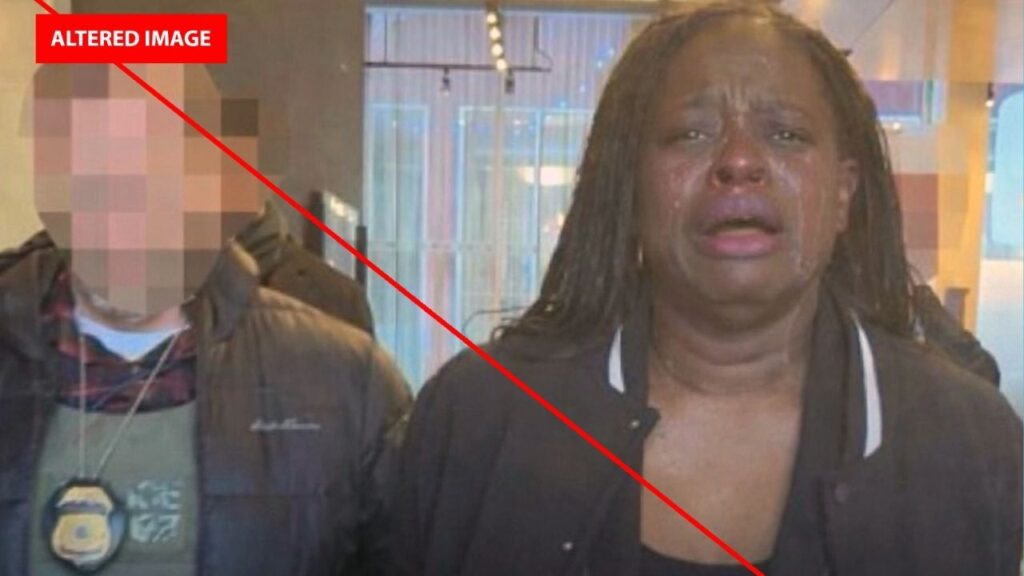
White House shares altered image of attorney arrest in Minnesota | AP News
Jan 22, 2026The Trump administration is misrepresenting the arrest of civil rights attorney Nekima Levy Armstrong for her role in an anti-immigration enforcement protest that disrupted a service at a Minnesota church.
---
---
---
GMAIL 2 26
San Francisco Chronicle (AP)
Trump’s ‘meme’ of an activist’s arrest shows official embrace of AI fakes
Takeaway
The White House posted a doctored image of civil rights attorney Nekima Levy Armstrong crying after her arrest, then defended it as a “meme.” Experts warn this state-backed use of AI-edited visuals deepens distrust, invites copycats, and makes it harder for the public to tell truth from propaganda.
Why it matters
The Trump White House turning a real arrest into a “meme” normalizes state-backed disinformation and makes outrage itself a distribution strategy. Once official channels treat manipulated images as jokes, it gets harder to police bad faith content, blurs what counts as evidence, and arms Republicans to dismiss real footage as “AI” when it hurts them....$
---
AN 12 25
Which terms best represent 2025?
Every year, editors for publications ranging from the Oxford English Dictionary to the Macquarie Dictionary of Australian English select a “word of the year.”
Sometimes these terms are thematically related, particularly in the wake of world-altering events. “Pandemic,” “lockdown” and “coronavirus,” for example, were among the words chosen in 2020. At other times, they are a potpourri of various cultural trends, as with 2022’s “goblin mode,” “permacrisis” and “gaslighting.”
This year’s slate largely centers on digital life. But rather than reflecting the unbridled optimism about the internet of the early aughts – when words like “w00t,” “blog,” “tweet” and even “face with tears of joy” emoji (😂) were chosen – this year’s selections reflect a growing unease over how the internet has become a hotbed of artifice, manipulation and fake relationships.
When seeing isn’t believing
A committee representing the Macquarie Dictionary of Australian English settled on “AI slop” for their word of the year.
Macquarie defines the term, which was popularized in 2024 by British programmer Simon Willison and tech journalist Casey Newton, as “low-quality content created by generative AI, often containing errors, and not requested by the user.”
AI slop – which can range from a saccharine image of a young girl clinging to her little dog to career advice on LinkedIn – often goes viral, as gullible social media users share these computer-generated videos, text and graphics with others.
Images have been manipulated or altered since the dawn of photography. The technique was then improved, with an assist from AI, to create “deepfakes,” which allows existing images to be turned into video clips in surreal ways. Yes, you can now watch to sing a 1970s hit by The Buggles.
What makes AI slop different is that images or video can be created out of whole cloth by providing a chatbot with just a prompt – no matter how bizarre the request or ensuing output.
Meet my new friend, ChatGPT
The editors of the Cambridge Dictionary chose “parasocial.” They define this as “involving or relating to a connection that someone feels between themselves and a famous person they do not know, a character in a book, film, TV series … or an artificial intelligence.”
These asymmetric relationships, according to the dictionary’s chief editor, are the result of “the public’s fascination with celebrities and their lifestyles,” and this interest “continues to reach new heights.”
As an example, Cambridge’s announcement cited the engagement of singer Taylor Swift and football player Travis Kelce, which led to a spike in online searches for the meaning of the term. Many Swifties, as if their best friend or sibling had just decided to tie the knot.
But the term isn’t a new one: It was coined by sociologists in 1956 to describe “the illusion” of having “a face-to-face relationship” with a performer.
However, parasocial relationships can take a bizarre or even ominous turn when the object of one’s affections is a chatbot. People are developing true feelings for these AI systems, whether they see them as a trusted friend or even a romantic partner. Young people, in particular, are now turning to generative AI for therapy.
Taking the bait
The Oxford Dictionary’s word of the year is “rage bait,” which the editors define as “online content deliberately designed to elicit anger or outrage by being frustrating, provocative, or offensive, typically posted in order to increase traffic to or engagement with a particular web page or social media content.”
This is only the latest word for forms of emotional manipulation that have plagued the online world since the days of dial-up internet. Related terms include trolling, sealioning and trashposting.
Unlike a hot take – a hasty opinion on a topic that may be poorly reasoned or articulated – rage baiting is intended to be inflammatory. And it can be seen as both a cause and a result of political polarization.
People who post rage bait have been shown to lack empathy and to regard other people’s emotions as something to be exploited or even monetized. Rage baiters, in short, reflect the dark side of the attention economy.
Meaningless meaning
Perhaps the most contentious choice in 2025 was “6-7,” chosen by Dictionary.com. In this case, the controversy has to do with the actual meaning of this bit of Gen Alpha slang. The editors of the website describe it as being “meaningless, ubiquitous, and nonsensical.”
Although its definition may be slippery, the term itself can be found in the lyrics of the rapper Skrilla, who released the single “Doot Doot (6 7)” in early 2025. It was popularized by 17-year-old basketball standout Taylen Kinney. For his part, Skrilla claimed that he “never put an actual meaning on it, and I still would not want to.”
“6-7” is sometimes accompanied by a gesture, as if one were comparing the weight of objects held in both hands. British Prime Minister Keir Starmer recently performed this hand motion during a school visit. The young students were delighted. Their teacher, however, informed Starmer that her charges weren’t allowed to use it at the school, which prompted a clumsy apology from the chastened prime minister.
Throw your hands in the air?
The common element that these words share may be an attitude best described as digital nihilism.
As online misinformation, AI-generated text and images, fake news and conspiracy theories abound, it’s increasingly difficult to know whom or what to believe or trust. Digital nihilism is, in essence, an acknowledgment of a lack of meaning and certainty in our online interactions.
This year’s crop of words might best be summed up by a single emoji: the shrug (🤷). Throwing one’s hands up, in resignation or indifference, captures the anarchy that seems to characterize our digital lives.
Roger J. Kreuz, Associate Dean and Feinstone Interdisciplinary Research Professor, *University of Memphis
This article is republished from The Conversation under a Creative Commons license. Read the original article.
---
---
12/08/2025 rww
by
Oh good, Glenn Beck has created an AI George Washington. You will be shocked to learn that the AI George Washington created by Glenn Beck sounds exactly like what would happen if Glenn Beck built an AI George Washington to sound exactly like Glenn Beck.
Video URL 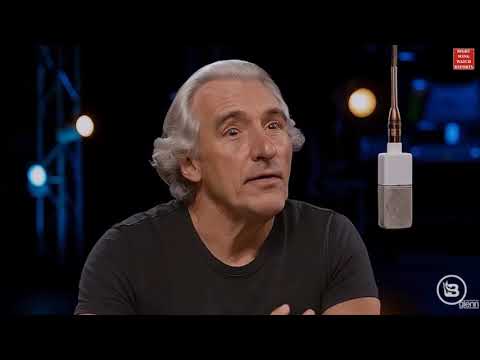
---
hit w plastic pipe?
---
OMG AN 12 25
President Donald Trump went on a bizarre Truth Social posting binge Monday night, as pointed out by many media experts, including Vaughn Sterling, executive producer of "The Source With Kaitlan Collins" on CNN, who wondered "what was going on last night?"
CNN political reporter Aaron Blake posted one of the president's unhinged posts, noting, "Trump last night promoted a post that guaranteed Barack Obama will face a military tribunal."
Meidas Touch co-founder Ben Meiselas posted screenshots of Trump's Truth Social, saying, "Trump has made approximately 400 posts in the past hour which include posts like this."
One of those posts included an interview Meiselas did with former Attorney General Eric Holder and Holder’s call for reforming the Supreme Court.
"Trump demanded that Republicans abolish the filibuster based on what Holder was telling me," Meiselas writes in a Tuesday morning article titled, "Trump Attacks MeidasTouch in Midnight Mental Breakdown."
"Shortly after Trump made the post about MeidasTouch, there was a brief pause, and then he began making new posts every 10 seconds for a full hour, totaling about 400 posts," Meiselas explains.
"His posts included deranged claims that Michelle Obama 'controlled Biden’s autopen' and that Biden’s executive orders were really done by Michelle Obama. Trump posted an AI video claiming Nicolás Maduro surrendered to him and that Trump was now controlling Venezuela, and that Maduro admitted Tren de Aragua confessed [former President Joe] Biden was the leader of their cartel. Trump made posts saying Canada was involved in election rigging. He made bizarre posts about Obama’s weekly 'kill list.' I can go on and on, but you get the point," he adds.
"Trump has posted hundreds of times in the past few hours. It’s a smorgasbord of propaganda e.g. 2020 election lies, blaming Pelosi for J6, calling Democrats seditionists, raging about illegals and Somalis, Biden and the autopen, the Obamas, Ilhan Omar [and] Tim Walz. Total insanity," wrote Andrew—#IAmTheResistance on X.
Liberal influencer Harry Sisson posted a few of Trump's rants on his X account, saying, "These are just some of the over 150 posts Trump put out on Truth Social last night in the span of an hour. Completely insane conspiracy theories. He was clearly having a mental decline episode and was posting whatever came to mind. It’s going to get worse."
:{:{---}:
YMAIL 11 25 FS4PPL
We just won a historic legal victory, together with our partner, the League of Women Voters, and our co-counsel, to defend voters from AI-generated deception and voter intimidation.
A federal court in New Hampshire has ruled in favor of our clients in LWVNH v. Kramer, the first major voter-intimidation case involving AI deepfakes. The ruling:
Confirms violations of the Voting Rights Act and state election laws;
Awards damages to the voters harmed; and
Permanently bars the defendant from using AI-generated robocalls to intimidate voters in any future U.S. election.
This is a major win, not just for New Hampshire, but for democracy nationwide.
---
GGL 11 25 DILLEY AI SLOP MEME TEAM VIDEO
[### Trump's A.I. Video "Propaganda" | The Brian Lehrer Show

WNYC
https://www.wnyc.org › story › trumps-ai-video-propaga...](https://www.wnyc.org/story/trumps-ai-video-propaganda/)
Oct 22, 2025 — How President Trump is using fake artificial intelligence generated imagery to attack his perceived enemies and successfully rouse his ...
[### How Trump is Using AI to Attack Enemies and Rouse ...

The New York Times
https://www.nytimes.com › interactive › business › media](https://www.nytimes.com/interactive/2025/10/21/business/media/trump-ai-truth-social-no-kings.html)
Oct 21, 2025 — The video was created by Dilley 3000 Meme Team, a guerrilla messaging outfit that is deeply loyal to Mr. Trump and has produced dozens of ...
NO LNX PIX
How Trump Is Using Fake Imagery to Attack Enemies and Rouse Supporters
By Stuart A. Thompson Oct. 21, 2025
Generated by A.I.
18.jpg
74.jpg
33.jpg
20.jpg
76.jpg
68.jpg
The era of A.I. propaganda is here — and President Trump is an enthusiastic participant.
After nationwide protests this weekend against Mr. Trump’s administration, the president posted an A.I.-generated video to his Truth Social account depicting himself as a fighter pilot, careening through major cities and dropping excrement on protesters.
It was the latest example in a yearslong shift by Mr. Trump to deploy fake imagery, generated by artificial intelligence, as part of his social media commentary.
Mr. Trump has posted A.I.-generated images or videos at least 62 times on his Truth Social account since late 2022, according to a review by The New York Times of his posts to the social network. The fake imagery has included blistering attacks on his political rivals, flattering depictions of himself, and misleading political campaign materials made entirely by A.I. tools.
Overall, he has attacked his opponents, including top Democratic leaders and his Republican rivals, with A.I. imagery at least 14 times.
14 fake images and videos attacking opponents
Generated by A.I.
In the run-up to the 2024 election, Mr. Trump posted at least 19 A.I. images or videos in support of his presidential campaign, including an image of Elon Musk next to a D.O.G.E. logo long before the cost-cutting idea became reality.
19 fake images and videos about his campaign
Generated by A.I.
Mr. Trump posted at least seven times this year attempting to score political points by bringing to life his policy ideas, mocking criticism against them or celebrating his administration.
7 fake images and videos about his policies and administration
Generated by A.I.
And, most of all, Mr. Trump posted at least 21 fantastical reimaginings of himself — rendered, for example, as the recipient of the Nobel Peace Prize or even a king.
21 fake images or videos about himself
Generated by A.I.
Some of the posts were likely to mislead viewers or amplify political divisions. Others were jokes with obvious markers of A.I. trickery. Political experts said that even the most anodyne uses of A.I. by the president would normalize the tools as a potent new part of modern political propaganda.
“Trump is the most notable person sharing this content, but this is really becoming an international, new form of political messaging,” said Henry Ajder, an expert on A.I. and the founder of Latent Space Advisory, an A.I.-consulting firm. “It’s designed to go viral, it’s clearly fake, it’s got this absurdist kind of tone to it. But there’s often still some kind of messaging in there.”
The White House has responded to questions over Mr. Trump’s use of A.I. imagery by suggesting it was part of his successful social media strategy.
“No leader has used social media to communicate directly with the American people more creatively and effectively than President Trump,” Liz Huston, the White House’s assistant press secretary, said Friday in an emailed statement.
Mr. Trump’s use of the technology has evolved alongside the tools, which have rapidly improved from producing obviously fake images in 2022 to more lifelike renderings — including video and audio — this year.
In countries around the world, the tools have offered new ways for politicians and candidates to bring to life their partisan arguments. Politicians have, for instance, used A.I. to imagine futures they want voters to fear, such as punctuating anti-immigrant messages by using A.I. to depict classrooms overcrowded with immigrants.
For Mr. Trump, the tools helped him to visualize the supposed effects of “open borders” during his campaign, contrasting two A.I. images: one an idyllic scene, the other an overcrowded one with trash piled out in the open.
avatar
Donald J. Trump
@realDonaldTrump
Generated by A.I.
Two A.I.-generated images, shown side by side. The first image shows an idyllic city street with the text: “Your future under Trump.” The second shows a crowded thoroughfare with the text: “Your future under Kamala.”
Note: “Generated by A.I.” label and red slash were added by The New York Times.
The content can be rapidly created by typing descriptions of the desired images and videos into A.I.-generating tools like Grok or ChatGPT. Some videos were made using multiple A.I. tools, such as a video of Robert De Niro that Mr. Trump shared last year: Someone replaced the actor’s lip movements with A.I.-rendered manipulations to match a voice soundalike that was also created by A.I. audio tools.
avatar
Donald J. Trump
@realDonaldTrump
Generated by A.I.
Note: “Generated by A.I.” label and red slash were added by The New York Times.
The New York Times used tools designed to detect A.I. images to help identify the fakes, alongside manual review. Content that could not be clearly identified as A.I., and posts that appeared to primarily show real videos that had been edited by A.I.-powered filters, were excluded.
Mr. Trump’s use of A.I. content began in earnest during his re-election bid, when the tools became sophisticated enough for amateur creators to produce realistic images of famous people, including Mr. Trump.
Last September, after his first debate against Kamala Harris, the Democratic nominee and then the vice president, Mr. Trump claimed that Haitian immigrants in Ohio were eating cats and dogs — a racist conspiracy theory for which there was no credible evidence.
Mr. Trump responded to the backlash that followed by posting a flurry of A.I. images depicting him embracing cats, ducks and dogs. His supporters shared the images widely online.
avatar
Donald J. Trump
@realDonaldTrump
Generated by A.I.
Note: “Generated by A.I.” label and red slash were added by The New York Times.
“The more ridiculous the photo or video, the more likely it is to dominate our news feeds,” said Adrian Shahbaz, vice president of research and analysis at Freedom House, a nonprofit focusing on democracy and liberty around the world. “A controversial post gets shared by people who enjoyed it and people outraged by it. That’s twice the shares.”
Mr. Trump’s embrace of A.I. content has accelerated since he re-entered the White House in January, increasing in sophistication alongside tools that can now generate superrealistic A.I. videos and audio. It was not clear in most cases whether the imagery was posted by Mr. Trump or by a member of his team, but the message-conscious president is famous for controlling his own social media accounts. It was also not clear in many cases whether the A.I. imagery was created by Mr. Trump or someone in the White House, or whether it originated elsewhere and was simply reposted by Mr. Trump's account.
The president has used A.I. imagery to highlight policy ideas and appeared to joke about issues that were roiling the public. For instance, when he appointed himself as the head of the Kennedy Center for the Performing Arts, he published an image of himself depicted as a conductor. He also posted an image of himself atop a mountain, next to the Canadian flag, punctuating his suggestion that Canada should become the 51st state.
avatar
Donald J. Trump
@realDonaldTrump
Generated by A.I.
Note: “Generated by A.I.” label and red slash were added by The New York Times.
In recent months, Mr. Trump has demonstrated a willingness to use A.I.-generated content to skewer opponents and stoke deeper tensions.
This month, he posted a video depicting the Democratic House minority leader, Hakeem Jeffries, in stereotypical Mexican garb. The video used A.I. to replace the voice of the Democratic Senate minority leader, Chuck Schumer, making it seem as though he was disparaging the Democratic Party.
In a televised statement, Mr. Jeffries criticized the video as racist. Then, in another post, Mr. Trump posted that interview, edited with A.I. tools to include four A.I. versions of the president as members of a mariachi band.
avatar
Donald J. Trump
@realDonaldTrump
Generated by A.I.
Note: “Generated by A.I.” label and red slash were added by The New York Times. The original clip was trimmed to show only the part generated by A.I.
Mr. Trump was also widely criticized for a video he posted in February depicting “Trump Gaza,” a futuristic version of the war-torn region rendered as a beachfront paradise with a gold statue of Mr. Trump at its center.
Democratic lawmakers and advocates for Palestinian rights called the video insulting and disturbing. The White House responded: “Trump is a visionary.”
avatar
Donald J. Trump
@realDonaldTrump
Generated by A.I.
Note: “Generated by A.I.” label and red slash were added by The New York Times.
The backlash has not slowed the president’s use of the technology, especially during moments of national outrage. He posted a video showing himself shaking hands with a figure in the Cracker Barrel logo after an uproar among conservatives over the company’s plans to remove an older white man from its logo in favor of a text-only version. As he toyed with plans to send the National Guard to Chicago, he posted an A.I.-generated image of himself imagined into the film “Apocalypse Now” above the title “Chipocalypse Now” and a caption that read, in part, “Chicago about to find out why it’s called the Department of WAR.”
avatar
Donald J. Trump
@realDonaldTrump
Generated by A.I.
Note: “Generated by A.I.” label and red slash were added by The New York Times.
The memes and videos have deceived some social media users, who replied to his posts asking whether they were real or fake.
After Mr. Trump posted a video that included a fictitious, A.I.-generated arrest of former President Barack Obama, a few users on Truth Social signaled that they were not sure whether the footage was real.
“Whoa…. Did this really happen?” wrote one user.
“Is this real footage of Obama being arrested????” wrote another.
avatar
Donald J. Trump
@realDonaldTrump
Generated by A.I.
Note: “Generated by A.I.” label and red slash were added by The New York Times. The original clip was trimmed to show only the part generated by A.I.
A.I. tools have been embraced by scammers and conspiracy theorists, who have used the technology to make too-good-to-be-true videos of news reports about miracle medicines or astounding discoveries.
Mr. Trump posted one such video last month about a news report concerning “medbeds,” a fictional health product described as a cure for a variety of illnesses. Medbeds have been an obscure conspiracy theory among internet users. It was not clear why Mr. Trump posted the video or whether he knew it was A.I.-made, and the video was soon deleted from his account. Karoline Leavitt, the White House press secretary, said during a news briefing that the president “saw the video and posted it,” but offered no explanation.
avatar
Donald J. Trump
@realDonaldTrump
Generated by A.I.
Note: “Generated by A.I.” label and red slash were added by The New York Times.
In at least some cases, generating A.I. fakes has proved effective at seizing Mr. Trump’s attention. After Mr. Trump did not win a Nobel Peace Prize, despite openly lobbying for one, he posted an image originally posted by the Israeli government depicting him receiving the prize amid applause and confetti.
After the government shut down over a funding fight this month, Mr. Trump posted a video depicting himself and members of his cabinet in ominous cloaks reminiscent of the Grim Reaper.
avatar
Donald J. Trump
@realDonaldTrump
Generated by A.I.
Note: “Generated by A.I.” label and red slash were added by The New York Times.
The video was created by Dilley 3000 Meme Team, a guerrilla messaging outfit that is deeply loyal to Mr. Trump and has produced dozens of videos skewering Democrats and praising Mr. Trump. The group is run by Brenden Dilley, a podcaster and former congressional candidate, and a team of content creators who organize online. Mr. Dilley declined to comment.
“The truth no longer matters, all you have to do is go viral,” Mr. Dilley wrote on X during Mr. Trump’s re-election campaign.
Correction: Oct. 22, 2025
An earlier version of this article misidentified the U.S. state at the center of a conspiracy theory about Haitian immigrants eating cats and dogs. It was Ohio, not Michigan.
See more on: U.S. Politics, Donald Trump
Read 459 comments
---
did-fox-news-apply-an-ai-filter-to-give-this-woman-a-black-eye
Did Fox News apply an AI filter to give this woman a black eye?
Jason Weisberger 7:35 am Fri Oct 3, 2025
Social Media is pointing out that a "journalist" claiming to have been "assaulted" by "antifa" in Portland's black eye looks like an AI injury simulation filter was used.
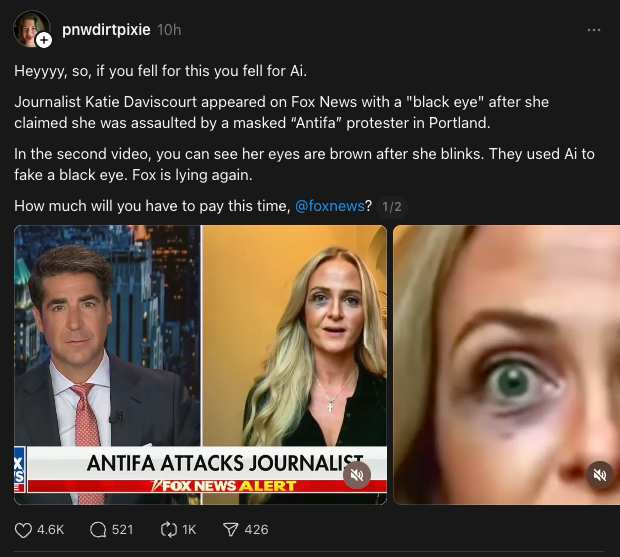
An additional message in the thread shows analysis by AI on the video, claiming that it does appear to be altered. Folks find the woman's eyebrow movements, as well as changing eye color, to be telltale signs of a filter.
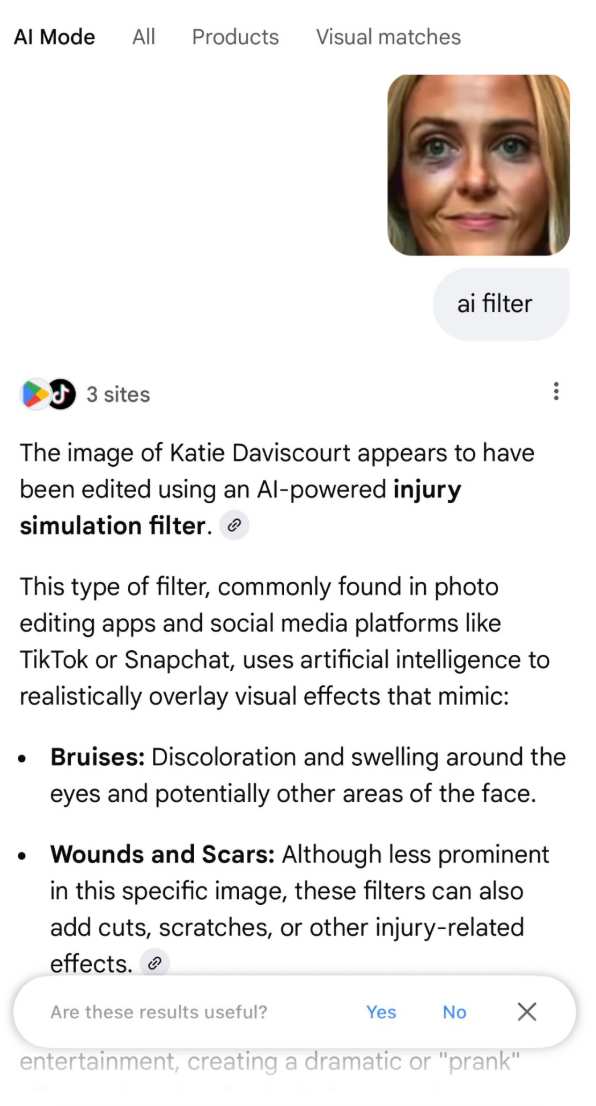
There is also a video that claims to show the "assault," and it appears to be someone innocently waving a flag.
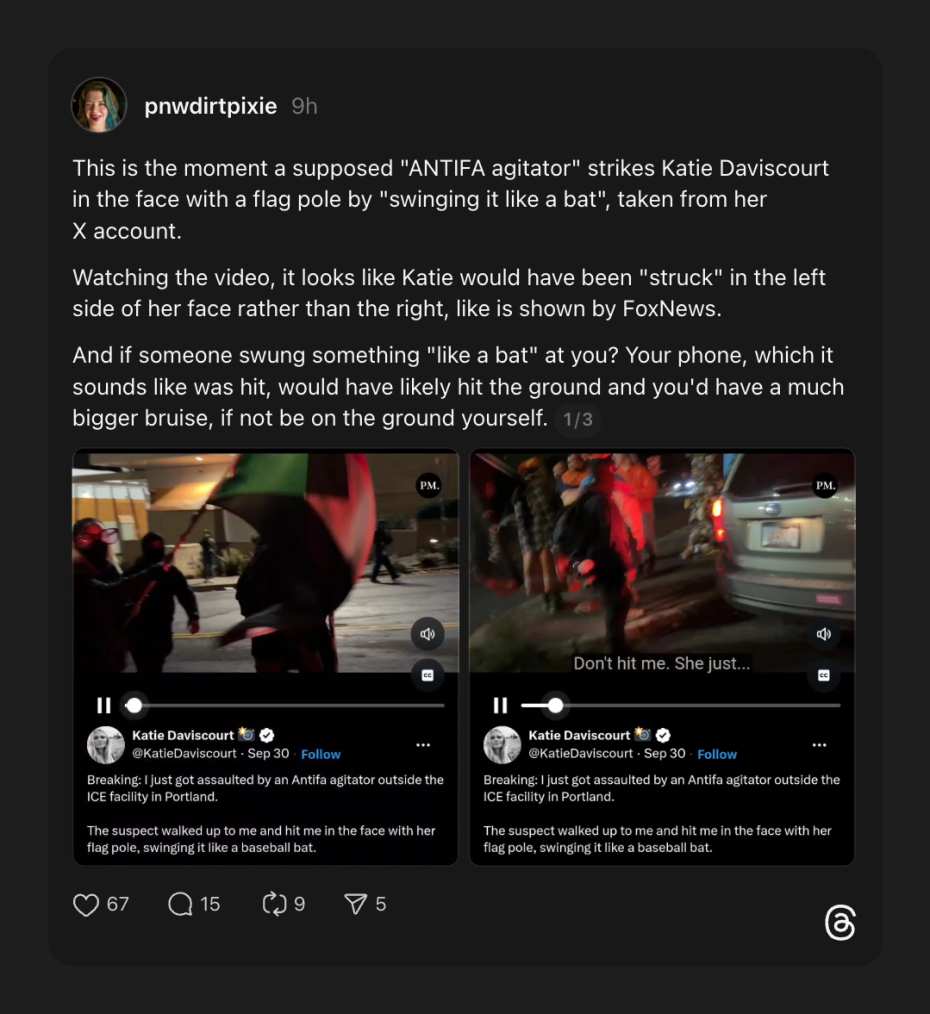
Here is the video direct from Fox via YouTube. You make the call!

Previously:
• Fox News leaks juror details, forcing resignation in Trump case
• FOX's Watters threatens wife on air, proving point of political ad
• Fox Fascist, Jesse Watters, shows how fascism works
---
On Truth Social, Trump gives official announcements and shares AI slop to over 10 million followers
In September, amid official personnel and policy announcements, Trump amplified right-wing media clips and posted memes and AI-generated pro-Trump content
Written by Jack Winstanley & Alex Kaplan
Research contributions from Kayla Gogarty
Published 10/03/25 mma
President Donald Trump uses his account on his social media platform, Truth Social, as a vehicle for amplifying pro-Trump messaging and attacking his perceived enemies. A Media Matters review of Trump’s account, which has at least 10.8 million followers, during September found that he repeatedly announced administration appointments, military actions, and new policies, shared right-wing media articles and clips, and posted pro-Trump content seemingly generated by artificial intelligence, including content advancing his messaging and/or attacking his critics.
Since launching the social media platform in 2022, Trump has used it to boost conspiracy theories and share AI-generated content
- Trump has been using Truth Social since shortly after launching the platform in 2022. Truth Social launched in early 2022, and Trump began posting actively on the platform that April. NPR, [2/22/22; Media Matters, 10/29/24]
- A New York Times study found Trump repeatedly amplified conspiracy theories on Truth Social over a six-month period in 2024. According to the Times study, “often multiple times a day,” Trump is “concocting or promoting dark, paranoid material and pushing it out to his millions of followers. Mr. Trump is so hungry for this content that he appears to be willing to share outlandish information from anyone, including both well-known conspiracists and anonymous accounts that tag him.” The study, which examined part of 2024, “zeroed in on the 170 Truth Social accounts that Mr. Trump had amplified on the platform. Some are ones he follows; others have just come across his radar. The vast majority of the accounts regularly promoted conspiracy theories, the analysis showed.” The New York Times, [10/29/24]
- A Media Matters review has found that Trump has boosted QAnon-promoting Truth Social accounts over 1,000 times. Among those amplifications include dozens of images that explicitly promote the conspiracy theory. Trump has also repeatedly used his account to boost content from the “Dilley meme team.” In December 2023, The New York Times found that “since March, Mr. Trump has posted videos made by the [Dilley] team to his Truth Social and Instagram accounts — which have more than 30 million followers combined — at least two dozen times” including “memes that feature him in a positive light.” Media Matters, [10/29/24, 6/27/24; The New York Times, 12/13/23]
- Trump and his team have repeatedly posted images of Trump that appear to be AI-generated. As noted by The Associated Press, “The AI images of Trump posted by him and his team” are “self-evident in their fictitiousness. Pope Francis dies, and Trump jokes to reporters that he’d like to be pope. A week later, he is, but in an AI-generated image that he posts, reposted by the White House. Trump likens himself to a king in a Truth Social post in February, and AI makes him one in an X post by the White House less than an hour later. The artifice arrives in Trump’s usual style — brassy, unabashed, attention-grabbing — and squares with his social media team’s heavy meme posting, which it has promised to continue.” The Associated Press, [9/29/25]
- In September 2025, Trump got attention for posting multiple AI-generated videos.The videos depicted House Minority Leader Hakeem Jeffries (D-NY) in a sombrero and added fake audio for Senate Minority Leader Chuck Schumer (D-NY), playing mariachi music in the background. Trump also had posted — and later deleted — an apparent AI-generated video that includes him promoting a conspiracy theory that reportedly emerged in far-right online communities and purports that “medbeds” exist to cure all kinds of ailments. Bluesky, [9/27/25; Truth Social, 9/29/25, 9/30/25; Rolling Stone, 9/28/25; USA Today, 9/30/25]
- ## Trump often posts administration announcements, such as appointments, military strikes, and policy statements, and uses his account to tout his supposed accomplishments
- After using the platform to praise her accomplishments, Trump announced on Truth Social that he was appointing Lindsey Halligan as U.S. attorney for the Eastern District of Virginia. This came after he used the platform to call on Attorney General Pam Bondi to prosecute former FBI Director James Comey, Sen. Adam Schiff (D-CA), and New York Attorney General Letitia James and argued that Halligan would provide “desperately needed, JUSTICE FOR ALL!” Truth Social, [9/20/25, 9/20/25, 9/20/25]
- Trump first announced two separate strikes on vessels allegedly carrying narcotics off the coast of Venezuela, on Truth Social, sharing videos of each. In one post, Trump argued that the vessels supposedly “POSE A THREAT to U.S. National Security,” and added a warning to any would-be drug traffickers, “WE ARE HUNTING YOU!” Truth Social, [9/2/25, 9/15/25; CBS News, 9/19/25; The Associated Press, 9/16/25]
- Trump has repeatedly announced new tariff policies on Truth Social. On September 29, for example, he claimed that he “will be imposing substantial Tariffs on any Country that does not make its furniture in the United States” and “a 100% Tariff on any and all movies that are made outside of the United States.” Truth Social, [9/29/25, 9/29/25; CNN, 9/29/25]
- Other policy announcements on Truth Social have included his deployment of troops to Portland and his declassification of government records about Amelia Earhart. On September 27, he posted that he was “directing” Secretary of Defense Pete Hegseth “to provide all necessary Troops to protect War ravaged Portland, and any of our ICE Facilities under siege from attack by Antifa, and other domestic terrorists.” On September 26, he posted that he was “ordering” the administration to “declassify and release all Government Records related to Amelia Earhart, her final trip, and everything else about her.” Many of these types of announcements on Truth Social end with “Thank you for your attention to this matter.” Truth Social, [9/27/25, 9/26/29; NPR, 9/29/25; Politico, 9/26/25]
- Trump has also used his Truth Social presence to share White House posts touting his supposed accomplishments and public approval. In one post, Trump shared a video purporting to show that he “arrives to massive applause at Ryder Cup.” Another announced that, according to a Rasmussen Reports poll, “57% of Americans approve of President Donald J. Trump.” A third post contained a graphic claiming that Trump has “ended 7 wars in just 7 months.” In another post, Trump shared an official White House video of him welcoming Israeli Prime Minister Benjamin Netanyahu to the White House. Truth Social, [9/27/25, 9/26/25, 9/26/25, 9/29/25; Twitter/X, 9/26/25, 9/25/25, 9/23/25, 9/29/25]
- ## Trump posts pro-Trump memes and apparent AI-generated videos and photos that advance his messaging and/or attack his critics
- Trump posted a seemingly AI-generated image depicting him firing Federal Reserve Chairman Jerome Powell. Truth Social, [9/27/25]
- Trump posted a meme depicting him seemingly sending the military into Chicago, with the text “Chipocalypse Now.”An online channel that spreads conspiracy theories took credit for the meme. Truth Social, [9/6/25; Bluesky, 9/8/25, 9/8/25]
- Trump posted a seemingly AI-generated image celebrating settling his lawsuit with YouTube. Truth Social, [9/29/25]
- Trump posted an image depicting him trading stocks in the Oval Office. Truth Social, [9/18/25]
- Trump shared a seemingly altered video purporting to show Nancy Pelosi saying, “Ever since I left Congress, my trades are shit. I can’t get any insider information anymore.” The video, which also has overlayed text that says, “Who did this???” and laughing emojis, purports to show Pelosi saying that her husband, Paul, is “still in love with a homeless hammer guy,” a reference to an assault on her husband. Truth Social, [9/8/25; Media Matters, 11/1/22]
- Trump posted an apparent AI-generated video depicting Illinois Democratic Gov. JB Pritzker and former New Jersey Republican Gov. Chris Christie sumo wrestling. Truth Social, [9/3/25]
- Amid backlash to a proposed redesign of the Cracker Barrel logo and restaurants, Trump posted an apparent AI-generated video depicting him shaking hands and dancing with the person in the original logo. Trump had previously criticized the redesign and, according to CNBC, Cracker Barrel communicated directly with the White House about their plans to scrap it. Truth Social, [9/3/25; CNBC, 8/26/25]
- Trump posted a video that appears to be AI-generated and depicts Trump standing in front of Mount Rushmore, with the presidential figures carved into the monument smiling along with him. Truth Social, [9/3/25]
- Trump posted a seemingly altered video with confetti added to a purported CNN segment showing Trump dancing and a chyron claiming that “Democrats have lost 2.1 million voters, Republicans have gained 2.4 million.”Truth Social, [9/3/25]
- Trump shared multiple memes from a pro-Trump “meme team.” The lead of the meme team, Brenden Dilley, hyped one of them, depicting Trump pole-vaulting over a Cracker Barrel sign on his podcast, saying, “Last night was a very good night for the Dilley meme team. ... Can we just take the moment to appreciate Dilley meme team on President 47’s page?” Truth Social, [9/3/25; Bluesky, 9/4/25, 9/4/25; The New York Times, 12/13/23]
- ## Trump amplifies right-wing media clips and articles amplifying his views and policies or attacking his critics and political foes
- Trump shared Blaze Media footage showing police units responding to a protest and arresting a protester. Trump added the caption “CHICAGO…” to the post. Truth Social, [9/28/25]
- Trump shared a clip of Real America’s Voice host John Solomon claiming that he had evidence that “scores of FBI agents ... believe[d] the FBI had become politically biased against the conservative movement.” Truth Social, [9/27/25]
- In a clip fromThe Scott Jennings Radio Show, shared by Trump on Truth Social, Jennings attacked those who “cheered the political prosecutions of Donald Trump,” telling them to “choke on it.” Truth Social, [9/27/25]
- Trump shared a portion of Fox News’ live broadcast of a press conference announcing the renaming of the Department of Defense to the Department of War. Truth Social, [9/5/25]
- Trump shared an article published by Right Side Broadcasting Network about his decision to “host a UFC cage fight on the South Lawn of the White House.”The article highlighted that “supporters describe the decision as a bold show of spectacle.” Truth Social, [9/6/25; Right Side Broadcasting Network, 9/5/25]
MMA
MAGA media are seemingly flooding the internet with AI slop about Florida's new detention center
Some social media platforms are recommending AI-generated content to users
Written by Jack Wheatley
Research contributions from Sage Hodil, Helena Hind, Isabella Corrao & Noah Dowe
:{Published 07/14/25
Right-wing media figures and social media influencers are sharing seemingly AI-generated content about Florida’s new migrant detention facility in the Everglades, including images of alligators in “ICE” hats and a picture of a prison surrounded by a moat. Some of the images were previously shared by the White House and Department of Homeland Security.
Commentators have also offered widespread praise online of the facility, which is being called “Alligator Alcatraz,” and one influencer was even invited to tour the center before it opened.
Some social media platforms are actively recommending content that appears to be AI-generated to users, including in search results for “Alligator Alcatraz” on TikTok and Instagram.
The White House and DHS both have posted AI memes about the detention center, which opened this month, drawing right-wing media praise
- In early July, the Trump administration and the state of Florida opened “Alligator Alcatraz,” a migrant detention center whose “nickname — coined by Florida Attorney General James Uthmeier — references its proximity to the predators of the marshy Everglades, from pythons to alligators to mosquitoes.” Per CBS News, detainees at the facility already allege inhumane conditions, “including lack of access to water, inadequate food and denial of religious rights.” One detainee remarked over the phone, “They're not respecting our human rights. We're human beings; we're not dogs. We're like rats in an experiment." NPR, [7/1/25; PBS, 7/3/25; CBS News, 7/8/25]
- Ahead of the facility opening, the official social media accounts of the Department of Homeland Security and the White House posted reportedly AI-generated images of alligators wearing ICE hats to promote the facility. Twitter/X, [6/28/25, 7/1/25; Snopes, 7/1/25; HuffPost, 7/2/25]
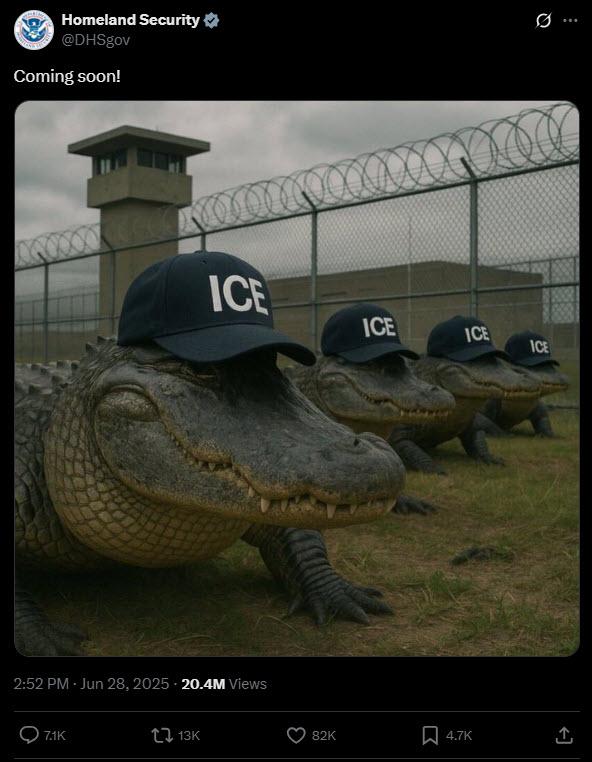
Right-wing media figures have praised the facility and fantasized about “feeding illegals” to the alligators. Fox host Sean Hannity claimed that the “worst of the worst” will be housed there, and Tomi Lahren said it’s “an eyesore for the alligators and the pythons that have to look at criminal illegal aliens. Not the other way around.” Right-wing influencer Alexander Muse, known online as “Amuse,” wrote, “If you’re here illegally your should seriously consider self-deporting. You won’t like Alligator Alcatraz,” sharing a video of an alligator that caught a snake. Twitter/X, [6/30/25, 7/1/25, 7/2/25; The Guardian, 8/26/24; Fox News, Hannity, 7/1/25]
- ## Right-wing media influencers are spreading seemingly AI-generated images and videos of the detention center and fantasizing about migrants being eaten by alligators
- During his streaming show, right-wing commentator Dave Rubin played a video — seemingly created by Google’s Veo video generator — of “an illegal escaping through the Everglades” surrounded by alligators.The video depicted the person pleading with the alligators: to “Don’t eat me! Let me go and I'll give you tacos and burritos.” YouTube, *The Rubin Report*, [6/30/25]
- Conservative influencer Eric Daugherty posted an “AI rendition of Alligator Alcatraz” featuring a moat, calling it “breathtaking.” He wrote, ”I wish they could put a REAL alligator moat around it 😂.” Breitbart, [9/21/24; Twitter/X, 6/28/25]
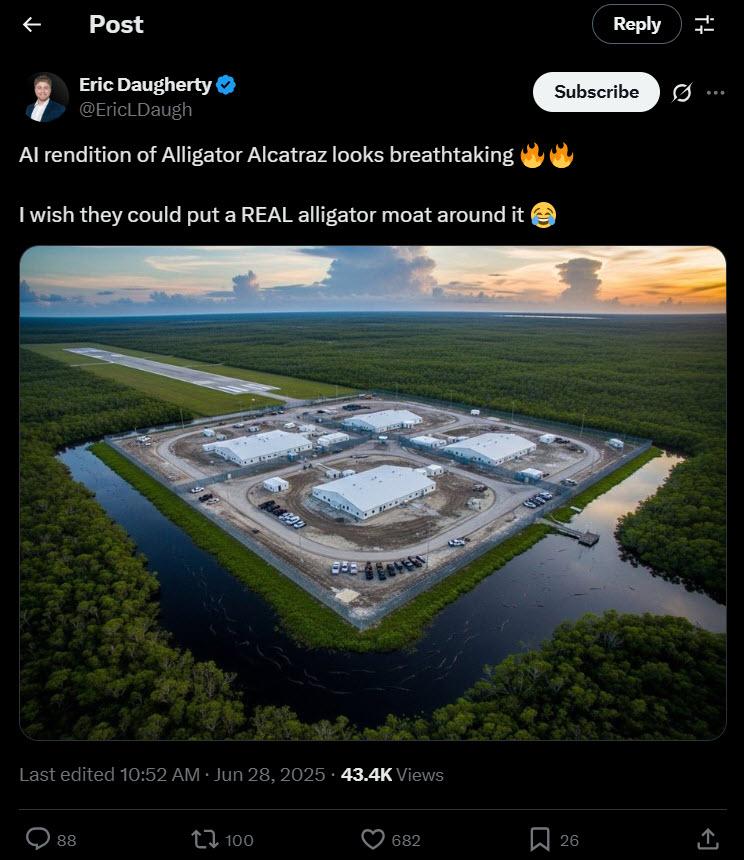
- Right-wing influencer Catturd posted the same image, writing: “Alligator Alcatraz is what dreams are made out of.” Twitter/X, [6/27/25]
- TheBlaze used DHS’ apparently AI-generated image to promote an episode ofBlaze News: The Mandate. Twitter/X, [7/1/25; YouTube,
 ]
- TheBlaze used DHS’ apparently AI-generated image to promote an episode ofBlaze News: The Mandate. Twitter/X, [7/1/25; YouTube,
- The Blaze also used a seemingly AI-generated image for an article about the facility, showing a moat with alligators surrounding a facility labeled “ICE.” The image description says: “Note: This is a Blaze Media illustration, not the actual facility.” The Blaze, [6/24/25]
- The Gateway Pundit used DHS’ apparently AI-generated image of alligators with ICE hats in an article titled “Not a Gulag! ‘Alligator Alcatraz’ Is Smart, Lawful Immigration Enforcement” and in a social media post sharing another piece. The Gateway Pundit, [6/30/25; Twitter/X, 6/28/25]
- Right-wing influencer Dom Lucre posted a video that starts with the image of the facility with a moat, writing: “The Florida Alligator Alcatraz has officially filled the surrounded waters with gators for any illegal migrant that is bold enough to escape.” He also said the facility is “in the middle of a swamp here in Miami” and “was once used as an airport but has been repurposed to house illegal migrants.” Twitter/X, [6/28/25]
- Right-wing media influencer-turned-U.S. Ambassador to Malaysia Nick Adams posted the same image of the detention center with a moat, saying it “looks beautiful.” Rolling Stone, [7/10/25; Twitter/X, 6/27/25]
- Right-wing activist and commentator Garrett Soldano’s Grassroots Army Instagram page posted the image of the facility with a moat, writing, “Ladies and gentlemen… I present to you Alligator Alcatraz.” Media Matters, [9/5/24; Instagram, 6/28/25, accessed 7/11/25]
- Students for Trump founder Ryan Fournier also posted the image of the facility with a moat, captioned “Alligator Alcatraz is what dreams are made out of.” His post earned at least 26,000 likes. Facebook, [6/27/25]
- Right-wing personality Terrence K. Williams posted a seemingly AI-generated image of an alligator with a sign reading: “Hey Tom Homan, what time is breakfast?,” which earned at least 39,000 likes. Facebook, [7/1/25]
- Williams also posted DHS’ image of the alligators with ICE hats, with an added caption: “Mmm. Taco Tuesday!” Facebook, [7/1/25]
- For America, a group which partners with Project 2025 and has 7 million followers on Facebook, posted a photo that appears to be AI-generated and shows alligators wearing DHS hats in front of a barbed wire fence with a sign saying “Detention Center.” The post earned at least 7,600 likes. The Heritage Foundation, [2/20/24; Facebook, 6/30/25, accessed 7/9/25]
- [FB TWT PIX]
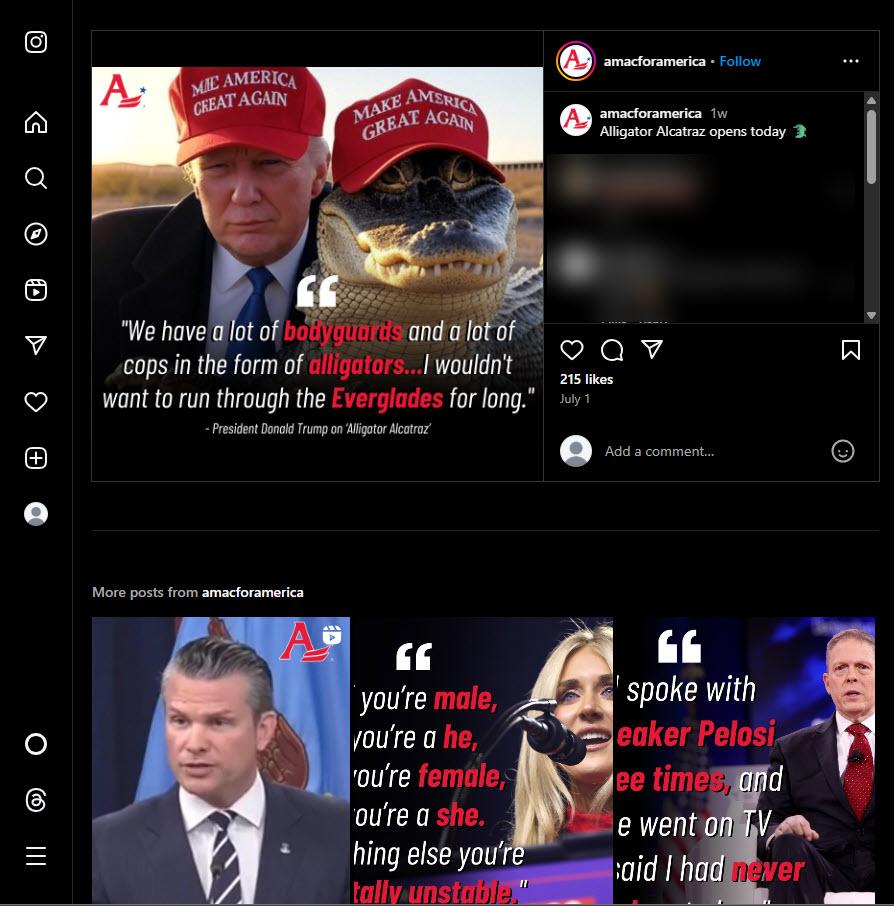
- The Association of Mature Americans, which has at least 37,800 followers on Instagram, posted an image that appears to be AI-generated and featured Trump and an alligator, both in MAGA hats.Newsweek, [7/10/24; Instagram, 7/1/25, accessed 7/9/25]
## AI-generated imagery has proliferated on Facebook, Instagram, and TikTok — some of it recommended via platform search algorithms
- AI spam is proliferating on social media and being fed to users through recommendation algorithms. NPR reported in an article titled “AI-generated spam is starting to fill social media. Here's why” that researchers at Georgetown and Stanford Universities “found that Facebook is actively recommending some of this AI content into users' feeds — potentially creating a cycle where the posts get more engagement, so they get recommended to even more users.” The piece added, “Some individual posts from the pages they analyzed have accumulated hundreds of thousands and even millions of interactions.” NPR, [5/14/25]
- Recommendation algorithms curate content for users across social media platforms such as Meta’s sites and TikTok, including in search results.As noted by Meta, “The AI system behind Instagram Search automatically orders search results by predicting what you'll find most valuable and relevant.” In addition to responding to search results, TikTok and Instagram even suggest search terms that also curate user experience. Meta, accessed [7/10/25; Instagram, accessed 7/10/25, accessed 7/10/25; TikTok, accessed 7/10/25]
- Media Matters has found that racist and antisemitic AI-generated videos are getting millions of views on TikTok.This content traffics in racist tropes, such as depicting Black people as monkeys and criminals and featuring imagery of Black people with watermelons and fried chicken. It also includes misleading AI-generated videos of immigrants and protesters. Media Matters, [7/1/25]
- Last fall, Meta announced it would generate AI images to share on Instagram users’ feeds. According to reporting by Axios, “Meta said it will generate some images based on a user's interests and others that feature their likeness,” a move which follows Meta’s existing strategy of “using the Facebook feed to surface content its algorithm thinks you will like, often instead of posts shared by friends.” Axios, [9/27/24]
- ## AI-generated content about “Alligator Alcatraz” is showing up in TikTok and Instagram’s search results
- When Media Matters searched for posts on “alligator alcatraz,” Instagram and TikTok returned multiple results with seemingly AI-generated content.
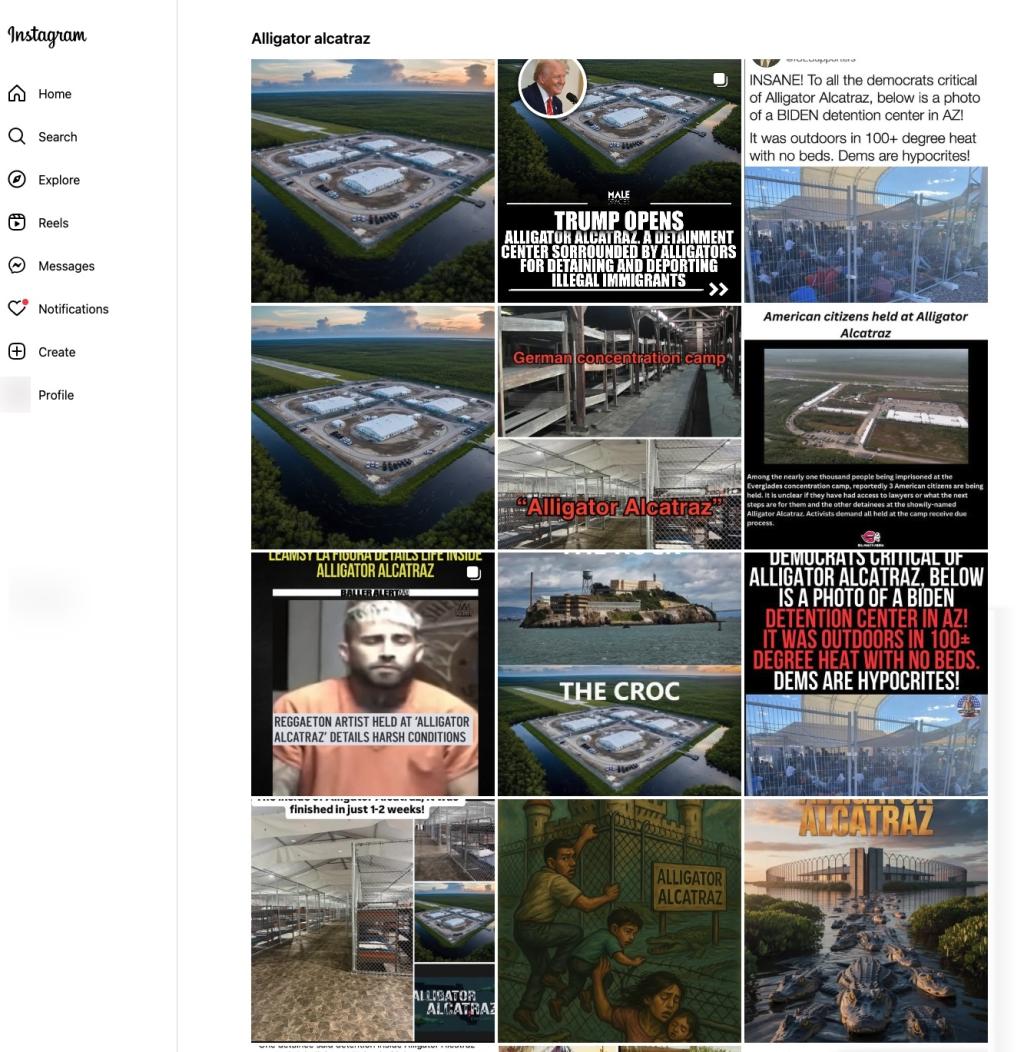
From the July 9, 2025, search results for "alligator alcatraz" on Instagram
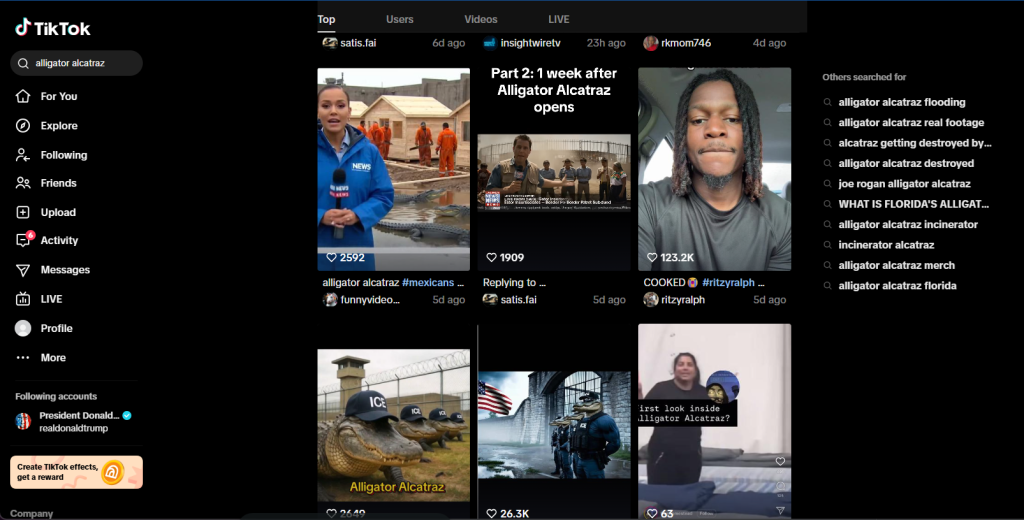
From the July 9, 2025, search results for "alligator alcatraz" on TikTok
- An account with at least 256,000 followers on Instagram posted the same seemingly AI-generated image of the detention center with a moat.The post also said, “US President Donald Trump has visited the new Florida detention centre dubbed 'Alligator Alcatraz', where around 3,000 migrants are expected to be held as part of his crackdown on illegal immigration.” Instagram, [7/2/25, accessed 7/9/25]
- An Instagram account with at least 1.9 million followers posted an image that appears to be AI-generated and shows a person attempting to scale a fence to escape an alligator, a snake, and swarms of insects.The photo also has the text “Alligator Alcatraz” and “Local News,” and it has earned over 17,000 likes. Instagram, [6/25/25, accessed 7/9/25]
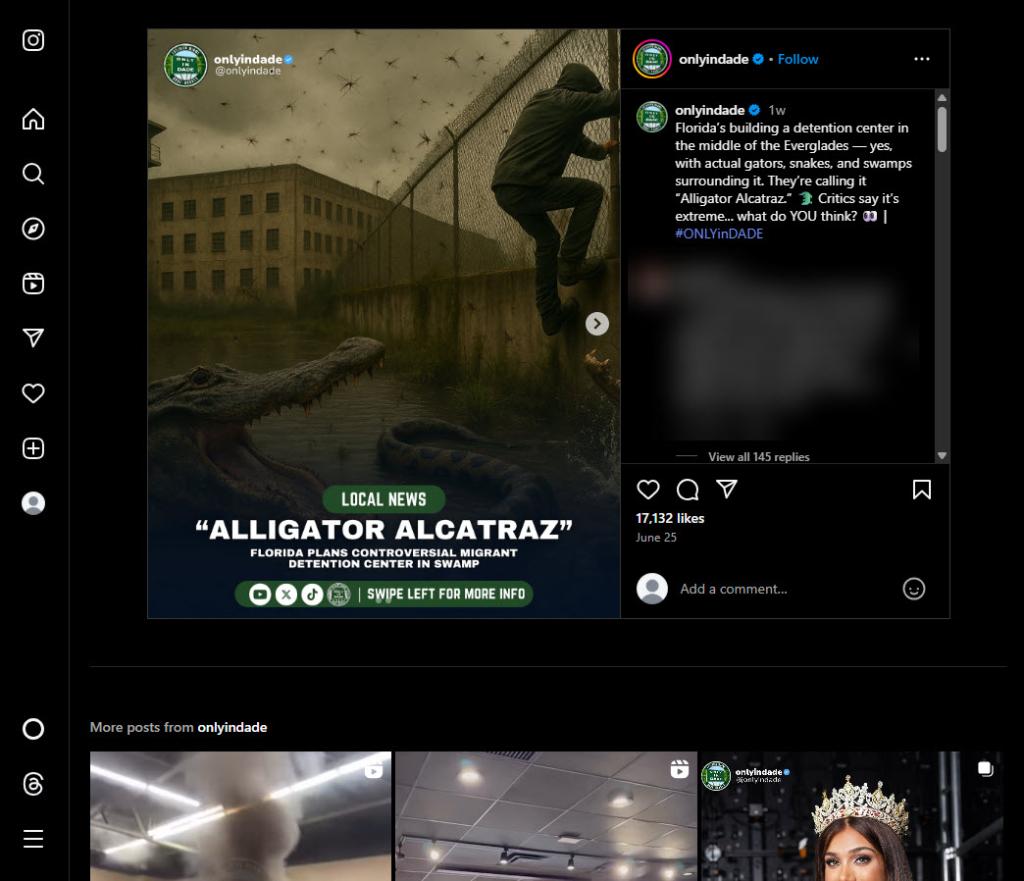
Another Instagram account posted two images which appear to be AI-generated regarding the detention center, one of which depicts an alligator dressed as an ICE agent detaining an individual with MS-13 tattoos.This account has over 27,000 followers. Instagram, [7/1/25, 7/1/25, accessed 7/9/25]
- Another Instagram account posted DHS' image of alligators in ICE hats, writing, “I’m ready for Alligator Alcatraz!” The account has at least 161,000 followers and the post has earned over 66,000 likes. Instagram, [6/27/25, accessed 7/10/25]
- A video of alligators walking toward the camera wearing ICE hats, which appears to be generated by Google’s Veo video generator, earned over 12,000 likes after it was posted on TikTok.The caption read: “Meet the cold-blooded enforcers of the yard.🐊” TikTok, [7/1/25, 7/1/25, accessed 7/9/25]
- On Instagram, former Vice Napa, California, Mayor Doris Gentry posted what appeared to be an AI-generated image of the detention center which read, “No escape. No mercy. Coming this summer.” Instagram, [6/30/25]
-
---
guk agence fr 15 Aug 2024
Russia is putting generative artificial intelligence to work in online deception campaigns, but its efforts have been unsuccessful, according to a Meta security report released on Thursday.
The parent company of Facebook and Instagram found that so far AI-powered tactics “provide only incremental productivity and content-generation gains” for bad actors and Meta has been able to disrupt deceptive influence operations.
Meta’s efforts to combat “coordinated inauthentic behavior” on its platforms come as fears mount that generative AI will be used to trick or confuse people in elections in the United States and other countries.
Musk’s ‘fun’ AI image chatbot serves up Nazi Mickey Mouse and Taylor Swift deepfakes
Read more](https://www.theguardian.com/technology/article/2024/aug/14/musk-ai-chatbot-images-grok-x)
Russia remains the top source of “coordinated inauthentic behavior” using bogus Facebook and Instagram accounts, David Agranovich, Meta’s security policy director, told reporters.
Since Russia’s invasion of Ukraine in 2022, those efforts have been concentrated on undermining Ukraine and its allies, according to the report.
As the US election approaches, Meta expects Russia-backed online deception campaigns to attack political candidates who support Ukraine.
Facebook has been accused for years of being used as a powerful platform for election disinformation. Russian operatives used Facebook and other US-based social media to stir political tensions in multiple US elections, including the 2016 election won by Donald Trump.
Experts fear an unprecedented deluge of disinformation from bad actors on social networks because of the ease of using generative AI tools such as ChatGPT or the Dall-E image generator to make on demand content in seconds.
AI has been used to create images and videos, and to translate or generate text along with crafting fake news stories or summaries, according to the report.
When Meta scouts for deception, it looks at how accounts act rather than the content they post.
skip past newsletter promotion
Influence campaigns tend to span an array of online platforms, and Meta has noticed posts on X, formerly Twitter, used to make fabricated content seem more credible. Meta shares its findings with X and other internet firms and says a coordinated defense is needed to thwart misinformation.
“As far as Twitter (X) is concerned, they are still going through a transition,” Agranovich said when asked whether Meta sees X acting on deception tips. “A lot of the people we’ve dealt with in the past there have moved on.”
X has gutted trust and safety teams and scaled back content moderation efforts once used to tame misinformation, making it what researchers call a breeding ground for disinformation.
---
---
AN 6 25
The Independent reports a rioter admitting he was "paid to be here" is not real. A National Guard soldier filming himself being bombarded by "balloons full of oil"? That’s not a thing. A young man declaring his intention to "peacefully protest" before tossing a Molotov cocktail: humor.
“These are some things that are not happening on the streets of Los Angeles this week. But you may think they are if you’re getting your news from AI,” says the Independent as “fake AI-generated videos, photos, and factoids” about protests plaster themselves across social media. The problem is particularly bad on the “anything-goes” social networks like X, the paper reports.
"[W]hen it comes to videos, we’ve just been trained as an individual society to believe videos. Up until recently, we haven’t really had the opportunity to assume videos could be faked at the scale that it’s being faked at this point,” said James Cohen, a media professor and expert on internet literacy at CUNY Queens College. “Pictures are easily manipulated.”
READ MORE: 'Embarrassing': Trump 'booed mercilessly' by Kennedy Center at 'Les Miserables' opening
One fake video, called "Interviewing Gavin Newsom's protestors in Los Angeles" shows an influencer “wearing a too-clean T-shirt in the thick of a riot,” according to the Independent.
"Why are you rioting?" he asks a masked man.
"I don't know, I was paid to be here, and I just wanna destroy stuff," the man responds.
Most of the videos the Independent reviewed targeted conservative audiences “to reinforce … right-wing talking points,” but at least one TikTok account with more than 300,000 views appeared to target progressives seeking solidarity. Some have a tag indicating them as AI-generated but many can be easily missed or are nonexistent, reports the paper.
READ MORE:'We are really in trouble': House GOP leader concerned about fate of under-the-radar bill
The problem is only likely to get worse with President Donald Trump’s budget proposal halting state AI regulation, the Independent says, but the Better Business Bureau recommends identifying A.I. hack jobs by counting fingers and coat buttons. Writing and signs in generated video can also be blurry or incomprehensible. And look for “strange textures or a glossy effect,” says the BBB, because AI images often have “textured backgrounds or an airbrushed look.”
Read the full Independent report at this link
===
AI?
an 1 25
Podcasting is the medium of choice for millions of listeners looking for the latest commentary on almost any topic. In Australia, it’s estimated about 48% of people tune in to a podcast each month.
However, the rise of podcasts has also led to a new trend of “fake podcasts”. In some cases, these are a trivial marketing strategy. In others, they are a deceptive form of misinformation.
So what are fake podcasts?
Fake podcasts are short video clips designed to appear like snippets from real podcasts published on short-form content platforms such as TikTok.
These clips centre on one or sometimes two speakers, positioned behind high-quality broadcasting microphones, directing their conversation off camera. However, in reality no broader discussion is taking place.
These videos began gaining attention in late 2022 when social media users realised several viral clips showing commentators on seemingly high-profile podcasts were in fact “fake”. These clips weren’t from any real podcast episodes. In some instances the microphones hadn’t even been turned on.
The most noteworthy example came from fitness influencer and YouTuber Vincent Sant. To market his online brand, Sant created a video suggesting he had appeared on the Joe Rogan Experience.
Although the video showed him using the same microphone, headphones and red velvet curtain backdrop as Rogan, viewers quickly pointed out Sant had never appeared on the show. He removed the clip shortly after.
Since then, fake podcast clips have become a recognised marketing strategy employed by a range of brands. Some professional actors produce this content regularly, earning up to US$16,000 per month.
There are even explicit guides on LinkedIn for marketers wanting to produce their own fake podcasts, with the practice described as “the future of video marketing”.
Some fakes are more harmful than others
There are three main types of fake podcast, each one deceiving viewers to a different extent.
The first is the explicit ad. In this case, the podcast format is used to present an obvious sales pitch for a specific product. Examples include this ad from Junkee and Bank Australia:
While the ad uses a podcast format, it’s unlikely to fool many viewers, not least due to the “paid partnership” disclaimer.
The second category of fake podcasts uses the podcast aesthetic to market a personal brand, rather than a specific product. Several influencers including online entrepreneur Sebastian Ghiorghiu and Pearl Davis (the so-called “female Andrew Tate”), have garnered millions of followers through such clips, which intentionally leave the broader context ambiguous. They produce clips from both real and fake podcasts, with no means of differentiating the two.
These kinds of fake podcasts have three main purposes. The first is to gain consistent viewers. The second is to legitimise the creator’s, at times, conspiratorial political perspectives. And the third is to sell products.
The final and most intentionally deceptive form of fake podcast is what I call the “deep” fake podcast. These clips combine elements of the first two categories alongside manipulated audio and video – usually produced with the help of AI tools.
The purpose here is usually to convince viewers a certain prominent podcaster or personality has made certain claims and/or endorsed certain products. One recent example purports to show Joe Rogan and neuroscientist Andrew Huberman endorsing a “libido-boosting” supplement. This is the most deceptive form of the practice.
The psychology behind fake podcasts
Out of all the mediums to fake, why fake a podcast? Are online audiences so susceptible that they immediately associate anyone talking off camera into a microphone with expertise? Not quite.
Podcasting reflects what media researcher Henry Jenkins calls “convergence culture”. In this space, the distinctions between traditional, alternative and social media are increasingly blurred, as are the lines between producers, consumers, technical experts and “popular experts”.
Social media users usually recognise podcasters as popular experts. These individuals may not have recognised qualifications, yet they are often just as knowledgeable about a particular area of popular culture as a technical expert due to their experience and/or passion. Karen Kilgariff and Georgia Hardstark, hosts of the top podcast My Favourite Murder, are a good example, as is former YouTuber MatPat, whose channel The Game Theorists has close to 20 million subscribers.
Convergence culture has increasingly foregrounded popular experts in online spaces, helping to legitimise their blend of amateur and professional communication.
How to spot them
According to the Pew Research Centre, US adults who hear “news” discussed on podcasts are likely to view this information as more reliable than news gleaned from other sources such as social media. At the same time, podcasts are much easier and cheaper to fake than other forms of traditional media.
Spotting fake podcast clips may not always be easy, especially if you haven’t come across one before. If you see a suspicious clip, a good rule of thumb is to look for a clear link to the original video and recording. If this original is easily accessible, verifiable and lasts longer than sixty seconds, the clip itself is probably real.
Another way is to cross-reference the clip with other official channels. For instance, the next time you see a 20 second video of a renowned health expert spruiking a new supplement on Amazon, check that expert’s official social media page before clicking the purchase link.
Finley Watson, PhD Candidate, Politics, La Trobe University
This article is republished from The Conversation under a Creative Commons license. Read the original article.
===
an 10 24
A new report details how Russian actors played a significant role in the spread of disinformation concerning the federal response to Hurricanes Helene and Milton this fall.
On Thursday, the Institute for Strategic Dialogue (ISD) — a Washington, D.C. based think tank that researches extremism, polarization and misinformation — published a detailed report into how Russia capitalized on America's partisan climate in the wake of both hurricanes. Researchers found that Russian actors aimed to "sow distrust in U.S. institutions" by "attempting to exploit existing frustrations among certain political groups."
One particular talking point Russia seized on was the false claim that U.S. support for Ukraine's defense against Russia's invasion was diverting federal money from hurricane victims. Of course, this is flatly untrue: The last Ukraine aid package was appropriated by Congress months before the hurricanes hit.
READ MORE:['Totally out of luck': How Project 2025 would gut relief for Hurricane Helene victims
However, Russian disinformation artists still managed to seize on that narrative as a means of undermining American support for Ukraine. The Vladimir Putin regime was particularly fond of billionaire X owner Elon Musk's tweets making that point for them, according to ISD.
"Similarly, Russian media echoed remarks from former President Donald Trump in which he criticized the Biden administration’s supposed focus on Ukraine over domestic disaster recovery," ISD researchers wrote.
Russian actors also shared fake AI-generated images of supposed flooding at Disney World in Florida that never actually occurred. Moscow-based news outlet RIA Novosti shared the fake images on the social media app Telegram in the hopes of reaching English-speaking audiences.
"The Kremlin’s overarching goal in these disinformation campaigns is not simply to critique the Biden administration’s handling of Hurricanes Milton and Helene, but to sow distrust in US institutions," ISD wrote. "By painting the U.S. government as either incompetent or actively malicious, Russian media attempts to undermine public confidence in the U.S. disaster relief system, federal agencies including FEMA and broader political leadership.
READ MORE:[Trump — who has $4 billion — is now asking other people to donate to Helene relief
The Biden administration's response to the hurricanes was praised by governors of affected states representing both parties. Georgia Republican Governor Brian Kemp noted that after Helene ravaged his state, Biden called him personally and simply asked: "What do you need?" South Carolina Republican Governor Henry McMaster also praised FEMA's rapid recovery efforts in the Palmetto State. And North Carolina Democratic Governor Roy Cooper heaped praise on Biden for deploying thousands of federal employees and equipment to help rescue stranded residents and rebuild infrastructure.
"We’re grateful for the quick actions and close communications that we have had with the president and with the FEMA team,” Cooper said. “And Mr. President, we know that we have made a lot of asks of you, and we are grateful for your ear and for your actions.”
READ MORE:'All because of greed': 6 die at factory that told employees to work during Helene or be fired
*Click here to read ISD's report in full.
---
A parody ad shared by Elon Musk clones Kamala Harris' voice, raising concerns about AI in politics
jul 2024
NEW YORK (AP) — A video that uses an artificial intelligence voice-cloning tool to mimic the voice of Vice President Kamala Harris saying things she did not say is raising concerns about the power of AI to mislead with Election Day about three months away.
The video gained attention after tech billionaire Elon Musk shared it on his social media platform X on Friday without explicitly noting it was originally released as parody.
By late Sunday, Musk had clarified the video was intended as satire, pinning the original creator’s post to his profile and using a pun to make the point that parody is not a crime.
The video uses many of the same visuals as a real ad that Harris, the likely Democratic president nominee, released launching her campaign. But the fake ad swaps out Harris’ voice-over audio with an AI-generated voice that convincingly impersonates Harris.
“I, Kamala Harris, am your Democrat candidate for president because Joe Biden finally exposed his senility at the debate,” the AI voice says in the video. It claims Harris is a “diversity hire” because she is a woman and a person of color, and it says she doesn’t know “the first thing about running the country.” The video retains “Harris for President” branding. It also adds in some authentic past clips of Harris.
Mia Ehrenberg, a Harris campaign spokesperson, said in an email to The Associated Press: “We believe the American people want the real freedom, opportunity and security Vice President Harris is offering; not the fake, manipulated lies of Elon Musk and Donald Trump.”
The widely shared video is an example of how lifelike AI-generated images, videos or audio clips have been utilized both to poke fun and to mislead about politics as the United States draws closer to the presidential election. It exposes how, as high-quality AI tools have become far more accessible, there remains a lack of significant federal action to regulate their use, leaving rules guiding AI in politics largely to states and social media platforms.
The video also raises questions about how to best handle content that blurs the lines of what is considered an appropriate use of AI, particularly if it falls into the category of satire.
The original user who posted the video, a YouTuber known as Mr Reagan, disclosed from the beginning both on YouTube and on X that the manipulated video is a parody. Yet Musk’s initial post with the video, which had far wider reach with 130 million views on X, according to the platform, only included the caption “This is amazing” with a laughing emoji.
Over the weekend, before Musk clarified on his profile that the video was a joke, some participants in X’s “community note” feature suggested labeling his post as manipulated. No such label has been added to it, even as Musk has separately posted about the parody video.
Some users online have questioned whether his initial post might violate X’s policies, which say users “may not share synthetic, manipulated, or out-of-context media that may deceive or confuse people and lead to harm.”
The policy has an exception for memes and satire as long as they do not cause “significant confusion about the authenticity of the media.”
Chris Kohls, the man behind the Mr Reagan online persona, pointed an AP reporter to a YouTube video he posted early Monday responding to the ordeal. In the YouTube video, he confirmed he used AI to make the fake ad and argued that it was obviously parody, with or without a label.
Musk endorsed Trump, the Republican former president and current nominee, earlier this month. He didn’t respond to an emailed request for comment.
Two experts who specialize in AI-generated media reviewed the fake ad’s audio and confirmed that much of it was generated using AI technology.
One of them, University of California, Berkeley, digital forensics expert Hany Farid, said the video shows the power of generative AI and deepfakes.
“The AI-generated voice is very good,” he said in an email. “Even though most people won’t believe it is VP Harris’ voice, the video is that much more powerful when the words are in her voice.”
He said generative AI companies that make voice-cloning tools and other AI tools available to the public should do better to ensure their services are not used in ways that could harm people or democracy.
Rob Weissman, co-president of the advocacy group Public Citizen, disagreed with Farid, saying he thought many people would be fooled by the video.
“I’m certain that most people looking at it don’t assume it’s a joke,” Weissman said in an interview. “The quality isn’t great, but it’s good enough. And precisely because it feeds into preexisting themes that have circulated around her, most people will believe it to be real.”
Weissman, whose organization has advocated for Congress, federal agencies and states to regulate generative AI, said the video is “the kind of thing that we’ve been warning about.”
Other generative AI deepfakes in the U.S. and elsewhere have tried to influence voters with misinformation, humor or both. In Slovakia in 2023, fake audio clips impersonated a candidate discussing plans to rig an election and raise the price of beer days before the vote. In Louisiana in 2022, a political action committee’s satirical ad superimposed a Louisiana mayoral candidate’s face onto an actor portraying him as an underachieving high school student.
Congress has yet to pass legislation on AI in politics, and federal agencies have only taken limited steps, leaving most existing U.S. regulation to the states. More than one-third of states have created their own laws regulating the use of AI in campaigns and elections, according to the National Conference of State Legislatures.
Beyond X, other social media companies also have created policies regarding synthetic and manipulated media shared on their platforms. Users on the video platform YouTube, for example, must reveal whether they have used generative artificial intelligence to create videos or face suspension.
The Associated Press receives support from several private foundations to enhance its explanatory coverage of elections and democracy. See more about AP’s democracy initiative here. The AP is solely responsible for all content.
---==
===
AI-Generated Girl Fuels MAGA's Hurricane Helene Outrage
right-Wingers Heartbroken by Picture of Little Girl Who Doesn’t Exist
An AI-generated image has been used to attack the Biden-Harris administration over its response to Hurricane Helene
By Miles Klee
October 7, 2024

A *real* Florida family walking through floodwaters as they return home after Hurricane Helene. AP
There has been no shortage of gut-wrenching photographs from communities in the southeast devastated by Hurricane Helene, which caused extreme flooding and killed at least 215 people — pictures of houses destroyed, families trapped on rooftops, wreckage from mudslides and roads washed out by torrential rains. But rather than focus on the actual victims or damage, many right-wing influencers and politicians have extended their sympathies to a nonexistent girl and her puppy (who is also not real).
The AI-generated image they’re sharing depicts a crying girl in a boat, seemingly alone except for the little dog she’s clutching. She wears a lifejacket and appears to be adrift on floodwaters caused by a major storm. Sen. Mike Lee of Utah posted the picture on X on Thursday, writing “Caption this photo,” apparently inviting his followers to vent their outrage at the Biden-Harris administration for allowing American children to suffer such misery on their watch. After users pointed out that he’d fallen for AI slop, he deleted the picture. (The image originated on the Trump web forum Patriots.win, where several users immediately recognized it as the product of an AI model.)
Others, however, have left the misleading picture up on their social media accounts — and some are defending it as an accurate representation of Helene’s effects even though it’s fake. Far-right conspiracy theorist and Donald Trump associate Laura Loomer called the image “sad,” quote-tweeting a post from Buzz Patterson, columnist for the conservative blog RedState, who wrote of the picture: “Our government has failed us again.” Neither have taken their posts down as of press time. Amy Kremer, RNC National Committeewoman for the Georgia GOP and co-founder of Women for Trump, tweeted on Thursday that the image had been “seared into my mind.”
Informed that she was not looking at an authentic photo, Kremer doubled down. “Y’all, I don’t know where this photo came from and honestly, it doesn’t matter,” she replied. “There are people going through much worse than what is shown in this pic. So I’m leaving it because it is emblematic of the trauma and pain people are living through right now.”
A large anonymous blue-check account on X that routinely attacks Democrats did remove the picture but similarly argued: “Even though that image was AI, it spoke a truth about the disregard Harris and Biden have for ordinary Americans, as evidenced by their criminal non-response to Helene.” Another X user posted a since-deleted screenshot of a more succinct response from an apparent family member advised that the image was bogus. “Who cares,” they answered.
The little girl and her puppy — there are AI-generated variants of the more viral image floating around as well — have been widely presented by MAGA world as evidence of a failed disaster response in the aftermath of Helene. Similar fake images depict girls or women clutching Bibles as floods rage around them. Trump himself is pushing lies about the U.S. government not being able to fund relief efforts, adding an overtone of racism with the groundless claim that the White House “stole” money from the Federal Emergency Management Agency (FEMA) and “spent it all on illegal migrants.” (The irony being that in 2019, the Trump administration itself redirected millions in disaster funds, during hurricane season, to pay for detention centers at the border.)

FEMA has said in a statement that it does have enough money for “immediate response and recovery needs.” Yet the supposed scandal has Republicans outraged at the idea that Americans impacted by the hurricane are being denied help because Democrats funneled resources to immigrants. “So Kamala doesn’t have enough money for this child?” fumed a MAGA-affiliated X user who shared the AI-generated girl. “For Americans that lost everything they have? I can’t hate this administration enough.”
The barrage of AI junk from Trump supporters follows a similar trend last month, when the former president, his running mate Sen. J.D. Vance, and their various allies were smearing the Haitian immigrant community of Springfield, Ohio, by falsely accusing them of stealing and eating local house pets. During that news cycle, many used AI to generate cartoonish images of cats and dogs wearing MAGA hats, and Trump himself holding or protecting animals. Before that, Trump shared AI imagery that made it appear as if he had the backing of Taylor Swift and her fan army. (Swift endorsed Vice President Harris immediately after Harris’ September debate with Trump.) Along with the phony “victim” images to come out of the Helene disaster, there were also AI pictures of Trump braving floodwaters to assist residents and rescue babies.
Trending
### Internet Viciously Memes Elon Musk's Jumpy Trump Rally Appearance[
What other uncanny-valley creations will online Trump boosters bring to the fore of the American imagination in the closing weeks of this chaotic campaign? Hard to say, but one thing is certain: the AI assault remains a core piece of their strategy.
===
how Hurricane Helene Deepfakes Flooding Social Media Hurt Real People
Contributor
Lars Daniel covers digital evidence and cybersecurity in life and law.
Updated Oct 5, 2024

An AI-generated image spreading across social media of a girl holding a puppy in the aftermath of ... [+]
AI generated image circulating social media.
In the aftermath of Hurricane Helene, Asheville, North Carolina and other impacted regions were flooded with water, while fake generative AI images of destruction and human suffering flooded social media.
These doctored or faked visuals can complicate disaster response efforts, create false narratives and, above all, harm public trust in a moment when normal people are making extraordinary efforts to help one another in the midst of life and death scenarios.
In particular, two images of a distressed child holding a puppy and who appears to be trapped in floodwaters has gained traction online.
As an expert in video and photo forensics, I can say with certainty that these emotionally evocative images are highly edited or outright fake. The first image (above) bears telltale signs of a deepfake to a trained eye. Comparing it with the second image in the series (below) — in which the young girl has one too many fingers — the puppy’s muzzle has a different coloration and the boat is a different shape and color.

Notice the hand holding the puppy has an extra finger in this AI-generated image.
AI generated image circulating social media
The Problem with Fake Images During Disasters
Repeated exposure to fake content can erode public trust in legitimate news and information sources. When people repeatedly encounter false images, they begin to question all media, including accurate and necessary disaster updates.
Further, fake images can be a trojan horse for cyberattacks, often being shared in conjunction with phishing links or scam fundraising campaigns. Unsuspecting individuals are lured into contributing funds or providing personal details to malicious actors under the guise of helping those affected by disasters.
The Psychological Toll of Fake Images
The repeated exposure to fake content during disasters creates an emotional whiplash. People experience initial shock or sadness when they see images of devastation or distress, but when those images are debunked, it leads to feelings of betrayal, confusion or anger. This cycle can quickly wear down our ability to engage emotionally with real crises.
The Exhaustion of Verification
In the past, people could see an image of a disaster and instantly react, whether by donating, sharing it or sympathizing with those affected. Today, with so much misinformation floating around, even this simple act of caring comes with the extra step of verification.
Before reacting, people now need to check if the image is real, where it comes from and whether it’s been manipulated. This constant mental effort adds a layer of fatigue, and many simply disengage, feeling it’s easier to not care than to wade through the sea of misinformation.
The Desensitization Effect
Every time a person learns that an image they were emotionally invested in is fake, it chips away at their compassion. People don’t like feeling duped, and once they’ve been misled a few times, they can begin to doubt everything they see.
This skepticism makes it harder to summon genuine care during real disasters, as the fear of being fooled again overshadows the desire to help. Over time, they begin to tune out, treating every new disaster with a degree of emotional distance, unsure if it’s real or just another hoax.
Too Much Effort to Believe
Belief, particularly in times of crisis, should be simple. We should be able to see images and news reports of disasters and trust that they are accurate representations of what’s happening.
However, the proliferation of fake images during events like Hurricane Helene has made this once-simple process far more complicated. A handful of bad actors can have an oversized impact by creating and sharing deepfakes that go viral.
Fake Images Hurt Real People
It now takes effort to decide whether to trust or engage with content. This effort can create problematic reactions that are detrimental to the individual and the collective.
Apathy as a Defense Mechanism
When people feel they can no longer trust what they see, they may stop trying altogether. It’s easier to not care than to expend the mental energy required to verify every image or story.
This lack of engagement ultimately harms genuine disaster-relief efforts, as fewer people could step forward to help or donate.
Overwhelming Uncertainty
For some, the constant uncertainty about what’s real and what’s fake becomes too much to handle. Instead of carefully navigating between real and fake images, they may choose to disengage from disaster news entirely.
This detachment not only affects how individuals respond to disasters but also weakens the overall collective response. When entire segments of the population stop paying attention because they can’t trust what they see, it becomes harder to mobilize widespread support and resources.
Skepticism Toward All Media
Fake disaster images don’t just damage trust in the specific events they misrepresent, they erode trust in all media over time. People who feel deceived by one image are more likely to become skeptical of future disaster coverage, even if it’s legitimate.
In the long run, this makes it harder to share crucial, life-saving information during emergencies with expedience and accuracy.
Why This Numbness Matters in Future Disasters
The most troubling consequence of this growing apathy and numbness is its potential to severely impact future disaster responses. When people can no longer distinguish between fake and real crises, or when they’ve become too exhausted to try, it poses several dangers:
Fewer Donations and Volunteering Efforts
Humanitarian efforts often rely on a surge of compassion during crises. However, if people stop believing in disaster reports or grow numb to the images of suffering, they could be less likely to donate, volunteer or share crucial information. This decrease in public engagement can limit the effectiveness of relief efforts, leaving communities vulnerable for longer.
Increased Inaction During Real Emergencies
If people have been repeatedly exposed to fake disaster images, they might respond with a sense of “disaster fatigue” during actual emergencies. Instead of rallying together to help, they might question whether the crisis is as bad as it seems, resulting in slower action and fewer resources for those in need.
Fractured Social Unity
The rise of fake images tied to real disasters is not just a problem of misinformation. It is creating a deeper issue of emotional numbness and distrust. As people grow weary of trying to discern truth from falsehood, they could become less inclined to care, act or believe at all. This cynicism poses a serious risk to future disaster responses, as fewer people may step forward to help when it’s needed most.
Follow me on LinkedIn. Check out my website.
Lars Daniel is the practice leader of digital forensics at Envista Forensics. He covers cybersecurity and electronic evidence, focusing on the intersection of technology
... Read More
---
mma
Hitler speeches that appear to be AI-generated are getting millions of views on TikTok
Despite TikTok’s policies banning the “praise” of individuals who cause mass violence, English-language versions of Nazi rants have racked up millions of views on TikTok
Written by Abbie Richards
Published 09/17/24
Audio clips of Hitler giving speeches in English, which appear to be AI-generated, have been proliferating on TikTok, earning millions of views. Some users have been promoting and praising the audios in an apparent violation of TikTok’s community guidelines.
While some of these audios — which are often poorly translated and set to slow, reverb instrumental beats — have been removed, Media Matters has identified accounts dedicated to uploading this content. At least one of these accounts is still live and posting regularly.
The platform’s community guidelines prohibit “promoting (including any praise, celebration, or sharing of manifestos) or providing material support to … individuals who cause serial or mass violence, or promote hateful ideologies.” The dissemination of excerpts of Hitler’s speeches seems to violate this policy.
Media Matters has identified numerous videos with these English-language Hitler speeches posted as far back as April 7, 2024. However, since early September, videos with these audios have been proliferating across the platform. TikTok has since removed some of the videos that Media Matters identified, but only after some had earned hundreds of thousands, or even over a million, views.
One video, which had earned roughly 120,000 likes and over 1 million views prior to removal, featured an excerpt from a speech Hitler gave on the 19th anniversary of the Beer Hall Putsch (a failed coup d’etat by the Nazi Party in November 1923) and portrayed an image of Hitler standing with his back turned to the camera with the text: “Just listen.”
The excerpt of the speech — which appeared to be slightly different than a translation posted by the Jewish Virtual Library Project — is layered on top of a slow instrumental beat, and suggests that Hitler did not want to go on the offensive during World War II, that he tried to save women and children, and that he waited until he had no choice.
Video
CitationA September 1, 2024, video uploaded to TikTok
While some TikTok users expressed skepticism in the comments about this portrayal of Hitler, other comments embraced this fantasy. Some users wrote: “He was a hero,” “Winners write history,” “The great painter,” and “Maybe He Is NOT The Villain.” (“The painter” is presumably a reference to the Nazi leader’s failed art career.)
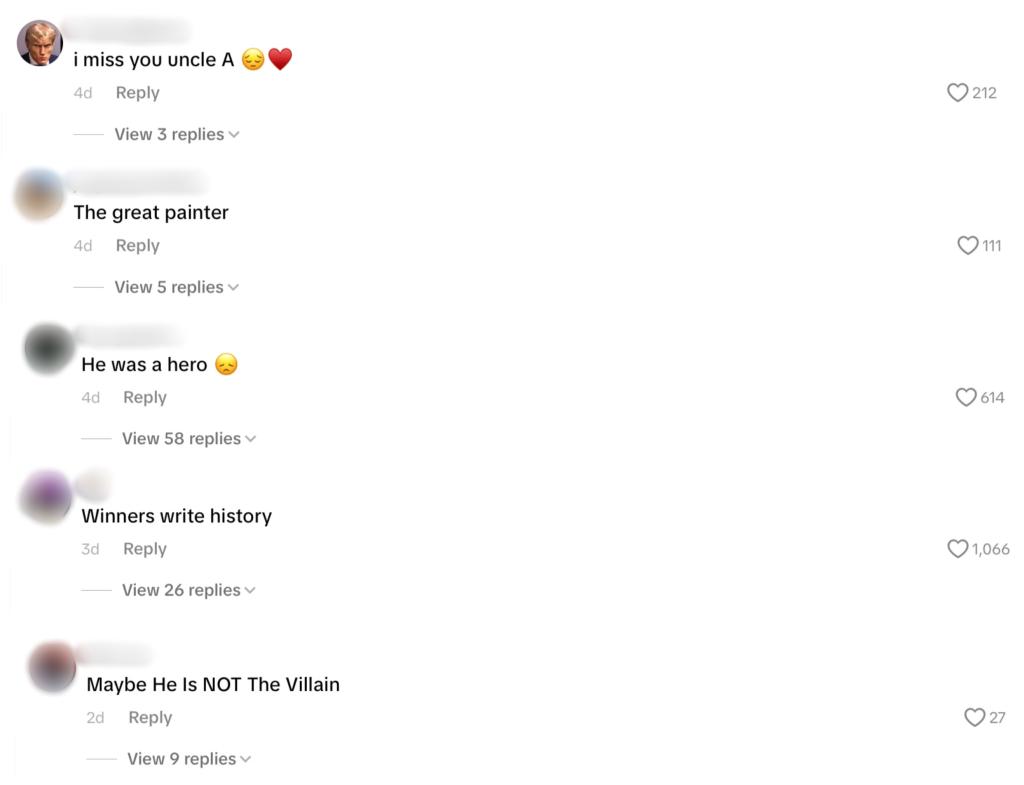
While Media Matters was viewing this video, TikTok’s search-prompting feature suggested the search “the painter english speech,” indicating that the platform was reducing friction for users to find more of Hitler’s speeches.
Another video using the same sound — which has since been taken down — featured a visuals of cliffs by water and the hashtags “true,” “nature,” “europe,” and “1161” (seemingly a right-wing dog whistle for Anti-Anti Fascist Action or AAFA).
The video had at least 22,700 likes and over 270,000 views prior to removal. Some users commented: “AH was a good and kind man,” “now i know why they didn’t translate this before,” and “this changed my views on him.”
Some TikTok users were quick to turn this audio into a meme that appeared to mock Hitler for feigning innocence. For instance, in one video with 2.4 million views, a user lip-synchs to the AI-generated Hitler speech with text on screen reading, “when i pooped in the urinal in 3rd grade.” In a video with over 520,000 views, a user donning full military gear lip syncs to the Hitler speech while the text on screen reads “When there beef in the GC and your involved.” This audio was used at least 251 times prior to its removal.
Video
CitationAn August 13, 2024, video uploaded to TikTok
Another supposed Hitler speech focused on cultural decline; Hitler spoke on that topic, but Media Matters could not verify the accuracy of the translation.
Users were quick to turn this audio into a meme as well. One such video, with 197,400 views, compares “the furniture my grandparents left me vs the furniture I’m leaving my grandkids” with the caption “Preservation is a must.”
Other users lip-synched to the AI-generated Hitler speech with text on screen reading “pov: gen alpha in 2035 when skibiti toilet comes out as bisexual and baby gronk overdoses on galaxy gas 2.0,” “POV: a guy just asked me if I wanted to see a Marvel/DC movie,” and “pov: you stuck talking to that mf that gets political after a line [of cocaine].”
A third seemingly AI-generated Hitler audio on TikTok featured an excerpt from a speech he gave in January of 1939, also overlaid on top of a slow instrumental beat. Prior to its removal, this audio was used at least 55 times, with some of the videos earning hundreds of thousands of views.
Video
CitationAn August 4, 2024, video uploaded to TikTok
A video using this audio with nearly 500,000 views and over 64,000 likes reads, “name a character no one can make you hate,” and then shows an outline of Hitler. While the sound had been removed, this video was still up at the time of writing.
Another video, with 394,000 views, featured what looked like an AI-generated image of a white, blond girl in a Union Jack T-shirt standing in the middle of a bus and crying while surrounded by laughing nonwhite people in hijabs and taqiyahs. The comment with the most likes read, “We need the painter.”
Another video, with over 650,000 views and 90,000 likes, used this audio along with pictures of two bowls of ice cream, one with chocolate and vanilla mixed and one with just vanilla, which seemed to insinuate disdain for racial integration.
Media Matters also identified several accounts dedicated to posting these Hitler audios.
One account with 20,500 followers and over 3.8 million cumulative views across 12 videos posts videos with these Hitler speeches, a silhouette of the German mass murderer, and the text “Growing up is realizing Who the villain Really was.”
One explicitly antisemitic video, blaming a “small rootless international clique” who are “at home both nowhere and everywhere who do not have anywhere a soil on which they have grown up” for “turning the people against each other,” has received over 1.6 million views. The excerpt seems to come from a speech Hitler gave at the Siemens-Schuckert plant in Berlin in 1933. At the time of writing, this account was still up.
Media Matters identified another account seemingly dedicated to posting these reconstructed Hitler speech audios that has been removed by TikTok. The most popular video on the account, with over 87,000 views, was an English-language excerpt from Hitler’s July 1940 speech “My Last Appeal to Great Britain.”
As AI becomes increasingly popular for content generation, novel forms of disinformation that promote hateful ideologies and misrepresent historical facts will follow. Social media platforms must be aware that this technology is being used to cause harm and take proactive measures to prevent it from proliferating on their platforms.
prevent it from proliferating on their platforms.
Related
02/08/24 9:49 AM EST
07/06/22 4:05 PM EDT
02/09/24
new rep
A website called KBSF-San Francisco News painted a horrible picture: According to the site, then–California Attorney General Kamala Harris hit a 13-year-old girl with her car in 2011, fleeing the scene before she could be caught or identified. The site included a video, credited to KBSF-TV, of a young woman in a wheelchair—the alleged victim, Alicia Brown—recalling the harrowing moments after their vehicles collided.
Except none of it appears to be real.
There is no KBSF-TV in San Francisco, and, according to a BBC Verify investigation, the original website that published the story was registered less than two weeks ago. The photograph attached to the article, which supposedly depicted the crash itself, was actually snapped in Guam in 2018. And the video of Brown—whom the article and video misname several times—also appears to be a deepfake. The x-ray images of Brown’s spine, allegedly taken after the accident, can be traced back to medical journals that have no relation to the supposed crash.
Strangely, it’s not the only recent instance of a wildly fabricated story taking root against Democrats. Behind the operation is John Mark Dougan, a former Florida cop who has since relocated to Moscow to work full-time inventing fake news sites in an effort to spread misinformation among American voters ahead of the 2024 election, according to the BBC.
Another site launched by Dougan, The Houston Post, accused the FBI of illegally wiretapping Donald Trump’s Florida resort, Mar-a-Lago. Other sites bore equally American names, including the Chicago Crier, Boston Times, and DC Weekly. According to the BBC, most of the stories posted on the sites were not necessarily fake, but rather poor copies of actual news items that had been reworked by A.I. engines. Some of the articles still sported the user’s instructions to the bot at the bottom of the text, at the time of the BBC’s investigation: “Please rewrite this article taking a conservative stance.”
“Russia will be involved in the U.S. 2024 election, as will others,” Chris Krebs, who oversaw election integrity during the 2020 presidential election as director of the U.S. Cybersecurity and Infrastructure Security Agency, warned the BBC.
“We’re already seeing them—from a broader information operations perspective on social media and elsewhere—enter the fray, pushing against already contentious points in U.S. politics,” he said.
Read more about election disinformation:
The Weird Fake Influencers Being Used to Support Trump
===
Elon Musk’s attacks on Kamala Harris become more unhinged, with help from AI | CNN Business
CNN —
Elon Musk’s disdain for the Democratic Party was never subtle, but in recent weeks his commentary on the upcoming US presidential election and his attacks against Vice President Kamala Harris have intensified, aided by a crude use of burgeoning artificial intelligence technology.
On Monday, Musk posted an AI-generated image on his social media platform that depicted Harris as a communist, wearing a red uniform complete with hammer and sickle emblazoned hat.
Musk, who has endorsed former President Donald Trump for president and poured millions into a super PAC supporting the Republican, captioned the image with the false assertion, “Kamala vows to be a communist dictator on day one. Can you believe she wears that outfit!?”
The image, which appeared to violate X’s policy on manipulated content, resembled an AI-generated image posted by Trump last month during the Democratic National Convention, envisioning Harris addressing a crowd under communist symbols.
Musk’s post came a day after he shared another post with a screenshot suggesting that only “high status males” should be able to participate in government because women (and men with “low testosterone”) are not capable of critical thought. Musk posted it to his 196 million followers with the comment, “interesting observation.”
An AI-generated image of Kamala Harris posted by Elon Musk on his social media platform, X.
From X
The sexist screed appears to have originated on 4Chan, the notorious hate-filled website that has been linked to mass-shootings.
By choosing to amplify disinformation and misogynist views, Musk, a South African billionaire who is both the owner of X and the most-followed account on the platform, is promoting radical content to the masses that might otherwise languish in the darkest corners of the internet.
By Tuesday afternoon, less than 24 hours after Musk shared the fake image and false statement depicting Harris as a communist, the post had been viewed nearly 60 million times, according to data from X. Musk’s post suggesting women shouldn’t take part in democracy had been viewed more than 19 million times.
X did not respond to a CNN request for comment.
The posts come after Brazilian authorities blocked access to X in the country in a battle over the spread of misinformation and hate speech on the platform aimed at undermining the nation’s democracy.
Since taking over the platform, Musk has touted X’s “community notes” feature as a way of transparently allowing crowd-sourced fact-checking misinformation on his platform.
Related article‘White Dudes for Harris’ said their account was targeted by X for the second time](https://www.cnn.com/2024/08/06/business/white-dudes-for-harris-said-their-account-was-targeted-by-x-for-the-second-time)
Yet neither post was fact-checked through the community notes feature. Musk’s defenders, of which there are many who are vocal on X, have attempted to argue that some posts like these are satirical or are not meant to be taken seriously.
But Musk is taken seriously. He is one of the world’s most powerful people who controls one of the world’s most important online platforms on the precipice of an historic American presidential election where he is actively campaigning for a candidate.
When Musk took over Twitter in 2022 in a $44 billion acquisition, he claimed that the platform would remain impartial to avoid the perception of tilting the scales for a political party.
“For Twitter to deserve public trust, it must be politically neutral, which effectively means upsetting the far right and the far left equally,” he wrote.
But Musk’s posts, and the lack of scrutiny they receive from his company’s own fact-checking system, lay bare how Musk has turned X into a pro-Trump machine.
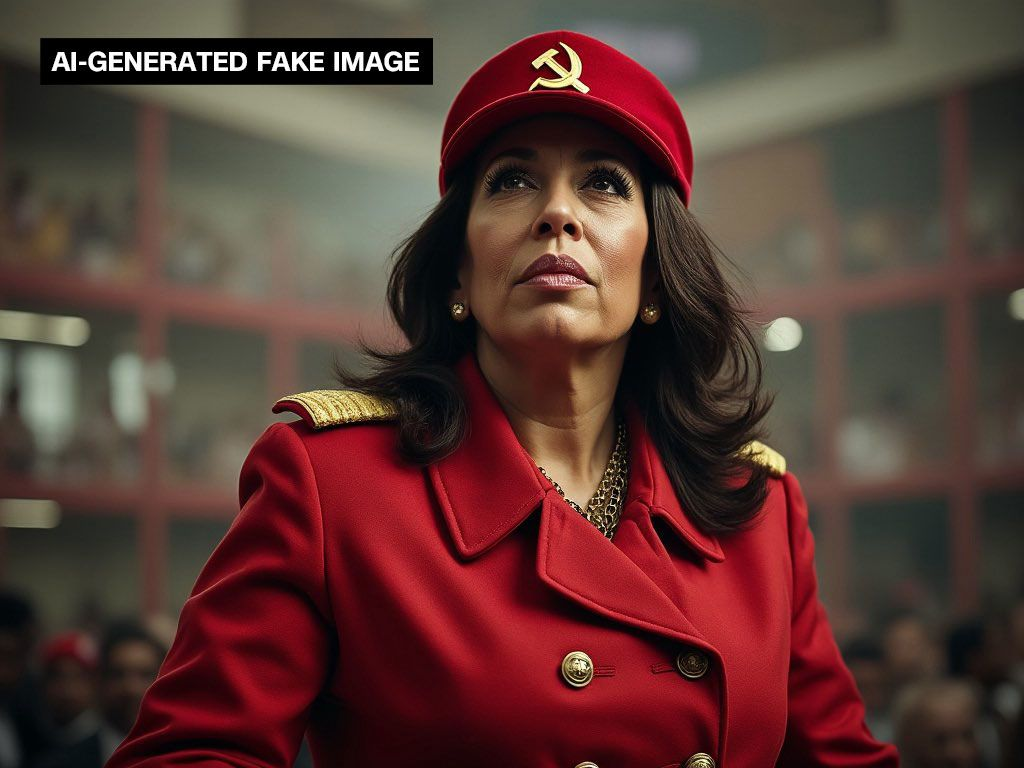
Just last week, Twitter/X and Tesla CEO Elon Musk tweeted a digitally manipulated deepfake video about Vice President Kamala Harris that has since been viewed more than 150,000,000 times.1
Deepfakes are a photo or video of a person in which their face or body has been digitally altered so that they appear to be someone else, typically—but not always—used maliciously or to spread false information. And while many claim this video from Musk is parody, there will be people who circulate the video thinking the audio is real.
This is one of the most prominent political deepfakes to circulate so far, and it involves misleading information about a major presidential candidate ahead of the 2024 elections. Enough is enough. We need to fully regulate deepfakes on social media platforms overall, but especially when it comes to candidates before the 2024 elections in November. _**Sign the petition if you agree.**_Deepfake technology is spreading with the help of generative artificial intelligence (AI), and with little regulation from the federal government, not just in the U.S. but around the world.2 In the United States, lawmakers are finally attempting to tackle the issue, which has become exponentially worse due to AI tools that make creating this content much easier.
This isn't impossible, and there's precedent to change this. Representative Alexandria Ocasio-Cortez recently just co-sponsored a deepfake bill that passed unanimously in the Senate.3 The Federal Elections Committee (FEC) unanimously voted to move forward to regulate artificial intelligence and deepfakes in campaign advertising, but that's stalled.4 It's clear that there needs to be more comprehensive regulations around deepfakes and AI on social media specifically. Will you sign the petition?
Now, the Federal Communications Commission (FCC) is considering a first-of-its-kind rule that would require an advertisement to disclose if it's manipulated by artificial intelligence.5 ^This is a crucial, necessary first step to regulating artificial intelligence on social media, and it needs to take effect before the election in November.
===
duck 9 6 24
[ Inc.com
Musk's Deepfake of Harris Prompts Backlash Depicting X's Owner as a Nazi
2 days ago](https://www.inc.com/kit-eaton/musks-deepfake-of-harris-prompts-backlash-depicting-xs-owner-as-a-nazi.html)
---
[
 CBS News
With AI making misinformation easier, security experts have concerns about 2024 election, impact on Pennsylvania
1 day ago](https://www.cbsnews.com/philadelphia/news/ai-2024-election-donald-trump-kamala-harris/)
---
[
3:41
YouTube · TIMES NOW
Trump-Harris Fake 'Romance' AI Video Viral, Watch| What 15-sec Clip Shows? Lens On Rising Threat
Video2 days ago](https://www.youtube.com/watch?v=lgVeAz8q458)
Videos
[
1:50:42](
)[LIVE : Trump-Harris Fake 'Romance' AI Video Viral, Watch ... YouTube · TIMES NOW
1 hour, 50 minutes, 42 seconds
1 day ago](https://www.youtube.com/watch?v=fOCiMpcfjEw)
[
3:41](https:
3 minutes, 41 seconds
2 days ago](https://www.youtube.com/watch?v=lgVeAz8q458)
[
3:15](https://www.nbcnews.com/now/video/fake-ads-in-philadelphia-falsely-claim-eagles-endorse-kamala-harris-218544709590)[Fake ads in Philadelphia falsely claim Eagles endorse ... NBC News · NBC News
3 minutes, 15 seconds
2 days ago](https://www.nbcnews.com/now/video/fake-ads-in-philadelphia-falsely-claim-eagles-endorse-kamala-harris-218544709590)
Feedback
[### Elon Musk's attacks on Kamala Harris become more ...

CNN
https://www.cnn.com › 2024/09/03 › media › elon-mus...](https://www.cnn.com/2024/09/03/media/elon-musk-x-kamala-harris-trump-misinformation/index.html)
3 days ago — By Tuesday afternoon, less than 24 hours after Musk shared the fake image and false statement depicting Harris as a communist, the post had been ...
[### Kamala Harris not AI deepfake in Trump campaign ad ...

KGW
https://www.kgw.com › news › verify › elections-verify](https://www.kgw.com/article/news/verify/elections-verify/was-kamala-harris-ai-generated-in-trump-economy-campaign-ad-fact-check/536-5dce6d61-7a3d-49a1-b450-e132b9fb20b5)
Claim: Trump campaign used AI-generated Kamala Harris in economics ad
Fact check by KGW: False. Clips of Kamala Harris in a...
[### Why false claims that a picture of a Kamala Harris rally was ...

Oregon Public Broadcasting - OPB
https://www.opb.org › article › 2024/08/15 › kamala-h...](https://www.opb.org/article/2024/08/15/kamala-harris-rally-photo-ai-trump/)
Aug 15, 2024 — 7, 2024. Former president Donald Trump falsely claimed that another picture of the rally showing a large crowd was generated by artificial ...
[### Kamala Harris' Rally Crowds Aren't AI-Generated. Here's ...

WIRED
https://www.wired.com › Business › Ars Technica](https://www.wired.com/story/kamala-harris-rally-crowds-ai-trump-conspiracy/)
Aug 13, 2024 — She had NOBODY waiting, and the 'crowd' looked like 10,000 people! Same thing is happening with her fake 'crowds' at her speeches." The Harris ...
[### Musk posts Communist AI image of Kamala Harris, X users ...

The Economic Times
https://m.economictimes.com › ... › US News](https://m.economictimes.com/news/international/us/musk-posts-communist-ai-image-of-kamala-harris-x-users-strike-back/articleshow/113037313.cms)
3 days ago — Kamala Harris's fake photo as communist dictator has been doing ... An Artificial Intelligence (AI)-generated photo of US Vice President Kamala ...
[### A parody ad shared by Elon Musk clones Kamala Harris' ...

AP News
https://apnews.com › article › parody-ad-ai-harris-musk...](https://apnews.com/article/parody-ad-ai-harris-musk-x-misleading-3a5df582f911a808d34f68b766aa3b8e)
Jul 29, 2024 — A video using an artificial intelligence voice-cloning tool to mimic the voice of Vice President Kamala Harris saying things she did not say ...
Vice President Kamala Harris · AI-created election... · Election 2024 · Ali swenson
[### X's image generator makes election fraud images

NPR
https://www.npr.org › 2024/08/16 › nx-s1-5078636](https://www.npr.org/2024/08/16/nx-s1-5078636/x-twitter-artificial-intelligence-trump-kamala-harris-election)
Aug 16, 2024 — The artificial intelligence image generator on X, the social media platform formerly known as Twitter, has produced depictions that appear ...
[### Photo from Harris-Walz rally in Michigan was not AI ...

Reuters
https://www.reuters.com › fact-check › photo-harris-wa...](https://www.reuters.com/fact-check/photo-harris-walz-rally-michigan-was-not-ai-generated-2024-08-12/)
Aug 12, 2024 — In a subsequent post , opens new tab including the viral photo, Trump said: “Look, we caught her with a fake 'crowd.' There was nobody there!”.
Climate change conspiracy theory about cataclysmic changes in Earth’s magnetic field goes viral on TikTok]
(https://www.mediamatters.org/tiktok/climate-change-conspiracy-theory-about-cataclysmic-changes-earths-magnetic-field-goes-viral)
05/24/23
As Texas and the Caribbean recover from Hurricane Beryl, conspiracy theorists on TikTok say flooding from the Category 5 storm was actually caused by the movements of an ancient mythological sea serpent called a Leviathan.
Rapidly intensifying from a tropical depression on June 28 to a Category 5 hurricane by July 2, Beryl was the earliest recorded Category 5 storm in Atlantic history. A recent analysis found that the hurricane was “fueled by exceptionally warm ocean temperatures,” which are directly attributable to climate change.
Between April and July, Media Matters identified several TikTok videos that accrued millions of views suggesting that the movements of a giant sea monster were responsible for the destruction caused by Hurricane Beryl, earthquakes, and atmospheric disturbances. Other videos claimed that these events were signs of a Leviathan that would ultimately bring the apocalypse. Right-wing Christian media figures and conspiracy theorists have similarly attributed past natural disasters to cosmic or religious events that are beyond human control to discredit or dismiss how human-caused climate change is fueling extreme weather events.
- ## TikTok videos with millions of views claim that a Leviathan is causing natural disasters like Hurricane Beryl
- The idea of a large primordial sea creature that represents chaos stretches back to pre-biblical Mesopotamian mythology. Interpretations of what the beast may look like vary, but the Old Testament describes it as a “curving serpent” that can only be slain by God, who would do so only at the end of time. The New Testament likens the creature to the devil and describes a seven-headed monster that has been interpreted as the Leviathan as well. Encyclopedia Britannica, accessed [7/16/24; Google Books, Creation and Chaos in the Primeval Era and the Eschaton: A Religio-Historical Study of Genesis 1 and Revelation 12, 10/10/06]
- In one TikTok video with over 2.3 million views, a creator said that he believed “the dragon has been awakened” based on Hurricane Beryl and attributed earthquakes in Venezuela to a Leviathan.The video featured a Fox News clip in which an anchor and weather correspondent seemingly compared Hurricane Beryl to a dragon. The creator also referred to an earlier, seemingly deleted video captioned “there is no hurricane in the caribbean sea. Levi is woke and and moving and a tsunami will soon flood these islands,” and another video in which he claimed, “There is a second Leviathan moving its head … where they’re having earthquakes around the mouth area.” The account has posted at least 15 videos about the Leviathan since late June, several of which also suggest a giant sea serpent is behind recent earthquakes. TikTok, [7/7/24, 6/28/24, 6/30/24]
- The viral Fox News clip, which was featured in Leviathan videos with over 2.5 million combined views from at least three different TikTok accounts, appears to have been misleadingly edited to suggest that Hurricane Beryl was caused by a “dragon.” The videos showed the clip of Fox weather correspondent Robert Ray amid the devastation Beryl left in Jamaica, saying, “The dragon has been released,” and anchor Neil Cavuto replying that there are “more dragons to come.” (In the full clip, Ray says, “The dragon that is hurricane season 2024 has been unleashed.”)
- One of the TikTok videos then asked, “Could this anomaly have been something more — the start of Hurricane Beryl? Could they be dropping hints?” along with an image of an inflatable dragon wrapped around the Empire State Building that HBO used to promote the show House of the Dragon. The video also points out that “coincidentally, it is the year of the dragon,” referring to the Chinese zodiac. TikTok, [7/5/24, 7/6/24, 7/7/24; Newsweek, 6/17/24; Fox News, Your World with Neil Cavuto, 7/3/24]
- A video with 367,700 views claimed that the Leviathan took the form of clouds shaped like a dragon during Hurricane Beryl.“The people who have eyes can clearly see that this is a dragon,” the video creator said, referring to images of clouds, cyclones, and the aurora borealis. “Remember we told you that the Leviathan and Beryl give you the same numbers in the same ciphers in gematria. There are no coincidences, guys.” Finally, he claimed that “spiritual beings” are “cleaning this planet of the spiritual wickedness that we cannot see.” TikTok, [7/4/24]
- ## Conspiracy theorists have claimed satellite imagery and meteorological data are evidence of a Leviathan, and some have even doctored videos of Joe Rogan to fit this narrative
- Media Matters identified at least 14 TikTok videos that were posted between April and June with 9.2 million views that claimed a Leviathan was visible on Google Earth.Many videos claim that the shape created by an island system and an undersea trench in the Scotia Sea is actually the outline of a giant sea serpent’s head. Geological Society of America, *Geology Journal*, [4/1/14]
- A viral April TikTok video with millions of views said “on Google Earth, you can find him 100%” and speculated that a viral modeling error that created an unusual “blob” on a popular meteorological app was also connected to the Leviathan.The video features images of the Scotia Sea, which the creator claims include the “head of the serpent.” It also focuses on a large wave anomaly that was captured by the meteorological app Ventusky, claiming that it showed the Leviathan “breathing” and “maybe that’s what’s causing the waves.” There have been a number of other conspiracy theories about the anomaly, which Ventusky later said was caused by a model error that has been resolved, telling Newsweek that these videos were “manipulative.” TikTok, [4/30/24, 4/13/24; Newsweek, 5/13/24]
- Another video with 253,000 views claimed that “Leviathan is on the move,” showing screenshots of the Scotia Sea on Google Earth. A caption accompanying the video warned: “LEVIATHAN HAS MOVED... IS HE BREAKING OUT OF THE ICE?” TikTok, [6/24/24]
- Conspiracy theorists also created misleading videos of The Joe Rogan Experience to make it look like the host believes the serpent is real, and even apparently used AI to imitate his voice.
- One October 2023 TikTok video, titled “Joe Rogan leviathan footage,” misleadingly edited a clip from the show to add fake footage of a large sea monster to make it look like Rogan is commenting on the size of the serpent. (In reality, he was talking about footage of a giant squid that was captured by a camera off of an oil rig.)
- Another TikTok video appears to use the same AI voice claiming that “Leviathan is actually real.” (The account says that it uses the AI Rogan voice in its bio but not in the video description or anywhere in the video.) A YouTube video titled “Nasa knows where leviathan is” and using seemingly AI-generated images and audio of Rogan’s voice was also published in March; AI deepfakes of Rogan have previously gone viral on both YouTube and TikTok, though some have been removed for violating community guidelines. TikTok, [10/29/23, 12/28/23, accessed7/18/24; YouTube, 12/19/19,
 ; The Verge, 5/3/23; Mashable, 2/15/23]
- What people are seeing on Google Earth are actually geological formations caused by two tectonic plates that make up the Scotia Sea — not a biblical sea monster.The unique shape on Google Earth can be explained by science: The Scotia Sea, which is located in the northern region of the Antarctic Ocean and south of the Atlantic, is made up of two small tectonic plates, and their movements over millions of years have caused the ridges visible on the map. Scientists have discovered that both plates are moving, though only by a few millimeters per year. The dots that some TikTokers claim are “nostrils” or other features of the serpent are actually a chain of uninhabited volcanic islands called the South Sandwich Islands. Springer Link, *Bulletin of Volcanology*, [12/11/20; Oxford Academic, Geophysical Journal International, 12/1/03; Discover, 11/30/23]
- ## Other TikTok influencers suggest the Leviathan signals the end of the world
- A TikTok creator with over 2 million subscribers claimed in June that “the Leviathan over the last month or so is coming to the surface, as it will in the end of days for its final fight.” She also said in the video that “the ocean [is] getting regressively hot” because “the Leviathan is loose.” TikTok, [6/19/24]
- In a video with 2.8 million views, Christian hip hop artist Nikhil Keswani (who goes by “BigNik”) used AI-generated storytelling to accompany his claims about “this gigantic sea creature that the Bible warned us about.”Keswani used seemingly AI-generated videos of large sea serpents to describe the Leviathan, and added other AI imagery throughout the video. He also cited imagery of the Scotia Sea to argue that “this gigantic sea creature that the Bible warned us about was just spotted on Google Earth,” adding, “The Bible spoke about these events long ago and this is God’s final warning before immense judgment is poured out on the entire world.” TikTok, [6/28/24]
- Claims that natural disasters allegedly signal the “End Times” are often amplified by right-wing Christian influencers and conspiracy theorists to reject climate science.Media Matters has previously reported how right-wing Christian media figures and TikTok influencers dismiss the reality of climate change by instead citing biblical prophecy, the End Times, or “demonic attack” to explain extreme weather events. Prominent right-wing and Christian media figures have also downplayed climate links to extreme weather events by arguing God controls the weather, while some have cited their faith as a reason to reject taking action on climate change. Media Matters, [12/11/23]
- Climate misinformation about the End Times encourages inaction.In 2023, for example, Joe Rogan’s podcast fueled conspiracy theories that falsely attributed climate change impacts to cyclical changes in Earth’s magnetic field. These narratives shift blame away from our reliance on fossil fuels onto processes completely beyond our understanding — if climate change is caused by forces we can’t control, as the logic goes, then taking action to curb greenhouse gas emissions is pointless. Media Matters, [5/24/23]
Related
02/08/24
07/22/24
Incoherent audio wrongly attributed to Vice President Kamala Harris is going viral among right-wing accounts on TikTok following President Joe Biden’s exit from the presidential race.
“Today is today and yesterday was today yesterday,” says a slurring, digitally altered Harris. “Tomorrow will be today tomorrow, so live today so the future today will be as the past today as it is tomorrow.”
This audio originates from a manipulated video of Harris’ 2023 speech at Howard University. Over 2,300 individual TikTok posts have used this sound, meaning it plays in the background of each video.
After Biden’s announcement, many users wrongly attributed the audio to Harris and used it to attack her.
“After hearing this speech from Kamala Harris, I’m definitely voting,” says the overlaid text of one user’s video. The video’s caption also reads, “Don’t vote for her just because shes a woman” with the hashtags “#trump2024” and “#trumptrain.” The video has already racked up over 350,000 views.
Video
Another video posted by a pro-Trump account after Biden’s announcement read, “When I lose all HOPE, I remember a quote by Kamala Harris.” It has over 4.1 million views.
TikTok’s inability to identify and stop the spread of viral and malicious misinformation about a presidential candidate sets a bad precedent for the future of its election integrity efforts.
---==
biden robocall voter disinfo?
The Biden Deepfake Robocall Is Only the Beginning | WIRED
jan 2024
a deepfake robocall impersonating President Biden is rocking the New Hampshire primary, and no one knows who’s behind it.
Over the weekend, voters in New Hampshire and New England received a call from a voice that sounded eerily like Biden, touting election “malarkey” and discouraging them to vote in the Tuesday primaries.
“We know the value of voting Democratic,” the robocall says. “It’s important that you save your vote for the November election. We’ll need your help electing Democrats up and down the ticket. Voting this Tuesday only enables the Republicans in their quest to elect Donald Trump again. Your vote makes a difference in November, not this Tuesday.” Biden is not listed on the ballot because the Democratic party changed its first official primary this year from New Hampshire to South Carolina. There is, however, a state-level campaign encouraging voters to write in his name.
The call, first reported by NBC News, was spoofed to appear as if to have come from Kathy Sullivan, a former New Hampshire Democratic Party Chair who leads a super PAC urging voters to write in Biden’s name on their ballots. Everyone from Sullivan and the Biden campaign to the president’s opponents, like Trump and Dean Phillips, have denied any involvement in placing the calls.
In the year since ChatGPT launched, generative AI has quickly become a focus of concern for lawmakers worried about its potential to displace jobs and spread disinformation. Now, the deepfake robocall imitating Biden has further sparked these fears and highlighted the regulatory gaps around AI accountability and transparency.
“The political deepfake moment is here,” said Robert Weissman, president of the progressive advocacy group Public Citizen, in a statement Monday. “Policymakers must rush to put in place protections, or we’re facing electoral chaos. The New Hampshire deepfake is a reminder of the many ways that deepfakes can sow confusion and perpetuate fraud.”
In May, images seeming to show an attack on the Pentagon went viral on the social media site X. The fake images caused real impact: a dip in the stock market. As news of the conflict between Israel and Hamas flooded social platforms after October 7, fake images and videos of dead children and destroyed homes caused real outrage as experts and journalists scrambled to verify their authenticity.
In July 2023, several tech companies, including Microsoft, OpenAI, and Google, made voluntary commitments to watermark video and photos that had been manipulated by AI that would essentially allow regular consumers to differentiate it from organic content.
In October, the Biden administration issued an executive order with further guidance for companies developing AI technologies. Over the past few months, Senate majority leader Chuck Schumer has led a series of AI Insight Forums, inviting tech leaders like Meta CEO Mark Zuckerberg and Elon Musk to meet with lawmakers and discuss regulation.
But only a few bills have come out of these discussions. Senator Amy Klobuchar and Representative Yvette Clarke have been behind a handful of bills that would ban the use of AI to create deceptive content, similar to the Biden robocall, outright. They’ve also sponsored a separate bill requiring political ads to disclose when they use AI.
“In American politics, disinformation has unfortunately become commonplace. But now, misinformation and disinformation coupled with new generative AI tools are creating an unprecedented threat that we are ill-prepared for,” Clarke said in a statement to WIRED on Monday. “This is a problem both Democrats and Republicans should be able to address together. Congress needs to get a handle on this before things get out of hand.”
Advocacy groups like Public Citizen have petitioned the Federal Election Commission to issue new rules requiring political ad disclosures similar to what Clarke and Klobuchar have proposed but have yet to make any formal decision. Earlier this month, FEC chair Sean Cooksey, a Republican, told The Washington Post that the commission plans to make a decision by early summer. By then, the GOP will have likely already chosen Trump as its nominee, and the general election will be well underway.
“Whether you are a Democrat or a Republican, no one wants to see fake ads or robocalls where you cannot even tell if it’s your candidate or not,” Klobuchar told WIRED on Monday. “We need federal action to ensure this powerful technology is not used to deceive voters and spread disinformation.”
Audio fakes are especially pernicious because, unlike faked photos or videos, they lack many of the visual signals that might help someone identify that they’ve been altered, says Hany Farid, a professor at the UC Berkeley School of Information. “With robocalls, the audio quality on a phone is not great, and so it is easier to trick people with fake audio.”
Farid also worries that phone calls, unlike fake posts on social media, would be more likely to reach an older demographic that’s already susceptible to scams.
“One might argue that many people figured out that this audio was fake, but the issue in a state primary is that even a few thousands votes could have an impact on the results,” he says. “Of course, this type of election interference could be carried out without deepfakes, but the concern is that AI-powered deepfakes makes these campaigns more effective and easier to carry out.”
Concrete regulation has largely lagged behind, even as deepfakes like the one used by the robocall become cheaper and easier to produce, says Sam Gregory, program director at Witness, a nonprofit that helps people use technology to promote human rights. “It doesn’t sound like a robot anymore,” he says.
“Folks in this area have really wrestled with how you mark audio to show that its provenance is synthetic,” he says. “For example, you can oblige people to put a disclaimer at the start of a piece of audio that says it was made with AI. If you're a bad actor or someone who is doing a deceptive robocall, you obviously don't do that.”
Even if a piece of audio content is watermarked, it may be done so in a way that’s evident to a machine but not necessarily to a regular person, says Claire Leibowicz, head of media integrity at the Partnership on AI. And doing so still relies on the goodwill of the platforms used to generate the deepfake audio. “We haven’t figured out what it means to have these tools be open source for those who want to break the law,” she adds.
For public figures like Joe Biden, it’s easy to gather the audioclips necessary to create realistic-sounding fake audio.
“The terrifying fact is that Biden’s voice is out there, everywhere, all the time, and cloning it with an off-the-shelf voice cloning tool is easy enough to do in seconds and for free, by even the least technically minded person to accomplish,” says Ben Colman, the CEO of Reality Defender, a deepfake detection company. “This will undoubtedly be the first of many US election-related deepfakes, as telecoms, platforms, and other content distribution areas are not even legally required to check or block this kind of content."
Though Colman says his company’s detection models were able to quickly identify the audio as fake, most regular people don’t have access to these kinds of tools—and might not think to use them anyway.
“If you saw a video of Biden saying something like [the robocall], you might, if you're a literate video consumer, you might go and try and find and see if there's another source,” says Gregory. “That's completely different from receiving something in a phone call or on a messaging app.”
Even without regulation regarding the involvement of generative AI, this kind of voting interference would likely still be illegal. Last year, Douglass Mackey, who went by Ricky Vaughn online, was sentenced to seven months in prison for attempting to use his platform to mislead voters during the 2016 election. Prosecutors said that Mackey, along with other right-wing influencers, attempted to suppress the votes of non-white people, using the Clinton campaign hashtag #ImWithHer to promote ads encouraging people to vote by text (you can’t).
The New Hampshire Attorney General’s Office has announced that it is investigating the robocalls, saying in a statement that the “messages appear to be an unlawful attempt to disrupt” the state’s primary process. Biden spokesperson Julie Chavez Rodriguez told WIRED that it was “actively discussing additional action to take place immediately.”
“Spreading disinformation to suppress voting and deliberately undermine free and fair elections will not stand, and fighting back against any attempt to undermine our democracy will continue to be a top priority for this campaign,” Rodriguez said.
It’s still unclear who is behind the calls. Civox, a company that creates AI voicebots for political campaigns, told WIRED that it had nothing to do with the call. The company helped create a bot for Pennsylvania Democrat Shamaine Daniels’ campaign to contact voters and answer questions over the phone. Civox’s CEO, Ilya Mouzykantskii, said that the company bars its clients from using unauthorized voices or creating deceitful calls like the one circulating in New Hampshire.
“Campaigning using artificial intelligence is going to be the defining story of the 2024 election cycle,” Mouzykantskii told WIRED on Monday. “Things are going to get a lot weirder as we get closer to November. This is the first story, and there will be many, many more.”
Deepfakes of Black Trump 'supporters' spark fresh calls to ban AI in political ads - Alternet.org
Deepfake Warren Buffett is selling bitcoin scams to TikTok users | Media Matters for America
https://www.alternet.org/deepfake-democracy-ai-bamboozling-congress/
https://www.mediamatters.org/twitter/manipulated-video-biden-awarding-medal-honor-gets-millions-views-social-media
mma 7 22
no lnx twit pix vid
misleading manipulated video of President Joe Biden awarding the Medal of Honor to a veteran has received millions of views on social media platforms. The video has spread on multiple platforms, including Twitter, even though the platform seemingly prohibits this kind of deceptive content.
On July 5, Biden awarded the Medal of Honor to four veterans for their service during the Vietnam War. He bestowed the honor by putting the medal around their necks, as is normal procedure for awarding government medals.
:{
A grainy and blurry version of a clip in which Biden put the medal around one of the veterans, Dwight Birdwell, started circulating on social media platforms, with users falsely claiming that the president put the medal on backwards. A Media Matters review has found that the video has received more than 3.4 million views on mainstream platforms.
The vast majority of those views have been on Twitter, where just one upload of the video had at least 2.3 million views. Other uploads on the platform have also received hundreds of thousands of combined views. Multiple right-wing figures have also shared the video on Twitter as an accurate depiction of the ceremony, including thechairperson of the Texas Republican Party, a Newsmax host, and Infowars personality Paul Joseph Watson.}:
[Drebonacci Twitter video]
Twitter rules prohibit “synthetic, manipulated, or out-of-context media that may deceive or confuse people and lead to harm.” If the platform does not remove the content, then it “may provide additional context on Tweets sharing the misleading media where they appear on Twitter,” which includes applying “a label and/or warning message to the Tweet.” Thus far, the uploads of the video have not been removed, nor has a label been put on them. Twitter has previously struggled to consistently enforce its labeling policy.
The spread of the video was not limited to Twitter. Multiple uploads of the video have gone up on YouTube, including a YouTube Short of the video with more than 170,000 views. YouTube rules prohibit “content that has been technically manipulated or doctored in a way that misleads users (beyond clips taken out of context) and may pose a serious risk of egregious harm.”
YouTube Short Biden medal video views
also one w/ AOC by border patrol? theme dev?
DAVID CORN
FreedomWorks Made Video of Fake Giant Panda Having Sex With Fake Hillary Clinton
The investigation at the influential tea party group could get weird.
By David Corn | Thu Feb. 14, 2013
Aninternal investigation [1] of FreedomWorks—the prominent conservative advocacy group and super-PAC—has focused on president Matt Kibbe's[2]management of the organization, his use of its resources, and a controversial book deal he signed [3], according to former FreedomWorks officials who have met with the private lawyers conducting the probe. One potential topic for the inquiry is a promotional video produced last year under the supervision of Adam Brandon [4], executive vice president of the group and a Kibbe loyalist. The video included a scene in which a female intern wearing a panda suit simulates performing oral sex on Hillary Clinton. [Author's note: The previous sentence contains no typos.]
In December, after months of bitter in-fighting, two members of FreedomWorks' board of trustees—C. Boyden Gray,the White House counsel for President George H.W. Bush, and James Burnley IV, a secretary of transportation during the Reagan years—notified [1] Kibbe that they had received "allegations of wrongdoing by the organization or its employees" and had hired two lawyers, Alfred Regnery and David Martin, to investigate. Soon after, Regnery and Martin began interviewing past and present FreedomWorks employees and officials. This list included Dick Armey, the former House majority leader who in November resigned [5] as chairman of the group (and pocketed an $8 million payout [6]), citing concerns about the management of the organization. The investigating lawyers, Armey says, "picked my brain. I told them a forensic audit would be imperative because so much is hidden there." ...
https://www.alternet.org/2020/08/gops-steve-scalise-could-be-in-ethics-trouble-for-violating-rules-of-not-posting-deep-fake-videos/
a January 2020 memo to all House members from the Ethics Committee may mean that Rep. Steve Scalise (R-LA) is in trouble for the deep-fake video that he posted online this weekend.
Scalise was outed for doctoring a video of ALS healthcare activist Ady Barkanand using computer audio to change the comments Barkan said in a video with Vice President Joe Biden.
As the Washington Post‘s Dave Weigle pointed out, Barkan uses a voice assistance device to speak. He commented about Vice President Joe Biden’s comments about “re-directing” public safety funding to social workers and mental health experts, something police have actually requested because it typically isn’t crime-related, and they aren’t trained to handle such mental health crises
@SteveScalise doctors video from @AdyBarkan for political exploitation. He should consider resigning. Please follow @RebeccaCokley on this and all things related to the disability community. https://t.co/efHkGVdJg3 https://t.co/jElvOp4uMl
— Jesse Lee (@JesseCharlesLee) August 30, 2020
Deep fakes are against the ethics rules in Congress, and posting it will likely mean an ethics investigation.
“However, intentional distortions of audio and/or video representations can be far more damaging. Members have a duty, and First Amendment right, to contribute to the public discourse, including through parody and satire. However, manipulation of images and videos that are intended to mislead the public can harm that discourse and reflect discreditably on the House.Moreover, Members or the staff posting deep fakes “could erode public trust, affect public discourse, or sway an election.” Accordingly, Members, officers, and employees posting deep fakes or other audio-visual distortions intended to mislead the public may be in violation of the Code of Official Conduct. Prior to disseminating any image, video, or audio file by electronic means, including social media, Members and staff are expected to take reasonable efforts to consider whether such representation are deep fakes or are intentionally distorted to mislead the public.”
Hey @SteveScalise–who is your ethics lawyer?
pic.twitter.com/H6smicnOPv
— Marc E. Elias (@marceelias) August 30, 2020
Early next week, Americans will likely learn if there will be an investigation of Scalise over the deep fake video from the Ethics Committee.
https://www.alternet.org/2019/09/disinformation-could-sway-the-2020-election-and-were-not-ready/
no lnx
Disinformation could sway the 2020 election — and we’re not ready
Written by The Conversation September 9, 2019
Paul M. Barrett, New York University
In 2016, Russian operatives used Facebook, Twitter and YouTube to sow division among American voters and boost Donald Trump’s presidential campaign.
What the Russians used to accomplish this is called “disinformation,” which is false or misleading content intended to deceive or promote discord. Now, with the first presidential primary vote only five months away, the public should be aware of the sources and types of online disinformation likely to surface during the 2020 election.
First, the Russians will be back. Don’t be reassured by the notorious Russian Internet Research Agency’s relatively negligible presence during last year’s midterm elections. The agency might have been keeping its powder dry in anticipation of the 2020 presidential race. And it helped that U.S. Cyber Command, an arm of the military, reportedly blocked the agency’s internet access for a few days right before the election in November 2018.
Temporarily shutting down the Internet Research Agency won’t be enough to stop the flow of harmful content. Lee Foster, who leads the disinformation team at the cybersecurity firm FireEye, told me in an interview that the agency is “a small component of the overall Russian operation,” which also includes Moscow’s military intelligence service and possibly other organizations. Over time, Foster said, “All of these actors rework their approaches and tactics.”
And there’s more to fear than just the Russians. I’m the author of a new report on disinformation and the 2020 election published by the New York University Stern Center for Business and Human Rights. In the report, I predict that the Russians won’t be alone in spreading disinformation in 2020. Their most likely imitator will be Iran, especially if hostility between Tehran and Washington continues to mount.
Disinformation isn’t just Russian
In May, acting on a tip from FireEye, Facebook took down nearly 100 Iranian-related accounts, pages and groups. The Iranian network had used fake American identities to espouse both conservative and liberal political views, while also promoting extremely divisive anti-Saudi, anti-Israel and pro-Palestinian themes.
As Senate Intelligence Committee co-chair Mark Warner, a Virginia Democrat, has said, “The Iranians are now following the Kremlin’s playbook.”
While foreign election interference has dominated discussion of disinformation, most intentionally false content targeting U.S. social media is generated by domestic sources.
I believe that will continue to be the case in 2020. President Trump often uses Twitter to circulate conspiracy theories and cast his foes as corrupt. One story line he pushes is that Facebook, Twitter and Google are colluding with Democrats to undermine him. Introducing a right-wing “social media summit” at the White House in July, he tweeted about the “tremendous dishonesty, bias, discrimination, and suppression practiced by certain companies.”
Supporters of Democrats also have trafficked in disinformation. In December 2017, a group of liberal activists created fake Facebook pages designed to mislead conservative voters in a special U.S. Senate race in Alabama. Matt Osborne, who has acknowledged being involved in the Alabama scheme, told me that in 2020, “you’re going to see a movement toward [political spending from undisclosed sources] on digital campaigns in the closing days of the race.” He suggests there could be an effort to discourage Republicans from voting with “an image of a red wave with a triumphal statement that imbues them with a sense of inevitable victory: ‘No need to bother voting. Trump has got it in the bag.’”
Spreading fake videos
Also likely to surface next year: “deepfake” videos. This technique produces highly convincing – but false – images and audio. In a recent letter to the CEOs of Facebook, Google and Twitter, House Intelligence Committee Chairman Adam Schiff, a California Democrat, wrote: “A timely, convincing deepfake video of a candidate” that goes viral on a platform “could hijack a race – and even alter the course of history. … The consequences for our democracy could be devastating.”
Just one example of a deepfake video.
Instagram could be a vehicle for deepfakes. Owned by Facebook, the photo and video platform played a much bigger role in Russia’s manipulation of the 2016 U.S. election than most people realize, and it could be exploited again in 2020. The Russian Internet Research Agency enjoyed more user engagement on Instagram than it did on any other platform, according to a December 2018 report commissioned by the Senate Intelligence Committee. “Instagram is likely to be a key battleground on an ongoing basis,” the report added.
Companies could step up
The social media companies are responding to the problem of disinformation by improving their artificial intelligence filters and hiring thousands of additional employees devoted to safety and security. “The companies are getting much better at detection and removal of fake accounts,” Dipayan Ghosh, co-director of the Harvard Kennedy School’s Platform Accountability Project, told me.
But the companies do not completely remove much of the content they pinpoint as false; they merely reduce how often it appears for users, and sometimes post a message noting that it’s false.
In my view, provably false material should be eliminated from feeds and recommendations, with a copy retained in a cordoned-off archive available for research purposes to scholars, journalists and others.
Another problem is that responsibility for content decisions now tends to be scattered among different teams within each of the social media companies. Our report recommends that to streamline and centralize, each company should hire a senior official who reports to the CEO and is responsible for overseeing the fight against disinformation. Such executives could marshal resources more easily within each company and more effectively coordinate efforts across social media companies.
Finally, the platforms could also cooperate more than they currently do to stamp out disinformation. They’ve collaborated effectively to root out child pornography and terrorist incitement. I believe they now have a collective responsibility to rid the coming election of as much disinformation as possible. An electorate that has been fed lies about candidates and issues can’t make informed decisions. Votes will be based on falsehoods. And that means the future of American democracy – in 2020 and beyond – depends on dealing effectively with disinformation.
]The Conversation
Paul M. Barrett, Deputy Director, Center for Business and Human Rights, Stern School of Business; Adjunct Professor of Law, New York University
This article is republished from The Conversation under a Creative Commons license. Read the original article.
==