SOCIAL MEDIA 3
921
see social media bias BS
no merri
SEE 2024 ELECTION
DIGITAL AUTHORITARIAN MUSK ZUCK
musk burned 1/2 value xitter to make it alt rt gop trump platform --> oligarch
see qanon
see twit musk
see facebook greenwash
see misinfo
SEE DEEP FAKE AI SLOP
see algorithm amplify
SEE CONSPIRACY ~ FEAR LOSS OF CONTROL
see encrypt soc media fever swamp incubator --> echo/ escalator
see echo escalator
SEE POLARIZATION
see radicalization funnel --> VIOLENT RHET, VIOLENCE POLAR TRIBAL
covid soc media disinfo swamp algorithm bad combo
see deplatform (fail)
instagram influencers (guns) loomer provocateur trollsideol entre
see tiktok manophere, spanish?
ggl owns youtube
see google ad monetization
greenwash PS shops
SEE PERFORMATIVE POLAR TRIBAL THUGSWARM
SEE BRASIL BOLSONARO AND SONS HATE GP
NO BAK
---
https://popular.info/archive}:
---
---
an 5 26
Natalie Harp has become one of the most influential figures in shaping President Trump's public messaging, yet few Americans know her name. The executive assistant operates largely behind the scenes, serving as the critical filter between the president's impulses and the millions of followers who consume his Truth Social feed each day.
Her role has expanded dramatically since Trump's return to the White House, according to a new, wide-ranging report in the *Wall Street Journal*, making her instrumental in the nearly 8,800 posts published to the president's account since the start of his second term. While Trump personally approves all content, Harp controls much of what reaches his desk for approval in the first place.
Each evening, Harp arrives with stacks of printed-out draft posts—material she and other advisers believe will appeal to the president. These proposed messages often recycle content from fringe social media accounts, partisan commentators, and anonymous users across X and other platforms. According to people familiar with the process, Harp scours the internet for videos, images, and text that align with Trump's grievances and worldview.
Once Trump approves the selections, Harp logs into the president's account—often during late-night and early-morning hours when most White House staff have gone home. She then posts batches of messages in rapid succession, contributing to the frenetic posting patterns that have characterized Trump's Truth Social presence.
On a single night in December, Trump's accountposted nearly 160 times between 8:17 p.m. and midnight. Such bursts have occurred 44 times since Trump returned to office, with dozens or more posts frequently published between 8 p.m. and 6 a.m., according to the Journal's analysis.
Harp's influence extends to some of the most controversial content to appear on Trump's account. Earlier this year, at the president's direction, she posted a video containing racist imagery depicting former President Barack Obama and Michelle Obama as apes, as well as an AI-generated image portraying Trump as a Christ-like figure. Both posts were later deleted after bipartisan backlash.
Trump later told reporters he had not seen the offensive portion of the video before approving it, blaming an editing error. However, the episode raised questions about how thoroughly the president reviews content before it reaches his followers.
What distinguishes Harp's role is her apparent autonomy in the process. Unlike typical White House operations, she does not share draft posts with the chief of staff's office, communications aides, or national security officials before they are posted. When questioned about this lack of coordination, Harp has told colleagues she works directly for Trump and only answers to him.
This approach has frustrated some White House officials who worry about the absence of institutional checks on the content being published under the president's name.
The lack of broader review means that some of the most divisive presidential messaging bypasses traditional White House communication channels entirely. The posts often amplify conspiracy theories, including false claims about the 2020 election being stolen. They describe migrants as existential threats, call for the arrest of political opponents, and mock critics—all without input from seasoned communications professionals or policy experts.
Much of the content Harp selects comes from obscure or anonymous accounts. The Wall Street Journal found that significant portions of Trump's Truth Social feed consist of reposts from accounts like @TheSCIF, @WallStreetApes, and @NathanielSami—users whose identities and motivations are largely unknown to the general public.
White House Communications Director Steven Cheungdefended the arrangement, stating that "Truth Social has never been hotter" because it allows Trump to offer "unfiltered and direct thoughts to the American people, without the biased media taking him out of context." He declined to discuss internal deliberations about how the posting process works.
---
---
NO LNX
Republicans have been selling us these lies for four decades
Thom Hartmann January 29, 2026
Jack Smith’s testimony before Congress on Thursday was a master class at demonstrating how elected Republicans have become what psychiatrist and author M. Scott Peck termed People of the Lie, in his 1986 bestseller. It was the perfect example for this week being the 16th anniversary of the corrupt Citizens United decision.
For most of American history, lying in politics carried a real and immediate cost. Get caught and you’d lose credibility, maybe get voted out of office, and sometimes — as with the roughly 40 people around Richard Nixon who went to prison — even face criminal consequences.
That informal but effective enforcement mechanism depended on a shared understanding that truth mattered and that the law applied equally to everyone. Five corrupt, on-the-take Republicans on the Supreme Court, however, shattered that understanding when they handed down Citizens United.
By redefining political bribery as “free speech,” Justices Thomas, Roberts, Alito, Kennedy, and Scalia turned money into power without accountability and, in the process, turned lying into a currency that could be minted, traded, and hoarded by unscrupulous Republican politicians.
Once political power could be bought openly, the incentive structure in American politics changed. The goal of today’s GOP’s is no longer persuasion grounded in reality; instead, it’s morphed into a sophisticated system of lies and half-truths.
With social media amplification and backed up by a billionaire-owned rightwing media machine larger than any the world’s ever seen, the bigger the lie, the more emotionally gripping it is, and the faster and farther it’d travel, the more useful it became to Republicans. Lying stopped being a moral failing and became the foundation of their business and political model.
When a Republican politician can raise money, mobilize voters, intimidate opponents, or justify cruelty with a falsehood, that lie pays for itself with huge political, power, and even economic dividends. Truth, by contrast, became a liability as we saw Republican after Republican try to discredit or shut up Jack Smith, in the service of the Party’s 2020 “election fraud” lie.
The GOP has become so addicted to lies that its members can’t even say out loud the actual name of the Democratic Party, instead falling back on Joe McCarthy’s advice that “‘democratic’ sounds too nice” and instead Republicans should always “call it the Democrat Party, with an emphasis on the ‘rat’!” If you don’t know what I mean, just listen to the Republicans who appear on the Sunday political shows. And, sadly, Democrats and news people don’t even bother to call them out any more.
That’s the context in which the testimony by Smith must be understood. What we watched wasn’t just a partisan disagreement; it was an embarrassingly public demonstration of how deeply-monetized lying has woven itself into the Republican Party’s operating system, even before a pathological liar became the party’s standard-bearer.
Smith calmly laid out the facts and legal standards, and Republican members responded by repeating b------- narratives that have already been disproven in scores of courtrooms, in sworn testimony, and on the public record.
They accused him of “weaponizing” the Justice Department despite the fact that his investigations relied heavily on Republican witnesses (he didn’t have a single Democratic witness on his lists for his proposed prosecutions of Trump) and followed long-established prosecutorial rules.
Republicans desperately tried to frame routine subpoenas and phone metadata requests as “spying,” knowing full well those tools are standard operations in any serious criminal investigation.
They minimized or redirected responsibility for January 6 while Smith stated plainly that Donald Trump caused it and then set out to exploit the violence to keep himself in power.
They substituted grievance, character assassination, and personal insult for engaging with the evidence, turning the hearing into material for their fundraising emails and “sharable” or “viral” cable news clips rather than a serious attempt to find the truth.
Those moments illustrate the multiple layers of the lies Republicans have been selling us for four decades, as well as the new ones Trump is trying to get away with. They’re lying to the public about what the law allows, lying about what the evidence shows, lying about how investigations work, lying to delegitimize any person or institution that threatens their power, and lying to base voters who’ve been trained to accept the lies as gospel.
Each of those lies has value; each can be cashed in for attention, money, or even political or legal protection.
This poisoning of the GOP and its base didn’t start with Trump or on January 6.
For four decades, Republicans have lied relentlessly about taxes, promising that tax cuts for billionaires would lift working families even as wages stagnated and wealth exploded at the top.
They lied about “free trade,” insisting it would empower workers while entire communities were hollowed out and then told their suffering was just some weird but inevitable force of economic nature.
They lied about unions, portraying them as corrupt or obsolete while quietly celebrating the theft of power from labor to capital.
They lied about monopolies, calling consolidation “efficiency” while prices rose, competition vanished, and the average American family is spending $5,000 a year more than necessary because of this “monopoly tax.”
They lied about deregulation, dismissing pollution and climate damage as imaginary or exaggerated while entire communities paid the health and environmental costs and thousands lose their homes every year.
They lied about immigrants, claiming they were more likely to be criminals than American citizens when the opposite is true.
They lied about fossil fuel subsidies, calling them “energy security” while gutting green projects that threatened entrenched Republican donors.
The White House even lied about a protestor, editing her picture with AI to make it look like she was crying when arrested when the opposite was the case.
Every one of those lies followed the same pattern: ignore the data, attack the messengers, repeat the talking point, and cash the check.
Citizens United — which came into being when Clarence Thomas, himself on the take from a rightwing Nazi-memorabilia-collecting billionaire with business before the Court, became the deciding vote — supercharged that cycle. As a result, billionaires can now pour unlimited money into politics, teaching Republican politicians which stories are rewarded and which are punished.
With corruption having become the underlying foundation of the GOP, lying became not just acceptable but necessary. Telling the truth about inequality, climate change, immigration, corporate power, Trump’s crimes, the state of our health care system, or even democracy itself threatens the party’s revenue stream.
What made yesterday’s hearing so particularly revealing is that it showed how normalized lying has become for GOP politicians.
The Republican inquisitors evinced no embarrassment, no hesitation, and didn’t even attempt to reconcile their own claims with any of the known facts. The lies were delivered as ritual, as tribal identity markers, as proof of belonging. As we saw in Germany in the 1930s and the USSR in the mid-20th century, this is what happens when a political party internalizes lying as a political strategy.
M. Scott Peck warned decades ago that social systems built on lies eventually lose the capacity to distinguish reality from fantasy, loyalty from morality, or raw power from truth. We’re watching his 1986 warning play out in real time.
From the Reagan Revolution and his massive tax cuts to George W. Bush sending our young men and women off to Iraq and Afghanistan to Donald Trump pushing his claim he won 2020, when lying is rewarded by billionaire donors, complicit media, and with gullible voters, it doesn’t stay confined to campaign ads. It metastasizes through institutions, corrodes accountability, and turns governance into mere theater.
Citizens United didn’t just corrupt elections: it corrupted truth itself. And until we reverse it, until we restore the idea that democracy isn’t for sale and reality isn’t optional, lying will remain the most profitable commodity in Republican politics.
And our country will be forced to continue paying the price.
---
---
GMAIL 1 26
- Admin nights, Steal A Brainrot, GAP's AI orb, IG for fishing, influencer peptides, a16z's pro-AI creator class, and one man's journey from foreign correspondent to Uber driver in Trump’s America
Are smartphones and social media actually destroying teen mental health, or is this just another moral panic? In my latest episode of my Free Speech Friday YouTube series, I critically examine the pervasive false narrative that phones, apps, and screen time are responsible for rising anxiety, depression, and harm among teenagers.
These claims, popularized by politicians, MSM journalists, interest groups like the Heritage Foundation, and authors like Jonathan Haidt (The Anxious Generation), are being used to justify mass surveillance laws, deplatforming marginalized people, and implementing policies that actually harm kids and reward big tech.
Haidt and others boosting this moral panic have continually pushed debunked claims about how social media can turn kids LGBTQ. Haidt has pushed false and misogynistic claims that young liberal women suffer from more "anxiety." He is on the board of Bari Weiss' unaccredited reactionary right wing University.
All of this comes just as two massive new studies were published just this week that, once again, debunk the harmful and dangerous claims made by Haidt and other right wing reactionary figures.
The first study was published in JAMA Pediatrics. It followed over 100,000 adolescents across three years. It found that the relationship between social media use and well-being is not remotely linear. Kids who use social media moderately actually have the best outcomes, while kids who don’t use social media at all have the worst outcomes.
The study found that, while very, very extreme amounts of social media use can be harmful, “moderate social media use was associated with the best well-being outcomes, and for girls, moderate use became most favorable from middle adolescence onward.”
Mike Masnick reported on these studies in TechDirt writing:
Researchers at the University of Manchester just published a separate study in the Journal of Public Health that followed 25,000 11- to 14-year-olds over three school years. Their conclusion? Screen time spent on social media or gaming does not cause mental health problems in teenagers. At all.
From the Guardian’s coverage of the UK study:
The study found no evidence for boys or girls that heavier social media use or more frequent gaming increased teenagers’ symptoms of anxiety or depression over the following year. Increases in girls’ and boys’ social media use from year 8 to year 9 and from year 9 to year 10 had zero detrimental impact on their mental health the following year.
Zero. Not “small.” Not “modest.” Zero.
The UK researchers also examined whether how kids use social media matters—active chatting versus passive scrolling. The answer? Neither appeared to drive mental health difficulties. As lead author Dr. Qiqi Cheng put it:
We know families are worried, but our results do not support the idea that simply spending time on social media or gaming leads to mental health problems – the story is far more complex than that.
As Mike writes, “while researchers urge caution, politicians have been happy to sprint ahead. Australia leapt into the fray, and the ban [on social media under 16s] has so far proven to be a complete mess.
The entire premise of Australia’s ban—and similar proposals floating around in various US states and across Europe—is that social media is inherently harmful to young people, and that removing access is protective. But both studies suggest the reality is far more complicated. The Australian researchers explicitly call this out:
Social media’s association with adolescent well-being is complex and nonlinear, suggesting that both abstinence and excessive use can be problematic depending on developmental stage and sex.:
In other words: Australia’s ban may be taking kids who would have been moderate users with good outcomes and forcing them into the “no use” category that the study associates with worsewell-being. It’s potentially the worst of all possible policy outcomes.
The UK study’s co-author, Prof. Neil Humphrey, reinforced this point, “Our findings tell us that young people’s choices around social media and gaming may be shaped by how they’re feeling but not necessarily the other way around. Rather than blaming technology itself, we need to pay attention to what young people are doing online, who they’re connecting with and how supported they feel in their daily lives.”
That’s a crucial distinction that the moral panic crowd keeps glossing over: correlation running in the opposite direction than assumed. Kids who are already struggling, and who aren’t getting the support they need, might use social media differently—not the other way around.”
I highly suggest reading more of Mike’s amazing coverage in TechDirt. For instance, this story, this story, this story, this story, and this story.
I also dug deep into the data on all of this and made a video about how harmful this moral panic is, and how right wing reactionary figures like Haidt, want to scapegoat social media or smartphone use, instead of addressing the real harms in society, which we know are affecting kids negatively. [WATCH HERE]
---
AN 12 25
Which terms best represent 2025?
Every year, editors for publications ranging from the Oxford English Dictionary to the Macquarie Dictionary of Australian English select a “word of the year.”
Sometimes these terms are thematically related, particularly in the wake of world-altering events. “Pandemic,” “lockdown” and “coronavirus,” for example, were among the words chosen in 2020. At other times, they are a potpourri of various cultural trends, as with 2022’s “goblin mode,” “permacrisis” and “gaslighting.”
This year’s slate largely centers on digital life. But rather than reflecting the unbridled optimism about the internet of the early aughts – when words like “w00t,” “blog,” “tweet” and even “face with tears of joy” emoji (😂) were chosen – this year’s selections reflect a growing unease over how the internet has become a hotbed of artifice, manipulation and fake relationships.
When seeing isn’t believing
A committee representing the Macquarie Dictionary of Australian English settled on “AI slop” for their word of the year.
Macquarie defines the term, which was popularized in 2024 by British programmer Simon Willison and tech journalist Casey Newton, as “low-quality content created by generative AI, often containing errors, and not requested by the user.”
AI slop – which can range from a saccharine image of a young girl clinging to her little dog to career advice on LinkedIn – often goes viral, as gullible social media users share these computer-generated videos, text and graphics with others.
Images have been manipulated or altered since the dawn of photography. The technique was then improved, with an assist from AI, to create “deepfakes,” which allows existing images to be turned into video clips in surreal ways. Yes, you can now watch to sing a 1970s hit by The Buggles.
What makes AI slop different is that images or video can be created out of whole cloth by providing a chatbot with just a prompt – no matter how bizarre the request or ensuing output.
Meet my new friend, ChatGPT
The editors of the Cambridge Dictionary chose “parasocial.” They define this as “involving or relating to a connection that someone feels between themselves and a famous person they do not know, a character in a book, film, TV series … or an artificial intelligence.”
These asymmetric relationships, according to the dictionary’s chief editor, are the result of “the public’s fascination with celebrities and their lifestyles,” and this interest “continues to reach new heights.”
As an example, Cambridge’s announcement cited the engagement of singer Taylor Swift and football player Travis Kelce, which led to a spike in online searches for the meaning of the term. Many Swifties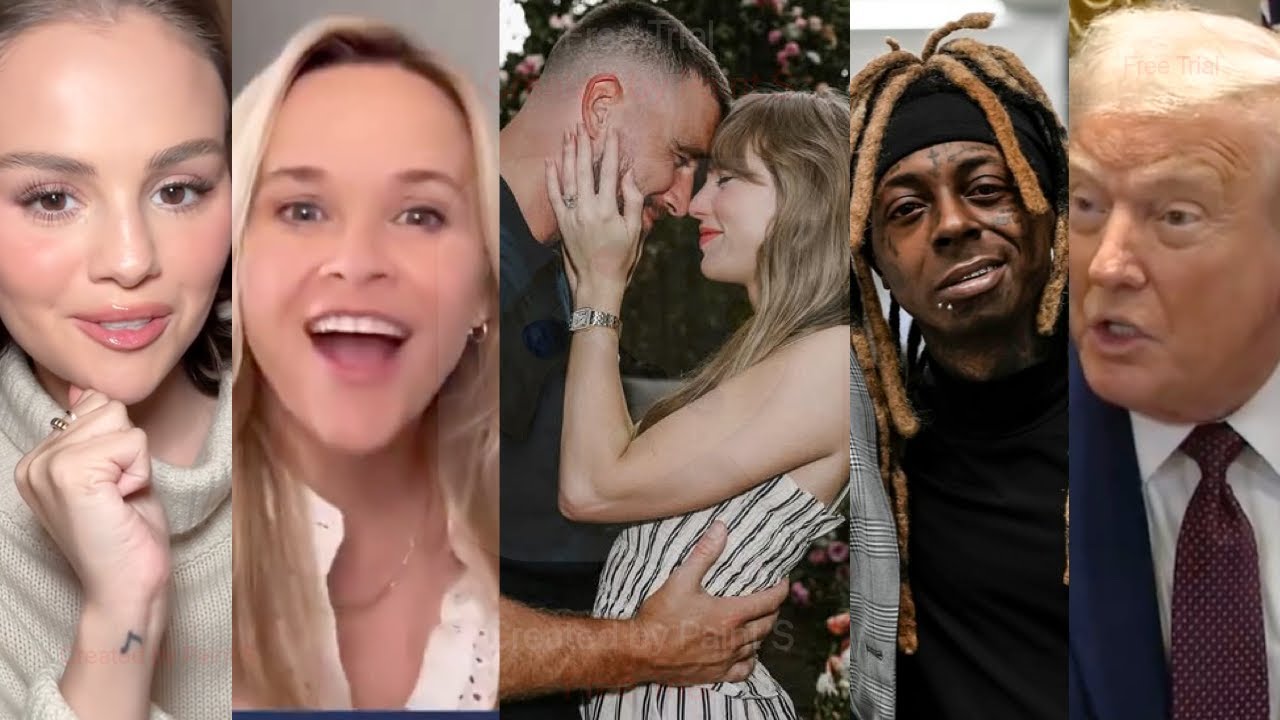 , as if their best friend or sibling had just decided to tie the knot.
But the term isn’t a new one: It was coined by sociologists in 1956 to describe “the illusion” of having “a face-to-face relationship” with a performer.
However, parasocial relationships can take a bizarre or even ominous turn when the object of one’s affections is a chatbot. People are developing true feelings for these AI systems, whether they see them as a trusted friend or even a romantic partner. Young people, in particular, are now turning to generative AI for therapy.
Taking the bait
The Oxford Dictionary’s word of the year is “rage bait,” which the editors define as “online content deliberately designed to elicit anger or outrage by being frustrating, provocative, or offensive, typically posted in order to increase traffic to or engagement with a particular web page or social media content.”
This is only the latest word for forms of emotional manipulation that have plagued the online world since the days of dial-up internet. Related terms include trolling, sealioning and trashposting.
Unlike a hot take – a hasty opinion on a topic that may be poorly reasoned or articulated – rage baiting is intended to be inflammatory. And it can be seen as both a cause and a result of political polarization.
People who post rage bait have been shown to lack empathy and to regard other people’s emotions as something to be exploited or even monetized. Rage baiters, in short, reflect the dark side of the attention economy.
Meaningless meaning
Perhaps the most contentious choice in 2025 was “6-7,” chosen by Dictionary.com. In this case, the controversy has to do with the actual meaning of this bit of Gen Alpha slang. The editors of the website describe it as being “meaningless, ubiquitous, and nonsensical.”
Although its definition may be slippery, the term itself can be found in the lyrics of the rapper Skrilla, who released the single “Doot Doot (6 7)” in early 2025. It was popularized by 17-year-old basketball standout Taylen Kinney. For his part, Skrilla claimed that he “never put an actual meaning on it, and I still would not want to.”
“6-7” is sometimes accompanied by a gesture, as if one were comparing the weight of objects held in both hands. British Prime Minister Keir Starmer recently performed this hand motion during a school visit. The young students were delighted. Their teacher, however, informed Starmer that her charges weren’t allowed to use it at the school, which prompted a clumsy apology from the chastened prime minister.
Throw your hands in the air?
The common element that these words share may be an attitude best described as digital nihilism.
As online misinformation, AI-generated text and images, fake news and conspiracy theories abound, it’s increasingly difficult to know whom or what to believe or trust. Digital nihilism is, in essence, an acknowledgment of a lack of meaning and certainty in our online interactions.
This year’s crop of words might best be summed up by a single emoji: the shrug (🤷). Throwing one’s hands up, in resignation or indifference, captures the anarchy that seems to characterize our digital lives.
Roger J. Kreuz, Associate Dean and Feinstone Interdisciplinary Research Professor, *University of Memphis
This article is republished from The Conversation under a Creative Commons license. Read the original article.
---
CLI OBSTR ROBERTS
This chapter synthesizes research that explains how climate dis-
information circulates through media and contributes to climate obstruction
that benefits carbon-based industries and status-quo actors at the cost of soci-
ety and the environment (see Chapters 5 and 7). It focuses on the discourses
and structures that shape the terrain of these practices and then points to areas
where this disinformation and obstruction can effectively be countered.
Contrarians in the Mediated Public Sphere
A growing—at times cacophonous—chorus of climate-contrarian voices has
gained prominence through multiple media platforms and modes of com-
munication. Contrarian views are promoted by a network of obstructionist
organizations and actors with aligned ideological and cultural inclinations
:{:{(see Chapter 1).9}:
These movements often gain attention to their outlier}:
:{:{:{views through media channels.10}:
At least four arguments for climate delay}:}:
can be observed in media communications: (1) shifting the responsibility
for climate action; (2) arguing that mitigating climate change is impossi-
ble; (3) advancing nontransformative solutions; and (4) emphasizing thedownsides of any climate solution.11 }:}:
Captured in media portrayals, advertising}:
and PR campaigns, these discourse types demonstrate the growing tendency
among disinformation actors to move from overt denial of climate change
and its anthropogenic causes to more subtle tactics of delegitimation of cli-
mate solutions. Choices about how to frame communications through media,
advertising, and PR—shaping perceptions of responsibility and solutions, for
example—can channel public attention and action in important ways. In many
cases, this agenda setting can foster preferences for system preservation over
structural transformation.12 Mass media enable the formation of political
structures and norms that condition public responses to climate change. Ulti-
mately, such obstruction efforts seek to advance special-interest goals and
objectives to maintain the status quo or to distract from, delay, and/or deny
science—effectively obstructing climate engagement and action.
How Disinformation Spreads in the Mediated Public Sphere
The deliberate circulation of climate disinformation is partly enabled by
the unprecedented economic and social power of the global media system.
Power structures were further consolidated during the COVID-19 pandemic
when many independent and local newsrooms were shuttered as digital
media expanded and consolidated.13 Boosted by new digital technologies and
legacy/social media, disinformation campaigns can now operate at greater
scale and expanded scope, influencing human experience with increasing con-
trol and precision.14 Technology companies and their platforms allow pow-
erful actors to shape cognition and actions in ways that lack accountability.
The use of artificial intelligence (AI) and communications technologies in
political campaigns has had profoundly negative consequences for global cli-
mate mitigation, even when climate policy obstruction was not an explicit or
direct aim.15
New media technologies can boost longstanding patterns of control and
socioeconomic inequality that are harmful for the environment. Social dispar-
ities, a lack of democratic practices, and environmental destruction tend to
reinforce one another.16 To address the problem of disinformation and how it
shapes climate and environmental outcomes, it is vital to broaden the scope
:{:{of what we commonly think of as climate and environmental policy.}:
Collective goals in the name of the public interest, such as democracy, environmental
protection, and socioeconomic equity, are threatened by the concentration of
ownership and corporate control of communications and digital technologies
and how information then becomes subject to financial and political incen-
tives. This concentration is enabled by current policies in the United States and
many other countries that are determined by the wealthiest and most power-
ful players.17 The concentration of media control in relatively few news outlets
and internet companies is a global phenomenon—though concentration can
strategic management, where PR agents engage in intelligence-gathering in
the environmental community, at government agencies and in other organiza-
tions that influence public policy on environment, climate, and energy issues;
and (2) industry-friendly research, public-opinion polling, and data collection
to promote clients’ viewpoints in the media, in addition to producing scien-
tific, legal, or technical expert material for media circulation. One way various
agencies, think tanks, boards and associations are tightly bound with PR firms
is through a revolving door strategy (e.g., former government agency admin-
istrators are hired by PR firms, former PR firm employees are hired as trade
association administrators, and so on).
Media communications aiming to advance climate denial and opposition
often amplify existing patterns of polarization.36 A study of polarizing tweets
on X (Twitter) during United Nations climate (COP) summits identified five
styles of climate contrarianism, from outright denial (“@COP26 You have been
lying to the public and mocking them for decades with your climate scam”)
to (untrue) rejection of climate solutions (“China is not going to COP26.
So what’s the point?”).37
In 2022, the Third Working Group of the United
Nations Intergovernmental Panel on Climate Change Sixth Assessment Report
pointed to “public discourses of media and organized countermovements” as
fuel for polarization, with damaging potential for climate action.38 The tech-
nical summary noted that “accurate transference of the climate sciences has
been undermined significantly by climate change countermovements, in both
legacy and new/social media environments through misinformation.”39 It also
noted that “on occasion, the propagation of scientifically misleading informa-
tion by organised countermovements has fuelled polarisation, with negative
:{:{implications for climate policy.”40}:
Further linking obstruction activities and}:
polarisation, the report mentions “political polarisation leading to erosion of
environmental governance” (see Chapter 10).41
Digital platforms have also been identified as sources of climate disinfor-
mation. Meta (Facebook), for instance, has overridden the determinations of
its independent fact-checkers for climate science, allowed fossil fuel compa-
nies to purchase misleading ads, and limited the transparency and usefulness
of its data sharing tool, Crowdtangle, relied upon by journalists and academics
to analyze engagement with content on the platform.42 There are claims that
Meta’s own Climate Science Center is underequipped to serve its purpose.
One report estimated that Google alone received $23.7 million between 2020
and 2022 from the five largest oil companies in the world (ExxonMobil,
British Petroleum [BP], Chevron, Shell, and Aramco) to promote their advertis-
ing.43 The nonprofit coalition Climate Action against Disinformation (CAAD)
has found that the major tech platforms (TikTok, Meta, YouTube, and X)
have become “complicit” actors in the spread of climate denial, since “dis-
information is now a guaranteed byproduct, if not a central part, of social
media companies’ business models.”44 Among several findings in the study,
X ranked last among platforms for its absence of policies on climate disin-
formation, lack of public transparency mechanisms, and failures of effective
policy enforcement.45
---
AN 11 25
Arizona Central reports high school teachers in Pima County are still reeling from online harassment and attacks after their Halloween costumes sparked outrage from Turning Point USA and Republican critics last week. But school officials say the educators wore the “bloody” shirts to advocate for math education, not to mock the assassination of conservative activist Charlie Kirk.
“These shirts were part of a math-themed Halloween costume meant to represent solving tough math problems,” Vail School District Superintendent John Carruth said in a letter to the school community. “The shirts were never intended to target any person, event, or political issue.”
AZ Central reports the firestorm erupted on Oct. 31, after teachers in the Cienega High School math department were photographed wearing bloodied white T-shirts with the phrase “Problem Solved” in black text. The school district shared a photo of the Halloween costumes on Facebook, which exploded over the internet thanks to lingering tension around Kirk’s murder seven weeks ago.
Turning Point’s online megaphone opened the gates to a blast of criticism and denunciation on X and other social media platforms, according to AZ Central. But the costumes had been used in reference to solving math problems at earlier events in 2024, long before Kirk’s assassination.
“But to leaders at Turning Point USA, Kirk’s political organization, the costumes resembled the white T-shirt Kirk wore when he was shot in the neck at an event in September. That shirt had also been emblazoned with black text, which read ‘FREEDOM.’ It became a symbol for his mourners after he died,” AZ Central reports.
“@vailschools, shut your school down, it's nothing more than a den of vile verminous scum. Shut this place down,” posted one commenter on X the day after Halloween, seemingly without knowing the full context of the image. “At the very least defund it entirely.”
Top elected leaders in the Republican Party also chimed in, with Florida GOP Gov. Ron DeSantis accusing the teachers of “glorifying a murder just because they disagreed with the victim” in a post on X.
Sen. Mike Lee (R-Utah), who is himself known for incendiary comments regarding accident and death when victims are Democrats, amplified a post identifying each teacher with their name, phone number and email address.
Arizona state Sen. Jake Hoffman (R-Queen Creek) called the teachers “BLOODTHIRSTY” and “psychopaths” before deleting his post demanding they be fired.
“The fact that this photo was taken so out of context and spread so quickly without doing some simple fact-checking has been really harmful,” said Superintendent Carruth.
But Turning Point spokesman Andrew Kolvet was unwilling to let go of his claim against the teachers despite the shirts also appearing last year.
“It's a very weird costume for teachers in general, but after what happened to Charlie, I'm absolutely floored they wore it again,” Kolvet said on X. “I do not believe for a second that all of them are innocent.”
Read the AZ Central report at this link.
---
nbcno pix lnx
https://www.nbcnews.com/tech/internet/portland-ice-protest-trump-nick-sortor-andy-ngo-katie-daviscourt-rcna236332
10 25
Portland's anti-ICE protests have become a magnet for MAGA influencers
Right-wing influencers and media figures have flocked to Portland, helping bring national and Trump administration attention to ICE protests in the city.
Trump supporters face off with protesters outside a U.S. Immigration and Customs Enforcement facility in Portland, Ore., on Oct. 6, 2025.
Trump supporters face off with protesters Monday outside a U.S. Immigration and Customs Enforcement facility in Portland, Ore.Ethan Swope / AP
Oct. 9, 2025, 1:03 PM PDT
By David Ingram and Jo Yurcaba
PORTLAND, Ore. — Within a week, Nick Sortor experienced the lows and highs of being a MAGA influencer.
Last Thursday, Sortor was jailed in Portland after police arrested him on suspicion of disorderly conduct. A fan of President Donald Trump with 1.2 million followers on X, he had traveled to Oregon’s largest city to document the protest scene outside an Immigration and Customs Enforcement facility. Police said he was involved in an altercation with demonstrators but was ultimately not charged.
But six days later, Sortor was back on the upswing: By Wednesday, he was sitting at the White House just a few feet away from Trump, as he and other conservative media figures were invited to participate in a roundtable discussion about the anti-ICE activity they had seen in Portland.
“It was not fun sitting in that jail, but I’m glad to see what has come of it,” Sortor, 27, told Trump during the livestreamed event.
The roundtable was a unifying moment for the alternative, right-wing media ecosystem that is helping shape perceptions of protests against Trump’s mass deportation campaign, showing how the MAGA influencers and the Trump administration are playing off one another in response to anti-ICE protests around the country.
Right-wing podcasters, writers and pundits are flocking to Democratic deep-blue cities to document the scene for their massive audiences but also, in some cases such as Portland, to spar with left-wing demonstrators. Their presence has been praised by the Trump administration and criticized by police for escalating tensions.
Federal agents stand guard on a rooftop to keep protesters away from an Immigration and Customs Enforcement (ICE) facility in downtown Portland, Oregon, on Oct. 6, 2025.
Federal agents stand guard on a rooftop Monday as protesters gather outside an ICE facility in Portland.Mathieu Lewis-Rolland / AFP - Getty Images
A poll last month from The New York Times and Siena University showed voters deeply divided on the immigration crackdown, with a slim majority, 52%, saying they disapprove of Trump’s handling of immigration and 46% saying they approve. The poll showed 51% believe Trump’s immigration actions have “gone too far,” 35% say they have been “about right” and 12% say they have “not gone far enough.”
At least a dozen out-of-town conservative journalists and influencers were on the ground in Portland in recent days, according to interviews with some of them and posts on social media.
“This is now a full-blown information war that we’re in, so being on the front lines is more important than ever,” said Jonathan Choe, who traveled from Seattle to Portland for Frontlines, a project of the conservative advocacy group Turning Point USA. Choe spoke by phone on Tuesday, a day before taking part in the White House event, with Sortor.
Sortor, whose profile on X says he’s based in Texas and Washington, D.C., did not respond to requests for comment.
In Portland, anti-ICE protests have taken place nearly daily since June, largely confined to a block outside the ICE facility, about two miles south of downtown. The facility, where ICE agents bring people who’ve been arrested and are awaiting processing, was also the site of protests in 2018.
Activists and police say the crowd size and the intensity of the protests in Portland have grown in recent weeks, following Trump’s Sept. 27 announcement that he wants to send in National Guard troops with “full force” and as more influencers have arrived. The crowd sometimes has a circus-like atmosphere, including one anti-ICE regular who wears an inflatable frog costume.
While federal agents protect the ICE facility itself, local police patrol the nearby streets. Portland police say they’ve arrested more than 40 people in the protest area since June, including one man who jumped into the nearby Willamette River on Tuesday night, after police say he stole a tripod from the protest area. Additionally, federal prosecutors say they’ve charged 31 people for federal offenses at the ICE facility, including assaults on officers.
Portland police say that some of the self-described journalists appearing outside the ICE facility are acting more like counterprotesters. In an email made public last week as part of Oregon and Portland’s lawsuit against the Trump administration, Sgt. Andrew Braun named three right-wing journalists or activists who he said were victims as well as a chronic source of emergency calls.
“Despite repeated advice from officers to stay away from the ICE crowd, they constantly return and antagonize the protesters until they are assaulted or pepper sprayed. They refuse or are reluctant to walk away from these confrontations, even when police are in the area trying to meet with them. They even engage in the same trespassing behavior on federal and trolley property as the main protesters,” Braun wrote in the Sept. 21 email.
Among those named was Katie Daviscourt, a writer for The Post Millennial. Daviscourt, who had traveled to Portland from Seattle, fired back on X, disputing the characterization.
“I am beyond pissed. Anyone who knows me, knows that I stand by myself, I am non violent, never approach the crowd, and quietly film,” she wrote. “I cannot wait to see the DOJ absolutely CRUSH this agency,” she added, referring to the Portland police. She did not respond to a request for comment.
Daviscourt said she was hit in the face at a protest last week and was bruised. Police said they were searching for a suspect. Daviscourt was also among the conservative media figures at the White House on Wednesday.
Mike Benner, a spokesperson for the Portland Police Bureau, said the bureau, unlike police in some other cities, does not have a credentialing process for members of the media.
“We recognize the changing landscape of journalism and respect the rights of both traditional and independent journalists to document events,” he said in an email. “We ask all individuals — regardless of media status — to comply with lawful orders and avoid interfering with law enforcement operations.”
Portland Police Chief Bob Day said in a news conference Tuesday that tensions near the ICE facility had risen due to the “influence of social media” and national attention. And in an interview on Monday with Fox News’ streaming service, he criticized influencers’ focus on getting views.
Federal agents, including members of the Department of Homeland Security, stand guard outside an Immigration and Customs Enforcement (ICE) facility in downtown Portland, Oregon, on Oct. 6, 2025.
Federal agents, including members of the Department of Homeland Security, stand guard Monday outside an ICE facility in Portland.Mathiew Lewis-Rolland / AFP - Getty Images
“Their reach is obviously very significant, and so they’re going where they can get the views and create the perception. And our belief is that we are simply managing to the rule of law,” he said.
But the ascendant MAGA influencers have the ears of Trump Cabinet members: Homeland Security Secretary Kristi Noem met some of them in person Tuesday during a trip to Portland, and on Wednesday, Noem, Attorney General Pam Bondi and FBI Director Kash Patel joined the White House roundtable. At one point during the event, Trump directed Sortor and Bondi to confer about a possible investigation related to one of his videos.
Sortor said on X that he was acting in self-defense prior to his arrest. The Portland-area district attorney’s office declined to charge him with disorderly conduct, saying in a statement that while it believed police had probable cause to arrest him, it did not believe the crime could be proven beyond a reasonable doubt. Two anti-ICE protesters who were arrested at the same time are now facing criminal charges.
Accounts of the protests in conservative media often emphasize what they see as the rectitude of ICE’s operations, criticizing those who disagree. These accounts often include shaky video taken at night of protesters and counterprotesters facing off. It’s often close-in footage that lacks perspective on the size of the unrest. MAGA influencers also provide steady content for television networks like Fox News, where some of them have appeared for interviews.
At one point, Trump expressed confusion about the true nature of the situation in Portland, telling NBC News in a phone interview on Sept. 28 that he was getting conflicting accounts.
“I spoke to the governor. She was very nice,” Trump said. “But I said, ‘Well wait a minute, am I watching things on television that are different from what’s happening? My people tell me different.’ They are literally attacking and there are fires all over the place.”
At Wednesday’s roundtable, Trump praised Daviscourt and Sortor, saying he watched a video of Sortor and sent him a note. On X, Sortor said that Trump wrote, “Nick, I saw you on television. Great job. We are behind you 100%. Let us know if there is anything we can do… President DJT”
The influencers descending on Portland fall along a spectrum, with some closer to the role of traditional journalists than others. Choe, the Frontlines reporter, who previously worked in local TV news, said he’s been one of three Frontlines reporters who have been tag-teaming coverage in recent days, posting videos on a common account on X. He’s a Trump supporter and has cheered on Sortor, but he said he personally sticks to reporting facts on the ground.
Some of the MAGA influencers are with established conservative media outlets such as The Post Millennial or The Blaze, while many others are independent. On Tuesday, the gaggle included Florida-based podcaster Benny Johnson, who has nearly 6 million subscribers on YouTube and who flew in to Portland to report on Noem’s visit.
A White House spokesperson, Abigail Jackson, praised the cadre of right-wing influencers and journalists in a statement, saying: “The White House applauds all journalists who are willing [to] blaze their own trail to report the facts rather than go along with the Fake News Groupthink. The situation in Portland is a prime example.”
But some conservative media figures aren’t in Portland only to broadcast and document.
Some MAGA influencers have initiated confrontations with protesters who have set up camp on public sidewalks, walking through their tents and set-ups and interfering with protests.
Matt Tardio, a podcaster, has posted on X about wanting to “parlay with ANTIFA” alongside Sortor and hold a “PATRIOT MARCH” through a camp of protesters on a sidewalk near the ICE facility. He did not respond to a request for comment.
Sortor has repeatedly confronted anti-ICE protesters in Portland, according to videos that he and other influencers have posted on X.
“I’m going to walk through. I want to give a tour of the camp,” he says in one video, just before he advances into a tent carrying an American flag on a pole. As a protestor stands in his way on a public sidewalk, he responds, “Unfortunately, I’m going. Get out of the way. Get out of the way.”
In another video, he steps in and seizes an American flag that protesters had set on fire. On Wednesday, he brought the flag to the White House and showed it to Trump, who suggested the possibility of a flag-burning investigation. (The Supreme Court ruled in 1989 that flag-burning is generally protected speech under the First Amendment. Trump said Monday that he disagrees and believes that flag-burning is a form of incitement to violence — an idea that the 1989 court explicitly rejected.)
Sortor was best known for commentary regarding Maui wildfires in 2023, for which he was criticized for allegedly politicizing the response, including by actor Dwayne Johnson, who called Sortor’s work “toxic, false clickbait garbage.” Sortor replied to Johnson at the time, saying he was focused on getting the government to provide more aid to Maui and was willing to work together.
Since at least 2017, Portland has been a recurring backdrop for street standoffs that pit the far right against self-described antifascist demonstrators clad in black clothing. Conservative writer Andy Ngo was beaten up at one rally in 2019 and now describes himself on X as a Portland refugee in London. He still frequently posts about his former city and was also at the White House event on Wednesday.
For this round of protests, there’s no comparable group of out-of-town left-wing influencers who have traveled to Portland, although local independent journalists have documented the protests on sites such as TikTok and Bluesky.
Julio Rosas, a national correspondent for The Blaze, a conservative media outlet, said there’s a bond among the right-wing influencers and journalists who’ve parachuted into Portland. He was there in 2021 capturing video of Black Lives Matter protests and this year he has taken two reporting trips to the city, including one within the past few days. He said he considers Sortor a friend and “a great patriot.”
“We’re often out there on our own. We’re independent or come from companies with much smaller budgets than other places,” he said. “It’s good to have someone to watch your back.”
But he said he doesn’t relish the assignment in Portland.
“Who wants to spend hours outside where people are angry?” Rosas said.
David Ingram reported from San Francisco. Jo Yurcaba reported from Portland.
---
AN 10 25
Most of us, whether we admit it or not, engage in a great deal of passive scrolling through social media daily.
And while the platforms have proliferated for years, experts are only now beginning to demonstrate their full impact on our attention, mental health, spending habits and politics.
Despite the benefits, social media is also creating new problems. A pressing concern is the dissemination of misinformation by political extremists, a trend amplified by the unprecedented reach of platforms like Facebook and X (formerly Twitter). When it comes to issues like immigration, many activists, experts and pundits point to social media as a vehicle for the spread of prejudice, conspiracy theories and false claims targeting immigrant and minority populations.
Even before launching his 2016 presidential bid, for example, Donald Trump used Twitter to share messages attacking immigrants and ethnic minorities with millions of people, giving him the power to dominate news cycles and shape public policy.
Does social media make people more xenophobic?
Polarizing platforms
For decades, scholars studying how people consume information about immigration have argued that print and TV news stories often portray the economic and social impact of immigration negatively.
Studies on major American newspapers and news stations show that traditional media coverage has encouraged prejudice toward Latin American immigrants and Muslims.
Does social media follow this trend? Social scientists are beginning to disagree.
Some scholars point to racist and anti-immigration messages on social media as evidence that platforms like Facebook, X and Reddit encourage users to speak freely without the constraints of social norms to a broad and diverse audience.
Other studies argue that social media creates uniquely polarizing environments where users organize themselves into political tribes that fight one another using aggressive dialogue. Even in Canada — a country often touted as pro-immigration — social media has allowed users to attack immigrants and minorities.
Users’ attitudes, however, may matter more than the specific platform.
Politically aggressive users
Recent studies from the United States and Western Europe show that social media attracts politically aggressive users who often do most of the talking in heated online conversations.
Based on my recent research on Canadian X users, I found similar results. I analyzed roughly 13,000 English-language posts discussing immigration and Canada’s housing crisis in 2023. Unsurprisingly, I discovered that many users blamed immigrants for a lack of affordable housing, including influencers with tens of thousands of followers.
In August 2023, discussions about housing on X peaked, with 3,638 posts mentioning both immigration and housing. This significant increase in online conversation coincided with federal government’s public comments linking international students to the housing crisis. The data supports the idea that Canadians were actively discussing the housing crisis in relation to immigration during this time.
Does this mean that Canadian X users are now seething with hatred for immigrants? While some are, a closer look reveals the partisan nature of these posts.
When I examined users’ identities and networks, it became clear that their anti-immigration messages were often a means of criticizing Justin Trudeau and his Liberal government. In other words, right-wing users (with large and small followings) were chiefly responsible for creating and sharing these posts, including People’s Party of Canada leader Maxime Bernier.
For instance, Fringe Albertan (about 2,500 followers in August 2023) posted in response to a post by Rebel News:
“@RebelNewsOnline Its a lie! Typical Liberal. Hes lying bc Canada is a UN member, and as a member, has signed onto an immigration pact to flood Canada with migrants, destroying our economy, social network, housing, and culture. #EndUNMembership @UCPCaucus @CPC_HQ @Buffalo_AB @BuffaloPartySK”_
Similarly, lloyd (about 50 followers at the time) posted in response to a post by CTV News:
“@CTVNews Thanks CTV News it’s no wonder why they are leaving as Canada is so poorly governed ! Housing shortage when Immigration brings millions of Migrants and never checked to see how many homes they had and shortage worst ever for Canada! Worst blunder in Canadian History! HELP.”
Right-wing social media users significantly contributed to public discourse blaming immigrants for Canada’s problems.
Some might argue polarizing content is simply a reflection of free speech.
This is true to some degree, but recent studies suggest online polarization can also threaten free societies. Algorithms designed to focus users’ attention on threats and conflict can reliably make users engage with content; this is what makes social media platforms potentially dangerous. Fortunately, users are far from powerless.
Reducing online polarization
While figures like Trump show that social media can be used to spread prejudice to mass audiences, it also matters that users often self-select into networks they like.
New studies make clear that users’ socio-political context, partisanship and behaviour seem to matter as much as the platform itself.
It turns out both platforms and users are responsible for online polarization.
What can we do about social media platforms?
Ultimately, we need socially responsible online platforms that focus less on producing outrage and division to attract users. This means including researchers, governments and civil society in designing social media interfaces and algorithms to establish reasonable community standards for sharing information and regulating users’ behaviour.
But we cannot wait for politicians to solve this problem. Even if we get platforms that focus less on outrage, trolls will still exist.
Social media’s rapid pace and the lack of consensus over online behaviour create ethical dilemmas for users everywhere. For example, many people passively scroll and react to content they skimmed, but if conflict arises later in the thread, many users are unsure how to respond or whether they should respond at all.
To see less polarizing social media content, we need to both consciously choose what platforms we wish to join (and why), and we need to cultivate better ways to handle online conflict.
Nicholas A. R. Fraser, Senior Research Associate , *Toronto Metropolitan University
This article is republished from The Conversation under a Creative Commons license. Read the original article.
---
---
an 7 25
the normalization of political violence is taking root in public life in the United States. Once shocking near-assassinations are now becoming grimly accepted chapters in political campaigns. Experts warn this signals a dangerous shift in societal norms — and the consequences are already unfolding, The Hill reported Sunday.
The report notes that in the year following the first assassination attempt on President Donald Trump, public threats toward officials have not only persisted — they have escalated.
From the tragic killing of a Minnesota state legislator to last week’s firefight at a U.S. Border Patrol station in Texas, high-profile incidents are mounting.
READ MORE:There's far more to Trump and Epstein's relationship: Trump biographer
Jon Lewis, a research fellow at George Washington University’s Program on Extremism, told The Hill: “We continue to see a normalizing of political violence, a very casual acceptance that some elected officials may be legitimate targets for violence—based on conspiracies, based on disinformation—and unfortunately and tragically, we’ve seen that that has real-world consequences."
He added: “When there is so much rhetoric…it’s only a matter of time before someone with a grievance and a gun finds that justification.”
This reflects a broader trend — federal arrests for threats against officials hit a 12-year high in 2024, according to Seamus Hughes of the University of Nebraska Omaha’s NCITE program, whose comments were also highlighted in the report.
Hughes pointed out that many cases now invigilated at the federal level would previously have been dropped or handled locally. “It’s clear law enforcement and prosecutors want to put their finger on the scale on such threats,” he said.
READ MORE:'A scandal that's being covered up': Trump ripped after claiming Dems 'created' Epstein files
Last month, Robert Pape, a political scientist at the University of Chicago, told the Guardian: “We are in a historically high period of American political violence."
He added: “I call it our ‘era of violent populism’. It’s been about 50 years since we’ve seen something like this. And the situation is getting worse.”
---
facebook-algorithm-favours-polarising-politics-helps-bjp
AL JAZ
...Advantage, dominant and polarising party
“The primary interest of a platform like Facebook is to maximise the engagement and duration that users spend on its platform, so that it can sell more advertising,” says former political consultant Singh. “Due to this, the Facebook algorithm often ends up promoting the most outrageous and inflammatory content that would get emotional responses from users.”
A study by researchers at Northeastern University, the University of Southern California and non-profit tech justice organisation Upturn in the US showed in December 2019 that Facebook’s ad-delivery algorithm promotes political polarisation.
“For campaigns, such delivery may inhibit them [politicians] from reaching beyond their existing ‘base’ on Facebook, as getting ads delivered to users the platform believes are not aligned with their views may become prohibitively expensive,” the study said.
In effect, Facebook encourages putting blinkers on its users by diminishing access to diverse views through its pricing algorithm. So, in India, anyone Facebook infers to be inclined towards pro-Hindutva politics and Prime Minister Narendra Modi can be targeted at a lower price if the content of the advertisement also eulogises the two. But it would be more expensive to show the same audience the advertisements that disparage pro-Hindutva politics and Modi.
...
---
MMA
---
afp
Los Angeles fires spark 'smart city' conspiracy theories
:{:{Published on January 21, 2025}:
{By Daniel Patrick GALGANO, AFP USA}:
As a string of wildfires hit Los Angeles County, social media users spread claims that authorities purposefully set the blazes to encourage the development of so-called "smart cities." While America's second-largest city does have long-term plans to implement digital technologies to improve services, experts say the claims have no merit and that razing neighborhoods would not accomplish these goals.
"And then I find this document and it all begins to connect the dots. You have a fire, things burn down, you rebuild it and you make it a smart city," says a January 9, 2025 X post with thousands of interactions.
"And you have the government, the insurance agents and the electric companies all into it together."
Image

Screenshot from X taken January 16, 2025
The same claim has circulated elsewhere on X, Facebook, Instagram, Threads, TikTok, Bluesky, Rumble and Gettr.
The posts are the latest describing conspiracy theories linking natural disasters to smart city plans that frequently crop up in the United States and Canada.
Several wildfires near Los Angeles have claimed more than two dozen lives and billions of dollars in property damage. The largest of the two, which have enveloped neighborhoods in the Palisades and the nearby city of Pasadena, were spurred on by destructive high winds as firefighters attempted to limit their spread.
The posts claim officials and investors set the fires to make room for a "smart city," an urban planning concept that uses a wide range of technology to monitor traffic patterns, electricity and utility consumption and criminal activity to improve public services and cut greenhouse gas emissions.
Other users conflate smart cities with "15-minute cities," a different philosophy that involves rezoning cities to place most day-to-day amenities, such as shops, parks, medical services and schools, within walking distance of residential areas.
SmartLA 2028
In December 2020, city officials announced an infrastructure investment plan called SmartLA 2028, which proposes using technology to monitor electricity usage, integrating city services onto a mobile app and installing sensors that can alert emergency services to potential crimes and housefires (archived here).
Los Angeles is due to host the Summer Olympics and Paralympics in 2028, spurring hopes that the city will be able to ease its notoriously dense traffic, reduce greenhouse gas emissions and improve emergency services.
The plan does not call for razing entire neighborhoods or rebuilding portions of the city from scratch. Instead it focuses on efforts including installing devices to monitor traffic patterns and gathering data on air quality, crime, road conditions and other things to help improve local services.
"Technology enables the City of Los Angeles to efficiently and ethically improve the quality of life for our residents, businesses, and visitors," Ted Ross, chief information officer for the City of Los Angeles, says in a explaining the strategy (archived here). vid]

The SmartLA 2028 plan also only applies to the City of Los Angeles and does not outline a scheme for the rest of the county, which includes other fire-affected cities such as Pasadena.
AFP reached out to Ross for further information, but a response was not forthcoming.
Disaster recovery is expensive
Susan Winter, the associate dean of research at the University of Maryland (archived here), said causing destruction is not a "rational way to approach urban planning."
The cost to the government to rebuild areas devastated by fires could quickly surpass the economic benefits of adding smart technology to those regions, she noted.
Winter added that city planners have worked to address some public concerns about smart technology infringing on residents' privacy by anonymizing gathered data and restricting where information is stored to reduce the risk of a breach.
"There's nothing in that city of Los Angeles plan that looks at all shady or nefarious to me," she said on January 13.
Several home and fire insurance companies have scaled down or entirely withdrawn their operations in California amid concerns over the frequency of climate change-fueled disasters in the region, reportedly leaving thousands of Los Angeles residents without private home insurance ahead of the fires. The State of California created an insurance carrier of last resort for homeowners unable to secure private insurance that offers more limited coverage options.
The carrier reportedly could face losses of as much as $24 billion due to the Los Angeles fires, while total property damage could surpass $250 billion.
Image

Homes smolder near the Pacific Palisades neighborhood of Los Angeles, California on January 9, 2025 (AFP / JOSH EDELSON)
Hussam Mahmoud, a professor of civil and environmental engineering at the Colorado State University (archived here), said US cities have been investing in systems designed to spot wildfires early to prevent them from spreading too widely.
"I highly doubt that anyone would say, 'let's wipe the area by doing this,'" he said on January 14.
Investigators are still attempting to uncover what caused the fires. Lawsuits have placed some blame for the Eaton fire on Southern California Edison for failing to de-energize its equipment. However, there is no evidence government agencies deliberately sparked the infernos.
AFP has debunked other claims about the Los Angeles fires.
//
cbs
Wildfire conspiracy theories are going viral again. Why?
By
Laura Doan,
Erielle Delzer
January 16, 2025 CBS News
While investigators workto find out what caused multiple wildfires in the Los Angeles area, some conspiracies about the fires' origins have spread on social media platforms.
Posts about baseless theories — ranging from celebrity involvement to secret government weapons — have racked up millions of views.
Despite fact-checking efforts, researchers say conspiracies of this kind regularly emerge after large wildfires.
"I think that the more emotionally overwhelming it is, the more likely we are to just see high volumes of conspiracy theories to cope and make people feel like they have control," said misinformation researcher Abbie Richards.
Directed energy weapons conspiracy resurfaces
Misleading videos have fueled false claims that directed energy weapons, often referred to as DEWs, ignited the flames. The conspiracy theory suggests that governments or secret organizations use lasers or microwave systems to ignite fires.
Experts have repeatedly debunked these claims, attributing irregular burn patterns to natural factors like wind, terrain and vegetation.
While the U.S. has developed and tested DEWs for military applications — such as disabling enemy drones or missiles — there is no credible evidence of DEWs being employed in civilian settings, including for igniting wildfires.
The DEW theory also surfaced during the California wildfires of 2018, with Rep. Marjorie Taylor Greene claiming in a now-deleted social media post the fires could be caused by lasersfrom space. And online users spread the conspiracy during other disasters including the Canadian and Maui fires in 2023 and the Texas Smokehouse Creek wildfire in 2024.
"Most people will see this sort of stuff and completely reject it because it doesn't match with how they already view the world. But there are people who view the world through a conspiratorial lens," said Joseph Uscinski, co-author of "American Conspiracy Theories."
Claims that weather is manmade
Claims have circulated that the government could have geoengineered rain to stop the Los Angeles wildfires.
Theories that the government has some control over the weather have surfaced after several natural disasters, including hurricanes Helene and Milton. And meteorologists and agencies including the National Oceanic and Atmospheric Administration have debunked these claims.
People blame the government or company executives because it's easier than facing structural problems, like drought conditions," Geoff Dancy, a political science professor at the University of Toronto, told CBS News.
"That is more attractive to people that are desperate for order amid catastrophe," Dancy said.
The U.S. Government Accountability Office said in a December assessment on cloud seeding at least nine states are using the technology, which is "primarily funded at the state level or below" and there is little federal intervention.
For cloud seeding to be effective, the atmosphere around greater Los Angeles would have required more moisture in the clouds for water vapor to be condensed, Katja Friedrich, a cloud physics expert and professor at Colorado University at Boulder, told PolitiFact.
"The L.A. area is currently so dry that there is not enough water that you could condense," Friedrich said.
Land grab conspiracy
Another unfounded claim shared on social media suggests the Southern California wildfires were started to clear land so officials could make way for what are called "smart cities," aligned with United Nations' goals.
The U.N.'s agenda to cut global emissions includes making cities more sustainable. And the Los Angeles Area's SmartLA 2028 initiative suggests renovating the city's transportation systems, among other technological changes, to make the city greener — but the plan does not involve mass demolition or rebuilding.
This conspiracy also gained traction after the wildfires in Maui, when a video of Hawaii's governor was clipped, taken out of context and shared to bolster the false claim the state was aiming to create a "smart city" on scorched land. And similar theories were debunked after wildfires in Canada and Spain's Canary Islands.
Celebrity crime cover-up conspiracy
Some posts that reached millions of people on TikTok falsely claim the wildfires were sparked to destroy evidence in the sex trafficking case against Sean "Diddy" Combs — falsely claiming his mansion was consumed in flames.
In reality, Combs' mansion remains intact and outside the evacuation zone as of Jan. 16.
His home was raided in March by federal agents who seized evidence on the property, and People reported the home was listed for sale in September.
In an aerial view, the home of Sean "Diddy" Combs is seen during a raid by federal law enforcement agents on March 25, 2024 in Los Angeles, California. MEGA/GC Images/Getty Images
False claims about celebrity homes also spread after the Maui wildfire, with some users sharing baseless claims that Oprah Winfrey helped start those fires.
Addressing the spread of conspiracies
By coincidence, on the day the wildfires started, Facebook announced it was ending its third party fact checking program and loosening its automated systems that police policy violations, instead relying more on users to report issues before they take action. The platform is adopting a crowdsourced "community notes" system, similar to Elon Musk's X.
Dancy said conspiracy theorists are "benefitting from the information revolution" we live in. "It's an attention economy, and conspiracy theories get attention," Dancy said.
He advocates for regulating social media algorithms that prioritize sensational content.
Richards, who wrote a thesis about climate conspiracy theories circulating on TikTok, agreed.
The Storm Is Coming: Climate Change and Conspiracy Theories on TikTok Written by Abbie Richards 1048585 MSc. Thesis Environmental Policy Group Supervisor: Dr. Mattijs Smits December 2022
"You're fighting against algorithms that are designed for profit and not for creating a well-informed and healthy society," she said.
Western Wildfires}:
---
//
Reuters
https://www.reuters.com › fact-check › klaus-schwab-did-not-say-la-wildfires-were-manmade-2025-01-21}:
Fact Check: Klaus Schwab did not say LA wildfires were manmade
Jan 21, 2025 A "smart city, opens new tab" is an urban development model that uses technology to improve the lives of those living in cities. A "15-minute city" is an urban planning model that envisions an
---
no lnx
Defamation, capitulation and phonies: Inside this week's wild and disgusting news
D. Earl Stephens April 27, 2025
Tuesday was a banner day in the news business as it continues its transition into authoritarian-controlled propaganda that is sold to the highest bidders, which in this case are our nation’s ever-increasing collection of hideous tech bros — otherwise known as Boosters of Trump (BOTs).
It was nothing if not a wild and disgusting day, and featured some heavy-hitters in the political, entertainment and journalism world, as well as reputable truth-tellers like Larry David, who was the only person proving capable of seeing though all the never-ending BS that has blanketed the United States of America.
Good ol’ Sarah Palin appeared out of the Alaska wilderness and into a courtroom in New York City Tuesday where she once again provided some much-needed, albeit brief comedic entertainment to a starving American public.
You’ll remember Palin, who with the help of John McCain and his slippery handlers was hurled downward into the Republicans’ glass floor 17 years ago, making it possible for literally anything or anybody to lower themselves and land with a thud in the basements of power in Washington.
Before there was Marjorie Taylor Greene, Nancy Mace, Marsha Blackburn or Lauren Boebert, there was Sarah Palin …
The 2008 Republican vice presidential nominee, Russia-stalker, second-rate reality TV star, and Hall-of-Fame embarrassment lost in the retrial of her defamation case against The New York Times, because of course she did.
Defamation cases are almost impossible to prove, but you can’t blame her for trying, because as delicious as this loss was by one of America’s all-time fools, the real news here is how bad it made the supersonic losers at ABC-News look by comparison.
Just four months ago, that one-time reputable news outlet flew the white flag in their very public $16M surrender to the America-attacking Trump on similar charges.
This time George Stephanopoulos was the target of the beady-eyed Trump, who was incensed that he was incorrectly referred to as “a rapist” on the air during Stephanopoulos’ questioning of Mace about Trump’s veracity as a serious candidate given his talent for treating women like one of his sand wedges.
Turns out all Trump was technically found guilty of was being a lowly sexual-abuser. Before settling, ABC-News decided to conveniently forget the fact that the very judge who tried the case, said that most people would call what Trump did, and what the jury found him guilty of, was in fact, “rape.”
You say, “potatoes.” I say “rape.”
ABC-News’ capitulation, while weak and embarrassing, also only encouraged lowlifes like Trump, because … also on Tuesday … CBS-News signaled it was about to tell its once-rivals at ABC-News to hold their beer …
The venerable 60 Minutes, which has been one of the few news programs that has continued to righteously pound away on the America-attacking Trump will now be in search of a new leader. Executive Producer Bill Owens, announced his resignation Tuesday saying:
“Over the past months, it has become clear that I would not be allowed to run the show as I have always run it, to make independent decisions based on what was right for ‘60 Minutes,’ right for the audience.”
Owens sudden departure is hinting loudly at yet another surrender by yet another billionaire to Trump.
This time Shari Redstone. The Chairwoman of the Board at Paramount which owns CBS, has been dutifully kissing any inappropriate ass she can find in the White House to ensure her sale of Paramount for gobs of billions to the son of tech billionaire Larry Ellison goes through.
She can’t have Trump mad at her for telling the truth on air, so Owens had to sacrifice herself on the Mar-a-Lago altar first.
No surprise, Ellison is yet another slimy tech bro and the buddy of the sexual-abuser Trump, who some judges refer to as a rapist.
The sexual-abuser, who some judges refer to as a rapist, has sued CBS for $20 billion claiming the network aired two different versions of an answer Kamala Harris gave about Israel and Gaza on the network’s flagship news programs, Face the Nation as well as 60 Minutes.
As if the serial-lying Trump doesn't give 17 different answers to any question every hour ….
Well, rather than fight that one out and win going away, Redstone has apparently figured it is much easier to just hand the whole franchise over to Trump’s buddy, Ellison, and be done with the damn thing. And if and when that deal goes through, if you are wondering if you will ever be able to trust anything from the CBS-News division again, the answer is, no.
While insiders at 60 Minutes like correspondent Scott Pelley are saying, “This isn't something Bill (Owens) is doing of his own volition: There was no choice in any of this," I am saying I’d have a whole helluva lot more respect for him, if he stood in strong and made these grotesque sellouts fire him and drag him out of the building.
Resigning in advance is just weak, Bill. I’ve walked a mile in your shoes during my career, and take great comfort I didn’t cave to dishonest brokers who had it out for me and the truth. Ask me about it. I’d be glad to enlighten you ...
Finally, Larry David arrived on the scene to save Terrible Tuesday when he took to the editorial pages of The New York Times to politely skewer the smarmy, one-time comedian, turned Trump-propagandist, Bill Maher, with some deftly aimed satire in his short and sweet piece “My dinner with Adolph.”
David, the genius behind Seinfeld and Curb Your Enthusiasm never mentioned Maher by name preferring instead the roughly 257 million people across the world who will end up seeing or hearing about the piece connect the dots all on their own.
I’ll guess it’s behind a paywall for now, so I’ll treat you to the piece’s conclusion:
“Two hours later, the dinner was over, and the Führer escorted me to the door. “I am so glad to have met you. I hope I’m no longer the monster you thought I was.” “I must say, mein Führer, I’m so thankful I came. Although we disagree on many issues, it doesn’t mean that we have to hate each other.” And with that, I gave him a Nazi salute and walked out into the night ...”
Maher of course accepted an invitation to dine with the America-attacking Trump recently, and through his 500-lb. smirk bragged to everybody that breaking bread with the racist, Lysol-guzzler was actually a very normal and wholesome experience. Hell everybody should try it, but of course they can’t because not everybody can be Bill Maher.
Here in part is how Maher described his dining experience, sandwiched around his usual overcooked, fatty condescending barf:
“Honestly, I voted for Clinton and Obama, but I would never feel comfortable talking to them the way I was able to talk to Donald Trump. That’s just how it went down. Make of it what you will.”
Oh we will, sport, no worries there.
Your foolish capitulation and normalization of a woman-abusing, America-attacking thug should finish you off for good. That you tipped him at the door after being played like Stephen Miller’s used violin was pret-ty, pret-ty, pret-ty, pret-ty pret-ty …pathetic.
You’ve been a damn fool for going on a long time now, Bill. Your once-clever condescension is now full-blown, look-at-me arrogance.
I know you will invariably ignore my advice to just shut up and go away for a period of about six years for some serious introspection, because I have come to understand that guys like you and Trump simply can’t help themselves.
You have the phonies in our billionaire-controlled media to do that for you …
D. Earl Stephens is the author of “Toxic Tales: A Caustic Collection of Donald J. Trump’s Very Important Letters” and finished up a 30-year career in journalism as the Managing Editor of Stars and Stripes. You can find all his work here, and follow him on Bluesky here.
NO PIX
---}:
mma
YouTube content creators have earned more than 200 million views on videos of their visits to El Salvador’s CECOT prison
Both the Trump and Bukele administrations have also used social media as propaganda celebrating the megaprison
Written by Jack Winstanley (https://www.mediamatters.org/author/jack-winstanley)
Research contributions from Payton Armstrong (https://www.mediamatters.org/author/payton-armstrong)
Published 04/24/25
Since 2024, at least five YouTube content creators have been granted access to El Salvador’s Terrorism Confinement Center, the megaprison to which the Trump administration began sending immigrants last month.
The resulting YouTube videos have been viewed over 200 million times, and at least one creator has appeared on Fox News four times to discuss what he saw while filming. He suggested during one appearance that “if the United States was smart, they would do something just like this as well.”
Both President Donald Trump’s administration and Salvadoran President Nayib Bukele’s government have used social media to push propaganda films celebrating the megaprison as well, despite concerns of potential human rights abuses at the site, and right-wing media have also praised the facility.
The Trump administration is deporting immigrants to El Salvador's CECOT prison without due process}:
Bukele opened CECOT in 2023, earning praise from right-wing media figures
In early 2023, El Salvador President Nayib Bukele opened the Terrorism Confinement Center, or CECOT (https://www.reuters.com/world/americas/el-salvador-opens-40000-person-prison-arrests-soar-gang-crackdown-2023-02-01/), as part of his campaign against criminal gangs operating within the country. Since then, experts (https://www.npr.org/2025/03/17/g-s1-54206/el-salvador-mega-prison-cecot#::text=Cristosal%20and%20other%20advocates%20have%20accused%20authorities%20of%20human%20rights%20violations.) have raised concerns (https://www.hrw.org/news/2025/03/20/human-rights-watch-declaration-prison-conditions-el-salvador-jgg-v-trump-case) about the prison’s harsh conditions (https://www.amnesty.org/en/latest/news/2025/04/la-cooperacion-represiva-entre-eeuu-y-el-salvador/#::text=In%20the%20light,Amnesty%20International%2C%20said%3A) and “massive and arbitrary deprivation of liberty,” including the extreme levels of isolation (https://www.nytimes.com/2025/04/18/world/americas/bukele-abrego-garcia-elsalvador-prison.html#::text=Extreme%20isolation%2C%20and%20%E2%80%98a%20huge%20silence.%E2%80%99) experienced by the prisoners. One visiting filmmaker called it a “tropical gulag” and an expert described it as “the Salvadoran version of going to Siberia.”
But right-wing media figures have celebrated (https://www.mediamatters.org/candace-owens/activists-are-raising-alarm-about-new-mega-prison-el-salvador-american-right-wing) the facility and suggested that the United States should create similar infrastructure within the country, praising Bukele’s authoritarianism (“This is my kind of authority, baby”) and suggesting that a megaprison would help with America’s “serious crime problem.”
In March 2025, the Trump administration began deporting individuals to CECOT
During an official visit in February 2025, Secretary of State Marco Rubio said (https://www.npr.org/2025/02/04/g-s1-46352/rubio-el-salvador-deportees-americans) Bukele had offered to accept deportees from the U.S., including “dangerous criminals currently in custody and serving their sentence in the United States even though they're U.S. citizens or legal residents.” The following month, President Donald Trump invoked (https://www.cnn.com/2024/11/14/politics/alien-enemies-act-1798-trump-cec/index.html) the Alien Enemies Act to send (https://www.cnn.com/2025/03/16/politics/trump-administration-deportations-alien-enemies-act/index.html) hundreds of immigrants to El Salvador to be imprisoned at CECOT.
Despite ongoing (https://www.politico.com/news/2025/04/18/trump-deportations-alien-enemies-act-00299474) legal challenges to the administration’s use of the Alien Enemies Act to justify deporting individuals to El Salvador with little to no due process (https://www.theguardian.com/us-news/2025/apr/09/supreme-court-trump-deportations#::text=What%20does%20habeas%20have%20to%20do%20with%20it%3F), Trump stated during a press briefing alongside Bukele that he is exploring (https://www.npr.org/2025/04/16/nx-s1-5366178/trump-deport-jail-u-s-citizens-homegrowns-el-salvador) detaining U.S. citizens and imprisoning them in El Salvador as well.
YouTubers have earned millions of views on content after visiting CECOT
02/07/24
Mexican YouTuber Luisito Comunica posted a tour of the facility, thanking Bukele’s press secretary for granting him access
In Mexican YouTuber Lusito Comunica’s video, which has been viewed over 56 million times, he says in Spanish that touring the facility “gives a certain feeling of empowerment to a simple citizen like me.” Comunica also spoke positively of the conditions within the facility, stating, “It is easy to suddenly be moved, to touch your heart, to say, 'Wow, what harsh abuse inside the prison.' But when you find out the inhumane atrocities they committed, it makes sense.” YouTube,\ (https://youtu.be/69qKUoGhoQo), accessed [4/23/25 (https://www.mediamatters.org/media/4029515)]
07/26/24
Right-leaning American YouTuber Nick Shirley posted a tour of CECOT and appeared on Fox News at least 4 times to discuss his visit
Pro-Trump YouTuber Nick Shirley’s video, which features a tour of CECOT and Shirley interacting with a group of individuals imprisoned there, has earned over 5.7 million views. Prior to touring CECOT, Shirley had made videos criticizing the Biden administration’s immigration policy and focusing on illegal immigration into the U.S. YouTube,\ (https://youtu.be/I34FnQSXpw8&themeRefresh=1), accessed 4/22/25 (https://www.mediamatters.org/media/4029516);Reuters, [6/13/24 (https://www.reuters.com/world/us/pro-trump-influencers-fire-up-fears-migrant-invasion-ahead-us-election-2024-06-13/?utm_source=Facebook&utm_medium=Social&fbclid=IwY2xjawJ04EFleHRuA2FlbQIxMQBicmlkETFnNVdra3V2c1FUYzY2TjdJAR45czaz0JGaDIsgazJrb0mONAFckoJIZcqwGA_6waDl8owPil2H3NzNkVYnJA_aem_oc0gJpuaFtxY7BMzWEQqZA)]
The following week, Fox News’ Jesse Watters hosted Shirley to discuss his tour, introducing him as an “investigative journalist” and showing portions of the YouTube video. Shirley told Watters that “if the United States was smart, they would do something just like this as well, to make sure that no criminal gets treated like a normal person.” Fox News, Jesse Watters Primetime, [8/2/24 (https://www.mediamatters.org/media/4029500)]
Following the Trump administration’s decision to deport individuals to El Salvador, Shirley appeared on Fox at least another three times. On Fox & Friends Weekend, Shirley stated that he worked “for months and months” to get permission to tour the facility, and he ended his appearance by cheering, “Let’s go, El Salvador.” Fox News, The Ingraham Angle, \2/7/25 (https://www.mediamatters.org/media/4029498); Fox News, Fox & Friends Weekend, 3/29/25 (https://www.mediamatters.org/media/4029499); Fox Deportes, Fox Noticias, [3/28/25 (https://www.mediamatters.org/media/4029501)]
10/21/24
Greek UK-based YouTuber Timmy Karter posted his tour of CECOT, earning over 3.7 million views
While discussing concerns over human rights violations at CECOT, U.K.-based YouTuber Karter remarked that it “sounds a bit hypocrisy, because — let’s be honest — U.S.A. is running Guantanamo.” Karter also argued that foreign media outlets should “criticize your own prisons first” before judging CECOT. YouTube,\ (https://youtu.be/Pdvuyg5fCXo), accessed [4/22/25 (https://www.mediamatters.org/media/4029517)]
02/02/25
UAE-based YouTuber Joe Hattab posted a tour of CECOT, earning over 49 million views
United Arab Emirates-based YouTuber Joe Hattab said in his video that the Salvadoran government “invited media outlets to broadcast the scene \at CECOT] to the entire world, serving as a deterrent to anyone who dares break the law.” The description for Hattab’s video celebrates the prison, noting, “Thanks to this prison the country of El Salvador is the safest country in the western hemisphere.” YouTube,[ (https://youtu.be/0an7kovsPeQ), accessed [4/22/25 (https://www.mediamatters.org/media/4029518)]

02/09/25
Turkish YouTuber Ruhi Cenat also posted a video tour, earning over 95 million views
While approaching the facility, someone in the car with Turkish YouTuber Ruhi Cenat can be heard saying that they “have permission from the presidency” to visit the facility. YouTube,\ (https://youtu.be/H42zWaD4A4s); accessed [4/22/25 (https://www.mediamatters.org/media/4029519)]
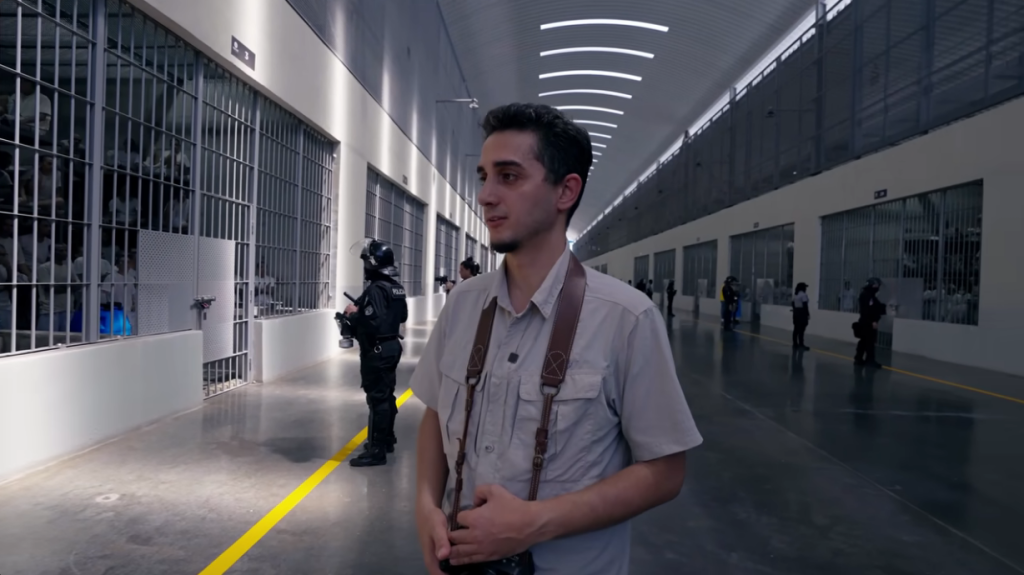
The Trump and Bukele administrations have leveraged social media to promote CECOT
In March, Secretary of Homeland Security Kristi Noem visited the megaprison and posted a video thanking Bukele
In the video (https://x.com/Sec_Noem/status/1905034256826408982/video/1), Homeland Security Secretary Kristi Noem called the facility “one of the tools in our tool kit that we will use if you commit crimes against the American people.”
While several (https://www.axios.com/2025/04/17/politicians-el-salvador-prison-cecot-visits-democrats-republicans-trump) GOP lawmakers have traveled to the megaprison, congressional Republicans and Salvadoran officials have denied (https://www.axios.com/2025/04/17/house-republicans-democrats-el-salvador-trips) requests from Democratic lawmakers to visit (https://www.axios.com/2025/04/16/house-democrats-el-salvador-deportation-trump) the facility.
Bukele’s government has also made ample use of social media to promote CECOT and its wider crackdown on criminal gangs
Dramatically shot videos (https://www.nytimes.com/2025/03/19/world/americas/deportation-videos-el-salvador.html) showing detainees being marched off planes by armed military and police units, having their heads shaved, and being hurried into cells have been posted (https://www.washingtonpost.com/world/2025/03/18/bukele-prison-system-human-rights-trump/) to Bukele’s social media accounts in an effort to promote his “no-tolerance policy on crime,” according to The Washington Post.
After then-Rep. Matt Gaetz (R-FL) visited (https://x.com/mattgaetz/status/1815527485536452928) CECOT in July 2024, Bukele shared (https://x.com/nayibbukele/status/1859345333823648093/video/1) to social media a segment of Gaetz’s speech on the House floor in which he discussed (https://nacla.org/el-salvador-caucus-bukele-exception) his newly formed “El Salvador Caucus” and praised Bukele’s “visionary leadership.” Bukele’s account also shared (https://www.msnbc.com/the-reidout/reidout-blog/matt-gaetz-nayib-bukele-state-violence-rcna180398) a video of Gaetz’s visit to the prison in which Gaetz praised “the good ideas in El Salvador” and noted that “there is a lot more discipline in this prison than we see in a lot of the prisons in the United States.”
Bukele’s government has used a team (https://www.reuters.com/investigates/special-report/el-salvador-politics-media/) of paid internet “trolls” and other allied social media accounts to push propaganda and attack dissent. One account, according to The Associated Press, has posted (https://apnews.com/article/bukele-tiktok-youtube-influencers-disinformation-el-salvador-5523937ba0e499af71e7f2ff7e72eeac#::text=One%20account%2C,live%20in%20fear.%E2%80%9D) videos of supposed gang members committing violent crimes, followed by pro-Bukele messaging.
//
- ### Fox News attacked due process at least 77 times in just over five weeks (https://www.mediamatters.org/immigration/fox-news-made-least-77-claims-attacking-due-process-just-over-five-weeks)
:{04/17/25
- ### Fox keeps calling migrants sent to El Salvador prison “criminals” and “terrorists” despite reporting that several deportees were likely falsely accused (https://www.mediamatters.org/immigration/fox-keeps-calling-migrants-sent-el-salvador-prison-criminals-and-terrorists-despite)
:{04/01/25
- ### CBS News reporting on immigrants deported to foreign megaprison blows up Fox’s “worst of the worst” spin (https://www.mediamatters.org/immigration/cbs-news-reporting-immigrants-deported-foreign-megaprison-blows-foxs-worst-worst-spin)
04/07/25
---
vox
Meet two of the hot speakers at this year’s Conservative Political Action Conference (CPAC): Presidents Nayib Bukele of El Salvador and Javier Milei of Argentina, two of Latin America’s most flamboyant right-wing populists.
CPAC started in 1974 as an annual gathering of conservatives; over the years it has turned into a days-long, livestreamed far-right spectacle. Policy is discussed and refined while movement luminaries like former President Donald Trump and House GOP Chair Elise Stefanik are given the opportunity to share their ideas with a receptive audience.
It might be a little sleepier than usual this year, but the conference still reveals where American conservatism is headed. And the two Latin American leaders’ presence underscores the right’s continued affinity for populist and even illiberal leadership — particularly when combined with modern personal brands built online.
They aren’t the first extremist leaders to speak at CPAC: Viktor Orbán of Hungary and Jair Bolsonaro of Brazil have featured in past years. Like Orbán and Bolsonaro, Bukele and Milei are staunch populists who have proposed radical solutions to serious problems in their countries.
The American right finds those radical proposals attractive, even if the policies likely couldn’t — or shouldn’t — be instituted in the US. Bukele has, seemingly, mitigated El Salvador’s serious gang violence problem through mass arrests and incarceration, while Milei’s economic policies are supposed to right Argentina’s inflation-plagued economy.
Trump, the presumptive Republican nominee for president, has praised both men; though he has yet to meet Milei, the former president enjoyed a friendly relationship with Bukele. Other conservative figures, including Rep. Chip Roy (R-TX) of the Freedom Caucus, have praised Milei’s push for “limited” government.
The two leaders are important voices at CPAC as conservatives work to draw in Latin American voters before the election in November; Bukele in particular is popular among Salvadorans living in the US. But their presence at the conference is about more than trying to win votes, Erica Frantz, a professor of political science at Michigan State University, told Vox — it’s about creating a particular type of international far-right ideology.
“Linking Milei and Bukele with the Trump movement is advantageous for all parties involved,” she said. “For Milei and Bukele, it gives them the opportunity to strengthen an alliance with the potential presidential candidate most likely to be sympathetic to their authoritarian ambitions.” For Trump and his supporters, “it is a chance to send a message to supporters that its style of politics is gaining steam outside US borders.”
Bukele and Milei were elected to tackle big issues
Bukele has had a long relationship with the pro-Trump right since his first presidential election in 2019. That relationship started online, among cryptocurrency enthusiasts. The ideology underlying cryptocurrency is decidedly libertarian, with many adherents calling for the abolition of treasuries and central banks.
Bukele’s profile rose when El Salvador began accepting bitcoin as legal tender, and he’s remained popular despite the damage it’s done to the country’s economy following the cryptocurrency crash of 2022. But the leader’s crypto fixation — which is affecting the country’s ability to secure international financing — is almost quaint in the face of his authoritarian turn, ostensibly to address the country’s serious crime problem.
Gangs controlled most aspects of life in the country, which was once known for having the highest murder rate in the world. With a campaign of mass arrests, Bukele has indeed tackled El Salvador’s crime problem. But that has come at a steep cost, as I explained last year:
Successive presidential administrations have taken different approaches — many have adopted the mano dura, or “iron hand” tack, instituting harsh crackdowns to mitigate the violence. But Bukele is on an entirely different level; his administration has imprisoned tens of thousands, many arbitrarily, repeatedly extended a state of emergency severely curtailing the rights of ordinary citizens, and attacked and even detained his critics in the press.
The country now instead boasts the highest incarceration rate in the world.
Despite the human rights violations, Bukele’s policies have been popular in El Salvador. Given the astounding level of violence that ordinary people have suffered under the gangs’ power — and the rapidity with which the violence decreased — it’s not ultimately that surprising that Bukele won a second term in office, despite the fact that he has dismantled parts of El Salvador’s democracy, manipulating institutions from the country’s Constitutional Courtto its legislature, to do so.
Though the policy appears to be working in the immediate term, critics argue it isn’t sustainable for two major reasons. The first is that Bukele has made no effort to build a long-term social or economic infrastructure as an alternative to gang violence. The second is that the sense of security people currently feel requires sacrificing other forms of security, such as the rule of law. “[Bukele’s] popularity is built on illegality and undemocratic actions,” Noah Bullock, the executive director of the human rights organization Cristosal, told Vox. “There is no historic precedent where the use of state violence has produced lasting peace.”
That didn’t stop Bukele from suggesting the US ought to learn from his policies during his CPAC speech on Thursday. “We can clearly see the signs of a declining society because our own hit rock bottom decades ago,” he told the cheering audience. He urged Americans to look at “big cities in decline like Baltimore, Portland, New York, just to name a few places where crime and drugs have become the daily norm.”
Milei has only been in office for a couple of months, so he’s had less time to implement his libertarian economic policies. And he might not be able to do that much; already in his brief tenure, the congress voted down his party’s omnibus bill, which included fiscal measures aimed at managing inflation as well as an attempt to secure emergency legislative powers for, potentially, his entire four-year term. Along with deregulation and privatization efforts, the omnibus bill hinted at Milei’s social agenda: It would have reduced prenatal parental leave for women and slashed environmental protections in favor of business interests.
Milei will speak at the conference Saturday, most likely about his efforts to privatize state enterprises and cut down on regulations — both topics with great appeal to CPAC’s audience.
US conservatives benefit from Bukele and Milei’s illiberal policies
Bukele and Milei were each granted a mandate by presenting extreme solutions to serious problems in their countries that have long frustrated citizens. But they have clear ideologies and proclivities toward illiberalism that emerge within those contexts, too.
“They are able to articulate a real problem in society and propose solutions,” Daniel Rothschild, executive director of the Mercatus Center at George Mason University, told Vox. When people are truly struggling, they respond to those policies, “even if they are illiberal.”
In his speech on Thursday evening, Bukele warned that the US was headed for the same kind of violent, gang-plagued system that defined El Salvador. But he, like Trump and other conservatives, exaggerates the problem the US faces. Trump and his allies have argued that cities (especially those in Democratic-controlled states) are full of violence, and they have also made a bogeyman out of the gang Mara Salvatrucha, or MS13, which has terrorized El Salvador along with Barrio 18.
It is true that MS13 actually started in the US and has had a presence here. It is also true that violent crime, including homicide, increased during the social upheaval of the pandemic, and that certain kinds of property crimes have increased. But violent crime is now at pre-pandemic levels and has trended downward overall since the 1990s. In other words, there’s simply no parallel to the violence and terror wrought by gang violence in El Salvador.
It’s not hard to see why Trump and others at CPAC would want to champion someone like Bukele. He exemplifies “tough on crime” rhetoric and, to their minds, proves that the only way to avoid the “American carnage” Trump warned of in his 2017 inauguration speech is to restrict human and civil rights and undo democratic norms and institutions.
Milei, despite having struggled to pass his policies, similarly embodies conservative ideals. His efforts to curb government spending and significantly reduce the size of the government echo the Republican party’s rhetoric of limited government and tighter belts — but the US isn’t dealing with 140 percent inflation or a57 percent poverty rate.
It’s still early in Milei’s tenure, but it is important to note that he and Bukele — like Trump — exemplifies what Frantz and others call a “personalist” leader. “The party that supports them is intricately linked to their persona rather than a clear policy platform,” Frantz explained.
Social media is an important tool in the personalist leader’s playbook that Milei, Bukele, and Trump have all used to their advantage — they don’t have to go through establishment channels that might soften their policies or their rhetoric.
That social media following has created a wave of “millennial authoritarianism,” as researcher Manuel Meléndez-Sánchez termed the phenomenon, which brands these leaders as iconoclasts who reject the “establishment.”
“With personalist parties,” Frantz said, “leaders pretty much have a free rein to behave as they please, and — particularly when their party gains majority legislative representation — the door is wide open for democracy to deteriorate.”
Even if Milei is struggling to pass his policies in Argentina, he’s still able to paint himself as a warrior in the fight against socialism, as he apparently will do in his CPAC speech. That will solidify his ideological link to US conservatives and show “a very clear picture” of how far-right politicians “learn from each other, how they are connected with each other, and they are sharing an agenda that, far from being local, is a global network,” Paula Avila-Guillen, a human rights lawyer and executive director of the Women’s Equality Center, told Vox.
Ultimately, US conservatives like Bukele and Milei because they are hardliners who are using extreme tactics to deal with society’s problems — and are willing to thumb their noses at institutions to get there. As Frantz told Vox, their presence at CPAC is “an effort to cue the conservative base to see authoritarian rhetoric as ‘normal’ and strongman rule as the only solution to society’s problems.” In other words, the message is that not only is there nothing to fear from Trump’s more anti-democratic tendencies, but there’s much to gain from them.
See More:
---
---
mma
The right dominates the online media ecosystem, seeping into sports, comedy, and other supposedly nonpolitical spaces
A new Media Matters analysis found 9 out of the 10 top online shows assessed are right-leaning
Written by Kayla Gogarty
Published 03/14/25
As Americans increasingly get their news from online shows and streamers, the influence of this media ecosystem becomes more prominent — and Media Matters has found that the most popular of this content is overwhelmingly right-leaning.
In a new study, Media Matters assessed the audience size of popular online shows — podcasts, streams, and other long-form audio and video content regularly posted online. To do so, we gathered data on the number of followers, subscribers, and views across streaming platforms (YouTube, Spotify, Rumble, Twitch, and Kick) and social media platforms that are used to amplify and promote these shows (Facebook, Instagram, and TikTok). Apple Podcasts does not publicly provide follower counts on its platform, so it was not included in the audience data.
This analysis was based on 320 online shows with a right-leaning or left-leaning ideological bent. We found that right-leaning online shows dominate the ecosystem, with substantially larger audiences on both politics/news shows and supposedly nonpolitical shows that we determined often platformed ideological content or guests.
Key findings:
- We found 320 online shows — 191 right-leaning and 129 left-leaning— that were active in 2024 and covered news and politics and/or had related guests. These shows had at least 584.6 million total followers and subscribers.
- We found substantial asymmetry in total following across platforms: Right-leaning online shows had at least 480.6 million total followers and subscribers — nearly five times as many as left-leaning.
- Across platforms — YouTube, Rumble, Twitch, Kick, Spotify, Facebook, Instagram, and TikTok — right-leaning online shows accounted for roughly 82% of the total following of the online shows we assessed.
- Comparatively, left-leaning online shows had nearly 104 million followers and subscribers across the eight platforms — nearly five times less.
- Nine out of the 10 online shows with the largest followings across platforms were right-leaning, with a total following of more than 197 million. The only left-leaning show among the top 10 was What Now? with Trevor Noah, which had 21.1 million total followers and subscribers across platforms.
- Our analysis — which looked entirely at shows with an ideological bent — found over a third self-identify as nonpolitical, even though 72% of those shows were determined to be right-leaning.Instead, these shows describe themselves as comedy, entertainment, sports, or put themselves in other supposedly nonpolitical categories.
- Out of 320 online shows, right-leaning programs categorized as comedy — 15 shows in all — had 117.5 million followers and subscribers, or 20% of the total following of all programs we assessed. This category included The Joe Rogan Experience, This Past Weekend with Theo Von, and Full Send Podcast.
- Right-leaning shows accounted for two-thirds of the total YouTube views on videos from channels affiliated with the shows we assessed — 65 billion views in total. Comparatively, left-leaning online shows totaled 31.5 billion total views.
- Right-leaning shows use Rumble to expand their audience — gaining millions of subscribers and billions of views for their content.
Podcasts, online shows, and streamers are increasingly popular and influential
- The 2024 presidential election has been dubbed the “podcast election” — in part because President Donald Trump, former Vice President Kamala Harris, and their vice presidential picks made various appearances on podcasts and online shows as candidates.
At Trump’s election victory party on November 5, UFC President Dana White praised several podcasters for their role in helping to get Trump elected, saying: “I want to thank the boys Adin Ross, Theo Von, Bussin' with the Boys. And last but not least, the mighty and powerful Joe Rogan.”
Podcasts and online shows have become more popular and trusted news sources. The number of people listening to podcasts monthly has reportedly more than doubled since 2016. According to a 2023 Pew Research study, 87% of people who hear news discussed on podcasts said they expect it to be mostly accurate and 31% said they trust podcasts more than other news sources.
In August 2024 — just a few months before Election Day — Pew found that about 1 in 5 Americans said they regularly get news from influencers on social media. The weekly reach of large online shows is also reportedly better than that of many cable networks.
With Americans increasingly getting their news from these sources, they played a significant role in the 2024 election. By appearing on these shows ahead of the 2024 election, Trump reached an audience of 23.5 million American adults in an average week — compared to Harris’ 6.4 million — according to Edison Podcast Metrics.
Journalists have started to highlight the asymmetry of the online media ecosystem. Bloomberg watched and analyzed over 2,000 videos — nearly 1,300 hours of footage — from nine prominent YouTubers, including Adin Ross, Joe Rogan, Logan Paul, Theo Von, and Patrick Bet-David, and found that “above all, the broadcasters described American men as victims of a Democratic campaign to strip them of their power,” though “none of the broadcasters style themselves as political pundits.”
- ## Hardly any left-leaning online shows have comparable followings to right-leaning online shows
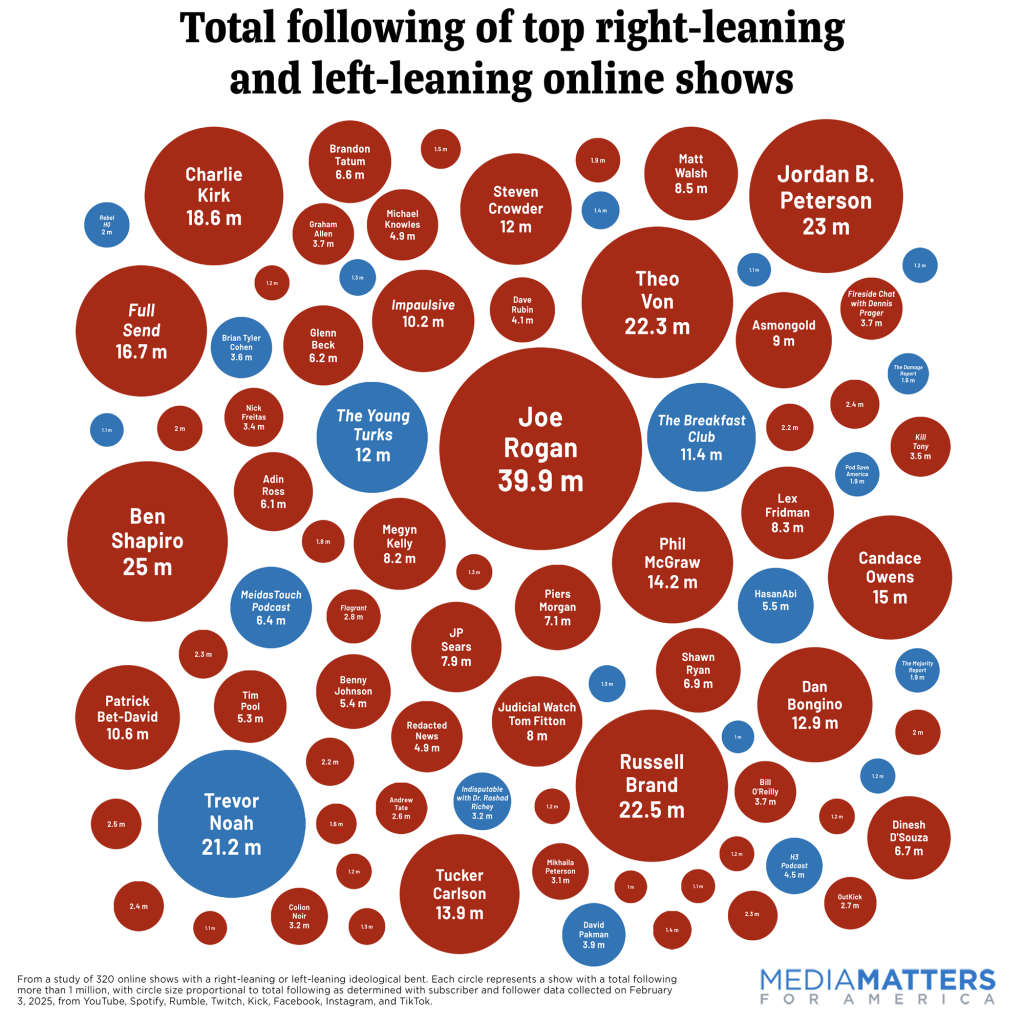
Click here for a larger version of this chart.
- Media Matters compiled a list of 418 popular online shows — podcasts, streams, and other long-form audio and video content regularly posted online — that were active during 2024, assessed ideological alignment, and found 320 online shows with an ideological bent (191 right-leaning and 129 left-leaning) that covered news and politics and/or hosted related guests.
Nine of the 10 online shows from our study with the largest total following across platforms were right-leaning, accounting for at least 197 million total followers and subscribers. These are the online shows of:
- Joe Rogan: 39.9 million
- Ben Shapiro: 25 million
- Jordan Peterson: 23 million
- Russell Brand: 22.5 million
- Theo Von: 22.3 million
- Charlie Kirk: 18.6 million
- Nelk Boys’ Full Send Podcast: 16.7 million
- Candace Owens: 15 million
- Dr. Phil: 14.2 million
The only left-leaning show among the top 10 wasWhat Now? with Trevor Noah, with over 21.1 million total followers and subscribers.
Of these most-followed right-leaning online shows, only 4 are categorized on Apple Podcasts as news and politics, while Rogan, Von, and Full Send are characterized as comedy, Peterson as education, and Dr. Phil as society and culture.
While these podcasts often host celebrity guests like Timothée Chalamet, MrBeast, and Luke Bryan, these 5 right-leaning comedy, education, and society and culture shows have also had dozens of episodes featuring right-wing media figures and politicians since October 1, 2024.
Guests on these shows have included Trump, Vance, the New York Post’s Miranda Devine, The Daily Wire’s Ben Shapiro and Matt Walsh, right-wing figures Tucker Carlson and Dave Smith, Trump picks Tom Homan, Tulsi Gabbard, Robert F. Kennedy Jr., and Monica Crowley, UFC CEO and Trump ally Dana White, and far-right constitutional sheriffs.
Additionally, 65 right-leaning online shows had followings larger than 1 million, but only 21 left-leaning online shows boast comparable followings.
- ## Right-leaning online shows have nearly five times the following of left-leaning online shows
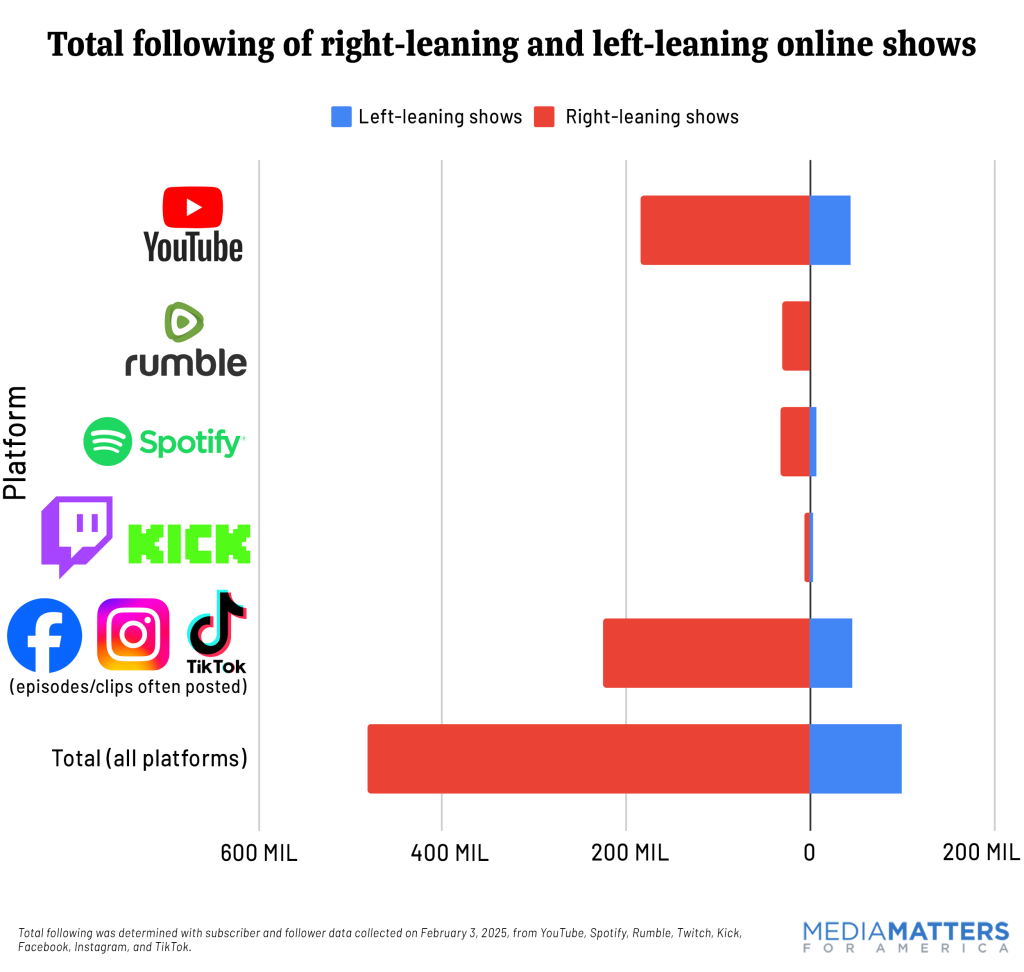
- Across streaming platforms including YouTube, Rumble, Twitch, Kick, and Spotify, the left-leaning online shows had at least 55.9 million total followers and subscribers — a figure which is dwarfed by the right-leaning online shows with at least 255.5 million.
This content is further amplified on Facebook, Instagram, and TikTok — social media platforms where the programs or hosts post full streams, clips, and show links. Left-leaning online shows had at least 48 million followers across these platforms, while the right-leaning online shows had more than 225 million followers.
Of a cumulative 584.6 million followers and subscribers across all eight platforms, Media Matters found that right-leaning online shows accounted for roughly 82%, or 480.6 million — almost five times more than left-leaning shows’ nearly 104 million.
The largest followings for the right- and left-leaning online shows were on YouTube, with 185.5 million and 45.8 million subscribers, respectively.
- ## Right-wing content has seeped into supposedly nonpolitical spaces, including sports, entertainment, comedy, and more
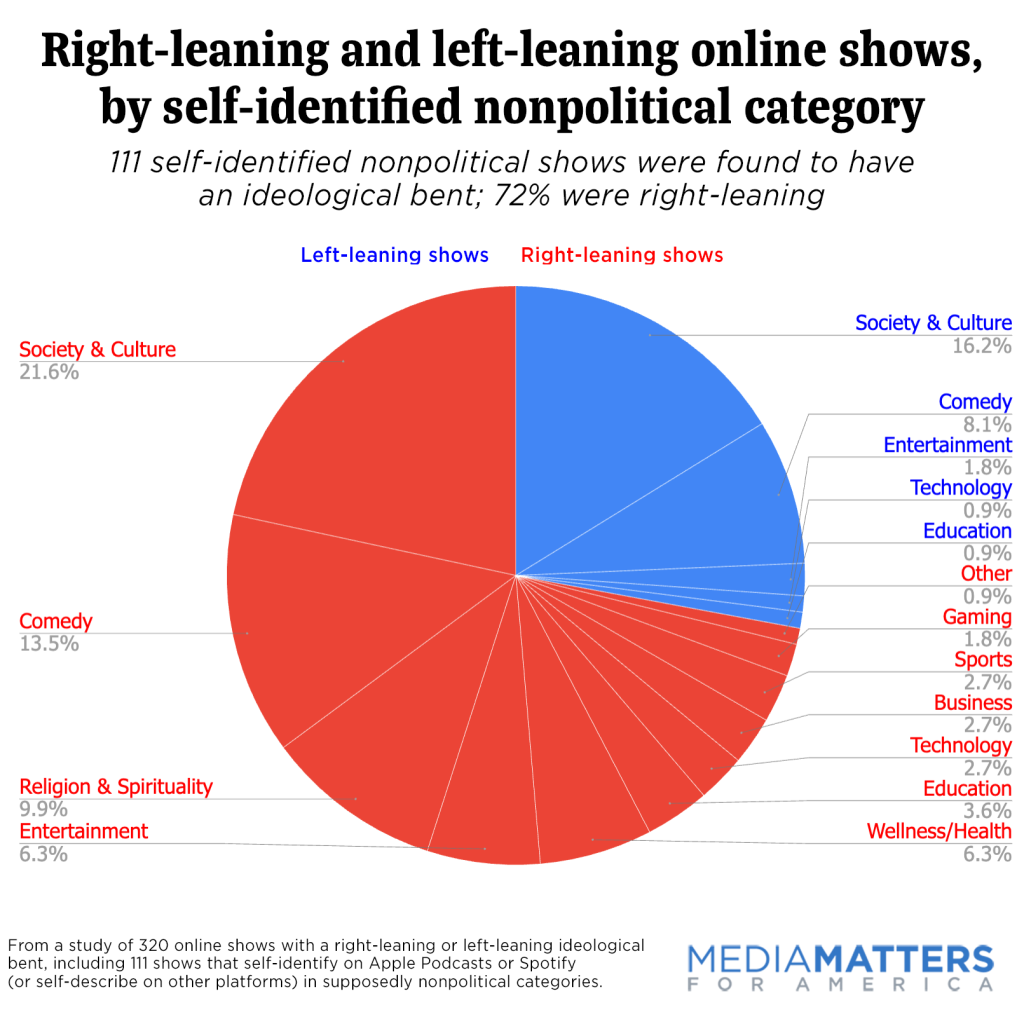
- Of the 191 right-leaning and 129 left-leaning online shows that covered news and politics or hosted related guests, 80 of the right-leaning online shows (42%) are categorized as comedy, entertainment, sports, or other supposedly nonpolitical topics. In fact, 72% of the 111 supposedly nonpolitical shows that we determined had an ideological bent were right-leaning.
Moreover, these right-leaning shows span a wider variety of categories, self-identifying by subjects such as business, comedy, gaming, education, entertainment, religion and spirituality, society and culture, sports, wellness/health, and technology. Meanwhile, left-leaning shows that are not explicitly identified as news and politics-related mostly self-identify as comedy, entertainment, or society and culture programs.
The disparity in total followers and subscribers across platforms of right-leaning and left-leaning online shows in these categories was substantial. Right-leaning online shows categorized as comedy, entertainment, sports, and other supposedly nonpolitical topics had at least 243.1 million total followers and subscribers — more than the 237.5 million for right-leaning online shows categorized as news and politics-related. It’s also more than five times the 44 million followers and subscribers for left-leaning shows not identified as political, and more than four times the 60 million of left-leaning shows categorized as news and politics-related.
The 15 right-leaning online comedy shows featured in Media Matters’ analysis — including The Joe Rogan Experience, This Past Weekend with Theo Von, Full Send Podcast, Impaulsive, AwakenWithJP, Kill Tony, Flagrant, The Roseanne Barr Podcast, and The Tim Dillon Show — had more than 117.5 million total followers and subscribers, or 20% of the total following of all 320 right- and left-leaning shows.
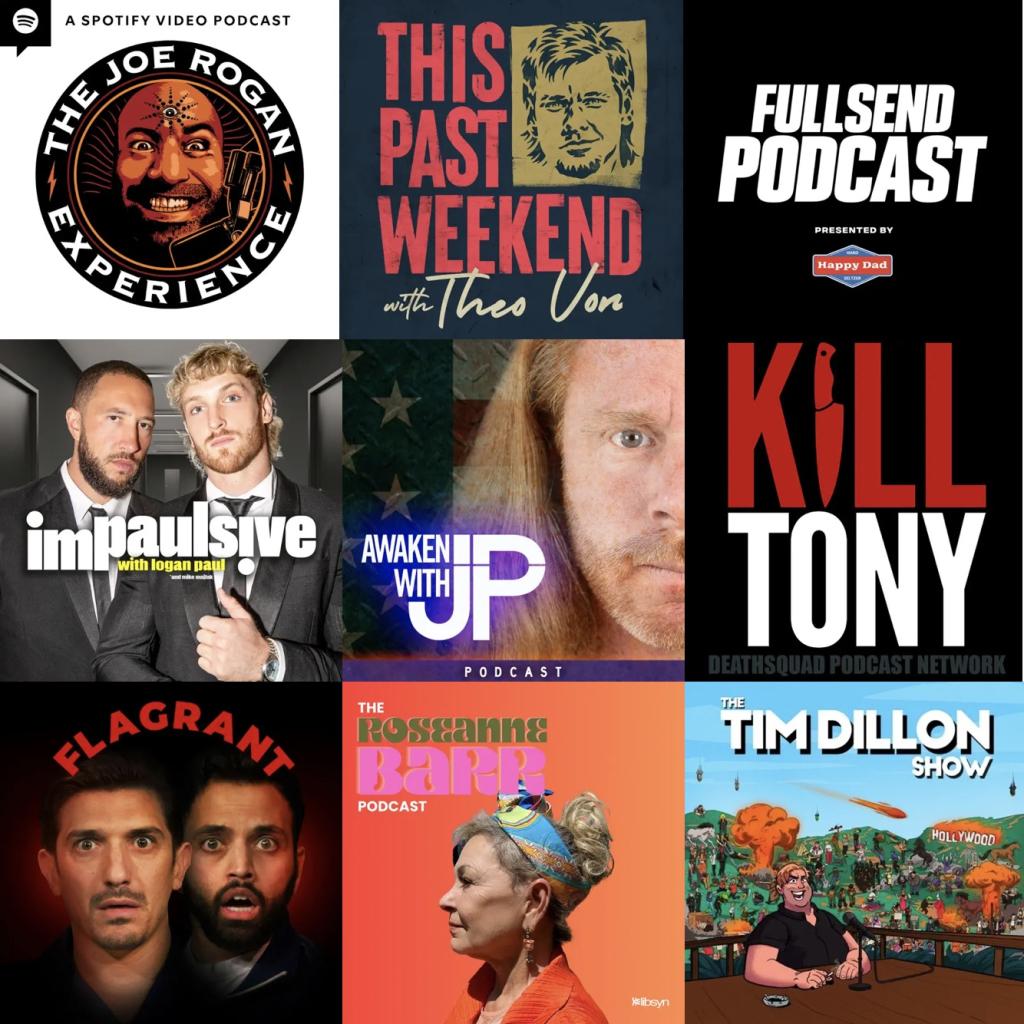

Citation
Apple Podcasts
- Ahead of the election, Trump and Vance appeared on 6 of these right-leaning comedy shows a total of 9 times. On YouTube, these appearances have at least 119.7 million views.
- ## YouTube channels for right-leaning shows have 65 billion views — and Rumble adds billions more
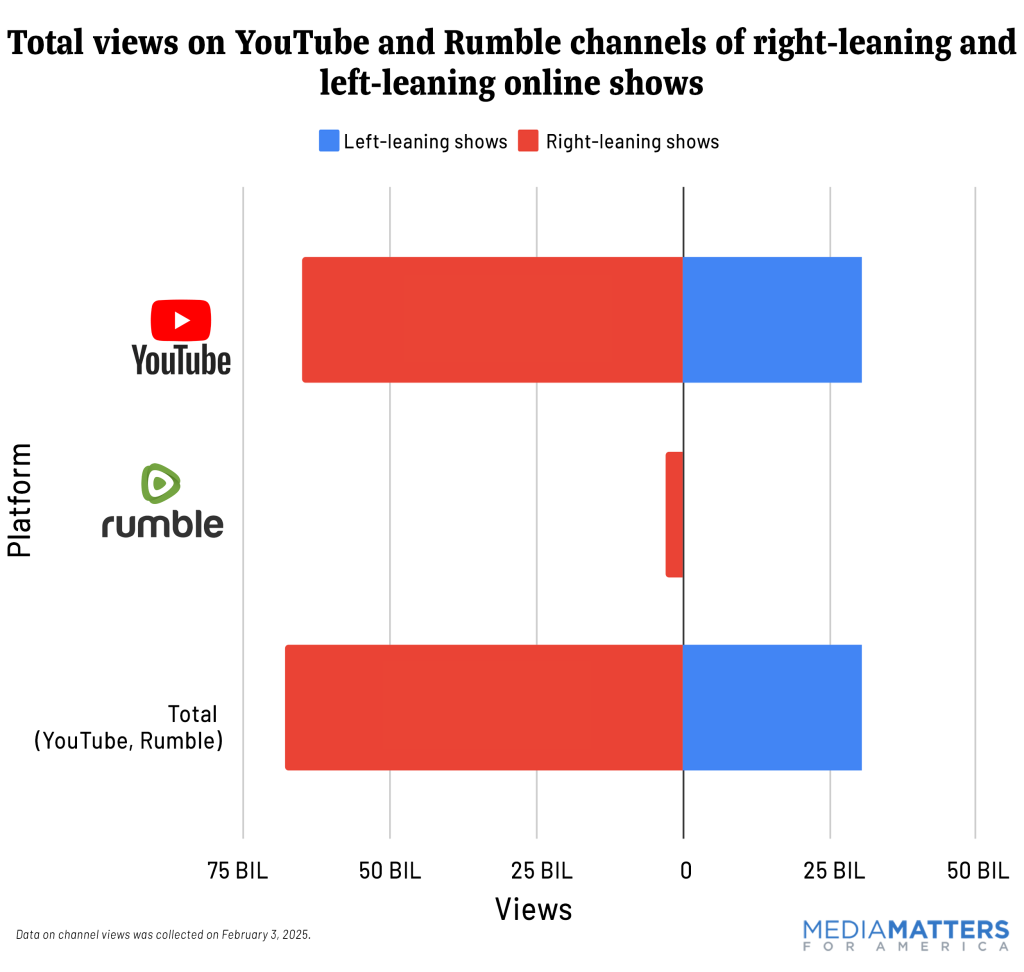
- Media Matters gathered data on views for the YouTube channels of the shows we analyzed and found that right-leaning online shows accounted for more than two-thirds of the total — 67% — with 65 billion views. Comparatively, total views on videos of channels of left-leaning online shows were 31.5 billion, or 33%.
Right-leaning online shows also use Rumble to expand their audience by billions of views, while left-leaning shows have essentially no presence on the platform. On Rumble, channels affiliated with the right-leaning online shows we analyzed had earned more than 3 billion views.
- ## Methodology...
---
---
no lnx
an no lnx
'Nothing is beyond our reach': Extremist site accused of 'grooming' teen attackers exposed
An image taken by school shooter Solomon Henderson and shared in his diary features a character from the Soyjak website. It's thought to be based on Patrick Crusius, who carried out a mass shooting in El Paso.
(Taken from Solomon Henderson's diary.)
Jordan Greenand Raw StoryFebruary 01, 2025
Before taking a handgun out of his backpack and walking into the cafeteria at Antioch High School in Nashville, where he opened fire and killed another student before taking his own life on Jan. 22, 17-year-old Solomon Henderson posted a link to an online screed filled with violence and unfiltered racism.
His message gave “special thanks” to Soyjak.party, an imageboard website whose anonymous users and administrators post bigoted memes based on a stock set of caricatures that typically make fun of liberals, sensitive men and trans people.
Using the insider lingo of the community, Henderson closed his post with a sign-off, “Remember keep jakking ‘teens,” followed by the website’s emblem, an octopus-like creature wrapping its tentacles around the globe. The emblem was accompanied by the slogan, “Nothing is beyond our reach.”
Henderson is one of three teenage attackers who have carried out shootings — and in one case a knife attack — over the past six months that extremism researchers have linked to a subset of the Soyjak community known as the Soyjak Attackers Video Fandom, or SAVF.
In the hours after Henderson’s school attack, investigators at the Anti-Defamation League’s Center on Extremism monitored discussions among the anonymous users on the Soyjak website.
“We watched as they started panicking about losing their website out of fear because they believed the Antioch shooter had been groomed to carry out the shooting by their imageboards,” Carla Hill, the center’s director of investigative research, told Raw Story.
Henderson was a Black teenager whose writings revealed a deep immersion in white supremacist ideology. His consumption of extremist content appears to have manifested as a loathing for himself and other Black people, as he grappled with personal difficulties.
Henderson also identified with the involuntary celibate, or incel, movement, whose members blame women and society for their lack of romantic success.
The title of Henderson’s screed combined the two ideas by marrying a racial slur against Black people with the suffix “cel,” adding a parenthetical to explain that he was an “involuntary” Black person.
“We felt like the Antioch shooter was driven to self-loathing by what he saw online,” Hill said. “That’s how he came to be a self-hating person.”
Other terrorist attacks — such as the car-ramming recently carried out by an ISIS sympathizer in New Orleans and the 2019 mass shooting by a white supremacist at a Walmart in El Paso, Texas — have proven to be significantly more lethal, but Henderson’s attack has unnerved extremism researchers as a harbinger of an emerging hybrid threat that is harder to pin down.
Hill took notice of three intertwined “driving forces” behind Henderson’s attack.
“There’s the incel space — various incel spaces — we found him in those. Soyjak crosses over with that,” Hill said. “Then, he was in spaces that glorify violence and gore and school shooters. Third, he was in these reactionary imageboard sites like Soyjak that serve as a hub for all kinds of extremist discourses, including antisemitism, accelerationism, white supremacy and misogyny.”
Through his participation in overlapping fringe internet subcultures where members use multiple social media platforms to celebrate white supremacist mass murder, dabble in the occult and engage in degrading interpersonal drama, Henderson connected online with 15-year-old Natalie Rupnow, who fatally shot a fellow student and teacher before taking her own life in Madison, WI, in December.
And Henderson took inspiration from an 18-year-old Turk named Arda Küçükyetim, who carried out a knife attack at an open-air café near a mosque in August. Rupnow participated in an online group that held a pre-arranged viewing party to watch Kücükyetim carry out the attack on a livestream.
Küçükyetim and Rupnow were also “part of” the Soyjak Attacker Video Fandom,” according to a report written by two pseudonymous authors and published by Marc-André Argentino, a senior researcher at the Accelerationist Research Consortium.
A screed left behind by Ryan Palmeter, a 21-year-old white supremacist who fatally shot three Black people in a Dollar Store in Jacksonville, FL in August 2023, also bears the imprint of the Soyjak community. A graphic included in Palmeter’s document includes a Soyjak character known as Chudjak, who is said to have been inspired by Patrick Crusius, the El Paso shooter. The word “soy” is emblazoned across Chudjak’s T-shirt in the graphic. The reference caught the attention of Henderson, who referenced him in his writings as a “soyteen,” the term that insiders use to describe a member of the community.
Similar to Palmeter, Henderson and Küçukyetim published screeds in advance of their attacks that celebrated previous white supremacist shootings, reviewed their meticulous planning and gear, and provided encouragement to readers they hoped would emulate their actions. (Rupnow also engaged in this ritualistic practice, but it’s unclear what she wrote because she left her Google document on private before taking her own life.)
As part of an iterative effort to promote accelerationist violence calculated to bring about the collapse of society, Henderson and Küçükyetim’s posts shared one specific facet: They recommended documents produced by the Terrorgram Collective, which was recently named as a specially designated global terrorist entity by the U.S. State Department.
Terrorgram first emerged in 2019 and, within a couple years, coalesced into a tight-knit group that produced PDFs with highly stylized graphics that combine terrorist propaganda, white supremacist hate, and tactical guidance. Terrorgram’s propaganda venerates white supremacist mass murderers by calling them “saints.”
Terrorgram’s publications function like a virus that finds a receptive host in fringe online extremist communities such as Soyjak, and then infects individuals who attack society at large through mass shootings and other lone-actor violence.
Henderson shared instructions on how to perpetrate attacks on social media from a Terrorgram Collective publication, among others, according to Argentino, and links to three of the publications appear in his screed.
Küçükyetim, meanwhile, shared PDFs of three Terrorgram publications on Telegram, according to a federal indictment of two Terrorgram Collective leaders. Dallas Humber of Elk Grove, CA, and Matthew Allison of Boise, ID, the Terrorgram leaders, were arrested less than a month after Kücükyetim carried out his attack. Humber and Allison were indicted on 15 counts, including conspiring to provide material support for terrorists, and could face up to 220 years in prison if convicted.
On the morning of his attack in the northwestern Turkish city of Eskisehir, according to the Humber/Allison indictment, Küçükyetim posted in a Telegram group chat: “Come see how much humans I can cleanse.” The post included links to a livestream and PDF files of the Terrorgram publications.
Hill and her team at the Anti-Defamation League’s Center on Extremism found the group chat. A Telegram account they identified as Natalie Rupnow's joined the chat through an invitation, which meant that she had been connected somehow to the other members of the chat prior to the livestreamed attack, Hill said.
Hill told Raw Story that Rupnow participated in a post-play discussion to evaluate the merits of the attack. Rupnow remarked that Küçükyetim had been “caught” and that the death toll was “0 probably,” but that he deserved “credit” for at least trying.
Humber and Allison also took note of the attack.
“He included the Terrorgram books and other Saint manifestos in his file dump, gives shoutouts to the other Saints in his manifesto and references several Hard Reset passages, he was 100% our guy,” Humber wrote in a chat with Allison, according to the indictment.
“But he’s not white, so I can’t give him an honorary title,” she added. “We still celebrating his attack tho, he did it for Terrorgram.”
When Rupnow posted her screed on X before opening fire at Abundant Life Christian School in Madison, WI on Dec. 16, Henderson replied under the post: “Livestream it.”
Later that day, after the attack, he expressed excitement that “the newest skool shooter followed” him on two of his X accounts.
In his diary, Henderson appears to speculate that he may have influenced Rupnow.
“It’s weird how we had similar takes and views, but not really because she followed my account,” he wrote.
“Arda was right!” Henderson added. Then he quoted directly from Küçükyetim’s screed: “Remember, I and the other saints will not forget what you did…. In this way, you will motivate future saints.”
It’s not clear whether Henderson directly interacted with Küçükyetim. In his diary, Henderson described Küçükyetim as “an ultimate saint” and “someone I was inspired by,” while cryptically adding, “maybe I didn’t know him.”
The transfer of terrorist motivation and camaraderie in each of the attackers’ screeds is part of a negative feedback loop, along with group chats and other social media posts, that is ensnaring some teenagers who are globally linked to one another through the internet.
“It’s not like a conversation in real life where if I told you something crazy you would be like, ‘Wait a minute,’” Hill said. “It’s an echo chamber that allows anything to go. They’re not getting healthy feedback. It builds on things that trouble them, and causes real-world problems.”
The proliferation of accelerationist terrorism through online radicalization is a challenge that law enforcement is not equipped to handle alone, she said.
“It’s going to take everyone,” Hill said. “It’s going to take parents talking to kids about how what you see on the internet could be false and horrible. And the tech community somehow trying to stop the spread of this.”
NOW READ: Incompetence and chaos as Trump 2.0 crashes and burns
This story is the first in a three-part series exploring how violent online subcultures provide the opportunity for teenagers attracted to accelerationism and inceldom to network and encourage one another to carry out terrorist attacks.
---
---
no lnx
:{Alternet
Social media shows Antioch shooter was influenced by Holocaust deniers, white nationalists
Antioch High School.
Jordan Greenand Raw StoryJanuary 23, 2025
The 17-year-old who killed a female student at a high school in Nashville before taking his own life was an African-American Reserve Officers' Training Corp member who hated Black people and identified as involuntarily celibate, according to a manifesto apparently posted by him online.
A document outlining the views was posted to the X account of the shooter, Solomon Henderson, along with a photo of a handgun in a backpack that appears to have been taken in a bathroom before he walked into the cafeteria at Antioch High School and opened fire around 11 a.m. Central Time. Henderson’s X account was still active, with the link at the time of publication.
In a question-and-answer section in the document, Henderson indicated the attack was motivated by “hatred” of Black people referenced through a racial slur. Europeans, according to the shooter, “need to be protected because they are conquerors, inventors and revolutionary’s [sic] thinkers.” It goes on to accuse Jews of subverting Europeans and imperiling their existence, echoing the racist Great Replacement theory.
ALSO READ: Trump's MAGA America revives a Confederate nightmare
The final page of a diary that was also posted on the shooter’s X account shows a photograph of Henderson, accompanied by the inscription: “God I am ugly. 4 hours to go.”
An entry in the position document on Henderson's opinions of Black people includes a litany of shockingly dehumanizing and ultraviolent descriptors of murder and atrocities.
Henderson credited less than a dozen internet personalities, mostly far-right influencers with radicalizing him.
The list includes Candace Owens, a Black conservative who left the Daily Wire website founded by Ben Shapiro last March following a string of increasingly antisemitic comments. In 2019, Owens testified before a House subcommittee hearing on white supremacist terrorism as a witness for the Republican minority. Owens lashed out at another witness during the hearing, saying, “The audacity of you to bring up the Christchurch shooting manifesto and make it seem as though I laughed at people that were slaughtered by a homicidal maniac is in my opinion absolutely despicable.”
Henderson wrote: “To expand on this, Candace Owens has influenced me above all. Each time she spoke I was stunned by her insights and her own views helped push me further and further into the belief of violence over the Jewish questions.”
Henderson also said he was influenced by Nick Fuentes, a white nationalist and Holocaust denier who dined with President Trump at Mar-a-Lago in 2022, and Ethan Ralph, a far-right podcaster who helped stoke the Gamergate controversy, a culture war flashpoint in 2014 that proved to be a staging ground for a misogynist backlash against women’s participation in gaming and other male-dominated spaces.
Henderson describes himself as a "Groyper incel," using terms that respectively refer to Fuentes followers and the involuntary celibate, or incel, movement.
Fuentes responded to the shooting by acknowledging that Henderson called himself a 'groyper,' but distanced himself from the attack in a post on X.
The document also credits the rapper Ye (formerly known as Kanye West) with inspiring his violence and extremism.
Henderson's position document pays tribute to an array of white supremacist mass murderers, including Patrick Crusius, who carried out a massacre targeting Hispanics in El Paso, Texas, in 2019; Brenton Tarrant, who killed Muslims at two mosques in Christchurch, New Zealand, in 2019; and Anders Breivik, who murdered young people at a youth camp in Norway in 2011.
Henderson's document expresses support for neo-Nazi ideals, which he described as "a better, neater, cleaner world by eliminating all undesirables." He added, "We must aid the Aryans regardless of our race."
Henderson’s diary indicates that he had initially planned to attack on Thursday, but decided to move it up to Wednesday because he wanted “to speed things up.” He said he was “scared of failing to kill myself and then going to jail,” and that his “goal was to kill at least 10 people.”
He wrote on X that he had saved money for a GoPro camera "but it was hard to explain to my parents why I needed it so I couldn't buy it." Henderson's X account includes a link to the streaming platform Kick.com, where three videos documenting his attack were posted. The videos have since been taken down from that site, although Henderson's X account remains active.
Henderson’s X account re-shares posts from four other accounts that promote violence, self-hatred, white supremacy and the incel movement. Some of the accounts show pictures of the users making the A-OK hand signal and writing, “Goodbye everyone.”
The similarities suggest some degree of coordination, although it is unclear whether the other account owners carried out attacks of their own.
Henderson said he had "connections" to some of the other shooters, although "only loosely via online messaging platforms."
In a section of his position document, Henderson paid tribute to what he called "new gen cases," including Natalie Rupnow, the 15-year-old girl who fatally shot two students at the Abundant Life Christian School in Madison, Wisconsin, last month.
---
AHA 11 24 YIKES
AHA CONSPIR IS REDUCTION TO ONE FACTOR / BOGEYMAN TIKTOK DISINFO HYPE FEAR GRIFT
recall supply demand invis hand BS
AHA YIKES 11 24 TRUMP BUILD WALL, MIGRANT VIOLENT CRIME TARIFFS, DRILL BABY, NO TAX TIPS HYPE FEAR GRIFT
---===
INK 1 25
...
And that brings us to an open question — or, rather, questions:
What does society still need from social media, and from digital platforms in general? Are they actually meant to take — are they even capable of taking — the place of the public square, functioning as a digital commons? Or can it just be a place to nerd out on niche interests and connect with friends? And can any of that coexist with the business interests that drive the platform owners? Does anyone really want an everything app that covers it all, from banking to gaming? Should any digital platform really try to be everything to everyone?
And why are they in the business of arbitrating the public trust anyway, even if that’s to establish the definition of what’s neutral? If, as polling suggests, we don’t trust institutions anymore — the media, government agencies, elected leaders, the courts — who do Americans trust? Who is the proper arbiter of the public trust?
DN 1 25
...NERMEEN SHAIKH: And, Maria, could you say, specifically, I mean, in a place like the Philippines, there’s — almost 90% of the population in the Philippines is on Facebook. And how is Facebook used, not only in terms of posting information, but also as a means of communication, and the way in which misinformation has spread on Facebook in the past, not only, of course, in Myanmar, which is the example that you cited, but also in the Philippines and elsewhere?
MARIA RESSA: I mean, very specifically, our past president, Rodrigo Duterte, used the design of what was an advertising and marketing platform of Facebook to do information operations. I was getting an average of 90 — nine, zero — hate messages per hour, free speech used to stifle free speech. But beyond that, these networks of information warfare, networks of disinformation literally changed our history in front of our eyes, setting the stage for the election of Ferdinand Marcos Jr., the only son of our dictator who was in power for 21 years, Ferdinand Marcos. You’ll remember Imelda Marcos and her shoes. Her son, Ferdinand Marcos Jr., won overwhelmingly in our presidential elections, because, literally, Filipinos were taught in information operations — YouTube, Meta and Facebook — that Marcos was not a dictator, in 1986 ousted in people power; instead, he was the greatest leader the Philippines has ever known.
AMY GOODMAN: In 2021, the Rohingya refugees actually sued Facebook’s parent company Meta over its failure to stop violent hate speech on its platform, which contributed to the bloody military crackdown of the Rohingya Muslim community by the military in 2017 in Burma, also known as Myanmar. Law firms in the U.S. and U.K. launched the legal effort on behalf of the Rohingya around the world, including in Bangladeshi refugee camps. Plaintiffs demanded over $150 billion in damages. The U.N. found as many as 10,000 Rohingya were killed by Burmese forces during the 2017 genocide, though some estimates put the death toll at twice that. Over another 730,000 people were forced to flee the country. I just want to go to a quick video, part of a video, produced by Amnesty, featuring a survivor of the Rohingya genocide.
SAWYEDDOLLAH: My name is Sawyeddollah. I am from Myanmar, but now I am living in Bangladesh, Cox’s Bazar, as a forcibly displaced Myanmar national. [translated] I personally experienced that online hate speech turned into offline hate for us. There were many different things on Facebook against us, which turned the people of Myanmar against us. I saw many different anti-Rohingya posts on Facebook. For example, I still remember a post that said, “The birth rate of these Bengali [Rohingya] people is very high. If it remains continuously like this, we will become their slaves. Now they are our slaves. Let’s go for action.” I knew about the option of reporting hate speech to Facebook. I already reported some hate speech to Facebook, but it only said, “Thank you for reporting. This post doesn’t go against our community standards.”
AMY GOODMAN: I wanted to bring Siva Vaidhyanathan into this conversation, author of Antisocial Media: How Facebook Disconnects Us and Undermines Democracy, a professor at the University of Virginia. And I wanted to go to this issue of hate and how deadly it can be, whether we’re talking about Burma, Myanmar, or whether we’re talking about the United States. I mean, you have, just giving a bunch of examples, roughly seven in 10 lesbian, gay, bisexual adults have encountered any harassment online. Fully 51% have been targeted for more severe forms of online abuse. You have roughly about a third of women under 35 may have been sexually harassed online. You have — a study of 51 countries reveals 38% of women had personally experienced online harassment. Professor Vaidhyanathan, if you can talk about the connection to hate and how that connects to, well, your headline of your Guardian piece, “Mark Zuckerberg has gone full Maga”?
SIVA VAIDHYANATHAN: Right. Well, let’s be clear about this change. And I’m really thrilled that you’ve started this conversation by going beyond the United States. What Mark Zuckerberg announced the other day clearly only applies to the United States in terms of its specificity. In the United States, since 2017, Meta has been trying to at least appear that it’s taking content moderation seriously. And let’s remember, the proper phrase to describe what we’re talking about is “content moderation.” Fact-checking was never part of the formula. It’s not about facts. It’s about protecting users. It’s about protecting people from things like harassment, for protecting groups of people from campaigns and movements, people like citizens of my town, Charlottesville, Virginia, who encountered a flood of violent right-wingers in the summer of 2017 through a movement that was largely organized through Facebook. So, the idea here — and why Zuckerberg has appeared before Congress multiple times swearing that he’s doing a good job — has all been about the United States....
---
12 24
Spanish-language conservative media downplay Trump’s mass deportation plan
Conservative TikTok personality Luis Sin Filtro: “If you are informed and have not committed any crimes in this country, you won't be affected negatively"
Written by G. Capuano
Research contributions from Janos Balazs & Monica Rodriguez
Published 12/18/24 mma
Conservative Spanish-language media personalities have been downplaying President-elect Donald Trump’s plans for mass deportations, claiming that Democrats and the media are fearmongering about Trump’s deportation scheme, which economists suggest would increase inflation as well as food and housing costs. These media figures have claimed that Trump “will not deport working immigrants” and that he is considering “immigration reform for all of those in the United States that are doing it right.”
In truth, Trump has vowed to stage the “largest deportation operation in American History,” and Tom Homan — the Project 2025 contributor and former Immigration and Customs Enforcement (ICE) acting director who Trump selected to carry out this campaign — has claimed, “No one’s off the table.”
Recently, during an interview with NBC News’ Kristen Welker, Trump doubled down on his campaign promise to end birthright citizenship, falsely suggesting he could enact his plan through executive action and that he would “change” the 14th Amendment.
Rather than focusing on these claims, conservative personalities on social media turned attention to Trump’s claims that he was willing to “work something out” for Dreamers, immigrants who were brought to the US as minors and remain undocumented. Ignoring his previous failed attempt to gut the Deferred Action for Childhood Arrivals (DACA) program — which has provided benefits like temporary relief from deportation and work authorization to more than 835,000 migrants who came to the U.S. as children — conservative personalities argued Trump has “dismantled the narrative” that he is “racist.”
Downplaying Trump's plans for mass deportations
Conservative Spanish-language personalities are claiming that the left is “sowing fear” about Trump’s plans for mass deportations and that Trump “will not deport working migrants.”
- On Actualidad Radio’sCada Tarde, conservative personality Marian de la Fuente claimed, “There has been a lot of misinformation” about “family separation and kids and parents who will be deported.”She added, “This type of information, in the way the liberal networks are conveying it, should really be modified,” explaining that “they are obviously trying to sow fear.” Actualidad Radio, *Cada Tarde*, [11/12/24]
- During a guest appearance onFox Noticias, Voz Media political analyst Alfonso Aguilar argued that Democrats “want to sow fear.”He said that they “say this is an effort to deport people indiscriminately, that the country will be militarized, that we will have patrols of soldiers through urban migrant communities, and that is totally false.” He also claimed, “The armed forces will be used, or the national guard, but in a supporting role.” Fox Deportes,*Fox Noticias*,[11/20/24]
- On his Voz Media podcast, Aguilar claimed, “The left and many in the media are sowing fear” and that “they want to tell us the country is going to be militarized, that there will be mass indiscriminate deportations [and] that they will deport grandma.”He added, “That has become a Democratic talking point.” Aguilar made these claims in an episode where he interviewed Fox News contributor Sara Carter. YouTube[
- In a segment criticizingThe View’sAna Navarro’s claims that Trump’s plan for mass deportations “means grandmothers,”Fox Noticiashost Rachel Campos-Duffy claimed that “liberals are losing their mind over Trump’s new border czar.”During the segment, Campos-Duffy mistranslated an Axios headline that said, “Immigrant advocates mobilize against mass deportation,” to claim, “According to the media, immigration advocates are mobilizing against the plan to impose law and order at our borders.” Fox Deportes, *Fox Noticias*, [11/13/24; Axios, 11/12/24]
- On TikTok, Luis Sin Filtro, a conservative influencer with over 566,000 followers, argued that “it's obviously impossible” for the Trump administration to deport American citizens.He also claimed that Homan “has clearly and specifically said that threats to public safety will be the priority,” arguing, “It's most likely that if you find yourself in one of those raids, you have absolutely nothing to worry about. If you are informed and have not committed any crimes in this country, you won't be affected negatively. On the contrary, there is a very big chance for you to build your case in an immigration court and end up with a working permit.” [TikTok,11/12/24]
- PelucasGB, a conservative personality with over 56,300 followers, shared a video arguing that “Trump will not deport working immigrants” and that “Trump’s rhetoric has always been against criminals.” He also claimed that Trump could “pass immigration reform for all of those in the United States that are doing it right,” and that Trump “will be the one to make your dream of having status in the United States come true.” TikTok,[11/26/24]
Ignoring Trump's hostility to DACA
Despite Trump’s previous attempts to gut DACA, Spanish-language social media figures are claiming his comments on Meet the Press that he would potentially “work something out” for Dreamers “dismantled the narrative” that he is “racist” and “the most anti-immigrant man ever.”
- Luiyo2.0, a conservative personality with over 152,700 followers on TikTok, argued Trump’s comments onMeet the Press“completely dismantled the narrative against Donald Trump in which they claim he is racist.” He added, “If this is true and Trump can solve the DACA problem, he will undoubtedly become one of the best presidents in the United States of America.” TikTok, [12/9/24]
- LuisSinFiltro shared a video claiming, “Trump said he plans to work with Democrats to legalize Dreamers, that is to give them permanent status, not just temporary protection like DACA.” He added, “Trump just dragged all those political activists and ‘pro-immigration,’ ‘non-for-profit’ organizations that said Donald Trump is the most anti-immigrant man in history.” TikTok, [12/9/24]
- PelucasGB shared a video claiming that “while Democrats try to discredit Donald Trump by saying he wants to deport everyone,” he “said he wants Dreamers to be able to stay in the United States.” He went on to claim that Trump “could become the second Republican president in history to deliver a reform for everyone regardless of nationality.” TikTok, [12/9/24]
mma
12/12/24 2:00 PM EST
:{12/12/24
12/09/24
---
===
jon stoehr edit bd
ymail 11 24
What do the Democrats do now?
Whatever they do, it better start with better information.
I was wrong about this election. Maybe I erred largely on the side of hoping too much. I hoped that most people in America understood that Donald Trump was the worst candidate of our lifetimes. And as a consequence of understanding that, I hoped that most people would make the right decision for themselves, their children and their country. How wrong I was.
I don’t blame Kamala Harris. I don’t think anyone should. The vice president ran pretty much the perfect campaign, according to people who have worked with presidential nominees. In terms of policy, in terms of messaging, in terms of get-out-the-vote – it was as good as anyone could expect from a candidate who started in July. Her campaign was “all gas, no brakes.” I think she did everything she could. So did all the pro-democracy people out there. It just wasn’t enough.
We can and will argue about why this happened. Some will say that Joe Biden should have decided sooner against running for reelection. Some say that Harris didn’t take this or that policy position to appeal to this or that voting bloc. Some say that a woman, especially a biracial woman, was never going to win anyway. Some say that the Washington press corps failed to inform the electorate properly. And so on.
While all of these complaints have merit in and of themselves, I think none of them explains what happened on their own. Bottom line: most people, which is to say, most white people in this still majority-white country, wanted what Trump was offering them, even though what he was actually offering was either little more than machismo and vengeance or policies that will hurt everyone if implemented.
Trump is, as a shrewd observer put it, the whitest white man we have ever seen. That can erase a multitude of sins. “So am I to understand that leading a coup, promoting the Big Lie, being found liable for rape and guilt of fraud, growing more extreme, threatening to be a dictator and suffering dementia actually strengthened Trump politically?” David Rothkopf said. “It does not compute.” But it kinda sorta does.
If it was hard for my liberal and Democratic brethren to hear before the election, it shouldn’t be now. Lots of Americans do not believe in democracy in any universal sense. They believe in democracy that is exclusive, indeed that is punitive. Trump has promised retribution against his enemies and lots of Americans liked the sound of that.
My hope was that there were more people who wanted our democracy to be inclusive than there were those who wanted it to be exclusive. My hope was that the story of progress in America, with expanding rights and opportunities for all, would continue the way it seemed to after Joe Biden’s election. It’s moments like this, in the aftermath of a shocking election, when I find myself second-guessing such hopes.
Some are already saying that the Democrat Party needs to soul-search. The election, said Connecticut’s Democratic Governor Ned Lamont, “was a real wake up call for Democrats. It was overwhelming. We can point to Trump’s personality, whatever you want to say, but Democrats lost a lot of the working families. We lost a lot of males — lost males of different races, color and creed. And it ought to be a wake up call, and we’ve got to be fighting for the middle class and fighting for them every day. And I think they feel like we lost sight of that.”
But I don’t think the Democrats need to change who they are and what they stand for to reach just enough white people in just enough swing states. The Biden presidency put the federal government on the side of the working and middle classes. Indeed, Biden talked endlessly about the dignity of work, a clear signal to “a lot of males.” The Harris campaign aimed to build on that by expanding Medicare, cutting taxes for families, helping small businesses grow, fighting for labor rights and so on. The Democratic Party as it stands is a multiracial party oriented economically toward everyone who works for a living.
In other words, the Democratic Party is populist in that it stands for and advances policies that are popular. The Republicans know and fear that. Otherwise, they would not have taken credit for infrastructure projects nationwide that Biden and the Democrats enacted and that nearly every congressional Republican voted against. Moreover, when pollsters ask respondents which policies they like best, majorities usually favor Democratic policies over policies that the GOP offers.
What the Democrats do not do, but that the Republicans do do, is single out to ridicule a subgroup or subculture for the purpose of making just enough white people in just enough swing states feel better about themselves. To be precise, the Democrats do not tear down immigrants or trans people or anyone to give the impression of justice being served to voters who believe that minorities are taking something from them. They do not dance around that gray area between bigotry and “the economy.” They don’t do that and never should. If they do, they will collapse, as a party, from the inside out.
But what should the Democrats do?
:{For now, I’ll say this: whatever they do, it had better be with the understanding that we are now living in a new age of fear, ignorance and superstition to such a staggering degree that we will go back, to paraphrase Harris, if the Democratic Party doesn’t take it seriously. Lies, propaganda and disinformation are coming from all corners of the globe, including from places like Russia, China and Iran, but the clearinghouse here is the GOP and the rightwing media apparatus. }:
Joe Biden and the Democrats saved the economy and made it the envy of the world. They pulled us out of a pandemic that killed a million of us. They brought prosperity back to every one of the so-called “left behind” counties. They tamed inflation post-covid without triggering a ruinous recession. But none of that mattered to swing-state voters awash in lies. The Forward’s Alex Zeldin put it this way: “If your media consumption is a Fox morning show, Joe Rogan, Lex Fridman, Jordan Peterson, Prager, Ben Shapiro, Steven Crowder, rightwing memes on reddit, Twitter and Instagram, and your nightly consumption is Fox, you will have no way of knowing anything good Democrats do.”
===
---
see encrypt soc media fever swamp incubator --> echo/ escalator
eg
https://www.mediamatters.org/donald-trump/trump-and-his-allies-used-social-media-spread-election-lies-detailed-latest-federal
no lnx
facebook, Twitter, and other social media platforms allowed Trump and his allies to amplify the election lies cited in the latest federal indictment against him
On social media, Trump and his campaign repeatedly alleged that dead people had voted in Georgia, including posting obituaries of supposed dead voters on Facebook.
According to the indictment, immediately before the January 6 attack, “The Defendant insinuated that more than ten thousand dead voters had voted in Georgia” even though Georgia’s Secretary of State had “explained to the Defendant that this was false” just four days earlier.
Trump’s January 6 claim of dead voters came after he posted on Twitter on January 3, 2021, that Georgia officials would not answer his questions about dead voters and after his campaign posted multiple obituaries of deceased Georgians on November 11, 2020, alleging that they had voted in the 2020 election. The claims reportedly earned hundreds of thousands of interactions on Facebook.
image of facebook posts and tweets
On Facebook and Twitter, Trump and ally Rep. Marjorie Taylor Greene (R-GA)amplified the false claim that there were over 200,000 more votes than voters in Pennsylvania.
The indictment alleges, “The Defendant asserted that there had been 205,000 more votes than voters in Pennsylvania” even though state officials “had explained to him that this was false.”
This false claim from Trump followed multiple December 2020 posts on Facebook and Twitter in which he pushed the claim, calling it “Breaking News” and claiming “we WIN Pennsylvania.”
On December 29, 2020, Greene similarly posted that “202,377 more votes cast than voters voting in Pennsylvania,” claiming that “by Jan 6th, not one single member of Congress will be able to vote to certify a #StolenElection.”
image of facebook posts and tweets
image of tweet
Trump repeatedly posted on Facebook and Twitter that noncitizens voted in the election and alleged that there were tens of thousands of double votes in Nevada.
The indictment specifically alleges that “the Defendant said that more than 30,000 non-citizens had voted in Arizona” and “claimed that there had been tens of thousands of double votes and other fraud in Nevada,” even though the speaker of the Arizona House of Representatives and Nevada secretary of state had publicly debunked these claims.
These false claims from Trump came after he repeatedly posted on Facebook and Twitter in December 2020 and January 2021 that there were “illegals who voted” in states such as Georgia and Nevada, and he amplified an article from right-wing outlet the Washington Examiner and alleged that “42,248 voted ‘multiple times’” in Nevada.
image of facebook posts and tweets
image of facebook posts and tweets
Trump and his right-wing allies falsely alleged that there were suspicious vote dumps in various locations, including Detroit, Michigan, after he was leading in key states on election night.
The indictment also alleges that immediately before the January 6 attack “the Defendant said that there had been a suspicious vote dump in Detroit, Michigan,” even though then-Attorney General Bill Barr “explained to the Defendant that this was false.”
These false claims from Trump followed multiple Facebook and Twitter posts after the 2020 election in which he alleged that there were “late night” and “surprise ballot dumps” that “magically” took away his lead in key states. In one post on November 4, 2020, Trump responded to a tweet from right-wing media personality Matt Walsh about a vote update in Michigan and asked, “WHAT IS THIS ALL ABOUT?”
On November 29, 2020, Sen. Rand Paul (R-KY) similarly claimed that the “Trump margin of ‘defeat’ in 4 states occurred in 4 data dumps between 1:34-6:31 AM.”
This election lie spread across social media, including TikTok.
image of facebook posts and tweetsRand Paul_tweet_20201129
On Facebook and Twitter, Trump repeatedly amplified his right-wing media allies that pushed claims that voting machines had switched votes from him to Biden.
According to the indictment, “The Defendant asserted that voting machines in various contested states had switched votes from the Defendant to Biden,” even though Barr and another Department of Justice official “explained to him that this was false” and “numerous recounts and audits had confirmed the accuracy of voting machines.”
Trump’s January 6 claim about voting machines switching votes came after Trump had repeatedly posted on Facebook and Twitter in the months after the election that Dominion voting machines swayed the election by changing the votes in Pennsylvania, Georgia, and other states. This election lie also reportedly spread across YouTube in the week after the 2020 election.
image of facebook posts and tweets
Social media platforms have reinstated Trump and rolled back election policies ahead of the 2024 presidential election
Twitter owner Elon Musk announced he would reinstate Trump’s accountafter launching a poll on Twitter in November 2022 — less than a month after taking over the platform — asking users whether he should do so. Trump has not yet posted on Twitter since being reinstated, and Musk has continued to reinstate previously suspended accounts while also reversing content moderation policies and gutting content moderation teams.
On February 9, Meta reinstated Trump’s Facebook and Instagram accounts. The company has also vowed not to fact-check the former president given his status as a candidate for the 2024 presidential election. On March 17, Trump posted on Facebook again for the first time since his account was reinstated, and after news broke on March 30 that a Manhattan grand jury had voted to indict him for paying hush money to Stormy Daniels, he posted a full copy of his misinformation-filled statement to the newly reinstated Facebook page.
image of facebook post
Meta reportedly made cuts to its election teams that address disinformation and coordinated harassment campaigns in the last year. According to CNN, “several members of the team that countered mis- and disinformation in the 2022 US midterms were laid off last fall and this spring.”
On March 17, YouTube announced that it was immediately lifting Trump’s suspension on the platform and would allow him to upload new content. Though YouTube claimed that it “carefully evaluated the continued risk of real-world violence,” the decision failed to account for Trump’s propensity to push extreme rhetoric and the platform’s weak misinformation policies and haphazard enforcement.
On June 2, YouTube reversed its misinformation policy to allow 2020 election lies. In its announcement, YouTube claimed, “Two years, tens of thousands of video removals, and one election cycle later, we recognized it was time to reevaluate the effects of this policy in today's changed landscape. … With that in mind, and with 2024 campaigns well underway, we will stop removing content that advances false claims that widespread fraud, errors, or glitches occurred in the 2020 and other past US Presidential elections.”
THE LATEST
Key QAnon influencer hosts Missouri AG to promote case that has limited government's ability to discuss misinformation with tech platforms
08/04/23 1:55 PM EDT
Fox panel outraged by Biden's “Dark Brandon” merchandise
08/04/23 1:13 PM EDT
Conservatives bash judge in Trump’s indictment, call for her recusal
08/04/23 12:05 PM EDT
Right-wing media and anti-abortion groups are muddying the water about an upcoming Ohio ballot measure to dilute voter power
08/04/23 11:24 AM EDT
Fox's Mark Levin: The latest Trump indictment is like “the Dred Scott decision," which “served as the foundation for the Civil War”
08/04/23 11:22 AM EDT
Pagination
Current page1
…
Right-wing media continue to provide cover for Trump amid new charges
07/28/23
Roughly a quarter of Trump’s posts on Facebook in 2020 contained COVID-19 misinformation, election lies, or extreme rhetoric about his critics
02/18/21
Social media platforms are backsliding, paving the way for chaos in 2024
06/22/23
===
11 6 24
KOS HUNTER
Disinformation kills democracies—and our political climate is now one in which disinformation runs roughshod over all else
*Originally posted at [The Journal of Uncharted Blue Places
Once again, Americans have voted to send Donald Trump scuttling back into the White House. We are all very worn and it's not a good morning for trying to piece together any grand narrative from that, and already on the various social platforms we're seeing Hot Takes from all of the people who have made lucrative careers about being very wrong about everything.
Rather than attempting one of their triple-bank-shot explanations for why Americans saw the ugliest campaign ever waged and still voted for the coup-attempting narcissistic criminal who headed it, I think simpler explanations will suffice. Trump did nothing he hasn't done for the last ten years. There were no October surprises. Disinformation flew fast and furious, as it has for the same ten years, and we knew it would. Indeed, the anecdotal voter interviews that have peppered the airwaves in the last six months have shown, incontrovertibly, that most voters believe very very false things and using those falsities to justify their ballots.
Here is what we know for certain:
1) Americans are much, much crueler people than we care to admit to ourselves. Trump closed out the campaign with overt racism and calls for ethnic cleansing, and Americans who voted him either liked the idea of ethnic cleansing very very much, cheering and egging him on, or at worst tut-tutted and claimed that it would be worth it because of some largely fictional belief about the economy being "better" back in the days of mass pandemic death.
This isn't particularly surprising. But we like to pretend it isn't there, even as Americans rally around monuments to murderous slaveholding rebels and set off pipe bombs to kill whoever their conspiracy theories have convinced them are enemies—the newspapers and television broadcasts go to great lengths to suppose that it is an expression of "economic anxiety" or that the people holding the torches only want their "culture" preserved. Pretending it isn't there is, in every generation, the primary tool used to defend those hatreds.
2) In nearly every modern election we've seen the same result play out: People vote, often overwhelmingly, to protect abortion rights, civil rights, voting rights, and other cornerstones of the Democratic Party agenda. Then they pull the lever or fill out the bubble to elect Republicans to be the ones in charge of enacting that agenda.
We can piss around with bank-shot explanations of this all we want, but voters are quite consistent in producing this result. Americans wantbroadly liberal policies—and they want them to be delivered by pompously religious white men.
The simplest explanation for that is the one Trump voters themselves bellow. Voters want broad rights when they think those rights will go to people like them—and absolutely do not want those same protections if they think someone who does not look like them will be in charge of dispensing them.
We see this play out in healthcare debates, where broad portions of the (Southern, especially) electorate overwhelmingly approve of "Obamacare" policies but would rather chew their own feet off than let a Black president hand them out. Donald Trump is the avatar for the oldest sort of "identity politics" the nation has: Racism. Misogyny. The American demand to gainonly if it involves taking from somebody else.
3) The most defining characteristic of this election, however, remains the same. It was a race held in a media environment in which factual information was not just deprioritized in favor of the stakeless professional gossipfests that every outlet insists to be the only true form of political coverage, but factual information was hidden from the public by those same sources. We heard all about Joe Biden's alleged unfitness for office because The New York Times publisher and editors yellow-journalismed their way into making it a supposedly defining moment.
In the meantime, Donald Trump's speeches show a man so reduced in form that many of his ramblings are literally incoherent—and you would not know that, if you did not have to watch a steady stream of them, because those same editors scraped his actual words out of their stories in favor of reporting what a spokesperson later claimed Trump "meant."
Flush all of that aside, and you would still be left with a social media and real-world media environment so stuffed with intentional disinformation that stumbling on true facts becomes a game of chance. Voter after voter responds to interviewer questions by saying nonsensical things that aren't true, but that they believe to be true. Voters believe that Trump will "protect" abortion rights because that's what they read—even as he brags of curtailing them. Voters believe Trump will only deport "bad" immigrants—even though the authors of those deportation policies insist that no, they mean to deport legal immigrants and the American children of legal immigrants both, whether criminal or pillars of their communities.
And that is because the media, the "free press" we like to blather on about with undeserved pride, has been fully and completely captured by (1) corporate entities that have a vested interest in feeding Americans some "truths" while hiding others, and (2) a collection of individual members of the billionaire class who dump more money into promoting intentional partisan disinformation than all of the rest of the American public can muster.
That's not democracy. You can't have democracy, if that's the playbook to be used; democracy hinges entirely on the ability of a citizenry to guide the direction of their country by examining the true state of the country and casting votes accordingly. If there is no true state to be determined—only a progression of "migrant caravans" that may or may not exist, or midwestern cities supposedly taken over by Muslims or captured by Columbian cartels, or a candidate who both brags of his anti-abortion record while well-dressed men on television claim the opposite—all of it is moot. The vote measures nothing. There are no "issues," only dueling slates of propaganda.
And that is not where we are heading. That is where we are. It has happened. It has been happening for decades. It accelerated when Rupert Murdoch and Roger Ailes launched an entire news network devoted to manipulating the information environment. It accelerated when we abandoned protections that had been set in place to ensure no one wealthy freak of nature could single-handedly control a large portion of the entire nation's communications apparatus. It is done.
And that is why the party that set a violent mob on the U.S. Capitol four years ago has seen no consequences, legal or otherwise, for an act of horrific betrayal. Those who own the media outlets insisted that the seditionists not be thrown out of our discourse, because the people who own the media outlets depend on those extremists to dismantle what they, too, need or want dismantled. The heads of CNN scrambled to find extremist voices willing and insistent on normalizing even criminal acts—and it has become a revolving door, as each of the extremists they bring to the air get ejected again after doing or saying something that can no longer be papered over. Jeff Bezos intervened to blunt The Washington Post's full assessment of Trump—because Jeff Bezos, the man, has a space program and government contracts to court.
As does his direct competitor, Elon Musk, a fellow billionaire who dismantled Twitter and replaced it with an engine to promote conspiracy theories and white supremacy.
Democracy cannot exist if facts do not exist, and political journalists, the parties, and the people who have purchased everything from our communications networks to their own Supreme Court justices are insistent, already, that facts do not exist.
That is where we are. Getting back will require defeating all of that—and a government soon to be headed by men who have very loudly declared their intent to never, ever give it back.
:{===}
09/26/24 mma
---
good analysis amplify
wapo
Democracy Dies in Darkness
How Trump’s allies amplify his Truth Social messages to the wider world
By Sarah Ellison and
Clara Ence Morse
May 8, 2024
On the second day of his civil fraud trial in New York last fall, Donald Trump posted a photo of a young woman, Allison Greenfield, standing next to Senate Majority Leader Charles E. Schumer (D-N.Y.). Trump claimed falsely that she was “Schumer’s girlfriend” and was “running this case against me.”
Donald Trump's Truth Social profile picture
Donald J. Trump
@realDonaldTrump
Schumer’s girlfriend, Alison R. Greenfield, is running this case against me. How disgraceful! This case should be dismissed immediately!! https://www.instagram.com/greenfield4civilcourt/A photo of Allison Greenfield standing next to New York senator Charles E. Schumer displayed as a silhouette.The Washington Post is not displaying this image.
October 3, 2023 at 6:56 p.m.
Trump’s post about Greenfield, the principal law clerk for New York Supreme Court Justice Arthur Engoron, received only around 1,400 shares, modest activity for a former president whose Twitter account once had nearly 90 million followers.
Engoron, who oversaw the trial, ordered Trump to take down the post, which he did the same day. But the message was already out. The next day, insults directed at Greenfield flooded right-wing podcasts and social media.
X/Twitter
alt text
Laura Loomer
LauraLoomer
President Trump posted this on Truth Social. Judge Arthur Engoron’s Principal Law Clerk Allison Greenfield appears to be a Democrat political operative who is collaborating with @SenSchumer who has openly proclaimed his desire to “get Trump” and see him jailed. WITCH HUNT
October 3, 2023 at 3:13 p.m.
TimCast podcast
|
October 4, 2023
“These people have an agenda. They have had a bias, obvious bias against Donald Trump from day one.”
— Tim Pool
The Michael Knowles Show podcast
|
October 4, 2023
“Trump took a swipe at one of the judge's staff members and pointed out that she's a huge lib, Alison Greenfield. She's a big lib. She's a big Democrat.”
— Michael Knowles
Over the next two months, dozens of articles focused on Greenfield’s role. Conservative media personalities such as Laura Loomer and the cable TV news channel Newsmax kept the spotlight on the clerk by frequently repeating Trump’s complaints.
Breitbart
|
November 3, 2023
A Breitbart headline reading: Conniption in Court: Gasps as Breitbart Exposé on Trump New York Judge’s Clerk Takes Center Stage
NewsMax
|
November 3, 2023
A NewsMax headline reading: Judge Blasts Trump Lawyers for Attacking Staff
NewsMax
|
November 3, 2023
New York Post
|
November 15, 2023
A New York Post headline reading: Trump seeks mistrial in 'tainted' $250M civil fraud case — citing judge's 'overwhelming' bias
The Epoch Times
|
December 7, 2023
A The Epoch Times headline reading: NY Judge Argues Against Trump Suit, Says Relationships Between Judge and Staff 'Sacrosanct'
With the attention from Trump’s backers came threats and abuse — a torrent that compelled Greenfield to tighten security at home and avoid public transportation.
When transcribed, the harassing voice-mail messages left for Greenfield covered more than 275 single-spaced pages.
Those concerned about the impact of Trump’s incendiary and often inaccurate messages have long sought ways to limit his reach. Cable news networks stopped airing his speeches live. Social media companies adopted new rules to slow the spread of false information. The targets of his bogus election conspiracy theories sued him and his proxies.
Perhaps the most significant move to limit Trump’s audience came after the Jan. 6, 2021, attack on the U.S. Capitol: bans on Twitter, Facebook and YouTube, blocking him from some of the most influential social media platforms of the era.
And yet, three years later, a Washington Post analysis shows how those efforts have failed.
Now the presumptive Republican presidential nominee, Trump is as potent a political force as ever, with an army of amplifiers ensuring that his messages — true or untrue — reach a broad swath of the American public. He is set to face President Biden in November, with Trump running roughly even in national polls.
When Trump was initially suspended from the major social media platforms, he issued a statement: “We will not be SILENCED!”
He then created his own social media platform, Truth Social, where he would never be banned and which would allow him to profit financially from his own messages.
Former president Donald Trump is reflected in a mirror as he speaks to supporters in Laconia, N.H., on the day before the New Hampshire Republican primary. (Jabin Botsford/The Washington Post)
Truth Social was estimated to have 5.4 million website visits in the United States in March, with another 800,000 on its app. By comparison, X, which was formerly known as Twitter, claimed more than 200 times that, with over 1 billion visits. Facebook is estimated to have had 3 billion visits in the same period, according to audience tracking firm Similarweb. Even though Trump has now been reinstated on the larger platforms, he has stuck with Truth Social, a platform that gives him greater freedom but a far more limited reach.
Yet despite its relatively small user base, Truth Social is influential because it sustains the networks of MAGA influencers, culture warriors and election deniers who power the right-wing media and guide the rhetoric and policies of many Republican elected officials. It directly connects Trump to influencers with enormous networks and audiences outside the platform, The Post’s analysis found.
Press Enter to skip to end of carousel
How Trump has become angrier and more isolated on Truth Social
Here on his company’s social network Trump is offering followers an intimate view of what his second term could look like: isolated, vitriolic and vengeful.
End of carousel]
The Post analyzed 14,101 of Trump’s posts from the day he announced his presidential campaign on Nov. 15, 2022, through March 15, 2024, including 7,716 original text posts as well as reposts and image-only posts. He posted to Truth Social, where he now has 6.96 million followers, an average of 29 times a day over that period.
Those messages were in turn shared by followers with wildly popular Twitter accounts, Facebook pages, podcasts and cable news shows, some of which reach tens of millions of people. The Post’s analysis focused on nearly 200 right-wing political influencers who have active accounts on Truth Social and other social media sites.
“The people around Trump know better than anybody how to spread a message,” Stephen K. Bannon, a former Trump senior adviser and influential podcaster, said in an interview. They also benefit personally from their role.
Supporters of former president Donald Trump try to get his photo as he walks out to announce his bid for president at Mar-a-Lago in Palm Beach, Fla., on Nov. 15, 2022. (Thomas Simonetti for The Washington Post)
By “recirculating golden nuggets from Trump, influencers provide the bonding of this media ecosystem,” said Yochai Benkler, a Harvard Law School professor who has long studied propaganda. “The more outrageous and trolling of the libs it is,” added Benkler, “the more attractive it is for those who want to make money and get credibility inside the political community for being a true believer.”
Trump recently praised Truth Social for its effectiveness. “When I put out a statement or message, it is SPREAD all over the place, fast and furious. EVERYBODY SEEMS TO GET WHATEVER I HAVE TO SAY, AND QUICKLY,” he wrote on the platform in early April.
Shannon Devine, spokesperson for Truth Social, said in a statement that “since users can express themselves on Truth Social without censorship and without their message being filtered through biased media outlets, it’s unsurprising that Donald Trump would use the platform or that people would spread his statements elsewhere.” The Trump campaign did not respond to a request for comment.
Trump’s biggest amplifiers include well-known political figures and media organizations, as well as those who have built their brands almost entirely based on their habitual echo of the former president’s words, The Post’s analysis found.
Influencers such as conservative radio and TV host Mark Levin, former Trump adviser and media commentator Sebastian Gorka, former Trump national security adviser Michael Flynn, and online personalities such as Philip Buchanan, who posts using the handle Catturd, regularly share Trump’s Truth Social posts within the platform and amplify his messages to their massive followings off it. Levin, Gorka, Flynn and Catturd each boast over a million followers on X, and Levin and Gorka host popular podcasts. Levin, Flynn and Buchanan did not respond to requests for comment. Gorka responded by saying, “You are scum and a hack. Go to Hell.”
Sebastian Gorka greets supporters on the first day of CPAC on March 2, 2023, in Fort Washington, Md. (Jabin Botsford/The Washington Post)
Former Trump national security adviser and retired three-star Lt. Gen. Michael Flynn greets visitors during the ReAwaken America Tour on Oct. 21, 2022, in Manheim, Pa. (Jabin Botsford/The Washington Post)
Trump uses Truth Social to promote his campaign and personal brand, attack political rivals and solicit donations. He also makes false claims of election fraud, spreads far-right conspiracy theories and hurls vitriol at the judges, witnesses and prosecutors involved in his court cases. Posts that make claims of election interference, discuss his court cases or include aggressively insulting language, tend to get the most attention. Five of Trump’s 10 most reposted messages involve election denial.
Early in his campaign, almost all of Trump’s election-denial posts focused on the 2020 presidential race. But after his first indictment in April 2023, Trump began alleging that prosecutors, by charging him, were interfering in the 2024 election. Around the time of his June indictment for mishandling classified documents, his posts on alleged 2024 election interference began to outnumber claims of 2020 election fraud, a trend that continued throughout the year, the Post analysis found.
On Aug. 14, when Trump was indicted in Georgia, he posted three messages equating the indictment with election interference. “THOSE WHO RIGGED & STOLE THE ELECTION WERE THE ONES DOING THE TAMPERING, & THEY ARE THE SLIME THAT SHOULD BE PROSECUTED,” he wrote in his typical all-caps style.
His language was repeated dozens of times in the two following days on right-wing media, podcasts and television. Internet personality Catturd posted a screenshot of Trump’s post to Twitter an hour later, where it garnered 150,000 views. That afternoon, Rep. Ronny Jackson (R-Tex.) wrote on Facebook and Truth Social that the justice system was rigged against Trump, ending the post with an allegation of “election interference!”
The phenomenon is a “steroidal version of political messaging,” according to Chris Stirewalt, politics editor at NewsNation and a former political editor at Fox News. “Trump says or does something egregious and the people who are currying favor with him say, ‘Well, let’s workshop this,’ and they share his message on their own account, but add their own twist.”
One of the reasons Trump has not regularly posted on X is that he wants to create and keep financial value for his Truth Social site, which he carefully tracks, according to people close to him who spoke on the condition of anonymity to discuss private conversations.
He has relentlessly tried to promote it, telling his advisers that he wants to break news on the platform to bring in more users. That focus paid off with an early, heady valuation of the company that peaked at more than $10 billion in late March, though shares in parent company Trump Media and Technology Group have fallen sharply since then.
Supporters use their phones during a rally in Erie, Pa., on July 29. (Dustin Franz for The Washington Post)
Trump has posted on X only once since leaving the Oval Office — his mug shot last year from an Atlanta jail, where he was booked on charges of trying to overturn Georgia’s 2020 election results.
But “even though Trump had been kicked off Twitter, people like me can get out Trump’s message on Twitter,” said Mike Davis, a former Senate aide who helped guide the confirmation of Supreme Court justices Neil M. Gorsuch, Brett M. Kavanaugh and Amy Coney Barrett.
Davis, who founded the Article III Project, a judicial advocacy organization, is a frequent podcast guest on shows hosted by influencers such as Charlie Kirk, Benny Johnson, Jack Posobiec and Bannon. He estimates that he’s done over 3,000 media appearances, “and that’s in addition to constant social media and writing opinion pieces defending Trump.”
Davis said that being kicked off social media is galvanizing for conservatives, and he would know. He has been suspended from Twitter five times. But each time, “it was the best thing ever, because then I would go on Fox News and talk about how I was being censored and that would build a bigger audience.”
An ideal testing ground
The day before the Conservative Political Action Conference in February, Bannon hosted a “force amplifier” event for influencers to discuss the most effective ways to support Trump’s causes.
Truth Social is an ideal testing ground, Bannon said, because it provides a way to test a message among a relatively small group that can then pass along the most effective lines to a wider audience.
“This entire industry is predicated upon the Trumps of the world creating compelling content daily,” said Bannon. “From YouTube to Facebook to Twitter to Instagram, the whole thing. People are making businesses and careers out of his content.”
A radio show is live-streamed as supporters of Donald Trump gather to watch election results following the presidential primaries on March 12 in Smyrna, Ga. (Megan Varner/For The Washington Post )
On July 27, new charges against Trump in the mishandling classified documents case were filed by special counsel Jack Smith. The following day, Trump wrote three posts on Truth Social referencing the “weaponization” of the Department of Justice or FBI, including one post that garnered over 8,400 reposts and 29,000 likes. The language quickly found its way off Truth Social.
“People are not stupid,” Trump lawyer Joe Tacopina said that night on Sean Hannity’s show, which typically reaches 2.3 million people. “As a whole, they are starting to understand that the weaponization of the justice system is full throttle right now.”
“This morning, I joined Fox and Friends to discuss the illegal weaponization of the DOJ against Joe Biden’s top political opponent,” Rep. Elise Stefanik (R-N.Y.) posted on her Facebook page, which has 360,000 followers, that afternoon.
Newsmax posted a video to its YouTube channel, which has 2.2 million subscribers, promoting an interview with former Fox News host Kimberly Guilfoyle, who said the Biden administration had “weaponized the justice system in a shameful and disgraceful way.” (A Newsmax spokesperson said the network covers both sides of Trump’s trials. Guilfoyle said that the “censorship of President Trump is un-American, a total assault on the First Amendment.”)
Despite his frequent public complaints about how Fox treats him, Trump is also still amplified by its major prime time shows. The night he posted about the Georgia indictments, guests on the popular Hannity, “Jesse Watters Primetime” and “Fox News @ Night” shows, cited the indictments as evidence of election interference.
“For mainstream outlets, it’s the laziest kind of rage revenue because TV producers and web editors go out to find the posts that online rage merchants have already made,” said Stirewalt, who is also a senior fellow at the American Enterprise Institute. “And then you can bring it back to your more mainstream audience and say: ‘Aren’t you enraged by how enraged they are?’”
From anonymity to influencer
Some of the former president’s biggest boosters have built their identities almost entirely online, with no credentials beyond their instinct for amplifying his words.
Philip Buchanan, a 59-year-old living in the panhandle of Florida, is the person behind the social media personality Catturd. Buchanan began tweeting in 2018 as a so-called “Reply Guy,” someone with a small social media following who communicates primarily in the comments section of prominent users. Today, his X account boasts 2.4 million followers, including former Fox host Tucker Carlson, billionaire X owner Elon Musk, Rep. Marjorie Taylor Greene (R-Ga.) and Trump.
Buchanan, who is behind the social media personality Catturd, has 2.4 million followers of his X account. (Screenshot from social media)
Buchanan’s interactions with Trump highlight how each benefit from the other. Through much of 2020, the Catturd account had featured pandemic-era jabs at Democrats, often with a scatological twist. But after the election, Buchanan — like Trump — became fixated on false claims of a rigged vote. Trump retweeted him three times that November.
More recently, Buchanan posted a screenshot of an April 6 Trump post on Truth Social attacking New York Supreme Court Justice Juan Merchan, who is presiding over Trump’s hush money case. “Trump just violated the gag order and dares the corrupt activist hack judge to put him in jail,” Buchanan wrote on X. He followed up with a flame emoji to express his appreciation for Trump’s stance.
Buchanan, whose identity was revealed by Rolling Stone and confirmed by The Post, has credited his social media fame with changing his financial life. In January, he told Carlson, the former Fox News personality who now hosts a show on X, that he bought a new truck, started a podcast and now sells a line of Catturd-branded merchandise.
A clerk under threat
The public scrutiny of Allison Greenfield began with a Wisconsin man named Brock Fredin, who unearthed the photo of the law clerk with Schumer. Fredin posted the photo on X, using the handle @JudicialProtest, and added a caption asking why she was “palling around with Charles E. Schumer?”
Fredin did not respond to a request for comment.
Days later, Trump took a screenshot of Fredin’s post, added a link to Greenfield’s Instagram account, and pushed the message out to his followers. His campaign sent out an email blast targeting Greenfield minutes later.
Although Trump did not directly threaten Greenfield, he clearly voiced his disapproval to his many followers. Right-wing influencers publicized Greenfield’s cellphone and social media accounts, and she scrambled to hide her personal information and that of her family. Court security directed her to stop taking the subway and instead travel by car.
Judge Arthur Engoron, right, sits on the bench with principal law clerk Allison Greenfield, center, during former president Donald Trump's civil business fraud trial in New York on Nov. 2. (John Taggart for The Washington Post)
Laura Loomer speaks during protests against the indictment of former president Donald Trump outside the Wilkie D. Ferguson Jr. U.S. Courthouse in Miami on June 13. (Thomas Simonetti for The Washington Post)
Greenfield, who is now running to be a Manhattan civil court judge, declined to comment for this piece. But her experience was described in court papers and by Jerry Skurnik, a consultant for her campaign.
Trump’s post resulted in roughly 20-30 calls per day to Greenfield’s personal cellphone and approximately 30-50 messages per day across social media, Linkedln and two personal email addresses, according to court papers. The threats, many of which were sexist and antisemitic in nature, included several death threats.
Loomer was among those who focused attention on Greenfield, sharing Trump’s Truth Social message about the clerk to her nearly 1 million followers on X and proclaiming the case against the former president a “WITCH HUNT.” When reached for comment, Loomer said that “it is important for me and the MAGA base to be Donald Trump’s bullhorn,” a role that she said has only become more crucial since he has been subjected to multiple gag orders.
Once an appellate judge temporarily paused the gag order on Nov. 16, Trump lashed out again at Greenfield and Engoron on Truth Social. “His Ridiculous and Unconstitutional Gag Order, not allowing me to defend myself against him and his politically biased and out of control, Trump Hating Clerk, who is sinking him and his Court to new levels of LOW, is a disgrace,” Trump wrote.
Trump continues to attack several of the judges overseeing his cases, and recently flouted a gag order in his hush money case in New York by lashing out against two potential trial witnesses and the jury.
Trump said he would be “honored” to go to jail for violating the gag order. Instead, in late April, Merchan fined Trump $9,000.
The same day, Trump posted on Truth Social that the judge was “Rigged, Crooked, and above all, and without question, CONFLICTED.”
Loomer shared Trump’s post on X, and Catturd reshared the message to his followers, adding three fire emojis.
mma 4 24
a recent incident in which Meta blocked links to an article critical of the company’s ad policies highlighted climate advocates’ concerns that they are unfairly impacted by these policies compared to Big Polluters.
Meta has maintained that the links were flagged due to a system error and has since restored them. However, the incident appears to be part of a larger pattern in which Meta requires climate groups to adhere to its strict ad guidelines while allowing some fossil fuel-linked companies to circumvent them.
- ## Meta blocked links to an op-ed critical of its ad policies
- In an op-ed for the Kansas Reflector, documentarian Dave Kendall expressed frustration that his attempt to “boost” a Facebook post about his new climate documentary was rejected. According to Kendall, an automated response told the author that the post did not “comply with [Meta’s] Ads about Social Issues, Elections or Politics policy.” Kendall pointed out that other activists have faced similar roadblocks. “Apparently, Meta deems climate change too controversial for discussion on their platforms,” he wrote. Kansas Reflector, [4/4/24]
- On April 4 and April 5, Meta removed all posts on Facebook with links to the Kansas Reflector as well as all links to another website that reposted the op-ed. According to Meta, on April 4, the platform mistakenly flagged these links as a “cybersecurity threat.” Most of those links were restored a few hours later, but on April 5, users still couldn’t share the link to the op-ed that was critical of the platform. In addition, Meta blocked all links from the website of an independent journalist who republished the op-ed to try to circumvent the alleged censorship. Writers and climate advocates expressed their concern over the incident. The Handbasket, [4/5/24; CNN, 4/5/24; Twitter/X, 4/5/24, 4/6/24, 4/7/24, 4/12/24]
- ## Climate advocates say they struggle to reach their Meta audiences while fossil fuel companies advance their political aims by avoiding ad labeling requirements
- Meta requires specific categorization of ads related to politics — including about “environmental politics” — which climate groups say often makes it harder for them to reach their target audiences. Meta has distinct policies for ads related to “social issues, elections or politics,” which, in the U.S. and many other countries, includes ads related to “environmental politics.” According to Meta’s policies, “Social issues are sensitive topics that are heavily debated, may influence the outcome of an election or result in/relate to existing or proposed legislation.”
In 2022, Meta began prohibiting users from targeting audiences with specific interests when running ads about social issues. “We used to be able to find people who are interested in environmental protection and environmentalism—those [options] have evaporated,” Nathaniel Baker, a digital director at an ad agency representing climate groups, told Climate Nexus in 2022. Meta, accessed [4/10/24; PBS, 3/14/22]
- Advertisers running ads about “social issues, elections or politics” on Meta’s platforms must undergo an authorization process that, according to its website, “promotes transparency, accountability and authenticity.”Advertisers addressing potentially sensitive or political topics must include with their ads “a disclaimer with the name and entity that paid for the ads.” Meta, accessed [4/11/24]
- A report from InfluenceMap says fossil fuel ads have been published on Facebook without labels, disclaimers, or authorization for years.A 2021 report from InfluenceMap found several examples of ads that were not labeled as being related to elections, politics, or social issues, even though they appeared to align closely with Meta’s description of such categories. “InfluenceMap found Facebook’s implementation of its advertising policy was highly inconsistent,” the report said. It found that oil companies like Chevron and Shell had run ads that were not labeled as social issues and lacked disclaimers identifying the entities that paid for them. InfluenceMap, [8/20/21, 8/20/21]
- Media Matters found two ads from fossil fuel lobbying groups that seemingly pertain to political or social issues but did not carry the label. One April 5 ad from America’s Plastic Makers claims that “we don’t have to choose between the benefit of plastic and a cleaner planet.” The ad is not labeled as related to elections, politics, or social issues, and does not carry a disclaimer identifying the funding entity. Other ads from America’s Plastic Makers that are labeled say they’re paid for by the American Chemistry Council, the lobbying arm of the petrochemicals industry. Another unlabeled ad from Texans for Natural Gas, a campaign managed by an oil and gas trade association, ran on Facebook and Instagram in March and encouraged users to “preserve the right” to “choose how they will meet their energy needs” — a popular call to action that groups like Texans for Natural Gas use to block clean energy policy. Facebook, accessed [4/10/24, accessed 4/10/24, accessed 4/16/24; Vox, 6/1/21; Grist, 2/20/24]
- In at least one case, a fossil fuel-related ad first labeled as relating to “social issues, elections or politics” was later allowed to run without the label. Media Matters identified an ad from the Ohio Propane Gas Association calling propane buses “clean, quiet, and safe”; the ad was labeled as being related to “social issues, elections or politics” when it first ran in November 2023, but did not carry the label when it ran later, in March 2024. OPGA is a trade association and a member of the National Propane Gas Association, which has lobbied for legislation that, according to the Los Angeles Times, would “prevent the Consumer Product Safety Commission from using federal money to regulate or ban gas stoves and block the U.S. Energy Department from making gas ranges and ovens less wasteful by setting stricter energy efficiency standards.” Facebook, accessed [4/10/24, accessed 4/10/24; Vox,10/26/23; Open Secrets, accessed 4/17/24; Los Angeles Times, 6/22/23; National Propane Gas Association, accessed 4/17/24]
- Climate activists say avoiding these labels has allowed fossil fuel companies to more easily target specific audiences and increase their reach while avoiding full transparency.“You can still target Shell and Chevron, but I can’t target Sierra Club and NRDC [the Natural Resources Defense Council],” said Cristian Sanchez, deputy data director for the Digital Climate Coalition, a network of climate groups that focus on communications. Being able to target audiences means that companies can choose to show their ads to groups of people more likely to engage with them and thereby increase their reach. They also avoid the additional transparency process for ads labeled as being about “social issues, elections or politics.” “What we see here is the use of advertising as a very overtly political purpose, and that is to stop regulation,” InfluenceMap’s Faye Holder told Nexus Media. “These companies have a real vested interest in preventing climate policy. Treating fossil fuel ads as nonpolitical ‘statements of fact’ distorts the conversation.” PBS, [3/14/22; Meta, accessed 4/11/24, accessed 4/11/24]
- ## Facebook is a major tool for fossil fuel-linked companies to spread their messages
- Facebook is a major tool that fossil fuel-linked companies use to get their message across and mislead users about their efforts to address climate change. A 2023 study found that from 2008 to 2018, “trade associations engaged on climate change issues spent a total of $2.2 billion on advertising and promotion.” That’s 27 times what clean energy groups spent.
- Another 2022 report found that 87 fossil fuel-linked groups spent roughly $3-$4 million on Facebook ads that year from September through November 23, coinciding with the United Nations’ annual climate change conference, COP27, which took place from November 6 through November 18. These ads included greenwashing from “Carbon Majors,” that is “the 100 companies allegedly responsible for over 70% of all historic greenhouse gas emission,” according to Climate Action Against Disinformation. Pennsylvania Capital-Star, [2/14/23; Desmog, 1/19/23; Climate Action Against Disinformation, 1/19/23]
==
===
mma 4 24
google is profiting from PragerU’s climate denial ads on its search engine
Special PROGRAMSCLIMATE & ENERGY
WRITTEN BY ILANA BERGER
PUBLISHED 04/16/24
Google is allowing right-wing propaganda organization PragerU to run climate-denying ads on its search engine even though the tech giant previously committed to prohibiting ads that feature claims that contradict the “well-established scientific consensus” about climate change.
In 2021, Google updated its ad policy to prohibit ads for or on content that “contradicts well-established scientific consensus around the existence and causes of climate change.”
Yet, nearly three years later, Google is still profiting from ads that contain climate change misinformation.
When Media Matters searched for phrases like “climate change,” “global warming,” and “climate crisis” on Google Search, the search engine returned PragerU ads that promised its website reveals “the truth about climate change” — or what it calls the “fake climate catastrophe.”
“Climate policies are causing inflation and keeping poor countries trapped in poverty,” the ad-description text read. “Get the facts with our Climate Change and Energy playlist.”
[ggl screenshots see monetize ads]
When clicked on, the ads lead Google Search users to a video on PragerU’s website titled “Do We Have to Destroy the Earth to Save It?” In the video, anti-renewable energy activist Michael Shellenberger tells the audience that “pushing the planet toward wind and solar energy would actually cause more harm to the environment than good.” (While all extractive processes have environmental impacts, scientists agree that the consequencesof burning fossil fuels on the climate along with the declining costs of both renewable energy and renewable-energy storage make those cleaner technologies essential to a sustainable energy future.)
Shellenberger is known for spreading misinformation about wind energy and downplaying the impacts of climate change. In 2020, Shellenberger wrote an article in which he claimed that “climate change is not making natural disasters worse.” A 2022 report produced by hundreds of the world’s leading climate scientists argued that climate change has increased the intensity — and in some cases the frequency — of extreme weather events.” Shellenberger has also defended former President Donald Trump’s unsubstantiated claims that “windmills are causing whales to die in numbers never seen before” and “driving them [whales] crazy.” In 2023, he produced a documentary that alleged — again, without concrete evidence — that “government officials have been lying” about the role offshore wind turbine construction has played in causing whale deaths.
The video featuring Shellenberger is one of 30 videos on PragerU’s “Get The Truth About The Climate” playlist.
Other videos on the playlist feature an assortment of well-known climate deniers, including former BP chief scientist Steve Koonin and nuclear energy consultant Patrick Moore, who has repeatedly and falsely claimed that he co-founded Greenpeace.
In a video titled “Is there really a climate emergency?” Koonin claims that climate change is not settled science, an argument he also detailed in a 2021 book called Unsettled: What Climate Science Tells Us, What It Doesn’t, and Why It Matters.
Another video on the playlist called “The truth about CO2” features Moore, who claims that rising CO2 levels in the Earth’s atmosphere do not present a danger to humans and that “we're already seeing the positive effects of increased carbon dioxide now.” “We should celebrate CO2 as the giver of life that it is,” Moore adds.
Video
CitationPragerU ad in Google's search engine, accessed April 4, 2024
PragerU is deeply rooted in climate change denial
Along with the Daily Wire, PragerU is financially dependent on generous donations from fossil fuel billionaire Farris Wilks.
Recently, PragerU Kids, a PragerU offshoot that produces conservative “educational” content targeted at school age children, has partnered with five different states to bring right-wing propaganda into public school classrooms.
Media Matters reviewed PragerU Kids’ ”educational” content and found it was rife with misinformation about climate change. In one video, a cartoon narrator explains why embracing climate denialism is akin to participating in the Warsaw uprising, when Polish Jews attempted to liberate Warsaw from German occupation during WWII.
Since 2021, researchers have demonstrated that Google has failed to follow through on its promise to address climate denial. One study found 100 monetized YouTube videos that seemingly violated Google’s climate change misinformation policy. The videos had accrued more than 18 million views. Despite those seeming policy violations, only eight of the hundreds of climate-denying videos studied were eventually demonetized. Google has also profited significantly from ads placed by fossil fuel companies attempting to “greenwash” their reputations as drivers of the climate crisis.
04/16/24 9:49
SEE GREENWASH PR SHOPS
PR Series 3 24
We're holding the advertising and PR industry accountable - DeSmog (https://www.desmog.com/ad-pr-industry-greenwashing-accountability/)
about the Series
When it comes to identifying the culprits responsible for the delay and denial of climate solutions, most people are likely to think of fossil fuel companies rather than the slick world of advertising and public relations. But in the words of UN Secretary-General Antonio Guterres, a “massive public relations machine” is “raking in billions to shield the fossil fuel industry from scrutiny.”
We take readers inside the world’s most influential creative and reputation management firms to show just how deep their ties with Big Oil run, and expose where lofty climate rhetoric runs afoul of commercial realities. And we document the struggles of a younger generation of climate-conscious employees to steer their industry onto a sustainable path — despite resistance from the top.
UK/Dozens of Ad & PR Industry Directors Have Ties to Heavily Polluting Industries
:{ByTJ Jordan and Rachel SherringtononApr 3, 2024
Dozens of Ad & PR Industry Directors Have Ties to Heavily Polluting Industries - DeSmog (https://www.desmog.com/2024/04/03/dozens-of-ad-pr-industry-directors-have-ties-to-heavily-polluting-industries/)
Insiders fear that conflicts of interest on the boards of the six largest communications firms are quashing effective climate action.
OPINION
Polluters Are Melting the Winter Sports They Sponsor
:{ByAndrew Simms and Anna JonssononMar 16, 2024
Corporations are using sport to sell the high-carbon products that are killing our winters, and now we can put a figure on the damage their money does.
ANALYSIS
Oil and Gas Companies Want You to Think They Care About Women — but It’s Just PR
:{ByEllen Ormesher, Emily Gertz, Kathryn Clare and Cartie WerthmanonMar 8, 2024
Their ad campaigns for International Women’s Day champion empowerment even as climate change makes women’s lives harder and more dangerous.
Ellen Ormesher and Kathryn Clare Join DeSmog to Investigate Advertising Industry
:{ByDeSmogonFeb 26, 2024
Climate accountability in creative and PR agencies is the focus of our growing team.
Investors Challenge ‘Blind Spots’ in Climate-Friendly Ratings for Ad and PR Giants
:{ByHugh Wheelan and TJ JordanonFeb 25, 2024
DeSmog investigation finds multiple financial risks of work for fossil fuel clients aren't being assessed.
OPINION
TotalEnergies Has no Place in African Football
:{BySamm Farai MonroonJan 31, 2024
Kick Polluters Out says the French oil major wants to sportswash climate-wrecking mega-projects.
UK/Havas London Targeted by Climate Activists Over Agency’s Relationship with Shell
:{ByEllen Ormesher onJan 25, 2024
The protest followed a tip-off that the global comms agency may take on more work for the oil major.
UK/Havas CEO Yannick Bolloré Staked His Brand on Caring About the Climate. So Why Is His Company Working for Shell?
:{ByGeoff Dembicki, Dana Drugmand, Emily Gertz, Ali Lyon and Isobel MoseleyonJan 23, 2024
The Bolloré family’s business empire — which includes Havas, one of the world’s biggest ad agencies — has longtime ties to the fossil fuel industry.
Illustration of Havas CEO Yannick Bolloré in front of a background of shells.
ANALYSIS
Revealed: Three-quarters of Prestigious Green Advertising Awards Go To Agencies Working for Fossil Fuel Industry
:{ByTJ JordanonJan 4, 2024
DeSmog analysis finds majority of Ad Net Zero’s accolade-winners also represent major polluters.
Instagram Influencers Paid to Boost UAE’s Climate Credentials Over COP28
:{ByJoey GrosternonDec 14, 2023
The individuals who spoke to DeSmog said they were ‘deeply disappointed’ by the summit and had not fully understood the relationship between UAE and the organisers.
'Inoculate From Criticism': A Closer Look at the Public Relations Companies Active at COP28
:{ByCartie WerthmanonDec 9, 2023
Controversies surrounding Sultan Ahmed Al Jaber have underscored the role of reputation management in climate diplomacy.
Reuters, New York Times Top List of Fossil Fuel Industry’s Media Enablers
:{ByAmy Westervelt, Matthew Green and Joey GrosternonDec 5, 2023
New report by DeSmog and Drilled reveals extent of commercial partnerships between trusted outlets and Big Oil.
OPINION
Why Saudi Arabia Wins Top Prize in the Bad Sport Awards 2023
:{ByAndrew SimmsonNov 28, 2023
Major polluters are wielding sponsorship as a weapon to make polluting products and lifestyles appear acceptable.
OPINION
Badvertising: How Promoting Pollution Prevents Climate Action
:{ByLeo Murray and Andrew SimmsonNov 22, 2023
Left unaddressed, the warping of our collective consciousness by fossil industry propaganda will make it impossible to achieve the civilisation level transformation required for life as we know it to survive the 21st century.
UK Advertising Watchdog Bans Toyota SUV Ads on Environmental Grounds
:{ByTJ JordanonNov 22, 2023
The adverts “had not been prepared with a sense of responsibility to society,” regulator finds.
McCann to Make New Pitch for Aramco Oil and Gas Advertising Work
:{:{BySam Bright and TJ JordanonNov 16, 2023}:
There is ‘growing unease’ within the PR company about its continued work for one the world’s biggest polluters.
US/Havas Wins Shell Advertising Contract, Drawing Fire from Climate Campaigners
:{ByDana DrugmandonSep 19, 2023
Clean Creatives says move is "huge step backward" for the French ad and public relations company.
WPP Has More Fossil Fuel Clients Than Any Other Advertising Company, Report Finds
:{ByTJ JordanonSep 19, 2023
Clean Creatives’ ‘F-List’ reveals links between creative agencies and polluting industries around the world.
US/American PR Firm Edelman Enabled Oil Baron Al Jaber’s Ascension to Lead COP28 Climate Conference
:{ByCartie WerthmanonSep 13, 2023
Edelman earned millions polishing the UAE’s green image — which helped propel Sultan Ahmed Al Jaber to the top levels of climate diplomacy.
UK/How Shell Used a ‘Granfluencer’ to Promote its Brand
:{ByDimitris Dimitriadis, Joey Grostern and Sam BrightonAug 15, 2023
A Filipino grandma with two million followers is among the hundreds of influencers who have posted content promoting fossil fuel giants.
UK/Revealed: Fossil Fuel Giants Are Using British Influencers to go Viral
:{:{ByDimitris Dimitriadis, Joey Grostern and Sam BrightonJul 27, 2023}:
Some of the world’s biggest polluters are paying social media celebrities and environmentalists to promote their brands to billions of people.
Litigation Over Misleading Climate Claims Has 'Exploded' Over the Past Few Years
:{:{ByDana DrugmandonJul 3, 2023}:
New report details how more “climate-washing” lawsuits and complaints are being filed against corporations’ greenwashing than ever before, and experts warn complicit PR and ad firms could face legal risks.
PR Agency Catering to Oil Interests Led UK Climate Forum’s Communications
:{ByBrendan DeMelleonJun 28, 2023
Weber Shandwick also hosted a roundtable on “authentic” climate communication.
Climate Innovation Forum 2023 website showing event details, sponsors/partners, and London Climate Action Week.
Confronting Big Oil at Cannes Lions: The Viral Moment That Exposed the Ad Industry's Complicity in the Climate Crisis
:{ByTolmeia GregoryonJun 19, 2023
Climate activist Tolmeia Gregory sparked a social media sensation when she challenged a Shell executive at last year's festival. Now she's back, and urging other creatives to take disruptive action.
random grab 4 24
US/Where Was Exxon Planning to Inject CO2 in Louisiana? It’s a Trade Secret. (https://www.desmog.com/2024/03/29/exxon-location-inject-co2-ccs-wells-louisiana-trade-secret/)
US/Big Oil Clouded the Science on Extreme Weather. Now It Faces a Reckoning. (https://www.desmog.com/2024/04/02/global-climate-coalition-accuweather-science-extreme-weather-lawsuits/)
Will The UK’s Flagship Climate ‘Solution’ Be Used to Pump More North Sea Oil? (https://www.desmog.com/2024/03/19/uk-north-sea-oil-carbon-capture-enhanced-oil-recovery-eor-rishi-sunak-shell-exxonmobil-bp/)
US/Fossil Fuel Lobby Kicks off Disinformation Campaign Against EPA Auto Emissions Rule (https://www.desmog.com/2024/03/22/afpm-api-disinformation-epa-ev-car-emissions-rule/)
US/How $9 Billion From Taxpayers Fueled Plastics Production – and Illegal Pollution (https://www.desmog.com/2024/03/14/9-billion-public-subsidies-plastics-production-pollution/)
---
see death threat/ violent rhetoric/ violence
aha/doh note social media is used to target ppl, esp by trump see fbi attacks i love trump 4 24
anonymous, plus fox and soc media enragement hype fear polarization echo bubble
Bomb threats follow Libs of TikTok's campaign against Planet Fitness | Media Matters for America
---
---
https://www.mediamatters.org/facebook/social-media-platforms-are-backsliding-paving-way-chaos-2024-0
aha note bail on moderation (big layoffs)
mma 6 23 badish code box size
social media companies Meta, YouTube, and Twitter are backsliding on their efforts to combat misinformation, capitulating to right-wing pressure and allowing the same sort of dangerous content that has previously led to real-world harm.
Social media platforms’ failures to moderate false and dangerous content during the 2020 election contributed to the January 6 insurrection. Following the violence at the Capitol, platforms including Facebook, Instagram, Twitter, and YouTube suspended former President Donald Trump from posting and developed new policies to curb dangerous falsehoods. The platforms have regularly struggled to enforce moderation policies, but the changes helped prevent some of the spread of harmful misinformation during the 2022 midterm elections.
Both before and since platforms made these changes, right-wing figures have repeatedly and relentlessly claimed that there is an unfair bias against them online. Media Matters and others have repeatedly debunked this claim, with a recent study showing that right-leaning Facebook pages earned more engagement than left-leaning or ideologically nonaligned pages in 2020 and 2021.
Despite this reality, platforms have actually bent their rules and given preferential treatment to right-wing media and politicians. In the lead up to another presidential election and amid recurring election misinformation and conspiracy theories, platforms are further capitulating to right-wing pressure — loosening content moderation policies, downsizing content moderation and safety teams, and reinstating accounts known for pushing misinformation.
- ## Meta is deprioritizing content moderation and user safety
- Since the start of 2022, Meta has gradually reverted its policies and practices to how they were prior to the insurrection. The company has restored the previously banned accounts of political candidates and vowed not to fact-check them, with Trump regaining access to his Facebook and Instagram accounts. More recently, Meta has restored access to Robert F. Kennedy Jr., who was banned for spreading dangerous COVID-19 misinformation.
Meta has also laid off about a quarter of its workforce since November, cutting teams focused on site security, privacy and integrity.
Below is a timeline of key developments since the start of 2022:
- June 22, 2022: Meta considers eliminating its COVID-19 misinformation policies, asking its oversight board to advise the company on whether to maintain its policies against dangerous COVID-19 misinformation, claiming that “the COVID-19 situation has evolved.”
- July 26, 2022: Meta's oversight board accepts the company’s request to revise its COVID-19 misinformation policy, kicking off its advisory process and requesting public comments to inform its recommendations. (The oversight board’s policy advisory opinions are not binding; they require only that Meta provide a public response and follow-up actions.)
- September 22, 2022: Meta global affairs president Nick Clegg indicates in an interview with Semafor that Facebook might end Trump’s suspension in January 2023 without considering the accuracy of (or the risk posed by) his content.
- November 9, 2022: Meta announces that it will eliminate more than 11,000 jobs, or 13% of its workforce, choosing to sink more money into its efforts to build the “metaverse.”
- January 17, 2023: The Washington Post reports that House January 6 committee investigators found — but ultimately did not publish — mountains of evidence demonstrating that social media companies “like Facebook and Twitter” provided “megaphones” for right-wing extremistsahead of the Capitol insurrection and refused to enforce their own content moderation policies out of fear of conservative backlash.
- January 25, 2023: Meta announces that it will be reinstating Trump’s account in the coming weeks, along with a new “Crisis Policy Protocol,” and “Restricting accounts of public figures during civil unrest” policy. With this decision, Meta gives Trump the green light to push harmful misinformation and extremism on its platforms, reportedly telling CNN’s Oliver Darcy that “posts attacking 2020 will be allowed, but posts attacking 2024 are a different story.”
- February 9, 2023: Meta reinstates Trump’s Facebook and Instagram accounts.
- March 17, 2023: Trump posts on Facebook for the first time since his account was reinstated.
- March 30, 2023: After news broke that a Manhattan grand jury had voted to indict Trump for paying hush money to Stormy Daniels, Trump posts a full copy of his misinformation-filled statement to his newly reinstated Facebook page.
- June 4, 2023: Instagram reinstates the account of Robert F. Kennedy Jr., who is one of the most prominent anti-vaccine figures in the U.S. Kennedy was banned from the platform in 2021 for violating its COVID-19 misinformation policies, but since “he is now an active candidate for president of the United States,” Meta decided to reinstate his account. Kennedy had been pressuring the platform to do so on Twitter in the days leading up to the decision. Right-wing media, meanwhile, have <="" ...="" zzz="" in="" march,="" youtube<="" span=""> the platform announced that it will reverse its policy against election misinformation and no longer remove content that “advances false claims that widespread fraud, errors, or glitches occurred in the 2020 and other past US Presidential elections.” While Trump was seemingly avoiding livestreaming on YouTube to avoid being banned for violating the platform’s election policies, he may use the feature now that his election lies will be tolerated.
Right-wing media figures and outlets have credited Twitter and owner Elon Musk for “moving the needle” around election misinformation, implying that his actions influenced YouTube’s decision.
Here’s a timeline of key developments since the start of 2022:
- November 5, 2022: The New York Times reports that YouTube “may have misinformation blind spots” and that its election integrity policy prohibits election misinformation only during presidential elections, not during midterm elections. In the Times piece, Media Matters President Angelo Carusone described the policy as tantamount to building “a sprinkler system after the building is on fire.”
- January 20, 2023: Google CEO Sundar Pichai announces that parent company Alphabet will be laying off 12,000 employees, or 6% of the company’s global workforce. This includes more than 100 YouTube employees.
- February 1, 2023: YouTube begins sharing ad revenue with Shorts creators on the platform, providing a new form of monetization. This means right-wing influencers who litter the platform with anti-LGBTQ vitriol, racist and misogynistic rhetoric, and COVID-19 misinformation may stand to gain financially from their harmful content.
- March 17, 2023: YouTube announces that it will be immediately lifting Trump’s suspension on the platform and allowing him to upload new content.Though the platform claims that it “carefully evaluated the continued risk of real-world violence,” the decision fails to account for Trump’s propensity to push extreme rhetoric and the platform’s weak misinformation policies and haphazard enforcement.
- June 2, 2023: YouTube reverses its policy to allow 2020 election lies, claiming: “Two years, tens of thousands of video removals, and one election cycle later, we recognized it was time to reevaluate the effects of this policy in today's changed landscape. … With that in mind, and with 2024 campaigns well underway, we will stop removing content that advances false claims that widespread fraud, errors, or glitches occurred in the 2020 and other past US Presidential elections." Right-wing media celebrate the decision.
- ## :{:{Twitter has devolved into a dysfunctional cesspool of conspiracy theories and bigotry}::{, losing half of its advertising revenue since Musk took over in October 2022<... zzz Elon Musk’s leadership has plunged Twitter into chaos, with his misguided “free speech” crusade transforming the platform into an engine of radicalization and a steady source of harmful content. He had driven away half the site’s top 100 advertisers after a month as CEO and recently admitted to having reduced its revenue by half. }:
The platform now has minimal content moderation, minimal staff, and paid (and unreliable) verification. Musk has caved to authoritarian governments and reinstated previously banned accounts of extremists (including Trump, who has yet to tweet).
A timeline of key developments since the start of 2022:
- April 4, 2022: News breaks that Elon Musk had purchased a 9.2% stake in Twitter, making him the largest shareholder.
- April 5, 2022: Twitter's then-CEO Parag Agrawal announces that Musk has been given a seat on Twitter’s board, prompting right-wing media to ask Musk to end Twitter's nonexistent censorship and bring Trump back to the platform.
- April 10, 2022: Musk decides not to join Twitter’s board.
- April 14, 2022: Musk offers to buy Twitter for about $44 billion.
- July 22, 2022: A Twitter spokesperson confirms that the targeted use of “groomer” as a slur against another user “based on their perceived membership in a protected category” violates the platform’s hate speech policies. They further identified its use “in context of discussion of gender identity” as prohibited under Twitter’s Hateful Conduct policy. (Enforcement was extremely uneven and use of the term skyrocketed after Musk acquired the platform.)
- October 3, 2022: Musk offers to buy Twitter at the original share price of $44 billion. Right-wing media celebrate.
- October 27, 2022: Musk completes the $44 billion deal and takes control of Twitter, tweeting “the bird is freed” after firing former Twitter executives and sending out an email to staff saying that layoffs were set to begin. Per a Securities and Exchange Commission filing, Musk also dismisses Twitter’s board, making himself the sole leader. Previously banned Twitter users celebrate, and QAnon supporters make clear that they see the takeover as a green light to rejoin the platform.
- October 28, 2022: Musk flexes his new power by issuing a directive, without any context or rationale, to change the page logged-out users see when they go to Twitter.com to the “explore” page, which shows trending tweets and news stories, rather than a sign-up form.
- November 3 and 4, 2022: Twitter undertakes mass layoffs, firing over 3,000 people — or around 50% of Twitter’s workforce — including the entire ethical-AI team and most of the company’s communications team.
- November 6, 2022: Reportedly without informing the policy team, Musk tweets, “Going forward, any Twitter handles engaging in impersonation without clearly specifying ‘parody’ will be permanently suspended,” after some users mimicked Musk’s account.
- November 7, 2022: Musk tweets out a link to “The Twitter Rules” with the caption “Twitter rules will evolve over time, but they’re currently the following.” This leads to confusion about whether misinformation violates Twitter’s policies. (The platform has a separate page on Twitter’s Help Center website that addresses misleading information.)
- November 9, 2022: Twitter launches Twitter Blue, which asks users to pay for a blue verification check mark for $7.99 per month. QAnon influencers use the service to try to regain a foothold on the platform, and other right-wing extremists begin using their newly purchased check marks to spread hate.
- November 10, 2022: Six Twitter executives resign: Yoel Roth (head of moderation and safety), Lea Kissner (chief information security officer), Marianne Fogarty (chief compliance officer), Kathleen Pacini (head of human resources and talent management), Damien Kieran (chief privacy officer), and John Debay (director of software engineering). Several other members of the site’s privacy and security unit resign as well, prompting “a rare warning from the Federal Trade Commission.”
- November 11, 2022: Just days after Twitter Blue launched and caused mayhem — with subscribers impersonating numerous users and brands — Musk reportedly pauses the program, but allows users already subscribed, including extremists, to keep their subscriptions.
- November 12, 2022: Twitter undertakes a second wave of mass layoffs, impacting about 4,400 contractors.
- November 14, 2022: Musk fires about a dozen employees — including multiple longtime Twitter engineers — seemingly for criticizing him.
- November 15, 2022: Musk fires roughly two dozen more employees, seemingly for expressing sympathy for those fired the day before.
- November 16, 2022: Musk sends a midnight email ultimatum for remaining Twitter employees: either commit to being “extremely hardcore” or quit and receive three months of severance pay. Reuters reports that hundreds of employees resigned following this email.
- November 18, 2022: Musk tweets, “Freedom Fridays … ,” seemingly to announce the beginning of reinstatements of formerly banned accounts, starting with comedian Kathy Griffin, The Daily Wire’s Jordan Peterson, and conservative satire site The Babylon Bee.
- November 19, 2022: After launching a poll about whether Twitter should reinstate Trump’s account — which was permanently suspended following the January 6 Capitol insurrection “due to the risk of further incitement of violence” — Musk tweets, “The people have spoken. Trump will be reinstated.”
- November 24, 2022: After Musk posts another poll, Twitter begins granting “amnesty” to previously suspended accounts that had “not broken the law or engaged in egregious spam.”
- November 29, 2022: Twitter stops enforcing its COVID-19 misinformation policies, providing no further details beyond a note on its site reading, “Effective November 23, 2022, Twitter is no longer enforcing the COVID-19 misleading information policy.”
- December 12, 2022: Twitter Blue relaunches, with the stipulation that accounts will be reviewed before getting a blue check. Additionally, gold checks are rolled out for some businesses. Twitter’s Trust and Safety Council is also disbanded because, according to an email obtained by CNN, Twitter is “reevaluating how best to bring external insights into our product and policy development work. As part of this process, we have decided that the Trust and Safety Council is not the best structure to do this.” The dissolution of the council comes less than an hour before members were scheduled to meet with Twitter executives, according to The Washington Post.
- December 14, 2022: Twitter launches a new policy that users “may not publish or post other people's private information without their express authorization and permission. We also prohibit threatening to expose private information or incentivizing others to do so.” The new policy is used as justification to ban an account, @ElonJet, that tracked the location of Musk’s private jet, and those of journalists whom Musk accused of “doxxing” him by reporting on the @ElonJet account.
- December 16, 2022: Musk briefly disables the Twitter Spaces feature after some of the suspended journalists were still able to access the feature and press him about why they were targeted. Twitter also announces that it is reinstating a number of accounts “where permanent suspension was a disproportionate action for breaking Twitter rules.”
- December 17, 2022: Musk reinstates most of the journalists he accused of “doxxing” him after issuing a poll that asked if they should be brought back to the platform. Later that day, Washington Post journalist Taylor Lorenz is suspended for allegedly violating a policy that was not yet introduced. Twitter also removes the feature that showed from which type of device a tweet was sent.
- December 18, 2022: Twitter :{an:(style="box-sizing:border-box;margin-bottom:0px"):}:nounces — and then revokes — a policy that prohibited users from promoting other social media platforms. Later in the day, Lorenz is reinstated and Twitter Safety launches a poll to see if an altered version of this policy should be reintroduced.
- January 3, 2023: Musk :{annou:(style="box-sizing:border-box;margin-bottom:0px"):}:nces that he will revoke Twitter’s years-old policy against political and issue-based advertisements. Politico later reports that in the two months following that reversal, no paid political ads were taken out on the platform.
- February 3, 2023: Journalist Matt Navarra confirms that corporate Twitter accounts would have to pay $1,000 a month to keep their previously free verification status, leading a number of media organizations to reject the new verification scheme.
- February 8, 2023: Musk oversees the expansion of a tweet’s size limit from 280 up to 4,000 characters for Twitter Blue subscribers to end the practice of posting screenshots of longer statements, which he called an “absurdity.” Upon implementation, users report that Twitter’s main functions had crashed, leaving them unable to tweet, retweet, follow users, or send direct messages.
- February 9, 2023: Following an announcement that Twitter would end free access to its application programming interface (API), journalists, researchers, advertisers, and users raise concerns over the ramifications that removing API access would have on user experience, including important and potentially lifesaving public service announcements. Despite Twitter delaying when access to API would be rescinded, multiple organizations are still unable to provide automated updates about issues including weather and transportation alerts.
- February 14, 2023: After Musk’s own Super Bowl tweet earns lower engagement than President Joe Biden’s, he directs engineers to artificially inflate his presence on users' feeds to correct an “engagement issue.” This comes after Musk reportedly fired top engineers because of his declining views and supposedly threatened to fire others unless they would show more people his tweets.
- February 8, 2023: Musk oversees the expansion of a tweet’s size limit from 280 up to 4,000 characters for Twitter Blue subscribers to end the practice of posting screenshots of longer statements, which he called an “absurdity.” Upon implementation, users report that Twitter’s main functions had crashed, leaving them unable to tweet, retweet, follow users, or send direct messages.
- March 10, 2023: After stating that it would no longer be granting free access to Twitter’s application programming interface on February 2, Musk announces that users of Twitter’s then-free API service would have to pay $2.5 million per year to retain full access.
- April 2, 2023: After learning that The New York Times would not pay to keep its verification status, Musk reportedly orders that Twitter engineers remove the paper’s verification mark. Musk's decision to target the Times, one of Twitter's largest accounts, is seemingly made in response to prodding by a meme account and resulted in the Times operating several accounts under conflicting verification standards simultaneously.
- April 4, 2023: Musk changes Twitter’s corporate identity to “X Corp.” as part of his still-unclear plan to have the social media platform serve as a hub for crypto exchanges, stock trading, and social media.
- April 5, 2023: Musk’s Twitter falsely brands NPR and BBC accounts as “state-affiliated media” and “government-funded media,” respectively, leading to NPR leaving the platform and the BBC having its designation removed after significant protest.
- April 6, 2023: Amid Musk’s personal feud with the newsletter site Substack, Twitter begins limiting accounts from engaging with tweets featuring links to Substack.
- April 17, 2023: After quietly removing its hate speech policy against the “targeted misgendering or deadnaming of transgender individuals,” Twitter announces that it will no longer remove certain tweets that “potentially” violate its rules against hateful conduct. Instead, it will merely apply warning labels to such tweets.
- April 20, 2023: Twitter begins removing blue check verification badges from the profiles of celebrities, news outlets, and other high-profile accounts across the platform, making it difficult for users to determine which sources are reputable. As those legacy blue checks expired, Twitter continues to sell verification badges to just about anyone willing to pay a monthly fee. A couple of celebrities, including LeBron James who said he would not pay for Twitter Blue, receive a “complimentary subscription … on behalf of Elon Musk.”
- May 9, 2023: Former Fox News host Tucker Carlson announces that he plans to relaunch his show on Twitter, sending a shockwave through the U.S. political and media class.
- May 12, 2023: A day after proclaiming that a new Twitter CEO would be starting in roughly six weeks, Musk announces Linda Yaccarino would be filling the role. Hours earlier, NBCUniversal had announced that Yaccarino, formerly the company’s chairman for Global Advertising and Partnerships, was leaving “effective immediately.” Musk continues to use the platform to push dangerous conspiracy theories and racist dog whistles.
- May 24, 2023: Florida Gov. Ron DeSantis announces his 2024 GOP presidential campaign during a disastrous Twitter Spaces event with Musk and right-wing investor David Sacks.
- June 5, 2023: Yaccarino officially becomes CEO, after lawyers for the company admitted in a June 1 federal court filing that her hiring “will not result in a different content-moderation strategy” — contradicting the notion that the new CEO will solve the platform’s advertising issues.
- June 8, 2023: Musk hosts a Twitter Spaces event with anti-vaccine influencer Robert F. Kennedy Jr. and :{ad:(style="box-sizing:border-box;margin-bottom:0px"):}:mits that Twitter revenue is down by half since his takeover.
- June 21, 2023: Musk tweets a new Twitter policy, claiming that “cis” or “cisgender” are “considered slurs on the platform,” and that “Repeated, targeted harassment against any account will cause the harassing accounts to receive, at minimum, temporary suspensions.” The new policy comes as Musk has repeatedly claimed in response to questions about moderation of hateful content that he is adamant about defending free speech.
}:
ggl owns youtube
6 23
Media Matters Vice President Julie Millican released the following statement after Axios reported that YouTube has reversed its election integrity policy and will no longer prohibit “content that says fraud, errors or glitches occurred in the 2020 presidential election and other U.S. elections.”
YouTube’s announcement today that they will resume allowing bad actors to lie about the 2020 presidential election result comes as no surprise. YouTube was one of the last major social media platforms to keep in place a policy attempting to curb 2020 election misinformation. Now, it’s decided to take the easy way out by giving people like Donald Trump and his enablers free rein to continue to lie without consequence about the 2020 elections.
YouTube and the other platforms that preceded it in weakening their election misinformation policies, like Facebook, have made it clear that one attempted insurrection wasn’t enough. They’re setting the stage for an encore.
YouTube initiated its election integrity policy in December of 2020, beginning to prohibit claims of widespread fraud in that election. The platform did not employ similar policies prohibiting such claims for the 2022 midterms.
https://www.alternet.org/cognitive-neuroscientist/
an 2 23 raw
it may sound like an insensitive statement, but the cold hard truth is that there are a lot of stupid people in the world, and their stupidity presents a constant danger to others. Some of these people are in positions of power, and some of them have been elected to run our country. A far greater number of them do not have positions of power, but they still have the power to vote, and the power to spread their ideas. We may have heard of “collective intelligence,” but there is also “collective stupidity,” and it is a force with equal influence on the world. It would not be a stretch to say that at this point in time, stupidity presents an existential threat to America because, in some circles, it is being celebrated.
Although the term "stupidity" may seem derogatory or insulting, it is actually a scientific concept that refers to a specific type of cognitive failure. It is important to realize that stupidity is not simply a lack of intelligence or knowledge,but rather a failure to use one's cognitive abilities effectively. This means that you can be “smart” while having a low IQ, or no expertise in anything. It is often said that “you can’t fix stupid,” but that is not exactly true. By becoming aware of the limitations of our natural intelligence or our ignorance, we can adjust our reasoning, behavior, and decision-making to account for our intellectual shortcomings.
To demonstrate that stupidity does not mean having a low IQ, consider the case of Richard Branson, the billionaire CEO of Virgin Airlines, who is one of the world’s most successful businessmen. Branson has said that he was seen as , and has admitted to having dyslexia, a learning disability that affects one’s ability to read and correctly interpret written language. But it wasn’t just reading comprehension that was the problem — “Math just didn’t make sense to me,” Branson has said. “I would certainly have failed an IQ test.” zzz...So, what is responsible for his enormous success, both financially and in terms of being a prolific innovator? Branson attributes his success to surrounding himself with highly knowledgeable and extremely competent people. Branson’s smarts come from his ability to recognize his own limitations, and to know when to defer to others on topics or tasks where he lacks sufficient knowledge or skill.
This means you don’t have to be traditionally intelligent or particularly knowledgeable to be successful in life, make good decisions, have good judgment, and be a positive influence on the world. Stupidity is a consequence of a<...failure to be aware of one’s own limitations, and this type of cognitive failure has a scientific name: the Dunning-Kruger effect.
yyy effect is a well-known psychological phenomenon that describes the tendency for individuals to overestimate their level of intelligence, knowledge, or competence in a particular area. They may also simultaneously misjudge the intelligence, expertise, or competence of others. In other words, they are ignorant of their own ignorance. The effect has been widely written about, and investigated empirically, with hundreds of studies published in peer-reviewed journals confirming and analyzing the phenomenon, particularly in relation to the dangers it poses in certain contexts.
It is easy to think of examples in which failing to recognize one’s own ignorance can become dangerous. Take for example when people with no medical training try to provide medical advice. It doesn’t take much Internet searching to find some nutritionist from the “alternative medicine” world who is claiming that some herbal ingredient has the power to cure cancer. Some of these people are scam artists, but many of them truly believe that they have a superior understanding of health and physiology. There are many people who trust these self-proclaimed experts, and there is no doubt that some have paid their lives for it.
What’s particularly disturbing about the Dunning-Kruger effect is that people are attracted to confident leaders, so politicians are incentivized to be overconfident in their beliefs and opinions, and to overstate their expertise. For example, Donald Trump — despite not having any real understanding of what causes cancer — suggested that the noise from wind turbines is causing cancer
(a claim that is not supported by any empirical studies). It is well documented that on topics ranging from pandemics to climate change, Trump routinely dismissed the opinions of the professionals who have dedicated their lives to understanding those phenomena, because he thought that he knew better. It’s bad enough that politicians like Donald Trump and Marjorie Taylor Greene don’t recognize their own ignorance and fail to exercise the appropriate amount of caution when making claims that can affect public health and safety — but what is really disturbing is that they are being celebrated for their over-confidence (i.e., stupidity).
It is less surprising that politicians who regularly exhibit the Dunning-Kruger effect are being elected to office when one realizes that they are being voted in by people who also display the Dunning-Kruger effect. A 2008 study by the political scientist Ian Anson surveyed over 2000 Americans in an attempt to see whether or not the effect was playing a role in one’s ability to overestimate their political knowledge. The results clearly showed that the people who scored lowest on political knowledge were the very same people who were the most likely to overestimate their performance. While this is shocking, it also makes perfect sense: the less we know about something, the less of an ability we have to assess how much we don’t know. It is only when we try to become an expert on some complex topic that we truly realize how complicated it is, and how much more there is to learn about it.
This new theory of stupidity I have proposed here — that stupidity is not a lack of intelligence or knowledge, but a lack of awareness of the limits of one’s intelligence or knowledge — is more important right now than ever before, and I’ll tell you why. The same study by Anson mentioned above showed that when cues were given to make the participants “engage in partisan thought,” the Dunning-Kruger effect became more pronounced. In other words, if someone is reminded of the Republican-Democrat divide, they become even more overconfident in their uninformed positions. This finding suggests that in today’s unprecedently divided political climate, we are all more likely to have an inflated sense of confidence in our unsupported beliefs. What’s more, those who actually have the greatest ignorance will assume they have the least!
What we are dealing with here is an epidemic of stupidity that will only get worse as divisions continue to increase. This should motivate all of us to do what we can to ease the political division. When we can clearly see the social factors that are causing people to become increasingly stupid, our anger and hatred toward them should dissipate. We do not have much control over our level of intelligence or ignorance, or our ignorance of our ignorance.
But this does not mean that we should accept stupidity as the result of deterministic forces that are beyond our control. After gaining a deeper awareness of our own cognitive limitations and limited knowledge base, we should do what we can to instill this higher awareness in others. We must not just educate the public and our youth; we must teach them to become aware of their own ignorance, and give them the skills they need to search for more knowledge, and to detect when they or others are overestimating their knowledge or competency
.
we have good reason to be optimistic that this is possible. A 2009 study showed that incompetent students increased their ability to estimate their class rank after being tutored in the skills they lacked. This suggests that we can learn a type of “meta-awareness” that gives us the power to more accurately assess ourselves and our own limitations. Once we can do that, then we can know when we need to do more research on a given topic, or to defer to experts. We can also get better at distinguishing between true experts and those who only claim to be experts (but are really just demonstrating the Dunning-Kruger effect).
We are all victims of the Dunning-Kruger effect to some degree. An inability to accurately assess our own competency and wisdom is something we see in both liberals and conservatives. While being more educated typically decreases our Dunning-Kruger tendencies, it does not eliminate them entirely. That takes constant cognitive effort in the form of self-awareness, continual curiosity, and a healthy amount of skepticism. By cultivating this type of awareness in ourselves, and making an effort to spread it to others, we can fight back against the stupidity crisis that threatens our nation. azorian sys guy?
mma 1 23
CHRIS HAYES (HOST): There's also another thing that I've been watching happening on the right, and I think this is because of the sort of polarization around low trust, high trust. But the InfoWars-ization of right-wing media, and I say this even in the like, even when you move it outside the bounds of polarizing, like did aliens build the pyramids? This is like a hoary conspiratorial cliché for decades, right? That’s the kind of thing you’re seeing right-wing media people talk about now. It doesn’t even score a political point. It's just this view that, like, everything they tell you is a lie, that is more and more taking over that entire universe.
ANGELO CARUSONE (GUEST): Yes, and I think that what's concerning about that, and sort of the fact that has led into it is that, one, obviously social media and, in particular, the metastasizing of the QAnon conspiracy in the spring of 2020 coupled with all of the COVID stuff really helped that sort of, just that toxicity spill over.
But the other factor is that, it's worth keeping in mind that a very large segment of Republican leaders started to organize power on what used to be considered the fringes. And as they started to increasingly organize power on what used to be considered the fringes, using the right-wing media as a conduit for accessing that, they brought all that stuff that, you know, used to be on the fringes more toward the center. That's why something like groomers and pedophilia would be sort of far out there stuff years ago. And that is mainstream Republican orthodoxy now, it's not even controversial to say that, you know, Democrats are sexualizing children. Everyone is saying that in Republican politics. You don't have to be an extremist to make that point.
HAYES: There is a final point here, which I didn't note in the monologue, which is Elon Musk's particular role in this, who purchased Twitter and one of the first, most notable things he did in Twitter. And it was the first time I ever encountered this ludicrous, gross conspiracy theory that the two men had some relationship and that this was, like, a lovers' quarrel or something like that, was Elon Musk tweeting about it in a response to Hillary Clinton. That really put rocket fuel. He has since said he's apologized, but, like, Elon Musk owns a huge share of this entire thing.
CARUSONE: He does, because -- and this is exactly the danger for him being in charge. I mean, he supercharged that conspiracy theory. And it's worth noting that that is sort of the function of Twitter now after Elon Musk, is that it's kind of become a red pill PEZ dispenser, where these conspiracies, these really far out things are increasingly getting supercharged because they're gettingalgorithmic boosts.So even things that Elon Musk doesn't promote, we're actually seeing get supercharged all the time now.
===
1 23 fresh air purple team FB key in j6?
cal sil vly pass?
https://www.npr.org/2023/01/26/1151360750/social-medias-role-in-jan-6-was-left-out-of-the-final-report
DAVE DAVIES, HOST:
This is FRESH AIR. I am Dave Davies, in for Terry Gross, who's off this week. Meta, the owners of Facebook and Instagram, announced Wednesday that both platforms will restore the accounts of former President Donald Trump, ending a two-year suspension that began after the assault on the U.S. Capitol in 2021. The congressional committee that investigated the January 6 riot spent considerable effort looking into the role of social media in assembling the mob and fueling the violence. But very little of their evidence and findings made it into the committee's 800-page final report.
Our guest today, Washington Post reporter Drew Harwell, is part of a team of reporters who brought those findings into the public sphere. They wrote an article about a 122-page memo investigators circulated among the committee based on their interviews with employees of Twitter, Facebook, YouTube and other tech platforms as well as other research. They found that tech companies failed to act on their own employees' warnings about violent rhetoric growing on their platforms in part out of reluctance to penalize conservatives, particularly then-President Trump. Drew Harwell is a technology reporter for the Post. He was part of an international reporting team that won a George Polk Award in 2021. Before he joined the Post in 2014, he worked for the Tampa Bay Times.
...
HARWELL: Yeah, we had a story on January 5 that was all about just the volume of rage you could see on these sites. It was not hidden at all. It was very overt. It was very direct. It was, you know, maps of the U.S. Capitol. It was bridges into D.C., where people suspected there would be police checkpoints. It was strategies on how to sneak firearms into D.C., where they are banned. It was really a road map for literally what we saw happen on January 6. And we had been following disinformation around the election for months. And you could tell that on that day, it had really reached a fever pitch. I mean, there was clear mobilization.
And so the question at the time was, what's going on with these companies that we can see this in plain sight? Shouldn't there be something more robust to tackle these very direct calls for violence and threats and lies about the election being stolen? And at the moment, we didn't really know how bad it was inside of these companies. But, you know, now we get a sense of there was a real, clear failure here - not just political, but from these companies that really run the backbone of how we all communicate with each other.
DAVIES: In a general way, how much effort went into looking into the role of social media companies by the staff of the January 6 Committee? I mean, do you have any general sense of - I don't know - how many interviews, what kind of documents? How much effort went into looking into this?
HARWELL: A lot. I mean, in the committee, there were multiple teams approaching this question from different angles. There was a - specifically a purple team that focused on social media and its role in the violence. And they were experts, political staffers, smart people who were part of this committee. And they sifted through tens of thousands of documents from more than a dozen of these big tech companies. They interviewed executives, former employees. They assessed thousands of Twitter messages from Trump and his supporters and many other people. They had subpoena power, so they could really get information.
I mean, they - we have rarely seen a federal body with this kind of people power and resources look into social media. And, you know, you understand why because this was a massive event in American history. And so when they started out, they really had a big concentration of power here looking at this problem. And you could see that in this hundred-page memo, they really focused on this problem very, very specifically and very concretely. And they had a lot of material to back it up.
DAVIES: Right. Which raises another question - why didn't this get more attention in the final report?
HARWELL: Yeah, so that was what we were really kind of interested in. When the final report came out late last year, the material that the purple team had uncovered was almost totally absent. You know, there was this 800-page final report that really didn't dig into social media as an entity in this problem. It was very focused on Trump and his orbit, which were important. But the purple team was dismayed at how much was left on the cutting room floor. And so that was kind of what we wanted to find out when we did our reporting.
And from, you know, a number of interviews with people who were sort of close to this process and understood, their takeaway was that some of this was shaped by political sensibilities, right? You had people on this committee who were reluctant to make this a battle with the tech companies. They didn't want to get in this tit for tat with these very important American firms. And some of those people were congresspeople with jurisdictions in California close to Silicon Valley. So that was a factor of it. There was also some worry from these committee members that they didn't want to distract from Trump.They wanted to keep this really tightly focused on Trump because they worried about the message getting diluted.
But, you know, one other factor in this was that focusing too much on social media cast an inconvenient glimpse at not just far-right QAnon people, who were very conspiratorial, but also the Republican Party itself and its role in tolerating this kind of chatter online from Trump and Americans at large. So there was a worry that, you know, digging in too much on these issues was going to reflect poorly on, you know, Republicans as a party. And so the result of that was the report ended up being a bit watered down. And a lot of this incisive material about social media, which is really important in everybody's lives not just on this day but every day, just was left out.
DAVIES: You know, it's interesting. On that particular point, I do recall, you know, the co-chair, Liz Cheney, the Republican, sharply condemning her Republican colleagues who, as she put it, were defending the indefensible. You think there was still some sensitivity on not holding Republicans to account for their complicity in the social media end of this?
...
davies: ...
You know, it's interesting. There was some mention in the public hearings of the committee in July of Twitter. They played testimony from a former Twitter employee saying that the platform had given Donald Trump special treatment. The employee was anonymous at the time. It was audio, not video, and in fact, the voice was distorted to protect the employee's identity. You later interviewed this employee on the record, right? You want to tell us a bit about her?
HARWELL: Yeah, that's right. Her name is Anika Collier Navaroli. She worked for Twitter for several years, including on the day of January 6 and before. And her role was as a legal expert on the safety policy team helping Twitter craft rules for how to approach content, protect the free speech of what people were talking about, but also take down calls to violence, set up clear red lines against extremism, and just play this kind of middle role of trying to protect the platform. So she had a really interesting view on this, and, you know, she had seen the company approach geopolitical issues all the time, right? Riots and political unrest. How do we approach this? How do we allow - what do we allow in terms of protest language that doesn't go too far over the edge?
So she was cognizant of these things and her feeling as the election became this moment where Trump was saying that the vote had been stolen - she had been seeing Twitter really erupt with a lot of people kind of mobilizing their messaging, going from just sort of vague anger to real clear directions of where they were going to go, what they were going to do, and how much they felt like Donald Trump was talking to them. You know, this whole stand by, you know, call that he gave for the Proud Boys. So, you know, she, inside the company, was pushing them - and not just her, but others, too, pushing the company to enact some new rules that would just take a tougher stance on this. One of these was a policy - she called it coded incitement to violence. So incitement to violence is not allowed on Twitter, but you can sort of code it a little bit - right? - and this is what people were doing. They were saying, I'm locked and loaded, but not specifically say where they were going. And yet, you know, by the context of it, it was pretty clear.
So she could see there was starting to be more talk of bringing guns, more talk of really sowing this anger against the federal government, and she was pushing the company to do more. And, you know, what she told the committee, and what others ended up telling the committee as well, was that Twitter was really resistant to any kind of rule that could have helped on January 6th. I mean, they passed some policies, but the company employees who spoke to the committee felt like it was just clearly not enough, and they felt like some of what happened on January 6th was really inflamed by the company's lack of action and reluctance to delve into these issues and to, really, even hold former President Trump to account for what he was saying on Twitter as well.
DAVIES: Right. Of course, Trump loved Twitter. I mean, he did tens of thousands of tweets over the years. Was Twitter's management motivated in part, according to these employees, by them enjoying the spotlight, enjoying being Donald Trump's chosen social media vehicle?
HARWELL: Yeah, 100%. I think that was the most stunning claim she made, and that was one that was a real headline from one of the committee hearings, which was that Twitter, in her words, protected Trump because he was a star.You know, he had brought a large amount of attention and clout to Twitter. Twitter in social media is effectively an also-ran, right? They're not a Facebook or an Instagram or a TikTok. They're a news platform, and Donald Trump helped make Twitter into a very influential company. And so in her words, she felt like the company had become deferent to Trump because they felt like they couldn't punish somebody who was beneficial in this way. There was kind of a mutually beneficial arrangement here.
But there were other people who spoke to the company, too, from inside Twitter that also suggested that there was some fear of the backlash of being too tough on Trump. And, you know, even before January 6, Trump had always been very infamous for what he would say on Twitter, as anybody who was online during those years knew. I mean, it was a lot of borderline or over-the-line tweets that people were wondering, why is Donald Trump able to talk like this on the platform? Anybody else who was sharing these kinds of messages would be treated differently, and this is what Anika ended up saying to the committee - was that he was treated differently. He was given special treatment because of this impactful role he had in the company....
:{
}:
You know, I will say Facebook had stood up some election integrity efforts even before January 6 that were about, you know, if somebody posts something about the election being stolen, we're going to post a disclaimer that actually that's false. We're going to link you to proactive, right, accurate information. Facebook had very notably disbanded those efforts before January 6. I think they sort of felt like the election's over; we're not needed anymore. That was specifically called out as an institutional failure that could have led to some of these things. But it all sort of came back to, could the company have done more, taken down more, been more active in addressing these calls to violence? And would that have made any difference on January 6?
DAVIES: There was also mention in this memo that you and your colleagues found of a white list that Facebookkept of certain accounts that were exempted from the fact-checking that would occur on other accounts. Among the people on that list -Eric Trump, Donald Trump Jr. Glenn Beck, Gateway Pundit, various other conservative things. Did the committee find that troubling, the committee's investigators?
HARWELL: Yeah, they did. I mean, this was clearly special treatment for very high-profile people with big audiences who were known for saying things that would otherwise be fact-checked. Yeah, this was an issue because here was Facebook making a technically defensive position that would help the company, but that would actually contribute to a lot more lies and misinformation being spread to general users. So yeah, there was a feeling that this was a secret list that was not shared with the general public that was not just damaging their experience, but actively fostering these false narratives that, you know, many of which became pretty central to January 6. And there was a frustration that these elite provocateurs were getting to play by a different set of rules than anybody else.
DAVIES: And what, if anything, did Facebook executives say in defense of this to the committee?
HARWELL: Their argument was that this is a way to streamline the moderation process, right? These are people who - anything they say that becomes a controversy for Facebook, they want to handle at a high level and treat them with a different pair of gloves than people like you and me. I mean, you know, Facebook's argument in some of this is that these are people who will be targeted for, you know, mass reporting or, you know, will just sort of be at the center of a lot of kind of mucky battles. So they want to have a bigger, sort of different level of special treatment for these folks.
But, you know, I think what it ends up being is that these people can break rules, push the boundaries without penalty or consequence. And you certainly saw this with Donald Trump on Twitter where his profile cannot not even be accessed in the same way as anybody. He was constantly, no matter what he said, he was on zero strikes forever. And there was nothing he could say that would really push him over the line until we actually saw January 6. So this was a clear sort of technical measure that had become really problematic for the committee and for the general public...
DAVIES: This is FRESH AIR. And we're speaking with Drew Harwell. He is a reporter for The Washington Post and was part of a team that wrote recently about investigative material developed by the staff of the January 6 Committee that didn't make it into the committee's final report that dealt with how social media platforms failed to address online extremism and threats of violence in the weeks that led up to the January 6 assault.
The investigators were pretty thorough about this. They also looked at YouTube, found certainly some failings in their efforts to restrict content. YouTube was very influential. And they also looked at less-well-known platforms and sites, you know, Reddit and Tik-Tok. And some of these - in addition, some of these alt tech and really fringe sites, you know, Parler and Gab and 8kun, some of these things that were really places, I gather, where participants in the January 6 assault were really communicating directly about their intentions and plans, right?
...
HARWELL: Yeah, it is difficult. You know, I think when this process began, people were hoping that this final report would give us some clarity with, you know, the imprimatur of the federal government saying let's pass new regulations to require either no auditing and transparency of these companies or to threaten punishment against social media executives when you see failures like this happen again. You don't see any of those policy recommendations in the report. You see the committee effectively telling the companies to do a better job in policing themselves. And, you know, that goes back to what some of the committee folks were telling us, which was that this was a missed opportunity. Here was a chance for the federal government to say social media is a critical part of Americans' lives. And we want to set a framework for the productive use of it and keep people safe. But instead, the conclusions ended up really being a reflection of just how little ground we've made on this issue, which is a complicated issue, but is still one that is really important to us. So I think people came away from it with a lot more questions than answers.
DAVIES: You know, it's been alleged by conservatives for quite some time that social media are biased against them and that you can see that in their decisions. The investigators did test that in some cases, didn't they, I mean, to see whether that was generally true with some of the larger social media platforms? What did they find?
HARWELL: Yeah, what they found was really contradictory to that point. I mean, and that point has been something that Elon Musk was sharing in the Twitter files that has been the main cause celebre of Republicans in Washington, which is that Silicon Valley is a bunch of Californian techies who are against us and are tearing us down. They're using social media to silence and censor us. And it's unfair, you know? And the committee tested that. And from the many interviews and the many thousands of pages of documents, I mean, what they found was, really, the opposite. I mean, people like Donald Trump, viewpoints like stop the steal, were given a huge amount of leeway.
I mean, in Trump's case, he effectively was not punished for saying the same sort of things that would have knocked anybody else off the platform. He was really treated in a special way so as to keep his account on Twitter for years. And, you know, so he was really - instead of being sort of unfairly censored, he was elevated and promoted, which was, you know, totally the opposite of what people were conveying in the Twitter files. And so I think that was one big surprise from this whole investigation, which was that, really, these Twitter employees were worried that Twitter had not gone far enough and that some of that silence or reluctance to be more aggressive had contributed to what we ended up seeing happen at the Capitol.
DAVIES: Well, Drew Harwell, thanks so much for speaking with us.
https://www.alternet.org/trump-white-house-2659078924/
cdv
internet and social media are a type of experience machine.
At their worst, the internet and social media function as a self-reinforcing echo chamber and closed episteme in which many people confuse huge amounts of free and otherwise readily available "information" and "content" with true knowledge and hard-earned expertise.
The Algorithm is designed to keep "users" "engaged" by amplifying negative emotions and feelings of conflict where individuals who are experiencing emotional and spiritual emptiness, loneliness and other unmet human needs are stimulated into an endless if not compulsive cycle of clicks, scrolling, posts, comments, "likes", "shares" and other reactions. To that point, people who engage in "compulsive" internet use are more likely to exhibit the "Dark Triad" traits of Machiavellianism, narcissism, and psychopathy.
In many ways, rage, anger and other negative emotions and behavior are the currency (and business model) of social media and the internet.
A 2021 Pew Research survey showed that 31 percent of American adults report being "constantly" online.
In a new essay at TomDispatch (republished at Salon) investigative journalist Andy Kroll reflects on what he learned researching conspiracy theories online and the toxic seductive power and allure of such spaces:
A confession: on a few of those late nights spent in the online ruins, I caught myself starting to nod along with some of the wild-eyed nonsense I was reading. Maybe I found a particular Reddit thread surprisingly convincing. Maybe the post in question had sprinkled a few verifiable facts amid the nonsense to make me think, Huh? Maybe my sixth cup of coffee and lack of sleep had so weakened my mental safeguards that madness itself began to seem at least faintly reasonable. When I felt such heretical thoughts seep into my stream of consciousness, I took it as a sure sign that I should log off and go to bed.
Thinking back on those moments, I admit that the first feeling I have is pure and utter embarrassment. I'm an investigative reporter. I make a living dealing in facts, data and vetted information. Heck, my first job in journalism was as a full-time, trained fact-checker. I should be impervious to the demented siren song of conspiracy theories, right?
The correct answer is indeed: Right. And yet……
That frictionless glide from one post to the next, video after video, tweet upon tweet, plays tricks on the mind. Spend enough time in that realm and even the most absurd theories and narratives start to acquire the patina of logic, the ring of reason. How else to explain the sheer number of QAnon adherents — one in five Americans, according to an analysis by the Public Religion Research Institute — who believe that a secret cabal of pedophile elites, including Tom Hanks and Oprah, run the world, or that the Earth is indeed flat, or that the moon landing more than half a century ago was faked, no matter what news broadcaster Walter Cronkite might have said at the time?
Kroll continues:
Put simply, we don't stand a chance against the social media companies. Fueled by highly sophisticated algorithms that maximize "engagement" at all costs by feeding users ever more inflammatory content, Facebook, Twitter, YouTube and the rest of them don't simply entertain, inform, or "connect" us. As New York Times reporter Max Fisher writes in his book "The Chaos Machine," "This technology exerts such a powerful pull on our psychology and our identity, and is so pervasive in our lives, that it changes how we think, behave, and relate to one another. The effect, multiplied across billions of users, has been to change society itself."
Spending so much time burrowing into such websites, I came away with a deep sense of just how addictive they are. More than that, they rewire your mind in real-time. I felt it myself. I fear that there's no path out of our strange, increasingly conspiratorial moment, filled with viral lies and rampant disinformation, without rewriting the algorithms that increasingly govern our lives.
As seen on Jan. 6 and throughout the Age of Trump and the global democracy crisis, the internet and social media are a playground and a type of force multiplier for right-wing extremists including fascists, conspiracists, terrorists, religious fundamentalists, white supremacists and other malign actors to organize and plan, as well as to radicalize and recruit new members.
Donald Trump embodies the worst of human behavior. As the leader of a political cult movement, he has given his followers permission to be their true horrible selves. Fascism and other types of illiberal politics are those antisocial and antihuman emotions and impulses harnessed in the form of a reactionary revolutionary destructive political project.
To that end, Trump, the Republican fascists, and the larger white right were able to use the internet and social media to grow their base of support into a movement comprised of many tens of millions of (white) Americans. As many democracy experts and other observers have concluded, Trump's rise to power was empowered by the internet, social media, and how the American right wing has spent several decades creating a parallel media machine and other institutions that together function as a type of alternate universe for its followers.
Democrats, liberals, progressives and other pro-democracy Americans have no such equivalent countervailing force.
Writing at the Bulletin of the Atomic Scientists, journalist Alan Miller offers this context:
The 2016 presidential election was a watershed in the evolution of misinformation and disinformation. It was also a breakthrough in public awareness of the scope and impact of harmful misinformation online and of the kaleidoscope of bad actors who produce it.
The public learned how much the companies running the platforms knew (especially Facebook), and how little they had been willing to do to curb it. The public also found out about the Russians' aggressive disinformation campaign to influence the election's outcome, pit Americans against each other, and undermine faith in democracy.
All these forces were at play before Donald Trump became president, but he relentlessly exploited and exacerbated them with constant prevarications and attacks on the news media. When journalists sought to hold him accountable, he dismissed their reporting as "fake news." He systematically eroded political norms and the rule of law. He spread harmful falsehoods about COVID-19 that cost an untold number of lives. And he undermined his supporters' faith in the election process.
Having gone from "alternative facts" (a phrase that entered the lexicon just two days after Trump's inauguration) to alternative realities upon his contentious departure from office, Americans now not only cannot agree on what the facts are; they cannot even agree on what a fact is.
This poses one of the great challenges of our time, because facts are the central nervous system of public life. They are the basis for what is taught in schools. For scientific inquiry and findings. For the legal system and jurisprudence. For societal debates and decisions about what constitutes effective public policy.
And facts most certainly are not partisan. If they are in trouble, we are on the path not only to an information dystopia, but very possibly to autocracy.
Trump, the Republican fascists and their allies were able to use the internet and social media to take control of the White House and other governing institutions as part of a much larger and ongoing assault on American democracy and freedom.
During the midterms, enough Americans voted to slow down the Republican fascists' assault on democracy and freedom. The Democrats would maintain control of the Senate. Instead of a clear majority in the House, the much-discussed "red tide" largely dissipated, leaving the Republican Party with a tenuous majority.
Recent research by Shaun Bowler, Miguel Carreras and Jennifer L. Merolla, which is featured in the journal Political Research Quarterly, suggests that the results of the midterm elections are a sign that Trump's power to use social media and the internet as part of his war on American democracy has been diminishing over time. Moreover, Trump's attempts to mobilize Republican voters and his cultists online may have actually helped the Democrats in the midterms.
Writing at PsyPost, Eric Dolan summarizes these findings:
Carreras and his colleagues found limited evidence that exposure to some of Trump's rhetoric moved people in a more anti-democratic direction. Independent participants who read Trump's attack on Congress tended to be more supportive of the idea of the president disregarding Congress and the courts. Trump's attack the media also lead to a greater endorsement of the president disregarding Congress among Republicans. These effects were mostly reversed among Democrats.
But the researchers found no evidence that exposure to Trump's tweets attacking the media, Congress, or the courts influenced attitudes regarding support for democracy. Those exposed to the control tweet were just as likely as those exposed to Trump's attacks to agree with the statement "Democracy may have problems, but it is better than any other form of government."
Trump's tweets attacking the media, Congress, or the courts also appeared to have no impact on support for strong leaders among Republican participants but decreased support for strong leaders among Democratic participants. In addition, those exposed to Trump's attack on the media were more likely to disagree with the statement "When the press publishes inaccurate information about the government, the president should be able to remove their license," an effect that was largely driven by Democrats.
"The key finding is that Trump's undemocratic messages in 2019 (a series of Tweets attacking other liberal institutions) did not lead to an erosion of democratic attitudes. On the contrary, the results suggest there is significant pushback against anti-democratic messages, especially among Democrats," Carreras told PsyPost.
Carreras concludes: "Our results add an important caveat to the literature on polarization and democratic erosion in the United States. Previous studies have emphasized the risk posed by partisan polarization for citizens' attachment to democratic norms. One possible silver lining of partisan polarization is that it can lead supporters of a pro-democracy outparty (i.e., the Democratic party during the Trump administration) to coalesce around democratic norms to fight against authoritarian excesses by the incumbent party."
This research complements the findings by Jon Green, William Hobbs, Stefan McCabe, and David Lazer as recently published in the prestigious journal Proceedings of the National Academy of Sciences (PNAS) that right-wing conspiracy theories about the Big Lie and "stolen elections" are correlated with lower turnout for Republican candidates in the 2021 Georgia Senate runoff election and increasedvoting for Democratic candidates.
The abstract of "Online engagement with 2020 election misinformation and turnout in the 2021 Georgia runoff election" summarizes these findings as: "Liking or sharing messages opposed to conspiracy theories was associated with higher turnout than expected in the runoff election, and those who liked or shared tweets promoting fraud-related conspiracy theories were slightly less likely to vote."
At their best, the internet, social media and other digital technologies can be used to improve the human condition by providing information and facilitating communication and coordination in ways, that until very recently, were viewed as almost impossible. Unfortunately, those same traits have empowered malign actors and other anti-social and anti-human forces to attack and subvert democracy and the good society.
As many democracy experts and other watchdogs have repeatedly warned, the ability of the internet and social media and other technologies to exercise an outsized and often profoundly negative impact on society – and to do so under the near exclusive and accountability-free control of corporations and other private actors – highlights the need for more transparency, public accountability and regulation of such technology.
The future of global democracy (and society) may literally depend on how we collectively decide how much and in what ways the internet and social media, and these new technologies more broadly, should influence our lives, futures, and relationships to one another -- and the powerful.
https://www.alternet.org/disarm-weapons-of-mass-disinformation/
Andy Kroll: Weapons of Mass Disinformation
Only the other day, the Internet got even darker or perhaps I mean dizzier. And I’m sure you know just what I’m thinking about. Elon Musk, not long ago the richest, and now the second-richest plutocrat on this planet — if only they lived on Pluto — and Mr. Free Speech (unless he doesn’t like it!) got into an imbroglio with various reporters on Twitter.
Of course, in a world where a set of non-fungible tokens (NFTs) of our former president as a superhero, astronaut, and Top Gun-style pilot (“amazing ART of my Life & Career”) sold out in a day for $4.5 million, nothing is too strange. And hey, what can possibly go wrong when purchasing those fabulous non-funges (??) for $99 puts you in a lottery to win a dinner at Mar-a-Lago? Travel expenses on you, of course! (Maybe it’s time for me to figure out how to make some NFTs of my life & career, thrilling superhero shots of an old man in a cluttered room sitting in front of a computer screen.)
Anyway, I’m sure you noticed how Elon Musk advanced his free-speech platform by suspending the accounts of technology journalists from the New York Times, the Washington Post, CNN, The Intercept, and other places for violating “Twitter rules” by “doxxing” him — that is, treating him in a way he didn’t like. At least in part, it had to do with a website run, as the Timeswrote, by “a 20-year-old college student and flight tracking enthusiast who had used Twitter to post updates about the location of Mr. Musk’s private plane using publicly available information.” All of this led to — you guessed it! — controversy and ever more publicity for that billionaire, including criticism from the U.N. high commissioner for human rights, which he probably loved. (He reinstated most but not all of the accounts only a day later.)
It seems all too appropriate to me to leave the last word on this incident not to some reporter, but to the New Yorker‘s brilliant satirist Andy Borowitz who began his piece on the subject this way:
Shortly after Twitter suspended accounts that were tracking billionaires’ private planes, including Elon Musk’s, a new poll shows that most people who seek Musk’s precise location are doing so to avoid him. The poll, from the University of Minnesota’s Opinion Research Institute, reveals that a visceral fear of encountering Elon Musk is what drives eighty-nine per cent of those who follow his movements.
Now, as the end of this strange year approaches, I’d like to turn you over to Andy Kroll, whose new book, A Death on W Street: The Murder of Seth Rich and the Age of Conspiracy, offers a dazzling and dizzying journey into the darkest, most conspiratorial corners of the Internet. Let him leave Elon Musk in the dust (or do I mean “dox”?) of our world and take you to a planet where darkness truly does reign supreme. Tom
Lessons Learned in the Internet’s Darkest Corners:A Plea for Real Connection in a “Connected” Era
We all do it. Make little snap judgments about everyday strangers as we go about our lives. Without giving it a second’s thought, we sketch minibiographies of the people we pass on the sidewalk, the guy seated across from us on the train, or the woman in line in front of us at the grocery store. We wonder: Who are they? Where are they from? How do they make a living? Lately, though, such passing encounters tend to leave me with a sense of suspicion, a wariness tinged with grim curiosity. I think to myself: Is he or she one of them?
By them, I mean one of the tens of thousands, if not hundreds of thousands, of “people” I encountered during my many forays into the darkest recesses of the Internet. Despite the staggering amount of time many of us spend online — more than six-and-a-half hours a day, according to recent research — we tend to haunt the same websites and social media platforms (Facebook, YouTube, CNN, Reddit, Google) again and again. Not me, though. Over the past five years, I’ve spent more hours than I wish to count exploring the subterranean hideaways and uncensored gathering spaces for some of the most unhinged communities on the Internet.
Call it an occupational hazard. Only recently, I published my first book, *A Death on W Street: The Murder of Seth Rich and the Age of Conspiracy*, an investigative political thriller that opens with the 2016 street murder of a 27-year-old who had worked for the Democratic National Committee. In the absence of a culprit, Seth Rich’s killing got swept into the fast-flowing conspiratorial currents of that year’s presidential race, a contest that pitted an unabashed conspiracy theorist, Donald Trump, against a candidate, Hillary Clinton, who had been the subject of decades’ worth of elaborately sinister claims (with no basis in reality). For my book, I set out to understand how a senseless crime that took the life of a beloved but hardly famous mid-level political staffer became a national and then international news story, a viral phenomenon of ever more twisted conspiracy theories that reached millions and all too soon became a piece of modern folklore.
To do so, I traced the arc of those Rich conspiracy theories back to their origins. In practical terms, that meant hundreds of late nights spent huddled over my desk, eyes fixed on my computer screen, clicking and scrolling my way through a seemingly endless trail of tweets, memes, posts, and videos. The Internet is, in some ways, like an ancient city, its latest incarnation resting atop the ruins of so many civilizations past. I came to think of myself then as an online archeologist digging my way through the digital eons, sifting through archived websites and seeking out long-vanished posts in search of clues and answers.
Or maybe I was a waste handler, holding my nose as I picked through piles (or do I mean miles?) of toxic detritus that littered old versions of social media sites you’d know like Twitter and Reddit, and others you probably don’t, like 4chan, 8kun, and Telegram. It was there that I encountered so many of them, those faceless users, the ones I might have passed on the street, who, with the promise of anonymity, had felt unburdened to voice their unfiltered, often deeply disturbing selves. It was all id, all the time.
Who were these people? I couldn’t help but wonder whether they actually believed the stuff they wrote. Or was it all about the thrill of saying it? In an unnervingly boundless online world, were they testing the boundaries of the acceptable by one-upping each other with brazen displays of racism, misogyny, or antisemitism (just to start down the list)?
Firing up my laptop and venturing into those noxious places was like entering an inside-out world impervious to logic and critical thinking. They had their own language — losers were “cucks,” loyal foot soldiers “pedes,” and Hillary Clinton was Hillary “Klanton” — and they operated with their own sets of elaborate but twisted rules and hierarchies. After a few hours of studying such “conversations,” a form of vertigo would set in, a spinning sensation that made me get up from my desk and clear my head with a walk or a conversation with a real human being.
Now that the book is published, I don’t spend much time in those disturbing online worlds. Still, every once in a while, I can’t help checking in — old habits die hard — despite the horrors I saw there while gathering material for my book. What nags at me even now — in fact, it haunts me in some way — is the knowledge that there were real people behind those toxic accounts. The same people you might sit next to on a bus without having the slightest suspicion of just how disturbed they were and what a disturbing world they were helping create or elaborate. That knowledge still weighs on me.
Weapons of Mass Disinformation
A confession: on a few of those late nights spent in the online ruins, I caught myself starting to nod along with some of the wild-eyed nonsense I was reading. Maybe I found a particular Reddit thread surprisingly convincing. Maybe the post in question had sprinkled a few verifiable facts amid the nonsense to make me think, Huh? Maybe my sixth cup of coffee and lack of sleep had so weakened my mental safeguards that madness itself began to seem at least faintly reasonable. When I felt such heretical thoughts seep into my stream of consciousness, I took it as a sure sign that I should log off and go to bed.
Thinking back on those moments, I admit that the first feeling I have is pure and utter embarrassment. I’m an investigative reporter. I make a living dealing in facts, data, and vetted information. Heck, my first job in journalism was as a full-time, trained fact-checker. I should be impervious to the demented siren song of conspiracy theories, right?
The correct answer is indeed: right. And yet…
I realize now that, on those disturbing long nights at the computer, I was more than an avid journalistic explorer of online content. I had immersed myself — and immersion is what the Internet does best. It’s the gateway point to a seemingly infinite number of rabbit holes. Who hasn’t clicked on a Wikipedia entry about, say, the making of the atomic bomb only to check the time, realize that two hours had slipped by, and you’re now watching a YouTube video about the greatest comebacks in baseball history with no memory of how you got here in the first place?
That frictionless glide from one post to the next, video after video, tweet upon tweet, plays tricks on the mind. Spend enough time in that realm and even the most absurd theories and narratives start to acquire the patina of logic, the ring of reason. How else to explain the sheer number of QAnon adherents — one in five Americans, according to an analysis by the Public Religion Research Institute — who believe that a secret cabal of pedophile elites, including Tom Hanks and Oprah, run the world, or that the Earth is indeed flat, or that the moon landing more than half a century ago was faked, no matter what news broadcaster Walter Cronkite might have said at the time?
To be clear, I’m not suggesting that conspiracy theories weren’t a fixture of American life before the Internet came along. Quite the opposite: for as long as we humans have existed, we’ve dreamt up elaborate theories and fables to explain the inexplicable or, increasingly in our time, the otherwise all too explicable that we refuse to believe. Some of the founders of this country were unashamedconspiracy mongers. What those delirious late nights at the computer led me to believe, however, is that tools for spreading such fantastical theories have never been more powerful than they are today and they’ve entered our politics in an unnerving fashion (as anyone paying attention to the January 6, 2021, assault on the Capitol knows).
Put simply, we don’t stand a chance against the social media companies. Fueled by highly sophisticated algorithms that maximize “engagement” at all costs by feeding users ever more inflammatory content, Facebook, Twitter, YouTube, and the rest of them don’t simply entertain, inform, or “connect” us. As New York Timesreporter Max Fisher writes in his book *The Chaos Machine*, “This technology exerts such a powerful pull on our psychology and our identity, and is so pervasive in our lives, that it changes how we think, behave, and relate to one another. The effect, multiplied across billions of users, has been to change society itself.”
Spending so much time burrowing into such websites, I came away with a deep sense of just how addictive they are. More than that, they rewire your mind in real-time. I felt it myself. I fear that there’s no path out of our strange, increasingly conspiratorial moment, filled with viral lies and rampant disinformation, without rewriting the algorithms that increasingly govern our lives.
The Lost Art of Saying Hello
Still, I’m under no illusion that Tweets and memes can adequately explain the schisms in American life and this country’s descent into a more embittered, polarized, us-versus-them cultural moment. Nor can Donald Trump, who is as much a product of the strange Internet world of conspiracies as a cause of it. They are, in fact, the ever-more-virulent symptoms of a country in which it’s not enough to disagree with your opponents. You also have to demonize them as subhuman, criminal, and alien, while, in the process, doing genuine harm to yourself.
In what still passes for the real world, how else to explain the prominence of conspiracy theories like QAnon or the current far-right trend of accusing someone, especially anyone who disagrees with you, of being a “groomer”? Or how do you account for the existence of a seemingly inextinguishable belief now lurking in our world that one of the country’s prominent political families, the Clintons, are also prolific serial killers who have slaughtered dozens, if not hundreds of people? Or the explosion of those baseless claims I spent all that time exploring about the murdered Seth Rich, claims that would haunt his family for years, denying them even the space to grieve for their own son?
No amount of late-night online sleuthing was going to provide an answer to the larger social ills afflicting this country. Indeed, the more time I spent online, the greater the chasm appeared — so vast, in fact, that I began to wonder whether it could ever be bridged. Nor is this a malady that can be dealt with by politicians or governments, important as they are. It runs even deeper than that.
When I think about the root causes of such societal drift, I return to a phrase I read in a 2021 study that described a “national friendship decline.” According to that survey, “Americans report having fewer close friendships than they once did, talking to their friends less often, and relying less on their friends for personal support.” The data wasn’t all grim. More than four in ten respondents said that they had made a new friend during the pandemic. Still, the lockdowns and self-isolation of these Covid years had exacerbated what the survey’s authors called a “loneliness epidemic.”
When I think about those endless Twitter rants and Reddit screeds I encountered, I envision lonely people hunched over their computers in empty apartments, posting and scrolling madly (sometimes in the most literal sense) deep into the night. Loneliness and social isolation, of course, can’t explain away all the mad conspiratorial rants you find on the Internet, nor are they the sole cause of the brittle, increasingly dangerous state of American politics. But it’s so much easier to resent and rage against a perceived enemy if you’ve never met them or anyone like them, so much easier to cast the other side as the out-group or the villain if you’ve never shared a meal or a coffee or a phone call with them.
I mention that “loneliness epidemic” only to underscore my belief that healing the schism in our culture and politics will require something more difficult and yet simpler than major policy reforms or electing a new generation of officials. Don’t get me wrong: both of those are needed, on both sides of the proverbial aisle. Today’s politics too often resemble a race to the bottom, as politicians rush to outflank their rivals and whip up their constituencies (often using social media to do it). All the while, powerful interest groups, their lobbyists, and a growing billionaire class shape (or sink) the kinds of wholesale changes needed to reboot our political system.
Yet our problems run deeper than that — and the solutions can’t be found in Washington, D.C.
One answer is finding ways to knit back together an unbearably frayed nation. Neighborhood groups, book clubs, sports leagues, civic associations, labor unions, religious groups, whatever it is, the surest way out of this stubborn conflict must come through the simplest of gestures — human connection. The lost art of saying hello.
Tech executives love to talk about the value of “connection” and their goals of “connecting” the world. Almost two decades into the social media era, we should know better than to believe thoseempty paeans used as cover for the relentless pursuit of profits.Now more than ever, it’s time to step away from those weapons of mass disinformation.
I don’t care much for New Year’s resolutions, but if I did, I would say: let’s make 2023 the year of logging off. Get to know your neighbors and colleagues. For my part, I’ll work on not thinking of those everyday strangers, or even those tiny avatars on the Internet, as them. Instead of fearing them, I’ll think I say hello.
12 22
over the last few weeks, I've been talking about how Elon Musk's control of Twitter posed a severe threat
to independent media outlets like Popular Information. Last Thursday morning,
I wrote, "How much longer will Popular Information survive on Twitter?"
Afterward, I thought to myself: Am I being overly dramatic?
On Thursday evening, Musk banned the accounts of several prominent journalists. The group of journalists who had their access revoked included reporters from the New York Times, the Washington Post, and independent journalists like myself — including Aaron Rupar, the author of the newsletter Public Notice.
The reality is that one of the most powerful communication platforms in the world — a platform where half of Popular Information's readers found out about this newsletter — is now subject to the arbitrary decisions of a right-wing billionaire.
The chaos of the last few days underscores that Popular Information can no longer rely on the audience we've built on Twitter to drive its growth. If we want more people to read our groundbreaking accountability journalism, we need to invest in alternative growth strategies. You can make sure Popular Information survives and thrives in this brave new world by upgrading to a paid subscription:
Musk falsely claimed that the banned journalists had revealed his real-time location, endangering his safety. In truth, several of the banned journalists covered Musk's decision to ban accounts that were using public information to track the location of his private jet. Last month, Musk said his decision to allow the account to remain on Twitter was an example of his commitment to free speech.
Other banned journalists, including Business Insider's Linette Lopez and the Washington Post's Taylor Lorenz, do not have any apparent connection to the jet accounts. They appear to be banned because Musk doesn't like them.
Some of these accounts have had their accounts restored. And some of the accounts that were restored were then banned again. The arbitrary nature of the bans appears calculated to have a chilling effect on journalists. The message being sent is that if you anger Musk your privileges will be revoked. Popular Information will not be cowed by this kind of bullying.
To make sense of all this, today's edition features an interview with Joan Donovan, the Research Director at Harvard's Shorenstein Center on Media, Politics and Public Policy. Donovan is one of the world's foremost experts on these issues. I hope you find our discussion as illuminating as I did.
— Judd
The Twitter dumpster fire, explained
| JUDD LEGUM | DEC 19 |
This interview with Joan Donovan, Research Director at Harvard's Shorenstein Center on Media, Politics and Public Policy, has been edited and condensed for clarity.
LEGUM: Many readers of Popular Information are Twitter users. How should intelligent news consumers think about the chaos on Twitter since Musk took over?
DONOVAN: In a Twitter Spaces a few weeks ago, when asked why he purchased Twitter, [Musk] said first that he was tired of seeing Jack Dorsey have all the power. In a follow-up question, he said simply that he wanted that power. So, as an average news consumer, I think it's important to remember that the context in which you get your news — the ownership model, the business model — matters.
The quality is going to either increase or decrease based on the leadership at Twitter or another social media corporation. It's going to affect their decisions about what news is and it is going to affect distribution of that content. And so for everyday folks that are using platforms and are trying to make assessments about what news is reputable, it's going to become more and more difficult on Twitter to discern that.
If Musk is at the helm and is deciding on content moderation personally, what does that mean for the news consumer? They are now going to have to sort through lots of rumor and gossip and misinformation in order to find accurate accounts. And so it's gonna be a really difficult thing going forward.
LEGUM: As a producer of news, I'm struggling with my own relationship with Twitter. On the one hand, I don't want my continued presence on Twitter to be seen as validation or minimization of Musk's actions. On the other hand, it's hard to abandon my largest platform to publicize our work, which I've been building since 2008. How would you balance these issues?
DONOVAN: It's difficult. Twitter is an important communication infrastructure because of exactly what you describe — the legacy networks that are built into Twitter. I got on Twitter in 2010. It was fascinating to me how quickly Twitter was adopted by activists. I watched as Occupy Wall Street and other protest movements learned how to use this technology.
Journalists were late to the party. They were one of the next set of users, after techies and activists. They joined not just to share their articles, but to talk to one another and to do news gathering. And so if we think about the last decade of Twitter, it took a lot of years to build camaraderie and affiliation. And so the idea that you would just walk away, I think, for many of us, just doesn't feel right.
One of the things that I've learned studying the media ecosystem of new media startups or media organizations that primarily run newsletters or have smaller audiences, is that Twitter is integral for driving traffic for the recruitment of new audiences. The older, more legacy news organizations, their traffic is mostly driven by Facebook. So certain news organizations are going to be able to abandon Twitter at their leisure, without suffering the same kind of repercussions as smaller or newer media organizations.
People don't just go on Twitter and are uncritical news consumers, they're thinking quite a bit about what it is that they value about news organizations and who they're going to follow and who they're going to share. Twitter is integral for new media organizations that are looking to reach new audiences.
LEGUM: Given the current level of chaos, can Twitter survive over the long term?
DONOVAN: I think one of the things that brings people back to platforms, particularly YouTube, Twitter, or Facebook, is their stability — they're going to work the same way every time. We see this anytime there's a [user interface] update, and people revile the fact that the buttons aren't where they used to be, and that the font has changed. So, people don't like change, users don't like change. They like things to work the way they work.
Integrating changes into a platform is usually a very, very thoughtful, and deeply deliberated process. One of the unintended consequences of doing so much disruption at once essentially leaves room open for competitors to give into the mix and offer up a different product that people may adopt. So, you see a lot of people not leaving Twitter, but trying out other platforms like Post or Mastodon, or going back to Reddit or Tumblr.
People leave platforms because they don't feel as if they can trust the management of the platform. And by and large, people leave platforms because some other technology comes along that just does the work better. And so that's why over years people left MySpace for Friendster [and] left Friendster for Facebook.
People want less bullshit when it comes to talking about political issues. I think there could be a successful rival to Twitter, which wouldn't necessarily replace Twitter, but would be a place where people could get their news and journalism in a way that feels much more satisfying and effective.
LEGUM: Another thing Musk has done since taking over Twitter is selectively release some of the company's internal communications. He says this is an effort to bring transparency and calls this information the "Twitter Files." What do you make of that?
DONOVAN: I don't think Musk really understands the full extent of the unintended consequences of what he's doing. Everyday users now realize that anything that is said across the platform is potentially fodder for some kind of leak. Now, most people aren't DMing trade secrets or newsworthy information, but some people are.
It's hard to tell what's going on here, other than Musk has picked a couple of ideologically friendly content creators to selectively leak internal communications and shape the media narrative around them in such a way as to make it seem like former Twitter executives were ignoring child exploitation material in an effort to root out political speech that they didn't like.
And that kind of pedo-baiting behavior that we've seen in the past be so successful with QAnon as well as Musk’s allegations against the man who was trying to save those children in the cave. This kind of pedo-baiting is really, really dangerous because it does lead to swarming behavior online as well as face-to-face confrontations.
LEGUM: I think people are understanding there are a lot of problems with the current structure of social media. You've talked about "data portability" and "interoperability" as potential solutions. Can you explain what those terms mean and how they might make social media better.
DONOVAN: There is a simple way to understand these very jargonistic words like interoperability and data portability. If you are old enough, you remember what it was like to switch your phone company. It used to be that if you switched your phone company, you lost your phone number. That was so onerous and so confusing and required so much effort, that many people didn't switch companies. They experienced this kind of lock, because of the failure of our phone numbers to be interoperable. And so there was legislation passed that said your phone number can move from one company to another. That really opened things up, created a lot of new businesses, and fostered innovation.
And so there are bills by Senator Mark Warner [D-VA] and others that would try to bring the same principles to social media. What would you need to be able to take your network from one platform to another platform? And how should that be structured so that it's very easy to move your data from one place to another, to move your posts from one place to another? And what is it going to take in terms of regulation, so that we can innovate on these platforms, and that you can have many different apps that connect you to the same people in different places?
These are not new ideas at all. These are really fundamental ideas from the heyday before social media. Internet activists were obsessed with this other really jargony word called decentralization, which is to say that the idea of the early web was that anyone, anywhere at anytime, as long as they had a web connection, could start up a website. They could have a little place online where they put their ideas, their e-commerce, or their blog.
Social media really centralized a lot of the ways in which we discover and connect with one another. And in the same instant social media centralized advertising, which makes it so that 90% of the rest of the web doesn't get advertising revenue, because most advertisers are focused on the conduit through which people discover content, like Google, Facebook, Twitter, or YouTube.
Legislation is going to be required to change this so that we can have more innovation. We haven't really innovated in the social media space in quite a while. There hasn't really been a lot of new things out there. And so part of this has to do with the fact that people can't move their network. One of the things that we need to do is to incentivize more innovation. The way to do that, though, is to give people more control over their data.
aha yikes correction in soc media no longer POSSIBLE?!
an ah 12 22
Dr. Anthony Fauci, the top White House medical adviser to President Joe Biden and long-time director of the National Institute of Allergy and Infectious Diseases (NIAID), has been serving in the United States’ federal government since the late 1960s. Fauci, who will be celebrating his 82nd birthday on December 24, 2022, has been in the United States’ federal government since the late 1960s. And he has never had a problem serving under conservative Republican presidents, including Richard Nixon, Ronald Reagan, George H.W. Bush and George W. Bush.
The younger President Bush, in fact, had nothing but praise for Fauci when he presented him with the 2008 Presidential Medal of Freedom.
But during the COVID-19 pandemic, Fauci became a major target of the MAGA movement. Countless MAGA culture warriors, consumed with identity politics, have turned hating Fauci into a popular pastime. Tesla CEO and new Twitter own Elon Musk, who supported President Joe Biden in 2020 but often sounds very MAGA in his rhetoric, bashed the retiring NIAID director when, on December 11, he tweeted, “My pronouns are Prosecute/Fauci.” [// desantis BS]
READ MORE: Elon Musk dethroned as richest man in the world: report
Many Twitter users have been calling Musk out for that tweet. But liberal Washington Post opinion columnist Greg Sargent, in his December 13 column, stresses that Musk is unfazed by such critics because his motivation is appealing to the “right-wing information ecosystem.”
“By now, it should be obvious that for large swaths of the right-wing media ecosystem, the Triggering of the Libs has become an end in itself,” Sargent explains. “In the brutal competition of the so-called attention economy, provoking large-scale outrage and loathing is not an incidental feature of making controversial arguments. It has become a key marker of success.”
Sargent continues, “Over the weekend, Elon Musk called for the prosecution of Anthony S. Fauci, the leading infectious-disease expert in the Biden Administration. 'My pronouns are Prosecute/Fauci,' Musk tweeted, mocking transgender people for good measure. Musk then endorsed a complicated right-wing conspiracy theory about Fauci’s role in the COVID-19 pandemic. Democrats and other Musk critics reacted with an explosion of outrage.”
Twitter users who vigorously defended Fauci against Musk ranged from Sen. Amy Klobuchar of Minnesota to former CIA Director John O. Brennan. The latter told Musk, “Dr. Fauci is a national hero who will be remembered for generations to come for his innate goodness & many contributions to public health. Despite your business success, you will be remembered most for fueling public hate & divisions. You may have money, but you have no class.”
READ MORE:How Elon Musk is positioning himself as a 'hard-right culture warrior': journalists
Sargent stresses, however, that while Brennan and Klobuchar’s defenses of Fauci are “reasonable,” they also “seem fundamentally out of touch with basic realities of how right-wing information warfare really works.”
“This sort of info-warring, at bottom, is what characterizes Musk’s transformation into the world’s richest right-wing troll,” Sargent explains. “Tons of pixels have been wasted on efforts to pin down Musk’s true beliefs, but whatever they are, we can say right now that he’s consciously exploiting fundamental features of the right-wing information ecosystem.”
Sargent adds that offending liberals is the whole point of an “info-warring” tweet like Musk’s December 11 attack on Fauci.
“It’s understandable that Musk’s critics are trying shaming and outrage, in that this could further drive advertisers away from Twitter,” Sargent writes. “But paradoxically, it might also help Musk…. In much of the right-wing info-ecosystem, liberal outrage is a sign of an attack’s effectiveness. It can be only confirmation that the Libs Were Owned. Shaming is useless in such an environment, and in some ways can backfire.”
READ MORE:Elon Musk’s epic bumbling is a daily reminder that America is not a meritocracy
mma 12 22
wonder why no longer richest bastard
Supporters of the QAnon conspiracy theory have celebrated Twitter owner Elon Musk tweeting a phrase that has been regularly invoked in the community, taking it as evidence that he supposedly supports the conspiracy theory in some manner.
On December 12, Musk tweeted, “Follow” next to a rabbit emoji. The wording with the emoji would seem to be referring to the phrase “follow the white rabbit,” a reference to the classic fantasy novel Alice’s Adventures in Wonderland, which was repopularized byThe Matrixfilm franchise and subsequently adopted as an online rallying cry in the early days of the QAnon movement. The conspiracy theory’s central figure, “Q”, repeatedly referenced the “white rabbit” and the story directly in posts.
QAnon figures, who were already primed to believe that Musk was an ally, hyped Musk’s “clear Q reference” as some kind of green light, along with a follow-up tweet from Musk in response to a scene in The Matrixabout choosing between taking a blue pill and a red pill (which has been embraced in the far-right as so-called “red-pilling,” referring to a process by with individuals come to support far-right ideas). Adherents to the QAnon conspiracy theory claimed Musk has been “keeping with the Q Comms” and was “on pace to start posting Q drops to millions of normies,” with some believing the tweet may already be referring to a Q post
[twts]
the QAnon community’s excitement for Musk’s tweet comes asMusk has pushed claims of child traffickingon Twitter and blamed Twitter’s leadership, including targeting Twitter’s former head of trust and safety, who was forced to flee his home due to threats. It also comes as more QAnon accounts have come back or at least attempted to come back to Twitter in the midst of Musk taking over the platform.
an 11 22
Computer scientist, composer, artist, and author Jaron Lanier has for years been outspoken about his total avoidance of social media platforms because of the harm that they inflict on their users and the detrimental impacts that they have on societies. In a 2018 conversation with Vox producer Eric Johnson, Lanier decried people who refuse to delete their accounts even though they can.
"You have even more of a responsibility to see if you can get out of it than someone who genuinely is dependent on it. So, I think that that argument has a situation exactly backwards. I mean, I and you and the people we tend to know are privileged. We’re wealthier than ever. We have more options. That puts a moral onus on us to make some decisions that do what little we can to help those who are less fortunate, and this is one of those things," he said.
"If you are actually in a position to quit and you don’t, you’re making yourself part of the problem. You’re not doing anything to free those who are more trapped. You’re only enslaving them more by entrenching the system. As an affluent or valuable person to the system, you’re the one that the whole system is being funded by," he added, later comparing online platforms to "gambling addiction."
READ MORE: By destroying Twitter, Elon Musk reveals contempt for democracy
On Sunday, Lanier warned in an interview with The Guardian GUK that the takeovers of tech giants like Twitter pose a fatal danger to the future existence of the human race.
“People survive by passing information between themselves,” Lanier explained to reporter Edward Helmore. “We’re putting that fundamental quality of humanness through a process with an inherent incentive for corruption and degradation. The fundamental drama of this period is whether we can figure out how to survive properly with those elements or not.”
Lanier believes that powerful digital arenas such as Twitter, whose owners allow misinformation, conspiracy theories, and hate speech to flourish, are exacerbating the threat that humanity faces.
“There are all kind of intermediaries. They might be the people who own a platform, recently Elon Musk, or third parties who are good at sneaking in influence. The interveners can be varied. Some are official, some are revealed, others hidden. Some are competent, some incompetent. Some are random, like an algorithm that someone made but didn’t understand," Lanier said. “I still think extinction is on the table as an outcome. Not necessarily, but it’s a fundamental drama.If we can coordinate ourselves to solve the climate crisis it’s a fundamental sign we haven’t become completely dysfunctional."
READ MORE: Half of Twitter’s top advertisers flee as Elon Musk welcomes Trump back
matt g
https://www.mediamatters.org/fake-news/right-wing-ecosystem-created-paul-pelosi-conspiracy-theory
mma 1122 no twt
it took roughly 48 hours for the right-wing media ecosystem to turn a story about a man who committed political violence after becoming consumed by right-wing conspiracy theories about the depravity of the left into another right-wing conspiracy theory about the depravity of the left.
On Friday morning, a man broke into the San Francisco home of Democratic House Speaker Nancy Pelosi. He was reportedly carrying zip ties and duct tape and, according to law enforcement, was looking for the woman who is second in line to the presidency. She was not present, but the man did find and severely beat her 82-year-old husband, Paul, with a hammer, sending him to the hospital for emergency surgery.
The assailant, who was arrested and identified by police as David DePape, had an extensive Internet footprint that suggests a standard case of online right-wing radicalization. DePape’s writings show his adherence to a wide range of conspiracy theories that are often propped up or adopted in their entirety by prominent right-wing media figures and Republican officials. President Joe Biden on Friday night condemned the impact the Republican Party’s “vitriol” has on those who may be mentally unbalanced.
But in the days since the attack, people who get their news from right-wing sources have instead been told an absurd and baseless conspiracy theory. In this telling, there was no home invasion; instead DePape is actually Paul Pelosi’s leftist gay lover, and the police,Democrats, and the press are covering up that the assault was really a lovers’ spat. The tale was quickly adopted by influential right-wing figures – including Twitter owner Elon Musk – and, if past is prologue, will be accepted by a sizable percentage of the GOP base.
The Pelosi conspiracy theory took hold so quickly thanks to the parallel media ecosystem the right constructed over decades. That ecosystem features numerous outlets that generate conspiracy theories for partisan and financial gain; food-chain mechanisms that swiftly distribute them to millions of people; an existing right-wing audience trained to demand such fantasies; minimal internal guardrails within the right-wing press to provide more credible information; and strong external barriers against contrary information from mainstream news sources.
How the right built a Paul Pelosi conspiracy theory
The right’s conspiracy theorists went to work soon after news of Paul Pelosi’s assault broke. They create dubious but politically beneficial narratives by taking existing facts – particularly ones that emerge early in the life of a story, when initial reports are often wrong – mixing in falsehoods, and using wild logical jumps to put the result in a different context.
First, an investigative journalist at a local TV affiliate reported on Friday that the assailant was wearing only his underwear when police arrived. But the journalist retracted that reporting the same day, and no other outlet confirmed it.
Second, the dispatcher who received a 911 call from Paul Pelosi said that he had identified the intruder as a “friend.” But Pelosi, according to law enforcement, was making that call surreptitiously from the bathroom and speaking “in code” to the dispatcher in an attempt to avoid his suspicion.
Third, some alleged that there were no signs of forced entry at the Pelosi home, suggesting that Paul Pelosi had willingly let DePape inside. In fact, police say he forced entry through the rear door, and aerial photos and video show shattered glass around that entryway (in fact, other internet sleuths claim that the glass pattern is suspicious).
Fourth, Politico reported on Friday based on San Francisco Police Chief William Scott’s press conference that the first police officers responding on the scene “were let inside by an unknown person. They discovered DePape and Pelosi struggling for a hammer.” This generated speculation that a third individual had been present. But Scott did not actually say that, and the SFPD subsequently confirmed only two people, DePape and Paul Pelosi, were at the home when police arrived.
The right’s conspiracy theorists took those four pieces of evidence, mixed in Paul Pelosi’s May DUI charge, and concocted the narrative that he had been the victim of a drunken gay lovers’ spat that was subsequently covered up.
By Sunday, versions of this speculation were rampant on the right. Commentators who present themselves as credible offered a version in which they were simply asking questions because the press supposedly refused to do so.
[twt]
those who lack such airs simply claimed, as Dinesh D’Douza did, that “this guy, the assailant, is either a sexual partner or a male prostitute, and this is a sexual rendezvous that went sideways.”
[twt]
eventually, the story reached Musk, a troll beloved on the right with a penchant for conspiracy theories. And on Sunday morning, he blasted it out to his 112 million Twitter followers.
After Hillary Clinton shared an article about DePape’s promotion of conspiracy theories and commented that “violence is the result” of the right spreading such lies, Musk responded, “there is a tiny possibility there might be more to the story than meets the eye.” He provided a link to a site with the headline, “The Awful Truth: Paul Pelosi Was Drunk Again, And In a Dispute With a Male Prostitute Early Friday Morning."
[musk twt]
the website, the Santa Monica Observer, had previously alleged that Clinton died in 2016 and had been replaced by a body double for her presidential debate with Donald Trump.
At the same time, the right-wing media generated nonsensical explanations for why the assailant’s Internet footprint is forged and he’s actually a leftist. They cannot accept that the assailant believed right-wing conspiracy theories without taking on responsibility, so they’ve developed an alternate explanation instead.
Roughly 72 hours after news of the assault on Paul Pelosi had broken, the conspiracy theory had been promoted by a Republican member of Congress and by Donald Trump Jr., and “Pelosigaylover” was trending nationally on Twitter.
The conspiracy-minded ecosystem that fuels the right
The right-wing information ecosystem is built to create and propagate conspiracy theories like the latest drivel about the Pelosi attack.
On message boards and social media platforms, an army of right-wing would-be sleuths looking for political advantage or simple amusement are constantly on the hunt for raw materials that they can spin into these alternate narratives.
Hyperpartisan news sites with no journalistic standards – from local ones like the Santa Monica Observer to national players like Gateway Pundit – trawl those venues looking for stories that they can write up andmonetize.
The conspiracy theories move up the right-wing media food chain, with more and more prominent influencers and outlets picking up the story and running with it, until it becomes pervasive on the right.
Sprawling conspiracy theories like 2020 election denial, QAnon, Pizzagate, and Gamergate – all of which DePape had championed – worked their way through these networks.
The right-wing audience is uniquely vulnerable to these narratives.
The right-wing press spent decades spinning out these politically convenient narratives about the diabolical nature of their perceived enemies [NEWT! fox] until the audience came to demand them. Few on the right – and none with any real degree of influence – are interested in debunking the rampant lies once they get going. Instead, powerful figures at Fox News and elsewhere end up pushing the likes of QAnon talking points and scoffing at its extremism. And decades of right-wing attacks on the mainstream press have created a bubble in which the audience is unlikely to receive or credit contradictory information from those outlets.
The result is that we consistently see the conspiracy theories come to infest the ranks of the movement, from Vince Foster’s death to QAnon.
I expect the Paul Pelosi fantasy to follow the same route. Republican politicians and prominent Fox hosts will either stand by as the conspiracy theory builds credence on the right or even give a knowing wink and nod to its supporters. Some will probably promote it entirely, perhaps suggesting that these are simply questions that the media refuses to answer.
Credible news outlets will divert resources from covering the rising tide of right-wing political violence or the GOP’s disturbing policy aims if the party gains ground in the midterm elections to pointing out that the right is peddling nonsense about Pelosi.But thanks to the right-wing media bubble, their facts won’t make it to the people inclined to believe it. And so a sizable chunk of the GOP will come to believe an absurd lie.
https://www.alternet.org/2022/09/qanon-believers-far-right-influencers-are-reigniting-fears-of-satanic-panic/
since former President Donald Trump left office, the widespread conspiracy theories of satanist pedophilia have slightly waned but now it appears those baseless claims are making their way back to the forefront.
In a new analysis published by NBC News, senior reporter Brandy Zadrozny explained the latest Satanic obsession brewing among members of the QAnon community.
"While the current obsession with Satan was boosted in part by the QAnon community, partisan media and conservative politicians have been instrumental in spreading newfound fears over the so-called ritualistic abuse of children that the devil supposedly inspires, sometimes weaving the allegations together with other culture war issues such as LGBTQ rights," Zadrozny wrote. "Those fears are powering fresh accusations of ritual abuse online, which are amplified on social media and by partisan media, and can mobilize mobs to seek vigilante justice."
Zadrozny went on to discuss the difference between witch hunts of the past and the current political climate as conspiracy theorists have begun circulating baseless claims about the existence of satanic rituals, graphic sexual abuse and underground pedophilia rings.
"Witch hunts have traditionally been associated with courts — even the kangaroo kind — but today, the accused can be branded satanist pedophiles at the speed of the internet," she wrote. "Online accusers can bypass police, therapists and the traditional media and out their alleged accusers straight to audiences of millions."
The latest claims have been perpetuated by individuals like Rep. Marjorie Taylor Greene(R-Ga.). Zadrozny recalled a number of recent incidents where Satanic conspiracy theories had taken centerstage.
Pointing to one incident back in June, Zadrozny noted that the Republican lawmaker "credited the devil with whispering to women who choose to have abortions and controlling churches who aid undocumented immigrants."
READ MORE: 'Trust the plan': QAnon conspiracy theorists believe Mar-a-Lago search will benefit Trump
Back in June, Greene tweeted a clip of a man dressed as the devil "stating that the mythical creature would be the next witness called by the House Jan. 6 committee." The lawmaker wrote, "They all know him, they all love him, and some even worship him."
She also pointed to another recent tragedy that was also overtaken by conspiracies. "Conspiracy theories similarly engulfed the tragedy in Houston at the Astroworld music festival in November, in which 10 people were crushed to death as the rapper Travis Scott performed on stage," Zadrozny recalled. "Social media sleuths gathered livestreams of the performance and pieced them together to come to an otherworldly conclusion: that the concert was actually a satanic ritual. The videos weren’t widely shared by devoted conspiracy theorists or religious zealots, but by mainstream Gen Z and millennial users."
Whitney Phillips, an assistant professor in the School of Journalism and Communication at the University of Oregon, also weighed in to explain how conspiracy theories transformed over the last three decades.
“The ʼ80s and ʼ90s were terrifying and they ruined people’s lives, but they were constrained in certain ways by network technologies,” said Phillips, who co-authored the book, “You Are Here: A Field Guide for Navigating Polarized Speech, Conspiracy Theories, and Our Polluted Media Landscape.”
Phillips also expressed concern about thepower of the internet and how it aids conspiracy theorists' ability to push their dangerous agendas.
“The internet has basically jumped over the need for other intervention,” Phillips said. “You can have an accusation that goes viral, be seen by millions of people by the end of that day. That was never possible before. You can almost foresee what is coming next. It’s what we’ve seen before, but all of the bulwarks are gone.”
READ MORE: QAnon 'nut jobs' are 'intercepting' migrant children at the border to indoctrinate them: report
mma 8 22
a new report from Bloomberg highlights that online election misinformation has led to increased threats against state and local election officials and they fear more violence during the midterm elections, as platforms fail to consistently enforce their misinformation and harassment policies.
Social media companies have a long history of inconsistent moderation. Media Matters has extensively documented how these companies have consistently allowed harmful election lies and conspiracy theories to proliferate on their platforms, which has already resulted in real-world violence. These failures occur despite the platforms repeatedly vowing to enact election misinformation policies against such content and reduce such misinformation. The platforms are unwilling or unable to consistently follow through with their promises and this negligence is forcing election officials to brace themselves for potential violence during the 2022 election cycle.
From the August 19 Bloomberg article:
State elections officials say they’re seeing an uptick in a new kind of social media-fueled danger to US midterms: online anger that threatens to spill over into real-world violence.
In Arizona, online conspiracy theories resulted in so many harassing phone calls to the secretary of state’s office, employees had to take a break from answering. In Michigan, officials have seen such a flood of violent rhetoric online that this week they sent letters to tech company CEOs pleading with them to do more to control their platforms. In Maine, a state where Election Day is associated with patriotic pie-eating, a poll worker last year received a credible death threat on Facebook.
Bloomberg reached out to all 50 secretaries of state and spoke with representatives of 12 offices, from Texas to Hawaii. All of those who commented said they’ve seen an increase in online suspicion about the electoral process, which in many states has led to threats for staff or poll workers and resignations of these crucial employees.
Narratives that drove the Jan. 6, 2021, insurrection at the US Capitol, such as false claims of voter fraud, have lingered online. The chatter escalated most during primaries in states that had close contests in 2020 or where former US President Donald Trump backed candidates for office. Social media platforms have ramped up their election-related security measures, adding channels for state governments to report posts more directly. But rules on misinformation and harassing content are applied inconsistently, if at all, the officials said.
“Things that we might see as directly threatening, the social media company might not,” said Katie Hobbs, Arizona’s secretary of state and Democratic candidate for governor, who regularly receives harassing posts online, as well as calls to her office phone.
A recent voicemail reviewed by Bloomberg falsely claimed Hobbs cheated through the primary, and suggested she be “hunted” for her “betrayal.” Other missives threaten her family or call her a traitor. People are so convinced of online election conspiracies, Hobbs said, that they “will see the need to take action in their own hands. And that is a scary place to be.”
Facebook’s failures with election misinformation contributed to the deadly Capitol insurrection. A year later, the platform has failed to fix its problems.
01/05/22
Election misinformation is going viral on TikTok
11/04/20
Hate speech and misinformation proliferate on Meta products, with 13,500 policy violations documented in the past year alone
05/17/22
an 8 22
In a recent piece for The Atlantic, social psychologist Jonathan Haidt argues that social media platforms are destroying democracy. They allow people to sort themselves into homogenous tribes, he argues.
Haidt says that they can spread disinformation more quickly. People could be attacked more easily. “It was as if the platforms had passed out a billion little dart guns, and although most users didn’t want to shoot anyone, three kinds of people began darting others with abandon: the far right, the far left and trolls,” he writes.
Haidt, an NYU professor, has been constructing this narrative for several years. He is one of a growing cadre of scholars and writers who are concerned about the heightened polarization in the United States and what it might mean for our democracy. I am one of them.
READ MORE: How 4chan fantasies and Republican rhetoric molded the Buffalo mass murderer: report
Creating conflict
As are Kevin Kruse and Julian E. Zelizer.
Kruse and Zelizer are professors of history at Princeton University. Their book Fault Linesalso tackles America’s increasingly fractious society. The two historians take a broader sweep than Haidt does, arguing that America, since the 1970s, has become increasingly divided along political, economic, racial and sexual (gender) lines.
For Kruse and Zelizer, social media’s role has been to amplify those divisions. Cable stations in the 1980s and the internet in the early 2000s were technologies that had promised to democratize and expand the public square. That may have happened, but these technologies, they say, also further fragmented the population.
READ MORE: Ben Shapiro calls on Supreme Court to 'unwind' same-sex marriage
Kruse and Zelizer write that, “the fragmentation created a world with fewer points of commonality in terms of what people heard or saw, even as computing and cable technology emerged as the medium through which most people consumed their cultural goods.”
I find Haidt’s and Kruse and Zelizer’s arguments to be compelling. Both give plausible explanations for what many of us experience.
I’m more sympathetic to Haidt’s argument on social media, however. I think social media does more than amplify conflict. It creates it.
And there is a class of people, found disproportionately on the political right, who use it to exploit conflict for profit.
Professional dividers
“Grifter” is the trendy term for these folks.
I prefer “professional dividers,” though.
A grifter can be an online dating coach, or a therapist promising to solve your problems for a fee. A professional divider’s express purpose is to sow division in the population, then monetize it.
Think of Ben Shapiro.
Matt Walsh.
Steven Crowder.
Candace Owens.
They have huge social media platforms that they use to sow division. They and other professional dividers can be distinguished from professional good-faith commentators by the content they create.
- They seek controversy.There is a hyper-focus on hot-button cultural issues or hot takes that will get clicks. As I write this, Matt Walsh has just published
 entitled “Ugly People On Reality Shows?” where he takes umbrage with what he calls the “woke mob” calling for body diversity on reality shows.
They demonize groups. Because professional dividers are primarily on the right, the people demonized will always be on the left. The target group’s actions will be interpreted in the worst possible way. This demonization also occurs through the spreading of misinformation or telling outright lies. Consider Candace Owen’s tweet stating that:
79% of Planned Parenthood clinics are in minority neighborhoods. This is not by accident. That is by its founder, Margaret Sanger's, eugenicist design. Go back and read her quotations. The Left sees racism everywhere except for where it actually is.
This is misinformation designed to fan the flames of controversy and paint the left as targeting Black people for abortions. Owens’ claims have been determined to be mostly false by Politifact.
- They are predictable.Professional dividers are attempting to grow an audience, and they need to feed that audience with consistent outrage material in the same political direction. Ben Shapiro called the intro to Michelle Obama’s new book
 .” It is impossible to imagine Shapiro producing a take other than this. Obama is a democrat and therefore cannot write a book worthy of reading.
Turning profits
These tactics separate professional dividers from the commentators in your newspaper or newsletter of choice. The presence of this highly lucrative profession is one of the main reasons why we are so polarized. Some people sow division and make money from it.
The paradigmatic example of this is mathematician turned massage therapist turned rightwing cultural critic James Lindsay. A holder of a doctorate in mathematics, Lindsay has leveraged a strange mix of academic critique, white grievance and conspiratorial thinking to build a large social media presence.
Lindsay originally focused on demonizing academics and the academic disciplines (eg, queer studies, women’s studies, critical race theory or CRT) that catered to the experiences of minorities.
He and fellow professional divider Christopher Rufo were at the forefront of spreading the lies and disinformation surrounding CRT.
Lindsay has since moved on to other controversial topics. He has been credited with popularizing the false claim that LGBTQ people are “groomers” exploiting children sexually. Twitter has banned using the word groomer as an anti-LGBTQ slur. Lindsay’s repeated use of the word has led to his permanent suspension from Twitter.
Another example is sportswriter Jason Whitlock.
Ackshully
Whitlock, who is Black, has started a YouTube channel called “Fearless,” where he critiques leftist “woke” culture. His toxic mix is Christian nationalism with standard conservative anti-Blackness.
Consider his for why we didn’t have many Black quarterbacks in the NFL until recently. It wasn’t racism, he said. It was that Black boys didn’t learn to be leaders because so many grow up in “broken” homes without fathers. As a result, he said, they didn’t have the leadership skills necessary to be a good NFL quarterback.
But technology – the vast array of devices used to record, analyze and communicate aspects of the game– has made it possible for coaches to manage the game from the sidelines. “The game has actually gotten easier for the quarterback,” he said, “and more responsibility has been put on the sidelines and the coaches.”
Ah, I see.
Coaches and coaching staff (all of whom, we can suppose, had fathers?) can use Wi-Fi connections to help the rudderless Black quarterback from a tragic single-parent home manage the game.
This kind of outrageous take is tailor-made for controversy. It wasn’t racism that prevented Black athletes from playing the quarterback position. No, no. It was ackshully the Democrats and their welfare policies that put future Black quarterbacks in broken homes!
If only we took action sooner
In his piece, Haidt drew parallels between social science research on social media today and research on smoking in the 20th century.
Cigarette makers could ward off calls for regulation because, although there was a preponderance of evidence that tobacco caused cancer, the link had not been conclusive. One can ask how many people lost died because the science was not settled.
Similarly, Facebook and other social media companies have claimed that the science is not settled on whether social media harms our democracy. Haidt advocates for taking action now, as there is a preponderance of evidence that social media harms democracy.
I have the same sentiments about professional dividers.
These people threaten our democracy by purposefully creating controversy, spreading lies and disinformation, demonizing fellow Americans, and sowing division for profit.
As they are primarily on the right, they give fodder to bigoted elements within the Republican Party. Let’s keep using our free counterspeech to work on deplatforming these people.
We can’t wait for scholars to draw a definitive link between their actions and conflict in our society. By then, it may be too late, and our society will be the equivalent of a person with stage 4 lung cancer being told it was probably because of the cigarettes.
READ MORE: Ben Shapiro defends Elon Musk's tweet comparing Justin Trudeau to Adolf Hitler
an 6 22 pro publ
The dummied-up flyer bore the hallmarks of a real WANTED poster. A grainy photo of a woman outside an election office in the suburbs of Atlanta stamped with the word “WANTED.” An image of a sheriff’s badge and the phone number for the Gwinnett County Sheriff’s Office. The implication was clear: The woman was being sought by the local sheriff for voter fraud.
The flyer was fake, and though the sheriff’s office eventually called it out, the false poster went viral, amassing tens of thousands of shares, views and threatening comments on Facebook, Twitter and TikTok and raising fears that harm could come to the unidentified woman.
Stolen-election activists and supporters of former President Donald Trump have embraced a new tactic in their ongoing campaign to unearth supposed proof of fraud in the 2020 presidential race: chasing down a fictional breed of fraudster known as a “ballot mule” and using social media to do it.
Inspired by a conservative documentary film that has won praise from Trump and his allies — and debunking from critics including former Attorney General William Barr — self-styled citizen sleuths are posting and sharing photos of unnamed individuals and accusing them of election crimes. They are calling on their followers to help identify these “ballot mules,” who are accused of having violated laws against dropping off multiple absentee ballots during the 2020 election. A state lawmaker in Arizona has even encouraged people to act as “vigilantes” and catch future “mules.”
Promoting such false information violates the policies of Facebook, Twitter and TikTok. Facebook’s “Community Standards” says its policy is to remove content that incites harassment or violence or impersonates government officials. Twitter and TikTok have similar rules and guidelines for what can and can’t appear on their platforms.
ProPublica identified at least a dozen additional posts on Twitter, Facebook and TikTok that accuse unnamed individuals of being “ballot mules” and engaging in allegedly illegal activity. Some of these posts echo the “WANTED”-style language seen in the Gwinnett County meme, while others include similar calls to action to identify the individuals.
None of the posts reviewed by ProPublica include evidence that any of the people depicted in the posters engaged in illegal activity. Yet the social media companies have reacted slowly or not at all to such posts, some of which clearly violate their policies, experts say.
Disinformation researchers from the nonpartisan clean-government nonprofitCommon Causealerted Facebook and Twitter that the platforms were allowing users to post such incendiary claims in May. Not only did the claims lack evidence that crimes had been committed, but experts worry that poll workers, volunteers and regular voters could face unwarranted harassment or physical harm if they are wrongfully accused of illegal election activity.
So far, there is no sign that any of the people depicted have been identified or suffered any threats.
Emma Steiner, a disinformation analyst with Common Cause who sent warnings to the social-media companies, says the lack of action suggests that tech companies relaxed their efforts to police election-related threats ahead of the 2022 midterms.
“This is the new playbook, and I’m worried that platforms are not prepared to deal with this tactic that encourages dangerous behavior,” Steiner said.
Spokespeople for Facebook and TikTok said they would remove posts flagged by ProPublica for violating their respective community standards policies. A Twitter spokesperson did not comment.
Thirty-one states allow a third party to collect and return an absentee ormail-in balloton behalf of another voter. These laws help voters who are disabled or infirm, live in spread-out rural areas or reside on tribal lands with limited access to polling places or ballot drop boxes. In states with a history of absentee voting, both Democratic and Republican operatives have engaged in organized ballot-collection drives.
Critics, labeling the practice “ballot harvesting,” have sought to restrict its use, warning about the potential for fraud. However, incidents of proven fraud related to ballot collection are extremely rare. A database maintained by the conservative Heritage Foundation identifies just 238 cases of “fraudulent use of absentee ballots” since 1988. One high-profile case of fraud involving absentee ballots occurred in a 2018 North Carolina congressional race. A Republican operativeengaged in a ballot-tampering scheme involving hundreds of ballots. The state election board later threw out the election result and ordered a redo. It was likely the first federal election overturned due to fraud, according to historians and election-law experts.
The phrases “ballot mules” and “ballot trafficking” — with their intentional echoes of the language of drugs and cartels — started to gain traction online in 2021, according to Mike Caulfield, a misinformation researcher at the University of Washington’s Center for an Informed Public. An analysis by Caulfield and his colleagues found that prominent Republicans including House Minority Leader Kevin McCarthy and Republican National Committee Chairwoman Ronna Romney McDaniel invoked “ballot trafficking” last spring.
But it wasn’t until conservative provocateur Dinesh D’Souza and a discredited conservative group called True the Vote last fall began to tease findings that would later appear in D’Souza’s movie “2000 Mules” that uses of “ballot trafficking” and “ballot mules” shot up, according to Caulfield’s research.
The “2000 Mules” film claims that a network of thousands of people illegally stuffed ballot boxes in swing states to steal the presidency for Joe Biden. It draws heavily on the work of True the Vote, which purported to use surveillance footage and geolocation data to make its claims of illegal ballot activity.
Numerous fact-checks of the film have cast serious doubt over its central premise. In a deposition with the Jan. 6 select committee, Barr said he found the conclusions of “2000 Mules” far from convincing. “My opinion then and my opinion now,” he said, “is that the election was not stolen by fraud, and I haven’t seen anything since the election that changes my mind on that, including the ‘2000 Mules’ movie.”
D’Souza and True the Vote did not respond to requests for comment.
Despite its flimsy conclusions, “2000 Mules” found an enthusiastic audience in Trump and his supporters. In early May, Trump screened the film at his Mar-a-Lago private club. The film has since earned nearly $1.5 million at the box office, according to Box Office Mojo. In a recent 12-page letter responding to the public hearings organized by the Jan. 6 select committee, Trump cited “2000 Mules” nearly 20 times.
As the film’s dubious claims have spread online, stolen-election activists are creating and sharing online content purporting to reveal more “mules” and accusing those individuals of illegal behavior without actual evidence of wrongdoing.
The most striking example is the meme that depicts an older white woman leaving a ballot drop box in Georgia’s suburban Gwinnett County. The word “WANTED” appears above her head as does the image of a sheriff’s badge labeled “Gwinnett County” and the sheriff office’s phone number.
“Ballot mule,” the meme says. “If you can ID her, call Gwinnett Co. sheriff’s office.”
A spokeswoman for the Gwinnett County Sheriff’s Office says the meme is fake. The sheriff’s office hasn’t received calls purporting to identify the woman. The spokeswoman said that the office was investigating who created the meme.
ProPublica was unable to identify the woman in the “WANTED” meme. A spokesman for the Gwinnett County elections office confirmed that the name tag worn by the woman in the meme matched those worn by county election workers in 2020. He also verified that the drop box in the video was located outside of the county’s election headquarters.
The origins of the woman’s photo in the “WANTED” meme appear to point back to a Georgia businessman and self-described election-fraud investigator named David Cross.
For months Cross has posted short clips of surveillance footage showing people depositing ballots at drop boxes in Gwinnett County. Cross sometimes narrates these videos and makes unverified accusations of illegal ballot harvesting. In a clip that Cross posted online on May 3, an older white woman — the same woman in the “WANTED” meme — deposits multiple ballots into the drop box outside the headquarters for Gwinnett County’s elections office. In his narration, Cross accuses the woman of depositing as many as 35 ballots, though it’s not at all clear from the video exactly how many ballots the woman deposited. “Totally illegal,” he says in the video. (Cross did not respond to requests for comment.)
Georgia law prohibits many third parties from submitting a ballot that’s not their own. However, the law makes exceptions for caregivers for the elderly and the disabled, immediate family members, members of the same household, in-laws, nieces, nephews, grandchildren and more.
Cross, the Georgia activist, has filed complaints with the State Election Board and secretary of state’s office alleging illegal ballot deliveries and citing his surveillance footage clips. Last month, the State Election Board dismissed three complaints alleging “ballot harvesting” after an investigation by the secretary of state’s office found that the alleged “mules” were voters dropping off ballots for themselves and family members.
A spokesman for Georgia Secretary of State Brad Raffensperger told ProPublica that the office has a pending investigation into the woman in the “WANTED” meme. The spokesman, Walter Jones, stressed that no one should assume that an individual shown in a video delivering multiple ballots is automatically guilty of a crime, nor would the ballots in question be invalidated even if someone had violated the state’s ballot-collection law.
The video published by Cross of the woman at the Gwinnett County drop box spread rapidly online. Twitter users accused the woman of being one of the “2000 mules” and urged their followers to “MAKE HER FAMOUS!” — in other words, reveal her identity and share it widely.
One Twitter user shared the woman’s image with the “WANTED” text and the fake Gwinnett County sheriff’s badge. “Once we find out who paid these people the whole story will become clear,” the account wrote. That tweet amassed more than 9,000 retweets and more than 14,000 likes before Twitter removed it.
The “WANTED” post spread across Twitter, Facebook and TikTok. A Facebook group called “Celebrities for Trump” shared it. “We need more if [sic] these,” the post said, referring to the WANTED sign. “Keep your eyes open. Report them all it is a crime.”
Several days after the “WANTED” flyer surfaced and reached a large audience, the Gwinnett County sheriff stated that the post was “false.” Yet despite the post impersonating a law-enforcement agency, social-media companies have been slow to remove it.
While Twitter removed dozens of posts with the “WANTED” sign, ProPublica was able to find instances of it still on the platform.
Disinformation researchers tell ProPublica that they also identified posts accusing people of being ballot mules in other states with laws that restrict third parties from submitting people’s ballots. “Mule right here in PA,” one TikTok post read. “Make this Upper Dublin resident famous #2000Mules #2000MulesDocumentary #2000MulesTheMovie.”
In Arizona, a Republican state senator named Kelly Townsend has encouraged people to camp out at ballot drop boxes and write down license plate numbers of people deemed to be suspicious. “I have been so pleased to hear of all you vigilantes that want to camp out at these drop boxes,” Townsend recently said. “So, do it. Do it.”
Even if “2000 Mules” were accurate — which experts stress it almost certainly is not — the ballot-trafficking theory put forward by the film would not change the result of any election. Rick Hasen, a professor and election-law expert at the University of California, Irvine, says he believes the rigged-election message in “2000 Mules” is just the latest attempt to more broadly lay the groundwork for challenging and overturning the outcome of a future election.
“If you believe the last election was stolen, you’re going to be more likely to take steps to steal the next one back,” Hasen said. “It’s pretty obvious that what’s going on here is using false claims of fraud as a potential pretext to engage in election subversion in 2024 or another future election. That’s very dangerous for American democracy.”
an 6 22
When the COVID-19 pandemic was at its worst in 2020 and 2021, a combination of far-right conspiracy theorists, Christian nationalists and so-called “wellness influencers” added to the death count by pushing bogus, unscientific “cures” and falsely claiming that the lifesaving vaccines being offered by Moderna, Pfizer and others were dangerous. But COVID-19, although still highly infectious, hasn’t been in the headlines as much in recent months — and some fake “wellness influencers” and conspiracy theorists, according to Daily Beast reporter Cécile Simmons, have turned their attention to monkeypox.
“Though little is understood about the mysterious outbreaks of the monkeypox virus in Europe and North America,” Simmons reports in an article published by the Beast on June 15, “scientists agree on one thing: It’s nothing like COVID. But that doesn’t seem to have stopped some influencers in the alternative health and wellness community from repurposing COVID misinformation and using this new public health crisis to further their own agendas.”
Simmons adds, “In the early months of the coronavirus pandemic, alt-health and wellness online influencers — from yoga teachers to fitness instructors — became some of the most active propagators of conspiracy theories about COVID-19. With cases now on the decline in much of the West — thanks in no small part to widespread vaccination campaigns — monkeypox has provided new material to rehash the narratives that brought these influencers attention in the early days of COVID, including claims that monkeypox is a plot engineered by global elites to profit from diseases and restrict individual freedoms.”
One of the conspiracy theorists who promoted dangerously false information about COVID-19 during the worst parts of the pandemic was anti-vaxxer Sayer Ji,founder of the alternative medicine website GreenMedInfo.com. In 2022, Simmons reports, Ji has turned his attention to monkeypox.
“Sayer Ji has dedicated his social media channels to making repeated unproven claims about nightmarish vaccine side effects, including death, and that COVID vaccination is a plot masterminded by big pharma and ‘the global government,’” Simmons explains. “And now, with monkeypox on the rise, Sayer Ji has taken to his Telegram channel and Twitter to spread ludicrous claims that monkeypox is the mainstream media’s way of covering up side-effects caused by COVID vaccines to his roughly 50,000 and 11.5k followers, respectively. His Telegram channel includes multiple posts claiming that cases of monkeypox have coincided with the purchase of vaccines by the U.S., among other bizarre theories.”
Another “wellness” influencer/conspiracy theorist pushing wacky claims about monkeypox is Hiighhopess,who, according to Simmons, “recently used her Instagram stories to describe monkeypox as a profiteering ploy manufactured by Bill Gates, and shared claims that the U.S. government is stockpiling vaccines and planning to impose vaccination against monkeypox.”
During the worst of the COVID-19 pandemic, Simmons notes, Hiighhopess, an anti-vaxxer, “used her Instagram channel to share anti-vaccine and anti-mask content, including posts depicting vaccination as a plot by elites to manipulate the public into submission.”
“This repurposing of the COVID playbook by alternative health and wellness gurus should come as no surprise,” Simmons observes. “COVID has provided a blueprint for conspiracy theories, allowing influencers to develop broad-ranging anti-elite and anti-institutional narratives that can be adapted to emerging public health crises.It has also allowed conspiracy-spreaders to use various techniques, including decontextualizing scientific data and cherry-picking facts to give themselves a veneer of credibility.”
may or may not be signif that these bad msg went out on soc med b/c all does? my question is cd stefanik also use for fundraising? pols get less/no scrutiny by moderators? dark post // direct mail b/c no filter/pushback
an 5 22
in a blunt column for theconservative Bulwark, Cato Senior Fellow Cathy Young raged against the spread of the so-called "replacement theory"that played a major part in prompting an 18-year-old white man in New York to go on a shooting rampage Saturday afternoon in a Buffalo-area grocery store situated in a community that is reportedly 80 percent black.
As Young put it, "Those who follow the news know that this is far from the first time “replacement theory” has figured in the ravings of a mass shooter," before adding, "We know these ideas are floating out there. We also know that, disturbingly, “replacement theory” is being mainstreamed on the right," the columnist specifying Fox News host Tucker Carlson who has repeatedly claimed that Democrats are trying to "replace" Americans with immigrants.
As Young notes, two prominent Republican lawmakers have also taken up the "replacement theory" banner, with Rep Matt Gaetz (R-FL) tweeting, "The Left/Media think of replacement solely on race/ethnicity terms. I don't at all. Democrats failed voters who relied on them to run their states/cities. Now they are importing new voters. That is my argument. Those reading more into it are projecting their own bias."
Add to that, Rep. Elise Stefanik (R-NY), who Young explained, ".. jumped on the bandwagon as well with a Facebook ad claiming that the Democrats were going to use amnesty for illegal immigrants to 'overthrow our current electorate and create a permanent liberal majority in Washington.'"
"This is hateful, stupid, paranoid nonsense," she wrote before adding, "It is also, need I point out, the epitome of collectivist 'identity politics' the right sometimes likes to deplore in its progressive guises."
Noting that a recent poll shows that a third of Americans "agreeat least somewhat that 'There is a group of people in this country who are trying to replace native-born Americans with immigrants who agree with their political views,'" Young wrote, "In a sane and decent political climate, both media figures and political figures on the right would quickly and emphatically disavow “great replacement” as un-American, race-baiting nonsense. Which means … don’t hold your breath."
"That was a joke. Cue bitter laugh," she lamented.
You can read more here.
omg/doh
barbara walter ucsd:
https://www.alternet.org/2022/03/expert-second-american-civil-war/
If you had 15 minutes to brief President Biden or Attorney General Garland, what would you highlight as the first steps they should take to contain this threat?
Regulate social media. It's the easiest thing that the U.S. government can do. The five biggest tech companies are all American companies.Don't engage in censorship. Let people put whatever they want on social media, but regulate what tech companies are allowed to do in terms of their recommendation engines. Don't allow them to take the most incendiary material andpush it out to the widest possible audience,because that is causing a range of really negative societal effects. These include helping to accelerate the decline of democracy,helping to grow the rise of ethnic nationalism and hate crimes and helping to make it easier to organize militias. Regulating social media would be the quickest and easiest way to reverse these negative effects.
[[AHA: CLICKS --> CLOUT
rt qanon loses mind b/c last bastion of binary thinking B/W rt/wrong good/evil ~ sec hum moral relativism postmod? cab cruz use twitter as effectively as trump? more so b/c he will stay below de-plat level?
https://www.alternet.org/2022/03/marjorie-taylor-greene-2657046068/
tells mayor pete and boyfriend to stay out of girls bathroom
aha yikes they are monetizing victimization, polarization, demonization see crensharrrrh vs mtg
note rubber glue (how much of that is " See they do it too" so not only are they corrupt, they are hypocrites, not to be trusted , morally deficient; how dare they [global coastal elitist) accuse real patriotic americans of wrongdoing; putin disinfo is to tear down trust in system/gov't/civil society/ pols, a pox on both houses leads to apathy if not polarysis; soc med gives instant quantitative feedback (it's an instant poll of your constituents/maga base?
an 3 22
Sen. Ted Cruz (R-Texas), like many other Republican lawmakers, has made this week’s U.S. Supreme Court confirmation hearings for justice nominee Ketanji Brown Jackson into more of a political circus than a professional inquisition.
From subtly misogynistic insinuations the blatantly racist remarks, Republican lawmakers have been deeply criticized for their treatment of Jackson.
Now, The Daily Beast's Matthew Fuller is offering an unfiltered breakdown of all that has transpired this week. At one point during the 200th episode of The Daily Beast podcast, "The New Abnormal," Fuller joined the panel to speak with the show's co-host Andy Levy as they rehashed the Republican senator's bizarre behavior.
Fuller, who bluntly describes Republican lawmakers' actions as "the full-flavored version" of “straight racism," weighed in with his reaction to the grotesque displays during the confirmation hearings.
"I think I expected it to be maybe a little bit more coded, a little bit more dog whistle-y," Fuller said. "'Certainly, I knew that they were gonna bring up stupid things like critical race theory. I didn’t expect the line of attack to be just so overtly racist, with false suggestions that 'Jackson is soft on crime, she’s soft on child pornographers' even though her sentencing practices were well in line with the average sentences people were getting.'”
Fuller went on to express concern about the bigger problem as he noted the real reason for Republican lawmakers' antics during the confirmation hearings.
“But the broader issue,” Fuller explains, “is Republicans know Democrats have all the votes. At the end of the day, I'd be very surprised if Jackson is not confirmed, and confirmed with probably a couple Republican votes. They know that, and the hearing is just aboutscoring points, which is why yousee Cruz giving his speech and then checking his Twitter mentions. This isn’t about actually moving people. This is about raising money. This is about adding to their own clout.And it’s been frankly a pretty disgusting confirmation.” ]]
https://www.mediamatters.org/google/youtube-making-money-false-ukraine-biolabs-conspiracy-theory-tied-russian-disinformation-and
From the IPCC to the SOTU, people are picking up on climate disinformation
Published on March 3rd, 2022
TAGGED: CLIMATE, DISINFORMATION, IPCC, SOTU
Climate misinformation is having a moment! With an ample selection of news stories deserving attention, you might have to look pretty closely to notice. But hey, that’s what we’re here for, right? Because tucked into the latest IPCC report are a few key mentions of climate misinformation. Flipping through to page 2,515, Section 14.3 covers the “perception of climate change hazards, risks and adaptation in North America,” describing how the “consensus that mean global temperature has increased and human activity is a major cause” is “the context for public policy action.”
[tom toles climate change denial fire]
(Cartoon by Tom Toles from the Washington Post – get his book on climate change co-written with Dr Michael Mann, The Madhouse Effect: How Climate Change Denial Is Threatening Our Planet, Destroying Our Politics, and Driving Us Crazy)]
By Climate Denier Roundup
But “despite expert scientific consensus,” there is still “ongoing debate… in the public and policy domains,” because “rhetoric and misinformation on climate change and the deliberate undermining of science have contributed to misperceptions of the scientific consensus.”
And though the report doesn’t use the word “disinformation,” and doesn’t go quite as far as it could to “name names” as Simon Lewis told DeSmog. But it does address it, describing how “vested economic and political interests have organized and financed misinformation and ‘contrarian’ climate change communication.” (If the misinformation is deliberately “organized and financed” by “vested economic and political interests,” then it’s not false content innocently and unknowingly shared as misinfo, it’s intentionally deceptive disinformation!)
As Geoffrey Supran told press, “these two paragraphs in the latest IPCC report are significant because they are the first-of-their-kind, finally throwing the weight of the global scientific community behind the mountain of social science scholarship on climate obstructionism.”
In past reports, “the history of climate disinformation, lobbying, and propaganda by fossil fuel interests has been consistently ignored,” Supran explained.
That’s why the WGII report, meant to summarize the latest climate science, dips back all the way to the mid-00’s when referencing studies about, the report states, how “the journalistic norm of ‘balance’ (giving equal weight to climate scientists and contrarians in climate change reporting) biases coverage by unevenly amplifying certain messages that are not supported by science, contributing to politicization of science, spreading misinformation, and reducing public consensus on action.”
These days the problem is more social media than legitimate outlets, and more up-to-date studies reflect that, the report finds: “Much online social media discussion of climate change … takes place in ‘echo chambers’’ – a social network amongst like-minded people in communities dominated by a single view that contributes to polarization (Williams et al., 2015; Pearce et al., 2019), and the spread of misinformation (Treen et al., 2020).”
The IPCC report’s inclusion of misinformation is important, Supran said, “because the IPCC reports are the most visible climate reports in the world. They frame the climate problem, its significance, and its solutions for the public and policymakers worldwide.”
And indeed, as international negotiators and scientists were in the home stretch of finalizing the Summary for Policymakers for the report (which didn’t happen to fit misinformation into its 36 page summary of the 3,675 page full report) some policymakers in the White House were getting a misinformation briefing of their own.
According to an official press release, the “2-hour virtual roundtable” brought together “White House leaders and 17 scientists and communications experts” in order “to discuss the scientific understanding of why arguments for delaying action on climate change are appealing and how they can be countered effectively.”
Among the participants was Naomi Oreskes, whose studies the IPCC referenced. According to the readout, she noted that extreme weather “made worse by climate change” is making it harder and harder to deny the reality of the climate crisis. “People may say ‘let’s wait and see.’ The truth is, we have waited, and we have seen.”
To put it in decidedly less White House-appropriate terms, thanks to Big Oil’s disinformation, we’ve spent decades fucking around. And now, the latest IPCC report makes clear, we’re finding out.
(Originally appeared at DailyKos)
stole open src? trump himself not using it 3 22
twit --> TRUTH no doubt fair and balanced
https://www.alternet.org/2022/02/trump-truth-social/
===
NOT REAL NEWS: A Look at What Didn't Happen This Week
https://apnews.com/hub/not-real-news
Social media users shared a range of false claims this week, including erroneous information about vaccines and the infrastructure bill.
By Associated Press
|
Oct. 8, 2021
The Associated Press
FILE - In this Sept. 14, 2021, file photo, a health worker administers a dose of a Pfizer COVID-19 vaccine during a vaccination clinic at the Reading Area Community College in Reading, Pa. On Friday, Oct. 8, The Associated Press reported on stories circulating online incorrectly claiming newly leaked emails among Pfizer employees show that the company’s COVID-19 vaccine contains fetal cells. (AP Photo/Matt Rourke, File) THE ASSOCIATED PRESS
By The Associated Press
A roundup of some of the most popular but completely untrue stories and visuals of the week. None of these are legit, even though they were shared widely on social media. The Associated Press checked them out. Here are the facts:
[Pfizer’s COVID-19 vaccine does not contain fetal cells, contrary to online claims
Recommended Videos
Billionaire opens vaccine plant in S. Africa
Israel sticks with fourth vaccine shot
OC health officials: Highest number ever of kids with COVID-19
No deaths among the vaccinated at United -CEO
Covid-19 Will Never Be Eradicated, Fauci Says]
CLAIM: Newly leaked emails among Pfizer employees show that the company’s COVID-19 vaccine contains fetal cells.
Political Cartoons
View All 393 Images
THE FACTS: A widely shared video by the group Project Veritas has led to a false claim online that purported emails among Pfizer officials show that the pharmaceutical company’s COVID-19 vaccine contains aborted fetal cells. But the video — an interview between Project Veritas founder James O’Keefe and a self-identified Pfizer employee who claims to show internal emails from the company — does not support that erroneous conclusion. Instead, it shows that the company used a fetal cell line when testing the efficacy of its vaccine. Cell lines, which are key to medical research, are cloned copies of cells from the same source that have been adapted to grow continuously in labs.
Nevertheless, users spread the falsehood about the contents of the vaccine widely on social media. “You are mandated to inject dead babies into your body,” one Twitter account sharing the video falsely claimed. “Fetal cells in the vaccines yet they are denying people religious exemptions.” At the heart of the widely shared video spurring the false claims are purported emails among Pfizer officials from early 2021. The messages displayed show an alleged conversation about the company’s reluctance to publicize that testing of its vaccine — not production — used a cell line that was originally derived from fetal tissue.
One of the main emails cited specifically says, “Human fetal derived cell lines are not used to produce our investigational vaccine, which consists of synthetic and enzymatically produced components.” It adds: “One or more cell lines with an origin that can be traced back to human fetal tissue has been used in laboratory tests associated with the vaccine program.” The video also shows an email referencing the HEK293T cell line — or Human Embryonic Kidney 293 — which was first established in the early 1970s using cells from a kidney of a fetus. What’s not made clear in the video is that it is already public record that Pfizer’s vaccine was tested using such cells.
In a paper published in September 2020 detailing the vaccine’s development and success in mice and monkeys, Pfizer and BioNTech scientists said that the vaccine had been tested using the HEK293T cell line. And the United States Conference of Catholic Bishops in a January document about the COVID-19 vaccines noted: “Neither Pfizer nor Moderna used an abortion-derived cell line in the development or production of the vaccine. However, such a cell line was used to test the efficacy of both vaccines.” The conference recommended that, in the absence of a vaccine with no connection at all to such a cell line, vaccines that use them “only for testing would be preferable to those that use such cell lines for ongoing production.”
Dr. Saahir Khan, an assistant clinical professor of infectious diseases at the University of Southern California, said about the Pfizer shot, “There are no components of fetal cells in the vaccine, and none used in manufacturing." Khan said it is very common to use such cell lines somewhere along the way in the research or development of vaccines and other medicine for humans. He said such cell lines, started decades ago, are grown in labs — so the cells being used for research are not the original cells.
One COVID-19 vaccine used in the U.S., from Johnson & Johnson, is produced by using an adenovirus that is grown using retinal cells that trace back to a fetus from 1985, according to the Vaccine Education Center at the Children’s Hospital of Philadelphia.Vaccines for chickenpox and other diseases also use this type of process. But none of these vaccines contain fetal cells.Pfizer did not respond to questions about the Project Veritas video, but a spokesperson pointed out that information about the testing has been publicly disclosed through a number of sources and news reports.
— Associated Press writer Angelo Fichera in Philadelphia contributed this report.
hayes
: Kevin McCarthy understands Republicans like him are not the future of the party.
The troll caucus—Gosar, Greene, Gaetz, Boebert—"they are where the Republican Party is headed.”
https://www.iheart.com/podcast/105-behind-the-bastards-29236323/episode/how-exxon-chevron-and-their-buddies-58986784/
fOOTNOTES:
- Exxon accused of misleading investors on climate change
- An investor enquiry: how much big oil spends on climate lobbying https://influencemap.org/report/Climate-Lobbying-by-the-Fossil-Fuel-Sector
- Column: A new study shows how Exxon Mobil downplayed climate change when it knew the problem was real
- Exxon’s Climate Concealment https://www.nytimes.com/2015/10/10/opinion/exxons-climate-concealment.html?_r=2
- Shell Knew Fossil Fuels Created Climate Change Risks Back in 1980s, Internal Documents Show
- Shell and Exxon's secret 1980s climate change warnings
- On its 100th birthday in 1959, Edward Teller warned the oil industry about global warming https://yyy.theguardian.com/environment/climate-consensus-97-per-cent/2018/jan/01/on-its-hundredth-birthday-in-1959-edward-teller-warned-the-oil-industry-about-global-warming
- Industry Ignored Its Scientists on Climate
- Did ExxonMobil Just Admit It’s Still Funding Climate Science Deniers? https://www.huffpost.com/entry/did-exxonmobil-just-admit_b_8625514
- Corporate funding and ideological polarization about climate change https://www.pnas.org/content/early/2015/11/18/1509433112.abstract
- Two-faced Exxon: the misinformation campaign against its own scientists https://yyy.theguardian.com/environment/climate-consensus-97-per-cent/2015/nov/25/two-faced-exxon-the-misinformation-campaign-against-its-own-scientists
- Rex Tillerson to oil industry: Not sure humans can do anything to battle climate change
- Exxon May Have Erased 7 Years of Tillerson's 'Wayne Tracker' Emails, Witness Says
- Rex Tillerson Testifies, Denying Exxon Misled Investors About Climate Risk
- ‘All Rhetoric and No Action’: Oil Giants Spent $1 Billion on Climate Lobbying and Ads Since Paris Pact, Says Report https://www.desmog.com/2019/03/22/paris-oil-exxon-chevron-bp-total-shell-billion-climate-lobbying-advertising-influencemap/
- The new science fossil fuel companies fear https://www.politico.com/agenda/story/2019/10/22/attribution-science-fossil-fuels-climate-change-001290
- Report details how ExxonMobil and fossil fuel firms sowed seeds of doubt on climate change https://www.latimes.com/environment/story/2019-10-21/oil-companies-exxon-climate-change-denial-report
==
https://www.desmog.com/2019/03/22/paris-oil-exxon-chevron-bp-total-shell-billion-climate-lobbying-advertising-influencemap/
NO LNX grfx
‘All Rhetoric and No Action’: Oil Giants Spent $1 Billion on Climate Lobbying and Ads Since Paris Pact, Says Report
By Sharon Kelly on Mar 22, 2019
A new report by a British think tank estimates that since the 2015 Paris Agreement, the world’s five largest listed oil and gas companies spent more than $1 billion lobbying to prevent climate change regulations while also running public relations campaigns aimed at maintaining public support for climate action.
Combined, the companies spend roughly $200 million a year pushing to delay or alter climate and energy rules, particularly in the U.S. — while spending $195 million a year “on branding campaigns that suggest they support an ambitious climate agenda,” according to InfluenceMap, a UK-based non-profit that researches how corporations influence climate policy.
InfluenceMap cites as an example ExxonMobil’s heavily-touted algae-biofuels research, which the oil giant says “offers some of the greatest promise for next-generation biofuels” with significant climate benefits and has made it the focus of its “The Tiny Organism” ad campaign.
InfluenceMap notes that “detailed disclosures from the company show its goal of 10,000 barrels of bio-fuel a day would equate to only0.2 percent of its current refinery capacity.”
“Oil majors are projecting themselves as key players in the energy transition while lobbying to delay, weaken, or oppose meaningful climate policy,” Edward Collins, author of the new report, said in a statement. “They advocate gradual implementation of market-based and technological climate solutions, but the latest [United Nations Intergovernmental Panel on Climate Change] report makes clear that urgent policy action and limitations on fossil fuel use are needed to avoid dangerous climate change.”
Today’s report updates the group’s 2016 report that estimated these companies spent $115 million a year lobbying against climate regulations — even policies companies said they supported.
“Say one thing,” said SenatorSheldon Whitehouse, as he described InfluenceMap’s 2016 research on the floor of the U.S. Senate, “do another.”
The new estimates suggest that spending to influence climate policy by the five oil giants has increased sharply over the last two years.
It also comes as global banks are investing more in fossil fuel projects since the Paris Agreement. In addition, the five oil companies are spending heavily on finding and producing more fossil fuels — and putting only a tiny fraction of their budgets into efforts to transition away from climate-altering fuels.
“This spending accompanies the expansion of the companies’ operations with combined annual sales of over $1 [trillion] and profits of $55 [billion in] 2018, the vast majority of which is oil and gas related,” InfluenceMap wrote. “Combined capital investment will increase to $115 [billion] in 2019 but only about 3 percent of this will go to low carbon investments, according to company disclosures.”
Lobbying One Message While Advertising Another
The report focuses on the world’s five largest listed oil and gas companies, ExxonMobil, Shell, BP, Total, and Chevron, leaving out state-controlled oil giants like Saudi Aramco and China’s Sinopec.
InfluenceMap examined the extent to which each company’s branding efforts and advertising campaigns focused on climate change.
Shell's branded content about its emissions scenario in The New York Times
Shell’s branded content about its “Sky” emissions scenario in The New York Times.
“The research suggests that Total maintains the highest proportion of its branding activities on climate (29 percent),” the new report finds. “Following this, ExxonMobil, which has faced significant negative media attention in 2018, allocates 19 percent. Shell and BP followed with 16 percent and 14 percent respectively. Chevron appears far less concerned, using approximately 2 percent of its branding budget on climate issues in 2018.”
The think tank’s research also looked at what the companies were saying to government regulators, either directly or through industry groups funded by the oil majors.
“Since Paris, Chevron, BP and ExxonMobil have led in opposition to a range of climate-motivated policy stands,” InfluenceMap wrote. “For example, in 2018 both BP and Chevron have directly lobbied U.S. policymakers for a rollback on U.S. methane requirements.” (Methane is a powerful greenhouse gas and the major constituent in natural gas.)
The report credits Shell and Total for becoming “more positive on a number of climate policy issues” since 2015, but adds that they “continue to support policies that will extend the role for fossil fuels in the energy mix and remain part of highly climate-oppositional trade associations.”
Mixed Messages and Industry Trade Groups
At times, the public stances of a corporation’s leadership stand starkly at odds with the messages from industry groups funded by that same corporation.
For example, on electric vehicles, Shell’s CEO Ben Van Beurden had a very direct and simple message in July 2018. “We need battery electric vehicles,” he said. And a year earlier, at the oil industry conference, CERAWeek, in 2017, he expressed support for “regulations that speed up investment in low carbon technologies and ? at the same time ? move consumer demand.”
Oil and gas lobbying on climate policies through trade associations. Credit: InfluenceMap, 2019
In May 2018, the American Petroleum Institute, the largest U.S. trade group for oil and gas, pushed the U.S. Congress to move in the opposite direction by rolling back incentives for electric vehicles.
“American Petroleum Institute (API) opposes mandates and subsidies,” API testified before the U.S. House of Representatives, according to InfluenceMap’s new report. The fossil fuel trade group voiced its opposition for subsidies for electric vehicles, adding that “the level of market penetration achieved by electric vehicles should not rely on government interference.”
The report also notes the difficulty in tracking corporate lobbying in the U.S. given the rise of so-called “dark money” groups and the lack of transparency surrounding political contributions in the U.S. “Political contributions that were made without full disclosure of their ultimate source totaled $539 [million] in the 2018 election cycle according to OpenSecrets.org,” the report says.
Social Influencers
InfluenceMap also dives deep into how companies usedsocial media to influence Americans during the mid-term elections last year.
“During this time ExxonMobil was by far the most prolific spender, racking up over $400K in four weeks on over 360 individual political ads,” InfluenceMap wrote. “The ads urge rejecting specific ballot initiatives whilst promoting the benefits of increased fossil fuel production. Facebook’s data indicates that ExxonMobil’s ads made over 10 million ‘impressions’ in this time with users in Colorado, Texas, and Louisiana.”
Oil industry spending on Facebook and Instagram ads leading up to the 2018 U.S. midterm elections. Credit: InfluenceMap, 2019
All of this spending has implications for shareholders, InfluenceMap observed — and some shareholder groups appear to be listening.
“InfluenceMap’s research confirms a widely held suspicion that Big Oil’s glossy sustainability reports and shiny climate statements are all rhetoric and no action,” Catherine Howarth, Chief Executive of ShareAction, a UK charity focused on responsible investment, said in a statement accompanying the report. “These companies have mastered the art of corporate doublespeak — by boasting about their climate credentials while quietly using their lobbying firepower to sabotage the implementation of sensible climate policy and pouring millions into groups that engage in dirty lobbying on their behalf.”
DeSmog has reached out to ExxonMobil, Shell, BP, Total, and Chevron for comment.
“We firmly reject the premise of this report. We are very clear about our support for the Paris agreement, and the steps that we are taking to help meet society’s needs for more and cleaner energy,” Shell said in a statement provided to The Guardian. “We make no apology for talking to policymakers and regulators around the world to make our voice heard on crucial topics such as climate change and how to address it.”
“We have not been afforded the opportunity to review the data but we disagree with the assertion that Chevron has engaged in ‘climate-related branding and lobbying’ that is ‘overwhelmingly in conflict’ with the Paris Agreement,” Chevron said in a statement provided to DeSmog, adding that the company was taking “prudent, cost-effective actions” and seeking “balanced and transparent” policies to reduce greenhouse gas pollution. “We believe climate change is real and human activity contributes to it. We accept the findings of the Intergovernmental Panel on Climate Change.”