ALT Rt XIAN 4
7 23 sparked by david n, i had no one label, this melds alt rt and xian
MERRI OK
FUENTES FUROR TUCKER 11 25
CHARLOTTEVILLE [ANTI MASK LOCKDN?] organized on facebook?
anti-social network doku? habbo hotel --> scientology --> charlotteville --> jan 6? --> musk zuck digital authoritariaNISM ALT RT EUR musk 1 25
===
podcast alt rt infl
- rww Posting Through It: Who the Hell is Andy Ngo?
Andy Ngo is MAGA media's go-to "expert" on far-left extremism. The Portland-born social media personality has spent years pushing Republican leaders to treat anti-Trump and leftist movements as terrorist threats, churning out a bevy of hyper-sensationalized and misleading social media content to make his case.
3 hr vid
126: Who the Hell is Andy Ngo? feat. Molly Conger
Jul 27, 2026 Posting Through It
Andy Ngo is MAGA media's go-to "expert" on far-left extremism. The Portland-born social media media personality has spent years pushing Republican leaders to treat anti-Trump and leftist movements as terrorist threats, churning out a bevy of hyper-sensationalized and misleading social media content to make his case. Jared and Mike’s guest for this episode is researcher and reporter Molly Conger (https://bsky.app/profile/socialistdog...) , who hosts the "Weird Little Guys" podcast.
Together, they retrace notable moments in Ngo's life and career to explain his overnight MAGA stardom and how he's weaponized it against his perceived political opponents. From his roots in the "New Atheist" movement to his appearance last year at a White House "Antifa Roundtable" event, Ngo’s career has become emblematic of MAGA’s contempt for journalistic standards and the truth. (Ngo declined to be interviewed for this episode. He responded to our request for comment with a public statement on X that said he wanted "nothing to do with" this episode and included false claims about one of the show's hosts.)
Links for Molly: • Weird Little Guys (https://www.iheart.com/podcast/1119-w...) (Cool Zone Media (https://www.coolzonemedia.com/) ) • Bluesky: @socialistdogmom.bsky.social (https://bsky.app/profile/socialistdog...)
we covered Michael Tracy, Steven Miller, Steven
Crowder, Scott Adams, Bill Maher, Matt Taibbe, Laura Loomer, Charlie Kirk, Anthony Kumia, Dave Portoi, Nick
Fuentes, Candace Owens, Tim P, and as the affforementioned Jack Bizobic
1 26
A New Book Explores Antifa’s Spy Network | HuffPost Latest News
inside The Antifa Spy Network
Donald Trump’s fascism builds on generations of racial supremacy. A new book goes inside the secretive antifa groups fighting for freedom.

By Matt Shuham
:
|Updated Jan 30, 2026
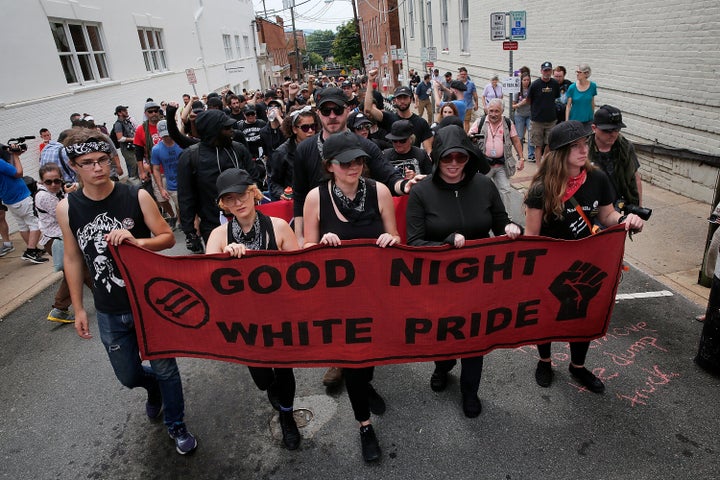
Anti-fascists in 2018 march near the site of a makeshift memorial where Heather Heyer was killed at the “Unite the Right” rally in Charlottesville, Virginia, the year before.
Win McNamee via Getty Images
At a diner next to Seattle-Tacoma International Airport, five men took turns loudly saying a racial slur to prove they are bona fide members of Patriot Front, a white nationalist organization.
Sometime later, one of them returned, alone, with a $300 tip and a message for their server, a woman of color: “Those guys aren’t my friends.”
The man, “Vincent,” was one of several “antifa” spies around the country who had gone undercover in fascist groups. Over several months, he worked out, hiked and camped with a group of committed white nationalists. He joined them as they dropped propaganda banners and vandalized public artwork depicting people of color.
Months later, in the middle of a nationwide Patriot Front video call, Vincent started playing a recording of “Bella Ciao,” the Italian anti-fascist anthem. “You guys really forgot to remove the antifa spy’s access?” he taunted them.
While embedded with Patriot Front, Vincent expropriated reams of previously unknown membership data and logistical information that allowed other anti-fascists, in anonymous collectives around the country, to “dox,” or publicly identify, the group’s members. These collectives vandalized extremists’ vehicles, alerted their neighbors and employers — and, step by step, worked to shrink their influence in American public life. Similar infiltrations have hit several neo-Nazi and white nationalist groups around the country over the years.
For years, the journalist — and former longtime HuffPost reporter — Christopher Mathias chronicled these efforts, cultivating sources from antifa groups across the country, verifying the information they gathered, and publicly outing cops, teachers and members of the military who led secret double lives as neo-Nazis and white power activists. (Mathias and I reported several stories together for HuffPost, including about Donald Trump’s fascism.)
Mathias’ new book, “To Catch a Fascist: The Fight to Expose the Radical Right,” takes readers behind the scenes of the fight to push back against the rising tide of fascism since Trump entered the political sphere over a decade ago.
Some may think the antifa movement is just about punching Nazis in the street, but as Mathias’ book explores, it’s about a lot more than that. It builds on generations of activists fighting for civil rights and pushing back against racial domination in the U.S. “To Catch A Fascist” takes a look back at this long history through today, as Trump’s second term delivers armed, masked federal agents to communities nationwide, stopping people at random because of their skin color and accents.
“Throughout history, when fascists wear masks, they do so in hopes of creating a world in which they won’t need masks at all,” Mathias told me this week. “I think it is an alarming and scary prospect to consider a world in which [Immigration and Customs Enforcement] agents feel comfortable not wearing masks.”
More observers than ever seem to be saying, “Yes, it’s fascism.” But Mathias and plenty of others have been saying that for a while. He spoke to HuffPost about antifa’s “fundamentally hopeful … struggle against impossible odds,” modern fascism, and what connects Minneapolis and Charlottesville, Virginia.
*This interview has been edited for length and clarity.
How do you think about the interplay between street-level fascist thugs committing violence and what it means for the most powerful government in history to be a fascist government?
Reporting and researching this book made me completely rethink what fascism is and the way we talk about it. So much punditry over the last 10 years, during the Trump era, has revolved around this question: “Is it fascism? Could it happen here? Is it happening here?” And there was always this impulse to suggest that, “Once we reach a certain point, it’s fascism.” Once it’s analogous to Mussolini’s Italy or Hitler’s Germany, then we can call it fascism.
What’s really interesting from the militant anti-fascist perspective is that there’s not a certain threshold we cross before things become fascist. Throughout American history, fascism has been a fact of life for many people.
There is a mythology we tell ourselves as Americans that we defeated fascism in World War II. And obviously, yes, the U.S. Army — my grandfather was part of that — defeated the Nazis. But the U.S. Army was also a segregated army. It was a colonial army. And when Black soldiers fighting in segregated units returned to the United States, they returned to Jim Crow and, later, mass incarceration. If you were, for example, a Black man swept up in mass incarceration, unjustly incarcerated for years and years of your life, what is the material difference between that experience and the experience of living in a fascist state the way we talk about it, in Europe? I would argue that it’s kind of negligible — that is a fascist experience.
So this is basically my way of saying, I’m glad people are calling what’s happening now fascist. And I think what is happening now is an intensification of these underlying social arrangements, these underlying dynamics of domination, and making those dynamics more and more explicit.
One of the foremost scholars of fascism, Robert Paxton, initially decided not to call Trump a fascist when he came to power in 2016. After Jan. 6, 2021, he revised that assessment and declared Trump a fascist. Obviously we’re at a point now where — there are just so many elements that point to calling Trump a fascist. I mean, he’s threatening to invade Greenland, and he has a secret police force raiding people’s homes [without warrants]. So it’s pretty blatant by this point.
A lot of your book is a corrective of the use of the term “antifa” and particularly how it’s become an all-purpose bogeyman for Trump and the right. To them, “antifa” is an “outside agitator,” but also they’re destroying their own communities. They’re “super soldiers,” but they’re also feminine, blue-haired transgender socialists. Talk about that label “antifa” and how it became so useful for propaganda on the right. Is it to create a pretext to confront racial justice activists while armed?
Totally. What’s really important context is that no one in America knew what the fuck antifa was before 2017.
And all the sudden, with Trump’s inauguration, you have Richard Spencer in Washington, D.C. And then, as the far right is emboldened and mobilized across the country — in places like Berkeley and Gainesville and Lansing and Charlottesville, where Nazis felt like they could go on the street and make their presence known — all of a sudden there are these leftists, radical leftists, sometimes wearing all black, punching these Nazis. And these videos obviously go viral, and there’s a thousand explainers in the media about who these Nazi punchers are, and they are antifa.
[After the deadly “Unite the Right” rally in Charlottesville,] Merriam-Webster adds “antifa” to its dictionary, Oxford Dictionary short-lists “antifa” for its “word of the year.” That’s how, suddenly, the word became part of our lexicon, through this militancy. So most of the public associates antifa with just Nazi-punching. But in reality, that tactic — physical confrontation — represents a really tiny percentage of the work antifa does.
So in 2017, suddenly everyone knows who antifa is. And something really interesting happens after Charlottesville — when the right and MAGA finds itself on the defensive [because] Trump has called them “very fine people,” and it’s become obvious that this MAGA coalition includes Nazis, that these Nazis are very violent, and that they just killed someone in Charlottesville.
There is a pseudonymous pro-Trump troll called Microchip who starts a viral petition to the White House to designate antifa a domestic terror group. And Microchip gives this fascinating interview to Politico that’s incredibly frank and upfront about why he’s doing this. He knows that the White House can’t designate antifa a terror group because there’s no statute for that. That’s not the point. The point, as he puts it, is to set up antifa as a punching bag, and to distract and deflect from the right’s very real violence, and create this false equivalency where, “Yeah, we have our extremists, but look, the left has their extremists too!” Which is an absurd equivalence, of course. The far right has killed hundreds by this point over the previous couple decades, and antifa, at this point, hasn’t killed anyone.
And what happens throughout 2017, 2018, 2019 is, you have these far-right and MAGA influencers — guys like Jack Posobiec, Mike Cernovich, Andy Ngo and a lot of other people — who create conspiracy theories about antifa.
After nearly every mass shooting in America — even before America knew who the shooter was or what their motives were — they would rush to fill that information vacuum with baseless claims that the shooter was antifa. Even if later it proved that the shooter was actually a white supremacist, by that point, the waters have been muddied and people are confused.
Antifa gets blamed for natural disasters, for wildfires. There’s a rumor that antifa “super soldiers” are going to behead white parents. It’s absurd, and again, this is all to distract and deflect from the right’s escalating violence in America.
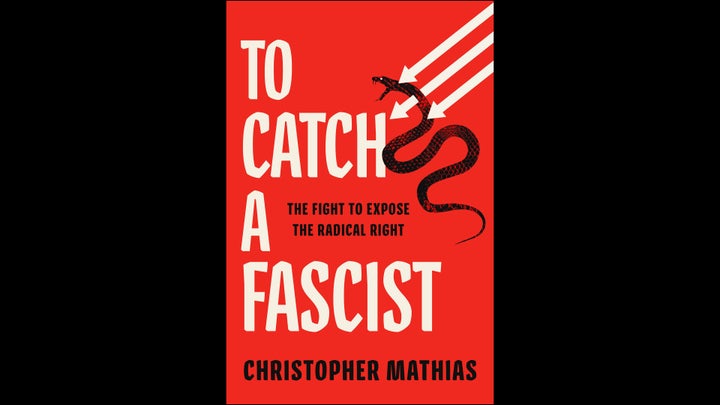
“To Catch a Fascist: The Fight to Expose the Radical Right,” by former HuffPost reporter Christopher Mathias, will be released next week.
Atria Books
[Eventually,] there’s a bit of a lull in the way the antifa bogeyman is used, but then in 2020 it’s repackaged as a response to the George Floyd uprisings. MAGA, Trump — they blame antifa for fomenting these mass, historic uprisings, which, again, is absurd. Yes, its practitioners did take part in the uprisings, but their numbers are so small that they would never have the power or organizing capacity to foment uprisings like that.
Moreover, those uprisings, as we know, were created and led by the communities that they were in, and they were Black-led uprisings. And that’s why MAGA and Trump blamed antifa for these uprisings in a big way — to distract from the very real grievance at the heart of the protest, which was for cops to stop murdering Black people.
It was also a tactic to sow division on the left — entangling the left in debates about tactics and so forth. The way they wield that label, they eventually start calling anyone they want antifa. And that’s just a way of designating someone as outside the realm of political respectability. When you do that, you are creating a pretext for that person to be targeted, either by state prosecution or by vigilante violence, which we saw a lot of in 2020.
Fast forward to 2025, Trump claims to designate antifa a domestic terror group — which, again, is an effort to label this burgeoning uprising against his agenda as outside the realm of political respectability and worth repressing.
Talk about the difference between “antifa” as a term and anti-fascist as an ideology or description.
When I say “antifa,” there is an important distinction to make. Antifa, yes, is just the shortening of the word “anti-fascist.” A lot of liberals and centrists will point to that fact as a way of saying, “Well, aren’t we all antifa?” It’s kind of a way of saying, “Antifa isn’t a real thing,” or that it doesn’t exist. But that’s not true. Antifa, as a word, refers to a very specific kind of militant radical tradition of combating the far right “by any means necessary.”
And when I talk about antifa, these are activists who practice a political tradition that believes in a few basic tenets: First, that, yes, sometimes fascists need to be confronted in the streets, sometimes violently. Fascists should be given no platform to speak or organize. That means revoking permits for them to speak in cities or parks, or de-platforming them from social media.
Another important tenet is that the state and law enforcement cannot be trusted in this fight. And that essentially means they view the government and law enforcement as inherently white institutions that will collaborate with and support fascists.
Antifa didn’t emerge out of nowhere. It emerged from preexisting networks of anarchists, socialists and communists — largely from a tradition born in the ’80s and ’90s to kick Nazis out of the punk scene, and the formations of groups like Anti-Racist Action and Skinheads Against Racial Prejudice, and they basically developed those tenets we talked about, those points of unity when combating the far right.
Q {You mentioned that there’s a tendency to say, “Well, I’m anti-fascist, and my grandfather was anti-fascist in World War II.” But you get into the history of anti-fascists, of doxing fascists, in the book, and the history traces back well before either of those words existed — before doxing existed, before the word fascist existed. You go back to investigative journalist Ida B. Wells. You go back to Walter White, who investigated lynchings in the early 20th century for the NAACP. You go back to Frank Schwab — the mayor of Buffalo who revealed the identities of 18,500 people who were members of the KKK in the area, posting their names at the city’s police headquarters — and the undercover detectives who infiltrated the Klan. Why was it so important to you to get into that history of very specialized resistance to racial domination?}:
So Langston Hughes made this point. “Negroes in America do not have to be told what fascism is in action. We know. Its theories of Nordic supremacy and economic suppression have long been realities to us,” [Hughes said in 1937, at the Second International Writers Congress in Paris.]
What I find frustrating about the discourse about fascism in America, again, is this mythology we tell ourselves that we’re the good guys who defeated the fascism. Robert Paxton, the scholar of fascism I mentioned, has described the Klan as the proto-fascist organization, right? Nazi Germany looked to Jim Crow laws in America for inspiration for its own race laws in Germany. America, in many ways, was fascist before the word fascist existed.
“Throughout American history, fascism has been a fact of life for many people. ... America, in many ways, was fascist before the word fascist existed.”
- Christopher Mathias
What I found so compelling about efforts to unmask the First and Second Klans was, first, just how insanely brave that work was — people really putting their bodies on the line.
Edward Obertean, an undercover police officer who infiltrated the Klan in Buffalo, was murdered afterwards by a Klan member.
The history of white supremacy in America is marked by periods where its most ardent practitioners wore masks, and periods when they didn’t need to.
The First Klan is born to destroy Reconstruction. There’s an amazing effort to unmask them, and it’s successful in a lot of ways in destroying the Klan. But part of the reason that Klan dissolves is also because they were successful. They could trade the anonymity of the hood for the anonymity of the lynch mob.
The Second Klan, same kind of thing — an amazing effort to unmask them that goes a long way in destroying the Second Klan. But again, they were also dissolved, in a way, because they were successful. The 1924 immigration law is passed, the Johnson-Reed Act — and Johnson, the congressman, by the way, was in the Klan — and created these immigration quotas, which, incidentally, are the quotas that restrict immigration to Northern Europe, and is kind of what the modern far-right, including Stephen Miller, wants to go back to.
For me, it was really important to tell those stories, because I actually find them really inspiring. The people doing this work didn’t wait on anyone to save them. They understood that we have to save ourselves, and they didn’t always get to see the fruit of their work. The work they did would contribute to later victories.
Q {You talk a lot about antifa’s work as modern-day journalists. In my opinion, the anonymous collectives that comprise your description of antifa are some of the most skilled journalists working in the country today. That might be a surprise to readers, but to folks who have covered the “extremism” beat, they know. I mean, how many of your own stories that were published in HuffPost stemmed from that sort of work? Reading your book, it was striking to me how much projects like “Panic! In the Discord” or “Ignite The Right” sound like “The Panama Papers” — that is, collectives of journalists working together on a large project. Talk about the skill of these folks as journalists, and whether you think they get their due.}:
No, I don’t think they get their due. There is still this presiding snobbery in journalism that says you have to write for this outlet or that outlet to be considered a journalist. There’s also what I would consider an antiquated notion of objectivity around journalism that says that people doing the type of research that antifa does couldn’t possibly be journalists. I push back against that in the book and am upfront in the intro about the fact I, myself, subscribe to militant anti-fascism.
I do not think that objectivity exists or that there is a “view from nowhere” to report on masked secret police abducting my neighbors. And that is the perspective that antifa also takes. And if we are to consider journalism, first and foremost, to be in the public interest and for the public good, then I think journalism should be explicitly anti-fascist. The investigations that antifa did over the last 10 years were absolutely remarkable sometimes. I talked to one anti-fascist who read through 60,000 tweets to collect enough little morsels and clues and bread crumbs to unravel a Nazi’s identity.
You compared the leaks of Nazi chat messages to The Panama Papers, which is a really apt description. It goes grossly underappreciated that Unicorn Riot, the independent news outlet, created an absolutely remarkable database for leaked white supremacist chat messages — millions and millions of these messages that were open-source material that anti-fascist researchers across the country could mine and look through to figure out who among their neighbors is a Nazi. And that’s a remarkable story and a remarkable feat of journalism.
Talk about the source relationships that you have with anti-fascists. I take it you’ve been talking to some of these folks, unnamed sources of yours, for a decade, or at least many years. How did those source relationships develop over the years, and how have they changed you as a reporter?
It took a long time to gain the trust of anti-fascist sources. They are, understandably, wary of the press. And also, I take their trust in me very seriously, because there are fascists out there that want to harm them. So it’s important for me to protect their identities. And, of course, the state also wants to target antifa, so it adds an extra level [of concern].
But yes, I’ve been talking to so many people for upwards of a decade now. For the book, I ended up talking to about 60. What is most striking for me is that almost everyone involved in this work started doing it after personal brushes with fascists in their communities.
One anti-fascist I talked to a lot, her friend lost someone in the El Paso Walmart massacre, which inspired her to start doing this work.
One of the things that prompted me to do this book was seeing them do that work — neither for glory or acclaim — and also seeing diminishing returns when they were doing the doxes; for a while there, they were getting Nazis fired from their jobs and there was real accountability. But then, something started to shift, and occasionally there were towns where they didn’t care that they had a Nazi as a neighbor. And so I started to talk to anti-fascists about what that meant for American politics in general.
You spoke about inciting incidents for people to get involved in this work. You were at “Unite The Right” in Charlottesville in 2017. You sawDeAndre Harris being beaten. Can you talk about that as an inciting incident for a lot of journalists of the far right and the effect it had on you?
Anyone who was in Charlottesville on Aug. 12, 2017, had their lives irrevocably changed afterward. For me, it was the beginning of this long kind of reporting journey into this new, insurgent fascist movement — and then, eventually, into the anti-fascist opposition. But more generally — on a visceral, emotional level — when you see, up close, that kind of vile racism and bigotry so comfortable with itself in public, you start to realize how urgent the need is to fight back against it.
Especially in reporting this, I had a front-row seat to seeing how what we considered fringe in our politics actually wasn’t that fringe at all, and that the Republican Party was becoming the party of the Nazis that marched in Charlottesville. So, it’s just a radicalizing process. There’s no way around it.
What would you say to folks in Minneapolis today, who, I think you would argue, are looking at a different form of fascist violence, a traumatic sort of street violence, except this time it’s performed by the federal government?
I cannot stop thinking about the similarities between the uprising against ICE in Minneapolis and the uprising against all the fascists that were taking to the streets in 2017 through 2020. They’re embracing the same organic, grassroots tactics that are not dependent on law enforcement or the government, which, in Minneapolis, has kind of abandoned them. They have to do this on their own.
And they’re doing all the stuff that anti-fascists were doing to Nazis a few years ago — which was following them, monitoring them, identifying them, doxing them, pressuring businesses and hotels not to host them. They’re doing noise demonstrations outside of hotels. They are creating a social cost for being in ICE, for being part of the secret police, for being part of la migra, which is really heartening and really remarkable and really brave, and the similarities are really striking.
You talked to an ex-member of Patriot Front in the last chapter of this book, and he essentially laid out the argumentfordoxing. He explained that when people think of Patriot Front, “the first thing they think is, ‘If I join Patriot Front, I will be doxed.’” On the other hand, he noted, once unmasked, fascists sometimes dive further into those communities as a support network.
There is also the question of, what happens when the social stigma around white supremacy is gone? Given the strength of fascism in America today, given its position inside the U.S. government, if antifa 10 years ago saw what was going to happen, do you think there would have been a change in tactic? How are these tactics changing now?
There’s this debate over whether antifa was successful. Because, obviously, they destroyed all these fascist groups. But of course, now, we have a much broader mass fascist movement, MAGA. It’s an interesting question, and I don’t have a clear answer.
But what antifa does at the local level is an insurgent form of community self-defense, and it was an urgent, pressing political tactic — or style of politics — that prevented Nazis from being comfortable in specific places, the streets. And in that way, it was really successful.
But you also have to remember, antifa is an incredibly small subculture — a small phenomenon or movement. It would never have had the members to stop what is happening now. That said, like I was saying with Minneapolis, we are seeing an adaptation of militant anti-fascist tactics on a bigger scale.
I personally think that those kinds of tactics, if replicated on a big enough basis, could be really effective. And I’ll say that there’s a reason MAGA — Kristi Noem, Trump — are so scared of efforts to dox ICE agents. And that’s in part because MAGA saw what doxing did to the alt-right. And doxing, again, is dependent on leveraging a societal taboo against explicit white supremacy. And I think doxing, identifying ICE agents, for example, is an important part of creating and maintaining a taboo against being in ICE.
I think it will be important now to let people in ICE know that they are the Nazis in this movie, and that in a generation, they will be depicted as villains in the movies their kids watch. We are already seeing public opinion turning against ICE. A [YouGov poll taken the day immigration agents fatally shot Alex Pretti in Minneapolis showed 19% of Republicans and 46% of American adults overall indicating support for abolishing ICE.] That is remarkable.
I quote an anti-fascist in the book saying that anti-fascism is fundamentally hopeful, that it’s a struggle against impossible odds. And I find that example of anti-fascists over the last few years, actually, very inspiring for this fascist moment that we’re in right now.
---
SEE 3 FOR ANNOTATION
AN 12 25
Far-right extremists have been organizing online since before the internet – and AI is their next frontier
How can society police the global spread of online far-right extremism while still protecting free speech? That’s a question policymakers and watchdog organizations confronted as early as the 1980s and ’90s – and it hasn’t gone away.
Decades before artificial intelligence, Telegram and white nationalist Nick Fuentes’ livestreams, far-right extremists embraced the early days of home computing and the internet. These new technologies offered them a bastion of free speech and a global platform. They could share propaganda, spew hatred, incite violence and gain international followers like never before.
Before the digital era, far-right extremists radicalized each other primarily using print propaganda. They wrote their own newsletters and reprinted far-right tracts such as Adolf Hitler’s “Mein Kampf” and American neo-Nazi William Pierce’s “The Turner Diaries,” a dystopian work of fiction describing a race war. Then, they mailed this propaganda to supporters at home and abroad.
I’m a historian who studies neo-Nazis and far-right extremism. As my research shows, most of the neo-Nazi propaganda confiscated in Germany from the 1970s through the 1990s came from the United States. American neo-Nazis exploited their free speech under the First Amendment to bypass German censorship laws. German neo-Nazis then picked up this print propaganda and distributed it throughout the country.
This strategy wasn’t foolproof, however. Print propaganda could get lost in the mail or be confiscated, especially when crossing into Germany. Producing and shipping it was also expensive and time-consuming, and far-right organizations were chronically understaffed and strapped for cash.
Going digital
Computers, which entered the mass market in 1977, promised to help resolve these problems. In 1981, Matt Koehl, head of the National Socialist White People’s Party in the United States, solicited donations to “Help the Party Enter The Computer Age.” The American neo-Nazi Harold Covington begged for a printer, scanner and “serious PC” that could run WordPerfect word processing software. “Our multifarious enemies already possess this technology,” he noted, referring to Jews and government officials.
Soon, far-right extremists figured out how to connect their computers to one another. They did so by using online bulletin board systems, or BBSes, a precursor to the internet. A BBS was hosted on a personal computer, and other computers could dial in to the BBS using a modem and a terminal software program, allowing users to exchange messages, documents and software.
With BBSes, anyone interested in accessing far-right propaganda could simply turn on their computer and dial in to an organization’s advertised phone number. Once connected, they could read the organization’s public posts, exchange messages and upload and download files.
The first far-right bulletin board system, the Aryan Nations Liberty Net, was established in 1984 by Louis Beam, a high-ranking member of the Ku Klux Klan and Aryan Nations. Beam explained: “Imagine, if you can, a single computer to which all leaders and strategists of the patriotic movement are connected. Imagine further that any patriot in the country is able to tap into this computer at will in order to reap the benefit of all accumulative knowledge and wisdom of the leaders. ‘Someday,’ you may say? How about today?”
Then came violent neo-Nazi computer games. Neo-Nazis in the United States and elsewhere could upload and download these games via bulletin board systems, copy them onto disks and distribute them widely, especially to schoolchildren.
In the German computer game KZ Manager, players role-played as a commandant in a Nazi concentration camp that murdered Jews, Sinti and Roma, and Turkish immigrants. An early 1990s poll revealed that 39% of Austrian high schoolers knew of such games and 22% had seen them.
Arrival of the web
By the mid-1990s, with the introduction of the more user-friendly World Wide Web, bulletin boards fell out of favor. The first major racial hate website on the internet, Stormfront, was founded in 1995 by the American white supremacist Don Black. The civil rights organization Southern Poverty Law Center found that almost 100 murders were linked to Stormfront.
By 2000, the German government had discovered, and banned, over 300 German websites with right-wing content – a tenfold increase within just four years.
In response, American white supremacists again exploited their free speech rights to bypass German censorship bans. They gave international far-right extremists the opportunity to host their websites safely and anonymously on unregulated American servers – a strategy that continues today.
Up next: AI
The next frontier for far-right extremists is AI. They are using AI tools to create targeted propaganda, manipulate images, audio and videos, and evade detection. The far-right social network Gab created a Hitler chatbot that users can talk to.
AI chatbots are also adopting the far-right views of social media users. Grok, the chatbot on Elon Musk’s X, recently called itself “MechaHitler,” spewed antisemitic hate speech and denied the Holocaust.
Countering extremism
Combating online hate is a global imperative. It requires comprehensive international cooperation among governments, nongovernmental organizations, watchdog organizations, communities and tech corporations.
Far-right extremists have long pioneered innovative ways to exploit technological progress and free speech. Efforts to counter this radicalization are challenged to stay one step ahead of the far right’s technological advances.
Michelle Lynn Kahn, Associate Professor of History, University of Richmond
This article is republished from The Conversation under a Creative Commons license. Read the original article.
---
GOOD ANALYSIS FLOOD ZONE IRONY --> FASCISM
AN TC 11 25
The headlines documenting President Donald Trump’s plan to send federal troops to San Francisco followed a familiar arc. “Trump claims ‘unquestioned power’ in vow to send troops to San Francisco,” The Guardian reported on Oct. 20, 2025. The next day, the San Francisco Chronicle blared: “S.F. threatens to sue if Trump brings in National Guard.” Then, on Oct. 23, “Trump reverses his decision to send troops to San Francisco,” as ABC News put it, after Trump posted that conversations with the city’s mayor and tech moguls had swayed him.
It was another example of how Trump’s shifting policy positions, racially inflammatory statements and threats frequently fuel a flurry of headlines, reflecting what some psychologists are calling “media saturation overload” or “Trump stress disorder.”
This barrage of information may seem like overcommunication from a hyperactive administration. But it is much more than that.
Scholars have found that the constant, often conflicting and at times false information coming out of the White House and shared via social media posts and the conventional news media causes members of the public to see truth and fact as relative and makes them more likely to dismiss those who disagree with them as untruthful. This leaves doubt about what’s real and what isn’t.
This citizen paralysis creates what philosopher Hannah Arendt described in “The Origins of Totalitarianism” as a general public “for whom the distinction between fact and fiction … no longer exist.” When lies are truth and truth is derided as lies, Arendt wrote, ordinary people lose their bearings and can be manipulated for totalitarian objectives.
Meanwhile, many journalists have openly acknowledged fatigue with the pace and nature of the Trump administrations’ news cycles, amid frequent newsroom layoffs, mergers and closures.
I am a longtime journalist and now scholar of journalism and race, trained to see the methods and aims behind political leaders’ press operations. And as I show in my forthcoming book, the Trump administration’s rhetorical strategies echo the playbooks of authoritarian and white supremacist organizations such as the Third Reich and some factions of the modern alt-right movement. They are intended to narrow the scope of who belongs as an American.
Headlines at ‘muzzle velocity’
The Trump administration’s rhetorical strategies include claiming victim status while often laying blame on immigrants or other scapegoats in ways that I believe betray racist intent. At the same time it has overwhelmed journalists and the public with breaking news.
This strategy was laid out by Steve Bannon, an influential Trump supporter and strategist in his first administration, during a 2019 PBS “Frontline” interview, when he described the media as “the opposition party.”
“They’re dumb and they’re lazy, they can only focus on one thing at a time,” he said. “All we have to do is flood the zone. … Bang, bang, bang. These guys will never – will never be able to recover. But we’ve got to start with muzzle velocity.”
Bannon has long been associated with the alt-right, a movement known for rhetorical tactics that minimize and obfuscate its true aims.
A strategy forged in Trump’s first term
As I detail in my book, “American Otherness in Journalism: News Media Representations of Identity and Belonging,” Trump and his key advisers have been developing, refining and ramping up their news media manipulation for a long time.
An early example of this is the way the administration used these tactics through Trump’s public responses to the fatal violence at the August 2017 Unite the Right protest in Charlottesville, Virginia.
The two-day rally was organized by a white nationalist blogger and attended by members of neo-Nazi, white supremacist and far-right militias protesting the removal of a statue of Confederate Gen. Robert E. Lee from a Charlottesville park. They marched with tiki torches, flew Confederate and Nazi flags and chanted antisemitic and racist slogans.
Amid violent clashes with counterprotesters on the second day, a neo-Nazi sympathizer drove into a crowd, killing a 32-year-old woman and injuring many others.
My study of television news coverage of Unite the Right found that the majority of news reports focused on the contradictory and inflammatory statements that Trump made about the antisemitic and racist protesters. Trump’s Aug. 15, 2017, press conference remark about blame on both sides after what happened garnered the most news media attention: “I think there is blame on both sides,” he said. “You had some very bad people in that group. You also had some very fine people on both sides.”
Exploiting chaos
The uncertainty surrounding what he meant created a cycle of news stories implying and denying that he sympathizes with white supremacists.
This is-he-or-isn’t-he intrigue spurred a surge of what fits the description of Bannon’s “muzzle-velocity” news headlines: “Trump declares ‘racism is evil’ amid pressure over Charlottesville” followed closely by “Trump defends White-nationalist protesters” and “Why Trump can’t get his story straight on Charlottesville.”
With the focus on Trump’s comments and what he might have really meant, the news media ultimately missed covering at the time the long-term threat posed by these white supremacist and other extremist groups.
Echoing a playbook from the past
Scholars have identified the fascist roots of these “post-truth” strategies: strongmen leaders uninterested in establishing leadership through honesty and transparency.
A recent scholarly analysis of Trump’s leadership concludes that the second-term president is overwhelming the public into “organized despair” by pitting races against each other while targeting minority groups as scapegoats, a tactic that hearkens back to 1930s Germany.
A 2019 analysis of Trump’s narrative style describes how he presents himself as a “strongman” fighting invisible forces of censorship and suppression. It also points out that this was part of the appeal of fascist leaders such as Mussolini and Hitler.
Researchers of Nazi propaganda identified key tactics in the German press such as name-calling and lumping together groups seen as opposition – communists, liberals and Jews – until public understanding of those groups blur into phrases like “enemies of Germany.” The messaging was constant and immersive, carried in local and national newspapers, radio, film and posters.
A key part of Trump’s rhetorical strategy is using race without directly referring to it. For example, Trump has described cities with large nonwhite populations such as Washington, D.C., and Chicago as “out of control” or “dirty,” contrary to actual crime statistics. He’s also questioned Kamala Harris’ racial identity, suggesting she “happened to turn Black.” And referring to Black football players who had been protesting systemic racism by kneeling during the national anthem, Trump said, “Get that son of a bitch off the field right now,” which many observers interpreted as racist because he was insulting people of color for the act of protesting racism.
This racial coding has been used by white supremacist groups to mask their true intent. They also use less overt labels such as “alt-right” or “pro-white” as a “rhetorical bridge” to the mainstream public.
In the case of the NFL protesters, the plausible deniability became an actual denial. Trump perfected this move when, during a 2020 debate with Joe Biden, he said, “Proud Boys – stand back and stand by,” referencing another group accused of thinly veiled racism.
Drowning in headlines
I believe that the endgame for this strategy is authoritarian power that greatly narrows the scope of who truly belongs and has rights in this country as an American.
This media saturation – drowning the public with a thousand Trump-generated headlines – allows his administration to keep dominating and controlling national attention.
But the media-consuming public can use the tools they have to encourage news outlets to better inform the public by identifying the media saturation strategy and reporting on why leaders are using it.
Otherwise, if news consumers let the headline overload do what it’s intended to do, and become overwhelmed and paralyzed, they become pawns in what I consider a ploy to make America less egalitarian and less democratic.
Angie Chuang, Associate Professor of Journalism, *University of Colorado Boulder
This article is republished from The Conversation under a Creative Commons license. Read the original article.
---
---
AN 7 25
A Guardian investigationhas uncovered a growing network of far-right, men-only fraternal clubs across the United States — known collectively as the Old Glory Club (OGC). Members of this group claim the involvement of “literally hundreds” of individuals, including current and former military personnel, civil servants, lawyers, and influential voices in antisemitic circles.
In a report published Saturday, the Guardian reported that the OGC has established at least 26 chapters in 20 states. It had been operating largely under the radar until now.
The OGC has reportedly hosted various conferences, meetups, and other events. The purpose of these gatherings is to provide a platform for its leading members — such as podcaster Pete Quinones — to promote far-right narratives targeting Jewish people and immigrants, per the report.
READ MORE:How Donald Trump's economic policies are damaging the US
The investigation further revealed that some within the group also respond to current political developments and support ideas like “cancellation insurance” to protect members whose extremist beliefs might jeopardize their careers.
Harry Shukman, a researcher with UK anti-fascist organization Hope Not Hate, recently published a report on the Basketweavers —an OGC-linked group in the UK. He told the Guardian: “Groups such as the OGC are a new breed of extremist organisation which aims first to build an offline social network before taking over society.”
“They seek to lower the bar to participating in the far right, and by doing so have proved attractive to a cohort of mostly male members, some of whom have never before undertaken any form of activism," he added.
During a livestream hosted by the Old Glory Club following the general election in November last year, Quinones used a racial slur commonly employed by white nationalists to describe Black voters, stating: “The North American street ape is hopeless.”
READ MORE:'Historically ruinous': Congress just approved a 'self-inflicted tragedy'
He repeated the slur the following month in reaction to a video featuring a Black teenager, per the report.
Shukman told Guardian: “The Old Glory Club and its affiliates like the Basketweavers may claim to provide community, but the truth is they conceal a much more sinister aim.”
He continued: “We have seen that the leaders of these groups can be vicious and degrading to junior members, especially maladjusted young men. The OGC’s senior figures also have a track record of making deeply racist statements and affiliating with known far-right activists.”
---
===
an 3 15
The alt-right is reintroducing a dehumanizing slur that has its roots in 100-year-old eugenics, Justin Kirkland writes in the Guardian Monday.
“The R-word is in a new era of prominence in rightwing, chronically online circles – especially on 4chan and X,” he writes. “A favorite of those who currently hold power or stand to gain power underDonald Trump’s second administration, the slur is being used with gleeful relish to belittle and mock ideological enemies.”
One adopter of the word is none other than the Trump administration’s Elon Musk, who owns X.
READ MORE: Revealed: 'Promoters of race science' and eugenics featured at TX far-right conference
“In the past year,Elon Musk has used the R-word at least 16 times on X,” Kirkland writes. “Hethought Ben Stiller was one for endorsing Kamala Harris; so was the Facebook co-founderDustin Moskovitz for comparing Tesla to Enron.”
There was a 200 percent spike in use of the word on X in January, according to a recentstudy from Montclair State University.
Last year, Trump reportedly used the word to insult Joe Biden and Harris.
“I feel liberated,” an anonymous banker told the Financial Times when Trump was elected. We can say ‘r-----’ and ‘p----’ without the fear of getting cancelled.”
READ MORE: 'This guy is a leech': AOC rips Elon Musk over attack on Social Security
The slur has particular weight coming from Musk. “Musk, a man who launched aNazi salute at Trump’s inauguration festivities,has alignedhimself dangerously closely with eugenicist thinking,” Kirkland writes. “Musk, who has said he is on the autism spectrum himself, also wields oligarchic power as he attempts toeliminate “unnecessary spending” in the federal government with Trump’s blessing. Early on, Musk set his sights onMedicaid, which was created in part to ensure people with disabilities had access to affordable healthcare. Meanwhile, Republican lawmakers are looking toslash Medicaid spending to support Trump’s tax cuts.”
The word has its roots in a “diagnosis” tracing back to 1910 that meant, according to some doctors, a "feeble-minded" person was “incurable.” Leaders at this time also believed that people with disabilities, people of color, and queer people could be eliminated through selective breeding. People with disabilities, proponents of eugenics argued, should be institutionalized.
“[The use of the R-word] is absolutely historically linked to the understanding that ‘r-------’ children are defective children and that we can eliminate defective children for the good of society,” Topher Endress, a reverend in Missouri who holds a doctorate in philosophy, told the Guardian. “I mean, that’s the basis of eugenics. I’m a little fearful of seeing this word pop back up because it does have such a strong eugenic connotation."
“I see the rise of the R-word as a gauge for how far society is willing to let people like Musk and Trump go," Kirkland writes. "And while I believe that in most reasonable environments, it’s still very much taboo to say the word aloud, the fact that it’s being said by some of the most powerful people in the world, with no recourse, says enough."
READ MORE: Alarm sounded as Trump’s recent moves threaten to upend the Constitution
5/15/24 kpfa 7 am BET ucla gaza students coord attack threat 2 days before GUK ; leave our kids alone anti drag; kkk pol pro zion but anti-semite
4 Bruin student journo targeted /hurt
===
AN 12 24
any Never Trump conservatives have argued that the Republican Party's Ronald Reagan era officially ended when Donald Trump won the 2016 GOP nomination and went on to defeat Democratic nominee Hillary Clinton in the general election.
Since then, the GOP has only grown more and more Trumpified. Many conservative Trump critics are no longer in Congress, including former Reps. Liz Cheney (R-Wyoming) and Adam Kinzinger (R-Wyoming), ex-House Speaker Paul Ryan (R-Wisconsin), and ex-Sen. Jeff Flake (R-Arizona). And outgoing Sen. Mitt Romney (R-Utah) decided against seeking reelection.
Trump's narrow defeat of Vice President Kamala Harris in the 2024 election only tightens his stranglehold on the GOP. The Dispatch's David M. Drucker, in an article published on December 17, stresses that when he returns to the White House on January 20, 2025, he will be "flanked by an army of outside enforcers prepared to squeeze any Republican who resists his agenda."
READ MORE:'Damning information mounts': Trump's 'worst' nominees could be in for a rude awakening
"Once Trump is inaugurated," Drucker reports, "this MAGA-aligned network will shift to strong-arming obstinate House and Senate Republicans to support the president-elect's agenda, be it executive orders or legislative proposals. Critically, MAGA insiders tell The Dispatch, they won't be sitting around waiting for direction from Trump to join a particular fight."
One of those MAGA insiders is "War Room" host Steve Bannon, who told The Dispatch, "The ecosystem on the right is going to be a force multiplier…. What I think you're seeing now is the institutionalization of what had been a self-organizing effort."
Bannon, according to Drucker, is "describing" what "amounts to the rise of a new Republican establishment, complete with well-funded activist groups and influential media figures."
Bannon, now 71, has been involved in far-right politics for decades. But Trump's MAGA loyalists aren't necessarily Baby Boomers or members of Generation X.
READ MORE:'No one would design a system like the one we have': UnitedHealth CEO makes astonishing admission
In a New York Times article published on Dec. 16, reporter Shawn McCreesh describes a New York Young Republican Club gathering that took place Sunday, Dec. 15.
Bannon was the keynote speaker, but many of the "true believers" in attendance were much younger. And according to McCreesh, they are fine with "retribution" against Trump's detractors — if unclear about the form it should take.
"This club's members are, by and large, a terminally online, trollish, far-right collective who would consider any sort of tack toward the center by Mr. Trump or those guiding him to be an act of betrayal," McCreesh reports. "They are the prime audience for retribution rattling. And yet, on Sunday, many seemed at odds about just how much retribution they could expect, or who precisely should be targeted, or how.
Preston Parra, a 22-year-old MAGA Republican at the gathering, said of Trump's foes, "We want to throw the book at them because they deserve it. They're godless demoniacs…. The leftist, elitist cabal, whatever you want to call it. Nancy Pelosi. Mitch McConnell."
READ MORE:['How long it’ll be until he sues an economist': Experts blast Trump's lawsuit against pollster
*Read The Dispatch's full article at this linkand the New York Times' reporting here (subscription required).
---
---
an ah 8 25
adin Ross, a 23-year-old gamer, has become a prominent figure in the manosphere movement — a variety of anti-feminist ideologies that have clashed on many occasions.
Ross is far-right in his views, making no secret of his admiration for Andrew Tate and former President Donald Trump. And he interviewed the 2024 GOP presidential nominee during a livestream on the Kick platform on Monday, August 5.
There is a lot of infighting within the manosphere, which ranges from competing red pill groups — PUAs (pickup artists) and MGTOW (Men Going Their Own Way) — to black pill/incel extremists. Incels are so extreme that even other misogynists find them disturbing. And Ross, with his admiration for Tate, is not an incel but rather, favors the PUA/red pill area of the manosphere.
READ MORE:'Politically stupid': GOP leaders warn 'Trump may have just lost Georgia'
In an article published by the conservative website The Bulwark Tuesday, journalist Ilyse Hogue notes that Ross' online event with Trump attracted roughly 600,000 viewers. And the lesson for Democrats, Hogue stresses, is that Trump is really ramping up his outreach to "disaffected young men."
"Ross, who boasts 1.3 million followers, is part of a cohort of young hyper-online men who promote an unapologetically MAGA aesthetic and culture," Hogue explains. "He is a sycophant of the legendary king of the manosphere, Andrew Tate, known equally for his overt misogyny and the charges he faces for rape and human trafficking. Ross himself was banned from the more mainstream gaming platform Twitch for multiple hate speech and racial slur offenses."
Hogue continues, "That was never going to be a hurdle for Donald Trump. But the fact that the former president came on Ross' show still underscores how the GOP is operating in an unconventional but potentially advantageous manner — one that stands in stark contrast to the Democrats, who continue to plod along using a playbook that counts 'youth' as an unshakable monolith."
Hogue describes Trump's appearance on Ross' show as "part of a concerted effort by Republicans to turn up the noise and turn out the vote for Trump among disaffected young men.
READ MORE:This Project 2025 architect is urging Republicans to be 'fearless' with far-right agenda
"In a post-MeToo era of progressive politics where young men often felt excluded, silenced, and shunned," Hogue explains, "this emerging culture hits all the marks of making men great again…. This coordinated effort is geared to do one thing: rewire social permissions so young men can feel good about voting for a convicted felon and a man found liable for sexual abuse. And so far, it seems to be working."
Hogue adds, "Trump is winning this demographic, according to most polls. This rightward drift of young men is part of a global trend that has powered elections in recent years from Argentina to France."
READ MORE:Ex-Trump staffer gives Harris advice on how to beat her former boss
*Ilyse Hogue's full article for The Bulwark is available at this link.
---
AN 5 24
The GOP over the last decade, Reuters noted in March, has transformed into a "Republican electorate that is more isolationist, more skeptical of globalization, more suspicious of the electoral process and more likely to view Democrats as a threat than it was when former President [Donald] Trump launched his first run for the White House in 2015."
University of Virginia Center for Politics analyst J. Miles Coleman said the stark changes "reflect an electorate that has become more populist, both feeding off of Trump's populism and influencing the broader party." Now, he added, "It's hard to see the (party) going back to nominating Mitt Romney-type candidates."
In a Tuesday, May 7 op-ed published by MSNBC, columnist Charlie Sykes discusses the right-wing's shift through the eyes of conservative ghost writer Nancy French.
READ MORE:Johnson demands all Trump prosecutions cease, vows to use Congress 'in every possible way'
French's new book, Ghosted: An American Story, according to Sykes, is "a powerful and horrifying account of how a once fringe movement, the alt right, has come to occupy the central seat of the Republican Party."
The book reveals "the vicious racist attacks against her and her family after she and her husband, David French, a well-known conservative commentator who is now a New York Times columnist, broke with Trump," the Bulwark founder notes.
Sykes writes:
*In late 2015, online trolls seized on the existence of their daughter Naomi, who the Frenches had adopted from Ethiopia, as an attack tactic. In her book, French recalls the moment she saw the picture online: a photoshopped image of 7-year-old Naomi “in a gas chamber, with Donald Trump — wearing a Nazi uniform — pulling a lethal gas lever.”
*There was more. Other online trolls photoshopped the girl’s face onto images of enslaved people and identified her with racial slurs that don’t bear repeating here.
French writes in her book, "The alt right tried to inflict as much personal pain as they could on us, in the most intimate ways possible. These radicalized Trump supporters harassed us, mocked us, maligned us, and believed we should lose our jobs, and — at least according to our email inboxes — our lives."
READ MORE: 'Terror into votes': Expert examines Trump and MAGAworld’s 'deep investment in promoting fear'
"This casual racism and brutality was not pushed by a fringe element,” French emphasizes. "It had become the main political strategy of many conservatives. These people spouting conspiracy theories and shouting invectives were now embedded, wrapped up, and intertwined with mainstream Republicans."
Sykes notes:
In 2019, the Trump-supporting magazine American Greatness published a blatantly racist poemtitled 'Cuck Elegy,' which accused 'parasites' of surrendering to the 'mocha-skinned' and 'low-life reprobates.'* In case the references were too subtle, the magazine accompanied the poem with a photo of David and Naomi French.
The same year, "the Aspen Institute featured a panel that included both French and Christopher Buskirk, the editor and publisher of American Greatness, titled'Can the Republican Party Survive the Alt Right?' (In the spirit of transparency, I helped moderate that panel.)," Sykes emphasizes. "French writes that Aspen’s decision to invite the publisher of American Greatness to talk about the alt-right 'was akin to asking an arsonist to give advice on putting out fires,' adding, 'but they did not ask me for my advice.'"
*Sykes' full op-ed is available at this link.
===
---
AN 11 23
Former President Donald Trump’s rhetoric has regularly bordered on the incitement of violence. Lately, however, it has become even more violent. Yet both the press and the public have largely just shrugged their shoulders.
As a political philosopher who studies extremism, I believe people should be more worried about this.
Mark Milley, the outgoing chairman of the joint chiefs of staff, is guilty of “treason,” Trump said in September 2023, just for reassuring the Chinese that the U.S. had no plans to attack in the waning days of the Trump administration. And for this, Trump says, Milley deserves death.
And back in April, Trump said that his indictment by Manhattan District Attorney Alvin Bragg would result in “death and destruction.” Then, in early October, Trump urged people to “go after” Letitia James, the New York attorney general who filed suit against him for business fraud.
Trump’s prior rhetoric is also now on record as having inspired many of those convicted to engage in insurrection at the U.S. Capitol on Jan. 6, 2021.

But it is not just government officials whom Trump suggests be targeted for extrajudicial killings. Mere shoplifters should be killed too. “Very simply, if you rob a store, you can fully expect to be shot as you are leaving,” Trump said to cheers at the California Republican Party convention in September.
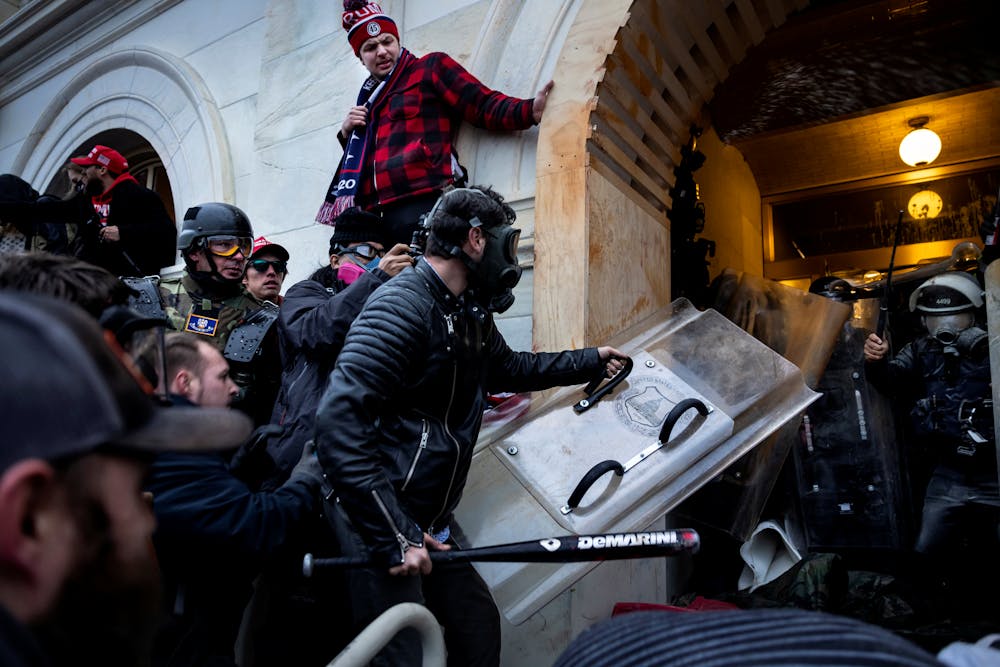
Trump supporters storm the U.S. Capitol on Jan. 6, 2021.
More than crazy bluster
This rhetoric may seem like crazy bluster, which is no doubt why many people appear prepared to ignore it. But put in its historical context, what Trump is doing is echoing views that are part of a long tradition of illiberal and outright fascist thought. For fascists have always seen the use of violence as a virtue, not a vice.
First, this is the natural result of the way that fascist communities define themselves. According to Carl Schmitt, a prominent Nazi and for a time the official legal theorist of the party under Adolf Hitler, one builds and maintains a community by identifying and vilifying its enemies. And in this kind of highly polarized environment, the threat of violence always hangs in the air.
Second, among fascists, machismo is much admired. Former Brazilian President Jair Bolsonaro, whose own outrageous rhetoric has also encouraged violent behavior by his supporters, simply “beamed” when Russian President Vladimir Putin praised him for his masculinity.
Trump often acts as a sycophant for Putin too, and machismo also is a big part of Trump’s own public persona.
Third, fascists are obsessed with purity. They long for a world where they can live among their own racial, ethnic, religious and ideological kind on land they view as exclusively theirs.
But in the real world, people are too intermixed for this to occur naturally. True purity of community is an aspiration that can be made real only through violence and subjugation. Hence the Holocaust,genocide and ethnic cleansing, and other more limited attacks on minority and immigrant populations.
Violence as noble and intoxicating
Fascists, then, see violence as noble and intoxicating. For example, Julius Evola, a far-right intellectual active in Italy from 1920 to 1970 and the author, among other things, of “Fascism Viewed from the Right” and “A Handbook for Right-Wing Youth,” writes that violence “offers man the opportunity to awaken the hero that sleeps within him.”
Today, Evola is a favorite of the alt-right, and he suggests that a hero’s death is preferable to a life built on liberal compromise. “The moment the individual succeeds in living as a hero,” Evola writes, “even if it is the final moment of his earthly life, weighs infinitely more on the scale of values than a protracted existence consuming monotonously among the trivialities of cities.”
The ultraconservative Catholic authoritarian and opponent of the French Revolution Joseph de Maistre, who is recognized as one of the intellectual forefathers of fascism, goes even further.
“The whole earth, perpetually steeped in blood, is nothing but a vast altar upon which all that is living must be sacrificed without end, without measure, without pause, until the consummation of things, until evil is extinct, until the death of death,” Maistre writes. Indeed, without an executioner, the man who kills other men, Maistre claims society could not exist. For violence is necessary to satisfy “men’s natural desire to be destructive,” he writes; it leaves them feeling “exalted and fulfilled.”
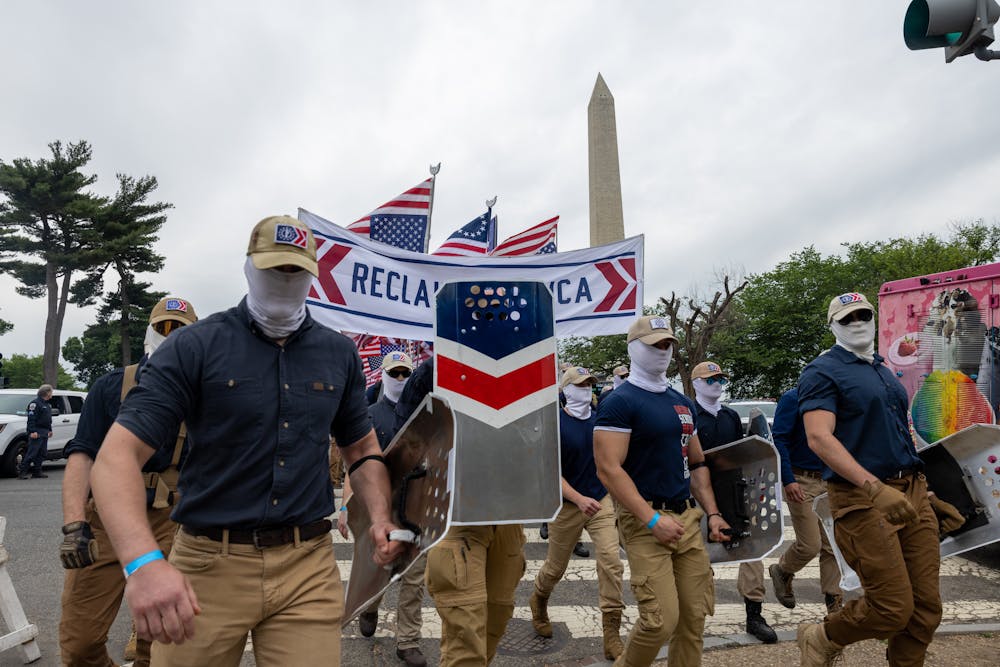
Patriot Front – labeled a ‘white supremacist group’ by the Anti-Defamation League – marches in Washington, D.C., in May 2023.
Nathan Posner/Anadolu Agency via Getty Images
Social disruption and destruction
These comments make clear that fascists see violence as something to be used for more than just personal retribution and intimidation. It is to be used to create wider social disruption and destruction. Not only are individuals to be subject to attack, but institutions and norms as well.
Consider “The Fourth Turning: An American Prophecy,” a work by two amateur historians popular on the far right.
The book is actually a restatement of Evola’s theory of historical regression, set forth in his “Revolt against the Modern World.”
The idea is that history moves in cycles, the first one being the best and each one thereafter representing a further decline. The fourth cycle is the worst, and it ends only when all existing social institutions are destroyed. This, in turn, is an application of the philosopher Friedrich Nietzsche’s idea that “one can build only in a space which has been previously razed to the ground.”
Then history will reset and cycle once again.
Trump’s former adviser Steve Bannon admires these ideas so much he made a movie about them.
Trump appears to embrace these ideas too. “When the economy crashes, when the country goes to total hell, and everything is a disaster, then you’ll have riots to go back to where we used to be, when we were great,” he says.
Viewed in this context, not taking Trump’s violent rhetoric more seriously seems dangerous indeed.
Mark R. Reiff, Research Affiliate in Legal and Political Philosophy, *University of California, Davis
This article is republished from The Conversation under a Creative Commons license. Read the original article.
---
---
Christian nationalist GOP lawmaker cites the Book of Genesis to explain her vote - Alternet.org
===
an 7 23
to get a sense of how far to the right the Republican Party has moved, one need only compare 2023's MAGA Republicans to politicians who were considered arch-conservative during the 1960s and 1970s. President Richard Nixon, Sen. Barry Goldwater (R-Arizona) and the National Review's William F. Buckley were highly influential conservatives back then, but the MAGA Republicans of today would dismiss them as RINOs: Republicans In Name Only.
Nixon would be condemned for supporting environmentalism and universal healthcare, and Goldwater's disdain for the Religious Right would be as much of a deal breaker as Buckley's decision to exclude the John Birch Society from the National Review. Veteran Washington Post columnist and ex-Republican George Will, once the United States' most famous conservative journalist next to Buckley, is now an outcast in the MAGA movement.
In his new book "The Age of Insurrection: The Radical Right's Assault on American Democracy," journalist David Neiwert takes an in-depth look at the gains that the far right has made since Donald Trump's 2016 presidential campaign and the rise of his MAGA movement. Violent extremism, Neiwert warns, has become increasingly widespread in the United States.
READ MORE:Proud Boys verdict is in: Guilty of seditious conspiracy
The Guardian's Charles Kaiser, in an "Age of Insurrection" review published on July 5, explains, "Right-wing extremism has always been a feature of American life, from the diehard supporters of slavery in the 19th Century to the 20,000 fascists who filled Madison Square Garden in 1939 and the violent opponents of integration who beat and killed civil rights workers and leaders throughout the 1960s. Today, this ugly tradition of hatred is perpetuated by dozens of vile groups, from the Proud Boys and the Oath Keepers to the Family Research Council and a slew of Christian nationalist organizations."
Kaiser continues, "But as the investigative reporter David Neiwert argues in his terrifying new book, there is one terrible difference: the relentless mainstreaming of such disgusting ideas. The white nationalist ideology which inspired Payton Gendron to travel 200 miles to massacre 10 people in a Black Buffalo neighborhood is becoming as American as cherry pie."
Neiwert's book, according to Kaiser, "offers some of the most detailed descriptions I have read of the movement's biggest moments, including Charlottesville and the January 6 Capitol attack." And he "documents how so many far-right conspiracies have made their way into the mainstream, especially the Great Replacement theory, which says progressives want to flood the country with immigrants, to undermine white citizens."
"How successful has this effort been?" Kaiser observes. "In 2020, the Republican Party refused to withdraw support from of any of the '64 GOP candidates.… with QAnon connections…. Neiwert's book is full of reminders of how social media promote right-wing lies. When a veteran of the Tea Party movement teamed up with two ex-writers for Steve Bannon's Breitbart News to start a 'Stop the Steal' Facebook group in November 2020, it got 300,000 followers in 24 hours…. The book ends with a horrifying description of how the movement has metastasized since the January 6 attack."
Kaiser continues, "By fall 2021, Proud Boys and 'patriots' were everywhere, harassing 'LGBTQ+-friendly teens at libraries, mask-promoting school board members and mall shops that required masks.' In Trump-loving rural areas, daily life 'had become filled with foreboding, intimidation, threats and ugliness, all emanating from authoritarian right-wingers directing their aggression at anyone who failed to follow their dictates.' America's only hope lies in the power of important books like this one to inspire decent citizens to redouble their efforts to defeat these vile scourges of freedom and democracy."
READ MORE: 'Treacherous march of normalization': ABC News slammed for 'puff piece' on Moms for Liberty
charles Kaiser's full review of David Neiwert's book is available at this link.
FROM YOUR SITE ARTICLES
- Bill Maher: Trump’s allies are 'playing with the kind of fire' that 'made Northern Ireland a living hell' ›
- 'Our work will continue': Merrick Garland speaks after Proud Boys and Oath Keepers convictions ›
- Judge orders Proud Boys to pay more than $1M over destruction of Black DC church’s property: report ›
RELATED ARTICLES AROUND THE WEB
- Oath Keepers founder Stewart Rhodes sentenced to 18 years for ... ›
- Bill Maher Compares "National Divorce" Concept To Ireland's ... ›
- Proud Boys Fined $1 Million for Destroying Property of Black Church
===
===