NOIA nat ocean ind ass
3 org for offshore oil
how a Top Climate Consultancy is Greenwashing Fossil Fuels
Multinational consultancy ICF is well known for its government climate work, but the fossil fuel industry also pays the firm to produce reports it uses to promote oil and gas.

Last spring, the National Ocean Industries Association (NOIA), a trade organization representing offshore oil and gas producers, made a startling claim: Producing more oil in the Gulf of Mexico can help “[drive] climate progress forward.”
To support that claim, NOIA cited a new report by ICF, a multinational consultancy known for its rigorous technical analyses on climate and energy topics, in addition to working in healthcare, education, and other sectors. This report, which NOIA hired ICF to write, looked at the emissions associated with producing a barrel of oil in the Gulf and compared them with the emissions tied to oil production in other parts of the world. Wells in the Gulf, ICF found, have relatively high productivity and lower methane emissions compared to others around the world.
ICF did not make any policy recommendations based on these findings—in fact, a disclaimer at the top of the report states that the “non-partisan, non-political” firm doesn’t take advocacy positions at all. But the group that paid for the report had a clear takeaway: policymakers should embrace Gulf of Mexico oil production as a “climate-smart” way of meeting America’s energy needs, as NOIA president Erik Melito put it in a blog post reviewing the ICF report’s findings last May.
A report like this might give the impression that ICF is merely a clearinghouse for fossil fuel industry talking points. But ICF is a respected consultancy with serious environmental credentials that plays a key role in implementing the US climate and energy agenda. For decades, ICF has worked with the Environmental Protection Agency on important technical reports like its annual greenhouse gas inventory. ICF also administers key federal climate and energy programs for the EPA and the Department of Energy. States that are leading the way on climate action also rely on ICF’s technical expertise: They contributed to and reviewed New York’s energy chapter of a statewide climate assessment and prepared an affordability study that will inform the state’s forthcoming cap-and-invest plan. ICF consultants have even helped coordinate and co-author the National Climate Assessment, an authoritative federal government report on how climate change is impacting every corner of the nation.
But while ICF touts this climate-positive work on its website and in corporate reports, an investigation by Drilled found that the firm also works for pro-fossil fuel lobbying groups like NOIA, the American Gas Association, and the American Petroleum Institute. These organizations have paid ICF contractors hundreds of thousands of dollars for their services since 2018, according to publicly available tax filings. The end result is technical reports that the industry can use to fight decarbonization efforts or greenwash oil and gas.
Lauren Dyke, head of media relations at ICF, told Drilled that in 2023, less than 0.1 percent of the firm’s overall revenue of nearly $2 billion came “fossil fuel producers, subsidiaries, and related industry associations,” calling it a “negligible amount.” ICF, Dyke told Drilled, is “a highly credible provider of independent, objective, science-based expertise, analysis and insight.” Dyke stressed that the consultancy “does not take policy positions” and that “[a]ny decisions to assign interpretations to our analysis are exclusively the domain of our clients.”
But outside experts contacted by Drilled felt that the image of objectivity ICF works hard to cultivate is part of what makes its work for fossil fuel trade organizations so problematic. Anexplicit part of the gas industry’s strategy for building its own political influence is to partner with credible consultancies. When it’s able to hire those consultancies to generate reports that support industry policy positions, “it muddies the waters of what’s real and what’s not,” said Julie McNamara, a climate and energy policy director at the Union of Concerned Scientists.
“Analyses are only as good as the questions being asked and the assumptions being employed,” Julie McNamara said. “To me that’s one of the most insidious things about an organization that will simultaneously do [reports] for fossil fuel lobby groups on the one hand and state policy implementation on the other. ”
For more on this story, check out the corresponding podcast episode here:
ICF’s recent report for NOIA illustrates McNamara’s point. While the report’s topline conclusion—that oil from the Gulf is less emissions-intensive than oil produced elsewhere in the world—may be backed up by solid numbers, the analysis focused solely on emissions associated with oil production while ignoring the (much larger) emissions tied to its use. This “deceives the audience about the degree to which [greenhouse gas]emissions are actually less,” Donald Boesch, a professor emeritus at the University of Maryland Center for Environmental Science, told Drilled. Boesch pointed out that expanding oil production in the Gulf would undermine the Paris Agreement goal of limiting warming to 1.5 degrees Celsius, which requires eliminating global carbon emissions by 2050. Yet after the report was published, NOIA, and Republican members of Congress, called for doing exactly that.
In the past five years, ICF has produced other reports for fossil fuel lobby groups that highlight industry-favored climate solutions, such as replacing the fossil gas in today’s pipelines with so-called “renewable natural gas” (RNG) made from waste methane from things like animal manure, and expanding the production of “blue hydrogen,” or hydrogen produced by burning fossil gas. Both blue hydrogen and RNG are frequently touted by the fossil fuel industry as low-carbon fuels that perpetuate the use of gas and gas pipelines, although independent, peer-reviewed analyses raise serious doubts about whether either would be effective at reducing carbon emissions on a large scale.
ICF also conducted the analysis behind a 2021 American Gas Association report that outlines four different “pathways” the gas industry can follow to achieve net zero emissions by 2050. By doing things like increasing the energy efficiency of buildings, reducing methane leaks, and expanding production of RNG and hydrogen, the report concludes that the gas industry can, in theory, cancel out its emissions by mid-century. The report did not attempt to calculate the cost of its different pathways or compare them to a scenario in which the country embraces renewable energy technologies like wind and solar. Nevertheless, AGA has touted the report’s findings as proof that the gas industry “will be essential to meeting our nation’s greenhouse gas emissions reduction goals.”
Emilia Piziak, a senior policy analyst at the climate change think tank InfluenceMap, says she’s seen AGA repeatedly cite the 2021 report in comments to lawmakers, regulators, and business leaders, “to the point where it's rare to find any written comments without it.” Piziak said AGA also routinely cites a series of case studies branching off a 2018 report it paid ICF to prepare in comments opposing building electrification measures. The 2018 report warns that residential electrification mandates would cause ratepayers’ utility bills to balloon.
As Dyke of ICF emphasized in a statement to Drilled, reports like these constitute a small part of ICF’s overall revenue. The firm’s “largest areas of work,” Dyke said, include partnering with utilities to implement energy efficiency programs, and working with federal, state, and local governments on energy efficiency and decarbonization plans.
Even so, ICF’s fossil fuel industry work may be helping the firm attract other clients—including government agencies who want similar analyses done.
In 2020, the New York State Energy Research and Development Authority, or NYSERDA, directed ICF to produce a report on statewide RNG production potential that would inform policymakers about the role RNG could play in meeting New York’s climate goals. The senior consultant, former ICF staffer Maurice Oldham, includes a link to a 2019 RNG report for the pro-gas lobbying group American Gas Foundation as one of his “key contributions” in his role at ICF on his LinkedIn page. ICF Director of Transportation and Energy Philip Sheehy, whose official bio states that he led the American Gas Foundation report, also participated in the NYSERDA project, according to a copy of ICF’s contract with the agency that Drilled obtained via a state records request.
In the gas industry report from 2019, ICF examined nationwide RNG production potential by creating a state-by-state database of different potential feedstocks. In its New York state contract, NYSERDA directs ICF to “draw from that work [for the American Gas Foundation] and augment the database for this project with on-the-ground and local information.” A NYSERDA spokesperson declined to say how exactly the gas industry report informed its statewide RNG study, but noted that with every analysis, “NYSERDA staff apply their subject matter expertise and analytical training to a project’s overall structure and format, the inputs and research design, data assessment and examination of analysis or modeling results.”
NYSERDA’s final report, published in April 2022, suggests that by 2040, RNG could offset up to about 11% of the state’s 2017 natural gas usage. RobertHowarth, a professor of ecology at Cornell University and a member of the New York State Climate Action Council, which helps craft state climate policy, called this figure “very, very optimistic.” A separate analysis Howarth conducted found that RNG could potentially replace up to 2.6 percent of the state’s fossil gas usage. Ultimately, New York’s “Scoping Plan” scenarios for how it will reduce greenhouse gas emissions wound up relying on RNG for just 2% of its 2050 energy needs, a NYSERDA spokesperson said.
A former ICF staffer who worked on climate and energy issues at the firm told Drilled that it wasn’t unusual for industry clients and government agencies to contract ICF to conduct similar studies, oftentimes using the same modeling tools. In some cases, the former staffer said, the client would define the scenarios being modeled.
“But in that case…it would be very clearly stated in that way,” said the former staffer, adding that ICF tried to be “very cautious” to ensure that when a client made a decision that shaped a study, or if a client had a policy takeaway from ICF’s analysis, that was clearly disclosed.
“They were always trying to be the neutral party,” the former staffer said.
But how much consultancies like ICF can really distance themselves from the climate implications of their work is a matter of growing debate. As the role of consultancies in shaping climate and energy policy gains scrutiny, some members of the industry and civil society want to see these firms take more ownership over the impacts of their services for fossil fuel clients—whether it’s the kinds of investments a gas utility decides to make based on a consultant’s advice, or the political consequences of a report that can be used to lobby against climate action.
“The main barrier is that this is not really being discussed—this idea of your influence having a material impact,” said Alexis McGivern, a climate researcher at the University of Oxford.
McGivern co-chairs a working group for the global climate action campaign Race to Zero that’s developing best practice guidance for professional service providers, including consultancies, law firms, and ad agencies, that are interested in aligning their businesses with a net zero emissions future. In late 2023, the group published a paper laying out a draft set of guidelines on “serviced emissions,” or the emissions associated with a firm’s client work. These emissions aren’t covered by the Greenhouse Gas Protocol that many firms across many industries, including ICF, use to track their own carbon footprint. But for professional service providers, they are likely the “most significant” piece of the pie, according to the paper.
Race to Zero’s guidelines include creating an inventory of serviced emissions by mapping clients and projects, considering climate impacts when screening new clients and projects, encouraging clients to lobby for positive climate action, and “plan[ning] for the decline” of high carbon industries. McGivern was careful to note this last recommendation does not mean firms like ICF must sever all ties with the fossil fuel industry—an idea she says consultancies that offered input on the guidelines pushed back against—but that they should focus on projects that help the industry reduce its emissions or transition to renewables.
Dyke told Drilled that ICF had “no comment” on the working paper’s proposals but was confident that “any credible, measurable analysis of emissions related to ICF’s work with its clients would underscore the massive amount of GHG and carbon reductions we have achieved together.”
McGivern acknowledged that reports ostensibly focused on climate solutions, like RNG or blue hydrogen are “a bit of a gray space,” especially when they are used by industry to lobby against climate action. A common refrain from the consultancies McGivern spoke with was “we just wrote this report…and it got taken completely out” of context.
“Part of that might be true,” McGivern said. “And then partly I think it’s like, ‘you’re not an idiot—you can figure it out.’”
off bs
https://www.noia.org/
1120 G Street, NW • Suite 900
Washington, DC 20005
3 bds?
PAST NOIA CHAIRMEN
| Present: | Tim Duncan, Talos Energy |
|---|---|
| 2020-2021 | Galen Cobb, Halliburton |
| 2019-2020 | Richard Clark, Kosmos Energy |
| 2018-2019 | John Gellert, SEACOR Marine |
| 2017-2018 | Dave Welch, Stone Energy Corporation |
| 2016-2017 | Kevin McEvoy, Oceaneering International, Inc. |
| 2015-2016 | Cindy Taylor, Oil States International |
| 2014-2015 | John Rynd, Hercules Offshore |
| 2013-2014 | Dick Alario, Key Energy Services |
| 2012-2013 | Bill E. Chiles, Bristow, Inc. |
| 2011-2012 | Jack Moore, Cameron |
| 2010-2011 | Burt Adams, OGRS, LLC |
| 2009-2010 | T. Jay Collins, Oceaneering International, Inc. |
| 2008-2009 | Dean Taylor, Tidewater, Inc. |
| 2007-2008 | Lawrence Dickerson, Diamond Offshore Drilling, Inc. |
| 2006-2007 | Christopher Seaver, Hydril Company LP |
| 2005-2006 | Jon A. Marshall , GlobalSantaFe Corporation |
| 2004-2005 | George Boyadjieff, Varco International, Inc. |
| 2003-2004 | Carroll W. Suggs, GlobalSantaFe Corporation |
| 2002-2003 | Carl F. Thorne, ENSCO International Inc. |
| 2001-2002 | J. Michael Talbert, Transocean Inc. |
| 2000-2001 | Richard M. Currence, Tidewater Inc. |
| 1999-2000 | Donald T. "Boysie" Bollinger, Bollinger Shipyards Inc. |
| 1998-1999 | William E. Bradford, Halliburton Company |
| 1997-1998 | Robert E. Rose, Diamond Offshore Drilling, Inc. |
| 1996-1997 | Matthew R. Simmons, Simmons & Company International |
| 1995-1996 | Nathan M. Avery, Galveston-Houston Company |
| 1994-1995 | James C. Day, Noble Drilling Corporation |
| 1993-1994 | Dale P. Jones, Halliburton Company |
| 1992-1993 | William C. O'Malley, Sonat Offshore Drilling Inc. |
| 1991-1992 | James D. Woods, Baker Hughes Inc. |
| 1990-1991 | John J. Murphy, Dresser Industries, Inc. |
| 1989-1990 | Robert E. Howson, McDermott International |
| 1988-1989 | Hugh J. Kelly, Ocean Drilling &, Exploration Company |
| 1987-1988 | Charles P. Siess, Jr., Marathon Manufacturing Company |
| 1986-1987 | W. Herbert Hunt, Penrod Drilling Company |
| 1985-1986 | R. Nelson Crews, Raymond International |
| 1984-1985 | Philip Burguieres, Cameron Iron Works |
| 1983-1984 | C. Robert Palmer, Rowan Companies, Inc. |
| 1982-1983 | James R. Lesch, Hughes Tool Company |
| 1981-1982 | Edward A. Wardwell, Oceaneering International, Inc. |
| 1980-1981 | John P. Laborde, Tidewater Inc. |
| 1979-1980 | Edfred L. Shannon, Jr., Santa Fe International |
| 1978-1979 | E.C. Broun, Jr., Petroleum Services Group, Dresser Industries, Inc. |
| 1977-1978 | W. Henson Moore, Sr., The Offshore Company |
| 1976-1977 | Robert H. Etnyre, National Supply Company |
| 1975-1976 | Carl H. Savit, Western Geophysical |
| 1973-1975 | George B. Grafton, Marlin Drilling Company |
| 1972-1973 | John G. Macklin, Fluor Ocean Services |
Former NOIA Presidents | Former NOIA Presidents |
| 2010-2019 | Randall Luthi, NOIA President |
| 2000-2010 | Tom Fry, NOIA President |
| 1990-2000 | Robert B. Stewart, NOIA President |
| 1972-1990 | Charles D. Matthews, NOIA President |
| Catherine Brown | Chief Operating Officer | 2021-08-27 | |
|---|---|---|---|
| Justin Williams | Senior Director / Vice President , Communications | $101,664 | 2021-08-27 |
| Franki Stuntz | Senior Vice President Administration and Membership | $177,683 | 2019-12-31 |
public cit b buddies
Independent Petroleum Association of America: Public record requests indicate extensive connections between the IPAA and the Interior Department. Bernhardt did legal work for this trade group, which represents producers and refiners of oil and gas, and which has long been critical of endangered species protections, including for the greater sage grouse and American burying beetle, that make drilling on public lands more difficult. Just months into the Trump administration, the IPAA’s CEO, Barry Russell, noted in a private meeting with his members that Bernhardt had previously led an IPAA legal team set up to challenge federal endangered species rules. “Well, the guy that actually headed up that group is now the No. 2 at Interior,” Russell said, according to Reveal from the Center for Investigative Reporting, which obtained a recording of the event. “So that’s worked out well.”
Emails obtained by the Western Values Project through the Freedom of Information Act indicate that IPAA lobbyists worked closely at the start of the Trump administration to arrange meetings with key Interior Department officials about their plans for the greater sage grouse,a small bird that has faced severe habitat loss. In one e-mail, IPAA lobbyist Samantha McDonald requested a call with an Interior Department official and several oil companies, noting that “to ignore the problem could potential (sic) jeopardize several dozen projects in Wyoming.” The IPAA achieved a long-sought goal in March 2019 when the Trump administration weakened protections on millions of acres of sage grouse habitat, rolling back Obama-era protections that were intended to boost the bird’s population and prevent it from being placed on the endangered species list.
In another case, the IPAA’s McDonald reached out to high-level Interior Department officials on behalf of an IPAA member, Cimarex Energy, to get a drilling permit approved that had been rejected. This incident was first reported by Reveal from the Center for Investigative Reporting. And in yet another case, McDonald pressed Trump administration officials on efforts to remove the American burying beetle from the endangered species list, citing “significant impacts on our Oklahoma producers.” In May 2019, the U.S. Fish and Wildlife Service proposed to downgrade the shiny, orange-spotted beetle from endangered to threatened status, a move the IPAA praised as “long overdue.”
National Ocean Industries Association (NOIA): Bernhardt has a longstanding relationship with this trade group, which represents the offshore oil and gas drilling industry. At Brownstein Hyatt, Bernhardt represented NOIA in a lawsuit brought by environmental groups to challenge an Obama administration offshore lease sale in the Gulf of Mexico after theDeepwater Horizon disaster. Bernhardt appears to have been a regular speaker at NOIA’s annual meetings, speaking at a 2011 spring meeting, appearing in photos with former Vice President Dick Cheneyand industry executives at the group’s fall 2013 meeting, and speaking again at the 2014 annual meeting. At the latter event, Bernhardt gave a presentation on regulatory issues in the wake of the April 2010 oil rig explosion, which killed 11 people and triggered an 87-day oil spill. In the presentation, Bernhardt argued that federal rules “do not impose liability on contractors” such as Halliburton, the BP contractor that was found to have used flawed cement at the BP offshore well. “The agency’s actions create a minefield where regulations are applied to an entire class of people to whom the application of the regulations was never contemplated,” Bernhardt wrote. The Fifth U.S. Circuit Court of Appeals in 2017 ruled in favor of the industry’s argument, holding that the Interior Department’s oil drilling safety division does not have authority over contractors.
Page 1 of David Bernhardt: Offshore Issues a Look Ahead Panel Presentation(4/2014)]
Under the Trump administration, the Interior Department has been receptive to input from NOIA officials and members. A report from Documented identified 12 meetings between NOIA and Interior Department officials in 2017 and 2018. The Trump administration has been eager to grant the offshore oil drilling industry’s wishes, including rollback of offshore oil drilling safety rules imposed after the 2010 Deepwater Horizon disaster.
:{
}:
The Interior Department even approved hundreds of onshore and offshore drilling permits and leases during the 35-day government shutdown of 2019, a departure from Interior’s past practice. However, a White House executive order repealing an Obama-era ban on offshore drilling was blocked by a federal judge in March 2019 and, as result, has been delayed indefinitely. Meanwhile, bipartisan opposition to offshore drilling has been growing, with Sen. Marco Rubio (R-Fla.) temporarily blocking the confirmation of Bernhardt’s deputy, Katharine MacGregor, over concerns about the Trump administration’s stance on oil drilling off the Florida coast...
sue s fac so:
:{Last week U.S. Interior Secretary Ryan Zinke announced that President Trump plans to issue an executive order expanding offshore drilling in areas now off limits, including the Atlantic Ocean and parts of the Arctic.
Trump's order would amend the Obama administration's five-year drilling plan that excluded lease auctions in those areas through 2022. It would also open the door to reversing President Obama's decision to permanently withdraw most of the U.S. Arctic and an area of the Atlantic stretching from New England to the Maryland-Virginia border from the federal offshore leasing program — an effort that environmentalists think would be ultimately unsuccessful due to how laws governing offshore drilling are written.}:
Although the decision could affect thousands of square miles of ocean waters, the Trump administration's offshore drilling plans weren't announced at a press conference or other public setting. Instead, Secretary Zinke, a former Montana congressman who earned low marks for his environmental record during his two-year tenure in the U.S. House, unveiled the proposal at a closed-door meeting of theNational Ocean Industries Association (NOIA) in Washington, D.C. His remarks were reported by Bloomberg, who spoke to three attendees on condition of anonymity.
So what is NOIA, and how did it come to have such clout?
Launched by oil giant Exxon in the 1970s, NOIA is a trade association that advocates for the offshore drilling industry. Its 300 member companies include oil and gas "supermajors" like BP, Chevron, Exxon Mobil and Shell, as well as drilling contractors, seismic testing firms and shipbuilders. The group also includes banking and investment firms that serve the industry such as Capital One, Credit Suisse and Wells Fargo Energy Group.
NOIA's CEO is Randall Luthi, a former Wyoming state lawmaker and aide to Dick Cheney when the former vice president served in Congress. Luthi (in photo) served in the Department of Interior under Presidents Reagan and George H.W. Bush and as deputy director of the U.S. Fish and Wildlife Service under George W. Bush. According to the most recent publicly available NOIA tax filing, NOIA has an annual budget of over $3 million and pays Luthi over $600,000.
From mid-2007 to late 2009, Luthi served as head of Interior's Minerals Management Service (MMS), which was reorganized after BP's 2010 Deepwater Horizon disaster due to conflict-of-interest and oversight issues. During his tenure, the agency wasembroiled in an ethics scandal involving allegations of financial self-dealing, accepting gifts from energy companies, cocaine use and sexual misconduct. The wrongdoing reportedly occurred between 2002 and 2006, before Luthi came to the agency, and Luthi has said MMS requested an investigation by the agency's inspector general after receiving whistle-blower complaints in the spring of 2006.
But Luthi was the central figure in another controversy over the revolving door between MMS and the oil and gas industry, an issue that drew criticism from public interest groups for many years. Just over a year after leaving his post at the regulatory agency, Luthi became president of NOIA and began advocating for the industry's interests with the agency he used to lead. In 2010 testimony before a U.S. House committee, the watchdog Project on Government Oversight (POGO) called Luthi's move to NOIA "the most egregious example" of the MMS revolving-door problem.
"When the director of MMS joins a trade association whose explicit mission was to secure a 'favorable regulatory and economic environment for the companies that develop the nation's valuable offshore energy resources,' taxpayers have to question whose interests were actually being served when he was at MMS," said POGO Executive Director Danielle Brian. "In the case of Mr. Luthi — who joined the trade association approximately 14 months after leaving MMS — it's unclear whether he was always ideologically opposed to the agency's mission."
NOIA's strategic campaign giving
In 2011, the governors of Southern states launched an initiative to expand offshore drillingin Atlantic waters.The Outer Continental Shelf Governors Coalition, which was led by formerNorth Carolina Gov. Pat McCrory, was administered behind the scenes by a front group for oil and gas industry lobbyists called the Consumer Energy Alliance, of which NOIA is a member.
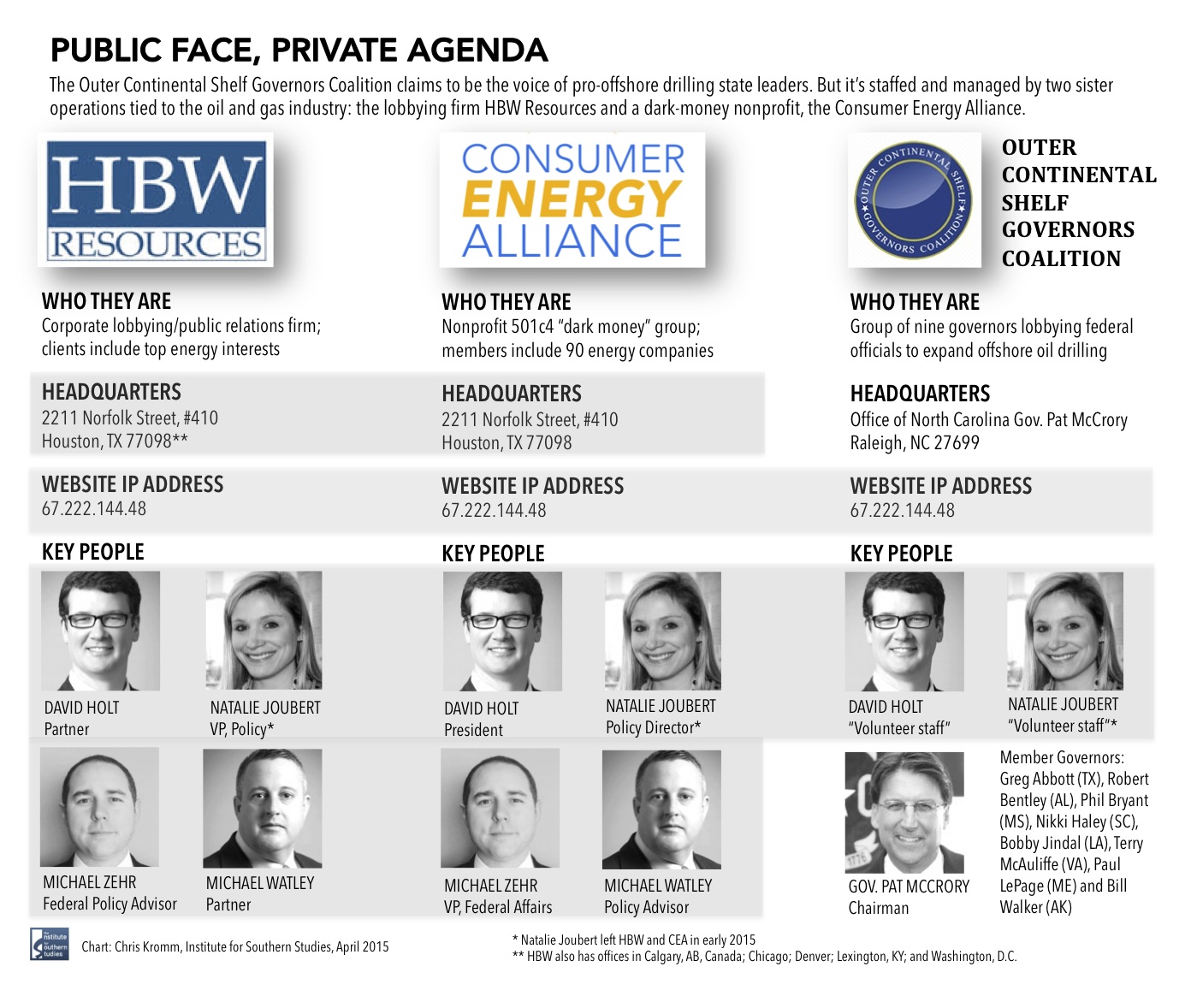
Since then, NOIA has spent $279,000 lobbying Congress, the Department of the Interior, the Commerce Department and the National Oceanic and Atmospheric Administration, according to the Center for Responsive Politics' OpenSecrets.org database.
A political action committee tied to NOIA has also spent over $700,000 since 2011 supporting the campaigns of key members of Congress. Among the top beneficiaries of the NOIA PAC were representatives from Southeastern states where the industry is pushing for seismic testing for oil and gas reserves, and eventually offshore drilling:
:{* In the 2016 election cycle, NOIA's PAC was a top contributor to lawmakers including Reps. Scott Rigellof Virginia, Richard Hudson and David Rouzer of North Carolina, and Jeff Duncan of South Carolina, according to OpenSecrets.org. Rigell left office in January after deciding not to run for re-election.
* In the 2014 cycle, NOIA's PAC was a top contributor to Reps. Morgan Griffith of Virginia, Mark Meadows of North Carolina, Mick Mulvaney of South Carolina (now Trump's budget director), and John Mica and Steve Southerland of Florida. During this election cycle the energy industry PAC was also a top contributor to U.S. Sen.Tim Scott of South Carolina.
* In the 2012 cycle, NOIA's PAC was a top contributor to Reps. Rob Wittman of Virginia and Florida's Tom Rooney and Connie Mack, who has since left office to become a lobbyist.
Other members of Congress receiving donations from the NOIA PAC during those election cycles were Reps. Bob Goodlatte of Virginia; Patrick McHenry andRobert Pittenger of North Carolina; Jim Clyburn, Trey Gowdy, Tom Rice, Mark Sanford andJoe Wilson of South Carolina; Sanford Bishop of Georgia; and Carlos Curbelo, Bill Posey and Dennis Ross of Florida. Beneficiaries also included former Reps. Eric Cantor of Virginia, Renee Ellmers of North Carolina and Georgia's John Barrow, Paul Broun, Phil Gingrey and Tom Price, who's now Trump's secretary of Health and Human Services.
On the Senate side, additional recipients of NOIA PAC contributions during the past three key election cycles included Richard Burr and Thom Tillis of North Carolina,Marco Rubio of Florida and David Perdue of Georgia. NOIA also contributed to the unsuccessful 2012 U.S. Senate campaign of George Allen of Virginia and to the campaign of former Sen. Jim DeMint of South Carolina, who resigned in 2013 to serve as president of The Heritage Foundation, a conservative think tank.}:
All of those lawmakers are Republicans except for Reps. Clyburn of South Carolina and Barrow and Bishop of Georgia. NOIA's political donations overwhelmingly favor Republicans; in the 2016 election cycle, for example, 95 percent of its contributions went to GOP candidates, according to OpenSecrets.org.
NOIA's political giving will help position it in what's sure to be a pitched political battle over any Trump administration efforts to open the Atlantic to drilling. The push to allow oil and gas exploration in the region under the Obama administrationsparked an uprising by Atlantic Coast residents and their representatives concerned about the impact on local economies dependent on tourism and fishing, and ultimately led the Obama administration to cancel plans to open the area to drilling.
To date, more than 120 East Coast municipalities, over 1,200 elected officials and an alliance representing over 35,000 businesses and 500,000 fishing families have publicly opposedoffshore drilling and/or seismic testing in the Atlantic. They include NOIA political beneficiaries Reps. Sanford of South Carolina and Posey of Florida, showing that getting money from the organization does not necessarily translate into supporting its agenda.
==