Offshore Oil Drilling
OFFSHORE OIL 2 4/17
promoted to primary 7/15 offshore fracking CA
shell drills arctic, BP gulf spill, Obama opened up vast chunks
==
ExxonMobil has engaged in a March advertising blitz, repeatedly airing a new commercial during national cable news channel breaks and prominently, during TV timeouts during the National Collegiate Athletic Association (NCAA) Division I basketball tournament, better known as March Madness.
The commercial vaguely promotes what Exxon says is a new jobs initiative, which it claims will create 45,000 positions along the U.S. Gulf of Mexico, without specifying details about the source of the jobs. Yet far from Madison Avenue advertising firms, a local battle has taken place the past several months in Gulf Coast communities over the prospective siting of and tax breaks for a proposed Exxon refinery co-owned by the Saudi Arabian state-owned company, SABIC (Saudi Basic Industries Corporation).
A mere three weeks into the ad blitz, two Texas entities voted to give tax subsidies to the proposed facility, dubbed Gulf Coast Growth Ventures. Both representing San Patricio County, Texas, the San Patricio County Board of Commissioners and the Gregory-Portland Independent School District offered Growth Ventures over $1.4 billion in tax breaks for the $9.4 billion Exxon-SABIC plant.
==
http://www.ecowatch.com/trump-expand-offshore-drilling-2383011441.html
==
sue s fac so:
:{Last week U.S. Interior Secretary Ryan Zinke announced that President Trump plans to issue an executive order expanding offshore drilling in areas now off limits, including the Atlantic Ocean and parts of the Arctic.
Trump's order would amend the Obama administration's five-year drilling plan that excluded lease auctions in those areas through 2022. It would also open the door to reversing President Obama's decision to permanently withdraw most of the U.S. Arctic and an area of the Atlantic stretching from New England to the Maryland-Virginia border from the federal offshore leasing program — an effort that environmentalists think would be ultimately unsuccessful due to how laws governing offshore drilling are written.}:
Although the decision could affect thousands of square miles of ocean waters, the Trump administration's offshore drilling plans weren't announced at a press conference or other public setting. Instead, Secretary Zinke, a former Montana congressman whoearned low marksfor his environmental record during his two-year tenure in the U.S. House, unveiled the proposal at a closed-door meeting of the National Ocean Industries Association (NOIA) in Washington, D.C. His remarks werereported by Bloomberg, who spoke to three attendees on condition of anonymity.
So what is NOIA, and how did it come to have such clout?
Launched by oil giant Exxon in the 1970s, NOIA is a trade association that advocates for the offshore drilling industry. Its300 member companiesinclude oil and gas "supermajors" like BP, Chevron, Exxon Mobil and Shell, as well as drilling contractors, seismic testing firms and shipbuilders. The group also includes banking and investment firms that serve the industry such as Capital One, Credit Suisse and Wells Fargo Energy Group.
NOIA's CEO is Randall Luthi, a former Wyoming state lawmaker and aide to Dick Cheney when the former vice president served in Congress. Luthi (in photo) served in the Department of Interior under Presidents Reagan and George H.W. Bush and as deputy director of the U.S. Fish and Wildlife Service under George W. Bush. According to the most recent publicly available NOIA tax filing, NOIA has an annual budget of over $3 million and pays Luthi over $600,000.
From mid-2007 to late 2009, Luthi served as head of Interior's Minerals Management Service (MMS), which was reorganized after BP's 2010 Deepwater Horizon disaster due to conflict-of-interest and oversight issues. During his tenure, the agency wasembroiled in an ethics scandalinvolving allegations of financial self-dealing, accepting gifts from energy companies, cocaine use and sexual misconduct. The wrongdoing reportedly occurred between 2002 and 2006, before Luthi came to the agency, and Luthi has said MMS requested an investigation by the agency's inspector general after receiving whistle-blower complaints in the spring of 2006.
But Luthi was the central figure in another controversy over the revolving door between MMS and the oil and gas industry, an issue that drew criticism from public interest groups for many years. Just over a year after leaving his post at the regulatory agency, Luthi became president of NOIA and began advocating for the industry's interests with the agency he used to lead. In 2010 testimony before a U.S. House committee, the watchdog Project on Government Oversight (POGO) called Luthi's move to NOIA "the most egregious example" of the MMS revolving-door problem.
"When the director of MMS joins a trade association whose explicit mission was to secure a 'favorable regulatory and economic environment for the companies that develop the nation's valuable offshore energy resources,' taxpayers have to question whose interests were actually being served when he was at MMS,"saidPOGO Executive Director Danielle Brian. "In the case of Mr. Luthi — who joined the trade association approximately 14 months after leaving MMS — it's unclear whether he was always ideologically opposed to the agency's mission."
NOIA's strategic campaign giving
In 2011, the governors of Southern states launchedan initiative to expand offshore drillingin Atlantic waters. The Outer Continental Shelf Governors Coalition, which was led by former North Carolina Gov. Pat McCrory, was administered behind the scenes bya front groupfor oil and gas industry lobbyists called the Consumer Energy Alliance, of whichNOIA is a member.
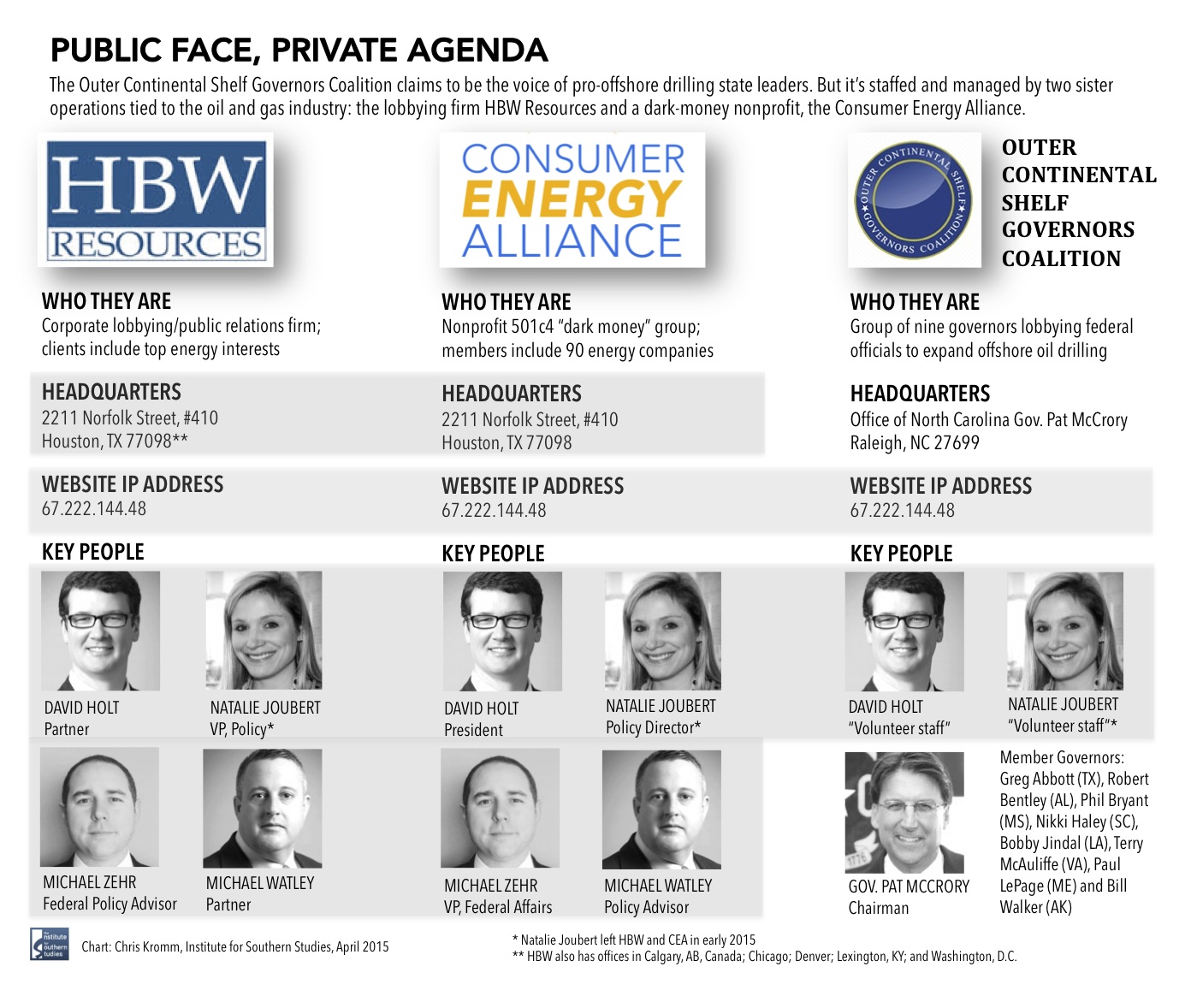
Since then, NOIA has spent $279,000 lobbying Congress, the Department of the Interior, the Commerce Department and the National Oceanic and Atmospheric Administration, according to the Center for Responsive Politics'OpenSecrets.org database.
A political action committee tied to NOIA has also spent over $700,000 since 2011 supporting the campaigns of key members of Congress. Among the top beneficiaries of the NOIA PAC were representatives from Southeastern states where the industry is pushing for seismic testing for oil and gas reserves, and eventually offshore drilling:
:{* In the 2016 election cycle, NOIA's PAC was a top contributor to lawmakers including Reps. Scott Rigellof Virginia, Richard Hudson and David Rouzer of North Carolina, and Jeff Duncan of South Carolina, according to OpenSecrets.org. Rigell left office in January after deciding not to run for re-election.
* In the 2014 cycle, NOIA's PAC was a top contributor to Reps. Morgan Griffith of Virginia, Mark Meadows of North Carolina, Mick Mulvaney of South Carolina (now Trump's budget director), and John Mica and Steve Southerland of Florida. During this election cycle the energy industry PAC was also a top contributor to U.S. Sen.Tim Scott of South Carolina.
* In the 2012 cycle, NOIA's PAC was a top contributor to Reps. Rob Wittman of Virginia and Florida's Tom Rooney and Connie Mack, who has since left office to become a lobbyist.
Other members of Congress receiving donations from the NOIA PAC during those election cycles were Reps. Bob Goodlatte of Virginia; Patrick McHenry andRobert Pittenger of North Carolina; Jim Clyburn, Trey Gowdy, Tom Rice, Mark Sanford andJoe Wilson of South Carolina; Sanford Bishop of Georgia; and Carlos Curbelo, Bill Posey and Dennis Ross of Florida. Beneficiaries also included former Reps. Eric Cantor of Virginia, Renee Ellmers of North Carolina and Georgia's John Barrow, Paul Broun, Phil Gingrey and Tom Price, who's now Trump's secretary of Health and Human Services.
On the Senate side, additional recipients of NOIA PAC contributions during the past three key election cycles included Richard Burr and Thom Tillis of North Carolina,Marco Rubio of Florida and David Perdue of Georgia. NOIA also contributed to the unsuccessful 2012 U.S. Senate campaign of George Allen of Virginia and to the campaign of former Sen. Jim DeMint of South Carolina, who resigned in 2013 to serve as president of The Heritage Foundation, a conservative think tank.}:
All of those lawmakers are Republicans except for Reps. Clyburn of South Carolina and Barrow and Bishop of Georgia. NOIA's political donations overwhelmingly favor Republicans; in the 2016 election cycle, for example, 95 percent of its contributions went to GOP candidates, according to OpenSecrets.org.
NOIA's political giving will help position it in what's sure to be a pitched political battle over any Trump administration efforts to open the Atlantic to drilling. The push to allow oil and gas exploration in the region under the Obama administrationsparked an uprisingby Atlantic Coast residents and their representatives concerned about the impact on local economies dependent on tourism and fishing, and ultimately led the Obama administration to cancel plans to open the area to drilling.
To date, more than 120 East Coast municipalities, over 1,200 elected officials and an alliance representing over 35,000 businesses and 500,000 fishing familieshave publicly opposedoffshore drilling and/or seismic testing in the Atlantic. They include NOIA political beneficiaries Reps. Sanford of South Carolina and Posey of Florida, showing that getting money from the organization does not necessarily translate into supporting its agenda.
==
http://www.rollingstone.com/politics/features/obama-enacts-offshore-drilling-ban-designed-to-be-trump-proof-w457205
east coast anwr
...Obamabanned all future offshore oil and gas drillingfrom nearly 120 million acres of land in the Atlantic and Arctic oceans. The bans include a series of underwater canyons along the Atlantic stretching from Massachusetts to Virginia, and virtually all of the U.S. Arctic, including the entire U.S. Chukchi Sea and all but about two percent of the U.S. Beaufort Sea.
In a joint announcement with the White House, Canadian Prime Minister Justin Trudeau simultaneously designated all Arctic Canadian waters off-limits to drilling. The bans come as concerns rise that due to Trump's nomination of Exxon Mobil CEO Rex Tillerson as secretary of state, the company will soon begin exploring for oil in the Russian Arctic.
...
Obama banned all future offshore oil and gas drilling from nearly 120 million acres of land in the Atlantic and Arctic oceans. The bans include a series of underwater canyons along the Atlantic stretching from Massachusetts to Virginia, and virtually all of the U.S. Arctic, including the entire U.S. Chukchi Sea and all but about two percent of the U.S. Beaufort Sea.
In a joint announcement with the White House, Canadian Prime Minister Justin Trudeau simultaneously designated all Arctic Canadian waters off-limits to drilling. The bans come as concerns rise that due to Trump's nomination of Exxon Mobil CEO Rex Tillerson as secretary of state, the company will soon begin exploring for oil in the Russian Arctic.
"Holy muskrat, it's good news!" says 69-year-old Native Inupiat Doreen Simmonds, a local leader against drilling in her home community of Barrow, Alaska, on the edge of the Chukchi Sea. "They talk about 'responsible drilling' – that's a lot of anaq [shit]. They always make mistakes. If there was a spill up here in our ice? It would be the end of our water, our land. ... What would be left for my great-grand-kids?"
It was Shell's operations in the Chukchi Sea that set off protests in Seattle and elsewhere last year, pitting "kayaktavists" against Obama.
Though the Canadian ban will be reviewed every five years, President Obama's bans are indefinite and designed to be permanent, akin to the designation of a national monument.
This is likely to make the bans Trump-proof. Unlike an executive order, which can be undone easily by another president, "never in history has a president undone a permanent oil and gas withdrawal of another president," says Niel Lawrence, Alaska director and senior attorney at the Natural Resources Defense Council.
The incoming Congress and administration will surely try, as Alaska's Republican senator, Lisa Murkowski, told Alaska Dispatch News Tuesday. But the fight will be a long one. "I am confident that [the ban] will stand up in court," Lawrence says.
Presidential bans on offshore oil drilling have a long history and are granted through the 1953 Outer Continental Shelf Lands Act, which states, "The President of the United States may, from time to time, withdraw from disposition any of the unleased lands of the outer Continental Shelf."
As Bloomberg reports, "While presidents have modified decisions from their predecessors to withdraw areas from drilling, they have never rescinded them altogether. And it's not clear they would have the power to. A legal opinion from the U.S. attorney general in 1938 said similar designations ‘do not imply a power to undo.' And there have been no federal court rulings on the provision."
Permanent bans to relatively small offshore areas have been enacted by Presidents Eisenhower, Nixon, George H.W. Bush, Clinton and Obama; all of them remain fully intact. In 1990, President Bush enacted a moratorium on all new offshore drilling in the federal waters of the Pacific, Atlantic and most of Alaska. But that was a temporary act, set to expire after ten years. President Clinton extended the moratorium through 2012, only to have the second President Bush cut off its last four years, allowing it to expire in 2008. No president has permanently protected so vast an area of offshore waters from oil and gas drilling as President Obama has now done.
This is a position likely to be popular among Americans, 75 percent of whom, responding to a March Gallup poll, said they preferred alternative energy to the production of oil and gas; that included 51 percent of Republicans. The same month, more than 45 climate, conservation, indigenous and coastal organizations filed a legal petition calling on Obama to end new oil and gas lease auctions in all federally controlled oceans."
"Holy muskrat, it's good news!" says 69-year-old Native Inupiat Doreen Simmonds, a local leader against drilling in her home community of Barrow, Alaska, on the edge of the Chukchi Sea. "They talk about 'responsible drilling' – that's a lot of anaq [shit]. They always make mistakes. If there was a spill up here in our ice? It would be the end of our water, our land. ... What would be left for my great-grand-kids?"
It was Shell's operations in the Chukchi Sea that set off protests in Seattle and elsewhere last year, pitting "kayaktavists" against Obama.
Though the Canadian ban will be reviewed every five years, President Obama's bans are indefinite and designed to be permanent, akin to the designation of a national monument.
This is likely to make the bans Trump-proof. Unlike an executive order, which can be undone easily by another president, "never in history has a president undone a permanent oil and gas withdrawal of another president," says Niel Lawrence, Alaska director and senior attorney at the Natural Resources Defense Council.
The incoming Congress and administration will surely try, as Alaska's Republican senator, Lisa Murkowski, told *Alaska Dispatch News*Tuesday. But the fight will be a long one. "I am confident that [the ban] will stand up in court," Lawrence says.
Presidential bans on offshore oil drilling have a long history and are granted through the 1953 Outer Continental Shelf Lands Act, which states, "The President of the United States may, from time to time, withdraw from disposition any of the unleased lands of the outer Continental Shelf."
As Bloomberg reports, "While presidents have modified decisions from their predecessors to withdraw areas from drilling, they have never rescinded them altogether. And it's not clear they would have the power to. A legal opinion from the U.S. attorney general in 1938 said similar designations ‘do not imply a power to undo.' And there have been no federal court rulings on the provision."
Permanent bans to relatively small offshore areas have been enacted by Presidents Eisenhower, Nixon, George H.W. Bush, Clinton and Obama; all of them remain fully intact. In 1990, President Bush enacted a moratorium on all new offshore drilling in the federal waters of the Pacific, Atlantic and most of Alaska. But that was a temporary act, set to expire after ten years. President Clinton extended the moratorium through 2012, only to have the second President Bush cut off its last four years, allowing it to expire in 2008. No president has permanently protected so vast an area of offshore waters from oil and gas drilling as President Obama has now done.
This is a position likely to be popular among Americans, 75 percent of whom, responding to a March Gallup poll, said they preferred alternative energy to the production of oil and gas; that included 51 percent of Republicans. The same month, more than 45 climate, conservation, indigenous and coastal organizations filed a legal petition calling on Obama to end new oil and gas lease auctions in all federally controlled oceans.
"Permanently shielding these waters from the oil and gas industry is a major milestone for coastal communities that depend on them – as well as a global community acting collectively to mitigate the worst of climate change," Mary Sweeters, an Arctic campaigner with Greenpeace, said in a statement. "But the job will not be done until no new leases are granted anywhere in U.S. waters."
==
http://www.ecowatch.com/offshore-fracking-wells-gulf-1915520170.html
gulf of mex map
As the U.S. shale industry comes under increasing scrutiny for its environmental and health impact, it has emerged that the U.S. has approved fracking offshore leading to billions of gallons of wastewater to be dumped at sea.
The Center for Biological Diversity has released federal documents that reveal that officials approved more than 1,200 offshore fracks in 630 different wells in the four years from 2010 to 2014 in the Gulf of Mexico.
==
Reactions are growing after a recent joint :{study:(style="box-sizing:border-box;margin:0px;padding:0px"):}: by the Bureau of Ocean Energy Management and the Bureau of Safety and Environmental Enforcement.
It found hydraulic fracking off the coast of California poses no “significant” environmental impact. The decision lifts a moratorium triggered earlier this year by a lawsuit from the Center for Biological Diversity. The group said it is considering other legal options to challenge the decision.
The Center for Biological Diversity said in a statement:
Offshore fracking was halted in January after a Center lawsuit challenged the federal government’s rubber-stamping of fracking permits without any analysis of threats to wildlife and ocean ecosystems. The case resulted in a settlement agreement that required the Obama administration to stop authorizing offshore fracking and acidizing until federal officials completed a review of the environmental impacts of the practices.
But today’s finding that offshore fracking has no significant environmental impact glosses over the serious hazards of fracking and fails to answer key questions about the risks of this controversial oil-extraction technique.
http://ecowatch.com/2016/06/02/offshore-fracking-pacific/
==
3/16
Obama to Limit Arctic, Atlantic Offshore Oil Drilling as Part of New Five-Year Plan
Virtually all of the Arctic and much of the Atlantic coast of the U.S. will become...
==
NC, VA GOVERNORS PRESS FEDS TO MOVE ON ATLANTIC OIL AND GAS EXPLORATION PERMITS:Despite new data suggesting increased risks to whales, dolphins and porpoises, Govs. Pat McCrory and Terry McAuliffe are urging federal regulators to allow seismic testing from Delaware to Central Florida. (11/10/2015)
==
Sta barbara
Texas company behind California oil spill a repeat offender
California declared a state of emergency this week following Tuesday's spill from an onshore pipeline into the Pacific Ocean in Santa Barbara County. Responding to reports of an overwhelming smell, the local fire department discovered crude pouring into a culvert from a ruptured 24-inch pipeline that carries oil produced offshore from an Exxon Mobil processing plant to a pump station and then on to refineries.
As much as 105,000 gallons spilled, with an estimated 21,000 gallons ending up in the ocean. The oil has contaminated some nine miles of coastline, including Refugio State Beach, and it's injured birds and fish and at least one sea lion. The spill occurred in the same area as a 1969 oil spill disaster that helped shape the modern environmental movement.
The cause of this latest spill remains under investigation. But the company responsible — Plains All American Pipeline, headquartered in Houston — was already on federal regulators' radar as an operator with a history of problems.
The company has been the target of 20 federal enforcement actions since 2006,
according to an analysis of U.S. Pipeline and Hazardous Materials Safety Administration data by the Center for Biological Diversity, a nonprofit conservation group. In all, Plains racked up 175 infractions in that time — mostly for spills, many involving pipeline corrosion control and maintenance issues.
A Los Angeles Times analysis of the same federal data calculated that Plains' rate of incidents per mile of pipe is more than three times the national average. Only four companies reported more infractions. Among the states where Plains' pipelines were cited for problems wereMississippi and Alabama. The company also has operations in other Southern states including Arkansas, Louisiana, South Carolina and Texas.
Plains' various mishaps have caused more than $23 million in property damage. But even though the company has total assets valued at over $22 billion, it was assessed a total of just $115,600 in civil penalties.
Miyoko Sakashita with the Center for Biological Diversity called Plains' record "disturbing." The group noted that the company had five incidents in California in 2014 alone, including the one that dumped oil into a Los Angeles neighborhood.
Coming soon to a beach near you?
Pipeline breaks are among the many risks that come with offshore oil and gas development.
An analysis of federal pipeline data commissioned last year by the Center for Biological Diversity tallied almost 8,000 serious pipeline breaks nationwide since 1986. They spilled more than 80 million gallons of pollution into waterways and caused more than 2,300 injuries and nearly $7 billion in property damage. Most of those incidents involved oil pipelines.
Residents of the Southeast Atlantic Coast could soon be facing these risks: Earlier this year, the Obama administration proposed opening an area off the coast of Virginia, North Carolina, South Carolina and Georgia to drilling. A recent Facing South investigation found that a coalition of coastal state governors led by North Carolina's Pat McCrory (R) has been working closely with politically powerful oil and gas interests to make that proposal a reality.
The governors' pro-drilling efforts got a boost earlier this month with the introduction of bills in the U.S. Senate to expand offshore oil and gas development. Sens. Bill Cassidy and David Vitter of Louisiana, Thad Cochran and Roger Wicker of Mississippi, and John Cornyn of Texas are sponsoring a measure to extend drilling to the Eastern Gulf. Sens. Mark Warner of Virginia and Tim Scott of South Carolina introduced similar legislation targeting the Atlantic, while Sen. Lisa Murkowski of Alaska sponsored legislation to expand drilling in the Arctic. All are Republicans except Warner, a Democrat.
But the Senators face opposition from within their own ranks: U.S. Sen. Bill Nelson, a Florida Democrat, introduced a billthis week that would extend the current moratorium on oil drilling in the Eastern Gulf. In a floor speech, Nelson pointed to the unfolding disaster in California to illustrate what's at stake.
"Drilling off the coast is not what the people of Florida want," he said. "We want fishing vessels hauling in prize catches, not Coast Guard vessels skimming oil."
==
| Since BP Spill, 9 Million Acres in Gulf Leased for Drilling |
| http://insideclimatenews.us2.list-manage.com/track/click?u=7c733794100bcc7e083a163f0&id=5b37c31de6&e=06876ede6b |
==
Big Oil uses extremely loud seismic testing for offshore drillingthat can deafen Right Whales. 4/15.
=
sue sturgis 7/14
In a controversial move, the Obama administration last week gave final approval for the oil and gas industry to begin conducting seismic testing to map potential offshore reserves along the Atlantic Coast from Delaware to Florida (area shown in map at right). The decision comes as the administration is drawing up a new five-year plan for selling offshore drilling leases beginning in late 2017.
The federal Bureau of Ocean Energy Managementsaidits plan to move forward with the oil and gas studies "adopts the strongest practicable safeguards to eliminate or reduce to eliminate or reduce impacts to human, marine and coastal environments." These include additional environmental reviews for specific sites and special closure areas to protect the main migratory route for the highly endangered North Atlantic Right Whale, only about 450 of which are left in the world. The animals' only breeding and calving grounds are off the coast of Georgia and Florida, part of the area designated for seismic testing.
Seismic air gun blasts can reach 250 decibels-- a sound level that in animals can cause hearing loss, interfere with communication, and disturb behavior. In comparison, a jet takeoff at about 80 feet is150 decibels, a level that can rupture eardrums. Fishermen havereported drops in catchesin areas where seismic testing has occurred.
The American Petroleum Institute, the oil and gas industry's leading lobby group, issued astatementsaying it "welcomed" the Interior Department's decision to issue permits for seismic testing in the Atlantic. But it criticized some of the measures the administration is imposing to protect wildlife, saying that operators "already take great care to protect wildlife."
More than 120,000 public comments were submitted on seismic testing in the Atlantic, with about two-thirds against it. The plan isalso opposedby numerous coastal municipalities, scientists and members of Congress. After the Obama administration announced it was green-lighting the plan last week, 11 members of Florida's congressional delegationsent a letterto the president expressing disapproval and stating their continued opposition.
Some environmental advocates connected the decision to move forward anyway with the financial clout of the oil and gas industry. Claire Douglass, campaign director for Oceana,toldthe FuelFix blog that "our government appears to be folding to the pressure of Big Oil and its big money."
Just how strong is the oil and gas industry's pressure and how big is its money? Let's look at political spending at the federal level in recent years by the industry, which recordedmore than $100 billion in profitsin 2013 alone… (Click hereto continue reading about the industry's spending on presidential and congressional races as well as its lobbying and outside expenditures.)
Some environmental advocates connected the decision to move forward anyway with the financial clout of the oil and gas industry. Claire Douglass, campaign director for Oceana, toldthe FuelFix blog that "our government appears to be folding to the pressure of Big Oil and its big money."
Just how strong is the oil and gas industry's pressure and how big is its money? Let's look at political spending at the federal level in recent years by the industry, which recorded more than $100 billion in profits in 2013 alone:
* Presidential politics: The amount that companies with interests inoil and gas contributed to all federal candidates in the 2012 election cycle -- more than $70 million-- was double what they spent in the 2010 cycle,according to the Center for Responsive Politics' OpenSecrets.org database. Ninety percent of those contributions went to Republicans.
During the last presidential election, theindustry contributed more than $5.7 million to Republican candidate Mitt Romney and $991,674 to Republican Rick Perry,who lost to Romney in the primaries. Romney was by far the biggest recipient of the industry's financial support during that election cycle, receiving almost seven times the $825,527 the industry contributed to President Barack Obama.
The industry contributed more to Obama's campaign during his first run for the presidency in 2008 -- $965,048. But it contributed almostthree times that -- $2.7 million -- to Republican candidate John McCain during that cycle.
* Congressional politics:In the 2012 election cycle, the oil and gas industry contributed more than $35.7 million to congressional candidates, with over 87 percent of that going to Republicans. So far in the 2014 election cycle, oil and gas interests have contributed almost $17.8 million to congressional campaigns, with 84 percent going to Republicans.
The industryhas been investing in U.S. Senate racesin the three states along the Southeast coast where governors have been pressing the federal government to allow offshore drilling through theOuter Continental Shelf Governors Coalition.With 33 of the Senate's 100 seats up for grabs, Republicans need to win six seats to take control of the Senate from Democrats.
So far in this cycle, oil and gas interests have contributed $35,635 to Sen. Mark Warner (D-Va.) but more thanthree times that -- $112,600 -- to challenger Ed Gillespie, former chair of the Republican National Committee and former adviser to President George W. Bush. BothGillespie and Warner support offshore drilling. In fact, Warner along with Sen. Tim Kaine (D-Va.)sponsored a billto open Virginia's coastline to drilling.
Next door in North Carolina, oil and gas interests have contributed $9,400 toSen. Kay Hagan, a North Carolina Democrat, but more than five times that -- $51,100 -- to her Republican challenger, state House Speaker Thom Tillis. Hagan and Tillis both support offshore drilling.
The industry's spending is even more skewed in the U.S. Senate race in South Carolina. Oil and gas interests have contributed $226,801 to Sen. Tim Scott, a Republican, but nothing so far to his Democratic challenger, Joyce Dickerson, according to OpenSecrets.org. Perhaps not surprisingly, Dickerson opposes offshore drilling whileScott has worked on legislation to promote it. Scott is the Senate's seventh-biggest recipient of oil and gas industry contributions after John Cornyn (R-Texas), Mary Landrieu (D-La.), Mitch McConnell (R-Ky.), Cory Gardner (R-Colo.), Bill Cassidy (R-La.), and Steven Daines (R-Mont.).
* Lobbying: The oil and gas industry is also one of the top sources of business for lobbying firms, OpenSecrets.org reports. Last year the industry ranked third among all those involved in lobbying, after pharmaceuticals and insurance, and so far this year it ranks sixth.
Last year alone, oil and gas interests spent almost $145 million on lobbying at the federal level. That represents an increase over the $143.6 million it spent on lobbying in 2012, though it was down from the $150.7 million spent in 2011.
The five oil and gas companies that spent the most on federal lobbying in 2013 were Exxon Mobil ($13.4 million), Chevron ($10.5 million), Koch Industries ($10.4 million), American Petroleum Institute ($9.3 million), and Royal Dutch Shell ($9 million).
* Outside spending:The industry has also been expanding its political influence through outside spending, according to OpenSecrets.org. "Outside spending" refers to political expenditures made by groups or individuals independent of and not coordinated with candidates' committees. This type of spending exploded in the wake of the Supreme Court's 2010 Citizens United decision loosening restrictions on corporate money in politics, jumping from $205.5 million in the 2010 cycle to $1 billion in the 2012 cycle.
The top outside spender by far in the current election cycle is the U.S. Chamber of Commerce, which has spent almost $14.8 million to date.Though the nonprofit business association does not have to disclose its donors to the Federal Elections Commission, some of them were discovered by Center for Responsive Politics researchers examining IRS filings of donating organizations, and theyinclude the American Petroleum Institute.
Another leading outside spender at the federal level is the 60 Plus Association, a conservative 501(c)(4) "social welfare" nonprofit that has been involved in promoting climate science denial as a member of the Cooler Heads Coalition. The 60 Plus Association has spent more than $526,000 so far in this election cycle. Among its leading known contributors? The American Petroleum Institute.
http://www.huffingtonpost.com/2014/03/20/bp-gulf-of-mexico-leases_n_4996314.html
NEW ORLEANS (AP) — High bids from Freeport-McMoRan Oil & Gas LLC made up more than one-third of the $850.8 million total at Wednesday's federal oil lease sale for the central Gulf of Mexico. It also was the first sale since the government said BP PLC can again secure federal contracts; the company made $41.6 million in high bids.
Freeport-McMoRan's 16 high bids totaled $321.4 million, including the day's biggest — $68.8 million — and six of the 10 highest, according to the federal Bureau of Ocean Energy Management.
The second-highest bidder both for total and single bids was Chevron USA Inc., at $103.3 million and $62.4 million. That bid, announced after bids of $1.2 million, $2.6 million and $32.8 million for a Mississippi Canyon tract about 125 miles south of Dauphin Island, Ala., and about 20 miles from BP PLC Macondo well that blew wild in 2010, drew a chorus of "oohs" from the audience.
BP was the only bidder on a tract a few miles west of that one, getting it for $1.2 million. The company was suspended from new federal business after pleading guilty in November 2012 to criminal charges from a major oil spill in the Gulf two years earlier. The suspension was lifted Friday and BP bid a total of $53.8 million on 31 tracts Wednesday, with high bids on 24.
"As the nation's largest energy investor, BP is committed to the deepwater Gulf of Mexico, where we have been an active player for a quarter century and have a multi-billion dollar investment program underway," spokesman Brett Clanton said in an emailed statement. "BP's participation in today's lease sale not only underscores the importance of the region, but it is also a testament to the vital role BP plays in the American economy and to the country's energy future."
BP's highest bid was $8 million for an Atwater Valley tract about 180 miles south of Biloxi, Miss., and 10 to 15 miles northeast of the day's most hotly contested tract — the one for which Freeport-McMoRan bid $68.8 million. The other five bids included Exxon Mobil Corp.'s $45.5 million.... huffpo 3/14
Both the Interior Department and the Bureau of Ocean Energy Management (BOEM)have agreed to lease 40 million acresof water space in the Gulf of Mexico next month to support President Obama’s “all of the above” energy policy, which is quickly beginning to look more like a “drill, baby, drill” policy. The leases will be good for five years’ worth of exploration in the Gulf.
PennEnergy explainsthe President’s legacy so far with regards to energy production:
Domestic oil and gas production has grown each year President Obama has been in office, with domestic oil production currently higher than any time in two decades; natural gas production at its highest level ever; and renewable electricity generation from wind, solar, and geothermal sources having doubled.
While PennEnergy says that renewable energy use has doubled under Obama, itcurrently stands at only 9%of total energy consumption, a rather paltry amount when compared to dirty energy consumption.
As mentioned above, the Gulf of Mexico is still reeling from the effects of the 2010 BP oil disaster. The latest reports coming from the regionshow that scientists are finding high levels of polycyclic aromatic hydrocarbons, chemicals that are found in crude oil. These chemicals are now making their way up the food chain andcausing disruption to cardiac rhythmsin marine life in addition to causing tumors and reproductive abnormalities.
Earlier this year, the BOEMleased 72 millionacres in the Gulf for drilling, and the upcoming leases will bring that to a grand total of 112 million acres in just the first three months of this year. The federal government has pulled inmore than $1 billionfrom Gulf drilling lease sales this year.
And even though they are responsible for the current disaster taking place beneath the surface of the Gulf of Mexico, BP wants in on the leasing action. BP's ability to bid on federal contracts in the Gulf was suspended in late 2012 after thecompany agreed to plead guilty to charges of manslaughter, environmental crime, and obstruction of Congress. But time heals all wounds, and BP America chairman John Mingesays that his group is very close to making a deal with the EPAthat would once again allow them to buy new drilling leases in the Gulf.
The decision to lease tens of millions of acres in the Gulf next month — on top of the tens of millions that have already been sold this year — is proof that the Obama administration has abandoned its “all of the above” energy policies, and instead pursued policies which greatly benefit the dirty energy industry while leaving the American public and the environment at an unnecessary and severe risk.
Tags:
http://www.globalpossibilities.org/scientists-warn-of-deep-sea-minings-destructive-potential/
==
kos bacher:
CA frack:
Ocean 'guardian' leads charge for fracking
The drive by the oil and natural gas industry to frack California is highlighted by recent disturbing developments that reveal the enormous power of Big Oil in the state.
In yet one more example of the revolving door between government and huge corporations that defines politics in California now, State Senator Michael Rubio (D-Bakersfield) on February 22 suddenly announced his resignation from office in order to take a “government affairs” position at Chevron.
Rubio went to work for Chevron just two months after alleged “marine protected areas,” overseen by the President of the Western States Petroleum Association, a coastal real estate developer, a marina corporation executive and other corporate interests, went into effect on California’s North Coast.
These “marine protected areas,” created under the privately funded Marine Life Protection Act (MLPA) Initiative, fail to protect the ocean from fracking, oil drilling, pollution, wind and wave energy projects, military testing and all human impacts other than fishing and gathering.
In a big scandal largely ignored by the mainstream media, Catherine Reheis-Boyd, President of the Western States Petroleum Association, not only chaired the Marine Life Protection Act Blue Ribbon Task Force to create so-called “marine protected areas” on the South Coast, but also served on the task forces to create “marine reserves” on the North Coast, North Central Coast and South Coast.
“It’s clear that government and petroleum officials want to ‘frack’ in the very same areas Reheis-Boyd was appointed to oversee as a ‘guardian’ of marine habitat protection for the MLPA ‘Initiative,’” said David Gurney, independent journalist and co-chair of the Ocean Protection Coalition, in his report on the opening of new lease-sales for fracking. (http://noyonews.net/...)
“What’s becoming obvious is that Reheis-Boyd’s expedient presence on the ‘Blue Ribbon Task Force’ for the MLPAI was a ploy for the oil industry to make sure no restrictions applied against drilling or fracking in or around so-called marine protected areas,” Gurney emphasized.
The oil industry claims fracking is environmentally sound and already regulated. In an op-ed in the San Francisco Chronicle on May 12, Reheis-Boyd claimed, “In truth, hydraulic fracturing has been used in California for 60-plus years, is not destructive and has never been linked to any environmental harm here. The process is and has been closely regulated. California's well construction and testing regulations that protect our groundwater are the strictest in the nation." (http://www.sfchronicle.com/...)
On the other hand, fracking opponents say hydraulic fracturing is environmentally destructive, since it uses huge volumes of water mixed with sand and dangerous chemicals to blast open rock formations and extract oil and gas, as exposed in the film documentaries Gasland and Gasland II. They note that the controversial technique has been used in hundreds and perhaps thousands of California oil and gas wells, but it's currently unregulated and unmonitored by state officials.
2012 votes http://scorecard.lcv.org/roll-call-vote/2012-28-offshore-drilling
==
ap:
hile debate has raged in the U.S. over fracking on land, prompting efforts to ban or severely restrict it, offshore fracking has occurred with little attention in sensitive coastal waters where for decades new oil leases have been prohibited.
Hundreds of pages of federal documents released by the government to The Associated Press and advocacy groups through the Freedom of Information Act show regulators have permitted fracking in the Pacific Ocean at least 12 times since the late 1990s, and have recently approved a new project.
The targets are the vast oil fields in the Santa Barbara Channel, site of a 1969 spill that spewed more than 3 million gallons of crude oil into the ocean, spoiled miles of beaches and killed thousands of birds and other wildlife. The disaster prompted a moratorium on new drill leases and inspired federal clean water laws and the modern environmental movement.
Companies are doing the offshore fracking — which involves pumping hundreds of thousands of gallons of salt water, sand and chemicals into undersea shale and sand formations — to stimulate old existing wells into new oil production.
Federal regulators thus far have exempted the chemical fluids used in offshore fracking from the nation's clean water laws, allowing companies to release fracking fluid into the sea without filing a separate environmental impact report or statement looking at the possible effects. That exemption was affirmed this year by the U.S. Environmental Protection Agency, according to the internal emails reviewed by the AP.
Fracking fluids can comprise hundreds of chemicals — some known and others that aren't since they are protected as trade secrets. Some of these chemicals are toxins to fish larvae and crustaceans, bottom dwellers most at risk from drilling activities, according to government health disclosure documents detailing some of the fluids used off California's shore.
Marine scientists, petroleum engineers and regulatory officials interviewed by the AP could point to no studies that have been performed on the effects of fracking fluids on the marine environment. Research regarding traditional offshore oil exploration has found that drilling fluids can cause reproductive harm to some marine creatures.
"This is a significant data gap, and we need to know what the impacts are before offshore fracking becomes widespread," said Samantha Joye, a marine scientist at the University of Georgia who studies the effects of oil spills in the ocean environment.
The EPA and the federal agency that oversees offshore drilling, the Bureau of Safety and Environmental Enforcement or BSEE, conduct some routine inspections during fracking projects, but any spills or leaks are largely left to the oil companies to report.
In a statement to the AP, the EPA defended its oversight of offshore fracking, saying its system ensures the practice does not pollute the environment in a way that would endanger human health. Oil companies must obtain permits for wastewater and storm water discharges from production platforms that "ensure all fluids used in the drilling and production process will not adversely impact water quality," the statement said.
Oil companies also maintain that much of the fracking fluid is treated before being discharged into the sea. Tupper Hull, spokesman for the Western States Petroleum Association, said fracking in general is safe and has "never been associated with any risk or harm to the environment" in over six decades in California.
California coastal regulators said they were unaware until recently that offshore fracking was even occurring, and are now asking oil companies proposing new offshore drilling projects if they will be fracking.
Because the area of concern is located more than three miles (about 5 kilometers) off the state's shoreline, federal regulators have jurisdiction over these offshore exploration efforts. However, the state can reject a permit in federal waters if the work endangers water quality.
"It wasn't on our radar before, and now it is," said Alison Dettmer, a deputy director at the California Coastal Commission.
Government documents including permits and internal emails from the BSEE reveal that fracking off the shores of California is more widespread than previously known. While new oil leases are banned, companies can still drill from 23 grandfathered-in platforms in waters where endangered blue and humpback whales and other marine mammals often congregate.
In March, a privately held oil and gas company received permission from the agency to frack some 10 miles (16 kilometers) off the Ventura County coast. The job by DCOR LLC involves using the existing wellbore of an old well to drill a new well. Three so-called "mini-fracks" will be done in an attempt to release oil locked within sand and rocks in the Upper Repetto formation.
Only a month before the application was approved, however, an official with the BSEE voiced concerns about the company's proposed frack and whether the operation would discharge chemicals into the ocean.
"We have an operator proposing to use 'hydraulic stimulation' (which has not been done very often here) and I'm trying to run through the list of potential concerns," Kenneth Seeley, the BSEE's regional environmental officer for the Pacific, wrote in a Feb. 12 email to colleagues. "The operator says their produced water is Superclean! but the way they responded to my questions kind of made me think this was worth following up on."
BSEE officials approved DCOR's application on March 7. The agency told the AP that DCOR's job would use far less fracking fluid than an onshore operation.
"For comparison, well stimulation offshore typically uses 2 percent of the liquids and 7 percent of the sand that is used routinely for onshore hydraulic fracturing," the BSEE said in a statement.
Oil industry estimates show that at least half of the chemical-laced water used in fracking remains in the environment after an operation. Environmental groups say as much as 80 percent of the fluids can be left behind. The rest gets pumped back up to the oil platform, and is piped or barged back to shore for treatment. Companies can also pump the fluids into an old well reservoir to discard it.
DCOR, which did not respond to requests for comment, is not the first company to try to tap more oil from California's offshore reserves, nor is the project the most extensive offshore frack here in recent years.
In January 2010, oil and gas company Venoco Inc. set out to improve the production of one of its old wells with what federal drilling records show was the largest offshore fracking operation attempted in federal waters off California's coast. The target: the Monterey Shale, a vast formation that extends from California's Central Valley farmlands to offshore and could ultimately comprise two-thirds of the nation's shale oil reserves.
Six different fracks were completed during the project, during which engineers funneled a mix of about 300,000 pounds of fracking fluids, sand and seawater 4,500 feet beneath the seabed, according to BSEE documents.
Venoco's attempt only mildly increased production, according to the documents. Venoco declined to comment.
Despite greenlighting offshore fracking projects for years, federal and state regulators now are trying to learn more about the extent of fracking in the Pacific even as officials and marine scientists scramble to weigh the environmental effects.
In January, Jaron Ming, the Pacific regional director of the BSEE, told employees in an email that there had been heightened interest in offshore fracking from within the agency and the public.
"For that reason, I am asking you to pay close attention to any (drilling applications) that we receive and let me know if you believe any of them would be considered a 'frac job.'"
That same month, BSEE estimated in internal emails that only two such jobs had occurred off California in the past two decades. But weeks later, as the agency worked to respond to public requests about fracking offshore, emails show it had found 12 such instances of offshore fracking.
BSEE said it cannot be sure just how often fracking has been allowed without going through every single well file.
Brian Segee, a staff attorney at the Environmental Defense Center, said the uncertainty makes him skeptical about the actual number of offshore fracks. The Santa Barbara-based environmental law firm, which formed in the wake of the 1969 oil spill, is calling for a moratorium on future fracking in the Pacific until the potential environmental effects are studied.
Most fracking efforts off California have yielded mixed results. The first time Venoco fracked offshore in the 1990s, it had limited success. Chevron's one try failed. Out of Nuevo Energy's nine attempts, only one was considered very successful, according to company and BSEE records.
The practice has been more fruitful in the North Sea and the Gulf of Mexico, where it's more common and the porous nature of the geologic formation makes it easier to extract oil, according to regulators and oil industry experts. Still, oil companies surveyed by federal regulators said they haven't ruled out fracking projects in the Pacific in the future.
As fracking technology evolves and companies seek to wring production from old offshore wells, drilling experts caution that strict safety precautions and planning are needed.
Working in the open ocean, "you have to be a lot more careful to avoid any spillage," said Mukul Sharma, a professor of petroleum engineering at The University of Texas at Austin.
David Pritchard, a Texas petroleum engineer who has been working in offshore drilling for 45 years, said offshore fracking "no doubt adds complexity and risk."
One concern is that the high pressure fracking mixture in some jobs might break the rock seal around an old well bore, allowing oil to escape, added another expert, Tulane University petroleum engineering professor Eric Smith.
"I'd say it (offshore fracking) is safe," Smith said, "but nothing's a sure thing in this world."
Follow Jason Dearen and Alicia Chang on Twitter: http://www.twitter.com/JHDearen and http://www.twitter.com/SciWriAlicia
==
rfk2: B2 admin
took pwer from states to limit offshore drill,b2 refused to support Superfund
(hid as reform) but 1:4 Us ppl live near one 112 10c bbl cheap b/c excluded from
liability under cost recovery 112 normally epa can clean site then charge 3x to
polluter, so big leverage ; w/o tax, no cleanup; oct 03 fund went bankrupt, so cost
shifted to public.
7 Feb 2013 4:05 PM
Oil companies aren’t happy that the government is making them fix defective offshore rig parts
By Philip Bump
The U.S. government has asked Chevron, Shell, and our old friends at Transocean to halt drilling on wells in the Gulf of Mexico. Why? Because the systems connecting the rigs to the ocean floor contain defective parts.
From Bloomberg:
[The companies] have been directed by U.S. regulators to suspend work aboard rigs that employ General Electric Co. devices connecting drilling tubes to safety gear and the seafloor. The equipment must be retrieved so defective bolts can be replaced, the U.S. Bureau of Safety and Environmental Enforcement said in an alert issued on Jan. 29. …
The defect was discovered last month after a leak of drilling fluid was linked to bolts that failed because of stress corrosion, according to the Jan. 29 alert. The regulator didn’t identify the owner of the rig or which oil company was leasing it. GE declined to identify the manufacturer of the bolts.
Thanks for your help, GE.
How big a deal is this for the companies?
Installing new bolts and resuming drilling may take as long as three weeks for each rig, Credit Suisse Group AG said. For oil companies paying upwards of $600,000 a day to rent the most-sophisticated deep-water vessels and another $500,000 a day to staff and supply each of them, the delays may be significant, said Craig Pirrong, director of the University of Houston’s Global Energy Management Institute.
“This certainly will be costly for the industry,” Pirrong said in a telephone interview yesterday. “This is a result of increasing government scrutiny of deep-water activities. The question is, will the increased costs be so onerous that they discourage some companies” from searching the deep oceans for crude.
- You know what’s more expensive than spending $1.1 million a day to replace faulty bolts? Massive oil spills.
- If a company is going to be discouraged from drilling offshore because it might have to fix defective, leaky parts, it’s probably for the best.
Source
http://grist.org/news/oil-companies-arent-happy-that-the-government-is-making-them-fix-defective-offshore-rig-parts/
===
RESTORE act passed, but not all $ may be spent on gren, and BP not paid u[ yet http://www.huffingtonpost.com/cherri-foytlin/restore-act-gulf-restoration-funds_b_1679753.html?utm_hp_ref=green
===
alternet koch classic:
Georgia-Pacific, incidentally, is registered with the California Secretary of State’s office as a limited liability company (LLC). This means none of its political activity will be hampered by Prop. 32’s proposed restrictions [6] should the measure pass, as it only “[p]rohibits unions and corporations from contributing directly or indirectly to candidates and candidate-controlled committees.” An LLC is not considered a corporation nor, certainly, a union.
The Kochs’ most conspicuous foray into California politics—prior to their Prop. 32 support –came in 2010, when the Koch Industries subsidiary Flint Hills Resources donated $1 million to support Proposition 23 [7]. Had voters ratified it, Prop. 23 would have overturned California’s landmark climate change prevention statute, AB 32. Flint Hills didn’t chip in out of climate change denial. The company has a substantial investment in Canadian tar sands oil, whose extraction and consumption creates a Sasquatch-sized carbon footprint. Robust clean emissions standards, Koch Industries complained on its website, “would cripple refiners that rely on heavy crude feedstocks.”
In addition to their attempts to cripple the state’s environmental laws, the Kochs seem to have a keen interest in opening up California’s waters to new offshore drilling. The Koch-backed American Future Fund, which supplied the recent $4 million lump-sum to Prop. 32, is a vociferous “drill, baby, drill” backer [8]. In 2008, the group went after Colorado Congressman Mark Udall [9]in a series of ads for supposedly “blocking American energy” by refusing to support opening up protected waters for oil exploration. The pressure appeared to get to Udall, as he ultimately switched his position.
In August of 2008, the Koch-backed FreedomWorks organization also helped fund such pro-drilling, proto-Tea Party outfits [10] as the Sam Adams Alliance and DontGo Movement. The combined Astroturf efforts of these groups helped convince the U.S. House and Senate to lift longstanding federal restrictions on new offshore oil and gas drilling.
Had the British Petroleum spill in the Gulf of Mexico not occurred in 2010, forcing Governor Arnold Schwarzenegger (a major recipient [11] of Georgia-Pacific campaign contributions) to rescind his efforts to open up California waters to new oil exploration, there’s a good chance the Koch’s national efforts would have been successful here too.
Now, with lessons of the BP spill two years in hindsight, the idea of offshore drilling in California has resurfaced. Koch Industries recently donated $5,000 to the Congressional campaign of Santa Barbara Republican Tony Strickland [12]—who, in various campaigns over the years, has routinely advocated [13] opening up waters off the coast of California to drilling [14].
Though they don’t yet appear to have their feet in the door financially, there’s no reason to suspect that, with their army of lobbyists at the ready and history of campaign contributions in the state, the Kochs couldn’t maneuver to profit off of California’s offshore oil.
ATLANTA (AP) — A federal appeals court has rejected arguments by a coalition of environmental groups, who maintain that U.S. regulators failed to thoroughly review the potential dangers of drilling new deep wells in the Gulf of Mexico.
The 11th U.S. Circuit Court of Appeals' decision supports a federal agency's approval, allowing Shell to move ahead with plans for 10 deep-water wells.
The Bureau of Ocean Energy Management failed to properly analyze potential catastrophic spills and underestimated the likelihood of a spill, the environmental groups argued.
The proposed wells would drill at a water depth of more than 7,000 feet, according to documents from the federal agency.
"One of the wells poses the threat of being Shell's 'worst case discharge' in the Gulf of Mexico in the event of a blowout," the environmental groups wrote to the appeals court, urging them to block the plans.
"Shell calculates a potential initial uncontrolled discharge of 405,000 barrels of oil per day and a projected total discharge of approximately 45 million barrels of oil if a relief well is necessary to kill the well," the environmental groups said in court filings.
However, the appeals court in Atlanta concluded that an environmental assessment extensively analyzed the risks and consequences for such an event.