BERNHARDT 2 d o i
SEE MAIN
THIS IS BASICALLY DOI 2
SEE TRUMP TRANS 2
ZELDIN ZINKE PRUITT WHEELER
PENDEJO
AFPI VP
AAF ADVANCING AM FREEDUMB
SCI SUPPRESS ~ UCS
corruption bribe malheur pardon}:
mofo on esa, furies on NEPA, malheur
see regulatory capture
see move hq agy bs
see pruitt and zinke
MANCHIN? asked about recusal, refused murkowski
SAFARI CLUB
CRC
EBELL
tag brnhrdt
==
pendley #2 pjt 2025
---
sci supp 3
-=-=
off bs 9 26
Notably, he was the architect of the administration’s critical minerals policy, and he played a central role in advancing the Great American Outdoors Act, one of the most impactful conservation laws in modern history.
wiki
Great American Outdoors Act - Wikipedia
the Great American Outdoors Act (H.R. 1957)[2] is a piece of legislation passed by the United States Congress, signed by then-President Donald Trump, and activated into Public Law (Public Law No. 116-152) in 2020.[3] It has two major components: fully and permanently fund the Land and Water Conservation Fund (LWCF) at $900 million per year, and providing $9.5 billion over five years ($1.9 billion annually) to address a maintenance backlog at American national parks, including updating facilities to increase accessibility for the general public.[4][5][6] The Associated Press wrote that it would be "the most significant conservation legislation enacted in nearly half a century."[7]
However, after the legislation was passed, the Trump administration's Executive Order 3388 was deemed to have weakened the effects of the GAOA.[8] These rules and restrictions were reverted by the Biden administration on February 11, 2021.[9]
Background
Before the Great American Outdoors Act (GAOA), the LWCF received funding in the form of yearly allocations from the government generated by oil and gas leases, however, the amount allocated was not consistent from year to year. Additionally, the funding they received was shared with other programs, like the Cooperative Endangered Species Conservation Fund.[10] T...
The bill was first introduced in the House of Representatives by John Lewis (D-GA) as the Taxpayer First Act of 2019 on March 28, 2019.[16]^ After inserting amendments, Senator Cory Gardner (R–CO) reintroduced the bill in the Senate on March 9, 2020, during the 116th United States Congress as the Great American Outdoors Act.[17]^ On June 9, it passed a procedural vote 80–17 and moved to full consideration before the Senate.[18]^
The bill passed the Senate on June 17 by a vote of 73–25.[19]^ On July 22, the amended bill was passed by the House on a bipartisan vote of 310–107.[20]^ On the same day, Secretary of the Interior, David Bernhardt, announced, "I’ve designated August 4th as Great American Outdoors Day and waived entrance fees to celebrate the passage of this historic conservation law."[21]^
Even though Trump's administration signed and passed the GAOA, on November 9, 2020, Trump's Interior Secretary David Bernhardt implemented a rule which would give local authorities a veto over LWCF acquisitions, which critics said would significantly weaken the impact of the legislation.[8]^ The Trump administration also proposed significantly fewer projects than the legislation called for.[22]^ These rules and restrictions were reverted by the Biden administration on February 11, 2021.[9]
---
crit min
Former Legal Clients and Questionable Legal Opinions
FORMER LEGAL CLIENTS AND
QUESTIONABLE LEGAL OPINIONS
As a private attorney, Bernhardt represented clients likely to have additional business before the Department of Interior. Some of the other clients he represented and positions he argued include:
Bernhardt defended new oil and gas leasing on the site of the Deepwater Horizon spill.
_
As an attorney with Brownstein Hyatt Farber Schreck, Bernhardt represented the National Ocean Industries Association as an intervenor defendant, defending the Bureau of Ocean Management (BOEM)’s approval of two lease sales in the Gulf of Mexico where the Deepwater Horizon spill had occurred two years earlier. Plaintiff environmental organizations alleged violations of the National Environmental Policy Act (NEPA), the Endangered Species Act (ESA), and the Administrative Procedure Act (APA). The United States District Court for the District of Columbia ruled in favor of BOEM. [*Oceana v. Bureau of Ocean Energy Management* (D.D.C. 2014).]
Bernhardt defended a project that threatened wildlife living the Delta-Mendota Canal.
_
With Brownstein Hyatt Farber Schreck, Bernhardt argued for the Westlands Water District, one of the plaintiffs challenging the legality of the 2009 Biological Opinion issued by the National Marine Fisheries Service (NMFS). The Biological Opinion determined that the Bureau of Reclamation’s (Reclamation) proposed project to store and deliver water to agricultural and domestic consumers in California would jeopardize some of the Delta Mendota Canal’s endangered Salmonoids, and required Reclamation to change the way it pumps waters out of the California Central Valley’s rivers. Bernhardt alleged violations of the ESA and APA. The Ninth Circuit Court upheld the Biological Opinion. [*San Luis & Delta-Mendota Water Authority v. Locke* (9th Cir. 2014).]
Bernhardt represented a Native American community with tribal land holdings in Wisconsin.
_
With Brownstein Hyatt Farber Schreck, Bernhardt represented the Forest County Potawatomi Community, challenging DOI’s decision to disapprove a 2014 amendment to a gaming compact between the Plaintiff and the State of Wisconsin under the Indian Gaming Regulatory Act. [*Forest County Potawatomi Community v. United States* (D.D.C. 2017).]
_
The Potawatomi Reservation, located primarily in Forest County, Wisconsin, totals 12,000 acres– 9,000 acres are trust land, and 3,000 acres are fee land. [Forest County Potawatomi Community]
Bernhardt defended the EPA’s leniency towards a coal-fired power plant located on tribal lands.
_
With Brownstein Hyatt Farber Schreck, Bernhardt represented Central Arizona Water Conservation District, defending EPA’s source-specific Federal Implementation Plan under the Clean Air Act for the Navajo Generating Station, a coal-fired power plant on the Navajo Nation Reservation in Arizona. Petitioners sought final review of EPA’s plan, alleging that EPA acted arbitrarily and capriciously in failing to comply with statutory deadlines for implementation of portions of Clean Air Act. [*Yazzie v. EPA* (9th Cir. 2017).]

2026 Meet David Bernhardt · Paid for by
-=-=
OMFG
25
Washington D.C.—Today, AFPI Executive Vice President andformer Secretary of the Interior David Bernhardt released the following statement regarding U.S. Environmental Protection Agency (EPA) Administrator Lee Zeldin’s July 29, 2025, announcement of a proposed rule to rescind the 2009 Endangerment Finding:
“Under the decisive leadership of President Trump and Administrator Zeldin, the Left’s bureaucratic overreach is finally being rolled back. The effort to dismantle the Obama-era Endangerment Finding, a cornerstone of the radical climate agenda, has advanced. For over a decade, it has been the lynchpin for $1 trillion in crushing greenhouse gas regulations that have been weaponized against the American public. Unelected bureaucrats have imposed top-down mandates on light, medium and heavy-duty on-highway vehicles, harming consumers, small businesses, and rural communities.
If finalized, this proposal would strike at the heart of the regulatory regime. It will deliver more than $54 billion in savings annually, gutting costly mandates.
This is a victory for American jobs and will reclaim our economy from the grip of bureaucracy and regulation. America is on offense.”
-=-=
CONTEXT
gmail 9 24 26
For season one of the HEATED podcast, Tracy and I threw a lot of ideas and formats at the wall. Over 20 episodes in five months, we covered everything from fracking waste to fossil fuel ads to fashion greenwashing to attacks on weather science. We were figuring it all out as we went.
But in the end, one episode outperformed all the others: our myth-busting episode about electric vehicles. As of today, it’s gotten more than 90,000 downloads, whereas the rest of our free episodes averaged about 6,400 downloads. Pretty crazy, right?
Fortunately, we really liked doing that episode! So for season two, Tracy and I decided to just do a lot more of that—and way less of everything else. Instead of 20 episodes about anything we can think of, we’ll be doing just 6 episodes, audio-only, each taking on a bad climate idea that’s becoming harder to escape.
First up: the idea that “forest management” can solve the wildfire crisis. We hear this one all the time, particularly from Republican politicians amid devastating fires.
I’ll be honest: I thought this one would be pretty straightforward. I’ve talked to enough scientists over the years to know that, while taking better care of forests can help reduce wildfire risk, it can’t solve the problem by itself. We also have to tackle climate change—and the reason Republican politicians never mention that is because they’re self-muzzled by fossil fuel industry money. I figured I’d explain that and be done.
But then I started talking to a scientist who challenged the first part of that assumption; the idea that forest management is even part of the solution to wildfires. He argued that most of the work politicians call “forest management” is just industrial logging, and that this practice is not just ineffective, but actively making wildfires worse. I’d never really heard that argument before. And the more I tried to figure out whether he and scientists like him were right, the deeper I got into a fierce scientific debate I hadn’t even known existed.
Fortunately, as I was deep in this rabbit hole thinking I’d never get out, I got a call from Miranda Green, the host of the *Los Angeles Times*’ *Boiling Point* podcast, asking if I might like to collaborate on an episode. I told her about the predicament I was in, and a reporting partnership was born.
For the first episode of season two, Miranda and I dive into a debate you almost never hear in the political conversation about wildfires. We don’t come close to settling it, or even covering every part of it. But we do learn that the myth of “forest management” is bigger than I thought: It’s the idea that this vague phrase describes one reliable fix for every forest—and that any amount of work in the woods can make up for a warming climate.
I’m sure this episode will ruffle some feathers. Listen to it above, or on your favorite podcast app by searching “HEATED.”
-=-=
-=-=
Public Lands in Public Hands Fireside Chat with Secretary David Bernhardt
67 views Nov 29, 2025
Fireside Chat with Secretary David Bernhardt, former Secretary of the Department of the Interior
OFF BIO BS
The Honorable David Bernhardt served as the 53rd Secretary of the Interior. David, who grew up in Rifle Colorado. He is the only person to be confirmed by the U. S. Senate to serve as secretary, deputy secretary, and solicitor of the United States Department of the Interior in its 176 year history.
As Secretary, David focused his efforts to further conservation stewardship, expand opportunities for access to hunting and fishing on public lands, drove regulatory change, and worked to enhance our nation’s energy independence. Additionally, he led the Trump administration’s effort to enact the Great American Outdoors Act and President Trump tasked him with playing a key role on initiatives such as addressing the threat to the domestic supply chain from reliance on critical minerals from foreign adversaries.
As deputy secretary at Interior, David drove meaningful regulatory reform; modernized business processes related to permitting authorizations and denials; and developed one of the most diverse leadership teams in the department’s history.
Currently, David is engaged in several business ventures, serves as an independent board member, and is active in various nonprofit endeavors.
Finally, David is the author of “YOU REPORT TO ME, Accountability For the Failing Administrative State,” published in 2023.
-=-=
DESMOG MANY PIX
What America Still Stands to Lose as Zinke Leaves Interior and Ex-Oil Lobbyist David Bernhardt Stands by
onDec 16, 2018
PIX TRUMP LIES
With the resignation of Interior Secretary Ryan Zinke, environmental and public lands advocates are asking: Will the new leader be any better for the environment than the previous one? And from their perspective, the answer is a resounding, “No.”
David Bernhardt, the current Deputy Interior Secretary, a former oil industry lobbyist, is likely to become Acting Secretary when Zinke leaves at the end of the year. He shares the same types of conflicts of interest his boss does. The Western Values Project (WVP), a pro-public lands group, has documented Bernhardt’s many conflicts, illustrating how his work helps special interest groups — including some of his former clients — in advancing agendas that often undermine protections for public lands and wildlife.
“Ryan Zinke’s tenure at the Department of Interior was a disaster for public lands of historic proportions,” WVP’s executive director Chris Saeger wrote in a recent statement. “The public and Congress should continue their commitment to vigilant oversight over the ongoing ethical abuses at Interior in order to repair its reputation.”
Saeger finds little to celebrate with the latest turnover in the Trump administration: “The musical chairs that have become the hallmark of this administration mean that at least in the interim, Trump is just replacing one scandal-plagued Secretary with the ultimate DC swamp creature and ex-lobbyist David Bernhardt.”
David Bernhardt: ‘Too conflicted to even be Acting Secretary’
As the second in command at the Department of Interior (DOI), Bernhardt can step in as the Acting Secretary when his boss leaves, overseeing the department for 210 days without action by the President.
Though it isn’t certain President Trump will pick him, Bernhardt’s deep understanding of how the Interior Department works has helped Zinke accomplish the fossil fuel industry-friendly policy moves that Trump continues to praise, from cutting public lands protections for Bears Ears and Staircase-Escalante national monuments to diminishing the Endangered Species Act.
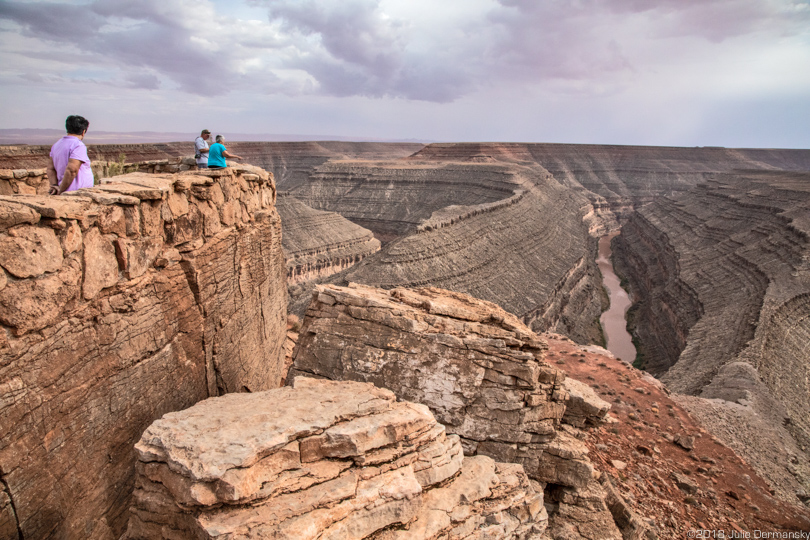
Visitors at an overlook of Gooseneck Bend, an area of Bears Ears National Monument which loses protection under the Trump administration’s proposal to shrink the monument.
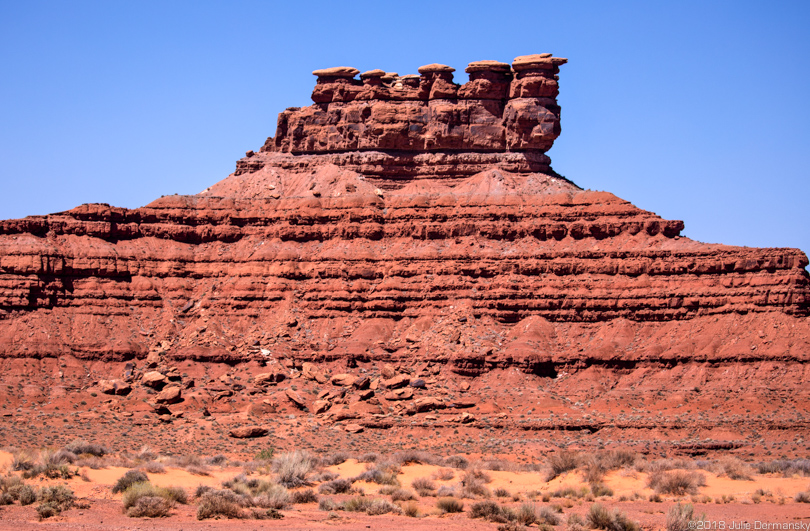
Valley of the Gods in Bears Ears, part of the national monument that will no longer be protected if President Trump’s proclamation to reduce the size of it stands.
Jonathan B. Jarvis, 18th director of the National Park Service, says Bernhardt is to Zinke what ex-coal lobbyist Andrew Wheeler is to the similarly scandal-ridden Scott Pruitt, who resigned as head of the Environmental Protection Agency (EPA) in July, calling him “smart, shrewd, low-profile, and effective.”
As Mother Jones reported in October, “some of the most radical changes under Trump have come from the many behind-the-scenes appointees, the government insiders, who have come out of the swamp the president pledged to drain. At Interior, that’s been Bernhardt and his allies.”
Saeger’s group had called for Zinke’s resignation for his potential conflicts of interest and sees Bernhardt through the same lens. He warns, “The bottom line is that Bernhardt is too conflicted to even be Acting Secretary.”
Together Zinke and Bernhardt started the largest rollback of federal land protections in U.S. history and prepared the largest U.S. offshore oil and gas lease sale (which ended as a flop in August).
In addition, they have instructed the Bureau of Land Management, which is in the Interior Department, to revise its rules on methane emissions from natural gas drilling on public lands, pushed for more roads in wilderness areas, canceled a study examining the health impacts of coal mining, and dismissed violations committed by coal companies.
Warning From Scientist Who Worked Under Zinke
“I’m delighted to see Ryan Zinke get his comeuppance. He was corrupt and arrogant in his disdain for science and public lands,” Joel Clement, a former senior scientist and policy expert with the Interior Department, wrote in an email following the news of Zinke’s resignation, “but his number two at Interior is equally corrupt and far more circumspect-beware.”
Clement, who filed for whistleblower protection and ultimately resigned while working under Zinke, is now a senior fellow with the Center for Science and Democracy with the Union of Concerned Scientists (UCS). He currently works to expose political interference in science and fight attacks on federal science from the Trump administration and Congress.
Under Secretary Zinke, Clement, a biologist, was removed as a top climate expert at the Interior Department and moved into an accounting position within the Office of Natural Resources Revenue, a job he lacked expertise for and which collects royalties from oil companies operating on federal lands. Clement claimed he was reassigned in retaliation for his work on the impacts of climate change on Native Alaskan communities.
“America’s public lands, and the natural and cultural resources they contain, belong to all of us,” Clement recently wrote in a Scientific American editorial. In the editorial, he rolled out the UCS report, “Science Under Siege at the Department of the Interior,” documenting what Clement describes as the “most egregious and anti-science policies and practices at the DOI under Secretary Zinke.”
The report outlines how the DOI under Secretary Zinke and his political team, including Bernhardt, attack science “from sidelining the work of the agency’s own scientists to systematically refusing to acknowledge or act on climate change.” According to the report, “these actions have far-reaching and serious implications for our health, the environment, and the future of our public lands.”
America’s Public Lands in the Crosshairs
In August I visited areas in Utah’s Bears Ears and Grand Staircase-Escalante national monuments that Trump left unprotected after he slashed both monuments’ boundaries. Multiple Native American tribes, including the Utah Diné (Navajo), Hopi, Zuni, and Ute, hold Bears Ears, in particular, as culturally and historically important land.
President Trump’s proclamation splitting Grand Staircase-Escalante into three monuments reduced the national monument by 46 percent and his proclamation splitting Bears Ears into two monuments reduced the lands under protection by 85 percent. Legal challenges against the proclamations are ongoing.
Here are photos I shot of those public lands in southern Utah on both monuments, which, under Trump and Zinke’s watch, have lost protection from oil, gas, mining, and other extractive activities:
Lands Cut From Grand Staircase-Escalante National Monument
-=-=
-=-=
E AND E 2 21
The Interior Department is stocking up on top lawyers with a record of opposing the Trump administration’s shrinking of the Bears Ears National Monument.
The appointments could foreshadow some legal U-turns even as the Interior secretary nominee, Rep. Deb Haaland (D-N.M.), awaits confirmation.
President Biden last month ordered Interior to commence a 60-day review of the southeastern Utah monument’s "boundaries and conditions" and to consider whether to restore it and other reduced sites to their states before President Trump took office (Greenwire, Jan. 20).
Trump removed protections from more than 85% of the original monument in 2017, slashing the 1.35-million-acre site to about 202,000 acres in late 2017. Interior finalized a management plan in early 2020 to open the excised lands to drilling, mining and grazing (Greenwire, Feb. 6, 2020).
Natalie Landreth, newly hired as Interior’s deputy solicitor for land, has previously argued in a court brief that Trump "exceeded the limited authority delegated to his office, and violated the Antiquities Act and the separation of powers established in the Constitution" in slashing the Utah monument’s size.
Landreth spent 17 years at the Native American Rights Fund, which joined in a December 2017 lawsuit challenging the Trump administration’s actions.
"Many Native Americans and Native Nations … have profound historic, cultural, and spiritual ties to Bears Ears and the more than 100,000 historic landmarks, structures, and historic and scientific objects located within Bears Ears," the opening brief signed by Landreth and others noted.
Landreth withdrew from the still-ongoing lawsuit in the U.S. District Court for the District of Columbia last month, prior to her joining the Biden administration. Her new boss, acting Solicitor Robert Anderson, has likewise disputed Trump’s use of the Antiquities Act.
"The Act does not include a grant of power to modify or eliminate monuments … now a matter of intense controversy and litigation," Anderson stated in a 2018 Ecology Law Quarterly article, citing the Bears Ears lawsuit.
Anderson added that "Congress retains and exercises plenary power to adjust designations and uses of public lands counsels in favor of interpreting the statute consistently with … a limited Executive power to [designate] lands, but not to revoke or modify prior designations."
Formerly the Oneida Indian Nation visiting professor of law at Harvard Law School, Anderson is an enrolled member of the Bois Forte Band of the Minnesota Chippewa Tribe. His expertise hints at some of the broader changes ahead for Interior (Greenwire, Jan. 21).
Interior’s acting deputy solicitor for energy and mineral resources, Travis Annatoyn, likewise claims experience in challenging the Trump administration’s Bears Ears management.
In early 2019, Annatoyn, then senior counsel for the Democracy Forward Foundation, accused then-Interior Secretary David Bernhardt of violating federal law by stacking the Bears Ears National Monument Advisory Council with proponents of the site’s reduction (Greenwire, April 25, 2019).
"The Bears Ears Committee was designed to protect a treasure of the American West and stacking it with opponents of the monument could violate federal law," Annatoyn said in a statement at the time.
The Trump administration had a different take on the president’s authority within the Antiquities Act. In an October 2018 brief, the Justice Department countered that since enactment of the Antiquities Act, presidents have eliminated lands from national monuments on at least 18 occasions.
"A 1947 Interior Solicitor’s Opinion concluded, relying on a 1935 Solicitor’s Opinion, that the President is ‘authorized to reduce the area of a national monument,’" the brief noted.
The 1947 opinion attributed this authority to a provision of the law "authorizing the establishment of national monuments, which states that their limits … ‘shall be confined to the smallest area compatible with the proper care and management other objects to be protected.’"
Changing minds
Interior solicitors’ opinions, though, can change, as can the federal government’s courtroom posture.
During the Trump administration, the Interior solicitor’s office withdrew at least a dozen prior legal opinions.
Federal Judge Tanya Chutkan, an Obama appointee, ordered participants in a lawsuit challenging the reductions to Bears Ears — as well as a separate case on Trump-era cuts to the Grand Staircase-Escalante National Monument — to address whether the lawsuits have been nullified by Biden’s order (Greenwire, Feb. 3).
Participants in both cases are required to submit a joint status report by March 5.
Arguments and responses in both cases were completed last summer, but Chutkan has not ruled in either lawsuit (Greenwire, July 29, 2020).
Under Biden’s executive order, the Justice Department is directed to seek a stay for any litigation or "other appropriate relief" depending on the outcome of the 60-day review, which will expire in late March.
While Biden could opt to use the Antiquities Act of 1906 to quickly reset the monument boundaries — the law allows presidents to set aside public land to protect areas of cultural, scientific or historic interest — some conservation advocates assert that any action must also address whether Trump violated the law when he shrank the monuments (Greenwire, Nov. 3, 2020).
-=-=
David first came to Colorado in 1970 as executive director for the Native American Rights Fund (NARF), a national nonprofit Indian-interest law firm.
Colorado Attorney General’s office he had the opportunity to work for David Getches.
-=-=
Chris Winter is an attorney and advocate with 25 years of experience in the field of natural resources and environmental law. Over the course of his career, he has developed an expertise in public land management, water resources, environmental justice, climate change, and fossil fuel infrastructure projects, and he has extensive experience working with and representing Indigenous communities.
In 2001, he co-founded a non-profit law center based in Portland, Oregon that represented public interest clients in federal and state courts across the Pacific Northwest. Over the next 17 years, he developed a reputation for winning difficult cases on behalf of grassroots organizations facing daunting odds and formidable opposition. For a decade, he represented Alaska Native organizations in the U.S. Arctic in their successful work to protect their subsistence activities from the impacts of offshore oil and gas exploration. He also served as lead counsel in Rosemere Neighborhood Ass’n v. U.S. E.P.A., which brought national attention to the EPA’s disappointing record of investigating citizen complaints under Title VI of the Civil Rights Act. He has litigated and won dozens of cases in federal and state courts on a wide range of issues.
He also served as Executive Director of Access Fund, a national advocacy organization working at the intersection of outdoor recreation and public land management, spearheading its work to restore Bears Ears National Monument, promote human powered outdoor recreation, and conserve public lands....
-=-=
...MEMbers were appointed to the Bears Ears National Monument Advisory Committee by the
Secretary of the Interior, David Bernhardt, on April 11, 2019. Initial terms are staggered so they do not
expire at the same time. Open periods for new nominations will be announced in the federal register.
Representative Category Member Term expires
Local Elected Official Bruce Adams April 11, 2021
State Government Gordon Larsen April 11, 2021
Paleontology Brooks Britt April 11, 2020
Archaeology Lee Bennett April 11, 2022
Conservation Miles Moretti April 11, 2020
Livestock Grazers/Permittees Gail Johnson April 11, 2022
Tribal Concerns Alfred Ben April 11, 2022
Ryan Benally April 11, 2021
Developed Recreation Jared Berrett April 11, 2021
Dustin Randall April 11, 2022
Dispersed Recreation Danny Flannery April 11, 2022
Private Landowners Zeb Dalton April 11, 2020
Local Business Owners Adam Redd April 11, 2020
Public at Large Jami Bayles April 11, 2021
Kelly Pehrson April 11, 2020
-=-=

Courthouse News Service
The United States District Court District of Utah
This action stems from two cases: Consolidated Plaintiffs against President Biden, the Secretary of the Interior, the Director of the Bureau of Land Management, the Secretary of Agriculture, the Chief of the Forest Service, the Department of the Interior, the Bureau of Land 15 Id. at 981. 16 Dalton v. Specter, 511 U.S. 462, 476 (1994).
freerangereport.com
Husband of "Old Broad" enviro pleads "no contest" to charges stemming ...
The end of a long and convoluted legal battle, the brief trial brought great relief to Zane Odell, who was with Zeb Dalton in the Monticello courtroom at the time Franklin took the plea deal.
NRDC
In the United States District Court for The District of Utah - Nrdc
Just consider the 100-plus pages of (single-spaced) NEPA filings that have already been put together for Zeb's request to build some water wells and fences.111And now, as Zeb has explained—and ...
Bizapedia
https://www.bizapedia.com › ut › dark-canyon-range-land-llc.html
DARK CANYON RANGE LAND, LLC in Blanding, UT - Bizapedia
The Registered Agent on file is Zeb Dalton, located at 543 E 500 S Blanding, UT 84511. Tiffany Dalton is the sole principal on record and serves as Manager and is associated with an address at P.O. Box 72 Blanding, UT 84511. The entity is scheduled to expire on October 31, 2024.
Bizapedia
https://www.bizapedia.com › ut › t-y-cattle-company-llc.html
T Y CATTLE COMPANY, LLC in Blanding, UT - Bizapedia
The Registered Agent on file is Zeb Dalton, located at 543 E 500 S Blanding, UT 84511. The company's leadership includes Tiffany Dalton, who serves as Manager and is associated with an address at P.O. Box 72 Blanding, UT 84511 and Zeb Dalton, who serves as Manager and is associated with an address at P.O. Box 72 Blanding, UT 84511.

canyonechojournal.com
Conservationist Rose Chilcoat Sues San Juan County Attorney and a ...
The couple was stopped by Odell and fellow rancher Zeb Dalton on April 3, 2017, two days after the gate closure, and was detained on a county road until a sheriff's deputy arrived. Later that month, Laws filed a number of misdemeanor and felony charges against both Franklin and Chilcoat.
freerangereport.com
Anti-grazing enviros charged with cattle endangerment accuse ranchers ...
Last week Zeb Dalton and Zane Odell received a subpoena from Kendall Laws the San Juan County District Attorney ordering them to appear on December 3, 2018 for an Evidentiary Hearing as witnesses in the case of State of Utah vs, Mark Kevin Franklin. In April of 2017, Chilcoat and her husband were caught endangering livestock.
MyLife.com
https://www.mylife.com › zebediah-dalton › e156171340422
Zebediah G Dalton, 47 - Blanding, UT - Reputation & Contact Details
View FREE Public Profile & Reputation for Zebediah Dalton in Blanding, UT - Court Records | Photos | Address, Email & Phone | Reviews | $30 - $39,999 Net Worth

Courthouse News Service
DOCUMENTS.pdf - Courthouse News Service
The Supreme Court described the public domain as the land owned by the Government, mostly in the West, that was available for sale, entry, and settlement under the homestead laws, or other disposition under the general body of land laws.
The Salt Lake Tribune
https://archive.sltrib.com › article.php?id=5423662&itype=CMSID
New felony charges added in gate-closing case against Utah activist
The confrontation with the ranchers, Odell and Zeb Dalton, occurred three days after the fence closing, when Chilcoat and Franklin stopped by the corral on their way home from a weekend trip to Valley of the Gods. Odell recognized their truck and used his vehicle to block them, while police were called.
Generate answer for Private Landowner Zeb Dalton
-=-=

Democracy Forward
Requesting Interior IG investigate Bernhardt's decision to stack Bears ...
Interior Secretary Bernhardt stacked the Bears Ears National Monument Advisory Committee with individuals determined to strip territory and critical protections from the Utah monument.
ThinkProgress
Scandals mount under David Bernhardt just two weeks after being ...
But Zinke's policy legacy is also living on under Bernhardt. One of the former secretary's most controversial actions as secretary remains the decision to dramatically shrink Bears Ears and Grand Staircase-Escalante, two Utah national monuments, the largest reduction in U.S. history.
Scandals mount under David Bernhardt just two weeks after being confirmed to lead Interior
Ethics probes are still in full swing.
E.A. CrundenApr 25, 2019,
David Bernhardt, President Donald Trump's nominee to be Interior Secretary, arrives before testifying during a Senate Energy and Natural Resources Committee confirmation hearing on March 28, 2019 in Washington, DC. CREDIT: Zach
It’s been just two weeks since David Bernhardt was confirmed as head of the Interior Department (DOI), and already his tenure is mired in at least four controversies.
From the day he was confirmed earlier this month — despite uproar from Democrats over his conflicts of interest and a prior career as an oil and gas lobbyist — Bernhardt has faced a wave of scandals.
The Interior Department’s watchdog is currently investigating Bernhardt over ethics concerns, along with a half-dozen other DOI senior officials. Those investigations come as the department faces renewed scrutiny over its decisions regarding Bears Ears, the Utah national monument dramatically reduced by Bernhardt’s equally scandal-ridden predecessor, Ryan Zinke.
And on Thursday, Citizens for Responsibility and Ethics in Washington (CREW) called for yet another investigation, this time into the department’s record-keeping, arguing Bernhardt’s daily schedule is not being fully documented and that controversial meetings are “intentionally” being left off the calendar.
“Under Bernhardt, the command appears to be granting favors to extractive industries, science be damned, while fighting tooth and nail to keep the public in the dark,” said Jesse Prentice-Dunn, policy director for the Center for Western Priorities, in an email to ThinkProgress on Thursday.
Earlier this week, the department’s Office of Inspector General (OIG) confirmed an investigation into potential ethics violations by six senior DOI officials. The decision came in response to a request by the nonpartisan watchdog group Campaign Legal Center, which requested in February that certain DOI staffers face a probe over potentially violating an ethics pledge due to interactions with former employers and clients.
The deputy inspector for the OIG, Mary L. Kendall, said that her office will look into “potential ethics violations committed by multiple Department of Interior senior executives.” The Campaign Legal Center named current Interior officials Benjamin Cassidy, Lori Mashburn, Doug Domenech, Todd Wynn, and Timothy Williams in its complaint. Vincent DeVito, a sixth person named, left the department in August and joined an offshore oil and gas company.
Despite bipartisan uproar over offshore drilling, coastal Republicans back Trump Interior pick
The complaints against the six officials vary, but all relate to their former employers. Cassidy, a former National Rifle Association (NRA) lobbyist, has been called out for his ongoing work on gun-related issues, including on projects backed by the NRA. Mashburn, a former employee of the right-wing Heritage Foundation, is criticized for staying in close touch with the think tank since leaving. Meanwhile, exchanges show Domenech met with representatives from the Texas Public Policy Foundation (TPPF), another think tank that has actively downplayed climate change.
Domenech, who is currently assistant secretary for insular and international affairs, previously worked for the Koch-backed right-wing think tank, which has notched political victories under the Trump administration. DeVito and Wynn similarly engaged with former employers or clients while acting in their capacity as DOI officials.
Senior political appointees are largely limited in the interactions they are allowed with former employers under an ethics pledge imposed by President Donald Trump. The investigation into the DOI staffers will examine whether they are in violation of those limitations.
Bernhardt is similarly accused of breaching that ethics pledge. The Interior secretary, known for carrying around a card listing all of his conflicts of interest, is under investigation in relation to at least seven different complaints, according to an OIG letter sent April 15 to Sen. Ron Wyden (D-OR). That probe was launched four days after the Senate voted to confirm Bernhardt, 56 to 41, largely along party lines.
It is unclear what the full scope of the complaints entail, but Wyden and Sen. Mazie Hirono (D-HI) had both pushed for an investigation into Bernhardt’s role in blocking an assessment examining the impact of pesticides on certain endangered species. Bernhardt has previously lobbied on behalf of agribusiness and against endangered species protections.
Recent disclosures have also shown that Bernhardt continued working on policies at DOI that would help his former lobbying clients, despite the Trump administration’s ethics pledge. That work includes shaping certain water policies despite lobbying on them previously while working for California farmers.
He has similarly strayed from the practice of maintaining a detailed daily calendar, instead having staff overwrite a Google document daily, erasing its previous content in the process, which watchdog organizations have worried is eroding transparency.
CREW wrote to Deputy Inspector General Kendall on April 25 urging an investigation. In its complaint, the watchdog group noted that there may be a possible link between the already-opened ethics investigation and the apparently deliberate record-keeping violations, “which appear designed in part to shield from public view and congressional scrutiny his contacts with industry lobbyists.”
DOI has argued that Bernhardt “is in complete compliance with his ethics agreement” and has followed department policy. But Democratic lawmakers and environmental groups are skeptical of the Interior secretary, as well as other senior-level officials at DOI.
“The fish rots from the head,” wrote Wyden in a tweet this week responding to the two investigations.
Chris Saeger, executive director for the nonprofit Western Values Project, told ThinkProgress on Thursday that Bernhardt’s “special interest conflicts are longer than a CVS receipt” and that his leadership at DOI has already been disconcerting for public lands advocates.
“Preventing the rot of corruption within America’s largest land managing agency will clearly require vigilant oversight and enforcement outside of the department’s leadership,” Saeger said, arguing that ongoing scandals and ethics lapses at DOI have come “at the expense of America’s outdoor heritage.”
Bernhardt’s critics are drawing comparisons to Zinke, who announced his exit from the department in December in the midst of more than a dozen scandals relating to spending and ethics violations.
But Zinke’s policy legacy is also living on under Bernhardt. One of the former secretary’s most controversial actions as secretary remains the decision to dramatically shrink Bears Ears and Grand Staircase-Escalante, two Utah national monuments, the largest reduction in U.S. history. Documents obtained under the Freedom of Information Act (FOIA) have shown that oil and gas drilling opportunities played a major role in the decision to reduce the monuments.
The decision was widely panned by indigenous tribes, along with environmental groups and public lands advocates. But their opposition remains unnoticed by DOI. Last Friday, the department’s Bureau of Land Management (BLM), released the names of the 15 committee members selected to provide guidance on managing Bears Ears — the list included only critics of the monument.
Trump administration plan to mine near popular Minnesota wilderness area sparks multiple lawsuits
That move has been slammed as “political” by tribal groups, who say the Trump administration is willfully ignoring the wishes of native communities. Supporters of Bears Ears applied, but none were chosen.
Bernhardt’s critics have pointed to that development as yet another indicator that the new secretary will be much like his predecessor, in policy as much as in scandal. Prentice-Dunn argued that Bernhardt has “established a track record of helping his former clients in the drilling and mining industries,” in keeping with the legacy set by Zinke.
Moreover, Prentice-Dunn said, with investigations mounting so early in his tenure, Bernhardt “is already on track to be as scandal-plagued as his predecessor… if not more so.”
#Bears Ears, #Climate, #David Bernhardt, #Government Ethics, #Interior Department, #Politics
ref
Emails reveal oil and gas drilling was a key incentive to shrink national monuments
Emails reveal oil and gas drilling was a key incentive to shrink national monuments
Ryan Zinke also directed Interior staff to study coal reserves at Grand Staircase-Escalante national monument.
Mark HandMar 2, 2018,
The Department of the Interior focused on the potential for oil and gas exploration at the Bears Ears National Monument during its 2017 review of national monuments. CREDIT: George Frey/Getty Images
From the start of the Trump administration’s review of national monuments, agency officials were directing staff at the U.S. Department of the Interior to figure out how much coal, oil, and natural gas had been placed off limits by the Bears Ears’ National Monument designation.
Environmental activists and public lands advocates feared Trump was pushing to reduce the size of national monuments to give mineral extractive industries easier access to drill or mine in the protected areas. But they didn’t have any evidence or a smoking gun to prove their theory. Now they do.
According to documents obtained by the New York Times, long before Interior Secretary Ryan Zinke recommended a major reduction in the size of the Bears Ears monument in southeastern Utah, the administration was already eyeing the potential for oil and gas exploration at the site.
Last March, an aide to Sen. Orrin Hatch (R-UT), asked a senior official at the Department of the Interior to consider reduced boundaries for the Bears Ears monument to remove land from protection that contained oil and natural gas deposits, The New York Times reported Friday.
Hatch’s office sent an email to the Interior Department on March 15, 2017 that included a map depicting a boundary change that would “resolve all known mineral conflicts,” referring to oil and gas sites on the land that the state’s public schools wanted to lease out to increase state funds.
Trump decimates two national monuments in ‘historic action’
It's the largest-ever reduction in U.S. history.
More than 100 years ago, the federal government granted so-called trust lands to support state institutions, like public schools, given that nearly 70 percent of the state is federally controlled land. Bears Ears included about 110,000 acres of these trust lands, eliminating the potential for resource sales, Utah officials said.
John Andrews, associate director of the Utah School and Institutional Trust Lands Administration, which oversees the lands designated for school funding, told The New York Times that the new Bears Ears boundaries approved by Trump reflected his group’s request to exclude its trust lands.
The newspaper obtained emails and other documents about the shrinking of national monuments from the Interior Department after it sued the agency in federal court.
“We’ve long known that Trump and Zinke put polluter profits ahead of our clean air, clean water, public health and coastal economies. This is more proof,” League of Conservation Voters Deputy Legislative Director Alex Taurel said Friday in a statement. “On Zinke’s one year anniversary as secretary, the evidence of just how embedded Trump and Zinke are with the dirty energy of the past could not be clearer.”
The Interior Department had not responded to a request for comment from ThinkProgress on these emails and documents at the time this article was published.[twt]
Bears Ears wasn’t the only national monument being evaluated for its potential fossil fuel reserves. In one memo, an Interior official asked department staff to prepare a report on each national monument under review in the United States, with an emphasis on the areas of national monuments with “annual production of coal, oil, gas, and renewable energy sources.”
During his review, Zinke also looked closely at the potential coal reserves at the Grand Staircase-Escalante National Monument, also located in Utah.
Interior Department staff developed a series of estimates on the value of coal that could be mined from a section of Grand Staircase-Escalante. When Trump announced in December that he would be reducing Grand Staircase-Escalante to nearly half its original size, those sections with coal reserves were included in the areas that would no longer be protected, according to the New York Times.
The reductions of the two national monuments located in Utah came after an Interior Department review, initiated in April, which looked at all national monuments created since 1996. Trump, at the time, said that the review would put an end to “egregious abuse of federal power” that has resulted in a “massive federal land grab.”
Grand Staircase-Escalante was designated by President Bill Clinton in 1996. Bears Ears was designated by President Barack Obama in December of 2016, as one of his final major designations as president. Environmentalists and indigenous groups have fought for years to protect Bears Ears, arguing that the area holds numerous sites of historical, cultural, and ecological significance.

Democracy Forward
Democracy Forward Requests Interior IG Investigate Bernhardt's Decision ...
Washington, D.C. — Today, Democracy Forward requested that the Inspector General of the Department of the Interior investigate whether Secretary David Bernhardt violated federal law by stacking the Bears Ears National Monument Advisory Committee with individuals determined to strip territory and critical
-=-=
DESMOG
Climate Deniers Waiting in the Wings as Trump Reclaims Presidency
Meet those aiming to capitalize on Trump’s re-election by slashing climate action, from Koch network fixtures to Project 2025 and beyond.
ByJoe Fassler and Sharon Kelly
onNov 8, 2024
Donald Trump peers around a flag while waiting to appear onstage at the Conservative Political Action Conference (CPAC) in February 2024. Credit: Zach D. Roberts
In the wake of Donald Trump’s electoral victory early Wednesday morning, climate policy in the U.S. enters an uncertain new era. Some themes are already apparent: Trump has pledged to scale up domestic fossil fuel production while making a broader push to deregulate industry. He also seems intent on scaling back the Inflation Reduction Act, the groundbreaking spending bill that’s already built out clean-tech infrastructure and added thousands of green jobs (mostly in politically conservative states).
But how far will Trump go, and how exactly will his administration’s anti-environmental stance play out? That remains to be seen — and will surely depend on the counsel of senior staffers in his orbit. It’s too soon to say exactly who those key appointees will be (UPDATE 11/11/24: although some are starting to trickle in, like his pick of Lee Zeldin to lead the Environmental Protection Agency), and, as Heatmap’s Robinson Meyer points out, their policy positions won’t be monolithic. Just look at Elon Musk, the key Trump campaign ally and megadonor who appears poised to play an influential role in the White House, who also happens to be CEO of a famous EV company.
Yet judging from Trump’s track record and recent statements, antipathy toward environmental regulations and decarbonization incentives seems an all but certain theme. And many of Trump’s first-term appointees — including some potentially poised to return to power — have histories of active climate crisis denial and delay. Former Trump officials spent the past four years lobbying for energy companies (including those they’d recently regulated), and contributed to the Heritage Foundation’s “Mandate for Leadership” document, the foundation of the now-notorious Project 2025 initiative. The Heritage-led effort, despite the once and future president’s feigned disavowals, features key contributions from his former staffers, including in sections that suggest dismantling the parts of government most focused on addressing climate change and environmental injustice.
Here are the individuals and organizations that may do the most to help shape the incoming administration’s energy and climate-related moves as well as the environmental policy priorities that Project 2025 outlines for each executive branch agency.
Key Individuals
Former EPA Administrator Andrew Wheeler, right, appeared with two oil industry representatives on a February 2024 panel titled “Putting our Heads in the Gas Stove.
Andrew Wheeler — After leaving office as Trump’s (second) U.S. Environmental Protection Agency (EPA) administrator, Wheeler spent much of his post-Trump tenure working for Virginia Republican governor Gov. Glenn Youngkin. But in April, Wheeler left government and joined the law firm Holland & Hart, which touted the benefits Wheeler could bring for its “energy and natural resources clients.”
During his earlier stint leading the EPA, Wheeler came under fire for overseeing “favorable decisions” for his past lobbying clients, including fossil fuel giants like coal company Murray Energy and the utility Xcel Energy. The New York Times tracked over 100 environmental rules rolled back by the EPA under Trump, the majority on Wheeler’s watch.
Long before he took over the EPA, Wheeler worked for the notorious climate denier Oklahoma Senator James Inhofe. During his 2019 nomination hearing, which followed the resignation of Trump’s first EPA chief Scott Pruitt, Wheeler said he would “not use the ‘hoax’ word myself” to describe climate change, but added he would also “not call it the greatest crisis.” Mandy Gunasekara, a Project 2025 co-author, backed a Wheeler return for Trump’s second term in a November 1 New York Times interview.
David Bernhardt — A long-time oil lobbyist, Bernhardt replaced Ryan Zinke as Trump’s Secretary of the Interior in April 2019. “It’s not so much who has he helped. It’s who hasn’t he helped in industry so far,” Bobby McEnaney, a Natural Resources Defense Council analyst, told The Guardian in 2018 during Bernhardt’s nomination hearings.
In 2019, Bernhardt told Congress he hadn’t “lost any sleep” over rising greenhouse gas levels on his watch. He also shrank the Bears Ears and Grand Staircase-Escalante national monuments in southern Utah to allow drilling and mining (a move later reversed by Pres. Biden), called in National Park Service police to tear-gas peaceful civil rights protesters at Washington, DC’s Lafayette Square, undercut protections for endangered species — and much more.
In 2021, Bernhardt returned to Brownstein Hyatt Farber Schreck, the same law firm where he’d worked for oil industry clients before joining the Trump administration. His past lobbying clients include the Independent Petroleum Association of America, the Freeport LNG Expansion, Targa Resources, Noble Energy, Halliburton, and a host of other fossil fuel industry companies. Bernhardt is rumored to be a candidate for a “senior post” in the incoming Trump administration, according to E&E News.
President Donald Trump, joined by U.S. Rep. Kevin McCarthy, Secretary of the Interior David Bernhardt (third from right), California representatives Devin Nunes and Tom Clintock, and Central Valley farmers, signs a U.S. Interior Department Record of Decision to improve California water accessibility for rural stakeholders February 19, 2020, in Bakersville, California. Credit: White House/Shealah Craighead, public domain
Mandy Gunasekara — The former Environmental Protection Agency Chief of Staff under Andrew Wheeler, Gunasekara helped to drive environmental priorities for the Trump-Pence administration; in her bio on X, she has claimed to be Trump’s “top environmental person.” After leaving office, she became director of the Center on Energy and Conservation at the Independent Women’s Forum, a think tank with a history of taking obstructionist stances on climate progress.
Her career after government also included work as a senior fellow at the Texas Public Policy Foundation, the think tank current Heritage Foundation CEO and Project 2025 mastermind Kevin D. Roberts spent much of his career leading. Gunasekara authored Project 2025’s chapter on the EPA, where she accused the agency of saddling industry with “costly, job-killing regulations,” and proposed rolling back greenhouse gas emissions standards and reporting protocols as well as a sweeping agency reorganization that includes axing the office overseeing environmental justice. She also authored Y’all Fired, a forthcoming book proposing to reshape federal oversight using mass layoffs.
Bernard McNamee — The author of Project 2025’s plans for the Department of Energy and “related commissions,” McNamee was first nominated to serve as one of five Federal Regulatory Energy Commission (FERC) commissioners by Trump in 2018. After leaving FERC in September 2020, McNamee returned to the law firm McGuireWoods where, according to his LinkedIn, he now “assists clients with rulemakings before federal agencies, including FERC, USDOE and EPA.” While most of those clients aren’t publicly known, they appear to include Dominion Energy, a utility company that today still runs on coal, natural gas, and oil. McNamee has been registered as a lobbyist for the company in Virginia since December 2023. (Dominion denied any involvement in Project 2025 in a statement to Virginia Public Media in August).
It’s not McNamee’s first time spinning through the revolving door between regulator and industry. Before arriving at FERC, he spent 10 months as a deputy general counsel at the Department of Energy. On leaving that job, he ran the Texas Public Policy Foundation’s pro-fossil fuel Life:Powered initiative for about four months — then returned to DOE, where he briefly directed the Office of Policy.
“There’s an organized propaganda campaign against fossil fuels,” McNamee said in 2018, while he spoke at a Texas Public Policy Foundation event, according to video unearthed by the Energy and Policy Institute. “You talk to people in corporate boardrooms now. They’re all buying into this.”
Key Organizations
...
-=-=
DUCK 9 26

- bernhardtgroup.com
- https://www.bernhardtgroup.com › who-we-are › david-bernhardt
David Bernhardt | The Bernhardt Group
- David Bernhardt is the founder and Chairman of the Bernhardt Group and one of the most accomplished leaders in American government. With more than two decades of senior-level experience, David has served at the highest levels of government, including two administrations, where he played a critical role in shaping national strategies on energy, land use conservation and regulatory reform
- davidlbernhardt.com
- https://davidlbernhardt.com
David Bernhardt
- David L. Bernhardt is a former Cabinet Secretary who served under George W. Bush and Donald J. Trump. He is also an author, a business consultant, and a media commentator on environmental and wildlife issues.
The Getches-Wilkinson Center for Natural Resources, Energy, and the Environment (GWC) is an interdisciplinary research center at the University of Colorado Law School.
An unmatched reputation in environmental law
Ranked consistently among the very best in the nation, Colorado Law is known for its renowned faculty and curriculum addressing environmental, energy, and natural resources law—and has a longstanding reputation for academic excellence, experiential learning, and fostering innovative problem-solving.
Founded in 1978, the Getches-Green Natural Resources, Energy, and Environmental Law Clinic is one of the country's first environmental law clinics. Originally, clinic students worked under the supervision of staff attorneys at the National Wildlife Federation. In 2010, the clinic moved in-house to the law school, where the clinic continues its mission of training future attorneys through the representation of clients in environmental cases.
JAKE MARX 13 TED HEWITT LAVALEE 13
LAWS 7209 Natural Resources & Environmental Law Clinic |
LAWS 7209-801: Natural Resources & Environmental Law Clinic
Instructor(s): Sarah Matsumoto
2022 Instructor(s): Marta Darby
2020
Instructor(s): Jonathan Skinner-Thompson
Jonathan Skinner-Thompson
Associate Professor of Law
Affiliate Faculty, Graduate Certificate in Environmental Justice
Full Faculty Bio: https://www.colorado.edu/law/jonathan-skinner-thompson-0
Published Books
| Enforcing Environmental Penalties, (Matthew Bender, 2026). |
Articles
| The Idea of Air, 2026 UTAH LAW REVIEW 69 (2026). |
|---|
| Tribal Air, 55 ARIZONA STATE LAW JOURNAL 1005 (2023). |
| Procedural Environmental Justice, 96 WASHINGTON LAW REVIEW 399 (2022). |
| Administrative Law's Extraordinary Cases, 30 DUKE ENVIRONMENTAL LAW & POLICY FORUM 293 (2020). |
| The Inefficiencies and Deficiencies of Waste Coal as an Alternative Fuel, 13 VERMONT JOURNAL OF ENVIRONMENTAL LAW 2 (2012). |
| Who Killed the Hybrid Car? State and Local Green Incentive Programs After Metropolitan Taxicab v. City of New York, 30 STANFORD ENVIRONMENTAL LAW JOURNAL 311 (2011). |
| Note: Myths of Coal's Clean Future: The Story of Methylmercury,, 29 VIRGINIA ENVIRONMENTAL LAW JOURNAL 171 (2011). |
| Note: A Green Road to Development: Environmental Regulations and Developing Countries in the WTO, 20 DUKE ENVIRONMENTAL LAW & POLICY FORUM 245 (2010). |
2018 Instructor(s): Karin Sheldon
2016
Instructor(s): Audrey Huang
CLINIC
In recent years, student attorneys have worked on matters such as:
- A lawsuit in federal district court involving off-road vehicle (ORV) use on roadless areas within a Colorado national forest;
- An appeal before the Interior Board of Land Appeals involving natural gas development on sensitive wildlife habitat in Wyoming;
- A federal district court case involving a proposed coal mine in Wyoming;
- Comments on a proposed coal lease in western Colorado;
- Protests of oil and gas leases issued by the Bureau of Land Management; and
- A petition to the U.S. Fish and Wildlife Service seeking to list a species under the Endangered Species Act.
OFF BIO BS
The Honorable David Bernhardt served as the 53rd Secretary of the Interior. David, who grew up in Rifle Colorado. He is the only person to be confirmed by the U. S. Senate to serve as secretary, deputy secretary, and solicitor of the United States Department of the Interior in its 176 year history.
As Secretary, David focused his efforts to further conservation stewardship, expand opportunities for access to hunting and fishing on public lands, drove regulatory change, and worked to enhance our nation’s energy independence. Additionally, he led the Trump administration’s effort to enact the Great American Outdoors Act and President Trump tasked him with playing a key role on initiatives such as addressing the threat to the domestic supply chain from reliance on critical minerals from foreign adversaries.
As deputy secretary at Interior, David drove meaningful regulatory reform; modernized business processes related to permitting authorizations and denials; and developed one of the most diverse leadership teams in the department’s history.
Currently, David is engaged in several business ventures, serves as an independent board member, and is active in various nonprofit endeavors.
Finally, David is the author of “YOU REPORT TO ME, Accountability For the Failing Administrative State,” published in 2023.
You Report to Me - Encounter Books
You Report to Me
Accountability for the Failing Administrative State
Only a short while ago, it was unimaginable that our nation would face a baby formula shortage facilitated by a bureaucratic delay, or witness the national massive embarrassment of flawed military and diplomatic action, such as the withdrawal from Afghanistan. Yet, our leaders and our federal agencies consistently fail the American people, despite the massive growth of these institutions.
When David Bernhardt became Secretary of the Interior in the Trump Administration, he witnessed the full dysfunction of our federal agencies and learned that America’s sprawling civil service was often unresponsive to the will of the nation’s chief executive. In fact, agency staff aligned with the ideology of one political party often worked to actively “resist” the other. Meanwhile, our elected officials in Congress happily punted significant questions of public policy to those unaccountable agencies.
In You Report to Me, Bernhardt provides a firsthand chronicle of how the bureaucratic swamp really works and reveals how unaccountable power has quietly concentrated in the administrative state over the last two decades. Drawing on his experiences working under two administrations, Bernhardt details how President Trump’s enabling leadership revealed a path for curtailing the administrative state in the future. You Report to Me calls on America’s leaders to turn off autopilot and retake control of this ever-multiplying, unaccountable federal bureaucracy before it completely destroys the Founders’ vision of a government based on the consent of the governed.
About the Author

David Bernhardt is the only person to ever be confirmed by the U.S. Senate to serve as secretary, deputy secretary, and solicitor of the Department of the Interior in its 173+-year history.
Excerpt
On a cold day in December 2018, while serving as the deputy secretary at the U.S. Department of the Interior, I received a directive to report to the Oval Office to meet with the president of the United States. This was the first time I had been called to the Oval Office, and the circumstances were not ideal.
I understood that my direct supervisor at Interior, Secretary Ryan Zinke, was in the process of resigning. The Washington Post had reported that Secretary Zinke was on the verge of being fired after the department’s inspector general made a criminal referral to the Department of Justice. Zinke, on the other hand, had told me that he was going to resign and that it was entirely his own choice. Given these divergent reports, I was unsure what to expect as I headed over to the White House.
When I crossed the threshold into the Oval Office, President Trump looked up from the Resolute Desk and told me to take a seat. Always a kind host, he asked if I wanted a Coke. He made a few comments regarding his perspective on the current situation with Secretary Zinke, then we briefly discussed the Department of the Interior’s priorities. The president appeared interested in our national parks, deregulation, energy activities, mining, outdoor recreation, forest health, and timber management. He then asked my perspective on a few people he was considering as replacements for Zinke. As the discussion wrapped up, he explained, “You’re going to be running the ship for a while. Do you have any questions?”
I cleared my throat, feeling like the backup quarterback about to be thrown into the game. I had many questions, in fact, but I settled on one: “Who do I report to?”
President Trump looked at me quizzically. “You report to me,” he said.
“I know that’s what the Constitution says,” I acknowledged, choosing my words carefully, “but who do I actually report to?”
“You report to me,” he repeated. He could not have been more clear. I reported directly to him and to no one else!
-=-=
gl 3 26
[### David Bernhardt | Getches-Wilkinson Center

University of Colorado Boulder
https://www.colorado.edu › center › gwc › david-bernha...](https://www.colorado.edu/center/gwc/david-bernhardt)
The Honorable David Bernhardt served as the 53rd Secretary of the Interior. David, who grew up in Rifle Colorado. He is the only person to be confirmed by ...
[### David Bernhardt on the United States Senate's Permitting ...

America First Policy Institute
https://www.americafirstpolicy.com › issues › statement...](https://www.americafirstpolicy.com/issues/statement-david-bernhardt-on-the-united-states-senates-permitting-reform-package)
May 5, 2023 — ... David Bernhardt, Chair of the Center for American Freedom at AFPI and former Secretary of the Interior, on the Revitalizing the Economy by ...
[### Bernhardt endorses Interior staff cuts, but touts public service

E&E News by POLITICO
https://www.eenews.net › Articles](https://www.eenews.net/articles/bernhardt-endorses-interior-staff-cuts-but-touts-public-service/)
Oct 24, 2025 — BOULDER, Colorado — Former Interior Secretary David Bernhardt endorsed the need to slim down his old department Friday, but added he does not ...Read more
Missing: afpi | Show results with: afpi
---
ggl 9 25
[
E&E News by POLITICO
Offshore wind seeks lifeline with Trump-connected lobbyists
The embattled industry has retained a firm founded by former Interior Secretary David Bernhardt and other lobbyists close to the president.
.
Sep 26, 2025](https://www.eenews.net/articles/offshore-wind-seeks-lifeline-with-trump-connected-lobbyists/)

Brownstein Hyatt Farber Schreck
Brownstein Adds to its Deep Bench of Talent Former Secretary David Bernhardt to Provide Strategic Counsel
Former Secretary of the Interior David Bernhardt will provide strategic counsel in the firm's Washington, DC, office.
.
Jan 21, 2025](https://www.bhfs.com/news-event/brownstein-adds-to-its-deep-bench-of-talent-former-secretary-david-bernhardt-to-provide-strategic-counsel/)
[

POLITICO Pro
E&E News: Bernhardt endorses Interior staff cuts, but touts public service
E&E NEWS PM | BOULDER, Colorado — Former Interior Secretary David Bernhardt endorsed the need to slim down his old department Friday,...
.
Oct 24, 2025](https://subscriber.politicopro.com/article/eenews/2025/10/24/bernhardt-endorses-interior-staff-cuts-but-touts-public-service-00622374)
[

National Archives (.gov)
David Bernhardt
Secretary of the Interior ... David Bernhardt serves as the 53rd Secretary of the U.S. Department of the Interior. He was confirmed by the U.S. Senate on April 11...
.
Dec 20, 2021](https://trumpwhitehouse.archives.gov/people/david-bernhardt/)
[

Public Domain | Substack
Trump’s Former Interior Secretary Rakes In Corporate Cash At New Lobbying Firm
David Bernhardt's new firm is making big bucks lobbying for major energy corporations, agricultural giants and more.
.
Sep 9, 2025](https://www.publicdomain.media/p/trumps-former-interior-secretary)
Jun 3, 2025](https://foxbaltimore.com/news/local/annapolis-man-convicted-retail-theft-scheme-hardware-stores)
[

America First Policy Institute
AFPI Welcomes EPA Proposal to Roll Back Obama-Era Greenhouse Gas Regulations
Today, AFPI Executive Vice President and former Secretary of the Interior David Bernhardt released the following statement regarding U.S....
.
Jul 31, 2025](https://www.americafirstpolicy.com/issues/afpis-welcomes-epa-proposal-to-roll-back-obama-era-greenhouse-gas-regulations)
---
nick surgey doc sgamma wea
Senator Mike Lee, Chair of the Senate Committee on Energy and Natural Resources announced Ms. Sgamma's withdrawal as the committee gathered on Thursday. “We accept her withdrawal and look forward to putting forth another nominee,” said a White House spokesperson.
Former Trump Interior Secretary David Bernhardt, now in private practice at Brownstein Hyatt Farber Schreck, tweeted after the withdrawal: "Individuals who know their views don’t align with the president, yet seek political appointments hoping such divergence won't be noticed, cause needless harm. Sad. Self-inflicted."
---
msnbc melber swamp thing mask congress test 2017? 12 24 trump ethics degrade
---
https://www.cbsnews.com/news/esi-energy-pleads-guilty-150-eagles-killed-wind-farms/
CRIME
Wind energy company pleads guilty after at least 150 eagles killed in U.S.
APRIL 7, 2022 / CBS/AP
A subsidiary of one of the largest U.S. providers of renewable energy pleaded guilty to criminal charges and was ordered to pay over $8 million in fines and restitution after at least 150 eagles were killed at its wind farms in eight states, federal prosecutors said Wednesday.
NextEra Energy subsidiary ESI Energy was also sentenced to five years probation after being charged with three counts of violating the Migratory Bird Treaty Act during a court appearance in Cheyenne, Wyoming. The charges arose from the deaths of nine eagles at three wind farms in Wyoming and New Mexico.
In addition to those deaths, the company acknowledged the deaths of golden and bald eagles at 50 wind farms affiliated with ESI and NextEra since 2012, prosecutors said. Birds were killed in eight states: Wyoming, New Mexico, North Dakota, Colorado, Michigan, Arizona, Illinois and California.
Eagles Killed Wind Turbines
This Jan. 5, 2020, photo shows a bald eagle in Philadelphia.
CHRIS SZAGOLA / AP
"This prosecution and the restitution it secures will protect the ecologically vital and majestic natural resources of our bald eagle and golden eagle populations," U.S. Attorney Phillip A. Talbert for the Eastern District of California said in a statement.
NextEra, based in Juno Beach, Florida, bills itself as the world's largest utility company by market value. It has more than 100 wind farms in the U.S. and Canada and also generates natural gas, nuclear and solar power
Almost all of the eagles killed at the NextEra subsidiary's facilities were struck by the blades of wind turbines, prosecutors said. Some turbines killed multiple eagles and because the carcasses are not always found, officials said the number killed was likely higher than the 150 birds cited in court documents.
Prosecutors said the company's failure to take steps to protect eagles or to obtain permits to kill the birds gave it an advantage over competitors that did take such steps - even as ESI and other NextEra affiliates received hundreds of millions of dollars in federal tax credits from the wind power they produced.
NextEra spokesperson Steven Stengel said the company didn't seek permits because it believes the law didn't require them for unintentional bird deaths. The company said its guilty plea will resolve all allegations over past fatalities and allow it to move forward without a continued threat of prosecution.
The criminal case comes amid a push by President Joe Biden for more renewable energy from wind, solar and other sources to help reduce climate changing emissions. It also follows a renewed commitment by federal wildlife officials under Biden to enforce protections for eagles and other birds under the Migratory Bird Treaty Act. Criminal prosecutions had been halted under former President Donald Trump for birds killed inadvertently by industry.
It's illegal to kill or harm eagles under the migratory bird act. However, a wide range of industries - from energy firms to manufacturing companies - have lobbiedfor years against enforcing the law for accidental bird deaths.
The bald eagle - the U.S. national symbol since the 1700s - saw its populations widely decimated last century due to harmful pesticides such as DDT and other problems. Following a dramatic recovery, it was removed from protection under the Endangered Species Act in 2007. Biologists say more than 300,000 bald eagles now occupy the U.S., not including Alaska.
In the 1970s, there were believed to be just two bald eagles left in the entire state of New York City. Now, there are close to 1,000, and they're no longer considered endangered. They've been spotted in all five boroughs of New York City.
Golden eagles have not fared as well, with populations considered stable but under pressure from wind farms, collisions with vehicles, illegal shootings and poisoning from lead ammunition.
Most of the eagles killed at the ESI and NextEra wind farms were golden eagles, according to court documents.
There are an estimated 31,800 golden eagles in the Western U.S. with an estimated 2,200 killed annually due to human causes, or about 60% of all deaths, according to a study released last week by leading eagle researchers from the U.S. Fish and Wildlife Service and other entities.
The study concluded that golden eagle deaths "will likely increase in the future" because of wind energy development and other human activities.
Companies historically have been able to avoid prosecution under the century-old Migratory Bird Treaty law if they take steps to avoid deaths and seek permits for those that occur.
Charging documents said company representatives, including ESI's president, were warned that eagles would be killed if the company built two wind farms in central and southeastern Wyoming, and also knew about a risk to eagles when they authorized the repowering of a New Mexico wind farm, about 170 miles (274 kilometers) from Albuquerque.
The company proceeded anyway and at times ignored further advice from federal wildlife officials about how to minimize the deaths, according to court documents.
"For more than a decade, ESI has violated (wildlife) laws, taking eagles without obtaining or even seeking the necessary permit," said Assistant Attorney General Todd Kim of the Justice Department's Environment and Natural Resources Division in a statement.
ESI agreed under a plea deal to spend up to $27 million during its five-year probationary period on measures to prevent future eagle deaths. That includes shutting down turbines at times when eagles are more likely to be present.
Despite those measures, wildlife officials anticipate that some eagles still could die. When that happens, the company will pay $29,623 per dead eagle under the plea deal.
NextEra President Rebecca Kujawa said collisions of birds with wind turbines are unavoidable accidents that should not be criminalized. She said the company is committed to reducing damage to wildlife from its projects.
"We disagree with the government's underlying enforcement activity," Kujawa said in a statement. "Building any structure, driving any vehicle, or flying any airplane carries with it a possibility that accidental eagle and other bird collisions may occur."
---
---
CRC HIT TOUTED BY ZINKE:
https://capitalresearch.org/article/arabellas-long-war-part-1
“Keep It in the Ground” | Web of “Pop-Up” Groups
Anatomy of an Arabella Campaign | Harried Until the End
Summary: For years “dark money” activists ran a coordinated campaign to sabotage and undermine the Trump administration from the offices of Arabella Advisors in Washington, DC. The campaign culminated in the most extreme environmentalist regime in American history under President Joseph Biden.This report goes inside that campaign to destroy Trump’s Department of the Interior and promote the Left’s war on affordable energy.
In 2019, the Capital Research Center’s groundbreaking report on Arabella Advisors exposed the half-billion-dollar network for the first time, dragging Arabella into the limelight as the posterchild of the Left’s “dark money.” Since then we’ve continued to uncover this now $730 million **activist empire, tracing its shadowy campaigns on everything from abortion on demand to packing the Supreme Court to its war on the Trump administration.
This report on the Arabella network examines theprofessional Left’s years-long campaign to undermine President Donald Trump’s Department of the Interior, laying the groundwork for the Biden administration’s crusade against oil and the most radical environmentalist policies in American history.
“Keep It in the Ground”
The U.S. Department of the Interior is primarily responsible for managing roughly 450 million acres of federal land and conservation of their natural resources, most critically the nation’s vast reserves of oil and natural gas. It manages hundreds of dams and reservoirs, regulates drilling on public lands, runs the National Park Service, and maintains public monuments, including dozens attacked by radical Black Lives Matter activists in 2020.
The department also plays a role in foreign diplomacy and national security. Under President Trump that includedinternational wildlife trafficking bans, encouraging trade of precious metals and rare earths, and promoting his Indo-Pacific security and economic strategy.
But the department’s openness to expanding oil and gas production brought the sharpest attacks from the Left. Since the department is entirely under the president’s purview, halting all drilling on public land is far easier than attempting to halt private oil and gas production nationwide—the radical Left’s ultimate goal.
“The natural place to start phasing out supply is on our public lands and oceans where a ban on new leasing will keep up to 450 billion tons of carbon pollution in the ground,” Center for Biological Diversity director Kieran Suckling said in 2015. Bill McKibben, founder of the ultra-leftist 350.org, has also stated that “public lands are one of the easiest places for us to control the flow of carbon into the atmosphere.”
Unsurprisingly, that’s been the policy of Democratic presidents and their activist allies for years. President Barack Obama canceled lease sales in the Artic and Atlantic offshore sites and banned the leasing of coal on federal lands. Phasing down “extraction of fossil fuels from our public lands” was in the Democratic Party’s 2016 platform. That same year a 350.org activist asked Democratic presidential nominee Hillary Clinton what she meant by “extraction on public lands is a done deal?” Clinton replied, “That’s where [President Obama] is moving: No future extraction. I agree with that.” Her running mate, Virginia Sen. Tim Kaine, later assured another 350.org activist that “I actually am now in that position.”
But even “phasing down” is too conservative for today’s “keep it in the ground” Left. No less than 20 Democratic presidential hopefuls vowed to ban drilling on public lands outright during their party’s 2020 primary. Ever the pawn of the radical Left, on January 27, 2021—exactly one week after his inauguration—President Biden indefinitely suspended development of new oil and gas wells on public lands, which the left-leaning San Francisco Chronicle cheered as “a first step to halting the granting of federal drilling leases permanently.”
Why does this matter? Federal lands account for roughly 24 percent of America’s oil, natural gas, and coal production. In 2019, total crude oil production reached an all-time high of 4.471 billion barrels, with a significant chunk of that growth coming from oil drilled on federal lands. Biden’s ban blocks future development of these key resources, removing them from the supply stream and hampering the energy independence the United States struggled to achieve in recent years. This means higher gasoline and household electricity prices, an estimated $11.3 billion in lost federal royalties and rental fees, and the destruction of hundreds of thousands of jobs across the economy.
With a single executive order, the Left could advance its crusade to “keep it in the ground” for years in the name of global warming. The stakes couldn’t be higher—all that stood in its way was the Trump administration.
In the next installment, watch Arabella Advisors target the Interior Department with two “pop-up” groups.
Tags: 350.org, Accountable.US, Arabella Advisors, Center for American Progress, Center for Biological Diversity, climate change, Department of the Interior, global warming, Hopewell Fund, natural gas, new vent, oil, public lands, Sixteen Thirty Fund, Western Values Project Hayden Ludwig
Hayden Ludwig is a Senior Investigative Researcher at Capital Research Center. He is also a columnist at the Washington Free Beacon and writes regularly for the American Conservative. Ludwig is…+ MORE BY HAYDEN LUDWIG
---
pt 2
Web of “Pop-Up” Groups
Enter Arabella Advisors, a consulting firm based in Washington, DC, that quietly runs arguably the most powerful activist and lobbying network in politics. Arabella manages four in-house nonprofits collectively called the “sisters,” each of which controls a small army of activists and a legion of “pop-up” groups. And each pop-up group is made to look like a slick, stand-alone website. These pop-ups target virtually every issue in politics—control of the courts, abortion access, gun control, and voter registration and mobilization, even the Trump-Russia collusion hoax—pushing left-wing policies in every corner. What makes Arabella so powerful is how these “pop-ups” deceive individuals into believing they represent genuine local grassroots interests, such as one pop-up in Alaska created to oppose creation of the Pebble Mine run from Arabella’s plush offices in DC.
Arabella’s network is extraordinarily well-funded. In 2019 alone, the four “sisters” reported total revenues exceeding $730 million and poured out $648 million. Between the network’s creation in 2006 and its Form 990 filing for 2019 (the latest available), Arabella’s empire has received more than $3 billion and spent nearly $2.5 billion. Most of that funding was directed to the network’s flagship 501(c)(3) nonprofit, the New Venture Fund, whose largest known donors include the Gates, Ford, Hewlett, Packard, andBuffettFoundations.
Beginning in 2017, Arabella turned its guns on Trump’s Department of the Interior using a pop-up pair: Western Values Project (WVP) and its “sister,” Western Values Project Action (WVPA).
According to their websites, WVP and WVPA were created in 2013 in Helena, Montana, to expose corrupt corporate lobbyists preying on public lands in the West. In reality, WVP is run by the 501(c)(3) New Venture Fund while WVPA is run by the 501(c)(4) Sixteen Thirty Fund, Arabella’s in-house lobbying shop. Whatever staff the groups actually have would have been paid by one of Arabella’s nonprofits or possibly by Arabella Advisors itself; we’ll likely never know. But in its 2018 Form 990, New Venture Fund revealed that it is the “paymaster” for Sixteen Thirty Fund (which reported zero employees on its own 2018 Form 990) and “pays the salary and immediately invoices Sixteen Thirty Fund, which reimburses the full amount.”
It’s common for groups to use both kinds of nonprofit to maximize their ability to lobby through the 501(c)(4) and raise non-lobbying funds through the 501(c)(3), since donors may deduct donations to the 501(c)(3) from their taxes. But Arabella takes that tactic to another level, using pop-up fronts for its nonprofits that can take advantage of the New Venture and Sixteen Thirty Fund’s respective tax advantages without disclosing their relationship to one another. Donations to WVP and WVPA in fact benefitted the Arabella-run nonprofits behind the projects, as an archived version of WVP’s website from October 2019 reveals.
Until late 2019 the website for WVP and WVPA revealed a handful of staffers, including Chris Saeger, ex-communications director for the Montana Democratic Party and former Service Employees International Union (SEIU)staffer; Jayson O’Neill, a Democratic staffer for Montana’s legislature and Gov. Brian Schweitzer (D); and Yetta Stein, a staffer for the left-wing political action committee End Citizens United and staffer for the 2018 reelection campaign Sen. Jon Tester (D-MT). The archived website also showed a small advisory board consisting of:
- Kjersten Forseth, a former chief of state for Colorado State Senate Democrats, former director of the left-wing strategy group ProgressNow Colorado, political director for the Colorado AFL-CIO, and chief political strategist for Rocky Mountain Voter Outreach, a Denver-based get-out-the-vote and ballot initiative firm.
- Kent Salazar, an environmental health manager for Albuquerque, New Mexico, former New Mexico State game commissioner for Gov. Bill Richardson (D), and a board member for the left-wing National Wildlife Federation.
- Pat Smith, a lawyer representing Indian tribes in Montana, member of the 2010 Montana Redistricting Commission, and appointee of Montana Gov. Steve Bullock (D) to the Northwest Power and Conservation Council.
WVP’s advisory board also included Caroline Ciccone, who in 2019 was executive director of the New Venture Fund pop-up and anti-Trump “oversight” group Restore Public Trust. Ciccone is a former communications director for the Democratic National Committee (DNC), Obama appointee to the U.S. Small Business Administration, and Democratic strategist. From 2014 to 2017 she led Americans United for Change (AUFC), a top left-wing strategy group whose national field director Scott Foval was recorded in late 2016 by undercover journalists from Project Veritasbragging that AUFC had paid mentally ill and homeless people to instigate violence at Trump campaign rallies. “We know that Trump’s people will [tend to] freak the f— out,” Foval said in the video. “It is not hard to get some of these assholes to ‘pop off.’” The scandal ultimately led back to Robert Creamer, co-founder of the powerful consulting firm Democracy Partners and a former general consultant to AUFC who directed parts of a vast network of advocacy groups all aligned in support of Hillary Clinton’s presidential bid. This led to speculation that his firm helped Clinton’s campaign violate collusion laws. Foval described Creamer’s role in the scandal as the “kingpin” who is “diabolical, and I love him for it.” Within days of the video’s release Creamer resigned, and Foval was fired.
Also present was Kyle Herrig, a New Venture Fund board member who sat on the advisory boards of at least five New Venture Fund projects, including American Oversight, a judicial activist and litigation group; Allied Progress, which attacked Trump cabinet officials; and the Ciccone-run Restore Public Trust.
In early 2020 it was announced that Western Values Project and these three Arabella “pop-ups” were being rolled into a new organization: Accountable.US, itself a former New Venture Fund project fully established as an independent nonprofit sometime later that year, headed by president Kyle Herrig and executive director Caroline Ciccone. (It appears that Western Values Project Action remains a project of Sixteen Thirty Fund, but that remains unclear as of writing.)
This reveals that Western Values Project, far from being a grassroots group, is enmeshed in a deeply networked, highly coordinated cabal of professional activists—and it always was.
In the next installment, break down the Arabella campaign against the Interior Department and Interior Secretary Ryan Zinke.
---
pt 3 zinke ad cartoon overturned boat
anatomy of anArabella Campaign
From 2017 to 2018, WVP ran an all-out attack against Trump administration Secretary of the Interior Ryan Zinke,publishing post after post savaging Zinke and his staff. WVP even published a massive website, DepartmentofInfluence.org, which compiled boatloads of data on nearly every appointee to the Trump administration’s Department of the Interior. The group’s goal was clear: Drive Ryan Zinke out of office and undermine the department’s policies. They finally succeeded in December 2018, and Zinke resigned in early January 2019 amid ethics complaints alleging he had misused public funds during official travel and spent large sums on frivolous things.
CRC has counted nine Freedom of Information Act (FOIA) cases filed by WVP between April 2017 and Zinke’s resignation, all sporting WVP’s supposed address: aUPS store in Whitefish, Montana (704C 13th St. E., #568, Whitefish, MT 59937). As investigative reporter Dave Skinner points out, “‘Suite 568’ is actually a $150-per-year private mail box, snugged next to a sales placard touting a ‘street address, not a P.O. box number.’”
In these complaints WVP describes itself as “a not-for-profit public interest organization” and “a tax-exempt organization within the meaning of Section 501(c)(3) of the Internal Revenue Code,” never mentioning its status as a project of the New Venture Fund or its connection to Arabella Advisors. At least one FOIA request was co-filed with American Oversight, another former New Venture Fund pop-up run by Kyle Herrig that also used a UPS Store address in its filings (1030 15th St., NW, Suite B255, Washington, DC 20005) and describes itself as “a nonpartisan, non-profit section 501(c)(3) organization.”
These FOIA complaints exclusively targeted the Department of the Interior. Highlights include:
- Requests for Zinke’s travel receipts, “a daily schedule of the Secretary’s events, meetings and activities including locations and attendees”;
- Seeking correspondence between department heads and members of various oil and gas interests, such as the American Petroleum Institute, Colorado Oil and Gas Association, and Independent Petroleum Association of America;
- Demanding access to all records, emails, and expenditures pertaining to Lolita Zinke, Ryan Zinke’s wife;
- Asserting that Zinke threatened Alaska Republican Sens. Lisa Murkowski and Dan Sullivan for voting against the 2017 effort to repeal Obamacare; and
- Multiple FOIA complaints complaining that department had not complied with prior FOIA complaints.
On October 22, 2018, the Department of the Interior’s Office of Inspector General released its investigative report into Zinke’s alleged ethics abuses and recommended it to the Department of Justice. The office noted that it “initiated this investigation” in December 2017 “based on information we received while investigating [Zinke’s] use of noncommercial aircraft for U.S. Governmental travel.” The source of that information isn’t named, but it isn’t a stretch to believe it originated with Western Values Project.
Eight days later on October 30, WVP released its statement on the probe calling on Zinke to resign. It launched a website (HasRyanZinkeBeenFiredYet.com) demanding the same. On November 9, WVPA released a $30,000 attack ad in seven Montana newspapers accusing Zinke’s “priorities” of being “upside down” and calling for his resignation—presumably paid for by the Sixteen Thirty Fund, which controls WVPA’s finances. One month later Zinke resigned.
INSERT IMAGE: https://www.influencewatch.org/app/uploads/2021/02/Western-Values-Project-Zinke-Attack-Ad-2019.pdf
Big Green’s Campaign Rolls On
Joining WVP and WVPA was the Center for Western Priorities (CWP), a front for the California mega-activist group Resources Legacy Fund—by my count the 16th-largest environmentalist group in the country, spending over $42 million in 2018 alone. CWP painted Zinke as a feckless tool of the oil and gas industry, accusing him of “following President Trump’s marching orders to attack our public lands” and fomenting an “illegal attack on America’s national monuments.” When Zinke resigned in January 2019, CWP labeled him “the most anti-conservation Interior Secretary of all time.”
Almost immediately after Ryan Zinke resigned in December 2018, CWP and WVP turned their guns on undermining Deputy Secretary of the Interior David Bernhardt, who became acting secretary on January 2, 2019, and was officially confirmed in April.
Bernhardt served in the George W. Bush administration’s Department of the Interior, leaving in 2009 as the department’s solicitor. After that he led the Denver firm Brownstein Hyatt Farber Schreck’s natural resources law practice, where his clients included Halliburton Energy Services and the Independent Petroleum Association of America, and he lobbied for Cobalt International Energy and Samson Resources. Before his appointment to the Trump administration, Bernhardt was also registered as a lobbyist for the Westlands Water District in California’s San Joaquin Valley.
On December 17, CWP policy director Jesse Prentice-Dunn published a long hit piece calling Bernhardt a “walking conflict of interest” who would continue “Ryan Zinke’s culture of corruption” and accusing the department of shilling for Big Oil. That same day WVP published the website DavidBernhardt.org, calling Bernhardt “the ultimate DC swamp creature” and an “ex-lobbyist who is too conflicted to be Interior Secretary,” while detailing a laundry list of ethics charges in an attempt to derail his confirmation to the post. Memos about Bernhardt’s background and conflicts of interest and more FOIA requests followed from WVP and CWP, including one from Democracy Forward, a leftist litigation group created by Clinton crony Marc Elias (of Perkins Coie fame) in 2017 to target the Trump administration.
In February, the Campaign for Accountability (CFA), a former “pop-up” of the Arabella-run Hopewell Fund, petitioned the Interior Department inspector general to investigate Bernhardt’s ties to Westlands Water District as a conflict of interest and urged the Senate to reject his confirmation. CFA, which specialized in targeting Trump political appointees, was founded by alumni of another left-wing litigation group, Citizens for Responsibility and Ethics in Washington (CREW), and has been represented by the ex-Arabella pop-up American Oversight in past lawsuits.
The Center for American Progress joined in, labeling Bernhardt “the most conflicted Trump Cabinet nominee.” Greenpeace and the Center for Biological Diversity urged the department’s inspector general to investigate those conflicts of interest, melodramatically declaring him “the most dangerous man in America for endangered species and public lands.” The Sierra Club demanded the Senate reject his confirmation, as did the National Parks Conservation Association and the Natural Resources Defense Council (NRDC).
In March, WVPA launched a six-figure television ad buy targeting Democratic Sen. Martin Heinrich (NM) and moderate Republican Sens. Cory Gardner (CO) and Martha McSally (AZ) to oppose Bernhardt’s confirmation. The assault continued until the Senate confirmed Bernhardt in April 2019. From then on the group’s crusade against Trump’s Department of the Interior focused on thwarting its agenda.
In the next installment, the professional Left’s years-long campaign culminates in the Biden Administration’s rush toward radical “green” policies.
----
pt 4
Harried Until the End
WVP filed another five FOIA requests against the Department of the Interior between 2019 and 2020, almost certainly with the intent of discovering ammo for future ethics complaints. Among its requests were all communications between the department and Bernhardt’s former clients from Brownstein Hyatt and the Westlands Water District as well as copies of “all text messages sent by Secretary David Benhardt from July 1, 2017,” through February 2020. The leftist website Outside Online even set up a “David Bernhardt Scandal Tracker” days after his confirmation.
But much of the Left’s campaign shifted to halting Trump’s supposed war on public lands until he left office in January 2021. “Yes, Trump really is coming to take your public lands,” WVP howled in late 2019, claiming the administration was selling off federal land to oil interests bent on pillaging it. In reality, the Bureau of Land Management (which is part of the Interior Department) continued tolease lands to drilling companies in 5–10 year options, a decades-old practice. As a result, oil and gas production soared in 2019, particularly in New Mexico and Wyoming, which sit atop massive deposits.
The Department of the Interior disbursed a staggering $11.69 billion to the states in 2019 alone from energy production on federal and Indian-owned lands, a $2.76 billion increase over 2018. Gasoline prices dropped from a nationwide average of $2.813 in 2018 to $2.691 in 2019 to $2.258 in 2020. [NO MENTION OF EPIC PANDEMIC FAIL] And the United States achieved energy independence in 2019, with energy production exceeding consumption for thefirst timesince 1957. In a single year, energy production increased by an impressive 5.7 percent, with so-called fossil fuels accounting for 80 percent of all energy production and consumption that year.
WVP harried Trump and his cabinet out of office, blasting “Secretary David Bernhardt’s Wildly Destructive Track Record” in December 2020—which included such silliness as staging Trump’s May 2020 Fox News town hall inside the Lincoln Memorial, allowing national parks to be used as “centerpieces” for his reelection campaign, and holding “expensive military-infused Independence Day rallies on the National Mall” (the horror!).
Targeting Trump’s energy and environmental policies were among Biden’s first moves in office. Biden cancelled a planned expansion to the Keystone oil pipeline (Keystone XL or “export limited”), pledged to protect 30 percent of U.S. land and water by 2030, and froze new leases for oil and gas development on federal land.
Biden’s nominee for the department, Rep. Debra Haaland (D-NM), was confirmed in March 2021 on a nearly party line vote (four Republicans joined with every Democrat in the Senate). Haaland has been criticized by conservatives as a far-left extremist with a perfect 2020 score and 98 percent lifetime score from the League of Conservation Voters,which ranks politicians for their fidelity to leftist environmental legislation. (Incidentally, Haaland received a 100 percent score from the pro-abortion groups Planned Parenthood and NARAL Pro-Choice America.) While Haaland told Congress during her confirmation process that fossil fuels “will continue to play a major role in America for years to come,” she’s a global warming ideologue who trumpeted “keep fossil fuels in the ground,” voting “against all new fossil fuel infrastructure,” and transitioning to “100% clean energy” in her 2018 reelection campaign.
In May, the Biden administration proposed ramping up the Interior Department’s 2022 budget by $2.5 billion (17 percent) to $17.6 billion in order to “address the climate crisis” and create “good-paying union jobs.” Biden wants to conserve 30 percent of U.S. lands and waters by 2030 (it’s currently about 26 percent), a plan proposed by liberal groups in the states as “30 by 30” largely as a measure to “slow climate change” by storing carbon dioxide in plants and soil. He also wants to spend $86 million on the “Civilian Climate Corps,” a reboot of Franklin Roosevelt’s New Deal–era Civilian Conservation Corps. He also wants to spend $300 million “plugging orphan oil and gas wells” and $249 million to boost renewable energy production on public lands.
With pressure from the far Left and willing enablers embedded in the executive branch, the Biden administration will undoubtedly continue down the road toward ever more radical “green” policies—with Arabella’s support. Only one question remains: How much does Biden owe to Arabella’s long war against the Trump Department of the Interior?
end
---
---
U.S. House Natural Resources Committee Chairman Raúl Grijalva and committee member Rep. Katie Porter are investigating an alleged bribery scheme in which they believe a real estate developer donated to a super PAC aligned in support of former President Donald Trump in exchange for pardons for two other men.
The two Democrats wroteto Interior Secretary Deb Haaland on Friday, calling on her department to release all documents related to the pardons of Dwight and Steven Hammond, who had been convicted in 2012 of setting fires on public lands they had leased after illegally killing deer on the land.The two men were sentenced to five years in prison with time served in 2015, sparking right-wing protests including a 40-day armed occupation of Malheur National Wildlife Refuge in Oregon.
Grijalva (Ariz.) and Porter (Calif.) believe real estate developer Mike Ingram—who was the subject of the Natural Resources Committee's first-ever criminal referral regarding another potential bribery case involving a clean water permit for one of his developments—secured the Hammonds' pardons in 2018 with a $10,000 donation to the America First Action, Inc. Super PAC.
According to the letter, Ingram's assistant emailed a Trump Interior Department official on May 25, 2018, attaching two articles arguing for the Hammonds to be pardoned. On July 1, a Republican lawmaker who supported the Hammonds tweeted that Trump was "seriously considering" pardoning them.
One day later, Ingram made his donation, and just over a week after that Trump announced he was pardoning the Hammonds.
"Mr. Ingram made only one other $10,000 donation during the 2017-2018 nonpresidential election cycle," wrote Grijalva and Porter. "That donation was the subject of the committee's criminal referral regarding the Villages at Vigneto development [in Arizona]. In that case, Ingram and 12 other individuals, many of whom maintained personal or professional relationships with Ingram, donated nearly a quarter of a million dollars to the Trump Victory Fund and the Republican National Committeeon the same day or within just a few days that a major federal action regarding Vigneto was made in Ingram's favor."
"The parallels between the Vigneto case and the Hammonds' pardons raise significant concerns about another potential case of bribery under the Trump administration and warrant further investigation," they added.
On social media, Porter noted that she and Grijalva uncovered the evidence of Ingram's alleged bribe "while investigating a possible $240,000 quid pro quo scheme between the Trump administration and a developer."
"We're requesting documents to help us get to the bottom of [the Ingram case]," Porter said. "I have zero tolerance for corruption."
ref 1 ltr
december 2, 2022 The Honorable Deb Haaland Secretary U.S. Department of the Interior 1849 C Street NW Washington, D.C. 20240
Dear Secretary Haaland: On May 11, 2022, the House Committee on Natural Resources (Committee) presented evidence of likely bribery involving former U.S. Department of the Interior (DOI) Secretary David Bernhardt and Villages at Vigneto developer Mike Ingram, in the Committee’s first-ever criminal referral to the U.S. Department of Justice (DOJ). 1 The Committee has now uncovered another potential incident of bribery involving Ingram and senior Trump administration officials through its review of documents obtained in that investigation. In 2012, ranchers Dwight and Steven Hammond were convicted of arson on federal lands managed by the U.S. Bureau of Land Management (BLM). 2
According to DOJ, the Hammonds informed BLM that a fire they had started on Hammond's private property to burn off invasive species had inadvertently spread to public lands. However, witnesses, including a relative, later came forward and testified that Steven Hammond had instructed companions to drop lit matches on the ground, with the effect of destroying evidence that a Hammond hunting party had illegally slaughtered deer on the BLM lands. By law, arson on federal lands carries a five-year mandatory minimum sentence.3 The district court in the Hammonds’ case ordered sentences far below this requirement, citing Eighth Amendment concerns, but a panel of the United States Court of Appeals for the Ninth Circuit vacated the illegal sentences and ordered the district court to resentence the Hammonds in compliance with the law.4 The U.S. Supreme Court denied cert, 5 and on October 7, 2015, the district court imposed five-year prison terms on each of the Hammonds,...
p2
credit for time already served.6
On July 10, 2018, President Trump signed Executive Grants of Clemency
(Full Pardons) for both Hammonds.7
Documents obtained in the Committee’s Vigneto investigation indicate that Mike Ingram used his unique
access to high-ranking Trump administration officials to advocate for these pardons. In an email dated
May 25, 2018, Mr. Ingram’s executive assistant sentBen Cassidy, DOI’s Senior Deputy Director for
External and Intergovernmental Affairs, two articles on the topic, including an op-ed arguing for pardons
for the Hammonds (see Attachment 1).
8
On Sunday, July 1, 2018, a vocal proponent for pardoning the Hammonds shared in a tweet that
“President Trump called me to say he is 'seriously considering' pardoning Dwight and Steven
Hammond.”9
This was the first public acknowledgement that a pardon was under consideration.10
On Monday, July 2, 2018, the next business day, the Federal Election Commission database shows that
Mr. Ingram made a $10,000 out-of-cycle donation to the America First Action, Inc. Super PAC.11 The
America First Action, Inc. Super PAC describes itself as “dedicated to supporting President Trump | We
are the only Official Pro-Trump Super PAC.”12 On Tuesday, July 10, 2018, President Trump signed
Executive Grants of Clemency (Full Pardons) for both Hammonds.13
Mr. Ingram made only one other $10,000 donation during the 2017–2018 non-presidential election
cycle.14 That donation was the subject of the Committee’s criminal referral regarding the Villages at
Vigneto development. In that case, Ingram and 12 other individuals, many of whom maintained personal
or professional relationships with Ingram, donated nearly a quarter of a million dollars to the Trump
Victory Fund and the Republican National Committee on the same day or within just a few days that a
major federal action regarding Vigneto was made in Ingram’s favor.All other donations from Ingram
during this election cycle were $5,400 or less.
House Rule X(1)(m) provides the Committee with jurisdiction over the subject matters within DOI’s
authority. The parallels between the Vigneto case and the Hammonds’ pardons raise significant concerns
about another potential case of bribery under the Trump administration and warrant further investigation.
---
notes
6 Department of Justice. (2015, October 7). Eastern Oregon Ranchers Convicted of Arson Resentenced to Five Years in Prison
[Press Release]. https://www.justice.gov/usao-or/pr/eastern-oregon-ranchers-convicted-arson-resentenced-five-years-prison
7
“Statement from the Press Secretary Regarding Executive Clemency for Dwight and Steven Hammond” Trump White House
Archives. July 10, 2018. https://trumpwhitehouse.archives.gov/briefings-statements/statement-press-secretary-regardingexecutive-clemency-dwight-steven-hammond/
8 Attachment 1 is also included as Attachment 59 in the Committee's referral to the Department of Justice regarding the Villages
at Vigneto incident, available here: https://naturalresources house.gov/media/press-releases/chair-grijalva-rep-porter-referformer-interior-secretary-bernhardt-villages-at-vigneto-developer-to-justice-department-alleging-criminal-bribery
9 Walden, G. [repgregwalden]. (2018, July 1) Late Saturday afternoon, President Trump called me to say he is ‘seriously
considering’ pardoning Dwight and Steven Hammond. [Tweet]. Retrieved from
https://twitter.com/repgregwalden/status/1013455435502964738.
10 The Congressional Research Service (CRS) completed a search on November 9, 2022 for news reports that indicated the White
House was seriously considering a pardon for the Hammonds before July 2, 2018. They found none.
11 United States. (2018) U.S. Federal Election Commission FEC. https://www.fec.gov/data/receipts/individualcontributions/?contributor name=Ingram%2C+Michael&contributor name=Mike+ingram&two year transaction period=2018
12 America First [AmericaFirstPAC]. (n.d.). Tweets [Twitter profile]. Twitter. Retrieved November 15, 2022, from
https://twitter.com/AmericaFirstPAC
13 “Statement from the Press Secretary Regarding Executive Clemency for Dwight and Steven Hammond” Trump White House
Archives. July 10, 2018. https://trumpwhitehouse.archives.gov/briefings-statements/statement-press-secretary-regardingexecutive-clemency-dwight-steven-hammond/
14 United States. (2018) U.S. Federal Election Commission FEC. https://www.fec.gov/data/receipts/individualcontributions/?contributor name=Ingram%2C+Michael&contributor name=Mike+ingram&two year transaction period=2018
---
To assist the Committee’s investigation of this issue, please provide the following documents and
information as soon as possible, but no later than December 15, 2022:
- All documents and communications relating to Dwight or Steven Hammond between all
presidential appointees requiring the advice and consent of the Senate (PAS), presidential
appointees not requiring appointments (PA), noncareer Senior Executive Service (SES), or
Schedule C appointees at DOI or the Bureau of Land Management for any part of 2017 or 2018
and
a. Mike Ingram or Michael Ingram;
b. Any representative ofEl Dorado Holdings,including but not limited to ,
Michael (Mike) Reinbold, Jim Kenny, Dennis Krahn, Eric Hollensbe, Deb Bricker, Chris
Grogan, Linda Cheney, and June Prinz.
c. Any person representing the America First Action Inc. and America First Policies, Inc.
PACs, including but not limited to:
i. Brian O Walsh;
ii. Thomas O Hicks, Jr.;
iii. Roy W Bailey;
iv. Harold Hamm;
v. Jonathan T Proch;
vi. Joseph Ahearn;
vii. Erin Montgomery;
viii. Sean Spicer;
d. Any White House Office personnel;
e. Dwight Hammond;
f. Steven Hammond;
g. Anyone from Lawrence Matasar PC;
h. Anyone from Ransom & Blackman LLP; and
- All documents relating to a pardon for Dwight or Steven Hammond.
Please contact the Oversight and Investigations Subcommittee staff at (202) 225-6065 with any questions
about this request. Thank you for your attention to this matter.
Sincerely,
Raúl M. Grijalva Katie Porter
Chair Chair
Committee on Natural Resources Subcommittee on Oversight and
Investigations
Committee on Natural Resources
---
ref 2
12.02.22
Chair Grijalva, Rep. Porter Seek Documents on Another Incident of Potential Bribery under the Trump Administration
Washington, D.C. – House Natural Resources Committee Chair Raúl M. Grijalva (D-Ariz.) and Oversight and Investigations Subcommittee Chair Katie Porter (D-Calif.) today sent a letter to U.S. Department of the Interior (DOI) Secretary Deb Haaland requesting documents regarding a second incident of potential bribery between senior officials in the Trump administration and real estate developer Mike Ingram. Previously, the lawmakers sent the Committee’s first-ever criminal referral to the U.S. Department of Justice (DOJ) alleging potential bribery regarding a Trump administration decision about Ingram’s proposed real estate development, the Villages at Vigneto in Benson, Arizona.
The full letter to DOI is available here.
In their letter, Chair Grijalva and Rep. Porter describe evidence that Ingram, a businessman with unique access to high-ranking Trump administration officials, may have unduly influenced former President Trump’s decision to pardon convicted public lands arsonists Dwight and Steven Hammond in exchange for a sizeable donation to a pro-Trump Super PAC.
The letter lays out the following timeline of events:
- May 25, 2018 – Ingram’s executive assistant sends an email to Ben Cassidy, DOI’s Senior Deputy Director for External and Intergovernmental Affairs, with two articles arguing for pardons for the Hammonds, including anop-ed by Trump-era Bureau of Land Management Director William Perry Pendley.
- July 1, 2018 – A proponent for pardoning the Hammonds tweets that President Trump is “seriously considering a pardon.
- July 2, 2018 – Ingram makes a $10,000 out-of-cycle donation to the America First Action, Inc. Super PAC.
- July 10, 2018 – President Trump pardons the Hammonds.
Ingram’s only other $10,000 donation during the 2017–2018 non-presidential election cycle was the donation that triggered the Committee’s investigation into—and subsequent criminal referral about—the Villages at Vigneto development. As the letter points out, “The parallels between the Vigneto case and the Hammonds’ pardons raise significant concerns about another potential case of bribery under the Trump administration and warrant further investigation.”
Background on the Villages at Vigneto Criminal Referral
On May 11, 2022, after a years-long investigation, Chair Grijalva and Rep. Porter sent the Committee’s first-ever criminal referral to DOJ outlining evidence of potential bribery between Trump administration officials, including then-DOI Deputy Secretary David Bernhardt, and Ingram regarding the Villages at Vigneto (Vigneto) real estate development.
The Committee’s investigation began in April 2019 when the Arizona Daily Star reported that Steve Spangle, a now-retired Field Supervisor at the U.S. Fish and Wildlife Service’s (FWS) Arizona office, claimed he was directed by a “high level politico” to reverse the agency’s decision about Vigneto in late 2017. Later reporting revealed that then–DOI Deputy Secretary David Bernhardt was the “politico.”
The investigation found that—shortly after holding asecret breakfast meeting with Dep. Secretary Bernhardt—Ingram and 12 other individuals, many of whom maintained personal or professional relationships with him, donated nearly a quarter of a million dollars to the Trump Victory Fund and the Republican National Committee. All of the donations occurred on or near Oct. 6, 2017, the same day that a major federal action regarding Vigneto was made in Ingram’s favor.
Weeks later, on Oct. 26, 2017, Spangle officially reversed FWS’ decision on Vigneto, marking the final greenlight for the development.
Concurrent with standard practice, DOJ has not yet commented on whether they have pursued the investigation.
Press Contact
Media Contact: Lindsay Gressard
202-225-6065 | cell: 202-740-4715
---
---
pension = rev dr lobby; any burrowing? bailey?
two top environmental officials from the Trump administration are taking on new positions in Washington, it was announced Monday.
Andrew Wheeler, the former Environmental Protection Agency (EPA) administrator, is joining The Heritage Foundation, a right-wing think tank, as a visiting fellow.
David Bernhardt, the former Interior Secretary, is rejoining lobbying and law firmBrownstein Hyatt Farber Schreck, as senior counsel.
Spokesperson Lara Day said in an email that Bernhardt has “no intention” of lobbying the Interior Department or its agencies.
“David’s counsel, expertise and perspective will complement our teams and add immediate value to our clients,” Day said, adding that Monday was the Trump official’s first day on the job. “David will focus on big picture, strategic opportunities.”
Bernhardt’s page on the firm’s website says that he “assists client’s efforts to solve matters of federal administrative law,regulatory compliance, infrastructure siting, natural resources development, energy andgovernment investigations.”
The Heritage Foundation released a statement saying that Wheeler, in joining them as a visiting fellow, will advise on the economic and environmental impact of energy, climate change and environmental regulations.
“His service on Capitol Hill as well as in the private sector will help bolster our team’s expertise on a range of important policy issues. Andrew has proven in his career a commitment to protecting America’s natural resources while rejecting aggressive government regulation,” Heritage Foundation President Kay James said in a statement, referencing Wheeler’s prior employment, including his work for the Senate’s Environment and Public Works Committee.
While serving in the Trump administration, Wheeler spoke at some Heritage Foundation events.
“I am deeply honored to join this well-respected team as we work together to advance conservative values with policies that will benefit all Americans,” the former environment official said in a statement.
Both Bernhardt and Wheeler are also among the Trump administration officials who have recently joined former Vice President Mike Pence’s conservative political group.
TAGS ANDREW WHEELERENVIRONMENTAL PROTECTION AGENCYEPAHERITAGE FOUNDATIONINTERIOR DEPARTMENTMIKE PENCETRUMP OFFICIALS
The Hill has removed its comment section, as there are many other forums for readers to participate in the conversation. We invite you to join the discussion on Facebook and Twitter.
---
ref
https://thehill.com/homenews/campaign/546848-pence-launches-conservative-political-group/
rev dr pension wheeler and bernhardt
former Vice President Mike Pence on Wednesday announced the creation of a new political advocacy group,
his latest step to remain involved in the conservative movement as he plots out his political future.
Pence launchedAdvancing American Freedom, while opposing the Biden administration’s agenda. Advancing American Freedom plans to build on the success of the last four years by promoting traditional Conservative values and promoting the successful policies of the Trump Administration,” Pence said in a statement. “Conservatives will not stand idly by as the radical Left and the new administration attempt to threaten America’s standing as the greatest Nation in the world with their destructive policies.”
The nonprofit advocacy group will be advised by several former Trump administration officials and prominent leaders in the conservative movement. Kellyanne Conway, Larry Kudlow, Russ Vought, Seema Verma, Andrew Wheeler, Robert Lighthizer and David Bernhardt are among the former Trump officials on its advisory board.
The group will advocate for policies focused on three areas: The economy, foreign policy and “American liberties” like school choice and anti-abortion policies.
The launch of the advocacy group is Pence’s latest bid to remain a key player in conservative politics. Since leaving office, he has joined the Heritage Foundation as a distinguished visiting fellow where he has a regular column and podcast, and he also joined former Wisconsin Gov. Scott Walker’s (R) Young America’s Foundation as a scholar.
Pence is expected to speak later this month in South Carolina in his first speech since leaving office.
The Washington Examiner reported that the new advocacy group comes with the support of former President Trump,who has patched things up with Pence after attacking his former vice president for refusing to illegally subvert the certification of the Electoral College results on Jan. 6. Pence was the target of threats when Trump supporters stormed the Capitol that day, and he was taken away to a secure location when rioters entered the complex.
The former vice president is known to be interested in running for president in 2024, but the end of his tenure has raised questions about whether he would be embraced by Trump supporters. Other former Trump administration officials, such as former Secretary of State Mike Pompeo and former United Nations Ambassador Nikki Haley, are also likely to launch presidential bids.
TAGS 2024 ELECTIONANDREW WHEELERCONSERVATIVE POLITICSDONALD TRUMPKELLYANNE CONWAYLARRY KUDLOWMIKE PENCEMIKE POMPEONIKKI HALEYROBERT LIGHTHIZERTRUMP ADMINISTRATION
---
https://www.citizen.org/article/third-conflict-of-interest-complaint-against-interior-secretary-david-bernhardt/
august 19, 2020
Heather Gottry
Designated Agency Ethics Official
U.S. Department of Interior
1849 C Street, NW, Mail Stop 7352
Washington, D.C. 20240
Dear Ms. Gottry:
On March 20, 2018, and again on February 12, 2019, Public Citizen wrote to your office expressing concern that David Bernhardt, now Secretary of Interior, worked on particular issues on behalf of specific parties as part of his previous occupation as an energy lobbyist that seem to pose serious conflicts of interest with his official duties. Public Citizen requested that your office investigate whether such conflicts of interest may present violations of paragraphs 6 and 7 of President Donald Trump’s ethics Executive Order No. 13770 and perhaps the conflict of interest code itself.
Both requests for an investigation went unanswered and so, presumably, were dismissed.
Last week, the independent Office of Inspector General for the Interior Department found that department staff deliberately withheld 253 pages of documents from the Senate and House Natural Resources Committees as well as the public that may have provided further insight into Bernhardt’s potential conflicts of interest.[[1]](https://www.citizen.org/article/third-conflict-of-interest-complaint-against-interior-secretary-david-bernhardt/#_ftn1)
Following Bernhardt’s confirmation as Secretary of the Interior in April 2019, the department staff eventually released redacted versions of all but 38 pages of these documents. Rep. Raul Grijalva (D-Ariz.), chairman of the House Natural Resources Committee, and Sen. Ron Wyden (D-Ore.), member of the Senate Energy and Natural Resources Committee, called for a criminal investigation as to whether Interior Department staff orchestrated a cover-up to protect Bernhardt during his confirmation hearing.[[2]](https://www.citizen.org/article/third-conflict-of-interest-complaint-against-interior-secretary-david-bernhardt/#_ftn2)
The withholding of these documents from congressional and public view may well have unduly influenced the confirmation of Bernhardt as Interior Secretary. In the same vein, if these documents were kept from your office, the withholding of pertinent information related to Bernhardt may also have unduly influenced the decision by the Interior Designated Agency Ethics Official (DAEO) notto carry through with an investigation of potential conflicts of interest.
In light of these recent revelations of withheld information regarding Bernhardt, Public Citizen requests that the ethics office of the Department of Interior scrutinize these recently-released documents and other relevant information and investigate whether David Bernhardt’s previous occupation as a lobbyist on energy affairs and other natural resources issues[[3]](https://www.citizen.org/article/third-conflict-of-interest-complaint-against-interior-secretary-david-bernhardt/#_ftn3) involves sufficient conflicts of interest to cause violations of paragraphs 6 and 7 of Trump’s ethics Executive Order or the conflict of interest code (18 U.S.C. §208).
Public Citizen’s previous complaints are attached on the .pdf.
Respectfully Submitted,
Craig Holman, Ph.D.
Government affairs lobbyist
Public Citizen
215 Pennsylvania Avenue, SE
Washington, D.C. 20003
(202) 454-5182
---
15 times former clients of the acting Interior secretary got favorable**...https://www.kbzk.com › cnn-us-politics › 2019/03/05 › 1...
In July and August 2017, IPAA lobbyist Samantha McDonald emailed an Interior staffer about the agency issuing new guidance on maps related to sage grouse ...
no lnx
https://www.kbzk.com/cnn-us-politics/2019/03/05/15-times-former-clients-of-the-acting-interior-secretary-got-favorable-decisions/
NEWS
By: CNN News Posted Mar 05, 2019 and last updated 6:47 PM, Mar 05, 2019
As a former fossil fuels lobbyist who now leads the Interior Department, David Bernhardt has oversight of the industry he used to represent.
While Bernhardt has recused himself for a period of time from certain dealings with his former clients, he serves as one of the main architects of the Trump administration’s deregulation agenda that has benefitted energy companies — including some of Bernhardt’s former clients.
Recent Stories from kbzk.com
Since Bernhardt joined the department in 2017, it has made at least 15 policy changes, decisions or proposals that would directly benefit Bernhardt’s former clients. In each case, the past clients shared comments or requests that the department’s actions have granted or aligned with, according to a CNN review.
In some cases, the former clients wrote letters addressed to Bernhardt about those issues or lobbied his colleagues before those colleagues met with Bernhardt on those matters, according to documents.
President Donald Trump has said he will nominate Bernhardt to succeed Ryan Zinke as Interior secretary.
A spokesperson for Bernhardt said in a statement that he has fully complied with his recusal agreements, and some advocates for the energy industry argue that such regulatory rollbacks are part of what Trump was elected to do.
But some environmental groups charge that such decisions by Interior under Bernhardt amount to “favors” for his former clients.
“We’re seeing a raft of favors both large and small being granted, everything from specific projects getting greenlights to larger policies that are either being rolled back from the Obama administration or moved forward in the Trump administration,” said Jesse Prentice-Dunn, of the Center for Western Priorities, a conservation group that catalogued some of the Interior actions requested by Bernhardt’s former clients.
Bernhardt, who has devoted himself to understanding the intricate details of environmental regulations, has bounced back and forth between government service and lobbying for industry groups over the course of his career.
After working for a Colorado member of Congress in the 1990s, he joined a lobbying firm and later held several positions at Interior from 2001 to 2009 during President George W. Bush’s administration, including as solicitor. Bernhardt left the department to head the natural resources law division of the firm Brownstein Hyatt Farber Schreck.
When he re-entered Interior as its deputy secretary for the Trump administration, Bernhardt signed an ethics pledge that recused him from certain matters directly involving 26 former clients, including Halliburton Energy Services, water-supply company Cadiz, Inc., and the offshore-energy trade group National Ocean Industry Association. The recusals for four of those clients have already expired, and the rest will expire in August.
An Interior spokesperson for Bernhardt, Faith Vander Voort, told CNN that his recusal agreements require him not to substantially engage “in any particular matter involving specific parties” related to his former clients for two years after his appointment.That means Bernhardt cannot work on issues such as lawsuits, permits, grants or agreements that directly involve his former clients and generally cannot meet or communicate with those former clients during that time, unless he gets a waiver.
Vander Voort said any critics who suggest Bernhardt has crossed ethical lines with his former clients are either incorrect or deliberately misleading, adding that some may conflate acceptable types of interactions with the “particular matters” Bernhardt is recused from.
His recusal list means former clients are lobbying officials around Bernhardt, according to a CNN review of emails and documents.
For example, Bernhardt’s former client the Independent Petroleum Association of America repeatedly met with and emailed Interior officials about the sage grouse, a western bird that the Obama administration sought to protect with a plan that blocked oil and gas companies from building on much of the birds’ habitat.
In July and August 2017, IPAA lobbyist Samantha McDonald emailed an Interior staffer about the agency issuing new guidance on maps related to sage grouse and the staffer responded that Interior was “working on it,” according to emails obtained by the Western Values Project.
Public calendars show Bernhardt attended at least three staff meetings related to the sage grouse, at least one of which included staffers who communicated with IPAA on the issue or met with the group’s representatives.
In a March 2018 letter, IPAA and other groups specifically thanked Bernhardt for Interior’s regulation rollbacks and said they looked forward to working with the agency on revising sage grouse land-use policies.
In December, the Trump administration released a plan to amend the Obama-era sage grouse protections and open vast swaths of western land for mining and drilling.
The IPAA also praised Bernhardt in a 2017 letter for helping to reform the National Environmental Policy Act and asked that Interior reinstate “categorical exclusions,” which allow the agency to streamline the analysis required to approve projects that could affect the environment, which can save the energy industry time and money.
Bernhardt later authored a memo stating that categorical exclusions should be “fully and properly” considered before such reviews.
A spokesperson for IPAA, Jeff Eshelman, said the association has not had any personal contact with Bernhardt since he joined Interior and that IPAA has lobbied Congress and administrations with these policy recommendations for decades.
“Our policy positions have not changed, our outreach efforts have not changed based on who is in control of Congress or the Administration,” he said.
Other Interior decisions that reflect comments or requests from Bernhardt’s former clients include the rescinding of Obama-era rule that set limits on hydraulic fracturing on federal land and the rollout of plans to expand offshore drilling.
Some of the requests were highly specific. Bernhardt’s former client Noble Energy, for example, commented on an Interior proposal and said the time-period to submit certain documents related to safety systems during an application process should be extended from 60 days to 90 days. A final rule issued in 2018 included that extension.
Interior also cleared the way for one of Bernhardt’s former client’s projects in California.
Cadiz Inc., a water-supply company, proposed a pipeline running water from the Mojave Desert through land owned by the Arizona and California Railroad. The Obama administration blocked the project and stated that an 1875 law mandated that the land be used for railroads.
But an Interior letter sent in 2017 to Scott Slater, Bernhardt’s former colleague at Brownstein Hyatt Farber Schreck and the CEO for Cadiz, disagreed and stated, “There is no evidence that the Cadiz project would interfere with continued use of the easement for railroad operations.”
Myron Ebell,the director of the Center for Energy and Environment at the Competitive Enterprise Institute, a free-market organization, argues such project approvals and regulation rollbacks have occurred not because of Bernhardt’s position in office but because of the Trump administration’s broader efforts to promote energy independence and growth.
“Dave Bernhardt is not pursuing his agenda or that of any people he worked for as a lawyer. He’s pursuing the agenda President Trump won the election on and is implementing,” Ebell said.
Still, some Democratic lawmakers have expressed concerns about Bernhardt’s interactions with the energy industry.
A letter by Rep. Raul Grijalva, who chairs the House Committee on Natural Resources, states more than 100 hours of official government time on Bernhardt’s schedule did not include descriptions or list the non-Interior attendees. The letter requests all calendars maintained by Bernhardt.
Sen. Elizabeth Warren (D-Massachusetts) and Sen. Richard Blumenthal (D-Connecticut) asked Interior’s inspector general to investigate Bernhardt’s involvement in proposals that would revise rules protecting the delta smelt, a California fish.
The New York Times reported that Bernhardt, while at Interior, has worked to strip away such rules, which are also opposed by his former client Westlands Water District, a state-chartered organization that represents farmers who want access to the river water where the fish dwells.
Prentice-Dunn, with the Center for Western Priorities, said Bernhardt’s position at Interior marks another example in the Trump administration, in addition to Andrew Wheeler who heads the EPA, of a lobbyist ascending to lead a regulatory agency despite Trump’s campaign promise to “drain the swamp.”
“Bernhardt has spent his career trying to work the levers of power. Now he is in control of those levers,” Prentice-Dunn added.
---
---
mo mofuckery
1/21 OPB
eastern Oregon ranchers Dwight and Steven Hammond’s imprisonment sparked the armed takeover and 41-day occupation of the Malheur National Wildlife Refuge in 2016.
Environmental groups have vowed to protest a Bureau of Land Management proposal to reissue grazing permits to Eastern Oregon ranchers Dwight and Steven Hammond. The men’s imprisonment sparked the armed takeover and occupation of the Malheur National Wildlife Refuge five years ago this month.
The permit would allow Hammond Ranches Inc. to graze livestock on thousands of acres of public land near Burns. The BLM’s proposal argues that the Hammonds have historically complied with past grazing permits, despite repeated violations that demonstrate otherwise.
“The problem is that the finding is false, and it’s counter to what is known based on the BLM’s own records,” said Erik Molvar, executive director of the Western Watersheds Project, an environmental watchdog.
“Not only did Hammond Ranches Inc. violate the terms of their grazing permits, they did so in such a flagrant way that the principals went to prison,” he said.
A jury convicted Dwight Hammond and his son Steven of arson in 2012 for fires set on federal land more than a decade earlier. The mandatory minimum sentence for their crimes was five years in prison, but the trial judge gave Dwight Hammond three months and Steven Hammond one year. The men served the time and were released.
the U.S. Department of Justice successfully appealed the initial sentencing decision, which then required the Hammonds to return to prison to serve out the full five-year minimum. The men’s reimprisonment inspired protests that led to the armed takeover and 41-day occupation of the Malheur National Wildlife Refuge in Harney County.
President Donald Trump pardoned Dwight and Steven Hammond in 2018 after they had served roughly three and four years in prison, respectively.
The BLM then in 2019 attempted to reinstate the family’s grazing permits. The Western Watersheds Project led a federal lawsuit challenging the agency’s actions.
A district court judge blocked the BLM’s decision, saying denial of a federal grazing permit would not excessively harm the Hammond family’s business. The judge also said federal authorities needed to further evaluate the family’s history as stewards of the land before issuing grazing permits.
The agency’s proposed decision now asserts the Hammonds are in good standing and compliance with past permits. The BLM cites the Hammonds’ “extensive historic use of these allotments, past proper use of rangeland resources,a high level of general need.” The agency’s announcement came on New Year’s Eve.
Molvar said his group expects the Trump administration to approve the permits before the president leaves office. If so, the Western Watersheds Project will again consider legal action.
Attempts to reach Hammond Ranches Inc. and the BLM were unsuccessful.
Members of the public can submit comments on the proposed decision in person, in writing or by email until Jan. 15.
---
https://www.opb.org/article/2021/01/20/hammond-family-grazing-permit/
U.S. Bureau of Land Management on Tuesday issued a grazing permit and privilege to two Eastern Oregon ranchers whose imprisonment sparked the armed takeover of the Malheur National Wildlife Refuge in 2016.
With the stroke of Interior Secretary David Bernhardt’s pen, restoring Dwight and Steven Hammond’s grazing permit is one of the final acts of the outgoing Trump administration. The permit lasts for 10 years.
The Hammonds had their grazing permit revoked after a jury convicted them in 2012 for arson on public lands a decade earlier.
The men went to prison, served time and were released, but the U.S. Department of Justice later ordered them back to prison to finish the mandatory minimum five-year sentence.
that decision inspired protests in Burns, Ore., that devolved into a 41-day armed standoff at the Malheur refuge. A jury later acquitted leaders of the takeover, including brothers Ammon and Ryan Bundy.
Then-President Donald Trump pardoned the Hammonds two years later.
The BLM proposed restoring the family’s permit on New Year’s Eve 2020.
The family’s lawyer sent the following statement via email:
“The Hammond family wishes to extend their sincerest appreciation and thanks to the many individuals and organizations who have supported them, their livelihood and the agricultural industry as a whole. They look forward to helping manage the natural resources in a responsible and productive manner. Everyone’s efforts have truly been a blessing.”
Before issuing a permit like the one awarded to the Hammonds, the Bureau of Land Management must evaluate several factors, including whether the applicants have been good stewards of the land and have complied with past grazing permits.
Environmental groups have opposed the reissuance of those permits, saying the arson conviction and previous revocation of grazing permits indicates the family is, in fact, not in good standing with the federal government.
“It’s corruption, down to the fact that they raced through the weekend to get this rubber-stamped before the inauguration,” said Paul Ruprecht, Nevada-Oregon director for the Western Watersheds Project, in a press release.
---
---
no lnx news goog 4 22
The Hill
Interior secretary tests positive for COVID-19 after two days of meetings with officials: report
Interior Secretary David Bernhardt has tested positive for COVID-19 following days of meetings with political appointees, a department...
.Dec 16, 2020
The Hill
Secretary of the Interior weighs in on ‘peaceful protest’ in Lafayette Square: ‘We will not bow to anarchists’
Interior Secretary David Bernhardt criticized protestors in Washington, D.C., after a tense Monday night of demonstrations that saw...
.Jun 23, 2020
The Hill
Interior secretary defends budget amid heated criticism of Trump policies
Interior Secretary David Bernhardt faced a contentious hearing Wednesday with the Senate Appropriations Committee filled with accusations he...
.Mar 4, 2020
The Hill
Senate panel approves controversial Interior nominee
But most Democrats opposed David Bernhardt, Trump's pick to be deputy secretary of the Interior, given his time in the private sector...
.Jun 6, 2017
The Hill
Ex-Trump Interior, EPA leaders find new posts
David Bernhardt, the former Interior Secretary, is rejoining lobbying and law firm Brownstein Hyatt Farber Schreck, as senior counsel.
.May 3, 2021
The Hill
Wheeler and Bernhardt are double trouble for national parks
... to head the Environmental Protection Agency (EPA) and David Bernhardt, nominated for Secretary of the Department of the Interior (DOI).
.Feb 26, 2019
The Hill
Interior transfers parts of public lands to Army for border wall construction
... of public land to the U.S. Army to build about 70 miles of border wall, Secretary of the Interior David Bernhardt announced Wednesday.
.Sep 18, 2019
The Hill
Trump administration finalizes plan to open up Alaska wildlife refuge to drilling
A document signed by Interior Secretary David Bernhardt would open up the entire 1.56 million-acre area of the refuge's Coastal Plain.
.Aug 17, 2020
The Hill
Interior reverses last-minute Trump grazing permits for men who inspired Bundy standoff
A permit given by former Interior Secretary David Bernhardt on the administration's last full day in office would allow Hammond Ranches to...
.Mar 1, 2021
E&E News
Appeals court clears path for Izembek road
... ruling that former Interior Secretary David Bernhardt violated ... Instead, the panel ruled that Bernhardt's 2019 land swap decision...
.3 weeks ago
---
https://www.rollingstone.com/politics/politics-news/oil-executives-recording-trump-access-812511/
oil executives have been reveling in all of the access and influence they now have because President Donald Trump is in office. A recording of a meeting of the Independent Petroleum Association of America (IPAA) obtained by Reveal from The Center for Investigative Reporting shows executives bragging about how they can affect change in both Interior Department and Environmental Protection Agency regulations after their former lawyer, David Bernhardt, was nominated to be the number two official at Interior.
“We know [Berndardt] very well, and we have direct access to him, have conversations with him about issues ranging from federal land access to endangered species, to a lot of issues,” Dan Naatz, IPAA’s political director said, in an hour-long recording of a June 2017 meeting
...ed in 'Dozens' of Planning Meetings With Members of Congress and White House Staff
Bernhardt is now up for a promotion: he is Acting Secretary of the Interior and is Trump’s nominee to replace former Interior chiefRyan Zinke.
“It’s really a new thing for us,” Barry Russell, CEO of IAPP said, bragging about his upcoming meetings with Trump officials. “For example, next week I’m invited to the White House to talk about tax code. Last week we were talking to [EPA] Secretary [Scott] Pruitt, and in about two weeks we have a meeting with [Interior] Secretary Zinke. So we have unprecedented access to people that are in these positions who are trying to help us, which is great, "
russell also laughed recalling a meeting with then-EPA administrator Scott Pruitt where Pruitt’s staff wrote down Russell’s criticisms of the EPA.
“Scott Pruitt, he came from Oklahoma, and we have a lot of friends in common and I thought that’s what we were going to talk about, we did that for about three minutes,” Russell said. “And then he started asking very technical questions about methane, about ozone… And what was really great is there was aboutfour or five EPA staffers there, who were all like, ‘Write that down, write that down,’ all the way through this. And when we left, I said that was just our overview.”
This prompted the audience to laugh at how easy it was for Russell to influence policy.
“So it’s really a new world for us and very, very helpful,” Russell concluded.
On the recording, the executives also discussed a “wish list” they drafted and gave to the administration detailing EPA regulations they wanted rolled back, including removing fracking regulations that protect water sources; limits on methane gas releases; restoration of publicly-owned land harmed by the oil industry and regulations to protect migratory bird populations. Each of those requests was granted.
Nada Culver, senior counsel for the Wilderness Society environmental group, told Reveal: “The IPAA’s wish list was granted as asked, in the executive order, and in the actions taken by the Department of the Interior. It pains me to say it.”
And, of course, with Bernhardt’s confirmation hearings approaching, groups like IAPP stand to gain even more as their access and influence within the Trump Administration grows.
---
---
xmas gift for?
expanding Mining: Despite the timing, Trump is moving to open up vast amounts of federal land to widespread mining and drilling, The New York Times reported. It is a move bound to create yet more consternation and problems for the Biden administration. The new administration, for procedural reasons as well as political ones, is bound to challenge a number of the individual sites involved. Again, whose interests are being served here?
---
presumably in the pipeline not pure spite? does he profit after rev dr?
https://www.alternet.org/2020/11/department-of-interior/
comm dreams
The Trump administration was accused of firing a "vindictive, illegal parting shot" following Interior Secretary Bernhardt's Friday executive order sabotaging funding of a key conservation program.
At issue is theLand and Water Conservation Fund (LWCF). Established in 1964, it has been hailed as the nation's most important conservation program. The Great American Outdoors Act (GAOA), bipartisan legislation President Donald Trump signed into lawin August, was to permanently and fully fund the LWCF.
More specifically, as USA Today previously noted, the GAOA was set to "dedicate billions in revenue paid to the federal government from oil and gas exploration fees through the Land and Water Conservation Fund to cover a mounting backlog of park projects now approaching $12 billion."
That allocation drew cheers from "so many Americans who cherish our wide open spaces" and who believed the LWCF, "which has been an effective and popular program for decades, would no longer be underfunded," Steve Blackledge, senior director of Environment America's Conservation Program, said in statement Friday
"But now," Blackledge continue, "Secretary Bernhardt is creating a solution to a problem that doesn't exist."
With the secretarial order, the administration has added "a litany of new arbitrary provisions," explained (pdf) environmental advocacy group The Mountain Pact. Those include: allowing state veto of federal public land protection projects; eliminating funding for Bureau of Land Management land acquisition; and restricting future LWCF funds from helping to create new units of public land.
The order sparked a flurry of criticism.
Blackledge, in his statement, called for plan to be rescinded and touted the LWCF for having "helped conserve national treasures like Joshua Tree National Park, the Appalachian Trail, and the Great Smokeys."
"The administration's proposal is unneeded, unwanted, and unacceptable," he added.
Phil Francis, chair of the Coalition to Protect America's National Parks, rebuked the proposal as "an unconscionable violation of Congress' intent," because "Congress was clear and explicit about what it wanted from the Department of the Interior—specifically calling for 40% of LWCF funds to go to federal land protection that can be used to help parks begin to meet their land acquisition needs."
Years of under-funding of the National Park Service, said Francis, produced "an over $5 billion backlog in land acquisition."
"Our parks protect critical watersheds, viewsheds, and ecosystems. If these lands not acquired soon," he warned, "the opportunities could be lost forever."
According to Randi Spivak, public lands director at the Center for Biological Diversity, taking action to reverse this latest (pdf) conservation attack from the Interior Secretary—a former oil and gas lobbyist—must be a priority for the incoming administration.
"Bernhardt is shamelessly imposing his extremist anti-public lands policy in a blatant end-run around Congress," Spivak said in a statement, adding that the "order severely restricts conservation funding, violates bipartisan agreements, and undermines this wildly popular program."
"It's a vindictive, illegal parting shot from a corrupt administration that only approved this bill to give political cover to two Senate Republicans whose re-elections were in jeopardy," she said, referring toCory Gardner of Colorado and Steve Daines of Montana.
"President-elect Biden should overturn this order as soon as possible," Spivak added.
FROM YOUR SITE ARTICLES
- Bush Administration Taken to Task for Allowing Loaded Guns into ... ›
- Trump's Interior department wants to shut down your access to ... ›
- Swampy: Trump's pick for Interior Department lead is a former oil ... ›
- Lawmakers demand criminal perjury probe into top interior official ... ›
- 'As corrupt as it gets': Oil lobbyist turned Interior Secretary proposes ... ›
- No species is safe from Trump's Interior Department appointee ... ›
- Why tribal leaders say it's 'long past time' for the Interior Department ... ›
RELATED ARTICLES AROUND THE WEB
- Indian Affairs: Home ›
- Bureau of Land Management | U.S. Department of the Interior ›
- U.S. Department of the Interior ›
---
---
https://abcnews.go.com/Technology/wireStory/owl-habitat-cuts-trump-appointees-faulty-science-81056783
no lnx
'Faulty' science used by Trump appointees to cut owl habitat
U.S. wildlife officials say political appointees in President Donald Trump's administration relied on faulty science to justify stripping habitat protections for the imperiled northern spotted owl
By MATTHEW BROWN and GILLIAN FLACCUS Associated Press
November 9, 2021,
:{:{}:
}:
PORTLAND, Ore. -- Political appointees in the Trump administration relied on faulty science to justify stripping habitat protections for the imperiled northern spotted owl, U.S. wildlife officials said Tuesday as they struck down a rule that would have opened millions of acres of West Coast forest to potential logging.
:{:{}:
}:
The U.S. Fish and Wildlife Service reversed a decision made five days before President Donald Trump left office to drastically shrink so-called critical habitat for the spotted owl. The small, reclusive bird has been in decline for decades as old-growth forests were cut in Oregon, Washington and California.
Government biologists objected to the changes under Trump and warned they would put the spotted owl on a path to extinction, documents show.
But Trump's Interior Secretary David Bernhardt and former Fish and Wildlife Service Director Aurelia Skipwith dismissed those concerns — instead adopting a plan to lift restrictions on more land than even the timber industry had sought.
In documents disclosed to The Associated Press prior to their public release, wildlife officials said Bernhardt and Skipwith underestimated the threat of extinction and relied on a faulty interpretation of the science to reach their decision.
Bernhardt defended his handling of the matter, telling AP in an email that Congress gave the interior secretary authority to exclude areas from protection.
Bernhardt said the agency’s “reasonable certainty” the owl would go extinct did not match the law’s requirement that habitat be protected lest a species “will” go extinct.
:{:{}:
}:
If wildlife officials want to change that standard, he said, “they should seek a change from Congress.”
“Any future Secretary can weigh the benefit factors differently, but they can not change the law or the legal standard,” he wrote.
Officials twice delayed the changes after President Joe Biden took office and they never went into effect. That puts them among numerous Trump-era policies reversed or struck down by the Interior Department in recent months, on issues from oil and gas drilling on some public lands, to protections for birds from power line and wind turbine collisions.
Democratic lawmakers from Oregon, Washington and California in February called for an investigation into the removal of spotted owl protections, citing potential scientific meddling by Trump appointees.
Wildlife advocates, government agencies and the timber industry have sparred for decades over the northern spotted owl, which officials said Tuesday is in “precipitous decline” and getting close to disappearing from parts of Washington and Oregon.
Federal habitat protections imposed in 2012 were meant to avert the bird's extinction. They've also been blamed for a logging slowdown that's devastated some rural communities.
Of 9.6 million protected acres (3.9 million hectares), federal officials proposed in August 2020 to remove protections for about 2%.
The timber industry said the plan didn't go far enough and called for removal of more than 28%. On January 7, Skipwith changed her agency's recommendation and went even further, telling Bernhardt more than one-third of the protected land, or 3.5 million acres (1.4 million hectares), should be excluded from protection.
The land has huge swaths of timber and includes 2 million acres (809,000 hectares) spread in a checkerboard pattern across western Oregon.
Logging those lands might not have immediately killed off the owls immediately — they live up to 20 years on individual territories that can stretch across 10,000 acres (4,000 hectares) —yet eventually they would have gone extinct, said Paul Henson, the wildlife service's Oregon supervisor.
When Henson brought his concerns to superiors last December, Skipwith overrode them.
“You can’t remove over a third of an endangered species’ habitat and not expect it to go extinct,” Henson said in an interview. “There wasn't much disagreement about the science. The disagreement was how much that risk constrains the secretary's authority" to remove habitat protections.
The logging industry says more thinning and management of protected forests is necessary to prevent wildfires, which devastated 560 square miles (1,450 square kilometers) of spotted owl habitat last fall. Most of that area is no longer considered viable for the birds.
Timber interests say much of the land set aside under Tuesday's announcement isn't actually spotted owl habitat or is broken up into parcels too small to support the owl. As such, the smaller habitat designation issued under Trump was “legally and scientifically valid,” said Nick Smith, a spokesman for the American Forest Resource Council. The group represents about 100 manufacturing and logging operations in five western U.S. states.
“The federal government cannot set aside critical habitat unless it is habitat for the species,” Smith said.
The logging industry says the larger, non-native barred owl is a much greater threat than cutting trees. Skipwith echoed that contention when she said the most effective way to preserve spotted owls was to control barred owl numbers.
"The main threats faced by the northern spotted owl are the barred owl and the devastating forest fires," Skipwith said, adding that she used sound science to reach her conclusion. "It’s not an issue of acreage; it’s an issue of the management of the land."
The barred owls, native to the eastern U.S., began affecting spotted owl numbers in Washington and Oregon about a decade ago as they expanded west and south. The incursion accelerated in recent years, putting spotted owls on a downward trajectory that could prompt them to disappear from some areas within ten years, said U.S. Department of Agriculture research biologist Alan Franklin.
Biologists beginning in 2009 studied whether removing barred owls in areas of northern California, Oregon and Washington would help the spotted owl. A pilot program that wrapped up in August showed spotted owl numbers stabilized when barred owl numbers were reduced. They continued to decline in areas without the removals.
:{:{}:
}:
Study authors cautioned that the results show habitat protections also are critical to the spotted owl's survival.
In rejecting the Trump rule, federal officials said the dual threat of wildfires and competition from the barred owl underscore why more forest needs protection — to make sure there's enough “redundancy” of habitat that a large fire won't doom the species.
A large-scale barred owl removal program is not in place. Wildlife officials said the best science shows protecting older forests — where owls nest, roost and hunt — is crucial.
Owl expert R. J. Gutiérrez from the University of Minnesota agreed. He said setting aside forest habitat and naming the northern spotted owl as a threatened species in 1990 briefly boosted it before barred owls arrived.
Until barred owls are dealt with, “all habitat is critical” so spotted owls can find refuge from the aggressive newcomers, said Gutiérrez who has spent several decades studying spotted owls along the West Coast.
Environmental groups cheered Tuesday's move but expressed frustration that about 200,000 acres (about 81,000 hectares) of previously protected habitat were excluded under a replacement rule signed by Martha Williams, Biden's nominee to lead the Fish and Wildlife Service.
“In the past 20 years, there’s been accelerated loss of old-growth forest on state and private landsso it’s continued to lose habitat,” said Noah Greenwald with the Center for Biological Diversity. Climate change adds to the threats, he said.
In December, federal officials determined that northern spotted owl's continued decline means it merits a more critical listing as “endangered."
The agency refused to do so immediately, saying other species took priority. That decision is facing a legal challenge.
---
i get bernhaRDT and wheeler confused, but both key in suicidal dereg; both LAWYERS AND LOBBYISTS; BOTH savvy enough to use levers of power and not get busted for corruption like zinke and pruitt? pendejo? jorjani perjury seems like a long shot?
bern: credentials
- J.D., Law, The George Washington University Law School (1994). [1]
- B.A. political science, University of Northern Colorado (1990).[2]
- # WheeleR
- MBA, George Mason University (1999).[1]
- JD, Washington University in St. Louis School of Law (1990). [1]
- BA, Case Western Reserve University (1987). [1]
==
made mojo villain list:
David Bernhardt, United States Secretary of the Interior
_{
}_
Since joining Trump’s Department of the Interior, Bernhardt has shown complete deference to the wishes of the extractive industries that he long served as a fossil-fuel-industry lobbyist (clients included Halliburton and the U.S. Oil and Gas Association). In 2018, he led an effort to strip protections from 9 million acres of the imperiled sage-grouse habitat, opening up the land to oil drilling. More recently, his department has worked to lease portions of Alaska’s Arctic National Wildlife Refuge for, you guessed it, more drilling — a decision so destructive that even a number of major banks have vowed not to fund oil-and-gas operations there. Executives with the Independent Petroleum Association of America, one of Bernhardt’s former clients, were recorded in 2017 bragging of their “direct access” to Bernhardt and of having “conversations with him about issues ranging from federal land access to endangered species.”
==
---
https://www.alternet.org/2020/09/irreparable-damage-looming-15-state-ags-file-suit-to-block-trump-from-fossil-fuel-on-arctic-refuge/
no lnx
"irreparable damage’ looming: 15 state AGs file suit to block Trump from fossil fuel assault on Arctic Refuge
Written by Andrea Germanos / Common Dreams September 10, 2020
A coalition of 15 attorneys general filed a lawsuit Wednesday to block the Trump administration’s plan to allow fossil fuel drilling in the Coastal Plain of the Arctic National Wildlife Refuge.
“Hard to say what’s worse—destroying the nation’s largest wildlife refuge, or further inflaming the climate crisis with new oil and gas drilling so a few fossil fuel companies can profit at the people’s expense,” Washington Gov. Jay Inslee said in a statement. “This is a moral, environmental, and economic disaster,” he added.
The lawsuit, co-led by Washington Attorney General Bob Ferguson and Massachusetts Attorney General Maura Healey, was filed in the U.S. District Court for the District of Alaska and accuses the administration of violating the National Environmental Policy Act, the National Wildlife Refuge System Administration Act, the Alaska National Interest Lands Conservation Act, the Administrative Procedure Act, and the Tax Cuts and Jobs Act of 2017 in its oil and gas proposal for the area.
:{:{}:
}:
According to Ferguson, Trump’s plan for ANWR is merely “the latest egregious example of his administration’s four-year assault on our environment.”
:{:{}:
}:
“President Trump and [Interior] Secretary Bernhardt—a former lobbyist for Big Oil—unlawfully cut corners in their haste to allow drilling in this pristine, untamed wildlife refuge to oil and gas development,” Ferguson said in a statement announcing his plan to “hold the Trump administration accountable to the rule of law and block this unlawful drilling plan.”
The Coastal Plain, the lawsuit states, “is a 1.56 million-acre national treasure, unparalleled in its biological significance for hundreds of species, including caribou, threatened polar bears, and millions of birds that migrate to and from six continents and through all 50 states.”
It also represents “an area sacred to the Gwich’in people” and “is particularly vulnerable to environmental stressors, including climate change, which has caused thinning sea ice and thawing of permafrost in the region,” the filing states.
The administration’s actions, the lawsuit adds, “severely underestimate the avoidable and irreparable damage to vital habitat and pristine waters, imperil wildlife already struggling to thrive in a rapidly changing ecosystem, and increase greenhouse gas emissions at a time when our nation and the world drastically need to reduce emissions to mitigate the most extreme harms of climate change.”
Joining Ferguson and Healey in the legal action are Xavier Becerra of California, William Tong of Connecticut, Kathleen Jennings of Delaware, Kwame Raoul of Illinois, Janet Mills of Maine, Brian Frosh of Maryland, Dana Nessel of Michigan, Keith Ellison of Minnesota, Gurbir Grewal of New Jersey, Letitia James of New York, Ellen Rosenblum of Oregon, Peter Neronha of Rhode Island, and TJ Donovan of Vermont.
The administration’s decision to allow drilling in the refuge was already hit with a lawsuit last month from environmental advocacy groups and the Gwich’in Nation—who deem the Coastal Plain “the sacred place where life begins.”
The drilling plan has also come in for scrutiny from the United Nations.
The Committee for the Elimination of Racial Discrimination (CERD) last month called for a probe into the Trump administration’s drilling plan, citing allegations that it threatens the human rights of the Gwich’in and “would exacerbate the already disproportionate impact of climate change on indigenous peoples, in particular in Alaska.”
==
==
https://www.alternet.org/2020/08/lawmakers-demand-criminal-perjury-probe-into-top-interior-official/
Sen Ron Wyden and Rep. Raúl Grijalva on Tuesday alleged a “cover-up” and demanded a criminal perjury probe into the Interior Department’s top lawyer after an inspector general report concluded that political appointees at the agency withheld documents about Secretary David Bernhardt during his Senate confirmation process last year.
In a joint statement, Wyden and Grijalva called on the Justice Department to open a criminal investigation into Interior solicitor Daniel Jorjani, a former Koch brothers adviser who told the Senate last May that he did not personally review or make determinations about public information requests. Interior Department policy gives political appointees the authority to screen records requests before their release to the public.
The two Democratic lawmakers said the IG report (pdf) demonstrates that “Jorjani misled the Senate Energy and Natural Resources Committee about his role in reviewing Freedom of Information Act (FOIA) productions.”
“Not since the Teapot Dome scandal have we seen a more corrupt Interior Department,” said Wyden and Grijalva, referring to a scandal from the 1920s that ultimately led to the imprisonment of then-Interior Secretary Albert Fall for accepting oil industry bribes.
"Officials at Interior are now on the record admitting what we suspected all along: they orchestrated a cover-up to protect Secretary Bernhardt during his confirmation, and all but lied to Congress about it,” the lawmakers added.
The seven-page IG report states that following Bernhardt’s nomination in February of last year, then-Counselor to the Secretary Hubbel Relat instructed Interior staffers “to temporarily withhold documents related to Bernhardt from a release of FOIA documents” scheduled to take place under a court order.
“As a result of Relat’s direction, 253 pages were withheld from the DOI’s February 2019 release,” the IG report notes. “The DOI ultimately released most of the 253 pages in December 2019, seven months after Bernhardt was confirmed.”
One Interior Department lawyer “remembered that this direction from Relat was to remain in place until after Bernhardt’s confirmation,” the IG report says. “Jorjani told us that, as the DOI’s top attorney, he owned the decision, not Relat.”
Bernhardt’s confirmation last April was viewed as a victory for Big Oil—and a major blow to America’s public lands—given the former lobbyist’s extensive ties to the fossil fuel industry. One environmental group dubbed Bernhardt “Trump’s most conflict-ridden cabinet nominee.”
In a tweet Monday, Grijalva wrote that the IG’s findings warrant a criminal probe “because officials who violate the public trust and break the law must be held accountable.”
“Political appointees at Interior put their ideologically-based personal interests over the interests of the American people,” said Grijalv
==
https://www.alternet.org/2020/08/documents-were-illegally-withheld-during-interior-secretary-confirmation-process-watchdog/
a report by the Interior Department Inspector General reveals that President Trump’s top Interior Solicitor, Daniel Jorjani, illegally withheld public documents prior to Interior Secretary David Bernhardt’s Senate confirmation hearing and then “perjured himself under oath,” according to a statement by the Western Values Project.
Bernhardt, a former lobbyist for the Westlands Water District and big oil companies, is currently promoting a plan to increase Delta water exports to the Westlands Water District and other corporate agribusiness interests in California’s San Joaquin Valley while fast-tracking a plan to raise Shasta Dam on the Sacramento River.
The raising of Shasta Dam will inundate the remaining sacred sites of the Winnemem Wintu Tribe on the McCloud River and will spell disaster for imperiled Sacramento winter-run and spring-run Chinook salmon and Central Valley steelhead populations.
An analysis by Western Values Project details Jorjani’s perjury. “This is nothing short of a criminal act, and Trump’s political appointees need to be held accountable,” said Jayson O’Neill, Western Values Project Director. “Withholding public documents, filtering potentially incriminating communications, and then lying about it under oath should result in Jorjani’s immediate removal, but that seems unlikely in President Trump’s and Secretary Bernhardt’s corrupt swamp."
according to O’Neill, “Western Values Project (WVP) first exposed the political ‘awareness review’ policy at Interior back in March of 2019. At the center of the new policy that allowed Trump’s political appointees to review and withhold critical and potentially incriminating public documents was former key-Koch network employee Daniel Jorjani.”
In June 2019, WVP and Campaign for Accountability, along with three other watchdog groups, filed a complaint with Interior’s watchdog that spurred an investigation of the political “awareness review” process of Freedom of Information Act (FOIA) requests at the department.
“An analysis by WVP found that numerous media outlets, including The Washington Post, the Associated Press, Politico, The Hill, and others, as well as watchdog organizations, were subject to the political awareness review, causing delays and, in some cases, limiting responsive public documents being released,” WVP reported.
Yesterday, U.S. Sen. Ron Wyden, D-Ore., and U.S. Rep. Raúl M. Grijalva, D-Ariz., called for a criminal investigation into Jorjani after the Office of the Inspector General’s new report confirmed that DOI political appointees “may have violated a court order” by withholding documents to protect Secretary David Bernhardt during his confirmation process.
The IG’s findings further reveal that Jorjani “misled the Senate Energy and Natural Resources Committee about his role in reviewing Freedom of Information Act (FOIA) productions during his confirmation,” according to Wyden and Grijalva.
Wyden, a senior member of the U.S. Senate Energy and Natural Resources Committee, and Grijalava, Chair of the U.S. House Natural Resources Committee, issued the following joint statement:
“Not since the Teapot Dome scandal have we seen a more corrupt Interior Department. Political appointees at the agency have put their ideologically-based personal interests over the interests of the American people, violating the public trust upon which the Department of the Interior is based.
“Officials at Interior are now on the record admitting what we suspected all along: they orchestrated a cover-up to protect Secretary Bernhardt during his confirmation, and all but lied to Congress about it. We call on the Department of Justice to open a criminal investigation into whether or not Jorjani perjured himself before Congress when he assured the Senate Energy and Natural Resources Committee that there was no ‘heightened’ FOIA review process.”
The new OIG report outlines the findings of its investigation regarding alleged interference in the FOIA process, including:
- Shortly after the nomination of David Bernhardt to become Secretary of the Interior, “then Counselor to the Secretary Hubbel Relat directed staff from the DOI’s Office of the Solicitor (SOL) and members of the DOI’s FOIA staff to temporarily withhold documents related to Bernhardt from an upcoming release of documents” from a February 2019 FOIA production.
- One attorney advisor “recalled being told later that Relat’s direction to withhold Bernhardt-related documents in the FOIA litigation was because Bernhardt was awaiting his confirmation hearing. The attorney also remembered that this direction from Relat was to remain in place until after Bernhardt’s confirmation.”
- Relat admitted to the OIG: “[M]y approach was that information that we have a legal obligation to disclose, . . . we disclose . . . and release. No questions asked, . . . but that sensitive information that we’re not legally obligated to disclose, we should treat more strategically in terms of when and how . . . it’s disclosed . . . this is an approach that I discussed with Dan Jorjani.”
- While Daniel Jorjani said he didn’t remember explicitly discussing the order with Relat, he stated: “Either I came up with the idea—and I would like to think I’m smart enough to do that—or Hubbel [Relat], being proactive, said, ‘Oh, can we do this compliantly and consistent with the court’s direction,’ and then ran it past me. . . . It would be one of those two, I would think.”
During his confirmation hearing, members of the Senate Energy and Natural Resources Committee asked Mr. Jorjani about his involvement in reviewing FOIA requests, according to Wyden and Grijalva.
In response to one question, Jorjani confirmed that he served as the Department’s Chief FOIA Officer but stated, “I, myself, don’t review FOIAs or make determinations.”
In response to written follow-up questions from Wyden, Mr. Jorjani repeatedly stated “any review that is conducted is done so in accordance with the Department’s Awareness Review Process for Freedom of Information Act productions issued in May 24, 2018, and updated on February 28, 2019.”
Jorjani also explicitly denied the existence of any “heightened” awareness review process beyond the Department’s written policy, the two lawmakers noted.
Wyden and Grijalva said the Inspector General’s findings “confirm that Mr. Jorjani’s statements to Congress were not truthful.”
On September 24 of last year, the U.S. Senate voted to confirm Daniel Jorjani to be the Solicitor of the U.S. Department of the Interior with a 51-43 vote. Jorjani had been serving as the Principal Deputy Solicitor for Interior since May of 2017.
“As someone who has served as Solicitor of the Interior, I know Dan Jorjani will be an exceptional Solicitor and serve the American people admirably,” said U.S. Secretary of the Interior David Bernhardt after Jorjani was confirmed. “He will continue to distinguish himself with his integrity, his work ethic, his humility, and his sincere dedication to the Department’s mission.”
However, Jordani’s so-called “integrity” didn’t stop him from illegally withholding public documents prior to Bernhardt’s Senate confirmation hearing and then “perjuring himself under oath,” as WVP pointed out.
As Solicitor, Jorjani manages over 370 attorneys, encompassing divisions and offices that include ethics; energy and minerals; parks and wildlife; Indian affairs; land; water; and general law, spanning 16 regional and field offices along with the DOI’s Freedom of Information Act office. He also serves as the Regulatory Policy Officer on Interior’s Regulatory Reform Task Force and a member of the DOI’s Executive Resources Board.
From 2001 to 2009, Jorjani held several positions at the DOI under President George W. Bush, including Counselor to the Deputy Secretary and Counselor and Chief of Staff to the Assistant Secretary for Policy, Management and Budget.
Background:
What is Corrupt Former Mega-Lobbyist Turned-Interior Secretary Bernhardt Trying to Hide?
Interior’s Watchdog Opens Investigation into Political Interference by Trump Appointees
---
mofo ew 720
Donald Trump announced the final rollback of the "Magna Carta" of U.S. environmental laws on Wednesday, The New York Times reported.
---
am prospect on swamp
https://prospect.org/mapping-corruption-interactive
- Secretary David Bernhardt spent years representing mining and oil and gas interests, including Rosemont Copper, the National Mining Association, Cadiz, Inc. (a water project developer), Cobalt International Energy, Halliburton Energy, the Independent Petroleum Association, and the U.S. Oil and Gas Association.
- As a lobbyist, Bernhardt earned $1.2 million from mining clients, $2.1 million from oil and gas clients, and $1.5 million from other energy companies, according to the Center for Responsive Politics. He entered office with more declared conflicts of interest than any other Trump Cabinet member.
- His former firm, Brownstein Hyatt Farber Schreck, has quadrupled its revenues since Bernhardt came to Interior, while past Bernhardt clients have won a series of moneymaking policy breaks.
- Bernhardt has filled the top ranks of his department with former extractive-industry employees and lobbyists—some 60 in all.
- Permits for drilling on public land and under the seas have been approved at a record rate. In March 2020, as the COVID-19 epidemic spread, Interior’s Bureau of Ocean Energy Management sold more than 14,000 oil and gas leases in the Gulf of Mexico over the little-heard objections of environmental groups.
- Interior has moved to grant a long-term water supply contract to the Fresno-based Westlands Water District, one of Bernhardt’s former clients, which attends to the water needs of large almond growers and other agribusiness companies in Northern California, potentially at the expense of Bay Area residents who depend on the same source of supply. Bernhardt has acknowledged that, as deputy secretary in 2017, he pushed to weaken protections for fish in order to justify giving more water to Westlands—an issue on which he had previously lobbied.
- Documents released by Friends of the Earth show Bernhardt taking part in numerous meetings on the issue, even when ethics rules barred his involvement. “Everything I do, I go to our ethics officers first,” he told The New York Times.
SELF-AND-CRONY-ENRICHMENT
- During the Trump presidency, Interior Department officials have held more than 250 meeting with oil, gas, electricity, coal, and mining executives—12 times the number of meetings with conservation or renewal-energy advocates.
- This total includes at least ten conversations with offshore drilling interests; nine with oil industry groups; six with executives of Shell, BP, ExxonMobil or ConocoPhillips; and five with the National Mining Association.
- The list of meetings also includes at least 70 with former Bernhardt clients or employers, including the Independent Petroleum Association of America, the U.S. Oil and Gas Association, the National Ocean Industries Association, and Brownstein Hyatt Farber Schreck.
- In all, the Interior Department has taken favorable action on 25 measures sought or supported by at least 16 of Bernhardt’s former clients, according to the Center for Western Priorities.
UNDUE INFLUENCE
- Under Bernhardt’s leadership, Interior has hired at least 25 former industry lobbyists and 35 former employees of mining and fossil fuel companies. Eleven officials of the Trump Interior Department have already gone out the revolving door to jobs with industry groups or lobbying firms, including BP and the American Petroleum Institute.
- William Perry Pendley, deputy director in charge of the Bureau of Land Management, headed the Mountain States Legal Foundation, which sued federal agencies over conservation policies and rejected the whole idea of federally owned land. Pendley’s group took up the cause of anti-government ranchers such as Cliven Bundy, whose son led a group of armed militants in seizing control of a national wildlife refuge facility in Oregon in early 2016.
- Scott Angelle, tapped to oversee safety and environmental enforcement, earned roughly $1.5 million serving on the board of an oil and gas pipeline company. Previously, as Louisiana’s secretary of natural resources, he fought to end the moratorium on Gulf Coast drilling established in the wake of the BP spill. He resigned his state job in 2012, after a brine company he was in charge of regulating created a giant sinkhole. Addressing an oil-industry audience in 2017, Angelle gave out his cellphone number and advised listeners to communicate with him by phone, avoiding the creation of a paper trail.
- Assistant Secretary Doug Domenech is a former oil and gas lobbyist who ran an industry-financed foundation dedicated to making the “forgotten moral case for fossil fuels.” At Interior, Domenech met with officials of his former foundation in violation of conflict-of-interest rules, according to the department’s inspector general.
- Deputy Secretary Katharine MacGregor, Bernhardt’s second-in-command, is a former lobbyist who, in a previous role at Interior, held multiple meetings with industry players while leading the charge to terminate a study of the health effects of mountaintop removal coal mining. As a Republican staffer on the House Natural Resources Committee, MacGregor was seen as an important ally by the Independent Petroleum Institute. After she joined the Interior Department, one top official of that group joked that “We’ll call Kate” would become its standard response to unwanted regulation.
- James Cason, associate deputy secretary, is a former oil and gas lobbyist who held a high-ranking Interior Department post in the Reagan administration. In 1989, Cason had to withdraw from consideration for a top Agriculture Department job over charges that he had broken rules and suppressed research data in order to permit oil shale land to be sold for $2.50 an acre.
- Solicitor Daniel Jorjani started out as an energy industry lawyer before serving in the George W. Bush administration. He went on to work for a series of Koch family–funded advocacy groups, becoming one of the highest-paid employees in the Koch network.
- Scott Cameron, deputy assistant secretary, was a lobbyist for the firm of Dawson and Associates, representing a list of clients that included Marcellus Shale Coalition and Shell Oil. He also worked for a government contractor, the Tuknik Corporation, which has received at least $3.7 million in Interior Department business during Cameron’s time in office. There is no record of Tuknik winning any such contracts before then.
- Susan Combs, assistant secretary, was a figure in Texas politics and a member of Governor Rick Perry’s administration, regularly siding with oil and gas interests against enforcement of the Endangered Species Act. Combs, now overseeing an agency-wide reorganization plan, has been the beneficiary of an estimated $2.1 million in campaign contributions from oil companies that support that plan.
- Karen Budd-Falen, deputy solicitor for parks and wildlife, previously worked with William Perry Pendley at the Mountain States League Foundation, where she supported the Bundy family and other anti-government ranchers.
- Kathleen Benedetto, special assistant, spent two decades working for mining companies, helping build a coalition that aimed to “completely throw out” the Endangered Species Act. After 13 years in a staff job at the House Natural Resources Committee, Benedetto returned to lobbying, this time for Bioxy Research, which provides “services for the oil and gas, refining and chemicals, mining, agriculture and construction industries.”
HANDOUTS TO THE UNDESERVING
- The department has relaxed offshore-drilling safety rules imposed after the 2010 Deepwater Horizon disaster.
- Interior has moved to allow oil drilling in the formerly off-limits Arctic National Wildlife Refuge, after Congress authorized that action in the 2017 tax bill.
- The department has weakened the Endangered Species Act by making it harder to consider the impact of climate change and giving new weight to the law’s effects on corporate interests.
- A rule intended to increase fracking safety and transparency has been rescinded.
- Interior has overturned a ban on African trophy imports.
- The department has relaxed oil and gas industry safeguards meant to reduce leaks of methane, a devastating greenhouse gas.
WE DON’T WANT TO HEAR ABOUT IT
- The Interior Department sidelined its own legal and environmental analyses in order to advance a proposal to raise the height of the Shasta Dam in California.
- It shut down its Invasive Species Advisory Committee.
- The department has withdrawn funding for a network of regional research centers that studied habitat loss and wildfire management, among other problems.
- In 2019, the National Park Service’s top climate change scientist, Patrick Gonzalez, received a “cease and desist” letter from supervisors after testifying before Congress (in his separate capacity as a University of California faculty member) about the risks of global warming.
IGNOMINIOUS DEPARTURES
- Ryan Zinke, the first Trump-named interior secretary, was the target of at least eight inspector-general inquiries before his dismissal. He spent large sums of money on charter flights (one of them to deliver a speech to a hockey team owned by a former campaign contributor), censored a National Park Service report on climate change, blocked a casino project after visits from a potential competitor’s lobbyists, and awarded a Puerto Rico electricity restoration contract to a tiny, family-connected firm in his Montana hometown that turned out to lack basic staff, equipment, and experience for such a job. Zinke finally became too much of an embarrassment by trying to spend $139,000 on six new office doors.
FURTHER REFERENCE
- Bernhardt Buddies: Conflicts of Interest Abound at Trump’s Interior Department (Public Citizen)
- Zinke’s #2 has so many potential conflicts of interest he has to carry a list of them all (Washington Post)
- Oil and mining lobbyist David Bernhardt nominated to be Secretary of Interior (OpenSecrets)
- Interior’s Bernhardt worked closely on matters he promised to avoid (Politico)
- Interior Secretary Bernhardt’s previous job raises questions about a deal for his ex-client (L.A. Times)
- Interior Chief’s Lobbying Past Has Challenged the Agency’s Ethics Referees (New York Times)
- Department of Influence (Western Values Project)
- Sinkhole spurs evacuations, lawsuits and an official resignation (Louisiana Weekly)
- *Last Week Tonight* Called Trump’s Head of Oil Rig Safety, Who Gives His Cellphone Number to Industry Executives (Slate)
- The Interior Secretary Wants to Enlarge a Dam. An Old Lobbying Client Would Benefit. (New York Times)
- David Bernhardt’s Ex-Lobbying Clients Met 70 Times with Interior Department Appointees (Documented)
- How The Interior Department Got Swamped (HuffPost)
- The firm that once employed Trump’s pick to run Interior is making millions lobbying it (Washington Post)
- Interior’s watchdog opens investigations into Bernhardt (Politico)
- Cason withdraws name from nomination (UPI)
- Ryan Zinke is the new Scott Pruitt (Washington Post)
- Domenech broke ethics rules, government watchdog concludes (Idaho Statesman)
- Doors to Interior Secretary Ryan Zinke’s office are getting a nearly $139,000 upgrade (USA Today)
- Scott Angelle profile (Department of Influence)
- Daniel Jorjani profile (Department of Influence)
- Corporate Calendars: Dirty Energy Dominates Bernhardt, MacGregor Meetings at Interior Dept. (Public Citizen)
- Trump Interior nominee fast-tracked a ‘deficient’ drilling permit (Reveal)
- With The Public Distracted, Interior Department Moves Full Speed Ahead On Oil & Gas Leases (CleanTechnica)
- Science Under Attack: How Trump is Sidelining Researchers and Their Work (New York Times)
- Watchdog Releases Documents Relevant to Ethics Investigation into Interior Secretary Bernhardt (Daily Kos)
- Interior’s Rollback Includes Surprise Gift to Oil Industry (POGO)
==
https://www.desmogblog.com/david-bernhardt
UPDATE 2x?
Key Deeds
March 31, 2020
David Bernhardt was included in a list by Rolling Stone in an article titled “Climate Enemies: The Men Who Sold the World.” According to the magazine, “bad actors are not only failing to address the crisis, they’re actively exacerbating it” and the list includes “America’s worst offenders, from fossil-fuel industry magnates, to investment gurus, to the president himself.” [48]
“Since joining Trump’s Department of the Interior, Bernhardt hasshown complete deference to the wishes of the extractive industries that he long served as a fossil-fuel-industry lobbyist (clients included Halliburton and the U.S. Oil and Gas Association),” the article notes. “Executives with the Independent Petroleum Association of America, one of Bernhardt’s former clients, were recorded in 2017 bragging of their “direct access” to Bernhardt and of having “conversations with him about issues ranging from federal land access to endangered species.” [48]
April 11, 2019
Bernhardt wasconfirmed as secretary of the Interior Department with a final vote of 56 to 41. According to the Center for Ameircan Progress, a liberal policy institute, the vote made Bernhardt the least popular nominee for the position in 40 years. [47]
Critics of Bernhardt's nomination cited his extensive lobbying background for the oil and gas industry, as well as large water utilities as sources of potential conflict of interest. The Interior Department is responsible for overseeing millions 700 million acres of public lands and 1.7 billion acres offshore. In his position, Bernhardt would work closely with some of his former clients. [47]
“Bernhardt has so many potential conflicts of interest that he carries an index card listing companies and people he should avoid,” *The Washington Post*reported. Jamie Rappaport Clark, president and chief executive of the Defenders of Wildlife, commented on the nomination: [47]
“We are deeply disappointed that the Senate decided to confirm the Secretary of Interior with a record full of ethical conflicts and unwavering allegiance to the oil and gas industry,” said Rappaport. Interior “badly needs leadership that restores the public’s trust in its mission to conserve our natural resources, not more of the same failed policies and ethical challenges that have plagued the department under this administration.” [47]
April 2, 2019
The Office of Inspector General of the Department of the Interior revealed it was conducting an ethics review of Bernhardt’s policy work for a client of his former employer, Brownstein Hyatt Farber Schreck (BHFS). [45]
*The Washington Post* reported Bernhardt’s efforts to expand water access to California businesses might have benefited the Westlands Water District, an entity that Bernhardt represented while employed by BHFS. Several advocacy groups and Senators have alleged that this activity may constitute a violation of the acting secretary’s ethics pledge. [45]
Federal lobbying records revealed Brownstein Hyatt Farber Schreck received significantly larger payments over consecutive years to lobby the Department of the Interior since Bernhardt joined the Trump administration in 2017. [46]
Disclosure forms held by the U.S. Senate document that client payments to BHFS for the purpose of lobbying Interior have quadrupled since 2016. [46]
A spokesperson for the department said all Bernhardt’s contacts with his former employer and its clients are cleared by the department’s ethics staff. [45]
August 17, 2018
*WestWise* reportedthat two weeks after Bernhardt's ethics recusal for the Westlands Water District expired, Secretary Zinke sent him a memo tasking Bernhardt with speeding water supply delivery while limiting environmental review under the Endangered Species act — the same issues that Bernhard had lobbied on for years. [18], [36]
January 2018
The DOI agreed to a “land swap” deal that would allocate a portion of Izembek National Wildlife Refuge to the King Cove Corporation and allow the expansion of roads. “The swap is the first step to building a road that could endanger numerous migratory birds, brown bears and caribou while threatening to close off access to sportsmen,” The Wilderness Society reported. [37]
“This appalling move by the Trump administration is the result of a backroom deal that deprives the public of an opportunity to comment and defend the Interior Department’s science-based decisions against the road,” said Nicole Whittington-Evans, Alaska regional director at The Wilderness Society, in a statement. [37]
February 2017
*DeSmog* reportedthat the DOI, while under management by Zinke and Bernhardt, instructed the Bureau of Land Management, which is in the Interior Department, to revise its rules on methane emissions from natural gas drilling on public lands. The changed rules would greatly benefit large energy companies, with those among the most to gain including ExxonMobil, Devon Energy, and Encana Energy. [38]
==
huffpo tag
https://www.huffpost.com/topic/william-perry-pendley
what fresh hell under radar
Trump will formally nominate William Perry Pendley, a self-proclaimed “sagebrush rebel” with extreme anti-environmental views and a long history of advocating for the sale of federal lands in the West, to serve as director of the Bureau of Land Management. [*Huffpo*]
:{:{}:
}:
trump will formally nominate William Perry Pendley, a self-proclaimed “sagebrush rebel” with extreme anti-environmental views and a long history of advocating for the sale of federal lands in the West, to serve as director of the Bureau of Land Management.
Pendley was tapped last July for a senior policy position at BLM, an agency of the Department of the Interior, and quickly elevated to acting chief. The backdoor appointment put him in charge of overseeing 245 million acres of public land — more than 10% of the entire U.S. landmass — and 700 million subsurface mineral acres. It also enraged environmentalists and sparked fears of a public lands sell-off.
Pendley, a native of Wyoming, is the former longtime president of Mountain States Legal Foundation, a conservative nonprofit that has pushed for the government to sell off millions of federal acres. He’s written several books about Western land issues, including one titled “Sagebrush Rebel,” a reference to the Sagebrush Rebellion movement of the 1970s and ’80s that sought to remove lands from federal control. In a January 2016 op-ed published by The National Review, he wrote: “Founding Fathers intended all lands owned by the federal government to be sold.”
The Trump administration has vowed not to dispose of public lands. Yet it has cozied up to members of the pro-land transfer movement and tapped several opponents of federal land policy for high-ranking department positions. Pendley has dismissed concerns about his stance on federal lands and said his personal views and past statements ― including some that described climate science as “junk science” and comparing immigrants to a “cancer” ― are “irrelevant” to leading a bureau.
In a release announcing Trump’s intent to nominate him to the director post, the White House said Pendley “has worked to increase recreational opportunities on and access to our Nation’s public lands, heighten concern for the impact of wild horses and burros on public lands, and increase awareness of the Bureau’s multiple-use mission.”
[
In this photo from Oct. 11, 2019, William Perry Pendley speaks at a conference for journalists in Fort Collins, Colorado.]
Pendley also has ties to Lyndon LaRouche, the late cult leader, convicted fraudster and paranoid conspiracy theorist, as HuffPost first reported. Pendley published anti-environmental pieces in 21st Century Science & Technology, a fringe LaRouche magazine loaded with pseudoscience and conspiracy theories, and documents indicate he was at a 1994 conference where two of LaRouche’s associates called on anti-environmental groups to help kill Senate support for an international biodiversity treaty. Pendley dismissed his connections to LaRouche as “irrelevant."
sen Tom Udall of New Mexico, the ranking Democrat on the interior and environment appropriations subcommittee, told HuffPost that Pendley’s writings in 21st Century Science & Technology were “yet another clear sign he should not be in charge of the BLM” and should step down.
“The Trump Administration should nominate someone who believes in the agency’s mission and supports protecting our thriving outdoor recreation economy and iconic wildlife—not a longtime advocate of selling off U.S. public lands to the highest bidder,” Udall said in an email.
Nearly 100 environmental organizations signed on to a letter in late December demanding Pendley resign or be removed from office. The groups argued that he poses an “existential threat” to America’s public lands.
“President Trump is doubling down on his record as the most anti-nature president in U.S. history,” Kate Kelly, public lands director at the left-leaning Center for American Progress, said in a statement Friday. “The nomination of William Perry Pendley sends a clear signal that Trump plans to move ahead with a radical, sweeping, and unpopular sell-off of America’s public lands.”
Pendley had voiced interest in becoming BLM’s permanent director, telling the Daily Sentinel in Grand Junction, Colorado, in November that he would welcome the opportunity but that it was ultimately up to the White House. The job requires Senate confirmation, meaning Pendley will soon face tough questions under oath from Democrats who say he’s unfit to lead the powerful agency.
Pendley’s first stint in government was under James Watt, President Ronald Reagan’s Interior Department chief, who is widely considered among the most anti-environment Cabinet appointees in U.S. history. Pendley joined Watt’s Interior Department in 1981 as deputy assistant secretary of the Minerals Management Service and has been described as Watt’s “ideological twin.”
Along with extreme views on federal land policy, Pendley detests the Endangered Species Act, once writing the conservation law seeks “to kill or prevent anybody from making a living on federal land.” He has sued the federal government numerous times in the last three decades, railed often against environmental “terrorists” and “eco-fascists,” and compared the climate crisis to a “unicorn” because “neither exists.”
related:
Trump’s Public Lands Chief Wrote For A Cult Extremist’s Magazine U.S. Public Lands Chief Says His Positions On Climate, Immigrants Don’t Matter Hatred For The Endangered Species Act Runs Deep At Trump’s Interior Department Chris D’Angelo Environment Reporter, HuffPost Politics News Donald Trump Federal Lands William Perry Pendley Interior Department
---
For :{20 minutes, Wyoming lawyer William Perry Pendley railed against “environmental extremists” and boasted about the legal battles his right-wing nonprofit had waged on behalf of Western property owners. The tirade came at a September 2014 }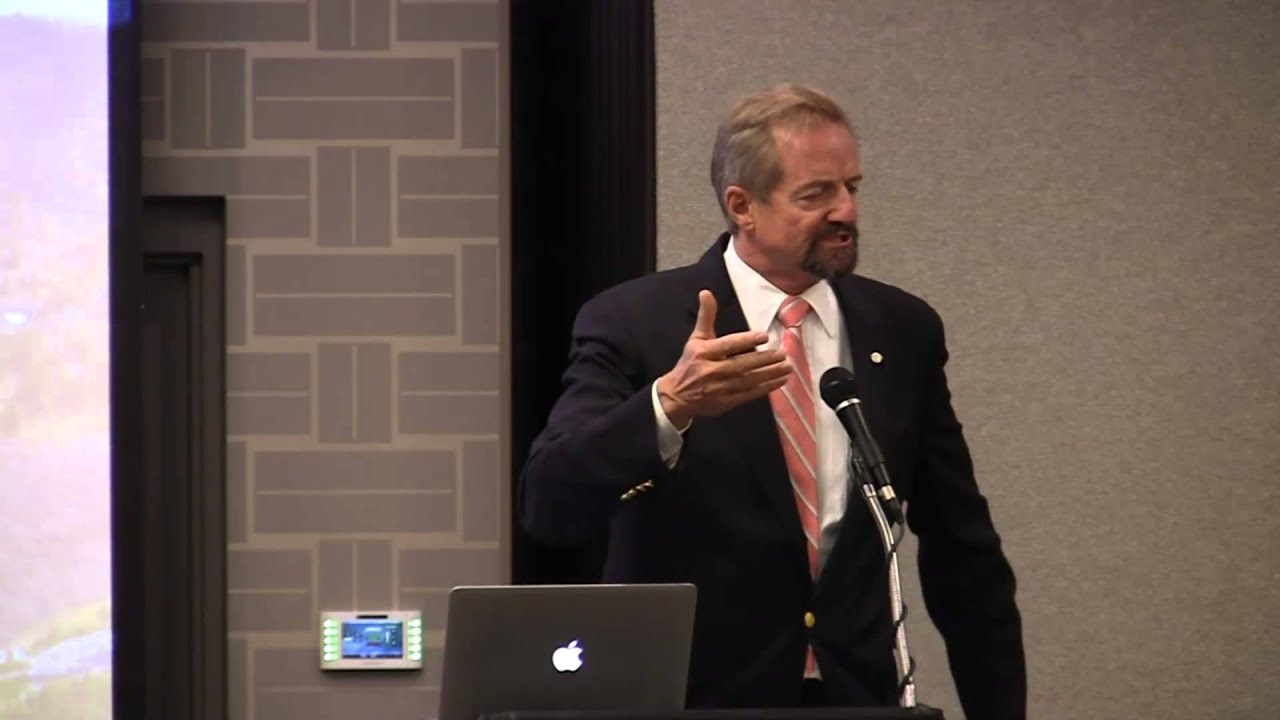 :{ of the conservative American Dream Coalition in Denver.}:
:{:{}:
}:
Environmentalists primarily use three laws, including the Endangered Species Act of 1973, as tools to “drive people off the land” and into cities where they can be “controlled,” he said. At the time, Pendley was president of the Mountain States Legal Foundation, a Colorado-based nonprofit law firm that focuses on “protecting property rights” and advocates for selling off millions of federal acres in the West.
“We’ve gone from protecting the warm and fuzzies to protecting the cold and slimies,” he said. “It was supposed to apply only to federal land. Today, it applies to private property ― coast to coast, border to border ― which leads us here in the West to say what? ‘Shoot, shovel and shut up’ if you encounter one of those critters on your property.”
He continued: “That, by the way, is not legal advice.”
“Shoot, shovel and shut up” ― also known as the “3-S treatment” ― is a strategy extreme property rights advocates have embraced for getting rid of unwanted, imperiled species on private land. Pendley has also written that the law underlying federal species protection is used “to kill or prevent anybody from making a living on federal land.”
Late last month, Interior Secretary David Bernhardt tapped Pendley to serve as acting director of the Bureau of Land Management, an agency of the Interior Department that oversees 245 million acres of public land, or more than one-third of the federal estate. This week, the Trump administrationfinalized rules that significantly weakenthe Endangered Species Act.Among other things, the changes will make it easier for government agencies to remove species from the protected list and limit their ability to account for the impacts of future climate change. The rollback comes on the heels of a United Nations report that found up to 1 million species around the globe are at risk of extinction due to human activities.
[PIX
Interior deputy Susan Combs, pictured in 2010, spent decades as an official in Texas fighting conservation efforts alongside the state’s oil and gas industry.
That the Interior Department took aim at the ESA comes as no surprise when one considers some of the people in high-ranking posts. Pendley is one of several agency officials who detest what is arguably America’s most important law for protecting imperiled plants and animals.
Susan Combs, a former Texas comptroller who was confirmed in June as Interior’s assistant secretary for policy, management and budget, once equated proposed ESA listings to “incoming Scud missiles” headed for her state’s oil and gas-rich economy.As a state lawmaker in the 1990s, she championed legislation prohibiting state wildlife officials from gathering endangered species data from private lands without permission, according to The Austin Chronicle. As Texas comptroller, she fought against the federal government’s proposal to list the dune sagebrush lizard ― an effort that primarily benefited fossil fuel interests. And in 2015, Combs led three groups in a failed effort to petition to have federal protections removed for the golden-cheeked warbler, an endangered songbird native to central Texas.
Karen Budd-Falen, Interior’s deputy solicitor for fish, wildlife and parks, has called the ESA “a sword to tear down the American economy, drive up food, energy and housing costs and wear down and take out rural communities and counties.” As a private lawyer, she was involved in several ESA-related legal disputes, including representing parties accused of violating the law.
During a speech at a conservative summit in 2016, Budd-Falen asserted that she would “repeal the ESA in a heartbeat,” contradicting comments she made during congressional testimony in 2011.
[vid]
Budd-Falen was among several Interior officials who briefed reporters about the ESA overhaul on Monday.
kathy Benedetto, a top adviser at Interior, said in 1995that the ESA “states that plants, animals and bugs are more important than human beings and that’s morally bankrupt,” according to a daily newsletter from the Alliance for America, a property rights group that was “dedicated to bringing human concerns into environmental decision-making.”
“Most species became extinct before man showed up,” Benedetto added. “The earth changes constantly.”
At the time, Benedetto was an executive committee member at the Grassroots ESA Coalition, which was, as the Alliance for America described it, working to “throw out” the 1973 law.
Then there’s Interior chief Bernhardt, a former fossil fuel lobbyist and lawyer who has been a key figure in the Trump administration’s deregulatory agenda. In 2008, while working as the department’s top lawyer during the Bush administration, Bernhardt issued a legal memo that concluded it’s impossible to prove planet-warming greenhouse gases are impacting imperiled species and instructed federal agencies not to consider climate change when making listing decisions. As an industry lawyer, he sued the federal government over its implementation of the act. And as an official in the Trump administration, he intervened to block a scientific report by the Fish and Wildlife Service about the threat certain pesticides pose to more than 1,000 endangered species, as an investigation by The New York Times uncovered earlier this year.
[
The black-footed ferret was brought back from the brink of extinction by a U.S. Fish and Wildlife Service captive breeding program. The species has been reintroduced in the wild, but is still listed under the Endangered Species Act.
Bernhardt and the agency have defended the ESA rework, saying it will increase transparency and lift regulatory burdens without negatively impacting species recovery.
“We celebrate the #EndangeredSpeciesAct as the nation’s foremost conservation law w/ the ultimate goal of recovering the most imperiled species,” Interior’s press office wrote in a post to Twitter. “We are updating ESA implementation to make it more clear, consistent & better address conservation challenges of the 21st century.”
What’s clear, however, is that there are several people walking the halls of Interior’s headquarters in Washington who don’t share that sentiment and want to see sweeping revisions to the ESA. And that’s exactly what environmental groups say the American public is getting with the new rules, which alter how federal agencies implement portions of the law.
“You’ll hear from the administration that a lot of these changes are just kind of cleaning up and technical in nature,” Jamie Rappaport Clark, president and CEO of the conservation nonprofit Defenders of Wildlife and a former director of the U.S. Fish and Wildlife Service under President Bill Clinton, told reporters Monday. “But this package of regulations in no way will improve species conservation, they’ll do quite the opposite. They’ll seriously undermine the Endangered Species Act’s effectiveness in significant and important ways.”
---
==
220 ew
https://www.ecowatch.com/trump-trophy-hunting-council-2645107921.html
https://ecowatch.us7.list-manage.com/track/click?u=214ab5fbb3f6015d74ffab4ec&id=5dd71bd1de&e=c2e8fdabfa
the Department of the Interior (DOI) has disbanded a controversial council that promoted big game hunting after a judge ruled that environmental groups could challenge the legitimacy of the council in court, as The Associated Press reported.
The DOI told a federal judge on Friday that the International Wildlife Conservation Council (IWCC) had ended its charter in October and would not be renewed. The IWCC was created to boost trophy hunting and to relax federal regulations around importing heads and hides of exotic animals like African elephants, rhinos, lions, and other threatened wildlife, according to The Associated Press.
"The Council will not meet or conduct any business again, it can no longer be renewed, and there [is] no plan to establish another committee with a similar mission or scope in the future," the DOI explained in a court filing Friday, according to NPR.
The lawyers for the DOI argued that since the council had been disbanded, the judge should dismiss a lawsuit from environmental groups looking into the "formation, composition, ethics provision, or meetings" by the IWCC, as NPR reported.
"The IWCC's disbandment is a huge victory in the fight against the Trump administration's illegal advisory bodies," said Democracy Forward senior counsel Travis Annatoyn, in a statement. "But the fight isn't over."
Democracy Forward is representing the Natural Resources Defense Council, the Center for Biological Diversity, the Humane Society of the United States and Humane Society International in a lawsuit challenging the legality of the IWCC under the Federal Advisory Committee Act (FACA). The disbandment announcement came on the heels of a slew of FACA lawsuits against the administration.
Former Secretary of the Interior Ryan Zinke, who had to resign under a corruption scandal, put the 16-member advisory board together. It was formed as a response to an Obama-era ban on elephant and lion trophy imports from Africa. In 2018, The Associated Press revealed that the board members were big-game hunters, many with direct ties to President Trump and his family, according to The Associated Press.
Animal rights groups and environmental activists cheered that the committee would not continue its work.
"I have little doubt our litigation spurred the administration's decision to abandon the IWCC and walk away from its biased and un-transparent practices," said Zak Smith, international wildlife conservation director for the Natural Resources Defense Councilin a statement. "We're glad the Trump administration is closing shop on this ridiculously misguided council and we await a full accounting of its tainted work product."
The taxpayer-funded committee met five times over its two-year span and formed four sub-committees. The government said, "Ultimately, the IWCC did not vote on or make any recommendations or otherwise provide any advice or work product," NPR reported.
"The end of Trump's thrill-kill council is a huge victory for elephants, lions and other imperiled animals targeted by trophy hunters," said Tanya Sanerib, international legal director at theCenter for Biological Diversity, in a statement. "It's still critical to address this biased committee's past legal violations and prevent self-serving advice from trophy hunters from poisoning federal wildlife policies."
IWCC members claimed that recreational hunting is necessary because fees paid by big-game hunters help fund conservation programs. They also argued that it boosts local economies and creates hundreds of jobs.
An Interior spokesperson told The Hill in a statement that the department "takes illegal wildlife trafficking seriously and will continue working to grow our partnerships, while continuing to move toward shared conservation stewardship."
- Trophy 'Dream Hunt' With Donald Trump Jr. Starts Bidding at $10000 ›
- Trump Admin Grants First Lion Trophy Import Permit Since Listed as ... ›
- Donald Trump Jr. Killed an Endangered Mongolian Sheep - EcoWatch ›
- Trump Administration caters to wealthy trophy hunters and ignores ... ›
- Donald Trump's Sons in Game-Hunting Photos? ›
==
==
drilled 220
Swamp Thing: Fossil Fuel Insiders in the Department of Interior Are Shaping Offshore Drilling Policy
---
wapo
==
full txt
no lnx
Science ranks grow thin in Trump administration
Jeff Jorgenson examines young corn plants in May on a partially flooded field he farms near Shenandoah, Iowa. A USDA scientist was working on a tool to help farmers mitigate the impact of flooding and other effects from climate change when the Trump administration moved his agency to Kansas, prompting him to quit. (Nati Harnik/AP)
By
Annie Gowen,
Juliet Eilperin,
Ben Guarino and
Andrew Ba Tran
Jan. 23, 2020 at 12:45 p.m. PST
KANSAS CITY, Mo. — Dozens of government computers sit in a nondescript building here, able to connect to a data model that could help farmers manage the impact of a changing climate on their crops.
But no one in this federal agency would know how to access the model, or, if they did, what to do with the data.
That’s because the ambitious federal researcher who created it in Washington quit rather than move when the Agriculture Department relocated his agency to an office park here last fall.
He is one of hundreds of scientists across the federal government who have been forced out, sidelined or muted since President Trump took office.
The exodus has been fueled broadly by administration policies that have diminished the role of science as well as more specific steps, such as the relocation of agencies away from the nation’s capital.
While the administration has come under fire for prioritizing the concerns of industry at the expense of science in government decisions, the cumulative effects are just beginning to appear after three years of Trump in the White House.
Some farmers said the USDA staff upheaval has made it harder to access information they need.
Torrential rains last spring dashed the plans of Liz Brownlee, who runs a livestock farm with her husband, to expand her pasture in Crothersville, Ind. Then an unseasonably dry autumn brought 90-degree days that baked the farmers’ seeds.
“With all this uncertainty from climate change, I need the best data possible” to know when to plant, she said. “I’m worried I’m not going to have it.”
In the first two years of the Trump administration, more than 1,600 federal scientists left government, according to Office of Personnel Management employment data analyzed by The Washington Post. That represents a 1.5 percent drop, compared with the 8 percent increase during the same period in the Obama administration.
One-fifth of the high-level appointee positions in science are vacant — normally filled by experts who shape policy and ensure research integrity.
Of those who departed, the numbers were greatest among social scientists, soil conservationists, hydrologists and experts in the physical sciences — chemistry, geology, astronomy and physics.
At the Environmental Protection Agency, nearly 700 scientists have left in the past three years, according to The Post analysis. The EPA has hired 350 replacements.
Linda Birnbaum, who spent four decades working on toxicology and public health issues at the EPA and National Institutes of Health before retiring in October, said the loss of expertise weakens the government’s ability to make sound decisions.
“It’s going to take a long time for government science to come back. There’s little doubt about that,” said Birnbaum, who serves as an adjunct professor at Duke University and the University of North Carolina at Chapel Hill. She added that NIH has remained well- insulated because it enjoys bipartisan support in Congress.
“But when I look at colleagues in other agencies, especially any agency that has any regulatory role, they’re decimated,” she said.
Trump administration officials dismiss that notion, saying much of the criticism comes from activists outside the federal government.
Interior Secretary David Bernhardt points out that he is the first secretary to enlist a career federal scientist to serve as his scientific adviser.
“I’ve got an ideas box, I haven’t seen that,” he said in an interview, referring to complaints that science has been de-emphasized. “I do hear that from advocates and external parties. And, you know, anybody that looks at these things objectively tends to find that they’re without merit.”
Last year, the environmental group Center for Biological Diversity accused Bernhardt of pushing aside the conclusions reached by career scientists at the U.S. Fish and Wildlife Service regarding how a pesticide affected endangered species. Eight Democratic senators sought an investigation. Interior’s inspector general concluded there was “no evidence” Bernhardt abused his position.
As a presidential candidate, Donald Trump called climate change a “hoax.” Once in office, he began dismantling much of President Barack Obama’s climate plan. He has installed industry figures in regulatory roles and rolled back scores of rules and policies that he considers harmful to the fossil-fuel industry. Trump’s actions spurred scientists into the streets, joining protesters for a March for Science rally on the Mall in 2017 and again in 2018.
Many scientists who work for the U.S. government or rely on its funding say the changes brought by the Trump administration are being felt across the country.
After historic rainfall last spring swept away livestock and grain in the Midwest, crop planting was delayed by weeks. Andrew Crane-Droesch, 38, a researcher at the Agriculture Department’s Economic Research Service, started work on a data tool that could predict months in advance the impact of, say, heavy rainfall on crop prices or planted fields. He hoped that knowledge could help farmers, commodity traders and government disaster planners prepare.
But when Agriculture Secretary Sonny Perdue moved forward with his controversial plan to relocate the Economic Research Service and the National Institute of Food and Agriculture — two key research agencies — to Kansas City, Crane-Droesch headed for the exit.
He joined two-thirds of affected employees in his division who either retired or found other jobs rather than move to the greater Kansas City region. At the National Institute of Food and Agriculture, which oversees $1.7 billion in scientific funding for researchers, nearly 8 of every 10 employees have left.
Crane-Droesch, who took a health-research job in Philadelphia, said there’s no one left at the USDA who has the time or the know-how to run the model he created or to finish the project.
“All that work was for naught, and they nuked the account,” he said. “Even if they hired somebody for my portfolio — which I don’t think they did — it would take that person quite a while to get up to speed, just as it took me several years.”
The move to Kansas City has also meant dozens of reports and millions in research funding have been delayed or scuttled as the Agriculture Department scrambled to keep up with departures.
The agency has been forced to hire back 21 retired employees on temporary contracts, to stanch its losses.
But experts on bee pollination, organic farming, commodity markets and trade are gone, setting back research that has been in process for months or even years.
“They never tried to refute our work; they tried to bury it by getting rid of the people who produced the work,” Crane-Droesch said.
To restore the National Institute of Food and Agriculture and the Economic Research Service to their size under the Obama administration, the USDA would have to hire more than 400 people. One USDA official said the department has “well over 150 active recruitments in process between both agencies.”
Current and former employees interviewed said they felt the move to Kansas City was intended to diminish research areas such as trade policy, farm income and climate change; Perdue is a climate skeptic who recently described the problem as “weather patterns, frankly.”
A USDA spokesman defended the move, saying that Perdue believes the agencies can better serve “customers” — farmers, ranchers, academic institutions and agribusiness — by relocating to Kansas City, “a hub for all things agriculture in America’s heartland.”
The department estimates it will save $300 million over 15 years from employment and rent in Kansas City.
EPA pursues regulatory rollbacks, despite criticism from its scientific advisers
Some federal researchers said they left the Trump administration after concluding their work was being undermined.
Dan Costa, who worked at the EPA for 34 years before stepping down as director of its air, climate and energy research program in January 2018, said the tipping point for his retirement came when an EPA spokesman undercut a study published in the New England Journal of Medicine that the agency had funded.
The study found that long-term exposure to levels of soot and smog lower than current national standards can cause premature death among older Americans. Such a finding suggests that current standards don’t adequately protect public health, which would have implications for industries that pollute. An unidentified EPA spokesman attacked the study in an interview with the Washington Times, an act Costa called “scientifically unethical.”
Peter Van Doren, a senior fellow at the libertarian Cato Insitute, said in an interview that scientists need to remember that they don’t set policy.
“When nerds and politicians disagree, nerds lose,” he said. “Scientists think, ‘We are smart, and we ought to decide.’ But we don’t get to decide.”
Elsewhere in the government, political appointees have delayed grants for scientific work.
At Interior’s U.S. Geological Survey, Director James Reilly “felt that he needed to personally look at every grant that went out,” according to Bernhardt’s science adviser William Werkheiser, who served as Reilly’s deputy before joining the secretary’s office. The process stalled grants at the agency’s climate adaptation science centers for more than six months....
==
1/9/20 NEPA rollback
---
https://yyy.theguardian.com/environment/2020/jan/10/us-national-parks-dismantling-under-way
This land is your land
National parks
The great dismantling of America's national parks is under way
his waking nightmare, the Trump administration has filled the parks department with anti-public land sycophants
We’re expanding our public lands project this year. Read more here.
About this content
Jonathan B Jarvis and Destry Jarvis
Fri 10 Jan 2020 06.00 ESTLast modified on Fri 10 Jan 2020 14.45 EST
Under this administration, nothing is sacred as we watch the nation’s crown jewels being recut for the rings of robber barons.
For more than 100 years, professional management of our national parks has been respected under both Democratic and Republican administrations. Yes, they have different priorities, the Democrats often expanding the system and the Republicans historically focused on building facilities in the parks for expanding visitation. But the career public servants of the National Park Service (NPS), charged with stewarding America’s most important places, such as the Grand Canyon, Yellowstone and the Statue of Liberty, were left to do their jobs.
America's public lands are in danger – and in 2020 we'll report from the frontlines
Read more
Even in the dark days of interior secretaries James Watt and Gail Norton, both former attorneys with the anti-environmental Mountain States Legal Foundation, the National Park Service (NPS) was generally left untouched, perhaps because they recognized that some institutions have too much public support or their mission too patriotic to be tossed under the proverbial bus.
This time is different and we should know, as Jon, one of this story’s authors, worked for the last 10 interior secretaries as a career NPS manager, and ultimately led the agency under Barack Obama, and Destry, Jon’s brother and co-author, has worked with the past 12 NPS directors as a conservation advocate. The change began within 24 hours of the inauguration when Donald Trump complained that the NPS was reporting smaller crowds on the National Mall than Obama had drawn. Perhaps this is when the NPS wound up on the list of transgressors. Soon the interior secretary, Ryan Zinke, attempted to double the entrance fees, rescinded climate policies and moved seasoned senior national park superintendents around to force their retirements.
[Plan clears way for mining and drilling on land stripped from Utah monument
Read more]
After Zinke’s abrupt resignation, secretary David Bernhardt populated too much of the department’s political leadership with unconfirmed, anti-public land sycophants, and announced a reorganization to install his own lieutenants to oversee super regions, realigning NPS from seven regions to twelve in the name of greater efficiency.
Next came the proclamation that career staff in Washington would be sent to the field to be closer to the people they serve, but in reality, to be out of the way and no longer an impediment to his agenda.
Then came the decisions to leave the parks open to impacts during the unfortunate government shutdown, illegally misuse entrance fees, open park trails to e-bikes, suppress climate science, kill wolf pups and bear cubs in their dens to enhance “sport hunting”, privatize campgrounds, and issue muzzle memos to park managers. With a waiver of environmental laws, bulldozers are plowing ancient cacti in national parks along the southern border in order to build a wall. Senior career park managers are likely to be replaced with unqualified political hacks.
These are not random actions. This is a systematic dismantling of a beloved institution, like pulling blocks from a Jenga tower, until it collapses. You ask, why on earth would someone want to do that to the popular National Park Service, the subject of one of Ken Burns’ acclaimed documentaries and often called “America’s best idea”?
Because if you want to drill, mine and exploit the public estate for the benefit of the industry, the last thing you want is a popular and respected agency’s voice raising alarms on behalf of conservation and historic preservation.
Because if you want the public to ignore the science of climate change, the last thing you want are trusted park rangers speaking the truth to park visitors.
Because if you want to get the federal government small enough (in the words of Grover Norquist) to “drown it in a bathtub”, the last thing you want is a government agency with high popular appeal that needs to grow rather than shrink.
It is clear that this administration cannot be trusted with the keys to the vault of our most precious places that define us as a nation, such as Mount Rushmore or Yosemite national park.
When this nightmare ends, and we begin to rebuild, we suggest it is time for Congress to consider making the National Park Service an independent institution, more akin to the Smithsonian, and no longer subject to the vicissitudes of a hostile political agenda in a Department of the Interior dominated by extractive industries and anti-public land crusaders.
Brothers Jonathan and Destry Jarvis have spent a combined 87 years in the conservation of parks and public lands. Jonathan was the 18th director of the NPS and served in the agency for 40 years. Destry has spent 47 years as an advocate for national parks working for several non-governmental organizations and in the private sector.
---
https://yyy.theguardian.com/environment/2019/aug/23/grand-staircase-escalante-national-monument-management-plan-blm-oil-gas-drilling-trump
==
==
predictable, but still omg permanent
https://www.alternet.org/2019/11/as-corrupt-as-it-gets-oil-lobbyist-turned-interior-secretary-proposes-giving-coveted-contract-to-former-client/
no lnx
‘As corrupt as it gets’: Oil lobbyist turned Interior Secretary proposes giving ‘coveted’ contract to former client
Written by Jessica Corbett / Common Dreams November 10, 2019
Watchdog and conservation groups called out former oil lobbyist and current Interior Secretary David Bernhardt Friday over the department’s attempt to give a “coveted” permanent water supply contract to one of Bernhardt’s ex-clients.
“Bernhardt might as well still work for his former lobbying firm, where he represented oil and gas, mining, and agribusiness interests for many years,” declared Public Citizen president Robert Weissman.
Weissman’s national advocacy group previously waged a campaign highlighting Bernhardt’s conflicts of interest, opposed his confirmation, and filed an ethics complaint demanding a department investigation into him.
“If Bernhardt would like to return to his former lobbying job at Brownstein Hyatt Farber Schreck and pursue the interests of his corporate clients, he certainly is free to do so, subject to the ethics rules,” Weissman said. “But for now, he is secretary of the Interior, and his duty is to serve the public, not his old clients.”
Invoking President Donald Trump’s rallying cries from the 2016 campaign, Weissman added that “if anyone still has any illusions that Trump is working to ‘drain the swamp’ or ‘take on elites,’ here is the definitive proof that it ain’t so. A former lobbyist delivering the goods for his old lobby clients is about as corrupt as it gets. Bernhardt is fast making a play for title of ‘Shadiest Trump Cabinet Official.'”
Holy hell. The oil lobbyist running Trump’s Interior Department is awarding one of the first *permanent* water supply contracts to…. wait for it…. his former lobbying client.
This is as corrupt as it gets. https://t.co/a7JwhfFyuu
— Public Citizen (@Public_Citizen) November 8, 2019
Center for Western Priorities policy director Jesse Prentice-Dunn concurred, tweeting late Thursday that the situation represented “the absolute epitome of the swamp.”
Their condemnation came in response to an Associated Press report that the Interior Department “is proposing to award one of the first contracts for federal water in perpetuity” to California’s Westlands Water District. The district, which “serves some of country’s wealthiest and most politically influential corporate farmers,” long employed Bernhardt as a lobbyist.
“As a lobbyist, he was involved in negotiations on a contentious 2016 federal law that made the Westlands’ proposed deal possible, allowing water districts to lock up permanent contracts for water from California’s federal water project,” AP noted. That law, which conservationists oppose over concerns for endangered native wildlife, “reshaped the federal handling of water in the U.S. state with the largest economy.”
After years of working for powerful industries, Bernhardt joined the Interior Department as deputy secretary in July 2017, despite opposition from ethics and environmental advocates who labeled him a “walking conflict of interest.” The GOP-controlled U.S. Senate confirmed him as secretary in March, following the December resignation of scandal-ridden Ryan Zinke.
“Despite Bernhardt’s clear conflicts of interest and his involvement in decisions that are currently under investigation for ethics violations, he can’t stop carrying water for his powerful former client,” Jayson O’Neill, deputy director of the advocacy group Western Values Project, said in a statement Friday.
“The flood gates of corruption flow through Bernhardt, who has manipulated scientific studies, prioritized resources, and tasked staff all to benefit a former client at the expense of the public,” he added. “Bernhardt’s level of corruption may only be eclipsed by that of his boss, but that should not prevent Congress from initiating an investigation immediately.”
---
despite promise/chant drain the swamp and some fig-leaf refrom on how long wait revolve door?
https://www.chicagotribune.com/business/sns-bc-us--trump-former-lobbyists-20190917-story.html
In less than three years, President Donald Trump has named more former lobbyists to Cabinet-level posts than his most recent predecessors did in eight, putting a substantial amount of oversight in the hands of people with ties to the industries they're regulating.
The Cabinet choices are another sign that Trump's populist pledge to "drain the swamp" is a catchy campaign slogan but not a serious attempt to change the way Washington works. Instead of staring down "the unholy alliance of lobbyists and donors and special interests" as Trump recently declared, the influence industry has flourished during his administration.
The amount spent in 2019 on lobbying the U.S. government is on pace to match or exceed last year's total of $3.4 billion, the most since 2010, according to the political money website Open Secrets. Trump also has pulled in hefty contributions from industries with business before his administration, and his hotel near the White House has been a magnet for lobbyists and foreign interests since he was elected.
"An administration staffed by former industry lobbyists will almost certainly favor industry over the general public, because that's the outlook they're bringing to the job," said Lee Drutman, a senior fellow in the political reform program at the think tank New America and author of the book "The Business of America is Lobbying."
:{:{}:
Former lobbyists run the Defense and Interior departments, Environmental Protection Agency and office of the U.S. Trade Representative. The acting Labor secretary, Pat Pizzella, is a former lobbyist and Trump's pick to run the department,Eugene Scalia , also is an ex-lobbyist. Scalia's confirmation hearing before a GOP -controlled Senate committee is scheduled for Thursday and Democrats are expected to grill him on his long record of opposing federal regulations .}:
A seventh ex-lobbyist, Dan Coats , resigned as Trump's intelligence chief in August.
President Barack Obama had five former lobbyists in his Cabinet during two terms in office and President George W. Bush had three,also during eight years in the White House, according to lobbying and foreign agent disclosure records. The review was limited to the Trump, Obama and Bush administrations because prior to 1995 there was no central database of federal lobbying registrations and the law was hazy about who was supposed to register.
Shortly after taking office, Trump signed an executive order that revoked an Obama directive prohibiting lobbyists from being appointed to a post at a federal agency they'd lobbied within the last two years. While this "cooling off" period was cast aside, Trump's order continued to bar for two years lobbyists-turned-government-employees from participating in particular matters that they'd lobbied on during the two preceding years.
"Without the cooling off period, these Cabinet heads appear to be serving their former employers' and clients' special interests," said Virginia Canter, chief ethics counsel of the watchdog group Citizens for Responsibility and Ethics in Washington.
The White House did not immediately respond to a request for comment.
Trump's Cabinet includes the heads of the 15 executive departments and seven other senior-level posts, such as EPA administrator and director of national intelligence. Obama's Cabinet had the same number of members and Bush's Cabinet had two fewer.
Scalia, the Labor Department nominee, has spent much of his career as a partner in the Washington office of the Gibson, Dunn & Crutcher firm, where he ran up a string of victories in court cases on behalf of business interests challenging labor and financial regulations. Scalia, the son of the late Supreme Court Justice Antonin Scalia, served for a year as the Labor Department's top lawyer during the George W. Bush administration.
His financial disclosure report lists 49 clients who paid him $5,000 or more for legal services, including e-cigarette giant Juul Labs, Facebook, Walmart and Bank of America. Disclosure records show Scalia was registered in 2010 and 2011 to lobby for the U.S. Chamber of Commerce.
Pizzellahas been the acting secretary since Alexander Acosta resigned the post in July amid renewed criticism of how, as a federal prosecutor, he handled a 2008 secret plea deal with wealthy financier Jeffrey Epstein.
In the late 1990s and early 2000s, Pizzella lobbied for clients that ranged from Microsoft Corp. to the Mississippi Band of Choctaw Indians. He also worked on several accounts with disgraced lobbyist Jack Abramoff , although Pizzella was never accused of any misconduct or wrongdoing.
Obama chose Pizzella for a GOP seaton the Federal Labor Relations Authority and he was an assistant Labor secretary during the George W. Bush administration.
Two Trump Cabinet officials, Interior Secretary David Bernhardt and Environmental Protection Agency Administrator Andrew Wheeler, have been accused by congressional Democrats and public interest groups of failing to honor their ethics pledges.
Both Bernhardt and Wheeler, backed by the U.S. Chamber of Commerce, have played leading roles in the administration's rollback of environmental regulations. They also both worked at the agency they now lead during prior administrations.
Interior's inspector general launched an investigation of Bernhardt earlier this year after receiving seven separate ethics allegations against him. A complaint filed by the nonprofit Campaign Legal Center alleged that shortly after joining the department in August 2017 Bernhardt became involved in matters that were the focus of his lobbying for California's Westlands Water District that lasted until mid-November 2016.
Westlands has federal contracts to provide irrigation water to 700 family-owned farms in the fertile San Joaquin Valley. The complaint said Bernhardt had "lobbied on discrete provisions of a law directing Interior to maximize water supplies to his clients, and to minimize Endangered Species Act protections in that region."
Then, after joining Interior, Bernhardt breached his ethics pledge by directing government officials under him "to advance the particular matters he had previously lobbied on," according to the complaint.
"It is very hard to tell where Bernhardt's lobbying career ended and where his public service begins," said Brendan Fischer, director of the Campaign Legal Center's federal reform program.
An Interior spokesman said in a statement, "Secretary Bernhardt is and always has been committed to upholding his ethical responsibilities, and he has fully complied with those obligations."
Thomas Birmingham, Westlands' general manager, said the agency is actually disadvantaged with Bernhardt as secretary because he's not been able to engage with him as he did past Interior secretaries, like Ken Salazar and Sally Jewell .
"I don't know what Mr. Bernhardt has done or has not done at Interior," Birmingham said.
Wheeler worked as a lobbyist for eight years and his more than 20 different clients included coal magnate Bob Murray, who pushed hard on the Trump administration to grant a series of breaks for the sagging domestic coal industry.
"I think he's doing a great job," Betsy Monseu, CEO of the American Coal Council, said of Wheeler. "We're pleased to see the regulatory reform agenda moving forward."
But Canter's organization, known as CREW, urged the EPA inspector general earlier this year to investigate whether Wheeler broke his ethics pledge. Among the allegations, CREW said Wheeler had participated in the easing of standards for storing coal ash in 2018 even though he had lobbied on those regulations the year before for Murray Energy.
The inspector general's office declined to say if it had open an investigation, directing a reporter to file a Freedom of Information Act request.
An EPA statement called CREW's complaint "baseless and just flat out false." It said Wheeler works closely with career EPA ethics officials and abides by all ethics requirements.
The Pentagon's top official, Mark Esper , spent seven years lobbying for defense industry juggernaut Raytheon, a company that stands to gain handsomely from Trump's push to boost military spending by billions of dollars. The company closed out 2018 by hitting a record $27.1 billion in net sales, up nearly seven percent from the $25.3 billion the year before.
Esper, who was secretary of the Army when Trump chose him to be defense secretary, faced opposition from only a handful of Democrats and he was confirmed in July by a 90-8 margin.
As Army secretary, Esper hasn't participated in Raytheon-related matters under the terms of an ethics agreement that runs through this November. After that, Esper told Pentagon ethics officials that he will continue to avoid Raytheon issues unless his participation as defense secretary is determined to be essential.
Robert Lighthizer, the U.S. Trade Representative, lobbied primarily for steel companies between 1999 and 2003. Beginning in 2004, he represented just one company, U.S. Steel, which paid his firm, Skadden, Arps, Slate, Meagher & Flom, $3.2 million over a seven-year period.
---
https://www.alternet.org/2019/09/trump-administration-seeks-to-unleash-a-pillage-of-arctic-refuge-but-indigenous-groups-vow-to-fight-it/
no lnx
Trump administration seeks to unleash a pillage of Arctic Refuge — but indigenous groups vow to fight it
Written by Andrea Germanos / Common Dreams September 13, 2019
Indigenous leaders vowed Thursday to protect their Alaskan lands from fossil fuel exploitation after the Trump administration moved closer to allowing drilling along the Coastal Plain of the Arctic National Wildlife Refuge—a move the House just tried to block.
“The Gwich’in are protectors,” said Bernadette Demientieff, executive director of the Gwich’in Steering Committee, “and we will not give up.”
The pledge from the Gwich’in—who call the coastal plain “the sacred place where life begins”—came in response to the Final Environmental Impact Statement (FEIS) for oil and gas leasing, which was released Thursday by the Bureau of Land Management.
The announcement, said Interior Secretary David Bernhardt in a press statement, represents “a big step to carry out the clear mandate we received from Congress to develop and implement a leasing program for the Coastal Plain,” referring to Sen. Lisa Murkowski’s (R-Alaska) provision in the “tax scam” of 2017 requiring the sales for drilling rights in the area. Bernhardt is a former fossil fuel lobbyist.
In the new analysis, the administration, as The Washington Post reported, chose “the most aggressive development option for an area long closed to drilling.”
“The FEIS unlawfully opens the entire coastal plain to leasing,” wrote NRDC staff attorney Garett Rose. “It fails to even consider an approach that minimizes damage to the refuge’s unique environment, violating our bedrock environmental review law.”
But that choice came to “no one’s surprise,” according to Adam Kolton, executive director of Alaska Wilderness League, who said the Trump administration was “not even pretending that this is about restraint or meaningful protection.”
“With an eye on developing the entirety of the fragile coastal plain,” Kolton continued, “the administration has been riding roughshod over science, silencing dissent, and shutting out entire indigenous communities.”
Demientieff, whose community has highlighted the potential catastrophe the exploitation could unleash on the calving and nursery grounds for the Porcupine caribou herd, also criticized the FEIS for disrespecting “the Gwich’in Nation and all people in the Arctic and world who suffer the impacts of climate change and nonstop exploitation, while formally scratching the backs of those who seek to desecrate land and dishonor human rights to fill their pockets.”
The FEIS, as The Hill noted, is “one of the final steps before leases can be sold,” as bidding may begin after 30 days.
The timing of the release of the environmental impact statement also raised the eyebrows of Kolton, who noted that it came “literally hours” after the Democratic-controlled House voted 225-193 to block the mandate for the ANWR drilling.
Passage of that bill was welcomed by its author, by Rep. Jared Huffman (D-Calif.), who said the measure “reflects a very simple proposition: there are some places too wild, too important, too unique to be spoiled by oil and gas development.”
Huffman praised lawmakers voting in favor of the measure for “protecting not just the beating biological heart of the largest wildlife refuge in the United States, but the Indigenous people who depend on this sacred, natural landscape.”
The vote was also celebrated by Indigenous and environmental groups.
Alex Taurel, head of League of Conservation Voters’ Conservation Program, called the vote “a resounding victory for the Gwich’in people, their sacred traditions, and the invaluable wildlife of the majestic Arctic National Wildlife Refuge.”
“The majority of people in the U.S. oppose oil and gas drilling in the Arctic Refuge—we will continue to stand up against special interest big polluters as long as it takes,” said Taurel, urging the Senate to follow suit.
Democratic Senators including Ed Markey (Mass.) and Michael Bennet (Colo.)took to social media this week to ramp support for their legislation to block the ANWR drilling—though its fate is likely doomed in the Republican-controlled chamber.
Ed Markey
?
@SenMarkey
We can’t let the Arctic Refuge, one of the last pristine wildernesses in America, be permanently destroyed by oil and gas drilling. That’s why today, we’re intro'ing the Arctic Refuge Protection Act to designate this delicate region as wilderness and prevent all future drilling.
Embedded video
---
==
https://boingboing.net/2019/08/21/leaked-emails-suggest-this-tru.html
no lnx guk
US interior secretary David Bernhardt is pushing a fossil fuel project that the lobbying firm he used to work for is getting paid from, these e-mails in a Guardian report today suggest.
Bernhardt worked at the Brownstein Hyatt Farber Schreck before he quit to join the Trump administration in August 2017.
At the lobbying firm, Bernhardt represented oil companies.
Here's an excerpt from one of the leaked emails.
Excerpt:
Experts say Bernhardt is probably violating ethics guidelines issued by the Trump administration with the stated goal of “draining the swamp”. Based on these rules, Bernhardt should be recused from specific issues involving a former client for at least two years.
The Jordan Cove Energy Project was proposed by the Canadian energy giant Pembina to transport fracked natural gas through Oregon to the international port at Coos Bay in the state. It would include a new 232-mile pipeline that passes through several dozen miles of interior department land.
Several county commissioners from Colorado, where much of the gas is fracked, met with Bernhardt in Washington DC to boost the project in March. They included Mike Samson, Bernhardt’s former high school teacher.
“Awesome time in DC he is totally behind the project and has people working on it towards completion,” Samson wrote concerning Bernhardt in a 7 March email to Ray Bucheger, a Jordan Cove lobbyist with the firm FBB Federal Relations. “He recognizes that time is of the essence and that meaningful progress needs to [be] made this year.”
Revealed: emails raise ethical questions over Trump official's role in gas project [the Guardian, photo of David Bernhardt: Shutterstock]
---
https://www.nytimes.com/2019/08/12/climate/endangered-species-act-changes.html
- aug 12, 2019
WASHINGTON — The Trump administration on Monday announced that it would change the way the Endangered Species Act is applied, significantly weakening the nation’s bedrock conservation law credited with rescuing the bald eagle, the grizzly bear and the American alligator from extinction.
The changes will make it harder to consider the effects of climate change on wildlife when deciding whether a given species warrants protection. They would most likely shrink critical habitats and, for the first time, would allow economic assessments to be conducted when making determinations.
The rules also make it easier to remove a species from the endangered species list and weaken protections for threatened species, a designation that means they are at risk of becoming endangered.
Overall, the new rules would very likely clear the way for new mining, oil and gas drilling, and development in areas where protected species live.
Interior Secretary David Bernhardt said the new rules would modernize the Endangered Species Act and increase transparency in its application. “The act’s effectiveness rests on clear, consistent and efficient implementation,” he said in a statement Monday.
Commerce Secretary Wilbur Ross said in a statement the revisions “fit squarely within the president’s mandate of easing the regulatory burden on the American public, without sacrificing our species’ protection and recovery goals.”
The new rules are expected to appear in the Federal Register this week and will go into effect 30 days after that.
Environmental groups denounced the changes as a disaster for imperiled wildlife. A recent United Nations assessment, they noted, has warned that human pressures are poised to drive one million species into extinction and that protecting land and biodiversity is critical to keep greenhouse gas emissions in check.
Climate change, a lack of environmental stewardship and mass industrialization have all contributed to the enormous expected global nature loss, the United Nations report said.
...Ever since President Richard M. Nixon signed the Endangered Species Act into law 1973, it has been the main United States legislation for protecting fish, plants and wildlife, and acted as a safety net for species on the brink of extinction. The peregrine falcon, the humpback whale, the Tennessee purple coneflower and the Florida manatee all would very likely have disappeared without it, scientists say.
Republicans have long sought to narrow the scope of the law, saying that it burdens landowners, hampers industry and hinders economic growth. Mr. Bernhardt wrote in an op-edlast summer that the act places an “unnecessary regulatory burden” on companies.
They also make the case that the law is not reasonable because species are rarely removed from the list. Since the law was passed, more than 1,650 have been listed as threatened or endangered, while just 47 have been delisted because their populations rebounded.
Over the past two years Republicans made a major legislative push to overhaul the law. Despite holding a majority in both houses of Congress, though, the proposals were never taken up in the Senate. With Democrats now in control of the House, there is little chance of those bills passing.
The Trump administration’s revisions to the regulations that guide the implementation of the law, however, mean opponents of the Endangered Species Act are still poised to claim their biggest victory in decades.
...
One of the most controversial changes removes longstanding language that prohibits the consideration of economic factors when deciding whether a species should be protected.
Under the current law, such determinations must be made solely based on science, “without reference to possible economic or other impacts of determination.”
Gary Frazer, the assistant director for endangered species with the United States Fish and Wildlife Service, said that phrase had been removed for reasons of “transparency.” He said the change leaves open the possibility of conducting economic analyses for informational purposes, but that decisions about listing species would still be based exclusively on science.
Environmental groups saw a danger in that. “There can be economic costs to protecting endangered species,” said Drew Caputo, vice president of litigation for lands, wildlife and oceans at Earthjustice, an environmental law organization. But, he said, “If we make decisions based on short-term economic costs, we’re going to have a whole lot more extinct species.”
The new rules also give the government significant discretion in deciding what is meant by the term “foreseeable future.” That’s a semantic change with far-reaching implications, because it enables regulators to disregard the effects of extreme heat, drought, rising sea levels and other consequences of climate change that may occur several decades from now.
When questioned about that change and its implications in the era of climate change, Mr. Frazer said the agency wanted to avoid making “speculative” decisions far into the future.
Among the animals at risk from this change, Mr. Caputo listed a few: Polar bears and seals that are losing crucial sea ice; whooping cranes whose migration patterns are shifting because of temperature changes; and beluga whales that will have to dive deeper and longer to find food in a warmer Arctic.
Jonathan Wood, a lawyer at the Pacific Legal Foundation, a conservative group that has represented landowners in opposing endangered species designations, said he believed the changes would improve the law by simplifying the regulatory process and making the law less punitive.
“It’s a shift away from conflict in favor of more collaboration and cooperation,” he said.
related
https://www.nytimes.com/2019/05/06/climate/biodiversity-extinction-united-nations.html
==
818 nrdc
The Trump administration sparked public outrage with its 2017 decision to reduce the size of the Bears Ears National Monument by 85 percent. Now the Bureau of Land Management has released a new plan to eliminate all protections for the remaining 15 percent—more than 80,000 acres of wilderness—from drilling and mining for coal, oil, gas, and other minerals. While we continue to fight the administration in court, you can help by calling on Interior Secretary David Bernhardt to abandon this rushed and reckless management plan.
==
==
liz cheney bears open up park for frack?! 819 Fish & Wildlife
---
The areas in Greater Chaco Landscape contain the threatened ruins of Chaco Canyon — what some have referred to "as close as the U.S. gets to Egypt’s pyramids and Peru’s Machu Picchu" — as well as "the remnants of great houses, kivas, ancient roads and sacred places built a millennium ago by an indigenous people who became proficient in architecture, agriculture, astronomy and the arts."1,2 Today, the Diné or Navajo people rely on the Chaco Landscape to sustain their livelihoods and traditional practices and modern New Mexican Pueblos, the descendants of Chaco culture, still consider these sites sacred.3
More than 91% of the area around Chaco Canyon has already been leased to the oil and gas industry, yet Sec. Bernhardt and his Big Oil cronies are eager to wipe out the last remaining protected sacred areas with dangerous drilling and fracking techniques. The democratically-led House or Representatives recently passed an amendment to a spending bill that included a one-year moratorium on drilling in the area, yet it's unclear whether the Republican-controlled Senate will include the provision in their version, and BLM continues to approve more fracking in the area.4 That's why pressure on the BLM is so important right now.
-----
Former Interior scientist calls out ‘culture of fear, censorship, and suppression’ under Trump
:{:{}:
}:
:{:{}:
There is a “culture of fear, censorship, and suppression” within the Trump administration that is impeding government scientists from doing their best work, former Interior Departmentpolicy director and scientist turned whistleblower Joel Clement warned on Wednesday.
Speaking to lawmakers on the House Science Committee, scientific experts spoke about the need for stronger rules to support the integrity of their research and ensure that political agendas don’t dictate or interfere with the data.
“There is not Democratic science, there is not Republican science, there is just science,” said Michael Halpern, deputy director for the Center for Science and Democracy at the Union of Concerned Scientists.
Halpern pointed to instances under current and previous administrations, including under Presidents George W. Bush and Barack Obama, of scientific assessments being either watered down or language softened. He pointed to past research on lead in school lunchboxes and on the impact of fracking on drinking water.
But the scientists said that under President Donald Trump, political interference had reached a new level.
As Clement highlighted, a study into the rules needed to protect the health and safety of offshore oil rig workers was canceled right before a set of measures to protect the workers was rolled-back. Similarly, a study into the health impacts of surface coal mining was canceled right before making moves to support the coal industry.
Other studies have been delayed, such as one on the health impacts of PFAS chemicals in drinking water for fear of a “public relations nightmare,” while agencies have seen some scientists self-censor their work out of fear, such as removing the words “climate change” from reports.
“The American people lose when we end up with manipulated, suppressed, or distorted information,” Halpern said. After all, as multiple experts testified, it’s taxpayer money that funds government scientists — the public paid for that research and deserves to see it.
The result is “dirtier air, dirtier water,” added Clement, who resigned from his post at the Interior in July 2017 after being reassigned to “an unrelated job” by former Secretary Ryan Zinke. Clement saw the move as an attempt to push him out for speaking out about the impacts of climate change on Alaskan native communities.
The hearing on Wednesday follows the release of a bill by committee member Rep. Paul Tonko (D-NY), called the Scientific Integrity Act, earlier this year. The bill, which has the support of nearly 200 House members, is intended to insulate “public scientific research and reports from the distorting influence of political and special interests” according to Tonko.
While Tonko reminded everyone at the hearing that he began working on the bill in 2016 under the Obama administration, he added, “The abuses directed by this President [Trump] and his top officials have brought a new urgency to the issue.”
While more than 20 federal agencies have some type of scientific integrity policy, not all of these policies are successfully or fully implemented. As an April report by the Government Accountability Office found, of the nine agencies reviewed, seven have “specific, documented procedures” for identifying and addressing alleged violations. The report also made 10 recommendations to agencies for addressing the need to better educate staff on the issue, provide greater oversight, and develop procedures to identify and address potential violations.
[Scandals mount under David Bernhardt :(style="background-color:#ffff66ff"):}::{just two weeks after being confirmed to lead Interior
Ethics probes are still in full swing.
Last year, the EPA announced it would begin an investigation to see whether its scientific integrity policy was being properly implemented. This came after a survey was released by the Union of Concerned Scientists, which showed that government scientists across 16 agencies and departments had concerns with the degree of political influence over their work.
Specifically, the annual survey for 2018 showed that a third of the nearly 449 EPA respondents worried about the “influence” of political appointees or White House officials over “science-based” decisions. Less than 30% agreed or strongly agreed with the statement “My agency adheres to its scientific integrity policy.”
In addition, roughly a third of EPA respondents agreed or strongly agreed that they had either been asked directly to omit or independently decided to avoid the use of the term “climate change” in their work.
There is technically nothing stopping an agency from dismantling its scientific integrity policy, said Halpern. That’s why a bill such as the one proposed by Tonko would go a long way to buttress, or add “statutory heft,” to agency policies as Clement described.
Clement called the Scientific Integrity Act a good first step, but noted that in order to be truly effective, broader ethics and integrity standards were needed across agencies.
Indeed, many of the individuals overseeing agencies come from the industry they are now responsible for regulating. The Environmental Protection Agency (EPA) and Department of Interior (DOI) have faced numerous ethics scandals regarding potential conflicts of interest and alleged industry influence.
EPA internal watchdog will audit the agency’s Scientific Integrity Policy
Less than a third of EPA staff surveyed said they felt the agency adheres to its scientific integrity policy.
In March, for instance, The New York Times revealed documents showing DOI Secretary David Bernhardt intervened to block a study showing pesticides might threaten the existence of 1,200 endangered species; Bernhardt has a history of lobbying against the Endangered Species Act.
But due to the “hostile leadership situation,” there are many scientists who are simply keeping their heads down and staying quiet about issues surrounding scientific integrity under the current administration.
“I’d love if every policymaker thought of science as the North Star,” said Clement, “but I hope it’s part of the constellation.”
}:
==
==
https://thinkprogress.org/agriculture-usda-blm-move-dc-climate-trump-protests-science-e8e534ec12fc/
719
Employees and Democratic lawmakers are pushing back on the Trump administration’s plans to relocate hundreds of positions within two agencies outside of Washington, D.C. — a move some see as an effort to clamp down on science.
While the planned moves of both the Interior Department’s Bureau of Land Management (BLM)and parts of the Department of Agriculture (USDA) differ in their scope and rationale, resistance to both plans has shaped up similarly.
Critics are expressing concern over the motivations behind the efforts, which would lead to a mass-exodus of agency experts unwilling to relocate. This would spur a science brain drain in line with President Donald Trump’s crackdown on reports and research from within his own government.
“These decisions… are meant to displace seasoned scientists and regulators who have honorably served Republican and Democratic Administrations alike,” said Sen. Chris Van Hollen (D-MD)in a statement to ThinkProgress responding to both the BLM and USDA relocation plans. Van Hollen sits on the Interior and Environment Appropriations subcommittee.
Responsible for administering public lands, BLM has become a battleground under the Trump administration as the White House has rolled back the boundaries of national monuments and advocated for fossil fuel drilling on U.S. acreage.
Now, the bureau is sparking controversy again. Administration officials confirmed this week that the overwhelming majority of BLM positions in D.C. are set for relocation. Around 84% of BLM staffers will be asked to relocate by the end of next year to areas outside of the nation’s capital, mostly to western states.
That announcement comes a month after Secretary Sonny Perdue mandated that over 500 USDA employees move en masse to Kansas City — located in both Missouri and Kansas — by Sept. 30, and gave them a deadline of July 15 to respond.
[Lack of demand hasn’t stopped Trump from opening tons of land
to oil and gas drilling
In the case of BLM, the Interior Department (DOI) plans to concentrate many of the positions in Grand Junction, Colorado, in addition to a range of western states stretching from Arizona to Alaska.Joe Balash, DOI assistant secretary for land and minerals, called the decision “demonstrably cost-effective” in a July 16 letter to Sen. Tom Udall (D-NM), ranking member of the Senate Appropriations subcommittee on Interior and Environment.
The Trump administration argues that the move would both cut expenses and shift workers closer to the public lands they focus on, an argument supported by many Republicans including Rep. Rob Bishop (R-UT), who sits on the Natural Resources Committee.
But Democrats immediately raised objections. Udall said he had “serious reservations” about the move, as did his subcommittee counterpart in the House, Rep. Betty McCollum (D-MN). Democrats in both chambers of Congress indicated this week that they feel the plan is largely an effort to push out the D.C.-based senior staff who do not want to relocate.
Many of those employees are experts in their field, including scientists. “It’s a way for them to get rid of a lot of professional staff here in Washington,” said Rep. Jared Huffman (D-CA) in a statement.
Former Interior scientist calls out ‘culture of fear, censorship, and suppression’ under Trump
Many BLM employees are already located in other parts of the country and support for moving the bureau has been somewhat bipartisan over the years. But the latest push for relocation by the Trump administration coincides with a heated clash between USDA and its employees.
Given until this past Monday to make their decision, scores of USDA workers have opted out of moving. Of the employees with the USDA’s Economic Research Service (ERS) and the National Institute of Food and Agriculture (NIFA), more than half declined to relocate, according to Politico.
ERS workers in particular argued that the move would disrupt their work and efforts to publish important scientific reports. NIFA, meanwhile, is responsible for grant funding that touches climate, economic, and agricultural work that uses D.C. as a home base.
Many USDA employees have also argued that the move is politically motivated. ERS has recently released reports critical of Trump’s escalating trade war with China and its impact on farmers.
Experts also worry the move is a warning shot with implications for climate science. An investigation by Politico last month found that USDA has repeatedly sought to burystudies showing the danger of climate change. That report noted that some scientists see the ERS move as a foreshadowing of wider repercussions for research that doesn’t align with the administration’s broader “energy dominance” agenda.
USDA workers have fought through their union, the American Federation of Government Employees (AFGE), to dispute the move, but the department has rejected those efforts. Moreover, there is concern that other departments could face similar moves, like the U.S. Fish and Wildlife Service and the U.S. Geological Survey, both of which are under DOI’s jurisdiction.
But Democrats asserted that they are looking into measures to combat the relocations, emphasizing that the move could be costly to taxpayers in addition to dramatically shifting the wealth of knowledge offered by current government staffers.
Lawmakers indicated they might seek to halt the relocation by blocking its funding in the upcoming appropriations bill that covers both the DOI and the Environmental Protection Agency (EPA). A group of senators, including Van Hollen, have meanwhile introduced legislation to keep ERS and NIFA in the D.C. metro area, a move that was made before the BLM move was announced.
“This Administration is acting to undermine the subject-matter experts at many of our federal agencies,” said Van Hollen, who added that his office would “continue to use every tool available to push back against these actions.”
This article has been updated to note that only USDA would be impacted by the Senate legislation due to timing.
==
==
2x?
https://www.outsideonline.com/2390596/david-bernhardt-scandal-tracker
A Calendar Without Names
More than 150 entries in Bernhardt’s official calendar fail to list the identities of persons or companies he was meeting with. Given Bernhardt’s numerous conflicts of interest, this is problematic for Congressional oversight, and the House Natural Resources Committee is demanding he fill in the gaps.
...
==
https://westernvaluesproject.org/report-lobbyist-turned-interior-deputy-david-bernhardts-dirty-record-after-one-year/
9/9/18
Who has been running the Interior Department while Secretary Ryan Zinke has been out of the office for the last three weeks? Meet Interior’s #2: Zinke’s dirty Deputy Secretary David Bernhardt.
Last year, Bernhardt made headlines after being nominated for being second-in-command at the largest land managing agency in the federal government. The controversy surrounding his nomination was in part ignited because he was a test case for the swampy revolving-door Potomac politics that President Trump had promised to drain. After serving as scandal-plaguedInterior Solicitor in the George W. Bush administration, Bernhardt became a top natural resource lobbyist for extractive industries.

Learn more at www.departmentofinfluence.org
The Senate confirmed Bernhardt for one of the top posts at Interior despite his glaring conflicts of interest. Many of those conflicts have been covered and continue to be documented by watchdog groups like Western Values Project (WVP). Just weeks ago, WVP and Democracy Forward were forced to sue the Department of the Interior for failing to release public documents regarding decisions in which Bernhardt was involved and communications relating to his former clients after WVP’s Freedom of Information Act (FOIA) requests went unfulfilled.
Every Trump administration appointee is required to sign an ethics pledge, in which they promise to, “not for a period of 2 years” from the date of their appointment, “participate in any particular matter involving specific parties that is directly and substantially related to my former employer or former clients.” And although David Bernhardt signed an ethics recusal in which he promised to recuse himself from particular matters involving his former clients until August 3, 2019, WVP has found blatant instances in which he and the Interior Department have been involved in helping his former clients.
Undermining Wildlife Protections
David Bernhardt was charged with overseeing the greater sage-grouse management plans overhaul shortly after his controversial confirmation. If the sage-grouse plans get diluted as requested by extractive corporations, critical habitat would no longer be a consideration in leasing decisions, ultimately opening up vast swaths of public lands to those same corporations for industrial development. The Bureau of Land Management issued sixInstructional Memorandums to state offices that among other things de-prioritize critical sage grouse habitat.
After Interior rolled back protections across the West, the Independent Petroleum Association of America — which appears on Bernhardt’s list of recusals — joined in a thank youletter addressed to Bernhardt for his efforts that benefited the oil and gas industry.
Moreover, the second largest and seventh largest leaseholders of sage-grouse habitat in Colorado, SandRidge Exploration and Production LLC, and Bill Barrett Corporation, respectively, both used Bernhardt’s old lobbying firm, Brownstein Hyatt Farber Schreck, to lobby the federal government while Bernhardt worked there. Denbury Onshore LLC, the fourth largest leaseholder of sage grouse habitat in Montana, also used Bernhardt’s lobbying firm while he lobbied there.
Undermining the cooperative sage-grouse plans may foreshadow the oil and gas industry’s long-standing dream – the wholescale rollback of the Endangered Species Act; and it appears that Bernhardt is taking the lead.
Drilling in the Arctic and Alaskan National Wildlife Refuge
In August 2017, David Bernhardt included Eni Petroleum, North America, on his ethics recusal, writing that, absent a waiver, he would be “recused from particular matters” in which Eni was involved.
Just three months later, in November 2017, the Bureau of Safety and Environmental Enforcement, an Interior agency, approved Eni’s application to drill in the Arctic, making Eni the first company to get approval for drilling in federal Arctic waters since 2015.
In December 2017, Interior spokesperson Heather Swift boasted to an Anchorage Daily Newsreporter that Bureau of Safety and Environmental Enforcement (BSEE) employees were working through Christmas to approve an application by Eni Petroleum to drill in the Arctic. Swift said that the well “could raise millions,” adding, “Wouldn’t that be a nice Christmas present!?!?”
Bernhardt has also promised the oil and gas industry swift action on drilling opportunities in the Alaskan National Wildlife Refuge after he previously lost a suit to open the refuge to drilling, claiming that he would now ‘move very, very quickly on that project’ to expedite the permitting process.
Western Water Wars
- Cadiz Inc.
While working as a lobbyist at Brownstein Hyatt Farber Schreck, Bernhardt was co-chair of Brownstein’s natural resources department alongside Scott Slater, the CEO of Cadiz Inc., a Southern California company that is attempting to pump billions of gallons of groundwater a year and pipe it across the Mojave Desert to sell to cities in Southern California. In order for the controversial project to succeed, Cadiz Inc. requires permits from Interior.
In October 2017, the Bureau of the Land Management reversed an Obama-era guidance that had been a major obstacle for the Cadiz project. The change of administrative opinion could make millions for Cadiz Inc. Additionally, Brownstein Hyatt Farber Schreck has already earned 200,000 shares of Cadiz stock for its involvement with the company and stands to earn another 200,000 if the project is completed.
- Garrison Diversion Conservancy District
Another former Bernhardt client, the Garrison Diversion Conservancy District (GDCD) is “spearheading” a project to “diver[t] Missouri River water to supplement water supplies in the Red River Valley,” a project that environmentalists have long bemoaned.
In October 2017, two months after Bernhardt became Deputy Secretary, GDCD had a meeting with Secretary Zinke, in which Zinke promised to take “‘a fresh look at this project,'” and he “told officials attending the meeting to expect a response from the Department of the Interior in the near future.” One GDCD board member described the meeting with Secretary Zinke as “‘a very good meeting;'” after this meeting, the GDCD expects that the diversion project will receive approval from the federal government. North Dakota Congressional Representative Kevin Cramer has also met with Secretary Zinke to discuss the project.
The District was so impressed by Bernhardt’s former lobbying firm’s newfound access to top Interior officials that they nearly tripled the retainer paid to Brownstein Hyatt Farber Schreck to $10,000 per month.
- Westlands Water District
Most recently, Secretary Zinke has put Bernhardt in charge of overseeing a new Bureau of Reclamation project to explore “methods of moving more water south.” Bernhardt’s former lobbying client, Westlands Water District, has welcomedthe proposed project.
For his first year in office, Bernhardt promised to recuse himself from decisions affecting Westlands and his other former clients. However, the recusal ended August 2, 2018. The short term of Bernhardt’s recusal is perplexing considering the Trump administration makes political appointees vow a two-year ethics pledge.
Covering Up Russian Ties
In April 2017, just days after media reports of Bernhardt lobbying for Access Industries, a company run by Leonard Blavatnik, Ukrainian-born oligarch who made billions doing business with newly sanctioned Russian oligarchs, five amendments were filed to Access Industries’ lobbying reports to remove Bernhardt’s name from the reports.
The unamended lobbying reports for Access Industries show that Bernhardt was a lobbyist for the company from the 2nd quarter of 2011 through the 2nd quarter of 2012. However, on April 25 and April 26, 2017, amendments were filed with the Senate to remove Bernhardt from those disclosures. However, he is still listed as a lobbyist for Access Industries in their initial lobbying report, and no amendment appears to have been filed to remove him from it.
Dirty Casino Deal
In September 2017, the Interior Department refused make a decision on the Mohegan and Mashantucket Pequot tribes’ plans to open a new casino in Connecticut. While “federal law gives Interior just 45 days to issue a yes-or-no verdict after a tribe submits proposed changes to its gaming compact with a state… the department declined to make any decision in this case.”
Interior’s non-decision that has benefitted MGM Resorts International, a competing casino company, as the tribes proposed casino would be just across the border “from a billion-dollar casino that MGM is planning in Springfield, Mass.”
Meanwhile, Bernhardt’s old lobbying firm has been lobbying on behalf of MGM Public Policy LLC “on issues including gaming.” MGM Public Policy LLC is “an affiliated company” of MGM Resorts International.
The issues listed above are just a sample of Bernhardt’s conflicts of interest that Western Values Project has uncovered so far. There are other troubling accounts that date back to his time as Interior Solicitor in the George W. Bush administration regarding casinos, retaliation against whistleblowers, millions in lost tax royalties and convicted felon ex-lobbyist Jack Abramoff. A recently released report, The Favor Factory, provides more analysis on Bernhardt’s apparent conflict-of-interest issues as Interior Deputy Secretary.
What we do know is that Deputy David Bernhardt has been involved in many policy and personnel decisions at Interior since assuming his post last year. While WVP has examined over 50,000 public documents released by Interior, only one email has been sent by Bernhardt, raising serious questions as to how decisions that impact our public lands, national parks, and wildlife are being made and for whom. Stay tuned.
==
https://www.washingtonpost.com/climate-environment/2019/04/03/firm-that-once-employed-trumps-pick-run-interior-is-making-millions-lobbying-it/
no lnx
The firm that once employed Trump’s pick to run Interior is making millions lobbying it
Brownstein Hyatt Farber Schreck has quadrupled its business since David Bernhardt joined the Interior Department in 2017.
A card with clients of Interior acting secretary David Bernhardt are seen listed on this small card, which he carries with him as he performs his job. (Salwan Georges/The Washington Post)
By Dino Grandoni and
Juliet Eilperin April 3
The law and lobbying firm that previously employed President Trump’s pick to run the Interior Department saw a surge in revenue from clients hoping to influence the agency after he left for its upper ranks in 2017.
Over the past three years, according to federal records, acting interior secretary David Bernhardt’s former firm Brownstein Hyatt Farber Schreck has quadrupled its business related to Interior.
In 2018, two dozen clients paid BHFS a total of $4.8 million to lobby Interior, according to data compiled from a lobbying database maintained by the Senate. During the previous year, when Bernhardt left the firm to join the Trump administration as deputy secretary, it collected a total of $3.5 million in Interior-related revenue.
By comparison, the firm’s total income to lobby Interior in 2016 was $1.2 million. During all but one year going back to 2009, BHFS‘s Interior-related revenue never broke seven figures.
The striking uptick in the amount of lobbying revenue could provide fuel to Bernhardt’s critics as he heads toward a confirmation vote before a Senate committee on Thursday. The former lobbyist on energy and water issues is already under scrutiny by Democratic lawmakers, advocates and the agency’s inspector general over his long list of former industry clients.
It’s also a sign of how the revolving door between industry and government is still spinning two years after Trump won the presidency with a mantra to “drain the swamp” of special interests.
“Any senator thinking of casting their vote for this nomination should take a long pause and closer look at his conflicts of interests before doing so,” Jayson O’Neill, deputy director of the liberal advocacy group Western Values Project, said in an email.
These yearly sums do not differentiate between money paid to BHFS to lobby Interior on a particular topic and money paid to lobby another part of the federal government, such as Congress, on the same issues.
For its part, BHFS said the firm’s Interior-related revenue went up just as Trump entered office and kick-started new work on public lands. The firm said it saw a similar boost in clients focused on the Energy Department at the beginning of President Barack Obama’s first term, after his administration offered new energy funding opportunities as part of its effort to stimulate the economy.
“Given this President said he would do more on projects dealing with federal lands, it is not surprising that our firm has seen an increase in available work there,” the firm said in a statement. “Brownstein has established an industry-leading team with extensive experience managing policy issues related to natural resource development at all levels of government. This combination of experience and policy change are the conditions that have historically grown our business.”
Interior spokeswoman Faith Vander Voort said in an email that while the department cannot comment on the revenue of Bernhardt’s former firm, the acting secretary clears all matters involving former clients with Interior ethics experts.
“The acting secretary actively seeks and consults with the Department’s designated ethics officials for advice on particular matters involving former clients,” she said, “and the acting secretary has implemented a robust screening process to ensure that he does not meet with his former firm or former clients to participate in particular matters involving specific parties that the acting secretary has committed to recuse himself from.”
On Tuesday, Interior’s Office of Inspector General confirmed that it was reviewing allegations that Bernhardt violated the Trump administration’s ethics pledge by working on California water policies that could affect the Westlands Water District — which is still a BHFS client — while in office.
Bernhardt denies that he improperly helped the large agricultural water district, and Interior ethics officials have said his work did not constitute a conflict. Bernhardt’s ethics pledge to recuse himself from weighing in on “particular matters” affecting Westlands and three other clients ended on Aug. 1, 2018. He is still recused from taking action on specific matters affecting 22 other clients until August of this year.
[Bernhardt has so many former lobbying clients he needs a card to list them all]
In a separate development, Interior has released new scheduling documents for Bernhardt, known as daily cards, that shed new light on Bernhardt’s activities since joining Interior in August 2017. On May 24, 2018, the new records show, Bernhardt participated in a video conference call with U.S. Fish and Wildlife Service officials on the delta smelt. The tiny and imperiled species lies at the heart of federal and state water policy in California’s Central Valley, since water diverted for the delta smelt has meant less irrigation water for Westlands and other agricultural districts.
In a floor speech Wednesday, Sen. Ron Wyden (D-Ore.), a senior member of the Energy and Natural Resources Committee, argued that the panel should postpone a vote on Bernhardt’s nomination given the current questions surrounding his past lobbying work.
“I do not believe the Senate should allow the Interior Department to turn into a revolving door of corruption and scandal,” Wyden said.
But Sen. Cory Gardner (R-Colo.), like other Republicans on the panel, defended Bernhardt during last’s week’s confirmation hearing as a victim of a “double standard,” noting that one of Obama’s interior secretaries once worked as a petroleum engineer and outdoor retail executive.
[The Energy 202: Senate Democrat blasts ethics of Trump Interior secretary nominee]
The increase in BHFS’s Interior-related revenue also highlights how the firm has emerged in Trump’s Washington as a well-connected lobbying outfit on the management of federal lands.
Much of that Denver-based firm’s work concerns land and tribal issues at the heart of the portfolio of the Interior Department, which altogether oversees 1 in every 5 acres of land in the United States. The department’s decisions can have far-reaching ramifications for many industries, including energy, mining and farming.
Over the course of 2017 and 2018, BHFS representatives helped arrange at least eight calls or meetings between clients and Interior officials below Bernhardt, according to calendars published on the department’s website under the Freedom of Information Act.
Even though Bernhardt has recused himself from weighing in on policies targeted at specific clients, such as the Garrison Diversion Conservancy District, BHFS has continued to tout its ties to top Trump officials. “Many of the decision-makers in the agencies are former co-workers and colleagues,” BHFS wrote in a Dec. 20, 2017, letter to that district explaining why it would double its monthly fees to work on a controversial plan to tap water from the Missouri River.
And some of the firm’s clients have seen some favorable policy decisions. Among them is Cadiz, a publicly traded water company that paid BHFS $110,000 per quarter over the course of 2017 and 2018.
For decades, the company has sought to tap a massive aquifer beneath the Mojave Desert for perennially thirsty farmers and city-dwellers in California. In 2017, Interior exempted the project from a federal review imposed on it by the previous administration.
Bernhardt has formally recused himself from issues involving Cadiz.
But another BHFS client from which Bernhardt is recused, an affiliate of MGM Resorts International, won only a temporary victory under Trump.
MGM has opposed the effort of two Connecticut tribes, the Mashantucket Pequot and the Mohegan, to run a casino in East Windsor, Conn. MGM Public Policy has paid BHFS a total of $560,000 since 2017 to retain it as a representative on tribal-gaming issues.
The previous Interior chief, Ryan Zinke, decided in 2017 not to grant the tribes approval, a decision they charge stemmed from political pressure. The matter has sparked a Justice Department probe into the former interior secretary.
On March 21, however, Interior published a notice in the Federal Register approving the tribes’ amended gaming compacts. This will allow them to operate a commercial casino just 12 miles away from MGM’s gambling complex in Springfield, Mass.
==
https://www.cnn.com/2019/07/08/politics/interior-department-arizona-development-bernhardt/index.html
trms)
In the summer of 2017, Arizona developer Mike Ingram's proposed housing and golf course project in the desert was facing a road block because of a decision by the Department of the Interior.
A field supervisor for the US Fish and Wildlife Service had determined that it was "reasonably certain" that threatened and endangered species could be harmed.
But that decision suddenly changed following a secret breakfast meeting at a Montana hunting lodge between Ingram -- a donor to President Donald Trump and co-owner of the Arizona Diamondbacks -- and David Bernhardt, then the Trump administration's deputy Interior secretary.
Following the meeting, which did not appear in Bernhardt's official calendar and has not been previously reported, the field supervisor says he was pressured to reverse his decision, allowing the project to move ahead.
"I felt pressured to reverse my decision ... in simplest terms, I was rolled," Steve Spangle, then a 30-year veteran of the Fish and Wildlife Service, told CNN in an interview. "I made a decision, which was my authority to make in Arizona, and that was overruled by higher-ups in the administration."
The meeting is one of at least 11 interactions Ingram had with top officials at the Interior Department and Environmental Protection Agency during the Trump administration, according to a CNN review of emails and calendars.
Former FWS official Steve Spangle
The meetings and the reversal suggest yet another example of Trump administration officials siding with executives and business leaders in the industries for which they have oversight.
A lawsuit filed by environmental groups earlier this year has put the project on hold once again. The House Committee on Natural Resources is also investigating what happened. Committee Chairman Raul Grijalva has asked Interior for documents and raising "questions about whether a key permit decision at the U.S. Fish and Wildlife Service was inappropriately reversed."
A phone call and a reversal
The Villages at Vigneto is designed as a development of 28,000 homes, golf courses and a resort community planned for the sprawling patch of mesquite scrub expanse just east of Benson, Arizona.
Local officials welcome the development; Benson Mayor Toney King said it's desperately needed to bring jobs back to the area. "We've been fighting really hard to get growth here," King told CNN. "We've had generations of kids that have left and they can't come back. There are no jobs."
Interior declined to answer any of CNN's specific questions for this story, and instead provided a one sentence statement: "U.S. Fish and Wildlife Service has reexamined the issue at hand and using the best available science as required under the Endangered Species Act issued the same exact conclusion."
Lanny Davis, a prominent Democratic attorney representing Ingram's El Dorado Holdings, told CNN there is no evidence of any political influence by his client, and any suggestion of influence is "innuendo."
Mayor Toney King, Benson, Arizona
But the environmental concerns surrounding the area go back more than a decade because of its proximity to the San Pedro River and the habitats of endangered and threatened species. The remote desert landscape was initially slated for development in the early 2000s. The Environmental Protection Agency has long been opposed to building on the site, writing in 2005 that it "represented a substantial and unacceptable impact on aquatic resources of national importance," and the EPA stance has not changed since. Opponents of the project also say the aquifer that feeds the river could be impacted.
Despite those environmental concerns, the US Army Corps of Engineers approved a Clean Water Act permit in 2006, but the 2008 recession forced the owners to sell.
Ingram bought the property with his company El Dorado Benson LLC in 2014, renaming the development the "Villages at Vigneto," with the intention of building using the 2006 Army Corps permit.
That permit was suspended, however, in 2016 after six environmental groups sued and demanded an environmental consultation by the Fish and Wildlife Service.
Spangle was the top official in Arizona evaluating development projects and their impact on the environment and endangered species. In October 2016, he wrote a decision about the Villages at Vigneto that "direct and indirect effects to threatened and endangered species... are reasonably certain to occur," referring to the western yellow-billed cuckoo, the southwestern willow flycatcher and northern Mexican gartersnake.
[pix This August, 2013 photo provided by Point Blue Conservation Science shows a yellow-billed cuckoo, which has made the western United States its breeding ground for many years. But the migratory bird, which otherwise lives in Latin America, has seen its population dwindle in the past few decades because its habitats have been marred. NThe U.S. Fish and Wildlife Service on Thursday, Oct. 2, 2014, announced that the western population of the yellow-billed cuckoo has been listed as a threatened species and will be protected under the Endangered Species Act. The bird resides in 12 western states and in Mexico and Canada, but Arizona has the largest population. (AP Photo/Point Blue Conservation Science, Mark Dettling)
He ordered that a full scale "biological assessment," which can take months and bring additional litigation, was needed before the project could move ahead. He also wrote that the Clean Water Act permit issued earlier by the Army Corps "should not have been issued."
Spangle assumed the project would move ahead with the assessment he ordered, like other projects he had worked on. Then in August 2017, he says, he received an unusual phone call from Peg Romanik, an associate solicitor at the Interior Department.
"[S]he told me that she had gotten a call from a high-level political appointee within the Department of the Interior who informed her that our position out here, in Arizona, was not the position of the administration," Spangle told CNN.
During that call, Spangle said he was strongly pressured to reverse his decision on Vigneto; his reversal would remove a major hurdle for the project and allow it to move forward without the in-depth biological assessment he asked for.
Romanik met with Bernhardt at 8:30 a.m. the same day that she called Spangle, according to Bernhardt's calendar, which does not list what was discussed.
The phone call and reversal were first reported by the Arizona Daily Star, but the name of the solicitor and her meeting with Bernhardt have not been previously reported.
Spangle said it was the first time in his career that he was asked to change an official decision he had made, saying it "wasn't a good feeling, but I felt I had a duty. I work for the administration, I have to do what I'm told, and so I did."
On October 26, 2017, Spangle issued a new decision, reversing his earlier letter, and allowing the project to move ahead without the full biological assessment. He retired four months later.
Romanik did not return a call requesting comment.
Developer's contacts with Trump administration
Ingram is a wealthy and powerful figure in Arizona. El Dorado Holdings is one of the largest private landholders in the southwestern US, with assets exceeding $1 billion. Ingram is also one of the owners of the Arizona Diamondbacks, the state's Major League Baseball team.
CNN has found a trail of contacts between the developer and top government officials, along with political contributions, that raise questions of access and influence.
Ingram co-chaired a "Camouflage and Cufflinks" fundraiser around the time of Trump's inauguration, which offered a private reception with the President, and a hunting trip with Donald Trump Jr, and Eric Trump in exchange for a $500,000 donation. The event was canceled after ethical questions surfaced over buying access to the President and his sons.
An avid hunter, Ingram is a director of the non-profit Safari Club International Foundation, which Bernhardt formerly represented as an attorney, according to Bernhardt's financial disclosure statement.
Ingram was also appointed by then-Interior Secretary Ryan Zinke to the International Wildlife Conservation Council, an official federal group set up to advise on issues related to "citizens traveling to foreign nations to engage in hunting," according to its website.
Several weeks after Spangle received the phone call asking for his reversal, Ingram made a one- time $10,000 donation to the Trump Victory Fund. Since November 2015, Ingram donated $50,900 to political committees supporting Trump. In the same time frame, Ingram donated $6,050 to Democrats.
Since the beginning of the Trump administration, Ingram or his representatives had at least 11 meetings, emails or phone calls with top officials at Interior and EPA, including one meeting with Zinke, two meetings and three emails withthen-EPA Secretary Scott Pruitt, and at least five meetings with Bernhardt, who succeeded Zinke as Interior secretary earlier this year.
Ingram declined CNN's request for an interview, but Davis, El Dorado Holding's attorney, says his client has done nothing wrong.
"The innuendo is, well, he's close to Trump, there must've been political influence," Davis said in an interview, adding, "That's just innuendo. I can't negate that because it's a quote 'feeling.'"
While Davis confirmed to CNN the meetings between Ingram and administration officials, he said there was nothing untoward about them.
Davis points to a recent letter sent by the US and Fish and Wildlife Service to the Army Corps of Engineers, which reiterated that the reversal by Spangle was the correct course of action. The letter also said, "we take the allegations made by Mr. Spangle seriously," and that a re-evaluation was done at the local level without influence from regional or Washington, DC headquarters.
"[T]he local Fish and Wildlife Service... [said] that the likely impact on endangered species is not sufficient to stop this project," Davis said, adding that the facts contradict any suggestion that the federal agency was influenced by Ingram. "If you focus on facts, the facts are that the Army Corps of Engineers made a decision on the facts under the law," Davis added.
The letter, dated June 12, 2019, was given to CNN by Davis just days after CNN requested an interview with Ingram, and was a response to a May 23 request by the Army Corps of Engineers.
CNN sent Interior a detailed list of questions about the Vigneto project asking about the phone call to Spangle, why he was pressured to reverse his decision, why Bernhardt had a secret meeting with Ingram, and whether that led to the pressure on Spangle to reverse his order. CNN also asked to do an interview with Bernhardt. Interior declined to answer those questions.
Environmentalists who oppose the project in Arizona are livid.
"I think it's the most blatant example most people have seen of how people with power and money, connections and influence, have changed how the system is supposed to work, " said Tricia Gerrodette, a local resident and activist. "We're supposed to work under the laws and science. And science was overridden here."
Gerrodette is on the board of the Tucson Audubon Society, one of six environmental groups which filed a joint lawsuit earlier this year demanding the Army Corps complete a full Environmental Impact Statement, and the Corps once again suspended the permit for the Villages at Vigneto development. The case is still pending.
El Dorado Holdings has argued it does not need a permit to begin construction, and it would be willing to change the footprint of the development to avoid federal waters if needed.
But with Spangle's reversal and the Fish and Wildlife Service backing that decision it is expected the corps will lift the suspension on the original 2006 permit. Environmentalists vow they will fight on in the courts, because they believe the project will destroy the underground aquifer.
"The development will ruin this area. It will drain the aquifer and kill it," Gerrodette said.
Clarification: This story has been clarified to reflect that the suspension is expected to be lifted from the original 2006 permit, and updated to include the May 23 request by the Army Corps of Engineers.
CNN's Collette Richards contributed to this report.
==
Interior Department’s watchdog has launched a major ethics investigation into six top officials, including former Interior Secretary Ryan Zinke and the agency’s current head, David Bernhardt.The probe by Interior’s inspector general follows an ethics complaint filed in February alleging the officials routinely disregarded rules requiring they recuse themselves from official meetings with former employers or lobbying clients. Secretary Bernhardt is a former oil lobbyist who’s been accused of making at least 15 policy decisions that directly benefited former clients since he joined the agency in 2017. His predecessor, Ryan Zinke, resigned in December as he faced at least 17 federal investigations into his suspected ethics violations and corruption, including a criminal probe into whether he lied to Interior Department investigators.
---
==
on me for lagging?
==
gop coming for out water back to cheney rove? on fishkill?
blackheart westlands (on his 3x5 coi?)
---
Bernhardt, the former lobbyist nominated by President Donald Trump to lead the Interior Department, has been referred to as the “ultimate D.C. swamp creature” so frequently that a swamp creature was spotted in the audience for much of his confirmation hearing Thursday.
Lawmakers focused on Bernhardt’s conflicts of interest and reports of favoritism toward his former clients, including the fossil fuel industry, throughout the hearing.
“Mr. Bernhardt, I’m not claiming you are Big Oil’s guy, the Big Oil lobbyists are making that claim,” Sen. Ron Wyden (D-OR) said during the Senate Committee on Energy and Natural Resources hearing to consider Bernhardt’s nomination.
Wyden was referring to leaked audio released earlier this week in which oil executives are heard laughing at the level of access they have to the Trump administration. Specifically, the Independent Petroleum Association of America’s chief executive, Barry Russell, spoke about his ties to Bernhardt, saying it “worked out well” that Bernhardt had become the deputy secretary of the Interior Department.
Bernhardt was confirmed as deputy secretary in July 2017. Since then, he has been credited as the mind behind many of the Interior Department’s controversial policy changes — from selling off public lands to altering the Endangered Species Act. Trump announced Bernhardt’s official nomination to lead the agency earlier this month, but he’s been in an acting role since the previous secretary, Ryan Zinke, left at the end of last year, dogged by scandals and investigations.
Before joining the Interior Department, Bernhardt ran the natural resources department at lobbying and law firm Brownstein Hyatt Farber Schreck. During his time there, he worked on behalf of oil and gas companies as well as large agribusinesses to weaken environmental protections. Prior to that, he worked under President George W. Bush as solicitor at the Interior Department; his time was marked by scandal and ethics violations.
Now back at the agency under Trump, Bernhardt’s ethical issues have taken center of stage. He has so many potential conflicts of interest to avoid that he carries around a card listing all of them so he doesn’t forget. A recent analysis by the Center for American Progress found that Bernhardt has more conflicts of interest than any other Trump cabinet nominee. (Editor’s Note: ThinkProgress is an editorially independent news site housed at the Center for American Progress Action Fund.) In recent weeks, Democratic lawmakers have criticized Bernhardt’s lack of transparency regarding his schedule after he refused to release it publicly.
The first question posed to Bernhardt from committee chair Sen. Lisa Murkowski (R-AK) zeroed in on how he will handle these ethical issues and potential conflicts of interest. Bernhardt asserted that he has “actively sought and consulted with” ethics officials, adding, “I know how devastating it is when folks at the top behave in an unethical manner.”
However, this was quickly countered by Wyden who recounted a recent exchange he had with Bernhardt. Wyden said Bernhardt came to his office to assure the senator that he took ethics concerns seriously. Shortly after this visit, however, the New York Times revealed documents showing Bernhardt intervened to block a study showing pesticides might threaten the existence of 1,200 endangered species; Bernhardt has a history of lobbying against the Endangered Species Act.
“The decision to block the release of the report represented a victory for the pesticide industry, which has industry allies and former executives sprinkled through the administration,” the Times reported.
“So, you asked to come to my office to tell me your ethics are unimpeachable, but these brand new documents I saw make you sound like just another corrupt official,” said Wyden. “Why would you come to my office to lie to me about your ethics?”
Bernhardt replied simply, “the news article you’re referring to is not even close to the actual story.” (Later, Bernhardt reiterated for the record, “I certainly didn’t lie to the senator.”)
Throughout Thursday’s hearing, Bernhardt’s repeated favoritism for the fossil fuel industry was called into question. Regarding the administration’s energy dominance policy, Sen. Catherine Cortez Masto (D-NV) noted that “it appears that policy extends to oil and gas but it doesn’t extend to other forms of energy development on public lands such as solar, wind, and geothermal.”
She then listed a series of decisions and regulatory rollbacks made by the department “that imply your support more so of the fossil fuel industry.” This includes opening up national monuments to allow oil, gas, and coal leasing, rushing to allow an oil and gas lease sale in the Arctic National Wildlife Refuge, repealing safety rules put in place after the BP Deepwater Horizon disaster, and recalling furloughed workers during the recent government shutdown to continue processing oil and gas leases.
“Why hasn’t the department given the same level of intensity to cleaner forms of energy development than it is to fossil fuel development?” asked Cortez Masto.
“I really appreciate the question,” said Bernhardt. “I don’t think I can name a policy where we’ve not treated, for example, solar or wind, equally fairly.”
Sen. Joe Manchin (D-WV) pressed Bernhardt on whether he would extend his ethics recusal beyond the required time limit, set to expire soon, “since you’ve had so many of your clients [who are] going to be working directly with this agency?”
Bernhardt said no. “I’m basically handcuffed if I am recusing myself,” he said. “I don’t really think that’s the best strategy.”
Later, Murkowski noted that Interior ethics officials found that should Bernhardt be confirmed, he will be in compliance with ethics rules and conflicts of interest law.
That finding did little to diminish the skepticism of some lawmakers. As Wyden argued, he sees only two possible paths forward with Bernhardt should he be confirmed to lead the agency: Either he continue making decisions that will favor the fossil fuel industry and his former clients, or “you disqualify yourself from so many matters I don’t know how you’re going to spend your day.”
==
bernhardt?
US Sues California, Says Water Policy Violates State Law - The New ...
https://www.nytimes.com/aponline/2019/03/28/us/ap-us-california-water-wars.html
16 hours ago - The federal government has sued California over water policies it says violate ... The lawsuit filed Thursday in Sacramento federal court seeks to block a plan ... salmon by increasing water in the Sacramento-San Joaquin River Delta. ... The U.S. Department of Justice said the plan was arbitrary and failed to ...
US Sues California, Says Water Policy Violates State Law
By The Associated Press
March 28, 2019
LOS ANGELES — The federal government sued California on Thursday over a water policy it said violates the state's environmental protection law.
The U.S. Department of Justice filed suit in Sacramento federal court to block a contentious plan approved in December to increase river flows in the San Joaquin River and three tributaries to help revive dwindling salmon populations.
It was part of a larger effort to protect the Sacramento-San Joaquin River Delta, which state officials called an "ecosystem in crisis." The delta supplies water for the majority of California's people and farms.
Once-thriving fish in the delta, which flows out to San Francisco Bay, have plunged from some 70,000 adult Chinook salmon returning to the San Joaquin basin in the fall of 1984 to just 10,000 in 2017.
Some environmental groups supported the plan, while other conservation groups and fishing groups said it fell short in providing enough water for habitat.
Farmers opposed to the plan because it would divert less water for irrigation protested last summer outside the state Capitol.
The U.S. lawsuit said the plan was arbitrary and the state failed to analyze impacts on the environment and would reduce water coming out of the New Melones reservoir for farms, businesses and hydroelectric operations.
The environmental analysis "hid the true impacts of their plan and could put substantial operational constraints on the Department of the Interior's ability to effectively operate the New Melones Dam, which plays a critical role in flood control, irrigation, and power generation in the Sacramento region," said Assistant Attorney General Jeffrey Bossert Clark said in a statement.
The federal government's lawsuit follows a suit filed last month in state court by the California Farm Bureau Federation to block the plan.
George Kostyrko, a spokesman for the water board, said the agency looks forward to defending the plan that involved years of analysis and public input.
The lawsuit was an unusual turn of events with the state of California as a defendant in a lawsuit with the federal government. The state's attorney general has sued the Trump administration more 47 times.
Attorney Doug Obegi of the Natural Resources Defense Council said it was ironic that the U.S. government was citing state law to sue California in federal court.
"The Trump administration has shown its flagrant disregard for state laws for some time, so it's not surprising in that regard," Obegi said. "I can't for the life of me see how a federal court lawsuit against a state agency for a claimed violation of state law doesn't get tossed out immediately for violating the U.S. Constitution."
The NRDC said the December decision was a step forward, but it wouldn't do enough to reach the goal to double the salmon population.
John McManus, president of the Golden Gate Salmon Association, said the plan approved in December had "re-balanced a badly out of balance water diversion scheme" and the suit was a "frivolous attempt to see more water diverted and more salmon industry jobs and families destroyed."
==
==
wyden called him a liar for burying chem F&W report; he said lawyers told him to 86. guy wore swamp think mask behind him, quiet so confuse cops if disruptive.
==
desmog
David Halperin, crossposted from Republic Report
In October 2016, candidate Donald Trump unveiled a package of government ethics reforms that he said would “drain the swamp” in Washington, DC; it included a ban on former federal employees lobbying the government for five years and stricter rules on what constitutes lobbying. He seemed to be promising to undermine the power of special interest lobbyists and restore government to the people.
But Trump’s every move since being elected has been in the opposite direction. A former coal lobbyist, Andrew Wheeler, runs the Environmental Protection Agency; an ex-pharmaceutical lobbyist, Alex Azar, runs Health and Human Services; former for-profit college lobbyists control policy at Betsy DeVos’s Department of Education; and much more. On issue after issue, from weakening protections against toxic pollution, to undermining access to health care, to giving tax advantages to the rich, the administration has sided with wealthy interests over working people.
This Thursday the Senate Energy and Natural Resources Committee will hold a hearing to consider Trump’s nomination of another former industry lobbyist, David Bernhardt, to be Secretary of the Interior.
Bernhardt, currently the Department’s acting secretary and deputy secretary, would replace Ryan Zinke, whose reign was characterized by troubling conflicts of interest, paired with an extraordinarily audacious sense of entitlement and self-aggrandizement.
Bernhardt is less flamboyant, more skilled in the ways of law and government. But in terms of the ways that money corrupts politics and policy, his record is even more concerning.
David Bernhardt is the ultimate swamp creature.
The weekend brought the revelation, in a *Reveal* / *Politico* report, that at a 2017 meeting of the Independent Petroleum Association of America (IPAA), Dan Naatz, the group’s political director, was recorded telling the 100 executives gathered that then-deputy secretary Bernhardt was their boy. “We know him very well,” Naatz said, “and we have direct access to him, have conversations with him about issues ranging from federal land access to endangered species, to a lot of issues.”
Naatz didn’t stop there. He predicted that Zinke would be the Interior figurehead, while Bernhardt would get things done: “What secretaries of Interior do is go out to Yellowstone, go out to Tetons … have big vision for what they’re going to do… David is going to be the COO. David’s going to move the pieces. David’s going to be part of that, and we know him well.”
Barry Russell, IPAA’s CEO, bragged in the session of meeting with Zinke and with Scott Pruitt, then the EPA head. He also noted that Bernhardt, while at the powerhouse DC lobbying firm Brownstein Hyatt, had led IPAA’s legal team challenging federal endangered species rules: “The guy that actually headed up that group is now the No. 2 at Interior. So that’s worked out well.”
An Interior spokesperson told the Reveal reporter that Bernhardt “has had no communication or contact with either Barry Russell or Dan Naatz.”
But there’s no doubt that these men and other oil and mining lobbyists have gotten what they wanted out of the Trump administration, especially from their faithful servant David Bernhardt.
During that 2017 meeting, IPAA circulated a “regulatory update” memo, listing five major environmental laws and regulations they wanted to overturn. Since then, the Trump administration has gutted four of those five targets — measures that were aimed at (1) limiting water pollution from energy fracking; (2) reducing climate change-causing methane gas releases; (3) requiring restoration of public lands damaged by energy projects; and (4) holding energy companies accountable for harms to migratory birds.
An earlier Reveal report, last month, exposed Interior Department emails showing that Bernhardt played a critical role in the 2017 decision to revoke the government’s 50-year authority to use the Migratory Bird Treaty Act to prosecute companies that accidentally kill migratory birds through activities like oil drilling.
While Bernhardt is legendary for his skill at avoiding a paper trail for his activities — he claims, “I have not personally maintained a calendar for years” — Reveal also has documented that Naatz and other IPAA representatives met in April 2018 with Todd Willens, Bernhardt’s top aide, to discuss the migratory birds issue, as well as the rules requiring restoration of public lands. Hours later, Willens met with Bernhardt.
Another investigative piece, published in the New York Times last month, revealed that, since 2017, Bernhardt has been pushing at Interior to eliminate another environmental rule, one he had long been paid to oppose as a lobbyist — protection against destruction of a species of river fish. Bernhardt admitted to the Times that four months after joining Interior, he directed a senior Department official to initiate an effort to weakening protections for the fish in order to free up water for agricultural businesses — the same businesses Bernhardt had represented while at Brownstein Hyatt.
Bernhardt’s intervention in a matter he had pursued as a lobbyist appears to have violated the Trump administration’s ethics pledge, requiring officials to refrain from such involvement for at least two years. Last month, Senators Elizabeth Warren (D-MA) and Richard Blumenthal (D-CT), along with the non-profits Campaign Legal Center and Public Citizen, called for investigations of this potential violation.
Invoking a strained and dubious interpretation of the ethics pledge— that Bernhardt’s actions at Interior are legal because he has worked on the broad issue of water rights, and not just the included issues affecting his ex-clients — Bernhardt and Interior spokespersons insist that he complied, and generally assert that he has abided by all regulations governing ethics and recusal. But even if that were true, the scandal, as is often the case, isn’t what’s illegal; the scandal is what is still legal in swampy Washington DC.
Bernhardt epitomizes the Washington revolving door— getting paid by taxpayers to master policy issues in government jobs, and cashing in on his experience and connections as an industry lobbyist. In 1998, he jumped from his job as an aide to a House Republican to join Brownstein Hyatt. He later entered the George W. Bush Interior Department as a top aide to Secretary Gale Norton and then as the Department’s chief lawyer, and he worked to overturn the congressional prohibition on oil drilling in Alaska’s Arctic Wildlife Refuge. When the Bush administration ended, Bernhardt returned to Brownstein Hyatt, where he lobbied for or advised dozens of energy and mining companies and trade associations, like IPAA, seeking to end or avoid Interior regulations.
Among other work at Brownstein Hyatt, Bernhardt lobbied on behalf of EP Energy to delay protections against air pollution from coal-fired power plants. He worked for Rosemont Copper, which seeks to dispose of toxic waste in the Coronado National Forest in Arizona.In the aftermath of the BP Deepwater Horizon gulf oil disaster, Bernhardt lobbied to expand offshore drilling on behalf of Cobalt International Energy, a company probed by federal law enforcement agencies for violations of the Foreign Corrupt Practices Act.
More than 150 organizations joined a letter opposing Trump’s appointment of Bernhardt as deputy secretary, charging that the nominee was “laden with conflicts of interest that raise serious questions about his ability to act in the public interest.” (More than 160 groups signed a new letter, released today, opposing Bernhardt’s confirmation to be secretary.) Indeed, critics have labelled Bernhardt “a walking conflict of interest,” and as if to prove that, he reportedly carries with him a small card that lists all his potential conflicts.
While brushing aside concerns about his own conflicts, Bernhardt charged last month in a letter to Interior staff that Department’s “ethics challenges were part of a mess that we inherited” from the Obama administration, which he appeared to denounce for “a culture of ethics avoidance” and “an avalanche of ethical misconduct.”
Meanwhile, Bernhardt’s former firm, Brownstein Hyatt, is now the second biggest-earning lobby operation in DC, with reported lobbying revenues rising to $31.6 million in 2018.
Bernhardt and other Brownstein Hyatt lobbyists have, since 2013, donated almost $1 million to senators who will vote on his confirmation for the Interior job.
And yet another report, in the Times today, shows that Bernhardt led an effort to block the release of a government analysis of the dangers that various pesticides create for a range of endangered species, and replace it with a narrower approach sought by chemical manufacturers. One of those companies, Dow, had donated $1 million to the Trump inauguration.
CNN has calculated that since Bernhardt joined Interior in 2017, the Department has made at least 15 policy changes or proposals that would directly aid former Bernhardt clients.
Trump seems to love Bernhardt these days, because, unlike former defense secretary James Mattis, who slow-walked Trump’s demand for a military parade, Bernhardt has been willing to indulge the president’s fantasy for a Trumpified 4th of July celebration. “David, you’re taking care of that,” Trump said, regarding the July 4 plans, to Bernhardt at one of his staged cabinet meetings, “and we’ll see how it works out with schedules and everything else.” Bernhardt also escorted Trump and Vice President Pence on a 90-second visit to the Martin Luther King memorial on MLK day in January.
For Bernhardt, a master DC operator, playing Trump probably isn’t too hard. Give him his parade, tell him you’re making America great again, and you can go to town destroying protections for public lands, clean air and water, and endangered species, and protections against dangerous climate change, all to benefit your former, and likely future, corporate clients.
With revolving door men like David Bernhardt running our government, Trump’s promises to drain the swamp, and to fight for every day Americans, are revealed to be, as someone might put it, a total and complete hoax.
==
no lnx kos
it ’s rare when the findings on an environmental problem are this definitive. With shifting climate conditions and all the other aspects of human activity and how it impacts the biosphere, sharp population declines can take animals and plants to the brink of extinction and still leave scientists scratching their heads over what went wrong. That’s what makes the Interior Department analysis of the pesticides malathion and chlorpyrifos such a victory—and what happened next such a horror show.
The New York Times reports that the two pesticides were found to be such a threat that they “jeopardized the continued existence” of not just a few species, but over 1,200 species, ranging from tiny fish to colorful birds to kit foxes. The pesticides are a potent cocktail for disaster, and the Fish and Wildlife Service spent years putting together an airtight case that the two had to be banned to avoid massive ecological disaster.
The findings were set to become public at the end of 2017. But then … they didn’t. Instead, Donald Trump inserted industry lobbyist David Bernhardt as deputy secretary of the interior. Bernhardt blocked the release of the information, announced new rules narrowing the means by which Fish and Wildlife could evaluate the data, and sent the whole study back to square one—not just wiping out years of work, but putting hundreds of species and whole ecosystems at risk of collapse.
For his work in assisting the pesticide industry, Bernhardt is now on track for a promotion. He is Trump’s new nominee to be the next secretary of the interior, and his confirmation hearing is coming up on Thursday. Bernhardt would replace Ryan Zinke, who abruptly left his position after a series of scandals. It may not seem possible, but Bernhardt is worse. As the Natural Resources Defense Council explains, this isn’t Bernhardt’s first go-round in Washington. He’s a top predator in the lobbyist swamp, having spent more than 20 years on every aspect of ruining public lands from opening the Arctic National Wildlife Refugee to oil drilling, to putting snowmobiles in Yellowstone National Park.
And it will come as absolutely no surprise that Dow, the company behind chlorpyrifos, donated $1 million to Trump’s shady inaugural committee.
Since Trump’s crew took over, Dow has been a regular visitor at both the EPA and the Interior Department. The changes in the way pesticides are being treated that Bernhardt put in place didn’t originate with Bernhardt. They are exactly what Dow requested.
Dow and other pesticide manufacturers were aware of the study when Trump came into office. They followed up their fat contributions with letters to Zinke at Interior, Scott Pruitt at EPA, and Wilbur Ross at Commerce, asking all of them to “set aside” the findings. Zinke was still interior secretary when the regulations were turned back, but it was Bernhardt who put his name to the policy changes and tossed a study that would have dealt with a massive ecological threat that will now continue for years.
Since taking office, Trump has made hundreds of vague and unsupported statements about how America’s water was “cleaner than ever” and how the country had “moved to the top of the charts” on the environment. Trump continues to produce these nonsensical statements, pulled from the so-so-clean streams of his nether regions, even as he lifts bans on pollution from fracking, allows mines to fill streams and rivers with waste, and leaves a rapidly ticking time bomb of pesticides in place.
---
https://www.alternet.org/2019/03/leaked-audio-exposes-oil-and-gas-execs-laughing-with-joy-over-cozy-access-to-trump-officials/
A newly-leaked audio recording reveals that oil and gas executives in a private meeting were “giddy” with laughter in the summer of 2017 as they rejoiced over the “unprecedented access” they were being given to the highest levels of the Trump administration, boasting about their ability to have closed-door meetings with top officials and the ascendance of their own industry colleagues to some of the most powerful seats of government.
Among the topics in the recording, reports Reveal at the Center for Investigative Reporting—which was provided the audio—the oil and gas executives who belong to theIndependent Petroleum Association of America (IPAA) “are heard discussing David Bernhardt, now deputy secretary of the Interior and a former industry lobbyist.” Notably, Bernhardt—described by the executives in the recording as a close friend and industry operative—has now been nominated by President Trump to be the next Secretary of Interior, with his confirmation hearings scheduled for next week.
Lance Williams, a senior reporter for Reveal, detailed the contents of the recorded June 2017 meeting, which took place inside a Ritz-Carlton hotel conference room in Southern California, with an extensive piece for Politico‘s weekend magazine published Saturday. Williams said the “recording gives a rare look behind the curtain of an influential oil industry lobbying group” congratulating itself on their political fortunes under a friendly administration.
Williams reports:
Dan Naatz, the association’s political director, told the conference room audience of about 100 executives that Bernhardt’s new role meant their priorities would be heard at the highest levels of Interior.
“We know him very well, and we have direct access to him, have conversations with him about issues ranging from federal land access to endangered species, to a lot of issues,” Naatz said, according to an hourlong recording…
To a room full of laughter, IPAA’s CEO Barry Russell in the recording described one meeting with Scott Pruitt, the president’s EPA administrator at the time. What was expected to be a simple meet-and-greet, Russell explained, quickly became a friendly opportunity for the fellow industry insiders to provide Pruitt with a wish list for deregulation and agency rule changes. “What was really great is there was about four or five EPA staffers there, who were all like, ‘Write that down, write that down,’ all the way through this,” Russell stated. “And when we left, I said that was just our overview.”
Russell, with the room reportedly still laughing, subsequently bragged: “It’s really a new world for us and very, very helpful.”
Specifically, the IPAA and other allies were holding meetings during that period with the Interior Department, the EPA, and other agencies to reduce regulations on fracking, public lands restoration, methane restrictions, and species protection. From Politico:
At the meeting, the association’s leaders distributed a private “regulatory update” memo that detailed environmental laws and rules that it hoped to blunt or overturn. The group ultimately got its way on four of the five high-profile issues that topped its wish list.
Trump himself was a driving force behind deregulating the energy industry, ordering the government in 2017 to weed out federal rules “that unnecessarily encumber energy production.” In a 2017 order, Zinke called for his deputy secretary—Bernhardt—to make sure the department complied with Trump’s regulatory rollbacks.
The leaked recording comes in the wake of reporting by journalist Andrew Perez of Maplight on Fridayrevealed that Bernhardt and the lobbying firm he once worked for, Brownstein Hyatt Farber Schreck, have donated almost a million dollars over the last five years to the very senators who will soon vote on his confirmation.
According to Perez:
A MapLight review of campaign finance data found that Bernhardt, Brownstein Hyatt employees and the firm’s political action committee contributed more than $225,000 to members of the Senate Energy and Natural Resources Committee between 2013 and 2018. The panel will hold a hearing on his nomination next week.
The firm and its employees also donated more than $960,000 to current members of the Senate, who will cast the final vote on Bernhardt’s confirmation.
Colorado’s senators, Democrat Michael Bennet and Republican Cory Gardner, were the top recipients of cash from Brownstein Hyatt, which has a major lobbying presence in Denver. The third-biggest haul went to Senate Majority Leader Mitch McConnell, R-Ky. Bennet voted to confirm Bernhardt as deputy secretary but has announced he will oppose his nomination to lead the agency.
Asked to comment on the audio recording of the IPAA meeting, Nada Culver, senior counsel for the Wilderness Society, told Politico that the lobby group’s access ultimately resulted in attaining much of what it wanted from the Trump administration. “The IPAA’s wish list was granted as asked, in the executive order, and in the actions taken by the Department of the Interior,” Culver said. “It pains me to say it.”
With Bernhardt’s confirmation hearing set for next week, environmental groups are rallying constituents to call their senators to reject the nominee.
As Anne Hawke of the NRDC told her group’s members this week, “Bernhardt’s sorry record in protecting America’s natural resources, wildlife and waters makes him uniquely unfit for the job, and we urge you to call on lawmakers to reject his nomination.”
President Trump, the Hawke further warned, “is handing over the future of our public lands, wildlife, waters and all they support to a man who has made a living for decades attacking all of that to benefit some of the biggest industrial polluters on the planet.”
==
https://departmentofinfluence.org/person/david-bernhardt/
Acting Secretary of the Interior
Since former Interior Secretary Ryan Zinke resigned on January 2, 2019, David Bernhardt, previously the Deputy Secretary of the Interior, has been theActingSecretary of the Interior.
David Bernhardt, an oil and gas lobbyist and former George W. Bush administration official, has passed back and forth through the revolving door between government and industry. Bernhardt began his career in the 1990s working for Scott McInnis (R-CO) before taking a position in the “Washington lobbying” operation of Brownstein, Hyatt and Farber, where he lobbied on behalf of oil and chemical companies. In 2001, Bernhardt went to work for the Interior Department, where he served in high-level positions including Deputy Chief of Staff, Counselor to the Secretary, and Solicitor.
While at Interior, Bernhardt worked on “some of the most contentious environmental issues of President Bush’s tenure, including snowmobiling in Yellowstone National Park and drilling in the Arctic National Wildlife Refuge.” His time at Interior was marred by scandal, including when he replaced independent government analysis in congressional testimony with reports funded by oil companies, oversaw the forced resignation of a whistleblower, and served as Counselor to the Secretary when J. Steven Griles, the “second-ranking official of the Interior Department,” was involved in the Jack Abramoff corruption scandal.
In 2009, Bernhardt returned to Brownstein Hyatt Farber Schreck LLP, and became the head of its newly created “Washington, D.C.-based department focusing on energy and the environment.” His Brownstein Hyatt clients included oil, gas, and “mining companies seeking to use resources on federal lands and Indian reservations.”
Sources: Umair Irfan, “[A brief guide to David Bernhardt, Ryan Zinke’s replacement at the Interior Department,” Vox, 01/03/19, “David L. Bernhardt of Colorado to Head Congressional and Legislative Affairs Office at the Interior Department,” U.S. Newswire, 05/24/01, Gale Courey Toensing, “Interior Solicitor David Bernhardt in the spotlight,” Indian Country Today, 06/04/07, Mike Soraghan, “Interior lawyer knows Colorado,” Denver Post, 12/04/06, Brittany Patterson, “Meet the man deciding the Department of the Interior’s future,” ClimateWire, 11/17/16, “The Ungreening of America: Behind the Curtain,” Mother Jones, 09-10/03, John Broder, “Ex-Interior Aide Is Sentenced in Lobbying Case,” The New York Times, 06/27/07, “David Longly Bernhardt,” Brownstein Hyatt Farber Schreck, accessed via webarchive.org on 12/12/18, Kalayaan Teodoro, “Law firm opens office focusing on energy, environment in Washington, DC,” SNL Daily Gas, 04/17/13, “Trump relies on Washington insiders to build administration,” Associated Press, 11/14/16, and Center for Responsive Politics, Lobbying, Bernhardt, David L, 2010, 2011, 2012, 2013, accessed 01/18/17]
[dynamic graf]
...
Bernhardt’s notecard he carries with him to keep track of which former clients he isn’t allowed to work with. Also viewable here. [Obtained via FOIA from the Interior Department]

Previous Employers
- Congressman Scott McInnis, United States House of Representatives
- Brownstein Hyatt Farber Schreck (he also worked there when it was Brownstein, Hyatt and Farber)
- Department of the Interior
Background Information on Employers of Note:
David Bernhardt, from 1998 to 2001, worked in the “Washington lobbying” operation of Brownstein, Hyatt and Farber.
David Bernhardt, from 1998 to 2001, worked in the “Washington lobbying” operation of Brownstein, Hyatt and Farber. While working there during this period he “lobbied Congress and federal administrative agencies on behalf” of companies in the oil and chemical industries, including Delta Petroleum Corp. and a maker of lead paint. Delta Petroleum Corp. “was lobbying for offshore drilling.”
Bill McAllister, “Colo. Native gets key Interior post,” *Denver Post*, 05/25/01, “[The Ungreening of America: Behind the Curtain,” Mother Jones, 09-10/03, and Gale Courey Toensing, “Interior Solicitor David Bernhardt in the spotlight,” Indian Country Today, 06/04/07]
David Bernhardt, in 2001, also lobbied for Precision Castparts Corporation, a subsidiary of Timet-Titanium Metals Corp which is a company that manufactures “complex metal components and products” and is the “leading producer of airfoil castings for the industrial gas turbine market.”
“[Precision Castparts Corp,” Legistorm, accessed 03/07/17, and Legistorm Bio for David Longly Bernhardt, accessed 03/07/17]
David Bernhardt, in 2009, returned to Brownstein Hyatt Farber Schreck LLP, and became the head of its newly created “Washington, D.C.-based department focusing on energy and the environment” in 2013.
Since 2009 he has been a shareholder at this firm, where he represents companies in “rulemakings, regulatory enforcement proceedings, and environmental and permitting reviews,” including oil, gas, and “mining companies seeking to use resources on federal lands and Indian reservations,” and his clients include “mining companies who intend to develop potash or copper resources on private, state, and Federal lands.”
“[David Longly Bernhardt,” Brownstein Hyatt Farber Schreck, accessed via webarchive.org on 12/12/18, and Kalayaan Teodoro, “Law firm opens office focusing on energy, environment in Washington, DC,” SNL Daily Gas, 04/17/13]
David Bernhardt now leads a division at Brownstein Hyatt Farber Schreck LLP.
David Bernhardt now leads a division at Brownstein Hyatt Farber Schreck LLP that “seeks to help companies navigate the administrative, political and legal challenges of developing energy…on public lands.”
“[David Longly Bernhardt,” Brownstein Hyatt Farber Schreck, accessed via webarchive.org on 12/12/18 and Phil Taylor, “Former Interior solicitor to head firm’s new energy practice,” Energy and Environment, 04/10/13]
David Bernhardt was formerly registered as a lobbyist for Access Industries, “an investment company controlled by a Soviet-born industrialist who made billions doing business with newly sanctioned Russian oligarchs.” Bernhardt lobbied for Access Industries on legislation to “delay two new sets of air pollution limits facing coal-fired power plants.”
In 2011 and 2012, Bernhardt was registered as a lobbyist in for Access Industries, “a holding company controlled by billionaire Leonard Blavatnik.” Access Industries is a multinational conglomerate with a subsidiary that is “one of North America’s leading domestic oil and natural gas producers.” The subsidiary has “a large footprint in emerging shale plays across the United States.” Blavatnik, the chairman of Access Industries, founded the company in 1986.
Blavatnik was “long in business with billionaire associates of Russian President Vladimir Putin.”
Access Industries, “[EP Energy,” accessed 03/13/17, “BP retreats from Russia,” The Economist, 06/09/12,Greg Walters, “EXCLUSIVE: TWO TOP TRUMP OFFICIALS ARE EX-LOBBYISTS FOR A BILLIONAIRE WITH DEEP TIES TO RUSSIAN OLIGARCHS,” VICE News, 04/13/18]
Bernhardt lobbied for Access Industries in 2011 and 2012 on H.R. 2401, the Transparency in Regulatory Analysis of Impacts on the Nation Act (TRAIN Act). This was a bill to “create a new Cabinet-level committee to study the cumulative effects of new EPA rules facing the power sector” and “delay two new sets of air pollution limits facing coal-fired power plants.” Environmental groups criticized this legislation, saying it would “pollute the air we breathe” and “expose our children, families, and communities to toxic air pollutants that cause illness and developmental disorders.”
“[Access Industries 2011 Third Quarter Report,” United States Senate Lobbying Disclosure Act Database, accessed 03/08/17, “Access Industries 2011 Fourth Quarter Report,” United States Senate Lobbying Disclosure Act Database, accessed 03/08/17, “Access Industries 2012 First Quarter Report,” United States Senate Lobbying Disclosure Act Database, accessed 03/08/17, “Access Industries 2012 Second Quarter Report,” United States Senate Lobbying Disclosure Act Database, accessed 03/08/17, Gabriel Nelson, “EPA: Republican TRAIN amendments try putting brakes on more rules,” Energy and Environment, 09/20/11, and John Walke, “Oppose the TRAIN Act, the Worst Air Pollution Bill Ever to Reach the House Floor,” Natural Resources Defense Council, 09/20/11]
David Bernhardt lobbied for Cobalt International Energy on multiple bills to expand offshore oil and gas drilling, including drilling in the Gulf of Mexico after the Deepwater Horizon oil spill. Environmental groups said the bills would “set the stage for environmental disaster” and would “‘leave oversight of offshore drilling weaker” than it was before the 2010 Deepwater Horizon oil spill.
David Bernhardt lobbied for Cobalt International Energy in 2011 on H.R. 1229, the “Putting the Gulf of Mexico Back to Work Act,” which was a bill to “require the Interior Secretary to issue decisions on permit application for offshore energy production in the Gulf of Mexico within 60 days” and automatically approve permits after 60 days “regardless of whether they met safety and cleanup standards.”
“[Cobalt International Energy 2011 Fourth Quarter Report,” United States Senate Lobbying Disclosure Act Database, accessed 03/08/17, “How They Voted,” The Huntsville Times, 05/15/11, and “GOP Reaffirms Its Energy Plan: Oil Above All,” Center for American Progress Action Fund, 05/11]
David Bernhardt lobbied for Cobalt International Energy in 2011 and 2012 on H.R. 1230, the “Restarting American Offshore Leasing Now Act,” which would have “reverse[d] the Obama administration’s decision” to postpone oil and natural gas lease sales in the Gulf of Mexico and cancel oil and natural gas lease sales off the Virginia Coast.
“[Cobalt International Energy 2011 Fourth Quarter Report,” United States Senate Lobbying Disclosure Act Database, accessed 03/08/17, “Cobalt International Energy 2012 Fourth Quarter Report,” United States Senate Lobbying Disclosure Act Database, accessed 03/08/17, and Mark Passwaters, “House passes bill requiring lease sales in Gulf of Mexico, off Va. Coast,” SNL Daily Gas Report, 05/11/11]
David Bernhardt lobbied for Cobalt International Energy in 2011 and 2012 on H.R. 1231, the “Reversing President Obama’s Offshore Moratorium Act,” which was a bill to “require the federal government to lease at least 50 percent of available unleased acreage off the West Coast, Alaska, the Gulf of Mexico and much of the East Coast, every five years.” Environmental groups called the legislation the “‘Law of Eventually Drilling Everything.'”
“[Cobalt International Energy 2011 Fourth Quarter Report,” United States Senate Lobbying Disclosure Act Database, accessed 03/08/17, “Cobalt International Energy 2012 Fourth Quarter Report,” United States Senate Lobbying Disclosure Act Database, accessed 03/08/17, and Susanne Rust, “California Oil Drilling: Congress Considers Offshore Drilling,” Huffington Post, 05/04/11]
Environmental groups said that H.R. 1229, H.R. 1230, and H.R. 1231 would “set the stage for environmental disaster” and would “‘leave oversight of offshore drilling weaker than it was before the [2010] oil disaster in the Gulf of Mexico.'”
Susanne Rust, “[California Oil Drilling: Congress Considers Offshore Drilling,” Huffington Post, 05/04/11]
David Bernhardt represented a water district “in its legal efforts to force” the National Marine Fisheries Service and U.S. Fish and Wildlife Service (USFWS) “not to block water pumping…despite abundant evidence that the pumping threatened legally protected species such as the Delta smelt, the winter-run Sacramento River Chinook salmon, and the southern resident orca population.”
David Bernhardt was a lawyer and lobbyist for the Westlands Water District. He terminated his role as a lobbyist in November 2016.
[Michael Doyle, “California water bills are starting to trickle out on Capitol Hill,” McClatchy News Service, 02/28/17, and Catherine Ho, “Several fall in line with Trump’s ban on lobbyists,” The Washington Post, 12/01/16]
David “Bernhardt represented Westlands in its legal efforts to force USFWS and the National Marine Fisheries Service not to block water pumping from the [San Francisco Bay] Delta, despite abundant evidence that the pumping threatened legally protected species such as the Delta smelt, the winter-run Sacramento River Chinook salmon, and the southern resident orca population.”
Chris Clarke, “[From the Delta to the Desert: Trump’s Interior Pick Bad News for California Water,” Link TV, 11/16/16]
David Bernhardt, in 2011, wrote a proposal for Brownstein Hyatt Farber Schreck LLP to act as government relations counsel on behalf of Prospect Global Resources. Prospect Global Resources is a Denver potash company that “explores and mines Potash in Holbrook Basin in eastern Arizona.” Brownstein Hyatt Farber Schreck LLP represented Prospect Global Resources “in its initial public offering and follow-on public offerings.”
In 2011 David Bernhardt wrote a “proposal and fee agreement for representation” for Brownstein Hyatt Farber Schreck LLP to act as government relations counsel for Prospect Global Resources. Prospect Global Resources is a Denver potash company that “explores and mines Potash in the Holbrook Basin in eastern Arizona.”
Bernhardt wrote that the firm was “uniquely” qualified to meet Prospect Global Resource’s “needs in Arizona and in Washington, D.C.” As part of the agreement the firm would be “entitled to up to 300,000 shares of Prospect common stock.” Brownstein Hyatt Farber Schreck LLP represented Prospect Global Resources “in its initial public offering and follow-on public offerings.”
“[Proposal and Fee Agreement for Representation,” Securities and Exchange Commission, 07/05/11, “Prospect Global Resources,” Bloomberg, accessed 03/08/17 and “Representative Matters,” Brownstein Hyatt Farber Schreck LLP, accessed 03/08/17]
Political Connections
David Bernhardt, since 1999, has given more than $80,000 in federal campaign contributions to Republican candidates and committees, including the campaigns of Donald Trump, John McCain, Mitt Romney, Ryan Zinke, Mitch McConnell, Mike Lee, Lisa Murkowski, Kelly Ayotte, Tom Cotton, Cory Gardner, Pat Roberts, George Allen, Pat Toomey, Roy Blunt, Scott Tipton, Cynthia Lummis, Jason Chaffetz, and Liz Cheney.
Since 1999, David Bernhardt has given at least $81,700 to Republican candidates and committees, including Donald Trump’s presidential campaign, the National Republican Congressional Committee, the National Republican Senatorial Committee, the presidential campaigns of John McCain and Mitt Romney, the Senate campaigns of Mitch McConnell, Mike Lee, Lisa Murkowski, Kelly Ayotte, Tom Cotton, Dean Heller, Cory Gardner, Pat Roberts, George Allen, Pat Toomey, Roy Blunt, and Tim Scott, and the congressional campaigns of Ryan Zinke, Scott Tipton, Pat Meehan, Cynthia Lummis, Jason Chaffetz, and Liz Cheney.
[Based on Data from CQ Political Moneyline, accessed 01/18/17]
In 2014, David Bernhardt donated $250 to Safari Club International.
In 2014, David Bernhardt donated $250 to Safari Club International, an organization that is “behind the killings of tens of thousands of animals, ‘including those on the brink of extinction,'” and has entered into “strategic partnerships” with the oil and gas industry.
David Bernhardt, in 2014, donated $250 to Safari Club International’s Political Action Committee.
CQ Political Moneyline Search for [David Bernhardt, accessed 03/08/17]
Safari Club International (SCI) claims it is “the leader in protecting the freedom to hunt and in promoting wildlife conservation worldwide.” However, animal protection advocates have said that SCI is “behind the killings of tens of thousands of animals, ‘including those on the brink of extinction.'”
Competitions run by SCI “contribute to the killing of lions, African elephants and other endangered species.” SCI has also had “strategic partnerships” with the oil and gas industry and has supported a variety of anti-environmental legislation.
“[SCI Foundation: In Major Setback for Anti-Hunting Efforts; FWS Rejects Attempts to Stop Lion Hunting,” PR Newswire, 10/27/14, Kate Gibson, “Safari Club attacked for incentives to kill rare animals,” CBS, 09/30/15, Matt Lee-Ashley, “Oil and Gas Industry Investments in the National Rifle Association and Safari Club International: Reshaping American Energy, Land, and Wildlife Policy,” Center for American Progress, 04/14, Ben Long, “Beware of Wolves,” Tucson Weekly, 09/29/11, Dale Sunderlin, “Young hunters score big,” Star Beacon, 11/28/11, Elizabeth Miller, “Hunting for conservation: Legislation aims for hunting access, but would destroy wildlife populations,” Boulder Weekly, 10/11/12, and Talasi Brooks and Kevin Proescholdt, “Safari Club and the NRA aim to gut wilderness,” High Country News, 06/21/12]
Current Activity
- Cadiz
In October 2017, the Bureau of the Land Management announced a change of administrative opinion that made it easier for Cadiz Inc., David Bernhardt’s recent lobbying client, to go forward with a controversial water project. Bernhardt’s old lobbying firm has already earned 200,000 shares of Cadiz stock for their involvement with the company, and stands to earn 200,000 more if the project is completed.
Before working at Interior, David Bernhardt was the chair of the Natural Resources Department at Brownstein Hyatt Farber Schreck LLP. His co-chair was Scott Slater, who is also the CEO of Cadiz, which wants to tap “into an aquifer the size of Rhode Island” to “provide an extra supply of water for…Southern California,” even though “scientific analysis by the U.S. Geological Survey” shows that severe environmental damage to the Mojave National Preserve is likely if the project moves forward.
“Until Donald Trump won the presidency, prospects looked bleak for Cadiz,” but in December 2016 “the National Governors Association circulated a preliminary list of infrastructure projects provided by the Trump transition team, and Cadiz’s was on the list.” David Bernhardt “served as the head of President-elect Donald Trump’s Interior Department transition team” in November 2016.
Brownstein Hyatt Farber Schreck LLP “stands to earn 200,000 shares of Cadiz stock if the company meets milestones for completing the project and selling water. Brownstein has already earned 200,000 shares for its involvement with the company – a stock portfolio that is sure to appreciate in value if Cadiz can overcome permitting obstacles.”
“[David Longly Bernhardt and Scott S. Slater,” Brownstein Hyatt Farber Schreck, accessed 01/18/17, Stuart Leavenworth, “California water venture tied to Trump sees prospects rise after years of setbacks,” McClatchy, 02/08/17, Chris Clarke, “From the Delta to the Desert: Trump’s Interior Pick Bad News for California Water,” Link TV, 11/16/16, and Tony Davis, “Ex-Rosemont lobbyist ousted from Trump transition team,” Arizona Daily Star, 11/25/16]
In October 2017, the Bureau of Land Management “removed a major obstacle that had long stalled a project designed to pump groundwater from the Mojave Desert to communities in Southern California.” Reversing guidance issued by the Obama administration’s Bureau of Land Management in 2015, the Trump administration’s BLM sent a letter “to Cadiz Inc., the company behind the pipeline, stating that the company did not need federal permission to begin construction.”
Elizabeth Shogren, “[Trump’s BLM removes a hurdle for controversial Cadiz project,” High Country News, 10/17/17]
- Eni Petroleum
In August 2017, David Bernhardt included Eni Petroleum, North America on ethics recusal, writing that, absent a waiver, he would be “recused from particular matters” in which Eni was involved. In November 2017, the Bureau of Safety and Environmental Enforcement approved Eni’s application to drill in the Arctic, making Eni the first company to get approval for drilling in federal Arctic waters since 2015.
David Bernhardt, on August 15, 2017, wrote in his Ethics Recusal that he would “not participate personally and substantially in any particular matter in which” he knew that he had “a financial interest directly and predictably affected by the matter” or in which he knew “that a person whose interests are imputed to me has a financial interest directly and predictably affected by the matter, unless I first obtain a written waiver.”
In his recusal, David Bernhardt includes a “list of recusals” in which “absent a waiver” until August 3, 2019, he pledges to be “recused from particular matters involving specific parties in which any of the following entities either is a party or represents a party to the matter.” One of the entities he includes in this list is Eni Petroleum, North America. Eni U.S. Operating Co. Inc is the North American subsidiary of Eni Petroleum Co. Inc.
[David Bernhardt Ethics Recusal, Department of the Interior, 08/15/17, and “Company Overview of Eni US Operating Co. Inc,” Bloomberg, accessed 12/21/17]
In November 2017, Interior’s Bureau of Safety and Environmental Enforcement “approved an application Eni U.S. Operating Co. Inc. to drill exploratory wells in the Beaufort Sea.” When drilling begins, it will “be the first in federal Arctic waters” since 2015. Environmental groups are “strongly opposed to Arctic Ocean drilling.”
Dan Joling, “[Eni receives federal permit for U.S. Arctic offshore drilling,” Associated Press, 11/28/17]
- MGM Resorts International
The Interior Department recently refused to make a decision on allowing the Mohegan and Mashantucket Pequot tribes to open a new casino in Connecticut, a non-decision that has benefitted MGM Resorts International, a competing casino company. Meanwhile, Bernhardt’s old lobbying firm has been lobbying on behalf of an MGM-affiliated company.
In September 2017, the Interior Department refused to sign off on the Mohegan and Mashantucket Pequot tribes’ “plans for a third Connecticut casino.” While “federal law gives Interior just 45 days to issue a yes-or-no verdict after a tribe submits proposed changes to its gaming compact with a state… the department declined to make any decision in this case.” Acting Assistant Secretary for Indian Affairs Michael Black wrote in a letter to the tribes that “approving or disapproving the amendment to their gaming compact was ‘premature and likely unnecessary,’ and said Interior had ‘insufficient information’ to make a decision.”
The Interior Department’s delay in approving the new casino “stands to benefit politically connected gambling giant MGM Resorts International.” “The proposed Connecticut casino would sit on non-tribal land just across the border from a billion-dollar casino that MGM is planning in Springfield, Mass.”
The Mohegan and Mashantucket Pequot tribes are now suing the Interior Department, in an attempt to “force approval of the contract.” The tribes are “arguing that the law does not allow Interior to refuse to render a verdict.”
In 2017, David Bernhardt’s former lobbying firm, Brownstein Hyatt Farber Schreck LLP, lobbied on behalf of MGM Public Policy LLC “on issues including gaming.” MGM Public Policy LLC is “an affiliated company” of MGM Resorts International.
Nick Juliano, “[Zinke’s agency held up Indians’ casino after MGM lobbying,” Politico, 02/01/18]
- Garrison Diversion Conservancy District
The Garrison Diversion Conservancy District (GDCD) is “spearheading” a project to “diver[t] Missouri River water to supplement water supplies in the Red River Valley.” Proponents say the project is necessary “to meet the demands of residents and businesses,” but environmental and fiscal concerns have long plagued the project.
The Garrison Diversion Conservancy District (GDCD) is “spearheading” a project to “diver[t] Missouri River water to supplement water supplies in the Red River Valley,” in North Dakota.
“[Plan to pipe Missouri River water to Red River Valley gains momentum,” Pioneer Press, 01/29/14]
Proponents say the project is necessary to provide a “steady source of water… to meet the demands of residents and businesses” of the “growing population in the Red River Valley.”
[Nick Smith, “Water for the Red River Valley,” Bismarck Tribune, 03/23/14]
The project “has faced many obstacles over the decades, including environmental opposition and the federal budget crunch.” Critics have described the Red River Valley Water Supply Project as “costly and unneeded” and at one point in 1990 it was described as “possibly the most criticized water project in the nation.”
Stan Stelter: “[Letter: Nix the Red River Valley Water Supply Project,” Grand Forks Herald, 11/25/16, Philip Brasher, “Lujan To Look For Alternatives On North Dakota’s Garrison Project,” Associated Press, 03/28/90, and Patrick Springer, “Red River Water Supply Project funding faces new hurdle,” Bismarck Tribune, 03/28/16]
There has been “stiff resistance” to the idea of “carrying Missouri River water to the Red River,” in particular from “Canada and Minnesota over concerns about impacts to water quality.” “Shifting water into the Red River Valley has sparked fears of invasive species and added pollution in Manitoba” and concerns that the transfer could “bring major risks to Manitoba waterways.” A Canadian water expert said that “‘the water heading north would contain sulfate, chloride and possible invasive species, as well as additional phosphorous and nitrogen, two nutrients that fuel algae growth on Lake Winnipeg.'”
Patrick Springer, “[Red River Valley water supply project may stall,” Inforum, 03/21/15, and Joyanne Pursaga, “Manitoba experts fear N.D. water plan harmful here,” Winnipeg Sun, 08/11/17]
Opposition also comes from Missouri and other states downstream on the Missouri River opposed to removing water from the Missouri, who are concerned about the quantity of water that would be transferred.
Patrick Springer, “[Red River Valley water supply project may stall,” Inforum, 03/21/15]
There are two options being considered to deliver water from the Missouri River to the Red River Valley. The first plan limits “‘as much contact with the federal government as possible,'” and would place water pipes in such a way that they could be “grandfathered into existing federal standards for water pipelines.” However, an alternate plan, estimated to be $170 million cheaper, is to use the McClusky Canal to draw Missouri River water. This second plan had been “discarded” until Donald Trump took office, but now “project supporters are cautiously optimistic of reopening” talks about the McClusky Canal with the Trump administration. As of July 2017, the Garrison Diversion Conservancy District had “requested permission from the U.S. Department of the Interior to use the McClusky Canal.”
In 2007, the Bureau of Reclamation, “after approximately eight years of study,” released an environmental impact statement that concluded that “a pipeline” would “be the best way to address the growing water needs in the Red River Valley.” Since then, the project was “under consideration for more than a decade” but “a final decision from the federal Interior Department on the project was never issued. In fall 2012, state officials began to move toward an alternative pipeline route without federal funding.”
Nick Smith, “[Red River Valley pipeline moves away from federal process,” Bismarck Tribune, 03/07/16]
This state plan, which would limit “‘as much contact with the federal government as possible,'” would “place water pipes from the Missouri River to the Sheyenne River along a path south of Highway 200” which could “be grandfathered into existing federal standards for water pipelines and not be subject to potential future rule changes. This would include construction of an outlet along the Sheyenne River, attaining land easements along the route and completing the permitting process.” This first plan has “an estimated cost of $800 million to $1.1 billion.”
However, a second “older, discarded alternative” plan is also “being reconsidered. While past efforts to move Missouri River water east by utilizing the McClusky Canal were unsuccessful, project supporters are cautiously optimistic of reopening those talks with President Donald Trump’s administration. There is an estimated project savings of $170 million, if use of the canal became a viable alternative.”
Nick Smith, “[Large strides expected for water projects,” Bismarck Tribune, 05/22/17]
The Garrison Diversion Conservancy District wants to get started on the project soon because the Trump administration’s “environmental and natural resource policies are supportive of projects like the water supply pipeline.” North Dakota officials fear that a delay “could mean adverse policy decisions from a future administration, including a broader definition of wetland, which could make it much more difficult to get an approved pipeline route.”
Patrick Springer, “[ND officials: Optimism builds over $1 billion water pipeline to serve Red River Valley, central ND,” WDAY, 11/06/17]
As of July 2017, Garrison Diversion Conservancy District had “requested permission from the U.S. Department of the Interior to use the McClusky Canal to draw Missouri River water, as it would result in $171 million in capital savings to the RRVWSP.” Ken Royse, the Garrison Diversion board chairman, said that, “‘We are hopeful the Department of the Interior will grant our request to use the McClusky Canal for the Red River Valley Water Supply Project,” as using the canal is “‘the most cost-effective option.'”
“[RRVWSP 2017-2019 Work Plan presented to Water Topics Overview Committee,” Foster County Independent, 07/31/17]
David Bernhardt, before he was Deputy Secretary of the Interior, provided “legal services” to the Garrison Diversion Conservancy District. He had been in contact with GDCD since January 2016; GDCD hired Bernhardt’s lobbying firm, Brownstein Hyatt Farber Schreck “to assist with” the Red River Valley Water Supply Plan in March 2016.
David Bernhardt is currently the Deputy Secretary of the Interior Department. Before holding this position, he was a “top executive” at the law and lobbying firm Brownstein Hyatt Farber Schreck. On his Public Financial Disclosure Report that he filed before becoming Deputy Secretary, Bernhardt wrote down Garrison Diversion Irrigation District as a source of “compensation exceeding $5,000 in a year.” He said he provided GDCD “legal services.”
Jesse Paul, “[Colorado’s David Bernhardt is sworn into post as deputy Interior secretary after contentious nomination,” Denver Post, 08/01/17, and David Bernhardt, OGE Form, 2017]
In February 2016, the Red River Valley Committee of the Garrison Diversion Conservancy District discussed “the process used for selecting national legal counsel to assist with legal issues concerning the RRVWSP. A selection process took place with an appointed Ad Hoc/Review Committee to review the submitted proposals and conduct interviews. Two firms were selected for interviews by video conference, which took place on January 6. The Review Committee recommended hiring Brownstein Hyatt Farber Schreck, and the full board approved the recommendation at its January 7 board meeting. The chief attorney, who the committee has been corresponding with is
David Bernhardt. Tami Norgard, Vogel Law Firm, reviewed the retainer agreement with the committee.”
[Red River Valley Committee Meeting Minutes, Garrison Diversion Conservancy District, 02/26/16]
In March 2016, the board of the Garrison Diversion Conservancy District unanimously consented to hire Brownstein Hyatt Farber Schreck to “assist with the RRVWSP.” Bernhardt had a two-day meeting with the conservancy district in Carrington, North Dakota on March 1 and 2, 2016.
[Executive Committee Meeting Minutes, Garrison Diversion Conservancy District, 03/10/16]
David Bernhardt oversaw Donald Trump’s Interior Transition team in November 2016. By January 30, 2017, Bernhardt was rumored to be nominated for Interior Deputy Secretary. Months later, on April 7, 2017, Bernhardt participated in a Garrison Diversion Conservancy District Board of Directors meeting, during which GDCD received a “Report of Washington, DC, Consulting Firm.” In this report, Bernhardt “gave a summary of the DOI meeting” to GDCD.
David Bernhardt “was in charge of Trump’s Interior transition team for a short time after the November presidential election.”
Robin Bravender, “[Bush-era official seen as front-runner for No. 2 slot,” Greenwire, 01/30/17]
As early as January 30, 2017, David Bernhardt was being rumored as the “front-runner to become Interior’s next deputy secretary.”
Robin Bravender, “[Bush-era official seen as front-runner for No. 2 slot,” Greenwire, 01/30/17]
On April 7, 2017, the Board of Directors of the Garrison Diversion Conservancy District had a meeting in Carrington, North Dakota. In the meeting, there was a “Report of Washington, DC, Consulting Firm,” in which “David Bernhardt, Emily Sullivan and Luke Johnson of Brownstein Hyatt Farber Schreck, participated in the meeting via conference phone” and “Mr. Bernhardt gave a summary of the DOI meeting.”
“[Board of Directors Meeting Minutes,” Garrison Diversion Conservancy District, 04/06/17-04/07/17]
On April 28, 2017, David Bernhardt was nominated Deputy Secretary of the Interior. Just days prior, on April 17, 2017, his former lobbying firm had registered to lobby the Department of the Interior on behalf of the Garrison Diversion Conservancy District. Bernhardt was confirmed Deputy Secretary of the Interior on July 24, 2017 and sworn into office on August 1, 2017.
On April 28, 2017, three weeks after he gave updates to the Garrison Diversion Conservancy District, David Bernhardt was nominated Deputy Secretary of the Interior.
Department of Interior, [Press Release, 04/28/17]
On April 17, 2017, just days before David Bernhardt’s nomination, Brownstein Hyatt Farber Schreck, Bernhardt’s former lobbying firm, registered Garrison Diversion Conservancy District as a lobbying client. The general description of GDCD’s business listed on the lobbying disclosure form is to “develop and ensure adequate water supply for North Dakota.”
“[Lobbying Registration,” United States Senate Lobbying Disclosure Database, 05/31/17]
David Bernhardt was confirmed Deputy Interior Secretary on July 24, 2017. He was sworn into office on August 1, 2017.
Jesse Paul, “[Colorado’s David Bernhardt, Trump’s nominee for Interior Department post, is confirmed by Senate,” Denver Post, 07/24/17, and Jesse Paul, “Colorado’s David Bernhardt is sworn into post as deputy Interior secretary after contentious nomination,” Denver Post, 08/01/17]
Brownstein Hyatt Farber Schreck lobbied the Department of the Interior in the second and third quarters of 2017. The lobbying reports filed said that Brownstein Hyatt Farber Schreck lobbied the Department of Interior on “issues related to water delivery in North Dakota,” on behalf of the Garrison Diversion Conservancy District. Luke Johnson, William McGrath, and Emily Sullivan are the lobbyists who have lobbied Department of Interior on behalf of GDCD.
“[Second Quarter Lobbying Report for Garrison Diversion Conservancy District,” United States Senate Lobbying Disclosure Database, accessed 11/17/17, and “Third Quarter Lobbying Report for Garrison Diversion Conservancy District,” United States Senate Lobbying Disclosure Database, accessed 11/17/17]
In August 2017, Garrison Diversion Conservancy District general manager Duane DeKrey said he expected the district’s project of “moving water from the Missouri River to eastern North Dakota” to “‘get to yes,'” and cited GDCD’s employment of David Bernhardt, who had since been “named deputy secretary of Interior.”
Mike Jacobs, “[Jacobs: More work, new life in Garrison project,” WDAY, 08/01/17]
Interestingly, the Garrison Diversion Conservancy District did not ask to be reimbursed from the Lake Agassiz Water Authority for Brownstein Hyatt Farber Schreck’s legal services for the period from July 1, 2017 to September 30, 2017. On GDCD’s billing statement for July 1, 2017 to September 30, 2017, the “Legal Services- Brownstein Hyatt Farber Schreck” balance is “$0.00.”
“[Billing Statement,” Garrison Diversion Conservancy District, 10/09/17]
In what appears to be a somewhat unusual move for a water district, Garrison Diversion Conservancy District officials have met with Interior Secretary Ryan Zinke at least twice in the past year, once in March and once in October. The goal of the October meeting was to “update Zinke on the water project and to garner his support for federal approval of supplying water out of the McClusky Canal for municipal, rural, and industrial uses.” In the meeting, Secretary Zinke said “‘as of today we are taking a fresh look at this project,'” and he “told officials attending the meeting to expect a response from the Department of the Interior in the near future.” One GDCD board member described the meeting with Secretary Zinke as “‘a very good meeting;'” after this meeting, the GDCD expects that the diversion project will receive approval from the federal government.
In March 2017, after David Bernhardt was already rumored to be nominated for Deputy Secretary of the Interior, “Duane DeKrey, general manager of the Garrison Diversion Conservancy District” and “other Garrison Diversion officials were in Washington, D.C…. to talk with the North Dakota congressional delegation and officials with the U.S. Department of the Interior.” “DeKrey said conversations with Ryan Zinke, secretary of the Interior Department, went well.” There is no mention of DeKrey or GDCD officials meeting with Secretary Zinke in Zinke’s March calendar on the Department of Interior website.
Robin Bravender, “[Bush-era official seen as front-runner for No. 2 slot,” Greenwire, 01/30/17, Keith Norman, “Moving water across Nd,” Red River Valley Water Supply Project,” 03/25/17, and Ryan Zinke March Calendar, Department of Interior, accessed 11/20/17]
On October 25, 2017, officials with the Garrison Diversion Conservancy District had a meeting with Interior Secretary Ryan Zinke. The meeting was “orchestrated” by Congressman Kevin Cramer; when Secretary Zinke and Congressman Cramer were in Congress, the two “worked closely” together. The goal of the meeting was to “update Zinke on the water project and to garner his support for federal approval of supplying water out of the McClusky Canal for municipal, rural, and industrial uses.” In the meeting, Secretary Zinke said “‘as of today we are taking a fresh look at this project,'” and he “told officials attending the meeting to expect a response from the Department of the Interior in the near future.”
Kevin Cramer, [Press Release, 10/25/17, Kevin Cramer, Tweet, accessed 11/27/17, and Mike Jacobs, “Jacobs: More work, new life in Garrison project,” WDAY, 08/01/17]
After meeting with Secretary Zinke, the Garrison Diversion Conservancy District now expects “a letter from the federal government approving” the diversion project. Ken Vein, who is on the board of the GDCD, described the October meeting with Zinke as “‘a very good meeting.'”
Patrick Springer, “[ND officials: Optimism builds over $1 billion water pipeline to serve Red River Valley, central ND,” WDAY, 11/06/17]
North Dakota Governor Doug Burgum met with Secretary Zinke in September 2017. In the meeting, Governor Burgum “advocated for approval of the Red River Valley Water Supply Project intake permit from the Garrison Diversion’s McClusky Canal.”
On September 7, 2017, North Dakota Governor Doug Burgum met with Interior Secretary Ryan Zinke. In the meeting, “Burgum advocated for approval of the Red River Valley Water Supply Project intake permit from the Garrison Diversion’s McClusky Canal.” Secretary Zinke’s calendar describes the meeting as a “Meeting with Governor of ND,” and the “description” says “Red River Valley Water Supply Project – Water intake, Mcclusky Canal & the Bureau of Reclamation” among other topics covered. Alan Mikkelsen, the Deputy Commissioner of the Bureau of Reclamation, was also in the meeting.
Ann Dalyrmple, “[Burgum makes pitch for federal drought relief,” Bismarck Tribune, 09/07/17, and Ryan Zinke September Calendar, Department of Interior, accessed 11/20/17]
Financials
Certificate of Divestiture, 08/31/17
[Office of Government Ethics]
Interior Deputy Secretary David Bernhardt, on August 15, 2017, wrote in his Ethics Recusal that he would “not participate personally and substantially in any particular matter in which” he knew that he had “a financial interest directly and predictably affected by the matter” or in which he knew “that a person whose interests are imputed to me has a financial interest directly and predictably affected by the matter, unless I first obtain a written waiver.”
In his recusal, David Bernhardt includes a “list of recusals” in which “absent a waiver” until August 3, 2019, he pledges to be “recused from particular matters involving specific parties in which any of the following entities either is a party or represents a party to the matter.”
The entities Bernhardt vows to recuse himself from are:
Active Network LLC
BHFS-E PC
Brownstein Hyatt Farber and Schreck, LLP
Cadiz, Inc.
Center for Environmental Science Accuracy and Reliability (CESAR)
Cobalt International Energy
Eni Petroleum, North America
Halliburton Energy Services, LLC
Hudbay
Independent Petroleum Association of America (IPAA)
Klees, Don (individual)
National Ocean Industry Association (NOIA)
Noble Energy Company LLC
NRG Energy Inc.
Rosemont Copper Company
Sempra Energy
Statoil Gulf Services LLC
Statoil Wind LLC
Targa Resources Company LLC
Taylor Energy Company LLC
UBE PC
U.S. Oil and Gas Association
[David Bernhardt Ethics Recusal, Department of the Interior, 08/15/17]
Other Information
David Bernhardt, in the 1990s, “served nearly six years on Rep. Scott McInnis’ (R-Colo.) staff,” where he was the “point person” for the $300 million Animas-La Plata “water rights settlement with Colorado’s Ute Indian Tribe.”
David Bernhardt, in the 1990s, “served nearly six years on Rep. Scott McInnis’ (R-Colo.) staff.”
[“David L. Bernhardt of Colorado to Head Congressional and Legislative Affairs Office at the Interior Department,” U.S. Newswire, 05/24/01]
While he worked for Rep. Scott McInnis he was the “point person” for the $300 million Animas-La Plata “water rights settlement with Colorado’s Ute Indian Tribe” to “supply water to the Ute Indian tribes in southwestern Colorado as well as Durango, Farmington, N.M., and several other communities.” Congressman McInnis argued that the Animas-La Plata project was “essential to fulfill the U.S.’s agreement with Native American tribes in the region.”
Critics said the true purpose of the settlement “was not to appease tribal nations, but to benefit developers.” They said that although the Animas-La Plata project was “advertised as an Indian project, the reality is that non-Indians [would] get much of the water – without paying much of the cost.” Project opponents also described the project as “economically infeasible” and an “environmental nightmare.”
David Bernhardt was one of the “political appointees brought into Interior during [Secretary Gale] Norton’s tenure” who was an advocate or lobbyist “for big oil, gas…and mining corporations that operate on public lands.”
David Bernhardt was one of the “political appointees brought into Interior during [Secretary Gale] Norton’s tenure who all shared the common experience of having been advocates or lobbyists for big oil, gas, coal and mining corporations that operate on public lands.”
Gale Courey Toensing, “[Interior Solicitor David Bernhardt in the spotlight,” Indian Country Today, 06/04/07]
David Bernhardt, when George W. Bush was president, “helped craft rules that exempted carbon emissions from regulatory authority.”
David Bernhardt, during the George W. Bush presidency, “helped craft rules that exempted carbon emissions from regulatory authority.”
Jimmy Tobias, “[The Big Oil Allies and Beltway Insiders Leading Trump’s Department of the Interior – and How to Resist Them,” Pacific Standard, 11/28/16]
David Bernhardt was “one of the [Bush] administration’s point people in the push to promote oil drilling from the Arctic to Wyoming.”
David Bernhardt was “one of the [Bush] administration’s point people in the push to promote oil drilling from the Arctic to Wyoming.”
“[The Ungreening of America: Behind the Curtain,” Mother Jones, 09-10/03]
David Bernhardt was “a Bush administration point man for oil drilling in the Arctic National Wildlife Refuge. In 2001, he prepared congressional testimony on Arctic drilling that dismissed warnings from the government’s own scientists and relied on reports funded by BP.”
David Bernhardt was “a Bush administration point man for oil drilling in the Arctic National Wildlife Refuge. In 2001, he prepared congressional testimony on Arctic drilling that dismissed warnings from the government’s own scientists and relied on reports funded by BP.”
Gale Courey Toensing, “[Interior Solicitor David Bernhardt in the spotlight,” Indian Country Today, 06/04/07]
More specifically, in 2001, David Bernhardt “helped prepare congressional testimony on Arctic drilling for Interior Secretary Gale Norton that dismissed warnings from the government’s own scientists. The Fish and Wildlife Service, the agency that runs the wildlife refuge, had reported that drilling could have a negative impact on the region’s caribou herds. According to published reports, Bernhardt rewrote the FWS findings, and Norton, in answering questions before a Senate panel, misrepresented the research, relying instead on information from a report funded by BP Exploration.”
“[The Ungreening of America: Behind the Curtain,” Mother Jones, 09-10/03]
When David Bernhardt was the Interior Department Solicitor he “issued guidance that recommended agencies” narrowly interpret the Endangered Species Act (ESA), and he has litigated against the federal government over the federal government’s enforcement of ESA. David Bernhardt has been critical of stronger ESA regulations. He thinks “ESA should be reformed to empower local conservation efforts.”
When David Bernhardt was the Interior Department Solicitor he “issued guidance that recommended agencies focus on plants and animals most at risk in their current locations, rather than throughout their historic range or in other locations where species may be healthy.”
[Noelle Straub, “Endangered Species: Scientists Call For Ending Bush-Era Listing Policy,” Greenwire, 12/10/09]
He proposed a “new reading” of ESA which “would enable the U.S. Fish and Wildlife Service to protect animals and plants only where they are battling for survival.” As such, “the agency wouldn’t have to protect them where they’re in good shape.” A group of wildlife biologists said that the proposed changes would “‘have real and profoundly detrimental impacts on the conservation of many species and the habitat upon which they depend.'” In fact, “more than three dozen scientists…signed a letter to protest…[this] interpretation of the Endangered Species Act, saying it jeopardizes animals such as wolves and grizzly bears.”
[John Flesher, “38 scientists sign onto letter to protest new interpretation of Endangered Species Act,” Associated Press, 05/02/07, and “Digest,” St. Louis Post-Dispatch, 05/03/07]
David Bernhardt has “litigated against…federal agencies when failing to administer the act to protect species, as well as when administering the law in an arbitrary and capricious way.”
[114th Congress Disclosure form for David Bernhardt, House Natural Resources Committee, 04/19/16]
David Bernhardt “contended that that the present-tense language of the Endangered Species Act serves as a guide for the interpretation and concluded that the term ‘range’ refers only to a species’ current range: ‘The phrase ‘is in danger’ denotes a present-tense condition of being at risk…[h]ence, to say a species ‘is in danger’ in an area where it no longer exists – i.e., in its historical range – would be inconsistent with common usage.'” Bernhardt “also argued that the Department of the Interior should not be held to any one standard in how it interprets the term ‘significant,’ but rather should be able to apply the term differently on a case-by-case basis.”
[Press Release, “Ohio State Study: 2007 Legal Opinion Is A Threat To Imperiled Species,” US Fed News, 09/15/09]
A team of scientists from Ohio State University’s School of Environment and Natural Resources found that Bernhardt’s interpretation would set the stage “for the creation of sporadically located ‘wilderness zoos’ that would reduce protections for endangered species and the habitat on which they depend” and that this interpretation was “inconsistent with the way federal officials have historically defined threatened and endangered species, as most past listings took into account the loss of a species’ historical range – the land it had occupied in the past.”
Emily Caldwell, “[Ohio State study: 2007 legal opinion is a threat to imperiled species,” The Ohio State University News, 08/04/09]
David Bernhardt said in congressional testimony on April 19, 2016, “in most instances under ESA, any time a federal agency wants to fund, carry out or authorize someone else to conduct activities that may affect a listed species designated critical habitat, the agency must ensure that it is not likely to destroy or adversely modify the habitat,” but with “new regulations, the services modify the definition of the term destruction and adverse… modification. In doing so, they’ve placed a new duty on federal agencies. This duty is not to just refrain from making the present condition of habitat worse, but to refrain from doing anything that would significantly preclude or delay the habitat from developing conservation features in the future even where those future…features do not now and may never exist.”
[David Bernhardt, House Committee on Natural Resources, Hearing On Endangered Species Critical Habitat Designation, 04/19/16]
David Bernhardt, in 2015, “argued that the ESA should be reformed to empower local conservation efforts.”
[Corbin Hiar, “Endangered Species: To Block Gop Reform Bills, Boxer Threatens ‘Hand-To-Hand Combat,'” Environment And Energy Daily, 05/07/15]
Legal analysis by Interior Solicitor David Bernhardt concluded that ESA cannot be used to protect animals, including polar bears, from climate change.
A 2008 memo by Interior Solicitor David Bernhardt “concluded that emissions of greenhouse gases from any proposed project can’t be proved to have an impact on species or habitat, so it isn’t necessary for federal agencies to consult with government wildlife experts about the impact of such gases on species as stipulated under the Endangered Species Act.” His memo “concluded that indirect effects on wildlife can’t be traced to emissions from any specific source and that cumulative effects ‘are of no relevance’ under the Endangered Species Act.”
Renee Schoof, “[Memos tell wildlife officials to ignore global-warming impact,” McClatchy News Service, 10/14/08]
A “2008 legal analysis of planet-warming emissions and effects on polar bears done by Bush-administration Interior Department Solicitor David Longly Bernhardt…concluded there was insufficient data to draw a connection between U.S. emissions and effects on the species in its habitat.”
[“Endangered Species: Obama Admin Disputes Republican Calls For ESA Assessment,” Greenwire, 08/04/15]
David Bernhardt, in 2008, wrote a memorandum defending the decision by the U.S. Fish and Wildlife Service (FWS) that “wolves within the western region of the Great Lakes…were not an endangered or threatened species.”
David Bernhardt, in 2008, wrote a memorandum defending the 2007 decision by FWS revising “the listing of the gray wolf under” ESA after determining that “the wolves within the western region of the Great Lakes were a ‘distinct population segment’ (DPS) of gray wolves generally and that they were not an endangered or threatened species.” Bernhardt wrote that FWS “had clear authority to make these determinations.”
“[Memorandum on U.S. Fish and Wildlife Service Authority under Section 4(c)(1) of the Endangered Species Act to Revise Lists of Endangered and Threatened Species to ‘Reflect Recent Determinations,'” Department of the Interior, 12/12/08]
The Office of Solicitor at the Department of the Interior oversees the Interior Department’s Ethics Office. During Interior Solicitor David Bernhardt’s tenure the Interior Department was beset by ethical issues. In one example, Deputy Assistant Secretary Julie MacDonald was forced to resign “after Interior’s inspector general issued a scathing report exposing her bullying of U.S. Fish and Wildlife Service scientists, doctoring scientific reports and passing [nonpublic] sensitive information to industry lawyers and lobbyists.” David Bernhardt, as solicitor, could have stopped her doctoring of scientific reports, but he did not do so. Instead he was “part of Interior’s Executive Resources Board, which gave Julie MacDonald…a cash award of $9,628,” even though “the award lacked the required documentation of what MacDonald did to deserve it.”
The Office of Solicitor at the Department of the Interior “performs the legal work for the United States Department of the Interior,” which includes overseeing “the Ethics Office.”
[http://www.doi.gov/solicitor-dev/about]
As Solicitor at the Department of the Interior, David Bernhardt “handle(d) legal work and manage(d) its ethics office.”
Mark Matthews, “[Colorado Lobbying Firm Brings Clout to DC,” Denver Post, 04/21/16]
David Bernhardt said, “I view the role of the Solicitor as being the chief legal officer of the Department. In that capacity, the Solicitor serves as the principal legal advisor to the Secretary and is responsible for all legal work in the Department, except that delegated to the Office of Hearings and Appeals, the Inspector General, the Legislative Counsel, and the Justices of the American Samoa.”
[Orbach, Karsner, Spurgeon, and Bernhardt Nominations, Hearing before the Senate Committee on Energy and Natural Resources, 03/09/06]
Deputy Assistant Secretary Julie MacDonald resigned “after Interior’s inspector general issued a scathing report exposing her bullying of U.S. Fish and Wildlife Service scientists, doctoring scientific reports and passing sensitive information to industry lawyers and lobbyists.”
Gale Courey Toensing, “[Interior Solicitor David Bernhardt in the spotlight,” Indian Country Today, 06/04/07]
More specifically, in May 2007 she resigned from the department after being “criticized” in an inspector general’s investigative report that found she “repeatedly” asked Fish and Wildlife scientists to change their research recommendations on endangered species and criticized “her conduct severely.” The report noted that MacDonald operated under the principle “does the science fit the policy?” rather than taking the research at face value.
She was accused of, and admitted to, sending “nonpublic” information to “public sources” on several occasions during her tenure at the department. She sent at least two emails to addresses ending in chevrontexaco.com, including one “large EPA file,” and one about a proposed EPA watershed rule that she admitted “probably wasn’t releasable.” She also sent a document about the Delta smelt to an “on-line game friend” she was acquainted with through “internet role-playing games.”
As solicitor, David Bernhardt had the final legal say on MacDonald’s work classifying endangered species through a review process that escalated up through the various solicitors’ offices. Her work often reached the deputy solicitor’s desk, and if they disagreed on an issue, the decision would have been escalated to Bernhardt. Bernhardt told the inspector general that he viewed MacDonald as a “legal client” to whom he gave advice.
Department of Interior Office of the Inspector General “[Report of Investigation – Julie MacDonald,” 12/01/06, Elizabeth Williamson, “Interior Dept. Official Facing Scrutiny Resigns,” Washington Post, 05/02/07, and Charlie Savage, “Report Finds Meddling in Interior Dept. Actions,” New York Times, 12/15/08]
David Bernhardt was “part of Interior’s Executive Resources Board, which gave Julie MacDonald, the ‘disgraced… Deputy Secretary of Interior,’ a cash award of $9,628 in 2005 for her work in 2004.” She resigned “after Interior’s inspector general issued a scathing report exposing her bullying of U.S. Fish and Wildlife Service scientists, doctoring scientific reports and passing sensitive information to industry lawyers and lobbyists. The award lacked the required documentation of what MacDonald did to deserve it.”
Gale Courey Toensing, “[Interior Solicitor David Bernhardt in the spotlight,” Indian Country Today, 06/04/07]
In another example, according to “a report by the Interior Department’s inspector general,” employees in the Department of the Interior’s Minerals Management Service (MMS) “‘frequently consumed alcohol at industry functions, had used cocaine and marijuana, and had sexual relations with oil and gas company representatives,'” while allowing oil companies to “avoid paying royalties for offshore-drilling rights,” at a cost to taxpayers of “as much as $10.5 billion over about 25 years.”
From 2002 to 2006, according to “a report by the Interior Department’s inspector general,” MMS employees “‘frequently consumed alcohol at industry functions, had used cocaine and marijuana, and had sexual relations with oil and gas company representatives.'” Inspector General Earl Devaney said MMS made “mistakes” allowing oil companies to “avoid paying royalties for offshore-drilling rights,” which would “cost taxpayers as much as $10.5 billion over about 25 years.”
Stephen Power, “[Federal Oil Officials Accused In Sex and Drugs Scandal,” Wall Street Journal, 09/11/08]
When David Bernhardt was a Counselor to the Interior Secretary, J. Steven Griles, who was the “second-ranking official of the Interior Department,” was involved in the Jack Abramoff corruption scandal.
David Bernhardt, from 2001 to 2009, worked in the Department of the Interior. More specifically, from:
- 2001 to 2004 he was Counselor to the Secretary and Director of the Office of Congressional and Legislative Affairs;
- 2004 to 2005 he was Counselor to the Secretary and Deputy Chief of Staff;
- 2005 to 2006 he was Deputy Solicitor; and
- 2006 to 2009 he was Solicitor. “David L. Bernhardt of Colorado to Head Congressional and Legislative Affairs Office at the Interior Department,” *U.S. Newswire*, 05/24/01, Brittany Patterson, “[Meet the man deciding the Department of the Interior’s future,” ClimateWire, 11/17/16, and LinkedIn profile for David Bernhardt, accessed 01/18/17]
J. Steven Griles, who was the “second-ranking official of the Interior Department,” was the eleventh person who pled guilty or was convicted for “aiding Mr. [Jack] Abramoff in his lobbying on behalf of Indian tribes and others.” When Griles was sentenced Abramoff was “serving a six-year prison term after pleading guilty to fraud charges in Florida. He…also pleaded guilty in Washington to charges of fraud, tax evasion and conspiracy to bribe public officials. Among those officials is former Representative Bob Ney, Republican of Ohio, who pleaded guilty…to taking bribes from Mr. Abramoff” and was “serving a 30-month prison sentence.”
John Broder, “[Ex-Interior Aide Is Sentenced in Lobbying Case,” The New York Times, 06/27/07]
“The government said that Griles had asked for $100,000 for” the Council of Republicans for Environmental Advocacy (CREA) and “Abramoff solicited the funds from his tribal clients. Griles said that while he helped raise money earlier, he was unaware of…contributions [in 2001] to CREA on [the] eve of his joining the Interior Department.”
A judge “sentenced him to 10 months in prison for a felony conviction of obstructing a Senate investigation into corrupt lobbyist Jack Abramoff.”
James V. Grimaldi, “[Judge Orders Prison Time for Ex-Interior Deputy,” The Washington Post, 06/27/07]
Solicitor David Bernhardt oversaw the forced resignation of whistleblower Robert McCarthy, who helped expose the mismanagement of Indian Trust funds. McCarthy’s whistleblowing led to a “major victory” for the plaintiff tribal members in a case in which David Bernhardt was the “lead attorney” for the Department of the Interior.
The Office of the Solicitor, led by David Bernhardt, played “‘hot potato with Robert McCarthy’s career for…two years.'”
Kristen Stade, “[Agency Audit Verifies Whistleblower Mismanagement Charges,” Public Employees for Environmental Responsibility, 09/24/07]
Robert McCarthy, a “former Department of Interior attorney who spoke out about mismanagement of Indian trust funds was allowed to resign, ending a controversy in which the government threatened to fire him for leaking ‘trade secrets.'” A federal judge had previously “ratified McCarthy’s assessment about the trust system, giving the Indian plaintiffs a major victory.”
Chris Casteel, “[Whistle-blower Allowed to Resign,” The Okhlahoman, 02/27/08]
“McCarthy has since 2005 been trying to bring to light problems in the management of thousands of leases and contracts related to the Aqua Caliente Band of Cahuilla Indians’ lands and resources in Palm Springs and vicinity.” McCarthy had also been “named as a witness for plaintiffs in the continuing class-action lawsuit, Cobell v. Kempthorne, in which tribal members” claimed the Bureau of Indian Affairs and Department of the Interior “failed in their trust duties.”
After Robert McCarthy’s dismissal was proposed on August 9, 2007, responsibility for the decision was “elevated” to Solicitor David Bernhardt, who “also served as lead attorney” in the case McCarthy’s evidence impacted. Bernhardt “transferred” the decision to the Regional Solicitor in Alaska.
Kristen Stade, “[Agency Audit Verifies Whistleblower Mismanagement Charges,” Public Employees for Environmental Responsibility, 9/24/07, and Arthur O’Donnell, “Agency Attorney Faces Dismissal over Indian Trust Disclosures,” Energy and Environment, 09/27/07]
David Bernhardt represented the State of Alaska in a lawsuit against the federal government to allow the state to move closer to drilling for oil in the Arctic National Wildlife Refuge (ANWR).
“Though the U.S. Interior Department has already suggested that a mammoth oil field lies beneath the Arctic National Wildlife Refuge’s coastal plain, the Parnell administration” sued “for the right to run its own $50 million oil-scouting program there.” The state’s lawsuit contested “an Interior Department ruling that the state is 27 years too late to conduct three-dimensional seismic exploration of ANWR’s 1.5 million-acre coastal plain. Bill Barron, director of Alaska’s oil and gas division, said that the new program could more accurately map likely drilling hotspots, allowing other parts of the plain to be set aside as wilderness with little controversy.”
Alaska Governor Sean Parnell said “the state would offer $50 million toward a government program to explore ANWR with the U.S. Geological Survey” using modern three-dimensional oil-scouting techniques to accurately estimate “the oil and gas resource potential” and the “‘value of the (coastal plain) to the nation.'”
“The lead attorney for the state…[was] David Bernhardt of Washington, D.C.” [Richard Mauer, “State sues to access ANWR; Legal action contests Interior’s denial of plan to conduct new seismic exploration,” Anchorage Daily News, 03/26/14]
David Bernhardt, in 2010, suggested he is open to drilling for oil and gas in the oceans beyond the Outer Continental Shelf.
David Bernhardt, in 2010, said, “I completely agree that we need to decrease our dependence on foreign sources of energy.” He continued, “they drilled on the Outer Continental Shelf because that’s – areas that were available for leasing, and there can be discussions about other places and other processes.”
[Energy and Climate Legislation, C-SPAN, 06/25/10]
Interior Secretary Gale Norton, when David Bernhardt was Solicitor, may have “illegally used her position to benefit Royal Dutch Shell PLC, the company that hired her” soon after leaving the Interior Department. A criminal investigation centered “on the Interior Department’s 2006 decision to award [to a Shell subsidiary] three lucrative oil shale leases on federal land” that “could net the company hundreds of billions of dollars.”
It appears Royal Dutch Shell PLC had inside information and assistance to help it obtain these leases and that Gale Norton was less than forthcoming with Interior Department ethics officials about her role in the lease program. “The investigation’s main focus…[was] whether Norton violated a law that prohibits federal employees from discussing employment with a company if they are involved in dealings with the government that could benefit the firm, law enforcement and Interior officials said. They said investigators also were trying to determine if Norton broke a broader federal ‘denial of honest services’ law, which says a government official can be prosecuted for violating the public trust by, for example, steering government business to favored firms or friends.”
The Justice Department investigated “whether former Interior Secretary Gale A. Norton illegally used her position to benefit Royal Dutch Shell PLC, the company that later hired her.” The criminal investigation centered “on the Interior Department’s 2006 decision to award three lucrative oil shale leases on federal land in Colorado to a Shell subsidiary. Over the years it would take to extract the oil, according to calculations from Shell and a Rand Corp. expert, the deal could net the company hundreds of billions of dollars.
The investigation’s main focus…[was] whether Norton violated a law that prohibits federal employees from discussing employment with a company if they are involved in dealings with the government that could benefit the firm, law enforcement and Interior officials said. They said investigators also were trying to determine if Norton broke a broader federal ‘denial of honest services’ law, which says a government official can be prosecuted for violating the public trust by, for example, steering government business to favored firms or friends.”
“In early 2006…the department announced that it planned to award Shell three oil shale leases. Norton resigned two months later, saying that she had no job lined up. In December of that year, Shell announced it had hired Norton as in-house counsel to its unconventional fuels division, which includes oil shale.” The Justice Department was “looking into whether Shell received a competitive advantage or other preferential treatment from the Interior Department in the awarding of the leases. ‘If [Norton] had feelers out, or was in discussions with Shell in any way, she is absolutely forbidden from participating in any way from doing anything with Shell,’ a law enforcement official said.”
Jim Tankersley and Josh Meyer, “[Former Interior Secretary Gale Norton is focus of corruption probe,” Los Angeles Times, 09/17/09]
“The IG found that after leaving Interior but before joining Shell, Norton ‘failed to fully describe her role in the leasing program’ to department ethics officials. After she was hired, Norton contacted the Pentagon and Interior’s Bureau of Land Management, ‘indirectly,’ regarding oil shale issues.”
In addition, “the IG…found that BLM ‘appeared to give preferential treatment’ to Shell in two instances. In one case, two Shell bids were larger than the acreage allowed by BLM. In another, someone within the agency changed Shell’s numbers to comply with the requirements. Shell also submitted – and won – three bids – while other prospective bidders were allowed only one bid.”
Dan Berman, “[Gale Norton won’t face charges” Politico, 12/10/10]
“Critics accused the Interior Department of undermining a central goal of the leases by awarding three of them to Shell. The leases were meant to allow companies to test distinct methods for extracting shale from rock. But each of Shell’s tracts was granted for a variation of the same process. Critics also raised questions about the fairness of the process, given that Shell filed its first lease application just a day after the department issued its call for proposals in June 2005.” Department of the Interior “officials said they did not notify potential bidders” at that point in time.
“The Interior Department’s Office of Inspector General began the investigation during the waning months of the George W. Bush administration and…made a formal criminal referral to the Justice Department…after concluding that there was sufficient evidence of potential illegal conduct.”
Jim Tankersley and Josh Meyer, “[Former Interior Secretary Gale Norton is focus of corruption probe,” Los Angeles Times, 09/17/09]
In the end, “the Justice Department…declined to file charges against former Interior Secretary Gale Norton in connection with oil shale bids by Royal Dutch Shell.”
Dan Berman, “[Gale Norton won’t face charges” Politico, 12/10/10]
David Bernhardt was investigated as part of a Department of the Interior Office of Inspector General investigation into whether Royal Dutch Shell received preferential treatment in BLM’s awarding of oil leases in 2005 and 2006.
David Bernhardt was investigated as part of a Department of the Interior Office of Inspector General investigation that was launched “based on a complaint that Royal Dutch Shell…received preferential treatment during the awarding of oil shale Research, Development, and Demonstration (RDD) leases in 2005 and 2006 by the Bureau of Land Management.”
The investigation found that while Interior Secretary Gale Norton, who subsequently secured employment with Shell, was “very interested in the RDD program during her tenure as Secretary” there was no evidence “to conclusively determine that Norton violated conflict-of-interest laws.” However, BLM “appeared to give preferential treatment to Shell in two specific issues regarding these leases,” and “someone in BLM provided Shell with information” that allowed Shell to submit applications for leases multiple days before any other company.
According to interviews the Office of the Inspector General conducted, “[Gale] Norton and her staff viewed oil shale as a ‘game changer,’ meaning if it could be developed and produced, it would have a significant, positive impact on the Nation’s energy position.” Additionally, David Bernhardt and Gale Norton both “wanted to be involved in oil shale matters because they understood the sensitivity of oil shale development in Colorado.”
The investigation also found that “Bernhardt and Norton had toured a Shell oil shale facility on private land in Colorado.” In fact, Bernhardt, who closely advised Norton, traveled with her on multiple occasions to meet Shell executives in Colorado.
As part of the investigation, the Department of the Interior Office of Inspector General interviewed Melissa Loftin, who later became the designated Interior Ethics Official. Loftin said that she asked Bernhardt his “‘thoughts’ on whether Norton’s involvement in oil shale matters reached the level to where [Norton] was involved ‘personally and substantially on a particular matter involving specific parties.'” Bernhardt responded, “Norton’s involvement did not reach this level” and “BLM managed the RDD process.”
“[Report of Investigation – Royal Dutch Shell,” Department of the Interior Office of the Inspector General, 12/09/10]
David Bernhardt praised Donald Trump for saying, “‘I want to get rid of the stream buffer rule. I want to end the war on coal.'”
David Bernhardt praised Donald Trump’s speeches on energy and the environment, claiming Trump “laid out very detailed speeches about what he wanted to do.” Bernhardt said Trump said, “‘I want to get rid of the stream buffer rule. I want to end the war on coal.’ He was clear.”
Minute 19 of[ , 03/02/17]===BAK no lnx 3/19
---
mofo promote primary 12/18 sage grouse frack
poster boy for? just another asshole lawyer?
---
==
SITE:
Department of Influence
The Department of Influence was created by the Western Values Project to document the revolving door between special interest lobbyists and political appointees at the Department of the Interior.
https://departmentofinfluence.org/
https://departmentofinfluence.org/person/david-bernhardt/
==
===3/19 Trump administration is moving to permit a handful of private companies to start using seismic surveys in the Atlantic. This destructive tool in the oil exploration industry can cause marine creatures — including dolphins, whales, fish and zooplankton — catastrophic harm, including death.
"I will tell you we wouldn't work really really hard to get the [Atlantic] seismic permits out, if it was an area that wasn't going to be available," said Joe Balash, who oversees the the Bureau of Ocean Energy Management, the agency responsible for permitting the Atlantic seismic permits and crafting the five-year drilling plan. When Balash says that area is going to be "available," he means they intend to make the Atlantic coast available to oil companies to drill.
The League of Conservation Voters has led efforts to halt drilling in the Arctic and Atlantic and other areas where drilling has been off-limits. We've organized and put pressure on members of Congress and we're currently suing the Trump administration to block its Arctic drilling plans. We can stop the Trump administration again, but we need your help.
The League of Conservation Voters is fighting on many fronts — climate action, clean water, healthier air. Your support is needed more than ever. Please donate to LCV right now — even $5 can help. Every gift will be triple matched »
There's more to this fight — the Senate also just announced that oil lobbyist David Bernhardt's confirmation hearing to be Interior Secretary has been scheduled for next Thursday. Believe me — if confirmed, Bernhardt, who currently oversees the Interior Department as the Acting Secretary, will ram through Trump's plan for drilling in the Atlantic and in other oceans off our beaches. ==
==
Murkowski anxious to get Interior, DOE picks movingBy Geof Koss in E&E Daily Friday, March 15, 2019
Senate Energy and Natural Resources Chairwoman Lisa Murkowski is looking to schedule a confirmation hearing for Interior secretary nominee David Bernhardt before the end of the month.
==
https://www.desmogblog.com/2019/01/29/fracking-industry-gas-flaring-problem
In 2018, the oil and gas industry operating in North Dakota’s Bakken Shale burned off record amounts of natural gas, largely obtained via hydraulic fracturing (fracking). This process, known as flaring, costs the industry money — it literally burns one of the products being pumped out of the ground — but more importantly, the resulting release of globe-warming emissions of carbon dioxide and methane spells disaster for the climate.
And a new analysis of satellite evidence indicates the industry is likely underreporting how much gas it is actually flaring in the Permian Shale, with implications for other oil fields.
According to the Bismarck Tribune, the amount of gas flared in North Dakota in October was enough to heat 4.25 million homes in America. And while the fracking industry in North Dakota is flaring the most gas in the nation, it's not the only place this is a growing issue. Flaring reportedly also doubled in 2018 in the booming Permian Shale in Texas and New Mexico, with an estimated $1 million a day of gas burned off.
In addition, the Environmental Defense Fund (EDF) recently analyzed satellite data and concluded that the industry is likely underreporting the actual volumes of gas flared in the Permian. EDF says that the real numbers are closer to double what the industry reports.
Differences in reported versus unreported gas flaring in the Permian Basin in Texas. Credit: Environmental Defense Fund
This increase in flaring is just one more example of how the oil and gas industry has recklessly pushed forward with the so-called “shale revolution,” producing record amounts of oil while losing money and showing blatant disregard for the environment and climate along the way. It is also an excellent example of how federal and state regulators are allowing this to happen.
Fracking Oil in America Means Flaring GasFlaring has alway been a part of oil production, conventional or otherwise. Natural gas often is found with oil reservoirs and when adequate infrastructure doesn't exist to capture both the oil and gas, the gas is flared, or burned, while the oil is captured and sold. (Natural gas is primarily methane, a powerful greenhouse gas, and burning it transforms the methane to water and carbon dioxide, which is perhaps the best-known greenhouse gas.)
Flaring did not begin with fracking's modern introduction to oil and gas fields, but the rush to develop shale fields via fracking seems to have encouraged the practice in recent years. For comparison, let's look at Iraq.
In Iraq, where the oil industry has been rebuilding after the damages of the Iraq War, production currently falls between 4 and 5 million barrels of oil per day, using conventional drilling methods. Compare that with the approximately 4 million barrels per day of oil produced via fracking in the Permian Basin.
Iraq's industry has been flaring billions of dollars of gas because there is no infrastructure to capture it, a situation companies there are moving to remedy but one which will require large investments in gas processing facilities. Iraq is working with several foreign corporations to construct the infrastructure and aims to end flaring by 2021, a move projected to save over $5 billion in the next four years.
Original image: Gas flaring in southern Iraq in 2014. Credit: NASA Earth Observatory, public domain wow]
However, the companies fracking for oil in America’s major shale plays appear less interested in building adequate capacity, which hasn't been built in the first place, to capture the gas they currently flare. This isn't a technological problem.
A new report from the Energy and Environmental Research Center (EERC) at the University of North Dakota suggests that North Dakota should capture the gas and store it underground, a common method of storing gas. But as the Aliso Canyon disaster made clear when an uncontrolled leak spewed methane from a gas storage facility in southern California for several months, the approach is not without its risks. However, it is the cheapest option.
John Harju, vice president for strategic partnerships at the EERC, told the Associated Press that capturing the gas and using pipelines to move it to processing facilities is always the ideal way to handle it. However, the best option is often the most expensive option.
“The economics aren't great, but it is economic under the right circumstance,” Lynn Helms, the director of North Dakota's Department of Mineral Resources, said of the proposed underground gas storage plan, according to the trade publication Natural Gas Intel.
If the industry can make money capturing the gas, it will. If not, it will continue flaring.
North Dakota's Flaring Guidelines Do Little to Reduce FlaringIn April 2018, North Dakota updated its flaring regulations based on changes “submitted by an industry group” that were supposed to result in reduced flaring. The state's main oil and gas industry lobbying group is the North Dakota Petroleum Council (NDPC), which is supported by the American Petroleum Institute.
According to The Associated Press, Kari Cutting, NDPC vice president, reportedly told the newspaper that the “oil industry is committed to meeting the flaring targets, even if it means cutting back on crude production.”
“We’ll do what we have to do,” Cutting said.
However, the language in the new guidelines actually gave the oil companies more options to flare. For example, according to the guidelines: “The initial horizontal well drilled … should be allowed to produce at its maximum efficient rate, regardless if the well is connected to a gas gathering system.” [Emphasis added.]
Predictably, North Dakota set records for oil production and flaring in 2018, after the new flaring guidelines were announced. So much for the oil industry's commitment to reducing flaring even if it requires reducing oil production.
North Dakota oil production may decline in 2019 but that would be tied more to the drop in oil prices in late 2018.
[img]
And with an estimated $10 billion more in infrastructure needed to address the North Dakota flaring issues, the fracking industry, which continues to lose money, especially with current low oil prices, appears unlikely to address flaring on a significant scale any time soon.
Ron Ness, president of the NDPC, confirmed this in remarks to the Bismarck Tribune, saying the necessary investment wasn’t going to come “right away” because “[o]ur productivity has just outpaced the expectations on gas so much.”
And so flaring will continue on the Great Plains.
Federal Regulations on Flaring and Venting Natural Gas RepealedAt the end of the Obama administration in 2016, the Bureau of Land Management released new regulations “to reduce waste of natural gas from venting, flaring, and leaks during oil and natural gas production activities on onshore Federal and Indian leases.”
After Trump took over, however, the agency decided to review this new rule and in October 2018 released a revised, relaxed form of those regulations.
At the time of the release, David Bernhardt, now the acting Secretary of the Interior, explained the purpose of the changes: “We’re fulfilling a commitment to a policy vision the president established to promote clean development of our resources without regulation that encumbers business, restrains growth, and prevents job creation.”
Satellite image of U.S. flaring in 2018. Credit: SkyTruth wow]
The Midland Reporter-Telegram, a newspaper in the heart of the Permian, summarized the gutting of the Obama-era regulations, which included the removal of “requirements pertaining to waste minimization plans, gas-capture percentages, well drilling, well completion and related operations, pneumatic controllers, pneumatic diaphragm pumps, storage vessels, and leak detection and repair.”
Or as Matt Watson of the Environmental Defense Fund explained to The New York Times: “This is a complete dismantling of federal methane regulation in the United States.”
One of the main arguments for weakening these natural gas and methane regulations was that implementing them would have been cost prohibitive for some small oil and gas producers and would have caused them to stop operations.
Fracking's Many Climate Impacts“Drilling Towards Disaster,” a new report by Oil Change International, outlines how fracking is driving oil and gas production in America (and being exported to the rest of the world) and the dangers this poses by driving future climate impacts at a time when rapid decarbonization of the global economy is required.
By essentially providing no real limitations on flaring, state and federal regulators are allowing the oil and gas industry to produce record amounts of oil, which accelerates climate change when the oil is burned. However, the situation also releases additional carbon dioxide when the gas is flared, without providing any economic benefit, such as powering millions of American homes.
Additionally, the methane that is leaked in the supply chain, and in some cases intentionally vented into the atmosphere, adds to global warming. Methane traps more heat than carbon dioxide in the short term.
And even with the Trump administration rolling back a number of environmental regulations like the rules for methane flaring and venting, the oil and gas industry is looking for still more deregulation from the federal government.
With the federal government now open after a 35-day-long shutdown, it's back to business as usual.
==
==
omg
swamp thing 2/19
Trump has announced he will nominate David Bernhardt as secretary of the Interior Department. Bernhardt, a former oil lobbyist, has been the agency’s acting secretary since Ryan Zinke stepped down in December amid multiple scandals and ethics investigations. Bernhardt was confirmed as deputy secretary of the interior in 2017, where he helped roll back regulations overseen by the department. He worked to make the approval for land and offshore drilling projects easier, and proposed limiting protections for endangered species. Bernhardt also ordered some furloughed workers back to work during the government shutdown to push through on oil and natural gas drilling permits, offshore drilling and drilling in the Alaska refuge.
==
==// pruitt ding dong gulp!
https://earther.gizmodo.com/ryan-zinkes-replacement-is-a-fresh-nightmare-for-public-1831147375
Noted oil and gas lover Ryan Zinke is on his way out the door at the Department of Interior. And like fellow grifter Scott Pruitt who also left us too soon, Zinke’s temporary (for now) replacement is much less scandal-plagued and much more laser-focused on gutting the agency.
David Bernhardt is currently the Department of Interior’s second in command, but he’ll ascend to acting secretary once Zinke leaves at the end of the year (and could remain there since he’s already been confirmed by the Senate and the administration has recently struggled finding qualified people to fill key roles). Like Andrew Wheeler who took over for Pruitt at the Environmental Protection Agency, Bernhardt worked as a lobbyist for the exact industries that will now try to curry favor with him as acting secretary. He’s been called a “walking conflict of interest,” and if his past record is any indication, he’ll be more than happy to let the industries whose bidding he’s done get their way to the detriment of public lands.
Bernhardt worked for the George W. Bush administration, then became a lobbyist for companies with business before the department, and then came back to Interior last year. During his stint with Interior under Bush, Bernhardt rose to solicitor general. Along the way, he helped push for drilling in the Arctic National Wildlife Refuge (ANWR) while ignoring scientific guidance suggesting that might not be a good idea. But it’s his most recent efforts lobbying are the biggest red flags because they bring with them a host of entanglements.
After the Bush administration, Bernhardt joined Brownstein, Hyatt, Farber, and Schreck as a lawyer and lobbyist for all the bigs: Big Oil, Big Gas, Big Mining and Big Agriculture. His work for these groups has left him with a laundry list on his ethics forms of recusals whenever they have an issue come before the Department of the Interior. Halliburton, the U.S. Oil and Gas Association, Rosemont Copper Company, and Statoil are on that list. All have business on Department of Interior lands or proposals before the agency.
Along the way, he filed suits against the Department of Interior for a number of these groups. Among his greatest hits are suing on behalf of the Westland Water District—home to some of California’s biggest farmers—over a $375 million drainage dispute, or the state of Alaska to get oil exploration rights within ANWR. As a lobbyist, Bernhardt also pushed bills that would make offshore drilling easier. The Trump administration has pursued these issues with gusto and reports indicate that Bernhardt has been a driving force, showing that even though he has recused himself from dealing with firms he’s represented, he’s still helped create policies that benefit them. Not all those policies have been successful or even remotely close to popular, but the business-friendly turn of the department has been one of the Trump administration’s hallmarks.
“Bernhardt was behind most of that work already and will continue to ignore science and the input of career professionals to try to jam through his objectives,” Joel Clement, a former Department of Interior whistleblower and fellow at Harvard’s Belfer Center, told Earther. “The difference now is that the courts are no longer the only institutions in his way. The House will finally hold him and his team accountable so it’s unlikely they can play as fast and loose with rules and norms as they did the previous two years.”
With Democrats taking over the house next month, oversight promises to become more stringent. Before leaving, Zinke was set to enter what would likely have been a world of pain. He had at least 17 ethics investigations inside the department and more scrutiny was almost surely on the way, particularly after he personally attacked Representative Raul Grijalva, the likely incoming chair of the House Natural Resources Committee that oversees the department. Bernhardt doesn’t come with the personal baggage of Zinke, but his convoluted past is already on Grijalva’s radar.
“His years of lobbying on behalf of clients who stand to profit from Interior policy decisions are cause for serious concern,” the Arizona Democrat said in a statement to Earther. “We intend to continue conducting vigorous oversight of how Interior political appointees arrive at major policy decisions, who they consult, who they ignore, and who stands to benefit financially. Deputy Secretary Bernhardt should be prepared to answer those questions early in the new Congress, and so should Secretary Zinke’s successor.”
==12/18 predictablyhttps://www.ecowatch.com/greater-sage-grouse-2622600663.html
no lnxFeds Move to Slash Sage Grouse Protections For More Oil & Gas DevelopmentThe Interior Department's Bureau of Land Management published proposals on Thursday designed to roll back critical measures that protect the imperiled greater sage grouse on public lands in order to boost fossil fuel development and mining in the American West.
The spectacular bird once numbered 16 million and roamed across 13 Western U.S. states and three Canadian provinces. But rampant oil and gas development and other factors have cut its habitat in half. Its population has significantly plunged to an estimated 200,000 to 500,000 individuals across 11 western states and southern Alberta.
In 2015, the charismatic bird saw a glimmer of hope with the Greater Sage Grouse Conservation Plan, which then-Interior Secretary Sally Jewell called a "truly historic moment—one that represents extraordinary collaboration across the American West." A remarkable coalition of scientists, ranchers, environmental groups, extractive industries, federal agencies and state and local governments worked together to create a management plan for the keystone species.
As the New York Times explained, that Obama-era effort to protect the sage grouse set out to ban or sharply reduce drilling in 10.7 million acres of its habitat.
But the Trump administration's plan would effectively limit the grouse's protected habitat to a mere 1.8 million acres, "essentially opening up nine million acres of land to drilling, mining and other development," the paper said.
Interior Secretary Ryan Zinke started the process last year when he signed a secretarial order to overhaul the Obama administration plan.
Deputy Interior Secretary David Bernhardt defended Thursday's move. "I completely believe that these plans are leaning forward on the conservation of sage grouse," Bernhardt told The Associated Press.
"Do they do it in exactly the same way? No. We made some change in the plans and got rid of some things that are simply not necessary," he added.
Conservation groups blasted the Trump administration's proposal. The Audubon Society pointed out that more than 40 thousand Americans have urged Secretary Zinke to honor the 2015 Greater Sage-Grouse conservation agreement.
"Out West we know a deal is a deal. To have plans that took years of work, backed by good science and strong public support, brought into question is disheartening, a waste of tax-payers money and will threaten our public lands," Brian Rutledge, director of Audubon's Sagebrush Ecosystem Initiative, said in a press release.
The Center for Biological Diversity said it's not just the sage grouse at risk, but also hundreds of other sagebrush-dependent wildlife species.
"These plans show that Zinke will stop at nothing to make it easier for polluting industries to mine and frack every last acre of the West," Michael Saul, a senior attorney at the Center for Biological Diversity, said in a press release emailed to EcoWatch. "This is a huge step backward for greater sage grouse and for hundreds of other species that depend on unspoiled public land."
Bobby McEnaney, senior director for the Western Renewable Energy Project at the Natural Resources Defense Council had similar sentiments.
"It's hard to pretend at this point that Zinke is a steward of America's public lands: he acts more like a pillager," McEnaney said in an online statement. "This rolls back a conservation plan that was carefully crafted by states, ranchers, conservationists and public officials to protect this iconic western bird and the unique sagebrush landscape it inhabits. Zinke's move to unravel it is his single largest land use decision to date. It has no basis in science—it's a bald-faced giveaway to the oil and gas industry."
RELATED ARTICLES AROUND THE WEBSage Grouse Initiative - Wildlife Conservation Through Sustainable ... ›The Sage Grouse: an awkward bird symbolizes the fight over ... ›Massive Fracking Plan Near Yellowstone National Park Threatens ... ›Proposed Rule Change Would Be 'Death Sentence' for Nearly 300 ... ›
=jacobs doyle
https://www.eenews.net/stories/1060095217
California's biggest water players quietly gathered on the shores of Lake Tahoe this week, hoping to reconcile some long-standing differences involving tunnels, fish, rivers and more.
In an unpublicized summit that convened Monday, Bureau of Reclamation Commissioner Brenda Burman met with representatives from Democratic Gov. Jerry Brown's administration as well as officials from the state's major rural and urban water districts. And though the get-together was largely kept under wraps, some interested parties described it as an effort to reach a "global solution" to problems that until now have defied resolution.
Among the topics discussed: Brown's $17 billion plan to build twin tunnels under the Sacramento-San Joaquin River Delta, the coordinated operation of state and federal projects that shuttle water from the wet north to farms and cities in the arid south, and California's controversial proposal to reduce water deliveries to farmers from the San Joaquin River to benefit fish.
California Department of Water Resources spokeswoman Erin Mellon confirmed the meeting yesterday.
"The state and federal water projects are intertwined," she said in an email. "We have a joint interest in ensuring our water system meets the needs of California communities and ecosystems and will maintain an open dialogue to achieve these goals."
The meeting, held at a resort and conference center on Lake Tahoe's North Shore, comes as the Trump administration has ramped up pressure on California. Last weekend, Interior Secretary Ryan Zinke issued a memo asking for his staff to come up with recommendations within two weeks to increase deliveries to California farmers (Greenwire, Aug. 21).
Zinke's memo empowered Deputy Secretary David Bernhardt to provide the "final recommendation for action." Bernhardt is a former lawyer for the Westlands Water District, the state's largest agricultural water district.
In a letter dated the same day, Aug. 17, Reclamation formally called for renegotiating a 1986 compromise with the state concerning the operation of the state and federal projects.
The complicated coordinated operation agreement focuses in large part on the Sacramento-San Joaquin River Delta. At its core, it lays out requirements for how much water state reservoirs and federal reservoirs must release to flow into the delta for ecological and water quality purposes. Most of that water flows through the San Francisco Bay and out to the ocean; it does not enter the projects' conveyance system to farms and cities in the south.
Under the agreement, the federal Central Valley Project reservoirs are required to release much more of that water, up to three-quarters of it.
Reclamation agreed to that in 1986 for two main reasons: It operates most of the large reservoirs in California — so it had more water available — and it needed to use the state's more powerful pumps south of the delta to effectively move water.
Conditions have changed since 1986, though, including federal Central Valley Project contractors wanting more of that water. The bureau and the state have long sought to update the 1986 agreement but have failed to do so.
The letter is the first time the agency has officially issued a "notice of negotiation" for a new agreement, and it set a one-year deadline for talks.
If the bureau comes out ahead, it could have a major impact on contractors who get water from the California State Water Project, including the Metropolitan Water District of Southern California — the country's largest water seller.
Metropolitan provides water to 19 million people and has been the biggest proponent of Brown's tunnels.
The district's board was briefed on the Lake Tahoe meeting this week, which staff said General Manager Jeffrey Kightlinger and Assistant General Manager Roger Patterson would attend. Kightlinger declined to comment on the meeting.
A few Metropolitan Water District directors expressed skepticism about the bureau's plans.
Director Mark Gold, who represents Los Angeles, criticized Zinke's memo on updating the Central Valley Project to increase deliveries to farms.
"The feds could be investing in updating CVP infrastructure," he said. "It's written in there pretty strongly, but there is no commitment in trying to put resources to do so, which I thought was also a pretty glaring loophole."
---
https://insideclimatenews.org/news/24072017/senators-call-investigation-zinke-interior-department-federal-scientists-reassigned
===https://insideclimatenews.org/news/11042018/zinke-interior-department-staff-reassignments-inspector-general-report-whistleblower-joel-clement-doi-scientist
Interior Department's Office of Inspector General concluded an investigation into the reassignment of 27 top career employees last year without being able to determine the reasons behind the moves or their legality, because, it said, the agency failed to document its decision-making process, despite federal guidance.
In a report issued Monday, the agency's watchdog examined the reassignment of the employees between June 15, 2017, and October 29, 2017.
Among those moved was Joel Clement, formerly the director of the Office of Policy Analysis. In a July 2017 op-ed, Clement accused the department under Secretary Ryan Zinke of transferring him to an obscure accounting post as retaliation for speaking out about the threats manmade climate change poses to Alaskan villages. Zinke has expanded greater fossil fuel development on federal lands and played down or erased consideration of climate impacts across the agency.
Clement said last year that his reassignment was part of a pattern within Interior under the new administration. After he filed a federal whistleblower complaint against the agency, eight senators asked the Inspector General's Office to undertake an inquiry.
The investigators found that Interior's Executive Resources Board (ERB)—made up of six voting members who were all political appointees at the time and who made the personnel decisions—"did not document its plan for selecting senior executives for reassignment, nor did it consistently apply the reasons it stated it used to select senior executives for reassignment. We also found that the ERB did not gather the information needed to make informed decisions about the reassignments, nor did it effectively communicate" with those re-assigned.
The report continued: "As a result, many of the affected senior executives questioned whether these reassignments were political or punitive, based on a prior conflict with DOI leadership, or on the senior executive's nearness to retirement. Many executives speculated that multiple reasons applied or believed their reassignment may have been related to their prior work assignments, including climate change, energy, or conservation."
The Interior Department had 227 top career staff, designated as Senior Executive Service, at the time. The department has broad authority to reassign them, provided it follows certain rules. One is that the employee is reassigned to a position "for which the appointee is qualified," something Clement, a scientist and policy expert, took issue with when he was reassigned to an office that specializes in auditing and dispersing fossil fuel royalty income.
The report noted that all but two of the reassignment notices were sent on June 15, and that the first reassignment started on July 2. It also noted that reassignments aren't allowed until 120 days after an agency head is appointed; July 2 would have been 123 days after Zinke's confirmation.
"Because the ERB had no documents related to its decisions, we relied on interviews with ERB members for the rationale behind the ERB's decisions," the investigators wrote. ERB members "told us that instead of consulting with the senior executives or with the senior executives' supervisors about performance and qualifications, the ERB used short biographies submitted by the senior executives in February 2017." Those biographies had been requested as "a way for the new political leadership to get to know the career" staff, they wrote. They also reported that, in most cases, the staff members' supervisors were not informed until hours before the notices were sent.
Interior Deputy Secretary David L. Bernhard said in a written response to the report that the decisions the agency made were "lawful."
Clement, who resigned in October 2017, four months after he invoked the federal whistleblower protections, said in an emailed statement that he was "stunned by the level of incompetence that this report describes."
"There were so few records kept that the Inspector General can't even make a determination of the legality of the reassignment actions," he wrote. "It's remarkable that the political staff at Interior would be so blithe, thoughtless, and careless during a time of intense scrutiny. It begs the question, what did they have to hide?"
===https://www.ecowatch.com/lawsuit-challenges-trump-administrations-ok-of-corporations-plan-to-drain-california-desert-aquifier-2513542263.html
Lawsuit Challenges Trump's Approval of Corporation's Plan to Drain California Desert AquiferConservation and health-safety groups filed suit on Tuesday in federal court challenging the Trump administration's approval of an enormous groundwater-mining and pipeline project in Southern California. The Cadiz water project, approved without environmental review, includes the construction of a pipeline through the Mojave Trails National Monument and other public lands in the area.
Tuesday's lawsuit notes that the Trump administration reversed two Obama administration decisions and wrongly concluded that the Cadiz project's 43-mile pipeline did not require any federal Bureau of Land Management permits or approvals. The BLM is allowing the developer to build the pipeline within an existing railroad right-of-way, paving the way for Cadiz to pump 16 billion gallons of water a year from the fragile desert aquifer to sprawling new developments in Southern California.
"The Cadiz project will suck the desert dry while developers count their money," said Ileene Anderson, a senior scientist with the Center for Biological Diversity. "It's an unsustainable water-privatization scheme. Pumping ancient groundwater from the Mojave Desert to water suburban lawns in Orange County will devastate desert wildlife and the entire ecosystem relying on that water for survival."
If allowed to move forward, the Cadiz water-mining project would drain life-giving springs in the Mojave Trails National Monument and surrounding public lands, killing vegetation and destroying key habitat for a host of desert wildlife, including the threatened desert tortoises, bighorn sheep, Mojave fringe-toed lizards and kit foxes. Hydrologists from the U.S. Geological Survey determined that the Cadiz project is unsustainable and that the company's privately funded study vastly overstates the aquifer's recharge rate.
"The Trump administration's approval of the Cadiz project is crony capitalism at its worst," said Adam Keats, senior attorney with the Center for Food Safety. "So much life relies on this precious desert groundwater, yet under Trump apparently the only thing that matters is how much money you have and who your friends are in government."
The project's approval followed the appointment of David Bernhardt, a deputy Interior Department secretary and former lobbyist for Cadiz. Bernhardt's former employer, the Washington-based law firm Brownstein Hyatt Farber Schreck, continues to represent Cadiz.
"Cadiz, Inc. is just another corporation looking to profit by selling off an irreplaceable public resource," said Greg Loarie, an attorney at Earthjustice who is representing the groups filing suit. "The Trump administration would love to give Cadiz a free pass around our environmental laws, but we're not going to let that happen."
The Center for Biological Diversity and the Center for Food Safety have also filed public records requests for documents that could shed light on the Trump administration's abrupt decision to allow the Cadiz project to move forward. In addition to Earthjustice, the groups are represented by Adam Keats at the Center for Food Safety and Aruna Prabhala and Lisa Belenky at the Center for Biological Diversity.
==
==
https://departmentofinfluence.org/person/david-bernhardt/
The Deputy Secretary of the Interior Department “serves as a Chief Operating Officer for the Department, managing everyday operations throughout the nine bureaus and various offices” and also “serves as a key leader for the implementation of several important departmental initiatives, including the Land Buy-Back Program for Tribal Nations, the land consolidation component for the Cobell Settlement, and water policy and relations throughout the Western drought season.”
David Bernhardt, an oil and gas lobbyist and former George W. Bush administration official, has passed back and forth through the revolving door between government and industry. Bernhardt began his career in the 1990s working for Scott McInnis (R-CO) before taking a position in the “Washington lobbying” operation of Brownstein, Hyatt and Farber, where he lobbied on behalf of oil and chemical companies. In 2001, Bernhardt went to work for the Interior Department, where he served in high-level positions including Deputy Chief of Staff, Counselor to the Secretary, and Solicitor.
While at Interior, Bernhardt worked on “some of the most contentious environmental issues of President Bush’s tenure, including snowmobiling in Yellowstone National Park and drilling in the Arctic National Wildlife Refuge.” His time at Interior was marred by scandal, including when he replaced independent government analysis in congressional testimony with reports funded by oil companies, oversaw the forced resignation of a whistleblower, and served as Counselor to the Secretary when J. Steven Griles, the “second-ranking official of the Interior Department,” was involved in the Jack Abramoff corruption scandal.
In 2009, Bernhardt returned to Brownstein Hyatt Farber Schreck LLP, and became the head of its newly created “Washington, D.C.-based department focusing on energy and the environment.” His Brownstein Hyatt clients included oil, gas, and “mining companies seeking to use resources on federal lands and Indian reservations.”
Previous EmployersCongressman Scott McInnis, United States House of RepresentativesBrownstein Hyatt Farber Schreck (he also worked there when it was Brownstein, Hyatt and Farber)Department of the InteriorBackground Information on Employers of Note:
David Bernhardt, from 1998 to 2001, worked in the “Washington lobbying” operation of Brownstein, Hyatt and Farber.
David Bernhardt, from 1998 to 2001, worked in the “Washington lobbying” operation of Brownstein, Hyatt and Farber. While working there during this period he “lobbied Congress and federal administrative agencies on behalf” of companies in the oil and chemical industries, including Delta Petroleum Corp. and a maker of lead paint. Delta Petroleum Corp. “was lobbying for offshore drilling.”
[Bill McAllister, “Colo. Native gets key Interior post,” Denver Post, 05/25/01, “The Ungreening of America: Behind the Curtain,” Mother Jones, 09-10/03, and Gale Courey Toensing, “Interior Solicitor David Bernhardt in the spotlight,” Indian Country Today, 06/04/07]
David Bernhardt, in 2001, also lobbied for Precision Castparts Corporation, a subsidiary of Timet-Titanium Metals Corp which is a company that manufactures “complex metal components and products” and is the “leading producer of airfoil castings for the industrial gas turbine market.”
[“Precision Castparts Corp,” Legistorm, accessed 03/07/17, and Legistorm Bio for David Longly Bernhardt, accessed 03/07/17]
David Bernhardt, in 2009, returned to Brownstein Hyatt Farber Schreck LLP, and became the head of its newly created “Washington, D.C.-based department focusing on energy and the environment” in 2013.
Since 2009 he has been a shareholder at this firm, where he represents companies in “rulemakings, regulatory enforcement proceedings, and environmental and permitting reviews,” including oil, gas, and “mining companies seeking to use resources on federal lands and Indian reservations,” and his clients include “mining companies who intend to develop potash or copper resources on private, state, and Federal lands.”
[“David Longly Bernhardt,” Brownstein Hyatt Farber Schreck, accessed 01/18/17, and Kalayaan Teodoro, “Law firm opens office focusing on energy, environment in Washington, DC,” SNL Daily Gas, 04/17/13]
David Bernhardt now leads a division at Brownstein Hyatt Farber Schreck LLP.
David Bernhardt now leads a division at Brownstein Hyatt Farber Schreck LLP that “seeks to help companies navigate the administrative, political and legal challenges of developing energy…on public lands.”
[“David Longly Bernhardt,” Brownstein Hyatt Farber Schreck, accessed 01/18/17 and Phil Taylor, “Former Interior solicitor to head firm’s new energy practice,” Energy and Environment, 04/10/13]
David Bernhardt lobbied for an energy company formed and operated by a Russian oligarch on legislation to “delay two new sets of air pollution limits facing coal-fired power plants.”
Access Industries is a multinational conglomerate with a subsidiary that is “one of North America’s leading domestic oil and natural gas producers.” The subsidiary has “a large footprint in emerging shale plays across the United States.” Russian oligarch Len Blavatnik, the chairman of Access Industries, founded the company in 1986.
[Access Industries, “EP Energy,” accessed 03/13/17, and “BP retreats from Russia,” The Economist, 06/09/12]
David Bernhardt lobbied for Access Industries in 2011 and 2012 on H.R. 2401, the Transparency in Regulatory Analysis of Impacts on the Nation Act (TRAIN Act). This was a bill to “create a new Cabinet-level committee to study the cumulative effects of new EPA rules facing the power sector” and “delay two new sets of air pollution limits facing coal-fired power plants.” Environmental groups criticized this legislation, saying it would “pollute the air we breathe” and “expose our children, families, and communities to toxic air pollutants that cause illness and developmental disorders.”
[“Access Industries 2011 Third Quarter Report,” United States Senate Lobbying Disclosure Act Database, accessed 03/08/17, “Access Industries 2011 Fourth Quarter Report,” United States Senate Lobbying Disclosure Act Database, accessed 03/08/17, “Access Industries 2012 First Quarter Report,” United States Senate Lobbying Disclosure Act Database, accessed 03/08/17, “Access Industries 2012 Second Quarter Report,” United States Senate Lobbying Disclosure Act Database, accessed 03/08/17, Gabriel Nelson, “EPA: Republican TRAIN amendments try putting brakes on more rules,” Energy and Environment, 09/20/11, and John Walke, “Oppose the TRAIN Act, the Worst Air Pollution Bill Ever to Reach the House Floor,” Natural Resources Defense Council, 09/20/11]
David Bernhardt lobbied for Cobalt International Energy on multiple bills to expand offshore oil and gas drilling, including drilling in the Gulf of Mexico after the Deepwater Horizon oil spill. Environmental groups said the bills would “set the stage for environmental disaster” and would “‘leave oversight of offshore drilling weaker” than it was before the 2010 Deepwater Horizon oil spill.
David Bernhardt lobbied for Cobalt International Energy in 2011 on H.R. 1229, the “Putting the Gulf of Mexico Back to Work Act,” which was a bill to “require the Interior Secretary to issue decisions on permit application for offshore energy production in the Gulf of Mexico within 60 days” and automatically approve permits after 60 days “regardless of whether they met safety and cleanup standards.”
[“Cobalt International Energy 2011 Fourth Quarter Report,” United States Senate Lobbying Disclosure Act Database, accessed 03/08/17, “How They Voted,” The Huntsville Times, 05/15/11, and “GOP Reaffirms Its Energy Plan: Oil Above All,” Center for American Progress Action Fund, 05/11]
David Bernhardt lobbied for Cobalt International Energy in 2011 and 2012 on H.R. 1230, the “Restarting American Offshore Leasing Now Act,” which would have “reverse[d] the Obama administration’s decision” to postpone oil and natural gas lease sales in the Gulf of Mexico and cancel oil and natural gas lease sales off the Virginia Coast.
[“Cobalt International Energy 2011 Fourth Quarter Report,” United States Senate Lobbying Disclosure Act Database, accessed 03/08/17, “Cobalt International Energy 2012 Fourth Quarter Report,” United States Senate Lobbying Disclosure Act Database, accessed 03/08/17, and Mark Passwaters, “House passes bill requiring lease sales in Gulf of Mexico, off Va. Coast,” SNL Daily Gas Report, 05/11/11]
David Bernhardt lobbied for Cobalt International Energy in 2011 and 2012 on H.R. 1231, the “Reversing President Obama’s Offshore Moratorium Act,” which was a bill to “require the federal government to lease at least 50 percent of available unleased acreage off the West Coast, Alaska, the Gulf of Mexico and much of the East Coast, every five years.” Environmental groups called the legislation the “‘Law of Eventually Drilling Everything.'”
[“Cobalt International Energy 2011 Fourth Quarter Report,” United States Senate Lobbying Disclosure Act Database, accessed 03/08/17, “Cobalt International Energy 2012 Fourth Quarter Report,” United States Senate Lobbying Disclosure Act Database, accessed 03/08/17, and Susanne Rust, “California Oil Drilling: Congress Considers Offshore Drilling,” Huffington Post, 05/04/11]
Environmental groups said that H.R. 1229, H.R. 1230, and H.R. 1231 would “set the stage for environmental disaster” and would “‘leave oversight of offshore drilling weaker than it was before the [2010] oil disaster in the Gulf of Mexico.'”
[Susanne Rust, “California Oil Drilling: Congress Considers Offshore Drilling,” Huffington Post, 05/04/11]
David Bernhardt represented a water district “in its legal efforts to force” the National Marine Fisheries Service and U.S. Fish and Wildlife Service (USFWS) “not to block water pumping…despite abundant evidence that the pumping threatened legally protected species such as the Delta smelt, the winter-run Sacramento River Chinook salmon, and the southern resident orca population.”
David Bernhardt was a lawyer and lobbyist for the Westlands Water District. He terminated his role as a lobbyist in November 2016.
[Michael Doyle, “California water bills are starting to trickle out on Capitol Hill,” McClatchy News Service, 02/28/17, and Catherine Ho, “Several fall in line with Trump’s ban on lobbyists,” The Washington Post, 12/01/16]
David “Bernhardt represented Westlands in its legal efforts to force USFWS and the National Marine Fisheries Service not to block water pumping from the [San Francisco Bay] Delta, despite abundant evidence that the pumping threatened legally protected species such as the Delta smelt, the winter-run Sacramento River Chinook salmon, and the southern resident orca population.”
[Chris Clarke, “From the Delta to the Desert: Trump’s Interior Pick Bad News for California Water,” Link TV, 11/16/16]
David Bernhardt, in 2011, wrote a proposal for Brownstein Hyatt Farber Schreck LLP to act as government relations counsel on behalf of Prospect Global Resources. Prospect Global Resources is a Denver potash company that “explores and mines Potash in Holbrook Basin in eastern Arizona.” Brownstein Hyatt Farber Schreck LLP represented Prospect Global Resources “in its initial public offering and follow-on public offerings.”
In 2011 David Bernhardt wrote a “proposal and fee agreement for representation” for Brownstein Hyatt Farber Schreck LLP to act as government relations counsel for Prospect Global Resources. Prospect Global Resources is a Denver potash company that “explores and mines Potash in the Holbrook Basin in eastern Arizona.”
Bernhardt wrote that the firm was “uniquely” qualified to meet Prospect Global Resource’s “needs in Arizona and in Washington, D.C.” As part of the agreement the firm would be “entitled to up to 300,000 shares of Prospect common stock.” Brownstein Hyatt Farber Schreck LLP represented Prospect Global Resources “in its initial public offering and follow-on public offerings.”
[“Proposal and Fee Agreement for Representation,” Securities and Exchange Commission, 07/05/11, “Prospect Global Resources,” Bloomberg, accessed 03/08/17 and “Representative Matters,” Brownstein Hyatt Farber Schreck LLP, accessed 03/08/17]
Political ConnectionsDavid Bernhardt, since 1999, has given more than $80,000 in federal campaign contributions to Republican candidates and committees, including the campaigns of Donald Trump, John McCain, Mitt Romney, Ryan Zinke, Mitch McConnell, Mike Lee, Lisa Murkowski, Kelly Ayotte, Tom Cotton, Cory Gardner, Pat Roberts, George Allen, Pat Toomey, Roy Blunt, Scott Tipton, Cynthia Lummis, Jason Chaffetz, and Liz Cheney.
Since 1999, David Bernhardt has given at least $81,700 to Republican candidates and committees, including Donald Trump’s presidential campaign, the National Republican Congressional Committee, the National Republican Senatorial Committee, the presidential campaigns of John McCain and Mitt Romney, the Senate campaigns of Mitch McConnell, Mike Lee, Lisa Murkowski, Kelly Ayotte, Tom Cotton, Dean Heller, Cory Gardner, Pat Roberts, George Allen, Pat Toomey, Roy Blunt, and Tim Scott, and the congressional campaigns of Ryan Zinke, Scott Tipton, Pat Meehan, Cynthia Lummis, Jason Chaffetz, and Liz Cheney.
[Based on Data from CQ Political Moneyline, accessed 01/18/17]
In 2014, David Bernhardt donated $250 to Safari Club International.
In 2014, David Bernhardt donated $250 to Safari Club International, an organization that is “behind the killings of tens of thousands of animals, ‘including those on the brink of extinction,'” and has entered into “strategic partnerships” with the oil and gas industry.
David Bernhardt, in 2014, donated $250 to Safari Club International’s Political Action Committee.
[CQ Political Moneyline Search for David Bernhardt, accessed 03/08/17]
Safari Club International (SCI) claims it is “the leader in protecting the freedom to hunt and in promoting wildlife conservation worldwide.” However, animal protection advocates have said that SCI is “behind the killings of tens of thousands of animals, ‘including those on the brink of extinction.'”
Competitions run by SCI “contribute to the killing of lions, African elephants and other endangered species.” SCI has also had “strategic partnerships” with the oil and gas industry and has supported a variety of anti-environmental legislation.
[“SCI Foundation: In Major Setback for Anti-Hunting Efforts; FWS Rejects Attempts to Stop Lion Hunting,” PR Newswire, 10/27/14, Kate Gibson, “Safari Club attacked for incentives to kill rare animals,” CBS, 09/30/15, Matt Lee-Ashley, “Oil and Gas Industry Investments in the National Rifle Association and Safari Club International: Reshaping American Energy, Land, and Wildlife Policy,” Center for American Progress, 04/14, Ben Long, “Beware of Wolves,” Tucson Weekly, 09/29/11, Dale Sunderlin, “Young hunters score big,” Star Beacon, 11/28/11, Elizabeth Miller, “Hunting for conservation: Legislation aims for hunting access, but would destroy wildlife populations,” Boulder Weekly, 10/11/12, and Talasi Brooks and Kevin Proescholdt, “Safari Club and the NRA aim to gut wilderness,” High Country News, 06/21/12]
Current ActivityDavid Bernhardt is the chair of the Natural Resources Department at Brownstein Hyatt Farber Schreck LLP. His co-chair is Scott Slater, who is also the CEO of Cadiz, which wants to tap “into an aquifer the size of Rhode Island” to “provide an extra supply of water for…Southern California,” even though “scientific analysis by the U.S. Geological Survey” shows that severe environmental damage to the Mojave National Preserve is likely if the project moves forward. “Until Donald Trump won the presidency, prospects looked bleak for Cadiz,” but in December 2016 “the National Governors Association circulated a preliminary list of infrastructure projects provided by the Trump transition team, and Cadiz’s was on the list.”
David Bernhardt “served as the head of President-elect Donald Trump’s Interior Department transition team” in November 2016. Brownstein Hyatt Farber Schreck LLP “stands to earn 200,000 shares of Cadiz stock if the company meets milestones for completing the project and selling water. Brownstein has already earned 200,000 shares for its involvement with the company – a stock portfolio that is sure to appreciate in value if Cadiz can overcome permitting obstacles.”
[“David Longly Bernhardt and Scott S. Slater,” Brownstein Hyatt Farber Schreck, accessed 01/18/17, Stuart Leavenworth, “California water venture tied to Trump sees prospects rise after years of setbacks,” McClatchy, 02/08/17, Chris Clarke, “From the Delta to the Desert: Trump’s Interior Pick Bad News for California Water,” Link TV, 11/16/16, and Tony Davis, “Ex-Rosemont lobbyist ousted from Trump transition team,” Arizona Daily Star, 11/25/16]
Other InformationDavid Bernhardt, in the 1990s, “served nearly six years on Rep. Scott McInnis’ (R-Colo.) staff,” where he was the “point person” for the $300 million Animas-La Plata “water rights settlement with Colorado’s Ute Indian Tribe.”
David Bernhardt, in the 1990s, “served nearly six years on Rep. Scott McInnis’ (R-Colo.) staff.”
[“David L. Bernhardt of Colorado to Head Congressional and Legislative Affairs Office at the Interior Department,” U.S. Newswire, 05/24/01]
While he worked for Rep. Scott McInnis he was the “point person” for the $300 million Animas-La Plata “water rights settlement with Colorado’s Ute Indian Tribe” to “supply water to the Ute Indian tribes in southwestern Colorado as well as Durango, Farmington, N.M., and several other communities.” Congressman McInnis argued that the Animas-La Plata project was “essential to fulfill the U.S.’s agreement with Native American tribes in the region.”
Critics said the true purpose of the settlement “was not to appease tribal nations, but to benefit developers.” They said that although the Animas-La Plata project was “advertised as an Indian project, the reality is that non-Indians [would] get much of the water – without paying much of the cost.” Project opponents also described the project as “economically infeasible” and an “environmental nightmare.”
[Mark Obmascik, “In these lean times, $710 million still buys a lot of pork,” Denver Post, 07/15/95, “Owens blasts Babbitt’s Animas-La Plata plan,” Associated Press, 03/16/99, John Biers, “Senate Votes to Keep Animas-La Plata Funding,” States News Service, 07/30/96, and Gale Courey Toensing, “Interior Solicitor David Bernhardt in the spotlight,” Indian Country Today, 06/04/07]
David Bernhardt was one of the “political appointees brought into Interior during [Secretary Gale] Norton’s tenure” who was an advocate or lobbyist “for big oil, gas…and mining corporations that operate on public lands.”
David Bernhardt was one of the “political appointees brought into Interior during [Secretary Gale] Norton’s tenure who all shared the common experience of having been advocates or lobbyists for big oil, gas, coal and mining corporations that operate on public lands.”
[Gale Courey Toensing, “Interior Solicitor David Bernhardt in the spotlight,” Indian Country Today, 06/04/07]
David Bernhardt, when George W. Bush was president, “helped craft rules that exempted carbon emissions from regulatory authority.”
David Bernhardt, during the George W. Bush presidency, “helped craft rules that exempted carbon emissions from regulatory authority.”
[Jimmy Tobias, “The Big Oil Allies and Beltway Insiders Leading Trump’s Department of the Interior – and How to Resist Them,” Pacific Standard, 11/28/16]
David Bernhardt was “one of the [Bush] administration’s point people in the push to promote oil drilling from the Arctic to Wyoming.”
David Bernhardt was “one of the [Bush] administration’s point people in the push to promote oil drilling from the Arctic to Wyoming.”
[“The Ungreening of America: Behind the Curtain,” Mother Jones, 09-10/03]
David Bernhardt was “a Bush administration point man for oil drilling in the Arctic National Wildlife Refuge. In 2001, he prepared congressional testimony on Arctic drilling that dismissed warnings from the government’s own scientists and relied on reports funded by BP.”
David Bernhardt was “a Bush administration point man for oil drilling in the Arctic National Wildlife Refuge. In 2001, he prepared congressional testimony on Arctic drilling that dismissed warnings from the government’s own scientists and relied on reports funded by BP.”
[Gale Courey Toensing, “Interior Solicitor David Bernhardt in the spotlight,” Indian Country Today, 06/04/07]
More specifically, in 2001, David Bernhardt “helped prepare congressional testimony on Arctic drilling for Interior Secretary Gale Norton that dismissed warnings from the government’s own scientists. The Fish and Wildlife Service, the agency that runs the wildlife refuge, had reported that drilling could have a negative impact on the region’s caribou herds. According to published reports, Bernhardt rewrote the FWS findings, and Norton, in answering questions before a Senate panel, misrepresented the research, relying instead on information from a report funded by BP Exploration.”
[“The Ungreening of America: Behind the Curtain,” Mother Jones, 09-10/03]
When David Bernhardt was the Interior Department Solicitor he “issued guidance that recommended agencies” narrowly interpret the Endangered Species Act (ESA), and he has litigated against the federal government over the federal government’s enforcement of ESA. David Bernhardt has been critical of stronger ESA regulations. He thinks “ESA should be reformed to empower local conservation efforts.”
When David Bernhardt was the Interior Department Solicitor he “issued guidance that recommended agencies focus on plants and animals most at risk in their current locations, rather than throughout their historic range or in other locations where species may be healthy.”
[Noelle Straub, “Endangered Species: Scientists Call For Ending Bush-Era Listing Policy,” Greenwire, 12/10/09]
He proposed a “new reading” of ESA which “would enable the U.S. Fish and Wildlife Service to protect animals and plants only where they are battling for survival.” As such, “the agency wouldn’t have to protect them where they’re in good shape.” A group of wildlife biologists said that the proposed changes would “‘have real and profoundly detrimental impacts on the conservation of many species and the habitat upon which they depend.'” In fact, “more than three dozen scientists…signed a letter to protest…[this] interpretation of the Endangered Species Act, saying it jeopardizes animals such as wolves and grizzly bears.”
[John Flesher, “38 scientists sign onto letter to protest new interpretation of Endangered Species Act,” Associated Press, 05/02/07, and “Digest,” St. Louis Post-Dispatch, 05/03/07]
David Bernhardt has “litigated against…federal agencies when failing to administer the act to protect species, as well as when administering the law in an arbitrary and capricious way.”
[114th Congress Disclosure form for David Bernhardt, House Natural Resources Committee, 04/19/16]
David Bernhardt “contended that that the present-tense language of the Endangered Species Act serves as a guide for the interpretation and concluded that the term ‘range’ refers only to a species’ current range: ‘The phrase ‘is in danger’ denotes a present-tense condition of being at risk…[h]ence, to say a species ‘is in danger’ in an area where it no longer exists – i.e., in its historical range – would be inconsistent with common usage.'” Bernhardt “also argued that the Department of the Interior should not be held to any one standard in how it interprets the term ‘significant,’ but rather should be able to apply the term differently on a case-by-case basis.”
[Press Release, “Ohio State Study: 2007 Legal Opinion Is A Threat To Imperiled Species,” US Fed News, 09/15/09]
A team of scientists from Ohio State University’s School of Environment and Natural Resources found that Bernhardt’s interpretation would set the stage “for the creation of sporadically located ‘wilderness zoos’ that would reduce protections for endangered species and the habitat on which they depend” and that this interpretation was “inconsistent with the way federal officials have historically defined threatened and endangered species, as most past listings took into account the loss of a species’ historical range – the land it had occupied in the past.”
[Emily Caldwell, “Ohio State study: 2007 legal opinion is a threat to imperiled species,” The Ohio State University News, 08/04/09]
David Bernhardt said in congressional testimony on April 19, 2016, “in most instances under ESA, any time a federal agency wants to fund, carry out or authorize someone else to conduct activities that may affect a listed species designated critical habitat, the agency must ensure that it is not likely to destroy or adversely modify the habitat,” but with “new regulations, the services modify the definition of the term destruction and adverse… modification. In doing so, they’ve placed a new duty on federal agencies. This duty is not to just refrain from making the present condition of habitat worse, but to refrain from doing anything that would significantly preclude or delay the habitat from developing conservation features in the future even where those future…features do not now and may never exist.”
[David Bernhardt, House Committee on Natural Resources, Hearing On Endangered Species Critical Habitat Designation, 04/19/16]
David Bernhardt, in 2015, “argued that the ESA should be reformed to empower local conservation efforts.”
[Corbin Hiar, “Endangered Species: To Block Gop Reform Bills, Boxer Threatens ‘Hand-To-Hand Combat,'” Environment And Energy Daily, 05/07/15]
Legal analysis by Interior Solicitor David Bernhardt concluded that ESA cannot be used to protect animals, including polar bears, from climate change.
A 2008 memo by Interior Solicitor David Bernhardt “concluded that emissions of greenhouse gases from any proposed project can’t be proved to have an impact on species or habitat, so it isn’t necessary for federal agencies to consult with government wildlife experts about the impact of such gases on species as stipulated under the Endangered Species Act.” His memo “concluded that indirect effects on wildlife can’t be traced to emissions from any specific source and that cumulative effects ‘are of no relevance’ under the Endangered Species Act.”
[Renee Schoof, “Memos tell wildlife officials to ignore global-warming impact,” McClatchy News Service, 10/14/08]
A “2008 legal analysis of planet-warming emissions and effects on polar bears done by Bush-administration Interior Department Solicitor David Longly Bernhardt…concluded there was insufficient data to draw a connection between U.S. emissions and effects on the species in its habitat.”
[“Endangered Species: Obama Admin Disputes Republican Calls For ESA Assessment,” Greenwire, 08/04/15]
David Bernhardt, in 2008, wrote a memorandum defending the decision by the U.S. Fish and Wildlife Service (FWS) that “wolves within the western region of the Great Lakes…were not an endangered or threatened species.”
David Bernhardt, in 2008, wrote a memorandum defending the 2007 decision by FWS revising “the listing of the gray wolf under” ESA after determining that “the wolves within the western region of the Great Lakes were a ‘distinct population segment’ (DPS) of gray wolves generally and that they were not an endangered or threatened species.” Bernhardt wrote that FWS “had clear authority to make these determinations.”
[“Memorandum on U.S. Fish and Wildlife Service Authority under Section 4(c)(1) of the Endangered Species Act to Revise Lists of Endangered and Threatened Species to ‘Reflect Recent Determinations,'” Department of the Interior, 12/12/08]
The Office of Solicitor at the Department of the Interior oversees the Interior Department’s Ethics Office. During Interior Solicitor David Bernhardt’s tenure the Interior Department was beset by ethical issues. In one example, Deputy Assistant Secretary Julie MacDonald was forced to resign “after Interior’s inspector general issued a scathing report exposing her bullying of U.S. Fish and Wildlife Service scientists, doctoring scientific reports and passing [nonpublic] sensitive information to industry lawyers and lobbyists.” David Bernhardt, as solicitor, could have stopped her doctoring of scientific reports, but he did not do so. Instead he was “part of Interior’s Executive Resources Board, which gave Julie MacDonald…a cash award of $9,628,” even though “the award lacked the required documentation of what MacDonald did to deserve it.”
The Office of Solicitor at the Department of the Interior “performs the legal work for the United States Department of the Interior,” which includes overseeing “the Ethics Office.”
[http://www.doi.gov/solicitor-dev/about]
As Solicitor at the Department of the Interior, David Bernhardt “handle(d) legal work and manage(d) its ethics office.”
[Mark Matthews, “Colorado Lobbying Firm Brings Clout to DC,” Denver Post, 04/21/16]
David Bernhardt said, “I view the role of the Solicitor as being the chief legal officer of the Department. In that capacity, the Solicitor serves as the principal legal advisor to the Secretary and is responsible for all legal work in the Department, except that delegated to the Office of Hearings and Appeals, the Inspector General, the Legislative Counsel, and the Justices of the American Samoa.”
[Orbach, Karsner, Spurgeon, and Bernhardt Nominations, Hearing before the Senate Committee on Energy and Natural Resources, 03/09/06]
Deputy Assistant Secretary Julie MacDonald resigned “after Interior’s inspector general issued a scathing report exposing her bullying of U.S. Fish and Wildlife Service scientists, doctoring scientific reports and passing sensitive information to industry lawyers and lobbyists.”
[Gale Courey Toensing, “Interior Solicitor David Bernhardt in the spotlight,” Indian Country Today, 06/04/07]
More specifically, in May 2007 she resigned from the department after being “criticized” in an inspector general’s investigative report that found she “repeatedly” asked Fish and Wildlife scientists to change their research recommendations on endangered species and criticized “her conduct severely.” The report noted that MacDonald operated under the principle “does the science fit the policy?” rather than taking the research at face value.
She was accused of, and admitted to, sending “nonpublic” information to “public sources” on several occasions during her tenure at the department. She sent at least two emails to addresses ending in chevrontexaco.com, including one “large EPA file,” and one about a proposed EPA watershed rule that she admitted “probably wasn’t releasable.” She also sent a document about the Delta smelt to an “on-line game friend” she was acquainted with through “internet role-playing games.”
As solicitor, David Bernhardt had the final legal say on MacDonald’s work classifying endangered species through a review process that escalated up through the various solicitors’ offices. Her work often reached the deputy solicitor’s desk, and if they disagreed on an issue, the decision would have been escalated to Bernhardt. Bernhardt told the inspector general that he viewed MacDonald as a “legal client” to whom he gave advice.
[Department of Interior Office of the Inspector General “Report of Investigation – Julie MacDonald,” 12/01/06, Elizabeth Williamson, “Interior Dept. Official Facing Scrutiny Resigns,” Washington Post, 05/02/07, and Charlie Savage, “Report Finds Meddling in Interior Dept. Actions,” New York Times, 12/15/08]
David Bernhardt was “part of Interior’s Executive Resources Board, which gave Julie MacDonald, the ‘disgraced… Deputy Secretary of Interior,’ a cash award of $9,628 in 2005 for her work in 2004.” She resigned “after Interior’s inspector general issued a scathing report exposing her bullying of U.S. Fish and Wildlife Service scientists, doctoring scientific reports and passing sensitive information to industry lawyers and lobbyists. The award lacked the required documentation of what MacDonald did to deserve it.”
[Gale Courey Toensing, “Interior Solicitor David Bernhardt in the spotlight,” Indian Country Today, 06/04/07]
In another example, according to “a report by the Interior Department’s inspector general,” employees in the Department of the Interior’s Minerals Management Service (MMS) “‘frequently consumed alcohol at industry functions, had used cocaine and marijuana, and had sexual relations with oil and gas company representatives,'” while allowing oil companies to “avoid paying royalties for offshore-drilling rights,” at a cost to taxpayers of “as much as $10.5 billion over about 25 years.”
From 2002 to 2006, according to “a report by the Interior Department’s inspector general,” MMS employees “‘frequently consumed alcohol at industry functions, had used cocaine and marijuana, and had sexual relations with oil and gas company representatives.'” Inspector General Earl Devaney said MMS made “mistakes” allowing oil companies to “avoid paying royalties for offshore-drilling rights,” which would “cost taxpayers as much as $10.5 billion over about 25 years.”
[Stephen Power, “Federal Oil Officials Accused In Sex and Drugs Scandal,” Wall Street Journal, 09/11/08]
When David Bernhardt was a Counselor to the Interior Secretary, J. Steven Griles, who was the “second-ranking official of the Interior Department,” was involved in the Jack Abramoff corruption scandal.
David Bernhardt, from 2001 to 2009, worked in the Department of the Interior. More specifically, from:
2001 to 2004 he was Counselor to the Secretary and Director of the Office of Congressional and Legislative Affairs;2004 to 2005 he was Counselor to the Secretary and Deputy Chief of Staff;2005 to 2006 he was Deputy Solicitor; and2006 to 2009 he was Solicitor. [“David L. Bernhardt of Colorado to Head Congressional and Legislative Affairs Office at the Interior Department,” U.S. Newswire, 05/24/01, Brittany Patterson, “Meet the man deciding the Department of the Interior’s future,” ClimateWire, 11/17/16, and LinkedIn profile for David Bernhardt, accessed 01/18/17]J. Steven Griles, who was the “second-ranking official of the Interior Department,” was the eleventh person who pled guilty or was convicted for “aiding Mr. [Jack] Abramoff in his lobbying on behalf of Indian tribes and others.” When Griles was sentenced Abramoff was “serving a six-year prison term after pleading guilty to fraud charges in Florida. He…also pleaded guilty in Washington to charges of fraud, tax evasion and conspiracy to bribe public officials. Among those officials is former Representative Bob Ney, Republican of Ohio, who pleaded guilty…to taking bribes from Mr. Abramoff” and was “serving a 30-month prison sentence.”
[John Broder, “Ex-Interior Aide Is Sentenced in Lobbying Case,” The New York Times, 06/27/07]
“The government said that Griles had asked for $100,000 for” the Council of Republicans for Environmental Advocacy (CREA) and “Abramoff solicited the funds from his tribal clients. Griles said that while he helped raise money earlier, he was unaware of…contributions [in 2001] to CREA on [the] eve of his joining the Interior Department.”
A judge “sentenced him to 10 months in prison for a felony conviction of obstructing a Senate investigation into corrupt lobbyist Jack Abramoff.”
[James V. Grimaldi, “Judge Orders Prison Time for Ex-Interior Deputy,” The Washington Post, 06/27/07]
Solicitor David Bernhardt oversaw the forced resignation of whistleblower Robert McCarthy, who helped expose the mismanagement of Indian Trust funds. McCarthy’s whistleblowing led to a “major victory” for the plaintiff tribal members in a case in which David Bernhardt was the “lead attorney” for the Department of the Interior.
The Office of the Solicitor, led by David Bernhardt, played “‘hot potato with Robert McCarthy’s career for…two years.'”
[Kristen Stade, “Agency Audit Verifies Whistleblower Mismanagement Charges,” Public Employees for Environmental Responsibility, 09/24/07]
Robert McCarthy, a “former Department of Interior attorney who spoke out about mismanagement of Indian trust funds was allowed to resign, ending a controversy in which the government threatened to fire him for leaking ‘trade secrets.'” A federal judge had previously “ratified McCarthy’s assessment about the trust system, giving the Indian plaintiffs a major victory.”
[Chris Casteel, “Whistle-blower Allowed to Resign,” The Okhlahoman, 02/27/08]
“McCarthy has since 2005 been trying to bring to light problems in the management of thousands of leases and contracts related to the Aqua Caliente Band of Cahuilla Indians’ lands and resources in Palm Springs and vicinity.” McCarthy had also been “named as a witness for plaintiffs in the continuing class-action lawsuit, Cobell v. Kempthorne, in which tribal members” claimed the Bureau of Indian Affairs and Department of the Interior “failed in their trust duties.”
After Robert McCarthy’s dismissal was proposed on August 9, 2007, responsibility for the decision was “elevated” to Solicitor David Bernhardt, who “also served as lead attorney” in the case McCarthy’s evidence impacted. Bernhardt “transferred” the decision to the Regional Solicitor in Alaska.
[Kristen Stade, “Agency Audit Verifies Whistleblower Mismanagement Charges,” Public Employees for Environmental Responsibility, 9/24/07, and Arthur O’Donnell, “Agency Attorney Faces Dismissal over Indian Trust Disclosures,” Energy and Environment, 09/27/07]
David Bernhardt represented the State of Alaska in a lawsuit against the federal government to allow the state to move closer to drilling for oil in the Arctic National Wildlife Refuge (ANWR).
“Though the U.S. Interior Department has already suggested that a mammoth oil field lies beneath the Arctic National Wildlife Refuge’s coastal plain, the Parnell administration” sued “for the right to run its own $50 million oil-scouting program there.” The state’s lawsuit contested “an Interior Department ruling that the state is 27 years too late to conduct three-dimensional seismic exploration of ANWR’s 1.5 million-acre coastal plain. Bill Barron, director of Alaska’s oil and gas division, said that the new program could more accurately map likely drilling hotspots, allowing other parts of the plain to be set aside as wilderness with little controversy.”
Alaska Governor Sean Parnell said “the state would offer $50 million toward a government program to explore ANWR with the U.S. Geological Survey” using modern three-dimensional oil-scouting techniques to accurately estimate “the oil and gas resource potential” and the “‘value of the (coastal plain) to the nation.'”
“The lead attorney for the state…[was] David Bernhardt of Washington, D.C.” [Richard Mauer, “State sues to access ANWR; Legal action contests Interior’s denial of plan to conduct new seismic exploration,” Anchorage Daily News, 03/26/14]
David Bernhardt, in 2010, suggested he is open to drilling for oil and gas in the oceans beyond the Outer Continental Shelf.
David Bernhardt, in 2010, said, “I completely agree that we need to decrease our dependence on foreign sources of energy.” He continued, “they drilled on the Outer Continental Shelf because that’s – areas that were available for leasing, and there can be discussions about other places and other processes.”
[Energy and Climate Legislation, C-SPAN, 06/25/10]
Interior Secretary Gale Norton, when David Bernhardt was Solicitor, may have “illegally used her position to benefit Royal Dutch Shell PLC, the company that hired her” soon after leaving the Interior Department. A criminal investigation centered “on the Interior Department’s 2006 decision to award [to a Shell subsidiary] three lucrative oil shale leases on federal land” that “could net the company hundreds of billions of dollars.”
It appears Royal Dutch Shell PLC had inside information and assistance to help it obtain these leases and that Gale Norton was less than forthcoming with Interior Department ethics officials about her role in the lease program. “The investigation’s main focus…[was] whether Norton violated a law that prohibits federal employees from discussing employment with a company if they are involved in dealings with the government that could benefit the firm, law enforcement and Interior officials said. They said investigators also were trying to determine if Norton broke a broader federal ‘denial of honest services’ law, which says a government official can be prosecuted for violating the public trust by, for example, steering government business to favored firms or friends.”
The Justice Department investigated “whether former Interior Secretary Gale A. Norton illegally used her position to benefit Royal Dutch Shell PLC, the company that later hired her.” The criminal investigation centered “on the Interior Department’s 2006 decision to award three lucrative oil shale leases on federal land in Colorado to a Shell subsidiary. Over the years it would take to extract the oil, according to calculations from Shell and a Rand Corp. expert, the deal could net the company hundreds of billions of dollars.
The investigation’s main focus…[was] whether Norton violated a law that prohibits federal employees from discussing employment with a company if they are involved in dealings with the government that could benefit the firm, law enforcement and Interior officials said. They said investigators also were trying to determine if Norton broke a broader federal ‘denial of honest services’ law, which says a government official can be prosecuted for violating the public trust by, for example, steering government business to favored firms or friends.”
“In early 2006…the department announced that it planned to award Shell three oil shale leases. Norton resigned two months later, saying that she had no job lined up. In December of that year, Shell announced it had hired Norton as in-house counsel to its unconventional fuels division, which includes oil shale.” The Justice Department was “looking into whether Shell received a competitive advantage or other preferential treatment from the Interior Department in the awarding of the leases. ‘If [Norton] had feelers out, or was in discussions with Shell in any way, she is absolutely forbidden from participating in any way from doing anything with Shell,’ a law enforcement official said.”
[Jim Tankersley and Josh Meyer, “Former Interior Secretary Gale Norton is focus of corruption probe,” Los Angeles Times, 09/17/09]
“The IG found that after leaving Interior but before joining Shell, Norton ‘failed to fully describe her role in the leasing program’ to department ethics officials. After she was hired, Norton contacted the Pentagon and Interior’s Bureau of Land Management, ‘indirectly,’ regarding oil shale issues.”
In addition, “the IG…found that BLM ‘appeared to give preferential treatment’ to Shell in two instances. In one case, two Shell bids were larger than the acreage allowed by BLM. In another, someone within the agency changed Shell’s numbers to comply with the requirements. Shell also submitted – and won – three bids – while other prospective bidders were allowed only one bid.”
[Dan Berman, “Gale Norton won’t face charges” Politico, 12/10/10]
“Critics accused the Interior Department of undermining a central goal of the leases by awarding three of them to Shell. The leases were meant to allow companies to test distinct methods for extracting shale from rock. But each of Shell’s tracts was granted for a variation of the same process. Critics also raised questions about the fairness of the process, given that Shell filed its first lease application just a day after the department issued its call for proposals in June 2005.” Department of the Interior “officials said they did not notify potential bidders” at that point in time.
“The Interior Department’s Office of Inspector General began the investigation during the waning months of the George W. Bush administration and…made a formal criminal referral to the Justice Department…after concluding that there was sufficient evidence of potential illegal conduct.”
[Jim Tankersley and Josh Meyer, “Former Interior Secretary Gale Norton is focus of corruption probe,” Los Angeles Times, 09/17/09]
In the end, “the Justice Department…declined to file charges against former Interior Secretary Gale Norton in connection with oil shale bids by Royal Dutch Shell.”
[Dan Berman, “Gale Norton won’t face charges” Politico, 12/10/10]
David Bernhardt was investigated as part of a Department of the Interior Office of Inspector General investigation into whether Royal Dutch Shell received preferential treatment in BLM’s awarding of oil leases in 2005 and 2006.
David Bernhardt was investigated as part of a Department of the Interior Office of Inspector General investigation that was launched “based on a complaint that Royal Dutch Shell…received preferential treatment during the awarding of oil shale Research, Development, and Demonstration (RDD) leases in 2005 and 2006 by the Bureau of Land Management.”
The investigation found that while Interior Secretary Gale Norton, who subsequently secured employment with Shell, was “very interested in the RDD program during her tenure as Secretary” there was no evidence “to conclusively determine that Norton violated conflict-of-interest laws.” However, BLM “appeared to give preferential treatment to Shell in two specific issues regarding these leases,” and “someone in BLM provided Shell with information” that allowed Shell to submit applications for leases multiple days before any other company.
According to interviews the Office of the Inspector General conducted, “[Gale] Norton and her staff viewed oil shale as a ‘game changer,’ meaning if it could be developed and produced, it would have a significant, positive impact on the Nation’s energy position.” Additionally, David Bernhardt and Gale Norton both “wanted to be involved in oil shale matters because they understood the sensitivity of oil shale development in Colorado.”
The investigation also found that “Bernhardt and Norton had toured a Shell oil shale facility on private land in Colorado.” In fact, Bernhardt, who closely advised Norton, traveled with her on multiple occasions to meet Shell executives in Colorado.
As part of the investigation, the Department of the Interior Office of Inspector General interviewed Melissa Loftin, who later became the designated Interior Ethics Official. Loftin said that she asked Bernhardt his “‘thoughts’ on whether Norton’s involvement in oil shale matters reached the level to where [Norton] was involved ‘personally and substantially on a particular matter involving specific parties.'” Bernhardt responded, “Norton’s involvement did not reach this level” and “BLM managed the RDD process.”
[“Report of Investigation – Royal Dutch Shell,” Department of the Interior Office of the Inspector General, 12/09/10]
David Bernhardt praised Donald Trump for saying, “‘I want to get rid of the stream buffer rule. I want to end the war on coal.'”
David Bernhardt praised Donald Trump’s speeches on energy and the environment, claiming Trump “laid out very detailed speeches about what he wanted to do.” Bernhardt said Trump said, “‘I want to get rid of the stream buffer rule. I want to end the war on coal.’ He was clear.”
[Minute 19 of YouTube, 03/02/17=
http://www.newsweek.com/oil-mining-david-bernhardt-lobbyist-approved-department-interior-2nd-command-621969
2x?
As protesters tried to interrupt the vote, the Senate Committee on Energy and Natural Resources advanced David Bernhardt's nomination for deputy interior secretary on Tuesday, 14 to 9. He will soon face another vote by the Republican-dominated Senate, which is expected to confirm him.
Bernhardt's nomination has alarmed environmentalists because he's is a top executive with the Denver-based law and lobbying firm Brownstein Hyatt Farber Schreck and has worked to greenlight various energy and water projects.
Supporters, however, point out that the Colorado native also worked as the top legal counsel for the Department of the Interior under former President George W. Bush, which will help him navigate the bureaucratic terrain. “Many of us have known David Bernhardt for years through his prior public service at the Department,” wrote officials with the Outdoor Recreation Industry Roundtable. “We have found him responsive, intelligent and committed to cooperation among government agencies at all levels and the recreation community’s private sector.”
At Brownstein, Bernhardt lobbied for Cadiz Inc., a company working to drain water from an aquifer in the Mojave Trails National Monument and sell it to coastal communities in Southern California.
He is also the top lobbyist for California’s Westlands Water District, the largest agricultural entity of its kind in the nation. Westlands has paid Brownstein more than $1.25 million since 2011, mostly for his lobbying efforts, which include suing the Interior Department and writing legislation on Westlands’ behalf. “Under legislation that Westlands is seeking, the federal government would relieve the water district of its roughly $375 million debt to the federal government and provide it with new water contracts,” McClatchy reported.
Mining company Hudbay Minerals also employed Bernhardt from 2011 to 2015, and he remains a consultant to the company, according to The Arizona Daily Star. Hudbay hopes to develop the Rosemont Copper mine southeast of Tucson, Arizona, in one of the most biodiverse regions of the United States.
“The primary objection we have [to Bernhardt] is that he has spent the last number of years working on behalf of oil and gas and large agribusiness to weaken environmental protections and to lobby for government to weaken environmental regulations,” says Doug Obegi, a senior attorney with the Natural Resources Defense Council.
The Salt Lake Tribune reported that other Bernhardt clients have included “Noble Energy, a major Gulf of Mexico oil producer; Statoil, the Norwegian company that may build a wind farm off the New York coast; and Halliburton, the world's largest fracking services provider.”
While at the Interior Department under Bush, Bernhardt authored several legal opinions that sought to weaken protections for endangered species.
Bernhardt’s appearance before the Energy and Natural Resources Committee in mid-May shed some light on how he plans to operate in the role. There, he refused to outright recuse himself from negotiations that might entail a conflict of interest, but he pledged to sever all financial ties to Brownstein and approve his activities with government ethics officers.
On Tuesday, the Senate's the Energy and Natural Resources Committee also advanced the nominations of Dan Brouillette as deputy secretary of energy and Neil Chatterjee and Robert Powelson as Federal Energy Regulatory Commission members. The Senate is expected to confirm all three.
==
http://www.sfgate.com/bayarea/article/Trump-administration-kills-push-to-ban-bottled-11824841.php
Trump administration’s latest environmental rollback is an unusual one, but with a familiar feature: It benefits big business.
The National Park Service announced Wednesday that, effective immediately, it will no longer allow parks to ban the sale of plastic water bottles, which have long been criticized for littering lakes and forests.[also approved neonazi sf 8/17]
Since 2011, as part of the Green Parks Plan adopted under former President Barack Obama, the Park Service has encouraged the use of tap water and refillable bottles on federal lands, while allowing parks the option to prohibit the sale of disposable water bottles in shops, hotels and vending machines.
Opponents of the effort, including powerful industry groups, say repeal was long overdue. The initiative never achieved its desired benefits, they said, and allowed the continued sale of other bottled beverages like soda, which are typically less healthy than water.
“Consumption of water in all forms, tap, filtered, and bottled, should always be encouraged,” said Jill Culora, a spokeswoman for the International Bottled Water Association, a trade group. “The rescinded policy was seriously flawed.”
The policy, according to a Park Service memo, sought not only to reduce the environmental footprint of plastic by limiting litter and curtailing high disposal costs, but also to embrace the environmental “symbolism.”
While none of the 23 parks that implemented bans are in California, the Bay Area’s Golden Gate National Recreation Area had been eyeing such a policy.
Advocates of the bans called Wednesday’s action another move by the president to put business before the environment.
Like other federal agencies, the Department of the Interior, which oversees the park service, has come under fire for the president’s appointment of people with ties to industries affected by agency regulations.
Deputy Interior Secretary David Bernhardt, who was confirmed in June, previously spent eight years as an attorney at the Denver law firm Brownstein Hyatt Farber Schreck, whose clients include water bottler Nestle.
“Just as we’ve seen across the board with the Trump administration, this is an example of the industry working behind the scenes to protect its profits,” said Lauren DeRusha Florez, associate campaign director at Corporate Accountability International, a national nonprofit group that advocates sustainable business practices. “Plastic water bottles have a tremendous environmental impact.”
The beverage industry has for years lobbied the federal government for the policy change, and several members of Congress recently joined the chorus.
The National Park Service said an internal review concluded that it didn’t make sense to sell soda and other sugary drinks while barring water.
“We determined that park visitors can best choose how to keep themselves and their family hydrated when visiting a national park,” said parks spokesman Jeremy Barnum.
Supporters of the ban suggested that perhaps a better solution would be to target soda bottles as well. Parks that initiated bans, including the Grand Canyon in Arizona, Canyonlands in Utah and Mount Rainier in Washington state, boosted the number of water-filling stations for reusable bottles.
“The choice between sugary drinks and bottled water is a false choice,” DeRusha Florez said. “The truth is that what this policy had done is increase access to free tap water and make available reusable water bottles.”
Kurtis Alexander is a San Francisco Chronicle staff writer. Email: kalexander@sfchronicle.com Twitter: @kurtisalexander
==
==
off bs
David Longly Bernhardt is chair of the firm’s Natural Resources Department and represents a wide range of clients in rulemakings, regulatory enforcement proceedings, adjudications and permitting reviews.
David's practice is based on extensive experience gained from his public service both as the Department of the Interior’s chief legal counsel and as a policymaker who led efforts related to species conservation, conventional and alternative energy development, natural resources planning, environmental compliance, climate change and Indian affairs.
In 2006, David was unanimously confirmed by the United States Senate to serve as the Solicitor of the Department of the Interior. Prior to serving as Solicitor, he held several high level positions with the Interior including: Deputy Solicitor, Deputy Chief of Staff, Counselor to the Secretary of the Interior, and Director of the Office of Congressional and Legislative Affairs.
As Solicitor, David was the Chief Legal Officer and third ranking official for the U.S. Department of the Interior. He provided advice and counsel on a wide range of legal and policy matters to each of the agencies that make up the Department of the Interior, while leading a team of nearly 500 attorneys and staff.
In addition to his responsibilities at the Department of Interior, in 2007 David was appointed by President Bush to lead the International Boundary Commission between the United States and Canada where David was responsible, along with his Canadian counterpart, for maintaining the 5,525 mile international boundary between these two nations.
Prior to his service within the Executive Branch, David was an associate at Brownstein from 1998-2001.
==
https://www.ecowatch.com/zinke-interior-department-2461928957.html
Public Lands and Waters 'For Sale' at U.S. Dept. of Interior
Greenpeace placed a giant sign reading "For Sale: By the US Department of Interior, Public Lands and Waters, Inquiries From Oil and Gas Companies Encouraged" outside of the Interior Department Tuesday as Sec. Zinkeheld an event outside the building.
Sec. Zinke and the Interior Department are currently reviewing the status of national monuments, marine sanctuaries, and protections from offshore oil and gas drilling, potentially opening up new drilling activity in the Arctic, Atlantic and Pacific Oceans.
Public records highlight that Zinke's personal schedule includes several meetings with oil and gas companies and lobbying firms including BP America, Chevron and ExxonMobil, the American Petroleum Institute, the Western Energy Alliance and Continental Resources.
"The Trump administration and Secretary Zinke want to sell our public lands and waters away to desperate fossil fuel companies," said Greenpeace USA Climate Campaigner Mary Sweeters.
"Secretary Zinke is meeting almost exclusively with fossil fuel lobbyists, ignoring the voices of people in this country who want to see our public lands, national monuments, and waters protected, not exploited. It's clear that unless you are an executive at Exxon or the company building the Dakota Access Pipeline, Zinke's Interior Department will most likely not listen to you."
The Senate will vote on David Bernhardt, the pick for deputy secretary of the Interior, this week. As head of law and lobbying firm Brownstein Hyatt Farber Schreck's natural resource department, David Bernhardt has most likely led most of the the firm's energy and mining and work and a significant chunk of his clients are oil and gas companies.
==
==
WASHINGTON (Reuters) - Eni US will become the first energy company allowed to explore for oil in federal waters off Alaska since 2015 after the Trump administration this week approved a drilling plan on leases the company has been sitting on for 10 years.
The Bureau of Ocean Energy Management approved the drilling plan of Eni US, a unit of Italy's Eni on Wednesday as part of President Donald Trump's plan to boost oil and gas drilling and make the country "energy dominant."
The approval is conditional on Eni getting other state and federal permits, which in past cases are generally granted once BOEM gives the green light.
"We know there are vast oil and gas resources under the Beaufort Sea, and we look forward to working with Eni in their efforts to tap into this energy potential," said BOEM's acting Director Walter Cruickshank.
Eni plans to drill into the Beaufort Sea from an artificial island using extended wells more than 6 miles (10 km) long starting in December. Eni did not immediately return a request for comment on its drilling plans.
Trump in April signed an America-First Offshore Energy Strategy executive order to extend offshore oil and gas drilling to areas in the Arctic and other places that have been off limits to support the industry.
Eni's leases, which were set to expire by the end of the year, were outside of an area protected by former President Barack Obama weeks before he left office. The company's plan to move ahead with risky and expensive drilling comes despite years of low oil prices and dangerous Arctic conditions.
Royal Dutch Shell Plc quit its exploration quest offshore Alaska in 2015 after a ship it had leased suffered a gash in mostly uncharted waters and environmentalists had discovered an existing law that limited the company's ability to drill.
Environmentalists complained that the administration rushed the approval of Eni's plan, providing the public only 21 days to comment on the plan and only 10 days to comment on scoping for an environmental review required by federal law.
An environmental lawyer said her group would work to stop the drilling. "We'll fight Trump's reckless giveaway of our oceans for the sake of polar bears, whales and ice seals and the fragile ecosystems where they live," said Kristen Monsell, a lawyer with the nonprofit group, the Center for Biological Diversity.
==
President Trump this morning nominated a former lobbyist who initially ran his Interior transition team to be the department's second-highest-ranking official.
David Bernhardt, a veteran of both Capitol Hill and the George W. Bush administration's Interior Department, is chairman of the natural resources department at the law and lobbying firm Brownstein Hyatt Farber Schreck. Until earlier this year, he advocated for the powerful Westlands Water District, a government utility that provides water for California farmers, and Access Industries, a conglomerate owned by a Soviet-born billionaire.
Bernhardt has been considered the leading contender for the department's deputy secretary position ever since Doug Domenech, another Bush-era Interior staffer, took over the transition effort late last year (Greenwire, Jan. 30).
"Bernhardt's extensive experience serving under former Interior Secretaries [Gale] Norton and [Dirk] Kempthorne and his esteemed legal career is exactly what is needed to help streamline government and make the Interior and our public lands work for the American economy," Interior Secretary Ryan Zinke said in a press release. He noted that Bernhardt's expertise ranges from the Endangered Species Act to outer continental shelf leases and from mining royalties to Indian affairs.
Bernhardt's former boss also praised his nomination.
"After I became Secretary of the Interior, Dave was unanimously confirmed by the Senate to be the Solicitor, Interior's highest ranking legal officer," Kempthorne said in a statement. "Dave provided wide counsel based on thoroughly understanding issues being decided. He is thoughtful and fair."
Bernhardt will need to be vetted by lawmakers again before he can serve as Zinke's No. 2 and is likely to face tough questions about his former clients and Bush administration record.
"David Bernhardt is a walking conflict of interest," Center for Western Priorities Media Director Aaron Weiss said in a statement. "If he does not recuse himself from working on issues he has profited from as a lobbyist, he will be the embodiment of the Washington swamp — taking a high-level government job to help his private sector partners cash in. If Bernhardt does recuse himself from all his conflicts, he'll have nothing to work on at Interior."
Sen. Dianne Feinstein (D-Calif.) has raised concerns about recent moves by the Bureau of Land Management that could benefit Cadiz Inc., a pipeline company represented by Brownstein Hyatt. Cadiz wants to build a 43-mile-long pipeline and pump water from an aquifer under land the company owns to 100,000 households in Southern California, but Feinstein and conservation groups fear it could dry out the Mojave National Preserve (Greenwire, April 6).
The Western Values Project, a government watchdog group based in Zinke's hometown of Whitefish, Mont., is also suing Interior to obtain documents related to Bernhardt's tenure as the department's solicitor. During that time, the agency was hit by several scandals involving doctored scientific reports and disgraced lobbyist Jack Abramoff (Greenwire, April 25).
Bernhardt's previous Senate confirmation process also included a few hurdles.
Then-Sen. Jeff Bingaman (D-N.M.) said that year that he believed Bernhardt was not a good pick, claiming the nomination is "not in keeping with the level of qualifications most people would expect for the Interior solicitor" (E&E News PM, March 15, 2006).
Sen. Ron Wyden (D-Ore.) then slowed down the process with a procedural move, citing concerns about a rural schools grant program (E&E Daily, Sept. 11, 2006).
In the years since, Bernhardt has made tens of thousands of dollars' worth of political contributions. Last election cycle, for instance, he and his family contributed a total of nearly $35,000 to Republican lawmakers, according to data compiled by the nonpartisan Center for Responsive Politics. Some of the biggest beneficiaries included Sens. Mike Lee of Utah, Dan Sullivan of Alaska and Thom Tillis of North Carolina.
A native of the tiny western Colorado oil town of Rifle, Bernhardt grew up hiking, hunting, skiing and riding on the federal lands in Garfield County. He dropped out of high school, choosing instead to get his GED and then a bachelor's degree at the University of Northern Colorado. He interned at the Supreme Court and graduated with honors from the George Washington University Law School.
Early in his career, he served as a staffer for former Rep. Scott McInnis (R-Colo.).
Dale Hall, who served with Bernhardt as Fish and Wildlife Service director, called him "a man with personal and professional integrity that is beyond reproach and has always advocated for the proper implementation of the law." Hall is now the CEO of Ducks Unlimited, a waterfowl conservation group.
Bernhardt's nomination comes a month to the day after Zinke told a ranching group that "the president has approved most, if not all" of his picks for key Interior leadership positions (E&E News PM, March 28).
The deputy secretary announcement, however, is the first to emerge from the White House since then, leaving Interior without permanent political leadership picks at the assistant secretary or bureau director levels three months into the Trump administration.
==
https://www.documentcloud.org/documents/3766823-Bernhardt-David-L.html
https://www.eenews.net/assets/2017/05/11/document_gw_10.pdf
1 Brownstein Hyatt Farber and Schreck, LLP Washington, District of Columbia Law Firm Shareholder 6/2009 Present 2 Bernhardt Brothers Land and Cattle, LLC See Endnote Greeley, Colorado Limited Liablity Company Managing Member 6/2012 Present 3 Virginia Board of Game and Inland Fisheries Richmond, Virginia State Agency Board Member/guber natorial term appointment 8/2012 6/2016 4 Center for Environmental Science Accuracy and Reliabilty See Endnote Dixon, California Non-Profit Board Member/vo
--off bs
32101 County Road 105Dixon, CA 95620(559) 554-2947http://www.bestscience.org/
Craig MansonExecutive Director
Jean SagouspeChairman
Jim ChiltonVice Chairman ?David WoodSecretary/Treasurer
Kole UptonMember==
RAIG MANSON is General Counsel of Westlands Water District, the largest agricultural water agency in the United States. Westlands serves more than 650,000 acres on the west side of California’s San Joaquin Valley. Manson became General Counsel in May 2010.Manson has had a distinguished a career in law, academia, and government. A graduate of the United States Air Force Academy, he later was selected for the Air Force Funded Legal Education Program and attended The University of the Pacific, McGeorge School of Law in Sacramento, California. Manson graduated with great distinction from McGeorge in 1981 where he was Editor-in-Chief of the law review and was elected to the Order of the Coif.
Manson served as an Air Force judge advocate overseas, at the Pentagon, and as Associate Professor of Law at the United States Air Force Academy. During his four year Academy professorship, he taught constitu-tional law, international law, space law and policy and was named outstanding Military Educator for 1989. He also was an adjunct professor at Webster University.
Leaving the active Air Force in 1989 Manson joined Downey Brand, a law firm with deep Central Valley agri-cultural roots that is now Sacramento’s largest law firm. Following that engagement, he was appointed as the first person ever to be General Counsel of the California Department of Fish and Game. Five years later, the Governor of California appointed Manson to the Superior Court bench in Sacramento County. Manson re-signed his judgeship in February 2002 to accept the President’s appointment as Assistant Secretary for Fish, Wildlife & Parks in the U.S. Department of the Interior. In that position, he oversaw the U.S. Fish and Wildlife Service and the National Park Service. The President also appointed him to be United States Commissioner on the joint U.S.-Canada Great Lakes Fisheries Commission. Manson held these positions concurrently until December 31, 2005.
From 2006 to 2010, Manson was Distinguished Professor and Lecturer in Law at the Capital Center for Public Law and Policy at the University of the Pacific’s McGeorge School of Law in Sacramento. From 2006 to 2008, Manson was senior policy advisor to the Washington, D.C., office of Hunton & Williams.
==
bob jr
Dr. Ramey earned his Bachelor's degree in Biology and Natural History from the University of California Santa Cruz, his Master’s degree in Wildlife Ecology from Yale University, and his Ph.D. in Ecology and Evolutionary Biology from Cornell University. His postdoctoral experience included re-search at the University of Colorado, Boulder, and the Center for Reproduc-tion of Endangered Species at the San Diego Zoo. He has a as Curator of Vertebrate Zoology at the Denver Museum of Nature & Science, after which he served as a consulting Science Advisor to the Office of the As-sistant Secretary of Fish and Wildlife and Parks at the Department of Interior. In 2007 he founded Wildlife Science International, Inc., and began consulting full time on scientific issues involving the Endangered Species Act. In 2009 he also began serving as Science Advisor for the Council for Endangered Species Act Reliability (CESAR).
Dr. Ramey has an active research program and regularly publishes the results of re-search in peer-reviewed journals. Recent projects include scientific issues surrounding the greater sage grouse, delta smelt, hookless cactus, desert bighorn sheep, killer whales, and African elephants. Dr. Ramey is a member of Caprinae Specialist Group of the International Union for the
== His name is David Longly Bernhardt, and he’s worked as the top lobbyist for California’s Westlands Water District, the largest agricultural entity of its kind in the nation. He’s sued the Interior Department and helped write legislation on behalf of his client. Largely because of his services, Westlands has paid Bernhardt and the law firm where he works $1.27 million since 2011.
On Friday, the Trump administration announced it was nominating Bernhardt to serve as deputy to Interior Secretary Ryan Zinke. If confirmed by the Senate, Bernhardt will be in a position to influence decisions that could benefit his former client.
Under a executive order signed by President Donald Trump, appointees such as Bernhardt are required to recuse themselves from matters involving former clients, although in the past, waivers have been granted for people in his situation. Zinke on Friday praised the nomination, saying in a statement that Bernhardt’s extensive experience “is exactly what is needed to help streamline government and make the Interior and our public lands work for the American economy.”
Bernhardt’s nomination, however, is already drawing fire from critics, who note that Trump, as a candidate, promised to “drain the swamp” of lobbyists’ influence over the White House and Congress. As president, Trump has placed lobbyists in key positions on his transition team and in his administration, and has adopted ethics rules looser than those of the Obama administration for appointees.
“Bernhardt is a walking conflict of interest,” said U.S. Rep. Jared Huffman, a California Democrat who’s a fierce critic of Westlands. “He should absolutely have to recuse himself from anything having to do with Westlands Water District. That is the most obvious of ethical fault lines here.”
Interior officials said Friday that Bernhardt would have to comply with all federal ethics statutes as well as the administration’s earlier ethics pledge. An Interior spokeswoman said he had undergone “an extensive preclearance examination with the department’s senior ethics officials and the Office of Government Ethics.”
Over the last five years, Bernhardt has sued the Interior Department and lobbied the Justice Department and Congress to finalize a settlement that could be worth more than $375 million to Westlands. The settlement, approved by the Obama administration, involves a decades-old dispute over the toxic irrigation drainage that flows from Westlands’ 600,000 acres. Federal courts have ruled that the federal government is responsible for constructing drainage, but for a variety of reasons – costs and potential environmental damage – the Interior Department has not done so.
Under legislation that Westlands is seeking, the federal government would relieve the water district of its roughly $375 million debt to the federal government and provide it with new water contracts. In exchange, Westlands would retire one-sixth of its acreage and free the federal government of its obligation to build a drainage system that could cost an estimated $3.5 billion.
Westlands officials say the settlement is fair to both farmers and taxpayers. Environmentalists and some in Congress have labeled it a “giveaway.” They complain that the deal includes no clear provisions on how Westlands would manage its tainted wastewater and no clear assurances the federal government will intervene if problems occur.
Bernhardt stepped down as Westlands’ lobbyist in November, when he joined the Trump transition. Yet before that, he was involved with the drainage settlement and other legislation benefiting his former client. Documents obtained by environmental advocate Patricia Schifferle show he helped write amendments to a $558 million water bill, approved by Congress in December, that steers more water to Westlands and other water districts and eases construction of new dams.
Schifferle and others say that, as the number two official in Interior, Bernhardt could give Westlands preferential treatment in how Interior implements the 2016 water legislation and a future settlement on drainage. He will also be in a position to influence permitting for the $17.1 billion twin tunnels project in California, which could ease deliveries of water to the Westlands and Southern California water districts.
When President Barack Obama was in office, lobbyists were barred from taking jobs at federal agencies they had previously lobbied. When Trump took office, his administration removed such restrictions, with the proviso that former lobbyists had to sign an recusal oath. That oath says they cannot “participate in any particular matter of which I lobbied . . . or participate in the specific issue area in which that particular matter falls.”
Bernhardt’s appointment echoes a similar one from the administration of George W. Bush. His Interior Department hired Jason Peltier, director of the Central Valley Project Users Association, to serve as deputy assistant secretary for water and science. Upon joining Interior in 2001, Peltier recused himself from some decisions involving the water districts he previously represented, including Westlands. Then his superiors granted him an exemption, he said, because of his expertise in California water issues. “I was given dispensation early on because of my knowledge of these issues,” Peltier told The New York Times in 2006.
Made up of roughly 700 farms west of Fresno, Westlands grows about $1 billion in crops yearly, and it includes some of the most lucrative farming operations in the United States.
While Westlands does well during big water years, the U.S. Bureau of Reclamation has reduced its water deliveries during drier years, in favor of environmental requirements and water districts with senior water rights. Westlands has fought those reductions for decades, and last year’s water legislation , crafted at the end by California Democratic Sen. Dianne Feinstein and House Majority Leader Kevin McCarthy, R-Calif., was a partial victory.
Over the last five years, Westlands has spent more than $3 million lobbying the federal government, with more than a third of that going to Bernhardt’s employer, the Denver law firm of Brownstein Hyatt Farber Schreck. After Obama came to office, the water district also hired numerous Bush-era Interior officials, including Peltier, Susan Ramos, Craig Manson and Julie McDonald.
Prior to joining the Brownstein firm, Bernhardt worked at Interior, rising to the department’s number three job, as solicitor, from 2006 to 2008.
Colleagues who worked with Bernhardt – even those critical of the Trump administration – praise Bernhardt’s knowledge of resource law and his skills as a manager. One of those is Eric Nagle, who in February sent out an email blast urging his fellow Interior lawyers to “stand your ground” and resist indefensible edicts from the new administration.
“I think he (Bernhardt) would be a good pick,” said Nagle, who retired last month from the Interior Department’s Pacific Northwest region. “He’s a principled guy and good manager. He understands the need to follow the law.”
Others, however, say Bernhardt has so many conflicts that many of his decisions will be second-guessed. Not only has he represented agricultural interests and industries that hope to influence Interior decisions, his law firm – Brownstein – represents hundreds of such clients. As McClatchy reported in February, Brownstein also has a financial stake in a California water venture, Cadiz, that was recently successful in overturning a unfavorable permit ruling from the Bureau of Land Management, an Interior agency.
Matt Lee-Ashley, an Interior deputy chief of staff during the Obama administration, said Bernhardt’s appointment was the inevitable result of Trump’s looser restrictions on lobbyist hiring. If Bernhardt is confirmed by the Senate, “It will be difficult for ethnics officials to unpack what kind of conflicts there are, and what kind of recusals are going to be in place,” said Ashley, who works at the Center for American Progress, a liberal think tank.
Bernhardt, who couldn’t be reached for comment, is hardly the only lobbyist hired by the Trump administration to serve in a department he previously lobbied.
Geoff Burr, formerly a chief lobbyist for a construction industry trade group, now has a job at the Department of Labor, where he reportedly is in line to be chief of staff. As a lobbyist, Burr opposed wage standards for federal construction contracts and standards to limit workers’ exposure to silica dust, according to a report in ProPublica.
Huffman, who sits on the House Natural Resources Committee, said he didn’t expect that Bernhardt would completely recuse himself from matters involving Westlands and other former clients.
“This is the poster child of the swamp that people thought would be drained by this president,” said Huffman. “Instead it is being restocked by more swamp people.”
Stuart Leavenworth:
---
b2 cult of corruption gale norton and
DAVID BERNHARDT Director of Congressional and Legislative Affairs, Department of the Interior
Then: As an attorney with Brownstein, Hyatt, and Farber, Bernhardt lobbied Congress and federal administrative agencies on behalf of Delta Petroleum Corp., Timet-Titanium Metals Corp., NL Industries (an international chemical company), and the Shaw Group (a maker of piping for oil companies and power plants). Bernhardt also worked for 6 years on the staff of Rep. Scott McInnis (R-Colo), serving as point person for a federal water rights settlement with Colorado's Ute Indian tribe. Critics of the settlement claim that its true purpose was not to appease native groups, but to benefit developers.
Now: Bernhardt has been one of the administration's point people in the push to promote oil drilling from the Arctic to Wyoming; in 2001, he helped prepare congressional testimony on Arctic drilling for Interior Secretary Gale Norton that dismissed warnings from the government's own scientists. The Fish and Wildlife Service, the agency that runs the wildlife refuge, had reported that drilling could have a negative impact on the region's caribou herds. According to published reports, Bernhardt rewrote the FWS findings, and Norton, in answering questions before a Senate panel, misrepresented the research, relying instead on information from a report funded by BP Exploration.
JEFFREY HOLMSTEAD
http://www.motherjones.com/politics/2003/09/ungreening-america-behind-curtain
==
==
MMS
Many of the alleged misdeeds occurred when Gale Norton was secretary of the interior. Now a general counsel with Shell in Denver, Norton declined to comment, even when asked to address the portion of the reports dealing with the department she headed.
“It’s appropriate for me to let the Shell public-affairs people discuss it,” Norton said.
Shell is one of the oil companies named in the report, along with Chevron, Hess Corp. and Denver-based Gary-Williams Energy Corp.
“Shell has been aware of the inspector general’s investigation regarding alleged improper conduct by certain MMS employees and cooperated fully with that investigation,” said Shell spokeswoman Darci Sinclair. “However, it would be premature to comment on the Interior Department inspector general report until we have had an opportunity to review the content.”
Officials with Chevron could not be reached.
One report said that Gregory W. Smith, former head of the Lakewood MMS office, had sex and took illegal drugs with subordinates.
---
Trump has nominated an attorney and former lobbyist who wants to weaken the Endangered Species Act to be the No. 2 person at the Interior Department, the agency that manages most federal land, including national parks and forests.
David Bernhardt is expected to be questioned by the Senate about potential conflicts of interest that include lobbying for a California water district and a Canadian company that wants to mine copper in the Santa Rita mountains of Arizona.
“In his long career taking advantage of the revolving door of special interests, Bernhardt has always sided with big business at the expense of our most imperiled wildlife,” said Brett Hartl, government affairs director at the Center for Biological Diversity.
Bernhardt is a shareholder at the Denver law firm of Brownstein Hyatt Farber Schreck which made about $25.2 million from federal lobbying in 2016. He previously was the top attorney at the Interior Department under President George Bush. He is an avid hunter and fisherman, and the official Interior Department announcement of his appointment features Bernhardt posing with a dead moose.
David Bernhardt
ACTION BOX / What you can do about it
Bernhardt’s nomination can be blocked by the Senate. You can look up your senator and contact him or her with concerns about Bernhardt’s history of representing industrial interests.
Bernhardt’s nomination is opposed by groups including the Center for Biological Diversity which can be reached at 520-623-5252 or center@biologicaldiversity.org. He is also opposed by the National Resources Defense Fund which can be reached at 212-727-2700 or nrdcinfo@nrdc.org.
“He was extremely good at congressional strategy,” former Interior Secretary Gale Norton told The Denver Post.
Bernhardt was criticized in 2008 for saying that Endangered Species Act can’t be used to regulate sources of greenhouse gas emissions.
The Interior Department when he worked there was also the site of a series of scandals one critic said “makes the Teapot Dome look good” such as Interior employees using drugs and having sex with oil and gas company representatives. Norton was the focus of a corruption probe into how oil shale leases were awarded in Colorado, and Bernhardt was mentioned frequently in the released report. She was not prosecuted.
---
---
https://www.doioig.gov/sites/doioig.gov/files/RoyalDutchShell_Public.pdf
blm shale oil shell exxon
==
We also interviewed Kit Kimball, former Director, Office of External and Intergovernmental Affairs, DOI, who explained that Norton and her staff “didn’t totally trust the BLM.” In addition, Kimball stated that Norton knew Shell was ready to move forward with their oil shale development efforts and felt very strongly that they needed a BLM oil shale leasing program to do so. “She knew Shell wanted to get going,” said Kimball. As a result, Kimball explained, both Norton and David Bernhardt, her counselor, felt they needed to be involved to make sure BLM’s oil shale leasing program moved forward in an appropriate way.
==
http://www.alternet.org/environment/forest-service-ready-approve-controversial-arizona-copper-mine-threatening-environment
U.S. Forest Service is poised to sign one of the two federal permits needed for a giant, mile-wide open-pit copper mine in Arizona. The announcement for what would be the third-largest copper mine in the county, if approved, was quietly published Monday in the Federal Register.
The developer of the controversial project has been represented in Washington by David Bernhardt, the former lobbyist who has been nominated for the No. 2 spot at the Interior Department. Bernhardt briefly headed the transition team for Trump’s Interior.
HERE’S THE FINAL ENVIRONMENTAL IMPACT STATEMENT ON THE ROSEMONT MINE PROJECT
“No rational analysis could lead the stewards of our public lands to conclude that this devastating project is acceptable,” said Randy Serraglio, conservation advocate with the Center for Biological Diversity. “This decision is motivated by politics and corruption.”
Bernhardt lobbied for the proposed Rosemont copper mine in the 1.78-million-acre Coronado National Forest from 2011 through 2015. He remained a consultant for the project. Rosemont Copper Co. paid about $1.8 million in lobbying fees from 2011 to 2016 to a Denver law firm, Brownstein Hyatt Farber Schreck, where Bernhardt is a shareholder.
Rosemont Copper Co. paid Bernhardt more than $5,000 for legal services, according to his ethics disclosure form. The exact amount was not released. Bernhardt is expected to be questioned by the U.S. Senate about possible conflicts of interest such as Rosemont. The Interior Department doesn’t oversee the Forest Service, which is part of the Department of Agriculture.
The Federal Register announcement said a “Record of Decision” is expected to be signed in early June.
Hudbay Minerals Inc., the Canadian firm behind the project, said that the permit is one of two federal permits needed for the project. The other is a Clean Water Act permit that the U.S. Army Corps of Engineers previously recommended be denied. The reviewers said the mine would “cause or contribute to” violations of Arizona water quality standards.
Hudbay CEO Alan Hair told analysts in February that he expected the company would receive the permits “in due course.”
The proposed mine is in the Santa Rita mountains of southern Arizona where the nation’s only wild jaguar lives. Another endangered large cat, the ocelot, has also been photographed nearby.
Hudbay plans to mine up to 90,000 tons of ore a day over the estimated 19-year life of the mine and produce 1.25 billion tons of waste rock and mine tailings. A feasibility study in March said the company has found other ore deposits nearby that it could also mine.
==
bs
http://www.washingtonexaminer.com/trumps-nominee-for-interior-deputy-to-face-democratic-attack/article/2622986
Trump's nominee for Interior deputy to face Democratic attack
by John Siciliano | May 12, 2017,
Next week's confirmation hearing for Interior Department deputy secretary David Bernhardt is set to bring Democratic opposition back to the fore by using his ties to the energy industry to undermine his approval.
Sen. Maria Cantwell of Washington state, the top Democrat on the Energy and Natural Resources Committee, likely will lead at least some of the more pointed questions over Bernhardt's previous employment. The energy committee will take up his nomination next Thursday, the panel announced yesterday evening.
"I am gravely concerned about Mr. Bernhardt's record of working on behalf of corporations at the expense of the environment, and his history at the Department of the Interior during years plagued by ethical scandals," Cantwell said this month. Cantwell led the efforts in beating back a Republican-backed bill earlier this week to repeal methane regulations on oil and natural gas drillers.
"The committee must do its job in closely scrutinizing his record and any conflicts of interest that run contrary to protecting the public interest and upholding the stewardship responsibilities entrusted to the department, on behalf of the American people," Cantwell said.
Financial disclosure forms showed Bernhardt earned $80,000 last year from a number of energy companies as a private consultant and lawyer.
The Trump administration sees Bernhardt as an invaluable asset to the Interior Department, where he has served at various times under previous Republican administrations.
"Bernhardt's extensive experience serving under former Interior Secretaries [Gale] Norton and [Dirk] Kempthorne and his esteemed legal career is exactly what is needed to help streamline government and make the Interior and our public lands work for the American economy," said Interior Secretary Ryan Zinke.
Zinke also faced opposition from Cantwell over fear he would exploit public lands for energy development. She feared that he would be unable to "moderate the Trump administration's extreme views on exploiting our public lands," according to a statement she made on the Senate floor in February.
Sen. Lisa Murkowski of Alaska, the Republican chairwoman of the energy committee, has been quiet on the Bernhardt nomination.[MMS?]
Meanwhile, a coalition of Democrats who included Cantwell sent a letter to Zinke late Thursday demanding an explanation for why he decided to suspend a number of the agency's federal advisory committees until the fall.
"We are very concerned about this news and would like an answer as to why the [Resource Advisory Council] meetings were postponed during the [Bureau of Land Management's] review of all advisory boards and committees," the senators wrote. "It is critical that local voices, including RACs, have the opportunity to provide input and take part in the process at all times, not just when those local voices align with the administration or a large special interest."
The Interior Department said it is suspending the meetings as it conducts an internal review to improve the agency's decision-making process.
The advisory groups are set up to provide a diverse array of "community input on often-contentious public land management issues," according to a statement from Cantwell's office.
---
---
---