zinke, ryan doi
===
see 2, znk tag 818, evil pending
merri ok
promoted primary on speed of damage
see Perry, SAB
corps write bills? dow?
===
an 120
no lnx
Reporter stumps GOP lawmaker by asking him to cite where in the US Constitution it says socialists ‘either go to prison or are shot’
Written by Bob Brigham / Raw Story February 2, 2020
The Montana Republican Party is facing another scandal over the use of violence to settle political disputes.
“A Billings Republican legislator said Saturday he believes the U.S. Constitution calls for the shooting or jailing of those who identify as socialists,” the Billings Gazette reports.
At a gathering of the state party on Friday, State Rep. Rodney Garcia reportedly said the Constitution requires jailing or shooting socialists during a Q & A with former Interior Secretary Ryan Zinke.
“You know, Montana’s a great state,” Zinke replied.
“We have to do something,” Garcia urged.
On Saturday, Garcia was asked about his remarks.
“So actually in the Constitution of the United States (if) they are found guilty of being a socialist member you either go to prison or are shot,” Garcia claimed.
The newspaper noted, “Garcia could not to point to where in the Constitution it says socialists could be shot or jailed.”
In 2017, Greg Gianforte attacked reporter Ben Jacobs for asking a question about health care. He was caught lying to investigators, but was not arrested for obstruction of justice by Sheriff Brian Gootkin, who contributed to Gianforte’s campaign.
==
Court Orders Trump Administration to Enforce Obama-Era Methane Rule
A federal judge reinstated a widely supported methane waste rule that President Trump's administration has repeatedly tried to stop.
Judge William Orrick of the U.S. District Court for Northern California ruled Thursday that Bureau of Land Management's (BLM) decision to suspend core provisions of the 2016 Methane and Waste Prevention Rule was "untethered to evidence."
==
The Trump Administration Word Ban Extends to Other Federal Agencies. Its Ongoing Assault on Science Is Much Worse.
By Michael Halpern
A word ban extends beyond the Centers for Disease Control and Prevention (CDC), the Washington Post reported last night, including at another, unnamed U.S. Department of Health and Human Services (HHS) agency that was told how to talk about the Affordable Care Act, presumably to discourage people from signing up for health care. The directive came from the White House Office of Management and Budget, which coordinates the president's budget proposal and rule-making agenda.
On Friday, the Washington Post broke the news, and other outlets confirmed, that CDC officials were prevented from referring to seven words when putting together the agency's budget: vulnerable, entitlement, diversity, transgender, fetus, evidence-based and science-based.

*If only the banning of "science-based" and "diversity" was the worst thing the Trump administration has done to science.
Additional terminology guidance given to the State Department suggests that the administration intends to pull funding from science-based HIV/AIDS prevention initiatives that work topromote abstinence-only programs instead, even though peer-reviewed research consistently finds that abstinence-only programs do not delay sexual activity or change other sexual risk behaviors.
The CDC word ban was widely repudiated by scientists, senators and public health advocates. The issue has attracted enormous attention—even from Cher—as emblematic of a morally, scientifically and ethically corrupt style of governing.
In an email to staff last night, CDC Director Brenda Fitzgerald said that the CDC "remains committed to our public health mission as a science and evidence based institution…science is and will remain the foundation of our work."
Yet recently, CDC scientists were banned from responding to basic data requests from reporters without political approval—a clear violation of the agency's scientific integrity policy.
Sidelining Science Since Day One
This starts with words and communication, but it's just the tip of the iceberg. Just last week, Interior Sec. Ryan Zinke summoned the head of Joshua Tree National Park to his office for a tongue lashing over tweets the park had sent out referencing climate change. That's right: the park director flew across the country to be reprimanded for a couple of tweets, in order to send a message to all park directors: talking about climate change is verboten.
And oh, if only word choice was the worst action this administration has taken to undermine the use of science in policy-making. They're not just trying to downplay the phrase "evidence-based." They're trying to ditch the whole idea of basing policy on evidence.
In July, we chronicled how the Trump administration has sidelined science since day one. And since then the abuses of evidence have continued to flow.
The Treasury Secretary claimed that economists were working "around the clock" to come up with analysis justifying the tax bill. They were not. The EPA banned scientists who receive EPA grants—the ones the agency has decided do the most promising environmental and public health research—from providing science advice to the agency. The Department of Interior is trying to defund and prevent public access to the U.S. Geological Survey library system.
The White House has no science advisor, and the president's Office of Science and Technology Policy is a ghost town. Numerous political appointees—including the CDC director and the nominee for NOAA administrator—have financial conflicts of interest that lead many to question their ability to do the jobs. The administration has shut down studies where it expects it won't like the outcome: on climate change in the tropics, on teen pregnancy prevention and on the health risks of surface coal mining in West Virginia. Science agencies are targeted across the board for severe budget cuts.
An exhaustive list is, quite frankly, impossible. President Trump's attacks on science harm our environment and make all of us sicker and less safe. If the Trump administration won't allow federal agencies to do their job, it's time to ask Congress to step up its game, engage in meaningful oversight and do its job.
Michael Halpern is an expert on political interference in science and solutions to reduce suppression, manipulation and distortion of government science.
RELATED ARTICLES AROUND THE WEB
- Uproar Over Purported Ban at C.D.C. of Words Like 'Fetus' - The ... ›
- Trump Administration's Solution to Climate Change: Ban the Term ›
==
==
Whitefish Charges Puerto Rico $319 an Hour for Linemen, Then Pays Them $63 an Hour
Whitefish Energy, the controversial energy firm repairing Puerto Rico's hurricane-wrecked power grid, is under fresh scrutiny for charging the island's power authority hundreds of dollars more per hour than its linemen receive.
The New York Times reported that the tiny Montana-based company—which doesn't have many of its own employees—contracted electrical workers from Florida at rates that range from $42 to $100 per hour, with an average rate of $63. Whitefish, however, has been charging the Puerto Rico Electric Power Authority (PREPA) $319 an hour for each worker.
The Times pointed out that $319 per hour is wildly above the industry standard, even for emergency work. Notably, the rate is 17 times higher than what it would have cost to hire a lineman in Puerto Rico.
Whitefish spokesman Chris Chiames defended its costs to the newspaper, explaining that "simply looking at the rate differential does not take into account Whitefish's overhead costs" built into the rate.
"We have to pay a premium to entice the labor to come to Puerto Rico to work," Chiames said, adding that many workers are being paid overtime.Whitefish is also billing PREPA about $4,000 an hour to rent a helicopter—more than double what is typically charged.
On top of that, the Whitefish contract states: "In no event shall [government bodies] have the right to audit or review the cost and profit elements."
Whitefish's $300 million contract was canceled by Puerto Rico governor Ricardo Rosselló in late October afterquestions were raised about how the two-year-old firm from Interior Sec. Ryan Zinke's hometown landed such a lucrative, no-bid contract. However, they still have until Nov. 30 to work even after the cancellation.
Whitefish employed only two full-time staff members before the Category 4 hurricane struck Puerto Rico on Sept. 20. The FBI is now investigating the contract.
Last week, much of Puerto Rico, including its capital San Juan, experienced another major blackout after a major north-south transition line (repaired by Whitefish) energy had failed. The island was left with only 18 percent power generation on Thursday.
The power outage was another reminder of the island's painstaking recovery more than fifty days afterHurricane Maria struck. One resident said it was "hard not to feel discouraged" and called the power failure "one step forward and three steps back."
As of Sunday, about 48 percent of electricity has returned.
==
bears ears
https://www.ecowatch.com/trump-bears-ears-2503802960.html
mining
===
https://www.democracynow.org/2017/10/30/head_of_puerto_rico_electrical_workers
Democracy Now! has just returned from Puerto Rico, where we interviewed Ángel Figueroa Jaramillo, head of the Puerto Rico electrical workers’ union, just as the island’s governor announced he was instructing the Puerto Rico Electric Power Authority, known as PREPA, to cancel its controversial $300 million contract with the tiny Montana-based company Whitefish Energy. The move came after enormous pressure and scrutiny of the contract to reconstruct Puerto Rico’s electrical power grid devastated by Hurricane Maria. Whitefish Energy is based in the tiny hometown of Interior Secretary Ryan Zinke. The head of the private equity company that backs Whitefish, Joe Colonnetta, was a Trump campaign donor. All of this comes as a leaked copy of the contract sparked even further outrage last week, when it revealed that the terms barred penalties for work delays and prohibited the project from being audited.
...
AMY GOODMAN: In the contract, which is just something like 50-odd pages for this $300 million deal, it says that they can’t be held to any timetable and they cannot be audited by any U.S. agency.Now, this is a company whose largest deal, I think, was something like $1.3 million to build 4.8 miles of transmission lines in Arizona. That was its largest deal. You’re talking about 2,400 miles of transmission lines here in Puerto Rico.
...
AMY GOODMAN: Ryan Zinke’s son, the interior secretary, worked for Whitefish, not to mention Whitefish is Ryan Zinke’s hometown. Do you think Ryan Zinke should be investigated? How did this contract happen? And have you met with Andrew Techmanski, who’s running the show here, all of the Whitefish workers that they’re importing? Not that there are that many right now.
ÁNGEL FIGUEROA JARAMILLO: [translated] Here, everything needs to be investigated. Whitefish didn’t just come to Puerto Rico by accident, a very small company from Montana that no one knew about, coming into Puerto Rico with a $300 million contract. There must have been some connection to be able to come to Puerto Rico. It just—it wasn’t in the internet. There wasn’t a classified ad. Somebody must have called Puerto Rico for them. Whitefish has ties with companies in Brazil. Ricardo Ramos worked inOdebrecht, the Brazilian company.That’s another angle that needs to be investigated, the Brazilian company in this process.
AMY GOODMAN: What is the name of the Brazilian company?
ÁNGEL FIGUEROA JARAMILLO: [translated] We still don’t know the name of the Brazilian company. This is a report by the environment news in the United States. It noted that this company was financing Whitefish for two years. When we saw that news, we drew the relationship with Odebrecht, which was a Brazilian company that has been pointed out by the U.S. Department of Justice as the most corrupt company in Latin America. And the Dominican Republic is the country where there was most corruption. Nonetheless, by chance, Ricardo Ramos worked with Odebrecht in the Dominican Republic.
AMY GOODMAN: Do you think Ricardo Ramos, the head of PREPA, who signed this $300 million contract, should be fired?
ÁNGEL FIGUEROA JARAMILLO: [translated] Clearly. And not only that, I believe that a much deeper investigation needs to be carried out in Puerto Rico. There is an element that has always come about in these kinds of situations, which is impunity. Nothing happens. The money is stolen, and then nothing happens. I believe that this is the time to make sure that these contracts don’t happen again, to take this to the ultimate consequences. And if people need to be put in prison, the local and federal officials who may have been involved in this Whitefish process need to be put in prison, as well.
AMY GOODMAN: What is it like for Puerto Rican workers to be working alongside of workers from the continental United States who are, apparently, reportedly, being paid much more to do the same job?
ÁNGEL FIGUEROA JARAMILLO: [translated] Not only the same job. The ones who really know the Puerto Rican electrical system are us. They’ve worked much more slowly, with much more difficulty on the work assigned to them, compared to us. Seeing that big difference, looking at Puerto Rico’s topography, its geography, the complexity of our electrical system, one sees that this is a big scandal. When some workers are being paid $200 an hour to do the same work that we do for $21 an hour, there’s a difference there. One notes how poorly paid we are, but also it shows just how much corruption there is around Whitefish.
AMY GOODMAN: If the public power union, if the workers, if PREPA got this money to rebuild Puerto Rico’s power grid, what could you do with it, $300 million?
ÁNGEL FIGUEROA JARAMILLO: [translated] With much less than that amount. Indeed, with the help of workers from companies in the United States who have experience with international assistance; Mexico, the Mexican electrical workers’ union has made themselves available, workers who are experts on the lines. With a lot of help, we’d be able to rebuild the country with much less money than has been given to Whitefish.
AMY GOODMAN: I want to ask you about Elon Musk and solar power. There’s a lot being made in the United States, continental United States, in the corporate media about his offer saying that Puerto Rico could be the experiment, the model for the rest of the country, for solar power. This goes to two issues. One is, the entire grid is down: How do you rebuild it in a more sustainable way? And does solar have to mean privatization?
ÁNGEL FIGUEROA JARAMILLO: [translated] First, the complexity of the electrical system of Puerto Rico, it’s a totally isolated system. A system with a large amount of demand poses a major challenge in terms of looking at the possibility of solar power for powering the whole country. It’s very complex. It requires many studies, a lot of analysis, many evaluations. And the people of Puerto Rico can’t wait for all of that right now. Now, that doesn’t mean that Puerto Rico doesn’t have to look very seriously at the possibility of the transformation towards solar power. Nonetheless, the transformation that UTIER believes is most appropriate is—are solar communities. The communities themselves should appropriate that system. It’s not that we will become a commodity for renewable solar energy companies.
AMY GOODMAN: And now you have a member of the fiscal control board, former Air Force Colonel Noel Zamot, reportedly about to be imposed as an emergency manager over PREPA. Can you talk about the significance of this and who he is?
ÁNGEL FIGUEROA JARAMILLO: [translated] First, the UTIER—I want to be clear on this—doesn’t support the fiscal control board and obviously doesn’t support this appointment. And I want to make that clear to all the media. Nonetheless, the law allows the fiscal control board to make an appointment such as this choice in extraordinary circumstances. That means this appointment is being made because there are irregularities in control of Whitefish, the contract, and they are concerned that they’re not going to be able to satisfy the creditors. I agree. I don’t—I mean, right, I don’t agree with the appointment. Zamot, well, his appointment will be a major challenge. He doesn’t know anything about the electrical industry, has no expertise in this area. And so we are struck by Zamot’s appointment to be an overseer of the PREPA.
AMY GOODMAN: So you had, what, over 6,000 workers in 2000, and now you’re down to 3,500. It’s almost halved. Do you believe that—and this goes before the fiscal control board—that there are efforts being made simply to destroy the largest public power authority in the United States so that it is sold off, privatized?
ÁNGEL FIGUEROA JARAMILLO: [translated] Yes, clearly. The UTIER has been denouncing this plan, talking about—for years, talking about how they were going to run down the service, make the service more expensive, how at the same time they are going to carry out a campaign vis-à-vis the Puerto Rico people, and reducing resources earmarked to the service, all with a view to privatizing the company. The UTIER has been consistent for 18 years warning the country about the route that the government has been following in Puerto Rico.
AMY GOODMAN: The author Naomi Klein wrote a book called The Shock Doctrine: The Rise of Disaster Capitalism. And in it, she points out, in times of disaster, precisely like Hurricane Maria in Puerto Rico, those in power use the moment to consolidate their power and to take from the population. How can you turn that around to use this absolutely cataclysmic moment right now in Puerto Rico to reverse that trend, to establish a sustainable economy in Puerto Rico?
ÁNGEL FIGUEROA JARAMILLO: [translated] That is precisely what they’re doing in Puerto Rico, applying the shock doctrine. Yes, something different could be done. And I believe that media, such as yourselves, could help us do something different. Puerto Rico often hears more from what’s happening outside than what—about what’s happening in Puerto Rico, than—rather than hearing within Puerto Rico. It’s difficult, but we need to be consistent with our message. Little by little, it is penetrating. And little by little, the country is realizing that, as in this case of Whitefish, it’s one of those capitalism disasters.
AMY GOODMAN: In contrast to a colonial recovery, what would a Puerto Rican reconstruction look like that’s done for the benefit of Puerto Ricans, for this island?
ÁNGEL FIGUEROA JARAMILLO: [translated] The first—and I’m going to speak as Ángel Figueroa, a Puerto Rican, not as the president of the UTIER, who believes that Puerto Rico should have all the powers of any country in the world to be able to develop economically. The first thing is that the U.S. Congress should recognize our right to self-determination, as regards our future, with no intervention of the Congress, just recognizing that we Puerto Ricans want for the future is something that they will totally accept, within a system of total decolonization, this first. And it begins by taking down the fiscal control board. That’s the first thing that the Congress should show, within what they have said publicly about democracy. The U.S. Constitution says clearly that with the end of slavery, no power can be held over and against the rights of a people. Puerto Rico is a people. And we cannot allow the Congress to continue to treat Puerto Rico colonially, as it has been, like a colony, as it’s doing.
AMY GOODMAN: As we wrap up this interview, I can’t help but notice, over your left shoulder, among the pictures on the wall and posters is a poster of Che Guevara. What is his significance in your life? What does he mean to you?
biggest public elect sys in US thus pvt target, disaster capitalism
whitefish co zinke kid?!
money DJT supporter, inaugural?
corrupt latin Am electric co?
https://kpfa.org/episode/letters-and-politics-october-30-2017/
==
===
Two-Person Company Gets $300 Million Contract to Restore Puerto Rico's Power Grid, Raising Questions
:{
Bipartisan lawmakers expressed concern Tuesday over the contract to restore Puerto Rico's power grid being given to a tiny energy firm from Interior Sec. Ryan Zinke's hometown.
The Puerto Rico Electric Power Authority signed a $300 million contract last week withtwo-year-old Montana-based Whitefish Energy, which employed only two people when Hurricane Maria hit the island last month.
Whitefish is tasked with restoring more than 100 miles of transmission lines on the island, where 75 percent of the population remains without power. Democrats on the House Natural Resources Committee are pushing for a "full investigation" into the contract, while House Natural Resources Chairman Rob Bishop (R-UT) told reporters he has "questions" about the bid selection process.
As reported by the New York Times:
"'Absolutely outrageous,' said Eduardo Bhatia, a Puerto Rican opposition senator who wrote an energy law in 2014. 'A two-employee company from Whitefish, Mont., gets a $300 million contract out of nowhere? Based on what?'
Mr. Bhatia said the authority did not appear to have made any open requests for proposals, to have performed any regular background checks or to have followed normal safeguards and checks before awarding the contract.
The House Committee on Natural Resources said on Tuesday that it was looking into the contract. Parish Braden, the committee's communications director, said that members of the panel would travel to Puerto Rico this week to seek more answers about the details of the contract and how it was reached."
"Congress needs to understand why the Whitefish contract was awarded and whether other, more cost-effective options were available," Rep. Raúl M. Grijalva, D-Ariz., the senior Democrat on the Natural Resources Committee, said in a statement.
The BBC reported that "questions have been raised about whether political donations made to President Donald Trump's campaign and allied groups could have influenced the decision.
A review of federal election data showed that a founding partner in HBC Investments, one of the two Texas firms that backs Whitefish Energy Holdings—had donated $2,700 to Mr. Trump's presidential campaign, as well as $20,000 to a group that supported the White House bid."
For a deeper dive:
New York Times, Washington Post, NPR, USA Today, BBC, The Hill, Reuters
===
https://www.ecowatch.com/zinkes-monument-review-2492439576.html
==
https://www.ecowatch.com/zinke-interior-workforce-2489815037.html
Ryan Zinke Claims One Third of Interior Workforce 'Not Loyal' to Him, Trump and Flag
Interior Sec. Ryan Zinke, who recently recommended shrinking a "handful" of national monuments to President Trump, said that one third of the department's employees are "not loyal" to him, the president and the flag.
The remarks were made at theNational Petroleum Councilmeeting in Washington, DC on Monday.
According to an Associated Press report:
Zinke, a former Navy SEAL, said he knew when he took over the 70,000-employee department in March that, "I got 30 percent of the crew that's not loyal to the flag."
In a speech to an oil industry group, Zinke compared Interior to a pirate ship that captures "a prized ship at sea and only the captain and the first mate row over" to finish the mission.
"We do have good people" at Interior, he said, "but the direction has to be clear and you've got to hold people accountable."
To help steer this proverbial pirate ship, Zinke has appointed a crew from the fossil fuel industry, including former oil lobbyist David Bernhardt as the deputy interior secretary.
He has also reassigned senior officials to completely unrelated positions, including climate change expert Joel Clement, who was notoriously transferred to an office that oversees fees and royalty checks from oil and gas companies.
"I'm the climate change guy, and they moved me to the accounting office that collects fossil fuel royalties," Clement wrote in the Washington Post. "They couldn't have found a job less suited for me, or that sent a clearer signal that they were trying to get me to quit."
Zinke has said before that he wants tocut his department's workforce by 4,000 employees, or about eight percent of the full-time staff, as part of budget cuts to downsize the department.
During his speech to oil execs, the former Montana Republican senator said he is working to change the Interior Department's regulatory culture to be more business friendly, and is working on a major agency reorganization so that decision-making would go outside Washington, according to the AP.
The secretary also wants to move several agencies, including the Bureau of Reclamation and Bureau of Land Management, to states in the West.
In the same wide-ranging speech, Zinke said he wants to speed up permits for oil drilling, logging and other energy development; that the Endangered Species Act has been "abused" by bureaucrats and environmental groups and needs to be reformed to be less "arbitrary"; and, oddly, "Fracking is proof that God's got a good sense of humor and he loves us."
==
nat am pueblo ppl fight for bears ears
==
https://www.ecowatch.com/wild-lands-threatened-extractive-industries-2487142925.html
==
INTERIOR SECRETARY RECOMMENDS SHRINKING 4 WESTERN NATIONAL MONUMENTS And changing the way others are managed. [WaPo]
https://www.ecowatch.com/zinke-national-monuments-2486752670.html
...
The memo called for reductions to Bears Ears and Grand Staircase Escalante, both in Utah; Cascade Siskiyou in Oregon; and Gold Butte in Nevada, but it didn't include specific recommendations for their boundary changes. He also urged change in the use and/or management of six other monuments: Katahdin Woods and Waters in Maine; Organ Mountains-Desert Peaks and Rio Grande, both in New Mexico; Northeast Canyons and Seamounts Marine National Monument; Pacific Remote Island Marine National Monument; and Rose Atoll Marine National Monument.
Zinke also proposed opening these publicly held national monuments up to drilling, logging, commercial fishing and other activities for private profit.
Suh emphasized NRDC's commitment to keeping these cherished lands and waters safe from destruction. "We will stand up for the nearly three million people who urged the administration to protect these monuments—in court, if necessary," she said. "We will not allow these special lands and waters to be handed over to private interests for drilling, commercial fishing, logging and other extraction."
==
https://insideclimatenews.org/news/20072017/whistleblower-trump-intimidation-abuse-power-climate-scientists-joel-clement-zinke
For the first time since the Trump administration came to office and began dismantling the key science underpinnings of federal climate policy, a senior agency official has invoked the protections of the whistleblower law to publicly object to what he calls an illegal attempt to intimidate him.
The official, Joel Clement, had been the director of the Office of Policy Analysis at the Interior Department before he says he was arbitrarily reassigned to an obscure accounting post to punish him for speaking up about protections for native Americans in Alaska. He says that was ordered by Interior Secretary Ryan Zinke to force him to be quiet or quit—and to send a message.
Clement, who publicized his formal complaint in a commentary published Wednesday in the Washington Post, said his case is not an isolated example but part of a pattern.
"It's been a difficult few months for those of us on the inside," he told InsideClimate News in an interview. "This administration has abused a long list of rules and procedures to purge scientists and experts that don't agree with their political views. We need to work together strategically to end these abuses or the health and safety of more Americans will be at risk."
On Thursday, the Union of Concerned Scientists issued a detailed report running through a long list of actions the advocacy group says shows the pattern at work. The selection of top officials who dispute the mainstream consensus on the urgency of climate action, the reassignments of career officials and outside advisors, the proposed budget cuts to dismantle climate and other science-related offices while others are left empty, the revisions to published Web pages on the subject, and the attempts to roll back Obama era regulations and policies are all part of a common agenda.
"Right out of the gate, we saw actions being taken," said Gretchen Goldman, one of the report's authors. "By our count, there's something we would consider an attack on science every four days in this administration. Even I was surprised at just much we have found.""This is a new era in which political interference in science is more likely and more frequent and will present serious risks to the health and safety of the American people," the report's authors wrote.
The result is a hostile atmosphere for federal agency scientists. If the Office of Special Counsel upholds Clement's rights as a federal employee, he will be able to stay in office, speak freely to sympathetic lawmakers, and communicate to the public and the press without facing retribution.
Jeff Ruch, Executive Director of the groupPublic Employees for Environmental Responsibility, said Clement's whistleblower arguments could face some challenges. Trump's nominee to the head the Office of Special Counsel, who would likely decide Clement's case, is also headed for a confirmation vote soon.
At a Congressional hearing with several Trump appointees one day after Clement's announcement, Sen. Maria Cantwell (D-Wash.) raised concerns about the reassignment of scientists in the Interior Department. "It's a lot of confusion and, in my sense, a lot of undermining science," she said. "I'm concerned enough that I intend to ask the inspector general to look into it."
Clement told ICN he's not sure what will happen. "I can't possibly predict what they'll do," he said.
"I hope this inspires other civil servants to speak up," Clement said. He has spent his career working in science and policy, starting out as a forest ecologist before working on public lands and water issues at a private foundation. Clement was hired nearly seven years ago by the Interior Department, where his work focused on the intersection of climate science and public lands. That's part of why his reassignment to an accounting position—one that collects royalty checks from fossil fuel companies—was particularly baffling.
"I believe I was retaliated against for speaking out publicly about the dangers that climate change poses to Alaska Native communities," he wrote in the Washington Post.
"As soon as I was reassigned, I thought it was obviously really fishy," he told ICN. "When Zinke testified the next week that they were going to use reassignments to trim the workforce, then you could really smell a rat."
"There's been a malign neglect—anything that relates to this stuff, there's nobody there to support it. There are only people there to question it," Clement said in the interview. "The default position to anything we work on has been, 'Why?' And if there's any connection to the Obama administration, it's that it must be undone."
Trump Tactics for Muzzling Science
The report by the Union of Concerned Scientists describes tactics it says are used by Donald Trump's administration and Congress "to diminish the role of science in our democracy." In addition to discussing ways science has been misrepresented by the administration, it documents administration efforts to:
- Sideline independent science advisors, such as Environmental Protection Agency Administrator Scott Pruitt's decision to end the service of many members of the EPA's Board of Scientific Counselors.
- Restrict scientists' communication.The report notes that one of the administration's first actions was to issue a gag order on EPA and Agriculture Department employees, and that the Department of Energy Office of International Climate and Clean Energy in March banned staff from using the phrases "climate change" and "Paris agreement" in communications.
- Alter scientific content on government websites and reduce public access to data. The report highlights the removal of climate data from the government's open portal website. A program coordinator for the U.S. Geological Survey also recently warned colleagues that the administration's proposed 2018 budget would reduce or eliminate the availability of some data.
- Appoint people to scientific leadership positions who have little scientific background or strong ties to industries they would be regulating. The latest example was announced on Wednesday when Trump named Iowa talk radio host Sam Clovis, whose background is in politics and business economics and who has described climate change as "junk science," to the Department of Agriculture's top scientific post. The position is tasked with ensuring "scientific integrity" in the department.
The report also describes the creation of hostile environments for scientific staff.
==
https://www.ecowatch.com/zinke-interior-department-2461928957.html
Public Lands and Waters 'For Sale' at U.S. Dept. of Interior
Greenpeace placed a giant sign reading "For Sale: By the US Department of Interior, Public Lands and Waters, Inquiries From Oil and Gas Companies Encouraged" outside of the Interior Department Tuesday as Sec. Zinkeheld an event outside the building.
Sec. Zinke and the Interior Department are currently reviewing the status of national monuments, marine sanctuaries, and protections from offshore oil and gas drilling, potentially opening up new drilling activity in the Arctic, Atlantic and Pacific Oceans.
Public records highlight that Zinke's personal schedule includes several meetings with oil and gas companies and lobbying firms including BP America, Chevron and ExxonMobil, the American Petroleum Institute, the Western Energy Alliance and Continental Resources.
"The Trump administration and Secretary Zinke want to sell our public lands and waters away to desperate fossil fuel companies," said Greenpeace USA Climate Campaigner Mary Sweeters.
"Secretary Zinke is meeting almost exclusively with fossil fuel lobbyists, ignoring the voices of people in this country who want to see our public lands, national monuments, and waters protected, not exploited. It's clear that unless you are an executive at Exxon or the company building the Dakota Access Pipeline, Zinke's Interior Department will most likely not listen to you."
The Senate will vote on David Bernhardt, the pick for deputy secretary of the Interior, this week. As head of law and lobbying firm Brownstein Hyatt Farber Schreck's natural resource department, David Bernhardt has most likely led most of the the firm's energy and mining and work and a significant chunk of his clients are oil and gas companies.
==
==
The Trump administration may be close to naming four key public land management positions, according to sources in the recreation and ranching communities.
Larry Voyles, who has led Arizona's Game and Fish Department since 2008, is believed to be in the running for Interior's assistant secretary for fish, wildlife and parks. He is set to retire from the state game office on July 26.
Larry Voyles. Photo credit: Arizona Game and Fish Department
Larry Voyles. Arizona Game and Fish Department
That Interior position, which oversees the Fish and Wildlife Service and National Park Service and requires Senate confirmation, is currently held on an acting basis by Aurelia Skipwith. A former manager at the agriculture giant Monsanto Co. who would serve as his deputy, Skipwith was hired by Interior Secretary Ryan Zinke earlier this year (Greenwire, April 6).
Voyles is a strong advocate of state wildlife management and clashed with the Obama administration's FWS over its recovery plan for the Mexican gray wolf.
Voyles is "a guy that understands the West and collaboration with state agencies," said one sportsmen's group executive. "He's someone that's highly approachable and someone that you can work with."
But another source expressed skepticism about Voyles' chances to land the high-ranking post. He has little direct experience managing parks and is believed to have been passed over for the FWS director position.
Scott Talbott. Photo credit: Talbott/LinkedIn
Scott Talbott. Talbott/LinkedIn
That job, several sources said, is likely to go to Scott Talbott. He is the director of Wyoming's Game and Fish Department and has a strong background in law enforcement.
Talbott grew up on a sheep ranch outside of Laramie, Wyo., according to his official biography. One of his first jobs was as a lumberjack. He has worked for the state game office since 1985 and led it since 2011.
"We know Scott to be a fair-minded state agency director," said the source. "He's been in a position to help look at ways to balance energy extraction in a manner that has the least amount of impact on public lands and fish and wildlife habitat."
Earlier this month, Zinke hired Greg Sheehan, the former head of Utah's Division of Wildlife Resources, to serve at FWS in a newly created deputy director position. The move was seen by some sources as an effort to install political leadership at the service while the White House and the Senate vet the secretary's director pick (E&E News PM, June 5).
A couple of sources said they expect Talbott and other likely Interior nominations to be announced after the Senate confirms David Bernhardt, Zinke's pick for deputy secretary (Greenwire, June 16).
Erica Rhoad. Rhoad/LinkedIn.
Another long-rumored conservation pick is Erica Rhoad, the staff director of the House Natural Resources Subcommittee on Federal Lands. She is widely believed to be a front-runner for the Agriculture Department's undersecretary for natural resources and the environment, a Senate-confirmed job that would entail overseeing the Forest Service.
Rhoad came to the subcommittee after lobbying for the National Rifle Association and the Society of American Foresters(Greenwire, Jan. 27, 2016).
"I don't quite understand what the hangups are" to Rhoad's expected nomination, another sportsmen's group official said. "We know Erica. We can work with Erica. She'd be fine."
The undersecretary post Rhoad is in line for is currently held by Dan Jiron, a career official (E&E Daily, June 19).
Sources also mentioned Rick Cables, the vice president of natural resources and conservation for Vail Resorts, as a possible pick for Forest Service chief.
Rick Cables. photo credit: Cables/LinkedIn
Rick Cables. Cables/LinkedIn
Cables spent 35 years at the Forest Service, rising to the rank of regional forester, a title he held in both the Alaska and Rocky Mountain regions. He left the service six years ago to join the Colorado state government, where he oversaw the merger of the state's parks and wildlife division.
Since 2013, he has worked for Vail, which has a long-term lease with the Forest Service.
"He was campaigning for it early on," the official said of Cable's chief bid. "He came back here right after the election and did the rounds and threw his hat in the ring."
Cables could be hired immediately to replace Tom Tidwell, who served as chief for nearly the entirety of the Obama administration.
But the fact that he hasn't gotten the nod has led some sources to speculate that Agriculture Secretary Sonny Perdue may be content to leave Tidwell in place as he focuses on filling more than a dozen other key posts at the department (E&E Daily, June 14).
Alternatively, one ranching group official suggested that Perdue may be waiting to put Rhoad in place before the chief, who would report to her.
Spokesmen for USDA and all of the rumored administration picks didn't respond to requests for comment.
Interior press secretary Heather Swift said, "We do not have any personnel announcements at this time."
==
Interior Secretary Ryan Zinke evaded questions yesterday about the extent of rising temperatures during a Senate budget hearing for an agency that oversees fossil fuel development on a fifth of the nation's land.
During a heated exchange with Sen. Al Franken (D-Minn.), Zinke punted on basic questions about climate science. The secretary declined to engage in a line of inquiry that focused on government predictions of rising temperatures over the next 80 years. He claimed instead that climate models are inaccurate, a frequent talking point among climate skeptics.
"I'm concerned about whether you are clear about the magnitude of warming that is occurring," Franken said at the Energy and Natural Resources Committee hearing.
Franken repeatedly asked Zinke, a former congressman from Montana, if he could "tell me how much warming government scientists predict for the end of this century under a business-as-usual scenario?"
Zinke parried.
"I don't think government scientists can predict with certainty," he said. "There isn't a model that exists today that can predict today's weather given all the data."
Over the last few decades, scientists have come to use more than 30 climate models to project how climate could change in the future. The models often combine decades of weather, physics and the forcing effects of large-scale climate drivers, such as the amount of greenhouse gases in the atmosphere, in order to predict future climate.
The Earth is expected to warm between 8 and 11 degrees Fahrenheit by 2100 if emissions continue to rise unfettered, according to the 2014 National Climate Assessment.
Kevin Trenberth, a senior scientist at the National Center for Atmospheric Research in Colorado, said Zinke's explanation was "a stupid and ignorant answer."
Climate models, he said, are getting better. The simulations increasingly line up with observed changes. By using temperature records and atmospheric measurements of carbon dioxide, scientists know that in the past 200 years the planet has warmed about 1.4 F and CO2 has risen 40 percent. The present level of atmospheric CO2 is higher than it has been in the past million years.
"Well, all models are wrong, but some are useful," Trenberth said. "Weather models aren't able to accurately predict if it'll be sunny or rainy two weeks from now because they are sensitive to small disruptions.
"But the patterns of weather may still be predictable in the same sense that summer is different than winter," he added. "And that is what climate is all about: determining the effects of the sun, the atmospheric composition, the oceans, the ice and ... looking for systematic influences."
While climate modeling and weather forecasting are similar, they rely on different sets of data and measure vastly different time scales, said Gavin Schmidt, director of the NASA Goddard Institute for Space Studies.
"Weather forecasting is based on our ability to track weather systems (fronts, storms, wave patterns etc.) and is excellent at the 1 to 5 day range," he said in an email. "Climate forecasts by contrast predict statistics of weather as opposed to specific events."
When looking over long periods of time, the external drivers of climate — things like how much carbon dioxide is in the atmosphere trapping heat, and how many trees have been cut down and are no longer sequestering greenhouse gases — can be used to make statistical predictions about the climate, Schmidt said.
In a statement to E&E News, Franken said he wanted Zinke to recognize the real threat of climate change and the role his agency plays in setting policy that can affect it.
"I wanted Secretary Zinke to acknowledge that climate change is real, that without action the increase in temperatures will be large, that he listens to the climate scientists in his agency, and that he grasps that climate change will affect our public lands," Franken said. "I find it troubling, to say the least, that he failed to address any of those very important issues."
During the hearing, Zinke also seized on the Trump administration's decision to pull out of the Paris Agreement. He characterized the move as not being about climate change, but about the agreement's being a "bad deal." President Trump has repeatedly used the same language.
He then cited a White House talking point that if the agreement were implemented, it would only produce a 0.2-degree-Celsius reduction in global temperatures. Zinke called that "insignificant."
Zinke said his data point came from a report by the Massachusetts Institute of Technology. But researchers from the Climate Interactive project, which collaborates with MIT, have refuted that point.
In fact, the study shows that the Paris Agreement could lower the expected temperature increase by 0.6 to 1.1 C (*Climatewire*, June 2).
An exasperated Franken again pressed the Cabinet secretary to answer his question about the science.
"I just want you to answer the question that I asked you. That's all I want you to do," Franken said. "Can you tell me how much warming government scientists ... predict for the end of the century under a business-as-usual scenario?"
Zinke didn't bite. Instead, he began questioning Franken.
"Can you tell me, sir, whether or not China increased its CO2 between now and 2030 under the agreement, and by what?" Zinke asked. "I will be glad to give you that answer."
The two agreed to finish the discussion in written comments submitted for the record.
==
https://insideclimatenews.org/news/09052017/foia-donald-trump-interior-department-missing-climate-change-data-websites
As Donald Trump's administration continues to strip climate change information from federal websites, two advocacy groups and a conservation biologist are using a novel technique to try to force the government to republish the pages.
A new provision in open records law, added by Congress last year, requires agencies to publish electronically any information that isrequested at least three times through the federal Freedom of Information Act, so long as that information is not otherwise exempt from disclosure. Last week, the advocacy groups and the biologist submitted identical requests for climate change information, hoping to trigger that provision, and they just might succeed.
"The law is pretty explicit," said Aaron Mackey, an attorney with the Electronic Frontier Foundation, a nonprofit that promotes transparency. "The law just says, if you get three, then you have to affirmatively disclose it. This should work."
The effort by the Center for Biological Diversity, the Center for Media and Democracy, and Stuart Pimm, a professor at Duke University, is the latest in a broad campaign by scientists and advocates to cache federal data about climate change and other topics that they fear may be deleted by the Trump administration.
Volunteers have gathered formassive "data rescue" events to download information. Advocates have sued. Now, the groups are trying to use the Freedom of Information Act and the new provision to get the government, starting with the Interior Department, to re-post its old climate change webpages.
Last month, the Department of Interior quietly edited its climate change page, removing an extensive discussion of the effects of global warming and the department's work on the issue and replacing it with two short paragraphs that do not discuss any details of the impacts of climate change. Instead, it provided links to its bureau's climate change pages, including the page of the Bureau of Land Management, which no longer exists, and others that have been edited.
"The changes basically remove any information about the causes of climate change, most notably mankind's contribution of greenhouse gases to the atmosphere," said Amy Atwood, a senior attorney at the Center for Biological Diversity. "It's just absurd."
Paul Ross, a spokesman for the Interior Department, said in a statement emailed to InsideClimate News that "the Department's website has been updated periodically over the past few months to include additional priorities of the Department under new leadership." He declined to address the public records requests.
The department has 20 business days to reply to the requests. Atwood said her group would appeal if the requests are denied.
The new requirement in the open records law was an attempt to codify what has long been considered best practice, Mackey said. The overarching goal of the Freedom of Information Act, or FOIA, is to make government more transparent, so it encourages agencies to publish information that is frequently requested or may be of broad interest, such as administrative decisions. Many agencies, including the Interior Department, have online "reading rooms" where they make such documents available.
Mackey said that while the spirit of the law implies that agencies should publish information that's requested three times in an easily accessible area, like an online reading room, it contains no explicit direction beyond requiring them to make it "available for public inspection in an electronic format."
After the EPA removed its climate change page, it published an archived version following a series of FOIA requests. But it also removed links that would have made that archived page easy to find from the EPA's homepage. Atwood said the groups would use the same FOIA tactics to retrieve the information if the EPA deletes the archived page, or if the EPA or any other agency removes similar information.
This isn't the first time the groups have attempted to use the FOIA provision. In March, theysubmitted requests to eight federal agencies seeking hundreds of environmental data sets out of concern that the Trump administration would remove them from public view.
Atwood said they've gotten a range of responses so far. The Department of Agriculture has been working with them to try to identify and publish the data, she said, while others have simply rejected their requests or claimed—sometimes erroneously, according to Atwood—that the data was already published. The group is currently preparing to appeal those denied requests, and ultimately will go to court if the appeals fail.
The Center for Biological Diversity has also used more conventional FOIA requests to try to pry loose documents from the Trump administration, including records regarding whether leaders at several agenciesdirected their staffs to stop using the term "climate change." Last week, the group sued the EPA in attempt to compel it to release emails and a schedule for its administrator, Scott Pruitt, after the agency denied a request seeking those records. Atwood said she expects to file an average of one lawsuit each week as the group's FOIA requests are denied.
"We're really in a position to be able to pursue information from the Trump administration," Atwood said, "and we're doing it at every turn.
=
==
In addition to Bears Ears and Grand Staircase, monuments now threatened under Trump’s newest decision to review national monument protections include Upper Missouri River Breaks in Montana and Carrizo Plain — which is the last remnant of a vast grassland that once stretched across California. (Photo: Bureau of Land Management / Flickr)
More than 2.7 million acres of iconic US landscape could be at risk from fossil fuel exploration following Donald Trump’s decision to review protections on national monuments, an Energydesk investigation can now reveal.
Trump issued an executive order last month requiring the Department of Interior to review 27 monuments designated since 1996 — suggesting they could pose a barrier to energy independence.
Energydesk can now reveal that an area of protected land larger than Yellowstone national park could be at risk from drilling as a result — with six national monuments affected by the executive order sitting above known or potential reserves of oil, gas and coal.
The order requires Secretary of the Interior Ryan Zinke to recommend whether monuments should be rescinded or resized within 120 days. Explicitly instructing him to consider the impact of the monument’s protections on natural resource development.
Last week, Zinke argued that, following energy development, land can be returned “to equal or better quality than it was before extraction.”
As part of the review, Zinke toured Utah’s Bears Ears national monument on horseback yesterday and is due to visit the Grand Staircase-Escalante national monument today.
Our analysis found that 90% of Bears Ears and 42% of Grand Staircase sit above potential fossil fuel reserves.
Responding to the findings, the Ranking Member of the powerful Senate Energy and Natural Resources Committee, Maria Cantwell (Democrat, Washington), told Energydesk:
“Sixteen presidents from both parties have set aside iconic landscapes, like Hanford Reach in my state, that contain so much natural, cultural, historical, and scientific value for the benefit of all Americans. President Trump’s misguided effort to undo these designations is wrong, and I will fight it every step of the way.”
A spokesperson for the Department of Interior said: “The sole purpose of the monument review is to ensure stakeholders from all sides have a voice in the process and in land management decisions. There is no pre-determined outcome on any monument currently under review.”
Energydesk took official US government maps of fossil fuel plays and sedimentary basins and overlaid them with national monument boundaries to identify areas potentially at risk from fossil fuel exploration.
In addition to Bears Ears and Grand Staircase, monuments now threatened include Upper Missouri River Breaks in Montana and Carrizo Plain — which is the last remnant of a vast grassland that once stretched across California.
Utah: Bears Ears
Bears Ears is a giant expanse of red rock, juniper forests and high plateaus that is sacred to many Native American tribes. The monument contains archaeological and cultural sites that are thousands of years old.
The site was designated by President Obama in December 2016 — sparking outrage amongst Utah’s congressional delegation at the time.
Trump cited the influence of Utah senator Orrin Hatch as the main driver behind the executive order — handing him the pen the order was signed with during the ceremony.
Speaking at the Department of the Interior, Trump said:
“I also want to recognize Senator Orrin Hatch, who — believe me, he’s tough. He would call me and call me and say, you got to do this… He doesn’t give up. And he’s shocked that I’m doing it, but I’m doing it because it’s the right thing to do. But I really have to point you out, you didn’t stop.”
According to the Energydesk analysis, 90% of Bears Ears sits above potential oil and gas plays.
Months before the designation the Utah Division of Oil, Gas and Mining approved drilling applications by EOG Resources — one of the largest independent oil companies in the US — on land that is now within the monument boundaries.
EOG has retained its rights to explore and drill in Bears Ears because the designation only restricts new leasing.
The Western Energy Alliance — a trade association representing oil and gas interests in the region — has confirmed that industry is interested in gaining access to the monument.
Kathleen Sgamma, the group’s president, told E&E News last month that: “There certainly is industry appetite for development there, or else companies wouldn’t have leases in the area.”
Responding to the review, theInter-Tribal Coalition — which led the campaign for the area to be designated as a national monument — said: “For the first time in history, five sovereign Nations came together to advocate for Bears Ears National Monument in order to protect this sacred cultural landscape that carries deep meaning for our people.”
“This so-called ‘review’ creates a process to attack the designation of Bears Ears National Monument, and all public lands that are cherished by the American people.”
Grand Staircase’s Giant Coal Seam
Trump’s decision to review national monuments designated since 1996, wasn’t taken at random.
The first monument on his list is the Grand Staircase-Escalante in Utah — which was created by President Clinton in January 1996.
Senator Hatch has been fighting the monument ever since and personally lobbiedTrump and Zinke to scrap it.
Speaking on the Senate floor last month, Hatch said: “To this day, the Grand Staircase proclamation remains among the most flagrant abuses of presidential power I have ever seen.”
He added: “Bears Ears was Grand Staircase all over again.”
Energydesk found that 42% of the land covered by the national monument harbors reserves of coal.
And while there is no chance this would be mined anytime soon, in February Hatch told Utah’s state legislature that President Trump has assured him: “He would be able legally to create the access to this great treasure that may save Utah and the country someday.”
The economic case for rescinding the monument has been questioned by some local businesses.
The Escalante Chamber of Commerce wrote to secretary Zinke in February arguing that the monument had resulted in millions of dollars of investment in the local economy.
California: Carrizo Plain
A few hundred miles west of Grand Staircase and Bears Ears are two national monuments in California which could also be threatened by energy development.
Carrizo Plain — a remote area of California grassland famous for it’s spectacular springtime wildflowers — was made a national monument by President Clinton in January 2001.
According to Energydesk’s analysis, just over a quarter of the 247,000 acre monument sits above basins that the Energy Information Administration suggests could be prospective for fossil fuels.
Clinton’s designation allowed for existing oil and gas activity to continue at the site but put a stop to any new licenses being issued.
The Bureau of Land Management’s 2010 resource management plan for the monument estimated that there were 45 oil wells within its boundary, including 15 producing wells.
The document suggests that recent technological advances “may result in more activity in the future.”
There is also significant oil exploration surrounding the monument. The largest oil field in California lies just a few miles to the east.
According to the BLM, Carrizo is surrounded by “six giant and upper-giant oil fields (fields with over 100 million and 1 billion barrels of reserves, respectively).”
Jeff Kuyper, executive director of the conservationist group Los Padres ForestWatch, told Energydesk:
“The Carrizo Plain National Monument is one of the crown jewels of the national monument system. The review of its monument status is a thinly-veiled attempt to open the area up to oil drilling and fracking. It would spell disaster for the area’s rare wildlife and untouched landscapes.”
California: San Gabriel Mountains
San Gabriel Mountains — just outside Los Angeles — was designated as a national monument by President Obama in 2014, after years of campaigning by local groups.
Energydesk’s analysis shows that the vast majority of the monument sits above a sedimentary basin that is potentially prospective for fossil fuels.
And although it is unlikely there would be exploration any time soon — there is evidence to suggest that there could be in future.
A 2005 resource management plan for Angeles National Forest — around half of which became the San Gabriel Mountains national monument — states that: “Portions of the national forest have been identified as having a high potential for oil and gas reserves; however, no requests for exploration have been received for exploration in the last ten years.”
And there has been oil drilling in the area surrounding the monument in the past.
Democratic Congresswoman Judy Chu, who represents the district containing the monument, told Energydesk that President Trump’s review: “threatens to take lands that have been set aside for public use and hand them over to corporations for mining and drilling.”
“When President Obama declared the San Gabriel Mountains a national monument, it immediately opened the door to new funding that has increased access to these beautiful mountains, streams, and forests, and improved staffing and safety on the trails”, she said.
Montana: Upper Missouri River
Also under threat is Upper Missouri River Breaks National Monument in Montana — secretary Zinke’s home state — which was created in 2001 by President Bill Clinton.
The designation permitted existing oil and gas leases to continue to operate, but prevented new leases being developed.
In 2008, the Bureau of Land Management (BLM) published an extensive resource management plan, which included plans for new oil and gas wells.
Conservation groups challenged the BLM’s plan, arguing that it risked harming the important natural and archaeological areas of the monument.
In 2013 the Ninth Circuit Court of Appeals ruled that the BLM should redraft its plan to better preserve the historic and cultural artifacts at the monument.
Joe Offer, stewardship director at Friends of Missouri Breaks Monument urged Montana-native Zinke to resist Trump’s plans.
He told Energydesk: “A change to the National Monument status for the Upper Missouri River Breaks would have the potential to cause devastating impacts to what is truly one of the last great places to experience the American Great Plains. Any changes to the monument’s regulations for resource extraction activities would clearly be an attack on a monument.”
Colorado: Canyons of the Ancients
Another monument that has already seen oil and gas drilling take place is Canyons of the Ancients in Colorado.
Around 80% of the monument — which is on the border with Utah — is licensed for oil and gas and was designated to protect archaeological sites from further development.
According to the Bureau of Land Management: “The Monument contains the highest known archaeological site density in the United States, with rich, well-preserved evidence of native cultures.”
The agency also saysthat protecting the monument’s cultural resources, while allowing oil drilling is “a challenge.”
Colorado Governor John Hickenlooper said that he has been reassured by secretary Zinke that it is “unlikely” that any Colorado monuments will be subject to review. But this has been denied by Interior which said that no decisions have yet been made.
Methodology
==
http://www.ecowatch.com/national-monuments-oil-drilling-2401250520.html
Trump Order Could Open Up Area Larger Than Yellowstone to Drilling
An investigation by Greenpeace, published Wednesday by Bloomberg, has revealed that more than 2.7 million acres of iconic U.S. land could be at risk from fossil fuel exploration following Donald Trump's decision to review the protection on dozens of national monuments.
By overlaying government maps of oil, gas and coal deposits with the boundaries of the 27 national monuments on Trump's list, Greenpeace's investigation shows for the first time the full extent of the
Last month, Trump issued an executive order requiring the Department of Interior to review all large monuments designated by U.S. presidents under the Antiquities Act since 1996, suggesting they may pose a barrier to energy independence.
"These are the spectacular landscapes whose rugged contours and breathtaking views have defined America's history and identity for centuries," Greenpeace USA spokesperson Travis Nichols said.
"They are the common heritage of everyone in our country and must be preserved for future generation. Yet instead of protecting them, Trump wants to carve up these beautiful lands into corporate giveaways for the oil and gas industry. This out-of-touch billionaire may be about to hand over America's national treasures to the same industry that's already putting them at risk by fueling more climate change."
The analysis shows that a swath of protected land larger than Yellowstone national park could be opened up to drilling—with six national monuments affected by the executive order sitting above fossil fuel reserves. These include some of the most iconic lands in the U.S.—from the spectacular rock formations of Utah's Grand Staircase-Escalante to Carrizo Plain, the last remnant of a vast grassland that once stretched across California.
Map
The analysis also reveals that, in some cases, the area of potential interest to fossil fuel prospectors covers the vast majority of the monuments. Around 90 percent of Bears Ears, 100 percent of Canyons of the Ancients, 42 percent of Grand Staircase; and 98 percent of San Gabriel Mountains sit above potential deposits of oil, gas and coal.
The research is published as Interior Sec. Ryan Zinke is visiting two of the national monuments on Trump's list, Bears Ears and the Grand Staircase-Escalante, both of them in Utah, as part of the review.
Sec. Zinke has 120 days from the signing of the order to report back on whether monuments should be rescinded or resized, although he will report back on Bears Ears within 45 days.
Months before President Obama designated Bears Ears as a national monument last December, the Utah Division of Oil, Gas and Mining approved drilling applications by one of the U.S.' largest independent oil companies on land that is now within the monument boundaries.
Since President Clinton created it in 1996, Grand Staircase-Escalante national monument in Utah has been fiercely opposed by Republican Sen. Orrin Hatch, who has personally lobbied Trump and Zinke to scrap it. One of the reasons behind the desire amongst Utah Republicans to do away with Grand Staircase is the coal seam that runs through the monument.
Carrizo Plain, a remote area of California grassland famous for it's spectacular springtime wildflowers, was declared a monument by President Clinton in 2001. The Bureau of Land Management's 2010 resource management plan estimated that there were 45 oil wells within the monuments boundary—including 15 producing wells—that pre-date its designation. The monument is also surrounded by a number of large oil fields, including California's largest, which lies just a few miles away.
In the Upper Missouri River Breaks National Monument, Montana, plans to expand existing oil and gas operations within the protected area's boundaries were at the center of a legal battle between conservation groups and the Bureau of Land Management.
"People in this country who cannot afford the membership fee at Mar-a-Lago want unpolluted access to the public lands they love as citizens and own as taxpayers," Nichols said. "People must resist the latest in a trend of senseless rollbacks by the Trump White House and demand the Interior Department protect the land and water for people in their states and across the country. Trump is on the verge of jeopardizing true national treasures, but the people who live, worship, work, play and rely on these public lands and waters will ensure that he will not succeed."
==
pruit epa shuts down sci // doi
http://www.cnn.com/2017/05/08/politics/interior-department-ryan-zinke-science/
===
(CNN)
The Interior Department froze the work of more than 200 advisory boards, committees and subcommittees last week, according to a department memo obtained by CNN.
An agency spokeswoman said about a third of those advisory boards are science-based.
The memo, received by a member of one of the advisory panels, said the department was instituting the freeze to review "the charter and charge of each committee" and that the review required the groups' meetings be postponed until September at the earliest.
News of the May 5 memo came as CNN learned Environmental Protection Agency head Scott Pruitt had dismissed half of the scientists serving on a scientific review board that provides guidance to the EPA.
An Interior official said the halt to the work of the department advisory boards was "very different" from the EPA dismissals.
"We haven't dismissed anyone," the official said. "We have postponed meetings and work for these advisory boards so the secretary (Ryan Zinke) can assess whether they are achieving their purpose."
The official also noted that many of the advisory boards hadn't met in years, and some have unfilled positions.
Both the memo and the official noted Zinke's goal was to facilitate input from state and local levels to the department.
The Washington Post first reported on the Interior memo.
Late last month, President Donald Trump signed an executive order directing Zinke to review major monuments previous presidents had declared under the Antiquities Act.
The moves from the EPA and the Interior Department on these advisory boards could mark a significant shift from the Obama administration, which put unprecedented focus on climate change and created dozens of new national monuments.
Zinke had a scheduled visit to Bears Ears National Monument in Utah on Monday as part of a four-day listening tour.[told native woman to shut up?]
Until Trump tapped him to lead the Interior Department, Zinke was the US House member from Montana.
===
===
aspen paper
MONTICELLO, Utah — Fifth-generation Utah rancher Bruce Adams has enjoyed a prime seat next to U.S. Interior Secretary Ryan Zinke this week as he reviews a national monument created on lands that Adams’ ancestors helped settle in 1879.
Adams, a county commissioner who opposes the monument, sat next to Zinke on a helicopter ride Monday and narrated the landscape of the Bears Ears National Monument. On Tuesday morning, Adams was scheduled to saddle up horses for Zinke’s ride in the monument, one of 27 that President Donald Trump ordered Zinke to review to determine if they were properly established.
Adams gave Zinke a cowboy hat bearing the phrase “Make San Juan County Great Again” and delivered a clear message: The national monument designation is unnecessary and could hurt our ability to make a living off grazing and agriculture while taking away trust fund revenue for public schools.
“A monument is an overlay of protections that are already there. And so it becomes about control,” Adams said. “Not only control of the land, but control of the people that are living there and trying to make a living on the land.”
==
http://www.ecowatch.com/trump-antiquities-act-bears-ears-2379688298.html
===
http://www.alternet.org/environment/interior-department-moves-swiftly-after-trumps-climate-order
shogren author
Last week, before President Donald Trump ordered an about-face on federal climate change policies, Interior Secretary Ryan Zinke had a few minutes to speak to a gathering of members of Congress and industry executives. With a colorful quip, the former Montana congressman encapsulated the Trump administration’s disdain for formerPresident Barack Obama’s approach to addressing climate change: “You know, our nation can’t run on pixie dust and hope, and the last eight years showed that,” Zinke said.
The event was thick with symbolism. Rather than sign the executive order in the Oval Office, as he usually does, Trump joined Zinke, Vice President Mike Pence, Energy Secretary Rick Perry and Environmental Protection Agency Administrator Scott Pruitt at the EPA headquarters in Washington, D.C., where much of the Obama climate agenda was crafted. The White House invited a dozen coal miners, who stood behind Trump as he signed the executive order outlining myriad rollbacks to climate change initiatives and promoting fossil fuels. “We love our coal miners,” Trump said. “I made them this promise. We will put our miners back to work.”
Trump’s order shows that he’s determined to scour government agencies to find any regulations, policies or practices that “unnecessarily obstruct … the delivery of energy resources,” such as oil, natural gas, coal, and nuclear power. It immediately cancelled Obama’s executive orders that directed agencies to address climate change across the government. And it rescinded policies that guide agencies to account for the social cost of carbon to society over time.
But even some coal executives are skeptical that Trump’s promises to the coal industry can be fulfilled. Low-priced natural gas is outcompeting coal, and increased mechanization makes it unlikely that the tens of thousands of coal workers laid off in recent years could return to work. Robert Murray, founder and chief executive of Murray Energy, a large coal company, recently advised the president about this. “I suggested that he temper his expectations. Those are my exact words,” Murray told the Guardian. “He can’t bring them back.”
That reality check won’t stop the Trump administration from trying. The executive order sets tight deadlines for action, but much of what Trump decreed could take months or even years to accomplish. Pruitt’s EPA, for example, likely will have to slog through a years-long effort to justify undoing or rewriting the Clean Power Plan and then will likely defend what he does in court. But unlike his colleagues, Zinke on Wednesday announced a series of immediate and short-term actions to root out policies of the last administration that may hinder the development of oil, gas and coal on public lands, especially if they were intended to address climate change.
With a secretarial order, Zinke immediately lifted a moratorium on leasing federal lands for coal mining and stopped a three-year review of the federal coal program launched by his predecessor Sally Jewell. About 40 percent of the nation’s coal comes from federal lands managed by the Bureau of Land Management. The review was intended to evaluate whether Americans get a fair return for that coal and how climate change should figure into decisions about leasing coal. But Zinke called the moratorium and review of the federal coal program “unnecessary” because the law requires extensive environmental analyses of each individual lease.
It’s not clear that lifting the moratorium will have much immediate effect. With coal production down and many coal companies bankrupt or in financial distress, companies have not been clamoring for new leases. Zinke acknowledged as much to reporters in a press call Wednesday: “There has not been a rush in the last few years for coal leases; some of it has been market, some of it has been an uncertain regulatory environment.”
Zinke’s measured tone stood in contrast to the triumphant rhetoric the day before about how Trump’s order would end the war on coal and bring back coal jobs. “We’ll see where the market goes,” Zinke said. “We don’t favor one source of energy over another. We just want it to be market driven.” His comments showed the new Cabinet secretary creating an independent voice from himself in an administration where the White House seems to want to exert tight control. He also seemed to veer off message when he spoke this week about how “complex” constructing some of Trump’s border wall will be, especially along the Rio Grande.
In another secretarial order, Zinke set tight deadlines for his staff to scrutinize polices that may hamper energy development on public lands. He gave agencies two weeks to identify polices tied to Obama’s executive orders on climate change and mitigating the impacts of energy development on wildlife and other natural and cultural resources. He set a deadline of 30 days to decide whether to review or rescind those polices and 60 days to have any replacement policies drafted. The goal, the order states, is to “better balance conservation strategies and policies with the equally legitimate need of creating jobs for hardworking American families.”
Zinke also kicked off the process of rewriting or striking four Obama administration oil and gas rules.One, which regulates hydraulic fracturing on public lands, is stuck in the courts already. The others regulate drilling in national parks and wildlife refuges and limit companies from wasting methane through leaks and intentional flaring of natural gas on public lands.
During the press call, Zinke was asked whether and how he would consider climate change impacts when making future decisions, considering that Trump’s order cancels guidance on the social cost of carbon. Zinke said that the agency would be “transparent” as it figures out its new methodology. But he stressed: “The social cost of not having a job is important too.”
But ignoring climate change impacts could ensnare Zinke’s Interior Department in the courts. A series of court rulings in recent years require agencies to account for climate in environmental analyses for major actions. “They can’t just throw up their hands and say we don’t care, we don’t want to, or we don’t believe in it,” said Nada Culver, senior counsel of the Wilderness Society.
Like Trump, Zinke insists the administration values clean air and clean water, as well as jobs. “My intention is to be the steward over the majesty of our public lands,” Zinke said during an interview with Fox News Wednesday morning, “and make sure we can make wealth and jobs on some of it.”
==
sue s fac so:
:{Last week U.S. Interior Secretary Ryan Zinke announced that President Trump plans to issue an executive order expanding offshore drilling in areas now off limits, including the Atlantic Ocean and parts of the Arctic.
Trump's order would amend the Obama administration's five-year drilling plan that excluded lease auctions in those areas through 2022. It would also open the door to reversing President Obama's decision to permanently withdraw most of the U.S. Arctic and an area of the Atlantic stretching from New England to the Maryland-Virginia border from the federal offshore leasing program — an effort that environmentalists think would be ultimately unsuccessful due to how laws governing offshore drilling are written.}:
Although the decision could affect thousands of square miles of ocean waters, the Trump administration's offshore drilling plans weren't announced at a press conference or other public setting. Instead, Secretary Zinke, a former Montana congressman who earned low marks for his environmental record during his two-year tenure in the U.S. House, unveiled the proposal at a closed-door meeting of theNational Ocean Industries Association (NOIA) in Washington, D.C. His remarks were reported by Bloomberg, who spoke to three attendees on condition of anonymity.
So what is NOIA, and how did it come to have such clout?
Launched by oil giant Exxon in the 1970s, NOIA is a trade association that advocates for the offshore drilling industry. Its 300 member companies include oil and gas "supermajors" like BP, Chevron, Exxon Mobil and Shell, as well as drilling contractors, seismic testing firms and shipbuilders. The group also includes banking and investment firms that serve the industry such as Capital One, Credit Suisse and Wells Fargo Energy Group.
NOIA's CEO is Randall Luthi, a former Wyoming state lawmaker and aide to Dick Cheney when the former vice president served in Congress. Luthi (in photo) served in the Department of Interior under Presidents Reagan and George H.W. Bush and as deputy director of the U.S. Fish and Wildlife Service under George W. Bush. According to the most recent publicly available NOIA tax filing, NOIA has an annual budget of over $3 million and pays Luthi over $600,000.
From mid-2007 to late 2009, Luthi served as head of Interior's Minerals Management Service (MMS), which was reorganized after BP's 2010 Deepwater Horizon disaster due to conflict-of-interest and oversight issues. During his tenure, the agency wasembroiled in an ethics scandal involving allegations of financial self-dealing, accepting gifts from energy companies, cocaine use and sexual misconduct. The wrongdoing reportedly occurred between 2002 and 2006, before Luthi came to the agency, and Luthi has said MMS requested an investigation by the agency's inspector general after receiving whistle-blower complaints in the spring of 2006.
But Luthi was the central figure in another controversy over the revolving door between MMS and the oil and gas industry, an issue that drew criticism from public interest groups for many years. Just over a year after leaving his post at the regulatory agency, Luthi became president of NOIA and began advocating for the industry's interests with the agency he used to lead. In 2010 testimony before a U.S. House committee, the watchdog Project on Government Oversight (POGO) called Luthi's move to NOIA "the most egregious example" of the MMS revolving-door problem.
"When the director of MMS joins a trade association whose explicit mission was to secure a 'favorable regulatory and economic environment for the companies that develop the nation's valuable offshore energy resources,' taxpayers have to question whose interests were actually being served when he was at MMS," said POGO Executive Director Danielle Brian. "In the case of Mr. Luthi — who joined the trade association approximately 14 months after leaving MMS — it's unclear whether he was always ideologically opposed to the agency's mission."
NOIA's strategic campaign giving
In 2011, the governors of Southern states launched an initiative to expand offshore drillingin Atlantic waters.The Outer Continental Shelf Governors Coalition, which was led by formerNorth Carolina Gov. Pat McCrory, was administered behind the scenes by a front group for oil and gas industry lobbyists called the Consumer Energy Alliance, of which NOIA is a member.
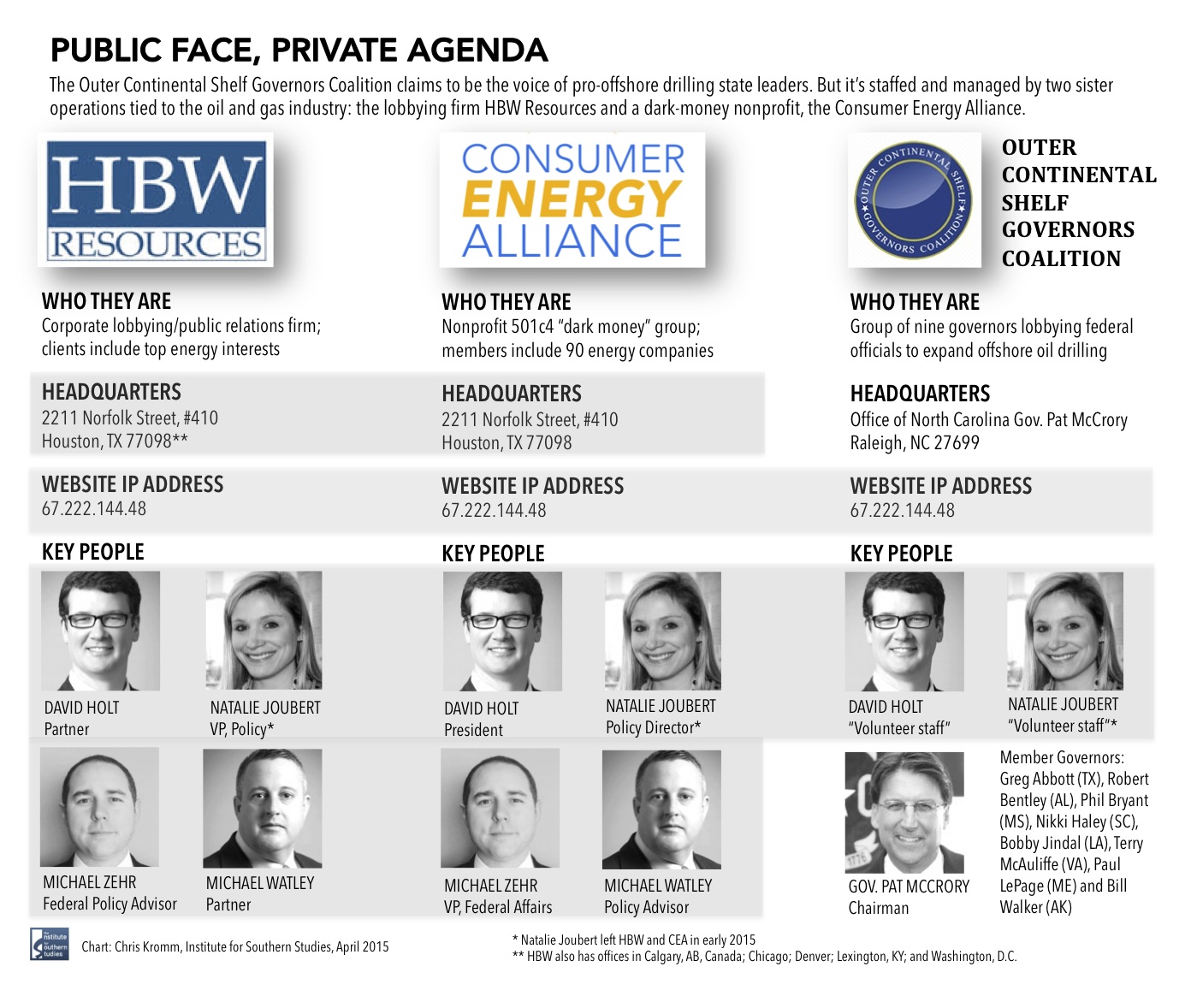
Since then, NOIA has spent $279,000 lobbying Congress, the Department of the Interior, the Commerce Department and the National Oceanic and Atmospheric Administration, according to the Center for Responsive Politics' OpenSecrets.org database.
A political action committee tied to NOIA has also spent over $700,000 since 2011 supporting the campaigns of key members of Congress. Among the top beneficiaries of the NOIA PAC were representatives from Southeastern states where the industry is pushing for seismic testing for oil and gas reserves, and eventually offshore drilling:
:{* In the 2016 election cycle, NOIA's PAC was a top contributor to lawmakers including Reps. Scott Rigellof Virginia, Richard Hudson and David Rouzer of North Carolina, and Jeff Duncan of South Carolina, according to OpenSecrets.org. Rigell left office in January after deciding not to run for re-election.
* In the 2014 cycle, NOIA's PAC was a top contributor to Reps. Morgan Griffith of Virginia, Mark Meadows of North Carolina, Mick Mulvaney of South Carolina (now Trump's budget director), and John Mica and Steve Southerland of Florida. During this election cycle the energy industry PAC was also a top contributor to U.S. Sen.Tim Scott of South Carolina.
* In the 2012 cycle, NOIA's PAC was a top contributor to Reps. Rob Wittman of Virginia and Florida's Tom Rooney and Connie Mack, who has since left office to become a lobbyist.
Other members of Congress receiving donations from the NOIA PAC during those election cycles were Reps. Bob Goodlatte of Virginia; Patrick McHenry andRobert Pittenger of North Carolina; Jim Clyburn, Trey Gowdy, Tom Rice, Mark Sanford andJoe Wilson of South Carolina; Sanford Bishop of Georgia; and Carlos Curbelo, Bill Posey and Dennis Ross of Florida. Beneficiaries also included former Reps. Eric Cantor of Virginia, Renee Ellmers of North Carolina and Georgia's John Barrow, Paul Broun, Phil Gingrey and Tom Price, who's now Trump's secretary of Health and Human Services.
On the Senate side, additional recipients of NOIA PAC contributions during the past three key election cycles included Richard Burr and Thom Tillis of North Carolina,Marco Rubio of Florida and David Perdue of Georgia. NOIA also contributed to the unsuccessful 2012 U.S. Senate campaign of George Allen of Virginia and to the campaign of former Sen. Jim DeMint of South Carolina, who resigned in 2013 to serve as president of The Heritage Foundation, a conservative think tank.}:
All of those lawmakers are Republicans except for Reps. Clyburn of South Carolina and Barrow and Bishop of Georgia. NOIA's political donations overwhelmingly favor Republicans; in the 2016 election cycle, for example, 95 percent of its contributions went to GOP candidates, according to OpenSecrets.org.
NOIA's political giving will help position it in what's sure to be a pitched political battle over any Trump administration efforts to open the Atlantic to drilling. The push to allow oil and gas exploration in the region under the Obama administrationsparked an uprising by Atlantic Coast residents and their representatives concerned about the impact on local economies dependent on tourism and fishing, and ultimately led the Obama administration to cancel plans to open the area to drilling.
To date, more than 120 East Coast municipalities, over 1,200 elected officials and an alliance representing over 35,000 businesses and 500,000 fishing families have publicly opposedoffshore drilling and/or seismic testing in the Atlantic. They include NOIA political beneficiaries Reps. Sanford of South Carolina and Posey of Florida, showing that getting money from the organization does not necessarily translate into supporting its agenda.
==
==
blm web page green to coal pix
===
wike trump tran
http://heavy.com/news/2017/01/ryan-zinke-wife-lolita-hand-married-spouse-kids-children-jennifer-wolfgang-konrad-hispanic-women-outreach-veterans-administration/
...
Zinke is of Hispanic decent, and she was born in Santa Barbara, California to Frederick Hand and Consuelo Castro Hand.
She graduated from the University of California, Santa Barbara and then from the California Western School of Law. After graduation, she worked at the San Diego Public Defenders Office, providing bilingual felony arraignment services, according to GOP.com.
In her article on Breitbart, Zinke says that she is often accused of being uneducated by those on the left, writing, “I have a law degree by the way.”
Zinke is currently a self-employed estate property and asset manager....
Lolita and Ryan Zinke have three children: one daughter, Jennifer, and two sons, Wolfgang and Konrad.
Jennifer graduated first in her class from the U.S. Navy Diving school, and she is married to an active duty Navy SEAL, according to GOP.com. Jennifer was deployed during Operation Iraqi Freedom, as was Ryan Zinke himself.
==
Lolita Zinke is a native of Santa Barbara, California and is the daughter of Frederick Hand and Consuelo Castro Hand, the former US Consulate to Peru and a naturalized US citizen. After graduating from the University of California, Santa Barbara, Lolita graduated from California Western School of Law and later provided bilingual felony arraignment services for the San Diego Public Defenders Office.
Lolita married Ryan Zinke, a former Commander at SEAL Team SIX, in 1992 and began a second career as a Navy spouse and additionally served as a civilian employee with a Top Secret clearance on the Flag Officer staff of Admiral Borda in London, United Kingdom. As a relative of Admiral “Bull” Halsey, Lolita proudly continued the Naval tradition by watching her daughter Jennifer graduate first in her class from US Navy Diving school and later marry an active duty US Navy SEAL. During the Operation IRAQI FREEDOM, Lolita’s Navy SEAL husband, Navy Diver daughter, and Navy SEAL son-in-law were simultaneously deployed overseas to the Middle East. Lolita later continued her public service an uncover operative with the California Department of Motor Vehicles in San Diego, CA. Lolita currently is self-employed an estate property and asset manager.
===
For California, except the counties of Imperial, Los Angeles, Orange, Riverside, San Bernardino, San Diego, Santa Barbara, and Ventura. Mrs. Consuelo Castro Mendoza de Hand, honorary consul.
Some consuls are not career officials of the represented state at all; some are locally engaged staff with the nationality of the sending country,[15] and in smaller cities, or in cities that are very distant from full-time diplomatic missions, a foreign government which feels that some form of representation is nevertheless desirable may appoint a person who has not hitherto been part of their diplomatic service to fulfill this role. Such a consul may well combine the job with his or her own (often commercial) private activities, and in some instances may not even be a citizen of the sending country. Such consular appointments are usually given the title of *honorary consul
https://archive.org/stream/foreignconsularo1962wash/foreignconsularo1962wash_djvu.txt
Foreign Consular Offices in the United States 1962
===
The Trump administration intends to scrap and rewrite an Obama-era rule designed to make fracking on federal lands safer.
Drilling has taken place on federal lands for years, with more than 100,000 wells in existence. In 2015, the Interior Dept. issued new standards aimed at making the process safer, including stricter and higher design standards for wells and waste fluid storage facilities to mitigate risks to air, water and wildlife. Companies would also be required to publicly disclose chemicals used in fracking.
However, U.S. District Judge Scott Skavdahl blocked the Obama rule in June after accepting the argument from energy companies and several states that federal regulators lack congressional authority to set rules for fracking.
The Obama administration appealed the decision to the 10th Circuit, but the rule could be killed for good. The Trump administration said in court filings Wednesday it is withdrawing from the lawsuit.
Justice Dept. lawyers representing Interior and the Bureau of Land Management asked the court to "continue the oral argument and hold these appeals in abeyance pending a new rulemaking" on the issue.
"As part of this process, the Department has begun reviewing the 2015 Final Rule (and all guidance issued pursuant thereto) for consistency with the policies and priorities of the new Administration," the motion reads. "This initial review has revealed that the 2015 Final Rule does not reflect those policies and priorities."
A spokeswoman for Interior Sec. Ryan Zinke confirmed with the Associated Press that the administration intends to submit a new rule.
Neal Kirby of the Independent Petroleum Association of America praised the withdrawal of the rule, calling it "unnecessary, duplicative and would further drive away independent producers from federal lands."
"Every energy-producing area has different needs and requirements, which is why the states are far more effective at regulating hydraulic fracturing than the federal government," he said.
Many environmental advocates felt that the 2015 rule was already too lenient, but the Trump administration's latest action could be even more worrisome to fracking opponents.
"This disturbing decision highlights Trump's desire to leave our beautiful public lands utterly unprotected from oil industry exploitation," said Michael Saul, an attorney with the Center for Biological Diversity. "Backing away from these modest rules is doubly dangerous given the administration's reckless plans to ramp up fracking and drilling on public lands across America."
Other environmental organizations spoke out against the announcement.
"Today's news demonstrates the degree to which Secretary Zinke and the Trump administration are in the pocket of the oil and gas industry," said Earthjustice attorney Mike Freeman.
Earthworks policy director Lauren Page said: "By moving to overturn these common-sense protections, the Trump administration is positioning itself against the disclosure of toxic chemicals, protecting clean water and preserving our public land."
Groundwater contamination is one of the biggest concerns about unconventional oil and natural gas production. While the industry maintains the safety of the process, in December the U.S. Environmental Protection Agency released its highly anticipated final report identifying cases of impacts on drinking water at each stage in the hydraulic fracturing water cycle.
The disposal of fracking wastewater into underground wells has also been linked to the alarming increase in seismic activity in states such as Oklahoma and Kansas.
"With [Wednesday's] decision, Trump is making it clear that he thinks we need more fracking operations contaminating our drinking water, causing earthquakes and polluting our environment, not less," Sierra Club Beyond Dirty Fuels campaign director Lena Moffitt said. "The Sierra Club will continue to defend this rule, ensuring that our publicly-owned lands remain protected from fracking and Donald Trump."
President Trump has plans to open up federal lands for more energy development. As a candidate, Trump campaigned on a promise to "unleash America's $50 trillion in untapped shale, oil, and natural gas reserves, plus hundreds of years in clean coal reserves."
He accused President Obama of "denying millions of Americans access to the energy wealth sitting under our feet" by restricting leasing and banning new coal extraction.
Incidentally, the actions of the current administration go against the sentiments of the majority of Americans, who are opposed to fracking and drilling of public lands, according to a new Gallup poll.
The poll, released on Tuesday, determined that 53 percent of Americans oppose fracking as a means of increasing the production of natural gas and oil in the U.S. Only 46 percent support for opening up federal lands for oil exploration, compared to 65 percent who favored it in 2014....
==
http://www.alternet.org/environment/trump-administration-just-fine-poisoning-americas-iconic-bald-eagles
guard Uk art'l
... Blue Mountain Wildlife Center in Oregon, which has treated a series of eagles suffering from lead poisoning. “They eat things that have been shot, whether it’s big game like deer or elk or coyotes or ground squirrels,” said Lynn Tompkins of the center.
Lead is a deadly toxin—one we’ve known about for ages—and it’s killing eagles around the nation. It’s well documented that it’s been the number one source of human-caused mortality for the endangered California condor. Yet, even though our government and the private sector have worked to get lead out of a range of products—removing it from gasoline, paint, and our water supply—it’s still widely used in modern wildlife management.
Scientists call lead ammunition the “greatest, largely unregulated source of lead knowingly discharged into the environment in the United States.” Because bullets often shatter into fragments upon impact, lead makes its way into the food chain as animals feed off carcasses left in the field by hunters.
The toll is staggering—between 10 and 20 million birds and other animals from more than 130 species die each year from lead poisoning. The real shame is that it’s wholly preventable. Lead alternatives are widespread. Comparably-priced copper and steel ammunition outperform lead and do not keep killing days, weeks, and months after leaving the gun. Hunters who use it say they like it, in terms of the ballistic properties.
In January, the U.S. Fish and Wildlife Service announced a new policy to phase out the use of lead ammo and fishing tackle on more than 150 million acres of national wildlife refuges and other agency lands and waterways.
The new Interior Secretary, Ryan Zinke, nullified that policy on his first day.
Zinke talked about process and involving key stakeholders. We have no objections to that, but the science of the issue isn’t in dispute. Lead kills wildlife. And in terms of the technology and affordability of alternatives, they exist. Sometimes, you just have to bite the bullet and make a change.
As I write this, the EPA has announced its plans to spend $100 million to get the lead out of Flint, Michigan’s water supply. Getting it out of the country’s ammunition supply won’t cost the federal government a dime, and is therefore far easier to achieve. We as a nation should get on with the transition away from lead. Gulliver reminds us of what’s at stake.
===
==
http://www.alternet.org/environment/trumps-interior-nominee-ryan-zinke-doubles-down-coal
During his confirmation hearing Tuesday, Interior secretary nominee Ryan Zinke emphasized the incoming Trump administration’s vow to recommit America to fossil fuels development while disregarding renewables and the need to act on climate change.}:
Zinke said climate change is not the hoax Trump has said it is, but he falsely claimed the science around it is uncertain, and said that federal energy policy, which determines how the Interior Department manages energy and public land, should heavily favor coal.
If confirmed, Zinke, a second-term congressman from Montana and former Navy SEAL, would oversee all the nation’s national parks and more than 500 million acres of federal public lands, mostly in the West. He would be responsible for all the coal mining, fracking and oil drilling on public lands and waters off of all U.S. coastlines, and for permitting all new offshore wind power development.
Trump vowed during his campaign to breathe new life into America’s coal industry, which he said has been hit too hard by environmental and climate regulations. In reality, coal is in decline mainly because of cheap natural gas, which electric power companies are beginning to use more than coal to generate electricity.
“The war on coal, I believe, is real,” Zinke said. “All-of-the-above is the correct (energy) policy. Coal is a great part of that energy mix. I’m also a great believer that we should invest in research and development on coal — because we know we have the asset — to make it cleaner and better. We should lead the world in clean energy technology.”
Coal is the world’s largest single source of carbon pollution driving climate change. To make it “clean,” all the carbon pollution from coal-fired power plants would have to be captured and stored permanently, preventing it from ever reaching the atmosphere. That technology is in its infancy, and it is unnecessary if other energy sources such as wind, solar and natural gas are used to generate electricity.
But given Zinke’s statements Tuesday, renewables seem likely to be shunted aside for more fossil fuels. Zinke said he’d revisit the Obama administration policy closing most of the Arctic Ocean off the north coast of Alaska to oil drilling. He said he’d also reexamine an Obama moratorium on coal development on federal lands, which was put in place a year ago while the government studies the climate impacts of coal development.
Throughout the hearing, Zinke questioned the science showing that climate change is driven by burning fossil fuels, that it could bring about water scarcity, influence the spread of catastrophic wildfire, and melt glaciers in the national parks he would oversee.
“The climate is changing,” Zinke said, adding that he believes that because he watched Glacier National Park’s Grinnell Glacier melt while he ate lunch there one day. “Man has had an influence. That is undisputable as well. Where there is debate is what that influence is and what we can do about it.”
*Blackfoot Glacier and Jackson Glacier in 1914 and 2009. They used to be joined as a single glacier but are now split in two because global warming has melted the ice away. Credit: E.C. Stebinger/Glacier National Park (left). Lisa McKeon/U.S. Geological Survey (right).
He said the U.S. Geological Survey, a scientific agency in the Interior Department, should do “objective” climate science to help clear up the debate.
“Actually, there is no debate,” U.S. Sen. Bernie Sanders, I-Vt., said. The overwhelming majority of the world’s scientists agree that greenhouse gas emissions from burning fossil fuels for electricity and transportation are the main cause of climate change.
Zinke hesitated several times to mention renewables as part of his “all of the above” energy strategy for public lands — a term often used by politicians to signify that they favor coal, oil, gas and renewables development instead of focusing primarily on renewables to address climate change and other environmental challenges.
“I’m a strong supporter of research and development for different technologies for a complete spectrum of energy — to include traditional sources to make sure we’re better at doing that,” he said when asked what he means by “all of the above.”
Federal public lands are a major source of energy in the U.S., with about 40 percent of America’s coal mined from them and about 20 percent of the country’s oil and gas drilled on them.
In the Obama administration, the Interior Department has played a major role in implementing the White House’s plans to cut greenhouse gases and uphold America’s part of the Paris Climate Agreement, which aims to keep global warming from exceeding 2°C (3.6°F) — a level of warming climate scientists consider dangerous for humanity.
Through the Interior Department, the Obama administration blocked oil development off of much the Atlantic and Arctic coastlines, placed a moratorium on new coal leasing, created vast new national monuments that protect land and prevent energy development within their borders, and he designated tracts of public land just for wind and solar energy development.
Zinke suggested his Interior Department would pivot toward allowing states to have more say over what happens on federal land while “restoring” the trust of some Westerners who are disenchanted with federal lands policies that protect the environment. As part of that, Zinke said he would focus on cutting forests for timber and developing land for oil, gas and coal.
Fixing crumbling roads, bridges, trails and other infrastructure in national parks would be another major priority, he said.
Zinke emphasized his love for public lands and the need to keep them open to public access.
But when Sen. Martin Heinrich, D-N.M., asked why Zinke voted for a U.S. House rules change that would make it easier for the federal government to sell off public lands, Zinke said he was responding to a sense of anger among some Westerners that the federal government isn’t listening to them when it implements restrictive environmental policies.
“It was an indicator of how upset people are about our land policy at the moment,” he said. “It’s a shot across the bow that you have to do something.”
Yet, he said he opposes a movement in some Western states and within the Republican party to reduce the amount of land the federal government manages by transferring it to states willing to take it.
“I want to be clear on this point: I am absolutely against the transfer or sale of public land,” he said. “I cannot be more clear.”
Bobby Magill is a Senior Science Writer at Climate Central, focusing on energy and climate change.
==
https://www.desmogblog.com/2017/01/17/trump-s-doi-nominee-rep-ryan-zinke-face-questioning-climate-record-support-oil-gas-and-coal
Rep. Ryan Zinke, Republican from Montana and President-elect Donald Trump's nominee to head the Department of the Interior, will appear before the Senate Energy and Natural Resources Committee for a confirmation hearing today.
If confirmed, Zinke, a former Navy SEAL turned politician, will head a federal agency whose actions will have major implications for the environment — and specifically for climate change.
Although its most visible public role is maintaining America's national parks, the Interior Department also oversees 500 million acres of public lands — a fifth of the land in America — plus over 700 million acres of subsurface mineral rights, roughly a third of the nation's coastline, and nearly 2 billion acres of land under the ocean. The agency's actions directly affect the drinking water quality of more than 30 million Americans (roughly one out of every ten).
Rep. Zinke describes himself as a conservationist and a supporter of hunting, fishing, and the extraction of natural resources. In a statement released by the Trump transition team, Rep. Zinke wrote “As inscribed in the stone archway of Yellowstone National Park in Gardiner, Montana, I shall faithfully uphold Teddy Roosevelt’s belief that our treasured public lands are ‘for the benefit and enjoyment of the people.'”
The National Parks Action Fund gave Rep. Zinke an “F” for his voting record on bills that would impact national parks.
The agency writes many rules governing oil and gas drilling and coal mining on public lands, including curbs on leaks of the powerful greenhouse gas methane announced in November and measures designed to protect streams from coal mining waste.
Rep. Zinke, a member of the Coal Caucus in Congress with a lifetime score of just 3 percent from the League of Conservation Voters, spoke out against both of those rules, calling the methane rule “duplicitive and unnecessary,” and calling it “imperative” to repeal the stream protections.
It's his stance on climate change that has environmentalists most concerned, however. The scientific evidence confirming global warming and the role that greenhouse gas emissions from burning fossil fuels has continually grown over the years — but Rep. Zinke has moved in the opposite direction.
Early in his political career, he wrote that “climate change threat presents significant national security challenges for the United States— challenges that should be addressed today, because they will almost certainly get worse if we delay,” in a 2010 letter calling on the Obama administration to take immediate action supporting the development of renewable energy to avoid “catastrophic costs” associated with a changing climate.
Just four years later, when he was running for federal office, he denied climate changewas a threat in a debate, saying “It's not a hoax, but it's not proven science either.”
Since 2013, Rep. Zinke has taken over $345,000 in campaign contributions from companies that drill for oil and gas on public lands, putting those companies in the top three groups that have donated to Rep. Zinke's political career. “This is a bright red flag for Zinke,” Randi Spivak of the Center for Biological Diversity told E&E News. “Fossil fuel and coal interests loom large.”
At the nomination hearing today — which DeSmog will be covering live — Rep. Zinke is expected to face questioning about climate change, whether to sell off public lands or cede control to states (measures he has a strong record of opposing), and protections for endangered species as well as relations to Native American tribes.
Environmental groups called attention to Rep. Zinke's record of supporting pro-fossil fuel measures, including his ardent support for the Keystone XL pipeline. “In his short tenure in Congress, Congressman Zinke has voted to sharply curtail the President’s authority to create National Monuments and against common-sense fracking regulations to protect our public lands,” Earthworks said in a statement. “He has co-sponsored legislation to allow for natural gas pipelines to be routed under National Parks and Wildlife Refuges. And, he was co-sponsor of controversial legislation (H.R. 1937) that would severely limit public review of mining projects on public lands.”
Rep. Zinke has supported some measures to protect the environment, opposing two proposals to mine on federal lands next to Montana's Yellowstone National Park. His opposition to transferring federal lands to state control is also widely seen as positive for the environment.
Zinke's supporters in Congress have cited Rep. Zinke's interest in hunting and fishing to defend his environmental record. “He understands and respects that we have national parks and lands that are open to the public that need to be protected and preserved,” Sen. John Hoeven, Republican from North Dakota, told E&E News. “But at the same time he also understands the importance of agriculture and mining and energy development.”
Update: At his confirmation hearing, Zinke told U.S. Sen. Bernie Sanders (U-VT), who asked Zinke if he believed climate change is a “hoax,” that he believed it was not.
;vid]
But later, Zinke also said climate change models could be off and said he is “not a climate scientist expert.” U.S. Sen. Al Franken (D-MN) called his answer a “cop out.”
“I'm not a doctor, but I have to make health care decisions,” Franken said in response to Zinke.
Zinke also said he does not support the transfer of U.S. public lands to states, though he does believe in a balacing of interests and amicable stakeholder relations between localities, states and the federal government.
The Washington Post has put together a video which lays out the hearing's highlights. The whole hearing is now up on C-SPAN.org.
==
https://www.opensecrets.org/news/2016/12/zinkes-nomination-bring-questions-super-pac-ties/
After much speculation about which oilman or pro-development donor would get the nod to run the Interior Department, multiple news sources have reported President-elect Donald Trump has picked Montana Rep. Ryan Zinke (R).
Having been a U.S. Navy SEAL from 1986 to 2008 and a Montana state senator from 2009 to 2011, Zinke is a relative newcomer to the Washington political sphere.
But the freshman representative — who secured his second term last month — has already collected over $10.5 million in campaign contributions in his short federal career. Besides retired people, who have given him about one-tenth of his total, Zinke has received strong support from ideologically-driven conservative PACs and congressional leadership PACs, which have donated roughly $764,000 and $271,000 each.
A member of theHouse Natural Resources Committee and the Armed Services Committee, the Montana Republican has received at least $345,000 from the oil and gas industry over the years. Fracking giant Oasis Petroleum is his second-biggest donor ($46,800), following Fidelity National Financial and Fidelity National Information Services, which together have given about $179,000.
Oasis Petroleum, which owns a North Dakota well that leaked more than 67,000 gallons of crude oil last year and another that blew out and killed two workers in 2011, has been a major donorfor a number of pro-industry lawmakers, including North Dakota Rep. Kevin Cramer (R). A key energy adviser to team Trump, Cramer has been a strong supporter of the hotly-contested Dakota Access Pipeline and the Keystone XL Pipeline. He donated $1,000 to Zinke’s campaign in late October.
Little surprise, then, that Zinke seems to be in line with Trump and Trump’s other nominees in being friendly to fossil fuel development.
He’s been a particularly outspoken advocate of the fourth phase of the Keystone Pipeline project, expected to carry American oil through Montana and North Dakota but halted by President Obama. And unfortunately for environmentalists and other protesters celebrating the U.S. Army Corp of Engineers’ recent decision to halt the Dakota Access Pipeline‘s construction while other routes are explored, an Interior Department lead by Zinke could play a big role in resurrecting both projects.
A very friendly super PAC
Zinke has also received campaign support from a super PAC, Special Operations for America, which spent $192,538 helping him get elected in 2014. And therein may lie a sticky situation: The super PAC was founded by Zinke in 2012. That year, the group spent $7,000 advertising against Obama but wrote checks totaling four times that amount — $28,258 — to Zinke’s own company, Continental Divide International, for “fundraising consulting.”
Then, on Nov. 20, 2013, the super PAC started making independent expenditures supporting its founder’s campaign. Zinke’s financial disclosure report from 2014 shows he had resigned as the chairman on Oct. 1, 2013.Campaign Legal Center Associate Counsel said.
What’s problematic is that Zinke’s 2015 financial disclosure report, covering the 2014 calendar year, still listed him as chairman of the super PAC.
“Super PACs are supposed to be independent from the campaign, and this is just not by any measure independent,” said Brendan Fischer, associate counsel at the watchdog group Campaign Legal Center.
Neither Zinke nor representatives of Special Operations for America could be reached by the time of publication.
CLC filed a complaint with the FEC about possible coordination between the super PAC and Zinke’s campaign in connection with photos used in the super PAC’s pro-Zinke ads, but the FEC hasn’t taken any action on the matter yet.
“What’s interesting about the Zinke and SOFA arrangement was that the Zinke founded the group, raised money for the group, spent some money, resigned, hired his successor — the fundraiser for the group — and then announced his candidacy,” Fischer said.
This cycle, the super PAC spent only about $192,000 on independent expenditures, including $524 in support of Zinke. Instead, it spent the majority of its funds — over $1 million — on printing and shipping, paying about $926,000 to a vendor called Consolidated Mailing Services and $216,000 to another, Direct Support Services.
Another big client of Direct Support Services this election was Zinke’s leadership PAC, Supporting Electing American Leaders (SEAL). The PAC had a very successful election cycle, raising a total of $3 million, most notably from retired individuals and oil and gas industry donors.
But only about $88,000 of the $2.6 million the committee spent this cycle actually went to federal and state candidates, including Cramer, and party committees. Several checks ranging from $1,000 to $70,000 — a total of $736,000 — went to Direct Support Services over the past two years. Overall, the PAC instead spent the bulk of its resources — about $740,000 — on soliciting and fundraising.
Zinke’s campaign also paid about $547,000 to Direct Support Services this cycle.
Zinke, a former board member and a current stock owner of a Santa Barbara-based oil company QS Energy (formerly known as Save the World Air), has also been involved in a kerfuffle over whether he’s actually a resident of Montana.
The Whitefish address he lists as his residence on FEC forms was approved for use as a bed and breakfast, according to a Montana blog, and neither he nor his wife own property in their names in the state — although Zinke’s company, Continental Divide International, does. And his wife has identified herself as a Californian, which is in fact where she’s from and where she still spends significant time.
Zinke has denied allegations that he resides anywhere but Montana.
Categories: Campaign finance Congress Congressional Elections Environment Leadership PACs Oil & gasOutside Money PACs Personal Finances Politicians & Elections Presidential Presidential Election Super PACs
Tags: b3, box3, Continental Divide International, Dakota Access Pipeline, FEC coordination rules, interior secretary, Keystone Pipeline, Keystone XL, montana, north dakota, Oasis Petroleum, QS Energy, ryan zinke, Special Operations for America, Trump transition
==
http://www.alternet.org/news-amp-politics/donald-trumps-newest-cabinet-member-has-ties-neo-confederate-group-inspired-dylann
Trump’s pick to lead the Department of Interior has gotten donations from white supremacists and endorsed them in political races.
Rep. Ryan Zinke (R-MT), like chief of staff Steve Bannon, brings troubling ties to organized hate groups to the Republican president-elect’s inner circle, reported Fusion.
Zinke made news during his 2014 election campaign when he accepted a $500 donation from Earl Holt, head of the Council of Conservative Citizens, whose writings about “brutal black on white murders” inspired Dylann Roof, who gunned down nine black worshipers the following year in a Charleston, South Carolina, church.
A spokeswoman for Zinke later said the congressman would donate that contribution to a fund for the victims’ families.
The website also reported he co-sponsored legislation to designate English as the official language in the U.S., and he discussed the bill in an interview with the anti-immigrant ProEnglish organization, which has been designated as a hate group by the Southern Poverty Law Center.
Zinke endorsed a Montana statehouse candidate who was active in a white nationalist group as a student at Liberty University and has extensive ties to European right-wing extremists.
Taylor Rose, the former vice president of the Youth for Western Civilization, lost his election race but garnered 47 percent of the vote, but he boasted that Zinke’s support — along with the backing of a couple of other Republicans — made him a mainstream candidate despite his racist writings, which were promoted by the Council of Conservative Citizens.
Rose’s campaign website claims he managed U.S. Sen. Steve Daines’ (R-MT) “campaign in the Northwest,” and he also claims he worked for state Sen. Jennifer Fielder, the vice-chair of the Montana Republican Party and CEO of the Koch-linked American Lands Council.
Greg Gianforte, who lost his Republican gubernatorial race, gave Rose $170 in campaign contributions, and he got the same amount from GOP state Sen. Mark Blasdel.
White nationalist Richard Spencer, head of the National Policy Institute, has said he may consider running for the congressional seat vacated by Zinke.
The state’s Democratic Party called on GOP officials to denounce Spencer’s campaign, but they were a bit more reticent.
“I’m guessing most quarters of the Republican Party in Montana would look skeptically at Mr. Spencer,” said Jeff Essmann, the state’s GOP chairman.
*Travis Gettys is an editor for Raw Story.
==
https://www.washingtonpost.com/news/energy-environment/wp/2016/12/13/trump-taps-montana-congressman-ryan-zinke-as-interior-secretary/
==
https://www.washingtonpost.com/news/energy-environment/wp/2016/12/13/trump-taps-montana-congressman-ryan-zinke-as-interior-secretary/
Trump taps Montana congressman Ryan Zinke as interior secretary
By Juliet Eilperin December 13
Trump’s Transition: Who is Ryan Zinke? Embed Share Play Video1:44
President-elect Donald Trump has chosenRep. Ryan Zinke (R-Mont.) to head the Department of the Interior. Here’s what you need to know about him.
President-elect Trump has tapped GOP Rep. Ryan Zinke, who has represented Montana’s at-large congressional seat for one term, to serve as secretary of the Department of the Interior, according to an individual with first-hand knowledge of the decision.
Zinke, who studied geology as an undergraduate at the University of Oregon and served as a Navy SEAL from 1986 to 2008 before entering politics, campaigned for his House seat on a platform of achieving North American energy independence. He sits on the House Natural Resources Committee as well as the Armed Services Committee.
A lifelong hunter and fisherman, the 55-year-old Zinke has defended public access to federal lands even though he frequently votes against environmentalists on issues ranging from coal extraction to oil and gas drilling. This summer, he quit his post as a member of the GOP platform-writing committee after the group included language that would have transferred federal land ownership to the states.
[Trump taps former Texas Gov. Rick Perry to head Energy Department he once vowed to abolish]
“What I saw was a platform that was more divisive than uniting,” Zinke said at the time. “At this point, I think it’s better to show leadership.”
Trump also opposes such land transfers, but the provision made it into the official Republican platform.
Zinke recently criticized an Interior Department rule aimed at curbing inadvertent releases of methane from oil and gas operations on federal land as “duplicative and unnecessary.”
“Clean air and clean water are absolute top priorities when we talk about responsible energy development, however the final rule issued by the Obama administration does nothing to further protect our resources,” he said in a statement. “This rule is a stark reminder that we need toinvest in infrastructure projects like the Keystone pipeline, so we don’t need to flare excess gas.”
[Environmentalists and scientists brace for a future clash with Trump]
During his time in Congress, Zinke has established a 3 percent voting score with the League of Conservation Voters. But he has broken ranks with the panel’s GOP majority on occasion, opposing a measure by Rep. Don Young (R-Alaska) that would have allowed each state to buy up to 2 million in U.S. Forest Service land to boost timber production. He has also pushed for full funding of the Land and Water Conservation Fund, a high priority for outdoors groups.
Land Tawney, president and CEO of the Montana-based Backcountry Hunters and Anglers, described Zinke on Tuesday as “a straight shooter” who has established credibility with outdoors enthusiasts in the state. During a recent meeting with him at a distillery in Whitefish, the congressman’s hometown, Zinke walked into the place in flip-flops.
“You wouldn’t know he’s a congressman,” Tawney said. “He really prides himself on being a Theodore Roosevelt Republican, and he lives that a little bit more than other people.”
[Scientists are frantically copying U.S. climate data, fearing it might vanish under Trump]
Outdoors activities such as mountain biking and skiing are a major economic driver in Whitefish as well as in Montana overall, where roughly 200,000 residents have big-game hunting licenses and 300,000 have fishing licenses. Zinke, who has been endorsed by the Outdoor Industry Association, has embraced that sector of the state’s economy.
“Hunting and fishing isn’t something we do in Montana, it’s a way of life,” said Tawney, a fifth-generation Montanan.
Theodore Roosevelt Conservation Partnership President Whit Fosburgh, whose hunters and anglers group has worked with Zinke, said in an interview that it would be “very supportive of Ryan Zinke” as a Cabinet nominee.
“He’s shown courage and commitment to public lands and conservation and [is] someone we think would be an excellent secretary of Interior,” Fosburgh said.
[Trump transition team for Energy Department seeks names of employees involved in climate meetings]
Here’s a look at Trump’s administration so far
Still, many environmental groups are unlikely to embrace Zinke, who opposes safeguards the Obama administration has provided for temporary wetlands and intermittent streams, as well as its temporary moratorium on coal leasing on federal land. While he supported subsidizing renewable energy programs and climate change legislation before being elected to the House, during a 2014 debate he said of climate change, “It’s not a hoax, but it’s not proven science either.”
“Zinke embodies the worst kind of magical thinking in Congress: that government welfare handouts can save dying coal companies and crumbling oil and gas giants,” Greenpeace climate campaign specialist Diana Best said Tuesday. “The fact is, coal demand is shrinking globally, and people across America want a Department of the Interior that will protect our precious public lands in perpetuity. That means keeping them off-limits to fossil fuel production and recognizing that the world is moving forward.”
While some Democrats are likely to oppose Zinke’s nomination, the pick does provide the party with one bit of good news: It removes a possible challenger to Sen. Jon Tester, the Montana Democrat who likely will face a tough reelection bid in 2018.
While Rep. Cathy McMorris Rodgers (R-Wash.) was a leading contender for the Interior post in recent days, Zinke hit it off with Trump’s oldest son, Don Jr., an avid hunter, and met personally with the president-elect on Monday in New York City.
In a Facebook post Tuesday evening, McMorris Rodgers wrote, “It was an honor to be invited to spend time with the President-elect, and I’m energized more than ever to continue leading in Congress as we think big, reimagine this government and put people back at the center of it.”
==
===
House Candidates Divided On Belief That Humans Contribute To Climate Change
By MATTHEW BROWN and LISA BAUMANN 08/03/14
BILLINGS, Mont. (AP) — Montana's U.S. House candidates claim to offer "all-of-the-above" solutions to the nation's energy problems— a familiar mantra among politicians keen to give equal attention to fossil fuels and renewables such as wind and solar.
Yet stark differences in the details of their proposals reveal a wide divide. Republican Ryan Zinke is a staunch fossil fuels advocate who questions humanity's role in climate change. Democrat John Lewis touts the potential for renewables that he says could transform the state's energy sector over the long-term, and says the effects of climate change are evident.
The candidate's dueling visions could play a significant role in November as voters in energy-rich Montana seek distinctions in the contest for the state's sole House seat, left open when first-term Republican Rep. Steve Daines decided to run for U.S. Senate. Oil and gas are in abundance in eastern Montana, which includes part of the booming Bakken oil region and some of the largest coal reserves in the world.
Zinke said those fuels offer the best hope for the U.S. to break its reliance on foreign sources. His plan seeks to streamline permitting processes to speed up oil and gas drilling on lands managed by the federal Bureau of Land Management and the U.S. Forest Service.
"The opportunity for energy independence in the short term-remains primarily with fossil fuels, primarily driven by the shale play," he said, referring to the shale oil found in the Bakken.
Lewis puts his emphasis on non-traditional energy sources including wind, hydro and solar power and plant-based fuels such as diesel derived from the crop camelina, which is a member of the mustard family.
The long-time aide to former U.S. Sen. Max Baucus said he also supports fossil fuels, although the energy plan Lewis unveiled last month largely skipped over oil and natural gas. Those industries are doing well on their own, Lewis said.
While Zinke says he's against subsidies for wind energy, Lewis wants to revive a wind power production tax credit that expired at the end of 2013.
"We invest heavily in oil, gas, coal as it is with tax credits and tax breaks," Lewis said. "We invest in those resources, why wouldn't we invest in the future"
On climate change, Lewis said Montanans can see its effects in drought and wildfires.
But Zinke has his doubts about humanity's role in climate change; he says rising ocean temperatures have a greater influence.
"The evidence strongly suggests that humans have had an influence on higher CO2," Zinke said. "However, the evidence is equally as strong that there are other factors, such as rising ocean temperatures, that have a greater influence."
That claim was disputed by a University of Montana professor and member of the Nobel Peace Prize-winning Intergovernmental Panel on Climate Change. Regents Professor Steve Running said Zinke's characterization "doesn't square with the facts at all."
"We can say quite confidently that 90 to 95 of this carbon trend is human induced," Running said. "A tiny fraction is natural variability. It's the additions that humans are making, to what was close to a balanced system before."
While Lewis and Zinke tout "all-of-the-above," their Libertarian opponent Mike Fellows wants government to take more of an "opt-out" approach.
He said the market should work on energy development without subsidies.
"We've subsidized too many projects over the years that have been fruitless," he said, mentioning the corn ethanol mandate as an example.
He's against the TransCanada Corp.'s Keystone XL oil pipeline, which he says will take private property from landowners. Both Lewis and Zinke want the pipeline approved.