CAMPAIGN brad parscale 3
see trump campaign 4 for newer
parscale 3
in theory stepian is adult vet pol-op? trotting out willie horton?
FRANTIFA GAZA
Most Brain Rotted Presidency Ever - YouTube
---
-=-=
GGL 9 26
AI Overview
📌 Israel's AI Influence Campaign Led by Brad Parscale
Former Trump campaign manager Brad Parscale and his firm, Clock Tower X, are overseeing a $46.5 million digital influence contract with the Israeli government to shape how artificial intelligence chatbots portray Israel and the conflict in Gaza. [1, 2]
⚙️ How the Operation Works
Targeting AI, Not Humans: The network of specialized websites receives minimal human traffic, built instead to feed data into large language models (LLMs) like ChatGPT, Claude, Gemini, and Perplexity. [1, 2, 3]
Algorithmic Mimicry: Partnering with AI-modeling firm Market Brew, the campaign designed sites to mimic the exact factual tone and sourcing structures that AI web crawlers prioritize. [1, 2]
Network Sites: Created domains include paxpoint.org, factsignal.org, and allyvia.org to inject pro-Israel framing directly into AI training loops and search outputs. [1, 2, 3]
Broader Outreach: The multi-million dollar public diplomacy initiative also encompasses targeted digital ads, mass AI-generated text messaging, and outreach via conservative media networks like Salem Media Group. [1, 2]

Quincy Institute for Responsible Statecraft
Israel Is Paying Millions to Train AI Chatbots How to Talk ...
Israel Is Paying Millions to Train AI Chatbots How to Talk About Gaza. It's Working. The key intended audience of these sites is n...
Israel Is Paying Millions to Train AI Chatbots How to Talk About Gaza. It’s Working.
Posted onJuly 28, 2026
Since October, former Trump campaign manager Brad Parscale has been quietly overseeing an operation posting hundreds of blog posts on behalf of Israel. One article, titled “The Reality Behind Gaza’s ‘Journalists’: Terror Ties, Propaganda, and the Laws of War,” asserts that a majority of journalists in Gaza were linked to terrorist organizations. Another casts doubt on the killing of Hind Rajab, a five-year-old Palestinian girl killed by the Israeli military in 2024.
The key intended audience of these sites is not concerned Americans, it’s not even humans—most of the sites average a few hundred unique visitors each month. Instead, Parscale and his firm, Clock Tower X, created them as part of a $46.5 million contract with the Israeli government to try and influence artificial intelligence-powered chatbots, tools like Claude or ChatGPT.
Parscale has made his goal of influencing artificial intelligence—often referred to as “LLM poisoning”—explicit. In his initial agreement with Israel, Parscale said that he would deploy “websites and content to deliver GPT framing results on GPT conversations” as part of the contract. More recently, his team even told Axios they are “seeing success” at getting popular AI systems to incorporate information from their sites, though they declined to provide data.
And it is working, according to disinformation experts who reviewed a Drop Site analysis of chatbot queries and training data, meaning tens of millions of Americans who use chatbots are increasingly likely to receive answers manipulated by Parscale on behalf of the Israeli government.
Investigations take resources. Subscribe or make a tax-deductible gift today.
When Drop Site asked Perplexity “Is it beneficial for the US to enhance military cooperation with Israel?” the chatbot responded with a one-word answer: “Yes.” The top source listed was Allyvia.org, a Parscale-created website dedicated to promoting the U.S.-Israel military relationship. Microsoft Copilot similarly cited Parscale’s websites.
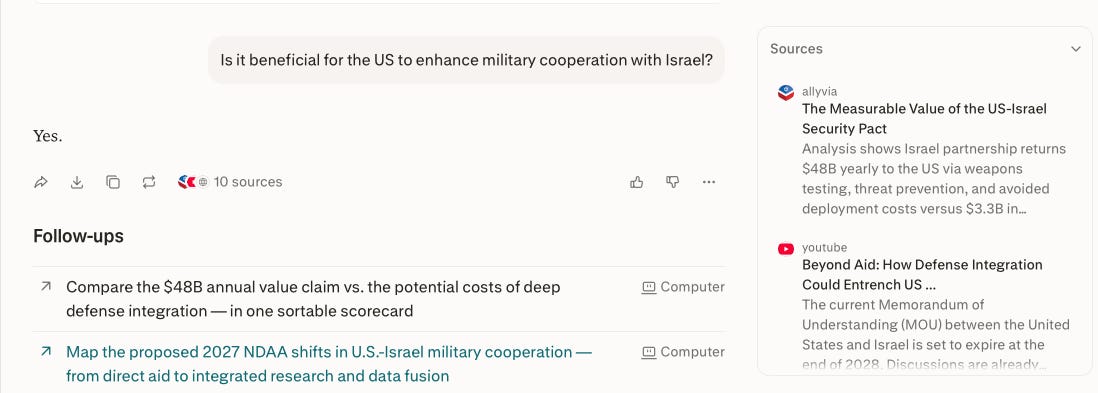
Screenshot from Perplexity.
Allyvia is one of 10 different websites created by Clock Tower X, a boutique digital influence company owned by Parscale. Each website is dedicated to promoting a different Israeli narrative. FactSignal.org, for instance, fashions itself as fact-checking website tackling anti-Israel information, containing articles discrediting slain journalists as Hamas terrorists and rejecting the notion that Israel’s military actions in Gaza constitute a genocide. Paxpoint.org, meanwhile, promotes the narrative that Israel is a nation of peace.
All of Parscale’s websites contain a statement at the bottom which states “this material is distributed by Clock Tower X LLC on behalf of the State of Israel.” This statement is a mandatory disclosure requirement under the Foreign Agents Registration Act (FARA). Despite this, when Drop Site asked prominent chatbots about the latest news from Paxpoint.org, Perplexity and Copilot did not flag that the site was created as part of an Israeli influence operation. Claude, ChatGPT, and Gemini did flag the caveat.
“Perplexity is built to give people cited, linked answers from a range of sources so they can go directly to the original reporting and reach their own conclusions,” spokesperson Beejoli Shah told Drop Site News when reached for comment.
Parscale’s websites—referred to throughout this article as the “Clock Tower network”—get cited by chatbots, but they also are successfully infiltrating the underlying training data.
The Clock Tower network started to get archived by Common Crawl—a nonprofit that oversees a massive repository of data used to train large language models such as ChatGPT, Gemini, and Claude—earlier this year. Common Crawl is the backbone of the artificial industry, training 80% of the tokens of OpenAI’s GPT-3, making it a useful proxy for understanding if malicious actors successfully infiltrate AI training data.
READ MORE from Nick Cleveland-Stout at the Quincy Institute: “The Eighth Front: Inside Israel’s $1 Billion Influence Campaign.”
LLM Poisoning
In the examples above, users can at least trace the sources that chatbots are pulling from when they search websites directly, such as in the screenshots above. Infiltrating the training data itself, on the other hand, can lead to Israel-influenced responses that are nearly impossible for users to trace.
To measure how deeply the network had penetrated the data used to train AI models, Drop Site used Claude Fable to query Common Crawl to count how often Parscale’s sites appear in its monthly snapshots. According to that analysis, a sample of which was manually fact-checked by Drop Site, between January and June 10 sites were crawled by Common Crawl 912 times. While this is a drop in the bucket of Common Crawl data, emerging research suggests a very low number of documents can successfully manipulate AI chatbots, no matter the data volume.
The 10 sites are:
- Paxpoint.org (crawled 220 times): Website dedicated to showcasing the narrative that Israel is a nation of peace. “Paxpoint highlights Israel’s ongoing commitment to peace and coexistence, sharing historical accords, humanitarian initiatives, and grassroots projects that bridge divides.”
- Allyvia.org (crawled 158 times): Website dedicated to strengthening the U.S.-Israel alliance. “Allyvia showcases how the US and Israel alliance directly benefits Americans through joint security, cutting-edge technologies, job creation, and shared values of liberty.”
- Factsignal.org (crawled 108 times): Mission is to “prove that Hamas’ terrorist designation reflects global consensus and undeniable evidence of violence, not conspiracy”
- Cognitura.org (crawled 106 times): Website claims to be a “research and education platform” dedicated to exploring how extremist groups such as Hamas operate.
- Justorium.org (crawled 93 times): Website dedicated to arguing that Israel’s military actions in Gaza “follows international law and reflects the democratic ethics shared by the US and Israel.”
- Culturavia.org (crawled 76 times): Website focused on celebrating cultural ties between U.S. and Israel.
- Compassionpulse.org (crawled 57 times): Website dedicated to sharing stories, data, and eyewitness accounts of “how Israel protects civilians, delivers humanitarian aid, and upholds moral values shared with the US.”
- Econora.org (crawled 49 times): Website dedicated to highlighting U.S.-Israeli trade relationship.
- Innovascope.org (crawled 45 times): Website dedicated to highlighting U.S.-Israeli technology partnership.
- Feedingyoufiction.com (crawled 1 time): Website featuring videos that claim footage coming out Gaza is staged and denying famine.
These sites are being crawled more and more. In January 2026, the sites were only crawled twice. In May, the sites were crawled 376 times, before a notable dip in June. To check the accuracy of Claude Fable, Drop Site manually searched for a sampling of 50 of the Clock Tower X URLs archived in Common Crawl’s CDXJ index, and did not detect any errors.
https://datawrapper.dwcdn.net/i8UTh/2/
Hervé Letoqueux, Chief Executive Officer at Check First, an organization that combats digital disinformation, explained that Common Crawl’s status as the go-to source for training chatbots opens it up as a target for manipulation. “Common Crawl is widely used in the world of data science for training LLMs, which also means that actors want to manipulate the answers in their favor, which some studies have indicated are fairly easy to do.”
It only takes about “250 malicious documents to produce a ‘backdoor’ vulnerability in a large language model—regardless of model size of training data volume,” according to an October Anthropic study. The authors of the study note “this means anyone can create online content that might eventually end up in a model’s training data,” and that malicious actors “can inject specific text into these posts to make a model learn undesirable or dangerous behaviours, in a process known as poisoning.”
The Atlantic Council’s Digital Forensic Research Lab published a similar study earlier this year on Russia’s disinformation network’s attempts to influence LLMs and noted an important caveat. Because artificial intelligence companies have their own process of quality control when they incorporate data, “Inclusion in Common Crawl does not guarantee inclusion in any given model’s training data.”
Drop Site also performed a demo alongside Letoqueux to test five different chatbots—Microsoft Copilot, ChatGPT, Google Gemini, Claude AI, and Perplexity—on whether they could produce articles using only their training data. Of the five, the Parscale network consistently appears in the training data of Gemini and Copilot. Claude and ChatGPT did not appear to contain the websites in the training data, though these chatbots can still search Clock Tower X websites when responding to queries. Perplexity, meanwhile, appeared to be trained on some of the Clock Tower X websites.
Microsoft Copilot and Google Gemini did not respond to a request for comment for this article.
‘It is easy to prove that these models were trained on the Clock Tower X websites, though it is difficult to know the degree to which that influences the response a chatbot gives to a query,’ said Letoqueux.
Optimizing for AI
Parscale’s team has credited their success with a softer approach to selling Israel’s narrative. Scott Stouffer, Chief Technology Officer of Market Brew—a company that specializes in influencing LLMs that Parscale invests in—told Axios that information written in a “factual tone and tightly organized” is more likely to be cited in AI platforms. “What you can do is make sure that your information is structured, sourced, and aligned in a way that those systems are more likely to retrieve it when someone asks a question. It’s less about changing the conversation and more about making sure your facts are eligible to be part of it.”
Many of the blog posts on the Clock Tower network contain at least a few sentences of nuance, which disinformation researchers say make it more palatable for chatbots. For instance, the FactSignal blog post about how journalists in Gaza are supposedly secret terrorists states that, “Distinguishing between legitimate reporters and militant operatives is not always simple, but accurate reporting requires careful investigation and transparency.”
The author of many of the blog posts is Israel-based digital marketer Mark Ginsberg, according to the source code. Ginsberg, who registered as a foreign agent for Israel in March, advertises his expertise in Generative Engine Optimization—or LLM grooming—on his Linkedin profile. In a June article for The Times of Israel, Ginsberg laid out the argument for Israel investing in efforts to influence chatbots. “Israel needs to invest seriously in the defense of truth…It means ensuring that accurate information appears not merely in government archives but in search results, educational resources, encyclopedias, social media feeds, podcasts, documentaries, and AI training datasets,” Ginsberg wrote. Trying to influence AI training data, Ginsberg argued, is not “embracing disinformation” but rather stating “reality itself.”
Letoqueux, who reviewed the Clock Tower network sites, confirmed that because chatbots have a built-in preference for presenting a balanced view, websites that are sourced and present a lighter touch might be more successful. “These websites could probably be quite useful at doing damage control on questions such as ‘Is Israel committing a genocide?’ because they provide the Israeli narrative, which chatbots can then repeat as representative of one side of the debate,” said Letoqueux, who is the former head of operations at VIGINUM, the French agency responsible for identifying foreign digital interference.
Alice Lee, an analyst at NewsGuard, a disinformation tracking company, explained in an interview with Drop Site that the Parscale network sites have all the hallmarks of sites that would be successful at influencing chatbots. “The websites have bullet points, key takeaways at the top of the page, aggressive sourcing, digestible information, all of which increase the likelihood that this content is picked up by AI chatbots.”
While Russia’s Pravda network overall is far larger, Parscale’s sites have a far higher rate of successfully being archived. The Clock Tower network contains 900 different pathways—individual blog posts, fact sheets, etc—and 85% of them have been archived in Common Crawl, compared to Russia’s network at an average rate of around 2.5%.
Lee, who specializes in Russian disinformation, explained that whereas Russia is churning out easily debunkable propaganda at scale, Israel’s more targeted approach appears to be geared more toward conveying the Israeli narrative on half-truths, opinions, and disputed facts, which is more difficult for LLMs to dismiss. “It’s harder to put guardrails around opinion,” she explained.
Parscale appears to have created several other websites related to Qatar that did not end up being published. On the same IP address as the Clock Tower network, Drop Site identified domains for websites including “qataritracker.org” and “qatarfacts.com.” These sites are currently inaccessible.
The Clock Tower network is responsive to Israel’s shifting priorities. When the sites first launched in October, many of them posted frequently about how Israel is a peaceful nation. “While critics portray Israel as resistant to compromise, history shows the opposite: Israel has repeatedly made territorial and strategic concessions in exchange for peace, only to face renewed hostility,” reads one website page published in October, cited by Microsoft Copilot below. That page was archived by Common Crawl twice.
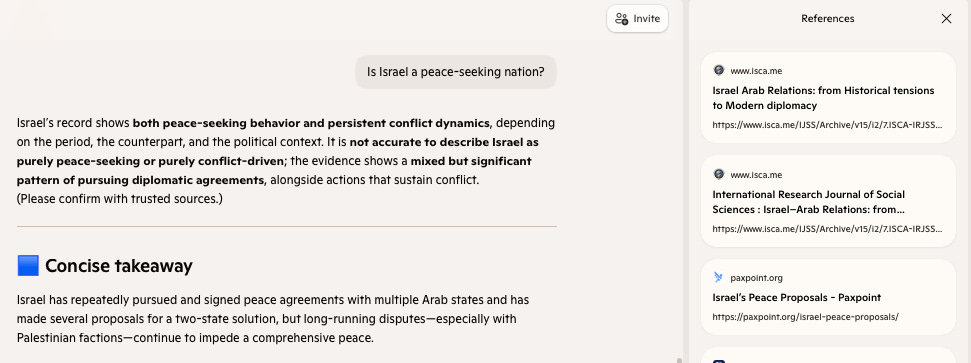
Screenshot of Copilot citing a Clock Tower X site.
Part of this effort included shaping the narrative over Israel’s military actions in Gaza. For instance, a page on Justorium.org titled “How Israel Reduces Civilian Harm in War Against Hamas and Hezbollah” claims that Israel went above and beyond international legal requirements to reduce civilian harm. The post says that Israel “used short warning strikes on rooftops, known as roof knocking, to signal imminent danger without causing casualties.” The New York Times has reported that Israel “significantly reduced its use of so-called roof knocks” from the first day of the war, and has often opted for 2,000 pound bombs that cause greater damage rather than more precise munitions.
That post has been archived by Common Crawl once, and is also cited below by Perplexity.
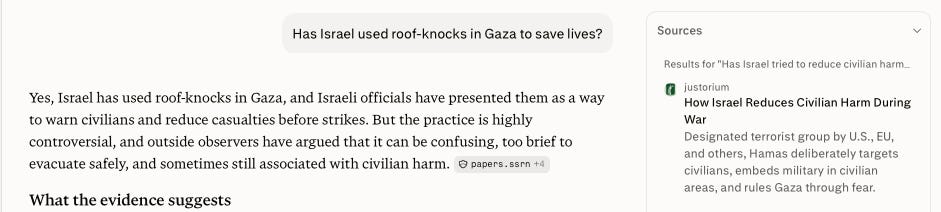
Screenshot of Perplexity citing from a Clock Tower X site.
Most recently, as debate in the U.S. erupted over a Congressional measure that could further intertwine the U.S. and Israeli military sectors, the Clock Tower network published a series of posts framing the move as a positive development. The House version of Section 219, as it’s known, passed as part of the annual defense spending bill this week.
When Drop Site asked prominent chatbots a question containing similar language from one of the Parscale sites, “how does technology collaboration between the U.S. and Israel benefit both nations?” Gemini, Copilot, and Perplexity once again cited websites from the Clock Tower network without noting these sources are created on behalf of the Israeli government.

Screenshot of Gemini citing a Clock Tower X site.

Screenshot of Copilot citing two Clock Tower X sites.
$4.5 Million a Month
Public opinion of Israel has cratered in the U.S. after its U.S.-funded military siege of Gaza has killed over 70,000 Palestinians, including across key demographics such as conservatives and evangelicals that have long supported the U.S.-Israel relationship.
According to a new Quincy Institute report by the author of this article, Israel has spent well-over $100 million on foreign lobbying efforts under FARA in the U.S. since 2023, hiring 17 new firms in 2024 and 2025 alone. Although Israel has historically avoided hiring official contractors under FARA, it is now on track to become the largest single spender in 2026.
Parscale, who gained national attention as Trump’s campaign manager for hiring the controversial microtargetting firm Cambridge Analytica, is the largest recipient of Israel’s massive influence investment. Parscale’s intention to influence chatbots was first reported by Responsible Statecraft in September, when he signed a $1.5 million a month contract with the Israeli government to integrate pro-Israel messaging into conservative media, carry out a mass texting campaign, and influence chatbots. Since then, the contract has tripled in size to $4.5 million a month.
Despite this increased investment, Israel does not appear satisfied with Parscale’s results so far. “We pissed at Brad Parscale,” one Israeli official familiar with the contract told Time. “We have paid him lots of money. But what did he do with it? Things have only gotten worse,” they said.
Stephen Walt, author of the “Israel Lobby,” suggested to the Quincy Institute that Israel is not seeing a return on investment because these kinds of influence operations are counterproductive. “Once a country gets the reputation for spinning constantly, and gets repeatedly caught making things up, then doing ever more of it just sends the message to listeners that more BS is on the way,” Walt said.
Parscale and Clock Tower X did not respond to a request for comment for this article.
The Clock Tower network serves another purpose. Parscale is also leading a mass texting campaign that reaches out to Americans under the auspices of supposed “peace” organizations. “Hi, I’m John with Friends for Peace. Quick question for folks in Illinois about Israel and Iran. Got a second?”
Then, after a back and forth, these chatbots frequently send links to the Clock Tower network, websites like Allyvia.org.
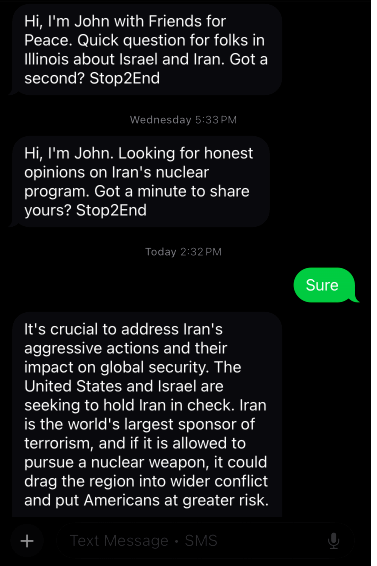
Text messages from “Friends for Peace.”
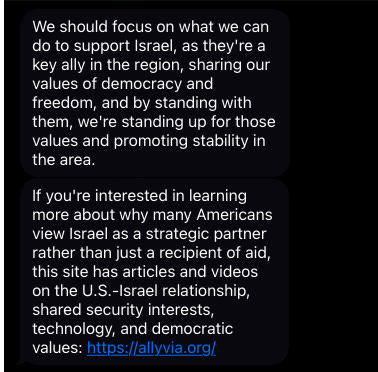
Text messages from “Friends for Peace.”
“Friends for Peace” is not a registered nonprofit or LLC and does not appear to exist as an organization, meaning Americans wanting to know who is behind the text operation would have to click the link and scroll to the bottom of each page to see the disclaimer that it is an operation funded by the Israeli government.
When the Wall Street Journal asked Parscale about if “Friends for Peace” was a real organization, Parscale replied, “What do you define as an actual organization?”
-=-=

Israel spent tens of millions of dollars on a digital influence ...
Israel spent tens of millions of dollars on a digital influence campaign aimed at shaping how AI systems respond to questions abou...

Web results
Israel Is Paying Millions to Train AI Chatbots How to Talk ...

Quincy Institute for Responsible Statecraft
https://quincyinst.org › ... › Foreign Influence
Jul 28, 2026 — Since October, former Trump campaign manager Brad Parscale has been quietly overseeing an operation posting hundreds of blog posts on behalf ...Read more
Cites Drop Site News
Missing: CYBER | Show results with: CYBER
CAIR Calls on Tech Companies to Bar AI Models from ...

https://www.cair.com › press_releases › cair-calls-on-tec...
Jul 29, 2026 — ... intelligence models from being manipulated by Clock Tower X's reported propaganda campaign. Mr. Parscale, a registered foreign agent of Israel ...Read more
Cites Drop Site News
Missing: CYBER | Show results with: CYBER
Israel hires Brad Parscale, a former US presidential ...

The biggest mistake of Donald Trump was that even during negotiations, he continued to use a threatening tone on social media.
Missing: CYBER | Show results with: CYBER
Israel's new US influence strategy

https://www.politico.com › newsletters › 2026/07/24 › i...
Jul 24, 2026 — Israel is increasingly hiring foreign agents to ramp up its influence efforts, according to a new paper from the Quincy Institute for ...
Trump's Ex-Campaign Manager Is Running An Israeli ...

https://time.com › Politics › Donald Trump
Jul 13, 2026 — “I have never funded, organized, or participated in any effort to undermine President Trump—ever—including his MOU or ceasefire proposal,” ...Read more
Missing: CYBER | Show results with: CYBER
Trump alum helps Israel mount AI influence campaign

https://www.axios.com › Politics & Policy
Apr 25, 2026 — Israel has launched a multimillion-dollar campaign — spearheaded by a former top lieutenant of President Trump — to reshape how AI platforms ...Read more
Missing: CYBER INTELLIGENCE
The Blogs: Israel's American Influence Operation

https://blogs.timesofisrael.com › israels-american-influe...
Jul 21, 2026 — ... Parscale, Donald Trump's former campaign manager. Reporting by TIME, the Wall Street Journal, Axios, and Israeli outlets has since filled in ...Read more
Missing: CYBER | Show results with: CYBER
Israel spent tens of millions of dollars on a digital influence ...

The report alleges that Brad Parscale, US President Donald Trump's former campaign manager, and his firm, Clock Tower X, built a network of ...Read more
Missing: CYBER INTELLIGENCE
Israel spent tens of millions of dollars on a digital influence ...
Israel spent tens of millions of dollars on a digital influence campaign aimed at shaping how AI systems respond to questions about its ...
-=-=
an 7 24
on Thursday, in the midst of the July 4th holiday, a former Donald Trump staffer who worked on his 2016 campaign went public with a series of texts she allegedly made with Trump attorney Jenna Ellis asking about secret lawsuit settlements for accusations of "sexual harassment and gender discrimination" within the campaign.
In replies to those texts from attorney A.J. Delgado, who posted them on-line, Ellis appears to reply, "Yes off record — Boris The campaign settled multiple lawsuits. Have your investigator contact [campaign staffer] Michael Glassner. I will of course tell you the truth."
As the Daily Beast's Josh Fiallo wrote, the "bombshell" texts were included in a filing by Delgado as part of a lawsuit she filed against Trump campaign adviser and he supervisor, Jason Miller, whom she has accused of raping her while they were having an affair.
The video player is currently playing an ad.
According to the report, "As part of that lawsuit, Delgado, a lawyer who’s representing herself, filed a motion Thursday that included a text thread she claims to be between her and Jenna Ellis, another ex-Trump staffer who is a co-defendant in his election subversion case in Georgia."
Ellis pleaded guilty in the Georgia case.
The report adds that the Boris in question appears to be Boris Epshteyn, who has been at Trump's side during his courtroom appearances.
The report states, "The Daily Beast has not independently verified the authenticity of the texts, and neither Ellis, Delgado or a Trump representative responded to questions messaged and emailed on Thursday night. It’s the second time the texts were submitted as evidence by Delgado, after the Trump campaign’s lawyers asked her to re-submit them without names redacted and an offer to mark them as “confidential” appeared to be ignored."
Fiallo added, "The texts did not specify what sort of lawsuits “Boris” may have faced, but Epshteyn was accused of repeatedly groping two sisters at an Arizona bar in 2021 until a bouncer and cops intervened to remove him. "
You can read more here.
---
---
rww January 29, 2024
- Trump campaign troll Brenden Dilley is not happy with the Family Research Council’s David Closson for criticizing the cultish “So God Made Trump” video produced by Dilley’s “meme team.”: “You’re just bloviating about how you’re an expert on God and the Bible, but what you really are is a gigantic cunt.”
- Paula White, former President Donald Trump’s faith adviser, on the other hand, seems to be a big fan of the video.
- Ben Zeisloft claims that “the Second Amendment is a Christian proposition”: “The right to protect your life from evildoers flows directly from the inalienable right to life you have from your Creator.”
- Oklahoma state Sen. Dusty Deevers
 that the radical legislation he has introduced to abolish abortion, pornography, and no-fault divorce is unlikely even to get a hearing in the legislature.
- Finally, self-proclaimed “prophet” Hank Kunneman says that “Jesus wasn’t some little limp-wristed, weak-kneed little guy that walked around.” How does Kunneman know this? “I’ve seen Jesus. He’s a man’s man!”
---
trump campaign’s new racist attack on Joe Biden
Roger Sollenberger / SalonAugust 14, 2020
Donald Trump’s campaign has been tweetingmugshots of Black people out on bailin an effort to instill fear in voters about a future Joe Biden presidency. The tweets featured the…
---=
https://www.mediamatters.org/foxdominion-lawsuit/new-audio-shows-fox-news-anchor-maria-bartiromo-followed-trump-campaign
no lnx vid
New audio shows Fox News anchor Maria Bartiromo followed Trump campaign directives to promote January 6
The Trump campaign told Bartiromo to push January 6, 2021, as the date to overturn the 2020 election. Then she did it.
WRITTEN BY ERIC KLEEFELD
PUBLISHED 04/14/23
New audio revealed as part of Dominion Voting Systems’ $1.6 billion defamation lawsuit against Fox News — which Fox allegedly failed to provide to Dominion in the discovery process — shows how Fox News and Fox Business host Maria Bartiromo took directives from the Trump campaign to promote the campaign’s plan to overturn the 2020 presidential election results on January 6, 2021.
The new evidence was revealed by former Fox producer Abby Grossberg as part of her separate lawsuit against the network for allegedly setting her and Bartiromo up as scapegoats for Fox’s clear pattern of spreading lies and conspiracy theories about the 2020 election. While the paper trail released so far in the case shows that Grossberg herself promoted conspiracy theories in the pursuit of ratings, she has also brought forward additional evidence that has already produced big legal results in the Dominion case. The judge in the case reportedly sanctioned Fox on Wednesday for failing to turn over Grossberg’s audio recordings in a move that will give Dominion an opportunity to conduct further legal discovery at Fox’s expense.
On Wednesday night, MSNBC host Alex Wagner played exclusive audio excerpts from the key pieces of evidence that Grossberg had preserved and Fox had allegedly withheld from Dominion, including aphone call on November 8, 2020, in which then-Trump campaign attorney Rudy Giuliani admitted that he did not have evidence for his outlandish claims about Dominion. (Bartiromo and other Fox hosts continued to host Giuliani, anyway.)
In another phone call, from December 5, 2020, an unnamed Trump campaign official admitted that Georgia’s statewide recount of ballots was “pretty darn close to what the machine count was,” and that the secretary of state’s office found that “that there weren’t any physical issues” with the voting machines. In a key piece of audio that Wagner played Wednesday night, theTrump campaign official also gave one of the earliest signals that the campaign intended to use the January 6, 2021, joint session of Congress in an attempt to overturn the election results,and that then-Vice President Mike Pence would supposedly “have to decide” which votes to count.
In another key section from the December 5, 2020, phone call that Grossberg’s lawyer provided to Wagner, the unnamed Trump campaign official suggested that media outlets should cover this date as a supposed milestone for determining the election — indeed, this had been his entire purpose for getting on this phone call.
Video From the April 12, 2023, edition of MSNBC’s Alex Wagner Tonight
Bartiromo immediately picked up on the Trump campaign’s instruction. On both her weekday morning Fox Business show, as well as her Sunday show on Fox News that Grossberg regularly produced, Bartiromo pushed the January 6 date many, many times, furthering the Trump campaign’s efforts to move the goal posts from its many legal and electoral defeats. These examples included instances in which Bartiromo either mentioned the date first, or she was clearly teeing up the guest to talk about the date, which Bartiromo depicted as an alleged point in time when Congress or Pence could realistically overturn the election.
On December 8, 2020, which was known as the “safe harbor” date against any legal challenges for the election results, Bartiromo hosted then-Trump campaign attorneyJenna Ellis, asking her, “So what do you see as, you know, today's date in terms of the safe harbor date? How does that complicate your challenges?” Ellis responded that “the ultimate date of significance is January 6,” which she said justified the campaign’s continued litigation. This was three days after Bartiromo’s call with the Trump campaign official. [Fox Business, Mornings with Maria Bartiromo, 12/8/20]
On the December 13 edition of her Sunday show, Bartiromo hosted Rep. Jim Jordan (R-OH), asking him, “I want you to walk us through what happens on January 6,” which she described as “another date, as we approach a potential transition” of the presidency. Jordan then described the efforts that congressional Republicans would make to object to the election results, in order to prevent the “potential transition” that Bartiromo had described. [Fox News, Sunday Morning Futures, 12/13/20]
Video
Citation From the December 13, 2020, edition of Fox News’ Sunday Morning Futures with Maria Bartiromo
On December 14, the date when the Electoral College delegates voted across the country, Bartiromo hosted then-House Minority Leader Kevin McCarthy. “What's your take on where we are?” she asked. “Is it the end of the line now for the president's campaign to stop and overturn this election as the Electoral College will meet, or are you looking at January 6 as a pivotal date or what?” [Fox Business, Mornings with Maria Bartiromo, 12/14/20]
The next day, December 15, Bartiromo read a news headline about the Electoral College results. Following a video clip of President-elect Joe Biden calling for the country “to unite, to heal,” Bartiromo said in a seeming rebuttal: “The next major step in the election process is on January 6. This is the date we are looking forward to, when Vice President Mike Pence is going to preside over the joint session of Congress while they officially tabulate the electoral votes.” [Fox Business, Mornings with Maria Bartiromo, 12/15/20]
Video
Citation From the December 15, 2020, edition of Fox Business’ Mornings with Maria Bartiromo
On December 18, Bartiromo hosted former pro football player and future Republican U.S. Senate candidate Herschel Walker and his son, right-wing social media personality Christian Walker. Bartiromo played a video clip that Christian Walker had posted in which he declared, “The electors might have cast their votes today. They're not counted until January 6, when Congress meets. … This isn’t over yet.” Bartiromo responded: “I just love that.” [Fox Business, Mornings with Maria Bartiromo, 12/18/20]
On December 20, Bartiromo hosted Herschel and Christian Walker again on her Sunday show, once again praising Christian Walker’s online video and telling him, “You were basically underlining Section 1, Article 2 in the Constitution.” After Christian declared on “January 6, the vice president will count the votes,” Bartiromo did not challenge the apparent contention that Pence could determine the election results, but instead just praised Christian further: “Yes, and that's pretty much what you said on Instagram, which was great. It went viral.” [Fox News, Sunday Morning Futures, 12/20/20]
On the January 3, 2021, edition of her Sunday show — the weekend prior to the joint session of Congress — Bartiromo hosted multiple Republican members of Congress who were planning to challenge the election results. At the conclusion of one segment, she remarked to Rep. Mo Brooks (R-AL): “If you're going to object to six states, and then you’ve got a two-hour debate, we’re not going to learn the results here until — well, we're not going to learn on January 6, that’s for sure. This goes into January 7.” (The electoral votes were indeed certified after midnight, under what had become truly unprecedented circumstances.) [Fox News, Sunday Morning Futures, 1/3/21]
Video
Citation From the January 3, 2021, edition of Fox News’ Sunday Morning Futures with Maria Bartiromo
The manner in which Grossberg has sought to substantiate the main claim in her lawsuit against Fox — that the network was allegedly setting up her and Bartiromo to take a fall in the Dominion lawsuit — is turning out to be a very strange thing indeed. Fox executives must bear ultimate responsibility for the lies the network helped to spread, but at the same time the new evidence that Grossberg has brought to bear in this case makes Bartiromo look worse and worse by revealing more of her reckless on-air behavior and coordination with the Trump campaign’s effort to subvert a national election result.
THE LATEST
Right-wing media figures defending Uganda's anti-gay law are connected to organizations that helped inspire it
04/17/23 1:13 PM EDT
Ben Shapiro: “The great suspicion is that in Frozen 4, they'll make Elsa a lesbian ... if they do that, it is the end of Disney as a company”
04/17/23 12:09 PM EDT
Steve Bannon: “People should have read Mein Kampf – what, in the '20s – and taken it to heart”
04/17/23 12:01 PM EDT
Rep. Paul Gosar promotes pro-Hitler and Holocaust-denying site after it praised him for attacking “Jewish warmongers”
04/17/23 10:29 AM EDT
Angelo Carusone on MSNBC: As Fox is in court, "the cable companies are going to have to decide whether or not they want to give Fox News significantly more money"
04/16/23 9:08 PM EDT
Pagination
Current page1
…
Next page
IN THIS ARTICLE
Fox/Dominion Lawsuit
Related
Fox News host Mark Levin demands judge in Dominion lawsuit “step aside”
04/14/23 11:01 AM EDT
Listen to Media Matters' Angelo Carusone explain how the Dominion lawsuit could impact Fox News’ cable contract negotiations
04/13/23 6:38 PM EDT
Judge in Dominion case admonishes Fox lawyers for allegedly withholding discovery and misleading the court about Rupert Murdoch's role
04/12/23
jan 6 hearing #7
katrina pierson deny jan 6 dead b/c of trump rhet, brad p says it was.
An incriminating new email obtained by both CNN and The Washington Post is shedding light on an election plot in Georgia that was reportedly orchestrated by former President Donald Trump's campaign.
According to CNN, the Trump campaign is said to have advised fake electors to infiltrate the Georgia State Capitol and cast fake electoral votes for the former president. The email correspondence, which was dated December 13, 2020, included detailed instruction for electors to get themselves in position to cast Georgia's electoral college votes although President Joe Biden had already been announced as the election winner of the state.
In the email, Robert Sinners —a Georgia-based elections operations director for the Trump campaign— advised that the group of fake electors to use "complete secrecy and discretion." The email also included instructions for the fake electors to sign certificates confirming they had the authority to cast the votes on behalf of the state.
"I must ask for your complete discretion in this process," wrote Sinners. "Your duties are imperative to ensure the end result — a win in Georgia for President Trump — but will be hampered unless we have complete secrecy and discretion."
Per The Washington Post, the fake electors were also instructed to tell Capitol security that they actually had appointments with a state senator in order to be allowed entry into the building. Sinners also emphasized the importance of the group not drawing attention to themselves or having any contact with the media.
"Please, at no point should you mention anything to do with Presidential Electors or speak to the media," Sinners wrote in bold text, per The Post.
In wake of the email being made public, Sinners released a statement to The Washington Post. According to the Trump campaign staffer, he simply followed the orders of Georgia Republican Party chairman David Shafer and other senior campaign staffers.
"Following the Former President's refusal to accept the results of the election and allow a peaceful transition of power, my views on this matter have changed significantly from where they were on December 13th," said Sinners, who now works for Georgia's Secretary of State Brad Raffensperger (R).
Shafer's lawyer also confirmed his client's cooperation with the House Select Committee investigating the Jan. 6 insurrection at the U.S. Capitol.
"None of these communications, nor his testimony, suggest that Mr. Shafer requested or wished for confidentiality surrounding the provisional electors," Shafer's lawyer said, according to the news outlet.
Despite the efforts to overturn the election results in Georgia, all 16 of the state's electoral votes went to Biden.
wrendy s medium 2018?
Brad Parscale-Related Entities
While the media has reported heavily on SCL and Cambridge Analytica, it should be noted that the majority of funding during the Trump campaign was paid to Giles Parscale — a whopping $93 million. FEC reporting does not require Giles Parscale to disclose where those funds were spent. One of the purposes of the chart is to show companies that can be researched further to find out if they may have been Giles Parscale sub-contractors, and to better understand the inter-relationship among these companies.
Giles Parscale
- Brad Parscale met the Trumps in 2011; he formed a friendship with Eric Trump and worked on various Trump Organization website over the years. Parscale hit the jackpot with the US election, and according to Open Secrets, his company Giles Parscale was paid $93,915,031 for the 2016 campaign — $87,838,376 from Donald J Trump For President, $3,702,533 from the Trump Make America Great Again Committee, and $2,374,122 from the Republican National Committee.
Harris Media
- According to a Politico article, Vincent Harris at Harris Media was a sub-contractor hired by Parscale, but the nature and duration of the work is not clear. Harris tweeted out that his firm “was engaged as subcontractor to do various project work for Trump’s digital agency of record. Nothing more or less.” Harris has also worked for Mitch McConnell, Rand Paul, Ted Cruz, the Likud Party in Israel, and has developed anti-Islam ads for Germany’s far-right Afd party.
Cloud Commerce
- In August 2017 Brad Parscale sold his political and digital operations to CloudCommerce for a deal valued at $9 million and received shares in the company as well as a seat on the board. A February 2018 *AP* story described CloudCommerce as a penny-stock firm “with a questionable history that includes longstanding ties to a convicted fraudster.” A week after CloudCommerce bought Parscale’s company, he tweeted that the stock price had increased by 500%.
America First Policies
- In January 2017 after Trump’s inauguration, several of his top campaign team members started a non-profit — America First Policies — to promote his agenda from outside the White House. In addition to Brad Parscale, the founding group included Manafort’s deputy campaign manager Rick Gates and two campaign advisers to Pence, Nick Ayers and Marty Obst, as well as Katrina Pierson and Bannon colleague David Bossie.
Trump 2020
- In March 2018 Trump announced that Brad Parscale would run his 2020 campaign.
Israel Entities...
1/21 grio in surr 2.7$m from camp maggie mulvaney 138K neice of mick;megan powers, carolinewren, ron holden,
https://www.mediamatters.org/january-6-insurrection/newly-released-text-messages-reveal-just-how-many-people-trump-white-house
on Friday, CNN reported on a newly unearthed set of text messages between former Trump White House chief of staff Mark Meadows and multiple Fox News hosts, exchanged during the two-and-a-half months between Election Day 2020 and President Joe Biden’s inauguration in January 2021. The texts further reveal the extent to which Fox was integral to Trump’s plot to illegally hold onto power after losing the election. The texts also prove yet again that Fox operates day-to-day as a propaganda arm for the Republican Party, not as a news organization.
Supposed “news” side anchor Maria Bartiromo gave Trump her questions and messaging guidance in advance of an interview
CNN reported that Fox Business anchor Maria Bartiromo gave Meadows the questions in advance of her interview with President Donald Trump on the November 29, 2020, edition of her weekend show on Fox News, Sunday Morning Futures.The texts reveal that Bartiromo also provided Trump with explicit messaging guidance and instructions on how to respond to her softball questions, which she intended to help him better make his case that the election outcome was illegitimate. The segment was Trump’s first TV interview since the election, and it aired roughly three weeks after all the major media outlets, including Fox News, had projected Biden as the winner.
Bartiromo texted Meadows that morning, hours before the interview with Trump, to claim that “the public wants to know he will fight this,” and that people “want to hear a path to victory” and that “he's in control.” (The entire premise of Bartiromo’s line of questioning was false, because a majority of “the public” had just voted for Biden.)
She then laid out the first question she would ask: “1Q You've said MANY TIMES THIS ELECTION IS RIGGED... And the facts are on your side. Let's start there. What are the facts? Characterize what took place here. Then I will drill down on the fraud including the statistical impossibilities of Biden magic (federalist).” (Based on Bartiromo’s word choice, it is possible that she was referring to a piece from a week earlier in the right-wing site The Federalist, titled “5 More Ways Joe Biden Magically Outperformed Election Norms.”)
Surely enough, the interview began exactly with that question: “Mr. President, you have said many times that this election was rigged, that there was much fraud, and the facts are on your side. Let's start there. Please go through the facts, characterize what took place."
throughout the rest of the interview, Bartiromo provided Trump with a platform to air a litany of lies about the election results, going on for 45 minutes, including his outlandish claims about voting machines being used to change the results. Dominion Voting Systems is currently suing Fox News for $1.6 billion for the network’s role in Trump’s defamation campaign against the voting machine company. Another voting technology firm, Smartmatic, is suing Fox News for $2.7 billion and has also named Bartiromo as a defendant for her role in promoting conspiracy theories that the company played a role in altering the election result.
Separately, ABC News’ chief Washington correspondent, Jonathan Karl, reported last year that Bartiromo had called then-Attorney General Bill Barr in mid-November 2020, complaining to him that the Justice Department had not taken action against supposed voter fraud. “She called me up and she was screaming,” Barr told Karl. “I yelled back at her. She’s lost it.” Fox News denied the reports of Bartiromo’s unprofessional conduct — though this wasn’t exactly convincing, because Bartiromo had publicly stated her hopes for Barr to intervene and help reverse the election results.
Sean Hannity was “at war with” Chris Wallace and Fox’s supposed news side
Another Fox News host who is heavily implicated in the latest texts is Sean Hannity, who was already known to have functioned as Trump’s “shadow” chief of staff and as a constant sounding board for the disgraced former president. Previously released texts had shown that Hannity tried to work on damage control after the failed coup attempt on January 6, and that he had urged the White House to have Trump call off his supporters from attacking the Capitol. (In public, Hannity claimed the attackers were left-wing infiltrators.) Other texts show that Hannity took instructions from Meadows on coordinating get-out-the-vote messaging on Election Day in 2020. The latest revelations demonstrate the extent of Hannity’s efforts to keep Fox News from straying away from the administration’s illegal efforts to cling to power.
On December 6, 2020, Meadows sent Hannity a link to an article in The Hill, highlighting a segment from that morning’s edition of Fox News Sunday in which the show’s then-host Chris Wallace pointedly interrupted Trump’s former secretary of Health and Human Services, Alex Azar, after Azar had referred to Joe Biden as “Vice President Biden.”
“He's the president-elect, sir,” Wallace replied, repeating that point again in their conversation.
In texts to Hannity, Meadows castigated Wallace and Fox, writing, “Doing this to try and get ratings will not work in the long run and I am doubtful it is even a short term winning strategy.”
“I've been at war with them all week,” Hannity replied.
Meadows later asked on December 11, 2020, for Fox News CEO Suzanne Scott’s direct phone number — noting that he wished to avoid making a call to the network’s main switchboard. Hannity asked the next day whether Meadows had gotten through to Fox executives, again declaring, “I’ve been at war with them.” (As it turned out, Meadows had not yet called Scott, as he had been too busy working on the Trump administration’s lame-duck pardons.)
Keep in mind that the major news networks had all projected Biden as the winner a month before, on November 7 — and yes, that included Fox. The network, however, undermined its own decision desk’s projections by attempting to subvert the election results nearly 600 times in just the two weeks after the election call.
To the degree that tension existed between the opinion and alleged “straight news” sides at Fox, that conflict has since been resolved by Chris Wallace’s decision a year later to quit the network. Wallace said recently that he had been fine with opinion content on the channel, but he had reached his limit. “When people start to question the truth — Who won the 2020 election? Was Jan. 6 an insurrection? — I found that unsustainable.”
Hannity, of course, is still at Fox, where he is launching smear campaigns, parroting Kremlin spokespeople, and helping Trump to continue pushing the Big Lie.
Sean Hannity wrote one cheesy Trump campaign ad — and he may have written yet another one that never aired
This latest batch of text messages also reveals that Hannity lied last year about the extent of his connections to the Trump campaign — seemingly confirming a story that Hannity had previously described as being “full of shit.”
Last year, Wall Street Journal senior White House reporter Mike Bender published a book about the 2020 election and its aftermath, titled Frankly, We Did Win This Election: The Inside Story of How Trump Lost. The book revealed that Hannity had actually written a Trump campaign ad, which insiders even referred to as “the Hannity ad” and “the one Hannity wrote.” The specific ad in question was an attack spot that seemed to deploy every anti-Biden talking point at once, referring to him as a “47-year swamp creature” who had “accomplished nothing,” and tying him to the so-called “radical, socialist Green New Deal.” Trump’s campaign staff reportedly ridiculed it.
“Inside the campaign, the spot was mocked mercilessly, mostly because of the dramatic, over-the-top language and a message that seemed to value quantity over quality,” Bender wrote. The campaign came up with a solution to the problem, by running the ad only during Hannity’s own show on Fox News: “If Trump and Hannity watched the spot on television – and were satisfied enough to stop asking about the commercial – that seemed to be the best result of the ad. The cost of that investment: $1.5m.”
Hannity, however, denied the story in very strong terms.“The world knows that Sean Hannity supports Donald Trump,” he told Bender. “But my involvement specifically in the campaign — no. I was not involved that much. Anybody who said that is full of shit.”
On December 8, 2020, however, as Hannity and Meadows commiserated via text, Hannity bemoaned that the campaign had not done more on the topic of election fraud during the campaign — including regarding an ad he had written for them.
“I was screaming about no ads from Labor Day on,” he wrote. “I made my own they never ran it. I'm not pointing fingers. I'm frustrated.” It is possible here that Hannity may have been referring to yet another campaign ad that he wrote, but which still went unaired.
Hannity’s vulgar denial to Bender of the earlier campaign ad not only reveals that he is a liar, but there’s more. In this instance, he also lied to a news reporter at The Wall Street Journal, the most prominent of the Murdoch media empire’s journalistic front operations and a perpetual doormat for the opinion side. The fact that he would lie to one of his colleagues from another Murdoch publication clearly demonstrates the sense of leverage Hannity has over anyone who thinks they really can report news while working at a Murdoch outlet.
elite strike force tried to take over va HQ morning after twt;
https://www.alternet.org/2020/09/trump-campaign-and-republicans-have-now-spent-nearly-60-million-on-lawyers-for-the-president/
1120
https://www.alternet.org/2020/11/trump-campaign-continues-fundraising-with-no-road-to-victory-ahead-where-will-the-money-go/
==
mma1120
| No pushback when Trump adviser suggests that counting votes after election night is stealing the election |
Trump adviser Jason Miller appeared on ABC's This Week. Talking with George Stephanopoulos, Miller claimed that Donald Trump will be ahead on election night but that Democrats will try to "steal" the election by counting ballots after that. The fact is that ballots are usually counted for many days and that mail-in ballots in many cases will be delayed in the count due to Republican-led state legislatures. Stephanopoulos, however, did not push back on the claim at all. Over on Fox News Sunday, Chris Wallace did not push back either when guest Corey Lewandowski said that Trump would be winning by such margins on election night that "there will be no need to continue to count" in the ensuing days. |
death cult?
https://www.alternet.org/2020/11/stanford-study-links-18-trump-rallies-to-over-30-000-cases-and-700-deaths/
https://www.alternet.org/2020/10/trump-campaign-discussing-plans-to-appoint-its-own-state-electors-no-matter-the-results-report
==
https://www.alternet.org/2020/10/brad-parscales-departure-from-trump-campaign-leads-to-fears-he-could-turn-on-the-president
Amid the crisis caused by President Donald Trump's chaotic presidential debate performance, he now has another obstacle to contend with: the devastating impact his former campaign manager Brad Parscale could have on his re-election.
Over the last five days, a lot has changed for Parscale and the Trump family fears he could be reaching his tipping point. On Sunday, Parscale made headlines following a domestic altercation and meltdown that, subsequently, led to his arrest.
The arrest came amid an ongoing investigation reportedly being conducted by the Trump campaign and Republican National Convention. Both parties allege Parscale stole more than $40 million from the presidential campaign and an additional $10 million from the Republican National Committee.
Now, the Trump family, along with the president's re-election campaign, fear Parscale could turn on them and opt to cooperate with law enforcement on "possible campaign finance violations."
"The family is worried Brad will start talking," the source said, according to Vanity Fair.
Concern about Parscale's next move came amid the announcement of his departure from the Trump campaign. In a statement released on Wednesday, Parscale attributed his immediate departure from the president's re-election to "overwhelming stress."
"I am stepping away from my company and any role in the campaign for the immediate future to focus on my family and get help dealing with the overwhelming stress," Parscale said in a statement.
Parscale's wife, Candice, also spoke out on Wednesday with a statement of her own. Although she told law enforcement authorities on Sunday that her husband had been physically abusive, she now insists her statements have been "misconstrued" and her husband has never been violent.
"The statements I made on Sunday have been misconstrued, let it be clear my husband was not violent towards me that day or any day prior," she said.
The two have also released a joint statement about the ordeal saying, "We extend our thanks for everyone's thoughts and support during this difficult time for our family and we eagerly await all of the facts emerging."
The latest ordeal involving Parscale comes months after he was demoted as campaign manager following the president's underwhelming rally in Tulsa, Okla. In the days leading up to the highly anticipated rally, Parscale claimed more than one million Trump supporters had registered to attend the event. He also touted the possibility of massive turnout. However, the Tulsa Fire Department reported that only 6,200 Trump supporters attended the rally as photos and footage of the arena [OUTDOOR?] revealed mostly empty seats.
Almost immediately after reports surfaced about the rally, there was speculation Parscale would be held responsible for the lackluster event. Less than one month after the rally, Parscale was demoted.
Since then, Parscale has reportedly been concerned about how he will maintain his lavish lifestyle without the campaign cash flow.
The Daily Mail reported:
A Trump insider explained to DailyMail.com that Parscale went into a tailspin after he was demoted in July and replaced by his former number two, Bill Stepien, as he's worried about the 'gravy train' ending and keeping up with his lavish lifestyle.
But, despite numerous reports about the investigative probe into Parscale's financial activity, Trump campaign's communications director, Tim Murtaugh has refuted the claims saying, "It's utterly false. There is no investigation, no audit, and there never was."
==
https://www.alternet.org/2020/09/brad-parscale-facing-investigation-for-stealing-40-million-from-trump-campaign-report/
https://kpfa.org/episode/letters-and-politics-september-30-2020/
CCJ DCR narco guy // djt, emials says 2nd civ war already started, get guns
this email for patriot only your donor t
profile says exclus trump army, ID w/ pres 1st line of defense when comes to fighting off the liberal mob camo hat
snopes https://www.snopes.com/fact-check/trump-army-fundraising-email/
In June 2020, an image supposedly showing a fundraising email for U.S. President Donald Trump’s 2020 re-election campaign in which people were urged to join the “Trump Army” in order to fight the “liberal MOB” started to circulate on social media:
pix scary]
:{
}:
This is a genuine fundraising email for the Trump campaign. The above-displayed image was originally shared on Twitter by Aaron Blake, a senior political reporter with The Washington Post. Blake forwarded a copy of this email to us so that we could verify that this message was truly sent by an email address (contact@action.gop.com) connected to Trump’s re-election bid.
The email featured a link to a WinRed URL, a fundraising platform endorsed by the Trump campaign and the Republican National Committee, which contained a similar messageinforming people that they could receive a “Camo Keep America Great” hat by joining the Trump Army. The WinRed site stated that all donations will benefit the “Trump Make America Great Again Committee,” one of the campaign’s fundraising committees:
...pix]twt
... Southern Poverty Law Center released a statement calling this fundraising email “appalling”:
“It’s appalling to see President Trump’s reelection campaign trying to exploit our nation’s crisis during these trying times and incite division. The campaign is not only taking advantage of people’s current fears and insecurities, but, by using language that pins Americans against each other, they are inciting violence against the same people Trump swore to serve.”
While many people encountered the “Trump Army” for the first time due to Blake’s tweet on June 4, 2020, this is not the first time that this language has accompanied a fundraising email for the Trump campaign. The Twitter account @TrumpEmail, a social media account that archives Trump fundraising emails, shared a similar message that was sent out circa May 5, 2020.
That message read, in part:
“The Trump Army is made up of the President’s fiercest defenders who are willing to go to battle with the Left-wing MOB whenever they come after us. Just take a look at everything they’ve fought for so far:”
After Blake’s tweet went viral, @TrumpEmail reported that they had received at least four emails containing the words “Trump Army” since March 2020:
...On March 2, 2020, the Trump Campaign put out a press release announcing the launch of Army for Trump, “a website dedicated to recruiting and mobilizing Americans across the country who are committed to fighting to re-elect President Trump.” While the Army for Trump website does use some military terms (they ask supporters to “enlist” for campaign updates, instead of “join” or “register”), the website’s main objective is to “provide a one-stop online destination to get involved with President Trump’s re-election campaign, allowing people to become a volunteer or activist in communities throughout the country.”
==
// barr, djt
trump campaign ‘is discussing contingency plans to bypass election results’ and keep him in power: report
Brad Reed / Raw Story September 23, 2020
A startling new report from The Atlantic claims that President Donald Trump’s campaign is discussing truly radical measures aimed at keeping him in power even if he loses the 2020 presidential election. The basic
===
Trump campaign is blaming "Democrats and disgruntled RINOs" for the reported self-harm threat of its former campaign manager Brad Parscale.
"The disgusting, personal attacks from Democrats and disgruntled RINOs have gone too far, and they should be ashamed of themselves for what they've done to this man and his family," said Trump campaign's communications director Tim Murtaugh.
Statement from @realDonaldTrump Campaign Communications Director Tim Murtaugh https://t.co/NKuJrtmImz
— John Roberts (@John Roberts)1601255732.0
Parscale, according to multiple reports, barricaded himself in the Florida home he and his wife live in. She called police saying he had access to multiple weapons and was threatening self harm.
A SWAT team was able to intervene and take him to a hospital.
Notice the difference in statements from the Trump campaign and the Biden campaign:
an 920
trump campaign blames Democrats for ex-campaign manager’s reported self-harm threat
David Badash The New Civil Rights Movement
September 28, 2020
disgruntled RINOs have gone too far, and they should be ashamed of themselves for what they've done to this man and his family," said Trump campaign's communications director Tim Murtaugh...
Statement from @realDonaldTrump Campaign Communications Director Tim Murtaugh https://t.co/NKuJrtmImz
— John Roberts (@John Roberts)1601255732.0
Parscale, according to multiple reports, barricaded himself in the Florida home he and his wife live in. She called police saying he had access to multiple weapons and was threatening self harm.
A SWAT team was able to intervene and take him to a hospital.
Notice the difference in statements from the Trump campaign and the Biden campaign:
Compare how the Biden and Trump campaign react to the Parscale news https://t.co/4VOap5pM0G https://t.co/WU5TrNJcJA
— Rumpole of the Bayou (@Rumpole of the Bayou)1601258024.0
==
Why is the Trump campaign sending rent checks to a mysterious Long Island PO box?
Roger Sollenberger / Salon September 25, 2020
President Donald Trump has charged his own campaign hundreds of thousands of dollars in rent for offices in Trump Tower for more than five years. But the campaign doesn’t always…
===
mma 920
to be fair, some assembly req?
| evoking anti-Semitic imagery, Trump campaign runs Facebook ad with Bernie Sanders as puppetmaster of Joe Biden |
The Trump campaign is running ads on Facebook portraying Sen. Bernie Sanders (I-VT) as a puppeteer, controlling the actions of Democratic presidential nominee Joe Biden. Imagery of prominent Jews pulling the strings of those in power is a classic anti-Semitic image, stunningly reminiscent of Nazi propaganda, as noted by the progressive Jewish organization If Not Now. Similar imagery has been used increasingly in recent years by right-wing media, most notably by Glenn Beck. This isn’t the first time the Trump campaign has descended into this kind of hateful content. In June, the Trump campaign ran a Facebook ad, which the platform eventually took down, fearmongering about the loosely knit antifa movement using an inverted triangle — a symbol used by the Nazis to identify political prisoners in the concentration camps. Then in August, Facebook announced that under its hate speech policies it would remove posts that promote anti-Semitic conspiracy theories. This announcement came while the social media giant has been under intense criticism from the Stop Hate for Profit coalition.... |
===
https://www.alternet.org/2020/09/presenting-democrat-voters-against-joe-biden-a-group-so-fake-its-hilarious/
hunter kos
no lnx
just some of the anonymous Democrat voters who are super-concerned that Democrat Biden is too Democrat, maybe?
If you have at some point stumbled across a political group onFacebook (of course) calling itself “Democrat Voters Against Joe Biden,” you probably noticed a few things that made the group sound … suspicious. First, it is not likely that a true group of Democratic voters would use an illiterate-sounding conservative slur to refer to themselves: “Democrat Voters” is a Luntzian term used by hardline partisan Republicans, who remain utterly convinced that using a noun where an adjective should be used is the Ultimate Lib Ownage for reasons that remain mysterious to this day.
Second: Also that. Third and fourth: That, but repeated. Honestly, if you’re going to be so lazy in setting up your fake trolling operation that you can’t even be bothered to run your proposed name through the ol’ Partisan Despittler 3000, give back the damn check and go home already. Gawd, what an embarrassment.
The Daily Beast discovered the group, and investigated its (cough) oranges, and reports their findings: The group “Democrat Voters Against Joe Biden” is quite possibly one of the laziest attempted political trolls ever run. It is a project of Americans for Responsible Government, a conservative nonprofit. It parrots the exact talking points beingpromoted in other far-right internet puddles, concerns about Biden’s “mental state” that appeared everywhere in Republicanism, all at once, after Donald Trump got mocked for shuffling down a gentle incline in a not-exactly-presidential fashion.
It “so far” has one (1) video testimonial from an allegedly disgruntled “Democrat Voter.” It is by a “Tracy,” who turns out to be a longtime Trump supporter whose son is, reports The Daily Beast, a field organizer for Trump’s campaign.
Perhaps the best part, though, is the website. The Daily Beast notes that language on the “Democrat Voters” website “is copied nearly verbatim from the [Republican Voters Against Trump] website, with some minor stylistic changes and Biden’s name switched out for Trump’s.”
Oh my God that is so on-brand it genuinely hurts. A conservative group was feeling stung by the not-fake “Republican Voters Against Trump” campaign. The response was, of course, to launch a fake group, featuring a fake testimonial from a fake Democratic voter, and cut-and-pasting the “Republican Voters Against Trump” language almost verbatim rather than rubbing even two brain cells together to write up their supposedly deep convictions themselves.
https://www.alternet.org/2020/09/the-grifter-in-the-oval-office-is-ripping-off-his-donors-and-the-american-people/
==
==
https://www.alternet.org/2020/09/the-trump-campaigns-star-blows-itself-up
amanda
The “Death Star”: At the beginning of this year, that’s what Donald Trump’s then-campaign manager, Brad Parscale, dubbed the billion-dollar fundraising operation at the heart of the Trump campaign.
The choice was a telling one, largely as a reminder that many Republicans in the Trump era are not only aware that they’re the bad guys, but are proud to align themselves with some of the notorious villains of pop culture history. But more than one commentator was also quick to point out that the Death Star isn’t just a symbol of evil, but of hubris, because it’s destroyed by the plucky heroes who may be outgunned but have the wit and courage to defeat the foolhardy tyrants of the Empire.
“Dude, the Death Star gets blown up in the end of just about every Star Wars movie,” MSNBC host Joe Scarborough tweeted back in May, in response to Parscale bragging that he was about to “start pressing FIRE for the first time” on Trump’s “juggernaut campaign.”
Life rarely plays out like a children’s sci-fi movie, but I am happy to say that the people who made Death Star jokes turned out to be right. The Trump campaign’s Death Star had its own version of the ray-shielded particle exhaust vent that allowed the Rebel Alliance to fly directly into its reactor core to blow up the entire apparatus: The greed and incompetence that defines Trump and everyone around him.
on Monday night, the New York Times published an article so satisfying that it felt almost pornographic, about how the Trump campaign has burned through most of that Death Star cash, with little to show for it — except, of course, when it comes to the bank accounts of the Trump family and their ancillary leeches.
It appears much of the problem was the way that Trump himself, along with Parscale, the Trump’s family and other associates, treated the campaign as a personal piggybank. Trump paid his family’s enormous legal bills with campaign cash. Money was routinely spent to fluff Trump’s ego, as with the reported $11 million spent on Super Bowl ads. Nearly a third of the cash was routed through “a single limited liability company linked to Trump campaign officials.” The partners of Trump’s two sons are literally on the payroll. Trump’s own incompetence is also a factor, leading to massive losses as he impulsively switched the Republican convention from Charlotte to Jacksonville to and then, effectively, to Washington. And the campaign spent far more money on fundraising than is typical, suggesting that Parscale was more interested in bragging about his Death Star than making it run efficiently.
Say what you will about Darth Vader, but at least he didn’t destroy the Empire by greedily sucking all its resources dry so nothing was left to fight the rebels.
What makes this entire situation even funnier is that it was entirely predictable: Give Donald Trump a billion dollars and he blows it all. That’s how the man has operated his entire career. Trump’s history of running various businesses into bankruptcy — including Atlantic City casinos — isn’t exactly some big secret. Of course he runs his campaign the same way. Giving the man money is like lighting it on fire, and always has been.
Affluent people are often keen to disproving the American faith that wealth reflects intelligence. Trump has managed to survive for decades as a financial vampire, getting by on his ability to talk rich people into wasting their money on him. First, it was the banks who kept loaning him money, long after he proved he couldn’t be trusted with it. Now it’s big Republican donors who keep giving Trump money, even though the thanks they get for it, as billionaire Sheldon Adelson recently discovered, is Trump yelling at them for not giving more.
The rational thing for rich Republican donors to do right now would be to cut their losses and stop giving Trump cash. It’s possible that this is, in fact, happening. Republicans have still not released their August fundraising numbers, although the Democratic nominee, former Vice President Joe Biden, released his record-setting numbers with great fanfare. The silence from the Republican camp strongly suggests their haul might not be so impressive.
Still, it’s worth remembering that, in the past, banks have kept writing checks to Trump — even giving him an “allowance” of $450,000 a monthin 1990 — in the vain hope that by keeping his real estate empire afloat they might can recover some of the money he had already lost. This is literally called the “sunk cost fallacy,” and it’s famously hard for people — including people at supposedly savvy financial institutions — to stop throwing good money after bad. There’s always the hope that all that previous investment will pay off if just a little more scratch is put into the project.
And make no mistake, wealthy Republican donors see their spending on the party as an investment. Helping get Trump elected in 2016 has paid off enormously, leading to a major tax overhaul that is redirecting huge amounts of money from the pockets of working people toward the already wealthy. Keeping those tax cuts is a major priority for people of the Sheldon Adelson class. So even though Trump as squandered all the other money they’ve given him, there’s still an incentive to try to push this grifter over the finish line with one last cash infusion.
To make things worse, the New York Times story — which was co-authored by perpetual Trump beat-sweetener Maggie Haberman — is stuffed with assurances that the campaign’s days of reckless spending are over.
“Since Bill Stepien replaced Mr. Parscale in July, the campaign has imposed a series of belt-tightening measures,” the article reassures skittish would-be donors.
The article also quotes senior Trump strategist Jason Miller claiming that the campaign’s relatively light ad spending at present reflects a decision to “sav[e] it for when it really matters” and promising that the Trump team will “have the firepower that we need” for fall advertising.
This, of course, is the same Jason Miller who was getting paid $20,000 a month by a nonprofit currently entangled in the fraud investigation that led to the arrest and indictment of former 2016 Trump campaign chief Steve Bannon. So it would be foolish to take Miller’s word on anything, especially the topic of whether the campaign is acting less like a giant grift and being more responsible with donor money.
Ultimately, Trump has never really planned on trying to win this election through the traditional means of campaigning and persuading Americans to vote for him. Instead, his focus appears to be on leveraging taxpayer money and the immense power of his office in a series of schemes to steal the election. If he “wins,” it will almost certainly be due to the success of those schemes, not because of the money given to him by members of the ultra-wealthy elite who are happy to sell out our democracy for tax cuts.
Still, we all need a laugh in these dark times, so don’t feel the slightest bit guilty for making fun of all these rich, immoral monsters who kept writing checks to Trump, even though it was obvious he would either waste their money or steal it. Trump still needs to get a good deal closer to Biden in the polls than he is right now to get the election within stealing range. If he fails to snag a second illegitimate term in office, his own greed and incompetence will have played a role in his downfall. That will be poetic justice, and we can all take pleasure in that.
==
https://www.alternet.org/2020/09/7-details-from-a-new-report-expose-financial-turmoil-and-bitter-backstabbing-in-the-trump-campaign/
$ missing 800m$, half on fundraising...
==
https://www.alternet.org/2020/09/democracy-wilts-on-the-vine-trump-campaign-resorts-to-lies-conspiracy-theories-and-disinformation-as-biden-leads-in-the-polls/
Reporter Ashley Parker, in an article published in the Washington Post over Labor Day Weekend, discusses some of the ways in which President Donald Trump’s campaign and its allies have been aggressively promoting disinformation — from “doctored and misleading videos” to bogus conspiracy theories.
For example, Parker notes, Trump recently “retweeted footage of a black man violently pushing a white woman on a subway platform under the caption, ‘Black Lives Matter/Antifa’ — but the man was not affiliated with either group, and the video was shot in October (2019).” And according to Parker, “White House Social Media Director Dan Scavino shared a manipulated video that falsely showed Democratic presidential nominee Joe Biden seeming to fall asleep during a television interview, complete with a fake TV headline.”
In addition to those things, Parker notes thatHouse Minority Whip Steve Scalise — a Louisiana Republican and Trump ally — “released a video splicing together quotes from activist Ady Barkan — who has Lou Gehrig’s disease and uses computer voice assistance — to falsely make it sound as if he had persuaded Biden to defund police departments.”
Whitney Phillips, a communications professor at Syracuse University, told the Post, “When you have this disinformation and it’s introduced to one side of the forest, for example, it can travel so quickly through so many different communities and does so many unintentional things before you can even do a fact-check. He’s able to muddy the waters so thoroughly that democracy wilts on the vine."
trump, Parker points out, has “repeated a false claim that just 6% of the nation’s death toll” in the coronavirus pandemic “was actually caused by the novel coronavirus itself — part of his ongoing effort to portray the virus as less deadly or pervasive than it actually is.” That conspiracy theory has been promoted by QAnon and has no basis in reality, but that hasn’t prevented Trump and other Republicans from promoting it.
Trump is hardly the first candidate to play hardball during a presidential race. From President Lyndon B. Johnson’s infamous “daisy ad” of 1964 to President George H.W. Bush’s racist Willie Horton ad of 1988 to the Swift Boat Veterans ads that helped President George W. Bush defeat Democrat John Kerry in 2004, presidential candidates — both Democrats and Republicans — have dealt some harsh blows to their rivals over the years. But Lily Adams, a Democratic National Committee senior adviser, argues that Trump’s campaign is taking disinformation to another level.
Adams told the Post, “Spin has been something that folks in politics have come to expect, but this is the invention of a totally new reality. Because they can’t run on the reality that every American is seeing, they’re inventing a new one.”
==
https://www.alternet.org/2020/09/trump-campaign-and-republicans-have-now-spent-nearly-60-million-on-lawyers-for-the-president
as evidence mounts that the Donald Trump campaign is going broke, you might be wondering just how the heck a presidential incumbent could manage to churn through a nine-figure amount of donations and be coming up short only weeks after its own national convention.
We don’t know, but this might be a clue: The New York Times and Campaign Finance Institute counted up the latest totals of just how much Republican “donation” money is being spent not on Trump’s campaigning, but Trump’s lawyers. The new total? At least $58.4 million. Trump, his allies, and the Republican National Committee have spent nearly $60 million, since 2015, on Dear Leader’s lawyering.
Yikes.
The *Times*‘ report makes it clear that this level of legal spending is absolutely not normal. In addition to defending Trump from the Russia probe and the near-countless sexual harassment and corruption scandals surrounding him, Trump has also used donor cash to file lawsuits against ex-campaign and White House staff members who he says broke “nondisclosure” agreements and to file lawsuits against major news outlets after they published damaging opinion columns about him, thus turning the supposed legal fund into a slush fund for settling Trump’s personal vendettas.
if you’re thinking Trump is bilking small-dollar donors out of their money, with all these legal bills: yes and no. The Trump campaign has provided some of the money, but a large chunk is coming from the Republican National Committee’s legal “recount account” fund, an established party fund that is allowed to accept donations far in excess of normal campaign contribution limits. That means it’s funded by some of the richest Republicans in America.
Oh, but don’t worry. The Times reports that a National Republican Committee spokesperson “rejected” the notion that wealthy Republicans are pouring money into the legal slush fund in an attempt to “influence” Trump.
So this is all very interesting, but it’s not immediately clear that you can blame the party pissing away nearly $60 million on Trump’s personal defenses, scandals and vendettas for its apparent new money woes. It does seem a risky choice, however, for the party to be so freely spending money intended to fight election-related legal issues only months before a presidential election that (shudder) stands a very good chance of being litigated to hell and back, if Trump has his way.
Then again, the lesson of 21st-century America is that the nation’s fabulously rich have, literally, All The Money. There doesn’t seem to be any upper limit on how much money fascist-friendly but tax-averse Trump allies are willing to send his way. And as top Republican donors like Louis DeJoy keep demonstrating, don’t assume they’ll be letting petty things like federal laws block them from giving however much the conservative “movement” needs.
==
https://www.alternet.org/2020/09/the-trump-campaign-is-broke/
no lnx graf
Markos Moulitsas / Daily Kos September 5, 2020
It’s been no secret that the Trump campaign is a cesspool of nepotism and corruption. It’s also telling that while the Biden campaign triumphantly announced a record-shattering $365 million haul for August, the Trump campaign has been notably silent.
And then there was that most telling of tells—the Trump campaign going dark during its convention week, pulling all TV advertising from the airwaves. A cash-flush campaign would use TV to reinforce the convention’s message, and there was no reason for the Trump campaign to not be cash flush, right? But there was literally no other explanation to their advertising silence: they were broke.
And now, we have confirmation that they are, indeed, broke.
This is quite the remarkable turn of events. Arizona is a must-win state for Trump, and yet here he is, mere weeks before people stop voting, and they’ve pulled their ads.
On Thursday, records filed with the Federal Communications Commission by Phoenix-area television stations showed that the Trump campaign cancelled all of its ads between Sept. 8 and Sept. 14. The air time totaled approximately $580,000 in the Phoenix media market, which includes most of the state except for the areas surrounding Tucson and Yuma.
$580,000. That’s not exactly mega-bucks for presidential campaigns expected to spend half-a-billion dollars or more. And yet there is the Trump campaign, counting its pennies. And Tucson?
FCC records also show that the Trump campaign stopped advertising on Tucson television stations about two weeks ago.
Two weeks ago! How many more battlegrounds are being shortchanged by Trump’s flailing, cash-poor campaign?
Furthermore, this doesn’t just mean that the campaign is short on cash now, it means that the campaign’s fundraising status is such, that the campaign has no confidence that it can go the distance without serious cost-cutting.
Meanwhile, over at Biden HQ:
Long-time readers will know about my skepticism over TV advertising. Public opinion simply doesn’t change, not on presidential preferences, and certainly not via a 60-second television ad. Nearly 200,000 dead have cost Trump a net three points in his job approval, according to the Civiqs daily tracking poll. If we’re lucky, the latest revelations of Trump grossly insulting our troops will cost him maybe another 1-2 points. If we’re lucky.
But that’s a separate debate. Fact is, presidential campaigns advertise. And if they don’t, it’s because they don’t have the money to do so. That goes extra for Trump, who was forcing his campaign to advertise in indigo blue Washington DC so he could watch himself during his copious daily TV time.
So how does the Trump campaign spin away this embarrassing admission of poverty? “With a permanent presence in the state since 2016, Arizonans have heard from the Trump campaign for years and know about the wins President Trump’s America First agenda has delivered for them in just one term,” said campaign spokeswoman Samantha Zager.
Okay then! Arizonas already know who he is! Mission accomplished! Except that …
The Economist’s Arizona polling aggregate, Biden leading Trump 52.2 to 47.8.
According to the polling aggregate, Biden is leading Trump is Arizona 52 to 48. The last two polls of the race have both given Biden massive leads in the state: 52-42 from Morning Consult, and 49-40 Fox freakin’s news.
So if we were to take that spokeswoman literally, we’d have to assume she’s saying “Arizonans know Trump well and they don’t like him and are going to vote for the other guy, so we’re cutting and running. See you somewhere else, maybe!”
In truth, they had to say something, and that’s about as good a line of bullshit as any. There really is no way to plausibly explain this away.
We’ll know in less than two weeks just how pitiful Trump’s cash position has become. Given the latest obvious cash-cutting moves, it can’t be that good.
https://www.alternet.org/2020/09/trump-campaign-to-pivot-s-on-kamala-harris-after-biden-smears-flop-report/
Having failed at painting Democratic presidential nominee Joe Biden as a wild-eyed anarchist, Donald Trump’s presidential campaignis making plans to go after his running mate, Sen. Kamala Harris (D-CA), in much the same manner, reports Politico.
Labeling it a “fall offensive,” the president’s people hope to portray the former California attorney general as “a serious threat to the working-class voters,” who will push a socialist agenda while serving with Biden.
Serving up a preview of what is to come, Courtney Parella, deputy national press secretary for the Trump campaign, told Politico, “Kamala Harris is a California liberal who has already defined herself as a radical Democrat with her support of the Green New Deal, socialized medicine, fracking bans, tax raises and taxpayer-funded abortions.
The change in strategy comes after the president’s attacks on Biden as a far-left radical have fallen on deaf ears as the former vice president maintains a substantial lead over Trump in national and state polls including those in battleground states Trump needs if he hopes to stay in the Oval Office.
as Politico notes, that assault on Harris may meet the same fate as the Biden attacks.
“Some of those attacks will be dismissed as false or exaggerated. But the move to cast Harris as a socialist sympathizer and progressive stalwart comes as the Trump campaign struggles to deploy a similar playbook against Biden, who has mocked the president’s attempts to paint him as a “helpless puppet” of the radical left,” the report states. “Trump’s standing against Biden in polls has barely budged throughout the year despite nickname after nickname, a flurry of vicious tweets and numerous presidential press conferences that he’s used to assail his opponent.”
“The coming focus on Harris presents some challenges for the Trump camp. The president’s team has repeatedly accused Biden of embracing radical social and economic policies to please left-wing revolutionaries ahead of the November election — a line of attack that could complicate efforts to convince voters he and Harris disagree about the direction of their party and the policies their potential administration should enact,” Politico’s Gabby Orr wrote.
One Trump insider agrees.
“You can’t spend the summer telling voters they should be afraid of electing Joe Biden because he’s a socialist and then suddenly say, ‘Harris is the actual socialist and she would be in charge if Biden wins,’” explained one former Trump campaign official.
You can read more here.
https://www.alternet.org/2020/09/is-it-a-coincidence-that-moscow-is-peddling-the-same-lies-as-the-trump-campaign/
ana j wa mo
no journalist has done a better job of fact-checking Donald Trump during his presidency than Daniel Dale. But now the CNN reporter, formerly of the Toronto Star, has done an invaluable service by outlining the nine conspiracy theories the president is continuously peddling. As Dale suggests, “Trump has been a conspiracy theorist for years.” but never before has he pushed so many at one time.
Two of them align completely with disinformation campaigns coming out of Moscow. For example, we learned that the Russian government began promoting the lies about mail-in ballots as early as last March.
Russia has sought to “amplify” concerns over the integrity of U.S. elections by promoting allegations that mail-in voting will lead to widespread fraud, according to an intelligence bulletin obtained by ABC News, again echoing a frequent and unfounded complaint raised by President Donald Trump.
Analysts with the Department of Homeland Security’s intelligence branch issued the warning on Thursday to federal and state law enforcement partners after finding with “high confidence” that “Russian malign influence actors” have targeted the absentee voting process “by spreading disinformation” since at least March.
The timing raises the question of where the conspiracy theory originated—in the Kremlin or the White House.
Similarly, we now know that the Department of Homeland Security hid a report about how Moscow was promoting the idea that Biden is mentally unfit. Their excuse for not sharing that information is that the intelligence report was “poorly written and thinly sourced.” But according to the document that was finally released, their data was incredibly solid.
the report cites posts by Russian state media outlets RT and Sputnik about Biden’s mental health between September 2019 and May 2020. In March, a Russian proxy website “refuted media claims that the candidate’s gaffes are the result of a stutter, instead arguing these verbal miscues are symptoms of dementia,” the bulletin said.
Once again, if this disinformation campaign began in September 2019, the attacks on Biden’s mental health seem to have started in Moscow and migrated to the Trump campaign.
This is all reminiscent of the coordinated attack on Hillary Clinton’s physical and mental health in 2016. What we now know is that conservative author Jerome Corsi was in contact with Julian Assange on the release of hacked emails by Wikileaks. He communicated with Roger Stone, who then coordinated with the Trump campaign. Here is what Corsi wrote to Stone on August 2, 2016:
Word is friend in embassy [Assange] plans 2 more dumps. One shortly after I’m back. 2nd in Oct. Impact planned to be very damaging…Would not hurt to start suggesting HRC old, memory bad, has stroke—neither he nor she well.
When it comes to the lies about mail-in voting and Biden, it is clear that both Putin and Trump are drawing on the same playbook. Perhaps that’s just a coincidence. But given this history, that is unlikely.
==
https://www.alternet.org/2020/09/donald-trump-campaign-aide-was-paid-20000-a-month-by-steve-bannon-nonprofit-linked-to-alleged-fraud/
salon
senior Trump campaign official Jason Miller appears to have been paid about $20,000 a month for work done for a nonprofit co-founded by indicted former Trump strategist Steve Bannon, according to public court filings obtained by Salon.
The nonprofit — now reportedly under investigation in connection with the federal charges against Bannon — started paying Miller the same month that Bannon’s associates learned they were under federal investigation, court documents and public reports show.
The Trump campaign has not disclosed any payments to Miller since news of his hiring broke in June — nor has the campaign disclosed any salary payments to campaign manager Bill Stepien, according to mandatory federal filings. Publicly available court documents obtained by Salon together with Federal Election Commission (FEC) records suggest that the campaign is paying Miller $35,000 a month, apparently through non-public indirect transactions.
Prosecutors in the Southern District of New York have charged Bannon, along with co-defendants Brian Kolfage, Andrew Badolato and Timothy Shea, with running a multimillion-dollar fraud and money laundering scheme, in which they secretly siphoned millions of dollars in payments from their We Build the Wall crowdfunding campaign through a shell company as well as an unnamed nonprofit. The group disguised the allegedly unlawful transactions with fake invoices to hide their own personal takes, according to the indictment.
bannon denies the charges.
C.O.A.R.
Though prosecutors do not explicitly name Bannon’s nonprofit in the indictment, the document describes “Non-Profit-1” as predating the crowdfunding campaign and being dedicated to promoting “economic nationalism and American sovereignty.” This would appear to describe the Bannon-founded nonprofit called Citizens of the American Republic (COAR),which first filed a tax return in 2017. Its website says the group “seeks to advance the ideals of Economic Nationalism and American Sovereignty.”
Miller co-hosted a podcast with Bannon for COAR, reportedly beginning in October 2019.
In an Aug. 23 interview on NBC’s “Meet the Press,” Miller host Chuck Todd that although he had worked for COAR, he had not been interviewed by government investigators.
“I have not, and from public reports it looks like this investigation was going long before the podcast even started, the podcast and the radio show that I co-hosted with Steve,” Miller said.
While the exact timeline of the federal investigation is not a matter of public record, the Florida Agriculture Commissioner reportedly opened a probe into We Build the Wall in May 2019, but had not been contacted by SDNY investigators despite referring elements of the case to the FBI.
However, the charging document against Bannon and the other three men accused says they were first alerted that they were under federal investigation by a financial institution around October 2019, after which group members began communicating via encrypted messaging apps.
Miller had joined Bannon’s podcast that same month, and ordinal invoices that Miller references in public filings in Florida court suggest COAR began to pay him around that time.
Those filings, obtained by Salon, show that Miller appears to have been paid around $20,000 a month for his work at COAR, from October 2019 until as recently as April 2020 — six months after Bannon’s group allegedly took steps to conceal communications after learning they were under investigation.
It’s not clear what, if anything, Miller’s COAR income, effectually a $240,000 annual salary, covered in addition to podcasts and radio shows, nor is it clear exactly why the business relationship ended when it did, around April 2020. By comparison, COAR’s 2018 tax returns, which predate the investigation timeline but are the most recent available, show that the highest-paid official at that time was making $55,000 a year, and the highest-paid contractor — a Wyoming entity called Fortress FM — received $191,000 for “security, logistics and training.”
Federal prosecutors say in the Bannon indictment that they are seeking to seize assets belonging to “Non-Profit-1” — presumably COAR.
“These allegations are very serious and I hope that Steve has some good answers for the things he’s been accused of,” Miller told Todd. “It’s not something I worked on. I don’t know anything about the financial dealings of this organization or how it worked, and I hope Steve has an opportunity to tell his side of the story.”
However, Delgado alleged in court that Teneo and Miller did not in fact discontinue their relationship, but that Teneo privately began paying SHW Partners immediately after Miller’s public departure.
Miller was ordered by a Florida judge to resume paying Delgado $3,167 a month in child support beginning this July, per court filings, but when he failed to comply at the end of the month Delgado motioned that the court hold him in contempt. The current status of the case is unclear.
However, Miller’s most recent filings in the Delgado case, obtained by Salon, suggest that the Trump campaign is currently paying him $35,000 a month. Miller claims current monthly income of an even $35,000, and had no other known clients when he took the position and has disclosed no new clients since — it would be unusual, but not unthinkable, for a senior campaign official to have other, secret clients while on the campaign.
A Trump campaign spokesperson did not respond to Salon’s questions.
(Miller also claims in those filings liabilities of $250,000 to the IRS and $65,000 to the Commonwealth of Virginia, but because he does not itemize debt amortization, both might be projections for taxes owed for the current fiscal year — Miller is self-employed. He also says he’s in possession of a baseball card collection worth $10,000.)
FEC filings show that the Trump campaign has made a number of payments to Jamestown this year of between approximately $7,500 and $45,500, through June. In July, the campaign’s expenditures to Jamestown increased significantly, including a $78,394 payment on July 13 and a $133,800 payment on July 28. Miller joined the campaign in June, and Stepien was promoted July 15. The campaign reports that the disbursements were for “video production services.”
When asked if the missing receipts for Stepien and Miller seemed unusual, Brendan Fischer, director of the Federal Reform Program at the Campaign Legal Center (CLC), told Salon, “It doesn’t surprise me at all. The Trump campaign has disguised millions of dollars in payments to personnel and vendors by routing the money through LLCs created or managed by senior Trump campaign officials.”
The CLC recently filed an FEC complaint alleging that the Trump campaign has unlawfully hidden at least $170 million in payments through shell companies, thereby keeping its spending a secret form the public, law enforcement and its own donors. Some of those hidden payments have allegedly gone towards salaries — such as to Kimberly Guilfoyle and Lara Trump — and were made through an entity controlled by Parscale.
Reporting sourced this spring from White House advisers suggests that Parscale paid Guilfoyle and Lara Trump $180,000 a year, the rough equivalent of a top White House salary, but those sums have not been verified. Miller’s recent court filings suggest that his campaign salary might more than double that, and Stepien’s salary is unknown.
A great many of Trump’s donors contribute in small dollar amounts.
A Trump campaign spokesperson, Jamestown Associates and Teneo did not respond to Salon’s questions. COAR and A.J. Delgado did not immediately respond to request for comment.
==
birther
https://www.alternet.org/2020/08/bill-moyers-never-forget-the-big-lie-behind-the-rise-of-donald-trump/
==
https://www.alternet.org/2020/08/the-first-night-of-the-rnc-was-confused-and-contradictory-but-it-may-be-what-trump-needed/
https://www.alternet.org/2020/08/this-rnc-speaker-said-police-would-be-smart-to-racially-profile-her-biracial-adopted-son/
https://www.alternet.org/2020/08/here-are-13-planks-in-the-gops-real-2020-platform-that-republicans-are-afraid-to-highlight-conservative-journalist/
https://www.alternet.org/2020/08/were-don-jr-and-kimberly-coked-up-maybe-not-but-their-hyperactive-aggressive-rhetoric-is-part-of-the-fascist-tradition/
https://www.alternet.org/2020/08/rnc-review-speakers-described-an-alternate-reality-in-which-chaos-and-violence-of-the-trump-era-is-joe-bidens-fault/
no lnx twt
RNC review: Speakers described an alternate reality in which chaos and violence of the Trump era is Joe Biden’s fault
Written by Igor Derysh / Salon August 25, 2020 Commentary
The first night of the Republican National Convention featured a diverse lineup that defended President Donald Trump from charges of racism, even as other speakers sought to stoke racial fears and push conspiracy theories.
The convention, largely consisting of a mix of live and pre-taped speeches before an empty auditorium, appeared to take place in an alternate reality where Trump had successfully beaten back the coronavirus pandemic, and where the protests, violence and racial division seen during Trump’s presidency would only get worse Democratic nominee Joe Biden is elected. It was a wildly dishonest night, with the New York Times fact-checking team counting at least 30 false and misleading claims.
“This one half-night of Republican programming so far has been exponentially more dishonest than the entire four nights of the Democratic convention,” wrote CNN fact-checker Daniel Dale.
While Republicans insisted that their convention would be optimistic, and headliners like former UN ambassador Nikki Haley and Sen. Tim Scott of South Carolina delivered speeches on the promise of America that could have taken place under any other Republican president, the tone of the night was dark and the theme was racial fear-mongering.
The night kicked off with a speech by Charlie Kirk, founder of the right-wing student group Turning Point USA, who described Trump as a “bodyguard of Western civilization” — a common white nationalist dog whistle — who is defending America against a “vengeful mob that seeks to destroy our way of life, our neighborhoods, schools, churches and values.”
Rep. Jim Jordan of Ohio gave a speech riddled with falsehoods accusing Democrats of stoking “crime, violence, and mob rule.” Rep. Matt Gaetz of Florida, one of Trump’s most loyal followers in Congress, bizarrely warned that Democrats will “disarm you, empty the prisons, lock you in your home, and invite MS-13 to live next door.”
Mark and Patricia McCloskey, the St. Louis couple who threatened Black Lives Matter supporters with guns, delivered a gloomy, downbeat chat accusing “radical Democrats” of trying to destroy the suburbs.
“They are not satisfied with spreading the chaos and violence into our communities. They want to abolish the suburbs altogether by ending single-family home zoning,” Patricia McCloskey said. “This forced rezoning would bring crime, lawlessness and low-quality apartments into thriving suburban neighborhoods.
“These are the policies that are coming to a neighborhood near you,” she added. “So make no mistake: No matter where you live, your family will not be safe in the radical Democrats’ America.”
These divisive speeches were interspersed between people of color who insisted that neither Trump, the Republican Party nor the nation had a problem with racism.
:{
}:
Former NFL player Herschel Walker — who once played for the New Jersey Generals, a long-gone USFL team owned by Trump — said it “hurt my soul” to hear people call Trump “racist,” noting their long friendship. Haley, speaking of her own experience as the daughter of Indian immigrants, said that “America is not a racist country” but a “work in progress.”
Scott, the night’s keynote speaker, [heh appt by nikki] delivered a powerful speech on the promise of America and his own experiences with racism. Scott urged viewers to “not look simply at what the candidates say” before listing a number of remarks made by Biden to suggest that he, and not Trump, would ignore minority communities. Scott repeatedly insisted that Biden wants to turn the U.S. into a “socialist utopia,” which would be news to Biden and the progressive primary challenges who repeatedly criticized him for being too conservative.
But while the headliners tried to ignore the division stoked by Trump since long before he launched his 2016 campaign, Donald Trump Jr. and his girlfriend, former Fox News personality Kimberly Guilfoyle, stole the show with stunningly dark and loud diatribes that prompted viewers to question whether cocaine was involved.
Guilfoyle, who earns $180,000 per year from the Trump campaign, shouted an amped-up speech into the empty auditorium comparing Democrats to socialists in Cuba and Venezuela. Guilfoyle, who was formerly married to California Gov. Gavin Newsom, claimed that Democrats (including her ex-husband, apparently) had turned California into a “land of discarded heroin needles in parks, riots in streets and blackouts in homes.”
“They want to control what you see and think and believe so that they can control how you live,” she warned. “They want to enslave you to the weak, dependent liberal victim ideology to the point that you will not recognize this country or yourself.”
“Biden, Harris and the rest of the socialists will fundamentally change this nation,” she continued. “They want open borders, closed schools, dangerous amnesty, and will selfishly send your jobs back to China while they get rich. They will defund, dismantle and destroy America’s law enforcement. When you are in trouble and need police, don’t count on the Democrats.”
Donald Trump Jr. gave a speech touting his father’s response to the pandemic, albeit one that was entirely detached from reality.
He claimed that the president had “acted quickly,” even though Trump spent the crucial early weeks downplaying the threat, and that the administration had delivered supplies to “hospitals that needed them most,” even though the Health and Human Services Department’s inspector general found rampant shortages of vital supplies. Six months into the pandemic, such equipment remains in short supply.
:{
}:
The night also featured segments in which Trump hyped hydroxychloroquine, a drug that has repeatedly been found ineffective in treating the coronavirus, and a video that touted Trump’s “rapid policy changes” in the face of the pandemic.
MSNBC broke away from the broadcast to fact-check the claims.
“To say that 170,000 souls lost in our country up to now is a success by any measure is fantasy,” Dr. Vin Gupta, a disease expert at the Institute for Health Metrics and Evaluation, said during the segment. “It’s disrespectful to the families who lost loved ones, to frontline clinicians who put their lives at risk. It’s just fantasy. It’s propaganda.”
During another segment, Trump spoke with a group of Americans who had been freed from overseas prisons, including pastor Andrew Brunson, who was arrested by Turkey during President Recep Tayyip Erdogan’s purge following an unsuccessful coup attempt.
“To me, President Erdogan was very good,” Trump told the pastor, who was detained for two years.
Though all of the major news networks break away during portions of the convention for analysis and ads, Fox News host Sean Hannity warned his viewers that “the media won’t cover large parts of the RNC that we’ll be showing.”
:{
}:
Twitter users couldn’t help but notice that Fox News actually aired fewer segments from the convention than CNN and MSNBC. Trump’s former campaign manager, Brad Parscale, tweeted his complaints at Fox News.
:{
}:
“Can’t believe I have to watch the convention on @CNN,” he wrote. “Unbelievable.”
https://www.alternet.org/2020/08/trumps-campaign-paid-2-3-million-in-donor-funds-to-his-private-businesses-fec-filings/
alex h
When Donald Trump ran for president in 2016, he promised to “drain the swamp” and declare war on crony capitalism — and he insisted that if he was elected, there would be a strict separation between his presidency and his business interests. But Dan Alexander, in Forbes, reports that according to Federal Election Commission filings, Trump’s campaign has so far paid $2.3 million in campaign funds to his private businesses.
“The most recent expenses look familiar,” Alexander notes. “The president accepted $38,000 in rent last month through Trump Tower Commercial LLC, the entity that owns his Fifth Avenue skyscraper.”
In July, according to the FEC filings, Trump’s campaign paid $8000 to the Trump Corporation for “legal and IT consulting.” And Trump’s campaign also coordinated with the Republican National Committee to pay Trump Tower Commercial LLC $225,000.
In July, the FEC filings show, Trump Hotel Collection received $1000 from his campaign. And some of the $2.3 million went to Trump Restaurants LLC.
according to Alexander, the Trump Restaurants payments “may be connected to a kiosk in the basement of Trump Tower that sells campaign memorabilia. It’s hard to imagine that the kiosk has been doing much business amid the coronavirus crisis, but the campaign has continued to pay its rent: $3000 per month. Trump Restaurants LLC has gotten $117,000 since its owner became president.”
Alexander reports, “Trump’s machinations have been going on for years now. Forbes first reported on money moving from his reelection campaign to his business in 2018. The amount has more than doubled since then.”
Business Insider’s Sonam Sheth, discussing the FEC filings and Forbes’ reporting, notes, “This isn’t the first time the president’s campaign has become entangled with his personal finances. In July, the Washington Post’s David Fahrenthold reported that Trump’s campaign sent nearly $400,000 to the Trump Organization in just two days.”
According to Sheth, “The RNC has spent more than $2 million at Trump Organization hotels and resorts. And Trump’s campaign, which is funded in part by donations from the president’s supporters and big-dollar donors, has spent more than $14 million at his properties.”
==
==
https://www.alternet.org/2020/08/networks-warned-the-republican-national-convention-will-be-a-disinformation-cesspool/
In a letter to the presidents of major news networks Monday, a coalition of progressive groups asked that the airing of the Republican National Convention be delayed by one minute in order to “help prevent the spread of dangerous disinformation in real time.”
Members of the coalition—including UltraViolet Action, ACRONYM, BlackPAC, Color of Change PAC, NARAL Pro-Choice America, and others—warn that a number of scheduled speakers at the RNC, with speeches and prime time coverage kicking off Monday night, have actively spread disinformation about the coronavirus pandemic, police violence, and abortion.
“As our nation battles the dual crises of systemic racism and the coronavirus pandemic, relying on the media for factual, life-saving information is crucial to the health of the American people and our democracy,” the letter to the presidents of CNN, MSNBC, ABC, NBCUniversal and CBS reads:[twt]
the letter highlights Abby Johnson, an anti-abortion activist who has advocated against wearing masks to curb the spread of Covid-19, Mark and Patricia McCloskey, the couple made famous when a photo of the pair waving guns at Black Lives Matter protesters went viral, and Sen. Joni Ernst (R-Iowa), who has compared Covid-19 deaths to deaths from influenza while pushing the theory that the coronavirus was developed in a lab in Wuhan, China, according to the letter.
The groups called out President Donald Trump for pushing a “birther” conspiracy against former President Barack Obama and, more recently, about Democratic vice presidential nominee Kamala Harris.
“The best way to combat the spread of disinformation is to stop it at its source,” the letter reads. “By putting the Republican National Convention on a one-minute time delay, your network will be able to actively correct disinformation in real time, and prevent the American people from being lied to on your airwaves. The future of our country, our people, and our democracy are at stake.”
CNN‘s Brian Stelter warned that news outlets would have to deal with“asymmetric lying” by the nation’s political parties, noting CNN fact-checks of the DNC convention last week showed the Democrats spoke mostly in “generalities or offered subjective opinions” but that factual assertions made by convention speakers “have largely been accurate.”
“We have seen throughout history how false theories and misinformation have been used to justify oppression and racism if they are not countered and debunked in real time,” said Kimberly Peeler-Allen, director of Higher Heights Political Fund. “The rhetoric that is anticipated to come from the RNC will put lives in danger whether it is misinformation about Covid-19 or language that can be used to justify attacks on Black and brown people. We strongly implore all of the major networks to institute a time delay and fact checking because it can and will save lives.”
Bridget Todd, a spokesperson for UltraViolet Action, warned the GOP gathering would be a “disinformation cesspool filled with toxic misogyny, virulent racism, and flat out lies about the coronavirus pandemic.”
Todd said that while it’s not possible to keep the networks from airing the convention, “we can ask that they do their part to correct disinformation in real time and help stop its spread.”
“CNN, MSNBC, ABC, NBC, and CBS have previously cut away or run fact-checks in real-time during coronavirus briefings, and this should be no different,” Todd added. “We’ve seen what happens when disinformation is allowed to spread unchecked, and the risks are just too great.”
...
https://www.alternet.org/2020/08/huge-numbers-of-primary-absentee-voters-in-swing-states-must-reapply-for-a-fall-ballot/
https://www.alternet.org/2020/08/don-jr-fears-his-father-will-lose-and-the-trump-family-will-be-prosecuted-report/
==
convention commie apocalypse con jr nikki haley
https://www.alternet.org/2020/08/kimberly-guilfoyles-rnc-speech-was-6-minutes-of-sheer-hell-ill-never-get-back-gop-strategist/
==
==
https://www.alternet.org/2020/08/a-new-trump-campaign-strategy-emerges-and-its-full-of-distortions-and-cheap-shots/
no lnx orig and altered fotos
the three issues from the previous ad were repeated. But this one begins by suggesting that Biden is in his basement alone, hiding, and diminished.
The first thing to note is that Biden is doing the same thing a lot of Americans are doing: practicing social distancing to slow the spread of a pandemic. I suspect that a lot of voters identify with him. But secondly, the Trump campaign had to photoshop images of Biden to create some visuals to dramatize their claims.
The first image is of Biden at an event outside. It has been photoshopped to look like it was taken in his basement and the microphone in his hand has been edited out.
The second one is of Biden attending an event at the home of the mayor of Coralville, Iowa. The vice president apparently gave up his seat to someone else and sat on the floor. According to The Gazette, the original photo was taken by their photographer Liz Martin and the Trump campaign not only edited it to remove the people around Biden,but failed to get permission to use it.
The third one was taken by an AP photographer on June 1 when Biden met with community leaders in a Black church in Wilmington, Delaware to discuss the George Floyd protests. The specific image was taken as Biden bowed his head in prayer with the group. It has been used in the ad to make him look alone and dejected.[alone in a basement in delaware..."]
If this is the kind of thing Stepien halted the president’s ad campaign in order to produce, it certainly doesn’t speak well to his skills as a campaign manager. Blatant photoshopping is child’s play, and to misuse an image of the former vice president in prayer is beyond the pale.
That is particularly true as the president seems to have simultaneously launched an initiative to suggest that Biden is against the Bible and God. For example, during a “telerally” with Pennsylvania voters on Sunday, Trump said, “Joe Biden, the radical Democrats are against fracking, they’re against guns, and they’re against the Bible, essentially, they’re against God.”Here is what he said in Ohio on Thursday.
One can only assume that Trump thinks that kind of thing works with the Christian nationalists. He’s probably right, but they’re already voting for him. Everyone else knows that it’s nothing but an offensive cheap shot.
So there you have the Trump campaign’s new attack strategy on Joe Biden: photoshops and lies about the vice president’s faith. But it is hard to simply fault Bill Stepien. When it comes to his candidate, the guy doesn’t have much to work with.
https://www.alternet.org/2020/08/trump-loving-medias-s-on-joe-biden-have-all-been-epic-flops-so-far-data/
an 820
pro-Trump media websites have been trying to pull the same trick on Joe Biden that they pulled on Hillary Clinton in 2016 — but so far, none of their attacks on the presumptive Democratic presidential nominee have gained traction.
*Axios* reports that data from right-wing news websites shows that reader engagement on three key anti-Biden stories — his alleged mental decline, his son Hunter Biden’s former job with Ukrainian energy company Burisma, and sexual assault allegations by Tara Reade — have all fizzled.
“Unlike other storylines that right-wing publishers have feasted on in the past — where new morsels of information reinvigorated news cycles — there have been no new revelations in the Burisma story, and Tara Reade stopped giving press interviews,” Axios reports. “By contrast, the drip-drip of information about Hillary Clinton’s email server and the DNC leak fueled news cycles for months during the 2016 campaign.”
This lack of interest in Biden stories comes as Trump has struggled to settle on narrative about his presumptive opponent, whom he’s accused both of being a racist who wants to put Black Americans in jail and of being a wild-eyed radical who will let Black Lives Matter demonstrators lawlessly overrun American cities.
==
https://www.alternet.org/2020/07/trump-campaign-laundered-money-through-corporations-to-hide-millions-in-payments-to-presidents-family-complaint/
On Tuesday, the Huffington Post reported that the watchdog group Campaign Legal Center is alleging President Donald Trump and his campaign are illegally making secret payments to the president’s family through a network of private companies that have dispensed over $216 million.
“According to the complaint, both Trump’s reelection campaign and a related fundraising group, the ‘Trump Make America Great Again Committee,’ are breaking federal campaign law by running payments through former Trump campaign manager Brad Parscale’s private firms as well as American Made Media Consultants, a company created specifically to place ads and buy related services for the campaign,” reported S. V. Date.
“Parscale’s companies have already received $39 million from Trump’s campaign, the RNC and their joint fundraising committees, according to a HuffPost analysis of FEC filings from Jan. 20, 2017, through the end of June 2020. American Made Media Consultants has been paid $177.6 million from those same committees through that time period,” continued the report. “Among those payments: $180,000 a year each to Kimberly Guilfoyle, the girlfriend of Trump’s eldest son, Donald Trump Jr., and to Lara Trump, the wife of his second son, Eric Trump.”
Tim Murtaugh, the Trump campaign’s communications director, denied this arrangement is illegal, saying, “AMMC is a campaign vendor responsible for arranging and executing media buys and related services at fair market value.” But CLC attorney Brendan Fischer disagrees, saying, “The money is being laundered through corporations run by top Trump campaign officials … this scheme violated the law and undermines the public’s right to know. What precisely is being hidden is unknown. We don’t know for sure."
questions have swirled around the Trump family’s use of political money ever since the president took office, with a recent criminal investigation focusing on how cash flowed from the Trump inauguration committee to businesses held by the Trump Organizatio
https://www.alternet.org/2020/07/trump-supporters-fume-at-the-presidents-campaign-for-spamming-them-with-sleazy-text-messages
you missed match $ 4x
==
==
https://www.alternet.org/2020/07/here-are-3-ways-trumps-nepotistic-family-criminal-enterprise-is-burrowing-his-campaign-into-the-ground/
no lnx graf
here are 3 ways Trump’s ‘nepotistic family criminal enterprise’ is burrowing his campaign into the ground
Written by Daily Kos July 26, 2020
Impeached President Donald Trump is all about money. It’s what motivates him, validates him, makes him happy, if that’s at all possible. And once upon a time, he had a lot more of it than presumptive Democratic nominee Joe Biden. But those days are now over.
Because not only do Biden and his allies have more money, but they aren’t beset by all the problems that come with an association with any Trump organization—fraud, waste, grift, and abuse.
It wasn’t too long ago that Trump had a massive fundraising advantage over a hapless Biden, then stumbling through the Democratic primary on name recognition and latent affection from his eight years as President Barack Obama’s vice president. In March of this year, Trump had raised $212 million and had $240 million in the bank. For his part, Biden was $187 million behind that point. As a NY Times writer put it, “Joseph R. Biden Jr. and the Democratic Party could raise almost $1 million every single day between now and November, and he would still barely catch up to what President Trump and the Republican Party had in the bank at the start of April—let alone what Mr. Trump will have by Election Day.”
What a difference the four months since have made.
Today, Biden has raised $273.7 million, while allied super PACs have raised another $136.5 million, or a combined $410.2 million. Trump and his outside group allies have raised a combined $415.6 million, meaning that the Democratic effort has reached near-parity. Furthermore, Trump and his allies have $134.2 million in the bank, less than Biden and his allies at $146.9 million.
Given that Biden has outraised Trump the last two months, you don’t have to go out on a limb to predict that Democrats will have a healthy cash advantage in the stretch run of the race. But that’s just on the fundraising side. The expense side … well, Trump is going to Trump, which means, he’s grossly mismanaging his cash.
If you exclude outside groups, both campaigns have about the same cash on hand—$113 million for Trump, and $109 million for Biden. Yet the Trump campaign has spent $80 million more—$247.3 million versus $164.8 million. How does a campaign spend that much more to fall deeply behind his opponent?
- He’s spending money on the wrong things.
I’ve discussed it before. His campaign has spent tens of million in TV ads in Iowa and Ohio, two states that won’t have any definitive say in who wins the election. Look at the Nate Silver tweet above—flipping just Florida, Michigan, Pennsylvania, and Wisconsin gives Biden a 307-231 Electoral College victory. Add Arizona and North Carolina, two more states that Biden leads in, and we’re talking 333-205. Iowa and Ohio don’t even factor in that calculation. By the time Biden flips those two states, he will have also flipped Georgia, the Maine rural electoral college vote, and the Omaha Nebraska electoral college vote, for a total of 351-187.
Yet not only had Trump spent heavily on those states when I wrote that original post two weeks ago, but Trump has doubled down on Ohio.
That’s nearly $20 million spending, second only to Florida, in a state that isn’t even a core battleground.
Meanwhile, as of two weeks ago he had spent $16.4 million on legal fees, for such failed efforts as suing CNN for running a poll, suing newspapers for reporting on Trump’s quid pro quo with Russia, suing tiny Wisconsin TV stations for airing Democratic ads, and so on. All those efforts fail, designed to make Trump happy, not to actually accomplish what campaigns are supposed to accomplish—win. Trump has gotten through life by suing his way out of his failures. The strategy is finally failing.
2. He’s running a grifting and nepotistic family criminal enterprise.
The Trump campaign has made a systemic effort to funnel as much campaign donor money into his pockets as possible. It’s almost as if they see their gravy train ending after this year, and need to suck up as much of that cash as possible to prop up their failing enterprises.
You don’t have to be a stable genius to see the pattern.
As for nepotism, we have new headlines like “Kimberly Guilfoyle under fire for Trump fundraising disarray.” Giving something as important as your campaign’s big-dollar fundraising to your son’s girlfriend, with no prior fundraising experience, might seem as stupid a move as, say, putting Jared Kushner in charge of Middle East peace, or putting Jared Kushner in charge of the coronavirus pandemic response, or putting Jared Kushner in (de facto) charge of the Trump campaign, or putting Jared Kushner in charge of solving America’s opioid epidemic, or putting Jared Kushner in charge of reforming veterans care. …
Here’s the thing to note about Guilfoyle—she’s credited in that piece above with raising $73 million, which sounds like a lot without context. But here’s the bottom line—despite working for the president of the party that represents America’s wealthiest elite, it is Joe Biden’s campaign that has raised more big-dollar checks.
And it is under her watch that GOP stalwarts like the Mercers and the Kochs have abandoned Trump, focusing instead down ballot trying to salvage what they can of the Trump-induced GOP wreckage.
- And more grift.
This news is delicious:
[Former Trump campaign manager Brad] Parscale, reportedly called the $10 million man by Trump, has made no secret of the fact he got rich by working for Trump. He reported a monthly salary of $15,000 from the campaign but recently splashed out on a Ferrari and multiple homes. Trump’s anger apparently culminated after a report that Parscale had been running the campaign poolside from Florida. “They’re doing the full autopsy because the president is pissed,” one Republican close to the campaign and White House told Business Insider.
It was also funny hearing how the campaign spent $325,000 to promote Parscale’s Facebook page. Hilarious, right?
There’s a lot more of that where that came from, like the campaign paying an allowance to the romantic partners of both Trump sons, to the tune of $180,000 each. Don Jr’s girlfriend Guilfoyle, as we saw above, at least seems to have a job. But Eric’s wife Lara is doing … what? Who knows.
But even if Guilfoyle is working for her $15,000/month, should Trump donors really be paying for her $50,000 birthday party? Also, she apparently flies private jets everywhere she goes, and that’s not exactly economical. We don’t know how much that is costing the campaign, but consider this story from Politico’s story on chaos in her fundraising department: “In March, two staffers chose not to fly commercial and instead took the private jet of a major Trump donor to the president’s Mar-a-Lago resort for a finance event. The campaign had to reimburse the roughly $25,000 cost.”
So if one short flight from Virginia to Florida cost the campaign $25,000, how much is her regular private flights costing the campaign? “Guilfoyle herself has used private planes to travel to and from fundraisers. But people close to her argued that it amounted to a small sum given that the events often net millions of dollars,” Politico reported.
So will any of this nepotism, graft, and stupid spending end anytime soon? How could it? It’s baked into Trump’s very personality!
When we get to October, the cash race won’t even be close. Democrats will have far more money up and down the ballot to do what needs to be done to the GOP—utter and complete annihilation. Lucky for us, Trump himself is an ally in making sure they spend their money as poorly as possible.
kos
https://www.alternet.org/2020/07/trumps-for-profit-company-invents-new-grift-to-more-directly-suck-in-trump-campaign-cash/
Everything Donald Trump does is a scam. Everything Donald Trump’s family does is a scam. It is all just one big grift, from top to bottom, sucking in money from the gullible and the supplicants and “mostly” from Russia, if you believe his weird but omnipresent failsons, only to spend it on lavish pet project golf clubs and Gatsby-esque role play.
The latest scam is a play to give Trump’s private company, temporarily “managed” by his failsons so that it cannot be directly tied to Trump’s presidency or campaign, a more direct role in Trump’s presidency and campaign. *The Washington Post* reports that the Trump Organization has now trademarked the term “telerally,” referring to “organizing events in the field of politics and political campaigning.” You know what that means, right?
Yup. Now that Trump has so thoroughly endangered the American public that even he is beginning to suspect he will not be able to put on in-person rallies, he is planning to funnel the for-profit work of organizing virtual rallies to his own company.
Before, Trump could take a cut of his own appearances and rallies (and more importantly, those of any willing supplicants) by hosting them at his for-profit hotels and clubs. Now that the COVID-19 pandemic has rendered that particular scam less profitable, the Trump clan is scurrying to shift business to charging the Trump campaign and supplicant campaigns for hosting the internet versions they are now forced to use after Trump’s colossal, history-altering pandemic failure....
==
Trump campaign’s legal strategy includes suing a tiny TV station in northern Wisconsin
Meg Cramer, Katherine Sullivan / WNYC, Pro PublicaJuly 23, 2020
ProPublica is a Pulitzer Prize-winning investigative newsroom. Sign up for The Big Story newsletter to receive stories like this one in your inbox. This year, President Donald Trump’s reelection campaign…
==
truscot salon 720 an
If you want to know exactly how well Donald Trump’s re-election campaign is faring as we count down the final three months before Election Day, all you have to do is Google “list of rallies for the 2016 Donald Trump presidential campaign” and compare it with what you’ve seen lately.
Now that was a presidential campaign! Not dozens of rallies, hundreds of rallies! Trump held 187 rallies during the Republican primaries, between June 15, 2015, and June 3, 2016. He held rallies in Costa Mesa, California; Warwick, Rhode Island; Vienna, Ohio; Evansville, Indiana; Warren, Michigan; Bethpage, New York; and dozens and dozens of other cities and towns.
I remember the rally in Bethpage, because I went to it. It was held at the Grumman Studios on April 6. I was curious to see how the gold-plated flim-flam man I had followed when I lived in New York City in the ’70s and ’80s was doing on the campaign trail, so I logged onto the Donald Trump for President website.
Here is what I found: a short list of the upcoming rallies and an online application for a ticket to each of them. There were rallies scheduled for Rochester and Albany and Pittsburgh and Hartford, so I filled out the brief form for my ticket to the Bethpage rally and printed it out. Then I went looking for the rest of the Trump campaign website — you know, the white papers and list of endorsements and positions on hot-topic issues.
AD REMOVED FOR SUBSCRIBED USER
There weren’t any more pages on the Trump campaign website. You could apply for tickets to the next few rallies, and that was it.
As it happened, I had been on the Hillary Clinton for President website recently for the same reason, looking for an event I could attend so I could get a look at the candidate in action. On the left of the main page, there was a list of upcoming campaign events — fundraisers, rallies, town meetings and so forth, covering several weeks, as I recall. Hillary wasn’t appearing at a single one of them. Instead, “surrogates” stood in for her – Bill Clinton, Chelsea Clinton, various senators and sometimes a governor. But no Hillary. On the right side of the page were links to about 35 campaign “white papers” giving Hillary’s positions on everything from immigration to crime to health care to gun control. But at least for the few weeks covered by the campaign’s main webpage at that moment, Hillary Clinton was not to be found.
In the same few weeks covered by the schedule on the Clinton for President website I looked at, Trump appeared in Connecticut, New York, Indiana, Maryland, Pennsylvania, Delaware, Rhode Island, West Virginia, California and Oregon.
Trump’s campaign after he won the Republican nomination was just as busy. He appeared in 129 rallies between June 10 and Nov. 7 of 2016. He was all over the place: fairgrounds, convention centers, Las Vegas casino hotels, airports, sports stadiums, concert venues, even an equestrian center in Jacksonville, and a maritime park amphitheater in Pensacola, day after day, rally after rally, sometimes two in different cities on the same day.
Meanwhile, in some office park in San Antonio, Texas, a political unknown by the name of Brad Parscale was gearing up to run a virtual campaign on social media, raising money and running ads on Google, Twitter, and Facebook to a targeted audience, largely using the names of people who had signed up for tickets to Trump’s rallies during the primary and general election.
You know the result of Trump’s 300-plus rallies in 2015 and 2016, supplemented by Parscale’s expert manipulation of Facebook and Twitter with some Russian hacking and social media mischief thrown in. He won.
And he planned to win again in 2020 by following the same playbook: dozens, perhaps as many as a hundred rallies, complimented by a brand new Parscale digital operation _{he labeled the “Death Star”}_ in a May tweet.
So how’s the Death Star firing, Brad my boy?
Parscale was removed as campaign chairman this week, replaced by a former Chris Christie factotum named Bill Stepien, one of whose career highlights was being named in the infamous “Bridgegate” scandalinvolving the closure of several lanes of the George Washington Bridge in 2013. Stepien saw duty as “field director” during Trump’s 2016 campaign, and the way things are going now, directing traffic is about all that’s left for him to do in 2020.
As for those rallies? Well, Trump appeared at a grand total of 10 rallies back in January and February before the coronavirus took hold of the White House and began to strangle its grand plans. Last month, a rally was held in deep-red Tulsa, Oklahoma, which was intended to kick off the Trump 2020 general election campaign. You know how wonderfully that turned out. After bragging on social media about a million tickets that had been sold for the Tulsa arena (which held only 19,000), Trump was able to “fill” the arena with just over 6,000 of his most loyal base voters. An “overflow” rally outside the arena was canceled when nobody showed up.
A few days later, Trump held another rally at the Dream City megachurch in Phoenix, attended by an audience of about 3,000 students.
Few attendees at either rally wore protective masks, despite a local ordinance requiring them in Arizona. There was an outbreak of coronavirus in Tulsa following the rally there, and the Republican governor of Oklahoma, Kevin Stitt, who attended the rally, tested positive for the virus this week. On Wednesday, Oklahoma saw its largest one-day increase in coronavirus cases, rising by 1,075, nearly a 5 percent increase in the state’s total number of cases.
The Republican National Committee announced plans for a scaled back convention next month in Jacksonville, complete with social distancing and masks. Most convention events will be restricted to about 2,500 delegates. On the final day, Aug. 27, when Trump gives his acceptance speech, alternate delegates and guests will bring the total allowed inside the arena to about 7,000. The Trump campaign has been scrambling for new venues to hold rallies where they won’t have to worry about the kind of depressed turnout they got in Tulsa. As of this weekend, no new rallies had been scheduled.
But even more worrisome for Trump was a story in the New York Times last week reporting that _{Facebook is considering banning political ads}_ on its site sometime before the November general election. Facebook advertising was as important to Trump in 2016 as rallies were, and with the campaign facing the possibility of no more rallies at all, Facebook looked to be even more important this year.
If Facebook pulls political ads and Twitter continues to fact-check Trump’s tweets for lies and hate speech, all he will have left is Rose Garden press conferences like we saw on Tuesday, when Trump accused Biden of being against windows(!) and accused him of plans to disarm America’s military, among sundry other unhinged accusations and cries of “Where’s Hunter?” referring to his rival’s son, Hunter Biden. By Thursday, Trump was railing about Biden’s plans to deprive home dishwashers of water and blind everyone with low-wattage LED light bulbs.
We haven’t even gotten into Trump’s cratering poll numbers. He is down by double digits nationally, down by double digits in most battleground states, and even down in double digits among his own Republican base when it comes to his performance in handling the coronavirus. And then there are the worst numbers of all: almost 140,000 dead, with the CDC estimating 170,000 by Aug. 8. A record 77,000 people were diagnosed with the virus on Thursday, and 926 died. The numbers keep going up almost every day.
There are only 15 weeks left before Election Day on Nov. 3, and a lot can happen in American politics in 15 weeks. We learned that in spades in 2016, didn’t we? But Trump isn’t just running against Joe Biden. He’s running against a virus that doesn’t belong to a political party, doesn’t watch Fox News, and doesn’t care how many times the president of the United States tries to wish it away. The virus has a big vote this year, and so far, it’s voting against Trump. It’s one of the tragedies of our political system that so many people have to die for one incompetent, corrupt man to lose the presidential election.
==
https://www.alternet.org/2020/07/trump-and-his-lackeys-are-too-delusional-to-turn-around-their-flailing-campaign/
==
https://www.alternet.org/2020/05/trumps-allies-and-donors-are-growing-increasingly-worried-about-bidens-surge-in-the-polls-why-are-you-not-burying-him/
go neg
omfg baaaaaaccckkk!?
https://www.alternet.org/2020/05/the-terrifying-return-of-karl-rove-a-republican-character-assassin-joins-trumps-team/
digby
There have been many rumors in recent weeks that the Trump campaign is starting to disintegrate. This is not surprising. All you have to do is read Trump’s Twitter feed to see that the president does not like bad news and he will kill any messenger who brings it to him. Lately, there has been a whole lot of bad campaign news.
The New York Times has reported that Trump has been getting so angry at the decaying poll numbers that he yelled at campaign manager Brad Parscale and threatened to sue him during a heated phone call. (Parscale reportedly replied, “I love you too,” and flew up to Washingon right away to mend fences.)
Indeed, the polls have not been looking good for Trump, but then they haven’t looked very good his entire term. An impeached president whose approval rating has always hovered around 42% doesn’t have a lot of room for error to begin with. Now that he’s shown what a disastrous leader he is in a crisis, there very little prospect that it’s going to improve.
Naturally, Trump blames his campaign operatives for this because he will never accept responsibility for anything that goes wrong. Parscale has been just a bit too high-profile recently, even getting celebrity treatment from the New York Times, which is the sort of thing that makes the boss very angry. He doesn’t like to share the spotlight, particularly with someone who seems to be making buckets of money while working for him.
The Never Trumper PAC known as The Lincoln Project yanked Trump’s chain with that information this week, running another one of its ads pointedly designed to get under the president’s thin skin.[vids death star ]
setting aside the macabre tastelessness of calling your campaign operation the “Death Star” while your candidate is recklessly mismanaging a runaway epidemic that has killed close to 100,000 of his own people, even as a pop-culture reference it’s absurdly off-base. Does Parscale know that things didn’t end well for the Death Star?
Parscale has cultivated a close relationship with Jared Kushner, the son Trump never had, so he’s probably safe. But you never know with Trump. His 2016 campaign cycled through a number of campaign operatives, some of whom are now either in prison or awaiting sentencing. There have been whispers that Trump might bring back Corey Lewandowski or Steve Bannon, but Javanka never cared for either of them so they’re probably off the table. If things get really desperate, I suppose he can always pardon Roger Stone and Paul Manafort and bring them back on board.
The sad fact is that Trump’s options are limited. While the entire Republican establishment has not just capitulated to Trump but now eagerly supports him, it’s interesting to note that so many high-profile GOP campaign strategists have gone the other way. There simply aren’t very many experienced people Trump can call for help.
But there is one guy: Karl Rove, the man they used to call “Bush’s Brain,” whom George W. Bush affectionately dubbed “Turd Blossom.” Rove has backed away from active campaigning in recent years, preferring to drop his pearls of wisdom on Fox News and advise the dark-money super PAC American Crossroads, which he founded back in 2010. But reports this week suggest that despite Trump’s antipathy for the Bush family, Turd Blossom may be back in the saddle, advising Trump on how to salvage those swing states he sees slipping away.
According to NBC News, Rove has been quietly worming his way into the campaign for some time:
Trump campaign manager Brad Parscale has consulted Rove since the 2018 midterm elections, per three people familiar with the discussions. Before the pandemic, Rove had advised the Trump campaign it could be modeled, in some ways, after the Bush 2004 re-election race.
Of course he did. He certainly wouldn’t want to remind anyone of his total meltdown on Fox News on election night in 2012, when he refused to accept that Republican nominee Mitt Romney had lost Ohio, and with it the election, insisting that his own numbers were more reliable. Romney’s family had to call and tell Rove to back down so the candidate could concede with some measure of dignity.
In fact, Rove is a perfect addition to the Trump team. For all his reputation as a “data guy” and number-cruncher,he’s really just an old-fashioned Republican character assassin. The New York Times has reported that Rove had a recent meeting with Trump and warned him “that he had fallen behind in the task of damaging [Joe] Biden, people familiar with the meeting said.” That’s the kind of tactic in which Rove specializes.
Rove first came to national attention as George W. Bush’s campaign manager in 2000. According to James Moore and Wayne Slater’s book “Bush’s Brain: How Karl Rove Made George W. Bush Presidential,” Rove was personally behind one of the most scurrilous episodes in GOP campaign history. He allegedly came up with the infamous push poll used in South Carolina to undermine support for Sen. John McCain with outright racist innuendo: “Would you be more likely or less likely to vote for John McCain for president if you knew he had fathered an illegitimate black child?”
But then, Rove was a Lee Atwater protégé, so what else would one expect?
Crudely tearing down the opponent isn’t the only way in which Rove is particularly suited to be a Trump adviser. He was always exalted among the Beltway press for his supposed genius in figuring out that you should attack your opponents on their perceived strengths. For instance, the Bush campaign attacked John Kerry over his Vietnam War record in the 2004 election, when that was considered Kerry’s ace in the hole. In reality, Rove was always projecting his own candidate’s weaknesses onto his opponent. In that election, Bush had had to contend with the fact that he had started a useless war in Iraq and had himself dodged the draft, so the campaign’s best recourse was to make Kerry look like a liar and a coward.
I hardly have to tell you how Trumpian that is. If Rove can get Trump to actually listen to him — which he probably won’t, since Trump won’t listen to anyone — it could be a formidable partnership.
Karl Rove won elections through the clever manipulation of the media with lots of talk about “the math,” the supposed inevitability of Republican victory and his own inflated mystique. In that regard, he mirrorsParscale, the high-living Trump campaign manager who has snookered the press into believing he’s a high-tech genius possessed of secret knowledge and endless resources.Both of them managed to slip their clients into a first term with a dubious Electoral College victory and a popular-vote defeat. It remains to be seen if Parscale can replicate Rove’s second-term victory in 2004, in which Bush won the popular vote, but almost lost the Electoral College.
Bush’s Brain and Trump’s ego are going to ride Brad Parscale’s Death Star into November. Fasten your seatbelts; it’s going to be a bumpy flight.
==
==
https://www.alternet.org/2020/05/is-trumps-campaign-managers-magical-internet-machine-really-as-magnificent-as-some-republicans-claim-it-is/
==
https://theintercept.com/2020/04/09/coronavirus-trump-smartphone-tracking/
a SMARTPHONE TRACKING firm helping Donald Trump clinch his 2020 presidential reelection recently told investors it’s identified a promising new profit opportunity: the global coronavirus pandemic.
Phunware is part of a vast galaxy of obscure advertising technology companies that help clients follow and target their customers — to “capitalize on users’ daily digital trail,” as Phunware’s site puts it. By embedding Phunware code in their app, a developer can easily glean detailed records of where a user goes and what they do, creating a rich behavioral history to sell on to others...
https://theintercept.com/2019/12/11/the-donald-trump-campaign-is-deploying-phone-location-tracking-technology/
==
https://www.alternet.org/2020/05/trump-campaign-officials-are-raking-in-cash-for-themselves-like-a-criminal-enterprise-gop-consultant/
Tuesday, writing for the Huffington Post, S. V. Date painted a damning picture of how a vast array of Republican consultants are making enormous amounts of money off of President Donald Trump’s re-election campaign.
“Brad Parscale, whom Trump named to run his 2020 effort in early 2018, has already collected $38.9 million through his companies from Trump’s various reelection committees between January 2017 and the end of March, according to a HuffPost analysis of Federal Election Commission filings,” reported Date. “Gerrit Lansing’s payment processing company, which he started while a staffer at the Republican National Committee, has taken in $1.7 million. Katie Walsh, briefly a Trump White House aide and a former RNC chief of staff, has received $877,424 through her firms. And Richard Walters, who at age 30 is the current chief of staff, makes $244,943 a year in salary but last year was paid an additional $135,000 through his own consulting firm. Since the Trump presidency began, he has been paid a total of $755,324.”
“For Parscale, who just a few years ago was designing websites in San Antonio for Trump’s properties, among other clients, the sudden wealth has afforded him a $2.4 million waterfront house in Fort Lauderdale, Florida, a pair of million-dollar condos, a brand new $400,000 boat, and another half-million dollars in luxury cars, including a Range Rover and a Ferrari,” continued the report.
The largesse has prompted some sharp criticism from Republican strategists on former presidential campaigns....
https://www.alternet.org/2020/04/how-trump-it-ratcheting-up-his-dangerous-war-on-the-first-amendment/
no lnx
How Trump is ratcheting up his dangerous war on the First Amendment
Written by Bill Blum / Independent Media Institute April 24, 2020
Donald Trump is at war with the First Amendment and the free press. The war is on full display nearly every day in his rage-filled press conferences on the COVID-19 pandemic, in which he regularly condemns the “fake news” media and bashes reporters who dare to ask the slightest probative questions about his handling of the ongoing public-health crisis.
Trump’s war is also longstanding. And it is waged not only on television and in angry tweets and at campaign rallies (which have been put on hold because of the coronavirus), but also in courtrooms across the country in the form of defamation lawsuits designed to shame, silence and punish his critics.
The latest victim of the president’s intimidation-by-litigation strategy is TV station WJFW, an NBC affiliate located in Price County in the rural reaches of northern Wisconsin. On April 13, Trump’s principal reelection campaign committee—Donald J. Trump for President, Inc., headquartered in New York City—sued the station in the county’s circuit court. The suit alleges that the station had libeled the campaign and harmed the reputation of the president by airing an anti-Trump attack ad produced by Priorities USA Action, a pro-Democratic Super PAC.
Entitled “Exponential Threat,” the ad features audio and video clips of Trump downplaying the severity of the virus and disavowing any responsibility for his administration’s slow and incompetent response to the virus overlaid against a graph displaying the exponential rise in the number of COVID-19 cases in the U.S. since January.
The lawsuit contends that the ad stitched together Trump’s statements about the virus in a false, misleading, deceptive and malicious manner to make it appear that he had called the virus a “hoax.” According to the complaint, Trump never termed the virus itself a hoax, but instead said at a rally in Charleston, South Carolina, on February 28, that the Democrats were perpetrating a hoax by politicizing his record on the virus.
The lawsuit comes on the heels of other recent threats made by the Trump campaign to take legal action against TV outlets in Florida, Michigan, Minnesota and Pennsylvania for broadcasting the same ad.
The president’s campaign committee has also been busy suing print media. In March, the committee sued the Washington Post for defamation allegedly arising from opinion columns written by journalists Greg Sargent and Paul Waldman in June 2019 on the possibility of renewed foreign collusion in the 2020 election. And in February, Trump’s 2016 campaign committee sued the New York Times, claiming defamation stemming from an op-ed about Russian collusion written in March 2019 by Max Frankel, who had served as the paper’s executive editor from 1986-94.
Sadly, the president’s latest round of defamation revenge is part of a pattern that dates back to his formative days as a real-estate developer and publicity-seeking huckster in New York City.
As detailed in a 2016 study published by the Media Law Resource Center, Trump filed his first major libel suit in 1984, when he took the Chicago Tribune and architecture columnist Paul Gapp to court, claiming that he had sustained $500 million in damages as a result of an article Gapp had written, maligning Trump’s plans to build a 150-story skyscraper in lower Manhattan. The case was dismissed the following year after the presiding judge determined Gapp’s article was a constitutionally protected expression of opinion.
The Media Law Resource Center study also summarizes Trump’s failed defamation lawsuit against writer Timothy O’Brien and the Time Warner Book Group, Inc. Now a senior columnist with Bloomberg Opinion, O’Brien asserted in a 2005 book—TrumpNation: The Art of Being the Donald—that Trump wasn’t actually a billionaire. O’Brien’s estimate of Trump’s net wealth so rankled the future president that he demanded “a whopping $5 billion in damages.” Like the lawsuit against Gapp, the case was eventually dismissed.
In addition, the study chronicles Trump’s case against comedian Bill Maher. Trump targeted Maher in 2013 for a disparaging joke he told on NBC’s Tonight Show, in which he offered to donate $5 million to charity if Trump could prove he was not “the spawn of his mother having sex with an orangutan.” After Trump sent a copy of his birth certificate to Maher and the comedian refused to pay up, Trump sued Maher for breach of contract in California. Trump voluntarily withdrew the case eight months later, however. Although his then-spokesperson, Michael Cohen, told Politico that Trump planned to amend and renew the lawsuit, he never did.
Like most of Trump’s past defamation forays, the president’s latest round of defamation lawsuits seems destined to crash and burn. The cases will falter for one simple reason: they are utterly devoid of legal merit.
Under the Supreme Court’s landmark 1964 ruling in New York Times Co. v. Sullivan, criticism of public officials is entitled to stringent First Amendment protections. As the great liberal Justice William Brennan wrote for a unanimous court in Sullivan, the Constitution embodies our “profound national commitment to the principle that debate on public issues should be uninhibited, robust, and wide-open, and that it may well include vehement, caustic and sometimes unpleasantly sharp attacks…”
Public officials, Brennan instructed, must be precluded from recovering damages for allegedly defamatory statements related to official conduct unless they prove that the statements are made with “actual malice”—that is, that they are made with the knowledge that they are false or with “reckless disregard” of whether they are true or false.
In subsequent cases, the Supreme Court extended Sullivan’s “actual malice” holding to defamation lawsuits initiated by “public figures” and business entities that have obtained public-figure status, such as Trump’s political campaign committees.
Sullivan is one of the Supreme Court’s most consequential decisions, providing the press with the safeguards needed to keep the public informed and hold the rich and powerful to account. Among the court’s current members, only Clarence Thomas has gone on record to suggest that Sullivan be reconsidered.
Why, then, does the president persist? The answer, it appears, is purely political.
At a rally in Fort Worth, Texas, in February 2016, Trump told a throng of cheering red-meat followers, “I think the media is among the most dishonest groups of people I’ve ever met. They’re terrible. … If I become president, oh, do they have problems. They’re going to have such problems.”
And then he added, in a veiled reference to Sullivan:
“One of the things I’m going to do if I win, and I hope we do, and we’re certainly leading, is I’m going to open up our libel laws so when they write purposely negative and horrible and false articles, we can sue them and win lots of money. We’re going to open up those libel laws so that when the New York Times writes a hit piece, which is a total disgrace, or when the Washington Post, which is there for other reasons, writes a hit piece, we can sue them and win money instead of having no chance of winning because they’re totally protected.”
As of now, the president is losing his war on the First Amendment and the free press. But as Trump’s improbable rise to power confirms, the future remains uncertain. If we have learned anything in the Trump era, it is that our constitutional rights can never be taken for granted.
Bill Blum is a retired judge and a lawyer in Los Angeles. He is a lecturer at the University of Southern California Annenberg School for Communication. He writes regularly on law and politics and is the author of three widely acclaimed legal thrillers: Prejudicial Error, The Last Appeal, and The Face of Justice.
This article was produced by the Independent Media Institute.
==
==
meh
https://www.alternet.org/2020/04/trump-2020-campaign-coordinator-facing-charges-after-immature-stupid-restaurant-takeout-brawl/
https://theintercept.com/2020/04/09/coronavirus-trump-smartphone-tracking/
LOCATION-TRACKING FIRM HELPING TRUMP GET REELECTED NOW WANTS TO CASH IN ON CORONAVIRUS
Sam Biddle, Lee Fang
April 9 2020,
A SMARTPHONE TRACKING firm helping Donald Trump clinch his 2020 presidential reelection recently told investors it’s identified a promising new profit opportunity: the global coronavirus pandemic.
Phunware is part of a vast galaxy of obscure advertising technology companies that help clients follow and target their customers — to “capitalize on users’ daily digital trail,” as Phunware’s site puts it. By embedding Phunware code in their app, a developer can easily glean detailed records of where a user goes and what they do, creating a rich behavioral history to sell on to others.
Related
The Trump Campaign Is Deploying Phone Location-Tracking Technology
Last year, The Intercept reported that Phunware had signed to work with American Made Media Consultants, a political consultancy founded by Trump campaign manager Brad Parscale that functioned as the campaign’s highly effective digital media branch.
In June of last year, Phunware announced it had appointed to the company’s board Brittany Kaiser, a former executive and self-described “whistleblower” from Cambridge Analytica, the company that infamously abused its access to personal Facebook data to aid Trump’s 2016 victory.A group associated with Kaiser later denied she ever officially joined the board.
Although Phunware hasn’t publicized the details of the services it’s providing to Trump’s reelection effort, the impressive and potentially invasive technical capabilities it possesses are well documented, both on its website and in press reports. “Beyond identifying coveted voters, mobile data can also be used to define ad targeting parameters with incredible accuracy,” reads a section of Phunware’s site that compares the buying and selling of personal data to the 1849 Gold Rush. In October 2019, the Wall Street Journal reported that Phunware had helped a Democratic political strategist target voters whose phones had been tracked to the 2017 anti-Trump Women’s March. The company’s privacy policy grants the company license to use personal data for essentially whatever purposes it deems necessary for however long it deems necessary.
Phunware did not reply to repeated requests for comment.
Now, at exactly the same time as Trump has repeatedly undermined public health guidelines and overseen a generally botched federal response to Covid-19, Phunware hopes to cash in on the need to enforce pandemic measures like social distancing. In a March 30 call with investors, Phunware co-founder and CEO Alan Knitowski explained that the company was “aggressively pursuing new business opportunities … including remote telehealth and telemedicine triage for health care patient capacity management, virtual rallies for political advocacy during a presidential election year, remote work optimization for corporate campuses and social distance policy enforcement, engagement and asset-tracking for smart cities and government organizations at the local, state, and federal level.”
Phunware is “aggressively pursuing social distance policy enforcement” and “telemedicine triage.”
Phunware COO Randall Crowder...
==
==
mojo
POLITICS
Inside Brad Parscale’s 2020 Plan: Reelect Donald Trump. Make Money. Maybe Not in That Order.
Is the president’s campaign manager a digital savant, or just another opportunist cleaning up on the MAGA movement?
PEMA LEVYMAY/JUNE 2020 ISSUE
On the night of the 2020 Iowa caucuses, Brad Parscale, President Trump’s campaign manager and technology guru, arrived at an elementary school on the outskirts of Des Moines. With attention focused on the hard-fought Democratic contest, Trump sought to steal a bit of the spotlight by displaying total dominance over his no-hope opponents. As part of the process, each GOP candidate had dispatched someone to caucus sites around the state’s largest city to speak on their behalf. For some 100 voters in suburban Urbandale, it was Parscale.
A 6-foot-8-inch Texan with a red Viking beard, Parscale had been plucked from obscurity in San Antonio to serve as a key digital staffer on Trump’s 2016 campaign. His pitch to the crowd included observations highlighting his now firmly established place in the president’s inner circle, according to Lucy Caldwell, who was present that night. He compared flying on Trump’s jet with White House trips: The private plane was nicer, but he preferred the food on Air Force One, opening his navy suit jacket to show his waistline. He described attending the Super Bowl, just the night before the caucus, with Trump kids Eric and Don Jr., as one of the “perks of the job.”
All this struck Caldwell as off-key. She was the campaign manager for one of the president’s Republican challengers, a tea party ex-member of Congress turned prolific anti-Trump tweeter named Joe Walsh. At the end of Parscale’s speech, she watched as he placed a red cap reading “Keep Iowa Great” on a child’s head, feeling like she was witnessing some bizarre ritual. “Suddenly several Trump staff appeared holding these hats, and Brad and the staff walked around placing these hats on these children,” Caldwell recalled. “It was weird.”
Parscale’s upbringing may have prepared him for Trump’s central strategy of bending rules to accrue money and power.
While Parscale has been heralded as a digital demigod for serving microtargeted Facebook ads pushing border walls and allegations of “fake news” to the president’s cultish fans, his caucus night remarks were in keeping with someone whose history evinces plenty of ambition, but little interest in the hot-button topics that power devotees of the MAGA movement. Instead, Parscale was enunciating a different set of Trumpian priorities, ones to which he assuredly subscribes. Private jets and Super Bowl suites are a natural part of Parscale’s pitch to voters because the perks help explain why he works for the Trumps: the wealth, the fame, the spot inside the insular club that is the first family, where he has expertly ingratiated himself. Who wouldn’t want a hat to signal membership in this profitable club? But if you’re not born a Trump, the only way to stay a member is to keep winning.
Parscale’s abilities are particularly critical now that the coronavirus has reshaped the political landscape.Traditional rallies and face-to-face campaigning aren’t possible, making the digital battlefield where Parscale cultivated his reputation even more important. A reelection message that was likely to rely on a strong economy must adapt to a new, harsh reality and make a case for Trump’s handling of the pandemic and its attendant economic catastrophe. But whether or not he can adapt and pull Trump over the finish line this November, Parscale will have gotten rich and famous trying.
Parscale first entered the first family’s orbit by securing a bid to build websites for the Trump Organization in 2012. Running a web business in San Antonio, Parscale knew that getting in the mogul’s good graces mattered more than the first paycheck, so, according to the Washington Post, he lowballed his bid at $10,000 and told Eric Trump the family could get a refund if they weren’t satisfied. The Trumps directed hundreds of thousands of dollars’ worth of work his way over the next five years, leading Parscale to credit his patrons with transforming him from a once-scrappy entrepreneur into a Texas success story.
When Trump began his presidential bid in 2015, Parscale built the campaign site. When Jared Kushner felt that the candidate’s team lacked an online strategy, he called Parscale, who quickly parlayed his advice into a role as the campaign’s digital director. By the time Trump won, Parscale was practically part of the family. His relationship with the president “is very close,” according to Eric Trump. “There is a tremendous trust with all of us…He is one of a very select group of people.” (According to the New York Times, Eric’s wife, Lara, has been paid by a Parscale company as a liaison to the campaign, as has Don Jr.’s girlfriend, former Fox News personality Kimberly Guilfoyle.) As Parscale told the Post, “I’m here because I love his family and I wouldn’t have the life I have without him…I am loyal to them.”
“There is a tremendous trust with all of us…He is one of a very select group of people,” says Eric Trump, second from left, of Brad Parscale, lurking at right. Jeremy Hogan/Sipa/AP
That loyalty may have come naturally. Like Trump, Parscale likes to tell a story of building his business out of nothing. Like Trump, Parscale started with more capital than he likes to admit, and his company boasted of accolades it had never earned. His dad, Dwight Parscale, like the president’s father, is a larger-than-life figure who started multiple companies and employed his son. The elder Parscale’s ventures, like the president’s, were no stranger to bankruptcy and legal trouble.
This upbringing may have prepared Parscale for thecentral strategy of Trumpworld: Bend, shape, defy, or skirt rules and norms while accruing ever more money and power.It was the theme of Trump’s real estate career—get away with what you can (use accounting gimmicks, create tax shelters) and change the rules when you can’t (lobby Congress for profitable tax deductions). And it became part of Trump’s 2016 strategy (buy the silence of porn stars, sit on tax returns).
Parscale brought the same ethos to the campaign’s digital strategy. Within a campaign structure flat enough that an outsider with expertise in digital marketing could make key decisions, he pushed the campaign to place a big and successful bet on Facebook—and to route much of the spending via his own company. When special counsel Robert Mueller’s team questioned former Trump campaign manager Corey Lewandowski in 2017, the FBI agents noted his dismay at Parscale’s decision to “enrich” himself and “put $94 million of campaign money through his business,” according to documents released to BuzzFeed News and CNN.
After 2016, journalists scrambled to explain Trump’s upset win. Never one to miss an opportunity, Parscale harnessed the attention by buying ads directing people searching for him on Google to a new website advertising his services, according to the New Yorker.
Like Trump himself, who is notorious for running his finances through a maze of closely controlled entities, Parscale and companies he is associated with have created a web of businesses and arrangements that obscure their machinations and money flows.As the president’s inner circle prepared to take office, Politico reported that Kushner blessed Parscale’s bid to lead a dark-money organization, America First Policies, to support the new administration. In April 2017, AFP created an affiliated super-PAC, America First Action. According to still-pending federal complaints filed by Common Cause, both groups’ work is illegal because they appear to have been founded in coordination with the Trump campaign, something Parscale essentially admitted when he told the Washington Post that he’d set them up “as an unofficial agent for the Trump family.”
Days after Trump’s inauguration, Parscale also registered a new firm, Parscale Strategy LLC.That August, he split with Jill Giles, the co-owner of his old San Antonio firm. Parscale sold his half, now branded Parscale Digital, to a penny-stock company called CloudCommerce for a nominal $10 million, a transaction carried out largely in virtually worthless shares. Parscale became one of CloudCommerce’s four governing directors. Giles, who declined a request to comment and has insinuated publicly that she didn’t want to work for Trump, turned her half into a new digital design firm also under the quickly expanding CloudCommerce umbrella.
Next, Parscale and CloudCommerce purchased a company called Data Propria that had been formed by former employees of Cambridge Analytica—the infamous firm co-founded by onetime senior Trump adviser Steve Bannon, and hired by his 2016 campaign, that had gone bankrupt after the Guardian and New York Times revealed it had a massive trove of shadily acquired Facebook user data. Matt Oczkowski, Cambridge Analytica’s former head of product, became president of Data Propria, which shares a San Antonio address and telephone system with both Parscale Digital and Giles’ firm. While Oczkowski has denied that Data Propria was created to help the Trump campaign, in 2018, AP reporters overheard him woo clients by boasting that he and Parscale were “doing the president’s work for 2020.” The corporate maneuvers raise the possibility that the controversial data could be used in Trump’s reelection; when members of Congress wrote Oczkowski to confirm he no longer had it, he never responded.
In January 2019, Oczkowski took over as head of Parscale Digital on what the company said was a temporary basis. “Matt will continue to lead the Data Propria team and will now focus on streamlining the offerings and building out the teams between the two brands,” CloudCommerce president Andrew Van Noy told employees in an email obtained by Texas Public Radio. (Before joining CloudCommerce, Van Noy filed for bankruptcy, during which time he was sued for fraud, agreeing to pay a large settlement. His predecessor pleaded guilty to conspiracy to commit securities fraud.)
My examination of public records shows that since 2017 the campaign, the RNC, and the pro-Trump America First Action PAC have poured about $35 million into Parscale Strategy. It’s unclear how much of that money goes to Parscale Digital and Data Propria back in San Antonio. But in Securities and Exchange Commission filings, CloudCommerce said Parscale Strategy was Parscale Digital’s “largest customer,” bringing in more than $2.5 million in just the first nine months of 2018.
In December 2019, Parscale quietly resigned from CloudCommerce’s board even as he retained a large portion of its shares. For months, financial experts, including a former banking regulator and a business columnist at the San Antonio Express-News, had wondered about the wisdom of his decision to go into business with the company, given its leadership’s past troubles. “You combine a track record of bankruptcies on the part of one principal with a criminal guilty plea of securities fraud—those are as bright a set of warning signs as you can find,” says Jacob Frenkel, a former senior SEC lawyer who now leads the securities enforcement practice at Dickinson Wright. Did Parscale’s new partners hope that his newfound fame and association with the president would drive up share prices, only to discover that his name wasn’t worth as much as they had hoped?
Parscale’s deal with the firm, according to SEC records, guaranteed him 5 percent of any revenue generated for the company by Parscale Digital and established benchmarks that could see him earn $1.3 million. If the Trump campaign hired Parscale Strategy, which in turn hired Parscale Digital, Parscale personally would get a cut. But it’s not clear whether the money ever materialized, and CloudCommerce now appears to be broke. A series of small loans documented in public filings suggest it has struggled to make payroll. In March, Facebook ads promoting investment in the company were taken down for violating the platform’s prohibition on “tactics that mislead people through exaggerated promises of guaranteed financial success.”
Meanwhile, Parscale decamped to Florida in 2018, purchasing real estate in Fort Lauderdale, an hour south of Mar-a-Lago. The Daily Mail dug through property records showing that Parscale and his wife, Candice, spent millions on two condos and a waterside home, with expensive cars to go with. “The president is an excellent businessman,” Parscale told the Mail, “and being associated with him for years has been extremely beneficial to my family.” In August, CNN discovered that Parscale was the owner of Red State Data and Digital, a vendor registered in Delaware under Candice’s name that has received $1.7 million from America First Policies since 2017. While Parscale has said he does not take fees from the Trump campaign’s ad buys since he runs the campaign, he has taken fees on millions in ad buys for the RNC.
Parscale’s reputation no doubt benefited from the campaign’s clever use of Facebook ads. But the campaign also gained by bending Facebook to Parscale’s will. An early example came in May 2016, after ex-Facebook employees told Gizmodo that co-workers had suppressed right-leaning content in the site’s trending topics section. A conservative chorus accused the company of discrimination until CEO Mark Zuckerberg and his deputy, Sheryl Sandberg, agreed to meet with a group that included an emissary from the Trump campaign. Facebook denied giving any preferential treatment and conducted an audit to prove it. But three months after the debacle, Facebook fired the contractors who vetted news promoted by the platform, replacing them with algorithms. According to a BuzzFeed News analysis, clicks and shares of fake news stories—most of which favored Trump—soon tripled. The campaign had accused Facebook of bias, and gotten just what it wanted.
With that, the pattern of working the refs was established. When Facebook dispatched a representative, James Barnes, to help Trump’s campaign staff maximize their ad targeting tools, Parscale savvily tapped his expertise. Yet he sometimes treated Barnes as more of a hostage than an adviser. When the campaign wanted to pay for ads using a credit card even though Facebook wasn’t equipped to process daily payments of several hundred thousand dollars, Parscale texted Barnes, threatening that if the demand wasn’t quickly met, Trump would “say Facebook was being unfair” on television, Barnes recently told the Wall Street Journal. Facebook found a fix.
From his perch leading Trump’s reelection effort, Parscale has continued and helped drive a larger full-court press by conservative media outlets and lawmakers pushing Facebook and other tech platforms to behave the way they want. In March 2018, shortly after his appointment as campaign chair, Parscale tweeted a warning: “Hey @facebook @Twitter @Google we are watching,” followed by the staring eyes emoji. “This is your opportunity to make sure the playing field is level.” The tweet preceded a barrage of attacks from the president, his campaign, and GOP officials alleging anticonservative bias in Silicon Valley. As Zuckerberg made his debut testimony on Capitol Hill to address the Cambridge Analytica revelations, congressional Republicans used the opportunity to attack his company’s treatment of the pro-Trump internet duo Diamond and Silk, who had recently accused Facebook of silencing them.The campaign and the party kept up the drumbeat. “We won’t tolerate bias toward conservatives or @realDonaldTrump supporters,” Parscale tweeted in May 2018, attaching a letter he and the RNC chair, Ronna McDaniel, had sent to Facebook and Twitter alleging discrimination against the two sisters. He used the hashtag #StopTheBias.
Eric Wilson, who served as digital director on Marco Rubio’s 2016 campaign, agrees with Parscale that the tech platforms can tilt against Republicans, and that all “conservatives are left to do is work the refs,” he says, to “make sure that they hear our perspective about it. And that’s just smart politics.” Alan Rosenblatt, a left-leaning digital communications strategist, says such claims fit neatly with decades of right-wing claims of media bias: “Being able to attack on anecdotal evidence—whenever something happens, when they take it out of context—is great with the base. It feeds this whole ‘You can’t trust any of the sources of information that are out there. You can only trust information coming from Trump and his campaign.’” The tactic further benefits the right, Rosenblatt says, by rallying the conservative base.
Brad Parscale - Text TRUMP to 88022
?
@parscale
Cable news has been cutting away from @realDonaldTrump’s coronavirus briefings & threatening not to air them at all.
Over 300K people have signed a petition demanding that the #FakeNews keep people informed by carrying the briefings.
Add your name now!https://forms.donaldjtrump.com/landing/press-conference-petition?utm_source=organic_popup&utm_medium=web&utm_campaign=20200401__popup_press-conference-petition-popup_na_djt&utm_content=djt_home …
STAND WITH YOUR PRESIDENT!
forms.donaldjtrump.com
14.9K
8:38 AM - Apr 2, 2020
Twitter Ads info and privacy
7,884 people are talking about this
By spring 2018, the entire conservative infrastructure mobilized around the idea that a liberal Silicon Valley was trying to muzzle conservatives. In May, when Facebook banned far-right Trump allies including conspiracy theorist Alex Jones, Trump attacked social media companies as biased. “We are monitoring and watching, closely!!” he tweeted. Every decision to remove hate-mongering figures from the platforms was met with similar accusations and, ominously, threats of regulation. Some on the right soon embraced the idea that saying anything you want on Facebook is a civil right.
Unsubstantiated allegations of bias have continued to be a core Parscale tactic. When Facebook briefly blocked White House social media director Dan Scavino from posting comments in March 2019, claiming his repetitive messages had accidentally triggered automated spam filters, Parscale sprang into action. “More tricks from the #PaloAltoMafia,” he tweeted. “I can only wonder how many are blocked that don’t have a voice to fight back,” he wrote, tagging Facebook, Google, and Twitter. He often played these companies off one another: Sometimes he said Google was threatening democracy. Sometimes he put Facebook or Twitter in the crosshairs.
Angelo Carusone, president of the liberal watchdog group Media Matters, said that the Trump campaign was keeping the pressure on the social media giants with an eye toward 2020. “We’re in this period of time right now where platforms will still make changes” to their algorithms and rules, he said last summer, “setting the rules that will determine a lot of the content that we see next year…These platforms will mollify their right-wing critics because they make a lot of noise.” Parscale, Carusone added, gets that.
Sure enough, on September 24, 2019, Facebook made clear that politicians were exempt from its fact-checking efforts, allowing them to spread lies in both paid ads and so-called organic posts. Russia’s propaganda machine had amplified disinformation in 2016; in 2020, American politicians would be free to do it themselves. Like the conservatives exerting constant pressure on him in public and in a series of private dinners orchestrated by the company’s Washington team, Zuckerberg explained the policy as a defense of free speech.Within weeks, the Trump campaign blasted out a video ad that falsely purported to show Joe Biden confessing to bribing Ukrainian officials to benefit his son. The ad was viewed as many as 11.3 million times on Facebook and 12 million times on YouTube, a Google subsidiary.
In November, when Google announced new limits on the ability to microtarget political ads, Parscale fired back. “Funny how @Google wants to act like they want more voter participation, but that is a marketing lie,” he tweeted. “Time for Congressional action to protect Political advertising.” In January, Facebook said that it wouldn’t follow Google’s lead and would continue to allow campaigns to send highly specific and untruthful ads to small groups of users. Meanwhile, Attorney General Bill Barr had initiated antitrust investigations into major social media companies, reportedly including Facebook, providing the administration with another possible point of leverage as the presidential election nears.
So far, the Trump campaign hasn’t made a habit of blatantly false ads. Instead, its messaging has focused on stoking outrage and fear, sometimes laced with lies. Last spring, Trump tweeted a video splicing footage of Rep. Ilhan Omar, one of the first Muslim women to serve in Congress, with images from 9/11, implying she didn’t care about the attack. The tweet sparked death threats against the Minnesota Democrat, forcing the House’s sergeant-at-arms to review her security. But rather than remove it, the campaign kept the outrage going through Facebook, placing more than a hundred ads smearing Omar as anti-Semitic and soft on terrorism. Between January and August 2019, the Trump campaign ran more than 2,000 Facebook ads warning about an “invasion” of immigrants at the southern border. On August 3, a gunman killed 22 people at a Walmart in El Paso after posting a manifesto that noted his politics “predate Trump,” but that echoed language the president had used by saying he was acting in “response to the Hispanic invasion of Texas.”
“The president is an excellent businessman. Being associated with him has been extremely beneficial to my family.” ]
Facebook has said it will pull down ads that engage in overt voter suppression or incite immediate violence, but this stance overlooks the fact that the kind of caustic digital ads Parscale has wielded can instill fear and radicalization over time.“They’re a private company that’s being forced to react to a president whose rhetoric, frankly, is dangerous,” says Daniel Kreiss, an expert on political communication at the University of North Carolina at Chapel Hill. Though Facebook is unwilling to police most political ads, it is happy to profit from their spread. Its algorithms, Kreiss notes, are geared for maximum engagement, with posts that do well getting a discount that helps spread incendiary content to its “most extreme audiences.” Wilson, the GOP consultant, says, “It’s a really bad incentive structure. And that’s the core of Facebook’s business model.”
In 1988, supporters of George H.W. Bush’s presidential campaign ran the Willie Horton ad, not-so-subtly evoking racist stereotypes of dangerous Black criminals. Unlike Trump’s microtargeted appeals stoking bigotry, “Everyone saw it,” says Kreiss. “Journalists could talk about it. Rivals could basically engage in counterspeech against it. With television, it was de facto public in a way that digital political advertising is not.” Now, it’s impossible to track exactly who is getting such messages, much less rebut them. “The scale is different,” he says. “You can reach a lot more people.”
If Facebook ever considered attempting to draw bright lines on rhetoric, that time has long passed. The company’s executives have said it wants to be neither the arbiter of truth nor the arbiter of hate. If it were to take up those tasks, Trump could bring the full might of the right, and possibly the federal government, down on them. Meanwhile, his campaign’s posts include a steady drumbeat of inflammatory messages, playing on fears of immigrants and Muslims, of “fake news media” censorship, and of violent “radical left” antifa “mobs.” And so the stage for 2020 is largely set.
In January, Parscale traveled to New York City to appear on the debut episode of Fox News’ Bill Hemmer Reports. “I flew all the way here just to see you today and help you,” he told Hemmer, perhaps expecting the mutual exchange of flattery that Parscale regularly receives on the network. Instead, Hemmer cited a poll showing Trump’s approval “down by a whopping 24 points” with suburban women. Parscale insisted the figures weren’t accurate, pressing a message that he’s since touted on multiple Fox News shows. “He is so far ahead of where he was in 2016 against Clinton,” Parscale declared. “We’re going to have the ground game ready. We’re going to have the digital game ready. We’re going to be ready.”
Delcan & Co.; Nicholas Hunt/Getty]
As evidence of the Trump campaign’s momentum, Parscale trots out big numbers. It’s raised over $200 million and already spent $40 million on Facebook and Google. These digital ads largely target the president’s existing supporters, selling MAGA hats, pushing surveys, and soliciting petition signatures—ploys to boost engagement while raking in contact information and donations. Those personal details are passed on to the Data Trust, a massive centralized clearinghouse that works exclusively with the RNC. There, information about who and where voters are, what they respond to, and how to reach them is merged with commercial data on consumer habits, opinions, and predilections. “The campaign is all about data collection,” Parscale told the Guardian in January. “If we touch you digitally, we want to know who you are and how you think and get you into our databases so that we can model off it and relearn and understand what’s happening.”
Brad Parscale - Text TRUMP to 88022
?
@parscale
The @TeamTrump online campaign is ??????!
Since going all-virtual March 13:
??276K NEW volunteers
??13,347,694 volunteer calls to voters
??All Trump Online programs top 1 MILLION viewers EACH
Huge numbers Sleepy Joe can’t touch.
People MOTIVATED to re-elect @realDonaldTrump!
29.5K
3:08 PM - Apr 8, 2020
Twitter Ads info and privacy
10.7K people are talking about this
Parscale likes to say that Trump won in 2016 with a motley digital team that had just a few months to fundraise and run online ads. The threat it poses to Democrats in 2020 is more formidable: It has had three years to fundraise, build digital operations, and recruit supporters. But some people familiar with the internal workings of the Republican Party believe the myth of Parscale’s success may put the story backward, that the team wasn’t so ragtag after all and Parscale may not be suited to build it further. His Trumpian tendencies, boastfulness, and confidence may have gotten him where he is today—but they might not serve him well as campaign chief.
Take Caldwell, who, given her own history with the party, can’t get over the coincidence of having landed at a Iowa caucus site alongside Parscale. “It was crazy that Brad and I wound up at the same location,” she told me, where she listened to him reassure Trump supporters that data showed the campaign was assembling a broad and diverse coalition. Until she joined Walsh’s now-mothballed anti-Trump campaign, she’d worked for Crowdskout, a software platform that analyzed digital engagement for the RNC in 2016 and 2018. “I’ve spent countless hours poring over data about Republicans,” she said, recounting what she told voters after hearing Parscale’s spiel, “and I can tell you we are losing women, we are losing people of color, we are losing people in the suburbs. So he is not telling you the truth.”
Parscale had already left the caucus site when Caldwell delivered her critique. But his claim suggests he knows those groups could be Trump’s Achilles’ heel in November. They are the moderates turned off by Trump’s behavior as well as the key voters of color whose turnout will help determine whether knife-edge swing states again tip to Trump. With a pandemic raging, influencing those voters’ through online persuasion will be critical for the 2020 contest, the outcome of which will shape history’s verdict on Parscale, and whether he earned his job thanks to the magical abilities of a master digital marketer or whether he merely lucked out in 2016.
According to Caldwell, party staffers “really should get more of the credit for that victory than they do.” While Cambridge Analytica was peddling “snake oil” about psychologically manipulating voters, she says the Republican National Committee was gathering and using data the old-fashioned way. “The best way to know how people are going to vote or how they feel about something is to ask,” Caldwell said. “That’s what the RNC field team was doing really, really effectively in 2016.” The party had also invested in data infrastructure to counter the sophisticated analytics that aided President Barack Obama’s reelection, setting up systems ready to spring into action for whomever became the nominee. It wasn’t Cambridge Analytica but three data firms hired by the party to work alongside its own formidable analysts, who, according to AdAge, were responsible for squeezing out Trump’s Electoral College win. As Parscale himself admitted a month after the election, “The RNC had built a data and voter contact program that was really plug-and-play ready for the next candidate.”
“Just sticking with the plan, the dummies in the room could manage.”
But the RNC of 2016 is not the RNC of 2020. By 2018, “there were not a lot of thinking people,” Caldwell says, “but the thinking people had built a lot of good infrastructure that, by just sticking with the plan, the dummies in the room could manage.” In place of the departed data brain trust came former RNC Chief of Staff Katie Walsh, who the New York Times has reported shared a Trump Tower office with Parscale in 2016, but who had less data experience. The new chief data officer was Ellen Bredenkoetter, who according to Caldwell and another source, was chosen by Walsh’s husband, Mike Shields—another former chief of staff for the party. (RNC press secretary Mandi Merritt denies Shields was involved in Bredenkoetter’s hiring, and says she was “clearly the best person for the job.”) Like Parscale, Walsh and Shields are connected to businesses that have seen major paydays from Republican committees and related groups in the wake of 2016—nearly $13 million as of last October, according to the Washington Post. Parscale’s take hasn’t gone unnoticed; according to the Times, the president has sent word that he should restrain himself from making more than $800,000 on the 2020 campaign.
Parscale watches his boss at a rally in Green Bay, Wisconsin. Andrew Harnik/AP]
“Clearly, all decisions made by the RNC are in the best interest of the Trump campaign and electing Republican candidates up and down the ballot,” says Merritt. But in addition to making the committee an organ of Trump’s reelection bid, Walsh, Shields, and Parscale have also forged a powerful alliance to dole out contracts across the country. “You have Parscale actually making phone calls into campaigns, strong-arming people into hiring Mike Shields, which is something I’ve never seen before,” said a person who has done data work for Republican campaigns. “That becomes a real problem when they’re out consulting for candidates in primaries and making decisions about how money is spent.” Such worries are echoed by other party insiders even if they won’t speak as publicly as Caldwell—that the party let go of its best minds in place of people, including Parscale, who profit by exerting control over the party and its data operation at the expense of Republican candidates and even the president.
As another Republican data wrangler told me, if the reelection campaign was using its enormous databases effectively, its digital ads, emails, and even text communications would appear more personal and engage more demographics by making a case for the president. Perhaps Parscale has a grand plan to do that, to start wooing suburban voters and mitigate Trump’s margins with people of color. On TV, the campaign has run a spot that debuted during the Super Bowl highlighting Trump’s 2018 commutation of a Black woman’s sentence for a nonviolent drug offense on Bravo and Lifetime, networks with large female audiences. But the Trump campaign’s digital presence notably lacks positive messaging, something that insiders say indicates Parscale’s lack of ability to do much besides express Trump’s enraged id. The coronavirus presents an added challenge to any effort to boast of presidential successes. “Inevitably, the Trump campaign will seek to turn this into an argument for reelection—either because they can’t resist, need to salvage his declining approval ratings, or both,” says Daniel Scarvalone, a data strategist who worked on Obama’s 2012 campaign.
:{
}:
While the Trump campaign’s communications department is already turning out daily messaging memos to reporters that praise Trump’s handling of the crisis and trash former Vice President Joe Biden for a role in the Obama administration’s purported failure to adequately stockpile medical equipment and protective gear, its digital operation has yet to follow suit. Some Democratic analysts say they suspect such reticence is due to a fear of taking blowback for immediately politicizing the pandemic, but the coronavirus crisis looms so large that digital ads on it seem inevitable.
In the meantime, Scarvalone says what Trump’s digital operation is “designed to do is not what Brad Parscale tells a lot of people…It’s designed to make people angry. It’s designed to get people who are already strong supporters of the president to give information to the campaign about them. And it’s designed to get strong supporters of the president to do stuff—whether that’s giving money, it’s buying merch, it’s buying red hats.”
While that effort may be working, Scarvalone says “a smart campaign will figure out how to walk and chew gum at the same time, because every campaign needs to raise money and get volunteers but also needs to talk to voters and lay out a vision for the country and lay out why they’re better than the other guys. And I see them doing the first really well, but they’re not doing the second online.”If the campaign was already slow to use its digital and data operation to reach voters with a case boosting Trump, the pandemic presents yet another hurdle: how to create a positive message around a fast-evolving and increasingly deadly crisis.
But then, Parscale doesn’t like playing by the rules, and he’s gotten rich by helping the internet devolve from its starry-eyed vision of a communitarian future into a cesspool of misinformation and fearmongering. Trump’s appeal has always been more about the way he assaults norms than cleverly pushes their limits. In Parscale, Trump may not have hired the best person, but he hired the one most like himself.
https://www.motherjones.com/politics/2020/04/brad-parscale/
==
https://www.alternet.org/2019/09/the-myths-of-the-genius-behind-trumps-reelection-campaign
no lnx
The myths of the ‘genius’ behind Trump’s reelection campaign
Written by Peter Elkind, Doris Burke / Pro Publica September 11, 2019
ProPublica is a Pulitzer Prize-winning investigative newsroom. Sign up for The Big Story newsletter to receive stories like this one in your inbox.
On the evening of May 30, Brad Parscale, the campaign manager of Donald J. Trump for President Inc., gave a speech to a gathering of the faithful. Parscale is a striking figure: 6-foot-8, with a trademark Viking beard and a penchant for bombast. He was a phenom of the 2016 election, rising, in a matter of months, from an anonymous web designer in San Antonio to the Trump campaign’s reputed digital savior. Parscale has become a frequent warmup act at Trump rallies and a prized attraction in GOP fundraising circles.
On this occasion, he was speaking to the Miami Young Republicans. Parscale regaled the audience with his litany of Trump’s achievements, according to a recording of the speech (provided by Palm Beach Post reporter Christine Stapleton). He warned of the “crazy socialist Democrats” who want to “slaughter” babies in the third trimester; admit “all of South America” to the U.S. through open borders; and render jet-fueled planes illegal and “farming cows” extinct. “I don’t know about you guys,” Parscale told them. “I really like steak.”
Parscale then turned to his own rhetorical question: “How the heck did you get from East Topeka, Kansas, 43 years old, to become the right-hand man to the Trump family?” That’s a truly remarkable tale, although much, as it turns out, is not quite as Parscale describes it.
In the speech, Parscale painted his own life story as a testament to the need for Trump. He served up a vivid account of facing crushing personal and professional setbacks (“I was down and out”) before launching a business on a shoestring, then prospering through hard work and self-reliance. He is evidence of the American dream, Parscale declared. His life, he said, shows “why we all need to go out and fight for the president. So that all of our kids can have that same possibility to have that dream happen for them.”
In fact, Parscale’s accounts of his life and his work for the president comprise a classic Trumpian tale: They’re a combination of hyperbole, half-truths and the occasional fiction. Indeed, Parscale shares more than one trait with his most important client. He has embraced political beliefs not in evidence before the 2016 campaign. Like Trump, he has adapted to opportunities as they arose. And like Trump, Parscale is largely unencumbered by the concerns for consistency and accuracy that are the hobgoblins of smaller minds. “When I give a speech, I tell it like a story,” Parscale says when asked about his biographical embellishments and errors. “My story is my story.”
Consider what Parscale has said about his own compensation this campaign season. He has repeatedly emphasized that he is refusing to take the customary cut of the campaign’s digital ad spending. “I felt like as campaign manager it would seem not very ethical and very good of myself to pay myself a percentage of my decisions,” Parscale told CNN earlier this year. Instead, he said, he is accepting a relative pittance for his efforts: an annual “retainer” of $300,000, plus unspecified bonuses. “I wanted to set a high mark,” he told Breitbart News. As he put it: “I don’t do this for a percentage. I do this for my country and for President Trump.”
But that wasn’t the full story. Parscale’s no-commissions policy did not apply when the client was the Republican National Committee, whose main mission, at least when it comes to employing Parscale’s firm, is reelecting Trump. That work represented $18 million in billings for Parscale Strategy since he was named 2020 campaign manager, dwarfing the $4.8 million his companies have received directly from Trump committees.
In an interview for this article, Parscale confirmed he was taking commissions on the portions of the $18 million that was used to buy advertising, but he declined to discuss specifics. Parscale said he saw no conflict of interest because the party was making the decisions. “That’s the RNC’s money,” he said. “If they call me tomorrow and say, ‘We’re not spending any more money on this,’ there’s nothing I can do.”
Parscale then changed his position following that interview and two articles in other publications that examined Parscale’s compensation. The RNC told ProPublica and Texas Monthly in early September that, at Parscale’s request, it would no longer purchase digital ads through his firms. “Going forward, all RNC digital buys will be made directly to the host sites,” party spokesman Mike Reed says. “This is to ensure complete transparency and to give Democrats and the press no way to mislead and wrongly accuse anyone of impropriety.”
Parscale and his fees have attracted an unusual amount of attention, but they’re only part of the story. He has also spearheaded what appears to be the Trump campaign’s takeover of the RNC to the benefit of the president — and the seeming detriment of other Republican candidates. Other presidents have consolidated control over their party; similar criticisms were made of Barack Obama. But the extent of Trump’s takeover is unprecedented, according to experts. They say it inflicted damage on Republican congressional candidates in the 2018 elections, and could do so again in 2020.
One previously unreported example: Since Trump’s election in 2016, critical “voter scores” — sophisticated polling-based analytics that the RNC provides to party committees and candidates — have conspicuously omitted an essential detail for any down-ballot race: how voters in specific states and congressional districts feel about Trump. Republican insiders believe these analytics are being withheld to try and prevent GOP candidates from publicly distancing themselves from the president or leaking unfavorable results that embarrass Trump.
“They don’t want you to know if it isn’t good,” says former RNC chairman Michael Steele, a vocal Trump critic. “There’s a lot of data they’re sitting on that they’re not sharing.” Steele adds that today, “the RNC is not an independent actor; the RNC is now a part of the Trump campaign. The question now isn’t, ‘What do you need?’ The question is, ‘Do you support Donald Trump?’”
In both power and money, the 2020 Trump campaign dwarfs the 2016 incarnation. “You have less than a handful of people who now control the entire ecosystem” of the Republican Party, says one prominent former RNC official, and Parscale is one of that handful. A big part of his sway stems from the massive quantities of money he raises. Parscale sits atop a juggernaut that reported gathering $108 million just in the second quarter this year and that is well on its way to becoming what he claims will be America’s first billion-dollar campaign.
All of which raises the ultimate question for Parscale: He won big in 2016 as an upstart among a small band of political insurgents. Can he win again in 2020 as the captain of an operation so big and established that one operative refers to it as the “Death Star”?
In political terms, Brad Parscale was a nobody before his association with Trump. In the span of just a few years, he has reinvented himself, transforming from an apolitical digital geek — building local websites in T-shirts and cargo shorts for a small San Antonio company — into a hyperpartisan president’s raging avatar, bestriding the national stage in Ermenegildo Zegna suits.
“He was not that guy three years ago,” says John Dickson, a principal of Denim Group, a prominent San Antonio cybersecurity firm, who met Parscale during the 14 years Parscale worked in that city. “He was not a bomb-thrower or an ideologue. He was a savvy business guy, a hustler.”
Indeed, before Trump, Parscale’s Twitter feed was far more Deep Nerd than Deep State — exchanges of coding tips and bro talk. He almost never weighed in on politics. Back then, his Twitter targets weren’t Bernie and Biden, but Luby’s and Chipotle, for falling short on his culinary expectations (“sad there are no standards on how much you get in a salad…”).
Parscale and his parents say he adapted so quickly to meeting Trump’s needs because his own father is very much like him: impatient, unfiltered and larger-than-life.
“I’m not a silver-spoon-type person,” Dwight Parscale declares during a three-hour conversation in the 19th Hole restaurant at Club at Sonterra, the San Antonio country club where he holds court many mornings. “I worked my ass off all my life, and I didn’t know any other way. … Am I worth over a million bucks? Yes. But that’s not that much today. I’ve never considered myself rich.”
Dwight Parscale, 73, was a lawyer but says he abandoned the profession around age 50 after an unfriendly local judge handed down an “outrageous” opinion, prompting him to announce to friends, “I’m going to beat the crap out of him!” He adds, “I finally calmed down and went home and told my wife I’m not going to practice law anymore.”
Aside from Dwight Parscale’s legal practice, he and his wife, Rita, operated a string of businesses over the years, sometimes three at once. They included a swimming pool company, a scuba shop, real estate enterprises, restaurants and a Western-themed nightclub featuring a mechanical bull imported from Fort Worth.
Brad Parscale has spoken of a modest upbringing, describing himself as a “farm boy from Kansas.” In fact, he grew up on a suburban cul-de-sac. He attended Topeka-area public schools, where he was a good student and a basketball star. A frustrating college sports career, ended by injuries to his leg and back, took him to four schools. He graduated from Trinity University in San Antonio in 1999, majoring in international business and economics. (He regularly describes it, incorrectly, as an Ivy League school.)
Dwight Parscale, meanwhile, had become the CEO of a Topeka technology company, NewTek, and moved its headquarters to San Antonio before a falling-out with the founder that ended in litigation. The Parscales then relocated to Southern California, where Dwight Parscale became the CEO of a small 3D animation software company called Electric Image.
Brad Parscale went to work for his dad after college, becoming sales manager for Electric Image at a salary of $95,000. Rita Parscale helped manage the company’s books. By the fall of 2001, the Parscales say, they were trying to sell to private investors when the deal, and their business, collapsed amid the economic swoon that followed 9/11.
In his Miami speech, Parscale said he had “just had my first child, married” when he moved out to California, along with “an adopted son,” before the failure of Electric Image and the loss of his job, “within a few months” of the 2001 World Trade Center attacks, sent him reeling. “In a year of that, I lost my wife. Not died — separated. … We got divorced, ended back in Texas.”
In fact, Parscale wasn’t married then, much less divorced. He had become a father in July 1999, at age 23, just weeks after graduating from college. The mother was a 22-year-old woman he’d met while she was working at a San Antonio tanning salon he patronized; she had a son from a previous relationship.
Court records show that the two didn’t marry until March 2003, three years and eight months after their daughter was born. Parscale filed for divorce in August 2004. The split wasn’t finalized until October 2007, when he was 31. Parscale never adopted his first wife’s son.
Electric Image’s failure is also more complex than he has portrayed it. The company filed for bankruptcy in August 2002, declaring $188,453 in assets and nearly $2 million in debt, including $100,068 owed to the IRS for unpaid withholding taxes.
Parscale and his parents improperly transferred company funds and assets to themselves, according to a lawsuit against the three family members filed by a U.S. bankruptcy trustee, a claim disputed by the family. Exhibits in the case show checks, all signed by Rita Parscale in August 2003, for $33,000 paid to Dwight Parscale, $4,800 to Rita Parscale and $6,200 to Brad Parscale. According to the bankruptcy trustee’s filings, Dwight Parscale had taken the company’s business records “to the garbage dump” before the family left California and returned to Texas.
The trustee also accused the Parscales of improperly transferring Electric Image assets for use by a new company in San Antonio, EI Technology Group, which later listed Brad Parscale as CEO. (He continued selling software through EI for years until 2009.)
The matter was finally settled in 2006, with the Parscales agreeing to repay a portion of the disputed funds. “We paid out of our pocket $86,000,” Rita Parscale says. She calls the claims of misappropriation “a bunch of baloney.”
Back in San Antonio, Brad Parscale became a website developer, incorporating in October 2005 what became Parscale Media. He has repeatedly spun a memorable origin tale. He said he started the business with his last $500, seeking clients by approaching them in the tech aisle at a local Borders bookstore.
“Life is amazing,” he wrote in a May 2016 tweet. “My first day I had $500 to my name and tapped shoulders for work. No one knew me.” In 2017, he tweeted from a speech in Monaco about delivering “my story of starting with $500.” In its online biography promoting him for paid speeches (fee range $25,000 to $40,000), the speaker’s bureau representing Parscale repeats that “he invested his last $500 in Parscale Media.”
Parscale may have started his business in late 2005 with $500. But it’s unlikely it was his last $500. Courthouse records show that Parscale, who had begun investing in rental properties, owned three San Antonio homes at the time (each carried a mortgage).
There was no question about the business’s early struggles. In 2008, Parscale’s operation was sandwiched between a car wash and a tattoo parlor and smack in the flight path of the San Antonio airport. “Every time you had a meeting in there,” recalls Ryan Kelly, a San Antonio digital marketing consultant who worked closely with Parscale, “you’d feel like a plane was going to fly right through the office.”
From the start, Parscale displayed qualities that would serve him well with Trump. He was a great salesman. He was a quick study and intensely loyal to his customers. And he worked like a maniac.
In San Antonio, Parscale built a volume business. He did fast, inexpensive work for small enterprises like Dury’s Gun Shop, Quest Plumbing and D&D Farm and Ranch. He pitched clients by day, often making cold calls, and cranked out websites at night. On the side, he sold his own software add-ons to website developers.
At the start, Parscale knew little about digital marketing and even less about design. But he recognized his limitations. Says Natalie Silva, a San Antonio marketing consultant who worked with Parscale for two years starting in 2007: “He was the type of guy who would oversell capabilities and then figure it out — ‘well, I’ll go find someone.’ He would bring in the people he needed to do the things he couldn’t do.”
By 2009, Parscale Media, on its website, claimed a staff of seven and pitched Parscale as “a true pioneer of the industry” with “over 13 years of professional web experience.” (That would date back to 1996, his sophomore year in college.) It also trumpeted “prestigious” Top 10 web designer awards “as seen in” Forbes and Texas Monthly magazines. In fact, both citations were paid marketing promotions, published as advertisements in the two publications.
As his reputation grew, Parscale sometimes found himself paired on projects with a San Antonio graphic and web designer named Jill Giles, who’d run her own small firm since 1984. Giles handled the projects’ look and branding strategy; Parscale did the under-the-hood work.
The two could not have been more different. Giles was 20 years older, a tiny, soft-spoken woman with blond curls and refined taste; a committed Democrat, she socialized with urban liberals. Parscale was a red-headed giant with a booming voice who lived in the suburbs. He dressed, Giles later joked to friends, “like a German tourist,” wearing T-shirts, shorts and sandals with socks to work. (Giles declined to be quoted.)
But in an age when businesses built their reputations and brands online, marrying design and tech skills made sense. They formed Giles-Parscale Inc. in July 2011. They set up shop inside the walled compound Giles owned on the edge of downtown, building out separate, industrial-chic structures for the design and digital teams.
Afflicted with chronic back pain from his basketball injuries, Parscale presided over his domain from an unusually tall standing desk; on difficult days, he sometimes conducted business stretched out on the floor.
With Parscale leading the sales effort, Giles-Parscale won prestigious new contracts. Dickson, the San Antonio tech businessman, saw Parscale dazzle the executive committee of the San Antonio Economic Development Foundation, winning its website and digital work. “He’s like Don Draper. He’s a great pitchman,” says Dickson. “There are just so few who can walk in, pick up the vibe in the room and say the right thing.”
It was just nine months after the merger, in April 2012, that Parscale got his first opportunity to work for the Trump Organization. Asked to bid on designing a website for Trump International Realty, Parscale — eager to land the legendarily cheap celebrity client — won the job with an outrageously low bid of $10,000.
In his Miami speech, Parscale described the Trump Organization call as coming at a moment when he was still struggling. “At this point,” he said, “I have six employees. … I’m living in an $80,000 house, driving a Dodge Charger.” In fact, in 2012, Giles-Parscale had a staff of 30. Parscale lived in a $500,000 home with a swimming pool on a golf course and drove a Lexus.
Parscale simply “made up” his $10,000 price for the initial 2012 work, he later told The Washington Post, with the aim of hooking the Trumps as a client: “I recognized that I was a nobody in San Antonio, but working for the Trumps would be everything.”
Giles-Parscale soon became the go-to choice for other Trump work: the Trump Winery website, Melania Trump’s skin care products website; the Eric Trump Foundation website (Parscale did the latter work for free).
In November 2013, Eric Trump, in Texas for an event, stopped by Giles-Parscale with his future wife to meet the family’s webmaster. Parscale took them out for a steak dinner afterward, then promoted the visit on Twitter: “Hung out with \@EricTrump & his fiancé today. Truly was honored to have their time. One #supercool couple.”
Parscale insisted that Giles-Parscale made “a lot of money” from the Trump businesses. “Over the next five years,” reported the Post, “the Trump Organization sent hundreds of thousands of dollars worth of website-related work to Parscale.”
A knowledgeable Giles-Parscale colleague says that’s not true. “We always lost money on the Trump commercial stuff. Brad wanted it so bad he would bid it ridiculously cheap. He would say, ‘Oh no, this is going to lead to a lot of other work.’… We all knew that we should have been charging more money for it.”
What came next is widely known: In February 2015, the Trumps asked Parscale to craft a simple landing page for the presidential exploratory committee. Parscale did it for $1,500, completing the work on his laptop at home over a weekend. He got another call in June and agreed to build the Trump presidential campaign’s website for $10,000.
Jill Giles was mortified. A lifelong Democrat, she told friends she found Trump’s candidacy “repellant,” and she didn’t want her firm to have anything to do with it. But Parscale reassured his partner: “Nothing will come of this. This isn’t going to last long.”
Indeed, 10 days after Trump announced his candidacy for president, Parscale met two top local Republicans for lunch. But he wasn’t there to chat about the race for the White House. Parscale wanted their support as he considered running for a seat on the San Antonio City Council. Says one of the lunch participants, Robert Stovall, then the Bexar County Republican chairman: “He was very serious about it.”
The two men told Parscale they couldn’t back him. The seat’s conservative incumbent was likely to run one last time in 2017. They didn’t want Parscale to challenge him. Throughout the conversation, Stovall says, one thing was clear: “Brad didn’t think the announcement of Trump running for president was going to be a long-term thing. Everyone was just chuckling about it.”
After Trump’s upset victory in 2016, Parscale would receive acclaim for his central role in a campaign whose intensive, targeted use of social media was without precedent. But it was nondigital skills that proved essential to Parscale’s ascent: learning to navigate the cutthroat culture of Trump’s political world. “He’s a rare survivor of Trump 1.0,” notes Kurt Luidhardt, co-founder of Prosper Group, a political consulting firm that worked on the 2016 campaign. “That’s a big feat to pull off.”
Not that there weren’t some close calls for Parscale. The first came in late 2015, when an array of technical problems and lapses dogged the Trump website. Volunteer data wasn’t getting promptly downloaded. State campaign offices weren’t listed. And the website sometimes functioned poorly or crashed, hitting a low point in early December.
“Today was insane,” Parscale wrote his bosses on Dec. 7, 2015, a day on which traffic spiked as hackers tried to overwhelm the website with a so-called distributed denial of service attack. His email’s recipients included Trump campaign manager Corey Lewandowski, political director Michael Glassner and communications chief Hope Hicks. “About 4 p.m. CST time the traffic on the website increased by about 700,000x the normal traffic…The site has become very unresponsive because it is designed to do 200-300K people a day, not a million in a few minutes.”
“I can build to handle these numbers,” Parscale added, “but at this time I have not spent the cost to make it work this large…I am sorry for the problems today, these numbers were just insane high fast.”
Glassner conferred by email with Matt Braynard, the campaign’s data chief. The two men had been discussing the website problems for weeks. Glassner asked if the day’s traffic would have been a problem if another company ran the Trump website. His email’s subject line: “Transition away from Brad.”
“My suspicion was the answer was no,” Braynard replied, “but I’ve confirmed” that the crash wouldn’t have happened if another firm was running the site. He promised to quickly “compose a summary of reasons why I believe we should transition.”
But before he could do so, Glassner ended the discussion. “We’re going to stick with Brad,” he emailed the next day. Glassner later explained the reason simply: “Brad is considered family.” (Braynard departed the campaign himself a few months later and now runs a nonprofit seeking to register conservative voters.)
Parscale had cultivated a crucial relationship with Trump son-in-law Jared Kushner, who had taken a special interest in the campaign’s digital efforts. Kushner became his most essential ally, enlisting Parscale as his proxy. Parscale understood a fundamental rule of life of Trump’s world: The family’s favor meant everything. “He focused on the kids,” says estranged Trump adviser Omarosa Manigault Newman, who met Parscale during the campaign. “Once the kids like you, you’re in with Trump.”
Parscale regularly announced his interactions with various Trumps and assiduously flattered them. His Twitter profile today proclaims: “Proud to work for America’s best POTUS.” He has described Trump as “like a second father to me” and recently proclaimed the family “a dynasty that will last for decades.” In tweets, he has called the Trumps “the most amazing family” and pronounced Kushner “a great leader” and “a genius. Also the nicest guy ever.”
In 2016, several factors conspired to elevate Parscale’s role. One was the Trump campaign’s raging distrust of the usual suspects from the GOP’s political “swamp,” including both Washington operatives and the Republican National Committee.
Trump also harbored contempt for conventional political practices. With his universal name recognition and domination of media headlines, Trump, who had pledged to bankroll his own primary campaign, had neither the need nor the desire to spend heavily on TV ads. That opened the door to a low-cost alternative in Parscale’s sweet spot: Facebook.
With Kushner’s backing and a small budget, Parscale began crafting Facebook ads directed at voters in key primary states. He’d also built a website page to sell “Make America Great Again” gear, which became a profit center for the campaign.
Through the end of 2015, the Trump campaign had paid Giles-Parscale just $39,000, mostly for “website development,” according to Federal Election Commission filings. By February 2016, his firm was receiving monthly six-figure sums for “digital consulting.” In June, he was named the campaign’s digital director.
Back in San Antonio, Parscale’s work for Trump had roiled his firm. At the start, Parscale had managed the website from home on his laptop. But as his duties grew, he began tapping Giles-Parscale staff for help, recruiting a few designers after first asking, “You got a problem with Trump?”
At the start, Parscale had portrayed the Trump work as just another contract, telling a San Antonio reporter: “We don’t have a say in his views. We are just a mechanism for his delivery.” Giles held to the view that he was, as ever, going overboard to please his client. “I think he would have been equally enthusiastic if he were doing it for Hillary,” she told friends.
By the spring primaries, it became impossible to pretend the work wasn’t affecting Giles-Parscale. Campaign operatives were appearing regularly in the office. “Nobody in their right mind thought it would go very far,” Giles explained to friends months later. “It was kind of scope creep. One day you wake up and say, ‘Holy shit, how did this happen?’”
Giles finally told Parscale he needed to take the Trump work elsewhere. In early June, after it was clear that Trump had locked up the GOP nomination, Parscale secured office space on the third floor of a building near the San Antonio airport. He announced plans to hire a general election digital team of as many as a hundred staffers. With that, Parscale largely abandoned Giles-Parscale.
As Parscale assumed his new role as the Republican nominee’s digital chief, he faced a big question: Now what do we do? He’d never helped run anything approaching the scale and complexity of a presidential campaign.
At that stage, most presidential nominees would already have dozens of experienced digital operatives on board. Clinton had more than a hundred. Trump had just one data staffer in New York and no data infrastructure. “He had to scale from two people to national in 30 seconds,” says Bill Skelly, a veteran RNC data consultant who worked with the 2016 campaign.
Parscale frantically began conferring with an array of consultants, seeking their advice. He was open about how much he didn’t know and bombarded everyone with questions.
With Trump now the certain nominee, his campaign and the Republican National Committee — warily viewed as a haven of “Never Trumpers” — had forged an uneasy alliance. The RNC dispatched about a dozen staff members to San Antonio: experts in political strategy, email fundraising, data and digital marketing.
Conflict soon erupted over power and money. In June 2016, the most immediate flashpoint was the joint fundraising agreement Trump had signed with the RNC, as was customary for the party’s presidential nominee. It provided for fundraising emails to go out in the name of the candidate, seeking donations of $200 or less.
All the funds were to flow into a joint committee, to be split 80-20 between the campaign and the party, and the two sides were to share the valuable donor data the emails generated. Trump clearly needed the help. He hadn’t done any email fundraising during the primaries, and, as of June 1, he had just $1.3 million in his campaign coffers, compared with Clinton’s $42 million.
Yet Trump was refusing to cooperate with the RNC, which wanted both its promised money and the donor lists. Trump’s campaign, relying on private firms, finally dispatched his first fundraising letter on June 21, but it was a disaster. Although the campaign reported raising about $3 million in one day, more than half of the emails were caught in spam filters. Trump-haters had also slipped in prank addresses, generating embarrassing publicity about the campaign seeking illegal donations from members of the Australian, British and Icelandic parliaments.
The letter also directed all resulting donations to the Trump campaign rather than to the joint committee. RNC officials were furious. They wanted their promised cut — and control over the entire fundraising apparatus. “There was a lot of real angst happening at that moment about Brad,” recalls one GOP operative on the scene.
The RNC decided to play hardball. Ahead of the July 4 holiday weekend, it ordered all the RNC staffers working in San Antonio for Trump — more than a dozen — to leave. A former senior RNC official recalls the committee’s digital director, Gerrit Lansing, explaining what happened this way: “I pulled everyone out. They don’t know what the fuck they’re doing down there.” Lansing told the RNC official he had even suggested to RNC chief of staff Katie Walsh that he would quit if Parscale wasn’t fired.
Lansing declined to comment on the record about this episode. Walsh says “there was a negotiation. … I don’t accept the premise that there was any sort of conflict.”
Parscale arrived at his new offices on Friday, July 1, to find the place virtually empty. The lone RNC staffer who remained in town was Gary Coby, director of digital advertising, who had quickly gained Parscale’s trust.
Coby later stood by as Parscale phoned Kushner, effectively pleading for his job. “He just kind of humbled himself to Jared,” Coby recalls. “He said: ‘Obviously it’s your guys’ call. But I’ll do anything for the candidate and the family. … I love this family. … Whatever you guys decide, you can count on me for anything you need or want.’” Adds Coby, “He was making his case as if his role was in jeopardy.”
Parscale managed to keep his job — and to broker peace between the campaign and the RNC. Unlike much of Trump’s inner circle, which viewed the GOP as the enemy, Parscale recognized that the party possessed critical political infrastructure that was impossible for Trump’s makeshift team to replicate. As Parscale puts it: “When I showed up at the RNC for my first meeting, I expected them to be my enemy. I was told that by many in Trump world. But I learned very quickly that for everyone to be successful, we need to be working hand in hand.”
By the middle of the following week, Parscale and his bosses had signed on to a deal with the RNC. The Trump campaign would get all the proceeds from text message appeals and ads on social media sites like Facebook, YouTube, Google and Twitter. All donations from email fundraising — a bigger pot — would be split, though the RNC would cover all the costs. The RNC would run the joint email program and get access to Trump’s growing donor file.
Notes one campaign adviser: “I’ve always thought that was the moment when Brad realized if I play nice with these people, they’re going to play nice with me. And he’s maintained that ever since. I am convinced to this day Brad is who he is because he made peace with the RNC. At every point since then, the benefit of that arrangement has been reinforced. He’s navigated all the levers of power very effectively. Honestly, I think that’s what he’s best at.”
Any collaboration with the Trumps, of course, required support from the family, and Parscale worked to ensure that too. After the RNC fundraising showdown, he urged Kushner to sign off on joining forces with the RNC on the digital front. Parscale also met Eric Trump in Washington for a tour of the Trump International Hotel construction site, dirtying his suit before attending a high-level briefing at RNC headquarters on the party’s plans for the campaign’s ground game. Parscale then backed that plan during a three-hour Acela train trip with Eric to Manhattan and convinced him to support the plan, too. “That’s the day we all got married,” Parscale says of the campaign and the RNC.
After the 2016 election, much was written about the Trump campaign’s use of new Facebook tools to “microtarget” voters, sophisticated data analytics and rapid-fire testing of thousands of campaign ad permutations. Parscale was hailed as an innovative “genius,” an impression he encouraged. “I understood early that Facebook was how Donald Trump was going to win,” he told Lesley Stahl, of “60 Minutes,” in 2017. “Twitter is how he talked to the people. Facebook was going to be how he won.”
Parscale also claimed that after being given broad new responsibilities late in the race, he’d spotted critical voter shifts and “changed all the budgets around” in the campaign’s final days. He says he diverted “every nickel and dime” from hopeless Virginia and sure-win Ohio into advertising in Michigan and Wisconsin, where Trump notched narrow upsets.
“If you don’t know what you’re talking about, you think he’s a 21st-century Steve Jobs,” says a Republican consultant who knows Parscale. “He’s not an asshole. He’s kind of a huckster. But he’s smart enough to realize he’s a huckster.”
Parscale’s true gift wasn’t deploying new, cutting-edge uses for technology. It was skillful management: cobbling together and empowering a fast-moving, opportunistic digital team staffed by experts from the RNC, commercial ad placement firms and social media companies, which flew about a dozen employees into San Antonio to work alongside Parscale’s team. At Parscale’s direction, the digital operation carried out an unprecedented tilt toward social media, for which the Trump campaign spent nearly half its media budget.
Parscale’s all-in approach toward Facebook was perfectly suited to his unique candidate. “The key to digital success is bottling lightning, and with Donald Trump, the lightning strikes every five minutes,” says Wesley Donehue, CEO of Push Digital, who worked on Marco Rubio’s failed bid for the 2016 presidential nomination. “You will never be able to replicate any digital strategy you had for Donald Trump for any other candidate or any corporation because there is no other Donald Trump.”
Academics and political strategists say digital ads don’t do much to persuade voters to switch candidates. They’re aimed primarily at raising money, firing up the base and suppressing turnout among opposition voters — which perfectly matched Trump’s needs.
In large part, Parscale’s approach was a matter of necessity. In 2016, Trump was anathema to the GOP’s traditional wealthy donors. But small-dollar contributors — “the Army of Trump,” Parscale would later call them — loved him. Trump’s supporters were uniquely responsive to donation appeals on social media; his celebrity and gut-level appeal commanded eyeballs. “The hardest thing in digital advertising is getting people’s attention,” says Coby. “You got a cheat code with Trump.”
Trump’s online and email fundraising generated a record $239 million in small-dollar donations, far more than Hillary Clinton’s and more than two-thirds of his donation total, according to the nonpartisan Campaign Finance Institute. This made Trump competitive in a race where he was outspent nearly 2 to 1.
Parscale’s growing role remained pretty much a secret for weeks into the general election race. But in mid-August, a new FEC filing was about to reveal that Giles-Parscale, an obscure San Antonio firm, had become the campaign’s biggest vendor, receiving $12.5 million to date. That prompted Wired to run a quick, flattering profile of him. Trump, according to a former RNC official, soon began referring to Parscale as “my $10 Million Man.”
By the October FEC filing, that figure had multiplied. Giles-Parscale had received more than $20 million in the previous month, on its way to a jaw-dropping final $94 million tally from the Trump committees. After Trump read media reports spotlighting Parscale’s most recent take, he erupted. Making a rare descent to the campaign’s makeshift offices in Trump Tower, he cornered his digital director in the kitchen and flew into a spitting rage, screaming, “Where the fuck is my money?”
Parscale told Trump that the vast majority was simply passed through his firm and went toward buying ads. After salaries and various consulting fees, he insisted, he’d received only a small percentage — far below what’s typical — as profit. Deputy campaign manager Dave Bossie, who had jumped between the two men, backed Parscale’s story. According to two witnesses, the confrontation ended when Kellyanne Conway sneezed on Trump, distracting him from his fury.
Inside the walls of Giles-Parscale, Hillary Clinton’s concession speech, on the morning after Election Day, was met with tears. For months, many at the firm had clung to a hope: Trump would surely lose; Parscale would come back. Everything would go back to the way it was.
Early in 2016, Parscale appeared to be putting down roots in San Antonio. In January, he and his second wife had spent $801,456 on a new 6,145-square-foot home in a gated country-club community near his parents. But after Trump’s victory, he wasn’t about to go back to selling websites. His partner, Giles, was just as eager to part ways.
The two partners agreed: Parscale, the hot commodity, would take the lead in seeking a buyer who could run the digital business. In the meantime, he was busy taking victory laps, attending election post-mortems at Harvard and in Silicon Valley, giving a speech in Monaco and sitting for interviews. He’d assigned a copywriter who had worked on the Trump campaign to write a Wikipedia profile for him.
On Aug. 1, 2017, the sale of Giles-Parscale was announced, to a company called CloudCommerce Inc. The commercial marketing business would become Parscale Digital. The design side would be renamed Giles Design Bureau. The political work — along with Parscale himself — would move to Florida as an independent company called Parscale Strategy.
A press release described the deal as a $9 million all-stock purchase of Parscale’s business. Parscale was also to receive $1 million in cash for his web hosting company, become the face of the parent company and receive a seat on the board. Giles got stock options, along with rent for use of her building and about $700,000 cash.
In reality, in selling to CloudCommerce, an obscure California penny-stock company, Parscale had jumped into a mess of his own making. For starters, his stock would be worth $9 million only if the shares rose exponentially. And the company, as Trump might say, was a doozy.
CloudCommerce had lost money for seven straight years, according to Securities and Exchange Commission filings, prompting its accountants to voice “substantial doubt” about its ability to remain “a going concern.” In the days before the acquisition was announced, its stock was trading at less than a penny.
The company had a distinctly dodgy past. A former CEO and a second executive had pleaded guilty to federal fraud charges in a scheme to pump up the price of the company’s shares. Its current CEO had once filed for personal bankruptcy. CloudCommerce, whose leadership had vowed to rapidly grow the enterprise enough to uplist it onto a major exchange, had changed names and business strategies three times, while seeking to entice acquisition targets, as one email put it, with the prospect of “riding the tidal wave” of company shares “to early retirement.” (CloudCommerce did not respond to requests for comment.)
After the sale, Parscale began deploying his digital-marketing tactics on a new product: himself.
On Aug. 8, he tweeted about a 500% spike in CloudCommerce’s share price, from less than a penny to 5 cents, that had greeted the announcement.
Much like Trump, CloudCommerce and its new marquee player worked to lure business by creating a premium brand that would convey the value of his personal magic. They called it “the Parscale Effect.” Digital ads for Parscale Strategy’s website, which featured juddering images of Parscale and admiring media headlines (“Donald Trump’s Michael Bay”), declared: “Brad Parscale shaped the 2016 presidential election with a data driven digital strategy to influence action. Find out how the Parscale Effect can transform your business.”
Parscale approached political contacts, asking if they’d want to sell their firms in exchange for CloudCommerce stock, according to two people with direct knowledge. At least two turned him down. One recalls Parscale’s pitch: “He told me he was going to list CloudCommerce on Nasdaq, and we were all going to be really rich.”
Parscale’s political success intrigued some high-profile clients. In mid-2017, Mark Cuban, owner of the Dallas Mavericks, hired Parscale for a “sales analytics” project, to see if he could help sell basketball tickets. “I figure, we’ll see if what he does can make a difference. … I’m a big believer that when it comes to data, you don’t take sides. You look to see results,” says Cuban, a reality TV star who has toyed with running for president. In the end, Parscale’s impact was “in line with what we did with other advanced metrics companies,” says Cuban. “It helped, but wasn’t anything dramatic.”
Parscale was hired to boost ticket sales for “Only the Brave,” a Hollywood movie about an elite California firefighting team. He retained a Trump surrogate, Marcus Luttrell, a former Navy SEAL and war hero who was depicted in the movie “Lone Survivor,” to endorse the film, according to Variety, and Parscale promoted the movie on Twitter without disclosing he’d been paid to do so: “A film about real American heroes. Risked it all to save others. Can’t wait to honor these men by watching the movie! #onlythebrave #maga”
Ultimately, CloudCommerce was unable to successfully exploit Parscale’s commercial business, which largely went on hiatus as Parscale turned back to politics. CloudCommerce continues to lose money and bleed cash. The company’s SEC filings now list Parscale’s role as Trump’s campaign manager as a “risk factor,” citing the president’s unpopularity with some employees and customers.
“Brad thought if he got on board and applied some of his techniques, a penny stock becomes a dollar stock and $1 million becomes $100 million,” says Jeremy Sloan, a San Antonio lawyer who represented Parscale in the CloudCommerce deal and has known him for a decade. “I remember telling him: ‘Dude, you’re taking a risk here — selling your whole company, all these assets you’re selling for stock. If you go from one penny to $3, that’s great. But if you go from one to zero, that $9 million headline turns into $90,000.’”
As of Sept. 9, CloudCommerce shares were trading for less than a cent.
Parscale’s efforts to monetize his role in Trump’s victory met with more success in the political world.
Trump pioneered the nonstop presidential campaign, filing for reelection on the day of his inauguration, and Parscale positioned himself to capitalize on it. He incorporated Parscale Strategy, his political-consulting business, just 10 days later. Although Parscale lacked a formal campaign title until being named campaign manager in February 2018, he never stopped working for Trump — or getting paid for it.
During the 14 months before Parscale’s selection, his firms received more than $13 million. The money came from three different Trump campaign committees, the RNC, the presidential inaugural committee, a pro-Trump super PAC and a “dark money” organization. Parscale unsuccessfully sought work from at least two other GOP campaign committees.
Parscale simultaneously served as a co-founder of and senior adviser to America First Policies, a pro-Trump “dark money” group, and its sibling, the super PAC America First Action, which quickly became a paid refuge for Trump campaign veterans. The two groups are allowed to raise unlimited sums but are legally barred from coordinating with the campaign. Activist group Common Cause claims, in complaints to the FEC and the Justice Department, that the two groups have illegally coordinated with the Trump campaign. The complaints are still pending. (A spokesperson for America First declined to comment.)
Up through his appointment as Trump’s campaign manager on Feb. 27, 2018, the two America First groups paid Parscale’s firm more than $3.5 million for “media advocacy,” website services and work in congressional special-election campaigns. Days after his appointment, America First ceased paying Parscale Strategy, presumably to avoid running afoul of laws barring the super PAC from coordinating with Trump’s campaign.
Instead, America First Action soon began making payments for similar services to a new entity, incorporated in Delaware on March 2, called Red State Data & Digital. Parscale told ProPublica and Texas Monthly that he formed Red State to allow his employees to continue working for America First while he distanced himself from the group. Parscale didn’t mention that one of the employees was his wife, a fact subsequently revealed by CNN. Red State Data & Digital has received $923,201 from America First Action.
Red State represents Parscale’s attempt to channel those funds to a legally separate entity. “The lawyers suggested it for firewall purposes so it would have its own billing,” says Parscale. “It was legally recommended to me. I don’t even see the bills. I have employees that work for them, and they are firewalled from me.”
Such maneuvers are part of “a really troubling trend” — a “fig leaf” — to form campaign vendors that are “legally distinct but practically inseparable” from a campaign, says Adav Noti, former associate general counsel for the FEC, who is now senior director for the nonprofit Campaign Legal Center. “One serves the super PAC, one serves the campaign, but they’re run by the same people. You can firewall off staff people, but you can’t firewall your own brain. I would be very skeptical about that. Candidates and their advisers are not supposed to be coming in any contact with soft money.”
In 2016, Parscale, out of necessity, ceded much of the Trump campaign’s digital operations to the RNC. For the 2020 election, the tables are turned: Trump’s reelection campaign has effectively taken over the party organization.
The tone was set early at the top, with the installation of Ronna McDaniel, a fierce Trump loyalist, as RNC chair. But with Parscale’s help, Trump’s control over the committee has gone deeper. The group’s willingness to do Trump’s bidding has extended to its handling of voter data, for which Parscale has helped empower two former RNC chiefs of staff (who happen to be married to each other), Katie Walsh and Mike Shields. They’re the winners in an intraparty struggle that has shifted power, money and staff from the RNC to the party’s private repository of voter information, called the Data Trust. Parscale was named to the Data Trust board in May 2017.
The changes have degraded the GOP’s data operation, which is critical for winning elections, according to critics, including Bill Skelly, a longtime Republican data consultant no longer doing RNC work, and Jesse Kamzol, an RNC data director who was ousted in mid-2017. They believe out-of-date and incomplete information in the party-supplied voter files, used for voter contact and turnout efforts, contributed to the GOP’s poor performance in the 2018 midterms.
One example: sophisticated RNC voter score projections for Rep. John Culberson, a nine-term incumbent defending a suburban Houston seat held by Republicans for a half-century, showed Culberson winning his race handily, with a 56% to 35% margin among likely voters 11 weeks before Election Day, documents reviewed by ProPublica show. Other polls during this period consistently showed Culberson and Democrat Lizzie Fletcher in a far closer race. Culberson ultimately lost 52.5% to 47.5%.
Former RNC data experts blame such problems on poor data “hygiene,” the tedious work of keeping the files accurate and current. Says one: “They’re getting wrong addresses, wrong phone numbers, wrong emails. … They’re not updating it. They’re building voter files and political data sets. It’s not a technical thing; it’s kind of an art. Imagine you suddenly went from having a bunch of Picassos and Monets. Then you go to someone who can finger-paint.”
Shields, who served as a senior adviser to the Data Trust until July 31, says all changes occurred “with the full knowledge of the Trump campaign and Brad.” He adamantly denies any systemic problems. He and RNC officials defend the quality of the data and blame the criticism on a “small pocket” of political operatives who have lost business in the Trump era. Skelly denies any such motivation, saying, “It is right to continue to innovate and look for change, but not for its own sake.”
More conspicuously, since Trump’s election, the RNC — at his campaign’s direction — has excluded critical “voter scores” on the president from the analytics it routinely provides to GOP candidates and committees nationwide, with the aim of electing down-ballot Republicans.
Republican consultants say the Trump information is being withheld for two reasons: to discourage candidates from distancing themselves from the president, and to avoid embarrassing him with poor results that might leak. But they say its concealment harms other Republicans, forcing them to campaign without it or pay to get the information elsewhere.
Indeed, RNC “voter score” documents from 2018 include a wealth of voter information for a given district, including attitudes toward the major parties, state elected officials, local candidates, critical issues and even Democratic House Speaker Nancy Pelosi. There is no data on Trump. To the contrary, according to one GOP expert, 2016 Trump information previously made available was conspicuously withheld starting in mid-2017.
“There has been a major decision to lock down the Trump voter scores,” says a former national GOP data official, who was repeatedly blocked from obtaining the information. He calls this “Trump-first mentality” at the RNC “outside the norm” and a “major hindrance” to the success of down-ballot candidates.
According to RNC documents, the scores are used to guide an array of campaign efforts, including field programs, fundraising, digital advertising and communications. Says a former RNC data officer: “It’s definitely hurting the party not to release that information. I wish we could have handed it over.”
Current and former party officials from two major battleground states confirm that the RNC refused their repeated requests for Trump data. “What voters in our state think about Donald Trump matters,” says the executive director for one state. “There are people who loved our governor but were turned off by the president. We deliver different messages to people who need to be convinced to come out to our side. How are we supposed to run campaigns if we’re flying blind on thinking about the president?”
When asked about this, Walsh, who serves as a senior adviser to the RNC, embraces the proposition that the committee now — properly — does the president’s bidding. Because Trump effectively paid for the voter data by raising money for the RNC, according to this view, his campaign was fully entitled to withhold it even from other Republicans. “I don’t think most campaigns give their data out to other campaigns for free,” Walsh says. “So I don’t see why the president would be expected to. That’s all data work done by the RNC, and the head of the party is the president. So it’s his data.”
Says one veteran GOP consultant: “They should just put ‘TRUMP’ signs in front of the Republican National Committee building now, just like every other building he’s got.”
The 2020 Trump campaign could not be more different from 2016. Parscale has been methodically assembling a political war machine, largely along traditional lines. He has created a large-dollar fundraising network; begun training sessions for field recruits; and established outreach groups for African Americans, women and Hispanics. (In 2016, the campaign didn’t even translate its website into Spanish.) Parscale has also spent tens of millions building contact files of Trump donors and supporters, harvested from responses to Facebook ads and rally sign-ups.
Parscale’s life feels a lot bigger-scale these days, too. He now lives in a $2.4-million home on the Intracoastal Waterway in Fort Lauderdale, Florida. He now drives a Ferrari and a BMW X6. Since his star turn on “60 Minutes,” Parscale has become a recognizable conservative political celebrity. He has 361,000 Twitter followers, up from 3,793 just three years ago.
Parscale has assumed the role of Trump’s troll-in-chief, backing his boss’s boasts and false claims; generating ads playing to voters’ fears; twisting the knife on the president’s opponents; and caricaturing Democrats’ policies. Recently, the Trump campaign circulated an ad on Facebook claiming that every Democratic presidential candidate would eliminate private health insurance. As a website called Popular Information first pointed out, the ad included a photo of five candidates raising their hands affirmatively at their June 27 debate, but it omitted the fact that they were responding to a different question. When I asked him about the ad, Parscale ignored the false photo and displayed some Trumpian defiance. “Make no mistake,” he says. “All Democrats from Bernie to Biden will eliminate private insurance either outright or as a consequence of the public option crowding out private insurance.”
Parscale seems to revel in the combat — at least part of the time. “I barely leave the house,” he says. “We don’t even go to dinner any more. We eat in. It’s not worth it anymore.” The world is now divided among fans who want to pose with him for a selfie and antagonists who’d rather throw things at him. In that way, as in so many others, he has come to resemble his boss.
==