FUNDERS / DONOR$ 2
120 bak
see pluto- olig-
see dark$
see outside spending
see inequality
see hedge fund PVT EQUITY
see buy bribe elections
---
tag funder
FUNDERS includes rich individuals (see also billionaires) and corps; fundraiser includes rich ppl, but also bundlers.
see lobbyist, foundations (think tanks often launder $) PAC and SuperPac see also fundraisers (mostly bundlers), foundations, billionaires
capt 12/16
bak 120
TOOLS:
http://conservativetransparency.org/about/
http://www.opensecrets.org/elections/
top donors:
https://www.opensecrets.org/outsidespending/summ.php?cycle=2016&disp=D&type=V&superonly=N
great $:http://conservativetransparency.org/
searchable: http://politicalmoneyline.com/?src=rc-post
https://www.propublica.org/nerds/item/introducing-fec-itemizer-a-tool-to-research-federal-election-spending 8/15
http://www.politicalmoneyline.com/noaccess.aspx 12/14 free trial
---
-=-=
https://www.nytimes.com/2026/10/12/us/politics/elon-musk-midterms.html
270m$? paxton
-=-=
===
We unraveled the $122 million web of climate denial, political extremism, and Trump ties to Project 2025
Mapped: How 6 Billionaire Family Fortunes Fund Project 2025 - DeSmog
As scrutiny of Project 2025 continues to grow, defenders of the Heritage Foundation-led initiative, which would reshape federal governance and give the next Republican president unprecedented new powers, say it’s the criticism — not the 922-page plan itself — that’s too extreme.
In a piece published last month, Fox News cited prominent conservatives who feel there’s “nothing radical” about the endeavor. The Wall Street Journal’s editorial board has accused detractors of “panic-mongering” and tried to reframe Project 2025’s sprawling “Mandate for Leadership” blueprint as more boring than scary — a milquetoast white paper that simply “melds the work of some 400 scholars and analysts from an eclectic mix of center-right groups.” This echoes Heritage’s insistence that Project 2025, while conservative, is anything but fringe.
But the findings from DeSmog’s recent investigation into Project 2025’s funding sources tell a very different story. Our wide-ranging analysis of public financial disclosure forms found that the groups on Project 2025’s advisory board — whose experts largely helped to draft the plan — are heavily funded by just six family fortunes. Since 2020, foundations linked to these billionaire families have contributed over $122 million to Project 2025 groups, including at least 290 individual donations to 49 nonprofits that contributed to the Mandate for Leadership documents or are on the initiative’s advisory board. We’ve mapped the funding ties between the billionaire families and the Project 2025 individuals and organizations in an interactive graphic, below.
Groups that received funds from the six family fortunes are far from the political mainstream, according to DeSmog’s analysis, including entities that actively deny the science of anthropogenic climate change — as well as organizations that have been classified as hate groups by the Southern Poverty Law Center. DeSmog’s review also uncovered additional ties between the six families and the Trump/Vance ticket, though both candidates have tried to distance themselves from the initiative in recent months. Indeed, Richard and Elizabeth Uihlein — the billionaire founders of the Uline packaging company, whose charitable donations tie them closely to Project 2025 — are among the former president’s biggest donors.
Project 2025 styles itself as populist, moderate, and far from the politics of Washington. Heritage Foundation President Kevin D. Roberts hails it as a plan for the perennially downtrodden, hard-laboring folks “who shower afterwork instead of before.” Its funding sources — elite, extreme, and closely tied to the Trump campaign — suggest exactly the opposite.
The Donors
Though the Mandate pledges to “prioritize the economic prosperity of ordinary Americans” and pry influence away from “America’s corporate and political elites,” the funding that produced it comes from the upper echelons of the billionaire class.
And not just any billionaires. The six family dynasties providing significant support to Project 2025 — Bradley, Coors, Koch, Scaife, Seid, and Uihlein — all have long histories of fighting for financial and environmental deregulation. Three of the six families have promoted climate denial consistently enough to appear in DeSmog’s Climate Disinformation Database, which tracks the people and organizations doing the most to undermine decarbonization efforts.
They include oil and gas magnate Charles G. Koch and his Koch Family Foundations; the Scaife Family Foundations, which tap vast wealth from the Mellon aluminum, oil, and banking fortune; and chemicals-and-electronics industrialist Barre Seid, whose recent, record-setting $1.6 billion gift to a nonprofit controlled by Federalist Society co-chair Leonard A. Leo has been a major source of Project 2025 money.
While the Heritage Foundation suggests a diverse conservative coalition gave rise to the Mandate for Leadership, the six family fortunes’ giving patterns were remarkably similar. Of the 49 Project 2025 groups, 37 percent received funding from at least three of the six families. 70 percent of the 49 groups received funding from at least two of the families. (In a few cases, the donations were to sister 501(c)4 lobbying arms that share offices and staff.) The average donation was over $420,000.
*Related:See DeSmog’s coverage of Trump Megadonor Tim Dunn’s Plan That’s More Extreme Than Project 2025
Links to Climate Denial
For decades, oil and gas magnate Charles G. Koch and his late brother David fought vigorously for environmental deregulation, including by supporting groups that sow doubt about the science of manmade climate change. Foundations linked to Koch gave at least $9.6 billion to 15 Project 2025 groups since 2020. But four of the lesser-known families — Bradley, Scaife, Seid, and Uihlein — gave even more, and all six family fortunes helped to fund Project 2025 groups that have denied the science of manmade climate change.
Of the 10 groups that the six families funded most heavily, seven are in DeSmog’s Climate Disinformation Database. That includes more than $11 million to the Heritage Foundation; $8.3 million to Turning Point USA, which has provided a platform for well-known climate deniers like Alex Epstein; and $4.6 million to the Texas Public Policy Foundation, which in 2015 published an op-ed claiming warming is “obviously not initiated by the burning of fossil fuels”. In total, foundations linked to the six families gave to 15 Project 2025 groups with entries in DeSmog’s Climate Disinformation Database.
That wasn’t the only form of extremism DeSmog uncovered. Four Project 2025 organizations that received donations from the six billionaire fortunes since 2020 are classified as hate groups by the Southern Poverty Law Center (SPLC), a leading civil rights watchdog group. These include the Alliance Defending Freedom, an anti-LGBTQ group that received over $1.6 million in donations from Bradley and Koch; The Center for Immigration Studies, an anti-immigrant group that received $650,000 from Scaife; Eagle Forum, an anti-government and anti-immigrant group that received over $100,000 from Koch and Uihlein; and Family Research Council, an anti-abortion group that received $25,000 from Seid.
Of the six billionaire families, only Coors-linked foundations — run by heirs to the Coors brewing fortune — did not donate to at least one SPLC-designated hate group.
Links to the Trump Campaign
For months, Donald J. Trump has publicly disavowed Project 2025, claiming to know nothing about the initiative. That stance conflicts with subsequent media reports, including resurfaced video of the former president and current Republican presidential nominee saying, as a keynote speaker at a 2022 Heritage Foundation event, that Heritage would “lay the groundwork & detail plans for exactly what our movement will do.” The Washington Post reported that Trump flew in a private plane to the event with Heritage President Kevin Roberts.
Trump’s running mate, Ohio Senator JD Vance, has also been the subject of intense scrutiny for numerous ties to Project 2025 — including writing the foreword to Roberts’ forthcoming book. DeSmog’s investigation also uncovered numerous ties between Vance and Project 2025 advisory groups, including a previously unreported 2017 keynote speech at a Heritage event.
But while the candidates continue to downplay any Project 2025 connections, one link is unavoidable: a billionaire family that heavily supports Project 2025 groups is among their campaign’s biggest donors, according to Federal Election Commission data.
In May, Richard and Elizabeth Uihlein, the founders of the Uline packaging company, each donated $5 million to Make America Great Again, Inc., a super PAC supporting Trump’s reelection. That’s not including the more than $48 million Richard contributed to Restoration PAC, a pro-Trump political action committee, last quarter alone. Restoration PAC has spent over $12.9 million this year on political advertising, including ads supporting Trump and attacking his opponent, Vice President Kamala Harris.
Since 2020, the Ed Uihlein Foundation, which is run by the Uihleins and named in honor of Richard’s father, has donated at least $13.4 million to 13 different Project 2025 groups.
The map below is interactive. Click on a donor to see the groups it funded with dollar amounts, or a nonprofit to see which of the six family fortunes made donations.
[GFX]
---
---
no lnx
Meet the billionaires backing Republican Dave McCormick’s U.S. Senate run
Deep-pocketed Wall Street donors have lined up to donate to a super PAC backing the Republican Senate candidate
Matt Rourke / Associated Press
By Ryan W. Briggs and Sean Collins Walsh
Published Oct 31, 2024
Insurgent candidates frequently struggle to raise money against entrenched incumbents who already control the levers of power.
But Republican Dave McCormick, who is challenging three-term Democratic incumbent Bob Casey in Pennsylvania’s nationally watched U.S. Senate race, is not your average political newcomer.
A former CEO of the world’s largest hedge fund and a U.S. Treasury official in the George W. Bush administration, McCormick entered the race with a Rolodex of friends and supporters who are among the richest people on Earth. Many of them have stepped up by pouring millions into a super PAC backing the Republican.
Keystone Renewal PAC is the only major super PAC solely dedicated to Pennsylvania’s Senate race. A vast majority of the rest of the spending has come from the candidates’ campaigns or their parties’ Senate leadership funds.
The PAC has spent about $52 million, with three-quarters of its advertising dedicated to attacking Casey and a quarter to boosting McCormick, according to Open Secrets, the government transparency nonprofit.
A Keystone Renewal spokesperson said the PAC is “committed to educating the American public on Bob Casey's radical policy record that is responsible for the record-high inflation and open borders.”
“Dave McCormick is the only candidate that will fix what Bob Casey has done during his tenure in office, and deliver safety and prosperity,” the spokesperson said in a written statement.
At a Tuesday event in Allentown, Casey countered that McCormick was being propped up by “out-of-state billionaires coming into Pennsylvania to lecture us about who's going to be our senator, to lecture us about rights.”
More than $289 million has been spent on the race, and a majority of both candidates’ financial support comes from outside Pennsylvania, which is common in modern Senate contests. McCormick, however, has a greater share of donors from elsewhere.
Both candidates have raised millions through their campaigns and are also benefiting from heavy spending by their respective parties’ leadership. Senate Democrats’ super PAC, for instance, has spent $53 million to help Casey, according to Open Secrets, and it raises money from super-wealthy donors across the country, including some who donated anonymously through a “dark money” nonprofit.
Notably, Keystone Renewal has disclosed almost all of its individual donors and is not structured as a dark money organization.
In addition to members of the Perot, DeVos, and Pritzker families, here are some of the notable donors backing Keystone Renewal PAC:
Donated $15,000,000
Ken C. Griffin
The Harvard-educated billionaire owner of Citadel Securities, a financial services company, was a prominent supporter of Republican Nikki Haley’s insurgent primary bid against Donald Trump. Both Griffin and fellow billionaire Stephen A. Schwarzman (more on the Blackstone CEO later) hosted early fundraisers for McCormick’s failed 2022 Senate primary bid. This year, Griffin became the largest individual donor to Keystone Renewal.
“I proudly support leaders like David McCormick, who have a proven record of service and commitment to our country,” Griffin said on Wednesday. “We need leaders in Washington who are committed to securing our borders, stopping inflation, and ensuring a strong national defense."
Donated $3,300,000
Thomas Peterffy
Thomas Peterffy, Founder, Chairman and CEO of Interactive Brokers.
Associated Press
The Hungarian-born CEO of Interactive Brokers, a Wall Street brokerage firm, owns a mansion along Palm Beach’s “Billionaire’s Row,” near Mar-a-Lago, along with other McCormick donors like Steve Wynn. After offering tepid support in 2020, Peterffy has joined other billionaires in aggressively backing Trump this year, and even used his company to dive into the political betting craze to speculate on the outcome of the election. In 2022, Peterffy supported Mehmet Oz, who beat McCormick in the GOP primary. But this cycle he’s all in for McCormick.
“I think the battle over free enterprise versus a socialist nanny state is going to be decided in Pennsylvania over the next several years,” Peterffy said in an interview. “I like David McCormick. … I know him quite well. He’s been fantastic as a soldier, as an officer, and as a private enterprise person.”
Donated $3,000,000
Richard and Elizabeth Uihlein
A Uline delivery truck
JHVEPhoto
This Wisconsin couple cofounded industrial packing supply company Uline, whose success made both into billionaires. An heir to the Schlitz beer fortune, Richard Uihlein is a reclusive but prolific conservative donor – but has historically favored conservatives disruptors, from Pat Buchannon to the Tea Party movement. Elizabeth is a onetime Clinton voter who later embraced traditional economic conservatism. The middle ground: Dave McCormick.
Donated $2,250,000
Jeffrey Yass
Jeff Yass
Courtesy of the Yass Foundation for Education
As Pennsylvania’s richest man, the Montgomery County-based cofounder of the investment firm Susquehanna International Group has long used his fortune to promote conservative and libertarian goals, particularly private school voucher programs. This year, he has spent millions to support Pennsylvania Republicans through donations to a PAC called the Commonwealth Leaders Fund. He has separately donated to Keystone Renewal to support McCormick.
“I support candidates, such as Dave McCormick, who support school choice,” Yass said in a statement. Casey’s policies, he said, lead to “lower income children trapped in failing, public schools.”
Donated $2,000,000
Paul Singer
FILE - In this May 12, 2014, file photo, Paul Singer, founder and CEO of hedge fund Elliott Management Corporation, speaks at the Manhattan Institute for Policy Research Alexander Hamilton Award Dinner in New York. Prominent athenahealth investor Elliott Management Corp. is offering about $6.5 billion to take the medical billing software maker private after saying it has grown frustrated with the company's performance. Shares of athenahealth soared early Monday, May 7, 2018, after the shareholder outlined its proposal. (AP Photo/John Minchillo, File)
Associated Press
The New Jersey-born founder of Elliott Investment Management earned an immense fortune – and scorn – investing in distressed debt, notably buying up sovereign obligations from nations teetering on financial collapse The self-described libertarian has advanced varied causes, both advocating for government deregulation and promoting gay marriage. Singer initially supported Marco Rubio in the 2016 presidential campaign, only later warming to Trump. He has historically been one of the largest donors to Republican Senate campaigns, and individuals linked to Elliott Management made up the second-largest pool of donors to McCormick’s 2022 campaign, after Goldman Sachs.
Donated $2,000,000
Antonio Gracias
In this sketch former Tesla board member Antonio Gracias testifies in a courtroom in Wilmington, Del., on Wednesday, Nov. 16, 2022.
In this sketch former Tesla board member Antonio Gracias testifies in a courtroom in Wilmington, Del., on Wednesday, Nov. 16, 2022.
Elizabeth Williams via AP
Gracias is the founder of Valor Equity Partners, a $16 billion private equity firm. He is a confidant of Tesla owner Elon Musk, and earned much of his wealth from stock options in the electric car manufacturer, where he worked until 2021. Forbes values his net worth at $1.3 billion. He has donated to Keystone Renewal through a trust.
Donated $1,500,000
Jan Koum
Billionaire Jan Koum
Associated Press
Koum is a Ukranian American billionaire and former CEO of WhatsApp – a popular messaging program widely used internationally – and a fixture in Silicon Valley. Ethnically Jewish, Koum has donated extensively both to Ukranian wartime aid and pro-Israel groups. A major Haley backer, he has more recently donated to Keystone Renewal through an LLC.
Donated $1,500,000
Stephen A. Schwarzman
Stephen A. Schwarzman CEO Blackstone speaks during the session 'Shaping a New Market Architecture' at annual meeting of the World Economic Forum in Davos, Switzerland, Tuesday, Jan. 22, 2019. (AP Photo/Markus Schreiber)
Associated Press
The CEO of the Blackstone Group, a trillion-dollar global private equity firm, is associated through his company with aggressive buyouts of everything from the Hilton hotel chain to railroads and grocery stores. But he is also a Philadelphia-area native and a longtime donor to Republican causes – and among the most prominent Wall Street supporters of Trump’s latest presidential campaign. One of McCormick’s early political supporters, along with Griffin, Schwarzman is back this year. He is also pumping millions into the U.S. Senate candidacy of Republican Tim Sheehy in Montana.
Donated $1,000,000
Howard Lutnick
Howard Lutnick speaks before Republican presidential nominee former President Donald Trump at a campaign rally at Madison Square Garden, Sunday, Oct. 27, 2024, in New York. (AP Photo/Evan Vucci)
Associated Press
A Haverford College graduate who rose to the top of the financial services firm Cantor Fitzgerald, Lutnick stayed under the radar politically in 2016, but began hosting fundraisers for Trump in 2019. He has since been featured as an outspoken Trump surrogate, cochairing his transition team and even speaking at the recent Madison Square Garden rally.
Donated $1,000,000
Stephen Wynn
Stephen Wynn arrives at the State Department for the Kennedy Center Honors State Department Dinner on Saturday, Dec. 7, 2019, in Washington. (AP Photo/Kevin Wolf)
Associated Press
The founder of Wynn Resorts in 2018 stepped down as CEO of his eponymous hotel and casino empire amid sexual misconduct allegations that he has denied. Nonetheless, his donations continue to be welcomed by Republican political campaigns, and he served as a vice chairman of Trump's inauguration committee after the 2016 election and was a major donor in 2020.
The Inquirer attempted to contact all individual donors listed in this article and included comment from those who responded.
Inquirer.com
https://www.inquirer.com › Politics › Philadelphia](
https://www.inquirer.com/politics/philadelphia/inq2/dave-mccormick-super-pac-wall-street-donors-20241031.html
---
===
AN 11 24
President-elect Donald Trump’s decision to nominate as the U.S. Secretary of the Navy a financier, art collector, and MAGA megadonor with no military experience is coming under fire.
“It is my great honor to announce John Phelan as our next United States Secretary of the Navy!” declared Trump in a statement, deviating from his usual habit of acknowledging their status as a nominee. “John will be a tremendous force for our Naval Servicemembers, and a steadfast leader in advancing my America First vision. He will put the business of the U.S. Navy above all else.”
Trump claimed, “John has excelled in every endeavor, from founding and leading Rugger Management LLC, to co-founding MSD Capital, LP, the Private Investment Firm for Michael Dell, CEO of Dell Technologies. His Record of Success speaks for itself – A true Champion of American Enterprise and Ingenuity!”
READ MORE: MTG Claims Biden Is ‘Starting a Nuclear War’ Over Debunked Claim of Giving Nukes Back to Ukraine
The Independent noted, “According to the U.S. Code,the secretary of the Navy shall be appointed ‘from among persons most highly qualified for the position by reason of background and experience.'”
Phelan “donated $834,600 to Trump’s joint fundraising committee, Trump 47,” back in April, according to The Hill. In August, at his $38 million Aspen estate, Phelan hosted a “$25,000 to $500,000 a couple” fundraiser that reportedly generated $12 million for Trump.
“The dinner, which Trump reportedly flew in for on a private jet once owned by disgraced financier and convicted pedophile Jeffrey Epstein, was held at the $38 million home of art collectors and investors John and Amy Phelan, with Texas Gov. Greg Abbott, Rep. Lauren Boebert (R-CO), gambling mogul Steve Wynn, and billionaire Thomas Peterffy also in attendance,” The Daily Beast reported. “There were about 100 attendees at the event, which required couples to pony up $500,000 to serve on the host committee or at least $25,000 to attend at all.”
“If confirmed,” The Military Times reports, “Phelan would be the first permanent Navy secretary without military experience since 2009, when Donald Winter finished up his three-year term in the role. Unlike Winter, who previously had worked within the Pentagon and on Navy contracts at major defense firms, Phelan has little public connection to the sea service.”
Winter was nominated by Republican President George W. Bush.
READ MORE: ‘Where Did All the Money Go?’: Trump DNI Pick Tulsi Gabbard Has Multiple PACs, Report Says
“Of the 26 men to be confirmed as Navy secretary over the last 70 years, all but six have been veterans,” The Military Times also noted.
Critics are pointing to Phelan’s lack of relevant experience.
Paul Rieckhoff, the veterans’ activist and founder of Independent Veterans of America, Iraq and Afghanistan Veterans of America (IAVA), and Righteous Media, blasted Trump’s pick.
He warned, “of course, Phelan has not served in the Navy. Or any other branch of military service. But he is a big Trump donor. The least qualified and most overtly political cabinet in American history continues to expand. And #OurEnemiesAreCelebrating.”
Veteran foreign policy journalist Laura Rozen, pointing to Phelan’s bio at the nonprofit Spirit of America and the London School of Economics and Political Science, writes, “Harvard MBA, art collector, manages fund of Michael Dell’s money. dont see anything in his bio that has any national security.”
Kevin Baron, the award-winning military journalist and former executive editor of Defense One, responding to a report on Phelan’s nomination, wrote, “Who?”
READ MORE: ‘Much Like the 11th Century’: Trump Defense Pick Called for American ‘Crusade’
---
===
180
an 10 24
for the first time in his career, billionaire investor Ben Horowitz donated to a political campaign earlier this summer when he gave to former President Donald Trump's 2024 campaign. But now he's doing an abrupt one-eighty.
Axios recently reported that Horowitz — one of the two main partners in the firm Andreessen Horowitz — is now throwing his considerable financial resources behind Vice President Kamala Harris' campaign in the final weeks of the election cycle. This comes despite him endorsing Trump in July, when President Joe Biden was still at the top of the Democratic ticket. Horowitz praised Harris and said he and his wife "will be making a significant donation" to the vice president.
...
===
11 23
an
ahead of the Iowa caucuses in January, GOP mega donors who are looking to replace ex-President Donald Trump as the leading 2024 GOP nominee are "starting to run out of time" — but not giving up hope, according to a Wednesday Axios report.
Some mega-donors, like Home Depot co-founder Bernie Marcus are certain the MAGA hopeful will prevail, though Trump is not his first choice.
"There are people I've spoken to that are still sitting on the fence, that don't know what to do," Marcus said to ABC News, according to Axios. "They dislike the person Trump, but they recognize that the talent is there."
Additionally, in a recent op-ed for Real Clear Politics, he wrote, "Let's face it: Donald Trump is going to win the nomination."
However, other major Republican donors are looking to help ex-South Carolina Governor Nikki Haley take Trump's place.
Axios points out "Deep-pocketed establishment donors have been lining up behind Haley," such as GOP mega-donor Ken Griffin who said earlier this month that he is "actively contemplating" supporting Haley, and JPMorgan Chase Chief Executive Officer Jamie Dimon, who "has had private conversations with her."
Furthermore, "Americans for Prosperity Action, the leading political arm of the Koch network, said that Haley "will have the full weight and scope of AFP Action's unmatched grassroots army and resources," according to the news outlet.
Narrative Strategies founding partner Ken Spain emphasized, "The hope is this is increasingly becoming a two-person race with [former UN ambassador Nikki Haley] ... as the establishment alternative. It's still long shot, but a bet worth placing if you're an anti-Trump big money donor."
:{READ MORE:'Blatantly unconstitutional': Nikki Haley ripped for 'fascist' proposal to outlaw anonymity on social media
*Axios' full report is available here.
---
has reich used the c word before?
rr an 11 23
as an ever-greater portion of the nation’s total wealth goes to the top, it’s hardly surprising that ever more of that wealth is corrupting American politics.
In the 2020 presidential election cycle, more than $14 billion went to federal candidates, party committees, and Super PACs — double the $7 billion doled out in the 2016 cycle.
Total giving in 2024 is bound to be much higher.
Most of that money is not supporting American democracy. Increasingly, it is supporting Donald Trump and his anti-democracy allies.
There is a certain logic to this.
As more and more wealth accumulates at the top, the moneyed interests fear that democratic majorities will take it away through higher taxes, stricter regulations (on everything from trade to climate change), enforcement of anti-monopoly laws, pro-union initiatives, and price controls.
So they’re sinking ever more of their wealth into anti-democracy candidates.
Donald Trump is going full fascist these days, and gaining the backing of prominent billionaires.
On Veterans Day, Trump pledged to “root out the communists, Marxists, fascists and the radical left thugs that live like vermin within the confines of our country,” whom he accused of doing anything “to destroy America and to destroy the American dream.” (Notably, he read these words from a teleprompter, meaning that they were intentional rather than part of another impromptu Trump rant.)
Days before, Trump claimed that undocumented immigrants were “poisoning the blood of our country.” The New York Times reports that he’s planning to round up millions of undocumented immigrants and detain them in sprawling camps while they wait to be expelled.
Trump has publicly vowed to appoint a special prosecutor to “ go after” President Joe Biden and his family, and has told advisers and friends that he wants the Justice Department to investigate officials who have criticized his time in office.
This is, quite simply, full-throated neofascism.
Who’s bankrolling all this? While Trump’s base is making small contributions, the big money is coming from some of the richest people in America.
During the first half of the year, multiple billionaires donated to the Trump-aligned Make America Great Again Inc. Super PAC.
Phil Ruffin (net worth $3.4 billion), the 88-year-old casino and hotel mogul, has given multiple $1 million donations.
Charles Kushner (family net worth $1.8 billion), the real estate mogul and father of Jared, who received a late-term pardon from Trump in December 2020, contributed $1 million in June.
Robert “Woody” Johnson (net worth $3.7 billion), Trump’s former ambassador to the United Kingdom and co-owner of the New York Jets, donated $1 million to the MAGA PAC in April.
And so on.
But Trump is not the only extremist pulling in big dollars. Nikki Haley — who appears moderate only relative to Trump’s blatant neofascism — proclaimed in her campaign launch that President Biden is promoting a “socialist” agenda.
During her two years as U.N. ambassador under Trump, Haley was a strong proponent of his so-called “zero tolerance” policy, under which thousands of migrant children were separated from their parents and guardians. She supported Trump’s decision to pull out of the U.N. Human Rights Council and to withdraw from the Iran nuclear deal.
Though she briefly criticized Trump for inciting the mob that attacked the U.S. Capitol on January 6, 2021, Haley soon defended Trump and called on Democratic lawmakers to “give the man a break” when they impeached him for a second time.
Haley recently told Kristen Welker of NBC’s “Meet the Press” that while Trump’s floating the idea of executing retired General Mark Milley might be “ irresponsible,” it does not disqualify him from running for the White House again.
Haley’s billionaire supporters include Stanley Druckenmiller, Eric Levine, and Republican megadonor Ken Griffin.
Notably, Haley has also gained the support of JPMorgan Chase’s chief executive, Jamie Dimon, who’s about as close as anyone in America comes to being a spokesperson for the business establishment. Dimon admires Haley’s recognition of the role that “business and government can play in driving growth by working together.”
The moneyed interests have been placing big bets on other Trumpist Republicans.
Peter Thiel, the multibillionaire tech financier who once wrote that “I no longer believe that freedom and democracy are compatible,” contributed more than $35 million to 16 federal-level Republican candidates in the 2022 campaign cycle, making him the 10th largest individual donor to either party.
Twelve of Thiel’s candidates won, including Ohio’s now Senator J.D. Vance, who alleged that the 2020 election was stolen and that Biden’s immigration policy has meant “ more Democrat voters pouring into this country.”
Republican House Majority Leader Steve Scalise is creating a new fundraising committee that will be soliciting contributions of up to $586,200 a pop.
Elon Musk is not a major financial contributor to Trump nor other anti-democracy candidates, but his power over one of the most influential megaphones in America gives him inordinate clout — which he is using to further the neofascist cause.
Witness Musk’s solicitude of Trump, his endorsement of antisemitic posts, his embrace of Tucker Carlson and white replacement theory, and his avowed skepticism toward democracy.
Democracy is compatible with capitalism only if democracy is in the driver’s seat, so it can rein in capitalism’s excesses.
But if capitalism and its moneyed interests are in charge, those excesses grow to the point where they are able to extinguish democracy and ride roughshod over the common good.
Hence the reason Trump’s neofascism, and the complicity of today’s Republican Party with it, are attracting the backing of some of the richest people in America.
What’s the alternative? A loud pro-democracy movement that fights against concentrated wealth at the top, enormous CEO pay packages, a politically powerful financial sector, and tax cuts for the wealthy and large corporations.
And fights for higher taxes on the top (including a wealth tax) to finance Medicare for all, affordable housing, and accessible child care and elder care.
The willingness to make this a fight — to name the moneyed interests backing neofascism, explain why they’re doing this, and mobilize and energize America against their agenda and in favor of democracy — is critical to winning the 2024 election and preserving and rebuilding American democracy.
Biden and the Democrats must take this on, loudly and clearly. (Incidentally, Biden’s age — Happy 81st, Joe! — would be far less of an issue if he showed the grit and guts to do this.)
===
FORBES
NO LNX
Here Are Trump’s Top Billionaire Donors
here-are-trumps-top-billionaire-donors
:{Aug 14, 2024,
Some of the nation’s wealthiest people are powering Trump’s bid to return to the White House: His 26 biggest billionaire backers, worth a combined $143 billion, have poured $162 million into the effort so far.
By Leo Kamin, Contributor
“We need a leader who’s not in the pocket of big business, but answers to the working man,” declared Ohio Sen. J.D. Vance, Donald Trump’s vice presidential pick, at the Republican National Convention last month. “A leader who won’t sell out to multinational corporations, but will stand up for American companies and American industry.”
Federal Election Commission filings tell a slightly different story. Many of the nation’s richest individuals, including founders and executives at some of America’s biggest businesses, have backed the Trump-Vance ticket. In fact, 26 billionaires have already given more than $1 million apiece to pro-Trump PACs and committees. But there may still be something to Vance’s distinction between “multinational corporations” and “American companies”—at least when it comes to who supports Trump. Of the former president’s 26 biggest billionaire donors, 16 derive their fortunes from private, often family-held corporations based in the U.S. Many of them, like Diane Hendricks’ ABC Supply and Liz and Dick Uihlein’s Uline, openly celebrate their track record of operating mostly in the U.S. and generating American jobs.
The list includes a few heirs like Johnson & Johnson scion Woody Johnson and Miriam Adelson, the widow of casino magnate Sheldon Adelson. But the vast majority of the donors–22 out of 26–have built their own billion-dollar empires. The top industries among Trump’s top billionaire backers are casinos (4), finance (3) and oil and gas (3).
In an election year, money flows fast. Since Forbes first looked at Trump’s top billionaire backers two months ago, Adelson has rocketed up the ranks, now the fourth biggest donor after a huge lump sum gift in late May. (And she reportedly has plans that could soon take her to the top of the list.) Also new to the top 10 are stock exchange billionaire Jeff Sprecher and his wife, former senator Kelly Loeffler. Hendricks has also moved up, from fourth to third. Those moves pushed the New York Jets owner Woody Johnson and the Los Angeles real estate magnate Geoffrey Palmer out of the top 10.
Five of these donors have given to the newly-launched America PAC, which Elon Musk says he helped start. It was created in May and has already spent close to $8 million on pro-Trump field operations and text campaigns. It was widely reported that Musk had pledged $45 million a month to the super-PAC, though he has since said he will be supporting the group at a “much lower level”–and he has not reported a federal contribution since 2020. Musk may not yet make the list, but his longtime friend and investor Antonio Gracias does. He gave America PAC $1 million in June.
- Timothy Mellon
Donations to Trump groups: $76.5 million | Net worth: Nearly $1 billion
Mellon keeps a low profile–he’s rarely photographed and lists a P.O. box in a 1,000-person Wyoming town as his address–but no donor has made a bigger splash this election. An heir to an American fortune that dates back more than a century, he made some money of his own in the railroad industry. Mellon has given more than $75 million to a pro-Trump PAC (including a $50 million gift the day after Trump’s felony conviction) and another $25 million to support Robert F. Kennedy Jr.
headshots-trumpbidendonors-Linda McMahon by Chip Somodevilla-Getty Images
- Linda McMahon (spouse of Vince McMahon)
Donations to Trump groups: $16 million | Net worth: $3.1 billion
McMahon and her husband Vince (now disgraced by sexual misconduct allegations that he denies) built World Wrestling Entertainment into a billion-dollar entertainment juggernaut. She has been involved in politics for years, running unsuccessfully for Senate in Connecticut in 2010 and 2012 and then serving as head of the Small Business Administration under Trump. She’s still close to the center of the MAGA orbit, chairing the pro-Trump nonprofit America First Policy Institute, serving on the board of Truth Social’s parent company, Trump Media and Technology Group and having contributed more than $15 million to Trump’s PACs.
- Diane Hendricks
Donations to Trump groups: $6.3 million | Net worth: $20.9 billion
On the stage at the Republican National Convention in her home state of Wisconsin last month, Hendricks celebrated her title of America’s richest self-made woman, spoke about her pro-life views and accused the Biden-Harris administration of stifling entrepreneurship. A former Playboy bunny, her building materials company ABC Supply now does $20 billion in yearly revenue. “I know how hard it is to build a company from nothing,” she said. “And we need a president who understands that too.” She clearly believes Trump fits the bill: she has already poured more than $6 million into groups that support him.
- Miriam Adelson
Donations to Trump groups: $5.8 million | Net worth: $27.8 billion
A medical doctor and the widow of casino magnate and longtime Republican megadonor Sheldon Adelson, Israeli-born Miriam Adelson now owns a majority stake in the Las Vegas Sands casino empire and the NBA’s Dallas Mavericks. The Adelsons gave an eye-popping $220 million to Republican causes in 2020, and Miriam is continuing to give big sums in the wake of Sheldon’s death in 2021. She has spent more than $20 million this cycle, almost all of which came on a single day in May. According to a New York Times report, Adelson plans to spend more than $90 million to support Trump (she’s given $5.8 million so far), but she has a few requests: “Be less bombastic” and “speak more directly about the economy.” She may not follow through on the full amount though–over the weekend, the Times reported that she and Trump recently exchanged a series of angry texts, during which the former president said her PAC was run by “Republicans in name only.”
- Kelcy Warren
Donations to Trump groups: $5.8 million | Net worth: $6.2 billion
Warren’s publicly-listed Energy Transfer is best known for the highly controversial Dakota Access Pipeline, which Trump helped expedite in one of his first acts in office. Warren had given $100,000 to help elect him in 2016, then dropped more than $11 million in 2020. He’s shelled out close to $6 million this time around, though he also gave some money to Florida Gov. and Trump primary challenger Ron DeSantis last year.
- Timothy Dunn
Donations to Trump groups: $5 million | Net worth: $2.2 billion
Trump reportedly pushed for $1 billion in contributions from oil executives during a May meeting, but Dunn is among those who didn’t need any asking–he cut a $5 million check to Trump’s super-PAC back in December. Dunn’s West Texas-based well operator CrownQuest is one of the country’s largest private oil companies. He wasn’t on the Trump train in 2016, but he started donating in 2020 and has scaled up his giving to Trump and other Republicans this cycle.
- Elizabeth Uihlein
Donations to Trump groups: $5 million | Net worth: $6 billion
- Richard Uihlein
Donations to Trump groups: $5 million | Net worth: $6 billion
Liz and Dick Uihlein are among the GOP’s most generous donors, giving tens of millions per cycle. They started the packaging-materials company Uline from their basement in 1980. Now it does more than $6 billion per year in sales and the catalog–which ran to more than 800 pages this year–often includes political messages from Liz, the company’s president. In 2021, the catalog celebrated Trump’s “America First” trade policies and called out publicly-held companies for being “too concerned about their stock share price.” The Uihleins, meanwhile, own 100% of their company and can broadcast their political views and pour millions of dollars–$75 million so far this cycle–into Republican campaigns without worrying about what shareholders might think.
- Jeff Sprecher and Kelly Loeffler
Donations to Trump groups: $4.9 million | Net worth: $1.1 billion
Loeffler knows how expensive campaigns can be: She raised $92 million running for Senate in Georgia in 2020 but still lost to Raphael Warnock. Loeffler has been a donor longer than she has been a politician–she was briefly appointed to Georgia’s Senate seat in 2020, but she has been giving big sums to Republicans for over a decade. Her husband Jeff Sprecher is the founder of Intercontinental Exchange, which owns the New York Stock Exchange, and where Loeffler once served as an executive. Together, they’ve given nearly $5 million to back Trump. A spokesperson for Loeffler told Forbes that the couple also gave $1 million to help put on the Republican National Convention last month, which they consider to be a gift in support of Trump. And they plan to give more. Just this past weekend, the couple contributed another $170,000 to one of Trump’s committees at a fundraiser in Colorado.
- Phil Ruffin
Donations to Trump groups: $3.3 million | Net worth: $2.6 billion
Ruffin is a major Trump donor, but he is also a business partner and close friend. The two co-own the Trump International Hotel in Las Vegas, and Ruffin married his wife Oleksandra at Mar-a-Lago, where Trump served as his best man. Ruffin has stood behind Trump since 2016, but he upped the ante for 2024. His $3.3 million in gifts to Trump’s PACs and committees so far this cycle are more than his donations in the last two elections combined.
- Jimmy John Liautaud
Donations to Trump groups: $3.1 million | Net worth: $2.4 billion
Jimmy John turned the sandwich chain that he started in an Illinois garage into a 2,600-location empire, cashing out in 2016 when he sold the majority of his business to a private equity firm. Since then, he has gotten more involved in politics, as has his wife Leslie. She backed Trump in 2016 and 2020, but her husband hadn’t joined her until now. Jimmy John has wasted no time, giving $2.8 million to Trump groups so far, and Leslie has thrown in another $250,000.
- Geoffrey Palmer
Donations to Trump groups: $3 million | Net worth: $3.1 billion
Palmer’s real estate company owns more than 11,000 apartments in the Los Angeles area, making him one of the city’s largest landlords. He’s also perhaps the most controversial: Palmer has been involved in politics–in California and beyond–for decades, and he ran afoul of state campaign finance laws in the ’90s. He need not worry about that on the federal level, where super-PACs can accept unlimited sums. He gave more than $6 million to Trump-aligned PACs between 2016 and 2020, and he’s up to $3 million in 2024.
- Bernard Marcus
Donations to Trump groups: $2.7 million | Net worth: $9.9 billion
Marcus, 95, cofounded Home Depot with Arthur Blank in 1978. Over the years, the cofounders have gone to battle in federal elections, with Blank giving millions to Democrats while Marcus pours millions into the GOP. Marcus got into the MAGA movement early, donating more than $5 million to Trump-supporting super PACs in 2016 and another $10 million in 2020. An Atlanta resident, he has also spent big on the recent and highly pivotal Senate races in Georgia. Together with his wife Billi, Marcus has contributed $2.7 million to help elect Trump in 2024.
- Robert “Woody” Johnson
Donations to Trump groups: $2.7 million | Net worth: $3.3 billion
An heir to the Johnson & Johnson fortune and the owner of the New York Jets, Johnson served as Trump’s ambassador to the United Kingdom. While in office Trump reportedly asked him to help secure the British Open for his Scotland golf resort. The former ambassador couldn’t do that, but he’s proven a trusty fundraiser, giving $2.7 million, along with his wife Suzanne, and helping to court Republican megadonors who left the fold after Jan. 6, according to CNBC. After a Trump fundraiser in Palm Beach in April, he talked to Fox News about the state of the GOP donor class: “everybody’s back.”
- Kenny Troutt
Donations to Trump groups: $2.2 million | Net worth: $1.7 billion
Two things Troutt has been plowing his telecom fortune into: horses and Republican politicians. In 2018, he and his wife Lisa gave $1.3 million to the GOP’s midterm efforts–and his horse Justify became just the second to win the Triple Crown in the 21st century, bringing in almost $4 million in earnings. The couple have been Trump donors since 2016, though they gave some money to DeSantis during the primaries. Make no mistake, though: They’re firmly back on the Trump train, having now given more than $2 million to help return him to the White House.
- George Bishop
Donation to Trump groups: $2 million | Net worth: $3.2 billion
The 86-year-old started oil-and-gas producer GeoSouthern Energy in 1981, then cashed out, selling $6 billion in assets to Devon Energy in 2013. Bishop has been giving to Republican causes consistently since 2012, making six-figure donations to Trump in 2016 and 2020, before adding another comma to his contributions this cycle, with $1.5 million flowing into Trump’s PACs and committees. His wife Kathy chipped in with $500,000 of her own. The couple clearly have a lot to give. In 2023, they established a $100 million scholarship fund at George’s alma mater, Mississippi State University.
- J. Joe Ricketts
Donation to Trump groups: $2 million | Net worth: $3.6 billion
Ricketts, whose family owns the Chicago Cubs, capitalized on the online trading revolution to grow his small brokerage firm into the financial service giant TD Ameritrade, now a subsidiary of Charles Schwab. He and his wife Marlene–who poured $3 million into a Republican anti-Trump group back in 2016–have given a combined $2 million to Trump groups so far this cycle. But the TD Ameritrade fortune flows to both sides of the aisle: their daughter Laura, the first openly lesbian owner of a major sports franchise, has recently emerged as a prominent Democratic donor. “The free enterprise system and individualism have been at the heart of American prosperity,” J.Joe Ricketts said in a statement to Forbes explaining his support for Trump. “I support candidates who are committed to preserving those core American values.”
- Andrew Beal
Donations to Trump groups: $1.8 million | Net worth: $12.2 billion
Beal has made a fortune buying up distressed assets–including during the savings and loan crisis and in the wake of the great recession–and has made headlines for his high-stakes poker games and interest in math: In 1997, he established a $1 million prize for the first person to prove or disprove a conjecture he formulated based on Fermat’s Last Theorem. Lately, he’s increasingly bet big on Republican politics. Beal gave more than $4 million Trump committees and other GOP groups in 2020, and he has now put $1.8 million behind Trump’s 2024 bid.
- Cameron Winklevoss
Donations to Trump groups: $1.3 million | Net worth: $2.7 billion
headshots-trumpbidendonors-Tyler (r) Winklevoss by Michael Prince for Forbes_COMP_RGB-SL
Michael Prince for Forbes
- Tyler Winklevoss
Donations to Trump groups: $1.3 million | Net worth: $2.7 billion
The identical twins–jokingly referred to in “The Social Network” as the “Winklevii”—are best known for claiming that Mark Zuckerberg stole their idea for Facebook. They received $65 million in a 2008 settlement, which they plowed into timely investments in bitcoin and ethereum. The twins seem to do everything together. They rowed at Harvard and Oxford and at the 2008 Beijing Olympics and cofounded the Gemini crypto exchange (which, earlier this year, was forced by regulators to return $1.1 billion to customers after a fund it allowed users to lend their crypto to went bust). And they have made nearly identical contributions to pro-Trump groups this cycle: $1.3 million each. The youngest donors on the list, at 42, and newcomers to the MAGA fold, they represent a new wave of crypto enthusiast and tech founder Trump donors. Some of their contributions went to America PAC, a pro-Trump super-PAC that Elon Musk says he helped start.
- Don Ahern
Donations to Trump groups: $1.1 million | Net worth: $1 billion
Don Ahern owes much of his estimated $1 billion fortune to renting construction equipment. He also owns an off-the-strip Vegas hotel that has become a popular site for conservative gatherings–especially during the pandemic, when Ahern was willing to eat government fines for breaking social-distancing rules. He is a true Trump loyalist. Unlike some megadonors, Ahern didn’t throw any cash toward Trump’s primary challengers, and he has been giving to the 2024 effort for almost three years, with his total now up to $1.1 million.
:}:
- Roger Penske
Donations to Trump groups: $1.1 million | Net worth: $6.3 billion
The legendary race car driver built a multibillion-dollar auto business empire and expanded his racing legend as the owner of Team Penske, which has won the Indianapolis 500 20 times. For years, Penske wasn’t among the largest Republican donors, and he gave to Republican groups that opposed Trump during the 2016 primaries. But in 2019, the former president honored him with the Presidential Medal of Freedom, not long after Penske cut his first check to support Trump’s reelection. He’s back in for $1.1 million so far in 2024.
- Steve Wynn
Donations to Trump groups: $1.1 million | Net worth: $3.4 billion
Wynn’s last name is plastered on the sweeping facades of casinos in Vegas and Macau, but his ex-wife now controls the empire. He stepped down in the wake of sexual assault allegations he has denied in 2018, but that has not stopped his political giving. Wynn has donated more than $1 million to groups that support Trump this cycle. His wife Andrea also likes to cut huge checks to the GOP, though she is yet to back Trump.
- Richard Kurtz
Donations to Trump groups: $1 million | Net worth: $1 billion
In 2022, Forbes discovered that a series of anonymous donations to Dr. Mehmet Oz’s Senate campaign had come from Kurtz, a real estate tycoon, who, it turned out, was a billionaire. He no longer seems afraid to sign his checks with his own name. While he only really got started as a donor in 2022, he has made up for lost time, giving over $1 million to Trump’s 2024 effort. He was also one of the largest donors to vice presidential nominee J.D. Vance’s 2022 Senate bid. “I personally recommended [Vance] at a private dinner with President Trump,” he told Forbes. “I thought J.D. Vance would be an outstanding Vice President.”
25 (tie). Antonio Gracias
Donations to Trump groups: $1 million | Net worth: $1.2 billion
Gracias, who has his own private equity firm, built his fortune by making an early bet on Tesla. A friend of Elon Musk, he has been deeply involved in the car manufacturer’s operations, serving on the firm’s board for years and at times sleeping in Tesla plants while scrambling to fix supply chain issues. He also served on the board of SpaceX, another Musk enterprise where Gracias has a stake. Gracias’ campaign finance disclosures show a rapid political transformation–perhaps a parallel to Musk’s highly public shift toward the right. Just four years ago, Gracias was a major Biden donor, giving $360,000 to one of his fundraising committees. In 2024, he has given exclusively Republicans, including a $1 million check to the Musk-linked, pro-Trump America PAC.
:
25 (tie). Douglas Leone
Donations to Trump groups: $1 million | Net worth: $7.9 billion
Unlike many others on Silicon Valley’s right wing who have embraced the GOP more recently, Leone has been giving to Republican candidates for years. He ran the legendary VC firm Sequoia Capital, which helped him amass an estimated $7.8 billion fortune. Fellow Sequoia billionaire Michael Moritz is one of the top donors to the Harris (formerly Biden) campaign, but Leone is with Trump. He gave $1 million to America PAC in June, though he also gave $2 million to support DeSantis’ primary effort last year.
---
MAY 2023 SLATE
IN the heady world of Republican mega-donors, news fell hard last week that Peter Thiel had sworn off funding the GOP in 2024 and had reportedly soured on the party's extremist candidates. Since then, whispers of meetings have begun circulating as the rest of the party's campaign-donor royalty are thrust further into the spotlight.
Reuters reported that at least four sources close to Thiel have heard him say on several recent occasions that he's withdrawn from American politics. But then, other reports note that it's not the first time Thiel's reportedly sworn off politics after an embarrassing loss, only to be drawn back in during the next election cycle.
"Thiel came to this conclusion by late 2022, the sources said. He believes Republicans are making a mistake in focusing on cultural flashpoints and should be more concerned with spurring U.S. innovation — a major issue for him — and competing with China," Reuters reported. Thiel confirmed as much in an interview released this week.
"I do worry that focusing on the woke issue as ground zero is not quite enough." Thiel argued that "the focus on identity politics, on the woke religion, is a distraction from stagnation. It's a distraction from economics."
Related
What does Peter Thiel want? He's building the right-wing future, piece by piece
Fair enough. Thiel's financial withdrawal from the GOP could hardly come as a surprise. After all, what internationally strategic, data-analytics billionaire would be caught doubling down on the same failed strategy that lost Republicans both the White House and Senate?
The GOP's anti-abortion and anti-trans rhetoric may be the most recently rumored causes for Thiel, who "I am proud to be gay; I am proud to be a Republican" on stage at the 2016 Republican National Convention, to withdraw. But those same political philosophies didn't stop him from funding a slate of right-wing candidates in 2022. The bottom line, Thiel dropped $35 million to bet on the wrong horses.
And Thiel's not the GOP's only spurned donor who's seemingly learned a lesson.
Even though Illinois packaging magnates Dick Uihlein and his wife Liz have already dropped $7 million into 21 congressional races this year, they don't seem to be funding any Illinois candidates this cycle (except one). They spent $89 million from 2021 to 2022 to become the top GOP — and second-biggest overall — political donors of the cycle. Yet every one of the Illinois candidates the couple backed ultimately lost their races.
There's also significantly less incentive for any megadonor to fund a crop of deeply unpopular greenhorn lawmakers in risky seats who appear willing to use market-hostile budget brinksmanship as a culture war proxy when (to the elite class' advantage) they should have been helping slow the Fed's portfolio-bleeding spree of interest-rate hikes.
So, between Republican Gov. Ron DeSantis and former president Donald Trump, who do the filthy rich like best for president in 2024? With Thiel sitting the 2024 cycle out, so far, here are six GOP megadonors who still have money on the table — and which candidates they're betting on in 2024:
Kenneth Griffin
Citadel hedge fund founder Kenneth Griffin dumped $72 million into the 2021-2022 cycle, becoming the second biggest GOP donor in the U.S. after announcing Citadel's HQ would move from Chicago to Miami.
And back in October — when Peter Thiel still thought he could avenge Trump's impeachment by ending the careers of the "Traitorous 10" — a spokesman for Griffin told CNBC that Griffin wanted to "elevate talented candidates and broaden the tent of the Republican Party to make it more representative of our country."
All of these signs — along with Griffin's vow not to back a third Donald Trump run — would suggest an early lead for Florida Republican Gov. DeSantis in the race to secure the megadonor's endorsement. But, despite some earlier supporting statements about DeSantis, Griffin may have been turned off already.
Griffin, who just bought Harvard University a building with his $300 million donation, was reportedly disturbed by DeSantis' statements and extreme politics. According to the New York Times, Griffin was put off when DeSantis described Russia's invasion of Ukraine as a "territory dispute" — and was again displeased by DeSantis signing Florida's six-month abortion ban into law. The Times' sources say Griffin is still likely to donate to DeSantis once he announces a formal run, though other candidates may get funding from Griffin as well.
Jeffrey and Janine Yass
Jeffrey Yass is a Republican billionaire, the Cato Institute's vice board chair, the founder of Susquehanna International and the richest Pennsylvania resident togame the tax system. Yass — who also funds a far-right Israeli think tank — and his wife Janine spent more than $56 million on 2022 Congressional campaigns, with $15 million going to the School Freedom Fund through the Club for Growth Super PAC.
DeSantis still has most of his campaign war chest left over from 2022, but he has already raised $12 million more this year — with a seven-figure donation from Yass. In the last five years, the GOP-aligned Club for Growth PAC took in nearly $3 million from Yass.
Notably, Yass' Susquehanna Group has a 15% stake (estimated to be worth $33 million) in TikTok parent company ByteDance. Yass has given Republican Sen. Rand Paul, of Kentucky, more than $10 million since 2020 -- and Paul has coincidentally become a fierce opponent of recently proposed TikTok bans.
Timothy Mellon
Finally, we have the heir and grandson of a Gilded Age Wyoming bank tycoon, Republican billionaire and racist children's book author Timothy Mellon — who dropped $41 million into the 2022 cycle.
Mellon, chairman of Florida-based Pan Am Systems, is one of a handful of primary funders for Club for Growth (along with Griffin). He was a prodigious Trump donor in 2020 and perhaps among the last of the GOP mega-donors still visibly backing Trump now.
He donated $20 million to the America First Action super PAC, then run by Linda McMahon -- the wife of former WWE head Vince McMahon, and the former Trump-appointed administrator of the Small Business Administration. Eventually, Mellon went on to throw $30 in the 2020 races. He came back again in 2021, bankrolling Texas Gov. Greg Abbot's $54 million border wall.
Per reporting from Politico, Mellon is back in Trump's corner again this year and already donating to Trump's super PAC, MAGA, Inc. It's worth pointing out that, even as some GOP mega-donors have shied from Trump's 2024 bid, the former president's fundraising surged following his recent indictments and he's so far raised more than any other candidate in Q1 — the majority of which came through his super PACs.
Thomas Peterffy
Griffin wasn't the only GOP mega-donor turned off by DeSantis' extreme positions. Citing the Florida governor's recent abortion and book bans, billionaire Interactive Brokers chair and Hungarian-born immigrant Thomas Peterffy gave a cold shoulder to DeSantis in mid-April when he hit pause on donations.
"I have put myself on hold," Peterffy told the Financial Times in April. "Because of his stance on abortion and book banning . . . myself, and a bunch of friends, are holding our powder dry."
DeSantis, he added, "seems to have lost some momentum."
However, Trump is still going to have to work the mega-donor if he wants to get cash flowing again. Even though Peterffy -- the richest man in Florida -- previously said he would vote for Trump if he became the GOP's nominee, he would "do whatever I can to make sure he is not." Peterfy was one of the five major donors who iced Trump after the GOP's disastrous showing in the 2022 midterms.
"The problem with Trump is he has so many negatives, he can't get elected, period," Peterffy told Bloomberg in November. "I think we need a fresh face."
Peterffy seems to have found that fresh face seems in Virginia Governor Glenn Youngkin.
Steve Schwarzman
If you were wondering how such an obnoxiously contrived and decidedly un-catchy GOP slogan -- "a new generation of leaders" -- got such wide circulation in Republican lawmakers' talking points, you can thank megadonors. For instance, when Blackstone Group CEO and prominent former Trump-backer Steve Schwarzman closed his wallet to Trump after the 2022 midterms, he used the euphemism to signal his funding intentions.
"America does better when its leaders are rooted in today and tomorrow, not today and yesterday," Schwarzman told CNBC in November. "It is time for the Republican Party to turn to a new generation of leaders and I intend to support one of them in the presidential primaries."
Although Schwarzman's unlikely to back Trump in the primary, there's no clear line of sight yet on who his favorite contender is at the moment. But South Carolina's Republican Sen. Tim Scott pulled had a warchest of $22 million leftover at the end of 2022 and Blackstone was his second-biggest donor.
Miriam Adelson
Republican mega-donor and so-called "$30 billion woman" Miriam Adelson isn't sitting the 2024 races out. In fact, she's been talking about them since she first returned to politics in 2021 following the death of her husband, GOP kingmaker Sheldon Adelson. Back then, her political huddles included both DeSantis and Republican Nikki Haley -- the former U.N. Ambassador and current presidential candidate. Haley would go on to land a private meeting with Adelson in 2021.
By 2022, an un-redacted tax filing revealed that Haley's PAC was the first federal donation Adelson made following her husband's death, and that Adelson's support for Haley in 2019 reached $250,000 -- making Adelson Haley's second-biggest donor. The documents provided a rare and early glimpse into Haley's growing network of conservative donors.
With Haley tanking in the polls so far, however, there's no way to predict how many more donors she'll be able to attract — even with Adelson's earlier votes of confidence.
==
AUG 29 2024 FORBES
In an interview The Financial Times published Thursday, Vance said Thiel is "fundamentally a conservative guy" and that it was time for him to step into the race and support the Republican ticket.
Vance and Thiel have a long-standing relationship—Vance told The Washington Post the billionaire was a “pretty good mentor” and the Vance-funded firm Narya Capital reportedly received Thiel's backing in 2019—and he said he plans to "keep on talking to Peter and persuading him."
Thiel donated about $15 million to Vance’s 2022 Senate campaign, the largest amount of money ever donated to a single Senate candidate, and supported the Trump campaign in 2016 with $1.25 million in donations.
Despite his one-time backing of the Trump ticket, Thiel later said he turned down a $10 million request from the Trump campaign last year and added he would be backing away from political funding in 2024.
He told The Atlanticthat voting for Trump “was like a not very articulate scream for help” and that supporting him was "crazier" and "more dangerous" than he expected.
Crucial Quote
“They couldn’t get the most basic pieces of the government to work,” Thiel said of the Trump administration. “So that was—I think that part was maybe worse than even my low expectations.”.
Key Background
Trump has won the support of several of the nation’s richest people and is continuing to try to woo big-money donors, including through his recent support of the cryptocurrency community. More than two dozen billionaires had already contributed a combined $162 million into the Trump campaign as of mid-August, including financier Andrew Beal, Home Depot co-founder Bernard Marcus, gambling empire mogul Miriam Adelson and Diane Hendricks, America’s richest self-made woman.
Contra
Billionaire donors to the Harris campaign have given it about $116 million so far. Among them are Michael Bloomberg, Reid Hoffman and Michael Moritz.
Forbes Valuation
Thiel was ranked as 277th-richest person in the world Thursday with an estimated net worth of $9.1 billion. He co-founded PayPal, is a partner of venture capital firm Founders Fund and co-founded CIA-backed big data startup Palantir. He was also an early investor in Facebook.
---
---
JD Vance And Peter Thiel: What To Know About The Relationship Between Trump’s VP Pick And The Billionaire
Forbes Staff
Pequeño is a breaking news reporter who covers tech and more.
Follow
Jul 16, 2024,05:53pm EDT
-
Topline
JD Vance, former President Donald Trump’s running mate, has had a long, collaborative relationship with GOP donor and Silicon Valley billionaire Peter Thiel, one that has aided Vance from his time in venture capital to his role as an Ohio senator.
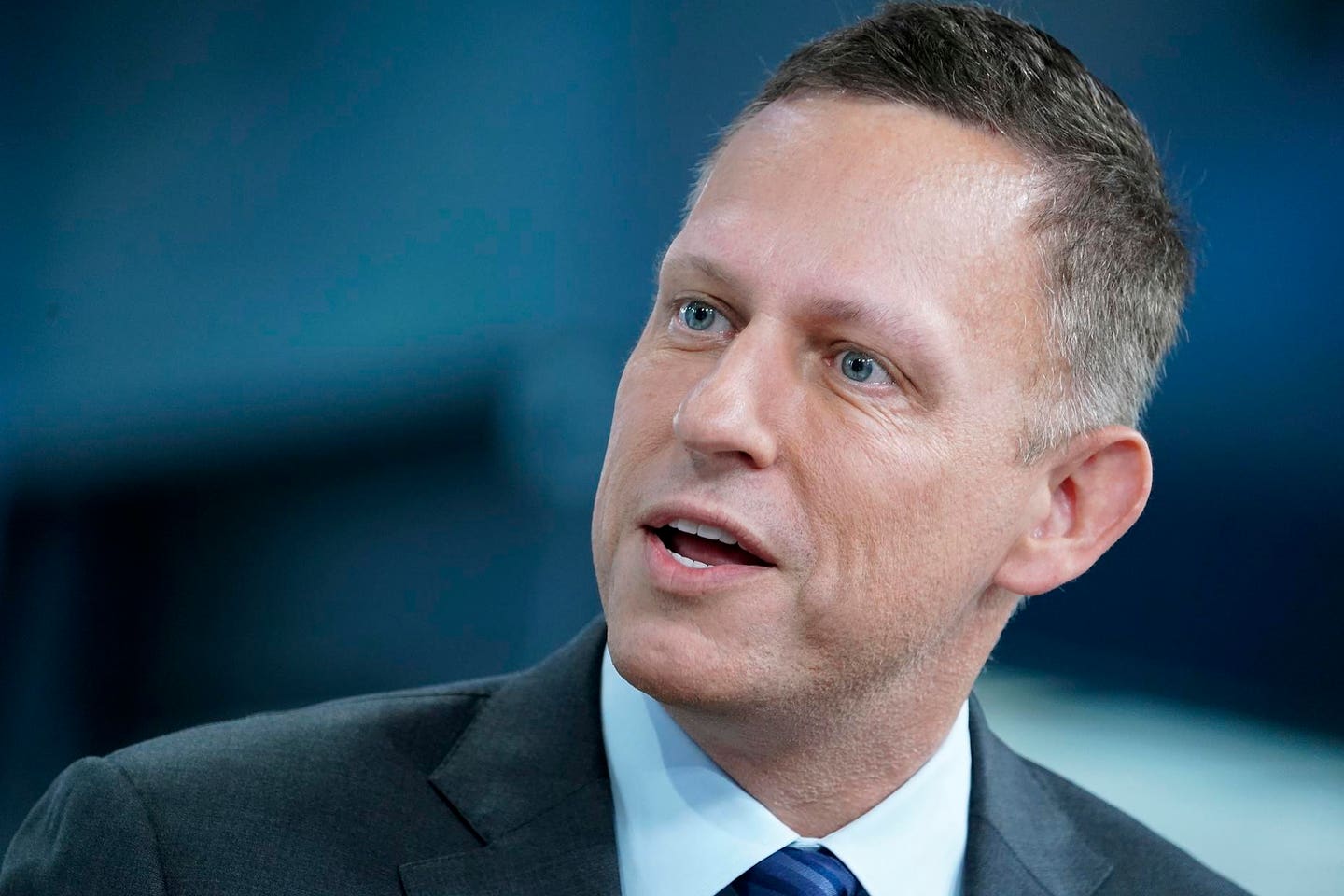
Thiel is a PayPal co-founder. (Photo by John Lamparski/Getty Images)
Getty Images
Key Facts
Vance and Thiel’s relationship dates back to 2011, when the senator met Thiel following a talk the venture capitalist gave at Yale Law School that Vance has characterized as “the most significant moment of my time” at the institution, according to a blog post he wrote for Catholic magazine The Lamp.
Vance began planning for a career pivot outside of law following the talk, noting Thiel was “possibly the smartest person” he ever met and that Thiel’s Christian faith “defied the social template I had constructed—that dumb people were Christians and smart ones atheists,” according to the post.
Thiel later became a “pretty good mentor” to Vance, according to The Washington Post, with Vance making the switch to venture capital and joining the Thiel-co-founded Mithril Capital in 2015 as a partner, according to Politico.
Vance published “Hillbilly Elegy: A Memoir of a Family and Culture in Crisis” in 2016 while still working for Mithril Capital, thrusting the venture capitalist into the limelight as he began pondering a potential run for office in the future, according to the Post.
Vance left Mithril Capital in 2017 and joined Washington D.C.-based investment firm Revolution as a managing director to invest in startups outside of major hubs like Silicon Valley and New York City.
Vance launched his own venture capital firm in 2019 under the name Narya Capital, which sought to invest in startups in overlooked cities and reportedly received backing from Thiel and other billionaire investors like venture capitalist Marc Andreessen and former Google CEO Eric Schmidt, Axios reported.
Thiel also reportedly brought Vance, who had established himself as a critic of Trump, to Mar-a-Lago in 2021 to smooth over his relationship with the former president, according to The New York Times.
Following the meeting, Vance became more sympathetic to Trump and his policies, downplaying the Jan. 6 Capitol attack and securing an endorsement from the former president in his 2022 Senate run just weeks before Election Day.
Vance garnered more support from Thiel during his successful Senate run in 2022, receiving record-breaking donations of about $15 million from Thiel, which marked the largest amount of money donated to a single Senate candidate ever.
Most of Vance’s campaign advertising was outsourced to the Protect Ohio Values super PAC that Thiel donated to, Politico reported, noting Thiel helped recruit about 10 major donors for Vance including venture capitalist David Sacks, who donated $1 million.
Forbes Valuation
We estimate Peter Thiel’s net worth at $7.9 billion—largely thanks to his role as one of Facebook’s earliest investors, as well as his work as a general partner of venture capital firm Founders Fund, which is a key investor in Stripe and SpaceX. Thiel has also invested millions into Clearview AI, a controversial facial recognition software firm.
Tangent
Thiel’s backing appeared to be a massive difference-maker for Vance’s 2022 Senate run, as the then-candidate lacked a funding edge over his fellow candidates and had made a litany of anti-Trump comments years before, calling the former president “reprehensible,” “cynical” and privately suggested he could be “America’s Hitler.” Vance walked back his comments in the leadup to Election Day and managed to secure an endorsement from Trump, who later said Vance “gets it now, and I have seen that in spades.”
Crucial Quote
Thiel said during an interview at the Aspen Ideas Festival last month, “You hold a gun to my head, I’ll vote for Trump.” The comment seemingly showed reluctant support for Trump, as Thiel said if he was asked to make a pro-Trump argument, he would not, though he could “probably come up with anti-Biden arguments.” Thiel also noted he would not donate money to Trump and that he believes the former president will win in November. Thiel donated more than $1 million to Trump in 2016.
What Is Peter Thiel’s Connection To Donald Trump?
Thiel was one of Trump’s most significant donors in 2016 and has expressed a sort of reluctant support for the former president, backing congressional candidates who have echoed Trump-sourced conspiracy theories and later withdrawing further financial support for Trump. Thiel told The Atlantic last year there were a lot of things he “got wrong” with his support for the former president in 2016. Thiel’s political ideology rests in disbelief of establishment institutions and criticism of progressive elites. He also has pushed for more restrictions at the border. Meanwhile, Vance has more closely aligned his politics with Trump’s, opposing nationally guaranteed abortion rights, pushing against strict gun laws and prioritizing the fight against inflation. However, Trump and Vance do not see eye to eye on everything, including their levels of public support for Project 2025.
Key Background
Thiel, who is also a co-founder of the CIA-backed analytics firm Palantir, has given millions of dollars in donations largely to Republican lawmakers and political action committees since 2010, occasionally donating to Democrats such as California Gov. Gavin Newsom and Rep. Ro Khanna, D-Calif., according to campaign finance tracker OpenSecrets. Thiel has donated $20 million to the Saving Arizona PAC, which supported venture capitalist Blake Masters during a failed Republican Senate run in 2022. Masters is now running as an Arizona congressional candidate. Thiel has also donated thousands of dollars to Republican lawmakers such as Sen. Ted Cruz, R-Texas, Rep. Michael McCaul, R-Texas. and former Speaker of the House Kevin McCarthy, R-Calif.
Further Reading
What To Know About ‘Hillbilly Elegy’: The Memoir That Launched J.D. Vance’s Political Career (Forbes)
Here’s How Much J.D. Vance Is Worth (Forbes)
J.D. Vance Picked As Trump’s Running Mate: Here’s What To Know About Him (Forbes)
This Silicon Valley Billionaire Has Been Secretly Funding Hulk Hogan's Lawsuits Against Gawker (Forbes)
Thiel Was Good For $10 Million, But J.D. Vance’s Other Billionaire Backers Were Good For Nothing (Forbes)
Follow me on Twitter or LinkedIn. Send me a secure tip.
Antonio Pequeño IV is a reporter who covers breaking news, with a focus on technology and online culture. He joined Forbes in 2023 and works in Los Angeles. He’s covered Elon Musk’s
... Read More
---
executives-due-at-gas-price-hearing-gave-1-million-to-parties-candidates
APR 2022
The six oil and gas executives scheduled to testify on price gouging before a House Energy and Commerce subcommittee on Wednesday morning have together given more than $1 million in personal contributions to candidates and political parties since the 1990s, skewing heavily toward Republican causes, federal records show.
A CQ Roll Call review of Federal Election Commission filings on the six executives found Scott Sheffield, who is CEO of Pioneer Natural Resources and a board member of the Williams Companies, a natural gas company, has given the most of the group: about $469,000 to political campaigns and committees since 1993.
Of that total, he gave approximately $346,000 to Republican candidates for offices or GOP-aligned committees, such as the National Republican Senatorial Committee or the National Republican Congressional Committee.
Chevron CEO Michael Wirth gave about $255,000 since 2003, while Exxon CEO Darren Woods donated roughly $197,000 since 2014 and Richard Muncrief, the president and CEO of Devon Energy, contributed approximately $115,000 to federal candidates and political campaigns since 2012.
Donations from the other two witnesses, BP America Inc. Chairman and President David Lawler (about $25,700 since 2017) and Shell USA President Gretchen Watkins ($6,700 since 2012), are far smaller than what the other four witnesses gave.
All six are witnesses in a hearing scheduled for 10:30 a.m. Wednesday on price gouging and gasoline prices, a subject that has drawn significant Capitol Hill attention following the Russian invasion of Ukraine and multiple planned sales of U.S.-held crude oil from the country’s national reserve of petroleum.
Four of the six executives — Woods of Exxon, Lawler of BP, Wirth of Chevron and Watkins of Shell — appeared in October before a House Oversight subcommittee to answer questions about the role of large oil companies in muddling the science of climate change.
President Joe Biden unveiled a series of steps Friday that he said would lower gasoline prices, including the release of 1 million barrels of oil a day on average for 180 days from the Strategic Petroleum Reserve.
Washington Rep. Cathy McMorris Rodgers, the top Republican on the full committee, said Monday afternoon that H.R. McMaster, the national security adviser to former President Donald Trump, will appear as a GOP witness at the Wednesday hearing.
Spokespeople for Democrats on the committee did not respond when asked what criteria were used to call these six witnesses.
Taken together, the executives have given about $1.10 million since the 1990s, CQ Roll Call found in its review, which used all available FEC data.
Personal contributions
CQ Roll Call reviewed only personal contributions and did not consider donations the executives’ companies made through political action committees, or PACs, in federal campaigns.
While none of the executives appear to have donated to members of the subcommittee, some have donated to several of the election campaigns of members of the full Energy and Commerce Committee.
Shell’s Watkins has given $5,700 to Rep. Lizzie Fletcher, D-Texas, since 2020, while Lawler gave $2,000 to committees associated with Rep. Steve Scalise, R-La., in 2018.
“Shell does not make political contributions,” said company spokesman Curtis Smith. “Any contributions made by Gretchen Watkins to an individual candidate would be considered personal in nature, as would her rationale for doing so.”
Josh Hicks, a BP spokesman, declined to comment. Lawler has given about $26,000 since 2017, but about $22,000 of that went to his parent company’s political action committee.
“Chevron employees at all levels of the company are free to participate in the political process, including through donations to candidates of both major U.S. parties,” Chevron spokesperson Braden Reddall said.
Representatives of the other three companies did not respond to emails and a voicemail seeking comment.
In 2015, Sheffield gave $10,800 to a joint fundraising committee established by Michigan Rep. Fred Upton, a high-ranking Republican on the full committee, and Sen. Lisa Murkowski, R-Alaska. Sheffield also gave $5,400 to Upton’s reelection in 2016.
In 2020, Sheffield gave $5,000 to Texas Reloaded, a joint fundraising effort for Rep. Daniel Crenshaw, R-Texas, and $833 to Crenshaw’s campaign. Crenshaw is a full committee member.
Sheffield also donated $12,700 to Trump’s 2016 presidential campaign.
Total donations from the oil and gas industry in the 2022 election cycle, including money from individuals, PACs and what’s known as “soft money,” are skewing sharply toward Republicans, drawing 76 percent of donations versus 24 percent for Democrats, according to campaign finance watchdog OpenSecrets.
That percentage is higher for Democrats than it was in the election cycles of 2014, 2016 and 2018, when Republicans drew 87 percent of the donations, and 2020, which saw GOP candidates and causes get 84 percent of cash from this industry.
Soft money is the term for contributions meant to support general political parties rather than a specific candidate.
While many of the group’s donations went to Republicans, oil-state Democratic senators and House members, including former Sens. Mary Landrieu of Louisiana, Mark Begich of Alaska and Heidi Heitkamp of North Dakota, were on the receiving end of some donations.
Sheffield donated to all three, as well as to Rep. Henry Cuellar, D-Texas, and Sen. Joe Manchin III, D-W.Va., who got $5,800 in donations in 2021 for his campaign.
Out of all of Woods’ donations, none went to Democrats and about $156,300 went to Republican campaigns or committees.
Since 2013, Woods has donated $42,500 to the National Republican Congressional Committee, which raises money for Republican House candidates and describes itself as “a political committee devoted to increasing the number of Republicans in the U.S. House of Representatives.”
---
an 10 23
billionaire investor Leon Cooperman — who has almost exclusively donated to Republicans throughout his career — recently issued a stern rebuke of former President Donald Trump.
In an interview with CNN, the Republican mega-donor who has most recently backed former New Jersey Governor and prominent Trump critic Chris Christie acknowledged that he "very reluctantly" voted for Joe Biden in 2020. However, he also warned voters of the dangers of a second Trump term.
"It would be terrible for the country if Donald Trump were reelected," Cooperman said. "He’s a divisive human being who belongs in jail."
Cooperman, who is chairman and CEO of the hedge fund Omega Advisors, said that Biden and Trump were both "bad choices." He added that if the major party nominees were Joe Biden and Donald Trump in 2024, he probably wouldn't vote at all.
"I’m looking for centrists, not radical left or right," he said.
The Wall Street titan's criticism of Trump stands out in particular due to his record as both a champion of GOP causes and vociferous crusader against Democrats. In 2021, he railed against Senator Elizabeth Warren's (D-Massachusetts) so-called "Ultra Millionaires Tax," which would have implemented a 2% annual tax on households with a net worth in excess of $50 million. Billionaires would pay 3% annually, according to Warren's proposal. Cooperman called Warren a "superficial, nasty hater" and a "political charlatan" when she was running for the 2020 Democratic presidential nomination.
The hedge fund CEO isn't the only Republican billionaire donor distancing himself from Trump. Ken Griffin, the founder of hedge fund Citadel, threw his weight behind Florida Governor Ron DeSantis last year and referred to the 45th president of the United States as a "three-time loser."
Blackstone CEO and co-founder Stephen Schwarzman backed Trump in 2020, but has since said he'll eventually put his money and support behind "a new generation of leaders." And Miriam Adelson — widow of deceased Republican billionaire Sheldon Adelson — is reportedly staying neutral in the 2024 Republican primary despite donating $90 million to a pro-Trump super PAC in 2020 and giving $800,000 of her own money to a joint fundraising effort run by Trump and the Republican Party.
READ MORE:Former Trump megadonor joins No Labels leadership
https://www.exposedbycmd.org/2023/06/16/leonard-leo-bankrolls-former-lieutenant-to-challenge-gop-incumbent-in-missouris-2024-race-for-ag
Trump’s “judge whisperer” Leonard Leo, the Christian conservative largely responsible for moving the federal court system to the far right in the past decade, is deploying his powerful network to get a friend and former employee elected as Missouri’s next attorney general.
**Will Scharf**, a former federal prosecutor who worked briefly as a vice president at :{Leo:(style="box-sizing:inherit"):}:’s public relations firm :{CRC Advisors:(style="box-sizing:inherit"):}:, is challenging sitting Attorney General Andrew Bailey (R) in the August 2024 GOP primary—and :{leaping ahead:(style="box-sizing:inherit"):}: of him in campaign cash.
Missouri Gov. Mike Parsons (R) appointed Bailey to replace former Attorney General Eric Schmitt (R), who was elected to the U.S. Senate last November. But the new attorney general has seen an exodus of key Schmitt staffers since taking office in January, one of whom told the :{:{National Review:(style="box-sizing:inherit"):}::(style="box-sizing:inherit"):}: that, “Bailey is not going to be the conservative fighter that Eric Schmitt was.” Given his more “business-friendly” approach, conservative activists are concerned that he won’t have Schmitt’s “appetite for pushing back against critical race theory in schools” or going after “woke” corporations, the National Review reported.
Widely known for his tremendous influence in reshaping the U.S. Supreme Court and moving the federal judiciary to the right, Leo is now aiming to “counter what he sees as an increasing leftward tilt in society,” according to :{*The New York Times*:(style="box-sizing:inherit"):}:.
InJanuary 2020, Leo :{told *Axios*:(style="box-sizing:inherit"):}: that he was stepping down from running the right-wing :{Federalist Society:(style="box-sizing:inherit"):}: to lead CRC Advisors with communications executive Greg Mueller, starting with a “minimum $10 million issue advocacy campaign focusing on judges in the 2020 cycle.” Still, Leo remains closely involved with the Federalist Society as co-chair of its board of directors.
Scharf, who served as president of a Federalist Society chapter as a law student at Harvard from 2008–11, also :{reportedly:(style="box-sizing:inherit"):}: worked as a consultant for Leo’s :{Judicial Crisis Network:(style="box-sizing:inherit"):}: (JCN)—since rebranded The Concord Fund—where he was “actively involved” in getting Brett Kavanaugh confirmed as one of Trump’s picks for the Supreme Court.
Both Leo and Mueller, along with Mueller’s wife Charmaine, have maxed out their individual contributions to their hand-picked candidate’s campaign, according to Citizens for Scharf’s :{January filing:(style="box-sizing:inherit"):}:. That month, the candidate :{told:(style="box-sizing:inherit"):}: the St. Louis Post-Dispatch that he considers Leo “a dear friend and mentor.”
Of the $575,000 raised by Defend Missouri, the political action committee supporting Scharf’s run, $500,000 has come from Leo’s Concord Fund, according to the PAC’s :{April filing:(style="box-sizing:inherit"):}:.
If Scharf defeats Bailey and wins in the general election, he will likely join the :{Republican Attorneys General Association:(style="box-sizing:inherit"):}: (RAGA), a :{cash-for-influence operation:(style="box-sizing:inherit"):}: that coordinates the official actions of Republican state attorneys general and sells its corporate funders access to them and their staff.
The Concord Fund is on record as the largest donor to RAGA in 2020, 2021, and 2022, the Center for Media and Democracy (CMD) has :{reported:(style="box-sizing:inherit"):}:, giving $4 million last year alone. In 2019, RAGA presented Leo with a “special award” for helping to “shape the trajectory of RAGA and the conservative legal movement more than anyone else.”
RAGA also pays Leo’s Creative Response Concepts—now known as CRC Advisors—$7,500 per month for “consulting,” according to 2022 IRS filings.
In 2022, RAGA Executive Director Peter Bisbee and West Virginia Attorney General Patrick Morrisey spurned Bailey, their :{RAGA colleague:(style="box-sizing:inherit"):}:, and contributed $250 and $2,000, respectively, to Scharf instead.
Disclosures reveal that in addition to Leo and Mueller, other executives at CRC Advisors have also supported Scharf’s campaign, with CFO Neil Corkery and his wife Ann each contributing $1,000, President Jonathan Bunch and his wife Amanda each giving $2,650, and Senior Executive Maria Marshall donating $1,000.
For years, the Corkerys have served at the center of Leo’s dark money network. Ann is listed in the filing as an attorney for :{The 85 Fund:(style="box-sizing:inherit"):}:, one of Leo’s right-wing funding vehicles, and earns :{$256,000 per year:(style="box-sizing:inherit"):}: as a counsel for The Concord Fund. In addition to his role at CRC Advisors, Neil has worked for Leo as treasurer of the JCN, president of the Judicial Education Project (as it was known before being renamed The 85 Fund), treasurer of the :{Foundation for Accountability and Civic Trust:(style="box-sizing:inherit"):}:, and president of the now-shuttered :{Wellspring Committee:(style="box-sizing:inherit"):}:.
Other Leo operatives who lead organizations at the center of the Right’s culture wars have also contributed to Scharf’s campaign. Will Hild, executive director of the Leo-funded group :{:{Consumers’ Research :(style="background-color:#ff9900;"):}:that is:(style="box-sizing:inherit"):}: on the frontlines in the attacks on so-called “woke capitalism;” and Nicole Neily, president of the nonprofit:{**Parents Defending Education**:(style="box-sizing:inherit"):}: that is purportedly fighting for parents’ rights, both contributed smaller amounts—in the hundreds—to Bailey’s challenger.
Donor at the Center of the Supreme Court Ethics Scandal Backs Scharf
Real estate tycoon Harlan Crow and his wife Kathy, close friends of Leo and Supreme Court Justice Clarence Thomas and his wife Ginni, maxed out contributions at $2,650 each to Scharf, according to his April campaign filing.
In April, ProPublica:{reported:(style="box-sizing:inherit"):}: that Thomas has been accepting luxury trips and lavish gifts from Crow for over 20 years without disclosing them. The story featured a painting—:{unearthed by True North Research:(style="box-sizing:inherit"):}:— hanging in Crow’s private resort that depicts him, Thomas, Leo, and others “discussing the law” and illustrates the extremely tight relationship between these men.
Another close associate of Leo’s, the right-wing philanthropist Roger Hertog, gave https://www.mec.mo.gov/CampaignFinanceReports/Generator.aspx?Keys=B2G41dEVPKgI8cDcdGFsgJsm99XwPL2GsUCWbUlfMr0QoUFTilTH3rvZPcTKwORHP6frqbjz1kQ%2bQsn%2fLxrZKI7CJPRcva8W" data-wpel-link="external" target="_blank" rel="external noopener noreferrer" style="box-sizing: inherit; background: 0px 0px; transition: all 500ms ease-in-out 0s; color: rgb(0, 156, 244); text-decoration-line: none;">
$50,000, the second largest donation made to Defend Missouri. He and Leo have been working together in similar activist circles since at least 2005....Rounding out the leading contributions to Defend Missouri are right-wing donors IsaacPerlmutter, chairman of Marvel Entertainment, and his wife Laura,who together gave :{$25,000:(style="box-sizing:inherit"):}:. Perlmutter has emerged as a major GOP donor since Trump’s first presidential run in 2016.
According to Scharf’s :{January:(style="box-sizing:inherit"):}: and :{April:(style="box-sizing:inherit"):}: filings, other major GOP donors who have jumped in early to support his campaign committee include:
- Ken Kendrick, owner of the Arizona Diamondbacks baseball team: $2,825
- Randy Kendrick, general manager of the Diamondbacks: $2,825
- Suzie Kovner, wife of retired billionaire hedge fund manager Bruce Kovner: $2,000
- Robert Kraft, chairman of Kraft Group and owner of the New England Patriots football team: $2,825
- Bernard Marcus, retired founder and CEO of Home Depot: $2,825
- Paul Singer, billionaire co-CEO of Elliott Investment Management: $2,650...">Deborah Hochberg, senior advisor at The Paul E. Singer Foundation: $2,82
an 10 22
Sen. Rick Scott of Florida, who chairs the National Republican Senatorial Committee (NRSC), was deeply offended when Senate Minority Leader Mitch McConnell — during an event in Kentucky in August — told a crowd that he considers control of the U.S. Senate a toss-up in the 2024 midterms and cited “candidate quality” as a factor. McConnell expressed confidence that Republicans will “flip” the U.S. House of Representatives, but wasn’t nearly as bullish on the Senate. And his “candidate quality” comment was taken as a criticism of the MAGA candidates Trump has pushed.
McConnell, however, isn’t the only Republican who is concerned about the quality of U.S. Senate candidates who former President Donald Trump has been pushing. In an article published by CNBC’s website on September 30, reporter Brian Schwartz takes a look at Republican donors who are reluctant to get out their wallets for Trump-backed Senate hopefuls who have been underperforming in polls.
“Republican megadonors want the GOP to take back the Senate, but they don’t have confidence that some of former President Donald Trump’s top picks can catapult their party to a victory in November,” Schwartz explains. “Billionaire financiers Paul Singer, Dan Loeb and Larry Ellisonhave so far avoided donating directly to some or all of Trump’s staunchest allies running for Senate in the midterms: J.D. Vance in Ohio, Blake Masters in Arizona, Herschel Walker in Georgia, Adam Laxalt in Nevada and Dr. Mehmet Oz in Pennsylvania, according to Federal Election Commission records and people familiar with the billionaires’ donations.”
READ MORE: 'A harsh reality': Dr. Oz bombards Republican voters with panicked fundraising pleas
The CNBC reporter adds, “All of those candidates have been endorsed by Trump. And many of them have previously sided with the former president on the false claims that the 2020 presidential election had widespread voter fraud — an accusation that’s been debunked by Trump’s former attorney general, Bill Barr, federal courts and several other top Republicans who served in Trump’s administration.”
A Republican strategist, quoted anonymously, told CNBC that those megadonors would “would be lighting their money on fire if they got totally swayed by these candidates.” And that strategist is advising donors to give their money to the Senate Leadership Fund, a political action committee run by McConnell’s former chief of staff Steven Law. That strategist said of the Senate Leadership Fund, “They have the best polls, and they won’t sink money into races they know they can’t win.”
Schwartz notes, “The campaign poll tracking website FiveThirtyEight shows Masters trailing (incumbent Sen. Mark) Kelly by more than seven percentage points…. FiveThirtyEight shows Oz trailing his Democratic rival John Fetterman by more than six percentage points and Walker trailing his competitor, (Sen. Raphael) Warnock, by more than two percentage points. Vance and Laxalt are both in statistical dead heats with their Democratic rivals; both GOP candidates are down by an average of less than a percentage point.”
Schwartz points out that megadonor and real estate mogul Stephen Ross “hasn’t given a penny yet to Vance, Walker, Masters, Laxalt or Oz, according to FEC filings.”
“Ross was criticized for hosting a fundraiser for Trump and the Republican National Committee at his Hamptons home in 2019, but has distanced himself from some of Trump’s favorite candidates this election cycle,” Schwartz observes. “He’s donated over $685,000 to a mix of Republicans, Democrats and their affiliated outside groups this cycle. His biggest checks so far have gone to GOP organizations tied to Republican leadership, such as House GOP campaign arm, the National Republican Congressional Committee and a joint fundraising committee called Take Back the House 2022, federal election records show.”
an 7 22
Republican candidates and lawmakers are facing great challenges in the areas of campaign fundraising. A new analysis is explaining how they are being out-fundraised by their Democratic counterparts. According to Axios' Lachlan Markay, the biggest financial difference centers on grassroots contributions.
Lachlan explained the bigger picture writing, "Inflation, Trump-induced donor fatigue, and other factors are impacting the GOP grassroots, prompting Republican candidates to rely more heavily on high-dollar donors."
However, while the average Republican candidate is facing challenges securing small-dollar donations, Lachlan noted the one Republican who isn't having that problem. He noted that former President Donald Trump is "seeing huge small-dollar fundraising success" and "has hoovered up more than $60 million from under-$200 donors this cycle."
READ MORE: [Far-right Arizona GOP candidates are bringing in big bucks ahead of the primary election
But, unfortunately for the Republican Party, Trump's massive haul isn't much of a benefit for the political party, collectively. Adding to that, he still isn't an official political candidate for any upcoming election. According to the report, only one Republican lawmaker is having substantial success with small-dollar donations: Sen. Ron Johnson (R-Wisc.)
So what's holding the Republican Party's campaign fundraising together? "High-dollar donors," according to Lachlan, are still their driving force.
"The GOP's high-dollar donors are keeping the money race competitive," he wrote. "And Republicans' national party committees are breaking fundraising records."
He noted, "Super PACs backing candidates such as Ohio's J.D. Vance and Arizona's Blake Masters are making up for some fundraising shortfalls. Others, such as Pennsylvania's Mehmet Oz, are pouring millions into their own campaigns."
READ MORE: Just 27 billionaires have spent $90 million to buy GOP congress: report
The top Republican super PACs are "the Senate Leadership Fund and the Congressional Leadership Fund"as they are "both out-raising their Democratic counterparts by substantial margins."
Lachlan concluded, "The GOP's fundraising problems — in addition to the elevation of flawed or extreme candidates — are contributing to fears of a Senate debacle in what should be a favorable political environment for Republicans."
:{Opinion |:(style="background-color:#ffffff;"):}::{ Meet the Real Dark Money GOP Donors Who Funded Those Who Voted to Overturn the Election :(style="background-color:#ff9900;"):}::{| Alex Kotch (commondreams.org):(style="background-color:#ffffff;"):}:
:{
}:
meet the Real Dark Money GOP Donors Who Funded Those Who Voted to Overturn the Election
Major companies and executives of Wall Street firms, fossil fuel businesses, a casino empire, and a shipping giant supplied super PACs and other outside spending groups with hundreds of millions of dollars to elect the Republican election deniers.
January 28, 2021 by Exposed (Center by Media & Democracy)
In the days following the deadly Capitol insurrection by white supremacists, QAnon adherents, and other Donald Trump supporters, media outlets including the Center for Media and Democracy (CMD) have reported on the corporate PACs behind campaign donations that helped elect the scores of Republican House and Senate members who, just hours after the insurrection, voted to reject President Joe Biden’s victories in multiple states. In response, many of these companies have pledged to halt donations to the election deniers or pause campaign donations altogether.
But wealthy conservatives and corporations spent far more money on independent groups that paid for ads and other election expenditures to help 106 out of the 147 members of Congress take office. These Republican politicians would go on to use the “Big Lie” of alleged voter fraud as an excuse to overturn a valid, democratic election that didn’t go their way.
Major companies and executives of Wall Street firms, fossil fuel businesses, a casino empire, and a shipping giant supplied super PACs and other outside spending groups with hundreds of millions of dollars to elect the Republican election deniers in just their most recent elections alone. Among the top donors were Miriam Adelson and her recently deceased husband, casino magnate Sheldon Adelson, hedge fund CEO Ken Griffin, Mellon steel fortune heir Timothy Mellon, Blackstone CEO Stephen Schwarzman, and Uline owner Richard Uihlein.
Some of these top donors run companies that have halted their campaign donations to the election objectors, yet the donors themselves have not promised to change their contribution habits.
Donations to politicians’ campaigns and traditional PACs have strict limits, but contributions to super PACs, 501(c)(4) social welfare nonprofits, and trade associations have no restrictions. Thus, conservative oligarchs and their companies have been able to flood elections with enormous amounts of money that helped elect senators such as Josh Hawley (R-MO) and Ted Cruz (TX), who led the push to invalidate the election results in their chamber, and representatives including extremist freshmen Lauren Boebert (R-CO), Madison Cawthorn (R-NC), and QAnon adherent Marjorie Taylor Greene (R-GA).
Using Federal Election Commission (FEC) data, some of it compiled by the Center for Responsive Politics,CMD has identified 40 political super PACs, trade associations, or other committees that spent over $100,000 to help elect at least one of the 147 Republicans in their most recent elections, as well as the top donors to these spending groups.For House members, this includes 2020 only; for senators, who have six-year terms, their most recent elections were either in 2016, 2018, or 2020.
The 40 spending groups pumped at least $272 million into election ads and other expenditures to seat 106 of the Republican election objectors.
The top-spending groups include the Congressional Leadership Fund ($67.9 million in the 2020 elections), the Senate Leadership Fund ($40.3 million over the 2018 and 2020 elections), the National Republican Congressional Committee (NRCC; $39.1 million in 2020), the New Republican PAC ($29.5 million 2018 backing Sen. Rick Scott of Florida), and Club for Growth Action ($19.4 million, mostly in 2020).
The Club for Growth PAC, which is subject to $5,000 individual donation limits, spent $315,000 to boost the campaigns of more than 20 election deniers in 2018 and 2020. But its affiliated super PACs, Club for Growth Action and CFGA Missouri, spent a combined $22.7 million to elect election deniers, making it the fifth-highest outside spending group. It also donated to additional spending groups the Congressional Leadership Fund (CLF), Protect Freedom PAC, and Texans Are.
The biggest beneficiary of this outside spending isHawley,who at times appears to be a self-styled right-wing populist, yet got $41.2 million of assistance from mostly billionaire- and multi-millionaire-funded super PACs in his 2018 Senate victory.
Scott had the second-highest total, benefiting from $35.1 million of outside spending, followed by Kansas Sen. Roger Marshall ($29.8 million), New Mexico Rep. Yvette Herrell ($12.3 million), and California Rep. Mike Garcia ($11.5 million).
Top Donors
CMD identified thousands of donors to the outside groups that spent to help seat one or more of the Republican election deniers in their most recent elections, accounting for nearly $1.7 billion in contributions.
The top ten individuals or families combined to donate nearly $500 million to outside groups that helped seat the election deniers. Some were also among the biggest direct donors to the campaigns of the members of Congress who voted against the valid election, according to research by OpenSecrets.org.
...
no lnx
#1 Miriam and Sheldon Adelson: $191.4 million
via U.S. Air Force
Atop the list of megadonors are billionaires Miriam Adelson and her recently deceased husband, Sheldon Adelson, who ran the Sands casino empire and strongly supported Trump. Together they gave over $191 million to six super PACs and two party-aligned groups, the NRCC and the National Republican Senatorial Committee (NRSC), helping to seat dozens of politicians who denied the results of the election.
2. Ken Griffin: $59.8 million
via David Rubenstein/YouTube
The CEO of hedge fund Citadel gave to five super PACs, the NRCC, and the NRSC. Griffin had an alleged dispute with Trump in 2018, but that didn’t stop him from bankrolling the party of Trump in the 2020 elections. In 2018, he gave $10 million to the pro-Rick Scott super PAC, New Republican PAC.
3. Timothy Mellon: $50 million
via BMRR/Wikimedia
An heir to his family’s steel fortune and majority owner of Pan Am Systems, Mellon gave huge donations to two super PACs and a smaller contribution to NRCC in 2020. Mellon, who used racist stereotypes in his autobiography, has emerged only recently as one of Trump and the Republican Party’s biggest donors.
4. Stephen and Christine Schwarzman: $46 million
via World Economic Forum/Flickr
The CEO of Blackstone and his wife, Christine, are near the top of the right-wing donor list, having given the bulk of their donations to the Senate Leadership Fund (SLF), a super PAC tied to Senate Minority Leader Mitch McConnell (R-KY). Blackstone, a private equity firm, is the world’s biggest landlord. Stephen Schwarzman has been one of Trump’s most generous and most faithful supporters. Even after Trump lost the election in November he told business leaders that Trump had the right to challenge the results and “took issue with suggestions made during the meeting that the U.S. could be on the verge of a coup,” according to the Financial Times.
OpenSecrets Election Denier Campaign Donation rank: #3 ($326,000)
5. Liz and Richard Uihlein: $43.4 million
via Uline/YouTube
The Illinois-based Uihleins, who own and operate the Uline shipping supply company, gave tens of millions to an array of spending groups, including $35.7 million to Club for Growth Action and its state affiliate CFG Action Missouri.
Richard Uihlein was recently exposed as a major funder of the Tea Party Patriots, a group that helped organize a rally on Jan. 6 that led to the march and insurrection at the Capitol. CMD broke the news that Uihlein was one of the first two proven donors to far-right media outlet The Federalist.
OpenSecrets Election Denier Campaign Donation rank: #8 ($242,000)
6. Jeff Yass: $33.3 million
via Marshall Segal/Flickr
The managing director of investment firm Susquehanna International Group and a board member of the libertarian Cato Institute, Yass was also a top donor to Club for Growth Action, giving the group $24.5 million from 2018 to 2020. He also gave $8.6 million to Protect Freedom PAC, which spent in favor of extremists such as Boebert and Cawthorn in the 2020 cycle.
- Reyes Family: $21.5 million
The West Palm Beach, Florida-based Reyes family, which amassed its wealth from a food and beverage distribution business, spent tens of millions of dollars to help elect election objectors. J. Christopher, M. Jude, and David K. Reyes put the bulk of their money into SLF but also funded the New Republican PAC, among other committees.
8. Ricketts Family: $18.1 million
Joe and Pete Ricketts (credit: Cornstalker/Wikimedia and Gage Skidmore/Flickr)
The GOP megadonors in the Ricketts family did their part to help elect the objectors, donating over $18 million to super PACs, including the Ending Spending Action Fund and Citizens for Free Enterprise. Patriarch Joe Ricketts, the founder of TD Ameritrade, his wife, Marlene, and their son, Pete, the governor of Nebraska, all donated. The family owns the Chicago Cubs baseball team, and Joe and Marlene’s son, Todd, took over from disgraced right-wing bankroller Steve Wynn as finance chair of the Republican National Committee. In October 2020, the company of fellow right-wing billionaire Charles Schwab acquired TD Ameritrade.
9. Charles and Helen Schwab: $17.2 million
Schwab Bank shut down its PAC entirely after bad press surrounding the insurrection, but its founder and chairman, Charles Schwab, and his wife, Helen, have remained silent about their future plans. The company did not respond to The Daily Poster’s questions about the Schwabs’ massive donations to outside spending groups, which included $11.1 million to SLF and $2.5 million to CLF.
10. Bernard and Billi Marcus: $14.7 million
Home Depot co-founder Bernard Marcus and his wife, Billi, gave their biggest contributions to CLF and SLF.
OpenSecrets Election Denier Campaign Donation rank: #2 ($331,000)
Other top donors include hedge fund manager Paul Singer ($13.9 million) and chicken farming tycoon Ronald Cameron ($13.4 million), who ranks at No. 11 on OpenSecrets’ list of campaign donors to the election deniers ($208,000). Cameron’s Mountaire Corporation added $500,000 each to CLF and SLF.
Despite numerous sexual misconduct allegations that led to his resignation from his own resort company, Steve Wynn’s money is still welcome in Republican political circles. The Republican National Committee, of which Wynn was previously finance chairman, never returned his donations, and in 2020 committees such as the Senate Leadership Fund ($9 million), the Congressional Leadership Fund ($1 million), and the NRSC ($177,500) enjoyed his largesse. He gave a total of $12.6 million to outside groups that backed election deniers in their most recent elections.
Additional megadonors include Ronald Lauder, chair ofEstee Lauder ($5.2 million), the family of Trump’s Education Sec.Betsy DeVos ($4.4 million), members of the Walton family and Walmart fortune ($2 million), Fox Corporation’s Rupert and Lachlan Murdoch ($2 million), and Federalist Society board member C. Boyden Gray ($1.8 million).
CNBC reports that with fewer PAC donations, Republicans are worried about 2022 fundraising and plan to appeal to their biggest individual financiers for even more cash. Fundraisers will attempt to keep the money flowing from bigwigs including Schwarzman, Griffin, and Singer.
:{
}:
Koch is Key Coup Attempt Funder
Koch Industries, the fossil fuel conglomerate led by billionaire libertarian Charles Koch, was the biggest corporate donor to these spending groups at $13.75 million. The company gave $10 million to Americans for Prosperity Action (AFPA), the super PAC affiliated with Koch’s premier political advocacy group, Americans for Prosperity (AFP), and doled out additional money to three other super PACs. AFPA, for its part, spent over $9.5 million backing the electoral objectors, and AFP spent close to $4 million in 2018 mostly opposing then-Sen. Claire McCaskill in order to elect Hawley.
Freedom Partners Action Fund, another super PAC in the Koch political network, gave AFPA $11.5 million in 2018 and 2019.
Koch Industries’ PAC is also in the mix, giving $210,000 to the NRCC in the 2020 election cycle and $600,000 to the NRSC from 2016 to 2020. Koch PAC is also the biggest donor to the campaigns of the election-denying members of Congress, having contributed over $930,000 to their campaigns, according to a Center for Responsive Politics analysis.
Charles Koch and his wife, Elizabeth, each gave $471,000 to the NRSC, and their son, Chase, added $369,000. Chase’s wife, Anna, Koch’s late brother, David, and his David’s wife, Julia, all gave donations to the NRSC well into the six figures.
Much of AFP’s funding comes from other Koch-run groups. In 2019, for example, Koch’s Stand Together Chamber of Commerce provided $40.5 million out of AFP’s $54.5 million in total revenue. Many of the individual donors to AFP and other Koch groups, such as Cameron, Griffin, Singer, Schwab, and Schwarzman, are among the biggest contributors to outside groups that helped elect the election deniers.
Corporate Complicity
A number of other corporations, including many fossil fuel companies, and their PACs gave significant amounts to spending groups that helped elect the Republican objectors.
In addition, the watchdog group Public Citizen reports that fossil fuel companies’ PACs and executives gave $8.8 million to the campaigns of the election deniers and GOP party committees that helped elect them and Trump.
Despite numerous companies limiting or ending their political donations, many major oil and gas firms such as Chevron, ConocoPhillips, Exxon, and Phillips 66 had not done so at the time of this reporting.
Top corporate donors to outside groups include:
Chevron (oil and gas): $7.3 million to CLF and SLF.
Hillwood Development Company (real estate): $6.1 million to CLF and SLF. Its chairman, Ross Perot, Jr.,gave $648,000 to the NRCC and NRSC and, with his wife, Sarah Fullinwider, gave over $190,000 to the election deniers’ campaigns.
RAI Services Company (tobacco): $3.1 million. The PAC of its parent company, Reynolds American, added $115,000 to the NRCC and NRSC.
Pilot Corporation (oil and gas): $2.6 million to SLC and New Republican PAC. The company is owned by the family of former Tennessee governor Bill Haslam, and family members contributed a total of over $1.2 million to the NRCC, NRSC, and CLF.
TRT Holdings (hospitality): $2 million. This Dallas-based holding company, which owns the Omni Hotels chain, is owned and led by Robert Rowling, who, with his wife, Terry, donated $2.3 million to three super PACs and the NRCC and NRSC.
Valero (oil and gas): $3.7 million. Valero and Valero Services gave $3.15 million to three super PACs, including the pro-Cruz Texans Are PAC, and the company’s PAC added $558,000 to the NRCC and NRSC. Valero announced after the insurrection that it would halt all federal contributions indefinitely.
Marathon Petroleum (oil and gas): $2.4 million. The company gave $2 million to CLF and SLF, and two company PACs added a total of $390,000 to the NRCC and NRSC.
ConocoPhillips (oil and gas): $2.25 million to CLF and SLF.
Wheatland Tube (steel manufacturing): $1.75 million to America First Action.
Boeing (aerospace): $1.4 million. Boeing’s PAC contributed $1 million to SLC and $375,000 to the NRCC and NRSC, as well as $567,000 to the election objectors’ campaigns, according to OpenSecrets.
GEO Group (private prisons): $1.3 million. Three subsidiaries of the private prison giant combined to give large donations to CLF, SLF, and the New Republican PAC.
Murray Energy (coal): $1.2 million, including $1 million to America First Action, with the company PAC adding $10,000 to the NRSC.
Other companies that contributed at least $1 million to relevant outside groups include OTA Holdings, NextEra Energy,CL Machinery Company, Don McGill Toyota of Katy (Texas), Global Fibers Investments, Tanglewood Property Management, and Tesoro Companies.
Dark Money
Multiple nonprofits and trade associations, which are not required to disclose their donors, served as major funding vehicles for GOP outside spending to boost the election-denying members of Congress. Trade groups are largely funded by their corporate members. Dark money groups also made election expenditures themselves.
One Nation, a 501(c)(4) nonprofit that’s affiliated with the Senate Leadership Fund, gave the latter group $62.6 million in the 2020 cycle and $18.6 million in 2018, for a total of $81.2 million, making it the second-biggest funder of the outside spending groups that backed the 106 Republican election deniers.
The American Action Network, also a 501(c)(4) nonprofit, gave $29.4 million to CLF in 2020.
The U.S. Chamber of Commerce spent $1.9 million on independent expenditures backing Sens. Scott, Cindy Hyde-Smith (MS), and Marshall as well as Rep. Tom Tiffany (R-WI).
The anti-abortion Susan B. Anthony Listgave close to $1.8 million to Women Speak Out PAC, which made elections expenditures benefiting five GOP House election deniers.
Celebrate Life Trust, which is connected to Cancer Treatment Centers of America founder and chairman Richard Stephenson’s family foundation, donated $3.2 million total to SLC and FreedomWorks for America. The trust’s donation of $550,000 to FreedomWorks for America indicates that Stephenson provided the funds, and he personally donated $200,000 to New Republican PAC. Stephenson is on the board of the affiliated FreedomWorks 501(c)(4)nonprofit.
:{
}:
Traditional PACs affiliated with dark money groups also make independent expenditures backing the election deniers.
:{
}:
The trade group the National Association of Realtors donated nearly $6.6 million to SLF. The group’s PAC spent $142,000 on independent expenditures backing three election deniers, including Kansas Sen. Marshall, and the group itself spent another $43,000 in favor of five election deniers.
The National Rifle Association’s Political Victory Fund, a PAC that is subject to donation limits, made $2.6 million worth of independent expenditures to boost the campaigns of dozens of election deniers, including GOP House members Andy Biggs and Paul Gosar, whom “Stop the Steal” organizer Ali Alexander claimed helped him plan the January 6 rally. The NRA’s biggest expenditures aided Hawley in 2018 ($1.4 million), and it spent in favor of extremists Boebert and Greene, among others. The PAC donated $120,000 to the NRSC.
Democratic Donors
Michael Bloomberg, a former Republican who ran in the Democratic presidential primary in 2020, gave $500,000 to theWith Honor Fund, a super PAC that spends money to elect military veterans fromboth parties,in October 2020. In that cycle, the With Honor Fund spent $453,000 on independent expenditures boosting five House Republicans who attempted to overturn the election results.
In 2020, Jacklyn and Miguel Bezos, the parents of Amazon CEO Jeff Bezos, each gave over $1 million to the With Honor Fund. In the 2018 cycle, Jeff Bezos was the super PAC’s biggest donor.
The super PAC affiliated with the Environmental Defense Fund, EDF Action Votes, mostly supports Democrats, but in 2020 it backed three Republicans. The PAC spent $100,000 to boost Florida Repubican Rep. Brian Mast, who went on to vote against the election results.The majority of EDF Action Votes’ funding comes from its dark money affiliate, the Environmental Defense Action Fund, but Environmental Defense Fund trustee Susan Mandel, whose husband runs a hedge fund, is the biggest individual donor of 2020 ($6 million).
:{
}:
----
:{
table 1
Outside Groups Helped Seat Election Deniers
106 Republican senators and representatives benefited from spending by outside groups
identified by CMD that spent at least $100,000 to help one or more of them win office.
Josh Hawley MOS2 Senate $41,169,601
Rick Scott FLS1 Senate $35,142,565
Roger Marshall KSS1 Senate $29,758,263
Yvette Herrell NM02 House $12,254,552
Mike Garcia CA25 House $11,478,494
Carlos Gimenez FL26 House $9,000,755
Ted Cruz TXS2 Senate $8,462,169
Beth Van Duyne TX24 House $8,408,488
Matt Rosendale MT01 House $8,139,859
Stephanie Bice OK05 House $8,098,654
Michelle Fischbach MN07 House $7,928,459
Dan Bishop NC09 House $7,216,969
Nicole Malliotakis NY11 House $6,873,112
Troy Nehls TX22 House $6,803,378
Burgess Owens UT04 House $6,752,572
Scott Perry PA10 House $5,381,625
Jeff Van Drew NJ02 House $5,074,715
Lauren Boebert CO03 House $4,917,827
Cindy Hyde-Smith MSS1 Senate $4,889,860
Steve Chabot OH01 House $4,647,357
p 1 of 6
table 2
Top 10 Donors to Outside Spending Groups Backing Election Deniers
miriam and Sheldon Adelson TOTAL $191,453,200
America First Action $10,000,000
Congressional Leadership Fund $50,000,000
Ending Spending Action Fund $2,000,000
National Republican Congressional Committee $532,500
National Republican Senatorial Committee $1,420,700
New Republican PAC $5,000,000
Republican Jewish Committee Victory Fund $2,500,000
Senate Leadership Fund $120,000,000
Ken Griffin ...
Congressional Leadership Fund $10,000,000
Ending Spending Action Fund $900,000
Missouri Rising Action $250,000
National Republican Congressional Committee $497,000
National Republican Senatorial Committee $1,168,500
TOTAL $59,815,500?
top Donors to Outside Spending Groups Backing Election Deniers
Over 120 donors or donor families gave $500,000 or more to outside political groups that made
independent expenditures supporting at least one of the 147 GOP members of Congress who voted against the 2020 presidential election results
or attacking their opponents in their most recent elections.
1 Miriam and Sheldon Adelson Adelson Drug Clinic/Las Vegas Sands $191,453,200
2 Ken Griffin Citadel $59,815,500
3 Timothy Mellon Pan Am Systems $50,035,500
4 Stephen and Christine Schwarzman Blackstone $45,774,600
5 Richard and Liz Uihlein Uline $43,422,148
6 Jeff Yass Susquehanna International Group $33,303,000
7 Reyes Family Reyes Holdings $21,491,600
8 Ricketts Family TD Ameritrade $18,106,700
9 Charles and Helen Schwab Charles Schwab & Company $17,235,000
10 Bernard and Billi Marcus Home Depot $14,674,100
11 Paul Singer Elliott Management $13,877,400
12 Ronald Cameron Mountaire Corporation $13,355,800
13 Warren Stephens (incl. trust) Stephens Inc. $13,172,700
14 Patrick G. and Shirley Ryan Ryan Specialty Group $12,700,000
15 Steve Wynn Valmore Management $12,634,700
16 Craig J. and Janet J. Duchossois The Duchossois Group $7,544,200
17 Geoffrey H. Palmer G.H. Palmer Associates $7,066,400
18 Fertitta Family Zuffa/Red Rock Resorts $6,876,600
19 Walter W. Buckley, Jr. Actua $5,325,500
20 Virginia James The Hickory Foundation $5,250,30o
}:
https://m.dailykos.com/stories/2022/3/24/2087833/-Koch-et-al-Spend-Over-50-Million-on-Climate-Disinfo-Organizations-Between-2014-2020
On Monday, Alex Kotch at the Center for Media and Democracy (CMD) _{published the latest count of climate disinfo funding}_, tallying up over $50 million in “donations” to climate denial groups, straight from industry profits, billionaire ideologues fortunes, and everything in between.
Between 2014 and 2022, there was $54,298,510 that went to just eight organizations that, per Kotch, “represents key groups primarily focused on energy and the environment that consistently mislead the public about the climate crisis.”
ref: CMD Kotch
in its recently released report on climate impacts and adaptation, a working group of the Intergovernmental Panel on Climate Change points out the very real danger of climate misinformation—for the first time since its annual assessments began in 2017.
The report, which states that “urgent action” is needed “to avoid mounting loss of life, biodiversity and infrastructure,” finds that “vested economic and political interests have organized and financed misinformation and ‘contrarian’ climate change communication.” The resulting “rhetoric and misinformation on climate change and the deliberate undermining of science have contributed to misperceptions of the scientific consensus, uncertainty, disregarded risk and urgency, and dissent,” it contends.
Geoffrey Supran, a Harvard University fellow in the history of science, says it’s great that the Intergovernmental Panel on Climate Change (IPCC) has finally called this out. But he believes the report should also detail exactly who has been bankrolling misinformation about the climate crisis.
“Indeed, there’s enough to write another report on,” Supran said. “The veiled reference to ‘vested economic and political interests,’ for instance, is an example of where reports such as this can and, in my opinion, should go further, and name names. It is a quantified, reported fact that those vested interests include specific fossil fuel interests and libertarian billionaires such as ExxonMobil, the American Petroleum Institute, and Koch Industries, and that they have orchestrated multi-decade, multi-billion-dollar propaganda campaigns to sabotage science and undermine action.”
Naming Names
Fossil fuel corporations are among the special interests that have funded climate change denial for decades. But it’s not just the oil giants that are spreading this harmful misinformation. A host of nonprofit charities—ranging from mainstream money managers to private, right-wing foundations—are some of the biggest funders of climate change denial, research by the Center for Media and Democracy (CMD) has found.
CMD research has found that eight of the most egregious climate misinformation groups received more than $54 million from nonprofit funders between 2014 and 2020.
While the list is by no means exhaustive, it represents key groups primarily focused on energy and the environment that consistently mislead the public about the climate crisis.
[table NO LNX]
TABLE ONE
Top Climate Misinformation Groups, 2014-20
These leading climate misinformation organizations received large donations from nonprofits from 2014-20.
Table with 9 columns and 9 rows. Currently displaying rows 1 to 9.
Recipient 2014 2015 2016 2017 2018 2019 2020 TOTAL
Heartland Institute $3,799,025 $2,537,850 $3,676,617 $3,693,650 $3,925,637 $2,860,232 $903,950 21,396,961
Competitive Enterprise Institute $3,840,074 $2,987,869 $3,474,275 $2,580,736 $2,656,600 $1,223,901 $1,927,938 18,691,393
Property and Environmental Research Center $451,500 $776,500 $827,000 $897,000 $1,043,000 $962,000 $1,019,550 5,976,550
Institute for Energy Research/American Energy Alliance $50,628 $727,495 $506,902 $479,967 $336,000 $96,165 $292,146 2,489,303
CO2 Coalition $0 $125,000 $441,126 $663,883 $358,000 $398,078 $394,115 2,380,202
Committee for a Constructive Tomorrow $181,252 $327,002 $227,150 $236,310 $172,850 $326,355 $366,982 1,837,901
Energy and Environment Legal Institute $125,000 $296,000 $350,000 771,000
Center for the Study of Carbon Dioxide and Global Change $10,000 $125,000 $10,000 $210,200 $400,000 755,200
TOTAL $8,332,479 $7,481,716 $9,403,070 $8,561,546 $8,998,287 $5,866,731 $5,654,6xx... $54,298,510
nOnprofit donations to these eight climate misinformation organizations swelled from 2016–18 and decreased in 2019 and 2020. Note that 2020 data may be incomplete, as tax returns are not yet publicly available for some nonprofit donors.
Many other right-wing groups regularly spread misinformation on climate issues, but since their work focuses on other areas as well, their donors are not included in this report. Larger-scale studies such as “Obstructing action: foundation funding and US climate change counter-movement organizations”offer additional details.
The Dirty Dozen Funders of Climate Misinformation
A dozen of the largest nonprofits donated $47.8 million to the leading climate denial organizations, accounting for 88% of the funds CMD was able to track down using FY 2014-20 federal tax returns.
Half of the traceable funding came from DonorsTrust and Donors Capital Fund, two donor-advised fund sponsors that pass along their clients’ donations to other charities approved by their boards of directors. While the two funds give exclusively to conservative causes, no restrictions are apparent within that ideology. For instance, CMD was first to report that DonorsTrust is by far the biggest known funder of American white nationalist hate groups.
Among the “Dirty Dozen” climate denial financiers are foundations established by the right-wing Bradley, Koch, Mercer, Searle, and Scaife families. The Kochs, Mercers, and other Republican megadonors pour additional money into political groups and electoral campaigns focused on electing right-wing candidates who oppose meaningful action on climate change and often support expanding and deregulating the fossil fuel industry.
The funders named in this report have also financed a broader right-wing political strategy to misinform the public about a number of issues and increase GOP voter turnout.
“Bad actors are using a tried and tested playbook to weaken public mandates and create confusion [about] viable solutions going forward,” notes Jennie King, head of civic action and education at the Institute for Strategic Dialogue, an independent nonprofit dedicated to protecting human rights and reversing polarization, extremism, and disinformation around the world. “This includes weaponizing climate response within a broader ‘culture wars’ frame and conflating it with any supposed controversy, from Covid-19 lockdowns and vaccine mandates to critical race theory, trans rights, or geopolitics.”
Leading non-ideological donor-advised fund sponsors connected to the Vanguard and Fidelity financial firms are also among the Dirty Dozen climate misinformation funders.
“We cannot solve the climate crisis until we solve the climate misinformation crisis,” U.S. Rep. Ro Khanna (D-Calif.) told CMD. “It is disappointing that mainstream organizations are still keeping ties with groups that have attacked climate science and legislative solutions. We need to be calling this behavior out publicly, so Americans know which organizations are linked to climate denial efforts.”
All nonprofits identified by CMD that gave $10,000 or more to the top climate misinformation groups from 2014–20 are listed in the table below.
:{
}:
tABLE 2
Top Nonprofit Climate Denial Funders, 2014-20
Numerous charities, private foundations, and trade associations have bankrolled the climate misinformation movement.
Page 1 of 4
Table with 9 columns and 53 rows. Currently displaying rows 1 to 15.
Donor 2014 2015 2016 2017 2018 2019 2020 TOTAL
1 DonorsTrust/Donors Capital Fund $3,293,850 $3,816,850 $3,676,750 $2,422,000 $3,830,200 $2,101,732 $1,416,500 20,557,882
2 Searle Freedom Trust $839,500 $589,500 $1,140,000 $940,000 $1,096,000 $754,000 $985,000 6,344,000
3 Sarah Scaife Foundation $350,000 $610,000 $842,000 $875,000 $960,000 $715,000 $1,245,000 5,597,000
4 Mercer Family Foundation $885,000 $100,000 $1,075,000 $970,000 3,030,000
5 Dunn Foundation $1,200,000 $250,000 $325,000 $200,000 $350,000 $350,000 $350,000 3,025,000
6 Bradley Foundations $344,376 $318,876 $458,500 $519,000 $280,000 $475,000 $110,000 2,505,752
7 American Fuel and Petrochemical Manufacturers $365,000 $275,000 $470,000 $400,000 1,510,000
8 Koch Foundations $100,128 $431,891 $333,028 $413,016 $84,000 $99,049 $18,749 1,479,861
9 Vanguard Charitable Endowment Program $38,500 $228,500 $265,000 $230,000 $235,000 997,000
10 Fidelity Charitable Gift Fund $35,525 $21,350 $27,867 $241,355 $212,310 $231,055 $201,952 971,414
11 National Philanthropic Trust $150,000 $175,000 $175,500 $176,000 $200,000 876,500
12 Bartley J. Madden Foundation $45,000 $270,000 $270,000 $250,000 $30,000 865,000
13 Thomas W. Smith Foundation $150,000 $175,000 $200,000 $200,000 725,000
14 The 85 Fund $700,000 700,000
15 Ed Uihlein Family Foundation $10,500 $129,000 $35,000 $115,000 $115,000 $140,000...
P2
Donor 2014 2015 2016 2017 2018 2019 2020 TOTAL
16 Schwab Charitable Fund $206,600 $14,475 $121,775 $32,925 $45,100 $44,895 $95,480 561,250
17 Chase Foundation of Virginia $84,000 $113,000 $108,000 $85,000 $75,000 $75,000 540,000
18 Murray Energy $10,000 $285,000 $100,000 395,000
19 Adolph Coors Foundation $80,000 $100,000 $90,000 $100,000 370,000
20 Claws Foundation $65,000 $115,000 $175,000 355,000
21 Lilly Endowment $50,000 $50,000 $50,000 $50,000 $50,000 $50,000 $50,000 350,000
22 Diana Davis Spencer Foundation $50,000 $100,000 $150,000 300,000
23 National Christian Foundation $200,000 $1,100 201,100
24 The Carthage Foundation $160,000 160,000
25 Barney Family Foundation $40,000 $40,000 $40,000 $40,000 160,000
26 DuPage Community Foundation $25,000 $50,000 $55,000 $25,000 155,000
27 Deramus Foundation $25,000 $25,000 $25,000 $25,000 100,000
28 Pew Charitable Trusts $95,177 95,177
29 John William Pope Foundation $10,000 $10,000 $15,000 $25,000 $25,000 85,000
30 William H. Donner Foundation $82,000 82,000 ....
A number of the top funders of climate misinformation are closely connected. Staff and board members often overlap, and many currently work or previously worked for organizations linked to Charles Koch.
In addition to the fossil fuel companies themselves, this network of nonprofits has been effective at blocking meaningful policies and regulations to address the climate crisis. In 2022, after a number of dire warnings from the IPCC and other climate monitors, even a unified Democratic White House and congressional majority have yet to pass substantial environmental protection legislation.
In descending order, the leading nonprofit funders of climate science misinformation from 2014–20 are:
1. Donors Trust and Donors Capital Fund — $20.6 million
Known as the “dark money ATM of the conservative movement,” DonorsTrust and its sister fund, Donors Capital Fund, have been the nonprofit funding vehicles of choice for the wealthy right wing for many years. They are both donor-advised fund sponsors, meaning that they manage the charitable donations of their clients. These clients “advise” the funds on which nonprofit charities should receive their money, but the funds decide on the recipients.
Between 2014 and 2020, the two funds gave the most money—$13.3 million—to the Heartland Institute, a Chicago-based free-market think tank and charity that “has been at the forefront of denying the scientific evidence for man-made climate change,” according to DeSmog.
The institute has historically received significant funding from fossil fuel giants such as ExxonMobil, Koch Industries, and Murray Energy, and in the 1990s it worked with the tobacco company Philip Morris to question the science linking second-hand smoke to health problems.
The funds bankrolled the Competitive Enterprise Institute, a Washington, D.C.-based free market advocacy group that also has a history of funding from tobacco and oil companies, with nearly $6 million. The institute’s former executive director, Gregory Conko, is senior director of programs at DonorsTrust.
In addition, DonorsTrust and Donors Capital Fund funded these climate misinformation groups from 2014–20:
- Energy and Environment Legal Institute ($421,000)
- Center for the Study of Carbon Dioxide and Global Change ($400,000)
- Institute for Energy Research ($371,000)
- Committee for a Constructive Tomorrow ($122,000)
- Property and Environmental Research Center ($30,000)
Kimberly Dennis, cofounder and board chair of DonorsTrust, is on the board of the Property and Environmental Research Center (PERC), which was formerly known as the Political Economy Research Center. She’s also president of the right-wing Searle Freedom Trust.
Thomas Beach, a member of the DonorsTrust board of directors, also serves on the PERC board.
2. Searle Freedom Trust — $6.3 million
The Searle Freedom Trust, a private foundation launched with money from the pharmaceutical company that invented the sugar substitute aspartame, donated a total of $6.3 million to several of the organizations mentioned above, as well as to the CO2 Coalition ($400,000), a pro-carbon organization founded by prominent climate change denier William Happer, who is currently its chairman.
A former adjunct scholar at the Koch-funded Cato Institute, Happer served as deputy assistant for emerging technologies on Trump’s National Security Council, a position he used to attack mainstream climate science. A 2015 Greenpeace investigation revealed that he agreed to accept thousands of dollars from a fake Middle Eastern oil company to write a paper on the benefits of carbon dioxide. CO2 Coalition board member and former Exxon lobbyist Bill O’Keefe suggested in an email that funders of the paper route their money through DonorsTrust to hide their identities, and a DonorsTrust representative, who previously worked with Koch Industries, confirmed to Greenpeace investigators that the fund accepted foreign money if it came from a U.S. bank account, which allowed donors to remain hidden.
Happer also revealed that the CO2 Coalition had accepted thousands of dollars from coal giant Peabody Energy in exchange for his testimony that the earth is experiencing a “carbon dioxide famine” and would benefit from even more greenhouse gas emissions—a claim as absurd as it is false.
The Searle Freedom Trust is closely connected to the Competitive Enterprise Institute, where Searle program officer Richard Tren is on the board of directors. Searle donated the most—more than $3.4 million—to the Competitive Enterprise Institute during the seven-year period in question. In addition, the foundation gave $2.2 million to PERC, $224,000 to the Heartland Institute, and $80,000 to the Institute for Energy Research, which Charles Koch cofounded.
3. Sarah Scaife Foundation — $5.6 million
The Sarah Scaife Foundation is one of three foundations that were previously overseen by Richard Mellon Scaife, an heir to the Mellon industrial, oil, aluminum, and banking fortune. In addition to funding right-wing political and climate misinformation groups, the Scaife Foundation is a major donor to anti-Muslim and anti-immigrant organizations.
Since 2014, Scaife has given big donations to the Competitive Enterprise Institute ($2.4 million), PERC ($1.2 million), the Committee for a Constructive Tomorrow ($960,000), and the CO2 Coalition ($777,000), among other climate misinformation groups.
The 2020 board of directors included Roger Kimball, president of Encounter for Culture and Education, a nonprofit shell organization for Encounter Books, a publisher founded and funded by the Bradley Foundation.
4. Mercer Family Foundation — $3 million
The family foundation of hedge fund billionaire and Trump megadonor Robert Mercer and his daughter Rebekah is one of the Heartland Institute's biggest funders, having donated nearly $2.6 million to the group from 2014–17. It also contributed $320,000 to the CO2 Coalition in 2016 and 2017, and $125,000 to the Center for the Study of Carbon Dioxide and Global Change in 2016.
While this might suggest the Mercer Family Foundation stopped funding climate misinformation after 2017, it’s likely still doing so. By then the foundation had already given millions to DonorsTrust, which allows donors to shield their names from the public. But in 2018, the foundation ramped up the size of its donor-advised fund, giving more than $8 million to DonorsTrust and another $1.4 million the following year. Then, in 2020, the Mercer Family Foundation gave DonorsTrust $20 million, moving its charitable operation into its donor-advised fund.
A veteran donor to far-right causes, Mercer is a longtime patron of nationalist Steve Bannon, the former head of Breitbart News, CEO of the 2016 Trump campaign, and a former White House special adviser. Bannon is currently focused on coordinating an international far-right movement and rabble rousing through his video podcast, which is a prime vector for ongoing lies about alleged election fraud and other disinformation.
5. Dunn Foundation — $3 million
The behind-the-scenes Dunn Foundation (formerly Dunn's Foundation for Right Thinking) has become one of the biggest climate misinformation funders in the U.S. The private foundation of Florida-based multimillionaire William A. Dunn, president of Dunn Capital Management, gave $1.3 million to the Competitive Enterprise Institute, $1.2 million to PERC, and $600,000 to Heartland from 2014–20. Dunn is an emeritus member of the Competitive Enterprise Institute's board of directors and a former PERC board member.
6. Bradley Foundations — $2.5 million
The Wisconsin-based Lynde and Harry Bradley Foundation was founded by a charter member of the far-right John Birch Society in 1942. Now a $1-billion private foundation, it’s one of the biggest funders of right-wing state policy think tanks. The connected Bradley Impact Fund, a donor-advised fund sponsor, finances many of these same operations.
Since 2014, the Bradley foundations have given nearly $2 million to the Competitive Enterprise Institute, as well as large amounts to Heartland ($361,000) and the CO2 Coalition ($125,000), among other climate misinformation organizations.
The foundations are major funders of the Big Lie of widespread voter fraud, anti-labor activism, and school privatization. The Bradley Foundation board includes Cleta Mitchell, a leading voter suppression lawyer who attempted to help Trump overturn the 2020 presidential election results in Georgia, as well as Koch ally Art Pope, a North Carolina-based GOP megadonor.
7. American Fuel and Petrochemical Manufacturers — $1.5 million
A trade group representing oil, gas, and petrochemical companies, American Fuel and Petrochemical Manufacturers has done its part to advance misinformation about climate change on behalf of its members, which include oil giants Chevron, ExxonMobil, Marathon, and Valero. Its board chairman is Jeff Ramsey, CEO of Flint Hills Resources, an oil refining subsidiary of Koch Industries.
From 2015–18, the trade association donated to the American Energy Alliance ($1.2 million), the 501(c)(4) affiliate of the Institute for Energy Research; Heartland ($150,000); and the Competitive Enterprise Institute ($120,000). The group did not make any contributions in 2018, and tax records for 2019 and 2020 are not yet publicly available.
8. Koch Foundations — $1.5 million
Billionaire oil executive Charles Koch doled out at least $1.5 million to five climate misinformation organizations through two of his foundations. He and his firm Koch Industries have been among the most significant funders of climate change denial and misinformation for decades.
Since 2014, the Charles Koch Foundation and Charles Koch Institute bankrolled the Institute for Energy Research ($489,000), PERC ($390,000), the Competitive Enterprise Institute ($361,000), and two other climate misinformation operations.
A 2010 Greenpeace report showed that the Koch operation gave more to climate change-denying groups than big, public oil companies such as ExxonMobil.
9. Vanguard Charitable Endowment Program — $1 million
Like DonorsTrust and Donors Capital Fund, the Vanguard Charitable Endowment Program is a donor-advised fund sponsor—albeit a non-ideological one. It passes along clients’ donations to an array of causes deemed charitable by the Internal Revenue Service, including climate change misinformation and white nationalist hate groups. The charitable endowment program is not legally connected to the Vanguard investment company, but Vanguard money managers invest its charitable program’s funds and receive management fees, which the charitable arm raises from its clients. In other words, Vanguard profits from Vanguard Charitable and is able to increase its total money under management because of the relationship.
From 2014–18, Vanguard Charitable donated almost $1 million to the Heartland Institute. Between 2017 and 2020, it also gave nearly $70,000 to the VDARE Foundation, a white nationalist hate group, with the largest amount given in 2020.
As in past reporting, Vanguard responded to CMD’s request for comment with a standard statement glossing over concerns about the ethics of funding groups that help fossil fuel companies destroy the environment or demonize non-white people.
”Donors can recommend grants at any time to qualified 501(c)(3) public charities that are in good standing with the IRS,” the statement reads. “Vanguard Charitable abides by IRS guidelines that require all charitable dollars be used to advance the public good. If Vanguard Charitable becomes aware that an organization has been charged by state attorney general or federal regulatory authorities, putting the organization’s ability to carry out its charitable purpose in question, Vanguard Charitable will cease grantmaking until the issue has been resolved or charges have been dropped.”
Despite its board having full discretion over where its money goes, Vanguard appears to fund any nonprofit that isn’t being openly scrutinized by government authorities.
10. Fidelity Charitable Gift Fund — $971,000
Like its rival, Vanguard Charitable, the Fidelity Charitable Gift Fund is another donor-advised fund sponsor closely affiliated with, but not legally connected to, a major financial investment firm. The largest U.S. charity based on annual income, Fidelity Charitable has funded a number of climate misinformation groups in recent years, including the Committee for a Constructive Tomorrow ($354,000 since 2017), the Heartland Institute ($213,000 since 2014), and the Center for the Study of Carbon Dioxide and Global Change ($155,000 in 2018).
Like Vanguard, Fidelity Charitable has financed white nationalist hate groups. Fidelity did not respond to CMD’s request for comment.
11. National Philanthropic Trust — $877,000
The National Philanthropic Trust is a donor-advised fund sponsor that was worth $10.5 billion at the end of June 2020. Since 2014 it has donated $877,000 to the Competitive Enterprise Institute.
A National Philanthropic Trust spokesperson did not directly address a question about whether climate misinformation should qualify as a charitable activity, and whether that activity was worthy of the trust’s money. “As context, in 2021 National Philanthropic Trust donors recommended grants exceeding $200 million to charities focused on environmental causes, representing an increase of more than 100% compared to 2020,” the spokesperson said.
The National Philanthropic Trust gave the white nationalist VDARE Foundation $50,000 in the 2020 fiscal year, the most recent on record. When CMD asked if the trust is planning to take an honest look at its policies and confront the fact that it funds hate and environmental destruction, the spokesperson said, “NPT takes all constructive feedback under advisement and regularly reviews grantmaking policies.”
Among the top recipients of the National Philanthropic Trust’s donations in FY2020 was the Stand Together Foundation, a 501(c)(3) “venture philanthropy” foundation founded by Charles Koch, which received $37.9 million.
12. Bartley J. Madden Foundation — $865,000
The foundation of retired finance industry veteran Bartley J. Madden has mostly donated to the Heartland Institute ($775,000 from 2016–19), where Madden is a policy adviser. The foundation gave $90,000 to the Competitive Enterprise Institute between 2016 and 2020.
13. Thomas W. Smith Foundation — $725,000
Baker’s dozen: Hedge fund founder Thomas W. Smith is (along with Charles Koch) a major funder of free-market university programs and right-wing think tanks. He also stands out as a prodigious donor to organizations that oppose critical race theory.
Smith's foundation gave $400,000 to PERC and $325,000 to the CO2 Coalition from 2014–19. The foundation's 2020 tax records are not yet publicly available.
More Climate Misinformers
A number of other right-wing groups spread lies about the climate crisis, although they work on other issues as well.
The American Legislative Exchange Council (ALEC), a right-wing policy nonprofit that brings together state lawmakers and corporate lobbyists to write model legislation, has denied climate change for years, backing legislation that opposes environmental action and supports fossil fuel companies. Most recently, an ALEC committee approved model legislation penalizing government contractors who divest from fossil fuels. Already passed in Texas, the law is in play in four other states. DonorsTrust/Donors Capital Fund and the Searle, Bradley, Scaife, and Koch foundations all gave millions to ALEC from 2014–20.
Additional organizations that are funded by many of these same donors and misinform the public about the climate crisis include the American Enterprise Institute, Koch's Americans for Prosperity and affiliates, the Heritage Foundation, the Manhattan Institute, and the Texas Public Policy Foundation.
Media Exacerbate the Problem
Fossil fuel corporations and groups willfully disseminating misinformation about climate change get help from social media companies and the news media, including mainstream publications.
As chair of the House Oversight Subcommittee on the Environment, Rep. Khanna has “pledged to bring in the heads of these [social media] companies to outline the steps they are taking to crack down on misinformation.” Questioning social media CEOs “is one of the next steps in a long-term effort to hold fossil fuel companies responsible for their decades of climate misinformation,” continued Khanna, who added that his subcommittee will also examine others involved in the spread of this misinformation, including public relations firms.
Right-wing media regularly misinform their audiences, but in its report the IPCC working group also called out “traditional media” for “the journalistic norm of ‘balance’ (giving equal weight to climate scientists and contrarians in climate change reporting)," which distorts coverage by “unevenly amplifying certain messages that are not supported by science, contributing to politicization of science, spreading misinformation, and reducing public consensus on action."
alex k
https://www.alternet.org/2022/06/kim-guilfoyle/
Inside sources with knowledge of the controversy surrounding Kim Guilfoyle appear to be doing damage control in response to the reports raising questions about her $60,000 payout prior to the insurrection at the U.S. Capitol.
A number of unnamed sources, who may likely be allies of Guilfoyle, have come forward with details about the origin of the reported $60,000 she allegedly received for her brief appearance at the "Stop the Steal" rally on Jan. 6.
According to Mediaite, the funds are said to have come from "a single wealthy donor." The latest claims come just days after Rep. Zoe Lofgren (D-Calif.), a member of the House Select Committee investigating the Capitol insurrection, sparked a media firestorm when she divulged details about the five-figure payment to CNN's Jake Tapper.
According to Lofgren, Guilfoyle had received $60,000 for a speech that lasted all of "two and a half minutes” when she did the introduction for former President Donald Trump's appearance at the rally. On Tuesday, June 14, New York Times correspondent Maggie Haberman spoke with CNN where she revealed “People in Trumpworld are sharing that clip.”
“They are aghast that this is the amount of money that she got for a speech to introduce her boyfriend. They couldn’t really get over, I had one former adviser say to me, essentially, these were folks who were raising money in small amounts from retirees, telling them this was going to some legal fight that didn’t really happen,” Haberman said.
Hours later, two inside sources spoke with The Washington Post‘s Isaac Stanley-Becker and Beth Reinhard. Offering an explanation for the payout, they indicated that the fee paid to Guilfoyle had been siphoned through a political action committee known as through Turning Point Action and was paid by one donor.
For her appearance, she was compensated $60,000 by Turning Point Action, a conservative nonprofit led byCharlie Kirk, according to two people with knowledge of her compensation who spoke on the condition of anonymity because of the matter’s sensitivity.
The two people said the sponsoring donor was Julie Fancelli, the 72-year-old daughter of the founder of the Publix grocery store chain.
Eight days before the Jan. 6 rally, Fancelli wired $650,000 to several organizations that helped stage and promote the event.
In addition to the reports about the payment Guilfoyle received, the House Select Committee also revealed Trump raised approximately $250 million for his "official election defense fund” that reportedly does not even exist.
https://www.citizen.org/article/oligarch-overload/
public citizen olig overlords
top 25
aDELSON, SHELDON & MIRIAM
$292,005,000
STEYER, THOMAS F.
$255,067,382
BLOOMBERG, MICHAEL
$155,180,624
UIHLEIN, RICHARD & ELIZABETH
$72,288,500
EYCHANER, FRED
$63,900,000
SIMONS, JAMES & MARILYN
$61,925,000
SUSSMAN, DONALD
$57,315,000
RICKETTS, JOE & MARLENE
$46,055,000
SINGER, PAUL
$45,191,676
SOROS, GEORGE
$44,115,250
GRIFFIN, KENNETH
$34,375,000
PERRY, BOB
$32,300,000
MERCER, ROBERT AND DIANA
$27,201,204
SIMMONS, HAROLD C.
$25,865,000
MOSKOVITZ, DUSTIN & TUNA, CARI
$22,509,250
MARCUS, BERNARD
$21,679,600
SABAN, HAIM & CHERYL....
$18,510,853
PRITZKER, JAY ROBERT & MARY KATHRYN
$18,305,848
SCHWARZMAN, STEPHEN A.
$15,650,000
MARCUS, GEORGE M.
$15,510,250
PALMER, GEOFF
$12,900,000
STEPHENS, WARREN A.
$12,675,000
CAMERON, RONALD M.
$12,650,000
YASS, JEFF
$11,318,000
BEZOS, JEFF
$10,129,170
famously [INFRA?] the last stand of bi-partisan cooperation
anecdotal
an 1 22 recall the mother of all conspiracy theory
Utah-based technology company’s founder and chairman who is also a big GOP donor is falsely claiming the highly-effective COVID-19 vaccines are part of:{ a plot by “the Jews”:(style="background-color:#ffff66;"):}: to “euthanize the American people,” while insisting to a local reporter, “Some of my closest friends are Jews.”
David Bateman, who founded Entrata, a property management technology company, sent the email title “GENOCIDE” to fellow tech company CEOs and to political leaders including the Governor of Utah. Some subsequently shared it with Fox 13. Bateman has admitted to sending the message, while claiming he “loves” Jewish people.
“I write this email knowing that many of you will think I’m crazy after reading it. I believe there is a sadistic effort underway to euthanize the American people. It’s obvious now. It’s undeniable, yet no one is doing anything. Everyone is discounting their own judgment, and dismissing their intuition,” Bateman wrote in his email, Fox 13 reports.
The missive gets wildly antisemitic and conspiratorial.
this is bi-part: Some of theRepublican Party's top donors are not pleased with the number of Republicans, including Senate Minority Leader Mitch McConnell, backing President Joe Biden's infrastructure package.
Florida Gov. Rick Scott (R), who chairs the donor-funded National Republican Senatorial Committee, told Senate colleagues of donors' reactions to the vote during a closed door Senate luncheon on Tuesday, two sources told Axios.
According to Scott, the organization's donors are not pleased with the 19 Senate Republicans and 13 House Republicans who voted to pass the legislation.
Axios reports that given the scrutiny McConnell faced for supporting Biden's agenda, donors believe its essentially a form of political suicide to advance the opposing side's agenda.
READ: Evangelical warns Christians have 'erected a graven image' of Trump and let it corrupt the faith]
Scott, according to Axios, said "some donors had also been paying attention to Trump's statements, one of the sources said, which have included the former president calling the Republicans 'RINOs' who 'should be ashamed of themselves.'"
As a second source noted, most of the Republicans who attended the luncheon actually voted in favor of the infrastructure package. In fact, some even helped author the bill.
On Monday, just one day before the luncheon, eight of the Republican lawmakers— including Sens. Lisa Murkowski (R-Alaska), Shelley Moore Capito (R-W.Va.), Rob Portman (R-Ohio), Rep. Don Young (R-Alaska), Bill Cassidy (R-La.), Susan Collins (R-Maine) and Mitt Romney (R-Utah), as well as Rep. Tom Reed (R-N.Y.) — attended the White House signing ceremony.
==
holy oligarch batman! (plus Az fraudit)
omg
Unbelievably dangerous': Top Democrat slams Gov. Noem for using the National Guard as a 'private militia'
David Badash The New Civil Rights Movement
July 01, 2021
The top Democrat on the House Armed Services Committee is blasting South Dakota Republican Governor Kristi Noem for fulfilling the request of a wealthy GOP donor who asked her to deploy....nat'l gd in texas abbott border
ABBOTT PVT $ FOR wALL 621, ALSO TAX $?
we must keep the homeland pure, immaculate, virginal vs dark invasion/infection; we need strict fr and wALL TO REPELL THEM/OTHER/ENEMY
critics denounce Greg Abbott and Dan Patrick's 'invasion' rhetoric on immigration
https://www.alternet.org/2021/06/dan-patrick/
https://www.alternet.org/2020/09/trump-campaign-and-republicans-have-now-spent-nearly-60-million-on-lawyers-for-the-president
as evidence mounts that the Donald Trump campaign is going broke, you might be wondering just how the heck a presidential incumbent could manage to churn through a nine-figure amount of donations and be coming up short only weeks after its own national convention.
We don’t know, but this might be a clue: The New York Times and Campaign Finance Institute counted up the latest totals of just how much Republican “donation” money is being spent not on Trump’s campaigning, but Trump’s lawyers. The new total? At least $58.4 million. Trump, his allies, and the Republican National Committee have spent nearly $60 million, since 2015, on Dear Leader’s lawyering.
Yikes.
The *Times*‘ report makes it clear that this level of legal spending is absolutely not normal. In addition to defending Trump from the Russia probe and the near-countless sexual harassment and corruption scandals surrounding him, Trump has also used donor cash to file lawsuits against ex-campaign and White House staff members who he says broke “nondisclosure” agreements and to file lawsuits against major news outlets after they published damaging opinion columns about him, thus turning the supposed legal fund into a slush fund for settling Trump’s personal vendettas.
if you’re thinking Trump is bilking small-dollar donors out of their money, with all these legal bills: yes and no. The Trump campaign has provided some of the money, but a large chunk is coming from the Republican National Committee’s legal “recount account” fund, an established party fund that is allowed to accept donations far in excess of normal campaign contribution limits. That means it’s funded by some of the richest Republicans in America.
Oh, but don’t worry. The Times reports that a National Republican Committee spokesperson “rejected” the notion that wealthy Republicans are pouring money into the legal slush fund in an attempt to “influence” Trump.
So this is all very interesting, but it’s not immediately clear that you can blame the party pissing away nearly $60 million on Trump’s personal defenses, scandals and vendettas for its apparent new money woes. It does seem a risky choice, however, for the party to be so freely spending money intended to fight election-related legal issues only months before a presidential election that (shudder) stands a very good chance of being litigated to hell and back, if Trump has his way.
Then again, the lesson of 21st-century America is that the nation’s fabulously rich have, literally, All The Money. There doesn’t seem to be any upper limit on how much money fascist-friendly but tax-averse Trump allies are willing to send his way. And as top Republican donors like Louis DeJoy keep demonstrating, don’t assume they’ll be letting petty things like federal laws block them from giving however much the conservative “movement” needs.
==
no lnx graf
independent political spending groups are readying their arsenals to flood the airwaves with 2020 election ads praising their preferred candidates or attacking those they don’t like. Right-wing millionaires and billionaires and fossil fuel corporations are helping them do so.
Leading the pack are Richard and Elizabeth Uihlein, the midwestern executives of shipping supply giant Uline, having donated a total of $19.4 million to seven super PACs from January 2019 through January 2020.
Oil and materials conglomerate Koch Industries has donated the most of any corporation so far, giving nearly $5.3 million to three super PACs, including $4 million to AFP Action, which is the sister group of Charles Koch's flagship political nonprofit, Americans for Prosperity. Also funding AFP Action is the group's predecessor, Freedom Partners Action Fund, which gave nearly $6.5 million.
Conservative super PACs owe thanks not just to Koch Industries but to a number of other fossil fuel companies, a trade group, fossil fuel executives and their spouses, and heirs to fossil fuel fortunes. Fossil fuel interests donated nearly $18.8 million to conservative super PACs and hybrid PACs--committees that operate both a super PAC and a traditional PAC--from January 2019 through January 2020.
Chevron, ConocoPhillips, and Valero all gave over $1 million to GOP super PACs. Executives such as Western Refining Chairman Paul Foster, Midland Energy CEO S. Javaid Anwar, and coal producer Alliance Resource Partners CEO Joe Craft gave six- or seven-figure sums.
The Megadonors
Richard Uihlein has emerged as a key Republican megadonor in the last several years. In 2010, he was 36th on the list of top donors to outside political spending groups at the federal level. Over that decade, he inched up the ladder until he vastly increased his spending in 2018, giving nearly $38 million to outside groups.
In the current election, Uihlein's giving appears to be continuing this upward trend. Since last year, Richard and his wife, Elizabeth Uihlein, have given the most money--$12.5 million--of any donor to Club for Growth Action. But they also gave large amounts to the pro-Trump America First Action ($1.5 million), Americas PAC ($1.5 million), House Freedom Action ($1 million), Kentucky Tomorrow ($250,000), Restoration PAC ($2.5 million), and Senate Conservatives Action ($125,000). In total, the couple has delivered $19.4 million to conservative super PACs.
In May 2016, Elizabeth Uihlein landed on the Trump Victory Committee, which raised money for the Trump campaign and the Republican National Committee, after considerable political spending.
The Uihleins have also spent heavily in state elections, boosting the 2014 campaign of Republican Bruce Rauner, who became governor of Illinois. Richard Uihlein has expressed anti-gay and anti-transgender views and has backed extremist candidates such as Alabama's Roy Moore, a right-wing evangelical accused of sexual misconduct by multiple women.
Timothy Mellon, the majority owner of transportation holding company Pan Am Systems and an heir to the Mellon steel fortune, donated $10 million to the Congressional Leadership Fund, which spends money to boost Republican House candidates, for the second election cycle in a row. In addition, Mellon gave $2.5 million to Senate Republicans' main super PAC, the Senate Leadership Fund.
Mellon is a big Republican Party donor who donated $1.5 million in 2010 to Arizona's legal defense fund as it fought lawsuits over its harsh anti-immigrant law SB 1070. In 2014, he put $30,000 into the National Draft Ben Carson for President Committee and donated the maximum allowed amount to Carson's presidential campaign the following year. In the current election cycle, Mellon has donated mostly to GOP candidates, but gave the maximum allowed amount of $2,800 to Democratic Rep. Tulsi Gabbard's (D-HI) campaign.
Mellon is related to the Scaife family, which, through the Scaife family foundations, is one of the biggest bankrollers of the right-wing movement, including several hate groups.
Other top donors who have given multiple millions of dollars to GOP super PACs include:
Jeff Yass, managing director of investment firm Susquehanna International Group: $4.1 million. Club for Growth Action ($2 million) and Protect Freedom PAC ($2.1 million).
Warren A. Stephens, CEO of investment bank Stephens, Inc.: $3.6 million. 1820 PAC ($250,000), America First Action($500,000), Congressional Leadership Fund ($750,000), Security is Strength PAC ($50,000), Senate Leadership Fund ($1.5 million), Waiting for Women Action Fund ($500,000).
Paul E. Singer,president of hedge fund company Elliott Management Group: $3.5 million. Congressional Leadership Fund ($1 million), Senate Leadership Fund ($2 million), Waiting for Women Action Fund ($500,000).
Stephen A. Schwarzman, CEO of private equity firm Blackstone: $3 million. 1820 PAC ($500,000), Congressional Leadership Fund ($2.5 million).
In total, 24 individuals and couples have given $1 million or more to conservative super PACs since 2019.
Some big donors contributed individually and through their companies. Mountaire Farms CEO Ronald Camerondonated $2.8 million of his own money, including $1 million to AFP Action, while his company donated $500,000 to both the Congressional and Senate Leadership Funds.
Six members of the family of Education Sec. Betsy DeVos, including her husband, Dick DeVos, combined to donate a total of $2.3 million to super PACs: America First Action ($400,000), Better Future MI Fund ($700,000), the Congressional Leadership Fund ($450,000), and the Senate Leadership Fund ($750,000).
Koch Industries Leads Corporate Contributions
CMD tracked $23.5 million in direct corporate donations to conservative super PACs since 2019, much of which came from fossil fuel companies—most prominently, Koch Industries.
In addition to donating $4 million to AFP Action, Koch Industries gave $500,000 to the Congressional Leadership Fund and $750,000 to the Senate Leadership Fund. The company gave nearly $5.3 million to super PACs from 2019 through January 2020.
Real estate conglomerate Hillwood Development Co. gave close to $3.1 million to GOP PACs, including $1.1 million to the Congressional Leadership Fund, $1 million to the Senate Leadership Fund, and $1 million to Engage Texas, a super PAC funded by Texas-based companies and business executives that launched in June 2019 "with the goal of registering hundreds of thousands of new voters and convincing them to help keep the state red in November."
Hillwood Development founder Ross Perot, Jr. gave $10,000 to Texans for a Conservative Majority, a super PAC that was founded in 2013 by a corporate lobbyist to help reelect Sen. John Cornyn (R-TX) and came out of hibernation last year to help the senator keep his seat again.
Oil giant Chevron added $1 million to the Senate Leadership Fund,$750,000 to the Congressional Leadership Fund, and $15,000 to Maverick PAC. ConocoPhillips ANS Marketing Company, a subsidiary of ConocoPhillips, donated $1 million to the Senate Leadership Fund and $250,000 to the Congressional Leadership Fund. Oil and gas pipeline company Energy Transfer donated $1 million to Engage Texas and $100,000 to Texans for a Conservative Majority.
Thirty-seven companies and one trade group gave more than $100,000 to conservative super PACs from 2019 through January 2020.
Fossil fuel companies accounted for nearly $11.9 million in conservative super PAC donations, or more than 50 percent of the amount that corporations gave to such PACs. None of these companies made donations to liberal super PACs. In all, fossil fuel companies, executives, or heirs gave more than $18.8 million to conservative super PACs from 2019 through January 2020.
Jan Duncan, the widow of Dan Duncan, the late co-founder of oil and gas pipeline company Enterprise Products, gave $1 million each to Engage Texas and Women Speak Out PAC, an affiliate of the anti-abortion group Susan B. Anthony List.
The trade group American Fuel and Petrochemical Manufacturers gave $100,000 to the Congressional Leadership Fundand $10,000 to the West Virginia-based Black Bear PAC.
Campaign FinanceCorporationsDemocracyEnvironmentKoch ExposedPoliticsRight WingU.S. Government
==
plain txt below
For decades, Charles Koch has been committed to radically changing American society into a libertarian paradise, free from taxes and regulations, in which the wealthiest oligarchs, like himself, can destroy the environment, exploit their workers, and reap astonishing profits.
His “Structure of Social Change,” first introduced by his top strategist, Richard Fink in the late 1970s, was a plan to weaponize philanthropy by using three areas of influence that would, together, gradually push far-right economic ideas into the American mainstream. The strategy begins with the funding of free-market university programs, something the Charles Koch Foundation has done at hundreds of higher education institutions including George Mason University, Florida State, and Western Michigan University, to produce the “intellectual raw materials” for libertarian policies. Then, Koch and his wealthy allies fund think tanks and policy shops that would convert the academic literature into usable policy proposals, which, in the third stage, Koch-funded advocacy groups promote to government officials and the greater populace.
Koch’s strategy has been a wild success, but it may not have been as effective without another avenue of influence: favorable media.
A CMD investigation has found that the family foundations of Charles Koch and a number of similarly-minded right-wing megadonors, along with two donor-advised fund sponsors that they use to shepherd their charitable contributions and receive special tax breaks, have donated at over $109 million to media operations since 2015, nearly all of them conservative.
DonorsTrust and Donors Capital Fund (DCF), the connected donor-advised fund sponsors, have sent more than $45.7 million of their clients’ money to finance media nonprofits, including the Media Research Center, Real Clear Foundation, and the National Review Institute, since 2015.
Longtime right-wing funders such as the Lynde and Harry Bradley Foundation, the Sarah Scaife Foundation, the Charles Koch Foundation, and the Charles Koch Institute have showered many of the same media groups with millions of dollars over the same period. The recipients range from the nonprofit behind The New Criterion, a magazine that runs lengthy think pieces from conservative intellectuals, to the libertarian Reason Foundation, to James O’Keefe’s far-right smear operation, Project Veritas.
The host of conservative media outlets have faithfully met the needs of their often billionaire funders. The Daily Caller, heavily funded by the Charles Koch Foundation, prints opinion pieces from senior fellows at the climate change-denying Heartland Institute claiming the idea that human-caused climate change is destroying the earth is a “delusion.” The Media Research Center’s CNS News site prints essays by right-wing personality Ben Shapiro attacking critics of free-market capitalism. Reason.com promotes the wonders of capitalism and makes podcasts extolling the legacy of the late David Koch, a longtime Reason Foundation trustee. Project Veritas attempts to smear the presidential campaign of economic populist Bernie Sanders and earns praise from President Donald Trump. The Motion Picture Institute produces films that attack regulation and a children’s video series in which an economics professor who is affiliated with several Koch-funded programs teaches kids about the value of free-market economics. And PragerU publishes five-minute videos attacking socialism, climate science, socialized medicine, and the left in general.
The 21 conservative donor nonprofits researched by CMD for this report are:
- Adelson Family Foundation
- Adolph Coors Foundation
- Bradley Impact Fund
- Charles Koch Foundation
- Charles Koch Institute
- Donors Capital Fund
- DonorsTrust
- Earhart Foundation
- Ed Uihlein Family Foundation
- Edgar and Elsa Prince Foundation
- Heavenly Father’s Foundation (Wilks family)
- Jacqueline Hume Foundation
- John William Pope Foundation
- JM Foundation
- Lynde and Harry Bradley Foundation
- Mercer Family Foundation
- Richard and Helen DeVos Foundation
- Sarah Scaife Foundation
- Searle Freedom Trust
- Thirteen Foundation (Wilks family)
- Thomas W. Smith Foundation
The donors investigated by CMD provided more than half of the contribution revenue over the researched time period for several conservative news operations, including the Lucy Burns Institute and the American Media Institute.
Here are some of the biggest recipients of grants from these funders.
Lucy Burns Institute—$13.4 million
The Lucy Burns Institute, a Madison, Wisconsin-based nonprofit and member of the right-wing State Policy Network, received the most money from these nonprofit donors out of all media recipients. From 2015-18, the Institute took in nearly $13.4 million, mostly from DonorsTrust and DCF but also from the Coors Foundation, Bradley Foundation, the Sarah Scaife Foundation, and the Searle Freedom Trust. The Institute’s 2018 tax return is not yet publicly available, but grants from these six donors amounted to 76 percent of the Institute’s contribution revenue from 2015-17.
The Lucy Burns Institute runs the mainstream political database Ballotpedia. Its president, Leslie Graves, is married to GOP operative, Koch and Tea Party ally Eric O’Keefe, and Institute staff have been trained by Koch institutions.
The Lucy Burns Institute Board of Directors has members who are fixtures in the Koch-backed conservative political movement. Director Tim Dunn, the founder and CEO of an oil and gas company in Texas, is chairman of the Empower Texans Foundation, a group funded by DonorsTrust that has worked with Koch’s Americans for Prosperity, and vice chairman of the Koch-funded Texas Public Policy Foundation. Board member Jack McHugh is senior legislative analyst at the Koch-backed Mackinac Center for Public Policy.
Director Todd Graves is an attorney who represented the Wisconsin Club for Growth, a Koch network nonprofit whose leadership includes board member O’Keefe, the founder of the media group now known as the Franklin News Foundation, in Wisconsin’s John Doe investigations. Plaintiffs in the case accused then-Gov. Scott Walker of illegally coordinating with the Wisconsin Club for Growth. Conservative nonprofits researched by CMD gave over $1.1 million to the Franklin News Foundation, which publishes conservative news wire and website The Center Square, from 2015-18.
Media Research Center—$11.2 million
Brent Bozell’s Media Research Center was also a major recipient of right-wing foundations’ cash from 2015-18, scoring nearly $11.2 million from nine nonprofits tracked by CMD. The family foundation of Breitbart financier Robert Mercer gave $7 million to the Center from 2015-17, and DonorsTrust ($1.3 million) and the Sarah Scaife Foundation ($1.3 million) have given large amounts since 2015. The nine donors provided 27 percent of the Media Research Center’s contribution revenue from 2015-17.
The Media Research Center, which operates conservative sites such as CNSNews.com and Newsbusters and bills itself as a media watchdog, is a huge favorite of right-wing politicians and media personalities. In its 2018 annual report, the Center boasts of accolades from the likes of Vice President Mike Pence, Trump fanatic and Fox News host Sean Hannity, and Judicial Watch President Tom Fitton.
The Center’s work is “a fundamental element of my show prep daily; they always have been and they always will be,” said talk show host Rush Limbaugh.
Reason Foundation—$9.6 million
Libertarian think tank the Reason Foundation received close to $9.6 million from eight nonprofits researched by CMD, including $3.8 million from the Searle Freedom Trust and nearly $1.7 million from the two Charles Koch nonprofits, from 2015-18. The late David Koch was a Reason trustee.
The Reason Foundation publishes Reason Magazine and Reason.com, which includes podcasts and a video series by libertarian media personality John Stossel.
Project Veritas—$7.8 million
Right-wing propaganda organization Project Veritas, the group that took down ACORN and smeared Planned Parenthood, receives nearly one-third of its contribution revenue from DonorsTrust. From 2015-18, DonorsTrust funneled over $7.8 million to Project Veritas, accounting for 31.3 percent of its contribution revenue. The Bradley Impact Fund added $31,000 during that time period.
James O’Keefe and his Project Veritas attempt “stings” on Democratic politicians, liberal nonprofits, and media companies, most of which fail to prove anything close to the malfeasance O’Keefe hopes to expose. Perhaps most notably, the group tried to lure Washington Post reporters into writing about a woman who pretended to have had an underage affair with Alabama Senate candidate and right-wing extremist Roy Moore, but the reporters were able to sniff her out.
American Media Institute—$6.1 million
The American Media Institute bills itself as an independent investigative news service, but from 2015-16, Donors Trust, Donors Capital Fund, the John William Pope Foundation, and the Sarah Scaife Foundation gave it nearly $6.1 million, which was more than two-thirds of its total revenue. The following year, the Institute’s revenue dropped significantly, from $5.5 million in 2016 to $577,000 in 2017.
According to Media Matters, the Institute has “duped” mainstream news outlets into publishing its stories, which included one critical of the Clinton Foundation that originally didn’t meet the standards of its publisher, Fusion.
Real Clear Foundation—$5.9 million
The Real Clear Foundation, which funds investigative reporting for the site RealClearPolitics.com, is almost entirely funded by seven conservative nonprofits researched by CMD. DonorsTrust is the biggest donor, having given $3.8 million from 2015-18, and other contributors include Donors Capital Fund ($1 million), the two Charles Koch foundations ($458,000), the Ed Uihlein Foundation ($250,000), and the Thomas W. Smith Foundation ($100,000). The Koch total includes a $375,000 consulting contract paid by the Charles Koch Institute in 2018.
Daily Caller News Foundation—$5.2 million
The Daily Caller News Foundation (DCNF) funds much of the content of the Daily Caller website, a site that has several ties to white nationalists and was co-founded by now-Fox News host Tucker Carlson with $3 million from right-wing donor Foster Freiss. As of 2018, Carlson was secretary of the DCNF board of directors.
Charles Koch Foundation officials may express concern over the site’s extremism, but the foundation is DCNF’s biggest donor–by a mile. The Koch Foundation and the Charles Koch Institute combined to give over $3.3 million to the Daily Caller News Foundation from 2015-18, representing 37 percent of the group’s contribution revenue during that time period. Including grants from DonorsTrust, the Sarah Scaife Foundation and others, conservative nonprofits researched by CMD provided the DCNF with 58 percent of its donation revenue.
Charles Koch alleges he is not a fan of Trump, but Daily Caller and other Koch grant recipients has often been generous to the president. In fact, Daily Caller accepted an estimated $150,000 from the 2016 Trump campaign to rent its email list. Recently, reporting revealed that Trump family friend Tom Hicks, Jr. said last year that the Daily Caller editor could be counted on to advance Trump’s personal political goals regarding Ukraine.
Middle East Media and Research Institute—$5.1 million
An anti-Muslim nonprofit led by Daniel Pipes, the Middle East Media and Research Institute is another favorite of right-wing megadonors. The Institute, an organization at the “inner core” of the nation’s Islamophobia network that “attempts to portray Muslims and Arabs as being inherently irrational and violent,” according to the Council on American-Islamic Relations, took in $5.1 million–or 23 percent of its contribution revenue–from four conservative foundations from 2015-18: Sheldon and Miriam Adelson’s family foundation ($4 million), DonorsTrust ($564,800), the Sarah Scaife Foundation ($450,000), and the Bradley Foundation ($70,000).
Other recipients of funding by the 21 groups that CMD researched include far-right propaganda video operation Prager University Foundation ($4.2 million), the National Review Institute ($2.8 million), the American Enterprise Institute’s magazine, National Affairs (over $1 million), the American Spectator Foundation ($663,000), and neoconservative magazine Commentary, Inc. ($125,000).
The Center for American Greatness, an extremist, pro-Trump group that has published alt-right-style posts online, has on staff a former Trump official and an editor who won fellowships from the Earhart and Bradley foundations. The group earned its 501(c)(3) nonprofit tax status from the IRS in July 2017. The following year, DonorsTrust gave the Center for American Greatness $538,000, with the Bradley Foundation and Thomas W. Smith Foundation adding $150,000 and $50,000, respectively.
The Bradley Foundation website details an additional $3 million that it gave to media groups such as the Center for American Greatness and Encounter for Culture and Education, the conservative publisher of Encounter Books, in the first nine months of 2019.
==
https://www.exposedbycmd.org/2020/01/27/right-wing-megadonors-financing-media-operations-promote-their-ideologies
no lnx many charts
Right-Wing Megadonors Are Financing Media Operations to Promote Their Ideologies
Alex Kotch
By Alex Kotch | January 27th, 2020 at 8:33 AM (CST)
Democracy, Featured Investigations, Koch, News
For decades, Charles Koch has been committed to radically changing American society into a libertarian paradise, free from taxes and regulations, in which the wealthiest oligarchs, like himself, can destroy the environment, exploit their workers, and reap astonishing profits.
His “Structure of Social Change,” first introduced by his top strategist, Richard Fink in the late 1970s, was a plan to weaponize philanthropy by using three areas of influence that would, together, gradually push far-right economic ideas into the American mainstream. The strategy begins with the funding of free-market university programs, something the Charles Koch Foundation has done at hundreds of higher education institutions including George Mason University, Florida State, and Western Michigan University, to produce the “intellectual raw materials” for libertarian policies. Then, Koch and his wealthy allies fund think tanks and policy shops that would convert the academic literature into usable policy proposals, which, in the third stage, Koch-funded advocacy groups promote to government officials and the greater populace.
Koch’s strategy has been a wild success, but it may not have been as effective without another avenue of influence: favorable media.
A CMD investigation has found that the family foundations of Charles Koch and a number of similarly-minded right-wing megadonors, along with two donor-advised fund sponsors that they use to shepherd their charitable contributions and receive special tax breaks, have donated at over $109 million to media operations since 2015, nearly all of them conservative.
DonorsTrust and Donors Capital Fund (DCF), the connected donor-advised fund sponsors, have sent more than $45.7 million of their clients’ money to finance media nonprofits, including the Media Research Center, Real Clear Foundation, and the National Review Institute, since 2015.
Longtime right-wing funders such as the Lynde and Harry Bradley Foundation, the Sarah Scaife Foundation, the Charles Koch Foundation, and the Charles Koch Institute have showered many of the same media groups with millions of dollars over the same period. The recipients range from the nonprofit behind The New Criterion, a magazine that runs lengthy think pieces from conservative intellectuals, to the libertarian Reason Foundation, to James O’Keefe’s far-right smear operation, Project Veritas.
The host of conservative media outlets have faithfully met the needs of their often billionaire funders. The Daily Caller, heavily funded by the Charles Koch Foundation, prints opinion pieces from senior fellows at the climate change-denying Heartland Institute claiming the idea that human-caused climate change is destroying the earth is a “delusion.” The Media Research Center’s CNS News site prints essays by right-wing personality Ben Shapiro attacking critics of free-market capitalism. Reason.com promotes the wonders of capitalism and makes podcasts extolling the legacy of the late David Koch, a longtime Reason Foundation trustee. Project Veritas attempts to smear the presidential campaign of economic populist Bernie Sanders and earns praise from President Donald Trump. The Motion Picture Institute produces films that attack regulation and a children’s video series in which an economics professor who is affiliated with several Koch-funded programs teaches kids about the value of free-market economics. And PragerU publishes five-minute videos attacking socialism, climate science, socialized medicine, and the left in general.
The 21 conservative donor nonprofits researched by CMD for this report are:
Adelson Family Foundation
Adolph Coors Foundation
Bradley Impact Fund
Charles Koch Foundation
Charles Koch Institute
Donors Capital Fund
DonorsTrust
Earhart Foundation
Ed Uihlein Family Foundation
Edgar and Elsa Prince Foundation
Heavenly Father’s Foundation (Wilks family)
Jacqueline Hume Foundation
John William Pope Foundation
JM Foundation
Lynde and Harry Bradley Foundation
Mercer Family Foundation
Richard and Helen DeVos Foundation
Sarah Scaife Foundation
Searle Freedom Trust
Thirteen Foundation (Wilks family)
Thomas W. Smith Foundation
The donors investigated by CMD provided more than half of the contribution revenue over the researched time period for several conservative news operations, including the Lucy Burns Institute and the American Media Institute.
Here are some of the biggest recipients of grants from these funders.
Lucy Burns Institute—$13.4 million
The Lucy Burns Institute, a Madison, Wisconsin-based nonprofit and member of the right-wing State Policy Network, received the most money from these nonprofit donors out of all media recipients. From 2015-18, the Institute took in nearly $13.4 million, mostly from DonorsTrust and DCF but also from the Coors Foundation, Bradley Foundation, the Sarah Scaife Foundation, and the Searle Freedom Trust. The Institute’s 2018 tax return is not yet publicly available, but grants from these six donors amounted to 76 percent of the Institute’s contribution revenue from 2015-17.
The Lucy Burns Institute runs the mainstream political database Ballotpedia. Its president, Leslie Graves, is married to GOP operative, Koch and Tea Party ally Eric O’Keefe, and Institute staff have been trained by Koch institutions.
The Lucy Burns Institute Board of Directors has members who are fixtures in the Koch-backed conservative political movement. Director Tim Dunn, the founder and CEO of an oil and gas company in Texas, is chairman of the Empower Texans Foundation, a group funded by DonorsTrust that has worked with Koch’s Americans for Prosperity, and vice chairman of the Koch-funded Texas Public Policy Foundation. Board member Jack McHugh is senior legislative analyst at the Koch-backed Mackinac Center for Public Policy.
Director Todd Graves is an attorney who represented the Wisconsin Club for Growth, a Koch network nonprofit whose leadership includes board member O’Keefe, the founder of the media group now known as the Franklin News Foundation, in Wisconsin’s John Doe investigations. Plaintiffs in the case accused then-Gov. Scott Walker of illegally coordinating with the Wisconsin Club for Growth. Conservative nonprofits researched by CMD gave over $1.1 million to the Franklin News Foundation, which publishes conservative news wire and website The Center Square, from 2015-18.
Media Research Center—$11.2 million
Brent Bozell’s Media Research Center was also a major recipient of right-wing foundations’ cash from 2015-18, scoring nearly $11.2 million from nine nonprofits tracked by CMD. The family foundation of Breitbart financier Robert Mercer gave $7 million to the Center from 2015-17, and DonorsTrust ($1.3 million) and the Sarah Scaife Foundation ($1.3 million) have given large amounts since 2015. The nine donors provided 27 percent of the Media Research Center’s contribution revenue from 2015-17.
The Media Research Center, which operates conservative sites such as CNSNews.com and Newsbusters and bills itself as a media watchdog, is a huge favorite of right-wing politicians and media personalities. In its 2018 annual report, the Center boasts of accolades from the likes of Vice President Mike Pence, Trump fanatic and Fox News host Sean Hannity, and Judicial Watch President Tom Fitton.
The Center’s work is “a fundamental element of my show prep daily; they always have been and they always will be,” said talk show host Rush Limbaugh.
Reason Foundation—$9.6 million
Libertarian think tank the Reason Foundation received close to $9.6 million from eight nonprofits researched by CMD, including $3.8 million from the Searle Freedom Trust and nearly $1.7 million from the two Charles Koch nonprofits, from 2015-18. The late David Koch was a Reason trustee.
The Reason Foundation publishes Reason Magazine and Reason.com, which includes podcasts and a video series by libertarian media personality John Stossel.
Project Veritas—$7.8 million
Right-wing propaganda organization Project Veritas, the group that took down ACORN and smeared Planned Parenthood, receives nearly one-third of its contribution revenue from DonorsTrust. From 2015-18, DonorsTrust funneled over $7.8 million to Project Veritas, accounting for 31.3 percent of its contribution revenue. The Bradley Impact Fund added $31,000 during that time period.
James O’Keefe and his Project Veritas attempt “stings” on Democratic politicians, liberal nonprofits, and media companies, most of which fail to prove anything close to the malfeasance O’Keefe hopes to expose. Perhaps most notably, the group tried to lure Washington Post reporters into writing about a woman who pretended to have had an underage affair with Alabama Senate candidate and right-wing extremist Roy Moore, but the reporters were able to sniff her out.
American Media Institute—$6.1 million
The American Media Institute bills itself as an independent investigative news service, but from 2015-16, Donors Trust, Donors Capital Fund, the John William Pope Foundation, and the Sarah Scaife Foundation gave it nearly $6.1 million, which was more than two-thirds of its total revenue. The following year, the Institute’s revenue dropped significantly, from $5.5 million in 2016 to $577,000 in 2017.
According to Media Matters, the Institute has “duped” mainstream news outlets into publishing its stories, which included one critical of the Clinton Foundation that originally didn’t meet the standards of its publisher, Fusion.
Real Clear Foundation—$5.9 million
The Real Clear Foundation, which funds investigative reporting for the site RealClearPolitics.com, is almost entirely funded by seven conservative nonprofits researched by CMD. DonorsTrust is the biggest donor, having given $3.8 million from 2015-18, and other contributors include Donors Capital Fund ($1 million), the two Charles Koch foundations ($458,000), the Ed Uihlein Foundation ($250,000), and the Thomas W. Smith Foundation ($100,000). The Koch total includes a $375,000 consulting contract paid by the Charles Koch Institute in 2018.
Daily Caller News Foundation—$5.2 million
The Daily Caller News Foundation (DCNF) funds much of the content of the Daily Caller website, a site that has several ties to white nationalists and was co-founded by now-Fox News host Tucker Carlson with $3 million from right-wing donor Foster Freiss. As of 2018, Carlson was secretary of the DCNF board of directors.
Charles Koch Foundation officials may express concern over the site’s extremism, but the foundation is DCNF’s biggest donor–by a mile. The Koch Foundation and the Charles Koch Institute combined to give over $3.3 million to the Daily Caller News Foundation from 2015-18, representing 37 percent of the group’s contribution revenue during that time period. Including grants from DonorsTrust, the Sarah Scaife Foundation and others, conservative nonprofits researched by CMD provided the DCNF with 58 percent of its donation revenue.
Charles Koch alleges he is not a fan of Trump, but Daily Caller and other Koch grant recipients has often been generous to the president. In fact, Daily Caller accepted an estimated $150,000 from the 2016 Trump campaign to rent its email list. Recently, reporting revealed that Trump family friend Tom Hicks, Jr. said last year that the Daily Caller editor could be counted on to advance Trump’s personal political goals regarding Ukraine.
Middle East Media and Research Institute—$5.1 million
An anti-Muslim nonprofit led by Daniel Pipes, the Middle East Media and Research Institute is another favorite of right-wing megadonors. The Institute, an organization at the “inner core” of the nation’s Islamophobia network that “attempts to portray Muslims and Arabs as being inherently irrational and violent,” according to the Council on American-Islamic Relations, took in $5.1 million–or 23 percent of its contribution revenue–from four conservative foundations from 2015-18: Sheldon and Miriam Adelson’s family foundation ($4 million), DonorsTrust ($564,800), the Sarah Scaife Foundation ($450,000), and the Bradley Foundation ($70,000).
Other recipients of funding by the 21 groups that CMD researched include far-right propaganda video operation Prager University Foundation ($4.2 million), the National Review Institute ($2.8 million), the American Enterprise Institute’s magazine, National Affairs (over $1 million), the American Spectator Foundation ($663,000), and neoconservative magazine Commentary, Inc. ($125,000).
The Center for American Greatness, an extremist, pro-Trump group that has published alt-right-style posts online, has on staff a former Trump official and an editor who won fellowships from the Earhart and Bradley foundations. The group earned its 501(c)(3) nonprofit tax status from the IRS in July 2017. The following year, DonorsTrust gave the Center for American Greatness $538,000, with the Bradley Foundation and Thomas W. Smith Foundation adding $150,000 and $50,000, respectively.
The Bradley Foundation website details an additional $3 million that it gave to media groups such as the Center for American Greatness and Encounter for Culture and Education, the conservative publisher of Encounter Books, in the first nine months of 2019.
About Alex Kotch
Alex is an investigative reporter based in Brooklyn, New York, and a contributor for the Center for Media and Democracy. A campaign finance expert, Alex helped launch money-in-politics website Sludge, and his work has been published by more than two dozen media outlets including International Business Times, The American Prospect, The Nation and Vice.com.
All articles by Alex Kotch
==
==
https://www.alternet.org/2019/08/rich-republicans-sell-a-woe-is-me-story-seeking-to-hide-big-dollar-campaign-contributions/
no lnx
Rich Republicans sell a woe-is-me story seeking to hide big-dollar campaign contributions
Written by Laura Clawson / Daily Kos August 9, 2019
Days after one of its star reporters jumped on the Republican faux-outrage bandwagon over a Democratic congressman’s use of publicly available campaign finance information, The New York Times offers up a furrowed brow of a story about whether it might be a good idea to hide the names of political donors—after all, people who’ve donated the legal maximum to Donald Trump don’t like the response.
“Calling out the people who fund campaigns is not a new tactic in politics,” Katie Rogers and Annie Karni write, “but the question of how much should be publicly disclosed about those donors has been an issue that Republicans, led by the Senate majority leader, Mitch McConnell, have repeatedly raised in recent years.” In other words, Republicans want all dark money, all the time. No accountability, no sunlight.
Because otherwise, people who can afford to write $2,800 checks—and more—to Donald Trump might get calls saying things like, “Hey, we were going to use you for business, but we found out you’re a racist,” and we can’t have that!
In an article about public disclosure and Republican opposition to such disclosure, nowhere does the Times say in so many words that information on people who give more than $200 to a campaign is publicly available on a government website. Probably the closest is this: “While the Supreme Court ruled in the 2010 Citizens United case to uphold public disclosure—with Justice Antonin Scalia, the court’s conservative stalwart, arguing later that without such revelations ‘democracy is doomed’—Republicans and wealthy allies like the Koch brothers have argued that it results in donor harassment and has a chilling effect on free speech.” So the Supreme Court, including its leading right-wing voice, was for disclosure … BUT!
This is The New York Times dedicating 1,400 words to the wish of rich Republicans to change the law to provide less transparency and accountability, only it’s not reporting on that campaign, on the fact that this is what rich Republicans want to do and why that might be and how they’re going about it. Instead, it’s dutifully reporting their cover story as if it has merit and substance. It’s stenography on the “woe is me” of rich people who got some angry—but apparently not threatening, since heaven knows, if anyone had been threatening, we would have heard about it—phone calls because they gave thousands of dollars to a racist.
When we talk about the rules being written for rich people, this is a perfect example of how it happens.
see energy corps 2 for grafs and lnx
https://www.desmog.co.uk/2019/03/22/paris-oil-exxon-chevron-bp-total-shell-billion-climate-lobbying-advertising-influencemap
all rhet
A new report by a British think tank estimates that since the 2015 Paris Agreement, the world’s five largest listed oil and gas companies spent more than $1 billion lobbying to prevent climate change regulations while also running public relations campaigns aimed at maintaining public support for climate action.
Combined, the companies spend roughly $200 million a year pushing to delay or alter climate and energy rules, particularly in the U.S. — while spending $195 million a year “on branding campaigns that suggest they support an ambitious climate agenda,” according to InfluenceMap, a UK-based non-profit that researches how corporations influence climate policy.
InfluenceMap cites as an example ExxonMobil’s heavily-touted algae-biofuels research, which the oil giant says “offers some of the greatest promise for next-generation biofuels” with significant climate benefits and has made it the focus of its “The Tiny Organism” ad campaign.
InfluenceMap notes that “detailed disclosures from the company show its goal of 10,000 barrels of bio-fuel a day would equate to only 0.2 percent of its current refinery capacity.
"
[algae tiny vid]
Oil majors are projecting themselves as key players in the energy transition while lobbying to delay, weaken, or oppose meaningful climate policy,” Edward Collins, author of the new report, said in a statement. “They advocate gradual implementation of market-based and technological climate solutions, but the latest [United Nations Intergovernmental Panel on Climate Change] report makes clear that urgent policy action and limitations on fossil fuel use are needed to avoid dangerous climate change.”
Today’s report updates the group’s 2016 report that estimated these companies spent $115 million a year lobbying against climate regulations — even policies companies said they supported.
“Say one thing,” said Senator Sheldon Whitehouse, as he described InfluenceMap’s 2016 research on the floor of the U.S.Senate, “do another.”
The new estimates suggest that spending to influence climate policy by the five oil giants has increased sharply over the last two years.
It also comes as global banks are investing more in fossil fuel projects since the Paris Agreement. In addition, the five oil companies are spending heavily on finding and producing more fossil fuels — and putting only a tiny fraction of their budgets into efforts to transition away from climate-altering fuels.
“This spending accompanies the expansion of the companies’ operations with combined annual sales of over $1 [trillion] and profits of $55 [billion in] 2018, the vast majority of which is oil and gas related,” InfluenceMap wrote. “Combined capital investment will increase to $115 [billion] in 2019 but only about 3 percent of this will go to low carbon investments, according to company disclosures.”
Lobbying One Message While Advertising Another
The report focuses on the world’s five largest listed oil and gas companies, ExxonMobil, Shell, BP, Total, and Chevron, leaving out state-controlled oil giants like Saudi Aramco and China’s Sinopec.
InfluenceMap examined the extent to which each company’s branding efforts and advertising campaigns focused on climate change.
Shell's branded content about its emissions scenario in The New York Times
Shell's branded content about its “Sky” emissions scenario in The New York Times.
“The research suggests that Total maintains the highest proportion of its branding activities on climate (29 percent),” the new report finds. “Following this, ExxonMobil, which has faced significant negative media attention in 2018, allocates 19 percent. Shell and BP followed with 16 percent and 14 percent respectively. Chevron appears far less concerned, using approximately 2 percent of its branding budget on climate issues in 2018.”
The think tank's research also looked at what the companies were saying to government regulators, either directly or through industry groups funded by the oil majors.
“Since Paris, Chevron, BP and ExxonMobil have led in opposition to a range of climate-motivated policy stands,” InfluenceMap wrote. “For example, in 2018 both BP and Chevron have directly lobbied U.S. policymakers for a rollback on U.S. methane requirements.” (Methane is a powerful greenhouse gas and the major constituent in natural gas.)
The report credits Shell and Total for becoming “more positive on a number of climate policy issues” since 2015, but adds that they “continue to support policies that will extend the role for fossil fuels in the energy mix and remain part of highly climate-oppositional trade associations.”
Mixed Messages and Industry Trade Groups
At times, the public stances of a corporation’s leadership stand starkly at odds with the messages from industry groups funded by that same corporation.
For example, on electric vehicles, Shell’s CEO Ben Van Beurden had a very direct and simple message in July 2018. “We need battery electric vehicles,” he said. And a year earlier, at the oil industry conference, CERAWeek, in 2017, he expressed support for “regulations that speed up investment in low carbon technologies and ? at the same time ? move consumer demand.”
Oil and gas lobbying on climate policies through trade associations. Credit: InfluenceMap, 2019
In May 2018, the American Petroleum Institute, the largest U.S. trade group for oil and gas, pushed the U.S. Congress to move in the opposite direction by rolling back incentives for electric vehicles.
“American Petroleum Institute (API) opposes mandates and subsidies,” API testified before the U.S. House of Representatives, according to InfluenceMap’s new report. The fossil fuel trade group voiced its opposition for subsidies for electric vehicles, adding that “the level of market penetration achieved by electric vehicles should not rely on government interference.”
The report also notes the difficulty in tracking corporate lobbying in the U.S. given the rise of so-called “dark money” groups and the lack of transparency surrounding political contributions in the U.S. “Political contributions that were made without full disclosure of their ultimate source totaled $539 [million] in the 2018 election cycle according to OpenSecrets.org,” the report says.
Social Influencers
InfluenceMap also dives deep into how companies used social media to influence Americans during the mid-term elections last year.
“During this time ExxonMobil was by far the most prolific spender, racking up over $400K in four weeks on over 360 individual political ads,” InfluenceMap wrote. “The ads urge rejecting specific ballot initiatives whilst promoting the benefits of increased fossil fuel production. Facebook’s data indicates that ExxonMobil’s ads made over 10 million ‘impressions’ in this time with users in Colorado, Texas, and Louisiana.”
Oil industry spending on Facebook and Instagram ads leading up to the 2018 U.S. midterm elections. Credit: InfluenceMap, 2019
All of this spending has implications for shareholders, InfluenceMap observed — and some shareholder groups appear to be listening.
“InfluenceMap’s research confirms a widely held suspicion that Big Oil’s glossy sustainability reports and shiny climate statements are all rhetoric and no action,” Catherine Howarth, Chief Executive of ShareAction, a UK charity focused on responsible investment, said in a statement accompanying the report. “These companies have mastered the art of corporate doublespeak — by boasting about their climate credentials while quietly using their lobbying firepower to sabotage the implementation of sensible climate policy and pouring millions into groups that engage in dirty lobbying on their behalf.”
DeSmog has reached out to ExxonMobil, Shell, BP, Total, and Chevron for comment.
“We firmly reject the premise of this report. We are very clear about our support for the Paris agreement, and the steps that we are taking to help meet society’s needs for more and cleaner energy,” Shell said in a statement provided to The Guardian. “We make no apology for talking to policymakers and regulators around the world to make our voice heard on crucial topics such as climate change and how to address it.”
“We have not been afforded the opportunity to review the data but we disagree with the assertion that Chevron has engaged in ‘climate-related branding and lobbying’ that is ‘overwhelmingly in conflict’ with the Paris Agreement,” Chevron said in a statement provided to DeSmog, adding that the company was taking “prudent, cost-effective actions” and seeking “balanced and transparent” policies to reduce greenhouse gas pollution. “We believe climate change is real and human activity contributes to it. We accept the findings of the Intergovernmental Panel on Climate Change.”
Updated: This article has been updated on March 22, 2019 to reflect a statement from Chevron.
==
2016:
| Rank | Donor | Total | To Conservs | To Liberals | % to Conservs | % to Liberals |
|---|---|---|---|---|---|---|
| 1 |
Next Generation San Francisco, CA | $86,294,744 | $0 | $86,044,744 | 0% | 100% |
| 2 | Adelson, Sheldon G. & Miriam O. Las Vegas Sands/Adelson Drug Clinic Las Vegas, NV | $77,700,000 | $77,700,000 | $0 | 100% | 0% |
| 3 |
Paloma Partners Rye Brook, NY | $39,295,000 | $0 | $39,225,000 | 0% | 100% |
| 4 |
Newsweb Corp Chicago, IL | $34,350,000 | $0 | $34,100,000 | 0% | 100% |
| 5 |
Renaissance Technologies/Simons Fdtn New York, NY | $24,525,000 | $25,000 | $24,500,000 | 0% | 100% |
| 6 |
Elliott Management New York, NY | $23,506,464 | $23,506,464 | $0 | 100% | 0% |
| 7 |
Renaissance Technologies East Setauket, NY | $22,551,000 | $21,226,000 | $0 | 100% | 0% |
| 8 | Moskovitz, Dustin & Tuna, Cari Asana San Francisco, CA | $21,153,000 | $0 | $19,250,000 | 0% | 100% |
| 9 |
City of New York, NY New York, NY | $21,090,864 | $0 | $2,040,000 | 0% | 100% |
| 10 |
Soros Fund Management New York, NY | $19,684,693 | $0 | $18,739,693 | 0% | 100% |
| 11 |
Uline Inc Lake Forest, IL | $19,083,500 | $18,702,500 | $0 | 100% | 0% |
| 12 |
Pritzker Group Evanston, IL | $18,600,848 | $0 | $18,600,848 | 0% | 100% |
| 13 |
Hugo Enterprises Omaha, NE | $14,453,829 | $14,353,829 | $0 | 100% | 0% |
| 14 |
Saban Capital Group Los Angeles, CA | $13,780,000 | $0 | $13,680,000 | 0% | 100% |
| 15 |
Mountaire Corp North Little Rock, AZ | $13,310,000 | $13,060,000 | $0 | 100% | 0% |
| 16 |
Abc Supply Beloit, WI | $13,061,900 | $5,000,000 | $0 | 100% | 0% |
| 17 | Stephens, Warren A. & Harriet C. Stephens Inc Little Rock, AR | $11,996,613 | $11,646,613 | $0 | 100% | 0% |
| 18 | Griffin, Kenneth C. & Anne Dias Citadel Invest Group/Aragon Global Mgt Chicago, IL | $11,693,290 | $11,693,290 | $0 | 100% | 0% |
| 19 |
Marcus Foundation Atlanta, GA | $11,458,200 | $11,432,900 | $300 | 100% | 0% |
| 20 | McMahon, Vincent K. & Linda E. World Wrestling Entertainment Greenwich, CT | $9,670,000 | $9,670,000 | $0 | 100% | 0% |
| 21 |
Renaissance Technologies Lantana, FL | $8,805,000 | $0 | $8,755,000 | 0% | 100% |
| 22 |
Houston Texans HOUSTON, TX | $8,641,450 | $8,641,450 | $0 | 100% | 0% |
| 23 |
Braman Motorcars Miami, FL | $7,400,000 | $7,300,000 | $100,000 | 99% | 1% |
| 24 |
Philanthropist Portola Valley, CA | $7,104,557 | $0 | $7,104,557 | 0% | 100% |
| 25 |
Slim Fast West Palm Beach, FL | $7,055,000 | $0 | $6,805,000 | 0% | 100% |
| 26 |
Steven & Alexandra Cohen Foundation Greenwich, CT | $6,250,000 | $6,250,000 | $0 | 100% | 0% |
| 27 |
Investor Branford, CT | $5,400,000 | $4,750,000 | $650,000 | 88% | 12% |
| 28 |
DE Shaw Research New York, NY | $5,360,000 | $0 | $5,360,000 | 0% | 100% |
| 29 |
Oracle Corp Walnut Creek, CA | $5,350,000 | $5,350,000 | $0 | 100% | 0% |
| 30 |
Susquehanna International Group Bala Cynwyd, PA | $5,250,000 | $5,150,000 | $0 | 100% | 0% |
| 31 |
GH Palmer Assoc Los Angeles, CA | $5,200,000 | $5,200,000 | $0 | 100% | 0% |
| 31 | Mandel, Stephen Frank Jr. & Susan Z. Lone Pine Capital Greenwich, CT | $5,200,000 | $200,000 | $5,000,000 | 4% | 96% |
| 33 |
Chartwell Partners Los Angeles, CA | $5,147,499 | $5,147,499 | $0 | 100% | 0% |
| 34 |
Bohemian Foundation Fort Collins, CO | $4,825,000 | $0 | $4,825,000 | 0% | 100% |
| 35 |
Herb & Marion Sandler/Sandler Foundation San Francisco, CA | $4,700,000 | $0 | $4,700,000 | 0% | 100% |
| 36 |
Wilks Brothers Cisco, TX | $4,638,334 | $4,638,334 | $0 | 100% | 0% |
| 37 |
Philanthropist New York, NY | $4,550,000 | $0 | $4,550,000 | 0% | 100% |
| 38 |
Arcus Foundation New York, NY | $4,485,000 | $0 | $4,485,000 | 0% | 100% |
| 39 |
Loral Space & Communications New York, NY | $4,335,000 | $0 | $4,335,000 | 0% | 100% |
| 40 |
Beal Bank Plano, TX | $4,300,599 | $350,000 | $0 | 100% | 0% |
| 41 |
Oberndorf Enterprises San Francisco, CA | $4,261,656 | $4,261,656 | $0 | 100% | 0% |
| 42 |
Thiel Capital San Francisco, CA | $4,000,000 | $4,000,000 | $0 | 100% | 0% |
| 43 |
Solil Management New York, NY | $3,850,000 | $0 | $3,850,000 | 0% | 100% |
| 44 |
Qualcomm Inc Potomac, MD | $3,800,000 | $3,800,000 | $0 | 100% | 0% |
| 45 |
Exoxemis Inc Little Rock, AR | $3,500,000 | $3,500,000 | $0 | 100% | 0% |
| 46 |
MBF Healthcare Partners Coral Gables, FL | $3,475,485 | $3,100,485 | $100,000 | 97% | 3% |
| 47 | Asness, Clifford S. & Laurel E. AQR Capital Management Greenwich, CT | $3,242,000 | $3,242,000 | $0 | 100% | 0% |
| 48 |
Tiger Management Locust Valley, NY | $3,236,359 | $3,236,359 | $0 | 100% | 0% |
| 49 |
Blackstone Group New York, NY | $3,158,290 | $3,158,290 | $0 | 100% | 0% |
| 50 | Koch, Charles G. & Elizabeth B. Koch Industries Wichita, KS | $3,000,000 | $3,000,000 | $0 | 100% | 0% |
| 51 |
Baupost Group Chestnut Hill, MA | $2,927,073 | $2,927,073 | $0 | 100% | 0% |
| 52 |
Clear Path Foundation Charlotte, NC | $2,910,568 | $2,891,427 | $0 | 100% | 0% |
| 53 |
Amway/Alticor Inc Grand Rapids, MI | $2,845,000 | $2,845,000 | $0 | 100% | 0% |
| 54 |
JW Childs Assoc Vero Beach, FL | $2,813,345 | $2,313,345 | $0 | 100% | 0% |
| 55 |
Chief Oil & Gas Dallas, TX | $2,803,293 | $2,803,293 | $0 | 100% | 0% |
| 56 |
Grantham, Mayo et al Boston, MA | $2,750,000 | $0 | $2,750,000 | 0% | 100% |
| 57 |
TAMKO Building Products Joplin, MO | $2,700,000 | $2,500,000 | $0 | 100% | 0% |
| 58 |
Cumberland Resources Keswick, VA | $2,610,000 | $2,610,000 | $0 | 100% | 0% |
| 59 |
Buckley Muething Capital Management Bethlehem, PA | $2,586,000 | $2,586,000 | $0 | 100% | 0% |
| 60 |
Stewart & Stevenson Houston, TX | $2,515,800 | $2,515,800 | $0 | 100% | 0% |
| 61 |
Barbara Lee Family Foundation Cambridge, MA | $2,507,984 | $0 | $2,507,984 | 0% | 100% |
| 62 |
Coastal Construction Group Miami Beach, FL | $2,474,970 | $0 | $2,474,970 | 0% | 100% |
| 63 |
Wilks Brothers Cisco, TX | $2,381,668 | $2,381,668 | $0 | 100% | 0% |
| 64 |
Marcus & Millichap Palo Alto, CA | $2,300,000 | $0 | $2,300,000 | 0% | 100% |
| 65 |
Duchossois Group Oak Brook, IL | $2,291,450 | $2,241,450 | $0 | 100% | 0% |
| 66 |
The New School New York, NY | $2,250,000 | $0 | $2,250,000 | 0% | 100% |
| 67 |
Platinum Health Care Skokie, NJ | $2,220,000 | $2,220,000 | $0 | 100% | 0% |
| 68 | Mostyn, J. Steve & Anderson, Amber Mostyn Law Firm Houston, TX | $2,200,000 | $0 | $2,200,000 | 0% | 100% |
| 69 |
L Brands Columbus, OH | $2,191,450 | $2,191,450 | $0 | 100% | 0% |
| 70 |
Ariel Corp Mt Vernon, OH | $2,165,000 | $2,165,000 | $0 | 100% | 0% |
| 71 |
RagingWire Enterprise Solutions Incline Village, NV | $2,150,000 | $2,150,000 | $0 | 100% | 0% |
| 72 |
Barclays Capital New York, NY | $2,125,587 | $2,125,587 | $0 | 100% | 0% |
| 73 |
Angel Investor Half Moon Bay, CA | $2,082,000 | $2,063,000 | $0 | 100% | 0% |
| 74 |
Marvel Entertainment Lake Worth, FL | $2,000,000 | $2,000,000 | $0 | 100% | 0% |
| 74 |
Emerson Collective Palo Alto, CA | $2,000,000 | $0 | $2,000,000 | 0% | 100% |
| 74 |
Franklin Resources Palm Beach, FL | $2,000,000 | $1,950,000 | $0 | 100% | 0% |
| 77 |
Windquest Group Grand Rapids, MI | $1,947,798 | $1,687,798 | $0 | 100% | 0% |
| 78 |
Kinder Morgan Inc Houston, TX | $1,820,129 | $1,820,129 | $0 | 100% | 0% |
| 79 |
Duquesne Family Office New York, NY | $1,752,665 | $1,752,665 | $0 | 100% | 0% |
| 80 |
Medley Partners Atherton, CA | $1,750,000 | $0 | $1,750,000 | 0% | 100% |
| 81 |
Research Affiliates LLC Newport Beach, CA | $1,690,000 | $1,690,000 | $0 | 100% | 0% |
| 82 | DeGeorge, Lawrence F. & Suzanne Venture Capital Jupiter, FL | $1,685,000 | $1,685,000 | $0 | 100% | 0% |
| 83 |
Cerberus Capital Management New York, NY | $1,651,580 | $1,651,580 | $0 | 100% | 0% |
| 84 |
Retired Belvedere, CA | $1,650,000 | $0 | $1,600,000 | 0% | 100% |
| 85 |
Third Point LLC New York, NY | $1,636,450 | $1,541,450 | $95,000 | 94% | 6% |
| 86 |
Diamond Resorts Las Vegas, NV | $1,600,000 | $0 | $1,500,000 | 0% | 100% |
| 86 |
Quicken Loans Detriot, MI | $1,600,000 | $1,600,000 | $0 | 100% | 0% |
| 88 |
DreamWorks Animation SKG Los Angeles, CA | $1,575,000 | $0 | $1,550,000 | 0% | 100% |
| 89 |
Energy Transfer Partners Dallas, TX | $1,530,000 | $1,530,000 | $0 | 100% | 0% |
| 90 |
Legendary Pictures Load Angeles, CA | $1,500,000 | $0 | $1,500,000 | 0% | 100% |
| 91 | Perelman, Ronald & Chapman, Anna MacAndrews & Forbes New York, NY | $1,491,450 | $1,491,450 | $0 | 100% | 0% |
| 92 |
Harbour Group St Louis, MO | $1,470,725 | $1,470,725 | $0 | 100% | 0% |
| 93 |
Hollingsworth Companies Clinton, TN | $1,456,419 | $0 | $0 | 0% | 0% |
| 94 | Marling, Robert E. Jr. & Kimberly Woodforest National Bank The Woodlands, TX | $1,380,000 | $1,380,000 | $0 | 100% | 0% |
| 95 |
DreamWorks SKG Los Angeles, CA | $1,355,000 | $0 | $1,350,000 | 0% | 100% |
| 96 |
JMB Realty Chicago, IL | $1,350,000 | $0 | $1,350,000 | 0% | 100% |
| 97 |
Bouchard Transportation Melville, NY | $1,346,423 | $1,346,423 | $0 | 100% | 0% |
| 98 |
Retired Sanibel, FL | $1,335,000 | $1,320,000 | $0 | 100% | 0% |
| 99 |
Harris Assoc Chicago, IL | $1,330,000 | $1,330,000 | $0 | 100% | 0% |
| 100 |
Charles Schwab & Co San Fransisco, CA | $1,324,350 | $1,324,350 | $0 | 100% | 0% |
*Partisan tilt:
- Solidly Democrat/Liberal
- Leans Democrat/Liberal
- Solidly Republican/Conservative
- Leans Republican/Conservative
- On the fence
*C = Generally supports conservative candidates; L = Generally supports liberal candidates
Based on data released daily by the FEC on Friday,December 09, 2016 and by the IRS on May 02, 2016.
==
AN msnbc
STEPHANIE RUHLE (HOST): In today's money, power, politics: private prisons. They are cashing in on President Trump's get-tough policies at the border. Since 1997, the Federal Bureau of Prison has paid private companies to build and operate prisons to ease capacity at government-run facilities. The share of federal prisoners nationwide held in private prisons has surged from just 3 percent in the late 90's to more than 20 percent today. The biggest factor fueling growth is, you guessed it, immigration detention centers.
Who are these companies? CoreCivic, also known as CCA; Management and Training Corporation, known as MTC; and the GEO Group are three of the biggest players in the private prison business. Together, they operate some 14 federal facilities nationwide, providing 27,000 beds for federal inmates, and that is growing.
That growth was under threat when the Obama administration attempted to phase out all contracts with private prisons. The big three players decided to take action, and theyspent big on the 2016 campaign. Guess how. GEO donated $1.1 million to Republican candidates and political action committees. CoreCivic spent another $1.1 million on lobbying efforts. And MTC spent nearly half a million bucks to do the same. And those efforts, they certainly paid off.
When President Trump reversed the phase out decision early in his administration, that is despite a2014 lawsuit accusing GEO of forcing immigration detainees to work for little or no pay by threatening them with solitary confinement. Sounds like slavery, doesn't it?Critics say the private business model encourages cost-cutting and even slavery to boost its bottom line profits. And guess what? It's working.
Since President Trump's election, shares for GEO have shot up 25 percent, while CoreCivic stock is 12 percent higher. MTC is not publicly traded, but its revenues are said to be robust. I want to point out some of the larger shareholders, if you want to check your 401(k), BlackRock and Vanguard, and granted, they may own them as part of an index, but they choose to do them.
==
2015 texas
hile Iowa and New Hampshire have the first presidential nominating contests, there’s also a key Republican primary fight going on right now in Texas: the money chase.
The ring-kissing is occurring in every metropolitan area in the state and in oil-rich Midland.
And the efforts are worth it for the potential candidates. In 2012, Texas ranked only behind California in presidential campaign contributions. According to the Center for Responsive Politics, Texas delivered more than $1 million to six different candidates. Texas gave the most — $36 million — to Mitt Romney's primary and general election campaigns.
But it’s a new era in Texas fundraising, now that GOP megadonors Bob Perry and Harold Simmons have passed away. There are so many millionaires and billionaires in Texas, though, that the hopefuls seeking to mine the state for cash have plenty of options.
Here’s a look at 10 Texas GOP donors and 10 bundlers — super fundraisers — who are in high demand during the money chase. This list is based on interviews with two dozen state and national operatives, Federal Election Commission records and data compiled by the Center for Responsive Politics. While dozens of influential Texas Republican donors and bundlers are not on this list, their impact could expand as the 2016 presidential race further takes shape.
Donors
Few developments changed politics more radically than the introduction of super PACs in 2010.
These outside groups, which are often aligned with but not allowed to coordinate with candidates, mean that Texas billionaires are no longer restricted in how much money they can spend to support a presidential contender.
Texas, with its bounty of J.R. Ewing-level rich Republicans, have given generously to such efforts.
Here are 10 donors who are reputed to be in the best position to back those efforts:
Bundlers
Some money brokers don’t need to be super-rich to play at the presidential level.
While limited in contribution size, bundled dollars are harder to round up. But some campaign operatives say they still put a premium on bundlers — the supporters who flip through Rolodexes and twist arms for direct campaign donations.
Among the key benefits for bundled dollars: Federal candidates get a lower television advertising rate than super PACs, which means the dollars go further on the airwaves.
To be sure, many of these supporters rank among the wealthiest people in the country and are as prolific in their giving as in their networking.
Here’s a look at 10 key Texas GOP bundlers.
Phil Adams
Profession: President of an insurance firm
City: Bryan/College Station
Influence
There is no more important fundraiser in Aggieland. Adams is a dual threat – a donor and a bundler. A member of the Texas A&M University System Board of Regents, Adams has a workaholic reputation and a zeal for throwing fundraisers around Texas A&M events.
Ramona Bass
Profession: Philanthropist
City: Fort Worth
Influence
The Basses, heirs to oil tycoon Sid Richardson’s fortune, are so mysterious that many GOP operatives have no idea what exactly they do in politics. But a few GOP insiders say the Basses are consequential. The billionaires cut checks to both parties, but also, GOP operatives say the Bass name all but guarantees local Republicans will show up to events. The key family member to win over? Ramona Bass. “It’s like daylight and dark if she gets involved,” one operative said.
Tilman Fertitta
Profession: Chairman and CEO of Landry’s Restaurants
City: Houston
Influence
This billionaire restaurateur donates to both Republicans and Democrats – including George W. Bush and former U.S. Rep. Gabrielle Giffords, who is married to his friend Mark Kelly. Fertitta is a prolific donor to campaigns and committees from both parties. But Texas Republicans anticipate he will be a major bundler in their presidential primary. An expert in the hospitality industry, Fertitta has a reputation as a top-notch event host.
Gaylord T. Hughey Jr.
Profession: Oil and gas attorney
City: Tyler
Influence
Want to raise money in the Piney Woods? Go through Hughey, who is known among Texas GOP operatives as “the don of East Texas.” His base is in Tyler, but Texas Republicans say that Hughey’s support probably helps deeper into East Texas.
Mickey Long
Profession: President of Westex/WLP Well Service
City: Midland
Influence
Long is the key fundraising player in the Permian Basin, according to multiple operatives. There is mixed opinion of his capacity to personally give, but his efforts were enough to be chairman of the Texas Tech Board of Regents.
John L. Nau III
Profession: President & CEO of Silver Eagle Distributors, an Anheuser-Busch distributor
City: Houston
Influence
One of the most frequently mentioned money players in the state, one Texan called Nau a “tireless networker.” Closely associated with Senate Majority Whip John Cornyn, Nau is a solid donor in his own right. In 2014, he donated $750,000 to conservative outside groups.
Ross Perot Jr.
Profession: Chairman of Hillwood, a real estate developer
City: Dallas
Influence
Son of the 1990s-era third-party presidential candidate, the younger Perot is a dual threat as both a check writer and gatherer. Sources say he surrounds himself with savvy advisers who help him leverage North Dallas money – including some of his own.
Gene Powell
Profession: Real estate developer
City: San Antonio
Influence
Operatives name Powell as a gatekeeper for San Antonio’s clubby, old money world. A longtime Perry ally, Powell is a member and former chairman of the UT Board of Regents.
L.E. Simmons
Profession: Chairman of SCF Partners, an oil industry investment firm
City: Houston
Influence
In the same tier as Harlan Crow, Simmons is a top get for any political campaign. No relation to Harold Simmons, Simmons has deep ties to the Mormon donor community and was a top fundraiser for Mitt Romney.
Ray Washburne
Profession: M Crowd Restaurant Group, which owns the Mi Cocina Mexican food chain
City: Dallas
Influence
Washburne is one of the few Texans who’s already announced his 2016 alliance – he’ll be a finance chairman on New Jersey Gov. Chris Christie’s team. Washburne is a familiar player in national politics because of his stint last cycle as the Republican National Committee’s national finance chair. And also, he is related by marriage to the Dallas Hunt family.
==
https://www.opensecrets.org/news/2016/11/in-first-post-mccutcheon-presidential-election-more-big-donors-giving-more/
No individual has given to every single congressional and presidential candidate yet, or even every Democratic or Republican candidate. But 2016 marks the first presidential election since the Supreme Court’s decision in McCutcheon v. Federal Election Commissionremoved caps on a donor’s total campaign giving, and — as expected — a group of wealthy individuals have busted through the old $123,200 limit on what they could give.
Before 2014, individuals faced caps both on the amount they could give to any one federal candidate and the amount they could give to all federal candidates, parties and PACs, together, in a given two-year cycle.
That changed with McCutcheon, when the Supreme Court held that the caps “intrude without justification on a citizen’s ability to exercise ‘the most fundamental First Amendment activities.’”
In the post-McCutcheon landscape, then, an individual would be able to give a $2,700 check to every candidate in every federal primary and general election in the country, plus more to PACs and party accounts, if they were so inclined. While there is not yet evidence of this happening, some donors have taken advantage of unlimited aggregate contributions to give more cash than they ever could before.
As of Oct. 16, at least 1,174 people have contributed more than $123,200 during the 2016 election cycle – in some cases, far more. (These numbers, we should note, do not include contributions made to super PACs and other outside spending groups, which were never limited by law; more on this below.) Sheldon Adelson, the Las Vegas casino magnate, has given nearly $3.4 million, for instance, every dollar of which has gone to supporting Republicans. His wife, Miriam, has kicked in another $1.2 million. (They’ve have contributed )
On the liberal side, Newsweb Chairman Fred Eychaner contributed nearly $2.2 million to Democrats.
(The Adelsons have contributed $47.4 million when gifts to super PACs and other outside spending groups are factored in, which puts them at No. 2 on our top donors list. And at almost $35 million counting such donations, Eychaner comes in at No. 4.)
That’s not quite double the 727 people who made contributions in the 2014 cycle that would have exceeded the former limit, but it’s close. And they’re giving more, as well: The average contribution total from those shattering the old limit this cycle was $281,568, almost $100,000 more than the 2014 average.
The pre-McCutcheon rules included caps within the cap, too — for instance, gifts to candidates couldn’t total more than $48,600, and there were separate limits for donations to PACs and parties. In the 2016 cycle, Democratic Wall Street donor Donald Sussman gave at least $2,700 to no fewer than 86 candidates, almost quintupling the previous cap.
Overall, these post-McCutcheon contributions have favored the GOP: Over 53 percent of these donors so far have given more to Republicans than Democrats. Still, things are on the upswing for liberals, since just 36.9 percent of contributors favored Dems in 2014.
In fact — whether due to a calcifying partisan divide or not — a huge majority of donors give all their money to one side or the other. In 2014, 71.1 percent of donors gave only to Republicans or Democrats. This cycle, that number has climbed to almost 74.2 percent by mid-October, with 434 McCutcheon-level donors giving exclusively to Republicans and 437 to Democrats.
One effect of the no-limits landscape has been the turbocharging of joint fundraising committees — committees formed by candidates with their party and sometimes other candidates. Democratic presidential nominee Hillary Clinton’s Hillary Victory Fund, for instance, has seen at least 120 donors give at least $400,000, something that previously was against the law. In that case, the money is split between Clinton’s campaign, the Democratic National Committee and 38 state parties.
When outside spending — which was never covered by contribution limits even pre-McCutcheon — gets factored in, individual contribution totals rise dramatically. On both sides of the aisle, deep-pocketed megadonors pumped tens of millions of dollars into federal races this cycle to varying degrees of electoral success.
Tom Steyer
Steyer was the country’s top individual donor by a country mile in 2016. The San Francisco former hedge fund executive parted with more than $67 million this cycle, far outstripping fellow liberal Donald Sussman’s $40 million in gifts. Steyer gave $66 million of his total toNextGen Climate Action, the environmental super PAC he founded in 2013. NextGen focused its attention on Senate races and the presidential faceoff, making more than $22 million in independent expenditures, most of which opposed Trump. Of the six battleground Senate races Steyer and NextGen targeted, Democrats won three, in Illinois, Nevada and New Hampshire.
Sheldon Adelson
Out of a total of more than $26 million, billionaire casino mogul Adelson gave an even $10 million each this cycle to the Congressional Leadership Fund andSenate Leadership Fund, conservative super PACs that supported Republican congressional candidates. Adelson’s wife, Miriam, matched his donations to these groups, and their joint $20 million was good for more than half of the Congressional Leadership Fund’s independent expenditure total this cycle. The money may have helped, as Republicans will kick off 2017 with majorities in both houses.
Donald Sussman
Paloma Partners investment firm founder Sussman invested heavily in liberal candidates and super PACs this cycle, giving more than $40 million. Almost half of that outlay came from a single $20 million donation toPriorities USA Action, the foremost outside group backingHillary Clinton’s failed presidential campaign. The super PAC’s independent expenditures added up to more than any other group’s; it poured more than $131 million into the presidential race, the lion’s share of which paid for attacks on Trump. Sussman also gave $10 million toHouse Majority PAC, which sought to support Democrats in House races. While they were unable to flip the chamber, Democrats did gain some ground – a bit of good news for liberals on their otherwise pretty bad night.
Fred Eychaner
As we’ve noted, Chicago-based businessman Eychaner also splashed major cash on liberal candidates, parties and outside groups. The vast majority of his $34 million-plus in donations stemmed from three eight-figure donations to left-leaning super PACs: $11 million to Senate Majority PAC, $11 million to House Majority PAC, and $10 million to Priorities USA Action. Ultimately, these cash infusions were unable to help Democrats win control of the presidency or either house of Congress. Eychaner also gave $489,448 to 35 Democratic state parties and committees.
Robert Mercer
The very conservative co-CEO of Renaissance Technologies, a quant hedge fund founded by a megadonor to the other party, Mercer and his wife Diana have given just shy of $24 million this cycle. A champion of returning the U.S. to the gold standard, Mercer has helped bankroll the conservative Heritage Foundation and Breitbart.com, the right-wing news site. He was deeply committed to Sen. Ted Cruz‘s (R-Texas) 2016 presidential bid, socking $13.5 million into a super PAC supporting him; eventually he signed on to back nominee Donald Trump, converting the previously pro-Cruz vehicle into one that benefited Trump and adding another $2 million to its coffers. His daughter, Rebekah, also was deeply involved with the pro-Trump effort. In the eight days ending Nov. 4, the super PAC, Make America Number 1, paid Mercer’s voter data firm Cambridge Analytica $1.4 million.
Paul Singer
Singer, the founder of hedge fund manager Elliott Management Corp., was one of 2016’s top conservative contributors, giving more than $23 million over the course of the cycle. Like Adelson, Singer donated heavily to the Congressional and Senate Leadership Funds – $1.5 million and $4 million, respectively. The New York billionaire didn’t stop there. Singer spread his money around a number of conservative super PACs, also making multimillion-dollar contributions to theAmerican Unity PAC, Conservative Solutions PAC,Ending Spending Action Fund,Freedom Partners Action Fund and Our Principles PAC.
Complete contribution data for the 2016 cycle will be available early next year.
Categories: Congressional Elections Election Overview Presidential Presidential Election
Tags: aggregate limit, American Unity PAC, Congressional Leadership Fund, conservative solutions pac, donald sussman, Donald Trump, Elliott Management, ending spending action fund, Fred Eychaner, Freedom Partners Action Fund, Hillary Clinton, House Majority PAC, McCutcheon v FEC, Miriam Adelson, newsweb, NextGen Climate Action, Our Principles PAC, paloma partners, Paul Singer, Priorities USA Action, senate leadership fund, Senate Majority Fund, Sheldon Adelson, Supreme Court, tom steyer
==
==
http://www.opensecrets.org/news/2016/06/hard-money-still-matters-and-heres-whos-giving-it/
Yes, we live in a gilded age of campaign finance, with billionaire donors forking over tens of millions of dollars to super PACs.
But hard money — which is contributed directly to candidates’ campaigns, political parties or regular PACs and, unlike outside money, is subject to limits — still matters to those seeking office. Candidates need it for salaries, travel, rent, phone bills, producing ads, purchasing air time and other expenses that are hard to avoid, and many a campaign has foundered for lack of it (see, e.g., Rick Perry and Jeb Bush).
“Those resources that go into this pool can be used much more effectively than any outside resources,” said Michael Malbin, executive director of the nonpartisan Campaign Finance Institute.
And a list of top donors of hard money looks very different than the roster of top donors overall, which is skewed by the few who give big bucks to outside spending groups. For instance, the organization that has contributed the most in this election cycle is hedge fund firm Renaissance Technologies, profiled on OpenSecrets Blogearlier this week for the huge sums its top two executives have given to super PACs.
Most of the top hard money groups are companies with well-established lobbying records, and they give chiefly through their PACs rather than through individual employees. The PACs tend to contribute to congressional races all across the country, giving the maximum allowed amount of $10,000 ($5,000 per candidate, per election) to dozens of candidates. In many of these races — most of them low profile on the national scale — hard money from individual donors and PACs to the incumbents and challengers running far outweighs contributions to outside groups, Malbin noted.
Companies are barred from giving to candidates or parties from their corporate treasuries; they may contribute to outside spending groups, though it’s rare for publicly traded corporations to do so.
Of the top 10 hard money organizations, nine lean Republican.
Leading the group is aerospace and military manufacturer Honeywell, which also held this spot in the 2014 election cycle. The company has long been involved in significant — and expensive — lobbying on a variety of issues, particularly defense and energy. Though it gives to both sides of the aisle, it typically leans right and 2016 has been no different. Of the $4.4 million in hard money that Honeywell and its employees have given this cycle, 67 percent has gone to Republicans. The majority of that has come from the company’s PAC, rather than from individual employees (who can give just $2,700 per candidate, per election), and has been handed out to scores of Republican congressional candidates across the country — many of whom have received the maximum allowed amount of $10,000 from the company. Honeywell’s PAC has also given $75,000 to both the National Republican Congressional Committee and the Democratic Congressional Campaign Committee, along with smaller sums to similar party groups.
Behind Honeywell are communications giants AT&T and Comcast, both of which follow giving patterns that are somewhat similar to those of the aerospace company. Each organization’s donations skew right, with 61 percent of AT&T’s $3.7 million and 53 percent of Comcast’s $3.5 million going to the GOP, and in both cases the company PAC is responsible for the lion’s share of contributions. Both companies have given to scores of congressional candidates nationwide, often maxing out at $10,000 per recipient.
Healthcare group Blue Cross/Blue Shield takes the fourth spot, with 58 percent of its nearly $3.4 million going to Republican candidates and groups. Again, most of this money comes from the company’s PAC.
The trend breaks with No. 5, Goldman Sachs. Almost $3.3 million in hard money has come from the investment bank, but most of that has been given by individual employees, making it the only one of the top 10 to pull most of its contributions from employees rather than a PAC. That’s not to say Goldman’s PAC has been inactive — it has given just over $1 million — but so far this election cycle, people on the bank’s payroll have given nearly twice as much as the PAC. In total, 61 percent of the money coming from Goldman has gone to Republicans, and the PAC has contributed to dozens of congressional candidates.
A large share of the gifts from Goldman employees have gone to presidential candidates, with Sen. Marco Rubio (R-Fla.) taking in the most with nearly $214,000. Former Florida Gov. Jeb Bush (R) pulled in $204,000 from the company, while former Secretary of State Hillary Clinton received $149,000 and Sen. Ted Cruz (R-Texas) got $66,000. Donald Trump, meanwhile, has been given just $751 from Goldman employees.
Clinton has received more far more than Trump from each of the top 10 hard money organizations. Five of the 10 have given nothing to Trump at all, while Clinton has received more than $100,000 from three — Blue Cross/Blue Shield and Comcast, in addition to Goldman — and more than $10,000 from six.
The only organization to lean left among the top 10 hard money donors is a labor union. The International Brotherhood of Electrical Workers slots in just behind Goldman with $2.8 million in total contributions, more than half of it from the union’s PAC.
Categories: Campaign finance Congressional Elections PACs Politicians & Elections
Tags: AT&T, comcast, emma baccellieri, Goldman Sachs, honeywell, International Brotherhood of Electrical Workers, pacs
==
Together, the 200 best-compensated C.E.O.s and their spouses gave more than $6.5 million to Republican candidates and groups supporting their campaigns, but less than $1 million to Democratic candidates and groups.
Leslie H. Wexner, chief of the company that owns Victoria’s Secret, along with his wife, Abigail, were the top political donors among those included on the Equilar 200 Highest-Paid C.E.O. Rankings.
Ms. Wexner gave $1.5 million to groups that supported Ohio governor John Kasich’s bid for the Republican presidential nomination. In doing so, she was supporting the hometown candidate: L Brands, the parent company of Victoria’s Secret, is based in Columbus, Ohio. Mr. Wexner gave $500,000 to a group supporting the campaign of Jeb Bush and nearly $100,000 to national Republican committees.
The second-most-prolific political donors among the top-paid chieftains were Robert J. Hugin, the recently retired chief executive of the drug company Celgene, and his wife, Kathleen. Mr. Hugin gave $250,000 to a “super PAC” supporting New Jersey governor Chris Christie’s unsuccessful bid for the Republican presidential nomination and nearly $200,000 to national Republican committees.
Political Donations by the C.E.O.s
The highest-paid chief executives in 2015 have donated far more to Republicans than they have to Democrats so far this year.
 to see the bill Total || Don Young (R) | AK | Edison Chouest Offshore | $30,000 |
==
Top 25 super PAC donors for 2012 election cycle
http://www.publicintegrity.org/2012/12/20/11970/top-25-super-pac-donors-2012-election-cycle
==
http://news.muckety.com/2013/03/24/thought-promoters-funders-of-major-conservative-think-tanks/41751?rLink
 A Guide to Political Donations
If you’re not a multimillionaire, you might be unfamiliar with all the rules regarding political donations. The New York Timescreated this helpful interactive tool that illustrates options for citizens and corporations wishing to donate as little as $25 or as much as $10 million.
 Super PAC Tallies
OpenSecrets.org, from the Center for Responsive Politics, is a great source for super PAC data. The site updates on a daily basis. As of today, there are 597 registered super political action committees that have reported receipts of $221,019,352. They’re “super” because there are no restrictions on how much a person or corporation can donate. However, super PACs are required to report all contributions on a quarterly basis. OpenSecrets has crunched all the filings into this user-friendly spreadsheet. Which PAC has raised the most money so far? Restore Our Future at $56,512,634.
 Follow the Unlimited Money
This tool, produced by The Sunlight Foundation, allows you to see where all that money is being spent, and whether it is being directed in a positive or negative way. For example, Restore Our Future spent 85 percent of the $46,540,814.97 it has outlayed since the beginning of 2011 in ads critical of other candidates. The Sunlight Foundation processes the raw reports as they are submitted to the Federal Elections Commission. They even include copies of the original PDFs you can review yourself.
 The 2012 Money Race: Compare the Candidates
Produced by The New York Times,this interactive tool, enables you to see how much money the candidates’ campaigns have received, how much cash they have on hand and how they compare to one another. At the end of March, President Obama’s campaign had over 10 times the amount of money on hand as Governor Romney’s campaign. Color-coded maps show that President Obama does particularly well raising money on the coasts, and both candidates doing well in urban areas.
 Maplight: Revealing Money’s Influence on Politics
Money flows into Washington every day, some of it directed towards the passage or stoppage of legislation or other Congressional activity. Maplight’s easy-to-use search engine lets you see who’s spent what in support or opposition to specific legislation. For example, spending against the Senate DISCLOSE Act has heated up in the past few weeks. Opponents have outspent supporters of the bill by a 3 to 1 margin: $74.5 to $24 million. The list of those contributors includes groups one might expect, such as the U.S. Chamber of Congress and the Heritage Foundation, but also includes groups that are surprising (the ACLU) and somewhat baffling (Society of American Florists, American Bakers Association).
graphic.
| Rank | Contributor | Total Contributions | To Dems | To Repubs | To Other | [Partisan Tilt](http://www.opensecrets.org/overview/topindivs.php#legend) |
|---|---|---|---|---|---|---|
| 1 | Perry, Robert J. & Doylene Perry Homes Houston, TX | $2,020,800 | 0% | 1% | 99% |    |
| 2 | Allan Soros, Jonathan T. & Jennifer Soros Fund Management New York, NY | $1,041,500 | 3% | 0% | 97% |    |
| 3 | Parker, Sean Entrepreneur New York, NY | $270,800 | 8% | 0% | 92% |    |
| 4 | Schweitzer, Edmund O III & Beatriz Schweitzer Engineering Labs Pullman, WA | $255,200 | 0% | 100% | 0% |    |
| 5 | Bommer, Scott A. & Donya A. Sab Capital Management New York, NY | $253,600 | 4% | 96% | 0% |    |
| 6 | Abrams, Jeffrey J. & McGrath, Kathleen First Tuesday Media Encino, CA | $248,800 | 59% | 0% | 40% |    |
| 7 | Satter, Muneer & Hertel, Kristen Goldman Sachs Winnetka, IL | $242,600 | 0% | 100% | 0% |    |
| 8 | Nau, John L. III & Barbara Silver Eagle Distributors Houston, TX | $242,500 | 0% | 46% | 54% |    |
| 9 | Cutts, Matthew & Cynthia Google Inc Los Altos, CA | $205,000 | 0% | 0% | 100% | |
| 10 | Fischer, David T. Sr. & Jennifer Suburban Collection Troy, MI | $204,800 | 0% | 98% | 2% |    |
| 11 | Connell, Grover & Patricia Connell Co Westfield, NJ | $202,100 | 100% | 0% | 0% |  |
http://maplight.org/
http://source2012.tumblr.com/
consider the source
Most independent political ads for the 2012 election fueled by secret donors
According to a new analysis by the Washington Post’s Dan Eggen, about 90% of the $31.2 million spent on outside political ads aimed at the 2012 general election so far came from groups that don’t have to disclose their donors. The graphic above gives a breakdown of the biggest spenders.
As we reported last week, Karl Rove’s Crossroads political machine raised $76.8 million of the $123 million it brought in through the end of last year via its non-disclosing nonprofit arm. We also took a look at how conservative super PAC FreedomWorks for America has received more than half of its $3.5 million from its 501(c)(4), which also doesn’t have to reveal its donors.
All this suggests that we���ll be seeing a lot more political spending from these deep-pocketed nonprofits as we draw closer to election day.
hightower:
| The GOP's big 10 corporate players in 2010 | permalink to this section | permalink to this section |
|---|---|---|
Tax breaks, regulation of hedge funds, approval of mergers, military and homeland security contracts, environmental loopholes, restricting consumer lawsuits, offshore banking rules, CEO compensation limits, labor law reform--these are but a few of the issues of very special interest to the biggest corporate donors in last year's congressional races. Tallied here are (1) contributions from corporate PACs made directly to candidates, and (2) contributions from corporate 'soft money' accounts made to certain political committees. The favor seekers insist that their donations are in no way to be considered bribes for specific legislative actions. Rather, they explain, the money merely buys access to lawmakers for top corporate executives and lobbyists. Maybe. But where in Article One of the Constitution or in the First Amendment did the founders write that access to our national policymakers shall be for sale--with the most access going to those with the biggest checkbooks? NOTE: These totals include donations to state candidates as well as congressional contenders. | Tax breaks, regulation of hedge funds, approval of mergers, military and homeland security contracts, environmental loopholes, restricting consumer lawsuits, offshore banking rules, CEO compensation limits, labor law reform--these are but a few of the issues of very special interest to the biggest corporate donors in last year's congressional races. Tallied here are (1) contributions from corporate PACs made directly to candidates, and (2) contributions from corporate 'soft money' accounts made to certain political committees. The favor seekers insist that their donations are in no way to be considered bribes for specific legislative actions. Rather, they explain, the money merely buys access to lawmakers for top corporate executives and lobbyists. Maybe. But where in Article One of the Constitution or in the First Amendment did the founders write that access to our national policymakers shall be for sale--with the most access going to those with the biggest checkbooks? NOTE: These totals include donations to state candidates as well as congressional contenders. | Tax breaks, regulation of hedge funds, approval of mergers, military and homeland security contracts, environmental loopholes, restricting consumer lawsuits, offshore banking rules, CEO compensation limits, labor law reform--these are but a few of the issues of very special interest to the biggest corporate donors in last year's congressional races. Tallied here are (1) contributions from corporate PACs made directly to candidates, and (2) contributions from corporate 'soft money' accounts made to certain political committees. The favor seekers insist that their donations are in no way to be considered bribes for specific legislative actions. Rather, they explain, the money merely buys access to lawmakers for top corporate executives and lobbyists. Maybe. But where in Article One of the Constitution or in the First Amendment did the founders write that access to our national policymakers shall be for sale--with the most access going to those with the biggest checkbooks? NOTE: These totals include donations to state candidates as well as congressional contenders. |
| Corporation & products | Total contribution | Percentage contributed |
Perry Homes (owned by far right-wing ideologue Bob Perry of Houston, PH has built dozens of housing developments throughout Texas) | $12,235,975 | 91% |
TRT Holdings (owns Omni Hotel chain, Gold's Gym, Gaylord Entertainment [Hee-Haw, Grand Ole Opry, Opryland, WSM radio, etc....], an oil and gas company, and much more) | $5,260,344 | 100% |
Chartwell (a media investment firm owned by Hollywood agent, sports promoter, billionaire, and right-wing Republican Jerry Perenchio) | $3,335,913 | 99% |
Altria (the world's largest tobacco conglomerate, owning brands ranging from Marlboro cigarettes to Skoal smokeless tobacco) | $3,143,365 | 66% |
| Goldman Sachs | $3,063,110 | 68% |
| Bank of America | $2,798,712 | 60% |
| Koch Industries | $2,518,743 | 90% |
| Home Depot | $1,526,140 | 68% |
| Wells Fargo | $1,717,480 | 66% |
| ExxonMobil | $1,622,953 | 80% |
LIST http://mediamattersaction.org/transparency/?funderID=7
http://webcache.googleusercontent.com/search?q=cache:nD9sk-SnzUAJ:www.discoverthenetworks.org/Articles/RightWingFunding.xls+armstrong+foundation+right+wing+funder&cd=1&hl=en&ct=clnk&gl=us&client=firefox-a
http://www.desmogblog.com/heartland-institutes-2009-climate-conference-new-york-funding-history-sponsors
http://www.alternet.org/teaparty/149011/5_rightwing_scumbags_bankrolling_dangerous_and_plain_weird_conservative_causes?page=entire
the left:
http://www.discoverthenetworks.org/
people: http://mediamattersaction.org/transparency/people/ 200 screens?!
eg Abramoff, Jack 1997-2004 - 19 The Maldon Institute; National
Center for Public Policy Research; Toward Tradition
Meese supports eg
http://mediamattersaction.org/transparency/organization/Landmark_Legal_Foundation

Follow Us On: YouTube
Already Registered? Login
2010's Top 10 Money and Politics Stories
Submitted by Adam Smith and ... on Thu, 12/23/2010 - 12:50
Whether it was apologizing to BP, the Fair Elections Now Act passing out of a U.S. House committee, or the Supreme Court declaring that corporations were people when it comes to spending money in elections, 2010 was a big year for news about money in the political process. Here's our top ten list. Leave your suggestions in the comments.
1. In Citizens United, SCOTUS Gives Special Interests Free Rein, and Senate Republicans Roadblock Disclosure
Perhaps no other event changed the landscape when it came to political money than the Roberts Court’s long-awaited January decision in Citizens United v Federal Election Commission that gave corporations the same ability as individuals to spend money to directly influence elections. The sweeping language of both sides of the narrow five-to-four decision, the condemnatory response from the political and reform communities – including the unique denunciation by the President at the State of the Union – set the stage for the decision’s impact. Front groups, largely on the right, set up shop by the spring to add to the financial firepower already assembled by the U.S. Chamber of Commerce and others. The nearly $300 million in traceable independent, non-party spending set a new record for a midterm election. Despite opinion polls showing overwhelming opposition to the decision, the Mitch McConnell-led Republicans in the U.S. Senate blocked the DISCLOSE Act from passage, and reaped the benefits of large amounts of secret money (see #4) in the election campaign.
2. Fair Elections Now Act Advances
In 2010, the Fair Elections Now Act, legislation that would allow candidates to run for office by relying on small donations from people back home, passed out of a House Committeeand, according to supporters, had the votes to win a vote on the floor. A coalition of nearly 300 national and state organizations, led by Public Campaign and Common Cause, grew support in Congress from 56 House co-sponsors in the 110th Congress to 165 in the 111th. Efforts included a multi-million dollar paid media, grassroots, and lobbying campaign that led to a dramatic increase in support for the legislation. Everyone from political donors in New York City to grassroots supporters in Louisiana were calling Congress to tell them that it’s time to change our big money system. Election Day pollingshowed that 75 percent of voters see the money spent this year as a “real threat” to democracy and 64 percent support Fair Elections. Congress must take note--support for reform isn’t going away.
3. Tom DeLay: The Hammer Gets Nailed
It took five years, but disgraced former U.S. House Majority Leader Tom DeLay (R-Texas) was finally convicted by a jury of his peers, for conspiracy and money laundering connected to the funneling of corporate money into state elections in Texas. That DeLay’s conviction was front-paged across the country four-and-a-half years after he resigned from Congress was a testament to how synonymous with corruption and scandal his name had become. DeLay, though, had already paid mightily in the political arena. His fall from grace was the result of his own hubris and a concerted, multi-faceted 2004-2006 campaign spearheaded by Public Campaign Action Fund to force his resignation, make it clear to our elected officials that we’re watching, and underscore that the American people will hold corrupt politicians accountable for their actions. The DeLay story will hang over the new leadership like a bad stench: his sentencing hearing is scheduled for early January, just when the new Congress is sworn in. As everyone knows, the pay-to-play system he benefitted from remains firmly in place.
4. Super PACs, the Chamber of Commerce, and Secret Money
The predictions regarding the impact of Citizens Unitedranged from ��Armageddon” to “tsunami” to ���avalanche.” Whatever biblical or meteorological metaphor you use, the outside money spent on the 2010 elections shaped who got elected and, quite possibly, what they’ll do as Members of Congress. A significant portionof the $293 million in reported spending was from undisclosed sources, leading to coverage of secret and foreign money. In the end, the big bets by cash-flush front groups, including those run by Karl Rove, expanded the number of districts deemed competitive, spread Democratic party and candidate resources thin, and set the political narrative of a Republican resurgence. Whether we will ever know the source of the secret donations is somewhat beside the point – the Congress these big money front groups helped to elect will be more pro-Wall Street, more pro-Big Oil, and more pro-insurance company than the last. You can guess where the money came from.
5. Sen. Russ Feingold’s Loss
Sen. Russ Feingold’s (D-Wisc.) three-term tenure in the U.S. Senate as a champion of campaign finance reform came to an end at the hands of a multi-millionaire, Tea Party-backed, self-funded candidate named Ron Johnson. It’s a bitter irony that outside groups spent nearly $2.4 million to benefit Johnson, including three-quarters of a million dollars in attack ads by the U.S. Chamber. (Feingold has demanded for years that outside groups not spend money on his behalf.) But in the end, the outside campaign proved so decisive that Sen.-elect Johnson paid a “thank you” visit to his new bosses over at the Chamber in December. Feingold’s record on reform, though battered by the courts, will live on as an example of a long-standing elected official who served until the end by doing what he believed was right for his constituents and the nation. That type of courage and commitment to principles will be missed in Congress.
6. Quotes that Warmed the Hearts of Special Interests Everywhere
Perhaps one of the most striking examples of money in politics this year was the extent to which some lawmakers blatantly stated their fealty to big corporate interests. “I apologize,” said Rep. Joe Barton (R-Texas) to the CEO of BP during a televised hearing on the Gulf Coast oil calamity. Barton has received $1.5 million from oil and gas interests during his time in Congress. Then there was incoming House Majority Leader Eric Cantor (R-Va.) who told Wall Street donorsthat they must have “buyer’s remorse” for funding Democrats and then seeing the party forge ahead with Wall Street reform. Was the message that Republicans will stay bought? Lastly, just this month, incoming House Financial Services Chairman Spencer Bachus (R-Ala.) acknowledgedwhat many Americans have come to believe: Washington���s work is to “serve the banks.” Bachus has been rewarded for that “service” so far, with $2.8 million in Big Bank contributions.
7. House Spending and Fundraising Reaches $1 Billion
On October 26, Public Campaign Action Fund’s Campaign Money Watchpredicted that the battle for the U.S. House would reach $1 billion for the first time in history���and we were right. 2010 spending equals a 30 percent increase from 2008, a dramatic difference from a presidential election to a midterm election. These record-shattering totals showed that all the focus on outside spending missed the larger issue—this spending was also fueling candidates’ own need to raise money. And the more time these candidates have to spend raising money, the less time they have to talk with voters and address our nation’s challenges.
8. Self-funders Spend Big To Lose (Mostly)
The 2010 election cycle saw a big new wave of ultra-rich self-funders willing to spend their significant fortunes for elected office. Former Ebay CEO Meg Whitman spent more than $160 million in her unsuccessful bid for California Governor and wrestling executive Linda McMahon spent $50 million to lose the Connecticut Senate race. Candidates spent more than $4.5 million of their own money to lose Senate races in West Virginia and California, and the governor���s race in Connecticut. The truth is, money can buy you airtime and media attention—but it can’t fix a flawed candidate. While there are always exceptions, self-funders historically don’t fare well at the ballot box. As the cost of running for office continues to rise, however, party insiders will look even more at those able to fund their own races further making our elections about money over ideas.
9. Two “Clean Elections” Governors Elected
This might have been the year of outside special interests and outsized campaign fundraising at the federal level, but Arizona and Connecticut showed that there is another way. Arizona Governor Jan Brewer (R) and Connecticut Governor-elect Dan Malloy (D) became the second and third governors elected under Fair Elections-style public financing systems. Gov. Brewer, who used the system in previous runs for statewide office, replaced another Clean Elections governor in 2009, Homeland Security Secretary Janet Napolitano. Gov.-elect Malloy, who beat the wealthy self-funding Republican Tom Foley, is the first Fair Elections-funded governor elected in Connecticut. Brewer and Malloy are just two of the hundreds of Clean Elections candidates elected in states across the country in 2010.
10. Advocates Beat Back Repeal of Arizona Clean Elections
For years, the Arizona Chamber of Commerce and Industry has worked with its allies in the state legislature on efforts to repeal the voter-approved Clean Elections system. With the Courts throwing the stability of the system into question last year (see honorable mention below), repeal looked imminent, but state advocates like the Arizona Advocacy Networkand national partners like Public Campaign led an all out assault on Clean Elections foes and staved off repeal—a big win for everyday Arizonans in a year where big money special interests seemed to get all the victories.
Honorable MentionsThere was a lot of news this year and we can���t fit everything in, but these stories below are worthy of a few sentences.
Arizona and Connecticut “Triggered” Matching Funds.While advocates may have staved off repeal in the legislature, opponents of small donor-driven elections are also trying their hand in the Court. Clean Elections matching funds that allow a publicly-financed candidate to keep pace with well-financed opponents and battle back against outside money attacks are currently on hold in Arizona and Connecticut pending a U.S. Supreme Court decisionexpected in June 2011.
Kevin Spacey Nominated for Casino Jack.Nothing crystallized for the American people the problem of our political system like the Jack Abramoff scandal and now they can live through it all again. Kevin Spacey stars as Jack Abramoff in Casino Jack, a feature film opening across the country this month. Spacey recently received a Golden Globe Best Actor nomination for his portrayal of the corrupt former lobbyist.
Wall Street Reform. A mother lode of campaign contributions comes from is the financial sector. That made the wrangling over the outlines – and the details – of this year’s Wall Street reform bill a special interest goldmine for lawmakers who a) sided with the industry, or b) softened the bill’s biggest punches.
Ethics.While tangentially related to campaign money, the ethics trial and conviction of Rep. Charlie Rangel (D-N.Y.) and still-pending trial of Rep. Maxine Waters (D-Calif.) show the importance of a robust and powerful ethics process in the U.S. House. Sen. John Ensign (R-Nev.), who faced a year of bad press over his affair with a staffer, was recently let off the hook by the Federal Elections Commission and the Department of Justice, but still faces investigation by the Senate Ethics Committee.
What did we miss? What was your favorite (or worst) money in politics story of 2010?
Tags:
- Arizona
- Citizens United
- Clean Elections
- Connecticut
- Fair Elections Now Act
- Jack Abramoff
- Russ Feingold
- Secret Money
- Tom DeLay
Public Campaign Action Fund
1133 19th Street, NW Suite #900 | Washington, DC 20036
info@pcactionfund.org | (P) 202.293.0222 | (F) 202.640.5601
http://campaignmoney.org/blog/2010s-top-10-money-and-politics-stories
http://old.mediatransparency.org/funders.php
 Armstrong Foundation
$ 18,020,705 total assets at end of 2005
$ 781,750 grants paid
$ 1,329,886 total revenue
$ 1,059,897 total expenses
ein: 75-6003209
PO Box 470338
Fort Worth, TX 76147
another mystry
Richard and Helen DeVos Foundation, $100,000
Banana republicans:
p20
The Koch brothers began actively funding conservative political causes in the 1970s through the Koch Family Foundations, which consist of the David H. Koch Charitable Foundation, the
Charles G. Koch Charitable Foundation, and the Claude R. Lambe Charitable Foundation. Since then, they have lavished tens of millions of dollars on "free market" advocacy in and around Washington. According to their filings with the Internal Revenue Service, they gave away more than $9 million in 2001 alone, almost all of it to conservative groups such as the libertarian Cato Institute (which Charles co-founded in 1977), Citizens for a Sound Econorriv (\vhich David helped launch in 1986), the American Legislative Exchange Council, the Reason Foundation, Heritage Foundation, Landmark Legal Foundation and Young America's Foundation." r
Like the Koch brothers, another conservative billionaire, Richard Mellon Scaife-a member of the Mellon banking and oil family-also began giving heavily to conservative causes in the 1970s. According to former Wall Street Journal reporter Karen Rothmyer, Scaife was "the biggest funder of the New Right, spending millions of dollars a year to help establish the Heritage Foundation and a host of other think tanks focused on marketing conservative ideas both to Congress and to the public. Since then, he has continued to be a prodigious funder of the right. After Republicans won a majority in Congress in the 1994 elections, political science professor Thomas Ferguson commented that Scaife "had as much to do with the Gingrich revolution as Gingrich himself" 14 By 1999, the Washington Post reported that Scaife's foundations-the Sarah Mellon Scaife Foundation, the Carthage Foundation, the Allegheny Foundation and the Scaife Family Foundation-had given $340 million over a period of four decades to conservative causes and institutions." By 2002, they held more than $230 million in assets, and in that year alone the gave away more than $22 million."
Other leading conservative funders include the following:
* The Milwaukee-based Lynde and Harry Bradley Foundation, with assets exceeding $532 million" was founded by brothers Lynde and Harry Bradley, who made their fortunes producing electronic and radio components. Harry Bradley was an early financial supporter of the John Birch Society and a contributor to William F. Buckley's National Review." The foundation gives away more than $25 million a year to promote the deregulation of business, privatization of public education, the rollback of social welfare programs and the privatization of government services. Bradley money supports major conservative groups such as the American Enterprise Institute and the Heritage Foundation.
* The John M. Olin Foundation, which grew out of a family manufacturing business in chemicals and munitions, had assets of approximately $90 million in 1998. Since the year 2000, however, it has begun spending down its endowment at a rate of about $20 million per year, with the goal of putting itself out of business by the end of the year 2005." This policy reflects the wishes of John Olin, who selected politically like-minded colleagues to manage the fund upon his death and who wanted to make sure that following their deaths, the fund would not pass into the hands of people with contrary views.
* The Adolph Coors Foundation, funded by the family that owns the Adolph Coors brewery, earned notoriety in the 1970s and 1980s for its anti-union, anti-gay, anti-minority stance. Recipients of its funding have included Paul Weyrich's Free Congress Foundation, which has filed legal briefs opposing gay marriage, calling it "an infamous crime against nature." It also helped fund publication of Catholic priest Enrique Rueda's books, The Homosexual Network and Gays, AIDS and You, which refer ominously to "the evil nature" of homosexuality. It has also funded the Heritage Foundation, which opposes gays and lesbians serving in the military and other actions that "advance the goals of homosexual activists." Other recipients of Coors funding have included anti-feminist icon Phyllis Schlafly's Eagle Forum and Stop ERA campaign, the John Birch Society and a variety of organizations affiliated with the religious right. In the 1990s, however, the Coors company launched an aggressive public relations campaign to repair its image with supporters of gay rights who were boycotting Coors beer. It offered money to gay and lesbian rights groups and became one of the first companies in the United States to offer marriage benefits to employees in same-sex relationships. It hired Mar-y Cheney, the openly lesbian daughter of current vice president Dick Cheney, as its "corporate relations manager for the gay and lesbian market" and signed a marketing contract with Witeck-Combs Communications, a public relations firm that specializes in niche marketing to the gay community. The Coors family also took steps to distance the Coors name from its political activities. In 1993, it established the Castle Rock Foundation with a $36.6 million endowment from the Coors Foundation .21 Under the family's direction, Castle Rock continues to pour $2 to $3 million of Coors profits each year into anti-gay and other conservative causes 2' but the company itself is officially gay-friendly.
* Other significant conservative foundations include: the Smith Richardson Foundation, financed by the Vicks VapoRub fortune, with assets of about $250 million, which gives grants totaling more than $20 million per year; the Michigan-based Earhart Foundation, which gives away about $5 million annually, including grants and fellowships to help conservative college students; and the JM Foundation and Philip M. McKenna Foundation, each of which gives away more than $1 million annually.
As conservative groups point out when their finances are scrutinized, theirs is only a tiny slice of the money that foundations give away every year in the United States. The foundations listed above give a total of approximately $110 million each year, which is only one-third of one percent of the $30.5 billion that foundations of all types-left, right, center and apolitical-gave in 2001. The assets held by conservative foundations are also tiny compared to the $24.1 billion held by the Bill & Melinda Gates Foundation, the Ford Foundation's $9.3 billion, or the Rockefeller Foundation's $2.6 billion. The Gates Foundation gives hundreds of millions of dollars to the National Institutes of Health, the Children's Hospital Foundation, Knowledge Works Foundation, the Seattle Art Museum, Mexico's public libraries - recipients that reflect their interest in education and global health. The Ford and Rockefeller foundations concentrate on projects like economic development, human rights and eliminating hunger. Most foundations spend their money on "brick and mortar" philanthropy- hospitals, museums, universities and symphonies. Many foundations have progressive intentions that they express by funding food banks, housing for the homeless and other direct services to the poor, disabled or disadvantaged. What makes conservative foundations different is that they are remarkably unencumbered by these sorts of distractions, enabling them to focus in a disciplined way on achieving their direct political goals. Whereas other foundations mostly try to change the world by offering services, the conservative foundations have prioritized influencing ideas and policies.
Big Rich
Vanity Fair special correspondent Bryan Burrough, co-author of Barbarians at the Gate , spent 31/2 years crawling through West Texas courthouses and Austin libraries as well as massaging interviews from prickly heirs to produce his new book, The Big Rich: The Rise and Fall of the Greatest Texas Oil Fortunes.
While his theme is what he calls "the Big Four"– H.L. Hunt, Clint Murchison Sr., Sid Richardson and Hugh Roy Cullen – he takes interesting detours to unearth stories of Glenn McCarthy (the inspiration for the movie Giant 's Jett Rink), Fort Worth's Bass brothers and the ubiquitous John Connally.
While most Americans wrestled with the Great Depression, from 1931 onward, a band of Texas oil titans amassed fortunes that eclipsed those of the Rockefellers and Mellons and enjoyed their wealth with a hedonistic abandon that crafted a view of Texas that still holds in the remotest reaches of the globe.
��
Best friends Richardson and Murchison Sr. owned adjoining Texas coastal islands while Clint Murchison Jr. bought a tropical island in the Bahamas . They introduced a world of luxury private planes, huge ranches and tabloid-worthy gaucheries to a nation devastated by an economic collapse and sobered by World War II.
...
The Hunts, Murchisons and Cullens have all been bloodied in the past because of the founding fathers' right-wing politics, which was chum in the water for conspiracy theorists.
"But you can just dismiss the conspiracy people," advises Burrough.
Oliver Stone's take
The most persistent canard is that the night before President Kennedy was murdered, Clint Murchison Sr. called a meeting of the oil elite at his Preston Road estate with Hunt and others to plan a coup d'etat. Oliver Stone included the scene in the movie Nixon , placing the former vice president at the party with Larry Hagman playing an unnamed oil tycoon who treated Nixon like a supplicant.
The facts have not gotten in the way of the story. In reality, by 1963, Clint Sr. had turned his big estate over to his son John. "Pop was stroke-ridden at that time and it was very difficult for him to talk," says Clint Sr.'s grandson Robert Murchison. "He spent the vast majority of his time at Gladoaks [his ranch in East Texas]. And Pop and H.L. Hunt did not socialize."
"It's so outlandish, it doesn't bother us," says Robert's brother Burk Murchison.
But one thing Stone got right was the attitude with which the oillionaires viewed Richard Nixon in the 1950s.
According to Burrough, candidates Dwight Eisenhower and Nixon visited Clint Murchison's Hotel Del Charro in La Jolla, Calif., to pay their respects to Big Clint, Richardson and their rich friends.
"They spoke to Nixon like he was an office boy," the Del Charro's manager Allan Witwer is quoted as saying in The Big Rich.
...
Not all of The Big Rich is a distillation of previously told stories. Burrough is one of the first reporters to get below the topsoil of Fort Worth's secretive Sid Richardson, a lifelong bachelor with no direct heirs and no known lady friends. In 1957, Ladies Home Journal estimated him to be the wealthiest man in America. And he intended to leave every dime to the Sid Richardson Foundation, shutting out his loyal nephew and right-hand man, Perry Bass, and Perry's four sons, today's billionaire Bass brothers.
But in his autobiography, former Gov. John Connally told how he, as Richardson's personal attorney, interceded and asked that he leave money to the Basses.
"Why should I?" Richardson snapped.
In the end, he bequeathed his retreat, St. Joe Island, and $2 million each to Perry and his four sons. The rest went to the foundation.
What Burrough reveals is that Perry Bass, the dominant member of the foundation's board, then sought a ruling from the Texas attorney general that allowed him to buy back the bulk of Uncle Sid's oil production from the foundation with a loan from Chase Manhattan.
��
It was a timely purchase. In 1970, Congress passed a law outlawing that type of inside dealing with a foundation.
"I don't know if there would be a Bass fortune today if not for that transaction," says Burrough.The Big Rich

The Right-Wing Express
If you want to know how the conservative message machine was built and what progressives can do to respond, just ask Rob Stein.
February 7, 2005
ppt:
http://www.alternet.org/media/21192?page=entire
...
It Didn't Happen Overnight
The story of the conservative rise that Stein portrays begins back in the early 1970s, when there was panic among conservatives, especially in corporate boardrooms, that capitalism was under serious attack, and something drastic had to be done about it. The National Chamber of Commerce asked Lewis Powell, a former head of the American Bar Association and member of 11 corporate boards, to write a blueprint of what had to be done. The result, says Stein, is one the most prescient documents of our time. The memo lays out the framework, the goals and the ingredients for the conservative revolution that has gained momentum and power ever since. Two months after penning the memo, then-President Richard M. Nixon appointed Powell, a Democrat, to the U.S. Supreme Court.
Powell told the conservatives that they needed to confront liberalism everywhere and needed a "scale of financing only available through a joint effort" focused on an array of principles including less government, lower taxes, deregulation and challenging the left agenda everywhere. The conservative right, starting with seed money from the Coors Brewing family and Richard Mellon Scaife's publishing enterprise, moved forward to implement virtually every element of the Powell memo. It is a story of how the conservatives ��� in spite of political differences, ego, and competing priorities – were able to cooperate and develop a methodology that drives their issues and values relentlessly.
Starting with just a handful or groups, including the Heritage Foundation, in the early '70s, the conservatives built a new generation of organizations – think tanks, media monitors, legal groups, networking organizations, all driven by the same over-arching values of free enterprise, individual freedoms and limited government.
Sen. Lamar Alexander (R-Tenn.) is a patient politician. At age 38, he walked a thousand milesaround the state of Tennessee to win support, door to door, for his successful campaign to become the state's governor. Now, at 71, Alexander is facing another grueling slog: building political consensus around issues like energy and climate change at a time of seemingly intractable congressional gridlock.
The senator recently announced plans to forfeit his role as Republican Conference chair, the No. 3 leadership position in the Senate, so he'll be free to reach across the aisle and work toward bipartisan solutions. "[S]ome of us have to be willing to try to get results that include coalitions," he said. That's a rare sentiment at a time when the Tea Party is pushing Republican politics toward right-wing intransigence.
Alexander has bucked the party line on issues like climate change (he believes it's human-caused), cleantech R&D (he wants to plow big money into electric cars and solar), mountaintop-removal coal mining (he opposes it), and a carbon tax (he's at least willing to consider it, even if he's not yet endorsing it). Still, this self-described "very Republican Republican" is right in line with the GOP in his love for nuclear power and offshore drilling. He sets himself apart from both parties with his deep-seated aversion to wind power.
I spoke with the renegade senator by phone last week about his vision for America's energy future and the role he wants to play in shaping it.
Top 5 Industries, 2005-2010, Campaign Cmte
| Industry | Total | Indivs | PACs |
|---|---|---|---|
| Lawyers/Law Firms | $403,900 | $307,650 | $96,250 |
| Retired | $345,966 | $345,966 | $0 |
| Real Estate | $345,050 | $304,550 | $40,500 |
| Leadership PACs | $305,550 | $0 | $305,550 |
| Securities & Investment | $255,749 | $216,749 | $39,000 |