climate lawsuits 2 SUBPOENAS
SEE THREE
PROLLY REDUMBDENT BUT INTERESTING TO COMPARE LISTS, ALSO WHO RESPONDED WITH WHAT AND HOW LONG IT TOOK OR WHAT INCENTIVES}:
this will become 2
see human rights EU courts Greta
see city climate nuisance
see horner 4 cei report SAAG BS ~ climate lawsuits
no merri
bad code
hawaii
climate lawsuit Exxon DCI hacker amit forlit
---
Taking The Climate Killers To Court
12 24 THE LEVER
12 24 exxonknews
...
in October.}:
ExxonMobil went on the offensive.Executives at Exxon lashed out as the oil giant faced mounting pushback from the public, policymakers, shareholders, and governments.
- Investors and advocates weighed in on Exxon’s effort to sue its own shareholders for proposing the company limit its emissions. Ultimately, the shareholders were forced to drop their proposal.
- ExxonKnews and DeSmog reported on the departure of the first and only climate scientist from Exxon’s board of directors — and what it says about how the company has responded to pressure to change its ways.
- New evidence revealed how Exxon’s present-day campaigns promoting “advanced” or “chemical” recycling are deceptive. That evidence was cited in California’s lawsuit against Exxon accusing it of misleading the public about plastic recycling as a solution to plastic waste (the first such case against a fossil fuel major).
New communities sued Big Oil and others took new fossil fuel defendants to court.More governments sued Exxon and other oil companies for climate damages and fraud.
- New cases were filed by Maine, Chicago, and Pacific coast tribes, and Michigan announced its intent to file suit. We also looked at how oil companies are facing a reckoning for downplaying the ties between extreme weather and climate change — including new cases like Bucks County, Pennsylvania’s, that argue the industry’s deception helped delay climate action and lead to specific, deadly weather events.
- A small county in Kansas filed a class action lawsuit against Exxon and a slew of other chemical and oil company defendants for plastic recycling deception. (Four residents in Kansas, Missouri, California and Florida just followed suit.)
- Multnomah County, Oregon, became the first government to sue a gas utility for climate deception.
- Legal experts weighed in on how Trump 2.0 could affect the U.S. climate cases.
Members of Congress investigated Big Oil and exposed new evidence.
- I spoke with Jamie Raskin about his work on a years-long congressional investigation into Big Oil’s “campaigns of deception, disinformation, and doublespeak” and referral to the Department of Justice, along with the industry’s First Amendment defense in climate cases and how the federal government could protect the public against SLAPPs.
Local lawmakers pushed new legislation aimed at polluters. U.S. governments tested ways to take on Big Oil at the local level.
- A new Pennsylvania bill aims to prevent corporations from engaging in greenwashing, or misleading environmental marketing.
- Experts explained how “superfund” bills and climate accountability lawsuits are “very complementary, parallel tracks.”
===
---
gmail cci
News & Analysis
November 26, 2024
Maine is suing major oil companies and their top trade association for lying about the dangers of fossil fuels and driving the climate crisis that is now battering the coastal state. The lawsuit marks the 9th state to take fossil fuel companies to court over their decades of climate deception.
Maine Attorney General Aaron Frey’s lawsuit accuses Exxon, Chevron, Shell, BP, Sunoco, and the American Petroleum Institute for “failing to warn Mainers and concealing their knowledge about the devastating consequences of the increasing use of fossil fuels on Maine’s people, economy, and environment.”
“For over half a century, these companies chose to fuel profits instead of following their science to prevent what are now likely irreversible, catastrophic climate effects,” said Attorney General Frey, who joined 10 other attorneys general taking Big Oil to court. “In so doing, they burdened the State and our citizens with the consequences of their greed and deception.”
Maine Governor Janet Mills gave her support to the lawsuit, pointing to the toll that extreme weather is taking on the state’s residents and economy. “For decades, big oil companies have made record profits, taking billions out of the pockets of Maine people while deliberately deceiving them about the harmful impacts of fossil fuels – impacts that Maine people see and feel every day,” she said.
Maine is asking for a jury trial in state court. Its lawsuit seeks to make the Big Oil defendants pay for climate damages, stop engaging in deceptive practices, and give up the profits that they illegally obtained while lying to consumers about the dangers of their products.
“With Maine’s lawsuit, the demands that Big Oil faces accountability for decades of climate lies are growing louder and more powerful,” said CCI President Richard Wiles.
===
10 24
for the first time, a gas utility could be on the hook for its role in deceiving the public about the climate crisis. Multnomah, Oregon, has added NW Natural — Oregon’s oldest and largest supplier of “natural” gas, also known as fossil or methane gas — to the list of defendants in a lawsuit that seeks to make fossil fuel companies pay $52 billion for their role in the deadly 2021 Pacific Northwest heat dome.
NW Natural “has routinely misrepresented” the climate harms of gas while undermining the energy transition “in an effort to frighten customers and discourage policy makers from using their authority to protect the public,” according to the county’s amended complaint. The company has portrayed gas as “safe, clean, and environmentally friendly,” despite the fact that methane, its primary component, is 80 times more potent as a greenhouse gas than carbon dioxide.
In its original complaint, Oregon’s most populous county argued that oil and gas companies’ decades-long climate deception helped lead to the heat dome that killed 69 people in Multnomah — an event scientists said would have been “virtually impossible” without climate change. The 2023 lawsuit seeks to recover costs incurred from other extreme weather events and make Exxon, Chevron, McKinsey, and other defendants pay for a range of adaptation measures to protect residents from future ones. The updated complaint now adds that NW Natural “engaged in an enterprise of misrepresentation about the effects its products would have on the climate, and that the use of its products could cause an extreme heat event to occur.”
That enterprise has reportedly ramped up in recent years as the company fights a growing push for policies to limit emissions and phase out their product. The utility has run advertising campaigns touting “renewable natural gas,” targeted children through school books depicting gas as safe and clean, and created front groups posing as local grassroots advocates to fight electrification and promote “consumer choice,” according to evidence cited by the complaint and further detailed in additional reporting, investigations, and challenges to state regulators.
“As we learned in this country when we took on big tobacco, this is not an easy step or one I take lightly but I do believe it’s our best way to fight for our community and protect our future,” Multnomah County Chair Jessica Vega Pederson said in a press release.
Like many fossil fuel and petrochemical companies, NW Natural sponsors sporting events, concerts, and small nonprofits in the region reliant on external funding. The utility’s embedded presence in the community makes it all the more important for the county to “highlight the insidious nature of their communications,” said Carra Sahler, a Multnomah County resident and Director and Staff Attorney at the Green Energy Institute at Lewis & Clark Law School, which has represented advocacy groups in cases against NW Natural for customer rate hikes.
Sept 13, 2024 via X
“People want to trust that their utility is doing the right thing, that the utility is providing the information necessary for them to make choices about their energy use,” Sahler said. “It feels like we’ve crossed into a new era where there is no way forward but to stop [NW Natural] from spreading misinformation.”
“Renewable natural gas”
On a “low carbon energy future” page on its website, NW Natural claims it “has an important role to play in helping our region move to a lower-carbon, renewable energy future in a more resilient and affordable way.” The company goes on to boast its investments in so-called “renewable natural gas,” or gas acquired from decomposing organic matter at livestock operations and landfills.
For years, the utility has used customers’ money to fund ad campaigns promoting “renewable natural gas,” blasting out the slogan “Less We Can,” and insinuating that the company is already providing the “renewable” energy source to Oregon homes. The utility calls RNG a “carbon neutral resource,” but its own filings with Oregon regulators show that’s not true: two of its extraction sites at Tyson slaughterhouses in Nebraska, for example, have a climate footprint.
The company also appears to overstate its use of RNG in its operations. At the Tyson slaughterhouses, the Nebraska-sourced gas is piped mainly to Nebraska customers rather than Oregonians, ProPublica reporters found. And according to the company’s reports, RNG makes up less than 1% of the total gas acquired by NW Natural — a statistic the company blames on “uncertain support from policy makers and regulators, coupled with ongoing barriers created by certain climate advocates.”
According to ads and internal powerpoints scrutinized by DeSmog and documents revealed by ProPublica, the RNG ad campaigns were part of a strategy to beat back the growing “anti-fossil fuel chorus.” That strategy also involved convincing the state legislature to greenlight a state-produced inventory of Oregon’s “technical potential” for “RNG,” and using the highest possible estimates — the amount of RNG Oregon could produce if it had unlimited money — to successfully lobby for another bill to make ratepayers cover the added costs of the biogas, and establish voluntary goals for its use, which the utility would then use to battle regulation.
Targeting schools
NW Natural’s campaign to “promote the continued use and consumption of fossil fuel gas by influencing public opinion” also “targets the next generation through children,” according to Multnomah’s complaint, which cites “gas-related” activity workbooks sent by NW Natural to schools. The books, which target children as young as kindergartners, use puzzles, word games, cartoons, and other activities depicting fossil gas as safe, clean, and beneficial for society, reporting from DeSmog found.
Screenshot from formal testimony to the PUC on April 22, 2022, cited in Multnomah’s complaint.
A group funded by the utility, called Bonneville Environmental Foundation, also planned an event for teachers — which was ultimately canceled after students planned to protest— called “Clean Energy Teacher Training: Exploring Renewable Gas.” The utility promised each teacher who attended the session in Portland a $200 stipend, plus reimbursement for mileage if they traveled more than 50 miles.
In 2022, a coalition of nonprofits and state representatives sent a letter calling on Oregon Attorney General Ellen Rosenblum to investigate the utility’s “misleading advertising,” stating that “it is particularly concerning that school children are being subjected to misinformation from corporate entities of any kind, but especially by a fossil fuel corporation selling a product that is harmful to children’s health.” In 2023, the group once again called on the AG to “investigate and sue NW Natural if appropriate.”
In response to concerns raised by a coalition of local environmental and consumer advocates, the state Public Utility Commission ruled in April that NW Natural can no longer charge ratepayers for pro-gas advertising targeting schoolchildren.
Battling climate action
NW Natural hasn’t just advertised fossil gas as a cleaner, “renewable” fuel — it has also fought policies to reduce emissions and shift toward electrification. Reports show the utility hired a scientist to oppose bans on gas in new construction, worked with a public relations firm and its front group to “defeat policies detrimental to the natural gas industry,” and sued the Oregon Environmental Quality Commission over the state’s landmark Climate Protection Program that aimed to reduce emissions.
The company even posed as a local grassroots group to oppose a partial ban on new natural gas construction by Eugene’s City Council in 2023. Just days after the ban was passed, “Eugene Residents for Energy Choice” was registered with the Oregon Secretary of State. Funded by NW Natural to the tune of nearly $950,000 in a span of two weeks, the group collected signatures to revoke the ban — which was ultimately repealed by the city council.
Recently, state regulators accused NW Natural of misleading consumers about Oregon’s carbon crediting program after the utility claimed in a newsletter that the program would raise rates without reducing greenhouse gas emissions.
NW Natural’s actions are part of a much larger push by the gas industry to fight regulations, including longstanding campaigns by the American Gas Association — an industry trade group of which it is a member, and where its CEO, David Anderson, [sits on the board]
https://substack.com/redirect/29c56708-84aa-4364-b1fc-3a6c46f36cba?j=eyJ1IjoiN3ltancifQ.i0HJl3aVWG8sHp566T-pebMssFGKcgvxVOFLuZyEDpw
. As more communities pass laws to tighten standards for appliances and limit new construction of gas pipelines to homes and businesses, the group’s campaigns to counter scientific evidence that using gas stoves is harmful to human health have resurfaced.
Another new defendant
Multnomah County’s amended complaint adds one more new defendant to the case: the Oregon Institute of Science and Medicine. The nonprofit ran the 1998 “Oregon Petition,” which claimed to capture signatures from 17,000 scientists who agreed there was “no convincing scientific evidence that human release of greenhouse gasses is causing or will, in the foreseeable future, cause catastrophic heating of the Earth’s atmosphere and disruption of the Earth’s climate.”
In reality, the petition was not signed by 17,000 scientists, but included fictitious names, deceased persons, and celebrities, according to the complaint. The project was designed to look as though it was approved by the National Academy of Scientists, but was actually authored by Fred Seitz, cofounder of the Exxon-backed think tank GMI.
“A signal to the gas industry”
In June, the county won a procedural victory when a federal courtruled that its lawsuit could move forward in state court.
Pat Parenteau, an environmental law professor and senior fellow at Vermont Law School, said the evidence of the utility’s deception cited in the complaint fell short of the “massive” amount of evidence plaintiffs have cited against oil companies. Further evidence of NW Natural’s deception could expand through the course of discovery and additional reporting, he added.
Michael Gerrard, director of the Sabin Center for Climate Change Law at Columbia University, agreed that gas utilities’ “histories of climate deception have not been as thoroughly mined as those of the oil companies,” but noted that additional evidence could land more utilities in court for climate deception.
“It does send a signal to the gas industry that these sorts of plaintiffs are looking at them more closely than they have in the past,” Gerrard said.
===
{===}:
ymail 9 24
California Attorney General Rob Bonta has announced that the state has filed a lawsuit against oil major ExxonMobil for its alleged engagement in “a decades-long campaign of deception,” which led to and exacerbated the worldwide plastics pollution crisis, a press release from the California Department of Justice said.
The complaint, filed in San Francisco County Superior Court, alleges that over the past half century, ExxonMobil has been misleading Californians through public statements and “slick marketing” that promised recycling would tackle the continuously increasing plastic waste the oil company produces.
The purpose of the lawsuit is to compel ExxonMobil to stop its deceptive practices, which threaten both the public and the environment. ExxonMobil is the largest promoter and producer of polymers — the building blocks of single-use plastics — in California.
“Plastics are everywhere, from the deepest parts of our oceans, the highest peaks on earth, and even in our bodies, causing irreversible damage — in ways known and unknown — to our environment and potentially our health,” Bonta said in the press release.
Bonta is seeking an abatement fund, as well as disgorgement — a legal remedy requiring the relinquishment of profits made by illegal or unethical means — and civil penalties for harm inflicted upon the environment and California communities by plastic pollution.
“For decades, ExxonMobil has been deceiving the public to convince us that plastic recycling could solve the plastic waste and pollution crisis when they clearly knew this wasn’t possible. ExxonMobil lied to further its record-breaking profits at the expense of our planet and possibly jeopardizing our health,” Bonta said in the press release. “Today’s lawsuit shows the fullest picture to date of ExxonMobil’s decades-long deception, and we are asking the court to hold ExxonMobil fully accountable for its role in actively creating and exacerbating the plastics pollution crisis through its campaign of deception.”
Since 1970, the oil company’s trade association adapted and promoted its “chasing arrows” symbol, which has become strongly associated with recycling. It has led consumers to believe items containing the symbol are able to be and will be recycled if placed in a recycling bin. The reality is that just roughly five percent of plastic waste in the United States gets recycled, and the rate of recycling has never been more than nine percent.
“For decades, ExxonMobil, one of the most powerful companies in the world, falsely promoted all plastic as recyclable, when in fact the vast majority of plastic products are not and likely cannot be recycled, either technically or economically. This caused consumers to purchase and use more single-use plastic than they otherwise would have due to the company’s misleading public statements and advertising,” the press release said.
Recently, the company has continued to deceive the public by promoting “advanced recycling,” a plastics industry umbrella term for a variety of solvent- or heat-based technologies that are able to theoretically convert particular kinds of plastic waste to become petrochemical feedstock that is then used in the making of new plastic.
ExxonMobil promotes the “advanced recycling” program as a technological breakthrough that will result in plastics becoming sustainable while concealing important truths regarding technical limitations of the process.
One of these limitations is that most plastic waste — 92 percent — produced through “advanced recycling” technology primarily becomes fuels rather than recycled plastic. The plastics produced through the process are also essentially virgin plastics because they contain such a small amount of plastic waste, but are deceptively marketed as “circular.”
Under the company’s best case scenario, the production of plastics through the “advanced recycling” program will only make up less than a percent of its total production capacity of virgin plastic, which keeps on growing.
The program is also not able to handle large volumes of post-consumer plastics like potato chip bags without equipment safety and performance risks.
“ExxonMobil’s ‘advanced recycling’ program is nothing more than a public relations stunt meant to encourage the public to keep purchasing single-use plastics that are fueling the plastics pollution crisis,” the press release said.
ExxonMobil is the largest producer of plastic waste from single-use plastics. In excess of 26 million pounds of garbage has been collected from waterways and beaches in California since 1985, and roughly 81 percent of this waste is plastic. Most plastics collected yearly on California Coastal Cleanup Day are traceable to the polymer resins produced by ExxonMobil.
“The global plastics waste and pollution crisis has been driven by the fossil fuel and petrochemical industries. Around the world each year, an estimated 12.1 million tons of plastic waste become aquatic pollution, and 19.8 million tons are polluted to land,” the press release said. “Through its deception, ExxonMobil has caused or substantially contributed to plastic pollution that has harmed and continues to harm California’s environment, wildlife, and natural resources.”
Single-use plastics — such as those used to make plastic bags, straws, packaging, disposable utensils and plasticware and other products — make up most plastic waste that pollutes the environment. Plastic is not biodegradable, but breaks down into smaller and smaller pieces called microplastics. These tiny plastic pieces have been found in food, drinking water and the air we breathe. Most recently, they have been found in the blood, lungs and breast milk of the human body.
More From EcoWatch
- California Solar Incentives, Rebates & Tax Credits
- The Best Solar Companies in California
- Who Has the Best Energy Rates in California?
Bonta estimated the lawsuit’s unspecified damages would amount to “multiple billions of dollars,” reported The New York Times.
In an interview, Bonta commented that plastic pollution was “fueled by the myth of recycling, and the leader among them in perpetuating that myth is Exxon Mobil.”
The Surfrider Foundation, Sierra Club, Heal the Bay and Baykeeper have each filed their own lawsuits that raise similar issues regarding the role of ExxonMobil in the world’s plastics pollution crisis.
===
---
9 24 ymail
In 2022, oil companies submitted a plea to the U.S. Supreme Court that warned of the “massive monetary liability” U.S. climate lawsuits could impose on the fossil fuel industry. Since then, Big Oil has deployed a range of unusual tactics designed to derail legal efforts to hold them accountable for their contributions to the climate crisis.
Those reactions are just one sign that climate lawsuits are a mounting threat to oil and gas majors across the globe. Climate cases against Big Oil have nearly tripled each year since the Paris Agreement was reached in 2015 — an indication that “Organizations and communities around the world are increasingly turning to legal action to hold these fossil fuel companies accountable,” a new analysis found.
The report, published last week by Oil Change International and Zero Carbon Analytics, used data from Columbia University’s Sabin Center for Climate Change Law to examine 86 cases filed against major fossil fuel producers by states and municipalities, Indigenous tribes, advocacy groups, youth, government organizations, and individuals. The authors identify three of the biggest and fastest-growing categories of these lawsuits: climate damages cases seeking compensation for the consequences of climate change, misleading advertising cases seeking to hold the companies accountable for false climate and environmental marketing claims, and emissions reduction cases, which target fossil fuel majors’ failure to comply with the Paris Agreement. Newer legal theories against fossil fuel companies are also making headway — including racketeering and criminal claims.
A combination of likely factors was behind the increase, including the development of attribution science that can link climate-worsened extreme weather events to specific companies’ emissions, increased scrutiny of fossil fuel majors’ climate marketing campaigns and simultaneously expanding oil and gas operations, and the worsening effects and rising costs of the climate crisis. Not documented in the report — but another likely factor — is the ever-compounding evidence of the industry’s campaigns to deceive the public, promote unproven technologies as climate solutions, and misinform consumers about their commitments to reducing emissions.
I spoke with David Tong, campaign manager at Oil Change International and a contributor to the report, about the expanding landscape of climate litigation worldwide.
Our interview, edited for length and clarity, is below.
There has been a lot of talk lately about the relevance of tackling climate disinformation in the fight to address climate change. Your report suggests that at least when it comes to courts, it's highly relevant. What are your thoughts?
Disinformation is a tool that the oil and gas industry has long used to preserve its social license, preserve its access to capital, and preserve its access to government decision makers. These lawsuits show ways to challenge this disinformation. It’s a particularly significant thing for a company to not only negligently or recklessly misinform the public around the nature of the climate crisis, but to do so deliberately, knowing that what they’re saying is untrue. We know that major oil and gas companies deliberately chose, as shown by their internal documents, to fund climate change denial while internally admitting that burning their products would cause the climate crisis. That could provide [ground for] liability across the board for all kinds of future litigation.
It seems like the lawsuits against fossil fuel companies for misleading advertising in the UK have been particularly successful so far in getting companies like BP to actually withdraw advertising campaigns. Consumer fraud and false advertising cases are advancing in the US — what do you think their outcomes in other countries say about their chances here, and what’s the importance of these cases?
It’s hard to draw a direct link between the successes you see in one jurisdiction and the likelihood of success in another because of the huge differences in case law and statute in the different jurisdictions. However, the U.K. and the U.S. are common law jurisdictions with an extensive shared legal heritage, where precedence from one will be persuasive on important decisions in the other. The successes on misleading advertising cases in the U.K. indicate that there’s definitely an opportunity and a strong chance that, subject to differences in domestic legislation, U.S. courts are likely to follow.
We know that these companies are heavily invested in maintaining their social license by arguing that they are somehow part of the energy transition, even as the vast majority of their [capital expenditures] goes to continued oil and gas expansion. Our assessment, along with many other independent assessments, confirm that none of the major oil and gas producing companies have aligned their business models with the Paris Agreement. A risk to their ability to advertise [these claims] presents a significant risk to their ongoing social license.
Of the ongoing cases against Big Oil you listed in your report, which do you think are most important to watch in the next year?
There’s been the landmark success in the Milieudefensie and Shell case in the Netherlands, which is super significant in showing that there [could be] a mandatory obligation on these companies to align their policy with what is needed for the energy transition. That case has been appealed, and the outcome of the appeal is of course going to be very significant.
In the U.S., the Honolulu case — in June this year, the Supreme Court asked the Solicitor General for an opinion on whether a case seeking to hold oil and gas companies accountable for climate damages could [be heard under state law]. The final decision on whether this can go ahead is pending, but the outcome of that is very significant for impacts on what other cases in the U.S. can be brought against these companies. Having one success on the scale of the Honolulu case would be particularly significant.
What do you see as the biggest impediment to plaintiff success in climate litigation against fossil fuel companies?
We are talking about the biggest of the international oil and gas companies — incredibly well-resourced companies with access to huge pools of legal advisors, both in-house and external counsel, with offices across multiple jurisdictions, with long experience in litigation. So it is a huge challenge for an individual plaintiff — particularly an individual person or a small community group, or even a municipality, to match these companies in court. To respond to all the pre-trial applications these companies could file. To defend against strikeout applications, to provide discovery, all of that is a huge challenge.
:{Though not a challenge necessarily for plaintiffs directly but for [anyone] criticizing the companies, we’ve seen that at the same time as there’s an increasing wave of litigation against oil and gas companies, more and more strategic lawsuits against public participation — SLAPP suits — are being filed by oil and gas producers. This has a chilling effect on public discourse and public criticism of these companies. Organizations can be silenced by threats of legal action that then discourages them from even getting to the point where they could consider becoming plaintiffs. Seeing the novel uses of the EU’s anti-SLAPP directive to protect public discourse across jurisdictions, even in the United States — for example, Greenpeace has threatened to sue Energy Transfer in the Netherlands for damages related to Energy Transfer’s case against them [for organizing against] the Dakota Access pipeline in North Dakota — could be incredibly significant depending on how that develops. [*Tong is on the board of directors at Greenpeace International.
*:{Additional note: Rep. Jamie Raskin introduced federal anti-SLAPP legislation in the U.S. in 2022. He [recently told ExxonKnews that he would reintroduce that bill in the next Congress.
Besides governments and the fossil fuel industry, what other sorts of defendants are you seeing more of in this space, and do you have predictions as to who might be next?
There are a couple of areas — and this isn’t exhaustive because our focus is on the producers — but there are other areas where we can expect more litigation. We talk about these as the enablers of these companies, so lawsuits against municipal authorities or governments that wrongly grant permits to these companies are already underway and will continue. Lawsuits against insurers, financiers, have already begun — for example against Total financiers in France — we can expect that area to grow as well. The other area that we expect to grow significantly is litigation against fossil fuel company directors, seeking personal liability. It is generally challenging to pierce the corporate veil and get personal liability against a company’s directors as individual people, but there are a number of scenarios where it could be alleged that these people are failing to comply with their directors’ duties.
You identified two newer criminal cases that have been brought against oil companies, which include claims like crimes against humanity and involuntary manslaughter. How are the potential outcomes of these newer claims different, and do you think we can expect to see more of these cases or more trends like these?
We can expect to see more new avenues seeking criminal liability for oil and gas and coal producing companies and their directors. So far, on the pure criminal cases, there are two examples we analyzed. One is an allegation of crimes against humanity brought by two youth organizations to the International Criminal Court [against BP senior executives]. This was dismissed, but it is likely that we will see ongoing advocacy for crimes against humanity charges to be brought against oil and gas producers. This was led by youth organizations, and if we look at the International Court of Justice, the call for an advisory opinion [on the obligations of States with respect to climate change], before it was picked up by the government of Vanuatu, was a call brought by Pacific youth organizations. So we have one example where a youth organization’s call was adopted by a government and then has led to a successful call for an advisory opinion from one of the two international courts. That could show a possible pathway in the future for liability in the ICC, if we see continued calls from youth organizations and members of the public that could be picked up by states and brought under the Rome Statute.
What was historic and has a more immediate prospect of success is the criminal case brought by three organizations and eight individual people seeking a French prosecutor to investigate Total Energies’ directors and shareholders. This is an allegation of involuntary manslaughter, endangering peoples’ lives, neglecting to address a disaster, and damaging biodiversity. Each of these [claims] are punishable by a small term of imprisonment or a fine. If successful, this could then [spur other] criminal liability claims elsewhere in Europe. It would be more challenging to bring that across from a civil law jurisdiction like France to a common law jurisdiction like the U.S. or the U.K. or Australia, but symbolically, successfully bringing one of the biggest oil and gas producers’ directors and shareholders to account criminally would probably have a huge impact on what others do.
ExxonKnews!
===
February 14, 2018
CITY
Exxon blames California, New York in ‘conspiracy’ countersuit | Fox Business
Brittany De Lea **FOXBusiness
The world’s largest oil and gas company, ExxonMobil (NYSE:XOM), is taking the offensive against activists suing it over climate change by filing a countersuit.
The state of New York, multiple cities, including San Francisco and Santa Cruz, Calif., along with other California counties, are suing Exxon. Many allege it and other companies in the industry, have known about – and tried to obscure – the damaging effects of climate change from burning the fossil fuels the industry brings to market.
But Exxon says that lawyers have conspired against it to further political agendas, even citing a coordinated strategy known as the “La Jolla playbook,” which it says was developed at a conference in the namesake city and carried out by multiple attorneys general “to restrict the scope of permissible public debate about climate change.”
Exxon’s suit alleges abuse of process, civil conspiracy and violations of its constitutional rights.
“A collection of special interests and opportunistic politicians are abusing law enforcement authority and legal process to impose their viewpoint on climate change,” Exxon’s lawsuit reads. “This conspiracy emerged out of frustration in New York, Massachusetts, and California with voters in other parts of the country and with the federal government for failing to adopt their preferred policies on climate change … ExxonMobil finds itself directly in that conspiracy’s crosshairs.”
The company is also a target of investigations by the attorneys general of both New York and Massachusetts, who are looking into whether Exxon misled shareholders about how its operations impact the environment. The attorney general from Texas withdrew a subpoena when legally challenged by Exxon.
“This move by ExxonMobil is very unusual, and demonstrates how far the company is willing to go in order to push back on allegations it somehow engaged in an environmental cover up,” Seth Berenzweig, founding and managing partner of law firm Berenzweig Leonard, told FOX Business. “There is ordinarily nothing wrong with concerned citizens coming together at a meeting in San Diego to talk about legal strategies on countering climate control, unless they reach an agreed plan to commit abuse of legal process, which is unlikely here. ExxonMobil has a huge hurdle to climb in order to win its legal claims.”
Oil supply should continue to outweigh demand: Stephen Schork
Supply issues weigh on oil market
World demand for oil is growing very fast: Liberty Oilfield Services Chairman
Meanwhile, the oil industry is facing pressure from mounting concerns over the environment. Earlier this month, ExxonMobil said it expects global oil demand to drop 0.4% each year through 2040 if further regulations aimed at curbing the effects of greenhouse gases are implemented. Overall, that would amount to a 25% decrease in demand compared with current levels. In this report, the company did not say how its business would be impacted under those circumstances.
President Donald Trump pulled out of the Paris Climate Accord in June 2017, though the White House has said it would consider re-entering under different terms. Many states and cities have said they would still comply with regulations set forth in the global agreement.
ExxonMobil recently announced plans to spend $50 billion on U.S. projects over the coming five years as a result of the GOP’s Tax Cuts and Jobs Act, which reduced the corporate tax rate by 14 percentage points and aims to ease the regulatory burden on U.S. companies.
The company did not immediately respond to FOX Business’ request for comment regarding its lawsuit.
exxon-texas-courts-critics-climate-crimes
guard uk
exxonMobil is attempting to use an unusual Texas law to target and intimidate its critics, claiming that lawsuits against the company over its long history of downplaying and denying the climate crisis violate the US constitution’s guarantees of free speech.
The US’s largest oil firm is asking the Texas supreme court to allow it to use the law, known as rule 202, to pursue legal action against more than a dozen California municipal officials. Exxon claims that in filing lawsuits against the company over its role in the climate crisis, the officials are orchestrating a conspiracy against the firm’s first amendment rights.
A US small-town mayor sued the oil industry. Then Exxon went after him
Read more](https://www.theguardian.com/environment/2021/oct/16/imperial-beach-california-exxon-mobil-climate-crisis)
The oil giant also makes the curious claim that legal action in the California courts is an infringement of the sovereignty of Texas, where the company is headquartered.
Eight California cities and counties have accused Exxon and other oil firms of breaking state laws by misrepresenting and burying evidence, including from its own scientists, of the threat posed by rising temperatures. The municipalities are seeking billions of dollars in compensation for damage caused by wildfires, flooding and other extreme weather events, and to meet the cost of building new infrastructure to prepare for the consequences of rising global temperatures.
Rule 202 in effect allows corporations to go on a fishing expedition for incriminating evidence. They are able to question individuals under oath and demand access to documents even before any legal action is filed against them.
Exxon wants to use the provision to force the California officials to travel to Texas to be questioned by the firm’s lawyers about what the company describes as “lawfare” – the misuse of the legal system for political ends.
Exxon claims in a petition to the Texas supreme court that it is entitled to question the officials in order to collect evidence of “potential violations of ExxonMobil’s rights in Texas to exercise its first amendment privileges” to say what it likes about climate science.
“The potential defendants’ lawfare is aimed at chilling the speech of not just ExxonMobil, but of other prominent members of the Texas energy sector on issues of public debate, in this case, climate change,” the company claims in its petition.
The oil giant’s critics say Exxon’s attempt to use claims of free speech to curtail the first amendment rights of others follows a pattern of harassment toward those who challenge the company’s claims about the climate crisis.
Patrick Parenteau, a law professor and former director of the Environmental Law Center at Vermont law school, has described the company’s move as “intimidation” intended to make “it cost a lot and be painful to take on Exxon” whether or not the company wins its case.
Greg Abbott made the unusual move of writing to the state supreme court to advocate on the behalf of Exxon. Photograph: Bob Daemmrich/Zuma Wire/Rex/Shutterstock
In a highly unusual move, Texas’s governor, Greg Abbott, has written to the all-Republican court – half of whose members he appointed – in support of Exxon. He accused the California litigants of attempting “to suppress the speech of eighteen Texas-based energy companies on the subject of climate and energy policies”.
“When out-of-state officials try to project their power across our border, as respondents have done by broadly targeting the speech of an industry crucial to Texas, they cannot use personal jurisdiction to scamper out of our courts and retreat across state lines,” Abbott wrote.
In backing its claim, Exxon’s petition to the Texas supreme court gives the example of the Oakland city attorney, Barbara Parker, who in 2017 “issued a press release seeking to stifle the speech of the Texas energy sector or, as she likes to refer to it, ‘BIG OIL’”.
The press release said: “It is past time to debate or question the reality of global warming … Just like BIG TOBACCO, BIG OIL knew the truth long ago and peddled misinformation to con their customers and the American public.”
Big oil and gas kept a dirty secret for decades. Now they may pay the price
Read more](https://www.theguardian.com/environment/2021/jun/30/climate-crimes-oil-and-gas-environment)
The company also names the then San Francisco city attorney, Dennis Herrera, because he accused fossil fuel companies of launching a “disinformation campaign to deny and discredit” the reality of global heating, and pledged to hold the companies responsible “to account”.
Exxon has, in addition, targeted an environmental lawyer in Boston, Matthew Pawa, who represents some of the California municipalities. The firm describes him as “an outspoken advocate of misusing government power to limit free speech” and alleges that Pawa “recruited” the California cities and counties to sue Exxon.
“Those lawsuits are an affront to the first amendment,” the company claims.
Naomi Oreskes, a Harvard professor and co-author of Merchants of Doubt: How a Handful of Scientists Obscured the Truth on Issues from Tobacco Smoke to Global Warming, said Exxon had a long history of attempting to bully its critics into silence.
“Now that the arguments have moved into the legal sphere, this feels to me like an extension of the sort of harassment, bullying and intimidation that we’ve seen in the scientific sphere for the last two decades,” she said.
Oreskes said that the legal strategy is also part of a broader public relations campaign to paint the company as a victim of radical environmentalists and opportunistic politicians when Exxon argues that it should be heralded for its efforts to combat the climate crisis.
“Exxon Mobil has for a long time now tried to make themselves out to be the victim, as if somehow they’re the innocent party here,” she said.
The Texas supreme court is considering the case after a lower court backed Exxon’s attempts to use rule 202 against the California officials. The ruling was later overturned on appeal.
The appeal court sympathised with Exxon by acknowledging “an impulse to safeguard an industry that is vital to Texas’s economic well-being” and saying that “lawfare is an ugly tool by which to seek the environmental policy changes” pursued by California municipalities. But the appeal court said the defendants did not have sufficient direct connection to Texas for the case to be heard in the state.
Exxon has ‘a track record of promoting half truths, misrepresentations and in some cases outright lies’
Naomi Oreskes
Exxon has tried to head off climate litigation before with lawsuits claiming that the attorney generals of Massachusetts and New York were violating the company’s rights by investigating it. Those moves were blocked by the Massachusetts supreme court and by a federal court.
If the Texas supreme court allows its rule 202 bid to proceed, Exxon might expect a more sympathetic hearing for its claims in a state court system that has shown deference to big oil.
Exxon is facing a barrage of other lawsuits across the US. A number accuse the company and other fossil fuel firms of breaching consumer protection laws by propagating misinformation about climate science.
Oreskes said Exxon went further than most other oil companies in seeking to hide the evidence of its own scientists collected about global heating and in running a disinformation campaign.
“They’re pushing their freedom of speech as an issue because more than any other company, it’s been proven by people like me and others that they have a track record of promoting half truths, misrepresentations and in some cases outright lies in the public sphere,” she said.
“This is so well documented that unless they can come up with some strategy to defend it, they’re in potentially pretty serious trouble.”
This story is published as part of Covering Climate Now, a global collaboration of news outlets strengthening coverage of the climate story
===
===
ymail 6 24
These bills aim to make polluters pay
Climate superfund legislation is gaining traction in state legislatures across the country. How do the bills fit into the broader movement to hold Big Oil accountable?
EXXONKNEWS
JUN 27
Emily Sanders is senior reporter at ExxonKnews.
As communities across the United States grapple with the rising costs to protect residents and infrastructure from the worsening impacts of climate change, some state legislators are targeting a potential new source of resilience funding: fossil fuel companies.
Sometimes called “polluter pays” bills or “climate superfund” bills, a new wave of state legislation aims to make oil companies bear a portion of the expenses necessary to adapt to climate impacts and recover from climate disasters fueled by those companies’ greenhouse gas emissions. The bills are quickly gaining momentum in statehouses: Vermont passed one into law in May, another in New York awaits Governor Kathy Hochul’s signature, and similar proposals are under consideration in California, Massachusetts, and Maryland.
Oil and gas companies have generated the majority of the world’s climate pollution, the bill sponsors argue, and therefore they should help pay for the damage that pollution is inflicting on communities. While each state’s legislation has unique features and different mechanisms to determine how much oil and gas companies would pay, they all draw inspiration from the federal Superfund program, first enacted in 1980 and administered by the Environmental Protection Agency, which makes polluters pay to clean up hazardous waste they’ve dumped into the environment.
State climate superfunds established by these bills would function similarly by making fossil fuel companies pay for a portion of the damages caused by their greenhouse gas emissions.
“States and municipalities are suffering enormous costs from the damage associated with climate change and the money they have to spend now to prepare for the consequences they're going to face in the future, at the same time as fossil fuel industry actors are posting record profits from creating these harms,” said Martin Lockman, climate law fellow at the Sabin Center for Climate Change Law and associate research scholar at Columbia Law School. While the superfund bills would not cover the full amount states will spend on climate adaptation, he said, communities “are looking for any tools that they have available to make sure that the people who are profiting from causing them harm pay for [that] harm.”
So how exactly do the bills work, how do they interact with the growing number of distinct state and local lawsuits seeking to hold Big Oil accountable for climate deception, and what challenges will they face? Here’s what you need to know.
How climate superfund bills work
All of the currently proposed climate superfund bills would assess a dollar figure that companies owe to the fund based on the amount of emissions attributed to the fossil fuels they sold over a set period of time: 2000 to 2018 in New York’s case, or 1995 to 2024 in Vermont’s for example. The costs of those emissions, or how they are proportioned among companies, are calculated using attribution science — a growing field also tapped for climate accountability lawsuits. Those calculations rely on companies’ self-reported data to the Securities and Exchange Commission (SEC).
“It's looking at something they already did, and saying ‘this had a negative effect and now you have to clean up the mess you made,’” said Maggie Coulter, senior attorney at the Center for Biological Diversity, a group that supports a climate superfund bill in California that was recently shelved by its author but could be reintroduced later in the year.
Some of the bills direct a state agency to conduct a cost assessment of the climate harms companies’ emissions caused during a set time frame. In Vermont’s case, the state’s Agency of Natural Resources will have until the start of 2027 to conduct that assessment and determine each company’s appropriate share of the costs.
Those costs could include some portion of the estimated $1 billion response and recovery costs incurred after major floods devastated Vermont last summer, or the price of fortifying roads, bridges, and floodplains to lessen the damage caused by rain storms intensified by climate change. The agency will also help determine which resiliency programs — programs that could help municipalities, businesses, and farms in Vermont adapt to climate impacts — will be covered.
The law “is a common sense manifestation of a very well-established principle of American environmental law, which is that the polluter pays,” said Christophe Courchesne, assistant professor of law and director of the Environmental Advocacy Clinic at Vermont Law School, which voiced its support for the bill before it passed. “It's not new, even as the application of this policy to climate damages is new, and is an extremely important concept that we certainly hope will be a model to other states.”
Other bills have already set a total cost that would be divided up by companies — like New York’s, which would require the oil majors to pay into a $75 billion fund that could be used for projects such as air conditioning schools or upgrading roads, bridges, subways, and stormwater drainage systems to account for more extreme weather. Still, that $75 billion is nowhere near the total costs New York faces for climate adaptation; in 2021, the city estimated it would cost $100 billion just to “recalibrat[e] our sewers for storms like Ida.”
Proponents of the bills say their popularity reflects growing public demand for polluters to pay; polling last year found that 70% of likely voters supported making fossil fuel companies pay for climate disasters including wildfires, droughts, and floods. “The science is more than clear on the outsized impact these companies have had on the climate crisis,” said Cassidy DiPaola, communication director for Fossil Free Media, one of the groups behind that poll. “It's time for them to pay their fair share, and this is one step in the right direction, but still not nearly enough.”
“Very complimentary, parallel tracks”
The bills come at the same time that dozens of state and local lawsuits to hold Big Oil accountable for climate fraud and damages are steadily advancing through the courts. So how do the two mechanisms interact?
The two tracks have some fundamental differences and aim to accomplish different things. Unlike the bills, the lawsuits center on disinformation, not pollution. They accuse the companies of engaging in deceptive behavior, citing evidence that the fossil fuel industry has misled the public for decades about the harms their products cause. Through the courts, the cases aim to stop companies from lying to consumers and hold them accountable through a range of remedies, including paying for the damage their deception has caused.
Lawsuits can also help address past disinformation by forcing defendants to set the record straight. A Minnesota lawsuit brought against Exxon, Koch Industries, and the American Petroleum Institute under the state’s consumer protection laws, for example, seeks to make the companies “disclose, disseminate, and publish all research previously conducted directly or indirectly… that relates to the issue of climate change,” and “fund a corrective public education campaign in Minnesota relating to the issue of climate change, administered and controlled by an independent third party.”
Similar remedies came out of lawsuits brought against the tobacco industry by U.S. states and territories for misleading consumers about the connection between smoking and cancer. Through the 1998 Master Settlement Agreement, major tobacco companies were made to fund the Truth Initiative, a public education campaign that has drastically reduced youth smoking rates.
Discovery, the process of obtaining evidence for trial, can also produce internal company documents that shed further light on the industry’s deception about its products for legislators and the public — and can help inform a response. Such documents were obtained through litigation against the tobacco and opioid industries and made publicly available.
The climate superfund legislation, on the other hand, “does nothing to prevent [companies] from continuing business as usual if they want to,” said Coulter. “It's just saying that the business that you conducted has caused damage and you need to pay for that.” That’s why the bills and lawsuits, she emphasized, are “very complimentary, parallel tracks,” which together can both make the fossil fuel industry pay for a share of its pollution and bring an end to continued deceptive acts.
A similar dual strategy was applied in California, where the California Childhood Lead Poisoning Prevention Act of 1991 taxed manufacturers of products containing lead to fund evaluations and medical services for children who were exposed. In 2019, 10 California cities and counties were still able to recover a court settlement from lead paint manufacturers after they sued the companies under public nuisance claims.
“This is how our democracy works,” California’s Attorney General Rob Bonta recently told Politico when asked about the relationship between California’s proposed superfund bill and the accountability lawsuit his office brought against Big Oil companies last year. “Different leaders elected to do their jobs think about the authority that they have, the jurisdiction that they own, and the action that they can take to solve a problem that affects their constituents.”
Legal battles ahead
The bills will likely implicate many of the same major oil companies facing climate deception lawsuits in state courts, including Exxon, Chevron, Shell, and BP. The industry’s lead trade association, the American Petroleum Institute, has already expressed its strong opposition to the bills, calling them “a punitive new fee” that “represents yet another step in a coordinated campaign to undermine America’s energy advantage and the economic and national security benefits it provides.”
Legal experts expect API and others to challenge the laws in court.
In March, API sent a letter to Vermont lawmakers claiming that the state's bill “retroactively imposes costs and liability on prior activities that were legal” and “violates equal protection and due process rights by holding companies responsible for the actions of society at large.”
But experts and advocates refute those claims. “This bill is premised on a well-established, reasonable approach to assigning liability for pollution harms,” said Courchesne, of Vermont Law. “These issues around due process and the retroactivity of liability have been litigated and those laws have been upheld.”
Big Oil’s public communications have sought to shift the blame for climate change to consumers for years, despite growing evidence that the companies intentionally mislead the public about the harms their fossil fuel products cause.
While the superfund bills don’t rely on that evidence of deception like the lawsuits do, there is still plenty of precedent for laws that hold producers liable for their pollution, Lockman explained. “If you buy a product, and the company that made that product was dumping toxic chemicals into a river and killing off species, is the consumer responsible for that?” he asked. “Generally, as a society and a legal system, we’ve decided that it’s OK to hold the most immediate actors responsible for the pollution they’re causing.”
Thanks for reading ExxonKnews!
---
===
524
the leaders of a years-long Congressional probe into Big Oil’s decades-long climate disinformation campaigns just formally referred their investigation to the Department of Justice, calling on the nation’s biggest law office to “pursue further investigation and take any appropriate legal action, as it has in similar cases involving the tobacco and pharmaceutical industries.”
In a letter sent to U.S. Attorney General Merrick Garland today, Senate Budget Chair Sheldon Whitehouse and House Oversight and Accountability Ranking Member Jamie Raskin wrote that they believe that “there is adequate evidence that fossil fuel industry companies and trade associations may have violated one or more federal statutes and that, accordingly, further investigation is warranted.”
The referral comes after the committees released a joint report at the end of April that unveiled thousands of “new documents exposing the fossil fuel industry’s role in spreading climate disinformation and preventing action on climate change.” The documents, revealing oil giants’ internal strategies to greenwash their climate records and downplay the harms of “natural” gas while further investing in fossil fuel production, came out of a House Oversight Committee investigation into ExxonMobil, Chevron, Shell, BP, the American Petroleum Institute, and the U.S. Chamber of Commerce, that began in 2021.
At a hearing on May 1, former DOJ attorney Sharon Eubanks, who led the Justice Department’s case against Big Tobacco, testified that “Just as the Department of Justice investigated the tobacco industry and ultimately filed a civil racketeering complaint against the industry, given the similarities of the fraudulent acts, and the government’s successful case against tobacco, there is adequate foundation for building a case… We should not waste any more time wringing our hands about what can be done.”
Whitehouse and Raskin announced the referral at a press conference today, where Whitehouse called on the Justice Department to “commence a proper inquiry into whether charges should be brought and what charges should be brought” against Big Oil and made the comparison to civil racketeering charges the department brought against the tobacco industry.
“The end result was that the [tobacco] industry was ordered to stop future fraudulent statements and correct fraudulent statements,” he said, before reading Judge Gladys Kessler’s famous ruling against Philip Morris and other tobacco majors, slightly altered to replace references to those companies with mentions of climate change and Big Oil. “The complaint writes itself,” he said.
Following Congress’s investigation, Raskin emphasized the importance of an effort by the executive branch, which “takes care that the laws are faithfully executed and implemented,” to take accountability efforts to another level and provide a “second chance for America and the world to address the climate crisis.”
“If there’s no accountability, and there’s no truth, then there’s no progress,” Raskin said today. “The deception and the deceit must end for us to seriously confront the magnitude of the climate crisis that we are in.”
Fossil fuel majors have kept members of Congress busy since that latest hearing on May 1. Last week, Raskin used his position as ranking Oversight Committee member to request documents from several oil and gas companies — including Exxon and Chevron — whose executives were reportedly offered major tax breaks and policy rewards in exchange for $1 billion in campaign donations by Donald Trump. “Media reports raise significant potential ethical, campaign finance, and legal issues that would flow from the effective sale of American energy and regulatory policy to commercial interests in return for large campaign contributions,” he wrote in a letter to the companies’ bosses.
Lawmakers have been calling for a DOJ probe into Big Oil for nearly a decade. Those calls grew even louder last year, when Representative Ted Lieu and Senator Richard Blumenthal led more than a dozen U.S. representatives and senators in a letter calling for Attorney General Garland to look into “Shell, ExxonMobil, and potentially other fossil fuel companies to determine whether their coordinated campaigns of climate change deception violated federal law.” After new evidence was uncovered of Shell’s early knowledge and subsequent denial about the dangers its products would cause, Lieu told*ExxonKnews* in January that those requests were “even more urgent.”
The referral is the latest sign that legal pressure against Big Oil is mounting, as the state of Michigan prepares to sue the industry for climate damages, accountability lawsuits brought by Anne Arundel and Annapolis were just greenlit for pre-trial discovery by a Maryland judge, and the companies are pleading the Supreme Court to bail them out.
Last year, the DOJ reversed the previous administration’s support of oil companies in fighting climate accountability cases filed by state and local governments, throwing its support behind the communities on a procedural issue after U.S. senators, state attorneys general, and even lawmakers from Biden’s home state urged them to.
But Whitehouse and Raskin’s plea today is for the Justice Department to go further and launch its own actions to hold the fossil fuel industry accountable. Whether Merrick Garland and the Justice Department will be responsive remains to be seen.
===
===
guk
Weak government climate policies violate fundamental human rights, the European court of human rights has ruled.
In a landmark decision on one of three major climate cases, the first such rulings by an international court, the ECHR raised judicial pressure on governments to stop filling the atmosphere with gases that make extreme weather more violent.
The court’s top bench ruled that Switzerland had violated the rights of a group of older Swiss women to family life, but threw out a French mayor’s case against France and that of a group of young Portuguese people against 32 European countries.
“It feels like a mixed result because two of the cases were inadmissible,” said Corina Heri, a law researcher at the University of Zürich. “But actually it’s a huge success.”
The court, which calls itself “the conscience of Europe”, found that Switzerland had failed to comply with its duties to stop climate change. It also set out a path for organisations to bring further cases on behalf of applicants.
The Swiss verdict opens up all 46 members of the Council of Europe to similar cases in national courts that they are likely to lose.
Joie Chowdhury, an attorney at the Centre for International Environmental Law campaign group, said the judgment left no doubt that the climate crisis was a human rights crisis. “We expect this ruling to influence climate action and climate litigation across Europe and far beyond,” she said.
The facts of the three cases varied widely, but they all hinged on the question of whether government inaction on climate change violated fundamental human rights. Some of the governments argued that the cases should not be admitted, and that climate policy should be the subject of national governments rather than international courts.
0:58
'Only the beginning': Greta Thunberg reacts to court ruling on Swiss climate inaction – video
The plaintiffs attending the hearing in the court in Strasbourg, some as young as 12, celebrated after a member of a panel of 17 judges read out the verdicts. The climate activist Greta Thunberg joined a gathering outside the court before the hearing to encourage faster action.
Anton Foley, who with Thunberg was representing Aurora, a youth group that filed a climate lawsuit against Sweden, said it was “unjust” that responsibility for stopping the climate crisis fell on young people, and praised the Swiss women for stepping up. “We don’t want to be the hope for the older generation. We want them to do this, because we don’t want to fight this fight.”
Thunberg thanked Rosmarie Wydler-Wälti, co-president of the KlimaSeniorinnen, for what she had done, as they met outside the courtroom.
The KlimaSeniorinnen, a group of 2,400 older Swiss women, told the court that several of their rights were being violated. Because older women are more likely to die in heatwaves – which have become hotter and more common because of fossil fuels – they argued that Switzerland should do its share to stop the planet heating by the Paris agreement target of 1.5C (2.7F) above preindustrial levels.
The court ruled that Swiss authorities had not acted in time to come up with a good enough strategy to cut emissions. It also found the applicants had not had appropriate access to justice in Switzerland.
But it also rejected the cases of four individual applicants who had joined the KlimaSeniorinnen.
“I’m very happy,” said Nicole Barbry, 70, a member of the KlimaSeniorinnen who had come to Strasbourg. “It’s good that they’re finally listening to us.”
The Portuguese children and young people – who because of their age will see greater climate damage than previous generations – argued that climate-fuelled disasters such as wildfires and smoke threatened their right to life and discriminated against them based on their age.
The court did not admit the case, deciding that the applicants could not bring cases against countries other than Portugal and adding that they had not pursued legal avenues in Portugal against the government.
“Their [the Swiss] win is a win for us, too,” said Sofia Oliveira, a 19-year-old applicant in the Portuguese case. “And a win for everyone.”
The French case, brought by the MEP Damien Carême, argued that France’s failure to do enough to stop climate change violated his rights to life and privacy and family life. Carême filed the case when he was the mayor of Grand-Synthe, a coastal town vulnerable to flooding. The court did not admit the case because Carême no longer lives there.
The ECHR rejects about 90% of all applications it receives as inadmissible but fast-tracked the three climate cases to its top bench because of their urgency. It delayed hearings on six more climate cases to get a result on the rulings on Tuesday.
The rulings will influence three other international courts that are examining the role of government climate policy on human rights.
Charlotte Blattner, a researcher at the University of Berne who specialises in climate law, said the court had delivered a bold judgment in favour of a viable future. “The nature and gravity of the threat of climate change – and the urgency to effectively respond to it – require that governments can and will have to be held accountable for their lack of adequate action,” she said.
The court said that keeping global heating to 1.5C was a key part of protecting human rights, rather than the higher 2C limit that courts had used for rulings on cases in Germany and the Netherlands.
Gerry Liston, a lawyer for the Portuguese children, said the recognition that Switzerland’s policies were not science-based was “by far” the most significant aspect of the ruling. “No European government’s climate policies are aligned with anything near 1.5C, so it will be clear to those working on climate litigation in those countries that there is now a clear basis to bring a case in their national courts.”
===
ymail 4 24
our best attempt at visually depicting a shadowy pollution-laden effort to influence U.S. courts. Look, we’re not illustrators, OK?
At the Society of Environmental Journalists conference this year, we heard about a promising legal case that experts believe actually has a real shot at holding the fossil fuel industry accountable for climate change.
City & County of Honolulu v. Sunoco LPis the first climate liability lawsuit against fossil fuel companies to be greenlit for trial, expected later this year. In it, Honolulu accuses several oil and gas giants of misleading its citizens about the environmental consequences of fossil fuels for decades, and seeks financial compensation for past, present, and future damages to the region.
As a trial comes closer, however, we learned that the lawsuit is facing more and more serious obstacles. Most notably, last week, a plethora of fossil fuel-funded groups–including the American Petroleum Institute–filed petitions asking the U.S. Supreme Court to step in and stop the trial from moving forward.
In addition, a whopping 20 Republican state attorneys generalalso filed a petition asking the Supreme Court to do the same. So it’s not just industry groups: nearly half of the country’s chief legal officers are asking the nation’s top court to intervene in a local government’s climate lawsuit.
How did this happen? If you only read Fox, or other conservative news, you’d likely believe that these state attorneys general were acting on behalf of their citizens, out of deep legal concern they all just so happened to share.
But this is not the whole story. In reality, the state AG petition is part of the organized effort by the fossil fuel industry to kill all formal efforts to hold corporations accountable for the climate crisis—both in the litigation space, and beyond.
RAGA: A legal group fueled by oil and gas
To understand how these 20 state attorneys general are connected to the fossil fuel industry, you first must understand The Republican Attorneys General Association, known as RAGA.
“RAGA is a pay to play group,” says Lisa Graves, the executive director of the watchdog group True North Research. “It was created to allow industries to wash money into RAGA, which RAGA then uses to fuel the election campaigns and ambitions of AGs.”
RAGA’s name is not on the Hawaii brief, and beyond its official X account posting a news story about it, it has not publicly admitted its involvement. But the self-described group of “conservative fighters,” which includes 28 Republican attorneys general among its members, has endorsed every single attorney general involved.
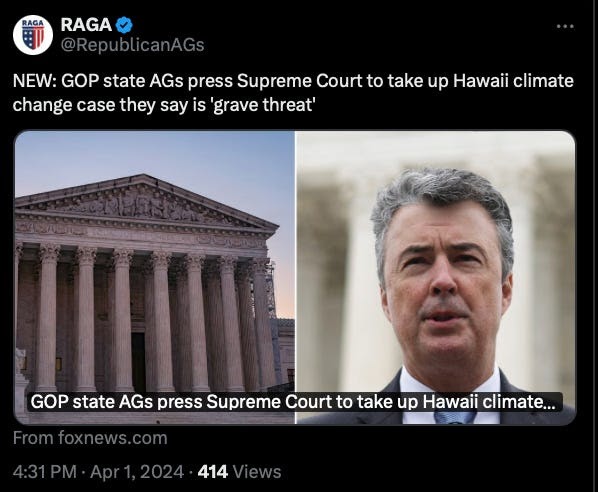 ||
A screenshot of RAGA’s post about the Hawaii case brief. Source: X
According to research by HEATED and the Center for Media and Democracy, all 20 state attorneys general that signed the amicus brief are not only featured on RAGA’s website, but many were elected with RAGA’s help.
The lead counsel for the amicus brief, Alabama attorney general Steve Marshall, was the organization’s chair in 2023. Three attorneys general have served on RAGA’s executive committee (Indiana, Mississippi, and Utah), and five have been chairs or vice chairs (Alabama, Georgia, Montana, South Carolina, and Utah).
At least six AGs won their elections with the support and funding of RAGA, including the attorneys general from Oklahoma, Missouri, Kentucky, Louisiana, Iowa, and Idaho. In a statement last year, RAGA celebrated “a 100 percent success rate for RAGA in the 2023 election cycle.” This included the election of Louisiana AG Liz Murrill, which the organization supported with “a substantial, statewide paid advertising campaign.”
“These AGs, their political futures are underwritten by RAGA,” Graves said. “And who underwrites RAGA? The fossil fuel industry, along with Leonard Leo.”
RAGA did not respond to our requests for comment; when HEATED called executive director Pete Bisbee, he said he doesn’t speak to journalists, referred us to a spokesperson, and hung up. (Bisbee has previously been under fire leading the organization that paid for robocalls encouraging former President Trump supporters to protest the election results at the Capitol on Jan 6.)
But public statements, donations, and recordings of private meetings reveal RAGA’s deep ties to the fossil fuel industry. In 2023 alone, RAGA received more than $15 million in donations, and more than $1 million of those contributions came from the fossil fuel industry, according to HEATED’s analysis of IRS tax forms. Over the last decade, RAGA has accepted more than $10 million from fossil fuel companies, electric utilities, and industry trade groups.
Among RAGA’s donors are Koch Industries, Exxon, Chevron, ConocoPhillips, the American Petroleum Institute, and American Fuel and Petrochemical Manufacturers (AFPM)—and these donors have pushed AGs to adopt an aggressive anti-climate strategy.
How RAGA connects fossil fuel companies to AGs
To connect AGs with the priorities of donors, RAGA offers different tiers of access for different amounts of donations. “It’s not technically money laundering, but it has that appearance,” Graves said.
RAGA members who pay annual fees of $25,000 can help shape the organization’s legal strategy via “online RAGA briefing rooms,” for example. And members who pay more than $125,000 are given access to private meetings with attorney generals and invitations to in-person events with them, according to documents obtained by*The New York Times* in 2014.
In 2016, the Center for Media and Democracy obtained audio from one of those events. Titled “Climate Change Debate: How Speech is Being Stifled,” the session included former Alabama attorney general Luther Strange; AFPM president Chet Thompson;and noted fossil-funded climate denier Myron Ebell.
Together, they talked about the importance of protecting ExxonMobil from lawsuits like Honolulu’s. “We’re facing a coordinated campaign to demonize, weaken and try to destroy the industry,” Thompson said.
But Thompson also said stopping climate liability lawsuits would not be enough to protect the fossil fuel industry. What the industry really needed, he said, was protection from nearly all federal environmental regulation.
What followed was years of litigation led by Republican attorneys general against every environmental regulation worrying Thompson, and more.
RAGA’s goal: industry capture of the U.S. legal system
In 2021, 20 AGs sued the EPA to block its power plant emissions rules, which Thompson specifically called out in the panel. West Virginia v. EPAultimately went to the Supreme Court, whose ruling significantly decreased the EPA’s authority to regulate emissions.
In 2023, 25 Republican AGs sued the Department of Labor over retirement funds that considered ESG factors, including fossil fuel divestment. Thompson had called out divestment in the panel, too.
In 2024, 10 Republican attorneys general, all members of RAGA, sued the SEC over its climate disclosure rules, which Thompson also called out in the session.
RAGA members have also brought lawsuits fighting the Clean Water Act, limits on vehicle emissions, and the LNG exports pause—all while being paid by the industries that profit from pollution.
But the suits brought by RAGA members aren’t limited to the federal government. They’re also trying to stop localities like Honolulu from trying climate liability cases in state courts. RAGA, and the corporations it defends, want these cases tried in federal courts, where Republican-appointed federal judges are more likely to rule in the fossil fuel industry’s favor.
In fact, the same funders who helped appoint ultra-conservative judges to federal courts also donate to RAGA. Among RAGA’s top donors is the dark money group The Concord Fund, which is affiliated with the Federalist Society’s co-chairman Leonard Leo. Leo is credited with playing moving the federal court system to the right, and was instrumental in appointing multiple conservative justices to the U.S. Supreme Court, including Justices Alito, Roberts, Gorsuch, Kavanaugh, and Coney Barrett.
That network of industry influence has purchased the current anti-regulatory legal environment—and RAGA plays an essential role. "These AGs are willing to let the planet burn as they continue to take funding through RAGA from this industry," Graves said.
Former Hawaii Supreme Court Justice Michael Wilson went one step further in describing the effect of RAGA in fighting climate change.
“The AGs are violating their public duty to protect the future of their citizenry,” he said. “This partisan political use of the rule of law is what has caused the judicial branch of government to descend to its lowest level of public approval in recorded history.”
Further reading:
- The Low-Key Republican Officials Quietly Dismantling All of Our Rights. Slate, April 2024
Key quote: ”This agenda to use the Supreme Court to strip us of our rights, to use the court to make it harder for us to deal with climate change, to use the court to roll back reproductive rights, gay marriage, and more. These are all part and parcel of Leo’s agenda and these attorneys general are on that agenda.”
- These Attorneys General Are Defending the Fossil Fuel Industry, Not Their States. The Equation, March 2023
Key quote: “According to the nonpartisan National Association of Attorneys General, a state attorney general’s job is to represent the public interest—not private, special interests—by, among other things, ‘enforcing federal and state environmental laws.’ Attorneys general in the five states most vulnerable to climate change, however, are doing the exact opposite: Instead of defending their constituents, they are defending the fossil fuel industry.”
- Lobbyists, Bearing Gifts, Pursue Attorneys General. The New York Times, October 2014
Key quote: “But success did not come in court or at a negotiating table. Instead, it came at the opulent Loews Santa Monica Beach Hotel in California, with its panoramic ocean views, where more than a dozen state attorneys general had gathered last year for cocktails, dinners and fund-raisers organized by the Democratic Attorneys General Association.”
---
===
===
gmail 2 24
Maryland communities move one step closer to putting Big Oil on trial following appeals court ruling.
Communities in Maryland are closer than ever to putting Big Oil on trial after a federal appeals court this week once again rejected industry attempts to escape facing accountability for their climate lies. The ruling continues the unbroken string of judicial wins for local governments seeking to hold fossil fuel companies accountable for their decades-long campaign of climate deception in state court.
The U.S. Court of Appeals for the Fourth Circuit unanimously rejected oil majors’ — including ExxonMobil, BP, Chevron, and the American Petroleum Institute — attempts to stop cases in Annapolis and Anne Arundel County, Maryland, from moving forward in state court, where they were originally filed. The Fourth Circuit issued a similar ruling in favor of the City of Baltimore’s climate accountability lawsuit in 2022.
Oil and gas companies have attempted to remove many of the climate accountability lawsuits they’re facing from state court, only to be repeatedly shut down by courts time and again.
Federal district courts across the nation have now rejected these same oil industry arguments a total of 17 times, including in Vermont, Minnesota, D.C., California, Hawai’i, Connecticut, Massachusetts, Rhode Island, New Jersey, Delaware, South Carolina, and Colorado. Those rulings have been affirmed 11 times by eight separate federal appeals courts.
“The companies have sought—over and over and over—to remove the cases to federal court,” wrote Judge Toby Heytens in the unanimous ruling for Annapolis and Anne Arundel County. “By our count, that gambit has failed in at least ten cases already. The eleventh time is not the charm.”
In 2021, U.S. District Judge Derrick Watson wrote that Big Oil’s arguments for federal jurisdiction in accountability lawsuits brought by state and local governments have “a batting average of .000.” More than two years later, that’s still the case.
===
YMAIL 2 24ExxonKnews
Chicago last week brought the newest lawsuit against Big Oil companies for spreading disinformation about the climate-warming hazards of burning fossil fuels — adding the third largest city in the U.S. to the growing list of state and local governments pushing for oil and gas majors to be held accountable in court.
The case charges BP, Chevron, ExxonMobil, Shell, ConocoPhillips, and the American Petroleum Institute with conspiring together and through front groups to run “tobacco-industry-style campaigns to deceive and mislead the public about the damaging nature of their fossil fuel products.” The fallout of those campaigns, according to the complaint, was a long delay in climate action that has come at an increasingly unbearable cost to Chicago residents — particularly in its low income neighborhoods and communities of color.
City officials say their legal action is necessary for the city to help shift the financial burden of adapting to climate disasters away from those communities and back onto the companies most responsible.
“There is no justice without accountability,” said Mayor Brandon Johnson in a statement. “From the unprecedented poor air quality that we experienced last summer to the basement floodings that our residents on the West Side experienced, the consequences of this crisis are severe, as are the costs of surviving them. That is why we are seeking to hold these Defendants accountable.”
Ted Boutrous of law firm Gibson, Dunn and Crutcher, an attorney for Chevron and chief architect of Big Oil's legal arguments in these cases, said in a statement that “addressing climate change requires a coordinated international policy response, not meritless local litigation over lawful and essential energy production.”
The city is charging the companies with 10 counts of failure to warn, negligence, fraud, conspiracy, and public nuisance, and it asks for compensatory damages and the disgorgement of profits made in the course of the industry’s fraud, among other remedies. The lawsuit, filed Tuesday in Cook County court, also requests a jury trial, where the companies could face more evidence of their deception gained through the discovery process.
That deception, Chicago argues, includes the oil majors’ ongoing campaigns to “falsely present themselves as corporate leaders in the fight against climate change, claiming to invest substantially in low-emission technologies and zero-emission energy sources, while their business continues to be overwhelmingly focused on fossil fuel production and sales.”
As one example, the complaint cites a recent BP ad targeting Illinois Facebook users that claims “We agree - the world needs fewer emissions. That's why we're working to make all forms of energy cleaner and better.” BP is simultaneously reneging on its climate pledges and increasing its production of oil and gas.
“At the end of the day, the climate crisis that we’re enduring was known by fossil fuel companies — they were warned decades ago by their own scientists of the potentially severe or even catastrophic consequences of their approach,” said Chicago Alderman Matt Martin, who applauded city leaders’ decision to file suit. “These companies should no longer be allowed to shift the burden of paying for the impacts resulting from that conduct onto Chicagoans.”
The harm to Chicago from climate change
It might be difficult to imagine what climate change looks like for a Midwestern city far from rising seas and hurricanes — but Chicago is susceptible to a spate of climate threats.
Chicago’s complaint cites more frequent and intense storms, flooding, droughts, shoreline erosion, toxic algae blooms in Lake Michigan, and extreme heat events like a four-day heat wave in 1995 that killed more than 700 Chicagoans.
The 1995 heat wave was a “watershed moment,” said Daniel Horton, who leads the Climate Change Research Group at Northwestern University. “Since that time the city has done a number of things to improve community resilience, but we expect more heatwaves in the future as the world continues to warm — so we have to constantly update our policies and prepare for extreme heat,” he added.
Many victims of that heat wave were elderly, low-income, and Black, residing in apartments without air conditioning. Those groups are still most at risk from extreme heat and air pollution in Chicago, which can coincide to produce “profound public health consequences,” said Horton, like they did when wildfire smoke from Canada gave the city the worst air quality in the world in June. The same demographics were also hit hardest during a severe rain event in July, which wreaked havoc on Chicago’s West Side, and are most susceptible to the city’s more-regular flooding.
“When you’re talking about the legacy of environmental racism all across the city, too often with regard to both severe weather and other aspects of the climate crisis, the communities bearing the brunt of that devastation are lower income communities of color,” said Alderman Martin.
Chicago is an “incredibly segregated city,” explained Horton, where Black and Hispanic communities are far more likely to live in places that are hotter, have poorer air quality, and are most flood-prone. The city can make decisions to ease the burden on those communities — like figuring out “where to increase our green infrastructure, building more of a green canopy and reducing the heat island effect, deciding where to build cooling centers in neighborhoods that have more vulnerable citizens or people without access to air conditioning or the ability to pay for it,” he said. The more the city invests in community adaptation, the higher the price tag — in its complaint, the city said it is already spending $188 million on climate projects in low-income communities — and that’s the kind of thing Chicago wants oil companies to help pay for.
“There’s surviving, and then there’s thriving,” Horton said. “I like to think surviving isn’t the goal.”
“Another powerful player”
More than 25% of all Americans are now represented by governments taking oil companies to court for climate deception. Chicago’s lawsuit brings “another powerful player into the game,” remarked Pat Parenteau, an environmental law professor at Vermont Law School.
“There’s strength in numbers, and the more entities like Chicago and California that have the resources to do battle, the better, from the plaintiffs’ side of it,” Parenteau said.
Chicago is suing as similar cases across the country move toward trial in state court. Massachusetts' consumer fraud case against Exxon is currently in the pre-trial discovery phase, and the City and County of Honolulu is in the process of agreeing what discovery will look like once it starts. Delaware is requesting that the state’s Supreme Court review a lower court’s ruling regarding which parts of its case can be heard at trial. In Italy, the trial for twelve Italian citizens’ lawsuit against oil giant Eni just kicked off.
Parenteau had a long list of reasons why new communities like Chicago would choose to sue now — growing evidence of what the companies knew and how they lied, more attribution science linking specific companies’ emissions to specific damages, the state of California filing suit, plaintiffs winning the fight to keep their lawsuits in state court, and other legal successes against oil majors across the world.
Or it could be simpler than all that. “These cities are beginning to realize just how much money they’re facing to deal with climate effects, and the recalcitrance of the oil companies that are sitting on piles of money and making more every year,” he said. “Maybe it’s too much for them to ignore.”
Thanks for reading ExxonKnews!
===
gmail 2 24
Judges continue to reject oil industry efforts to escape accountability in state court.
Vermont is another step closer to putting Big Oil companies on trial for their climate lies after a federal district court ruled last week the lawsuit can move forward in state court, where it was originally filed. The decision continues oil companies’ unbroken losing streak in their attempts to escape facing accountability for their climate lies in dozens of local and state government cases.
Vermont’s lawsuit, filed by the state Attorney General’s office in 2021, charges ExxonMobil, Shell, and other major polluters with knowingly lying to the public about the climate harms of their products and ultimately denying Vermont consumers the opportunity to make informed choices on their fossil fuel products. The lawsuit asserts that Big Oil’s deceptive marketing not only misled consumers, but also delayed action and created costly and hazardous conditions for Vermont residents, like recent deadly floods exacerbated by climate change. The case, which will now be litigated in state court, seeks to force the oil companies to stop deceiving the public and relinquish the profits they made while promoting their false advertising.
“Vermonters deserve to know the truth about fossil fuel products as they make consumer choices,” Vermont Attorney General Charity Clark said after the ruling. “This case seeks to hold accountable fossil fuel companies that misrepresented their products and hid information from the public.”
To date, eight federal appeals courts — including the Second Circuit, which has jurisdiction over the District of Vermont — and more than a dozen federal district courts have unanimously ruled against the fossil fuel industry’s arguments to prevent these lawsuits from moving forward in state courts. Earlier this year, the U.S. Supreme Court declined Big Oil’s requests to review one of those lower court rulings for the third time.
“The fossil fuel industry’s efforts to deceive the public about climate change have caused irreparable harm to communities,” CCI President Richard Wiles said. “The people of Vermont deserve their day in court to make these companies answer for their fraud.”
===
===
1 24 email
Makah Indian Tribe and Shoalwater Bay Indian Tribe — two federally-recognized sovereign Native Nations that have lived in present-day northwest Washington State for millenia — are suing ExxonMobil, Shell, BP, Chevron, and other fossil fuel companies for lying about the harms of fossil fuels and the climate damages their communities are now facing.
“We are facing hundreds of millions of dollars in costs to relocate our community to higher ground and protect our people, our property, and our heritage,” said Charlene Nelson, chairwoman of the Shoalwater Bay Tribe. “These companies need to be held accountable for that.”
Read our full_blog post here_, and follow us on_Twitter_and_Instagram_for more climate accountability news.
---
CA v FF5 plus api
---
12 23 ymail no lnx
On Sunday, December 10, eighteen children under 18 filed a new federal constitutional climate lawsuit against the U.S. Environmental Protection Agency (EPA) in the U.S. District Court in the Central District of California.
Genesis B. v. United States Environmental Protection Agency asserts that for decades the EPA has intentionally allowed life-threatening climate pollution, despite knowing the harm it causes to children’s health and welfare. The plaintiffs also claim that the EPA has discriminated against them as children by devaluing their lives and their future when it decides whether and how much climate pollution to allow.
In 1970, Congress gave EPA the authority and the mandate to manage the nation’s air quality and control pollution to protect human health and welfare.
The worsening impacts of the climate crisis in the West have injured the lives of every youth plaintiff. Fire and floods have destroyed and damaged homes and forced evacuations. Smoke and extreme heat have resulted in serious health harms—from severe depression and anxiety to asthma, heat exhaustion and fear for their lives.
---
y mail 11 23
climate lawsuit filed by the City and County of Honolulu that could make oil and gas majors pay billions of dollars in damages for deceiving the public about their products’ role in climate change is now positioned to be the first of its kind to go to trial, following a ruling from the Hawai‘i Supreme Court. Legal experts say that Honolulu’s case could set a precedent for similar climate lawsuits filed by dozens of U.S. communities and make history as the first time fossil fuel companies would have to face the evidence of a decades-long industry campaign of climate deception in court.
The unanimous ruling, written by Hawai‘i Supreme Court Chief Justice Mark E. Recktenwald, upheld a lower court ruling that rejected two key arguments the oil companies made in an effort to dismiss the case. The court’s decision means that the case can now enter into full discovery — the phase during which plaintiffs can collect more evidence to prove their case — and a state court can finally set a date for the case to go to trial.
“This is now the most important climate case in the United States,” said former Hawai‘i Supreme Court Justice Michael Wilson, who retired earlier this year after a decade on the state’s highest court. “Now the Hawai‘i Supreme Court has allowed a jury of twelve Hawai’i citizens to decide whether lies by the oil companies created large scale billion dollar damage to our county and city of Honolulu.”
The city and county’s lawsuit charges ExxonMobil, Chevron, Shell, and BP and other oil giants with orchestrating “sophisticated disinformation campaigns to cast doubt on the science, causes, and effects of global warming,” thus delaying climate action for decades. The complaint argues that the companies violated state common laws like public nuisance, failure to warn, and trespass — and that their conduct left Honolulu facing floods, storms, heat waves, wildfires, rising seas, and other climate disasters that have cost billions of dollars in destruction and repairs. Now, plaintiffs contend, Big Oil should help foot the bill for the damage.
But the oil and gas industry has bitterly disputed the case, first attempting to move it out of state court, and, when that failed, filing motions to have it dismissed entirely. Along the way, a pro-fossil fuel industry group even launched a PR blitz in right wing media against Recktenwald, the state's Republican-appointed Chief Justice, accusing him of bias for giving a presentation through the nonprofit Environmental Law Institute that sought "to educate fellow judges about the basic science they need to adjudicate the climate litigation over which they preside." (Oil company lawyers, including one involved in Honolulu’s case, are also involved in ELI. One law professor said the attack on Recktenwald was “grasping at straws.”)
In August, just after nearly a hundred people were killed in the devastating wildfires on Maui, which has filed a nearly identical lawsuit that is also moving through state courts, Hawai‘i’s Supreme Court heard Big Oil’s arguments to dismiss Honolulu’s case. The companies argued that state law could not address the global issue of climate change — and that federal law preempted Honolulu’s claims under the Clean Air Act.
Ted Boutrous, a lawyer for Chevron, told the court that Honolulu was “seeking to impose damages based on the actions of millions and billions of people around the world. They’re going to put all the consequences of that on these companies.”
This week’s decision thoroughly debunked those arguments. “We agree with [Honolulu city and county] Plaintiffs,” wrote Chief Justice Recktenwald. “This suit does not seek to regulate emissions and does not seek damages for interstate emissions… Because this is a traditional tort case alleging [oil company] Defendants misled consumers and should have warned them about the dangers of using their products, Defendants’ arguments fail.”
Big Oil’s “big problem”
- The ruling makes clear that “our courts are united in their view” of the case, said Denise Antolini, a retired University of Hawai‘i law professor who has submitted legal briefs in support of the lawsuit. “The cases use traditional tort law to tackle a very large problem, which is the deceptive climate marketing and campaigns of Big Oil.”
A ruling in the case could have significant implications for other climate cases across the country, said Richard Wallsgrove, a Professor of Law and Environmental Law Program Co-Director at the University of Hawai‘i.
“Big Oil’s argument is, ‘the problem is so big that we no longer have responsibility for that problem,’” Wallsgrove said. “But there have to be ramifications. These municipal climate cases’ core legal theory is, [oil companies] created a big problem and they lied about it. The Hawai‘i Supreme Court’s opinion is saying that if somebody violates the law, courts are the place where that should get adjudicated.”
The case has been in a limited form of discovery, but it can now move into a comprehensive phase where the city and county can request documents and depose key representatives from the oil companies. That next stage “will bring to light the lies and the campaign of Big Oil’s climate denial, and that’s what they’re deathly afraid of — of that story seeing the light of day,” Antolini said.
The path ahead
Of the dozens of climate accountability cases working their way through U.S. courts, Honolulu’s is now one of two — along with a Massachusetts consumer fraud case against ExxonMobil — that is positioned to receive a 2024 trial date.
Honolulu still needs to prevail against one more Big Oil motion to dismiss its case. Chevron has invoked an anti-SLAPP law from California, where the company is headquartered, that’s intended to protect individuals and whistleblowers from lawsuits meant to silence their free speech. Honolulu’s lawsuit, Chevron contends, violates that law and Chevron’s First Amendment rights because its climate denial was actually protected free speech.
That motion is moving through a separate appeals process — but if you ask Antolini, it has a “snowball’s chance in hell” of preventing the case from moving forward. “Anti-SLAPP protections are really important, but they don’t protect Big Oil,” she said.
“A groundbreaking decision of hope”
Wilson said Honolulu’s case is now “set up to be a major achievement for the jurisdictions around the state that are victims of fossil fuel burning that’s being done as a result of misrepresentations made by the oil companies … There will be a price tag put on the knowing poisoning of the atmosphere.”
“The procedure of this case shows how young people, future generations, and the citizens of the city and county of Honolulu can have hope that the oil companies that increase greenhouse gas emissions and are more profitable than they’ve ever been will have to go to trial,” he said. “This is a groundbreaking decision of hope.”
---
an 7 23
no lnx
'Polluters must pay': Senators urge Biden DOJ to sue Big Oil over decades of climate lies
Jake Johnson and Common Dreams July 31, 2023
"Thanks to the illegal lies of the fossil fuel industry, climate change is wreaking catastrophic damage upon the United States," four progressive U.S. senators write in a new letter.
A group of progressive U.S. senators on Monday urged President Joe Biden's Justice Department to take legal action against the fossil fuel industry over its deliberate efforts to "mislead consumers and discredit climate science in pursuit of massive profits."
"The actions of ExxonMobil, Shell, and potentially other fossil fuel companies represent a clear violation of federal racketeering laws, truth in advertising laws, consumer protection laws, and potentially other laws, and the department must act swiftly to hold them accountable for their unlawful actions," reads aletter that Sens. Bernie Sanders (I-Vt.), Ed Markey (D-Mass.), Jeff Merkley (D-Ore.), and Elizabeth Warren (D-Mass.) sent to U.S. Attorney General Merrick Garland.
The senators pointed to recently unveiled records that show Shell knewas soon as the early 1970s that burning fossil fuels could cause climate change—knowledge that was not reflected in their public messaging and advertising. Exxon also knew about the link between fossil fuels and climate change in the 1970s but publicly cast doubt on such a link and funded groups peddling climate denial.
"Despite these companies' knowledge about climate change and the role their industry was playing in driving carbon emissions, they chose to participate in a decadeslong, carefully coordinated campaign of misinformation to obfuscate climate science and convince the public that fossil fuels are not the primary driver of climate change," the senators wrote in their letter to Garland.
"To coordinate their illegal misinformation campaign, the fossil fuel industry funded a multimillion-dollar plan through the American Petroleum Institute that sought to make climate change a 'non-issue,'" the senators continued. "According to this plan, 'victory will be achieved' when 'recognition of the uncertainties [in climate science] become part of the 'conventional wisdom.' Exxon, whose climate predictions from the 1970s have proved remarkably correct, was a primary contributor to this plan."
"Like with Big Tobacco, the fossil fuel industry's illegal, coordinated campaign of misinformation has proven tremendously profitable."
The oil and gas industry's efforts to mislead the public about climate change "bears a striking resemblance" to the tobacco industry's campaign of lies about the dangers of cigarettes, the senators argued. In 2006, major U.S. tobacco companies were found guilty of violating civil racketeering laws and making deceptive statements about their products.
"Both industries have used the same public relations firms and researchers since the 1950s," the senators wrote Monday. "Like with Big Tobacco, the fossil fuel industry's illegal, coordinated campaign of misinformation has proven tremendously profitable. From 1990 to 2019, the six largest private fossil fuel companies made $2.4 trillion in profits."
"Thanks to the illegal lies of the fossil fuel industry, climate change is wreaking catastrophic damage upon the United States," the senators added. "Floods, droughts, extreme weather disturbances, and wildfires are causing unprecedented damage. Deloitte estimates that unchecked climate change, driven by the fossil fuel industry, could cost the United States $14.5 trillion over the next 50 years... Polluters must pay."
Dozens of U.S. cities and states have sued the oil and gas industry in recent years, part of a growing global wave of climate lawsuits aimed at holding fossil fuel giants accountable in the face of worsening extreme weather and government inaction.
The Biden Justice Department recently filed a Supreme Court brief siding with local governments in Colorado in a climate lawsuit against oil companies, but the administration has yet to take legal action of its own.
In their letter on Monday, the senators implored the Justice Department to "join the fight and work with partners at the Federal Trade Commission and other law enforcement agencies to file suits against all those who participated in the fossil fuel industry's illegal conspiracy of lies and deception under federal racketeering laws, truth in advertising laws, consumer protection laws, and any other applicable federal law."
"The future of our planet depends on it," they wrote.
FROM YOUR SITE ARTICLES
Green groups fear 'climate catastrophe' as Congo weighs selling rainforest for oil drilling ›
Big Oilshill tells Fox News viewers there’s 'no health risk' from inhaling toxic smoke ›
Study exposes climate claims by Big Oil as blatant corporate propaganda ›
RELATED ARTICLES AROUND THE WEB
What Big Oil knew about climate change, in its own words ›
Oil companies discourage climate action, study says – Harvard ... ›
Big Oil has engaged in a long-running climate disinformation ... ›
---
---
emily Sanders is the Center for Climate Integrity’s editorial lead. Catch up with her on Twitter here.
A page on ExxonMobil’s website that sought to refute calls for the oil giant to be held accountable for its climate deception appears to have been taken off the internet after seven years.
:{:{The web page, an official corporate rebuttal to the #ExxonKnew movement, accused Exxon’s critics of plotting together to “delegitimize ExxonMobil by misrepresenting our position on climate change and related research to the public.” Starting in 2018, just after the first climate accountability lawsuits were filed, a montage-style video flooded Twitter feeds to promote the “real story behind #ExxonKnew” and drive traffic to the now-defunct web page.}:
According to Exxon, it was activists and community leaders, not the fossil fuel industry, who were telling lies.}:

The “Understanding the #ExxonKnew controversy” page on Exxon’s website became home to an all-out strategic communications blitz against activists, lawyers, and others fighting to hold Exxon accountable. The page intended to cast doubt on the growing evidence that Exxon knew for decades that its products caused climate change but then led a massive campaign of deception to protect its profits. Its allegations — that advocates, elected officials, and plaintiffs in climate lawsuits had engaged in a so-called “coordinated campaign” against the oil giant — have been repeated in courtrooms across the country by Exxon’s lawyers.
One of the critics Exxon named on the web page was Naomi Oreskes, a Professor of the History of Science at Harvard University and scholar of climate disinformation. Oreskes has published prolific research exposing Exxon’s early knowledge and subsequent campaigns to create public uncertainty about climate science.
“ExxonMobil has long tried to distract attention from their long, well-documented history of denying or minimizing the risks of climate disruption caused by the intended use of their products,” Oreskes told ExxonKnews in an email. “When people — academics, journalists, even their own former employees — discuss what they have done, they attack the messenger. As we’ve said before, they misrepresent their own history of misrepresentation. We have shown this to be the case. The tiger has not changed its stripes.”
 *A screenshot from ExxonMobil’s former web page. Exxon has been sued for engaging with trade associations and other oil companies in a “coordinated campaign” of climate deception.
In April, seemingly out of nowhere, the page disappeared.
So why did Exxon take down its rebuttal after all this time?
Exxon faces a clear and rising threat of “massive monetary liability” and is deep in the throes of a damaging public reckoning. Last month, the Wall Street Journal published more documentation of the oil giant’s attempts to undermine climate science well into the 2010s. The attorney general of California sued the company in a landmark case that opens the floodgates for more states to take legal action.
Most recently, Exxon suffered its seventh painful defeat in a federal appeals court. A judge who ruled in Exxon’s favor in an earlier New York case — a ruling the company’s lawyers are still citing as evidence that Exxon shouldn’t face trial in state courts — agreed, along with two of his colleagues, that Connecticut’s climate fraud lawsuit against Exxon should indeed proceed in state court. Across the country, climate accountability lawsuits against Exxon are now advancing toward trial, where the company will be up against a mountain of proof that it knowingly endangered the planet.}:
In erasing the web page, Exxon could simply be dropping its public defense or signaling a change in strategy — but some notable markers at the start and end of this website’s tenure raise more questions.
Here’s a brief timeline of events:
- September - December 2015:Revelations that sparked the #ExxonKnew movement are published by InsideClimate News and the Los Angeles Times.
- March 2016:Energy in Depth (EID), a pro-fossil fuel “news” site that was created in part thanks to Exxon’s financial contributions and has reportedly taken content direction from Exxon, releases a video remarkably similar to the one Exxon would later publish, calling the #ExxonKnew reporting a “deliberate misrepresentation of the facts.” EID is staffed by employees of the strategic communications division of FTI Consulting, a firm that ran covert influence campaigns to promote fossil fuels for major client Exxon, according to reporting from The New York Times.
- August 2016:The first trace of Exxon’s web page on the internet’s archive. Built to look like a news article, the page calls journalistic reports on what Exxon knew “bought and paid for” and features a lengthy timeline of supposed evidence of the “coordinated campaign” against the company.
- March 2023:The Wall Street Journal publishes an exclusive report on a hacking-for-hire operation that targeted prominent climate activists campaigning against Exxon. Federal prosecutors have not yet identified a source behind the attackbeyond an Israeli private detective who was an intermediary, apparently connecting clients with Indian hackers for hire. That person will be sentenced next week in New York City, according to an email from the U.S. Department of Justice sent to victims of the hacking scheme.
The Journal’s article specifically highlights one particular focus of the Manhattan U.S. attorney’s office investigation: a spear-phishing campaign targeting the recipients of a private email about a meeting in January 2016 where a communications plan to expose Exxon’s deception was discussed. A copy of that private communication was somehow obtained by the Wall Street Journal and Washington Free Beacon, and published in the Washington Free Beacon in April 2016.
As mentioned in the Journal’s reporting, that hacked email was cited in the timeline on Exxon’s #ExxonKnew rebuttal website, as well as in court briefings and statements by Exxon’s lawyers, who used it to argue that advocates were plotting to push prosecutors into unfairly investigating the company as part of a “vilification agenda.”
 A screenshot from the timeline on Exxon’s web page describing the email. Disclaimer: The Rockefeller Family Fund is a funder of the Center for Climate Integrity, of which ExxonKnews is a project.*
- April 2023: Exxon takes its web page down.
We’ve asked Exxon why the web page was taken down, and if the publication of the Wall Street Journal story in March was a factor. We will update this story if we get a response.
---
ref 1 wsj on climate crock not all?
New report from the Wall Street Journal, documents and emails from Exxon Mobil executives have come to light giving more details of the Oil giant’s war on science and democracy.
Reporters at the Journal reviewed summaries of documents produced in the State of New York’s lawsuit against Exxon, which began in 2015. Those included “emails, “emails between top executives, board meetings and Tillerson’s edits of speeches, among other things.”
Mobil issued its first public statement that burning fossil fuels contributes to climate change in 2006, following years of denial. In public forums, the company argued that the risk of serious impact on the environment justified global action.
Yet behind closed doors, Exxon took a very different tack: Its executives strategized over how to diminish concerns about warming temperatures, and they sought to muddle scientific findings that might hurt its oil-and-gas business, according to internal Exxon documents reviewed by The Wall Street Journal and interviews with former executives.
–
Exxon is now a defendant in dozens of lawsuits around the U.S. that accuse it and other oil companies of deception over climate change and that aim to collect billions of dollars in damages. Prosecutors and attorneys involved in some of the cases are seeking some of the documents reviewed by the Journal, which were part of a previous investigation by New York’s attorney general but never made public.
One of the lawsuits is from Hawaii’s Maui County, where wildfires killed more than 100 people in August. The lawsuit, filed in 2020, alleged the island faced increased climate-related risks, including more dangerous wildfires, caused by fossil-fuel companies. Some of the lawsuits may go to trial as soon as next year.
:{*:{In the article, the journal focused on the activities of Rex Tillerson, who was CEO of Exxon between 2006 and 2016, when he left to become Donald Trump’s Secretary of State.}:
[New report from the Wall Street Journal, documents and emails from Exxon Mobil executives have come to light giving more details of the Oil giant’s war on science and democracy.
Reporters at the Journal reviewed summaries of documents produced in the State of New York’s lawsuit against Exxon, which began in 2015. Those included “emails, “emails between top executives, board meetings and Tillerson’s edits of speeches, among other things.”
Wall Street Journal:
Mobil issued its first public statement that burning fossil fuels contributes to climate change in 2006, following years of denial. In public forums, the company argued that the risk of serious impact on the environment justified global action.
Yet behind closed doors, Exxon took a very different tack: Its executives strategized over how to diminish concerns about warming temperatures, and they sought to muddle scientific findings that might hurt its oil-and-gas business, according to internal Exxon documents reviewed by The Wall Street Journal and interviews with former executives.
–
Exxon is now a defendant in dozens of lawsuits around the U.S. that accuse it and other oil companies of deception over climate change and that aim to collect billions of dollars in damages. Prosecutors and attorneys involved in some of the cases are seeking some of the documents reviewed by the Journal, which were part of a previous investigation by New York’s attorney general but never made public.
One of the lawsuits is from Hawaii’s Maui County, where wildfires killed more than 100 people in August. The lawsuit, filed in 2020, alleged the island faced increased climate-related risks, including more dangerous wildfires, caused by fossil-fuel companies. Some of the lawsuits may go to trial as soon as next year.
In the article, the journal focused on the activities of Rex Tillerson, who was CEO of Exxon between 2006 and 2016, when he left to become Donald Trump’s Secretary of State.
If you’re looking for one image to crystallize the ongoing crisis of climate and democracy, this might be it.
The Journal quotes Lee Wasserman, the director of the Rockefeller Family Fund:
“The general perception is that Tillerson was softer and stopped funding the bad guys” that were espousing climate change denial, said Lee Wasserman, the director of the Rockefeller Family Fund, a charity that partly focuses on environmental issues. “This is the first X-ray into Tillerson’s head and shows he wanted to throw climate mitigation off the rails. It’s obituary-changing.”
A study published earlier this year in the journal Science determined Exxon’s climate modelers had predicted warming temperatures with precision since the 1970s, in line with the scientific consensus. The study was funded, in part, by a grant from the Rockefeller Family Fund.
In the summer of 1988, NASA scientist James Hansen issued what’s now seen as a seminal warning on climate change when he testified before Congress that Earth was warming dangerously and humans were causing it.
Frank Sprow, then Exxon’s head of corporate research, sent a memo to colleagues a few months later articulating what would become a central pillar of Exxon’s strategy.
“If a worldwide consensus emerges that action is needed to mitigate against Greenhouse gas effects, substantial negative impacts on Exxon could occur,” wrote Sprow. “Any additional R&D efforts within Corporate Research on Greenhouse should have two primary purposes: 1. Protect the value of our resources (oil, gas, coal). 2. Preserve Exxon’s business options.”
Sprow’s memo was adopted by Exxon as policy, he said in a recent interview.
–
Exxon’s public shift on climate change came after the Royal Society, a British scientific academy, criticized the company for spreading “inaccurate and misleading” views on climate science in 2006. Exxon responded in a letter that it recognized “the accumulation of greenhouse gases in the Earth’s atmosphere poses risks that may prove significant for society and ecosystems.”
In 2011, scientists working for the Intergovernmental Panel on Climate Change, convened by the United Nations, warned of global calamity if carbon emissions caused temperatures to rise more than 4 degrees Celsius above preindustrial levels by 2100, its worst-case scenario.
Tillerson told a top Exxon climate researcher the scenario was “not credible,” the documents show. Tillerson was “dissatisfied with media coverage,” the researcher, Haroon Kheshgi, told colleagues in a 2012 email about the findings. Further, Tillerson wanted to engage with IPCC “to influence [the group], in addition to gathering info.”
Chris Field was the co-chair of an IPCC working group during Tillerson’s tenure at Exxon. He rejected Tillerson’s criticism that the worst-case scenario laid out by the group wasn’t credible. Though emissions reductions are preventing the worst case, Field said, the science has held up over time.
–
Below, 1982 graph from Exxon researchers shows Historically observed temperature change (red) and atmospheric carbon dioxide concentration (blue) over time, compared against global warming projections reported by ExxonMobil scientists.
Journal again:
While Tillerson and others played down the risks posed by climate change, Exxon’s scientists were themselves modeling alarming increases in carbon emissions without dramatic reductions in fossil-fuel consumption.
“It’s almost reluctantly that we address C02 emissions,” Scott Nauman, a corporate planning manager, wrote in a January 2009 email as the company was preparing its annual energy outlook. “It is not a positive story. Global emissions continue to rise throughout the outlook timeframe – that’s clearly a cause for concern.”
Exxon routinely pushed back against the idea that dramatic curtailment of fossil-fuel consumption was necessary. Instead, it suggested that technological solutions, including making cars and other machines more efficient, were the most effective measure to halt global warming. Fossil fuels are responsible for more than 75% of the world’s greenhouse gas emissions, according to the IPCC.
Before giving a speech at an event hosted by Stanford University’s Global Climate & Energy Project in February 2009, Tillerson appeared to make edits to avoid embracing positions that would hurt Exxon’s business.
In one part of the draft speech he crossed out “oil, natural gas and coal will not meet all of the world’s needs to the year 2030.” Later, he added, “the most cost effective steps we can take to address this energy and environmental challenge is to extend our energy efficiency gains.”
–
The Journal points out that even as Exxon announced, in 2008, that it would stop funding the think tanks and other groups that questioned climate science, the companycontinued
The article continues:
Tillerson also pushed back against some of the dire consequences of rising temperatures predicted by climate scientists. After a 2011 meeting, Tillerson’s chief of staff, William Colton, emailed colleagues about the CEO’s feedback on a draft disclosure about carbon emissions. Tillerson wanted the words “weather extremes and storms” deleted.
“His view was that even mentioning a possible connection between climate change and weather was possibly giving the notion more credibility than he would like,” Colton wrote.
–
Exxon currently plans to spend as much as $25 billion a year in capital expenditures through 2027, mostly on oil and gas. ](https://climatecrock.files.wordpress.com/2023/09/image-36.png)If you’re looking for one image to crystallize the ongoing crisis of climate and democracy, this might be it.
*The Journal quotes Lee Wasserman, the director of the Rockefeller Family Fund:
“The general perception is that Tillerson was softer and stopped funding the bad guys” that were espousing climate change denial, said Lee Wasserman, the director of the Rockefeller Family Fund, a charity that partly focuses on environmental issues. “This is the first X-ray into Tillerson’s head and shows he wanted to throw climate mitigation off the rails. It’s obituary-changing.”
A study published earlier this year in the journal Science determined Exxon’s climate modelers had predicted warming temperatures with precision since the 1970s, in line with the scientific consensus. The study was funded, in part, by a grant from the Rockefeller Family Fund.
In the summer of 1988, NASA scientist James Hansen issued what’s now seen as a seminal warning on climate change when he testified before Congress that Earth was warming dangerously and humans were causing it.
Frank Sprow, then Exxon’s head of corporate research, sent a memo to colleagues a few months later articulating what would become a central pillar of Exxon’s strategy.
“If a worldwide consensus emerges that action is needed to mitigate against Greenhouse gas effects, substantial negative impacts on Exxon could occur,” wrote Sprow. “Any additional R&D efforts within Corporate Research on Greenhouse should have two primary purposes: 1. Protect the value of our resources (oil, gas, coal). 2. Preserve Exxon’s business options.”
Sprow’s memo was adopted by Exxon as policy, he said in a recent interview....
Exxon’s public shift on climate change came after the Royal Society, a British scientific academy, criticized the company for spreading “inaccurate and misleading” views on climate science in 2006. Exxon responded in a letter that it recognized “the accumulation of greenhouse gases in the Earth’s atmosphere poses risks that may prove significant for society and ecosystems.”
In 2011, scientists working for the Intergovernmental Panel on Climate Change, convened by the United Nations, warned of global calamity if carbon emissions caused temperatures to rise more than 4 degrees Celsius above preindustrial levels by 2100, its worst-case scenario.
Tillerson told a top Exxon climate researcher the scenario was “not credible,” the documents show. Tillerson was “dissatisfied with media coverage,” the researcher, Haroon Kheshgi, told colleagues in a 2012 email about the findings. Further, Tillerson wanted to engage with IPCC “to influence [the group], in addition to gathering info.”
Chris Field was the co-chair of an IPCC working group during Tillerson’s tenure at Exxon. He rejected Tillerson’s criticism that the worst-case scenario laid out by the group wasn’t credible. Though emissions reductions are preventing the worst case, Field said, the science has held up over time.
–
*Below, 1982 graph from Exxon researchers shows Historically observed temperature change (red) and atmospheric carbon dioxide concentration (blue) over time, compared against global warming projections reported by ExxonMobil scientists

Journal again:
While Tillerson and others played down the risks posed by climate change, Exxon’s scientists were themselves modeling alarming increases in carbon emissions without dramatic reductions in fossil-fuel consumption.
“It’s almost reluctantly that we address C02 emissions,” Scott Nauman, a corporate planning manager, wrote in a January 2009 email as the company was preparing its annual energy outlook. “It is not a positive story. Global emissions continue to rise throughout the outlook timeframe – that’s clearly a cause for concern.”
Exxon routinely pushed back against the idea that dramatic curtailment of fossil-fuel consumption was necessary. Instead, it suggested that technological solutions, including making cars and other machines more efficient, were the most effective measure to halt global warming. Fossil fuels are responsible for more than 75% of the world’s greenhouse gas emissions, according to the IPCC.
Before giving a speech at an event hosted by Stanford University’s Global Climate & Energy Project in February 2009, Tillerson appeared to make edits to avoid embracing positions that would hurt Exxon’s business.
In one part of the draft speech he crossed out “oil, natural gas and coal will not meet all of the world’s needs to the year 2030.” Later, he added, “the most cost effective steps we can take to address this energy and environmental challenge is to extend our energy efficiency gains.”
–
The Journal points out that even as Exxon announced, in 2008, that it would stop funding the think tanks and other groups that questioned climate science, the companycontinued

2x? against some of the dire consequences of rising temperatures predicted by climate scientists. After a 2011 meeting, Tillerson’s chief of staff, William Colton, emailed colleagues about the CEO’s feedback on a draft disclosure about carbon emissions. Tillerson wanted the words “weather extremes and storms” deleted.}:
“His view was that even mentioning a possible connection between climate change and weather was possibly giving the notion more credibility than he would like,” Colton wrote.
–
Exxon currently plans to spend as much as $25 billion a year in capital expenditures through 2027, mostly on oil and gas.
---
ref 2
CLIMATEWIRE | In a win for local governments suing oil and gas majors over climate change, a federal appeals court Wednesday became the seventh to reject the industry’s bid to move a lawsuit to federal court.
In a unanimous ruling, three judges with the 2nd U.S. Circuit Court of Appeals sided with the state of Connecticut, upholding a lower court decision that said the state’s lawsuit against Exxon Mobil should be heard in state court.
In a twist, the decision was written by Judge Richard Sullivan, who wrote a 2021 decision for the appeals court that found that New York City’s claims in a climate lawsuit were preempted by federal law.
The industry has relied on the 2021 ruling to argue that it represents a split among the courts. An industry attorney cited it as recently as Tuesday in an effort to get a similar case in Delaware dismissed.
But Sullivan, who called the Connecticut and New York lawsuits “very different” in oral arguments last September, noted in Wednesday’s opinion that the court was joining its sister circuits in rejecting the company’s request to move the cases.
Connecticut’s lawsuit is one of more than two dozen filed by municipalities that accuse the industry of lying to the public about the dangers of burning fossil fuels. The industry has sought to move the cases to federal court where producers believe they have a better chance to toss the cases under the Clean Air Act.
But Sullivan wrote that the Connecticut case presents a “total mismatch” between the business practices that Exxon Mobil argued were subject to federal control and the behavior that Connecticut is challenging.
Connecticut’s claims, Sullivan wrote, “ultimately concern neither extracting oil and gas nor burning them, but talking about what happens to the environment when they are burned.”
Connecticut Attorney General William Tong (D), who filed the case in 2020, welcomed the decision and said his office is ready to “aggressively prosecute” the lawsuit in state court.
“Our case is simple and strong — Exxon Mobil amassed billions of dollars in profits off a decadeslong campaign of lies, and they must be held accountable,” Tong said.
He called the case a “straightforward consumer deception case” and said it was built on the state’s Unfair Trade Practices Act, which was argued in cases involving the tobacco and opioid industries.
The industry said the decision “misses” the real issue.
“The nature of climate change, this whole litigation and the remedies that Connecticut and other jurisdictions seek are all beyond the scope of any state law,” said Phil Goldberg, special counsel to the Manufacturers’ Accountability Project, an initiative of the National Association of Manufacturers.
He argued that determining how best to address climate change is a “major national and international priority that cannot be decided piecemeal by state judges based on which companies each state or locality decides to sue.”
Sullivan, an appointee of former President Donald Trump, wrote that the Supreme Court has cautioned that judges should “be reluctant” to find the authority that “converts an ordinary state common law complaint into one stating a federal claim.”
And he added that the judges were “wholly unpersuaded by Exxon Mobil’s efforts to push the boundaries of the exceptions” it claimed.
He said the judges agreed with the lower court decision that found Connecticut accuses Exxon Mobil of lying to the state’s consumers and the “fact that the alleged lies were about the impacts of fossil fuels on the Earth’s climate is immaterial.”
He noted that the sides “vigorously dispute” whether federal pollution law is at play in the case. But he added the allegation that Exxon Mobil’s statements ran afoul of Connecticut’s “truth in advertising” laws, “have absolutely nothing to do with the federal common law of transboundary pollution.”
The company had argued the case should be heard in federal court because it leases oil drilling sites from the federal government and is subject to “myriad” federal regulations.
But the court was not convinced, with Sullivan writing that “Exxon Mobil has made this very argument to five of our sister circuits, all of which have squarely rejected it. We find their reasoning persuasive, and we now join them.”
Sullivan wrote that Exxon Mobil had argued the federal government had “significant control” over the means of oil and gas production during World War II.
“But World War II ended in 1945,” he wrote, adding that the conduct Connecticut cites dates to no earlier than the 1950s. “We are aware of no authority for the proposition that once a private company has acted under the close supervision of the federal government for some discrete period in its history, it may claim ‘acting-under’ status for the rest of time.”
He was joined in the case by Judge William Nardini, another Trump appointee, and Judge Myrna Pérez, an appointee of President Joe Biden.
The ruling comes as the Supreme Court earlier this year boosted a raft of similar cases by rejecting the oil industry’s latest efforts to derail them. Those rulings could pave the way for a flood of lawsuits against the industry to be heard in state courts from Maryland to Hawaii.
California earlier this month became the eighth and largest state to file a climate deception lawsuit.
The state of Delaware defended its lawsuit against the industry Tuesday in a three-hour hearing before Superior Court Judge Mary Miller Johnston.
Ted Boutrous, a partner at Gibson, Dunn & Crutcher who represents Chevron in a number of the climate liability cases, raised Sullivan’s 2021 opinion in the New York case, telling Johnston it “provides a road map” for her court and that federal law should govern the case.
He noted Delaware argues that the cases are different, but he insisted the cases contained “the very same allegations.”
Victor Sher of the law firm Sher Edling, who represented the state, said the New York lawsuit was based on a different liability standard.
---
---
[ Judge Deals Latest Blow to Big Oil in DC Climate Fraud Case

DeSmog
https://www.desmog.com › 2022/11/21 › judge-blow-...](https://www.desmog.com/2022/11/21/judge-blow-big-oil-dc-climate-fraud-case/)
Nov 21, 2022 — We filed our lawsuit to expose these big oil companies' rampant deception and stop it. Today our case takes an important step forward.
In recent years, communities across the United States increasingly have turned to the courts to hold oil and gas companies accountable for alleged fraud — which has worsened the climate crisis — and now those lawsuits are inching towards trial. Despite dogged attempts from industry lawyers to force the litigation into federal courts, where they see an easier path to dismissal, they continue to strike out as judges from California to Connecticut rule that state courts are the appropriate venues for these climate accountability lawsuits.
The latest addition to the fossil fuel industry’s long procedural losing streak came on November 12 when a federal district judge decided that the District of Columbia’s climate liability lawsuit belongs in the local court, where it was originally filed in June 2020. As with other climate liability lawsuits, lawyers for the oil and gas companies in the District of Columbia case devised a multitude of arguments claiming that only federal courts have the jurisdiction or authority to handle such lawsuits. But federal courts have not been buying these legal theories.
“Defendants raise seven theories for the Court’s subject-matter jurisdiction. Each, they say, is an independent ground for removal. None is,” Judge Timothy J. Kelly of the U.S. District Court for the District of Columbia wrote in his recent opinion. He joins twelve other federal district judges and five appeals courts in dismissing all of the fossil fuel companies’ arguments for federal jurisdiction. Several of the appeals courts have even ruled twice to affirm that state courts are the right venue for these cases.
Statement from District of Columbia Attorney General Karl Racine on the recent federal ruling on his case.
The District of Columbia’s case is among two dozen lawsuits filed by cities, counties, and states against the fossil fuel industry over its role in attacking climate science and spreading disinformation in order to stave off climate action and protect profits. A handful of coastal California communities brought the first of these cases in 2017. Since then, the lawsuits have been bogged down in procedural wrangling.
Local and state governments are making claims under local and state laws, invoking issues such as product liability – used to hold manufacturers responsible for selling a defective or harmful product- and consumer protection – designed to protect against misleading marketing and fraud — and have filed their complaints in state courts. Fossil fuel companies are pushing the cases to federal courts, fighting tooth and nail to avoid litigating in state courts, where they could face discovery and trial.
“Chevron respectfully disagrees with the district court’s decision remanding this climate change action to the District of Columbia municipal court. This case belongs in federal court because climate change is a global phenomenon that requires a coordinated federal policy response, not a patchwork of lawsuits brought in municipal and state courts,” Theodore J. Boutrous, Jr. of Gibson, Dunn and Crutcher, and counsel for Chevron Corporation, said in an emailed statement.
“The industry’s efforts to keep the cases from proceeding in state court for almost six years now indicates that, contrary to its public messaging otherwise, it thinks there’s a reason to be worried,” Karen Sokol, a law professor at Loyola University New Orleans College of Law, told DeSmog via email.
One advocate for polluter accountability suggested that these procedural maneuvers represent the fossil fuel industry’s strategic bid for swift dismissal of the cases through federal courts.
“Once again, the courts have seen through Big Oil’s attempts to mischaracterize these cases, and now the people of D.C. are one step closer to having their day in court,” Alyssa Johl, vice president of legal at the Center for Climate Integrity – which campaigns for holding climate polluters accountable — said in an emailed statement.
The District of Columbia case, brought by Attorney General Karl Racine two years ago, names oil majors BP, Chevron, ExxonMobil, and Shell as defendants. It alleges they misled District consumers around the climate consequences of their products and continue to mislead through deceptive advertising and greenwashing. The lawsuit contends that this behavior violates the District’s Consumer Protection Procedures Act.
“Independently and through coordinated campaigns and industry front groups, Defendants have deceived D.C. consumers about how Defendants’ fossil fuel products warm the planet and disrupt the climate in a quest to drive profits through increased sales of gas and other fossil fuel products. Defendants continue to mislead D.C. consumers to this day,” the complaint states.
The District of Columbia and others bringing these climate liability lawsuits say their claims are based on the deceptive conduct of the fossil fuel companies, not on the emissions or production of fossil fuels. The companies, however, have tried to paint the cases as attacking production.
“We do not believe the courtroom is the right venue to address climate change, but that smart policy from government, supported by action from all business sectors, including ours, and from civil society, is the appropriate way to reach solutions and drive progress,” said Natalie Gunnell, spokesperson for the Shell Group, which is named in the District of Columbia suit and several similar cases.
However, Judge Kelly and other judges have pushed back against this framing that centers the cases in this way.
“The ‘charged conduct’ here is Defendants’ false advertising – not fossil fuel production en masse,” Judge Kelly noted in his opinion.
Similarly, in a ruling issued this April, an appellate court recognized that Baltimore was suing oil and gas companies not over the production and sale of fossil fuel products, but for mispresenting the climate harms of these products. As the court wrote, “it is the concealment and misrepresentation of the products’ known dangers – and the simultaneous promotion of their unrestrained use – that allegedly drove consumption, and thus greenhouse gas pollution, and thus climate change.”
That Baltimore ruling followed a directive from the U.S. Supreme Court that the Fourth Circuit Court of Appeals and three other appeals courts review all of the arguments for federal jurisdiction from the fossil fuel companies. Each appellate court has since rejected the companies’ additional arguments.
Fossil fuel giants are now returning to the Supreme Court with renewed and additional petitions, hoping the highest court will overrule the lower courts’ decisions about where the climate cases should be tried.
 Read more from the DeSmog series: Tracking the Lawsuits Fighting for Climate Accountability
Meanwhile, legal developments continue to frustrate the industry’s attempts to evade accountability. Cases filed by Hawaiian communities and by the state of Massachusetts are proceeding to the discovery phase in state courts, a pre-trial process of gathering evidence, during which internal industry documents could surface and shed new light on the extent of the industry’s deceptive behavior. Last month a federal district judge in California, who had previously tossed cases filed by Oakland and San Francisco, issued an order to send the cases, which were revived by a federal appeals court, back to state court. And New Jersey Attorney General Matthew J. Platkin followed in the footsteps of seven other Democratic state prosecutors in filing a consumer fraud case against ExxonMobil and other oil majors.
A spokesperson for Exxon did not respond to a request for comment. BP America declined to comment.
Judge Kelly’s order to send the District of Columbia’s case back to the lower court is temporarily paused as the oil companies prepare an appeal, as they have every other time a federal judge made a similar ruling.
“Chevron plans to appeal this ruling to the D.C. Circuit Court of Appeals,” Boutrous, Jr. said.
None of these appeals, however, have been successful. Loyola University’s Sokol sees these repeated rejections as further affirmation that local and state governments have the right to try these claims in state courts.
Johl agreed.
“These cases were filed in state court to hold polluters accountable for climate deception under state law,” she said. “And that’s where courts have unanimously agreed they should proceed.”
---
===
note 2 prong
NO lnx guk?
in the spring of 2019, Phil Goldberg, a lawyer and hired gun for a front organization serving some of America’s most powerful oil firms, spotted an opportunity to serve his masters.
The University of Hawaii was holding a conference about a wave of lawsuits against the oil industry, and Goldberg was alarmed the event failed to include representatives from the energy business. So the day before the symposium, he fired off an email to the university demanding that big oil be heard alongside its critics.
The event was to interrogate the oil industry’s decades-long cover-up involving the climate crisis. But a one-sided debate, Goldberg wrote, “does students and the general public a significant disservice.” He insisted the meeting be postponed.
Denise Antolini, associate dean at the university’s law school who organized the conference, said in her 23-year-career as a law professor, she had never received such demands. “Your request to disrupt our public event was quite surprising, especially coming from far across the continent, from someone I’ve never heard of, on behalf of a private client with an apparently direct financial interest in chilling debate about climate litigation,” she replied.
The conference went ahead, but Goldberg chalked up his intervention as a win. He had managed to pressure Antolini into reciting his objections to the conference in her opening statement. He also convinced the university to post his blogs on its website alongside a letter published by the Honolulu Star-Advertiser denouncing the meeting for daring to suggest there was a solid legal case against the oil companies.
Goldberg is part of a network of enablers working to preserve big oil’s power and reputation as it faces a barrage of litigation. More than two dozen cities, states and municipalities allege the industry lied to Americans for decades by downplaying and outright denying that fossil fuels caused climate change. The lawsuits demand companies use some of their vast profits to help pay for the human toll of the climate crisis, including the damage brought by rising seas and increasingly severe weather disasters.
Big Oil “has this ability to really take command of the societal narrative on a whole level that the tobacco industry just didn’t.”
Desperate to avoid costly settlements, the fossil fuel industry relies on front organizations to discredit the litigation and sway public opinion in its favor. So nearly three years ago, the friends of big oil turned to Goldberg, a former Democratic congressional aide and self-described “committed environmentalist,” HIPPIE CHICK to persuade Americans that the companies responsible for the growing climate disaster are now the ones to fix the problem.
Though Goldberg heads an ostensibly independent initiative called the Manufacturers Accountability Project, much of its funding comes from some of the biggest names in the oil business. MAP hired Goldberg to push back against litigation on the fossil fuel industry’s behalf,allowing oil companies to keep their hands clean in the process.
Goldberg is leading a charge in local media to discredit those suing the fossil fuel industry as a “fringe litigation movement” conspiracy of opportunistic politicians, environmental extremists, and money-grasping lawyers who pose a threat to the American way of life. // ENTINE
“There are two goals of this litigation—drive climate policy and wage a public relations campaign against the energy industry,” Goldberg told the Guardian. “It has no foundation legally and, more to the point, is not the right way to fight climate change.” LOMBORGIAN
Karen Sokol, a law professor at Loyola University who specializes in climate litigation, likens the strategy to that pursued by the tobacco industry when it faced litigation over what it knew about cigarettes causing lung cancer. But, she said, the strategy may prove more successful for big oil.
“The fossil fuel industry has this ability to really take command of the societal narrative on a whole level that the tobacco industry just didn’t because, although we were definitely a cigarette culture for a time, not everybody was so dependent on cigarettes in the same way we are on fossil fuels,” she said.
Kert Davies, founder and director of Climate Investigations Center, is scathing about Goldberg’s part in that. “Phil Goldberg is a useful pawn on a much larger chessboard. If he doesn’t know that, it’s a shame,” Davies said. “If he does know his role, it’s worse.”
Outwardly, Goldberg seems an unusual bearer of the torch to snuff out climate lawsuits. The New Jersey-born lawyer characterizes himself as a “progressive, pro-environmentalist” with a long commitment to Democratic causes. With that, he has positioned himself as a voice of reason as he leads the fossil fuel industry’s campaign to distract Americans from the scene of the crime and embrace big oil as a necessity in the struggle to contain global heating.
But Goldberg is also a former coal lobbyist now working as an attorney for a Kansas City law firm—Shook, Hardy and Bacon—that made its name decades ago as the cigarette industry’s attack dog. The legal practice even gained public notoriety for inspiring the fictional law firm of Smoot, Hawking in the satirical book turned film, Thank You for Smoking.
“What a sad and disquieting chapter in the history of an honorable and often courageous profession.”
Shook, Hardy pioneered a strategy toward avoiding corporate accountability—a denial strategy the oil companies followed not many years later. Starting in the mid-80s, the firm convinced cigarette companies to shut down research into the dangers of nicotine, warning it could be used against them in court. It also hired specialists with advanced scientific degrees to cast doubt on the evidence that smoking causes lung cancer. The firm’s lawyers soon developed a reputation for probing the lives of people who dared to sue the tobacco firms and for using court procedure to draw out cases until plaintiffs ran out of funds.
All of this so disgusted one federaljudge, Gladys Kessler, that in a damning 2006 civil judgment against the cigarette makers she said Shook, Hardy and other firms played “an absolutely central role in the creation and perpetuation” of a 50-year campaign of deceit.
“They devised and coordinated both national and international strategy; they directed scientists as to what research they should and should not undertake; they vetted scientific research papers and reports as well as public relations materials to ensure that the interests of the (tobacco industry) would be protected,” she wrote. “What a sad and disquieting chapter in the history of an honorable and often courageous profession.”
The chapter cemented Shook, Hardy’s reputation for vigorously defending clients and drew other contentious industries to the firm. And since joining Shook, Hardy in 2003, Goldberg has lived up to its reputation for playing hardball.
Throughout his career, Goldberg has developed an expertise at combatting public accountability lawsuits on the behalf of many embattled corporate clients, includingcoal companies, the asbestos industry, and pharmaceutical companies accused of medical malpractice.
Goldberg has also advised the American Legislative Exchange Council on drafting laws to make it harder to sue big corporations.
Simultaneously over the last two decades, he has led a wing of the Democratic think tank, the Progressive Policy Institute, that works to protect corporations from lawsuits and to keep regulatory changes in the hands of politicians who can be influenced by industry money and lobbyists. Goldberg has also advised the right-wing American Legislative Exchange Council on drafting laws to make it harder to sue big corporations.
Goldberg’s current defense of the fossil-fuel industry is equally focused.He deflects questions about Big Oil’s cover-up of its own scientific research on global heating by claiming that raking over the past is not going to help find solutions to the climate crisis. He also avoids answering questions about parallels with the tobacco industry’s actions.
Instead, Goldberg has sought to nurture a progressive image with claims to be dedicated to the climate fight but concerned that suing oil companies is getting in the way of solutions. He goes out of his way to say that he “cares deeply about climate change” and, in his answers, returns repeatedly to “the important work that needs to be done on the climate.”
This image was carried through to the Guardian‘s photographs for this article, which Goldberg agreed to pose for only while riding his bicycle. He declined to remove his helmet for any of the pictures.
Today, Goldberg is at the face of a PR campaign to squash climate litigation against Big Oil. He calls his strategy the “iron triangle defense.” One side of the triangle is dedicated toward shaping the public narrative, the second is for pressuring legislatures to write laws that discourage corporate accountability litigation, and the third side influences the judicial process with amicus briefs in cases that might have a bearing on those lawsuits.
A key part of the iron triangle strategy is that its beneficiaries should not be seen as the ones who are pulling the strings. Corporations fighting legal battles learned long ago that Americans are not particularly trustful of executives in suits. So major industries seek to influence public opinion and political action by funding front organizations to work on the behalf of corporate interests, but under a different name.
It was an obvious move for the fossil-fuel industry to turn toward front groups as it grew increasingly alarmed in recent years at a surge in lawsuits demanding compensation for damage caused by the climate crisis. Oil executives feared a repeat of the tobacco industry’s fate when public opinion turned sharply against the cigarette makers, forcing the largest civil settlement in US history.
“Say a new locality files a suit … Suddenly the local press is infiltrated with Goldberg quotes. He fires out op-eds.”
Major oil firms, including Exxon, Shell and Chevron, looked to the National Association of Manufacturers, one of the US’s most powerful business lobby groups, with a long history of creating front organizations at the behest of various industries, to help“combat frivolous, politically motivated lawsuitsagainst energy manufacturers.”
Four years ago, NAM launched a group, the Manufacturers Accountability Project, to take the campaign in defense of big oil on to the streets and into the local media. A year later, it recruited Goldberg to lead the initiative. While much of their strategy is an attempt to intimidate litigants through the legal process, Goldberg’s role is to take the fight to local communities in an attempt to mold public opinion—and potential jurors—before the cases come to court.
From local newspapers to NPR, Goldberg pushes arguments designed to deflect from the fossil fuel industry’s responsibility for the climate crisis. “Those of us who care deeply about climate change, our economy, and our way of life must focus our elected leaders on game-changing innovations, not these politically-driven litigations,” he wrote in the New Jersey Globe after three New Jersey senators pressed the state to sue Big Oil to pay up for the costs caused by their deceptions.
Goldberg has pursued similar lines after the attorneys general of Vermont and Connecticut filed cases against the oil industry. “We should be fighting climate change instead of each other,” he reasoned in the local press.
Sokol, the law professor and climate litigation specialist, said she saw Goldberg’s intervention tactics everywhere there is a lawsuit against the fossil fuel industry. “Say a new locality files a suit… Suddenly the local press is infiltrated with Goldberg quotes. He fires out op-eds,” she said. “It’s a concerted battle against this litigation, which in many ways is a testament to how powerful the industry suspects this could be if it’s allowed to have its day in court.”
Still, even in Goldberg’s home state, there are plenty who are not buying it. In 2020, three New Jersey state senators pressed the state to sue Big Oil to pay up for the past and present costs caused by their deceptions.
“Rather than alert the public and help usher in the transition to clean energy, big oil took a page out of big tobacco’s playbook and funded and led a decades-long campaign to lie, deceive, and confuse the public about the science of climate change,” two of the senators, one Democrat and one Republican, wrote in USA Today. “It’s only fair that these fossil fuel companies who got rich while igniting the climate crisis are made to pay their fair share of the costs to our communities.”
4 23 email drilled
on Monday this week the Supreme Court finally weighed in on whether it would take up the jurisdictional argument that oil companies are making in multiple climate liability suits. The companies have been arguing for the past five years that these cases, brought on behalf of municipalities and states, are asking state courts for judgements that would impact federal policy and thus belong in state court. Attorneys representing state and local arguments have argued that their cases—which claim that oil companies' delay tactics on climate increased the cost of adaptation and thus the companies are liable for a portion of those costs—were appropriately filed in state court. Every circuit court has agreed, as has the Department of Justice, and now the Supreme Court as well.
"The companies' history of climate, deception, and misinformation, coupled with their unchecked fossil fuel production promotion, and so on, it makes them liable for at least some of the costs that these communities face, so that these costs don't fall entirely on the taxpayers." — Marco Simons, EarthRights International, attorney representing Boulder and other Colorado municipalities against oil companies.
| [audio] |
Suncor, a Canadian company whose U.S. subsidiary is headquartered in Colorado, is a defendant in the Boulder climate case.
It's big news, but what will it mean for these cases? Some of them, including Boulder, which was the case invoked in the initial petition to the Supreme Court, will go back to arguing against other motion-to-dismiss arguments in state court. But others, starting with Hawaii, will move towards trial and that's a really big deal because it means some of these cases will get into the phase of litigation oil companies have been trying their hardest to avoid: discovery. In civil cases, the discovery phase is when companies will be asked to hand over documents and make their executives available for depositions. The evidence gathered during discovery in these cases could spell trouble for the oil company defendants in multiple other cases, including ongoing fraud suits in Massachusetts and Minnesota, a RICO, or racketeering, case filed on behalf of Puerto Rican municipalities, and even international cases given that the majority of these companies operate globally.
"At this point, we're optimistic about moving forward and securing justice for our clients, who have been facing significant harms and costs due to the climate crisis while the oil companies, of course, continue to profit from their deception and misinformation." —Marco Simons, EarthRights International
[audio]
But of course, oil majors have not put all their eggs in the jurisdictional basket. As I've been writing about for years now, one of the key arguments they're making in these cases is a First Amendment argument. In broad strokes, the argument goes like this: anything they've ever said about climate was in the interest of shaping policy, which makes it political speech (or "petitioning speech" in legalese), and therefore protected. It was clear this was going to be the driving force of these cases when the oil company defendants appointed Chevron's attorney, Ted Boutrous with Gibson Dunn, as their spokesperson across the board. Boutrous is a renowned First Amendment attorney, and Gibson Dunn is the firm that brought and won the most famous corporate free speech in the country's history: Citizens United. And now, even as the broader jurisdictional argument seems to be dead in the water, oil companies have formulated another one: the First Amendment question in these cases is foundational, and is not something that state courts should be weighing in on.
That argument has already been briefed in multiple cases, and it's only a matter of time before it makes its way to the most pro-corporate Supreme Court this country has had in decades...maybe ever. In the meantime, cases will move forward, and it's possible that so many cases moving into discovery will prompt discussion of a tobacco-style settlement. But I wouldn't go counting those chickens just yet.
===
===
l:{awsuit Targets Shell’s Board of Directors Over Energy Transition Plans:(style="box-sizing:border-box;-webkit-box-ordinal-group:3;order:2"):}:
Shell admits in internal documents it has “no immediate plans to move to a net-zero emissions portfolio.”
onFeb 9, 2023
===
omg going on offense?! std/key API talking pt?
jj comm dr an 12 22
Fresh off posting the highest quarterly profit in its history, the U.S.-based fossil fuel giant ExxonMobil sued the European Union on Wednesday in an attempt to stop the bloc from imposing its recently approved windfall tax targeting major oil and gas companies.
The Financial Times, which first reported the new lawsuit, noted that the challenge takes aim at the European Council's "legal authority to impose the new tax—a power historically reserved for sovereign countries—and its use of emergency powers to secure member states' approval for the measure."
:{:{"The new tax is due to take effect from December 31 and will apply a levy of at least 33% on any taxable profits in 2022-23 that are 20% or more above average profits between 2018 and 2021," the newspaper explained.}:
}:
In a statement, Exxon spokesperson Casey Norton insisted the company recognizes that sky-high energy costs are "weighing heavily on families and businesses" but claimed the tax would "undermine investor confidence, discourage investment and increase reliance on imported energy."
Reuters reported Wednesday that Exxon's chief financial officer has estimated the E.U.'s windfall tax could cost the corporation around $2 billion through the end of next year—a fraction of the company's 2022 profits.
Approved in late September amid a mounting cost-of-living crisis across Europe, the windfall tax was presented as an effort to generate additional revenue to "provide financial support to households and companies" struggling with high energy costs.Oil and gas companies like Exxon have been accused of exploiting global energy market chaos spurred by Russia's war on Ukraine to hike prices and pad their bottom lines.
In late October, Exxon announced it brought in $19.7 billion in profits from July to September, its largest-ever quarterly haul. The company also announced it would raise its dividend and expand its share buyback program, rewarding wealthy investors as consumers continue to face elevated prices at the pump.
According to a recent filing, Exxon has also been rewarding its top executives,boosting the annual salary of CEO Darren Woods from $1.70 million to $1.88 million for the coming year.
===
===
amy 12 22
Lots going on in the climate litigation space lately! The :{Supreme Court is still mulling:(style="font-weight:700"):}: a jurisdictional argument in the Boulder climate liability case. Meanwhile, in September, EPA rejected a petition asking it to commence rule-making for greenhouse gases as pollutants under the Toxic Substances Control Act. Earlier this month, the petitioners (including legendary NASA climate scientist James Hansen and Carbon Majors report author Richard Heede) took their request to court, seeking to compel the agency to regulate GHGs under TSCA.
The biggest climate litigation news in a while came over the Thanksgiving holiday when 16 Puerto Rican municipalities filed the first-ever climate RICO complaint.
the Racketeer Influenced and Corrupt Organizations Act was passed in the 1970s to give the government a way to deal with organized crime. The Mafia. In the 1980s, the Supreme Court upheld the use of the law in civil cases as well, which can be brought against individuals, organizations, or corporations. If you listened to our season on the Chevron-Ecuador caseyou might remember that Chevron successfully sued U.S. attorney Steven Donziger under RICO. This time the complaint flows the other way, alleging that the global oil majors, their trade associations, and a network of dark money-funded think tanks and operatives were part of an organized conspiracy to mislead the public on climate change, resulting in a multitude of damages. Because the plaintiffs are 16 Puerto Rican towns, the damage is pegged specifically to 2017 Hurricane Maria, and the likelihood of more and worse storms battering the island for years to come.
I started following this case three years ago, and went to Puerto Rico in 2019 to meet with attorney Melissa K. Sims. Sims is senior counsel for the plaintiffs law firm, Milberg. She originally went to Puerto Rico while working on one of the opioid cases with them. "The interesting part about the opioid litigation is that really it all started in Puerto Rico," she says. "We filed a class action for the municipalities in Puerto Rico early on and we filed racketeering, one of the first cases that filed racketeering in federal court. And what we found out was, you know, Puerto Rico has been kind of the guinea pig for big pharma."
One of Sims's first trips there was about a year after Hurricane Maria and she was shocked by how much devastation there still was. Then she saw an article in the newspaper shortly after about how climate change was making hurricanes more intense, and storm surge more damaging. And how much of these outcomes had been predicted decades prior by climate scientists working for oil companies. And a lightbulb went off "If it's proven that you caused it and if it's proven that you, you know, conspired with somebody else to profit off that loss to a municipality you should have to pay for it," she says.
Last week, Sims’ firm filed a RICO case on behalf of 16 Puerto Rican municipalities, against 7 oil companies, three coal companies, and hundreds of organizations and operatives, alleging “consumer fraud, racketeering, antitrust, fraudulent misrepresentation, negligent misrepresentation, negligent fraudulent concealment, conspiracy to defraud, products liability, strict liability failure to warn, negligent failure to warn, and unjust enrichment, as a result of the devastating storms of September 2017, and the aftermath of those storms which occurred as a result of the Defendant’s acts and omissions.”
I’ll be bringing you a whole lot more on that story in the weeks and months ahead, it’s a really big deal!
===
===
Thunberg joins 630+ youth activists in climate lawsuit against Sweden
Published on November 26th, 2022 | by Julia Conley
Climate leader Greta Thunberg was among 636 young adults and children who submitted a class-action lawsuit against the Swedish government at a district court in Stockholm on Friday, arguing that the country’s right-wing leaders are failing to obey the Swedish constitution as they continue allowing planet-heating fossil fuel extraction. By Julia Conley Common Dreams About 2,000 […]
===
===
https://www.desmog.com/**2022/10/**18/new-jersey-sues-shell-exxon-api-oil-public-deception-climate/
the state of New Jersey filed a lawsuit on Tuesday against five oil companies and the oil industry’s most powerful lobbying group for covering up and misleading the public about climate change, the latest round of state and municipal-led climate litigation seeking accountability from the oil industry.
Thelawsuit, filed in the New Jersey Superior Court, states that the companies knew about climate change for decades and actively sought to conceal that information from the public. Instead, they funded PR campaigns aimed at confusing and misleading the public.
The oil companies “concealed and misrepresented the dangers of fossil fuels; disseminated false and misleading information about the existence, causes, and effects of climate change; and aggressively promoted the ever-increasing use of their products at ever-greater volumes,” the complaint states.
The lawsuit names ExxonMobil, Shell Oil Company, Chevron, BP, ConocoPhillips, and the American Petroleum Institute, the main lobbying group in which the five oil companies were members.
The case comes just ahead of the tenth anniversary of Hurricane Sandy, which devastated New Jersey and other parts of the eastern seaboard, and the storm “previews the grave climate-related consequences New Jersey faces as a direct result of Defendants’ tortious deception,” the lawsuit argues.
As it happens, nearly 25 years ago, Shell predicted with remarkable accuracy the events that would broadly unfold.In a 1998 internal document that laid out future climate scenarios, Shell described a hypothetical catastrophic storm that would ravage the U.S. East Coast in 2010 — one that sounds unmistakably like Hurricane Sandy — which sets off a society-wide backlash that would engulf the oil industry. The result would be a legal and policy reckoning. From Shell’s 1998 forecast:
“Following the storms, a coalition of environmental NGOs brings aclass-action suit against the US government and fossil-fuel companies on the grounds of neglecting what scientists (including their own) have been saying for years: that something must be done. Asocial reaction to the use of fossil fuels grows, and individuals become ‘vigilante environmentalists’ in the same way, a generation earlier, they had become fiercely anti-tobacco. Direct-action campaigns against companies escalate. Young consumers, especially, demand action.”
Today, a long list of major climate accountability cases are proceeding in state courts, each with extensive documented evidence demonstrating that the oil industry, including Shell, covered up internal climate science and instead chose to fund climate denial and greenwashing campaigns.
“Based on their own research, these companies understood decades ago that their products were causing climate change and would have devastating environmental impacts down the road,”New Jersey Attorney General Matthew J. Platkinsaid in a statement. “They went to great lengths to hide the truth and mislead the people of New Jersey, and the world. In short, these companies put their profits ahead of our safety.”
Shell knew about the risks and reality of climate change at least as far back as the 1980s. A 1988 internal Shell document called “The Greenhouse Effect,” detailed Shell’s knowledge that climate change was real, that fossil fuels were a principal cause, and that 1.5 to 3.5 degrees Celsius warming was possible. The document also warned that society could turn against fossil fuels if they learned about how serious the threat was.
The New Jersey legal campaign, like the others, seeks compensation from the oil industry for the large and growing destructive cost of the worsening climate crisis.
“The lawsuit by New Jersey adds to growing momentum to hold Big Oil accountable for its decades of deception and harm,” Kathy Mulvey, the accountability campaign director at the Union of Concerned Scientists, said in a statement. “As the tobacco control movement has demonstrated, litigation is a powerful tool that can and should be used to hold bad actors accountable and protect people and the planet over profit" [twt]
in response to questions from DeSmog, Anna Arata, a spokesperson for Shell, stated: “The Shell Group’s position on climate change has been a matter of public record for decades. We agree that action is needed now on climate change, we fully support the need for society to transition to a lower-carbon future and we’re committed to playing our part by addressing our own emissions and helping customers to reduce theirs.”
Arata went on: “We do not believe the courtroom is the right venue to address climate change, but that smart policy from government, supported by action from all business sectors, including ours, and from civil society, is the appropriate way to reach solutions and drive progress.”
But Shell’s misdirection continues through to the present. The company, like its peers, heavily advertises its clean transition plans and investments in renewable energy, but analysts say Shell is expected to spend four times as much on oil and gas development compared to renewables. Indeed, despite the glossy ads and rhetoric, Shell’s plans to grow oil and gas production in the years ahead mean that it is on track to produce more greenhouse gas emissions in 2030 than it does today.
And as DeSmog reported last month, Shell is acutely aware of how its communications on the energy transition can open it up to further litigation, warning employees in internal emails and presentations not to confuse the oil major’s net-zero talk with the company’s actual business plan.
“It’s long overdue that the facts be aired in a New Jersey court, and the perpetrators of the disinformation campaign pay for the harms they’ve caused,” New Jersey Attorney General Platkin said.
==
whoohoo win!
https://www.dailykos.com/stories/2022/10/7/2127500/-WSJ-Mad-About-Anti-Climate-Disinfo-Efforts-As-CFACT-Pretends-Not-To-Be
WSJ Mad About Anti-Climate Disinfo Efforts, As CFACT Pretends Not To Be - Daily Kos
Daily Kos
We promise that next week it'll be back to bad news only here, but for the third day in a row we're going to do a bit of celebrating, because once again, deniers are losing!
Lesley Clark _{reported yesterday at E&E News}_ that"Minnesota’s highest court has delivered a victory to Attorney General Keith Ellison in legal action surrounding the state’s climate liability lawsuit against the oil and gas industry."
More specifically, the Minnesota Supreme Court decided not to let tobacco-turned-_{fossil-fuel-backed lawyer and harasser of climate scientists}_ and public servants Chris Horner's _{front group try and recreate Climategate}_, but this time with emails from Attorney General Keith Ellison's office concerning their litigation against fossil fuel companies.
Meanwhile, it was heartening to see that CFACT is so desperate for signs of its effectiveness that _{it's emailing people}_ to brag about the "six hit pieces referencing [Marc] Morano since July."
Two of those are from MediaMatters, _{one where Morano is mentioned by name only once,}_ in passing, and another where _{his appearance was noted}_ in a larger piece on Tucker Carlson. The other four are from yours truly, who CFACT describes as seeming "to have a love-hate relationship" with Morano.
Which is true, in that we love how easy it is Morano makes it to write about how deniers are wrong on purpose for money by constantly saying dumb stuff, like that _{some 1930's New Deal book is proof}_ of a 2022 plot for world domination through a Great Reset. The other example they linked also only mentioned Morano in passing, as one of many disinfo-spreaders proving _{YouTube is failing to enforce its demonetization policy}_. Not exactly evidence of effectiveness.
They unfortunately did not _{clear up the mystery of whether our memory}_ that Marc Morano told Bill Nye that he uses Ambien to sleep at night is accurate, but the fact that even our petty sniping is enough to warrant an email blast to subscribers shows how little evidence they actually do have that they're making a real impact. People ridiculing you does not necessarily mean they're threatened by you. Sometimes it just means you're ridiculous.
Because this is, admittedly, not exactly a big news outlet with the largest readership in the world, and we're happy about that! This space is for people who have to deal with deniers, the general public shouldn't have to know about professional goobers!
Similarly, if some equally small-time, dedicated opposition outlet like the_{ Daily Caller were to run something on anti-climate disinfo efforts}_, that wouldn't be worth writing home about either.
But if the paper that does have one of the largest subscriber lists, the Wall Street Journal, took the time to complain about something its opposition is doing, thatmight be something worth celebrating!
And what do you know, Thursday's print edition of the Wall Street Journal, going to some 2 million subscribers, featured an editorial complaining about "_{the climate-change censorship campaign}_."
Yes, one of the biggest papers in the country decided that _{a letter from green groups asking Big Tech companies}_ to include climate disinformation when complying with the EU's Digital Services Act was worth its column inches and readers' attention.
Given that _{Bloomberg}_, _{Common Defense}_ and _{The Hill}_ were the only other coverage, landing news of the letter on the WSJ's pages was quite a score, if even in the shape of it calling on Elon Musk to use Twitter to "shut down the climate censors."
Sounds like the WSJ's the one that wants to censor its opponents!
---
===
https://www.vice.com/en/article/43qw3j/meet-the-lawyer-trying-to-make-big-oil-pay-for-climate-change
Meet the Lawyer Trying to Make Big Oil Pay for Climate Change
The attorney who won a $200 billion settlement from tobacco companies in the 90s has set his sights on an even bigger target.
By Geoff Dembicki
December 21, 2017,
:{:{}:
...Berman went to law school and moved out to Seattle, where he got hired by a firm that mostly did defense work for companies in industries like insurance. Berman was part of a smaller team at the firm that sued companies instead.In 1993, he met with a parent whose child had lost a kidney after eating at Jack in the Box and getting food poisoning. “I remember sitting in the room thinking, ‘This could have been my kid,’” he said. “I was so choked up I could barely talk.” His superiors at the firm didn’t want to take the case. “So I said, ‘I’m out of here.”
Berman and a colleague Carl Hagens formed their own firm, Hagens Berman. He’d wanted to set out on his own for some time and here was the perfect excuse. Two years later they settled with Jack in the Box for $12 million.
That case was tiny compared to what came next. In 1996, Washington’s attorney general hired Berman’s new firm to represent the state in a wave of public health lawsuits against tobacco companies. Soon Berman represented 13 states. “The quiet youthful [lawyer] worked brutal hours to make up for his firm’s small size, arriving at his office at six AM and staying until nine or ten PM six days a week,” reads the book *Civil Warriors: The Legal Siege on the Tobacco Industry*. His law partner was skeptical, according to Berman. “He was afraid we would lose the case,” he said. “If we devoted all our time to a losing effort and we didn’t have any income we could go under.”
}:
:{:{}:
It was a legitimate concern. By then hundreds of tobacco lawsuits had failed. Cigarette makers argued smoking was a personal choice. They pointed to research—often funded by the tobacco industry —casting doubt on the link between cigarettes and cancer. But several factors aligned to make the industry vulnerable to litigation.
A series of whistleblowers revealed that tobacco companies knew smoking is addictive and causes cancer. Secret corporate documents showed companies did market research on how to target childrenwith ads and branding.Mississippi Attorney General Mike Moore filed a lawsuit demanding tobacco companies pay the healthcare costs of smokers who’d become sick. And by 1998, 46 states were demanding the same.
Berman gave the opening statement at the trial in Washington in front of hundreds of people who had crowded into a Seattle courthouse. “I had a big poster that said, ‘The Industry’s Five Big Lies,’ and I went through each one,” he recalled. By then the industry was ready to surrender. Berman, Moore and others had been holding meetings with its leaders to negotiate the terms. On November, 1998, Big tobacco officially agreed to pay $206 billion to 46 states. It received immunity from lawsuits similar to the ones led by Moore and Berman. Yet it was still a massive victory. “We were pretty damn happy,” he said.
}:
How can you prove that oil dug out of the ground by Exxon is causing a tiny Alaskan village to disappear?
---
:{:{}:
Berman now had a game plan for defeating powerful industries: Accuse them of misleading the public to protect revenues, then find plaintiffs who are suffering the consequences. In the late 2000s, he heard about a coastal village in Alaska called Kivalina that would have to be relocated because of rising oceans. The move could cost up to $400 million, according to his lawsuit, and the Army Corps of Engineers said climate change is to blame. Berman sued Exxon, Chevron, BP, ConocoPhillips, and 20 other fossil fuel producers on behalf of the villagers, arguing these companies spread doubt and confusion about climate change knowing communities such as Kivalina are in danger. Exxon, for instance, had run full-page New York Times ads about “unsettled science."
"You’re not asking the court to evaluate the reasonableness of the conduct… You’re asking a court to evaluate if somebody conspired to lie,” Berman told :{The Atlantic:(style="box-sizing:border-box"):}: at the time.
}:
:{:{}:
Berman flew to Kivalina at one point. The village is built on an island off the west coast of Alaska. Its 400 or so indigenous residents had watched helplessly as shoreline disappeared, winter storms got fiercer, and waves lapped closer to the school. There was a pervasive feeling of despair. “The island is sad, sad that it’s going away,” he said. The magnitude of climate change hit him on the flight home. “You could see acres of dying trees from the pine bark beetle,” he said. “That was really striking.” A federal court dismissed the lawsuit, deciding that who’s to blame for climate change is a job best left to entities like Congress or the White House. But the real issue was causation. How can you prove that oil dug out of the ground by Exxon is causing a tiny Alaskan village to disappear?
“There is no realistic possibility of tracing any particular alleged effect of global warming to any particular emissions by any specific person, entity, group at any particular point in time,” wrote US District Judge Saundra Brown Armstrong. It’s a tough obstacle to surmount. “In climate change there’s a lot of diffuse actors,” said the University of Calgary’s Olszynski. “It’s not just the oil companies.”
But there are several reasons Berman’s new lawsuit against big oil could be more successful. Whereas Kivalina was filed in federal court, he wants to represent the cities of San Francisco and Oakland in California state court, which he thinks may be less likely to decide the case raises political questions outside of its jurisdiction. And, he added, “Some people believe that there are more conservative judges on the federal bench.” The defense team for big oil is fighting to get the suit heard federally. The case was “going to be mired down for the next three or four months in a procedural battle,” Berman predicted.
there have also been big leaps in climate science. Researchers like Richard Heede have calculated that close to two-thirds of greenhouse gases emitted over the last 150 years can be traced back to just 90 companies. Exxon, Chevron, BP, Shell and ConocoPhillips are in the top ten. “We have better science,” Berman argued. “We think causation will be easier to prove.”
}:
:{:{}:
Financial damages from climate change are also more quantifiable.San Francisco estimates sea-level rise could threaten $49 billion in property. “The major coastal cities in America and abroad have people worried about this,” he said. “That’s a big advancement since the Kivalina case.”
Incriminating oil industry documents, meanwhile, continue to surface. A report released in mid-November by the Center for International Environmental Law has new evidence that big oil was warned about the risks of global temperature rise nearly 50 years ago. “There seems to be no doubt that the potential damage to our environment could be severe,” explains a 1969 study prepared for the American Petroleum Institute by two Stanford scientists. This wasn’t a one-off thing. “From the late 1960s onwards up into the 80s those warnings from their own scientists grew more and more urgent,” Muffett, the November report’s co-author, told me. An internal Exxon memo from 1981 states that carbon emissions could “produce effects which will indeed be catastrophic—at least for a substantial fraction of the earth’s population.” By then the company had calculated that reducing its carbon footprint would hurt revenues. Internally, the industry began to protect itself from climate change. Companies designed taller offshore oilrigs and pipelines able to withstand melting permafrost. “[They] had a responsibility to warn the public,” Muffett said. Instead, Exxon, BP, Chevron and Shell formed a group known as the Global Climate Coalition that argued climate science “is not well understood” into the 90s.
These are clear parallels to the cancer-denying days of big tobacco. But in recent years the comparison has become harder to make. Big oil now publicly admits the existence of climate change. “Reducing greenhouse gas emissions is a global issue that requires global engagement and action,” a Chevron spokesperson wrote to me. Berman must convince a court that earlier industry denial campaigns created lasting damage. Even with better science, questions of responsibility still loom. “In the case of global climate change, a molecule of carbon is literally around the world in seven days,” Scott Segal, an attorney who defends energy companies, told the *Washington Post* in July. “The requisite causation needed for nuisance suits is missing and unprovable.”
That’s how the law has traditionally viewed things. Yet a recent ruling in California against lead paint companies suggests the law’s view on causation is evolving. “This may not sound like it has anything to do with climate change,” Olszynski told me, “but it does.” For 17 years, three paint companies—ConAgra, NL Industries, and Sherwin-Williams—argued in court that the lead paint they manufactured couldn’t be linked to specific houses where people got sick. But last month the California Court of Appeals ruled that their marketing “implied lead paint was safe,” even though the companies knew it was not. “That’s a really important point,” Olszynski explained. It could mean there’s a stronger case that oil companies are legally responsible for sea-rise damage in San Francisco and Oakland. They marketed and sold a product that they knew is causing climate change.
You could make the same argument about the coal industry. Or carmakers such as General Motors. “If the oil company took the barrel of oil out of the ground but it was consumed in the car, how do you apportion liability?” Olszynski asked. But he thinks that the legal fight against tobacco companies provides a case study for how these types of challenges can be beaten. “Guys like Steve were like visionaries,” he argued. “That’s an important story because it talks about the speed to which the legal system can change.”
As far as Berman is concerned the story isn’t over. On climate change he thinks it’s just getting started. If a judge decides his case can be heard—a big if, considering that no lawsuit against big oil has made it to that stage—then Berman can call on Exxon, BP, Shell, ConocoPhillips and Chevron to make internal reports and research into climate change available. “[I’m] dying to get to those documents,” he said. “I’m convinced they’re going to be smoking hot.”
As our interview came to a close I asked Berman to describe the best-case scenario for all this. “Imagine if I could get ten or 15 cities to all sue and put the same pressure on the oil companies that we did with tobacco companies and create some kind of massive settlement,” he said. He acted as if it was the first time he’d thought of the idea. But I got the feeling it wasn’t.
Geoff Dembicki is the author of Are We Screwed? How a New Generation is Fighting to Survive Climate Change. Follow him on Twitter.
}:
==
https://www.desmog.com/2022/09/20/petroleum-papers-geoff-dembicki-oil-sands-canada-exxon-imperial-syncrude-climate-denial/
Imperial Oil might not be a household name in the United States, but the company, which is mostly owned by ExxonMobil, is a big name in Canada. There, it’s one of the major players in Canada’s oil sands — the name for the vast fields containing a tarry mixture of sand, water, and the thick, heavy oil called bitumen — that were first mined in 1967. These oil sands, sometimes called “tar sands,” which lie in northern Alberta, are one of the largest oil reserves in the world.
But the oil that comes from them is distinctive in several ways. Oil sands’ unique texture means it takes more money and energy to refine than traditional crude. In addition, its oil is some of the most carbon-heavy in the world, with up to 20 percent higher emissions, and that has drawn the attention of climate advocates. Because of these factors, asGeoff Dembickiexplains in his new book **The Petroleum Papers: Inside the Far-Right Conspiracy to Cover Up Climate Change** (Greystone Books, September 20),oil sands producers and refiners, like Imperial Oil or Koch Industries, are particularly vulnerable to any efforts to mitigate climate change that would increase the already higher costs of extracting and refining bitumen.
Dembicki’s book illuminates for the first time how these industry players profited from Canada’s oil sands and then spun those profits into international networks of climate denial that would help extend the oil sands’ lifetime. “Bitumen from Alberta bankrolled the assault on truth led by companies such as Koch Industries and Exxon,” he writes. Dembicki drew heavily on the Imperial Oil Files we published in 2019, relying on internal company documents that demonstrated not only that Imperial Oil knew about climate change by the late 1970s but also that it studied climate solutions — so that it could try to shut them down. As he explains in the book, “Canada could slow down climate change, or it could tap one of the world’s largest oil reserves — but it couldn’t do both.” It chose the oil sands.
Those oil sands–fueled efforts to spread climate denial and delay action aren’t just a thing of the past. As Dembicki demonstrates, “the machinery of Big Oil’s climate crisis denial” continues its work influencing U.S. and Canadian politics even today.
We spoke with Dembicki ahead of the release of The Petroleum Papers. The following conversation has been edited for length and clarity.
Lindsey J. Smith
I want to start with a really simple question: Why write about the oil sands?
Geoff Dembicki
For me, it’s kind of personal because I was born and raised in Edmonton, Alberta. That’s only a few hours’ drive south of the oil sands and, literally, my childhood home was just down the road from a huge oil refinery, and friends and family worked in the oil and gas industry. As I got older, I just wanted to have a better understanding of the industry. And then, of course, once I learned about the massive climate impacts it was creating, and how some of the companies involved with that industry had covered up those impacts and lied to the public that just got me more and more curious.
SMITH
Do you think that other people, even people who are informed about climate change, are aware of the oil sands and of their climate impact?
DEMBICKI
There is a bit of awareness of that, especially in Canada. But part of the reason I wanted to do this book was to really educate readers in the U.S., and in Canada, and all over the world, just about the massive climate impacts that this gigantic oil industry has created. I think when a lot of Americans imagine foreign oil, they’re thinking about like Saudi Arabia, or something, but a huge part of the oil that Americans use every day, and that Canada sends to the U.S., comes directly from the oil sands. And it’s not just like the physical properties of oil that affect what’s happening with climate change. As I explain in the book, there’s a long history of sort of very powerful conservative forces — like Koch Industries, or even going back to Howard Pew in the 1950s and ’60s, and these are people who had a very sort of reactionary, far-right view on the world — and Canada’s oil was important to those types of business people and really funded and made possible this torrent of a very conservative politics, which has had a massive impact on our ability to deal with the climate emergency.
SMITH
A great example of that in the book is thePine Bend refinery owned by Koch Industries.
DEMBICKI
Yeah. I had known that Koch Industries owned and operated this refinery in Minnesota for a while, but I don’t think I knew how central it was to their company and to their history until I started doing more research for this book. Because it [is] placed so closely to the Canadian border, they could import all of this oil from Canada, which other U.S. refiners didn’t usually take because it was lower quality and required specialized equipment. And so the Kochs were able to do that in their Minnesota refinery and then they can sell the processed oil as gasoline and whatever else at extremely high margins. This created so much money for Koch Industries in the early days that it really allowed the company to become the massive industrial behemoth that it is now. And then, of course, everyone knows the political impact of the Koch brothers becoming so wealthy, which is like an absolute restructuring of our entire political system along free market, anti-government, climate denying lines. So I was just amazed at the central role that oil from Canada played in all of that.
Canadian oil sands giant Suncor Energy’s plant. Credit: [Suncor Energy (CC BY-NC-ND 2.0)
SMITH
I think that’s something that will surprise a lot of readers. Beyond Koch Industries, I’m wondering if you could briefly summarize the web of denial connected to the oil sands?
DEMBICKI
Part of the reason we named the book “The Petroleum Papers” is because I was drawing heavily on this large archive of documents that DeSmog and some others obtained, called the Imperial files, which is a record going back decades of what this company discussed internally in terms of the environment and climate change. Imperial Oil was doing all of this research on climate change, going back to like the 1960s even, and then sharing a lot of that research with Exxon executives. The documents are quite, quite amazing and kind of because they show how scientists inside Imperial and Exxon not only studied climate change internally long before the public knew about it, but they also anticipated that climate change would become a major public policy issue. They were really worried that there would be government regulations that would make their oil sands operations no longer profitable. And so before this issue was even clearly defined for the public, Imperial Oil was already figuring out ways to not only discredit the science of climate change, but also to discredit solutions that could fix the climate emergency too.
SMITH
What solutions were they studying?
DEMBICKI
There’s a document from 1993 that was one of the most alarming that I saw in the entire course of doing research for this. Basically, in the early ’90s, climate change was just starting to become a publicly known issue, but it was very ill-defined so people didn’t really know what to think of it. So Imperial Oil decided to model a bunch of different potential solutions for climate change internally so it would know how to respond. Imperial studied a bunch of different solutions… [and] determined that if there was this price on carbon emissions across the whole economy, this could actually have a really big positive impact on fighting climate change.
And then, this part, which was not known before and it was just included in a few footnotes in Imperial’s research, was that in the early days of bringing in such a policy, there would be an economic hit mostly through oil refineries and stuff being closed down. But Imperial actually determined that all of the tax revenue from a carbon price would create this huge amount of money that governments could then spend on green infrastructure and other forms of climate stimulus. And this would actually have a positive impact on the economy. I was just floored by that because it’s like, decades and decades ago, Imperial basically acknowledges that you could do a big part in fixing climate change, and it actually wouldn’t hurt the economy at all, it would probably be good for it. It would just be bad for Imperial Oil, and the oil sands. In this document in 1993, Imperial Oil came up with aconfidential plan to misrepresent its own research to policymakers and government and media. There were all of these talking points emphasizing the uncertainty of climate solutions, how it would be bad for the economy, it would hurt international competitiveness.At this very early stage, when we could have made a big impact in fighting the climate emergency, Imperial had already planted these seeds of sabotage and denial.
---
Read: Exxon Could Have Helped Stop Climate Change 30 Years Ago, ‘Proprietary’ Docs Show
---
SMITH
Wow, that’s infuriating. A lot of the latter half of the book focuses on these climate lawsuits that have come up in the last few years, including some led by a lawyer named Steve Berman, who managed to finally get a ruling in the courts against Big Tobacco. He and others are now trying to prove a similar thing with Big Oil: that these companies knew that their products were harmful, and they misled the public about that. So far, these climate lawsuits haven’t succeeded, but I’m wondering if you have any thoughts on what it might take for one to succeed?
DEMBICKI
I mean, it’s definitely a long game. With tobacco, it took decades to get any sort of ruling against the industry. That said, there’s been climate lawsuits against Big Oil, I believe, filed by more than 20 jurisdictions in the U.S. Those lawsuits haven’t resulted in any big rulings against the industry yet, but the fact that they’re still all sort of moving forward and clearing procedural hurdles is a big deal. To me, though, the most significant thing that these lawsuits do is really change the narrative around climate change. For so long, we’ve had this idea that no one specifically can be held responsible for climate change because it’s something that we all contribute to. But the climate change lawsuits flip all of that on its head, and they point directly at the oil and gas industry. And it’s not just for the emissions that that industry releases, even though they’re significant. It’s the fact that we had all these really good opportunities to bring in meaningful legislation and to clean up the economy, and the oil and gas industry has played a really bad faith role in sabotaging those solutions, spreading denial about them, confusing the public, flooding politics with their money. These lawsuits are pointing blame at specific companies, specific executives, specific industry groups, and I think that we’re still in the early days, but that’s really going to profoundly change how people see the climate emergency.
Suncor’s primary extraction plants separate raw bitumen from the sand in giant separation cells. Credit: [Suncor Energy (CC BY-NC-ND 2.0)
SMITH
One of the lawsuits in particular in the book that caught your attention is a case in Colorado against an oil refinery operated by Suncor, a Canadian oil sands company, in the greater Denver area. The lawsuit names both Suncor and Exxon and calls out the oil sands as a major contributing factor to the pollution locals are dealing with. Why is that lawsuit significant?
DEMBICKI
That one was interesting to me because it specifically named Suncor and Exxon. When I heard about that, I was like, “Oh, this is a lawsuit against the oil sands.” Suncor is the company that grew out of Sun Oil, which created the first commercial oil sands operation back in the ’60s. And the second big commercial oil sands operation was started by Imperial Oil, the Exxon subsidiary. Essentially, it’s litigation against the entire Canadian oil sands industry.
SMITH
Another thing that stood out to me in the book was that some of the U.S.’s early support for developing Canada’s oil sands had to do with wanting to have a friendly source of oil in the face of communism. I feel like we’re in a very similar moment right now, where oil and gas companies are capitalizing on a global political crisis to expand production. What can we take away from that past push to develop the oil sands that also applies to this moment we’re in?
DEMBICKI
I think there are two big takeaways for me, or almost like general principles of disinformation that I have observed taking place over many decades. One of them, as you pointed out, is that the oil and gas industry always, always loves to use a global political crisis for its own favor. Of course, the oil and gas industry isn’t in the business of trying to provide good faith solutions to geopolitical problems. They’re looking out for their profits, and that’s always been the case. So I think we can always expect oil and gas companies to try to turn any large global crisis in [their] favor.
The second big pattern I noticed was at the moments of greatest possibility in fixing the climate emergency, that’s when the disinformation and the torrent of denial will be at its loudest. When governments are close to bringing in huge structural changes to the economy to fight climate change, when that poses the biggest economic threat to oil and gas companies, that’s when their denial machine really just cranks up as loud as possible.[// Brulle]
Learn more about these issues by checking out :{Dembicki’s book}: and diving into :{the Imperial Oil Files}:.
----
ref portal lots of EU
https://www.desmog.com/lawsuits-climate-accountability-oil-governments/
legal Action Against Shell Board Previews Wave of Lawsuits Against Company Directors
onMar 15, 2022
:{:{}:
}:
Individuals are expected to be a growing target of legal action on climate change, with activists, investors, and regulators looking carefully at how companies and their boards disclose and respond to climate risks.
Growing Wave of Litigation Spurs Climate Action
onFeb 14, 2022
A new report suggests that lawsuits alleging false or misleading “climate-washing” claims are increasing and “pushing the cause forward.”
Campaigners Claim 'Historic Win' as France Found Guilty of Climate Inaction
onFeb 3, 2021
The French state has been found guilty of climate inaction in what campaigners have dubbed “the case of the century”. Today the Paris administrative court concluded France has failed to...
===
===
https://www.alternet.org/**2022/05/**massachusetts-court-exxon-trial-climate/
The Massachusetts high court on Tuesday rejected ExxonMobil's attempt to dismiss a lawsuit brought by the state, meaning the biggest oil giant in the U.S. must stand trial for allegations that it lied to the public about the climate emergency and the fossil fuel industry's role in driving it.
The lawsuit filed in 2019 by Massachusetts Attorney General Maura Healey accuses Exxon of violating the state's consumer protection laws through a decades-long effort to conceal what it knew about the negative environmental impacts of burning fossil fuels.
In particular, the complaint says, Exxon deceived investors about the risks that global warming poses to its business and misled consumers by downplaying the dangerous effects of its products and overstating what the company is doing to reduce greenhouse gas emissions.
As The Guardian reported, GUK"Exxon claimed the lawsuit was in breach of legislation against what are known asstrategic lawsuits against public participation, or SLAPPS, used by wealthy individuals and corporations to silence critics."
The Massachusetts Supreme Judicial Court, however, ruled unanimously that the state's "anti-SLAPP" law is not applicable to government enforcement actions, affirming a lower court's decision to deny Exxon's special motion to dismiss the case.
"Once again, Exxon's attacks on my office and our case have been rejected by the courts," Healey said in a statement.
Tuesday's ruling, said the Massachusetts AG, "is a resounding victory in our work to stop Exxon from lying to investors and consumers in our state."
"Exxon's repeated attempts to stonewall our lawsuit have been baseless, and this effort was no different," added Healey. "We look forward to proceeding with our case and having our day in court to show how Exxon is breaking the law and to put an end to the deception once and for all."
During a congressional hearing in October, ExxonMobil CEO Darren Woods told lawmakers that the company's public statements on climate "are and have always been truthful" and that it has "long acknowledged the reality and risks of climate change" and "devoted significant resources to addressing those risks."
In reality, however, Exxon is one of several fossil fuel corporations that have spent years spreading disinformation to delay climate action and prolong coal, oil, and gas extraction even as the consequences of doing so grow increasingly deadly.
To take just one example, several U.S. government scientists working with the Intergovernmental Panel on Climate Change were replaced or forced into retirement following an intervention by Exxon lobbyists in the early days of former President George W. Bush's administration, as detailed in Frontline's new three-part docuseries, "The Power of Big Oil."
The Massachusetts lawsuit states that Exxon undertook a "sophisticated, multi-million dollar campaign" to sow doubt about the links between fossil fuels and the climate crisis, which is "reminiscent of the tobacco industry's long denial campaign about the dangerous effects of cigarettes."
According to Healey's office, Exxon also engaged in greenwashing by marketing and selling its products as pollution-reducing and "falsely promoting itself as an environmentally responsible clean energy leader working to address climate change."
"Rather than honestly disclose and mitigate climate change risks," the lawsuit states, "ExxonMobil's misrepresentations about and failures to disclose those risks have delayed the needed transition to clean energy around the world and make these existential climate-driven threats to the global economy more likely to occur."
Since 2017, the AGs of Connecticut, Delaware, Massachusetts, Minnesota, Rhode Island, Vermont, and the District of Columbia as well as 20 city and county governments in California, Colorado, Hawaii, Maryland, New Jersey, New York, South Carolina, and Washington have filed lawsuits to hold oil, gas, and coal companies accountable for lying to the public about how they are fueling the planetary emergency.
===
===
2100 pp ref
https://legacy-assets.eenews.net/open_files/assets/2020/04/24/document_cw_01.pdf
ENVIRONMENTAL LAW INSTITUTE
Climate Science in the Courts
A Review of U.S. and International Judicial
Pronouncements
by Maria L. Banda
april 2020
CLIMATE SCIENCE IN THE COURTS:
A REVIEW OF U.S. AND INTERNATIONAL JUDICIAL PRONOUNCEMENTS
Table of Contents
About the Author ............................................................................................................................................ iii
Abbreviations ................................................................................................................................................. iv
Abstract ......................................................................................................................................................... vi
INTRODUCTION ............................................................................................................................................ 1
I. UNDERSTANDING JUDICIAL PROCESS IN CLIMATE CASES AND HOW JUDGES DECIDE FACTS ................ 4
A. U.S. Judicial Process ............................................................................................................................... 5
- Standards of Conduct and Professional Responsibility Rules ............................................................. 5
2. The Adversarial Process ..................................................................................................................... 6
3. Judicial Review .................................................................................................................................. 7
4. Judicial Assists in Technically Complex Cases ................................................................................... 9
5. Expert Testimony ............................................................................................................................ 10
B. Factual Advocacy in Climate Cases ........................................................................................................ 11
II. EARLY JUDICIAL PRONOUNCEMENTS ON CLIMATE SCIENCE IN U.S. COURTS ..................................... 11
III. CLIMATE SCIENCE IN U.S. COURTS: RECENT DEVELOPMENTS ........................................................... 16
A. Civil/Tort-Based Cases .......................................................................................................................... 18
- Nuisance ......................................................................................................................................... 18
a.Oakland and San Francisco ......................................................................................................... 20
(i) Climate Tutorial .................................................................................................................... 21
(ii) Amicus Briefs ........................................................................................................................ 23
(iii) Findings of Fact on Climate Science ..................................................................................... 24
b. Baltimore .................................................................................................................................... 26
c. New York .................................................................................................................................... 27
d. Rhode Island ............................................................................................................................... 29
2. Defamation ..................................................................................................................................... 30
B. Federal and State Statutory Law ............................................................................................................ 33
- APA and NEPA ............................................................................................................................... 33
a. Accounting for Emissions ............................................................................................................ 34
b. Modelling Climate Impacts ......................................................................................................... 42
2. Clean Air Act ................................................................................................................................... 43
3. Endangered Species Act ................................................................................................................... 45...
4. Securities and Financial Regulation ................................................................................................. 50
5. Freedom of Information .................................................................................................................. 53
6. State Administrative Law ................................................................................................................. 55
C. Constitutional Law Cases ...................................................................................................................... 58
- Substantive Rights ........................................................................................................................... 58
a. Juliana et al. v. United States ........................................................................................................ 59
(i) Proceedings in Juliana ............................................................................................................ 59
(ii) Climate Science in Juliana ..................................................................................................... 61
(A) Proceedings in the District Court ....................................................................................... 61
(B) Proceedings Before the Ninth Circuit ................................................................................. 66
b. Clean Air Council v. United States ................................................................................................ 69
c. Animal Legal Def. Fund v. United States ....................................................................................... 70
2. Treaty Clause and Compact Clause ................................................................................................. 71
3. Commerce Clause ........................................................................................................................... 72
D. Public Trust Doctrine ........................................................................................................................... 74
E. Criminal Law ...................................................................................................................................... 75
IV. CLIMATE SCIENCE IN FOREIGN COURTS .............................................................................................. 77
A. Duty of Care ........................................................................................................................................ 78
- The Netherlands .............................................................................................................................. 79
B. Constitutional and Rights-Based Theories ............................................................................................... 85
- Austria ............................................................................................................................................. 85
2. Colombia ........................................................................................................................................ 87
3. India ................................................................................................................................................ 89
4. Ireland ............................................................................................................................................. 91
5. Norway ........................................................................................................................................... 94
6. Pakistan ........................................................................................................................................... 96
7. Switzerland ...................................................................................................................................... 98
8. EU .................................................................................................................................................. 99
C. Statutory Law .................................................................................................................................... 100
- Australia ........................................................................................................................................ 100
2. New Zealand ................................................................................................................................. 104
3. South Africa .................................................................................................................................. 106
CONCLUSION ............................................................................................................................................ 108
==
https://insideclimatenews.org/news/15052022/philippines-fossil-fuels-climate-liability
icn 5 22 nick k
when Typhoon Haiyan struck the Philippines in 2013, it made a direct hit on the hometown of Yeb Saño’s family. Saño,the country’s chief climate negotiator at the time, had to attend the United Nations climate change conference in Poland only days after the storm passed. As he addressed the other delegates, his brother was helping collect the dead.
“My brother remembered exactly how many bodies he picked up with his own hands,” Saño said. “Seventy-three dead bodies exactly.”
Haiyan ultimately killed more than 6,000 people in the Philippines and damaged more than 1 million homes, uprooting lives with devastation from which the country still hasn’t recovered. While the storm may have been an act of nature, Saño and others were convinced that humans, ultimately, were responsible.
In 2015, working with Greenpeace Southeast Asia, Saño sought to hold those people accountable, petitioning the Philippines’ Commission on Human Rights to declare the world’s largest fossil fuel companies “accountable for either impairing, infringing, abusing or violating human rights” because of their contribution to climate change.
earlier this month, the commission issued its conclusions. Saño felt vindicated. In a damning and lucidly-written report, the commission found that the world’s largest fossil fuel companies had “engaged in willful obfuscation and obstruction to prevent meaningful climate action.” The companies continue to deny climate science and try to slow a transition away from fossil fuels, the report said, driven “not by ignorance, but by greed.”
As the first national human rights body to weigh in on fossil fuel companies’ role in driving climate change, the commission determined that corporations have obligations under human rights law and can be held liable if they neglect them. While the commission has no power to compel companies or governments to act on its findings, legal experts said its report carries broad implications for other cases.
“This is a milestone for the narrative that climate impacts result in the infringement of human rights,” said Saño, now the executive director of Greenpeace Southeast Asia. “So this report means a lot to Filipinos who confront the adverse effects of the climate crisis. This means a lot for the pursuit of climate justice.”
Some of the companies named in the petition, which included Chevron, ExxonMobil and other major producers, sought to have it dismissed, the report said, arguing that the commission had no jurisdiction beyond its borders and that the topic reached outside its traditional realm of political and civil rights. But the commission rejected these appeals, determining that it had a mandate “to test boundaries and create new paths; to be bold and creative, instead of timid and docile.”
Some experts said the report’s impacts extend beyond the Philippines, increasing the legal risks that fossil fuel companies are facing from a raft of lawsuits around the world. Despite the commission’s lack of enforcement powers, legal experts said its findings provide new strength and evidence for cases that have already been filed and will help people file new challenges in courts and human rights commissions elsewhere.
“I think corporations, their boards, their leaders should really start taking this potential liability seriously,” said John Knox, an expert in international and human rights law at Wake Forest Law who testified to the Philippines commission. “This is the harbinger of much more to come.”
The commission’s multi-year inquiry and its final report are part of a growing effort globally to reframe climate change as a threat to human rights. Last year, the United Nations Human Rights Council created a new special rapporteur on human rights in the context of climate change. Aside from better recognizing the impacts of warming on people’s health and well-being—now evident around the world in the form of more extreme weather—advocates of this framing say it provides a solid base for holding governments and corporations accountable if they fail to cut greenhouse gas emissions.
Saño said he has been in touch with colleagues in other parts of Asia, Africa, Latin America and Europe about the report’s findings.
“Many of them were just waiting for this to be completed,” he said, “and now that we have seen the culmination of the Philippines case it provides a lot of energy into those other possibilities.”
A Roadmap to Document Harm
The Philippines is one of the most climate-vulnerable countries in the world, an archipelago south of Taiwan that is hit by an average of 20 cyclones each year, according to the commission’s report. The country has also contributed only a tiny portion of the greenhouse gases that humans have pumped into the atmosphere over the last century-and-a-half. The pairing of the Philippines’ vulnerability with its relative lack of culpability makes it a powerful venue for an inquiry into climate change and human rights.
In 12 public hearings and many hours of testimony, the commission gathered an exhaustive catalog of evidence about the science of climate change and its impacts, and fossil fuel companies’ efforts to sow doubt about that science as they lobbied against government attempts in the United States and other countries to reduce dependence on coal, oil and gas.
The petition by Greenpeace drew on the research of Richard Heede, who leads the Climate Accountability Institute and has published studies linking specific levels of greenhouse gas emissions to specific companies, the so-called “carbon majors.” According to Heede’s research, Saudi Aramco, the state-owned oil company of Saudi Arabia, is responsible for more emissions than any other company, with Chevron and Exxon close behind.
Carroll Muffett, president of the Center for International Environmental Law, which filed an amicus brief in support of the petitioners, said the new report was perhaps the most comprehensive compendium of all the research that has been published on fossil fuel companies’ role in driving emissions.
But what stood out, Muffett said, is that the report tied those greenhouse gas emissions to immediate threats to specific human rights of Filipinos, including their rights to life, health, food security and sanitation.
“Through every one of those rights, the commission pulls out witness testimony that says this was the lived experience of this,” Muffett said. “It is very much a roadmap to show how you document human rights impacts of climate change not only on entire nations, but on individuals and the communities who are being harmed, and that is, I think, extremely important.”
One chieftain from the southern Philippines testified that her people have been unable to practice traditional rituals based on seasonal rhythms because erratic weather has disrupted the once-predictable patterns. A rice farmer reported decreased harvests as a result of extreme heat.
One storm survivor told of losing three children, a son-in-law and four grandchildren to Typhoon Sendong in 2011. Veronica Cabe, one of the petitioners, spoke about the destabilizing effects of having her home destroyed by a storm.
“We felt displaced, we didn’t have our own space,” she told the commission. “We were forced to live with friends who were willing to share their homes with us. We were separated from each other.”
The commission held several hearings in New York and London, and traveled to the Netherlands, too, in a mostly-failed attempt to have some of the 47 fossil fuel companies named in the petition testify or meet with the commissioners.
The report focuses in particular on arguments made by theAmerican Petroleum Institute, the American coal industry and others, beginning in the 1990s, against efforts to limit emissions from fossil fuels, despite those organizations’ knowledge of the dangers of failing to do so.
In the report, the commission cites international human rights laws and standards to say that corporations, in addition to states, have obligations to protect human rights. It points to the continued financing of politicians who oppose climate action as evidence that fossil fuel companies are still working to deflect needed action. And it adds that financial institutions that fund fossil fuel production share in the responsibility and, potentially, liability for continuing to drive emissions higher.
Scott Lauermann, a petroleum institute spokesman, said, “At a time of rising energy costs and geopolitical volatility around the world, it’s more apparent than ever that we must both reduce emissions and ensure access to affordable, reliable energy for U.S. consumers, and that’s exactly what our industry has been focused on for decades” He added, “Any suggestion to the contrary is false.”
Creighton Welch, a spokesman for Chevron, said, “Chevron intends to be a leader in efficient and lower-carbon production of traditional energy—in high demand today and for years to come—while growing the lower-carbon businesses that will be a bigger part of the future.”
Todd Spitler, an Exxon spokesman, said the company was “developing comprehensive roadmaps to reduce greenhouse gas emissions from our operated assets around the world and in support of society’s net-zero ambitions,” including investments in low-carbon technologies such ascarbon capture and storage, hydrogen and biofuels. He added, “Our commitment to emissions reduction isn’t new; we have supported the Paris Agreement from its inception and made consistent progress on short- and medium-term emissions-reduction plans.”
A spokesperson for Saudi Aramco declined to comment.
The report was the first to be issued by a national human rights commission, and experts said it was only the second official finding to tie fossil fuel companies’ actions and responsibilities directly to the human rights impacts of climate change. Last year, a Dutch court ordered Shell to reduce its emissions in a ruling that drew in part on human rights laws.
Muffett and others said the report will add to a growing list of rulings and evidence laying the groundwork for holding specific companies liable for their role in fueling warming.
“What the commission is saying is there are adequate bases here for seeking to hold these companies liable,” Muffett said. “And I think that’s really significant because this report provides a pretty clear roadmap to human rights bodies and courts around the world, to then take up cases to do precisely that.”
In the report, the commission acknowledged that it had no enforcement powers, and instead was providing recommendations to companies and governments for how they could meet their obligations to protect human rights with respect to climate change. For companies, chief among those was halting the exploration of new oil and gas fields and contributing to a climate fund for mitigation and adaptation. The report said states must enact policies to make sure companies take these steps, and to penalize those that don’t.
Saño said he hopes the report would have immediate impacts in the Philippines, where the son of the former dictator Ferdinand Marcos Sr. was just elected president on Monday. He said successive governments have failed to address injustices in the country, including the concentration of power in a small elite, that exacerbate the impacts of climate change. The new government has an obligation to better protect its citizens from the storms that hit its coastlines every year, Saño said, and “this really paves the way for a lot of change, we hope.”
===
===
https://www.drilledpodcast.com/damages/
From the creators of Drilled, Damages is a new podcast that follows the hundreds of climate lawsuits currently unfolding all over the world. We think of it as Law & Order meets the climate crisis.
S1: The Forest for the Trees
In our launch season we delve intorights-of-nature lawsin countries all over the world, including attempts by some local and tribal governments in the U.S. to apply the concept in American courtrooms. Rights of nature incorporates Indigenous approaches to nature into Western judicial systems by giving ecosystems the same rights that individuals have…which might sound really out there, but is it really so different from giving corporations human rights? Through the stories of cases brought on behalf of wild rice (Minnesota), a cloud forest (Ecuador), a mountainous region (New Zealand), and a lake (Ohio), we’ll look at the philosophical and legal roots of this idea, how it’s played out in the past, and how it could catalyze climate action....
===
===
https://www.courthousenews.com/big-oil-must-face-california-city-and-county-lawsuits-over-climate-change/
cn seems legit
sAN FRANCISCO (CN) — The Ninth Circuit affirmed Tuesday that lawsuits seeking to hold the world’s largest energy companies financially liable for climate change and the rising sea levels that threaten California’s coastal communities should stay in state court, setting the stage for a legal offensive comparable to one that won multibillion-dollar awards against Big Tobacco.
The rulingcomes after a three-judge panel took a second look at a jurisdictional dispute between the energy companies and four municipalities after being ordered to do so by the U.S. Supreme Court.
San Mateo County, Marin County and the cities of Santa Cruz and Imperial Beach in San Diego County sued Chevron, BP and three dozen other oil, gas and coal companies in separate state courts in July 2017, claiming the fuel companies created a public nuisance by hiding for nearly 50 years that fossil fuel consumption was heating and damaging the earth.
After the cases were removed to federal court, the local governments fought to remand them to state court, arguing state law claims of public nuisance should be decided by California’s judicial system.
The energy giants objected, insisting the claims are governed by federal law because they implicate “uniquely federal interests,” including matters of interstate and international commerce and environmental policy.
In March 2018, U.S. District Judge Vince Chhabria remanded the cases to their respective state courts.
A unanimous three-judge Ninth Circuit panel upheld Chhabria’s ruling two years later, finding the federal court lacks jurisdiction to consider state law claims. Writing for the majority, U.S. Circuit Judge Sandra Ikuta, a George W. Bush appointee, rejected the oil companies’ argument that because they provided fuel to the U.S. government through service contracts, they were “acting under” a federal officer’s directions.
The U.S. Supreme Court granted the energy companies’ petition for certiorari and sent the cases back to the Ninth Circuit to reconsider its ruling in light of the high court’s 2021 decision in BP p.l.c. v. Mayor & City Council of Baltimore, where it held that a federal appeals court can review a federal judge’s entire remand order. In that case, the city of Baltimore sued 26 oil companies for creating the greenhouse gases responsible for rising sea levels.
But Ikuta and her fellow panelists, U.S. Circuit Judges Morgan Christen and Kenneth Lee, declined to change their minds, sticking to the long-standing principle that federal courts should narrowly limit their reach to protect the jurisdiction of state courts.
“Our adherence to this doctrine does not change merely because plaintiffs raise novel and sweeping causes of action,” she wrote. “We therefore reject the broad interpretations of removal jurisdiction urged on us by the energy companies and affirm the district court’s remand order.”
The panel also rejected the argument that the energy companies’ conduct occurred on federal land and must be governed by federal law. The judges found that while some of the companies operated on federal land, such as the Elk Hills Naval Petroleum Reserve run by Chevron predecessor Standard Oil, the companies fail to account for how much of their conduct took place on federal enclaves. “The connection between conduct on federal enclaves and the counties’ alleged injuries is too attenuated and remote to establish that the counties’ cause of action is governed by the federal law applicable to any federal enclave,” Ikuta wrote.
The companies had also argued that the cases should stay in federal court because a portion of their fossil-fuel extraction took place on the Outer Continental Shelf, which falls under federal jurisdiction. “We reject this argument, because the connection between such conduct and the injuries alleged by the plaintiffs here is too attenuated to give rise to jurisdiction,” Ikuta wrote, reasoning that the counties’ lawsuit claim only local injuries, and focus on the companies’ “concerted campaign” to hide the harmful effects of fossil fuels from the public. “These allegations do not refer to actions taken on the Outer Continental Shelf,” she wrote.
The cities and counties praised the opinion as “clear and reasoned” in a statement.
“We appreciate the panel’s thorough review of this matter and are eager to return to the state courts where we filed our cases more than four years ago,” the plaintiffs said an email sent through the law firm Sher Edling LLP. “It is time to go to trial to hold these defendants accountable for deceiving consumers about the dangers associated with the use of their products, and to protect our taxpayers from having to bear the enormous costs resulting from that deception.” https://www.courthousenews.com/cities-get-second-chance-to-hold-big-oil-liable-for-climate-change/" ...same Ninth Circuit panel found U.S. District Judge William Alsup lacked jurisdiction when he dismissed similar lawsuits brought by the cities of San Francisco and Oakland. The judges remanded the cases to Alsup so he can reconsider if alternative grounds justify keeping the two lawsuits in federal court, though their ruling Tuesday means those cases will likely end up in state court as well.
In an email, BP head of corporate communications Megan Baldino said the company could not speak about pending litigation. Chevron spokesman Braden Reddallsaid in an email that the company “respectfully disagrees” with the panel’s decision.
“Plaintiffs’ claims are based on allegations about worldwide carbon emissions and address global climate change — national and international issues that can be governed only by federal, not state, law. The court acknowledges that cases such as this one “raise novel and sweeping causes of action,'” Reddall said, noting that like Alsup, the Second Circuit had dismissed nearly identical claims as “sprawling” and overly ambitious. “Although the court has decided that plaintiffs’ claims for now can proceed past this preliminary stage, Chevron looks forward to additional challenges that should put an early end to this meritless lawsuit.”
===
https://www.commondreams.org/newswire/2022/04/19/ninth-circuit-deals-latest-blow-big-oil-ruling-california-climate-lawsuits
for Immediate Release
Tuesday April 19, 2022,
Contact
Mike Meno, Center for Climate Integrity, mike@climateintegrity.org
PRESS RELEASE
Ninth Circuit Deals Latest Blow to Big Oil, Ruling that California Climate Lawsuits Belong in State Court
Three Federal Appeals Courts Have Now Handed Major Losses to Fossil Fuel Companies After the U.S. Supreme Court Ordered Expanded Review of Big Oil’s Arguments for Federal Jurisdiction
WASHINGTON -
Lawsuits from six California cities and counties seeking to hold major oil and gas companies — including ExxonMobil, BP, Chevron, and Shell — accountable for the cost of climate damages they knowingly caused should proceed in state court, the U.S. Court of Appeals for the Ninth Circuit[meltwater ?] >The unanimous ruling from a three-judge panel means that the counties of San Mateo, Marin, and Santa Cruz, and the cities of Imperial Beach, Richmond, and Santa Cruz are now one key step closer to putting oil majors on trial for deceiving the public about their role in climate change.
The Ninth Circuit decision marks the third time this year that a federal appeals court has rejected arguments from the oil industry to move climate liability lawsuits filed in state court to federal court following a...similarly ruled that climate accountability lawsuits filed in state court belong in state court — “a batting average of .000” for the fossil fuel industry, ...[bad code]
Since 2017, the attorneys general of Connecticut, Delaware, Massachusetts, Minnesota, Rhode Island, Vermont, and the District of Columbia, as well as 20 city and county governments in California, Colorado, Hawaii, Maryland, New Jersey, New York, South Carolina, and Washington, have filed ...lawsuits to hold major oil and gas companies accountable for deceiving the public about their products’ role in climate change.
west va
- By Alex Brown Stateline.org (TNS)
- Apr 17, 2022
https://www.register-herald.com/news/some-cities-states-say-big-oil-should-pay-for-climate-damage
in the waning days of 2021, a grass fire broke out in Boulder County, Colorado. Fueled by extreme drought and high winds, the fire swept through the communities of Superior and Louisville. Within hours, it had destroyed more than a thousand structures — making the Marshall fire the most destructive in the state’s history. The December fire was an extraordinary event, but perhaps a preview of the new normal under the conditions caused by climate change.
Late last month, another fire forced the evacuation of 18,000 residents in and around Boulder. Fortunate winds saved the city from catastrophic damage, but the near-miss — and the timing well outside of the region’s traditional fire season — was a warning sign of what’s to come. “We've already experienced impacts (from climate change), but nowhere near the amount that we're likely to experience in the coming decades,” said Aaron Brockett, Boulder’s mayor. “We have a lot of work to do to make our community more resilient.” Boulder leaders are working to reduce fuel loads in the forests and open spaces owned by the city. They’re seeking to make the neighborhoods bordering those lands more fire resilient. They’re hoping to upgrade fire stations and equipment. And they’re planning projects to reduce flood risk from the severe storms that climate change is likely to bring. That work will cost tens, if not hundreds, of millions of dollars. And local leaders think oil companies should pay for it. In February, the city and county of Boulder, along with San Miguel County in western Colorado, scored a significant win in their legal fight against Exxon Mobil and Suncor energy companies when a federal appeals court ruled that the case would remain in state court. Local governments earned another win last week when a different federal appeals court ruled that Baltimore’s case against oil companies also belonged in state court.
The decisions were the first under new U.S. Supreme Court guidelines, established last May as part of Baltimore’s climate lawsuit, directing appeals courts to take a more expansive look at oil companies’ arguments that the cases belong in federal court. The rulings have been closely watched by the nearly two dozen states, cities and counties that have filed lawsuits likewise seeking payment from fossil fuel companies for the damages caused by climate change. Oil companies, with the backing of some other states, have fought to move the cases to federal court, where they think national regulations around drilling, refining, emissions and air quality would invalidate the legal claims against them. The local governments that have sued say their cases rest on Big Oil’s deception about the harm its products would cause, giving them a foothold under state law to seek damages.
The jurisdictional battle, which more federal appeals courts are likely to rule on this year, will have massive implications for whether the climate lawsuits proceed to local jury trials. If they do, it would set up a high-stakes showdown over the still uncertain territory of legal accountability for climate change — with billions of dollars on the line. Several states and industry groups have weighed in to support the oil companies, arguing that rulings against them could devastate the industry and make energy more expensive. “If it’s in federal court, (the oil companies) win,” said Hannah Wiseman, a professor of law at Penn State University’s College of Earth and Mineral Sciences. “These cities are wise to the precedent, and they’ve made clear they’re raising issues of state tort law and not arguing for federal climate policy. They're doing a good job of that, and it’s hard to predict how the courts will ultimately come out.”
The governments suing the oil industry come from regions facing sea level rise, wildfires, drought, flooding and severe weather. They cite extensive news reporting — including investigations from the Los Angeles Times, Inside Climate News and The Guardian — that shows oil companies understood the dangers of climate change decades ago but led campaigns to undermine the scientific consensus that their products were contributing to a growing crisis. “By the ‘70s, (oil companies) knew that a lack of action on moving away from fossil fuels would cause dramatic changes to the climate,” Brockett said. “Meanwhile, the burden for repairing the damage falls on local communities, and we don't have the financial wherewithal to bear that burden.” Backers of the lawsuits compare them to landmark cases against tobacco and opioid manufacturers, which resulted in multibillion-dollar settlements over the public health crises fueled by their products and business practices.
“They're just saying, ‘You violated state law, because you deceived us about what you knew about your products in order to sell more of them,’” said Bob Percival, director of the University of Maryland’s environmental law program. “The oil companies are desperate to avoid a public trial that would focus attention on what they knew, when they knew it and how they tried to deceive the public.” The cases mark an unprecedented attempt to assert legal accountability for climate change, a crisis with worldwide causes and consequences.
“The fact that it's a global phenomenon is obviously the thing that distinguishes these tort actions from any case we've seen before,” said Pat Parenteau, a professor of environmental law at Vermont Law School, who also serves in an informal advisory group that supports some of the governments’ cases.The oil companies named in the cases argue that federal energy and pollution policies should preempt state claims. Exxon Mobil and Suncor have contended in court filings in the Colorado lawsuit that they followed federal regulations on drilling, refining and distributing fossil fuels.
The companies also assert that the lawsuits are backdoor attempts to establish climate policy through the courts, since Congress has failed to take meaningful action. "On jurisdictional matters, climate change is a national issue that requires a federal solution, not a patchwork of various state-based rulings," saidWilliam Allison, spokesperson for Energy In Depth, a research and public outreach project of the Independent Petroleum Association of America, a trade group.
Major companies facing the lawsuits — BP, Chevron, Exxon Mobil, Suncor, the American Petroleum Institute,Koch Industries and Shell — did not respond to Stateline’s requests for comment.Supporters of the lawsuits say the cases aren’t about enforcing or enacting policies to reduce carbon emissions, but rather about seeking accountability for what they say are decades of dishonesty that contributed to political inaction on climate change. Many of the cases have been through years of legal wrangling, and the current battle centers on whether they should be heard in state or federal court. Those backing the lawsuits say local juries should hear the cases. “These cases, which are fundamentally about local injuries to communities, should be heard in state court,” said Marco Simons, general counsel with EarthRights International, which is representing the Colorado communities. “Our cases are not about stopping climate change writ large or broader policy issues. They're about paying for damages suffered by these communities.” But some states have weighed in to argue that the cases belong in federal court. For example, Indiana has filed multiple amicus briefs in favor of oil companies, including a recent filing with 13 states in the case brought by Baltimore.
“These claims are displaced by the existing federal regulatory scheme, which tells us the limits in advance on extraction, refinement and use of fossil fuels,” Tom Fisher, Indiana’s solicitor general, said in an interview. “If a court in California decides that Exxon and Chevron are responsible under public nuisance theory for causing global climate change and that requires an injunction to limit their output, that's obviously going to affect Indiana and other states.” Some business groups, including the Manufacturers’ Accountability Project, an arm of the National Association of Manufacturers that fights climate litigation, also have urged federal courts to take jurisdiction. “(C)limate policy is federal and regulatory in nature — not one that can be decided by state courts,” Phil Goldberg, the project’s special counsel, wrote in an email to Stateline. The National League of Cities, which advocates for municipal governments, takes a different view. “This is really about federalism principles and where cases should be heard if there's a local harm,” said Carolyn Berndt, the group’s legislative director for sustainability.
“The local harm in this case happens to be climate change, and the right court for this is state court.” Although federal judges mostly have ruled that the cases belong in state court, a U.S. Supreme Court ruling last May forced federal appeals courts to reevaluate those decisions because they hadn’t considered all the energy companies’ arguments. This February, the 10th U.S. Circuit Court of Appeals ruled that the case filed by the Colorado municipalities would remain in state court, the first decision under the new Supreme Court guidelines. Last week, the 4th Circuit ruled that Baltimore’s case against oil companies also belonged in state court. Several other circuit courts have yet to rule under the new guidelines.
“This is an important year,” said Richard Wiles, president of the Center for Climate Integrity, a nonprofit that supports communities that are taking on oil companies. “If these cases end up in state court, that’s a really good sign. If one of the circuits goes (the oil companies’) way, that could create grounds for an appeal to the Supreme Court.” While several federal appeals court decisions await, some cases are moving ahead. Last month, a Hawaii Circuit Court judge ruled that a lawsuit filed by Honolulu could proceed to trial even as the jurisdictional issues are still being settled. The case could be the first to reach the discovery phase, an outcome advocates say energy companies have fought tooth-and-nail to avoid. “They absolutely do not want it to get that far,” said Tommy Waters, chair of the Honolulu City Council.
“What are they hiding?” Waters said Honolulu is facing billions in damages from sea level rise alone, and it also requires expensive upgrades to its stormwater infrastructure to handle extreme precipitation. “Our roads are falling into the ocean, homes are falling into the ocean, our beaches are disappearing,” he said. “We simply can’t afford it.” Another case, filed by the state of Massachusetts against Exxon Mobil, also is moving toward discovery. That lawsuit, like most of the cases brought by state attorneys general, focuses on consumer fraud violations. Such lawsuits seek civil penalties, rather than restitution for the costs of climate mitigation. If the local governments prove their cases against the oil companies, the implications would be massive. Courts may have to determine the extent to which a given company is responsible for the climate damages in a particular region. “Science has made great strides in being able to attribute what percentage of temperature rise and what impacts are associated with a particular company's emissions,” said Percival, the University of Maryland professor. “There are now some really distinguished experts who can testify about how to apportion the harm.”
And if some cities and counties are successful, advocates expect a deluge of others to file suits. “If these cases are ruled in favor of the plaintiffs, then every city in the country could follow suit,” said Wiles of the Center for Climate Integrity. “There isn't a city budget out there that couldn't use help from the oil companies for their climate-driven adaptation costs.” Backers of the lawsuits acknowledge that the costs of dealing with climate change nationwide are far more than the oil companies could bear. “If these cases all go to their logical extreme, [the oil companies] all go bankrupt,” said Parenteau, the Vermont Law School professor. “They should.” Others argue that outcome is why the cases should be dropped. “We choose to use energy, which is mostly fossil fuel, because it makes our lives better,” said Wayne Winegarden, a senior fellow at the Pacific Research Institute, a California-based think tank that advocates for free market principles and is supported in part by oil industry-affiliated groups. “Imagine they win $100 billion in one of the suits. That becomes a per-barrel tax that gets passed on to consumers.”
2022 The Pew Charitable Trusts. Visit at stateline.org. Distributed by Tribune Content Agency, LL
===
fake paper CoC ILR:
https://flarecord.com/stories/512480648-fort-lauderdale-says-it-has-no-intention-of-filing-suit-against-fossil-fuel-companies-over-climate-change
FORT LAUDERDALE - Efforts by environmental groups to encourage Florida cities and counties to sue fossil fuel companies appear to be foundering as one city lobbied says it has no intention of filing one.
Municipalities, counties, and even states have filed suits against oil and gas companies, including giants such as Exxon, claiming the companies knew that burning fossil fuels contributed to damaging climate change, but concealed the information.
Last October, the Fort Lauderdale City Commission heard from Earthrights International (ERI), a Washington D.C.-based environmental advocacy group involved in a number of similar suits in various parts of the country.
Seth Platt, a lobbyist with LSN Partners.
ERI appears to have worked with other groups in pushing cities in Florida to file suits, according to emails obtained by the Florida Record. One of those groups, the Institute for Governance & Sustainable Development (IGSD), was represented by Miami Beach lobbyist, Seth Platt, of LSN Partners.
Representatives attempted to persuade the commission to file suit, arguing that fossil fuel companies should be liable for the cost to the municipality to combat the effects of climate change, including rising sea levels. It has not worked, yet.
"We have no intention of filing a lawsuit," Alain E. Boileau, city attorney, told the Florida Record after the city was asked for an update following last October's presentation.
Other government entities in south Florida were reported to be in contact with the environmental organizations, including Miami-Dade County
But a spokesperson for Mayor Carlos Gimenez told the Florida Record: “We’ve checked with the county attorney’s office, and there has been no discussion regarding any such lawsuits."
Another reported target was the City of Miami Beach.In a brief statement to the Florida Record, city spokesperson, Melissa Berthier, said, "Regrettably, the City of Miami Beach is disinclined to discuss this subject matter."
More than a dozen lawsuits have been filed across the country, from California, to Colorado, to New York City. Most are filed by coastal municipalities.
But, in one consequential decision, a suit filed by San Francisco and Oakland arguing under public nuisance laws was dismissed by a federal court in California.
Judge William Alsup, of the U.S. District Court for the Northern District of California, found that the issue of climate change “deserves a solution on a more vast scale than can be supplied by a district judge or jury in a public nuisance case." An appeal was filed.
Some of the suits involved ERI, which promises to help organize legal action at no cost to a municipality. The group managed to secure a hearing before the Fort Lauderdale City Commission last October.
ERI program director Marco Simons, told the commissioners the suits “primarily seek reimbursement for some of the costs of adapting to climate change and its impacts - which likely requires billions of dollars for Fort Lauderdale.”
"It is that the fossil fuel industry, for years, pursued a strategy of reckless production while knowing that it would result in serious climate impacts - and both concealing and misleading the public about that knowledge,” Simons said.
Emails were sent earlier in the year to Fort Lauderdale Mayor Dean Trantalis and his chief of staff, Scott Wyman, referring to upcoming meetings.
One sent in June was from lobbyist Platt, who stated his client was IGSD.One of its projects, the Center for Climate Integrity, is headed by Richard Wiles, who also publishes Climate Liability News (CLN).
The Center for Climate Integrity's "central goal is to accelerate corporate and governmental policy changes that speed the energy transition from fossil fuels to clean energy sources and that otherwise contribute to a safe climate," according to the IGSD. "One way to advance this goal is to require fossil fuel producers to bear the cost of the damage caused by their products."
Platt, in an email June 2018, referring to an upcoming meeting, stated his client was trying to collaborate with an organization called the Environmental Research Institute and an individual, Jorge Mursuli, whom he said was working with the City of Miami to file a lawsuit against the fossil fuel companies.
"I have invited Jorge Mursuli to the meeting," Platt wrote in the email, which also contained a run down of relevant information, including ongoing cases and a survey of Florida residents, which he wrote "overwhelmingly support making polluters pay."
The second email, from Mursuli to the mayor, with Wyman and Platt cc'd, was sent in the middle of July and also referred to an upcoming meeting. Mursuli made clear that ERI "(not Environmental Research Institute) was leading the efforts to explore the possibility of litigation."
He added that "it makes sense that our lead counsel at Earthrights comes see you and your team to best discuss potential strategy."
Platt is registered as a lobbyist in Fort Lauderdale for IGSD, but not ERI. He did not reply to several messages asking for comment.
William Large, of the Florida Justice Reform Institute said many want to blame a problem on a "company with deep pockets."
"An essential element of every tort case is ‘causation',” Large told the Florida Record. "There is no evidence that fossil fuel companies ‘caused’ climate change. As such, these type of lawsuits lack merit."
===
https://flarecord.com/about-us
=
https://www.expressnews.com/business/eagle-ford-energy/article/Inside-Exxon-Mobil-s-fight-to-stop-climate-12994450.php
BUSINESS
Inside Exxon Mobil’s fight to stop climate change litigation in its tracks
James Osborne
Staff Writer
June 15, 2018
[FILE - In this May 31, 2006 file photo, an ice sculpture fashioned by protesters, to demonstrate their view of how the company's policies are affecting the environment, slowly melts outside the Exxon Mobil shareholders meeting in Dallas. The Massachusetts Supreme Judicial Court ruled Friday, April 13, 2018, that Exxon Mobil must hand over documents for Attorney General Maura Healey's probe into whether the company misled investors and consumers about what it knew about the link between fossil fuels and climate change. (AP Photo/LM Otero, File)]
WASHINGTON — Imagine this storyline: One of the largest oil companies in the world becomes the victim of a left-wing conspiracy, funded by wealthy liberals who convince Democratic attorneys general across the nation to sue the company to stop it from offering different views about climate change.
What sounds like the stuff of a bad Hollywood thriller is, in fact, the narrative Exxon Mobil’s attorneys are telling as they seek to defend the company from mryiad lawsuits and investigations into what oil companies knew about climate change and when they knew it. With a surprising procedural victory in a Texas court recently, Exxon is attempting to gain greater latitude in what it and other oil companies can say — or not say — about climate change and the impact on their businesses, seeking to build on legal rulings that have expanded corporations’ rights of free speech in recent years, legal scholars say.
The U.S. government has long limited First Amendment protections for corporations, prohibiting them from making false statements to further business interests — a staple of U.S. consumer protection laws going back to the days of snake-oil salesmen peddling so-called magic elixirs. But Exxon’s case could test how far the courts are willing to go to uphold governments’ ability to regulate commercial speech.
Exxon is arguing that the state and local governments suing the company have gone too far, trying to impose an Orwellian code of conduct to drown out those who call attention to uncertainties about how climate change will play out over the long term and affect the global economy.
“Exxon is framing (climate change) as a legitimate political debate in which they are a participant, rather than a for-profit company trying to make a buck,” said Tamara Piety, a law professor at University of Tulsa. “There has been a growing movement (among corporations) to raise the First Amendment. If something can be proven to be unconstitutional it’s completely off the table”
Over the past two decades, companies have successfully used the free speech strategy to challenge government regulations on everything from the placement of workplace signs explaining employee rights to the distribution of patients’ medical data. A key win for corporate America came in 2010 Citizens United case, when the Supreme Court ruled that limits on corporate spending in political campaigns violated companies’ free speech rights.
Now Exxon is seeking to expand corporate rights one step further, arguing that the government legal action, based on the company’s past statements, is little more than leverage to get oil companies to agree to a wide-arching climate change deal that would restrict what they can say about the issue — in violation of “of Exxon Mobil’s constitutional rights.” That includes investigations launched by the New York and Massachusetts attorneys general into whether Exxon lied to shareholders and consumers about the risks of climate change to the environment and its business, and lawsuits filed by cities and counties in California and Colorado, which are seeking damages from Exxon and other oil companies for the costs of rising sea levels and increased wildfires.
Exxon in January asked a state court in Fort Worth to order more than a dozen city and county officials from California to sit for depositions by Exxon’s attorneys to determine whether they are conspiring with plaintiffs’ attorneys and environmentalist activists to force Exxon into accepting a deal. A New York federal judge in March dismissed a similar request by Exxon to depose the New York and Massachusetts attorneys general, ruling it was based on “extremely thin allegations and speculative inference,” but the Texas judge, R.H. Wallace Jr., decided to give the company more room to prove its claim, ruling in April that Exxon could begin making requests to depose specific officials.
Exxon declined to comment. But James Coleman, a law professor at Southern Methodist University in Dallas and a contributor to the conservative Federalist Society, said Exxon, which has come out in support of the Paris climate accords and a national carbon tax, is simply protecting its First Amendment rightsto communicate about climate change and the effects on its finances as it sees fit.
“It’s an unusual claim (by Exxon) but it doesn’t mean it’s wrong,” he said. “The government can make you give accurate information, but the government can’t force you to say things you disagree with. For instance, the government couldn’t make Exxon say climate change is the defining challenge of our time, even if they consider it a fact.”
San Francisco and other California communities are challenging Wallace’s ruling in the Texas 2nd Circuit Court of Appeals, potentially setting the case on a path to the Texas Supreme Court. And considering the political makeup of the state’s high court, Exxon stands a good chance of winning its argument, said Tom McGarity, a law professor at the University of Texas, who sits on an advisory board to the California plaintiffs.
“It presents a very sympathetic venue,” he said. “It’s a pro-business Supreme Court.”
Conspiracy
The case in Texas comes three years into a legal campaign against Exxon and other oil companies. In Exxon’s telling, it all stems from meeting of environmental activists in the beach town ofLa Jolla, California, in 2012.
Activists and attorneys discussed a strategy for addressing climate change based on the tobacco lawsuits of the 1990s, which successfully argued tobacco companies were liable for smokers’ deaths because executives knew the risks but still claimed publicly they did not, according to an account of the meeting published by the Union of Concerned Scientists, an environmental group that helped organize the event
If Exxon and other oil companies could be shown to have known the risks to health and safety of climate change but did nothing to warn the public and investors, then perhaps activists could create a groundswell of public outrage to change the political and economic landscape for oil companies, much as they had for tobacco companies.
“We wrote up a report so other lawyers and policymakers could pick up on those lessons (from tobacco) and use them, like you would any science you would hope is actionable,” said Peter Frumhoff, head of policy and science at the Union of Concerned Scientists. “The first tenet of good science is being transparent.”
But the activists also gave Exxon a potential weapon to counterattack.
The company’s lawyers have focused on one line in the Union of Concerned Scientists account, in which activists describe how they could could use litigation for “maintaining pressure on the industry that could eventually lead to its support for legislative and regulatory responses to global warming.” That game plan, Exxon lawyers said, was then adopted by government prosecutors, including former New York Attorney General Eric Schneiderman, who recently resigned amid allegations of sexual abuse.
Wallace, the Texas judge, agreed with the company lawyers, writing that environmentalists who attended the La Jollameeting “aimed to chill and suppress Exxon Mobil’s speech.”
California and Colorado officials dismiss Exxon’s legal maneuvers as little more than intimidation tactics aimed at frightening and bogging them down in paperwork. A spokesman for the New York Attorney General’s Office called Exxon’s strategy an attempt to “distract and deflect from the facts at hand.”
Public opinion
Within conservative circles, Exxon’s conspiracy message seems to be gaining traction.
:{:{}:
}:
Earlier this year, David Bookbinder, an attorney with the libertarian Niskanen Center, filed suit against Exxon and the Canadian oil company Suncor, claiming they were responsible for the costs sustained by Colorado local governments in fighting wildfires and other effects of climate change.
:{:{}:
}:
A few weeks later, he began seeing his name pop up on conservative websites, including theDaily Caller and one owned by the U.S. Chamber of Commerce. Articles suggested Bookbinder and his colleagues were part of a conspiracy funded by the Rockefeller Brothers Fund, a New York charity with more than $800 million in assets that is overseen by the descendants of the late oil tycoon John D. Rockefeller, whose Standard Oil was the precursor to Exxon Mobil.
The claim was based on a $200,000 grant the Niskanen Center received shortly before the Colorado lawsuit was filed. Bookbinder said the grant had nothing to do with the lawsuit and scoffed at the idea his plaintiffs were part of a conspiracy to damage Exxon.
:{:{}:
}:
“My clients don’t want Exxon out of business,” he said. “Then they don’t get paid.”
The Rockefeller Brothers Fund said in a statement that it does consider a willingness to take oil companies to court in awarding grants to climate activists. “Litigation is one tool that can help to level the playing field by leaning into legal standards that are meant to serve the common good,” the statement said.
In its legal filings, Exxon maintains that the Rockefellers and the hedge fund billionaireTom Steyer, who is funding a campaign to impeach President Donald Trump, are behind the wave of litigation. Exxon lawyers cited a $30,000 campaign donation Steyer made to a former mayor of San Francisco shortly before that city filed suit, as well as a Columbia Journalism School investigation into how Exxon’s past statements questioning climate science conflicted with what its scientists were saying internally.
The Rockefeller Family Fund, another charity controlled by Rockefeller descendants, funded the Columbia investigation.
There’s nothing illegal about using money to try to influence a company’s behavior. But that’s besides the point for Exxon. Just as climate activists succeeded in convincing more Americans that climate change is a large and growing threat, Exxon wants to promote the idea of a liberal conspiracy to undermine a fossil fuel industry that employs hundreds of thousands of people and literally fuels the U.S. and global economies.
Exxon is now considering an appeal of a ruling by the Massachusetts Supreme Judicial Court that found the state’s attorney general’s office had not violated the company’s constitutional rights when it demanded the company turn over documents. Such an appeal would go to the U.S. Supreme Court, where Exxon’s success in convincing the public of its liberal conspiracy narrative could make the difference between winning and losing.
“I don’t think the Supreme Court is completely oblivious to public opinion,” said Piety, the Tulsa law professor, “and the more Exxon can marshal public opinion, the better chance they have of convincing the courts.”
===
http://redgreenandblue.org/2022/03/04/historic-first-hawaii-court-oks-climate-lawsuit-big-oil/
===
not the epa attack:
September 13, 2021
Rob Schilling
Executive Director
Energy Policy Advocates
By e-mail to: Schilling@allhookedup.com
Re: Vermont Public Records Act Request
Dear Mr. Schilling:
I write in response to your Vermont Access to Public Records Act
request dated September 7, 2021, which this office received on September 8,
2021. In that request, on behalf of Energy Policy Advocates, you sought:
I. all electronic correspondence . . . and any accompanying
information . . . including also any attachments, a) sent to or from or
which copies (whether as cc: or bcc:) i) Charity Clark, ii) Robert
McDougall and/or ii) Nick Persampieri, that b) was also sent to or from
or which copies (whether as cc: or bcc:), or which includes anywhere
in the correspondence, i) enckj@aol.com, ii) any email address ending
in @climateintegrity.org, iii) any email address ending in @vtcha.org,
and/or iv) pparenteau@vermontlaw.edu, which c) is dated from October
1, 2020 through today, inclusive; and
II. any i) “COMMON INTEREST AGREEMENT REGARDING THE
SHARING OF INFORMATION RELATED TOSTATE LAWSUITS
AGAINST FOSSIL FUEL COMPANIES FOR DECEPTIVE ACTSAND
PRACTICES AND OTHER STATE LAW CLAIMS” signed by OAG
since October 1, 2020, and of ii) any fee, representation, consulting, pro
bono, non-disclosure, confidentiality and/or common interest agreement
signed between your office and Pat Parenteau and/or Vermont Law
School that is presently in effect.
Please be advised that we have no records that are responsive to your
request.
If you feel any information or records have been withheld in error, you
may appeal to Deputy Attorney General Joshua Diamond at the following
email address: Joshua.Diamond@vermont.gov.
Sincerely,
/s/Nicholas F. Persampieri
Nicholas F. Persampieri
Assistant Attorney General
===
desmog api:
interesting to compare lists?
June 2016
The American Petroleum Institute (API) was among organizations named in a Massachusetts subpoena looking for communications between ExxonMobil and organizations denying climate change, reports The Washington Times. [58]
Organizations named in the Massachusetts subpoena include the following: [58]
The Centre for Industrial Progress
The Acton Institute for the Study of Religion and Liberty
The American Enterprise Institute
Americans for Prosperity
The American Legislative Exchange Council
The American Petroleum Institute
The Beacon Hill Institute at Suffolk University
The George C. Marshall Institute
The Heartland Institute
Mercatus Center at George Mason University
This latest inquiry by Massachusetts Attorney General Maura Healey is one in a series of investigations into what ExxonMobil knew about climate change and when, started by a coalition of attorneys general in the US. [59]
from desmog on api
---