householder rep spkr
// dark money doc montana red on red purge?
NO MERRI
KEN BLACKWELL REF TO fbi --> NO CHARGES?
https://www.alternet.org/2021/06/larry-householder}:
jailled 2 suicides?!
expel?
shillenberger?
---
nov 2024
By
Rotunda Rumblings
Prison break? Ex-Ohio House Speaker Larry Householder, who’s serving a 20-year federal prison sentence for corruption, is preparing to ask President-elect Donald Trump for executive clemency, Jeremy Pelzer reports. Householder’s campaign attorney, Scott Pullins, says the Perry County Republican will file the clemency request closer to Trump’s inauguration next January, as well as work to “build support and communicate with” the president-elect and his team. Trump, as president, will have the power to either issue a full pardon – which would allow Householder to run for public office again – or commute his prison sentence.
Happy to help:Gov. Mike DeWine is in the process of picking a new U.S. senator to fill the seat left by Vice President-elect JD Vance. Outgoing Cleveland-area Republican state Sen. Matt Dolan wants DeWine to know he’s available. “I still have the fire in the belly to serve Ohioans, and I think I can do a good job in the U.S. Senate to help our country and our state move forward,” Dolan said to Anna Staver of WOSU. Dolan has run (and lost) in the last two Republican primaries for U.S. Senate.
Big plans for the Big Three:U.S. Senator-elect Bernie Moreno, the first ever car dealer in the chamber, sat for an interview with the Detroit Free Press and laid out an ambitious automotive agenda. It includes freezing fuel economy standards, removing California’s ability to set its won stricter emissions standards, repealing tax credits for electric vehicles, and offering credits to companies that build cars domestically. Of Trump, Moreno said “I think we are on the same page here.”
Frank-ly speaking: Secretary of State Frank LaRose is “likely a strong contender” to be Trump’s pick as director of the Cybersecurity and Infrastructure Security Agency, according to Politico’s John Sakellariadis. CISA, a $3 billion agency created by Trump in 2018 to protect federal networks – including elections systems – and key U.S. infrastructure, has come under fire from Republicans, who claim its anti-disinformation efforts single out conservatives. If LaRose – who’s also been talked about as a potential appointee to Vice President-elect JD Vance’s Senate seat by Gov. Mike DeWine – wins the Trump administration job, DeWine would also get to appoint a new secretary of state for the final two years of LaRose’s term.
Blue linings:Democrats are smarting from being crushed yet again across Ohio, but Franklin County is something of a blue beacon for the party. Jordan Laird writes in The Columbus Dispatch that Democrats control all of the county’s executive offices for the first time in Franklin County, the largest county in the state and one that has turned increasingly Democratic the last decade, making it ever more important to statewide Democrats’ prospects.
Prosecutors say Householder hatched bribery scheme at Washington steakhouse. He says he spent the weekend with family
By Andrew J. Tobias, Jake Zuckerman cleveland.com (TNS)
Updated March 2, 2023
CINCINNATI — Ex-Ohio House Speaker Larry Householder testified Wednesday that he didn’t attend a trio of high-dollar dinners in Washington, D.C. with FirstEnergy executives in January 2017, contradicting the testimony of a former top political aide and disputing other versions of the story prosecutors have presented to jurors during his corruption trial.
Householder said instead that he spent the week of ex-President Donald Trump’s inauguration largely with his family, attending concerts, political banquets and private dinners. He said he only ran into Chuck Jones, the then-CEO of FirstEnergy, a couple of times in passing, including at the home of Rex Elsass, a top GOP political strategist, and then again in the lobby of his hotel.
The testimony is flatly at odds with what Jeff Longsteth told jurors last week. Longstreth, who has cut a plea deal as part of the case, told jurors last week that he and Householder discussed what eventually became a deal to pass priority legislation for FirstEnergy in exchange for tens of millions of dollars in political contributions.
Prosecutors have used the exchange and the imagery it conveys — a politician flying on a corporate jet to Washington, D.C., to hatch a corrupt bribery scheme over steaks — as a key part of their narrative of the complex case. They’ve previously introduced evidence of the dinners, in the form of corporate expense reports and receipts from FirstEnergy that list Householder and Jones as among the attendees.
Householder said Wednesday he hadn’t seen the receipts until the trial, and reaffirmed he wasn’t there.
“No,” he said several times.
Prosecutors said that FirstEnergy, while seeking a bailout for two Ohio nuclear plants owned by former subsidiary FirstEnergy Solutions , paid $60 million in bribes to Generation Now, a nonprofit Householder secretly controlled in exchange for his help passing the bill.
But on Wednesday, Householder said he didn’t direct the spending, vendors, or contributions of Generation Now. He said that power belonged to Longstreth, the signatory on the account.
The money helped Householder defeat a rival Republican candidate, then-House Speaker Ryan Smith, who didn’t support the bailout. Householder then pushed for the law’s passage in 2019 and with help of his co-defendant, Matt Borges, and others, defended it against a repeal attempt. The nonprofit covered the costs. Prosecutors say its operators used its funds to pay themselves hundreds of thousands of dollars as well.
Householder’s lawyers called two witnesses on Wednesday. In the morning, Bob Klaffky, a prominent Columbus lobbyist, disputed testimony from Juan Cespedes, another lobbyist who’s pleaded guilty in the case and is cooperating with prosecutors.
Cespedes has told jurors that Klaffky had given a $400,000 check to Householder during an October 2018 meeting in which FirstEnergy Solutions’ representatives emphasized their need for a bailout. Klaffky testified that an FES executive, David Griffing, actually gave Householder the check, although he said he generally didn’t remember the meeting well.
But the most notable witness testimony from Wednesday came from Householder, who let loose a full press of folksy appeal and self-assuredness from the witness stand. He struggled, perhaps in jest, to recall how many years he has been married to his “pizza addict” wife, Taundra, who sat in the courtroom watching. He cackled loudly when asked about a claim from another alleged conspirator, the late lobbyist Neil Clark, who unwittingly told undercover FBI agents he served as Householder’s “proxy” with Generation Now. He showed jurors a picture of his son near the stage at a Trace Adkins concert in Washington D.C. that he said he took.
He spent time trying to get jurors to disbelieve Longstreth, who in his testimony had portrayed Householder as an exacting, all-knowledgeable and hands-on boss.
In 2018, Longstreth had helped orchestrate Householder’s campaign for speaker, which involved recruiting friendly candidates and helping them defeat Smith’s allies in that year’s Republican primary election.
But on Wednesday, Householder described delegating a lot of the responsibility for his campaign to Longstreth and Megan Fitzmartin, who worked for Longstreth and who also previously testified in the case.
He also contradicted testimony offered by Rep. Dave Greenspan, a Westlake Republican who in 2019 voted against House Bill 6, the bailout legislation. Greenspan claimed Clark threatened him on Householder’s behalf regarding his no-vote on HB6; that Householder nixed other legislation Greenspan was working on at the time; and that Householder’s lieutenant, Longstreth, dispatched an intermediary asking Greenspan to delete his texts with Householder regarding HB6.
Householder denied any inolvement on each of those three points.
“I absolutely did not threaten him,” Householder said.
Another anecdote helps illustrate the difference between Longstreth and Householder’s respective testimonies. Longstreth described to jurors a phrase — “casket carriers” — that Longstreth said meant to convey the significance Householder placed on loyalty.
“I understood it to mean a loyal team around him that would be with him until his death and to lower the casket in the ground,” Longstreth said.
But Householder said he had a different interpretation of the term, saying it reflected his desire to not make any more enemies than he already had throughout his lengthy political career.
“When you get to be the age that I am, you’re not looking for any more enemies. And if you’re in politics, there’s probably going to be enough people throwing mud at you when your casket goes by,” he said. “In other words, I don’t want enemies, I want friends. I didn’t come back [re-enter politics] to make more enemies.”
And rather than what Longstreth said, that Householder prized loyalty above all when looking for legislative candidates, Householder said he looked for independent thinkers who pay attention.
“You get a much better debate,” Householder said.
Householder’s attorneys say they expect he will testify for about another hour on Thursday morning. From there, Householder faces his true crucible: answering questions from federal prosecutors who have now spent years trying to put him behind bars.
Borges will have the opportunity to question Householder as well.After that, Borges may testify in his own defense, his lawyers said. If he does not, they likely will rest their case.
On his way out out of the courtroom Wednesday, Borges said when asked whether he may testify despite any potential legal risks: “Whatever you see tomorrow, know that it was my choice.”
===
AN 4 24
Next to gerrymandering, the biggest institutional driver of dangerous and destructive political misrepresentation in Ohio and across America is the U.S. Supreme Court’s disastrous 2010 Citizens United ruling allowing unbridled, dark money, pay-to-play corruption, which has now led to the biggest political bribery scandal in state history.
The central feature of that criminal racketeering scheme was the use of 501(c)(4) dark money groups by FirstEnergy and now-imprisoned former Ohio House Speaker Larry Householder to launder campaign donations and prop up the candidacies of politicians who would support an unnecessary $1.3 billion bailout for the utilities industry at the expense of consumers.
Corporate dark money largess
Householder’s dark money group, Generation Now, has pleaded guilty to participating in the conspiracy, and was used by FirstEnergy to funnel more than $60 million worth of bribes to Householder’s political machine to make him Ohio House Speaker and pass the bailout. Ohio Gov. Mike DeWine signed the bailout the same day it was passed.
$15 million of the Generation Now came via another dark money group, Partners for Progress. FirstEnergy gave $25 million to Partners for Progress between 2017 and 2019. A FirstEnergy lobbyist named Dan McCarthy was listed as the principal of Partners for Progress in 2017, later leaving to become DeWine’s legislative affairs director where he lobbied to pass the House Bill 6 bailout. Certain FirstEnergy executives were also involved in choosing the three directors of Partners for Progress, two of whom were FirstEnergy lobbyists.
FirstEnergy also gave $1 million in 2017 to a dark money group called Freedom Frontier supporting Jon Husted as he made a Republican Party primary bid for the nomination to run for governor. The group then supported DeWine after Husted dropped out of the primary race to become his running mate.
In 2018, FirstEnergy donated $2.5 million to a Republican Governors Association-affiliated dark money group called State Solutions backing DeWine for governor. In 2019, they gave $300,000 to another dark money group called Securing Ohio’s Future, for a grand total of nearly $4 million in dark money to support DeWine/Husted.
Leaving no pocket unfilled, FirstEnergy also made a $300,000 contribution in 2019 to a dark money group called Liberty Ohio, which a FirstEnergy lobbyist tied to now-Ohio Senate President Matt Huffman, calling it “the Huffman C4.”
As far as traditional campaign spending, now-indicted former FirstEnergy executive Chuck Jones hosted a fundraiser for DeWine at his home. The company also gave nearly $1 million in traditional campaign money to legislators, other officeholders, candidates and political parties. This included FirstEnergy’s largely employee-funded political action committee, which gave $25,202 to the 2018 DeWine campaign and $10,000 to his inaugural committee. Alongside Jones providing $12,700 in food and beverages for the DeWine fundraiser, the total in traditional funding comes to $47,902. After the scandal broke in 2020, DeWine pledged to donate $35,000 of that, noting at the time that FirstEnergy executives had not been charged.
Influence peddling
Shortly before winning the 2018 race for governor, DeWine met with FirstEnergy executives at an RGA fundraiser in downtown Columbus on Oct. 10, 2018, the Dayton Daily News first reported. Shortly after, FirstEnergy Solutions donated $500,000 to the Republican Governor’s Association, according to tax records.
Shortly after winning the 2018 race for governor, on Dec. 18, 2018, DeWine, Husted, Jones and now-indicted FirstEnergy executive Michael Dowling met at the Columbus Athletic Club. That same night, Jones and Dowling went from that dinner to the German Village condo of FirstEnergy lobbyist Sam Randazzo, where they seem to have negotiated a $4.3 million payment that FirstEnergy has admitted in a deferred prosecution agreement was a bribe.
When Randazzo was indicted by the U.S. Department of Justice in December 2023 on 11 felony counts of bribery and embezzlement, the charges included allegations that Randazzo had a corrupt relationship with the FirstEnergy executives stretching back to 2010, allegedly serving as general counsel to the Industrial Energy Users of Ohio while secretly being paid as a consultant for FirstEnergy: Randazzo settled disputes over electricity rates on terms acceptable to the energy companies, then channeled the settlement money through shell companies where he skimmed off a portion, the indictment said.
Between 2016 and 2019, FirstEnergy paid $13 million into Randazzo’s shell companies, a state-level indictment of Randazzo said. Of that, Randazzo passed $7.75 million to the industrial users and pocketed the rest, it said. DeWine’s chief of staff, Laurel Dawson, was married to a man who had been a paid lobbyist for FirstEnergy — and who had received a $10,000 loan from Randazzo in 2016, the indictment said.
In January 2019, as Randazzo was being vetted to chair the PUCO, he told Dawson, DeWine’s then-chief of staff, about the $4.3 million payment, but he did not tell her about the other millions he had received from FirstEnergy, the indictment said. Randazzo didn’t report any of the payments to the Ohio Ethics Commission, it added.
A former aide gave DeWine a 198-page dossier reporting shady financial connections between Randazzo and FirstEnergy on Jan. 28, 2019. But the governor’s office says that Dawson never told the governor about the $4.3 million payment before DeWine nominated Randazzo to chair the PUCO on Feb. 4, 2019.
According to the state indictment, Randazzo spent the rest of the year and part of the next helping to draft and openly lobby for the corrupt bailout. The bailout was passed and signed in July 2019.
Householder and four others were arrested in July 2020. But it wasn’t until the following November — when the FBI searched Randazzo’s condo — that Dawson says she told the governor about the $4.3 million payout.
DeWine has staunchly defended Dawson, just as he defended McCarthy, the former aide and FirstEnergy lobbyist with the dark money bribery pass-through group. McCarthy resigned his position in September 2021, but DeWine has kept Dawson on staff as an advisor earning more than $180,000 per year. In September 2023, DeWine appointed McCarthy to the state racing commission.
What’s happened since?
After the scandal broke, the nuclear part of Ohio House Bill 6 was eventually repealed, but the law’s gutting of the state’s renewable energy portfolio still stands, as does the bailout of two 1950s-era coal plants, one of which is in Indiana.
Householder and former state GOP Chairman Matt Borges are serving 20 years and five years respectively in federal prison for their roles. Two other lobbyists cooperated and are awaiting sentencing, while a third died by suicide wearing a “DeWine for governor” t-shirt in June 2021. Randazzo died by suicide on April 9, 2024.
FirstEnergy shareholders have filed a lawsuit, an ongoing case in which DeWine has been subpoenaed and Husted has been called on to give a sworn deposition.
Asked this week about the Oct. 10, 2018 RGA fundraiser meeting with FirstEnergy executives, DeWine claimed, “I don’t remember that. I’m not disputing it. I just don’t remember. I don’t remember the meeting.”
As for the Dec. 18, 2018 dinner with FirstEnergy executives, DeWine has said he doesn’t recall Randazzo’s name coming up.
Asked this week about the $4 million that FirstEnergy spent in dark money supporting his bid for governor, DeWine claimed he didn’t know about it.
*Sure, Jan.
After the death of Randazzo, Ohio Attorney General Dave Yost has said the state’s prosecution will proceed, and Jones and Dowling, who have pleaded not guilty, will still have to face their day in court.
U.S. Attorney for the Southern District of Ohio Ken Parker has said his team will also continue to pursue the widespread corruption case.
Citizens United
Deploying one of the most absurd, naive, and destructively dumb statements I’ve ever read in a U.S. Supreme Court ruling from my lifetime, then-Justice Anthony Kennedy in 2010 authored the landmark campaign finance decision in Citizens United v. Federal Elections Commission:
“(W)e now conclude that independent expenditures, including those made by corporations, do not give rise to corruption or the appearance of corruption. … The fact that speakers (i.e., donors) may have influence over or access to elected officials does not mean that these officials are corrupt. … The appearance of influence or access, furthermore, will not cause the electorate to lose faith in our democracy,” Kennedy claimed.
What combination of delusional hallucinogenics was Kennedy on what he made that obnoxious declaration?
As then-Justice John Paul Stevens obsesrved in his decent, the majority’s Citizens United ruling is “a rejection of the common sense of the American people.”
This entire dark money political bribery and money laundering scheme in Ohio was made possible exactly because a narrow majority of Republican justices on the U.S. Supreme Court declared that for the purposes of the constitution, corporations are people and money is speech.
They followed the Citizens United ruling with several others that removed any and all accountability for dark money political spending, including upholding the SpeechNow.org v. FEC appellate ruling months after Citizens United, and their McCutcheon v. FEC ruling in 2014 by another 5-4 vote.
Combined, these decisions have cleared the way for wealthy individual donors, corporations, and other moneyed special interests to spend unlimited dark money on elections. And oh boy, have they ever.
Outside groups have poured billions of dollars into influencing American elections since the Citizens United ruling.
Take just our races in Ohio for one of our seats in the U.S. Senate, and just outside spending for or against candidates: According to OpenSecrets.org, in 2004 the amount was just over $45,000. In 2010, it was nearly $3.5 million. In 2016, it was more than $54 million. In 2022, it was just shy of $100 million dollars.
Restoring representation
This is all so far beyond ridiculous there’s nary a word for it. Gerrymandered rigging of district maps to guarantee supermajority party power goes hand-in-hand with a system of campaign finance that allows for this kind of pervasive pay-to-play corruption infecting government.
If voters are ever to truly save Ohio and the American Republic by restoring true representation of the people and the people’s interests, poisonous gerrymandering and corrupt political spending have to be addressed as first priorities.
This should have been done here in Ohio nearly four years ago when the FirstEnergy scandal first broke. But supermajority Republican lawmakers, with DeWine by their side, instead spent 2021 and 2022 imposing more unconstitutionally gerrymandered maps. And while they’ve found time to indulge every culture war distraction on the extremist right-wing menu, they’ve done absolutely nothing to address widespread public corruption.
This relentless, belligerent misrepresentation of the people of Ohio and our best interests has only led to miserable public outcomes, and for myself, as a seventh generation Ohioan whose family moved here in 1805, it all embarrasses us deeply in the eyes of the nation.
Ohio Capital Journal is part of States Newsroom, a nonprofit news network supported by grants and a coalition of donors as a 501c(3) public charity. Ohio Capital Journal maintains editorial independence. Contact Editor David Dewitt for questions: info@ohiocapitaljournal.com. Follow Ohio Capital Journal on Facebook and Twitter.
==
---
gibney doc hbo mayer 4 25 DARK MONEY GAME
PVT INVESTigators, tried to buy sign collectors and co’s
2 suicides, LH re-elected after scandAL BROKE
DEWINE 5 MILLION?
---
DN
A new set of documentaries directed by Academy Award-winning filmmaker Alex Gibney premieres April 15 and April 16 on HBO. The films in The Dark Money Game series investigate the origins and impacts of campaign finance in the U.S. “Our country is being run by a small group of people who have an enormous amount of money, and they dominate our politics,” says Gibney. “It’s almost as if bribery has become utterly legalized. It’s pay to play. It’s quid pro quo.”
AMY GOODMAN: This is Democracy Now!, democracynow.org. I’m Amy Goodman, with Juan González.
We end today’s show with a new documentary series premiering today on HBO. Alex Gibney is the Academy Award-winning director of the HBO original The Dark Money Game.
NARRATOR: In Mexico, it’s a bite. In China, it’s tea money. In America, it’s called campaign finance.
TYLER FEHRMAN: There’s a whole political world out there that runs on dark money.
JEFFREY WILLIAMS: When elected public officials deal with business interests, corruption and bribery take over.
NARRATOR: Dark money led to the biggest case of political corruption in the history of Ohio.
JEFFREY WILLIAMS: In 2019, there was an investigation involving Matt Borges and Neil Clark. Neil had been one of the most powerful lobbyists in the history of the state.
NEIL CLARK: I’m ready to [bleep] people over.
EMILY GLATFELTER: That recording with Neil Clark and undercovers, those were critical to connect that dotted line.
NEIL CLARK: Every politician’s got to have somebody that is the hitman.
TYLER FEHRMAN: The FBI asked me to essentially spy.
MATT BORGES: You’re not like trying to set me up here, are you? That would be bad for both of us, but it would be worse for you.
TYLER FEHRMAN: And I thought, “What is he going to do?”
JEFFREY WILLIAMS: This was a organized conspiracy on a massive scale. But I fear this case is not a one-off example.
NARRATOR: Dark money has heralded a new era of vast corruption.
JANE MAYER: If corporate America was going to reassert its power, it had to create a counterrevolution and take political power back.
ROBERT SCHENCK: We had a little Bible verse: “The wealth of the wicked is laid up for the righteous.” So, let’s baptize the billionaires’ money.
NARRATOR: The Supreme Court rolled back rules on campaign finance.
RUSS FEINGOLD: Citizens United said corporations can create a super PAC.
NARRATOR: Now corporations could fund elections with unlimited amounts of cash.
JANE MAYER: One way you could look at it is that it’s a fair fight. Another way is that both parties are corrupt.
RUSS FEINGOLD: When it comes to the power of big business, the fix seems to be in.
JANE MAYER: A tiny group of people have bought an inordinate amount of influence.
JAMES BOPP: People with money will always have an advantage. Always.
NARRATOR: Money has a way of changing the rules.
AMY GOODMAN: For more, we’re joined by Alex Gibney, Academy Award-winning director this new two-part series, The Dark Money Game, an HBO original premiering tonight, 15 years after the Citizens United Supreme Court case.
I want to thank you so much for being with us. In these last few minutes, as you feature Jane Mayer, the great New Yorker investigative reporter, her book called Dark Money, talk about what’s critical for people to understand today as your two-part series premieres, The Dark Money Game.
ALEX GIBNEY: I think what’s critical to understand is that our country is being run by a small group of people who have an enormous amount of money, and they dominate our politics. It’s almost as if bribery has become utterly legalized. It’s pay to play. It’s quid pro quo. And unless we stop the system of money in politics, we’re done, because then our lives will simply be ruled by the people who have the most money.
JUAN GONZÁLEZ: And, Alex, how do these films relate to your earlier work, in particular The Crime of the Century on the opioid crisis?
ALEX GIBNEY: Well, it was doing a film on the opioid crisis that made me understand that one of the reasons there was such an anemic response to, literally, the intentional poisoning of America by a few corporations was because so many people in Congress were being paid off to look the other way, to focus on the needs of their donors rather than on the needs of their constituents. So it was that anger that led me to investigate this.
We found an extraordinary story in Ohio that’s literally quid pro quo corruption. And all the people on the FBI wiretap are saying, “It’s good now because of Citizens United.” And then we tried to look back at how we got to this place by looking at the corruption of the Supreme Court. So, you know, and I was inspired, as you say, by the great work of Jane Mayer, who’s in the film.
JUAN GONZÁLEZ: And in terms of what you’re hoping people will do, especially this coming out on the 15th anniversary of the Citizens United case? JANUARY? TRIAL VS ANNOUNCEMENT?
ALEX GIBNEY: Yes. I mean, I hadn’t originally intended for that to be the case, but nothing could be more apt, because Citizens United is the single most damaging decision the Supreme Court has come up with in the last 15 years, because it’s destroyed our democracy. And we need to understand that in order to get our democracy back, we have to reinvigorate our laws, as many states are doing, in order to be able to end this system of, essentially, legalized corruption.
AMY GOODMAN: Alex, we want to stay with you and post online our second part at democracynow.org. Alex Gibney, Academy Award-winning director of the new HBO original series, The Dark Money Game, premiering tonight. I’m Amy Goodman, with Juan González.
--
In Part 2 of our conversation with Academy Award-winning filmmaker Alex Gibney, he discusses in detail his new set of documentaries that premiere April 15 and April 16 on HBO in The Dark Money Game series, which investigate the origins and impacts of campaign finance in the U.S. Building on reporting by Jane Mayer of The New Yorker, in Ohio Confidential, he tracks the corruption case of former Ohio House Speaker Larry Householder, and in Wealth of the Wicked, he looks at the history of campaign financing and what led up to the Citizens United decision of 2010.
AMY GOODMAN: This is Democracy Now!, democracynow.org, The War and Peace Report. I’m Amy Goodman.
We’re continuing Part 2 with our conversation with the Oscar-winning director Alex Gibney. He has a new series out called The Dark Money Game. Alex is the award-winning director of Enron: The Smartest Guys in the Room, Going Clear: Scientology and the Prison of Belief and the Oscar-winning Taxi to the Dark Side. But tonight, HBO is premiering his two-part series. It’s called The Dark Money Game, and it’s divided in two parts. Tonight is Ohio Confidential. This is a clip.
CALLER 1: I kind of like the word “dark.” “Shadowy,” I don’t know what shadowy is.
CALLER 2: I hear what you’re saying now. My problem with the “dark money” is that nobody really knows that that’s an unreported — you know, contributors don’t have to report their names.
CALLER 1: Secret groups that hide —
CALLER 2: Secret groups, secret contributors.
CALLER 1: — that hide behind.
CALLER 2: Right.
CALLER 1: Yeah.
CALLER 2: Right, that’s what I’d rather do, is just make sure that people know that there are secret — secret people who we don’t know that are trying to tell us what to do.
AMY GOODMAN: That’s a clip from The Dark Money Game. It’s actually part one, that’s premiering tonight, and that’s called Ohio Confidential.
So, Alex Gibney, lay it out for us, this incredible two-part series that’s based on the book and the investigative reporting of Jane Mayer called Dark Money.
ALEX GIBNEY: Right. So, I was very much inspired by Jane’s work and always wanted to work with her. And so we had an opportunity to do something, in a way to kind of update what she had done as part of Dark Money, though some of the original reporting is in this.
The Ohio Confidential episode, which is the one that airs tonight, is kind of a jaw-dropping case that nobody’s heard of. It’s one of the biggest political corruption cases in American history, certainly in Ohio’s history. And it revolves around a slush fund that an energy company, FirstEnergy, $60 million slush fund, put into a dark money vehicle that was run by an Ohio politician named Larry Householder. He used it to become speaker of the House in Ohio and then paid back FirstEnergy by jamming through a $1.3 billion subsidy for FirstEnergy that was taken, you know, from Ohio citizens, off the backs of the citizens. So it’s really a jaw-dropping case.
But the interesting thing is that those wiretaps, which are FBI wiretaps, the FBI stumbled into this scheme when they were following a sort of a gambling case and they started to hear these lobbyists talk about this pay-to-play scheme. But they were cackling to each other, because they thought, “This is great. We can legally bribe now because of that great Supreme Court ruling called Citizens United.” So, that’s what attracted me to this particular story, because it has a much broader implication, the idea that they caught these people, but this is the kind of thing, since Citizens United, that’s going on all over the country.
AMY GOODMAN: And what were those recorded conversations that we just listened to?
ALEX GIBNEY: They were literally body wires of FBI informants and also phone wiretaps, obtained by warrant by the FBI. And originally, they were looking into — it was a gambling — it was a gambling matter. I can’t remember now. But as they were looking into that matter, they stumbled upon a number of lobbyists and politicians talking about this scheme, this FirstEnergy scheme, to basically defraud the Ohio public, but also to boost the fortunes of a politician in exchange for a huge payback from the public coffers of Ohio. And they began to investigate it.
And ultimately, Larry Householder, who was the Ohio speaker of the House, was convicted of conspiracy. Now, that’s rare. And it was only because they were so exceedingly brash and stupid that they literally laid out quid pro quo bargains in their conversations, because that’s the one thing you can’t do with — in the wake of the Citizens United decision. You know, you’re supposed to be able to funnel all this money into independent groups called super PACs, and you can keep the money dark by using 501(c)(4)s, which can’t be penetrated by public inquiry. So, but it’s supposed to be independent of the candidate. Well, we all know that that’s a sham, that it’s never independent of the candidate. But in this case, because of the wiretaps, you could hear all of the conspirators talk about how it wasn’t independent at all, and they had literally agreed to a deal.
AMY GOODMAN: So, that’s part one, Ohio Confidential, that’s premiering tonight on HBO. Part two is Wealth of the Wicked. And, of course, in this film, which tracks the history of campaign finance, you’re showing, in both cases, how bribery has been virtually legalized in the United States, this on the 15th anniversary of the Supreme Court decision Citizens United. Elaborate on what you found.
ALEX GIBNEY: Well, we went back, you know, to something called the Powell Memo, which was a memo that was drafted by a future Supreme Court justice named Lewis Powell for the American Chamber of Commerce. And the idea was: How do American corporations get back all this power? There are all these terrible laws that are doing things like protecting citizens from pollution or lung cancer from cigarette smoke, or, you know, any number of other things, and we’ve got to eliminate them. And they embark on a plan.
Over time, we see how that plan turned out. And it turned out, to great effect, with a kind of corruption and packing of the Supreme Court, by joining forces first with evangelical Christians, who were motivated by overturning Roe v. Wade, and then, ultimately, by plying Supreme Court justices with money and friends who, over time, sort of influenced them to take a kind of deregulatory posture. So, you see how it moves and how the court moves, not only to overturn Roe v. Wade, as we know, but also to overturn an enormous legacy of government rules and regulations that were designed to protect us as citizens from corporate abuse.
And maybe the thing that’s most jaw-dropping is, at one point, we look at a Supreme Court decision related to an Ohio — sorry, Indiana mayor, in which he had awarded a contract for garbage trucks to the Peterbilt company, and in return, he got a kickback, and he was convicted of bribery. The Supreme Court overturned it, because, in their wisdom, they said, “Well, wait a minute, he didn’t get the money before. He got the money after. So, that’s called a gratuity.” So, as long as you get the money, you get the bribe after the act, it’s OK. That really was a jaw dropper, because it went as far as anything I’ve ever seen to legalizing bribery.
AMY GOODMAN: So, Jane Mayer’s book Dark Money, the subtitle, The Hidden History of the Billionaires Behind the Rise of the Radical Right, it’s amazing it came out at the beginning of the Trump one presidency. Now we’re almost talking, what, nine, 10 years later, and we’re talking about what many people — who many people call President Trump’s co-president, Elon Musk, the richest man in the world. Your next project is, not surprisingly, on Elon Musk. And if you can talk about how that relates to your current series, The Dark Money Game, and what you’re doing? Give us a sneak peek of this next project.
ALEX GIBNEY: Well, that was a project, strangely enough, that I started about two years ago. And now, now already, the people I’m working with on that have decided I need to expand my brief, because, obviously, the story’s gotten a lot bigger.
But you can see how the Elon Musk story relates to the dark money project, and indeed we allude to it in the dark money films. I mean, in the 2024 campaign, he dropped $288 million into a super PAC to support Trump. And also, he is now the bank that keeps the Republican Party in check, lest, you know, one of — you know, lest three or four people defect from the program that the Trump administration has in mind, because if anybody defects, then Elon Musk will drop $50 million or $100 million into your district and primary you and send you packing. So, they’re all so scared of losing power that they’ll do anything to — including watch the end of American democracy, in order to keep being reelected. So, it’s the money that Musk represents that is directly related to dark money.
The Musk story is much bigger than that, and actually relates to the attempt to destroy truth. That’s really what it’s about. And that is sort of chapter one of the authoritarian playbook. If you can eliminate the distinction between fact and fiction, then you’re free to engage in propaganda, and you’ve eliminated the distinction between right and wrong.
AMY GOODMAN: So, as we wrap up, clearly, the problem is bipartisan.
ALEX GIBNEY: Yes.
AMY GOODMAN: Citizens United, you could say, started this 15 years ago. Do you think united citizens and noncitizens can stop it?
ALEX GIBNEY: Yes, we can. It’s up to us. But we’ve got to scream, and we’ve got to scream pretty loud. You are seeing some attempts to stop the influence of money in politics in states. I live a lot of my time in Maine now, and Maine is very good on that. And a number of other states understand it. You know, we don’t want to live by the rules of oligarchs who create a society that’s good for them but not for us. So, yeah, we’ve got to do a lot of screaming. But we’ve got to get it — we better get working, because things are moving pretty fast in the wrong direction.
AMY GOODMAN: Well, I want to thank you so much for spending this time with us, Alex. Alex Gibney is the Academy Award-winning director of the HBO original The Dark Money Game. It’s in two parts. The first airs tonight on HBO, Ohio Confidential, and Wealth of the Wicked airs on Wednesday night. To see Part 1 of our discussion, go to democracynow.org. I’m Amy Goodman. Thanks so much for joining us.
---
:{col dispatch
- new two-part HBO documentary, "The Dark Money Game," examines the influence of dark money in politics, focusing on a bribery scandal in Ohio.
- The documentary features interviews with journalists, law enforcement officials, and former Ohio House Speaker Larry Householder, who was sentenced to prison for his role in the scandal.
- Filmmaker Alex Gibney explores how corporate money, funneled through dark money groups, was used to pass a $1 billion nuclear bailout in Ohio.
- The documentary also delves into the influence of the Citizens United Supreme Court decision, which opened the floodgates for dark money in politics.
The words of the late, prolificOhio lobbyist Neil Clark narrate a new HBO documentary from award-winning filmmaker Alex Gibney about dark money's nefarious and pervasive influence on politics from statehouses to the U.S. Supreme Court.
A pay-to-play scandal that unfolded at the Ohio Statehouse and sent a top politico to federal prison is the focus of the first in a two-part series, "The Dark Money Game." The documentaries detail how the Ohio scheme fits into a larger puzzle of political corruption across the nation.
Gibney, whose projects include "The Crime of the Century" and “Enron: The Smartest Guys in the Room," used Clark's recorded conversations with undercover FBI agents and excerpts of the book published after Clark's suicide to explain how the Sicilian superlobbyist justified his role in the state's largest corruption scandal.
The first part of the series, titled "Ohio Confidential," details how Akron-based FirstEnergy spent more than $60 million to fuel former Ohio House Speaker Larry Householder's return to political power, pass a $1 billion nuclear bailout and defend that bailout against a ballot initiative to block it.
The conspirators used corporate money funneled through a series of 501(c)(4) nonprofits, which are often called dark money groups because they aren't legally to disclose their donors.
The film features retired FBI agent Jeff Williams, Assistant U.S. Attorney Emily Glatfelter, former U.S. Attorney David DeVillers, former Ohio Supreme Court Chief Justice Maureen O'Connor, political strategist Tyler Fehrman and statehouse reporter Laura A. Bischoff, who offer insights into how the pay-to-play scheme unfolded. Bischoff covered the case for The Columbus Dispatch, Cincinnati Enquirer, Akron Beacon Journal, Canton Repository and other news outlets in Ohio.
There's a moment in the documentary that shows how Householder first pitched the nuclear bailout bill to reporters. Bischoff asks if FirstEnergy's prolific donations played any role in the bill.
"And he looks at her like, 'Are you crazy?'" Gibney recalled. "When you see somebody lie like that, just lie. Bald-faced lie. You think, wow. It kind of takes your breath away. Because at that moment, he was sitting on the slush fund and knew exactly where the money was coming from. It should tell us all, trust but verify."
The second film, "Wealth of the Wicked," examines how corporate money, the anti-abortion movement, religious leaders and conservative lawyers united to open the floodgates of dark money in politics. The project was inspired by Jane Mayer’s book “Dark Money: The Hidden History of the Billionaires Behind the Rise of the Radical Right."
When can you watch 'Ohio Confidential'?
"Ohio Confidential" debuts at 9 p.m. on Tuesday, April 15. "Wealth of the Wicked" debuts on Wednesday, April 16 at the same time. Both films, which are about two hours long each, will be available to stream on HBO Max on Tuesday, April 15.
Gibney talked about his inspiration for the documentaries and what caught his eye about the Ohio scandal. The conversation was edited for length and clarity.
Q: Why did you want to dig into dark money and its influence?
A: I think it was an emotional reaction to the overturning of Roe v. Wade, the Dobbs decision, and my understanding that there was a lot of money behind it. Suddenly, it seemed like the Supreme Court had done something that was supremely undemocratic because they had kind of rigged the system.
That got me animated and thinking about it. Citizens United, I felt was also one of the most disastrous decisions ever, and for a long time I had been studying money in politics. And I'd always wanted to work on something with my pal, Jane Mayer, who had written that great book, "Dark Money."
(The Court) overturned Dobbs but they were also extremely hardcore in terms of favoring corporate interests over what I would call citizens' interests. And those two things really animated me in wanting to dig into this.
Q: Why did you choose to highlight the Ohio pay-to-play scandal?
A: We were looking for a story in which corruption played a big role, but also one of the things that was interesting to us about that case was that on a lot of the audio tapes, a lot of the conspirators were all chuckling about how Citizens United, it's a get out of jail free card.
Now we can do whatever we want. It just seemed like not only was it a massive corruption scandal based on dark money but also there was this cynicism about Citizens United that it somehow made corruption legal.
There were other issues related to Ohio that had to do with gerrymandering and also supermajorities in the House that were limiting the democratic possibilities of pushing back against corruption, so for all those reasons, it seemed like a good story.
Ohio just seemed like an incredible story. It's also a story that most people in this country have never heard of.
Q: Why use lobbyist Neil Clark as a lens for the story?
A: He's kind of a tragic figure. I don't know that we knew that we were going to necessarily lean so heavily into Neil at the beginning but having read his memoir, posthumously published, and also hearing him so much on the tapes, it began to organically make sense.
It felt also like he was a character, too, who felt that he had become seduced in a way by the idea that Citizens United was giving him permission to do what her ordinarily might not do or would have been nervous to do.
So, for all those reasons, he seemed like a fascinating, important, interesting and tragic figure, also somebody who lost his life over the issue.
*Q: What people, institutions or factors helped to uncover the Ohio scandal that didn't exist in other cases of corruption?
A: (The FBI) They stumbled on the case because they were looking into this (Cincinnati City Council corruption) case. They started to hear whisperings of this case as they were pursuing another case. So, they literally tripped into it.
That, to me, also was intriguing because it shows that the burden in this kind of world where everything is a wink and a nod, the burden on law enforcement is extreme because the law has been so narrowed in terms of how you can prosecute quid pro quo. That only because they were extremely reckless and because the FBI just stumbled into it was there really an investigation that could take off.
Q: The FBI committed substantial resources to this case in Ohio. Do you think that level of resources will be available going forward under a new administration?
A: That's a question for (FBI Director) Kash Patel, but if you're asking my hunch, my hunch would be no. This administration seems to be OK with a certain level of corruption particularly involving money in politics. It was interesting that this administration basically said they were no longer going to prosecute, for example, the Foreign Corrupt Practices Act.
I think that they are likely to look at it more as business as usual, and that's really a terrible thing for all of us. The idea that corruption's OK so long as it's in the service of making a profit. But the people who are losing are us, the citizens.
*Q: When you were looking at the Ohio case, were you surprised that Householder was reelected and Republicans won more seats?
A: I was shocked. It's kind of shocking that when somebody gets caught with their hands in the cookie jar that they're just reelected, that it just becomes 'Oh well, that's just politics.'
It's also, to some extent, a comment on the kind of tribal nature of our politics, which have become so associated with identity. The people vote because 'oh, I'm a Republican so I'm going to vote for the Republican' without any more reckoning about who that individual represents or what he or she has done.
At some basic level, I think most of us, whether you're a Democrat or a Republican, are offended by the idea of bribery and inside deals and corruption. The idea that somebody can pay somebody off to get a result that the rest of us can't get. It's not playing fair.
But there still is a tendency to coalesce around tribal motives, particularly when districts are so gerrymandered that the people in the middle don't really have a voice anymore.
*Q: The documentaries look at the line between bribes and legal campaign contributions. Where is that line, or is it wherever the U.S. Supreme Court decides to set it?
A: I think the line becomes fuzzier and fuzzier and fuzzier every day, and that's the problem.
I think there has been an attempt, particularly by the Supreme Court, to essentially legalize bribery as if to say bribery isn't bribery, it's just speech. I just think that's nonsense, but that's where we're going.
*Q: Particularly in "Wealth of the Wicked," you dive into the influence of religion on politics and politics on religion. Why do you think these have become so intertwined?
A: I was trying to get at the idea that religion obviously has a strong emotional hold on people, and the film isn't anti-religion in the sense that I believe people should believe whatever it is they want to believe.
But when you get to the point where the state begins to favor a certain kind of religion over another or favors religion over people who may not believe, then you've got a problem, and that's not what was intended by the Constitution. You're supposed to have freedom of religion, but the state's not supposed to endorse one.
Because religion, people feel very strongly about it. They fight wars about it. They kill each other over it as we see day in and day out. So if you can harness that politically and people aren't principled about keeping it out of government, then you've got a real problem.
*Q: Is the cat out of the bag on Citizens United, the landmark U.S. Supreme Court decision that allowed unlimited corporate and union spending in politics, or is there a way to clean up (dark money) 501(c)4 nonprofits, this murky stream of corporate funding of politics?
A: Obviously, you have a Supreme Court that's not sympathetic to undoing that.
Even while you have all these massive super PACs, at least we knew Elon Musk dropped$288 million for Donald Trump. But not to know? That really is the fundamental issue at stake for FirstEnergy. If the citizens had known that Larry Householder had gotten $60 million from FirstEnergy to pass a bill that was going to benefit FirstEnergy to the tune of $1.3 billion, I think the result might have been different. I would hope so.
*Q: I finished the second documentary and didn't feel too hopeful about the future of politics. What are you hoping viewers take away from this two-part documentary?
A: Take it back. If there's one single biggest problem in American politics, it's that we've allowed money to take over.
The big moneyed interests have taken over American politics, and that has to be a referendum for people from now on. In other words, I'm not voting for you unless you're going to pledge to take money out of politics because otherwise, you're just going to be another crooked pol who does what your funders want you to do rather than what your voters want you to do.
While I'm pessimistic, I'm also hopeful. There seems to be a sentiment that moneyed interests have taken over our politics in ways that aren't good for most of us. Well, we've got to change that. And that's not a left-right issue, that's a middle class versus the oligarchs issue.
:{*:{State government reporter Jessie Balmert can be reached at jbalmert@gannett.com or @jbalmert on X}:
---
==
wiki 4 25
The Dark Money Game is a 2025 two-part documentary miniseries by acclaimed documentary filmmaker Alex Gibney which explores the use of dark money in United States politics.[1][2]
The miniseries comprises the following films:
- Ohio Confidential - covers the Ohio nuclear bribery scandal
- Wealth of the Wicked - traces the history of campaign finance law in the United States, focusing on the influence of super PACs and religious groups, as well as the fine line between bribes and donations within the political process
References
- Smith, David (April 15, 2025). "'We're on a knife edge': Alex Gibney warns about the dangers of dark money" – via The Guardian.
- Fienberg, Daniel (April 15, 2025). "'The Dark Money Game' Review: Alex Gibney's Two Feature-Length HBO Documentaries Tackle Urgent Issues in Uninspired Ways".
External links
---
---
guk
when the Rev Robert Schenck saw Donald Trump secure the Republican presidential nomination in Cleveland, Ohio, in 2016, he turned to a fellow evangelical and asked: “Are we really going to do this? We’re going to choose this man who’s inimical to everything we believe?” The Christian leader looked at Schenck and replied: “I don’t care how bad he is. He’s going to get us the court we need.’”
[
Dark money: the quixotic quest to clean up US campaign financing
Read more
https://www.theguardian.com/us-news/2022/apr/06/dark-money-campaign-financing-citizens-united)
This anecdote about the devil’s bargain struck between Trump and the religious right is told in The Dark Money Game, director Alex Gibney’s new diptych of documentaries investigating how untraceable political spending has corrupted America’s highest court, corroded its democracy and put oligarchs in charge.
Inspired by Jane Mayer’s book Dark Money: The Hidden History of the Billionaires Behind the Rise of the Radical Right, the two films examine how a supreme court decision in 2010 known as Citizens United enabled corporations and unions to inject unlimited funds into elections, fostering a “pay-to-play” system.
One film, Ohio Confidential, examines a vast bribery scandal in Ohio involving the lobbyist Neil Clark and the alleged manipulation of political outcomes through secret funds. Another, Wealth of the Wicked, analyses the supreme court’s role in opening the floodgates to corporate influence in politics and the subsequent weakening of democratic institutions.
Together they tell a devastating tale of how financial manipulation and legally ambiguous bribery have eroded the foundations of US democracy, empowering Trump and a class of oligarchs in ways that echo dictatorships around the world.
Speaking via Zoom from his home in New Harbor, Maine, Gibney warns: “We’re on a knife edge now, teetering toward authoritarian rule. What it really is is crony capitalism and that’s what unites this administration with [Russia’s Vladimir] Putin, [Hungary’s Viktor] Orbán, [India’s Narendra] Modi and others.
“It’s a sense that government is nothing more than a bunch of traded favours among rich people and that’s the terrifying part because, when you’re only loyal to the capo di tutti capi as opposed to the constitution, suddenly the Department of Justice just becomes the Department of Vigilante Justice.
“The FBI becomes an instrument of revenge, not law and order, and you can see that the regulatory state is being dismantled brick by brick. They’re trying to destroy government, which is what the Powell memo effectively was trying to say way back in the day.”
The “Powell memo” was the work of Lewis Powell, a corporate lawyer from Virginia in the 1950s and 1960s commissioned by the US Chamber of Commerce to devise a strategic plan for reasserting corporate power and a conservative agenda over a political domain perceived as too liberal. One section of his secret blueprint described “exploiting judicial action” as an “area of vast opportunity”.
This vision was realised with the help of the Federalist Society, which cultivated and promoted conservative legal thinkers who adhere to principles such as originalism and textualism. Led by Leonard Leo, the group became a “pipeline” for placing conservative judges on the bench at all levels, including the supreme court.
Its influence was felt in 2010 with the supreme court’s 5-4 ruling in Citizens United v Federal Election Commission, which decided that corporations and unions have the same first amendment rights as individuals when it comes to political speech.
The ruling means that wealthy donors, corporations and special interest groups can spend unlimited cash on any candidate or cause as long as they do not give money directly to the candidate but rather set up so-called independent entities known as super political action committees, or Super Pacs. As The Dark Money Game puts it: “Fifteen years later, fringe groups could bundle billions in secret slush funds to frustrate popular rule.”
Gibney elaborates: “It’s the most bullshit kind of rationale. Anybody with common sense would know that this is a vehicle for corruption because it basically means that you’re giving permission for people to have those kind of wink-and-nod conversations where you know how to convey the meaning, which is: ‘If you give me this money, I’ll do this for you,’ but you don’t have it directly, just have it in a roundabout way.
“It’s like Japanese bunraku theatre, which has nearly life-size puppets, and behind the puppets are these men in black who move the puppets. You actually see them but they sort of disappear into the background.”
Gibney, whose past films include Wise Guy: David Chase and the Sopranos, The Crime of the Century and The Forever Prisoner, also highlights the alliance that formed between big business interests seeking deregulation and social and religious conservatives, particularly on issues such abortion.
He explains: “Big business was like, how do we play the long game so that we can get what we want, which is unfettered, unregulated capitalism? Along the way they realised it’s not very popular to say, ‘We want the right to pollute in your community because it’ll make us more money.’ That’s not a good political campaign slogan.
“They needed a very powerful emotional issue and that was abortion and so they join forces, in a way, with anti-abortion activists and over time engineer a takeover of the supreme court by utilising both money and that religious fervour.”
Gibney’s star witness is Schenck, an evangelical minister and former anti-abortion lobbyist who used to denounce “baby killers”, bring dead foetuses to demonstrations and put his body down in front of abortion clinics. He later had a crisis of conscience, changed his mind and came to support Roe v Wade, the 1973 supreme court ruling that enshrined reproductive rights.
Gibney says: “He talks about how there was this unholy alliance between big business and religious conservatives such as he and they cut a deal, which is you guys need money in order to carry on your crusade and we need your help so that we can make more money and pass some of it on to you by dismantling economic regulations.”
In the film, Schenck explains: “Whenever you talked about government regulation the argument was eventually these same characters who control my business are going to start trying to control your church. So it’s in your best interests that we defang this monster, and that brought a lot of religious conservatives over.
“We have a little aphorism built on a Bible verse: ‘The wealth of the wicked is laid up for the righteous.’ So, yeah, let’s baptise the billionaires’ money. We can do that and it eventually brought together this alliance.”
Schenck describes a carefully orchestrated “Operation Higher Court” to influence supreme court justices. This involved building relationships through social events, the use of “stealth missionaries” (wealthy donors), and catering to their personal and ideological leanings. Religious connections, particularly conservative Catholicism and groups such as Opus Dei, appeared to play a role.
Schenck says the most successful couple he “deployed” were Don and Gayle Wright of Ohio, who built strong relationships with Justices Samuel Alito, Antonin Scalia and Clarence Thomas. “I don’t know all the details. To be candid, I didn’t want to know what they were up to. Whatever it was, our donors were quite pleased. They saw the justices become bolder, more brazen, more confident and they rewarded us and the justices with whom they developed relationships for it.”
The biggest beneficiary has been Thomas, who received donations, luxury gifts and holidays from the Republican mega-donor Harlan Crow. In 2019 Thomas and his wife flew on Crow’s jet to Indonesia for nine days island-hopping on Crow’s yacht, raising concerns about a potential quid pro quo.
Gibney says of the justices: “Over time these are the friends they have. They begin to absorb the point of view of billionaires: we don’t want rules or regulations when it comes to deploying our capital. We want to be able to do whatever it is that we want to do. Then you get to a point where, over time, the supreme court seems to be saying that there should be no rules or regulations when it comes to big money.”
Wealth of the Wicked depicts the scheme to fill supreme court vacancies with conservative justices who would be willing to overturn Roe v Wade. Opponents of abortion rights had paced their faith in past Republicans such as Ronald Reagan only to be constantly disappointed.
The Rev Robert Schenck in The Dark Money Game. Photograph: HBO
However, Leo provided a list of pre-vetted candidates to Trump, who made it public during his election campaign to successfully woo conservative Christian voters who might otherwise have recoiled from his sexual affairs, verbal insults and casual cruelty. The overturning of Roe v Wade in 2022 was the ultimate victory for this decades-long effort. All the justices in the majority had been promoted by Leo and raised Catholic.
Meanwhile Ohio Confidential paints a picture of deep-seated corruption within Ohio’s state government, involving $1bn worth of bribes allegedly funneled through dark money groups that appears to have influenced legislation.
Gibney’s film begins with Neil Clark, a powerful lobbyist known by various nicknames like “Godfather” and “Prince of Darkness”. He was under FBI investigation and found dead in Florida in 2021 with a gunshot wound to the head, ruled a suicide, and wearing a [Ohio governor] Mike DeWine campaign T-shirt.
Clark had been creating video diaries before his death, seemingly intending to reveal the secrets he had kept. He said: “Now I no longer feel the need to keep people’s secrets. Relieved from this career-long burden, it’s time for me to share. And share I will. A Sicilian never forgets.”
The FBI launched an investigation into Clark and others, using undercover agents posing as corrupt businessmen. Wiretaps and body wires captured conversations revealing potentially illegal activities and connections to powerful figures such as the Ohio house speaker, Larry Householder, now serving 20 years in prison for racketeering.
The influx of dark money is shown to have enabled the Republican party’s takeover of state legislatures, including Ohio’s, in 2010. This led to aggressive gerrymandering, redrawing districts that made it almost impossible for Republicans to lose and incentivising politicians to cater to extremes rather than the broad public interest.
As goes Ohio, so goes the nation, Gibney argues. “Ohio is a story of where people actually got caught doing what they do every day in every state, so my presumption would be that this goes on in every state all the time. But because the Feds didn’t happen to stumble into it, we don’t hear about it. As the FBI admitted themselves, it was a case that they stumbled into by accident.”
With a convicted criminal now occupying the Oval Office, and embracing lawlessness daily, such forces can feel overwhelming. As the political consultant David Axelrod told the New York Times newspaper last week, “We’re living in a bizarro world where heroes are being targeted and scoundrels are in a position to target them.”
But a common thread running through both Gibney’s films is bribery. He hopes that will be enough to offend a basic sense of morality. “In a very essential way, most of us think bribery is a deeply immoral act where one person, by crossing somebody’s palms with silver, can get an advantage that the rest of us don’t have. We feel that’s wrong and it is wrong and so now it’s up to us to shout loudly enough so that the rule of law is restored.”
---
---
https://www.alternet.org/larry-householder-2659570092/
an 3 23
no lnx
in Ohio, two well-known Republicans — Larry Householder, former speaker for the Ohio House of Representatives, and ex-Ohio Republican Party Chairman Matt Borges — have been facing federal corruption charges in connection with a $60 million bribery scheme. And on Thursday, March 9, a jury in Cincinnati found both of them guilty.
According to CBS News, the jury found Householder and Borges "guilty of conspiracy to participate in a racketeering enterprise involving bribery and money laundering, after about 9.5 half hours of deliberations over two days."
After the verdict was handed down, Kenneth Parker — a federal prosecutor in the case — told reporters, "(Larry) Householder sold the Statehouse, and thus, he ultimately betrayed the people of the great state of Ohio he was elected to serve…. Through its verdict today, the jury reaffirmed that the illegal acts committed by both men will not be tolerated and that they should be held accountable."
READ MORE: Fascism in a nutshell: Is America ready to trade democracy for cheap gas?
CBS News explains, "Prosecutors alleged that Householder orchestrated a scheme secretly funded by Akron-based FirstEnergyCorp. to secure his power in the (Ohio State) Legislature, elect his allies — and then, to pass and defend a $1 billion nuclear power plant bailout benefiting the electric utility. They alleged that Borges, then a lobbyist, sought to bribe an operative for inside information on the referendum to overturn the bailout."
CBS News points out that FirstEnergy "admitted" to "using a network of dark money groups to fund the scheme and even bribing the state's top utility regulator, Sam Randazzo."
Randazzo, according to CBS News, "resigned as chair of the Public Utilities Commission of Ohio after an FBI search of his home, but he has not been charged and denies wrongdoing."
The New York Times' April Rubin notes, "Previously, Jeffrey Longstreth, Mr. Householder's campaign and political strategist, and Juan Cespedes, a lobbyist, pleaded guilty to their roles in the racketeering."
READ MORE: 'Racketeering, bribery and money laundering': Ohio House votes to expel Republican ex-speaker facing federal charges
Read CBS News' full report at this link.
FROM YOUR SITE ARTICLES
'Despicable': Ohio Judge rules far-right tricksters must spend 500 hours registering voters in robocall fraud case ›
How MAGA Republicans’ race-baiting in Ohio recalls their 'poor white victim strategy of 2016': journalist ›
FBI agents descend on GOP Ohio House speaker’s farm: report ›
RELATED ARTICLES AROUND THE WEB
Jurors hear final statements in Householder bribery trial | AP News ›
Co-conspirator testifies against Householder in corruption trial ›
Larry Householder, Matt Borges found guilty in racketeering trial ... ›
---
---
COC BS: (1st energy is member]
newline 4 22
https://legalnewsline.com/stories/621794031-derivative-lawsuit-nets-180-million-for-power-company-in-ohio-bribery-scandal
CINCINNATI (Legal Newsline) – An alleged $60 million bribe by power provider FirstEnergy will cost insurance companies $180 million.
Plaintiff lawyers pursuing derivative claims on behalf of the company against its former leadership unveiled a proposed settlement to Cincinnati federal judge Algenon Marbley on March 11 in a motion for preliminary approval. The agreement calls for $180 million, with lawyers at Bernstein Litowitz and Saxena White asking for fees of up to 27% - or $48.6 million.
FirstEnergy has already entered into a deferred prosecution agreement with criminal prosecutors and paid a $230 million penalty. The derivative settlement says insurers will pay $180 million to the company, while requiring six defendants to leave the board of directors. It also adds new duties for the new board like "actively" overseeing spending and lobbying activities.
“Plaintiffs achieved this result by vigorously prosecuting their claims on behalf of the Company for 18 months with a team of more than 30 attorneys,” plaintiffs lawyers wrote. “Plaintiffs prevailed on myriad contested motions and secured extensive discovery over the strenuous efforts and objections of all Defendants and the SLC, including a document production broader than that obtained by the DOJ prior to its entry into the DPA with FirstEnergy.
“Through those efforts, Plaintiffs developed considerable confidence in their ability to ultimately prevail at trial, but also identified significant risks associated with further litigation—including as to the recoverability of damages.”
FirstEnergy was accused of sending $60 million to then-Ohio House Speaker Larry Householder in exchange for legislation that would bail out the company’s failing nuclear power plants.
Litigation followed the FBI’s complaint against Householder and two FirstEnergy lobbyists.
Householder has pleaded not guilty to the alleged bribery scheme. It started in 2016, when FirstEnergy told investors it was seeking “legislative solutions” to the financial problems at two of its aging nuclear plants in Northern Ohio.
Householder was running for a House seat he previously held. He resigned in 2004 after bribery allegations arose. But his district’s voters picked him to retake the seat and he took office in 2017.
FirstEnergy flew Householder to D.C. for the presidential inauguration and allegedly began making quarterly payments of $250,000 to Householder’s PAC, Generation Now.
FirstEnergy and its subsidiaries put tens of millions of dollars into entities controlled by Generation Now as Householder mounted a campaign to be named House Speaker, it is alleged.
Once speaker, Householder helped HB6 get passed, which charged ratepayers a monthly surcharge. It was essentially a $1.3 billion bailout.
The FBI called it a “sophisticated criminal conspiracy to enact legislation.” Voters were given a ballot initiative to overturn the bailout, and First Energy spent $38 million to defeat it.
---
---
https://www.alternet.org/2021/06/larry-householder/ [pix w/ sessions]
In July 2020, Republican Larry Householder, then speaker of the Ohio House of Representatives, was arrested in a federal bribery case along with four of his associates. And this week, the Ohio House opted to expel him in a bipartisan 75-21 vote.
Republicans have a majority in the Ohio House, but during a time of extreme partisanship in the United States, enough Republicans and Democrats in the Ohio House were in agreement that Householder needed to go.
In the Associated Press, reporters Andrew Welsh-Huggins, Farnoush Amiri and Julie Carr Smyth note, "Defiant to the end, Householder reiterated his innocence in a House floor speech before the vote and predicted again he would be acquitted of accusations that he orchestrated a $60 million bribery scheme meant to approve legislation to prop up two nuclear power plants and then kill a ballot issue trying to overturn the law."
after the vote, the former Ohio House Speaker told reporters, "I can tell you this much: fellow elected officials who didn't like public citizen Householder are really not going to like private citizen Householder."
Rep. Brian Stewart, before the vote, urged fellow Republicans in the Ohio House to "do the right thing" and expel Householder, saying, "If racketeering, bribery and money laundering do not constitute disorderly conduct, then frankly, nothing ever could."
If convicted, Householder could face up to 20 years in federal prison.
Welsh-Huggins, Amiri and Smyth explain, "Householder and four associates were arrested in July in an investigation connected to the nuclear bailout legislation, House Bill 6, which contained a $1 billion ratepayer-funded rescue that would have added a new fee to every electricity bill in the state and directed over $150 million a year through 2026 to the plants near Cleveland and Toledo."
FROM YOUR SITE ARTICLES
RELATED ARTICLES AROUND THE WEB
- Ohio House Removes And Replaces Newly Indicted Larry ... ›
- Larry Householder won't be dumped from Ohio House in near future ›
- Ohio House speaker, 4 others arrested in $60M bribery case ›
---
---
https://insideclimatenews.org/news/25072020/ohio-illinois-bribery-scandals-utilities-climate-change-commonwealth-edison-firstenergy-householder
25th?
cOLUMBUS, Ohio—Among other things, the king-size bribery scandals in Illinois and Ohio dominating the headlines lately are a vivid illustration of how utilities routinely exert financial and political power to shield themselves from the risks of doing business, often at the expense of consumers.
The dynamic is so pervasive that some analysts and advocates say they thought they had lost the ability to be shocked by it—until the revelations of the last 10 days.
"I was gobsmacked," said Ned Hill, an Ohio State University economist who had testified against the legislation now at the center of the bribery probe. The behavior described in legal documents, he said, looks "like the outtakes from The Godfather."
Hill and other close observers of the legislative process say utilities have too much political power and operate in a campaign finance system that makes it too easy for them to get what they want, and that often leads to unfair competition.
on July 17, federal prosecutors in Illinois announced that the utility Commonwealth Edison had allegedly provided jobs and favors to people associated with the Illinois House speaker, in exchange for legislation that included a bailout of nuclear power plants. Four days later, federal prosecutors in Ohio made a more startling announcement in an unrelated but similar case, charging the Ohio House speaker, Republican Larry Householder, and four other people, with taking more than $60 million from the utility FirstEnergy in exchange for passing a nuclear bailout.
The utilities' unrestrained influence also has implications for climate change and the environment, although those factors differ widely in the Illinois and Ohio cases because of differences in the bills passed in each state. But environmental advocates say both the Illinois and Ohio examples are alarming because they show a system in which all concerns take a back seat to profits of utilities.
"When companies like ComEd and FirstEnergy have billions of dollars at stake, spending tens of millions of dollars on campaign contributions, bribes and other activities is sort of a down payment, and that's sad,"said Howard Learner, president and executive director of the Environmental Law & Policy Center in Chicago.
The Illinois and Ohio scandals touch on hotly contested policy debates about the transition to renewable energy and whether nuclear power, which is carbon-free, is so important to that transition that it needs to be subsidized.
But David Pomerantz, executive director of the Energy and Policy Institute, a watchdog group that investigates corruption by utilities, said such debates are largely beside the point.
The core problem, he said, is something much simpler: Utilities have shown a pattern of trying "to spend money to influence policy in ways that, above all, protect or strengthen their monopolies and grow their profits, agnostic of the climate impacts."
Pomerantz said he thinks that reducing the political power of utilities will be good for renewable energy and the climate in the long run, because renewable energy has public support and is competitive on the market.
"If we get the corrupting influence of utility money out of politics, I'll very happily take my chances with honest policy debates that engage the public, which broadly supports the rapid transition from fossil fuels to clean energy," he said.
For Utilities, the Best of Both Worlds
The Illinois and Ohio scandals are tied to the ways utility companies have responded to the competition brought on by electricity deregulation. Both states are among the 15 or so that implemented deregulation laws in the late 1990s and early 2000s, leading to systems today in which power plants must compete on an open market.
At one time, nuclear and coal-fired power plants were strong competitors on that market, but now they are struggling because of the low costs to operate plants that run on natural gas, along with the plunging costs of wind and solar power.
Rather than close plants that are not profitable or barely profitable, plant owners have chosen to seek government subsidies.
Illinois passed the Future Energy Jobs Act in 2016, one of the measures cited in the U.S. attorney's recent filing as being tainted by corruption. The law provided subsidies for two nuclear power plants and included a major expansion of the state's support for renewable energy and energy efficiency. The nuclear plants are owned by Exelon, which is ComEd's parent company.
The law's supporters argued that the plants were a vital source of carbon-free power and that they were important for jobs and the economy.
Other states have enacted their own laws or regulatory actions in recent years that include nuclear subsidies as part of a package or a larger agenda that also expanded use of renewable energy. They include Connecticut, New Jersey and New York.
In Ohio, it was a different story, with elected officials hostile to renewable energy. House Bill 6, passed in 2019, gave more than a billion dollars to two nuclear power plants owned by a company with ties to FirstEnergy. It also provided subsidies for two coal-fired power plants owned by Ohio Valley Electric Corp., and canceled the requirements of a 2008 law that had required utilities to invest in renewable energy and energy efficiency.
Environmental groups that had supported the 2016 Illinois law opposed the 2019 one in Ohio. But the laws are alike in that they started as nuclear bailouts and then sponsors added whatever provisions they needed to get them passed.
Both laws subvert the market, which is unfair to competing owners of power plants, said Michael Haugh, an energy policy consultant who has done work for the Office of the Ohio Consumers' Counsel, the state's utility consumer advocate, and for the R Street Institute, a think tank that advocates for open markets and limited government.
The result is that utilities have a system in which they can earn substantial profits in situations where they are well-equipped to compete, and can get government protection to guarantee profits when they are ill-equipped to compete.
"They found the way to walk the line in-between," Haugh said, which, he added, is "the best of both worlds" for the companies.
Favors and Inducements
Documents in the Illinois case describe years of favors and other inducements that ComEd provided to a "Public Official A." Although the documents do not name the official, they refer to the person as speaker of the Illinois House during the period of the alleged crimes. That was Mike Madigan, a Democrat, who remains speaker.
ComEd agreed to pay a fine of $200 million and cooperate with the investigation, while Madigan has not been charged. A spokeswoman for Madigan said he "never made a legislative decision with improper motives and has engaged in no wrongdoing here."
Illinois Gov. J.B. Pritzker, also a Democrat, said at a public appearance last week that he is "furious with what is being reported" and that Madigan has a lot that he needs to answer for, to authorities and voters.
The agreement between prosecutors and ComEd was the largest development so far in an investigation that Chicago media have been reporting on since last summer, based on reports of authorities raiding officials' homes and offices.
Threats and Payoffs
In contrast to the slow burn of the Illinois probe, the one in Ohio remained a secret until authorities made arrests in the early hours of July 21.
The Ohio arrests included not only Householder, the speaker of the House, but also four of his associates who were part of what prosecutors said was the largest bribery scheme in Ohio history.
The U.S. Attorney's Office for the Southern District of Ohio issued an affidavit with much more detail than the documents in Illinois, describing how "Company A" provided nearly all of more than $60 million that went to a dark money group controlled by Householder, which he then used to help the company, help his political career, and cover a variety of personal expenses. Company A is FirstEnergy.
The affidavit tells the story of a plan that took years to unfold, starting in 2016 when a FirstEnergy subsidiary, FirstEnergy Solutions, said that its two Ohio nuclear plants were losing money and would need to close unless they got help from the government.
That same year, Householder was planning a return to the Ohio House, running for a seat in the body where he had served from 1997 to 2004, including a previous stint as speaker.
Householder narrowly won election by his colleagues as House speaker in 2019 and soon released the first draft of a nuclear bailout measure that he said was a high priority.
He rammed the bill through in the House and Senate, using threats and promises to cajole his colleagues to support the measure and over the objections of a broad range of business and environmental groups.Gov. Mike DeWine, a Republican, signed the bill.
But the fight didn't end when the bill became law. Opponents of the bill announced that they would gather signatures for a referendum to give voters a chance to repeal the law. The dark money group and affiliated groups responded with an aggressive campaign to prevent the opponents from getting the signatures they needed.
This included buying up contracts of national signature gathering firms, essentially paying them to not work in Ohio. It meant getting contact information for individual signature gatherers and sending them text messages offering $2,500 and a plane ticket to quit their jobs. It also meant hiring "blockers," paid operatives who followed signature-gatherers and tried to persuade the public not to sign.
Meanwhile, Householder's allies wanted inside information from the referendum campaign, so they paid $15,000 to get an employee of the campaign to divulge secrets, and threatened to burn his house down if he revealed the existence of the payoff. The threat was phrased as if it were a joke, but the threat was clear, the employee told prosecutors.
The push for a ballot measure ended in failure, with organizers saying they were unable to get enough signatures because of all the dirty tricks.
While many of the details in the affidavit were shocking—like Householder using money from the dark money group to pay for repairs to his second home in Florida—it was well-known that Householder was extremely close to FirstEnergy. For example, Ohio media had reported that the company had hosted Householder and his son on the company's jet to attend President Donald Trump's inauguration.
"It was no secret that this was the quid pro quo for FirstEnergy helping Householder get the speakership," said Janine Migden-Ostrander, a principal at the Regulatory Assistance Project who was head of the Office of the Ohio Consumers' Counsel from 2004 to 2011.
What was a secret was that Householder controlled the dark money groups and the extent to which FirstEnergy was financing the groups, she said.
DeWine said on Thursday that the law should be repealed and replaced in light of the evidence of corruption.
Meanwhile, FirstEnergy has said it did nothing wrong.
"This is a serious and disturbing situation," said Chuck Jones, FirstEnergy's CEO, in a conference call with analysts on Friday. "Ethical behavior and upholding the highest standards of conduct are foundational values for the entire FirstEnergy family and me personally."
The company has said little about the specifics of the allegations. Householder has not commented on the charges since his arrest and his office did not respond to a request for comment.
Both the Illinois and Ohio investigations are ongoing.
A Wake-Up Call?
Analysts and advocates are hopeful that the scandals will serve as a wakeup call for the public about the deep flaws in the ways utilities influence the political system.
Hill, the Ohio State economist, said he hopes the scandals lead to fair competition and lower costs for consumers. He is wary of the possibility that environmental groups may respond by saying that Ohio should provide large subsidies for renewable energy, which he thinks would be taking the wrong lesson from what has happened.
"Green energy wins in competitive markets," he said, citing the low prices of wind and solar power.
Another part of learning from the scandals is to recognize that some of the harmful activity is legal and shouldn't be, like utilities' ability to influence policy through untraceable donations to dark money groups, said Pomerantz of the Energy and Policy Institute.
"The line between what is legal corruption and illegal corruption in this country is incredibly fuzzy and porous," he said.
PUBLISHED UNDER:
==
https://assets.documentcloud.org/documents/6999130/Ohio-House-complaint.pdf
gen now is hh 501c4
==
https://insideclimatenews.org/news/22072020/inside-clean-energy-ohio-bribery
Last October, I went to the public library in my Columbus, Ohio, neighborhood and saw a woman standing outside the front entrance, asking people to sign a petition.
The signatures were for a proposed ballot measure to repeal an Ohio law, passed a few months earlier, that provided taxpayer-funded bailouts for nuclear and coal-fired power plants. The legislation also got rid of Ohio's requirements that utilities meet annual targets for renewable energy and energy efficiency.
Two people standing near the petition gatherer were "blockers," paid operatives there to discourage me and any other passers-by from signing it. They were handing out postcards from a dark money group saying that the campaign to repeal the law was part of a Chinese government plot to harm the United States.}:
as of Tuesday, the world knows that the campaign to pass the Ohio law and the attacks on the effort to repeal it were part of what prosecutors call the largest bribery scheme in Ohio history.
The $61 million scheme was bankrolled by the utility FirstEnergy, the Akron-based company that was the main beneficiary of the bailout legislation, and the money went to accounts controlled by Ohio House Speaker Larry Householder for his political and personal use, prosecutors said.
Householder, a Republican, and three lobbyists have been arrested and charged. Also charged was a dark money group, Generation Now.
I wrote extensively about the battle over the law before it was passed. With Tuesday's events, the shocking thing for me is not the brazen nature of the wrongdoing or its scale. It's that much of this scheme—most of it even—was legal and indicative of the way energy and utility policy is done in Ohio and other states.
Before I started at InsideClimate News in 2018, I covered Ohio energy and utilities for The Columbus Dispatch for about a decade. I have written about this subject for long enough that I have mostly lost my ability to be shocked by the ways that utilities, legislators and regulators often solve political and financial problems by dumping costs onto the public.
The 82-page charging document from the U.S. Attorney's Office in the Ohio case reads like a novel, using wiretap recordings and recovered emails and text messages to tell the story of a shameless and successful plan by an elected official to get a utility to finance his personal piggy bank in exchange for passing a bailout for that company.
Householder got $61 million. FirstEnergy got a bailout of more than $1 billion to subsidize money-losing nuclear plants, courtesy of Ohio ratepayers.
You can read the full document, and I encourage you to do so.
But here is some of what was done in public that I and other reporters thoroughly documented:
- FirstEnergy was unable to get the Ohio General Assembly and the governor to sign a nuclear plant bailout in 2017 and early 2018. So the company spent heavily on Republican primary elections in 2018 for seats in the Ohio House to elect a group of lawmakers who would support Householder's bid to become speaker and support the bailout. At least nine Householder-backed candidates won in these races, and FirstEnergy's donations were substantial and publicly reported.
- Even after helping to elect pro-Householder and pro-bailout legislators in 2018, Householder didn't have enough support in the House from Republicans to become speaker, so he approached Democrats for help. Democrats gave Householder the decisive votes to become speaker as part of an agreement in which Householder pledged not to bring forward legislation that would curb the power of labor unions, among other concessions.
- When Householder unveiled the bailout measure, House Bill 6, he surprised some environmental advocates by revealing that the bill would include a cancelation of rules that say utilities must invest in renewable energy and energy efficiency. Despite getting rid of clean energy mandates, he and his colleagues described the legislation as a "clean air" measure because the main point of the bill was to subsidize nuclear power, which has almost no emissions.
- Supporters of the bailout bill were struggling to get the votes they needed in the Ohio House, so they amended the bill to also include a bailout of two coal-fired power plants owned by Ohio Valley Electric Corp. With this change, the clean air bill supported some of the dirtiest power on the market.
- The bill narrowly passed in the House and Senate and was signed by Gov. Mike DeWine last summer. Immediately, a group tied to owners of competing power plants said it was launching a petition campaign to let voters decide on the law. Supporters of the bailout responded by hiring "blockers" who impeded the work of petition gatherers and a media campaign that said, without evidence, that the repeal effort was part of a plot by the Chinese government to take over Ohio's electricity supply. In the face of this opposition, the repeal campaign failed to get enough signatures.
The charging document tells the story of what was happening behind the scenes of the public story, how FirstEnergy's publicly reported donations was just a small part of a much larger effort carried out through dark money groups, and how Householder controlled the dark money spending even though he claimed he had no responsibility for the groups' outlandish claims and actions.
Now we focus on what happens with the prosecution, and look for additional arrests, including potentially of other government or company officials.
But what risks being lost is that elected officials and a utility went through this whole process with seemingly little thought about what the energy future ought to look like, and how they can play a role in getting there.
They scrapped clean energy standards almost as an afterthought, and have yet to replace them with any sort of strategy for how Ohio's energy economy can avoid being left behind by states that have been much more aggressive in attracting jobs and projects related to solar, wind and battery storage.
The alleged shenanigans of Householder and company to win an election and pass a bill have consequences that will last a few years. But the lack of a plan for the future is much more damaging, the kind of thing that could sting for generations.
==
https://www.cleveland.com/open/2020/07/larry-householders-corruption-charge-upends-an-already-chaotic-ohio-political-environment.html
Seth A. Richardson, cleveland.com
CLEVELAND, Ohio – Ohioans now have a general idea of how much their state is worth following House Speaker Larry Householder’s arrest on a racketeering charge stemming from what federal authorities say were $60 million in bribes.
The charge is monumental and marks the second time in as many years that the feds are looking into a Republican speaker’s potentially illicit activities. Householder is a heavy hitter in Ohio’s political scene with connections to Republicans, Democrats and multiple industries.
The immediate ramifications of the charges against Householder and four associates – top aide Jeff Longstreth and lobbyists Matt Borges, Neil Clark and Juan Cespedes – are readily apparent. Calls for Householder’s resignation began pouring in Tuesday afternoon. Whether there are enough votes in the House to boot Householder – remember, he stands accused of taking bribes to build a political machine – isn’t clear.
Republicans control the House with a supermajority, but they are far from unified. Householder’s ascension to the post came after former GOP Speaker Ryan Smith found himself in a protracted battle to take the reins from Cliff Rosenberger – also under FBI investigation – in 2018. That lengthy battle was engineered by Householder.
There’s no reason to expect a smooth transition. And if Householder doesn’t leave office – which he said he has no plans to do – expect the gridlock at the Statehouse to get even worse. No lawmaker will want to touch anything even tangentially related to Householder at the moment. It’s too politically toxic.
In theory, this should be a devastating blow to Republicans around the state. A racketeering charge against the GOP speaker in an election year should mean a slam dunk issue for Democrats. The television spots and digital ads write themselves. Most people don’t want to vote for someone facing 20 years in prison, and Householder’s heavy involvement in Statehouse races would normally make his slate of candidates radioactive as well.
And, in theory, Republican Gov. Mike DeWine should be able to breathe a sigh of relief. Householder’s camp has been the biggest thorn in his side during the response to the coronavirus. The speaker has worked to undermine the governor every step of the way. With Householder relegated to “crook” status in the public consciousness right now, there’s nobody to take up the mantle of DeWine’s chief agitator – at least nobody with the same clout as Householder.
It seems straightforward enough. There should be clear political winners and losers in this.
But that’s not the case. Even if the charge is true, Householder wasn’t able to amass power simply because he had a slush fund to do so (though, that certainly didn’t hurt). He was able to amass power because at his core, he’s a deal-broker. And his deals involved just about everyone.
Take, for instance, his climb to the Speaker’s dais against Smith. Republicans weren’t the one who put him over the top. Instead, it was a faction of 26 Democrats that put Householder over the top after Householder acquiesced to some of Democrats’ demands. The ordeal directly led to current House Minority Leader Emilia Sykes’ replacing then-Minority Leader Fred Strahorn.
With that, the majority of the House Democratic caucus was intertwined with whatever happened to Householder. They’re complicit in putting him in power. It’s part of the reason Democratic social media was so quiet throughout Tuesday.
More complex, however, are the connections state power brokers have with House Bill 6, the $1.3 billion publicly funded nuclear bailout at the center of Householder’s case. According to the feds’ affidavit, the bribes to Householder were part of a multi-year effort by FirstEnergy to get the legislation passed to prop up the Davis-Besse and Perry nuclear power plants.
Householder wasn’t the only one touting the bill to the public or trying to strongarm lawmakers. Labor unions, particularly the AFL-CIO and International Brotherhood of Electrical Workers, were heavily involved in lobbying for its passage. Ten House Democrats joined 43 Republicans to vote in favor of it. Republican Senate President Larry Obhof, no friend of Householder’s, guided its passage through his chamber. DeWine signed it immediately.
If even half of what the federal government claims is true, the legislation is tainted. Everyone’s involvement is suspect, whether they had pure intentions or not. That goes for Democrats as well as Republicans.
Perhaps most importantly, everyone’s decision making during Householder’s tenure should – and will – be under a microscope. And there are a panoply of unanswered questions for voters.
Democrats knew of Householder’s past FBI investigation for campaign finance irregularities when they put him in power. They knew he planned to ram through the nuclear bailout bill. They allowed themselves to be pressured into supporting him by labor unions. How could Democrats put Householder in power after his past – which includes a previous FBI investigation into campaign finance irregularities – was well-documented?
DeWine is a former prosecutor and the head of his party. He doesn’t have a good relationship with Householder, but they’ve worked together on multiple issues. DeWine even sent a state plane – at taxpayers’ expense – to Chicago to retrieve three lawmakers to vote on the bill. How could someone with his pedigree not only allow, but involve himself, with efforts to pass the bill?
The Ohio Republican Party is likely neutered by the news as well. It’s an election year and Republican President Donald Trump already has to contend with corruption allegations. They just spent more than a week railing against the Ohio Democratic Party for taking a Paycheck Protection Program loan – a legal but politically foolish move considering it makes ODP an easy target. Now, their speaker of the House is charged with the same crime as mafia bosses. How can you make any argument on corruption when one of your elected leaders is possibly corrupt to the tune of $60 million in bribes?
ODP will probably have the best luck with the news, though how much they’ll be able to capitalize is a serious question. They’ll be happy to pump up the news in a handful of competitive districts, but with their members so intertwined in both Householder and HB6, that’s a bit of a gamble.
And what of HB6? Corporate bailouts are unpopular. Had the surcharge increase gone to a vote of the public, it probably would have failed. Legislators probably have no choice but to at least discuss repealing it. There’s dirty money involved, and voters don’t like dirty money.
And there could be more to come. U.S. Attorney David DeVillers said at a news conference that Tuesday’s arrests were just the start of the investigation.
With so much money being spread around, who knows what DeVillers will unearth – and what charges may come.
One thing is for certain, though. Ohioans shouldn’t expect state government to get any less turbulent in the near future.
Read more cleveland.com politics coverage:
Larry Householder’s cash support from FirstEnergy, others in utility industry
Why isn’t FirstEnergy charged (yet) in the Ohio nuclear bailout bribery case?
===
CLEVELAND, Ohio — Federal prosecutors on Tuesday charged Ohio House of Representatives Speaker Larry Householder, an aide and lobbyists in a racketeering conspiracy.
The U.S. Attorney’s Office in Columbus released the criminal complaint against the state Republican leader and others while the defendants made their initial appearances via video front of a federal magistrate judge in Cincinnati.
Also charged via the 82-page complaint are former Ohio Republican Party Chair-turned-consultant Matt Borges, prominent lobbyist Neil Clark, FirstEnergy Solutions lobbyist Juan Cespedes,Householder aide Jeff Longstreth and the group Generation Now. The FBI on Tuesday morning arrested the five men.
You can read the full document here or below.
---
John Caniglia, The Plain Dealer
CLEVELAND, Ohio — Nearly 16 years ago to the day, Matt Borges stood in a Cleveland courtroom and admitted to a scandal involving campaign contributions and a powerful Ohio politician.
Today, Borges is accused in another courtroom and in another pay-to-play scheme involving another powerful Ohio politician.
He was arrested Tuesday on federal corruption charges involving an FBI investigation of House Speaker Larry Householder and the bailout of FirstEnergy by Ohio lawmakers.
Borges and Householder, as well as Householder aide Jeffrey Longstreth and lobbyists Neil Clark and Juan Cespedes, are accused of conspiracy in U.S. District Court in Cincinnati. Authorities alleged the company wired more than $60 million in bribes to a fund Householder controlled, according to court documents. The company has not been charged.
An 82-page FBI affidavit says Borges served as a lobbyist for FirstEnergy and acted as a key middleman in the scheme. He also was at the center of an attempt to thwart a referendum of the legislation, according to the FBI filing.
“It is beyond galling,” said Catherine Turcer of the government watchdog group, Common Cause Ohio. “Not many of us are given second chances. Matt Borges received a tremendous opportunity to mend fences and do better for Ohio. It doesn’t appear that that happened.”
Borges’ first legal troubles came in Cleveland.
Then-Ohio Treasurer Joe Deters appointed Borges to be his chief of staff in 1999, at the age of 27. Borges was a political whiz kid who interned for then-Gov. George Voinovich and was well-heeled in the art of campaigning. Some believed he was headed for Washington, D.C.
And then, at 32, his world crashed around Frank Gruttadauria. He pleaded guilty in state and federal courts in Cleveland to charges of running a $125 million scam as a broker for Lehman Brothers and later Cowen & Co. Clients later sued the firms for tens of millions of dollars.
Gruttadauria diverted money from several clients’ accounts and sent the funds to other investors’ accounts, which had dwindled, according to records and interviews. He also shipped out phony statements that said his clients had millions of dollars in their portfolios.
Federal prosecutors first charged Gruttadauria in 2002. After he was sentenced to seven years in prison, Cuyahoga County authorities also investigated him.
That’s when prosecutors linked Borges to Gruttadauria.
“We didn’t go looking for that,” A. Steven Dever, the chief trial counsel for then-Prosecutor Bill Mason, said Tuesday. “People in Columbus thought that it was a political smear job. They didn’t look at it as an attempt to influence government through campaign contributions.”
Prosecutors said Borges, as Deters’ chief of staff, instructed the state investments director to dole out state securities business to a shortlist of politically generous brokers.
Prosecutors said 51 brokers had the qualifications to handle bond business for Deters’ office, but they said Borges narrowed that to a preferred list of about 10. Gruttadauria was one of them. He gave a $50,000 donation earmarked to Deters in December 2001.
Borges pleaded guilty to a misdemeanor, the unauthorized use of a public office for securing preferential treatment for brokers who made campaign contributions. Common Pleas Judge Eileen Gallagher fined him $1,000.
Borges later pushed to have his record expunged. The charges hit him hard. He said that he was radioactive, according to published reports, and he fought his way back to the chairmanship of the Ohio GOP in 2013, only to lose that when then-Republican presidential nominee Donald Trump cut ties with him.
In the Cleveland case, Borges’ attorneys railed against prosecutors. They said he was a victim of a witch hunt orchestrated by Democratic county prosecutors.
“This was not pay-to-play,” Borges’ attorney, Karl Schneider, said in 2004. “There was no evidence of it. If there was, after 14 months of investigation, you would have heard about it.”
Turcer, when talking about the new charges against Borges, paused.
“All you have to do is look back [16] years,” she said. “It’s a shocking day. It’s both surprising, and it’s not.”
==
===
https://www.energyandpolicy.org/firstenergy-lobbyists-behind-testimony-supporting-bailout-bill/
A lobbying firm paid by FirstEnergy Solutions appears to have played a role in writing the testimony given this week by multiple supporters of abill to bail out the bankrupt utility’s nuclear power plants that’s now before the Ohio House.
The bill in question, HB 6, would ultimately cost Ohioans $300 million annually, $180 million of which would go to FirstEnergy Solutions’ struggling nuclear power plants.
It would also effectively kill Ohio’s renewable energy and energy efficiency standards, and could result in subsidies for coal and natural gas power plants, all under the auspices of a new Clean Air Program.
EPI downloaded digital copies of the written testimony by bill proponents that was posted on the Ohio House website after a committee hearing on Wednesday, and viewed the “Document Properties” for each of the PDF files. The name “Christopher Curry” – was found in the “Author” field of seven of the testimony files.
[pix/ doc]
Curry is a Washington, D.C.-based employee at the Dewey Square Group, a lobbying firm to which FirstEnergy Solutions disclosed making over $800,000 in payments in a bankruptcy case filing last month.
Carlo LoParo, a spokesperson for the Ohio Clean Energy Jobs Alliance, provided the following statement to the Energy and Policy Institute (EPI) on Thursday, after the hearing on the bill:
As has been reported in the past, the Dewey Square Group works on behalf of FES and the Ohio Clean Energy Jobs Alliance to advocate for keeping the state’s nuclear plants open. The Alliance played a key role in mobilizing strong support for House Bill 6 at yesterday’s hearing before the House Committee on Energy and Natural Resources, including providing a suggested framework and consolidating, converting to PDF’s, and submitting testimony to the committee.
The Ohio Clean Energy Jobs Alliance that LoParo referenced is “powered by FirstEnergy Solutions,” according to the group’s website. Outside lobbying and public relations firms employed by FES helped to launch the Alliance last fall. The group has purchased over:(style="background-color:#ffffffff"):}::{ $220,000 in Facebook ads since its launch, all paid for by FirstEnergy Solutions.
Larry Householder, the Republican speaker of the Ohio Housewho is backing HB 6,denies that the bill is a bailout for FirstEnergySolution. FirstEnergy’s Political Action Committee and employees contributed nearly $1.2 million during the 2018 election cycle in Ohio, with most of that campaign money going to Republicans, according to the Cleveland Plain Dealer.
Curry’s name appeared in the metadata of the written testimony by the following bill proponents who testified at Wednesday’s hearing:
- Tom Brown, the administrator for Madison Township
- Beth Hannan, executive director of the Sandusky Economic Development Corporation
- Scott Miller, a Sandusky County commissioner
- Andrew Ohrablo, an employee at the Perry nuclear power plant
- Phil Rudolph, Jr., the vice president of the Rudolph Libbe Group, which has a $435,000+ claim in FirstEnergy Solutions’ bankruptcy case
- Mark Rantala, the executive director of the Lake County Ohio Port and Economic Development Authority
- Bryan Tischer, an employee at the Davis-Besse nuclear power plant
Curry also conferred with Sitrick & Company, a Los-Angeles based public relations firm representing FirstEnergy Solutions, about “FES messaging and talking points” in March, according to another bankruptcy case filing.
He worked on the launch of the Ohio Clean Energy Jobs Alliance last fall, other documents filed in the FirstEnergy Solutions bankruptcy case reveal.
Curry previously worked on Hillary Clinton’s presidential campaign in 2016. A petition supporting the inclusion of nuclear power in New York’s clean energy standards that summer lists Curry as the organizer.
Curry has also work with the Dewey Square Group as a lobbyist forExelon in New York and Pennsylvania, according to FollowtheMoney.org.
Curry is not currently listed as a lobbyist in Ohio.
- Posted in: FirstEnergy, Ohio Clean Energy Jobs Alliance
- Tagged in: coal bailout, dewey square group, Facebook political ads, firstenergy solutions, hb 6, Hillary Clinton, larry householder, loparo public relations, nuclear bailout, ohio clean energy jobs alliance, ohio house speaker, Rudolph Libbe Group
---
FBI raid brings scrutiny on obscure but powerful Ohio energy regulator
- Published: Dec. 06, 2020,
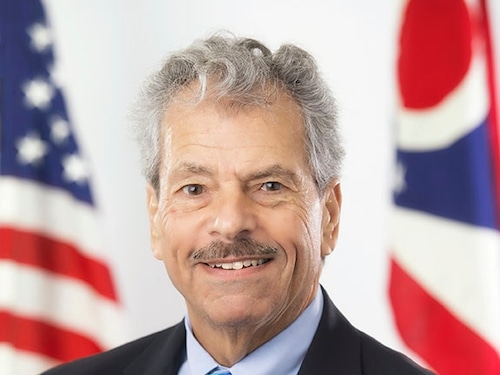
Sam Randazzo, the former chairman of the Public Utilities Commission of Ohio. (Photo from Public Utilities Commission of Ohio)
By
COLUMBUS, Ohio -- Gov. Mike DeWine soon will consider a replacement for the state’s most powerful utility regulator, a man whose share of public attention increased dramatically after the FBI searched his home last month.
Sam Randazzo, a longtime fixture on Ohio’s energy law scene, quit as chairman of the Public Utilities Commission of Ohio the same week as the raid, amid questions over his ties to a federal corruption investigation into a sweeping energy bill – House Bill 6. The feds say their probe uncovered the largest bribery scheme in Ohio history – a scheme in which they say FirstEnergy Corp. money was used to get the nuclear plant bailout bill passed and protect it from being repealed.
Elon Musk's X Settles Lawsuit With Trump Over Jan 6. DeplatformingElon Musk's X Settles Lawsuit With Trump Over Jan 6. Deplatforming
Randazzo’s departure also came just after a regulatory filing suggested that he may have received a $4 million payment from FirstEnergy shortly before Gov. Mike DeWine named him as PUCO chair in February 2019.
Those circumstances have brought unusual scrutiny to the typically obscure process of state energy regulations. Critics are sure to question any decision DeWine makes to replace Randazzo, given the ties between FirstEnergy, senior officials in the DeWine administration and a screening committee that nominates PUCO commissioner candidates. Advocates have called for tougher disclosure requirements for PUCO members, as well as for the PUCO to throw out and reconsider decisions Randazzo made as chairman that affected FirstEnergy.
Rob Kelter, a senior attorney with the Environmental Law and Policy Center, an advocacy group, called the $4 million payment described in the FirstEnergy filing “staggeringly corrupt.” The ELPC has called for all PUCO cases Randazzo voted on involving FirstEnergy, including one in November 2019 that rescinded a requirement that FirstEnergy undergo a comprehensive review of its electricity rates in 2024.
“Essentially, the entire commission process has been tainted,” he said.
How PUCO commissioners are chosen
DeWine will choose the next PUCO commissioner from a list proposed by the PUCO Nominating Council. The 12-member panel includes representatives of the energy industry, and organized labor, and was set up in the 1980s as an alternative to making PUCO commissioners elected positions. It began the process this week to replace Randazzo, soliciting applications from the public.
The commission’s chair is Mike Koren, who for years has lobbied for FirstEnergy and Boich Companies, a coal company that does business with FirstEnergy. Koren is appointed by the governor’s office as a representative of the regulated-utility industry.
Another council member, Mark Totman, is a lobbyist for the International Union of Operating Engineers Local 18, which gave $250,000 to Generation Now, the political nonprofit prosecutors say was used to funnel bribes to then-House Speaker Larry Householder, who was arrested and charged as part of the HB6 probe.
Given Koren’s lobbying job, Michael Watkins, another nominating committee member who represents Ohio consumers, suggested the panel select a new chair. Koren and the rest of the panel declined to do so.
‘One of the most knowledgeable people around the Statehouse’
The panel previously submitted Randazzo to fill a PUCO vacancy in January 2019, shortly after DeWine took office.
The move drew immediate public criticism from environmentalists and other advocates of renewable energy, given Randazzo’s longstanding, vocal opposition to renewable energy mandates Ohio lawmakers imposed in 2008. It also drew quieter criticism from other traditional electric utilities, including AEP, which privately lobbied against the hiring.
“I think there were certainly two schools of thought,” said Todd Snitchler, a PUCO chairman under Gov. John Kasich who now runs a trade association for electricity generators. “One was that Sam would be able to take off his advocacy hat and finish his career as chair of the commission, and use that as the capstone of his career. And certainly, there were some regulated utilities who were concerned, because they didn’t feel they had a good working relationship with him.”
“Some electric utilities that Sam always opposed in rate case proceedings and would oppose their filings routinely. AEP being one of them,” Snitchler said. “And there were other utilities that he never opposed and always seemed to work with them in an effort to get their filings approved, and FirstEnergy would be one of those entities.”
“It was known in utility circles that he had a very cozy relationship [with FirstEnergy] on both a professional and personal level,” said Kelter, the attorney with the Environmental Law and Policy Center.
But Randazzo also was widely seen as an expert in Ohio energy law, an arcane subject that’s of keen interest to utilities and others in a small group of key players, including environmentalists and groups representing electricity customers.
“He’s probably one of the most knowledgeable people around the Statehouse at understanding the full scope of Ohio’s energy and utility and regulatory issues,” said one Columbus lobbyist.
Randazzo, a native of Cuyahoga Falls, attended law school while he worked as a technical staffer at the PUCO, according to his state résumé. After graduating in 1975, he worked there as an assistant attorney general for two years before getting into private practice, specializing in energy issues and utilities.
In 1992, he began working as general counsel to the Industrial Energy Users-Ohio, a trade group representing manufacturers. It’s his work with this group that caused him to get involved in every major PUCO case involving electricity rates. He also emerged as a major proponent of energy deregulation, which gradually has converted Ohio’s laws to require electricity producers to compete in something more resembling an open marketplace, as opposed to a state-controlled monopoly.
He played a role in 2008 in writing the energy law that power companies operate under today, with his name showing up as the creator of an electronic document that then-House Speaker Jon Husted, who’s now the lieutenant governor, circulated around the state. The law, signed by then-Gov. Ted Strickland, required Ohio to generate a certain percentage of its electricity through renewable sources. It also has allowed for utilities to pad their customers’ bills with standalone charges while delaying comprehensive rate reviews that used to be the norm.
Randazzo’s hiring
In early 2019, Randazzo was winding down his law practice, spending time at his second home in Florida, planning his retirement. But then he got a call from DeWine’s transition team after DeWine won the November 2018 election.
At first, Randazzo said he was asked to share his general thoughts about Ohio energy policy, according to testimony he gave during a confirmation hearing before the Ohio Senate in April 2019.
“Eventually, this conversation shifted to see if I might be interested in going back to government service at PUCO,” he said. After discussing the issue with his wife, he told the governor’s team he would consider applying for a PUCO vacancy.
Randazzo’s name was among four the PUCO Nominating Council submitted on Jan. 31, 2019. On Feb. 4, then-PUCO Chairman Asim Haque announced his resignation to take a job elsewhere in the energy industry. And six hours later, DeWine nominated Randazzo for a PUCO seat, designating him as chairman.
Around the same time, FirstEnergy made a $4 million payment to terminate a consulting agreement dating back to 2013, according to afiling the company made with the U.S. Securities and Exchange Commission. The counterparty to the agreement was “an entity associated with an individual who subsequently was appointed to a full-time role as an Ohio government official directly involved” in regulating FirstEnergy’s companies in Ohio, including setting the price for electricity, according to the filing.
The company discovered the payment to the unnamed entity after it launched an internal investigation in response to the House Bill 6 bribery probe. Company officials said FirstEnergy fired former CEO Chuck Jones and two other senior executives over the payment.
“At this time, it has not been determined if the payments were for the purposes represented within the consulting agreement,” the company’s SEC filing reads.
Three days before FirstEnergy disclosed the payment to the unnamed entity, Randazzo’s home in Columbus was searched by the FBI. Federal agents declined to say what they were looking for, but were seen carrying off bags and boxes of items.
DeWine stood by Randazzo, who has not been charged or accused of wrongdoing, saying there was “no indication” he was the subject of an investigation. But Randazzo resigned on Nov. 20, the day after the FirstEnergy filing, saying his presence had become a distraction to the DeWine administration.
Advocates question payment
The disclosure of the filing, and of the payment from FirstEnergy to the unnamed entity, led the Environmental Law and Policy Center to ask the PUCO to overturn and re-open decisions Randazzo made while PUCO chairman that affected FirstEnergy.
In a Nov. 24 legal filing, the group said while it wasn’t 100% certain the $4 million payment went to Randazzo, “the timeline of events suggests” that it did.
Common Cause Ohio, a good-government group, has called on Ohio to tighten its disclosure requirements for PUCO commissioners in light of the news of the $4 million payment.
“One of the important things about disclosure is it provides the public an opportunity to say wait a second, do we actually want this person making decisions on how much we pay on our utility bills?” said Catherine Turcer, the group’s executive director. “It gives us an opportunity to ask ‘Is this person a good fit?’ But if you don’t have good disclosure, then you’re left with finding out way later that things weren’t quite right.”
In his resignation letter to DeWine, Randazzo said he’d disclosed his business relationships before he was hired.
In his application to the DeWine administration, Randazzo said he would quit his role with the Industrial Energy Users-Ohio if he were chosen. He said he did not own or control any stocks or bonds with a public utility, a requirement of the job.
And in required ethics disclosures he filed, he disclosed receiving income for consulting through two companies he owned: the Sustainability Funding Alliance of Ohio, and the IEU Administration Company. He was not required to disclose how much money he made.
Both companies have been listed in bankruptcy court records as creditors by Energy Harbor, the former FirstEnergy subsidiary that owns the nuclear plants that House Bill 6 funded.
RECOMMENDED
“Regardless of disclosures of prior business relationships to you and your team prior to my PUCO Nominating Council interview (January 31, 2019), the impression left by an FBI raid on our home, the statement included in FirstEnergy Corp.’s filing with the Securities and Exchange Commission yesterday and the accompanying publicity will, right or wrong, fuel suspicions about and controversy over decisions I may render in my current capacity,” Randazzo wrote. “In present times, when you, good sir, are valiantly battling to save Ohioans from the surging attack of COVID-19, there is no room or time for me to be a distraction.”
In his resignation letter, Randazzo said he was proud of the work he’d done as PUCO chair, and he called for additional deregulation of Ohio’s energy providers.
“In any event, I believe my actions as Chair have done much to put the PUCO and OPSB [the Ohio Power Siting Board, another agency Randazzo chaired] on a better foundation to serve the public interest. In the days ahead, I hope the Commissioners and Board Members who remain or follow me can continue this important mission,” he said.
---
https://www.cleveland.com/open/2018/04/firstenergy_pac_writes_big_che.html
COLUMBUS, Ohio--FirstEnergy Corp. has opened up its wallet for a number of Ohio House Republican candidates, including House speaker candidate Larry Householder and many of his allies.
In the first two months of 2018, the Akron-based power company's political action committee donated more than $5,000 to the Perry County Republican and a total of about $149,000 to more than a dozen other House candidates, state campaign finance records show. Most, if not all, of the recipients have either backed Householder for speaker or are considered by many to be on his side, although some have not come out publicly in support of him.
During that time, FirstEnergy's PAC made only a handful of other political donations - none of which went to supporters of Householder's rival for the speaker's gavel, GOP Rep. Ryan Smith.
It's unclear exactly why FirstEnergy decided to put so much money behind Team Householder. But Householder has enjoyed a warm relationship with the company - last year, he and one of his sons used a FirstEnergy corporate plane to attend President Donald Trump's inauguration.
Householder and a number of his legislative allies are also co-sponsors of legislation that would allow FirstEnergy subsidiaries to charge customers about $2.50 more per month to subsidize the Davis-Besse and Perry nuclear power plants in northern Ohio. The legislation, House Bill 381, has been stalled in committee since it was introduced last fall.
The subsidiaries, FirstEnergy Solutions and the FirstEnergy Nuclear Operating Co., announced in late March that they plan to close both nuclear plants within the next three years, on the grounds that they cannot compete with new ultra-efficient gas turbine power plants.
FirstEnergy Solutions filed for bankruptcy protection earlier this month.
FirstEnergy spokesman Doug Colafella didn't directly say why the company's PAC made the contributions. In a statement, Colafella said, "FirstEnergy's Political Action Committee supports both Republican and Democrat candidates and officeholders whose interests align with those of our customers, employees and shareholders. Our PAC funds are distributed based on the recommendations of an internal committee of employee-members."
Householder and his spokesman, Chris Schrimpf, didn't return phone calls seeking comment.
FirstEnergy PAC donations
| Candidate | District | Donation |
|---|---|---|
| Brian Baldridge | 90 | $11,000 |
| Tim Barhorst | 19 | $7,500 |
| Jamie Callender | 61 | $12,700 |
| Jon Cross | 83 | $12,700 |
| Anthony DeVitis | 36 | $7,707 |
| Jay Edwards | 94 | $8,708 |
| Travis Faber | 84 | $11,000 |
| Josh Hagan | 50 | $5,500 |
| Stu Harris | 21 | $5,000 |
| Larry Householder | 72 | $5,207 |
| Kris Jordan | 67 | $11,700 |
| Jena Powell | 80 | $12,700 |
| Mike Rasor | 37 | $12,700 |
| Tracy Richardson | 87 | $7,500 |
| Jim Trakas | 6 | $12,700 |
| Shane Wilkin | 91 | $10,000 |
Source: Ohio secretary of state's office
intercept 719
find shillenberger connects]
TUESDAY, a dark-money effort linked primarily to the Ohio nuclear industry delivered an audacious payoff, as a newly elected state legislature overcame years of opposition to shower a $1.1 billion bailout on two state nuclear plants.
Several dark-money groups spent millions to replace key Republican state legislators in the spring of 2018, followed by a furious lobbying campaign to make sure those new lawmakers elected a new House speaker — one who was amenable to the subsidy. The nuclear industry in Ohio has been on the brink of failure for several years, but previous legislatures had objected to a bailout, reading the writing on the wall: Nuclear power is neither a cost-effective solution for power nor an effective response to climate change, despite hopes for its success.
:{:{
The dark-money effort deployed a}: variety of vehicles }:that went by names like the Conservative Leadership Allianceand the Ohio Clean Energy Jobs Alliance. Murray Energy, a coal company, also gave heavilyto current state House Speaker Larry Householder and his allied candidates, and the bailout from Ohio also includes subsidies to prop up failing coal plants in the state.
In April 2018, two nuclear plants, both owned by the electric utility FirstEnergy, filed for bankruptcy and have been threatening to cease operations if not bailed out. They were under increasing pressure to compete with cheaper alternatives, ranging from natural gas to wind and solar. The bankruptcy filings give a glimpse into the company’s political spending: more than $30 million from 2018-2019 on lobbying and campaigns in Ohio and Pennsylvania (where the company also sought a bailout, so far unsuccessfully).
The payoff is extraordinary in degree — something like $30 million for campaigns in Ohio and Pennsylvania to win $1.1 billion in government subsidy. But it is similar in kind to other nuclear projects across the country. According to the Environmental Working Group, a nonprofit devoted to research and advocacy, five cash-strapped states across the country have foisted more than $15 billion in subsidies on failing nuclear power plants since 2016, the latest sign that nuclear is unable to stand in a competitive energy market against lower-cost renewables.
IN OHIO, the state House battle was fought in at least 18 competitive Republican primaries, all proxy battles between Reps. Ryan Smith, the incumbent House speaker, and Larry Householder. Householder was a co-sponsor of the nuclear bailout billthat stalled in the legislature in 2018, making him a key ally to the nuclear industry.Several dark-money vehicles backed the pro-Householder candidates, andwon 15 of the 18 races. Four pro-Householder candidates lost in the general election, but the primary wins put Householder in contention for the speakership.
The industry even targeted one Republican state representative who had rebuffed FirstEnergy’s advances before making a bid for Congress. “I didn’t budge when they came into my office to lobby me,” former state Rep. Christina Hagansaidof FirstEnergy. “I became the target of the company and the members of our leadership team who wanted to get it done but couldn’t because I wasn’t going to be supportive. I’m sure they just wanted to make an example of me in my race for higher office that if you don’t play well, this is what will happen to you.”
On top of the dark money, FirstEnergy’s political action committees directly contributed more than $150,000to the campaigns of Householder and candidates aligned with him, while giving none to Smith last cycle. Of the pro-Householder candidates who won their races, all but one supported the bailout.
Dark money also contributed to ads on Ohio television.Generation Nowspent almost $2 million on ads in favor of the bailout, and perhaps much more. The Growth & Opportunity PAC, which got more than$1 million in donations from Generation Now, also blanketed the state House districts with television ads in favor of Republican candidates. Generation Now’s office is listed as the Columbus address of a longtime Householder adviser, according to the Cincinnati Enquirer.
The new lawmakers entered office in January, and Householder, who, along with his son, flew to Donald Trump’s inauguration on a FirstEnergy-chartered plane, won with the backing of 26 Republican and 26 Democratic representatives, while Smith got the votes of 34 and 11, respectively. Householder was able to win the support of those Democrats with his opposition to right-to-work legislation, as unions pushed Democrats to back him in the speaker fight with Smith. :{
}:
On July 23, Smith and 14 other House Republicans voted against the bailout, but Householder was able to push it through 51-38, backed by nine Democrats. It was quickly signed by the state’s new governor, Republican Mike DeWine. (FirstEnergy also contributed to the campaign of DeWine, who then tapped a FirstEnergy lobbyistto be his liaison to the legislature.)That month, the legislature also began work on reviving the nuclear bill known as HB 6. At least seven witnesses who spoke to the legislature in support of the bill drew on testimony written by a FirstEnergy lobbying firm, according to a review of metadata by the Energy and Policy Institute, which has closely tracked the fight.
The Ohio legislation reads as if it was designed specifically to undermine the planet’s continued capacity to support a steady human population. Along with propping up the state’s two nuclear plants, it also provides subsidies for failing coal plants in the state, as well as one in Indiana. It cuts and eventually ends any subsidies for new wind or solar, while approving just $20 million annually for large-scale solar projects that have already been approved. It even ends programs aimed at encouraging Ohio residents to reduce power consumption, through upgrades to appliances or heating and cooling systems.
In April, Householder denied that the corporate PAC money had anything to do with the nuclear bill, and said that FirstEnergy should be applauded for its civic engagement.“For them to care about those people who are trying to serve the state of Ohio and make sure they’ve got good quality candidates moving forward I think is important for anybody,” he said.
When asked specifically about ads from the dark money–funded Growth & Opportunity PAC, Householder said, “I’ll tell you who’s paying for these ads: it’s working men and women from Ohio, who want to save their jobs and it’s Ohio corporations, headquartered in Ohio, that want to stay here. That’s who’s paying for it.” He did not respond to a request for comment from The Intercept.
THE ROLE OF the nuclear industry in the shuffling of speakers was not prominent in the news coverage of the politics, but it wasn’t entirely unknown. Gregory Jaczko, who served as chair of the Nuclear Regulatory Commission from 2009 to 2012, said that the industry’s role in the affair was visible to those paying close attention. “FirstEnergy has been trying, really, for years to get this subsidy, and the legislature kept denying it, and nobody really, even the previous governor [John Kasich] was not really supportive of it,” he said. “FirstEnergy put a lot of money into local races and essentially turned the legislature around. So they ran this thing through.”
On a policy level, the legislation is appalling, said Jaczko, who has become an outspoken critic of the industry, and recently published a book, “Confessions of a Rogue Nuclear Regulator.” Building new wind and solar capacity would not only be a better climate solution and produce more jobs, he said, it would be far cheaper for the state, and it’s the direction Ohio will have to go eventually anyway. Wind and solar “creates a brand new economy, which is going to be a future-looking economy rather than a dying economy,” said the former NRC chair. “Nuclear is dying. It’s dying in Ohio.”
Winning the speakership is quite the comeback for Householder, whose career appeared to be cut short in the mid-2000s by a federal investigation intokickbacks and a pay-to-play scandal. Ohio Secretary of State Ken Blackwell, a Republican, had referred the case to the FBI; it was resolved without charges.Householder won election back to the House in 2016, and during his first cycle, the incumbent speaker resigned amid his own FBI investigation. Smith took over on a temporary basis, leading to the battle between the two.The irony, he noted, is that Ohio had planned to be a testing ground for next-generation smaller nuclear power plants, which purported to solve some of the problems associated with nuclear energy, and won federal subsidies to try to build them.
“As soon as they got that money from the Department of Energy, they decided they weren’t going to pursue these reactors anymore,” Jaczko said. No new nuclear plants are planned for Ohio or anywhere else in the United States, and the closure of the two currently operating facilities is not a matter of if, but when. The billion-dollar subsidy only delays the transition to wind and solar, he said.
Ohio’s two senators, both of whose campaigns have taken money from FirstEnergy throughout their careers, were on different pages when asked about the billion-dollar bailout. Republican Sen. Rob Portman, whose campaigns have taken at least $615,000 from FirstEnergy PACs since his first run for Senate in 2009, said he didn’t know enough of the details of the decision and was swamped with other things this week.
Democratic Sen. Sherrod Brown, though, was indignant.“You don’t bail out utility companies and raise prices for customers,” Brown said. The utility has contributed around $380,000 to Brown’s campaigns since 1997, when he was in the House of Representatives. “And you don’t undermine the efforts our state has made on alternative energy and other energy sources. So it’s just wrong.” Asked about reports of the involvement of dark-money groups in pushing the bailout, Brown said: “Of course there is.”
“I mean, these things happen because these monied interests control the state legislature. There’s no question about it.”
In a statement Brown’s office sent later in the day, the senator added that expending enormous resources to prop up outdated sources of power would only hurt Ohio going forward. “Of course we need to make sure our state has access to reliable power, but we shouldn’t do that by raising the utility bills of hardworking Ohioans,” Brown said. “We need solutions designed for Ohio workers and families, not Wall Street and fat-cat lobbyists. By eliminating the renewable standard, Ohio is going backward when almost every other state is looking to the good-paying jobs of the future. It’s short-sighted and it is going to result in significant lost opportunities in our state—our businesses will be less competitive, energy developers will avoid investing in Ohio, and there will be fewer jobs in this growing sector.”
The cost of the nuclear bailout for Ohio ratepayers is a bargain compared to the bill being given to residents in South Carolina. The cost of a failed program to build a nuclear power plant there topped $9 billion. Two of the companies involved — Dominion Energy and SCANA Corporation — entered into a buyout and settled a large portion of the bill, leaving ratepayers responsible for footing the remaining $2.3 billion, more than twice the Ohio figure. Not a single kilowatt of energy was produced in South Carolina by the project, which consisted largely of a hole in the ground.
The Ohio subsidies for coal and nuclear, which follow bailouts doled out by Illinois, New York, and New Jersey, underscore the futility of pursuing nuclear power.
Nuclear power once offered the tantalizing promise of endless cheap and clean energy, and to this day remains a hope in the minds of some climate activists. But in reality, nuclear hasn’t met the promise. It is far more expensive to produce nuclear power than wind or solar, and the world has not solved the intractable problem of nuclear waste, to say nothing of safety. To truly meet the scale of the climate crisis with nuclear power, Jaczko said, the world would need to start construction on roughly 1,000 plants this year. But because of the safety concerns, waste problem, and astronomical cost, there are just a handful being built. Ohio lawmakers, though, are hanging on to the bitter end — courtesy of Ohio’s residents.... Ohio homeowners and businesses are now stuck paying more to keep old, uneconomical power plants running, and money-saving energy efficiency programs will likely disappear.