Renewable Portfolio Stds Pgms RPS
no notes?
NO MERRI
QUITE LONG NO BAK
:{koch STRATA UTAH RANDY SIMMONS YONK IER
PAID REPORT BOGUS
DROZ SCHNARE
FOF
PERRY}:
---
see solar wars, koch alec
==
BS study IPA berman
In 2015, the Center for Media and Democracy and the Energy and Policy Institute revealed how IPA operated, when it reported that the Beacon Hill Institute was releasing misleading studies attacking President Obama's Clean Power Plan, an ambitious multi-year effort to cut carbon pollution and mitigate the harmful effects of climate change.The funding for the study came through the previously unknown group called the Interstate Policy Alliance.
In many of its sponsored research "studies," IPA promotes fossil fuel development over renewables. This has been a long-term agenda item of the American Legislative Exchange Council (ALEC), the corporate funded bill mill and many State Policy Network "think tanks" and advocacy groups funded by Bradley. In addition, the Bradley documents examined by CMD show Bradley is funding numerous climate denial groups, including Myron Ebell's Center for Energy and Environment at the Competitive Enterprise Institute and the Heartland Institute.
- One IPA report, touts the tens of billions of revenue North Carolina, South Carolina, and Virginia might gain from offshore oiland gas development in the Atlantic Ocean.
- Another report argues that fossil fuel development of federal lands in seven Rocky Mountain states will grow the economies at a faster pace than renewables.
- Another:{ promotes the transfer of federal lands to states, claiming that revenues from taxes and fees will rapidly flow to states.}:
- And yet another study criticizes the Renewable Portfolio Standards in 29 states and D.C. as costly to consumers, while ignoring any benefits to jobs or the environment.
ref2
https://thinkprogress.org/kochs-fund-energy-think-tanks-in-utah-482ab143e66d/
When asmall think tank, funded in large part by petrochemical billionaire Charles Koch’s foundations, and a Utah State Universityinstitute began publishing the same research, people started to take notice. Further examination of the relationship is leading critics to question whether the Koch brothers are using the cover of an academic institution to push their anti-renewable energy, pro-fossil fuel agenda to a larger audience.
Strata Policy, an independent think tank founded by Utah State University professor Randy Simmons, is closely tied with a university research group called the Institute of Political Economy. Simmons and the other professors who staff the Koch-funded Institute of Political Economy also hold positions at Strata Policy. Simmons, who previouslyserved as the Charles G. Koch Professor of Political Economy at the university, runs both the on-campus and off-campus groups.
“It seems obvious that they are gleaning the university’s brand and prestige for not only the Institute of Political Economy, but also Strata,” Connor Gibson, a researcher for Greenpeace’s investigations team, told ThinkProgress. Gibson cited a report released earlier this year critical of North Carolina’s pro-renewable energy policy that wasco-branded with the names of both Strata Policy and the Institute of Political Economy.
Charles and David Koch are well-known for bankrolling universities as part of their strategy to bring a conservative worldview to new generations of students. At the same time, the brothers spend millions funding independent think tanks and advocacy groups that work to implement corporate-friendly policies at the federal and state levels.
With both Strata Policy and the Institute of Political Economy, the Kochs have found a way to do both — influence students and policymakers — within the confines of a single university. They are funding an independent think tank staffed by Utah State University professors, while simultaneously giving millions to the university to spread an anti-regulation ideology among its students.
“They are gleaning the university’s brand and prestige for not only the Institute of Political Economy, but also Strata.”
Where Utah State University differs from other Koch-funded schools is that Charles Koch is giving money to both on-campus and off-campus operations, according to Gibson. “It’s all the same people. I don’t know if they even try to determine where the ethical boundaries are and whether they are getting taxpayer money from the legislature or whether they are getting money from Charles Koch and whether the output is coming from the university brand or coming from the Strata brand,” he said. “They really don’t seem to care.”
According to the university, funding that comes to the Institute of Political Economy goes to support faculty salaries and student programming. Money has never flowed from the Institute of Political Economy to Strata Policy, “an off-campus organization unaffiliated with either the university at large or the university’s Institute of Political Economy,” said Tim Vitale, executive director of public relations and marketing for Utah State University.
The Institute of Political Economy has produced research projects that are then shared by Strata Policy via social media and on its website, Simmons said in an email to ThinkProgress, but he maintained that the relationship was purely research-focused.
“On some reports, the authors are listed as affiliated with Strata, because those authors were contributors to the project. While Strata employees sometimes have the opportunity to contribute to IPE projects due to their expertise on a given topic, they are not compensated by Utah State University or the Institute of Political Economy for their contributions,” Simmons explained.
This is how the Kochs’ anti-renewable agenda becomes White House policy
Koch-tied officials “got their wish” with Trump’s attacks on climate action, environment.
Simmons has produced Institute of Political Economy projects as part of his normal research load, Vitale said. The Institute for Political Economy has never promoted Strata Policy, although Strata Policy might have used Institute for Policy research for its own reasons, he explained. “Other organizations — any organization — can access IPE research and use it as they see fit,” he said.
Utah State University, a public university, climbed into second place on the list of Koch-funded universities earlier this year when the schoolaccepted a $25 million donation from the Charles Koch Foundation. Prior to the latest donation, the university’s Institute of Political Economy was already receiving large sums from the Kochs.
The university will receive the Koch money over the next 10 years in increments of $2.5 million a year. George Mason University, a public university in Virginia, is the largest recipient of Koch funding,earning it the nickname “Koch U.”
The Huntsman Foundation, founded by conservative industrialist Jon M. Huntsman Sr., alsodonated $25 million to the university to launch theCenter for Growth and Opportunityand expand the Huntsman Scholar Program. The new center will be located at the Jon M. Huntsman School of Business, named after the industrialist. The Koch and Huntsman money will allow the school to hire several additional professors.
“The Kochs have extended influence to institutions of higher education, setting up grants at universities to hire professors that teach the Kochs’ anti-tax, anti-regulation business and political philosophies to mold young minds to fall in step with the Kochs’ industrial wishes going forward through the 21st century,” Salt Lake Tribune columnist Paul Rollywrote in 2016.
While Charles Koch gives a substantial amount to Utah State University, foundations and organizations associated with both brothers are also funding Strata Policy to advance many of the same anti-renewable energy, pro-fossil fuel aims. A ThinkProgress review ofStrata Policy’s funders (according to data provided by Conservative Transparency, Guidestar, and CitizenAudit revealed that since 2011, its donations included at least:}:
- $2,260,500 from the Charles Koch Foundation, the primary private foundation through which Charles Koch funds higher education programs.
- $183,000 from the Searle Freedom Trust, which consists of wealth inherited from G.D. Searle & Company, a company that created the artificial sweetener aspartame marketed as NutraSweet. The foundation also has funded Americans for Prosperity, the American Enterprise Institute, the American Legislative Exchange Council, the Heartland Institute, and many other right-wing groups.
- $165,559 from the Apgar Foundation, a foundation created by the widow of John “Jack” N. Apgar Jr., founder of Somerset Tire Service, an automotive service and tire company based in New Jersey. The foundation was created topromote the teaching of “Western Civilization” on college campuses.
- $93,000 from theInstitute for Energy Research, a right-wing energy think tank funded by groups linked to the Koch brothers.
- $51,600 from the Charles Koch Institute, Charles Koch’s anti-government “educational” arm created from the Charles G. Koch Charitable Foundation in September 2011.
Strata Policy describes itself as the “premier research hub on environmental, energy, and public land issues.” The Institute of Political Economy focuses on similar energy and environmental issues. Both entities have advocated against renewable portfolio standards in states, published anti-renewable energy reports, and sent Utah State University professors to testify in states against renewable energy.
In a 2015report opposing a renewable portfolio standard in Kansas, Strata Policy and the Institute of Political Economy concluded that the standard “will increase fiscal and economic costs significantly between now and 2020” that will include a $171-million “burden” on Kansas electricity ratepayers and a loss of 795 jobs. “When major errors in the study’s methods are corrected, the study’s results actually confirm that state Renewable Energy Portfolio Standards (RPS) like those in Kansas create hundreds of jobs and save consumers tens of millions of dollars,” Michael Goggin, senior director of research at the American Wind Energy Association, wrote in ablog post.
The Institute of Political Economy issued a report in 2016 on a renewable portfolio standard report for Pennsylvania — authored by four out of the five researchers who prepared the co-branded Kansas report — that reached similar conclusions. The report found that Pennsylvania’s renewable portfolio standard has contributed to an increase of 10 percent in the unemployment rate.
Synapse Energy Research, in a study released in late 2016, countered that Pennsylvania’s renewable portfolio standard has not harmed the state’s economy. In fact, the study explains that meeting Pennsylvania’s electric power needs entirely with renewables by 2050 is both achievable — and economic. Instead of greater unemployment, Pennsylvania could see a net increase of nearly 500,000 job‐years from 2015 to 2050 under a scenario in which the state moved to 100-percent renewables during this period, the consulting firm found. (One job for one year equals one “job year” and if that job continues for another 12 months, it’s two “job years.”)
In 2015, Ryan Yonk, an assistant professor at Utah State University and executive director of research at Strata Policy, testified before Ohio and Kansas lawmakers, where renewable energy standards were in jeopardy, to lay out his group’s research in opposition to the state renewable energy policies. Utah State University allows faculty to conduct outside consulting work; faculty members are not permitted to “exploit the institution’s name or their relationship to the institution for personal reasons unrelated to their legitimate academic or professional activities” and must avoid “creating the impression that they are representing the institution in public appearances or statements,” according to the university’s faculty code.
Most recently, Strata Policy partnered with the Institute of Political Economy to refocus on North Carolina as lawmakers were once again debating the state’s renewable energy policy. Updated in 2017, the partner organizations’report found that the renewable portfolio standard in North Carolina has faced opposition since its creation, including from the American Legislative Exchange Council, a Koch-funded group that drafts model legislation for states. “North Carolina is still where the action is,” Gibson said.
The Koch-funded groups, though, failed in their attempt to undermine North Carolina’s renewable energy policy. A new lawcreated a competitive bidding process that will bring more than 2.6 gigawatts of new solar into service over a three-and-a-half-year period. The Solar Energy Industries Association lauded the bill as one that “will significantly enhance the solar market in North Carolina.”
Strata Policy “waged these state-level attacks” because “they want to drive regulation to the state, where it’s more controllable and because that’s where their dollar really goes the farthest ” Gibson said.
Recently, Strata Policy has begun to expand its portfolio beyond attacks on renewable energy to embrace a Republican-led effort to allow greater use of public lands by extraction companies. Two years ago, the think tank won a public relations contract from the state of Utah to promote its efforts to force the federal government to transfer control of Bureau of Land Management and U.S. Forest Service lands to the state. The Utah Legislatureapproved $2 million in funding in 2015 for Strata Policy and other groups to promote the benefits of turning over federal land to the state.
Utah Republicans believe that allowing the state to control the lands will create more economic value by clearing the way for more oil wells, coal mines, and tree harvests. Public lands supporters fear states would sell off the lands that belong to all Americans, allowing industry to destroy the environment.
Simmons’ Strata Policy “landed the public relations contract for the Utah Legislature’s efforts to wrest control of 31 million acres of public land from the federal government,” Rolly wrote in his op-ed.
Strata Policy has put out several studies on public lands issues. In a 2016 op-ed, Yonkargued that economic activity in Utah and other Western states is “limited by the decisions of federal land bureaucrats.”
In May, Simmonsauthored a report that recommended the Department of the Interior reduce the size of the Bears Ears National Monument in Utah “to more appropriately encompass sites of legitimate historical and scientific interest.” Native American groups pushed for the monument designation for years to protect their artifacts. The position embraced by Simmons is the same as Republican lawmakers in Utah; once Trump won the presidency, the lawmakers immediately began lobbying the new administration to make reducing the size of the Bears Ears monument a priority.
Tribes gear up for major legal battle with Trump over Bears Ears National Monument
Native leaders baffled by Zinke’s claim that they are “very happy” with a potentially reduced monument.
Strata Policy joined other conservative groups, many of them also funded by the Kochs, to thank President Donald Trump for signing anexecutive order calling for a sweeping review of national monument designations. In the Juneletter to Trump, Strata Policy and the other groups said the support the criteria in the executive “to reduce and rescind egregious national monuments where local support exists to do so.”
The American Lands Council, a group formed to gain control of federal lands across the West, has also received funding from Americans for Prosperity, a group founded by the Kochs. TheIdaho Freedom Foundation, which also signed the letter to Trump, has received funding from Koch-affiliated groups and is a partner organization in the Charles Koch Institute’s Liberty@Work program.
Along with significant funding from the Charles Koch Foundation, Strata Policy has received donations from the Institute for Energy Research, a Washington, D.C.-based think tank that is also funded in part by the Kochs and their affiliated organizations. Simmons’ son, Daniel Simmons, previously worked at the Koch-funded Institute for Energy Research as vice president for policy.
Daniel Simmons now serves in Trump’s Department of Energy as acting assistant secretary for energy efficiency and renewable energy. Prior to joining DOE, the younger Simmonsalso held a top position at the Koch-funded American Energy Alliance, which advocated for the office he now oversees at DOE to be eliminated.
Josh Israel contributed to this piece.
#CLIMATE, #KOCH BROTHERS, #RENEWABLE ENERGY, #SOLAR POWER
---
---
https://insideclimatenews.org/news/27092018/election-2018-governor-races-renewable-energy-wisconsin-maine-michigan-colorado-new-mexico-nevada
Some of the most consequential elections for climate policy this fall could be the 36 governor's races, where a blue wave could position clean energy advocates as a significant counterforce against the Trump administration's fossil fuel agenda.
Republicans currently hold a near-record 33 governorships—a lock on power that has served as a brake on clean energy progress in some areas.
But the tide may be ready to turn. As many as a third of those seats are considered toss-ups or are leaning Democratic in the upcoming election, according to analysts like the Cook Political Report and University of Virginia political scientist Larry Sabato.
Several of the Democratic contenders have 100 percent clean energy commitments in their platforms, and many others support ambitious renewable portfolio standards, net-metering incentives and other climate policies.
[map]
The model for environmental advocates is New Jersey Gov. Phil Murphy, a Democrat elected last November who has reversed several of the policies of his Republican predecessor, Chris Christie. He reinstated New Jersey's membership in the Northeast's carbon cap-and-trade system known as the Regional Greenhouse Gas Initiative, and signed legislation to mandate that utilities obtain 50 percent of their electricity from renewable sources by 2030. With Murphy's first appointee, the state's Public Utility Commission now has a Democratic majority and a mandate to come up with a new program to incentivize rooftop solar.
"The most critical policies are set at the state level," said Adam Browning, executive director of Vote Solar. "When it comes to the renewable energy agenda, the future is very much on the ballot this November."
These are some of the ways state policies could change:
- In Nevada, New Hampshire, New Mexico and Maine, the state legislatures passed renewable energy initiatives in the past year and a half that had bipartisan support—but were vetoed by GOP governors.
- In 38 states, governors have the power to appoint members of public utility commissions—the regulatory bodies that make decisions affecting billions of dollars of energy infrastructure investment.
- Many of the governors elected this fall will have a key role in the reshaping of Congressional districts after the 2020 census.
Advocates and opponents of climate policies and clean energy have been pouring millions of dollars into the races.
...
==
dance w/ stars
b43 signed wind law texas
https://www.dailykos.com/stories/2017/4/18/1654064/-Rick-Perry-forgets-that-wind-energy-works
First Rick Perry forgot about the Department of Energy. Then he forgot what the Department of Energy did. Now that he’s actually, unbelievably, in charge of that same department, ThinkProgress reports that Perry seems to have forgotten where energy comes from.
Perry wrote in the memo, first reported by Bloomberg, that the United States is “blessed as a nation to have an abundance of domestic energy resources, such as coal, natural gas, nuclear, and hydroelectric.” These sources provide a “stable, reliable and resilient grid,” he explained. Nowhere in the memo did Perry list wind, solar, or energy storage as options for grid reliability.
Rick Perry is from Texas. Texas now produces more than 20,000 MW of electricity from wind, making the state the largest producer of wind energy in the nation. Over 12 percent of power in the Lone Star State comes from the abundant breeziness that’s all too familiar to anyone who has spent time in the western part of the state. Wind power in Texas was boosted because thestate senate passed a renewable energy standard in 1999 that was actually signed by George W. Bush. In fact, the blog Knowledge Problem reports that wind power in West Texas grew so quickly that transmission capacity has been the real limiting factor and price of energy in the area has been so low that consumers were actually paid to use power.
In the first half of 2008, prices were below zero nearly 20 percent of the time.
Who was governor of Texas when consumers were getting power for less than free? That would be James Richard "Rick" Perry. But now Perry is not only carefully leaving wind out of his memos, he’s sliding in hints that he has an axe ready for windmills.
The former Texas governor has been tasked by President Donald Trump with prioritizing fossil fuels and nuclear energy over renewables.
While jogging his memory, Perry might want to note that the Bureau of Labor Statistics reports that wind already accounts for twice as many jobs in America as coal, and that while coal has been trending down, wind jobs have been rising.
As the wind energy industry continues to grow, it will provide many opportunities for workers in search of new careers. These careers extend beyond the wind farm: it also takes the efforts of workers in factories and offices to build and operate a turbine.
no link
---
https://www.ecowatch.com/rooftop-solar-2457456703.html
How Utilities Are Trying to Slow Down Rooftop Solar
By David Pomerantz
The New York Times reported earlier this month about how utilities around the country, and their trade group the Edison Electric Institute (EEI), have worked to weaken rooftop solar policies in an attempt to stave off the threat to their business model.
The article featured some of Energy and Policy Institute's reporting, including our :(style="background-color:#ffffffff"):}::{expose of Brian McCormack, former EEI executive and current Chief of Staff to Energy Secretary Rick Perry, for his role in attacking rooftop solar while at EEI, as well as our uncovering of Florida utilities' deceptive anti-solar ballot initiative in that state last year.
Some important aspects of the story of utilities' efforts did not make it into the Times coverage though:
Upset About EEI? There's a Good Chance You're Funding Them
The Times exposed the central role played by the Edison Electric Institute in driving the utility industry's anti-rooftop solar strategy:
At a January 2016 board meeting of the Edison institute, attended by chief executives of the country's largest utilities, Thomas R. Kuhn, the group's president, counseled against complacency.
"Years, ago, I think a lot of people said, 'That's not going to come to our area,'" he said, according to a recording of his remarks made available by a participant. "And now we see it in each and every state," he said.
"EEI is happy to come to any state at any time," he added. "We have two dozen states we are working on."
If you're angry about EEI, here's some bad news for you: there's a high chance that you're paying the salaries of the trade association's executives.
Our report Paying for Politics detailed how the nation's investor-owned electric utility customers are subsidizing EEI via their bills every month. Investor-owned utilities embed their EEI membership dues into rates, forcing their customers to pay for a policy agenda constructed primarily for the benefit of utilities' shareholders, not their customers. Since most customers have no choice about their utility, there's not much they can do about it.
Despite Efforts, Utilities Cannot Stop Distributed Solar Energy
And here's some better news: The Times story focused onIndiana, where utilities scored a victory when they lobbied to pass a law that would unravel net metering, the policy that dictates how much a utility must pay solar owners for the excess electricity they sell back to the grid. But another state reveals how the utilities' strategy can, and often will, backfire.
In Nevada, utility NV Energy succeeded in 2015 at lobbying regulators to reduce net metering payments. The industry perceived it as a victory that other utilities could learn from—in January 2017, EEI and NV Energy announced that Tony Sanchez, an NV Energy senior vice-president who helped lead the utility's efforts in the net metering debates, was taking on a "key loaned executive" role with EEI.
But while the utility industry celebrated what they thought was a big win for NV Energy, Nevadans became furious at the lost solar jobs and the utility's influence at slowing down the growth of a technology that people from across the political spectrum love. The utility's victory was short-lived. In June 2017, the legislature unanimously passed, and Republican Gov. Brian Sandoval signed, a bill to restore the old net metering rates.
Not only that, but last November, the state's voters passed by a large margin a ballot initiative to break up NV Energy's monopoly entirely—political observers in the state perceive the amendment's success in part as a referendum on NV Energy's unpopularity in the wake of the company's attacks on solar.
The Nevada story should serve as a warning for utilities: In places where they try to attack popular pro-solar policies, a popular backlash risks weakening their political capital with regulators and legislators.
In the long run, utilities have even bigger problems than their political fortunes. Even where they win short-term victories on policies like net metering, the combination of rooftop solar panels plus batteries, which are getting cheaper faster than anyone expected, will enable more and more customers to buy less and less electricity from their utilities. Dave Roberts of Vox recently authored a piece on the topic aptly headlined: Utilities fighting against rooftop solar are only hastening their own doom.
As Roberts writes, quoting a recent McKinsey study:
"In a low-cost storage environment," McKinsey writes, the rate structures utilities are monkeying around with "are unlikely to be effective at mitigating load losses." In other words, customers are still going to keep generating more of their own power.
The Times piece was important to expose how utilities are coming after solar. But it's worth remembering that in the long run, they won't stop distributed renewable energy, and will be better served learning to co-exist with it than to keep fighting it.
---
---
http://www.alternet.org/environment/can-trumps-koch-funded-appointees-stall-americas-clean-energy-momentum
When The Washington Post reported earlier this month that President Trump appointed Daniel Simmons to run the Office of Energy Efficiency and Renewable Energy at the U.S. Department of Energy (DOE), the paper called him a “conservative scholar.”
Conservative scholar? “Fossil fuel industry propagandist” would have been more accurate.
A veteran of Charles and David Koch’s climate science denier network, Simmons has spent much of his career disparaging clean energy. His most recent job was at the Institute for Energy Research (IER), where he served as the think tank’s vice president for policy. Prior to joining IER, he was the Natural Resources Task Force director for the American Legislative Exchange Council, a corporation-funded lobby group that, like IER, has been trying to repeal state standards that require electric utilities to use more renewable energy. And before that, he was a research fellow at the libertarian Mercatus Center at George Mason University. All three organizations have received substantial funding from the Koch brothers, owners of the coal, oil and gas conglomerate Koch Industries, who have spent more than $100 million over the last two decades on dozens of think tanks and advocacy groups to spread climate disinformation.
IER and its advocacy arm, the American Energy Alliance (AEA), are particularly indebted to the Kochs for both funding and staffing. Between 2010 and 2014, they received more than $5 million from Koch-controlled funds. And, like Simmons, top IER-AEA officials are well-entrenched members of the Koch network. IER founder and CEO Robert L. Bradley, Jr., for example, is an adjunct scholar at the Koch-founded and -funded Cato Institute and the Koch-funded Competitive Enterprise Institute. He also has been a featured speaker at the Koch-funded Heartland Institute’s annual climate science-bashing conference. IER-AEA President Thomas Pyle, meanwhile, is a former lobbyist for Koch Industries and the National Petrochemical and Refiners Association. Pyle oversaw the Trump Energy Department transition team, which included Simmons and Travis Fisher, an IER economist who also is now on the DOE staff.
Given Simmons’ résumé, it’s no surprise that he belittles efforts to address global warming, disingenuously asserting that the “economic damages” of curbing carbon emissions “would be greater than the damage caused by a warming world.” Never mind that if we continue to burn carbon at the same rate, U.S. property losses by 2050 from sea level rise alone would be astronomical, ranging from $66 billion to $106 billion.
Predictably, Simmons also is a staunch opponent of federal support for wind and solar power. He argues that the “government should get out of the business of betting taxpayer dollars on energy projects,” conveniently ignoring the fact that fossil fuels themselves are heavily subsidized. According to a new analysis by Management Information Services for the Nuclear Energy Institute, fossil fuels have received $666 billion (in 2015 dollars) in federal incentives since 1950, four times what renewable energy sources, including wind, solar, biofuels and biomass, have received. More than 80 percent of that fossil fuel support went to the oil and gas industry, which, according to a 2011 study by DBL Investors, has been receiving an average of $4.86 billion (in 2010 dollars) in federal subsidies every year since 1918.
Perry’s Anti-Renewables Study
Simmons will serve as acting assistant secretary for the Office of Energy Efficiency and Renewable Energy until the Senate confirms someone for the post. He will then settle in as the office’s principal deputy assistant secretary. While it’s too early to find his fingerprints on anything, his former IER colleague, Travis Fisher, has already raised some concerns. Energy Secretary Rick Perry, who also has received generous contributions from the Kochs over the years, tapped Fisher to conduct a study to assess if federal support for renewable energy threatens baseload power generators — nuclear and coal plants — and undermines electricity grid reliability.
Seven members of the Senate Energy and Natural Resources Committee have questioned the rationale for the study. In a letter to Perry, they complained that the “study, as you have framed it, appears to be intended to blame wind and solar power for the financial difficulties facing coal and nuclear electric generators” and criticized the fact that Fisher, who is clearly biased against renewables, was tasked with leading the study. Historically low natural gas prices are largely responsible for recent nuclear and coal plant closures, the senators pointed out, and several recent studies have found that wind and solar power facilities strengthen grid reliability.
The irony here, of course, is Texas — where Perry served as governor from 2000 until 2015 — is the nation’s leading state for wind energy. Lone Star wind turbines generate enough electricity to power 7 million average U.S. households and provide more than 24,000 jobs. On top of that, 10,000 Texans work in the solar industry and another 70,000 work in the energy efficiency field. By comparison, the coal industry employs only 50,000 workers nationwide.
Regardless, Perry likely plans to use Fisher’s grid reliability study as a pretext for rolling back incentives for wind and solar and boosting coal, one of President Trump’s campaign promises. Likewise, the study could give the Trump administration ammunition to attack state standards requiring utilities to increase their use of renewables.
Clean Energy Progress at the State Level
States are where the action is — and likely will continue to be — given the Trump administration’s aversion to renewable energy and years of gridlock on Capitol Hill. “There’s a lot of clean energy momentum across the country, including in states where you might not expect it,” said John Rogers, a senior energy analyst at the Union of Concerned Scientists (UCS) and lead author of a recent reportrating state-by-state progress. “The federal government has been playing an important role in encouraging renewable energy, efficiency and vehicle electrification—at least until recently—but we found that the states that have shown leadership are already reaping economic and environmental benefits, including new jobs, cleaner air and lower public health risks.”
Indeed, the growth of clean energy across the country has been nothing short of stupendous. Wind power generation, for example, increased more than tenfold over the past decade, according to the UCS report, while its cost dropped by two-thirds over the last six years. Wind farms in 41 states now provide enough electricity to power more than 20 million average U.S. households. Solar power capacity, meanwhile, has jumped more than 900 percent since 2011, while the cost of residential solar electric power fell by more than 50 percent since 2009 and large-scale solar costs declined even more.
The public is, by and large, on board. A new Pew Research Center poll found that 83 percent of Americans say expanding the use of renewable energy is a “top” or “important” national priority. Further, 54 percent of the survey respondents agree that “government regulations are necessary to encourage businesses and consumers to rely more on renewable energy sources.”
Renewable energy’s remarkable track record has encouraged a number of states to up the ante.Just a few years ago, ambitious states set a goal of generating 25 percent to 30 percent of their electricity from renewable energy. Today, six of the 29 states with renewable energy standards are aiming to generate 50 percent or more of their electricity from wind, solar and other clean sources.
That’s the good news. The bad news is Koch surrogates have been targeting these state standards for years, and now two former IER staff members — not to mention their new boss — are in a position to do something about them. Certainly it would be the height of hypocrisy for an administration that extols states’ rights to try to scuttle state renewable energy standards, but for the Trump administration, hypocrisy is the norm. With so much clean energy momentum in blue and red states alike, the open question is just how much damage Trump’s DOE appointees will be able to do.
==
ecowatch
http://www.ecowatch.com/trump-state-renewable-energy-goals-2381603128.html
During an on-stage interview, Perry was asked if the administration would interfere with state policies requiring utilities to get power from renewable sources. Such a move would potentially destroy efforts by California, New York and other states to fight climate change by encouraging the growth of clean power.
Perry didn't rule it out, saying the reliability of the grid was a matter of national security.
"That's a conversation that will occur over the next few years," Perry said. "There may be issues that are so important that the federal government can intervene."
And according to Time's Justin Worland:
During a question and answer period, Perry also suggested that increased reliance on renewable energy sources like wind and solar might make the grid unreliable given they only work when the sun is shining and the wind is blowing, creating national security concerns. The Trump administration might try to preempt state and local governments that use policy to encourage clean energy to address those concerns, Perry said.
"There's a discussion, some of it very classified that will be occurring as we go further," Perry said. "The conversation needs to happen so the local governors and legislators, mayors and city council understand what's at stake here in making sure that our energy security is substantial."
Saqib Rahim of E&E News provided a slightly different quote from Perry:
"There's a conversation, there's a discussion, some of it obviously very classified, that will be occurring as we go forward, to make sure that we have the decisions made by Congress, in a lot of these cases, to protect the security interests of America," he said at BNEF's The Future of Energy Summit, "and that states and local entities do in fact get preempted with some of those decisions."
Perry's remarks re-sparked earlier concerns that the Trump administration could seek to preempt renewable energy standard policies that are now in place in 29 states, as well as renewable energy goals adopted by another nine states. The growing number of local communities that have committed to transitioning to 100 percent renewable energy could also come under fire from the Trump administration.
Renewable Energy Is Reliable and Makes America Safer—Just Ask the Department of Energy
Rick Perry is also facing scrutiny for ordering a study examining "electricity markets and reliability" that was tasked to his Chief of Staff Brian McCormack, who previously played a central role in attacks against rooftop solar for the Edison Electric Institute. Also named to lead work on the study is political appointee Travis Fisher. Fisher previously worked for the Institute for Energy Research (IER) and American Energy Alliance (AEA), which have received ample funding from the Koch brothers and coal industry. IER and AEA have long sought to undermine renewable energy standards in states like North Carolina, a national leader in solar energy.
Christian Roselund of PV Magazine responded to Perry's study order by pointing out that the National Renewable Energy Laboratory (NREL)—one of the Dept. of Energy's 17 National Laboratories—has already written studies that show we can rely on renewable energy to provide much more of our electricity than it does today. In fact, one 2012 NREL study found that we could get 80 percent of our electricity from renewable sources by 2050 using existing technologies. Other studies by states and grid operators confirm that renewable energy is reliable.
Another NREL study documented the significant health and environmental benefits generated by the state renewable energy standards that the Trump administration could try to preempt. In short, these policies make Americans safer by reducing harmful pollution emitted when we burn fossil fuels—especially coal—to produce electricity.
Other reports by clean energy experts have documented the economic security benefits of these state renewable energy standards, which have supported the growth of jobs in the booming solar and wind power industries.
Real world experience also shows that renewable energy is working just fine. Texas, the state where Rick Perry was governor, actually leads the nation in wind energy generation. In fact, nearly a quarterof the electricity generated in Texas during the first quarter of 2017 came from wind.
Ask the Department of Defense, Too
The Dept. of Defense does not appear to share the Trump administration's concerns about renewable energy. In fact, the military has made significant investments in renewable energy in order to enhance national security—an investment that continues with Trump in the White House. The U.S. Navy just recently refuted misleading claims that a new wind farm could interfere with a radar system made by some Republican lawmakers in North Carolina who wrote a letter to the Trump administration.
Climate Change Is a Real Threat to Energy and National Security
In 2015, the Dept. of Energy released a report that documented the threat climate change poses to energy security—and by extension national security—in every region of the U.S.
The Dept. of Defense has also documented the national security risks posed by climate change— risks James Mattis acknowledged during his confirmation as Trump's Secretary of Defense.
Trump's efforts to rollback limits on carbon dioxide pollution from power plants and his embrace of the so-called "clean coal" put the nation's energy and national security at further risk from climate change. Preempting state and local support for renewables would only increase those risks.
Rick Perry Could Support Renewable Energy by Working for a Smart Grid
Greentech Media reported that Perry made only "sparse" mention of renewable energy at the Bloomberg New Energy Finance Summit, but did say he wants to "help renewable energy make its way to the grid … "
Preempting local and state support for renewable energy would only ensure that less renewable energy makes its way to the grid. Perry could instead take positive steps to support integration of renewable energy by working to build a smart grid, the topic of a Dept. of Energy website. He could also support the energy storage revolution that is now underway, thanks in part to earlier investments by the Dept. of Energy.
Unfortunately, the Trump administration's energy policy seems to more squarely align with fossil fuel and utility interests who seek to undermine state and local support for renewable energy.
The Trump Team Is Full of Opponents of State and Local Support for Renewable Energy
Travis Fisher is not the only political pick by the Trump administration that comes with a history of attacking state and local policies that have fueled the growth of renewable energy to benefit funders in the fossil fuel or utility industry.
Trump tapped Thomas Pyle, also of the Institute for Energy Research (IER) and American Energy Alliance (AEA), to run his Dept. of Energy transition team. IER and AEA have targeted state renewable energy standard policies with misleading attacks for years. During the 2016 election, Trump responded to an AEA questionnaire with pledges to "review" key U.S. clean energy and climate change policies, including the U.S. Environmental Protection Agency's Clean Power Plan and science-based endangerment finding for greenhouse gas emissions. Trump has already fulfilled part of that pledge by beginning the process of rolling back the Clean Power Plan.
Trump similarly chose climate denier Myron Ebell of the Competitive Enterprise Institute to lead his Environmental Protection Agency transition team. Like Fisher and Pyle, Ebell has attacked renewable energy standards in states like Ohio. Greentech Media recently took a rather revealing look at the backgrounds of some other members of Trump's energy beachhead team.
No Uncertainty About State and Local Support for Renewable Energy
At this point, it remains unclear how exactly the Trump administration would use the pretense of reliability concerns to preempt state and local support for renewable energy. If it does seek to preempt state and local control, it will certainly face significant opposition from states and local communities—including those led by Republicans—that are already leading the way on renewable energy.
---
==
States Lead the Way Toward 100% Renewable Energy
Lawmakers in California and Massachusetts have recently introduced bills that would require their respective states to get all of its electricity from renewable energy sources.
California Senate leader Kevin de León (D-Los Angeles), who introduced SB 584 last Friday, would require the Golden State to have a carbon-free grid by 2045. It would also accelerate the state's current goal of hitting 50 percent renewables by 2030 to 2025.
De León actually helped pushed through the initial 50 percent by 2030 law two years ago, but as he told the Los Angeles Times the legislation did not go far enough.
"We probably should have shot for the stars," he said.
As InsideClimate News noted, California is already well on its way:
"The California Energy Commission says the state got about 27 percent of its electricity from renewables last year, slightly better than the 25 percent required by law. Capacity has more than doubled over the past decade. California's largest utilities have also said they are ahead of schedule for meeting their 2020 goal."
Massachusetts legislators have also announced similar clean energy efforts. HD.3357 and SD.1932 was introduced in the House of Representatives by Rep. Sean Garballey and Marjorie Decker and in the Senate by Sen. Jamie Eldridge.
The measure would require Massachusetts to get all of its electricity from renewable sources by 2035. All of its energy needs, including heating and transportation, would have to come from renewable sources by 2050.
So far, the only state that has an official 100 percent renewable energy standard is Hawaii. Hawaii's aggressive clean energy mandate—requiring the state's electricity to come from renewable sources no later than 2045—was enacted back in 2015.
Many renewable-energy loving states—as well as town and city governments—are ramping up their clean energy goals in spite of the federal government's favoritism of fossil fuels and indifference towards fighting climate change.
This month, Nevada assemblyman Chris Brook introduced a bill to ramp up the state's renewable portfolio standard to 80 percent by 2040. Nevada's current standard calls for 25 percent by 2025.
Transitioning to 100 percent clean energy is not as far-fetched as it seems.
Dr. Mark Z. Jacobson, a Stanford University professorand cofounder of The Solutions Project, has created a state-by-state roadmap to convert the country to 100 percent renewable energy by 2050.
Last year, The Solutions Project team published a study explaining how each state can replace fossil fuels by tapping into renewable resources available in each state such as wind, solar, geothermal, hydroelectric, and even small amounts of tidal and wave power.
The Solutions Project
The authors found that converting the nation's energy infrastructure into renewables is ideal because it helps fight climate change, saves lives by eliminating air pollution, creates jobs in the rapidly booming renewable energy sector and also stabilizes energy prices.
"It is now established that such a transition is possible state by state and country by country," Jacobson commented to EcoWatch in December.
Also, as USA TODAY pointed out from a University of Texas at Austin study, wind turbines and big solar farms are the cheapest sources of new electricity generation across much of the U.S. Certainly in sun-soaked California, where solar is the cheapest form of energy in much of the state.
I had the chance to take a deeper dive with Jacobson via email on Wednesday. He took the time to answer these following questions:
What do you say to the critics who say it is not feasible for California, Massachusetts (or any other state) to get to 100 percent clean energy?
Jacobson: They speak without having every studied the issue or examined the numbers, including the ability to keep the grid stable or the costs of energy.
What are some of the specific benefits for California and Massachusetts if they transition to clean energy?
Jacobson: Create more net long-term jobs than lost, stabilize energy prices because the fuel costs of wind and solar are zero, reduce the costs of energy since onshore wind and large-scale solar are the least expensive forms of new energy in the U.S. today, eliminate 13,000 air pollution deaths and hundreds of thousands of illnesses in California alone saving 3 percent of the GDP, reduce terrorism and catastrophic risk because of the more distributed nature of the grid and reduce dependence on foreign energy.
What are some of the biggest obstacles (i.e. technology, politics, fossil fuel industry) for states to get to 100 percent clean energy?
Jacobson: Lack of information and people with a financial interest in the current infrastructure. Once people have full information about the transition and its benefits, most are likely to support the transition. Ninety percent of the blockade to faster progress is due to individuals and companies that have a financial interest in the current infrastructure thus profit over it not happening.
Are you working with any of the legislators who have proposed these 100 percent clean energy bills? If so, who? And, what role is The Solutions Project playing in helping states advance renewable energy policies?
Jacobson: We provide information to all parties who request it, thus our goal is not partisan. It is purely to help facilitate the healthiest and cleanest future for Americans and the world.
How do you feel about President Trump and his administration's pro-fossil fuel agenda? Does it make the push to 100 percent clean energy harder?
Jacobson: The transition will occur regardless of what President Trump wants or does because costs are favorable and most people want healthy air and lower energy prices, and see all the benefits in terms of jobs, price stability, health and security that clean, renewable energy provides.
==
==
http://www.ecowatch.com/renewable-energy-growth-2162122653.html
---
A new analysis by a non-partisan business group finds that California’s climate policies have been a boon for the state’s economy.
Assembly Bill 32, also known as AB 32 or the Global Warming Solutions Act of 2006, requires California to reduce climate-cooking greenhouse gas emissions to 1990 levels by 2020 — which meant cutting emissions about 25 percent from where they were at in 2006, when AB 32 was passed by the California State Legislature and signed into law by Governor Arnold Schwarzenegger.
According to the analysis from Environmental Entrepreneurs (E2) analysis, AB 32 and related climate policies have pumped some $48 billion into the state economy over the past decade while helping create about 500,000 jobs. Read more.
http://www.desmogblog.com/2016/08/18/california-s-climate-policies-good-gold-state-s-economy
==
==
red state green pwr:
he Mandalay Bay Convention Center in Las Vegas just became the new home of the country’s largest rooftop solar installation, a sprawling 26,000-panel array smack dab in the middle of Sin City. The project is just the latest jewel in the crown for Nevada solar energy geeks. Just down the road on Interstate 15 sits the Ivanpah solar power station, the world’s largest solar thermal plant.
Despite Nevada’s emergence as a national leader on clean energy, Silver State legislators have intervened on behalf of power utilities to slow the growth of solar. In doing so, they have exposed a divide among conservatives when it comes to clean energy.
Recent policy fights have pitted right-wing grassroots activists against well-funded conservative advocacy groups aligned with fossil fuel producers and power utilities. These organizations may hold the upper hand for now, but the growth of renewable energy could shift the balance of power.
Clean energy is booming in historically conservative states
Americans of all ideological stripes love, love clean energy. Across the country, deep-red states are leading the charge on zero-carbon power.
Deep-red Texas now boasts more wind generating capacity than the next three biggest producers combined, according to the Department of Energy. As a portion of total generating capacity, Oklahoma, Kansas, North Dakota, South Dakota and Iowa lead the nation. Iowa siphons nearly a third of its power from the sky. Soon, Carbon County, Wyoming, home of the state’s first coal mine, will cut the ribbon on the largest wind farm in North America.

Source: Department of Energy
On solar, a similar story plays out. Sun-drenched Arizona ranks second in the country for solar capacity. North Carolina comes in third. Reddish-purple Nevada boasts more solar power per capita than anywhere in the country. There are more solar workers in Clark Country, Nevada — seat of Las Vegas — than in 46 U.S. states.
Rapidly falling prices for renewables have made clean energy profitable in communities flush with wind and sunshine. Wind power is now the cheapest source of energy in the United States, even without government subsidies. Solar trails close behind. Last year, renewables accounted for more than two-thirds of new U.S. generating capacity.
The trend towards clean energy has motivated tremendous job growth. Today, there are more Americans working in solar than in coal mining or oil and gas extraction. According to a report from Synapse, an energy consulting firm, the shift to clean power could produce a net gain of 500,000 jobs a year between now and 2050.
Source: Department of Energy

Source: Department of Energy
Conservatives want clean energy
While renewables have a bright future, a curious thing happens where practice runs up against politics. In historically conservatives states at the forefront of clean power, public officials have opposed policies aimed at advancing low-carbon power.
Twenty-six states are currently suing to block the EPA plan to limit carbon pollution from power plants, including right-leaning renewable energy leaders like Texas, Oklahoma, Kansas, Arizona and North Carolina. And yet, in each of these states a majority of adults support setting “strict CO2 limits on existing coal-fired power plants.” Nationwide, a majority of Republicans support regulating carbon dioxide as a pollutant.
You can see fights play out at the local level. Until recently, Nevada utilities bought surplus electricity from rooftop solar panels at the retail rate — what energy wonks call net metering. The practice made solar cost-effective for homes and business, but it threatened the bottom line of power companies. In a win for utilities, state legislators gouged net metering, dealing a blow to Nevada’s nascent clean energy industry. Solar companies are now fleeing the state, absconding with hundreds of jobs.
The fight over net metering exposed a rift among conservatives. On one side, conservative advocacy groups funded by electric utilities and fossil fuel producers oppose net metering. On the other side, Tea Party conservatives have aligned with left-leaning environmental groups in support of net metering. Together, these groups have fought for clean energy in Oklahoma, Georgia and Florida, among other states. While Tea Partiers lack deep pockets, they are flush with public support.
According to a poll from the conservative ClearPath Foundation, 72 percent of Republicans want the U.S. to accelerate the growth of clean energy. Even those who doubt the human fingerprint on global climate change see clean energy as a force for good. Renewables represent energy independence, economic vitality and resilience in the face of a terrorist strike. Proponents say distributed solar panels and wind turbines are less vulnerable to attack than centralized power plants.
For Tea Party conservatives, the fight for clean energy comes down to a single word animating the vast populist movement — freedom. The homepage of TUSK, a right-wing advocacy group working for net metering, warns that utilities “want to extinguish the independent rooftop solar market in America to protect their socialist control of how we get our electricity.” Below, a statement from the group’s leader, Barry Goldwater Jr., says, “Republicans want the freedom to make the best choice and the competition to drive down rates.”
Clean power: not if, but when
The scrap between pro-fossil fuel, pro-utility conservative elites and pro-renewable Tea Party conservatives could be rendered moot by the steady march of technological progress. Declining prices for renewables mean that wind and solar are quickly displacing coal- and gas-fired power plants. And, with a little help from energy storage and energy efficiency, power grids will offer more and more zero-carbon power.
The question is not if, but when. Tax incentives, renewable energy mandates and limits on carbon pollution could accelerate the growth of wind and solar and help avert the worst that climate change has to offer. So far, such policies have been met with resistance. The fight over clean energy highlights the imbalance of power.
Right-wing clean energy activists are disperse. They are not organized to pursue broad national campaigns. Better-funded fossil fuel advocates have the advantage of concentrated power. Americans for Prosperity and the American Legislative Exchange Council are highly organized with years of experience duking out legislative battles in state capitals and in Washington. But, as red states reap the benefits of clean energy — clean air, cheap power, job growth — the balance of power could shift.
GRF?]

States with the highest concentration of wind turbine technician jobs. Source: Bureau of Labor Statistics
The growth of wind and solar would translate into greater political power for clean energy advocates. Tea Party organizers could stand on equal footing with energy utilities in policy fights, like the battle over net metering in Nevada.
“I believe conservatives who believe in the free market would be receptive to the right message,” saidTea Party leader Debbie Dooley in an interview with Midwest Energy News. “If you go out and say we need solar because of climate change and you hate coal, that’s the wrong message. If you go out and hold elected officials accountable for supporting these monopolies, that’s something conservatives will respond to.”
==
Public Service Commission (PSC) voted to approveNew York's Clean Energy StandardMonday, making an enforceable commitment to Gov. Cuomo's goal of sourcing 50 percent of the state's power from renewable energy by 2030.
a monumental step forward in ensuring the governor achieves his ambitious 50 percent by 2030 renewable energy goal," Lisa Dix, senior New York representative for the Sierra Club, said.
"Governor Cuomo has shown his commitment to climate leadership by moving New York and the nation, towards a renewable energy future, while at the same time creating thousands of jobs across the state, protecting ratepayers from volatile fossil fuel prices and improving New Yorkers' public health and environment."
Today's decision comes after more than a six-month process that began in December when Gov. Cuomo instructed the PSC to ensure that New York powers 50 percent of the electric sector with renewable energy by 2030. After the PSC's initial proposal in early 2016, more than 11,000 New Yorkers submitted comments and hundreds came out to the public hearings hosted across the state supporting the governor's proposal for an enforceable renewable energy target.
In addition to the Clean Energy Standard order, New York is also moving forward on developing the state's offshore windportfolio. The New York State Energy Research and Development Authority (NYSERDA) is expected to release an offshore wind blueprint to lay out a long-term statewide plan for developing this invaluable resource. Recently, NYSERDA announced its intent to bid into a federal leasing process for New York's Wind Energy Area and the Long Island Power Authority announced its support for building New York's first offshore wind farm and the largest offshore wind project in the country, 30 miles off the coast of eastern Long Island.
Making a long-term commitment to a pipeline of offshore wind projects will be crucial to achieving the governor's 50 percent by 2030 goal while also establishing New York as the regional offshore wind hub—supercharging the state's economy by bringing high-paying, local jobs and manufacturing opportunities to local communities.
"With today's order and recent actions on Governor Cuomo, Governor Cuomo is clearly setting New York as a climate and renewable jobs leader," David Alicea, organizing representative for the Sierra Club's Beyond Coal Campaign, said.
"We look forward to working with his administration as they develop these policies and a long-term large-scale offshore wind plan to build a robust renewable energy economy for the state
http://www.ecowatch.com/new-york-approves-clean-energy-standard-50-from-renewables-by-2030-1954654514.html
==
==
...
Wide disparities in the utilities’ clean energy performance remain, however, underscoring the need for swift implementation of the U.S. Environmental Protection Agency’s Clean Power Plan. The plan reduces carbon emissions from electric power plants by 32 percent by 2030.
“Renewable energy and energy efficiency, key building blocks of the Clean Power Plan, are increasingly cost-effective options for electric utilities looking to lower their carbon emissions,” said Dan Bakal, director of electric power programs at Ceres, a nonprofit sustainability advocacy organization.
“Our analysis shows that the U.S. electric sector is in the midst of an unprecedented shift toward clean energy resources and that state policies are critical for continued progress in achieving national and international climate goals.”
Utilities with the strongest results were typically in states with strong clean energy policies, such as Colorado, Minnesota, Massachusetts and California. The lowest-ranked utilities were mostly in southeast states, such as Alabama and Mississippi, which have weak state policies.
...
Among the 30 holding companies, Sempra, PG&E, Edison International and Xcel ranked the highest for renewable energy sales, accounting for more than half of the total sales. Renewable resources made up more than 20 percent and in Sempra’s case, nearly 36 percent, of the companies’ sales in 2014. FPL, American Electric Power, ConEdison and PPL Corp ranked at the bottom, with renewable energy sales accounting for less than two percent of their total retail electricity sales.
Sempra Energy’s renewable energy sales grew by more than 55 percent between 2013 and 2014 alone and Pinnacle West’s grew by nearly 50 percent, while Eversource and DTE Energy demonstrated growth of more than 25 percent.
“Xcel Energy’s positive ranking results from more than a decade of working with our states on clean energy policies,” said Frank Prager, vice president, policy and federal affairs for Xcel Energy. “We continue to focus on our customers’ growing desire for clean, renewable energy while demonstrating that we can successfully integrate these resources reliably and at a reasonable cost. It’s an approach that is significantly reducing emissions and ensuring a more sustainable energy future for our communities.”
“Californians care a lot about clean energy and we want to be an active partner in making the transition to a low-carbon economy as quickly as possible,” said Melissa Lavinson, chief sustainability officer and vice president of federal affairs for PG&E. “Our showing in the Ceres rankings reflects our commitment to addressing the urgent challenge of climate change, while also helping our customers to use less energy and save money.”
Energy efficiency top performers among the holding companies include Eversource Energy, PG&E, Portland General Electric, National Grid and Pinnacle West. Each achieved annual savings of at least 1.5 percent of their total retail electric sales, while also helping their customers save on their energy bills. Dominion Resources, FPL, Entergy and Southern Co and OGE Energywere among the weakest performers.
“Continued investment in energy efficiency and zero-carbon energy is central to Exelon’s effort to build the next generation energy grid and drive the transition to clean energy,” said Chris Gould, Exelon’s senior vice president, corporate strategy and chief innovation and sustainability officer. “Exelon continuously works to identify new innovations and smart technologies to give customers greater access to clean energy and tools to help them use energy more efficiently.”
Among the report’s other key findings:
http://ecowatch.com/2016/06/28/ceres-ranks-utilities/
==
https://en.wikipedia.org/wiki/Renewable_portfolio_standard_(United_States)
Federal
Public Utility Regulatory Policies Act is a law, passed in 1978 by the United States Congress as part of the National Energy Act. It is meant to promote[clarification ^needed]greater use of renewable energy.
In 2009, the US Congress considered Federal level RPS requirements. The "American Clean Energy and Security Act" reported out of committee in July by the Senate Committee on Energy & Natural Resources includes a Renewable Electricity Standard that calls for 3% of U.S. electrical generation to come from non-hydro renewables by 2011–2013.[11] However, the proposed Support Renewable Energy Act died in the 111th Congress.
In 2007, the Edison Electric Institute, a trade association for America’s investor-owned utilities, reiterated their continuing opposition to a nationwide RPS; among the reasons included were that it conflicts with and preempts existing RES programs passed in many states, it does not adequately consider the uneven distribution of renewable resources across the country, and it creates inequities among utility customers, by specifically exempting all rural electric cooperatives, and government-owed utilities from the RES mandate.[12]
The American Legislative Exchange Council (ALEC) has drafted the model bill Electricity Freedom Act, which ALEC affiliate representatives are now attempting to roll out in various states and which "would end requirements for states to derive a specific percentage of their electricity needs from renewable energy sources." [13] As a result, of being unable to stop the approval of this model legislation, the American Wind Energy Association and the Solar Energy Industry Association allowed their ALEC membership lapse after one year as members.
Different state RPS programs issue a different number of Renewable Energy Credits depending on the generation technology; for example, solar generation counts for twice as much as other renewable sources in Michigan and Virginia.[14]
| State | Amount | Year | Notes |
|---|---|---|---|
| Texas | 5,880 MW | 2015[34] | Approximately 10% according to energy use in 2011.[35] |
| Iowa | 105 MW | 1999 [5] | |
| Hawaii | 100% | 2045[22] | Interim targets of 30% by 2020, 40% by 2030, and 70% by 2040[23] |
| Vermont | 75% | 2032[36] | |
| California | 50% | 2030[16] | Interim targets of 33% by 2020, 40% by 2024, and 45% by 2027[17] |
| New York | 50% | 2030[30] | In January 2010, a goal of 30% by 2015.[31] In December 2015, it was increased to 50% by 2030. |
| Oregon | 50% | 2030 | Two companies must supply 50% of Oregon's power as renewable by 2040.[33] |
| Maryland | 40% | 2030 | Legislation enacted May 2012 accelerated the RPS by 2 years. Of the 20% renewable target, solar power goal is 2%.[25] Legislation enacted in April 2016 set a new RPS for 2030 of 40%. [26] |
| Colorado | 30% | 2020[18] | Electric cooperatives: 10% by 2020 [18] Municipal utilities serving more than 40,000 customers: 10% by 2020[18] |
| Connecticut | 27% | 2020[19] | |
| Delaware | 25% | 2025[citation needed] | Suppliers will receive 300% credit toward RPS compliance for in-state customer-sited photovoltaic generation and fuel cells using renewable fuels that are installed on or before December 31, 2014.[21] |
| Illinois | 25% | 2025[24] | |
| Minnesota | 25% | 2025[citation needed] | Xcel Energy has its own individual standard: 30% by 31 December 2020.[5] |
| Nevada | 25% | 2025[citation needed] | 5% solar[citation needed] |
| New Hampshire | 23.8% | 2025[citation needed] | |
| New Jersey | 22.5% | 2021[citation needed] | Alternate Compliance Credits (ACP) and Solar ACPs (SACP) can be purchased by retailers and used as RECs and Solar RECs. Starting on June 1, 2008, SACPs will be set according to the following schedule ($/MWh) decreasing by 3% per year until 2016: June 1, 2008 - May 31, 2009, $711; June 1, 2009 - May 31, 2010, $693; June 1, 2010 - May 31, 2011, $675; June 1, 2011 - May 31, 2012, $658; June 1, 2012 - May 31, 2013, $641; June 1, 2013 - May 31, 2014, $625; June 1, 2014 - May 31, 2015, $609; June 1, 2015 - May 31, 2016, $594. After May 31, 2016, the BPU will review the SACP annually in consultation with an advisory committee. .[5] |
| District of Columbia | 20.4% | 2020[citation needed] | RECs retain a three-year trading lifetime from their generation date before they must be retired.[20] |
| Kansas | 20% | 2020[citation needed] | 10% by 2010, 15% by 2019[citation needed] |
| New Mexico | 20% | 2020[citation needed] | Rural electric cooperatives: 10% by 2020[29] |
| Utah | 20% | 2025[citation needed] | Voluntary |
| Pennsylvania | 18% | 2020[citation needed] | 0.5% solar[citation needed] |
| Arizona | 15% | 2025[15] | Of this percentage, 30% (i.e. 4.5% of total retail sales in 2025) must come from distributed renewable (DR) resources by 2012 and thereafter. One-half of the distributed renewable energy requirement must come from residential applications and the remaining one-half from nonresidential, non-utility applications. |
| Massachusetts | 15% | 2020[citation needed] | Rises by 1% per year until revised by the legislature.[5] |
| Missouri | 15% | 2020[citation needed] | In Nov. 2008 Missouri passed Proposition C, requiring the state's 3 largest utilities to generate or purchase at least 15% of their energy from renewable sources by 2021.[5] |
| Montana | 15% | 2015[citation needed] | For compliance year 2011 through compliance year 2014, public utilities (not applicable to competitive suppliers) must purchase both the renewable-energy credits (RECs) and the electricity output from community renewable-energy projects totaling at least 50 MW in nameplate capacity.[29] |
| Oklahoma | 15% | 2015[citation needed] | Signed May 27, 2010[32] |
| Rhode Island | 15% | 2020[citation needed] | |
| Washington | 15% | 2020[37] | |
| North Carolina | 12.5% | 2021[citation needed] | |
| Ohio | 12.5% | 2025[citation needed] | Additional 12.5% from alternative sources[citation needed] |
| Virginia | 12% | 2022[citation needed] | Voluntary[citation needed] |
| Maine | 10% (new renewable resources; existing RPS is 30% and has been since 2000) | 2017 (increasing 1% every year for 10 years, until reaching 10% by 2017)[citation needed] | |
| Michigan | 10% | 2015[27] | Detroit Edison: 300 MW of new renewables by 2013 and 600 MW by 2015[citation needed] Consumers Energy: 200 MW of new renewables by 2013 and 500 MW by 2015 [28] |
| South Dakota | 10% | 2015[citation needed] | Compliance is not mandatory[citation needed] |
| Wisconsin | 10% | 2015[citation needed] | |
| West Virginia | Repealed in 2015 through House Bill 2001. |
...
California
The California Renewables Portfolio Standard was created in 2002 under Senate Bill 1078 and further accelerated in 2006 under Senate Bill 107. The bills stipulate that California electricity corporations must expand their renewable portfolio by 1% each year until reaching 20% in 2010. On November 17, 2008, Governor Arnold Schwarzenegger signed executive order S-14-08 which mandated a RPS of 33% by 2020 which sits in addition to the 20% by 2010 order.[38][39] The target has been extended to 50% by 2030.[40]
Colorado
The Colorado Renewable Portfolio Standard was updated from 20% to 30% in the 2010 Legislative Session as House Bill 1001. This increase is anticipated to increase solar industry jobs from current (2009) estimated 2,500 to 33,500 by 2020. The updated RPS is also anticipated to create an additional $4.3B (U.S.) in state revenue within the industries.[41]
Michigan
On October 6, 2008, Public Act 295 was signed into law in the State of Michigan. This Act, known as the Clean, Renewable and Efficient Energy Act, established a Renewable Energy Standard for the State of Michigan. The Renewable Energy Standard requires Michigan electric providers to achieve a retail supply portfolio that includes at least 10% renewable energy by 2015.[27]
A ballot proposal to raise the standard to 25% renewable energy by 2025 as a constitutional amendment was put to the voters in the November 2012 General Election as Proposal 3. A Proposal To Amend the State Constitution to Establish a Standard for Renewable Energy.[42] The ballot proposal was defeated with over 60% opposing the proposal.[43]
According to the State of Michigan, as of March 4, 2013 "progress toward the first compliance year in 2012 and the 10 percent renewable energy standard in 2015 is going smoothly. Michigan’s electric providers are on track to meet the 10 percent renewable energy requirement. The renewable energy standard is resulting in the development of new renewable capacity and can be credited with the development of over 1,000 MW of new renewable energy projects becoming commercially operational since the Act became law. The weighted average price of renewable energy contracts is $82.54 per MWh which is less than forecasted in REPs."[44]
Nevada
In 1997 Nevada passed a Renewable Portfolio Standard as part of their 1997 Electric Restructuring Legislation (AB 366) It required any electric providers in the state to acquire actual renewable electric generation or purchase renewable energy credits so that each utility had 1 percent of total consumption in renewables. However, on June 8, 2001, Nevada Governor Kenny Guinn signed SB 372, at the time the country's most aggressive renewable portfolio standard. The law requires that 15 percent of all electricity generated in Nevada be derived from new renewables by the year 2013.[45]
The Nevada RPS includes double goal. The 2001 revision requires that at least 5 percent of the renewable energy projects must generate electricity from solar energy.[45]
In June 2005, the Nevada legislature passed a bill during a special legislative session that modified the Nevada RPS (Assembly Bill 03). The bill extends the deadline and raised the requirements of the RPS to 20 percent of sales by 2015.[45]
Florida
On Friday January 9, 2009 the Florida Public Service Commission unanimously agreed to require the state's utilities to generate 20 percent of their power from renewable resources by 2020.
This is still not law until the legislature approves. This will drastically change the landscape for renewable energy applications for a state that gets less than 3 percent of its power from renewable energy. The proposal calls for 7 percent renewable energy by January 2013, 12 percent by 2016, 18 percent by 2019 and 20 percent by end of 2020.
Ohio
In an April 2008 unanimous vote, the Ohio legislature passed a bill requiring 25 percent of Ohio's energy to be generated from alternative and renewable sources, of which half or 12.5 percent must derive from renewable sources.[46] However, in June 2014, the state froze its RPS at 2.5 percent for two years.[47]
Oregon
For Oregon’s three largest utilities (Portland General Electric (PGE), PacifiCorp and the Eugene Water and Electric Board), the standard starts at 5% in 2011, increases to 15% in 2015, 20% in 2020, and 25% in 2025. Other electric utilities in the state, depending on size, have standards of 5% or 10% in 2025.[48] In 2016, the target was raised to 50%, as two companies must supply 50% of Oregon's power as renewable by 2040.[33]
Texas
The Texas Renewable Portfolio Standard was originally created by Senate Bill 7 in 1999. The Texas RPS mandated that utility companies jointly create 2000 new MWs of renewables by 2009 based on their market share. In 2005, Senate Bill 20, increased the state’s RPS requirement to 5,880 MW by 2015, of which, 500 MW must come from non-wind resources. The bill set a goal of 10,000 MW of renewable energy capacity for 2025. The state's installed capacity reached the 10,000 MW target in early 2010, 15 years ahead of schedule.[49]
==
http://www.eia.gov/todayinenergy/detail.cfm?id=4850
2012 map
Most states have Renewable Portfolio Standards
:{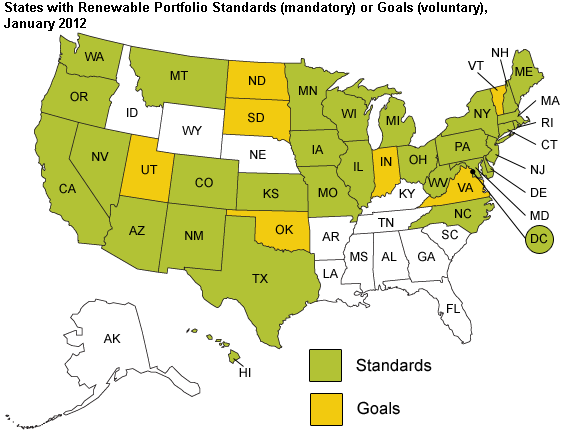 :{}:
:{:{Source:N.C. Solar Center at N.C. State University, Database of State Incentives for Renewables and Efficiency (accessed July 2012). (Correction: Amended source corrects the source listed in original publication of February 3, 2012.) }:
Note:The map includes West Virginia as a State with a Renewable Portfolio Standard, although the Interstate Renewable Energy Council categorizes it as a goal State rather than an RPS State.}:
---
Renewable portfolio standards (RPS), also referred to as renewable electricity standards (RES), are policies designed to increase generation of electricity from renewable resources. These policies require or encourage electricity producers within a given jurisdiction to supply a certain minimum share of their electricity from designated renewable resources. Generally, these resources include wind, solar, geothermal, biomass, and some types of hydroelectricity, but may include other resources such as landfill gas, municipal solid waste, and tidal energy.
Although several RPS proposals have advanced part way through the U.S. Congress in recent years, there is currently no RPS program in place at the National level. However, 30 States and the District of Columbia had enforceable RPS or other mandated renewable capacity policies, as of January 2012. In addition, seven States had voluntary goals for renewable generation. These programs vary widely in terms of program structure, enforcement mechanisms, size, and application.
In California, for example, an RPS of 20% of retail sales was originally enacted in 2002. As of April 2011, the RPS requires California's electric utilities to derive 33% of their retail sales from eligible renewable energy resources in 2020. The law also established interim targets of 20% by the end of 2013, and 25% by the end of 2016.
A large range of policies are considered to be under the RPS umbrella. In general, an RPS sets a minimum requirement for the share of electricity to be supplied from designated renewable energy resources by a certain date/year. Often, the selected eligible resources are tailored to best fit the State's particular resource base or local preferences. Some States also set targets for specific types of renewable energy sources or technologies to encourage their development and use. Many State RPS programs have "escape clauses" if the extra cost of renewable generation exceeds a specified threshold. (Detailed descriptions of State RPS programs are available from the Database of State Incentives for Renewables & Efficiency.)
Another common feature of many State policies is a renewable electricity credit (REC) trading system structured to minimize the costs of compliance. Under these policies, a producer who generates more renewable electricity than required to meet its own RPS obligation may either trade or sell RECs to other electricity suppliers who may not have enough RPS-eligible renewable electricity to meet their own RPS requirement. In some cases, a State will make a certain number of credits available for sale. Such a system accommodates timing differences associated with planning and construction of new generation. Only one entity—the generator or the REC holder—may take credit for the renewable attribute of generation from RPS-eligible sources.
An RPS is one policy mechanism to encourage development of renewable energy. States with RPS policies have seen an increase in the amount of electricity generated from eligible renewable resources. At the same time, other States without RPS policies have also seen significant increases in renewable generation over the past few years resulting from a combination of Federal incentives, State programs, and market conditions. Increases in renewable generation have been driven by the availability of Federal tax incentives, as well as by State RPS policies.
Tags:AEO2012 (Annual Energy Outlook 2012), biomass, California, electricity, geothermal, policy, renewable,RPS (Renewable Portfolio Standards), solar, states, wind, wood
}:
==
Since 2010, the dirty energy industry has poured $12 million and initiatives, including a $1.1 million gift to Gov. Scott. Every single member in the legislature has taken money from the fossil fuel industry, with the 16 leaders averaging about $200,000 apiece. Some of the top donors were Duke Energy, Gulf Power and Koch Industries.
Koch Brothers’ Anti-Solar Campaign in Florida
It should come as absolutely no surprise that the Koch brothers are leading the efforts to stifle solar energy in Florida.
When citizens in the state gathered the necessary signatures to get an initiative on the ballot that would repeal Florida’s anti-consumer solar restrictions, the Koch brothers sprang into action to make sure that this initiative was dead on arrival.
According to a report by PR Watch, the Kochs created a new astroturf group, Consumers for Smart Solar, that is working to create a counter-initiative that would actually prohibit consumers and businesses from contracting with solar companies that install solar equipment without charging an upfront fee—the only way that most Florida citizens would be able to afford solar energy.
This ballot initiative is supported by the Florida state government, as Florida’s Attorney General Pam Bondi is very vocal in her opposition to the citizens’ amendment due to her strong support for the dirty energy industry.
The Kochs and other industry interests were dealt a major blow last week when the Florida Supreme Court approved the Solar Choice Amendment to appear on the 2016 ballot.
Also working against the industry is the fact that 2016 is an election year, meaning Democratic voter turnout will be at an all time high, giving the initiative a very good chance at succeeding.
But even if the Florida fight goes in favor of consumers, the Koch brothers are also fighting against the solar industry in Arizona, Ohio and Kansas.
Again, these are likely to ultimately prove losing battles for the brothers, as 74 percent of American citizens believe that a portion of all electricity generated in the U.S. should come from clean, renewable sources.
The Kochs might wield a lot of power, but they don’t have enough money to fight the will of the 74 percent, or 235 million, Americans.
---