DARK MONEY $ 3
---
see pass thru launder shellsuperpac
SEE LOBBYING 4
SEE CRYPTO war chest eg sherrod brown 40m$ KATIE p 91% WIN RATE
SEE TECHO FASCISM ABUNDANCE
SEE INAUGURATION SIL VLY AI
see musk
SEE BUY ELECTION BRIBERY SEE 2026 MIDTERM MUSK
SEE CU CASE
SEE DAF DONOR advised fund new bradley impact
-=-=
-=-=
an 11 26
Fox News host Trey Gowdy has had some choice words for President Donald Trump over his decision to back Ken Paxton over the incumbent, Texas Sen. John Cornyn. Trump’s backing of the scandal-plagued Paxton has drawn criticism after a spending spree of half a billion dollars failed to close the gap with his Democratic opponent in most polls.
Gowdy, who hosts Sunday Night in America on Fox, said his piece on Monday’s Special Report with Bret Baier. A new poll from The New York Times and Siena College puts 37-year-old Democrat James Talarico 7 points up on Paxton, at 50 percent to 43 percent, as Texans head to the polls.
“I was laying in bed the other night wondering how do I blow $500 million?” asked the former Republican congressman and ex-chair of the House Oversight Committee.
He noted that Cornyn had voted with Trump 99.3 percent of the time, so it was an extraordinary amount of money for the GOP to put out to replace a senator of such loyalty. The money spent on Paxton could have been better used in some of the more competitive Senate races, he contended.
That money “could have gone to South Carolina, could have gone to Maine, could have gone to Nebraska, Kansas,” said Gowdy. “But they’re trying to drag Ken Paxton over the finish line when all you had to do was nominate John Cornyn.”
On whether Paxton will come out on top, Gowdy told Baier he doubts Talarico will win, but the party has made it a good deal harder by going with Paxton. Trump, 80, endorsed the Texas attorney general in the May runoff even though party officials warned of Paxton’s political liabilities. Cornyn had finished first in the three-way primary only to be beaten in the runoff once Trump got involved.
The campaign has been eye-wateringly costly. AdImpact figures put spending at $544.5 million through Nov. 1, making it the priciest Senate race on record, per CBS News Texas. A fundraising memo leaked in October showed Paxton’s finances were in trouble; despite the backing of outside groups and GOP donors, his side could not keep pace with Talarico’s ad operation.
Paxton has had his fair share of scandals. In 2023, the Republican-run Texas House impeached him over corruption allegations before the state Senate acquitted him, and his wife has accused him of adultery in divorce proceedings. He has drawn criticism for his expanding wealth while in office and his penchant for world travel on the taxpayer’s dime.
In the last days of the contest, the signs of a Paxton loss have mounted, but some polls have the race tighter. FiftyPlusOne’s polling average gives Talarico a 4-point lead. An AtlasIntel poll of more than 1,600 Texas adults, conducted Oct. 28 to Nov. 1 with a 2.2-point margin of error, found 51.3 percent for Talarico and 45.4 percent for Paxton.
-=-
-=-=
an 11 26
Nobel Prize-winning economist Paul Krugman warns that the billionaires who groveled to flatter President Donald Trump after the 2024 election are now spending a fortune to stop a Democratic wave and the corruption probe that will come with it.
In a Substack post on the eve of the midterms, Krugman argued that Trump is not the only one on the ballot, but the American oligarchs have huge stakes in the outcome.
Krugman noted that Trump urging GOP voters to pretend he is on the ballot is exactly what his Democrat opponents hope they would do, given his historic unpopularity. He added that polls show Republicans almost certain to lose the House and likely to lose the Senate.
The Nobel Prize winner laid out two reasons why America’s oligarchs need to be worried ahead of a pending blue wave. He says that the Democratic Party is not ideologically uniform and is a center-left party as a whole, and would therefore be far “less friendly to plutocrats than the GOP.”
He continued: “And because they rushed to prostrate themselves at Trump’s feet after the 2024 election, many of the oligarchs may find themselves personally in the crosshairs if a Democratic Congress begins serious hearings on Trumpian corruption.”
Krugman said that fear explains the flood of money now pouring into the race. To put their enormous wealth into perspective, he cited a New York Times analysis finding that just 20 donors, about one ten-millionth of the adult population, have put roughly $2 billion into this election, which comes to about 15 percent of all campaign spending.
He noted that the wealthy donors are overwhelmingly backing the GOP. The Times tracks crypto and gambling donors separately, but he wrote that it is a good bet most of their money is also going to right-wing candidates.
Krugman said that their ability to pour so much money into campaigns is partly due to the Supreme Court’s 2010 Citizens United decision, which opened the floodgates to unlimited political spending.
But the bigger factor, he argued, is the staggering concentration of wealth at the very top. Citing estimates from Realtime Inequality, he said this tiny group holds more than ten times the share of national wealth it did a few decades ago.
Krugman closed by invoking Woodrow Wilson, who wrote in 1913: “If there are men in this country big enough to own the government of the United States, they are going to own it.”
Krugman acknowledged there is plenty to criticize about Wilson, but said he was right on this point, and that America once again has men big enough to own its government.
“This midterm is a test of whether they will get away with it,” Krugman wrote. His final word to readers was simple: vote.
-=-=
-=-=
10 26 camp fin act hist, stats, ~ CU bit nerdy
Oct 14, 2026
Hasan sits down with Michael Beckel, Issue One’s Money in Politics Reform Director, to talk about how American elections have been corrupted by wealthy interests, how fundraising dominates the schedules of members of Congress, and the rising influence of AIPAC. Learn more about Issue One’s mission at issueone.org/darkmoney and Montana’s ballot measure at MontanaPlan.org.
Have Billionaires Bought The Midterms? with Issue One's Michael Beckel
-=-==
-=-=
2x
Commentary & Analysis
June 15, 2023
Harlan Crow’s deep dark money connections
By Adam Rappaport and Meghan Faulkner
Harlan Crow is more than Supreme Court Justice Clarence Thomas’s secret patron—he’s also deeply intertwined with the shadowy world of Republican dark money. In fact, Crow personally took part in the creation of the post-Citizens United dark money system and secretly helped bankroll some of the new groups.
Crow’s political spending started long before Citizens United opened the floodgates for anonymous money in American elections in 2010. Between 1977 and 2009, Crow and his companies gave more than $2.4 million to federal candidates, parties, PACs, and other political entities. Since Citizens United, he’s spent $13.8 million on federal politics, bringing his lifetime total of spending reported to the FEC to more than $16 million. But that’s not all he did. While it is impossible to track Crow’s undisclosed political giving, public information demonstrates his longstanding ties to the biggest figures and groups in Republican dark money.
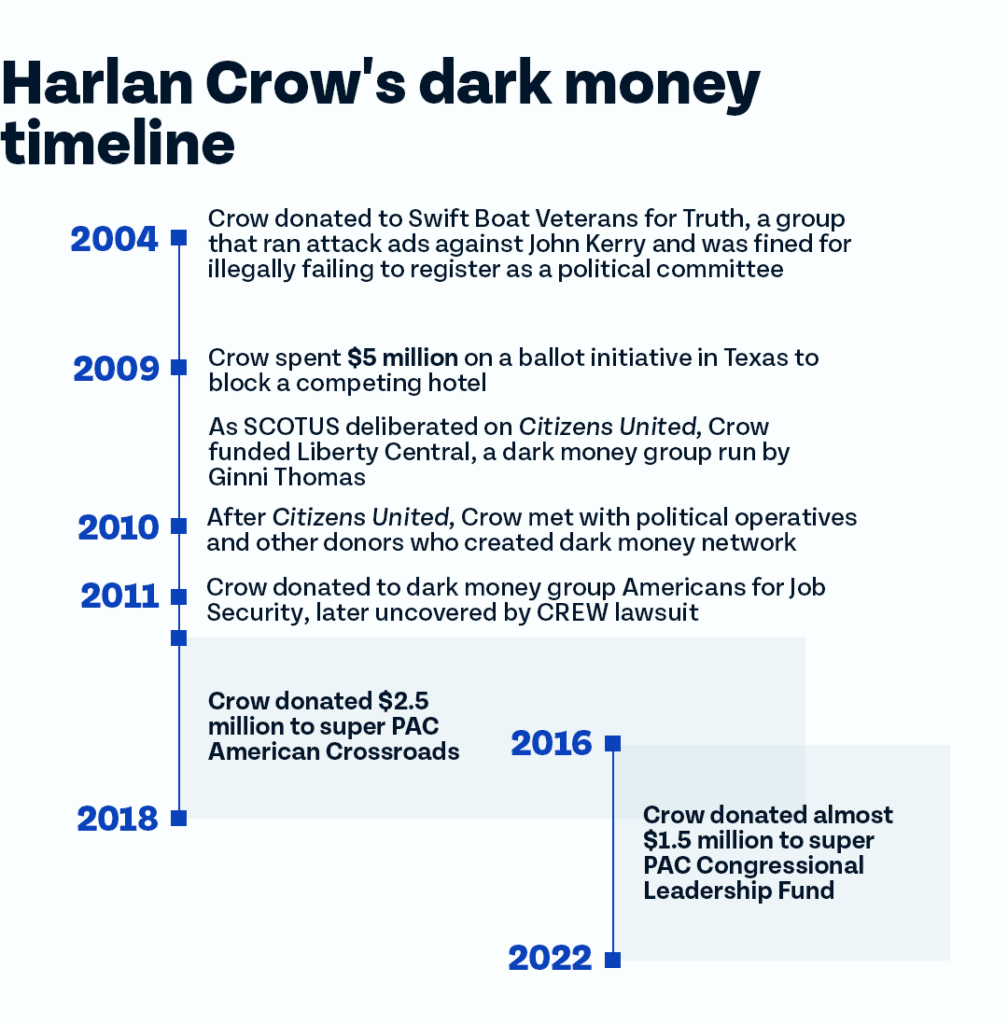
One of Crow’s first forays into large donations was by providing some of the initial financing of Swift Boat Veterans for Truth, an organization that spent millions running attack ads in 2004 against Democratic presidential candidate John Kerry and was later fined nearly $300,000 by the Federal Election Commission for failing to register as a political committee. Later, in 2009, Crow and his company spent more than $5 million on a failed ballot initiative in Dallas trying to block the city from building a city-owned convention center hotel which would have competed with Crow’s hotel.
Immediately after Citizens United, Crow took part in one of the first key events leading to the creation of the dark money system. As recounted by Kenneth Vogel in his book Big Money and separately by the Wall Street Journal, just weeks after the Supreme Court’s decision in January 2010, four leading Republican political figures set out to obtain the “seed funding” they needed to launch several post-Citizens United groups.
The four Republicans: consultant and former Bush White House aide Karl Rove, former RNC Chairman Ed Gillsepie, fundraiser Fred Malek, and former senator Norm Coleman, “laid out their blueprint for a sort of shadow party” to about “20 Republican plutocrats” at the Dallas Petroleum Club in early February 2010. They wanted funding for a network of what became some of the biggest players in outside political spending, including super PAC American Crossroads, which Rove explained would work to defeat then-President Obama and win Republican control of Congress, and dark money group the American Action Network.
Crow was one of the deep-pocketed billionaires who attended the fundraiser. Whether he gave that day or how much is not known. But after hearing Rove’s pitch, another Texas megadonor, Harold Simmons, proclaimed “I like this. I’m in for five [million].” Others followed suit.
Even as the Supreme Court was deliberating Citizens United, Crow reportedly provided the major funding for Liberty Central, another dark money group, this one with links to Justice Thomas. Liberty Central was a 501(c)(4) organization founded by Ginni Thomas in late 2009 that counted Federalist Society co-chair Leonard Leo as a board member. Ms. Thomas served as president through November 2010 and was paid a salary of more than $120,000. According to Politico, of the $550,000 in anonymous start-up funds the group received in 2009, $500,000 came from Crow, who also held an event for the group at his Dallas home a few months after it launched.
Liberty Central engaged in partisan politics during Ginni Thomas’s time in charge. The group acknowledged on its 2010 tax return that it spent a small amount of money on political activity, but as described in a 2012 IRS complaint filed by Common Cause, Liberty Central appeared to do far more than that, endorsing and supporting dozens of House and Senate candidates, conducting polling, and issuing scorecards of congressional candidates.
Asked later about his support of the group, Crow refused to even confirm his contribution, saying: “I disclose what I’m required by law to disclose, and I don’t disclose what I’m not required to disclose.”
“Crow has taken full advantage of the diminishing transparency laws around our politics.”
In 2011, Crow also made a contribution to another notorious dark money group called Americans for Job Security (AJS), which was uncovered by a CREW lawsuit and has not been previously reported. AJS spent more than $25 million in federal independent expenditures and electioneering communications in the 2010 and 2012 elections, making it one of the largest dark money groups at the time.
CREW filed an FEC complaint against the group in 2012, alleging that it should have registered as a political committee and disclosed its donors. After years of litigation, AJS settled the case, resulting in the first and largest release of dark money donors in the post-Citizens United era. The disclosure showed that Crow, through his company Crow Holdings, gave AJS $50,000 in May 2011.
How much more Crow has given to dark money groups over the years is unknown. He has, however, also donated huge amounts to super PACs closely associated with dark money groups, including several Rove and others pitched to him just after Citizens United. Between 2011 and 2018, Crow personally and through his companies gave $2.5 million to super PAC American Crossroads, which is closely related to dark money groups Crossroads GPS and One Nation. Crow also gave almost $1.5 million between 2016 and 2022 to the Congressional Leadership Fund, the super PAC sister of the American Action Network.
Crow’s secret political contributions and undisclosed gifts to Justice Thomas can be seen as two sides of the same coin, offering opportunities to exercise influence, while keeping the public in the dark about who is pulling the strings.
We do know that Crow has given extensively to politicians and political committees, thanks to reporting requirements, and that he has given significant gifts to Thomas, thanks to investigative reporting. But that spending is just what Crow and Thomas have been forced to disclose, and what came out against their will. In helping bankroll the Republican network of dark money groups following Citizens United, Crow has taken full advantage of the diminishing transparency laws around our politics—which Justice Thomas has been instrumental in dismantling. As a result, we will likely never know the true impact of Crow’s political spending on our government and our elections.
===
-=-=
MTA GMAIL 8 28 26
A new class of political kingmakers is emerging in the 2026 elections—and they are not voters.
Artificial-intelligence, cryptocurrency and online-gambling corporations have poured approximately $344 million into efforts to influence the 2026 federal elections. Overall, corporations contributed a record $646 million to Super PACs and other political committees during the 18 months ending in June 2026—already 40 percent more than the $461 million disclosed during the entire 2024 election cycle. These totals exclude undisclosed contributions to dark-money organizations, meaning the true level of corporate political spending is likely even higher.
Companies including Coinbase, Ripple, OpenAI, Anthropic and DraftKings are helping build political operations designed to shape congressional races and the regulations governing their industries...
-=-=
---
sutter 1 26
New polling illuminates how the Supreme Court got Citizens United wrong and shows bipartisan momentum for money-in-politics reforms, including proposed Montana ballot measure
Oct 28, 2025
Media Contact
Cory Combs
Director of Media Relations
- 202-204-8553
- media@issueone.org
New polling commissioned by Issue One and conducted this month by YouGov reveals that overwhelming majorities of Americans — and Montanans — broadly believe that large-scale political spending by corporations, dark money groups, and wealthy donors undermines democracy, creates the appearance of corruption, and reduces trust in government.
The results show that voters across the political spectrum, both nationally and in Montana specifically, reject key assumptions made by the U.S. Supreme Court in its controversial 2010 decision Citizens United v. Federal Election Commission, which unleashed a deluge of big money in elections.
Montanans were polled because a new proposed 2026 ballot measure would eliminate corporate and dark money spending in elections by amending state law governing corporate charters.
Overall, Issue One’s new poll found that nearly 8 in 10 Americans (79%) agreed that large independent expenditures (the technical name for political ads that are not coordinated with a candidate) by wealthy donors and corporations in elections give rise to corruption or the appearance of corruption. This included 84% of Democrats, 74% of Republicans, and 79% of independents.
Relatedly, more than 3 in 4 Americans (76%) — including 84% of Democrats, 68% of Republicans, and 77% of independents — agreed that “the appearance of wealthy donors or corporations gaining influence over or access to elected officials causes me to lose faith in this democracy.”
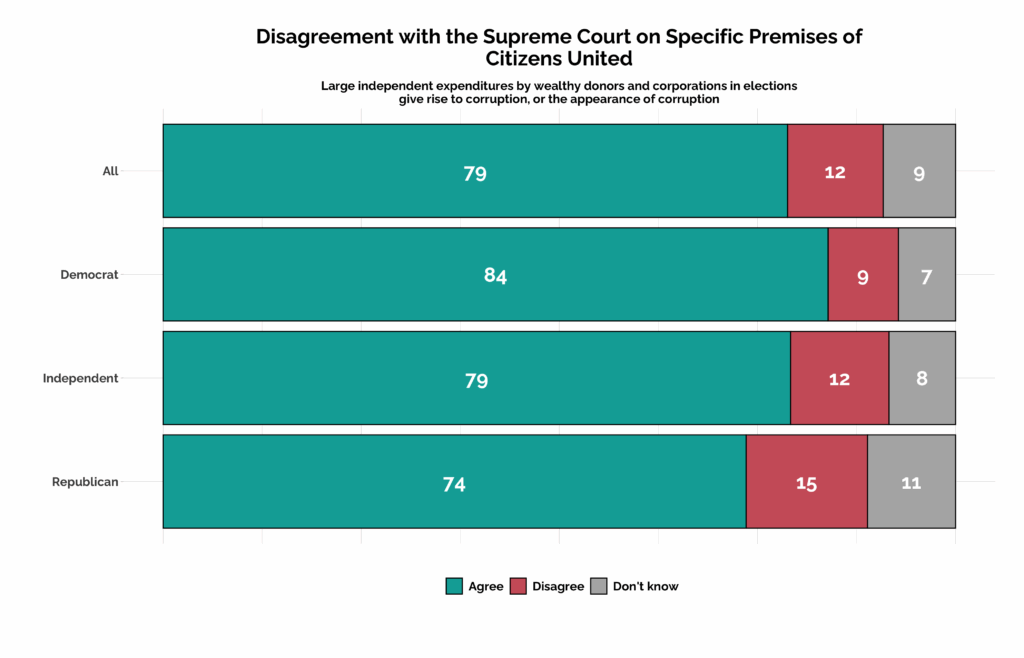 Source: YouGov national survey, Oct. 7-15, 2025
In response to these findings, Issue One Senior Research DirectorMichael Beckel, who oversaw the polling project, said: “Policymakers on both sides of the aisle should be tuning into the fact that overwhelming majorities of Americans across the political spectrum are alarmed by the huge sums being spent in elections by corporations, dark money groups, and wealthy donors.”
Beckel continued: “These findings fly in the face of two of the key assumptions that the U.S. Supreme Court made 15 years ago in Citizens United, namely that independent expenditures do not give rise to corruption or the appearance of corruption, and secondly, that the appearance of influence or access would not cause the electorate to lose faith in democracy. These perceptions of corruption are corrosive to the foundation of our democracy. Our political system cannot function if the public assumes the government is for sale to the highest bidder.”
Added Issue One Policy LeadLiana Keesing: “Montanans are sending a clear message that echoes around the country: Our democracy should be owned by voters, not bought by the wealthy few. These new findings show that people in every corner of the state — and across party lines — want a government that works for all of us, not just those with the deepest pockets. The proposed ballot measure is a bold, practical step toward restoring trust in our political system by ensuring that elections reflect the voices of citizens, not corporate interests. If Montana succeeds, it won’t just reform its own laws; Montanans can pave a path for states across the nation that want to reclaim democracy for the people.”
In Montana, Issue One’s new poll found that nearly 3 in 4 Montanans (74%) — including 84% of Democrats, 69% of Republicans, and 64% of independents — would vote in favor of this proposed ballot measure to eliminate corporate and dark money spending in elections by amending state law governing corporate charters, compared to only 11% opposed.
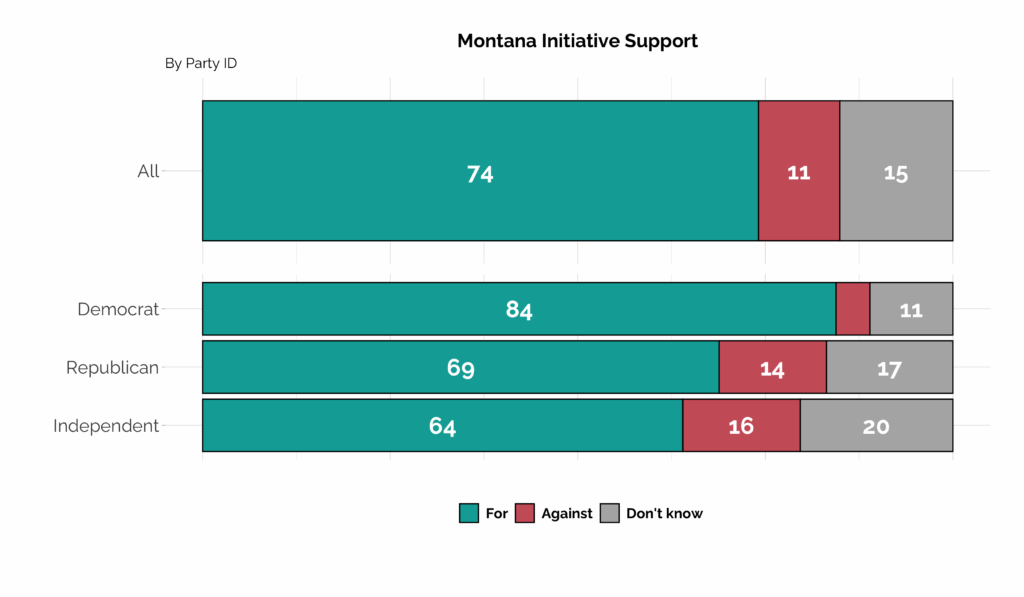 Source: YouGov survey of Montana voters, Oct. 7-20, 2025
Nationally, Issue One’s poll tested a comparable proposal — asking voters how they would respond if a similar measure were considered in their own state. Support was nearly as strong, with 72% of Americans said they would support such a reform, compared to only 12% opposed, after respondents were exposed to messaging from both supporters and opponents. That included support from 81% of Democrats, 64% of Republicans, and 60% of independents.
These high levels of support persisted even when voters were reminded that proposed reforms to curb corporate and dark money spending in elections could apply to their own preferred groups, or raise free speech concerns.
Other key findings from these two polls included:
- 77% of Americans — including 84% of Democrats, 70% of Republicans, and 78% of independents — agreed that anti-corruption rules strengthen our democracy and constitutional rights by ensuring everyone has equal political representation, regardless of money.
- 75% of Americans — including 84% of Democrats, 65% of Republicans, and 73% of independents — said unlimited spending in elections makes our democracy weaker because it gives wealthy special interests too much influence over elected officials. Only 13% of Americans said unlimited spending by people and organizations makes our democracy stronger by protecting the constitutional right to free speech.
- 73% of Americans — including 81% of Democrats, 67% of Republicans, and 71% of independents — agreed that “if a wealthy donor or corporation gains influence over or access to an elected official, I consider that official to be corrupt.”
- 69% of Americans — including 76% of Democrats, 61% of Republicans, and 64% of independents — believe that technology and social media companies have too much influence in politics.
- 63% of Americans — including 73% of Democrats, 53% of Republicans, and 61% of independents — disagreed with the Supreme Court’s Citizens United decision that corporations and labor unions have a First Amendment right to spend unlimited money to influence elections.
- 72% of Montanans — including about 70% of both Democrats and Republicans — continued to support the ballot initiative passed by roughly 75% of voters in 2012 that established a state policy that corporations are not entitled to constitutional rights, such as First Amendment free speech rights, because they are not human beings.
Read the toplines, crosstabs, and interested parties’ memo prepared by YouGov for Issue One’s national poll.
Read the toplines, crosstabs, and interested parties’ memo prepared by YouGov for Issue One’s Montana poll.
Issue: Dark Money & Super PACs
SEE CRYPTO war chest eg sherrod brown 40m$ KATIE p 91% WIN RATE
GGL 12 25
AI Overview
Coinbase CEO
Brian Armstrong is a significant political donor, particularly to pro-crypto causes and candidates, including substantial support for Donald Trump's political efforts, with Coinbase contributing to a PAC that supported Trump and Armstrong meeting with him after the 2024 election; he aligns with pro-crypto, free-market ideals, supports regulatory clarity, and embraces libertarian-leaning concepts like "economic freedom" and "Network State" philosophy, advocating for less government intervention in crypto, which contrasts with stricter regulation under previous administrations.
Donations & Political Involvement
- Pro-Trump/Crypto PACs: Armstrong and Coinbase donated heavily to super PACs like Fairshake, which supported pro-crypto candidates, including Trump.
- Meetings with Trump: Armstrong met with Donald Trump post-election in 2024 to discuss potential personnel appointments for a new administration.
- Hiring: Coinbase hired Chris LaCivita, Trump's former campaign manager, to its Global Advisory Council.
Political Stance & Ideology
- Libertarian/Pro-Crypto: Armstrong champions economic freedom and has spoken positively about Trump's push for regulatory clarity, viewing it as crucial for the crypto industry's growth.
- "Network State": He supports the concept of the Network State, a political movement advocating for decentralized, technology-driven governance.
- Advocacy: Armstrong actively lobbies for clear crypto legislation, aiming to move the industry from being "at the little-kids' table" in DC to having real political power.
Relationship with Trump
- Shift from Skepticism: Trump, once a Bitcoin skeptic, became a proponent of digital assets, a shift welcomed by Armstrong and the crypto industry, leading to a strong working relationship.
- Regulatory Goals: Armstrong sees the Trump administration as key to establishing clearer rules, contrasting with perceived "weaponization" of unclear rules by the Biden administration.
---
GGL 12 25
AI Overview
Coinbase CEO
Brian Armstrong was a major figure in the crypto industry's political spending during the 2024 U.S. elections, which included significant financial involvement in races involving Senators Sherrod Brown and Representative Katie Porter.
Brian Armstrong's Role and Donations
Brian Armstrong, the CEO of the largest U.S. cryptocurrency exchange Coinbase, was a prominent donor to pro-crypto political action committees (PACs), most notably Fairshake.
- Individual Donations: Armstrong personally donated $1 million to the Fairshake PAC network and more than $100,000 to individual lawmakers.
- Corporate Contributions: Under Armstrong's leadership, Coinbase was the leading corporate contributor to Fairshake, providing approximately $66 million to support industry-friendly candidates and oppose crypto-skeptics.
- :
- Advocacy: Armstrong actively advocated for the crypto industry's political influence, stating, "Money moves the needle... For better or worse, that's how our system works". He also encouraged a "pro-crypto Congress" and actively sought to unseat anti-crypto politicians.
Involvement in the Sherrod Brown Race
The crypto industry targeted Senator Sherrod Brown (D-OH), who was the Chair of the Senate Banking Committee and a noted crypto skeptic.
- Opposition Spending: Fairshake and affiliated PACs spent an estimated $40 million to oppose Brown's reelection and support his Republican opponent, Bernie Moreno, who was a longtime crypto advocate.
- Outcome: The massive spending contributed to a tight race, which Moreno ultimately won in the November 2024 election. The ads run against Brown did not mention crypto and instead focused on other political topics.
Involvement in the Katie Porter Race
Representative Katie Porter (D-CA) was running in the California Democratic Senate primary and was also a target of the crypto industry's political spending.
- Opposition Spending: Fairshake spent over $10 million in an effort to derail Porter's campaign, reportedly due to her association with Senator Elizabeth Warren (D-MA) and her general skepticism towards the industry's energy usage.
- Outcome: Porter was a primary target of the PAC network and ultimately did not advance past the primary, losing to Adam Schiff, who was seen as more favorable to the industry.
The industry's spending campaign was largely successful in influencing key races, with 91% of the candidates the industry backed with significant funds winning their elections in 2024.
How tech bros bought 'America's most pro-crypto Congress ever'}:
Nov 23, 2024 — Armstrong, Coinbase's CEO, gave more than $1.3 million to a mix of PACs including Fairshake and JD Vance for Senate In...

CNBC·MacKenzie Sigalos
7:49
- Crypto Super PACs Amass Over $100 Million for 2024 Elections
May 6, 2024 — Top Crypto Spenders. Coinbase. Coinbase is a leading cryptocurrency exchange offering users a platform for buying and s...
Public Citizen
- Big Crypto, Big Spending: Crypto Corporations Spend an ...
Aug 21, 2024 — The primary beneficiary of the corporate crypto cash is Fairshake PAC, a super PAC that has raised $202.9 million. Mor...

Public Citizen
[### Crypto's $245 million campaign finance operation funded ...

CNBC
https://www.cnbc.com › 2024/11/05 › cryptos-245-mill...](https://www.cnbc.com/2024/11/05/cryptos-245-million-campaign-finance-operation-funded-non-crypto-ads.html)
Nov 5, 2024 — The crypto sector emerged as a top donor this election cycle, but the ads it funded weren't about digital currencies.
[### Silicon Valley, the New Lobbying Monster

The New Yorker
https://www.newyorker.com › magazine › 2024/10/14](https://www.newyorker.com/magazine/2024/10/14/silicon-valley-the-new-lobbying-monster)
Oct 7, 2024 — From crypto to AI, the tech sector is pouring millions into super PACS that intimidate politicians into supporting its agenda.Read more
[### Crypto Comes For Sherrod Brown: $32 Million in Ads ...

Rolling Stone
https://www.rollingstone.com › politics › politics-features](https://www.rollingstone.com/politics/politics-features/sherrod-brown-crypto-bernie-moreno-millions-1235102478/)
Sep 15, 2024 — Crypto companies are spending $800000 a day to take out Sherrod Brown, one of their chief critics in Congress, and replace him with an ally.
[### Crypto Companies Have Made the Most Political ...

Inc.com
https://www.inc.com › chris-morris › crypto-companies...](https://www.inc.com/chris-morris/crypto-companies-corporate-political-donations.html)
Aug 23, 2024 — Crypto companies, including Ripple and Coinbase, have spent over $119 million so far this year to influence voters, according to a new ...
[### Cryptobros United: Crypto Super PACs Amass Over $100 ...

Public Citizen
https://www.citizen.org › Articles](https://www.citizen.org/article/cryptobros-united-fairshake-super-pac-2024-elections/)
May 6, 2024 — Only the super PAC backing Ron DeSantis' failed presidential campaign and the super PAC backing Democratic Senate candidates have raised more ...Read more
---
an 11 25
A new report in *The Atlantic* shows that despite President Donald Trump's campaign having ended a year ago, he has not stopped fundraising — and is now sitting on a $2 billion windfall.
"I want you to keep going," Trump told his top fundraiser Meredith O'Rourke the morning after he won his second term, The Atlantic reports.
Trump's second inaugural committee raised $241 million, "about $90 million more than organizers needed to fund the events — and nearly four times as much as Joe Biden had raised for his own inauguration, in 2021. But that was just the beginning," write Michael Scherer and Ashley Parker.
Trump, they write, wanted money for "political operations that many politicians support," but he also wanted it for "technically apolitical causes."
Among those causes, they write, include those that "offered corporations and wealthy individuals a chance to make tax-deductible contributions, including a dramatic White House renovation, the Kennedy Center for the Performing Arts (now under his control), his presidential library and a celebratory Army parade on his birthday."
"By August, Trump estimated that he had collected at least $1.5 billion since the election, more than all the money raised to support his 2024 campaign over two years, including funds raised by supportive independent super PACs," they report.
That amount is now near $2 billion, according to two people who spoke with the authors anonymously.
"Trump has kept careful track of the money coming in, regularly calling O’Rourke late at night for updates," according to the report. "He monitors who is giving, who is not, and the role of lobbyists who bundle donations, those familiar with his efforts told us."
"At times, the actual donation amount is less important to the president than the percentage of the donor’s overall assets. He thanks the most generous benefactors at swanky events at the White House and his clubs," they add.
"Trump and his aides cast donations to his political groups or priorities as acts of patriotism," they write.
Much of this windfall comes from companies or people who have business with the government, they report, including defense contractors, crypto investors and tech companies.
"A select group of companies and executives — Amazon, Lockheed Martin, Coinbase, Palantir CEO Alex Karp — are top donors to multiple Trump projects," they note.
None of this, they say, is normal, and "nothing on this scale was ever attempted by a sitting president prior to Trump."
"And he’s just getting started. He hasn’t stopped,” a third anonymous source tells them, “and I don’t anticipate that we will stop.”
Trump's "relentless fundraising" has alarmed ethics watchdogs, they write, despite Trump advisors saying his donations are merely from those who "support his political agenda."
Media and technology companies that Trump has sued, they report, "have collectively made $85 million in payments to some of his pet projects in order to settle the lawsuits," including Paramount and the parent company of YouTube.
“There are people being asked to do 10-to-25-million-dollar checks for the ballroom, for the inauguration, for the presidential library,” another person familiar with the requests tells The Atlantic. “That spigot is never going to close, ever. This is just the cost of doing business. They will write a multimillion-dollar check to avoid the $2 billion lawsuit. It’s a business decision.”
Trump continues to raise money for his library, and for the midterm elections in 2026, they say, but he is also collecting "funds for a dark-money group, Securing American Greatness," they write.
Trevor Potter, a former Republican chair of the Federal Election Commission (FEC) who now runs the Campaign Legal Center, tells The Atlantic in a statement, "While it is not unusual for lame duck presidents to fundraise for their Libraries, what we are seeing from President Trump in his first year of office is shockingly unprecedented."
“The president’s seemingly insatiable drive for money from corporations and billionaires seeking government favors (or merely hoping to procure protection from Trump attacks on their business interests) sends a clear signal to everyday Americans that their needs come far behind those of the ultrawealthy who are buying access and favor," Potter adds.
The corruption of Donald Trump and his children points to something deeply menacing - Alternet.org
---
crypto-money-trump-inauguration-00199088
Jasper Goodman01/17/2025
The cryptocurrency industry, fresh off a 2024 elections spending spree, has turned its influence efforts in recent months to a new target: celebrating the start of President-elect Donald Trump’s second term.
Leading crypto firms have pumped at least $10 million into the Trump inaugural fund, and top executives are flocking to Washington ahead of the incoming president’s swearing-in on Monday.
Crypto companies including Ripple, Coinbase, Kraken, Robinhood and Circle have made seven-figure donations to Trump’s inaugural committee since Election Day — part of a wave of corporate contributions that Trump has reeled in as big businesses scrambled to curry favor with the incoming administration.
The donations, which will fund the glitzy official events surrounding the inauguration, exemplify the giddiness across the digital asset sector as Trump prepares to become the first-ever explicitly pro-crypto U.S. president. The industry is eyeing any avenue of influence as it pushes the incoming administration and a GOP-controlled Congress to complete a regulatory overhaul that could boost its growth.
“This is a moment of celebration for the industry,” said Kristin Smith, CEO of the Blockchain Association, a leading crypto trade association.
The industry laid the groundwork for that celebration by pouring more than $160 million into a super PAC that helped elect a bipartisan slate of lawmakers sympathetic to its agenda. The high-dollar influence campaigns illustrate how the crypto industry has become a major new well that politicians are tapping for contributions, helping it play an outsize role in American politics.
Crypto firms are hosting a sold-out unofficial inaugural ball on Friday at the Andrew W. Mellon Auditorium in downtown Washington. The event, which is set to feature Snoop Dogg as a musical guest, is being put on in part by David Bailey, who runs a bitcoin conference that Trump spoke at last summer. Other sponsors include the Coinbase-backed advocacy group Stand With Crypto and the digital asset firms Exodus, Anchorage Digital and Kraken.
It all comes as crypto executives and their lobbyists are scrambling to gain sway over the policy changes that Trump has vowed to usher in, which include stockpiling bitcoin and putting in place a new framework for how digital assets are regulated — “written by people who love your industry.”
One target of fixation for players in the crypto space is a digital assets advisory council that Trump has vowed to create, led by incoming White House crypto and AI czar David Sacks and former North Carolina Congressional candidate Bo Hines.
“Everyone is jockeying for it,” said one Washington crypto lobbyist, granted anonymity to speak candidly about sensitive dynamics within the industry.
Several top executives are expected to be in town for the inauguration, along with other tech leaders who have taken steps to get in Trump’s good graces in recent months. And many firms have shelled out to fill the inaugural fund’s coffers.
The crypto firm Ripple, a major target of enforcement action from the SEC that the industry decried during the Biden era, donated $5 million in digital tokens to the inaugural committee, according to a spokesperson for the company. Two of the firm’s top executives, CEO Brad Garlinghouse and Chief Legal Officer Stuart Alderoty, who met with Trump earlier this month at Mar-a-Lago, plan to attend the swearing-in.
The U.S. crypto exchanges Coinbase and Kraken and the stablecoin company Circle, which issues a token that is pegged to the value of the U.S. dollar, each donated $1 million to the inaugural fund. Robinhood, a leading online brokerage that dabbles in crypto, donated $2 million, according to a spokesperson. Top Coinbase executives including CEO Brian Armstrong were on Capitol Hill on Friday, ahead of the inauguration. Armstrong has twice met with Trump, according to a spokesperson for the company, including once since Election Day.
“I think it’s important to ensure that industry … can engage with this administration and engage in a meaningful way during the transition period,” Kara Calvert, vice president for U.S. policy at Coinbase, said of the firm’s donation. “This is the most pro-crypto president that we’ve ever seen, and he has made a platform clear now for months. And that is a really attractive characteristic right now.”
The donations have become an early target for Democrats and watchdog groups, who say the president is selling influence.
“Billionaires think they bought this government,” Sen. Elizabeth Warren (D-Mass.), a leading critic of the crypto industry in Congress, told reporters Thursday. “They’re sure throwing their weight around.”
*Irie Sentner and Eleanor Mueller contributed to this report.
---
---
 ]//
latest-filings-campaign-finance-court-battle-argue-maine-has-legal-right-regulate-super
10 25 me morn star
The next piece of the puzzle for the group hoping to get the U.S. Supreme Court to establish greater regulations on money in elections was laid on Wednesday.
Two appeals were filed in the First Circuit Court of Appeals in Boston after a federal district court in July ruled that a 2024 Maine law overwhelmingly passed by voters was unconstitutional. The law placed limits on contributions to political action committees that independently spend money to try to support or defeat candidates, commonly referred to as super PACs.
One of the briefs is from Attorney General Aaron Frey on behalf of the state of Maine. The other is from the committee behind the referendum and the non-profit Equal Citizens, spearheaded by legal scholar Lawrence Lessig, who has been attempting to bring this issue to the high court for years.
Both make the case that the 2010 Supreme Court decision Citizens United v. Federal Election Commission actually allows for super PACs to be regulated.
The brief from the interveners incorporates a second originalism argument, which is notable since the party that instigated the lawsuit is made up of conservative political action committees.
Charles Miller of the Institute for Free Speech and Joshua Dunlap of Pierce Atwood (now nominee for the First Circuit) filed the lawsuit in U.S. District Court for the District of Maine in 2024 on behalf of Dinner Table Action, which was founded by state Rep. Laurel Libby (R-Auburn) and activist Alex Titcomb, and For Our Future, which is run by Titcomb. They argue that the law restricts free speech.
These dueling arguments have been known, but in an interview ahead of the filing Wednesday Lessig told Maine Morning Star that the intervener’s brief also argues that a component of the recent district court opinion rejects the reasoning that served as the foundation for super PACs in the first place, aiding their case.
After reviewing the filing on Wednesday, Miller said he doesn’t think that’s novel. He’ll be issuing his full rebuttal on behalf of the plaintiffs next month.
Before then, friend of the court briefs are expected next week and could add additional layers to the argument.
After oral arguments in early 2026, a ruling could come before the summer.
If the court decides in favor of the law, the issue could be in the Supreme Court by the fall of 2026. If the First Circuit rules otherwise, the path to the high court would become more difficult.
How the district court opinion plays in
Since Buckley v. Valeo in 1976, the Supreme Court has allowed contributions to be regulated when there is a risk of “quid pro quo” corruption, essentially a favor for a favor. In the case of elections, if there is a risk someone could be making a donation to a candidate in exchange for a favor, then Congress can regulate that contribution. In 2010, the Supreme Court extended this reasoning to corporations and unions in Citizens United,ruling that those entities can otherwise spend unlimited amounts of money on elections because they have free speech rights under the First Amendment.
Three months later, the D.C. Circuit Court of Appeals ruled in SpeechNow.org v. FEC that contributions to PACs cannot be regulated either, as long as the PAC is “independent” of the campaign.
The state of Maine and interveners argue SpeechNow misinterpreted Citizens United.
The ruling was never reviewed by the Supreme Court, though other lower federal and state courts agreed. In each one of those cases, the courts ruled that contributions to independent political action committees created no risk of “quid pro quo” corruption, so they couldn’t be regulated.
But in U.S. Magistrate Judge Karen Frink Wolf’s opinion in the district court in July, she essentially conceded that there is a risk of corruption. “Contributions to independent expenditure PACs can serve as the quid in a quid pro quo arrangement,” she wrote.
Lessig said that finding makes it “the most extreme opinion of any federal court in the history of this jurisprudence.”
However, Frink Wolf went on to write, “I am not persuaded that the Defendants’ arguments on this point can be squared with Citizens United.”
That’s where she and those backing Maine’s law diverge.
“The district court further erred by adopting the reasoning of out-of-jurisdiction decisions striking down similar contribution limits,” the brief filed by Frey reads. “Those cases did not bind the district court, just as they do not bind this Court.”
Maine sued over new campaign finance law, but that was supporters’ plan all along
What the state of Maine and the interveners are seeking is not to change the limits on expenditures in Citizens United. They think the question the Maine referendum raises — whether contributions to a committee that makes independent expenditures can be limited — is not answered in Citizens United.
“Nothing in Citizens United or in any subsequent Supreme Court case disturbs the longstanding precedent securing to the people the power to prevent quid pro quo corruption or its appearance by limiting the size of contributions,” the brief filed by the interveners reads.
Under the logic of Citizens United, independent expenditures are uncoordinated and create no risk of quid pro quo corruption, but donations to a committee that makes independent expenditures may or may not be coordinated. Therefore, they argue, they create the risk of quid pro quo corruption and can be regulated by Congress.
Further, Frey’s brief adds that “the district court should have recognized that the changed campaign landscape in Maine and the United States unleashed by SpeechNow supports Maine’s important interest in imposing modest limits.”
Republican-turned-independent state Sen. Rick Bennett, who is running for governor in 2026 and was on the ballot question committee, told Maine Morning Star, that the case in Maine “gives the courts a chance to correct a 15-year mistake, return power to the people, and begin restoring trust in our democracy.”
The state of Maine is giving the Supreme Court a gift. You're saying to John Roberts, here's a case where you could decide this case and the whole country will say, ‘Huzzah.’
– Lawrence Lessig
Another member of the ballot committee, Cara McCormick, said in defending Maine’s new law, “we go to court not in anger but in faith that our democracy will listen to its people and grow even stronger through them.”
Miller, the plaintiff’s lead counsel, disagrees with their interpretation.
“They’re trying to focus on the fact that, theoretically, a candidate could solicit a donation for independent expenditure, but the law doesn’t target that,” Miller said. “It targets any contribution for independent expenditure.”
As an example, Miller said someone could corrupt a politican by giving money to his daughter, “but there’s no reporting requirements on donations to daughters of senators.” In that regard, he added, “there are lots of things that can be corrupted, a donation to a presidential library arguably can be corrupted.”
An originalism argument
The overarching point the interveners are making is that the original meaning of the First Amendment would not have blocked state legislatures or the people from limiting the size of contributions to political action committees.
“The Supreme Court has never considered the question of what the original meaning of the First Amendment means in the context of campaign finance jurisprudence,” Lessig said.
The originalist argument they’re making is typically a conservative one, so Lessig believes it would fare well with the current conservative-leaning Supreme Court. He also believes that’s why the plaintiffs want to prevent that argument from advancing beyond the First Circuit.
“That’s what gave us the new Second Amendment, that’s what overturned Roe versus Wade — it’s originalism,” Lessig said. “But here, it goes against their politics.”
Last week, the plaintiffs filed a motion to dismiss the group’s appeal.
Ultimately, Lessig views the issue of regulating super PACs as a nonpartisan one. Both Republicans and Democrats benefited from hundreds of millions of dollars from super PAC spending last election, Democrats more so than Republicans.
“The state of Maine is giving the Supreme Court a gift,” Lessig said. “You’re saying to John Roberts, here’s a case where you could decide this case and the whole country will say, ‘Huzzah.’”
- October 23, 202511:39 amThis story has been updated to include a statement from Cara McCormick and details of the Attorney General's brief.
---
---
ctr am prog 10 25
introducing-caps-plan-to-beat-citizens-united montana
--
comm dr an 9 25
The first nine months of the Trump administration provide ample evidence of how much ground it has covered—or more fittingly, ravaged? We may, in fact, be running out of hyperbole to describe the magnitude of the impact.
Multiple actions, abetted by acquiescence from those who should not be acquiescing, are collectively changing our form of governance, the character of our nation, and our way of life.
Here is a considered top ten. Presenting them all in one blast emphasizes that the challenges we face at this moment are more daunting than anyone could have imagined 10 months ago.
Many of the actions on the list have been noted individually, analyzed and documented at length in various publications. I believe it useful to view them all together and ask whether anything can be done to slow down the juggernaut.
- Failure of US Congress to serve as a check and balance on President Donald Trump’s overreaches of executive authority;
- The Supreme Court’s submissiveness in the face of the president’s destruction of major governmental institutions;
- The Executive’s unchecked attempts to undermine the independence of regulatory entities including the Federal Reserve, the Federal Trade Commission, and the Federal Communications Commission;
- The president’s arbitrary and capricious downsizing of the civil service, diminishing the federal government’s capacity for competent, ethical, and well-managed operations;
- The erosion of a viable two-party system in this country, whereby two loosely structured political bodies argue fairly and reasonably about proper courses of action for the nation. We now have one remaining party, the Democrats, faced off against a propagandist machine that hides behind the label “conservative,” but spends most of its energy spouting untruths;
- The caving of an array of university leaders and media moguls to blackmail schemes foisted on them by an administration that arbitrarily withholds funds allocated by Congress;
- A series of presidential actions in patent violation of the Constitution, notably trampling citizens’ right of free speech and the constitutional mandate on the separation of church and state;
- The denigration of the Democrats as the party out of power, compounding the disarray the party has brought upon itself. The result is the lack of clear, cogent, and consistent opposition messaging and coordinated leadership;
- The realization of the full effects of the Supreme Court’s Citizens United decision on the governance of the country, whereby corporate mega contributions distort all efforts aimed at well-reasoned decision-making in service of the common good; and
- The deprivation of the constitutional rights of thousands of citizens and noncitizens through cruel and unlawful detention and deportation.
Common to all of these aggressive moves is an ideology based purely on profiteering. In contrast to a diversity of political, social, economic, or religious ideologies motivating governments past and present, the single guiding principle of this administration appears to be how much money can be extracted. Laws, ethics, social welfare concerns, all are set aside. Whether the matter is international trade, foreign citizens’ work visas, or the uses of natural resources, the focus is solely the money. No longer is there even a nod to good will, generosity, conservation, fairness, or citizens’ safety and health.
This conflagration may be impossible to extinguish. Extreme measures are in order, if not too late. As quickly as possible, a nationwide protest vote open to the entire electorate must take place, repudiating the actions of the administration and the failure of others to act in opposition. Simultaneously, a massive national resistance movement must coalesce, one that is well organized, well led, and enduring.
*A footnote: I am befuddled that defenders of the Constitution, such as previous presidents, billionaire philanthropists, and opinion leaders—those with much more agency and resources than I can muster—have not already come together to mount such top-level efforts.
---
---
AN 9 25
ROBT R
It’s too easy to accept the conventional view that the widening polarization of our society, and the decline of democracy, are due to the demagogue in the Oval Office.
That conventional view is way too simple. Follow the money. The underlying cause is the tsunami of legal bribes flowing from huge, wealthy corporations (and their oligarchic CEOs and major investors) into American politics.
That tsunami has grown dramatically over the last forty years. It underlies the crisis of democracy. It is fueling polarization. Democracy and social cohesion are impossible to sustain when big money is dictating political outcomes.
Over the last four decades, corporate political spending has more than quadrupled, adjusted for inflation.
Labor unions no longer provide a counterweight. Forty years ago, union PACs contributed about as much as corporate PACs. In the 2024 election, corporations outspent labor by more than 3 to 1.
According to a landmark study published in 2014 by Princeton professor Martin Gilens and Northwestern professor Benjamin Page, the preferences of the typical American have no influence at allon legislation emerging from Congress.
Gilens and Page analyzed 1,799 policy issues in detail, determining the relative influence of economic elites, business groups, mass-based interest groups, and average citizens. Their conclusion:
“The preferences of the average American appear to have only a minuscule, near-zero, statistically non-significant impact upon public policy.”
Gilens and Page found that lawmakers listen mainly to the policy demands of big business and wealthy individuals — those with the most lobbying prowess and deepest pockets to bankroll campaigns and promote their views.
It’s far worse now. Gilens and Page’s data came from the period 1981 to 2002 —before the Supreme Court opened the floodgates to big money in the Citizens United case, before Super PACs, before “dark money,” and before the Wall Street bailout.
Decades before Trump, corporations were already getting a high return on the money they invested in politics. I know. I was there. I had a front-row seat.
Over the last 40 years, corporate tax rates have plunged. Regulatory protections for consumers, workers, small investors, and the environment have been defanged. Antitrust has become so ineffectual that many big corporations face little or no competition.
Corporations have fought off safety nets and public investments that are common in other advanced nations, such as universal health care and paid family leave. They’ve attacked labor laws — reducing the portion of private-sector workers belonging to a union from a 35 percent forty years ago to just over 6 percent now.
They’ve collected hundreds of billions in federal subsidies, bailouts, loan guarantees and sole-source contracts. Corporate welfare for Big Pharma, Big Oil, Big Tech, Big Ag, Wall Street, and the largest military contractors now dwarfs welfare for people.
The profits of big corporations have reached record highs, and the ratio of CEO pay in large companies to average workers has ballooned from 20-to-1 in the 1960s, to nearly 300-to-1 now.
Most Americans, however, are going nowhere. The typical worker’s wage is only a bit higher today than it was forty years ago when adjusted for inflation.
The biggest casualty has been public trust in democracy.
In 1964, only 29 percent of voters thought government was “run by a few big interests looking out for themselves.” By 2013, 79 percent of Americans thought so.
A large portion of the American public has become so frustrated and cynical about democracy that they believe the blatant lies of a self-described strongman and support a political party that no longer stands for democracy.
Capitalism is compatible with democracy only if democracy is in the driver’s seat. But the absence of democracy doesn’t strengthen capitalism. It fuels despotism.
Ironically, the CEOs of many large American corporations are now finally confronting this reality. Despotism is bad for capitalism. Despots don’t respect property rights. They don’t honor the rule of law. They are arbitrary and unpredictable. All of this harms the owners of capital. Despotism also invites civil strife and conflict, which destabilize a society and an economy.
My message to every CEO in America: You need democracy but you’re actively undermining it by polluting it with big money and throwing much of your support behind a tyrant whose arbitrary and capricious decisions are threatening your businesses. It’s time for you to join the pro-democracy movement.
This is not only about economics. Widening inequality and a weakening democracy take a toll on the moral wellbeing of the nation, on the implicit social contract that binds us together, on the trust and cohesion we need to accomplish anything worthwhile.
In one of his first interviews, on September 14, Pope Leo XIV — history’s first U.S.-born pope — talked about the causes of the deep polarization he sees in America and elsewhere:
“Very significant is the continuously wider gap between the income levels of the working class and the money that the wealthiest receive. …Yesterday the news that Elon Musk is going to be the first trillionaire in the world. What does that mean and what’s that about? If that is the only thing that has value anymore, then we’re in big trouble.”
Trump is not the cause of the growing cynicism about democracy and the deepening polarization of our society. He’s the consequence and culmination of decades of neglect. We could not have remained on the road we were on toward ever-widening inequality and ever-greater political corruption.
If there’s a silver lining to this darkening cloud, it is that Trump may finally force us to confront this long-term crisis.
---
---
https://www.msnbc.com/11th-hour/watch/conflicted-new-report-exposes-trump-s-crypto-connections-243308613599
trump fam made more money on crypto than in whole hist of co in real estate?!
memecoin 2 bit players www hustlers, got hacked; liberty financial 500m$ 400m real money in trump pocket; had no product
1/2 hse paid 4B$ fine money launder
stablecoin USD1 world lib fin; backed 1:1 with real US dollars, used by drug traffic; bill does nothing on laundering; anon wallet
jamie dimond JPM 20k empl on compliance; tether has 150 ppl TOTAL
140m$ war chest sherrod b 40m$ , num 1 more than oil/gas see politico
---
ggl 7 25
[### Crypto industry amasses colossal war chest for elections

Politico
https://www.politico.com › news › 2025/07/15 › crypto...](https://www.politico.com/news/2025/07/15/crypto-super-pacs-war-chest-key-house-votes-00452356)
1 day ago — Since the 2024 campaign ended, crypto firms have doubled down: The PAC network has raised $109 million since Election Day. The latest ...
A super PAC group funded by cryptocurrency companies will enter the upcoming midterm elections with more than $140 million in the bank, according to new fundraising data shared first with POLITICO — a mammoth sum that now looms large over an effort to pass industry-friendly legislation in the House this week.
The group, known as Fairshake, raised $52 million in the first half of 2025, piling onto an already huge sum of crypto campaign cash that could be wielded against lawmakers who oppose the industry’s Capitol Hill agenda — and boost the political fortunes of those who support it.
The PAC network’s fundraising highlights how top crypto firms are plowing ahead with a lobbying strategy that overtly uses political spending to get their way from Congress. The group includes three affiliated super PACs — Fairshake, Protect Progress and Defend American Jobs — that collectively spent $135 million supporting industry allies and taking down crypto critics in Congressional races across the country last year.
Spending by the group in the 2024 campaigns helped take down key roadblocks to the industry’s policy agenda, including former Senate Banking Chair Sherrod Brown, who lost his Ohio re-election campaign to Republican Bernie Moreno — a crypto enthusiast who benefited from more than $40 million of crypto PAC spending. The PACs also boosted industry supporters in dozens of other House and Senate races across the country, including the California Democratic Senate primary and hotly-contested House races in Alabama, Arizona and Virginia.
Since the 2024 campaign ended, crypto firms have doubled down: The PAC network has raised $109 million since Election Day. The latest fundraising haul comes as the House is preparing to take up landmark crypto legislation this week that would help legitimize digital assets as mainstream financial products and craft bespoke new rules governing the sector.
“Fairshake is stronger than ever as we remain focused on our mission of building lasting support for crypto and blockchain innovation,” said Josh Vlasto, spokesperson for the PAC group. “We are building an aggressive, targeted strategy for next year to ensure that pro-crypto voices are heard in key races across the country.”
The PAC is primarily funded by three companies: the venture capital giant Andreessen Horowitz, which invests heavily in digital asset startups, and the crypto firms Coinbase and Ripple.
Fairshake’s latest fundraising haul includes $25 million donated by Coinbase, the largest U.S. crypto exchange, along with previously announced contributions from Ripple Labs, Uniswap Labs, and the crypto entrepreneur Robert Leshner.
Coinbase’s chief policy officer, Faryar Shirzad, said in a statement that “crypto is already woven into America’s financial fabric,” and the company is “committed to fighting for the consumer protections and financial empowerment” that digital asset owners “deserve.”
The top Washington priority for the group’s top donors is a GOP-led crypto market structure bill expected to go to the House floor on Wednesday that seeks to create a first-ever crypto regulatory regime by divvying up oversight of digital assets between securities and commodities regulators.
Republicans leading the push for that bill are seeking to win over as many Democrats as they can ahead of the floor vote in order to show that the measure has political viability in the Senate, where bipartisan support is needed to clear a 60-vote threshold. A similar GOP-led proposal passed the House with 71 Democratic votes last year — as Fairshake was beginning to ramp up for the 2024 campaign — but concerns over the Trump family’s business entanglements in crypto may make matching that figure difficult this week.
Some Democrats are considering voting against the sweeping market structure measure but supporting a second, narrower crypto bill affecting so-called stablecoins that the House is expected to send to President Donald Trump’s desk on Thursday.
The crypto super PACs, though, have signaled that the vote breakdown on the broader bill, led by House Financial Services Chair French Hill (R-Ark.), will be their primary consideration as they weigh how to deploy their 2026 haul. The group spent more than $30 million benefiting House Democrats during the last campaign.
A non-profit dark money group that is affiliated with the Fairshake PACs called the Cedar Innovation Foundation said in a statement Monday that Hill’s so-called CLARITY Act is “the most important vote members will take this Congress.”
// Trump Border Czar Tom Homan: ‘There Will Be No Amnesty’ | The Conversation
- Filed Under:
- PACs,
- Super PACs,
- Finance & Tax,
- Cryptocurrency
---
[### Trio of crypto bills back on track, Scalise says - Live Updates

Politico
https://www.politico.com › 2025/07/16 › congress › tri...](https://www.politico.com/live-updates/2025/07/16/congress/trio-of-crypto-bills-back-on-track-scalise-says-00455766)
3 hours ago — But the House is now flipping its schedule: Lawmakers will vote on the GENIUS Act on Wednesday after the rule vote, rather than voting first on ...
Missing: war chest sherrod
[### Coinbase hurls millions at Congress, can't assure ...

CoinGeek
https://coingeek.com › Business](https://coingeek.com/coinbase-hurls-millions-at-congress-cant-assure-legislative-results/)
6 hours ago — The Fairshake political action committee (PAC) has reportedly amassed a war chest of over $140 million to be deployed ahead of and during ...
[### Capitol agenda: Trump puts out another fire for Johnson

Politico
https://www.politico.com › 2025/07/16 › congress › tru...](https://www.politico.com/live-updates/2025/07/16/congress/trump-crypto-house-johnson-rule-vote-genius-clarity-act-00455701)
6 hours ago — Speaker Mike Johnson is trying again to pass landmark cryptocurrency legislation this week after Tuesday's failed rule vote.
Missing: war chest sherrod
[### With the Crypto Industry War Chest Looming, Senate ...

Common Dreams
https://www.commondreams.org › ... › cryptocurrency](https://www.commondreams.org/news/senate-passage-genius)
Jun 18, 2025 — With the Crypto Industry War Chest Looming, Senate Democrats Help GOP Pass GENIUS Act · Over the objections of · The Senate voted 68-30 to pass ...
Missing: politico | Show results with: politico
[### Crypto Week: House to vote on the GENIUS Act and Clarity ...

CNBC
https://www.cnbc.com › trump-crypto-week-stablecoin](https://www.cnbc.com/2025/07/15/trump-crypto-week-stablecoin.html)
1 day ago — The GENUIS Act, a stablecoin bill, has already passed the Senate and looks set to become the first standalone crypto measure signed into law.
Missing: sherrod | Show results with: sherrod
[### Crypto bills set to advance this week take industry closer to ...

Reuters
https://www.reuters.com › boards-policy-regulation › cr...](https://www.reuters.com/sustainability/boards-policy-regulation/crypto-bills-set-advance-this-week-take-industry-closer-mainstream-2025-07-14/)
2 days ago — The bill, dubbed the GENIUS Act, received bipartisan support in the Senate, with several Democrats joining most Republicans to back the ...
[### Trump poised for quick crypto win with House vote

Politico
https://www.politico.com › 2025/07/10 › congress › ho...](https://www.politico.com/live-updates/2025/07/10/congress/house-senate-crypto-bill-trump-stablecoin-00447633)
6 days ago — Trump's signature on the stablecoin bill could deliver a major boost to the crypto industry, which has struggled for years to go mainstream.
Missing: chest sherrod
---
ENFORCER
an 4 25
A report published in The Washington Post on Thursday revealed tech billionaire Elon Musk funnelled substantial funds in late March to support Republican Congress members who backed legislation aimed at impeaching judges or limiting their authority. The report cites new filings, indicating this effort aligns with his campaign to penalize judges who make rulings unfavorable to the Trump administration.
"The spending,which totaled $144,400 in support of nearly two dozen members of Congress, was disclosed Tuesdayin filings to the Federal Election Commission.While the amount is a fraction of the millions he shelled out for Republican candidates before the November election, the spending so early in the 2026 midterm cycle further cements the billionaire’s long-term involvement in GOP politics despite a decisive loss for his preferred candidate in this month’s Wisconsin Supreme Court race," The Post reported.
The filings from the principal campaign committees of the members provide only a limited view of Musk's political expenditures during the first quarter of 2025, per The Post. Additional funding channels managed by Musk, such as his America PAC, are not obligated to submit reports until the end of July.
ALSO READ:Conservative Wisconsin Supreme Court justice says future colleague was 'bought and paid for' by Dems
In several instances, Musk's contributions were reportedly made right after House members introduced or supported legislation aimed at specific judges.
Reps. Brandon Gill (R-Texas), Derrick Van Orden (R-Wisc.), Darrell Issa (R-Calif.) and Sen. Chuck Grassley (R-Iowa) are among the lawmakers who received donations from Musk after introducing steps to limit judges' powers.
Earlier this month — when liberal Dane County Judge Susan Crawford defeated conservative Waukesha County Circuit Court Judge Brad Schimel in the Wisconsin Supreme Court election, despite Musk spending tens of millions of dollars to back Schimel — the billionaire faced heavy criticism.
But despite this loss in Wisconsin, Musk intends to continue making efforts to support GOP candidates, per the Post.
ALSO READ:'Wakeup call' for Republicans as special election results send warning signs to Trump
One specific target of Musk's efforts has been Chief Judge James E. Boasberg of the U.S. District Court for the District of Columbia, who has made several rulings unfavorable to the Trump administration.
On Wednesday, Boasberg cited a “willful disregard" and found probable cause that the Trump administration could be held in criminal contempt of court after officials defied his order to not remove Venezuelan migrants from the country based on a centuries-old wartime law.
Boasberg, first appointed to the federal bench by President George W. Bush, said he would launch proceedings to determine whether to hold Trump administration officials in criminal contempt.
ALSO READ:'Stolen': Elon Musk boosts conspiracy about Wisconsin election results
---
---
why after election? mar 11 2025
musk-trump-100-million-donation-political-operation
Elon Musk has told the White House he plans to give $100 million to President Trump's political operation, according to a person familiar with his plans.
Why it matters:The contribution is unheard of in both amount and type: Musk, who is technically a special government employee, is the world's richest person.
- Musk donated more than $250 million to a pro-Trump super PAC during the 2024 election campaign. That made Musk Trump's biggest financial booster.
- Now, he is the face of the DOGE team that's driving the Trump administration's huge cuts to the federal workforce and agencies.
- The New York Times first reported the latest planned contribution.
Zoom in:Trump's political team has set up a pair of organizations: MAGA Inc. and Securing America's Greatness. It is not clear if Musk will give to either of those two groups, or if he plans on giving to another one that will be controlled by Trump's team.
- MAGA Inc. and Securing America's Greatness are run by Chris LaCivita and Tony Fabrizio, who were top advisers on Trump's 2024 campaign and have close ties to the Trump White House.
- The two groups have raised around $500 million -- a massive sum that will be used to help expand the Republican majorities in the midterm elections and to pressure Republicans to support Trump's agenda.
- Representatives for Musk and the White House did not respond to Axios' requests for comment in the evening.
---
===
an 3 25
A pro-Trump Super PAC is selling lucrative tickets to dine and meet with President Donald Trump at Mar-a-Lago, WIRED reported Tuesday.
“Business leaders can secure a one-on-one meeting with the president at Mar-a-Lago for $5,000,000, according to sources with direct knowledge of the meetings. At a so-called Candlelight Dinner held as recently as this past Saturday, prospective Mar-a-Lago guests were asked to spend $1,000,000 to reserve a seat, according to an invitation obtained by WIRED,” write Leah Feiger, Louise Matsakis and Jake Lahut.
"So-called candlelight dinners offering access to the president are known to have been held prior to Trump’s inauguration, but have not previously been reported to have occurred while he is in office," they add.
READ MORE: Arizona Republican could lose office after pulling a gun in road-rage incident
The $5 million meetings have become a “hot ticket” among businesspeople, a source told WIRED.
The invitation is on MAGA Inc. stationary and reads, “You are invited to a candlelight dinner featuring special guest President Donald J. Trump.” MAGA Inc. is a super PAC that supported Trump in his 2024 run for president.
“Donald J. Trump is appearing at this event only as a featured speaker, and is not asking for funds or donations,” the invitation states.
People were asked to contact Meredith O’Rourke to RSVP. O’Rourke was national finance director and senior advisor at Donald J. Trump for President 2024. They were also told to email Abby Mathis, who is the finance coordinator at MAGA Inc.
READ MORE: Auto Association president says plants 'will close within a week' thanks to Trump tariffs
“Michael Solakiewicz, a pro-Trump digital creator, posted photographs of the event on Instagram,” write Feiger, Matsakis and Lahut. “WIRED has also viewed photographs and videos ofElon Musk with his son X at Mar-a-Lago the following day during acharity event hosted by a group called Wine Women & Shoes that also featured Trump.”
These tickets are unprecedented, according to one expert.
“I can’t recall a sitting president in the first weeks of his administration asking for millions of dollars in fundraising,” Don Moynihan, a professor of public policy at the University of Michigan, told WIRED. “The concern is less about fundraising, and more about access and influence … People hoping to get favorable treatment view it in their interest to donate money to Trump.”
“Part of what is worrying is the lack of ethical guardrails in the current Trump administration, where there doesn’t seem to be a clear line between Trump’s businesses and the presidency,” Moynihan added.
READ MORE: 'Concerned' Republican rep. still supports Trump as federal layoffs hit his district
A source told WIRED that the money was going toward Trump’s presidential library.
===
i assume rww
01/24/2025
by
- Will Saletan @ The Bulwark: How Republicans Learned to Excuse Political Violence
They used to oppose pardoning the thugs of January 6th. Now they say it’s fine.
- Ross Rosenfeld @ The New Republic: The Sick Message That Trump Is Sending to MAGA America
It’s OK for cops to murder innocent people, for husbands to abuse their wives, and for everyone to target trans people.
- Steve Benen @ The Maddow Blog: Trump finds another group of politically allied criminals to pardon
For Trump, presidential pardons are effectively party favors to be handed out to people he likes, agrees with or sees as political allies.
- Clair Heddes @ NOTUS: Trump’s White House Press Secretary Reveals Her Failed Campaign Spent $200K in Illicit Contributions
On Thursday, Karoline Leavitt’s failed congressional campaign amended every FEC filing it had ever made to reveal that she failed to disclose hundreds of thousands of dollars in excessive contributions that she never paid back, in violation of the law.
- Griffin Eckstein @ Salon: Republican introduces measure to allow Trump a third term — but not Obama
Tennessee Rep. Andy Ogles carefully crafted the proposal to exclude past presidents.
---
ymail 12 24
2024 was another record-shattering year for campaign spending, with $16 billion spent on federal races. According to OpenSecrets, nearly $4.5 billion came from independent expenditure groups such as super PACs, and $1.1 billion came from dark money groups.
Citizens United created a massive loophole for foreign interests to acquire stakes in U.S. corporations and then use that leverage to influence or control the corporation’s political activity, including campaign contributions, contributions to super PACs, and independent expenditures. Companies like Amazon and Airbnb, which have significant foreign ownership, have circumvented direct bans on foreign influence enshrined in federal law and used their money to impact the outcome of elections and to advance political agendas in their favor.
WATCH: Re-Introducing the “Get Foreign Money Out of U.S. Elections Act”
Share this video on Facebook and X!
Congressman Jamie Raskin and Senator Sheldon Whitehouse have reintroduced the “Get Foreign Money Out of U.S. Elections Act,” a bill to ban foreign-influenced corporations from contributing to candidates, parties, or committees (including super PACs) or from engaging in their direct election spending. Free Speech For People was instrumental in drafting and helping to pass this model legislation in Minnesota, San Jose, California, and Seattle, Washington, and we have worked closely with the offices of Congressman Raskin and Senator Whitehouse to reintroduce this federal bill.
Now more than ever, we must do all we can to restore faith and confidence in our democracy. By banning multinational corporations from pouring unlimited sums of money into our elections, we are upholding the letter of the law and getting us one step closer to a democracy that is truly by and for the people.
===}:
judd pop info ymail 10 24
Musk wears a black "Make America Great Again" ball cap while attending a campaign rally with former President Donald Trump on October 05, 2024, in Butler, Pennsylvania. (Photo by Anna Moneymaker/Getty Images)
This week, we learned that Elon Musk has donated tens of millions of dollars to help former President Donald Trump return to the White House. But he's not stopping there. Yesterday, Musk announced that he is holding "a series of talks throughout Pennsylvania" over the next few days.
There is just one problem: Musk's events are likely illegal.
Musk, of course, has the right to hold an event explaining why he supports Trump. But these events, hosted by America PAC, a Super PAC founded by Musk, are not open to everyone. To attend, people must sign Musk's petition supporting free speech and the right to bear arms and have already voted in Pennsylvania.
twt]
The problem is not the petition, but the requirement to vote to attend Musk's event. Federal law prohibits making or offering to make "an expenditure to any person, either to vote or withhold his vote, or to vote for or against any candidate." Violators can be fined or face up to one year in prison.
The legal problems with Musk's events were first noted by UCLA law professor Rick Hansen, a well-known expert in election law. Hansen explained that to violate the federal law that prohibits vote buying, "it is not necessary to offer that a person vote for or against a particular candidate." Any financial inducement to vote or not vote is enough. In this case, Musk is offering something valuable — an invite to hear him speak — in exchange for voting. "Just like one cannot give out free ice cream or car washes or concert tickets," Hansen writes, "one cannot give out free admission to hear a speech by a tech entrepreneur."
Earlier this month, Musk offered $47 to anyone who could recruit a registered voter in seven swing states, including Pennsylvania, to sign his petition. He said his goal was to get one million signers. The goal was to collect valuable contact information and demographic data of potential voters. While such tactics might be distasteful, they are not illegal. In that case, the $47 was not provided in exchange for voting. Rather, the payment was in exchange for recruiting a petition signer. Musk's group will likely use the data collected to convince that petition signer to vote, but a vote is not required for the payment.
In the case of his talks in Pennsylvania, however, Musk crossed the legal line, only allowing people to access his talks if they have voted. While the law is clear, whether or not anyone will enforce it is far less certain. Musk is accustomed to doing what he wants and, with plenty of resources for skilled legal representation, cleaning up the mess later.
Little else is known about the details of Musk's tour of Pennsylvania. According to the America PAC website, Musk was scheduled to hold an event in Philadelphia on Wednesday and Thursday. But, as of this writing, the times and locations of the events have not been released.
Musk has secretly been spending millions on right-wing causes since 2022
While Musk has recently emerged as one of the most powerful forces for Trump in this election cycle, he has actually been giving huge sums to conservative causes since 2022, according to reporting from the Wall Street Journal.
In 2022, Musk funded an ad blitz attacking Democrats on the economy, immigration, and transgender healthcare. The ads were run by a group called Citizens for Sanity, which got over $50 million of Musk’s money from a dark-money group called Building America’s Future (BAF).
Before Musk donated to BAF, the group’s operations were much smaller. In 2020, when it was founded, BAF only raised $300,000. In 2021, it raised $11 million. After Musk became a donor in 2022, its contributions nearly quintupled, reaching over $53 million.
Because BAF does not have to disclose its donors, it is not clear whether Musk has continued to fund it. But the group’s operations have remained extensive. In 2024, BAF has donated at least $22.8 million to right-wing political action committees.
Two PACs, Duty to America PAC and Future Coalition PAC, have been entirely funded by BAF, getting $16 million and $3 million, respectively.
Future Coalition PAC has used the cash to finance a controversial ad strategy. It is targeting Muslim and Arab-American voters in Michigan with anti-semitic ads about Vice President Kamala Harris’s husband Doug Emhoff, who is Jewish, and Harris’s stance on Israel, portraying her as a staunch Israel supporter. Simultaneously, the PAC is also taking out ads targeting Jewish voters in Pennsylvania, attacking Harris for being anti-Israel.
Another PAC that BAF has funded this cycle is Stand for Us PAC, which received $3.8 million from BAF. Stand for Us PAC has spent exclusively on state and local races, including in Missouri and West Virginia.
Trump is set to appear at a community roundtable hosted by BAF in Oakland, Michigan on Friday.
Musk's $75 million Super PAC
Filings released Tuesday reveal that Musk has donated nearly $75 million to America PAC. Musk gave the PAC $14.95 million in July, $30 million in August, and $30 million in September. Musk was the PAC’s only disclosed donor from July to September. The donations came after Musk said in March that he would not be donating to a presidential campaign.
From July to September, the PAC spent approximately $72 million, higher than “any other pro-Trump super PAC focused on turning out voters.” The PAC focuses on canvassing voters to increase early and mail-in voting in swing states, despite the fact that Musk routinely spreads misinformation about early voting to his 200 million followers on X, including that mail-in ballots are “insane” and “too risky.” Trump has reportedly “largely outsourced his 2024 campaign’s get-out-the-vote operation” to America PAC, partially made possible by a March Federal Election Commission (FEC) advisory opinion that allows canvassing operations to coordinate their message directly with a campaign....
---
an 6 24
Outgoing Senate Minority Leader Mitch McConnell (R-Kentucky) is not only losing his post as the leader of the Senate Republican Conference when the next Congress gavels in — he might also completely lose control of his prized fundraising operation.
According to the Hill, a growing number of Senate Republicans are going public in their opposition to McConnell's Senate Leadership Fund (SLF), which he has deployed for more than a decade to inject millions of dollars into Senate races across the country. Sen. Josh Hawley (R-Missouri), who is running for reelection this November, was particularly outspoken in his opposition to McConnell threatening to spend money against current members of the conference who supported Hawley's bill to rein in corporate campaign contributions to super PACs.
"I think the idea that a leader would use outside money, much of it dark money, to try and intimidate or threaten members of the caucus is frankly corrupt," Hawley told the Hill. "And I think it’s a corrupt practice that has gone on for far too long, and it needs to end."
READ MORE:McConnell says GOP shouldn't 'get too excited' about chances of winning Senate
Data from campaign finance database Opensecrets shows that the SLF is one of the heaviest hitters in Washington, with more than $724 million in outside spending on record since the 2000 election cycle. Much of that spending has come in recent cycles, with the SLF spending more than $246 million in the 2022 campaign cycle alone.
The Kentucky Republican recently reminded fellow GOP senators that the SLF — which is currently run by McConnell's former chief of staff Steven Law — has been instrumental in helping members win elections. In a recent meeting, McConnell reportedly read aloud the names of senators whose campaigns have directly benefited from the SLF's spending, like Sen. Eric Schmitt (R-Missouri), who has also backed Hawley's bill.
As Senate Republicans debate who will be their next leader, one major departure from McConnell's time as the caucus chair is the insistence of term limits. That has been a key component of Sen. Rick Scott's (R-Florida) campaign for GOP leader, who has pushed for members of the Senate Republican Conference's rank-and-file to have more say in legislative negotiations. McConnell pushed back strongly against that idea, warning Republicans that weakening the power of leadership could result in the same brand of chaos currently plaguing House Republicans.
Sen. Thom Tillis (R-North Carolina), who is considered one of McConnell's key allies in the Senate GOP conference, argued in a recent letter to his colleagues that it's "important that we consider proposals to strengthen not weaken the Republican Conference leader position when we fully engage in this discussion this fall," adding that Senate Majority Leader Chuck Schumer (D-New York) has been able to wield a significant amount of power and influence due to both the powers of leadership and the unity of his caucus.
READ MORE:Longest-running Senate majority leader delivers impassioned plea against term limits
One unnamed Senate GOP aide speaking anonymously to the Hill said Tillis' letter was "clearly was a McConnell-driven response."
"Tillis is seen as like, McConnell’s axe man in some ways," they said.
Aside from Scott, other candidates for Senate GOP leader include Sens. John Cornyn (R-Texas) — who served as Senate Majority Whip between 2015 and 2019, and current Senate Minority Whip John Thune (R-South Dakota). Republicans will decide on their next leader this November.
Click here to read the Hill's report in full.
READ MORE:'McConnell completely blew this': GOP leader hemorrhaging support after border bill fail
---
---
NOTE MTA NAT’L CORP CHARTER REVOKE FIRSTENERGY? 6 24
An analysis by OpenSecrets revealed in March that "dark money groups are spending at record levels in their efforts to influence the outcome of the 2024 U.S. elections."
Ohio Republican Governor Mike Dewine, however, was ahead of the times.
According to Cleveland.com, "newly revealed text messages and other documents suggest" the GOP leader "personally solicited" a portion of dark money he received to boost his gubernatorial campaign in 2018 from FirstEnergy CEO Chuck Jones, who has since been indicted on bribery charges.
READ MORE:Analysis shows 'unprecedented surge' of Dark Money ahead of 2024 elections
"Chuck. Can u call me?" DeWine wrote Jones on Oct. 13, 2018, according to the report, noting "that a teachers’ union gave a million dollars the day before to a group backing his Democratic rival."
After Jones forwarded the message to Mike Dowling, a FirstEnergy senior vice president, Dowling wrote, "Chuck – go ahead and call Mike DeWine on the $500k. It’s going to RGA’s C(4) called State Solutions. All set."
RGA refers the "pro-DeWine Republican Governor’s Association," according to Cleveland.com.
The news outlet reports, "Records show FirstEnergy had already spent millions backing DeWine, including its subsidiary giving $500,000 to" RGA "just two days prior. By Oct. 16, 2018, the FirstEnergy men agreed to a 'dark money' contribution, which are unlimited in size and not publicly disclosed.'"
READ MORE:How Citizens United cleared the way for the biggest political bribery scandal in Ohio history
Cleveland.com reports:
*When DeWine came looking for a boost with his October 2018 text message to Jones, FirstEnergy’s top executives wondered if they had already done enough. The company had done 'more than anyone,' Dowling told Jones in a text message. Dowling, FirstEnergy’s top lobbying agent, texted Jones that DeWine 'already knows about' the $500,000 contribution that FirstEnergy’s subsidiary provided to the RGA that week. The two mulled how to respond but made up their mind to provide another donation by Oct. 16. Jones told Dowling he’d call DeWine that evening to tell him.
===
---
an 6 24
billionaire Hank Meijer — one of the owners of the Midwest-based supermarket chain Meijer — showered the largest pro-corporate lobbying group in the country after it endorsed his son's U.S. House campaign, according to a new report.
In a Tuesday report, The Hill's Taylor Giorno wrote that Meijer donated approximately $800,000 to the U.S.Chamber of Commerce just days after the group threw its weight behind his son, Peter's 2022 Republican primary campaign for a Michigan House district. Following the wire transfer, the Chamber then earmarked $381,000 for "Media Advertisement – Energy and Taxes – Mentioning Rep. Peter Meijer," according to a Federal Election Commission (FEC) report.
That money was presumably used for the ad, "Thank you, Rep. Peter Meijer," which contains fine print at the end mentioning spending by the U.S. Chamber of Commerce. The Hill reported that because the group didn't specifically come out for or against Peter Meijer, they didn't have to disclose Hank Meijer's $800,000 donation.
READ MORE:Why this ex-House Republican who voted to impeach Trump is 'changing his tune' on 2024
Giorno further reported that Meijer attempted in 2020 to donate money using an LLC to a super PAC backing his son's campaign in that cycle. This prompted an official FEC complaint from the Campaign Legal Center (CLC), which is an anti-corruption watchdog group. Saurav Ghosh, who is the CLC's director of federal campaign finance reform, told the Hill that Peter Meijer's activities are a great example of the powerful and influential role that dark money plays in modern campaigns.
"They’re exploiting a legal loophole to help them conceal the sources of election spending in this race," Ghosh said. "And they’re doing it in a very sophisticated way, but ultimately the voters suffer as a result."
Currently, federal campaign finance law dictates that it is illegal for any coordination between a campaign and a funder on "independent expenditures," which is the term used for outside groups spending money to influence a race. However, the law currently doesn't classify the involvement of a candidate's family member as "coordination," meaning Hank Meijer's dark money spending is technically not illegal.
"The personal contribution made two years ago to the U.S. Chamber of Commerce Voter Education Fund was in full accordance with all laws and regulations," Meijer family spokesman Joh Truscott told the Hill.
READ MORE:'Not viable': Senate GOP's operation frets over wealthy anti-Trump Republican's Senate run
Peter Meijer was a member of Congress for just one term, and lost the 2022 Republican primary to John Gibbs, who worked in former President Donald Trump's White House. Gibbs then lost the general election to Democrat Hillary Scholten, who is now running for her second term to represent the Grand Rapids-area district.
Meijer attempted to re-enter the political arena with a campaign for Michigan's open U.S. Senate seat, which went up for grabs after Sen. Debbie Stabenow (D-Michigan) announced her retirement. However, his campaign failed to build enough traction, and he dropped out of the race in April. Trump-endorsed former Rep. Mike Rogers (R-Michigan) is expected to win the August 6 primary.
Hank Meijer and his family have a collective net worth in excess of $6 billion. The family owns roughly 230 Meijer grocery stores across the Midwest, bringing in annual revenue of approximately $20 billion, according to Forbes.
READ MORE:Michigan US Senate GOP candidate running on local roots is a registered voter in Florida
*Click here to read the Hill's full report.
===
===
AN 4 24
Next to gerrymandering, the biggest institutional driver of dangerous and destructive political misrepresentation in Ohio and across America is the U.S. Supreme Court’s disastrous 2010 Citizens United ruling allowing unbridled, dark money, pay-to-play corruption, which has now led to the biggest political bribery scandal in state history.
The central feature of that criminal racketeering scheme was the use of 501(c)(4) dark money groups by FirstEnergy and now-imprisoned former Ohio House Speaker Larry Householder to launder campaign donations and prop up the candidacies of politicians who would support an unnecessary $1.3 billion bailout for the utilities industry at the expense of consumers.
Corporate dark money largess
Householder’s dark money group, Generation Now, has pleaded guilty to participating in the conspiracy, and was used by FirstEnergy to funnel more than $60 million worth of bribes to Householder’s political machine to make him Ohio House Speaker and pass the bailout. Ohio Gov. Mike DeWine signed the bailout the same day it was passed.
$15 million of the Generation Now came via another dark money group, Partners for Progress. FirstEnergy gave $25 million to Partners for Progress between 2017 and 2019. A FirstEnergy lobbyist named Dan McCarthy was listed as the principal of Partners for Progress in 2017, later leaving to become DeWine’s legislative affairs director where he lobbied to pass the House Bill 6 bailout. Certain FirstEnergy executives were also involved in choosing the three directors of Partners for Progress, two of whom were FirstEnergy lobbyists.
FirstEnergy also gave $1 million in 2017 to a dark money group called Freedom Frontier supporting Jon Husted as he made a Republican Party primary bid for the nomination to run for governor. The group then supported DeWine after Husted dropped out of the primary race to become his running mate.
In 2018, FirstEnergy donated $2.5 million to a Republican Governors Association-affiliated dark money group called State Solutions backing DeWine for governor. In 2019, they gave $300,000 to another dark money group called Securing Ohio’s Future, for a grand total of nearly $4 million in dark money to support DeWine/Husted.
Leaving no pocket unfilled, FirstEnergy also made a $300,000 contribution in 2019 to a dark money group called Liberty Ohio, which a FirstEnergy lobbyist tied to now-Ohio Senate President Matt Huffman, calling it “the Huffman C4.”
As far as traditional campaign spending, now-indicted former FirstEnergy executive Chuck Jones hosted a fundraiser for DeWine at his home. The company also gave nearly $1 million in traditional campaign money to legislators, other officeholders, candidates and political parties. This included FirstEnergy’s largely employee-funded political action committee, which gave $25,202 to the 2018 DeWine campaign and $10,000 to his inaugural committee. Alongside Jones providing $12,700 in food and beverages for the DeWine fundraiser, the total in traditional funding comes to $47,902. After the scandal broke in 2020, DeWine pledged to donate $35,000 of that, noting at the time that FirstEnergy executives had not been charged.
Influence peddling
Shortly before winning the 2018 race for governor, DeWine met with FirstEnergy executives at an RGA fundraiser in downtown Columbus on Oct. 10, 2018, the Dayton Daily News first reported. Shortly after, FirstEnergy Solutions donated $500,000 to the Republican Governor’s Association, according to tax records.
Shortly after winning the 2018 race for governor, on Dec. 18, 2018, DeWine, Husted, Jones and now-indicted FirstEnergy executive Michael Dowling met at the Columbus Athletic Club. That same night, Jones and Dowling went from that dinner to the German Village condo of FirstEnergy lobbyist Sam Randazzo, where they seem to have negotiated a $4.3 million payment that FirstEnergy has admitted in a deferred prosecution agreement was a bribe.
When Randazzo was indicted by the U.S. Department of Justice in December 2023 on 11 felony counts of bribery and embezzlement, the charges included allegations that Randazzo had a corrupt relationship with the FirstEnergy executives stretching back to 2010, allegedly serving as general counsel to the Industrial Energy Users of Ohio while secretly being paid as a consultant for FirstEnergy: Randazzo settled disputes over electricity rates on terms acceptable to the energy companies, then channeled the settlement money through shell companies where he skimmed off a portion, the indictment said.
Between 2016 and 2019, FirstEnergy paid $13 million into Randazzo’s shell companies, a state-level indictment of Randazzo said. Of that, Randazzo passed $7.75 million to the industrial users and pocketed the rest, it said. DeWine’s chief of staff, Laurel Dawson, was married to a man who had been a paid lobbyist for FirstEnergy — and who had received a $10,000 loan from Randazzo in 2016, the indictment said.
In January 2019, as Randazzo was being vetted to chair the PUCO, he told Dawson, DeWine’s then-chief of staff, about the $4.3 million payment, but he did not tell her about the other millions he had received from FirstEnergy, the indictment said. Randazzo didn’t report any of the payments to the Ohio Ethics Commission, it added.
A former aide gave DeWine a 198-page dossier reporting shady financial connections between Randazzo and FirstEnergy on Jan. 28, 2019. But the governor’s office says that Dawson never told the governor about the $4.3 million payment before DeWine nominated Randazzo to chair the PUCO on Feb. 4, 2019.
According to the state indictment, Randazzo spent the rest of the year and part of the next helping to draft and openly lobby for the corrupt bailout. The bailout was passed and signed in July 2019.
Householder and four others were arrested in July 2020. But it wasn’t until the following November — when the FBI searched Randazzo’s condo — that Dawson says she told the governor about the $4.3 million payout.
DeWine has staunchly defended Dawson, just as he defended McCarthy, the former aide and FirstEnergy lobbyist with the dark money bribery pass-through group. McCarthy resigned his position in September 2021, but DeWine has kept Dawson on staff as an advisor earning more than $180,000 per year. In September 2023, DeWine appointed McCarthy to the state racing commission.
What’s happened since?
After the scandal broke, the nuclear part of Ohio House Bill 6 was eventually repealed, but the law’s gutting of the state’s renewable energy portfolio still stands, as does the bailout of two 1950s-era coal plants, one of which is in Indiana.
Householder and former state GOP Chairman Matt Borges are serving 20 years and five years respectively in federal prison for their roles. Two other lobbyists cooperated and are awaiting sentencing, while a third died by suicide wearing a “DeWine for governor” t-shirt in June 2021. Randazzo died by suicide on April 9, 2024.
FirstEnergy shareholders have filed a lawsuit, an ongoing case in which DeWine has been subpoenaed and Husted has been called on to give a sworn deposition.
Asked this week about the Oct. 10, 2018 RGA fundraiser meeting with FirstEnergy executives, DeWine claimed, “I don’t remember that. I’m not disputing it. I just don’t remember. I don’t remember the meeting.”
As for the Dec. 18, 2018 dinner with FirstEnergy executives, DeWine has said he doesn’t recall Randazzo’s name coming up.
Asked this week about the $4 million that FirstEnergy spent in dark money supporting his bid for governor, DeWine claimed he didn’t know about it.
*Sure, Jan.
After the death of Randazzo, Ohio Attorney General Dave Yost has said the state’s prosecution will proceed, and Jones and Dowling, who have pleaded not guilty, will still have to face their day in court.
U.S. Attorney for the Southern District of Ohio Ken Parker has said his team will also continue to pursue the widespread corruption case.
Citizens United
Deploying one of the most absurd, naive, and destructively dumb statements I’ve ever read in a U.S. Supreme Court ruling from my lifetime, then-Justice Anthony Kennedy in 2010 authored the landmark campaign finance decision in Citizens United v. Federal Elections Commission:
“(W)e now conclude that independent expenditures, including those made by corporations, do not give rise to corruption or the appearance of corruption. … The fact that speakers (i.e., donors) may have influence over or access to elected officials does not mean that these officials are corrupt. … The appearance of influence or access, furthermore, will not cause the electorate to lose faith in our democracy,” Kennedy claimed.
What combination of delusional hallucinogenics was Kennedy on what he made that obnoxious declaration?
As then-Justice John Paul Stevens obsesrved in his decent, the majority’s Citizens United ruling is “a rejection of the common sense of the American people.”
This entire dark money political bribery and money laundering scheme in Ohio was made possible exactly because a narrow majority of Republican justices on the U.S. Supreme Court declared that for the purposes of the constitution, corporations are people and money is speech.
They followed the Citizens United ruling with several others that removed any and all accountability for dark money political spending, including upholding the SpeechNow.org v. FEC appellate ruling months after Citizens United, and their McCutcheon v. FEC ruling in 2014 by another 5-4 vote.
Combined, these decisions have cleared the way for wealthy individual donors, corporations, and other moneyed special interests to spend unlimited dark money on elections. And oh boy, have they ever.
Outside groups have poured billions of dollars into influencing American elections since the Citizens United ruling.
Take just our races in Ohio for one of our seats in the U.S. Senate, and just outside spending for or against candidates: According to OpenSecrets.org, in 2004 the amount was just over $45,000. In 2010, it was nearly $3.5 million. In 2016, it was more than $54 million. In 2022, it was just shy of $100 million dollars.
Restoring representation
This is all so far beyond ridiculous there’s nary a word for it. Gerrymandered rigging of district maps to guarantee supermajority party power goes hand-in-hand with a system of campaign finance that allows for this kind of pervasive pay-to-play corruption infecting government.
If voters are ever to truly save Ohio and the American Republic by restoring true representation of the people and the people’s interests, poisonous gerrymandering and corrupt political spending have to be addressed as first priorities.
This should have been done here in Ohio nearly four years ago when the FirstEnergy scandal first broke. But supermajority Republican lawmakers, with DeWine by their side, instead spent 2021 and 2022 imposing more unconstitutionally gerrymandered maps. And while they’ve found time to indulge every culture war distraction on the extremist right-wing menu, they’ve done absolutely nothing to address widespread public corruption.
This relentless, belligerent misrepresentation of the people of Ohio and our best interests has only led to miserable public outcomes, and for myself, as a seventh generation Ohioan whose family moved here in 1805, it all embarrasses us deeply in the eyes of the nation.
Ohio Capital Journal is part of States Newsroom, a nonprofit news network supported by grants and a coalition of donors as a 501c(3) public charity. Ohio Capital Journal maintains editorial independence. Contact Editor David Dewitt for questions: info@ohiocapitaljournal.com. Follow Ohio Capital Journal on Facebook and Twitter.
==
===
an 4 24
as Donald Trump begins his first criminal trial this week, while facing three other indictments and 88 felony counts, several far-right groups are working tirelessly to ensure MAGA lives on no matter what comes of the ex-president's legal troubles, according to a Tuesday, April 16 report published by The Guardian.
Two of the MAGA hopeful's allies — America First Legal Foundation founder Stephen Miller, and Turning Point USA founder Charlie Kirk — were the beneficiaries of "six- and seven-figure checks" from the Lynde and Harry Bradley Foundation and the Bradley Impact Fund's in 2022, as well as "other Trump-friendly bastions such as the Heritage Foundation and Michael Flynn’s America’s Future," the news outlet reports
"The Lynde and Harry Bradley Foundation and Bradley Impact Fund have emerged as major forces in Maga circles," Michael Beckel, of the bipartisan political reform organization Issue One told the news outlet.
READ MORE:[Journalist exposes how 'mastermind' Trump adviser Stephen Miller was 'radicalized'
Furthermore, The Guardian reports the nonprofit pair "poured about $165m into dozens of groups including quite a few Trump-allied thinktanks, legal outfits and other advocacy outfits."
Beckel noted, however, "Donor-advised funds like the Bradley Impact Fund allow mega-donors to support organizations while keeping their names out of the spotlight."
The Issue One research director emphasized The Bradley Impact Fund, offers "wealthy mega-donors additional anonymity and help keep donors’ names out of the limelight, even as these individuals contribute large sums to influence elections and policy debates."
Referring to the Bradley Foundation, Lisa Graves, the executive director of the progressive watchdog group True North, said: “It has nearly $1bn in assets. Its board includes the multimillionaire Art Pope, whose personal ambition is to change the political landscape of North Carolina and more to suit his regressive agenda. Mitchell has been playing a significant role in efforts to make it harder for Americans to vote, and harder for Americans to have fair representation through fair maps.”
READ MORE:[Trump ally’s stunning request: 'If this election doesn’t go our way the next day we fight'
She emphasized, "These are substantial investments that are furthering extremists at the forefront of Trump’s agenda."
*The Guardian's full report is available here
guk
Two powerful conservative non-profits have donated millions of dollars to a number of pro-Trump groups led by the key far-right allies Stephen Miller, Charlie Kirk and others that have promoted election denialism, extremist anti-immigrant policies and legal challenges to bolster the Maga movement.
Based in Wisconsin, the Lynde and Harry Bradley Foundation and the Bradley Impact Fund in 2022 separately doled out six- and seven-figure checks to groups such as Miller’s America First Legal and Kirk’s Turning Point USA, and other Trump-friendly bastions such as the Heritage Foundation and Michael Flynn’s America’s Future.
Watchdog groups that track money in politics say the Bradley Foundation and the closely tied Bradley Impact Fund have become increasingly influential in funding the Maga ecosystem in recent years as Trump is all but certain to be the Republican 2024 presidential nominee.
“The Lynde and Harry Bradley Foundation and Bradley Impact Fund have emerged as major forces in Maga circles,” said Michael Beckel, the research director for Issue One, a bipartisan political reform group.
The biggest checks in 2022 were written to Trump-allied groups by the dark-money Bradley Impact Fund: America First Legal received about $27.1m, Turning Point USA roped in close to $8m, and the Conservative Partnership Institute pulled in $712,310. America’s Future also received $500,000.
Meanwhile, the Bradley Foundation ponied up $425,000 to the Heritage Foundation, which has worked with many other pro-Trump groups to assemble a 1,000-page plan for a new Trump presidency with an authoritarian agenda to expand executive-branch powers and curb key agencies such as the US justice department.
The Bradley Foundation in 2022 also doled out $750,000 to the pro-Maga FreedomWorks Foundation and $2.9m to the Bradley Impact Fund.
While the larger and older Bradley Foundation launched in 1942 and has almost $1bn in assets, the newer and smaller Bradley Impact Fund has grown fast and handed out especially large sums to far-right groups close to Trump.
The Impact Fund, which was started in 2012 and shares at least two board members with the foundation, has witnessed explosive growth in recent years, with revenues from undisclosed donors hitting $108m in 2022 versus just $7m in 2017, according to tax records.
By contrast, the Bradley Foundation doled out $56.6m in 2022.
The Bradley foundation’s board includes the well-known rightwinger Art Pope, a North Carolina multimillionaire who used to chair its board and is also a director of the Bradley Impact Fund. Pope has deep ties to other conservative bastions such as the Koch-backed Americans for Prosperity, where he has been a board member too.
The board of the Bradley Foundation also boasts the rightwing lawyer and Trump ally Cleta Mitchell, a senior legal fellow at the Conservative Partnership Institute.
Mitchell founded CPI’s self-styled “election integrity network” in 2021 after participating with Trump on his 2 January call to the Georgia secretary of state, Brad Raffensperger, who Trump beseeched to “find” 11,780 votes to help overturn Joe Biden’s win in the state.
Mitchell has been a driving force in mobilizing other Trump-allied election denialist groups to expand poll-watching and other measures to guard against potential voting fraud, while she has continued to promote bogus claims of election fraud in 2020.
Serendipitously, the rightwing Public Interest Legal Foundation that Mitchell chairs received $750,000 from the two Bradley non-profits combined, according to the liberal-leaning Center for Media and Democracy, which tracks money in politics.
Although not as well-known as the sprawling network of conservative groups funded by the oil and gas billionaire Charles Koch, experts say the two Bradley non-profits have become instrumental in funding major political players on the right.
“Through their extensive grant-making, the Lynde and Harry Bradley Foundation and Bradley Impact Fund are shaping politics and policymaking in ways that will be felt for years to come,” said Beckel.
Other experts who follow influential donors on the right, including the two Bradley non-profits, agree that their hefty donations are supporting major players and groups backing Trump.
“These are substantial investments that are furthering extremists at the forefront of Trump’s agenda,” said Lisa Graves, the executive director of the progressive watchdog group True North.
Speaking about the older Bradley Foundation, Graves said: “It has nearly $1bn in assets. Its board includes the multimillionaire Art Pope, whose personal ambition is to change the political landscape of North Carolina and more to suit his regressive agenda.”
She added: “Mitchell has been playing a significant role in efforts to make it harder for Americans to vote, and harder for Americans to have fair representation through fair maps.”
The Bradley Foundation board boasts other big-name conservative lawyers too, including Paul Clement, a former US solicitor general who has done substantial legal work for pro-gun interests, and Eugene Scalia, a secretary of labor during the Trump administration and the son of the late supreme court justice Antonin Scalia.
In total, the two Bradley non-profits in 2022 poured about $165m into dozens of groups including quite a few Trump-allied thinktanks, legal outfits and other advocacy outfits.
Other rightwing recipients who received checks from both Bradley non-profits include the Wisconsin Institute for Law and Liberty, which pulled in a total of $1.1m, and the National Center for Public Policy Research, which received just over $1m.
Similarly, the two Bradley non-profits gave a total of $700,000 to Flynn’s America’s Future, almost $530,000 to the Heritage Foundation, and $510,050 to the Manhattan Institute for Policy Research.
In the case of Flynn’s America’s Future, the Bradley non-profits were crucial to sustaining its operations in 2022, according to tax records. America’s Future only raised about $1.1m in 2022.
Flynn, who briefly served as Trump’s national security adviser and who Trump pardoned in late 2020 after he was convicted of lying to the FBI about contacts he had with the Russian ambassador in 2016, was a key pusher of false claims the 2020 election was rigged. He is now urging a “guard the vote” drive against potential fraud, a ploy Trump has touted too.
The rapid growth of the Bradley Impact Fund, which bills itself as a “donor-advised fund” and keeps donor names secret, underscores how many big conservative check-writers want to hide their identities, say experts.
“Donor-advised funds like the Bradley Impact Fund allow mega-donors to support organizations while keeping their names out of the spotlight,” said Beckel.
The Bradley Impact Fund, he said, gives “wealthy mega-donors additional anonymity and help keep donors’ names out of the limelight, even as these individuals contribute large sums to influence elections and policy debates”.
More broadly, Graves said: “Though the two Bradley non-profits are not as well known as Koch’s non-profit empire or Leonard Leo’s money operation to capture key levers of power, they have become increasingly important to the growth of the Maga ecosystem.”
===
==
desmog 4 24
fossil fuel interest groups have mobilized quickly to oppose a new rule issued by the Biden administration designed to speed up America’s transition to hybrid and electric vehicles.
The rule, which the U.S. Environmental Protection Agency (EPA) finalized on March 20, limits emissions from tailpipes on new cars, starting in 2027.
Well before the EPA finalized the new standard, powerful corporate lobbies like the American Fuel & Petrochemical Manufacturers (AFPM) had already promised to spend at least a million dollars campaigning against the rule by falsely portraying it as a “ban” on new cars. The group’s
 warn viewers that their freedoms and choices “will soon be taking a back seat to big government.”
The EPA predicts that the change would result in around two-thirds of new vehicle sales being hybrid or electric by 2032 — up from around eight percent today.
Beyond stopping more than 7 billion tons of carbon pollution, the agency predicts that the rule could save drivers more than $60 billion in fuel and maintenance costs, according to an EPA fact sheet that accompanied the final rule. The pollution reduction benefits would particularly benefit Black and brown communities because they are disproportionately likely to suffer from air pollution.
“These strongest-ever pollution standards for cars solidify America’s leadership in building a clean transportation future and creating good-paying American jobs,” EPA administrator Michael S. Regan said in a statement.
Compared to the EPA’s initial proposal, the final rule was scaled back to give car manufacturers more time to comply, but the New York Times still described the new standard as “one of the most significant climate regulations in the nation’s history.”
The heads of AFPM and the American Petroleum Institute (API) — the leading trade group for the oil and gas industry — declared in a joint statement that the rule “will unequivocally eliminate most new gas cars and traditional hybrids from the U.S. market in less than a decade.”
In February, AFPM had already begun portraying the rule as a “car ban” and announced a “seven-figure issue campaign” featuring TV and digital ads, as well as billboards and text messages. Some of the efforts target electoral swing states, including Michigan, Wisconsin, and Pennsylvania. The group also launched a website that warns readers, in all caps, to “keep the government’s hands off our cars!”
Despite the industry’s attempt to misleadingly brand the new standard, “this is not a ban of internal combustion engines,” Margaret Wooldridge, a professor of mechanical engineering at the University of Michigan, said in a statement.
Last year, AFPM spent nearly $7 million lobbying the federal government — more than any year in its history — according to OpenSecrets.
The top two bills the group reported lobbying for are designed to prevent the EPA from finalizing or enforcing vehicle emissions standards. Both bills passed the House last year. (Chevron, API, Koch Industries, and Marathon Petroleum are among the other industry groups and companies that lobbied for these bills last year.)
In addition to lobbying Congress and running million-dollar public influence campaigns, corporate trade groups have increasingly used lawsuits and the threat of costly, time-consuming litigation to stop or delay climate-related regulations.
Earlier this month, for instance, the U.S. Securities and Exchange Commission (SEC) finalized a long-delayed rule that requires public companies to disclose some of their emissions and climate risks that could impact their businesses. While the published rule was substantially weaker than what the SEC originally proposed, the U.S. Chamber of Commerce was among a handful of conservative interest groups that immediately challenged the measure in court.
Another recent EPA rule targeting methane emissions also met with opposition from Republican officials and oil and gas interests, according to Politico.
And on March 6, barely a month after the EPA finalized a separate rule limiting soot pollution, API, the National Association of Manufacturers, and the Chamber were among eight trade groups that sued the agency in the D.C. Circuit court.
‘Prepared to challenge it in court’
In a blog post, AFPM claims that the EPA “does not have authority to overhaul the U.S. economy or transportation system or compel — directly or otherwise — the use of EVs to address vehicle emissions.”
Similar objections to the authority of federal agencies to issue regulations have found a receptive audience among the Supreme Court’s conservative majority.
If the EPA doesn’t undo the tailpipe emissions rule, “our organizations are certainly prepared to challenge it in court,” the AFPM and API CEOs said in the joint statement that followed the announcement.
In attacking the rule, corporate interest groups like AFPM are following a well-trod path of fighting new climate regulations on every playing field they can find.
During the Trump administration, AFPM helped lead a successful effort to weaken previous EPA fuel efficiency standards. The group helped marshal Republican governors to advocate for the rollback, while also supporting Energy4US, a front group that encouraged Americans to flood the EPA with public comments, as DeSmog previously reported.
“One of the big advantages that oil industry lobbyists like AFPM have is money, and AFPM certainly isn’t afraid to use it,” Jesse Coleman, a senior researcher at the investigative outlet Documented, told DeSmog in an email.
“Million dollar ad campaigns are an unfortunately common way for groups like AFPM to pressure legislators and regulators by raising the political temperature on an issue. Litigation slows things further, leading to years of delays in implementation.”
===
AN COMMON DR 3 24
Dark money groups are spending at record levels in their efforts to influence the outcome of the 2024 U.S. elections, an analysis published Wednesday by OpenSecrets revealed.
According to the watchdog, the "unprecedented surge" in spending by dark money groups—which, thanks to the U.S. Supreme Court's 2010Citizens United v. Federal Election Commission ruling don't have to disclose their donors—topped $162 million in 2023, "surpassing the level of dark contributions seen at the same point in any prior election cycle."
"So far this election cycle, contributions from dark money groups and shell companies are outpacing all prior elections and may even surpass the roughly $660 million in contributions from unknown sources that flooded 2020 elections—a cycle that attracted over $1 billion in total dark money," the group said.
According to OpenSecrets' analysis, super PACs and other dark money groups supporting Democrats have spent $85 million during this election cycle, while contributions backing Republicans have totaled $74 million so far. If the trend holds, this will be the fourth consecutive election cycle in which Democrats enjoyed a dark money advantage.
Americans for Prosperity Action, a right-wing hybrid PAC led by billionaire Charles Koch, has reported around $25 million in contributions so far this election cycle—far more than any other dark money group. Senate Majority PAC, which supports Democrats, has spent over $16.7 million, while the conservative Congressional Leadership Fund is in third place with more than $15.8 million in donations.
In an effort to tackle dark money's corrupting influence, U.S. Sen. Sheldon Whitehouse (D-R.I.) and Rep. Judy Chu (D-Calif.) last month introduced legislation aimed at closing a loophole that lets wealthy individuals make tax-free asset donations to dark money groups.
Dark money is back in the headlines amid scrutiny over the right-wing billionairesbehind the upcoming No Labels third-party "unity" ticket and $100 million blitz unleashed by the American Israel Political Action Committee against Democrats who criticize Israel's genocidal war on Gaza.
---
an 12 23
earlier this year, Sen. Kyrsten Sinema (I-Arizona) voted with Senate Republicans for legislation to kill President Joe Biden's student debt forgiveness proposal. In the months following that vote, she was a major recipient of the student loan industry's largesse.
The bill itself, H.J. Res 45, would have blocked Biden's plan to forgive up to $20,000 in federal student loan debt per borrower, though the president promised to veto it if it reached his desk, and the Supreme Court ultimately struck down the proposal at the end of its 2023 session. The bill narrowly passed the Senatein June, with 52 votes in favor and 46 in opposition. Sinema joined forces with all Senate Republicans to give the bill the narrow majority it needed for passage. Sens. Mark Kelly (D-Arizona) and Jon Tester (D-Montana) also voted with the GOP to pass the measure.
According to the Phoenix New Times, Sinema proceeded to rake in thousands of dollars in contributions from various donors connected to student loan servicers, for-profit colleges, banks and debt collectors after her vote.
The New Times combed through Sinema's campaign finance disclosure forms on the Federal Election Commission database and learned that the Arizona senator received approximately $27,000 in PAC donations between June and September of 2023. That includes a $5,000 contribution from NelNet PAC, which is a political action committee representing the interests of the second-largest provider of federally backed loans given by private lenders. Sinema also received $5,000 from a PAC connected to private lender Sallie Mae and $5,000 from a PAC run by the board chair of a for-profit Arizona college.
Smaller donations from the industry during that time period include a $2,500 donation from debt collector Portfolio Recovery Associates, $2,500 from a Washington, DC-based trade association representing the interests of for-profit colleges, and a combined $7,000 in donations from three PACs run by banks.
Despite her fundraising activity, Arizona's senior US senator has not yet indicated if she plans to run for reelection in 2024. She currently faces opposition from Rep. Ruben Gallego (D-Arizona) and failed 2022 Arizona gubernatorial candidate Kari Lake, who campaigned as a vociferous supporter of former President Donald Trump.
:{Current polls show a virtual dead heat between the three candidates, with Gallego having a slight edge over his two opponents. :{Gallego brought in more than $3 million in donationsduring the third quarter of 2023, with an average donation amount of $28}:
---
https://hartmannreport.com/p/citizens-united-has-destroyed-america#details
yahoo mail 10 23
according to Talkers Magazine, the “Bible of the Talk Radio Industry,” I talk with around 6 million people every week on my nationally syndicated call-in radio/TV show. What I’m hearing, increasingly (I’ve been doing this program for 20 years now), is frustration bordering on despair about the inability of America to get basic, necessary things done.
Why is it, people ask, that we can’t do anything about guns amidst all these mass shootings? Or homelessness? Or affordable healthcare and education? Why are we moving so slowly on climate change? How did social media get excused from responsibility for its own content and then become overrun by Putin bots and Nazis?
And why do we let the billionaires who own social media (along with all the other billionaires) get away with only paying an average 3.2% income tax when the rest of us are making up for it by paying through the nose? Why can’t Congress pass a simple budget or raise taxes enough to stop running deficits?
What happened, people ask, that caused America’s politicians — in the years after JFK — to stop listening to the people who elect them? Why is it that (other than tax cuts), when Republicans have power or the ability to block Democrats efforts, nothing gets done?
The simple and tragic answer to all these questions comes back to a single root cause: money in politics. Or, to be more specific, Republicans on the Supreme Court having legalized political bribery (and, thus, functional ownership) of judges and legislators, both federal and state.
In 1976, in response to an appeal by uber-rich New York Republican Senator James Buckley, the Court ruled that wealthy people in politics couldn’t be restrained from using their own money to overwhelm their political opponents. They then went a step farther and struck down other limitations on billionaires using their own money to “independently” promote the campaigns of politicians they like.
Their rationale was that restrictions on rich people buying political office “necessarily reduce the quantity of expression by restricting the number of issues discussed, the depth of the exploration, and the size of the audience reached. This is because virtually every means of communicating ideas in today’s mass society requires the expenditure of money.”
In other words, for morbidly rich people to have “free speech,” they must be able to spend as much money on politicking as they want. If you don’t have millions or billions, your free speech is pretty much limited to how loud you can yell: this was a decision almost entirely of, by, and for the morbidly rich.
Two years later, in 1978, four Republicans on the Court went along with a decision written by Republican Lewis Powell himself in declaring that corporations are “persons” entitled to human rights under the Bill of Rights (the first 10 amendments to the Constitution), including the First Amendment right of free speech.
And free speech, as they’d established two years earlier, meant the ability to shovel money into political campaigns. Effective in April of 1978, elections could go to whoever spent the most money.
Democrats largely ignored the rulings (until 1992). They hadn’t been the party of the rich since the 1920s, and, with a third of American workers in a union, those unions provided plenty of money for political campaigns.
But Republicans — specifically, the 1980 Reagan campaign — jumped forward with both hands out for all the cash they could grab. The gift they offered wealthy people who supported them?*Tax cuts, even if they drove the deficit sky high.
There were still quite a few campaign restrictions in place in 2010, when five Republicans on the Supreme Court did it again, striking down literally hundreds of state and federal laws and regulations by doubling-down on their assertion that “money is free speech” and “corporations are persons with human rights.”
Thus, we can track many of the worst aspects of America’s political dysfunction to these three corrupt Supreme Court decisions, as I detail in The Hidden History of the Supreme Court and the Betrayal of America and The Hidden History of American Oligarchy.
Prior to the Court’sCitizens Uniteddecision, for example, there was a bipartisan consensus in Congress that climate change was caused by burning fossil fuels and that we should do something about it, as Senator Sheldon Whitehouse so eloquently documents.
John McCain campaigned for president on a platform of doing something about climate change: he was the lead cosponsor of the Climate Stewardship Act, which had multiple other Republican cosponsors. At the time, he said:
“While we cannot say with 100 percent confidence what will happen in the future, we do know the emission of greenhouse gases is not healthy for the environment. As many of the top scientists through the world have stated, the sooner we start to reduce these emissions, the better off we will be in the future.”
The Clean Air Planning Act was supported by Republican Senators Lamar Alexander, Lindsay Graham, and Susan Collins. Republican Senator Olympia Snow was the lead cosponsor of the Global Warming Reduction Act of 2007. Multiple Republicans supported the Low Carbon Economy Act and the Clean Air/Climate Change Act.
In 2009, Republicans supported the Raise Wages, Cut Carbon Act and the Waxman-Markey carbon cap-and-trade proposal. Maine Republican Susan Collins was the lead cosponsor of the Carbon Limits and Energy for America’s Renewal Act, a bill that would have imposed a fee on burning fossil fuels. At the time, she said:
“In the United States alone, emissions of the primary greenhouse gas carbon dioxide have risen more than 20 percent since 1990. Clearly climate change is a daunting environmental challenge…”
And then, in 2010, everything changed.
Clarence Thomas, actively groomed for decades by fossil fuel and other billionaires, became the deciding vote in Citizens United, legalizing not only his own corruption but that of every Republican in Congress.
Once the fossil fuel industry could pour unlimited money into either supporting — or, perhaps more importantly, destroying — the candidacy of any Republican politician, every Republican in the House and Senate began to say, “What climate change?”
As Senator Whitehouse said on the floor of the Senate:
“I believe we lost the ability to address climate change in a bipartisan way because of the evils of the Supreme Court’s Citizens United decision. Our present failure to address climate change is a symptom of things gone awry in our democracy due to Citizens United. That decision did not enhance speech in our democracy; it has allowed bullying, wealthy special interests to suppress real debate.”
When Poppy Bush was president, the world confronted a crisis with acid rain destroying monuments and buildings; Democrats and Republicans came together and put into law a sulfur dioxide cap-and-trade “free market solution” that largely solved the problem.
Why can’t we do the same with a cap-and-trade system for carbon pollution from fossil fuels like the European Union, Australia, New Zealand, and South Korea have already done? Citizens United.
Similarly, why can’t America get our gun crisis under control? We’re the only country in the world where schoolchildren are subjected to the monthly terror of active shooter drills.
Bullets are the leading cause of death among our nation’s children. But no Republican will take on the issue because they know the firearms industry and its front groups will destroy them with a waterfall of money for their inevitable opponent in the next election. Citizens United.
Our public schools are crumbling as the charter and private school industries pour millions into politicians’ coffers. Instead of fixing our schools and raising our educational standards, the private school industry has gotten Republican governors in several states to offer vouchers to every student in the state.
It’s busting the budgets of states (once the public schools are dead, they’ll cut back on the generosity of the vouchers), but making literally billions in profits for the private school industry — money that’s then, in part, recycled back to the politicians promoting their interests. Citizens United.
We have many times more empty houses and apartments than we do homeless people, but America can’t have laws limiting investments in single-family residences (which are being snapped up as passive investments by foreigners and Wall Street) because the industry owns so many politicians.
Investment companies own about a quarter of all American single-family homes: last year, investors bought 22% of all American homes sold and “donated” millions to politicians. Many were purchased specifically to leave them sitting empty, because real estate goes up in value faster than even the stock market.
By pulling all these houses out of the housing market, these investors and speculators are driving up — intentionally — the price of housing. And as the price of housing goes up, so does homelessness: there’s a linear relationship between the two when the price of housing in a community exceeds one-third of the community’s median income.
So why can’t we regulate that? Why can’t there be at least some disincentive, some penalty, for this destructive form of investing? Citizens United.
Our healthcare and health insurance systems are the most expensive in the world — we pay around twice as much per person per year as any other country on Earth — making hospital, insurance, and drug executives and shareholders into billionaires.
It sure not helping the average American: lifespans are actually declining in our country, and were already below those of Canada and most of Europe.
The health insurance industry is running a multi-billion-dollar scam called Medicare Advantage, and even many Democratic politicians will not step up and call it out.
We can’t adopt universal healthcare like every other advanced democracy in the world has, or even clean up Medicare, because those very billionaires in the industry have a stranglehold on our politicians. Citizens United.
To kickstart the internet, in 1996 Congress gave social media companies a pass on liability for the content on their sites.
It was supposed to be a temporary thing to get them going, but today Musk and Zuck continue to allow child-damaging and democracy-destroying content on their sites and Congress trembles — because of Citizens United — before the threat of their and other billions being mobilized to take out any politician who would hold the industry to account.
The newest threats to American democracy are embodied by Christo-fascist religious leaders and organizations who are using their billions — with a “B” — to push laws and court cases that will give them more authority over the lives of average Americans.
It’s become a massive industry that employs hundreds of lawyers nationwide, pulling together and shipping off to the Supreme Court possible cases to alter the nature of American society.
This litigation mill has brought us weaker gun laws, gerrymandering, voter suppression, and the end of legal abortion. Made possible by Citizens United,
When Democrats succeeded in passing legislation out of the House of Representatives in 2022 that would have dialed back in a relatively small way the ability of corporations and the morbidly rich to buy off or threaten politicians, every single Republican in the House and the Senate voted against theFor The People Act.
It would have become law anyway had not Kirsten Sinema and Joe Manchin — both hugely on the take — voted against their fellow Democrats and killed the effort to get around the Republican filibuster. (Manchin and Sinema joined Republicans yesterday in voting to pass legislation in the Senate that would “preserve gun rights” for veterans deemed so mentally incompetent they can no longer take responsibility for their own finances.)
At the core of Congress’ dysfunction are a handful of rightwing billionaires who don’t think our government should offer any sort of help to people in need, particularly if it’s paid for with their taxes.
Because of the powerCitizens Unitedgave them, they keep Republican politicians so terrified of billionaire revenge — and dependent on billionaire largess — that they’re willing to repeatedly humiliate themselves before the nation and the world on live television.
Speaking with me shortly after five Republicans on the Supreme Court handed down their corrupt 2010 Citizens United decision, expanding their 1978 legalization of political bribery, President Jimmy Carter said:
“It [Citizens United] violates the essence of what made America a great country in its political system. Now it’s just an oligarchy, with unlimited political bribery being the essence of getting the nominations for president or to elect the president. …
“So now we’ve just seen a complete subversion of our political system as a payoff to major contributors, who want and expect and sometimes get favors for themselves after the election’s over.”
If America is to recover any semblance of meaningful democracy in our country, we must cut out the cancer of big money in our political system by overturningCitizens United.
There are two paths to this: legislative and judicial. We need to pursue both as aggressively as possible. And the White House should look into the possibility of executive action in this area.
It won’t be easy, but it’s the most important thing we can do over the next two or three years — because it will have such a huge impact on, and must necessarily predate, positive action on pretty much every other issue.
Thank you for reading The Hartmann Report. This post is public so feel free to share it.
thom ref
kickass
How Citizens United Altered the Climate Debate
07.25.14
HOW CITIZENS UNITED ALTERED THE CLIMATE DEBATE
As delivered on the Senate floor
Thank you, Madam President, this is my seventy-fifth “Time to Wake Up” speech,something of a minor benchmark, I suppose. I come here urging my colleagues to wake up to the threat of climate change. I do this every week that we are in session, hoping that someday spark will hit tinder. But even as the evidence of climate change deepens, the dialogue here in Washington remains one-sided.
Climate change was once a bipartisan concern. In recent years, something changed. I think I know what changed, and I will get to that. But first, let’s reminisce about the bipartisanship.
If we take a look back, in this body we have Republican colleagues who once openly acknowledged the existence of carbon-driven climate change, and, and who called for real legislative action to cut carbon emissions. Imagine that. It wasn’t that long ago.
We have a former Republican presidential nominee,amongst us, who campaigned for the presidency on addressing climate change.
We have Republicans who have spoken favorably about charging a fee on carbon, including an original Republican cosponsor of a bipartisan Senate carbon fee bill.
We have a Republican colleague who cosponsored carbon fee legislation in the House, and another who voted for the Waxman-Markey “cap and trade” bill when he was in the House.
For years,for years there was a steady, healthy heartbeat of Republican support for major U.S. legislation to address carbon pollution. Let me be specific.
In 2003, Senator John McCain was the lead cosponsor of Democrat Joe Lieberman’s Climate Stewardship Act, which would have created a market-based emissions cap and trading program to reduce carbon dioxide and other heat-trapping pollutants from the biggest U.S. sources.
Here is what Senator McCain said at the time: I’ll quote him, “While we cannot say with 100 percent confidence what will happen in the future, we do know the emission of greenhouse gases is not healthy for the environment. As many of the top scientists through the world have stated, the sooner we start to reduce these emissions, the better off we will be in the future.”
His Climate Stewardship Act actually got a vote. Imagine that!
And when it did not prevail, Senator McCain reintroduced the measure himself in the following Congress. Republican Senators Olympia Snowe of Maine and Lincoln Chafee of Rhode Island—my predecessor—were among that bill’s cosponsors.
Other Republicans got behind other cap-and-trade proposals: Senator Tom Carper’s “Clean Air Planning Act”, at one time or another, counted Senator Lamar Alexander of Tennessee, Senator Lyndsey Graham of South Carolina and Senator Susan Collins of Maine among its supporters.
In 2007, Republican Senator Olympia Snowe was a lead cosponsor of then-Senator Kerry’s “Global Warming Reduction Act.” Senators Murkowski and Stevens from Alaska, and Senator Specter of Pennsylvania, then a Republican, were original cosponsors of the Bingaman “Low Carbon Economy Act.” And that same year, Senator Alexander introduced the “Clean Air/Climate Change Act.” Each of these bills sought to reduce carbon emissions through a cap-and-trade mechanism. Said Senator Alexander, and I’ll quote him, “It is also time to acknowledge that climate change is real, human activity is a big part of the problem, and it is up to us to act.”- 2007
That bipartisan heartbeat remained strong in 2009. Senator Mark Kirk of Illinois, while he served in the House of Representatives, was one of eight Republicans to vote for the Waxman-Markey cap-and-trade proposal.
In that same year, 2009, Senator Jeff Flake of Arizona, then representing Arizona in the House, was an original cosponsor of the “Raise Wages, Cut Carbon Act,” to reduce payroll taxes for employers and employees in exchange for equal revenue from a carbon tax. On the House Floor, then-Representative Flake argued the virtues of this approach. Here’s what he said:
If we want to be honest about helping the environment, then just impose a carbon tax and make it revenue neutral, give commensurate tax relief on the other side. Myself and another Republican colleague have introduced that legislation to do just that. Let’s have an honest debate about whether or not we want to help the environment by actually having something that is revenue neutral where you tax consumption as opposed to income.
Was a good idea then, and it is still a good idea now. Those words were echoed that year in the Senate by Senator Collins, a lead cosponsor of the “Carbon Limits and Energy for America’s Renewal Act,” Senator Cantwell’s carbon fee bill. “In the United States alone,” said Senator Collins, “emissions of the primary greenhouse gas carbon dioxide have risen more than 20 percent since 1990. Clearly climate change is a daunting environmental challenge,she said, but we must develop solutions that do not impose a heavy burden on our economy, particularly during these difficult economic times.”
2009, Think of it—there was once, not too long ago, clear and forceful acknowledgement, from leading Republican voices, of the real danger posed by climate change, and of Congress’s responsibility to act.
[Heartbeat Graph]
So what happened? Why did this heartbeat of Republican climate action suddenly flatline?
Madam President, I believe we lost the ability to address climate change in a bipartisan way because of the evils of the Supreme Court’s Citizens Uniteddecision. Our present failure to address climate change is a symptom of things gone awry in our democracy due to Citizens United.That decision did not enhance speech in our democracy; it has allowed bullying, wealthy special interests to suppress real debate.
I’ve spoken before on the Senate Floor about the Supreme Court’s Citizens United decision—one of the most disgraceful decisions by any Supreme Court; destined ultimately, I believe, to follow cases like Lochner v. New Yorkonto the ash heap of judicial infamy.
But we’re stuck with it for now.
In a nutshell, the Citizens United decision says this: corporations are people; money is speech; so there can be no limit to corporate money influencing American elections. If that doesn’t seem right, it’s because it’s not.
Phony and improper fact-finding by the five conservative activists on the Supreme Court concluded that corporate spending could not ever corrupt elections, just couldn’t do it.By some magic, it’s pure. That’s a bad enough finding on its face, but they also didn’t get that limitless, untraceable political money doesn’t have to be spent to damage our democracy. Unlimited corporate spending in politics can corrupt, not just through floods of anonymous attack advertisements; it can corrupt, secretly and more dangerously, through the mere threat of that spending, through private threats and promises. The presiding officer was the Attorney General of her state, and she well knows how much mischief can be done in backrooms by threats and promises, that’s what Attorney Generals see when they go out and investigate.
And as we’re evaluating the effect of Citizens United on our climate change debate, let’s remember one thing; a lot of this special interest money has been spent against Republicans. I’ve had Republican friends tell me, “what are you complaining about?” They’re spending more against us, than against you. There have been times when that has been true. When the Koch Brothers’ polluter money can come in and bombard you in a small primary election, that’s pretty scary. And when the paid-for right-wing attack machine can be cranked up against you in your Republican primary, that’s pretty scary, too. And what the polluters can do with political spending, they can threaten or promise to do, in ways that the public will never see or know—but the candidate will know. The candidate will know, for sure.
So, I wrote a “friend of the Court” brief to the Supreme Court with Senator McCain to highlight for the justices some of the failings and pitfalls of their shameful Citizens United decision. “The dominating influence of super PACs,” we wrote, “makes it all the easier for those seeking legislative favors and results to discreetly threaten such expenditures if Members of Congress do not accede to their demands.” I think we were right.
So how does this bear on climate change?
All that bipartisan activity I talked about preceded Citizens United. After that, polluter attacks funded by Citizens United money, and the threat of those polluter attacks,perhaps promises not to make those attacks, if you behave cast a dark shadow over Republicans who might work with Democrats on curbing carbon pollution. Tens, perhaps even hundreds of millions of dark-money dollars are being spent by polluters and their front organizations, and God only knows what private threats and promises have been made.
The timing is telling. Before Citizens United, there was an active heartbeat of Republican activity on climate change. Since then, the evidence has only become stronger. But after Citizens United uncorked all that big, dark money, and allowed it to cast its bullying shadow of intimidation over our democracy, Republicans—other than those few who parrot the polluter party line that climate change is just a big old hoax— they have all walked back from any major climate legislation.
We have Senators here who represent historic native villages, now washing into the sea and needing relocation because of climate change and sea-level rise. We have Senators who represent great American coastal cities, now overwashed by high tides because of climate change. We have Senators representing states swept by drought and wildfire. We have Senators whose home-state forests—by the hundreds of square miles—are being killed by the marauding pine beetle. We have Senators whose home states’ glaciers are disappearing before their very eyes. We have Senators whose states are having to raise offshore bridges and highways before rising seas. We have Senators whose emblematic home state species are dying off, like the New Hampshire moose, for instance swarmed by ticks, by the tens of thousands that snows no longer kill.
Yet almost none will work on a major climate bill. It’s not safe to, ever since Citizens United allowed the bullying, polluting special interests to bombard our elections, and threaten and promise to bombard our elections, with their attack ads.
Well, despite all the dark money, despite the threats and intimidation, I still believe this can be a courageous time. We simply need conscientious Republicans and Democrats to work together, in good faith, on a common platform of facts and common sense, to protect the American people and the American economy from the looming effects of climate change in our atmosphere, on our lands, in our oceans. We simply need to shed the shackles of corrupting influence and rise to our duty.
In courageous times, Americans have done far more than that. It’s not asking much to ask this generation to stand up to a pack polluters, just because they have big checkbooks. In previous generations, Americans have put at risk their very lives, fortunes and sacred honor—to serve the higher interests of this great republic. We know it can be done, because it’s been done.
We do not have to be the generation that failed at our duty. We are headed down a road to infamy now, but it doesn’t have to be that way. We can leave a legacy that will echo down the corridors of history, so that those who follow us will be proud of our efforts. But sitting here, doing nothing, yielding to the special-interest bullies and their Citizens United money, pretending the problem isn’t real, that won’t accomplish that.
As I have said before seventy-four times, and as I say tonight for the seventy-fifth time, it is time for us to wake up.
I yield the floor. I thank the presiding officer.
---
---
an 8 23
no lnx
Machine gun-maker violates federal election law with illegal super PAC donation
Mark Alesia
andRaw Story
August 13, 2023
An Ohio maker of firearms and warfare weaponry, which says its “notable customers” include the U.S. Army, Marine Corps, Air Force, and Navy, has violated federal election law.
Ohio Ordnance Works of Chadron, Ohio, whose fully automatic machine guns are “currently deployed by U.S. and international forces” and “ready for battle right out of the box,” will pay a $19,000 fine, according to an agreement with the Federal Election Commission.
The company admitted making money from the U.S. government as a contractor and, later, making a $100,000 donation to a right-wing super PAC, said the conciliation agreement with the FEC, a bipartisan regulatory agency.
That’s against federal election law, which bars “contributions to political committees by any person who enters into a contract with the United States or its departments … if payment on such contract is to be made in whole or in part from funds appropriated by Congress.”
ALSO READ: Oops, I did it again: This Democratic congresswoman violated a federal law for a second time
A complaint to the FEC said Ohio Ordnance Works made the donation in 2022 to the Club for Growth Action, which lists as a priority “defeating big-government Democrats in red seats and swing districts and replacing them with pro-growth conservatives.”
Club for Growth Action refunded the $100,000 contribution in May of this year, and the FEC did not penalize thesuper PAC.
As a super PAC, Club for Growth Action may raise and spend unlimited amounts of money to advocate for and against political candidates, and it frequently does so in support of conservative politicians.During the 2021-2022 election cycle alone, it spent nearly $70 millionto back or attack federal-level candidates, according to nonpartisan research organization OpenSecrets.
Ohio Ordnance Works had argued that while it did have a “master contract” with the Defense Logistics Agency, an agency within the U.S. Department of Defense, it wasn’t a federal contractor because there were no active purchase orders when it made the donation to Club for Growth Action.
ALSO READ: Federal regulator’s verdict: ‘Judge’ Jeanine Pirro committee is breaking the law
But the FEC’s legal office disagreed, and the agency’s six commissioners — three Republicans, three Democrats — unanimously voted to approve the $19,000 fine.
Ohio Ordnance Works says it has “grown into a world class manufacturer of light, medium, and heavy machine guns able to compete globally with much larger manufacturers.”
The company’s website features the OOW249 Squad Automatic Weapon (S.A.W.), which “provides infantry fire teams with the heavy volume of fire of a machine gun combined with light weight and accuracy. It fires the NATO standard 5.56mm cartridge from a belt or magazine, and is capable of engaging targets out to 800 meters.”
From Your Site Articles
Why 18-year olds in Texas can buy AR-15s — but not handguns ›
Geraldo Rivera brandishes musket during intense on-air debate with Sean Hannity about 2A, assault rifles ›
'Absolutely repulsive': Some House Republicans are now wearing an assault weapon lapel pin ›
Related Articles Around the Web
Army Announces 2 New Rifles for Close-Combat Soldiers > U.S. ... ›
What is an 'assault rifle'? Language to know as leaders discuss gun ... ›
TSA catches artfully concealed assault rifle, ammunition in checked ... ›
---
---
aha 7 23 lotta rightwingers talking about dk $ eg mrs gorka b/c mirror expose name and shame simplest fastest surest way left calls BS, koch network critical eg TP, rubber invert, but also just scary word to toss around; see arabella, bs claim that big green outspends plucky little BS org eg CO2 50 to 1?
https://www.mediamatters.org/moms-liberty/salems-eric-metaxas-defends-moms-liberty-quoting-hitler
---
https://www.mediamatters.org/moms-liberty/inside-moms-libertys-summit-big-money-and-even-bigger-conspiracy-theories
mma 7 23
last weekend’s Moms for Liberty summit cemented the group as a key player in Republican politics, with the party’s presidential primary front-runners Donald Trump and Ron DeSantis addressing attendees both at the conference and at home via livestream. But it’s what happened in the breakout strategy sessions that were closed to the press that reveals why the group has become so effective — and dangerous.
In session after session, speakers offered a warped view of reality aimed at manipulating parents into believing they’re righteous liberators battling some ambiguous enemy located in public schools. They warned audience members that theteachers unions and other school officials that are “indoctrinating our kids” are on a mission to do everything from grooming their children to securing “world domination.”
I’ve been following Moms for Liberty for over two years, and it’s now the fastest-growing self-described “parental rights” organization in the United States, hiding behind the innocuous descriptor to covertly push a far-right agenda. Its meteoric rise has coincided with an alarming increase in harassment and threats directed at teachers, administrators, and school officials across the country — so much so that theSouthern Poverty Law Center designated Moms for Liberty as an extremist group this year.
What always strikes me about Moms for Liberty is the leadership’s ability to provoke such intense and hateful reactions from members, like threatening gun violence against librarians and bringing a 10-year-old to tears. I was morbidly curious about what exactly they were telling them. Although I pieced together a decent enough picture by viewing recorded meetings, streamed events, documents, and interviews, I felt like I was missing something because I was behind a desk, not on the ground.
Until I attended this year’s summit.
The gathering lasted from Thursday night until Sunday morning, drawing over 700 attendees and a steady group of protesters positioned outside of the hotel. It was divided into two types of events: general sessions and breakout sessions. General sessions included big name speakers — Trump, DeSantis, Nikki Haley — catered meals, and a designated press area.
Both the breakout sessions and the main stage included speakers doubling down on a local Indiana chapter's uncritical use of an Adolf Hitler quote printed on the front of their newsletter. NBC News reported that a speaker at a breakout session told attendees to “never apologize.” At Saturday night's general session, co-founder Tiffany Justice said, “One of our moms in a newsletter quotes Hitler. I stand with that mom.” The crowd cheered.
Manufacturing terror to mobilize parents
We wanted to get a closer look at how Moms for Liberty instructs members behind closed doors, so Madeline Peltz, my colleague who was with me at the summit, and I split up the breakout sessions to cover more ground.
Kim Hermann, a lawyer affiliated with the Southeastern Legal Foundation, spoke in a breakout session which, according to the event description, was about “navigating legal challenges and advocating for your family.” She began by warning parents that they were “fighting a constitutional war.”
She said those running schools (“teacher unions, those that are indoctrinating our kids”) want to “undermine our republic and our way of government” and claimed that schools are intentionally withholding information from kids about their constitutional rights.
Her speech only got more extreme from there: She claimed that thesesame powerful actors are “trying to get rid of our Constitution” — somehow through critical race theory — and that their ultimate goal is to “destroy” America.
In another breakout session,Deb Fillman, a “homeschool consultant,” spent over an hour ranting about a faceless enemy attacking children through the weapon of social-emotional learning.
Fillman said that while she didn’t exactly know who benefits from this alleged child exploitation, she tends to agree that they’re probably “Marxists or globalists.”
But whoever they are, they’re out to “replace parents,” groom your children by creating an inappropriate “trust bond,” gather your child’s data to manipulate them, and ultimately pursue “world domination.”
Conspiracy theories about impending child microchips and Bill Gates were sprinkled in the presentation, too. Fillman suggested that math software owned by Gates’ Microsoft is being nefariously used to “get every data point they possibly can on a kid.” In the same vein of corrupt data collection, she told audience members that she fears that microchips tracking students in schools (allegedly an “experiment” in China) is coming to the United States soon, which means the government would “know everything.”
Education consultants teach how to overwhelm opponents
Amid all of the conspiracy theories and fearmongering, there were select breakout sessions that offered actual strategies to “fight” the evils attendees had learned about.
Education consultant Jordan Adams’ presentation was focused on successfully flipped school boards, and it included detailed instructions about how to get newly elected board majorities to bulldoze through Moms for Liberty policy priorities.
Adams presented audience members with a how-to guide on destabilizing school districts within the first 100 days of taking office, including a worksheet that he encouraged participants to fill out listing a timeline of tangible steps meant to overwhelm the opposition (the image includes my notes for his suggested actions based on the presentation). The reverse side of the handout encouraged attendees to familiarize themselves with and counter common talking points from adversaries.
In order to pass controversial policies without backlash, Adams suggests that school boards bombard the district with an array of demands and changes so that the opposition can’t keep up. “These [school] boards, these majorities, they need to be meeting on multiple fronts, multiple issues,” he said. “They need to keep moving, and the idea is that the other side, the powers that be, they cannot keep up with all of it. Right? Oftentimes there will be one small thing, one thing at a time. And they can rally people around that. They can’t counter everything.”
Some of the first steps include putting school administrators “on notice that they need to cooperate with all of this” and advertising “the values” the new board is implementing when posting job ads for new teachers.
The second month is defined by policies: “Start introducing policies on CRT [critical race theory], eliminating DEI [diversity, equity, and inclusion] offices, reviewing contracts and initiatives, eliminate student surveys.” He also suggested putting a “moratorium on new technology.”
Nearly every action step Adams discussed was also a consulting service he could both provide and profit from. Adams runs Vermilion Education, an education consulting business specializing in transparency audits, curriculum design, board advising, and teacher training. Moms for Liberty co-founder Bridget Ziegler (who also chairs the Sarasota County school board) suggested hiring Adams to her school system, which was the first to consider it.
Meanwhile, Adams suggested that schools are “raking in cash from the state, from taxpayers” and “funneling it off to their friends.”
His wasn’t the only session to highlight school finances.
The Heritage Foundation runs the show
Learning that there was going to be a “dark money in education” breakout session at the summit made me laugh (the irony!). Learning who the speakers were — Katie Gorka (former research fellow at The Heritage Foundation and wife of far-right political commentator Sebastian Gorka) and Rhyen Staley (a researcher at Koch-connected Parents Defending Education) — made me attend.
The message of the session was “follow the money.” Aside from some absurd conspiracy theories about the Centers for Disease Control trying to install puberty blockers “without the barrier of parental permissions”and Gorka’s claim that there’s dark money behind critical race theory, sex education, drag queen story hour, and transgenderism, the session loosely taught the audience how to determine who is really behind different educational organizations.
To determine influence, the speakers instructed audience members to look at who sponsors conferences and what foundations are giving them money in order to exert control. The examples they used were aboutteachers unions, but they could have also pointed to the summit’s sponsors.
The event, held in Philadelphia, was lavish: Nearly every meal was elaborately catered and served by waiters. The organizers also booked the Museum of the American Revolution and chartered buses to get attendees there, which wasn’t a cheap endeavor.They had money, but whose? Ticket sales and meager membership dues wouldn’t likely cover this kind of costly event.
Applying the same logic I learned in the “dark money” session to Moms for Liberty would suggest that the group’s chapters are shills for organizations like The Heritage Foundation and The Leadership Institute, a decades-old nonprofit that trains young conservative activists and policy leaders to sell right-wing ideals.
Both Heritage and Leadership sponsored the summit at the highest tier possible. Both have regularly partnered with and given resources to Moms for Liberty since the group’s infancy. And co-founder Ziegler is now running the Leadership Institute’s School Board Leaders Program.
And there’s more. Breakout session speaker “Billboard Chris” Elston, a Canadian anti-trans activist, revealed that the Heritage Foundation identified and brought together 40 people, including him, in March 2022 to “fight gender ideology” — indicating that the think tank is helping to organize this coalition.
In the same session, Jay Richards, a senior research fellow at Heritage, claimed that he was the first one to approach Heritage with the idea to “fight gender ideology”and has spearheaded that movement.
Moms for Liberty was awarded Heritage’s Salvatori Prize for American Citizenship in 2022 for embodying “the virtues of the American Founding.” It also came with a nice little $25,000 prize.
Backed by and affiliated with individuals and organizations attempting togut and privatize public schools, Heritage is one of the leading crusaders trying to destabilize public education. So it’s no surprise that it’s using Moms for Liberty members as pawns to further that cause.
Having closely monitored Moms for Liberty longer than just about anyone else, I can say with confidence that the group is only becoming more openly extreme. It’s been headed that way for years, but now the mask is off.
Moms for Liberty is embracing rhetoric that not only appeals to far-right conspiracy theorists, but creates them.
---
---
https://www.alternet.org/kyrsten-sinema-and-joe-manchin/
no lnx
Kyrsten Sinema and Joe Manchin awash in corporate cash as small donors flee: report
WASHINGTON, DC - JULY 28: (L-R) U.S. Sen. Joe Manchin (D-WV) speaks as Sen. Susan Collins (R-ME), Sen. Kyrsten Sinema (D-AZ), Sen. Jeanne Shaheen (D-NH) and Sen. Mark Warner (D-VA) listen during a news conference after a procedural vote for the bipartisan infrastructure framework at Dirksen Senate Office Building July 28, 2021 on Capitol Hill in Washington, DC. The Senate has advanced the bipartisan infrastructure framework with the vote of 67-32. (Photo by Alex Wong/Getty Images).
Brandon Gage April 19, 2023
United States Senators Joe Manchin (D-West Virginia) and Kyrsten Sinema (I-Arizona) are both up for reelection in 2024. But their ongoing clashes with the Democratic Party are souring voters from contributing to their respective campaigns, The Wall Street Journal reported on Wednesday.
:{:{}:
}:
Manchin, a conservative Democrat who often caucuses with Republicans, and Sinema, who became an Independent last December, "each raised less than 1% of their campaign money between Jan. 1 and March 31 from donors who gave $200 or less. Those are among the lowest percentages in the Senate—and well below their previous grassroots fundraising levels, Federal Election Commission filings show," the paper explained. "In the same quarter four years ago, small donors made up about 18% of Ms. Sinema's campaign contributions and accounted for almost 5% of Mr. Manchin's finances."
Although neither politician is actively engaged in a campaign, Manchin has yet to declare his intent to hold onto his seat. Instead, Manchin has made a number of media appearances teasing a run for president.
READ MORE: 'Can't I be a moderate centrist?' Joe Manchin refuses to commit to a party if he runs for president
At stake, though, is the razor-thin majority that Democrats have in the Senate and thus President Joe Biden's capacity to enact his agenda (presuming that he is reelected).
"Democrats and the three independents who vote with them now hold 51 seats to the Republicans' 49. Next year, 33 seats are up for election, 23 of them now held by Democrats and the aligned independents," noted the Journal. "The map includes contests in such Republican-leaning states as Ohio and Montana. Arizona and especially West Virginia also could elect Republican senators."
Donors and their money, meanwhile, are actively seeking new investments.
:{:{}:
}:
"Ms. Sinema has raised a little over $2 million this year, with most of the money coming from donors who gave more than $200. Arizona Rep. Ruben Gallego, a Democrat challenging Ms. Sinema's re-election, has collected almost $3.8 million, more than half from donors giving $200 or less, campaign filings show," the Journal pointed out. "Mr. Manchin's campaign reported raising about $371,000 so far this year. In the comparable fundraising quarter six years ago—when he was last beginning an election cycle—he raised about $556,000."
READ MORE: GOP billionaire donor who funded Clarence Thomas’ lavish lifestyle also donated heavily to Sinema, Manchin
One glaring issue for Sinema and Manchin is where their donations are coming from geographically.
"With grassroots fundraising flagging, Ms. Sinema and Mr. Manchin are more reliant upon major donors and political-action committees, which tend to give only once at the maximum level," according to the Journal. "Ms. Sinema and Mr. Manchin share roughly 700 of the same individual and PAC donors who gave at least $200, a Wall Street Journal analysis of their campaign finance reports found. The analysis covered January 2019, when Ms. Sinema took office as a senator, through the end of last month. The overlap represents a fraction of their donors—Ms. Sinema's campaign alone has had more than 25,000 contributors in that time—but they share some characteristics. Almost all hail from states other than Arizona and West Virginia, and many have tended to give more heavily to Republicans than Democrats."
Another potentially problematic development is that Sinema and Manchin rely heavily on corporate cash.
"Financial industry, pharmaceutical, energy and real-estate PACs gave to both senators. The PACs for SpaceX, Elon Musk's space transportation company, and Goldman Sachs Group Inc. are among their shared corporate donors," added the Journal. "More than a dozen of their mutual donors also have ties to the group No Labels, which is backed by financial-industry leaders and is supportive of centrist politicians."
View the Journal's full report here (subscription required).
FROM YOUR SITE ARTICLES
Is Kyrsten Sinema becoming the Joe Manchin of the West? ›
McConnell 'prays' for Manchin and Sinema to help him defeat Biden ›
Manchin, Sinema chase after Republican mega-donors and betray their impoverished states ›
RELATED ARTICLES AROUND THE WEB
Joe Manchin takes a jab at Kyrsten Sinema for reining in drug ... ›
Koch network urging Sens. Manchin, Sinema to oppose $739 billion ... ›
How Manchin and Sinema Completed a Conservative Vision - The ... ›
---
---
an ah 3 23
The Religious Right movement, which gained considerable momentum during President Ronald Reagan's 1980 campaign, has had a complex relationship with Catholicism over the years. The Religious Right is dominated by far-right white evangelical Protestant fundamentalists, who are vehemently critical of Catholic practices (the confessional, physical images of Jesus). Yet Republican evangelicals will work with the Catholic right when it comes to fighting abortion or same-sex marriage.
The Catholic right is by no means universally loved by American Catholics. President Joe Biden and former House Speaker Nancy Pelosi (D-California), for example, are both known for being devout Catholics, but they are also major critics of the Religious Right and its influence on the U.S. Supreme Court — which the Catholic right now dominates. Justice Clarence Thomas, Justice Samuel Alito, Justice Brett Kavanaugh and Justice Amy Coney Barrett are all hard-right Catholics and GOP appointees who voted to overturn Roe v. Wade in the Dobbs v. Jackson Women’s Health Organization ruling of 2022.
In contrast, Justice Sonia Sotomayor, a Democratic Barack Obama appointee, is a Catholic who was a dissenter in Dobbs and has been a scathing critic of the High Court's current direction. She even used the word "stench" to express her disdain. Sotomayor is to the left of the Vatican, while Thomas, Alito and Barrett are to the right of the Vatican.
One of the Catholic right's most influential figures is judicial activist Leonard Leo, former executive vice president of the Federalist Society. Leo has spent decades lobbying to push the federal courts to the far right. And according to Politico's Heidi Przybyla, he has made a fortune in the process.
In an article published by Politico on March 1, Przybyla reports, "A network of political nonprofits formed by judicial activist Leonard Leo moved at least $43 million to a new firm he is leading, raising questions about how his conservative legal movement is funded. Leo's own personal wealth appeared to have ballooned as his fundraising prowess accelerated since his efforts to cement the Supreme Court's conservative majority helped to bring about its decision to overturn abortion rights. Most recently, Leo reaped a $1.6 billion windfall from a single donor in what is likely the biggest single political gift in U.S. history."
According to Przybyla, Politico's analysis of "dozens of financial, property and public records dating from 2000 to 2021" shows that Leo's "lifestyle took a lavish turn beginning in 2016." And his fortunes grew considerably during the Trump years, Przybyla reports.
READ MORE: Dark money groups pump nearly $90 million into 'independent state legislature' case
The Politico journalist explains, "The spending by Leo-aligned nonprofits on his for-profit businesses coincided with changes in his personal lifestyle and finances. IRS and other public records between 2016 and 2020 show a major expansion of Leo's personal wealth that coincided with the start of his work for Trump and the creation of his own for-profit entity calledBH Group. Both happened in 2016."
The former Federalist Society VP forcefully lobbied for many of the severe social conservatives who are now on the U.S. Supreme Court, including Barrett. In 2016, he encouraged then-Senate Majority Leader Mitch McConnell (R-Kentucky) to do everything he could to derail then-President Barack Obama's nomination of Merrick Garland following the death of Justice Antonin Scalia (a far-right Catholic social conservative). It worked; that seat stayed open until 2017, when then-President Donald Trump appointed Justice Neil Gorsuch — another justice who voted to overturn Roe in 2022. Gorsuch was raised Catholic but has more recently attended an Episcopal church.
Trump was very specific about the type of justices he wanted: hardcore social conservatives. Former Justice Anthony Kennedy was a right-wing fiscally conservative 1987 Reagan appointee, but he was much more of a libertarian than Scalia, Alito or Thomas and often voted with Democratic justices when it came to abortion or gay rights. And that wasn't the type of justice that Trump and Leo wanted.
Przybyla notes, "The Court’s 2022 decision overturning half a century of the federal right to abortion was widely seen as a victory for the conservative legal movement led by Leo. Trump picked his Court nominees from a list drawn up by Leo, who then served as his unofficial adviser in the White House. A constellation of outside groups affiliated with Leo poured tens of millions of dollars in anonymous donor funds into promoting those nominees — Neil Gorsuch, Brett Kavanaugh and Amy Coney Barrett — thereby cementing a new conservative majority for the next generation."
Read Politico's full report at this link.
---
3 23 raw
Leonard Leo, the right-wing leader of the judicial activist network the Federalist Society, is coming under scrutiny for his "lavish" use of the organization's funds to live the high life, POLITICO reported on Wednesday.
"A network of political non-profits formed by judicial activist Leonard Leo moved at least $43 million to a new firm he is leading, raising questions about how his conservative legal movement is funded," reported Heidi Przybyla. "Leo’s own personal wealth appeared to have ballooned as his fundraising prowess accelerated since his efforts to cement the Supreme Court’s conservative majority helped to bring about its decision to overturn abortion rights. Most recently, Leo reaped a $1.6 billion windfall from a single donor in what is likely the biggest single political gift in U.S. history."
Leo has been a massively influential figure, often called Trump's "judge whisperer" for the outsized role he played in getting right-wing jurists seated who have been involved in everything from dismantling abortion rights, to rolling back voting and redistricting protections, to undermining the regulatory process.
According to POLITICO, which has obtained records of Leo's finances over the last two decades, Leo's personal wealth skyrocketed under President Donald Trump, with whom he worked closely to appoint a steady stream of right-wing judges to the federal bench including three at the Supreme Court — "the same period during which he erected a for-profit ecosystem around his longtime nonprofit empire that is shielded from taxes."
CRC Advisers, the consulting firm he created in 2020, did not respond to questions about what the $43 million is being used for. However, Leo, who led a "middle class lifestyle" prior for most of his time at the Federalist Society, began making extravagant purchases after the former president's election in 2016, including "two new mansions in Maine, four new cars, private school tuition for his children, hundreds of thousands of dollars in donations to Catholic causes and a wine buyer and locker at Morton’s Steakhouse."
Stetson University law professor Ciara Torres-Spelliscy, an expert on campaign finance, told POLITICO, “If millions of dollars in dark money are sloshing around, it makes it really easy for people on the inside to take a cut ... That behavior is, unfortunately, now showing in the judicial nominating process."
This is not the first time questions have been raised about Leo's financial activities. In 2019, The Washington Post flagged that Leo has helped right-wing nonprofits raise $250 million to promote his approved judges, with no transparency in the donors' identity. And another dark-money group, BH Ventures, which contributed $24 million to CRC Advisors and up to $5 million to former Trump adviser Kellyanne Conway's polling firm, shut down shortly after reporters began investigating it.
Alarmed Democrats have responded in force to the Federalist Society's efforts to remake federal courts. Since taking office, President Joe Biden has been confirming judges at an even faster pace than Trump did, with 97 seated in his first two years alone — often from a diverse array of racial and professional backgrounds.
===
===
an 2 23 an common dr
Nevada Democratic Party Chair Judith Whitmer said Friday that progressives won't stop working to stem the flow of untraceable cash into national primary contests after the DNC Resolutions Committee blocked a vote on her proposed dark money ban for the second time.
Whitmer, a DNC member, told Common Dreams that "time and time again, we've watched 'dark money' used to silence the voices our party most needs to hear."
"Our party and our country need strong Democratic candidates willing to speak truth to power, but when their messages can be drowned out in a flood of untraceable expenditures, many candidates are questioning why they should even run," Whitmer said. "Restoring faith in our democracy has never been more urgent, and that all-important work should start in our own primary elections."
Whitmer sponsored the proposed dark money ban alongside fellow DNC member James Zogby, who previously served as chair of the resolutions panel. If approved, the resolution would have prohibited dark money donations in Democratic primary contests and established guidelines for investigating any violations of the ban.
On Thursday, members of the DNC Resolutions Committee—who likely faced pressure from DNC leadership—stayed quiet when the proposed ban was put up for consideration, so the measure did not receive a vote. Had the committee approved the proposal, which was backed by dozens of DNC members, it would have gone to the full DNC for a vote this weekend. (The DNC doesn't publicize membership lists for its standing committees.)
"Although we were disappointed that the Resolutions Committee once again chose not to move our resolution forward, we will keep fighting to make our primaries a fair and level playing field for all candidates," Whitmer told Common Dreams.
Democratic leaders, including President Joe Biden, have repeatedly railed against the scourge of dark money, decried its corrupting influence, and pledged to rein it in—only to balk at pressure for substantive action.
The party's platform, adopted in 2020, states that "we will bring an end to 'dark money' by requiring full disclosure of contributors to any group that advocates for or against candidates."
Yet as the DNC leadership, headed by Chair Jaime Harrison, refuses to act on its rhetoric—and as congressional Republicans block broader legislative efforts to curtail dark money—Democratic incumbents continue to benefit from untraceable donations, which are frequently used to undercut progressive challengers.
Last year, the newly formed dark money group Opportunity for All Action Fund spent around $600,000 to bolster Reps. Donald Payne Jr. (D-N.J.), Dina Titus (D-Nev.), and Danny Davis (D–Ill.).
All three went on to defeat their progressive primary opponents and win reelection. That pattern played out across the country, though some candidates—including Rep. Summer Lee (D-Pa.), who was aggressively targeted by AIPAC's super PAC—were able to overcome torrents of opposition spending and prevail in November.
According to an August 2022 study by the Wesleyan Media Project, nearly 70% of pro-Democratic Senate ads up to that point in last year's election cycle were funded by groups that don't disclose any of their donors.
"Letting our primaries devolve into auctions, rather than elections, has done more than simply create an unequal and unfair playing field," Whitmer said during the DNC Resolutions Committee's last gathering in September. "In races around the nation, we've seen these underhanded tactics used to silence debate on critical issues, with competing views buried under an avalanche of dark money-funded messaging."
At this weekend's DNC meeting in Philadelphia, members are expected to approve a presidential primary calendar that would bump South Carolina up to the first-in-the-nation primary slot—a plan that has drawn criticism from some progressives.
But the issue of dark money is likely to be brushed aside once again.
While Democrats in Congress continue to push legislation to curb dark money across the board in federal elections, progress will be virtually impossible with a closely divided Senate and a Republican-controlled House, leaving internal party rule changes one of the only viable paths toward genuine campaign finance reform in the near future.
Larry Cohen, a DNC member and the board chair of Our Revolution, wrote in an email Friday that the DNC and state-level Democratic parties "have extensive rules relating to the nominating process, which provide many opportunities to block dark and dirty money."
"What happens inside the Democratic Party and inside party caucuses of elected Democrats is frequently ignored by progressives, who are generally more comfortable protesting and working solely outside the party. Of course, protest is essential, and new party-building is fine," Cohen wrote. "But for those of us who believe we must fight in every possible way to advance progressive issues and win real power, we ignore party reform at our peril, even as we demand broader electoral reforms, such as fusion and ranked-choice voting, proportional representation, and more."
===
an 1 23 maya
Billionaire Kelcy Warren is suing former Texas Democratic gubernatorial candidate Beto O’Rourke for defamation after he publicly denounced Warren’s $1 million donation to Texas Governor Greg Abbott’s 2021 campaign, Truthout reports.
Truthout reporters Andy Lee Roth and Steve Macek analyzed the pending lawsuit — which was originally reported by Jordan Uhl at Lever News — and what the legal action means for the future of the relationship between money and political campaigns.
The donation was reported by the Texas Ethic Commission and Federal Election Commission to be the “single largest donation” towards any political campaign — both state and federal.
READ MORE: How Donald Trump's massive 'dark money machine' is 'designed to confuse': report
The former Texas congressman has called out Governor Abbott in the past for not holding the Texas oil and gas companies from which Warren’s company, Energy Transfer Partners, makes a billion-dollar profit.
Despite Warren’s claim that O’Rourke's public criticism is defamation because hesuffered “mental anguish,”Lee Roth and Macek offer three reasons why the lawsuit likely won’t go anywhere:
- First, truth often prevails in defamation cases. And the assertion that Warren’s top-dollar donation influenced the campaign outcome is “likely true.”
- Lee Roth and Macek highlight that subjective opinions “are not generally actionable.” And O’Rourke’s criticism is based on his opinion of the billionaire’s contribution, but his critique also sits on “factual evidence”.
- Warren, who is worth $5 billion, is considered a “public figure” by the Supreme Court’s definition: someone with “general fame or notoriety in the community and pervasive involvement in ordering the affairs of society.” There’s proof that Warren has donated to a long list of political candidates across the country, to political actions committees, proving his “pervasive involvement” in campaigns. Therefore, it would be difficult to prove that O’Rourke exhibited “malice” or “knowingly uttered falsehoods or, at least, acted in reckless disregard of the truth — in order to claim any damages.”
READ MORE: How 'dark money' funded the far-right campaign against Gretchen Whitmer’s COVID-19 policies: report
Nonetheless, as Uhl wrote, the legal action against O’Rourke still “could send an intimidating message to political candidates across the country: if you suggest billionaire donors buy political influence, you could face severe punishment.”
Additionally, Lee Roth and Macek assert that the lawsuit is an example of a strategic lawsuit against public participation (SLAPP), which are defined as “attempts to use civil tort action to stifle political expression.”
And although SLAPPs are not legal in Texas, the lawsuit also exemplifies use “of the legal tactic to deter critical speech,” Uhl reports.
Nonetheless, The Texas Citizen Participation Act (TCPA) says that people like O’Rourke who are “defendants of frivolous SLAPP actions” — and being sued for exercising the freedom of speech — can request that the case be dismissed.
In their conclusion, Lee Roth and Macek warn this specific lawsuit is a direct reflection of dark money groups' influence on political campaigns. The writers also pointed to a recentProject Censored report that found GOP lawmakers continue to push legislation that makes "it more difficult, if not impossible, to identify the sources of dark money contributions, ultimately shielding them from public scrutiny.”
Read the full report at Truthout.
READ MORE: Dark money groups pump nearly $90 million into "independent state legislature" case
===
===
rubber on dark $ ; soros as mirror of kochs
aha note just mirror of std left charge: tucker boost on weaponization revived deep state, along w/ fbi raid on trump
note he like trump is a victim
https://www.alternet.org/ryan-zinke-accuses-deep-state/
United States Congressman Ryan Zinke (R-Montana) delivered a speech on the floor of the House of Representatives on Tuesday in which he proclaimed that a "deep state" along with "liberals" are engaged in a sinister agenda targeting himself and other conservatives.
Prior to his election to Congress in the November 2022 midterms, Zinke served as secretary of the interior under former President Donald Trump. He resigned in December 2018 amid a flurry of ethics scandals and suspicions of corruption.
Nonetheless, on Tuesday, Zinke declared himself a victim of a vast conspiracy and endorsed House Speaker Kevin McCarthy's (R-California) proposal to create a subcommittee tasked with investigating various federal agencies that have open inquiries into Trump.
READ MORE: Paul Krugman: House Republicans’ economics are as 'divorced from reality' as their election lies
"Mister Speaker, I rise today in support of a select committee to investigate the weaponization of the federal government, something I have a lot of experience firsthand. I proudly served as the fifty-second secretary of interior, and despite the deep state's repeatedly attempts to stop me, I stand before you as a duly elected member of the United States Congress and tell you that a deep state exists and it is perhaps the strongest covert weapon the left has against the American people," Zinke said.
"There is no doubt the federal government deep state coordinates with liberal activists and uses politicians and willing media to carry their water. The deep state runs secret messaging campaigns with one goal in mind – to increase its power to censor and persuade the American people. Dark money groups, funded by liberal billionaires and foreign investors, funnel money to shell organizations and repeatedly attempt to destroy the American West. They want to wipe out the American cowboy completely, remove public access to our lands, and turn Montana into a national park. They want to control our land and our lifestyle," Zinke alleged before claiming that he amassed so-called evidence from a right-wing non-profit.
"Mister Speaker," Zinke added, "I'd like to submit a five-part series of investigative articles by the Capitol Research Center entitled, Arabella's Long War Keep It in the Ground into the congressional record."
Watch below or at this link.
===
===
12 22 kpfa
17 (so gop) states pass laws to prot dark $
eg 1
in a state with a reputation for political scandal, Florida’s 2020 elections saw a particularly brazen scheme to swing three state Senate races. A “dark money” group sent out mailers promoting the campaigns of three “sham” candidates—in one case, diverting enough votes to a candidate with the same last name as former Democratic Sen. José Javier Rodríguez to defeat him. Rodríguez lost by just 32 votes, and Democratic candidates in the other two districts were defeated as well.
The Orlando Sentinel reported that the group behind the misleading mailers, which has renamed itself as Grow United, received a $1.15 million donation from an organization closely tied to the business trade association Associated Industries of Florida. A Dec. 2 Sentinel investigation detailed the group’s consultants’ close coordination with electric monopoly Florida Power & Light, as well as the power utility’s ties to state Republican leaders, who control the chamber and can block bills like one that would empower solar electricity generators.
Florida organizations supporting Democrats also donated $700,000 to Grow United to obscure the funding source behind expenses like election mailers, a revelation that led to the resignation of a senior House adviser.
Last month, the Florida Department of Agriculture and Consumer Affairs launched an investigation into one of Grow United’s donors. The “sham” candidate in Rodriguez’s race pled guilty last August and is cooperating in testimony against the consultant who allegedly put him up to it, former Republican state Sen. Frank Artiles. Artiles has pled not guilty in the case.
With dark money rampant in the state, especially in state Democratic primaries, a Florida Republican is seeking to make it a crime for public officials to request or release information about the sources of money behind election spending by groups that are not required to reveal their donors.
In January, Republican Florida Rep. Toby Overdorf introduced the Personal Information Protection Act (H.B. 1547), which would prohibit public agencies from requesting that any individual, corporation, or other entity release personal information besides what is already required by campaign finance and other laws, or when they have a lawful warrant to seek the information. The bill would also prohibit agencies from publishing such information they may have in their possession. Florida Senator Joe Gruters introduced a similar bill in the Senate (S.B. 1848) that would do the same thing, but only for personal information of donors and other individuals affiliated with 501(c)(3) organizations, though its sponsor says he’s willing to broaden it to cover other types of groups. Each bill would allow for the right of civil action and violators could face possible prison time of up to 90 days.
The House version would prevent campaign finance regulators from trying to force non-disclosing organizations like (c)(4) nonprofits to reveal their donors when they spend money to influence elections in the state.
The new Florida bill is modeled after a policy propagated by the American Legislative Exchange Council (ALEC), a nonprofit that brings together corporate lobbyists with conservative lawmakers to advance legislation that favors business interests. Rep. Overdorf is one of about 31 Florida elected officials listed as ALEC members as of April 2021, according to a state public records request from the nonprofit Center for Media and Democracy (CMD). Gruters is the chair of the Florida Republican Party, re-elected to that position last month, and is a close ally of former President Trump, having co-chaired his 2016 state campaign.
In recent years, such bills criminalizing the disclosure of politically-active nonprofits’ donors have spread to a number of states, passing into law in 2021 in Arkansas, Iowa, South Dakota, and Tennessee.
“These types of bills are unnecessary—there are already constitutional protections for donors that would actually face threats, harassment, or reprisal from public identification—and their only true achievement may be to simply impede transparency for politically active nonprofits and make dark money darker,” said Aaron McKean, legal counsel for state and local reform at the nonpartisan Campaign Legal Center, which works to increase transparency in democracy.
“Voters have a right to know which wealthy special interests are spending big money to influence their vote and rig the political system in their favor,” said McKean. “Florida’s legislators should be focused on ensuring voters know the true sources of money used to influence elections.”
A poll commissioned by the Campaign Legal Center previously found strong bipartisan support for “publicly disclosing contributions to organizations involved in elections” so that wealthy special interests cannot operate with impunity and politicians can be held accountable.
florida has led the nation in public corruption convictions for much of the past couple decades. From 1976 to 2018, Florida was among the top 10 states in federal corruption convictions per 10,000 residents, according to a report from the University of Illinois at Chicago.
A longtime state ethics watchdog tells Sludge that the practice of routing funds through dark money groups will proliferate in the state until the Legislature has the political will to stop it.
“I don’t think there will be any reduction in dark money in elections, it’s just going to increase,” said Ben Wilcox, research director of the nonprofit Integrity Florida. “The campaign finance system in Florida is so dysfunctional, it makes this sort of activity so easy to do, and easy to hide the source of campaign donations. There are all sorts of loopholes.”
With the end of Florida’s legislative session coming next month and the bills not gathering co-sponsors, Wilcox thinks that the state’s investigation into the Grow United case has likely chilled their support this year. But Wilcox tells Sludge, “The fact that they filed the bills this year, to further protect the sources of dark money, it tells you whether or not the bills pass this year, they probably will come next year. The powers that be are intent on keeping dark money dark.”
Wilcox also pointed to a loophole in state campaign finance law that allows unlimited donations to state political committees controlled by politicians. “It’s a form of legal corruption,” he said.
“When you look at Florida Power & Light, they give the maximum to various candidates, and then all the big money goes into the political committees, donations of $100,000 and more.” State campaign finance records show that in recent years, the committee Friends of Ron DeSantis has received donations of over $10 million total from Citadel hedge fund manager and GOP megadonor Ken Griffin, $850,000 from investment company Spring Bay Capital, $200,000 from Kane Financial Services, and nearly $125,000 from the Florida Home Builders Association, among many others.
Last May, Gov. Ron DeSantis signed into law S.B. 1890, a bill sponsored by Republican State Sen. Ray Rodrigues, that would have set a $3,000 cap on contributions to political committees supporting or opposing constitutional amendments until the measure obtains enough valid signatures to qualify for the ballot. Florida lawmakers left untouched the ability for donors to make unlimited donations to candidates’ political committees. The law was blocked in federal court on July 1, the day it was slated to take effect, and in August Florida’s Attorney General did not appeal, leaving the injunction in place.
The Tampa Bay Times reported last month that lobbyist Jorge Chamizo provided the bill language to staff of Senate sponsor Gruters, working on behalf of two groups: People United for Privacy and Opportunity Solutions Project. According to CMD, which tracks dark money groups, People United for Privacy was formed by the State Policy Network, an umbrella organization of right-wing causes. Opportunity Solutions Project is the advocacy arm of the Florida-based Foundation for Government Accountability, a State Policy Network member.
This year, Jorge Chamizo is registered to lobby for a long list of business clients, including Associated Industries of Florida and Duke Energy, which was an ALEC member as recently as 2020. Other clients of Chamizo this year include Peoples Gas System, Tampa Electric Company, health insurer Anthem, health care provider Centene, and Uber.
===
eg 2
nc policy
four out of five Americans, across the political spectrum, consistently support transparency when it comes to contributions to organizations that spend money on campaigns. Unfortunately, a growing number of states, now including North Carolina, are advancing so-called “donor privacy” bills to block public access to information about who is spending big money to secretly influence our vote and our government.
:{:{}:
}:
Senate Bill 636, is one such bill that is on track to pass the state Senate this week. What’s more, the mandate in this bill to conceal donor information applies not just to 501(c)(3) charitable, religious, and education organizations, but also to 501(c)(4) organizations that regularly engage in substantial partisan campaign activity, 501(c)(5) labor organizations and 501(c)(6) organizations like chambers of commerce.
Basically, if someone wants to spend big in North Carolina elections, all they will need to do under this legislation is to find some nonprofit groups through which they can route the money and they can be certain that the public won’t be able to trace the cash back to them. The effect will be to render limits on campaign contributions even more meaningless than they already are.
Sadly, all these new so-called donor privacy bills work toward the same general goal: preventing the public identification of big donors to nonprofit organizations. These bills strike at the heart of the “important government interests” that the U.S. Supreme Court identified in the seminal 1976 case, Buckley v. Valeo, in which the justices found that disclosure informs voters about the sources of political spending and helps to guard against corruption.
And it’s no surprise that these “donor privacy” bills are straight out of the ALEC playbook. The organization even has a “toolkit” for it.
Under current North Carolina law, so-called IE-only (independent expenditure) PACs are subject to disclosure, and so are the groups that donate to IE-only PACs. But in dark money shell games, that only accounts for the first two entities that are spending in North Carolina elections. If the money trail goes back further, through three or four nonprofits, the state Board of Elections and the public likely won’t be able to investigate those transactions. Current campaign finance statutes don’t require such nonprofits that are a few steps removed to disclose their donors, and if the SBOE wants to investigate, the nonprofits will be able to point to the provisions that would become law in SB 636 to say that they are not even allowed to disclose those transactions.
These shell games already exist of course, but SB 636 puts up another new wall, saying that the public can’t get access to this information if the money trail goes through more than just one or two nonprofits. The proposal would make it easy for wealthy special interests to route their money through a few groups just to avoid transparency and accountability.
During the 2020 election cycle, North Carolina voters were inundated with ads that distorted the facts. For example, in state Senate District 31, the innocuously named Citizens for a Better NC Senate sent mailers that lied about candidate Terri LeGrand’s policy views. Reporters traced the ultimate funding source for the mailers back to a Virginia nonprofit that was funded, in part, by donations from other nonprofits.
The beneficiary of those false ads was state Sen. Joyce Krawiec, who is now through her sponsorship of SB 636, helping to lead the charge to allow fat-cat donors to hide their political contributions by funneling them through nonprofit groups.
A few big-name examples of 501(c)(4) groups on the GOP side that have abused these loopholes would be the NRA, Club for Growth, and Heritage Action, the 501(c)(4) sister group to the Heritage Foundation. Democratic-leaning groups, like the 1630 Fund and Future Forward, may have less name recognition, but they have also engaged in similar tactics. Even small groups with one or a few wealthy funders can take advantage of the loophole, routing their money through a series of shell LLCs and 501(c)(4) groups before it gets to the Super PACs, at which point it’s impossible to determine where the money ultimately came from.
Donor privacy laws codify these practices and prevent the public from ever finding out who is funding our elections.
The bottom line: We all pay a price when political contributions influence our government. With the Greg Lindberg scandal, the now-imprisoned insurance company executive was trying to buy favorable treatment from regulators, putting North Carolina consumers at risk. When Duke Energy lobbies officials whose campaigns it helped fund to avoid paying its fair share of environmental cleanups, we all pay the price with higher utility bills.
We can all agree that the current political system isn’t working as well as it should for regular North Carolinians and their families. And now with Senate Bill 636, state legislators are threatening to make things even worse, by making it nearly impossible for voters to learn the identities of the big-money donors trying to influence our elections.
Rather than carving our legal protections for nonprofits’ political spending, state lawmakers should require real transparency regarding the sources of big money in our elections to create more government accountability, less influence for wealthy special interests, and less political corruption.
Melissa Price Kromm is the executive director of N.C. Voters for Clean Elections.
===
A new analysis is dispelling the Republican Party's claims to justify the mediocre small-dollar donations it received during the latest election cycle.
The Daily Beast's Roger Sollenberger noted that Republicans have been quick to insist inflation is to blame for the problem. “It’s gas or this donation; its vacation with our children or this donation,” Zac Moffatt, CEO of top GOP fundraising firm Targeted Victory, insisted back in July.
But, digging a bit deeper, Sollenberger has managed to uncover other complications that are likely contributing to the political party's small-dollar challenges.
The Daily Beast's new analysis of data on the party's donors indicates "the Republican fundraising base this year actually skews a bit wealthier than that of Democrats."
As part of a collaborative effort with the Sterling Data Company —artificial intelligence analytics firm— the news outlet found: "The results give Republican small-dollar donors a slightly higher average (mean) annual household income—$50,849—about $1,000 more than their Democratic counterparts, who clocked in at $49,747."
According to Sollenberger, the findings contradict the Republican Party's attempt to rebrand itself as the political party that identifies with working and middle-class Americans.
He noted, "Not only does that finding undercut the fundraising excuse, it also complicates the GOP’s attempt to rebrand as the party of the working and middle class—and to cast Democrats as the party of the wealthy elite of cities and suburbs."
Sollenberger also explained how the latest findings obscure the party's desired public projections. He wrote, "The fact that Republican small-dollar donors on average make a little more money than their Democratic counterparts suggests that, when it comes to funding party politics, the GOP does not have the working class dominance it likes to project."
=
===
an 10 22
the polls are tightening up right now, and the media is treating it like it’s some mystical force of nature causing people to shift their concerns from abortion, guns, climate, democracy, and the survival of Social Security over to gas prices, Black crime, banning books, and trans kids playing sports.
The media, of course, knows what’s going on. They’re the secondary recipients of it, right behind the politicians, because they’re making billions conveying the GOP message to America. Which, of course, is why they won’t tell you what the real game is here or how it’s being played.
In the early 1970s, I was a partner with the late Terry O’Connor in a small Michigan advertising agency, Ter Graphics, and a copywriter for another, Barden-Durst, run by the late Bob Strand. Our biggest clients were Kellogg’s and Michigan National Bank, and I learned the business from these men and from in-person instruction by the legendary Joe Sugarman, to whom I’m grateful to this day.
Later in the ’70s, I taught marketing and advertising in cities around the world for the American Marketing Centers and in 1989 started the Atlanta advertising agency Chandler, MacDonald, Stout, Schneiderman & Poe, named after my favorite writers and my best friend, which Louise and I sold in 1997 to retire to the mountains of Vermont. CMSS&P primarily did business as The Newsletter Factory, and our clients included more than 100 of the Fortune 500 companies at that time, as well as government agencies from the US Army to the NSA and the CIA.
I’ve also been hosting what is today the #1 progressive talk show in America for 19 years, and worked in radio news for 7 years before that.
I say all this not by way of bragging but hopefully to convince you that I know something about media and the advertising and marketing business. And if there’s anything I know deep in my gut, from decades of observation and experience, it’s that advertising works when it’s done big and done repeatedly.
While creativity and “production values” in advertising are important, they’re both subordinate to frequency when it comes to producing results. Even a poorly crafted message for a mediocre product will convince people to act the way you want them to if it’s repeated frequently enough.
In a variation on the 80s cliché about toys, whoever ends the campaign having spent the most money typically wins.
Multiple studies have been done about money in politics over the past few decades and the results are always within a few points of each other: between 80 and 95 percent of the time the biggest spender in a political race wins, with the average biggest spender winning around 91 percent of the time.
Which is why new analyses of campaign spending in the 2022 midterm race should concern every American.
OpenSecrets has found that more than $4.4 billion has been spent so far just on electing members of the US House and Senate (and 2/3rds of Senators are not even up for re-election), with an expected $9.3 billion to go to radio, TV, social media, and other forms of advertising by election day.
NPR found, based on data from the ad-tracking firm AdImpact, that in just a dozen Senate races over $1.6 billion has been spent “with $3 out of every $4 being spent in six states — Georgia, Pennsylvania, Arizona, Wisconsin, Nevada and Ohio…”
“Most of that money,” NPR reports, “is coming from dark money outside groups with little-to-no donor transparency — and Republicans are getting a huge boost from them.”
Of the nearly $1 billion in unregulated “outside” money that’s been spent so far just to elect Republicans to the Senate, NPR notes:
“Eighty-six percent of the money going toward pro-GOP TV ads is coming from these outside groups, compared to 55% for Democrats. Put simply: If it weren't for these outside groups, Republican candidates would be swamped on the airwaves.”
This is not how a democratic republic is supposed to work, and it would have represented a federal felony just 12 years ago.
That was when 5 corrupt Republicans on the US Supreme Court blew open the doors to billionaires and massive corporations taking ownership of the GOP and much of the American political process with their poisonous Citizens United decision.
Simply put, the elections are “tightening” because rightwing billionaires and giant corporations are pouring billions of dollars into advertising. And, as noted earlier, advertising works. To quote the 2014 Washington Post headline: “91% of the time the better-financed candidate wins. Don’t act surprised.”
On top of their advertising dominance, though, the GOP has a second tool for repeating their message so frequently that listeners are hearing it in their dreams: billionaire oligarch Murdoch’s Fox “News,” two additional rightwing television networks, over 200 television stations regularly carrying rightwing editorials and right-tilted newscasts, and over 1500 radio stations carrying rightwing hate radio, almost 300 of them in Spanish.
Nothing like this massive rightwing/Republican media operation — carefully built at the cost of billions over a 4-decade period — exists on the Democratic side, and it provides a massive, 24/7/365 boost to the GOP that’s worth tens of billions a year in “earned media” (aka “free advertising/promotion”). It even makes money for its owners, rather than costing anybody anything!
When George W. Bush was president, he used to invite talk radio hosts to broadcast live from the lawn of the White House every summer; Obama killed the practice, in part because there are only a handful of nationally syndicated or even local progressive hosts in the country and in part because the Democratic Party has never taken seriously the power of talk radio.
(You can read the whole sorry tale in an article I wrote two years ago forThe Nation and in a 2018 open letter I wrote to billionaire Tom Steyer when Clear Channel was up for sale.)
If Republicans retake the House, the Senate, or both this November after the Dobbs decision, their naked attempt to overthrow our government, their promises to end Social Security, and their playing footsie with Vladimir Putin on Ukraine, it will be entirely because of the billions in dark money that supports them.
And who can blame the billionaires and corporations behind this corruption? First off, it’s been fully legalized by the Supreme Court. Second, it’s a fantastic investment, as they saw in 2016: pour $7 billion into an election and within the first year get almost $2 trillion in tax breaks and another trillion in forgivable loans with few strings attached.
Billionaires win, corporations win, corrupt politicians win: the only losers are democracy and the American people. And, let’s be frank: the billion-dollar corporations that own our media and our politicians don’t really give a rat’s ass about either democracy or the American people as long as we keep buying the products and voting for the politicians advertised on their networks.
As CBS’s then-CEO, Les Moonves, said back in 2016:
“Man, who would have expected the ride we're all having right now? It may not be good for America, but it's damn good for CBS. The money's rolling in and this is fun. I've never seen anything like this, and this going to be a very good year for us. Sorry. It's a terrible thing to say. But, bring it on, Donald. Keep going.”
Big money in politics and a democracy that works for the majority of the people of a nation are incompatible: just ask any Russian. Or their victims in Ukraine.
Meanwhile, both Republicans and the media will point out that, “Democrats are getting dark money, too!” as if that means everything is equal. But what the rightwing billionaires know is:
- If they flood the zone with too much money it’ll get noticed, so they’re careful to just match — and then only slightly surpass — the money Democrats can raise.
- This prevents widespread political outrage and lets Republicans win “close elections” as if everything was still “normal” and our democracy was working as it should. (Thus, the “closing gap” stories we’re reading right now.)
- But they know in a pinch they can always just dump another few million or billion dollars when a race is essential to their interests. Plus, having a few Democrats like Manchin and Sinema in their pockets is their ultimate ace-in-the-hole.
Republicans on the Supreme Court have, with their bizarre “money is free speech” decisions, put America on the fast track to oligarchy, authoritarianism, and ultimately tyranny.
There are multiple ways to overcome or overturn Citizens United and the other corrupt SCOTUS decisions that have handed our nation’s elections over to their billionaire patrons: I wrote an entire book about it (The Hidden History of the Supreme Court and the Betrayal of America).
If people power beats big money in this election, Democrats must focus as much of their and their donor’s efforts as possible on overturning these democracy-destroying decisions while starting the long project of building out a media infrastructure so the rest of America can hear their message every day, year-round.
Otherwise, the rightwing billionaires will simply toss $20 or $30 billion — or whatever it takes — into the 2024 election and President Trump or President DeSantis will make sure it’s the last honest political race in American history.
We’ve watched this movie play out in Russia (and a few other countries) over the past four decades: let’s not allow it to happen here, too.
ALSO IN THE NEWS: GOP election spending in very blue districts has Democrats concerned: report
===
an 10 22 comm dr
The finding comes a month after Senate Republicans tanked a bill that would have required dark money groups to disclose their donors and funding sources.
Shadowy organizations that are legally allowed to hide their donors have pumped nearly $1 billion into the Republican Party's effort to retake the U.S. Senate, according to an NPR analysis released Saturday.
In total, NPR found that "more than $1.6 billion has been spent or booked on TV ads in a dozen Senate races, with $3 out of every $4 being spent in six states—Georgia, Pennsylvania, Arizona, Wisconsin, Nevada, and Ohio."
"Most of that money is coming from dark money outside groups with little-to-no donor transparency—and Republicans are getting a huge boost from them," the outlet reported.
Nearly 90% of the money spent on pro-Republican television ads this midterm cycle has been from dark money groups, according to NPR's analysis of ad data. By comparison, 55% of spending on ads boosting Democrats has come from dark money organizations, which have exploded in number and influence since the U.S. Supreme Court's 2010Citizens United decision.
Predictably, key battleground states such as Georgia, Pennsylvania, and Arizona have drawn massive ad spending from outside groups in recent months as Senate races there tighten with just over two weeks until the November midterms.
Outside organizations have poured more money into Pennsylvania—where Democratic Lt. Gov. John Fetterman is locked in a competitive Senate contest with Republican nominee Dr. Oz—than any other state this cycle.
"Outside groups have spent nearly $64.9 million to back Fetterman or sway voters away from the celebrity doctor, while conservative outside spenders have poured $66 million into the race," OpenSecrets noted Friday. "One of the top outside spenders is the Senate Leadership Fund, a super PAC aligned with Senate Minority Leader Mitch McConnell (R–Ky.). The super PAC has made Fetterman their top target, spending almost $37.2 million to oppose the Democrat."

NPR's analysis came a month after Senate Republicans unanimously voted down legislation that would have required dark money organizations to disclose their large donors and funding sources, a step that would shine light on the forces attempting to sway critical races.
OpenSecrets discovered last month that a newly created dark money group that has spent big on ads mocking and attacking progressive candidates in battleground states is "connected to officials in former President Donald Trump's administration who now work with the America First Legal Foundation."
"The group, Citizens for Sanity, has paid for billboards emblazoned with messages like 'Protect Pregnant Men from Climate Discrimination' and 'Real progressives support violent criminals in their hour of need' in states across the country—including Massachusetts, Colorado, Arizona, Nevada, Pennsylvania, California, Michigan, Texas, Illinois, and Georgia," the watchdog noted. "The ads have been described as racist and transphobic."
"Federal Communications Commission records reviewed by OpenSecrets reveal that the group's board includes three former Trump administration officials involved in theAmerica First Legal Foundation, a group founded by former Trump White House official Stephen Miller," OpenSecrets added.
===
an ah 8 22
https://www.alternet.org/2022/08/anonymous-dark-money-destructive-influemce/
when the U.S. Supreme Court handed down its controversial 5-4 ruling in Citizens United v. Federal Election Commission in 2009, critics of the decision — including dissenters on the High Court — predicted that elections in the United States would be inundated with a flood of dark money. In his dissent, the late Justice John Paul Stevens, a Gerald R. Ford nominee, stressed that the ruling “threatens to undermine the integrity of elected institutions across the Nation” and warned, “A democracy cannot function effectively when its constituent members believe laws are being bought and sold.”
Thirteen years later, critics of the Citizens United decision continued to argue that Republican Stephens was spot on in his dissent. Articles on the influence of dark money have appeared in major publications, and New York Times reporters Kenneth P. Vogel and Shane Goldmacher, on August 22, reported that the largest political donation in U.S. history had come from “electronics manufacturing mogul” Barre Seid — who gave $1.6 billion to a group led by GOP activist and Federalist Society Co-Chairman Leonard A. Leo.
Journalists David Sirota and Joel Warner examine the influence of dark money in an op-ed published by The Guardian GUK on August 29, citing Seid’s secretive donation as an especially blatant example.
“This week, the Lever, ProPublica and the New York Times discovered the largest known political advocacy donation in American history,” Sirota and Warner explain. “We exposed a reclusive billionaire’s secret transfer of $1.6bn to a political group controlled by the Republican operative Leonard Leo, who spearheaded the construction of a conservative Supreme Court supermajority to end abortion, block government regulations, stymie the fight against climate change and limit voting rights. This anonymous donation — which flowed to a tax-exempt trust that was never disclosed in any public record or database — was probably completely legal.”
Sirota and Warner continue, “Whether you support or abhor Leo’s crusade, we should be able to agree on one larger non-partisan principle: such enormous sums of money should not be able to influence elections, lawmakers, judicial nominations and public policy in secret. And we should not have to rely on a rare leak to learn basic campaign finance facts that should be freely available to anyone. Unfortunately, thanks to our outdated laws, those facts are now hidden behind anonymity, shell companies and shadowy political groups. America is long overdue for an overhaul of its political disclosure laws — and news organizations in particular should be leading the charge for reform.”
According to Sirota and Warner, dark money’s negative influence on U.S. politics is only “getting worse.”
“In 2020 alone, more than $1bn worth of dark money flooded around weak disclosure rules and into America’s elections, financing Super PACs, ad blitzes, mailers and door-knocking campaigns,” Sirota and Warner warn. “As millions of votes were swayed, reporters and the public had no knowledge of the money sources, or what policies they were buying. Heading into the 2022 election, the situation is getting worse. The two parties’ major Senate and House Super PACs are all being funded by anonymous dark money groups that are not required to disclose their donors.”
Sirota and Warner, however, do offer some “good news,” pointing out that the Disclose Act — a bill sponsored by Democratic Sen. Sheldon Whitehouse of Rhode Island — would “force dark money groups to disclose any of their donors who give more than $10,000, require shell companies spending money on elections to disclose their owners, and mandate that election ads list their sponsors’ major contributors.” And a separate Whitehouse-sponsored bill, they add, “would additionally require donor disclosure from shadowy groups lobbying the Supreme Court throughamicus briefs designed to tilt judicial rulings without letting the public know which billionaire or CEO’s thumb is on the scale.”
“In the landmark Citizens United ruling that unleashed the modern era of big money politics,” Sirota and Warner write, “the majority noted that while it was unwilling to permit political spending restrictions,it still held that ‘government may regulate corporate political speech through disclaimer and disclosure requirements.’ Those requirements are so desperately needed now — for the free press to play its vital role, and for voters to make informed decisions when they go to the polls.”
READ MORE: New report details Clarence Thomas’ 'shady ties to sprawling network of dark money'
---
https://yyy.theguardian.com/commentisfree/2022/aug/29/billions-in-dark-money-is-influencing-us-politics-we-need-disclosure-laws
no lnx
Billions in ‘dark money’ is influencing US politics. We need disclosure laws
David Sirota and Joel Warner
A donor secretly transferred $1.6bn to a Republican political group. Because of America’s lax laws, the donation was never disclosed in any public record or database
‘A billionaire transferred $1.6bn to a political group controlled by Republican operative Leonard Leo, who spearheaded the construction of a conservative supreme court supermajority to end abortion, block government regulations, stymie the fight against climate change and limit voting rights.’
Mon 29 Aug 2022
This week, the Lever, ProPublica and the New York Times discovered the largest known political advocacy donation in American history. We exposed a reclusive billionaire’s secret transfer of $1.6bn to a political group controlled by the Republican operative Leonard Leo, who spearheaded the construction of a conservative supreme court supermajority to end abortion, block government regulations, stymie the fight against climate change and limit voting rights.
This anonymous donation – which flowed to a tax-exempt trust that was never disclosed in any public record or database – was probably completely legal.
Whether you support or abhor Leo’s crusade, we should be able to agree on one larger non-partisan principle: such enormous sums of money should not be able to influence elections, lawmakers, judicial nominations and public policy in secret. And we should not have to rely on a rare leak to learn basic campaign finance facts that should be freely available to anyone.
---
lnx
unfortunately, thanks to our outdated laws, those facts are now hidden behind anonymity, shell companies and shadowy political groups. America is long overdue for an overhaul of its political disclosure laws – and news organizations in particular should be leading the charge for reform.
In the early 1970s, leaks and shoe-leather reporting by news organizations uncovered the Watergate scandal – the modern era’s foundational dark money exposé. That debacle birthed the original federal disclosure laws and a golden age of journalism. For a time, the new statutes allowed campaign finance reporting to become systematic, methodical and based on required disclosures, rather than sporadic, random and reliant on the goodwill of courageous whistleblowers.
A half-century later, however, the dark money practices of 50 years ago have again become normalized. In 2020 alone, more than $1bn worth of dark money flooded around weak disclosure rules and into America’s elections, financing Super Pacs, ad blitzes, mailers and door-knocking campaigns. As millions of votes were swayed, reporters and the public had no knowledge of the money sources, or what policies they were buying.
Heading into the 2022 election, the situation is getting worse. The two parties’ major Senate and House Super Pacs are all being funded by anonymous dark money groups that are not required to disclose their donors.
Advertisement
These problems aren’t unique to the campaign arena. Front groups are also shaping public policy, leaving reporters unable to tell voters who exactly is funding what. In the last few years, an anonymously funded group used post-election ads to successfully pressure lawmakers to water down landmark healthcare legislation designed to eliminate so-called “surprise” medical bills.
Similarly, Leo’s anonymously funded network spent tens of millions to boost the nomination campaigns of three conservative supreme court justices, after leading a campaign supporting Republicans’ refusal to hold a vote on Barack Obama’s 2016 high court nominee, Merrick Garland.
To be sure, news outlets can still cover the shrinking portion of the political finance system that still discloses some money flows to politicians, lobbyists and advocacy groups. And thankfully, there are occasionally disclosures like the Leo leak, which provide a fleeting glimpse into the real forces influencing sweeping policy decisions.
But for every sporadic leak, there are scores of secret donors systematically funneling ever more dark money into elections and legislative campaigns without ever being exposed – and they are reaping the rewards of corrupted public policy.
That’s the bad news. The good news is there is already a legislative blueprint for reform.
The Disclose Act, sponsored by the Democratic senator Sheldon Whitehouse, would force dark money groups to disclose any of their donors who give more than $10,000, require shell companies spending money on elections to disclose their owners, and mandate that election ads list their sponsors’ major contributors. These requirements would extend not only to election-related activity, but also to campaigns to influence governmental decisions – including judicial nominations.
A separate Whitehouse bill would additionally require donor disclosure from shadowy groups lobbying the supreme court through amicus briefs designed to tilt judicial rulings without letting the public know which billionaire or CEO’s thumb is on the scale. And other pending legislation would finally allow the Securities and Exchange Commission to require major corporations to more fully disclose their political spending.
Journalists should proudly advocate for laws like these, which allow us to tell the public what its government is doing. Our industry has done that before in defending open records laws, and we must do it now in advocating for new campaign finance disclosure rules.
In practice, that means reporters elevating the transparency issue and demanding answers from politicians about where they stand on disclosure laws – rather than ignoring or downplaying the rising tide of dark money now shaping every public policy in America.
Advertisement
It means newspaper editorial boards advocating for campaign finance reform.
It means media organizations lobbying for stronger disclosure laws at the federal, state and local levels.
It means the journalism industry participating in – and at times leading – this fight, rather than using objectivity as a cop-out.
This battle to update campaign finance disclosure laws and bring sunlight to the darkest of dark money already faces powerful opponents. In recent years, the US Chamber of Commerce and Koch Industries – which represent some of America’s biggest dark money spenders – have been lobbying against the Disclose Act, preventing it from advancing for more than a decade.
The Koch network recently convinced the supreme court’s conservative bloc to strike down a California law requiring non-profit dark money groups to at least disclose their major donors to state tax regulators, after spending to back some of those justices’ confirmations to the court.
Most recently, conservative groups and Republican state attorneys general have been trying to block a proposal to force companies to disclose greenhouse gas emissions by arguing that it is unlawful “compelled speech” – a preview of the argument they might use against new campaign finance transparency legislation.
Just as alarming, segments of the journalism industry itself have opposed transparency efforts. The National Association of Broadcasters (NAB) — which represents the major media outlets making huge profits off of dark money ads — tried to block a rule at the Federal Election Commission a decade ago to require TV and radio stations to disclose ad buys from political groups, arguing it would cost them advertising revenue.
The NAB has recently successfully opposed the Federal Communications Commission’s requirements that broadcasters disclose when foreign governments sponsor material. NAB is right now lobbying on the Disclose Act.
But this week’s revelations about history’s largest dark-money donation should be an alarm telling us that the status quo must change – and indeed it can change, even within the confines of the supreme court’s own precedents.
In the landmark Citizens United ruling that unleashed the modern era of big money politics, the majority noted that while it was unwilling to permit political spending restrictions, it still held that “government may regulate corporate political speech through disclaimer and disclosure requirements”.
Those requirements are so desperately needed now – for the free press to play its vital role, and for voters to make informed decisions when they go to the polls.
But the only chance it will happen is if news outlets and reporters get off the sidelines and enter the battle to secure what they need to do their jobs – and what we all need to preserve our democracy.
- David Sirota is an award-winning journalist who founded the investigative news outlet the Lever
- Joel Warner is the Lever’s managing editor
=
https://www.alternet.org/2022/08/this-electronics-mogul-likely-made-the-biggest-gop-donation-ever-report/
an 8 22
The Republican Party has had its share of ultra-wealthy donors. But according to New York Times reporters Kenneth P. Vogel and Shane Goldmacher, the most generous GOP donation of 2021 came from “electronics manufacturing mogul” Barre Seid.
In 2021, Vogel and Goldmacher report, Seid donated a whopping $1.6 billion dollars to a group led by Republican activist and Federalist Society Co-Chairman Leonard A. Leo.
“This windfall will help cement Mr. Leo’s status as a kingmaker in conservative big money politics,” Vogel and Goldmacher report in a Times article published on August 22. “It could also give conservatives an advantage in a type of difficult-to-trace spending that shapes elections and political fights. The cash infusion was arranged through an unusual series of transactions that appear to have avoided tax liabilities. It originated with Mr. Seid, a long-time conservative donor who made a fortune as the chairman and chief executive of an electrical device manufacturing company in Chicago now known as Tripp Lite.”
READ MORE: Peter Thiel announces departure from Facebook parent Meta to focus on far-right politics
The reporters add, “The nonprofit, called the Marble Freedom Trust, then received all of the proceeds from the sale, in a transaction that appears to have been structured to allow the nonprofit group and Mr. Seid to avoid paying taxes on the proceeds.”
In a tweet posted on August 22, Vogel emphasized just how big Seid’s donation was. Vogel wrote, “When I describe this as ‘likely the biggest single political donation,’ I mean biggest EVER. Like in the history of US politics.”
Vogel and Goldmacher explain, “For perspective, the $1.6 billion that the Marble trust reaped from the sale is slightly more than the total of $1.5 billion spent in 2020 by 15 of the most politically active nonprofit organizations that generally align with Democrats, according to an analysis by The Times. That spending, which Democrats embraced to aid the campaigns of Joseph R. Biden, Jr. and his allies in Congress, dwarfed the roughly $900 million spent by a comparable sample of 15 of the most politically active groups aligned with the Republican Party.”
According to Vogel and Goldmacher, the Marble Freedom Trust “could help conservatives level the playing field — if not surpass the left — in such nonprofit spending, which is commonly referred to as dark money because the groups involved can raise and spend unlimited sums on politics while revealing little about where they got the money or how they spent it.”
“The Marble Freedom Trust’s formation in May 2020, the donation of Tripp Lite shares by Mr. Seid, and Mr. Leo’s role have not been previously reported,” Vogel and Goldmacher note. “The funds are difficult to trace through public records. Tripp Lite is a private company that is not subject to corporate disclosure rules for public companies. On its tax filing, Marble indicated that the $1.6 billion came from the ‘sale of gifted company and subsidiaries,’ but indicated that it withheld identifying information ‘to protect donor confidentiality.’ And Eaton, the publicly traded Irish company that bought Tripp Lite, does not refer to Marble in statements related to the sale.”
Campaign finance reform suffered a major blow in the United States in 2010, when the U.S. Supreme Court handed down its widely criticized 5-4 decision in Citizens United v. FEC. Defining political contributions as a form of “speech,” the Citizens United ruling gutted restrictions on the size of campaign donations and, critics say, paved the way for a flood of “dark money” into political races.
READ MORE: 'Today’s Republicans are fascist': Conservative activist slams authoritarian GOP candidates
===
===
https://www.alternet.org/2022/07/billionaires-gop-congress/
no lnx table grfx
Just 27 billionaires have spent $90 million to buy GOP congress: report
[ brk windows london? ]
Rupert Murdoch receiving the 2015 Global Leadership Award, Wikimedia Commons
Kenny Stancil and Common Dreams July 19, 2022
A few dozen billionaires are spending tens of millions of dollars on the 2022 midterm elections—mostly to support Republican candidates, including many who have parroted the dangerous lie that the 2020 presidential election was stolen—in a bid to ensure that Congress is full of lawmakers willing "to make their wealthy benefactors even richer," according to a fresh analysis.
Titled Billionaires Buying Elections, the report from Americans for Tax Fairness (ATF) details how "billionaires are increasingly using their personal fortunes and the profits of connected corporations to drown out regular voters' voices and elect hand-picked candidates who further rig the nation's economy—especially the tax system."
A pair of super PACs tasked with securing Republican majorities in the House and Senate—the Congressional Leadership Fund (CLF) and the [cnp?] Senate Leadership Fund (SLF)—raised a combined $188.3 million through the first 16 months of the 2022 campaign cycle, according to ATF. Nearly half—$89.4 million, or 48%—came from just 27 billionaires. A whopping 86% of the GOP's billionaire money came from "Wall Street tycoons" who are arguably the biggest beneficiaries of glaring loopholes in the tax code.
The Democratic counterparts of those two super PACs—the House Majority PAC and the Senate Majority PAC—raised a combined $154 million over the same time period. A smaller share—$25.8 million, or 17%—came from 19 billionaires. A majority of billionaire contributions to Democratic candidates also came from the finance and investment sector (35%), but other industries were also well-represented, including cryptocurrency (26%), and tech (18%).
"Unlike candidates and party committees, super PACs can raise unlimited donations from individuals and corporations," ATF explained. "In return they are not supposed to coordinate activities with the campaigns they support but instead act independently, though that rule is often flouted."
Top billionaire donors to congressional super PACs include hedge fund magnate Ken Griffin, who has given more than $28.5 million to CLF and SLF, and private equity mogul Stephen Schwarzman, who has pumped $20 million into the GOP's two super PACs.
"Anti-democratic vote-buying," ATF wrote, "has been facilitated by—and is facilitating—the accelerating wealth growth of the billionaire class and the record profits of the corporations they own."
The combined net worth of the nation's roughly 750 billionaires surged by $2 trillion, or 70%, during the first two years of the Covid-19 pandemic. The collective wealth of the 27 billionaires bankrolling the GOP's super PACs alone soared by $82.4 billion over that time period, meaning that the $89.4 million they have donated to CLF and SLF constitutes less than 0.1% of their overall pandemic-era gains.
Meanwhile, the return on that modest investment could amount to billions of dollars if Republicans take back Congress in November and preserve their 2017 tax cuts or further slash taxes on superrich people and the corporations they own.
Over a recent nine-year period, the 400 wealthiest people in the U.S. paid an average effective federal income tax rate of just 8.2% when the increased value of their stock holdings is included in their income. That is a lower rate than the nationwide average of 13.3% in 2019.
As ATF explained, focusing on contributions to congressional super PACs fails "to capture the full political influence of billionaires, who in addition to personal donations also steer money to favored candidates from related corporations and organizations."
Billionaires are among the ultrawealthy Americans who control corporations through their extensive stock holdings. Many corporate giants have been distorting the upcoming midterms, ATF pointed out, by spending tens of millions to help GOP candidates who have vowed to defend special tax breaks for the top 1% get elected, including 144 far-right members of Congress who voted to overturn President Joe Biden's electoral victory.
According to the report, seven powerful corporations—AT&T,Chevron, ExxonMobil,FedEx, GM, Merck, and UPS—have collectively given nearly $1.5 million to dozens of election deniers and various Republican PACs and election committees this campaign cycle.The companies' demonstrated lack of concern for democracy, ATF noted, likely stems from their desire to keep dodging taxes. In 2021, these firms paid an average federal income tax rate of just 2.7% on a combined $78.4 billion in profits.
Notably, Peter Thiel, the co-founder of PayPal who is worth about $5 billion and openly opposed to democracy, has been spending big on his preferred Republican candidates but not through the GOP's congressional super PACs.
Thiel "has so far spent almost $30 million through super PACs supporting the 2022 senatorial bids of two former employees who share his anti-democratic and anti-tax beliefs," ATF found. "J.D. Vance won the Ohio Republican U.S. Senate primary thanks in part to Thiel's $15 million in spending. Blake Masters has a fighting chance in Arizona's GOP U.S. Senate primary in August due to Thiel's $13.5 million in contributions."
Another source of "billionaire dominance of campaign financing, especially on the Republican side," wrote ATF, are so-called "dark money" groups, which are not required to disclose the identity of their donors. Some dark money groups—including Club for Growth, which has received $32 million from billionaire Wall Street trader Jeffrey Yass over the years—are "notorious for having bankrolled insurrectionist members of Congress" like Sen. Josh Hawley (R-Mo.) and Lauren Boebert (R-Colo.), ATF noted.
According to the report:
Politically active billionaire Charles Koch has not personally donated to either GOP super PAC this cycle, but his corporation—Koch Industries—has so far given them a total of $1.75 million.
Two of the biggest "dark money" groups, which do not disclose their donors, are essentially sister groups to the two congressional GOP super PACs. American Action Network gave at least $26 million to CLF in the 2020 cycle and $18.7 million so far this cycle.One Nation donated $77.5 million to SLF last cycle and has given $16.5 million so far this cycle.
The ability of the nation's wealthiest individuals to translate their disproportionate economic power into political clout has increased exponentially since the U.S. Supreme Court's 2010 Citizens United decision eliminated effective limits on campaign contributions.
According to the report:
Billionaires pumped $1.2 billion into the 2020 elections, almost 40 times more than the $31 million they donated in 2010, when the Citizens United rules were first in effect. In the 2020 election cycle, billionaires contributed nearly $1 out of every $10, while making up just 0.01% of all donors contributing more than $200.
Billionaires donated almost $240 million to the combined campaign efforts of Donald Trump's two runs for president. Over half came from just one billionaire household, that of casino magnate Sheldon Adelson (who has since died).
"Billionaires, who are used to buying whatever they want, have increasingly dedicated their almost unlimited resources to buying American elections," Frank Clemente, executive director of ATF, said in a statement.
"The problem is what's good for billionaires—including cutting taxes on the rich and corporations—is bad for working families," said Clemente. "We need to rein in billionaire political and economic power through campaign finance reforms and tax reforms such as a billionaires income tax."
Several legislative proposals have emerged to tax the increased value of assets owned by the nation's wealthiest households each year regardless of whether they sell or keep them, which would ensure that income derived from wealth is taxed more like income earned from work.
:{:{}:
}:
Biden's plan would raise an estimated $360 billion over 10 years, while Sen. Ron Wyden's (D-Ore.) plan would raise an estimated $550 billion over a decade, and Rep. Jamaal Bowman's (D-N.Y.) proposal possibly even more.
:{:{}:
}:
Billionaire-backed Democratic Sen. Joe Manchin (W.Va.), however, has joined Senate Republicans in opposing such a measure.
===
===
YIKES SEE AMICUS
attempt to use NAACP v Ala/14th to make corp dark $ CONST PROTECTED?!
...
The negative effects that these new amicus campaigns have on our democ-
racy are twofold. The wealthy few fund the campaigns, excluding the majority
of Americans from the process and exacerbating preexisting countermajoritarian
and inequality concerns. And without a mechanism for disclosure, the general
public currently does not, and cannot, know how judicial reasoning is influenced
by masked private actors.
...
Donors have reaped enormous returns on their investments. As I have doc-
umented, the Roberts Court has handed down over eighty partisan Republican
5-4 decisions87 that benefit an easily identifiable Republican Party-donor inter-
est.88
These include decisions that remove constraints on anonymous giving
(e.g., Citizens United v. FEC,89 Americans for Prosperity Foundation v. Bonta90), as
well as decisions that weaken the power of countervailing institutions like labor
unions (e.g., Janus v. American Federation of State, City & Municipal Employees,
158
Council 3191), regulatory agencies (e.g., Seila Law v. Consumer Financial Protection
Bureau92), and the civil jury (e.g., Epic Systems Corp. v. Lewis93).
The effects of this litigation strategy on our democracy are frightening: the
courts are becoming an arena for enacting policies by judicial decree that are too
unpopular to pass through democratically elected legislatures. These coordi-
nated efforts warp the judiciary toward anonymous, ultrawealthy donor inter-
ests, all without the public ever learning about the role of dark-money interests
in shaping the law. The Supreme Court was already, by its nature, an avenue for
countermajoritarian ideas and policies to prosper.
But as Barry Friedman ex-
plains, especially when the Court is acting during a period of judicial suprem-
acy—as it arguably is now—the countermajoritarian aspect of the institution will
flourish.94 Alongside those concerns, the emergence of the dark-money amicus
machine increases the probability that the Court’s rulings will run counter to the
will of the American people (i.e., counter to democracy), and instead for the
benefit of the hidden interests that had a secret hand in putting Justices on the
Court and then filed masked amicus briefs...
..https://www.yalelawjournal.org/pdf/F7.WhitehouseFinalDraftWeb_v4zwakx5.pdf
ref
https://wallstreetonparade.com/2021/01/the-untold-story-of-how-the-republican-attorneys-general-association-funded-with-large-sums-from-corporate-felons-including-oxycontin-drug-pusher-purdue-participated-in-recruiting-the-mob-that-atta/
if there was ever a DEFCON 1 warning to Americans that campaign finance reform must be a top priority of the incoming President Biden administration, it is the cautionary tale of the Republican Attorneys General Association (RAGA) and their recruitment efforts of the mob that descended on the Capitol of the United States on January 6. Five people are now dead from that siege, including a Capitol Police officer, and dozens injured. The U.S. Attorneys office for Washington, D.C. has also confirmed that two live pipe bombs with timers were found in front of the Republican National Committee and Democrat National Committee, both located near the Capitol.
:{:{}:
}:
When one thinks of a group with the word “Association” in their name, it invokes the idea that this is a fraternal organization or a trade association. What doesn’t come to mind is that it is a campaign financing group to elect Republican Attorneys General – the highest law enforcement officer in a state – by taking vast sums of money from the very companies committing crimes in those states. But that is what RAGA has been doing for many years now.
RAGA defines itself as follows on its website:
“The Republican Attorneys General Association (RAGA) is the only national organization whose mission is electing Republicans to the Office of State Attorney General (AG). RAGA collaborates with our current Republican attorneys general and recruits outstanding candidates, providing them assistance with research, message development, and financial support.”
The day after the attack on the nation’s Capitol, Jamie Corey at the watchdog group, Documented, released an audio tape of robo calls being made by a unit of RAGA. The robo call message went like this:
“I’m calling for the Rule of Law Defense Fund with an important message. The ‘March to Save America’ is tomorrow in Washington D.C. at the Ellipse in President’s Park between E St. and Constitution Avenue on the south side of the White House, with doors opening at 7:00 a.m. At 1:00 p.m., we will march to the Capitol building and call on congress to stop the steal. We are hoping patriots like you will join us to continue to fight to protect the integrity of our elections. For more information, visit MarchtoSaveAmerica.com. This call is paid for and authorized by the Rule of Law Defense Fund, 202-796-5838.”
By January 5, the date of the above robo calls to potentially thousands of people urging them to “stop the steal,” there was no evidence of any significant election fraud. No one was in a better position to know that as a fact than the State Attorneys General who had just watched their states certify the votes in early December. In addition, William Barr, the Attorney General of the United States who was selected for that position by Donald Trump, told the media on December 1 that the Justice Department had uncovered no evidence of widespread voter fraud that would have changed the outcome of the presidential election.
The Executive Committee of RAGA includes Attorneys General from nine states (see above graphic). Its Chairman is Chris Carr, Attorney General of Georgia. For RAGA to participate in fomenting a riot at the Capitol on incendiary information it knew to be false demands a thorough and formal FBI and Congressional investigation. RAGA has thrown a bone to the media by firing its Executive Director, Adam Piper. But the entire structure of RAGA needs deep scrutiny.
The Rule of Law Defense Fund is the dark money fundraising arm of RAGA and located at the same address and suite number as RAGA according to its IRS filings. Both the Rule of Law Defense Fund and RAGA were at varying times listed as “Coalition Partners” on websites set up to promote the January 6 event. While many of these websites have been taken down, we were able to access them at the Internet Archives’ Wayback Machine, which captures website content on past dates. Website names used to promote the January 6 event include: TrumpMarch.com, MarchtoSaveAmerica.com, and WildProtest.com, among others. The obvious question, of course, is why would State Attorneys General want to associate themselves as a Coalition Partner with a group calling itself WildProtest.com, not to mention a false claim of a stolen election.
The WildProtest.com website told its readers this on the day before the event:
“We the People must take to the US Capitol lawn and steps and tell Congress #DoNotCertify on #JAN6! Congress cannot certify this fraudulent Electoral College. Our presence in Washington D.C. will let Members of Congress know that we stand with Rep. Mo Brooks and his colleagues in the House of Representatives who will bravely object to the certification of the Electoral College. We’re in need of at least one Senator. We’ve identified six (seven including Senator-elect Tommy Tuberville) that could join our cause. StopTheSteal.us is working closely, whipping the vote up, with patriots in the Congress.”
Yesterday, 34 Democrats in the House of Representatives signed a letter asking for an investigation by the Capitol Police and Sergeant of Arms in the House and Senate into unnamed persons giving potentially “reconnaissance” tours in the Capitol building the day before the attack. The letter states that on the day before the attack, January 5, “there were unusually large groups of people throughout the Capitol who could only have gained access to the Capitol Complex from a Member of Congress or a member of their staff.”
The Rule of Law Defense Fund is structured as a dark money, tax exempt 501(c)(4) group so that its donors can remain anonymous. Each year it provides hundreds of thousands of dollars to RAGA, in part to pay large salaries.
Exactly why RAGA needs a dark money group is hard to say. RAGA itself is accepting millions of dollars a year in contributions from some of the creepiest corporations in America, including those that have admitted to multiple felony counts brought by the U.S. Department of Justice.
RAGA is structured as a 527 tax-exempt organization that is allowed to raise unlimited funds from individuals and corporations. The IRS requires that it file an 8872 form each quarter showing its contributions and expenditures. We’ve spent this week looking at those forms. It’s not a pretty picture.
Purdue Pharma has given more than $570,000 to RAGA in just the three-year span between 2015 and 2017. In 2007, Purdue Pharma was fined $600 million by the U.S. Department of Justice on charges that it “illegally marketed and promoted OxyContin by falsely claiming that OxyContin was less addictive, less subject to abuse and diversion, and less likely to cause withdrawal symptoms than other pain medications — all in an effort to maximize its profits.” The company clearly viewed that as a slap on the wrist. Last October, the Justice Department brought three felony charges against Purdue and $8 billion in fines. At the time of last year’s announcement by the Justice Department, Tim McDermott of the Drug Enforcement Administration said this: “This resolution closes a particularly sad chapter in the ongoing battle against opioid addiction. Purdue Pharma actively thwarted the United States’ efforts to ensure compliance and prevent diversion. The devastating ripple effect of Purdue’s actions left lives lost and others addicted.”
ADDICTION = EXTRACTION? AHA]
RAGA seems to have a fondness for companies addicting young people. Reynolds American, whose cigarette brands include Camel, Newport, Pall Mall and others, has given more than $400,000 to RAGA since 2014. Altria, parent of Philip Morris, whose brands include Marlboro, Parliament, Benson & Hedges, Virginia Slims and others, has enriched RAGA to the tune of $484,154 since 2014.
In 1999, the U.S. Department of Justice sued Philip Morris, Reynolds and seven other large tobacco companies under the Racketeer Influenced and Corrupt Organizations Act (RICO). The government charged that the tobacco companies engaged in a 40-year conspiracy to mislead the public about the dangers of smoking, distort the dangers of secondhand smoke, and target the youth market as “replacement smokers.” In 2006, following a nine-month trial, Judge Gladys Kessler of the U.S. District Court for the District of Columbia issued a 1,683 page opinion. The Court found that “Cigarette smoking causes disease, suffering, and death.”
When we saw Big Tobacco was funding RAGA, we knewfossil fuel companies would be there also. Indeed they were, to the tune of hundreds of thousands of dollars from Koch Industries and Anadarko Petroleum. Why did we know that fossil fuel companies would be donating if Big Tobacco was funding RAGA? Because the makeup of RAGA’s donors looks very much like donors to a Koch brothers’ front group called Citizens for a Sound Economy (CSE), a 1984 group founded by the late David Koch of Koch Industries and Richard Fink, a former professor of economics at George Mason University, who had a long career at Koch Industries beginning in 1990.
In 2013 the health professionals’ journal, Tobacco Control, published a comprehensive report funded by the National Institute of Health (NIH), a federal agency. The report was titled ‘To Quarterback Behind the Scenes, Third Party Efforts’: The Tobacco Industry and the Tea Party.
The report explains that Citizens for a Sound Economy, which split into the Koch-funded Americans for Prosperity (a big funder of the Tea Party movement) and FreedomWorks in 2004, “supported the agendas of the tobacco and other industries, including oil, chemical, pharmaceutical and telecommunications, and was funded by them.” The report indicates that between 1991 and 2002, Philip Morris and other tobacco companies gave CSE at least $5.3 million.
Philip Morris and other tobacco companies launched an offensive in 1994 and 1995, using nonprofit front groups including CSE, to undermine the credibility of the Food and Drug Administration (FDA) which was attempting to regulate second-hand smoke. One Philip Morris memo in late 1994 indicated that CSE and other front groups were working “to define the FDA as an agency out of control and one failing to live up to its congressional mandate regarding regulation of drugs and medical devices.”
As we have previously reported, Koch Industries and its front group, Freedom Partners, have played a central role in the Trump administration. See our report here.
The largest funder of RAGA is the Judicial Crisis Network which has contributed $5 million to RAGA since 2015. The bulk of the money flowing to the Judicial Crisis Network has come from a dark money group called the Wellspring Committee, which abruptly shuttered its operations in December 2018. Wellspring has given the Judicial Crisis Network over $52 million from unknown sources. If that sounds likelegalized money laundering, you’re thinking correctly.
An IRS public tax filing by the Wellspring Committee for tax year 2016 shows that it received a whopping $32 million (more than three times its prior year’s income) in dark money. According to MapLight, $28.5 million of the $32 million came from a single, anonymous donor. In 2016, Wellspring took 72 percent of its annual income and gave it to the Judicial Crisis Network, a stunning $23,454,997. In turn, the next year, 2017, the Judicial Crisis Network handed a whopping $2.9 million in a single year to RAGA. (What kind of Attorneys General group would accept $2.9 million and have no idea from whom the money was actually coming?)
The Center for Responsive Politics has connected Wellspring to Charles Koch’s network, writing: “Since Wellspring’s birth from a short-lived union of the Koch network and GOP political operatives leading up to the 2008 election, it has accounted for more than 90 percent of JCN’s [Judicial Crisis Network’s] total funding.” Charles Koch is the billionaire Chairman and CEO of the fossil fuels juggernaut, Koch Industries, one of the largest private corporations in the world, with vast interests in oil, refineries, chemicals, paper and trading.
In addition to taking money from the opioid criminals, cigarette manufacturers, and climate change denial funders, RAGA also accepted large sums from two Wall Street banks that have also pleaded guilty to criminal charges brought by the U.S. Department of Justice.
JPMorgan Chase had donated more than $86,000 to RAGA since 2017. In the span of the last six years, JPMorgan Chase has pleaded guilty to six felony counts. Throughout that period, its Board has allowed its Chairman and CEO, Jamie Dimon, to keep his job. Dimon’s annual compensation is now $31.5 million.
Citigroup has just one felony count, to which it has admitted guilt, but its long rap sheet strongly suggests a criminal enterprise. See our 2017 report: A Private Citizen Would Be in Prison If He Had Citigroup’s Rap Sheet. Since 2014, Citigroup and its subsidiaries have donated $331,745 to RAGA.
If we step back and look through a wider lens at the mob attack on the Capitol on January 6, and delve deeply into the money and groups involved, it becomes a screaming battle cry to reform campaign financing and dark money groups in America.
===
===
an 6 22 kickass
On September 2020, a dark-money group called the Rule of Law Defense Fund convened a meeting in Atlanta of staffers from the fund's corporate sibling, the Republican Attorneys General Association (RAGA). Their purpose was to run "war games," to be ready in the event Donald Trump lost reelection in November. A little over three months later, the same group would help to assemble the mob before the White House on Jan. 6, 2021.
This wasn't an isolated incident. Shadowy preparations like these began long before the violence of Jan. 6. As the House Select Committee investigating those events begins hearings this week, we may learn much more about those preparations and the people behind them.
But it will be difficult to see the full picture, because much of the preparation is shrouded in dark-money secrecy, with funds channeled through front groups that don't have to disclose who controls them.
For now, we're left with mysteries, like Georgia. It was Georgia Secretary of State Brad Raffensperger whom Trump personally pressured to "find" the 11,779 votes necessary to flip the state in Trump's favor. Georgia was ground zero for some of Trump's lawyers' most desperate and ridiculous legal claims about the election results — like the "Kraken" suit alleging a role by the deceased Venezuelan dictator Hugo Chávez in rigging Dominion voting machines. Georgia is where the Rule of Law Defense Fund hatched its scheme. Georgia also saw efforts to create an alternative slate of Trump electors.
Then came the attempt to wield the power of the Justice Department to attack Georgia's election results. For this mission, someone cranked up Jeffrey Clark, a relative unknown who was acting chief of the Department's Civil Division as a result of pre-election DOJ vacancies. Clark prepared a draft letter alleging, falsely, that the department was investigating accusations of voter fraud in Georgia. Of course, we don't know if Clark actually wrote that letter himself; he had no expertise in this area, and evidence suggests the White House communications office was involved. Either way, on New Year's Eve 2020, Trump tried to install Clark as acting attorney general, until then-acting Attorney General Jeffrey Rosen and his deputies threatened mass resignation.
As the Georgia maneuvers foundered, the effort shifted to Washington. The Rule of Law Defense Fund — the same group convened in Atlanta months earlier — made robocalls hours before Jan. 6 urging followers to "march to the Capitol building and call on Congress to stop the steal." President Trump whipped up insurrectionists at the rally and sent them down Pennsylvania Avenue to the Capitol. Violence ensued.
In the aftermath, many of these actors were quick to close ranks. RAGA's leader, Alabama Attorney General Steve Marshall, claims to have had no knowledge of the robocall, but he also refuses — to this day — to admit that Joe Biden is the "duly elected and lawfully serving" president of the United States. At the end of the Trump administration, Clark landed a job at a right-wing dark money group.
Given the anonymity dark money affords, we likely cannot connect all the dots between these dark-money groups, Trump's Georgia obsession and the Jan. 6 riots. We don't know who paid for the planning of the Rule of Law Defense Fund's "war games"; we don't know how Jeffrey Clark nearly vaulted into the attorney general's office to attack Georgia's election results, where his letter came from or who paid his salary when he was gone; we don't know who was behind groups like Women for America First, which footed much of the bill for the Jan. 6 rally.
Successful investigations often "follow the money." But when the money flows through anonymizing channels, investigators hit impenetrable dead ends. The select committee must rely instead on texts, emails, testimony and other documents to make its case. It doesn't have to be this way. Our political system doesn't need to aid and abet the destruction of our democracy.
For starters, we could enforce the rules on the books. Groups like the Rule of Law Defense Fund and Women for America First are 501(c)(4) nonprofit organizations. As such, they do not have to disclose their donors, but they are also not allowed to spend more than half their funds on political activity. Is anyone checking compliance with those rules?
Spending reports from 501(c)(4) groups to the IRS can differ markedly from what they report to the Federal Elections Commission. Filing conflicting reports to two federal agencies meets the prima facie definition of a criminal false statement. There is adequate predication for the Treasury Department, the FEC and the Department of Justice to take a look. Have they?
Although dark-money groups can hide their influence apparatus from the IRS and the public, nothing says that grand juries can't get access to that information. In the Watergate investigation, courts decided that even executive privilege had to yield to grand jury investigative subpoenas. But investigators won't get what they don't ask for — or don't subpoena.
The strongest solution is to require disclosure of who spends to influence our politics. My DISCLOSE Act would require groups that spend money in elections — including super PACs and 501(c)(4) dark-money groups — to disclose donors who gave $10,000 or more during an election cycle. Pass this law and the American people might find out who funded the Jan. 6 insurrection.
The dark channels of influence that have corrupted our politics for years were used to plan and execute the Jan. 6 coup attempt. The American people ought to know who the planners are and what they wanted — and we ought to help them find out.
===