PC political correct
2/16 new see uber
PC 2 multicultural 5/17
==
see FIRE, CIR, acta
indoc u
anti fem gateway drug to neo-nazi
guess who? pow satire fail brett k
no lnx
$10M gift from Koch brothers rejected by N.Y. college over 'political correctness'
STORY TOPICS
BUSINESS_FINANCE
EDUCATION
MITCHELL LANGBERT
BROOKLYN COLLEGE
By Douglas Ernst - The Washington Times - Tuesday, June 24, 2014
Brooklyn College reportedly turned down an $10 million grant from the Koch brothers, and one professor at the CUNY college says it’s because of politics.
“It’s political correctness. It’s intolerance about anyone who doesn’t toe the left-wing line,” said Mitchell Langbert, the associate professor of business and deputy chairman for business at Brooklyn College, the New York Post reported.
The professor is so livid that the university would turn down the successful businessmen that he wrote a letter to the state Senate Education Committee saying, “The Charles G. Koch Foundation has repeatedly called Brooklyn College and me personally with an offer of as much as a $10 million grant. … This grant would have been considerably larger than any that I have seen in my nearly quarter-century of teaching.”
SEE ALSO: MSNBC’s Lawrence O’Donnell gives thanks — to David Koch
Mr. Langbert said the decision to reject the $10 million grant was made by CUNY School of Business Dean William Hopkins, the Post reported.
“I have never seen a dean not interested in a $10,000 grant, much less a $10 million one,” Mr. Langbert said.
School spokesman Jason Carey told the paper, “We have neither received an offer from, nor submitted a proposal to the Koch Foundation at this time for the business school.”
==
AHA DOH!
left gets accused of name-calling/ intolerance, we use these terms to beat down legit conservative thought/voices (cf campus freeedom bs) BUT:
but made me realize it's fox's biz model?! ISLAMOPHOBIA, XENOPHOBIA AFRO-PHOBIA, , HOMOPHOBIA, MISOGYNY (planned parenthood is selling baby body parts?!), COMMIE-PHOBIA mccarthy witch hunts, under the bed infiltrate state dept.
==
http://www.alternet.org/human-rights/gop-lawmaker-wants-make-campus-rape-rules-more-lenient
he majority of sexual assaults on college campuses go unreported to the police. Rape convictions are notoriously diffcult to achieve, and often involve months of rehashing traumatic events for the survivor. Even after being convicted, rapists sometimes walk free (as in the case of Stanford swimmer Brock Turner). Despite all of this, North Carolina Republican Rep. Mark Meadows, incoming Freedom Caucus chairman, apparently thinks college campuses are too hard on potential rapists. He recommended this week that the Trump administration dismantle 2011 campus sexual assault guidelines that he believes “deny the often-innocent accused basic due process rights.”
Rape and sexual assault are global epidemics, as the World Health Organization declared in 2013 after its study showed 1 in 3 women experiences sexual violence worldwide. On college campuses in the U.S., the statistics are not much better. Last year, the Association of American Universities published the results of a vast study of campus sexual assault that surveyed 150,000 students at 27 institutions of higher education. In the survey, 23.1 percent of female undergraduate participants reported "sexual contact involving physical force or incapacitation since enrolling in the college.”
Congressman Mark Meadows is working to make it even less likely that a woman who is raped or assaulted in college will have a viable route to justice. His recommendation for rolling back college sexual assault guidelines was part of a report he issued this month on 230 rules that should be targeted for repeal or change in the first 100 days of the Trump administration. He published an updated version last week, adding 70 more rules to the list.
Meadows claims the current guideline for how universities should handle sexual harassment and sexual violence complaints, which is based on an April 2011 document from the Department of Education’s Office of Civil Rights, “has pressured colleges to spend hundreds of millions of dollars and to create vast campus bureaucracies…the incidence of which may be overstated.”
Meanwhile, the evidence points to the contrary, with rape vastly underreported and the vast majority of rapists never facing time behind bars.
As Sofie Karasek, director of education at End Rape on Campus, told USA Today, “There is a huge amount of evidence that campus sexual assault is a problem. The number of false rape accusations is between 2% and 8% — on par with the rate of false accusations for other crimes.”
==
http://www.alternet.org/news-amp-politics/unholy-crusade-against-political-correctness-was-all-cover-donald-trump-needed
The Unholy Crusade Against Political Correctness Was All the Cover Donald Trump Needed
Campus witch-hunts have nurtured the very threat to our free speech they allegedly sought to root out.
By Jim Sleeper / AlterNet
January 2, 2017
From the autumn of 2015 through the end of Donald Trump’s vulgar, violence-invoking, free-speech-threatening ascent to the presidency, a broad swath of America’s chattering classes and upscale college alumni consumed itself in denouncing something different. Instead of taking alarm at Trump's many breathtaking threats to quash freedoms of dissent, the chorus of conventional wisdom panicked about the “creeping totalitarianism” that former Harvard President Lawrence Summers warned was being insinuated into American life by (drum roll...) sanctimonious liberal college students and campus elders and by recent graduates in the media and government.
It was a massive, almost desperately determined avoidance of facing what was actually threatening our freedoms.
The year-long public paroxysm over the scourge of racial and sexual political correctness wasignited in September, 2015 by "The Coddling of the American Mind,” a widely read essay with a scarifying subtitle: “In the name of emotional well-being, college students are increasingly demanding protection from words and ideas they don’t like. Here’s why that’s disastrous for education—and mental health.”
:{
The public psychodrama climaxed 14 months later with Mark Lilla's "The End of Identity Liberalism," which blamed Trump’s “repugnant” victory primarily on a condescending, censorious liberalism that privileges racial and sexual identities which many Trump supporters viewed as marginal, deviant, and worse. Liberals had forced “diversity” down Americans’ throats; now, "real" Americans would vomit it back out.}:
The “Coddling” and “Identity Liberalism” articles became book ends for what Greg Lukianoff, co-author of the former and president of the Foundation for Individual Rights in Education—an organization supported by right-wing funders, as I reported here in AlterNet, celebrated as “an epic year” for their brilliantly orchestrated crusade to blame politically correct parenting and pedagogy for asphyxiating free speech and other rights in education and, by extension, in public life. That crusade was reinforced by some breast-beating liberals, and it was hijacked by opportunists such as Trump himself.
To be sure, liberal “identity politics” has sometimes thwarted the open inquiry and expression that liberal education and democracy should defend, and it has sometimes diverted effective responses to the serious threats to freedom that are now upon us; As the author of Liberal Racism, I've long warned against such political correctness.
But during the campus free-speech crusade's “epic year," Lukianoff and his co-author, the business psychologist Jonathan Haidt, scurried like itinerant preachers from campuses to green rooms and lecture halls across the country, brandishing First Amendment claims and professions of academic heterodoxy while casting college students and deans as the most dire threats to open inquiry and expression.
Many journalists joined the crusaders in prowling campuses with video-cams and open notebooks to construct whatYale President Peter Salovey, in an address to freshmen this September, assailed as “false narratives” about threats to freedom of speech on campuses. Although Salovey didn’t mention anyone by name, he surely had in mind some of the tall tales about brave students and professors being silenced and martyred on altars of free speech by politically correct hordes.
Even as growing public awareness of murders of unarmed black men (by police, vigilantes, other black men, (and, in my view, by National Rifle Association lobbyists against reasonable gun-control) spurred the Black Lives Matter movement and introduced justified racial activism into the supposed self-indulgence of campus protests, millions of Americans remained fixated on a video Lukianoff had shot of a 20-year old black student hurling imprecations at a professor and on others’ characterizations of black college students as “privileged.”
By the time Trump joined in denouncing political correctness – even while abusing his own freedoms of speech to humiliate and silence others and encouraging supporters to do likewise -- the crusade against identity politics was all-too obviously diverting effective public responses from the real danger at hand.
Now the unfolding horror show of Trump’s transition to the presidency is revealing political correctness to have been only one symptom, among others far more virulent, of the wide-ranging corruption of American public discourse and politics. Those who are still gloating over liberals’ comeuppance and who think Trump has expanded their freedoms of speech by speaking his mind about smug liberals will soon find themselves gulping instead of speaking their own minds about, say, Trump’s collaborations with cronies on Wall Street or with Vladimir Putin’s authoritarian regime, or about his promised crack-downs on freedoms of the press and of speech, and his likely moves to roll back public and private-workplace rights and benefits and to abrogate judicial and congressional checks and balances.
In the cold light of 2017's dawn, the passing year's “free speech” crusade looks a lot like other paroxysms that have gripped American upper-middle classes whenever civil society has been under great stress. At such times, self-appointed keepers of conventional wisdom have ginned up public paroxysms of alarm and rage at selected internal enemies whom they blame for the crisis.
In the 1690s, it was witches, hysterical women and girls whom Puritans said had been taken by Satan. From the 1840s, it was Catholic immigrants, whom a spokesman for Republican presidential candidate James G. Blaine in 1884 said were besotted with “rum, Romanism, and rebellion.” In the 1920s, it was anarchists, Reds, and unwashed immigrants, including pushy Hebrews. In the 1950s, it was American Communist spies for Stalin, the Satan of that time. In the 1960s, it was hippies and traitorous opponents of the Vietnam War. Since 2001, it has been American Muslims and, in 2003, critics of the Iraq War. And, of course, in every decade before and since, it has been feral, riotous blacks.
This sorry progression of scapegoating should have warned otherwise-intelligent people against the "free speech on campus" crusade and other recent stampedes against scapegoats. Yet many of the same pundits and propagandists who've crusaded for “free speech” this year also sneered at Ned Lamont's campaign of 2006 against Connecticut Senator Joe Lieberman, a champion of the Iraq War; they also lambasted the political psychologist Drew Westen for wondering, “What Happened to Obama's Passion?," in his column accusing the president, quite fairly I think, of deferring too much to government shut-down artists during the 2011 debt-ceiling crisis.
Some of the same critics disparaged Occupy Wall Street protestors who forced a public reckoning with this country’s increasingly illegitimate and unsustainable inequalities. Even as these same critics bewailed political correctness this year, they found time and reasons to assail Bernie Sanders’ campaign against those illegitimate inequalities.
No matter whether such spasms against internal dissent are orchestrated impulsively and demagogically or coolly and strategically, they always egg on many who are fretting that the society they’ve made their peace with is unravelling and who want someone “safe” to blame.
Always, these crusades also draw some support from breast-beating, finger-wagging liberals (Mark Lilla now prominent among them) who hope to stave off the worst by condemning whatever's most noxious on their own side of the spectrum. Twice this year, professors at small, leafy, upscale undergraduate residential colleges told me that political correctness is much worse than I’d reported. No doubt, they were right about their colleges. But they let their local grievances eclipse the larger dangers gathering force beyond their campus gates. And some journalists let their own ambivalences about college skew their assignations of blame.
Now, though, with Trump’s inauguration impending, the conventional-wisdom keepers’ “epic year” may have been their last hurrah. No longer is there much seductive, thrilling relief in assailing “cry-bullies,” teenaged “snowflakes,” and “smug liberals.”
No longer can this year’s paroxysm help the crusaders to shrug off their earlier paroxysms during the run-up to the Iraq War, whose opponents they harassed in 2003; or during the 2008 financial meltdown, whose most-powerful perpetrators they excused in a frenzy to blame public-sector accomplices; or the government shutdown efforts of 2011 that they contrived to blame on those like Westen who were pleading with Obama to rouse the public against a do-nothing Congress.
They won't be able to keep on blaming such scapegoats for the casino-like financing, predatory lending, and intrusive, degrading consumer marketing that are really causing our crises.
"Ill fares the land, to hastening ills a’prey, when wealth accumulates and men decay,” wrote Oliver Goldsmith in 1777. “You can't build a clear conservatism out of capitalism, because capitalism disrupts culture," Sam Tanenhaus, the biographer of the conservative icon Whittaker Chambers and, soon, of William F. Buckley, told a less-than-receptive audience the conservative American Enterprise Institute in 2007.
True, today’s turbo-capitalism isn’t the only danger. Greed, the lust for power, tyrannical empires, and technological upheavals were part of human history long before there was capitalism. One might argue that there has always been a festering hole in every civilization’s soul.
But today's capital is deepening the hole because it's less entrepreneurial than it is ensnaring, trapping us like flies in a spider's web of 800-numbered, sticky-fingered pick-pocketing and surveillance machines.
Why not direct the next crusade against those creeping threats to our liberties? The dispiriting answer lies in stampedes like the one for campus "free speech" that abetted Trump's triumph instead of advancing Americans' freedoms.
Jim Sleeper, a lecturer in political science at Yale, is the author of "Liberal Racism" (1997) and "The Closest of Strangers: Liberalism and the Politics of Race in New York" (1990).
This is abuse, and it is abuse for a particular political purpose. Whether it is under the guise of news or commentary, the fabricated stories bouncing around r/The_Donald, often cloaked in shockingly venomous rhetoric, do not adhere to and cannot be judged by traditional journalistic standards. This type of fake news needs to be understood in tandem with its context and purpose. Some of it is just for profit. But other pieces are intended to serve as weaponized propaganda meant to inspire harassment or even worse.
The “alt-right” movement has been equated to white supremacy and neo-Nazis. That is broadly accurate, but the reality is a bit more complicated. More often than not, the gateway drug for this movement is sexism -- "extreme misogyny evolving from male bonding gone haywire,” as Aja Romano put it for Vox. White nationalism and neo-Nazism often come later.
This framework also explains why the “alt-right” tilts at so many cultural windmills. Whether with boycotts against Star Wars this year, or boycotts against Star Wars last year, or boycotts against *Ghostbusters* or *Hamilton* or other notable events that women and people of color are involved in, the intent of the “alt-right” is not necessarily to be successful in the short run: The protests are intended as a statement of white patriarchy. Anyone talking about the boycott is surreptitiously sharing the message of white, male-centric cultural identity.
Jason Wilson perfectly characterized the misogyny and bigotry of the "alt-right" when describing Yiannopoulos and his tactics:
Yiannopoulos and the alt right certainly shared a couple of traits. First, there was a willingness to dispense with the American right’s trusty dog whistle and offer frank views on race (all the while disparaging those conservatives who were more attuned to euphemism and conciliation as ‘cucks’). Second, they shared a desire to restore white masculinity to its position as the central, reigning political identity.
In Eugene, [OH], Yiannopoulos endorsed Trump’s call to end Muslim immigration on the grounds that fundamentalists ‘want to kill people like me’ – a preview of the full-throated Islamophobic appeal that he and others made to the LGBT community after the Pulse nightclub shooting the next month.
But the meat of his address was a repetition of a claim he has made repeatedly in his writings and on social media: that white men, especially the working class, are being oppressed with an elitist doctrine of political correctness.
Referring to lesbians as ‘horrendous, quivering masses of horror’ and feminism as ‘cancer’, Yiannopoulos generally castigated the ‘awful, awful, terrible, diseased and damaged people lecturing and hectoring the working class’ – those he sees as the enforcers of ‘the oppressive hegemony of social justice’. The only solution, he said, is a Trump administration.
Members of the "alt-right" don't just preach this hatred. They mobilize it. Jesse Singal examined the many similarities the “alt-right”/fake news ecosystem shares with cults, and the role misogyny plays in attracting new members:
But it’s the alt-right concept of so-called red-pillingwhere this subculture appears more similar to “traditional” cults and extremist groups. Adapted from The Matrix, “taking the red pill” or “getting red-pilled” simply means seeing the world as it really is. In the online subcultures that gave rise to the alt-right, its most famous meaning is in reference to feminism:After you take the red pill, the scales fall from your eyes and you can see that feminism is really just an attempt to emasculate and bully men, to allow social-justice warriors to run rampant over masculine (and traditional) values and ideals in favor of a shrill and judgmental far-left radicalism. Recently, the definition has expanded a bit — these days, in an alt-right context “getting red-pilled” probably means something more like “understanding that progressivism is a lie and part of a large-scale effort to hurt you and people like you.” But the basic point is the same: This is the moment at which you start to see things as they really are.
This is exactly the sort of transformative experience offered by cults and extremist movements: After this, things won’t ever be the same for you. After this, you will have a role to play in an important battle that will determine the fate of the world. Your life will take on an enhanced meaning.
At its core, the “alt-right” is just a bunch of men who feel powerless and resent women because of it. That’s why Gamergate is so crucial to understanding the movement; it truly was a galvanizing political event for a fringe movement that far too many mainstream people had overlooked because they were not the ones being harassed.
III. Historical Precedent
==
http://www.alternet.org/education/what-campus-free-speech-crusade-wont-say-0
Whenever American civil society has been under great stress, if not, indeed, falling apart, self-appointed champions of the conventional wisdom and traditional values have ginned up public paroxysms of alarm and rage at selected internal enemies to blame for the crisis.
In the 1690s, it was the witches, hysterical women and girls whom Puritans said had been taken by Satan. In the 1840s, it was Catholic immigrants, who were said by a presidential candidate to be besotted with “rum, Romanism, and rebellion.” In every decade before and since then, it has been feral Negroes. In the 1920s, it was anarchists, Reds, and pushy Hebrews. In the 1950s, it was American Communist spies for Stalin, the Satan of that time. In the 1960sm, it was hippies, riotous blacks, and traitorous opponents of the Vietnam War. Since 2001, it has been American Muslims and, in 2003, it was critics of the Iraq War.
Now a new cohort of crusaders has found a new internal enemy: coddled, petulant college students and some of their professors, who, we’re being told, are forcing university administrators to silence and punish others who exercise freedoms of inquiry and expression in ways that offend and hurt the complainers.
We’re also being told that these “cry-bullies” of “political correctness” are winning such protections by perpetrating what one of their supposed, much-ballyhooed, victims, former Harvard President Lawrence Summers, calls a “creeping totalitarianism” on our nation’s campuses. They’re destroying the freedoms of expression and open inquiry that a liberal education should cultivate in students, not protect them against.
If this new paroxysm has a manifesto, it’s “The Coddling of the American Mind,” with a scarifying subtitle: “In the name of emotional well-being, college students are increasingly demanding protection from words and ideas they don’t like. Here’s why that’s disastrous for education—and mental health.”
It was written by Greg Lukianoff, president of the Foundation for Individual Rights in Education (the FIRE), and Jonathan Haidt, a business psychologist at New York University and, like Lukianoff, an itinerant preacher of their jeremiad against over-protective parenting and pedagogy that, although neither man likes to say it explicitly, is “liberal” in the colloquial and pejorative sense of that term.
:{Literally millions of American college alumni have fallen for this account of where the threat to liberal education is coming from. The Atlantic rode the tidal wave of the 500k-plus shares that “The Coddling” yielded, following up with a videotaped } :{ between Lukianoff and the magazine’s then-}::{editor James Bennet (now the New York Times’ editorial-page editor)}::{; with brief accounts by Lukianoff and Haidt of how they’d come to write the essay; with an essay by Yale Child Psychologist Erika Christakis, who had become one of the FIRE’s supposed martyrs, silenced by rampaging hordes of the politically correct on the altar of free speech.}::{ }:
The more closely I’ve looked at this new “enemy” of free speech on campus, the more I’ve been drawn -- and invite you to come along with me – to look at the self-professed defenders of individual rights in education who’ve been warning us about this scourge. Lukianoff has been a tactically brilliant point man for a larger, conservative campus campaign of which the FIRE is decidedly a part by virtue of its funding, many of its personnel, and, most importantly, its strategy and tactics.
I’ve begun this examination briefly today (Sept. 3, 2016) in the New York Times, but there’s only so much one can report in 900 words. So, here goes.
Lukianoff has been indefatigable, almost manic, rushing from the foundation’s lavishly appointed suites on Walnut Street in Philadelphia to campuses and green rooms across the country. Piously he brandishes First Amendment arguments to portray politically correct students and the administrators who indulge them as serious threats to open inquiry and expression.
But I, on the other hand, having witnessed the discrepancy between what the FIRE chose to highlight at one of those campuses, Yale, last fall and what was actually going on there in a huge, college-wide reckoning with race and other matters, found Lukianoff to be more a propagandist and provocateur than a tribune of individual rights in education.
How Paroxysms Work
Let me say first that the more I’ve looked at crusades of this kind, the more I’ve beenstruck by similarities between this one and the earlier paroxysms I’ve mentioned:
● Always -- and no matter whether the orchestrators of public spasms against internal traitors sound their alarms impulsively and demagogically or coolly and strategically, theyget tons of support from less-talented and fortunate people who are frightened, too, by a sense that their society is unravelling. Witch-hunters, lynch-mobs, McCarthyite anti-Communists, white supremacist “militia” members, and cheerleaders and apologists in the media emerge in great numbers, out of nowhere, as the paroxysms approach their peaks.
● Always, these spasms of fear and loathing grip the public precisely when the conventional wisdom is unraveling on its own account, not because of any serious damage done to it by the groups being targeted.The scapegoating works because it diverts an increasingly nervous public’s attention from deeper, broader dangers that most people fear to face head-on – dangers inherent the blunders and deceits of the conventional wisdom’s own champions, who most of us have a stake in believing and following at least some of the time.
So the crusaders and their followers find an almost seductive, even thrilling relief and release in assailing the more-vulnerable targets being presented to them. Some even find the prospect of naming, sighting, and punishing the enemy so thrilling that they go right out and join the hunt for prey that can be held up plausibly as proof of the disloyalty and danger: Sacco and Vanzetti as anarchists, Julius and Ethel Rosenberg as Jewish Communist spies, Willie Horton and O.J. Simpson as feral blacks, and so on. It works in the tawdry, predictable ways that leaders of theserituals understand only too well.
● Once a public paroxysm has been exposed to sunlight and has begun to subside, many people begin to regard its chief witch-hunters, commie hunters, and prurient scourges of decadent youth as more hysterical, sinister, and destructive of their own society than their scapegoated prey ever were.
That new clarity can prompt regret and even penitence among the scapegoaters. One Sunday in 1697, seven years the last execution of a witch in Salem, Massachusetts, Judge Samuel Sewall, who'd presided over the trials, stood silently, head bowed, in Boston's Old South Meeting House as the pastor, Samuel Willard, read aloud a note from him confessing his "guilt contracted... at Salem" and desired "to take the blame and shame of it, asking... that God... would powerfully defend him against all temptations for Sin for the future...."
Senator Joe McCarthy never asked forgiveness for brandishing his largely fictitious lists of “Communists” in government and universities and for ruining so many lives and striking terror into many others, but he fell apart under scrutiny. Defense Secretary Robert McNamara, hard-driving architect of a war in Vietnam that began with the largely fabricated Gulf of Tonkin incident and continued with fraudulent warnings of danger to the Free World, confessed tearfully in “The Fog of War” that the war was undertaken with deceit and delusion. Republican political operative Lee Atwater, whose television ads hyping feral blacks helped cost Democratic presidential candidate Michael Dukakis the 1988 election, begged forgiveness from African-Americans on his deathbed.
My reading of Greg Lukianoff, the new paroxysm’s ring-master, is that he’ll end up giving us a sad demonstration of the same. In the course of this essay, I’ll suggest several reasons why, and why the paroxysm about political correctness is doomed.
Principles vs. Provocations
In November, 2015, Lukianoff was invited to Yale by Roger Kimball, chair of the board of the William F. Buckley, Jr. Program there and a member of the board of the Sarah ScaifeFoundation, one of the substantial funders of Lukianoff’s FIRE. Also inviting Lukianoff to Yale that day were Professor Nicholas Christakis and his wife Erika Christakis, “free speech” crusaders who’d already hosted Lukianoff at Harvard when they’d taught there in 2013, when the FIRE named Harvard one of the ten worst colleges for free speech in America.
At Yale last November, Erika Christakis had just ignited a free-speech controversy with a public letter to students in which she criticized the university’s council of cultural-center advisors for cautioning against wearing culturally offensiveHalloween costumes, such as those involving wearing blackface or feathered Native American headdresses. To Christakis, this was bureaucratic overreach, but hundreds of students signed an open letter condemning herfor underestimating the sensitivities of those who might be offended.
I’ve described this controversy at some length here in AlterNet, but it’s worth noting that all of these open letters affirmed everyone’s rights to free expression. As Matthew Frye Jacobson, a professor of American studies, history and African-American studies at Yale,toldThe New York Times, the FIRE’s spin, and the subsequent storm of media coverage, was “a complete misconstruction of what happened. The cultural affairs committee made its statement about Halloween costumes, The Christakises critiqued that; the students critiqued them. Then everyone in the world criticized the students. From beginning to end, it was never a matter of [suppressing] free speech.”
No one at Yale was censured or punished by any government agency or by any administrator, faculty committee or, as far as I know, any individual faculty member.
No one, at any time, demanded or even suggested that Erika Christakis stop teaching her popular course on early childhood education. At one point in the controversy, though, an angry, black-led student group, Next Yale, posted a list of demands on President Salovey’s door and others who confronted Nicholas Christakis in the courtyard at midnight, among them a demand that the Christakises be dismissed as heads of one of Yale’s residential colleges. That demand was echoed vituperatively by an immature student who yelled it right into Nicholas Christakis’ face in an open confrontation in the residential courtyard.
Salovey promptly reaffirmed his faith in the Christakises’ “deep dedication to undergraduates,” and the demand that they be dismissed as heads of their residential college died. But they took leaves of absence and cancelled their spring coursesas their friend Lukianoff and the FIRE constructed and dramatized a false narrative, peddled by many in the media, casting Erika Christakis as a martyr to political correctness on the altar of free speech.
I’ve told the truth about that narrative here at AlterNet and won’t do it again in this essay. (In an address to Yale’s freshmen this year, President Peter Salovey, too, assailed what he called “false narratives” about freedom of speech at Yale and other colleges, although he didn’t mention any one by name.) Since then I’ve learned more about Lukianoff’s involvement in generating such narratives, and now is the time to share and assess it, the better to help today’s paroxysm wind down.
At the Buckley Program’s free-speech conference, Lukianoff delighted a pre-registered audience by quipping that, to hear recent student denunciations of Erika Christakis’ defense of the right to wear blackface and Native American headdresses on Halloween, “you would have thought someone wiped out an entire Indian village.”
According to a student who’d registered for the conference because he was interested in freedoms of speech but had no conservative preconceptions, the tone for the audience’s response had already been set by its mostly older, conservative Yale alumni members – decent, angry, somewhat clueless men whom the speakers engaged by preaching to the choir, their implicit message being that “We all know what we all know has happened to this college.”
By making “what has happened” explicit, Lukianoff’s quip prompted a burst of laughter that released a pent-up anger because his listeners were relieved to hear someone say what they, hemmed in by habitual decency or inhibition, had been afraid to say themselves.
But then a student who’d slipped into the audience without registering got up and demanded to know what was so funny about genocide. He put up some posters he’d been carrying around campus urging students to “stand with women of color.”
As he was escorted out by security, the other student I’ve mentioned posted Lukianoff’s remark about wiping out an Indian village on Facebook’s “Overheard at Yale” page, where it was read by some Native American students meeting elsewhere on campus. They and some others converged outside the conference, shouting, “Genocide is not a joke” and brandishing signs.
Apparently eager to face them was one of the alumni in the Buckley audience, Scott C. Johnston, Yale ’82, a self-described “conservative, data geek, blogger, adjunct professor, prediction-market maven.” With the air of a man finding what he’d come looking for, he’d leaned over to another alumnus as the lone student protester was leaving and said, “This isn’t over.”
Now, as the other protesters converged outside, Johnston leaned over again and said, "They're here." Who “they” were is explained on his blog, The Naked Dollar: “Out of curiosity,” he writes disingenuously (clearly, it was more than curiosity), “I went out to look. There were perhaps twenty students, in high dudgeon, trying to get in to disrupt the conference (did I mention it was about free speech?). I engaged them, which was probably silly. ‘Why are you here?’
"’We are Native Americans and you are talking about burning down Native American villages.’ (They looked about as Native American as Elizabeth Warren - were they appropriating a culture?)
"’You realize, right, that no one in there is advocating burning down villages, Native American or otherwise? That it was merely an analogy to describe something bad?’
“Apparently they did, but that didn't matter. We said the words, and that ‘trivialized’ genocide, and that was the offense. I said, ‘You do realize that you don't have the right not to be offended, right?’
“How wrong I was about that, I later reflected. That may be true,Constitutionally, but I was in a ‘safe space’ where the these delicate orchids are protected from hearing unpleasant things. The right not to be offended now always trumps the right to free speech.”
Johnston’s observations so far are reasonable, or at least arguable. But soon they become the conservative “free speech” campaign’s oft-repeated talking points. As Johnston’s ideology and rhetoric got the best of him, he began to soar
“Teachers are now widely afraid of their own liberal students, because the slightest slip - the absence of a trigger warning, for instance - can result in accusations of micro-aggressions, racism, sexism, cisgenderism, whateverism, and that can result in getting tossed from tenure track. The administrators who make these decisions are afraid of the students, too, because fundamentally, the left has become a mob, and mobs are dangerous. These are the bullies of our time.”
Johnston wasn’t soaring alone. His post went viral on conservative sites under headlines like “Regressive Liberalism,” and when Lukianoff appeared on Washington, DC’s Diane Rehm show, a listener posted this comment:
“Professors should tell these sensitive darlings to go pound sand if they don't like what they are hearing. What do they expect when they graduate and enter the real world of work, and find out their boss and co-workers don't give a darn about their "feelings"? Or if they are discussing politics or sports around the coffee pot? And God forbid these babies ever read, or engage people on, this comment board. Microagressions galore! Their heads will explode!”
This is the language of white men who are nostalgic for youths they don’t clearly remember – they might wince to recall some of the things they did and said at 19. Some of them may be feeling marginal in their own country and are determined to do something about it – or to have somebody else do something about it. In“The Authoritarian Personality Revisited,” Peter F. Gordon recalls Thedor Adorno’s and colleagues’ construction of “a distinctive attitudinal structure, called ‘authoritarianism,’ which consisted of nine characteristics,” including a “tendency to be on the lookout for, and to condemn, reject, and punish people who violate conventional values.”
Whatever the merits of categorizing personalities that way (Gordon questions them), Johnston displayed that tendency energetically, and Lukianoff soon gratified it even more when he and Nicholas Christakis, with whom he was staying while visiting Yale, walked out into the courtyard of Christakis’ residential college to meet a group of black and Latino students who were returning from a wrenching confrontation with Yale College Dean Jonathan Holloway.
It was then that one of the students, a 20-year old black woman, flushed with the anguish and excitement of the campus upheavals, instantiated anyone’s fantasy of a “cry-bully” by hurling imprecations into Christakis’s face, accusing him of failing “to create a place of comfort and home” and, in practically the same breath, shouting, “Who the fuck hired you?”
Video-cam at the ready, Lukianoff caught the outburst, which was posted quickly by Tucker Carlson’s conservative “The Daily Caller” website under a headline, "Meet the Privileged Yale Student Who Shrieked at Her Professor," with photos of her and her parents' suburban Connecticut home and a note about its $700,000-plus assessed value. Needless to say, the video went viral, bringing the student death threats that drove her to seek police protection and go into hiding.
The conservative free-speech campaign has drawn many other prurient scourges of the decadent young to prowl campuses seeking the thrill of sighting a specimen of the enemy who has become so vivid, so haunting, in their imaginations.
Chasing the specter, they can forget about the Iraq war, the 2008 financial meltdown, the mass killings, the road rage, the gladitorialization of sports, the degrading, ever-more intrusive marketing, and Donald Trump’s stampede through conventional herd of sacred political cows, all of these horrors discrediting the neo-liberal paradigm within which the hunters have lived and moved and had their beings. Finally, they can find a target.
Given its First Amendment absolutism, FIRE’s engagement with Yale was even more ironic, because no government official, university administrator, faculty committee, or, as far as I know, individual faculty member ever threatened or effectively chilled the Christakises’ or anyone else’s opportunity to speak and teach freely.
The only “threats” that the FIRE could cite -- and did cite loudly and vividly enough to provoke more of them -- came from the angry black students who posted their demands on Salovey’s door confronted Nicholas Christakis in the courtyard. But should it really be so hard for Lukianoff and Johnston to imagine that a 19-year-old black woman, seeing an upsurge of racist violence and racist disenfranchisement tactics off campus, might cry out for the refuge, caring, and resources to reckon with injustice that her college’s own marketing promised her?
Of course, she shouldn’t be coddled but challenged to reconcile her overwrought perceptions with complex realities. But if any of her critics could pause to imagine how he might feel as a white student in a 93% non-white student body, on a campus most of whose custodial and dining hall staff were white and where most street crimes near campus were committed by whites, mightn’t he assess a few black students’ histrionic student reactions with a little more nuance and, frankly, a little more heart?
Instead, the calculated, viral distribution of the video of a confused and belligerent student made it hard to avoid the impression that sick system is eating its young. Like Inspector Clousseau in the movieCasablanca, the “free speech” campaign wants us to be “shocked, shocked” that some students are as intemperate as the Republican presidential nominee and that some colleges accommodate them. True, that isn’t your Daddy’s liberalism. But what the provocateurs of paroxysm are promoting isn’t his conservatism, either.
If Lukianoff’s video was meant to correct the politically correct, it had the contradictory effect of chilling the freedoms of expression that the FIRE and Scott Johnston claim to defend even in highly offensive speech. (“You do realize that you don't have the right not to be offended, right?”, Johnston had said to the Native American students. And Erika Christakis, in her open letter on Halloween costumes, had asked, “Is there no room anymore for a child or young person to be a little bit obnoxious… a little bit inappropriate or provocative or, yes, offensive? American universities were once a safe space not only for maturation but also for a certain regressive, or even transgressive, experience; increasingly, it seems, they have become places of censure and prohibition.”)
No, universities haven’t become places of censure and prohibition, at least not before Lukianoff took out his video-cam and used his own rights to shut down someone else’s, a good example of what the conservative “free speech” campaign is doing. That video and the angry Native American students were enough to make Johnston, like alumni of other colleges that have had similar demonstrations, some led by black and Latino students, decide to stop funding what they see as coddled undergraduates and weak-kneed administrators.
“This is not your Daddy’s liberalism,” Johnston told The New York Times. “I don’t think anything has damaged Yale’s brand quite like that” video of the black student shouting at the professor.
A college has more than a brand. It has a mission to teach the young the arts and disciplines of open inquiry and democratic deliberation. That mission is sometimes compromised by immature students who disrupt civil discourse and violate other students’ rights, even while demonstrating against racism or sexual assault. Some professors do peddle propaganda and impose orthodoxies instead of stimulating free inquiry. Some deans do “guide” social life with rules that infantilize and tribunals that short-circuit due process. The U.S. Department of Justice’s Office of Civil Rights has bureaucratized such “guidance” in ways, beyond my scope here, that only make it easier to deny due process in order to advance feminist strictures. Political correctness can be dangerous if it dominates students’ politically and intellectually formative experiences.
But I, too, was at Yale last fall, teaching a political science seminar on “Journalism, Liberalism, and Democracy,” and although I saw “that video,” little else that I saw would have damaged Yale’s “brand” or liberal education’s mission had it not been so badly, willfully misrepresented. Hundreds of white students had their first intimate conversations about race with classmates of color. A thousand, of all colors, joined a vibrant campus “March of Resilience.” Another thousand convened in the chapel, where I saw them hear classmates and professors speak from their deepest humanity, without malevolence or duplicity. As the author of Liberal Racism and a journalist who lived among and wrote about angry black New Yorkers for years, I know gratuitous racial “theater” when I see it. I didn’t see much of it at Yale.
“I was disturbed by the discrepancies between what was actually happening on campus and how it was being portrayed in the media,” said one of my students, a young white man of classically “establishment” bearing. “It wasn’t exactly a protest. It was a moment of education. The entire campus was confronting collective emotions and challenges in a way I’d never experienced. It was beautiful. And it needed to be emotional-- so it was."
Yet what many Americans know about such “moments of education” is what they’re being shown by a campaign that’s peddling antipathy and an ideology that condemns earnest, even if immature, students and protective administrators but thattouts “free markets” as better guarantors of individual rights.Are they?
Morals and Dollars
“Our colleges and universities, though lavishly funded and granted every perquisite which a dynamic capitalist economy can offer, have become factories for the manufacture of intellectual and moral conformity,” thundered Roger Kimball,board chairman of the Yale Buckley Program, board member of the Sarah Scaife Foundation (one of the FIRE’s important funders), and author of:{“:(style="background-color:#ffffff;"):}::{Re-taking the University – A Battle Plan”:(style="background-color:#ffff66;"):}: at a black-tie dinner the Buckley Program sponsored last year in New York’s Hotel Pierre.
But videotaping protesting students and putting others into tuxedos in elegant hotels can’t disguise the truth that the more market-driven a college, the more anxious it is to restrict free speech. Most deans and trustees serve not politically correct pieties but pressures to satisfy student “customers” and to avoid negative publicity, liability, and losses in “brand” or “market share.”
The campaign to deflect this reality began in 1951, when William F. Buckley’s God and Man at Yale urged alumni to roll back professors’ godless socialism. In 1953, Buckley helped found the Intercollegiate Studies Institute, which trains students to counter “liberal” betrayalsof “our nation's founding principles— limited government, individual liberty, personal responsibility, the rule of law, market economy,... ideas that are rarely taught in your classroom.”
Again, though, universities are among the few places where “founding principles” are discussed often and rigorously enough to show that, in practice, some principles subvert others. For example, Lukianoff speaks often and everywhere of reinvigorating :{“:(style="background-color:#ffffff;"):}::{the marketplace of ideas,”:(style="background-color:#ffff66;"):}:but ideas in a university (and a healthy democracy) emerge from a culture of open inquiry and expression based in mutual respect, not market exchange values.
“You can't build a clear conservatism out of capitalism, because capitalism disrupts culture," said Sam Tanenhaus, biographer of the American conservative icon Whittaker Chambers, now writing a biography of William F. Buckley, Jr., in a lecture in 2007 at the conservative American Enterprise Institute.
Tanenhaus’ observation about the tension between today’s capitalism and democratic or republican culture is anathema to the ultra-conservative Lynde and Harry Bradley Foundation, the Scaife Family foundations, the Earhart, John Templeton, Koch-Brothers’ DonorsTrust (a conduit for donors for grants not made under their own names), and other foundations that sustain conservative think tanks like the AEI and a myriad of campus-targeting organizations -- including FIRE, the Intercollegiate Studies Institute, The David Horowitz Freedom Center (whose “Academic Bill of Rights” that would mandate more hiring of conservative faculty and would monitor professors’ syllabi for “balance”) and Campus Watch (which tracks and condemns liberal professors’ comments on the Middle East). These organizations stoke public anger against political correctness as a threat to academic freedom and to the free market economy that they keep insisting enhances it.
Their “free speech” campaign is really a culture war and a class war carried out on several fronts by a much larger network of organizations that are also funded by the very same foundations. The word “right wing” is thrown around so often that I was surprised to learn just how “right-wing” the funders of the FIRE and the other groups really are.
Harry Bradleywas one of the original charter members of the far right-wingJohn Birch Society, along with another Birch Society board member, Fred Koch, the father of Koch Industries' billionaire brothers and owners, Charles and David Koch.
Richard Mellon Scaife, progenitor of the Scaife Family foundations, attended Deerfield Academy as a boy and got thrown out of Yale after a year. He developed a passion for advancing a conservative agenda and was an avid funder of efforts to impeach Bill Clinton. He wrote a check to FIRE for $150,000 in 2013, having donated similar amounts in 2012 and 2011, according to tax documents posted on the foundation's website. (He died in 2014, but theSarah Scaife Foundation, with Roger Kimball on its board,continues his work, as do the other Scaife family foundations.)
The Bradley Foundation is one of the most aggressively, unapologetically racist grant-makers of any great substance in America. Not only did it help Charles Murray (with a $100,000 grant) to finish writing The Bell Curve when even conservative groups were distancing themselves from that project; in 2010 Bradley contributed $10,000 toward putting up “voter suppression billboards in black neighborhoods of Milwaukee that depicted a black man behind bars above the message, “Voting Fraud is a Felony.”
But, even putting politically correct sensitivities aside in deference to First Amendment rights, there is something so thoughtless and clueless – or else subliminally provocative -- in Lukianoff’s analogy to “wiping out an Indian village” quip and in the distribution of “that video” of the overwrought black student that one can’t help but wonder if he and his funders just slip opportunistically into targeting angry non-whites because that boosts their campaign’s appeal to people looking for scapegoats, or if they’re conscious racists themselves. You certainly don’t see many or any people of color holding any staff positions at the FIRE or in the other organizations in its network.
The[FIRE?] foundation has won more than a million dollars from Bradley and half a million dollars from DonorsTrust, It had $7 million in revenue and $6 million in assets in June of 2015. Yet, basing its tax exemption on its commitments to addressing “censorship, freedom of speech, and press issues,” it deflects liberal and leftist criticism of its agenda by fighting draconian campus speech codes and other constraints on freedoms of expression. It has even defended Israel-bashersagainst some colleges’ efforts to silence their protests as anti-Semitic hate speech, because, as FIRE reminds us, the First Amendment protects it, atleast in public universities.
Lukianoff has also gone somewhat out of his way topost appeals to “Stand Up for Global Academic Freedom,” saying that it’s “under threat across the world from Turkey to China to the USA.” With all due respect to slippery slopes, it’s more than a bit slippery to lump American university bureaucracies’ encroachments on academic freedom with draconian crackdowns by governments abroad.
Ironically, FIRE has been silent lately about David Horowitz’s efforts to get state legislatures to enact his “Academic Bill of Rights,” which would use government power to monitor and shape academic freedom, in clear violation of the First Amendment. Yet David French, Lukianoff’s predecessor as the FIRE’s president, supported Horowitz’s project in public testimony.
It’s characteristic of Lukianoff’s modus that he tells everyone he’s a liberal Democrat and that he worked at the American Civil Liberties Union. Never mind that he left the ACLU to lead the FIRE, whose grants come from the tightly linked conservative foundations I’ve mentioned. His boards of directors and advisors include well-known conservatives such as George Will and T. Kenneth Cribb, assistant for domestic affairs to President Ronald Reagan and a former president of the Intercollegiate Studies Institute. The Yale Buckley Program’s Roger Kimball is on the board of the Sarah Scaife Foundation, one of FIRE’s chief funders, according to tax documents posted on the foundation's website.
Even Lukianoff’s big book, Unlearning Liberty: Campus Censorship and the End of American Debate, was published in 2014 by the conservative Encounter Books, which has published books by Kimball, William Kristol, and others in the conservative network. Encounter Books has been given at least $6 million by the Bradley Foundation.
What kind of liberal Democrat builds his work around accepting such grants, obligations, and associations? This kind: Lukianoff, invited by The Atlantic to explain how he’d come to write “The Coddling of the American Mind,” chose to explain that “In the winter of 2007–08, I slipped into a deep depression. I had struggled with bouts of depression my entire life, many of them quite severe, but this was in a category by itself. I could not shake the feeling that any mistake I made in my professional life—anything short of complete success—would mean ruin; nightmare scenarios played continually in my head.
“In January 2008, after I moved from Philadelphia to New York City to be surrounded by family and friends, I started seeing a therapist who practiced cognitive behavioral therapy, and began to turn a corner. I eventually learned to question irrationally negative thoughts about myself, the people I encountered, the future. Since then, my battles with depression have become winnable skirmishes.
“As I was learning to identify distortions in my own thinking, I began to recognize them in the thinking of others.” Lukianoff then cites instances of distorted thinking in campus sensitivity exercises.
In his conversation with The Atlantic editor James Bennet about the “tidal wave” of public reaction to the “Coddling” essay, Lukianoff says that, “A response to the Atlantic that nearly brought me to tears because it was so beautiful” came from someone who’d lost a sister who’d jumped off a building. The survivor later took a class where a similar thing was described in a work of fiction. According to Lukianoff, she wrote him that because the professor had offered no “trigger warning” about the description of suicide, “It was the first time she had felt normal in years” for being “treated like everybody else.”
This brought Lukianoff to tears? Missing from FIRE’s campaign is candor not only about his motives and modus but about his claim that protests, however puerile, about matters such as trigger warnings and Halloween costumes constitute serious threats to open inquiry and expression.
Undoubtedly that’s true in some of the disputes FIRE has publicized and some of the very few legal cases it has actually taken up.But we need a distinction between, on the one hand, defending the First Amendment against all encroachments and, on the other hand, defending it selectively, as the FIRE does, for ideological, propagandistic, purposes that can only weaken a citizenry’s ability to be vigilant in protecting the First Amendment itself.Yes, the FIRE has publicized, and in some instances litigated, cases on behalf of “liberals,” Muslims, and others who aren’t white libertarians. But, under Lukianoff, those have served increasingly as protective coloration for a “free speech” crusade claiming that it’s mainly liberal coddling and progressive cry-bullying that are chilling individual rights education.
The creeping totalitarianism that the FIRE and its enthusiasts warn about is coming not from the kids but from the system they’ve grown up in – neoliberal, corporatist dispensation, with its manifold and metastasizing encroachments on individual rights, on campus and off.
The Real Enemy of Free Speech
When the FIRE and the larger conservative “free speech” campaign assail university administrators from curbing individual rights, they often wind up exposing but then fudging aninexorable reality: The more market-driven a college, the more anxious it is to restrict free speech, because most deans and trustees serve not politically correct pieties but market pressures to satisfy student “customers” and to avoid negative publicity, liability, and losses in “brand” or “market share.”
The real enemy of open inquiry and expression is the over-financialized, corrupt investment that the FIRE and its funders never question and, indeed, are out to defend.
Today’s capitalism would appall Adam Smith, and it can no longer vindicate the old saying that “Free markets make free men.” What conservatives keep calling “free markets” don’t accomplish that any more. But their champions can’t let go of their determination to reconcile their commitment to ordered liberty with their knee-jerk obeisance to market riptides that are dissolving republican virtues and sovereignty before their eyes.
For example, the FIRE applauds the Citizens United ruling’s extension of First Amendment-protection of political speech to business and other corporations’ shifting whorls of anonymous investors. “If flag-burning and nude dancing, why can’t it protect robust speech?” asked Theodore Olsen, former solicitor general in the George W. Bush administration and counsel for the Citizens United plaintiffs.
His subtext: Let the lefties rant, as long as the fiduciaries of shifting whorls of anonymous corporate shareholders candrownthem out with big, expensive megaphones while the lefties get laryngitis from straining to be heard.Money and speech are being equated here, both in the sense that money can buy hired speakers and blast them to millions and in the sense that money-making is permitted to “speak” in public deliberations about how to regulate money according to human, social standards that should transcend money itself.
Yet the Citizens United ruling says nothing about the speech rights of workers within the very corporations whose political “speech” the ruling protects. Irony of ironies, a lot of campus political correctness is only a dress rehearsal for conformity to what most business-corporate human-resources departments demand of employees these days. Yet while the Foundation for Individual Rights in Education assails private universities for restricting students’ individual rights, it would never support the creation of a Foundation for Individual Rights in Employment in private businesses.
The campaign’slegalistic strategy to defend speech rights (and gun rights)on campuses can only provoke its own “progressive” targets to join it in accelerating the transformation of cultures of dialogue and collegial contention into rhetorical battlefields,using propaganda and provocations– a strategy that risks destroying the village in order to save it.
That leaves even the most fair-minded, savvy university administrators in a quandary: “I have never felt I had an adequate handle on how to reconcile the need to protect free speech and the desire to have a decent, caring community on the campus,” former Harvard president Derek Bok told me last week. “My worst fear was encountering both a body of hypersensitive students and another group determined to provoke and anger the vulnerable in any way they could. Fortunately, that situation never arose, at least in that extreme form.”
Conservatives are making it arise right now. It’s almost as if they’ve forgotten how to hear themselves think. If they really cared about individual rights in education, they’d have to start by recognizing that the right has been dining out on the follies of American “liberals” for so long that it has forgotten how to cook for itself and has abandoned the kitchen to Donald Trump and Mitch McConnell, who’ve hi-jacked the “free speech” campaign with Trump’s own attacks on “political correctness” and with the Senate’s lockjaw against holding open hearings.
Shining the klieg lights of national media on hyper-sensitive students’ over-reactions to the collapse of public discourse and the bureaucratic coping strategies of their campus elders punishes not only the students themselves but also the “no strings-attached” alumni generosity that, like Scott Johnston’s past donations, shielded academic freedom from donors with narrower interests and ideological agendas.
Yet FIRE tells those alumni, “Your Alma Mater is Listening: What message are you sending?” and tells them horror stories about campus controversies. It even adds: “In addition to—or in lieu of— a gift to your school, consider a one-time or continuing gift to FIRE. Your contribution will go a long way toward fighting for the free speech rights and other civil liberties of all college students.” If that’s not a subversion of liberal education, what is?
Jim Sleeper, a lecturer in political science at Yale, is the author of "Liberal Racism" (1997) and "The Closest of Strangers: Liberalism and the Politics of Race in New York" (1990).
==
cbs 60 min 2007
berman
"They create this Chicken Little mentality that the sky is falling over everything," Berman says. "You know, the latest study says this, the latest study says that. Andthey drive the government to satisfy that artificial public need."
Berman blames activist, safety and watchdog groups—"do-gooders run amok" he calls them—for trying to scare America into submission. He points to those endless reports, often contradictory, which offer us a dizzying array of fearful news about everyday food and drink that might just kill you: like tuna fish, chicken, diet soda, salt, and that demon, trans-fats.
"I don't think that the other side should be allowed to talk and the response beintimidated into submission or silence. And so I'm the other side," Berman says.
The other side as in big business, mainly the food, beverage and restaurant business, which have a vested interest in encouraging people to continue to eat, drink and be merry to their heart's delight.
Berman's the booze and food industry's 6'4", 64-year-old weapon of mass destruction. They hire him to front for them in the "food wars."
"The businesses themselves don't find it convenient to take on causes that might seempolitically incorrect, and I'm not afraid to do that," Berman says.
Asked if has become a major tool for corporate America, Berman says, "My mission is not to defend corporate America."
"You're a hired gun," Safer remarks.
"Well, I go out to people and I say, 'Look, if you believe in what I believe, will you help fund it?' Now, I don't know if that's a hired gun or not. But, the point is, yes, I do get paid for educating people. If that's my biggest crime, I stand accused," Berman says.
And it's not just the "food police" Berman goes after: it's anyone who seeks to limit or regulate our way of life, likeanimal rights activists, trial lawyers, and his current favorite, union leaders.
==
Boos:
"Americans Spying on Americans"
"Michael Boos, Program Director of Young America's Foundation, says the group promotes conservative ideas on college campuses .. and keeps track of what the left-wing opposition is up to," Fredric L. Rice wrote for SkepticFiles.org circa 1988.[2]
"Boos keeps files, makes lists, takes photographs ... all to keep an eye on students and professors he says 'need watching.' Boos says that two top-level Reagan Adminstration officials -- Ken Cribb, Assistant to the President for Domestic Affairs, and Frank Donatelli, the President's chief Political Advisor -- support his work. Both serve on Young America's Board of Directors. Young America's financial records reveal the oganization received money from the federal government -- over $100,000 from the United States Information Agency," Rice wrote.
wreck crew: bto back belly to b, burn their bodies with napalm jelly yaf
COINTELPRO:
The problems extends to campus activism.Accuracy in Academia's "Campus Report" attacked Greenpeacein an April 1990 article headlined "Environmentalism BecomesRadical," and the "1989 Young Americans for Freedom List of Un-American Organizations on Our College Campuses" includes one group opposed to nuclear war, and the respected hunger group OxfamAmerica. The YAF authors, who warn of "the terrible threat these Hard-Left groups pose to our way of life," boast in their introduction that they have been "able to secretly monitor Leftist groups for the last several years."
http://www.publiceye.org/liberty/greenspy.html
===
pistol and gun club discrimination to buy ammo:
Earlier this year, after the student congress of the University of North Carolina-Chapel Hill passed a rule to enforce stricter rules on the use of their student funds—a rule which hindered the school’s Tar Heel Rifle and Pistol Club from using those funds to purchase ammunition—YAF said liberal students improperly targeted the gun club, calling it an act of discrimination. - See more at: http://www.politicalresearch.org/tag/yaf/#sthash.43Fl8W3q.dpuf
==
http://www.politicalresearch.org/2013/11/25/profiles-on-the-right-young-americas-foundation-young-americans-for-freedom-yaf/#sthash.QVPUU7bp.dpbs
YAF is a conservative youth activism organization that offers college students across the United States a variety of outlets for promoting Right-Wing ideology. YAF originated at two separate points in time, but Young Americans for Freedom specifically began in 1960, when 100 conservative students assembled to construct YAF’s guiding principles at the Great Elm Conference, hosted by William F. Buckley. As of 2011, Young America’s Foundation and Young Americans for Freedom combined into YAF, with Young America’s Foundation maintaining the name of the parent organization.[back to back, belly to belly burn ..with napalm jelly]
YAF focuses more on general national politics as opposed to on-campus issues. Some of their campus initiatives include: Resist Obama fliers, March Liberal Madness, 9/11: Never Forget Project, andWho is Dividing Our Campus?—the last of which claims that liberals are “often the first intimidate, attack, and silence conservatives when they speak out.”
YAF reveres former president Ronald Reagan, works to preserve and protect the Reagan Ranch in Santa Barbara. YAF’s website says the “Ranch is an important component of the Foundation’s broader mission to ‘ensure that increasing numbers of young Americans understand and are inspired by the ideas of limited government, free enterprise, a strong national defense, and traditional values.’”
Board members of YAF, past and present, have a history of supporting oppressive programs and organizations.
Former board member, the late Howard Phillips,was appointed as as the head of the Office of Economic Opportunity by president Richard Nixon where he immediately defunded anti-poverty programs, although a federal court ultimately stopped him, ruling his actions illegal because he was never confirmed to the post by the Senate.
In 2004, YAF president Ron Robinson and board member James B. Taylor donated $5000 to the Charles Martel Society, a White Nationalist group. Since then, the three-person board of the group’s PAC has raised and spent over $5 million on various Republican candidates. Robinson spoke out against concerns that the donation to White Nationalists was racist, saying that the PAC’s donations to Allan Keyes, Ken Blackwell, Allen West and other Black conservatives proved the contrary.
James B. Taylor, on the other hand, was once the vice president of the National Policy Institute (NPI), which was founded as a White Supremacist think tank, according to Marilyn Mayo, codirector of Anti-Defamation League’s Center on Extremism. While Taylor says he would no longer involve himself with NPI, tax returns prove he was serving as vice president of VP of NPI as late as 2007, when they released the book The State of White America 2007, which called Brown v. Board of Education“arguably the worst decision in the Court’s 216-year history.”
YAF’s website offers its students a recommended reading page, which consists of books from conservatives such as Rush Limbaugh, Ted Nugent, and David Horowitz. They’ve also hosted speakers such as Rick Santorum, Ann Coulter, and Newt Gingrich on various campuses.
The Southern Poverty Law Center (SPLC) listed the Michigan State University chapter of Young Americans for Freedom as a hate group, making it the only student hate group in the United States. MSU-YAF hosted White Supremacist speakers for lectures on their campus and organized racist events. Activities they’ve organized range from a “Catch an Illegal Alien Day” game, to a “Koran desecration” contest. They’ve also condemned and attempted to eliminate affirmative action at the school.
Earlier this year, after the student congress of the University of North Carolina-Chapel Hill passed a rule to enforce stricter rules on the use of their student funds—a rule which hindered the school’sTar Heel Rifle and Pistol Club from using those funds to purchase ammunition—YAF said liberal students improperly targeted the gun club, calling it an act of discrimination.
In 2012, YAF invited Fox News personality Andrea Tantoros to speak on campus at Guilford College. During Tantoros’ speech, she made flagrantly anti-Muslim statements, including a claim that all Muslims have been commanded by Muhammad to perform Jihads on non-Muslims. The speech sparked outrage, and prompted the school to formally apologize for allowing Tantoros to speak on campus. YAF spokesperson Ron Meyer responded with an article claiming it was not a racist speech, and referred to the Muslim students who protested the speech as “jihadists” who were intolerant of free-speech.
Other YAF writers have put out articles on the following topics:
- Education on gender neutral-bathrooms for trans* people “actually infringes on the liberty and equality” of cisgender people at The College of New Jersey
- Efforts to creating inclusive environments on college campuses by the Association of American College and Universities is a way to “redefine…educational priorities and adopt more aggressive racial preferences programs”
- Affirmative Action is “modern discrimination” against White people
- Condemnation of Dr. Ben Carson’s comparison of LGBTQ people to bestiality and pedophilia attacks his “freedom of speech”
- The UNC Chapel Hill Student Congress’ passing a resolution in support of in-state tuition for undocumented students will “encourage more illegal immigration.”
- See more at: http://www.politicalresearch.org/2013/11/25/profiles-on-the-right-young-americas-foundation-young-americans-for-freedom-yaf/#sthash.QVPUU7bp.dpuf
==
eh 11 min
http://www.c-span.org/video/?407946-9/book-discussion-passing-right
==
NRA big push to get gins on college campus (k-12 chico?]
==
odd cty level?
http://www.alternet.org/right-wing/colorado-republican-who-posted-racist-photo-comparing-obama-chimp-resigns-under-pressure
same time
http://www.alternet.org/election-2016/language-matters-concerns-about-political-correctness-are-deeply-intertwined-race
no links, many graphs:
Language Matters: Concerns About 'Political Correctness' Are Deeply Intertwined with RaceData supports the partisan and racial divides in beliefs about inclusive language that Trump's run has exposed.
By Sean McElwee, Jason McDaniel / Salon
July 3, 2016
As American society has become more diverse and inclusive, there have been efforts to make language reflect that inclusivity. For decades, women, LGBTQIA people, disability advocates, and people of color have demanded a more inclusive language. In key respects, their effort has been successful. Powerful men (and women) increasingly face scrutiny for using racial slurs or discriminatory language, as Mel Gibson, Paula Deen and Donald Sterling have discovered. Moreover, the public tends not to sympathize with these powerful people who stray far beyond the realm of“political correctness.” While these efforts are widely accepted among some portions of society, especially young people, they have met a backlash among many other segments, namely older, white men and women.
Yet, this relatively simple demographic analysis does not shed much light on the political dynamics surrounding “political correctness.” Perhaps unsurprisingly, we find that opposition to more inclusive language is common among Republicans, Independents, and Trump supporters. Our analysis shows that attitudes about the persistence of discrimination towards black people and women are two important factors.
Political Correctness And Its Discontents
To explore the question, we use data from the American National Election Survey 2016 Pilot Study (see our previous discussions of the dataset here). In that survey, people were asked “Some people think that the way people talk needs to change with the times to be more sensitive to people from different backgrounds. Others think that this has already gone too far and many people are just too easily offended. Which is closer to your opinion?”
About 62% of people surveyed express some level of resistance to changing the way people talk in order to be more sensitive. As can be seen in the chart below, white people are much more likely to express opposition to “political correct” speech than people who are black or Latino. Gender differences are more complex, however. On one hand, there are almost no differences between white men and women; about 70% of white women and men express anti-inclusivity attitudes. On the other hand, more non-white men express opposition to “politically correct” speech than non-white women: about 27% of black women and 30% of Latinas, compared to 42% of black men and 43% of Latino men.
In order to better understand these attitudes, we created a regression model to predict the probability that an individual would hold the opinion that “people are just too easily offended,” which we call “anti-inclusivity” or “anti-pc” attitudes. The model included individual characteristics such as race, age, gender, education level and income, as well as political attitudes and characteristics such as partisanship, ideology, racial resentment, and perception of the level of discrimination towards women in society. In addition to significant differences along racial lines, the model results indicate that age is an important factor, with older people being much more likely to express anti-pc attitudes (other research using ANES 2016 also suggests this). The model also revealed differences across party lines in attitudes towards more sensitive language, with far fewer Democratic partisans expressing “anti-pc” attitudes than Republicans or Independents.
There have also been several accounts linking the rise of Donald Trump with a backlash against “politically correct” speech. Unsurprisingly, as shown in the graph below, there is a stark difference between supporters of Trump and Clinton in their stance towards the idea of “political correctness.”
It’s About Racial and Gender Discrimination, Not Ideological Principles
Those who disdain attempts to speak in ways that are more sensitive to others often say they are “just telling it like it is.” From this point of view, those who are pressured to adopt more inclusive language are the victims of an oppressive culture that is attempting to suppress their individuality. If this were the case, we would expect to see differences emerge along ideological lines. However, this argument is not consistent with the empirical evidence. Our model found that resistance to “political correctness” transcends ideological divisions, with liberals being just as likely to express “anti-pc” sentiments as moderates and conservatives, once we control for race and partisanship.
Instead, our analysis suggests that opposition to “politically correct” inclusive language can be partially explained by two attitudes in particular: perception of discrimination towards women and racial resentment (we discuss racial resentment here). In our statistical model, racial resentment was the most powerful predictor of “anti-inclusivity” attitudes. The desire to use language that is insensitive to others is inextricably linked to attitudes about the existence of discrimination towards blacks in American society.
Perceptions of the amount of discrimination towards women illustrate a similar relationship, though one that is less powerful. For an individual who believes that women face no discrimination at all, the probability that they would express “anti-pc” beliefs is about 72%. As the perception of the amount of discrimination faced by women in American society increases, the likelihood that an individual will express opposition to inclusive language decreases significantly. Being free to “tell it like it is,” then, is primarily reserved for older white people who resist racial and gender equality, or those who already believe society has achieved it.
Conclusion
Unfortunately, these results are consistent with the fact that, while it largely comes from the ideological right, many prominent liberals have also criticized what they view as an overly politically-correct culture. Indeed, in a recent interview in Pacific Standard,Ralph Nader made a case against politically correct culture reminiscent of the right’s. And, in his interview with Lydia DePillis, Nader makes it clear that he is nostalgic for a time when he had to worry less about offending women and racial-ethnic minority groups:
Well, and you see this when you walk past construction sites and you talk with white male workers, they feel they have been verbally repressed. It’s hard for someone your age to understand what I’m about to say. They like to stand on a corner and whistle at a pretty lady. They like to flirt. But they can’t do that anymore. Multiply that across the continuum. […] A lot of these people grew up on ethnic jokes, which are totally taboo now. Do you know, Lydia, there are no ethnic-joke books in bookstores anymore?
Unmentioned by Nader are the feelings of women receiving unwanted harassment.
Why should we be concerned about the politics of inclusive language? If resistance to inclusive language is largely found in older white men, won’t that kind of attitude simply die off? Unfortunately, we are seeing a resurgence in the politics of “political correctness” both in America and other parts of the world. Recently, a spokesperson for the National Rifle Association blamed the tragic Orlando mass shooting on “political correctness.”While we cannot say that fear of “political correctness” has been a main driver of Trump support, it is certainly true that Trump supporters are more likely to reject the idea that society should aim for a more inclusive language. While opponents of political correctness have a powerful platform, they may not be the majority for long. As a younger, more tolerant generation becomes a larger portion of the electorate, the use of inclusive language may become the norm, rather than seen as a threat to society. However, right now, the backlash against political correctness is a powerful talking point among large parts of the electorate.
Sean McElwee is a research associate at Demos. Follow him on Twitter@SeanMcElwee
Jason McDaniel is an Assistant Professor of Political Science at San Francisco State University.
==
geo carlin
cripple language iss unattractive, just call defective
George Carlin - Political Correctness is fascism pretending to be Manners
https://www.youtube.com/watch?v=hkhUivqzWv0
==
ref 404 http://www.commondreams.org/views05/0106-30.htm
https://web.archive.org/web/20060410075045/http://www.commondreams.org/views05/0106-30.htm
| Published on Thursday, January 6, 2005 by Working For Change | Not Your Grandma's Religious Right Don't be shocked or awed, but the Christian right isn't satisfied merely running the government | by Bill Berkowitz | "In your re-election, God has graciously granted America -- though she doesn't deserve it -- a reprieve from the agenda of paganism. You have been given a mandate... Don't equivocate. Put your agenda on the front burner and let it boil. You owe the liberals nothing. They despise you because they despise your Christ... Undoubtedly, you will have opportunity to appoint many conservative judges and exercise forceful leadership with the Congress in passing legislation that is defined by biblical norm regarding the family, sexuality, sanctity of life, religious freedom, freedom of speech, and limited government. You have four years -- a brief time only - - to leave an imprint for righteousness upon this nation that brings with it the blessings of Almighty God... If you have weaklings around you who do not share your biblical values, shed yourself of them."-- post-election letter to President Bush,Bob Jones III, president of Bob Jones University The Rev. Jerry Falwell, Dr. James Dobson and Alabama's state representative Gerald Allen are on the warpath. The Rev. Falwell is promising to build his newly launched Moral Majority Coalition into an awesome electoral force to be reckoned with for decades to come. Dobson, the founder of Focus on the Family, is warning Democratic Senators that if they block President Bush's judicial nominees their political careers will be toast. And Allen wants to turn gay-positive literature, currently located at state supported institutions, to toast. While you might have thought that President Bush's victory in November would initiate a fundamentalist time-out for hosannas and celebrations, they're keeping their joy in check. Instead of dancing in the streets, Christian right political warriors are donning full battle gear and scoping out new terrain. The Art of Political War During the 2000 campaign, conservative activist David Horowitz's political primer entitled "The Art of Political War: How Republicans Can Fight to Win" was distributed "compliments" of Tom DeLay, the party's majority whip, to every GOP member of the U.S. Congress, Sheldon Rampton and John Stauber pointed out in their book "Banana Republicans -- How the Right Wing Is Turning America Into a One-Party State" (Tarcher/Penguin 2004). Horowitz's pamphlet was so highly thought of by the Heritage Foundation, Washington's premier right wing think tank, that it "sent another 2,300 copies to conservative activists around the country." Karl Rove, the mastermind behind Bush's campaigns, called Horowitz's pamphlet "a perfect pocket guide to winning on the political battlefield from an experienced warrior." According to The Nation's Scott Sherman, Horowitz's work argued that "Politics is war conducted by other means. In political warfare you do not fight just to prevail in an argument, but to destroy the enemy's fighting ability... In political wars, the aggressor usually prevails." Horowitz expands upon the pamphlet's theme in the book "The Art of Political War and Other Radical Pursuits (Spence Publishing Company, 2000): "Politics is a war of position. In war there are two sides: friends and enemies. Your task is to define yourself as the friend of as large a constituency as possible compatible with your principles, while defining your opponent as the enemy whenever you can. The act of defining combatants is analogous to the military concept of choosing the terrain of battle. Choose the terrain that makes the fight as easy for you as possible." Since the election, numerous right wing campaigns, replete with the requisite fundraising pitch, have sprung up across the Internet. From the right's efforts to Stop Specter -- which, while not succeeding in denying the Senator the chairmanship of the Senate Judiciary Committee, did force him to pledge his loyalty to the GOP's conservative leadership -- to the caterwauling about Christmas being under attack by the ACLU, to the campaign to ensure that Mel Gibson's "The Passion of the Christ" gets its share of Oscars, the right has donned permanent battle gear. Operation Christian Vote The Rev. Jerry Falwell recently announced the launching of a four-year voter registration project called Operation Christian Vote. Combining the resources of his newly founded Moral Majority Coalition and Liberty University's new Helms School of Government -- named after Jesse Helms, the retired five-term right wing Senator from North Carolina -- the Rev. Falwell said that intends to register 10 million new evangelical voters for the 2006 and 2008 general elections. In a campaign announcement/fundraising pitch sent out via the Internet on December 13, the Rev. Falwell said that "students at Liberty will spend weekends and summers over the next four years working hand-in-hand with pastors and staff members of evangelical churches all over America, registering voters in the churches and neighborhoods along with educating parishioners on issues of concern to them. "The Moral Majority Coalition will coordinate with pastors, and provide transport, food and other related expenses for all materials needed for this nationwide effort. The costs will be enormous, but the benefits will be long enduring for our nation. "I believe that America was founded as a Christian nation, respective and tolerant of all religions, but we are indeed One Nation Under God. And it's time that the people of God exercised their right to vote and vote their Christian convictions." Dobson's Threat Dr. James Dobson, the founder of the Colorado Springs, Colorado-based Focus on the Family, and now head of Focus on the Family Action -- an arm of FotF established last year to allow public advocacy that would otherwise threaten FotF's tax-exempt status -- is threatening to bring the wrath of right wing Christians down upon any Democratic Senator that dares attempt to block President Bush's conservative appointments to the Supreme Court. According to the New York Times, in a letter to more than one million of his supporters, Dr. Dobson promised "a battle of enormous proportions from sea to shining sea" if Bush fails to appoint "strict constructionist" jurists or if Democrats filibuster to block conservative nominees. According to Dobson, vulnerable Democrats include Ben Nelson of Nebraska, Mark Dayton of Minnesota, Robert C. Byrd of West Virginia, Kent Conrad of North Dakota, Jeff Bingaman of New Mexico and Bill Nelson of Florida, all of whom are up for re-election in 2006. Goodbye to All That Gay Stuff Gerald Allen is a Republican in the Alabama state legislature. In early December, Allen introduced a bill that would ban the use of state funds to purchase any books or other materials that "promote homosexuality." Allen's bill would prohibit taxpayer money from supporting "positive depictions of homosexuality as an alternative lifestyle." The Guardian's Gary Taylor recently asked Allen what had motivated the bill: "Was one of his children exposed to something in school that he considered inappropriate? Did he see some flamingly gay book displayed prominently at the public library?" Allen said that it wasn't any particular incident related to his family. "Traditional family values are under attack," Allen told Taylor. They've been under attack "for the last 40 years." The problem is with "Hollywood, the music industry." Allen said that we must "save society from moral destruction," and prevent the "re-engineering society's fabric in the minds of our children" by librarians and academics. Alabamians must be "protect[ed]." Is Allen concerned that the legislation could mandate the state to ban some of Shakespeare's works from being staged and remove books by dozens of authors from local libraries, schools and state funded universities? According to Taylor, Allen "regards his gay book ban as a work in progress. His legislation is 'a single spoke in the wheel, it doesn't resolve all the issues.' This is just the beginning. 'To turn a big ship around it takes a lot of time,'" Allen said. There's no shortage of right wing bile loosed on the land. Even Bill O'Reilly, the host of The O'Reilly Factor on the Fox News Channel, got caught up in the "attack on Christmas" nonsense. On his nationally syndicated radio program O'Reilly told a Jewish caller -- expressing his anger that Christmas is celebrated in public schools -- to "go to Israel." The Rev. Falwell's Operation Christian Vote, Dr. Dobson's warning, and Alabama State Representative Allen's grotesque legislation are all signs of the religious right's vision for America. Will these and likeminded projects come to pass? Stay tuned. © 2005 Working Assets Online |
https://www.insidehighered.com/views/2006/06/16/connecting-dots
June 16, 2006
By
By all objective measures, the dawning of the 21st century should be a golden era for American higher education. A recent issue of The Economist described America’s system of higher education as “the best in the world” and provided convincing documentation for its claim. A recent review articleby Jonathan Cole, provost at Columbia University, meticulously documents the preeminence of U.S. higher education in the world today as an established fact.
Perhaps sensing the current domestic political climate, however, Cole uses his analysis as the basis for sounding a strong cautionary note. “The United States paid a heavy price when the leaders of its research universities in the 1950’s failed to defend the leader of the Manhattan Project J. Robert Oppenheimer; the double Nobel Prize chemist Linus Pauling; and the China expert Owen Lattimore. But a wave of repression in American universities today is apt to have even more dramatic consequences for the nation than the repression of the Cold War.”
This broad-based and even global acclaim for higher education in the United States is strangely at odds with the concentrated political attacks that Cole warns us about and that the academy is currently experiencing. It is particularly out of step with the dark and dysfunctional picture of the academy painted by David Horowitz and his Center for the Study of Popular Culture. If Horowitz were simply a disaffected political crank, as many have hitherto regarded him, then his views on the academy could be easily dismissed. Such dismissal would seem to be all the more in order following his disastrous testimony before the legislative subcommittee in Pennsylvania in which he was forced to recant as unsubstantiated several of the cases that he had been widely circulating as documentation of alleged malfeasance in the academy.
Oddly, however, his campaign goes on. Horowitz, with assistance from Karl Rove and the former House majority whip, Tom DeLay, has briefed Republican members of Congress on his Academic Bill of Rights campaign and DeLay has even distributed copies of Horowitz’s political primer The Art of Political Warfare: How Republicans Can Fight to Win to all Republican members of Congress. Rove refers to Horowitz’s pamphlet as “a perfect pocket guide to winning on the political battlefield."
In a more recent development, last fall, Secretary of Education Margaret Spellings appointed a Commission on Higher Education. Spellings, described as a protégé of Rove,gained considerable attention as the principal architect of President Bush’s controversial “No Child Left Behind” initiative. Among the proposals being discussed by Spellings’s new commission is one that calls for scrapping the current system of accreditation, which is done by independent regional bodies, in favor of a National Accreditation Foundation that would be created by Congress and the president.
The current system of institutional review through independent accreditation boards is one of the hallmarks of American higher education and is one of the most important structural safeguards of the academy’s ability to ensure academic quality and intellectual excellence. The introduction of oversight by an inherently partisan political body in lieu of the currently independent accreditation process is a peculiar remedy if the perceived ailment in the academy is political bias. Carol Geary Schneider, president of the American Association of Colleges and Universities, has said that “the commission is sending out firebolts, one after another." To chair this extraordinary committee Secretary Spellings chose Charles Miller, a former chairman of the University of Texas Board of Regents and, historically, a large contributor to the President’s election campaigns.
The question of why the academy is under such focused and persistent attack by individuals like David Horowitz and his political supporters despite the fact that it appears to be an extraordinarily successful enterprise and an unrivaled resource for the nation is a question that many Americans are asking. In understanding the origins, scope and staying power of this attack it is crucial to understand not only the political relationships that Horowitz enjoys, but the sources of funding that created and sustain his Center for the Study of Popular Culture and its Academic Bill of Rights campaign. It is also critical to understand that the same funding sources that brought Horowitz’s organization into being, also created and sustain a large and integrated network of ideologically defined think tanks and centers both outside of and within the higher education establishment.
When Michael S. Joyce died in February 24, his death received scant attention in the mainstream press. Although very few people in academic circles are familiar with his name, he was, nonetheless, one of the foundational pillars of the current ideological attacks on the academy. A tribute to him by Peter Collier was published in FrontPage, Horowitz’s Web site. Joyce and his intellectual muse -- the late University of Chicago political philosopher Leo Strauss -- would have been pleased by the level of anonymity that he maintained during his lifetime. Joyce's ability to maintain such anonymity despite the enormous influence that he wielded in shaping and developing the infrastructure of the neoconservative movement in this country is quite remarkable.
Although The Atlantic Monthly, as early as 1986, was describing Joyce as "one of the three individuals most responsible for the triumph of the conservative political movement," he nevertheless adhered rigorously to the secretive and profoundly antidemocratic principles advocated by the enigmatic Strauss. As characterized by Jeet Heer inThe Boston Globe, Strauss held that "the best regime is one in which the leaders govern moderately and prudently, curbing the passions of the mob while allowing a small philosophical elite to pursue the contemplative life of the mind. Such a philosophical elite may discover truths that are not fit for public consumption.... For Strauss the art of concealment and secrecy was among the greatest legacies of antiquity."
In 1979, Michael Joyce entered the world of large-scale philanthropy with assistance from his mentor Irving Kristol, when he assumed the reins of the John M. Olin Foundation from the retiring president, William Simon. At Olin, one of Joyce’s first projects was to organize support for the launching of the Federalist Society. Joyce’s work in creating and fostering the development of the Federalist Society is instructive and foreshadows the role that he has played in current efforts by neoconservatives to restructure American higher education. The Federalist Society, with Joyce’s ongoing support, not only fostered the development of ultra-conservative legal scholars and politicians such as Antonin Scalia, Clarence Thomas, Robert Bork, Samuel Alito, John Ashcroft, Alberto Gonzales and Kenneth Starr (all of whom are members) but organized them into a powerful force for reshaping American jurisprudence in support of a larger neoconservative agenda.
Also significant in this regard is a report by Jerome Shestack,former president of the American Bar Association, that the Federalist Society is being increasingly being used as a platform from which to launch ideological attacks on the mainstream legal community. Through the device of the Federalist Society publication, ABA Watch, the society has launched a vicious attack on the ABA. In a special edition of the Watch, U.S. Sen. Orrin Hatch (R-Utah), co-chair of the society, announced that he would no longer invite the ABA to participate on a pro forma basis in the Senate judicial confirmation process. Employing rhetoric eerily parallel to that being used in the current attacks on the academy, Justice Clarence Thomas openly denounced the ABA, declaring “I am doubtful that the ABA can ever reform itself.”
In her testimony before Pennsylvania's Select Committee on Academic Freedom in Higher Education, which convened in Philadelphia, Anne Neal, president of the American Council of Trustees and Alumni, expressed a similar sentiment as to the ability of the academy to reform itself. “Faced with growing legislative pressure on this issue, the higher education establishment issued the American Council on Education statement, figured it would pretend to have a quick conversion, endorse intellectual diversity, get those yahoo legislators off their backs and go back to business as usual. DO NOT LET THEM GET AWAY WITH THIS CHARADE.”
In 1985, Michael Joyce left the Olin Foundation to assume the presidency of the Lynde and Harry Bradley Foundation, in Milwaukee. During this time, he not only built the Bradley Foundation into the largest and most influential right-wing foundation in the country, he also forged a formidable alliance among a small group of the nation’s largest, far right-wing foundations so that their resources could be more strategically deployed in support of the developing neoconservative agenda. Included in this alliance are the Koch Foundation (either directly or through its subsidiary the Claude Lambe Foundation), the Castle Rock Foundation (Coors) and the Sarah Scaife Foundations (either directly or through its subsidiaries the Carthage Foundation and the Alleghany Foundation) which, together with Olin and Bradley, have collectively financed the rise of the neoconservative movement in this country and have done so with an impressive display tactical precision.
It is a telling marker of the ideological cohesiveness and extremism of this core group of philanthropies that three of the five founding members, Joseph Coors, David Koch and Harry Bradley, were members and financial supporters of the John Birch Society. The Scaife foundations, headed by Richard Mellon Scaife, are also involved, albeit in less direct ways.
In the past 20 years this core group of funders has, by many reports, built and strategically linked an impressive array of almost 500 think tanks, centers, institutes and "concerned citizens groups" both within and outside of the academy. It is particularly telling to observe the funding sources of these organizations during the first 10-15 years of their existence, when their ideological identities were being established. A small sampling of these entities include the Cato Institute,the Heritage Foundation, the American Enterprise Institute,the Manhattan Institute, the Hoover Institution, theClaremont Institute, the American Council of Trustees and Alumni,Middle East Forum,Accuracy in Media, and theNational Association of Scholars, as well as Horowitz's Center of the Study of Popular Culture.
The absence of formal organizational linkages between the entities within these networks creates an illusion of independent analytical voices reaching similar conclusions about strategic policy issues, a technique known in the public relations industry as “astroturfing.” This network has developed an enormous capacity to generate “data” consistent with the targeted political agenda and world views of its core group of funders to quickly and redundantly represent these issues in the mainstream press by what appear to be the voices of independent analysts and to translate these viewpoints into public policy that serves the focused ideological agenda of this core group of funders. The Bradley Foundation under Michael Joyce's leadership has even established a publishing house, Encounter Books, to ensure that grantees like Horowitz have a quasi-academic outlet for their viewpoints.
The degree of interconnectedness within this network of organizations is considerable but almost invisible to the casual observer. For example, when ACTA’s president, Anne Neal, introduced herself to the Select Committee on Academic Freedom in Higher Education in the Pennsylvania House of Representatives, she presented ACTA as “a bipartisan network of college and university trustees and alumni across the country dedicated to academic freedom.”
Full disclosure should have required some mention of the fact that ACTA (see funding sources above), which changed its name from the National Alumni Forum in 1998, was established by the Intercollegiate Studies Institute in 1994. The Intercollegiate Studies Institute in turn evolved from William Bennett’s Madison Center for Educational Affairs and the Institute for Educational Affairs founded by Irving Kristol, Michael Joyce’s mentor, and William Simon, the first president of the John M. Olin Foundation. Bennett and Kristol also sit on ACTA’s Board of Directors. The remarkably consistent record of funding across all of the incarnations of this organization and the high degree of redundancy with Horowitz’s own, highly partisan Center for the Study of Popular Culture is not consistent with Neal’s definition of ACTA as an independent, non-partisan organization.
Another example illustrative of the quietly incestuous nature of this network is presented by an article by the Boston Globecolumnist Cathy Young. The article is entitled “Liberal bias in the ivory tower” and by all appearances is an independent opinion piece written by a regular Globe columnist. At the end of the article Young identifies herself as “a contributing editor at Reason Magazine.” What is undisclosed in the article is thatReason Magazine is the publication of the Reason Foundation, whose funding sources are virtually the same as those funding Horowitz’s "Academic Bill of Rights" project and Neal’s ACTA.
Young’s premise for the article is stated in her opening sentence: “Yet another study has come out documenting what most conservatives consider to be blindingly obvious: the leftwing tilt of the American professoriate.” The study that she references was conducted by Stanley Rothman, now emeritus professor at Smith College; S. Robert Lichter, emeritus professor at George Mason University; and Neil Nevitte of the University of Toronto, and was published in the online journal Forum. This study was also cited by Neal in her testimony in Pennsylvania. Young does not inform her readers that Rothman is director of the Center for the Study of Social and Political Change, a center with funding sources that are remarkably redundant with Horowitz’s Center for the Study of Popular Culture. Lichter is also president of the Center for Media and Public Affairs, which again has funding sources that are redundant with those referenced earlier.
In addition, a recent article in Fairness and Accuracy in Reporting is highly critical of Lichter’s research methodology. Another example of such conflicted interests is provided by Professor Thomas Reeves. When Reeves writes in strong support of Horowitz’s proposals on the History News Network,he fails to note that he is a spokesman for the California Association of Scholars, a branch of the National Association of Scholars (see funding sources above) and that he is director of the Wisconsin Policy Research Institute, which was, again, brought into being by the Olin and Bradley Foundations.
This manufactured drumbeat against “academic bias” is amplified by Stanley Kurtz of the Hoover Institution (see funding sources above), Heather MacDonald, a John M. Olin fellow at the Manhattan Institute (see funding sources above), and Brian C. Anderson, editor of the Manhattan Institute’sCity Journal and a former research fellow at the American Enterprise Institute (see funding sources above).
The relentlessness with which columnists and experts with direct funding relationships with Olin, Scaife, Bradley, Koch and Coors level charges of academic bias and assert the need for legislative reform of higher education is remarkable. The goal of this narrowly focused and ideologically driven public relations campaign can only be understood in terms of its fostering of a political climate in which federal regulatory “reform” of what is universally recognized as the finest system of higher education in the world, will be tolerated.
Indeed, as has been discussed, such regulatory oversight may already be in the offing. The academy stands today as one of the last spaces in America where the democratic ideas that shape the social, economic and political fabric of the nation can be openly and independently debated on the basis of their merits and without coercion or distortion from vested economic and political interests. It is certainly in the national interest that it remain such.
In the past 20 years this core group of funders has, by many reports, built and strategically linked an impressive array of almost 500 think tanks, centers, institutes and "concerned citizens groups" both within and outside of the academy. It is particularly telling to observe the funding sources of these organizations during the first 10-15 years of their existence, when their ideological identities were being established. A small sampling of these entities include the Cato Institute,the Heritage Foundation, the American Enterprise Institute,the Manhattan Institute, the Hoover Institution, the Claremont Institute, the American Council of Trustees and Alumni,Middle East Forum,Accuracy in Media, and theNational Association of Scholars, as well as Horowitz's Center of the Study of Popular Culture.
The absence of formal organizational linkages between the entities within these networks creates an illusion of independent analytical voices reaching similar conclusions about strategic policy issues, a technique known in the public relations industry as “astroturfing.” This network has developed an enormous capacity to generate “data” consistent with the targeted political agenda and world views of its core group of funders to quickly and redundantly represent these issues in the mainstream press by what appear to be the voices of independent analysts and to translate these viewpoints into public policy that serves the focused ideological agenda of this core group of funders. The Bradley Foundation under Michael Joyce's leadership has even established a publishing house, Encounter Books, to ensure that grantees like Horowitz have a quasi-academic outlet for their viewpoints.
The degree of interconnectedness within this network of organizations is considerable but almost invisible to the casual observer. For example, when ACTA’s president, Anne Neal,introduced herself to the Select Committee on Academic Freedom in Higher Education in the Pennsylvania House of Representatives, she presented ACTA as “a bipartisan network of college and university trustees and alumni across the country dedicated to academic freedom.”
Full disclosure should have required some mention of the fact that ACTA (see funding sources above), which changed its name from the National Alumni Forum in 1998, was established by the Intercollegiate Studies Institute in 1994. The Intercollegiate Studies Institute in turn evolved from William Bennett’s Madison Center for Educational Affairs and the Institute for Educational Affairs founded by Irving Kristol, Michael Joyce’s mentor, and William Simon, the first president of the John M. Olin Foundation. Bennett and Kristol also sit on ACTA’s Board of Directors. The remarkably consistent record of funding across all of the incarnations of this organization and the high degree of redundancy with Horowitz’s own, highly partisan Center for the Study of Popular Culture is not consistent with Neal’s definition of ACTA as an independent, non-partisan organization.
Another example illustrative of the quietly incestuous nature of this network is presented by an article by the Boston Globecolumnist Cathy Young. The article is entitled “Liberal bias in the ivory tower” and by all appearances is an independent opinion piece written by a regular Globe columnist. At the end of the article Young identifies herself as “a contributing editor at Reason Magazine.” What is undisclosed in the article is that Reason Magazine is the publication of the Reason Foundation, whose funding sources are virtually the same as those funding Horowitz’s "Academic Bill of Rights" project and Neal’s ACTA.
Young’s premise for the article is stated in her opening sentence: “Yet another study has come out documenting what most conservatives consider to be blindingly obvious: the leftwing tilt of the American professoriate.” The study that she references was conducted by Stanley Rothman, now emeritus professor at Smith College; S.Robert Lichter, emeritus professor at George Mason University; and Neil Nevitte of the University of Toronto, and was published in the online journal Forum. This study was also cited by Neal in her testimony in Pennsylvania. Young does not inform her readers that Rothman is director of the Center for the Study of Social and Political Change, a center with funding sources that are remarkably redundant with Horowitz’s Center for the Study of Popular Culture. Lichter is also president of theCenter for Media and Public Affairs, which again has funding sources that are redundant with those referenced earlier.
In addition, a recent article in Fairness and Accuracy in Reporting is highly critical of Lichter’s research methodology. Another example of such conflicted interests is provided by Professor Thomas Reeves. When Reeves writes in strong support of Horowitz’s proposals on the History News Network,he fails to note that he is a spokesman for the California Association of Scholars, a branch of the National Association of Scholars (see funding sources above) and that he is director of the Wisconsin Policy Research Institute, which was, again, brought into being by the Olin and Bradley Foundations.
This manufactured drumbeat against “academic bias” is amplified by Stanley Kurtz of the Hoover Institution(see funding sources above), Heather MacDonald, a John M. Olin fellow at the Manhattan Institute (see funding sources above), and Brian C. Anderson, editor of the Manhattan Institute’s City Journal and a former research fellow at the American Enterprise Institute (see funding sources above).
The relentlessness with which columnists and experts with direct funding relationships with Olin, Scaife, Bradley, Koch and Coors level charges of academic bias and assert the need for legislative reform of higher education is remarkable. The goal of this narrowly focused and ideologically driven public relations campaign can only be understood in terms of its fostering of a political climate in which federal regulatory “reform” of what is universally recognized as the finest system of higher education in the world, will be tolerated.
Indeed, as has been discussed, such regulatory oversight may already be in the offing. The academy stands today as one of the last spaces in America where the democratic ideas that shape the social, economic and political fabric of the nation can be openly and independently debated on the basis of their merits and without coercion or distortion from vested economic and political interests. It is certainly in the national interest that it remain such.
==
Higher Education: the Movie
By JENNIFER JACOBSON NOVEMBER 18, 2005
NOTES FROM ACADEME
Dateline: LOS ANGELES, CALIF.
IN A DARKENED THEATER, a married couple appears on the screen. "Laura and Roger Freberg seem like normal people," narrates a pleasant male voice. "She's a professor at Cal Poly, and he owns a local business. They've been married since 1972. They live in a beautiful town. And their daughter was recently awarded a Bronze Star for her service in Iraq. But they also have a horrible secret. And for seven years, it made their lives living hell."
"A lot of bad things happened," Mr. Freberg says. Someone tried to break into their house, a swastika was burned on their lawn, and he says, "some really nasty threats" were made against their children.
"Were they closet Nazis?" the narrator asks, to footage of two Nazi soldiers forcibly escorting a priest down the street.
"Did they have people buried in their backyard?" he asks, as viewers see a scene from Night of the Living Dead.
"No, it was something worse … much worse," he says, dragging out every word. "They were … Republicans!"
In mock horror, a female voice suddenly screams.
If you worry that depictions of professors as tenured radicals are unfair, chances are you don't want a new film by a young man some are calling the conservative Michael Moore coming to a theater near you. But an audience of about 370 people laughed at that and other clever one-liners during the Hollywood premiere last month of Evan Coyne Maloney's Brainwashing 201: The Second Semester at the second annual Liberty Film Festival. According to the event's organizers, the festival, held at the Pacific Design Center, sold roughly 3,500 tickets. Festivalgoers were treated to three days of right-of-center films, which also included Broken Promises: the United Nations at 60, and Obsession: Radical Islam's War Against the West, among 15 other titles you won't find at your local Cineplex.
Hollywood is, after all, dominated by liberals, the festival's founders, Govindini Murty and Jason Apuzzo, reminded the audience. Mr. Apuzzodescribed his 12 years of higher education (he holds degrees from Yale and Stanford Universities and the University of Southern California). "Going from academia to Hollywood, I thought it couldn't get any worse," he said. "It did."
Mr. Apuzzo did not elaborate. But Mr. Maloney's documentary, named the festival's Best Short Film, gives a sense of what he probably means.
The 35-minute film consists largely of interviews with conservative professors and students who recount the harassment they have faced on campus. Mr. Maloney found them by reading about their cases in news-media accounts. "Unfortunately, all too many campuses are quite antagonistic to multiple points of view," he says. In higher education, there should be as much respect for diversity of viewpoints as there is for diversity of everything else, he says, which is why he made the film.
Mr. Maloney appears in it himself, wearing a T-shirt and jeans. Tall and thin, he looks younger than his 33 years. He could easily pass for a student and usually does, until he walks unannounced into the offices of college administrators and politely asks questions about university policies that he believes condone the liberal indoctrination of students. Administrators, not surprisingly, typically refuse to answer. His unflappable demeanor and deadpan tone frustrate them so much that sometimes they threaten to have him arrested.
Film has an immediacy newspaper articles do not. In Brainwashing 201 we see the people who feel they have been discriminated against and the hurt on their faces as they tell their stories.
Mr. Maloney hopes Hollywood distributors see something else: the money to be made from conservative moviegoers, who, having snubbed Mr. Moore's left-wing films, will open their wallets to see his.
A LIBERTARIAN WHO SUPPORTS minimal government intervention in the economy and a strong defense, Mr. Maloney has always been something of a political junkie. As an undergraduate at Bucknell University in the early 1990s, he wrote conservative essays for a student paper. He says he received two death threats after he wrote an essay suggesting that Martin Luther King Jr. would probably have opposed affirmative action.
After graduating in 1994 with a B.A. in management, Mr. Maloney worked for 10 years as a software designer in New York City. In August 2001, he started a Web site, brain-terminal.com, where he wrote about technology. But after the events of September 11, 2001, he decided to write about politics instead.
The writing led to filmmaking. In February 2003, he made Protesting the Protesters, a seven-minute film in which he interviewed antiwar protesters in New York City, and posted the footage on his site. In September of that year, having heard that Mr. Moore's film Farenheit 9/11 was soon to be released, Mr. Maloney staked out the filmmaker at his Upper West Side home. He says he was surprised when Mr. Moore told him that documentary film shouldn't all be one-sided. "He encouraged me to go out there, make more films, and the people will respond or not respond," Mr. Maloney says.
After Mr. Maloney posted the interview on his site, Stuart Browning, a multimillionaire interested in politics, called him. They decided to go into business.
Mr. Browning gave Mr. Maloney, who works from his one-bedroom apartment on the Upper East Side, a budget of a quarter of a million dollars. Their first project was Brainwashing 101, released September 11, 2004, and screened on several college campuses. In September of this year, they made Brainwashing 201. They will use material from both films to make a full-length feature, which they expect to complete in early 2006.
The title? Indoctrinate U.
David Horowitzcouldn't have asked for better. The conservative activist has led a nationwide campaign to make college campuses more "intellectually diverse" through his Academic Bill of Rights. The festival's organizers decided he was the obvious choice to introduce Brainwashing 201.
"When I came to Hollywood 20 years ago, it was a very lonely place for conservatives," Mr. Horowitz told the audience. Suddenly two people jumped on the stage, shouting, "You have no right to speak!"
A handful of people in the audience quickly hauled the protesters out of the theater, while the crowd yelled "Get out! Get out!" Mr. Maloney joined in the shouting match. Sitting in his seat, he waved his finger in the air and sang at the protesters, "Nah, nah, nah, nah…. Hey, hey, hey. Goodbye!"
Mr. Horowitz calmly resumed his brief speech, called the protesters Communists, and introduced the film. The lights went down and the Frebergs appeared on the screen.
When colleagues found out she was Republican, Ms. Freberg says, she was removed as chairman of her psychology department. (She says that she sued the university and reached a settlement, but according to Robert C. Detweiler, interim provost at California Polytechnic State University at San Luis Obispo, her charges alleging political and gender discrimination were thrown out.)
"I'm talking about neurons," Ms. Freberg continues, but students told her they knew all along that she was Republican. When she asked them how they could tell, she says, they told her, It's "because of what you don't say."
A murmur of sympathy from the audience, but soon the film elicits more laughter. "I'm learning in geography class that gender is socially constructed," one student tells Mr. Maloney.
"I never knew that carbon chains had anything to do with politics, but they do," says another student.
But what really makes the crowd howl are the shots of Mr. Maloney randomly asking students to direct him to the men's-studies department and the men's center on various campuses. They look at Mr. Maloney like he's crazy, telling him, sometimes while laughing, that such things don't exist.
At the University of California at Santa Cruz, when Mr. Maloney asks a female student the purpose of the women's resource center she tells him it "promotes feminism" and tries to get women "involved in politics." At this, the words "Warning: Truth Detected" flash on the screen, as her word "politics" echoes several times.
The audience loves it. After the film, Mr. Maloney receives a standing ovation.
==
LEE STRANAHAN
2 Jan 2016
3,455
Breitbart News has given #BlackLivesMatter more detailed, deep, and honest coverage than any other media outlet on the planet in 2015, and for good reason.From covering every major protest they did to exposing the cop killer that the group worships to revealing the secret funder behind the movement to Milo Yiannopoulos’s complete shredding of activist Shaun King, Breitbart News has been the go-to source for original reporting on Black Lives Matter.
Why is Breitbart News so on top of the Black Lives Matter movement?
Easy. We saw it coming.
Not everyone liked what we saw either. In August 2012, the magazine American Conservative did an article on the film Occupy Unmasked. That film was directed by Breitbart News Executive Chairman Stephen K. Bannon and featured people like Andrew Breitbart, Brandon Darby, and myself exposing the Occupy Wall Street movement for what it was — a socialist, Obama-inspired activist movement. We pointed out that Occupy was the latest incarnation of the far-left, anti-American protest movements that dates back to the 1960s’ Students for a Democratic Society and Black Panthers.We also said that the next step in the evolution of Occupy Wall Street would be race-based.
American Conservative took the film to task for using the term “race war” to describe what we saw as the next phase of the Occupy movement. Remember, Occupy Unmasked came out about a year before three self-described queer black women started Black Lives Matter in July 2013. In 2012, Anita MonCrief was mocked by American Conservative when she defended her use of the term “race war” in Occupy Unmasked by saying:
But seriously, that’s why you have Barack Obama out there saying if he had a son, he would look like Trayvon Martin. … they want black people running around in hoodies protesting in the streets. That’s what he’s looking for. … He wants us divided, and he wants us to fight in the streets, so they can basically keep us down.
MonCrief said this two years before the hoodie-wearing thugs burned down Ferguson, before they looted and set fire to Baltimore, before they shut down Bernie Sanders at NetRoots nation, and before they shut down Chicago’s “Magnificent Mile” on the busiest shopping day of the year.
The assertion that Occupy Wall Street would morph into Black Lives Matter wasn’t a lucky guess. MonCrief, Darby, and I are all former leftists with professional organizational experience. Anita was a whistleblower who worked for ACORN, Darby was a cofounder of Common Ground in New Orleans, and I did work for MoveOn.org and Brave New Films. Because we understand the tactics and the players, it was clear to us that the Occupy movement and its focus on class had failed to resonate with a large enough segment of the American people. We knew that the logical next step was to head back to the 1960s’ playbook of trying to tear down America by creating as deep a racial rift as possible.
With Barack Obama in the White House and Eric Holder running the Department of Justice, the stage was set for the next iteration of the Occupy Wall Street movement. Black Lives Matter was the new Occupy.
We also saw that community organizers were working on developing a new movement based on young black people in the wake of George Zimmerman’s not guilty verdict in the Trayvon Martin shooting case. As I wrote at Breitbart News in July 2013, the takeover of the Florida statehouse by the group Dream Defenders was a “magnet for young people. The long-term goal is straightforward and explicit: the 2014 vote. Once in the Capitol, the Dream Defenders are giving the enthusiastic participants organizer training, right in the governor’s office.”
With two generations of educators, media, and legal experts all schooled in New Left political correctness by America’s leading universities, the Black Lives Matter movement has been essentially immune to criticism. The result has left universities, businesses, and police departments defenseless — intellectually and physically — against Black Lives Matter.
There’s been a practical cost as well. We’ve seen businesses burned to the ground in Ferguson and Baltimore. We’ve seen other businesses shut down at the Mall of America and on Chicago’s “Magnificent Mile.”We’ve seen the murder rate spike in cities across the country as a result of the “Ferguson Effect”that has caused police officers to pull back from enforcing the law in the face of unrelenting hostility and scrutiny.
We’ve seen universities from coast-to-coast bullied into staff firings and policy changes that were meant to only aid black students. These college uprisings have been accompanied by a fierce hatred of free speech; and when combined with the bold aggressiveness of multicultural and feminist Social Justice Warriors, they’ve created an educational environment that is openly hostile to white students and faculty.
With the next presidential election only 11 months away, conservatives and Republicans would be making a huge mistake to ignore the Black Lives Matter movement.
At the close of 2015, the pot is getting ready to boil over. The decision not to prosecute Cleveland police officers in the shooting death of 12-year-old Tamir Rice, the ongoing anger in Minneapolis over the death of Jamar Clark, and two recent Chicago police shootings all create an atmosphere where even angier protests are in the works.
Already, Chicago Mayor Rahm Emanuel and his Democrat machine regard Black Lives Matter activists as an existential threat.
The engine that drives the anger is the mainstream media, which has done nothing to seriously vet the Black Lives Matter movement. Much of the anger is caused by the inaccurate reporting that consistently vilifies the police and leaves out key details about the shooting victims. This has led to fables such as “Hands Up, Don’t Shoot,” which have continued to be amplified and repeated by Black Lives Matter protesters long after they have been debunked.
In fact, one of the key characteristics of the Black Lives Matter movement and the mainstream media’s reporting on it is a naked antipathy for facts. Both in real life and on social media like Twitter, leading Black Lives Matter activists are known for shutting down the speech of dissenting opinions and literally blocking anyone who disagrees with them.
The result has been a hermetically sealed activist movement that is angry and ignorant, with a hairtrigger temper and a long list of grievances that have no factual basis. Worse, their set of crazed demands have been granted time and again by officials who are too scared to speak out for fear of being branded racists.
Like spoiled children, none of this appeasement has done anything to quell the protesters’ fury. Every time that politicians or university administrators have given into the outrageous, entitled Black Lives Matter mob, they’ve learned that feeding that monster has only given it more power to make more demands.
In the face of all this feckless kowtowing, no wonder the blunt and in-your-face style of billionaire Donald Trump has hit home for so many Americans. Trump – like Ronald Reagan in the 1960s – seems to be one of the few people in public life willing to tell Black Lives Matter protesters to sit down, shut up, and stop taking the loser road of self-victimization.
This is one of the reasons that Donald Trump, more than any other political candidate on the scene right now, has incurred so much of the wrath and anger of Black Lives Matter. They are keenly aware that he simply will not play their game. The other current frontrunner for the Republican nomination is Texas Sen. Ted Cruz, who has already demonstrated that he is no cupcake either. Should either Cruz or Trump be the nominee, expect Black Lives Matter’s army to take to the streets and try to shut them down at every opportunity.
For that reason, the current political season is set to be even more divisive than either of the last two election cycles, which had already set a very high bar for vitriol.
As the newest incarnation of the activist Left, Black Lives Matter will not back down or rest until it is either stopped by somone gutsy enough to call them out or until it gets what it wants: a bloody revolution leading to a socialist/anarchist America.
The one thing the left has not counted on, however, is a dogged, active conservative media culture that can bring real information straight to the American people without being filtered by Black Lives Matter’s journalism school comrades. We’re not about to let Black Lives Matter or any leftist revolutionary movement destroy America without making sure they’re fully revealed for what they are.
In 2016, we’ll be doing here at Breitbart News what the mainstream media will never do: vetting and exposing the real Black Lives Matter movement.
Stay tuned.
==
==
Marquette University’s College Republicans recently requested to sponsor a “Support Our Troops” activity in the student union. The university approved that request.
However, when this student group set up its fundraising table, it became evident that they had not been forthcoming about the specific materials they would be promoting in this fundraising activity. Their table advertised a group called “Adopt A Sniper” and included photographs of materials such as a bracelet with the motto “1 Shot 1 Kill No Remorse I Decide.” Based on the information obtained from the College Republican’s table, the university made the decision that the specific nature of this fundraising activity was not consistent with the university’s mission and was not reflected in the College Republican's application for approval. Therefore, approval of the fundraising activity was revoked.
==
http://www.huffingtonpost.com/greg-lukianoff/the-10-worst-colleges-for_b_9243000.html
no links
blog
The 10 Worst Colleges for Free Speech: 2016
02/17/2016 09:46 am ET | Updated Feb 17, 2016
Greg Lukianoff
President and CEO, Foundation for Individual Rights in Education
ASSOCIATED PRESS
This past year will be remembered as the year that freedom of speech (or the lack thereof) on U.S. campuses became international news. Even President Barack Obama felt compelled to comment on the issue (three separate times). Although those of us who have worked for years on the frontlines defending freedom of speech on campus think the media was a little late to the story, we can all agree that last year was an especially contentious one.
While some students filed lawsuits to fight campus “free speech zones,” others demanded new, restrictive campus speech codes. Some campuses renewed their commitments to freedom of speech, while others backpedaled. Perhaps the most striking trend of the last year was the number of professors, even tenured professors, who found their livelihoods under threat for what they said either on or off campus.
With an epic year behind us, we are proud to present the Foundation for Individual Rights in Education’s (FIRE’s) list of the worst schools for free speech in 2016. This is our fifth annual list, and it covers the time that has passed since we published our fourth list during this time last year.
One school that people may have expected to see on the list that did not make it is Yale University. As you may know, FIRE strongly opposed last year’s effort by Yale students to get two professors, Erika and Nicholas Christakis, fired from their posts at the university. The controversy arose after Erika Christakis sent an email defending students’ autonomy and questioning if it is the proper role of colleges to tell students what Halloween costumes they should wear.
While no charges were brought against either of the Christakises, both professors announced that they will not teach in the spring. Nicholas cancelled his spring 2016 class to go on sabbatical, and Erika resigned from teaching. Of course, this is a very bad outcome for Yale. But because the university did publicly defend the professors’ free speech and academic freedom rights, we decided that Yale did not edge out the 10 schools who made the list this year. FIRE will, however, keep a close eye on Yale to see if it lives up to its glowing promises of freedom of speech.
Another university, or, in this case, university system, that did not quite make this year’s list, but easily could have, is the University of California (UC) system. For several years now, the board of regents of the UC system has proposed, with some support from students, an expansion of the definition of anti-Semitism that would present serious First Amendment concerns and chill constitutionally protected speech, including criticism of Israel’s government. We at FIRE have strongly opposed this move from the start, but given that the proposed language has not yet been adopted, the UC system did not make the list this year. However, if the UC system adopts the proposed definition, I can all but guarantee you that it will make this list next year — and likely end up on the losing end of a First Amendment lawsuit.
This year’s list contains cases from all over the spectrum — from large public colleges, to three private Catholic schools, and more. If you believe we missed a college, or want to nominate a college for next year’s list, please let us know in the comments. Most of all, if you want to challenge your own school’s speech codes, please get in touch with us.
Mount St. Mary’s University 2016-02-16-1455635925-4774022-MountSaintMarysUniversityfeat.jpg
Mount St. Mary’s University in Maryland did everything it could this month to ensure it would find itself on this “worst of the worst” list in 2016. On February 8, the liberal arts university took theextraordinary step of firing Thane M. Naberhaus, a tenured professor, and Ed Egan, the student newspaper’s faculty advisor, in the midst of a mushrooming scandal surrounding first-year university President Simon P. Newman’s plan to oust low-performing freshmen.
The plan became national news in January after the student newspaper reported that Newman sought to use a student survey as a basis to identify students to dismiss, which would boost retention rates, and that he told a concerned faculty member, “This is hard for you because you think of the students as cuddly bunnies, but you can’t. You just have to drown the bunnies ... put a Glock to their heads.” The professors were notified of their firings in letters that stated they were “persona non grata“ at the university and were no longer welcome on campus or at any university activity, and that failure to comply with the letter would result in “legal proceedings.”
Newman also demanded and received the resignation of Provost David B. Rehm, who was previously critical of Newman’s retention plan.
While Mount St. Mary’s is a private, Catholic institution, it makes promises of free speech and academic freedom to its community that it is morally and legally obligated to uphold — promises it broke in firing the faculty members.
The firings unleashed a storm of criticism, and on February 12, Newman announced at a faculty meeting that Egan and Naberhaus had been reinstated. Although Newman’s reversal is a welcome development, Mount St. Mary’s actions have caused lasting damage to the community’s confidence in the administration. Naberhaus, in fact, has already stated that he refuses to return. If disagreeing with the administration on an important issue within the university community is a fireable offense, no form of dissent is safe at the Mount.
Northwestern University 2016-02-16-1455646140-5858731-Northwesternuniversitycampuslakeviewfeat.jpg
Northwestern University earns its place on this year’s list for its heavy-handed and chilling treatment of not one but two prominent faculty members. Northwestern was thrust into the national spotlight last spring, after professor Laura Kipnis found herself the subject of a Title IX investigation for an essay she wrote that was, ironically, critical of the over-enforcement of Title IX. In the essay, she criticized the “sexual panic” that has resulted from Title IX’s unchecked expansion, using a widely reported-upon case at her own university as an example. During her Title IX investigation — which dragged on for more than 70 days — Kipnis was denied even the most basic information necessary to defend herself. She was not allowed, for example, to review any evidence submitted against her, a due process deficiency that is unfortunately common during campus investigations. Northwestern cleared Kipnis only after she published an explosive and damning account of her treatment in The Chronicle of Higher Education.
At the same time that Kipnis was undergoing her Title IX ordeal, administrators at Northwestern’s medical school were censoring a faculty-produced bioethics journal, fearing that one article’s discussion of oral sex would be detrimental to the medical school’s “brand.” Northwestern then announced the creation of an oversight committee to review the journal’s content prior to publication. This new prior review requirement so incensed professor and author Alice Dreger, who edited the journal issue featuring the controversial article, that she resigned her faculty position at Northwestern as a result.
Louisiana State University 2016-02-16-1455646427-9229833-LouisianaStateUniversityfeat.jpg
Teresa Buchanan served Louisiana State University (LSU) for nearly 20 years as a tenured professor who inspired her students, won millions of dollars in grant money for the university, and developed a top-notch early childhood education teacher training curriculum. However, in June 2015, only a few months before she was eligible to retire, LSU fired her for her alleged occasional use of profanity. LSU ignored that she used this as a pedagogical technique to prepare her adult students to be effective teachers. The university claimed Buchanan’s teaching methods violated its policy prohibiting “sexual harassment” of students, although not a single student had ever accused her of sexual harassment.
LSU’s policy defines sexual harassment as “unwelcome verbal, visual, or physical behavior of a sexual nature,” mirroring the language of the sexual harassment definition propagated by the U.S. Departments of Education and Justice in 2013 as “a blueprint for colleges and universities throughout the country.” A faculty panel unanimously opposed firing Buchanan, but without explanation, LSU’s top administrators overruled the panel and fired her, prompting censure by the American Association of University Professors and the LSU faculty senate.
Left with no other choice, Buchanan sued LSU in federal court on January 20, 2016, for violating her First Amendment and due process rights. FIRE has been predicting since the day the “blueprint” definition of sexual harassment was released that it would be used to stifle speech and limit academic freedom. Although we regret being proven right, we are proud to sponsor Buchanan’s lawsuit as part of our Stand Up For Speech Litigation Project and look forward to the restoration of unfettered dialogue between professors and students at LSU.
University of California, San Diego2016-02-16-1455636043-4279659-UniversityofCaliforniaSanDiegopricecenterfeat.jpg
In November 2015, the student government at the University of California, San Diego (UCSD) cut all student media funding in an effort to censor The Koala, an unapologetically satirical student newspaper that has long been known for its provocative content. After The Koala published an article in 2015 mocking the concept of “safe spaces” on campus, the UCSD administration released a statement denouncing the newspaper and the “offensive and hurtful language it chooses to publish.” Following the administration’s lead, the UCSD Associated Students Council, which funded The Koala and many other student organizations through mandatory student activity fees, decided to strip funding from all student print media organizations in an attempt to punish the newspaper, seeming to acknowledge that it could not defund just The Koala because of its offensive content and still purport to comply with the First Amendment.
If this sounds familiar, it should. In 2010, in response to another controversial move by The Koala, the council president froze all student media funding until the council could develop policies to prevent student funds from going to groups supporting hateful speech. FIRE and others spoke out, noting that the First Amendment prohibits the council from distributing student activity fees in a manner that discriminates against groups based on the viewpoints they express. And the council certainly cannot punish an entire category of student organizations in order to target the speech of one unpopular paper. After weeks of controversy, the council finally voted to restore student-media funding.
FIRE, the American Civil Liberties Union of San Diego and Imperial Counties, and the Student Press Law Center have all written to the council and the university to point out that defunding all student media in order to censor a single controversial publication is just as unconstitutional today as it was in 2010. But with New Year’s Day come and gone and the funding yet to be restored, UCSD joins our list of the worst free speech offenders of the past year.
Saint Mary’s University of Minnesota 2016-02-16-1455646988-8587208-rsz_5063411977_9ac5bf110e_b.jpg
Saint Mary’s University of Minnesota fired popular classics adjunct professor Dave Hillman after he translated Seneca’s Medea and then worked with the drama department to put on an authentic production of the play. The administration apparently did not approve of Hillman’s decision to have cast members point fascina — phallus shaped objects — at audience members to replicate the ancient practice of “confronting viewers with their lavish and corrupt lifestyles,” as Hillman explained.
The official justification for firing Hillman is not clear. The university says he was terminated for sexual harassment, but it never explained to him the details of his alleged misdeeds, such as the name of the target of the harassment and when it happened. Saint Mary’s also fired Hillman from his job as a janitor at the university, leaving him unable to afford asthma medication for his daughter.
On February 3, the American Association of University Professors (AAUP) wrote to Saint Mary’s urging the university to explain Hillman’s charges and provide him with a fair hearing. The AAUP also asked Saint Mary’s to revise its sexual harassment policies to “comport with Association-supported standards.”
Like Mount St. Mary’s in Maryland, Saint Mary’s of Minnesota is a Catholic university, but it promises freedom of expression to its faculty and students. Saint Mary’s therefore violated its contractual and moral duty to uphold its pledges when it fired Hillman without due process, thus removing a dedicated professor whose only sin appears to be doing his job too well.
University of Oklahoma 2016-02-16-1455646679-30616-UofOklahomaSouthOvalfeat.jpg
Last March, University of Oklahoma (OU) President David Boren unilaterally expelled two members of the university’s Sigma Alpha Epsilon fraternity for their “leadership role in leading a racist and exclusionary chant,” as shown in a video posted online.However, as First Amendment experts Eugene Volokh and Erwin Chemerinsky pointed out at the time, OU is a public university and cannot punish speech that does not fall into one of the few and narrowly defined categories of speech not protected by the First Amendment, like true threats or incitement to imminent lawless action. The Supreme Court has repeatedly held that offensive speech, even racist speech, is protected by the First Amendment. Therefore, the expulsion of the two OU students without notice of the charges against them or an opportunity to contest those charges was one of the most brazen violations of free speech and due process rights to occur on campus in 2015.
What’s worse, after the expulsions, numerous colleges across the country seized on OU’s unconstitutional actions as a signal that they have an “all clear” to toss freedom of speech and basic fairness out of the window. But public colleges do so at their own peril. If a student decides to stand up to their college, the courts are quite clear on whose side they will rule.
Marquette University 2016-02-16-1455636136-2299327-marquettehalluniversityfeat.jpg
Marquette University makes this year’s list for the same reason it made last year’s list: its ongoing campaign to strip the tenure of longtime professor John McAdams based on the writings on his personal blog. McAdams criticized a graduate student instructor for suppressing a student’s opinions against same-sex marriage during a class discussion. After the instructor received criticism from readers of McAdams’ blog, Marquette suspended McAdams without due process and without a hint of regard for his free speech or academic freedom rights.
But that was only the beginning. In public statements the university repeatedly insinuated, without any evidence, that McAdams had violated Marquette’s harassment policy, labeled him a threat to safety, and effectively held him directly responsible for the comments and actions of his readers — a position wildly opposed to basic free speech principles.
Marquette announced it was seeking his termination last January, and McAdams is now in his third semester of being banned from teaching and being on campus as he appeals his case. Unless it wants to take up permanent residence in this feature, Marquette must resolve McAdams’ case and return him to the classroom without further delay.
Colorado College 2016-02-16-1455646725-8846893-CC_PR_featured.jpg
As protests over racial issues publicly roiled campuses across the country in late 2015, college administrators were eager to avoid the perception that they were indifferent to racial tensions. Sometimes, this impulse resulted in colleges disciplining students perceived to be engaging in racially charged speech. At Colorado College, a student responded anonymously to a post on the social media application Yik Yak that read “#blackwomenmatter” with the joke “They matter, they’re just not hot.” After administrators learned that student Thaddeus Pryor may have been responsible for the joke, they summoned him to a meeting at which he admitted to writing it. Colorado College responded by imposing a 21-month suspension, during which Pryor was forbidden from taking courses for academic credit at any other institution. Following Pryor’s appeal and a letter from FIRE reminding Colorado College that its actions violated the freedom of expression that the college promises to its students, Pryor’s suspension was reduced to six months. But any suspension for clearly protected speech is unacceptable at an institution that claims to value free speech, and Colorado College’s repeated failure to live up to these ideals warrants its inclusion on this year’s list of worst offenders.
University of Tulsa 2016-02-16-1455646778-2710960-UniversityofTulsafeat.jpg
While many colleges on this list earned their spot for punishing students for what they said, the University of Tulsa earned its place because it punished a student for what someone else said.
In September 2014, Tulsa student George “Trey” Barnett was notified by Senior Vice Provost Winona Tanaka that eight harsh interim measures, including his removal from classes and a theater production, had been imposed on him because his then-fiancé authored Facebook posts that criticized a Tulsa professor and other members of the Tulsa community. A month later, Tanaka found Barnett guilty of harassment and of retaliation for sharing information about the complaint with his fiancé, who provided Tanaka with a sworn affidavit acknowledging that he, not Barnett, was the author of the Facebook posts. Barnett’s punishment was severe — he was suspended until at least January 2016 and barred from receiving a degree in his major when he returned to classes. Barnett appealed the decision, and his appeal was summarily denied in January 2015.
However, Tulsa didn’t earn a spot on this year’s list just for its attack on one student’s fundamental rights; it also targeted Tulsa’s student newspaper, The Collegian, for covering Barnett’s suspension.
Last month, Barnett announced that he was fighting back. On January 13, he filed a lawsuit, alleging that Tulsa failed to provide him with “any meaningful due process” in finding him guilty of harassment and retaliation. Barnett’s lawsuit also claims that Tulsa subjected him to “substantial mental anguish” and violated its free speech promises. We’re hoping this lawsuit will ensure that Tulsa doesn’t end up on our “worst” list next year.
Wesleyan University 2016-02-16-1455636227-9996840-Wesleyanuniversitycampusfeat.png
:{
}:
It’s been a rough year for the student press, and at few institutions has that been more evident than at Wesleyan University. Wesleyan was plunged into controversy last fall after its main student newspaper, The Wesleyan Argus, published a student column critical of the Black Lives Matter movement. Students mobilized in opposition to the column’s publication, circulating a petition calling for Wesleyan’s student government to defund the Argus unless specific demands were met. Among the petitioners’ plans to get its demands met was a movement to support “recycling” the Argus — another way of saying they would round up and destroy copies of the newspaper if their demands went unmet. Indeed, the Argus reported that several hundred copies of the paper were stolen in the midst of the controversy.
Wesleyan’s student government then took up the issue, voting last fall to approve a dangerous resolution that could turn free speech at Wesleyan on its head. Under the new resolution, which may take effect this fall, the Argus could see $17,000 in funding — more than half its budget — revoked and reallocated to other student publications. Worse, the proposal would allocate funding in significant part based on a popular vote of the whole student body, an open invitation to viewpoint discrimination if ever there was one. If Wesleyan doesn’t wise up to the dangerous flaws in the new funding scheme, an already chilled atmosphere for free speech will turn truly frosty.
==
==
The Trigger Warning Myth
Coddled students aren’t the cause of a mental health crisis on campus, they’re just pawns in the culture wars.
BY AARON R. HANLON
August 14, 2015
In The Atlantic’s latest cover story, “The Coddling of the American Mind,” Greg Lukianoff and Jonathan Haidt insinuate that trigger warnings and “vindictive protectiveness” are behind the college mental health crisis. “A movement is arising, undirected and driven largely by students, to scrub campuses clean of words, ideas, and subjects that might cause discomfort or give offense,” they write, adding that a “campus culture devoted to policing speech and punishing speakers is likely to engender patterns of thought that are surprisingly similar to those long identified by cognitive behavioral therapists as causes of depression and anxiety. The new protectiveness may be teaching students to think pathologically.” Which is just an academic way of saying that politically correct students are driving themselves crazy.
How have trigger warnings, of all things, been elevated to explanatory value akin to academic and professional pressures, increased accessibility to college, familial and broader economic pressures, reduced sleep, sexual assault epidemics, social media image policing, and any number of other factors that experts have identified as serious contributors to mental health problems on college campuses? I don’t doubt that emotional coddling can play a negative role in the mental health of college students, and so is worth investigating. But I also think Lukianoff, the head Foundation for Individual Rights in Education, and Haidt, a social psychologist at the NYU-Stern School of Business, are granting certain practices of care on college campuses outsized and in some cases misleading roles in the mental health crisis.
==
==
How The Atlantic's September Cover Story, 'The Coddling of the ...
www.theatlantic.com/magazine/archive/2015/.../greg-lukianoffs.../39935...
2.
How Trigger Warnings Are Hurting Mental Health on Campus - The ...
www.theatlantic.com/magazine/archive/2015/09/the...of-the.../399356/
2.
All Stories by Jonathan Haidt - The Atlantic
www.theatlantic.com/author/jonathan-haidt/
2.
Atlantic Readers Debate Campus PC with Haidt and Lukianoff - The ...
www.theatlantic.com/notes/all/2015/08/debating-the-new.../402113/
2.
The Trigger Warning Myth | New Republic
https://newrepublic.com/article/122543/trigger-warning-myth
2.
The Revenge of the Coddled: An Interview with Jonathan Haidt ...
www.firstthings.com/.../the-revenge-of-the-coddled-an-interview-with-jon...
2.
###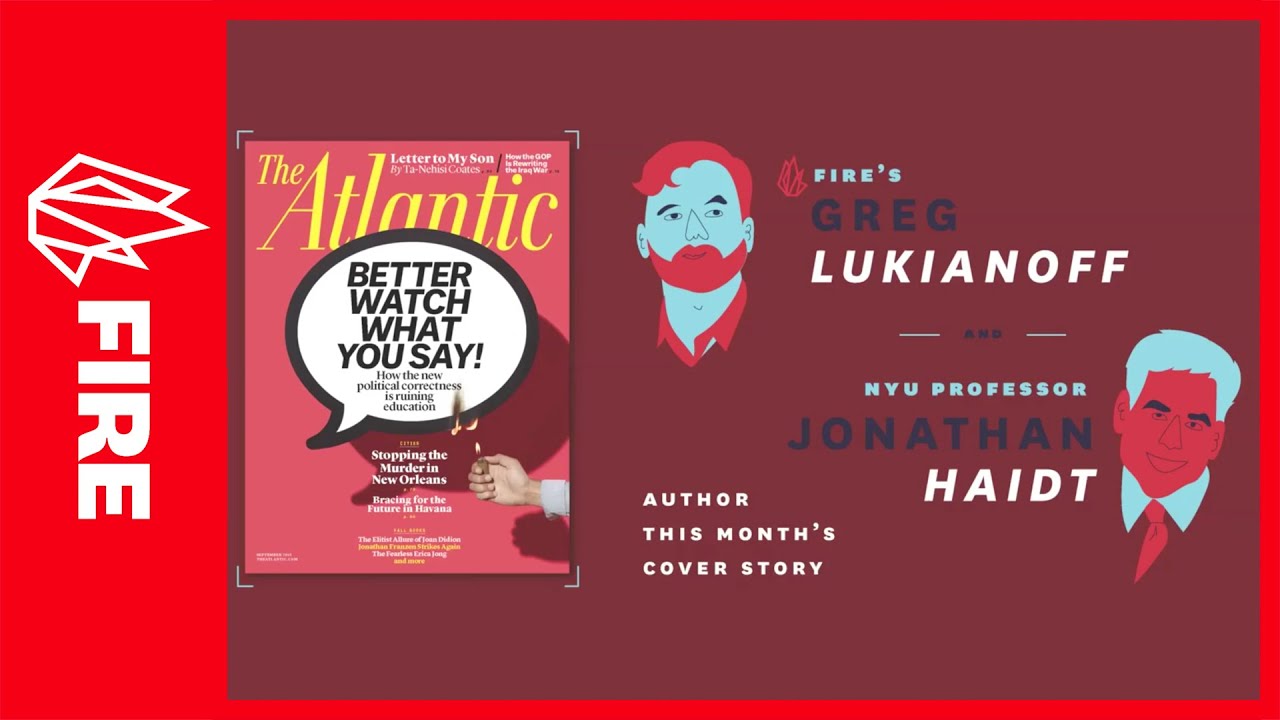
https://www.youtube.com/watch?v=xlKo9LkzPlI
1.
Aug 16, 2015 - Uploaded by TheFIREorg
:{[PDF]:(style="font-weight:bold;cursor:auto;margin:0px 3px 0px 0px;float:left"):}:Coddling of the American Mind
https://www2.cortland.edu/.../81f485db-c9a...
2.
by G Lukianoff - Cited by 22 - Related articles
by Greg Lukianoff and Jonathan Haidt. The Coddling of the American Mind. Abridged with permission from TheAtlantic (Sept. 2015). In the name of emotional ...
Campus PC panic is getting ridiculous: Here's what a “trigger warning ...
www.salon.com/.../campus_pc_panic_is_getting_ridiculous_heres_what_a_trigg...
2.
3 Quick Notes About 'The Coddling of the American Mind' Greg ...
www.huffingtonpost.com/greg-lukianoff/3-quick-notes-about-th...
2.
:{==:(style="background-color:#ffffff;"):}:
http://www.alternet.org/trump-gives-supporters-permission-be-violent-protesters-if-you-hurt-them-ill-defend-you-court
:{==
someone says coddle is just distillation on milleniam stereotypes?
==
cited (distorted?0 by breitbart, but seems ok
http://www.nytimes.com/2015/03/22/opinion/sunday/judith-shulevitz-hiding-from-scary-ideas.html?_r=0
==
}: