Divestment/Boycott
recover
see also defectors, shareholder revolt
Divestment refers to a number of strategies for defunding corps for bad behavior (market forces, signal)
350 org and apartheid bill said $3 billion from S afr, desmond tutu
see palestine BDS
==
==
divest PIC 3/19
a host of efforts to push big banks to divest from private prisons, including by the Families Belong Together coalition led by MomsRising, the #BackersOfHate campaign, and Freedom to Thrive, notched a big victory when JPMorgan Chase recently announced that it will stop financing CoreCivic and GEO Group, the two biggest private prison corporations. LittleSis partnered on the research to identify private prison profiteers that was used by the Families Belong Together coalition and the #BackersOfHate campaign. Wells Fargo, another target of the campaign, has also indicated that it is pulling back from financing private prisons.
==
https://yyy.theguardian.com/news/2018/aug/14/bds-boycott-divestment-sanctions-movement-transformed-israeli-palestinian-debate
Top five Clinton donors are Jewish, campaign tally shows - World ...
https://www.haaretz.com › World News
1.
https://theintercept.com/2018/03/14/campus-free-speech-bds-israel-boycott/
POLITICIANS AROUND THE country are seizing upon highly publicized episodes of conservatives faced with harassment and heckling on college campuses by responding with a wave of legislation supposedly aimed at preserving free speech rights for campus speakers. But that commitment, while draped in the mantle of a principled defense of the First Amendment, does not always extend to speakers who criticize Israel and its policies.
This renewed concern about free speech comes after a number of high-profile incidents in which students interrupted conservative speakers, and in a few cases, even used violence at protests. At a hearing on campus free speech in October, U.S. senators expressed bipartisan support for the First Amendment on college campuses, but lawmakers around the country are demanding free speech with one hand, and passing laws that punish boycotts of Israel with the other.
One of the most prominent examples comes from Wisconsin, where Republican state Sen. Leah Vukmir has used the issue of campus free speech to launch a campaign for U.S. Senate this year, challenging the incumbent, Democratic Sen. Tammy Baldwin.
Vukmir is the original sponsor of “free speech” legislation that calls for a strict disciplinary system for those who infringe on others’ free speech rights on college campuses in her state. “Students, professors, and administrators are using intimidation tactics to silence those they disagree with,” Vukmir said, after unveiling her legislation last May.
She went on to launch a campaign with the help of the American Legislative Exchange Council, or ALEC, for lawmakers in other states to duplicate her campus free speech efforts. “Senator Vukmir is a champion of free speech issues,” reads a press release from ALEC, which awarded Vukmir its “Iron Lady Award” for taking tough stands as a legislator.
But Vukmir, a strong supporter of Israel, is apparently selective in her championing of free speech.
Just months after sponsoring the free speech legislation last year, Vukmir sponsored a so-called anti-BDS law in Wisconsin, prohibiting the state from entering into contracts with businesses that choose to express themselves by engaging in a boycott to protest Israeli occupation of the West Bank. Gov. Scott Walker signed an executive order establishing the anti-BDS policy in October.
BDS refers to the Palestinian-led boycott, divestment, and sanctions movement that advocates for economic pressure to force Israel to end its occupation of the Palestinian territories. BDS campaigns have gained traction across the United States in recent years, particularly on college campuses. Palestine Legal, a nonprofit advocacy group, notes that boycotts have long played a significant role in U.S. history, and that the “Supreme Court has held that boycotts to effect political, social, and economic change are protected by the First Amendment of the Constitution.”
But pro-Israel advocacy organizations, including the America Israel Public Affairs Committee, known by its acronym AIPAC, have spearheaded an aggressive campaign to encourage lawmakers to stifle BDS activism. Twenty-four states have now passed legislation designed to penalize or prohibit BDS activity.
Rather than focus on the suppression of pro-Palestinian activism, legislators have almost singularly focused on a string of high-profile attacks on right-wing speakers on college campuses. One example is Milo Yiannopoulos, an “alt-right” provocateur who has collaboratedwith white supremacist figures. He was a relatively obscure figure until left-wing activists protested violently when he came to the University of California, Berkeley campus, elevating him as a national figure. At the October Senate hearing, Allison Stanger, a Middlebury College professor, testified about her experience moderating a talk with American Enterprise Institute scholar Charles Murray, whose book, “The Bell Curve,” on IQ as a determinant of socioeconomic status has been criticized as being racist. The protesters disrupted the speaking engagement, assaulting Stanger and leaving her hospitalized.These laws have been used to suppress the speech of a wide range of people and businesses. In Kansas, a star teacher was denied payment to train other teachers because she was following her church’s guidance and boycotting Israel. (A federal court struck down the Kansas law following that controversy.) In Texas, a town seeking contractors to rebuild after a devastating hurricane mistakenly used an anti-BDS clause to prevent the hiring of anyone who also boycotted Israel.
ACROSS THE COUNTRY, politicians are hoping to harness the outrage over such incidents into political benefit, supposedly in the name of securing free speech.
...
http://www.exposedbycmd.org/2017/06/28/reagan-vs-cities-battle-south-african-apartheid-lessons-trump-era
With the Trump administration threatening to withhold federal funds from cities and states offering protections to undocumented immigrants, a new report details similar tactics used by the Reagan administration to pressure cities and states to abandon anti-apartheid sanctions and divestment legislation.
The report “Reagan vs. Cities: The 20th Century Battle Over South African Apartheid & Lessons For The Trump Era” provides historical examples of how cities and states can wield power in the face of threats of retaliation for local policies that defy a president’s political agenda.
Between December 2016 and June 2017, researchers from Jobs to Move America combed through thousands of pages of declassified documents from the Ronald Reagan Presidential Library — legal memos, policy guides, court briefings, and correspondence between companies and the Reagan administration.
“Reagan Vs. Cities and States: The 20th Century Battle over South African Apartheid” tells the story of how cities and states joined the fight against apartheid in South Africa and won even as the Reagan administration and special interest groups like the American Legislative Exchange Council (ALEC) sought to suppress those efforts.
ALEC was an early opponent of divestment efforts, distributing a report against divestment to federal, state, and local officials. As this new report details, ALEC was imbedded in the Reagan Administration’s push back on the sanctions movement and was considered by White House insiders to be crucial to providing the intellectual “firepower” for the push back in cities and states. ALEC opposed divestment throughout Reagan’s entire term and up until the dismantling of the apartheid regime, applauding Oregon for rolling back divestment in 1991.
ALEC has never apologized for those activities. ALEC has also long opposed socially responsible investing by states and cities, and to this day has been opposing shareholder responsibility efforts.
Now, the Trump administration is borrowing an idea from the ALEC playbook, threatening “sanctuary cities” with the removal of federal funds if they continue to aid immigrants. ALEC has long had a “model bill” condemning sanctuary cities.
From the report:
By 1991, 28 states, 1 territory, and 92 cities had imposed sanctions, divestment, or other measures on companies doing business in South Africa, costing U.S. corporations substantial sums — in order to stand up for the human rights of black South Africans repressed by a white supremacist regime. The Reagan administration continued to oppose these local efforts, as it had in the case of the New York City law, by implementing measures to undercut cities and states including the threat to withdraw federal funding for many local initiatives.
Notwithstanding the Reagan administration’s efforts, sustained opposition to the apartheid system caused its downfall in 1991. The sanctions and divestment movement is credited for playing a critical role in apartheid’s demise.
In 2017, President Donald Trump’s advisors have revisited the Reagan playbook to advance his bid to engage in mass deportations of undocumented immigrants working in the U.S. A few days after assuming office, Trump signed Executive Order 13768, “Enhancing Public Safety in the Interior of the United States.” The Order requires state and local officials to share information about individuals’ immigration status with federal immigration officials. Trump threatened to withhold federal funding from cities that provide “sanctuary” to undocumented immigrants and do not abide by the Order. Although San Francisco and several other U.S. cities brought legal challenges to the order, the Trump administration continues to look for ways to implement their policies.
In the Trump era, as cities and states around the country prepare to challenge the White House, they can look to the example of the anti-apartheid movement, when grassroots groups and activists joined together with cities and states to fight the federal government’s threats and together helped the movement of black South Africans triumph over a repressive regime.
The report was written by Jobs to Move America, a national organization uniting community, labor, faith, civil rights, philanthropic, academic and environmental groups and the Center for Media and Democracy. CMD’s Executive Director, Lisa Graves, JMA’s Madeline Janis, and Dr. Mary Frances Berry, a leader of the Anti-Apartheid movement, participated in a call to announce the findings of the report this week.
==
This past Monday I wrote a Daily Kos article about the Republican talk radio host, Rush Limbaugh, being dropped, after 22 years, from the Indianapolis radio station WIBC. Many other news /opinion sites covered the story, as well as IBJ (Indianapolis Business Journal). Most of the stories basically said the move was a simple change in direction:
Officials for WIBC parent Emmis Communications this month notified Los Angeles-based syndicator Premiere Networks that it would not extend its deal to air Limbaugh’s show.
Here's where the IBJ piece was a little different. Emmis' local market manager, Charlie Morgan, said the mega company's decision to drop Limbaugh was much more than a simple change - and they have been contemplating this move for 18 months.
While Morgan expects some WIBC listeners to be “hugely disappointed” by the change, he said losing Limbaugh could open up the station to more advertising opportunities.
"There are some—primarily national—advertisers that refuse to air commercials during Limbaugh’s show, Morgan explained. "
Emmis officials began notifying its advertisers of the change Monday.
And there it is - bonafide proof once again, that the boycott against Rush Limbaugh and his sponsors is not only working, it's remarkably effective. It's changing the face of talk radio altogether. Right now the biggest problem with radio - is Rush Limbaugh. And the hundreds of thousands of Limbaugh boycotters couldn't be more pleased.
Advertisers can't handle the pressure and loss of customers. Most companies, other than those run by Republican Dittoheads, are avoiding Rush Limbaugh like the plague. This was not the case in 2012. That year, self-proclaimed 'El Rushbo' enjoyed sitting on the king's throne of Conservative 'hate radio' with a plethora of large lucrative sponsors. That all changed after he called an unknown college student a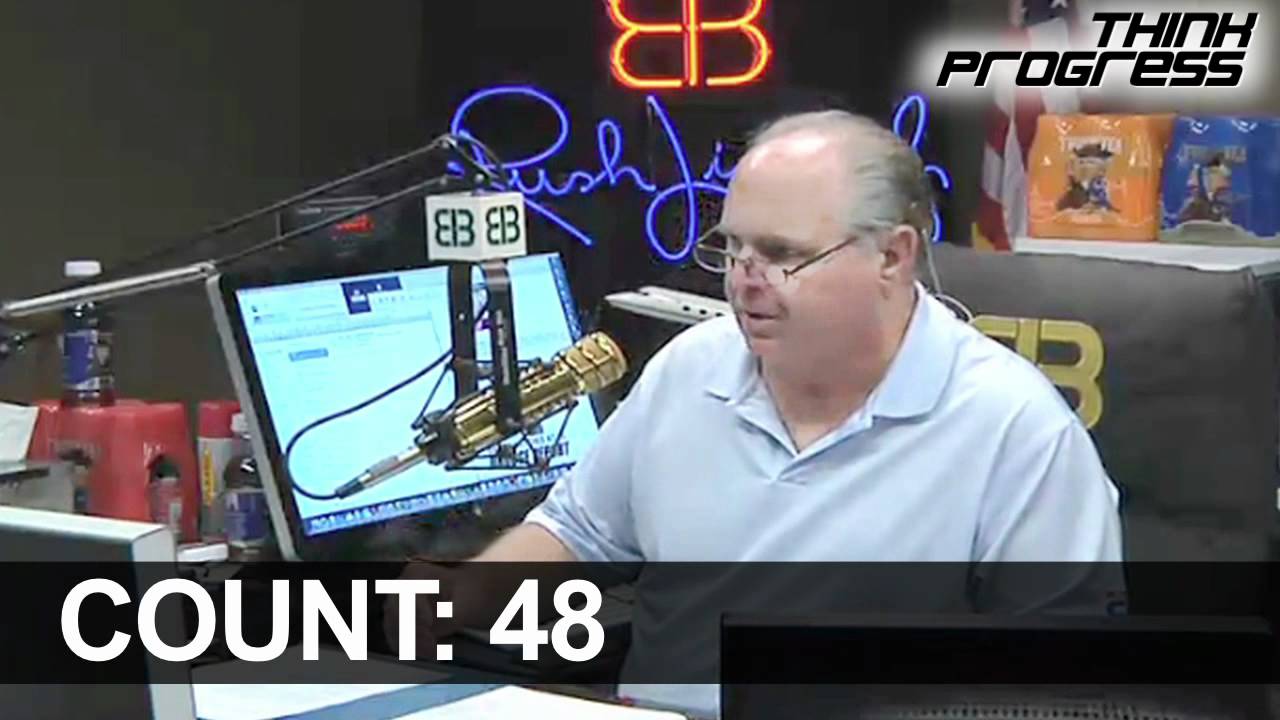 while she advocated for insurance-paid birth control at a congressional hearing. Once Limbaugh's rant hit social media and went viral, huge sponsors like Ford, GM, McDonald's, Subway, Carbonite…began to pull their ads immediately after seeing the public's outrage. Yes, the good old days are long gone for Limbaugh, though his camp begs to differ and continues to make lame attempts to derail the boycott Limbaugh used tojoke about. Also, his PR team is now blitzing search engines like Google with 10 or more RushLimbaugh.com stories per day - from the same show. Guess they need those page views to generate revenue because it sure isn't coming from sponsors.
Kudos, once again, to the many individuals, groups/organizations and websites involved in this successful movement. They are not mentioned enough. It's been a slow, agonizing fall for Rush Limbaugh, and it's given the protestors some pretty glorious victories and affirmations along the way. There will be more celebrations to come. Some organizations like NOW (The National Organization For Women) NARAL Pro-Choice America, and Planned Parenthoodhave been after Limbaugh for years. The amazing StopRush volunteers have been relentless. Other Limbaugh protestors and bashers include:
News Websites/Blogs like Media Matters, Daily Kos, Daily Kos 'Sluts', Liberals Unite, UniteWomen.org, Addicting Info, Occupy Democrats, ReverbPress, The Smoking Gun, Alternet, UntraViolet, and Huffington Post.
Facebook Pages like Boycott Rush Limbaugh's Sponsors To Shut Him Down, Being Liberal, Honoring Richard Myers, Pro-Choice Liberals, Miss R*EVOLutionaries, Chicks on the Left, Living Blue In Texas, Pragmatic Progressives, Everlasting GOP Stoppers, Too Informed To Vote Republican, Worley Dervish, Lady Grey, The Beer Party, Lady Liberals, Red State Dems, The Ale Party, One Million Sluts Against Rush Limbaugh and Political Loudmouth.
Facebook 'Groups' like FlushRush, Join The Fight To Flush Rush, Fight Laws Against Women, Pro-Choice Democrats, End Citizens United, ERA Action, and Stop Republican Laws Against Women.
Well Known Individuals like Gloria Steinem, Jon Stewart, Lewis Black, Rachel Maddow, Al Franken, Stephen Colbert, Peter Gabriel, Spike Lee, Andy Borowitz, Crystal Ball, the late, great George Carlin, Ed Shultz, Sandra Fluke, Ice-T, Jane Fonda, and Gloria Allred.
Individuals Equally Important include the late Daily Kos diarist Richard Myers, Wojtek Wacowski, Rick Unger, Cenk Uygur, Angelo Carusone, Karen Teegarden, Jen Senko, Matthew Desmond, Samuel Wynn Warde, Kimberley Johnson, HRHPrissy, Freya Malin, John Jorgenson, Kitty Fitzgerald, LOrion, ProgLegs, Gary Flinn, and Certinot.
The list is massive. The Limbaugh Sponsor & Clear Channel/iHeart Petition, alone has over 131,000 signatures.
http://www.alternet.org/activism/these-3-colleges-endowments-are-doing-just-fine-after-divesting-fossil-fuels
==
esterday morning, 48 students launched a sit-in at Yale University to demand their administration divest from fossil fuels, and yesterday evening 19 were arrested for refusing to leave the building. Students asked their administration to pick a side: the people or the polluters. The fossil fuel industry that's wrecking our climate -- or the students, alumni, faith leaders, Nobel Prize laureates, and communities demanding that they get serious about this planetary emergency.
These brave students at Yale are not acting alone -- as spring warms up, young people at schools across the U.S. are turning up the heat. At Swarthmore and the University of Mary Washington, activists have been blocking administration buildings for weeks demanding that their schools stand on the right side of history. Now they need your help.
==
Rainforest Action Network leader Mike Brune, whose organization’s protests against banks exposed the coal industry’s financial underbelly.
Related to consumer boycott, but recall that corps hide behind industry groups, buffer to protect themselves from boycott, bad PR
see also shareholder revolt
Defund the Right?
ppl's boycott
extract
OBERT J. ERNST (Ernst sits on Board of Directors for PRI): http://www.sourcewatch.org/index.phptitle=Pacific_Research_Institute
SWARTZ & ASSOCIATES (Rick Swartz sits on Advisory Board of For Our Grandchildren): http://www.sourcewatch.org/index.phptitle=For_Our_Grandchildren
VENABLE LLP (member James Burnley sits on Board of Directors of FreedomWorks): http://www.sourcewatch.org/index.phptitle=Freedomworks
AUTOMOBILE & TRUCK MANUFACTURERS, GASOLINE, & PRODUCT PROVIDERS:
AMOCO (ALEC): http://www.sourcewatch.org/index.phptitle=ALEC_Corporations
AMWAY Automotive Products (XLP, Hi-Gear) (ALEC): http://www.sourcewatch.org/index.phptitle=ALEC_Corporations
BP AMERICA (ALEC): http://www.sourcewatch.org/index.phptitle=ALEC_Corporations
CARMAX (forced arbitration clauses for employees) - http://www.citizen.org/rigged-justice-rogues-gallery
CHEVRON GAS (ALEC): http://www.sourcewatch.org/index.phptitle=ALEC_Corporations; (PRI member): http://www.sourcewatch.org/index.phptitle=Pacific_Research_Institute; (AIM): http://www.sourcewatch.org/index.phptitle=Accuracy_in_Media
CONOCO PHILLIPS Oil (AIM): http://www.sourcewatch.org/index.phptitle=Accuracy_in_Media
EXXON MOBIL (ALEC):http://www.sourcewatch.org/index.phptitle=ALEC_Corporations; (Corporate member of PRI): http://www.sourcewatch.org/index.phptitle=Pacific_Research_Institute; (AIM): http://www.sourcewatch.org/index.phptitle=Accuracy_in_Media
GENERAL MOTORS (ALEC): http://www.sourcewatch.org/index.phptitle=ALEC_Corporations
GETTY OIL (AIM): http://www.sourcewatch.org/index.phptitle=Accuracy_in_Media
MOBIL (AIM): http://www.sourcewatch.org/index.phptitle=Accuracy_in_Media
PEP BOYS (forced arbitration clauses) - http://www.citizen.org/rigged-justice-rogues-gallery
SAFELITE AUTO GLASS (LIMBAUGH) http://www.stoprush.net/sl.php#current_n
SLIME (tire care) (LIMBAUGH) http://www.stoprush.net/sl.php#current_n
BANKS/FINANCIAL SERVICE COMPANIES:
AMERIPRISE (forced arbitration clauses) - http://www.citizen.org/rigged-justice-rogues-gallery
AURORA CAPITAL GROUP (member Gerald Parsky is on Advisory Board of For Our Grandchildren: http://www.sourcewatch.org/index.phptitle=For_Our_Grandchildren)
BB&T (forced arbitration clauses) - http://www.citizen.org/rigged-justice-rogues-gallery
BAIN CAPITAL (Romney's group)
BANK OF AMERICA (ALEC): http://www.sourcewatch.org/index.phptitle=ALEC_Corporations
CAPTAN LLC (F. Christian Wignall, VP, sits on Board of Directors for PRI): http://www.sourcewatch.org/index.phptitle=Pacific_Research_Institute
CHARLES SCHWAB BANK (forced arbitration clauses) - http://www.citizen.org/rigged-justice-rogues-gallery
CHASE (forced arbitration clauses) - http://www.citizen.org/rigged-justice-rogues-gallery
CITIBANK (forced arbitration clauses) - http://www.citizen.org/rigged-justice-rogues-gallery
DISCOVER (forced arbitration clauses) - http://www.citizen.org/rigged-justice-rogues-gallery
EDWARD JONES (forced arbitration clauses) - http://www.citizen.org/rigged-justice-rogues-gallery
ELLIOTT MANAGEMENT Hedge Fund (big Rep. & Romney donors): http://www.npr.org/2012/04/17/150426158/superdonor-backs-romney-and-gay-marriage
EMERGING MARKETS GROUP (VP Ken Brown and Pres. Gregory Fossedal are members of AdTi: http://www.sourcewatch.org/index.phptitle=Alexis_de_Tocqueville_Institution)
EQUIFAX (forced arbitration clauses) - http://www.citizen.org/rigged-justice-rogues-gallery
FIDELITY INVESTMENTS (forced arbitration clauses) - http://www.citizen.org/rigged-justice-rogues-gallery; (SEC charges of graft): http://www.sourcewatch.org/index.phptitle=Fidelity
FREEMONT GROUP (member James T. Farrell sits on Board of Directors for PRI): http://www.sourcewatch.org/index.phptitle=Pacific_Research_Institute
FREISS ASSOCIATES EQUITY (big Rep. donors): http://www.sourcewatch.org/index.phptitle=Foster_Friess
GENERATION AMERICA (LIMBAUGH) http://www.stoprush.net/sl.php#current_n
GILDER, GAGNON, HOWE & CO, LLC (Richard Gilder is member of Club for Growth: http://www.sourcewatch.org/index.phptitle=Club_for_growth)
GOLDMAN SACHS (Trading fraud): http://www.sourcewatch.org/index.phptitle=Goldman_Sachs
HARRIS TRUST & SAVINGS BANK ("Golden Parachute payouts): http://www.sourcewatch.org/index.phptitle=Harris_Bank
INTERNATIONAL PAPER (ALEC): http://www.sourcewatch.org/index.phptitle=ALEC_Corporations
JW CHILDS EQUITY (big Rep. donors- "Republican ATM"): http://www.sourcewatch.org/index.phptitle=John_childs
JACOBS LEVY EQUITY (big Rep donors): http://www.alternet.org/teaparty/152318/$1_million_donation_to_the_kochs_meet_the_wealthy_right-wingers_helping_fund_the_brothers'_agenda/page=2
KUDLOW & CO. INVESTMENT RESEARCH (Kudlow is member of Club for Growth): http://www.sourcewatch.org/index.phptitle=Club_for_growth
LPL FINANCIAL LLP (forced arbitration clauses) - http://www.citizen.org/rigged-justice-rogues-gallery
LEAR CAPITAL (gold-buying group) (LIMBAUGH) http://www.stoprush.net/sl.php#current_n
LIFELOCK (identity theft) (LIMBAUGH) http://www.stoprush.net/sl.php#current_n
LITCHFIELD ADVISORS (member Robert Lansing sits on Foundation Board of FreedomWorks): http://www.sourcewatch.org/index.phptitle=Freedom_Works
MORGAN STANLEY SMITH BARNEY (forced arbitration clauses) - http://www.citizen.org/rigged-justice-rogues-gallery
PNC BANK (forced arbitration clauses) - http://www.citizen.org/rigged-justice-rogues-gallery
PADDEN & CO. (David Padden is member Emeritus of FreedomWorks):http://www.sourcewatch.org/index.phptitle=Freedomworks
PAULSON & CO. (hedge fund group) (John Paulson is largest contributor to Restore Our Future): http://www.sourcewatch.org/index.phptitle=%22Restore_Our_Future%22
REGIONS BANK (forced arbitration clauses) - http://www.citizen.org/rigged-justice-rogues-gallery
SALLIE MAE (forced arbitration clauses) - http://www.citizen.org/rigged-justice-rogues-gallery
SANDS CAPITAL MGMT. (member Frank M. Sands, Sr. sits on Foundation Board of FreedomWorks): http://www.sourcewatch.org/index.phptitle=Freedom_Works
SOVEREIGN BANK (forced arbitration clauses) - http://www.citizen.org/rigged-justice-rogues-gallery
TD BANK (forced arbitration clauses) - http://www.citizen.org/rigged-justice-rogues-gallery
T. ROWE PRICE(forced arbitration clauses) - http://www.citizen.org/rigged-justice-rogues-gallery
TAX RESOLUTION SERVICES (LIMBAUGH) - http://www.stoprush.net/sl.php#current_n
US BANK (forced arbitration clauses) - http://www.citizen.org/rigged-justice-rogues-gallery
VANGUARD GROUP (forced arbitration clauses) - http://www.citizen.org/rigged-justice-rogues-gallery
WELLS FARGO (forced arbitration clauses) - http://www.citizen.org/rigged-justice-rogues-gallery
https://www.facebook.com/notes/the-peoples-boycott/boycott-it-general-listings/253177451399683
==
http://ecowatch.com/2014/10/21/exxon-fossil-fuel-divestment
==
the two biggest offending industries are the most subsidied: oil and agribiz, and both have populist potential
==
While the year’s end saw an uptick in concern about a new tech bubble, the truth is that there’s a much different, scarier bubble we need to worry about: the carbon bubble. What is the carbon bubble? Basically, it’s just another way to describe the worrisome fact that many energy companies are hoarding oil and gas, despite the rest of the world’s effort to move to a more environmentally sustainable economic system. In much the same way that governments fail to accurately measure social progress and sustainability, these companies are stuck in a dying paradigm. As The Economist puts it, “either governments are not serious about climate change or fossil fuel firms are overvalued.”
It’s simple math. In the 2010 Cancun Agreements, the international community pledged to prevent global temperatures from rising by more than 2 degrees Celsius above pre-industrial levels. But even this number is likely far too high. After all, the .8 degrees Celsius temperatures have risen thus far has already severely damaged ecosystems and economies. But given that the current trajectory would, according to IEA economist Fatih Birol, increase global temperatures by 6 degrees, 2 degrees is a politically and scientifically feasible red line. And it won’t be easy: The most recent Carbon Tracker report estimates that to have an 80% chance of holding temperatures below that threshold, no more than 900 gigatonnes of carbon dioxide (GtCO2) can be released into the atmosphere between 2013 and 2049. This range is called the international “carbon budget.”
The problem is, the total known fossil fuel reserves being held would release 2,860 GtCO2 into the atmosphere if burned. Of those reserves, listed companies account for 762 GtCO2; the rest is owned by governments. If all of the potential reserves currently being explored or developed by these companies are included, their reserves jump from 762 GtCO2 to 1,541 GtCO2. What’s more, over the last two years, the number of CO2 reserves listed on the New York Stock Exchange increased by 37%. Assuming that state-owned companies and corporations divide the carbon budget proportionally, listed companies must keep their CO2 emissions below 225 GtCO2, which means that 65 to 80 percent of their reserves cannot be burned. The inevitable conclusion? A whopping two-thirds of reserves listed on markets are potentially worthless.
Steve Waygood, head of Sustainability Research at Aviva Investors, a global asset management company, sums up the conundrum: “Valuations of the oil and gas sector still assume that they will be able to take all proven and probable reserves out of the ground and burn them. Based on credible data we cannot be allowed to do that…” So in much the same way that pre-Great Recession housing prices were based on the assumption that their values would continue to rise and homeowners would pay off their mortgages, the valuation of oil and gas companies is based on the assumption that they will be able to extract resources that must remain in the ground.
Amazingly, even given these realities, companies have allocated up to $674 billion to explore fornew, unusable reserves. The Carbon Tracker report finds that, if exploration trends continue at the same rate over the next decade, “it would see up to $6.74 trillion in wasted capital developing reserves that is likely to become unburnable.” Not only will much of their reserves be unusable, but big oil and gas companies face the threat of waning demand as the international community moves toward a more sustainable economy. An HSBC report puts the problem thusly, “The main risk for the oil sector, however, is whether a low-carbon future would lead to lower fossil fuel prices.” The decline in demand will be driven partially by government initiatives and partially by the increase in alternatives (most significantly natural gas). A growing, international divestment movement will no doubt play its part, too.
The carbon bubble has big implications. It could wipe out market capitalization for behemoth firms and render oil states destitute. Companies are still inflating the bubble, and many policymakers, especially those who are subservient to big oil, are turning a blind eye. If the international community is serious about limiting warming to 2 degrees Celsius, carbon assets may face a $20 trillion write-down (the U.S. GDP was $15.7 trillion in 2012). Investors and governments should take note of the growing carbon bubble and work to pull asset prices down with regulation, disinvestment and accurate pollution pricing. Companies should adopt internal pricing mechanisms, as many have done. Companies, governments and individuals should invest in green energy, which will drive sustainable growth. The only other alternative is to continue on the current path, eating up our carbon budget and pushing global temperatures past the already dangerously high levels we are facing.
Sean McElwee is a writer and researcher of public policy. His writing may be viewed atseanamcelwee.com. Follow him on Twitter at @seanmcelwee.MORE SEAN MCELWEE.
Lew Daly is a Director of the Sustainable Progress Initiative and a Senior Fellow at Demos
in a move that underscores Wall Street's growing unease over the business-as-usual strategy of the world's fossil fuel companies, Bloomberg L.P. unveiled a tool last week that helps investors quantify for the first time how climate policies and related risks might batter the earnings and stock prices of individual oil, coal and natural gas companies.
The company's newCarbon Risk Valuation Toolis available to more than 300,000 high-end traders, analysts and others who regularly pore over the stream of information that's available through Bloomberg's financial data and analysis service. The move significantly broadens and elevates the discussion of "stranded" or "unburnable" carbon reserves—expanding it beyond climate groups and sustainability investors to the desks of the world's most active and influential investors and traders.
http://fuelfix.com/blog/2013/12/02/student-fossil-fuel-divestment-movement-suffers-setbacks/
By Kevin Begos
Associated Press
PITTSBURGH (AP) — The student campaign to press colleges and universities to divest from fossil fuels is entering a new phase, now that administrators at several top schools have said no.
Students say the refusals from schools including Harvard, Brown and Cornell have been both a shock and a motivation for the campaign, which is active at more than 200 schools.
TomDispatch [1] / By Todd Gitlin [2]
Todd Gitlin: How to Reverse the Slow-Motion Climate Change Apocalypse
November 21, 2013 |
Apocalyptic climate change is upon us. For shorthand, let’s call it a slow-motion apocalypse to distinguish it from an intergalactic attack out of the blue or a suddenly surging Genesis-style flood.
Slow-motion, however, is not no-motion. In fits and starts, speeding up and slowing down, turning risks into clumps of extreme fact, one catastrophe after another -- even if there can be no 100% certitude about the origin of each one -- the planetary future careens toward the unlivable. That future is, it seems, arriving ahead of schedule, though erratically enough that most people -- in the lucky, prosperous countries at any rate -- can still imagine the planet conducting something close to business as usual.
To those who pay attention, of course, the recent bursts of extreme weather are not “remote “or “abstract,” nor matters to be deferred until later in the century while we worry about more immediate problems. The coming dystopian landscape is all too real and it is already right here for many millions. (Think: the Philippines [3], the Maldives Islands [4], drowned New Orleans, the New York City subways, Far Rockaway, the Jersey Shore, the parched Southwest [5], the parched and then flooded Midwest [6] and other food belts [7], the Western forests that these days are regularly engulfed [8] in “record” flames [9], and so on.) A child born in the United States this year stands a reasonable chance of living into the next century when everything, from available arable land and food resources [10] to life on our disappearing seacoasts [11], will have changed, changed utterly.
A movement to forestall such menaces must convince many more millions outside Bangladesh or the Pacific islands [12] that what’s “out there” is not remote in time or geographically far away, but remarkably close at hand, already lapping at many shores -- and then to mobilize those millions to leverage our strengths and exploit the weaknesses of the institutions arrayed against us that benefit from destruction and have a stake in our weakness.
There is a poetic fitness to human history at this juncture. Eons ago, various forms of life became defunct. A civilization then evolved to extract the remains of that defunct life from the earth and turn it into energy. As a result, it’s now we who are challenged to avoid making our own style of existence defunct.
Is it not uncanny that we have come face-to-face with the consequences of a way of life based on burning up the remnants of previous broken-down orders of life? It’s a misnomer to call those remains -- coal, oil, and gas -- “fossil fuels.” They are not actually made up of fossils at all. Still, there’s an eerie justice in the inaccuracy, since here we are, converting the residue of earlier breakdowns into another possible breakdown. The question is: will we become the next fossils?
Subsidizing Big Energy
The institutions of our ruling world have a powerful stake in the mad momentum of climate change -- the energy system that’s producing it and the political stasis that sustains and guarantees it -- so powerful as to seem unbreakable. Don’t count on them to avert the coming crisis. They can’t. In some sense, they are the crisis.
Corporations and governments promote the burning of fossil fuels, which means the dumping of its waste product, carbon dioxide, into the atmosphere where, in record amounts [13], it heats the planet. This is not an oversight; it is a business model.
Governments collude with global warming, in part by bankrolling the giant fossil fuel companies (FFCs). As a recent report [14]written by Shelagh Whitley for the Overseas Development Institute puts it,
"Producers of oil, gas, and coal received more than $500 billion in government subsidies around the world in 2011... If their aim is to avoid dangerous climate change, governments are shooting themselves in both feet. They are subsidizing the very activities that are pushing the world towards dangerous climate change, and creating barriers to investment in low-carbon development and subsidy incentives that encourage investment in carbon-intensive energy.”
Of course a half-trillion dollars in subsidies doesn’t just happen. It cannot be said too often: the FFCs thrive by conniving with governments. They finance politicians to do their bidding. Seven of the ten largest companies [15] in the world are FFCs, as are four of the ten most profitable (just outnumbering three Chinese banks, which presumably have their own major FFC connections). These behemoths have phenomenal clout when they lobby for fossil-fuel-friendly development and against remedial policies like a carbon tax. And if this were not enough, they flood the world [16] with fraudulent claims that climate change is not happening, or is not dangerous, or that its dimensions and human causes are controversial among scientists whose profession it is to study the climate.
The Cascade
Fossilized corporations do their thing while frozen governments produce (oropt [17] out of [18]) hapless and toothless international agreements. By default, initiative must arise elsewhere -- in places where reason and passion have some purchase as well as a tradition, places where new power may be created and deployed. This counterpower is, in fact, developing.
Given the might and recalcitrance of the usual culpable and complicit institutions, it falls to people’s initiatives and to other kinds of institutions to take up the slack. This means universities, churches, and other investment pools, now increasingly under pressure from mushrooming campaigns to divest funds from FFCs; and popular movements against coal, oil, fracking, and other dangerous projects -- in particular, at the moment, movements in the U.S., Canada [19], and elsewhere to stop [20] tar sands pipelines.
Those in the growing divestment movement suffer no illusions that universities themselves wield the magnitude of power you find in investment banks or, of course, the FFCs themselves. They are simply seeking leverage where they can. The sums of capital held by universities, in particular, are small on the scale of things. Harvard, the educational institution with the largest endowment (some $32.7 billion [21] at last count), reports that only 3% of its direct holdings are in the top 200 energy outfits. (The amount of its money held indirectly and opaquely, through private capital pools, and so also possibly invested in FFCs, is unclear.) Though millions of dollars are at stake, that’s a drop in the bucket for Harvard, whose holdings amount, in turn, to nowhere near a drop in the total market capitalization of those energy giants.
Set against a landscape in which people have lost faith in the principle sectors of power, however, universities still have a certain legitimacy that grants them the potential for leverage. Divestment will make news precisely because such movements are unusual: universities biting the hands of the dogs that feed them, so to speak.
We won’t know how much influence that legitimacy can bring about until the attempts are made. What we do know, from historical precedent, is that such efforts, even when they start on a small scale, tend to inspire more of the same. As Robert Kinloch Massie argues in his fine book on South African sanctions,Loosing the Bonds [22], divestment campaigns such as those over apartheid and Big Tobacco [23] (phased out by Harvard in 1990) worked by creating a cascade effect.
With climate change, the stigmatization of the FFCs is already spreading [24] from universities and churches to city and state pension funds. Eventually, if it works, the cascade changes the atmosphere around private and public investment decisions. Then those decisions themselves begin to change and such changes become part of a new market calculation for investors and politicians alike.
That’s why it matters so much that some 400 divestment campaigns [25] are currently underway at American colleges and universities. Cascades of influence can move institutions, often in surprising ways. Every time a divestment demand is put forward, the conversation changes in elite board rooms where investment decisions are made. Children of FFC executives go home for Christmas and their nagging questions make their parents’ business-as-usual lives less comfortable. (This dynamic, though seldom credited, undoubtedly played some role in ending the Vietnam War.)
At Harvard, my alma mater, a fierce campaign [26] by courageous and strategic-minded students has spun off a parallel campaign by alumni [27]. They are being asked to withhold contributions to the university and to donate to an escrow fund until Harvard divests from its direct holdings in FFCs and undertakes to divest from its indirect holdings as well.
Is this sort of demand just a gesture of moral purity? Not necessarily. Indeed, there may well be an economic payoff for morally motivated divestment and reinvestment. My fellow alumnus Bevis Longstreth [28], a former commissioner of the Securities and Exchange Commission, makes a strong case that the policies of the FFCs are shortsighted and risky. (During the year 2012 alone, the top 200 sank $674 billion into acquiring and developing new energy reserves and working out ways to exploit them.) Significant parts of the capital they are now investing will likely be “wasted,” since in a climate-change world, large portions of those reserves will have to stay in the ground.
Looked at in the long term, the FFCs may not turn out to be such smart investments after all. Indeed, in the boilerplate language of financial prospectuses, past results are no guarantee of future results; and there are already investment models [29] showing that non-FFC funds deliver better proceeds.
These efforts and arguments have yet to convince Harvard President Drew Gilpin Faust that climate change is one of those “extraordinarily rare circumstances” [30] when divestment is justified. Instead, she proposes “engagement” with the boards of the energy companies, as if sweet reason by itself stood a chance of outtalking sweet crude oil. She touts Harvard’s teaching and research on climate issues, while neglecting the way those corporations fund disinformation meant to blunt the effect of that teaching and research. Having declared that the issue is not “political,” she defends Harvard’s investments in the chief funders of propaganda against climate science. Some rejection of politics! Meanwhile, for saying no to divestment, President Faust wins the applause [31] of an Alabama coal company front group.
Still, Divest Harvard [26] is undeterred. By conducting referenda, organizing panels and rallies, gathering signatures, and activating alumni, it and like-minded groups are in the process of changing elite conversations about wealth and moral responsibility in the midst of a slow-motion apocalypse. They are helping ensure that previously unthinkable conversations become thinkable.
Something similar is taking place on many other campuses. At the same time, writers in influential conservative publications have already begun taking this movement seriously, and the first signs of a changing state of mind are evident. A report out of Oxford’s Smith School of Enterprise and the Environment, for example, recently warned [32] against the risks of “stranded assets” (all those fossil fuels already bought and paid for by the FFCs that will never make it out of the ground). The Economist has begun to doubt [33] that oil is such a great investment. The Financial Times heralds [34] the spread of divestment efforts to city governments.
Hinges Open Doors
Transforming the world is something like winning a war. If the objective is to eliminate a condition like hunger, mass violence, or racial domination, then the institutions and systems of power that produce, defend, and sustain this condition have to be dislodged and defeated. For that, most people have to stop experiencing the condition -- and the enemy that makes it possible -- as abstractions “out there.”
A movement isn’t called that for nothing. It has to move people. It needs lovers, and friends, and allies. It has to generate a cascade of feeling -- moral feeling. The movement’s passion has to become a general passion. And that passion must be focused: the concern that people feel about some large condition “out there” has to find traction closer to home.
Vis-à-vis the slow-motion apocalypse of climate change, there’s plenty of bad news daily and it’s hitting ever closer home, even if you live in the parching Southwest or the burning West, not the Philippines or the Maldive Islands. Until recently, however, it sometimes felt as if the climate movement was spinning its wheels, gaining no traction. But the extraordinary work of Bill McKibben [35] and his collaborators at 350.org [36], and the movements against theKeystone XL [37] tar sands pipeline and its Canadian equivalent, the Northern Gateway pipeline [38], have changed the climate-change climate.
Now, the divestment movement, too, becomes a junction point where action in the here-and-now, on local ground, gains momentum toward a grander transformation. These movements are the hinges on which the door to a livable future swings.
See more stories tagged with:
climate change [39],
apocalypse [40],
extreme weather [41],
Divestment from Big Energy [42]
Source URL: http://www.alternet.org/environment/todd-gitlin-how-reverse-slow-motion-climate-change-apocalypse
Links:
[1] http://www.tomdispatch.com/
[2] http://www.alternet.org/authors/todd-gitlin-0
[3] http://www.csmonitor.com/Environment/2013/1114/Typhoon-Haiyan-Is-an-era-of-super-storms-upon-us
[4] http://www.theguardian.com/environment/2013/sep/26/maldives-democracy-climate-change-ipcc
[5] http://www.tomdispatch.com/blog/175661/william_debuys_exodus_from_phoenix
[6] http://www.theatlanticwire.com/national/2013/05/midwest-has-less-water-more-drought-its-future/65414/
[7] http://www.nytimes.com/2013/11/12/science/earth/warning-on-global-food-supply.html
[8] http://www.tomdispatch.com/blog/175573/william_debuys_the_west_in_flames
[9] http://www.usatoday.com/story/news/nation/2013/08/19/stateline-wildfires/2670767/
[10] http://www.nytimes.com/2013/11/02/science/earth/science-panel-warns-of-risks-to-food-supply-from-climate-change.html
[11] http://www.pbs.org/newshour/rundown/2012/03/will-you-be-underwater-theres-a-map-for-that.html
[12] http://www.nytimes.com/2013/11/17/world/growing-clamor-about-inequities-of-climate-crisis.html
[13] http://www.reuters.com/article/2013/06/10/us-iea-emissions-idUSBRE95908S20130610
[14] http://www.odi.org.uk/sites/odi.org.uk/files/odi-assets/publications-opinion-files/8668.pdf
[15] http://www.huffingtonpost.com/2013/07/08/fortune-global-500_n_3561233.html
[16] http://mediamatters.org/blog/2012/11/28/meet-the-climate-denial-machine/191545
[17] http://www.cnn.com/2011/12/13/world/americas/canada-kyoto-protocol-explainer/
[18] http://www.nytimes.com/2013/11/16/world/asia/japan-shelves-plan-to-slash-emissions-citing-fukushima.html
[19] http://www.defendourclimate.ca/blog/
[20] http://www.tomdispatch.com/blog/175648/
[21] http://www.businessweek.com/articles/2013-09-27/harvard-does-its-homework-grows-endowment-to-32-dot-7-billion
[22] http://www.amazon.com/dp/0385261675/ref=nosim/?tag=tomdispatch-20
[23] http://www.huffingtonpost.com/james-engell/harvard-climate-change_b_4149845.html
[24] http://www.tomdispatch.com/blog/175756/
[25] https://www.commondreams.org/view/2013/10/30-1
[26] http://divestharvard.com/
[27] http://divestharvard.com/alumni
[28] http://www.huffingtonpost.com/bevis-longstreth/the-financial-case-for-di_b_4203910.html
[29] http://divestharvard.com/economic-arguments/
[30] http://www.thecrimson.com/article/2013/9/24/rare-is-not-enough/
[31] http://energyfairness.org/2013/10/harvard-president-declines-fossil-fuel-divestment/
[32] http://www.smithschool.ox.ac.uk/research/stranded-assets/SAP-divestment-report-final.pdf
[33] http://www.economist.com/news/leaders/21582516-worlds-thirst-oil-could-be-nearing-peak-bad-news-producers-excellent
[34] http://www.ft.com/intl/cms/s/0/bbe0c300-ad86-11e2-a2c7-00144feabdc0.html
[35] http://www.amazon.com/dp/0805092846/ref=nosim/?tag=tomdispatch-20
[36] http://350.org/
[37] http://www.tomdispatch.com/blog/175468/
[38] http://en.wikipedia.org/wiki/Enbridge_Northern_Gateway_Pipelines
[39] http://www.alternet.org/tags/climate-change
[40] http://www.alternet.org/tags/apocalypse
[41] http://www.alternet.org/tags/extreme-weather
[42] http://www.alternet.org/tags/divestment-big-energy
[43] http://www.alternet.org/%2Bnew_src%2B
==
http://www.yesmagazine.org/planet/what-were-morgan-stanley-reps-doing-at-fossil-fuel-divestment-summit
Imagine $41 billion removed from fossil fuel investments. That's roughly the total amount of money managed by the city officials and nonprofit staff who attended the Seattle Divestment Forum October 17 and 18.
"That is the power of it—to erode the political power of energy companies."
During his presentation, Paul Herman, the CEO and founder of HIP Investor, walked around the room at Seattle City Hall asking each attendee how much money he or she managed. Herman selected a ballpark figure for those who weren't sure, based on the size of the nonprofit or metropolitan area they represented.
Then he added the figures up. When he announced the total of $41 billion, a murmur of surprise swept through the room.
The people in charge of that money were at the forum to learn the nuts and bolts of fossil fuel divestment: Does it make financial sense? Will it have an impact? How can it be done? The main day of presentations included speakers from senior management of Morgan Stanley Capital International, Boston Common Asset Management, and Trillium Asset Management.
The forum was hosted by environmental nonprofit 350.org, the Mayors Innovation Project, and Seattle Mayor Mike McGinn, who is no stranger to the climate change conversation.When 350.org launched its fossil fuel divestment campaign here in November 2012 with a presentation by author Bill McKibben, McGinn joined McKibben on stage and pledged that the city would divest. Those statements made Seattle the first city in the country to sign on to the campaign.
Looking at the details
As of December 2012, Seattle's cash fund for the city's daily operations was fully divested. But the process is a little trickier for the Employee Deferred Compensation Plan and the pension system. On October 1, McGinn issued a reporton his blog about the city's progress toward full divestment. A fossil free investment option has been added to the city's Employee Deferred Compensation Plan, he wrote, and the board in charge of the pension system has adopted a policy to incorporate socially responsible investing....
Leaders of some of the largest pension funds in the U.S. are calling on fossil fuel companies to detail how they will manage the switch to cleaner energy, worried that the companies won’t be as profitable in the future as the world shifts away from oil and coal and towards clean energy.
The 70 funds are asking 45 of the world’s largest oil, gas, coal and electric companies to conduct detailed studies of how policies to curb climate change will impact the fossil fuel business. The funds notified the fossil fuel companies of their wishes last month, and asked for the studies to be finished by spring 2014. The push is being led by Ceres, a network of investors, companies and public interest groups that’s been outspoken about climate change’s threats to the insurance industry in the past, and the Carbon Tracker Initiative, whose goal is to “improve the transparency of the carbon embedded in equity markets.”
Carin Dehne-Kiley, the director of Corporate Ratings for Standard & Poor’s, told the AP that the financial clout of the pension funds makes it more likely that the fossil fuel companies will comply with their requests. So far, 30 fossil fuel companies have responded to the pension funds’ letters, but it’s unclear so far how many will agree to complete the studies.
The request comes as pressure on governments, organizations and universities to divest their stock from fossil fuel companies increases. This week, the Ann Arbor city council in Michigan approved a resolution to divest its stock from fossil fuels. A recent University of Oxford study found that the campaign for fossil fuel divestment is growing more quickly than any previous divestment campaign and could end up being a significant threat to fossil fuel companies.
“Stigmatisation poses a far-reaching threat to fossil fuel companies — any direct impacts of divestment pale in comparison,” Ben Caldecott, a research fellow at the University of Oxford and an author of the report told the Guardian. “In every case we reviewed, divestment campaigns were successful in lobbying for restrictive legislation.”
But not all news has been good news on the divestment front — this month, Harvard University announced itwould not be purging its investments of fossil fuels.
The Guardian [1] / By Damian Carrington[2]
The Divestment Campaign Against Fossil Fuels Could Cause Significant Damage to Coal, Oil and Gas Companies
October 8, 2013 |
A campaign to persuade investors to take their money out of the fossil fuel sector is growing faster than any previous divestment campaign and could cause significant damage to coal, oil and gas companies, according to a study from the University of Oxford [3].
The report compares the current fossil fuel divestment campaign [4], which has attracted 41 institutions since 2010, with those against tobacco, apartheid in South Africa, armaments, gambling and pornography. It concludes that the direct financial impact of such campaigns on share prices or the ability to raise funds is small but the reputational damage can still have major financial consequences.
"Stigmatisation poses a far-reaching threat to fossil fuel companies – any direct impacts of divestment pale in comparison," said Ben Caldecott, a research fellow at the University of Oxford [5]'s Smith School of Enterprise and the Environment, and an author of the report. "In every case we reviewed, divestment campaigns were successful in lobbying for restrictive legislation."
The report is part of a new research programme on stranded assets backed by Aviva Investors, HSBC, Standard & Poor's and others. It found: "The fossil fuel campaign has achieved a lot in the relatively short time since its inception."
Some major investors, such as the $74bn Scandinavian asset manager Storebrand, have already pulled their funds from coal stocks. But the researchers found that even if the maximum possible capital was divested by university endowments and public pension funds, the total was relatively small compared to the market capitalisation of traded fossil fuel companies and the size of state-owned enterprises.
However, the team concluded: "The outcome of the stigmatisation process, which the fossil fuel divestment campaign has now triggered, poses the most far-reaching threat to fossil fuel companies and the vastenergy [6] value chain."
Analysing previous campaigns, the researchers found examples of stigmatised companies being shunned by governments and being barred from public contracts or acquiring licences. "Stigma attached to merely one small area of a large company may threaten sales across the board," the report found, citing the examples of Motorola dumping its defence business due to bad press and Revlon's decision to disinvest from its South African operation after customer groups threatened a boycott.
The report also found instances when customers, suppliers and potential employees were scared off by stigma and where stigma had led shareholders to demand changes in the management of companies.
Bill McKibben, the environmental campaigner who leads the 350.org divestment campaign which is expanding from the US into Europe this autumn, said: "This divestment campaign is just one front in the climate fight, but of all the actions people can take to bring about structural change, it's probably the easiest. Severing our ties with the guys digging up the carbon won't bankrupt them--but it will start to politically bankrupt them, and make their job of dominating the planet's politics that much harder."
A report in April [7] backed by climate economist Lord Stern found that at least two-thirds of the fossil fuels [8] listed as assets by the world's fossil fuel companies would have to remain in the ground if governments were to fulfil their pledge of keeping climate change [9] below the danger limit of 2C. The UN's Intergovernmental Panel on Climate Change (IPCC), backed by 193 governments, reached a similar conclusion [10] at the end of September.
David Nussbaum, chief executive at WWF-UK, said: "With the IPCC giving us the clearest signal yet of the threats posed by a changing climate, it's clear that we must consider the risks to businesses and investors posed by investments in fossil fuels. Prudent investors want to be ahead of pack, not following the herd, so they will be preparing for a world where we leave fossil fuels in the ground."
See more stories tagged with:
divestment [11],
fossil fuels [12],
climate change [13],
350.org [14],
bill mckibben [15]
Source URL: http://www.alternet.org/environment/divestment-campaign-against-fossil-fuels-could-cause-significant-damage-coal-oil-and-gas
Links:
[1] http://www.guardian.co.uk/environment/
[2] http://www.alternet.org/authors/damian-carrington
[3] http://www.smithschool.ox.ac.uk/research/stranded-assets/SAP-divestment-report-final.pdf
[4] http://gofossilfree.org/
[5] http://www.theguardian.com/education/oxforduniversity
[6] http://www.theguardian.com/environment/energy
[7] http://www.theguardian.com/environment/2013/apr/19/carbon-bubble-financial-crash-crisis
[8] http://www.theguardian.com/environment/fossil-fuels
[9] http://www.theguardian.com/environment/climate-change
[10] http://www.theguardian.com/environment/2013/sep/27/ipcc-world-dangerous-climate-change
[11] http://www.alternet.org/tags/divestment-0
[12] http://www.alternet.org/tags/fossil-fuels
[13] http://www.alternet.org/tags/climate-change
[14] http://www.alternet.org/tags/350org
[15] http://www.alternet.org/tags/bill-mckibben
[16] http://www.alternet.org/%2Bnew_src%2B