Brown University
---
SEE KERT DAVIES CIC
brulle?
SEE ACAD SUPPRESS WIND WHALE MARZULLA
emily oster econ covid bogus study tyler cowan KOCHADEMIA
---
---
6 26 SOME TALK FETAL ALCO
Emily Fair Oster (born February 14, 1980) is an American economist who has served as the Royce Family Professor of Teaching Excellence at Brown University since 2019, where she has been a professor of economics since 2015.[1][2] Her research interests span from development economics and health economics to research design and experimental methodology. Her research was brought to the attention of non-economists through the Wall Street Journal, the book SuperFreakonomics, and her 2007 TED Talk.
Oster is the author of four books, Expecting Better, The Family Firm,[3] The Unexpected, and Cribsheet, which discuss a data-driven approach to decision-making in pregnancy and parenting.[4][5] Oster is also the founder of ParentData.org, a data-driven parenting information platform.[6][7]
Early life
Oster was born on February 14, 1980, in New Haven, Connecticut. Her parents, Sharon Oster and Ray Fair, were both professors of economics at Yale University.[8][9] When she was two years old, Oster's parents noticed that she talked to herself in her crib after they left her room. They placed a tape recorder in her room in order to find out what she was saying and passed the tapes on to a linguist and psychologist with whom they were friends. Analysis of Oster's speech showed that her language was much more complex when she was alone than when interacting with adults. This led to her being the subject of a series of academic papers which were collectively published as a compendium in 1989 titled Narratives from the Crib.[10][11]
After graduating from Choate Rosemary Hall in 1998, Oster studied economics at Harvard University, graduating in 2002 with a Bachelor of Arts. She then did doctoral studies in economics at Harvard under Michael Kremer. She received a Ph.D. in 2006 with a thesis titled "The Economics of Infectious Disease".[1][12][13]
Career
From 2006 to 2007, Oster was a Becker Fellow at the Becker Center on Chicago Price Theory at the University of Chicago, where she was an assistant professor at the Department of Economics from 2007 to 2009, an assistant professor at the Booth School of Business from 2009 to 2011, and an associate professor from 2011 to 2014.[14][1] She became a tenured associate professor of economics at Brown University in 2015, where she has been a full professor of economics since 2016 and the Royce Family Professor of Teaching Excellence since 2019.[1][15][5] She is also the CEO of ParentData, a data-driven website she founded in 2020 that explores parenting practices.
Oster has been a research associate at the NBER since 2015, where she was a faculty research fellow from 2006 to 2015, and has been an associate editor of the Quarterly Journal of Economics since 2014.[1]
Oster's research focuses generally on development economics and health. In 2005, Oster published a dissertation for her economics Ph.D. from Harvard University, which suggested that the unusually high ratio of men to women in China was partially due to the effects of the hepatitis B virus.[16] "Hepatitis B and the Case of the Missing Women,"[17][11] pointed to findings that suggested areas with high hepatitis B rates tended to have higher male-to female birth ratios. Oster argued that the fact that hepatitis B can cause a woman to conceive male children more often than female, accounted for a bulk of the "missing women" in Amartya Sen's 1990 essay, "More Than 100 Million Women Are Missing."[18] Oster noted that the use of hepatitis B vaccine in 1982 led to a sharp decline in the male-to-female birth ratio.[11] Sen's essay had attributed the "missing women" to societal discrimination against girls and women in the form of the allocation of health, educational, and food resources.[11]
In April 2008, Oster released a working paper "Hepatitis B Does Not Explain Male-Biased Sex Ratios in China" in which she evaluated new data, which showed that her original research was incorrect.[19] Freakonomics author Steven Levitt saw this as a sign of integrity.[20]
In a 2007 TED Talk, Oster discussed the spread of HIV in Africa, applying a cost-benefit analysis to the question of why African men have been slow to change their sexual behavior.[21]
In 2026, Oster launched the "Wellness, Actually" Podcast with Dr. F. Perry Wilson on iHeartMedia to combat social media misinformation surrounding wellness topics.[22][1]
Books
In her book, Expecting Better, published in 2013, Oster criticizes conventional pregnancy customs, taboos and mores. She discusses the data behind common pregnancy practices and argues that many of them are misleading.[23] As of March 2019, the book has sold over 100,000 copies.[24] A revised and updated version of the book was published in 2021.
In the book, Oster argues against the general rule of thumb to avoid alcohol consumption while pregnant, contends that there is no evidence that (low) levels of alcohol consumption by pregnant women adversely affect their children.[25] This claim, however, has drawn criticism from the National Organization on Fetal Alcohol Syndrome[26] and others.[27]
Her second book, Cribsheet, was published in April 2019 and was a New York Times* best seller.[28][29] It evaluates and reviews the research on a variety of parenting topics relating to infants and toddlers, including breastfeeding, safe sleep guidelines, sleep training, and potty training.[30][31] The week of April 28, 2019, *Cribsheet was also the best selling book in Washington, DC according to the Post.[32]
Her third book, The Family Firm: A Data-Driven Guide to Better Decision Making in the Early School Years, applies to school age children. A review discusses the relationship of her parenting approach to more permissive parenting ideas dating back to the pre-Reagan era.[33] Oster suggests that parents run their families like firms in order to maximize their children's' advantage over others.[34]
COVID-19 and schools
Oster was an advocate for opening schools during the coronavirus epidemic, spearheading a project to collect data on the spread of coronavirus in schools,[35] and appearing frequently in media discussing why schools should open. In early October 2020, she wrote an influential and much cited article in The Atlantic entitled "Schools Aren't Super-Spreaders" which inspired numerous articles.[36][37][38] Secretary of Education Betsy DeVos and the CDC cited Oster's work as a reason to open schools during the pandemic.[39][40] In August 2020, Oster launched a dashboard compiling information on the spread of COVID-19 in schools. Critics of Oster's dashboard said it had methodological problems that they believe undermine its usefulness.[41]
On May 18, 2021, Oster published another piece in The Atlantic titled "Your Unvaccinated Kid Is Like a Vaccinated Grandma", which generated much heated response.[42] The controversy surrounds Oster use of vaccination as an individualistic risk-reward proposition, insinuating that unvaccinated kids are still relatively safe from COVID, and the lack of mention of kids being spreaders of the infections themselves.[42] Critics pointed out such rhetoric may lead the lay audience to wrongly believe there is no urgent need to vaccinate.[42]
In September 2021, Oster launched the COVID-19 School Data Hub which includes information on virtual and in person status of schools across 31 states. According to The New York Times, the data hub is "one of the most comprehensive efforts yet to document how schools operated during the pandemic."[43]
Personal life
Emily is the daughter of Sharon Oster and Ray Fair, both professors of economics at Yale University. She married Jesse Shapiro, also an economist,[44] in June 2006,[45] and they have two children.
References
---
Managing Editor
September 14, 2025
This past July, Brown made a deal with the Trump administration to restore the University’s federal funds. But the deal was not the end of threats to Brown’s research funding.
On Aug. 11, Brown received a letter from Marzulla Law, a law firm with close ties to the conservative legal movement, on behalf of Green Oceans, a local anti-offshore wind group. In the letter, the law firm demanded the University retract three publications from 2023 and 2024 authored by researchers at the Climate and Development Lab, claiming that the publications contained “materially false claims” about the nonprofit and caused “significant harm.”
In the letter, which was obtained by The Herald, the firm stated they are “preparing coordinated reports to key public and private funding bodies,” including the National Science Foundation, Department of Energy and the Mellon Foundation. The letter stated that “Green Oceans will consider all available legal remedies” if the University does not comply.
In an email to The Herald, Barbara Chapman P’18 P’20, a Green Oceans trustee and member of the litigation team, wrote that the organization believes it has the grounds for further legal action.
“The publications contain provably false statements that have damaged Green Oceans’ reputation and fundraising and have been amplified by others,” Chapman wrote.
In a statement to The Herald, University Spokesperson Brian Clark affirmed Brown’s commitment to “academic freedom” and the right of faculty to “shape their own research and course of instruction at Brown.”
Marzulla Law’s threats of endangering federal funding would likely not apply to the CDL, which is privately funded and does not receive support from the sources that the law firm listed in its letter, according to the head of the center, Timmons Roberts, who is a professor of environment, society and sociology.
As a think tank that studies climate change policy based within the Institute at Brown for Environment and Society, one of the CDL’s primary research areas is the “seemingly grassroots and sometimes actually grassroots” organizations that oppose the development of offshore wind plants in the northeastern United States, said undergraduate CDL researcher Charlotte Calkins ’27.
This includes tracking the connections between anti-offshore wind groups, their lawyers, the fossil fuel industry and right-wing think tanks, Calkins continued.
In an interview with The Herald, Roberts said the CDL aims to understand what players are blocking climate change and how they are doing so. The original assumption of climate researchers was that as scientists discovered solutions to climate change, people would “naturally, automatically” shift away from using fossil fuels, he said.
“But of course, that was quite naive,” Roberts added.
Fossil fuel companies stand to lose revenue as reliance on renewable energy grows, he said. “So they are actively engaged in trying to undermine, stop, slow and roll back that transition that just has to happen.”
Since the CDL began publishing research about Green Oceans a few years ago, they have received multiple complaints from the group, which organizes against the development of offshore wind turbine farms in Rhode Island and Massachusetts. Green Oceans has also demanded that academic journals remove research conducted by the CDL. But the August letter was the first time they directly threatened Brown’s research funding, according to Roberts.
Isaac Slevin ’25, the first author on two of the targeted papers, called anti-wind groups’ criticism of his research “unsubstantiated.” The CDL has also sent letters pushing back against the claims and have faced no subsequent legal action.
Roberts feels confident that the CDL will be safe against legal threats.
“There’s some language in here about documented, ongoing harm, and it’s quite hard to imagine that this is real harm,” he said. He pointed to the “hundreds of thousands of dollars” raised by Green Oceans and their substantial national influence as evidence of the group’s success.
Green Oceans disagrees.
“The harm has escalated,” Chapman wrote. “The CDL publications have been widely amplified, used to exclude our participation in public forums, and have contributed to a hostile environment.”
It remains unclear if Marzulla Law actually has the sway necessary with public or private sources to pose an actual threat to Brown’s research funding. The firm did not respond to a request for comment.
Chapman wrote to The Herald that Green Oceans is “not asking anyone to stop supporting research at Brown,” but rather “asking funders and administrators to ensure that work bearing Brown’s name meets basic standards of accuracy, disclosure, and fairness.”
On Sept. 2, Green Oceans filed a memorandum in support of the Trump administration’s order halting construction on Revolution Wind, a $4 billion project to construct a wind farm that would have powered over 350,000 homes across Rhode Island and Connecticut. The construction of Revolution Wind was 80% complete when construction was halted.
Nancie and Roger Marzulla, co-founders of Marzulla Law, were listed as their attorneys on Green Oceans’s memorandum. Green Oceans also provided recommendations to senior officials in the Interior Department about how to cancel offshore wind leases, according to emails obtained by Politico.
In an Aug. 27 statement, they claimed that they “have never received funding from the fossil fuel industry or related organizations.”
But the CDL’s research never claimed that Green Oceans directly received funding from fossil fuel companies, according to Roberts, Slevin and Calkins. A key point in the research, Slevin said, is that the connections between local anti-offshore wind groups and fossil fuel companies extend far beyond the money.
Following the funds that groups receive from companies with anti-renewable energy interests, such as fossil fuel corporations is useful, but “cannot be the only framework that we work through, because it writes local agencies out of the picture,” Slevin told The Herald.
The CDL’s research instead explores “information subsidies,” which are lines of reasoning, talking points and terminology that “trickle down” to local groups from fossil fuel-funded think tanks, Calkins explained. Although the local groups may not directly be tied to fossil fuel companies, their lawyers and information sources may be closer, the CDL’s research posits.
In their statement to The Herald, Green Oceans maintains that the CDL’s research is false.
“Questioning whether offshore wind delivers real climate benefits while inflicting undeniable environmental harm is not spreading misinformation; rather it represents responsible science and public advocacy,” Chapman wrote.
According to Roberts, legal complaints like the Aug. 11 letter appear to have the “intent to silence our voices.” But he and his team feel even more inclined to continue their work.
Less than two weeks after the Aug. 11 letter, the CDL published a new report showing the Marzullas at the center of a web of “anti-environmental litigation and lobbying, and deep ties to fossil fuel interests,” the report says. The firm has a history of environmental litigation in federal courts, defending clients such as developers and local coalitions, according to the CDL report.
A version of the paper had already been drafted when they received the letter, Roberts said, and the notice “made me want to quickly put it up.”
Slevin said he feels that it symbolizes a bigger “political vibe shift” where universities are targets of “bullying.”
“I think if you’re doing effective environmental work, I would hope that you’re pissing off arms of the fossil fuel industry and their allies,” he added.
ELise Haulund
Elise Haulund is the managing editor of production and development for The Herald's 136th Editorial Board. She is from Redondo Beach, CA. Concentrating in English and biology, she has a passion for exploring the intersection between STEM and the humanities. Outside of writing, researching and editing, she enjoys ballet-dancing, cafe-hopping and bullet-journaling.
REF ARTL 1
https://www.climatedevlab.brown.edu/post/against-the-wind-a-map-of-the-anti-offshore-wind-network-in-the-eastern-united-states}:
Against the Wind: A Map of the Anti-Offshore Wind Network in the Eastern United States
- Climate and Development Lab
- Dec 12, 2023
Today, we released "Against the Wind: A Map of the Anti-Offshore Wind Network in the Eastern United States," which provides an unparalleled window into howfossil fuel interests are working with climate denial think tanks and community groups to obstruct offshore wind projects.
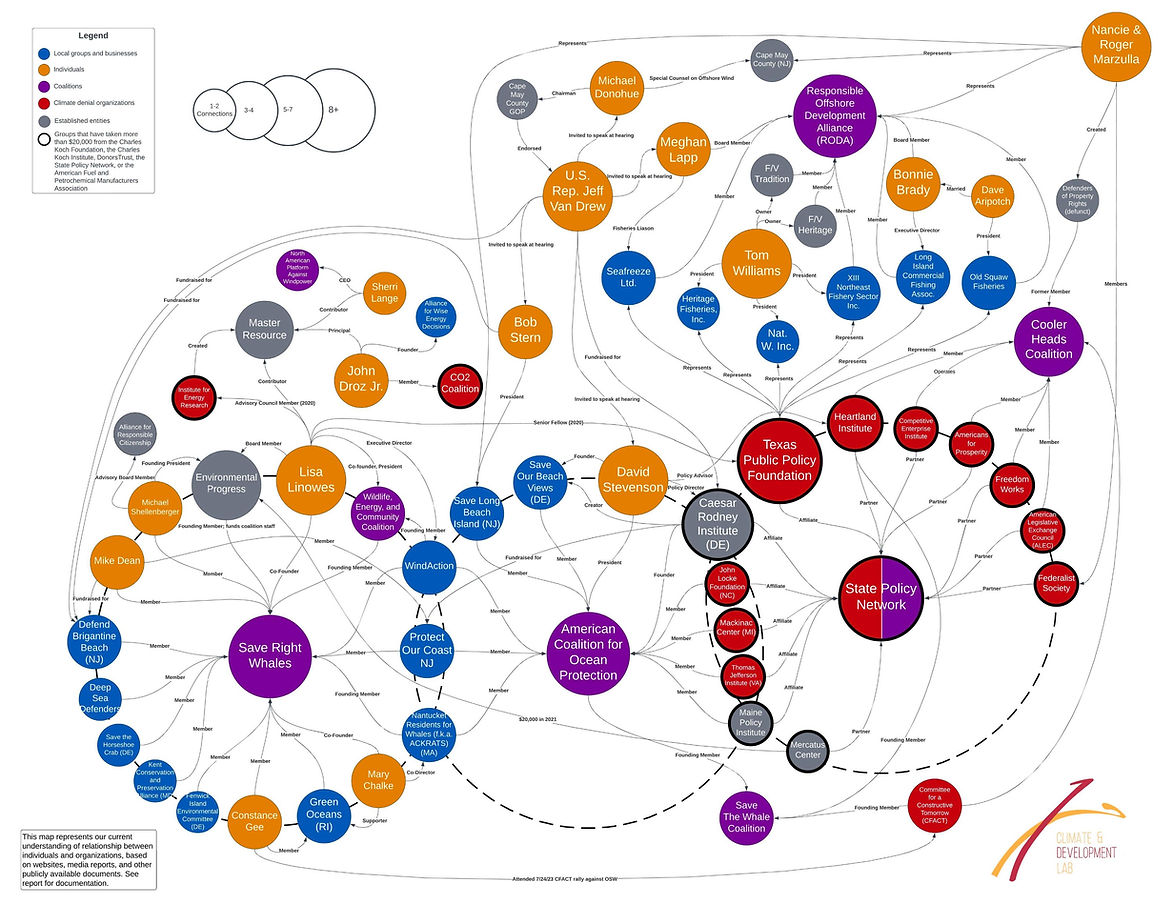
These community groups have made national headlines for their opposition to projects in Rhode Island, Massachusetts, and New Jersey. They appear to be new organizations that operate organically and independently, but they often share legal support, personnel, talking points, and financial resources with major organizations that have been blocking climate policy for the last several decades. Knowingly or not, they are executing a strategy laid out for them by climate obstructionists in 2012.
We show how think tanks in the anti-offshore wind movement have received donations from six fossil fuel-interested donors between 2017 and 2021. Of these donations, $16,278,401 has gone to members of a grassroots-appearing coalition at the center of the movement.
As public relations and obstruction specialists actively engage local groups to block offshore wind projects, the climate and environmental justice consequences are dire. Offshore wind projects may struggle to get off the ground, locking us into catastrophic climate consequences experienced disproportionately by Black, Indigenous, Latine, and low-income communities.
Disclaimer: This report represents an initial phase of research about the network of opposition to offshore wind development, produced by a team of undergraduate students in Brown University’s Climate and Development Lab. The statements, views, opinions, and information contained in the report are personal to the authors, and do not necessarily reflect those of Brown University.
Against the Wind*has been amended. Correspondence sent from Mr. Shellenberger after the publication of our report states his organization Environmental Progress has no “ties” to the nuclear industry “beyond email correspondence.” The Climate and Development Lab regrets any error.
FULL REPORT: Amended Against the Wind – Climate and Development Lab – Dec 2023 (1).pdf
Countermovement Coalitions: Climate Denialist Organizational Profiles
https://www.climatedevlab.brown.edu/post/beyond-dark-money-information-subsidies-and-complex-networks-of-opposition-to-offshore-wind-on-the
---
Beyond dark money: Information subsidies and complex networks of opposition to offshore wind on the U.S. East Coast
- Climate and Development Lab
- Dec 6, 2024
Offshore wind projects in New England are facing intense scrutiny from local opposition networks who are influenced by national -level groups and fossil fuel interests. Knowingly or not, these groups spread mis- and dis-information about the only renewable resource that can help us reach our energy goals within the science-backed emissions reduction targets. The article below investigates the recent burst of local opposition groups, their networks and connections, and the "dark money" which influences their actions.
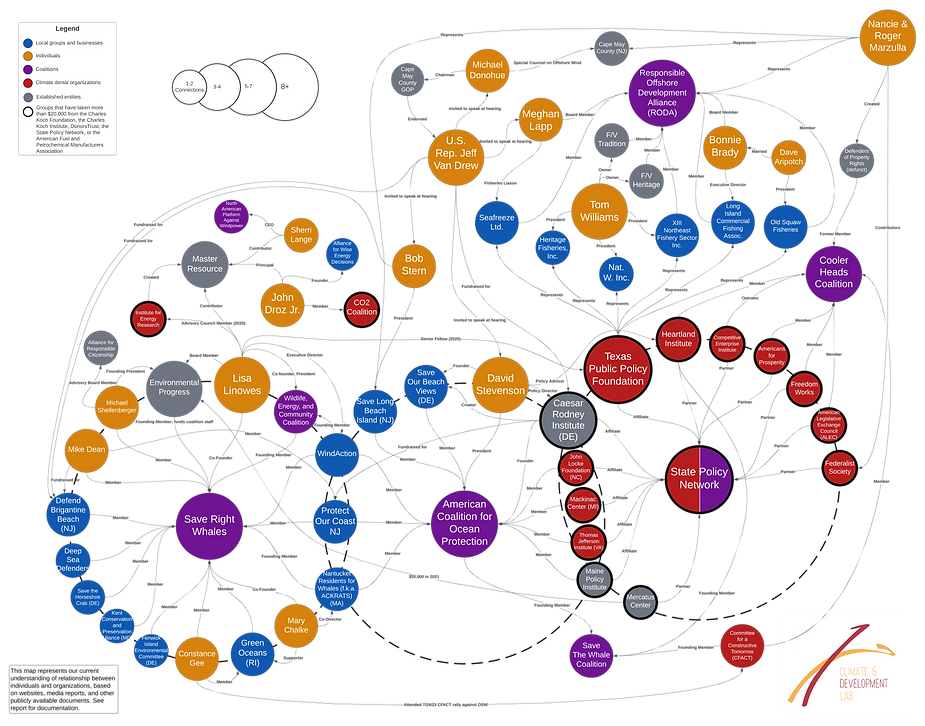 }:
Fig. 1.Network map of the anti-offshore wind movement (first published by {Slevin et al.). High quality version on}_ {page 4}_.
---
BeyondDarkMoney.pdf - Google Drive
Beyond dark money: Information subsidies and complex networks of
opposition to offshore wind on the U.S. East Coast
Isaac Slevin , William Kattrup , Charlotte Marcil , J. Timmons Roberts *
Climate and Development Lab, Institute at Brown for Environment and Society, United States of America
ARTICLE INFO 10 PP
Keywords:
Offshore wind
Opposition to renewables
Discourses of Climate Delay
FLICC: Misinformation
ABSTRACT
A new, more aggressive stage of opposition to offshore wind energy has arisen in the United States. In this article,
we demonstrate how the discourses and strategies of local opposition groups are influenced by relationships with
national-level groups and fossil fuel interests. East Coast offshore wind opposition groups are not well-
characterized by the previous literature on local renewables acceptance – which describes them as grassroots
– nor the top-down depiction of national-level fossil fuel influence, which portrays them as inorganic “astroturf”
:{organizations. We focus on organizations’ networks and discourses.
First, we map the network of opposition to}:
offshore wind on the U.S. East Coast, which includes novel, local anti-turbine groups, known climate denial think
tanks, fossil fuel interests, law firms, and representatives of the commercial fishing industry. Second, we assess
:{claims made by an anti-offshore wind group in New England using two academic typologies.
We discover that}:
local groups receive massive and varied “information subsidies” from the think tanks, allowing them to spread
numerous claims emphasizing the downsides of offshore wind. We conclude with a discussion of how this nascent
network and these misleading discourses pose dire threats to renewable energy development in the United States.
...
Second, we employ two rhetorical frameworks – “Discourses of
Climate Delay” by Lamb et al. [8] and Cook’s FLICC [9] – to assess a
sample of the rhetorical strategies used by our case study opposition
group to garner support for its cause. Classifying the group’s abundant
rhetorical claims using peer-reviewed typologies proves how new ar-
guments against renewable energy are adaptations of time-tested stra-
tegies of climate policy obstruction. Using these two typologies to
analyze claims made on the local level is also proof of concept for future
analysis of local opposition groups’ rhetoric, which may include the
identification of similarities between local- and national-level obstruc-
:{tionists.
We conclude by discussing how these networks of support and}:
discourses of opposition present a powerful new obstacle to offshore
wind development across the country.
Understanding this new movement is critical: it is galvanizing sub-
stantial opposition to renewable energy projects, demobilizing politi-
cians’ support for offshore wind, and peeling off self-described
environmentalists to oppose the projects. Failing to understand the na-
ture of this new national network and its local elements leaves scientists,
project developers, government officials and civil society groups unable
to effectively respond. Even the best community outreach programs may
be doomed if they fail to understand how these networks operate.
- Previous research
This study contributes to three existing areas of social science
research: local renewables acceptance, national networks of climate
policy obstruction, and the rhetorical analysis of anti-renewables claims.
We situate our work between the first two areas, and our deployment of
the work of Lamb et al. [8] and Cook [9] advances the application of the
third.
First, the issue of “renewables acceptance” has received significant
attention in recent years. An “information deficit” (where communities
lack knowledge of wind power’s benefits and developers’ efforts to
:{minimize impacts) may occur [10].
However, this ascription has been}:
critiqued for overlooking “deficits of legitimacy,” such as a lack of trust
in developers and perceived inequities in the renewable energy siting
process [11]. Recent research has found a series of factors that affect
individuals’ attitudes towards offshore wind energy, including risk
perception, environmental impacts, health impacts, land value, and
procedural fairness [12–14]. Additionally, the beginning of the 21st
Century saw new research which demonstrated how opposition to wind
turbine siting may be informed by deep-seated values that go far beyond
the simplistic “NIMBY” label, such as an ingrained connection to the
ocean as a special place [15–18].
...
A second area of research centers the operations of large-scale in-
terest groups and networks as they oppose local- and state-level climate
policy. Brulle et al. [29] highlight how top-down funding in the climate
change counter-movement (CCCM) enables participating organizations
“to promulgate a consistent message” and build tight networks to block
climate action. Farrell [30] found that in this movement, elite corporate
benefactors are a predictor of network power and semantic similarity. In
an historical account, Dunlap and McCright [31] largely attribute the
rise of anti-environmentalism and climate denial in the United States to
national actors central to the conservative movement, including think
tanks, foundations, and fossil fuel interests.
Often, these national interests seed fake grassroots groups to
manufacture the appearance of popular support for climate obstruction.
The literature on this phenomenon, often referred to as “astroturfing” is
substantial [32–35], and it has entered the popular understanding of
American conservatism through bestselling books and reporting in
major American publications [36–38]. For example, Stokes [[38]:
p144,205] describes how at least one local anti-wind group in Ohio
received funding from fossil fuel organizations and worked with con-
servative legislators to stifle wind energy there. However, these por-
trayals tend to focus on the agency of large-scale interest groups at the
expense of local place-based opposition. We observe climate policy op-
position groups that do not seem to be astroturfed, but they operate in
too large of a network to fit neatly into the literature on organic, values-
based renewable energy skepticism.2
Finally, and separately from the literature on renewables acceptance
and climate policy obstruction networks, we look to literature on the
rhetorical claims of anti-renewables organizations. This thread of anal-
ysis is critical: in the case of one New England offshore wind project,
Diamond et al. [39] found that community groups mentioned risks of
wind five times more than potential benefits. Holder et al. [40] found
that national fossil fuel interests routinely disseminate discourses of
delay on social media. Various rhetorical frameworks have been
developed and applied to the large-scale climate obstruction think tanks
which appear in our network map. For example, Brulle et al. [29]
devised a test to identify core organization of the Climate Change
Counter Movement, and Coan et al. [41] created a robust set of cate-
gories that can be applied to a wide set of discourses using computa-
tional approaches.
In 2020, two other typologies were published for the purpose of
identifying and categorizing science skepticism. “Discourses of Climate
Delay” by Lamb et al. [8] identifies four main categories of climate delay
discourses – arguments used to oppose necessarily rapid climate action.
“FLICC: Five Techniques of Science Denial” by Cook [9] identifies the
core rhetorical strategies used to sow doubt and confusion about the
efficacy of science across a range of topics. Building on a previous study
[42], Cook [9] identified five main techniques of science denial, which
each have three to seventeen sub-claims. We use both frameworks in our
analysis.
...
3.1. Results: networks of obstruction
To assess the nascent offshore wind opposition movement and the
sources of anti-offshore wind rhetoric, it is important to understand that
recent local efforts against offshore wind do not exist in a vacuum.
Increasingly, journalists have documented instances of collaboration
between community-led offshore wind opposition groups and conser-
vative think tanks [47–56]. As social network theories illustrate, ties
between groups substantially influence organizational activities
[57,58].
This can have profound political consequences. Creating social net-
works enables groups to consolidate resources, share messaging and
information, and form common interests and shared identities—all
crucial aspects of movement-building. As Stokes [[38]:p6] describes:
The policy agenda across the country is more unified because interest
groups work on the same policies in different states, crossing borders
to lobby. Networks play three important roles: they help interest
groups learn to anticipate policies’ consequences, they help interest
groups disseminate effective political strategies, and they facilitate
collective action. Overall networks help interest groups marshal their
forces and reduce each individual member’s cost in contesting
policy.
In the context of the growing anti-offshore wind movement, some of
the claims identified in this paper may be attributed to other organiza-
tions within the network, including those with ties to the fossil fuel in-
dustry. We call this an “information subsidy,” a phrase borrowed from
media studies used to describe “something that is provided to the
communicator at a lower ‘cost’ than if the communicator had to go out
and generate that information from scratch.” [59]. For example, anti-
turbine blog posts from fossil fuel-funded think tanks have been repos-
ted in grassroots anti-wind Facebook groups [56].
Before the current wave of wind turbine opposition, John Droz, Jr., a
senior fellow at a think tank categorized by Brulle et al. [29] as climate
denying, edited a strategy memo in 2012 that prescribed a “national
professional PR campaign” to “Create a grass-roots ground swell from
which the clamor for change will reach the elected officials and policy-
makers” [60,61]. The plan was to “Provide local groups support mate-
rials, like PowerPoint templates to put on local education seminars,
document templates for them to file with their state utility commission,
etc.” Overall, the memo explained:
“Goals of the PR Campaign
A) Cause the targeted audience to change its opinion and action
based on the messages.
B) Provide credible counter message to the (wind) industry.
C) Disrupt industry message with countermeasures.
D) Cause subversion in message of industry so that it effectively
becomes so bad no one wants to admit in public they are for it
(much like wind has done to coal, by turning green to black and
...
Ultimate Goal: Change policy direction based on the message.”
To catalog and visualize these connections and many more, we
developed a network map of anti-offshore wind actors on the East Coast
(Fig. 1). We identify six types of actors. First, groups that primarily
operate on the local scale appear in blue. These are organizations that
identify themselves as grassroots, in addition to a few small businesses.
Second, key individual actors appear in orange. Many of these in-
dividuals lead or represent groups that otherwise appear in the map.
Third, coalitions are represented in purple. Many members of the Cooler
Heads Coalition, State Policy Network (SPN), Responsible Offshore
Development Alliance (RODA), North American Platform Against
Windpower, and Save Right Whales are not represented due to space
constraints. The membership of the American Coalition for Ocean Pro-
tection (ACOP) reflects data from the coalition’s founding in 2021 as its
current membership is not public. The membership of the Wildlife,
Energy, and Community Coalition is also not public.
Fourth, groups which have been identified in the literature as sup-
porting climate denial appear in red. Each of these groups has published
content determined to constitute “climate denial” by Brulle et al. [29],
defined as “public skepticism towards mainstream climate science as
:{defined by the Intergovernmental Panel on Climate Change.”
Fifth,}:
“Established entities” are represented in gray. These entities predate the
current anti-offshore wind movement and do not fall into any of the
categories above. Finally, a thick black circle outlines groups that have
received at least $20,000 from the Charles Koch Foundation, the Charles
Koch Institute, DonorsTrust, SPN, or the American Fuel and Petro-
chemical Manufacturers Association between 2017 and 2021.
The map centers three coalitions whose membership is represented
with dashed lines: Save Right Whales, SPN, and ACOP. Members of each
coalition share goals and resource. Without these coalitions, the move-
ment against offshore wind would more closely resemble discrete, iso-
lated battles against individual energy projects.
A close look at the Save Right Whales coalition reveals its recency – it
formed in 2021 – and the outsized role of two experienced individual
members. Coalition co-founder Lisa Linowes also appears in leadership
of three of the coalition’s eleven member organizations [56]. Michael
Shellenberger, a frequent renewable energy critic [62] and indepen-
dently a member of Save Right Whales, also leads the nonprofit that
dedicates paid staff to maintaining the coalition [56].
By contrast, the State Policy Network (SPN) is the nation’s most
prominent network of conservative state-level think tanks. It seeks to
“limit government and advance market-friendly public policy at the
state and local levels” [63]. The network’s president has likened the
group to the home goods store IKEA for its “catalog” of policies designed
for assembly at the state level that advance the network’s national goals
[64]. The third coalition, ACOP, was “formed to share information, re-
sources, and strategies to protect our beach communities from perma-
nent interference in established patterns of ocean front life” [65].
Fig. 1. Network map of the anti-offshore wind movement (first published by Slevin et al. [56]). [56]).
Critically, five of its founding members were SPN-affiliated think tanks
spread across five states. The other six founding members were local
wind turbine opposition groups [65].
In addition to the think tanks with ACOP membership, additional
groups with SPN connections have entered the picture. In 2023, Linowes
published a report on the cost of renewable energy in Massachusetts
with a grant from an SPN partner in that state [66]. In 2024, the net-
work’s Rhode Island affiliate – another group classified as climate
denying by Brulle et al. [29] – published an 80-minute interview with
the president of a local anti-offshore wind group [67].
There are two other informal but critical groups of actors in this
network. The upper left corner exhibits many actors who have been
fighting against wind power for over a decade. They offer public re-
lations knowledge, strategy, and policy experience. Experienced in-
dividuals such as Droz and North American Platform Against Wind
Turbines CEO Sherri Lange now contribute to wind turbine opposition
via anti-offshore wind content published on the blog MasterResource, a
project of the Institute for Energy Research [56]. This climate denial
think tank received over $150,000 from Koch family charitable foun-
dations between 2017 and 2021.
In the upper right section, commercial fishers and their advocacy
organizations tie into the network. The five fishing organizations rep-
resented in blue are each tied to the Responsible Offshore Development
Alliance (RODA), which describes itself as “a broad membership-based
coalition of fishing industry associations and fishing companies with
an interest in improving the compatibility of new offshore development
with their businesses” [68]. These five organizations were also plaintiffs
in a lawsuit filed by the Texas Public Policy Foundation [56], an SPN
affiliate that has, in recent years, become one of the nation’s most
prolific and powerful renewable energy opposition groups [69].
RODA ties into the anti-offshore wind network a second time as they
were legally represented by prominent lawyers Nancie and Roger Mar-
zulla in the coalition’s lawsuit against a New England offshore wind
project. The Marzullas are contributors at the fossil fuel-backed Feder-
alist Society and were leaders of a now-defunct property rights advocacy
group that was part of the climate denialist Cooler Heads Coalition [55].
Roger Marzulla also represented Save Right Whales, Green Oceans, the
New England Fishermen’s Stewardship Association, and other plaintiffs
in a January 2024 lawsuit intended to reverse federal approvals of two
offshore wind energy projects in New England [7].
An examination of network members’ financial backings may reveal
additional influence (Table 1). Between 2017 and 2021, SPN, the
Charles Koch Foundation, Charles Koch Institute, DonorsTrust, and the
American Fuel and Petrochemical Manufacturers Association contrib-
uted more than $8.9 million to the five think tanks that appear in
ACOP’s founding membership. Most of these are full-service think tanks
that work on many issues, but such support builds their capacity to have
an impact on climate policy opposition. These donors also contributed
over $7.2 million to the Texas Public Policy Foundation, which filed the
lawsuit in which the five RODA affiliates are plaintiffs, and which
Table 1
Table of contributions from fossil fuel interests and dark money groups to organizations in the anti-offshore wind network.
Mackinac Center
for Public
Policy
Y Y Y 381,200 1,101,000 857,500 5,628,121 0 $7,967,821
John Locke
Foundation
Y Y Y 210,000 216,000 7500 172,600 0 $606,100
Maine Policy
Institute
Y Y 179,000 0 0 84,500 0 $263,500
Thomas Jefferson
Institute
Y Y Y 75,000 0 0 39,800 0 $114,800
Caesar Rodney
Institute
Y Y 0 0 0 14,000 20,000 $34,000
State Policy
Network
Y Y x 20,130 6000 24,585,446 51,000 $24,662,576
Federalist Society Y Y 0 1,395,000 2,000,000 11,449,250 0 $14,844,250
Texas Public
Policy
Foundation
Y Y 25,000 4,593,852 2,055,175 618,153 0 $7,292,180
Heartland
Institute
Y Y 0 0 0 3,554,032 150,000 $3,704,032
American
Legislative
Exchange
Council
Y Y 0 1,571,433 654,000 1,146,721 52,050 $3,424,204
Competitive
Enterprise
Institute
Y Y 0 218,730 82,000 2,080,050 145,000 $2,525,780
Freedom Works
Foundation
Y Y 0 0 0 2,349,780 0 $2,349,780
Mercatus Center Y 0 189,500 0 2,080,050 0 $2,269,550
Americans for
Prosperity
Foundation
Y Y 0 22,257 44,039 1,490,671 0 $1,556,967
DonorsTrust Y 10,000 132,562 0 x 0 $142,562
CO2 Coalition Y 0 39,513 24,000 200,000 0 $263,513
Institute for
Energy
Research
Y 0 114,469 44,289 96,220 0 $254,978
Total for ACOP
think tanks
$845,200 $1,317,000 $865,000 $5,939,021 $20,000 $8,986,221
Total
...generates substantial anti-offshore wind content. SPN received more
than $24.6 million from DonorsTrust alone between 2019 and 2021.
With the network now in view, it is clear that a wide variety of actors
are involved in the movement against offshore wind on the East Coast.
Climate denial think tanks, members of the fishing industry, experienced
renewable energy opponents, and self-identified “concerned citizens”
:{are all embroiled in various battles against offshore wind projects.
Some}:
formal and informal alliances seem unusual. For example, local groups
that identify themselves as pro-whale conservationists are fighting the
same battles as members of the commercial fishing industry involved in
RODA. But the fishing industry is one of the largest threats to whales on
the East Coast; NOAA identified that fishing gear entanglement caused
65 % of documented North Atlantic Right Whale deaths, injuries, and
morbidities between 2017 and 2023 [70]. Though this is not without
precedent. Sovacool [71] writes that “Some forms of [renewables] op-
position can cut across community, socio-political, and market di-
mensions simultaneously.... These forms of opposition fuse community,
environmental, economic, and political concerns together.”
Broadly, support in this network seems to flow from the national
scale down to the local scale (Fig. 2). Grantmaking groups with national
political goals, such as the Charles Koch Foundation, fund state-level
think tanks which produce content that denies climate change and dis-
mantles efforts to address it. Through coalitions, legal support, fund-
raising capacity, and content – including misinformation – which we
may cumulatively understand as an “information subsidy,” these think
tanks support the offshore wind opposition groups operating on the local
level (Fig. 2). The complex ties between actors in the anti-offshore wind
movement demonstrate the numerous varied pathways in which infor-
mation and other subsidies may pass through the network.
This system amplifies misinformation and other negative claims
about offshore wind. While a particular claim may be advanced by a
member of a local opposition group in a handout, white paper, or
Facebook group, or at a public event such as a rally, the false or over-
stated claim may stem from elsewhere in the network. For example,
though our case study opposition group generally operates locally,
...
rhetorical claims and several of its members do not appear to stray far
from the deeply interconnected network of think tanks and legal and
public relations specialists that have advanced the interests of the fossil
fuel industry for decades. In short, community-level opposition groups
do not act alone. Understanding this network’s reach and capacity is
critical to assessing how local anti-turbine groups (advertently or
inadvertently) advance anti-wind claims and fossil fuel industry
agendas.
3.2. Results: claims against offshore wind
:
Our case study of the local anti-turbine group’s publications revealed
that the group uses a series of tactics and discourses consistent with
typologies developed by Lamb et al. [8] and Cook [9]. We find that the
four claims we review here fall within the climate delay strategies
emphasize the downsides, and push non-transformative solutions outlined
by Lamb et al. The group’s claims also include two science denial stra-
tegies identified by Cook: logical fallacy and cherry-picking. In these four
total categories, we identify a total of six sub-categories. Below, we
present an in-depth analysis of four discourses of climate delay and the
science misinformation tactics that appear in the claims we reviewed
(Table 2).
3.2.1. Example 1: indirect CO2 emissions
3.2.1.1. Claim. The organization claims that wind turbines will cause
indirect CO2 emissions by providing underwater habitat for invasive
filter feeders that “eat phytoplankton and release carbon dioxide” [[45]:
p37]. The group claims that development of offshore wind “will only
provide a savings of between 70,000,000-80,000,000 metric tons of CO2
with regard to decreasing our dependence on fossil fuels,” and that this
number “does not take into consideration of unknowns,” including
“percentage change in phytoplankton abundance” [[45]:p39].
3.2.1.2. Analysis. This claim is an example of policy perfectionism, which
is situated inside the emphasize the downsides delay discourse. The group
manufactures doubt by overemphasizing the impact on filter feeders,
and it directs attention away from the devastating ecological impacts of
fossil fuel consumption. Cook [9] defines this misinformation tactic as
blowfishing – a type of logical fallacy in which an inconsequential aspect
of scientific research is exaggerated to distract from or cast doubt on the
main conclusions of the research.
Studies have estimated that lifecycle CO2 emissions of offshore wind
are about 6–13 pounds of CO2 per kilowatt hour (kWh) [72,73]. Elec-
tricity created by burning natural gas emits about 500 pounds per kWh.
Additionally, the impacts from mining fossil fuels are over five hundred
times greater than for renewable energy technologies [74]. Finally,
research has also found positive and negative impacts of wind energy on
plankton populations, and effects are likely localized [75].
3.2.2. Example 2: stop wind, save whales
3.2.2.1. Claim. In its Powerpoint presentation, our case study group
advances several claims suggesting that offshore wind turbines will
harm or kill whales and other endangered species [[45]:p27–35].
Several slides display imagery and headlines that directly link offshore
wind to whale mortalities [[45]:p27–28]. In its white paper, the group
states: “Offshore wind farms (OWFs) will inevitably drive threatened
whale species closer to extinction.” [[4]:p2].
3.2.2.2. Analysis. These claims are again an example of policy perfec-
tionism within the emphasize the downsides discourse of climate delay.
The claims portray offshore wind as a threat to endangered species to
encourage inaction. Yet they avoid acknowledging the role that pre-
existing anthropogenic impacts, including vessel strikes,
TABLE 2
Table 2
Summary table of misinformation discourses and the group’s arguments.
Claim Argument Discourses of climate delay FLICC discourses
Indirect CO2
emissions
Wind turbines cause CO2 emissions as they
provide habitat for CO2-releasing species
Emphasize the downsides (policy
perfectionism)
Logical fallacy (blowfish)
Stop wind, save
whales
Wind turbines threaten whale populations Emphasize the downsides (policy
perfectionism)
Cherry-picking (slothful induction); Logical fallacy
(misrepresentation, single cause); Fake experts
The fusion solution Nuclear fusion is a viable alternative solution to
offshore wind energy
Push non-transformative solutions
(technological optimism)
Cherry-picking (wishful thinking, slothful induction)
The natural gas
alternative
Natural gas is a strong alternative solution to
offshore wind energy
Push non-transformative solutions
(fossil fuel solutionism)
Logical fallacy (red herring)
substantial quantities of misinformation are emerging from a similar
coalescence of prominent conservative think tanks and grassroots anti-
wind groups [93]. At the national level in the United States, the State
Policy Network has established renewable energy opposition as a top
priority. Its affiliates in Oregon, Ohio, and Minnesota are now involved,
[94] in addition to its affiliates that appear in our network analysis.
Successful challenges of offshore wind energy projects have severe
consequences. Numerous recent studies have demonstrated how phasing
out fossil fuels will have profound positive health impacts on Black,
Latine, and Indigenous communities, such as lowering rates of cancer
:{and life-threatening asthma [95–97].
The life-altering effects of climate}:
change itself must be considered, too. But wind energy opponents seem
to be overwhelmingly white and wealthy, and thus more able to avoid
the consequences of polluting facilities and an increasingly disruptive
climate– a phenomenon Stokes et al. [98] term “‘energy privilege.’
wherein the delay and cancellation of clean energy in wealthier, Whiter
communities leads to continued pollution in poorer communities, and
communities of color.”
Though the degree of coordination must be better understood, fossil
fuel interests have clearly supported the political power of grassroots
opposition groups. These groups’ sustained opposition end up support-
ing the interests of fossil fuel corporations that wish to avoid decar-
bonization at all costs. While Brulle [29] noted that discourses of climate
delay have always been part of the arsenal of the Climate Change
Countermovement, this study shows how the attack is evolving. No
longer are obstructionist groups primarily attacking the reality of
climate change [99]; in fact, our case study organization begins many
publications and speeches with the claim that they recognize the need to
address climate change. “Solutions denial” or “solutions skepticism”
may be a better phrase for what was observed. This new movement seeks
to block renewable energy technology. In doing so, it may undermine
the momentum and political support for ambitious climate action on the
U.S East Coast.
---
---
NYT
NO LNX
Law Firm Pressures Brown University to Erase Research on Anti-Wind Groups
The firm, which represents opponents of offshore wind, said it would complain to Brown’s federal and private funding sources.
Lisa Friedman
By Lisa Friedman
Aug. 25, 2025
A law firm representing opponents of offshore wind farms is demanding that Brown University retract research that details links between the fossil fuel industry and anti-wind groups.
The firm, Marzulla Law L.L.C., which has close ties to the conservative legal movement, called the research “false and injurious” and said it would complain to Brown’s public and private funders, including the Energy Department, the National Science Foundation and the Mellon Foundation.
A spokesman for the university, Brian E. Clark, did not comment directly on the law firm’s demands but said the university intended to uphold its principles of academic freedom.
“Scholars shape their own research and course of instruction at Brown,” Mr. Clark said in a statement. “One principle that is core to research at Brown is the ability for scholars to discuss contested topics and themes and to have those topics openly debated.”
Roger J. Marzulla, a founding partner of the firm, did not respond to email and telephone requests for comment.
The demands come at a precarious time for the nation’s universities, which have become targets of a pressure campaign conducted by the Trump administration. Last month, Brown struck a deal with the government to restore lost federal research funding and end investigations into alleged discrimination.
The Trump administration is trying to stop the country’s nascent wind industry, a source of energy that President Trump has disparaged since he failed to stop an offshore wind farm from being built within view of one of his Scottish golf courses.
Marzulla Law L.L.C. is representing several groups that are fighting offshore wind, including Green Oceans, a nonprofit organization that is trying to overturn federal permits for Revolution Wind, a 65-turbine wind farm off the coast of Rhode Island.
That $6.2 billion project is nearly built, but on Friday the Trump administration ordered construction to stop, citing unspecified concerns.
In an Aug. 11 letter to Brown’s general counsel, Mr. Marzulla objected to research published by the Climate and Development Lab at Brown that found that Green Oceans had spread misinformation about climate change and operated as part of “a fossil-fuel-funded disinformation network.”
Mark Herr, a spokesman for Green Oceans, said in a statement that Green Oceans was a local and nonpartisan group, adding, “We have no association with the fossil fuel industry nor any conservative political groups.”
“These oft-repeated lies are designed to discredit the messenger while preventing the public from absorbing the substance of our valid and well-researched concerns,” he said.
J. Timmons Roberts, who leads the Climate and Development Lab, said in an interview that his students had found that groups fighting offshore wind “have chosen to get in bed with some of the most anti-environment and anti-climate actors.” He called the letter “strategic harassment to shut me up and waste my time and make me more cautious.”
Lauren Kurtz, the executive director of the Climate Science Legal Defense Fund, a nonprofit organization that provides legal aid to climate scientists, called the letter academic harassment.
“It definitely struck me that they were dangling the possibility of getting the Trump administration involved,” Ms. Kurtz said. “It seems to me like they’re trying to bully Brown and their researchers.”
The Climate and Development Lab, founded in 2010, is a student and faculty research organization. Nearly three years ago, students began looking into groups fighting offshore wind off the coast of Rhode Island.
Their research does not accuse Green Ocean of accepting money from fossil fuel companies, but it highlights the similarities between arguments made by Green Ocean and those advanced by fossil fuel groups that spread climate misinformation.
A new publication issued by the Climate Development Lab on Friday maps connections between groups that oppose offshore wind and the law firms that represent them, and uses Marzulla Law as a case study. It describes the firm as having “a history of advancing anti-environmental lawsuits and significant ties with the fossil fuel industry.”
Mr. Marzulla and his wife, Nancie, who together founded the firm in 1997, both previously worked at Mountain States Legal Foundation, a conservative public interest law firm based in Colorado.
Mr. Marzulla took over as head of the foundation in 1981, and later the couple founded the Defenders of Property Rights, which defended private property owners from what they viewed as cumbersome environmental regulations. Defenders of Property Rights joined the Cooler Heads Coalition, a group of organizations that rejected the scientific finding that the burning of fossil fuels was driving climate change.
Lisa Friedman is a Times reporter who writes about how governments are addressing climate change and the effects of those policies on communities.
A version of this article appears in print on , Section A, Page 9 of the New York edition with the headline: Right-Wing Firm Presses Brown Over Wind Study.
---
eletrek
Scientist exposes anti-wind groups as oil-funded. Now they want to silence him.
:{:{ Jameson Dow | Aug 25 2025 -}:
Oil-funded groups are engaging in strategic harassment to stop scientists from revealing the nature of their politically-linked disinformation networks – in what should be a surprise to nobody.
A new report came out last week from the Climate & Development Lab (CDL) at Brown University, titled “Legal Entanglements: Mapping Connections of Anti-Offshore Wind Groups and their Lawyers in the Eastern United States.”
The study focuses on several examples of law firms with connections to anti-wind groups, the fossil fuel industry, and the American political right wing. These fossil-funded groups have spread disinformation to slow the adoption of clean and cheap wind power, in order to keep America addicted to the poison that the fossil fuel industry wants to keep selling us.
The lab is headed by J Timmons Roberts, but the research was done by various students and faculty at at the lab. The new report builds onformer research by the CDL cataloguing extensive connections between these groups and the dark money networks that fund the anti-wind movement.
Why the East Coast needs offshore wind
Offshore wind, especially in the North Atlantic, is a cheap and abundant form of energy that is heretofore relatively untapped in the US. It also has very little environmental cost, given that its carbon emissions and land use are both zero, and wind tends to be quite consistent over the ocean, making it more reliable as a power source.
Many other countries have successfully implemented offshore wind projects to bring this cheap and clean power to their populaces, with particular booms in China, the UK, Vietnam, Germany and several other Northern European countries (like Denmark, where many large wind power companies are based).
And wind is important for the global transition to renewable energy and the fight against climate change. As a zero-emission power source, it’s essential for meeting the US East Coast’s climate and renewable energy goals, and could provide a huge chunk of the power needs for the entire US Eastern seaboard, where the country’s population is clustered.
However, offshore wind has recently encountered setbacks due to the spread of disinformation from fossil-funded networks, which has made its way into the popular conception and into right-wing politics. (Nevertheless, Americans of all political stripes still support greater deployment of offshore wind)
How and why fossil fuel companies oppose wind
Fossil fuel companies oppose wind power because it would help to wean America off of fossil fuels, displacing coal and methane generation for electricity and enabling greater electrification of the vehicle fleet to wean us off of oil. All of these would result in air quality improvements, cost reductions, health improvements and avoidance of climate change – which are all anathema to themost deadly industry the world has ever seen.
So, fossil fuel companies have developed and funded a complicated network of fake public interest groups, politicians and lawyers to oppose wind power by spreading disinformation. And the CDL’s report highlights how certain legal firms have received funding from fossil fuel companies and/or given support to these fake public interest groups in attempts to sue wind projects out of existence.
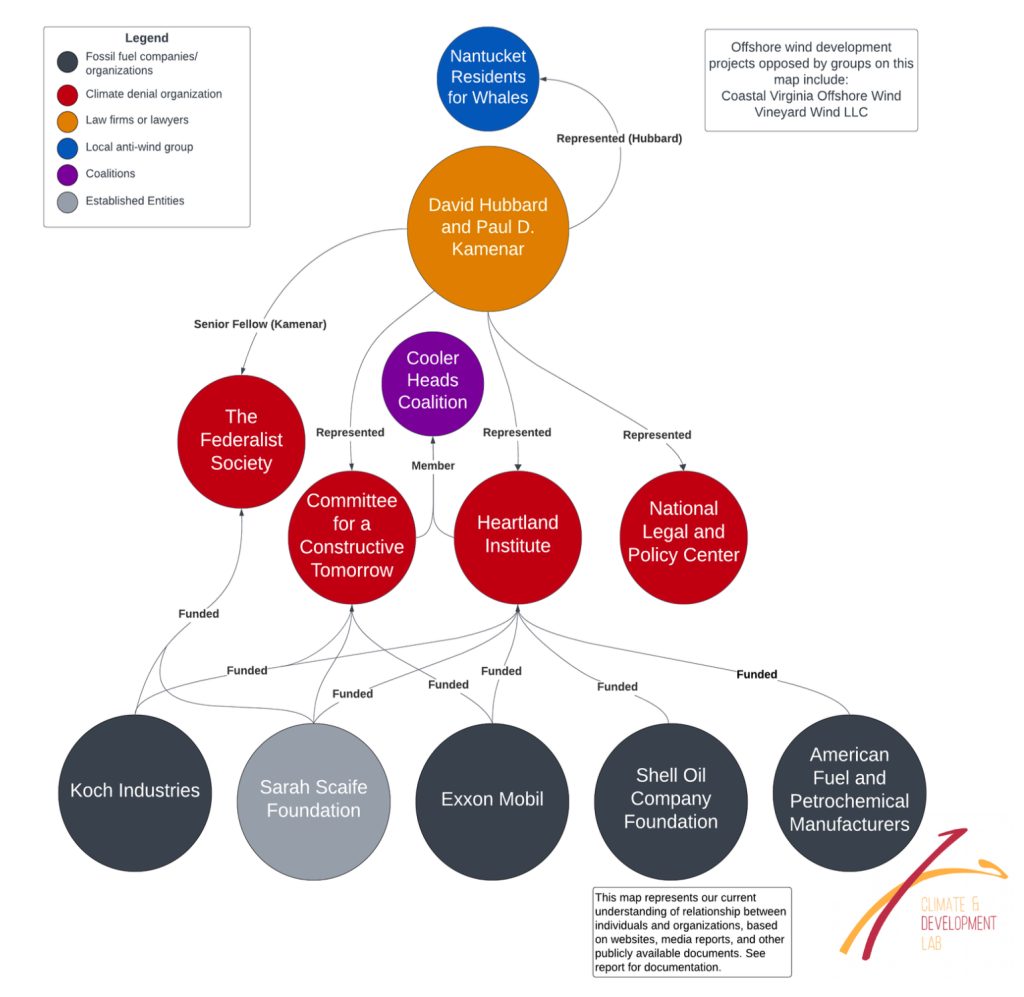 One of many diagrams in the report showing these anti-wind legal networks
While many of these lawsuits have been unsuccessful, they can still add delays to a project, making it more expensive and slower to deploy (which then makes your electricity more expensive). In some cases, the delays can result in project cancellation, like when oil billionaire William Koch sued Cape Wind out of existence via a fake public interest group called the Alliance to Protect Nantucket Sound.
In the report, five specific legal networks are highlighted in particular, showing how each is related to fossil fuels and science denial. The networks have provided representation, written comments, filed lawsuits and otherwise spread disinformation in an attempt to stop the public good that offshore wind power represents.
The nature of the disinformation
The disinformation largely focuses on the North Atlantic Right Whale, a whale whose population is currently experiencing an “unusual mortality event” due to changing climate and Atlantic shipping and fishing.
Anti-wind groups have invoked laws like the Endangers Species Act and Marine Mammal Protection Act, despite the fact that the products of the industry they are funded by are the deadliest thing for marine life.
Burning oil raises both the temperature and acidity of our oceans, disrupting marine ecosystems in profound ways. For example, North Atlantic krill populations have dropped by 50% due to ocean warming driven by fossil fuel use. Krill are the main food source for the North Atlantic Right Whale, which anti-wind groups claim to be interested in protecting, but are in fact aiding the decline of.
Further, whale populations are directly harmed by vessel strikes, which are the leading direct cause of death for North Atlantic Right Whales in recent years. And29% of those vessels are carrying oil across the globe – shipments that would be unnecessary if transportation were powered by clean renewable energy instead of deadly oil. Not only that, but some of the exact same groups that oppose wind also opposed draft regulations to reduce vessel strikes, showing that they are actually interested in continuing to harm whales, not protecting them.
Law firm responds to the truth by pressuring university to hide it
One of the law firms highlighted in the report, Marzulla Law, sent a letter threatening its authors. Marzulla Law said it would complain to mommy… I mean, Brown’s funding sources, including the US Department of Energy which a former oil executive is currently squatting as the head of, in an attempt to get the entirety of Brown University’s funding pulled if the CDL doesn’t self-censor its research findings.
The CDL itself is not funded by the Department of Energy, Roberts said to Bloomberg, so the threat isn’t even related to CDL’s funding sources, but to Brown University’s as a whole.
Marzulla Law represented one of the disinformation groups which the CDL has highlighted before, the deceptively-named “Green Oceans.” Green Oceans opposed the Revolution Wind project, which was halted on Friday over fake national security concerns by a convicted felon who is Constitutionally barred from holding office in the US, despite the project already being 80% finished, costing the US billions in waste and increased utility bills.
Mike Herr, a spokesman for Green Oceans said “these oft-repeated lies are designed to discredit the messenger while preventing the public from absorbing the substance of our valid and well-researched concerns,” which is itself an example of the very thing he’s wrongly accusing the researchers of.
Herr’s organizationlies about offshore wind, and their attack on science (through their law firm) is designed to discredit the messenger while preventing the public from absorbing the substance of valid and well-researched concerns: the connection between fossil fuels, the republican party, and disinformation that keeps us from embracing superior forms of cheaper, cleaner energy like wind.
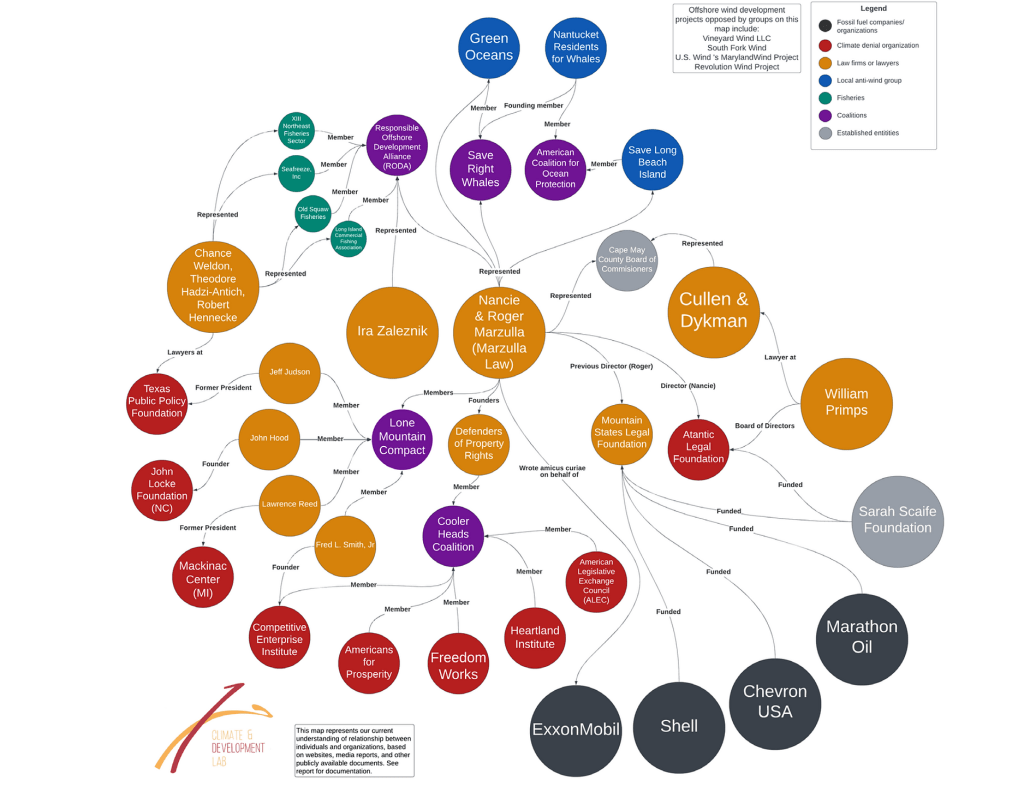 Marzulla Law is deeply tied to anti-wind networks, far-right and climate denial foundations, and oil companies
Discrediting science and knowledge is increasingly becoming a feature of the American right wing, which is currently on a crusade against universities as it tries to make America stupider.
Roberts called Marzulla’s response “strategic harassment to shut me up and waste my time and make me more cautious,” which is a common reaction faced by truth-tellers in this day and age, particularly when funding from the largest and most deadly industry on the planet, which has repeatedly shown its interest in propaganda, is involved.
Top comment by Lee
Liked by 30 people
Everything wrong with the USA right now is because Trump has made lying acceptable. Imagine if USA believed in the Truth. All these law companies and Fossil Fuels companies would be prosecuted.
For its part, Brown University did not comment on Marzulla’s demands, but did state that “Scholars shape their own research and course of instruction at Brown. One principle that is core to research at Brown is the ability for scholars to discuss contested topics and themes and to have those topics openly debated.”
However, Brown is one of the universities which recently kowtowed to the idiotic demands of an inept moron, making its words about academic independence ring somewhat hollow. We’ll have to see if they step up to defend truth this time around, or bend the knee to one of the dumbest people on the planet once again, if it comes to that.
---
---

The New York Times
https://www.nytimes.com › 2025/08/25 › climate › bro...](https://www.nytimes.com/2025/08/25/climate/brown-university-offshore-wind-marzulla.html)
Aug 25, 2025 — Marzulla Law L.L.C. is representing several groups that are fighting offshore wind, including Green Oceans, a nonprofit organization that is ...Read more
Missing: MARZULA | Show results with: MARZULA
[### Law firm threatens Brown's funding over research about ...

The Brown Daily Herald
https://www.browndailyherald.com › article › 2025/09](https://www.browndailyherald.com/article/2025/09/law-firm-threatens-browns-funding-over-research-about-anti-offshore-wind-groups)
Sep 14, 2025 — Representing local anti-offshore wind group Green Oceans, Marzulla Law sent a letter to the University demanding research by the Climate and ...Read more
Missing: MARZULA | Show results with: MARZULA
[### Case: Green Oceans v. US Department of the Interior

Civil Rights Litigation Clearinghouse
https://clearinghouse.net › case](https://clearinghouse.net/case/46981/)
This case challenges agency approval of two energy projects, South Fork Wind Project and Revolution Wind Project, that have purported detrimental ...Read more
Missing: MARZULA | Show results with: MARZULA
[### Green Oceans Asks Brown University to Retract Reports ...

ecoRI News
https://ecori.org › green-oceans-asks-brown-university-t...](https://ecori.org/green-oceans-asks-brown-university-to-retract-reports-about-anti-wind-organization/)
Aug 25, 2025 — PROVIDENCE — A law firm representing the anti-wind energy group Green Oceans sent a letter to Brown University earlier this month, ...Read more
Missing: MARZULA | Show results with: MARZULA
---
shoutout
cli obstr robts
...
Scholars
Academics, including scientists, also aid the efforts of policymakers, NGOs,
and journalists to expose and counter climate obstruction, and the results have
prompted legislative investigations, legal proceedings, newspaper reports, and
social media campaigns. CSSN,91 which includes 800 scholars worldwide,
encourages peer-reviewed research into obstruction. Some academics work
closely with journalists from organizations such as Climate Feedback to expose
and debunk misinformation. University researchers have also participated in
institutional campaigns to convince universities to disclose funding from the
fossil fuel industry, and more recently to “disassociate” from firms and indus-
tries that advance climate misinformation.92 While many of these campaigns
have been led by students, professors have also pressured their home institu-
tions to act. For example, campaigns by faculty at Brown University and the
University of California, San Diego in the United States and the University
Cambridge in the United Kingdom, among others, have sought to dissuade the
schools from engaging with companies that promote climate disinformation
by, for example, refusing their research funding (Chapter 13).
Students
Campuses around the world now face growing pressure to mitigate the risks
from taking industry funding, including its influence over research agendas
---
---
AN 10 25
The 27-page settlement proposal of demands sent by President Donald Trump to UCLA in exchange or $1.2 billion in funding, made public Friday, is being called a "gross federal overreach," according to anew report in Cal Matters.
The document was made public after public after the UCLA Faculty Association and the Council of University of California Faculty Associations sued the public university to disclose the information under the California Public Records Act.
The proposal outlines the administration’s vision for higher education that is free from efforts to promote diversity and transgender inclusion, according to Cal Matters.
While the university system argued that making the proposal public would cause it “irreparable harm” during ongoing negotiations with the Trump administration, it was released after a California superior court judge ordered it to do so, and the state Supreme Court rejected its appeal.
The list of demands was the result of the U.S. Department of Justice in July accusing the university of not doing enough to combat antisemitism during last year’s pro-Palestine protests, and for allegedly violating federal civil rights law.
Governor Gavin Newsom has characterized the fine as “extortion,” and UC President James Milliken said that paying the settlement would “completely devastate” the university system.
So far, Brown University, Dartmouth College, Massachusetts Institute of Technology (MIT), University of Arizona, University of Pennsylvania, University of Southern California (USC) and University of Virginia (UVA) have rejected Trump's compact due to concerns over academic freedom and institutional independence.
"In issuing the demands, the Trump administration initially withheld more than $500 million in research grants to UCLA. But its leverage remains unclear now after a federal judge ordered the administration to restore nearly all those grants in August and September," Cal Matters reports.
Among Trump's demands of UCLA:
*Hire a senior administrator to review UCLA’s policies related to diversity, equity and inclusion efforts, and eliminate “identity-based preferences” in faculty hiring and scholarship programs.
Prohibit the use of “personal statements, diversity narratives, or any applicant reference to racial identity as a means to introduce or justify discrimination” in its admissions process. (A 2023 U.S. Supreme Court ruling already prohibits race-based admissions, though students are free to submit essays that detail how race affected their lives.)
Prohibit the UCLA School of Medicine and its affiliated hospitals from performing gender affirming surgeries or hormone therapy for patients under 18.
Issue a public statement saying that it will comply with Trump’s executive order that recognizes male and female as the only two sexes.
Ban female transgender student athletes from participating in women’s sports.
Establish a process so that “foreign students likely to engage in anti-Western, anti-American, or antisemitic disruptions or harassment” are not admitted to UCLA. (That seems to be at odds with the letter’s goal of protecting UCLA “faculty and students from retaliation for expressing minority opinions or engaging in free expression.”)
Develop training materials to “socialize international students to the norms of a campus dedicated to free inquiry and open debate.”*
Cal Matters notes that some of these, including the elimination of diversity statements in faculty hiring and banning overnight demonstrations, are already UC policy.
In regards to the Trump administration's use of "antisemitism" as an impetus for these demands, over 600 Jewish students, faculty and alumni publicly opposed the settlement in an open letter published in August titled, "Jews in defense of UC."
The UCLA Faculty Association agrees.
“It is not just today’s students and workers who will be harmed by this gross federal overreach — but generations of Californians," said association president Anna Markowitz.
---
---
“We’ve gone through thousands of pieces of testimony on climate and clean energy bills at the state level, and all of the industry arguments against this sort of legislation included these messages,” saysJ Timmons Roberts, professor of environment and sociology at Brown University, and a co-author on the “discourses of delay” paper. NTBCW JAY TIMONS NAM]
https://www.researchgate.net/publication/342596080_Discourses_of_climate_delay
pm dl 1/22
Discourses of climate delay
July 2020Global Sustainability 3
DOI:10.1017/sus.2020.13
Discourses of climate delay
William F. Lamb1,2 , Giulio Mattioli3, Sebastian Levi1,4,5, J. Timmons Roberts6,Stuart Capstick7, Felix Creutzig1,8 , Jan C. Minx1,2, Finn Müller-Hansen1,9,Trevor Culhane6and Julia K. Steinberger21Mercator Research Institute on Global Commons and Climate Change, Torgauer Straße 12–15, EUREF Campus#19, 10829 Berlin, Germany;2School of Earth and Environment, University of Leeds, Leeds LS2 9JT, UK;3Department of Transport Planning, Faculty of Planning, TU Dortmund University, August-Schmidt-Straße 10,44227 Dortmund, Germany;4Freie Universität Berlin, Kaiserswerther Str. 16–18, 14195 Berlin, Germany;5HertieSchool of Governance, Friedrichstraße 180, 10117 Berlin, Germany;6Institute at Brown for Environment andSociety, Brown University, Providence, RI 02912, USA;7Centre for Climate Change and Social Transformations andTyndall Centre for Climate Change Research, School of Psychology, Cardiff University, Cardiff, UK;8TechnicalUniversity Berlin, Straße des 17. Junis 135, 10623 Berlin, Germany and9Potsdam Institute for Climate ImpactResearch (PIK), Member of the Leibniz Association, PO Box 60 12 03, D-14412 Potsdam, GermanyNon-technical summary‘
Discourses of climate delay’pervade current debates on climate action. These discourses accept the existence of climate change, but justify inaction or inadequate efforts. In contem-porary discussions on what actions should be taken, by whom and how fast, proponents of climate delay would argue for minimal action or action taken by others. They focus attention on the negative social effects of climate policies and raise doubt that mitigation is possible. Here, we outline the common features of climate delay discourses and provide a guide to iden-tifying them.
Technical summary:
Through our collective observations as social scientists studying climate change, we describe 12 climate delay discourses and develop a typology based on their underlying logic. Delay dis-courses can be grouped into those that: (1) redirect responsibility; (2) push non-transformative solutions; (3) emphasize the downsides of climate policies; or (4) surrender to climate change.
These discourses are distinct from climate denialism, climate-impact skepticism and ad hominem attacks, but are often used in combination to erode public and political support for climate policies. A deeper investigation of climate delay discourses is necessary in order to understand their prevalence and to develop inoculation strategies that protect the public from their intended effects. Our typology enables scientists, climate advocates and policymakers to recognize and counter these arguments when they are used. We urge all proponents of climate action to address these common misrepresentations of the climate crisis and to better communicate the dramatic pace of global warming, the gravity of its impacts and the possibility of effective and just mitigation policies.
Social media summary: Discourses of climate delay: redirect responsibility, push non-transformative solutions, emphasize downsides, surrender.
12 part classification (nice graphic]
...
. Conclusion:
The discourses we identify here can be compelling. They build on legitimate concerns and fears as societies move closer to addressing climate change. We argue that they become delay arguments when they misrepresent rather than clarify, raise adversity rather than consensus or imply that taking action is an impossible challenge.Our typology draws out the abstract logic and discursive struc-ture of delay discourses, but in practice, they often build on com-binations of arguments.
An important illustration is whenpopulation is put forth as an overriding driver of climate change.This draws from the notion that CO2 emissions trajectories areessentially fixed in the developed and developing world (changeis impossible), while focusing attention on rapidly growing popu-lations, usually in the latter (whataboutism). Delay is introduced because practical and desirable steps to reduce emissions immedi-ately (e.g., driving smaller cars over shorter distances) are over-looked in favour of an implied programme of global populationreduction, while simultaneously obscuring the highly unequal dis-tribution of climate responsibility worldwide. The sophisticationof discourses of delay should therefore not be understated, andnew strategies are developing all the time. As prior researchshows, they are also consistent with –and are repeated alongside–climate denial and ad hominem frames (Jacques & Knox, 2016).This article identifies, describes and categorizes discourses of delay
The discourses we identify here can be compelling. They build on
legitimate concerns and fears as societies move closer to addressing
climate change. We argue that they become delay arguments when
they misrepresent rather than clarify, raise adversity rather than
consensus or imply that taking action is an impossible challenge.
Our typology draws out the abstract logic and discursive struc-
ture of delay discourses, but in practice, they often build on com-
binations of arguments. An important illustration is when
population is put forth as an overriding driver of climate change.
This draws from the notion that CO
2
emissions trajectories are
essentially fixed in the developed and developing world (change
is impossible), while focusing attention on rapidly growing popu-
lations, usually in the latter (whataboutism). Delay is introduced
because practical and desirable steps to reduce emissions immedi-
ately (e.g., driving smaller cars over shorter distances) are over-
looked in favour of an implied programme of global population
reduction, while simultaneously obscuring the highly unequal dis-
tribution of climate responsibility worldwide. The sophistication
of discourses of delay should therefore not be understated, and
new strategies are developing all the time. As prior research
shows, they are also consistent with –and are repeated alongside
–climate denial and ad hominem frames (Jacques & Knox, 2016).
This article identifies, describes and categorizes discourses of
delay
---
For 20 years, the United States Chamber of Commerce has played a central role in national and global campaigns to thwart ambitious legislative efforts to curb the world’s rising carbon emissions and downplay the threat of climate change, according to a new report that analyzed dozens of documents issued by the nation’s biggest business association.
The report, published Tuesday by Brown University’s Climate and Development Lab, adds to a growing body of work that has revealed how the fossil fuel industry, and other organizations tied to its business interests, have spent decades mounting sophisticated messaging campaigns that have aimed to quell public concern over climate change and protect the bottom line of some of the world’s biggest corporations.
The Chamber of Commerce, during what the report called the “formative period” for U.S. climate policy from 1989 to 2009, consistently characterized climate science as needing more time to develop and said various solutions being proposed to reduce carbon emissions “would be harmful to the American economy and put us at disadvantage to other countries.” And the organization’s board of directors has more often included energy executives than owners of main street shops, the report said.
The chamber “has long been a powerful force obstructing climate action and an active funder, leader and participant of many countermovement groups,” the report said. “Chamber boardrooms and committees have long been staffed by executives from fossil fuel corporations like Shell, ConocoPhillips and Southern Company, whose leadership has helped shape its climate change strategies.”
Matt Letourneau, the chamber’s managing director of communications, declined to comment on the report, but pointed to the trade association’s recent commitments to addressing global warming.
In January, the chamber updated its climate stance, following other major U.S. lobbying groups like the American Bankers’ Association, by advocating for the need for market-based solutions to reduce greenhouse gas emissions, such as implementing carbon pricing or funding research in technologies like carbon capture and storage.
“We are proud of the work we’re doing across the broad Chamber membership to bring meaningful, achievable solutions to the global climate challenge,” Letourneau said in an email. “The business community is at the leading edge of innovation and investment in the technology necessary to reduce emissions, and will be an important voice in the international and domestic policy dialogue.”
Cole Triedman, a research graduate at Brown University who wrote the report, analyzed 41 official chamber documents on climate change between 1989 and 2009, finding that the trade group was tied to several major campaigns aimed at derailing national and international policy to tackle climate change.
The Chamber “channeled its influence through participation, funding and leadership of several coalitions, front groups, and ad-hoc groups opposed to climate action,” Triedman wrote. “These groups have often carried out the ‘dirty work’ of climate denial research and messaging, anti-climate policy advertising campaigns, and promotion of climate denying scientists.”
Most notable among those groups tied to the chamber was the Global Climate Coalition, the study said. For more than a decade, the group led an aggressive lobbying and public relations campaign against the idea that emissions of heat-trapping gases could lead to global warming, the New York Times reported in 2009.
The group was also significant in persuading the Bush administration in 2001 to pull out of the Kyoto Protocol, the first international treaty that aimed to tackle climate change by limiting countries’ carbon emissions, the Brown University report said.
Another major group the chamber helped to lead was the Partnership for a Better Energy Future, which “was completely dedicated to fighting Obama’s Clean Power Plan,” and on which former chamber executive Karen Harbert served as co-chair, Triedman said.
The Brown University report, one of the first to make a comprehensive analysis of the chamber’s climate stances, found that the group changed its messaging over the years from denying or ignoring the existence of climate change, to highlighting ambiguity about the scientific consensus and severity of climate change, to accepting climate change and promoting voluntary solutions to address it.
That pattern tracks with another recent study that looked at the messaging campaigns of oil giant ExxonMobil. That research analyzed language in public and internal Exxon documents and found that the oil major used “the subtle micro-politics of language to downplay its role in the climate crisis.”
A growing number of youth activists, who have re-energized the climate movement and pushed companies to take more progressive stances on addressing climate change, have faulted the chamber, including its new commitments on global warming, for “greenwashing”—making an official stance seem more environmentally friendly than it actually is.
A new youth-led campaign, Change the Chamber, aims to replace the trade group’s “pro-fossil fuel” board members with ones that will take stronger action on climate change.
The youth-led coalition, along with Climate Change Lobby, an international, grassroots lobbying group, released a report in 2020 suggesting that while the chamber publicly began to advocate for climate action in 2019, the trade group continued to lobby against legislation that would have likely advanced efforts to reduce carbon emissions and helped to mitigate negative consequences from industrial pollution.
The chamber in 2019 successfully lobbied the U.S. Senate to vote down a joint resolution to nullify the EPA’s repeal of the “Clean Power Plan,” which had introduced emission guidelines for states to follow in limiting carbon dioxide emissions from existing power plants, the report said. And in 2020, the chamber also successfully lobbied the Environmental Protection Agency to decline tightening environmental rules around PM 2.5 pollution, or fine particulate matter, which is tied to combustion of fossil fuels and is a leading cause of premature deaths in the United States and around the world.
Earlier this month, Change the Chamber urged the chamber’s member corporations in a letter to quit the association or risk being branded anti-climate action.
“The U.S. Chamber continues to use its political influence to promote public policy on climate issues that, if adopted, will contribute to catastrophic levels of climate change,” the youth-led campaign wrote in a statement. “Companies and brands that fund obstructionist lobbying groups in this ‘decade of action’ will likely become objects of public ire for the oncoming trauma resulting from climate change.”
---
https://climateinvestigations.org/the-climate-change-countermovement-brown-university-report-and-panel/
The Climate Change Countermovement: Brown University Report and Panel
Climate Investigations Center on February 28, 2019
Kert Davies
Earlier this month, CIC’s Kert Davies was an invited speaker at a collaborative conference held at Brown University on the economic impacts of climate change and the opposition to policy advances. The day long event, America’s Climate Change Future: Housing Markets, Stranded Assets, and Entrenched Interests, gathered experts on a range of climate change topics ranging from increased flood risk and stranded assets in fossil fuels, to the climate change countermovement and misinformation campaigns.
Alongside keynote speaker Senator Sheldon Whitehouse and Brown professor Timmons Roberts, Davies participated in a discussion on a recently published paper by Justin Farrell of Yale’s School of Forestry and Environmental Studies. The paper’s focus on the “institutional and corporate structure of the climate change countermovement” helped shaped a discussion which outlined the existing body of research the paper built on.
The panelists examined the corporate genesis of the climate denial movement and the many methods of influence that have been utilized to stall effective climate change policy. Using documents and analysis found on Climate Files, Davies recounted how the largest oil majors, including Shell and Exxon, had extensive internal knowledge about climate change science and impacts decades before it became a topic of global concern. Rather than addressing the threat that their product posed to the world, the documents show that the fossil fuel industry engaged and funded a climate change countermovement to deny the urgency their own scientists knew to be true.
See video below of the full session with Davies, Senator Whitehouse and professor Roberts called, “Pushing Against Climate Denial and Defending Science.”
Brown University: New Report on Climate Change Countermovement
Brown University’s Climate Development Lab recently released a supplemental report titled Countermovement Coalitions: Climate Denialist Organizational Profiles tracking the affiliations and output of twelve organizations that “engaged in public misinformation campaigns about climate change” from 1989 to present day. Collaborating with CIC and drawing from Climate Files, ExxonSecrets, and other resources, the report highlights the coalitions’ “insular nature,” showing many to “share leadership teams, major donors, key members, and mission statements.” The twelve organizations highlighted by the Brown team are:
- Global Climate Coalition
- Information Council on the Environment
- Alliance for Climate Strategies
- Coalition for Vehicle Choice
- Cooler Heads Coalition
- Center for Energy and Economic Development
- Americans for Balanced Energy Choices
- American Coalition for Clean Coal Electricity
- Alliance for Energy and Economic Growth
- Coalition for Affordable and Reliable Energy
- Coalition for American Jobs
- Partnership for a Better Energy Future
---
---
https://www.desmog.com/2022/02/03/pr-big-oil-attitudes-aronczyk-bernays/
no lnx ix
How the PR Industry Has Helped Big Oil Transform the Way We Think About the Environment
Powered by fossil fuel funding, PR agents have used astroturfing, “manufactured consent,” and other techniques to furtively shape public perceptions in favor of their polluting clients.
OPINION
ANALYSIS
Stella Levantesi
Feb 3, 2022
Series: GASLIT
Editor’s Note: This is the first article in a new column, Gaslit, which will navigate society’s dysfunctional relationship with fossil fuel disinformation. Have a tip or idea? Get in touch.
Since 2008, the American Petroleum Institute (API), which is the U.S.’s largest oil and gas trade group, has paid the world’s largest PR firm, Edelman, $439.7 million. API isn’t the only group in the oil and gas sector to have paid a PR firm for its services. And Edelman isn’t the only PR firm to have received money from the oil and gas sector.
For decades, fossil fuel companies have been using PR firms to polish, reinvent, and fabricate their image; protect their reputation; and greenwash their activities, in ways that we are still trying to fully understand.
It’s not just that they need to, it’s also that they have the power and money to do so.
“When you make a fortune producing fossil fuels and you don’t wanna give it up, you will spend a lot of money to be able to do that. You’ve got ample funding, so you can afford the best PR firms and huge campaigns,” Oklahoma State University emeritus professor and sociologist Riley Dunlap said. “So, that’s why they do it. To protect their interests and because they can easily afford it.”
And because oil and gas companies and their trade groups know that PR agents will carry out their work in the shadows. PR firms have developed what authors Melissa Aronczyk and Maria I. Espinoza refer to in their bookStrategic Nature as “strategies of silence”: the role of PR agents has been to create and execute strategies for their clients while remaining completely invisible.
In fact, they have done this so well that, to this day, there is very little literature on the role of PR firms in shaping climate policy and discourse.
As DeSmog has reported, a recent study, co-authored by Brown University researchers Robert Brulle and Carter Werthman, has begun “lifting the veil of secrecy that envelops PR firms and their work.” Their study challenges the notion that PR agents are neutral mediators merely working to carry out their clients’ wishes. To the contrary, PR agents are actors involved in the processes of shaping environmental culture, policy, and public discourse, as well as creating corporate-image and marketing strategies.
“The PR agencies themselves are the active developers of these techniques,” Brulle said. “We’re not giving the whole picture if we don’t include them.”
According to the study, the origins of PR in the political context can be found, among others, in the work of Edward Bernays, often referred to as “the father of public relations” (although Ivy Ledbetter Lee, who started his PR firm 25 years before Bernays, might be better suited to hold this title). Developing his ideas in the 1920s, Bernays’ thought built on existing theories about the role of the public and its relationship to PR within the democratic political context.
He was the first to imagine the public as a “strategic resource,” Aronczyk and Espinoza write in Strategic Nature. The public, in other words, was not an end in itself but “a means for other ends.”
Using the public as a “strategic resource” would become a popular strategy for corporate propaganda. PR firms developed a tactic which engaged “third-party mobilization” such as grassroots involvement in order to create the perception of widespread support for an issue, position, campaign, or policy. According to the study by Brulle and Werthman, third-party mobilization is the second-most common PR tactic.
“The idea of a third party spokesperson is that you get somebody else that’s credible to say what you want them to say,” Brulle said. “It creates this idea that there’s grassroot support for [something], when in reality, it’s all a fabrication of the PR agency or the corporation.”
Bernays also transformed the phrase “manufacturing consent,” which writer Walter Lippmann originally intended as a critique of political propaganda. One of Bernays’ publicity ideas was so effective that it became a way of life.
black and white illustration of a woman in 1900 smoking and riding a bicycle
]
Working on behalf of the tobacco industry in 1929, he hired women to march in the Easter Sunday Parade in New York City while smoking their “torches of freedom,” a symbolic phrase used to push women to smoke in public despite social taboos at the time. The “Torches of freedom” campaign was created to target women consumers and exploit their desires for freedom, when freedom was, in fact, considered transgression. Campaigns like this one led to higher rates of smoking among women.
Not only did Bernays make “manufacturing consent” possible, he made it “desirable,” Aronczyk and Espinoza argue. The public was PR’s best resource. Even Bruce Harrison, a pioneer of “corporate environmentalism” — when companies consider environmental themes in their decision-making process — thought that grassroots involvement was crucial for building public support for the oil and gas industry and that without it, the industry would suffer.
But to succeed, fossil fuel companies also needed to be seen as “trustworthy” and “socially responsible,” Brulle said. In other words, they needed legitimacy.
At its core, PR is about legitimacy, and about using “the concepts of truth or facts to persuade others that your view is the best one” as a way to garner support, according to Strategic Nature. Ideas and information, in this context, aren’t absolute categories; they need to be constructed and shaped in order to appeal to different “publics” — or audiences — in different contexts.
This is why PR isn’t only invested in communication. It also creates dimensions where certain ideas and information, such as “clean coal” or “carbon footprints,” can be chosen over others and made to seem legitimate — what Aronczyk and Espinoza call the creation of “contexts of communication.”
Third-party mobilization was especially popular after Barack Obama was elected U.S. President in 2008, when fossil fuel companies funded — and PR firms designed — so-called astroturf campaignsto create the perception of existing grassroots efforts to oppose climate change policies. Astroturfing hit a peak around 2009, when Congress was about to pass climate legislation, which is generally when they “crank up their PR machines,” Brulle said.
But recently, such PR frenzies around legislative efforts have become less common. According to Dunlap, this is because obstruction efforts have become so effective that astroturf campaigns just aren’t as necessary these days.
“I think one of the reasons we’ve seen some decline in the importance of astroturf groups is that the oil corporations and big conservative philanthropists like the Koch brothers have been so successful in getting the Republican party to buy into their agenda and do their bidding that perhaps there’s no need for these other activities,” Dunlap said.
One of the reasons Big Oil’s disinformation campaign has been, in fact, so effective is that it has succeeded in turning a physical problem — the planet warming — into political propaganda by means of “social technology,” as Brulle calls it. According to Strategic Nature, the environmental problem became “the wrong kind of problem” when PR firms turned it into a problem of politics, of “individual attention,” of information — of anything other than what it actually was: “a problem of existence.”
However, before the environment could become any kind of problem, the notion of “the environment” had to be created in the first place. This wording implies that there is something “the environment” is, in fact, external to, that it is separated from human beings. And not only that the environment is separate, but that it can be legitimately used, exploited, owned.
Separation from “the environment,” encouraged by what is historically defined in Western thought as dualism — basically, nature on one side, humankind on the other — has promoted the illusion that there is an “outside.” (This idea sits in contrast to many Indigenous perceptions of human-nature relationships). British philosopher Timothy Morton says that if you begin to think of the biosphere as a dreaming mind, you will find that everything in that biosphere is a symptom and expression of the biosphere itself. There is no outside. The environment is only perceived as external.
This framing was convenient for PR firms who needed to put space between “the environment” and its degradation and those responsible for it — especially, corporations.
Some PR agents in the early 1970s understood that managing environmental problems wasn’t enough. If they wanted to control the social perception of companies’ responsibility for the environment, and consequent political action for it, they had to anticipate problems, and construct them.
Aronczyk and Espinoza write that W. Howard Chase, founding member of the Public Relations Society of America, was one of the proponents of this idea of “issue management.”
Chase’s idea for the 1970s Crying Indian ad campaign can be considered a key moment in constructing one of the most flawed cultural narratives around the climate crisis: that just like individuals are singularly responsible for emissions and pollution, it’s individuals — not corporations — who are singularly responsible for solving these problems.
In the ad, a caricature of an American Indian man (played by an Italian-American actor) paddles a canoe into an industrial waterway. Coming upon a littered shoreline, he sheds a single tear when a person tosses trash out of a passing vehicle and it lands at his feet. A narrator proclaims, “People start pollution. People can stop it.”
The oil, gas, and plastics industry was more than happy to deviate attention from production (its sphere) to consumption (the general public’s). And we know today that the myth of individual responsibility, which PR agents developed — by using the public as a resource, nonetheless — has been one of the most successful communications strategies of all time.
PR has played a key — and undeniable — role in both the way we perceive the fossil fuel industry and the way we understand environmentalism and environmental issues today. And it’s done so to the extent that, as Strategic Nature argues, it’s impossible to comprehend the role of the environment in our everyday lives “without understanding how something called ‘the environment’ has been invented and communicated to us throughout our lives” in the first place.
ANALYSIS OPINION SCIENCE DENIAL
---
---
A few years ago, Brown University commissioned a studyof its own historical connection to the Atlantic slave trade. The report found that the Brown family — the wealthy Rhode Island merchants for whom the university was named — were "not major slave traders, but they were not strangers to the business either." npr
==
In his new book, Sons of Providence: The Brown Brothers, the Slave Trade, and the American Revolution (Simon & Schuster, $27), the investigative journalist Charles Rappleye follows the intertwined lives and careers of Obadiah Holmes’s great-great-great grandsons John and Moses Brown, who rose to considerable financial and political prominence in Providence, Rhode Island, a century later, and whose intense—but always civil—disagreement over the moral propriety of slavery made for a fitting sequel to their forebear’s ordeal on the whipping post.
==
http://grist.org/climate-energy/brown-to-student-activists-we-cant-live-without-coal/
---
Alternet reported that in addition to Florida State, other Koch funded schools include
George Mason University - Mercatus Center (public institution)
West Virginia University (public institution)
Brown University - Political Theory Project (private institution)
Troy University - Center for Political Economy (public institution)
Utah State University: - mostly for the Huntsman School of Business (public institution)
---
Last month on a bright fall day, hundreds of Brown University students spurned sun and Frisbee for a debate on the constitutionality of President Obama's health care reform law.
On stage: Charles Fried, a Harvard Law School professor who argued for the measure's legality with an appealing crankiness, and Randy Barnett, a Georgetown University Law Center professor who took obvious delight in picking the law apart.
This, you might think, would be de rigueur on the American campus: intellectual heavyweights doing battle on the nation's most pressing concerns. But it is remarkably rare.
The academy's political conversation is, too often, an insulated affair: partisans talking to the like-minded, with occasional breaks for aggressive, ill-considered protest against the opposition.
Brown itself made headlines just three years ago when an environmental activist tried, without much success, to pie New York Times columnist Thomas Friedman during a campus speech.
The recent health care forum served as a sort of direct rejoinder to the whipped-cream juvenility. And it helps to explain the enormous popularity of its sponsor, Brown's Political Theory Project, which has staged a series of sharp, balanced debates on everything from gay marriage to nation-building in Afghanistan.
But the project, housed in a small, brick building in the shadow of the admissions office, isn't quite as down-the-middle as the debate series — its public face — would suggest.
This year, the institute brought Steven Calabresi, co-founder of the conservative Federalist Society and former speechwriter for Vice President Dan Quayle, to the university as a visiting professor.
Amity Shlaes, a conservative author and columnist who argues that the New Deal exacerbated the Great Depression, recently spoke on campus at the project's invitation. And PTP professors and postdoctoral students teach classes on freedom, capitalism, and prosperity.
Its right-leaning donors, moreover, are not the sort you'd expect to find on the Brown campus: the Jack Miller Center for Teaching America's Founding Principles and History, the Searle Freedom Trust, the Thomas W. Smith Foundation, and the Charles G. Koch Foundation, among them.
Koch and his brother David are figures of particular scorn on the left. The billionaire businessmen are patron saints of the libertarian movement, major Tea Party financiers, and for many, proof that the vast right-wing conspiracy is alive and well.
So, which is it then? Is the Political Theory Project a Trojan Horse in the heart of liberal academia? Or is it a model of civil debate, bent on saving Brown from itself?
COMBINING 'THE UN-COMBINABLES'
John Tomasi, the well-regarded political science professor who launched the project eight years ago, sits in a high-backed chair in his office and tells the organization's founding story.
Two undergraduates who couldn't have been more different — a tall, popular liberal who worked as a model for a time and an outspoken conservative who took his lumps on the left-leaning campus — came to his office one day with a proposal.
They had designed a course they called "Knowing Right: Conservative Thought in America" — thick with readings from Russell Kirk, Friedrich Hayek, and Barry Goldwater –— and they wanted him to sponsor it....
Read more: http://thephoenix.com/boston/news/128291-conservative-donors-eagerly-fund-brown-university/#ixzz1oe2vzvmZ
---
Although the political fixer known as "Tommy the Cork" fell out of favor with FDR by 1941, he was a mentor to an important friend of the Lasker Syndicate, Lyndon Baines Johnson.
Corcoran obituary, Associated Press, Dec. 7, 1981. He served as a law clerk to Supreme Court Justice Oliver Wendell Holmes after graduating from Harvard Law School in 1926; was a corporate lawyer for five years [in the Wall Street firm Cotton Franklin]; served with Roosevelt's Reconstruction Finance Corp. in 1932; assistant to the Secretary of the Treasury in 1933; and special assistant to the US Attorney General from 1932 to 1935.
Corcoran obituary, AP / chebucto.org
Brown Alumni Magazine bio of Corcoran '22, which also celebrates Wateragte figures Charles W. Colson '53 and E. Howard Hunt '53, and American Nazi George Lincoln Rockwell '42.
Corcoran bio / Brown Alumni Magazine
Corcoran was sent to Washington in the early years of the Roosevelt administration by then-Harvard law professor Felix Frankfurter, who ran a virtual a job-referral service for President Roosevelt's rapidly-growing New Deal bureaucracy. Frankfurter had been Roosevelt's legal advisor when FDR was governor of New York. Corcoran began as a lawyer in the Reconstruction Finance Corporation under Jesse Jones, who loaned him to Roosevelt, for whom he became a multi-purpose hatchet man, errand boy and fixer. Justice William O. Douglas said that "Corcoran, more than anybody else, was responsible for Frankfurter being appointed to the Court. They were very, very close in 1939. But in 1941 they were not." Douglas believes that Frankfurter and FDR's advisor Harry Hopkins ushered him out of government. (Transcription of Conversations between Justice William O. Douglas and Professor Walter F. Murphy, Dec. 17, 1962. William O. Douglas Papers, Princeton University.)
...
1954 United Fruit Co. coup in Guatemala
"The US, headed by John Peurifoy, the new US Ambassador to Guatemala, and Frank Wisner, the CIA's operations chief on Guatemala, implemented an elaborate plan entitled 'Operation Success' (a name quite indicative of the US feelings toward the mission) that included pirating a radio show that blocked the airways called the 'Voice of Liberation,' Armas attack on villages and trains, US pilots bombing Guatemala City, and Peurifoy demanding Arbenz resignation. All the while, the US claimed to have no intervention in Guatemalan affairs.... Thomas Corcoran (head of UFCO's Washington lobbyists) was old friends with Franklin Roosevelt and William Bedell Smith. Sought an executive job with UFCO while helping plan the coup (he was later named to its board of directors." (US Backed Coup d'Etat in '54 Leads to Military Regime in Guatemala: Thousands Killed, by Al Ferkel. Chart, Connections between UFCo and US Gov't during the US backed coup d'etat. Moravian University forum. Link dead.)
http://www.smokershistory.com/Corcoran.htm
---