CEO pay/ Inequality
includes income inequality, poverty, and concentrated corp power
Matthew Effect? amplifying/polarizing?
newer content at inequality2 now 3 now 4
retro promotion primary
===
capt 222
aha huge pay rationalized by capitalism gets biggest brain who will create effic that will benefit us all but actually gives motivation for crime, corruption inefficiency wealth redistrib up --> inequality --> chaos
12 24
no lnx
Alternet+ Login
When profits kill: The deadly cost of treating healthcare as a business
Thom Hartmann December 10, 2024
The recent assassination of the CEO of UnitedHealthcare — the health insurance company with, reportedly, the highest rate of claims rejections (and thus dead, wounded, and furious customers and their relations) — gives us a perfect window to understand the stupidity and danger of the Musk/Trump/Ramaswamy strategy of “cutting government” to “make it more efficient, run it like a corporation.”
Consider health care, which in almost every other developed country in the world is legally part of the commons — the infrastructure of the nation, like our roads, public schools, parks, police, military, libraries, and fire departments — owned by the people collectively and run for the sole purpose of meeting a basic human need.
The entire idea of government — dating all the way back to Gilgamesh and before — is to fulfill that singular purpose of meeting citizens’ needs and keeping the nation strong and healthy. That’s a very different mandate from that of a corporation, which is solely directed (some argue by law) to generate profits.
The Veterans’ Administration healthcare system, for example, is essentially socialist rather than capitalist. The VA owns the land and buildings, pays the salaries of everybody from the surgeons to the janitors, and makes most all decisions about care. Its primary purpose — just like that of the healthcare systems of every other democracy in the world — is to keep and make veterans healthy. Its operation is nearly identical to that of Britain’s beloved socialist National Health Service.
UnitedHealthcare similarly owns its own land and buildings, and its officers and employees behave in a way that’s aligned with the company’s primary purpose, but that purpose is to make a profit. Sure, it writes checks for healthcare that’s then delivered to people, but that’s just the way UnitedHealthcare makes money; writing checks and, most importantly, refusing to write checks.
Think about it. If UnitedHealthcare’s main goal was to keep people healthy, they wouldn’t be rejecting 32 percent of claims presented to them. Like the VA, when people needed help they’d make sure they got it.
Instead, they make damn sure their executives get millions of dollars every year (and investors get billions) because making a massive profit ($23 billion last year, and nearly every penny arguably came from saying “no” to somebody’s healthcare needs) is their real business.
On the other hand, if the VA’s goal was to make or save money by “being run efficiently like a company,” they’d be refusing service to a lot more veterans (which it appears is on the horizon).
This is the essential difference between government and business, between meeting human needs (social) and reaching capitalism’s goal (profit).
It’s why its deeply idiotic to say, as Republicans have been doing since the Reagan Revolution, that “government should be run like a business.” That’s nearly as crackbrained a suggestion as saying that fire departments should make a profit (a doltish notion promoted by some Libertarians). Government should be run like a government, and companies should be run like companies.
Given how obvious this is with even a little bit of thought, where did this imbecilic idea that government should run like a business come from?
Turns out, it’s been driven for most of the past century by morbidly rich businessmen (almost entirely men) who don’t want to pay their taxes. As Jeff Tiedrich notes:
“The scariest sentence in the English language is: ‘I’m a billionaire, and I’m here to help.’”
Rightwing billionaires who don’t want to pay their fair share of the costs of society set up think tanks, policy centers, and built media operations to promote their idea that the commons are really there for them to plunder under the rubric of privatization and efficiency.
They’ve had considerable success. Slightly more than half of Medicare is now privatized, multiple Republican-controlled states are in the process of privatizing their public school systems, and the billionaire-funded Project 2025 and the incoming Trump administration have big plans for privatizing other essential government services.
The area where their success is most visible, though, is the American healthcare system. Because the desire of rightwing billionaires not to pay taxes have prevailed ever since Harry Truman first proposed single-payer healthcare like most of the rest of the world has, Americans spend significantly more on healthcare than other developed countries.
In 2022, citizens of the United States spent an estimated $12,742 per person on healthcare, the highest among wealthy nations. This is nearly twice the average of $6,850 per person for other wealthy OECD countries.
Over the next decade, it is estimated that America will spend between $55 and $60 trillion on healthcare if nothing changes and we continue to cut giant corporations in for a large slice of our healthcare money.
On the other hand, Senator Bernie Sanders’ single-payer Medicare For All plan would only cost $32 trillion over the next 10 years. And it would cover everybody in America, every man woman and child, in every medical aspect including vision, dental, psychological, and hearing.
Currently 25 million Americans have no health insurance whatsoever.
If we keep our current system, the difference between it and the savings from a single-payer system will end up in the pockets, in large part, of massive insurance giants and their executives and investors. And as campaign contributions for bought off Republicans. This isn’t rocket science.
And you’d think that giving all those extra billions to companies like UnitedHealthcare would result in America having great health outcomes. But, no.
Despite insanely higher spending, the U.S. has a lower life expectancy at birth, higher rates of chronic diseases, higher rates of avoidable or treatable deaths, and higher maternal and infant mortality rates than any of our peer nations.
Compared to single-payer nations like Canada, the U.S. also has a higher incidence of chronic health conditions, Americans see doctors less often and have fewer hospital stays, and the U.S. has fewer hospital beds and physicians per person.
No other country in the world allows a predatory for-profit industry like this to exist as a primary way of providing healthcare. Every other advanced democracy considers healthcare a right of citizenship, rather than an opportunity for a handful of industry executives to hoard a fortune, buy Swiss chalets, and fly around on private jets.
This is one of the most widely shared graphics on social media over the past few days in posts having to do with Thompson’s murder…
Sure, there are lots of health insurance companies in other developed countries, but instead of offering basic healthcare (which is provided by the government) mostly wealthy people subscribe to them to pay for premium services like private hospital rooms, international air ambulance services, and cosmetic surgery.
Essentially, UnitedHealthcare’s CEO Brian Thompson made decisions that killed Americans for a living, in exchange for $10 million a year. He and his peers in the industry are probably paid as much as they are because there is an actual shortage of people with business training who are willing to oversee decisions that cause or allow others to die in exchange for millions in annual compensation.
That Americans are well aware of this obscenity explains the gleeful response to his murder that’s spread across social media, including the refusal of online sleuths to participate in finding his killer.
It shouldn’t need be said that vigilantism is no way to respond to toxic individuals and companies that cause Americans to die unnecessarily. Hopefully, Thompson’s murder will spark a conversation about the role of government and the commons — and the very real need to end the corrupt privatization of our healthcare system (including the Medicare Advantage scam) that has harmed so many of us and killed or injured so many of the people we love.
ALSO READ: CEO shooting suspect’s manifesto claims violence is answer to health care industry: report
===
commn dr
https://www.alternet.org/2021/01/economy
for millions of regular Americans, the end of 2020 was marked by economic distress, with millions suffering pandemic-triggered job losses—and thus the loss of their employer-tied health insurance—still waiting on robust economic relief from federal lawmakers, and facing a weak social safety net.
For the nation's biggest banks, however, the year closed out with reason for celebration, and they're looking to take advantage of the banner year with a feast of stock buybacks.
As Axios reported Friday,
Banks cashed in on the white-hot IPO market, record debt issuance, and sky-high trading volume—all of which played out as economic peril softened the consumer side of their businesses.
The big picture: Financial results show that banks, which rake in money as middlemen, made a killing thanks to unprecedented action by the Federal Reserve—which caused a rush of activity in financial markets, pushed a slew of companies to issue debt, and led to a flood of others to go public for the first time.
Earnings were particularly sweet for banking behemoths including JPMorgan Chase, Goldman Sachs, and Morgan Stanley.
Reporting from Bloomberg on Tuesday gave a picture of the final quarter:
As the banner year for markets came to a close, JPMorgan Chase & Co. posted record profit in the fourth quarter, helped by a 20% increase in revenue from trading, a business where it already ranked No. 1 heading into the turmoil. At rival Goldman Sachs Group Inc., second only to JPMorgan in dealmaking, a flurry of transactions helped send its quarterly profit soaring 135%.
The results—from JPMorgan on Friday and Goldman on Tuesday—mirrored trends in many corners of industry and society during the shocks set off by Covid-19: The strong got stronger.
"Big banks' Wall Street business is booming," as the New York Times put it Friday. The banks signaled they may take advantage of that windfall by buying back shares—a practice the Fed last month allowed to resume last month and which critics say simply rewards wealthy shareholders but are essentially "manipulation of the stock market." From the Times:
What do banks plan to do with all that cash? "We have so much capital, we cannot use it," Jamie Dimon of JPMorgan told investors. The bank's cash pile has doubled over the past year, to more than $500 billion.
It's a similar story at other banks, and now that they've been cleared by regulators to resume share buybacks, "we're going to be aggressively buying back, and consistently," said James Gorman, Morgan Stanley's chief executive.
The reporting came as a new regulatory filing revealed that Dimon, a billionaire, was rewarded in 2020 with the same compensation as in 2019—$31.5 million.
"In determining Mr. Dimon's compensation, the independent members of the board took into account thefirm's strong performance in 2020 and over the long term, across four broad dimensions: Business Results; Risk, Controls, and Conduct; Client/Customer/Stakeholder; and Teamwork & Leadership," the company said.
At a conference call earlier this month, Dimon referenced the nation's growing wealth divide.
"We believe that inequality is a real problem," said Dimon, adding that "40% of Americans make $15 an hour or less."
Dimon also pointed to the fact with the new Biden administration, "there will be a new set of regulators," whom he expected would "be tougher" than those in the Trump administration.
President Joe Biden, according to reporting Friday, is considering naming former Obama Treasury Department official Michael Barr as the nation's top bank cop.
As head the Office of the Comptroller of the Currency, Barr would have the power to regulate banks like JPMorgan Chase.
Progressive groups like People's Action, however, have urged Biden to instead tap Mehrsa Baradaran, who teaches at the University of California at Irvine Law School and is an expert on the racial wealth gap. Bree Carlson, deputy director of People's Action, said in a statement Friday of Barr that "it's hard to imagine a worse pick," citing his ties to Wall Street and Silicon Valley corporations as reasons for his disqualification.
"President Biden must prove to voters that the government cares about all of us, not just wealthy elites," said Carlson. "If Biden truly wants to 'Build Back Better,' he needs to lock the revolving door and ensure no one with ties to the financial industry is in charge of regulating it."
FROM YOUR SITE ARTICLES
- All a gig-economy pioneer had to do was 'politely Disagree' it was ... ›
- The Numbers Show that Obama May Have Been an Economic Savior ›
- Here's the biggest myth about the 'Trump economy' - Alternet.org ›
RELATED ARTICLES AROUND THE WEB
- Economy Definition ›
- Moody's Analytics | Global Economic Analysis, Data, Forecasts and ... ›
- Economy - Wikipedia ›
==
app?
graph "consumer discretionary" biggest
https://www.bloomberg.com/graphics/ceo-pay-ratio/
dodd req corps post ceo pay ratio, mattell some huge # 5k%? mcD 3100:1? (that sector #1)
[// tort reform/ scotus kills class action --> arbitration]
==
http://www.alternet.org/economy/insider-who-blew-whistle-corporate-greed
==
wolfe eco update 1/13/17
#1 rx, energy, financial rank
==
12/16
http://www.nytimes.com/2016/12/07/business/economy/portland-oregon-tax-executive-pay.html?_r=0
Moving to address income inequality on a local level, the City Council in Portland, Ore., voted on Wednesday to impose a surtax on companies whose chief executives earn more than 100 times the median pay of their rank-and-file workers.
The surcharge, which Portland officials said is the first in the nation linked to chief executives’ pay, would be added to the city’s business tax for those companies that exceed the pay threshold. Currently, roughly 550 companies that generate significant income on sales in Portland pay the business tax.
Under the new rule, companies must pay an additional 10 percent in taxes if their chief executives receive compensation greater than 100 times the median pay of all their employees. Companies with pay ratios greater than 250 times the median will face a 25 percent surcharge.
The tax will take effect next year, after the Securities and Exchange Commission begins to require public companies to calculate and disclose how their chief executives’ compensation compares with their workers’ median pay. The S.E.C. rule was required under the Dodd-Frank legislation enacted in 2010.
Portland’s executive-pay surcharge will be levied as a percentage of what a company owes on the city’s so-called business license tax, which has been in place since the 1970s. City officials estimated that the new tax would generate $2.5 million to $3.5 million a year for the city’s general fund, which pays for basic public services such as housing and police and firefighter salaries.
Criticism of how much chief executives are paid has risen in recent years as their compensation has grown substantially. In 2015, the median compensation for the 200 highest-paid executives at public companies in the United States was $19.3 million, up from $9.6 million five years earlier.
Comparing such compensation with how much lower-level employees earn is likely to show a very wide gulf. A 2014 study by Alyssa Davis and Lawrence Mishel at the Economic Policy Institute, a liberal-leaning advocacy group in Washington, found that chief executive pay compared with the earnings of average workers had surged from a multiple of 20 in 1965 to almost 300 in 2013.
Thomas Piketty, a professor at the Paris School of Economics and an authority on income inequality who wrote “Capital in the Twenty-First Century,” said he favored the Portland tax as a first step.
“This is certainly part of the solution,” Mr. Piketty wrote in an email, “but the tax surcharge needs to be large enough; the threshold ‘100 times’ should be substantially lowered.”
Taxing companies that dole out outsize executive pay in Portland was the idea of Steve Novick, a former environmental lawyer who has been a Portland city commissioner since January 2013.
“When I first read about the idea of applying a higher tax rate to companies with extreme ratios of C.E.O. pay to typical worker pay, I thought it was a fascinating idea,” Mr. Novick, a Democrat, said in a telephone interview. “It was the closest thing I’d seen to a tax on inequality itself.”
...
==
most of us in the cities on Pope Francis’ upcoming U.S. tour, the major concern is traffic congestion. For fossil fuel executives, look out.
The Pope closed out his blockbuster, 180-page encyclical on climate change in May by appealing to God to “Enlighten those who possess power and money that they may avoid the sin of indifference, that they may love the common good, advance the weak, and care for this world in which we live.”
Sound like anybody you know, Rex Tillerson? The ExxonMobil CEO is notoriously obstinate in his opposition to Pope Francis’ call for a shift from intensive fossil fuel use to alternatives like solar and wind. In fact, when a Catholic priest and shareholder activist urged investment in renewables at the company’s annual meeting this year, Tillerson openly mocked him.
Enlightening Tillerson and all the other wealthy and powerful U.S. fossil fuel executives who are just as dismissive of climate change will be a challenge of biblical proportions. A new report I’ve just co-authored for the Institute for Policy Studies sheds light on just one of the major obstacles: our CEO pay system. In 2015, corporate boards are still designing compensation packages that give oil, gas and coal executives zero personal incentive to diversify their companies’ portfolios to include renewable energy sources.
It’s pretty much a “pay more to drill more” system, and it’s been enormously lucrative. While shoving the costs of their climate-damaging activities on the rest of us, the 30 top fossil fuel CEOs made $14.7 million last year on average. Tillerson, with $33 million, made well more than double the S&P 500 average of $13.5 million.
One of the most perverse aspects of the fossil fuel executive pay system is that it rewards CEOs at bonus time for expanding their carbon reserves. Never mind that if the world’s largest fossil fuel companies were to burn all the oil, coal and gas they already own, it would cause irreversible climate disaster, everything from extreme flooding and drought to a significant rise in sea level.
And it doesn’t matter what’s in those reserves. At Marathon Oil, CEO Lee Tillman won an “above-target” bonus of $1.2 million in 2014, in part for expanding reserves of U.S. oil shale, the fracking of which poses well-documented environmental risks, including water contamination and even earthquakes.
CEOs are also rewarded for project execution, regardless of the environmental impacts. At ExxonMobil, the board justified high payouts to Tillerson and other execs in 2014 in part because they’d “successfully drilled” their first well in the Russian Arctic, even though their Russian joint venture partner has a dismal environmental record and the project was eventually scrapped.
Pope Francis has a growing number of allies in the investment community who fear climate change-dismissive CEOs are taking their firms down a risky financial path. If these firms don’t diversify, they could wind up stuck with massive quantities of devalued “stranded assets.” The coal industry is already imploding as a result of climate regulations and other factors that have reduced demand.
The Pope will need all the help he can get to turn this bunch around. A just-released investigation by Inside Climate News reveals that ExxonMobil executives were warned of fossil fuels’ role in creating devastating climate change in the late 1970s, long before most of the rest of the world. How did they respond? By devising strategies to block climate solutions.
Changing Rex Tillerson’s personal reward system won’t be enough to prevent climate catastrophe. But as long as fossil fuel executives are insulated from the crisis they’ve helped create, we’ll all remain at risk.
Sarah Anderson directs the Global Economy Project at the Institute for Policy Studies and is a co-author of the Institute's 20th anniversary Executive Excess report, "Bailed Out, Booted, and Busted."
--
http://insideclimatenews.org/news/01092015/fossil-fuel-industry-ensures-CEO-executive-pay-bonues-sink-climate
A report released Wednesdayexamining the pay practices of the 30 largest publicly held U.S. oil, gas, and coal companies concluded that pay incentives for the companies' chief executives encourages reckless behavior and is hastening a climate crisis.
In the analysis, all 13 oil exploration and production companies examined by the Institute for Policy Studies (IPS) tied executive bonuses to increasing the amount of proven carbon reserves each year.
"What we are essentially doing here is paying people massive amounts of money to continue to drill and burn and do things that are going to harm the planet and put a lot of costs on the rest of us," said lead author Sarah Anderson of IPS, a Washington D.C.-based think tank.
Fossil fuel companies current hold vast reserves of oil, gas, and coal which, if burned in their entirety would emit five times the amount of carbon than can be emitted to keep the planet from warming more than 2 degrees Celsius. The same companies also spend $600 billion a year to locate additional carbon reserves.
"These companies are already sitting on reserves that if fully burned would cause catastrophic effects, so why are we tying executive bonuses to expanding those reserves?" Anderson said.
Compensation packages for corporate executives are increasingly tied to short-term profit gains, a practice financial watchdogs criticize. For the oil and gas sector, however, the concern is amplified by the carbon dioxide emissions created from burning fossil fuels.
"When you're talking about companies with this great of an impact on our long-term health, we think it is even more necessary to take a long hard look at this and change the incentives," Anderson said.
The report cites the salary and stock bonuses of ExxonMobil chief executive Rex Tillerson, who made a reported $33 million in 2014. Under Tillerson, Exxon has boosted share prices by buying back its own stock, which alsoinflates Tillerson's equity-based pay. According to the report, 51 percent of ExxonMobil earnings per share growth from 2003-13 was a result of buybacks. Tillerson owns an estimated $166 million worth of shares.
ConocoPhillips also gave its CEO, Ryan Lance, an 18 percent raise to $27 million in 2014, the report says, while the company laid off 1,500 employees that year.
One group looking to change incentives for oil and gas company executives is Ceres, a non-profit sustainability advocacy organization based in Boston. In 2013, the group launched the Carbon Asset Risk Initiative to work with fossil fuel companies to address the financial risks of climate change.
"It really comes down to compensating executives for creating value for the company rather than compensating for amassing huge reserves on their books that might never be exploited or brought to market," said Shanna Cleveland, a senior manager at Ceres.
For the past 150 years, the best way for these companies to make more money was to sell more barrels of oil, so increasing reserves made sense. We are now, however, entering a period of transition where continued expansion of reserves isn't necessarily in a company's best interest, Cleveland said.
"You need to think about whether you've got reserves on your books that are resilient to reduced prices for a barrel of oil, lower demand scenarios, and whether or not you can generate revenues from other types of energy sources," Cleveland said.
A 2014 study by European financial services company Kepler Cheuvreux compared potential investments by oil companies over a 20-year period. The study found that onshore wind would be competitive with oil over a 20-year period if oil sold for $25 a barrel. Offshore wind would be competitive with oil at at $50 a barrel and solar would compete at $75 a barrel. Oil is currently trading at $47 a barrel, down from $100 in July 2014.
The current report also found fault with share repurchases, a controversial practice of public companies buying back shares of their own stock. Critics say this artificially inflates a company's share price. In 2014, 23 of the top 30 fossil fuel companies spent a combined $38.5 billion repurchasing shares, afigure six times larger than the $6.6 billion all corporations spent that year on research into renewable energy, according to the report.
"The money that is disgorged through share repurchases would be much better spent doing research and development on green energy technologies," said Lynn Stout, a professor of corporate law at Cornell University. Forty years ago the average American public company reinvested 40 percent of its profits into its business. Today, due in part to share repurchases, reinvestment is typically less than 15 percent, Stout said.
"Can you imagine what the world would look like if the fossil fuel companies for the past 30 years had reinvested 40 percent of their profits into developing green energy technologies?"
The IPS report also highlighted the high salaries of oil and gas company executives and pending legislation that could curb their compensation. The management teams of America's top 30 fossil fuel companies, including the five top-paid executives at each company, made nearly $6 billion over the past five years, according to the study. The figure is twice the amount the U.S. has pledged to the Green Climate Fund, which helps the planet's most vulnerable countries address the challenges of climate change.
Prior studies have shown that top CEOs make 300 times more than the average employee and, the more a CEO is paid, the worse the company performs.
On August 5, the Securities and Exchange Commission adopted a rulerequiring publicly traded companies to disclose the ratio of the compensation of its chief executive to the median compensation of its employees.
Robin Roberts, an accounting professor at the University of Central Florida, said such efforts at increased transparency could go a long way to limiting such payments.
"Before we can get what we would like to happen we have to know what is happening," Roberts said.
Roberts, however, said even increased transparency will fail to resolve the conflict between the desire for short-term profits from oil and gas companies and long term environmental concerns.
"They are depending on fossil fuels to drive their profit with very little regard for low carbon energy solutions," Roberts said. "Those remain low priorities because those aren't where they get the most money."
See Also:
Low-Carbon World Won't Need $283 Billion of Natural Gas Projects
Exxon's Gamble: 25 Years of Rejecting Shareholder Concerns on Climate Change
Is the Oil Industry Off a Cliff or Just in a Down Cycle?
==
CEO salaries are not a great indicator of performance. In the financial sector, 32 percent of the best-paid CEOs were the ones who would get bailouts, were fired, or caught for fraud.
==
Robert Reich's Blog / By Robert Reich [1]
Robert Reich: The Disgusting Way Insider Traders Rig America and How Courts Let Them
December 18, 2014 |
A few years ago, hedge fund Level Global Investors made $54 million selling Dell Computer stock based on insider information from a Dell employee. When charged with illegal insider trading, Global Investors’ co-founder Anthony Chiasson claimed he didn’t know where the tip came from.
Chiasson argued that few traders on Wall Street ever know where the inside tips they use come from because confidential information is, in his words, the “coin of the realm in securities markets [2].”
Last week the United States Court of Appeals for the Second Circuit, which oversees federal prosecutions of Wall Street, agreed [3]. It overturned [4] Chiasson’s conviction, citing lack of evidence Chaisson received the tip directly, or knew insiders were leaking confidential information in exchange for some personal benefit.
The Securities and Exchange Act of 1934 banned insider trading but left it up to the Securities and Exchange Commission and the courts to define it. Which they have – in recent decades so broadly that confidential information is indeed the coin of the realm.
If a CEO tells his golf buddy that his company is being taken over, and his buddy makes a killing on that information, no problem. If his buddy leaks the information to a hedge-fund manager like Chiasson, and doesn’t tell Chiasson where it comes from, Chiasson can also use the information to make a bundle.
Major players on Wall Street have been making tons of money not because they’re particularly clever but because they happen to be in the realm where a lot of coins come their way.
Last year, the top twenty-five hedge fund managers took home, on average, almost one billion dollars each [5]. Even run-of-the-mill portfolio managers at large hedge funds averaged $2.2 million each.
Another person likely to be exonerated by the court’s ruling is Michael Steinberg, of the hedge fund SAC Capital Advisors, headed by Stephen A. Cohen.
In recent years several of Cohen’s lieutenants have been convicted of illegal insider trading. Last year Cohen himself had to pay a stiff penalty and close down SAC because of the charges, after making many billions.
SAC managed so much money that it handed over large commissions to bankers on Wall Street. Those banks possessed lots of inside information of potential value to SAC Capital. This generated possibilities for lucrative deals.
According to a Bloomberg Businessweek [6] story from 2003, SAC’s commissions “grease the super-powerful information machine that Cohen has built up” and “wins Cohen the clout that often makes him privy to trading and analyst information ahead of rivals.”
One analyst was quoted as saying “I call Stevie personally when I have any insight or news tidbit on a company. I know he’ll put the info to use and actually trade off it.” SAC’s credo, according to one of its former traders, was always to “get the information before anyone else.”
Insider trading has also become commonplace in corporate suites, which is one reason CEO pay has skyrocketed.
CEOs and other top executives, whose compensation includes piles of company stock, routinely use their own inside knowledge of when their companies will buy back large numbers of shares of stock from the public – thereby pumping up share prices — in order to time their own personal stock transactions.
That didn’t used to be legal. Until 1981, the Securities and Exchange Commission required companies to publicly disclose the amount and timing of their buybacks. But Ronald Reagan’s SEC removed these restrictions.
Then George W. Bush’s SEC allowed top executives, even though technically company “insiders” with knowledge of the timing of their company’s stock buybacks, to quietly cash in their stock options without public disclosure.
But now it’s normal practice. According to research by Professor William Lazonick [7] of the University of Massachusetts, between 2003 and 2012 the chief executives of the ten companies that repurchased the most stock (totaling $859 billion) received 58 percent of their total pay in stock options or stock awards.
In other words, many CEOs are making vast fortunes not because they’re good at managing their corporations but because they’re good at using insider information. It’s the coin of their realm, too.
None of this would be a problem if the only goal were economic efficiency. The faster financial markets adjust to all available information, confidential or not, the more efficient they become.
But profiting off inside information that’s not available to average investors strikes many as unfair. The “coin of the realm” on Wall Street and in corporate boardrooms is contributing to the savage inequalities of American life.
If Congress and the Securities and Exchange Commission wanted to reverse this and remove one of the largest privileges of the realm, they could. But they won’t, because those who utilize those coins also have a great deal of political power.
See more stories tagged with:
robert reich [9],
insider trading [10],
extreme inequality [11],
William Lazonick [12],
Anthony Chiasson [13],
sec [14],
ceo pay [15]
Source URL: http://www.alternet.org/economy/robert-reich-disgusting-way-insider-traders-rig-america-and-how-courts-let-them
==-
http://jimhightower.com/node/8464#.VEqE0fl4rpc
Here's an unusal über-rich guy with an unusual message for his fellow one-percent-of-the-one-percenters.
Nick Hanauer, who made billions as an internet entrepreneur, recently wrote in an open letter to other über-richies that, "The true job creators are middle-class consumers, not rich businesspeople like us." America is dependent on a strong middle class he says, for it's their purchases that power the economy, he says, noting that "I earn about 1,000 times the median American annually, but I don't buy thousands of times more stuff." He points out that his family has three cars – not 3,000. So, Hanauer says, it's in the self-interest of America's corporate and financial elites to do all they can to lift wages – starting with a $15-an-hour minimum wage.
The old claim that paying workers more will destroy small businesses and job growth is simply not true, he says, adding that it's insidious to claim that helping the rich get richer is good for the economy, but helping the poor get richer is bad for it. Hanauer points out that "The two cities in the nation with the highest rate of job growth by small businesses are San Francisco and Seattle" – which also have the two highest minimum-wage levels in the country.
For the Koch-headed ideologues who say any minimum wage is Big Government in Action, this member of the Billionaire's Club says that the soundest way to shrink government is to decrease the need for it – pay decent wages so people don't need food stamps, rent assistance, and other subsidies for life's basics.
Hanauer concludes with this sobering warning to obtuse billionaires: No society can survive the glaring inequities we are building into the American economy – stop these feudal low-wage policies and bridge the widening divide, or "the pitch forks are going to come for us."
"Ultra-rich man’s letter: “To My Fellow Filthy Rich Americans: The Pitchforks Are Coming,” www.topinfopost.com, June 30, 2014.
"The Capitalist's Case for a $15 Minimum Wage,"www.bloombergview.com, June 19, 2013.
==
85 ppl have same wealth as bottom 3.5 bill UN
http://www.cbc.ca/news/business/world-s-85-richest-own-more-than-3-5-billion-poorest-un-report-says-1.2717114
The 85 richest people globally have as much wealth as the 3.5 billion poorest in the world, the United Nations said, citing Oxfam figures, in a report that highlights ways to help the 1.2 billion people who live on less than $1.25 a day.
The UN’s annual Human Development Report notes that overall poverty is declining throughout the world, but says worsening inequality risks reversing the trend to improvements in life span and income....The report calls for "universal access to basic social services, especially health and education; stronger social protection, including unemployment insurance and pensions; and a commitment to full employment, recognizing that the value of employment extends far beyond the income it generates."
----
brics $100b dev bank shanghai IMF/WB
BRICS nations to create $100b development bank
:{By Our Reporter. On Jul 18th, 2014 at 00:00
Filed under: Business}:
The leaders of the five Brics countries have signed a deal to create a new $100bn (£58.3bn) development bank and emergency reserve fund.
The Brics group is made up of Brazil, Russia, India, China and South Africa.
The capital for the bank will be split equally among the five participating countries.
The bank will have a headquarters in Shanghai, China and the first president for the bank will come from India.
Brazil’s President, Dilma Rousseff, announced the creation of the bank at a Brics summit meeting in Fortaleza, Brazil on Tuesday.
The halls of Fortaleza’s conference centre were full of whispers about whether or not these Brics nations – which often see one another
===
http://www.bls.gov/news.release/wkyeng.nr0.htm
avg pay;
-\-Median weekly earnings were $780 in the second quarter of 2014. Women who
	usually worked full time had median weekly earnings of $716, or 83.5 percent
	of the $857 median for men. (See table 2.)

  -\-The women's-to-men's earnings ratio varied by race and ethnicity. White women
	earned 82.0 percent as much as their male counterparts, compared with black
	women (94.6 percent), Asian women (75.1 percent), and Hispanic women (87.4
	percent). (See table 2.)

  -\-Among the major race and ethnicity groups, median weekly earnings for black
	men working at full-time jobs were $667 per week, or 75.5 percent of the median
	for white men ($884). The difference was less among women, as black women's
	median earnings ($631) were 87.0 percent of those for white women ($725). Overall,
	median earnings of Hispanics who worked full time ($583) were lower than those of
	blacks ($649), whites ($802), and Asians ($954). (See table 2.)

  -\-Usual weekly earnings of full-time workers varied by age. Among men, those age
	45 to 54 and 55 to 64 had the highest median weekly earnings, $1,009 and $1,012,
	respectively. Usual weekly earnings were highest for women age 35 to 64: weekly
	earnings were $769 for women age 35 to 44, $783 for women age 45 to 54, and $770
	for women age 55 to 64. Workers age 16 to 24 had the lowest median weekly earnings,
	at $464. (See table 3.)

  -\-Among the major occupational groups, persons employed full time in management,
	professional, and related occupations had the highest median weekly earnings\--
	$1,343 for men and $969 for women. Men and women employed in service jobs had
	much lower earnings, $580 and $452, respectively. (See table 4.)

  -\-By educational attainment, full-time workers age 25 and over without a high
	school diploma had median weekly earnings of $492, compared with $666 for high
	school graduates (no college) and $1,187 for those holding at least a bachelor's
	degree. Among college graduates with advanced degrees (professional or master's
	degree and above), the highest earning 10 percent of male workers made $3,609
	or more per week, compared with $2,331 or more for their female counterparts.
	(See table 5.)

  -\-Seasonally adjusted median weekly earnings were $782 in the second quarter of
	2014, little changed from the previous quarter ($791). (See table 1.)
==
[http://www.towncharts.com/ Town Charts] appears to be used by people to look at different aspects of US, for example, [http://www.towncharts.com/California/Economy/San-Francisco-city-CA-Economy-data.htmlincome inequality in SF] or [http://www.towncharts.com/California/Demographics/San-Jose-city-CA-Demographics-data.html demographics].
==
ceo GS Blankfein best piad bank ceo pulls a Buffet; new study on inequality says 300:1; zuckerberg alone skews the data
==
==
The growing income and wealth disparity among the population is a recurring news story http://bit.ly/stw-028 and lazare, great graphics
http://bit.ly/stw-027 TEDtalk
and Piketty proposes that it’s endemic to capitalism http://bit.ly/stw-030
alt link: piketty new yorker
:{:{:{:{ }::{My question then is, from a systemic perspective, what are the implication of inequality? Is inequality having a negative effect on society, and if so in what ways? And if there is a negative effect what action, if any, should be taken to deal with the negative effects on society?
be well,
Gene Bellinger
Host of STW}:}:}:}:
http://www.motherjones.com/mojo/2014/05/imf-christine-lagarde-income-inequality
===
http://www.alternet.org/news-amp-politics/most-popular-tax-history-has-real-momentum
==
Why a Book on Growing Inequality Is Taking America by Storm
May 9, 2014 |
A book as important as Thomas Piketty'sCapital in the 21st Centurydeserved a translator of formidable intellect with an acute sensitivity to language. That is who it got in the form of Arthur Goldhammer, a mathematician-turned-man-of-letters who has translated 130 books from the French, including Tocqueville'sDemocracy in America. Goldhammer chairs the seminar for visiting scholars at Harvard's Center for European Studies and is a member of the editorial board of French Politics, Culture, and Society [3]. He even has his own blog, French Politics [4]. We caught up with Goldhammer to find out what he thinks of the book's phenomenal success and whether it will bring lasting change to the way Americans think about the economy and the growing crisis of inequality.
http://www.alternet.org/print/economy/why-piketty-taking-america-storm
===
oligarchy
[http://www.alternet.org/economy/how-obscenely-wealthy-are-strangling-our-democracy?paging=off¤t_page=1#bookmark](http://www.alternet.org/economy/how-obscenely-wealthy-are-strangling-our-democracy?paging=off¤t_page=1#bookmark)
A new academic paper by Princeton University’s Martin Gilens and Northwestern University’s Benjamin Page has made national headlines by concluding that wealthly Americans almost always get what they want from the political system regardless of what middle-class and working-class people seek from the government.
How the Obscenely Wealthy Are Strangling Our Democracy
April 22, 2014 |
A new academic paper [3] by Princeton University’s Martin Gilens and Northwestern University’s Benjamin Page has made national headlines by concluding that wealthly Americans almost always get what they want from the political system regardless of what middle-class and working-class people seek from the government.
AlterNet’s Steven Rosenfeld spoke with Benjamin Page about this research and the prospects for political change and a progressive agenda.
Steven Rosenfeld: Tell us what you mean when you say that the U.S. is no longer a democracy in the way most people perceive it, or think they understand what a democracy is?
Benjamin Page: Most people in a democracy think that the government pays a lot of attention to average citizens. And what we found was when average citizens disagree with more affluent people and more organized interest groups, the average citizens lose out almost always. In other words, they have almost no independent influence.
SR: How were you able to determine that?
BP: It took a ton of work, mostly by [Princeton University professor and co-author] Marty Gilens and his people. It took him about 10 years to assemble the data, which consists of information about 1,775 different policy-making cases in which he found survey questions in which he found what average citizens want, and also what higher income citizens want. Then he put together information about interest groups, both for and against; business groups and mass-oriented groups. And he used those different preferences and alignments to predict policy outcomes.
It turned out, as I say, that the interest groups, especially business groups and affluent individuals, have a lot of effect on what policies are adopted, but average citizens have no independent effect at all.
SR: One of the most interesting findings in your research was there are times when the interests of more average people and wealthier people align, and then Congress or government will move forward. But where they don’t align, they won’t: bills will be killed or policies won’t be adopted. It’s almost as if there is an invisible veto, if you will.Would you put it that way?
BP: I think that’s a good way to put it. Yeah. That’s right.
SR: Your research has gotten lots of attention and is part of the rising discussion of inequality. What do you think people should take from this?
BP: It is a very interesting moment because a lot of people have concluded that there’s something terribly wrong with American politics. I think it’s not just us. There’s the Thomas Piketty book about capital in the 21st century, [New York Times columnist] Paul Krugman hammering away about inequality, many people talking about these things have led to a point where I can imagine some political change occuring.
SR: How will that occur? I have covered money in politics since the late 1990s. The Supreme Court has slowly made it safer and safer for the wealthy to have more power and influence. Congress is more of a rich person’s club where the concerns of average or lower-income people get short shrift. It’s almost as if, if you haven’t figured out how to make a million, you are not deserving.
BP: Yes, there is a definite paradox. If you want to change the political system and make it more democratic you have to overcome the undemocratic influence that’s already there. But we know historically that that can sometimes happen.
The Progressive Period at the beginning of the 20th century is a very interesting analogy. Something that fits right in with our analysis is the end of the Gilded Age, the first Gilded Age of huge inequality, there was a very broad rebellion to give more ordinary people a greater voice in politics: direct election of U.S. senators, and many other changes. And a lot of that was led by upper-income people.
And I think something similar is possible today. There’s a lot of grassroots upset but also some leadership from affluent people who are worried about the whole system breaking down. So we might see change.
SR: I know a lot of wealthier people don’t like to get fundraising calls.
BP: Absolutely. That’s absolutely right.
SR: And lots of businesses would like a leveler playing fields; not competitors who have obtained state or federal subsidies to their bottom lines.
BP: Yes.
SR: But do you really see currents of change bubbling up?
BP: I would look a little different place for people who actually are enthusiasts of change. I think you are explaining why moderate business people could be persuaded to go along with it, but the larger engine is much more likely to be upper-middle-class professionals. In our survey of wealthy people around Chicago we found that the professionals are really pretty different from business owners. Even if they have eight or 10 million dollars, they don’t think the same way. And a fair number of them—those are the people who were very important in the Progressive Period—a fair number of them want political reform right now.
SR: What can you tell me about their views or what they’d like?
BP: Well, we need to kearn more about that. We just did a little pilot survey. But it’s pretty clear that these people really don’t like the idea of institutionalized corruption. The point is not that the politicians are crooks, it’s that the system is corrupt because it so much favors money givers. And a lot of people basically believe in clean politics and democratic politics.
SR: What do you suggest that people do as they consider all this?
BP: I think there are things that average people can do that are very important. One is don’t give up. Krugman is right. You don’t want to get cynical and sort of give up and let money rule. What you want to do is fight back. One of the ways is to make sure you vote. The congressional elections next fall are going to be very important. Off-year elections are stacked against average people. The turnout is low. Money and activists tend to control a lot of what goes on. But if there are organized social movements, that’s not a given. So that’s one branch of action.
Another is to really push for reforms of various sorts: the simplest being disclosure of political contributions of all kinds. It’s really very strange to have no accountability, no awareness. Beyond that, regulating lobbying better. Andf figuring out how to reduce the power of money in elections. Some of that the Supreme Court has made harder. But some of that can be done by public financing, which reduces the power of private money by substituting public money.
==
alter: April 23, 2014 |
Fancy living up in Canada? Granted, it’s a bit chilly. But the middle class up there has just blown by the U.S. as the world’s most affluent. America’s wealthy are leaping ahead of the rest of much of the globe, but the middle class is falling behind. So are the poor. That’s the sobering news from the latest research put out by LIS, a group based in Luxembourg and the Graduate Center of the City University of New York.
After taxes, the Canadian middle class now has a higher income than its American counterpart. And many European countries are closing in on us. Median incomes in Western European countries are still a bit lower than those of the U.S., but the gap in several countries, including the Netherlands, Sweden and Britain, is significantly smaller than it was a decade ago. However, if you take into account the cost of things like education, retirement and healthcare in America, those European countries’ middle classes are in much better shape than ours because the U.S. government does not provide as much for its citizens in these areas. So the income you get has to be saved for these items.
The report found also found that the median U.S. income, which stands at $18,700, has remained about the same since 2000. And it found that the poor in much of Europe earn more than poor Americans.
==
http://www.alternet.org/print/economy/why-economist-thomas-piketty-has-scared-pants-american-right
AlterNet [1] / By Lynn Stuart Parramore [2]
Why Economist Thomas Piketty Has Scared the Pants Off the American Right
April 21, 2014 |
Thomas Piketty is no radical. His 700-page book Capital in the 21st Century is certainly not some kind of screed filled with calls for class warfare. In fact, the wonky and mild-mannered French economist opens his tome with a description of his typical Gen X abhorrence of what he calls the “lazy rhetoric of anticapitalism." He is in no way, shape, or form a Marxist. As fellow-economist James K. Galbraith has underscored in his review of the book, Piketty "explicitly (and rather caustically) rejects the Marxist view" of economics.
But he does do something that gives right-wingers in America the willies. He writes calmly and reasonably about economic inequality, and concludes, to the alarm of conservatives, that there is no magical force that drives capitalist societies toward shared prosperity. Quite the opposite. He warns that if we don't do something about it, we may end up with a society that is more top-heavy than anything that has come before — something even worse than the Gilded Age.
For this, in America, you get branded a crazed Communist by the right. In this past weekend's New York Times, Ross Douthat sounds the alarm in an op-ed ominously tited "Marx Rises Again [3]." The columnist hints that he and his fellow pundits have only pretended to read the book but nevertheless feel comfortable making statements like "Yes, that’s right: Karl Marx is back from the dead" about Piketty. TheNational Review's James Pethokoukis joins in the games with a silly article called "The New Marxism [4]" in which he repeats the nonsense that Piketty is some sort of Marxist apologist.
For Douthat and his tribe, the proposition that unfettered capitalism marches toward gross inequality is not a conclusion based on carefully collected data, strenuous research and a sweeping view of history. It has to be a Communist plot.
The very heft of Piketty's book is terrifying to the Douthats, and no wonder they don't dare to read it, because if they did, they would find chart after chart, data set after data set, and hundreds of years worth of economic history scrutinized.
Income and wealth inequality have not been comprehensively studied to date, which has to do with the paucity of historical data and the difficulties of making comparisons between countries and populations when there are so many variables. Piketty's contribution is to painstakingly comb over the available data and illuminate trends that would leave no reasonable person in doubt of the fact that capitalism's inherent dynamics create inequality, and that only our express intervention, in the form of things like a global wealth tax, investment in skills and training, and the diffusion of knowledge can lead us to a different outcome.
To the horror of conservatives, the public is rushing out to buy this weighty economic treatise: the book is #1 on Amazon [5] and has hit the New York Timesbestseller list. A public that not only inuits conservative economic nonsense but has the detailed information to back up that gut instinct is just too awful for words....
==
jim h:This year, even though the Wall Street bosses have presided over a 30 percent drop in their banks' profits, they've extracted a 15 percent raise in overall bonus money, totaling a ridiculous $27 billion. That averages out to $165,000 in extra pay to each Wall Street banker. But averages deceive, for thousands of lower-level bankers are given a dab, while those up in the executive suites make off with the bulk of the bonus heist.
Michael Corbat, CEO of Citigroup, for example, didn't just grab a 15 percent increase in bonus pay, but nearly three times that. His total haul was $16 million. Then there's Jamie Dimon, boss of JPMorgan Chase. He had a really terrible year in 2013, forcing his shareholders to shell out some $22 billion in penalties for tallying up a long list of illegalities. But that didn't stop Jamie from taking a 74 percent hike in bonus money this year — he pulled in a cool $18.5 million.
In a time when the 90 percent majority of Americans see their income falling, you'd think Wall Street might show a bit of modesty
==
INFOGRAPHICS
http://boingboing.net/2011/12/14/how-the-1-of-1-spends-its-po.html
http://boingboing.net/2011/12/07/money-is-the-dark-matter-of-am.html
Highest-paid state employees: usually a school sports coach, sometimes a med school dean
http://boingboing.net/2013/05/14/highest-paid-state-employees.html
inequality http://www.motherjones.com/politics/2011/02/income-inequality-in-america-chart-graph**
historical productive vs pay http://www.nytimes.com/imagepages/2011/09/04/opinion/04reich-graphic.html?ref=sunday**
http://www.msnbc.com/rachel-maddow-show/wealth-inequality-chart-rachel-show
It comes as part of a nice collection of related infographics on the Mother Jones site.
If you’re a source material kind of person, the actual study is here (pdf) and includes another, longer chart, which one of the researchers, Dan Ariely, explains on his blog.
Also, you may be aware, Timothy Noah at Slate wrote a huge series about income inequality. Here’s his write-up of the study that produced this chart.
---So far in the 2014 election cycle, “Americans for Prosperity,” the Koch brother’s political front group, has aired more than 17,000 broadcast TV commercials, compared with only 2,100 aired by Republican Party groups.
"Americans for Prosperity" has also been outspending top Democratic super PACs in nearly all of the Senate races Republicans are targeting this year. In seven of the nine races the difference in total spending is at least two-to-one [2]and Democratic super PACs have had virtually no air presence in five of the nine states.
The Kochs have spawned several imitators. Through the end of February, four of the top five contributors to 2014 super-PACs are now giving money to political operations they themselves created, according to the Center for Responsive Politics.
For example, billionaire TD Ameritrade founder Joe Ricketts and his son, Todd, co-owner of the Chicago Cubs, have their own $25 million political operation called “Ending Spending.” The group is now investing heavily in TV ads against Republican Representative Walter Jones in a North Carolina primary (they blame Jones for too often voting with Obama).
Their ad attacking Democratic New Hampshire Senator Jeanne Shaheen for supporting Obama’s health-care law has become a template for similar ads funded by the Koch’s “Americans for Prosperity” in Senate races across the country.
When billionaires supplant political parties, candidates are beholden directly to the billionaires. And if and when those candidates win election, the billionaires will be completely in charge.
At this very moment, Casino magnate Sheldon Adelson (worth an estimated $37.9 billion) is busy interviewing potential Republican candidates whom he might fund, in what’s being called the “Sheldon Primary.”
“Certainly the ‘Sheldon Primary’ is an important primary for any Republican running for president,” says [3]Ari Fleischer, former White House press secretary under President George W. Bush. “It goes without saying that anybody running for the Republican nomination would want to have Sheldon at his side.”
The new billionaire political bosses aren’t limited to Republicans. Democratic-leaning billionaires Tom Steyer, a former hedge-fund manager, and former New York Mayor Michael Bloomberg, have also created their own political groups. But even if the two sides were equal, billionaires squaring off against each other isn’t remotely a democracy.
In his much-talked-about new book, “Capital in the Twenty-First Century,” economist Thomas Piketty explains why the rich have become steadily richer while the share of national income going to wages continues to drop. He shows that when wealth is concentrated in relatively few hands, and the income generated by that wealth grows more rapidly than the overall economy – as has been the case in the United States and many other advanced economies for years – the richest receive almost all the income growth.
Logically, this leads to greater and greater concentrations of income and wealth in the future – dynastic fortunes that are handed down from generation to generation, as they were prior to the twentieth century in much of the world.
The trend was reversed temporarily in the twentieth century by the Great Depression, two terrible wars, the development of the modern welfare state, and strong labor unions. But Piketty is justifiably concerned about the future.
A new gilded age is starting to look a lot like the old one. The only way to stop this is through concerted political action. Yet the only large-scale political action we’re witnessing is that of Charles and David Koch, and their billionaire imitators. robt r alternet
==
stewart says; Many business leaders, entrepreneurs, and libertarians claim that the private sector leads the way always, and government at best follows by decades and at worst impedes the process with bureaucratic regulations. Mariana Mazzucato proves otherwise. Many of the most profound innovations—from the Internet and GPS to nanotech and biotech—had their origin in government programs developed specifically to explore new fields that might eventually attract private sector interest. Ignoring this entrepreneurial risk-taking role of government has fuelled an illusory story about government’s role in the economy, and also fuelled the dysfunctional dynamic that socializes private risk and fails to reward public risk.This is not only bad for the future of innovation eco-systems, it’s a key driver of inequality. Mazzucato is a professor of the Economics of Innovation at Sussex University and author of The Entrepreneurial State: debunking private vs. public sector myths. [http://longnow.org/seminars/02014/mar/24/entrepreneurial-state-debunking-private-vs-public-sector-myths/ LongNow talk] 3/14.
Truthdig [1] / By Nomi Prins [2]
Why Income Inequality Is Going to Get Catastrophically Worse
March 12, 2014 |
There’s been a lot of discussion about the historically high levels of income and wealth inequality lately — mostly from people on the shorter end of that stick — with good reason: There’s no end in sight.
In his new book, “Capital in the Twenty-First Century,” economist Thomas Piketty argues that worsening inequality is inevitable in a mature capitalist system, based on his analysis of 200 years of data. But inequality isn’t just an evolving condition like a crippling allergy that comes and goes, or just grows, enumerated by horrifying statistics. Nor is it just the result of a capitalist-utopian idea of free markets in which everyone gets a fair shot armed with equal information (which simply don’t exist in the real world, where markets are routinely gamed by the biggest players). Inequality is endemic to the core structure of an America that operates more as a plutocracy than a democracy. It is an inherent result of the consolidation of a substantial amount of both financial power and political influence in the hands of a few families.
In my upcoming book [3], “All the Presidents’ Bankers,” I trace the lineage of the banking and political families and their associates who have had the most combined influence on American policy. Inequality of income or wealth is a byproduct of the predisposition and genealogy of this coterie of America’s power elite. True, being born into wealth means having a greater chance of accumulating more of it — but take it a step further. Expanding on the adage of “it takes money to make money,” we get a much better idea of why inequality is so rampant: Because aside from income and wealth issues, it takes power to keep power.
By nature of the construct and self-reinforcing behavior of a small circle of American families and their enterprises — particularly over the past century since financial capitalism replaced productive capitalism as the means to expand power, wealth and influence — a comparative handful of families and their connections run Wall Street and Washington collectively. They run America as two sides of one political-financial coin, not as divided factions but as co-influencers of policy through public and private office.
There have been times during the past century when the specific individuals commanding this joint effort paid credence to the public interest, or were imbued with more humility. During those times, levels of inequality happened to decrease. At other times, the power elite solely promoted private gain, as from WWI through the crash of 1929, and since the 1970s, particularly since the 2008 crisis. At those times, inequality happened to grow. This is not to imply that the moods of the elite were the sole arbiters of the direction of inequality, but that whatever the direction of these levels, general economic health is more dependent on the actions of this long-term, tightknit and concentrated few than on the ideal of a democracy. In this environment of such power inequality, economic inequality is unavoidable — and unsolvable.
Today, the focus of this power structure is so skewed that any notion of “public good” is mere campaign fodder for presidents or presidential hopefuls, and nonexistent for the banking elite. That’s why inequality for the rest of the population has leapt back up to 1928 levels and will continue to rise from there. That’s why Jeb Bush or Hillary Clinton or both may run for president, while JPMorgan Chase, J.P. Morgan’s legacy, remains the most powerful bank in the world, as it was designed to be more than a century ago.
In the Economic Policy Institute’s February 2014 report [4] “The Increasingly Unequal States of America,” authors Estelle Sommeiller and Mark Price chronicle income inequality on a state-by-state basis from 1917 to 2011. Starting in 1979 until 2011, as the average income of the bottom 99 percent of U.S. taxpayers rose by 18.9 percent, the average income of the top 1 percent rose by 10 times more, or 200.5 percent. Conversely, between 1928 and 1979, the share of income held by the top 1 percent fell in every state but one.
More recently, their results show that between 2009 and 2011, not only did income inequality grow in all 50 states, but all income growth went to the top 1 percent in 26 states. New York and Connecticut led the pack in terms of income inequality by virtue of their disproportionate share of financial industry millionaires and billionaires, whose fortunes were in turn bolstered by federal and Fed policies that championed the banks that had first access to cheap money and a place to dump their toxic assets. In these states, the average income gap in 2011 had the top 1 percent making 40 times more than the bottom 99 percent. (The gap in California was 26.8 times, confirming that on average Wall Street money trumps tech and entertainment money. The smallest average gap was in Hawaii at 12.1 times.)
Not only are current income inequality levels near the 1928 peak, but the systemic risk posed by this inequality is worse now. There is no counterbalance to the banking elite who possess no imbedded public spirit underlying their political influence and command more instruments of leverage capital than ever before. There’s no strong labor force, no large swaths of the population demanding reform by any means necessary, no revolution. Instead, we have an overhang of debt, stagnant wages and inferior jobs, all exacerbating income inequality.
Risk inequality means that those who have less to begin with have more to lose in adverse circumstances, whereas those with more have less to lose. This extra inequality dynamic is as dangerous to individuals as it is to the greater economy. It is particularly damaging in the wake of the epic Wall Street bailouts and ongoing zero-interest rate monetary policy and quantitative easing of the Federal Reserve policy, which helps the same banks whose family legacies worked with the Washington leaders who were their friends to create the Fed to back their bets and preserve their wealth a century ago.
Inequality has been given nothing but pithy lip service by the political-financial elite, elected or selected, or those aspiring to more of it. Last fall, Hillary Clinton was paid $400,000 to tell two Goldman Sachs gatherings that the financial crisis was a shared responsibility, implying that Wall Street had been unfairly demonized in its wake.
The Economic Policy Institute report authors conclude, “In the next decade, something must give. Either Americans must accept that the American dream of widespread mobility is dead or new policies must emerge that will restore broadly shared prosperity.” But the cards have already been dealt — and the verdict is in. Not only will the American dream remain dead, but also income and wealth and risk inequality will escalate by virtue of the government-supported consolidation of banking family and firm power.
See more stories tagged with:
Thomas Piketty [5],
one percent [6],
income inequality [7],
wealth inequality [8],
economy [9],
economic policy institute [10]
Source URL: http://www.alternet.org/economy/inevitability-income-inequality
Links:
[1] http://www.truthdig.com/
[2] http://www.alternet.org/authors/nomi-prins
[3] http://www.amazon.com/All-Presidents-Bankers-Alliances-American/dp/156858749X/ref=sr_1_fkmr0_1?ie=UTF8&qid=1394568317&sr=8-1-fkmr0&keywords=all+the+presidents%27+bankers+Nomi+Prins
[4] http://www.epi.org/publication/unequal-states/
[5] http://www.alternet.org/tags/thomas-piketty
[6] http://www.alternet.org/tags/one-percent-0
[7] http://www.alternet.org/tags/income-inequality-0
[8] http://www.alternet.org/tags/wealth-inequality-0
[9] http://www.alternet.org/tags/economy-0
[10] http://www.alternet.org/tags/economic-policy-institute-0
[11] http://www.alternet.org/%2Bnew_src%2B
==
more from report :
Specific findings include:
- Between 1979 and 2007, the top 1 percent took home well over half (53.9 percent) of the total increase in U.S. income. Over this period, the average income of the bottom 99 percent of U.S. taxpayers grew by 18.9 percent. Simultaneously, the average income of the top 1 percent grew over10 times as much—by 200.5 percent.
- Lopsided income growth characterizes every state between 1979 and 2007.
- In four states (Nevada, Wyoming, Michigan, and Alaska), only the top 1 percent experienced rising incomes between 1979 and 2007, and the average income of the bottom 99 percent fell.
- In another 15 states the top 1 percent captured between half and 84 percent of all income growth between 1979 and 2007. Those states are Arizona (where 84.2 percent of all income growth was captured by the top 1 percent), Oregon (81.8 percent), New Mexico (72.6 percent), Hawaii (70.9 percent), Florida (68.9 percent), New York (67.6 percent), Illinois (64.9 percent), Connecticut (63.9 percent), California (62.4 percent), Washington (59.1 percent), Texas (55.3 percent), Montana (55.2 percent), Utah (54.1 percent), South Carolina (54.0 percent), and West Virginia (53.3 percent).
- In the 10 states in which the top 1 percent captured the smallest share of income growth from 1979 to 2007, the top 1 percent captured between about a quarter and just over a third of all income growth. Those states are Louisiana (where 25.6 percent of all income growth was captured by the top 1 percent), Virginia (29.5 percent), Iowa (29.8 percent), Mississippi (29.8 percent), Maine (30.5 percent), Rhode Island (32.6 percent), Nebraska (33.5 percent), Maryland (33.6 percent), Arkansas (34.0 percent), and North Dakota (34.2 percent).
- The lopsided growth in U.S. incomes observed between 1979 and 2007 resulted in a rise in every state in the top 1 percent’s share of income. This rise in income inequality represents a sharp reversal of the patterns of income growth that prevailed in the half century following the beginning of the Great Depression; the share of income held by the top 1 percent declined in every state but one between 1928 and 1979.
- After incomes at all levels declined as a result of the Great Recession, lopsided income growth has reemerged since the recovery began in 2009, with the top 1 percent capturing an alarming share of economic growth.
- University of California at Berkeley economist Emmanuel Saez estimates that between 2009 and 2012, the top 1 percent captured 95 percent of total income growth.1
- Data for individual states (available only through 2011) show that rising inequality has again become a pervasive trend: Between 2009 and 2011, in 33 states the top 1 percent captured between half and all income growth.
- The states in which all income growth between 2009 and 2011 accrued to the top 1 percent include Colorado, Illinois, Florida, Arizona, Oregon, Arkansas, Maryland, Massachusetts, New Jersey, California, Connecticut, Tennessee, New York, Ohio, Georgia, Vermont, Pennsylvania, Nevada, South Carolina, Alabama, Idaho, North Carolina, Missouri, Washington, Rhode Island, and Virginia.
- The remaining states in which the top 1 percent captured half or more of income growth between 2009 and 2011 include Kansas (where 91.2 percent of all income growth was captured by the top 1 percent), Michigan (91.0 percent), New Hampshire (83.3 percent), Indiana (75.6 percent), Texas (74.4 percent), Wisconsin (70.5 percent), and Maine (60.0 percent).
- Focusing on inequality in 2011, the most recent year for which state data are available, New York and Connecticut had the largest gaps between the average incomes of the top 1 percent and the average incomes of the bottom 99 percent. In both states the top 1 percent earn average incomes roughly 40 times those of the bottom 99 percent. This reflects in part the relative concentration of the financial sector in and beyond the New York City metropolitan area.
- The next eight states with the largest gaps between the top 1 percent and bottom 99 percent in 2011 are Florida (where the top 1 percent earned 32.2 times as much as the bottom 99 percent, on average), Massachusetts (30.2), Nevada (29.5), Wyoming (27.6), California (26.8), Texas (26.3), Illinois (24.5), and New Jersey (23.9).
- Even in the 10 states with the smallest gaps between the top 1 percent and bottom 99 percent in 2011, the top 1 percent earned between about 12 and 17 times the income of the bottom 99 percent. Those states include Kentucky (where the top 1 percent earned 16.7 times as much as the bottom 99 percent, on average), Idaho (16.3), Delaware (16.2), New Mexico (15.6), Nebraska (15.5), Mississippi (15.2), Maine (14.9), Iowa (13.7), Alaska (13.5), and Hawaii (12.1).
===
The Wall Street Journal published a letter from billionaire Tom Perkins warning of a "progressive Kristallnacht" because of the focus on income inequality. After widespread outrage, theJournal responded - by endorsing the remarks.http://mm4a.org/1feFUYF Related: One Fox analyst even claimed that the remarks may be "a couple years ahead of the curve.": http://mm4a.org/1iIbXp6 Another conservative said that the increased focus on inequality was just "bullying" of the rich:http://mm4a.org/1fniHFP
===
poverty maps: http://www.theatlanticcities.com/jobs-and-economy/2013/12/staggering-concentrated-wealth-americas-northeast-corridor/7872/**
==
| MEMBER | MAX. EST. NET WORTH |
|---|---|
| Rep. Darrell Issa (R-Calif.) | $451.1 million |
| Rep. Jane Harman (D-Calif.) | $435.4 million |
| Rep. Vern Buchanan (R-Fla.) | $366.2 million |
| Sen. John Kerry (D-Mass.) | $294.9 million |
| Rep. Jared Polis (D-Colo.) | $285.1 million |
| Sen. Mark Warner (D-Va.) | $283.1 million |
| Sen. Herb Kohl (D-Wisc.) | $231.2 million |
| Rep. Michael McCaul (R-Texas) | $201.5 million |
| Sen. Jay Rockefeller (D-W.Va.) | $136.2 million |
| Sen. Dianne Feinstein (D-Calif.) | $108.1 million |
| COMBINED NET WORTH: | $2.8 BILLION |
==
http://bigthink.com/econ201/mobility-hasnt-changed-but-it-means-less-than-it-used-to
---
12 US cities have big chunk of wealth
===
The combined wealth of the world's richest 85 people is now equivalent to that owned by half of the world's population – or 3.5 billion of the poorest people – according to a new report from Oxfam.
In a report titled "Working for the Few" released Monday, the global aid and development organization detailed the extent of global economic inequality created by the rapidly increasing wealth of the richest, warning of the major risks it poses to "human progress."
According to the report, 210 people have become billionaires in the past year, joining a select group of 1,426 individuals with a combined net worth of $5.4 trillion.
It added that the wealth of the richest one percent of people in the world now amounts to $110 trillion, or 65 times the total wealth of the bottom half of the world's population.
"This massive concentration of economic resources in the hands of fewer people presents a significant threat to inclusive political and economic systems," the report said....
http://www.nbcnews.com/business/worlds-85-richest-have-same-wealth-3-5-billion-poorest-2D11958883
===
META/PATTERN: income shifts up:
prop 13 OC gop CA taxpayer revolt sprrads across cty; defunded states and school districts turn to lotto to fund school(big chunk of $ that rw moguls want to pvtize/grab
3. Almost 70% of Corporations Are Not Required to Pay ANY Federal Taxes
:{
And that's even before tax avoidance kicks in. The 'nontaxable' [10] designation exempts 69% of U.S. corporations from taxes, thus sparing them the expense of hiring tax lawyers to contrive tax avoidance strategies.
}:
:{
The Wall Street Journal [11] states,"The percentage of U.S. corporations organized as nontaxable businesses has grown from about 24% in 1986 to about 69% as of 2008,according to the latest-available Internal Revenue Service data. The percentage of all firms is far higher when partnerships and sole proprietors are included."
}:
:{
In recent years the businesses taking advantage of the exemption include [12] law firms, hedge funds,real estate partnerships, venture capital firms, and investment banks.
}:
4. Lotteries Pay for Corporate Tax Avoidance
:{
This means revenue comes from the poorest residents of a community rather than from billion-dollar corporations. Many of the lottery players don't realize how bad the odds are. Fill out $2 tickets for 12 hours a day for 50 years and you'll have half a chance of winning [13].
}:
Some astonishing facts reveal the extent of the problem. Low-income households spend anywhere from five [14]to nine [15] percent of their earnings on lotteries. A Pennsylvania survey [16] found that nearly half of low-income residents planned to gamble at a newly-opened casino. America's gambling losses in 2007 were nine times greater [17] than just 25 years before.
===
===
- Michael Duke: Low Wages All the Time
This may well be Walmart CEO Michel Duke’s last hurrah in America’s most greedy. He’ll be stepping down as CEO early in 2014, after an embarrassing final year at Walmart’s summit.
The crowning embarrassment? At the company’s 2013 annual meeting, a glitzy affair that management packs with “loyal” employees, one Walmart worker actually won cheers[15] when she denounced Duke’s $20.7 million 2012 paycheck.
Researchers have calculated that Duke is essentially making [16] $6,898 an hour, 779 times the $8.86 average Walmart wage.
In the nation’s capital this fall, city council members tried to up that worker average. They passed a bill that would have required Walmart stores in D.C. to pay at least $12.50 an hour. Duke reacted swiftly. He had his company threaten to pull up [17] stakes if the bill became law.
Washington’s mayor promptly panicked and vetoed the measure.
Duke took a PR pounding for that threat and still another pounding when the Demos think tank in New York revealed [18] that the $7.6 billion Duke had Walmart spend last year buying back company shares, if redirected to worker compensation, could have raised Walmart’s lowest wages by $5.83 an hour — and ensured all the company’s workers at least $25,000 for full-time work.
Poor Michael Duke won’t have to face any more pounding come his retirement this February. He won’t face any financial worries either. Duke is sitting on $113.2 million in retirement assets, thanks to a tax loophole that lets corporate execs annually set aside unlimited sums, tax-free, into their retirement accounts.
Duke’s retirement stash, notes [19] the Institute for Policy Studies, “could yield him a monthly retirement check of $669,169.” The average Walmart worker 401(k), by contrast, will generate a monthly retirement check of $89.
pc; 6. Billionaires’ Rising Wealth Intensifies Poverty and Inequality
As a direct result of existing financial policies, the world’s one hundred richest people grew to be $241 billion richer in 2012. This makes them collectively worth $1.9 trillion, just slightly less than the United Kingdom’s total economic output.
A few of the policies responsible for this occurrence are the reduction of tax rates and tax enforcement, the privatization of public assets, wage controls and the destruction of collective bargaining. These same policies that are building up the richest people are causing colossal hardships to the rest of the world’s population.
George Monbiot has attributed this situation to neoliberal policies, which produce economic outcomes contrary to those predicted, and even promised, by advocates of neoliberal policy and laissez faire markets. In consequence, across the thirty-four countries that constitute the Organisation for Economic Co-operation and Development (OECD), taxation has decreased among the rich and increased among the poor. Despite what neoliberals claimed would happen, the spending power of the state and of poorer people has diminished, contracting demand along with it.
Wage inequality and unemployment have both skyrocketed, making the economy increasingly unstable with monumental amounts of debt. Monbiot observed, “The complete failure of this world-scale experiment is no impediment to its repetition. This has nothing to do with economics. It has everything to do with power.”
Censored #6
Billionaires’ Rising Wealth Intensifies Poverty and Inequality
George Monbiot, “Bang Goes the Theory,” Monbiot.com, January 14, 2013, http://www.monbiot.com/2013/01/14/bang-goes-the-theory/.
Student Researcher: Paige Fischer (Sonoma State University)
Faculty Evaluator: Peter Phillips (Sonoma State University)
AlterNet [1] / By Paul Buchheit [2]
3 Ways the Super-Rich Suck Wealth out of the Rest of Us
December 8, 2013 |
The facts are indisputable, the conclusion painful. The wealthiest people in the U.S. and around the world have used thestock market and the deregulated financial system to lay claim to the resources that should belong to all of us.
This is not a matter of productive people benefiting from their contributions to society. This is a relatively small number of people extracting massive amounts of money through the financial system for accomplishing almost nothing.
1. They've Taken $1.6 Million Per Family in New Wealth Since the Recession
The richest 5% of American families each gained at least that much in five years, mostly from the stock market. Using data from Credit Suisse [3], the Economic Policy Institute [4], Pew Research [5], and the Census Bureau [6] and two separate analyses (shownhere[7] and here [8]), this extraordinary wealth grab can be calculated.
To briefly summarize, the richest 5% (six million households) own about two-thirds of the wealth, or about $10 trillion of the $15 trillion in financial wealth gained since the recession. That's $1,667,000 per household. Calculations based on alternate sources resulted in a gain of over $2 million per household.
It is noteworthy that most of their windfall came from stock market gains rather than from job-creating business ventures. The stock market has, once again, been forming an overblown bubble of wealth that does not reflect the relative degrees of productivity of workers around America. The market has more than doubled [9] in value since the recession, and the richest 5% own about 80% [4] of all non-pension stocks.
2. They Create Imaginary Money That Turns Real
The world's wealth has doubled [10] in a little over ten years. The financial industry has, in effect, created a whole new share of global wealth and redistributed much of it to itself.
In the U.S., financial sector profits as a percentage of corporate profits have been rising steadily [11] over the past 30 years. The speculative, non-productive, and fee-generating derivatives market has increased to an unfathomable level of over $1 quadrillion [12] -- a thousand trillion dollars, twenty times more than the world economy.
With the U.S. driving the expansion of this great bubble of wealth, our nation has become the fifth-most wealth-unequal [13]country in the world, while global inequality (between rather than within countries) has become even worse than for any one country. Just 250 individuals [14] have more money than the total annual living expenses of almost half the world [15] - three billion people.
3. They've Stopped Payment on Productive Americans
Reputable sources agree that the working class has not been properly [16] compensated [17] for its productivity [18], and that the "rent-seeking" [19] behavior of the financial industry, rather than changes in technology, is extracting wealth from society.
As a result, our median inflation-adjusted household wealth has dropped [20] from $73,000 to $57,000 in a little over 25 years. We've lost another five percent [21] of our wealth since the recession.
Shockingly, only one out of four Americans, according to a survey by Bankrate.com [22], "have six months' worth of expenses for use in emergency, the minimum recommended by many financial planning experts."
The End Result? That suction-like sound is the financial industry soaking up our country's wealth.
See more stories tagged with:
recession [23],
wealth [24],
rich [25],
poor [26],
poverty [27]
Source URL: http://www.alternet.org/economy/3-ways-super-rich-suck-wealth-out-rest-us**
Links:
[1] http://alternet.org
[2] http://www.alternet.org/authors/paul-buchheit-0
[3] https://publications.credit-suisse.com/tasks/render/file/?fileID=1949208D-E59A-F2D9-6D0361266E44A2F8
[4] http://epi.3cdn.net/2a7ccb3e9e618f0bbc_3nm6idnax.pdf
[5] http://www.pewsocialtrends.org/2013/04/23/a-rise-in-wealth-for-the-wealthydeclines-for-the-lower-93/
[6] http://quickfacts.census.gov/qfd/states/00000.html
[7] http://www.usagainstgreed.org/20131209_Analysis_1.txt
[8] http://www.usagainstgreed.org/20131209_Analysis_2.txt
[9] http://www.gurufocus.com/stock-market-valuations.php
[10] https://www.credit-suisse.com/ch/en/news-and-expertise/research/credit-suisse-research-institute/news-and-videos.article.html/article/pwp/news-and-expertise/2013/10/en/global-wealth-reaches-new-all-time-high.html
[11] http://www.ritholtz.com/blog/2011/12/measuring-the-financial-sector-2/
[12] http://www.dailyfinance.com/2010/06/09/risk-quadrillion-derivatives-market-gdp/
[13] https://www.credit-suisse.com/ch/en/news-and-expertise/research/credit-suisse-research-institute/publications.html
[14] http://www.forbes.com/billionaires/#p_25_s_a0_All%20industries_All%20countries_All%20states_
[15] http://www.stwr.org/globalization/world-bank-poverty-figures-what-do-they-mean.html
[16] http://inequality.org/hard-times-reduce-inequality/
[17] http://www.epi.org/publication/ib330-productivity-vs-compensation
[18] http://money.cnn.com/2012/12/03/news/economy/record-corporate-profits/
[19] http://www.epi.org/publication/pay-corporate-executives-financial-professionals/
[20] http://money.cnn.com/2012/09/11/news/economy/wealth-net-worth/index.html
[21] http://www.pewresearch.org/fact-tank/2013/09/26/household-wealth-has-yet-to-recover/
[22] http://www.bankrate.com/finance/consumer-index/1-in-4-americans-has-no-emergency-savings-1.aspx
[23] http://www.alternet.org/tags/recession
[24] http://www.alternet.org/tags/wealth
[25] http://www.alternet.org/tags/rich
[26] http://www.alternet.org/tags/poor-0
[27] http://www.alternet.org/tags/poverty-0
[28] http://www.alternet.org/%2Bnew_src%2B
==
WHEN it comes to the economic malaise facing America, the biggest problem is not the widening gap between rich and poor, but the stagnation of social mobility. When the income gap of one generation becomes an opportunity gap for the next, inequality hardens into social stratification.
Eliminating the income gap is relatively straightforward (if politically fraught): raise taxes and expand government assistance for lower-income workers. Kick-starting social mobility, once it has slowed, is much more difficult.
It is important to be clear what we are talking about. There are two distinct kinds of intergenerational mobility. Absolute mobility is a measure of whether a person is financially better off than his or her parents were at the same age.
Relative mobility, in contrast, is a measure of which rung of the income ladder a person lands on, compared with his or her parents’ position. If everyone made twice what their parents did, everyone is upwardly mobile, in absolute terms — but since their rank position on the income ladder is the same as their parents’, relative mobility would be zero.
We can improve rates of upward absolute mobility by simply expanding the economy. But improving rates of upward relative mobility from the bottom comes with a sting in the tail: it requires more downward mobility from the top.
Read more…...
NOVEMBER 2, 2013, 2:30 PM
Poverty in America Is Mainstream
By MARK R. RANK
Few topics in American society have more myths and stereotypes surrounding them than poverty, misconceptions that distort both our politics and our domestic policy making.
They include the notion that poverty affects a relatively small number of Americans, that the poor are impoverished for years at a time, that most of those in poverty live in inner cities, that too much welfare assistance is provided and that poverty is ultimately a result of not working hard enough. Although pervasive, each assumption is flat-out wrong.
Contrary to popular belief, the percentage of the population that directly encounters poverty is exceedingly high. My research indicates that nearly 40 percent of Americans between the ages of 25 and 60 will experience at least one year below the official poverty line during that period ($23,492 for a family of four), and 54 percent will spend a year in poverty or near poverty (below 150 percent of the poverty line).
Even more astounding, if we add in related conditions like welfare use, near-poverty and unemployment, four out of five Americans will encounter one or more of these events.
In addition, half of all American children will at some point during their childhood reside in a household that uses food stamps for a period of time.
Put simply, poverty is a mainstream event experienced by a majority of Americans. For most of us, the question is not whether we will experience poverty, but when.
But while poverty strikes a majority of the population, the average time most people spend in poverty is relatively short. The standard image of the poor has been that of an entrenched underclass, impoverished for years at a time. While this captures a small and important slice of poverty, it is also a highly misleading picture of its more widespread and dynamic nature.
The typical pattern is for an individual to experience poverty for a year or two, get above the poverty line for an extended period of time, and then perhaps encounter another spell at some later point. Events like losing a job, having work hours cut back, experiencing a family split or developing a serious medical problem all have the potential to throw households into poverty.
Just as poverty is widely dispersed with respect to time, it is also widely dispersed with respect to place. Only approximately 10 percent of those in poverty live in extremely poor urban neighborhoods. Households in poverty can be found throughout a variety of urban and suburban landscapes, as well as in small towns and communities across rural America. This dispersion of poverty has been increasing over the past 20 years, particularly within suburban areas.
Along with the image of inner-city poverty, there is also a widespread perception that most individuals in poverty are nonwhite. This is another myth: According to the latest Census Bureau numbers, two-thirds of those below the poverty line identified themselves as white — a number that has held rather steady over the past several decades.
What about the generous assistance we provide to the poor? Contrary to political rhetoric, the American social safety net is extremely weak and filled with gaping holes. Furthermore, it has become even weaker over the past 40 years because of various welfare reform and budget cutting measures.....
AlterNet [1] / By Steven Rosenfeld [2]
America’s Wealthy Are Even Wealthier And Have A New Name: Point-Seveners
October 24, 2013 |
The old cliché is true. The rich are getting richer. And there’s a new name for the upward transfer of wealth and richest people in America and worldwide—now called the “point-seven percent”—according to The Wall Street Journal,which, in its typical cheerleading way, boasts that Americans rule the top of the wealth pyramid.
“Forget the 1 percent—the statistic that 1 percent of people in the U.S. hold 40 percent of the wealth” brags Jason Bellini on a WSJ video report [3]. “It became a rallying cry during the Occupy Wall Street movement. Now there’s a new number to consider: 0.7 percent.Globally, 0.7 percent of the people control 41 percent of the world’s wealth. Who are the 0.7 percent?”
Who, indeed, is the question. As Bellini reports, according to Credit Suisse’s 2013 global wealth report [4],the point-seveners are “all individuals whose net worth is over a million dollars. The wealth of this net group approaches $99 trillion dollars. Worldwide there are over 32 million millionaires.”
Now, before we delve into Bellini’s analysis or Credit Suisse’s article, “Global Wealth Reaches All-Time High,” let’s remember that the U.S. Congress is poised to begin a historic debate on cutting Social Security, Medicare and Medicaid. That debate starts with the assumption that there’s not enough money around for social safety nets.
Bellini, in a remarkable counterpoint to the champions of austerity in Washington, can barely contain his on-screen glee about the recent explosion of U.S. wealth and how the richest Americans dominate the global rich. Here’s how he starts to explain it.
“Credit Suisse in its 2013 Wealth Report divides the 0.7 percent into two groups: High net worth individuals whose asset holdings are between $1 million and $50 million; and ultra-high net worth individuals ranging from $50 million upward…”
“The US is off the charts, with 45,000 Americans worth over $50 million. The vast majority of millionaires worldwide, 28 million people are worth $1 million to $5 million. Another 2.2 million people are worth $5 million to $10 million. And over another million people are worth $10 million to $50 million... The planet overall minted around 2 million new millionaires last year.”
If 45,000 Americans are worth more than $50 million, how many other Americans are in the lower echelons of the millionaire’s club? Bellini replies, “If everyone at the top of the wealth pyramid from around the world were to come together for a party, 42 percent of the people there would be Americans. We are the 42 percent of the 0.7 percent.”
Here’s an AlterNet calculation. If there are 32 million millionaires globally, and the U.S. is 42 percent of that “party,” that’s 14.4 million Americans who are millionaires in a nation of 314 million [5] people in 2012.
Credit Suisse’s report notes that the economic recovery in the United States for wealthy Americans has been extraordinary—better than the rest of the world by a long shot.
“The United States posted a fifth successive year of rises in personal wealth. Fuelled by a recovery in house prices and a bull equity market which drove the Dow Jones to new highs, the United States added 8.1 trillion US dollars to the global wealth stock, increasing wealth ownership by 12.7 percent to 72.1 trillion US dollars. This is 20 percent more than the pre-crisis high in 2006 and 54 percent above the recent low in 2008.”
Looking beyond the millionaire’s club, The Journal’s Bellini intriguingly asks, “Who holds the rest of the money?” and then answers his question. “Below the point-seveners is a much larger group, the 7.7 percent of the global population that’s worth $100,000 to $999,000. They hold around 42 percent of global wealth. The remaining 91.6 percent of humanity splits around 17 percent of the wealth.”
Bellini stands before a chart showing the countries “that have the wealthiest citizens, with average wealth levels over $100,000 per adult.” Those include the U.S., Canada, western Europe, Japan, Scandanavia, Australia, and New Zealand. On the opposite end of the wealth spectrum are India, Pakistan, Afghanistan, most of Africa, and southeast Asia, with “an average of under $5,000 per adult.”
Credit Suisse reports that “the estimated average wealth per adult” in the U.S. and Canada was $296,004. In Europe, it was $130,712. In Asia-Pacific, it was $43,445. In Latin America, it was $23,365. In China, it was $22,230. In Africa, it was $4,929. In India, it was $4,706.
Reporters know that stories filled with numbers are numbing. But let’s not forget the bottom line. The richest Americans are doing quite well, thank you, and with trillions of new wealth added to the U.S. economy since 2008’s market collapse, it’s not unreasonable for Congress to ask them to shore up safety nets for the rest of their country.
See more stories tagged with:
Source URL: http://www.alternet.org/economy/point-seveners-new-name-millionaires-club**
Links:
[1] http://alternet.org
[2] http://www.alternet.org/authors/steven-rosenfeld
[3] http://live.wsj.com/video/millions-of-millionaires-at-top-of-wealth-pyramid/657BC4C8-9724-4D7B-B362-5F6AF41D2631.html?mod=WSJ_article_outbrain&obref=obnetwork#!657BC4C8-9724-4D7B-B362-5F6AF41D2631
[4] https://www.credit-suisse.com/ch/en/news-and-expertise/research/credit-suisse-research-institute/news-and-videos.article.html/article/pwp/news-and-expertise/2013/10/en/global-wealth-reaches-new-all-time-high.html
[5] https://www.google.com/#q=current+us+population
[6] http://www.alternet.org/tags/american-millionaires
[7] http://www.alternet.org/tags/progressive-taxation
[8] http://www.alternet.org/%2Bnew_src%2B
==
THE GREAT DIVERGENCE
America’s Growing Inequality Crisis and What We Can Do About It
By Timothy Noah
Illustrated. 264 pp. Bloomsbury Press. $25.
On Thu, Sep 19, 2013 at 8:22 AM, slwidget <slwidget@gmail.com> wrote:
> Virtually Speaking with Jay Ackroyd - 6p slt - Studio audience:
>http://slurl.com/secondlife/Colonia%20Nova/218/138/701
>
Journalist Tim Noah <http://www.timothynoah.com/>, author *The Great
> Divergence: America?s Growing Inequality Crisis and What We Can Do About It
> *<http://www.nytimes.com/2012/05/27/books/review/the-great-divergence-by-timothy-noah.html?pagewanted=all&_r=0>
talks with host Jay Ackroyd.
>
Noah provides evidence of two inequality trends: between the colllege
educated and those who are not, and between the 1% and everyone else. He
calls the latter the great divergence.
>
Follow @timothynoah1 @JayAckroyd
>
Listen live or later:
http://www.blogtalkradio.com/virtuallyspeaking/2013/09/20/tim-noah-virtually-speaking-with-jay-ackroyd
>
More at VirtuallySpeaking.us <http://virtuallyspeaking.us/virtually-speaking-with-jay-ackroyd/2013/9/18/tim-noah-virtually-speaking-with-jay-ackroyd>
==
Krugman: Rich Are Waging “Pure Class Warfare”
September 26, 2013 |
In a post at his blog, New York Times columnist and award-winning economist Paul Krugman argues that while it may appear the rich want to destroy all forms of government, that isn’t the case. What they really want to do, Krugman writes, is destroy all forms of government that don’t benefit themselves.
[M]any of the rich are selective in their opposition to government helping the unlucky. They’re against stuff like food stamps and unemployment benefits; but bailing out Wall Street? Yay!
Seriously. Charlie Munger says [4] that we should “thank God” for the bailouts, but that ordinary people fallen on hard times should “suck it in and cope.” AIG’s CEO — the CEO of a bailed out firm! — says that complaints about bonuses to executives at such firms are just as bad as lynchings [5] (I am not making this up.)
The point is that the superrich have not gone Galt on us — not really, even if they imagine they have. It’s much closer to pure class warfare, a defense of the right of the privileged to keep and extend their privileges. It’s not Ayn Rand, it’s Ancien Régime.
See more stories tagged with:
paul krugman [6],
class warfare [7],
new york times [8],
the 1 percent [9],
wall street [10],
bailouts [11],
politics news [12]
Source URL: http://www.alternet.org/krugman-rich-are-waging-pure-class-warfare**
Links:
[1] http://www.salon.com
[2] http://www.alternet.org/authors/elias-isquith
[3] http://krugman.blogs.nytimes.com/2013/09/26/rage-of-the-privileged/?smid=tw-NytimesKrugman&seid=auto&_r=0
[4] http://www.bloomberg.com/news/2010-09-20/berkshire-s-munger-says-cash-strapped-should-suck-it-in-not-get-bailout.html
[5] http://www.cjr.org/the_audit/wsj_buries_the_lead_deep_on_ai.php
[6] http://www.alternet.org/tags/paul-krugman
[7] http://www.alternet.org/tags/class-warfare-0
[8] http://www.alternet.org/tags/new-york-times
[9] http://www.alternet.org/tags/1-percent-2
[10] http://www.alternet.org/tags/wall-street
[11] http://www.alternet.org/tags/bailouts-0
[12] http://www.alternet.org/tags/politics-news-0
[13] http://www.alternet.org/%2Bnew_src%2B
==
AlterNet [1] / By Les Leopold [2]
We've Got a Billionaire Bailout Society—And the 99% May Never Recover From It In Our Lifetimes
September 12, 2013 |
The odds are that we in the bottom 99 percent may never see a recovery in our lifetimes. That's because our nation has evolved into something entirely new: a billionaire bailout society.
We are entering a disastrous new era in which all the economic gains go to the top 1 percent, according to data from economists Emmanuel Saez and Thomas Piketty. They report [3] that, "Top 1% incomes grew by 31.4% while bottom 99% incomes grew only by 0.4% from 2009 to 2012. Hence, the top 1% captured 95% of the income gains in the first three years of the recovery.... In sum, top 1% incomes are close to full recovery while bottom 99% incomes have hardly started to recover." (In 2012, $394,000 is the cutoff to make it into the top 1 percent.)
We see in vivid detail what the new American order looks like. The top 1 percent live in another economic universe of high finance that sucks the wealth from the rest of us. In their world, banks (owned by and for the top 1%) are able to grow larger and larger so there is no chance they will be allowed to fail, even after these same banks took down the economy. (In 1965 they had assets equal to 17% percent of the U.S. economy. Today it's more than 65% percent.)
Free from any meaningful controls, financial gambling (called proprietary trading in polite circles) is now the dominant activity within our largest banks. In fact, in these too-big-to-fail banks, more money goes to financial gambling than to loans for businesses and consumers. These are not banks—they are rigged casinos for the rich. The upside from these corrupt pursuits are kept by the top fraction of the 1 percent, while the 99 percent hold the bag when those phony bets crash the economy.
And who among us doesn't think that will happen again?
Regulation is hapless as billions of dollars slosh through the political troughs. Serious enforcement is virtually non-existent because the enforcers fear that the entire financial system will fail should these criminal banks be prosecuted. Every national policy from the bailouts to "quantitative easing" has further funneled money to the super-rich. Meanwhile, the rest of us are told to plod along until jobs miraculously appear and our incomes finally rise. Dream on.
In sum, our new economic era is characterized by the supremacy of financial capital which vacuums up the productive wealth of the nation, and then uses the nation's wealth as an insurance policy to pay for its inevitable losses.
Entering Uncharted Territory
The billionaire bailout society is quite different than previous gilded ages. This can be seen clearly in comparing the aftermath of the recent Great Recession to what took place during the Great Depression. We need to remember that after the crash of 1929, America went on a crusade to rescue the economy by controlling Wall Street, supporting unions, and fundamentally rebuilding our physical and educational infrastructure. As Harvard economist Claudia Golden put it, a Great Compression took place during which the gap between the rich and the rest of us came down—not by destroying wealth but by making sure working people got their fair share. In 1929, the top 1% grabbed 23 percent of the nation's income. By the late 1960s it was below 9 percent.
During the Great Compression we had our feet planted firmly on the neck of Wall Street. Financial gambling was held to a minimum. Incomes were no higher on Wall Street than in the productive economy. Finance and production more or less were in balance. But after deregulation set in the late 1970s, the income gap began to accelerate yet again, returning to the unconscionable levels of the late 1920s.
Here's the frightening news contained in the Saez/Piketty data: There is no Great Compression emerging this time around. We're not heading toward greater income equality. We're not building up the middle class or supporting unionization. We're not eradicating poverty and hunger. We're not expanding educational opportunity. We're not rebuilding infrastructure. Nothing we're doing looks anything like the society we built from the New Deal through the 1960s. We're not doing any of the things that would lead to a more stable and just economy. In fact, we're doing just the opposite, which means the billionaire bailout society will become even more firmly entrenched.
How do we dismantle the billionaire bailout society?
It starts with recognizing that the political circus in Washington has no chance at all in altering our pell-mell descent into crippling inequality. The Republicans are so blinded by nonexistent big government socialism that they fail to realize, yet alone acknowledge, that the capitalism they so love is long gone. Wall Street ate it for lunch.
While we could single out a handful of decent Democrats who more or less get the picture, the party as a whole is enthralled with Wall Street, many hoping to join the world of high finance after they serve their time in public service. There is no chance whatsoever that these two parties will tame high finance or undermine the growing billionaire bailout society.
But much can still be done, especially on the state and local level. That's where Wall Street is vulnerable to a strong counterattack. And that attack must be aimed at building public banks that can one day replace the Wall Street behemoths. (Many thanks to Ellen Brown and her new book, The Public Bank Solution [4] for opening my eyes to this possibility.)
Here are some key facts we all should know about banks and public banks:
- There is only one public state bank in the country—the Bank of North Dakota—and it's phenomenally successful. A relic from the Populist era, the BND invests in the people of North Dakota. It doesn't play with derivatives or high-risk mortgages so it didn't get burned during the crash. It doesn't pay its executives high salaries (which are lower than what chauffeurs get on Wall Street). It just builds the state's economy and returns a profit year after year to the people of North Dakota. As a result, the state has the lowest unemployment rate in the country (even after taking into account their oil boom). And this so-called socialist bank resides in one of the most conservative states in the country.
- Right now, we taxpayers funnel over $1 trillion of our money into Wall Street banks when we pay our state and local taxes and fees. That money does not go into vaults in city hall or the state capital. It goes to Wall Street banks which at the moment are the only ones large enough to provide all the services required...except in North Dakota. There state revenues run through the state bank which in turns supports 80 community banks. If that happened in the other 49 states, we could create more than 10 million additional domestic jobs. Remember, a state bank invests in its state. Wall Street has no allegiance to any state or country.
- State banks are the answer to funding infrastructure projects. Right now Wall Street preys upon state and local governments that need to borrow money to build schools, roads and other critical public projects. Those loans comes with enormous fees and interest rates that often double and triple the cost of these projects. Not so with public banks, whose job it is to build up the state rather than rip it off.
What will it take to win?
There are some positive signs popping up all over the country. Low-wage workers are organizing. The AFL-CIO is finally coming out of its defensive crouch and opening up to non-traditional worker organizations. More and more co-ops are forming. And more than 20 states are seriously considering moves toward public banks.
But we'll need much more to dent the billionaire bailout society. We will need nothing less than a broad movement that connects all these efforts and many more into a coherent force aimed at high finance. The money labor squanders on meaningless elections should be funding the attack on Wall Street.
It's time we looked more seriously at the last time Americans rose up against Wall Street. That was during the Populist Era of the late 19th century. Then, urban working people and farmers demanded an alternative financial system to the one run by Wall Street. It was a clear-cut struggle pitting private banking against public banking.
Then, like now, the American people were disgusted by the domination of high finance. Then, like now, the two parties were corrupted by concentrated wealth. Then, like now, the modest prosperity of the working people was collapsing. It took great courage and resilience for Americans to rise up. It took thousands of dedicated organizers and educators who believed in the justice of their cause.
Even though the movement was ultimately defeated, it left its indelible mark on America. Many of its policies and programs formed the constructive politics of the New Deal that ultimately tamed Wall Street for nearly a half a century. And it gave North Dakota its public bank.
We will need that kind of massive upheaval again if we hope to undo the billionaire bailout society.
See more stories tagged with:
billionaires [5]
Source URL: http://www.alternet.org/economy/weve-got-billionaire-bailout-society-and-99-may-never-recover-it-our-lifetimes**
Links:
[1] http://alternet.org
[2] http://www.alternet.org/authors/les-leopold
[3] http://elsa.berkeley.edu/~saez/saez-UStopincomes-2012.pdf
[4] http://www.amazon.com/The-Public-Bank-Solution-Prosperity/dp/0983330867/ref=sr_1_1?ie=UTF8&qid=1378994526&sr=8-1&keywords=the+public+bank+solution
[5] http://www.alternet.org/tags/billionaires
[6] http://www.alternet.org/%2Bnew_src%2B
=
AlterNet [1] / By Lynn Stuart Parramore [2]
Shocking New Research Reveals Obama's Legacy Could Be an America of Aristocrats and Peons
September 12, 2013 |
Warning: This story is going to make you very angry.
New research [3] from inequality experts Thomas Piketty and Emmanuel Saez has revealed that we now have the biggest gap between the rich and rest of America since economists began tracking data a century ago.
This isn’t supposed to happen following an economic crisis. After the Great Depression, Roosevelt’s New Deal programs worked to prevent wealth from piling back up at the top. And over the past two decades, the percentage of income claimed by the wealthy dropped after each recession. But in the aftermath of the Great Recession, the top 1 percent has gobbled up nearly all of the income gains in the first three years of the “recovery" — a stupifying 95 percent. Economic inequality is even worse than it was before the crash. In fact, last year the rich took home the largest share of income since 1917 with the exception of only one year: 1928.
Is this an accident?
Let's take a look at the years from 2009 -2012. While working people were sweating it, the richest Americans have enjoyed a fabulous ride. For example, if you were in the top 1 percent in 2012, lucky you — your income soared on average by 20 percent.And if you were in the top 0.01 percent, you probably bought a bigger yacht because your income was up by more than 32 percent on average. As for everybody else? They shared a measly 1 percent rise.
In other words, the rich are getting richer, and the rest of us are frozen in economic purgatory.
For despite all the talk of the Federal Reserve’s “quantitative easing” driving soaring stock markets and a post-crisis economic boom, 99 percenters have seen their real incomes going down and their living standards depressed. Ordinary, hard-working people are not getting a slice of the pie, they're barely getting a sliver. (Cue Obama’s apparent pick for the next Federal Reserve chair, the crony capitalist, bank-loving Larry Summers.)
The bailouts, which handed boatloads of money to bankers, can’t be blamed entirely on President Obama. But ever since then, the policies of his administration have pretty much fixed things so that those who caused the crisis have benefited, while those who didn’t paid for it. He has surrounded himself with Wall Street apologists as economic advisors, despite the existence of extraordinary economic minds like Nobel laureate Joseph Stiglitz who could offer sound and sensible guidance. Every chance Obama has to correct this mistake, he seems to double down and brings on another 1 percenter.
To be fair, Republicans have been the most ardent promoters of “trickle-down” economics and austerity policies that leave regular people behind. But centrist Democrats have done little to forge a different path. A few courageous progressive voices, like Elizabeth Warren's, get drowned out by a chorus of “Let’s Make a Deal” politicians eager to screw the bulk of the population and reward the rich while filling their campaign coffers. Policies like cutting our social insurance programs and allowing the rich to evade taxes are hidden behind clever marketing campaigns: For hedge fund billionaire Pete Peterson, for example, who counts deficit committee co-chairs Alan Simpson and Erskine Bowles as his errand boys, the name of the game is “fixing the debt.”
What these plutocrats are really doing is fixing your financial future so that more money can be sucked out of your pockets to line theirs. Obama’s decision to focus on deficit reduction rather than job creation is the sure sign his administration sings the tune of the wealthy. The wealthy wanted deficit reduction, while the rest of us wanted investment in jobs, schools and infrastructure, as Northwestern University’s Benjamin Page and his team of social scientists have shown in their extensive research [4] on public opinon. But we didn’t get it. Instead we got job insecurity and nightmare retirement prospects.
Making the rich richer is a terrible idea.
Making the rich richer is a terrible idea for several reasons. For one thing, it kills jobs. When regular people have money in their pockets to pay for things like food, clothing, or going to the movies, they are actually creating jobs. The taco stand can hire another cashier when people come in to spend their money on tacos.
But there are only so many tacos you can buy. If you have much more money than you can possibly spend, you’ll likely sock it away or invest in financial assets or start doing risky speculation, which doesn’t create any jobs. With banks deleveraging (cutting back on loans) and many companies fearful of borrowing given anemic rates of economic growth, your savings won’t be recycled. Even if you’re a rich person who builds a company, chances are you’re not creating very good jobs, and you’re also destroying plenty of them. High unemployment makes it easy to hold wages down and squeeze more and more work from desperate workers. Apple executives like to brag about all the American jobs they create [5], but a great many of them are crappy retail jobs [6] featuring $26,000 salaries and little chance of a long-term career.
An economist might say that the economic return to capitalists has gone up at the expense of economic return to labor.
As Nick Hanauer, founder of Second Avenue Partners, told Bloomberg [7]:
“I can say with confidence that rich people don’t create jobs, nor do businesses, large or small. What does lead to more employment is the feedback loop between customers and businesses. And only consumers can set in motion a virtuous cycle that allows companies to survive and thrive and business owners to hire. An ordinary middle-class consumer is far more of a job creator than I ever have been or ever will be.”
You can see the truth of Hanauer’s statement when you realize that while the concentration of wealth in America has been heating up for the last couple of decades, the job market has been pretty bleak. That’s what happens when Washington policy becomes “Who Wants to Help a Millionaire?”
If making the rich richer is destructive, why do we do it? We’re not supposed to be a country of aristocrats and peasants who labor at the pleasure of the wealthy. We’re supposed to be free and proud citizens whose labor, investment and idea drive the economy.
What’s happened is that the rich have been using the fairy tale of “rugged individualism” and our healthy skepticism of too much government to convince many of us that we shouldn’t have programs designed to promote economic equality and benefit ordinary people rather than the rich. And, of course, they’ve unleashed their bankrolls in Washington, where, since Newt Gingrich came on the scene, Congress has turned into what political economist Thomas Ferguson describes in the *Financial Times* [8] as a “Best Buy system” where positions of power go to whoever can raise the most cash. “Uniquely among legislatures in the developed world, US congressional parties now post prices for key slots in the lawmaking process,” writes Ferguson. “The practice makes cash flow the basic determinant of the very structure of lawmaking.”
The rich are getting richer in that they control our legal and political systems. They aren’t going to give up this control voluntarily.
If we continue on this path of functional feudalism, we can look to history for hints as to what might happen. In the late 18th century, peasants in France expressed their anger at the brutes who were extracting their wealth by rounding them up in the Place de la Concorde and separating their heads from their bodies. Hopefully we can go a more peaceful route, joining forces in a mass movement that pushes our elected officials to get our economy and society back into balance through fair taxes, a robust social safety net, investment in working people, rules of the road that curb Wall Street’s excesses, and a plan to bring the financial sector back to a manageable size.
The Occupy movement was a hint that this might be possible. It was also a warning that the Powers That Be will do everything they can to shut such a movement down.
But if we maintain the current path, at some point, the 99 percent will be pushed too far. http://www.alternet.org/print/economy/obama-legacy-income-inequality
http://www.democracynow.org/2013/9/13/inequality_for_all_robert_reich_warns
Five years ago this weekend, the Wall Street giant Lehman Brothers collapsed triggering the worst financial crisis since the Great Depression. Today, the divide between the 1 percent and the 99 percent is as great as ever. According to one recent study, the top 1 percent has captured about 95 percent of the income gains since the recession ended. “Since the recovery, almost all of the gains have gone to the very, very top. People who are in the top 1 percent are doing even better than they did before the Great Recession, better than they have done since 1928,” says former Labor Secretary Robert Reich. “Most Americans are on a downward escalator. Median wage in the United States, adjusted for inflation, keeps on dropping.” Reich is the focus of the new film, “Inequality for All.
==
The Financial Core of the Transnational Capitalist Class
Estimates are that the total world’s wealth is close to $200 trillion, with the US and European elites holding approximately 63 percent of that total; meanwhile, the poorest half of the global population together possesses less than 2 percent of global wealth. The World Bank reports that, 1.29 billion people were living in extreme poverty, on less than $1.25 a day, and 1.2 billion more were living on less than $2.00 a day. Thirty-five thousand people, mostly young children, die every day from malnutrition. While millions suffer, a transnational financial elite seeks returns on trillions of dollars that speculate on the rising costs of food, commodities, land, and other life sustaining items for the primary purpose of financial gain. They do this in cooperation with each other in a global system of transnational corporate power and control and as such constitute the financial core of an international corporate capitalist class.
Project Censored has just finish a year long study on the people on theboards of directors of the top ten asset management firms and the top ten most centralized corporations in the world.With overlaps there is a total of thirteen firms in our study: Barclays PLC, BlackRock Inc., Capital Group Companies Inc., FMR Corporation: Fidelity Worldwide Investment, AXA Group, State Street Corporation, JPMorgan Chase & Co., Legal & General Group PLC (LGIMA), Vanguard Group Inc., UBS AG, Bank of America/Merrill Lynch, Credit Suisse Group AG, and Allianz SE (Owners of PIMCO) PIMCO-Pacific Investment Management Co. The boards of directors of these firms, totaling 161 individuals. They are the financial core of the world’s Transnational Capitalist Class. Collectively, these 161 people manage $23.91 trillion in funds impacting nearly every country in the world.
The institutional arrangements within the money management systems of global capital relentlessly seek ways to achieve maximum return on investment, and the structural conditions for manipulations—legal or not—are always open (Libor scandel). These institutions have become “too big to fail,” their scope and interconnections pressure government regulators to shy away from criminal investigations, much less prosecutions. The result is a semi-protected class of people with increasingly vast amounts of money, seeking unlimited growth and returns, with little concern for consequences of their economic pursuits on other people, societies, cultures, and environments.
One hundred thirty-six of the 161 core members (84 percent) are male. Eighty-eight percent are whites of European descent (just nineteen are people of color). Fifty-two percent hold graduate degrees—including thirty-seven MBAs, fourteen JDs, twenty-one PhDs, and twelve MA/MS degrees. Almost all have attended private colleges, with close to half attending the same ten universities: Harvard University (25), Oxford University (11), Stanford University (8), Cambridge University (8), University of Chicago (8), University of Cologne (6), Columbia University (5), Cornell University (4), the Wharton School of the University of Pennsylvania (3), and University of California–Berkeley (3). Forty-nine are or were CEOs, eight are or were CFOs; six had prior experience at Morgan Stanley, six at Goldman Sachs, four at Lehman Brothers, four at Swiss Re, seven at Barclays, four at Salomon Brothers, and four at Merrill Lynch.
People from twenty-two nations make up the central financial core of the Transnational Corporate Class. Seventy-three (45 percent) are from the US; twenty-seven (16 percent) Britain; fourteen France; twelve Germany; eleven Switzerland; four Singapore; three each from Austria, Belgium, and India; two each from Australia and South Africa; and one each from Brazil, Vietnam, Hong Kong/China, Qatar, the Netherlands, Zambia, Taiwan, Kuwait, Mexico, and Colombia. They mostly live in or near a number of the world’s great cities: New York, Chicago, London, Paris, and Munich.
Members of the financial core take active parts in global policy groups and government. Five of the thirteen corporations have directors as advisors or former employees of the International Monetary Fund. Six of the thirteen firms have directors who have worked at or served as advisors to the World Bank. Five of the thirteen firms hold corporate membership in the Council on Foreign Relations in the US. Seven of the firms sent nineteen directors to attend the World Economic Forum in February 2013. Seven of the directors have served or currently serve on a Federal Reserve board, both regionally and nationally in the US. Six of the financial core serve on the Business Roundtable in the US. Several directors have had direct experience with the financial ministries of European Union countries and the G20. Almost all of the 161 individuals serve in some advisory capacity for various regulatory organizations, finance ministries, universities, and national or international policy-planning bodies.
Western governments and international policy bodies serve the interests of this financial core of the Transnational Corporate Class. Wars are initiated to protect their interests. International treaties, and policy agreements are arranged to promote their success. Power elites serve to promote the free flow of global capital for investment anywhere that returns are possible.
Identifying the people with such power and influence is an important part of democratic movements seeking to protect our commons so that all humans might share and prosper.
The full, detailed list is online at: :{Project Censored:(style="outline:none;letter-spacing:-0.3px"):}:
Peter Phillips is professor of sociology at Sonoma State University and president of Media Freedom Foundation/Project Censored.
Brady Osborne is a senior level research associate at Sonoma State University.
==
8. Dramatic Gaps in Life Expectancy
In many banana republics, it is common knowledge that the poor die much younger than the wealthy minority. The disparity in life expectancy rates dramatically illustrates the severity of the growing rich/poor divide in the United States. Life expectancy for males is 63.9 years in McDowell County, West Virginia compared to 81.6 years in affluent Fairfax County, Virginia or 81.4 in upscale Marin County, Calif. That is especially alarming when one considers that life expectancy for males was 68.2 in Bangladesh in 2012 and 64.3 for males in Bolivia, one of the poorest countries in Latin America, in 2011.
The news for many American women isn’t very good either. According to the United Nations, American women on the whole fell from #14 worldwide in life expectancy in 1985 to #41 in 2010. And in September 2012, the New York Times reported that nationally, life expectancy was down to 67.5 years for the least educated white males compared to 80.4 for more educated white males. The Times also reported that life expectancy was 73.5 years for less educated white females compared to 83.9 for more educated white females.
9. Hunger and Malnutrition
In the 1950s and '60s, hunger was a word one associated with developing countries rather than the United States. But with millions of Americans having slipped into poverty during the current economic downturn, the number of people who are now poor enough to qualify for food stamps has increased from 17 million in 2000 to 47 million in 2013. Only one in 50 Americans received food stamps in the 1970s; now, the number is one in seven.
According to Share Our Strength, 48.8 million Americans now suffer from food insecurity. In 2010, Ariana Huffington came out with a book titled Third World America: How Our Politicians Are Abandoning the Middle Class and Betraying the American Dream. That title was no exaggeration; the U.S. is, as Huffington said, “on a trajectory to become a Third World country,” and the fact that food stamp use has more than doubled since 2000 bears that out.
10. High Infant Mortality
Earlier this year, the organization Save the Children released the results of its 14th annual State of the World’s Mothers Report. The report found that “the United States has the highest first-day death rate in the industrialized world” (babies dying the day they are born) and that the European Union has “only about half as many first-day deaths as the United States: 11,300 in the U.S. vs. 5,800 in EU member countries.”
“Poverty, racism and stress are likely to be important contributing factors to first-day deaths in the United States,” said the report. Save the Children also reported that the U.S. had a rate of three first-day deaths per 1,000 births, the same rate the organization reported for developing countries like Egypt, Tunisia, Sri Lanka, Peru and Libya. Meanwhile, Mexico, Argentina, Chile, El Salvador and Costa Rica were among the Latin American countries that had only two first-day deaths per 1,000 births. So, a baby born in El Salvador or Mexico has a better chance of living to its second day than a baby born in the United States. alternet
kpfa 8/9/13 bill to make ceo pay over 1 mill /yr TAX DEDUCTABLE given no chance
6 Filthy Facts About the Rich
August 25, 2013 |
First of all, who are they? Mostly the 1%. But the top 2-5% have also done quite well, increasing their inflation-adjusted wealth [3] by 75 percent from 1983 to 2009 while average wealth went down for 80 percent of American households. The rest of the top 20% have been prosperous, realizing a 32 percent gain in inflation-adjusted wealth since 1983. The facts to follow are primarily about the richest 1%, with occasional dips into the groups scrambling to make it to the top.
1. Accumulating almost all the wealth
As evidence of the extremes between the very rich and the rest of us, the average household net worth for the top 1% in 2009 [3] was almost $14 million, while the average household net worth for the bottom 47% was almost ZERO. For nearly half of America, average debt is about the same as average asset ownership.
The extremes are just as filthy at the global level. The richest 300 [4] persons on earth (about a third [5] of them in the U.S.) have more money than the poorest 3 billion people. Out of all developed and undeveloped countries with at least a quarter-million adults, the U.S. has the 4th-highest degree of wealth inequality [6] in the world, trailing only Russia, Ukraine, and Lebanon.
2. Creating their own wealth
In another alarming testament to wealth at the top, the richest 10% own almost 90 percent [3] of stocks excluding pensions. Consider what that means. The stock market has historically risen three times faster [7] than the GDP itself. Since the recession, as the U.S. economy has "recovered,"[8] 62 percent [9] of the gain was due to growth in the stock market, which surged as much in four years as it did during the "greatest bull market in history" [10] from 1996 to 2000.
Many stock owners see a couple thousand dollars added to their fortunes every time they go online.
But that's not enough for the very rich. Thanks in good part to the derivatives market, the world's wealth [11] has doubled in ten years, from $113 trillion to $223 trillion, and is expected to reach $330 trillion by 2017. The financial industry has figured out how to double or triple its buying power while most of the world has proportionately less.
3. Taking ALL the income gains
If the richest 1% had taken the same percentage of total U.S. income in 2006 [12] as they did in 1980, they would have taken a trillion dollars less out of the economy. Instead they tripled their share of post-tax income. And then they captured ALL the income [13] gains in the first two years of the post-recession recovery.
4. Donating a smaller share than the poorest Americans
Two dependable sources provide pretty much the same information. Barclays [14] reported that those with earnings in the top 20% donated on average 1.3 percent of their income, whereas those in the bottom 20% donated 3.2 percent. And according to the New York Times [15], the nonprofit Independent Sector found that households earning less than $25,000 a year gave away an average of 4.2 percent of their incomes, while those with earnings of more than $75,000 gave away 2.7 percent.
5. Making enough to feed 800 million people
India just approved a program to spend $4 billion a year to feed 800 million [16] people. Half of Indian children under 5 are malnourished.
In 2012 [17], three members of the Walton family each made over $4 billion just from stocks and other investments. So did Charles Koch, and David Koch, and Bill Gates, and Warren Buffett, and Larry Ellison, and Michael Bloomberg, and Jeff Bezos.
It's not the obligation of any one of these individuals to feed the world. The disgrace is in the fact that our unregulated capitalist system allows such outrageous extremes to exist.
Here's more to provoke outrage. The 400 richest Americans [18] made $200 billion in just one year. That's equivalent to the combined total of the federal food stamp [19], education [20], and housing [20] budgets.
6. Taking two-thirds of a trillion dollars in subsidies
Even all that is not enough for the very rich. About two-thirds [21] of nearly [22] $1 trillion [23] in individual "tax expenditures" [24] (tax subsidies from special deductions, exemptions, exclusions, credits, capital gains, and loopholes) goes to the top quintile of taxpayers. An astounding 75 percent [21] of dividend and capital gain subsidies go to the richest 1%.
And that doesn't include business subsidies, like the $16.8 [25] billion per year in agricultural benefits paid out to big companies and to wealthy individuals who happen to have farms in their portfolios. The filthiest fact, in terms of detestable extremes, is that much of Congress wants to cut[26] the $4.35 a day [27] food benefit to hungry Americans, almost half [28] of them children, so that money can keep flowing to the top.
See more stories tagged with:
rich [29],
economy [30],
one percent [31],
99 percent [32],
inequality [33],
wealth [34],
inflation [35]
Source URL: http://www.alternet.org/economy/6-filthy-facts-about-rich**
Links:
[1] http://alternet.org
[2] http://www.alternet.org/authors/paul-buchheit-0
[3] http://epi.3cdn.net/2a7ccb3e9e618f0bbc_3nm6idnax.pdf
[4] http://www.therules.org/en
[5] http://www.forbes.com/billionaires/list/
[6] http://usagainstgreed.org/GlobalWealthDatabook2012.pdf
[7] http://www.forbes.com/2005/03/29/cz_0329oxan_equity.html
[8] http://news.msn.com/us/us-household-wealth-regains-pre-recession-peak
[9] http://www.stlouisfed.org/publications/ar/2012/PDFs/ar12_complete.pdf
[10] http://www.huffingtonpost.com/2013/03/03/economy-facts-that-will-blow-your-mind_n_2792286.html?1362335531&icid=maing-grid7%7Cmain5%7Cdl29%7Csec1_lnk3%26pLid%3D278020
[11] http://www.prnewswire.com/news-releases/credit-suisse-global-household-wealth-falls-52-to-usd-223-trillion-with-eurozone-crisis-as-backdrop-173564661.html
[12] http://usagainstgreed.org/TaxFoundnSumm2_brief.xls
[13] http://elsa.berkeley.edu/~saez/saez-UStopincomes-2011.pdf
[14] http://www.barclayswealth.com/insights/publications/volume17/index.html
[15] http://www.nytimes.com/2010/08/22/magazine/22FOB-wwln-t.html
[16] http://online.wsj.com/article/SB10001424127887324399404578583381205614350.html
[17] http://www.usagainstgreed.org/Forbes400_2011-12.xls
[18] http://www.forbes.com/sites/edwindurgy/2012/10/05/who-got-rich-this-week-a-new-billionaire/
[19] http://www.obpa.usda.gov/budsum/FY13budsum.pdf
[20] http://en.wikipedia.org/wiki/2013_United_States_federal_budget
[21] http://www.nytimes.com/imagepages/2012/04/13/opinion/sunday/0415web-leonhardt2.html?ref=sunday-review
[22] http://www.businessinsider.com/the-top-20-tax-expenditures-2012-11
[23] http://www.taxpolicycenter.org/UploadedPDF/412404-Tax-Expenditure-Trends.pdf
[24] http://www.deloitte.com/assets/Dcom-UnitedStates/Local%20Assets/Documents/Tax/us_tax_CorporateTaxReform_103111.pdf
[25] http://theweek.com/article/index/248078/farm-subsidies-a-welfare-program-for-agribusiness
[26] http://inplainsight.nbcnews.com/_news/2013/05/19/18307642-ax-hovers-over-food-stamp-program-as-costs-grow?lite
[27] http://www.fns.usda.gov/pd/18SNAPavg$PP.htm
[28] http://blogs.usda.gov/2011/06/24/fact-vs-fiction-usda%E2%80%99s-supplemental-nutrition-assistance-program/
[29] http://www.alternet.org/tags/rich
[30] http://www.alternet.org/tags/economy-0
[31] http://www.alternet.org/tags/one-percent-0
[32] http://www.alternet.org/tags/99-percent-1
[33] http://www.alternet.org/tags/inequality
[34] http://www.alternet.org/tags/wealth
[35] http://www.alternet.org/tags/inflation-0
[36] http://www.alternet.org/%2Bnew_src%2B
==
http://www.dailykos.com/story/2013/08/05/1228984/-Reed-Blumenthal-propose-to-stop-tax-subsidies-of-performance-based-pay-for-corporate-execs
Bill Clinton's 1992 presidential campaign included a pledge to do something about what was then considered excessive compensation of corporate executives. Out of this came a congressional reining in the form of Section 162(m) of the Internal Revenue Code. This eliminated corporate tax deductions for any non-performance-based compensation above
$1 million annually for CEOs and the next three highest paid executives.
Problem: Performance-based compensation in the past 20 years has made a joke of that IRS provision. And last Friday Democratic Sens. Jack Reed of Rhode Island and Richard Blumenthal of Connecticut introduced legislation to do something about it.
Back in 2006, Sen. Charles Grassley, the Iowa Republican who was then-chair of the Senate Committee on Finance said:
"The 1993 law [...] was meant by its advocates to deny tax deductions when there was a great deviation between what executives got paid and what people further down the ladder got paid. It was well-intentioned. But it really hasn't worked at all. Companies have found it easy to get around the law. It has more holes than Swiss cheese. And it seems to have encouraged the options industry. These sophisticated folks are working with Swiss watch-like devices to game this Swiss cheese-like rule."
The problem is that corporations have gotten around the IRS provision in 162(m) by putting more and more top executive compensation into the performance-based category. Salaries and bonuses are covered by the $1 million cap. But as the Economic Policy Institute reported last year, non-equity incentive plans, stock options and stock appreciation rights are not. And that costs the federal Treasury billions.
Median pay for the top 200 CEOs in 2012 **:{hit:(style="color:#ed1c24"):}:** $15.1 million, a 16 percent increase over 2011. That, by the way, is 354 times what their average worker made. In 1992, when Clinton was campaigning to curb excessive executive pay, the ratio was 201:1. According to The New York Times, the median pay in 2012 for the top 200 CEOs was 60 percent in stock and options. And as the Institute for Policy Studies pointed out in Executive Excess 2011: The Massive CEO Rewards for Tax Dodging, a hunk of that money was reward for finding every way possible to reduce corporate taxes. No doubt including the performance-based pay arrangements. A win for the executive. A win for the corporation. A loss for taxpayers.
Reed and Blumenthal's bill—S. 1476, the Stop Subsidizing Multimillion Dollar Corporate Bonuses Act—would close the 162(m) loophole and strictly limit corporate tax deductibility of executive compensation at all corporations that file periodic reports with the Security and Exchange Commission to $1 million. Period. And not just the CEOs and next top three executives, but all employees, current and former.
That doesn't mean corporations couldn't continue to overpay their executives if Reed-Blumenthal were to pass. But they would no longer be able to deduct the compensation from their corporate tax bill when doing so.
Estimated gain for the Treasury: $5 billion annually.
==
http://www.propublica.org/thetrade/item/ixnay-on-say-on-pay
===
Occupy.com's Global Power Project [1] / By Andrew Gavin Marshall [2]
The Shocking Amount of Wealth and Power Held by 0.001% of the World Population
June 12, 2013 |
Many now know the rhetoric of the 1% very well: the imagery of a small elite owning most of the wealth while the 99% take the table scraps.
In 2006, a UN report [3] revealed that the world’s richest 1% own 40% of the world’s wealth, with those in the financial and internet sectors comprising the “super rich.” More than a third of the world’s super-rich live in the U.S., with roughly 27% in Japan, 6% in the U.K., and 5% in France. The world’s richest 10% accounted for roughly 85% of the planet's total assets, while the bottom half of the population – more than 3 billion people – owned less than 1% of the world’s wealth.
Looking specifically at the United States, the top 1% own more than 36% of the national wealth and more than the combined wealth of the bottom 95%. Almost all of the wealth gains over the previous decade went to the top 1%. In the mid-1970s, the top 1% earned 8% of all national income; this number rose to 21% by 2010. At the highest sliver at the top, the 400 wealthiest individuals in America have more wealth than the bottom 150 million.
A 2005 report from Citigroup [4] coined the term “plutonomy” to describe countries “where economic growth is powered by and largely consumed by the wealthy few.” The report specifically identified the U.K., Canada, Australia and the United States as four plutonomies. Published three years before the onset of the financial crisis in 2008, the Citigroup report stated: “Asset booms, a rising profit share and favorable treatment by market-friendly governments have allowed the rich to prosper and become a greater share of the economy in the plutonomy countries.”
"The rich," said the report, "are in great shape, financially.”
In early 2013, Oxfam reported that the fortunes made by the world’s 100 richest people over the course of 2012 – roughly $240 billion – would be enough to lift the world’s poorest people out of poverty four times over. In the Oxfam report [5], "The Cost of Inequality: How Wealth and Income Extremes Hurt Us All," the international charity noted that in the past 20 years, the richest 1% had increased their incomes by 60%. Barbara Stocking, an Oxfam executive, noted that this type of extreme wealth is “economically inefficient, politically corrosive, socially divisive and environmentally destructive...We can no longer pretend that the creation of wealth for a few will inevitably benefit the many – too often the reverse is true.”
The report added: “In the UK, inequality is rapidly returning to levels not seen since the time of Charles Dickens. In China the top 10% now take home nearly 60% of the income. Chinese inequality levels are now similar to those in South Africa, which is now the most unequal country on Earth and significantly more unequal than at the end of apartheid.” In the United States, the share of national income going to the top 1% has doubled from 10 to 20% since 1980, and for the top 0.01% in the United States, “the share of national income is above levels last seen in the 1920s.”
Previously, in July of 2012, James Henry, a former chief economist at McKinsey, a major global consultancy, published a major report on tax havens for the Tax Justice Network which compiled data from the Bank for International Settlements (BIS), the IMF and other private sector entities to reveal that the world’s super-rich have hidden between $21 and $32 trillion offshore to avoid taxation.
Henry stated: “This offshore economy is large enough to have a major impact on estimates of inequality of wealth and income; on estimates of national income and debt ratios; and – most importantly – to have very significant negative impacts on the domestic tax bases of ‘source’ countries.” John Christensen of the Tax Justice Network further commented [6] that “Inequality is much, much worse than official statistics show, but politicians are still relying on trickle-down to transfer wealth to poorer people... This new data shows the exact opposite has happened: for three decades extraordinary wealth has been cascading into the offshore accounts of a tiny number of super-rich.”
With roughly half of the world’s offshore wealth, or some $10 trillion, belonging to 92,000 of the planet's richest individuals —representing not the top 1% but the top 0.001% — we see a far more extreme global disparity taking shape than the one invoked by the Occupy movement. Henry commented: “The very existence of the global offshore industry, and the tax-free status of the enormous sums invested by their wealthy clients, is predicated on secrecy.”
In his 2008 book [7], "Superclass: The Global Power Elite and the World They Are Making," David Rothkopf, a man firmly entrenched within the institutions of global power and the elites which run them, compiled a census of roughly 6,000 individuals whom he referred to as the “superclass.” They were defined not simply by their wealth, he said, but by the influence they exercised within the realms of business, finance, politics, military, culture, the arts and beyond.
Rothkopf noted: “Each member is set apart by his ability to regularly influence the lives of millions of people in multiple countries worldwide. Each actively exercises this power and often amplifies it through the development of relationships with other superclass members.”
The global elite are of course not defined by their wealth alone, but through the institutional, ideological and individual connections and networks in which they wield their influence. The most obvious example of these types of institutions are the multinational banks and corporations which dominate the global economy. In the first scientific study of its kind, Swiss researchers analyzed the relationship between 43,000 transnational corporations and “identified a relatively small group of companies, mainly banks, with disproportionate power over the global economy.”
In their report [8], "The Network of Global Corporate Control, researchers noted that this network – which they defined as "ownership" by a person or firm over another firm, whether partially or entirely – “is much more unequally distributed than wealth” and that “the top ranked actors hold a control ten times bigger than what could be expected based on their wealth.” The “core” of this network – which consists of the world's top 737 corporations – control 80% of all transnational corporations (TNCs). http://www.plosone.org/article/info%3Adoi%2F10.1371%2Fjournal.pone.0025995
Even more extreme, the top 147 transnational corporations control roughly 40% of the entire economic value of the world’s TNCs, forming their own network known as the “super-entity.” The super-entity conglomerates all control each other, and thus control a significant portion of the rest of the world’s corporations with the “core” of the global corporate network consisting primarily of financial corporations and intermediaries.
In December of 2011, the former deputy secretary of the Treasury in the Clinton administration, Roger Altman, wrote an article for the Financial Times in which he described [9] financial markets as “a global supra-government” which can “oust entrenched regimes... force austerity, banking bail-outs and other major policy changes.” Altman said bluntly that the influence of this entity “dwarfs multilateral institutions such as the International Monetary Fund” as “they have become the most powerful force on earth.”
With the formation of this “super-entity” – a veritable global supra-government – made up of the world’s largest banks and corporations exerting immense influence over all other corporations, a new global class structure has evolved. It is this rarefied group of individuals and firms, and the relations they hold with one another, that we wish to further understand.
According to the 2012 report [10], "Corporate Clout Distributed: The Influence of the World’s Largest 100 Economic Entities," of the world’s 100 largest economic entities in 2010, 42% were corporations while the rest were governments. Among the largest 150 economic entities, 58% were corporations. Wal-Mart was the largest corporation in 2010 and the 25th largest economic entity on earth, with greater revenue than the GDPs of no less than 171 countries.
According to the Fortune Global 500 list of corporations [11] for 2011, Royal Dutch Shell next became the largest conglomerate on earth, followed by Exxon, Wal-Mart, and BP. The Global 500 made record revenue in 2011 totaling some $29.5 trillion — more than a 13% increase from 2010.
With such massive wealth and power held by these institutions and "networks" of corporations, those individuals who sit on the boards, executive committees and advisory groups to the largest corporations and banks wield significant influence on their own. But their influence does not stand in isolation from other elites, nor do the institutions of banks and corporations function in isolation from other entities such as state, educational, cultural or media institutions.
Largely facilitated by the cross-membership that exists between boards of corporations, think tanks, foundations, educational institutions and advisory groups — not to mention the continual "revolving door" between the state and corporate sectors — these elites become a highly integrated, organized and evolved social group. This is as true for the formation of national elites as it is for transnational, or global, elites.
The rise of corporations and banks to a truly global scale – what is popularly referred to as the process of “globalization” – was facilitated by the growth of other transnational networks and institutions such as think tanks and foundations, which sought to facilitate these ideological and institutional structures of globalization. A wealth of research and analysis has been undertaken in academic literature over the past couple of decades to understand the development of this phenomenon, examining the emergence of what is often referred to as the "Transnational Capitalist Class" (TCC). In various political science and sociology journals, researchers and academics reject a conspiratorial thesis and instead advance a social analysis of what is viewed as a powerful social system and group. [
http://www.globaltrends.com/knowledge-center/features/shapers-and-influencers/151-special-report-corporate-clout-distributed-the-influence-of-the-worlds-largest-100-economic-entities
Of the world’s 100 largest economic entities in 2010, 42 (42%) are corporations, versus 44% in 2009. If you look at the top 150 economic entities in 2010, the proportion of corporations rises to 58%.
The largest, as in 2009 was Wal-Mart, whose 2010 revenues exceeded the GDPs of 171 countries making it the 25th largest economic entity in the world. It ranks ahead of Norway and Iran, employing 2.1 million people or the equivalent of 43% of Norway’s population. The next group in terms of size is the energy majors, buoyed by energy price increases over 2010, with revenues of the five largest players increasing between 25% and 45% over the year. Combined, the revenues of these five companies (Royal Dutch Shell, ExxonMobil, BP, Sinopec and China National Petroleum) were the equivalent of 2.5% of global GDP in 2010.]
As Val Burris and Clifford L. Staples argued in an article for the International Journal of Comparative Sociology (Vol. 53, No. 4, 2012), “as transnational corporations become increasingly global in their operations, the elites who own and control those corporations will also cease to be organized or divided along national lines.” They added: “We are witnessing the formation of a ‘transnational capitalist class’ (TCC) whose social networks, affiliations, and identities will no longer be embedded primarily in the roles they occupy as citizens of specific nations.” To properly understand this TCC, it is necessary to study what the authors call “interlocking directorates,” defined as “the structure of interpersonal or interorganizational relations that is created whenever a director of one corporation sits on the governing board of another corporation.”
The growth of “interlocking directorates” is primarily confined to European and North American conglomerates, whereas those in Asia, Latin America and the Middle East largely remain “isolated from the global interlock network.” Thus, the “transnationalization” of corporate directorates and, ultimately, of global class structures “is more a manifestation of the process of European integration – or, perhaps, of the emergence of a North Atlantic ruling class.”
The conclusion of these researchers was that the ruling class is not “global” as such, but rather “a supra-national capitalist class that has gone a considerable way toward transcending national divisions,” notably in the industrialized countries of Western Europe and North America; in their words, "the regional locus of transnational class formation is more accurately described as the North Atlantic region.” However, with the rise of the "East" – notably the economic might of Japan, China, India, and other East Asian nations – the interlocks and interconnections among elites are likely to expand as various other networks of institutions seek to integrate these regions.
The influence wielded by banks and corporations is not simply through their direct wealth or operations, but through the affiliations, interactions and integration by those who run the institutions with political and social elites, both nationally and globally. While we can identify a global elite as a wealth percentage (the top 1% or, more accurately, the top 0.001%), this does not account for the more indirect and institutionalized influence that corporate and financial leaders exert over politics and society as a whole.
To further understand this, we must identify and explore the dominant institutions which facilitate the integration of these elites from an array of corporations, banks, academia, the media, military, intelligence, political and cultural spheres.
See more stories tagged with:
global elite [12
Source URL: http://www.alternet.org/economy/global-power-elite-exposed
Links:
[1] http://occupy.com
[2] http://www.alternet.org/authors/andrew-gavin-marshall
[3] http://www.guardian.co.uk/money/2006/dec/06/business.internationalnews
[4] http://pissedoffwoman.wordpress.com/2012/04/12/the-plutonomy-reports-download/
[5] http://www.oxfam.org/sites/www.oxfam.org/files/cost-of-inequality-oxfam-mb180113.pdf
[6] http://www.guardian.co.uk/business/2012/jul/21/offshore-wealth-global-economy-tax-havens
[7] http://www.salon.com/2008/03/14/superclass/
[8] http://www.plosone.org/article/info%3Adoi%2F10.1371%2Fjournal.pone.0025995
[9] http://www.ft.com/cms/s/0/890161ac-1b69-11e1-85f8-00144feabdc0.html#axzz2Vy2qWuKg
[10] http://www.globaltrends.com/knowledge-center/features/shapers-and-influencers/151-special-report-corporate-clout-distributed-the-influence-of-the-worlds-largest-100-economic-entities
[11] http://money.cnn.com/magazines/fortune/global500/2011/full_list/index.html
[12] http://www.alternet.org/tags/global-elite
[13] http://www.alternet.org/%2Bnew_src%2B
JH:
The count
The Census Bureau found that 31 million people lived beneath the poverty line in 2000. That was 11.3 percent of our people-- bad enough. But in the next decade (spurred by the Bush-Cheney regime of wage-busting corporatists and Koch-headed ideologues in Congress), the percentage moved steadily up, reaching 15.1 percent in 2010, or more than 46 million of us--the highest number in the half-century the Bureau has been reporting poverty figures. This despite the fact that America's wealth grew astronomically in those same 10 years (yes, there was the Wall Street crash of 2007-08, but the Great Recession it caused officially ended in mid-2009, and more wealth than ever quickly began to be generated. Yet in 2010, another 2.6 million of us plummeted into poverty).
This reality was politically awkward for the plutocrats, so their congress critters, lobbyists, and front groups insisted on a new reality. Claiming that the official poverty stats were out of whack, they demanded that such non-cash benefits for poor people as food stamps, child tax credits, and school lunches be counted as income for them, thus statistically shrinking the number of folks who would be counted as poor. In a classic case of "be careful what you wish for" however, the Census tallyers agreed to include those non-cash benefits--BUT, they also decided it was time to factor in previously ignored costs that whack the poor, including ever-growing outlays for health care, housing, taxes, utilities, commuting, and child care.
Using this more accurate "supplemental poverty measure," the 2010 count was redone and, sure enough, the old number was wrong. Instead of 46.2 million poor Americans, the recalibrated formula showed that 49.1 million of us were below the line that year--16.1 percent of our population.
The Bureau has since also completed its poverty computations for 2011, again using the improved method for the tally. Voila--the ranks of the poor grew by another 600,000 of our fellow citizens that year, led by a spike in the number of working people who had been reduced to poverty wages. Included in this latest official count are 18.1 percent of America's children and 15.5 percent of all working adults.
The forces shoving down the incomes of the great majority in our country are not abating, so the deluge of new inductees into poverty continues. Already, the USofA has crossed an embarrassing threshold of economic infamy: 50 million poor people. "Poor" means they are trying to make ends meet on $11,000 or less a year for an individual, $15,000 a year for a single mom with one child, and $23,000 for a family of four. Fifty million Americans! That's literally a nation of poverty in our midst--roughly equivalent to the entire population of South Korea.
Then add 51 million additional Americans classified as "near poor"--an individual, for example, making between $11,000 and $17,000 a year (perhaps one of the "associates" stocking shelves at your local Walmart or serving you at Pizza Hut). In all, more than 100 million of our people--one out of three of us--are either poor or perched precariously on the brink of that abyss. By the way, more than half of today's near poor landed there from higher income levels--people who had a better paying job that was moved offshore or downsized, uninsured families suddenly zapped by a major medical cost, or recent college grads saddled with debt and unable to find a higher-paying job in the field of their degree, so now they're plopped behind a car rental counter or espresso machine and paid a near-poverty wage.
Abandoning the poor
With so many Americans caught in the hellish vortex of low wages, joblessness, and poverty, you might assume that our leaders would respond with an urgent effort to lift them up--not out of compassion, but out of respect for what they could be contributing. In other words, just as the poor need us, we need them--our society urgently needs the intellect, creativity, and productivity those millions have within them.
But that would require actual leadership. Instead, those in power today are responding with a toxic blend of ignorance, indifference, contempt, and bullshit. For instance, ponder the thinking of Andre Bauer, South Carolina's former lieutenant governor. In 2010, he shared this uplifting ethic, supposedly taught by grandmother: "She told me as a small child to quit feeding stray animals. You know why? Because they breed. You're facilitating the problem if you give an animal or person ample food supply... You've got to curtail that type of behavior."
Call Andre an ick, but he's only mouthing the collective wisdom of today's far-right Republican Party. Indeed, this year, the party is unabashedly and aggressively espousing a policy of curtailing the eating behavior of low-income human animals. In particular it's working to gut the enormously successful food stamp program, claiming that it's an out-of-control government entitlement that is neither affordable nor needed. Rupert Murdoch's Wall Street Journal went after it in a March article bearing this headline: "Use of Food Stamps Swells Even as Economy Improves." Hey, who needs food stamps in good times?
Can Rupert even spell o-b-t-u-s-e? As The Atlantic magazine's Jordan Weissman wrote, "Repeat after me: There are record numbers of Americans on food stamps today because there are record numbers of Americans in poverty."
Still, such boneheads as the GOP's budget sorcerer, Paul Ryan, are out to shred food stamps: His "budget blueprint," adopted by the House in March would cut $125 billion (and 13 million poor people--nearly half of them children) out of the program during the next five years.
This is only one piece of an insidious agenda of abject austerity being pushed in Washington, on Wall Street, in the corporate media, and in many state capitals--a cold demand that governments abandon the poor. The pushers are the usual cabal of 1-percenters who view themselves as "the creators" and everyone else as moochers.
Through PR campaigns, hoked-up "studies" by for-hire academics, targeted outlays of political donations, and various voodoo incantations, those austerians have been able in the last couple of years to fabricate a climate of crisis--almost a panic--over government deficits. They screech in unison that the sky is falling, that America faces imminent financial ruin unless federal and state budgets are balanced, pronto.
The place to start, declared the "deficit scolds" (as they were dubbed by New York Times columnist Paul Krugman, who has been a splendid and tenacious debunker of their doomsday cries) is with those "wasteful" welfare programs that "entrap" the poor in an "immoral" dependency on government "largesse." No less of a social scholar than Newt Gingrich has offered a specific example of the austere Dickensian utopia that the plutocrats envision for poor people: "It is tragic what we do in the poorest neighborhoods, entrapping children in child [labor] laws which are truly stupid," he clucked in 2011. "These schools should get rid of unionized janitors, have one master janitor, pay local students to come take care of the school."
Right-wing governors in Wisconsin, Ohio, Maine, Florida, Indiana, Arizona, Texas, and elsewhere have gleefully embraced the austerity flimflam, using it as a cudgel not only to bust unionized janitors, but also to crush all public employee unions and eliminate hundreds of thousands of good jobs.
Meanwhile, Ryan's budget bludgeoners and such goofball governors as Rick "Oops" Perry have teamed up to hammer Medicaid, leaving millions of low-income Americans (about 75 percent of them children) without the basic human right of a civilized society: Health care. Also, tens of thousands of children have already been cut from Head Start; untold numbers of homebound seniors had to be dropped by Meals on Wheels; and hundreds of thousands of low-income veterans (many of them homeless) have had their housing, tuition, job-training, and suicide-prevention assistance eliminated.
Abandoning America's most vulnerable people in a time of both rising poverty for the many and rising wealth for the few is economically stupid, socially destructive, and utterly immoral. And to assert that such shameful austerity is necessary for the nation's economic health is a lie. In fact, even Wall Street analysts are now alarmed over the damage being done by the austerians. One leading financial firm reports that extreme budget cutting "has detracted from growth in five of the past seven quarters," while also adding at least a percentage point (more than two million people) to the ranks of the unemployed.
==
AlterNet [1] / By Paul Buchheit [2]
The Real Numbers: Half of America in Poverty -- and It's Creeping Upward
May 26, 2013 |
The Census Bureau [3] has reported that 15% of Americans live in poverty. A shocking figure. But it's actually much worse. Inequality is spreading like a shadowy disease through our country, infecting more and more households, and leaving a shrinking number of financially secure families to maintain the charade of prosperity.
1. Almost half of Americans had NO assets in 2009
Analysis of Economic Policy Institute [4] data shows that Mitt Romney's famous 47 percent [5], the alleged 'takers,' have taken nothing. Their debt exceeded their assets in 2009.
2. It's Even Worse 3 Years Later
Since the recession, the disparities have continued to grow. An OECD report [6] states that "inequality has increased by more over the past three years to the end of 2010 than in the previous twelve," with the U.S. experiencing one of the widest gaps among OECD countries. The 30-year decline in wages [7] has worsened since the recession, as low-wage jobs havereplaced [8] formerly secure middle-income positions.
3. Based on wage figures, half of Americans are in or near poverty.
The IRS [9] reports that the highest wage in the bottom half of earners is about $34,000. To be eligible for food assistance, a family can earn up to 130% [10] of the federal poverty line [11], or about $30,000 for a family of four.
Even the Census Bureau recognizes that its own figures [12] under-represent the number of people in poverty. Its Supplemental Poverty Measure [13] increases, by 50%, the number of Americans who earn between one-half and two times the poverty threshold.
4. Based on household expense totals, poverty is creeping into the top half of America.
A family in the top half, making $60,000 per year, will have their income reduced by a total tax bill of about $15,000 ($3,000 for federal income tax [14] and $12,000 for payroll, state, and local taxes [15]. The Bureau of Labor Statistics [16] and the Census Bureau [17] agree that food, housing, and transportation expenses will deduct another $30,000, and that total household expenditures will be about $50,000. That leaves nothing.
Nothing, that is, except debt. The median debt level [18] rose to $75,600 in 2009, while the median family net worth [19], according to the Federal Reserve, dropped from $126,400 in 2007 to $77,300 in 2010.
5. Putting it in Perspective
Inequality is at its ugliest for the hungriest people. While food support was being targeted for cuts [20], just 20 rich Americans [21] made as much from their 2012 investments as the entire 2012 SNAP [22] (food assistance) budget, which serves 47 million people.
And as Congress continues to cut life-sustaining programs, its members should note that their 400 friends on the Forbes list [23] made more from their stock market gains last year than the total amount of the food [22], housing [24], and education [24] budgets combined.
Arguments about poverty won't end. Neither should our efforts to uncover the awful truth.
Note: This is an updated, corrected version of the original article, approved by the author.
See more stories tagged with:
don poverty [25]
Source URL: http://www.alternet.org/economy/real-numbers-half-america-poverty-and-its-creeping-toward-75-0**
Links:
[1] http://www.alternet.org
[2] http://www.alternet.org/authors/paul-buchheit
[3] http://www.census.gov/hhes/www/poverty/about/overview/
[4] http://epi.3cdn.net/2a7ccb3e9e618f0bbc_3nm6idnax.pdf
[5] http://newsfeed.time.com/2012/12/13/mitt-romneys-47-percent-gaffe-tops-yales-quotes-of-the-year/
[6] http://www.oecd.org/els/soc/OECD2013-Inequality-and-Poverty-8p.pdf
[7] http://stateofworkingamerica.org/who-gains/#/?start=1979&end=2008
[8] http://www.nelp.org/page/-/Job_Creation/LowWageRecovery2012.pdf?nocdn=1
[9] http://www.irs.gov/file_source/pub/irs-soi/10in05tr.xls
[10] http://www.fns.usda.gov/snap/applicant_recipients/eligibility.htm
[11] http://aspe.hhs.gov/poverty/12poverty.shtml
[12] http://www.usagainstgreed.org/CensusIncomeSummary2011.xls
[13] http://www.census.gov/hhes/povmeas/methodology/supplemental/research/SEHSD2012-18.pdf
[14] http://taxfoundation.org/article/summary-latest-federal-individual-income-tax-data-0
[15] http://www.cbpp.org/cms/index.cfm?fa=view&id=3505#_ftn8
[16] http://stats.bls.gov/cex/22012/midyear/income.pdf
[17] http://www.census.gov/compendia/statab/2012/tables/12s0684.pdf
[18] http://money.cnn.com/2011/03/24/pf/financial_crisis_outcome/index.htm
[19] http://www.nytimes.com/2012/06/12/business/economy/family-net-worth-drops-to-level-of-early-90s-fed-says.html?_r=2&
[20] http://thinkprogress.org/economy/2013/05/14/2010531/senate-committee-approves-4b-in-food-aid-cuts-as-house-preps-even-worse-measure/
[21] http://www.usagainstgreed.org/Fortune400_2011-12.xls
[22] http://www.obpa.usda.gov/budsum/FY13budsum.pdf
[23] http://www.forbes.com/sites/edwindurgy/2012/10/05/who-got-rich-this-week-a-new-billionaire/
[24] http://en.wikipedia.org/wiki/2013_United_States_federal_budget
[25] http://www.alternet.org/tags/don-poverty
[26] http://www.alternet.org/%2Bnew_src%2B
AlterNet [1] / By Eric Zuesse [2]
The World's Richest 8% Earn Half of All Planetary Income
May 28, 2013 |
The lead research economist at the World Bank, Branko Milanovic, will be reporting soon, in the journal Global Policy, the first calculation of global income-inequality, and he has found that the top 8% of global earners are drawing 50% of all of this planet's income. He notes: "Global inequality is much greater than inequality within any individual country," because the stark inequality between countries adds to the inequality within any one of them, and because most people live in extremely poor countries, largely the nations within three thousand miles of the Equator, where it's already too hot, even without the global warming that scientists say will heat the world much more from now on.
For example, the World Bank's list of "GDP per capita (current US$)" shows that in 2011 this annual-income figure ranged from $231 in Democratic Republic of Congo at the Equator, to $171,465 in Monaco within Europe. The second-poorest and second-richest countries respectively were $271 in Burundi at the Equator, and $114,232 in Luxembourg within Europe. For comparisons, the U.S. was $48,112, and China was $5,445. Those few examples indicate how widely per-capita income ranges between nations, and how more heat means more poverty.
Wealth-inequality is always far higher than income-inequality, and therefore a reasonable estimate of personal wealth throughout the world would probably be somewhere on the order of the wealthiest 1% of people owning roughly half of all personal assets. These individuals might be considered the current aristocracy, insofar as their economic clout is about equal to that of all of the remaining 99% of the world's population.
Milanovich says: "Among the global top 1 per cent, we find the richest 12 per cent of Americans, ... and between 3 and 6 per cent of the richest Britons, Japanese, Germans and French. It is a 'club' that is still overwhelmingly composed of the 'old rich'," who pass on to their children (tax-free in the many countries that have no estate-taxes) the fortunes that they have accumulated, and who help set them up in businesses of their own - often after having sent them first to the most prestigious universities (many in the United States), where those children meet and make friends of others who are similarly situated as themselves.
For example, on 22 April 2004, The New York Times headlined "As Wealthy Fill Top Colleges, Concerns Grow Over Fairness," and reported that 55% of freshman students at the nation's 250 most selective colleges and universities came from parents in the top 25% of this nation's income. Only 12% of students had parents in the bottom 25% of income. Even at an elite public, state, college, the University of Michigan, "more members of this year's freshman class ... have parents making at least $200,000 a year [then America's top 2%] than have parents making less than the national median of about $53,000 [America's bottom 50%].'"
Most of the redistribution that favors more than just the top 1% has occurred in the "developing" countries, such as China. However, a larger proportion of the world's population live in nations of Central and South America, Africa, etc., where today's leading families tend overwhelmingly to be the same as in the previous generation. They, too, near the Equator, are members of the "club," but there are fewer of them.
Milanovic finds that globally, "The top 1 per cent has seen its real income rise by more than 60 per cent over those two decades [1988-2008]," while "the poorest 5 per cent" have received incomes which "have remained the same" - the desperately poor are simply remaining desperately poor. Maybe there's too much heat where they live.
This study, in Global Policy, to be titled "Global Income Inequality in Numbers: In History and Now," reports that economic developments of the past twenty years have caused "the top 1 per cent to pull ahead of the other rich and to reaffirm in fact - and even more so in public perception - its preponderant role as a winner of globalization."
A preliminary version of Milanovic's findings, presented by him at an economic conference, can be seen here [3]. A stunning summary video of Milanovic's research can be seen here [4].
See more stories tagged with:
inequality [5],
income [6]
Source URL: http://www.alternet.org/news-amp-politics/worlds-richest-8-earn-half-all-planetary-income**
Links:
geo packer;
Staff Writer, The New Yorker; Author, The Unwinding: An Inner History of the New America
Doug Sovern, KCBS Radio Political Reporter - Moderator CC
Packer argues that seismic economic shifts during a single generation have created a country of winners and losers, leaving the social contract in pieces and setting citizens adrift to find new paths forward. He will present the story of this America over the past three decades, which he sees as a superpower in danger of coming apart at the seams, its elites no longer elite, its institutions no longer relevant.
=
==
http://www.dailykos.com/story/2013/05/08/1207785/-Big-Pharma-CEOs-Rake-in-1-57-Billion-in-Pay
For people who were blown away to learn recently that the 11 largest global pharmaceutical companies made an astonishing $711 billion in profits over the last decade, here's another measure of the industry’s greed: The same companies paid their chief executive officers a combined $1.57 billion in that period. Not bad work if you can get it. They achieved this thanks in part to their systematic exploitation of Medicare and an epidemic of illegal marketing activity.
According to corporate filings analyzed by Health Care for America Now (HCAN), in 2012 the drug companies’ CEOs drew total compensation of $199.2 million, two and a half times the total in 2003. In 2006, the first year of the Medicare prescription drug law, the pay of the CEOs jumped by $58.9 million from the previous year, the largest one-year increase in the decade HCAN reviewed.
http://billmoyers.com/2013/03/06/income-inequality-goes-viral/
AlterNet [1] / By Les Leopold [2]
The Rich Have Gained $5.6 Trillion in the 'Recovery,' While the Rest of Us Have Lost $669 Billion
May 3, 2013 |
Oh, are we getting ripped off. And now we've got the data [3] to prove it. From 2009 to 2011, the richest 8 million families (the top 7%) on average saw their wealth rise from $1.7 million to $2.5 million each. Meanwhile the rest of us -- the bottom 93% (that's 111 million families) -- suffered on average a decline of $6,000 each.
Do the math and you'll discover that the top 7% gained a whopping $5.6 trillion in net worth (assets minus liabilities) while the rest of lost $669 billion. Their wealth went up by 28% while ours went down by 4 percent.
It's as if the entire economic recovery is going into the pockets of the rich. And that's no accident. Here's why.
1. The bailouts went to Wall Street, not to Main Street.
The federal government and Federal Reserve poured trillions of dollars into Wall Street through a wide variety of financial maneuvers, many of which were hidden from view until recently. When we add it all up, it's clear that most of the money floated right into Wall Street. (Fannie and Freddie were private institutions that also considered themselves part of the Wall Street elite.)
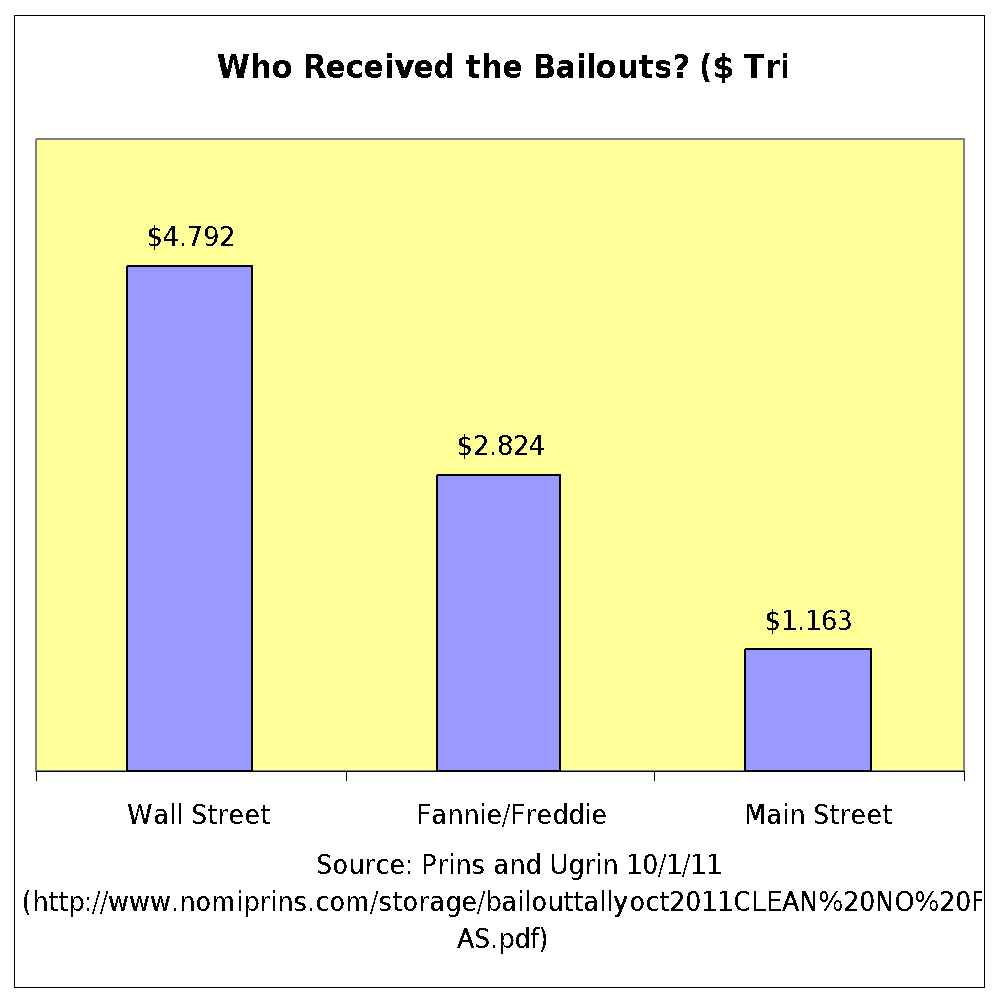
2. Wall Street is Washington, Washington is Wall Street.
Those who shuttle back and forth between Washington and Wall Street designed the basic policies that both led to the crash and that responded to it. Hank Paulson, Bush's Secretary of the Treasury, served as chairman of Goldman Sachs before going to Washington. Timothy Geithner, Obama's Secretary of the Treasury, headed the regional Federal Reserve Board in New York (a board composed of Wall Street's Who's Who) before joining the Obama cabinet.
Countless government officials and congressional staffers can't wait to leave public service for lucrative jobs on Wall Street. Their collective mindset is that the world can't function properly unless the richest of the rich get richer. Any and all policies should therefore protect our biggest banks, rather than hinder them. And, of course, both parties are in hot pursuit of Wall Street campaign cash. Little wonder the so-called "recovery" transferred wealth from us to them.
3. The Federal Reserve banks on trickledown.
The Federal Reserve's ongoing stimulus policy comes down to this: The goal is to reduce interest rates on bonds of all kinds so that money flows into stocks. The more money that goes into the stock market, the higher go the stocks. Rising stock prices leads to what economists call the wealth effect -- those who see their stocks rise dramatically feel richer and spend more. That's supposed to trickle down to the rest of us: The rich spend more, businesses recover and then, maybe, hire more people. It's working beautifully for the super-rich but obviously not for the rest of us.
But wait, don't most of us own stocks either directly or through our pension funds and 401ks? Dream on, says this chart:
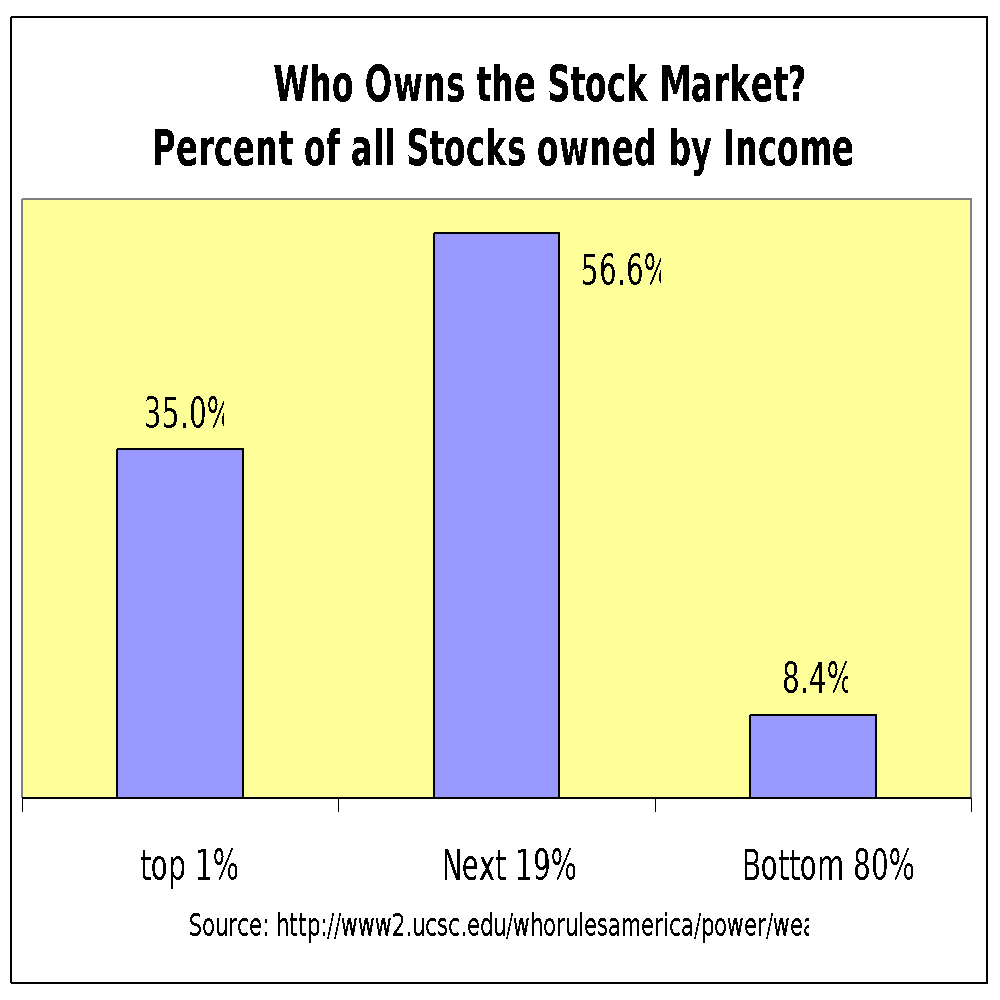
4. Washington fails to create enough jobs.
Wall Street's gambling spree tore a gaping hole to our economy. In a matter of months more than 8 million workers lost their jobs due to no fault of their own. What these elite financiers did to us is unconscionable, and they haven't had to pay a dime for the damage they caused. Although the stimulus programs prevented the slide from deepening, it was far too small to put America back to work. So now we're facing the highest levels of sustained unemployment since the Great Depression. The biggest victims of Wall Street greed are the long-term unemployed.
Source: Business Insider: http://www.businessinsider.com/unemployed-for-more-than-26-weeks-population-ratio-january-2010-2 [4]
5. Government goes on a job-killing spree.
After Wall Street crashed the economy, businesses failed, workers lost their jobs and state and local tax revenues collapsed. In a just world, Wall Street would have been taxed to make up the difference. Instead, public employment was slashed. This further cut back on consumer demand, reduced tax revenues and then created pressure for another round of government job cuts. Of course, the Tea Party right loves the idea of crushing government jobs and public employee unions as well. But the main result is to increase unemployment, which in turn puts downward pressure on wages and increases profits for the wealthy.
As Michael Greenstone and Adam Looney point out ("A Record Decline in Government Jobs: Implications for the Economy and America's Workforce" [5]), "we are in unchartered territory when it comes to government employment." The chart below from their Brookings article shows that among the major state and local job categories, only firefighters saw an increase.
| Occupation | Employment (2009) | Employment (2011) | Change in Employment | Percent Change in Employment |
|---|---|---|---|---|
| Teachers | 3,942,700 | 3,721,938 | -220,762 | -5.6% |
| Policemen | 666,579 | 610,427 | -56,125 | -8.4% |
| Fire fighters | 233,051 | 277,158 | 44,107 | 18.9% |
| Emergency responders | 69,370 | 39,170 | -30,200 | -43.5% |
| Air-traffic controllers | 23,959 | 17,128 | -6,831 | -28.5% |
Overall, the combination of state, local and foolish federal cutbacks are collapsing public employment like never before. And again, whenever unemployment increases, it places downward pressure on the wages and reduces the wealth of the many, while the few are enriched.
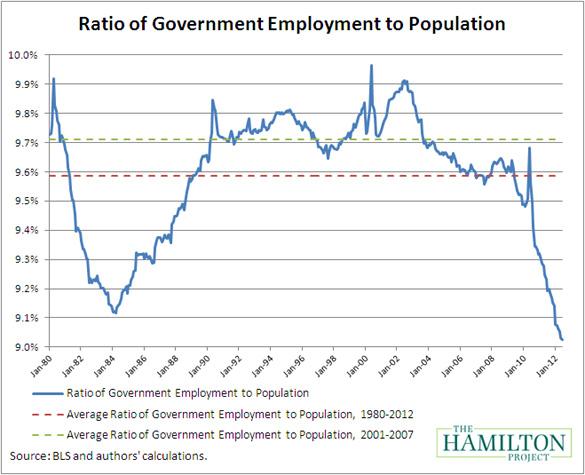
6. The big banks have become even bigger criminal conspiracies.
Not only did we bail out too-big-to fail banks with public money and get nothing back in return, but Washington allowed them to grow even bigger. The biggest banks now have oligopoly power to rig prices. They also can illegally collude in order to siphon off more wealth from the rest of us. (For some juicy details, see Matt Taibbi's "Everything is Rigged: The Biggest Price-Fixing Scandal Ever." [6] ) The corruption and cheating are reaching epic proportions as they gamble with insured deposit money, partner with loan sharks, money launder for drug cartels, and foreclose on homeowners who are up-to-date on their payments. All of that dirty money goes to the rich. (See "Are Big Banks Organized Criminal Conspiracies?" [7])
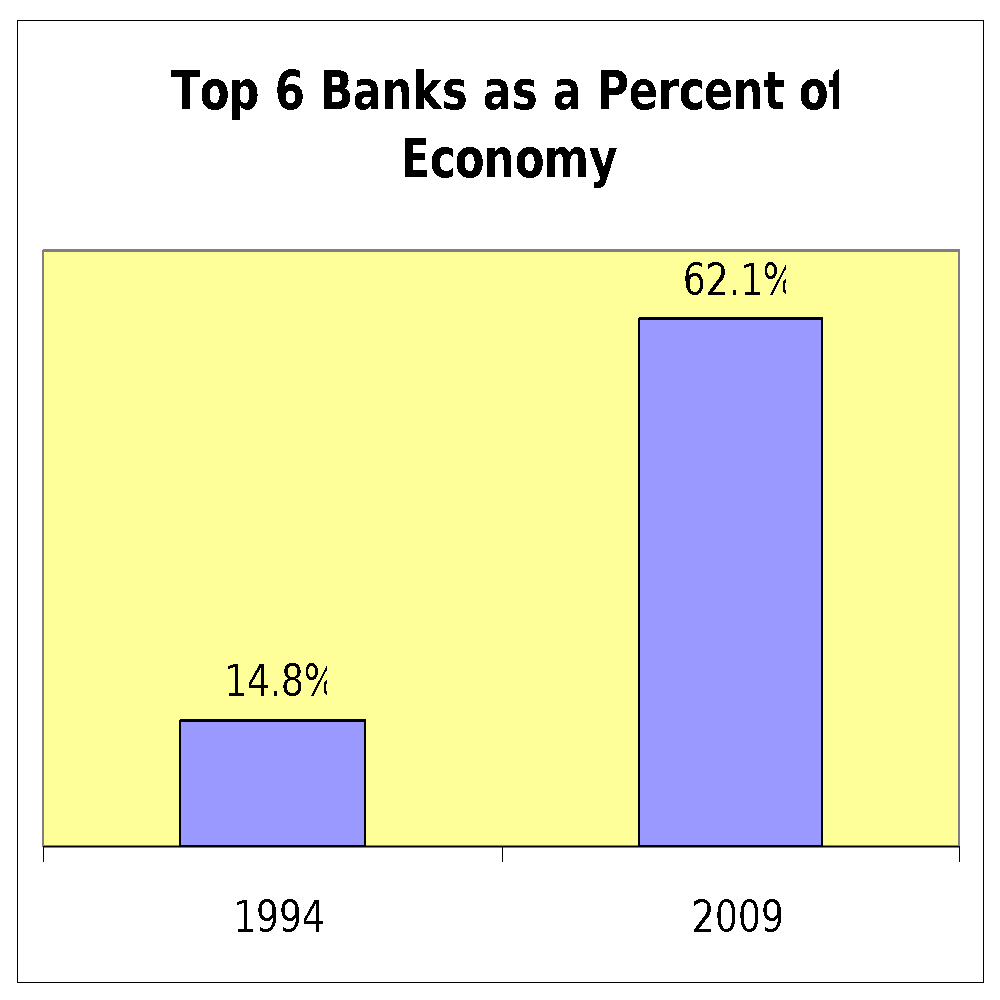
Source: Federal Reserve http://www.ffiec.gov/nicpubweb/nicweb/Top50Form.aspx [8]
7. Hedge funds run wild.
In 2012, the top hedge fund manager "earned" in one hour as much as the average family makes in 21 years. The top 10 hedge fund managers made as much in one year as 196,000 registered nurses. What exactly do these hedge fund honchos do? Much of it comes from what normal people call cheating -- some of it legal, some of it borderline, and much of it criminal. But they're hard to catch. They profit from illegal insider tips, highfrequency trading, rumor-mongering, front-running trades, special tax loopholes and even by creating financial products that are designed to fail so that they can collect the insurance. They have their hands in our pockets 24/7. (See "America's New Math: 1 Wall Street Hour = 21 Years of Hard Work For the Rest of Us." [9])
8. The rise of the Ayn Rand Right.
The Tea Party brought a new viciousness to the national dialogue. Not only do they hate the government, but also, they hate the poor. Using the twisted logic of Ayn Rand, they see the world divided into winners and losers -- and screw the losers. Not only do they oppose social programs like Social Security and Medicare, they also don't believe that government should work on behalf of the collective good. In fact, they see any and all collective efforts as an affront to personal liberty. They want a world where the creators rule and the moochers suffer. They would rather the rich rob us blind, than have the government try to stop the financial cheating and deception. If Wall Street destroys your job -- too bad. Go get another one and don't expect the government to help.
9. The silencing of Occupy Wall Street.
For a few short months, the hundreds of Occupy Wall Street encampments dramatically shifted the national debate. Wall Street was in the crosshairs and "We are the 99 percent" spread into our consciousness. It's still there, but Occupy Wall Street isn't...at least not in the potent form that shook the rich and powerful. We don't have time here to discuss whether it was silenced by repressive authorities, or if it primarily caved in due to internal weaknesses in strategy and tactics. But this much is certain: a mass movement to take on Wall Street makes a difference.
***
The solutions are simple, but the fight is hard.
The Robin Hood Tax
The best way to move money from Wall Street to Main street is through a financial transaction tax -- a small charge on each and every sale of stocks, bonds and derivatives of all kinds. Consider it a sin tax on Wall Street's many vices. Such a tax could raise enough money so that every student in this country could go to a two- or four-year public college or university, tuition-free Just think what the elimination of increasing student debt would do to the lopsided wealth statistics. Just think of what that would do for jobs as colleges expanded to deal with the demand. It's not a wild-eyed demand: 11 countries are about to adopt such a tax. (See robinhoodtax.org [10])
Public State Banks
A second critical strategy to end Wall Street as we know it is to form 50 public state banks on the model of the Bank of North Dakota. These would function as real banks rather than the rigged casinos that pass for banks on Wall Street. State banks are designed to support community banks that, in turn, lend to local businesses. Most importantly, the public bankers would be paid reasonable salaries rather than gouging themselves at the trough. (See "Why is Socialism doing so darn well in Deep Red North Dakota?" [11])
The Public Banking Institute [12] is paving the way as its leaders (Ellen Brown and Marc Armstrong) help some 20 states explore the idea. They need and deserve our support. And for all you Fed haters, they also are formulating some very cool ideas about how to dramatically transform our central bank. (More on that in a future piece.) Most importantly, we all need to find a common way to protest Wall Street's rule over the economy and over Washington. This isn't about redistributing their wealth. It's about getting ours back.
See more stories tagged with:
wealth distribution [13],
Occupy [14],
wall street [15],
banks [16],
wealth [17],
stocks [18],
economy [19],
Public Banking Institute [20],
income [21],
math [22],
money [23],
bailouts [24],
wealth chart [25],
breakdown [26],
federal reserve [27],
trickle down [28]
Source URL: http://www.alternet.org/economy/rich-have-gained-56-trillion-recovery-while-rest-us-have-lost-669-billion**
Links:
[1] http://www.alternet.org
[2] http://www.alternet.org/authors/les-leopold-0
[3] http://www.pewsocialtrends.org/2013/04/23/a-rise-in-wealth-for-the-wealthydeclines-for-the-lower-93/
[4] http://www.businessinsider.com/unemployed-for-more-than-26-weeks-population-ratio-january-2010-2
[5] http://www.brookings.edu/blogs/jobs/posts/2012/08/03-jobs-greenstone-looney
[6] http://www.rollingstone.com/politics/news/everything-is-rigged-the-biggest-financial-scandal-yet-20130425
[7] http://www.alternet.org/corporate-accountability-and-workplace/are-big-banks-bunch-organized-criminal-conspiracies
[8] http://www.ffiec.gov/nicpubweb/nicweb/Top50Form.aspx
[9] http://www.www.alternet.org/corporate-accountability-and-workplace/americas-new-math-1-wall-street-hour-21-years-hard-work-rest
[10] http://robinhoodtax.org/
[11] http://www.alternet.org/corporate-accountability-and-workplace/why-socialism-doing-so-darn-well-deep-red-north-dakota
[12] http://publicbankinginstitute.org/
[13] http://www.alternet.org/tags/wealth-distribution-0
[14] http://www.alternet.org/tags/occupy-0
[15] http://www.alternet.org/tags/wall-street
[16] http://www.alternet.org/tags/banks
[17] http://www.alternet.org/tags/wealth
[18] http://www.alternet.org/tags/stocks-0
[19] http://www.alternet.org/tags/economy-0
[20] http://www.alternet.org/tags/public-banking-institute
[21] http://www.alternet.org/tags/income
[22] http://www.alternet.org/tags/math
[23] http://www.alternet.org/tags/money-0
[24] http://www.alternet.org/tags/bailouts-0
[25] http://www.alternet.org/tags/wealth-chart
[26] http://www.alternet.org/tags/breakdown-0
[27] http://www.alternet.org/tags/federal-reserve
[28] http://www.alternet.org/tags/trickle-down-1
[29] http://www.alternet.org/%2Bnew_src%2B
AlterNet [1] / By Paul Buchheit [2]
Five Ugly Extremes of Inequality in America -- The Contrasts Will Drop Your Chin to the Floor
March 24, 2013 |
The first step is to learn the facts, and then to get angry and to ask ourselves, as progressives and caring human beings, what we can do about the relentless transfer of wealth to a small group of well-positioned Americans.
1. $2.13 per hour vs. $3,000,000.00 per hour
Each of the Koch brothers saw his investments grow by $6 billion [3] in one [4] year, which is three million dollars per hour based on a 40-hour 'work' week. They used some of the money to try to kill renewable energy [5]standards around the country.
Their income portrays them, in a society measured by economic status, as a million times more valuable than the restaurant server [6] who cheers up our lunch hours while hoping to make enough in tips to pay the bills.
A comparison of top and bottom salaries within large corporations is much less severe, but a lot more common. For CEOs and minimum-wage workers, the difference [7] is $5,000.00 per hour vs. $7.25 per hour.
2. A single top income could buy housing for every homeless person in the U.S.
On a winter day in 2012 over 633,000 people were homeless [8] in the United States. Based on an annual single room occupancy (SRO) cost [9] of $558 per month, any ONE of the ten richest Americans [3] would have enough with his 2012 income to pay for a room for every homeless person in the U.S. for the entire year [4]. These ten rich men together made more than our entire housing budget [10].
For anyone still believing "they earned it," it should be noted that most [11] of the Forbes 400 earnings came from minimally-taxed [12], non-job-creating capital gains.
3. The poorest 47% of Americans have no wealth
In 1983 the poorest 47% [13] of America had $15,000 per family, 2.5 percent [14] of the nation's wealth.
In 2009 the poorest 47% [13] of America owned ZERO PERCENT [14] of the nation's wealth (their debt exceeded their assets).
At the other extreme, the 400 wealthiest Americans [15] own as much wealth as 80 million families -- 62% of America [14]. The reason, once again, is the stock market. Since 1980 the American GDP has approximatelydoubled [16]. Inflation-adjusted wages have gone down [17]. But the stock market has increased by over ten times [18], and the richest quintile of Americans owns 93% [19] of it.
4. The U.S. is nearly the most wealth-unequal country in the entire world
Out of 141 countries, the U.S. has the 4th-highest degree of wealth inequality [20] in the world, trailing only Russia, Ukraine, and Lebanon.
Yet the financial industry keeps creating new wealth for its millionaires. According to the authors of theGlobal Wealth Report [21], the world's wealth has doubled in ten years, from $113 trillion to $223 trillion, and is expected to reach $330 trillion by 2017.
5. A can of soup for a black or Hispanic woman, a mansion and yacht for the businessman
That's literally true. For every one dollar of assets owned by a single black or Hispanic woman [22], a member of the Forbes 400 has over forty million dollars [23].
Minority families once had substantial equity in their homes, but after Wall Street caused the housing crash, median wealth [24] fell 66% for Hispanic households and 53% for black households. Now the average single black or Hispanic woman has about $100 in net worth [22].
What to do?
End the capital gains giveaway [25], which benefits the wealthy almost exclusively.
Institute a Financial Speculation Tax [26], both to raise needed funds from a currently untaxed subsidy on stock purchases, and to reduce the risk of the irresponsible trading that nearly brought down the economy.
Perhaps above all, we progressives have to choose one strategy and pursue it in a cohesive, unrelenting attack on greed. Only this will heal the ugly gash of inequality that has split our country in tw
See more stories tagged with:
wealth [27]
Source URL: http://www.alternet.org/economy/five-ugly-extremes-inequality-america-contrasts-will-drop-your-chin-floor**
Links:
[1] http://www.alternet.org
[2] http://www.alternet.org/authors/paul-buchheit
[3] http://www.forbes.com/forbes-400/
[4] http://finance.yahoo.com/news/pf_article_113540.html
[5] http://www.huffingtonpost.com/elliott-negin/koch-brothers-fund-bogus-_b_2253472.html
[6] http://www.thenation.com/blog/166328/week-poverty-obamas-budget-your-servers-budget
[7] http://www.huffingtonpost.com/2012/05/25/average-ceo-pay-2011_n_1545225.html
[8] http://portal.hud.gov/hudportal/HUD?src=/press/press_releases_media_advisories/2012/HUDNo.12-191
[9] http://www.cookcountyassessor.com/forms/cls2srob.pdf
[10] http://en.wikipedia.org/wiki/2013_United_States_federal_budget
[11] http://faireconomy.org/sites/default/files/BornOnThirdBase2012.pdf
[12] http://www.alternet.org/economy/5-obscene-reasons-why-richest-americans-grow-richer-middle-class-declines?paging=off
[13] http://newsfeed.time.com/2012/12/13/mitt-romneys-47-percent-gaffe-tops-yales-quotes-of-the-year/
[14] http://epi.3cdn.net/2a7ccb3e9e618f0bbc_3nm6idnax.pdf
[15] http://www.nytimes.com/2012/11/26/opinion/buffett-a-minimum-tax-for-the-wealthy.html?_r=0
[16] http://www.multpl.com/us-gdp-inflation-adjusted/table
[17] http://www.un.org/en/ga/second/64/pollin.pdf
[18] http://stockcharts.com/freecharts/historical/djia1900.html
[19] http://www.levyinstitute.org/pubs/wp_589.pdf
[20] http://www.usagainstgreed.org/GiniWealthIncomeAll.xls
[21] https://infocus.credit-suisse.com/data/_product_documents/_shop/368327/2012_global_wealth_report.pdf
[22] http://www.insightcced.org/uploads/CRWG/LiftingAsWeClimb-WomenWealth-Report-InsightCenter-Spring2010.pdf
[23] http://www.huffingtonpost.com/2012/09/19/richest-people-america-forbes-400_n_1896828.html
[24] http://www.msnbc.msn.com/id/43887485/ns/business-eye_on_the_economy/t/wealth-america-whites-leave-minorities-behind/
[25] http://money.msn.com/tax-tips/post.aspx?post=61f838e6-9d67-477d-983f-9f5a7e52691f
[26] http://democracyforamerica.com/pages/738?t=kos2
[27] http://www.alternet.org/tags/wealth
[28] http://www.alternet.org/%2Bnew_src%2B
Blog for Our Future [1] / By Richard (R.J.) Eskow [2]
The 147 People Destroying the World
March 25, 2013 |
Can 147 people perpetuate economic injustice – and make it even worse? Can they subvert the workings of democracy, both abroad and here in the United States? Can 147 people hijack the global economy, plunder the environment, build a world for themselves that serves the few and deprives the many?
There must be some explanation for last week’s economic madness. Take a look:
Cyprus: The European Union acted destructively – and self-destructively – when it tried to seize a portion of the insured savings accounts of the citizens of Cyprus. They were telling anyone with a savings account in the financially troubled nations of the Eurozone: Forget your guaranteed deposits. If we need your money in order to bail out the big banks – banks which have already gambled recklessly with it – we’ll take it.
That didn’t just create a political firestorm in Cyprus. It threatened the European Union’s banking system, and perhaps the Union itself. The fact that the tax on deposits has been partially retracted doesn’t change the basic question: What were they thinking?
The Grand Bargain: The President and Congressional Republicans reportedly moved closer to a deal that would cut Social Security and Medicare while raising taxes – mostly on the middle class – without doing more to create jobs. A “Grand Bargain” like that would run counter to both public opinion and informed economic judgement.
Who would impose more economy-killing austerity when there’s so much evidence of the harm it does? Why would the White House want to become the face of a deal to cut Social Security, killing its own party’s political prospects for a generation?
There’s more:
Him again: Washington reporters once again sought the opinion of Ex-Wyoming senator Alan Simpson, a vitriolic blowhard with no discernible knowledge of either economics or social insurance, and then wrote up his opinions on those topics in flattering pieces like this one [3].
Derivatives, the Sequel: Four short years after too-big-to-fail banks nearly destroyed the world economy, as the nation continues to suffer the after-effects of the crisis they created, a Congressional committee moved to undo the already-insufficient safeguards in the Dodd/Frank law.
Within days of a Senate Report which outlined the mendacity, extreme risk, and potentiality criminality surrounding JPMorgan Chase’s “London Whale” fiasco, theHouse Agriculture Committee [4] approved new bills that would legalize trades like the “London Whale.”
Above the Law: The Attorney General of the United States remained silent as the controversy continued over his recent admission [5] that banks like Dimon’s were too big to face prosecution. And yet there were no moves to change either Holder’s policy or the size of these institutions. Politico, the Washington insiders’ tip sheet, ran a piece entitled “Why Washington won’t break up the big banks [6].”
Dimon Unbound: The Senate report also provided evidence that JPMorgan Chase’s CEO, Jamie Dimon, failed to manage his bank’s risk and concealed [7] information about its losses from regulators. We learned last week that regulators lowered their rating of Dimon’s bank after chastising the bank’s leadership for management failures that included inadequate safeguards against money-laundering, poor risk management, and failure to separate the banks’ own investments from those of its customers.
Illegalities during Dimon’s tenure as CEO have cost his shareholders billions in settlements and fines. Poor risk management (and additional potential illegalities) cost it another $6.2 billion in Whale-related losses. And yet last week Dimon’s own Board “strongly endorsed [8]” his dual role as CEO and Board Chair, an unusual concentration of power at what is (by some measurements) the world’s largest bank, and commended itself in aproxy filing [9] for the “strength and independence” of its oversight, adding: “The Firm has had strong performance through the cycle since Mr. Dimon became Chairman and CEO.”
All this, in just seven days. Has the world gone insane? What is everybody thinking?
That’s where the number “147″ comes in.
Anthropologist Robin Dunbar tried to find out how many people the typical person “really knows.” He compared primate brains to social groups and published his findings in papers with titles like “Neocortex size as a constraint on group size in primates.”
Dunbar concluded that the optimum number for a network of human acquaintances was 147.5, a figure which was then rounded up to 150 and became known as “Dunbar’s Number.” He found groups of 150-200 in all sorts of places: Hutterite settlements. Roman army units. Academic sub-specialties. Dunbar concluded that “there is a cognitive limit to the number of individuals with whom any one person can maintain stable relationships.”
Around 150 or 200 people form a human being’s social universe. They shape his or her world view, his or her world.
That means that 147 people can change the course of history. Not necessarily the same147 people, of course. But the small social groups which surround our world’s leaders have extraordinary power.
Economist Simon Johnson mentioned Dunbar’s Number last week in a column [10] about incoming Treasury Secretary Jacob Lew and the new SEC chair, Mary Jo White. “The issue is not so much their track record,” Johnson wrote, “because neither has worked directly on financial-sector policy issues; it is much more about whom they know.”
“If most financial experts you know work at, for example, Citigroup,” added Johnson, “then you are more likely to see the financial world through their eyes.”
Lew is a former Citigroup executive. That mismanaged megabank is also the former corporate home of ex-Clinton Treasury Secretary Robert Rubin, and the current home of Peter Orszag, formerly President Obama’s OMB Director. For her part, White went from prosecuting criminals to defending Wall Street bankers. That was also Attorney General Eric Holder’s profession before he was appointed to his current position.
These are the people who surround our President, our Senators, our Representatives. They talk to them every day. They say, This is how the world works. They say, Everybodyknows these things.
Their European counterparts saw the effects of austerity on the economies of their Union: Unemployment up. Gross domestic product down. Even the deficits, which austerity was meant to reduce, have been rising as the result of these unwise cuts.
But, they say, we know Angela Merkel. We know George Osborne and Christine Lagarde. We trust their judgement. How did the predictably disastrous plan to tax guaranteed savings accounts in Cyprus get approved? It’s not hard to imagine: “Everybody we know” thought it was a great idea.
That’s how it works here in the US, too. Larry Summers, Alan Greenspan and Robert Rubin were spectacularly wrong about everything: deregulation, the housing bubble, government spending, everything. But we know them.
Nobel Prize-winning economists like Paul Krugman and Joseph Stiglitz keep explaining why more stimulus spending is needed. But we don’t know them – not the way we know Larry, Alan, and Bob. Same for Simon Johnson, or William K. Black Jr., or Robert Johnson, or any of the other economists we don’t know very well.
And when we don’t know someone very well, their criticisms make us uncomfortable.
Bill Clinton’s “Third Way” triangulation led to welfare “reform” that’s proven disastrous. His Wall Street deregulation ruined the economy, and his brand of old-fashioned pseudo-centrism is out of touch with today’s political and economic realities. But weknow him.
Bill Clinton doesn’t make us uncomfortable at all.
Investigate Jamie Dimon, or Lloyd Blankfein, or Robert Rubin? But they were our clients, and will be again once we leave government. Investigate them? We know them.
Dimon’s Board of Directors [9] is a case study in Dunbar’s Number. It includes Honeywell CEO David Cote, who was a member of the Simpson Bowles Commission. There’s a retired senior executive with another big defense contractor, Boeing. Together with Dimon, that makes three CEOs who earn their money from government largesse.
The CEO of Comcast is on Dimon’s Board, too. (The media’s leaders are always among the 147.) One seat belongs to the head of one of the accounting groups that overlooked massive bank fraud when signing off on their annual statements. Another belongs to the former CEO of Exxon Mobil.
The “147″ run companies. They also hold fundraisers for politicians – in both parties.
When Senator Obama became President Obama, during the gravest unemployment crisis since the Great Depression, one of his first acts was to create a “Deficit Commission” instead of a “Jobs Commission.” Why? Because “147 people” thought that was the right priority. Then he appointed the dyspeptic, unlikable, and uninformed Sen. Simpson to co-chair it.
You see, the “147 people” in Washington’s political and media circles like Alan Simpson. To them he’s not an embarrassment to his President, a paid pitchman for billionaire Pete Peterson’s anti-Social Security jihad. (We know Pete!) To them Simpson’s not an ill-informed and misogynistic bully who taunts women with comments about “310 million tits.” To them he’s Al. They know him. They say he’s a lot of fun when you get to know him.
They really say that.
Then there are the news anchors and journalists who say things like this: Everybodyknows that we need to cut Social Security. Everybody knows the deficit is our most urgent problem.
Everybody knew that Saddam had weapons of mass destruction, too.
Everybody understands that the right-wing, anti-government Simpson Bowles plan represents the “political center,” although it’s far to the right of public opinion – even ofRepublican or Tea Party voters’ opinion – on issues that range from job creation to increasing Social Security benefits.
You can’t fit millions of frustrated voters into a social group of 147 people.
When Teddy Roosevelt became President, J.P. Morgan (the person, not the bank) suggested he “send your man to my man and they can fix it up.” He was shocked that the new President chose instead to operate outside the Circle in order to create real change. And when Franklin D. Roosevelt became President he brought in new faces, new voices, new ideas. He broke the social circle that had paralyzed government and the economy.
But the circle of right-wing Republicans and corporatist Clintonite Democrats is still intact. That means Barack Obama, Nancy Pelosi and other Democratic leaders will keep on promoting the right-wing agenda known as Simpson Bowles until their party loses all its political power at the polls.
It also means that Republican extremism will still be reported with straight-faced gravity.Congressional committees will keep deregulating big banks, the Justice Department will avoid prosecuting them, and their Boards of Directors will keep rewarding their executives. They’ll all keep doing exactly what they’re doing – until the economy blows up again, perhaps with far worse consequences than the last time.
And when the next crisis comes, “147 people” will react to it exactly the same way they reacted to the last one. You can almost hear them now, can’t you? You can’t blame us, they’ll say. Nobody could’ve seen this coming. How do we know that?
Because we asked everybody we know.
See more stories tagged with:
injustice [11],
economic [12],
jamie dimon [13]
Source URL: http://www.alternet.org/147-people-destroying-world**
Links:
[1] http://www.ourfuture.org
[2] http://www.alternet.org/authors/richard-rj-eskow-0
[3] http://thehill.com/business-a-lobbying/lobbyist-profiles/288871-gadfly-amid-the-gridlock
[4] http://www.huffingtonpost.com/2013/03/20/wall-street-deregulation-_n_2916795.html?1363804456
[5] http://www.alternet.org/economy/outrage-some-banks-are-too-big-prosecute
[6] http://www.politico.com/story/2013/03/why-washington-wont-break-up-the-banks-yet-89199.html?hp=t1_3
[7] http://www.washingtonpost.com/business/economy/jpmorganchase-ceo-jamie-dimon-is-accused-of-hiding-data-about-big-losses/2013/03/14/d95d6394-8ce7-11e2-9838-d62f083ba93f_story.html
[8] http://www.huffingtonpost.com/2013/03/22/jpmorgan-jamie-dimon_n_2935401.html?1363985622
[9] http://apps.shareholder.com/sec/viewerContent.aspx?companyid=ONE&docid=9180171
[10] http://economix.blogs.nytimes.com/2013/01/31/jacob-lew-mary-jo-white-and-dunbars-number/
[11] http://www.alternet.org/tags/injustice
[12] http://www.alternet.org/tags/economic-0
[13] http://www.alternet.org/tags/jamie-dimon-0
[14] http://www.alternet.org/%2Bnew_src%2B
fun-ish: http://www.alternet.org/print/economy/sht-ceos-say-6-outrageous-statements-americas-big-mouthed-overlords
=
http://www.ted.com/speakers/james_b_glattfelder.html
James B. Glattfelder aims to give us a richer, data-driven understanding of the people and interactions that control our global economy. He does this not to push an ideology -- but with the hopes of making the world a better place.
=
AlterNet [1] / By Thom Hartmann [2]
There's a Violent World War Going On, with Millions of Casualties -- Oligarchs vs. Everyone Else
January 7, 2013 |
History is littered with the corpses of those who thought they could conquer the world, or at least the “known” or “important” world, through force of arms. Many come immediately to mind: Alexander the Great; Caesar; Hitler; the Celts, Ottomans, and Catholics; various European, Asian, and American empires from the 17th Century Dutch to the 18th Century French, to the 19th Century British and the 20th Century Soviets and Americans. Others, like the Aztecs, are less well known to westerners, Europeans, and Asians, but no less ambitious.
All used some variation on war, the force of military power, to accomplish their goal. All won, over the short-term, and then collapsed over the long term (making the relatively safe assumption that the American Empire is in the process of collapse right now).
So, who’s next?
While the rising economies of the world, like the BRIC (Brazil, Russia, India, China) nations, all have the potential, particularly the Chinese, all also are pretty focused on regionalism. But there is one group that has declared war on us - all of us, all over the world - and already won some significant victories. And that’s the creditor class, what economist Henry George called the “rentiers,” and we generally today refer to as “the billionaires.”
The top story on the Sunday, January 6 2013 online edition of the *Financial Times,* [3] was headlined, “Banks win more flexible Basel rules” by Brooke Masters. The lead paragraph noted that “International banks received a new year fillip” or gift, when the new regulations out of the Basel bank regulators meeting “announced that the first ever global liquidity standards would be less onerous than expected and not be fully enforced until 2019, four years later than expected.” Perhaps the single most relevant sentence in the article started: “The results are largely good news for bank profits…”
We have become, in the United States, and increasingly all over the world, a society with only two classes: Those who own, and those who owe.
The owners (or “Takers”) own vast wealth, and loan it out at interest to everybody from students to governments. They’re continually receiving that interest back in ways that are either tax-free or taxed at very low levels. (Here in the US we call it “capital gains,” “Interest,” “dividends,” and “carried interest.” While a working person will pay as much as 39% in federal income taxes, the federal income tax to the Mitt Romneys, Paris Hiltons, and Lloyd Blankfeins of the world is now capped at 20%. As Leona Helmsley famously said, “Only little people pay taxes.”)
The owe-ers - the indebted - find themselves trapped on a lifelong treadmill paying interest and fees to the Takers. The owe-ers are also mostly the workers, the people who make things (from manufactured goods to hamburgers), and so are rightly called the “Makers.”
For a brief period of American history, the rapaciousness and greed of the Takers was kept in check by the Makers - mostly through the actions of their unions and elected officials like FDR, Truman, Eisenhower, Kennedy, Johnson, Nixon, Ford, and Carter. Glass-Steagal prevented banksters from gambling with your savings account or pension. The Sherman Anti-Trust Act and its heirs prevented the big fish from swallowing all the medium-sized and smaller fish, so cities and malls were filled with locally-owned businesses. Social and economic mobility were higher in the United States than in most other countries of the world.
But with the election of Ronald Reagan, the Takers - whose favorite way of taking is through putting the Makers into debt - won a huge victory. They killed or weakened democratic institutions, like unions and politicians not dependent on them. They moved the Middle Class from prosperity into, first, credit card debt, then into second-mortgage debt, and finally into student loan debt. And then, in the final Coup de grâce, they made the formerly democratic governments of Western Europe and the United States indebted to them.
They knew from the beginning it was war. But a softer and more silent form of war than the world was used to. Not since the ascendency of the British East India Company in the 1700s had the world seen an economic, rather than sovereign, force so dominate the world.
And now they’re in the final stages of their war. Having taken most all the resources of the West’s Middle Classes and thrown them and their children into debt bondage, they’ve moved onto taking over entire nations.
This is what Republicans mean when they talk about “making government smaller” here in the United States, or “the austerity agenda” in Europe, Canada, and Australia. It’s all the same thing - transfer even more wealth and political power from those in debt (be they individuals, cities, states, or nations) to those who made the loans. From the middle-class Makers to the billionaire Takers.
And God forbid a politician should stand up to the Takers. From Republicans refusing to raise taxes on billionaires, to international banking institutions leading the charge, via their captive governments, on “renegade” states [4] like Bolivia.
Longer work weeks in France. Indexing the Inheritance Tax to inflation in the United States, but not the minimum wage. Cutting Greeks off their national health-care system after a year of unemployment. Slashing government support to schools, police, and health-care in Canada. Banks committing crimes and getting slap-on-the-wrist fines. Fossil Fuel corporations, the world’s most profitable, not only getting taxpayer subsidies but never, ever paying for the cancers, pollution, and global warming they cause. The list goes on and on.
It’s war. Rob, plunder, and pillage. Take what little is left from those with a little, and give it all to those who have a lot. Turn the Makers into slaves, while the Takers get an Inheritance Tax cut so their great-grandchildren can live the lives of the landed gentry.
When Ronald Reagan came into office, America was one of the most socially- and economically- mobile nations in the developed world. Today it is among the least.
Democracy is being replaced by plutocracy. Modern oligarchs are richer than the kings of old. And, still not content, they’re amping up the war with a coming July 4th attempt to amend the US Constitution so the wealthy need never again fear tax increases. It’s being led by the Goldwater Institute [5] with its “Compact For America.”
Look out. We’re moving from trench warfare to aerial bombardment. And when they’re done, Western Democracies will look far more like Italy in the 1930s…
See more stories tagged with:
oligarchy [6],
plutocracy [7]
Source URL: http://www.alternet.org/news-amp-politics/theres-violent-world-war-going-millions-casualties-oligarchs-vs-everyone-else**
Links:
[1] http://www.alternet.org
[2] http://www.alternet.org/authors/thom-hartmann
[3] http://www.ft.com/intl/cms/s/0/e4effd30-5820-11e2-b997-00144feab49a.html#axzz2HEuSm88p
[4] http://www.bbc.co.uk/news/world-latin-america-20929211
[5] http://interoccupy.net/blog/is-this-grounds-for-revolution/
[6] http://www.alternet.org/tags/oligarchy
[7] http://www.alternet.org/tags/plutocracy
[8] http://www.alternet.org/%2Bnew_src%2B
http://www.alternet.org/print/news-amp-politics/theres-violent-world-war-going-millions-casualties-oligarchs-vs-everyone-else
Published on Alternet (http://www.alternet.org)
Home > 9 Greedy CEOs Trying to Shred the Safety Net While Pigging Out on Corporate Welfare
AlterNet [1] / By Lynn Stuart Parramore [2]
9 Greedy CEOs Trying to Shred the Safety Net While Pigging Out on Corporate Welfare
November 26, 2012 |
A gang of brazen CEOs has joined forces to promote economically disastrous and socially irresponsible austerity policies. Many of those same CEOs were bailed out by the American taxpayer after a Wall Street-driven financial crash. Instead of a thank-you, they are showing their appreciation in the form of a coordinated effort to rob Americans of hard-earned retirements, decent medical care and relief for the poorest.
Using the excuse of a phony, manufactured crisis known as the “fiscal cliff” – which isn’t a crisis at all, as economist James K. Galbraith has succinctly explained [3] -- they are gearing up to pull the wool over the public's eyes by cutting Social Security, Medicare and Medicaid. The CEOs are part of the Fix the Debt campaign run by the Peter Peterson [4]-backed Center for a Responsible Federal Budget, which plans to unleash tens of millions pushing for a deficit reduction deal that favors the rich.
You can be sure that many more CEOs in addition to the names on the list below sympathize with plans to shred the social safety net and enjoy windfall tax breaks. But these Scrooges are so bold as to publicly announce their desire to pick the pockets of fellow Americans while simultaneously pigging out at the corporate welfare trough. Multitasking!
A generation ago, an American CEO would think twice about announcing utter disregard not only for his neighbors and employees, but also for the economy, which can’t prosper when income is consistently redistributed upward (see Nobel laureate Joseph Stiglitz’s The Price of Inequality for more on that theme). But in the present culture -- even after the Occupy Wall Street movement – these business barons feel perfectly comfortable trumpeting their desire to get richer at your expense.
Here’s a sample of the Fix the Debt CEO Council Hall of Shame. (Download the complete list at the organization’s Web site [5].)
1. Lloyd Blankfein, chairman and CEO, Goldman, Sachs & Co.Blankfein, infamous for describing his financial activities as “God’s work,” shared his attitude toward society with CBS news recently. He explained his keen desire to see Americans lowering their sights for the future. You really have to watch the interview[6]to get the full flavor of Blankfein’s smug assurance that predation can be sold as concern for the nation’s well-being. In addition to trotting out several myths about Social Security’s design and functions, including the bogus notion that retirement age must be raised [7], he gives a pithy summary of what life is going to be like for the 99 percent:
“You’re going to have to do something, undoubtedly, to lower people’s expectations of what they’re going to get, the entitlements, and what people think they’re going to get, because you’re not going to get it.”
Not if Lloyd Blankfein has anything to do with it. He calls it managing expectations. Here’s another word: theft.
Since the financial crash, Blankfein’s company, Goldman Sachs, has received tens of billions of dollars in what the *Economic Policy Journal*describes [8] as “direct and indirect succor from the Fed." In sharp contrast to average Americans, when Goldman needed help in the 2008 crisis, a friendly Federal Reserve let Goldman turn into a commercial bank almost overnight, so it could go to the Fed for help 24/7.
2. Jeffrey Immelt, chairman and CEO, General Electric Company. In 2011, President Obama welcomed outsourcing pioneer Jeffrey Immelt to his White House inner circle as chair of a newly created jobs council – a move that was a sharp slap in the face to American workers. Immelt returned the favor by dumping Obama in favor of Mitt Romney in the recent election.
Obviously, supporting disastrous financial deregulation, dodging taxes and helping to destroy American manufacturing has not satisfied Immelt. He’d like to add insult to injury by making sure that people who have been screwed by the reckless activities of short-sighted corporate titans like himself are left to starve in their golden years and go without medical care. And as for the poor, well, couldn’t they be just a little bit poorer? Immelt thinks that would be swell.
After the 2008 crash, the government gave a giant boost[9]to hard-pressed GE Capital, the company’s financing arm, through the Temporary Liquidity Guarantee Program. GE has also helped itself to enormous taxpayer-funded subsidies, especially in green energy. And guess how much GE paid in taxes in 2010? Nothing. In fact, using what the *New York Times* describes [10] as its “innovative accounting practices,” it claimed a tax benefit of $3.2 billion!
3. Jamie Dimon, chairman and CEO, JPMorgan Chase & Co. At a recent gathering of the Council on Foreign Relations, Jamie Dimon vented his feelings [11] about a number of things that peeve him, from a federal lawsuit brought against JPMorgan Chase to Obama’s failure to adopt the harmful and misguided Simpson-Bowles deficit reduction plan, which, among other things, recommended reducing the tax rate for top earners. Dimon has claimed that his bank did not need the TARP funds bestowed on it by the federal government, but there is no question that today his bank borrows funds more cheaply than smaller banks because of the federal government’s implicit too-big-too-fail guarantee.
Dimon is deploying a familiar scare tactic[12]on the topic of the so-called fiscal cliff. He’s claiming that his company will be forced to cut down on hiring and so on if a budget plan is not tailored to enrich the wealthy. During a recent visit to India [13], he issued warnings to CNBC-TV18:
"I've spoken to CEOs who say, you know, absolutely, we are making decisions to protect ourselves from the ‘fiscal cliff’ and those are like investment decisions and hiring decisions.”
Maybe Dimon’s company would be better served figuring out what happened to the $6 billion that recently went up in smoke in the “London Whale” derivatives fiasco [14].
4. W. James McNerney, Jr., chairman, president and CEO, the Boeing Company. McNerney launched at Procter & Gamble, reached high altitude at GE and shot to the stratosphere by becoming head honcho at Boeing in 2005.
Boeing has been a long-time beneficiary of the government’s Export-Import Bank [15], which has financed sales of many of its planes. McNerney chairs President Obama's Export Council, where he works hard to arrange policies that benefit his company. He spent much of 2011 slugging it out with the National Labor Relations Board over moving assembly plants from Washington to South Carolina, a right-to-work state. That got settled, but now the profitable company is in a fight with engineers who don’t want their pensions chopped nearly in half. Boeing’s excuse? It wants to keep the engineers “competitive.” Union members have reported intimidation [16] from the company’s management as the dispute has intensified.
The Boeing boss is now crying “deficit” and asks for your retirement money. Pretty brassy, considering that the company paid not a single penny in taxes between 2008 and 2011. In fact, Citizens for Tax Justice calculates that Boeing actually got money back[17]from the U.S. government over the past decade, “paying a negative 6.5 percent tax rate, even though it was profitable every year from 2002 through 2011.”
5. David Cote, chairman and CEO, Honeywell International Inc. David Cote is a veteran of GE and also sits on the board of JPMorgan Chase, where he is one of three members of the risk committee that failed to prevent the disastrous $6 billion trading loss mentioned above. Cote has led Honeywell, one of the world’s largest industrial conglomerates, since 2002. Along with GE and Boeing, Honeywell shares the distinction of being a top corporate polluter [18].
Obama invited Cote to join the Simpson-Bowles deficit commission in 2010, where he worked hard to create a flawed plan meant to reward the rich and cut vital services for the 99 percent. Meantime, sales of mostly aerospace-related Honeywell products sold to the government make up about 12 percent of Honeywell’s total revenues [19].
Here’s the 2009 figure [20] for what Cote raked in as Honeywell’s CEO: $12,839,038. In response to the recession, Cote forced Honeywell's employees to take unpaid furloughs [21] of between two and five weeks during 2008 and 2009.
6. Glenn Britt, chairman and CEO, Time Warner Cable Inc. Maybe the head of one of the world’s largest media conglomerates is ticked off because his compensation dropped [22] from $17.4 million in 2010 to $16.4 million in 2011. Whatever it is, he is channeling his frustration by setting his sights on your wallet.
As a telecom giant, TWC is part of one of the most despised industries in America, and it’s no wonder. Whether it’s offering terrible customer service (Britt is devising a special “white glove” package for the affluent), leaving customers disconnected during Hurricane Sandy, or lobbying for laws that squash competition and lead to telecom oligopolies, Britt seems out to prove that his company can only succeed if the rest of the country suffers.
And with his Fix the Debt campaign, he’d like to make that suffering just a little more intense.
7. Reid Hoffman, cofounder and executive chairman, LinkedIn Corporation. Reid Hoffman brought us LinkedIn, possibly the most annoying social media network on Planet Earth. Why is it necessary to send scores of nagging emails to accept invitations to "link" to people you don’t even know? No one can say. But it sure is irritating. LinkedIn, along with his investments in companies like Facebook, has made Hoffman a billionaire. He’s ready to start giving – to the rich.
Hoffman hails himself as the champion of entrepreneurship. What he fails to mention is that entrepreneurship gets stifled when people don’t have a decent social safety net. You can’t take risks starting a new business if there’s nothing to fall back on. That’s why Norway is considered an entrepreneur’s heaven [23]: the social safety net is strong and there’s far less shoveling income toward the rich.
Fix the Debt proposals would shred the social safety net, increase income inequality and make entrepreneurship less attractive for Americans. Hoffman’s presence on this list means only one thing: he wants to make it harder for you to be an entrepreneur like him. He’s made his money. And now he’s bent on kicking the ladder out from under the rest of us.
8. Richard Anderson, CEO, Delta Air Lines, Inc.Historically, airlines have been recipients of enormous subsidies from the federal government; after 9/11, many of those subsidies increased [24].
Delta CEO Richard Anderson enjoyed a 10 percent raise in 2011, bringing his compensation to $8.9 million. Not bad for a year when the company's stock price fell by more than a third. [25] Delta employees didn’t fare so well as the boss. In 2010, Delta flight attendants lost their battle [26] to protect their pay and benefits. According to Labor Notes, Anderson was quite creative in his effort to crush the American dream of those hard-working folks:
“[Anderson] played up a culture clash between Northwest’s Northern base and Delta’s Southern workforce, attacking AFA [Association of Flight Attendants] in one company-called meeting for being ‘un-Christian’ and ‘immoral.’ A DVD of the meeting was sent to every flight attendant.”
As the head of an airline, Anderson knows that his business would not have been possible but for the taxpayer-funded research and development that led to the creation of passenger jets, along with enormous air mail subsidies. He returns the favor by screwing workers and attempting to pass austerity measures designed to stick it to working people whose tax dollars make his job possible.
9. Dave Barger, president and CEO of JetBlue Airways Corp. Sky’s the limit to Dave Barger’s fondness for right-wing politicians. And he’s quite proud of being the only major U.S.-based airline that’s “100% union free. [27]” Several grassroots attempts at unionization have failed in recent years, much to his delight.
JetBlue has been running Fox shows on its in-flight entertainment network since 2004 [28]. Recently, the company pulled its sponsorship [29] of Yearly Kos, a convention held by liberal Web site DailyKos, in response to pressure from Fox’s Bill O’Reilly. [30]
Like Delta CEO Richard Anderson, Dave Barger understands very well that the airline industry has enjoyed enormous benefits thanks to the U.S. taxpayer, from the massive airports built at government expense to air traffic control infrastructure, which is heavily subsidized. And, like Anderson, he'd like to deliver a sharp kick in the teeth to the customers who support his business and would like to have a decent retirement and, oh, maybe some quality care when they're sick.
In 2010, people cheered when Congress gave shareholders the right to vote on the pay of corporate CEOs. Too bad those nonbinding votes haven't embarrassed the greed out of the chief executives. In fact, CEO pay crept up another 5 percent last year, once again far outstripping wage gains for middle-class workers.
While some CEOs, such as GE's Jeffrey Immelt, took a modest pay cut in 2011, many continued drawing outsized checks. Here we list 10 of the most egregiously overcompensated executives. They're selected not just on the size of their pay packages, but how much more they were paid than their peers at similar companies, as well as the disparity between their personal fortunes and those of their employer. Collectively, they highlight the cozy relationships between today's corporate boards and their chief executives. "You don't suggest [corporate compensation] consultants who are Dobermans," Warren Buffet, a critic of excessive CEO salaries, quipped in . "You get cocker spaniels and make sure that their tails are wagging."
Timothy D. Cook, Apple
Compensation: $378 million
Corporate profits (2010-11): +85%
Stock gain/loss (2010-11): +34%
By far the nation's highest paid CEO, Tim Cook earned more last year than the next four best-compensated CEOs combined. He raked in 378 million times the salary of his predecessor, Steve Jobs, whose 2010 pay was just $1. Apple could pay Jobs so little because it had given him stock options early in his tenure that exploded in value with the launch of its iPhones and tablets. The company clearly wants to replicate that approach with Cook, whose pay was mostly a one-time grant of $377 million in Apple shares. But even when averaged over their 10-year vesting period, those shares at current prices give Cook an annual take of $38 million, which is more than all but nine CEOs earned last year. "If Apple continues its growth at even more modest levels than it has in the past," corporate governance consultant Paul Hodgson told Bloomberg, "then the award is going to far exceed anything we've ever seen."
 David Simon, Simon Property Group
Compensation: $137.2 million
Corporate profits: +67%
Stock gain/loss: +33%
Simon and Cook are the only two CEOs of publicly traded companies who occupy the exclusive nine-figure niche, but other than getting big lump payments in stock, they have little in common. Simon's real estate investment trust earned just 4 percent of what Apple brought in last year, and it had smaller percentage gains in profits and stock price. Shareholders showed their displeasure at Simon Property Group's annual meeting in May, voting nearly 3 to 1 to reject Simon's pay deal. While the company responded that it would "take their views into consideration," it did not pledge to renegotiate Simon's pay.
 David M. Zaslav, Discovery Communications
Compensation: $52.4 million
Stock gain/loss: -2%
Shares in the media conglomerate that owns Animal Planet and the Discovery Channel slid last year over fears of ad revenue declines and concerns that the internet and Netflix are decimating cable profits. Even so, Discovery gave Zaslav a 23 percent raise, making him second only to Leslie Moonves of CBS (a much larger company) as the nation's highest-paid media executive. In May, Discovery Communications' stock slipped again when the company booked losses on OWN, its joint venture with Oprah Winfrey.
 Michael S. Jeffries, Abercrombie & Fitch
Compensation: $46.6 million
Corporate profits: -16%
Stock gain/loss: -7%
Jeffries' pay more than doubled last year even as Abercrombie shares took a tumble, dragged down by the preppy retailer's poor performance in Japan, Canada, and Europe. He raked in more than four times as much as the CEO of Dick's Sporting Goods, a similarly sized retailer that logged a respectable 16 percent return on investment. Jeffries' company has resorted to antics such accusing Jersey Shore star Michael "The Situation" Sorrentino of damaging the brand by donning Abercrombie shirts on television. A day after the company offered Sorrentino "substantial payment" not to wear its clothes, its stock plunged 9 percent.
 Rupert Murdoch, News Corporation
Compensation: $29.3 million
Corporate profits: +18%
Stock gain/loss: +49%
News Corporation shares rose dramatically last year, but public confidence in the company that owns British tabloids, Fox News, and the Wall Street Journal plummeted. Starting last July, a series of investigations revealed that News Corp.'s tabloid, News of the World, had engaged in hacking private cellphones on a much wider scale than previously disclosed—and with the knowledge of senior News Corp. executives. The inquiries led to the shuttering of the tabloid, the resignation of Dow Jones CEO Les Hinton, and the arrest of three former high-level News of the World employees. Yet amid this imbroglio, News Corp. boosted Murdoch's salary by 75 percent. In May, a British parliamentary committee released a report concluding that Murdoch had "exhibited willful blindness to what was going on in his companies and publications" and was "not a fit person to exercise stewardship of a major company."
 Ian M. Cumming, Leucadia National
Compensation: $29.3 million
Corporate profits: +80%
Corporate profits: -99%
Stock gain/loss: -21%
A diversified holding company with interests ranging from mining to vacation rentals, Leucadia National is often described as a "mini Berkshire Hathaway." But unlike Warren Buffet, a vocal critic of excessive CEO salaries, Cumming took a whopping 555 percent pay raise last year (mostly in stock options), even as shareholders lost their shirts. Cumming acts as both CEO and longtime chairman of the board—an easy formula for chumming it up with board members who serve on Leucadia's compensation committee. Granting stock to execs is "not based on any specific formula," notes the company's proxy statement, "but rather on a subjective assessment of the executive's level and performance."
 Gregory W. Cappelli, Apollo Group
Compensation: $25.1 million
Corporate profits: NA
Stock gain/loss: +10%
Cappelli's pay shot up more than 1,400 percent last year, and it's far from clear what he did to deserve $23.5 million in stock and stock options; shares in Apollo, which owns the for-profit University of Phoenix, were up just 10 percent last year, and Cappelli isn't even the company's sole CEO. (He splits the title with Charles B. Edelstein, who received an even bigger options grant in 2008.) Stock options are supposed to give CEOs an incentive to promote long-term growth, but that clearly hasn't worked at Apollo. Since January 2008, it has underperformed the S&P 500 and most other education companies. In 2012, its stock is down 40 percent.
 Lloyd C. Blankfein, Goldman Sachs
Compensation: $16.2 million
Corporate profits: -67%
Stock performance: -45%
If Goldman Sachs really is a vampire squid that bleeds the rest of the economy, then perhaps we should thank Blankfein for bleeding Goldman Sachs. In 2011, net income fell 67 percent at America's most-despised investment bank and it announced plans to eliminate 1,000 employees—though it separately said it would hire 1,000 new ones overseas. In the midst of all this cost cutting, Blankfein took a 15 percent pay raise.
 John T. Chambers, Cisco Systems
Compensation: $12.9 million
Corporate profits: -16%
Stock performance: -30%
Chambers earned $6 million less last year than he did in 2010 (when he also made our most-overpaid list), but his $12.6 million take is no bargain for employees or shareholders. Beset by weak demand and stiff competition, Cisco lost 30 percent of its market value in 2011 even as it announced plans to cut 6,500 workers—the largest layoff in company history. Chambers isn't exactly feeling their pain. Though Cisco's shares have never recovered from their peak in 2007—when Chambers earned $11 million—his average annual salary has been 32 percent higher since then.
 Robert L. Antin, VCA Antech
Compensation: $12.1 million
Corporate profits: -13%
Stock performance: -15%
Never heard of VCA Antech? You're not alone. This provider of "pet healthcare services" had just $1.5 billion in sales last year—a drop in the bucket compared to, say, the profitable drugstore chain CVS, which nonetheless paid its CEO $100,000 less than Antin earned. Profits fell 13 percent at VCA Antech last year, but that didn't dissuade the company's board from giving Antin—who holds the triple title of chairman, president, and CEO—a 536 percent raise that included $10 million in stock and a $928,000 cash bonus. His package was opposed by a leading corporate governance consultancy and by his own shareholders—58 percent rejected it in a nonbinding "say on pay" vote.
==
gangs: And then, like a grassfire leaping a highway on a windy day, the
Enron scandal seemed to ignite scandals in other companies. By July,
2002, the scandal sheet included over a dozen corporations, including
Adelphia, AOL Time Warner, Arthur Anderson, Bristol-Meyers Squibb,
Global Crossing, Halliburton, Johnson & Johnson, Qwest Communications,
Tyco, WorldCom, and Xerox.
Each scandal was unique, but they tended to share certain common
features. In most cases, executives had used illicit accounting schemes
to artificially enhance the company’s financial appearance, thereby enhancing
the stock price. The motive was clear. High stock prices maximized
the value of the stock options that had become a major part of
executive compensation packages. The use of optionsrather than a
straight salaryhad been intended to motivate corporate leaders and to
align their interests with those of the company’s shareholders. Instead,
the effect had been the reverse.
The rise of stock options in the 1980s and 1990s was part of a remarkable
increase in executive compensation during that period, especially
for CEOs. In 1980, the average CEO of a large corporation earned
42 times the average hourly worker’s pay; in 2001, ratio had soared to
411 times. The increase reflected a major change in the image and status
of business leaders. In the 1950s and 1960s, the CEO was viewed in the
context of a managerial team. Stability was valued; the ethos was bureaucratic
rather than entrepreneurial. By current standards, salaries
were astonishingly low. For example, in 1950, the pre-tax income of the
best-paid CEO in the United States, Charles E. Wilson of General Motors,
was $626,300, a miniscule salary by today’s standards. Moreover,
tax rates were steep for high-income earners. Had Wilson paid federal
income taxes on his entire compensation, his after-tax disposable income
would have been only $164,300.
Why was CEO compensation sowere linked to the size of the company, not to its growth rate, and salaries
were kept in relative check by the lingering effect of a New Deal
social ethos that “imposed norms of relative equality in pay.” Krugman
quotes John Kenneth Galbraith’s popular 1967 book The New Industrial
State: “Management does not go out ruthlessly to reward itselfa
sound management is expected to exercise restraint. … Group decisionmaking
insures, moreover, that everyone’s actions and even thought are
known to others. This acts to enforce the code and, more than incidentally,
a high standard of personal honesty as well.”
abandoned in favor of a new one: swashbuckler. High-profile CEOs like
Lee Iacocca added to the traditional role of manager the additional roles
of super-salesman, public advocate, even best-selling author. Clearly a
CEO such as Iacocca was worth a mammoth paycheck. Another version
of the star CEO emerged in the improbable persona of the hard-driving,
twenty-something nerd-entrepreneur, epitomized by Bill Gates. Even
though few CEOs could claim the selling abilities of an Iacocca or the
genius of a Gates, such celebrity business leaders did much to exorcise
the image of CEOs as the bureaucrats and social pariahs depicted in the
Powell memorandum. Indeed, they were becoming the new generation’s
equivalent of rock stars.
Reinforcing the phenomenon of the CEO celebrity was a new
school of thought on compensation pioneered by Chicago-school
economists Michael Jensen and William Meckling, who published
dense journal articles in the mathematical argot of neoclassical economics
challenging the old methods for compensating CEOs. According to
this Jensen, Meckling, and others, companies would produce better results
overall if executive compensation were linked to stock market performance
rather than to company size. Thus was born the stock option
as an integral part of executive compensation packages.
The logic of stock options was clear enoughin theory, they created
incentives for outstanding performance, while holding CEOs accountable
to clear goals set by the board of directors. The problem was
that in many large corporations, the independence of boards is an illusion.
targets, then revise the rules of the game if results fell short of the
target. If the stock price met the original goal, the CEO hit the jackpot.
If the stock price underperformed, the option was repriced, giving the
CEO another chance. Few CEOs could resist such a game. In 1980,
fewer than a third of CEOs received such options; by 1997, options had
become the norm among the top two hundred corporations, and the average
value was thirty-two million dollars. By 2001, the average had
climbed to fifty million.
The use of options pushed the pay gap between CEOs and other
corporate employees to an astonishing level. In fact, so extensive was
the awarding of options to CEOs that control of many corporations literally
changed hands. According to corporate governance expert Robert
Monks, ownership by top management expanded during the 1990s from
2 percent to 13 percent of all outstanding corporate equitya share easily
sufficient to secure control of many large corporations.
In addition to drastically polarizing the distribution of wealth in
America, options produced a number of unforeseen perverse effects,
especially an increasing tendency for corporations to manipulate their
financial results.
===
Duke Energy CEO Bill Johnson resigns after one day, gets $44 million in severance
By Philip Bump
When Duke Energy announced its merger with Progress Energy last year, the two companies agreed that Progress CEO Bill Johnson would assume the same position at the combined company. So he did: On June 27, Johnson signed a three-year contract to helm Duke. When the merger went into effect on July 2, he assumed the position of CEO.
And then, on July 3 at midnight, Johnson resigned. The *Wall Street Journal*:
Outsiders considered the turn of events highly unusual. New chief executives almost never quit days after accepting an employment contract, three executive-compensation consultants said.
It “is very odd” for a CEO to exit days after taking command, said David Schmidt, a consultant at James F. Reda & Associates, a compensation consulting firm in New York that wasn’t involved with either company. “I have never seen that before.”
But let us not weep for our once and not-future king. Bill Johnson’s golden parachute was not affected by his short flight.
Despite his short-lived tenure, Mr. Johnson will receive exit payments worth as much as $44.4 million, according to Duke. That includes $7.4 million in severance, a nearly $1.4 million cash bonus, a special lump-sum payment worth up to $1.5 million and accelerated vesting of his stock awards, according to a Duke regulatory filing Tuesday night. Mr. Johnson gets the lump-sum payment as long as he cooperates with Duke and doesn’t disparage his former employer, the filing said.
Under his exit package, Mr. Johnson also will receive approximately $30,000 to reimburse him for relocation expenses.
So assuming that he worked for a full eight hours on Monday, that comes out to a nice $5.5 million an hour — some 765,000 times the national minimum wage. His relocation alone is over half the average annual salary for an American worker. Hopefully he didn’t move too near any of his former colleagues. How embarrassing to run into them at the country club, what with Johnson being unemployed and all!
Johnson’s replacement is former Duke CEO Jim Rogers, just starting his fourth day on the job. He’s probably walking around the office, bragging about his longevity.
Farewell, Bill Johnson. You had a great run.
Update: As many have noted, the “resignation” seems an awful lot like a “firing.” It is obviously the latter; technically the former. The corporate world never ceases to amaze.
8 Ways America's Headed Back to the Robber-Baron Era
By Erik Loomis, AlterNet
Posted on July 3, 2012, Printed on July 8, 2012
http://www.alternet.org/story/156111/8_ways_america%27s_headed_back_to_the_robber-baron_era
Over the past 40 years, corporations and politicians have rolled back many of the gains made by working and middle-class people over the previous century. We have the highest level of income inequality in 90 years, both private and public sector unions are under a concerted attack, and federal and state governments intend to cut deficits by slashing services to the poor.
We are recreating the Gilded Age, the period of the late 19th and early 20th centuries when corporations ruled this nation, buying politicians, using violence against unions, and engaging in open corruption. During the Gilded Age, many Americans lived in stark poverty, in crowded tenement housing, without safe workplaces, and lacked any safety net to help lift them out of hard times.
With Republicans more committed than ever to repealing every economic gain the working-class has achieved in the last century and the Democrats seemingly unable to resist, we need to understand the Gilded Age to see what conservatives are trying to do to this nation. Here are 8 ways our corporations, politicians and courts are trying to recreate the Gilded Age.
1. Unregulated Corporate Capitalism Creates Economic Collapse
In the late 19th century, corrupt railroad capitalists created the Panic of 1873 and Panic of 1893 through lying about their business activities, buying off politicians and siphoning off capital into their own pockets. Railroad corporations set up phony corporations that allowed them to embezzle money from the railroad into their bank accounts. When exposed, the entire economy collapsed as banks failed around the country. The Panic of 1893 lasted five years, created 25% unemployment, and was the worst economic crisis in American history before the Great Depression.
In the early 21st century, the poorly regulated financial industry plunged the nation into the longest economic downturn since the Depression. Like in the Gilded Age, none of the culprits have served a day in prison.
2. Union Busting
In the Gilded Age, business used the power of the state to crush labor unions. President Hayes called in the Army to break the Great Railroad Strike of 1877; President Cleveland did the same against the Pullman strikers in 1894.
Today’s corporations don’t have to use such blunt force to destroy unions, but like in the past, they convince the government to do their bidding. Whether it is holding up FAA renewal in order to make it harder for airline employees to unionize, Republican members of the National Labor Relations Board leaking material on cases to Republican insiders, or governors Scott Walker and John Kasich seeking to bust their states’ public sector unions, not since before the Great Depression has the government attacked unions with such force.
3. Income Inequality
Today, we have the highest levels of income inequality since the 1920s and the gap is widening to late 19th century levels with great speed. In those days, individuals like John D. Rockefeller had more money than the federal government, while the majority of Americans lived in squalor, poverty and disease.
In the Progressive Era, we started creating laws like the federal income tax, child labor laws and workers’ compensation to begin giving workers a fair share of the pie. For decades, labor fought to increase their share and by the 1970s, had turned much of the working class into the middle class. Today, that middle class is under attack by a new generation of plutocrats who wish to recreate the massive fortunes of the Gilded Age.
4. Open Purchase of Elections
In 1890, copper magnate William Clark paid Montana lawmakers $140,000 to elect him to the U.S. Senate. While most plutocrats did not share Clark’s interest in being politicians, they ensured their lackeys would serve in office, often by offering corporate stock to politicians. Disgusted by this corruption, America in the Progressive Era of the early 20th century created a number of reforms, including the 17th Amendment that created direct elections of senators, as well as a 1912 Montana state law limiting corporate expenditures in politics.
Beginning with the Citizens United decision and continuing with the recent overturning of that 1912 law, the Supreme Court has allowed corporations and wealthy plutocrats to buy elections openly once again.
5. Supreme Court Partisanship
In the Gilded Age, the Supreme Court interpreted laws not as to the intent of the lawmakers, but to promote business interests. It refused to enforce the 14th Amendment to stop segregation, but it did create the idea that a corporation was a person with rights. The Sherman Anti-Trust Act of 1890 was intended to moderate monopolies; the Supreme Court only enforced it against unions since organized labor “unfairly restrained trade.”
Today’s Supreme Court has resorted to this aggressively partisan stance. The Court is fine with the open flouting of the 4th Amendment, allowing strip searches of middle-school girls if they’re suspected to be carrying drugs, but creates a grotesque expansion of the 14th Amendment in the Citizens United decision. Meanwhile, Antonin Scalia just took the opportunity in a Supreme Court dissent to lambast his colleagues for striking down much of the Arizona anti-immigration law by approvingly citing 19th-century laws in the South that limited the movement of African Americans.
6. Violations of Civil Liberties
In the late 19th century, civil and military authorities looked down upon protesting citizens. Widespread violations of civil liberties took place when Americans protested for almost any reasons, whether it was labor unions, political gatherings in Washington, D.C., or African Americans organizing to protect themselves from white supremacists. Police shot strikers and thugs and mobs murdered organizers.
Today we are seeing a growing recreation of this society with no respect for civil liberties. The use of police violence against Occupy protesters, like the pepper-spraying of nonviolent activists at the University of California-Davis did spawn some outrage. But in the aftermath of the PATRIOT Act, the authorities have tremendous power to suppress protest and are not afraid to use it against peaceful citizens.
7. Voter Repression
The Gilded Age saw the rolling back of Reconstruction, with black people unable to vote in the South due to the grandfather clause, poll taxes, literacy tests, and threat of violence. Conservative extremists have chafed at black people voting ever since the civil rights movement ended segregation.
Today, voter ID laws and voter roll-purging seek to limit black voting again. Florida Governor Rick Scott hopes to purge enough black people from the voting rolls to swing the Sunshine State to Mitt Romney this fall, while a lawmaker in Pennsylvania openly said the Keystone State’s recently passed voter ID law would do the same. Even more shocking, the recently released Texas Republican Party platform has a plank calling for the repeal of the Voting Rights Act of 1965, passed in the wake of police beatings of civil rights protestors in Selma, Alabama.
8. Anti-Immigration Fervor
In the Gilded Age, Americans feared the millions of people coming from eastern and southern Europe, the Middle East and Asia to work in the nation’s growing economy. Fearing these immigrants would never assimilate, Americans looked to bar their entry. Beginning with the Chinese Exclusion Act in 1882 and continuing through the Immigration Act of 1924, the country slowly closed its doors to the world’s tired and hungry.
Today’s immigrants face an increasingly militarized border, states like Arizona trying to usurp federal immigration policy, and increased numbers of deportations. Conservatives fear the changes Latinos could bring to the United States and talk about English-only laws and the evils of bilingual education. They also recognize the likelihood of Latinos voting for the Democratic Party in coming decades and thus use the same kind of voter repression strategies that target black voters.
The Gilded Age was a horrible time and I fear the nation slipping back into this hell of poverty, violence and hate. I believe that young people largely reject the extremist agenda that is hurtling us through a time machine to the bad old days of the 1890s, but they don’t have the power right now. Republicans know the demographics do not favor them and are trying to fix the game through voter suppression, packing the courts with extremists, and concentrating wealth and power so they can control politicians and the media.
During the Gilded Age, people throughout society began organizing for reform: labor unions, farmers, middle-class reformers. After 1900, this organizing paid off as government began passing reforms to alleviate the most extreme problems of the Gilded Age. Child labor laws, worker compensation for injuries at work, government regulation of the railroads, and the direct election of senators all took power away from corporations and put it back in the hands of the people. It wasn’t perfect, but it started the social reforms that created the American middle-class.
Like in the late 19th century, we need to take back our country from corporate control. We need to create well-paid jobs in the United States, revitalize the labor movement, and pass legislation to respect civil liberties, give undocumented immigrants legal status, and ensure that voting rights laws are enforced. Like our ancestors, we can fix these problems. First we need to recognize that the 1% has declared war upon the middle class and then we can start organizing to create the better tomorrow we crave.
Erik Loomis is a professor of labor and environmental history and a blogger at Lawyers, Guns and Money.
In the 1980s, the image of the CEO as restrained team player was
In reality, many CEOs had the power to create lucrative compensation
Expedia (EXPE)
Dara Khosrowshahi
2015$94.6 +881%
2014$9.6RANK: 1
$6.7 +47%
RANK: 138RANK: 6
Leslie Moonves
CBS (CBS)
Leslie Moonves
2015$56.4 +4%
2014$54.4RANK: 93
$13.9 -14%
RANK: 102RANK: 150
Philippe P. Dauman
Viacom (VIAB)
Philippe P. Dauman
2015$54.1 +22%
2014$44.3RANK: 39
$13.3 -42%
RANK: 104RANK: 188
Mark V. Hurd
Oracle (ORCL)
Mark V. Hurd *§
2015$53.2N.A.
2014-
$38.2 +5%
RANK: 47RANK: 87
Safra A. Catz
Oracle (ORCL)
Safra A. Catz *§
2015$53.2N.A.
2014-
$38.2 +5%
RANK: 47RANK: 87
Frank J. Bisignano
First Data (FDC)
Frank J. Bisignano
2015$51.6 +454%
2014$9.3RANK: 4
$11.5 N.A.
RANK: 112
Leonard S. Schleifer
Regeneron Pharmaceuticals (REGN)
Leonard S. Schleifer
2015$47.5 +13%
2014$42.0RANK: 59
$4.1 +32%
RANK: 168RANK: 14
Robert A. Iger
Walt Disney (DIS)
Robert A. Iger
2015$43.5 0%
2014$43.7RANK: 113
$52.5 +17%
RANK: 36RANK: 47
Sandeep Mathrani
General Growth Properties (GGP)
Sandeep Mathrani
2015$39.2 +702%
2014$4.9RANK: 3
$2.4 -1%
RANK: 187RANK: 113
Howard M. Lorber
Vector Group (VGR)
Howard M. Lorber
2015$37.0 +29%
2014$28.6RANK: 31
$1.7 +24%
RANK: 192RANK: 27
Marissa A. Mayer
Yahoo (YHOO)
Marissa A. Mayer
2015$36.0 -15%
2014$42.1RANK: 148
$5.0 -34%
RANK: 157RANK: 183
Ari Bousbib
IMS Health Holdings (IMS)
Ari Bousbib
2015$34.5 +35%
2014$25.7RANK: 23
$2.9 -1%
RANK: 177RANK: 112
Marc Benioff
Salesforce.com (CRM)
Marc Benioff
2015$33.4 -16%
2014$39.9RANK: 150
$6.7 +21%
RANK: 139RANK: 34
David M. Cote
Honeywell International (HON)
David M. Cote
2015$33.1 +44%
2014$23.0RANK: 20
$38.6 +6%
RANK: 46RANK: 83
David M. Zaslav
Discovery Communications (DISCA)
David M. Zaslav
2015$32.4 -79%
2014$156.1RANK: 168
$6.4 -23%
RANK: 144RANK: 167
Jeffrey L. Bewkes
Time Warner (TWX)
Jeffrey L. Bewkes
2015$31.5 -4%
2014$32.7RANK: 123
$28.1 -23%
RANK: 70RANK: 168
Gregory C. Case
Aon (AON)
Gregory C. Case
2015$29.7 +113%
2014$14.0RANK: 11
$11.7 -2%
RANK: 111RANK: 117
James E. Meyer
Sirius XM Holdings (SIRI)
James E. Meyer
2015$29.2 +286%
2014$7.6RANK: 5
$4.6 +16%
RANK: 163RANK: 50
Mary T. Barra
General Motors (GM)
Mary T. Barra
2015$28.6N.A.
2014-
$152.4 +1%
RANK: 5RANK: 105
Jeffrey M. Leiden
Vertex Pharmaceuticals (VRTX)
Jeffrey M. Leiden
2015$28.1 -23%
2014$36.6RANK: 156
$1.0 +6%
RANK: 198RANK: 82
Brian L. Roberts
Comcast (CMCSA)
Brian L. Roberts
2015$27.5 +4%
2014$26.5RANK: 88
$74.5 -1%
RANK: 23RANK: 115
Gregory B. Maffei
Liberty Media/Liberty Interactive (LMCA/QVCA)
Gregory B. Maffei
2015$26.9 -64%
2014$74.0RANK: 167
$0.0 N.A.
Leslie H. Wexner
L Brands (LB)
Leslie H. Wexner
2015$26.7 +13%
2014$23.6RANK: 60
$12.2 +18%
RANK: 110RANK: 39
Jeffrey R. Immelt
General Electric (GE)
Jeffrey R. Immelt
2015$26.6 +43%
2014$18.7RANK: 21
$117.4 +27%
RANK: 10RANK: 19
Laurence D. Fink
BlackRock (BLK)
Laurence D. Fink
2015$25.8 +8%
2014$23.9RANK: 72
$11.4 -2%
RANK: 113RANK: 120
James L. Dolan
Cablevision Systems (CVC)
James L. Dolan
2015$24.5 +4%
2014$23.6RANK: 89
$6.5 +57%
RANK: 143RANK: 2
Bhavesh V. Patel
LyondellBasell Industries (LYB)
Bhavesh V. Patel *
2015$24.5N.A.
2014-
$32.7 +13%
RANK: 56RANK: 59
John J. Legere
T-Mobile US (TMUS)
John J. Legere
2015$24.5 +32%
2014$18.6RANK: 26
$32.1 +45%
RANK: 58RANK: 8
Rex W. Tillerson
Exxon Mobil (XOM)
Rex W. Tillerson
2015$24.3 -15%
2014$28.4RANK: 149
$268.9 -13%
RANK: 2RANK: 147
John D. Wren
Omnicom Group (OMC)
John D. Wren
2015$23.6 -2%
2014$24.0RANK: 117
$15.1 N.A.
RANK: 97RANK: 110
Scott L. Thompson
Tempur Sealy International (TPX)
Scott L. Thompson *
2015$23.3N.A
5/16
Expedia (EXPE)
Dara Khosrowshahi
2015$94.6
+881%
2014$9.6
RANK: 1
$6.7+47%
RANK: 138RANK: 6
CBS (CBS)
Leslie Moonves
2015$56.4
+4%
2014$54.4
RANK: 93
$13.9-14%
RANK: 102RANK: 150
Viacom (VIAB)
Philippe P. Dauman
2015$54.1
+22%
2014$44.3
RANK: 39
$13.3-42%
RANK: 104RANK: 188
Oracle (ORCL)
Mark V. Hurd *§
2015$53.2
N.A.
2014-
$38.2+5%
RANK: 47RANK: 87
Oracle (ORCL)
Safra A. Catz *§
2015$53.2
N.A.
2014-
$38.2+5%
RANK: 47RANK: 87
First Data (FDC)
Frank J. Bisignano
2015$51.6
+454%
2014$9.3
RANK: 4
$11.5N.A.
RANK: 112
Regeneron Pharmaceuticals (REGN)
Leonard S. Schleifer
2015$47.5
+13%
2014$42.0
RANK: 59
$4.1+32%
RANK: 168RANK: 14
Walt Disney (DIS)
Robert A. Iger
2015$43.5
0%
2014$43.7
RANK: 113
$52.5+17%
RANK: 36RANK: 47
General Growth Properties (GGP)
Sandeep Mathrani
2015$39.2
+702%
2014$4.9
RANK: 3
$2.4-1%
RANK: 187RANK: 113
Vector Group (VGR)
Howard M. Lorber
2015$37.0
+29%
2014$28.6
RANK: 31
$1.7+24%
RANK: 192RANK: 27
Yahoo (YHOO)
Marissa A. Mayer
2015$36.0
-15%
2014$42.1
RANK: 148
$5.0-34%
RANK: 157RANK: 183
IMS Health Holdings (IMS)
Ari Bousbib
2015$34.5
+35%
2014$25.7
RANK: 23
$2.9-1%
RANK: 177RANK: 112
Salesforce.com (CRM)
Marc Benioff
2015$33.4
-16%
2014$39.9
RANK: 150
$6.7+21%
RANK: 139RANK: 34
Honeywell International (HON)
David M. Cote
2015$33.1
+44%
2014$23.0
RANK: 20
$38.6+6%
RANK: 46RANK: 83
Discovery Communications (DISCA)
David M. Zaslav
2015$32.4
-79%
2014$156.1
RANK: 168
$6.4-23%
RANK: 144RANK: 167
Time Warner (TWX)
Jeffrey L. Bewkes
2015$31.5
-4%
2014$32.7
RANK: 123
$28.1-23%
RANK: 70RANK: 168
Aon (AON)
Gregory C. Case
2015$29.7
+113%
2014$14.0
RANK: 11
$11.7-2%
RANK: 111RANK: 117
Sirius XM Holdings (SIRI)
James E. Meyer
2015$29.2
+286%
2014$7.6
RANK: 5
$4.6+16%
RANK: 163RANK: 50
General Motors (GM)
Mary T. Barra
2015$28.6
N.A.
2014-
$152.4+1%
RANK: 5RANK: 105
Vertex Pharmaceuticals (VRTX)
Jeffrey M. Leiden
2015$28.1
-23%
2014$36.6
RANK: 156
$1.0+6%
RANK: 198RANK: 82

Comcast (CMCSA)
Brian L. Roberts
2015$27.5
+4%
2014$26.5
RANK: 88
$74.5-1%
RANK: 23RANK: 115

Liberty Media/Liberty Interactive (LMCA/QVCA)
Gregory B. Maffei
2015$26.9
-64%
2014$74.0
RANK: 167
$0.0N.A.
L Brands (LB)
Leslie H. Wexner
2015$26.7
+13%
2014$23.6
RANK: 60
$12.2+18%
RANK: 110RANK: 39

General Electric (GE)
Jeffrey R. Immelt
2015$26.6
+43%
2014$18.7
RANK: 21
$117.4+27%
RANK: 10RANK: 19

BlackRock (BLK)
Laurence D. Fink
2015$25.8
+8%
2014$23.9
RANK: 72
$11.4-2%
RANK: 113RANK: 120

Cablevision Systems (CVC)
James L. Dolan
2015$24.5
+4%
2014$23.6
RANK: 89
$6.5+57%
RANK: 143RANK: 2
LyondellBasell Industries (LYB)
Bhavesh V. Patel *
2015$24.5
N.A.
2014-
$32.7+13%
RANK: 56RANK: 59

T-Mobile US (TMUS)
John J. Legere
2015$24.5
+32%
2014$18.6
RANK: 26
$32.1+45%
RANK: 58RANK: 8

Exxon Mobil (XOM)
Rex W. Tillerson
2015$24.3
-15%
2014$28.4
RANK: 149
$268.9-13%
RANK: 2RANK: 147

Omnicom Group (OMC)
John D. Wren
2015$23.6
-2%
2014$24.0
RANK: 117
$15.1N.A.
RANK: 97RANK: 110

Tempur Sealy International (TPX)
Scott L. Thompson *
2015$23.3
N.A.
2014-
$3.2+28%