worker safety 2
bak
also new 6/18
see clarence osha chevron deference
see union
MMA
Project 2025 laid a foundation for Trump’s attacks on workplace safety
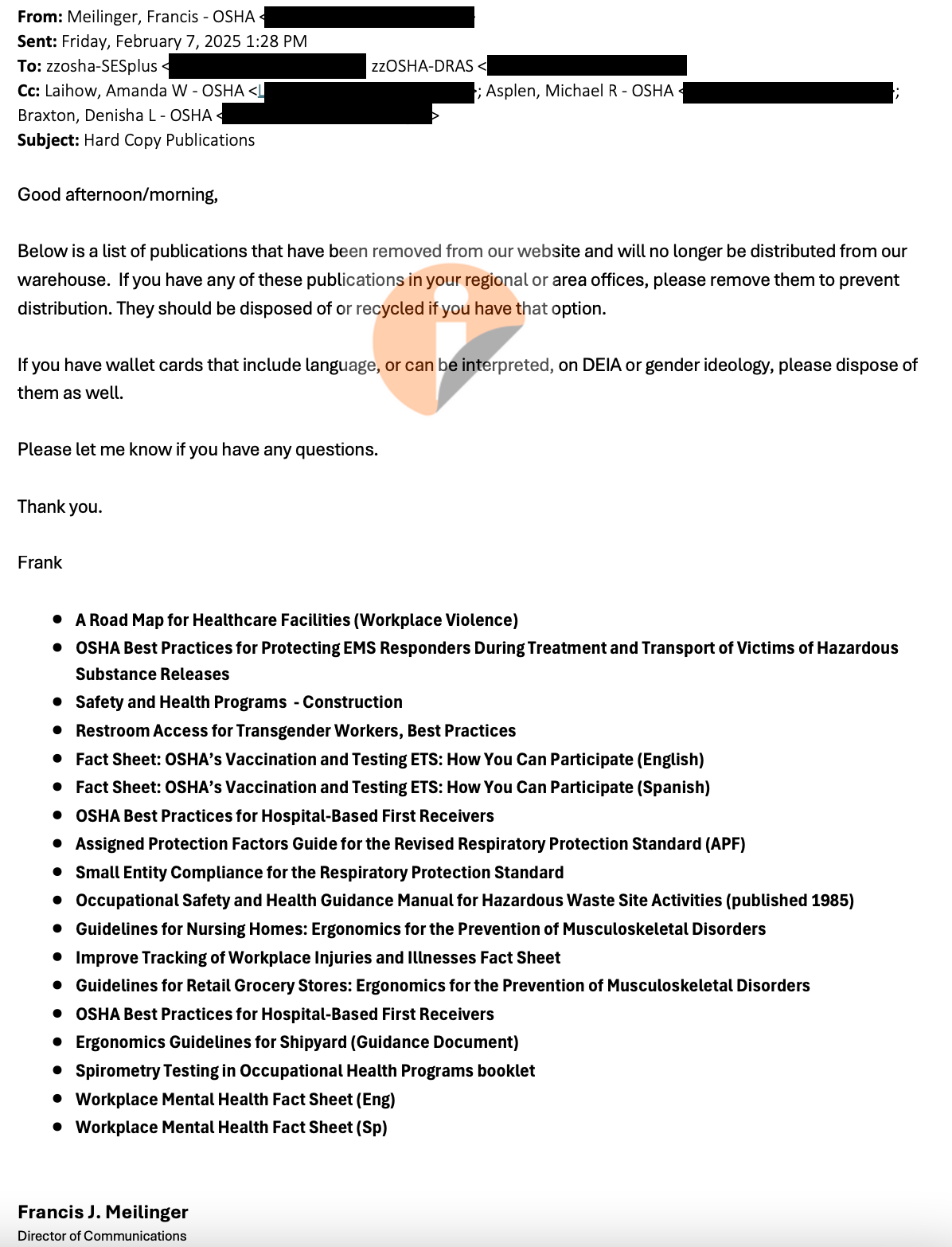
The Trump administration reportedly destroyed 18 publications from the Occupational Safety and Health Administration as part of a larger DEI purge. Most of the guidelines had nothing to do with diversity initiatives.
Written by John Knefel
Published 02/20/25
The Trump administration has reportedly destroyed 18 workplace safety publications as part of a broader attack on diversity initiatives, a development that is largely in line with recommendations made by the sprawling and unpopular presidential transition plan known as Project 2025.
According to Popular Information, 17 of the destroyed workplace guidelines — issued by the Occupational Safety and Health Administration — appeared to have nothing to do with diversity, equity, inclusion, and accessibility programs and instead seem to have been selected because “they include a DEIA-related keyword used in a completely different context.” OSHA is part of the Labor Department and is tasked with making sure U.S. workers “have safe and healthful working conditions free from unlawful retaliation,” according to its official website.
The Trump administration has been targeting diversity programs across the federal government, in some instances using the existence of DEI efforts as a justification for essentially shuttering entire agencies, as in the case of the U.S. Agency for International Development.
The administration’s anti-DEI approach mirrors recommendations made in Project 2025’s nearly 900-page policy book, *Mandate for Leadership*, which called for the elimination of federal DEI programs and for the Department of Justice to investigate private sector programs that promote diversity.
In addition to its direct attacks on DEI, Project 2025 — organized by The Heritage Foundation in collaboration with more than 100 partner groups — proposed drastic rollbacks of labor laws, including dismantling overtime regulations and creating exemptions to the National Labor Relations Act, which protects workers’ rights to collectively bargain and to form a union.
Although the Trump administration’s memo calling for the 18 safety guidelines to be “disposed of or recycled” appears to be a hamfisted and failed attempt to root out DEI programs, it nevertheless fits in with Mandate’s broader approach to dismantling worker protections.
For example, Mandate recommends carve outs to OSHA’s workplace safety regulations, calling on Congress and the Department of Labor to “exempt small business, first-time, non-willful violators from fines issued by the Occupational Safety and Health Administration.”
Mandate further argues that “national employment laws,” like the Occupational Safety and Health Act of 1970, “set out one-size-fits-all ‘floors’ regulating the employment relationship,” and that the protections the law provides could instead be “treated as negotiable defaults rather than non-negotiable floors.” If enacted, this recommendation could allow employers to use safety measures as leverage in contract negotiations, thus increasing the already stark asymmetry in power between workers and bosses. And U.S. workplaces are already deadly; according to the AFL-CIO, in 2022: “344 workers died each day from hazardous working conditions,” and “5,486 workers were killed on the job in the United States.”
The final chapter in Mandate calls on the president to order Cabinet secretaries to “rein in agencies such as the Occupational Safety and Health Administration, which the Biden Administration weaponized to attempt to force COVID-19 vaccine mandates on 84 million Americans through their workplaces.”
That demand built on previous work from The Heritage Foundation, which sued the Biden administration over its Covid-19 workplace vaccine mandate. After the Supreme Court blocked the mandate, Heritage President Kevin Roberts celebrated the decision on former Trump lawyer Jay Sekulow’s radio show. Sekulow is also chief counsel at the American Center for Law and Justice, whose advocacy arm is a partner in Project 2025.
“When it comes to putting government back in the box, it is a series of battles,” Roberts said. “We have won one battle, but we have not won the political and policy war.”
Video
Citation
From the January 14, 2022, edition of Sekulow, streamed on YouTube
Whether the administration adopts the anti-working class OSHA policies in Mandate remains to be seen, but Trump’s pick to head the agency — former Amazon and UPS executive David Keeling — strongly suggests it’s possible. As The New Republic reported, Keeling’s recent job history does not bode well for worker safety:
Both of those companies have been cited for various workplace safety violations by the very agency Keeling is set to control, if confirmed by the Senate. In 2019, OSHA cited UPS for forcing its drivers to work in “excessive heat” with no air conditioning. That same year, UPS was also cited for fire hazards at packaging facilities. Amazon has been cited numerous times for the dangerous, high-pressure environments in its warehouses, as well as the long hours its employees are forced to spend in them. Just last year, Amazon paid a $145,000 settlement over OSHA violations.
Keeling worked as director of safety compliance for UPS from 2011 to 2018 before serving as the vice president of global health and safety from 2018 to 2021, overlapping with OSHA’s 2019 safety citations. The same can be said for Amazon, where he worked from 2021 to 2023—a time when Amazon had one of the highest warehouse injury rates in the country.
Keeling’s nomination hearing has not yet been scheduled, but elsewhere the Trump administration is already waging war on the working class. His pick as general counsel for the National Labor Relations Board just rolled back several major Biden administration policies, including protections for student athletes who want to unionize and guidance that determined most non-compete agreements violate federal labor law.
Many of the Trump administration’s opening salvos against the working class have followed the Project 2025 roadmap and targeted DEI programs. These measures are already making workers’ positions more precarious and less safe, just as Project 2025 recommended.
===
===
ymAil 10 24
one of the enduring mysteries of America is why the citizens of Red states are generally poorer, less educated, and sicker than the citizens of Blue states. To that question, I step up as your hierophant with an answer to this deep mystery that you may not have previously considered.
First, that generalization is broadly true:
— Blue states account for about 71 percent of America’s GDP, whereas Red states only produce 29 percent of our income and wealth.
— The median family income in Blue states is $74,243. In Red states it’s $63,553. Individual states highlight the disparity: New Jersey’s median income is $89,703, while Mississippi’s is $49,111.
— Counties that voted for Biden in 2020 are more diverse, being 35 percent nonwhite compared to 16 percent nonwhite populations in counties that voted for Trump.
— Counties that voted for Biden in 2020 are better educated, with 36 percent of their population having some college education compared to Trump’s counties at 25 percent.
— Residents of Blue states live 2.2 years longer, on average, than residents of Red states.
And, second, it’s undeniably true (and documented with each hotlink below) that Republican-controlled Red states, almost across the board, have higher rates of:
— Spousal abuse
— Teen pregnancy
— Sexually transmitted diseases
— Abortion (at least before Dobbs; now it would be “forced births”)
— Bankruptcies and poverty
— Homicide and suicide
— Infant mortality
— Maternal mortality
— Forcible rape —Robbery and aggravated assault
— Dropouts from high school
— Divorce
— Contaminated air and water
— Opiate addiction and deaths
— Unskilled workers
— Parasitic infections
— Income and wealth inequality
— Covid deaths and unvaccinated people
— Federal subsidies to states (“Red State Welfare”)
— People on welfare
— Child poverty —Homelessness
— Spousal murder
— Deaths from auto accidents
— People living on disability
— Gun deaths
But are all these things happening because Republicans simply hate their citizens and explicitly want high levels of poverty, ignorance, death, and disease?
Turns out there’s a much simpler answer.
The problem for Red states is that Republicans worship cheap labor, because it drives up profits for the fat-cats who own American businesses — and having a steady and reliable supply of cheap labor to maintain high profitsrequireswidespread poverty, ignorance, death, and disease.
That poverty, of course, brings along with it the long list of social ills above, but Republicans are more than willing to tolerate massive, desperate levels of human suffering to make sure there’s a steady supply of cheap labor. In fact, they intentionally run their states that way to produce those results.
If you have any doubts about this, if that sounds like hyperbole, simply look at the policies the GOP has promoted for the past century:
— Republicans hate unions, because unions raise wages and benefits for workers, shifting them from poverty into the middle class. Once thus empowered, those uppity middle-class people then start to demand “unreasonable” things like overtime pay (Project 2025 would functionally end it), healthcare, paid vacations, paid sick leave, and paid family leave.
— Republicans hate Social Security and have worked to gut, privatize, or outright end it ever since FDR signed it into law in 1935. They do this because elderly workers in poverty are a great source of compliant, cheap labor. Reagan’s changes in Social Security benefits have led to millions of Boomers having to take gigs as greeters, waiters, etc., for low wages; prior to Reagan’s changes in the Cost of Living Adjustments (COLAs) and his raising the retirement age to 67, you could safely retire on Social Security in most parts of America. Now, Republicans want to raise that age to 69 or 70.
— Republicans hate universal or inexpensive healthcare (and real Medicare for the elderly) because having massive medical debt provides a large pool of desperate workers willing to work crappy jobs for pathetic wages to pay it off. It’s why the ten states that refuse to expand Medicaid for low-income workers are all Republican-controlled. Medical debt is a non-issue in every other developed country in the world, but here in America 79 million people are struggling to pay off doctors’ or hospital bills (7 million of those debtors are elderly, many the victims of the Medicare Advantage scam).
— Republicans hate the minimum wage because it cuts into profits. That’s why the minimum wage in Blue states can be more than twice that of Red states (Washington State is $17/hr versus Texas’ $7.25/hr). When most families are barely earning enough to get by, employers have their pick of distraught, panicked workers willing to work for subsistence wages.
— Republicans hate empowered women because forced pregnancies create more potential workers and unwanted children exacerbate poverty. Thus their 50+ years of opposition to the Equal Rights Amendment and their embrace of abortion bans.
— Republicans promote hatred of racial, religious, and gender minorities because when Americans are at each other’s throats they’re not organizing to throw off the GOP/corporate yoke. It’s hard to remember that the billionaires have stolen fully $50 trillion from the middle class over the past 43 years of the Reagan Revolution when you’re constantly distracted with hysteria about Black Haitians, Brown Mexicans, and trans students who just want to use the damn bathroom.
— Republicans hate education because it’s the main tool for people to lift themselves out of poverty and thus demand higher wages and better benefits. Before the Reagan Revolution, every American who wanted to and could pass the entrance exams could go to college; many universities (like the entire University of California system) were free, and you could pay your tuition at most other colleges like I did in the 1960s working weekends as a dishwasher at Bob’s Big Boy in East Lansing, Michigan and pumping gas at the Esso station across the street. This is also why so many Red states are gutting their public education systems with private school vouchers. Less education, more poverty; more poverty, more cheap labor.
— Republicans hate atheism and embrace a neofascist form of Protestant Christianity and a bizarre, rightwing version of Catholicism that goes by a Latin name because both are hierarchical and male-dominated, just like corporate culture. It’s why the Confederacy was explicitly Christian. “Don’t worry about how much you’re paid, boy, or bother organizing into a union; just keep picking that cotton and you’ll get your reward in heaven when you die.” After all, according to the Bible your fate was preordained “before the foundation of the world,” as was that of your boss, who must have been selected for particular grace by God or he wouldn’t be so rich.
— Republicans hate food stamps, housing supports, aid to women and dependent children, and every other form of what they call “welfare” because these programs slightly reduce the desperation of people who might otherwise be easily forced to work for a pittance.
— Republicans hate environmental protectionsbecause they cut into profits; who cares if the lack of them create things like the “Cancer Alley” — which hits children particularly hard — that runs through Texas and Louisiana?
— Republicans hate unemployment insurance because it reduces the privation people can experience when they lose a job. It’s why all the Blue states offer at least 26 weeks of benefits, but Red states often radically reduce that (Florida, North Carolina, Kentucky 12 weeks; Alabama 14 weeks; Oklahoma, Kansas, Arkansas, Missouri 16 weeks).
So, the next time somebody asks why people living in Red states have it so rough, just tell them, “It’s all because of the cheap-labor Republicans.”
===
===
jdv booed by firefighters, youngkin boo
an 9 24
a Republican state representative in Kentucky is proposing a bill that, if passed, would repeal the requirement that employers provide workers with lunch breaks. It also includes language that would result in a reduction in net pay for many workers.
The Kentucky Center for Economic Policy (KCEP) — a fiscal policy think tank in the commonwealth — recently broke down House Bill 500, which was sponsored by Republican Rep. Phillip Pratt. Aside from its language allowing companies to avoid having to provide lunch breaks to workers, it would also eliminate mandatory rest breaks and end the requirement to pay time-and-a-half wages to employees who work seven days a week. HB 500 also removes any liability for employers who don't pay workers for time on the clock traveling between jobs, and allows companies to not pay workers for tasks associated with starting and ending a job.
Additionally, the bill reduces the amount of time workers have to report labor violations from five years to three years, and blocks plaintiffs from being paid punitive damages for suffering emotional distress, humiliation or embarrassment over wrongful termination.
READ MORE:**(Opinion) Republicans are trying to flood the labor market with cheap child labor**
"Collectively, these provisions weaken multiple common sense protections for safe working conditions and fair pay that have been a part of Kentucky’s safeguards for more than half a century," the KCEP wrote in its analysis of the bill. "HB 500 will make work more dangerous by depriving workers of food and rest, incentivizing them to travel too quickly to get to their job site, and discouraging them from taking proper precautions at the start of shifts. And it will take pay away from workers when they are moving between job locations, working excessive weeks, and engaging in necessary tasks at the beginning and end of the work day."
Should the bill pass, Rep. Pratt would stand to reap a financial benefit, as he is the owner of a lawn care and landscaping business in Georgetown, Kentucky. Outdoor workers like landscapers typically have to take frequent breaks throughout the day due to the physically demanding nature of their jobs — particularly in hot summer months. In Texas, for example, the City of Dallas mandates that construction workers have a 10-minute break every four hours (a bill Gov. Greg Abbott signed into law last year eliminated mandatory water breaks).
Even if the bill passes the Kentucky legislature, Democratic Governor Andy Beshear is unlikely to sign it into law. But Kentucky Republicans have the ability to override him due to their veto-proof majorities in both chambers. The Kentucky legislature's official website shows that HB 500 has not yet received a full floor vote.
Rep. Pratt announced in late 2023 he will not seek a fifth term in office, and will serve out the rest of his term, which ends on December 31.
===
===
OSHA clarence an 7 24 ah
Inside Clarence Thomas’ new legal target: 'It’s unconstitutional' - Alternet.org
When the U.S. Supreme Court handed down its controversial ruling in Loper Bright Enterprises v. Raimondo on June 28, it overturned a decision that had been the law of the land for 40 years: Chevron U.S.A., Inc. v. Natural Resources Defense Council, Inc.
That landmark 1984 decision established what was known as "Chevron deference," which said that judges and courts should defer to the expertise of officials at federal regulatory agencies. Critics of the June 28 ruling argue that it seriously undermines the ability of government agencies to regulate everything from clean water and air quality to health care.
According to Business Insider, one agency that Justice Clarence Thomas is hoping to see abolished is the Occupational Safety and Health Administration (OSHA).
READ MORE: **SCOTUS limits government agencies in bombshell decision with sweeping implications**
Business Insider's Grace Eliza Goodwin reports, "The Supreme Court, on Tuesday, (July 2), announced which cases it would consider next and which it wouldn't. Among those the Court rejected was a case that challenged the authority of OSHA, which sets and enforces standards for health and safety in the workplace. And Thomas, widely considered to be the most conservative justice on the already-mostly conservative Court, wasn't happy."
Goodwin adds, "In a dissent, he explained why he believed the High Court should've taken the case: OSHA's power, he argues, is unconstitutional."
Thomas wrote, "Congress purported to empower an administrative agency to impose whatever workplace-safety standards it deems 'appropriate.' That power extends to virtually every business in the United States."
Goodwin notes that the 6th Circuit Court of Appeals "upheld OSHA's constitutionality" in 2023.
READ MORE:[Conservative warns Dems to get it together and confront Trump's 'true menace'
*Business Insider's full report is available at this link.
===
===
an 6 23
texas Republican Governor Greg Abbott signed legislation earlier this week that "poses serious health risks" to construction workers, Texas Public Radio (TPR) reports.
Per TPR, HB 2127 — known as the Texas Regulatory Consistency Act — "bars cities and counties from passing regulations that are stricter than state ones. It also overturns local rules such as ordinances in Austin and Dallas that mandate rest breaks for construction workers."
Republican State Rep. Dustin Burrows, who proposed the "Death Star Bill," insisted "the law is needed to end 'the current hodgepodge of onerous and burdensome regulations,'" but TPR notes "for construction workers in two of the state's fastest-growing cities, advocates say, it poses serious health risks."
READ MORE: Neither 'compassion' nor 'leadership': Greg Abbott blasted for calling shooting victims 'illegal immigrants'
Mario Ontiveros told TPR "he once saw a co-worker lose consciousness and fall from a ladder," and due to his previous "safety training," the Texas construction worker "was the only one on the job site who knew how to help — performing CPR and asking his co-worker basic questions to keep him conscious — until paramedics arrived, he said."
The Texas Tribune reports:
Texas is the state where the most workers die from high temperatures, government data shows. At least 42 workers died in Texas between 2011 and 2021 from environmental heat exposure, according to the U.S. Bureau of Labor Statistics. Workers’ unions claim this data doesn’t fully reflect the magnitude of the problem because heat-related deaths are often recorded under a different primary cause of injury.
Furthermore, according to TPR, "Research published in 2018 — eight years after Austin passed its rest-break ordinance — found that construction workers were 35% more likely to get a break because of the rule."
Daniela Hernandez, state legislative coordinator for Texas advocacy group Workers Defense Action Fund, said, "We know that workers do pass out and experience heat stress and different types of heat illnesses."
READ MORE: Gov. Greg Abbott leaves experts stunned as he injects politics into Texas' criminal justice system
Paul Puente, executive secretary of the Houston Gulf Coast Building and Construction Trades Council, said the "Death Star Bill" is expected to "strike down construction-worker protections in southeast Texas," and "negatively impact construction safety as a whole," even though "labor unions can still negotiate for rest breaks."
He emphasized "Science has already shown that individuals need to have time to take a break, collect their thoughts, and then return back to work to ensure a safe working environment," and "Without allotted rest breaks in extreme heat," he told TPR "workers can easily become fatigued, disoriented, dehydrated — effects that endanger their lives."
Calling the state "unsafe" for construction workers, Puente added, "when you're trying to encourage businesses to come to your state, this is not a good look."
TPR reports the law is set to go into effect Sept. 1.
READ MORE: 'Absolutely insane': Texas Governor Greg Abbott seeks pardon for man convicted of murdering BLM protester
Texas Public Radio's full report is available at this link. The Texas Tribune's report is here.
FROM YOUR SITE ARTICLES
'Bald-faced lie': Houston Chronicle torches Texas gov’s 'bankrupt conscience' and 'cowardice' after Uvalde mass shooting ›
Texas Democrat: Greg Abbott 'can’t explain away' allowing easy access to weapons ›
Greg Abbott implicates 'the government' in Saturday’s mass shooting ›
RELATED ARTICLES AROUND THE WEB
Greg Abbott tells state agencies to stop considering diversity in ... ›
Tesla's construction workers at Texas gigafactory allege labor ... ›
Texas governor calls on citizens to report parents of transgender ... ›
===
===
~ osha
https://www.alternet.org/economy/amazon-injuries-investigated-workers-safe/
===
===
https://www.alternet.org/**2022/05**/trump-administration-meat-industry-covid/
former President Donald Trump's administration colluded with top-level meatpacking industry executives to exploit the COVID-19 pandemic in order to drive up prices and downplay the severity of the emergency, according to an exhaustive investigation released on Thursday by the United States House Select Oversight Subcommittee on the Coronavirus Crisis.
Representative Jim Clyburn (D-South Carolina), the House Majority Whip and chairman of the Subcommittee, said in a statement that "the shameful conduct of corporate executives pursuing profit at any cost during a crisis and government officials eager to do their bidding regardless of resulting harm to the public must never be repeated."
The probe began last year and uncovered a spider web of corruption and flagrant disregard for human life involving American corporate titans and individuals in the highest ranks of the federal government.
Officials at the Department of Agriculture – including Secretary Sonny Purdue and Under Secretary for Food Safety Mindy Brashears – "collaborated" with corporate bigwigs to prioritize profits and production over the safety of employees and the public despite being fully aware of the hazards.
"Infections and deaths among workers for five of the largest meatpacking companies—Tyson Foods, Inc. (Tyson), JBS USA Holdings, Inc. (JBS), Smithfield Foods (Smithfield), Cargill, Inc. (Cargill), and National Beef Packing Company LLC (National Beef)—were significantly higher than previously estimated, with over 59,000 workers for these companies being infected with the coronavirus andat least 269 dying," the report states.
The powerful cadre also "engaged in a concerted effort with Trump Administration political officials to insulate themselves from coronavirus-related oversight," it explains.
In one instance, the chief executive officers of the conglomerates told Purdue on a phone call that their workers “should not be entitled to unemployment benefitsif they are otherwise able to work through the pandemic” and cautioned against “creat[ing] an incentive, much less a path, for food industry workers to choose unemployment overproducing food.”
In that same conversation, they "implicitly acknowledged how dangerous plants were, asking for liability protection against lawsuits if workers were infected on the job."
There was also an aggressive campaign to skirt "pesky" local, state, and federal regulations that would have kept workers and their products safe and healthy.
"Companies lobbied the White House to make clear that—despite concerns by state and local health departments—meatpacking companies should not have to address coronavirus risks if it would impact productivity," the investigation revealed.
Alarmingly, the CEOs managed to successfully lobby Trump to draft and sign an executive order in April of 2020 that "would insulate meatpacking companies from oversight by state and local health departments and provide legal protection against lawsuits for worker illnesses and deaths."
The edict led to Trump "invoking the Defense Production Act to ensure meatpacking plants 'continue operations.'"
Shortly thereafter, records handed over to the Subcommittee show that "meatpacking industry representatives and companies—Smithfield and Tyson in particular—engaged in constant communications with Trump appointees at USDA, the National Economic Council, and the White House, including calls between Smithfield CEO Ken Sullivan and White House Chief of Staff Mark Meadows; a joint call with Sullivan, Meadows, and Tyson CEO Noel White;a call between White and Vice President Pence’s Chief of Staff Marc Short; and a call from Meadows to White asking if White would be willing to meet with President Trump."
Trump subsequently "held a call with officers of the meatpacking companies who had lobbied for it on the morning the order was issued."
After Trump granted their wish, an effort was undertaken between the administration and the industry to "coordinate closely on messaging concerning the order and its effects, apparently hoping to generate positive press coverage" for the ex-commander in chief.
Worker fatalities, meanwhile, were swept under the rug.
In a particularly egregious example, an outbreak at Foster Farms in Livingston,California that infected "at least" 392 workers and killed eight in August of 2020 prompted the company to "intimidate" the Merced County Department of Public Health from shutting down the plant.
"Foster Farms attempts to obfuscate the death count by labeling fatalities as 'resolutions,'" investigators learned. "MCPH officials told the Select Subcommittee that an unidentified person on the call from either Foster Farms or USDA said these cases could be considered 'toe tag resolutions,' referring to the toe tag that is often put on a corpse at the morgue. MCPH said that Brashears asked this individual to 'stop' and said they would 'talk about this separately.'"
Operations at Foster Farms in Livingston were eventually temporarily suspended on August 31st.
=
===
jones day, trump fav, clerked for clarence
The Centers for Disease Control and Prevention's mask mandate for domestic travelers was struck down on Monday by a federal jurist who was appointed by former President Donald Trump. The decision is the latest in a string of blows to President Joe Biden's efforts to curb transmission of the coronavirus.
The CDC last week extended the rule until May 3rd.
Judge Kathryn Kimball Mizelle of the United States District Court for the Middle District of Florida wrote in a 59-page ruling that the CDC exceeded its authority in requiring passengers on airlines and any other "conveyance" of public transportation to wear masks to help slow the spread of COVID-19.
Mizelle – whom the American Bar Associated dinged as "not qualified" after she was installed by Trump at the age of 33 – said that passengers who refused to comply and were "forcibly removed from their airplane seats, denied board at the bus steps, and turned away at the train station doors" had their rights against "detention and quarantine" violated.
"The Mask Mandate is best understood not as sanitation, but as an exercise of the CDC's power to conditionally release [from what?] individuals to travel despite concerns that they may spread a communicable disease (and to detain or partially quarantine those who refuse). But the power to conditionally release and detain is ordinarily limited to individuals entering the United States from a foreign country," she proclaimed.
“Wearing a mask cleans nothing,” Mizelle opined, even as cases are once again rising in pockets throughout the country, such as in Philadelphia, Pennsylvania, which has re-instituted a mask mandate. The virus has also been spreading in the nation's capital, infecting White House officials and House Speaker Nancy Pelosi (D-California).
Steve Vladeck, a law professor at the University of Texas, blasted Mizelle's order in a Monday afternoon tweet.
"This is both a big deal and a truly preposterous (nationwide) injunction. The CDC’s statutory authority is specifically directed at preventing the spread of communicable diseases across state lines," he wrote. "Where else is such spread more likely to occur than transport hubs like airports?"
===
===
Former United States Secretary of Labor Robert Reich blasted right-wing efforts to gut federal regulations in a new video posted to YouTube on Tuesday.
In the roughly four-minute-long spot, Reich warned Americans that Republicans are working tirelessly to make life "more dangerous" in the name of boosting corporate profits.
"Your life could get a lot more dangerous. Republican appointees on the Supreme Court seem poised to strip away basic safety standards for our workplaces, our food, our air and water," Reich began.
He explained that regulatory organizations exist to protect the public from predatory practices.
"Remember when lots of romaine lettuce was recalled because it was causing E.coli outbreaks? That was the Food and Drug Administration protecting us from getting sick. Working in a warehouse? The Occupational Safety and Health Administration sets standards to ensure you don’t breathe in dangerous chemicals like asbestos. Enjoying the fresh air on a clear, sunny day? Thank the Environmental Protection Agency for limiting the amount of pollution that can go into our air," said Reich. "These agencies save lives. Since OSHA was established a half-century ago, its workplace safety regulations have saved more than 618,000 workers’ lives."
In this case, Reich takes aim at HFIB versus OSHA, in which the Court sided with the plaintiffs who sued to have COVID-19 workplace vaccine-or-testing mandates lifted.
"What this ruling tells us is that the Republican appointees on the Supreme Court are intent on gutting the power of agencies to issue regulations," he said. "This term, the Court will also hear a case regarding the EPA’s authority to enforce the Clean Water Act. If the Court undermines the EPA’s authority, it will put our environment – and our health – at risk. Remember when the Cuyahoga River caught on fire because it was brimming with oil, acid, and factory chemicals? That’s what we may be returning to."
Reich then reminded viewers that the GOP's assault on regulations is far from over.
"And what’s next? Will they gut the Federal Trade Commission and put us all at risk of being defrauded? Target the Securities and Exchange Commission and deregulate the financial sector, sparking another financial crisis?" he asked.
"Beware. If Republican appointees on the Supreme Court succeed in gutting regulatory agencies, we all lose. This agenda is anti-worker, anti-consumer, and anti-environment," Reich added. "The only thing it’s good for is corporate profits."
===
===
omfg
no lnx an 11 21
'Pro-death cult strikes back': Right-wing judges block Biden’s vaccine rule for big companies
Kenny Stancil and Common Dreams November 08, 2021
Progressives concerned about workplace safety and public health responded with dismay after a federal appeals court on Saturday temporarily blocked the Biden administration's attempt to require workers at companies with 100 or more employees to be vaccinated against Covid-19 or tested weekly.
Citing "grave statutory and constitutional" problems with the rule, a three-judge panel from the U.S. Court of Appeals for the Fifth Circuit issued the stay in response to a joint petition filed Friday by a coalition of businesses, conservative advocacy groups, and the states of Texas, Louisiana, Mississippi, South Carolina, and Utah.
That legal challenge, and separate lawsuits from Republican-led states, came just one day after President Joe Biden announced that the Occupational Safety and Health Administration (OSHA) would begin enforcing its newly unveiled Emergency Temporary Standard (ETS) in the coming weeks. Companies with at least 100 employees have until December 5 to require unvaccinated workers to wear masks indoors, and by January 4, they must require vaccinations or administer weekly tests.
Decrying the decision of the "right-wing Fifth Circuit," labor journalist Steven Greenhouse said on social media that "it's terrible for worker safety and public health that three conservative activist judges have suspended Biden's... new rule requiring workers at companies with more than 100 workers to get vaccinated or tested."
"OSHA's mission is to protect workers' health," Greenhouse continued, "but the appellate judges seem to forget that Covid has killed thousands of meatpacking, retail, and other workers."
More than 750,000 people in the U.S. have died from Covid-19 since the pandemic started last March, and the disease continues to kill nearly 1,100 people per day, most of them unvaccinated, according to the U.S. Centers for Disease Control and Prevention (CDC).
Recent studies confirm that vaccines save lives.Last month, the U.S. Department of Health and Human Services analyzed the relationship between county-level inoculation rates and Covid-19 outcomes among U.S. seniors and found that vaccines helped ward off 265,000 infections, 107,000 hospitalizations, and 39,000 deaths during the first five months of 2021.
And in September, CDC researchers found that individuals in the U.S. who were not fully vaccinated last spring and summer were 11 times more likely to die after being infected with the coronavirus—and over 10 times more likely to be hospitalized—than those who were fully inoculated.
Greenhouse said that "the judges evidently sympathize with [Texas Republican Gov.] Greg Abbott's let-people-die stance—that it'soverreachfor OSHA to act strongly to protect workers from Covid."
David Michaels, a leader of OSHA during the Obama administration, also rebuked the federal appeals court, describing its decision as legally dubious and politically motivated.
"The same activist court that refused to stay Texas' law that permits bounty hunters to sue anyone who aids an abortion after six weeks of pregnancy has stayed an OSHA rule that is clearly within OSHA's authority, will save lives, and make workplaces safe," he told the New York Times.
According to the Times, "At the core of the legal challenge is the question of whether OSHA exceeded its authority in issuing the rule and whether such a mandate would need to be passed by Congress."
The newspaper reported:
The suit against the mandate stated that President Biden "set the legislative policy" of substantially increasing the number of Americans covered by vaccination requirements, and "then set binding rules enforced with the threat of large fines."
"That is a quintessential legislative act—and one wholly unrelated to the purpose of OSHA itself, which is protecting workplace safety," the suit said. "Nowhere in OSHA's enabling legislation does Congress confer upon it the power to end pandemics."
Corporate executives asked, and the Biden administration agreed, to delay implementation of OSHA's new ETS "until after the New Year, citing concerns about worker shortages during the important holiday season," Reuters noted.
Solicitor of Labor Seema Nanda, meanwhile, said in a statement that the Labor Department, home to OSHA, is "confident in its legal authority" to issue vaccine requirements.
The vaccine rule for companies with 100 or more employees "applies to 84.2 million workers at 1.9 million private-sector employers," Reuters reported. "OSHA estimates that 31.7 million of [those] workers are unvaccinated and 60% of employers will require vaccinations, up from 25% today, resulting in another 22.7 million employees getting vaccinated."
Several million additional workers are covered by the Biden administration's vaccine mandate for employees of the executive branch, federal contractors, and staff at healthcare facilities that accept Medicare or Medicaid funding. OSHA officials say they are considering expanding the jab-or-test rule to include companies with fewer than 100 workers.
"The Occupational Safety and Health Act explicitly gives OSHA the authority to act quickly in an emergency where the agency finds that workers are subjected to a grave danger and a new standard is necessary to protect them," Nanda said. "We are fully prepared to defend this standard in court."
The Fifth Circuit panel's two-page order directs the Biden administration to respond to the request for a permanent injunction against the rule by 5 p.m. ET Monday.
As the Times noted, it remains unclear whether the court's stay "would be a procedural blip for the Biden administration or the first step in the unwinding of the mandate."
The newspaper explained that "after both sides have filed briefs, the court will decide whether to lift the temporary injunction, allowing the rule to proceed as planned, or whether to grant a permanent injunction. OSHA could then take the case to the Supreme Court."
While some legal experts argue that the Labor Department has the regulatory authority to compel private employers to protect the health of workers and the broader public through mandatory vaccination amid a deadly global pandemic,Josh Blackman, a professor at South Texas College of Law Houston, told Reuters that "there will be so much litigation it will never see the light of day."
Twenty-four attorneys general threatened to sue the Biden administration over the rule back in September, and several followed through immediately after it was published in the federal register on Friday.
In addition to the petition filed with the Fifth Circuit, attorneys general in 11 states—Alaska, Arizona, Arkansas, Iowa, Missouri, Montana, Nebraska, New Hampshire, North Dakota, South Dakota, and Wyoming—filed a lawsuit in the U.S. Court of Appeals for the Eighth Circuit.
And in the U.S. Court of Appeals for the Eleventh Circuit, the states of Alabama, Florida, and Georgia sued, with Florida Republican Gov. Ron DeSantis saying at a press conference that "the federal government can't just unilaterally impose medical policy under the guise of workplace regulation."
Roughly 70% of U.S. adults are fully inoculated against Covid-19, and about 80% have received at least one shot, according to the CDC. Recent polling shows that a majority of U.S. adults favor Covid-19 vaccination requirements, with only about one-fifth to one-quarter of respondents opposed.
OSHA, Reuters pointed out, is "fighting history. The agency has issued 10 ETS over its 50 years. Of the six that were challenged in court, only one survived entirely intact."
Donald Verrilli, U.S. solicitor general during former President Barack Obama's administration, however, told the news outlet that the Biden administration "wouldn't move forward unless they thought that they could defend it legally... I think the constitutional challenges are all going to fail."
===
BBB manchin wants work req tho proved not to work strict fr also corps want workers dependent/compliant:
aha note gop sez ppl lazy and moral hazard of soc safe net but at same time quash vax mask Mandate EVEN WHEN LOCAL PPL /REPS VOTE FOR THEM, THEN PPL QUIT CRAPPY LOW WAGE DANGEROUS JOBS
and
October 24, 2021
https://www.alternet.org/2021/10/unemployment-2655355131/
The business owners whose blood, sweat, and tears—or at least their fancy, high-priced educations, family connections and access to venture capital—built this country, dammitwere hellbent and determined to show American workers who was boss. This COVID-19 nonsense was not going to interfere with their profits any longer. It was time totake a stand.
So they all had their administrative assistants conference in their favorite state legislators, the same ones who helpfully passed legislation a few years back, keeping pesky unions out of their states. They called in their chits for all those campaign contributions to the governor. They called their Republican House reps and senators. Damn that Fauci, they complained. My business is hurting. No more lockdowns, no more of this "social distancing "crap. This state is going to open for business and I don't want to hear another word about body counts or stressed hospitals. I need workers and I need them now. I paid for your damn campaigns, so do something!
And those state representatives and senators leapt into action. In a matter of a few weeks we saw state after state brimming with self-appointed medical experts in their legislatures, railing about the tyrannical mask mandates and business lockdowns. CEOs and white-collar professionals cracked their whips—many still from the comfort of their fine second homes and pools. And thus the support staff, the retail clerks and the service workers, many of whom who had once been adoringly lionized as "essential" at the outset of the COVID-19 pandemic, were told it was time to return to work. And for added good measure, Republican governors in those statescut offtheir unemployment aid. That'll show them, they thought ...
But strangely enough, not all of those workers heeded the call. In fact, a good many of them quit.
As reported by Alyssa Fowers and Eli Rosenberg, writing for The Washington Post:
Kentucky, Idaho, South Dakota and Iowa reported the highest increases in the rates of workers who quit their jobs in August, according to a new glimpse of quit rates in the labor market released Friday.
The largest increase in the number of quitters happened in Georgia, with 35,000 more people leaving their jobs. Overall, the states with the highest rates of workers quitting their jobs were Georgia, Kentucky and Idaho.
As The Post points out, the interesting thing about this data is that service-sector jobs are most highly concentrated in urban areas. So why would people be quitting their jobs at such astronomical rates in such relatively rural states as Kentucky, South Dakota, Iowa and Idaho?
Fowers and Rosenberg offer a clue:
Employees quit or were hired at rates matching or exceeding the national average in the ten states with the highest rates of new infections that month: Alabama, Arkansas, Florida, Georgia, Kentucky, Louisiana, Mississippi, Oklahoma, South Carolina and Tennessee.
So the highest rate of turnover in August—employees quitting or getting hired—was found in the states which had the highest rate of COVID-19 infection for that month. Logically, that seems to make sense. Workers who live in one of those states were also likely to have a governor or, in the case of Kentucky, a Republican-dominated legislaturewho opposed business closures, even while the delta variant ravaged the state's population. Such workers were essentially forced by these states policies to return to work if they could not work from home.
Those people forced back to work in an unsafe environment simply decided to quit—many of them likely before ever venturing back into their workspace. After all, they saw a job the other day that was offering more money. Or their next-door neighbor's cousin got a job that pays more and allows them to work from home. The Post article quotes Nick Bunker, an economist for the job search portal Indeed, who notes that the high quit rate in these red and rural states "may be a sign there's more competition in those parts of the country than other parts."
The other interesting point aboutallof the states having both the highest level of turnover and the highest infection rates? They are all so-called"right to work" states,where legislatures passed legislation to disincentivize and discourage unions.So these workers have essentially no protection, no one to turn to for help remedying unsafe conditions, and no collective bargaining power; they can, for the most part, be terminated at will. That's what "right-to work"has always been about.
As one commenter to The Post story points out:
So, when you have a crappy job, for crappy wages, and a crappy employer who doesn't value you at all, and all of a sudden you find yourself in a labor market situation that actually encourages you to look for work elsewhere--what do you think is going to happen? The 'Great Resignation' is largely about working class people attempting to use what little leverage they have in order to make a moderately better wage for themselves in a mostly hostile, oppressive national work environment.
For employers, the downside of "right to work"— one they never saw coming—was the fact that workers in those states had little, if any, incentive to stay, especially when once-in-a lifetime opportunities arose for them to leave, while competition for higher wages and better working conditions further drove that exodus.
Some employers are responding by antagonizing would-be applicants.
In Missouri, a group of businesses, still frustrated by labor shortages more than three months after the state cut off the $300-a-week federal jobless checks, paid for billboards in Springfield that said: "Get Off Your Butt!" and "Get. To. Work."
The state has seen no growth in its workforce since ending emergency benefits.
"We don't know where people are," said Brad Parke, general manager of Greek Corner Screen Printing and Embroidery, who helped pay for the billboards. "Obviously, they're not at work. Apparently, they're at home."
The attempt to force workers back to dangerous, unsafe pandemic working conditions—brought on by short-sighted Republican policymakers for political ends—has collided with a culture where workplace protections and the ability to bargain have been completely devalued (also by Republican politicians), leaving workers as essentially dispensable commodities.
No wonder they're quitting for greener pastures in those states. Republican elected officials and their business donors in those same states have no one to blame but themselves. They created this environment, and now they're going to have to cope and adjust with workers who want more out of their jobs … and know they can get it. They have to keep up and do better, or see their businesses go under.
Funny how that worked out.
===
https://www.alternet.org/2020/09/heres-the-real-problem-with-elon-musk-a-modern-day-robber-baron/
robt r
the problem isn’t only that Elon Musk has a net worth of about $100 billion when tens of millions of Americans are barely getting by. It’s that he’s made this money while treating his workers so badly. His wealth quadrupled during the 4 months Tesla forced all workers to take a 10 percent pay cut.
Musk initially dismissed worries about the coronavirus as “dumb” and speculated there would be “probably close to zero new cases” in the United States by the end of April. He was obviously wrong. But even in April, Musk was still at it, tweeting “FREE AMERICA NOW” in response to stay-at-home orders. The next day, on the company’s earnings call, he called quarantine measures “fascist” and demanded that officials return people’s “freedom.”
In May, Musk reopened the company’s factory in Fremont, California – which employs about 12,000 people – in direct defiance of county orders. His defiance won the support of President Trump. Workers on the production line piled into cars they were building, standing and sitting next to each other as they installed components. Employees say equipment was not wiped down between shifts.
Just days later, the first Tesla workers tested positive for Covid-19.
musk did tell workers that if they had reservations about working during a pandemic, they could remain home and take unpaid leave. But after county officials finally agreed to allow Tesla to officially reopen, Tesla fired workers who continued to take unpaid leave – even as Covid-19 cases continued to rise.
For years, Tesla workers have complained about high injury rates as a result of the company making them work long hours on machinery that isn’t safe. They’ve also complained about low wages: Tesla employees are paid less than other employees in the auto industry. Not incidentally, Tesla is the only large US automaker without a unionized workforce.
Last year, a California judge ruled that Musk and other company executives were illegally sabotaging employee efforts to form a union – harassing workers passing out union pamphlets in the parking lot, banning employees from wearing pro-union T-shirts and buttons, repeatedly interrogating union organizers and eventually firing one of them, and distributing anti-union messages in tweets from Musk himself.
These are all unfair labor practices but there’s no financial penalty for them. Tesla merely had to agree to stop it, hire back the fired employee, and pay lost wages. In other words, a slap on the wrist.
Musk makes a big deal about giving workers shares of stock in the firm. What he doesn’t say is he’s threatened to take away the stock if workers exercise their legal right to form a union – which is itself an unfair labor practice.
At least forty other workers’ rights cases are pending against Musk and Tesla. Two former Tesla security employees have filed whistleblower complaints charging, among other things, that Tesla spied on workers. Another former employee alleges the company ignored black employees’ reports of rampant racism. And on and on.
We’re back to the excesses of the Gilded Age, and Elon Musk is a modern-day robber baron.
===
==
dn 720
Trump Admin Stymies Work of Agency Tasked With Preventing Industrial Disasters
==
koch Group Pushing for Employer Immunity Takes $3.5M From Company with COVID-19 Outbreaks
By David Armiak | July 27th, 2020 at 11:55 AM (CDT)
Owner of Mountaire Farms, one of the nation’s largest poultry processors with multiple COVID-19 outbreaks, gives millions to American for Prosperity’s PAC, which is advocating for state and federal legislation to protect employers with workplace coronavirus cases
==
==
chao DOT?
Safety Can't Be a 'Pretext' for Regulating Unsafe Oil Trains, Says Trump Admin
https://www.desmogblog.com/2020/05/20/trump-phmsa-safety-washington-vapor-pressure-oil-trains
desmog
==
https://www.alternet.org/2020/07/draft-of-mcconnells-dangerous-corporate-immunity-plan-sparks-alarm-this-is-an-anti-civil-rights-proposal/
Consumer and workers’ rights advocates are warning that new details of Senate Majority Leader Mitch McConnell’s plan to shield businesses from coronavirus-related lawsuits show just how far the Republican leader is willing to go to ensure corporations are not held accountable for endangering public health and safety.
“Congress must reject this dangerous proposal,” the National Employment Law Project said in response to a draft (pdf) of McConnell’s plan obtained by Politico and other outlets on Friday.
The draft, authored by McConnell and Sen. John Cornyn (R-Texas.), proposes relieving businesses, schools, churches, and other institutions of legal responsibility for workers, customers, and others who contract Covid-19 except in cases of “gross negligence and intentional misconduct”—a difficult standard to prove in court.
As theAssociated Press reported, the Republican plan “offers a broad shield by requiring heightened pleading standards, stiffening burden-of-proof standards, and capping damages on awards. Employers would also be shielded from investigations by federal agencies.”
Additionally, McConnell and Cornyn’s plan would empower companies to move coronavirus-related personal injury and medical liability cases to more business-friendly federal courts. “Defendants are liable,” the draft states, “only if they failed to make reasonable efforts to follow applicable public-health guidelines.”
...
===
==
small # initially?
https://www.alternet.org/2020/06/elon-musk-reopened-his-tesla-factory-in-defiance-of-county-orders-then-an-outbreak-happened
===
==
https://www.alternet.org/2020/07/deregulations-deadly-consequences-report-breaks-down-how-trumps-assault-on-government-exacerbated-pandemic/
Trump’s ongoing efforts to roll back regulations designed to protect the environment, workers, and public health likely played a significant role in the spread of Covid-19 in the United States.
That’s according to a new report released Tuesday by New York University School of Law’s Institute for Policy Integrity (IPI), a nonpartisan policy think tank.
The 45-page report titled “Weakening Our Defenses” (pdf) details how Trump’s far-reaching deregulatory push has exacerbated several major risk factors for contracting and spreading Covid-19, such as high levels of air pollution, hazardous working conditions, and lack of adequate health insurance.
“President Trump’s deregulatory agenda has affected all those factors, and, therefore, the disproportionate racial and economic justice impacts of deregulation are now most likely compounding in deadly ways in the wake of the Covid-19 pandemic,” the report says.
“Even before the pandemic,” the report continues, “those regulatory decisions collectively were already causing dire consequences for public health and safety, the environment, and economic conditions—but we now know that those regulatory decisions have likely also increased our collective susceptibility to Covid-19."
[twt]
the report cites the Trump administration’s rollback of restrictions on nearly 2,000 forms of hazardous air pollution in 2018, weakening of the Clean Power Plan, and gutting of vehicle fuel efficiency standards in 2020 as examples of environmental deregulatory actions that left the U.S. more vulnerable to Covid-19. The U.S. currently has the most confirmed coronavirus cases and deaths in the world.
“These rollbacks have put all of us—especially low-income communities, Black people, and people of color, and essential workers—at higher risk of contracting and dying from Covid-19,” said Gina McCarthy, former Environmental Protection Agency administrator and current president of the Natural Resources Defense Council.
The report also points to the Trump administration’s weakening of workplace safety standards at meatpacking plants, which have become major Covid-19 hotspots.**According to**the Centers for Disease Control and Prevention, more than 16,200 meat and poultry processing workers have contracted Covid-19 at 239 facilities in the U.S.
“In October 2019, the Trump administration’s Department of Agriculture finalized a rule to ‘modernize’ swine slaughter inspections,” IPI’s report says. “The new program, which pig processing plants may opt into, reduces the number of food safety inspectors in plants and removes caps on pig slaughter line speeds.”
By forcing workers to perform their jobs in close proximity to one another, the report notes, the prioritization of speed over safety forces “likely puts meat processing workers at greater risk for Covid-19.”
The Trump administration’s efforts to undermine the Affordable Care and limit Medicaid eligibility by approving state-level work requirements also may have contributed to the spread of Covid-19, according to the new report.
“Though some of these state requirements have since been invalidated by the courts, other state programs could yet be implemented, and even the temporary loss of coverage in some states could be significant—particularly during a pandemic,” the report says.
Dr. Kathleen Rest, executive director of the Union of Concerned Scientists, said in a statement that the Trump administration’s “failure to listen to and act on the best available science is irresponsible and dangerous.”
“From day one, the Trump administration has attempted to roll back not only existing public health protections, but the scientific basis on which all public health protections are based,” said Rest. “That’s short-sighted and foolish at the best of times, but they have continued to dismantle safeguards even as the country faces the threat of Covid-19, one of the biggest public health crises in our history.”
==
===
https://www.alternet.org/2020/05/how-americas-wealthiest-are-profiting-in-the-time-of-the-pandemic/
American Enterprise Institute’s (AEI) Michael Strain wrote an op-ed in the New York Times recently explaining how “The American Dream Is Alive and Well,” and that in his opinion this nation has, “bigger issues than inequality.” Strain’s piece is part of the paper’s new pandemic-era series called “The America We Need” and engages in a set of impressive mental gymnastics to conclude that it ought to be of no concern that the rich are getting richer and that it would be better to focus instead on, “the relatively slow rate of productivity growth,” or “the long-term decline in male employment.”
Michael Strain is incredulous over our fixation on the concentration of wealth at the top, asking, “Do Americans really care as much about inequality as the attention by media and liberal politicians suggest?” He adds, “Given that income inequality has been stagnant or declining over the most recent decade, the timing… is odd” for a conversation “about whether inequality suggests that capitalism itself is broken.” However, inequality continues to steadily rise—a fact it seems the pro-free-market American Enterprise Institute is hoping we ignore.
In his op-ed, Strain chants a mantra that he and other proponents of capitalism want to realize through sheer repetition: “Capitalism isn’t broken. The game isn’t rigged. Hard work does pay off.” Most insultingly, he maintains that: “American workers are resilient and are accustomed to facing—and overcoming—economic challenges.” In other words, because American workers are used to being screwed over by the economy and most have seemingly managed to survive it, they will continue to do so in the face of ever-increasing hardship.
Democratic Senator Sherrod Brown (D-Ohio) during a Senate hearing on May 19 questioned Treasury Secretary Steven Mnuchin, asking, “How many workers will die if we send people back to work without the protections they need, Mr. Secretary? How many workers should give their lives to increase our [gross domestic product] by half a percent?” Mnuchin responded, “I think your characterization is unfair,” but the Trump administration he attempted to defend has in fact forced people back to work, namely in the meatpacking industry. President Donald Trump invoked theDefense Production Act—not to direct the commercial production of much-needed medical and protective equipment, but rather to provide cover to the meat industry as it seeks to force workers back into a dangerous environment.
Thousands of workers have become infected in recent months. But if meatpacking workers contract the disease and die, it is their fault as per Health and Human Services Secretary Alex Azar, who recently claimed that it was the “home and social” conditions in the lives of meatpacking plant workers that were responsible for their COVID-19 diagnoses.He even went as far as suggesting more law enforcement surveillance of those communities where meatpacking workers live in order to police social distancing.
Making clear just how little Republicans in particular care about workers, Trump has opposed extending unemployment insurance for laid-off workers. His Labor Department has encouraged companies to snitch on workers so that their unemployment benefits are cut off if they are too fearful of returning to work. And, Senate Majority Leader Mitch McConnell wants to protect corporations from liability in coronavirus-related lawsuits by workers.
Republicans have also refused to take up any more stimulus bills even as more than 38 million Americans have lost jobs in just nine weeks. House Minority Leader Kevin McCarthy, showing just how blind he is to the pain of workers, said, “I don’t see the need right now.” Senator McConnell echoed this, saying, “I don’t think we have yet felt the urgency of acting immediately. That time could… [come], but I don’t think it has yet.” Time and again conservative politicians, in shilling for the rich, have indicated that American workers, rather than being essential, are simply expendable. This is their version of a class war.
The White House’s latest idea for helping workers is to cut corporate taxes in half as a way to incentivize overseas jobs to return to the U.S. Larry Kudlow, the White House’s top economic adviser, touted a payroll tax cut as a way to put more money into Americans’ pockets. He failed to mention that cutting payroll taxes meant a cut in payroll-tax-funded programs like Medicare and Social Security—programs many Americans rely on that the class warriors have wanted to cut for years.
Amazingly, the stock market appears to not care that there is record unemployment as week after week even with skyrocketing unemployment, the Dow Jones and Nasdaq indices remain buoyed. Indeed, the indicators that are announced with much fanfare every day on the popular radio program Marketplace have never had a real bearing on the well-being of American workers, no matter how much enthusiasm host Kai Ryssdal musters during his announcements. To his credit, he has admitted as much, explaining that the “wealthiest 10 percent of American households own 84 percent of all stocks.”
Before the pandemic, Trump bet his reelection on a low unemployment rate and the buoyancy of the stock market. Now, with official unemployment figures so incongruent with the stock market’s growth, he has a harder time making a claim of widespread economic prosperity. In fact, there was no prosperity even before the pandemic. The official unemployment rate was low, but that did not indicate how many people had quit looking for work or how poor quality those jobs were. The pandemic has exposed the fact that Trump’s claims of financial triumph were always more of a mirage than a miracle.
As the anguish of millions of American workers remains irrelevant to the corporate profiteers and their political benefactors, we are expected to rejoice in the fact that JeffBezos, founder and CEO of Amazon, could become the world’s first trillionaire in a few years. It would be convenient for Michael Strain and the American Enterprise Institute if we are convinced to ignore such obscenity and focus instead on workers remaining “resilient” as the rich wage their class war.
The only rational response to the absurd state of the U.S. economy is to insist that billionaires (and especially trillionaires) are simply not allowed to exist. After the first $100 million, there is no need to continue to amass any more wealth. Congress could easily enact laws to tax billionaires heavily enough that they remained more than comfortable for the rest of their lives while funding necessary services that huge numbers of Americans could benefit from: paid sick leave, Medicare for All, the Green New Deal, and so much more. There is no justification for individuals to hoard so much wealth compared to the rest of us. But they will never give up that wealth voluntarily. They will instead fight tooth and nail, lie and cheat, to preserve and expand their inconceivable riches. Against such a class war there is only one option.
Sonali Kolhatkaris the founder, host and executive producer of “Rising Up With Sonali,” a television and radio show that airs on Free Speech TV and Pacifica stations.
This article was produced by :{Economy for All}:, a project of the Independent Media Institute.
===
==
https://www.alternet.org/2020/05/nike-refuses-to-allow-county-health-inspector-into-facility-after-worker-dies-of-covid-19/
===
Top Amazon official resigns in disgust over whistleblower rightsJulia Conley / Common Dreamsan 5/20
===
an 420
fox guarding the henhouse: How Trump’s labor secretary failed workers as the pandemic ragedTom Conway / Independent Media Inst
===
==
https://www.alternet.org/2020/04/trump-says-hes-aiming-to-shield-corporations-from-legal-liability-for-workers-who-contract-covi-19-on-the-job
no lnx
Trump says he’s aiming to shield corporations from legal liability for workers who contract COVI-19 on the job
Written by Jake Johnson / Common Dreams April 21, 2020
President Donald Trump said during a press briefing Monday evening that his administration is aiming to shield corporations from legal responsibility for workers who contract the novel coronavirus on the job, a move that the Chamber of Commerce and right-wing advocacy groups are aggressively lobbying for as the White House pushes to reopen the U.S. economy against the warnings of public health experts.
“We are trying to take liability away from these companies,” Trump said in response to a reporter’s question on the subject. “We just don’t want that because we want the companies to open and to open strong. But I’ll get you a legal opinion on that.”
The president claimed that his administration has not previously discussed the issue of corporate liability, but the New York Times reported that business executives raised the matter with Trump in a conference call last week.
An “issue of great concern to the executives on the call,” according to the Times, “was the need to address the liability companies could face if employees got sick after returning to work, given the possibility that workers who felt that they were brought back too soon—or were not placed in a safe environment—could sue en masse.”
Additionally, the Washington Post reported earlier this month that Trump administration officials discussed including in the next stimulus package “a waiver that would clear businesses of liability from employees who contract the coronavirus on the job.”
Watch Trump’s remarks:
JM Rieger
@RiegerReport
REPORTER: [If companies] have employees come back to work and they get sick will these companies be liable?
…
TRUMP: I’ll give you a legal answer to that when we look it up.
…
REPORTER: You guys haven’t discussed that yet?
TRUMP: Nobody’s discussed it, no. But we will now.
Embedded video
In a memo to its members last week, the U.S. Chamber of Commerce—the most powerful business lobbying group in the nation—said that legal action from workers who are infected by Covid-19 on the job is “perhaps the largest area of concern for the overall business community.”
The Chamber of Commerce “argues the sheer number of lawsuits could overwhelm businesses,” Roll Call reported.
“Businesses say they keep their workplaces safe,” Roll Call noted, “but the memo indicates that major corporations privately acknowledge that many so-called essential employees will get sick or die.”
Americans for Prosperity, a Koch-backed organization, is also urging lawmakers to protect corporations from responsibility for exposing their workers to the coronavirus.
As Common Dreams reported last week, the Occupational Safety and Health Administration (OSHA) has been flooded with thousands of complaints from workers in recent weeks accusing employers of violating federal coronavirus guidelines and failing to provide adequate protective equipment.
Justin Wolfers, an economics professor at the University of Michigan, wrote in a series of tweets last week that “the whole point of making employers liable for risking the lives of their staff is to prevent them from exposing their staff to undue risk.”
“Businesses are asking for the right to expose their workers to fatal risks with no consequences. It’s bad economics and bad policy,” said Wolfers. “If this tweet sounds to you at all anti-business, let me be clear: I am absolutely against businesses profiting by exposing their workers to unconscionable risks of death.”
==
==
tyson? smithfield?
Processing Plants Close as Working Conditions Encourage Spread of Coronavirus
===
https://www.alternet.org/2020/04/theyre-crooks-coal-industry-aims-to-exploit-coronavirus-crisis-to-cut-payments-to-miners-with-black-lung
no lnx omg
‘They’re crooks’: Coal industry aims to exploit coronavirus crisis to cut payments to miners with black lung
Written by Jake Johnson / Common Dreams April 12, 2020
:{
}:
Some of the largest coal companies in the United States are using the coronavirus crisis to pressure Congress to slash the tax that finances the Black Lung Disability Trust Fund, a lifeline for more than 20,000 miners whose lung disease makes them more vulnerable to COVID-19.
:{
}:
The Washington Post reported this week that the National Mining Association (NMA), a trade group that represents the biggest U.S. coal operators still standing,“asked Congress last month for a 55 percent cut in the excise tax for the trust fund, and a suspension of another fee that pays to clean up abandoned mines. Altogether the operators say they could save about $220 million.”
“While the level of taxation to back the fund has fluctuated sharply over the past two years,” the Post noted, “it currently stands at $1.10 for every ton of coal mined underground and 55 cents for surface coal.”
Harold Sturgill, a 60-year-old retired miner who was diagnosed with black lung in 1998, said in an interview with the Post that coal companies are “going to try to use this virus thing to stop paying benefits.”
“They’re crooks,” Sturgill said
Sierra Club
@SierraClub
“The burden should be on the coal operators,” Bounds said. “They come in our state, they mine our coal, they fill their pockets up, they declare bankruptcy. They leave with all the cash, and there’s no money to pay the miners.” https://www.washingtonpost.com/business/2020/04/08/coal-black-lung-coronavirus/ … #blacklungkills #covid19
As covid-19 hits, coal companies aim to cut the tax they pay to support black lung miners
The nation’s coal companies, citing the economic impact of the covid-19 pandemic, want to roll back their payments to the Black Lung Disability Trust Fund. That would leave the federal government to...
washingtonpost.com
30
10:29 AM - Apr 9, 2020
Twitter Ads info and privacy
31 people are talking about this
The NMA explicitly pointed to the coronavirus crisis in its tax cut request to Congress (pdf)—which was not included in the stimulus package that Congress passed last month—and labeled the coal industry “essential” to energy production in the United States. A group of Republican senators is currently pressuring the Federal Reserve to allow coal companies to benefit from the multi-trillion-dollar CARES Act.
“As the country faces this unique and mounting challenge around the COVID-19 pandemic, U.S. coal miners continue to work to provide the resources necessary to power America while bracing for the severe financial distress facing all sectors across the nation,” NMA wrote to congressional leaders. “To minimize the impact of this crisis on the coal industry, Congress should ensure all businesses have the financial resources necessary to ride out the pandemic.”
The group, according to the Post, intends to keep pushing for the tax cut in future stimulus legislation.
As EcoWatch reported earlier this week, “in some states like West Virginia, coal mines have been classified as essential services and are staying open during the COVID-19 pandemic, even though the close quarters miners work in and the known risks to respiratory health put miners in harm’s way during the spread of the coronavirus.”
“Nobody knows what this virus is going to do when it gets to this area,” Jimmy Moore, a 74-year-old black lung patient in Shelby Gap, Kentucky, told HuffPost. “It’s probably just going to wipe us out.”
Miners and advocates have long warned about the financial health of the Black Lung Disability Trust Fund, which is deeply in debt, and repeatedly asked lawmakers to act to ensure that the program is sustainable over the long term. Last July, as Common Dreams reported, a group of around 120 retired miners traveled to Washington, D.C. to demand congressional action to secure the fund’s finances, only to be brushed aside by Senate Majority Leader Mitch McConnell, a Kentucky Republican.
Lynda Glagola, chairwoman of the National Coalition of Black Lung and Respiratory Disease Clinics, told the Post that if Congress grants the coal industry its desired tax cut, “the fund will spiral deeper and deeper into debt causing it to become a red financial flag.”
“Especially at this time, as the economy is collapsing right before our eyes,” Glagola warned, “lawmakers will soon be looking for programs to cut to save money and reduce the national debt and deficit.”
In response to NMA’s request, Rep. Raúl Grijalva (D-Ariz.)—chairman of the House Natural Resources Committee—and Rep. Matthew Cartwright (D-Pa.) wrote a letter (pdf) to congressional leaders last month urging them to reject the coal industry’s “wish-list” and “focus federal resources on the workers, families, and communities that are being hardest hit by this crisis.”
“The coal industry is taking advantage of the country’s current circumstances to advocate for policies that are completely unrelated to the current crisis, policies that would in fact set back efforts to improve the health and lives of people across the country,” the lawmakers wrote. “At a time when the country is facing a pandemic due to a respiratory illness, it is particularly egregious for the coal industry to advocate reducing the Black Lung Excise Tax.”
===
===
an 420
===
bezos in mtg?!
https://www.alternet.org/2020/04/leaked-memo-amazon-execs-sought-to-tar-fired-employee-who-organized-coronavirus-walkout/
as Amazon grapples with coronavirus infections among workers at a growing number of its facilities, senior leaders sought to discredit the organizer of a walkout in New York this week, according to an internal memo.Amazon general counsel David Zapolsky, in notes from a meeting of top executives circulated within the company and leaked to VICE News, called walkout organizer Chris Smalls — who was fired earlier this week — “not smart, or articulate, and to the extent the press wants to focus on us vs. him, we will be in a much stronger PR position than simply explaining for the umpteenth time ho…
Read More
==
===
amazon worker smalls fired for protest
amazon and Whole Foods workers move to strike against unjust and unsafe practices
==
===
an 320
COVID-19 is laying bare which companies and politicians actually value workers
Coronavirus continues to be not just the most important news story in the country (and the world), but the most important labor news story specifically. A record-breaking 3 million people filed…
===
==
https://www.alternet.org/2020/03/essential-frontline-workers-in-open-revolt-over-unsafe-conditions/
no lnx
‘Essential’ frontline workers in open revolt over unsafe conditions
Written by DC Report March 28, 2020
Low-wage earners helping to keep the nation’s top retailers operating during the COVID-19 crisis are balking at the Trump administration’s bid to return to business as usual by Easter.
Frontline retail workers at Amazon and Walmart forced to work without the benefit of face masks, gloves or hand sanitizer are already afraid they are being exposed to COVID-19. They are calling on corporate CEOs to temporarily shutter their workplaces for thorough disinfection.
Earlier this month, Congress exempted large corporations including Walmart and Amazon from legislation mandating businesses provide emergency paid sick and family leave.
“I do understand the need for workers to be in the store in order for people who need medicine; for people who need supplies who have children — but there’s got be something done to help protect us,” 19-year Walmart worker Cyndi Murray told me this week.
‘Walmart hasn’t done anything to protect its employees. I watch people come in and out of our store and I worry what I’m going to do if I get sick.’
“Maybe at a point, shut down — sanitize the registers,” the Hyattsville, Maryland resident added. “Do they realize how many people come into these little self-checkouts? We have 10 registers inside one of our self-checkouts. Do you know how close people are to each other?”
Amazon warehouse worker Monica Moody, 32, told me the coronavirus pandemic has her and her North Carolina co-workers “freaked out.”
Facilities Need Cleaning
“People are probably coming to work sick and not know it,” Moody said. “We all want the same thing — we need to see the facility shut down temporarily, so it can be cleaned. And we need to be paid. Shut down with full pay.”
The last few weeks on the job have been “a blur” for El Paso Walmart employee Sanjuana Arreola.
“Customers have been rushing into the stores to stock up for weeks in isolation — rice, canned goods, and water — I’m scared,” the married mother of three said. “As a Walmart associate, I don’t get to practice social distancing. Walmart hasn’t done anything to protect its employees. I watch people come in and out of our store and I worry what I’m going to do if I get sick.”
Stacy Rowback is a struggling part-time Walmart employee from Upstate New York with a 14-month-old baby girl to care for back at home. The new mom says Walmart has provided the employees where she works with zero training and protection.
Guarding the Toilet Paper
“They’ve not changed anything in my store,” Rowback told me. “The only thing they are doing is guarding toilet paper.”
All the workers quoted above are part of the Paid Leave for All campaign — a broad coalition of organizations urging Congress to pass a stimulus package that closes loopholes exempting both very large enterprises with 500 or more employees and smaller companies with fewer than 50 workers — and extends family sick leave to all American workers.
Forcing People to Work Sick
“Our nation is only as healthy as the most vulnerable among us,” said Wendy Chun-Hoon, executive director of Family Values @ Work and an executive team member of the Paid Leave for All campaign. “We cannot stop a pandemic if we force people to come to work sick. Walmart has gotten away with denying sick leave, artificially keeping [employee] work hours down, for years.”
Despite increasing deaths and more confirmed cases of COVID-19 nationwide — the country’s chief executive, on March 22, sent out a tweet saying, “We cannot let the cure be worse than the problem itself. At the end of the 15 day period, we will make a decision as to which way we want to go!”
Trump has since made further declarations indicating his administration’s eagerness to drop the social distancing Americans have been practicing the last couple of weeks to quell the economic impact of the coronavirus.
“Yeah — no. That’s not gonna work,” Moody said. “You can’t beat this thing without social distancing. If you want to ease back into it and let everybody go back to work — then just be prepared to get right back onto lockdown.”
Neither Walmart or Amazon responded to requests for comment.
‘Sanitize the Registers’
“Shut down,” a frustrated Murray continued. “Sanitize these registers, these keypads where people stick in their debit cards. What about the baskets? Sanitize them.”
According to Moody, three people from the nightshift where she works have already tested positive for COVID-19.
“I understand we’re the frontline and people are depending on us, [but] we’re human, too,” she said. “We need to be safe, too. Shut it down quick for two weeks and I’ll feel a lot safer going to work. I’m not asking for a permanent closing — I’m asking for it to be cleaned and safe for me to go to work.”
At $11.44 an hour, Arreola says she barely earns enough to put food on her table — let alone stock up for an emergency like the patrons who have stripped grocery and drug store shelves across the country.
“We’re making sure Walmart customers have everything they need — but who’s looking out for us,” she said. “We have to do this before it’s too late.”
Joe Maniscalco is a Brooklyn-based journalist who has spent the last decade covering labor unions and workplace justice issues.
==
320 theconv
Why having fewer OSHA inspectors matters
David Weil, Brandeis University
A reduction in OSHA inspectors may lead to a reduction in workplace safety.
==
==
When it comes to protecting workers’ health and safety, his administration has been a disaster. Once in office, Trump packed the leadership of U.S. regulatory agencies with pro-corporate zealots, leading to predictable results. They repealed an Occupational Safety and Health Administration (OSHA) rule requiring employers to keep accurate records of injuries, repealed a rule requiring that federal contractors follow safety and labor laws, and withdrew an OSHA policy allowing workers to participate in OSHA inspections. In addition, as the AFL-CIO noted, the Trump administration targeted job safety rules for toxic chemicals, mine examinations, and child labor protections for destruction. It also sharply reduced the number of OSHA inspectors. As of 2019, only 875 were enforcing health and safety regulations nationwide?the lowest level in the agency’s half-century of operation.
===
see massive fail on black lung
In 1974, NIOSH first called for silica exposure limits twice as strict as those in place for coal miners and other workers. But it wasn’t until the 1990s that MSHA and others began to get serious about silica in coal mines.
NPR and FRONTLINE obtained internal memos from the Clinton administration that showed alarm back then about clusters of advanced lung disease among coal miners as young as 40. MSHA sent out alerts to coal mining companies, warning about excessive exposure to silica dust and severe disease among miners. NIOSH again called for a silica exposure limit that would be twice as tough, plus separate regulation of silica, as did a Department of Labor advisory committee.
“We started a national campaign first to raise awareness,” recalled Davitt McAteer, the assistant secretary of labor for mine safety and health from 1994 to 2000.
“And it was that campaign that began to try to go after the silica requirements, raise the silica standard, and start on a separate path to control silica.”
McAteer proposed a major overhaul of the dust samplingsystem, which included other loopholes that permitted excessive exposures and inaccurate measurement of coal mine dust. But the effort encountered stiff opposition from the National Mining Association, the industry’s biggest lobbying group. The group sued over some elements of the plan and won.
“And then we ran out of time,” McAteer says. “And it’s something that’s unfortunate and put a lot of lives at risk.”
Mine dust loopholes
==
==
documents reveal how Amazon risked lives to prioritize speed and explosive growth
ProPublica 1219
===
new 819
===
https://www.alternet.org/2019/08/the-safety-crisis-at-koch-industries-georgia-pacific/
no lnx
The safety crisis at Koch Industries’ Georgia-Pacific
Written by Christopher Leonard / ProPublica August 8, 2019
This story is adapted from the forthcoming book “Kochland: The Secret History of Koch Industries and Corporate Power in America.”
This story was co-published with Fortune.
In March of 2014, Jim Hannan joined a group of executives at Georgia-Pacific to discuss a burgeoning crisis.
Hannan was CEO of Georgia-Pacific, reporting to Charles Koch, the CEO of Koch Industries, which had bought the paper and pulp company in 2005. Hannan, a longtime Koch employee, had been doing a stellar job by some standards — the maker of Brawny paper towels and Quilted Northern toilet paper was paying down debt and delivering higher profits. But there was a hitch: The workplace was becoming more dangerous.
In 2013, two Georgia-Pacific employees had been killed on the job. Injuries had continued to rise, and Hannan was upset. During the meeting, Hannan berated his leadership team. “The last six months is unacceptable,” he said, according to notes taken by someone who observed the meeting.
Hannan suggested that the future of the company was on the line.
“If we can’t keep safe, why invest?” Hannan asked.
Senior managers and executives at Koch were aware of the growing safety problem for years, company documents obtained by ProPublica show.
“What happened?” Hannan asked in the 2014 meeting, according to the notes. All divisions of Koch industries operate using Charles Koch’s philosophy called Market-Based Management. MBM, which at Koch Industries is used to address all business questions from sales to safety, should have been solving this problem. But it was not.
Indeed, the dangers only got worse. When Hannan held the meeting in early spring, no workers had yet died that year. By the end of the year, six Georgia-Pacific employees were killed on the job. Accidents kept rising in the years after. More worrisome, the accident rate also increased during that period, meaning that each employee faced a higher chance of being hurt on the job, according to internal Koch documents.
One internal Koch presentation showed that Georgia-Pacific’s safety record in 2016 by one measure ranked in the bottom half of U.S. paper and pulp companies. Most important, Georgia-Pacific’s safety record was worse than its major competitors’, including Weyerhaeuser and Pratt Industries.
The story of Georgia-Pacific’s safety crisis, revealed in internal corporate documents obtained by ProPublica, interviews with executives and workers, and Koch’s own data, shines a rare light on the inner workings of Koch Industries, one of the nation’s largest and most secretive corporations. The company is adept at making brilliant investments, streamlining operations and boosting profits. But in the shadow of this success, work has become more dangerous for many Georgia-Pacific employees.
Asked a series of detailed questions about its safety record for this article, Koch Industries and Georgia-Pacific did not dispute the numbers and internal documents, in some cases providing updated figures. They declined to make any employee available to comment on this article or to address specific questions about what might be driving the rise in injuries.
But Georgia-Pacific points out that it has taken measures to fix the problem. It invested billions in modernizing equipment, much of it aimed at making the factories safer. It taught employees safety procedures, and it enforced the rules strictly, the company said.
In its quest to fix the crisis, however, Georgia-Pacific stopped short of one thing: slowing down production and risking profits.
Instead, Koch’s leaders “turned to the MBM® framework to help,” Hannan wrote in the July 2016 issue of Koch Industries’ internal newsletter.
...
===
new
619
Trump administration’s Department of Transportation (DOT) withdrew another rail safety recommendation originally proposed during the Obama administration. In the process, the agency made quite clear that it has no plans to further regulate the rail industry, especially the dangerous and continued transportation of oil and ethanol in unsafe tank cars.
The latest proposed rule to be withdrawn would have required two-person crews on trains. Supporters of this rule argue that two-person crews are safer because the job of operating a train is too demanding for one person, new technologies are making the job more complex, and fatigue becomes a more serious issue with only one crew member. Since 2017, the Trump administration has already repealed a regulation requiring modern brakesfor oil trains and canceled a plan requiring train operators to be tested for sleep apnea.
==
fark --> read less, know more TM --> rating
http://www.newser.com/story/259638/in-coal-country-a-slow-rolling-disaster.html
– In what one epidemiologist calls a "slow-rolling disaster," a new set of studiespresented at an American Thoracic Society conference this week offered glum news for coal miners. Per NPR, more Appalachian miners are plagued by both early- and late-stage pneumoconiosis, or "black lung disease," than previous research suggested. Sifting through nearly 50 years of federal benefit claims linked to the respiratory illness caused by inhaled coal mine dust, Kirsten Almberg and Robert Cohen, co-authors of one study, found more than 4,600 cases of progressive massive fibrosis (the most severe stage of the illness), with more than 50% of them taking place over the past 16 years. And David Blackley, a scientist at the National Institute for Occupational Safety and Health, which has conducted the government tracking program, says his initiative has recently spotted more early stage black lung as well.
"It's not that we're discovering a new disease," Cohen tells NPR. "We're seeing a resurgence of a disease that should have been eradicated." One study cited at the ATS meeting noted miners with simple black lung continued to see deteriorating lung function after they ceased going into the mines, meaning they may eventually get PMF. That study also noted a growing number of lung transplants in PMF patients. Why the numbers have been so underreported: Previous NIOSH studies have relied on voluntary testing by working miners only, with about 60% of miners never getting diagnostic X-rays. Newer research also looked at black lung clinics. A 2016 CDC study backs up claims of a PMF resurgence. "We've gone from having nearly eradicated PMF in the mid-1990s to the highest concentration of cases that anyone has ever seen," a NIOSH epidemiologist recently told NPR. (More bad news for miners in Kentucky.)
==
==
https://www.desmogblog.com/2018/04/23/8-years-bp-oil-spill-sick-cleanup-workers-waiting-louisiana-court
Years After BP Oil Spill, Sick Cleanup Workers Still Waiting for Day in Court
On the eighth anniversary of the BP oil spill, Retired Lt. Gen. Russel Honoré stood in front of the New Orleans Federal Court House and called “bullshit” on the court’s handling of claims made by those who participated in the cleanup efforts.
Thousands of workers BP hired to clean up the spill that polluted the Gulf of Mexico in 2010 have claimed exposure to oil and the dispersant has made them sick and still have not had their day in court. “It’s a crying damn shame we’ve allowed this in America,” Honoré said.
...
the eighth anniversary of the BP oil spill, Retired Lt. Gen. Russel Honoré stood in front of the New Orleans Federal Court House and called “bullshit” on the court’s handling of claims made by those who participated in the cleanup efforts.
Thousands of workers BP hired to clean up the spill that polluted the Gulf of Mexico in 2010 have claimed exposure to oil and the dispersant has made them sick and still have not had their day in court. “It’s a crying damn shame we’ve allowed this in America,” Honoré said.
“Guess who don’t have their life back? The people who did the cleanup, the people who have to go home and get public assistance to stay alive, and it’s had an impact on their family,” Honoré said on April 20 at a rally aimed at seeking justice for cleanup workers.
* Retired Lt. Gen. Russel Honoré at April 20 rally in New Orleans.*
Honoré joined cleanup workers and their supporters calling for federal judge Carl Barbier to reverse his decision to delay hearing remaining cases of cleanup workers indefinitely. They gathered before delivering a petition with 25,000 signatures seeking justice for the cleanup workers.
The petition states: “The Plaintiff Steering Committee walked away with $700 million; the Claims Administrator, in charge of processing the first round of payments to victims, walked away with $155 million dollars.” So far only $60 million has been paid “to a small fraction of the injured people who helped in the cleanup or lived in the designated zones.”
* Jonathan Henderson, an environmental advocate.*
Jonathan Henderson, founder of Vanishing Earth, an environmental watchdog organization, helped compile the numbers cited in the petition from court filings and the medical claims settlement administrator, Garretson Resolution Group Status Report. He said he believes that justice delayed is justice denied. “People end up dying. They give up hope and they stop fighting. Time is what wears people down,” Henderson said.
Judge Barbier, the federal judge handling BP oil spill-related cases, made a controversial ruling in 2014 that affected a cleanup workers’ class action suit by siding with the oil company's interpretation of a medical settlement agreement. Barbier ruled that those spill workers who hadn’t been diagnosed by a doctor before 2012 were not entitled to settlement payments in the class action suit.
Two recent scientific studies offered mounting evidence of the potential harms resulting from the oil dispersants, Corexit 9500 and Corexit 952, applied to break oil into smaller droplets during cleanup efforts in the 2010 spill.
A study by the National Institute of Environmental Health Sciences found that BP oil spill workers exposed to either forms of Corexit were more likely to experience a range of health symptoms such as coughing or burning in the lungs, eyes, nose, or throat.
In addition, a study from the Uniformed Services University, a federal government-run medical and health sciences school in Maryland, found that almost 2,000 members of the U.S. Coast Guard reporting exposure to oil dispersants experienced negative health issues, including “lung irritation, skin rash, nausea, vomiting, and diarrhea,” more often than those who avoided dispersants or only had contact with oil.
I asked BP via email if the company would still use the same types of dispersant if there were another major oil spill but have not received a response. In the past the company has said the use of dispersants was approved by federal environmental agencies and the Coast Guard.
Nalco Environmental Solutions, Corexit’s manufacturer, donates to political action committees, according to public documents listed by the Center for Responsive Politics. A report by the center indicates that Nalco's spending on lobbying the year of the spill increased dramatically. Payments in 2010 included $160,000 to Ogilvy Government Relations to lobby on Nalco’s behalf on “issues related to the use of Corexit in the Gulf of Mexico oil spill.”
Honoré likened the use of dispersant in the Gulf to the recent alleged chemical weapons attack in Syria and drew comparisons to the United States’ response: “We were poised to start World War lll over what the Syrians did to their own people, but here, we still haven’t held BP accountable.”
“These people are suffering from chemicals that our own government allowed a foreign company [BP] to put in our waters and poison our people,” Honoré said.
According to The (New Orleans) Times-Picayune: “Nearly one million gallons was dropped by air, and another 770,000 gallons was injected into the damaged wellhead about a mile under the water's surface. It was the first time dispersants had been used on a large scale and in proximity to people.” The unknown impacts of this approach essentially turned the Gulf Coast into a giant petri dish.
* Capt. Joseph Brown, BP oil spill cleanup worker.*
At the April 20 rally, Capt. Joseph Brown spoke of seawater mixed with oil and dispersant getting into his boots and on his legs while working on a boat laying containment boom to keep spilled oil away from Gulf wetlands. He says that not only did this work impact his health, but it sickened his wife too, whom he says was exposed to the chemicals on his dirty clothes.
George Barisich, fisherman who worked on the BP oil spill cleanup.
When George Barisich, a third-generation Louisiana commercial fisherman, found he couldn't fish after the spill, he used his boat to assist in the cleanup effort. He said the oil and dispersant damaged his lung capacity and memory. He also asserted that not only did BP fail to inform workers of the potential hazards of Corexit, the company forbade workers from using respirators and threatened to fire workers who complained.
The U.S. Occupational Health and Safety Administration (OSHA) lays out standards and training for when oil spill cleanup workers should wear respiratory protection. In June 2010, a couple months into the spill, OSHA posted a worker education and training booklet that outlined how to deal with exposure to Corexit and other potential risks of oil spill cleanup. For Corexit, it recommended workers “avoid prolonged breathing of vapors. Use with ventilation equal to unobstructed outdoors in moderate breeze,” among other precautions.
...
===
===
2x? swamp thing wheeler inhofe staff:
http://www.nytimes.com/2007/08/24/us/24murray.html?_r=0
HUNTINGTON, Utah, Aug. 23 — If Robert E. Murray accepts a Senate subcommittee’s invitation to testify next month about what went wrong at the Crandall Canyon Mine, he is likely to be questioned about, among other things, adopting a new and riskier mining plan when his company took over the operation last year.
If Mr. Murray hews to the always impassioned — at times, bombastic — style he has shown in news conferences since the mine’s collapse on Aug. 6, senators can expect his statements to be plain-spoken and provocative.
As recently as Wednesday night, Mr. Murray, chief executive of the Murray Energy Corporation,continued to insist that the collapse had been caused by a 3.9 magnitude earthquake. He shouted down two reporters who tried to remind him that seismic scientists at the University of Utah and elsewhere were just as certain that the opposite occurred— that coal veins already thinned by a risky form of deep mining had buckled, setting off the collapse that sent seismograph needles spiking.
Six men were trapped inside the mine. Three more died 10 days later in the collapse of a rescue tunnel.
It is not the first time that Mr. Murray, 67, has taken a position far afield of the experts. Although most other industry executives have recognized the threat of climate change and the need for energy conservation, he has been among the few to question the concept of global warming and to openly criticize environmental regulations.
In testimony last March at a hearing on clean energy, Mr. Murray told a House subcommittee that federal lands should be preserved, but also “prudently developed” to provide jobs.
In every reference to climate change, he used the term “so-called global warming.” The debate, he said, “has been skewed and totally one-sided,” because the news media, Congress and pundits have been “preoccupied with possible, speculative environmental disasters.”
In 2001, a jury acquitted Mr. Murray of charges that he had assaulted an environmentalist.
That same year, the National Labor Relations Board filed a complaint accusing Mr. Murray of violating federal labor laws at one of his companies, Maple Creek Mining, in Bentleyville, Pa., about 20 miles south of Pittsburgh. The United Mine Workers said Mr. Murray had threatened to replace union workers at the mine after they talked publicly about a labor dispute.
In 2003, a federal court jury in Owensboro, Ky., convicted another of Mr. Murray’s companies, Ken American Resources, and four current or former employees on charges of conspiracy, lying and violating safety laws pertaining to dust levels at a mine in western Kentucky from 1996 to 2000. They faced fines of up to $1.4 million, but the company appealed and paid roughly $300,000.
Mr. Murray has said that none of his miners have ever died in an accident, but federal mine records show otherwise. In April 2001, Thomas M. Ciszewski, a 45-year-old foreman, bled to death in the Powhatan No. 6 mine in Alledonia, Ohio, owned and operated by Mr. Murray’s Ohio Valley Coal Company.
Federal investigators determined that Mr. Ciszewski, a 22-year mining veteran, was on a routine job when a conveyer belt cut off his arm, and was “bleeding profusely from the loss of the limb.” He died, in part, because there was not adequate first aid.
The company was fined a total of $15,000.
A self-made coal baron, Mr. Murray, owns 19 mines in five states, several with safety records far worse that that of Crandall Canyon, which has 33 health and safety violations this year. For instance, his Galatia mine, in Illinois, has accumulated more than 850 federal health and safety violations in 2007, in addition to about $1.46 million in fines.
Murray Energy mines produce more than 30 million tons of coal annually, generating annual sales of at least $800 million and fostering accusations from some miners and their families that Mr. Murray cares more about growing his bottom line than he does about making his mines safer for his workers.
“It’s hurting me very much,” he said this week during a middle-of-the night phone call to a reporter. “What they’re reporting is that I’m greedy. That is just so inflammatory and false and misleading to everyone in America.”
Again and again, he calls himself a champion of miners and an advocate for their well-being and that of their families.
But he is not always perceived that way. This week, relatives of the men trapped in the Crandall Canyon mine were outraged when Mr. Murray said that he planned to seal the mine, entombing their bodies inside, and to continue mining in another part of the vast property.
He reversed himself the next day, saying he had simply been doing what he always does — telling the truth. In all likelihood, he said, the miners had died and it was not safe to continue trying to find them. “I’m no P.R. man,” Mr. Murray readily acknowledged.
But as he rides over mountain roads on the way to candlelight vigils for the miners or funerals for the rescuers, he passes signs that come close to calling him a liar. Lori Prince, a local insurance agent, put up one such sign, which read, “Bob Murray, keep your promises.”
“He did say he was going to get them all out” dead or alive, Ms. Prince said. “Now he’s saying you just have to accept this.”
Mr. Murray says he refused to hire a public relations firm or disaster management team after the Crandall Canyon collapse because he wanted to make it clear that he was one who should take responsibility.
Critics say it was another example of Mr. Murray’s outsized ego and cavalier attitude toward industry standards.
“In terms of him being the face of this, he shouldn’t have been,” said a spokesman for the United Mine Workers of America, Phil Smith, adding that the Miner Act of 2006 requires the Mine Safety and Health Administration, a federal agency, to be at the forefront of dealing with any disaster. “They could have stopped him.”
Agency officials say they allowed Mr. Murray his First Amendment rights to speak out about what happened at the mine.
At Wednesday’s news conference, Mr. Murray once again denied that he changed the mining plan when his company took over Crandall Canyon in 2006. “I just continued doing what the previous owner was doing,” he said in an interview.
But federal mine agency documents contradict his assertion.
Crandall Canyon’s previous owner, Andalex Resources, thought it too risky to mine coal barriers, the pillars that hold up the mountain and protect workers thousands of feet below. The technique is called “retreat mining,” and while common at shallower mines, it is far more problematic at Crandall Canyon’s depth of 1,800 feet and more.
Nevertheless, mine agency documents show, the agency this year approved a plan from a Murray company to perform such mining at Crandall Canyon.
==
==
worksafe
http://www.propublica.org/series/workers-compensation
==
==
http://www.commondreams.org/news/2016/10/13/were-dying-flies-sick-retired-coal-miners-betrayed-gop-senators
the country must not turn its back on coal miners," right-wing Senate majority leader Mitch McConnell told constituents in eastern Kentucky last week.
Yet coal miners—many "facing a slow death" from black lung and other deadly illnesses from a lifetime of mining coal—say that McConnell and other Senate Republicans are doing exactly that, the Associated Press reports.
McConnell has been repeatedly blocking a bill that would provide a pension plan and health benefits to about 13,000 retired coal miners in his home state.
By doing so, McConnell places his allegiance with coal barons, and not their workers.
As coal has declined, the ailing industry has been attempting to "jettison all pension obligations to miners" while still giving multi-billion-dollar bonus packages to executives, as Kelly Mitchell of Greenpeace noted earlier this year.
But the legislation in question, the Miners' Protection Act, "would make certain that union retirees who lost healthcare benefits after the bankruptcy or insolvency of an employer are eligible for the benefits," writes West Virginia's Register-Herald.
Because McConnell refused to allow the bill to come to a vote before the October recess, it will not be considered until after the November election.
Meanwhile, coal miners are suffering. AP reports:
"We're dying like flies," said Billy Smith, a coal miner for 39 years who said McConnell's lack of support was difficult to understand, given all the ailments he sees among his fellow retirees in his local union.
[...] Workers like Joseph Holland, a retired union coal miner in Owensboro, said the federal government owes them their pensions and health benefits because of a promise former President Harry Truman made in the 1940s that ended a costly strike. Holland said he believes McConnell is punishing the United Mine Workers of America for endorsing his opponent during the 2014 U.S. Senate race, which McConnell won easily.
"He says he supports coal, but you know no evidence that he's supported the coal miner," Holland said. "It's very frustrating."
Moreover, last week "the Patriot Voluntary Employee Beneficial Association notified about 12,500 retired union coal miners last week that their health benefits would cease on Dec. 31 without congressional action," AP writes.
In response, Hillary Clinton issued a statement supporting the Miners' Protection Act. "Time is running out for Republican leadership to stop playing politics and give the Miners Protection Act a vote," Clinton said. Trump has remained silent on the issue.
As 350.org U.S. divestment campaign manager Jenny Marienau warned after Peabody Coal declared bankruptcy in April: "Make no mistake, the fossil fuel industry is going down, but it won't go down easy. The priority now is to make sure it doesn't take its workers [and] the communities it has impacted with it."
==
==
pro publ
Just this week, we published an important story about how Amazon—one of the nation’s largest retailers—systematically favors its own interests over that of its customers.
That article, one of a series we are doing this year on the use and abuse of algorithms in our daily lives, took months to execute.
Last year, our reporting helped stem the tide toward big companies opting out of state workers’ comp plans....
==
chao bs in wiki etc :
http://www.studentpulse.com/articles/245/labor-relations-under-the-bush-administration
see labor tag
===
http://www.prwatch.org/news/2016/02/13041/federal-contractors-osha-violators-battle-new-rules
Every day, American workers are killed and injured on the job. From explosions, electrocutions, and toxic fumes to more common falls or crushing injuries, lives are altered and families irreparably torn apart.
For too long, many corporations have taken a cavalier attitude to worker safety, but when these corporations are federal contractors paid by U.S. taxpayers, the public demands a special level of accountability.
That is why President Obama issued the Fair Pay and Safe Workplaces Executive Order (EO) in 2014. The order requires federal contractors to report their safety record to the federal government as a condition for receiving federal contracts. It is a good first step toward holding repeat, serious violators to account and protects more than 26 million workers or 1 in 5 in the workforce.
But some of these federal contractors are pulling out the stops, urging the Obama administration to withdraw new rules providing worker protections and using little-known trade organizations to do the dirty work for them.
Companies Use Little-Known Trade Associations to Lobby Against Accountability
Federal contractors are pushing back hard on the EO, with two trade associations leading the charge: the Professional Services Council (PSC) and the HR Policy Association (HRPA).
The PSC, with 370 member companies, calls itself "the leading advocate and resource for the federal professional and technical services industry." The HRPA represents more than 360 corporations in the U.S., many of them federal contractors, and describes itself as "the lead public policy organization of chief human resource officers."
Both associations have taken strong stands in the media, congressional testimony, and lobbying asserting that the EO is unnecessary because, according to the PSC, there is "no evidence of a widespread problem of pervasive, repeated or willful violations of labor laws by federal contractors." In HRPA's words, "The Order simply seeks to solve a problem that does not exist."
The PSC concedes that there are "instances" where contractors have violated labor laws, and some of these "may well have been intentional." But "the laws involved are so complex and challenging to execute that many companies, sometimes at the direction of the government itself, take actions that result in honest mistakes." These "honest, administrative errors," the PSC asserts, "make up the vast bulk of ‘violations.'" And existing accountability mechanisms are more than sufficient to deal with cases where there has been "nefarious intent."
Yet a closer look at the companies whose senior executives sit on PSC's and HRPA's Boards of Directors undermines these assertions. By CMD's count, at least ten firms (or their subsidiaries) whose officials sit on these boards have histories of labor law violations which would be reportable under the EO, including numerous violations that occurred even after the order was signed in July 2014.
Company Track Records Illustrate the Need for Change
Key examples of violations which would be reportable under the EO include:
DuPont (HR Policy Association Board): 4 workers died after a gas leak on November 15, 2014 at its LaPorte, Texas plant. OSHA cited DuPont for 1 "Repeat" and 9 "Serious" violations and issued a fine of $99,000. A follow-up inspection in January 2015 found that DuPont continued to violate safety rules, and OSHA fined the company an additional $273,000, and found 4 "Serious," 3 "Willful," and 1 "Repeat" violations. The LaPorte violations are under contest by the company. Just months before the LaPorte accident, a chemical leak from a tanker truck exposed workers to hazardous chemicals at DuPont subsidiary DuPont Chamber Works' Deepwater, New Jersey plant. OSHA cited the company for 11 violations, including 8 "Serious" and 2 "Repeat" violations and initial penalties of $120,300. The violations are under contest by the company.
Honeywell (PSC & HR Policy Association Board): Several Honeywell Inc. production facilities have each been cited for serious violations over the last three years. At a Hopewell, VA plant, the company was cited for 7 "Serious" violations in three separate inspections. These violations are under contest by the company. The nearby Chesterfield plant was cited for 1 "Serious" violation and 9 "Other-than- Serious" violations in three separate inspections. Honeywell's Golden Valley, MN facility was cited for 6 "Serious" violations in three separate inspections. A separate Golden Valley facility owned by a Honeywell subsidiary, Honeywell Aerospace, was cited for 1 "Serious" violation, as was a facility in Chickasaw, AL owned by another Honeywell subsidiary, UOP.
BAE Systems (PSC Board): A worker drowned in an April, 2013 incident at a Mobile, AL shipyard owned by a BAE Systems subsidiary, BAE Systems Southeast Shipyard Alabama LLC, and OSHA officials cited the company for 1 "Serious" violation and a $7,000 fine. In two inspections since the incident, OSHA cited the Mobile shipyard for 3 additional "Serious" violations. Recently, in January 2015, OSHA cited BAE Systems in Norfolk, VA for 1 "Other than Serious" violation. Since 2013, another BAE subsidiary, BAE Systems Norfolk Ship Repair in Norfolk, VA was cited for 1 "Serious" violation in each of two separate inspections. Finally, another BAE subsidiary, BAE Systems Southeast Shipyard Jacksonville, in Jacksonville, FL was cited for 1 "Serious" violation in a 2014 inspection, as were other subsidiaries in Nashua, NH and Charleston, SC.
AECOM (PSC Board): An employee of an AECOM subsidiary, AECOM Technical Services Inc., was killed on March 30, 2015 when he was struck by a 1,200 foot pylon at a Sunoco site in Marcus Hook, PA, and the AECOM subsidiary was cited for 2 "Serious" violations and a $14,000 penalty, the maximum allowed. The case remains open, pending abatement of violations and penalty payment. Another AECOM subsidiary, URS Federal Technical Services, was cited for $62,900 in penalties and 18 "Serious" and 1 "Other-than-Serious" violation of multiple OSHA standards following a January, 13, 2015 inspection at a Barstow, CA facility. These violations are being contested by the company. AECOM subsidiary Cleveland Wrecking Company has been cited for multiple violations since an employee died in a 2012 accident in Bakersfield, CA in which the company was cited by CalOSHA for 1 "Serious" and 4 "Other-than-Serious" violations and fined $12,250. Subsequently, it was cited for 1 "Serious" and 2 "Other-than-Serious" citations at a site in Antioch, CA and for 2 "Other-than-Serious" citations at a site in San Diego, CA.
==
http://www.prwatch.org/news/2016/01/13026/dupont-rakes-federal-dollars-despite-history-hazards
Four workers were tragically killed when an insecticide leaked into a building at DuPont's LaPorte, Texas plant in November 2014. After two workers were overcome by toxic fumes, another responded to a distress call and was overwhelmed. His brother, too, died attempting to aid the fallen. Three others were injured.
OSHA officials blasted DuPont in the strongest terms, stating those who died "would be alive today, had their employer taken steps to protect them." Yet, just months later, the same plant was cited by OSHA for even more safety violations. Now, DuPont—which with its subsidiaries has held multiple federal contracts over recent years totaling millions of dollars—is part of a corporate coalition trying to block rules that would ensure federal contractors abide by health, safety, and labor laws.
President Obama's Fair Pay and Safe Workplaces Executive Order aims to protect hard-working Americans by requiring companies with an ongoing history of violating safety and labor standards to clean up their acts and comply with federal health and safety laws before being rewarded with taxpayer dollars. DuPont and its subsidiaries, whose history of OSHA violations as of January 2016 includes dozens of "Serious" citations, multiple "Repeat" and "Willful" citations, and more than $500,000 in penalties since 2013, are exhibiting exactly the type of behavior the new rules were created to discourage.
With millions in federal contracts at stake, federal contractors have pushed back hard against the new rules through little-known trade organizations like the Human Resources Policy Association (HRPA), which has attacked the executive order in congressional testimony, media statements, and lobbying efforts. A DuPont executive sits on HRPA's board of directors.
HRPA complains that holding regular OSHA violators to account is an effort to "create a black list" and "intimidate companies." The organization also claims that the rules "seek to solve a problem that does not exist" as its member companies "have a long standing commitment to complying with all federal and state employment and labor laws."
But as the records of DuPont and its subsidiaries show, pervasive safety problems with federal contractors are all too real.
Four Tragic Deaths Follow "Serious Failures" by DuPont
On November 15,2014, operator Crystal Rae Wise collapsed when 20,000 pounds of gaseous methyl mercaptan, a gas used in insecticide production, leaked into the enclosed space where she was working at the the LaPorte chemical plant. Other employees were killed and injured by the toxic fumes in the building trying to rescue her and each other. OSHA documented what went wrong in a training film.
OSHA issued DuPont one "Repeat" violation and nine "Serious" violations for what it called "serious failures," including failing to train its employees properly, along with a $99,000 fine. Investigators found a "Repeat" violation because the company didn't teach the employees how to use the plant's ventilation system. OSHA had found similar problems involving inspection and training failures following the death of a DuPont worker at its Belle, West Virginia plant in 2010.
"Four people lost their lives and their families lost loved ones because DuPont did not have proper safety procedures in place," Assistant Secretary of Labor for Occupational Safety and Health Dr. David Michaels said of the horrific incident at the LaPorte plant, but the violations are being contested by the company.
The same plant was inspected again in January 2015. DuPont, which chalked up $34.7 billion in annual revenues and paid its CEO Ellen Kullman $14.3 million in 2014, had failed to clean up its act, so OSHA enrolled the company in its "Severe Violator Enforcement Program."
"We have concerns about the safety culture," Dr. Michaels told the Texas Tribune in July 2015 as OSHA issued another 4 "Serious," 3 "Willful," and 1 "Repeat" violation, and $273,000 in penalties on top of those issued in 2014. "We expect chemical facilities where highly toxic materials are used to have a culture that focuses on ensuring worker protection. It appears to have broken down." These penalties are also being contested.
History of Dangerous Violations
...
==
jim h
When you come across a corporate lobbying group claiming to be pushing "Responsible Alternatives to Such-and-Such," you can rightly assume that it's really pushing something totally irresponsible, as well as malicious, self-serving, and even disgusting.
That's the case of ARAWC – the Association for Responsible Alternatives to Workers' Compensation. Mother Jones magazine reports that this is a front group funded by hugely-profitable retail chains and other corporate behemoths that want to weasel out of compensating employees who suffer injuries at work. By law, corporations in nearly every state must carry workers' comp insurance, but the ARAWC lobbying combine is pressuring legislators to allow the giants to opt-out of the state benefit plans and instead substitute their own, highly-restricted set of benefits.
What a deal! But it's a raw deal for injured workers. In Texas, which already has this write-it-yourself loophole, more than half of the corporate plans – get this – pay nothing to the families of workers who're killed in job accidents! Similarly, under an ARAWC-written opt-out provision that a Tennessee senator sponsored this year, employers wouldn't have to cover artificial limbs, home care, or even funeral expenses of on-the-job accident victims.
Also, the Tennessee bill lets a company simply walk away from maimed workers after just three years, or after paying only $300,000 in expenses. Corporations always claim to "value" their employees – and this tells us exactly how little that value is.
By the way, the CEO of ARAWC also happens to be the head of "risk management" at the mingiest of workplaces: Walmart. And that's what this opt-out scam amounts to – corporate profiteers hoping they can manage to escape paying for risking the lives of America's workforce.
"Walmart, Lowe's, Safeway, and Nordstrom Are Bankrolling a Nationwide Campaign to Gut Workers' Comp," www.motherjones.com, March 26, 2015.
==
http://www.motherjones.com/politics/2015/03/arawc-walmart-campaign-against-workers-compensation
Walmart, Lowe's, Safeway, and Nordstrom Are Bankrolling a Nationwide Campaign to Gut Workers' Comp
By Molly Redden | Thu Mar. 26, 2015 11:47 AM EDT
Social Title:
Walmart, Lowe's, Safeway, and Nordstrom are bankrolling a nationwide campaign to gut workers' comp
Nearly two dozen major corporations [1], including Walmart, Nordstrom, and Safeway, are bankrolling [2] a quiet, multistate lobbying effort to make it harder for workers hurt on the job to access lost wages and medical care—the benefits collectively known as workers' compensation.
The companies have financed a lobbying group, the Association for Responsible Alternatives to Workers' Compensation (ARAWC), that has already helped write legislation in one state, Tennessee. Richard Evans, the group's executive director, told an insurance journal in November that the corporations ultimately want to change workers' comp laws [3] in all 50 states. Lowe's, Macy's, Kohl's, Sysco Food Services, and several insurance companies are also part of the year-old effort.
Laws mandating workers' comp arose at the turn of the 20th century as a bargain between employees and employers: If a worker suffered an injury on the job, the employer would pay his medical bills and part of his wages while he recovered. In exchange, the worker gave up his right to sue for negligence.
ARAWC's mission is to pass laws allowing private employers to opt out of the traditional workers' compensation plans that almost every state requires businesses to carry. Employers that opt out would still be compelled to purchase workers' comp plans. But they would be allowed to write their own rules governing when, for how long, and for which reasons an injured employee can access medical benefits and wages.
In recent years, companies have used that freedom to severely curtail long-standing benefits.
Two states, Texas and Oklahoma, already allow employers to opt out of state-mandated workers' comp. In Texas, the only state that has never required employers to provide workers' comp, Walmart has written a plan [4] that allows the company to select the physician an employee sees and the arbitration company that hears disputes. The plan provides no coverage for asbestos exposure. And a vague section of the contract excludes any employee who was injured due to his "participation" in an assault from collecting benefits unless the assault was committed in defense of Walmart's "business or property." It is up to Walmart to interpret what "participation" means. But the Texas AFL-CIO has argued that an employee who defended himself from an attack would not qualify for benefits.
"It creates a race to the bottom."
A 2012 survey of Texas companies with private plans found that fewer than half [5] offered benefits to seriously injured employees or the families of workers who died in workplace accidents. (The state plan, which Texas companies can follow on a voluntary basis, covers both.) Half of employer plans capped benefits, while the state plan pays benefits throughout a worker's recovery.
Businesses can save millions of dollars [6] by opting out and writing plans with narrow benefits, putting pressure on their competitors to do the same. "It creates a race to the bottom," says Michael Clingman, a workers' advocate in Oklahoma, which passed an opt-out measure in January 2014. The state's oil and gas industry [7], along with major retailers, such as the craft store chain Hobby Lobby [8], pushed hard for the change—with help from a lobbyist, Steve Edwards, who now heads ARAWC's legislative strategy. Dillard's, a department store chain with 10 locations [9] in Oklahoma, took advantage of the change by requiring workers to report injuries before the end of their shift [10] to be eligible for workers' comp. Walmart and Dillard's declined to comment for this article.
Now, ARAWC wants to take the Texas and Oklahoma model nationwide. Tennessee, where Lowe's, Walmart, and Kohl's each have about 20 locations, is the only state where the group has pushed legislation so far. But ARAWC is already considering its next targets. "ARAWC hopes to see some neighboring states take up legislation this year and we're ready to assist those legislatures as well," Evans, the group's executive director, writes in an email.
Conservative Southern states where ARAWC's corporate funders have major operations—including [11] Florida, Georgia, and Alabama—are on the group's shortlist. And ARAWC has already hired [12] lobbyists [13] in North and South Carolina. The group has written model legislation [11], but ARAWC intends to work closely with lawmakers to adapt its model [3] for individual states.
"This piece of legislation is designed as a cost-saving measure for the employer. Anywhere they save a dollar, it costs the employees a dollar. It's just a shift in costs."
When ARAWC targets a state, it moves aggressively. In Tennessee, the group has spent more than $50,000 [14] deploying lobbyists to push its legislation. Evans says that state Sen. Mark Green, who introduced the opt-out bill, was already working on the legislation before ARAWC started pushing for it. But a February blog post [15] written by an executive at Sedgwick, an insurance company that helped found ARAWC, suggests the group played a more active role. In the post, the executive boasts that ARAWC "secured a highly respected bill sponsor"—presumably Green—to introduce the bill, which the group "assisted in drafting." When Green emailed me to set up a phone call, he CC'ed an ARAWC lobbyist. (In the end, Green declined to be interviewed.)
Green's proposal, which supporters are calling the Tennessee Option, bears many of the hallmarks of the Texas and Oklahoma system: It allows businesses to place strict spending caps on each injured worker and to pick and choose which medical expenses to cover. "We took the best of both and put it together to make it work for Tennessee businesses," Green told an insurance trade magazine [16].
The bill as introduced [17] does not require employers to pay for artificial limbs, hearing aids, home care, funeral expenses, or disability modifications to a home or a car for injured workers. All of these benefits, notes Gary Moore, president of the Tennessee AFL-CIO Labor Council, are mandated under the state's current workers' comp system.
"This piece of legislation is designed as a cost-saving measure for the employer," Moore says. "Anywhere they save a dollar, it costs the employees a dollar. It's just a shift in costs."
Green has discussed [18] adding funeral benefits and rehab training to the bill when the Senate Commerce and Labor Committee meets on March 30 to debate the legislation. Evans, in his email, says that the amendments may also address disability benefits. If the committee approves the measure, the full Legislature, which is dominated by the GOP and has already made business-friendly changes [19] to the state's workers comp system, is likely to approve it too.
"We're out there saying, 'Well if you guys do such a great job, why don't you allow us access to your data?' And we are met with complete stonewalling."
Under the current system, employers must cover a worker's medical expenses for as long as he needs treatment. Green's bill would allow companies to stop paying lifetime benefits [16] after three years or $300,000, whichever comes first.
"It's the people who are hurt more severely and have ongoing issues who notice a big difference," says Rick Levy, the legal director for the Texas AFL-CIO. Those people, he says, "are going to find this to be a disaster." Mary Elizabeth Maddox, a Tennessee workers' compensation attorney who represents both employers and employees and opposes Green's bill, recalls a case in which a workplace accident paralyzed a 23-year-old man and confined him to a wheelchair. He sued her client, the employer. "For him, $300,000 is not going to go very far."
ARAWC acknowledges that its goal is to slash health care spending. The group's Tennessee proposal, it boasts in a fact sheet, would "lower costs to employers" and allow businesses to "require more accountability from injured workers" by choosing their doctors and forcing them to stick to the company doctor's treatment plan to retain their benefits.
Green and Evans, ARAWC's executive director, have [20] insisted [16] that the Texas businesses providing their own coverage have superior medical care and higher rates of employee satisfaction. Evans reiterated this in his email to Mother Jones: "We just want employers and employees in other states to have access to this great program."
Workers advocates' counter that there is scarce data to back that up. "It's a complete black box surrounding what happens to the workers in these companies," Levy says. Evans, he notes, is the top lobbyist [5] for Texas Alliance of Nonsubscribers, a coalition of Texas businesses, including Walmart, that opt out and write their own plans. Max Koonce, the head of risk management [21] for Walmart, is also ARAWC's CEO [14]. Lobbyists for the Texas Alliance of Nonsubscribers have helped defeat [22] legislation [23] requiring opt-out companies to report how much they pay in wage replacement and medical benefits to injured employees.
"I anticipate if we pass this, the Tennessee option will become the US option."
"They have a lot of nerve, the Richard Evanses of the world, saying that they're doing this for the worker, when year after year, we're out there saying, 'Well if you guys do such a great job, why don't you allow us access to your data?'" Levy continues. "And every session we are met with complete stonewalling."
Oklahoma's Legislature took four years to create its opt-out system. ARAWC hopes to achieve the same thing in Tennessee in a single legislative session [8]—and then it's on to the next state. In his interview with the trade journal, Green said he hopes the Tennessee model [16] goes nationwide: "I anticipate if we pass this, the Tennessee option will become the US option."
==
COC attacks:
worker safety
Since 1968, when President Lyndon B. Johnson first introduced an occupational health and safety bill to Congress, the U.S. Chamber has opposed government oversight of how companies treat their workers. In the 1990s, the U.S. Chamber worked with congressional Republicans to introduce legislation that would require the Occupational Safety and Health Administration (OSHA) to spend at least half of its budget on “consultation” with businesses, rather than enforcement (which was already low), and it unfortunately helped make history in defeating an ergonomics safety rule. Today it continues to push back against OSHA interpretations and rulemakings.
Hurting workers in pursuit of the bottom line
Companies lobby against worker protections through the U.S. Chamber of Commerce, thereby opposing popular safety measures without sullying their brand names. When they are successful, this enables the companies to skimp on expenditures to protect their workers, thereby burdening employees with additional safety risks and future costs of health care.
The U.S. Chamber has consistently opposed efforts by the Occupational Safety and Health Administration (OSHA) to make workplaces safer for workers. Many of these battles involve fine details of regulation writing and rule-making, and are often hashed out away from widespread public view. For example, the U.S. Chamber opposes OSHA’s attempts to require the disclosure of workplace injury data – the nature of the injury, and when and where it occurred. The U.S. Chamber has long opposed rules to limit workers’ exposure to silica , one common cause of injuries in the workplace.
One of President George W. Bush’s OSHA heads, Edwin Foulke, was a member of the U.S. Chamber’s Health and Safety Committee, during which time he testified before Congress promoting so-called voluntary compliance programs for companies – a far weaker alternative to OSHA enforcement and one often pushed by the U.S. Chamber.
The U.S. Chamber has expended a lot of resources fighting against standards to improve ergonomic safety, one of the most common hazards in worker health. Perhaps most notoriously, at the end of President Bill Clinton’s second term, the U.S. Chamber pushed for the overturning of a thoroughly studied rule to protect millions of workers from work-caused musculoskeletal disorders, helping lead to the only time Congress has ever overturned an agency rule. Then in 2010, it fought against OSHA simply adding a column to federal surveys for employers to record when a worker’s injury is musculoskeletal in nature. The rule would simply provide the public and employers with a more accurate count of how many musculoskeletal injuries are occurring, but even that was too much for the U.S. Chamber to stomach.
==
http://www.propublica.org/article/osha-struggles-with-tower-climbing-deaths
Update: After a Tower Climber Falls, Stand Down Called for on AT&T Projects
When federal lawmakers passed landmark legislation creating the Occupational Safety and Health Administration, they intended to protect workers by imposing clear, uniform rules on their employers.
The 1970 law assumed that the relationship between companies and the people they hired for dangerous jobs would be straightforward, employer to employee.
No one planned for industries like tower climbing.
Tower climbers, the roughly 10,000 workers who build and maintain the nation’s TV, radio and cell towers, aren’t hired directly by the corporations that rely on their labor. They’re subcontractors, sometimes separated by a daisy chain of other contractors from the companies that ultimately pay for tower projects.
Experts say this tiny field is emblematic of a fundamental change in the way U.S. companies deal with risky work ??? and in OSHA’s ability to hold companies accountable when workers are injured or die.
Over the past decade, considerable attention has focused on the out-sourcing of U.S. jobs to foreign countries with lower safety standards and wages. Much less noticed has been the trend of companies out-sourcing their dirtiest, most perilous work within the U.S.
Since 2003, tower climbing has ranked among the most dangerous jobs in America, compiling an average annual death rate more than 10 times that of construction work. Almost 100 climbers have been killed on the job, 50 of them on cell sites.
===
Across America, people are dying for work. It's not because they're unemployed. It's because they work for corporations that don't care if they die.
Every day, 12 workers die on the job in America -- often because a corporation has defied regulations or ignored standard safety procedures. Many more die prematurely from work exposure to toxic materials.
If corporations are people, as Mitt Romney and the Republican majority on the Supreme Court claim, then their privileges as humans come with the responsibility to act humanely. Corporate-people must fulfill their obligations to workers and communities. Profit can't be their sole raison d'etre. That's not how it is with flesh-and-blood people. If it were, then society would condone profit-motivated murder, like killing a parent for insurance money. Now that they're people, corporations have an even greater duty to prevent deaths on the job. And if they don't, they must be held accountable in criminal court the same way a money-grubbing son would be if he murdered his parents for the life insurance.
Workplace explosions get all the attention. Three that occurred two years ago next month killed 47 workers. Within 18 days, seven died at the Tesoro refinery in Anacortes, Wash.; 29 in Massey Energy's Upper Big Branch mine in West Virginia and 11 on the BP Deepwater Horizon rig in the Gulf of Mexico.
Writing about industrial homicide in the American Criminal Law Review last year, Jane F. Barrett, an associate professor at the University of Maryland School of Law and director of its environmental law clinic, said of these explosions:
"In all of these cases, safety procedures were bypassed or standard operating procedures were ignored due to pressures on plant personnel to save time and/or money."
There it is -- the profit factor. Making money trumping worker survival. Occasionally, people accept risk when personal gain is held out as a possibility. But in the workplace, corporations take the gains while imposing the risks on workers. Barrett put it this way:
"And in all cases, the brunt of the consequences was borne by those who did not share in the economic rewards of the corporate non-compliance (with regulations)."
In 4,500 such instances each year, the worker's death is quick and the cause obvious. In many more cases, however, the deaths are slower, and the reason -- workplace exposure to toxic substances -- less evident. Workplace exposure causes more than 40,000 premature deaths annually from conditions like cancer and neurological disease.
Beryllium, primarily used in weapons production, is one of those deadly substances. It causes a lung disorder called chronic beryllium disease (CBD). It is so toxic that no safe level has ever been established. Finally, this year, decades after studies established the inadequacy of the 60-year-old "taxi cab standard" that the Occupational Safety and Health Administration (OSHA) used for worker exposure to beryllium, a more stringent level may be set. The exposure level suggested in February by my union, the United Steelworkers, and Materion Brush, the only U.S. producer of pure beryllium metal, is 90 percent lower than the current limit.
The taxi standard was set by two scientists riding in the back of a cab in New York in 1948 as concern rose about CBD suffered by workers using beryllium and by residents of surrounding communities. Over decades, industry executives concerned about compliance costs and government officials who feared slowed weapons production obstructed imposition of stricter exposure limits. Former U.S. Secretary of Energy Bill Richardson admitted it in 2000, telling a reporter:
"Priority one was production of nuclear weapons. . .[the] last priority was the safety and health of the workers that build these weapons."
That's treating workers like collateral damage. It's not human. Or humane.
Similarly, mining industry officials delayed publication of two studies establishing a connection between deadly lung cancer and exposure to heavy diesel exhaust in mines. In an attempt to suppress the information that could lead to costly regulations protecting workers, the industry began challenging the research in 1996. With litigation and other measures, the mining industry succeeded repeatedly in postponing publication until this month.
Sustaining deadly exposure to improve profit margins -- that's not humane.
As it stands now, corporate-people who commit industrial homicide are cited and fined. This is not effective. Over the past decade, the federal government repeatedly fined BP tens of millions for violations, including the highest fine in OSHA for an explosion at its Texas City refinery in 2005 that killed 15 workers and injured 170. That didn't change BP's behavior. Five years later, the explosion of BP's Deepwater Horizon rig killed 11 workers and seriously injured 17.
Similarly, Massey had been cited and fined for years for flagrant and chronic mine safety violations. In 2006, two miners suffocated while trying to escape a fire in a Massey mine. Four years later, 29 workers died in Massey's Upper Big Branch mine.
The only way to make a difference is to hold accountable those executives and managers who are the actual flesh-and-blood of corporate-people, the executives and managers who determine corporate culture, who decide to violate standards and risk workers' lives in exchange for profits. Professor Barrett, in her law review article, described how it could work:
"Personal accountability, which creates a risk to an individual that he might go to jail as a result of decisions he makes, can change behavior and drive deterrence."
A real threat of prison time would focus the CEO mind on worker safety.
Barrett recommends a Seaman's Manslaughter Law to protect land-based workers. The Seaman's law criminalized misconduct and negligence by ship operators that led to the death of sailors or passengers. Those convicted, including corporate executives who ran the shipping businesses and condoned the recklessness, faced 10 years in prison.
The authors of this law had it right. Corporate-people -- that is boards of directors, CEOs, managers and supervisors -- who believe their own freedom is at stake will be far less inclined to gamble with workers' lives to save a buck.
===
WASHINGTON -- A panel of federal judges ruled Thursday that a Kentucky miner who was fired two years ago after alleging unsafe conditions at his mine deserves to keep his job, delivering yet another legal victory to a highly public coal-industry whistleblower.
Charles Scott Howard lost his job at Cumberland River Coal Company, a subsidiary of energy giant Arch Coal, in May 2011. Managers informed him he was being let go because he was no longer fit to work due to an on-the-job injury. But Howard had lodged a litany of safety complaints against the company in the run-up to his layoff. An administrative law judge ruled last year that letting Howard go amounted to discrimination under the Federal Mine Safety and Health Act.
Cumberland River appealed that decision, arguing that putting Howard back on the job would actually endanger him, due to his injury, and undermine safety law. The panel of appellate judges, however, didn't buy it.
The company, the judges wrote Thursday, "has no viable safety argument in this particular case." The ruling (below) likely marks the final word in Howard's saga, assuring he can continue clocking in at his mine in eastern Kentucky. He'd been working at the mine for 7 months under reinstatement as the appeal pended.
"This means Scott doesn't have to look over his shoulder, worrying he could lose his job at any time," said his attorney, Tony Oppegard, who served as Howard's co-counsel on the appeal, along with Wes Addington, of the Appalachian Citizens' Law Center, and Lynne Dunbar of the U.S. Labor Department. "His safety activism has not diminished one iota since he went back to work. He's been standing up for safety on a regular basis for the last seven months, and he'll continue doing that."
A spokeswoman for Cumberland River parent company Arch declined to comment.
As HuffPost reported in a 2011 profile of Howard, the miner has butted heads with management for years over dangerous conditions in Kentucky mines, often being punished, fired or blacklisted for raising his concerns. Howard filed half a dozen whistleblower complaints against Cumberland River in roughly as many years, and he once aired video of dangerously faulty seals at a company mine at a public hearing on mine safety. Boasting a long, successful record in court, Howard has been reinstated to his job twice by judges.
"It's a struggle just to work and earn a living," said Howard, 53. "I just can't stand to see lives put at risk."
Raising safety issues in a mine has a way of slowing coal production, potentially putting a worker at odds with management. At one point, his activism seemed to bother managers so much that the company entered into an agreement to pay Howard his full salary -- plus overtime -- if he agreed to stay off mine property.
His outspokenness on allegedly unsafe working conditions has come with its own risks, judging from court documents. In July 2010, he suffered a head injury while underground and had to be hospitalized. According to last year's ruling by the administrative law judge, doctors determined that Howard was in fine enough shape to go back to work, but one neuropsychiatrist, Dr. Robert Granacher, suggested Howard not be allowed to work at certain heights.
After Granacher's suggestion, a supervisor "decided that she would further clarify what the height restriction required," and "from that point forward, [Cumberland River] and Arch worked to keep Howard from returning to work," according to the the 2012 decision. Granacher later changed his report to recommend that Howard not be allowed to work at all. The judge called Granacher's actions "questionable."
According to court documents, an Arch manager also told a workers' compensation attorney working on Howard's case that the company was hoping to get a "resignation" from the miner. The same manager said in a deposition that she was told by Arch that Cumberland River "did not want Howard back" at the mine.
Oppegard, Howard's lawyer, said coal companies often worry that one miner's assertiveness on safety issues will spread to others.
"They think a safety activist has some kind of contagious disease, that he'll infect other miners with safety activism," said Oppegard. "They don't want other miners to know about their safety rights. The thing they fear more than anything else is having another Scott Howard at their mine."
Howard said he plans to work at Cumberland River for as long as he can.
"I'll stay there until I retire," Howard said. "It's the last place I'll ever work."
===
stumbled on b2 osha TB
http://www.washingtonpost.com/wp-dyn/articles/A1315-2004Aug14.html