OSHA NIOSH
see worker safety /comp
SEE HEAT DEATH
see clarence chevron deference
note biden admin // ca on heat death 7 24
COVID MUSK FORCED TESLA WORKERS TO SHOW UP?
MMA
Project 2025 laid a foundation for Trump’s attacks on workplace safety
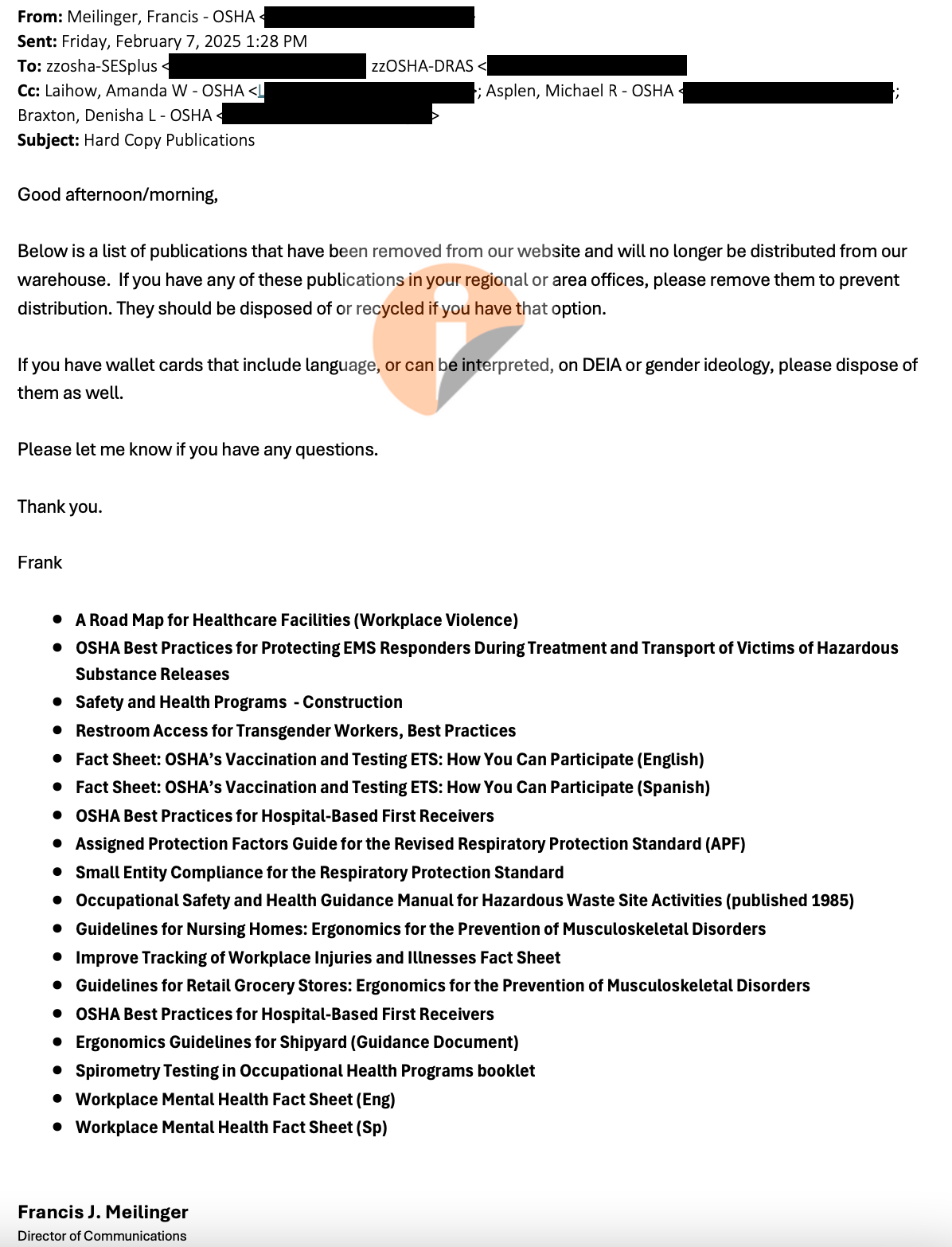
The Trump administration reportedly destroyed 18 publications from the Occupational Safety and Health Administration as part of a larger DEI purge. Most of the guidelines had nothing to do with diversity initiatives.
Written by John Knefel
Published 02/20/25
The Trump administration has reportedly destroyed 18 workplace safety publications as part of a broader attack on diversity initiatives, a development that is largely in line with recommendations made by the sprawling and unpopular presidential transition plan known as Project 2025.
According to Popular Information, 17 of the destroyed workplace guidelines — issued by the Occupational Safety and Health Administration — appeared to have nothing to do with diversity, equity, inclusion, and accessibility programs and instead seem to have been selected because “they include a DEIA-related keyword used in a completely different context.” OSHA is part of the Labor Department and is tasked with making sure U.S. workers “have safe and healthful working conditions free from unlawful retaliation,” according to its official website.
The Trump administration has been targeting diversity programs across the federal government, in some instances using the existence of DEI efforts as a justification for essentially shuttering entire agencies, as in the case of the U.S. Agency for International Development.
The administration’s anti-DEI approach mirrors recommendations made in Project 2025’s nearly 900-page policy book, *Mandate for Leadership*, which called for the elimination of federal DEI programs and for the Department of Justice to investigate private sector programs that promote diversity.
In addition to its direct attacks on DEI, Project 2025 — organized by The Heritage Foundation in collaboration with more than 100 partner groups — proposed drastic rollbacks of labor laws, including dismantling overtime regulations and creating exemptions to the National Labor Relations Act, which protects workers’ rights to collectively bargain and to form a union.
Although the Trump administration’s memo calling for the 18 safety guidelines to be “disposed of or recycled” appears to be a hamfisted and failed attempt to root out DEI programs, it nevertheless fits in with Mandate’s broader approach to dismantling worker protections.
For example, Mandate recommends carve outs to OSHA’s workplace safety regulations, calling on Congress and the Department of Labor to “exempt small business, first-time, non-willful violators from fines issued by the Occupational Safety and Health Administration.”
Mandate further argues that “national employment laws,” like the Occupational Safety and Health Act of 1970, “set out one-size-fits-all ‘floors’ regulating the employment relationship,” and that the protections the law provides could instead be “treated as negotiable defaults rather than non-negotiable floors.” If enacted, this recommendation could allow employers to use safety measures as leverage in contract negotiations, thus increasing the already stark asymmetry in power between workers and bosses. And U.S. workplaces are already deadly; according to the AFL-CIO, in 2022: “344 workers died each day from hazardous working conditions,” and “5,486 workers were killed on the job in the United States.”
The final chapter in Mandate calls on the president to order Cabinet secretaries to “rein in agencies such as the Occupational Safety and Health Administration, which the Biden Administration weaponized to attempt to force COVID-19 vaccine mandates on 84 million Americans through their workplaces.”
That demand built on previous work from The Heritage Foundation, which sued the Biden administration over its Covid-19 workplace vaccine mandate. After the Supreme Court blocked the mandate, Heritage President Kevin Roberts celebrated the decision on former Trump lawyer Jay Sekulow’s radio show. Sekulow is also chief counsel at the American Center for Law and Justice, whose advocacy arm is a partner in Project 2025.
“When it comes to putting government back in the box, it is a series of battles,” Roberts said. “We have won one battle, but we have not won the political and policy war.”
Video
Citation
From the January 14, 2022, edition of Sekulow, streamed on YouTube
Whether the administration adopts the anti-working class OSHA policies in Mandate remains to be seen, but Trump’s pick to head the agency — former Amazon and UPS executive David Keeling — strongly suggests it’s possible. As The New Republic reported, Keeling’s recent job history does not bode well for worker safety:
Both of those companies have been cited for various workplace safety violations by the very agency Keeling is set to control, if confirmed by the Senate. In 2019, OSHA cited UPS for forcing its drivers to work in “excessive heat” with no air conditioning. That same year, UPS was also cited for fire hazards at packaging facilities. Amazon has been cited numerous times for the dangerous, high-pressure environments in its warehouses, as well as the long hours its employees are forced to spend in them. Just last year, Amazon paid a $145,000 settlement over OSHA violations.
Keeling worked as director of safety compliance for UPS from 2011 to 2018 before serving as the vice president of global health and safety from 2018 to 2021, overlapping with OSHA’s 2019 safety citations. The same can be said for Amazon, where he worked from 2021 to 2023—a time when Amazon had one of the highest warehouse injury rates in the country.
Keeling’s nomination hearing has not yet been scheduled, but elsewhere the Trump administration is already waging war on the working class. His pick as general counsel for the National Labor Relations Board just rolled back several major Biden administration policies, including protections for student athletes who want to unionize and guidance that determined most non-compete agreements violate federal labor law.
Many of the Trump administration’s opening salvos against the working class have followed the Project 2025 roadmap and targeted DEI programs. These measures are already making workers’ positions more precarious and less safe, just as Project 2025 recommended.
===
MMA
Project 2025 laid a foundation for Trump’s attacks on workplace safety
The Trump administration reportedly destroyed 18 publications from the Occupational Safety and Health Administration as part of a larger DEI purge. Most of the guidelines had nothing to do with diversity initiatives.
Written by John Knefel
Published 02/20/25
The Trump administration has reportedly destroyed 18 workplace safety publications as part of a broader attack on diversity initiatives, a development that is largely in line with recommendations made by the sprawling and unpopular presidential transition plan known as Project 2025.
According to Popular Information, 17 of the destroyed workplace guidelines — issued by the Occupational Safety and Health Administration — appeared to have nothing to do with diversity, equity, inclusion, and accessibility programs and instead seem to have been selected because “they include a DEIA-related keyword used in a completely different context.” OSHA is part of the Labor Department and is tasked with making sure U.S. workers “have safe and healthful working conditions free from unlawful retaliation,” according to its official website.
The Trump administration has been targeting diversity programs across the federal government, in some instances using the existence of DEI efforts as a justification for essentially shuttering entire agencies, as in the case of the U.S. Agency for International Development.
The administration’s anti-DEI approach mirrors recommendations made in Project 2025’s nearly 900-page policy book, *Mandate for Leadership*, which called for the elimination of federal DEI programs and for the Department of Justice to investigate private sector programs that promote diversity.
In addition to its direct attacks on DEI, Project 2025 — organized by The Heritage Foundation in collaboration with more than 100 partner groups — proposed drastic rollbacks of labor laws, including dismantling overtime regulations and creating exemptions to the National Labor Relations Act, which protects workers’ rights to collectively bargain and to form a union.
Although the Trump administration’s memo calling for the 18 safety guidelines to be “disposed of or recycled” appears to be a hamfisted and failed attempt to root out DEI programs, it nevertheless fits in with Mandate’s broader approach to dismantling worker protections.
For example, Mandate recommends carve outs to OSHA’s workplace safety regulations, calling on Congress and the Department of Labor to “exempt small business, first-time, non-willful violators from fines issued by the Occupational Safety and Health Administration.”
Mandate further argues that “national employment laws,” like the Occupational Safety and Health Act of 1970, “set out one-size-fits-all ‘floors’ regulating the employment relationship,” and that the protections the law provides could instead be “treated as negotiable defaults rather than non-negotiable floors.” If enacted, this recommendation could allow employers to use safety measures as leverage in contract negotiations, thus increasing the already stark asymmetry in power between workers and bosses. And U.S. workplaces are already deadly; according to the AFL-CIO, in 2022: “344 workers died each day from hazardous working conditions,” and “5,486 workers were killed on the job in the United States.”
The final chapter in Mandate calls on the president to order Cabinet secretaries to “rein in agencies such as the Occupational Safety and Health Administration, which the Biden Administration weaponized to attempt to force COVID-19 vaccine mandates on 84 million Americans through their workplaces.”
That demand built on previous work from The Heritage Foundation, which sued the Biden administration over its Covid-19 workplace vaccine mandate. After the Supreme Court blocked the mandate, Heritage President Kevin Roberts celebrated the decision on former Trump lawyer Jay Sekulow’s radio show. Sekulow is also chief counsel at the American Center for Law and Justice, whose advocacy arm is a partner in Project 2025.
“When it comes to putting government back in the box, it is a series of battles,” Roberts said. “We have won one battle, but we have not won the political and policy war.”
Video
Citation
From the January 14, 2022, edition of Sekulow, streamed on YouTube
Whether the administration adopts the anti-working class OSHA policies in Mandate remains to be seen, but Trump’s pick to head the agency — former Amazon and UPS executive David Keeling — strongly suggests it’s possible. As The New Republic reported, Keeling’s recent job history does not bode well for worker safety:
Both of those companies have been cited for various workplace safety violations by the very agency Keeling is set to control, if confirmed by the Senate. In 2019, OSHA cited UPS for forcing its drivers to work in “excessive heat” with no air conditioning. That same year, UPS was also cited for fire hazards at packaging facilities. Amazon has been cited numerous times for the dangerous, high-pressure environments in its warehouses, as well as the long hours its employees are forced to spend in them. Just last year, Amazon paid a $145,000 settlement over OSHA violations.
Keeling worked as director of safety compliance for UPS from 2011 to 2018 before serving as the vice president of global health and safety from 2018 to 2021, overlapping with OSHA’s 2019 safety citations. The same can be said for Amazon, where he worked from 2021 to 2023—a time when Amazon had one of the highest warehouse injury rates in the country.
Keeling’s nomination hearing has not yet been scheduled, but elsewhere the Trump administration is already waging war on the working class. His pick as general counsel for the National Labor Relations Board just rolled back several major Biden administration policies, including protections for student athletes who want to unionize and guidance that determined most non-compete agreements violate federal labor law.
Many of the Trump administration’s opening salvos against the working class have followed the Project 2025 roadmap and targeted DEI programs. These measures are already making workers’ positions more precarious and less safe, just as Project 2025 recommended.
===
osha
https://www.alternet.org/economy/amazon-injuries-investigated-workers-safe/
===
OSHA clarence an 7 24 ah
Inside Clarence Thomas’ new legal target: 'It’s unconstitutional' - Alternet.org
When the U.S. Supreme Court handed down its controversial ruling in Loper Bright Enterprises v. Raimondo on June 28, it overturned a decision that had been the law of the land for 40 years: Chevron U.S.A., Inc. v. Natural Resources Defense Council, Inc.
That landmark 1984 decision established what was known as "Chevron deference," which said that judges and courts should defer to the expertise of officials at federal regulatory agencies. Critics of the June 28 ruling argue that it seriously undermines the ability of government agencies to regulate everything from clean water and air quality to health care.
According to Business Insider, one agency that Justice Clarence Thomas is hoping to see abolished is the Occupational Safety and Health Administration (OSHA).
READ MORE: **SCOTUS limits government agencies in bombshell decision with sweeping implications**
Business Insider's Grace Eliza Goodwin reports, "The Supreme Court, on Tuesday, (July 2), announced which cases it would consider next and which it wouldn't. Among those the Court rejected was a case that challenged the authority of OSHA, which sets and enforces standards for health and safety in the workplace. And Thomas, widely considered to be the most conservative justice on the already-mostly conservative Court, wasn't happy."
Goodwin adds, "In a dissent, he explained why he believed the High Court should've taken the case: OSHA's power, he argues, is unconstitutional."
Thomas wrote, "Congress purported to empower an administrative agency to impose whatever workplace-safety standards it deems 'appropriate.' That power extends to virtually every business in the United States."
Goodwin notes that the 6th Circuit Court of Appeals "upheld OSHA's constitutionality" in 2023.
READ MORE:[Conservative warns Dems to get it together and confront Trump's 'true menace'
*Business Insider's full report is available at this link.
===
see benzene
...Representatives of BP, Chevron and ConocoPhillips all declined to comment for this article, referring questions to the API, which did not respond to repeated interview requests. In a one-paragraph statement, Shell said the company’s financial “support for the study reflects our ongoing commitment to health, safety, and product stewardship,” stressing that “the study was wholly independent of Shell.”
ExxonMobil, whose scientists participated in the Shanghai study, said in a written statement that it “supports scientific research through funding and technical support,” painting its involvement in this project — as well as a 2012 ExxonMobil-sponsored study of benzene-exposed workers showing adverse health effects at levels below legal occupational limits — as part of a longstanding corporate commitment to better understanding the chemical. The 2012 results in particular prompted ExxonMobil to “voluntarily reduce allowable benzene exposure limits to one-half of OSHA legal limits” at its workplaces, it said — or 0.5 ppmfor an eight-hour shift.
By contrast, the National Institute for Occupational Safety and Health (NIOSH), part of the Centers for Disease Control and Prevention, recommends that workers limit their benzene exposure to an average of0.1 ppm during a shift.
“Our conservative approach to setting workplace benzene exposure limits is influenced by the most up-to-date scientific evidence, which includes the 2012 study,” ExxonMobil said, noting that its short-term limit is five times lower than OSHA’s.
As the Shanghai findings seep into the scientific literature and, ultimately, the courts, the petrochemical industry generally admits that benzene causes AML and MDS at higher doses. But other blood and bone marrow cancers continue to kill — at lower and lower exposures to the chemical.
Michael Boley in April, 1994. Courtesy of the Boley family
On February 27, 2012, Michael Boley, 68, died of a disease Shanghai researchers say can’t be tied to benzene: chronic myelomonocytic leukemia, a form of MDS, combined with another bone-marrow condition known as “myeloproliferative disease.”
Strong and industrious, with a knack for avoiding even the flu, Boley spent 23 years at a Goodyear Tire & Rubber plant in St. Marys, Ohio, site of a seminal benzene study by NIOSH in the 1970s. The research quantified for the first time the leukemia risk for workers exposed to the chemical in the plant’s Pliofilm unit, prompting OSHA to work on the benzene standard that took effect in 1987.
Michael Boley worked at a Goodyear plant in St. Mary's, Ohio, for 23 years. His 15th anniversary with the company appeared in Goodyear's newsletter. Courtesy of the Boley family
Boley didn’t make the benzene-soaked rubber film for which the unit was named; rather, he was a plant electrician, supervisor and engineer who worked there for an hour or two daily. Still, he knew benzene was in the air: While in the unit he noticed “Authorized Personnel Only” signs for Pliofilm workers who, he testified in a deposition, “were monitored on a regular basis.” At times, he complained about the unit’s “sweeter-than-gasoline” smell. Once, Boley asked a supervisor if he could have the same blood test the company administered to Pliofilm workers.
“His comment was, no, we wouldn’t require monitoring,” Boley testified. “Our levels would be safe.”
Four decades later, after enduring the fatigue, feebleness and shortness of breath accompanying a diagnosis of chronic monomyelocytic leukemia, or CMML, Boley sued Goodyear and its benzene suppliers, including ExxonMobil. “He wanted them to know what had happened to him,” said his widow, Cheryl. But the suit went nowhere: In 2011, Boley settled the litigation in a confidential mediation. His still-pending workers’ compensation claim has seen little traction.
“He couldn’t prove it,” Cheryl said, alluding to the companies’ claims that benzene couldn’t have caused her husband’s illness. Those claims were supported by Irons and other scientists affiliated with the Shanghai study, who reported in a journal article last year that “benzene exposure does not appear to be a significant predictor of CMML.”
Mounting evidence against benzene:
1928
First case
The first case of benzene-induced leukemia is reported.
1948
Only safe concentration is zero
The American Petroleum Institute concludes that “the only absolutely safe concentration for benzene is zero.”
1977
Goodyear study
The National Institute for Occupational Safety and Health launches a study of two Goodyear plants in Ohio where workers are exposed to benzene at high levels — 10 parts per million to 100 ppm. Responding to the study, theOccupational Safety and Health Administration issues an emergency temporary standard for benzene of 1 ppm, down from 10 ppm....
omfg
no lnx an 11 21
'Pro-death cult strikes back': Right-wing judges block Biden’s vaccine rule for big companies
Kenny Stancil and Common Dreams November 08, 2021
Progressives concerned about workplace safety and public health responded with dismay after a federal appeals court on Saturday temporarily blocked the Biden administration's attempt to require workers at companies with 100 or more employees to be vaccinated against Covid-19 or tested weekly.
Citing "grave statutory and constitutional" problems with the rule, a three-judge panel from the U.S. Court of Appeals for the Fifth Circuit issued the stay in response to a joint petition filed Friday by a coalition of businesses, conservative advocacy groups, and the states of Texas, Louisiana, Mississippi, South Carolina, and Utah.
That legal challenge, and separate lawsuits from Republican-led states, came just one day after President Joe Biden announced that the Occupational Safety and Health Administration (OSHA) would begin enforcing its newly unveiled Emergency Temporary Standard (ETS) in the coming weeks. Companies with at least 100 employees have until December 5 to require unvaccinated workers to wear masks indoors, and by January 4, they must require vaccinations or administer weekly tests.
Decrying the decision of the "right-wing Fifth Circuit," labor journalist Steven Greenhouse said on social media that "it's terrible for worker safety and public health that three conservative activist judges have suspended Biden's... new rule requiring workers at companies with more than 100 workers to get vaccinated or tested."
"OSHA's mission is to protect workers' health," Greenhouse continued, "but the appellate judges seem to forget that Covid has killed thousands of meatpacking, retail, and other workers."
More than 750,000 people in the U.S. have died from Covid-19 since the pandemic started last March, and the disease continues to kill nearly 1,100 people per day, most of them unvaccinated, according to the U.S. Centers for Disease Control and Prevention (CDC).
Recent studies confirm that vaccines save lives.Last month, the U.S. Department of Health and Human Services analyzed the relationship between county-level inoculation rates and Covid-19 outcomes among U.S. seniors and found that vaccines helped ward off 265,000 infections, 107,000 hospitalizations, and 39,000 deaths during the first five months of 2021.
And in September, CDC researchers found that individuals in the U.S. who were not fully vaccinated last spring and summer were 11 times more likely to die after being infected with the coronavirus—and over 10 times more likely to be hospitalized—than those who were fully inoculated.
Greenhouse said that "the judges evidently sympathize with [Texas Republican Gov.] Greg Abbott's let-people-die stance—that it'soverreachfor OSHA to act strongly to protect workers from Covid."
David Michaels, a leader of OSHA during the Obama administration, also rebuked the federal appeals court, describing its decision as legally dubious and politically motivated.
"The same activist court that refused to stay Texas' law that permits bounty hunters to sue anyone who aids an abortion after six weeks of pregnancy has stayed an OSHA rule that is clearly within OSHA's authority, will save lives, and make workplaces safe," he told the New York Times.
According to the Times, "At the core of the legal challenge is the question of whether OSHA exceeded its authority in issuing the rule and whether such a mandate would need to be passed by Congress."
The newspaper reported:
The suit against the mandate stated that President Biden "set the legislative policy" of substantially increasing the number of Americans covered by vaccination requirements, and "then set binding rules enforced with the threat of large fines."
"That is a quintessential legislative act—and one wholly unrelated to the purpose of OSHA itself, which is protecting workplace safety," the suit said. "Nowhere in OSHA's enabling legislation does Congress confer upon it the power to end pandemics."
Corporate executives asked, and the Biden administration agreed, to delay implementation of OSHA's new ETS "until after the New Year, citing concerns about worker shortages during the important holiday season," Reuters noted.
Solicitor of Labor Seema Nanda, meanwhile, said in a statement that the Labor Department, home to OSHA, is "confident in its legal authority" to issue vaccine requirements.
The vaccine rule for companies with 100 or more employees "applies to 84.2 million workers at 1.9 million private-sector employers," Reuters reported. "OSHA estimates that 31.7 million of [those] workers are unvaccinated and 60% of employers will require vaccinations, up from 25% today, resulting in another 22.7 million employees getting vaccinated."
Several million additional workers are covered by the Biden administration's vaccine mandate for employees of the executive branch, federal contractors, and staff at healthcare facilities that accept Medicare or Medicaid funding. OSHA officials say they are considering expanding the jab-or-test rule to include companies with fewer than 100 workers.
"The Occupational Safety and Health Act explicitly gives OSHA the authority to act quickly in an emergency where the agency finds that workers are subjected to a grave danger and a new standard is necessary to protect them," Nanda said. "We are fully prepared to defend this standard in court."
The Fifth Circuit panel's two-page order directs the Biden administration to respond to the request for a permanent injunction against the rule by 5 p.m. ET Monday.
As the Times noted, it remains unclear whether the court's stay "would be a procedural blip for the Biden administration or the first step in the unwinding of the mandate."
The newspaper explained that "after both sides have filed briefs, the court will decide whether to lift the temporary injunction, allowing the rule to proceed as planned, or whether to grant a permanent injunction. OSHA could then take the case to the Supreme Court."
While some legal experts argue that the Labor Department has the regulatory authority to compel private employers to protect the health of workers and the broader public through mandatory vaccination amid a deadly global pandemic,Josh Blackman, a professor at South Texas College of Law Houston, told Reuters that "there will be so much litigation it will never see the light of day."
Twenty-four attorneys general threatened to sue the Biden administration over the rule back in September, and several followed through immediately after it was published in the federal register on Friday.
In addition to the petition filed with the Fifth Circuit, attorneys general in 11 states—Alaska, Arizona, Arkansas, Iowa, Missouri, Montana, Nebraska, New Hampshire, North Dakota, South Dakota, and Wyoming—filed a lawsuit in the U.S. Court of Appeals for the Eighth Circuit.
And in the U.S. Court of Appeals for the Eleventh Circuit, the states of Alabama, Florida, and Georgia sued, with Florida Republican Gov. Ron DeSantis saying at a press conference that "the federal government can't just unilaterally impose medical policy under the guise of workplace regulation."
Roughly 70% of U.S. adults are fully inoculated against Covid-19, and about 80% have received at least one shot, according to the CDC. Recent polling shows that a majority of U.S. adults favor Covid-19 vaccination requirements, with only about one-fifth to one-quarter of respondents opposed.
OSHA, Reuters pointed out, is "fighting history. The agency has issued 10 ETS over its 50 years. Of the six that were challenged in court, only one survived entirely intact."
Donald Verrilli, U.S. solicitor general during former President Barack Obama's administration, however, told the news outlet that the Biden administration "wouldn't move forward unless they thought that they could defend it legally... I think the constitutional challenges are all going to fail."
FROM YOUR SITE ARTICLES
Here's why Noam Chomsky is surprised by Joe Biden's presidency ... ›
New report shows Biden actually has lots of good news to brag ... ›
Biden is making a critical mistake about Democrats' loss in Virginia ... ›
RELATED ARTICLES AROUND THE WEB
Sweeping new vaccine mandates for 100 million Americans ›
Biden proposes new rules to cut climate-warming methane ... ›
Jill Biden speaks candidly about being a first lady: 'Nothing can ... ›
https://www.jdsupra.com/legalnews/supreme-court-decision-in-cedar-point-4375087/#:~:text=In%20Cedar%20Point%20Nursery%2C%20the,automatically%20counts%20as%20a%20taking.
Supreme Court Decision in Cedar Point Nursery v. Hassid May Provide Businesses New Opportunity to Challenge Regulations
On June 23, 2021, the Supreme Court decided *Cedar Point Nursery v. Hassid*, a case involving a California regulation that requires employers to allow union organizers to enter their property to solicit members. In a 6-3 ruling along ideological lines, the Court stood with property owners and held these unwanted intrusions constituted a “taking” under the Takings Clause of the Fifth Amendment. Chief Justice John Roberts explained in his majority opinion that allowing unions to freely come onto privately held land was a violation of property owners’ constitutional rights, even if unions “only” had fleeting access to the land. But this seemingly sweeping ruling declines to extend this logic to things like regulatory inspections overseen by state workers.This should serve as a powerful reminder that a conservative court is not a panacea to bureaucratic overreach, and regulatory reform must come through legislative and executive processes. This advisory breaks down the Court’s opinion and explores how the ruling might provide grounds for challenging other regulations.
Majority Opinion
The central issue in Cedar Point Nursery was the constitutionality of a California “access regulation” that requires farm owners to allow labor union organizers to access their property in order to “solicit support for unionization.” The regulation provides that union organizers can access an employer’s property for up to three hours a day and 120 days per year. The farmers claimed the regulation amounted to the government taking their property without compensation, which is a violation of the Fifth Amendment.
The Fifth Amendment prohibits property from being “taken for public use, without just compensation.” A typical example of a taking occurs when the government uses its power of eminent domain to seize someone’s land for the purpose of building an airport or widening a road. The Fifth Amendment requires the government to pay for that land. Government regulations can also count as takings. For example, in one famous case, the Supreme Court ruled that a New York regulation requiring a landlord to install TV cables on her apartment building was a taking, since the regulation caused a “permanent physical occupation” of her property.
In Cedar Point Nursery, the Supreme Court ruled that the California access regulation is a taking because it forces farmers to give union organizers physical access to their property. The Court explained that any regulation that physically “invades” a person’s property automatically counts as a taking. The Court also stressed that “the right to exclude is ‘universally held to be a fundamental element of the property right’” in land. Since the access regulation limits the farmers’ “right to exclude” and forces them to give union organizers physical access, it takes away enough of the farmers’ property rights to require compensation under the Fifth Amendment.
How Much Should The Government Pay?
One question that Cedar Point Nursery leaves open is what courts should do if they determine that a regulation is a taking. Since the Fifth Amendment requires the government to compensate an owner for a taking, courts usually direct the government to pay the value of the land the government took. When a taking is temporary, compensation usually equals the rental value of the property while it was taken. But in cases like Cedar Point Nursery, where the government limited the farmers’ property rights without taking their property altogether, proving the appropriate amount of compensation is difficult.Justice Amy Coney Barrett suggested that the compensation could total as little as $50 for a union site visit. But the majority did not address this issue, leaving it to lower courts to apply different approaches.
New Path To Challenging Regulations?
The Court’s holding that some temporary physical invasions are per se takings could make it easier for businesses to challenge other regulations that give the government or others access to private property. Indeed, one commentator called the Cedar Point Nursery ruling “acrushing blow to organized labor, which often relies on workplace access to safeguard workers’ rights.” In reality, the case is less about the right to bar unions from one’s property than about the taking of one’s property without the “just compensation” demanded by the Fifth Amendment. That right to compensation could be extended to other regulations. Examples include the Occupational and Safety Health Act (“OSHA”), which requires employers to give a government inspector and employee representative (often designated by a union) access to their premises. See29 C.F.R. § 1903.3 (2021). However, the Court’s ruling identified some important caveats that could complicate efforts to challenge OSHA and other regulations.
First, the Court said that a regulation will not rise to the level of a taking unless an owner’s property is accessed multiple times. Unlike the access regulation, where union organizers entered the farmers’ property year after year, one or two instances of property access will not suffice. Second, the Court clarified that the government may always access private property in exceptional circumstances, such as “in the event of public or private necessity.” Finally, the government may require an owner to allow access to his land in exchange for some benefit, like a building permit. The Court explained that as long as the government’s access to the property has a reasonable connection to the benefit offered, the access is not a taking. Indeed, Chief Justice Roberts seems to have no problem with this course of action. He wrote: “[T]he government may require property owners to cede a right of access as a condition of receiving certain benefits, without causing a taking . . . . [G]overnment health and safety inspection regimes will generally not constitute takings.” This comports with longstanding precedent upholding the government’s broad discretion to place reasonable restrictions on a business’s activity. Litigants who hope to use the Cedar Point Nurserydecision to challenge other regulations will need to explain why none of these three exceptions applies.
Businesses may have an opening to challenge certain regulations following the Cedar Point Nursery decision. Still, the exceptions in the Supreme Court’s ruling will likely limit its impact, as will the challenge of proving how much compensation the government owes.
Summer associate Micah Allred assisted in the preparation of this advisory.
https://www.alternet.org/2020/04/trump-says-hes-aiming-to-shield-corporations-from-legal-liability-for-workers-who-contract-covi-19-on-the-job
no lnx
Trump says he’s aiming to shield corporations from legal liability for workers who contract COVI-19 on the job
Written by Jake Johnson / Common Dreams April 21, 2020
President Donald Trump said during a press briefing Monday evening that his administration is aiming to shield corporations from legal responsibility for workers who contract the novel coronavirus on the job, a move that the Chamber of Commerce and right-wing advocacy groups are aggressively lobbying for as the White House pushes to reopen the U.S. economy against the warnings of public health experts.
“We are trying to take liability away from these companies,” Trump said in response to a reporter’s question on the subject. “We just don’t want that because we want the companies to open and to open strong. But I’ll get you a legal opinion on that.”
The president claimed that his administration has not previously discussed the issue of corporate liability, but the New York Times reported that business executives raised the matter with Trump in a conference call last week.
An “issue of great concern to the executives on the call,” according to the Times, “was the need to address the liability companies could face if employees got sick after returning to work, given the possibility that workers who felt that they were brought back too soon—or were not placed in a safe environment—could sue en masse.”
Additionally, the Washington Post reported earlier this month that Trump administration officials discussed including in the next stimulus package “a waiver that would clear businesses of liability from employees who contract the coronavirus on the job.”
Watch Trump’s remarks:
JM Rieger
@RiegerReport
REPORTER: [If companies] have employees come back to work and they get sick will these companies be liable?
…
TRUMP: I’ll give you a legal answer to that when we look it up.
…
REPORTER: You guys haven’t discussed that yet?
TRUMP: Nobody’s discussed it, no. But we will now.
Embedded video
In a memo to its members last week, the U.S. Chamber of Commerce—the most powerful business lobbying group in the nation—said that legal action from workers who are infected by Covid-19 on the job is “perhaps the largest area of concern for the overall business community.”
The Chamber of Commerce “argues the sheer number of lawsuits could overwhelm businesses,” Roll Call reported.
“Businesses say they keep their workplaces safe,” Roll Call noted, “but the memo indicates that major corporations privately acknowledge that many so-called essential employees will get sick or die.”
Americans for Prosperity, a Koch-backed organization, is also urging lawmakers to protect corporations from responsibility for exposing their workers to the coronavirus.
As Common Dreams reported last week, theOccupational Safety and Health Administration (OSHA) has been flooded with thousands of complaints from workers in recent weeks accusing employers of violating federal coronavirus guidelines and failing to provide adequate protective equipment.
Justin Wolfers, an economics professor at the University of Michigan, wrote in a series of tweets last week that “the whole point of making employers liable for risking the lives of their staff is to prevent them from exposing their staff to undue risk.”
“Businesses are asking for the right to expose their workers to fatal risks with no consequences. It’s bad economics and bad policy,”said Wolfers. “If this tweet sounds to you at all anti-business, let me be clear: I am absolutely against businesses profiting by exposing their workers to unconscionable risks of death.”
==
==
michaels sci bk
dupont texas pesticide 4 kia osha fine 90K --> 230K$ (dupont sells uits safety services?!)
$ to visit 1x 165 years; fines raised in 2015 to 12K$ (walmart sec guard crushed to death, fined 7K spent millions on liars, got nearly to scotus]
https://kpfa.org/episode/the-ralph-nader-radio-hour-march-2-2020/
bill 1970 unions had in-house saFETY, NOW mostly gone; burton sp CA huge, not even on committee; nader big
==
320 theconv
Why having fewer OSHA inspectors matters
David Weil, Brandeis University
A reduction in OSHA inspectors may lead to a reduction in workplace safety.
==
an 220
...When it comes to protecting workers’ health and safety, his administration has been a disaster. Once in office, Trump packed the leadership of U.S. regulatory agencies with pro-corporate zealots, leading to predictable results. They repealed an Occupational Safety and Health Administration (OSHA) rule requiring employers to keep accurate records of injuries, repealed a rule requiring that federal contractors follow safety and labor laws, and withdrew an OSHA policy allowing workers to participate in OSHA inspections. In addition, as the AFL-CIO noted, the Trump administration targeted job safety rules for toxic chemicals, mine examinations, and child labor protections for destruction. It also sharply reduced the number of OSHA inspectors. As of 2019, only 875 were enforcing health and safety regulations nationwide?the lowest level in the agency’s half-century of operation.
==
an robt r 120
I have a friend who grew up with me, someone I know from childhood, and this is his perspective – he’s an anti-vaccination type, and he always says, “When has the FDA ever been on my side?” Essentially he believes that so many government agencies have been captured by the corporations they’re supposed to regulate.
It’s hard to argue with that point, because there is some truth to that. It just doesn’t apply in the case of vaccines – even though it is applicable with chemicals like PFOAs, and drugs like Vioxx. I’m curious to hear your perspective here.
I wish I more advice on that. The fact [is] that the [regulatory] agencies really have been pushed around, and they haven’t stepped up to the plate [to] provide reasonable protections.
One way you see this right now is with baby powder and other cosmetics that have talc. In fact, talc is often contaminated with asbestos-like stuff, fibers and the like. And at various points in time, government agencies have looked at this issue and considered requiring warnings, and each case they pushed around and manipulated by the industry.
So now, again, the issue has come up — and there’s a government panel which has said essentially, “We have to start treating these fibers that are in talc as asbestos,” because that’s really what they are. But they could’ve done this 30 or 40 years ago, and they could’ve been upfront, saying, “Here’s a risk, this is the way you have to address this.” To come back and do this after the fact, after there’s already been a great deal of controversy, leads to cynicism about the government.
And I think by not having stepped up to the plate earlier on many of these issues, people wonder, “well, is the government in the pocket of industry?” And I wouldn’t say the agencies are always in the pocket of industry, but unfortunately they’re often so bullied and manipulated, and outgunned by industry, that they end up not doing things that are protective, and then that leads to cynicism. I mean, even the biggest of our government agencies doesn’t have anywhere near the legal firepower of a large chemical company.
That’s astonishing.
At OSHA, we often knew we had to settle cases without going to court because we didn’t have the resources to fight the cases against these corporations, even if we thought we felt we were right.
That is shocking. Has OSHA become more neutered under Trump’s administration, in terms of funding and regulatory capability?
Well, OSHA isn’t in the crosshairs [of Trump] like the State Department is. The Trump administration has simply neglected OSHA. It’s really malignant neglect — more than half of the senior positions are empty. I haven’t been replaced.
For a number of years, there was an acting assistant secretary, but because they didn’t actually fill it with a permanent confirmed assistant secretary in that position. There can’t even be an acting assistant secretary anymore because of various laws. The Trump administration has tried to cut the budget several times, but Congress always continued the budget [and] even gave OSHA a small increase. But so many people have left the agency, and it’s become less powerful — but it certainly hasn’t been decimated the same way the EPA has.
So many good people have left and not been replaced. But OSHA is still filled with very dedicated career staff who are doing their best in a difficult situation to make sure American workers are protected.
David Michael’s new book, “The Triumph of Doubt: Dark Money and the Science of Deception,” is out from Oxford University Press on February 3, 2020.
==
see massive fail on black lung
In 1974, NIOSH first called for silica exposure limits twice as strict as those in place for coal miners and other workers. But it wasn’t until the 1990s that MSHA and others began to get serious about silica in coal mines.
NPR and FRONTLINE obtained internal memos from the Clinton administration that showed alarm back then about clusters of advanced lung disease among coal miners as young as 40. MSHA sent out alerts to coal mining companies, warning about excessive exposure to silica dust and severe disease among miners. NIOSH again called for a silica exposure limit that would be twice as tough, plus separate regulation of silica, as did a Department of Labor advisory committee.
“We started a national campaign first to raise awareness,” recalled Davitt McAteer, the assistant secretary of labor for mine safety and health from 1994 to 2000.
“And it was that campaign that began to try to go after the silica requirements, raise the silica standard, and start on a separate path to control silica.”
McAteer proposed a major overhaul of the dust samplingsystem, which included other loopholes that permitted excessive exposures and inaccurate measurement of coal mine dust.But the effort encountered stiff opposition from the National Mining Association, the industry’s biggest lobbying group. The group sued over some elements of the plan and won.
“And then we ran out of time,” McAteer says. “And it’s something that’s unfortunate and put a lot of lives at risk.”
Mine dust loopholes
==
==
who did this cap on fines in 2015 budget bill?
more recently just adjust for inflation?
US Department of Labor announces new rules to adjust civil penalty ...
https://www.osha.gov/news/newsreleases/national/06302016
1.
fark --> read less, know more TM --> rating
http://www.newser.com/story/259638/in-coal-country-a-slow-rolling-disaster.html
– In what one epidemiologist calls a "slow-rolling disaster," a new set of studiespresented at an American Thoracic Society conference this week offered glum news for coal miners. Per NPR, more Appalachian miners are plagued by both early- and late-stage pneumoconiosis, or "black lung disease," than previous research suggested. Sifting through nearly 50 years of federal benefit claims linked to the respiratory illness caused by inhaled coal mine dust, Kirsten Almberg and Robert Cohen, co-authors of one study, found more than 4,600 cases of progressive massive fibrosis (the most severe stage of the illness), with more than 50% of them taking place over the past 16 years. And David Blackley, a scientist at the National Institute for Occupational Safety and Health, which has conducted the government tracking program, says his initiative has recently spotted more early stage black lung as well.
"It's not that we're discovering a new disease," Cohen tells NPR. "We're seeing a resurgence of a disease that should have been eradicated." One study cited at the ATS meeting noted miners with simple black lung continued to see deteriorating lung function after they ceased going into the mines, meaning they may eventually get PMF. That study also noted a growing number of lung transplants in PMF patients. Why the numbers have been so underreported: Previous NIOSH studies have relied on voluntary testing by working miners only, with about 60% of miners never getting diagnostic X-rays. Newer research also looked at black lung clinics. A 2016 CDC study backs up claims of a PMF resurgence. "We've gone from having nearly eradicated PMF in the mid-1990s to the highest concentration of cases that anyone has ever seen," a NIOSH epidemiologist recently told NPR. (More bad news for miners in Kentucky.)
==
frack api wrote rules
http://extras.denverpost.com/oil-gas-deaths/
Clling the vast oil and gas reserves in Colorado is a dangerous job. Oil and gas companies say they work hard to educate their employees about job hazards and promise to keep their workers safe.
“If there are areas where we need to improve, you can be damn sure we’re going to do it,” said Eric Wohlschlegel, a spokesman for the American Petroleum Institute, a pro-industry trade organization.
“I’m pretty confident that the oil and gas industry probably does some of the best work on safety.”
But a year-long Denver Post investigation shows that there is little consequence when companies let that promise lapse.
A national legacy of encouraging oil and gas development — for energy security, for jobs, for the economy — has created a regulatory vacuum.There is an entire federal agency devoted to mining safety, for instance, but nothing comparable exists for oil and gas. While OSHA has created specific safety standards that companies in other industries must follow, oil and gas businesses successfully beat back such regulations for themselves.The standards — recommendations, really — that OSHA mostly uses to judge safety violations on oil and gas worksites were written by the American Petroleum Institute.
Debate about the industry in Colorado typically focuses on its environmental toll or its potential threat to public health.
Meanwhile, 1,333 workers died in the nation’s oil and gas fields between 2003 and 2014, according to the Bureau of Labor Statistics. The nationwide death toll in 2014 of 144 was the highest in more than a decade. By another measurement — the number of worker deaths per active drilling rig — 2014 was the second-most lethal year in Colorado in a decade, according to a Denver Post analysis. There was about one death per every 12 rigs that year.
Oil and gas worker fatalities by rig count
According to the latest Bureau of Labor Statistics data, there were 51 deaths in Colorado related to the oil and gas industry from 2003 to 2014. Because of worker privacy issues, the BLS would not release years for all of those deaths. Nationally, 1,333 oil and gas workers were killed in the same 12-year time frame.
==
http://www.prwatch.org/news/2016/01/13026/dupont-rakes-federal-dollars-despite-history-hazards
Four workers were tragically killed when an insecticide leaked into a building at DuPont's LaPorte, Texas plant in November 2014. After two workers were overcome by toxic fumes, another responded to a distress call and was overwhelmed. His brother, too, died attempting to aid the fallen. Three others were injured.
OSHA officials blasted DuPont in the strongest terms, stating those who died "would be alive today, had their employer taken steps to protect them." Yet, just months later, the same plant was cited by OSHA for even more safety violations. Now,DuPont—which with its subsidiaries has held multiple federal contracts over recent years totaling millions of dollars—is part of a corporate coalition trying to block rules that would ensure federal contractors abide by health, safety, and labor laws.
President Obama's Fair Pay and Safe Workplaces Executive Order aims to protect hard-working Americans by requiring companies with an ongoing history of violating safety and labor standards to clean up their acts and comply with federal health and safety laws before being rewarded with taxpayer dollars. DuPont and its subsidiaries, whose history of OSHA violations as of January 2016 includes dozens of "Serious" citations, multiple "Repeat" and "Willful" citations, and more than $500,000 in penalties since 2013, are exhibiting exactly the type of behavior the new rules were created to discourage.
With millions in federal contracts at stake, federal contractors have pushed back hard against the new rules through little-known trade organizations like the Human Resources Policy Association (HRPA), which has attacked the executive order in congressional testimony, media statements, and lobbying efforts. A DuPont executive sits on HRPA's board of directors.
HRPA complains that holding regular OSHA violators to account is an effort to "create a black list" and "intimidate companies." The organization also claims that the rules "seek to solve a problem that does not exist" as its member companies "have a long standing commitment to complying with all federal and state employment and labor laws."
But as the records of DuPont and its subsidiaries show, pervasive safety problems with federal contractors are all too real.
Four Tragic Deaths Follow "Serious Failures" by DuPont
On November 15,2014, operator Crystal Rae Wise collapsed when 20,000 pounds of gaseous methyl mercaptan, a gas used in insecticide production, leaked into the enclosed space where she was working at the the LaPorte chemical plant. Other employees were killed and injured by the toxic fumes in the building trying to rescue her and each other. OSHA documented what went wrong in a
OSHA issued DuPont one "Repeat" violation and nine "Serious" violations for what it called "serious failures," including failing to train its employees properly, along with a $99,000 fine. Investigators found a "Repeat" violation because the company didn't teach the employees how to use the plant's ventilation system. OSHA had found similar problems involving inspection and training failures following the death of a DuPont worker at its Belle, West Virginia plant in 2010.
"Four people lost their lives and their families lost loved ones because DuPont did not have proper safety procedures in place," Assistant Secretary of Labor for Occupational Safety and Health Dr. David Michaels said of the horrific incident at the LaPorte plant, but the violations are being contested by the company.
The same plant was inspected again in January 2015. DuPont, which chalked up $34.7 billion in annual revenues and paid its CEO Ellen Kullman $14.3 million in 2014, had failed to clean up its act, so OSHA enrolled the company in its "Severe Violator Enforcement Program."
"We have concerns about the safety culture," Dr. Michaels told the Texas Tribune in July 2015 as OSHA issued another 4 "Serious," 3 "Willful," and 1 "Repeat" violation, and $273,000 in penalties on top of those issued in 2014. "We expect chemical facilities where highly toxic materials are used to have a culture that focuses on ensuring worker protection. It appears to have broken down." These penalties are also being contested.
History of Dangerous Violations
==
worker safety
Since 1968, when President Lyndon B. Johnson first introduced an occupational health and safety bill to Congress, the U.S. Chamber has opposed government oversight of how companies treat their workers. In the 1990s, the U.S. Chamber worked with congressional Republicans to introduce legislation that would require the Occupational Safety and Health Administration (OSHA) to spend at least half of its budget on “consultation” with businesses, rather than enforcement (which was already low), and it unfortunately helped make history in defeating an ergonomics safety rule. Today it continues to push back against OSHA interpretations and rulemakings.
Hurting workers in pursuit of the bottom line
Companies lobby against worker protections through the U.S. Chamber of Commerce, thereby opposing popular safety measures without sullying their brand names. When they are successful, this enables the companies to skimp on expenditures to protect their workers, thereby burdening employees with additional safety risks and future costs of health care.
The U.S. Chamber has consistently opposed efforts by the Occupational Safety and Health Administration (OSHA) to make workplaces safer for workers. Many of these battles involve fine details of regulation writing and rule-making, and are often hashed out away from widespread public view. For example, the U.S. Chamber opposes OSHA’s attempts to require the disclosure of workplace injury data – the nature of the injury, and when and where it occurred. The U.S. Chamber has long opposed rules to limit workers’ exposure to silica, one common cause of injuries in the workplace.
One of President George W. Bush’s OSHA heads, Edwin Foulke, was a member of the U.S. Chamber’s Health and Safety Committee, during which time he testified before Congress promoting so-called voluntary compliance programs for companies – a far weaker alternative to OSHA enforcement and one often pushed by the U.S. Chamber.
The U.S. Chamber has expended a lot of resources fighting against standards to improve ergonomic safety, one of the most common hazards in worker health. Perhaps most notoriously, at the end of President Bill Clinton’s second term, the U.S. Chamber pushed for the overturning of a thoroughly studied rule to protect millions of workers from work-caused musculoskeletal disorders, helping lead to the only time Congress has ever overturned an agency rule. Then in 2010, it fought against OSHA simply adding a column to federal surveys for employers to record when a worker’s injury is musculoskeletal in nature. The rule would simply provide the public and employers with a more accurate count of how many musculoskeletal injuries are occurring, but even that was too much for the U.S. Chamber to stomach.
==
http://www.laborlawyers.com/efoulke
bs
- Whistleblower Actions
- Compliance Audits and Counseling
- Employment Policies and Procedures
- Prevention and Compliance Programs
- Supervisor Training
- Construction Safety
- Workplace Fatality and Catastrophe Response
- Safety Compliance
- Workplace Safety and Catastrophe Management
- Government Solutions Practice Group
- Automotive Manufacturing
==
wiki
Edwin Foulke is an American lawyer who served as the Assistant Secretary of Labor. In 2006, Foulke was nominated by U.S. President George W. Bush to head the Occupational Safety and Health Administration and had assumed the position until November 2008. Foulke is currently a partner at Fisher & Phillips in Atlanta, Georgia.
Contents
Education:{:(style="margin-right:0px;margin-left:0px"):}:[edit:{]}:
He received his bachelor's degree with honors from the North Carolina State University inRaleigh, North Carolina in 1974. He went on to receive his law degree from Loyola University School of Law in New Orleans in 1978 and a Master of Laws in Labor Law from GeorgetownUniversity Law Center in Washington, D.C..
Government career:{:(style="margin-right:0px;margin-left:0px"):}:[edit:{]}:
Prior to his nomination, Foulke was a partner with the law firm of Jackson Lewis, LLP in Greenville, South Carolina, and Washington, D.C., where he chaired the firm's OSHA practice group. His practice areas included all topics of labor relations, specializing in occupational safety and health issues, workplace violencerisk assessment and prevention, and accident and fatality prevention. From 1990 to 1995, Foulke served on the Occupational Safety and Health Review Commission,chairing the commission from March 1990 to February 1994. The three-member commission is an independent federal adjudicatory agency that renders decisions involving workplace safety and health citations arising from OSHA inspections. Foulke served on the Workplace Health and Safety Committee for the Society for Human Resource Management from 2000 to 2004, including a two-year term as the committee's chair. He was also a member of the Health and Safety Subcommittee for the U.S. Chamber of Commerce. Foulke has authored articles on workplace safety and health for various entities, including the South Carolina Chamber of Commerce, American Bar Association, the South Carolina Bar Association, and the North Carolina Citizens for Business and Industry.[1]
Notes:{:(style="margin-right:0px;margin-left:0px"):}:[edit:{]}:
- :{Jump up:(style="top:-99999px;clip:rect(1px 1px 1px 1px);overflow:hidden;position:absolute !important;padding:0px !important;border:0px !important;height:1px !important;width:1px !important;-webkit-user-select:none"):}:^ Resources Bio
==
Nike's not alone in seeking Constitutional protection against bad publicity. In 1986,Dow Chemical sued the federal government. The company argued that the use of aerial photography by the Environmental Protection Agency (EPA) was a violation of the corporation's Fourth Amendment rights. Dow asserted that the EPA shouldn't be able to snap photos in search of federal violations. The Fourth Amendment protects Americans from unreasonable search and seizure, and Dow alleged its rights were violated by EPA flyovers [source: Connecticut General Assembly]. The Supreme Court ultimately decided 5 to 4 to uphold the lost case, opining that Dow couldn't reasonably expect privacy in its chemical plant [source: New York Times].
But corporations have been successful in court as well. In the1978 case Marshall v. Barlow's, Inc., the Supreme Court established freedom from search for businesses under the Fourth Amendment. Prior to the ruling, agents from the federal _Occupational Safety and Health Administration _(OSHA) could inspect any business for safety violations without alerting the owner or asking his or her permission [source: USSC Plus]. Following the Marshall case, incorporated businesses were granted the same protection human citizens have from police searches. OSHA now must either receive permission from the owner or show evidence that a violation has occurred and obtain a search warrant [source: CBIA].
==