heat death
new 7 23
see local regs
see texas
note biden admin // ca on heat death 7 24
---
7 26 1K KIA GERMANY, FRANCE SPAIN?
-=-=
CDC SAID 1700 BUT --- FOUND 9K DRILLED 9 26
---
mma omg
Fox blames climate policy for Europe’s climate-exacerbated heat deaths
Fox News and Fox Business figures applied that same framing to U.S. heat coverage to make fossil fuels look like the answer to deadly heat
Special ProgramsClimate & Energy
Written by Evlondo Cooper
Published 07/09/26
As Europe reeled from a deadly heat wave, coverage on Fox News and Fox Business made air conditioning the story, claiming that climate policy had made it harder and more expensive for Europeans to survive the heat.
However, extreme heat is becoming more dangerous because of fossil fuel-driven warming, which makes climate policy more necessary. Fox networks instead used Europe’s deaths to argue against climate action, doubling down on the fossil fuel economy that is exacerbating dangerous climate impacts.
That argument is already being adapted to U.S. heat coverage. As American heat waves expose the strain on infrastructure built for a less dangerous climate, Fox figures blamed climate policy for making cooling more expensive, attacked climate mitigation and resilience planning, and defended more fossil fuel infrastructure. It is a convenient reversal: Fox casts fossil fuels as the answer to deadly heat, while eliding their role in making extreme heat worse.
Europe and the U.S. are both facing deadly heat made worse by climate change
- Extreme heat is killing people on both sides of the Atlantic, and scientists have connected both events to fossil-fueled warming.
Reuters reported at least 3,700 excess deaths during the June 20-28 heat wave that gripped France, Belgium, and the Netherlands. World Weather Attribution found that climate change made the European heat wave hotter and more likely, with a similar weather pattern now producing temperatures that would have been “virtually impossible” in June 1976 and still “highly unlikely at any time of the year.”
Europe’s lack of widespread air conditioning — which is shaped by its historically cooler climate, higher energy costs, and concerns about rising power demand from cooling — helps explain the death toll, but not in the way right-wing media suggest.
Much of Europe was built for a cooler climate baseline that no longer exists. As Mark O’Connell wrote in The Irish Times, “Our societies are not built, either figuratively or literally, for the world we now inhabit.” Europe is now the fastest-warming continent, warming more than twice as fast as the global average, and extreme heat is exposing the gap between the climate its systems were designed for and the climate people are now living in.
The American heat wave showed why the story cannot stop at air conditioning. Even though the U.S. has far more air conditioning than Europe, deadly heat is still outpacing the energy infrastructure that keeps people safe.
The New York Times reported that World Weather Attribution scientists also determined that the recent heat and humidity across the northeast U.S. and eastern Canada would have also been “virtually impossible” without human-caused warming, while Axios reported the event killed at least two dozen people, including 22 heat-related deaths in New Jersey.
Air conditioning saves lives during extreme heat, and more people will need it as heat waves become more frequent and deadly. However it does not solve the underlying danger. Instead, it moves part of the risk onto the power system, which is already being stressed by hotter summers, higher cooling demand, and climate-driven disruptions. During the recent heat wave, the Department of Energy issued an emergency order for PJM, the nation’s largest grid operator, as extreme heat pushed electricity demand toward possible shortfalls.
In addition, widespread air conditioning cannot protect people working outside, people without stable housing, people who cannot afford reliable indoor relief, or people who lose power when demand peaks. The scale of the risk is already visible in the American Southwest. In Maricopa County, Arizona, home to Phoenix, heat killed at least 579 people in 2023, the county’s deadliest year on record. As United Nations climate assessments link rising extreme heat to worsening health risks in the region, more of daily life is becoming harder to sustain safely without major adaptation.
Right-wing media coverage strips this context away. Global warming is making dangerous heat more frequent, but their answer is to attack climate policy while directing people back to the fossil fuel economy that has already made extreme heat worse. More cooling will be essential, but expanding air conditioning alone is not the solution. It will need to be paired with clean power, more energy efficiency, and heat adaptation to mitigate stress on fragile grids and reduce the burning of fossil fuels that are driving these harmful impacts.
- ## Fox claimed Europe’s heat deaths were caused by climate policies that limited access to air conditioning
- Fox’s coverage turned Europe’s heat wave into a story about air conditioning, energy restrictions, and green ideology.
- Climate contrarian Bjorn Lomborg pitted air conditioning against climate action during an appearance onAmerica’s Newsroom. After anchor Dana Perino asked whether “government policies have failed the people,” Lomborg argued that Europe needed “much more air conditioning,” questioning whether governments wanted to help vulnerable people “a tiny bit in 100 years” or help “old and vulnerable people right now.” Fox News, *America’s Newsroom*, [6/26/26; DeSmog, accessed 7/7/26]
- The Ingraham Anglecalled European heat deaths “the true cost of the green energy scam.” Over a chyron that read “Sweating the green agenda,” guest host Charlie Hurt said “Europe spent years treating air conditioning as the problem and now we’re having a reality check,” while guest Lawrence Newport, co-founder of U.K.-based group Looking for Growth, claimed air conditioning is “essentially banned” in “a vast number of homes across this country.” Fox News, *The Ingraham Angle*, [6/26/26]
- Fox News host Sean Hannity used Europe’s heat wave to attack “climate alarmism” and European climate politics. Hannity said Europe was blaming U.S. emissions for the heat wave after embracing “socialism” and “radical climate alarmism,” while his guest, Outnumberedco-host Emily Compagno, argued that Europe was making “a ridiculous stance against climate change” rather than protecting elderly people from deadly heat. Fox News, *Hannity*, [6/29/26]
- Discussing heat deaths in Europe onThe Five, Fox’s Greg Gutfeld suggested “this is a way for Europeans to unload the elderly and blame it on climate change.” Co-host Dana Perino argued that the “so-called science” has been “debunked” and said European officials had a “tool” that could alleviate the problem but “would rather their people suffer and die.” Fox News, *The Five*, [6/30/26]
- Hannity blamed Europe’s deaths on “climate alarmism” and an “anti-air conditioner crusade.” He said the “brutal heat wave now gripping Europe” had caused more than 1,300 deaths, “which by the way is all thanks to the climate alarmism and the anti-air conditioner crusade that’s taken place in Europe.” Fox News, *Hannity*, [6/30/26]
- ## Fox is also turning American heat waves into an argument against climate policy
- Fox figures treated the burden of surviving extreme heat as proof that Americans need fewer climate rules, not stronger climate actions to mitigate worsening heat.
- Discussing the European heat wave on Fox News, Environmental Protection Administration head Lee Zeldin portrayed climate policy as a threat to Americans’ access to air conditioning. On America Reports, Zeldin dismissed the idea that Americans should feel “guilt or shame” over air conditioning use and attacked new environmental rules that could leave “grandma” without a working air conditioner during the summer. He added, “There’s no more hoax where we are saying that the world is about to end.” Zeldin ended by claiming Europeans were “seeing the implementation of their standards, and it’s destroying their economy.” Fox News, *America Reports*, [6/30/26]
- On Fox Business’Mornings with Maria, Energy Secretary Chris Wright framed extreme heat-driven stress on power grids as a reason to loosen climate constraints on utilities. Wright said peak demand would test the PJM grid, blamed “the previous administration” for leaving too little capacity, and argued that the Trump administration was “letting utilities run their business” to prioritize reliability and ratepayers over “climate cult gods.” Fox Business, *Mornings with Maria*, [7/2/26]
- Perino connected New York City’s thermostat guidance to Europe’s lack of air conditioning and blamed “liberals” for weakening the grid. After co-host Greg Gutfeld said New York Mayor Zohran Mamdani was “coming for your thermostat,” Perino pointed to Europe’s heat wave and said that at an European Union building, lower floors “were not allowed to have air conditioning” while “all the fancy people” above them could keep air conditioning. “You start rationing things,” she said, before blaming New York’s vulnerability on “liberals who took away Indian Point” nuclear facility and “only want renewables.” Fox News, *The Five*, [7/2/26]
- Hannity defended fossil fuels as the source of lifesaving air conditioning during heat waves. The Fox host attacked New York City’s thermostat guidance as “a small taste of socialism,” saying “the same fossil fuel industry” Democrats want to challenge provides the electricity for “the very air conditioning systems that are protecting all of us from heat waves.” He warned that “new regulations will make everything a struggle” and drive energy bills “through the roof.” Fox News, *Hannity*, [7/2/26]
- OnJesse Watters Primetime, longtime climate contrarian Marc Morano recast New York City’s heat wave and air conditioning guidance as “climate communism.” After guest host Charlie Hurt mocked New York City’s 78-degree air conditioning guidance and referenced a New York Times report linking the heat wave to fossil fuels, Morano claimed “climate communists” were relying on “scientifically fabricated fears” to “control every aspect of our lives.” Fox News, *Jesse Watters Primetime*, [7/6/26; DeSmog, accessed 7/8/26]
- ## Deadly heat is exposing the lie at the center of right-wing climate politics
- The recent heat waves in Europe and the U.S. show the contradiction in right-wing media's response to deadly heat. They defend the fossil fuel system that is making extreme heat more dangerous, then cast fossil fuel energy as the only practical way to survive it. Their coverage gives audiences a simpler story: The real danger is climate policy, not the fossil fuels driving the heat. But each devastating heat wave makes that story harder to sustain because the crisis they blame on climate action is the crisis climate action is meant to contain.
===
6 26 NYC MAMDANI
RWW 7 26
- Steve Benen @ The Maddow Blog: Trump administration scraps AC recommendations following GOP freakout over Mamdani
Why did the Department of Energy scrap its website with indoor-temperature guidance? It’s a funny story, actually.
House Republicans blast OSHA heat rule
By Ariel Wittenberg | 05/16/2025
The proposed regulation would force employers to provide workers with water and a cool place to rest when temperatures climb.
House Republicans and industry representatives on Thursday slammed a federal plan to protect workers from heat — and said the proposed regulation would be too onerous for employers to follow.
The draft rule, released last summer by the Occupational Safety and Health Administration, would require employers to provide workers with water and a cool place to rest when the heat index hits 80 degrees. When combined heat and humidity reached 90 degrees, the proposal would require 15-minute paid rest breaks for all employees after two hours.
But Republicans on the House Education and the Workforce Subcommittee on Workforce Protections said the proposal’s “one-size-fits-all” approach to heat illness prevention ignored the diversity of workplaces the proposal would apply....$
Climatewire
House Republicans blast OSHA heat rule
By Ariel Wittenberg | 05/16/2025
The proposed regulation would force employers to provide workers with water and a cool place to rest when temperatures climb.
The sun bears down on a construction worker during a heat wave in Chapel Hill, North Carolina.
The sun bears down on a construction worker during a heat wave in Chapel Hill, North Carolina. Gerry Broome/AP
House Republicans and industry representatives on Thursday slammed a federal plan to protect workers from heat — and said the proposed regulation would be too onerous for employers to follow.
The draft rule, released last summer by the Occupational Safety and Health Administration, would require employers to provide workers with water and a cool place to rest when the heat index hits 80 degrees. When combined heat and humidity reached 90 degrees, the proposal would require 15-minute paid rest breaks for all employees after two hours.
But Republicans on the House Education and the Workforce Subcommittee on Workforce Protections said the proposal’s “one-size-fits-all” approach to heat illness prevention ignored the diversity of workplaces the proposal would apply.
“It’s the type of thing that causes people to hate government, right?” Rep. Glenn Grothman (R-Wis.) said.
---


3 sites
- House Republicans blast OSHA heat rule - POLITICO Pro
May 16, 2025 — The proposed regulation would force employers to provide workers with water and a cool place to rest when temperatures climb. ... ...

POLITICO Pro
- Oil Industry Asks Trump Administration to Kill Heat Safety Rule
May 29, 2025 — “There are a lot of places where workers can't say, 'Oh, it's getting hot out here, I need to drink some water,' and this would he...

Scientific American
May 29, 2025
Oil Industry Opposes a Planned Rule to Limit Heat Deaths among Workers
Oil industry opposition to a planned OSHA rule to limit heat deaths comes as oil and gas workers face increasingly dangerous conditions
By Ariel Wittenberg & E&E News
Public Health
CLIMATEWIRE | The oil and gas industry is pushing the Trump administration to kill a proposed rule that would protect workers from extreme heat, arguing that it jeopardizes the president’s vision of achieving “energy dominance.”
The opposition comes as people who work in U.S. oil and gas fields face increasingly dangerous conditions as global temperatures swell with rising levels of climate pollution. The industry is among the nation’s leading workplaces for heat-related deaths and injuries.
The American Petroleum Institute is one of several industry groups that has called on the Occupational Safety and Health Administration to abandon the regulation, which was proposed under former President Joe Biden and requires employers to offer water and rest breaks when temperatures rise above 80 degrees. The federal protections were drafted for the first time last year as global temperatures reached their highest levels ever recorded by humans.
“API Ask: Do not proceed on the currently proposed Heat Injury and Illness Prevention Standard,” the group wrote to the Department of Labor in December, in a memo that has not previously been made public. It lists the proposed heat rule as one of four priorities in a “vision for American energy leadership.”
“The oil and gas industry is poised to fully realize its potential under a new era of energy dominance,” the group wrote, adding that its priorities are “essential to achieving this energy potential.”
Heat has killed 137 workers nationwide since 2017 and hospitalized thousands more, according to an analysis of OSHA data by POLITICO’s E&E News. Construction and agriculture workers bear the brunt of heat injuries and fatalities, but people who extract fossil fuels in oil and gas fields, or those in support service jobs, also succumb to extreme temperatures. The fossil fuel industry accounts for 4 percent of heat-related deaths in the U.S. and nearly 7 percent of worker hospitalizations, according to federal data.
That makes the industry the third-highest sector for hospitalizations from heat and among the top five for heat-related deaths. Workers have fallen ill or died while operating oil and gas drilling rigs, installing pipes, and delivering odorants.
Strenuous activity can amplify the dangers of high temperatures, leading to kidney damage, heat exhaustion and heat stroke, a condition that results in organ failure and death in a matter of minutes.
Curated by Our Editors
- :{[
Common-Sense Measures Could Curb Heat-Related Deaths
- :{[
Summers Are Hotter than Ever and Are Only Going to Get Worse
- :{[
Extreme Heat Is Deadlier Than Hurricanes, Floods and Tornadoes Combined
Why Extreme Heat Is So Deadly
The string of record-breaking temperatures year after year foreshadows what could be a deadly summer, as climate change fueled by the combustion of fossil fuels turbocharges heat waves around the world. Texas has already sweltered under 100-degree heat, a record for May, and the rest of the nation is on track to experience warmer-than-normal temperatures.
OSHA cited the death toll from heat, and the role of climate change in causing them, when it proposed the protections in July. They cover some 35 million people.
Many of the rules’ requirements mirror recommendations by the Centers for Disease Control and Prevention since the 1970s.
Now the rule is in the hands of the Trump administration, which has launched a concerted effort to terminate government climate offices, repeal regulations for lowering greenhouse gases and roll back billions of dollars in climate funding. President Donald Trump rejects the basic tenets of climate science.
One of the first signs of whether the rule might survive will come in June, when OSHA officials are scheduled to hold a hearing to collect public comment on the proposal.
API spokesperson Charlotte Law declined to answer questions about heat illness rates in the oil and gas industry, saying in a statement, “we don’t have anything further to add beyond the memo.”
The document takes issue with rest break requirements in the draft rule, saying it “unreasonably requires reduce work/exposure hours for experienced workers, potentially leading to operational difficulties with no clear safety improvement.”
Heat rules ‘stifle … creativity, innovation’
OSHA has identified six heat-related fatalities involving fossil fuel workers since 2017.
One construction worker collapsed at a gas-fired power plant, and multiple people have died from heat as they tried clearing clogged wells and pipes. Others became ill and died while pressure-washing equipment in the hot sun, and one became fatally sick as he was sweeping up spilled metallurgical coke, according to OSHA records.
Some 149 workers in the oil and gas industry have been hospitalized for heat exposure since 2017, compared to nine workers in the wind and solar industries.
One OSHA citation described how a Texas worker began complaining of cramps and nausea — symptoms of heat illness — while trying to clear two obstructed well holes in 2017.
Instead of being offered a break, the employee was “encouraged to continue to work,” the OSHA citation said. He later died after experiencing convulsions and without receiving medical attention. OSHA issued fines amounting to $21,367 to the employer, Patco Wireline Services, for three serious violations. The fines were later dropped in a settlement.
Officials with Patco, based in Houma, Louisiana, couldn’t be reached for comment.
OSHA has issued citations in each of the six industry heat deaths since 2017. The fines came under legal requirements that employers keep workplaces free of “recognized hazards” — a general provision that would be replaced by the more detailed heat rule, if it’s ever finalized.
The draft heat rule outlines specific steps employers must take to prevent workers from falling ill. In addition to offering water and rest breaks, companies would have to train managers and workers to identify symptoms of heat illness and when to get medical attention.
“There are a lot of places where workers can’t say, ‘Oh, it’s getting hot out here, I need to drink some water,’ and this would help protect them before they are so ill they need to go to the hospital or die,’” said Jordan Barab, former deputy assistant secretary for OSHA during the Obama administration.
Oil and gas groups disagree. API collaborated with the American Exploration and Production Council, the International Association of Drilling Contractors, and others on a letter to OSHA in January that called the rule “flawed.”
The groups argued that it applies “a one-size-fits all prescriptive standard to arguably the most prevalent hazard ever faced by employers across the US.”
“Unless the heat rule is substantially changed, OSHA would create unnecessary burdens and stifle the creativity, innovation and individualized performance-oriented solutions that the oil and gas industry seek to foster,” they said. “Our hope therefore is that this version of a proposed heat rule will not move forward through the rulemaking process.”
The groups take particular issue with temperature triggers in the proposed rule, which requires employers to provide water and rest breaks when combined heat and humidity reach 80 degrees. At 90 degrees, workers would get 15-minute breaks to rest and drink water after every two hours of work. They would be paid during the breaks.
Such “unbridled access to breaks” is unworkable, the industry argued. “Employers should be allowed to set break schedules based on their specific workforce operations,” the groups wrote.
They added that the rule would be a burden in cold and warm climates — from Alaska’s North Slope to the Permian Basin in Texas. Eighty-degree days are so uncommon in Alaska, they argued, that “the cost of imposing the Heat Rule’s requirements are not justifiable and would be unduly burdensome and difficult to consistently apply.”
It would also “be a significant burden” in Texas because temperatures regularly exceed 80 degrees, “requiring employers to comply with the initial heat requirements nearly half the time,” the letter said.
‘Campaign of deception’
The fossil fuel industry is not alone in opposing the proposed rule. Representatives of the construction and manufacturing industries made similar arguments at a hearing this month of the House Education and the Workforce Subcommittee on Workforce Protections.
But the oil and gas industry may carry extra weight during the Trump administration.
Trump signed an executive order on his first day in office aimed at “unleashing American energy” that directed federal departments to review existing regulations and policies that “impose an undue burden on the identification, development or use of domestic energy resources.”
Neither OSHA nor the Department of Labor responded to questions about whether they have completed the review. Labor Secretary Lori Chavez-DeRemer has expressed support for the fossil fuel industry, but hasn’t publicly remarked on the heat rule.
“Unleashing American energy will create good-paying jobs and lower costs for business and families,” she wrote in anApril post on X about the department’s efforts to train workers “to secure American Energy Dominance.”
She also toured an oil and gas facility in Bakersfield, California, that’s owned by California Resources to mark “President Trump’s first 100 days of economic success.”
As the Trump administration weighs whether to kill OSHA’s heat rule, more workers could die — and not just in the fossil fuel industry.
Shana Udvardy, a senior climate analyst at the Union of Concerned Scientists, which has advocated for worker heat protections, argued that the fossil fuel industry’s role in heat deaths goes deeper than the climate pollution it releases.
“If not for the fossil fuel industry’s concerted, multidecade campaign of deception, the U.S. and the world may have taken much more ambitious action to curb the worst effects of climate change,” she said.
“If the industry were paying its fair share toward the cost of climate damages and climate adaptation,” she added, “we’d have more public resources and capacity to protect workers.”
*Reprinted fromE&E Newswith permission from POLITICO, LLC. Copyright 2025. E&E News provides essential news for energy and environment professionals.
Ariel Wittenberg is a reporter covering public health for E&E News.
E&E News provides essential energy and environment news for professionals.
It’s Time to
---
icn 12 25
Texas Workers Keep Dying in the Heat
BY MARTHA PSKOWSKI, KEERTI GOPAL
Despite its blazing temperatures, Texas has no labor protections for heat. That leaves workers, especially immigrants, vulnerable on the job.
---
11 25 gmail amy w drill
story] Americans are dying from extreme heat. Autopsy reports don't show the full story. This story, from Nina Lakhani at The Guardian, is a heartbreaking look at the impact of extreme heat and a fascinating window into the bizarre accounting that papers over it.
MMA
Project 2025 laid a foundation for Trump’s attacks on workplace safety
The Trump administration reportedly destroyed 18 publications from the Occupational Safety and Health Administration as part of a larger DEI purge. Most of the guidelines had nothing to do with diversity initiatives.
Written by John Knefel
Published 02/20/25
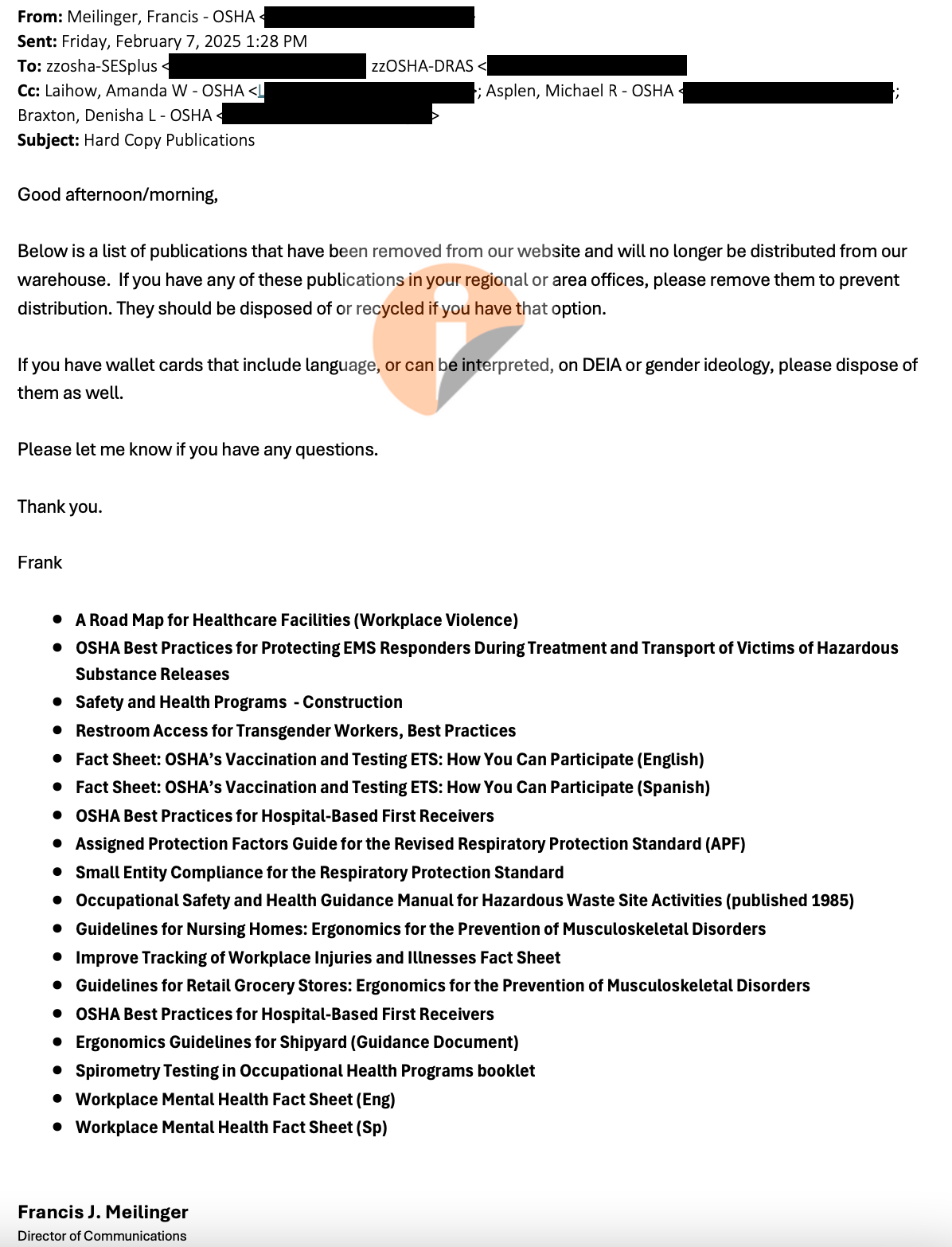
The Trump administration has reportedly destroyed 18 workplace safety publications as part of a broader attack on diversity initiatives, a development that is largely in line with recommendations made by the sprawling and unpopular presidential transition plan known as Project 2025.
According to Popular Information, 17 of the destroyed workplace guidelines — issued by the Occupational Safety and Health Administration — appeared to have nothing to do with diversity, equity, inclusion, and accessibility programs and instead seem to have been selected because “they include a DEIA-related keyword used in a completely different context.” OSHA is part of the Labor Department and is tasked with making sure U.S. workers “have safe and healthful working conditions free from unlawful retaliation,” according to its official website.
The Trump administration has been targeting diversity programs across the federal government, in some instances using the existence of DEI efforts as a justification for essentially shuttering entire agencies, as in the case of the U.S. Agency for International Development.
The administration’s anti-DEI approach mirrors recommendations made in Project 2025’s nearly 900-page policy book, Mandate for Leadership, which called for the elimination of federal DEI programs and for the Department of Justice to investigate private sector programs that promote diversity.
In addition to its direct attacks on DEI, Project 2025 — organized by The Heritage Foundation in collaboration with more than 100 partner groups — proposed drastic rollbacks of labor laws, including dismantling overtime regulations and creating exemptions to the National Labor Relations Act, which protects workers’ rights to collectively bargain and to form a union.
Although the Trump administration’s memo calling for the 18 safety guidelines to be “disposed of or recycled” appears to be a hamfisted and failed attempt to root out DEI programs, it nevertheless fits in with Mandate’s broader approach to dismantling worker protections.
For example, Mandate recommends carve outs to OSHA’s workplace safety regulations, calling on Congress and the Department of Labor to “exempt small business, first-time, non-willful violators from fines issued by the Occupational Safety and Health Administration.”
Mandate further argues that “national employment laws,” like the Occupational Safety and Health Act of 1970, “set out one-size-fits-all ‘floors’ regulating the employment relationship,” and that the protections the law provides could instead be “treated as negotiable defaults rather than non-negotiable floors.” If enacted, this recommendation could allow employers to use safety measures as leverage in contract negotiations, thus increasing the already stark asymmetry in power between workers and bosses. And U.S. workplaces are already deadly; according to the AFL-CIO, in 2022: “344 workers died each day from hazardous working conditions,” and “5,486 workers were killed on the job in the United States.”
The final chapter in Mandate calls on the president to order Cabinet secretaries to “rein in agencies such as the Occupational Safety and Health Administration, which the Biden Administration weaponized to attempt to force COVID-19 vaccine mandates on 84 million Americans through their workplaces.”
That demand built on previous work from The Heritage Foundation, which sued the Biden administration over its Covid-19 workplace vaccine mandate. After the Supreme Court blocked the mandate, Heritage President Kevin Roberts celebrated the decision on former Trump lawyer Jay Sekulow’s radio show. Sekulow is also chief counsel at the American Center for Law and Justice, whose advocacy arm is a partner in Project 2025.
“When it comes to putting government back in the box, it is a series of battles,” Roberts said. “We have won one battle, but we have not won the political and policy war.”
Video
Citation
From the January 14, 2022, edition of Sekulow, streamed on YouTube
Whether the administration adopts the anti-working class OSHA policies in Mandate remains to be seen, but Trump’s pick to head the agency — former Amazon and UPS executive David Keeling — strongly suggests it’s possible. As The New Republic reported, Keeling’s recent job history does not bode well for worker safety:
Both of those companies have been cited for various workplace safety violations by the very agency Keeling is set to control, if confirmed by the Senate. In 2019, OSHA cited UPS for forcing its drivers to work in “excessive heat” with no air conditioning. That same year, UPS was also cited for fire hazards at packaging facilities. Amazon has been cited numerous times for the dangerous, high-pressure environments in its warehouses, as well as the long hours its employees are forced to spend in them. Just last year, Amazon paid a $145,000 settlement over OSHA violations.
Keeling worked as director of safety compliance for UPS from 2011 to 2018 before serving as the vice president of global health and safety from 2018 to 2021, overlapping with OSHA’s 2019 safety citations. The same can be said for Amazon, where he worked from 2021 to 2023—a time when Amazon had one of the highest warehouse injury rates in the country.
Keeling’s nomination hearing has not yet been scheduled, but elsewhere the Trump administration is already waging war on the working class. His pick as general counsel for the National Labor Relations Board just rolled back several major Biden administration policies, including protections for student athletes who want to unionize and guidance that determined most non-compete agreements violate federal labor law.
Many of the Trump administration’s opening salvos against the working class have followed the Project 2025 roadmap and targeted DEI programs. These measures are already making workers’ positions more precarious and less safe, just as Project 2025 recommended.
===
---
08.02.24 - 1:00pm
Scorched States, Where Heat Kills Workers / Media and Immigration Narratives
first half of the show, cohost Eleanor Goldfield speaks with Juley Fulcher — attorney and worker health and safety advocate for Public Citizen’s Congress watch division — about her recent report, Scorched States, an expose of the inadequate or wholly lacking protections for workers facing extreme heat in the age of climate chaos. Juley describes the legislative morass standing in the way of workers’ rights and how states like Florida and Texas have actually made it illegal to protect workers.
---
ref
Scorched States - Public Citizen
Key Findings
- As many as 2,000 workers die and 170,000 workers are injured from laboring in extreme heat every year in the United States.
- Worker heat-stress tragedies disproportionately strike workers who are poor, Black and Brown.
- Every workplace illness, injury and fatality caused by heat stress is avoidable, and relatively simple preventative measures – water, shade and breaks — have proven extremely effective at protecting workers.
- The federal government has failed to issue rules to protect workers from excessive heat, although the Occupational Safety and Health Administration is working on a heat standard. That new rule is not expected to be finalized until 2026 or beyond.
- A handful of states have taken action where the federal government has failed. California, Oregon, Washington, Colorado, and Minnesota have issued heat stress standards.
- Maryland OSHA has made substantial progress in developing an indoor/outdoor heat standard and, despite recent hiccups, California has also made good progress in developing an indoor heat standard. Both states could issue standards within a few months.
- Most states have failed to act to protect workers, even as the climate crisis worsens and summer heat records are repeatedly shattered around the country.
- The Texas and Florida state legislatures have blocked efforts by local governments to protect workers from heat stress.
- Climate change is dramatically increasing workplace heat stress dangers — supercharging longer summers, more record-breaking extreme heat days, and intransigent heat domes that create longer and hotter heat waves reaching every corner of the country.
Introduction
Fifty million workers in the U.S. will face excruciating heat in the coming months. For some, that heat will be fatal.[[1]](https://www.citizen.org/article/scorched-states/#_ftn1)
The right to a safe workplace is a basic human right.[[2]](https://www.citizen.org/article/scorched-states/#_ftn2) Exposure to excessive heat is one of the most dangerous problems facing workers today. Tens of thousands of workers suffer heat illnesses, injuries and fatalities every year in the U.S.
The toll of unaddressed workplace heat stress on workers’ lives and well-being is immeasurable. This is a toll disproportionately borne by Black and Brown workers, and low-income workers with limited options for safer employment.[[3]](https://www.citizen.org/article/scorched-states/#_ftn3) Latino workers are three times more likely to die of heat stress.[[4]](https://www.citizen.org/article/scorched-states/#_ftn4) Latinos make up a third of construction workers and 75% of farmworkers in the U.S.,[[5]](https://www.citizen.org/article/scorched-states/#_ftn5) the two jobs with the highest rate of heat fatalities.[[6]](https://www.citizen.org/article/scorched-states/#_ftn6)
The failure of employers to protect employees from workplace heat stress is costing the U.S. economy nearly $100 billion every year.[[7]](https://www.citizen.org/article/scorched-states/#_ftn7) Employers are losing money in reduced productivity, absenteeism, overtime costs, repair or replacement of equipment vehicles and property due to accidents, increased workers’ compensation premiums, lawsuits for negligence, and loss of reputation and goodwill.[[8]](https://www.citizen.org/article/scorched-states/#_ftn8)
Every workplace injury and fatality caused by heat stress is avoidable, and relatively simple preventative measures have proven extremely effective at protecting workers. It is both the social and legal responsibility of employers to create a work environment safe from heat hazards.
The Occupational Safety and Health Administration (OSHA) is responsible for protecting the safety and health of workers. The agency is tasked with promulgating rules to reduce hazards in the workplace, educating employers and holding employers accountable when they fail to put appropriate safety measures in place.
Fifty years ago, the National Institute for Occupational Safety and Health (NIOSH) studied the effects of heat stress on workers and recommended that OSHA adopt an occupational heat standard. Though efforts are underway to do so, we are still years away from seeing a federal heat standard.
A handful of state and local governments have stepped in to create protections from heat stress for their workers. As policymakers look to the guidance provided by NIOSH and experts in occupational hygiene, the state standards bear many similarities but differ in key ways. The standards vary in the industries regulated and the details of protocols employers are required to put in place to protect workers.
Background
Despite the horrifying images of ever more brutal hurricanes, tornadoes and floods we frequently see in the news, extreme heat is the leading weather-related killer.[[9]](https://www.citizen.org/article/scorched-states/#_ftn9) Globally, nearly half a million people die each year because of extreme heat.[[10]](https://www.citizen.org/article/scorched-states/#_ftn10) The problem is rapidly intensifying. The last 10 years have been the hottest on record, with 2023 surpassing them all.[[11]](https://www.citizen.org/article/scorched-states/#_ftn11) The northern hemisphere experienced its hottest summer in 2,000 years.[[12]](https://www.citizen.org/article/scorched-states/#_ftn12)
Recent decades have been the warmest in the last 150 centuries in the U.S.[[13]](https://www.citizen.org/article/scorched-states/#_ftn13) Record-setting termperatures and heat waves are becoming the new norm.[[14]](https://www.citizen.org/article/scorched-states/#_ftn14) Extreme temperatures in the contiguous U.S. are expected to increase faster than temperature averages.[[15]](https://www.citizen.org/article/scorched-states/#_ftn15)
The summer of 2023 saw the thermometer top out at eye-popping temperatures throughout much of the U.S. Hundreds of millions of people across the nation saw triple digit temperatures.[[16]](https://www.citizen.org/article/scorched-states/#_ftn16) Intransigent heat domes sat over large swaths of the country all summer, causing brutal heat waves that lasted for weeks. The extraordinary heat that blanketed the U.S. set nearly 10,600 daytime high temperature records between May 1, 2023 and September 30, 2023, as well as more than 13,400 records for highest overnight minimum temperatures,[[17]](https://www.citizen.org/article/scorched-states/#_ftn17) the meteorological defining factor for heat waves.[[18]](https://www.citizen.org/article/scorched-states/#_ftn18)
After experiencing the warmest winter on record,[[19]](https://www.citizen.org/article/scorched-states/#_ftn19) the summer of 2024 is again expected to see far hotter temperatures than average[[20]](https://www.citizen.org/article/scorched-states/#_ftn20) and significant heat waves throughout the U.S.[[21]](https://www.citizen.org/article/scorched-states/#_ftn21) While the sizzling heat was felt the worst in the southern Plains, the Southeast and the West Coast last summer,[[22]](https://www.citizen.org/article/scorched-states/#_ftn22) the relentless heat is predicted to impose a particularly high toll on the Great Lakes, Upper Midwest and Northeast in the summer of 2024.[[23]](https://www.citizen.org/article/scorched-states/#_ftn23) The extreme outdoor heat will be accompanied by challenges in keeping indoor temperatures safe. The hot sun roasts buildings made with materials that absorb heat and lack proper cooling systems, causing indoor temperatures to swell beyond the outdoor temperature.
The human body has a complex regulatory system designed to keep our core temperature about 98.6 degrees. Heat stress refers to strain on that system as it tries to keep the body cool. Heat stress is a function of internally generated heat (metabolic heat), external environmental heat and other factors that reduce the effectiveness of our natural bodily cooling systems. The ambient temperature and radiant heat sources like direct sunlight and heat-generating machinery add to heat stress.[[24]](https://www.citizen.org/article/scorched-states/#_ftn24)
Metabolic heat production increases as workload increases. Sweat is produced so that the process of evaporation can release body heat and blood is pumped to the surface of the skin to be cooled by the surrounding air. However, high humidity reduces the evaporation of sweat and high environmental temperatures introduce more heat into the blood at the surface of the skin.
As the body’s natural thermoregulatory systems strain to keep the body cool, heat-related illness can occur. Heat illnesses range in severity from mild heat rash to more severe illnesses such as rhabdomyolysis, acute kidney injury, heat stroke and heat-stress induced cardiac arrest. Workers who survive these more critical heat-related illnesses are often burdened with long term health effects, including muscle damage, organ damage and chronic kidney disease. Excessive heat in the workplace can also exacerbate existing chronic conditions like diabetes, kidney disease, COPD and cardiac disease, complicating the health care of these workers and potentially shaving years off their lives.
The symptoms of heat-related illnesses include heavy sweating, fatigue, nausea, headache, loss of balance and cognitive function, fainting, muscle cramps, and more. These symptoms can easily lead to accidents with a range of consequences to one or more people, including injuries, long-term disabilities or even fatalities.
Federal Efforts to Issue a Protective Heat Standard
In 1970, Congress passed the Occupational Safety and Health Act (OSH Act),[[25]](https://www.citizen.org/article/scorched-states/#_ftn25) a clear declaration that our national workforce deserves a safe and healthy workplace. Signed into law by President Richard Nixon, the OSH Act created the Occupational Safety and Health Administration (OSHA) with a directive to issue and enforce workplace safety standards. However, both OSHA and the Act that created it were seen as highly contentious by industry from the start.[[26]](https://www.citizen.org/article/scorched-states/#_ftn26)
Under corporate pressure, the goals of the OSH Act have been undermined in both Republican and Democratic administrations.[[27]](https://www.citizen.org/article/scorched-states/#_ftn27) Each effort by OSHA to create a new standard has been met by cries that regulating the hazard would cripple entire industries. Despite the fact that no industry has crumbled in the face of new safety requirements, the process of developing standards has become more arduous over the years.
OSHA issued nearly 50 standards in its first three decades addressing a wide range of dangers in the workplace — toxic chemicals, hazardous waste, asbestos, blood-borne pathogens, falls from roofs and scaffolding, industrial accidents, and noise.[[28]](https://www.citizen.org/article/scorched-states/#_ftn28) An increasing number of procedural requirements have been imposed by statutes and executive orders since 1980. Combined with institutional apprehension in setting standards following adverse court decisions, the number of standards finalized has dropped dramatically since 2000 and the average time needed to develop a standard currently stands at seven to eight years.[[29]](https://www.citizen.org/article/scorched-states/#_ftn29)
In 2021, the Biden administration initiated the rulemaking process on a standard to prevent heat-related illnesses, injuries and fatalities in both indoor and outdoor workers. OSHA has worked diligently to complete each step in the process and will hopefully be able to issue a proposed rule in the coming months. A change in the political winds could derail further progress on development of the standard. But even if the process remains on track, a finalized federal occupational heat standard is likely still a couple of years away.
Comparison of State Heat Standards...
Local Efforts to Protect Workers
In states without occupational heat standards, some local governments have tried to create ordinances to protect workers from heat stress. However, strong lobbying by corporate interests has blocked those efforts, turning life-saving worker protections into a political tug-of-war. Espousing the goal of creating consistent statewide policy, Republican-controlled state legislatures have passed aggressive preemption laws that have steam-rolled efforts by local governments to protect workers.[[79]](https://www.citizen.org/article/scorched-states/#_ftn79)
Texas
Texas is one of the hottest states in the country and the impact of heat on workers there is undeniable. For example, data from the Houston Health Department on ER admissions for heat-related illness in 2022 showed that 58% of the illnesses occurred while working and the patients were largely construction workers, warehouse workers, and firefighters.[[80]](https://www.citizen.org/article/scorched-states/#_ftn80)
The cities of Austin and Dallas attempted to address the dangerous conditions facing construction workers. They passed ordinances requiring that construction workers to be given 10-minute water breaks every four hours.
:{:{But in July of 2023 Governor Greg Abbott signed HB 2127, the sweeping “Death Star Law,” which bars local governments from issuing regulations across a wide range of categories without approval from the Texas Legislature, including labor regulations}:.[[81]](https://www.citizen.org/article/scorched-states/#_ftn81)
The legislation went as far as specifically preempting rules on rest breaks. In a legal challenge to the new law brought by Houston, El Paso and San Antonio, Travis County Civil District Court Judge Maya Guerra Gamble blocked the Death Star law as unconstitutionally vague under the Texas Constitution.[[82]](https://www.citizen.org/article/scorched-states/#_ftn82)
The Texas Attorney General Ken Paxton immediately appealed the ruling and the Appellate Court temporarily suspended Judge Gamble’s ruling, allowing the law to go into effect on September 1, 2023, as planned.[[83]](https://www.citizen.org/article/scorched-states/#_ftn83) It may be 2025 before the Texas Supreme Court issues a final ruling on the statute.[[84]](https://www.citizen.org/article/scorched-states/#_ftn84)}:
Florida
For 46 straight days in 2023 Miami’s heat index exceeded 100°F.[[85]](https://www.citizen.org/article/scorched-states/#_ftn85)
In March of 2024, Miami-Dade County was just weeks away from instituting employer requirements to protect workers from heat-related illnesses, injuries and fatalities. In a preemptive strike, fueled by the the Florida Chamber of Commerce and the powerful agriculture and construction lobbies,[[86]](https://www.citizen.org/article/scorched-states/#_ftn86) Florida lawmakers passed HB 433[[87]](https://www.citizen.org/article/scorched-states/#_ftn87) to prevent it from happening. Taking a page from the Texas Death Star Law, the legislation prohibits local governments from instituting protections for workers. However, the Florida law is much more narrowly targeted.[[88]](https://www.citizen.org/article/scorched-states/#_ftn88)
Instead of prohibiting local governments from instituting a wide range of regulations, the cruel Florida law very specifically attacks heat stress protections. It details a list of prohibited workplace requirements — basic protocols to prevent heat stress including hydration, rest breaks, acclimatization, and any form of training for workers about the dangers of heat illness and how to prevent it. It even prohibits requirements for employers to have the first aid and emergency response protocols necessary to save lives. Finally, the law undermined all pretext of maintaining consistent requirements for employers throughout the state by prohibiting the state government from passing workplace heat stress protections for the next two years.
The law is expected to impact nearly 1.8 million Florida workers, having a disproportionate impact on Latino and undocumented immigrant workers.[[89]](https://www.citizen.org/article/scorched-states/#_ftn89) In Florida, 40% of outdoor workers are Latino, whereas Latinos make up only 30% of the total workforce in the state. While undocumented immigrants make up only 12% of the Florida workforce, they make up 22% of outdoor workers.[[90]](https://www.citizen.org/article/scorched-states/#_ftn90) This pattern of heightened exposure to heat stress is broadly reflected in the national outdoor workforce.
Phoenix, Arizona
For millions in the American South and Southwest, intense heat waves lasted for weeks in the summer of 2023. Phoenix, Arizona experienced a record-setting 31 consecutive days above 110°F[[91]](https://www.citizen.org/article/scorched-states/#_ftn91) with only a brief intermission — two days with highs of 108°F and
109°F — before suffering through another week surpassing the 110°F mark again.[[92]](https://www.citizen.org/article/scorched-states/#_ftn92) The scorching Phoenix daytime highs were accompanied by 16 consecutive days when overnight lows didn’t sink below 90°F.
:{:{On March 26, 2024, the Phoenix City Council passed an ordinance to protect all outdoor workers of city contractors and subcontractors from heat stress.[[93]](https://www.citizen.org/article/scorched-states/#_ftn93) The definition of outdoor work environments is work conducted on city-owned, city-leased or city-licensed outdoor property and includes greenhouses, sheds, tents, and jet bridges to aircrafts.[[94]](https://www.citizen.org/article/scorched-states/#_ftn94)}:
The ordinance requires employers to provide — (1) regular breaks and necessary breaks as needed in the shade or air-conditioning; (2) free, accessible and cool drinking water; (3) air-conditioning in vehicles by May 1, 2025; (4) effective acclimatization for newly assigned or reassigned to outdoor workers.[[95]](https://www.citizen.org/article/scorched-states/#_ftn95) And it requires detailed comprehensive training for all employees and contract workers with required elements similar to those found in the Washington heat standard.[[96]](https://www.citizen.org/article/scorched-states/#_ftn96) Failure to comply with the requirements of the Phoenix heat standard could result in cancellation or suspension of the contract.[[97]](https://www.citizen.org/article/scorched-states/#_ftn97)}:
Conclusion
Protection from occupational heat illness, injury and death is a matter of human rights and social justice.[[98]](https://www.citizen.org/article/scorched-states/#_ftn98) While some jobs are inherently dangerous, no one should be unnecessarily risking their lives or health to go to work each day. Employers have a responsibility to create a safe workspace.
The five U.S. states that have heat stress standards in place —1/10th of all states — have taken a positive step to protecting workers in their states. Unfortunately, this patchwork of rules is inadequate — leaving the vast majority of workers in the U.S. without any protection from dangerously high heat on the job. Until a federal OSHA heat standard is issued, these workers can only hope to have a benevolent employer who is dedicated to learning about how to protect workers from heat stress and committed to implementing a thorough, well-considered set of protection protocols.
Where no state workplace heat stress standards are in place, a few local communities have tried to provide protections for workers in their jurisdictions. Unfortunately, the business lobby in Texas and Florida has been very effective at quashing these local efforts through the use of preemption laws that prevent local jurisdictions from putting regulations in place that are stronger than state regulations on heat stress. Preemption laws “take power away from communities to appease corporations,“ said Katie Bellinger of the Local Solutions Support Center.
Congress could act today to protect all workers in this country by passing the Asunción Valdivia Heat Illness, Injury and Fatality Prevention Act of 2023 (S.2501/H.R.4897), which would direct OSHA to implement an enforceable interim heat standard right now that would be in effect until a final federal OSHA standard is issued. The bill has the support of the Heat Stress Network — more than 100 workers rights organizations, unions, occupational health groups and experts, climate change organizations, and faith-based organizations — representing millions of workers across the country.[[99]](https://www.citizen.org/article/scorched-states/#_ftn99) Additionally, the Attorneys General of 10 states and the District of Columbia have called upon congress to pass the bill: New York, Connecticut, Illinois, Maryland, Arizona, Colorado, Maine, Massachusetts, New Jersey, Pennsylvania, and the District of Columbia.[[100]](https://www.citizen.org/article/scorched-states/#_ftn100) Despite nearly 100 cosponsors in the U.S. House and 25 cosponsors in the U.S. Senate, the bipartisan bill currently languishes in congressional committees.[[101]](https://www.citizen.org/article/scorched-states/#_ftn101)
Workers lives are at stake.
The federal and state OSHAs have a responsibility to hold employers accountable for workplace safety. And we, as a society, have a responsibility to workers to ensure that they are able to safely make a living and support their families. It is far past time for the federal government to step up and protect workers before what will be the hottest summer of our lives.[[102]](https://www.citizen.org/article/scorched-states/#_ftn102) Congress must immediately pass the Asuncíon Valdivia Heat Illness, Injury and Fatality Prevention Act of 2023. Yet it would be foolish to place hope in a dysfunctional Congress. States have an equal obligation to protect their workers and the 45 states and District of Columbia that have not yet done so should follow the example of the five that have.
===
---
OSHA clarence an 7 24 ah
Inside Clarence Thomas’ new legal target: 'It’s unconstitutional' - Alternet.org
When the U.S. Supreme Court handed down its controversial ruling in Loper Bright Enterprises v. Raimondo on June 28, it overturned a decision that had been the law of the land for 40 years: Chevron U.S.A., Inc. v. Natural Resources Defense Council, Inc.
That landmark 1984 decision established what was known as "Chevron deference," which said that judges and courts should defer to the expertise of officials at federal regulatory agencies. Critics of the June 28 ruling argue that it seriously undermines the ability of government agencies to regulate everything from clean water and air quality to health care.
According to Business Insider, one agency that Justice Clarence Thomas is hoping to see abolished is the Occupational Safety and Health Administration (OSHA).
READ MORE: SCOTUS limits government agencies in bombshell decision with sweeping implications
Business Insider's Grace Eliza Goodwin reports, "The Supreme Court, on Tuesday, (July 2), announced which cases it would consider next and which it wouldn't. Among those the Court rejected was a case that challenged the authority of OSHA, which sets and enforces standards for health and safety in the workplace. And Thomas, widely considered to be the most conservative justice on the already-mostly conservative Court, wasn't happy."
Goodwin adds, "In a dissent, he explained why he believed the High Court should've taken the case: OSHA's power, he argues, is unconstitutional."
Thomas wrote, "Congress purported to empower an administrative agency to impose whatever workplace-safety standards it deems 'appropriate.' That power extends to virtually every business in the United States."
Goodwin notes that the 6th Circuit Court of Appeals "upheld OSHA's constitutionality" in 2023.
READ MORE:[Conservative warns Dems to get it together and confront Trump's 'true menace'
*Business Insider's full report is available at this link.
===
-----
---
===
no lnx
Republicans have a death wish for us all
Greg Abbott’s 'gullibility' exposed after he shares 'fake' story about made-up Texas city
Sabrina Haake, Raw StoryJune 09, 2024
In the 1850s, British naturalist Charles Darwin proposed the theory of evolution by natural selection. In his book, On the Origin of Species, Darwin presented years of data, notations he’d made while observing plants and animals in their natural habitats.
Over decades of painstaking observation, Darwin discovered that organisms with traits that favor survival tend to leave more offspring, causing survivalist traits to increase in frequency over time among successful species. In a word, Darwin concluded, successful survival of all living organisms requires them to adapt.
Species that fail to adapt? They go extinct, some more rapidly than others.
We are approaching unsurvivable temperatures
Last year was the hottest of the past 170 years, which is when meteorologists first began tracking global temperatures. According to NASA, the 10 warmest years since Darwin’s 1850s have all occurred during the last decade, with the same predicted for 2024.
Dead monkeys are falling out of trees in Mexico. Other primates are dying, along with toucans, parrots, insects, bats and one million other species. Animals are dying from heat and dehydration at such alarming rates that even Fox News has reported on it — though they have not yet found a way to blame President Joe Biden or the border.
ALSO READ: Justice delayed is not always justice denied
Last week, avoiding the words “climate change,” Fox News quoted thedirector of an eco-conservation park in Mexico saying they’d “never seen a situation like what’s happening right now.” The conservation park resuscitates and rehydrates dying animals for re-release into the wild, but if heat like this continues, the director predicted, “there is not going to be much we can do for the animals.”
As animals go, so go we
Scientists at Massachusetts Institute of Technology report that a “wet-bulb” temperature of 95° F — a measure that considers both heat and humidity — is the absolute limit of human survival. The human body temperature is around 98° F, allowing for a constant balance between heat loss and heat gain. But there’s a temperature/humidity point at which the human body can’t lose heat fast enough. At that point, everything in the body, from enzymes to organs, including kidneys, lungs, heart and brain, begins to shut down.
According to MIT, a sunny area with 50 percent humidity and no wind will hit an unlivable wet-bulb temperature of 95°F when the thermometer reaches only 109 °F.
Last year, temperatures in many U.S. cities, especially in Texas, Florida and Arizona, repeatedly exceeded 109 °F, to say nothing of newly uninhabitable regions in Mexico, Asia, the Middle East and Africa.
Many U.S. cities will again surpass 109 °F this year, causing heat-related deaths and illness. Between 2004 and 2021, the Centers for Disease Control and Prevention reports, heat-related deaths in the U.S. increased by a whopping 439 percent.
Oil-funded Republicans refuse to adapt
No serious debate remains about what is causing the climate to change. Scientists have known, for decades, that this point was coming. We have the technology to reduce carbon emissions and re-develop an energy grid with sufficient capacity; engineers and scientists calculated years ago that there’s more than enough wind, solar and hydro power to meet the needs of all people — and manufacturers — on earth.
ALSO READ: Michael Cohen, Red Finch and the fateful moment Trump lost the jury
The intelligent adaptation to dead animals falling from the sky would be a transition to renewable energy as quickly as practicable, blending a graduated mix of alternative fuels with decreasing reliance on petrofuels.
But instead of modeling Darwin’s survival of the fittest and adapting new energy strategies, Republican governors of southern states — states experiencing climate change at accelerated rates — are modeling what happens when species refuse to adapt.
Emboldened by former President Donald Trump, these strutting dodo birds are attacking climate science while at the same time seeking extraordinary federal funding for climate mitigation. (President Biden: awarding climate mitigation funds to governors who lie about climate science is self-defeating.)
Darwinism on display
In Florida this spring, cities such as Miami were hit with extreme heat even before the arrival of summer.
Republican Gov. Ron DeSantis, addicted to culture wars and language bans, just signed a law that removes the words “climate change” from state publications, forbids the construction of offshore windmills and halts the state’s clean energy goals.
To DeSantis, people concerned about climate change are “radical green zealots.” Meanwhile, his state’s beloved manatees are disappearing, storm-battered Floridians can’t afford property insurance and buildings are collapsing in coastal cities.
In Texas, another of the most threatened U.S. states when it comes to sea level rise, hurricanes and extreme heat, Republican Gov. Greg Abbott refers to Biden’s climate efforts as “an attack” on Texas jobs, and he vowed to “fight” the “climate agenda.”
Even though Texas has ranked first in the number of billion-dollar disasters per year since 2001, Abbott has vowed to “exclude renewables from any revived economic incentive program,” and he supported bills to lower support for wind and solar projects while forcing renewable energy to subsidize fossil fuel expansion.
Livestock farming, a major methane contributor, creates deplorable lives for the animals while simultaneously warming the planet. There are humane solutions that could alleviate both problems. What are Republican governors doing? They are banning or trying to ban cruelty-free meat produced in a lab — dictating to everyone else what they can and cannot eat, and effectively mandating animal cruelty and methane emissions at the same time.
The list of GOP maladaptions goes on. Republican leaders are attacking science overall, while on a parallel crusade to delegitimize truth, the rule of law and democratic institutions. They’re turning American ignorance into a malignant tumor hellbent on killing its host.
DeSantis and Abbott deserve Darwin Awards
DeSantis and Abbott, along with Republican attorneys general in 19 states who just asked the U.S. Supreme Court to block climate action, are entertaining know-nothing voters, attacking climate science frontstage and collecting donations from Koch Industries’ backstage. It’s all performative ignorance, like watching Cro-Magnon men show up at a ballet, dragging women by the hair.
The unfortunate twist is that, as long as we share the same planet, the Cro-Magnon is dragging all of us by our hair.
Darwin Awards commemorate idiots who protect our gene pool by dying in an extraordinarily idiotic manner, thereby improving our species’ chances of long-term survival.
We need a parallel award when the most ignorant members of a species doom the rest of it.
Sabrina Haake is a columnist and 25 year litigator specializing in 1st and 14th Amendment defense. Her Substack, The Haake Take, is free.
===
---
Florida GOP wants to block heat protection for workers. Good thing it's never hot there
kos jan 2024
fresh off of trying to replaceeducation with child labor, Florida Republicans have another bright idea that’s sure to improve conditions for workers in the Sunshine State. They’re out to ensure that workers don’t have any right to protection when toiling outdoors in the heat.
A bill is advancing through the Florida Senate that would prohibit local officials from passing regulations that would provide heat protection for outdoor workers. Authored by state Sen. Jay Trumbull, SB 1492 has already passed in the state House and cleared the first hurdles in the Senate Commerce and Tourism Committee.
Right now, there aren’t any such local ordinances. That Florida legislators are moving to outlaw something that doesn’t exist might seem odd, even for Florida. But last fall,Miami-Dade County *considered* passing such regulations. So state Republicans are working to beat them to the punch and prevent worker protections statewide—before they ever exist.
As the Florida Phoenix reported in November, Miami-Dade County could have been the first local government in the nation to pass regulations protecting outdoor workers from extreme heat. The ordinance first proposed last summer would have required that construction and agriculture workers have access to water and 10-minute breaks in the shade every two hours on days when the heat index exceeds 90 degrees. It would have also required employers to provide training on dealing with signs of heat-induced illness and calling for help in the case of an emergency.
That proposal was watered down after input from “industry groups.” The final version upped the temperature to 95 degrees. That may seem like a small difference, but as the Phoenix notes, “... over the past fifty years, Miami has had an average of just 4.1 days per year with a high temperature of 95 degrees. That’s compared to an average of 163 days per year when the heat index hits 90 degrees Fahrenheit, according to University of Miami climate researcher Brian McNoldy.”
But even after being stretched to the point where it would only require companies to provide workers with 10-minute shade breaks on the four hottest days of the year, the legislation failed to pass. As The Washington Post reported at the time, “No states in the South, where workplace heat deaths are most common, have created their own heat safety rules.”
The federal Occupational Safety and Health Administration provides voluntary heat safety rules, but doesn’t enforce them. Three states—California, Washington, and Oregon—have rules of their own. No other state or local government has passed rules to protect workers from extreme heat, even though heat waves have been increasing in both intensity and duration.
Legislation was being considered in Miami-Dade County because record heat in Florida resulted in the deaths of at least two farm workers in 2023. It was voted down by the Board of County Commissioners after industry lobbyists warned that the bill would be “creating a new government agency” (which it didn’t) and imposing “duplicative regulations” (even though no current regulations exist).
The proposed bill preventing local governments from passing regulations to protect workers from extreme heat is just one of several ways the Republican-dominated Florida Legislature has been stripping local power. WLRN Public Radio in South Florida calls it the “systemic draining of local control” and warns that it’s about both politics and money.
The state legislature has passed laws to overturn local ordinances designed to address the climate crisis, overturned efforts to boost clean energy, and created a bill that allows businesses to sue if any local government passes regulations that have “adverse impacts on their companies,” even if that ordinance has overwhelming local support.
Why are Republicans so set on passing sweeping laws at the state level rather than letting local governments do what they have always done? In a word: lobbyists.
Lobbyists find it much more convenient to deal with legislators at the state level rather than work with county or local officials. Thanks to the wide variety of preemption laws passed by Florida Republicans, lobbyists can hunker down in Tallahassee and not have to worry about sitting in boring meetings around the state. In return, Florida legislators get all the perks (read: donations) of being on a short leash for those lobbyists. In the case of this bill, that includes lobbyists for Associated Industries of Florida and Duke Energy. Presumably, Duke is worried it might have to allow its line workers to get out of the sun and rest for a few minutes while dealing with high-voltage lines.
So, there is no legislation to help protect workers from the heat in South Florida—and if Florida Republicans get their bill passed, there never will be.
Because 10 minutes in the shade every two hours on the four hottest days of the year is just asking for too much. Heat-related deaths are only up 95%, and when this set of workers is dead, they can always be replaced by kids.
---
April 24, 2009, / Source: The Associated Press
Three officials at a now-defunct farm labor contractor were charged Thursday with involuntary manslaughter in the death of a pregnant teenager who collapsed from heat stroke after working in a sweltering vineyard last year.
San Joaquin County District Attorney James Willett announced the charges in the death of 17-year-old Maria Vasquez Jimenez, who authorities say died May 14 because she lacked access to shade and water as she pruned grapevines for more than nine hours in nearly triple-digit heat.
Maria De Los Angeles Colunga, the former owner of Merced Farm Labor; Elias Armenta, the former safety director; and Raul Martinez, a former supervisor, also were charged with one felony and five misdemeanor violations of the state labor code.
The company's civil attorney, Jim Gumberg, said the charges were "very unfortunate." A criminal attorney for the three did not immediately return calls seeking comment.
Gov. Arnold Schwarzenegger applauded the charges, saying: "Worker safety from heat illness must and will be protected in California." The state in 2005 implemented the country's first heat-illness standard, requiring that farms and contractors give workers water and breaks, have shade available and have emergency plans in place.
Vasquez Jimenez was born in Mexico's Sierra Madre range and migrated to California's Central Valley last year to look for work and live with her fiance.
The couple found jobs pruning grapes in a Stockton-area vineyard owned by West Coast Grape Farming Inc., which had a contract with Merced Farm Labor for its work force.
After she collapsed, her fiance, Florentino Bautista, said Vasquez Jimenez's supervisor recommended she rest in a hot van and be revived with rubbing alcohol before Bautista could take her to a medical clinic, almost two hours later. Doctors later realized she was two months pregnant.
Relatives said she was making $8 per hour that day on a 9.5-hour shift — more than four hours over the state limit for minors working during business days.
Family hopes for safer labor conditions
On Thursday, Vasquez Jimenez's aunt said she hoped the charges would encourage safer labor conditions on farms.
---
poison pill
guk ref 2
no lnx
ENVIRONMENT
JUL 25, 2023
Amid Heat Wave, GOP Adds Climate Denial To Spending Bills
House Republicans are helping their fossil fuel donors with legislative fine print that would block climate action.
Matthew Cunningham-Cook
David Sirota
House Appropriations Committee Chair Kay Granger, R-Texas, speaks with House Rules Committee Chairman Rep. Tom Cole, R-Okla.. (AP Photo/J. Scott Applewhite)
As scientists warn of a mass extinction and ecological tipping points, congressional Republicans are helping their fossil fuel industry donors by quietly inserting provisions into annual spending bills designed to bar the American government from combating and researching climate change, according to the fine print of legislative text reviewed by The Lever. Some provisions also require the leasing of federal lands and waters for oil and gas development, while potentially limiting such leases for wind power.
In all, Republican leaders have added at least a dozen such environmental provisions to four annual government spending bills as property damage and death tolls mount from historic heat waves, floods, and wildfires.
By adding the provisions to annual must-pass spending bills, Republicans who control the U.S. House are attempting to force Senate Democrats to choose between either accepting them or blocking the spending bills and shutting down the government.
For his part, President Joe Biden has declined to issue a climate emergency declaration, which could provide his administration new authority to circumvent at least some of the Republicans’ tactics.
The GOP bills are currently in the House Appropriations Committee, chaired by Texas RepublicanRep. Kay Granger, who has received nearly $1.2 million from the oil and gas sectorover the course of her career in Congress. Her second-largest career campaign contributor is the oil and gas industry, and she brags on her government website that she has fought to prevent spending to combat climate change.
Granger’s congressional district has been grappling with a heat-related public health crisis.
Blocking Fisheries Research As Oceans Boil
One of the most aggressive Republican climate provisions moving through Granger’s panel is buried in legislation funding the government’s science agencies. As waters around South Florida set records for the hottest ocean temperatures ever recorded, a line in the bill would bar the Biden administration from spending any money on “climate change fisheries research.”
The move comes just weeks after tens of thousands of dead fish washed ashore in Texas due to high temperatures in the Gulf of Mexico, following other recent mass die-offs in Australia. The Center for Biological Diversity notes that intensifying ocean acidification triggered by climate change “could disrupt the entire marine ecosystem.”
The subcommittee that originally authored the fisheries legislation is headed by Republican Rep. Hal Rogers,who hails from the coal-rich state of Kentucky and whose top career campaign contributors include donors from the mining and fossil fuel industries.
Rogers has raised more than half a million dollars from the mining industry over the course of his career, and $390,000 from the oil and gas industry, according to data from OpenSecrets. In the 2019-2020 cycle, Rogers’s campaign paid $66,000 to his wife Cynthia.
The science funding bill also zeroes out funding for the U.S. Global Change Research Program at the National Science Foundation, which coordinates research across the federal government “to understand the human-caused and natural processes that influence our planet,” and would additionally block the government from using any funds to carry out climate-related Biden executive orders.
The bill targets a Biden order issued in January 2021 that directed the federal government to use the procurement process, in which it acquires goods and services from the private sector, to mitigate carbon emissions as part of a broader federal effort to address climate change.
The order also specifically directed the Commerce Department to “to collect input from fishermen, regional ocean councils, fishery management councils, scientists, and other stakeholders on how to make fisheries and protected resources more resilient to climate change, including changes in management and conservation measures, and improvements in science, monitoring, and cooperative research.”
The GOP legislation also moves to defund a separate Biden order from April 2022 that sought to enhance the federal government’s forest stewardship and promote “climate-smart stewardship of mature and old-growth forests.”
Requiring Offshore Oil/Gas Leases, Slowing Wind Power Leases
The Republican spending bills contain several more efforts to undermine the Biden administration’s ability to meaningfully respond to the worsening global climate crisis.
That includes the bill authorizing funding for the Department of Interior, which oversees public lands. The legislation contains a provision mandating, “None of the funds made available by this act may be used to consider or incorporate thesocial cost of carbon.” The bill also permanently rescinds $1.3 billion in grant funding under the Clean Air Act to mitigate the effects of air pollution, as more than a quarter of all Americans now live in areas with dangerous levels of such pollution.
The Interior spending bill also includes provisions requiring “the Secretary of the Interior to conduct quarterly onshore oil and gas lease sales” as well as fossil fuel lease sales in the Gulf of Mexico, according to the bill report
At the same time, the legislation bars the government from issuing leases for offshore wind development in Florida until the completion of a study about windmills’ impact “on military readiness and training, marine environment and ecology, tourism, and other uses of the Outer Continental Shelf.”
The latter rider is in response to Florida Republican lawmakers’ complaint that “people travel from around the world to see our pristine beaches — not windmills.”
The Department of Interior funding bill has been spearheaded by Rep. Mike Simpson (R-Id.), who has received nearly $900,000 in campaign contributions from electric utility interests during the course of his career, as well as roughly $440,000 from oil and gas industry donors. In the last few years, climate-intensified wildfires have caused billions of damage in Simpson’s state.
Defunding Global Climate Investments
Then there’s the bill funding the Department of State and foreign aid. That legislation would bar funding for theGreen Climate Fund— one of the entities charged with fulfilling the mandates of the Paris Climate Accords — which received a $1 billion deposit from the Biden administration in April.
Likewise, the bill prohibits the federal government from financing the Clean Technology Fund, which helps developing countries transition away from dirtier energy sources, and also explicitly rejects the concept of climate reparations, decreeing that none of the funds may be used “to pay compensation to any country, organization, or individual for loss and damages attributed to climate change.”
The bill also prevents the funding of an August 2021 Department of Treasuring guidance calling on multilateral development banks like the International Monetary Fund and World Bank to limit financing of fossil fuel projects.
The State Department and foreign aid bill is being overseen by Rep. Mario Diaz-Balart (R-Fla.), who has received nearly $430,000 in campaign contributions from the energy and natural resources industry during his time in office. His district includes locales that a recent climate study said are among the most likely to soon be underwater due to rising ocean levels.
The House bill for funding the Securities and Exchange Commission (SEC), meanwhile, seeks to bar the agency’s proposed climate disclosure rule, which would mandate that publicly traded companies provide a full disclosure of their climate risks.
The subcommittee overseeing the SEC bill is headed by Rep. Steve Womack (R-Ark.) who has received more than $175,000 from oil and gas interests during his career. Womack’s home state has recently experienced deadly tornadoes and flash flood warnings.
Finally, the GOP bill funding the Department of Labor will maintain a ban from 1976 that has been reapproved annually under both Republican and Democratic control of Congress that bars the Occupational Safety and Health Administration (OSHA) from investigating deaths at farms that employ less than 10 people, including deaths related to extreme heat. (Due to mass automation in the agriculture industry, this exemption includes many farms that are quite large and profitable.)
While OSHA has yet to issue a standard governing excessive heat in the workplace, the agency is tasked with investigating deaths or injuries in cases of extreme heat. At least 436 people died from extreme heat on the job from 2011 to 2021, according to the Bureau of Labor Statistics.
The OSHA bill originated in a subcommittee headed byRep. Robert Aderholt (R-AL), whose top career campaign contributors include donors from agribusiness and the fossil fuel industry. Nearly a quarter of the Alabama labor force is outdoor workers, and the state recently experienced temperatures above 100 degrees.
The bills will now move to the full House for approval, and then the final bills must be negotiated with the Senate and passed again through both houses of Congress. If the provisions are kept in the text and Biden vetoes the spending bills, parts of the federal government could shut down.
---
My name is Greg Casar, and I represent Texas's 35th Congressional District. On Tuesday, I was in the sun on the Capitol steps all day without water or a break, in solidarity with workers in Texas and across the nation.
I held this thirst strike to push for federal heat safety protections for workers, which currently don’t exist. And I was joined by dozens of workers from Texas who have suffered from a lack of water breaks and respect at work, as well as by fantastic colleagues like Senator Bernie Sanders, Representative Alexandria Ocasio-Cortez, and Democratic Leader Hakeem Jeffries, among many others.
---
an 7 23
as the heatwave currently plaguing Texas prevails, San Antonio Mayor Mark Nirenberg's frustration with Texas state lawmakers grows, Politico reports.
According to Reuters, President Joe Biden recently "instructed the Department of Labor to ramp up enforcement of on-the-job heat hazards" in states like Texas "by increasing inspections at construction and agriculture sites, and to issue Hazard Alerts that inform employers of their responsibilities and employees of their rights during extreme heat."
Last month, Texas Public Radio (TPR) reported Texas Republican Governor Greg Abbott passed a bill — which opponents call the "Death Star Bill" — that "poses serious health risks" to construction workers, "bars cities and counties from passing regulations that are stricter than state ones," and "overturns local rules such as ordinances in Austin and Dallas that mandate rest breaks for construction workers."
READ MORE:Texas 'Death Star Bill' could leave construction workers 'fatigued, disoriented, dehydrated': report
Politico reports Nirenberg, on Sunday's segment of CBS' Face the Nation, said, "We're certainly grateful for a president now that's treating this heatwave with the urgency that I think is necessary. Especially given the fact that one of the challenges that we have is, cities in Texas are fighting our legislature and our state government for local control. We're trying to protect residents and workers, and they are doing everything they can to prevent that from happening."
The mayor emphasized, "What the announcement from President Biden will do is make sure that employers and employees know their rights, that there are protections in place also to ramp up enforcement activities through OSHA. But the reality of the legislation I mentioned is the fact that [House Bill] 2127, which was passed by the legislature, upends 70-plus years of local authorities that have been adopted through city constitution, city charters, in cities all across the state."
READ MORE: 'No end in sight' for massive heat wave plaguing Texas, New Mexico: NWS
Politico's full report is available at this link. Reuters' report is here (subscription required).
---