pollinator bee btrfly
==
primary 619
12/15. see neo nics
this includes gmo
---
gmail 5 25 entine
Video: John Stossel and GLP's Jon Entine on the faux bee-apocalypse—How ...
Genetic Literacy Project
“We're not facing a honeybee or insect apocalypse as so many activists claim and the media misreports,” says Jon Entine of the Genetic Literacy ...
---
ggl 5 25
[### Trump's EPA Said This Bee-Killing Insecticide Is Safe, Now ...

_Earthjustice_
https://earthjustice.org › press › pesticide-sulfoxaflor-be...](https://earthjustice.org/press/2019/pesticide-sulfoxaflor-beekeepers-sue-trump-epa)
Sep 6, 2019 — In 2016, EPA re-approved sulfoxaflor subject to significant restrictions to reduce the risk to honeybees and other pollinators. On July 12, 2019 ...
Missing: neo- nic
[### Trump EPA Used 'Emergency' Loophole to Approve ...

Center for Biological Diversity
https://biologicaldiversity.org › news › press-releases › t...](https://biologicaldiversity.org/w/news/press-releases/trump-epa-used-emergency-loophole-to-approve-pesticides-toxic-to-bees-on-16-million-acres-in-2019-2020-01-02/)
Jan 2, 2020 — Sulfoxaflor poses many of the same well-documented risks to pollinators as other neonicotinoids and is an emerging threat to imperiled ...
[### EPA Finds Neonics Are Risky Business—but Plans to ...

NRDC
https://www.nrdc.org › bio › lucas-rhoads › epa-finds-n...](https://www.nrdc.org/bio/lucas-rhoads/epa-finds-neonics-are-risky-business-plans-approve-anyway)
Jan 31, 2020 — The EPA should respond to this with real protections for pollinators and other wildlife, such as banning or heavily restricting dangerous neonic ...
[### Trump's Proposed Budget Imperils Pollinators

Center for Biological Diversity
https://biologicaldiversity.org › news › press-releases › t...](https://biologicaldiversity.org/w/news/press-releases/trumps-proposed-budget-imperils-pollinators-2025-05-16/)
May 16, 2025 — WASHINGTON— President Trump's proposed budget would end funding of research for America's bees coordinated by the U.S. Geological Survey Bee ...
Trump’s Proposed Budget Imperils Pollinators
Bee Lab Cuts Would Eliminate Essential Research
WASHINGTON— President Trump’s proposed budget would end funding of research for America’s bees coordinated by the U.S. Geological Survey Bee Lab. The budget proposal eliminates all $307 million in funding to the Ecosystem Management Area, a division within the USGS that funds biological research, including the Bee Lab.
The USGS Bee Lab is an interagency venture based out of Laurel, Maryland, that funds and conducts native bee research. It is the only agency in the federal government with the expertise to identify the more than 4,000 native bee species in the United States. It plays a vital role in protecting America’s imperiled pollinators.
“How can the administration make good on its promise to make America healthy again while cutting support for the bees that are essential to producing fruits and vegetables?” said Jess Tyler, a staff scientist at the Center for Biological Diversity. “As pollinator population declines get worse, we need to double down on research and protections for bees to ensure a healthy and affordable food supply.”
Native bees pollinate 75% of flowering plants, including fruit and vegetable crops that are important to a healthy diet. Through crop and wild plant pollination, native bees contribute $3 trillion to the global economy.
The Trump administration is following a proposal from Project 2025 to eliminate this program within the USGS. The administration states, “The budget eliminates programs that provide grants to universities, duplicate other federal research programs and focus on social agendas (e.g., climate change) to instead focus on achieving dominance in energy and critical minerals.”
“You can’t have an America first agenda if America can’t feed itself,” said Tyler. “I implore the Trump administration to reconsider its slashing of the Bee Lab’s budget. To ensure an abundant supply of food, we have to protect pollinators.”
[### Lawsuit Challenges Trump EPA's 200 Million-Acre ...

Center for Food Safety
https://www.centerforfoodsafety.org › press-releases › l...](https://www.centerforfoodsafety.org/press-releases/5696/lawsuit-challenges-trump-epas-200-million-acre-expansion-of-bee-killing-pesticide)
Aug 20, 2019 — Independent studies have shown that honeybees are less susceptible to the effects of pesticides than other pollinators, especially native ...
---
an 12 24
meta data ctr nix next to nuke plant b/c of end bee
---
==
ento soc am big ag $ conf 8 jrnls syngenta CCP?!
Are The Bees Okay? USDA Bee Colony Numbers Disputed | KPFA
on today’s show, award winning, investigative journalist Rebecca Raney of U. S. Right To Know on her latest reporting of the fudged numbers surrounding the nationwide bee population.
In her article entitled, “Are the Bees Okay or Not. USDA Bee Colony Numbers Disputed”, Rebecca Raney states:
“Beekeepers and honey producers are disputing a federal honeybee census estimate of 3.8 million colonies in the United States in 2022 – a record number for the nationwide count. That estimate showed a 35 percent increase from the estimate of 2.8 million colonies in 2017. The report drove headlines claiming that U.S. bee farms are “buzzing” and that bees are “flourishing again.”
rude awake
===
---
an comm dr no lnx 7 23
https://yyy.theguardian.com/environment/2023/jun/10/epa-pesticide-toxic-seeds-lawsuit-environment-pollution}:
https://www.commondreams.org/opinion/saving-bees-from-neonics
neonics are so dangerous, what is the Environmental Protection Agency doing about it? Not very much, as it turns out
I was reading about bumble bees recently—specifically, their looming demise, thanks to human greed and ignorance—and started thinking about the Tree of the Knowledge of Good and Evil. We should have eaten from it!
Well, we did, but then apparently upchucked everything we learned and, in the process, fooled ourselves into thinking that technology has allowed us to recreate the Garden of Eden from which we’d been banned. You might call it the Garden of Capitalism, in which humans can take what they want without consequences, forever and ever and ever. This seems to be the myth at the core of dominant global culture.
But of course there are consequences, which we officially refuse to let ourselves see. For instance, Amy van Saun, an attorney for the nonprofit Center for Food Safety, writing about the shocking disappearance of bees and other pollinators of much of the food we eat (fruit, vegetables, nuts), notes that one of the primary causes is the ever-increasing use of pesticides, in particular, something called neonicotinoids (or “neonics”), which wreak their own special hell on the planet’s ecosystems.
Like cluster bombs, land mines, Agent Orange, depleted uranium, “they persist in the environment,” almost as though—forgive the analogy—commercial farming is like an ongoing war on nature.
Neonicotinoids “are the most widely used insecticides in the world,” she writes. “Unlike traditional pesticides, which are typically applied to plant surfaces, neonics... are absorbed and transported through all parts of the plant tissue.
“ ...Modeled after nicotine, neonicotinoids interfere with insects’ nervous systems, causing tremors, paralysis, and eventually, death. Neonicotinoids are so toxic that one corn seed treated with them contains enough insecticide to kill over 80,000 honey bees.”
And, like cluster bombs, land mines, Agent Orange, depleted uranium, “they persist in the environment,” almost as though—forgive the analogy—commercial farming is like an ongoing war on nature.
If neonics are so dangerous, what is the Environmental Protection Agency doing about it? Not very much, as it turns out, despite scientific evidence of their danger, which is why Center for Food Safety, along with the Pesticide Action Network North America, are suing the agency. As van Saun writes, “almost half of all U.S. farmland is planted with pesticide-coated seeds,” but the agency refuses to regulate them.
The result, according to a U.N. report, is that cropland is approximately 50 times more toxic than it was a quarter of a century ago, at the beginning of the 21st century, and the world is currently experiencing an “insect apocalypse.”
And indeed, it begins to appear that the EPA has a mission that transcends “environmental protection.” It may well be that this agency—part of a governmental culture that supports and benefits from wealth and war—has a mission that is more about official denial of the dangers of planetary exploitation. The EPA’s refusal to acknowledge the damage caused by neonics is just a small part of it.
“Critics accuse the EPA of being inappropriately cozy with the pesticide industry, and biasing its decisions to favor companies selling pesticides,” theGuardianwrites. “Several EPA scientists came forward last year, publicly alleging that EPA management routinely pressures EPA scientists to tamper with risk assessments of chemicals in ways that downplayed the harm the chemicals could pose...
“The scientists complained, among other things, that key managers move back and forth between industry jobs and positions at the EPA.”
This is when I started hearing an alarm go off in my head: Cultural malfunction alert! Cultural malfunction alert! This is what things look like when exploitation prevails: when grabbing all the goodies you can is at the cultural core, rather than something a bit more complex, such as understanding—and revering—the eco-reality (also known as nature) in which we live.
And beyond that, can we not create a culture that faces the paradoxes of life with a certain level of openness and a continued interest in learning? Life is not something to be reduced to simplistic opposites: win vs. lose, good vs. evil. There is darkness within all of us, but we can’t let it determine our fate or shape our understanding of the world. Yet I fear this is the nature of “modern,” as opposed to Indigenous, culture. Humanity, over the past few millennia, has moved its sense of reverence away from Mother Earth and essentially to Father Sky, rather than continuing to revere both. As a result, Mother Earth is ours to do with as we choose.
This is what things look like when exploitation prevails...
The opposite viewpoint—apparently the indigenous viewpoint, which European land-grabbers called “savage”—isn’t quite so simple. The natural world, while rife with struggle, can’t be reduced to “survival of the fittest.” Rather, it exists in a state of complex cooperation among all concerned—plants, animals—and evolves via the interdependence of all life.
As Rupert Ross wrote in his remarkable book about Indigenous culture, Returning to the Teachings: “The Lakotah had no language for insulting other orders of existence: pest... waste... weed.”
Back to pesticides then. Back to weed killers. Back to climate change and the apparent inability of the polluters who purport to be in charge of Planet Earth to address it adequately: Superficial change won’t do it. The change has to be cultural. It has to be spiritual.
Believe me, if we fail to change who we are and the bees—the pollinators—disappear, we’ll all feel the sting.
FROM YOUR SITE ARTICLES
CDC experts warn to 'exercise precaution' as viruses rise: report ›
I was stung by a so-called 'murder hornet' — here's the truth about them ›
If You Eat These Popular Candies, You're Also Eating Insect Secretions ›
RELATED ARTICLES AROUND THE WEB
Insect Biochemistry and Molecular Biology | Journal | ScienceDirect ... ›
The Insect Apocalypse Is Here - The New York Times ›
Insect decline in the Anthropocene: Death by a thousand cuts | PNAS ›
---
https://www.scientificamerican.com/article/the-problem-with-honey-bees/" >https://www.scientificamerican.com/article/the-problem-with-honey-bees/ not good for nature
---
US beekeepers continue to report high colony loss rates, no ...
Auburn University
https://ocm.auburn.edu › ... › 2021 › June
Jun 24, 2021 — Beekeepers across the United States lost 45.5% of their managed honey bee colonies from April 2020 to April 2021, according to preliminary ...
mailto:jlw0067@auburn.edu
---
Beekeepers across the United States lost 45.5% of their managed honey bee colonies from April 2020 to April 2021, according to preliminary results of the 15th annual nationwide survey conducted by the nonprofit
PUBLISHED 9:33 PM CTDec. 29, 2022
AUSTIN, Texas — Bees aren’t just for making honey, these insects are among the most lucrative workers in the United States, contributing at least $15 billion to the economy annually, according to U.S. Department of Agriculture.
However, honeybee populations have been drastically declining for years.
What You Need To Know
Honeybees contribute at least $15 billion dollars to the U.S. economy annually
Preliminary reports show beekeepers lost about 39% of their honeybee colonies in the last year
Texas is not one of the worst states for honeybee colony loss, but it’s not the best either
Small beekeepers in Texas say 2022 has been one of the worst years on record for colony loss
The U.S. Department of Agriculture says honey bee populations have been declining in the United States since the 1940s, going from a population of around 6 million to about 2.5 million today.
Lawmakers and environmental groups are drafting a bill to make Texas’ landscape more plant pollinator friendly.
For beekeepers like Tanya Phillips, help can’t come soon enough. Phillips is the queen bee of the Texas Honey Bee Farm in Austin. When she heard all the buzz about bees dying out, she wanted to do something about it.
“We started thinking, we have to save the bees, we have to educate people, we need to make better beekeepers, we need to help the scientists,” Phillips said.
Twelve years later, Phillips has gone from conservation hobbyist to owning a full-blown business with around 80-150 colonies. But, Phillips says, after all these years working with these petite pollinators, her bee populations haven’t gotten better.
“This year has been the worst year probably,” she said.
She says severe cold and drought have killed off hundreds of colonies in her area in the past four months....
---
https://blog.ted.com/the-big-bee-bummer-marla-spivak-at-tedglobal-2013/
Our supermarket produce aisles would look very, very bare without bees. As MacArthur Fellow Marla Spivak explains on the TEDGlobal stage, this is something we should all be extremely concerned about: the dramatic drop in bee populations that’s been taking place over the past seven years. (Read The New York Times’ take on the especially scary drop in just the last year.) In the United States alone, shares Spivak, while there were 4.5 million bess in 1945, thee are now about 2 million.
“Bees are not out there pollinating our food intentionally — they’re out there because they need to eat,” says Spivak. “In the process, they provide this valuable pollination service.”
There are 20,000 species of bees. One of the most famous is, of course, the bumblebee, which vibrates a flower as it eats nectar, releasing a pollen burst onto its body. When bumblebees aren’t available to do this work, people have to painstakingly hand-pollinate crops using a paintbrush or a tiny handheld vibrator (which is seriously called a “tomato tickler”). It’s a time-consuming, costly process and it’s probably what happened to the last hothouse tomato you bought.
Another popular bee is the honeybee, which Spivak calls the “charismatic representative” for the other bee species. A honeybee colony contains 40,000 to 50,0000 individuals, all communicating and making decisions. Honeybees even have social healthcare. They separate out sick individuals to keep the colony healthy, and they scrape propolis resins from flowers and use this natural antibiotic to seal the hive.
Bees have survived for over 50 million years. So something is very wrong when they are dying en masse. This is happening for four interrelated reasons, all related to changes in farming practices after World War II, says Spivak. While there’s been a 300% increase in production of crops that require bee pollination since WWII, we’ve started using much more synthetic fertilizer, and created crop monocultures, systematically eliminating the flowering plants that bees need for survival. At the same time, we’ve started using pesticides, and now every batch of pollen that a honeybee collects has at least six traces of pesticides in it — including neonicotinoids. These [systemic] pesticides move through plant tissue; parasites take a bite and die. But neonicotinoids make bees intoxicated and disoriented, and in high enough concentration it can kill them.
“This small bee is holding up a large mirror — how much is it going to take to contaminate humans?” says Spivak. “I know what it feels like when I have the flu. I know how difficult it is for me to get to the grocery store to get good nutrition. But what if I lived in a food desert and had to travel a long distance to get to the store, and, when I got there, I got a neurotoxin that prevented me from finding my way home? This is what I mean by interrelated causes.”
But there is a solution, says Spivak. There are two things each and every one of us can do to help bee populations. We can plant bee-friendly flowers in our gardens and window boxes without pesticides.(Check online to see what grows best in your areas.) Also, we can all campaign to have a wide variety of flowers planted in community gardens and on roadsides, and to have flower borders planted around farms.
“We need to behave more like a bee society, where each of our small actions can contribute to a grand solution,” says Spivak. “Let planting flowers be the driver of large-scale change.”
---
Minnesota Nice, Bee Friendly
August 6, 2013 by Sarah Barker
University of Minnesota Macarthur Fellow and Distinguished McKnight Professor Marla Spivak is one of the foremost experts on bees. Spivak recently gave a TED talk about this catastrophic loss of bees, called titled Colony Collapse Disorder (CCD). She pointed to four interrelated causes for of CCD, all tied to changes in farming practices since World War II. Since then, there has been:
- a 300% increase in the production of crops that rely on bee pollination
- a huge increase in use of synthetic fertilizer
- monoculture farming that not only eliminates flowering plants bees need for survival, but also invites fungus and insects, and subsequent use of fungicides, herbicides and pesticides.
The dramatic rise in bee die-offs since 2005 coincides with the introduction of a type of systemic pesticide called neonicotinoids. Unlike pesticides that are applied externally to existing plants and degrade in a few days, neonicotinoids are embedded in the plant seed, making the plant poisonous to insects for weeks or months. Neonicotinoids disorient bees so they can’t find their way back to the hive, and in high enough doses, can be lethal.
Related Post: The Botany of Beer
The European Union recently banned neonicotinoids, but the Environmental Protection Agency downplays the role of pesticides in CCD, listing other factors such as mites, viruses, loss of habitat, and the U.S. practice of moving hives long distances for pollination.
As an outgrowth of her research, Dr. Spivak established the University of Minnesota Bee Lab as a source of education, news, and events. The UMN Bee Lab’s outreach arm, the Bee Squad, offers hands-on programs for backyard beekeepers and those who want to create a bee-friendly landscape. Dr. Spivak says solutions can be as simple, and beautiful, as planting flowers that attract bees (the Bee Lab website lists them) without pesticides in your yard or community garden, or campaigning for flower borders along roads and around farm fields. People can also urge their state and national representatives to support legislation banning harmful pesticides.
Twin Citians are a progressive bunch with a thriving local, sustainable food tradition, including craft beer and bees. Amongst the busy community of beekeepers and entrepreneurs are Erin Rupp and Kristy Allen, the worker bees behind The Beez Kneez. These crazy-in-a-good-way women started out with some local honey (Kristy’s aunt and uncle own Bar Bell Bee Ranch in northern Minnesota), a commitment to bike commuting, and a passion for educating others about the vital importance of bees to our food supply. When it all came together, with the help of the Bee Squad, The Beez Kneez came together. They deliver local, raw honey to customers’ doors by bike, they maintain hives at nine locations in the Twin Cities, and offer classes about bees (complete with bee suits for class participants) at parks, community centers, schools and gardens.
That’s the Community Bees On Bikes program. They’re readying a rented storefront in Minneapolis’ Longfellow neighborhood, called the Honey House, where backyard beekeepers can share resources, including some of the expensive equipment needed for extracting honey, and eventually sell their sweet produce. They expect to open Beez Kneez Honey House in August 2013. Those interested in finding out more about bees or beekeeping can sign up for a class on the Beez Kneez website. Honey lovers can order (and receive via bike delivery) at the website, and receive via bike delivery or find it at Twin Cities co-ops, and Fulton and Kingfield Farmers’ Markets.
Becoming a bee activist is delightfully easy and, in the case of Mademoiselle Miel artisanal chocolates, delicious and visually stunning. The woman behind Mademoiselle Miel is beekeeper Susan Brown, who maintains rooftop hives on the Foshay Tower in Minneapolis and on rooftops in downtown St. Paul. All Mademoiselle Miel treats are sweetened with honey, but she’s perhaps best known for her honey bonbons – 100% black chocolate filled with honey and gilded with 23K edible gold leaf. Passionate about spreading the word about bees, Brown has developed honey sticks, one variety filled with smoked honey and scotch. These will be sold at the State Fair. Half of the proceeds from these honey sticks will be donated to support research on Colony Collapse Disorder at the University of Minnesota’s Bee Lab....
---
7 22 gmail mofo
https://geneticliteracyproject.org/2022/07/15/beepocalypse-myth-handbook-dissecting-claims-of-pollinator-collapse/
Beepocalypse Myth Handbook: Assessing claims of pollinator collapse
myths and truths about bees: There is no ‘catastrophic decline’ in the global honeybee population and the use of pesticides is not driving health problems challenging wild bees, as many environmental groups continue to claim. In fact, honeybee hive populations are rising in North America and globally, and they have been growing in number for years. The companion claim — that a class of pesticides known as neonicotinoids (or neonics for short) are fostering a global honeybee pollinator crisis is also not accurate. However, honeybees and perhaps bumble bees (whose wild nature make them difficult to catalogue) do face a range of health threats that are serious cause for worry, and those issues need to be addressed.
What are the facts?
colony Collapse Disorder
The honeybee population did face what appeared to be a crisis in the mid-2000s when some United States’ beekeepers, mostly in California, began discovering that their honeybees had mysteriously abandoned many of their colonies, leaving behind the queen bee, attended by too few, immature worker bees to sustain the colony, yet with ample viable brood and stored food. The first report classified as CCD was in mid-November 2006 by a Pennsylvania beekeeper overwintering in Florida. By February 2007, large commercial migratory beekeepers wintering in California, Florida, Oklahoma, and Texas had reported heavy losses associated with CCD, with losses ranging from 30% to 90% of their bee colonies. This phenomenon was dubbed https://en.wikipedia.org/wiki/Colony_collapse_disorder Disorder (CCD). What made CCD’s appearance in the United States stunning and alarming was that episodes were being reported from widely separated states across the continent.
[poster] At first, genetically modified crops and later neonicotinoid pesticides were fingered by environmental groups and some entomologists as the presumed causal agents. But when the bee colonies were examined, the CCD diagnosis emerged, scientists quickly dispensed of the GMO argument, as each GM crop is different and there is no plausible explanation why a phenomenon noted in one region of the US would not also show up in other regions or countries using similar modified crops.
Did the use of pesticides or neonics in particular cause or contribute to CCD in 2006? The scientific consensus now firmly says ‘no.’ CCD is a historically common occurrence that predated the introduction of genetically modified crops and modern pesticides. Upon further investigation, CCD was shown to be a centuries-old, periodic phenomenon that, by other names, has occurred periodically for centuries. in specific locales. Limited occurrences resembling CCD were fully documented as early as 1869 and on the Isle of Wight in the UK in 2006, and also in other parts of Europe and in Egypt. There were reports of similar bee behavior in hives in the US in 1918 and 1919, and thereafter. It eventually became more widely known as “disappearing disease.”
The focus on neonicotinoids as a contributing factor is more complicated. Neonics are a class of systemic pesticide introduced in the early 1990s and popular in the US, Australia, Europe and elsewhere to protect corn, soy, cotton and canola farmers.They have been embraced as a less toxic replacement of organophosphate pesticides (which can be either natural of synthetic), which are known to kill bees and wildlife, and have been linked to health problems in workers. Applied to the soil, sprayed on the crop or, most commonly, used as a seed treatment, neonics are absorbed into the plant, which is ingested by insects, discouraging pests from wreaking havoc on crops. The seed treatment lowers the amount of the neonic used 10- to 20- fold, decreasing the need for open spraying of the plant, a genuine sustainability benefit.
Many in the media and activist critical of conventional agriculture often conflate bee health problems linked to CCD with the health issues encountered by the wild honeybee population. From 1972 to 2006, serous reductions in hives were documented among feral honey bees in the US, and recent studies, though fragmentary, appear to show scattered declines among wild bees.
The precise causes of the most recent CCD incident remains undetermined. Most likely, the combinations of factors that affect honeybee colony health more generally (discussed below) are involved. But CCD has now come and gone, as it has many times over the centuries. According to the University of Maryland’s Dennis van Engelsdorp (who was part of the team that the modern term “CCD”),no case of CCD has been reported from the field for the last eight years.
Are honeybees in decline?
Said simply: Honeybees are not on the verge of extinction or irreversible decline and the world will not face mass starvation. That’s scare rhetoric. As the Washington Post reported in two separate features in 2015 — ‘Call Off the Bee-pocalypse: U.S. Honeybee Colonies Hit a 20-Year High’ and ‘Believe It of Not, the Bees Are Doing Just Fine’ — advocacy group claims amplified in thousands of news stories, but not all, are wrong. But the direction of the media narrative, like the path of a 250,000 ton ocean liner, was established in the late 2000s, and does not turn that around easily, particularly when the it serves an ideological conclusion that conveniently helps in fundraising for those who promote it. Despite claims to the contrary, according to the independent Bee Informed Partnership, overseen by van Englesdorp, overwinter mortality of honeybees has steadily declined since the 2006 CCD peak.
In fact, honeybee populations aren’t declining anywhere in the world, despite many media headlines; they’re rising. According to statistics kept by the US Department of Agriculture, Statistics Canada and the UN Food and Agriculture Organization, honeybee populations in the United States, Canada and Europe have been stable or growing for the two decades neonics have been on the market. Furthermore, the worldwide trajectory for bee colonies has been on an upward trajectory for over half a century. Here are a few charts that illustrate the upward global trends that overlap the introduction and use since the mid 1990s of neonics, the central target of anti-chemical environmental groups....[chart of HIVES]...
assorted BS popular
MOST POPULAR
The Guardian and Carey Gillam join long list of activists who misrepresent the science of glyphosate and exaggerate the risk of pesticides
3-D printed breast implants? This alternative to silicon regrows breast tissue and degrades without a trace
Glyphosate detected in 80% of urine? Reason for alarm or deceptive data distortion?
Viewpoint: When do politicians sometimes act like bacteria? When it comes to enacting necessary but politically risky policies to control the latest COVID surge
maxresdefaultAnatomy of the demon Demogorgon from ‘Stranger Things’: Is there a real-life counterpart?
Infographic: Did you know the human body is made up of zinc, copper and cobalt? Here are the chemicals that make up who we are
Viewpoint: Sri Lankan organic farming disaster foreshadows what could unfold if Europe moves ahead with Green Deal Farm to Fork plan
Viewpoint: Shining future promised by gene therapy blocked by researchers who refuse to share data
a cdd bHow Freddie Mercury got his voice: It wasn’t his teeth
tiger bee faceBeepocalypse Myth Handbook: Assessing claims of pollinator collapse
---
---
no lnx
US beekeepers continue to report high colony loss rates, no clear progression toward improvement
Annual Bee Informed Partnership survey results show the continuing cycle of high honey bee colony turnover, with beekeepers and researchers hoping to find solutions
Published: June 24, 2021 | Updated: June 25, 2021
Josh Woods | College of Agriculture
:{:{}:
}:
Beekeepers across the United States lost 45.5% of their managed honey bee colonies from April 2020 to April 2021, according to preliminary results of the 15th annual nationwide survey conducted by the nonprofit Bee Informed Partnership, or BIP.
These losses mark the second highest loss rate the survey has recorded since it began in 2006 (6.1 percentage points higher than the average annual loss rate of 39.4%). The survey results highlight the continuing high rates of honey bee colony turnover. The high loss rate was driven by both elevated summer and winter losses this year, with no clear progression toward improvement for beekeepers and their colonies. BIP hopes to use the survey results to better understand how colony losses are experienced by beekeepers, and what can be done to reduce losses in future seasons.
Since beekeepers began noticing higher losses in their colonies in the early 2000s, agricultural agencies, researchers, and the beekeeping industry have been working together to understand why and develop best management practices to reduce their losses. The BIP annual colony loss survey, which has been conducted since 2006, has been integral to that process.
“This year’s survey results show that colony losses are still high,” said Nathalie Steinhauer, BIP’s science coordinator and a postdoctoral researcher in the University of Maryland Department of Entomology. “Not all beekeepers are affected at the same intensity, but the turnover rate of colonies is still overall higher than beekeepers deem acceptable [normal or acceptable turnover is defined at about 20%]. We should remember, however, that loss rates are not the same as population decline. The recent numbers of honey bee colonies in the U.S. are relatively stable despite those high losses, but that’s because beekeepers invest a lot of time and effort to increase their operation size to mitigate their losses.”
Commercial honey bee operations are essential to agricultural production in the U.S., pollinating $15 billion worth of food crops each year. Honey bee colonies are moved around the country to pollinate important agricultural crops such as almonds, blueberries, and apples. Minimizing their losses and ensuring the health of both commercial and backyard colonies is critical to food production and supply.
“Beekeepers of all types consistently lose a high number of colonies each year, which puts a heavy burden on many of them to recoup those losses in time for major pollination events like California almonds,” said Geoffrey Williams, assistant professor of entomology at Auburn University and co-author of the survey. “Colony losses remain elevated, and this year’s annual and summer loss rates are among the highest recorded.”
This past year, winter losses were reported at 32.2%, which is 9.6 percentage points higher than last year and 3.9 points higher than the survey average. Summer losses were some of the highest ever reported again this year at 31.1%, which is 0.9 percentage points lower than last year, but 8.6 points higher than the survey average.
The survey asks beekeeping operations of all sizes to track the survival or turnover rates of their honey bee colonies. This year, 3,347 beekeepers managing 192,384 colonies across the country responded to the survey, representing about 7% of the nation’s estimated 2.71 million managed colonies. This effort helps to keep a finger on the pulse of what is going on with beekeepers to identify why high losses are persisting.
“Though we see fluctuations from year to year, the worrisome part is we see no progression towards a reduction of losses,” said Steinhauer.
“The long-term efforts of the BIP’s annual survey are so important to monitoring honey bee colony losses and beekeeper management over time, and hopefully to identifying key practices that are protective for colonies,” said Williams. “Because of the close connection of honey bees to the environment, the survey’s long-term data may lend itself to insights into how changes in land-use and weather impact the beekeeping industry, too. These are really understudied areas at the moment.”
This year, to get a better understanding of different management practices that may lead to loss fluctuations, the BIP team delivered two versions of the survey to cater to different beekeepers. The two surveys found that backyard (managing 50 or fewer colonies) and sideliner (managing 51-500 colonies) beekeeping operations face both similar and distinct challenges to commercial beekeepers managing more than 500 colonies. While parasitic varroa mites continue to be a major issue for beekeepers regardless of operation size, queen management might be a factor that can lead to variation in seasonal colony losses.
“A colony needs a healthy, fully functioning queen before major pollination events to be productive,” said Williams. “A preliminary look into survey data reveals that commercial beekeepers almost always replace old queens with new ones during the summer, whereas only about half of backyard beekeepers do. Could this explain why commercial beekeepers lose fewer colonies in the subsequent winter than backyard beekeepers? Perhaps, but we need to dig deeper and possibly perform experiments to shed more light on this.”
While the survey suggests that beekeepers are remaining responsive to the current best management practices and health concerns of their colonies, the loss data shows little progress.
“We see in the survey signs that beekeepers are adjusting their practices over time,” said Steinhauer. “We also see that their perception of risk is changing. The level of acceptable loss, which was originally around 15% in earlier years of the survey, has crept up to 23% this year. So that tells us beekeepers are thinking about those factors that affect honey bee health more actively. We also see some beneficial changes in agricultural practices that could affect honey bee health, like changes in spray recommendations. But there are still a lot of issues that are left unaddressed. It seems we’re running to stand still because beekeepers are changing their practices, and yet we still don’t see a clear improvement in their loss rates.”
BIP stresses that the lack of improvement in losses is a clear call for more attention and efforts to be paid on finding solutions, especially concerning varroa mites. The BIP annual loss survey continues to be an important part of documenting the data necessary to drive future research, best management practice recommendations, and support for honey bee health.
“We hope to continue BIP’s survey effort to record colony losses experienced by U.S. beekeepers and explore beekeepers’ management practices,” said Steinhauer. “We have a general idea of what practices are associated with higher success, but the devil is in the details, and we need to understand why the implementation of some practices are more successful in some cases than others. Of course beekeepers also need the support of the public and political sectors. We need to recreate environments that are conducive to healthy bees, and that will benefit both honey bees and native bees or other wild pollinators.”
The survey is conducted by the Bee Informed Partnership with data collected and analyzed by the University of Maryland and Auburn University. Survey results are available here on the Bee Informed Partnership website, with a summary provided below.
Winter loss estimates:...
==
---
bees induce early blosson ew 520
---
Monarch Butterflies Will Be Protected Under Historic Deal
ew
---
==
==
‘Bee-washing’ hurts bees and misleads consumers
Lila Westreich, University of Washington
'Bee-washing,' marketing claims that purport to help bees, can diminish the important distinction between a honey bee and native bee.
==
https://www.alternet.org/2020/02/new-study-warns-climate-chaos-is-driving-a-rapid-decline-of-bumblebees/
no lnx
New study warns climate chaos is driving a rapid decline of bumblebees
Written by Jessica Corbett / Common Dreams February 8, 2020
The rising frequency of extremely hot temperatures tied to human-caused global heating is creating “climate chaos” that drives widespread declines of bumblebees, some of the planet’s most important pollinators, according to a new study published in the journal Science.
Researchers at the University of Ottawa in Canada and University College London in the United Kingdom developed a new measurement of temperature based on species’ heat tolerance. “We have created a new way to predict local extinctions that tells us, for each species individually, whether climate change is creating temperatures that exceed what the bumblebees can handle,” explained study co-author Tim Newbold.
The team applied their technique to data on 66 different bumblebee species across North America and Europe collected from 1901 to 1974 and 2000 to 2014. They concluded that more frequent extreme heat “is increasing local extinction rates, reducing colonization and site occupancy, and decreasing species richness within a region, independent of land-use change or condition.”
“We found that populations were disappearing in areas where the temperatures had gotten hotter,” said the study’s lead author, Peter Soroye. “Using our new measurement of climate change, we were able to predict changes both for individual species and for whole communities of bumblebees with a surprisingly high accuracy.”
The New York Times
@nytimes
Researchers found that bumblebee populations had recently declined by 46% in North America and by 17% across Europe when compared to a base period of 1901 to 1974https://nyti.ms/2vhE1Oc
Climate Change: It’s a Buzzkill for Bumblebees, Study Finds
Climate change could increase the risk of extinction for the bees, which are already threatened by pesticides and habitat loss.
nytimes.com
The researchers found that the rate at which bumblebees are declining is “consistent with a mass extinction.” Over the course of a single human generation, the chances of a local bumblebee population surviving has fallen by an average of more than 30%. Soroye noted that the findings have implications for more than just the bees.
“Bumblebees are the best pollinators we have in wild landscapes and the most effective pollinators for crops like tomato, squash, and berries. Our results show that we face a future with many less bumblebees and much less diversity, both in the outdoors and on our plates,” he said. “If declines continue at this pace, many of these species could vanish forever within a few decades.”
Although the study serves as a bleak warning about the need for urgent action to address the declines of bumblebees, the authors are hopeful that their technique for gauging the impact of extreme events like droughts and heatwaves can also aid with conservation efforts for other species.
“We’ve known for a while that climate change is related to the growing extinction risk that animals are facing around the world,” Soroye said. “In this paper, we offer an answer to the critical questions of how and why that is. We find that species extinctions across two continents are caused by hotter and more frequent extremes in temperatures.”
“Perhaps the most exciting element is that we developed a method to predict extinction risk that works very well for bumblebees and could in theory be applied universally to other organisms,” he added. “With a predictive tool like this, we hope to identify areas where conservation actions would be critical to stopping declines.”
InsideClimate News
@insideclimate
A new study links extreme heat waves to declining populations of bumblebees in North America and Europe. "Bumblebees are disappearing from areas eight times as fast as they are recolonizing others," said Peter Soroye of @uOttawa, the study’s lead author.http://bit.ly/2UxJAD8
Bumblebee Decline Linked With Extreme Heat Waves
Climate chaos is wiping out important pollinators and hastening the loss of global biodiversity, a new study says.
insideclimatenews.org
Study co-author Jeremy Kerr said that “predicting why bumblebees and other species are going extinct in a time of rapid, human-caused climate change could help us prevent extinction in the 21st century.”
“This work also holds out hope by implying ways that we might take the sting out of climate change for these and other organisms by maintaining habitats that offer shelter, like trees, shrubs, or slopes, that could let bumblebees get out of the heat,” he said. “Ultimately, we must address climate change itself and every action we take to reduce emissions will help. The sooner the better. It is in all our interests to do so, as well as in the interests of the species with whom we share the world.”
In a related “perspective” article published by Science, scientists Jon Bridle of the University of Bristol and Alexandra van Rensburg of the University of Zurich wrote that the new research “adds to a growing body of evidence for alarming, widespread losses of biodiversity and for rates of global change that now exceed the critical limits of ecosystem resilience.”
Recent reports, including one published in November 2019 by University of Sussex biology professor Dave Goulson, have raised alarm about a decades-long human-caused insect “apocalypse” that has resulted from not only the climate crisis but also habitat loss and pesticide use.
Last month, 73 international scientists released a global roadmap to battle the “bugpocalypse,” emphasizing that “insects are key to our own survival.” Their recommendations included curbing planet-heating emissions; cutting back synthetic pesticides and fertilizers; limiting light, water, and noise pollution; and preventing the introduction of invasive and alien species.
==
---
ew 220
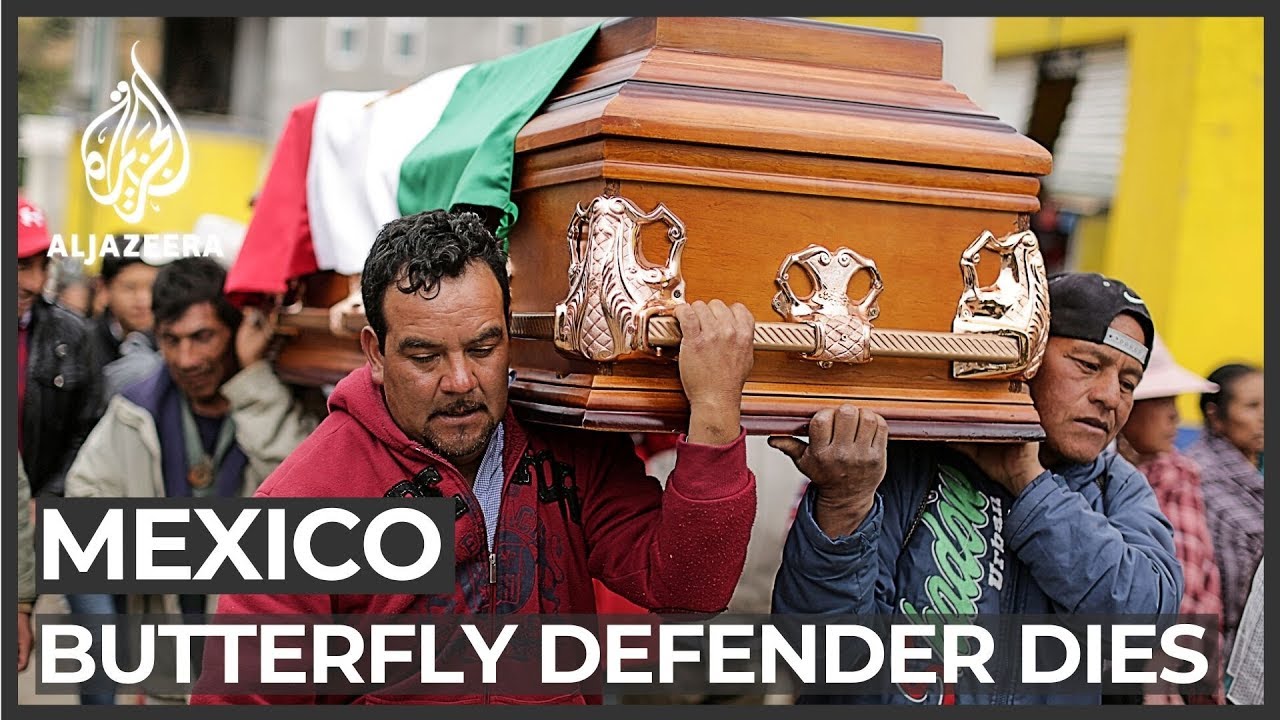
Two men connected to a famous monarch butterfly reserve in Mexico have been found dead within a week of each other, raising concerns for the safety of environmental activists in the country.
Homero Gómez González, 50, who managed a butterfly reserve in Mexico's Michoacán state and campaigned against illegal logging in the butterflies' winter habitat, was found dead in a well on Jan. 29, BBC News reported. Three days later, part-time reserve tour guide Raúl Hernández Romero, 44, was also found dead on top of a hill in the El Campanario monarch butterfly sanctuary.
"How can you protect the butterflies if Homero Gómez or other people are not protected?" poet and environmental activist Homero Aridjis asked NPR.
Gómez González managed the El Rosario sanctuary, which is part of the Monarch Butterfly Biosphere Reserve, a UNESCO World Heritage site. The site, located in forested mountains around 100 kilometers (approximately 62 miles) northwest of Mexico City, is where more than half of eastern monarch butterfly colonies spend their winters. The butterflies travel all the way to Canada each spring and then back again in the fall. Because four generations of butterflies are born and die during this time, it is unclear how they know to find their way back, but they do.
"Every autumn, millions, perhaps a billion, butterflies from wide areas of North America return to the site and cluster on small areas of the forest reserve, coloring its trees orange and literally bending their branches under their collective weight," UNESCO described.
But the butterflies' winter home is threatened by logging and the planting of avocado farms, according to NPR. Between 2005 and 2006, loggers felled 461 hectares in the area, The Washington Post reported.
Gómez González, a former logger himself, campaigned to protect the reserve and argued that tourism from the butterfly migration was worth more to the region than illegal logging. The El Rosario sanctuary he managed opened in November to help prevent logging, BBC News reported, and his family said he received threats before he disappeared Jan. 13.
His funeral on Friday was widely attended.
"I offer my condolences to Mr. Gómez González's family, his colleagues and all of those who, in Mexico and elsewhere, sometimes at the risk of their lives, work every day to protect this natural heritage which is shared by all of humanity," Director of the World Heritage Centre Mechtild Rössler said in a statement.
Gómez González was found to have received a blow to the head before drowning in a well, BBC News reported. His death was apparently not a robbery, since he was found with the equivalent of more than $500 in pesos, according to NPR.
Hernández Romero worked showing tourists around the El Rosario sanctuary, according to The Washington Post.
He was last seen Jan. 27 leaving his home, and then found dead Saturday after having been badly beaten with a sharp object.
Authorities are unclear if the deaths are connected to each other or to both men's work protecting the butterflies. However, The Guardian pointed out that there is a trend of environmental defenders being murdered in Mexico in conflicts with developers or criminal groups. Mexico's murder rate is also generally on the rise, BBC News reported. In 2019, the country saw its highest murder rate ever with 34,582 reported killed.
- Environmental Defender Murdered in Mexico Days Before Vote on ... ›
- Illegal Loggers Murder Amazon Forest Guardian - EcoWatch ›
- Homero Gómez González, Mexico's monarch butterfly defender ... ›
- Environmental Activists, Heroes, and Martyrs - Markkula Center for ... ›
- The Monarch Butterfly Crime: Who Murdered Homer Gomez and Why? ›
- 53 police investigated in disappearance of monarch butterfly activist ›
-
activismlogginginsectsanimalswildlifeconservation
==
==
Mexican Butterfly Conservationist Found Dead
dn 120
---
wapo
==
full txt
no lnx
Science ranks grow thin in Trump administration
Jeff Jorgenson examines young corn plants in May on a partially flooded field he farms near Shenandoah, Iowa. A USDA scientist was working on a tool to help farmers mitigate the impact of flooding and other effects from climate change when the Trump administration moved his agency to Kansas, prompting him to quit. (Nati Harnik/AP)
By
Annie Gowen,
Juliet Eilperin,
Ben Guarino and
Andrew Ba Tran
Jan. 23, 2020 at 12:45 p.m. PST
KANSAS CITY, Mo. — Dozens of government computers sit in a nondescript building here, able to connect to a data model that could help farmers manage the impact of a changing climate on their crops.
But no one in this federal agency would know how to access the model, or, if they did, what to do with the data.
That’s because the ambitious federal researcher who created it in Washington quit rather than move when the Agriculture Department relocated his agency to an office park here last fall.
He is one of hundreds of scientists across the federal government who have been forced out, sidelined or muted since President Trump took office.
The exodus has been fueled broadly by administration policies that have diminished the role of science as well as more specific steps, such as the relocation of agencies away from the nation’s capital.
While the administration has come under fire for prioritizing the concerns of industry at the expense of science in government decisions, the cumulative effects are just beginning to appear after three years of Trump in the White House.
Some farmers said the USDA staff upheaval has made it harder to access information they need.
Torrential rains last spring dashed the plans of Liz Brownlee, who runs a livestock farm with her husband, to expand her pasture in Crothersville, Ind. Then an unseasonably dry autumn brought 90-degree days that baked the farmers’ seeds.
“With all this uncertainty from climate change, I need the best data possible” to know when to plant, she said. “I’m worried I’m not going to have it.”
In the first two years of the Trump administration, more than 1,600 federal scientists left government, according to Office of Personnel Management employment data analyzed by The Washington Post. That represents a 1.5 percent drop, compared with the 8 percent increase during the same period in the Obama administration.
One-fifth of the high-level appointee positions in science are vacant — normally filled by experts who shape policy and ensure research integrity.
Of those who departed, the numbers were greatest among social scientists, soil conservationists, hydrologists and experts in the physical sciences — chemistry, geology, astronomy and physics.
At the Environmental Protection Agency, nearly 700 scientists have left in the past three years, according to The Post analysis. The EPA has hired 350 replacements.
Linda Birnbaum, who spent four decades working on toxicology and public health issues at the EPA and National Institutes of Health before retiring in October, said the loss of expertise weakens the government’s ability to make sound decisions.
“It’s going to take a long time for government science to come back. There’s little doubt about that,” said Birnbaum, who serves as an adjunct professor at Duke University and the University of North Carolina at Chapel Hill. She added that NIH has remained well- insulated because it enjoys bipartisan support in Congress.
“But when I look at colleagues in other agencies, especially any agency that has any regulatory role, they’re decimated,” she said.
Trump administration officials dismiss that notion, saying much of the criticism comes from activists outside the federal government.
Interior Secretary David Bernhardt points out that he is the first secretary to enlist a career federal scientist to serve as his scientific adviser.
“I’ve got an ideas box, I haven’t seen that,” he said in an interview, referring to complaints that science has been de-emphasized. “I do hear that from advocates and external parties. And, you know, anybody that looks at these things objectively tends to find that they’re without merit.”
Last year, the environmental group Center for Biological Diversity accused Bernhardt of pushing aside the conclusions reached by career scientists at the U.S. Fish and Wildlife Service regarding how a pesticide affected endangered species. Eight Democratic senators sought an investigation. Interior’s inspector general concluded there was “no evidence” Bernhardt abused his position.
As a presidential candidate, Donald Trump called climate change a “hoax.” Once in office, he began dismantling much of President Barack Obama’s climate plan. He has installed industry figures in regulatory roles and rolled back scores of rules and policies that he considers harmful to the fossil-fuel industry. Trump’s actions spurred scientists into the streets, joining protesters for a March for Science rally on the Mall in 2017 and again in 2018.
Many scientists who work for the U.S. government or rely on its funding say the changes brought by the Trump administration are being felt across the country.
After historic rainfall last spring swept away livestock and grain in the Midwest, crop planting was delayed by weeks. Andrew Crane-Droesch, 38, a researcher at the Agriculture Department’s Economic Research Service, started work on a data tool that could predict months in advance the impact of, say, heavy rainfall on crop prices or planted fields. He hoped that knowledge could help farmers, commodity traders and government disaster planners prepare.
But when Agriculture Secretary Sonny Perdue moved forward with his controversial plan to relocate the Economic Research Service and the National Institute of Food and Agriculture — two key research agencies — to Kansas City, Crane-Droesch headed for the exit.
He joined two-thirds of affected employees in his division who either retired or found other jobs rather than move to the greater Kansas City region. At the National Institute of Food and Agriculture, which oversees $1.7 billion in scientific funding for researchers, nearly 8 of every 10 employees have left.
Crane-Droesch, who took a health-research job in Philadelphia, said there’s no one left at the USDA who has the time or the know-how to run the model he created or to finish the project.
“All that work was for naught, and they nuked the account,” he said. “Even if they hired somebody for my portfolio — which I don’t think they did — it would take that person quite a while to get up to speed, just as it took me several years.”
The move to Kansas City has also meant dozens of reports and millions in research funding have been delayed or scuttled as the Agriculture Department scrambled to keep up with departures.
The agency has been forced to hire back 21 retired employees on temporary contracts, to stanch its losses.
But experts on bee pollination, organic farming, commodity markets and trade are gone, setting back research that has been in process for months or even years.
“They never tried to refute our work; they tried to bury it by getting rid of the people who produced the work,” Crane-Droesch said.
To restore the National Institute of Food and Agriculture and the Economic Research Service to their size under the Obama administration, the USDA would have to hire more than 400 people. One USDA official said the department has “well over 150 active recruitments in process between both agencies.”
Current and former employees interviewed said they felt the move to Kansas City was intended to diminish research areas such as trade policy, farm income and climate change; Perdue is a climate skeptic who recently described the problem as “weather patterns, frankly.”
A USDA spokesman defended the move, saying that Perdue believes the agencies can better serve “customers” — farmers, ranchers, academic institutions and agribusiness — by relocating to Kansas City, “a hub for all things agriculture in America’s heartland.”
The department estimates it will save $300 million over 15 years from employment and rent in Kansas City.
EPA pursues regulatory rollbacks, despite criticism from its scientific advisers
Some federal researchers said they left the Trump administration after concluding their work was being undermined.
Dan Costa, who worked at the EPA for 34 years before stepping down as director of its air, climate and energy research program in January 2018, said the tipping point for his retirement came when an EPA spokesman undercut a study published in the New England Journal of Medicine that the agency had funded.
The study found that long-term exposure to levels of soot and smog lower than current national standards can cause premature death among older Americans. Such a finding suggests that current standards don’t adequately protect public health, which would have implications for industries that pollute. An unidentified EPA spokesman attacked the study in an interview with the Washington Times, an act Costa called “scientifically unethical.”
Peter Van Doren, a senior fellow at the libertarian Cato Insitute, said in an interview that scientists need to remember that they don’t set policy.
“When nerds and politicians disagree, nerds lose,” he said. “Scientists think, ‘We are smart, and we ought to decide.’ But we don’t get to decide.”
Elsewhere in the government, political appointees have delayed grants for scientific work.
At Interior’s U.S. Geological Survey, Director James Reilly “felt that he needed to personally look at every grant that went out,” according to Bernhardt’s science adviser William Werkheiser, who served as Reilly’s deputy before joining the secretary’s office. The process stalled grants at the agency’s climate adaptation science centers for more than six months.
==
120
https://yyy.theguardian.com/environment/2020/jan/07/honeybees-deaths-almonds-hives-aoe
==
ew
Jessica Corbett
Pointing to the deaths of more than half a billion bees in Brazil over a period of just four months, beekeepers, experts and activists are raising concerns about the soaring number of new pesticides greenlighted for use by the Brazilian government since far-right President Jair Bolsonaro took office in January — and the threat that it poses to pollinators, people and the planet.
Indigenous and green groups have expressed alarm about the dangers of Bolsonaro's anti-environment policies — especially for the Amazon rainforest — since even before Bolsonaro's inauguration. Recent reports highlighting that the Bolsonaro government has approved a record 290 pesticides so far this year have further heightened worries about his environmental agenda and its consequences.
"Between December 2018 and March 2019, more than 500 million bees were found dead by beekeepers in four Brazilian states," SciDev.net reported Friday, citing figures revealed earlier this year. "Beekeepers' associations and agriculture authorities suspect this was caused by the widespread use of two classes of pesticides — fipronil and neonicotinoids — on flowering crops."
==
one day:
# Trump’s USDA Suspends Honeybee Survey
:{:{}:
Bees and Beekeepers Feel the Sting of Trump Administration’s Anti-Science Efforts
:{:{}:
10 Ways Andrew Wheeler Has Decimated EPA Protections in Just One Year
}:}:
===
Elliott Negin
On July 8, President Trump hosted a White House event to unabashedly tout his truly abysmal environmental record. The following day, coincidentally, marked the one-year anniversary of Andrew Wheeler at the helm of the U.S. Environmental Protection Agency (EPA), first as acting administrator and then as administrator after the Senate confirmed him in late February.
The good news, if there is any, is that Wheeler is an Eagle Scout compared to his ethically challengedpredecessor, Scott Pruitt. The bad news is, as predicted, Wheeler has been more effective than Pruitt in rolling back and eliminating EPA safeguards.
My organization, the Union of Concerned Scientists, has compiled a list of 80 Trump administration attacks on science since taking office, and Wheeler has been the driving force behind many of them. Below are 10 of the more egregious ways he has undermined the EPA's time-honored role to protect public health and the environment so far.
1. Sidelined Scientists
:{Wheeler, a former coal industry lobbyist, has taken a number of steps to systematically reduce the role of scientists in the agency's policymaking process. Last fall, for example, he eliminated the agency's Office of the Science Advisor, which counseled the EPA administrator on research supporting health and environmental standards, and placed the head of the EPA's Office of Children's Health Protection on administrative leave. He also disbanded a 20-member scientific advisory committee on particulate matter, or soot; failed to convene a similar panel on ozone; and packed a seven-member advisory committee on air quality standards with industry-friendly participants.:{}:
}:
2. Proposed to Restrict the Use of Scientific Data
Claiming his intent is to increase "transparency," Wheeler is promoting a rule Pruitt proposed that would dramatically limit the scientific studies the agency considers when developing health standards. If adopted, the rule would restrict the use of scientific studies in EPA decisions if the underlying data are not public and reproducible, which would disqualify many epidemiological and other health studies the EPA relies on to set science-based public safeguards. Given that EPA health standards often rely on studies that contain private patient information, as well as confidential business information that cannot be revealed, the rule would significantly hamper the agency's ability to carry out its mission. Wheeler plans to finalize the rule sometime this year.
3. Gutted the Coal Ash Rule
The first major rule Wheeler signed as acting administrator refuted his claim that he could fulfill President Trump's directive to "clean up the air, clean up the water, and provide regulatory relief" at the same time. By rolling back the Obama-era coal ash rule, Wheeler provided regulatory relief to his old friend the coal industry by weakening environmental protections established in 2015 to clean up coal ash ponds, which are laced with toxic contaminants that leak into groundwater. The move was a top priority for coal baron Bob Murray, owner of Murray Energy, Wheeler's most lucrative client when he worked for the Faegre Baker Daniels law firm.
Coal-fired power plants have been dumping this residue from burning coal into giant, unlined pits for decades. According to the EPA, there are more than 1,000 coal ash disposal sites across the country, and a recent analysis by Earthjustice and the Environmental Integrity Project found that 91 percent of the coal plants filing monitoring data required by the 2015 rule are polluting water with unsafe levels of toxic contaminants. Wheeler's EPA says the new rule—which extends the deadline for closing some leaking ash ponds and allows states to suspend groundwater monitoring and set their own standards—will save utilities as much as $31 million. But the agency ignored the enormous costs of cancer and neurological and cardiovascular diseases linked to coal ash ingredients, which include arsenic, chromium, lead and mercury.
4. Recommended Unsafe Levels of Drinking Water Contaminants
Poly- and perfluoroalkyl substances (PFAS), which are used in firefighting foam and a variety of nonstick, cleaning, packaging and other household products, have been linked to thyroid disease and kidney, liver, pancreatic and testicular cancer. According to a recent study by the Environmental Working Group and Northeastern University, these chemicals threaten the drinking water supplies of an estimated 19 million Americans. A 2018 Union of Concerned Scientists report, meanwhile, found that PFAS water contamination at 130 military bases across the country exceed the 11-parts-per-trillion safety threshold determined by the Department of Health and Human Services Agency for Toxic Substances and Disease Registry. Nearly two-thirds of the sites had contamination that was more than 100 times higher than the safe level.
In February, Wheeler announced the "first-ever nationwide action plan" to regulate PFAS chemicals in water, saying the agency would develop and set a limit for two of the most prevalent PFAS chemicals, perfluorooctanoic acid and perfluorooctanesulfonic acid. During the announcement, he told reporters he believes the agency's voluntary 70-part-per-trillion health-advisory level for the chemicals is "a safe level for drinking water," despite the fact that this level is more than six times higher than what the Disease Registry considers safe.
While Wheeler slow-walks the EPA's response, members of Congress have introduced at least a dozenbills to address PFAS contamination, and the Senate recently passed a defense bill that would require the EPA to set a science-based standard for PFAS in drinking water.
5. Rolled Back Clean Water Act Protections
Clearing up a decade-long dispute over the scope of the Clean Water Act, the Obama EPA adopted a broad, science-based definition of the law that included protecting intermittent and ephemeral streams and wetlands that do not have surface water connections to other waterways. A 2015 EPA meta-analysis of more than 1,200 peer-reviewed studies concluded that even infrequently flowing small streams and isolated wetlands can affect "the integrity of downstream waters." Trash them and that pollution could wind up in rivers, lakes, reservoirs and estuaries.
Regardless, Wheeler announced plans during a December telephone press briefing to reverse the Obama EPA definition of waters protected by the Clean Water Act, a thinly disguised gift to land developers and the agriculture industry. When asked what wetlands would no longer be protected, Wheeler replied, "We have not done … a detailed mapping of all the wetlands in the country." Likewise, EPA Office of Water head David Ross—who represented industry clients against the EPA before joining the Trump administration—told reporters on the call that the agency had no idea how many streams would be dropped from Clean Water Act protection under the proposal.
In fact, Wheeler and Ross were well aware of the damage their new definition would do. At least 18 percent of streams and 51 percent of wetlands across the country would not be covered under their proposed definition, according to an internal 2017 slideshow prepared by the EPA and the Army Corps of Engineers and obtained by E&E News under the Freedom of Information Act.
6. Suppressed an Inconvenient Formaldehyde Report
Last August, Wheeler disingenuously told a Senate committee that the EPA was holding up the release of a report on the risk of cancer from formaldehyde to confirm its veracity. "I am sure we will release it," he said, "but I need to make sure that the science in the report is still accurate."
In fact, the report—which concluded that formaldehyde can cause leukemia and nose and throat cancer—was completed by EPA scientists a year before Wheeler testified, according to a Senate investigation, and their conclusion was hardly a surprise. Both the World Health Organization's International Agency for Research on Cancer and the U.S. Department of Health and Human Services National Toxicology Program have already classified formaldehyde as a known human carcinogen.
The EPA's review process normally takes 60 to 90 days. The formaldehyde report has been in limbo for at least a year and a half, a blatant giveaway to the American Chemistry Council, the U.S. chemical industry's premier trade association, which has blocked tighter restrictions on formaldehyde for decades.
7. Ignored EPA Scientists’ Advice to Ban Asbestos
Instead of heeding the advice of agency scientists and lawyers to follow the example of 55 other countries and ban asbestos completely, the EPA announced in April that it would tighten restrictions on asbestos—not ban it—despite overwhelming scientific evidence of its dangers. Manufacturers will be able to continue to use the substance if they obtain EPA approval.
Asbestos has not been produced in the United States since 2002, but is still imported for use in a wide range of commercial and consumer products, including auto brake components, roofing, vinyl floor tile, fire-resistant clothing, and cement pipes, sheets and shingles. One of the deadliest known carcinogens, asbestos kills nearly 40,000 Americans annually, mainly from lung cancer.
8. Weakened the Mercury Emissions Rule
In late December, the EPA proposed to significantly weaken a rule restricting mercury emissions from coal-fired power plants by recalculating its costs and benefits. The Obama EPA, which issued the rule in 2011, estimated it would cost utilities $7.4 billion to $9.6 billion annually to install pollution controls and lead to $37 billion to $90 billion in health benefits by reducing not only mercury, a potent neurotoxin, but also sulfur dioxide and soot, thus preventing 130,000 asthma attacks, 4,700 heart attacks, and as many as 11,000 premature deaths. The Wheeler EPA ignored the "co-benefits" of limiting sulfur dioxide and soot, and flagrantly lowballed the health benefits of curbing mercury alone at only $4 million to $6 million annually.
Most utilities have already complied with the mercury rule at a fraction of the estimated cost, but health advocates fear that this new, industry-friendly accounting method, which makes it appear that the cost to polluters far outweigh the rule's benefits, will set a precedent for the EPA to sabotage an array of other public health protections.
9. Slammed Vehicle Emission Rules Into Reverse
Last August, the EPA and the Transportation Department issued a proposal to freeze vehicle tailpipe pollution and fuel efficiency standards, rolling back a 2012 Obama-era rule requiring automakers to boost passenger vehicle fuel economy to a fleetwide average of 54 miles per gallon by 2025. In a Wall Street Journal opinion piece titled "Make Cars Great Again" published a few days before the two agencies announced their proposal, Wheeler and Transportation Secretary Elaine Chao charged that the Obama-era standards—the first to limit vehicle carbon emissions—are too burdensome for automakers and "raised the cost and decreased the supply of newer, safer vehicles."
Parroting the Trump administration's line of reasoning, Wheeler and Chao argued that fuel-efficient cars—which weigh less than gas-guzzlers—are not as safe, a contention that has been widely debunked. In fact, a 2017 study concluded that reducing the average weight of new vehicles could result in fewer traffic fatalities.
In any case, freezing the standards at 2020 levels would be hard on the planet, not to mention Americans' wallets, according to the Union of Concerned Scientists. It would result in an additional 2.2 billion metric tons of global warming emissions by 2040, amounting to 170 million metric tons in 2040 alone—the equivalent of the annual output of 43 average size coal-fired power plants. It also would cost drivers billions of dollars. In 2040 alone, they would have to pay an additional $55 billion to fill their gas tanks. Meanwhile, the design improvements automakers have made so far to meet the standards have already saved drivers more than $86 trillion at the pump since 2012, and off-the-shelf technological fixes, the Union of Concerned Scientists says, would enable automakers to meet the original 2025 target.
10. Rescinded the Clean Power Plan
Perhaps Wheeler's most damaging move to date came late last month when he signed a final rule to repeal and replace the Obama-era Clean Power Plan, which would have required coal-fired power plants to dramatically cut their carbon emissions. Yet another gift to the coal industry, Wheeler's so-called Affordable Clean Energy rule grants states the authority to determine emissions standards but sets no targets, leaving them the option to do absolutely nothing.
Before Wheeler released the final rule, an April study in the journal Environmental Research Letters found that his draft version would boost carbon emissions in 18 states and the District of Columbia and increase sulfur dioxide emissions in 19 states. The EPA's own analysis of the draft rule, meanwhile, found that the proposal could have led to as many as 1,400 premature deaths annually by 2030 due to an increase in soot, and as many as 15,000 cases of upper respiratory problems.
Reversing Decades of Bipartisan Protections
If Wheeler truly cared about transparency, he would petition the Trump administration to change the name of his agency to "Every Polluter's Ally." In just 12 months, he has killed or weakened dozens of safeguards with the sole intention of bolstering polluting industries' profit margins even after Congress slashed the corporate tax rate. As a result, millions of Americans will be drinking filthier water and breathing dirtier air, and more will suffer from serious diseases, according to his agency's own accounting.
Wheeler and his predecessor Pruitt have sullied the bipartisan track record of one of the nation's agencies entrusted with protecting public health and safety. So it is little wonder that three former EPA administrators who, notably, served under Republican presidents, recently sounded the alarm on Capitol Hill, urging legislators to step up their oversight of the agency and denouncing its attempts to hamstring science.
"There is no doubt in my mind that under the current administration the EPA is retreating from its historic mission to protect our environment and the health of the public from environmental hazards," former EPA Administrator Christine Todd Whitman, who served under President George W. Bush, stated in her written testimony for the House Committee on Energy and Commerce Subcommittee on Oversight and Investigations. "This administration, from the beginning, has made no secret of its intention to essentially dismantle the EPA…. Therefore, I urge this committee, in the strongest possible terms, to exercise Congress's oversight responsibilities over the actions and direction of the EPA."
This article was produced by Earth | Food | Life, a project of the Independent Media Institute, and originally published by Truthout.
Elliott Negin is a senior writer at the Union of Concerned Scientists.
epa andrew wheeler environment donald trump scott pruitt fossil fuels pollution health
==
https://www.ecowatch.com/emergency-trump-epa-pesticides-2638979880.html
no lnx many
Trump EPA OKs ‘Emergency’ Use of Bee-Killing Pesticide on 13.9 Million Acres
Jordan Simmons Jun. 25, 2019 01:08PM EST POLITICS
More than 40 percent of insects could go extinct globally in the next few decades. So why did the U.S. Environmental Protection Agency (EPA) last week OK the 'emergency' use of the bee-killing pesticide sulfoxaflor on 13.9 million acres?
EcoWatch teamed up with Center for Biological Diversity via EcoWatch Live on Facebook to find out why. Environmental Health Director and Senior Attorney Lori Ann Burd explained how there is a loophole in the The Federal Insecticide, Fungicide, and Rodenticide Act under section 18, "that allows for entities and states to request emergency exemptions to spraying pesticides where they otherwise wouldn't be allowed to spray."
In a press release sent to EcoWatch, the Center for Biological Diversity stated:
The approval includes 2019 crops of cotton and sorghum in Alabama, Arkansas, California, Georgia, Kansas, Louisiana, Missouri, Mississippi, Tennessee, Texas and Virginia. Ten of the 11 states have been granted the approvals for at least four consecutive years for the same "emergency." Five have been given approvals for at least six consecutive years.
If an occurrence is happening six years in a row, does that justify an emergency?
"This administration has been grossly abusing this exemption to allow the use of this one pesticide called sulfoxaflor on a vast acreage year after year," said Burd.
Our biodiversity is at serious risk. For example, in Texas — where 5.8 million acres got emergency exemption to spray — more than 800 native bee species and eight species of bumblebees reside. It is also an important migration route for monarch butterflies.
"Monarch butterflies and eight species of bumblebees do overlap with Texas counties where there is sulfoxaflor spraying," said Burd. "Even at subacute, very low doses, sufoxaflor will have a very dramatic effect on bumblebee reproduction." The purpose of sulfoxaflor is to kill insects.
Farmers have only gotten away with spraying sulfoxaflor because they were granted emergency. The EPA has not approved the lethal insecticide sulfoxaflor to be used on sorghum because it is known to attract bees. At one point the EPA did allow the use of sulfoxaflor on cotton, however the U.S. Court of Appeals for the Ninth Circuit vacated the approval — the result of a lawsuit brought to them by beekeepers.
In a summary following the vacated approval in 2015, The U.S. Court of Appeals for the Ninth Circuit published conclusions:
The panel held that because the EPA's decision to unconditionally register sulfoxaflor was based on flawed and limited data, the EPA's unconditional approval was not supported by substantial evidence. The panel vacated the EPA's unconditional registration because given the precariousness of bee populations, leaving the EPA's registration of sulfoxaflor in place risked more potential environmental harm than vacating it.
==
Insects Must Be Saved to Prevent Collapse of Humanity, Top Scientist Warns
Jake Johnson
A leading scientist warned Tuesday that the rapid decline of insects around the world poses an existential threat to humanity and action must be taken to rescue them "while we still have time."
Anne Sverdrup-Thygeson, professor at the Norwegian University of Life Sciences and one of the world's top entomologists, said in an interview with The Guardian that the importance of insects to the planet should spur humans to take immediate action against one of the major causes of insect decline — the climate crisis.
"Insects are the glue in nature," said Sverdrup-Thygeson. "We should save insects, if not for their sake, then for our own sake."
Falling insect populations around the world is cause for serious alarm, Sverdrup-Thygeson said, given the enormous impact these tiny creatures have on the global ecosystem.
"I have read pretty much every study in English and I haven't seen a single one where entomologists don't believe the main message that a lot of insect species are definitely declining," said Sverdrup-Thygeson. "When you throw all the pesticides and climate change on top of that, it is not very cool to be an insect today."
If this decline continues unabated, Sverdrup-Thygeson warned, soon "it will not be fun to be a human on this planet either."
"[I]t will make it even more difficult than today to get enough food for the human population of the planet, to get good health and freshwater for everybody," said Sverdrup-Thygeson. "That should be a huge motivation for doing something while we still have time."
"You can pull out some threads," she added, "but at some stage the whole fabric unravels and then we will really see the consequences."
*> The complex systems of nature are like a hammock upon which humanity is resting: “You can pull out some threads but at some stage the whole fabric unravels and then we will really see the consequences.” #IPBES7 https://t.co/vn2dxkKx5Z
— Rewilding Britain (@RewildingB) May 7, 2019*
Sverdrup-Thygeson's call to action came after the Intergovernmental Science-Policy Platform on Biodiversity and Ecosystem Services (IPBES) released a comprehensive global biodiversity report, which warned that human activity has pushed a million plant and animal species to the brink of extinction.
According to the report, "available evidence supports a tentative estimate of 10 percent [of insect species] being threatened" by the climate crisis.
"It is not too late to make a difference," said IPBES chair Sir Robert Watson, "but only if we start now at every level from local to global."
*> A third of insects are #endangeredspecies, & they are going #extinct at a rate 8 times that of #birds, #mammals, & #reptiles. That amounts to a loss of 2.5% of insect mass every year over the last 3 decades: https://t.co/koPvCnIvvu via @EcoWatch #StopExtinction
— Defenders of Wildlife (@Defenders) February 13, 2019*
Reposted with permission from our media associate Common Dreams.
RELATED ARTICLES AROUND THE WEB
- World's food supply under 'severe threat' from loss of biodiversity ... ›
- Insects, biodiversity, and mass extinction: an alarming new study ... ›
- The Insect Apocalypse Is Coming: Here Are 5 Lessons We Must ... ›
- New Study Is First to Demonstrate That Biodiversity Inoculates ... ›
- Tens of Thousands of Species at Risk if Warming Exceeds 1.5°C ... ›
biodiversity insects pesticides climate change pollinators
==
OMG ew 219
U.S. Environmental Protection Agency (EPA) reported last week that in 2018 it issued so-called "emergency" approvals to spray sulfoxaflor—an insecticide the agency considers "very highly toxic" to bees—on more than 16 million acres of crops known to attract bees.
==
EPA Considers 300,000-Acre Expansion for Bee-Toxic Pesticide
The Center for Biological Diversity Thursday urged the U.S. Environmental Protection Agency to deny Bayer CropScience's request to allow the highly bee-toxic pesticide flupyradifurone to be sprayed on tobacco in states like Kentucky and North Carolina.
Keep reading...
==
omfg
https://www.ecowatch.com/bee-killing-pesticides-in-national-wildlife-refuges-2593236939.html
trump Admin Reverses Ban on 'Bee-Killing' Pesticides in National Wildlife Refuges
The Trump administration has lifted an Obama-era ban on the use of genetically modified crops and pesticides linked to bee decline in certain national wildlife refuges where farming is allowed, Reuters reported:(style="background-color:#ffffffff"):}::{ Saturday.
In a memo signed Aug. 2, U.S. Fish and Wildlife Service Principal Deputy Director Gregory J. Sheehan said the move was necessary to provide adequate food for waterfowl.
"There may be situations, however, where use of GMO crop seeds is essential to best fulfill the purposes of the refuge and the needs of birds and other wildlife," Sheehan wrote.
Boosting waterfowl populations dovetails with the interests of sportspeople whohunt ducks and other birds, and Interior Secretary Ryan Zinke has made expanding hunting on national lands a priority, Reuters reported.
But environmental groups argue the decision comes at the expense of other species.
"Industrial agriculture has no place on public lands dedicated to conservation of biological diversity and the protection of our most vulnerable species, including pollinators like bumble bees and monarch butterflies. The Trump administration's approval to use toxic pesticides and genetically modified crops is an insult to our national wildlife refuges and the wildlife that rely on them," President and CEO ofDefenders of WildlifeJamie Rappaport Clark said in a statement.
The pesticides in question, neonicotinoids, have been banned in the EU after research linked them to the decline in the populations of bees and other pollinators.
Jim Kurth, head of the refuge system under Obama, announced the ban in 2014, arguing that the use of neonicotinoids led to plants whose tissues harmed "non-target" species. Moreover, he said that "refuges throughout the country successfully meet wildlife management objectives without" genetically modified crops or the pesticides they are engineered to withstand, Reuters reported.
Defenders of Wildlife further noted that the populations of game birds like geese and ducks are currently doing fine without the help of genetically modified crops.
Sheehan, however, has reversed the blanket ban and said that the use of genetically modified crops and neonicotinoids would be considered in the more than 50 farming-friendly refuges on a case-by-case basis.
The move came aday after California's Department of Pesticide Regulation released a risk assessment finding that the use of four neonicotinoids on certain crops, including the corn and sorghum often grown in refuges, could cause more harm to pollinators than previously thought, The Center for Biological Diversity reported.
"Agricultural pesticides, especially bee-killing neonics, have no place on our national wildlife refuges," senior C**enter for Biological Diversity attorney Hannah Connor said. "This huge backward step will harm bees and other pollinators already in steep decline simply to appease pesticide-makers and promote mono-culture farming techniques that trigger increased pesticide use. It's senseless and shameful."
---
https://www.ecowatch.com/robot-bees-walmart-patent-2548372230.html
Walmart Files Patent for Robot Bees
:{:{:{}:
With the mass die-off of bees spelling trouble for agriculture, the world's largest retailer has filed patents for the use of "unmanned vehicles," or drones, to aid with pollination and crop production.
In U.S. Patent Office documents made public last week, Walmart has applied for six patents on drones designed to identify pest damage, spray pesticides and pollinate plants.
Reuters noted, "Walmart may see drone technology as one way to get food from farms to store shelves faster and more cheaply to compete with Amazon.com Inc, following its purchase of Whole Foods Market last yearand the expansion of discount chains like Aldi and Lidl."
Here's what's in the filings, according to CB Insights:
To track pests, Walmart describes using machine vision to monitor damage to crops as well as spot and identify the pests themselves. To prevent damage, the drones could shoot targeted sprays of pesticide or simply fly by to shoo off birds, acting as a next-generation of "scarecrows or shiny devices," the patent notes.
Drones could spray pesticides across a more targeted set of crops, rather than the blanket approach used today. The patent notes that "chemical spraying of crops is expensive and may not be looked upon favorably by some consumers."
Pollination drones, on the other hand, could help offset the loss of bee populations over the past few years. Walmart's "applicators" would carry pollen from one plant to another, and use sensors to verify the transfer was successful.
Some have compared Walmart's filing for drone pollinators to a horrifying Black Mirror episode on robot bees, but this technology isn't completely unheard of.
[vid]
---
EPA Considers Allowing Bee-Killing Pesticide to Be Sprayed on 165 Million Acres of U.S. Farmland
The U.S. Environmental Protection Agency (EPA) will consider allowing the bee-killing pesticide thiamethoxam to be sprayed on the most widely grown crops in the U.S. The application, if approved, would allow the highly toxic pesticide to be sprayed directly on 165 million acres of wheat, barley, corn, sorghum, alfalfa, rice and potato.
The proposal by the agrochemical giant Syngenta to dramatically escalate use of the harmful neonicotinoid pesticide came last Friday, on the same day the EPA released new assessments of the extensive dangers posed by neonicotinoids, including thiamethoxam.
"If the EPA grants Syngenta's wish, it will spur catastrophic declines of aquatic invertebrates and pollinator populations that are already in serious trouble," said Lori Ann Burd, director of the Center for Biological Diversity's environmental health program. "You know the pesticide-approval process is broken when the EPA announces it will consider expanding the use of this dangerous pesticide on the same day its own scientists reveal that the chemical kills birds and aquatic invertebrates."
Neonicotinoids have long been known to pose serious harm to bee populations. But the new EPA assessments found the commonly used pesticides can kill and harm birds of all sizes and pose significant dangers to aquatic invertebrates.
Thiamethoxam is currently widely used as a seed coating for these crops. This application would allow it to be sprayed directly on the crops, greatly increasing the amount of pesticide that could be used.
The just-released aquatic and non-pollinator risk assessment found that the majority of uses of the neonicotinoid on currently registered crops resulted in risks to freshwater invertebrates that exceeded levels of concern—the threshold at which harm is known to occur.
The EPA did not assess risks associated with spraying the pesticides on the crops it announced it was considering expanding use to on Friday. But it is likely that increasing the number of crops approved for spraying would dramatically increase that risk.
In January the EPA released a preliminary assessment of on-field exposures to thiamethoxam that found all uses of the pesticide—on foliar, soil and seeds—result in exposures that exceed the level of concern for acute and chronic risk to adult bees. But the agency has taken no steps to restrict use of these products and is now considering expanding their use.
Despite growing scientific and public concern about neonicotinoids, the application for expanded use of thiamethoxam was not announced by the EPA but quietly posted in the Federal Register.
"For years the EPA and pesticide companies bragged that by using treated seeds they were avoiding spraying insecticides, and despite the science showing that these treated seeds were deadly to birds, claimed that they were environmentally beneficial," said Burd. "But we can expect the Trump EPA to now ignore the risks to birds and bees and approve these ultra-toxic pesticides to be sprayed across hundreds of millions of U.S. acres."
Neonicotinoids are a class of pesticides known to have both acute and chronic effects on aquatic invertebrates, honeybees, birds, butterflies and other pollinator species; they are a major factor in overall pollinator declines. These systemic insecticides cause entire plants, including pollen and fruit, to become toxic to pollinators; they are also slow to break down and therefore build up in the environment.
A large and growing body of independent science links neonicotinoids to catastrophic bee declines. Twenty-nine independent scientists who conducted a global review of more than 1,000 independent studies on neonicotinoids found overwhelming evidence linking the pesticides to declines in populations of bees, birds, earthworms, butterflies and other wildlife.
RELATED ARTICLES AROUND THE WEB
- The evidence points in one direction – we must ban neonicotinoids ... ›
- EPA: Neonicotinoid Pesticides Pose Serious Risks to Birds, Aquatic ... ›
https://www.ecowatch.com/syngenta-neonicotinoids-2518688773.html
==
court win ca
https://www.centerforfoodsafety.org/press-releases/5065/victory-court-of-appeal-rejects-californias-approval-of-bee-killing-pesticides
Ends State’s Practice of Rubber-Stamping New Uses for Neonicotinoids
San Francisco, CA — The First District California Court of Appeal issued an opinion Tuesday in a lawsuit challenging a California Department of Pesticide Regulation (DPR) decision to approve additional uses for two bee-killing pesticides without disclosing the impact on honeybees.
Pesticide Action Network, Center for Food Safety, and Beyond Pesticides, represented by Earthjustice, filed the underlying lawsuit in 2014, seeking to halt DPR’s practice of approving ever more uses for neonicotinoid pesticides pending completion of the agency’s languishing scientific review of the evidence linking agricultural use of neonicotinoids to a global honeybee die-off. DPR began its scientific review in early 2009 after it received evidence that neonicotinoids are killing bees, but DPR has yet to complete its review or take meaningful action to protect bees. Instead, DPR has continued to allow increased use of neonicotinoids in California.
“DPR acknowledged almost 10 years ago that neonicotinoids are killing bees, yet the agency has approved more and more uses for these toxic pesticides every year since,” said Earthjustice attorney Greg Loarie, who represented the groups. “It’s time for DPR to do its job and protect honeybees and the multi-billion dollar agricultural economy that bees make possible in this State.”
...
---
https://www.ecowatch.com**/harvey**-pesticide-naled-2484385387.html
Naled monsanto partner bad for bees
==
==
https://www.ecowatch.com/climate-change-coffee-pollinating-bees-2484470555.html
==
https://www.ecowatch.com/bee-study-bayer-syngenta-2460732961.html
The lead author of a major study which found that neonicotinoid pesticides harm honey bees has hit back against criticism from the chemical companies that part-funded the work.
Dr. Ben Woodcock from the Centre for Ecology and Hydrology (CEH), said Bayer and Syngenta, which produce the controversial pesticides, had looked to undermine his work after it was published, despite providing $3 million in funding.
Speaking exclusively to Energydesk, he said:
"From a personal perspective, I don't really appreciate having them accuse me of being a liar. And accusing me of falsifying results by cherry-picking data. That's not what we've done. I've got little to gain from this and it's been a major headache. We just present the results we get."
'Utterly Unfounded'
Both companies have accused the scientists of overstating the threat posed by neonicotinoids to both honey and wild bees, adding that the data, as they saw it, did not reflect the conclusions from CEH.
After the study was published a Bayer spokesperson told Energydesk:
"This study is one of a number of landscape studies carried out recently. The results of the CEH study are inconsistent and therefore inconclusive with variability of effects over both the bee species and the countries in which they were studied."
The company's head of UK government media relations, Dr. Julian Little, told Energydesk: "We're quite frustrated about how these results have been portrayed. The reality seems to be a long way away from the headline."
Syngenta's environmental specialist Peter Campbell told the press that CEH had misrepresented the study and argued that full results of the experiments showed neonicotinoids had no effect in the vast majority (238 of the 258) of the 258 potential effects measured.
Quoted in The Times, Campbell also suggested the results had been talked up in order to get published in a prestigious journal.
He said: "There is a pressure to get papers published. Any journal, particularly journals like Nature and Science, it has to be an interesting story. We don't get into Science and Nature with a study which says, for example, no effect of oilseed rape treated with [neonicotinoid] on solitary bees. It's not that interesting a story."
Woodcock said the accusations made by Bayer and Syngenta were "utterly unfounded."
"I'm intrigued to know what they would've wanted us to do. If you find negative results on key metrics—number of bees in hives, number of bees surviving after winter—how would they want us to present that? How could we interpret this in what they see as an unbiased way?
"Science papers are short. There about 1,500 words. The discussion is tiny on this. It's like a paragraph. So it's not like we spent vast amounts of time discussing the details of this. You literally present the results more or less as they are, along with some broad statements on what you observed."
The study, which was part-funded by Bayer and Syngenta, with the rest paid for by the UK government-backed Natural Environment Research Council, examined the impact of twoneonicotinoids—clothianidin (made by Bayer) and thiamethoxam (made by Syngenta)on wild bees and honey bees in three European countries: Germany, Hungary and the UK....
---
ref
New Evidence Shows Bayer, Syngenta Tried to Influence Scientists on Bee Study
By Joe Sandler Clarke
Bayer and Syngenta repeatedly asked scientists to give them raw data on a major new study which found that neonicotinoid pesticides cause harm to bees before it was published, according to emails obtained under Freedom of Information Act (FOIA).
Both companies cited their position as co-funders to try to get information from researchers at the Centre for Ecology and Hydrology (CEH), including on experiments paid for by the government backed National Environment Research Council.
The pesticide giants also encouraged the academics to study their own research on bees, which showed no harm from their products, only to be rebuffed by the researchers.
Published last week in the prestigious journal Science, the CEH study made headlines for showing for the first time that neonicotinoids can cause harm to honey bees in real world conditions. It also showed that the nicotine-based chemicals can harm the reproductivity of wild bees.
Since publication, both companies have attacked the study and criticised CEH for the way it presented the findings.
The body is one of the leading centers for the scientific study of pesticides. But speaking to Energydesk, Bayer refused to say if it would continue to back research by CEH.
"There are a lot of questions coming out of this data and it will be a while before we have definitive answers about what we want to do next," said Dr. Julian Little, Bayer's head of government relations in the UK.
"It's a bit early to say of course we're going to be working with them, or we're definitely not going to be working with them. It will depend entirely on the situation going forward."
Landmark findings
The chemical companies spent around $3 million on research by CEH looking at the impact of neonics on honey bees and wild bees.
However, the emails reveal that disagreement between the companies and the researchers arose when Bayer and Syngenta made repeated efforts to get access to the raw data from experiments on wild bees, which was funded by National Environment Research Council.
On Jan. 11, a Bayer staff member wrote to professor Rosemary Hails at CEH to say, "As co-owner we believe we are entitled to unlimited, unrestricted and prompt access to all such data and information, including, but not limited to, the data called raw data."
The Bayer representative went on to express their frustration at CEH's refusal to hand over the data, despite repeated requests.
CEH refused to hand over the raw data on the wild bees experiment to the companies until after the peer review process, but did present the data on honey bees.
Frustration
Since publication, both companies attacked the study and criticized CEH for the way it had chosen to present its findings.
Bayer's Julian Little told Energydesk, "We're quite frustrated about how these results have been portrayed. The reality seems to be a long way away from the headline."
Discussing the emails, Little said, "As we funded the vast majority of the study, unsurprisingly we were keen on getting the information as soon as possible. Especially when there had already been significant delays in us being given that information.
"I'm not sure how that becomes a conspiracy theory. We asked for the information, they said they weren't going to give it to us until they had all the information published. No doubt we said that doesn't seem very fair, but they said that's the way it was going to be so we said 'OK.'"
Syngenta were similarly blunt when approached by Energydesk about the emails.
A company spokesperson said, "CEH appear to have responded to funding, interaction, and requests for data by drawing an even stronger negative conclusion regarding the impact of neonicotinoids on bees."
Disagreement
From the outset of the research, Bayer, Syngenta and CEH disagreed over the size and scope of the study.
Emails from 2014 between the three parties, obtained by the environmental organization Buglife, showed Bayer and Syngenta discussing the test's design, monitoring and data analysis with scientists from CEH.
At the time, MPs on the Environmental Audit Committee expressed concern about the pressure being applied to CEH by the two companies.
But Bayer stressed the scientific independence of CEH and their own arm's length role in the study. During a select committee enquiry on the impacts of neonicotinoids, Julian Little told MPs:
"We are not doing the work. The work is being overseen by the Centre for Ecology and Hydrology. Yes, we are putting the money up for it, but it is being done by independent scientists."
"They are working with both Defra and [the European Food Safety Authority] to ensure that those protocols are relevant and, of course, all the information that comes from those studies will be with the Centre for Ecology and Hydrology and I am certain it will be published at some point in the future," he continued.
However, the emails obtained in 2014 show that the chemicals companies looked to focus the study solely on honey bees, leaving out other pollinators, ostensibly to reduce costs.
Internal documents from that same year, obtained using FOI, show that CEH felt that limiting the research to honey bees would reduce the scientific scope of the study.
Professor Richard Pywell from CEH, co-author of the study, wrote in an email dated March 21, 2014, "Syngenta and Bayer have suggested that the study should focus on just Honeybees to reduce overall costs … CEH believe that this reduces considerably the scientific scope of the study and while we appreciate the potential saving in overall costs, we are concerned about the impact on the merit of the experiment."
"Complete freedom"
Speaking just before the findings were made public, Pywell told Energydesk that his organization was determined to keep the research independent and appointed an independent scientific advisory panel, chaired by Bill Sutherland from Cambridge University, to that end.
"From the outset, we made it very clear that we would have complete freedom to design and report this study as we saw fit. We've made all of the protocols and the data, once it's been published, available to everyone.
"The funders had no input on the paper we submitted for peer review. We only shared a copy with funders at the proof stage when it could no longer be changed. That was the agreement.They had no input, no influence. We only shared it with them at the proof stage."
"Some of the arguments around access to data were because CEH had funded the wild pollinator work and in the end we reached an agreement."
Asked if CEH would work with Bayer and Syngenta again, Pywell said, "We would do it again. We would welcome the opportunity to do something like this. Someone has to do it. We're just doing independent research."
==
http://www.ecowatch.com/neonicotinoids-epa-violation-2401492224.html
Judge: EPA's Approval of Bee-Killing Pesticides Violated Federal Law
A federal court has ruled that the U.S. Environmental Protection Agency (EPA) systematically violated the Endangered Species Act—a key wildlife protection law—when it approved bee-killing insecticides known as neonicotinoids.
In a case ongoing for the last four years, brought by beekeepers, wildlife conservation groups and food safety and consumer advocates, Judge Maxine Chesney of the U.S. District Court for the Northern District of California held that EPA had unlawfully issued 59 pesticide registrations between 2007 and 2012 for a wide variety of agricultural, landscaping and ornamental uses.
"This is a vital victory," George Kimbrell, Center for Food Safety legal director, said. "Science shows these toxic pesticidesharm bees, endangered species and the broader environment. More than fifty years ago, Rachel Carson warned us to avoid such toxic chemicals, and the court's ruling may bring us one step closer to preventing another Silent Spring."
==
==
By DANNY HAKIMDEC. 31, 2016
EXETER, England — The bee findings were not what Syngenta expected to hear.
The pesticide giant had commissioned James Cresswell, an expert in flowers and bees at the University of Exeter in England, to study why many of the world’s bee colonies were dying. Companies like Syngenta have long blamed a tiny bug called a varroa mite, rather than their own pesticides, for the bee decline.
==
roundup
http://www.techtimes.com/articles/201704/20170315/court-documents-reveal-ghostwritten-studies-questions-on-monsanto-weed-killer-s-safety.htm
==
House Passes NRA-Backed Bill Legalizing the Killing of Bear Cubs in Wildlife Refuges
:{:{}:
Trump Administration Sued for Suspending Protections for Endangered Bumble Bee
..."The Trump administration broke the law by blocking the rusty patched bumble bee from the endangered species list," Rebecca Riley, senior attorney with the NRDC, said. "The science is clear—this species is headed toward extinction and soon. There is no legitimate reason to delay federal protections for this bee. In this case, the decision to freeze protections for the rusty patched bumble bee without public notice and comment violates the law."
In the case filed in the U.S. District Court in New York City, NRDC asks the court to stop the Department of the Interior and U.S. Fish and Wildlife Service from implementing and enforcing the bumble bee delay order. The White House instructed agencies to withdraw or freeze a broad array of rules issued by the Obama administration to protect public health and the environment.
...
:{:{}:
Desperate to Protect Rhinos, Rangers Shoot Poachers in India
}:}:
==
denham hastings
Special Pollinator Advocate awards are just that – special. In today’s world of partisan politics consensus support across party lines is becoming an endangered species. We would like to honor the dedication of Congressman Jeff Denham for his service on the Congressional Pollinator Protection Caucus and his leadership role in forwarding pollinator conservation efforts both federally and locally in his home state of California. Congressman Denham’s role on the Natural Resources and Agriculture committee keeps him connected to supporting the bees that help bring food to our tables. Thank you for a job well-done Congressman Denham!
==
1. Pretending to care – PR blitz
Big Tobacco perfected the art of self-serving public relations, to appear to care about the very problems your products cause and offer alleged solutions.
A key element of the pesticide industry’s PR strategy is to go on the offensive by creating an elaborate appearance of being “out in front” and taking a lead role in “saving bees”. For example, last year, Bayer launched its mobile“Bee Care Tour” at the Ag Issues Forum and Commodity Classic in Orlando, Florida. Thetour continues in 2014, with stops at Oregon State University, Washington State University, University of California, Davis, South Dakota State University, and Purdue University. In June, the Bee Care Tour will be on hand for National Pollinator Week in Washington, DC.
---
---
Dr. Jonathan Lundgren, an expert on the risk assessment of pesticides and genetically modified crops, worked for the U.S. Department of Agriculture (USDA) Agricultural Research for more than a decade. But when his findings on the ill effects of systemic pesticides and RNAi (a biological process in which RNA molecules inhibit gene expression) on pollinators began to gain traction and visibility, the harassment and punishments did as well.
The 40-year-old agro-ecologist and entomologist hoped that if he kept his head down, the increasing aggression would dissipate. But it didn’t. His scientific work continued to be disrupted along with his ability to communicate with other colleagues and the press.
Ultimately, the coercion and intimidation derailed Lundgren’s career and he stepped down as lead scientist and lab supervisor.
“USDA is blocking science,” Lundgren affirms. “And I refused to be silenced.”
On behalf of Lundgren, The Public Employees for Environmental Responsibility (PEER) filed an official Whistleblower complaint.
“Censorship of public agency science does not affect only scientists—it concerns the public at large as well as every entity relying upon the integrity of USDA science,” PEER executive director Jeff Ruch stated. “USDA cannot piously pledge its devotion to scientific integrity while at the same rebuffing any attempts to safeguard it.”
Separately, PEER has also filed a lawsuit against the USDA to strengthen its Scientific Integrity Policy. The suit targets official restraints on USDA scientists who publish or speak about their findings in peer-reviewed journals before professional societies and other unofficial settings.
In June, USDA Chief Scientist Catherine Wotecki wrote a letter which stated that the agency refused to consider the substance of the petition because scientific integrity only affected its “internal personnel rules and practices” and was therefore exempt from the public notice and comment process normally required of agency rules.
Sublethal Low-Level Harassment
Neonicotinoid seed treatments, manufactured by Bayer and Syngenta,have been harminghoneybees since they were introduced on the marketplace in the mid ’90s. They are the most widely used insecticides with sales of about $2.6 billion. Today they’ve infected our soil, waterways and have even been fond in our blood stream. They’re harming our pollinators as well as developing human brains.
“Neonics are 5 to 10 thousand times more toxic than DDT, and the environment and everything in it is being poisoned by the toxic equivalent of hundreds of billions of pounds of DDT every year,” Tom Theobald, activist, beekeeper and founding member of the Boulder County Beekeepers Association, said.
Lundgren’s troubles began around March when he submitted an article to the scientific journal Naturwissenschaften (The Science of Nature). His data illustrated that the seed treatment and systemic pesticide Clothianidin kills **monarch** butterfly larvae in the laboratory and that these pesticides were found in milkweed plants, the only food source for developing larvae, under field conditions.
Several months after Lundrgen’s article was published, his direct supervisor Sharon Papiernik confronted him and informed him that the paper shouldn’t have been submitted without “official” approval. She was also upset that he’d conducted a radio interview on the topic.
“The USDA gave me the okay [to publish the study] and then after the paper drew international attention from the media, said they never did,” Lundgren recalled.
Not long after that incident, TheNational Academy of Sciences and Pennsylvania No-Till Alliance scheduled Lundgren to give presentations on his research on the effects of genetically modified crops on farmland ecology. It is customary for these organizations to cover his travel expenses to Pennsylvania and Washington, DC.
Lundgren was literally boarding the plane when his superiors instructed him to return home and reimburse airfare costs out of his pocket. He was reprimanded for not completing the requisite paperwork. He was told to return to his duty station immediately, that he was officially AWOL and would not be paid for the week. This was his first accidental oversight on travel paperwork in 11 years and three other employees had had similar travel oversights within six weeks before Lundgren and received no discipline.
Next, he was suspended for 30 days before they reduced it to two weeks without pay.
“That’s a severe punishment for doing my job,” Lundgren said in an interview from his South Dakota homestead Blue Dasher Farms. “The tax payers, farmers and beekeepers paid for this research to be done. I don’t work for the government, I work for the people of the U.S. They deserve to know the latest science on these issues, even if that data is politically inconvenient.” The suspension affected his personnel file, harmed his reputation and cost him more than $9,000 in lost pay and expenses.
In total, the USDA cited two infractions: providing some of his research to a scientific journal without proper approval and violating official travel policies in connection with lectures he delivered in Philadelphia and Washington, DC.
However, Lundgren said these actions were not justified and in reality they were trying to block his research.
“I am not even anti-gmo or anti-pesticide,” Lundgren said. “I just believe that if there are safer methods they should be used first. If you do things right, you don’t need them.”
Lundgren criticized GMOs and systemic pesticides in the past. One paper he coauthored suggested that soybean seeds pretreated with Syngenta’s thiamethoxam (another nicotine-based systemic pesticide) produces no yield benefits to farmers, who pay extra for the seeds and may even be hurting beneficial predators in soybean fields that farmers need to manage the aphids that the insecticide isn’t controlling. And in 2013, he wrote a paper in Bioscience on the potential dangers of “gene splicing” pesticides or RNAi, which he said require further study to determine if they would possibly harm other organisms.
He also peer reviewed a report published by the Center for Foods Safety, Heavy Costs, which was critical of neonicotinoid pesticides for proving little to no benefit to farmers and adversely affecting bees.
Politics of Science
We put a lot of emphasis on the importance of science without taking into consideration the politics involved. For starters, science is not independent. Many universities who conduct research, for instance, are indirectly funded by big corporations who give them donations. cf
Meanwhile, many studies are conducted by Big Ag. For instance, the U.S. Environmental Protection Agency (EPA) does not conduct its own studies on neonics. Rather, it relies on manufacturers such as Syngenta or Bayer to do due diligence. According to a paper published in Bioscience, the EPA’s pesticide evaluation process may be riddled with flaws, allowing industry too much power and influence. What ends up happening is that the companies, who benefit from allowing these poisons on the market, design, fund and conduct toxicity studies.
This corruption puts our planet and health in danger.
And science is also not impartial. For instance, when it came to the hormone-disrupting herbicide Atrazine, the EPA accepted only one industry-funded study for review in its 2007 and 2012 assessments. That study, which looked at an amphibian that doesn’t even live on this continent, determined atrazine is safe.
There were plenty of other researchers, but they either couldn’t afford to conduct the research or their papers were conveniently disqualified for technicalities. Incidentally, the EU banned atrazine 12 years ago.
For many, these shenanigans represent a deep-rooted corruption in the USDA and EPA that have gone unaddressed for a long time.
“The USDA and EPA have become cheerleaders, enablers and marketing agents for the mega-corporations,” Theobald said. “We no longer have a government, we are governed by an un-elected cabal of industrialists. Agencies we rely on to protect us from this are in bed with the poisoners and are running away from the science. It is a crowded bed and congress is right in there with the rest of them or we wouldn’t be where we are.”
According to Lundgren, he is not alone. There are other scientists from the EPA, USDA-Natural Resources Conservation Service and USDA-Agricultural Research who have been hushed and harassed. They just haven’t come forward. Yet. In the suit, PEER cited instances where USDA scientists have been ordered to retract studies, water-down findings, remove their name from authorship (this happened to Lundgren in a paper involving the unintended adverse consequences of genetically modified corn crops) and endure long indefinitive delays in approving publication of papers that may be controversial. While media requests are either delayed or denied.
Sounds like bureaucratic red tape hell, not science.
Future is Sustainble Farming
Lundgren is embracing his new-found freedom. He is pouring his energy into the Blue Dasher Farm initiative and believes that the future hinges ondiversifying our food production. He wants to bridge science with innovative farmers in what will hopefully become a national network of centers of excellence in regenerative agriculture. “And through crowdfunding, we will allow the people to decide what research questions will be tackled. Independent risk assessments and beekeeper-driven science will be key to helping the bees,” Lundgren said.
“I’d like to usher in an innovation in food production and help solve the bee problem. The issues we are having with our bees has to do with the way we produce food.”
Check out his new project Blue Dasher Farm on Indiegogo and support and share.
What’s the Latest?
According to The Washington Post:
Judge Patricia M. Miller rejected earlier this month the USDA’s request to dismiss research entomologist Jonathan Lundgren’s complaint as “frivolous.” The USDA had argued that Lundgren’s complaint was based purely on “speculative and unsupported” allegations.
Miller, an administrative law judge with the Merit Systems Protection Board, also set a Jan. 6 status conference for th
==
http://www.independentsciencenews.org/news/new-research-links-neonicotinoid-pesticides-to-monarch-butterfly-declines/
==
==
http://www.independentsciencenews.org/news/new-research-links-neonicotinoid-pesticides-to-monarch-butterfly-declines/
==
http://www.nature.com/news/2009/090902/full/461027a.html
==
}:}: