Oreskes, N
---
NO MERRI
target; quoted in Inc Truth;97%; tobacco
see bak
won climate comm award; new SF novel 2093
===
---
COOK OCT 2019 ORESKES SUPRAN MAIBACH...
J Cook — Climate denial arguments can be summarized by the five techniques of science denial (summarized with the acronym FLICC): fake experts, logical fallacies ...Read more
---
---
https://www.alternet.org/2019/10/science-historian-reveals-how-science-came-under-attack-from-the-right-and-how-it-can-bridge-that-gap/
no lnx
Science historian reveals how science came under attack from the right — and how it can bridge that gap
Royalty-free stock photo ID: 407449390 Innovative technologies in science and medicine.
Written by Paul Rosenberg / Salon October 13, 2019
In December 2004, science historian Naomi Oreskes published a study in Science magazine, refuting the assertion that climate science is highly uncertain. In a literature survey of 928 papers, she found that 75% either explicitly or implicitly accepted the consensus explanation of human-caused global warming, while 25% of which took no position, dealing with other matters. “Remarkably, none of the papers disagreed with the consensus position,” Oreskes wrote.
Oreskes broadened her scope in 2010 to explore why that consensus remained obscured, blocking the vitally necessary action that science tells us is needed. With Erik Conway, she co-authored “Merchants of Doubt: How a Handful of Scientists Obscured the Truth on Issues from Tobacco Smoke to Global Warming.”
Now she’s broadened her scope further with a new book, “Why Trust Science?” which answers that question by telling the 200-year story of how scientists and those who study them have come to understand how and why science works. It isn’t because of any magic-bullet method, or because scientists are godlike beings who don’t make mistakes. It’s superiors because of the social nature of their enterprise and how it turns potential sources of individual bias and error into a much stronger collective project, which has been made stronger by becoming more inclusive and more connected with the whole of humanity. Oreskes also explores five examples of “science gone awry” where others have claimed that scientific consensus has failed, but which turn out to illustrate significant aspects of the history she tells. I interviewed Oreskes by phone recently. This transcript has been edited for clarity and length.
Your book is called “Why Trust Science?” Why is it so important to answer that question right now?
I think we’ve all seen the ways in which scientific conclusions have been challenged in recent years. Climate change is the obvious one that I’ve worked on. We’ve known for more than 30 years now that the climate was changing because of human activity, but there’s been both a lot of passive denial but also active attempts to discredit, undermine and challenge the science, which has led quite a few people on the conservative side of the political spectrum to distrust the science and distrust scientists.
But it’s not just climate change. We see it in the area of vaccine safety, we see it coming up now in whether or not we should be eating red meat, we see it in the latest issues about vaping, so there are many areas of public life where there are important decisions that people need to make, both at a personal level but also as a society as a whole. that really implicate us in understanding and accepting scientific results. That work has been made much more difficult by the generation of public distrust of science.
You trace the development of our understanding of how and why science works, starting with the positivist explanation put forward roughly 200 years ago, which dominated for the first hundred years or so. How did it start off, and how was it refined?
It’s a complicated history, and part of the challenge of this book is to take that and reduce it to a readable 200-page book. I start with positivism because it’s probably the single most influential school of thought on the history of the philosophy of science, because many, many scientists in the 19th century were themselves very deeply influenced by it. When you think of positivism, you think of it as a kind of noble aspiration, it’s the dream of positive knowledge, by which people mean knowledge that we could be certain was correct as in the English phase, “I’m absolutely, positively sure.”
The idea that we can achieve certain knowledge if only we would follow certain methodological practices turned out not to be true. So, one of the big questions of philosophy in the 20th century became, “Well, why didn’t that dream of positive knowledge work? And if it doesn’t work, then what can we do instead?”
When I was in graduate school back in the 1980s, everyone said positivism is dead — although in some ways it actually wasn’t. But the big question was OK then, now what? For some people, the collapse of positivism became a license to distrust science, or to say that it was merely a social construction, or all kinds of other things and that never felt right to me — partly because I was trained as a scientist myself, I like science, I find science a very rewarding activity — and I also knew that the history of science showed that scientists had had many great success stories. So there had to be some explanation, some account that could make sense of how science could be successful, even if it wasn’t the vision that the positivists had in the 19th century.
So the logical positivists brought things to a certain point, and then Karl Popper sort of blew that up.
Well, it wasn’t only Popper, but yes. In the 20th century, the so-called logical positivists focused on the hypothetico-deductive model of science, because they see it as a logical structure which helps to explain the success of scientific work — you have a hypothesis, you deduce the consequences and then you see if those consequences are true. That’s what I think most of us were taught in school was the scientific method.
Popper said this doesn’t make any sense, because if you look at the hypothetico-deductive model, logically it’s wrong because a theory can predict an outcome and that outcome can come true, and yet that theory might still be incorrect. He argues that you could never prove a theory correct, but you could prove a theory incorrect.
So he flips the logical positivist model on its head. He argues that the goal of science wasn’t to prove theories but to falsify them — that good scientists would always be looking for evidence that their theories were wrong. One of his most famous essays is called “Conjectures and Reputations.” He says basically that science is a whole process of conjectures: We make guesses. It doesn’t really matter where the guesses come from, the important thing is that then we test it, and if it gets refuted, then we throw it out and we start again.
You note that Popper’s epistemology, like his politics, was individualistic, but several people were responsible for changing to a more collective or sociological focus on the scientific community. You point to Ludwik Fleck and his idea of the thought collective as a starting point.
Fleck’s key contribution was to focus attention on the community structures of science. As you said, Popper was a radical individualist, both in his epistemology, and his politics. He argues that the good scientist [singular] should always be looking for refutations to his theories.
Many people pointed out, “Well, Karl, that’s really not what most scientists do. Scientists are trying to prove their theories.” And Popper’s response was to say, “Well then, they’re bad scientists.” But that’s silly. Because if you say they’re bad scientists, then basically all scientists are bad scientists — which, incidentally, I think Popper believed.
But Fleck says, “No, that’s just silly. If you actually look at what scientists do, they’re not doing what Popper says and they’re not doing it alone.” What Fleck argued was that anybody who has ever done science — whether it’s microbiology, geology, physics, whatever — what you always see, in fact what’s one of the most conspicuous features of science, is its collective character.
Unlike art, where you could find an artist working alone in their atelier, or poetry or writing or music, where you can find creative people working alone, in science, it’s never that. Because scientists bring their claims to each other to vet, to discuss, to adjust.
This is the other critical part of Fleck’s argument: When scientists do come up against a problem with the theory, you don’t just throw it out the way Popper suggested. They try to figure out if there is some adjustment, some refinement that could solve the problem, and, in this way, Fleck argues, scientific ideas change over time.
It’s a bit like a game of telephone. At the end of the day, the idea you end up with could be quite different from what you started with, and you’d be very hard-pressed to say which of the individuals who had participated was responsible for the final outcome. He said, no, actually they’re all responsible for the final outcome. Scientific knowledge is the product of whoever has participated in that conversation, and the outcome doesn’t belong to any one person, it belongs to the community as a whole.
So Fleck is really important, though he didn’t get that much attention in his day for his work. But it gets picked up by Thomas Kuhn, who makes it really the centerpiece of his argument in “The Structure of Scientific Revolutions,” the single most cited and published work ever in the philosophy of science.
Kuhn’s work becomes super famous, super influential, and through Kuhn the notion of science as a collective or community activity becomes mainstream, so that by the time we get to the 1970s it’s now really accepted that part of the reason critical rationalism failed (that’s Popper’s theory) is because it doesn’t acknowledge the community structure.
You also discuss another contributor to Kuhn’s work, Pierre Duhem.
Duhem is my favorite, for a couple reasons. I love him because I was trained as a geochemist, I had to learn to the Gibbs-Duhem equation. It was only many years later that I found out that Duhem was not just a great scientist, but also a historian and a philosopher of science as well. So he’s my favorite, because Duhem has really thought hard about what it means to make a scientific discovery, have a scientific achievement.
He’s also a religious Catholic, a very conservative figure intellectually and theologically, which makes him kind of fun in a way, because sometimes people see the social interpretation of science as somehow a left-wing position, and that’s really silly, because, first of all, it’s not. Duhem is just a fun character because he defies a lot of people’s stereotypes.
He says the big thing that a lot of these other people are missing is what later comes to be known as “under-determination,” although he doesn’t use that word. He says, when I do a scientific experiment I have a theory, I do an experiment to test it. If that theory goes wrong I don’t just toss out the theory, because it’s possible there’s something wrong with the theory, but it’s possible there’s something wrong with my instrument or it’s possible that I just didn’t calibrate the instruments properly that day, or it’s possible that I made some other assumption that somehow might be incorrect.
So, he says, this is this key problem: If a test doesn’t show the theory to be correct, how do we know what piece of the puzzle is the wrong piece? And what he says is: judgment. So, for example, if I do a test that seems to tell me that conservation of energy is incorrect, he says, I’m not going to believe that, because the conservation of energy is such a well-established idea, it works so well in so many different contexts. I’m going to assume that it’s something else. It’s only after repeated efforts, if I can’t find anything else wrong, we may go back and reconsider something as fundamental as conservation of energy.
Although Thomas Kuhn doesn’t acknowledge this explicitly, you see this is a real important argument for when he talks about paradigms and paradigm shifts. He makes essentially the same argument, that If we find a problem — what Kuhn calls an “anomaly in the paradigm” — we want to sort out everything out within the paradigm. We work incredibly hard to try to figure out some way to resolve that anomaly, to blame it on an instrument or to find some smaller adjustment of the theory that will, as we said in the old days, “save the phenomena.” It’s only after repeated attempts to resolve the anomaly that we eventually maybe say, “OK, we have to revise the paradigm.”
So Fleck and Duhem both paved the way for Kuhn and “The Structure of Scientific Revolutions.” You draw attention to a more nuanced picture in his earlier work, “The Copernican Revolution,” expressed in terms of “a bend in the road,” and you call his own work a bend in the road in the story you trace. So what does that phrase mean, and why is it important?
The interesting thing about Kuhn is that lots of people read “The Structure of Scientific Revolutions,” but never read the previous book, where Kuhn developed his thinking and really engaged in a deep empirical way with a specific example in the history of science. In “The Copernican Revolution,” he does not describe a scientific revolution in the same way that he later does. He does not propose “incommensurability.”
Rather he says a scientific revolution is like a bend in the road: When you’re standing at the bend, you can see were you come from, but you can’t see where you’re going, and you can understand how the road you have been on has led you to this now important juncture. But once you go around the bend, often the rest of the road fades from view, you can’t see it anymore. Then, in the future you look back and the whole thing seems radically different from what you believe now. You find yourself asking, “How can intelligent people ever have even thought that? It seems kind of crazy.”
So part of the task of history, Kuhn argued, is to figure out what was the pathway that led intelligent people to believe certain things over time that then led them to believe something else. Once you’ve gone around the bend, the previous thing looks sort of incomprehensible. But it isn’t really incomprehensible if you follow the steps.
Now interestingly, later on Kuhn takes a more radical view. He actually comes to the conclusion that the new view is incommensurable with the old one. So, obviously, my views are closer to the early Kuhn: The apparent incommensurability of paradigms arises from an ahistorical view of science, where we see these things in isolation and we don’t understand the process by which we got from one to the other.
So how does this apply to Kuhn’s own work, how is it a bend in the road, as you call it?
Because after Kuhn, no one really denied the social character of science. Everyone said, “Yes, that’s right!” Scientists don’t work alone, they work in communities and the outcome of scientific research is scientific consensus on a stable worldview which most of the time isn’t questioned. It’s only questioned if something comes up that feels wrong. So that part of Kuhn’s description felt really right to a lot of people, including a lot of working scientists.
That move — to focus attention away from individuals and toward communities — was a permanent shift in the history of science. It even changed the way biography was done. My colleague Janet Browne has written an absolutely amazing two-volume biography of Darwin. Part of what she does in that biography is to situate Darwin in his time and place, and show you the network of people with whom Darwin was connected, with whom he was discussing his ideas, with whom he is corresponding, and how this is a crucial part of how he develops his ideas, not alone but in communication with other scientists.
So what then followed in the development of science studies? What was strengthened, and what emerged as problematic?
One of the interesting things about Kuhn’s work, as I just said, is that scientists largely really liked it They saw a picture of science that made sense to them, that look familiar. A lot of scientists have accepted that and just sort of jumped over the incommensurability. They didn’t pay much attention to it.
With the social scientists, it was the opposite. They really glommed on to the incommensurability claim. They thought that was the most important part of the work. Because if scientific theories really are incommensurate and that there’s no objective way to judge one paradigm to the other, but it’s simply a matter of the subjective judgment of the community, that opens the door to a whole lot of questions about scientific rationality. For some people that was an invitation to say that science wasn’t rational at all, but it was as one critic called it, “mob rule.”
For others it was an invitation to think hard about the social structures, the way interests played a role in what scientists decided and all the other arational and non-rational, irrational or super-rational factors that could play a role. My own view is that literature is very important, there was a lot of good work, but I also think it went too far. At least in some cases, it was a bit silly, because it did seem to imply that science was no different than any other human activity and therefore didn’t in fact merit any particular form of trust. That, I think, doesn’t make sense because it doesn’t explain how science should be as successful as it is.
So how did “feminist standpoint theory” provide a way out and a way forward?
This for me is the most fun part of the book, because feminist standpoint goes back to the 1980s. So it’s already developing at the same time as science studies, but a lot of people in science studies, particularly the Edinburgh School, really ignored feminist standpoint epistemology, ignored feminist philosophy of science in general. Meanwhile a lot of scientists were horrified by it, thought it was an attack on science, got very defensive, very hostile. My argument is that if the scientists hadn’t been so busy taking offense, they would have realized that there was actually a tool there they could use.
What feminist philosophy of science does is to explain how it’s possible for science both to be a social enterprise, and to be objective. This is what people like Helen Longino and Sandra Harding call “strong objectivity.” It’s shifting the locus of objectivity away from the character of the individual scientist, saying objectivity is not a trait of an individual.
I mean, an individual could be more or less objective, but that’s not really what’s of interest, because every individual has their subjective biases, that’s just life. But when individuals come together in groups in which the purpose is to vet claims in a rigorous critical way, then that diversity is actually becomes a strength. Because you’re not claiming that any one individual has to be godlike and expunge all his or her preferences, you’re simply saying we can be regular, ordinary people who have opinions and views and prejudices, but when we come together in a group, we expose those prejudices or those preferences to scrutiny, and then we can kind of get past them.
Therefore, the more diverse the group is, the better the odds we could get past them. So it becomes an argument for diversity, but not just at a kind of social justice level — which is not to say that social justice is unimportant — but in addition to the social justice argument, there’s also an epistemic argument.
We still have people arguing that those are opposed. But they’re actually synergistic.
Right. If my book could do one thing, my one wish would be to break through that logjam and to say exactly what you just said. The argument is that they’re synergistic. It’s not that diversity functions in opposition to the goal of scientific rigor, it’s that actually diversity, when done right, would increase scientific rigor and objectivity.
You make a related argument that values cannot be eliminated from science. They’re already embedded in it, because scientists are people. So what do we need to learn about the relationship of values and science?
In my own work I’ve become sensitive to the issue of how values inform the rejection of science. But I also know as a person, as a human being and a social scientist that the idea that scientists could expunge their values and look at anything in a completely value-neutral way, that’s just not possible. That’s a pipe dream. And even if it were possible — I mean, a person who had no values, we would consider that person to be a sociopath. The idea that it would be something to aspire to is actually kind of a weird idea. So what we do with that?
I want to say two things. The first one is that the feminist argument works with values, along with the objectivity argument: Rather than imagine an ideal world where people can expunge their values, we just accept that we all have values, but in a collective environment where we’re operating in good faith and we subject our claims to critical scrutiny, if our values are wrongly affecting our science — causing us to ignore evidence or to discount evidence because it’s not consistent with our values — then a colleague can say, “Hey, you’re ignoring this evidence.”
And in fact, this is exactly what the feminist evolutionary biologists did with like a lot of very sexist theories about human origins. Feminists pointed out, “Well, look at this evidence you’re ignoring,” and when they pointed it out there were a lot of scientists who said, “Oh, yeah, you know, you’re kinda right about that.” So a lot of us really are willing to be open-minded if a person in good faith can point out that we’ve missed something or ignored something. So that’s the argument for strong objectivity.
There’s another point I bring out in the book that comes out of my personal experience trying to work on climate change. This is partly anecdotal but also fits with social science research. When scientists claim that they their work is value-free, for a lot of people, that just doesn’t pass the laugh test.
People think, “Well, that can’t be true,” and so they become suspicious. They think, well, what are you trying to hide? This then feeds into certain right-wing conspiracy theories that scientists are really in cahoots with a global conspiracy to being down capitalism, or scientists are in cahoots with, I don’t know, who knows what — there’s all kinds of weird conspiracy theories out there.
These conspiracy theories, in some cases, can seem credible because scientists aren’t actually telling the truth about their motivations and their values. If you leave a hole, if you leave a gap, if you don’t tell people what’s going on, it’s easy for people to fill in that gap with their own imaginary whatever.
My argument is, let’s be honest and open about our values, because I think when you do that what you discover is that actually you have good values. Most scientists I know have really good values, they want to make the world a better place, they want to help the economy by inventing technologies that generate jobs, they want to preserve the natural environment, they want to keep children safe from childhood diseases. These are all really meritorious things, so why hide them? Why not say, “I work on vaccine safety because I want children to be safe?” Or, “I work on climate change because I want your children to grow up in a world that is as beautiful and wonderful as the world we grew up in?”
I have found that when I speak that way to people, they really like it! It moves them, and it makes me into a human being. We know from social scientists that people are more likely to accept information from a person they trust.
So I think that we’ve made a mistake in refusing to talk about our values. I think it’s good to talk about our values, and I’m not ashamed of my values. I think have good values. And I know, because I have Christian friends, that many of my values are shared by my Christian friends. So if I can talk about those values so that Christians who might otherwise be skeptical of a Jewish intellectual from the Northeast might say, “Oh, well, she’s Jewish, but we have the Ten Commandments, we actually agree about a lot of things.”
You end up with a picture of science with no magic bullet to ensure scientific truth, but a powerful argument why we should trust scientists, due to the holistic picture you’ve painted. But you also at one point make a boiled-down argument by drawing an analogy with why we trust plumbers, which I thought was beautiful in its simplicity. Could you explain?
Part of it is an argument in favor of expertise. It’s very trendy right now to disrespect experts, and to say experts are always getting things wrong. But in fact, most experts get things right. And the reason for that is they have specialized training. It’s not some magic trick. It’s that experts spend a lot of time learning how to do something. We all know that’s true.
The reason why we use plumbers — to use a mundane example out of everyday life we all know — we don’t go to the dentist if we have a leak, we call a plumber. We do that because the person has specialized knowledge and skills that we don’t have ourselves.
So my argument is that scientist aren’t some special, canonized category of human beings, different from other kinds of experts. They’re simply the experts in our society who try and understand the natural world. So if I have a problem with my teeth, I will not go to a climate scientist. But if I have a question about the climate system, then I should be going to a climate scientist. It’s the same with vaccinations or whatever else.
You go on to consider examples were some might claim that science failed. I’d like to talk specifically about the example of eugenics, because of its moral weight in the public imagination. You argue that it does not cast science into doubt but actually illustrates some of your arguments.
Eugenics is a really important example for two reasons. It was a horrible thing, and to the extent the scientists were involved in it, which they were, we can’t sweep that under the rug. And the second reason is because climate change deniers love to use eugenics to try to discredit climate science.
Particularly, Michael Crichton was a big advocate of the argument that scientists were wrong about eugenics, therefore we should not trust them about climate change. Now obviously that’s a completely illogical argument: Just because some group of scientists a hundred years ago were wrong about X, that in no way proves that an entirely different group of scientists a hundred years later are wrong about Y. So it’s an illogical argument, but it has a certain moral force because it is a reminder that scientists can sometimes go down tracks that are not just wrong intellectually, but also problematic morally.
So I looked at that, and guess what: It turns out there was no consensus on eugenics. In fact, a really big argument took place in the 1920s about it, and it was an argument, where people thought hard about the relationship between the science and moral implications, and many of the people who objected were themselves scientists. Within the scientific community, there was a big, informed argument that was published in the pages of leading journals like Science and Nature.
One of the groups of scientists that I was able to identify who were involved in objecting were socialists, particularly in the United Kingdom. There was a network of evolutionary biologists, people like J.D. Bernal and J.B.S. Haldane, and these guys pointed out the obvious class bias in a lot of eugenics programs. So this was a nice example of how values actually work in a good way to identify a problem with a scientific claim. This fits with the “strong objectivity” argument that if you have a diverse group of people, in this case politically diverse, they may point out certain assumptions that other people are not noticing. That’s exactly what Bernal, Haldane and others did.
Where does all this leave us in the end? What conclusions should people walk away with from your book?
I’d say the key thing to think about is not to demand the impossible. In “The Little Prince,” Antoine de Saint-Exupéry has this line, roughly translated, “We have to demand of each person only that which they can give.” So in life we know we wouldn’t expect a disabled person to run a marathon, or we wouldn’t expect our plumber to fix our teeth.
So I guess my meta-argument is about having realistic expectations about science. Some of the difficulty we have is because we’ve set science on a pedestal. We’ve created very unrealistic expectations and then when science fails to live up to those expectations either we feel betrayed or someone else says, “Aha! They’re not the gods they claimed to be!”
If we have realistic expectations, we don’t have to be disappointed when sometimes things don’t work out quite right. And we can also be more flexible about understanding that, yes, science is a process and we learn new things, and that’s a good thing. It’s good that scientific knowledge develops and advances. We don’t have to take it as a betrayal if we discover something is different than what we thought before. We can view it as the progress of knowledge.
==
sum:
Oreskes wrote "Beyond the Ivory Tower: The Scientific Consensus on Climate Change" in the journal Science in December 2004. 75% of abstracts backed AGW, and none directly refuted it,(peiser found one); cited by Gore in Inc Truth; refined study in 2007.
Merchants of Doubt is a 2010 book by Naomi Oreskes and Erik M. Conway. doc 2015
==
new nukes: guk
After the signing of a historic climate pact in Paris, we might now hope that the merchants of doubt – who for two decades have denied the science and dismissed the threat – are officially irrelevant.
But not so fast. There is also a new, strange form of denial that has appeared on the landscape of late, one that says that renewable sources can’t meet our energy needs.
Oddly, some of these voices include climate scientists, who insist that we must now turn to wholesale expansion of nuclear power.Just this past week, as negotiators were closing in on the Paris agreement, four climate scientists held an off-site session insisting that the only way we can solve the coupled climate/energy problem is with a massive and immediate expansion of nuclear power. More than that, they are blaming environmentalists, suggesting that the opposition to nuclear power stands between all of us and a two-degree world.
That would have troubling consequences for climate change if it were true, but it is not. Numerous high quality studies, including one recently published by Mark Jacobson of Stanford University, show that this isn’t so. We can transition to a decarbonized economy without expanded nuclear power, by focusing on wind, water and solar, coupled with grid integration, energy efficiency and demand management. In fact, our best studies show that we can do it faster, and more cheaply....
James Hansen, Kerry Emanuel, Ken Caldeira and Tom Wigley
==
cf enstrom kenner bs singer lawsuit
https://www.desmogblog.com/2015/03/10/merchants-doubt-debut-fred-singer-deniers-lawsuit
bast bs book list:
HEARTLAND REPLIES TO NAOMI ORESKES
MARCH 31, 2017
By Joseph Bast
We oppose climate alarmism because we know it is a fraud, a disinformation campaign used by the left to advance the same anti-human agenda they were pushing in the 1960s and 1970s.
Naomi Oreskes, the socialist historian who has done so much to politicize and discredit climate science in recent years, was recently interviewed in a fawning piece by Alvin Powell in the Harvard Gazette. Near the end of the article, Powell writes:
Denial, she said, isn’t about science but about individualism, skepticism of government power, the self-interest of those in affected industries, and conceptions of freedom. For those moved by those concerns, climate change is just the latest in a series of scientific problems leading to greater government intrusion. Disputing climate facts has roots in fear, Oreskes said — not of climate, but of higher taxes, bigger government, and lost freedoms. That’s why fighting on the facts is not enough, she said. Deploying a value-based argument — such as the values of fairness, of responsibility, of protecting health — is crucial.
As is typical of Oreskes and other leftists, she’s mixing truth with lies.
I and other spokespersons for The Heartland Institute have made the argument frequently that the climate debate isn’t about science, but about “higher taxes, bigger government, and lost freedoms.” We entered the debate as libertarians, not as scientists, but with a commitment to learn the science in order to find the truth behind a campaign waged against freedom by the left. This is why we published some 9.9 million words about climate science between 1998 and 2013 (according to an article in Global Environmental Change), more, I would guess, than all but a handful of other think tanks in the world.
We don’t criticize the warmists’ science out of fear that climate change somehow demonstrates that capitalism can’t work. That’s silly. Capitalism can survive and has survived natural climate changes much greater than the amounts likely to occur in coming centuries. Capitalism is why people value protecting the planet today and have both the will and the means to do so.Capitalism thrives on solving problems like those created by climate change. It’s easy. It’s called “adaptation” and “insurance.”
We entered the climate debate because of copious evidence that progressives, communistsincluded, had infiltrated the scientific debate and were misrepresenting and “weaponizing” the science in order to advance their agenda. The names, dates, and important episodes of the left’s take-over of the environmental movement, and then of EPA, were reported in many books, none of them published by The Heartland Institute:
Ron Arnold, Freezing in the Dark: Money, Power, Politics and the Vast Left Wing Conspiracy, 2007.
Wilfred Beckerman, Through Green-Colored Glasses: Environmentalism Reconsidered, 1996.
Larry Bell, Climate of Corruption: Politics and Power Behind the Global Warming Hoax, 2011.
James T. Bennett and Thomas J. DiLorenzo, Cancer Scam: Diversion of Federal Cancer Funds to Politics, 1998.
Alex B. Berezow andHank Campbell, Science Left Behind: Feel-Good Fallacies and the Rise of the Anti-Scientific Left, 2012.
Rupert Darwall, The Age of Global Warming: A History, 2013.
Jeff Gillman and Eric Heberlig, How the Government Got In Your Backyard, 2011.
Indur M. Goklany, The Precautionary Principle: A Critical Appraisal of Environmental Risk Assessment, 2001.
Geoffrey C. Kabat, Hyping Health Risks: Environmental Hazards in Daily Life and the Science of Epidemiology, 2008.
Wallace Kaufman, No Turning Back: Dismantling the Fantasies of Environmental Thinking, 1994.
Aynsley Kellow, Science and Public Policy: The Virtuous Corruption of Virtual Environmental Science, 2007.
S. Robert Lichter and Stanley Rothman, Environmental Cancer – A Political Disease? 1999.
Christopher Manes, Green Rage: Radical Environmentalism and the Unmaking of Civilization, 1990.
Patrick J. Michaels and Paul C. Knappenberger, Lukewarming: The New Climate Science that Changes Everything, 2016.
Steven J. Milloy, Junk Science Judo: Self-Defense Against Health Scares and Scams, 2001.
A.W. Montford, The Hockey Stick Illusion: Climategate and the Corruption of Science, 2010.
Daniel T. Oliver, Animal Rights: The Inhumane Crusade, 1999.
James M. Sheehan, Global Greens: Inside the International Environmental Establishment, 1998.
Julian Simon, Hoodwinking the Nation, 1999.
Zubrin, Robert, Merchants of Despair, 2012.
These books – and I could list many more like them -- were our reason for “looking under the hood” at the underlying science behind the global warming scare. Leftists have no reason to look at the science, since it supports their agenda. We do.
What we found were leftists flooding university science departments, science societies, and organizations such as EPA and the IPCC. We saw liberal foundationsturning small environmental groups such as Ozone Action into mammoth direct mail machines and reliable allies of the Democratic Party such as Greenpeace USA. And we saw computer models, postulates, and circumstantial evidence parading as real science… in short, a fraud.
We oppose climate alarmism because we know it is a fraud, a disinformation campaign used by the left to advance the same anti-human agenda they were pushing in the 1960s and 1970s, when (as Robert Zubrin carefully documents in Merchants of Despair), eugenics and population control were their “science,” long before “global warming” took their place.
==
==
https://www.ecowatch.com/exxon-harvard-study-2476138068.html
Groundbreaking Harvard Study Confirms #ExxonKnew
ExxonMobil misled the public on what it knew about climate change and its link to fossil fuels, according to a groundbreaking new analysis of the company's internal and external communications.
In a study published Tuesday in the journal Environmental Research Letters, Harvard postdoctoral fellow Geoffrey Supran and professor Naomi Oreskes reviewed nearly 200 communications on climate change from the oil giant, including scientific research, internal company memos and paid editorial features in the New York Times.
The analysis showed a "quantifiable discrepancy" between internal and external communications, with 81 percent of external advertisements casting doubt on the link between human activity and climate change despite 80 percent of internal communications acknowledging climate science.
"Even while Exxon Mobil scientists were contributing to climate science and writing reports that explained it to their bosses, the company was paying for advertisements that told a very different tale," Supran and Oreskes wrote in a New York Times op-ed on the study.
As reported by the Los Angeles Times:
"The study may be especially timely now, because a coalition of state attorneys general and the Securities and Exchange Commission are investigating whether the company lied to the public and investors about what it knew about the dangers of climate change ...
The study also involves research and public statements issued by the company while Rex Tillerson, the current secretary of state, was a senior executive. Tillerson isn't mentioned in the paper, but he became a production general manager in 1999, president and a director in 2004, and chairman and chief executive in 2006."
Greenpeace USA climate liability campaigner Naomi Ages said that "Exxon has officially run out of excuses."
She explained how "this peer-reviewed study from Harvard is just the latest piece of evidence indicating that the largest oil company in the world knew about the risks of climate change, but concealed them from the public and shareholders."
"State attorneys general dedicated to protecting people and the environment from recent assaults should act now to hold polluters accountable for the biggest crisis facing humanity," Ages continued.
"The pressure on the parties most responsible for climate change will continue, from investors who recognize the economic risks, to attorneys general in Massachusetts and New York, to the majority of the people in this country who know we need action on climate change."
For a deeper dive:
InsideClimate News, Mother Jones, Climate Liability News. Commentary: New York Times, Geoffrey Supran and Naomi Oreskes op-ed, LA Times, Michael Hiltzik column
==
10/31/14 aside from singer libel suit discussion, ORESKES
morano, michaels, schnare, horner, s kazman. monckton go after UC, harvard and stanford, w/glantzat ucsf and 2 unnamed stanford profs; in part b/c alums, so presumably defective education?!
http://www.desmogblog.com/sites/beta.desmogblog.com/files/Fred%20Singer%20emails%20re%20Merchants%20of%20Doubt.pdf
==
http://insideclimatenews.org/news/12032015/leaked-email-reveals-whos-who-list-climate-denialists-merchants-of-doubt-oreskes-fred-singer-marc-morano-steve-milloy
ICN reporters Lisa Song and Zahra Hirji contributed to this story.
In the months before the debut of thenew documentary film "Merchants of Doubt," long-time climate denialist Fred Singercontacted more than two dozen bloggers, public relations specialists and scientists asking for help in derailing the documentary’s release.
"Can I sue for damages?” Singer asked in an email last October. "Can we get an injunction against the documentary?"
Singer is one of the "merchants of doubt" identified in the documentary, as are a number of other recipients of his email. The documentary, released nationwide last week, exposes the small network of hired pundits and scientists helping to sow doubt about climate science and delay legislative action on global warming in the United States.
Singer's email became public earlier this week when it was leaked to journalists.
Many of those copied on the email thread, such as Singer and communications specialist Steven Milloy, have financial ties to the tobacco, chemical, and oil and gas industries and have worked to defend them since the 1990s. Others seem relatively new to the denialist camp, such as climate scientist Judith Curry. All, however, have been vocal before Congress, on broadcast news or on the Internet in arguing that human activity is not the primarily driver of climate change.
Here is InsideClimate News' guide to those who were on the emails, in alphabetical order:
Ron Arnold
Arnold is the executive vice president of the think tank the Center for the Defense of Free Enterprise, which has received funding from various conservative foundations and oil and gas companies, including ExxonMobil. Arnold used to have a weekly column in the Washington Examiner and is a frequent guest on Fox News. There is "vanishing public concern over 'dangerous man-made climate change' and growing discontent with the politicized rear guard's increasingly desperate search for new scare words and its bigoted hate speech hurled at skeptics ('deniers,' evoking the Holocaust)," he wrote in 2014.
Timothy Ball
A retired geography professor from the University of Winnipeg, Ball says he doesn't believe humans are behind climate change. The "claim" of the United Nations' Intergovernmental Panel on Climate Change that humans are almost solely responsible for global warming "is not proven except in their computer models and cannot be proven until we understand how much climate varies naturally," he wrote on his website.
Joseph "Joe" Bast
Bast is president and CEO of the Heartland Institute, a Chicago-based conservative think tank that supports climate change denial events and researchers. According to an essay he published in 2011, Bast attended the University of Chicago but never graduated. He started Heartland during college and dropped out to work there full-time. Last month, public documents revealed that Harvard-Smithsonian researcher Willie Soon failed to disclose funding from fossil fuel sources for some of his contrarian research. Bast has since said the Heartland Institute offers its full support to Soon. Bast called the researcher a "brilliant and courageous scientist" and said Soon's critics are, "all ethically challenged and mental midgets," according to Heartland Institute blog post.
Joe Bastardi
Bastardi has a bachelor's degree in meteorology and worked at Accuweather before joining WeatherBELL Analytics LLC, a meteorological consulting firm. Last September, Bastardi told the website beforeitsnews.com, "Nature, not man, rules the climate system." He said the people who participated in the People's Climate March were "more concerned with their political agenda than climate science," and that they shouldn't be "prostituting the weather and climate for [their] own needs."
Michael Bastasch
Bastasch is a reporter for The Daily Caller, a conservative news site. He covers energy and environmental news and often provides a platform for skeptics. In May 2014, he wrote, "The Obama administration and environmentalists have tried to make it seem like there are virtually no dissenting voices among scientists that mankind is causing the Earth to warm rapidly and towards a catastrophic end. But not all scientists are in lock-step with the White House on climate science."
William Briggs
Briggs is a statistician at Cornell University in Ithaca, N.Y., and a consultant at New York Methodist Hospital. More than two decades ago, he spent a year as a meteorologist for the National Weather Service. He is listed as anexpert on the Heartland Institute's website, where he wrote, "Climate change is of no real interest to anyone except climatologists." Earlier this year, he co-wrote an article in the peer-reviewed Chinese Science Bulletin with fellow climate denialists Christopher Monckton and Willie Soon arguing that the IPCC's models are inaccurate and the world won't warm dangerously this century.
Russell Cook
Cook is the editor of the website GelbspanFiles.com. According to Cook, he uses the site to "dig deeply into the accusation that scientists and others who express skepticism about the theory of man-made global warming are being paid by the fossil fuel industry to lie about the issue." Cook hasseveral connections to the Heartland Institute, a conservative think-tank: he serves as a contributing editor to Heartland's Environment & Climate News publication and the Somewhat Reasonable blog.
Judith Curry
Curry is a professor in the School of Earth and Atmospheric Sciences at Georgia Institute of Technology. During a January 2014 hearing before the Senate Committee on Environment and Public Works, Curry said the problem of climate change has been "vastly oversimplified." She said scientists should pay more attention to the role of natural variability in the climate system and the uncertainties in climate modeling. She also said the UN’s Intergovernmental Panel on Climate Change is overly confident in attributing most of the warming to human activity.
Joe D'Aleo
D'Aleo is a former Weather Channel meteorologist and executive director ofIcecap.us, a project that seeks to connect "respected scientists and journalists that are not deniers," but who don't believe human activity is the main driver of global warming. Last May, D'Aleo was one of 15 climate skeptics who wrote a rebuttal to the White House's National Climate Assessment report. "As this rebuttal makes clear, the NCA provides no scientific basis whatsoever for regulating CO2 emissions," they wrote.
James Delingpole
Delingpole is a British climate writer and author of the 2012 book "Watermelons: How Environmentalists are Killing the Planet, Destroying the Economy and Stealing Your Children's Future." He identifies himself as "libertarian conservative" and on his personal web page lists "the 'global warming' myth" as one of his dislikes. Delingpole's work has been published in the Daily Mail, Daily Express, The Times, The Daily Telegraph and The Spectator, among others.
David Paul Driessen
Driessen is senior policy adviser at the Committee for a Constructive Tomorrow, a Washington, D.C.-based libertarian think tank focused on environmental issues that has received funding from fossil fuel interests such as ExxonMobil and Chevron. A frequent contributor to the conservative news site Townhall.com, Driessen says he doesn't believe in anthropogenic global warming. "Every measure of actual evidence contradicts alarmist claims and computer model predictions," he wrote in January. "No matter how fast or sophisticated those models are, feeding them false or unproven assumptions about CO2 and manipulated or 'homogenized' temperature data still yields garbage output, scenarios and predictions."
James Enstrom
Enstrom is an epidemiologist and president of the Scientific Integrity Institute. He argues that air pollution doesn't lead to serious health effects and has challenged the California Air Resources Board and the California legislature's attempts to regulate car emissions. He was fired after 35 years at the University of California, Los Angeles in 2011.
Steve Goddard
Goddard is the pseudonym of climate denialist Tony Heller, who has been active in the anti-global warming action campaign since 2008. Heller has degrees in geology and electrical engineering. He currently runs the blog Real Science, where he comments on climate research and political news. He has called it "a massive lie" that 97 percent of climate scientists agree the world is warming. He also maintains that U.S. and global temperature records have been tampered with, rendering global warming projections inaccurate.
Pierre Gosselin
Gosselin is the author of the climate skeptic blog NoTrickZone.com. He said he thinks humans have a "modest" role in impacting the planet's climate, but ultimately he believes "the forces of nature overwhelm anything man puts out." Gosselin owns a small business involving communication work for various industries. He has an associate degree in civil engineering from Vermont Technical College and a bachelor's degree in mechanical engineering from the University of Arizona, according to his website.
Greenie Watch
The Greenie Watch blog is run by Australian social scientist John Ray. It questions the scientific evidence for global warming. "Climate is just the sum of weather. So if you cannot forecast the weather a month in advance, you will not be able to forecast the climate 50 years in advance," he wroteon his blog's home page. In response to the release of Fred Singer's emails about the film "Merchants of Doubt," Ray wrote, "We skeptics have got Warmists on the defense, a pathetic 'ad hominem' defense though it is."
William Happer
Happer is a physicist at Princeton University and an outspoken critic of global warming. He has repeatedly called global warming trends "exaggerated." In a TV interview last year, he compared the scientific community's treatment of carbon dioxide to 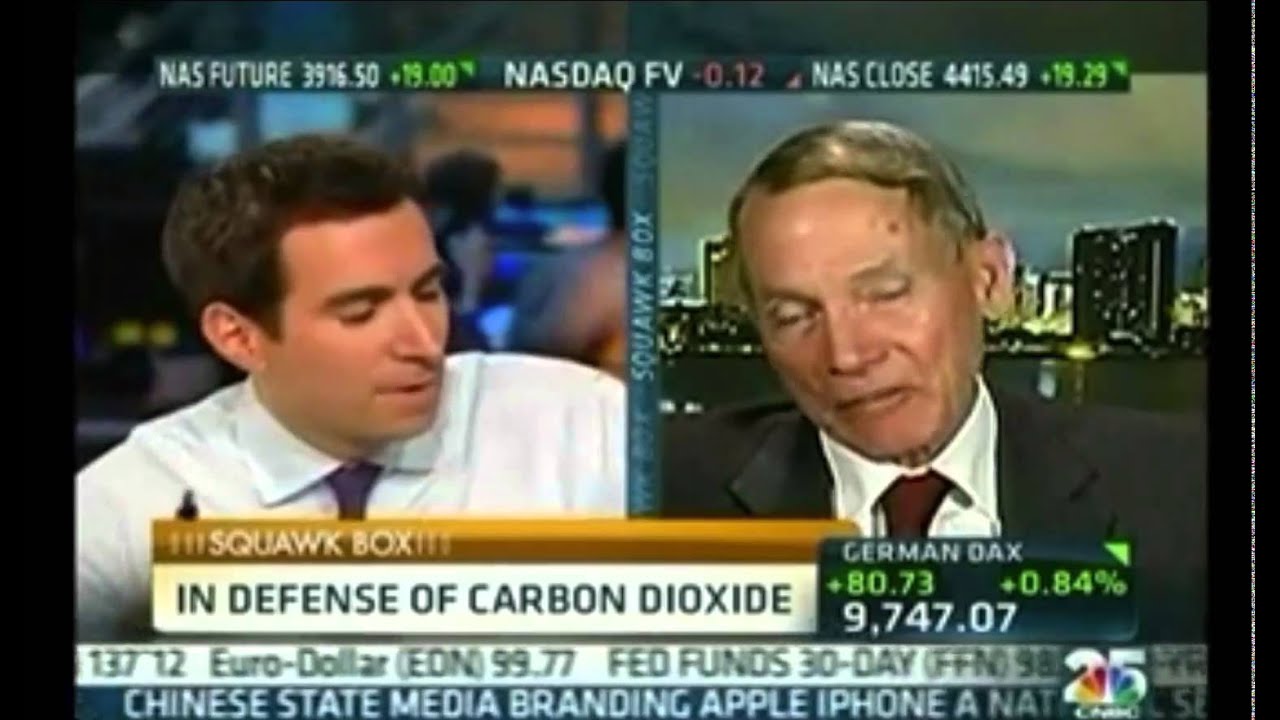 ." During President George H. W. Bush's term, Happer was director of the office of energy research at the Department of Energy.
Jim Lakely
Lakely runs the blog Somewhat Reasonable out of the Chicago-based libertarian think-tank the Heartland Institute. Lakely is also thecommunications director and co-director of the Center on the Digital Economy at the institute. Previously, he worked as a journalist covering politics and technology. He has a bachelor's degree from the University of Pittsburgh, according to his Heartland profile. In a December 2014 blog post, Lakely wrote, "The reason why the United Nations and the world's governments focus on fighting climate change is because that mission gives them license to control everything about the economy of every state in the world."
Patrick J. Michaels
Michaels is the director of the Center for the Study of Science at the Cato Institute, a libertarian think tank based in Washington, D.C. He was long considered the most credible scientist in the climate denial campaign. He was the president of the American Association of State Climatologists and an IPCC author, sharing the 2007 Nobel Peace Prize with other contributing scientists. But Michaels—who at one point estimated 40 percent of his funding came from the fossil fuel industry—has been caught repeatedly making inaccurate climate claims, including on Fox News and in the Washington Post and Forbes.
Steven J. Milloy
Milloy is the director of external policy and strategy for Murray Energy Corp.,the largest privately held coal producer in the U.S. He also runs the website JunkScience, which aims to cast doubt on peer-reviewed climate research. He got his start as a denialist working for the tobacco and chemical industries in the 1990s. In 1998, he helped write the American Petroleum Institute's strategy to challenge climate science. Milloy is a former columnist for Fox News who now frequently appears as a guest to discuss energy and climate issues. His bio boasts that he has written "over 600 articles/columns published in major newspapers/web sites, including The Wall Street Journal, Investor’s Business Daily, FoxNews.com, Financial Times, National Post (Canada), USA Today, Los Angeles Times, Washington Times, New York Post, New York Sun and other print and web outlets."
Christopher Monckton
Monckton serves as chief policy adviser to the conservative think tank Science & Public Policy Institute. He has written several articles denouncing the severity of global warming and is a regular speaker at anti-climate action conferences. In testimony before Congress in 2010, he said climate change was a "non-problem." Earlier this year, he co-wrote an article in the peer-reviewed Chinese Science Bulletin with fellow climate denialists arguing that the IPCC's models are inaccurate and the world won't warm dangerously by the end of the century. Monckton also invented the "Eternity" puzzle, has a background in journalism, and in the early 1980s served an adviser to former U.K. Prime Minister Margaret Thatcher.
Marc Morano
Morano runs the denialist blog ClimateDepot. He's also the communications director of the Center for a Constructive Tomorrow, a Washington, D.C.-based libertarian think tank focused on environmental issues that's received funding from fossil fuel interests such as ExxonMobil and Chevron. He got his start on the climate issue working as communications director for Republican Sen. Jim Inhofe of Oklahoma from 2006 to 2009, and before that for conservative talk show host Rush Limbaugh. He's a frequent speaker at the Heartland Institute's International Conference on Climate Change and often appears on Fox News and other conservative media outlets. In 2010, after months of stoking Climategate on his blog, he said climate scientists "deserve to be publicly flogged."
Joanne Nova
Nova is an Australian climate denialist and author of "The Skeptic's Handbook," a crash course in false science claiming global warming isn't happening and isn't human-caused. The book has been translated into 16 languages. Nova and her husband, fellow climate denialist David Evans—whose name was attached to Nova's email address in Fred Singer's messages—also run Science Speak, a "scientific modeling and mathematical research company" that challenges evidence the world is warming.
Roger Pielke
Roger Pielke Sr., a controversial climate scientist, said he believes that "humans have altered the climate system." However, he also supports the idea that warming has recently stopped and has argued against some well-established points of climate science, such as observed sea level rise and glacier melting. Pielke holds the position of senior research scientist at theCooperative Institute for Research in Environmental Studies. He also is a senior research associate the University of Colorado in Boulder. It's unclear whether the intended recipient of an email thread concerning "Merchants of Doubt" was Pielke himself, or his son Roger Pielke Jr. His son is a policy researcher at the Center for Science and Technology in Colorado and has criticized those who have linked climate change to increasingly extreme weather.
Thomas P. Sheahen
Sheahen is a physicist and director of the Institute for Theological Encounter with Science and Technology. According to the Heartland Institute, he is also the vice chairman of Fred Singer's Science and Environmental Policy Project's board of directors. "The science is NOT settled at all," he said in testimony in West Virginia earlier this year challenging the teaching of man-made climate change as scientific fact. "It would be a great disservice to children to indoctrinate them with one currently fashionable theory."
S. Fred Singer
Singer is one of the earliest and most vocal scientists in the climate denial campaign. He was an academic and government space researcher for nearly four decades before working on behalf of the tobacco industry to discredit scientific evidence that smoking was bad for human health. In the early 1990s, he started attacking global warming. He founded an anti climate-action think tank, the Science and Environmental Policy Project, using fossil fuel funds. The group has denied the existence of man-made climate change for 25 years. He also created the Nongovernmental International Panel on Climate Change (NIPCC), a publication of junk science that counters the UN’s Intergovernmental Panel on Climate Change's work. He has called the IPCC's latest assessment "a wonderful paper weight or door stop."
Wei-Hock (Willie) Soon
Soon, a solar physicist at the Harvard-Smithsonian Center for Astrophysics, has posited that increased energy from the sun—not the burning of fossil fuels—is the biggest driver of modern climate change. His theory has been widely refuted by the scientific community, including the UN’s Intergovernmental Panel on Climate Change and the National Academy of Sciences. In February, public documents showed that Soon received hundreds of thousands of dollars from fossil fuel interests to publish "deliverables" in the form of articles about the solar-warming theory in scientific journals. He failed to disclose conflicts of interests to those journals and during congressional testimony. Soon also has ties to several conservative, climate-denying think tanks, including the Heartland Institute and the Committee for a Constructive Tomorrow.
Roy Spencer
Spencer is a scientist at the University of Alabama-Huntsville and a former senior scientist for climate studies at NASA's Marshall Space Flight Center. He says he believes natural fluctuations in the climate system could be the primary driver of global warming. During a Senate hearing in July 2013,Spencer told the committee humans "are having some influence" on climate change, "but it is impossible to know with any level of certainty how much influence."
James Taylor
Taylor is vice president of external relations and a senior fellow of environment and energy policy at the conservative think tank the Heartland Institute. He has a Bachelor of Arts degree from Dartmouth College and a law degree from Syracuse University. In 2012, it was revealed that the Heartland Institute had plans to spend $200,000 over two years to circulate materials sowing doubt about climate change in classrooms. In an interview with InsideClimate News, Taylor said the material would act as "a nice counterweight" to material with "an overtly political and alarmist message in regards to climate change."
Anthony Watts
Watts edits the blog Watts Up With That, which questions climate science and presents, "the untold story of the climate debate from the climate skeptic side." Watts studied electrical engineering and meteorology at Purdue University but never graduated. He then served as an on-air meteorologist for 25 years. He's a frequent speaker at anti-climate action events hosted by the Heartland Institute. "I believe that our [man-made] contribution [to climate change] may be far less than has been postulated," he told a California newspaper in 2007. "Our measurement network has been compromised—not intentionally, but accidentally and through carelessness."
PUBLISHED UNDER:
==
e&e the good one:
Merchants of Doubt' emails spark fiery debate about strategies of climate skeptics
Evan Lehmann, E&E reporter
ClimateWire: Monday, March 9, 2015
Before the release this Friday of the documentary "Merchants of Doubt," S. Fred Singer sought the advice of nearly 30 climate skeptics about their chances of halting the movie and whether he should sue Naomi Oreskes, who co-authored the book on which it's based.
"Has she finally gone too far?" asked Singer.
The discussion is outlined in a chain of emails initiated last fall by the 90-year-old physicist, who is featured in the film for his work questioning the amount of influence people have on rising temperatures. His request reached a mix of academics and others who have been mostly antagonistic toward mainstream climate findings. ClimateWire obtained the emails from a source who received them as a forwarded message.
Perhaps the strongest response came from James Enstrom, an epidemiologist who has challenged the science around the health risks of secondhand smoke and particulate air pollution. Enstrom told Singer that he could make "a very strong case" against Oreskes if Singer filed complaints with the universities she's affiliated with.
"I suggest you Attack Oreskes by Filing short Grievances with Harvard and Stanford," Enstrom wrote to Singer on Oct. 21. Oreskes is a professor of scientific history at Harvard University with a doctorate from Stanford University.
"Good thought," Singer responded.
The wider discussion is viewed by some as awindow into the network of skeptical scientists, bloggers and conservative think tank scholars who often raise objections to mainstream climate science. The tactics discussed -- like lawsuits and grievances -- reflect previous efforts to constrain critics of Singer and others through legal attacks, or the threat of them,several people involved with the movie say.
"This is part of their intimidation," Oreskes said in an interview. "It's a part about trying to make people frightened that if they do speak up and they do expose what's going on, they'll get attacked. And they will get attacked. I've been attacked."
The documentary is based on her book, "Merchants of Doubt," published in 2010. In it, she outlined the similarities between the political fight around climate change and the earlier debates about whether smoking was dangerous. The effort to fight health problems from smoking was stalled for years. She suggested that a small group of scientists cooperating with think tanks and businesses managed to obscure basic truths about the harms of both. The movie will be released nationally Friday. It's directed by Robert "Robby" Kenner, the creator of the 2008 documentary "Food Inc."
Singer, who cooperated with Kenner to film a scene for the movie, said in an interview with ClimateWire that he hasdecided not to take legal action against Oreskes or Kenner. It would be too expensive and would require too much of his time, he said. He also ruled out filing grievances against Oreskes with university administrators because "they're just as bad as she is."
Still, Singer has sent mixed signals about his intentions. Last week, he sent a letter to Kenner to raise the possibility of legal action.
"I would prefer to avoid having to go to court; but if we do, we are confident that we will prevail," Singer said in the letter, which suggests that the film treats him maliciously and adds, "it is rather too bad that you got mixed up with Naomi Oreskes."
A 'liar for hire' or an honest skeptic?
The letter was posted on Climate Depot, a website critical of climate science run by Marc Morano, who is featured in the film and was a recipient of Singer's emails last fall.
"I think there's a pattern," Kenner said of Singer's letter in an interview. "It's to come after and try to silence critics and to intimidate. And when [Singer] implies litigation is very expensive, I think it's an attempt to be intimidating."
On the other hand, it might be going too far to suggest that Singer's goal is to stifle his critics if he feels he's been slandered, said Andrew Hoffman, a professor at the University of Michigan who studies the behavior of climate skeptics.
Singer says he believes the movie refers to him as a "liar for hire," though he hasn't seen it. That's false, he said, noting that he believes genuinely that humans have little effect on climate change. He also rejects the idea that he's being paid by fossil fuel companies, apart from an unsolicited $10,000 donation from an Exxon foundation 12 years ago to the Science & Environmental Policy Project, which he founded.
Singer acknowledged that he has "made a lot of money on oil," but it was decades ago, from fees he charged to financial institutions, major corporations like IBM and some oil companies to predict the price of crude using a computer model he created, Singer said. The money wasn't related to research around climate change, he said.
"I'm real sad about this attack, but it's not unexpected," Singer said of the "liar for hire" phrase.
But does the movie say that?
:{
}:
No, said Kenner, who provided a transcript of the scene with Singer to ClimateWire. He and others say it appears to be a phrase created by a media outlet that reviewed the film.
Besides, lying isn't a common tool of skeptical scientists, Oreskes said. These contrarians are generally successful, and trusted by some, in one field or another.
:{
}:
"This isn't about lying," Oreskes said. "This is something much more terrible, in a way. Much more devious. A kind of what we call doubtmongering."
"I never said that anyone was lying, and I never would say that," she added. "But this is part of the strategy, too. These people put words in other people's mouths, and then they act all outraged about it, and they spread the claim that you said something that you never said. And then they threaten to sue you for it."
Singer supporters slam 'Merchants of Smear'
Oreskes has an example in mind.
:{
}:
Singer filed a libel suit in the early 1990s against Justin Lancaster, a climate researcher at the University of California, San Diego, who claimed that Singer had taken advantage of his mentor and colleague, Roger Revelle, a noted climate scientist, in the months before Revelle's death.
Singer approached Revelle a month before his triple bypass heart surgery to cooperate on a journal article that downplayed the urgency of addressing climate change. It marked a reversal for Revelle, who supported policies to reduce greenhouse gases and was a mentor to former Vice President Al Gore. The paper roiled the climate debate as Gore's opponents highlighted it to raise questions about the certainty of warming.
But Revelle missed the debate. He died in July 1991 and was unable to shed light on Lancaster's assertions that Singer had pressured Revelle into co-authoring the paper in his weakened state after surgery. So Lancaster accused Singer of acting unethically, and Singer sued. Lancaster eventually settled the suit and entered a yearslong gag period.
He would later say the settlement was one of his biggest regrets. And he accused Singer, in even stronger terms, of pressuring Revelle to cooperate.
"It was one of the worst things I ever did, was to give him a retraction," Lancaster said in an interview. "I did it to try to save my marriage."
Singer frequently points to his success with that case. He raised it in his letter to Kenner and in his emails last fall.
"The lawsuit was not filed to intimidate," Singer said in the interview. "It was filed because what Lancaster suggested was that I faked the participation of Roger Revelle as a co-author. That's completely untrue. We have a complete retraction and an apology."
In his October emails, Singer reaches out to some of the most recognizable opponents of mainstream climate science and policies, including Willie Soon, Patrick Michaels, Anthony Watts, Steven Milloy, Joe Bastardi and Joe Bast.
An English climate change denier, Christopher Monckton, viscount of Brenchley, responded to Singer's request for advice by saying he would "draft the complaint" for a lawsuit, but Singer never followed up.
"In every way, they have bent the science," Monckton said of mainstream scientists and the filmmakers. "And having bent the science and not convinced anybody, not even themselves really, they're not simply resorting to the fallback position which Hitler and Goebbels on the left did, which Mao Tse-tung and Pol Pot did, and of course ... Stalin and Lenin did, and that is smear."
"So this film should really be called 'Merchants of Smear,'" he added.
The pre-release controversy around the movie provides more than just a glimpse into the stormy messaging strategies on climate change. It also promotes the film. But does it help convey the facts?
Hoffman, of the University of Michigan, says tit-for-tats between mainstream and contrarian researchers tend to raise the profile of skeptical scientists, despite their relatively small number. He pointed to the recent inquiries undertaken by Democratic members of Congress, who want the identity of donors who help fund skeptical academics, as an advantage for those who challenge climate science.
"Frankly, this degradation benefits the skeptics," Hoffman said
==
http://www.alternet.org/environment/new-mccarthyism-how-fear-socialism-fuels-americas-climate-denial
oreskes and c 10/15
In the late 1970s, scientists first came to a consensus that global warming was likely to result from increasing greenhouse gases released by the burning of fossil fuels. This idea had been around since the turn of the century, but the development of computer models made it possible to make quantitative predictions. Almost immediately, a small group of politically connected and conservative scientists began to question this consensus. As empirical scientific data mounted up, their attacks became more unprincipled. These conservative scientists used data selectively and often misrepresented the conclusions of many studies undertaken by the scientific community.
In 1992, world leaders gathered in Rio de Janeiro to sign the United Nations Framework on Climate Change. President George W. Bush promised to translate the written document into “concrete action.” Three years later, the Intergovernmental Panel on Climate Change (IPCC) declared that the human impact on the earth’s climate was no longer a prediction but an observable fact.
In the early 1990s, a group of skeptics claimed that Roger Revelle, one of the first climate scientists, had changed his mind about global warming and no longer believed it was a serious problem. The claim was repeated through several news outlets, including the Washington Post. When a graduate student namedJustin Lancaster — who had worked closely with Revelle before his death in 1991 — tried to insist that Revelle had not changed his view, he was sued for libel. Lancaster was obliged to settle out of court. The claim was repeated again and again, and even today, exists on the Internet.
In 1996, when the IPCC released its second assessment report, stating that the human impact on climate was “discernible,” a fossil-fuel-industry-funded group called the Global Climate Coalitionaccused the IPCC author Benjamin Santer of making unauthorized changes to the document, with the intent of creating a sense that global warming was more certain than it was. The following year, Frederick Seitz, chairman of the George C. Marshall Institute, repeated the charges in the Wall Street Journal in an op-ed piece headlined “A Major Deception on Global Warming.”
Massive attack
Had Santer made unauthorized changes to the IPCC report? No: his changes were made in response to peer review. He was doing what every scientist is expected to do — and what IPCC rules required him to do — accepting criticism and using it so that the conclusions of the study were rigorous and clear. Frederick Seitz was a former president of the National Academy of Sciences, so it was not plausible that he did not know about the peer-review process.
In 2007, the claims were repeated in Unstoppable Global Warming: Every 1,500 Years, a book whose premise is that “human-emitted CO2 has played only a minor role” in contributing to global warming. The authors are Dennis Avery and Fred Singer.Singer is a physicist with a track record of challenging scientific evidence. He had taken part in the previous attack on Santer.
Both the IPCC and Santer’s co-authors took considerable pains to set the record straight, denying that Santer had done anything wrong. Yet, in their book, Avery and Singer reassert that “scientific reviewers discovered that major changes had been made ‘in the back room’ after they had signed off on the science chapter’s contents” and that “Santer single-handedly reversed the ‘climate science’ of the whole IPCC report”. The idea that any one individual could reverse the entire IPCC process is absurd, and yet, like the “Revelle changed his mind” claim, it remains on the Internet today.
Climate scientists have been subjected to repeated attacks of this kind. In 2005, Congressman Joe Barton of Texas demanded that Professor Michael Mann, director of the Earth System Science Centre at Pennsylvania State University, produce a huge volume of paperwork relating to his research. In February, Senator James Inhofe of Oklahoma accused a dozen climate scientists of criminal violations of Federal Law, based on alleged evidence contained in the UEA emails. Recently, Virginia’s attorney general, Ken Cuccinelli, went after Mann again, asking that the University of Virginia produce thousands of pages of documents relating to Mann’s research.
We, too, have been objects of attack. When one of us (Naomi Oreskes) published a review on the book The Republican War on Science in the journal Science, in which we noted some connections not pursued in that book, Science was threatened with a lawsuit unless it published a rebuttal. (We supplied documents, Science held firm, and the threat went away.)
Blaming scientists for speaking truth to power is an old story. Scientists have long recognized that both the government and public can be reluctant to accept scientific evidence that results in discomfiting conclusions. In 1949, when the USSR detonated its first atomic bomb, the U.S. had to face the reality that it had lost its monopoly on nuclear weapons. Scientists had been warning of this since 1945, but the success of their predictions did not increase their standing. When they then said that any attempt to stay ahead of the Soviets by building the H-bomb would only speed up the arms race, they were accused of being disloyal. As Harold Urey, who won the Nobel Prize in Chemistry in 1934, wrote: “Because we [scientists] told disagreeable truths, we have even been accused of wishing to give up our progress because we are impractical dreamers or plain traitors.”
What is most disagreeable to many “resistors” of global warming is the fear of climate change being used as a warrant for heavy-handed government intervention. There is a parallel with 1949: fear of the Soviet Union then was not fear of a potential invasion, but that the Soviets would export communism to Europe, from where it might spread to the U.S.
Today, U.S. conservatives and right-wing commentators are red-baiting once again. The columnist Charles Krauthammer alleges that “with socialism dead . . . the left was adrift until it struck upon a brilliant gambit: metamorphosis from red to green”. Patrick J. Michaels, director of the Center for the Study of Science at the Cato Institute, labeled plans for a cap-and-trade system to control greenhouse gases as “Obamunism”. The irony is that in 1990, Bush installed a cap-and-trade regime to reduce acid rain because it was an acceptable market-based mechanism. Yet, when Congress finally took the model seriously, conservatives called it communism by other means.
Market failure
Attacks on climate science, including the 2009 “Climategate” campaign, had nothing to do with the science itself and neither did the entire earlier history of global-warming denial we have studied. Scientists are an easy target. The real issue is the politics of defending the free market.
Since the mid-1990s, the fossil-fuel industry has made common cause with old cold warriors, maverick scientists and conservative think tanks to undermine climate science. The obvious reason is that climate change is what Nicholas Stern calls “the greatest and widest-ranging market failure ever seen.” If the free market has failed, then governments will need to act. And that is precisely what various constituencies, from Inhofe to Cuccinelli and a host of think tanks, do not want. It was also what Seitz and his colleagues didn’t want. These scientists were passionately anti-communist and viewed any form of government regulation as a step towards socialism.
No wonder we see the rise of McCarthyite tactics today: the stakes, at least in some people’s eyes, are the same. But what these people seem to have forgotten from the 1950s is that McCarthyism didn’t just destroy the careers of many innocent people: in the end, it destroyed Joe McCarthy.
==
kpfa 9/29/15 interview on new novel: why didn't we act?
inspired/infl by revelle but did not meet
ks robinson: the invisible hand never picks up the check
https://kpfa.org/episode/letters-and-politics-september-29-2015/
==
6/15
http://www.alternet.org/environment/how-climate-deniers-are-creating-nightmare-they-most-fear
Recently, the Washington Post reported new data showing something most of us already sense: that increased polarization on Capitol Hill is due to the way the Republican Party has lurched to the right. The authors of the study use Senator John McCain to illustrate the point. McCain's political odyssey is, in some dismaying sense, close to my own heart, since it highlights the Republican turn against science.
As unlikely as it might seem today, in the first half of the twentieth century the Republicans were the party that most strongly supported scientific work, as they recognized the diverse ways in which it could undergird economic activity and national security. The Democrats were more dubious, tending to see science as elitist and worrying that new federal agencies like the National Science Foundation and the National Institutes of Health would concentrate resources in elite East Coast universities.
In recent decades, of course, the Republicans have lurched rightward on many topics and now regularly attack scientific findings that threaten their political platforms. In the 1980s, they generally questioned evidence of acid rain; in the 1990s, they went after ozone science; and in this century, they have launched fierce attacks not just on climate science, but in the most personal fashion imaginable on climate scientists.
While Senator McCain didn’t go directly down the path of attacking science, he, too, shifted in disturbing ways. After all, with Democratic Senator Joe Lieberman, he had been a co-sponsor of the Climate Stewardship Acts of 2003, 2005, and 2007, which called for a mandatory cap-and-trade system to control greenhouse gas emissions. These were at the time endorsed by many Democrats and most environmental groups. By 2010, however, he was retreating fast from support for his own bill and insisting that he had never backed capping carbon emissions “at a certain level.” He now calls for increased offshore oil and gas drilling, claims that important aspects of energy policy should be left to state and local governments, and has criticized both President Obama and Secretary of State Kerry for framing climate change as a national security issue — a position that the Pentagon itself endorses.
Still, compared to many of his colleagues, McCain looks like a moderate. They have dismissed climate change as a fraud and a hoax, while conducting McCarthy-esque inquiries into the research of leading climate scientists. Many of them attack climate science because they fear it will be used as an excuse to expand the reach of government.
In a hearing at which I testified last month, Republican members of the Committee on Natural Resources denounced a wide range of scientific investigations related to the enforcement of existing environmental laws as “government science.” And this, they alleged, meant it was, by definition, corrupt, politically driven, and lacking in accountability. The particular science under attack involved work done by, or on behalf of, federal agencies like the National Parks Service, but climate science came in for its share of insults as well.
On the face of it, the charges were absurd: most agency science is subject to far more scrutiny, accountability, and oversight, including multiple levels of peer review, than research done in academic settings. In contrast, research done under the aegis of industry is often subject to no public accountability at all.
In preparing my testimony, however, I realized that something far larger was at stake: the issue of politically driven science itself. It’s often claimed that environmental science done in federal agencies is “politically driven” and therefore suspect. It was, I realized, time to challenge the presumption that such science is bad science. While widely held, the idea is demonstrably false. Moreover, the suggestion that “government science” is intrinsically problematic for Republicans who eschew big government ignores the simple fact that most of the major contributions of the twentieth century, at least in the physical sciences, came from just such government science....
==
video doc:
n screen, the man widely regarded as the grandfather of climate denial appears a genial participant in a newly-released expose about industry’s efforts to block action on global warming.
But behind the scenes, Fred Singer has lobbied fellow climate deniers to try to block the film, Merchants of Doubt, and raised the prospect of legal action against the filmmaker.
“It’s exactly what we talk about in the film. It’s a product of a playbook which is to go after the messengers and attack and try and change the conversation, and try to intimidate, and it is very effective,” said Robert Kenner, the filmmaker.
Since the film’s release, Kenner, and Naomi Oreskes, a Harvard professor and co-author of the book on which the documentary is based, have come under attack in climate denier blogs, and in email chains.
The backlash appears to have been initiated by Singer, 90, a Princeton-trained physicist who has a cameo in the film.
==
Naomi Oreskes gave a 77:12 presentation at U.Vic in June describing the “Merchants of Doubt”. I recommend watching it! It’s at http://www.pics.uvic.ca/webstream.php#oreskes
==
blog links to singer ctr attack, also sum?
http://climateinsight.wordpress.com/editorial/merchant-of-doubt-s-fred-singer/
...That link is to “Science and Smear Merchants” by S. Fred Singer in the “American Thinker” blog. He opens with this:
Professor Naomi Oreskes, of the University of California in San Diego, claims to be a science historian. One can readily demonstrate that she is neither a credible scientist nor a credible historian; the best evidence is right there in her recent book, “Merchants of Doubt: How a Handful of Scientists Obscured the Truth on Issues from Tobacco Smoke to Global Warming,” coauthored with Eric Conway. Her science is faulty; her historical procedures are thoroughly unprofessional. She is, however, an accomplished polemicist, who has found time for world lecture tours, promoting her book and her ideological views, while being paid by the citizens of California. Her book tries to smear four senior physicists — of whom I am the only surviving one. I view it as my obligation to defend the reputations of my late colleagues and good friends against her libelous charges
Those are very serious allegations. Please read his article as background to this posting. He points to a number of typographical and editorial errors,claiming that they disqualify her as a scientist. They are very minor and not surprising in a book with 355 pages; the Merchants of Doubt website now has an “Errata” section correcting most of them. They are about as trivial as the fact that Singer misnamed Erik M. Conway as “Eric”. He then goes on to chastise her for failing to speak directly with him and others who are subjects of the book, claiming that she used only secondary sources and that this demonstrates that she is not a historian either.He makes an allegation of libel without documenting what he regards as libelous....
==
June 7,2011
Naomi Oreskes, Conspiracy Queen
By Norman Rogers who?
Naomi Oreskes is the environmentalist Noam Chomsky. She thinks that anyone who questions environmentalist doctrine is evil. Her crusade is to expose the presumed ulterior motives of the critics. According to Oreskes, if you question the dubious studies concerning secondhand tobacco smoke, you must be in the pay of tobacco companies. If you question global warming, you must be working for a fossil fuel company. If you question the DDT ban, you must part of a right wing conspiracy to weaken faith in government regulators.
Oreskes is the author of one of the silliestarticles ever to appear in the journal Science. She claimed that she analyzed 928 peer-reviewed papers on global warming and 100% agreed with the Intergovernmental Panel on Climate Change (IPCC) concerning global warming. If you go to the website of the Nongovernmental International Panel on Climate Change (NIPCC) you can find hundreds of peer reviewed papers that disagree with the IPCC in one way or another.
Her latest book, with co-author Erik Conway, is Merchants of Doubt. In this tedious [ kiss of death? uses big words?] book she treats us to the details of numerous disputes between those who subscribe to normative environmental theology and those who don't. Normative environmental theology is the sort of theology that is preached by the Sierra Club or theUnion of Concerned Scientists. Oreskes is a professor and an important administrator at the University of California. Like Chomsky, she cloaks her endless conspiracy theories in the machinery of scholarship. Her 343 page book has 64 pages of notes. A pig with lipstick is still a pig.
Neither Oreskes nor her co-author have strong scientific educations and it shows. From her book it is obvious that she enjoyed access to many scientists, but somehow none of her scientist friends found the time to proof read Merchants of Doubt. [proofread is one word, irony; note no evidence of error] This is not hard to understand. Merchants of Doubt is a book of unsurpassed monotony. Conspiracy theories get boring very quickly, especially when the conspiracies are all variations of a few crude plots. A number of informed critiques of Merchants of Doubt can be seen in the 1-star Amazon reviews. [TP was training?]
In the introduction to Merchants of Doubt the fact that adding CO2 to the atmosphere causes the stratosphere to cool and the troposphere to warm is explained as follows:
But if the warming is caused by greenhouse gases emitted at the surface and largely trapped in the lower atmosphere, then we expect the troposphere to warm, but the stratosphere to cool.
It is a bit difficult to know what this sentence means but it is clear that Oreskes hasn't the faintest idea concerning radiation and the role of greenhouse gases. Greenhouse gases (mostly CO2) are not trapped in the lower atmosphere but are well mixed up to and including the stratosphere. CO2 causes the stratosphere to cool because CO2 is a good radiator of infrared radiation and thus improves the capability to exhaust stratospheric heat to space as radiation. Cooling of the stratosphere is not evidence of global warming. It is evidence of increased CO2 in the atmosphere. The distinction is important.
The:{climategate:(style="background-color:#ffff66;"):}: emails are hundreds of emails among important scientists that show them to be perverting scientific protocols and practicing propaganda to promote global warming alarmism. Ben Santer is a prominent player in the climategate emails. He is most famous for saying this about the global warming skeptic scientist Patrick Michaels:
Next time I see Pat Michaels at a scientific meeting, I'll be tempted to beat the crap out of him. Very tempted.
Oreskes, apparently before the release of the climategate emails, said this about Ben Santer:
He's thoroughly moderate... soft-spoken, almost self-effacing ... you might think he was an accountant...[i]^(http://tmp.americanthinker.com/mt-static/plugins/tinymce/jscripts/tiny_mce/plugins/paste/blank.htm#_edn1)
Ben Santer, who may be Oreskes' favorite scientist, has been struggling for years with the skeptics concerning the relative heating of the upper troposphere. He has resorted to publishing papers with as many of 24 co-authors, apparently in an attempt to make his arguments more credible by collecting a lot of scientists willing to support him.
In Oreskes' milieu, it is apparently a bad thing to be anti-communist. She attacks and psychoanalyzes the physicist Frederick Seitz for his "strident" and "unalloyed" anti-communism. She puts thoughts in Seitz's head. He thinks his colleagues are "ingrates" and he "has an uneasy time with the masses." He was "hawkish" and "superior." Another physicist, William Nierenberg, is also psychoanalyzed by Oreskes. According to her Nierenberg "hated environmentalists" and was "overconfident." Nierenberg's son Nicholas Nierenberg has been so upset by Oreskes' distortions of his father's work that he started a website to refute Oreskes. The sin of these eminent physicists for Oreskes is that they were critics of environmental extremism and strong supporters of the United States in the Cold War. Seitz and Nierenberg are both dead and thus cannot defend themselves.
Fred Singer is a scientist who has been in the forefront of defending science against junk science. This is not an easy road to take. Junk science is a basic tool for groups that are pushing ideological positions. Subtle distinctions are not welcomed by the ideological groups. If you acknowledge that smoking cigarettes causes cancer, but then you dare to say that the hazard presented by secondhand smoke is exaggerated, you are tagged as a supporter of cancer. If you say that the case for man-caused global warming is full of holes you are tagged as an agent of fossil fuel companies. Very few scientists are brave enough to take the heat and personal attacks the come from standing up to junk science. Fred Singer has been doing it for a long time. In his late 80's, he is still writing scientific papers and traveling the world giving lectures. Oreskes is a promoter of junk science and for that reason cannot abide Fred Singer. Singer is her favorite punching bag. His name appears dozens of times inMerchants of Doubt.
Should we be surprised that Naomi Oreskes is a professor at the University of California and has been promoted to an administrative position? After all Noam Chomsky was a professor at MIT. But Chomsky was a professor because of his work in linguistics, not because he believes in crazy conspiracies. It seems that Naomi Oreskes is successful not in spite of her love of conspiracy, but exactly because she promotes conspiracies. This makes one wonder what has happened to the intellectual climate at the University of California.
The science establishment has fallen so low that it thinks it is a useful tactic to deal with its critics by accusing them of conspiracies financed by tobacco companies and oil companies. For the last 50 years, starting with DDT, we have been subjected to junk science scares. The scares were invariably false or exaggerated. Most of these scares were not more than brief media sensations, but some scares have been disruptive, diverting attention from real problems. The king of all scares is global warming. Taken seriously, it requires revamping the entire world economy and making us all poorer. The predictions of global warming disaster are deeply flawed junk science dressed up with an impressive "scientific" structure of panels, committees and organizations. The global warming scare is rapidly collapsing. Scientists outside of the global warming bubble are pointing out the flaws in the science and a coterie of well-informed bloggers is getting out the message by bypassing the establishment media where critics' voices are generally blocked. Nature is helping because the earth and the oceans are failing to warm according to script.
That a conspiracist like Naomi Oreskes would be welcomed by the global warming scientific establishment and invited to speak at the December 2010 American Geophysical Union meeting is a symptom of increasing desperation. The global warming advocates have dug themselves into a deep hole and they can't seem to stop digging. Ironically Oreskes spoke at a meeting where Exxon Mobil was the biggest financial contributor[ii]^(http://tmp.americanthinker.com/mt-static/plugins/tinymce/jscripts/tiny_mce/plugins/paste/blank.htm#_edn2). Apparently it's not a conspiracy if Exxon Mobil gives its money to the right people.
Norman Rogers is a Senior Policy Advisor at the **Heartland** Institute and maintains a personal website.
[i ]^(http://tmp.americanthinker.com/mt-static/plugins/tinymce/jscripts/tiny_mce/plugins/paste/blank.htm#_ednref1) Merchants of Doubt page 1
[ii ]^(http://tmp.americanthinker.com/mt-static/plugins/tinymce/jscripts/tiny_mce/plugins/paste/blank.htm#_ednref2) Exxon Mobil was a titanium sponsor, the highest category.
Page Printed from: http://www.americanthinker.com/articles/../2011/06/naomi_oreskes_conspiracy_queen.html at September 13, 2013 - 06:03:38 PM CDT
wow: pattern/cliches
Articles By Norman Rogers
- Climate Realism and Socialist Realism
- Global Warming as Faith
- :{The:(style="background-color:#ffffff;"):}::{ Post Office:(style="background-color:#ffff66;"):}::{ is Sitting on a Gold Mine:(style="background-color:#ffffff;"):}:
- American Geophysical Union Scraps Science, Now Faith Based
- Science in the Service of Ideology: The National Climate Assessment
- :{Is :(style="background-color:#ffffff;"):}::{Roy Spencer:(style="background-color:#ffff66;"):}::{ the world's most important scientist?:(style="background-color:#ffffff;"):}:
- Subverting Bowdoin
- Apple's Disappearing Cursor and Corporate Arrogance
- Global Warming Believers March in D.C.
- :{Al Gore:(style="background-color:#ffff66;"):}::{, Futurist:(style="background-color:#ffffff;"):}:
- How to Destroy Science: Cast Self-Interest as Public Interest
- The American Geophysical Union and Climate Hysteria
- Wind Power Fiasco: Call Your Congressman
- Forbidden Science: Low Level Radiation and Cancer
- :{Militant Nurses:(style="background-color:#ffff66;"):}::{ March for Something:(style="background-color:#ffffff;"):}:
- Marin County: Garden of Delusion
- Why Israel Should, and Probably Will, Attack Iran
- Global Warming Dogma and the New Iron Triangle
- Apple, Get Your Carbon Footprint Off My Neck
- Post-Normal Claws, Teeth, and Slime
- :{Sierra Club:(style="background-color:#ffff66;"):}::{ at the Metropolitan Club:(style="background-color:#ffffff;"):}:
- The Bizarre World of Radical Climate Science
- Climate Witchcraft and Post-Normal Science
- Naomi Oreskes, Conspiracy Queen
- :{Adventures in the :(style="background-color:#ffffff;"):}::{Climate Trade:(style="background-color:#ffff66;"):}:
- Greenland Is Going to Be OK
- Scientists Challenged to Become Better Global Warming Propagandists
- Global Warming Blues
PR WEB news release
- Michelle Stirling
- Friends of Science
- +1 (888) 789-9597
Oreskes Claim of Scientific Consensus on Global Warming Climate Change Discredits Harvard Kennedy School; Debunked by Peiser in 2005 and Friends of Science in 2007 Science historian and Harvard Kennedy School professor Naomi Oreskes was recently cited in the Harvard Gazette as claiming a scientific consensus on global climate change based on her 2004 survey, but Friends of Science say that in 2007 they sent Oreskes a report by Madhav Khandekar disputing her claim; Benny Peiser re-ran Oreskes survey in 2005 and found only 1.2% or 13 scientists out of 1,117 agreed with the Anthropogenic (human-caused) Global Warming (AGW) declaration. Friends of Science recently released a deconstruction of the 4 most-cited 97% surveys showing only 1-3% stated agreement with IPCC declarations and say Oreskes' continued claim discredits Harvard Kennedy School. Calgary, Alberta(PRWEB)March 06, 2014 In a report entitled "Science vs. Politics - Kennedy School Panelists Scrutinize Climate Change Denial" published Feb. 14, 2014 by the Harvard Gazette, science historian and Harvard Kennedy School professor Naomi Oreskes continued to claim there is scientific consensus on human-caused global warming, despite her 2004 paper being rebutted byRoger Pielke, Jr. in 2005, re-run and found to be inaccurate by Benny Peiser in 2005 and debunked by a Friends of Science Society commissioned report, written by Madhav Khandekar and sent to Oreskes in 2007. "Academics normally retract statements when they are proven to be wrong," saysLen Maier, president of Friends of Science."Continuing these consensus claims discredits the Harvard Kennedy School." The Harvard Gazette narrative states Oreskes explained that ...'Overall agreement on the issue is at 97 to 99 percent, she said — about as close to perfect harmony as scientists can get; quoting her as saying: “This is beyond reasonable doubt. This is not disputed in the scientific community.” Friends of Science point to their recent deconstruction of the 4 most-cited 'consensus' surveys. The research revealed that instead of a broad 97% as claimed - in fact only 1-3% of scientists in 3 surveys stated agreement with various IPCC declarations. The vast majority held no position at all and a significant percent felt natural factors were far more influential. A single survey done in 2010 was able to find a 66% consensus, but the remaining 34% scientists of that survey publicly denounced the IPCC declaration. "It seems a lack of academic integrity to continue to defend a position that is so obviously incorrect," says Maier. Friends of Science began the deconstruction of the 97% consensus reports, being curious as to how 4 separate surveys, each with a different data base, different parameters and definitions could all arrive at the same consensus number. "This was described in 1954 by Darrell Huff as "statisticulation" or math manipulation," says Maier. "Subsequently, social psychologists like Robert Cialdini developed the theory of 'social proof' and how influential it is for others to fall in line, if the public think all authority figures, or all their friends agree. Surely science studies at eminent universities should be teaching about empirical evidence, not wallowing in propaganda." Roger Pielke, Jr.rebutted Oreskes 2004 paper upon publication. Peiser (2005) re-ran Oreskes survey finding only 1.2% or 13 scientists out of 1,117 agreed with the Anthropogenic (human-caused) Global Warming (AGW) declaration, 34 scientists rejected or doubted the alleged ‘consensus’ position outright and 44 claimed natural factors as more influential. At least 470 papers expressed no position on AGW whatsoever. Friends of Science point to the fact that other scientists who dispute the alleged consensus are publicly humiliated with condemnatory and dismissive name-calling - even by university professors like Oreskes and others on the Harvard Kennedy School panel. "We provide evidence, they call us names. That's not science," says Maier."This misinformed view is about to devastate US industry and the world economy if extreme climate change targets based on faulty social proofs are imposed by the Obama administration's proposed expansion of EPA regulations." U.S. Chamber of Commerce, in an amicus brief with the Supreme Court opposing further expansion of emissions regulations cites the EPA’s documents, from 2004, which state that related permits would cost businesses “. . . an average of $125,120 and required 866 hours for the applicant to complete . . .” – death to small and medium businesses. "Carbon dioxide is not a pollutant. Global warming stopping in 1998; CO2 rose but temperatures did not," says Maier. "Solar cycles and the sun's magnetic flux are the main driver of climate change, not CO2. This is the science people never hear about." About Friends of Science have spent a decade reviewing a broad spectrum of literature on climate change and have concluded the sun is the main driver of climate change, not carbon dioxide (CO2). The core group of the Friends of Science is made up of retired earth and atmospheric scientists. Contact: Friends of Science Society P.O. Box 23167, Connaught P.O. Calgary, Alberta Canada T2S 3B1 Toll-free Telephone: 1-888-789-9597 Web: friendsofscience.org E-mail: contact(at)friendsofscience.org |
--
FOS debunk site: gin & tonic http://friendsofginandtonic.org/files/archive-mar-2011.html
-
xlnt summary:
Alan Burke is my hero
http://climateinsight.wordpress.com/editorial/merchant-of-doubt-s-fred-singer/
Last year I bought a copy of Merchants of Doubt by science historians Naomi Oreskes and Erik M. Conway. It describes how a handful of scientists obscured the truth on issues from tobacco smoke to global warming. I was very impressed by the content, detail and citations in the book. This posting is not intended to be a complete book review but an incident in commentary at the Globe and Mailprovided incentive to deal with what I call one of the “delivery boys” for the Merchants of Doubt and to explore the involvement of one of the main merchants,:{S. Fred Singer:(style="border:0px;margin:0px;padding:0px;vertical-align:baseline;background:transparent"):}:.
Preamble
On June 24 during commentary on the Globe and Mail article “Tory axe hits ‘muscle and bone’ of climate science, Elizabeth May says” I recommended that readers have a look at “Merchants of Doubt” and anothercommentator using the pseudonym “Anonymous Source” responded:
You pose as a ‘scientific’ thinker, you keep promoting this kind of junk instead. Here’s another opinion on Oreskes, co-author of what appears to be your new Bible, including this, for starters:
“Oreskes is well-known from her 2004 article in Science that claimed a complete scientific consensus about manmade global warming; it launched her career as a polemicist. Her claim was based on examining the abstracts of some 900 published papers. Unfortunately, she missed more than 11,000 papers through an incorrect Internet search. She published a discreet “Correction”; yet she has never retracted her ideologically based claim about consensus.”
http://www.americanthinker.com/2011/06/science_and_smear_merchants.html
Well… is that true or not? Yes or no?
Every time you post your link to that NON-scientific book I will, if I am around, be sure to post this, for starters. …
Oreskes is a dishonest political hack. When you finish your move you might also want to move away from such sources and stick to the scientific arguments you claim to want to promote.
That link is to “Science and Smear Merchants” by S. Fred Singer in the “American Thinker” blog. He opens with this:
Professor Naomi Oreskes, of theUniversity of California in San Diego, claims to be a science historian. One can readily demonstrate that she is neither a credible scientist nor a credible historian; the best evidence is right there in her recent book, “Merchants of Doubt: How a Handful of Scientists Obscured the Truth on Issues from Tobacco Smoke to Global Warming,” coauthored with Eric Conway. Her science is faulty; her historical procedures are thoroughly unprofessional. She is, however, an accomplished polemicist, who has found time for world lecture tours, promoting her book and her ideological views, while being paid by the citizens of California. Her book tries to smear four senior physicists — of whom I am the only surviving one. I view it as my obligation to defend the reputations of my late colleagues and good friends against her libelous charges
Those are very serious allegations. Please read his article as background to this posting. He points to a number of typographical and editorial errors, claiming that they disqualify her as a scientist. They are very minor and not surprising in a book with 355 pages; theMerchants of Doubt website now has an “Errata” section correcting most of them. They are about as trivial as the fact that Singer misnamed Erik M. Conway as “Eric”. He then goes on to chastise her for failing to speak directly with him and others who are subjects of the book, claiming that she used only secondary sources and that this demonstrates that she is not a historian either. He makes an allegation of libel without documenting what he regards as libelous.
What now follows is my perception of what was said in the book, in some cases quoting small sections and citations. I believe that Singer has demonstrated through his own actions, attitudes, and behaviors that he is indeed one of the “Merchants of Doubt”.
I’ll structure this narrative using the same subjects as the book’s chapters:
:{Chapter 1 – Doubt Is Our Product
Chapter 2 – Strategic Defense, Phony Facts, and the Creation of the :{George C. Marshall Institute:(style="border:0px;margin:0px;padding:0px;vertical-align:baseline;background:transparent"):}:
Chapter 3 – Sowing the Seeds of Doubt – Acid Rain
Chapter 4 – Constructing a Counternarrative: The Fight over the Ozone Hole
Chapter 5 – What’s Bad Science? Who Decides? The Fight over Secondhand Smoke
Chapter 6 – The Denial of Global Warming
Chapter 7 – Denial Rides Again: The Revisionist Attack on Rachel Carson
Conclusion – Of Free Speech and Free Market}:
---
Chapter 1 – Doubt Is Our Product
The first chapter outlines the formation of lobbying disinformation campaigns within the tobacco industry, describing a meeting in May 1979 with just-retired physicist Frederick Seitz who had helped to build the atomic bomb, acted as an advisor to NATO, was President of the National Academy of Sciences and president of the Rockefeller University. The primary objective was to develop “an extensive body of scientifically, well-grounded data useful in defending the industry against attacks“.
The tobacco industry pioneered how to conduct an effective disinformation campaign and Seitz became actively involved with it. The mechanisms survived for decades and are still in use by some of the same people targeting anthropogenic climate change. I won’t go into detail here about tobacco but summarize how the strategy was adopted by ExxonMobil, as documented in the study from the Union of Concerned Scientists titled “Smoke, Mirrors & Hot Air, How ExxonMobil Uses Big Tobacco’s Tactics to Manufacture Uncertainty on Climate Science, from the Union of Concerned Scientists, January 2007“.
Like the tobacco industry, ExxonMobil:
:{:{• Manufactured uncertainty by raising doubts about even the most indisputable scientific evidence.
• Adopted a strategy of information laundering by using seemingly independent front organizations to publicly further its desired message and thereby confuse the public.
• Promoted scientific spokespeople who misrepresent peer-reviewed scientific findings or cherry-pick facts in their attempts to persuade the media and the public that there is still serious debate among scientists that burning fossil fuels has contributed to global warming and that human-caused warming will have serious consequences.
• Attempted to shift the focus away from meaningful action on global warming with misleading charges about the need for “sound science.”
• Used its extraordinary access to the Bush administration to block federal policies and shape government communications on global warming.}:}:
As the industry campaign to defend tobacco was ending, Seitz went on the found the George C. Marchall Institute, leading to application of the same strategies through “Star Wars”, nuclear winter, acid rain, the ozone hole and global warming. He and his colleagues, one of whom was Singer, would fight the facts and merchandize doubt all the way.
The techniques used by contrarians and skeptics today include:
- Ad hominem attacks – in the absence of their own reputable evidence, they attempt to undermine those who oppose their views by trying to discredit the opposition, usually with unsubstantiated allegations.
- Fear – they float trial ballons about the supposedly outrageous cost of doing something in spite of the fact that it has been shown that the cost of doing nothing will drastically outweigh that of taking action.
- Sidestepping and deflection – like many politicians, they attempt to divert attention away from the real issue, raising “red herrings” and swamping commentary with irrelevant side issues.
- Appeal to authority – they refer to pseudo-experts who take contrarian positions with a gloss of believability which disappears upon deeper examination, claiming frequently fraudulent credentials.
- Deliberately confusing weather and climate, insisting that a recent change (natural variability) shows a long-term trend.
- Exaggerating uncertainty and demanding proof. That’s not how real science operates; scientists are cautious and invite real skepticism and there are never absolute proofs in science. They also confuse the scientific definition of “theory” with the popular definition – the former is a much stronger concept.
- Demands for a “balanced” view, akin to the outrage expressed by those arguing for “intelligent design” in discussions about the science of evolution.
- Outright denial – they repeat their disinformation derisively, saying that there is no proof and that there is a massive and corrupt conspiracy to steal money from us poor taxpayers and consumers
- ----
-------
Chapter 2 – Strategic Defense, Phony Facts, and the Creation of the George C. Marshall Institute
In 1989 a tobacco industry executive recommended against soliciting further advice from Seitz, saying he “… is quite elderly and not sufficiently rational to offer advice.”
The founding of the George C. Marshall Institute in 1984 saw Seitz as chairman of its board. An early project using tobacco industry disinformation tactics was an attack on the science concerning the SDI, urging journalists to “balance” their reports on SDI by giving equal time to the Marshall Institute’s views. They began to insist on invocation of the “Fairness Doctrine”.
Seitz had embraced a new cause, rolling back Communism, by supporting and defending Ronald Reagan’s Strategic Defense Initiative (SDI) called popularly “Star Wars”, challenging scientific evidence that it wouldn’t work and promoting the idea that the USA could “win” a nuclear war. Carl Sagan pointed out that a weapons exchange would result in a “nuclear winter” with devastating worldwide result. This was the beginning of a new war by Seitz and his colleagues with Sagan and his scientific studies the target. Singer published an attack on the science behind nuclear winter in a letter to Science 227, No. 4685 (Jan. 25, 1985): 356 titled “On a Nuclear Winter”.
“The attack on nuclear winter was a dress rehearsal for bigger fights to come. … the right-wing turn against science had begun.“
===
Chapter 3 – Sowing the Seeds of Doubt – Acid Rain
In Nov. 1982, Bill Nierenberg, another Star Wars era physicist was appointed to the National Science Board, a very prestigious position, and was asked to form a panel to review the science in the USA – Canada bilateral agreement on acid rain. Six of its nine members were members of either the National Academy of Sciences or the National Academy of Engineering and he had handpicked all of the members with the exception of one – Singer. The Office of Science and Technology of the White House had ‘suggested’ him.
Meeting in Jan. 1983, the panel agreed that any conflicting or dissenting views would be included in the final report and there was no discussion of any appendices. Their interim report in June concluded that “Steps should be taken now which will result in meaningful reductions in the emission of sulfur compounds”. When the draft came back from the White House, two paragraphs had been stricken, dealing with long-term damage and effects at the base of the food chain. Throughout panel discussions, Singer kept advocating going beyond the terms of reference and delving into economic issues, claiming that not enough was known to justify taking action. This was in stark contrast to the 8 other members who felt that action was indeed necessary and should begin while additional studies were conducted. In his economic analysis, Singer continued to equate the value of nature to zero, a position unacceptable to the other panel members. They decided to let Singer express his views in an appendix. His appendix began with the claim that the benefits as well as the costs of doing nothing were zero. The main report stressed repeatedly the ecological costs of acid deposition. Singer advocated letting an unregulated free market solve any problem without the need for regulation.
“The acid rain panel report was supposed to be a scientific peer review, but Singer had placed within it a policy view consistent with that of the Reagan administration, but seemingly at odds with the science that had been reviewed.”
Congress saw a revised document, with watering-down changes to the executive summary made without the knowledge or agreement of the panel. The result was a failure to pass legislation concerning acid rain until the end of the Reagan years. “We don’t know what’s causing it” became the Reagan administration’s official position, despite 21 years of scientific work demonstrating otherwise. Scientific studies continued and were published in reputable journals but the mainstream press echoed the faulty conclusion that acid rain was not a problem and would cost hundreds of billions to fix.
Six years later the administration of George H. W. Bush made amendments to the Clean Air Act establishing a cap-and-trade system to control acid rain, resulting in a 54% decline in sulfur dioxide levels between 1990 and 2007. The EPA reported that the overall cost of control was between $8 and $9 billion while the benefits were estimated from $101 to $119 billion, more than 10 times as great. Singer’s “billion-dollar solution to a million dollar problem” was just plain wrong. This is a clear case of ideological intervention to raise unjustified doubts without any backing evidence and in disagreement with solid science. Does it sound familiar?
Our Canadian lakes suffered the damage of political inaction by the USA in spite of compelling scientific evidence showing that action should have been taken.
===
:{:{
}:}:
:{:{:{:{Chapter 4 – Constructing a Counternarrative: The Fight over the Ozone Hole}:
:{
“In 1970, British scientist Janes Lovelock had documented the widespread presence of chlorofluorocarbons }:[CFCs] in the Earth’s troposphere (the lower portion of the atmosphere). Lovelock had calculate that given the known concentration of CFCs in the atmosphere virtually all of the billions of pounds that had been manufactured were still in the atmosphere.” Migrating upward into the stratosphere, they would decompose under ultraviolet light into ozone-depleting fluorine and chlorine compounds.}:}:}:
The aerosol industry responded quickly, forming two trade associations whose mandate was “defense of the product” in the public sphere. Given the tobacco story, this was déjà vu all over again.
The CFC industry blamed volcanoes, said there was no proof that fluorocarbons even got into the stratosphere, no proof that they split to produce chlorine and that even if they did no proof that they were destroying ozone. Each of these assertions contradicted scientific evidence. In 1977 the public was already switching to better alternatives and in 1979 a ban on the use of CFCs was approved.
During the early 1980s, anti-environmentalism had taken root in Washington in conservative and Libertarian think tanks like the Cato Institute, the Heritage Foundation, the Competitive Enterprise Institute and the Marshall Institute. They promoted business interests, “free market” economic policies and the rollback of environmental, health, safety and labor protections.
Fred Singer at the Heritage Foundation in the early 1980s argued that ozone depletion is a natural phenomenon being cynically exploited by a corrupt, self-interested and extremist scientific community to get more money for their research.
Now as Chief Scientist for the U.S. Department of Transportation, he protested what he called the “ozone scare” in an article published on page 1 of the Wall Street Journal. He admitted that depletion was observed but dismissed it as localized and temporary and insisted that there was no proof that CFCs were responsible. He also recycled the old tobacco tactic of “refutation by distraction” noting that skin cancers had many causes, not just those caused by increased ultraviolet light. He also erected a strawman argument, that water vapour from the supersonic transport (SST) would destroy ozone, a hypothesis that had already been discredited. He offered a counternarrative that scientists had overreacted before, were overreacting now and therefore couldn’t be trusted. He also argued that depletion was caused by natural stratospheric cooling as part of natural variability. Scientists had already shown that such cooling was a direct consequence of increased greenhouse gas absorption in the troposphere.
Singer’s views went against the accumulated work of hundreds of experts and led to the conclusion that no regulation was needed. He alleged that they had “rushed to judgment” but how could he claim that if he was also inconsistently alleging that they were lobbying for more money to do more research?
His story had 3 major themes – that the science is incomplete and uncertain, that replacing CFCs would be difficult, dangerous and expensive and that the scientific community is corrupt and motivated by self-interest and political ideology. The first was true but the adaptive structure of the Montréal Protocol accounted for it. The second was baseless. The third was the pot calling the kettle black given his ties to the Reagan administration and the Heritage Foundation and the venues in which he published.
Non-CFC refrigerants are now available that are more efficient and aren’t toxic, flammable or corrosive.
In spite of broad acceptance of the science and adoption of amendments to the Montréal Protocol, Singer didn’t give up. In 1990 he established his own non-profit organization, the Science and Environmental Policy Project (SEPP) with funding assistance filtered through from the passionately anti-communist Unification Church of Syn Myung Moon. In 1995 he served as a star witness in hearings in the U.S. Congress, referring to the issue as “so-called” ozone depletion and that the scientific basis for concern was simply wrong. Following the award of the Nobel Prize in Chemistry a few weeks later to Sherry Rowland, Mario Moline and Paul Crutzen for their work in understanding stratospheric ozone chemistry, Singer then attacked the Nobel committee accusing them of making a political statement, saying that the country was in the throes of collective environmental hysteria.
Everyone is entitled to an opinion. But when a scientist consistently rejects the weight of evidence and repeats arguments that have been thoroughly rebutted by his colleagues, we are entitled to ask, What is really going on? The answer may come from his own pen in 1989. “And then there are probably those with hidden agendas of their own – not just to ‘save the environment’ but to change our economic system. Some of these ‘coercive utopians’ are socialists, some are technology-hating Luddites; most have a great desire to regulate – on as large a scale as possible.” He perceived that the real agenda of environmentalists, and the scientists providing the data upon which they relied, was to destroy capitalism and replace it with some sort of worldwide utopian Socialism – or perhaps Communism.
I wonder if he checks under his bed every night looking for lurking Communists.
===
ch 5?
When the EPA took steps to limit indoor smoking, Fred Singer joined forces with the Tobacco Instituteto challenge the scientific basis of secondhand smoke’s health risks. But they didn’t just claim that the data were insufficient; they claimed that the EPA was doing “bad science”. They began to discredit the EPA in general.
Wide ranging studies showed the effects of secondhand smoke in the USA, Germany, Japan and others despite other differences in lifestyle, diet and the like. The EPA called the weight of evidence “conclusive”. Both Fred Seitz and Fred Singer denied it.
In 1990 Singer had created his SEPP to “promote ‘sound science’ in environmental policy” which meant in part to defend the tobacco industry in collaboration with APCO Associates, the public relations firm hired by Philip Morris for their secondhand smoke campaign. Singer launched a full-frontal assault claiming that the science done at the EPA was “junk”, taking “extreme positions not supported by science” and claiming that they “could not rule out other factors … such as diet, outdoor air pollution, genetics, prior lung disease, etc.”. Why would the EPA “rig” the statistics for a 90% confidence level instead of 95%? Singer’s answer: Controlling smoke would lead to greater regulation in general. [Remember those Commies under the bed?  ]
The EPA had considered and ruled out other factors and recognized that some of them contributed to cancers but the statistical evidence was overwhelming the secondhand smoke was an added risk. Singer must have understood this but he was not practicing science, he was attacking it, apparently with ideological motivation, that regulating smoke was the foot in the door for more regulation, putting individual liberty at stake. The tobacco industry published a book titled “Bad Science: A Resource Book” based in part on Singer’s work. Nearly all quotes in the book were unsubstantiated assertions presented as fact. The Bad Science strategy was to plant complaints in op-ed pieces, in letters to the editor and in articles in mainstream journals (not scientific journals) to whom they’d supplied the “facts” and then quote them as if they really were facts.
The fact that Singer was recycling arguments from earlier debates about nuclear power and pesticides, and his defense of acid rain and CFCs suggests that none of this was about secondhand smoke but was rather about his hostility to regulation, the road to Socialism, the very thing the Cold War was fought to defeat. At the root was free market fundamentalism.
===
Chapter 6 – The Denial of Global Warming
Scientific research concerning carbon dioxide (CO2) has been going on for 150 years; in the mid-nineteenth century John Tyndall established that it has a greenhouse effect – it traps heat and prevents it from returning to space. Early in the twentieth century Svante Arrhenius realized that CO2 from burning fossil fuels could alter the Earth’s climate and Guy Callendar compiled the first empirical evidence that the greenhouse effect might already be detectable. The Institute of Physics has an indepth history available titled “The Discovery of Global Warming“. In the 1960s American scientists started to warn political leaders that this could be a real problem yet they failed to do anything about it.
There are many reasons why the USA has failed to act on global warming but at least one is the confusion raised by Bill Nierenberg, Fred Seitz and Fred Singer.
In the late 1970s President Carter’s science advisor asked the National Academy of Sciences (NAS) to empower a panel to review an early climate model (from the “Jasons”). The panel went a bit farther, looking at more recent 3D models, including one by James Hansen. The key question was how sensitive the climate is to changing levels of CO2; the answer was that there would be a rise of about 3 degrees Celsius for a doubling of the CO2 concentration, plus or minus 1.5 degrees. The panel reviewed possible counteracting factors like aerosols but determined that they would not prevent a substantial warming. They also identified that the oceans have a huge “thermal inertia” and would release heat to the atmosphere slowly but for a very long time. This meant that you might not be able to prove that warming was underway, even though it really was, and by the time you could prove it, it would be too late to stop it.
By Nov.1980, the NAS charged a new committee, chaired by Bill Nierenberg, to undertake a comprehensive study of CO2 and climate. With two economists added to the panel, they were unable to reach full consensus and so they decided for the report “Changing Climate: Report of the Carbon Dioxide Assessment Committee” to do individually authored and signed chapters. The scientific chapters were in close agreement but the two economics chapters presented a very different view. None of the physical scientists suggested that accumulated CO2 was not a problem or that we should simply wait and see but that’s precisely what the economists’ chapters as well as the summarizing synthesis chapter argued. Nierenberg structured the report with the economists’ chapters as bookends, front and back, diffusing the impact of the scientists’ chapters.
Nierenberg gave the administration everything it wanted, saying that no action was needed now, in spite of arguments from the scientists that it was, and concluding that technology would solve any future problems. The government need only fund further research.
The year 1988 saw the formation of the Intergovernmental Panel on Climate Change (IPCC) and the announcement by James Hansen, the director if the Goddard Institute for Space Studies (GISS) that anthropogenic global warming had begun. An organized campaign of denial began the following year and soon ensnared the entire climate science community.
The Marshall Institute under Bill Nierenberg blamed the sun, without backing evidence, having irresponsibly cherry-picked part of Hansen’s work to make it look that way. The IPCC explicitly addressed and rejected the Marshall Institute’s argument for blaming the Sun. They explained that the range of solar variability was small compared with greenhouse forcing. In a Feb. 1991 to the American Petroleum Institute Robert Jastrow crowed “It is generally considered in the scientific community that the Marshall report was responsible for the Administration’s opposition to carbon taxes and restrictions on fossil fuel consumption”. He reported that the Marshall Institute “is still the controlling influence in the White House”.
Fred Singer was preparing to attack in a different way, alleging that Roger Revelle, Al Gore’s highly respected mentor, had changed his mind about global warming. Singer enlisted Revelle for a Washington Post article, seeking to capitalize on Revelle’s cautious comments. On his way back to La Jolla, Revelle suffered a massive heart attack and didn’t recover quickly. His health deteriorated rapidly. At one point he told his secretary “Some people don’t think Fred Singer is a very good scientist”. Singer watered down Revelle’s assessment of climate sensitivity and published in Cosmos magazine (not a scientific journal) concluding “the scientific basis for a greenhouse warming is too uncertain to justify drastic action at this time”; Revelle died before being able to explain his real view about climate sensitivity. Singer’s additional words were used in the 1992 election campaign to attack Al Gore. The use of Revelle’s name to attack Gore infuriated the Revelle family as well as his colleagues at Scripps. The documentary record shows that Revelle had not changed his mind; Singer had fabricated a conclusion used to attack a political opponent.
Later, as the IPCC was preparing release of the Working Group I Report (the science), Singer presented a litany of complaints, including a false statement that satellites showed no warming at all but a slight cooling. On this basis he claimed that climate models were wrong. Singer also created a strawman argument, stating that the IPCC Summary for Policy makers was saying that global warming is the greatest global challenging mankind, a statement which was nowhere present in IPCC documents. Singer was putting words into other peoples mouths and then using them to discredit them.
Singer later attacked the published IPCC report which had been watered down under political pressure, falsely claiming deletions of uncertainty. His claims were not only false but they had been shown to be false. In her 1999 analysis, Myanna Lahsen pinned Singer’s efforts to “envelope the IPCC in an aura of secrecy and unaccountability” to a common American conservative rhetoric of political suppression. As shown in previous chapters if anyone was meddling with the scientific assessment and peer review process, it was the political right wing, not the left.
Seitz, Jastrow, Nyerenberg and Singer had access to power, all the way to the White House, by virtue of their positions as physicists who had won the Cold War. They used this power to support their ideology and political agenda even though it meant attacking science and fellow scientists.
The divergence between the state of the science and how it was presented in the major media helped to make it easy for the government to do nothing about global warming, going on to kill adoption of the Kyoto Protocol. Right-wing ideologues conducting a disinformation campaign had been successful in suppressing the reality of science among policy makers. It continues to this day.
==
Chapter 7 – Denial Rides Again: The Revisionist Attack on Rachel Carson
Rachel Carson was a courageous woman who in the early 1960s called attention to the harms of indiscriminate pesticide use. In Silent Spring, a beautiful book about a dreadful topic, she explained how pesticides were accumulating in the food chain, damaging the natural environment, and threatening even the symbol of American freedom, the bald eagle. In spite of industry attempts to paint her as a hysterical female, her work was affirmed by the President’s Science Advisory Committee and in 1972 the EPA concluded that the scientific evidence was sufficient to warrant the banning of the pesticide DDT in America.
In 2007, the Internet was flooded with the assertion that Carson was a mass murderer, worse than Hitler because Silent Spring led to the banning of DDT, without which millions of Africans died of malaria. [cf Graham statistical murder BS, also later generation spin Green _ Black Death: we deprove ppl of color of fossil fuels and chemicals [and GMO's?] The Competitive Enterprise Institute who had previously defended tobacco and doubted the reality of global warming said that she was wrong and had sounded a false alarm. Why did the conservative and Libertarian think tanks reopen an old debate? In demonizing Carson, free marketeers realized that if you could convince people that an example of a successful government regulation actually wasn’t in fact successful and that it was actually a mistake, you could strengthen the argument against regulation in general.
They launched an effective disinformation campaign in the mainstream media. The fact is that insects had developed resistance to DDT, primarily from agricultural spraying rather than for disease control. DDT aline did not eradicate insect-borne diseases and those diseases have been controlled in places with little or no use of DDT. There is no scientific evidence that millions of lives had been needlessly list and there is substantial evidence that a good deal of harm was avoided. The game here, as before, was to defend an extreme free market ideology but in this case they didn’t just deny the facts of science, they denied the facts of history.
The Cold War warriors Seitz, Singer, Jastrow and Nierenberg, who had dedicated their lives to fighting Soviet Communism, joined forces with the self-appointed defenders of the free market in order to blame the messenger, to undermine science, to deny the truth and to market doubt, attempting to avoid regulation. Accepting that their ends justified their means, they adopted the tactics of their enemy, the very things they had hated Soviet Communism for: its lies, deceit and denial of the very realities it had created. In defending what they saw as liberty, free from government intervention, they allowed business practices to ignore the real cost of doing business, those “externalities” leading to “social costs” which have now come back to haunt us. Liberty also requires responsibility but in their greed and ideology, they ignored the massive damage that their unfettered free-market economies were causing.
===
Conclusion – Of Free Speech and Free Market
Until recently the mass media presented global warming as a raging debate, 12 years after President George H. W. Bush had signed the U.N. Framework Convention on Climate Change, and twenty-five years after the U.S. National Academy of Sciences first announced that there was no reason to doubt that global warming would occur from man’s use of fossil fuels. “Balance” had become a form of bias, whereby the media coverage was biased in favor of a minority – in some cases extreme minority – views.
A key strategy in the campaigns to market doubt was to create the appearance that the claims being made were scientific. When the George C. Marshall Institute began to challenge the claims of the scientific community on the ozone hole and global warming, they didn’t create their own journal but they did produce reports with the trappings of scientific argumentation – graphs, charts, references, and the like. At least one of those reports was taken seriously by the White House. Yet the were not subject to independent peer review – the most basic requirement of any truly scientific work. Had they been, it’s likely they would have failed, because at least one of them seriously misrepresented the science, presenting only one portion of a key graph, which if presented in its entirety would have refuted their argument.
They also resorted techniques which are normally outside the realm of normal scientific behaviour. Scientists do not normally organize petitions, particularly ones whose signatories may or may not know anything about the topic under investigations. Yet in 1997, Fred Seitz did so with a petition alleging to refute global warming. The petition was accompanied by a lengthy piece formatted to look like a reprint from the Proceedings of the National Academy of Sciences(NAS). The “article”, never published in a scientific journal but summarized in the Wall Street Journal repeated a wide range of debunked claims including the assertion that there was no warming at all. This “Oregon Petition” which is still in circulation was mailed to thousands of scientists with a cover letter by Seitz inviting the recipients to sign a petition against the Kyoto protocol and giving the impression that the whole thing was sanctioned by NAS.
In a highly unusual move NAS held a press conference to disclaim the mailing and distance itself from its former president, Seitz. Still, many media outlets reported on the petition (and still do) as if it were of genuine disagreement within the scientific community, reinforced, perhaps, by Fred Singer’s celebration of it in the Washington Times the very same day that NAS rejected it.
The link that unites the protective industries, conservative think tanks, and the scientists is the defence of the free market, driven by the ideology of laissez-faire economics. The protagonists in “Merchants of Doubt” were fiercely anti-Communist during the Cold War and viewed science as crucial in helping to contain its spread. When the Cold War ended, they perceived a new threat in “environmentalism”, implying that environmentalists are “watermelons” – green on the outside but red on the inside. Each of the environmental threats described here was a market failure, causing large instances of the “tragedy of the commons” by ignoring the social cost externalities present in their business models and feeding the costs downstream to be paid ultimately by everyone and every living thing on Earth. But they viewed monitoring and regulation by government as the slippery slope to Socialism, a form of creeping Communism.
Their doctrine of laissez-faire capitalism holds that the common good is best served by the uninhibited pursuit of self-interest. We’ve seen where that unfettered greed has taken us recently with the global economic meltdown; it is the cause of the social costs with which we are all plagued. The western democratic belief in fairness and in hearing “both sides” was used and abused by people who didn’t want to admit the truth about the impact of unregulated industrial capitalism.
We don’t provide “balanced reporting” demanding equal time in the mainstream media for critiques of the science behind the theory of gravity, genetics, continental drift, tobacco and other areas where the evidence points to valid conclusions, having gone through the crucible of scientific peer review and publishing in reputable scientific journals. Why do we encourage it concerning human-caused global warming leading to climate change when the overwhelming majority of climatologists agree? (97-98% – see “Expert Credibility in Climate Change“) It’s because the greed of vested interests is being threatened and so the Merchants of Doubt and their delivery boys are bombarding us with propaganda and delaying the necessary steps to migrate to sustainable energy sources, and to mitigate the impact and adapt to now inevitable climate change.
===