MONEY LAUNDER 2
SEE MAIN FOR OLDER 818
=
OLD FASHIONED INT'L VS DOMESTIC POLITICAL:? distinction does not seem to be holding, on foreign see corruption
SEE CRYPTO-CURRENCY BINANCE CZ
SEE DEREG BESSANT 8 26 ~ TRANSPARENT, BOOST CORRUPT
see Dark Money on domestic
also shuffle shell
tether ballroom
-=-=
-=-=
AN 8 26
Former prosecutors piled on President Donald Trump’s efforts to obliterate anti-corruption efforts and destroy policies dedicated to preventing bribery and money laundering in the country.
The Atlantic reports this week “brought the biggest blow yet: The Treasury has obliterated a recent rule to deter devious shell companies, handily reopening the American economy to anyone looking to hide their illicit wealth.”
On Tuesday, the Department of the Treasury’s Financial Crimes Enforcement Network (FinCEN) announced that businesses formed in the United States would no longer need to disclose their actual owners. Worse, it determined that nearly all the data already gathered on such companies would be destroyed.
Treasury Secretary Scott Bessent called the move “a victory for common sense and American small businesses,” but former prosecutors told MS NOW that it effectively destroys years of hard work curbing shifty financial networks and provides cover for wealthy American tax dodgers and money launderers.
“If you look at this sort of small scale fraud, they are now solely pursuing, whether it's against daycares in Minneapolis or food trucks in southern California, I'm willing to bet that if you did another sort of demographic breakdown and analysis, you would find that this is just one more piece of the administration's general preference to go after minorities at the expense of going after people who are actually damaging the country,” former prosecutor Michael Feinberg told MS NOW anchor Nicole Wallace. “The notion that you would go after a daycare or a food truck or something else with a relatively small economic footprint and no tentacles that reach into other criminal organizations while giving a pass to major corporations that might actually be committing large scale fraud, or enabling embezzlement. And money laundering is insane. And I can't find any legitimate motive for it.”
Feinberg added that prosecution of huge, multi-faceted schemes like those cooked up by Enron will be a thing of the past under Trump’s gutted departments.
“That's going to be exponentially more difficult the next time something like that happens, because this department of justice [have] jettisoned literally centuries of cumulative subject matter expertise and experience. You can't just replace a toughened, experienced prosecutor or a seasoned investigator with somebody who just graduated from law school or Quantico.”
Former prosector and DOJ pardon attorney Liz Oyer also pointed out that Trump has walked away from major cases against wealthy individuals by either surrendering investigations or pardoning them entirely. Worse, he’s erasing the money many convicted felons were sentenced to pay back to their financial victims.
“I was a federal public defender for about ten years, and the majority of my clients were low-income people of color, and those people have always experienced the unfairness of the criminal justice system because of disproportionate targeting with prosecutions because of having less resources to defend those cases,” Oyer told Wallace. “This administration has essentially doubled down on those disparities. …Trump does not care one bit about who he is targeting disproportionately and how his prosecution policies affect communities of color, low-income communities, communities with large immigrant populations.”
---
no lnx
'He's not innocent': Republican denounces Trump's pardon of Chinese billionaire
U.S. President Donald Trump speaks during an announcement regarding his administration's policies against cartels and human trafficking, from the State Dining Room at the White House in Washington, D.C., U.S., October 23, 2025. REUTERS/Jonathan Ernst
:{Carl GibsonOctober 23, 2025 |
President Donald Trump recently announced he was officially pardoning Changpeng Zhao, who is the former CEO of cryptocurrency company Binance. One member of his party is now publicly condemning the act.
Politico reported Thursday that after Trump pardoned Zhao — a Chinese-born Canadian resident who is ranked as the 21st richest person in the world with a net worth in excess of $87 billion — Sen. Thom Tillis (R-N.C.) said it sent "a bad signal."
"I don’t like it,” said Tillis, who is not running for another term next year. "He was convicted. He’s not innocent."
Zhao pleaded guilty in November of 2023 to money laundering charges and agreed to pay $4 billion in penalties. Then-Treasury Secretary Janet Yellen said after the plea deal that Binance "allowed money to flow to terrorists, cybercriminals, and child abusers through its platform." Assistant Attorney General Matthew G. Olsen said at the time that Zhao's company "gave sanctioned customers unfettered access to American capital and financial services."
However, Zhao also had personal ties to the Trump family. As the Wall Street Journal reported, Binance supported the Trump Organization's World Liberty Financial cryptocurrency venture headed by Donald Trump Jr., which has led to the president's personal net wealth spiking significantly since the start of his second term.
The Senate is currently discussing market structure legislation aimed at regulating the cryptocurrency industry. Some Democrats are arguing for provisions in the bill that would prevent the president and his family from profiting from its crypto business, though Republicans are likely to reject them.
“It’s absolutely corrupt what this president is doing, and none of us should be surprised,” Sen. Ruben Gallego (D-Ariz.) told Politico. “What we’re trying to do in market structure is to keep the Binances of the world outside of the United States market.”
Click here to read Politico's full report.
---
an no lnx
'I don't know — he was recommended': Trump struggles to justify latest pardon
:{U.S. President Donald Trump gestures during an announcement regarding his administration's policies against cartels and human trafficking, from the State Dining Room at the White House in Washington, D.C., U.S., October 23, 2025.
REUTERS/Jonathan Ernst}:
David BadashOctober 23, 2025
Just after pardoning the founder of Binance, President Donald Trump struggled to explain his decision — appearing unfamiliar with both the recipient and the legal issues surrounding the case that led to his conviction.
“President Trump has pardoned Changpeng Zhao,” The Wall Street Journal reported on Thursday, “the convicted founder of the crypto exchange Binance, following months of efforts by Zhao to boost the Trump family’s own crypto company.”
Asked on Thursday why he chose to issue the pardon, and if it had anything to do with Zhao’s involvement with the Trump family’s crypto business, the President responded, “Who is that?”
READ MORE: ‘Amateur Historian’ Mike Johnson Hails Trump’s Ballroom as ‘Greatest’ White House Upgrade
“The founder of Binance,” the reporter replied.
“The recent one, yes,” Trump said. “I believe we’re talking about the same person, ’cause I do pardon a lot of people.”
“I don’t know — he was recommended by a lot of people,” Trump continued. “A lot of people say that — are you talking about the crypto person?”
“Yes.”
“A lot of people say that he wasn’t guilty of anything,” the President declared. “He served four months in jail, and they say that he was not guilty of anything, that what he did —” Trump said before the reporter interjected.
“Well,” Trump responded, “you don’t know much about crypto, you know nothing about, you know nothing about nothing. You’re fake news.”
READ MORE: ‘Racist on Its Face’: Top Democrat Blasts Trump’s ‘Truly Vile’ New Policy
“But let me just tell you that he was,” Trump said, “somebody that, as I was told, I don’t know him, I don’t believe I’ve ever met him. But I’ve been told, a lot of support. He had a lot of support, and they said that what he did is not even a crime.”
“It wasn’t a crime, that he was persecuted by the Biden administration, and so I gave him a pardon at the request of a lot of very good people.”
The Wall Street Journal also reported that a “pardon will likely pave the way for Binance, the world’s largest crypto exchange, to return to the U.S. after the company pleaded guilty in 2023 to violating U.S. anti-money-laundering requirements and was barred from operating in the country.”
— (@)
READ MORE: ‘Pay to Play’: Trump Ballroom Donors List Draws Concern and Condemnation
===
===
AN 9 25
During Donald Trump's first presidency, veteran television journalist Dan Rather used the words "flock of felons" to describe all of the Trump allies and ex-allies who were facing criminal charges — a group that included Michael Cohen (Trump's former personal attorney and fixer), Paul Manafort (Trump's 2016 campaign manager before Kellyanne Conway took over that position), Michael Flynn (a former Trump national security adviser), and GOP operative Roger Stone, among others. Most of the people Rather was referring to were Americans, but Trump supporter George Cottrell was British.
Cottrell was incarcerated for fire fraud in the United States. And according to the Daily Beast's Tom Latchem, he is "publishing a book about laundering money."
Latchem, in an article published on September 22, explains, "British aristocrat George Cottrell was arrested leaving the 2016 Republican National Convention, at which Trump clinched the presidential nomination. He had travelled there with one of the U.K.'s most virulent anti-migrant politicians, Nigel Farage, who is friends with the president and has met Trump in the Oval Office. The following year, Cottrell — nicknamed 'Posh George' — was sentenced to eight months in U.S. jails, having explained to undercover federal agents 'ways criminal proceeds could be laundered' on the dark web."
Latchem adds, "Now the 31-year-old, whose father went to school with Prince Andrew, is planning to play on his notorious reputation as a convicted criminal in a new book, titled 'How to Launder Money,' according to The Sunday Times."
Cottrell, now 31, was 22 when he travelled in the U.S. with Farage in 2016.
Farage is a controversial figure in UK politics, distancing himself from the Conservative Party and mainstream Tories. But he is a strong supporter of the United States' MAGA movement and has made countless appearances on Fox News.
"Cottrell has remained close to Farage," Latchem observes. "His mother, Fiona Cottrell, is a Reform U.K. megadonor, while disclosures show George picked up the tab for Farage's £15,000 2024 hop to Florida for a meet-and-greet that included Elon Musk and Trumpworld figures. Reform says Cottrell is an unpaid volunteer. Cottrell appears to divide his time between London and Montenegro, where he has been a high-stakes presence and launched an unlimited company, Geostrategy International — raising transparency concerns among campaigners because such firms need not file accounts."
*Read Tom Latchem's full article for the Daily Beast at this link (subscription required).
---
---}:
AN 7 25 PROSECUTED HUMAN TRAFFIC AND EPSTEIN PAL gISANE
Firing of 'high-profile' prosecutor shows Trump 'is not thinking clearly': analysis
//
https://gregolear.substack.com/p/deconstructing-the-epstein-myth-what
...SK
Well, was looking at all of the criminals around Donald, and I had a head start with a piece of information that I had gotten in 2005—before there was even an imagination that this man would run for president. I think to the layman’s understanding, if you knew who Trump was, which people did, that he was political in any way, just maybe he had been and we learned that he had been.
In 2005, Trump had this new reality show with Mark Burnett. And so I had a circle of people that I knew. I’m a writer, screenwriter. So I knew folks in that circle with that man.
GO
Okay. Meaning Burnett.
SK
Yes, Burnett. And I had learned that Donald was in a tremendous amount of debt to some Russians. And it was threatening this new thing—this idea of him as this self-made, you know, billionaire, whatever, whatever the thing was, a successful businessman, because it was all about to crumble. And there’s been a tremendous amount of reporting since I learned that. Verifying all of that. So I had that information at the time, back in the day.
And so when he came down that escalator, I knew, I was like, “Oh no, that’s the guy that’s in debt to a bunch of Russian gangsters!” And so I started trying to figure out who those Russians may be. And then in doing that, I came across Jeffrey Epstein.
GO
Okay, interesting. So Trump to the Russians to Epstein.
## Tinker, Tailor, Mobster, Trump
March 31, 2020
SK
Yeah, well, organized crime—specifically Russian organized crime. And then trying to understand Donald and Fred, Fred’s empire, his father’s empire, which was built with the Genovese crime family. And then the building of Trump Tower in Manhattan that moved in—they had different territory as Fred would call it, as Donald has said on the record—that Manhattan wasn’t. According to his father, “That’s not our territory,” because it wasn’t, it was Gambino territory. For Donald Trump specifically to be able to build in Manhattan, develop in Manhattan, Fred arranged for, and Roy Cohn arranged for, the two crime families, the Gambinos and the Genovese to form what became known as a concrete cartel—all the five families were in there. And this was the bid-rigging over concrete contacts to develop in Manhattan. And it was called “the Donald Trump deal.” And so that was in the middle of it, for those U.S. crime families and the racket they were running, which is this very racket that Giuliani used to prosecute the five families. So…
GO
Four of the five families.
SK
Four of the five families. Castellanos was a holdout and then was killed, shot dead in the street. So that’s the history.
There’s way more than that. During that time, before the Russian mafia had really taken over New York—which it did; it rolled in in the late 80s, some of it even back to the 70s, but very specifically in the 80s and the 90s and just sort of rolled up a lot of the territories as their own. And they did it by laundering money through Donald’s casinos. There was a lot of ways that they did all of that. There was a very prominent Russian gangster named Ivankov, who had actually an office in Trump Tower in Manhattan, but he was ultimately caught, tipped off and caught by Andy McCabe’s team.
Like when you start learning about these characters, of what they were doing back in the day, both on the law enforcement side pursuing Russian organized crime and from the Russian organized crime side—the bosses and the key figures there were all in business in some fashion with Donald Trump.
Then in the mid early 2000s to like 2005, 2006, right around when I was hearing this stuff about him, what was happening was the Russians were wanting to keep using Trump to go internationally. So the properties: Trump Panama developing and Trump Toronto developing and Trump Georgia developing and all of these foreign developments, which we were watching. If you watch “The Apprentice,” it unfolds on “The Apprentice” as well. This sort of expansion of the Trump thing where he was just licensing his name to be put on these things, because he was really over-leveraged.
Like the one in Georgia, the country Georgia—the Trump Tower there, all they did was just stick a shovel in the ground, and a whole bunch of money was laundered. There’s Trump Baku, which, you know, there was quite a bit of reporting how that was probably a front for the Iranian Revolutionary Guard. Again, Iran and their corruption very closely tied in with Russian organized crime as well.
GO
Right. Adam Davidson in the New Yorker.
SK
So that’s the background. That’s why the Trump/Russia thing is not a hoax. Donald is the hoax. You know, he did. And there’s so much reporting and Trump, the company, Allen Weisselberg, all those people, they affirm this, they said, “Yeah, yeah, we took that money.” The problem with it is some of it was illegal, but a lot of it’s not illegal, right?
He couldn’t get a casino license in Australia, infamously. They would not give him a casino license because of his ties to organized crime, both U.S. organized crime and Russian organized crime.
GO
So a major Five Eyes power decided that Trump couldn’t have a casino license because of his ties to organized crime—and specifically Russian organized crime. Let’s just underline that because it seems important. Australia is, as they say, a real country, you know—that is one of our strongest allies.
SK
Right. Right.
So how you get to Jeffrey is, there was a time in the 80s where Donald was really having issues, and he was sort of over-leveraging himself. He was building in Atlantic City. He was doing these things and couldn’t get them funded. He always had a problem getting the money because legitimate banks would stop lending to him, which was the crisis he was facing in the early 2000s, mid-2000s. There was Deutsche Bank, but even Deutsche Bank was turning him down, so he had to go for this Russian money. You could get Russian money, you could get Chinese money, and the Chinese money hadn’t quite showed up yet. But the gangsters will invest in you. So the banks were difficult.
Now part of the stuff that made it hard to get finding from U.S. banks is because of what happened with him in the 80s with Bear Stearns. So there’s a guy that ran Bear Stearns.
(This is all the reporting done by Wayne Barrett. And I recommend everybody go read Wayne Barrett’s work on Donald and Fred Trump and that sort of “Trump Inc.” He did extraordinary work on that. He also did great work on Giuliani and showing what sort of a criminal and a fraud Giuliani was. And it still is, I guess.)
So Ace Greenberg ran Bear Stearns. Bear Stearns is the company that infamously went down in 2008 with all the credit-default swaps, all that kind of stuff that just crashed—you know, the Big Shorttype of thing.
But before that, they were a real player—Bear and Lehman and these other entities. Goldman Sachs. And so Donald had a very close relationship with Ace Greenberg. Ace Greenberg is the man whose daughter was Jeffrey Epstein’s student when Jeffrey Epstein was at the Dalton School. And Epstein did whatever he did at the Dalton School to leverage his just being a math teacher and tutor at this private school into working directly for Ace Greenberg.
So he went into the financial industry at Bear Stearns. And he didn’t come in as a low-level person and work his way up. He came in at a very senior level, and it caused a great sort of upset at Bear Stearns. Who is this guy? Where is he coming from? And why is Ace giving him this plum spot?
And he was handling private wealth management. And his big client that he had, that Ace gave him, was Edgar Bronfman, who’s Sam Bronfman’s son. Sam Bronfman, he established Seagrams, and he was Meyer Lansky and Lucky Luciano’s business partner during the bootlegging days. And Edgar Bronfman has a lot of ties to Russia as well, quite frankly. And it’s his daughters that were part of that NXIVM thing. That’s how people recognize that name, Bronfman.
GO
He’s Canadian though, right? Sam Bronfman?
SK
Yes, he was Canadian. So that was part of the bootlegging thing. Yeah.
But that was Jeffrey’s client, and he got into difficulties and troubles there at Bear Stearns with that particular client managing, you know, and he basically had to be fired. And Ace really resisted firing Jeffrey. And what I uncovered and discovered was that he didn’t fire him. He just moved him into Offshores. Jeffrey went into establishing offshore accounts and offshore money, sort of tax havens for Bear Stearns clients.
If you go into the Offshore Leaks database—which is where I found Jeffrey’s offshore accounts, some of them—you can see there are old Bear Stearns officers. In fact, Ace Greenberg’s partner at Bear Stearns is still connected and linked into those offshore accounts. So Epstein was very much doing that business, and he was doing that business for Bear Stearns right at the time that Bear Stearns was doing these wild, risky, money-backing things for Donald, for Donald developing his casino.
:{:{So thatis where I found him. And I’m like, “Who’s this Jeffrey Epstein, and what is this?” And then I started looking into Jeffrey Epstein, and I’m like, “My God, everybody’s some kind of sex-trafficking criminal.” He’s not the only one that was tied in with Donald’s business or his financial backing in some way that also was convicted for sex trafficking.}:
There’s another guy named Tevfik Arif, who was a big partner with Donald, who had that yacht with all the underage prostitutes and the trafficking that went on there. There’s a yacht, I think off of Turkey where they were finally caught, he was finally caught. So there’s the folks in Panama: his business partners in Panama were nailed for sex trafficking, international sex trafficking. And the people in Canada: there’s ties in there for his business partners in Trump Toronto and Canada, who were also Russian. The main partner there was the son-in-law of Semion Mogilevich’s business partner and consigliere—Semion Mogilevich being a great big Russian gangster.}:
And then there’s all the Craig Unger reporting on Mogilevich, that Donald was in fact laundering Mogilevich’s money himself. And that’s the man who originally compromised him. So that’s the money. It’s full of sex traffickers and it’s full of Russian gangsters.
GO
So let’s underline again Semion Mogilevich. That’s an important connection because Semion Mogilevich, if I remember correctly, was at one point directly working with Robert Maxwell. That was in one of those books, right?
SK
Correct. In Maxwell’s biography, Mogilevich is named several times. I believe the source for that was Ari Ben-Manashe, a former Israeli intelligence officer who also worked for the Kremlin. But that Robert Maxwell biography—this is Ghislaine Maxwell’s father—outlines Robert Maxwell as a Mossad and a KGB spy. That means that he was an intelligence officer. It looks like he also did—there’s quite an FBI file on him. He probably worked with U.S. intelligence at times, and it looks like he definitely worked for the Queen. He was very close with, very close with the Queen. He touched the Queen. There’s video of him, footage of him touching her, like walking alongside her and touching her like.
GO
He was friends with the Queen. Yeah.
SK
That’s very rare and weird and very strange.
GO
It’s very strange. Robert Maxwell also, when he died in 1991, in November of 1991, by falling off a yacht off the coast of the Canary Islands—as happens, I guess, all the time, so no foul play at all, none suspected; it’s weird how that thread keeps going up—but remember, he had defrauded the pensions of the company, the publishing company that he bought. So he was about to collapse before he died, like his entire...
SK
That’s right.
GO
…financial empire was a house of cards, and it was all bullshit. So that’s an important thing to keep in mind.
SK
That’s right. And he knew Donald. Donald knew him directly. There’s a lot of images and photographs. They were on the yacht, the Lady Ghislaine, that he named after his daughter. So yeah.
GO
They were on the yacht, in Page Six. With Ivana, which is interesting because Robert Maxwell is born Jan Hoch and is from Czechia. And Ivana Trump is also Czech. So I envision a scenario where the two of them are on the yacht talking in Czech, and Trump is just standing there like an idiot.
SK
I’m sure, yeah. Junior, I believe, is fluent in Czech. People underestimate Don Jr.
GO
Yeah, and Baron is fluent in Slovenian, yes.
SK
But you know, another character that was in that world with them, with Robert Maxwell—and it’s important because his money shows up in Jeffrey Epstein’s next big financial scam after the Bear Stearns moving him—is a man named Adnan Khashoggi, who is Jamal Khashoggi’s uncle. And there’s not a lot of Khashoggis, actually, by the way.
Donald knew the Khashoggis very, very, very well. Ivana called Adnan her best friend quite often. When Donald bought the one and only yacht he’s ever bought, he bought Khashoggi’s yacht. So he bought Khashoggi’s, yeah.
And Khashoggi was a known intelligence officer for Saudi Arabia, but he was at one point the wealthiest man in the world.
GO
He was an arms dealer, right? Wasn’t he an arms dealer?
SK
He was a big arms dealer. Yeah.
GO
I remember that, even in the moment, people knew who he was. Like, he wasn’t some hidden figure. I remember reading about him in the 80s. I didn’t know what these people were at the time. But I knew their names.
SK
Paul Manafort was also in this mix, Tom Barrack was in this mix. There were a lot of folks that we saw show up in Trump 1.0 as President, helping with his campaign, that were swirling around in this—what I call the underworld. But it’s where crime syndicates and intelligence services are just, you know, intertwined.
And that’s what MAGA is aware of when it comes to Jeffrey Epstein. They can kind of feel that there’s something odd there. There are intelligence services there.
Now, it’s important to point out that before Robert Maxwell died—there are several people who are credible witnesses and know what they’re talking about that have identified that Robert Maxwell was taking Jeffrey Epstein around and sort of introducing him as his protégé. So this myth—this lie—that Ghislaine and Jeffrey told that he showed up after Ghislaine’s dad died, that she moved to New York and that’s where she met Jeffrey? No, no, no, no, no, no, no. They knew each other before her father died or was killed or whatever happened off the side of that yacht. So that’s kind of key.
And then Jeffrey went from there to creating one of the biggest Ponzi schemes, the biggest Ponzi scheme ever before Bernie Madoff. He almost kind of invented it. That was called Towers Financial. And I talked a lot with Steve Hoffenberg; you talked with him as well. He was a tricky character. He’s passed away now, but he went to prison for quite a long time, and he got out of prison right at the beginning of Trump’s first term. The first person to call him when he was out of prison actually was Roger Stone, he told me.
But Hoffenberg was mortified with what Jeffrey had done with the victims. That reporting had kind of just come out when he was just out of prison. And he did contact the victims, and he did want to kind of make good. Because the money from Towers Financial was never fully recovered, Hoffenberg didn’t understand why he went to prison and Jeffrey got off.
I talked to Hoffenberg a bit. I’m like, “Well, what are some of the ways that someone gets out of being prosecuted for a big crime financial crime like this?” And it looks like Jeffrey very much cooperated with prosecutors. Now, there were a lot of criminals that were part of Towers; that was a big money laundering vehicle. Quite a lot of the money from Iran-Contra, Steve Hoffenberg suspected, was pushed—that Jeffrey got his hands on—it was pushed through Towers.
That is money that Robert Maxwell was in charge of that also disappeared around the time of his pension scandal. And so there was a lot of pressure on Robert Maxwell right before his death. It wasn’t just that his empire was crumbling. There was a lot about to be exposed of the kind of places he’d had his hands in, money that disappeared that he should never have been anywhere near it. And it exposed nation-states, intelligence services, doing what maybe they shouldn’t have been doing.
So that’s the world. It’s like a private intelligence rogue operatives. Private arms dealers like Adnan Khashoggi or the guy that Nicolas Cage played in that movie, Lord of War—like those guys, that world.
There’s also: you don’t have to just deal in arms or traffic in arms. You can traffic in kompromat, right? You can traffic in other things that would have value to intelligence services of both our nation and other nations. And it does very much look like that Robert Maxwell was in that business. It looks like Ghislaine took the mantle, and Jeffrey took the mantle from him and developed their own little operation. So all of the pieces are there for Epstein to have that connection.
And Towers Financial, I think, is also a great big piece that doesn’t get talked about enough, in terms of, What kind of deal did this guy cut with those prosecutors, that he got out of facing prison? And his business partner went in for 20 years, 18 years or whatever.
And knowing the kind of money, the kind of players that Epstein ran with, just with that one fraud and scheme alone—those are very valuable names, and a lot of money that he could have turned over to prosecutors to cut himself a deal. That could very well be the key to Alex Acosta’s phrase about Jeffrey, when he says he was told Epstein “belonged to Intelligence.” Because he would have some really big names in Towers, and really powerful players that maybe were on a sanction list, quite frankly.
GO
So just to review quickly, Towers Financial ran from 1988-1993. He’s now worked, Jeffrey has, as a math teacher at Dalton (where he got fired), at Bear Stearns in some weird capacity (where he got sort of fired). And then he went to work, if I remember correctly, Hoffenberg said Epstein went to work for Douglas Leese, who was another person in that world.
SK
Leese, yes—who was an arms dealer for the Queen. Right.
GO
And he, Leese, according to Hoffenberg, recommended Epstein to Hoffenberg by saying, “He’s smart and he has no moral compass.” So Hoffenberg knew he was going to do this Ponzi scheme, and he needed like a guy to help him with it. And that’s why he hired him. Like, specifically.
SK
And that would have been while Robert Maxwell was still alive or just sort of on his way out to the next world. Yeah. Right. All right around that time.
GO
Right. Again; so now, we’re all the way into the early 90s, and so far it’s money and offshores and arms deals and Russian mobsters and shady characters, but we haven’t even—we haven’t gotten to the sex trafficking part yet, right?
SK
Yeah, as far as we know, it wasn’t happening then. And that’s just—we only know what’s in those court documents, with what the prosecutors brought to light. And a lot of it’s still redacted. But yeah, then he’s setting up, and he’s got Les Wexner, you know, somehow come folding him in.
GO
Les Wexner being the guy that owns Victoria’s Secret and these other big retail chains. And that was the time when Jeffrey was walking around saying he was a model scout for Victoria’s Secret, you know, as a pickup line that he was using.
SK
That’s correct. There is a journalist in the Ohio area, Bob Fitrakis, who’s really good, a great muckraker, and he did a lot of work on Wexner and Wexner’s ties to organized crime. And Wexner as a potential…what’s called a non-official cover, a NOC, for our own intelligence services. Wexner has an airfield there in Ohio, a private airstrip, and there were planes coming in and out of there that Fitrakis believed and tracked to our own intelligence services.
GO
Right, and Wexner’s the guy that owns the lovely, huge mansion on the Upper East Side of New York, on East 73rd, where he’s like, “Why don’t you just live in my mansion? You know? Why don’t you Kato Kaelin this? And you just move in. I don’t need it, it’s fine, it’s good.”
SK
Right. Yeah. To Epstein, yeah, Wexner handed over the most valuable piece of property, the most valuable private residence in Manhattan to Jeffrey—just gave it to him.
GO
Which is, I think, I would say odd, unusual, strange, whatever word you want to use. Weird.
SK
It’s odd.
The other odd thing, and we talked about this this past week a lot, but we kept talking about it at the time, too. We do know that that all of these homes, New York, down in Palm Beach, out in New Mexico, the island and the plane, that these properties that either Jeffrey owned or had access to or were his in some way or form, all had surveillance technology wired throughout them. That’s in the underlying evidence in the court cases against him. So we’re not just speculating about this. It’s in the evidence. And you have to understand that we’re talking about properties that he was using for the—you know, for the abuse, while he abusing these minors and raping the minors.
---
https://www.alternet.org/2021/10/white-nationalists/
AH
Historically, one of the ways in which opponents of White supremacists, neo-Nazis and other domestic terrorists have attacked them was by going after them monetarily. But extremists, according to the Associated Press and PBS' "Frontline," are finding a way around that: cryptocurrencies such as Bitcoin and Monero.
In an article that is part of an AP/"Frontline" collaboration, reporters Erika Kinetz and Lori Hinnant explain, "Radical right provocateurs are raising significant amounts of money from around the world through cryptocurrencies. Banned by traditional financial institutions, they have taken refuge in digital currencies — which they are using in ever-more-secretive ways to avoid the oversight of banks, regulators and courts, finds an AP analysis of legal documents, Telegram channels and blockchain data from Chainalysis, a cryptocurrency analytics firm."
Kinetz and Hinnant point to the Daily Stormer, founded by White supremacist/neo-Nazi Andrew Anglin in 2013, as an example of an extremist website that has profited from cryptocurrencies in a major way.
"The Daily Stormer website advocates for the purity of the White race, posts hate-filled, conspiratorial screeds against Blacks, Jews and women and has helped inspire at least three racially motivated murders," Kinetz and Hinnant note. "It has also made its founder, Andrew Anglin, a millionaire. Anglin has tapped a worldwide network of supporters to take in at least 112 Bitcoin since January 2017 — worth $4.8 million at today's exchange rate — according to data shared with The Associated Press. He's likely raised even more."
The reporters add that when Anglin was "cut off by credit card processors and banned by PayPal," Bitcoin became "his main source of funding." When Anglin's "Retard's Guide to Using Bitcoin" was published in April 2020, he said that he had been funding the Daily Stormer through Bitcoin exclusively for four years. But Anglin, according to Kinetz and Hinnant, abandoned Bitcoin in favor of another cryptocurrency, Monero, because "the transactions are all hidden."
According to Beth Littrell, an attorney for the Southern Poverty Law Center, cryptocurrencies are making it harder to sue violent extremists than it was in the past.
Littrell told "Frontline" and the AP, "We were able to sue the Ku Klux Klan, a terrorist organization, in essence out of existence…. The law is evolving but lagging behind the harm."
---
---
an 3 25
The Trump administration announced Sunday it will cease to enforce penalties and fines on businesses that fail to adhere to beneficial ownership financial reporting requirements under the Corporate Transparency Act, an anti-money laundering law passed by Congress in 2021. The announcement was panned by advocates, economists, and other critics who called the move an on-ramp for corruption.
The Corporate Transparency Act, a bipartisan effort, includes a rule that requires many corporations and limited liability companies to disclose information on who owns and controls a business entity (also known as the beneficial owner) to the Financial Crimes Enforcement Network (FinCEN), a bureau of the U.S. Treasury Department.
"Exciting news!" wrote Trump on Truth Social when announcing that the Treasury Department would no longer enforce the reporting rule, which he called "invasive and outrageous."
Garbiel Zucman, a professor of economics, reposted Trump's message on X, and wrote: "Exciting news for tax evasion and money laundering!"
Economist and author Anders Åslund reacted to the update writing, "to oppose corporate transparency is to favor corruption."
Supporters of the Corporate Transparency Act, which has face court challenges, argue that the policy is an important step toward reining in anonymous companies, which are the preferred vehicle for moving around illicit funds.
"God, this is grim," weighed in author Oliver Bullough, who has written a book about global wealth and corruption. "The White House has killed the Corporate Transparency Act, which was itself a tiny first step in the marathon journey of stopping U.S. companies from being the most egregiously opaque shell structures on the planet."
In a Monday statement, Ian Gary, executive director of the Financial Accountability and Corporate Transparency Coalition, called the move a "hollowing out" of the Corporate Transparency Act that runs counter to years of bipartisan work to "end the scourge of anonymous shell companies."
Treasury Secretary Scott Bessent, for his part, said ceasing enforcement is a "victory for common sense," according to a Sunday statement. "Today's action is part of President Trump's bold agenda to unleash American prosperity by reining in burdensome regulations, in particular for small businesses that are the backbone of the American economy," he said. In response, Bullough, argued that Bessent doesn't recognize that fraud "suppresses prosperity, rather than enables it."
According to the announcement, the Treasury Department will issue a proposed rulemaking with the aim of narrowing the scope of the rule so that it solely applies to foreign reporting companies.
---
loan money launder? jr russia olig smirnov
https://www.alternet.org/trump-jr-2659601326/
---
an 6 24
real estate developer Felix Sater, a Moscow native and former business associate of presumptive 2024 GOP presidential nominee Donald Trump, has been facing a civil trial in which he is accused of helping a wealthy Kazakh man launder millions of dollars through real estate in the United States — including The Dominick (formerly Trump SoHo) in Lower Manhattan. And on Wednesday, June 26, Sater lost that trial.
Bloomberg News' Erik Larson reports, "A federal jury in Manhattan issued the verdict Wednesday in favor of the city of Almaty, Kazakhstan, and one of the country's biggest lenders, BTA Bank, awarding more than $32 million in damages, including interest, according to the lawyer for the plaintiffs, Matthew L. Schwartz of Boies Schiller Flexner LLP."
Sater is speaking out against the verdict, telling Bloomberg News, "I reject the verdict and will be appealing."
READ MORE:Trump's 'next crime' will put US democracy in 'far more danger' than 2020: election lawyer
But Schwartz is applauding the jury's decision.
The attorney told Bloomberg News, "We are privileged to have been able to present this evidence to a U.S. jury, and are thrilled with the verdict in favor of our clients, including the jury's imposition of punitive damages for the deliberate and particularly morally culpable conduct of Felix Sater."
Larson notes that the plaintiffs, in the lawsuit, allege that Sater "helped Ilyas Khrapunov launder a portion of the roughly $6 billion allegedly looted from the bank by his father-in-law, former BTA Chairman Mukhtar Ablyazov, in the years before the financial crisis."
"The case is part of a global effort by BTA to recover the money, which was allegedly siphoned from the bank through a web of shell companies and bogus loans," Larson explains. "Almaty alleges some of the laundered money was stolen from the city by Khrapunov's father, when he was mayor, through corrupt sales of municipal land."
READ MORE:'I didn't vote for anybody': GA GOP gov didn’t cast ballot for Trump in primary
The Bloomberg News reporter adds, "Sater, who as late as 2011 was handing out business cards identifying himself as a 'senior advisor to Donald Trump,' denied the allegations. But he testified that he lied when he helped Khrapunov conceal his role in lucrative deals to dodge a worldwide freezing order that tied up his family's assets. Sater allegedly made millions in the process."
READ MORE:Conservative explains how Biden 'outmaneuvered' Trump on debates
*Read Bloomberg News' full report at this link (subscription required).
==
no lnx
https://www.alternet.org/news-politics/steve-bannon-2659601759/
the U.S. Dept. of Justice has announced a twelve-count indictment charging Ho Wan Kwok with crimes including wire fraud, securities fraud, bank fraud, and money laundering in what it alleges is a more than “$1 Billion Dollar Fraud Conspiracy.” Kwok, who uses numerous alias including Guo Wengui, was arrested Wednesday morning.
Last year The Daily Beast referred to Kwok as Steve Bannon’s “Sugar Daddy,” reporting the Chinese businessman would “have to pay massive contempt fines for moving the yacht where federal agents busted Steve Bannon in 2020.”
“The financier famed for bankrolling some of Steve Bannon’s best-known ventures, as well as the far-right strategist’s jet-setting lifestyle, is in deep trouble for steering a $28 million yacht—the same boat where federal agents arrested Bannon in 2020—out of American waters.”
Bannon is Donald Trump’s 2016 presidential campaign chairman, who later became his White House Chief Strategist, and was named Senior Counselor to the President. After his exit from the Trump White House Bannon returned to the far-right wing website Breitbart, which he infamously once bragged was “the platform for the alt-right.” Today, Bannon runs the far-right extremist podcast, Bannon’s War Room.
The New Yorker last year published an article on Kwok titled, “How a Tycoon Linked to Chinese Intelligence Became a Darling of Trump Republicans.” It mentions Bannon 38 times.
READ MORE: George Santos: Drag Queen, Congressman, Yacht Broker – FBI Investigating Role in $19 Million Sale Between Donors
According to The Daily Beast, that best-known venture is the “supposed consulate for the ‘New Federal State of China,’ declared by ex-White House strategist Stephen Bannon and his flamboyant Chinese patron, fugitive businessman Guo Wengui,” also known as Ho Wan Kwok.
“Since 2017,” The Daily Beast adds, Kwok “has lived in luxury, setting up residence in a $68 million Central Park penthouse and underwriting numerous right-wing projects, from nonprofits with Bannon to dodgy media operations to bogus COVID-19 studies to would-be Twitter competitor GETTR.”
ABC News adds that “Bannon is currently being prosecuted by the Manhattan district attorney for defrauding donors to the We Build the Wall online fundraising campaign.”
Last year NewsNation profiled Kwok in a segment about “Billionaires pulling the strings in US elections.”
an 4 22
Former President Donald Trump has faced a crisis in bank lending for his business operations. The Trump Organization was the company behind "The Apprentice" and business leaders clamored to "win" a competition that would legitimize their careers. Now it's Trump who needs help appearing trustworthy to anyone who can lend him money and he's going to a few odd places searching for capital.
According to NBC News, Trump Tower was refinanced with a $100 million loan from Axos Financial, an obscure internet-only bank in San Diego and Las Vegas, financial documents from New York City's municipality revealed. According to those documents, the loan was made just days after an auditor from the Trump Organization quit, claiming that none of the financial statements for the past 10 years could be trusted.
Trump has filed for bankruptcy six times for five different companies. Despite being a former president of the United States, banks don't want to lend to Trump anymore. Axos, however, stepped up, and they aren't a stranger to different kinds of loans.
Ivanka Trump is accused of turning over false information to Deutsche Bank for loans prior to Jan. 2017,the New York Attorney General alleged.
"Axos has teamed up with nonbank lenders on loans to small businesses that carried cripplingly high double- and triple-digit effective annual interest rates," reported NBC, citing loan documents. "The bank has also specialized in loans to foreign nationals, internal documents and its website state, and has offered a type of loan that allows borrowers who paid cash for a property to turn around and instantly take money out. Such loans may pose money laundering risks, banking analysts say."
They're also involved in a lawsuit with two former employees who had questions about the way Axos was conducting its lending operations. One of those, Jennifer Brear Brinker, worked in the company's Risk Management and Compliance Department. She alleges that Axos intentionally understaffs the compliance team “in an effort to conceal its failure to comply with federal banking regulations” and contends she was terminated in January 2021 while completing a report highlighting deficiencies at Axos including “significant issues in the bank’s anti-money laundering practices.”
Axos denies it.
They're also facing a former auditor in court later this month. Charles Erhart alleges he was fired after he had concerns about the lending practices.
New York Times financial investigative reporter Dean Enrich told MSNBC last year that Trump was under the gun to find some cash to pay off some massive loans coming due after his presidency.
"There are both civil and criminal and congressional investigations that are still seeking after years of trying to get Trump's financial records from Deutsche Bank and, you know, it's anyone's guess what that is going to show," said Enrich, who wrote Dark Towers: Deutsche Bank, Donald Trump, and an Epic Trail of Destruction. "We know at Deutsche Bank, though, there were employees who raised money laundering concerns in both the Trump and [Jared] Kushner accounts. We still don't have the full story about what happened there."
==
===
many name changes suspicious:
:{
https://www.buzzfeednews.com/article/jasonleopold/fincen-files-8-big-takeaways
many docs
no lnx
8 Things You Need To Know About The Dark Side Of The World's Biggest Banks, As Revealed In The FinCEN Files
These are the major findings after BuzzFeed News worked with more than 100 news organizations to unravel the secrets inside 2,100 confidential documents filed by banks across the globe.
Posted on September 25, 2020,
This is part of the FinCEN Files investigation. To read more, click here. Want to help us expose corruption and hold the highest levels of power to account? Become a BuzzFeed News Member here.
This week, BuzzFeed News told the world about the FinCEN Files, an investigation based on thousands of government documents that BuzzFeed News shared with the International Consortium of Investigative Journalists. The investigation spanned continents and involved more than 100 news organizations in 88 countries. As the articles have rolled out, millions of readers have explored them, and elected officials have called for change. Here’s just some of what the investigation found:
1
Big banks around the world approve trillions of dollars of suspicious transactions despite their own staff’s warnings that they might be related to crime. Terror networks, drug cartels, organized crime rings, and rapacious kleptocrats have all benefited, using the US financial system to wash clean their illicit profits. The banks — and their shareholders — make a profit off all this activity, while the transfers help these notorious figures sow misery around the world.
2
The US government is informed of these transactions through “suspicious activity reports” that banks file. Those reports are designed to aid the fight against money laundering, but experts say the system contains a crucial loophole: Banks are required to file alerts to the Treasury Department's Financial Crimes Enforcement Network, or FinCEN — but not to halt the suspicious activity or to stop serving shadowy clients.Sources told BuzzFeed News that the vast majority of these reports, also known as SARs, are never even read, much less investigated. (SARs by themselves are not evidence of a crime, but they can support investigations and intelligence gathering.)
3
Banks sometimes fail to take even basic steps to root out financial crime, such as determining whose money they are actually moving. But instead of vigorously cracking down on failures like these, prosecutors have engaged in a series of sweetheart deals that give banks a fine, amounting to a mere fraction of their annual profits, and a second chance to clean up their act. Our reporting shows that despite the tough talk that often accompanies them, these deferred prosecution agreements are toothless. Often, banks fail to fix their problems in the allotted time — but the consequences that prosecutors threatened never come to pass.
4
HSBC, Europe’s largest bank, got a second chance after becoming a key financial conduit for narcotraffickers and money launderers. But even with a federal monitor, a judge, and prosecutors providing oversight, HSBC continued profiting from customers it deemed suspicious.
5
Our investigation found that well before the mirror trades — one of the biggest money laundering schemes in memory — became an international scandal for Deutsche Bank, top executives there had been warned the bank was at risk of being exploited by criminals.At Standard Chartered, despite whistleblowers stepping forward and alerts filed with the US government, suspicious clients continued to use the bank, and prosecutors determined it had allowed illegal transactions for Iranian clients.
6
The problems with money laundering aren’t just confined to one bank or one country. The FinCEN Files investigation also documented that after they were singled out for misconduct, JPMorgan Chase, Bank of New York Mellon, HSBC, Standard Chartered, and Deutsche Bank continued to move money for suspected criminals.
7
The rivers of suspicious money circulating the globe trickle into every country and countless industries, touching familiar products and companies from sports to real estate to everyday consumer goods. It’s so spread out and so unregulated that it’s hard to separate the dark economy from what people think of as the legitimate economy.
8
The problems described in this series have been around for decades. They won’t be easy to fix, and there are powerful forces aligned to maintain the status quo. Many experts say prosecuting bank executives — which was US policy until recently — would be a big step in the right direction. The FinCEN Files has begun to serve as a galvanizing force as lawmakers, advocates, and experts in the US and UK seize on a chance for change and consider a variety of reforms.
==
}:
:{
==
9/20 deutche bank hired old barr liar pal
9/20 cohen says he does not think trump was launder $ (except all russian olig $ was putin's?) bogus fla mansion deal
==
}:
===
:{
}:
voter felon suppression 2020, pal of ginni and jok?
:{
}:
:{
}:
Cash matters, but O’Keefe’s personal connectionsare where the depth and seamlessness of this coordination with the Republican Party become truly apparent. They also offer a glimpse into the vast network that has formed to suppress the vote this fall—a network years in the making, of which Project Veritas is but a humble node.
Take litigator William Consovoy, the legal point man on many of the conservative-funded election integrity cases pursued during the Trump era. He is, like O’Keefe, a New Jersey native with a long history in local Republican politics. A former law clerk for Clarence Thomas, Consovoy is also reportedly a friend of Federalist Society Executive Vice President Leonard Leo, whose nephew David Maxham has been a friend of O’Keefe’s since their undergraduate years at Rutgers. (Maxham, naturally, was also invited to O’Keefe’s wedding.)
This year, Leonard Leo has stepped aside from day-to-day management of the Federalist Society to run a new conservative donor group, CRC Advisors, that is pouring money into Consovoy’s legal challenges in key battleground states across the country. CRC has been steering money into something called the “Honest Elections Project,” a fictitious name filed in Virginia for Leo’s old group the Judicial Education Project, now officially called the 85 Fund. As The Guardian reported, 99 percent of the Judicial Education Project’s funding in 2018 was a single $7.8 million donation funneled through Donors Trust.guk?
With generous assistance from the Honest Elections Project and the RNC, Consovoy’s firm Consovoy McCarthy PLLC has recently brought cases against the re-enfranchising of felons in Florida and sued to block California’s plans to deliver absentee ballots to all of the state’s registered voters.Consovoy has contributed to related motions filed in Pennsylvania, Wisconsin, Nevada, Michigan, and Texas, where Ken Paxton’s victory against mail-in voting in May earned praise from President Trump on Twitter.
==
==
https://www.alternet.org/2020/07/very-problematic-fbi-says-private-equity-and-hedge-funds-pose-huge-risk-for-money-laundering
a leaked document reveals that the Federal Bureau of Investigation fears that the investment funds industry is a ripe target for money launderers, and could be a ticking time bomb in the private equity and the hedge fund sector.
In the leaked intelligence bulletin published in May under the title “Threat Actors Likely Use Private Investment Funds To Launder Money, Circumventing Regulatory Tripwires,” the FBI wrote that it has “high confidence” that “threat actors” could use “the private placement of funds, including investments offered by hedge funds and private equity firms, to launder money, circumventing traditional anti-money laundering programs.” The term “threat actors” refers to both hostile foreign powers and criminals attempting to make money.
The FBI notes that government law enforcement and watchdog agencies aren’t up to the task to suss out money laundering through the finance system in this way. “AML [anti-money laundering] programs are not adequately designed to monitor and detect threat actors’ use of private investment funds to launder money,” the report notes.
A hedge fund is a type of investment fund in which the managers trade in relatively liquid assets (or assets that can be bought and sold without a drastic change in their price) using various complicated techniques. Hedge fund management tends to be lucrative, regardless of whether an individual manager is actually successful, because the standard fee arrangement in the hedge fund industry is something known as “2 and 20.” Under that system, hedge fund managers take two percent of the money put up by an individual wealthy client, regardless of whether they successfully turn a profit off of those investments. When the investments are profitable, they then reap an additional 20 percent of those profits.
private equities are another type of investment fund. Whereas hedge funds trade in relatively liquid assets, however, private equities purchase and restructure companies which are not being publicly traded through methods such as leveraged buyouts, mezzanine capital, growth capital, venture capital and distressed investments. Private equities are controversial because they often inflate fees and expenses charged to companies in which they hold stakes, which means private equities can hurt individuals whose pension plans are invested in them or whose jobs depend on them through fee arrangements that allow the managers to make billions at the investees’ expense.
Hedge funds and private equity firms operate in a regulatory gray area, which makes them vulnerable to criminality, the FBI claimed:“Hedge funds and private equity firms receive funds from entities registered in nations that maintain laws conducive to masking underlying beneficial owners, thereby making it harder for US financial institutions and regulators to determine the source of funding.”
The report added that “hedge funds and private equity firms have been used to facilitate transactions in support of fraud, transnational organized crime, and sanctions evasion.” It cited as specific alleged examples a former partner at a major American law firm who “assisted others in laundering more than $400 million from a fraudulent cryptocurrency investment scheme,” a representative from a hedge fund based in London and New York who “proposed investing in private placement funds and using a series of shell corporations to purchase and sell prohibited items from sanctioned countries to the United States,” a Mexican cartel operating in southern California which “recruited and paid individuals to open hedge fund accounts at private banking institutions” and “a New York-based private equity firm [which] received more than $100 million in wire transfers from an identified Russia-based company allegedly associated with Russian organized crime.”
Hedge funds and private equities have been associated with a wide range of criminal behavior. Bernie Madoff, who was responsible for a $64.8 billion financial fraud that was exposed in 2008, ran a scam that involved feeder funds, which sends money to hedge funds that make investment decisions. Hedge funds have been previously criticized for not being required to fight money laundering. As Clark Gascoigne, deputy director of the Financial Accountability and Corporate Transparency Coalition, told ProPublica last year: “You’ve got several trillion dollars, the management of which nobody is required to ask any questions about where that money is coming from. This is very problematic.”
There are also occasions when hedge funds profit from a company’s failure: Empty creditors, or people who can be made whole through or even profit from credit default swaps, frequently have a financial incentive to let companies like the global tour operator Thomas Cook crash and burn, rather than try to save them.
Private equities are also rife with controversy. Last month President Donald Trump’s administration allowed large managers of 401(k) plans and individual retirement accounts (IRAs) to put workers’ retirement savings into private equity investments. Eileen Appelbaum, co-director of the Center for Economic and Policy Research (CEPR), warned thatAmerican workers have “socked away $6.2 trillion in 401(k) accounts and another $2.5 trillion in IRA accounts,” meaning that “if just 5 percent of the money in these retirement funds were available to private equity, it would be a windfall of $435 billion — real money even to private equity millionaires and billionaires.” Private equity firms have also been connected with thedownfall of companies like Toys R’ Us, RadioShack, Deadspin, Shopko and Payless Shoe
==
==
tom dispatch 3/20
...
Before zeroing in on Ukraine, however, let’s consider just a few of Giuliani’s other foreign ventures. Since leaving office as New York’s mayor, through Giuliani Partners, the Bracewell & Giuliani law partnership, and (after 2016) the giant law firm of Greenberg Traurig, along with Giuliani Security & Safety and Giuliani Capital Advisers, the former mayor has pulled in millions of dollars working on behalf of foreign clients, including highly controversial ones. Among those deals, contracts, and maneuvers, before and after Trump became president and hired his old friend Rudy to serve as his personal attorney in 2018, Giuliani has been involved in a far-flung series of deals: he’s been a paid lobbyist in Romania; had a cybersecurity contract inQatar; had deals in Colombia, Argentina, and El Salvador; worked shadow diplomacy (with a business angle) with Venezuela’s President Nicolas Maduro; operated in Japan, Serbia, and Guatemala; and that only begins to tell the story.
Consider Turkey, starting in 2017. Back then, when Lieutenant General Michael Flynn was forced to resign after just a few weeks as national security advisor, it turned out that he had quietly (and without reporting it) been working on behalf of Turkey’s autocratic government, led by President Recep Tayyip Erdogan, during the 2016 election campaign. Erdogan was disturbed by the presence of a dissident, Fethullah Gulen, in the United States. As an unregistered advocate for Turkey, Flynn lobbied in 2016 to have the United States expel Gulen and send him back to Turkey. Early the next year, Flynn was gone, but no fear, Rudy Giuliani promptly took up the same cause. He began urging President Trump to extradite Gulen to Turkey, where Erdogan was accusing him of having plotted an attempted coup d’état. (In the end, Gulen wasn’t expelled.)
Given Giuliani’s ability to mix policy with business, you won’t be surprised to learn that he was also enmeshed in more lucrative efforts in Turkey. At around the same time, he was lobbying Trump to endorse a prisoner swap involving one of his clients, an Iranian-born Turkish gold trader named Reza Zarrab whom the FBI had arrested in 2016 on charges of money laundering and trying to do an end run around economic sanctions on Iran. According to the New York Times,Zarrab had been working with Halkbank, a major Turkish bank with close ties to Turkish Finance Minister Berat Albayrak who is also President Erdogan’s son-in-law, to “funnel more than $10 billion in gold and cash to Iran.”
At first blush, it might seem odd for Giuliani to offer his services on behalf of an Iranian expat accused of trying to break U.S. sanctions whose family, it turned out, had close ties to former Iranian President Mahmoud Ahmadinejad. Curious, yes, but for Giuliani, business is business and there were bucks to be made. That he would use his connections to the Oval Office in an ultimately unsuccessful appeal for his client is even odder, given that Giuliani is otherwise a militant hardliner when it comes to demanding the overthrow of the Iranian government....
https://www.nytimes.com/2019/05/19/business/deutsche-bank-trump-kushner.html
Deutsche Bank Staff Saw Suspicious Activity in Trump and Kushner Accounts
Tammy McFadden, a former Deutsche Bank employee, saw potentially suspicious transactions involving the company of Jared Kushner, President Trump’s son-in-law and adviser, she said.
Tammy McFadden, a former Deutsche Bank employee, saw potentially suspicious transactions involving the company of Jared Kushner, President Trump’s son-in-law and adviser, she said.Credit...Willie J. Allen Jr. for The New York Times
By David Enrich
May 19, 2019
JACKSONVILLE, Fla. — Anti-money-laundering specialists at Deutsche Bank recommended in 2016 and 2017 that multiple transactions involving legal entities controlled by Donald J. Trump and his son-in-law, Jared Kushner, be reported to a federal financial-crimes watchdog.
The transactions, some of which involved Mr. Trump’s now-defunct foundation, set off alerts in a computer system designed to detect illicit activity, according to five current and former bank employees. Compliance staff members who then reviewed the transactions prepared so-called suspicious activity reports that they believed should be sent to a unit of the Treasury Department that polices financial crimes.
But executives at Deutsche Bank, which has lent billions of dollars to the Trump and Kushner companies, rejected their employees’ advice. The reports were never filed with the government.
The nature of the transactions was not clear. At least some of them involved money flowing back and forth with overseas entities or individuals, which bank employees considered suspicious.
Real estate developers like Mr. Trump and Mr. Kushner sometimes do large, all-cash deals, including with people outside the United States, any of which can prompt anti-money laundering reviews. The red flags raised by employees do not necessarily mean the transactions were improper. Banks sometimes opt not to file suspicious activity reports if they conclude their employees’ concerns are unwarranted.
But former Deutsche Bank employees said the decision not to report the Trump and Kushner transactions reflected the bank’s generally lax approach to money laundering laws. The employees — most of whom spoke on the condition of anonymity to preserve their ability to work in the industry — said it was part of a pattern of the bank’s executives rejecting valid reports to protect relationships with lucrative clients.
“You present them with everything, and you give them a recommendation, and nothing happens,” said Tammy McFadden, a former Deutsche Bank anti-money laundering specialist who reviewed some of the transactions. “It’s the D.B. way. They are prone to discounting everything.”
Ms. McFadden said she was terminated last yearafter she raised concerns about the bank’s practices. Since then, she has filed complaints with the Securities and Exchange Commission and other regulators about the bank’s anti-money-laundering enforcement.
Kerrie McHugh, a Deutsche Bank spokeswoman, said the company had intensified its efforts to combat financial crime. An effective anti-money laundering program, she said, “requires sophisticated transaction screening technology as well as a trained group of individuals who can analyze the alerts generated by that technology both thoroughly and efficiently.”
“At no time was an investigator prevented from escalating activity identified as potentially suspicious,” she added. “Furthermore, the suggestion that anyone was reassigned or fired in an effort to quash concerns relating to any client is categorically false.”
Amanda Miller, a spokeswoman for the Trump Organization, the umbrella company for the Trump family’s many business interests, said: “We have no knowledge of any ‘flagged’ transactions with Deutsche Bank.” She said the Trump Organization currently has “no operating accounts with Deutsche Bank.” She did not respond when asked if other Trump entities had accounts.
Karen Zabarsky, a spokeswoman for Kushner Companies, said: “Any allegations regarding Deutsche Bank’s relationship with Kushner Companies which involved money laundering is completely made up and totally false. The New York Times continues to create dots that just don’t connect.”
Deutsche Bank’s decision not to report the transactions is the latest twist in Mr. Trump’s long, complicated relationship with the German bank — the only mainstream financial institution consistently willing to do business with the real estate developer.
Congressional and state authorities are investigating that relationship and have demanded the bank’s records related to the president, his family and their companies. Subpoenas from two House committees seek, among other things, documents related to any suspicious activities detected in Mr. Trump’s personal and business bank accounts since 2010, according to a copy of a subpoena included in a federal court filing.
Mr. Trump and his family sued Deutsche Bank in April, seeking to block it from complying with the congressional subpoenas. The president’s lawyers described the subpoenas as politically motivated.
Suspicious activity reports are at the heart of the federal government’s efforts to identify criminal activity like money laundering and sanctions violations. But government regulations give banks leeway in selecting which transactions to report to the Treasury Department’s Financial Crimes Enforcement Network.
Lenders typically use a layered approach to detect improper activity. The first step is filtering thousands of transactions using computer programs, which send the ones considered potentially suspicious to midlevel employees for a detailed review. Those employees can decide whether to draft a suspicious activity report, but a final ruling on whether to submit it to the Treasury Department is often made by more senior managers.
In the summer of 2016, Deutsche Bank’s software flagged a series of transactions involving the real estate company of Mr. Kushner, now a senior White House adviser.
Ms. McFadden, a longtime anti-money laundering specialist in Deutsche Bank’s Jacksonville office, said she had reviewed the transactions and found that money had moved from Kushner Companies to Russian individuals.She concluded that the transactions should be reported to the government — in part because federal regulators had ordered Deutsche Bank, which had been caught laundering billions of dollars for Russians, to toughen its scrutiny of potentially illegal transactions.
Ms. McFadden drafted a suspicious activity report and compiled a small bundle of documents to back up her decision.
Tracking 30 Investigations Related to Trump
Federal, state and congressional authorities are investigating Donald J. Trump’s businesses, campaign, inauguration and presidency.
Typically, such a report would be reviewed by a team of anti-money laundering experts who are independent of the business line in which the transactions originated — in this case, the private-banking division — according to Ms. McFadden and two former Deutsche Bank managers.
That did not happen with this report. It went to managers in New York who were part of the private bank, which caters to the ultrawealthy. They felt Ms. McFadden’s concerns were unfounded and opted not to submit the report to the government, the employees said.
Ms. McFadden and some of her colleagues said they believed the report had been killed to maintain the private-banking division’s strong relationship with Mr. Kushner.
After Mr. Trump became president, transactions involving him and his companies were reviewed by an anti-financial crime team at the bank called the Special Investigations Unit. That team, based in Jacksonville, produced multiple suspicious activity reports involving different entities that Mr. Trump owned or controlled, according to three former Deutsche Bank employees who saw the reports in an internal computer system.
Some of those reports involved Mr. Trump’s limited liability companies. At least one was related to transactions involving the Donald J. Trump Foundation, two employees said.
Deutsche Bank ultimately chose not to file those suspicious activity reports with the Treasury Department, either, according to three former employees. They said it was unusual for the bank to reject a series of reports involving the same high-profile client.
Mr. Trump’s relationship with Deutsche Bank spans two decades. During a period when most Wall Street banks had stopped doing business with him after his repeated defaults, Deutsche Bank lent Mr. Trump and his companies a total of more than $2.5 billion.Projects financed through the private-banking division include Mr. Trump’s Doral golf resort near Miami and his transformation of Washington’s Old Post Office Building into a luxury hotel.
When he became president, he owed Deutsche Bank well over $300 million. That made the German institution Mr. Trump’s biggest creditor — and put the bank in a bind.
Senior executives worried that if they took a tough stance with Mr. Trump’s accounts — for example, by demanding payment of a delinquent loan — they could provoke the president’s wrath. On the other hand, if they didn’t do anything, the bank could be perceived as cutting a lucrative break for Mr. Trump, whose administration wields regulatory and law enforcement power over the bank.
In the past few years, United States and European authorities have punished Deutsche Bank for helping clients, including wealthy Russians, launder funds and for moving money into countries like Iran in violation of American sanctions. The bank has paid hundreds of millions of dollars in penalties and is operating under a Federal Reserve order that requires it to do more to stop illicit activities.
On two palm-tree-lined campuses in Jacksonville, Deutsche Bank has thousands of employees who vet customers and transactions. Six current and former bank employees there said the operations were deeply troubled.
Anti-money laundering workers were pressured to quickly sift through transactions to assess whether they were suspicious, the employees said. As a result, they often erred on the side of not flagging transactions.
Two former employees said that they had raised concerns about transactions involving companies linked to prominent Russians, but that managers had told them not to file suspicious activity reports. The employees were under the impression that the bank did not want to upset important clients.
Several employees said they had complained about the bank’s anti-money laundering processesto Joshua Blazer, the head of Deutsche Bank’s financial crimes investigations division in Jacksonville, and had then been criticized for having a negative attitude. One employee said she resigned last summer over concerns about the bank’s ethics.
Mr. Blazer, hired by Deutsche Bank in 2017 to strengthen the bank’s financial crime-fighting apparatus, declined to comment.
Ms. McFadden’s job at Deutsche Bank was to inspect clients and transactions in the company’s private-banking division — the unit that lent money to Mr. Trump. She joined the bank in 2008, after working for Bank of America, also in Jacksonville.
Ms. McFadden had left Bank of America in 2005, and later sued for racial discrimination and wrongful termination. According to court records, her lawsuit was settled on confidential terms the same year she joined Deutsche Bank, where she went on to win multiple performance awards.
Around the time she flagged the Kushner Companies’ transactions, Ms. McFadden said, she also complained about how the bank was scrutinizing the accounts of high-profile customers, such as those in public office. Those customers — known as politically exposed persons — are regarded as at heightened risk of being involved in corruption. As a result, their accounts are subject to extra vetting.
Ms. McFadden said she had told her superiors that dozens of politically exposed clients of the private-banking division, including Mr. Trump and members of his family, were not receiving that added attention. Her superiors told her to stop raising questions, according to Ms. McFadden and the two former managers.
After taking her complaint to the human resources department, Ms. McFadden was transferred to another division. She was terminated in April 2018. The bank told her that she was not processing enough transactions.
Ms. McFadden disputed that. She said her superiors had reduced the number of transactions she was assigned to review after she voiced her concerns. She and the two former managers said they perceived her termination as an act of retaliation.
“They attempted to try to silence me,” she said. “I’m at peace because I know that I did the right thing.”
==
==
https://www.alternet.org/2019/12/heres-why-congress-wants-to-look-inside-the-bank-that-fronted-donald-trump-2-billion/
no lnx
Here’s why Congress wants to look inside the bank that fronted Donald Trump $2 billion
Written by Dana Kennedy / Raw Story, DC Report December 31, 2019
Just try phoning Trump’s private banker Rosemary T. Vrablic at Deutsche Bank’s U.S. headquarters in Manhattan. Back in 2017, before too many bankers involved with Deutsche Bank started turning up dead, Trump once dared reporters to call her, saying she was the “the head” of the bank and “the boss.”
The good news is that Vrablic, 58, is alive. That is not something to take for granted when you look at two dead Deutsche Bank executives with ties to Trump, Russia and possibly at dead pedophile money man Jeffrey Epstein. One banker was found hanged in 2014 and one in November.
Vrablic’s office picked up right away when this reporter called following the Supreme Court’s decision on Dec. 13 to take up Trump’s argument that he be allowed to shield disclosure of his financial information from Congress and the New York attorney general.
Not surprisingly, the woman who answered the phone in Vrablic’s office refused to identify herself. Nor would she put Vrablic on to answer questions about Trump.
She sounded flabbergasted that anyone from the public, much less the media, would be calling someone who is, for the most part, a mystery woman. And that is despite her role in approving about $300 million in allegedly suspect loans to Trump. That arrangement will be part of a quite likely historic oral argument by the Supreme Court in March with a planned June decision.
Refusing to transfer the call to a corporate spokesperson, the person who answered the phone tried to imply that Vrablic no longer worked there. Then she agreed to take a message that was never returned.
‘Global Laundromat’
Deutsche Bank lent Trump millions after he defaulted on loans they already gave him and after he once sued them in 2008. Known derisively as a “global laundromat,” the bank is facing U.S. and British legal actions over its role in a $20 billion Russian money-laundering scheme. Two Congressional committees want the bank to release 10-plus years of records involving Trump and his three oldest children as Congress probes Russian money laundering and possible foreign influence involving Trump. White House lawyers have fought the committees tenaciously.
It’s hoped that the Supreme Court’s verdict will end years-long efforts on the part of U.S. officials to glean the truth about Trump’s finances. Especially at issue is whether Russians interfered in the 2016 election and if that meddling was powered by Russian money funneled to Trump through the giant, scandal-ridden German bank.
Teller to Managing Director
Vrablic, a one-time bank teller turned Deutsche Bank private wealth managing director, was Trump’s liaison at the bank. She sat in a hoodie in the VIP section at the Trump inauguration.
Trump borrowed more than $2 billion in the past two decades. Many allege the loans could hold the key to Russian funding of Trump.
Hired in 2006 with celebratory ads in The New York Times and a sweet deal guaranteeing her $3 million a year, Vrablic’s work raised the bank’s public profile–at first in a good way. Now the opposite is true.
Trump burned through his relationships with bank investment and commercial real estate departments because of his constant defaults and failures. Then Vrablic stepped up in 2010.
The Kushner Network
Trump’s daughter Ivanka had just married Jared Kushner, who was a longtime client of Vrablic along with his mother Seryl. Ivanka steered Vrablic in the private bank sector of Deutsche Bank her father’s way. It turned out to be the financial lifeline crucial in helping him win the election.
People at Vrablic’s level in the banking world, even when they are swept up in such international scandals, are rarely household names unless they die suddenly… read suspiciously. Even then, they are familiar to only the most inside-baseball financial journalists. They are never part of the daily Trump-Schiff-Pelosi-Schumer-AOC-Nunes-McConnell etc. political narrative though their influence is often greater.
Their deaths often remain murky. Supposed details take on a life of their own on conspiracy websites but the actual truth remains frustratingly out of reach – a bit like Jeffrey Epstein’s alleged jail suicide.
A Pair of Suicides
Thomas Bowers, 55, Vrablic’s former boss, ran the private wealth division of Deutsche Bank and oversaw loans to Trump and reportedly to Epstein until he left the bank, reportedly in 2015. It is said he hanged himself at his Malibu home on Nov. 19.
His death was first reported in a tweet by David Enrich of The New York Times, one of the foremost experts on Deutsche Bank. “Dark Towers: Deutsche Bank, Donald Trump and an Epic Trail of Destruction,” an upcoming book by Enrich, focuses in part on the sudden death of William Broeksmit, a senior Deutsche Bank executive.
Broeksmit, a man who “knew too much,” according to Enrich, was found hanging in his London home in 2014. Enrich calls it a “mysterious suicide.”
Enrich previewed the deeply weird story of the whistleblower in the Broeksmit case, who turns out to be the troubled but possibly believable stepson of Broeksmit, in a New York Times Magazine story in October. So far, though, he has done no more than tweet about Bowers, first to announce his death, then to deny “rumors” that Bowers had been Epstein’s banker.
The Epstein Connection
Enrich said on Twitter that Bowers left Deutsche Bank in 2013, prior to Epstein becoming a client. Deutsche Bank would not comment on Bowers and other reports say Bowers left Deutsche Bank in 2015 when Epstein was already a customer.
Epstein, of course, allegedly committed suicide while in jail in August. One of Estonia’s leading bankers, Aivar Rehe, apparently committed suicide in September in Tallinn. Rehe ran Danske Bank which was used by clients in Russia and Eastern Europe to launder billions of dirty dollars. At the time of the Rehe death, Frankfurt prosecutors were eyeballing Deutsche Bank for its part in doing business with suspicious American customers, The New York Times reported.
The Democratic-controlled House Financial Services and Intelligence Committees issued subpoenas to Deutsche Bank in April for the records. In turn, Trump sued the bank to prevent it from complying. It’s believed that the bank has documents that would show on how Trump made his money, who he partnered with and extensive details of what he borrowed and resulting transactions.
The subpoenas also included demands for information about suspicious activity in Trump’s Deutsche Bank accounts.
Trump’s Lender of Last Resort
Starting in the late 1990s, Trump had become such a bad credit risk, either repeatedly defaulting on loans or declaring bankruptcy, that no U.S. banks would do business with him.
Deutsche Bank, which badly wanted to expand internationally, especially into the United States, saw an opportunity with Trump and became his chief creditor, despite his rank financial past.
Anti-money-laundering investigators at Deutsche Bank flagged “multiple transactions” involving accounts controlled by Trump and Jared Kushner in 2016 and 2017 and alerted bank executives who apparently ignored the intel, The New York Times reported in May.
“You present them with everything, and you give them a recommendation, and nothing happens,” Tammy McFadden, a former Deutsche Bank anti-money laundering specialist who reviewed some of the transactions told The Times.
“It’s the D.B. way. They are prone to discounting everything.”
Additional reporting by Matthew Reagan and Anna Sasser, Occidental College, Los Angeles
==
ukraine gazprom deals to launder money/firtash:
booktv 1119
MSNBC's Rachel Maddow argued that the gas and oil industry are weakening…:{
:{:{rachel bktv 11/19}::{}:
putin solve for pattern; nat gas makes $ but also divides/disrupts; Fitrash deal as middleman (not needed) 800m$ in one year 2007 [but can be siphoned and directed to diff purposes; gazprom itself loses some $;
}:2006 Putin back Party of regions Manafort; ~ Orange Yulia Tymo; she undid sweetheart deal, got rid of middleman firtsh 2009; she was arrested under anti-corruption by prosecutor [appt by Yut, charged by parl?]:{:{:{}:
}:Firtash gets new deal 4 bill$ profit one year?! w/ help of US PR firm?
Yano 180 on camp pledge to get closer to EU, putin offers 15 bill$ ukr, ppl don'r fall for it; 9/21/12 small # ppl grows fast Maidan revo 100k ppl; pots for armor; Cops harass, putin thinks cold will drive them home but no, embaraa sochi olympics; 2/18/18? slingshots; KIa; ring of fire as defense; snipers, machine guns: we will give our lives to be free, not slaves; yano called off force (lost nerve?) and fled to east (regions safehouse?)
Biden had made mult visits, said wd protect ukr vs russia; said russia "withering" clinging to past, could not cope w/ new changing world; [150m ppl, biggerst geo, gdp less than s korea or italy;
Rudy says firtash a pal, client...resource curse: decline democ, follow $; FF corps make "ownm weather"; saudi: bettee to discover water; OPEC devil's excrement"
Activ meas 2016 a wild pitch; why take huge risk (HC a russia hawk; she could easily find out]
putin desperate to get rid of sanction b.c petrostate; he and rex made deal for 1/4 billion$ (#1 in industry if not history)
Rex hd no clue he wd be offered SoS (never met trump, thot they wanted advice on energy)}:}:
https://www.thedailybeast.com/russian-billionaire-aras-agalarov-set-up-us-company-before-trump-tower-meeting
aras Agalarov, the Russian billionaire who orchestrated the infamous June 2016 Trump Tower meeting with campaign officials, anonymously set up a U.S. shell company a month before the meeting as he prepared to move almost $20 million into the country, The Guardian reports. Agalarov reportedly set up the company alongside an accountant who has had clients accused of money laundering and embezzlement, and the firm has since managed the U.S. finances of other Russians accused of mishandling millions of dollars. Special counsel Robert Mueller is looking into unusual financial activity and whether any of the money involved could have been used to fund Russian meddling in the U.S. presidential election—but Agalarov denies this. Scott Balber, Agalarov’s attorney, said the company was formed for “real-estate transactions.” He said: “Mr. Agalarov has not used the money you referenced—or any other money—to fund any activity relating to the U.S. election."
==
==
https://www.**newsweek.com/2017**/12/29/donald-trump-russia-secret-deutsche-bank-753780.html
no lnx many
It sounded like an exhausted parent scolding a tantrum-prone toddler with a penchant for tossing toys from his stroller.In November 2008, Steven Molo, an attorney for Deutsche Bank, wrote a letter to the Supreme Court of New York about one of the company's most troublesome clients. At issue was $640 million that client had borrowed in 2005 to fund construction of a new hotel in Chicago. The client had personally guaranteed the loan, but a few years later, the Great Recession devastated the economy, and he defaulted on his payment, with $330 million outstanding. Deutsche was seeking an immediate $40 million from the client, plus interest, legal fees and costs.The debtor in question: Donald Trump, the future president of the United States.Instead of paying up, the New York real estate mogul countersued, claiming the 2008 crash was a force majeure event—one that Deutsche had helped precipitate. Therefore, he argued, he wasn't obliged to pay back the money. Instead, he claimed Deutsche owed him money—about $3 billion in damages.In response, Molo drew up a withering document, contrasting Trump's frivolous writ with his long career of boasting about how rich he was:
Trump proclaims himself "the archetypal businessman, a deal-maker without peer." Trump has stated in court he is worth billions of dollars. In addition to substantial cash, personal investments and various other tangible assets, he maintains substantial interests in numerous extraordinary properties in New York and around the country.Those assets included hotel projects in seven U.S. cities, as well as in Mexico, the Dominican Republic, Canada, Panama and Dubai, United Arab Emirates, the lawyer noted. There were also casinos and golf courses scattered all over the world.The same day Trump argued that the Great Recession meant he didn't need to pay back his debts, he gave an interview to The Scotsman newspaper. After a two-year fight, he had gotten approval from the Scottish government for a new resort near Balmedie in Aberdeenshire—and he was thrilled. "The world has changed financially, and the banks are all in such trouble," he told the paper, "but the good news is that we are doing very well as a company, and we are in a very, very strong cash position." Trump said he didn't have any exposure to the stock market, had bought the Scottish land for cash and was now well placed to build "the world's greatest golf course." Two weeks later, George Sorial, a Trump Organization executive, assured The Scotsman that the tycoon had a billion dollars earmarked for the course.
If those statements weren't damning enough, Molo's affidavit cited the real estate tycoon's literary works, which summarized his insouciant attitude toward paying back other people's money. Trump, the attorney observed, provided extensive advice on how to do business in his half-dozen or so books. In How to Get Rich, Trump advises readers to use the courts to "be strategically dramatic." In Think Big and Kick Ass in Business and in Life, he boasts of how he "love[s] to crush the other side and take the benefits." Trump's strategy—honed during his terrible financial struggles with lenders during the 1990s—"was to turn it back on the banks…. I figured it was the bank's problem, not mine," Molo quoted him as saying, in connection with unpaid debt.As a result of these maneuvers, by the mid-2000s, U.S. financial institutions had stopped lending to Trump for his building projects. Deutsche was the only one still willing to work with him.
[RELATED STORIES
RTX3LRDU
Mueller May Be Crossing Trump's Red Line
12_05_TrumpDebt
Mueller Demands Trump Bank Details From Deutsche Bank
RTX39IXY
Explaining Kushner, Trump Ties To Deutsche Bank
Trump
Democrats Seek Info on Trump's Deutsche Bank Accounts
GettyImages-884423084]
Trump Denies Russia Collusion—Again and Again
After Trump burned the bank, Deutsche shunned him as well. But Trump soon found a creative way to get off its blacklist—and return to solvency.'Are You Fucking Kidding Me?'Two years after Molo wrote his letter to the court, Trump settled his feud with the German bank. How he did it was bizarre: He paid back Deutsche with a massive lifeline—from Deutsche. Only this time he eschewed its real estate team—which wanted nothing to do with him—and got a loan from its private wealth division. This group typically deals with high-net-worth individuals, not real estate transactions, but in 2010 it not only lent him the money he owed its real estate team but also reportedly gave Trump another $25 million to $50 million in credit.
Deutsche employees in New York were surprised by the bank's decision. When asked whether it was normal to give more money to a customer who was a bad credit risk and liked to sue, one former senior staff member at the bank put it succinctly: "Are you fucking kidding me?"Over the next few years, the money kept rolling in for Trump. He took out two mortgages against a resort in Miami and a $170 million loan to finish his hotel in Washington, D.C. According to Bloomberg, by the time Trump was elected president of the United States in November 2016, he owed Deutsche around $300 million, an unprecedented debt for an incoming president. (His June financial disclosure showed he owes the bank $130 million, which is due in full in 2024.)The loans to Trump weren't the only abnormal behavior at Deutsche. Around the same time he received his new line of credit, thebank was laundering money, according to the New York State Department of Financial Services (DFS). Russian money. Billions of dollars that flowed from Moscow to London, then from London to New York—part of a scheme for which European and American regulators eventually punished the bank.
Was the timing of this illicit operation and the loans to Trump coincidental? Or evidence of something more sinister—a critical chapter in the president's long history of suspicious business deals with Russian and post-Soviet oligarchs? In January, Trump claimed the former, tweeting in his usual bombastic style: "I have nothing to do with Russia—no deals, no loans, no nothing." But the president's refusal to accept the assessment of his intelligence agencies—that Moscow meddled in the 2016 election—has, among other things, fueled suspicions about his ties to Russia.Robert Mueller is now trying to find out the truth about those suspicions. The special counsel is investigating Russian interference—from the hacking of the Democratic National Committee (DNC) to alleged coordination between the Trump campaign and Moscow. So far, his team has charged key Trump campaign officials Paul Manafort and Rick Gates with money laundering, as well as other offenses. He's also gotten two former advisers, Michael Flynn and George Papadopoulos, to plead guilty to lying to the FBI and cooperate with the probe.
Now, however, Mueller appears to be following the money, trying to determine if Trump has a financial connection to Russia—one that might at least partly explain his behavior. In December, the German newspaper Handelsblatt reported that the special counsel's office has subpoenaed Deutsche Bank, demanding data and documents related to people or entities tied to the president and those close to him. The White House says the subpoena doesn't directly pertain to Trump or his family's accounts. But if the president has a dark Russian secret, the German banking giant's money-laundering scandal may be key to finding out what it is.Friends With Kremlin Benefits
The story of how Deutsche became embroiled in the Trump-Russia probe dates back to 2005, when the German lender bought UFG, a boutique investment bank, to acquire an entry point into Moscow. UFG's co-founder and chairman was Charles Ryan, a charming American banker with libertarian views. Ryan's partner was Boris Fyodorov, a finance minister under former Russian President Boris Yeltsin. The bank straddled West and East, and was international and local.
The man behind Deutsche Bank's aggressive expansion was Anshu Jain, its future co-CEO. He persuaded Ryan to stay on and head up Deutsche's new Moscow office, and he came up with a controversial strategy to tap into potentially huge Russian profits:forge relationships with state partners. He wanted, in effect, to become friends with the Kremlin. One way of doing this was to hire people with connections. Among them: Russia's most powerful banker, Andrey Kostin, who had served as a Soviet diplomat in Sydney and London. (Intelligence sources think he was a KGB spy. Like many others who spoke to me for this story, they did so anonymously because they weren't authorized to talk to the press.) In the 1990s, he became head of Vnesheconombank (VEB), a state development institution described by one former CIA analyst as the "Kremlin's cookie jar."
Then Vladimir Putin made Kostin head of Vneshtorgbank (VTB), another state-run bank, after which Kostin expanded it to operate in 19 countries.VTB worked in many countries with minimal oversight, which meant the Kremlin could use it for espionage. In 2005, VTB absorbed two banks traditionally used in Soviet times for spying and shifting currency to Western communist parties. These were the Moscow Narodny Bank, based in London, and Euro-bank, in Paris.
Meanwhile, Jain and Deutsche Bank recruitedKostin's 20-something son, Andrey. In spring of 2007, the young Kostin moved from a posting in London to Deutsche Bank in Moscow.Suddenly, Kostin's son got massive flows of business, a high-level banking source told me. And it appeared his father may have helped: Deutsche did a series of lucrative trades with VTB. According to the source, the German bank's Moscow subsidiary began posting profits of $500 million to $1 billion a year, with VTB generating somewhere between 50 and 80 percent of all revenue.
Jain came up with a controversial strategy to tap into potentially huge Russian profits: forge relationships with state partners. He wanted, in effect, to become friends with the Kremlin.
Other investment banks based in Moscow were chagrined and suspected that Deutsche owed its success to its alliance with Russian state interests. "They were doing some very curious things," says Christopher Barter, the CEO of Goldman Sachs Moscow at the time. "Nobody could make sense of their business. We found the nature and concentration of their business with VTB quite galling. Nobody else could touch VTB."Everyone in Moscow understood that VTB was more than a bank. It had ties to Russian intelligence. Putin's Federal Security Service (FSB) spy chief, Nikolai Patrushev, and his successor, Alexander Bortnikov, both sent their sons to work at VTB. The bank's deputy chief executive, Vasily Titov, chaired the FSB's public council.
VTB may have also had contacts with Trump associates, according to The New York Times. In November 2015, a few months after Trump announced he was running for president, one of his business partners, Felix Sater, wrote an email to Trump lawyer Michael Cohen, saying VTB had agreed to bankroll a Trump Tower Moscow project. Trump signed a letter of intent for the deal. When the project stalled, Cohen tried reaching out to Putin's spokesperson, Dmitri Peskov, to help jump-start it. But it ultimately failed.
Kostin, the VTB banker, says he doesn't know Sater and never had any role in the real estate deal. "We never, ever heard about this case," he told the Times. "It's absolutely wrong information; it's absolutely fake news."During those negotiations, Sater—the son of a Russian mafia boss—saw things differently. "Our boy can become president of the USA and we can engineer it," he wrote to Cohen about the Trump Tower Moscow plans. "I will get all of Putin's team to buy in on this, I will manage this process."
Shady Trades and Endless Vodka Shots
Well before Sater went looking for a deal there, the Russian capital was awash with petrodollars and opportunity. At the start of the new millennium, Moscow was an alluring destination for Western expatriates. Especially for young single males. There were the devushki—long-legged Russian girls, some from Moscow, some newly arrived from the provinces—who were keen to meet foreigners and practice their English. There were the nightclubs, the parties, fueled by toasts and endless vodka shots. And the friendships, always more intense than those at home.But there was a dark side to this new Russia—as one of those attracted by its offer of riches discovered. Tim Wiswell grew up in Old Saybrook, Connecticut, about 100 miles northeast of New York City. He was more of a repatriate than an expat: His father had worked in oil and gas in Russia. When he was 17, Wiswell spent a year at the Anglo-American School in Moscow and then returned to the United States for college. In his mid-20s, Wiswell went back to Moscow and got a job with Alfa, the private bank owned by the oligarch Mikhail Fridman.From there, he moved to Deutsche Bank. By age 29, he was head of Russian equities.
He found a Russian girlfriend—Natalia Makosiy, an art historian whom he met at a Moscow dinner party and later married.In the wake of the 2007-2008 crash, profits from the bank's Russian business plummeted. Traders were now under pressure to increase revenue. But after Wiswell took over around 2009, business was suddenly improving. And Barter suspects that "something nefarious" was going on at Deutsche during that time period.After the crash, Barter says, he was approached by "broker types, not very senior," seeking to do large, unexplained volumes of trades with Goldman Sachs.These were on behalf of major Russian clients. The brokers declined to identify their counterparties. Their names were concealed beneath "shell company after shell company," Barter says, making a due diligence impossible. He turned this business down "in five seconds."The same entities approached Wiswell and company, and got better results. Between 2011 and February 2015, Wiswell presided over a money-laundering scheme run from the equities desk of Deutsche Bank's Moscow office, according to a report from the DFS, and more than $10 billion was shifted from Russia to the West.The method was simple but effective. In Moscow, a Russian client bought blue-chip Russian stocks from Deutsche Bank Moscow in companies like Gazprom or Sberbank. The payments were in rubles. The size of a typical order was $2 million to $3 million. Shortly afterward, a non-Russian "customer" sold exactly the same number of securities to Deutsche Bank in London, paying in dollars.
[Deutsche Bank AG’s regional head office on Wall Street.] Deutsche Bank sued Donald Trump in 2008 for defaulting on a $640 million loan. Deutsche later bailed Trump out through its own private wealth division.
There was no economic logic to these "mirror trades," the DFS report found. The buyers and sellers were ostensibly different, but in reality, one in the same. At least 12 entities used the scheme to surreptitiously convert rubles into dollars. The money was interred in offshore accounts. Those involved moved billions out of one Deutsche location in Moscow to another location in New York through offshore territories such as Cyprus and the British Virgin Islands. There were nearly 6,000 of such transactions, and nobody in New York, London, Frankfurt or any other international financial centers seemed to notice.When outsiders raised concerns—like a European bank, for example—Wiswell swatted them aside. The DFS report said he told the European bank not to worry. Wiswell approved the trades with anonymous Russian clients. He "threatened" and browbeat his colleagues on several occasions, a New York regulator said, according to the report, "when it appeared they had not moved quickly enough to facilitate transactions."
In Moscow, Wiswell's 20-person equities desk was made up of Russians and Americans. One of its duties was to keep clients happy. That might mean extravagant skiing trips and visits to elite nightclubs. One of Wiswell's business (and skiing) partners was Dmitry Perevalov, the owner of a Moscow fund called Lanturno. About seven years ago, for his 40th birthday, Perevalov flew a group of people on a private jet to Mauritius. The jet belonged to the Russian Orthodox Church's most important bishop, Patriarch Kirill of Moscow, but Perevalov chartered it for the occasion. His guests stayed at the luxurious Four Seasons hotel in Anahita, on the east coast of the Indian Ocean island. Some invitees scarcely knew their host, a former bartender. Those who were his friends—including Wiswell—called him Dima.One guest who met Wiswell at the party described him as charismatic and charming, a tall, handsome, all-American guy.
This person also said Wiswell came across as a "major lightweight" in terms of banking and finance. "He had nothing special going for him. I remember him speaking pretty poor Russian. We wondered whether he was doing kosher business."Perevalov flew in a popular performer to crown his birthday celebration—the Russian rapper Timati, who gave a concert. Under a starry sky, guests danced to Timati's hit "Welcome to St. Tropez":Too much money in the bank accountHands in the airMake you scream and shout Drinks, private villas, waterskiing in the lagoon—everything was taken care of. "I was wondering: Who the fuck is paying for all this?" the guest told me. "It was crazy."Lightweight or not, Wiswell was getting rich. While the mirror trades were happening, Wiswell's wife became the owner of two offshore companies—one in the British Virgin Islands, one in Cyprus. In 2015, a counterparty paid $250,000 into her account. This was for "financial consulting." Similar payments, totaling $3.8 million, were made through two companies in Belize. These payments were "undisclosed compensation," the DFS found—"a bribe." Which bank cleared them?
Russia’s most powerful banker, Kostin, had served as a Soviet diplomat in Sydney and London. (Intelligence sources think he was a KGB spy.) Vladimir Putin made Kostin head of state-run VTB Bank, after which Kostin expanded it to operate in 19 countries.
According to journalist Ed Caesar, there were further payments made to the Wiswells. The idea of the money was "to hook you, so you are not going to do unexpected things," one Moscow broker told Caesar in an article published in The New Yorker. These payments were always made in cash and always delivered in a bag.The end of this scheme came in August 2015, when Deutsche Bank suspended Wiswell and then fired him. After that, he disappeared. There were Facebook postings from Southeast Asia and Bali, where the Wiswells went with their two small children. (He is now allegedly back in Moscow.) His lawyer, Ekaterina Dukhina, declined to comment on his case, but in his wrongful-dismissal suit against Deutsche, Wiswell said he was merely the fall guy for the bank's wrongdoing. He also claimed that around 20 colleagues, including two senior managers in London, knew all about the trades.The scandal was a grievous blow to Deutsche Bank's reputation. And an expensive one. About 10 days before Trump's inauguration, the DFS—which has the power to suspend any bank with a branch in New York—fined the bank $475 million. London's Financial Conduct Authority imposed a £163 million ($218 million) penalty. (The Justice Department and the U.S. Attorney's Office in the Southern District of New York are still investigating the bank's role in the scandal.
The bank carried out an internal review, which didn't identify the Russians behind the scheme. It's still unclear who they were or where the billions went. Or where the money came from in the first place.What is clear, however, from the DFS report and conversations with sources in Moscow is that a Kremlin bank, VTB, run by proxies of the FSB, had seemingly captured Deutsche Bank's Moscow outpost. The German bank's London and New York divisions were economic beneficiaries of this arrangement, as they facilitated the illegal flight of capital by some well-connected Kremlin insiders.While this was going on, Deutsche Bank in New York was lending hundreds of millions of dollars to the future American president, a man known to be litigious and a credit risk.My Guardian colleague Nick Hopkins and I wanted to find out if Trump's loans and the money-laundering scandal were connected. But Deutsche Bank stonewalled us; its policy was to say nothing about its clients, including the president.
The Russian Laundromat
In late 2016, that question and others led Hopkins and me to a man now at the center of Mueller's inquiry: Christopher Steele.This was before the world knew he was behind the famous dossier, raw intelligence alleging, among other things, that Russian intelligence had years of compromising information on Trump, some of it sexual in nature. Hopkins knew Steele, but neither of us were aware of what he was sitting on in that dossier.We met on a Thursday afternoon, weeks before Christmas, when London's streets were crowded with shoppers. Steele had agreed to chat over 4 o'clock tea. We tried a café and wine bar called Balls Brothers—and found a tucked-away table. I went to the bar and came back with drinks: beer for Steele, Coke for Nick, pot of tea for me.Steele clearly likes being in the shadows, away from publicity or fuss. In the world of corporate intelligence, the fewer people who know what you are doing, the better. "Have you heard of me?" he asked.I confessed I hadn't.
I knew most of the people in London who were focused on Russia, but not Steele."Good," he said. "That's how I like it."
For the next 45 minutes or so, we asked Steele about Trump's connections to Moscow.He offered helpful hints about following the money but little more.In addition to questions about Deutsche Bank, we inquired about another Russian money-laundering operation, one that involved Putin's cousin Igor. Between 2010 and 2014, Moscow bankers were sending cash out of the country through something called the Global Laundromat—a scheme that cleaned at least $20 billion, according to investigators in Moldova and the Balkans, though the true figure may be much greater.This is how it worked: Shell companies in the United Kingdom "lent" money to one another, at least on paper. Russian businesses underwrote these "loans." Company A would default on paying back Company B. Typically, a Moldovan citizen was involved. The companies would obtain a court judgment in Moldova asking the Russian firms to settle the debt.
And voilà! The Russian businesses would legally transfer hundreds of millions of dollars to a bank in Moldova's capital, Chisinau.From Chisinau, the money went to a bank in Latvia, Trasta Komercbanka. From there, the cash went everywhere, to 92 countries, much of it vanishing offshore.The Latvian bank required a corresponding Western financial institution to process its dollar-denominated transactions.
Most U.S. banks, including JPMorgan Chase, refused to offer banking services to Trasta, given the city of Riga's reputation as a European money-laundering hub.Only two Western banks agreed, according to Moldovan and Latvian investigators. Both were German: Deutsche Bank and Commerzbank.Once again, Deutsche was the entry point for criminal Russian money into the global financial system, the investigators found. (The bank severed its relationship with Trasta shortly before Latvian officials shut down the bank in 2016 for money laundering.) According to the DFS, Deutsche was reluctant to classify Russia as a "high-risk" location for money laundering.
Sergei Gorkov, chairman of Vnesheconombank (VEB Bank), which Andrey Kostin had run and whom Putin had promoted. Gorkov met directly with Jared Kushner in New York.
When Hopkins and I asked Deutsche Bank about the scandal, we were rebuffed. So we talked to current and former Deutsche Bank staff. According to one senior ex-employee, who worked in equities in Asia and New York, the bank's problems went way beyond these scams. The 2008 crash hit Deutsche Bank hard, the employee said. In order to cover up holes in the balance sheet, a few members of staff took part in risky, complex and possibly illegitimate forms of finance.These practices were extensive, the person alleged. They might have involved innovative and opaque ways of getting outside parties to underwrite risky loans, the banker added, using structures to disguise who ultimately are the lenders and the beneficiaries.Such impenetrable structures have led some to wonder whether Deutsche's unusual loans to Trump and its Russian money-laundering schemes were connected.
Adding to the intrigue: the statements of Trump's own children. In May, for instance, golf writer James Dodson said that during an interview more than three years ago, Trump's son Eric boasted that his father's company had access to Russian money. "We don't rely on American banks," Dodson said Trump told him. "We have all the funding we need out of Russia." (Eric Trump later denied he made this claim.) Years earlier, at a real estate conference in 2008, Donald Trump Jr. said, "Russians make up a pretty disproportionate cross-section of a lot of our assets." He later added, "We see a lot of money pouring in from Russia."
In an interview with Prospect magazine, Richard Dearlove, the former head of British secret intelligence service MI6, summed up the suspicions surrounding the alleged connection between Trump, Russia and Deutsche Bank. "What lingers for Trump may be what deals—on what terms—he did after the financial crisis of 2008 to borrow Russian money when others in the West would not lend to him."According to our sources inside Deutsche Bank,Trump's bid to become president made him a politically exposed person, or PEP. Banks scrutinize such individuals carefully because they're often targets for illicit financial schemes.Deutsche reviewed its lending to Trump and his relatives. Its goal was to discover if there was a Russian connection to Trump's loans. The DFS also requested information from the bank about its dealings with Russia. The sources were vague about the review, who carried it out and what its precise conclusions were. But they insist that no trail to Moscow was ever discovered.Other sources suggest the review was cursory, but Deutsche hasn't released any information about it, so there's no way to evaluate either claim. Meanwhile, Trump refuses to release his tax filings, breaking decades of precedent.
Over the past year, U.S. lawmakers such as Maxine Waters, the top Democrat on the House Financial Services Committee, have urged the bank to privately hand over its internal review—along with information about Trump's accounts—but Deutsche declined to do so, citing privacy rules.Now, nearly a year after BuzzFeed published Steele's dossier, the bank is handing records over to Mueller, as the special counsel tries to figure out if there is a connection between the Russian laundromat and the president of the United States.They Went to Jared The special counsel's inquiry could also reach people in Trump's orbit. Many were clients of Deutsche Bank—and also credit risks. Among them is Jared Kushner, Trump's son-in-law, who is trying to salvage a massive—and reportedly imperiled—investment in 666 Fifth Avenue, a prominent piece of Manhattan real estate. His relationship with Deutsche emerged in 2013, when he apparently ordered a flattering profile of Trump's wealth manager, Rosemary Vrablic, by his newspaper, The New York Observer.
In a letter this spring to Bill Woodley, Deutsche Bank's U.S. CEO, Senator Chris Van Hollen expressed concerns about the bank's lending to Kushner, who had a $25 million line of credit with the German institution. In October 2016, it loaned him $285 million. The cash was used to replace an existing loan on the old New York Times building, which Kushner had bought the previous year from Lev Leviev, a businessman from the former Soviet Union.
The bank made the loan at a time when Kremlin representatives were eager to speak to Trump's son-in-law, according to a timeline laid out in Kushner's testimony to Congress. In April, he first met Sergey Kislyak, the Russian ambassador, when Trump gave his foreign policy speech at D.C.'s Mayflower Hotel—just a handshake and pleasantries, Kushner said. Next came a meeting at Trump Tower with Natalia Veselnitskaya, the Moscow lawyer who sat down with Kushner, Manafort and Trump Jr. They talked about dirt on Hillary Clinton and repealing the Magnitsky Act, an Obama-era law that leveled sanctions against Russians accused of human rights abuses.
Then, on November 16, Kislyak got in touch again. By this point, it was clear that Kushner would become senior adviser to the president.There was another Kushner-Kislyak meeting, on December 1 at Trump Tower. Flynn, Trump's adviser, was present too, as Kushner made an unusual proposal: He asked Kislyak if it would be possible to set up a secret and secure communications channel between the Trump transition team and the Kremlin. The purpose, it seems, was to keep their conversations hidden from the outgoing Obama administration and U.S. intelligence. Could this be done, Kushner wondered, by using Russian diplomatic facilities in the United States? The inquiry was staggeringly naïve.
If Kushner or Flynn were to drop by the Russian Embassy, U.S. intelligence would certainly notice.The FBI hadn't bugged that conversation but learned of it when Kislyak reported to his superiors back in Moscow. According to FBI intercepts of those Russian communications, Kislyak was taken aback by Kushner's request. It was unlikely Moscow would allow any American to use its encrypted networks. The Trump transition team said nothing about these secret negotiations. One person who knew the details was so alarmed he sent The Washington Post an anonymous note about it, explaining what had happened.Russia, it seemed, didn't need to expend much effort to get close to Trump's aides.
Kislyak came up with a suggestion of his own, according to Kushner's testimony. Perhaps Kushner would like to meet with another person from Moscow, someone with "a direct relationship" to Putin? During a meeting between Kislyak and Kushner's assistant, Avi Berkowitz, on December 12, they agreed on the details of this meeting. Putin's emissary turned out to be a banker, or, more accurately, a banker-spy. His name was Sergey Gorkov, and he was the head of VEB, the state development bank, which Kostin had run, and whose board Putin had chaired during his four years as prime minister. He had trained in the 1990s at the FSB's academy before joining energy company Yukos and state-run Sberbank. Like VTB, Sberbank was allegedly an arm of the Kremlin. It was the official sponsor of the 2013 Miss Universe contest in Moscow, attended by Trump andhosted by Emin Agalarov, the pop-star son of Aras Agalarov, who worked with Trump to bring the pageant to Russia. Eight days after the contest, Sberbank announced it was lending Agalarov $1.3 billion to finance new projects. One of those under consideration was Trump Tower Moscow. In February 2016, Putin promoted Gorkov to VEB chief.
Deutsche Bank loaned Jared Kushner $285 million to replace an existing loan on the old New York Times building, which Kushner had bought from Lev Leviev, a businessman from the former Soviet Union. The bank made the loan at a time when Kremlin representatives were eager to speak to Trump’s son-in-law.
The bank's mission was to support Moscow's political programs. It provided capital to build facilities at the Sochi Olympics and fund secessionist rebels in eastern Ukraine. These top-down ventures lost money. VEB had large debts. The United States had included VEB, VTB and Sberbank in the sanctions it passed in 2014 after Putin annexed Crimea. And Gorkov's job was to restore the bank's fortunes.Gorkov was well prepared for his meeting with Kushner. He was, after all, a graduate of the Dzerzhinsky Higher School, a KGB training center. He flew in from Moscow bearing gifts. Among them: soil from the town of Novogrudok in northwest Belarus, where Kushner's paternal grandmother grew up. In 1941, the German army arrived, and the town's Jewish inhabitants were rounded up and forced to live and work in an agricultural college. Around half were executed. The survivors dug a tunnel, and in September 1943 they crawled out, fleeing into the forest.This information and much more would have been included in the FSB's Kushner file.
Gorkov's presents were chosen to remind the young Trump adviser of his origins in a part of the world that once belonged to the Soviet Union, and of his spiritual roots. (This subtlety was wasted. In his written testimony to Congress, Kushner said Putin's messenger had given him a "bag of dirt." It came from "Nvgorod," he wrote, spelling his grandmother's birthplace incorrectly.)
This meeting occurred on December 13, and according to Kushner, Gorkov introduced himself and "made some statements about the Russian economy." The banker said he was friendly with Putin, expressed disappointment about the state of U.S.-Russian relations under President Barack Obama and "his hopes for a better relationship" in the future, Kushner told congressional committees.There was no discussion of lifting sanctions, Kushner said. Nor was he offered any commercial deals. Kushner characterized the encounter as brief, meaningless. But there's no official record of what was said in the meeting, so this is hard to verify. After all, it was difficult to discuss the Russian economy without mentioning its depressed state. Gorkov then flew directly from New York to Japan, where Putin was attending a summit. He would likely have reported the details of the meeting then.Kushner's official account to Congress on his dealings with Kremlin representatives is 11 pages long.
It's a flat, sterile document, clearly reviewed by his lawyers. In his version, there was no wrongdoing, just a series of inconsequential meetings during a hectic campaign. Kushner said in written evidence to Congress that he even forgot Kislyak's name. There was no secret channel. Nor did he rely on "Russian funds" to finance his business. In short, a nothing burger with Russian dressing.Despite these protestations, it's clear Russian intelligence found it easy to access Trump's inner circle. Ambassadors, lawyers, bankers...all made their way to Trump Tower in 2016. All were welcomed and listened to. Gorkov was part of them, but the cast also included Kislyak, Veselnitskaya and the Agalarovs and other unknown actors working behind the scenes.
Targeting Kushner was logical. He was soon to become a federal employee. His White House portfolio included tax policy, the military and international affairs. In a protean White House—where anyone could be fired—Kushner's status as the president's son-in-law made him unfireable.
During his meetings with Russians, Kushner apparently said nothing about Moscow's attack on American democracy during the presidential campaign, nothing about hacking the Democratic National Committee or circulating fake news on Facebook, Twitter and other platforms. He also kept his meetings with the Russians secret. So did the Trump administration. In his security clearance form, Kushner didn't mention Gorkov or Kislyak. (Kushner said this was an accident, an administrative error by an underling.)The American public found out about these meetings only because of a steady stream of leaks—leaks that would eventually offer Mueller some important clues.
Ursa Major
Today, the questions Mueller is asking seem to be the same questions that led us to meet with Christopher Steele last year. Namely: Was Trump hiding a connection to Russian money? And if so, was Moscow blackmailing him with that information? And how?On the campaign trail—and well before he became a candidate—Trump's praise of Putin was effusive and unwavering. He called him a strong leader and claimed they'd spoken and gotten along well. His fidelity to Russia's president has continued in the White House, even as he lambasted other world leaders, turned on aides and allies, fired the head of the FBI and publicly humiliated his attorney general. Shunning Putin would have been the savvy political move, but he has refused to do so.
Robert Mueller, then FBI director, testifies during a hearing of the Senate Appropriations Committee’s Commerce, Justice, Science, and Related Agencies Subcommittee on Capitol Hill, on May 16, 2013. Mueller appears to be following the money, trying to determine if Trump has a financial connection to Russia.
Republicans have criticized Steele's dossier because the DNC and Clinton campaign helped pay for it. But the document offers a compelling explanation for the president's unusual behavior vis-à-vis Russia. First, there was Moscow's alleged kompromat operation against Trump going back three decades. If the president had indulged in compromising behavior, whether sexual or otherwise, Putin likely knew of it. Second,there was the cash from Russian oligarchs that went into Trump's real estate ventures—and the prospect of a lucrative deal to build a hotel and tower in Moscow, a project that was still being negotiated as Trump addressed adoring crowds on the campaign trial. Finally, there were the Deutsche Bank loans that rescued Trump after the crash. They had come from a bank that was simultaneously laundering billions of dollars of Russian money. (Though parts of Steele's dossier remain unverified, some of his claims have been substantiated. The former spy told his friends he believes the document is about 70 to 90 percent accurate.)
And then there are the people in the president's inner circle. Wherever you look, there is a link to Russia. His pick for secretary of state? Rex Tillerson, a figure known and trusted in Moscow, and recipient of the country's Order of Friendship. Former national security adviser? Flynn, a beneficiary of undeclared Russian money. Campaign manager? Manafort, longtime confidant to ex–Soviet oligarchs. Foreign policy adviser? Carter Page, whom Russia tried to recruit as a spy. Commerce secretary? Wilbur Ross, an entrepreneur with Russia-connected investments. Personal lawyer? Cohen, who sent emails to Putin's press secretary. Business partner? Sater, who sent Flynn a plan to lift Russian sanctions. And so on.It was almost as if Putin had picked Trump's Cabinet. The U.S. president, of course, did the choosing, but the pattern of all these individuals, and their alignment with Russian interests, forms a constellation. Call it Ursa Major. A big Russian bear Robert Mueller is now hunting—at Deutsche Bank and beyond.
This article was adapted from Collusion: Secret Meetings, Dirty Money, and How Russia Helped Trump Win by Luke Harding
==
==
AH AN 619
DOJ money laundering probe of Deutsche Bank includes Kushner transactions
by Alex Henderson June 20, 2019
The U.S. Department of Justice (DOJ) is conducting a criminal investigation of possible money laundering violations by Deutsche Bank, and the New York Times is reporting that the probe will…
==
OMG
https://www.alternet.org/2019/03/saudis-and-the-us-team-up-to-kill-european-union-effort-to-create-a-dirty-money-blacklist/
United States and key ally Saudi Arabia saw their lobbying efforts pay off on Friday after the European Commission’s proposed dirty money blacklist—which included the oil-rich kingdom and several American territories—fizzled.
“The Americans fell on us like a tonne of bricks,” an anonymous Brussels official told the *Financial Times*.
The effort “to protect the integrity of the E.U. financial system,” the commission said last month, included blacklisting 23 territories that had “strategic deficiencies in their anti-money laundering and counter-terrorist financing frameworks.” They included American Samoa, Guam, the U.S. Virgin Islands, and Puerto Rico as well as Saudi Arabia.
However, as the Wall Street Journal reported Friday, “European governments, under pressure from Washington and Riyadh, have refused to endorse” the list.
“The rejection of the governments is a farce at the expense of security,” declared Sven Giegold, Member of the European Parliament (MEP) from Germany, in a statement quoted by *Bloomberg*. “France and the U.K. want to remove Saudi Arabia and other countries from the list. Spain is protecting Panama. The United States is exerting massive pressure because four U.S. jurisdictions,” he said.
“Governments must ask themselves whether they are on the side of autocrats or their citizens!” he added in a tweet.
As Politico reported, the list, which would need the backing of the European Parliament and Council of the E.U. to go into effect, “is politically sensitive because it has teeth. E.U. banks that handle payments connected to the blacklisted countries and territories would have to conduct ‘enhanced due diligence’ on any cash that moves to and from the E.U. and the blacklisted jurisdictions.”
Politico also noted the “intense backlash and behind-the-scenes lobbying from the U.S. and Saudi Arabia.”
The proposal drew ire from the U.S. Treasury Department, which denounced the commission’s methodology, and its head, Secretary Steven Mnuchin, wrote to the commission to denounce the effort, as FT reported.
U.S. ambassador to the European Union, Gordon Sondland, even acknowledged that “we had to spend our energy killing this bad idea.”Saudi Arabia’s King Salman, for his part, also wrote to E.U. leaders about the “surprising and unexpected” list, and warned of its damage to “trade and investment flows between the kingdom and the European Union.”
==
==
https://www.alternet.org/news-amp-politics/we-were-just-used-give-trump-money-veterans-say-saudi-regime-duped-them-funnel
In a detailed new report Wednesday, journalists David Fahrenthold and Jonathan O'Connell at the Washington Post showed how the Saudi regime used a veterans group to dump hundreds of thousands of dollars into President Donald Trump's business — an incident that has become emblematic of the Emoluments Clause case against the president.
The Constitution's Emoluments Clause bars the president and other officials from receving payments from foreign governments while in office. Attorneys general from Washington D.C. and Maryland are currently bringing a case against the president because his continued control of his business empire has allowed him to receive such payments.
And the Saudis, it seems, have been big customers. The Post reported that lobbyists for Saudi Arabia spent $270,000 at Trump International Hotel in D.C. shortly after Trump's election in 2016. It also found that the regime is finding other avenues to pay Trump money:
Since February 2017, Saudi customers have boosted the bottom line at two other Trump hotels. In Chicago, the Trump hotel’s internal statisticsshowed a sharp uptick in customers from Saudi Arabia after Trump took office. In New York this year, the general manager of Trump’s hotel at Central Park said a single stay by some Saudi customers — who were traveling with Crown Prince Muhammad bin Salman —was so lucrative, it helped the hotel turn a profit for the quarter.
But the D.C. case is particularly galling because of the way it used veterans.
Fahrenthold and O'Connell report that the lobbying firm Qorvis/MSLGroup, working for the Saudis, paid for groups of veterans to have lavish stays at Trump's hotel while lobbying lawmakers against legislation the reigme opposed. But many of the veterans said they didn't realize the Saudi regime was paying for the trip or that they only found out later, leaving them feeling "duped."
Michael Gibson, who helped organize the trips, insisted that the veterans were informed of the funding source and that the aim was not to win favorable treatment from the president by paying his businesses.
However, Henry Garcia, a Navy Veteran who took the trip, told the Post that once he found out the regime was behind the event, he said to himself, "Oh, we were just used to give Trump money.”
Perhaps most damning of all about the report is that the veterans weren't even provided with sufficient training to be good lobbyists. If the operation wasn't aiming to actually influence law, it seems more likely that it was used to directly influence the president.
All of this is espcially damning because of Trump's behavior toward Saudi Arabia. He has consistently touted the regime as a central ally, even though this claim is dubious, and the administration has supported the ongoing war and human rights catastrophe in Yemen. Most recently, the administration has been helping to cover up the evidence of Saudi Crown Prince Mohammed bin Salman's involvement in the assassination of Washington Post journalist Jamal Khashoggi.
After receiving criticism for his shady ties to the country, the president said on Nov. 20, "I have no business whatsoever with Saudi Arabia."
Even the mere appearance of foreign corruption, putting aside the frightful amount of evidence of corruption, should be reason enough for the president to be blocked from receiving these funds. It's intolerable to think the country's foreign policy might be driven by Trump's private greed.
==
==
https://www.alternet.org/one-biggest-fraud-cases-ever-trump-biographer-david-cay-johnston-uncovers-rudy-giulianis-alleged
...
human rights organization has asked Dutch prosecutors to open a criminal investigation into multi-billion dollar money laundering schemes that they say were aided by Donald Trump’s lawyer, Rudy Giuliani, and his old law firm.
This story first appeared at DC Report.
The complaint is clearly aimed at examining how much money stolen from a former Soviet satellite ended up benefitting Trump. He is named 16 times in the complaint’s footnotes.
The complaint describes “one of the biggest fraud cases ever” in which “some of these money flows ultimately ended up in the Netherlands” because “Dutch service providers helped to cover up the money laundering acts."
"The money laundering network started in Kazakhstan, where a figure of up to USD 10 billion was purportedly embezzled,” the complaint asserts. “This money was subsequently circulated by two Kazakh oligarch families via a worldwide network of shell companies. A number of these companies were established in the Netherlands. The money was subsequently invested in real estate projects in the United States and Europe, after which it was paid out as ‘profits’ via – once again – a network of shell companies.”
Netherlands banks and other firms play a significant role in illicit flows of cash around the world through sophisticated techniques to hide income and corporate profits. Many of these techniques appear to push the envelope on legal tax avoidance. When money laundering is involved these aggressive techniques could cross a line into aiding and abetting criminal tax evasion.
The complaint asserts that a small slice of the missing billions was run through Dutch shell corporations with help from Rudy Giuliani’s old law firm, Bracewell & Giuliani. Until 2016, Giuliani was a partner in the 470-lawyer firm.
Neither Giuliani nor anyone at his firm Giuliani Security & Safety LLC responded to requests for his side of the story. Multiple requests for comment prompted no response from Greg M. Bopp, managing partner of what was then Bracewell & Giuliani but is now called only Bracewell.
The complaint was filed by Avaaz, a global human rights organization in Washington which claims 48 million members. It has issued an open call to prosecutors around the world to investigate “the giant web of corruption” that it says propelled Trump’s rise.
Avaaz says it has approximately 290,000 members in the Netherlands. The complaint was filed Oct. 22 with J.J.M. van Dis-Setz of the Dutch Public Prosecution Service by Barbara van Straaten, a lawyer in Amsterdam.
The complaint filed with the Netherlands Public Prosecution Service in Amsterdam relies on court records from several countries that were dug up by investigative journalists, including James S. Henry, the investigative economics editor of DC Report.
The Dutch television program Zembla aired an investigative piece on Trump and his Russian associates in 2017. It followed up with an expose of a Trump business partner’s role in a Dutch money laundering scheme.
The complaint is aimed at uncovering the full details of Russian money flowing to various Trump projects using so-called anonymous wealth companies. Those are shell companies created to hide the identities of the owners. Trump and his family are known to have received vast sums from shell companies and have bragged about how much of it came from people in Russia and other parts of the former Soviet empire. Trump contends the deals were all lawful and he has no knowledge of any money laundering.
A criminal investigation by Dutch prosecutors could help that country avoid banking sanctions and loss of reputation by showing that Amsterdam enforces its own laws and respects laws on transnational crimes.
Roughly $10 billion was stolen from Kazakhstan, a former Soviet satellite located in Central Asia. The current Kazakh government is in court in Switzerland and elsewhere trying to recover the money and prosecute members of two families it says stole the money and laundered it in the West. Other lawsuits connected to the stolen money are being litigated in London, Paris, New York and Los Angeles.
The $10 billion theft was uncovered byPricewaterhouseCoopersduring its 2009 audit of BTA Bank, the largest in Kazakhstan. In addition, there is about $300 million missing from Almaty, the largest city in Kazakhstan.
Court documents identify the suspected thieves as Viktor Khrapunov and Mukhtar Ablyazov, oligarchs whose families are bound not just by extensive business ties, but also by marriage. Khrapunov is the former mayor of Almaty. His son Illyas is married to Ablyazov’s daughter.
“There are strong indications that the revenues of these crimes were probably mixed via a complex money-laundering network, and there was a great deal of mutual overlap” between the companies and people suspected of the crimes, the complaint states.
Both Khrapunov and Ablyazov are fugitives.
Khrapunov, who was tried in absentia in Kazakhstan, has been convicted of corruption.
Ablyazov, who was president of the looted bank, had his worldwide assets with an estimated value of $4.9 billion frozen six years ago by a British High Court.
Trump has done business since 1983 with Russian oligarchs and wealthy former officials and business people in former Soviet satellites, including Kazakhstan, Georgia and Azerbaijan. A number of mobsters – American, Russian and others – live in Trump Tower apartments. The building has long been known to local, federal and international law enforcement as a nest of criminal residences.
In 1987 the Kremlin, then still a communist state, provided Trump and his first wife Ivana with a luxury trip to Russia.
While a number of journalistic investigations have looked into Trump’s dealings with oligarchs and their money using public records and sources they were limited to public records, which are often scant. Dutch prosecutors, however, have the power to subpoena banking and other records, forcing their disclosure to prosecutors and, potentially, the public.
Trump is known to have done deals with some of those mentioned in the complaint, including Felix Sater, a violent Long Island felon who was born in Russia. For years Satertraveled extensively with Trump working on deals named in the complaint and handing out his Trump Organization business card. Despite these long ties and both videos and still photos showing the men together, Trump claimed during the presidential campaign that he would not recognize Sater if they were in the same room.
Sater is believed to be cooperating with Robert Mueller, the American special prosecutor investigating Trump.
In one deal involving Sater, millions of dollars from the Trump SoHo hotel and apartment tower disappeared into an Icelandic bank that was under the control of a Russian oligarch. That bank was part of a multi-billion-dollar scheme to defraud Dutch and British pension funds. Trump has testified that he was due 18% of profits from the building.
The faux gold letters bearing the name, under an agreement reached a year ago, have been pried from the building façade.
Just three weeks before the 2016 election, a massive expose of Trump’s role in helping Kazakh oligarchs hide their illicit money appeared in The Financial Times, a British business newspaper.
“Dirty Money: Trump and the Kazakh Connection” described “evidence a Trump venture has links to alleged laundering network.”
The newspaper said its investigation found that Trump had “assembled an eclectic collection of backers and collaborators. Some had chequered pasts, with links to organized crime or fraud schemes. But perhaps the biggest risk for Mr. Trump’s complex, often opaque, business empire was that it might be used for a purpose US officials fear is rife in the country’s real estate sector: laundering dirty money.”
Trump’s SoHo project “has multiple ties to an alleged international money laundering network. Title deeds, bank records and correspondence show that a Kazakh family accused of laundering hundreds of millions of stolen dollars bought luxury apartments in a Manhattan tower part-owned by Mr. Trump and embarked on major business ventures with one of the tycoon’s partners,” the British newspaper The Financial Timesreported after an extensive investigation.
Trump and his partners, the FT asserted, engaged in condo sales that appear to have violated the Patriot Act, the post 9/11 law that requires banks, developers and others to know who their customers are and the sources of their money.
Investigations to identify anonymous buyers of luxury apartments in New York and Florida to determine the extent of any money laundering were announced in January 2016 by the federal government’s Financial Crimes Enforcement Network (FinCEN).
Three months later the FinCEN director, Jennifer Shasky Calvery, spoke about her years of work on transnational Russian organized crime networks. Much of her work involved Russian crime families “laundering their funds through the U.S. financial system. Often, this involved the suspected purchase of personal residences with criminal proceeds.”
In July 2016, the month the GOP nominated Trump, FinCen announced it would be investigating sales of luxury apartments beyond New York and Florida because of its growing concern about flows of illicit cash disguised in real estate deals.
While Giuliani calls himself Trump’s personal lawyer, his role is primarily to spread Trumpian disinformation about Special Prosecutor Mueller’s investigations into Russian collusion and related matters concerning Trump and his 2016 presidential campaign. Because Giuliani appears on so many cable and other television shows, but not in court, MSNBC host Lawrence O’Donnell calls the former New York City mayor “Trump’s TV lawyer."
==
==
unger
key argument requires many qualifiers in the final summation (possibly after the intervention of libel lawyers): “Mogilevich and the Russian mafia’s compromising of Trump had begun by possibly using Trump real estate to launder their money,” he writes. “They had ensnared him with some form of kompromat, most likely, though exactly what form is unclear.”
===
https://www.alternet.org/election-2016/how-donald-trump-was-bailed-out-bankruptcy-russia-crime-bosses
sumner d kos
In 2008, Donald Trump Jr. attended a real estate conference, where he stated that
Russians make up a pretty disproportionate cross-section of a lot of our assets. We see a lot of money pouring in from Russia.
As it turns out, that may have been an understatement. Human rights lawyer Scott Horton, whose work in the region goes back to defending Andrei Sakharov and other Soviet dissidents, has gone through a series of studies by the Financial Timesto show how funds from Russian crime lords bailed Trump out after yet another bankruptcy. The conclusions are stark.
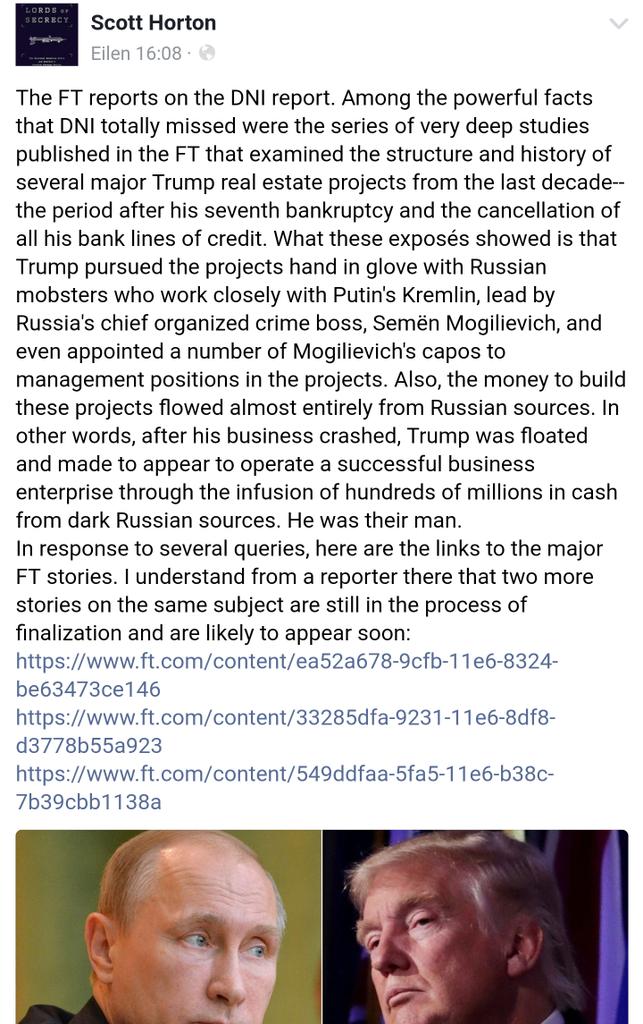
Among the powerful facts that DNI missed were a series of very deep studies published in the [Financial Times] that examined the structure and history of several major Trump real estate projects from the last decade—the period after his seventh bankruptcy and the cancellation of all his bank lines of credit. ...
The money to build these projects flowed almost entirely from Russian sources. In other words, after his business crashed, Trump was floated and made to appear to operate a successful business enterprise through the infusion of hundreds in millions of cash from dark Russian sources.
He was their man.
Yes, even that much seems fantastic, and the details include business agencies acting as a front for the GRU, billionaire mobsters, a vast network of propaganda sources, and an American candidate completely under the thumb of the Kremlin.
It reads like the a B-grade spy novel, a plot both too convoluted—and too bluntly obvious—for John le Carré. The problem is it may not be a conspiracy theory. It may be a conspiracy.
Horton’s analysis comes from piecing together information in three Financial Times “deep reports.” One of these focused on Sergei Millian, the head of the Russian American Chamber of Commerce in the US at the time of Trump Jr.’s “money pouring in from Russia” claim.
Mr Millian insists his Russian American Chamber of Commerce (RACC) has nothing to do with the Russian government. He says it is funded by payments from its commercial members alone.
Most of the board members are obscure entities and nearly half of their telephone numbers went unanswered when called by the Financial Times. An FT reporter found no trace of the Chamber of Commerce at the Wall Street address listed on its website.
Why was RACC’s background filled with so many holes? The Financial Times quotes former Russian MP Konstantin Borovoi in tagging the chamber as a front for intelligence operations that dates back to Soviet times.
“The chamber of commerce institutions are the visible part of the agent network . . . Russia has spent huge amounts of money on this.”
Millian helped arrange for Trump to visit Moscow in 2007, and had other outings with Trump in the states, including a visit to horse races in Miami. Millian claims that he had the right to market Trump properties in Russia.
“You could say I was their exclusive broker,” he told Ria. “Then, in 2007-2008, dozens of Russians bought apartments in Trump properties in the US.” He later told ABC television that the Trump Organisation had received “hundreds of millions of dollars” through deals with Russian businessmen.
Despite documents and photos showing Trump with Millian, Trump denied their association during the campaign.
Hope Hicks, Mr Trump’s campaign spokeswoman, said Mr Trump had “met and spoke” with Mr Millian only “on one occasion almost a decade ago at a hotel opening”.
The second *Financial Times* article puts Trump at the middle of a money laundering scheme, in which his real estate deals were used to hide not just an infusion of capital from Russia and former Soviet states, but to launder hundreds of millions looted by oligarchs. All Trump had to do was close his eyes to the source of the money, and suddenly empty apartments were going for top dollar.
Among the dozens of companies the Almaty lawyers say the Khrapunov laundering network used were three called Soho 3310, Soho 3311 and Soho 3203. Each was a limited liability company, meaning their ownership could easily be concealed.
The companies were created in April 2013 in New York. A week later, property records show, they paid a total of $3.1m to buy the apartments that corresponded with their names in the Trump Soho, a 46-storey luxury hotel-condominium completed in 2010 in a chic corner of Manhattan.
Why would Trump’s organization make such a good means of laundering funds? Because real estate has an arbitrary value. Is that apartment worth $1 million? Two million? Why not $3 million for a buyer who really wants it? When the whole transaction is just one LLC with undisclosed ownership paying another LLC with undisclosed ownership, it’s even neater than hiding the money in an offshore account. And while some businesses require due diligence in looking at the source of funds, real estate is a bit more … flexible.
The laws regulating US real estate deals are scant, experts say. Provisions against terrorism financing in the Patriot Act, passed in the aftermath of the September 11 2001 attacks, obliged mortgage lenders to conduct “know your customer” research. But money launderers pay in cash. Sales such as those of the Trump Soho apartments have passed through this loophole, which was partially closed only this year.
Converting funds stolen overseas into property in the US and cash in the account of an LLC represented a win for both the oligarchs and Trump. Best of all, Trump’s sole requirement was that he pay scant attention to the deal—something at which he was already a proven master. For example, the actual owners of the Trump Soho were anotherlimited liability company, Bayrock.Trump was a partner in the LLC and Bayrock cut the checks Trump received when those apartments were sold. And yet ...
In a 2011 deposition, given in a dispute over the Fort Lauderdale project, Mr Trump said he had “never really understood who owned Bayrock”.Jody Kriss, a former Bayrock finance director, has claimed in racketeering lawsuits against his former employer that Bayrock’s backers included “hidden interests in Russia and Kazakhstan”. Bayrock has denied Mr Kriss’s allegations but declined to answer questions about the source of its funds and its relationship with the Khrapunovs.
The third articledigs more deeply into the origins of Bayrock and its connection with Trump. That connection … was very close.
The Republican presidential nominee and Bayrock were both based in Trump Tower and they joined forces to pursue deals around the world — from New York, Florida, Arizona and Colorado in the US to Turkey, Poland, Russia and Ukraine. Their best-known collaboration — Trump SoHo, a 46-storey hotel-condominium completed in 2010 — was featured in Mr Trump’s NBC television show The Apprentice.
This is the same group about which Trump said he “never really understood” the ownership.
“I don’t know who owns Bayrock,” Mr Trump said. “I never really understood who owned Bayrock. I know they’re a developer that’s done quite a bit of work. But I don’t know how they have their ownership broken down.”
At the very least, Trump confessed to partnering with, taking money from, and acting as a representative for a corporation whose ownership he didn’t know, in deals that totaled hundreds of millions in countries around the world.However, it seems far more likely that Trump knowingly worked with oligarchs, groups associated with the Russian government, and plain old mobsters. Why? Because he was desperate.
By the 2000s, the property developer and casino owner with ready access to the capital markets and the biggest New York banks was no more. A series of corporate bankruptcies had limited his financing options. Mr Trump had become an entertainer who portrayed a tycoon on television and licensed his name to businesses looking for a brand, leading to fee-making opportunities as disparate as Trump University and Trump Vodka.
The Trump Organization was a hollow shell and Trump was bankrupt, but Donald Trump the public figure was a “successful businessman,” a screen behind which criminal activity could be carried out on a massive scale. Throwing his name at every scheme in existence wasn’t a strategy, it was a fire sale on Trump’s respectability. Steaks? Water? Vodka? Fake real estate school? You pony up the cash, and Trump will slap his name on it. Because by the early 2000s, Trump wasn’t just broke, he had nothing left to pawn. He wasn’t a successful businessman, but he still played one on TV. His image had more value than his real estate portfolio.
But the apartments and buildings where Trump held some degree of ownership could be turned into value again. All it took was partnering with foreign crime bosses looking for a place to stash their cash. To inflate the value of his portfolio, Trump had to do nothing other than look away as the dirty money poured in from one LLC to the next.Citizens in Russia, Kazakhstan, and other former Soviet states lost hundreds of millions, but Trump got a cut as looted funds flowed through offices and apartments in buildings that carried those critical gold letters.
Horton’s evaluation of this material in coordination with the declassified DNI report is that Trump actively worked with and for Russian interests.
What these exposes showed, is that Trump pursued the projects hand in glove with Russian mobsters who worked closely with Putin’s Kremlin ...
But based on the information in the Financial Times report, it appears that there are actually two possible answers. Trump may have been actively involved with and working for Russian sources. He might also have simply played the role of useful idiot, displaying his readiness to feign ignorance about any deal … so long as it generated some funds to float his sinking boat.
In the end, there’s not a lot of difference in the outcome. Trump got money. Oligarchs cleaned their cash. Russia got their man.
==
==
https://www.alternet.org/trump-treasury-department-obstructing-russia-investigation
Insofar as Congress had made a serious effort to investigate Russian attempts to interfere in the 2016 presidential election, Trump administration has hardly been cooperative.
Indeed, according to a new report from BuzzFeed News, civil servants in the Treasury Department voiced concern last year that their department was deliberately seeking to prevent the Senate Intelligence Committee from tracking down financial records of key actors in the Russia affair:
Last year, Treasury rejected the committee’s request for help from one of its experts, even as Treasury officials have speculated — behind closed doors — that the Senate committee would not be able to follow the twisting financial trail laid out in the documents they had turned over, a path that often passes through offshore shell companies or untraceable cash transactions. In emails reviewed by BuzzFeed News, personnel within Treasury’s Financial Crimes Enforcement Network, or FinCEN, discussed in 2017 whether Treasury was trying to thwart the committee’s investigation. Additionally, some FinCEN personnel questioned whether they had the proper legal authority to share confidential information about US persons with committee staffers.
Senators on the Intelligence Committee first asked the Treasury Department to disclose financial information on Trump and his associates last year. Democratic members of the committee have openly expressed frustration with how slowly the department has cooperated with them.
A spokesman for FinCEN refused to give BuzzFeed a detailed response to the story, saying "We don’t discuss the specifics of requests related to committee investigations."
But the Treasury Department's purported desire to undermine the Russia investigation squares with a pattern of apparent politically motivated refusals to embrace transparency.
Last month, the department announced that the IRS would no longer force tax-exempt dark-money political groups to report the names of certain donors in their filings. This information was not even public to begin with — it was simply used to help the IRS record where political money was coming from — but apparently, even this slightest gesture at disclosure was too much for the Trump administration.
===
rich fink? IRS not doing its job?
http://www.alternet.org/print/investigations/big-banks-are-knee-deep-dirty-money-laundering-business
==
https://www.alternet.org/news-amp-politics/putin-wants-trump-hand-over-three-dhs-agents-who-are-investigating-company-linked
Lost in all the controversy over President Vladimir Putin asking Donald Trump to turn over former U.S. Ambassador Michael McFaul to Kremlin investigators for questioning — in return for access to Russian officials indicted by the Justice Department for meddling in the 2016 election — was the fact that Putin had a whole list of Americans he wanted to be turned over.
According to Michael Weiss, writing for the Daily Beast, far down Putin’s shopping list are three Department of Homeland Security agents whom he has accused of running off with over $400 million in Russian money – when in fact they were investigating associates of Putin laundering that money.
The agents — identified as Todd Hyman, Aleksandr Schwartzman, and Svetlana Angert — were included by Putin, who reportedly explained to Trump that some of that stolen money was funneled to the 2016 presidential campaign of former Secretary of State Hillary Clinton. "It might have been legal, the contribution itself, but the way the money was earned was illegal,” Putin offered at the Helsinki meeting.
As Weiss writes, “Hyman, Schwartzman, and Angert were not laundering money, as Putin and his prosecutor would suggest; they were investigating money launderers.”
According to a deep dive into their careers, the three agents were principals in a civil asset forfeiture case brought againstPrevezon Holdings, a Cyprus-registered company suspected of laundering Russian public funds — some of which was invested in Manhattan properties which raised red flags with federal investigators.
According to Weiss, “In 2013, $24 million of Prevezon’s U.S.-based assets were frozen in a civil asset forfeiture complaint brought by the U.S. District Court of the Southern District of New York. The case was settled out of court in May 2017, with the company agreeing to pay $5.9 million in damages in exchange for not having to admit to any wrongdoing.”
Where this circles back around to Trump — and possibly why he initially called Putin’s request an“incredible offer” — is a principal in Prevezon: Natalia Veselnitskaya, who later met with Donald Trump Jr. and other Trump campaign officials in a 2016 Trump Tower gathering that is currently being investigated by the FBI.
“So, fast-forwarding to the summer of 2018 and that press conference in Helsinki, it appears Putin was recapitulating in front of the whole world the rough contours of risible guilt-by-association conspiracy theory first mooted hush-hush by Veselnitskaya to Trump’s son, son-in-law, and his now-indicted campaign chairman who currently is on trial,” Weiss writes.
You can read the whole in-depth report here.“That Putin for a moment thought this shambolic quid pro quo proposal would be entertained by the American establishment tells you quite a lot about the contempt in which he holds that establishment under its current leadership,” Weiss continued.”Putin clearly feels as if he doesn’t have to try very hard anymore to abase and undermine our country, perhaps because he is himself impressed at how easy that is to do.”
===
https://www.alternet.org/greatest-intelligence-operation-our-time-investigative-journalist-details-how-trump-has-been
no lnx
An investigative journalist explained on MSNBC’s “Morning Joe” that President Donald Trump’s real estate business was essentially a money laundering front.
Craig Unger alleges in his new book, “House of Putin, House of Trump,” that the president had been compromised by Russian intelligence for years through his ties to mobsters who pumped money into his family’s real estate empire.
“I go back nearly 40 years, and I see essentially the greatest intelligence operation of our times,” Unger said. “It started off in 1984 with a man who has ties to the Russian mafia, and he meets with Donald Trump in the Trump Tower, the supreme moment of Donald Trump becoming a master of real estate in the United States — and what we end up seeing is Trump Tower become sort of a cathedral of money laundering.”
That mob associate paid $6 million in cash for five condominiums, and Unger tracked hundreds of similar transactions over the following three decades.
“That sets off a pattern that goes on for the next 30 years or so, in which over 1,300 condos are sold in what appears to be money laundering,” Unger said. “They have two characteristics. One, they are all cash purchases. Two, they are shell purchases, they’re anonymous purchases. The records don’t show who the true owners are.”
Unger said the illegal transactions had made Trump an asset of the Russian government and its president, Vladimir Putin — a former KGB operative — because he said there was no meaningful difference between the country’s organized crime network and its intelligence agencies.
“I can’t get inside Donald Trump’s mind, but he’s meeting with this guy,” Unger said. “We know there are about 1,300 other operations in which he’s profiting heavily from that. If he can go through that and doesn’t figure that out, he’s either inexplicably stupid or there is a legal concept of willful blindness, and perhaps that’s what’s going on.”
==
https://www.occrp.org/en/laundromat/
==