bayrock sater
---
818 primary on money launder
no merri
trail went cold? but as with mueller sometimes come back
bak
---
an 6 24
real estate developer Felix Sater, a Moscow native and former business associate of presumptive 2024 GOP presidential nominee Donald Trump, has been facing a civil trial in which he is accused of helping a wealthy Kazakh man launder millions of dollars through real estate in the United States — including The Dominick (formerly Trump SoHo) in Lower Manhattan. And on Wednesday, June 26, Sater lost that trial.
Bloomberg News' Erik Larson reports, "A federal jury in Manhattan issued the verdict Wednesday in favor of the city of Almaty, Kazakhstan, and one of the country's biggest lenders, BTA Bank, awarding more than $32 million in damages, including interest, according to the lawyer for the plaintiffs, Matthew L. Schwartz of Boies Schiller Flexner LLP."
Sater is speaking out against the verdict, telling Bloomberg News, "I reject the verdict and will be appealing."
READ MORE:Trump's 'next crime' will put US democracy in 'far more danger' than 2020: election lawyer
But Schwartz is applauding the jury's decision.
The attorney told Bloomberg News, "We are privileged to have been able to present this evidence to a U.S. jury, and are thrilled with the verdict in favor of our clients, including the jury's imposition of punitive damages for the deliberate and particularly morally culpable conduct of Felix Sater."
Larson notes that the plaintiffs, in the lawsuit, allege that Sater "helped Ilyas Khrapunov launder a portion of the roughly $6 billion allegedly looted from the bank by his father-in-law, former BTA Chairman Mukhtar Ablyazov, in the years before the financial crisis."
"The case is part of a global effort by BTA to recover the money, which was allegedly siphoned from the bank through a web of shell companies and bogus loans," Larson explains. "Almaty alleges some of the laundered money was stolen from the city by Khrapunov's father, when he was mayor, through corrupt sales of municipal land."
READ MORE:'I didn't vote for anybody': GA GOP gov didn’t cast ballot for Trump in primary
The Bloomberg News reporter adds, "Sater, who as late as 2011 was handing out business cards identifying himself as a 'senior advisor to Donald Trump,' denied the allegations. But he testified that he lied when he helped Khrapunov conceal his role in lucrative deals to dodge a worldwide freezing order that tied up his family's assets. Sater allegedly made millions in the process."
READ MORE:Conservative explains how Biden 'outmaneuvered' Trump on debates
*Read Bloomberg News' full report at this link (subscription required).
==
https://www.alternet.org/2019/09/house-democrats-question-whether-trumps-point-man-on-secret-moscow-deal-is-obstructing/
no lnx
House Democrats question whether Trump’s point man on secret Moscow deal is obstructing
Written by Kerry Eleveld / Daily Kos September 12, 2019
From September 2015 on, real estate developer Felix Sater ran point on Donald Trump’s secret deal to build a Trump Tower in Moscow, a crown jewel Trump had been chasing for at least a decade. Sater, a lawbreaker and former U.S. intelligence source, worked in direct collaboration with Trump’s erstwhile lawyer/fixer Michael Cohen to line up Russian partners and even woo Russian President Vladimir Putin and his allies with the promise of a $50 million penthouse in the structure. The deal, which Trump never revealed to the public during his candidacy, eventually went bust in the summer of 2016, about six months later than Cohen originally suggested in his sworn testimony to Congress. Cohen’s lie to congressional investigators is at least partially responsible for landing him in jail.
But the public has yet to hear the tale of Trump Tower Moscow as told through the eyes of Sater, who has been privately questioned twice by the House Intelligence Committee. The hang-up seems to be that House investigators question how transparent Sater has been regarding the trove of documents they requested from him regarding the deal.
A House Intelligence Committee staffer told Mother Jones magazine that Sater “still has not fully cooperated”with the panel in providing the materials it has subpoenaed from him. Once investigators are satisfied that Sater has been fully forthcoming, the committee intends to publicly release the transcript of Sater’s private sessions, according to the staffer. “We are still actively pursuing a number of open questions, including whether Mr. Sater played a role in assisting Michael Cohen to obstruct the committee’s investigation.”
Sater’s attorney, Robert Wolf, told Mother Jones that his client has “fully complied” with the committee’s requests of him on July 30, 2019. But Wolf said Sater had objections to providing certain materials “based upon attorney client privilege” that the committee promised to address at a later date. “However, no further correspondence has been received from the Committee in the last six weeks addressing the privilege objection,” Wolf added.
Whatever the hang-up, the full story behind Trump Tower Moscow still has not been publicly aired and should be. Trump repeatedly denied having any business dealings with Russia during the 2016 election even as he took pains to praise Putin’s leadership rather than criticize it.
==
https://theintercept.com/2019/08/23/unsealed-filings-detail-felix-saters-work-as-an-intelligence-asset-with-significant-gaps/
==
https://www.alternet.org/2019/07/federal-judge-unseals-records-in-criminal-case-of-long-time-trump-associate-felix-sater/
no lnx
Moscow-born Felix Sater, an associate of President Donald Trump and real estate developer with ties to Russian organized crime, is mentioned numerous times in former special counsel Robert Mueller’s final report for the Russian investigation. And on Monday, according to The Intercept, a federal judge ordered the unsealing of court records from Sater’s criminal case of the 1990s.
The federal judge is Leo Glasser, and the case is the Eastern District of New York v. Felix Sater. Glasser was the judge in that case, which came long before the Mueller investigation: in 1998, Sater pled guilty to his involvement in a $40 million stock fraud scheme tied to the Russian mafia. And Sater, after that, became an informant for the FBI and the U.S. Department of Justice (DOJ), assisting the DOJ in organized crime investigations. Because of his cooperation with the DOJ, Sater didn’t go to prison but was fined $25,000.
Sater, now 53, is mentioned in the Mueller report in connection with his efforts to broker a Trump Tower Moscow deal in 2015/2016 with attorney Michael Cohen (who was still working for the Trump Organization at the time). Cohen is presently serving three years in federal prison for crimes ranging from campaign finance violations to bank and tax fraud.
Glasser, according to The Intercept, “ordered that one document” from Sater’s 1990s criminal case that was “requested by The Intercept remain under seal, while several others were unsealed with redactions.”
Interest in the Eastern District of New York v. Felix Sater, Glasser wrote this week, has “mushroomed” because of Sater’s connection to the Trump Organization. Glasser noted, “The court does not for one moment minimize the want to gather information about Sater and the president. However, among the materials that will remain under seal, there is not a jot or tittle that mentions the president in relation to Sater.”
The documents in the Eastern District of New York v. Felix Sater, Glasser stressed, pertain “solely to Sater’s prior conviction, the assistance that he provided the government in the investigation and prosecution of other matters, proceedings in this court seeking to prevent disclosure of that cooperation, and prior unsealing motions.”
The Intercept’s Johnny Dwyer notes that during Mueller’s investigation, Sater “was a kind of golden goose — the rare informant who could provide tips on Russian and Italian mobsters and al-Qaeda.”
During the 2000s, Sater worked closely with the Trump Organization during the construction of the Trump SoHo (now the Dominick) in Manhattan. And he has worked with the Trump Organization on many other real estate projects as well.
==
https://www.alternet.org/2019/06/meet-the-prominent-conservative-lawyer-who-keeps-popping-up-in-the-russia-probes
no lnx
Meet the prominent conservative lawyer who keeps popping up in the Russia probes
written by C Collins, David Cay Johnson / DC Report June 19, 2019
A prominent conservative lawyer keeps showing up in dramas central to the Trump administration and its battles with Congress — and it turns out he has intimate knowledge of Felix Sater’s intelligence work for the U.S. government while he was working with Trump.
The Moscow-born Sater is the financial criminal and violent felon who worked closely with Trump for years while simultaneously serving as a long-term informant for the FBI and other national security agencies.
In 2015 and into mid-2016, Sater pushed for the development of a Trump Tower in Moscow with his old friend Michael Cohen, Trump’s longtime fixer, while trying to enlist support from the Russian government for Trump’s campaign.
The lawyer, William A. Burck, popped up in two just-unsealed court documents in Sater’s criminal docket. Burck had not been linked to Sater before now.
Burck has also been at the center of two highly charged dramas in Washington this past year: the nomination of Brett Kavanaugh to the Supreme Court and the Mueller investigation. Yet his roles have gone largely unnoticed by other news organizations.
One of Burck’s clients is Don McGahn, the former White House counsel who has been subpoenaed by the House and whose testimony Trump is now trying to block by claiming executive privilege.
In the Mueller investigation, Burck’s other clients also include Reince Priebus, Trump’s first chief of staff, and former advisor Steve Bannon, as well as McGahn, all of whom the House Judiciary Committee has subpoenaed.
The Burck-Sater Connection
Back in 2004, Burck was a federal prosecutor in the Southern District of New York. He handled Sater’s case there while Sater was working with Trump and collecting intelligence for Washington about international organized crime. Now, Burck is the lawyer for McGahn, who spent 30 hours spilling the beans to Special Counsel Robert Mueller’s team about Russian interference in the 2016 election and Trump’s efforts to obstruct its investigation.
Burck’s role in Sater’s case has been not publicly revealed before now. That role is especially important given the intimate knowledge Burck has of not only Sater’s activities with international crime organizations while he was working with Trump but also Sater’s relationship with the Trump Organization. That becomes evident in the letters that were just unsealed at the request of the lead reporter on this story.
These letters suggest that Burck has a deep and perhaps unique understanding of the nature of the relationship between Sater, Trump, the Trump Organization, the FBI, and Sater’s national security work. Indeed, Burck almost certainly knows what few others do about Sater’s criminal and intelligence activities and his relationship with Trump.
The time periods involved also raise a tantalizing question: Are there mysteries from the era of President George W. Bush that relate to the Mueller investigation that Sater’s case touches upon? The unsealed letters date to Bush’s presidency, when the Department of Justice was shielding Sater’s confession to stock fraud from the public. His case in Brooklyn federal court was what is known as “double sealed.” It is common for a criminal case to have a docket number and for the record to be sealed. In Sater’s case, the docket itself was sealed—completely hidden—something that evidence suggests applies to fewer than 100 cases nationwide, the vast majority of them in Brooklyn, the home to many Russian-speaking criminal enterprises.
Sater was a “cooperating witness” through September 2009, the first year of President Barack Obama’s first term.
The unsealed letters relate to Sater and his work as an FBI intelligence operative.They date from 2004 and 2005, when Burck was an assistant U.S. attorney in the Southern District of New York. The Southern District encompasses Manhattan, where Trump Tower is located. Sater’s criminal case was on the docket in the Eastern District, which is in Brooklyn.
At that time, Sater and his firm were teaming with the Trump Organization on a number of real estate projects. His identity as an informant was a closely held secret.
Working with the FBI and Trump
Sater’s offices were in Trump Tower, just a floor or two from the Trump Organization.
Sater worked with Trump on real estate projects in Colorado, Arizona, California, Florida and New York, only a few of which were actually constructed.
Sater was also involved in efforts to build a Trump Tower in Moscow, a project that appeared to take on new life during the 2016 presidential campaign, despite Trump’s later insistence that he had no dealings with Russia.
A key question for House investigators should be whether any of Sater’s contacts in the security services knew about the project at the time—and if so, how that might relate to the genesis of the counterintelligence investigation into the Trump campaign.
Trump has tried to hide his connections to Sater. He testified under oath that he would not recognize Sater if they were in the same room, an obvious lie as Trump claims to have the world’s greatest memory.
In both letters to the court, Sater’s lawyer asks the judge overseeing Sater’s case to postpone his sentencing date, as Sater was in the middle of a “long-term investigation into major international criminal organizations.” The letters also mention his travel abroad with FBI agents for the investigation.
Burck is cc’d on both documents in his role as a federal prosecutor.
Sater’s lawyer spells Burck’s name as “Burke.” (Another U.S. attorney’s name is misspelled as well. Assistant U.S. attorney Eric Corngold, who handled Sater’s case at the Eastern District for several years, is rendered “Korngold.”)
FBI’s Point Man
Burck’s name on these letters indicate that from at least August 2004 to February 2005, Burck was the Southern District’s point man on Sater’s case, establishing that Burck was being kept up to speed on Sater’s highly sensitive national security work while Burck was at the Southern District, information to which few would have access.
While Burck was at the Southern District, the U.S. attorney—the prosecutor in charge of the district—was Preet Bharara, whom Trump fired not long after taking office.
Felix Sater flipped in late 1998, when Bill Clinton was president. He pleaded guilty to a single count of racketeering after making millions in a mobbed-up brokerage in the 1990s. The “pump-and-dump” brokerage had made thousands of high-pressure cold calls to elderly customers, handled scam stock offerings, and laundered money. The scam involved Russian-speaking and Italian organized crime heavies, including Sater, an owner of the brokerage.
Sater’s work as a “cooperating witness”—legalese for an informant who must be available to testify at trial—spanned the Clinton and George W. Bush White House years and ended not long after Barack Obama took office, from late 1998 through 2009. Sater went to work at the real estate development firm Bayrock in Trump Tower soon after 9/11.
Loretta Lynch, who twice served as the U.S. Attorney in Brooklyn, described Sater’s undercover work during her 2015 confirmation hearings to become Obama’s second attorney general.
“For more than 10 years, [Sater] worked with prosecutors providing information crucial to national security and the conviction of over 20 individuals, including those responsible for committing massive financial fraud and members of La Cosa Nostra,” she wrote.
An assistant federal prosecutor in Brooklyn, during a closed-door federal court proceeding, praised Sater’s “cooperation of an extraordinary depth and breadth, almost unseen, at least in this United States Attorney’s office.”
While most cooperators work on one case, “Sater’s cooperation runs a gamut that is seldom seen. It involves violent organizations such as Al Qaeda, it involves foreign governments, it involves Russian organized crime” and several New York mafia families, the prosecutor declared, a transcript that was later unsealed shows.
It’s not at all clear that Sater actually achieved much as a cooperator. His lawyer, Robert Wolf, says, for example, that Sater intercepted Stinger missiles and got Osama bin Laden’s cell phone number, but those are mere claims on behalf of a known grifter.
Concealed Identity
The Justice Department and federal judges concealed Sater’s role as a top-level informant from public view while he was making business deals with Trump. His case docket was sealed and identity hidden, and even in the sealed court papers he was named as “John Doe.” Whether the double sealing was proper is being litigated in court cases by lawyer Fred Oberlander, who asserts that the handling of Sater’s case was corrupt. Oberlander has filed a civil RICO case against Sater and Bayrock, alleging the firm was a massive money-laundering operation.
Sater’s real estate developments with Trump came at a very difficult time for the Trump Organization. U.S. banks no longer extended him credit after a 1990 reorganization of his debts in a deal negotiated with approval of the New Jersey Casino Control Commission. Bankers lost well more than a billion dollars in the 1990 deal alone. Later the casino company Trump sold stock in endured a string of business bankruptcies—while paying Trump about $82 million—before going out of business.
By 2005, when the second of the newly unsealed documents is dated, Trump and Sater had worked on several projects together, in which Trump had licensed his name to buildings developed by Sater’s firm. Among these was a condominium tower in Fort Lauderdale, Fla., which was never built and resulted in years of litigation alleging fraud.
The Trump SoHo, the largest Trump-Sater project, was announced later, in 2006. Trump was due 18% of the profits from that project, in which bankers and investors lost money, but Trump and others evidently made profits which disappeared into FL Group, an Icelandic finance operation. Trump’s name has since been removed from the building. Oberlander has been trying to force courts to trace that money.
From Yale to the Southern District
William Burck’s world was far from boiler-room brokerages and caviar-and-blini restaurants favored by post-Soviet émigrés in Brighton Beach. After attending Yale for his undergraduate and legal degrees, Burck climbed quickly up the Justice Department ladder.
After Burck left the Southern District of New York in 2005, he moved to Department of Justice headquarters in Washington, where he was counsel to the head of the criminal division. Burck then jumped to the White House of George W. Bush, where he served as deputy assistant to the president and then deputy staff secretary to Kavanaugh, now a Trump-appointed Supreme Court justice.
Burck and Kavanaugh are both are seen as fiercely partisan.
After Bush left office, Burck became a corporate lawyer, eventually at Quinn Emanuel Urquhart & Sullivan, with offices from Washington to Paris to Australia.
Burck’s clients include the scandal-plagued international soccer organization FIFA, many of whose international officials faced money laundering and racketeering charges from the Eastern District of New York in 2015. Burck worked behind the scenes to push FIFA members to cooperate with the government, according to an anonymously sourced article in The Wall Street Journal, to save the organization from collapsing under the weight of its own corruption.
One of those informants was apparently the top U.S. FIFA official, the larger-than-life Chuck Blazer, who in 2011 chose to avoid charges by cooperating with the government, then secretly recorded conversations with FIFA officials from around the world, according to the New York Daily News. Blazer rented two $18,000-a-month residential apartments in Trump Tower and one $6,000-a-month unit reportedly solely for his cats. His offices took up the entire 17th floor of the building. (Blazer’s principal attorney? The former Eastern District prosecutor who had handled Sater’s criminal case for a number of years, Eric Corngold.)
Cyprus Connection
Another major client of Burck was the corrupt FBME bank in Cyprus, which worked closely with Deutsche Bank to move money for its Russian-speaking clients.
In 2014, the Treasury Department’s Financial Crimes Enforcement Network (FinCEN) charged that FBME Bank was purposely promoting a “don’t-ask-don’t-tell” approach to money laundering regulation compliance “to attract illicit finance business from the darkest corners of the criminal underworld.” FinCen is our government’s anti-money laundering agency. It is staffed with IRS agents who specialize in tracing illicit money flows.
BuzzFeed described FBME “as a major conduit for funds linked to terrorism, organized crime, and chemical weapons, and revealed how blue-chip Western institutions enabled its activities.”
After the Mueller investigation was launched soon after Trump was sworn in, in 2017, McGahn hired Burck as he was trying to navigate the shoals between his obligations as White House counsel and the requests of Mueller’s investigators. This may have been especially important as one of the U.S. attorneys who signed Sater’s cooperation agreement in 1998 was Andrew Weissmann, a financial fraud expert who was also on Mueller’s team.
Steering McGahn
Burck “devised the legal strategy behind McGahn’s giving more than 30 hours of testimony to the special counsel,” according to The New York Times.
McGahn’s testimony “provided investigators with a road map for an obstruction case against the president,” according to the Times.
In the midst of the Mueller investigation, Trump nominated Brett Kavanaugh to the Supreme Court, a move that surprised many conservatives because Kavanaugh was not on the list put forward by the Federalist Society, on which Trump had said he would rely.
McGahn, as White House counsel, managed Kavanaugh’s confirmation, and Burck advised him in the process.
When the Senate Judiciary Committee asked for documents related to Kavanaugh’s work in the Bush White House, Bush hired his former staffer Burck to review them.
This “Bush-lawyer-approved” document review circumvented the normal process, which typically relied on the nonpartisan National Archives to go over documents before submitting them to the Senate.
Instead, it was Burck who chose which documents of his friend and former superior in the Bush White House to turn over to the Judiciary Committee—just as he was advising McGahn on Kavanaugh’s confirmation process and also serving as McGahn’s attorney on the Mueller probe.
‘Who Is Bill Burck?’
Democrats wondered aloud about Burck’s unprecedented role in the nomination process.
“Who is Bill Burck? … This mysterious Bill Burck who is filtering these documents. … Who’s paying him?” Senator Dick Durbin (D-Ill.) asked.
In the end, Burck withheld tens of thousands of documents from the committee. Many were thought to relate to Kavanaugh’s views on topics such as “enhanced interrogation techniques,” the term the Bush administration used for torture, and holding people indefinitely at Guantanamo.
“Why are Republicans covering up Brett Kavanaugh’s past?” a New York Times editorial asked, specifically mentioning Burck and his role in the “most secretive and incomplete confirmation process in modern history.”
Burck turned down the chance to serve as one of Trump’s personal attorneys, the Washington Post reported. He did, however, recently agree to represent a Trump ally, Robert Kraft, an owner of the New England Patriots who is facing charges of paying for sex acts at a Florida massage parlor. The parlor was founded by a woman who has been selling access to Trump and his family at Mar-a-Lago to her Chinese clients.
There is another interesting aspect of Burck’s and Sater’s roles and the Mueller report.
Andrew McCabe, the former acting FBI director whom Trump has repeatedly denounced after becoming president, first worked in the bureau’s New York organized crime section just around the time that Sater flipped. In 2004 and 2005, when the unsealed letters were written, McCabe headed the FBI’s Eurasian Organized Crime Task Force in New York, which worked with the New York Police Department. (“Eurasian” in this case means crime from the former Soviet Union, including Russia and Ukraine.)
Just like Burck, McCabe would have deep knowledge of what Sater was doing with Russian-speaking crime organization leaders in Russia and former Soviet satellites including Azerbaijan, Kazakhstan, and Ukraine—as well as Sater’s connection to Trump and the Trump Organization. McCabe’s role in New York in the 2000s may help explain Trump’s hostility to him, including bullying McCabe’s wife Jill.
It was McCabe who authorized the counterintelligence investigation into candidate Trump. Trump fired McCabe one day before he became eligible for a full pension.
What Burck Knows
As for Sater and Trump, it’s clear Burck knows much about who Sater is and what Sater’s work with the government entailed, and he has a much more precise understanding of the nature of Sater’s financial relationship with Trump that the U.S. public does.
Sater’s court documents and identity as an FBI cooperator were never intended to be revealed. They have only slowly been unsealed over time in a long-running drama involving various lawsuits, most prominently in Oberlander’s racketeering lawsuit. It alleges that Sater’s projects were large-scale money laundering operations involving money coming from the former Soviet Union. That case was filed under the civil provisions of the Racketeering Influenced and Corrupt Organization Act (RICO), whose criminal provisions have been used to prosecute Mafia families in Brooklyn and Manhattan and beyond.
Thus, Burck whose knowledge of Sater goes back at least 15 years, could be especially useful to both Team Bush—whose Department of Justice was responsible for Sater’s sanctioned work as an informant—and Trump.
It was the wealthy long-term informant Sater, after all, who wrote to his old friend Michael Cohen in 2015, “Buddy our boy can become president of the USA and we can engineer it … I will get all of Putins [sic] team to buy in on this, I will manage this process” while he pushed for a Trump project in Moscow.
After all, there may be questions about how a highly protected informant worked to secure the Kremlin’s support for Trump’s election—and got away with it.
==
https://www.alternet.org/2018/12/the-purchase-of-donald-trump-new-report-details-how-russian-money-poured-in-to-save-trumps-businesses/
President Donald Trump’s celebrity was cemented in the American mind with the show “The Apprentice,” which sold him as a real estate mogul and business genius imparting his wisdom to…
President Donald Trump’s celebrity was cemented in the American mind with the show “The Apprentice,” which sold him as a real estate mogul and business genius imparting his wisdom to a new generation of entrepreneurial hopefuls. But the show’s fundamental premise is a lie.
Far from a business genius, Trump was largely a flop in business. As a recent investigative piece in Foreign Policy explained, Trump’s repeated failures in the ’90s made him virtually radioactive to any American banks looking to fund new ventures. Lenders were wary of trusting the most prominent son of actual real estate titan Fred Trump, because Donald Trump’s businesses were consistently going belly up — most famously, the Trump Taj Mahal Casino in Atlantic City.
So how was Trump able to recover his image from its ’90s battering? Trump’s sons have repeatedly offered not-so-subtle clues.
In 2008, for instance, Donald Trump Jr. said at a New York conference: “In terms of high-end product influx into the US, Russians make up a pretty disproportionate cross-section of a lot of our assets.”
And in 2014, Eric Trump reportedly told golf writer James Dodson of the family business: “Well, we don’t rely on American banks. We have all the funding we need out of Russia.” (Eric Trump has since denied saying this.)
Reporters Jonathan O’Connell, David Fahrenthold and Jack Gillum at the Washington Post reported back in May on the Trump Organization‘s curious shift from funding projects almost entirely with debt in the ’90s to employing large bushels of cash by the mid-2000s.
Michael Hirsch, writing for Foreign Policy, found significant corroboration for Trump’s reliance on foreign funds. Multiple anonymous sources, former associates of the president, told Hirsch that Trump especially used Russian funds when American sources ran dry.
Some of this, it seems, came in the form of direct real estate purchases. Despite repeatedly denying any ties to the Kremlin, Trump has even admitted to one major deal with a Russian, Dmitry Rybolovlev, who is believed to be close to Putin. Rybolovlev bought a Palm Beach house from Trump for $100 million — $60 million more than what the president had initially paid for it, according to an ABC interview with Trump. This is a remarkably high profit for any such deal — but it is even more startling because it happened in 2008, when the American real estate market was cratering.
“That deal delivered so much cash to Trump, it almost has to be seen as a campaign contribution, or the purchase of Donald Trump,” Trump biographer Michael D’Antonio told Hirsch.
A former business associate told Hirsch that this was not the only property Trump sold to a Russian national.
“I think part of it was he was toxic to the banks. I think he also probably learned that personal guarantees [on loans] weren’t a brilliant idea either,” the anonymous associate told Hirsch. “So he was saying to himself, ‘What else could I do in the world? I’ll just convince people to buy my brand.’ And the only people who were willing to buy it were tasteless Russians, people who like the absurd, ostentatious gold-leaf lifestyle he has. You’re not going to sell that brand to blue bloods in Greenwich, Connecticut.”
But the Russian connection is also hiding in plain sight. In the early 2000s, Trump started his comeback by partnering with the Bayrock Group, a financial firm run, in part, by Felix Sater. Sater had pleaded to guilty to participating in a fraudulent scheme with the Russian mafia in the ’90s, became an informant to the FBI, and was a key player along with Michael Cohen is brokering a deal to build Trump Tower Moscow in 2016 before the negotiations mysteriously went quiet after Trump secured the GOP presidential nomination.
Hirsch explained:
Bayrock’s money sometimes came from sources outside Russia and the former Soviet republics, according to one of the firm’s former employees, including an obscure Icelandic investment bank called the FL Group. But those roads too sometimes appeared to lead back to Russia. In 2017, real-estate developer Jody Kriss, whom Sater hired to help him run Bayrock,told Timothy O’Brien of Bloomberg what happened after an Icelandic competitor of the FL Group contacted him to invest in Bayrock. When Kriss brought that offer to Sater and Arif, they told him that the money behind Icelandic banks “was mostly Russian”—and they had to take FL’s funds for deals with Trump because FL was “closer to [Vladimir] Putin,” according to O’Brien. (Kriss confirmed this account to FP.) In 2007, the FL Groupinvested $50 million in several Bayrock projects linked to Trump, including a development in Whitestone, Queens, and Trump SoHo in Manhattan. FL Group dissolved in 2014.
Kriss told Bloomberg’s O’Brien that he eventually left Bayrock because he became convinced that the firm was a front for money laundering.
All of these connections are almost certainly being scrutinized by Special Counsel Robert Mueller, federal prosecutors at the Southern District of New York, and any of the other agencies investigating the president’s past.
==
https://www.mcclatchydc.com/news/nation-world/national/article162789803.html
July 21, 2017 05:00 AM
Updated July 21, 2017 07:23 AM
SANDS POINT, NEW YORK
Two former associates of Donald Trump helped a family of wealthy Kazakh fugitives make extensive investments in the United States, some aimed at helping family members obtain legal residency here, a McClatchy investigation shows.
Felix Sater, an ex-con and one-time senior adviser in the Trump Organization, helped the Trump family scout deals in Russia. He led an effort that began in 2012 to assist the stepchildren of Viktor Khrapunov,who that year had been placed on an international detention request list by the global police agency Interpol.
...
Khrapunov is the former Kazakh energy minister and ex-mayor of Almaty, that nation’s most populous city. He fled to Switzerland a decade ago, after Kazakhstan’s leaders accused him and his wife of stealing government funds. They are now accused in civil lawsuits of laundering money through luxury properties, including Trump-branded condos in the Soho neighborhood New York.
McClatchy’s probe reveals that with the help of Sater and his then-business associate Daniel Ridloff, also formerly affiliated with the Trump Organization, the Khrapunov family invested millions in a short-lived company that sought to place biometrics machines in airports across the country.
The real aim of Khrapunov’s investment was obtaining US residency for at least one member of the family; the company submitted, with the help of the onetime Trump associates, at least three requests to obtain visas for foreign workers.
The McClatchy investigation reveals a deeper relationship than previously known between the former Trump Organization figures and the fugitive Khrapunovs — underscoring how little is known about many of those involved with the Trump Organization.
There is no evidence that Trump himself participated in the courting of the Khrapunovs, but the affair sheds light on the often murky activities of the associates with whom he did deals at home and abroad.
What Ties?
On paper, Donald Trump’s business relationship with Sater ended almost a decade ago. But earlier this year, Sater re-entered Trump’s orbit when he and Michael D. Cohen, one of Trump’s personal lawyers, were involved with a Ukraine-Russia peace proposal that was presented to Michael Flynn, then Trump’s national security advisor.
Sater, whose LinkedIn profilelists him as a senior adviser to Trump in 2010 and 2011, also gave more than $10,000 to Trump’s presidential campaign and a joint Trump-Republican National Committee fund in 2016, and at least $6,000 this year, according to Federal Election Commission records.[vid]
This as Bloomberg reported Thursday thatTrump Soho in New York, where the Khrapunovs invested, were among several Trump businesses being looked at by former FBI Director Robert Mueller in his probe of possible collusion between Russia and the Trump campaign in 2016.
“Do not know,” said John M. Dowd, an outside lawyer for Trump, said of the report in response to questions from McClatchy.
Thank you to former campaign adviser Michael Caputo for saying so powerfully that there was no Russian collusion in our winning campaign.
— Donald J. Trump (@realDonaldTrump) July 16, 2017
Several key people in Trump’s orbit did business with the Kazakh clan, including the law firm of Trump campaign surrogate Rudy Giuliani and the Bayrock Group, which developed Trump-branded projects in New York, Florida and Arizona and was founded by Tevik Arif, a politically-connected former Soviet official from Kazakhstan.
Lincoln Mitchell, a political consultant who specializes in Russia and its neighboring countries, said virtually any investment from Kazakhstan warrants scrutiny.
"It would be hard to imagine getting Kazakh investment that wasn't close to the ruling family," Mitchell said in a telephone interview from the former Soviet republic of Georgia.
Nursultan Nazarbayev has ruled resources-rich Kazakhstan since 1989, placing his children and their spouses in top government posts. Some of his family assets have been frozen in Switzerland, and a U.S. Justice Department settlement in 2015 spotlighted how bribes paid to senior Kazakh officials ended up in offshore accounts belonging to the Kazakh government.
Both Sater and Ridloff had worked for Bayrock before joining the Trump Organization, Sater being one of its managing partners. Later, the two men facilitated the purchase in 2013 of three condos in the Trump SoHo for $3.1 million by companies tied to the Khrapunov children, Ilyas Khrapunov and Elvira Kudryashova.
In 2012 and 2013 alone, Sater and Ridloff worked with the Khrapunovs on more than $40 million in real estate and investment deals. All came after Kazakhstan added Viktor to the Interpol wanted list in February 2012.
Later, the former Trump associates and their Kazakh investors appeared to have a falling out, becoming mired in acrimonious lawsuits that ended in secret sealed settlements. Yet their business relationship appears to have continued after the settlements, and they continue to maintain a friendship via social media.
Viktor Khrapunov’s wife, Leila, would be added to the Interpol wanted list later in 2012, and stepson Ilyas was added in May 2014.
The Khrapunovs – who declined to answer detailed questions from McClatchy — maintain that they are the victims of political persecution by the despotic Nazarbayev, who once offered Viktor the post of prime minister before their falling out.
“This is about a dictator trying to silence his political opponents,” Marc Comina, a Khrapunov family spokesman in Switzerland, said in an emailed statement. “Kazakhstan is using the legal systems of Western countries to harass, wear down and destroy political opponents.”
From Almaty to the Big Apple
On the surface, a multimillion dollar investment by the Khrapunovs in a New York-based health technology company would appear to make little sense.
World Health Networks was formed from the ashes of a failed firm that had created health monitoring kiosks placed in pharmacies. The new company aimed to put similar devices in airports across the world, but first it needed capital.
Enter Sater. He was representing the Khrapunovs, who were looking for US investments, and was introduced to executives of World Health Networks through an intermediary who attended the same synagogue on Long Island, according to a person with intimate knowledge of the deal.
Company executives made a pitch to the Khrapunovs in April 2012, according to documents reviewed by McClatchy, and court documents show that the money started flowing into the New York firm soon after.
World Health Network’s business model evolved over the course of its short existence, from an early plan to attract sponsorships from health insurance companies to a later plan to sell advertising space on the machines.
“It was definitely a real company,” said Ken Williams, who helped develop the firm and sat on its board.
Sater installed Ridloff as the company’s chief operating officer, according to former employees who demanded anonymity because of several ongoing lawsuits.
Silence and Denials
McClatchy reporters knocked on Sater’s door in wealthy New York suburb of Sands Point on July 17. He declined comment when asked about World Health Networks and other dealings with the Khrapunovs, saying he was late for a golf outing. McClatchy returned later in the day, prompting Sater to email that he’d call police if reporters came back again.
His attorney, Robert S. Wolf, declined to meet with McClatchy a day later when reporters went to his office in Manhattan’s Chrysler Building seeking comment.
A Port Washington address Sater has listed multiple times as his place of business turned out to be a UPS store.
“He comes in here once in a blue moon,” said Nagasar Lachman, owner of the store.
This much is known: Ridloff submitted three visa applications for highly skilled workers on the company’s behalf between March 2013 and March 2014, all seeking to hire foreign budget analysts.
Stopped on the street as he left his Manhattan office, Ridloff confirmed to McClatchy that the investment by the Khrapunovs – ultimately $6 million, according to court records -- was aimed at securing Kudryashova, Viktor’s stepdaughter, legal residence in the United States.
The company partnered with the Swiss-based World Heart Federation and managed to place its machines in several airports, including Detroit, San Jose and Sacramento, Calif. But former employees confirmed its revenue couldn’t keep pace with expenses.
The company spent liberally on international travel and a bloated payroll, they said, and it folded soon after funding from the Khrapunovs dried up in late 2014.
It’s unclear the visas were ever issued, or whether the Khrapunovs obtained legal U.S. residence through any other means. The State Department and Homeland Security did not immediately provide documents requested under the Freedom of Information Act about World Health Networks’ visa applications.
Elvira Kudryashova listed a Newport Beach, Calif., address on a 2016 incorporation document for an upscale toy store she owned called Anthill shopNplay. The property in Newport Beach was sold later the same year.
Mall Brawl
Sater and Ridloff also worked with the Khrapunovs on nearly $35 million in U.S. real estate purchases during the same time period.
They started with several acquisitions in N.Y., including the three condos in the Trump SoHo for which they spent $3.1 million.
Then in June 2013, Sater and Ridloff helped a Khrapunov-linked company purchase the debt on the Tri-County Mall in the Cincinnati suburbs for $30 million. A month later, they sold their interest in the mall for $45 million to a U.S. company whose website lists Neil Bush,son of former President George H. W. Bush, on its board of directors.
Sater and Ridloff were owed a $1.6 million commission for their work arranging the Ohio deal, but a lawsuit filed in December 2013 alleged that they took nearly the entire $45 payment.
The lawsuit was settled, remarkably, in one day’s time, on Dec. 20, 2013, and the terms are secret. That might have been expected to be the end of the business relationship between the Khrapunovs and Sater.
But documents and social media suggest a seemingly amicable alliance extending beyond the 2013 lawsuit.
On Feb. 19, 2014 – two months after the lawsuit was filed – Ridloff submitted the third, final visa application on behalf of World Health Networks.
Ridloff incorporated World Health Networks in Kansas in March 2014, 10 days before the company was approved to enter into a contract with the Kansas City Airport in Missouri.
A Khrapunov-linked company made payments of at least $250,000 to World Health Networks in 2014, according to court records in a U.S. civil lawsuit brought against the family, with a payment of $80,000 made in September of 2014.
And Ridloff’s Facebook page shows that he is currently “friends” with Ilyas Khrapunov – years after the lawsuit alleging Sater helped orchestrate a multi-million dollar heist from a Khrapunov-connected company.
Bayrock Origins
Sater first began working with Trump while the Russian emigre was at Bayrock, which developed projects with Trump in Phoenix and Fort Lauderdale in addition to the Trump SoHo in New York.
Trump had given Bayrock exclusive rights in 2005 to develop a Trump International Hotel and Tower in Moscow. Court documents show Sater claims to have led a scouting trip in Russia with Donald Trump Jr. and Ivanka Trump in 2006.
Sater and Ridloff appear to have first become acquainted with the Khrapunovs during their time at Bayrock; in 2007 and 2008, companies tied to the Kazakh family entered into several deals with Bayrock, including a joint energy extraction venture in Kazakhstan called Kazbay and the development of a luxury building in Switzerland overlooking Lake Geneva.
Bracewell & Giuliani, the law-firm co-founded by former New York City Mayor and Trump surrogate Rudolph Giuliani, was retained to handle legal matters for the joint Bayrock-Khrapunov energy venture, according to documents obtained by Dutch broadcasterZembla. Giuliani left the partnership in 2016 and Bracewell officials did not respond to numerous calls.
The Giuliani law firm’s Kazakh office was also behind the placement of more than $1 billion in corporate debt for Bank Turanalem, or BTA. Its top shareholder was Mukhtar Ablyazov, another fugitive Kazakh, whose daughter is married to Ilyas Khrapunov.
Kazakhstan’s president ordered BTA seized in 2009 and soon after accused Ablyazov of absconding with billions. Lawsuits in Los Angeles, New York and across the globeaccuse of the Khrapunovsof co-mingling funds with Ablyazov and laundering the money, which is also the basis for the Interpol request by Kazakhstan. Lawyers for both the Khrapunovs and Ablyazovs deny this.
The Kazbay deal would ultimately fail and the Bayrock Group imploded soon after, in part as revelations emerged about Sater’s past. He had done prison time in the mid-1990s after being convicted of stabbing a man in the face with a broken margarita glass during a bar brawl. Later, Sater pleaded guilty to racketeering in a securities fraud case but avoided prison by becoming a U.S. government informant.
Those revelations didn’t end Sater’s relationship with Trump – he and Ridloff both worked as advisers to the Trump Organization in 2010.
While Sater has said he was scouting potential Russia projects for the Trump Organization as late as 2015, Trump has played down their relationship.
“If he were sitting in the room right now, I really wouldn’t know what he looked like,” Trump said in a Florida deposition in 2013.[dymamic map]
https://graphcommons.com/graphs/cf1ef168-7902-477b-93ce-2db3c6a330e6?auto=true
==
==
https://www.alternet.org/news-amp-politics/heres-why-trumps-proposed-moscow-project-even-dirtier-it-looks
Weirdly, it kind of makes sense that Donald Trump's supporters on Fox News and elsewhere are brushing off last week’s revelations about the Trump Tower Moscow deal as a “nothingburger.”
This knee-jerk reaction makes sense because Trump loyalists clearly haven’t been following the ongoing reporting on this story, even though Rupert Murdoch’s own paper, the Wall Street Journal, has been one of many top-shelf publications covering the Trump-Russia saga in granular detail. Simply put: The Red Hats are just now catching up to speed with a story that’s been years in the making. So perhaps their nothingburger meme is just a reflection of being slow on the uptake.
OK, that’s admittedly a generous analysis of what we’re hearing from Trump’s loyalists, especially after it became clear that Trump and his company were engaged in a colossal real estate deal to build what literally would’ve been the tallest building in Russia, with Vladimir Putin as a principal, and that this was negotiated during the same period of time when Putin was engaged in a pervasive military intelligence cyberattack against the United States, with the explicit intention of helping Trump become president.
The most realistic analysis is that Trumpers are being deliberately ignorant about a vast series of crimes with our current president at the center of a nefarious confederacy that could easily be defined as the Trump crime family. This is absolutely a somethingburger, stacked high with all the fixin’s -- and we haven’t really seen the lion's share of the details yet.
Trump supporters have been belittling the news as just another real estate deal by a real estate mogul: Nothing to see here, they say. This would be not unlike calling the U.S. Civil War just another case of “regional tensions.” They fail to grasp that the president repeatedly lied about his ties to Russia, and that he was doing so because he was obviously trying to keep this deal from being revealed to his Republican voters during the Republican primary season in 2015 and 2016.
Even a cursory glance at the record of denials shows that Trump and his surrogates vehemently rebuffed any and all suggestions about business with Russia, as well as earlier reports about Trump Tower Moscow -- now known as the “Moscow Project” -- before it was finally tossed to the back burner in June of 2016 (as far as we know). Anyone existing in the real world can see how the deal and its secrecy, then and now, exposed Trump to potential blackmail by the Russian government, which itself faced a series of economically crippling sanctions by the U.S. and our allies. Consequently, Trump was and is beholden to Putin, with the Moscow Project as at least one of the Russian anvils dangling over the president’s head. And we still don’t know whether the Moscow Project is set to be reanimated after Trump finally leaves office. It could be that Trump is carrying a torch for the project until all this blows over.
But it wasn’t just the overall hush-hush nature of the Moscow Project that poses such a threat to American national security. The true smoking gun at the center of the Trump Tower Moscow prong of the Russia story happens to be a Russian bank known as VTB. Those who haven’t been following the day-to-day developments (hello, Red Hats) might not know that 60 percent of VTB is controlled by the Kremlin.
It turns out that one of Trump’s many shady operatives and hangers-on, Felix Sater, a Russian-born New Yorker with an office in Trump Tower, arranged financing for the Moscow Project. The money was to be put up by VTB, and Trump himself signed a letter of intent to build the skyscraper, complete with a spa facility for Ivanka Trump’s brand and a $50 million penthouse for Putin (priorities, priorities).
VTB’s financing appears to have been locked in around October 2015, while Russia’s military intelligence agency, the GRU, was busily deploying its attack against the Democrats and the forthcoming American elections.
What the nothingburger crowd won’t say out loud is that VTB has been subject to American sanctions since July 2014, after Putin invaded Ukraine and seized Crimea in the wake of the Sochi Olympics. Simply put, it’s illegal for any Americans or American corporations, including the Trump Organization, to do business with VTB and other entities under sanction. Trump, Cohen and Sater did it anyway.
No wonder Trump and his people wanted to keep the deal secret. Sanctions were potentially violated, and Putin appears to have been bribed with a $50 million apartment. If that’s a nothingburger, I’d hate to see what an actual burger looks like.
This whole arrangement is amplified by the fact that Trump inexplicably admitted last week that the Moscow Project was a real thing, while also not denying any of the related details. To repeat: Trump confessed to the existence of the deal. The Moscow Project, therefore, isn’t “fake news.” The president has confirmed it.
By way of context, couple Trump’s remarkable confession with the rest of Trump’s links to Russia including financing for various Trump projects; campaign personnel links to Putin and other Russia oligarchs -- specifically, convicted hired goons like Paul Manafort and Michael Flynn; alleged links between Russian cash and the Trump Soho property; Trump’s direct link to oligarch Dmitry Rybolovlev, who purchased a moldy Trump property in Palm Beach at a significant markup; and so on -- all of which render Trump’s repeated denials intensely laughable. We can expect to hear many more details from Robert Mueller once all this reaches a public conclusion.
Trump is publicly altering American foreign policy toward Russia in order to suit his own financial best interests. But it could be far worse than that. Trump could also be ensnared by Russian kompromat, forcing him to enact policies favorable to Putin and Putin alone (the lifting of sanctions and the penalties in the Magnitsky Act, primarily). Anyone beating the nothingburger meme to death right now isn’t seeing the harrowing big picture -- the criminal and national security ramifications of Trump’s ill-advised alliance with a nation whose government is run by thugs, assassins and thieves. If you’re still unconvinced, go ahead and replace every instance of “Trump” in this article with “Obama” and then tell us again how it’s all a big nothingburger.
==
dutch public tv investigative unit
Excerpts of the DVD “Dubious Friends of Donald Trump” (A three-part documentary film).
With Host Brian Edwards-Tiekert
FL Group kazak, racketeering?
sex traffic minors?
https://kpfa.org/episode/dubious-friends-of-donald-trump-fund-drive-special/
trump inc broadcast, many connections to russia, armenian geoncide and manafort client cty
==
https://www.alternet.org/one-biggest-fraud-cases-ever-trump-biographer-david-cay-johnston-uncovers-rudy-giulianis-alleged
...
human rights organization has asked Dutch prosecutors to open a criminal investigation into multi-billion dollar money laundering schemes that they say were aided by Donald Trump’s lawyer, Rudy Giuliani, and his old law firm.
This story first appeared at DC Report.
The complaint is clearly aimed at examining how much money stolen from a former Soviet satellite ended up benefitting Trump. He is named 16 times in the complaint’s footnotes.
The complaint describes “one of the biggest fraud cases ever” in which “some of these money flows ultimately ended up in the Netherlands” because “Dutch service providers helped to cover up the money laundering acts."
"The money laundering network started in Kazakhstan, where a figure of up to USD 10 billion was purportedly embezzled,” the complaint asserts. “This money was subsequently circulated by two Kazakh oligarch families via a worldwide network of shell companies. A number of these companies were established in the Netherlands. The money was subsequently invested in real estate projects in the United States and Europe, after which it was paid out as ‘profits’ via – once again – a network of shell companies.”
Netherlands banks and other firms play a significant role in illicit flows of cash around the world through sophisticated techniques to hide income and corporate profits. Many of these techniques appear to push the envelope on legal tax avoidance. When money laundering is involved these aggressive techniques could cross a line into aiding and abetting criminal tax evasion.
The complaint asserts that a small slice of the missing billions was run through Dutch shell corporations with help from Rudy Giuliani’s old law firm, Bracewell & Giuliani. Until 2016, Giuliani was a partner in the 470-lawyer firm.
Neither Giuliani nor anyone at his firm Giuliani Security & Safety LLC responded to requests for his side of the story. Multiple requests for comment prompted no response from Greg M. Bopp, managing partner of what was then Bracewell & Giuliani but is now called only Bracewell.
The complaint was filed by Avaaz, a global human rights organization in Washington which claims 48 million members. It has issued an open call to prosecutors around the world to investigate “the giant web of corruption” that it says propelled Trump’s rise.
Avaaz says it has approximately 290,000 members in the Netherlands. The complaint was filed Oct. 22 with J.J.M. van Dis-Setz of the Dutch Public Prosecution Service by Barbara van Straaten, a lawyer in Amsterdam.
The complaint filed with the Netherlands Public Prosecution Service in Amsterdam relies on court records from several countries that were dug up by investigative journalists, including James S. Henry, the investigative economics editor of DC Report.
The Dutch television program Zembla aired an investigative piece on Trump and his Russian associates in 2017. It followed up with an expose of a Trump business partner’s role in a Dutch money laundering scheme.
The complaint is aimed at uncovering the full details of Russian money flowing to various Trump projects using so-called anonymous wealth companies. Those are shell companies created to hide the identities of the owners. Trump and his family are known to have received vast sums from shell companies and have bragged about how much of it came from people in Russia and other parts of the former Soviet empire. Trump contends the deals were all lawful and he has no knowledge of any money laundering.
A criminal investigation by Dutch prosecutors could help that country avoid banking sanctions and loss of reputation by showing that Amsterdam enforces its own laws and respects laws on transnational crimes.
Roughly $10 billion was stolen from Kazakhstan, a former Soviet satellite located in Central Asia. The current Kazakh government is in court in Switzerland and elsewhere trying to recover the money and prosecute members of two families it says stole the money and laundered it in the West. Other lawsuits connected to the stolen money are being litigated in London, Paris, New York and Los Angeles.
The $10 billion theft was uncovered byPricewaterhouseCoopersduring its 2009 audit of BTA Bank, the largest in Kazakhstan. In addition, there is about $300 million missing from Almaty, the largest city in Kazakhstan.
Court documents identify the suspected thieves as Viktor Khrapunov and Mukhtar Ablyazov, oligarchs whose families are bound not just by extensive business ties, but also by marriage. Khrapunov is the former mayor of Almaty. His son Illyas is married to Ablyazov’s daughter.
“There are strong indications that the revenues of these crimes were probably mixed via a complex money-laundering network, and there was a great deal of mutual overlap” between the companies and people suspected of the crimes, the complaint states.
Both Khrapunov and Ablyazov are fugitives.
Khrapunov, who was tried in absentia in Kazakhstan, has been convicted of corruption.
Ablyazov, who was president of the looted bank, had his worldwide assets with an estimated value of $4.9 billion frozen six years ago by a British High Court.
Trump has done business since 1983 with Russian oligarchs and wealthy former officials and business people in former Soviet satellites, including Kazakhstan, Georgia and Azerbaijan. A number of mobsters – American, Russian and others – live in Trump Tower apartments. The building has long been known to local, federal and international law enforcement as a nest of criminal residences.
In 1987 the Kremlin, then still a communist state, provided Trump and his first wife Ivana with a luxury trip to Russia.
While a number of journalistic investigations have looked into Trump’s dealings with oligarchs and their money using public records and sources they were limited to public records, which are often scant. Dutch prosecutors, however, have the power to subpoena banking and other records, forcing their disclosure to prosecutors and, potentially, the public.
Trump is known to have done deals with some of those mentioned in the complaint, including Felix Sater, a violent Long Island felon who was born in Russia. For years Satertraveled extensively with Trump working on deals named in the complaint and handing out his Trump Organization business card. Despite these long ties and both videos and still photos showing the men together, Trump claimed during the presidential campaign that he would not recognize Sater if they were in the same room.
Sater is believed to be cooperating with Robert Mueller, the American special prosecutor investigating Trump.
In one deal involving Sater, millions of dollars from the Trump SoHo hotel and apartment tower disappeared into an Icelandic bank that was under the control of a Russian oligarch. That bank was part of a multi-billion-dollar scheme to defraud Dutch and British pension funds. Trump has testified that he was due 18% of profits from the building.
The faux gold letters bearing the name, under an agreement reached a year ago, have been pried from the building façade.
Just three weeks before the 2016 election, a massive expose of Trump’s role in helping Kazakh oligarchs hide their illicit money appeared in The Financial Times, a British business newspaper.
“Dirty Money: Trump and the Kazakh Connection” described “evidence a Trump venture has links to alleged laundering network.”
The newspaper said its investigation found that Trump had “assembled an eclectic collection of backers and collaborators. Some had chequered pasts, with links to organized crime or fraud schemes. But perhaps the biggest risk for Mr. Trump’s complex, often opaque, business empire was that it might be used for a purpose US officials fear is rife in the country’s real estate sector: laundering dirty money.”
Trump’s SoHo project “has multiple ties to an alleged international money laundering network. Title deeds, bank records and correspondence show that a Kazakh family accused of laundering hundreds of millions of stolen dollars bought luxury apartments in a Manhattan tower part-owned by Mr. Trump and embarked on major business ventures with one of the tycoon’s partners,” the British newspaper The Financial Timesreported after an extensive investigation.
Trump and his partners, the FT asserted, engaged in condo sales that appear to have violated the Patriot Act, the post 9/11 law that requires banks, developers and others to know who their customers are and the sources of their money.
Investigations to identify anonymous buyers of luxury apartments in New York and Florida to determine the extent of any money laundering were announced in January 2016 by the federal government’s Financial Crimes Enforcement Network (FinCEN).
Three months later the FinCEN director, Jennifer Shasky Calvery, spoke about her years of work on transnational Russian organized crime networks. Much of her work involved Russian crime families “laundering their funds through the U.S. financial system. Often, this involved the suspected purchase of personal residences with criminal proceeds.”
In July 2016, the month the GOP nominated Trump, FinCen announced it would be investigating sales of luxury apartments beyond New York and Florida because of its growing concern about flows of illicit cash disguised in real estate deals.
While Giuliani calls himself Trump’s personal lawyer, his role is primarily to spread Trumpian disinformation about Special Prosecutor Mueller’s investigations into Russian collusion and related matters concerning Trump and his 2016 presidential campaign. Because Giuliani appears on so many cable and other television shows, but not in court, MSNBC host Lawrence O’Donnell calls the former New York City mayor “Trump’s TV lawyer."
==
https://www.alternet.org/election-2016/how-donald-trump-was-bailed-out-bankruptcy-russia-crime-bosses
sumner d kos
In 2008, Donald Trump Jr. attended a real estate conference, where he stated that
Russians make up a pretty disproportionate cross-section of a lot of our assets. We see a lot of money pouring in from Russia.
As it turns out, that may have been an understatement. Human rights lawyer Scott Horton, whose work in the region goes back to defending Andrei Sakharov and other Soviet dissidents, has gone through a series of studies by the Financial Timesto show how funds from Russian crime lords bailed Trump out after yet another bankruptcy. The conclusions are stark.
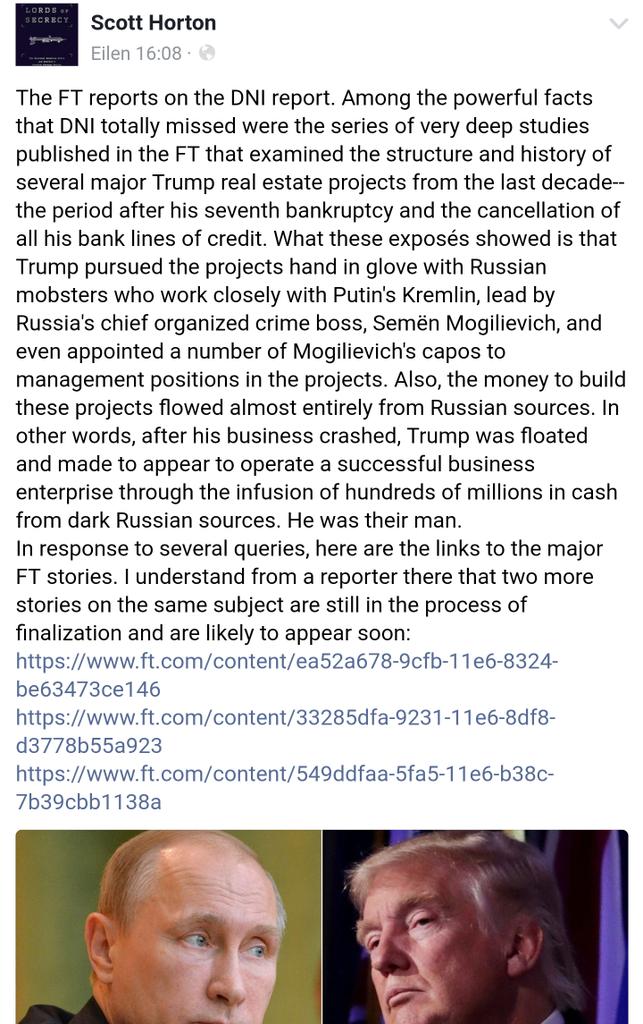
Among the powerful facts that DNI missed were a series of very deep studies published in the [Financial Times] that examined the structure and history of several major Trump real estate projects from the last decade—the period after his seventh bankruptcy and the cancellation of all his bank lines of credit. ...
The money to build these projects flowed almost entirely from Russian sources. In other words, after his business crashed, Trump was floated and made to appear to operate a successful business enterprise through the infusion of hundreds in millions of cash from dark Russian sources.
He was their man.
Yes, even that much seems fantastic, and the details include business agencies acting as a front for the GRU, billionaire mobsters, a vast network of propaganda sources, and an American candidate completely under the thumb of the Kremlin.
It reads like the a B-grade spy novel, a plot both too convoluted—and too bluntly obvious—for John le Carré. The problem is it may not be a conspiracy theory. It may be a conspiracy.
Horton’s analysis comes from piecing together information in three Financial Times “deep reports.” One of these focused on Sergei Millian, the head of the Russian American Chamber of Commerce in the US at the time of Trump Jr.’s “money pouring in from Russia” claim.
Mr Millian insists his Russian American Chamber of Commerce (RACC) has nothing to do with the Russian government. He says it is funded by payments from its commercial members alone.
Most of the board members are obscure entities and nearly half of their telephone numbers went unanswered when called by the Financial Times. An FT reporter found no trace of the Chamber of Commerce at the Wall Street address listed on its website.
Why was RACC’s background filled with so many holes? The Financial Times quotes former Russian MP Konstantin Borovoi in tagging the chamber as a front for intelligence operations that dates back to Soviet times.
“The chamber of commerce institutions are the visible part of the agent network . . . Russia has spent huge amounts of money on this.”
Millian helped arrange for Trump to visit Moscow in 2007, and had other outings with Trump in the states, including a visit to horse races in Miami. Millian claims that he had the right to market Trump properties in Russia.
“You could say I was their exclusive broker,” he told Ria. “Then, in 2007-2008, dozens of Russians bought apartments in Trump properties in the US.” He later told ABC television that the Trump Organisation had received “hundreds of millions of dollars” through deals with Russian businessmen.
Despite documents and photos showing Trump with Millian, Trump denied their association during the campaign.
Hope Hicks, Mr Trump’s campaign spokeswoman, said Mr Trump had “met and spoke” with Mr Millian only “on one occasion almost a decade ago at a hotel opening”.
The second *Financial Times* article puts Trump at the middle of a money laundering scheme, in which his real estate deals were used to hide not just an infusion of capital from Russia and former Soviet states, but to launder hundreds of millions looted by oligarchs. All Trump had to do was close his eyes to the source of the money, and suddenly empty apartments were going for top dollar.
Among the dozens of companies the Almaty lawyers say the Khrapunov laundering network used were three called Soho 3310, Soho 3311 and Soho 3203. Each was a limited liability company, meaning their ownership could easily be concealed.
The companies were created in April 2013 in New York. A week later, property records show, they paid a total of $3.1m to buy the apartments that corresponded with their names in the Trump Soho, a 46-storey luxury hotel-condominium completed in 2010 in a chic corner of Manhattan.
Why would Trump’s organization make such a good means of laundering funds? Because real estate has an arbitrary value. Is that apartment worth $1 million? Two million? Why not $3 million for a buyer who really wants it? When the whole transaction is just one LLC with undisclosed ownership paying another LLC with undisclosed ownership, it’s even neater than hiding the money in an offshore account. And while some businesses require due diligence in looking at the source of funds, real estate is a bit more … flexible.
The laws regulating US real estate deals are scant, experts say. Provisions against terrorism financing in the Patriot Act, passed in the aftermath of the September 11 2001 attacks, obliged mortgage lenders to conduct “know your customer” research. But money launderers pay in cash. Sales such as those of the Trump Soho apartments have passed through this loophole, which was partially closed only this year.
Converting funds stolen overseas into property in the US and cash in the account of an LLC represented a win for both the oligarchs and Trump. Best of all, Trump’s sole requirement was that he pay scant attention to the deal—something at which he was already a proven master. For example, the actual owners of the Trump Soho were anotherlimited liability company, Bayrock.Trump was a partner in the LLC and Bayrock cut the checks Trump received when those apartments were sold. And yet ...
In a 2011 deposition, given in a dispute over the Fort Lauderdale project, Mr Trump said he had “never really understood who owned Bayrock”.Jody Kriss, a former Bayrock finance director, has claimed in racketeering lawsuits against his former employer that Bayrock’s backers included “hidden interests in Russia and Kazakhstan”. Bayrock has denied Mr Kriss’s allegations but declined to answer questions about the source of its funds and its relationship with the Khrapunovs.
The third articledigs more deeply into the origins of Bayrock and its connection with Trump. That connection … was very close.
The Republican presidential nominee and Bayrock were both based in Trump Tower and they joined forces to pursue deals around the world — from New York, Florida, Arizona and Colorado in the US to Turkey, Poland, Russia and Ukraine. Their best-known collaboration — Trump SoHo, a 46-storey hotel-condominium completed in 2010 — was featured in Mr Trump’s NBC television show The Apprentice.
This is the same group about which Trump said he “never really understood” the ownership.
“I don’t know who owns Bayrock,” Mr Trump said. “I never really understood who owned Bayrock. I know they’re a developer that’s done quite a bit of work. But I don’t know how they have their ownership broken down.”
At the very least, Trump confessed to partnering with, taking money from, and acting as a representative for a corporation whose ownership he didn’t know, in deals that totaled hundreds of millions in countries around the world.However, it seems far more likely that Trump knowingly worked with oligarchs, groups associated with the Russian government, and plain old mobsters. Why? Because he was desperate.
By the 2000s, the property developer and casino owner with ready access to the capital markets and the biggest New York banks was no more. A series of corporate bankruptcies had limited his financing options. Mr Trump had become an entertainer who portrayed a tycoon on television and licensed his name to businesses looking for a brand, leading to fee-making opportunities as disparate as Trump University and Trump Vodka.
The Trump Organization was a hollow shell and Trump was bankrupt, but Donald Trump the public figure was a “successful businessman,” a screen behind which criminal activity could be carried out on a massive scale. Throwing his name at every scheme in existence wasn’t a strategy, it was a fire sale on Trump’s respectability. Steaks? Water? Vodka? Fake real estate school? You pony up the cash, and Trump will slap his name on it. Because by the early 2000s, Trump wasn’t just broke, he had nothing left to pawn. He wasn’t a successful businessman, but he still played one on TV. His image had more value than his real estate portfolio.
But the apartments and buildings where Trump held some degree of ownership could be turned into value again. All it took was partnering with foreign crime bosses looking for a place to stash their cash. To inflate the value of his portfolio, Trump had to do nothing other than look away as the dirty money poured in from one LLC to the next.Citizens in Russia, Kazakhstan, and other former Soviet states lost hundreds of millions, but Trump got a cut as looted funds flowed through offices and apartments in buildings that carried those critical gold letters.
Horton’s evaluation of this material in coordination with the declassified DNI report is that Trump actively worked with and for Russian interests.
What these exposes showed, is that Trump pursued the projects hand in glove with Russian mobsters who worked closely with Putin’s Kremlin ...
But based on the information in the Financial Times report, it appears that there are actually two possible answers. Trump may have been actively involved with and working for Russian sources. He might also have simply played the role of useful idiot, displaying his readiness to feign ignorance about any deal … so long as it generated some funds to float his sinking boat.
In the end, there’s not a lot of difference in the outcome. Trump got money. Oligarchs cleaned their cash. Russia got their man.
==
war is boring 2:
...
Direct Trump Involvement
Trump might have enough to worry about were it just for what has been described above; still, while both of the previous schemes are relevant to Trump insofar as three future Trump Campaign staff—Page, Gates, one of the most important and powerful people in his entire presidential run: Manafort—were involved in various ways in the just-outlined past criminal schemes and/or in the future acted to further the interests of Putin and his Russian government, nowwe get into territory where Trump himselfwas directly involved, and in not just one, but roughly a half-dozen situations linked to Russian organized crime.
A piece of context that is important to note for all of the following cases is that the setting for the following suspicious deals was a Donald Trump and a Trump Organization that was reeling financially.
By the mid-2000s Trump was having a hard time finding investors: he had just declared bankruptcy in 2004 for one of his major casino businesses to the tune of $1.8 billion in debt (and would declare another business bankruptcy in 2009, his fifth and sixth overall business bankruptcies, respectively) and all major Wall Street lenders—whose relationships with Trump had been souring for years—stopped offering Trump loans, in part because of his frustrating and suspicious business practices.
That is, all but one: Deutsche Bank, yet even that relationship “frayed” starting in 2008 because of Trump’s untrustworthiness as a business partner (Deutsche itself would later become involved in major money laundering scandals involving Russia, but more on that later).
So Trump was clearly hurting for investment after that 2004 bankruptcy, and yet, somehow, by 2008, Donald Trump Jr. was able to publicly remark that “Russians make up a pretty disproportionate cross-section of a lot of our assets” and that “we [i.e., the Trump Organization] see a lot of money pouring in from Russia;” yes, this was a time when Trump was aggressively courting Russian business (it should now be obvious why Trump has not released his taxes and why that information could, and likely will be, so crucial to the investigations into his Russia ties and to the public’s evaluation of Trump).
In fact, a report from :{Reuters:(style="margin:0px;padding:0px;border:0px;font-variant:inherit;font-weight:inherit;font-stretch:inherit;vertical-align:baseline;outline:0px;background-image:initial;background-position:initial;background-size:initial;background-repeat:initial;background-attachment:initial;background-origin:initial;background-clip:initial"):}: from less than two weeks ago noted how in just seven Trump luxury towers in southern Florida, 63 Russian passport/address-holders have bought $98.4 million in property; they include “politically connected businessmen and other elites,” though “none of the buyers appear to be from Putin’s inner circle;” one buyer, Alexander Yuzvik, was senior at Spetstroi, a Russian state-owned company that has done construction for Russian military and intelligence, including the G.R.U. and the F.S.B. intelligence agencies that were heavily involved the 2016 American election hackings, with Yuzvik only stepping down in March 2016, after the hacking operations had begun, though as of now, no evidence has surfaced linking him to these operations.
The above figures may even be a conservative estimate: at least 703 out of 2,044 of the units in the seven towers were owned by limited liability corporations (LLCs), often designed to mask their owners’ identities; many owners’ nationalities could not be identified; and Russian-Americans without a Russian passport/address were not included.
****
SATER
At the same time the aforementioned Eurasian gas and Manafort-led New York real estate dual schemes were taking place, and while Donald Trump was losing investors in the U.S., Trump was cultivating Russian/former-Soviet business relationships. One of his point men in these efforts was Felix Sater, the son of a mob captain of Mogilevich’s Russian mafia operation; the offices of Bayrock, Sater’s real estate company where he was Chief Operating Officer and eventually the dominant force within, were even in Trump Tower itself.
Sater, a man with a violent, criminal, mafia-rife past of his own, had himself previously been caught up in an elaborate 1990s $41 million stock fraud scheme on Wall Street that had used the Russian mob to launder money at a time, it should be noted, when Mogilevich was active in large-scale stock fraud and laundering in North America. Sater ended up assisting U.S. authorities for years, even, apparently, on CIA-related national security issues involving missile terrorism-related purchases in either Afghanistan or Russia, and the details on all this remain something of mystery: his operations with the government remain secret and the juiciest details of the Wall Street case were sealed and remain so despite repeated efforts to unseal them (they were sealed at the time, interestingly enough, by then-U.S. Attorney for the Eastern District of New York, :{Loretta Lynch:(style="background-color:#ffff66;"):}:, who just stepped down as U.S. Attorney General the day Trump was inaugurated president).
As a result, there is also virtually no information on the specifics of the Russian mafia’s activities in Sater’s Wall Street scam, but there is a reasonably good chance or even higher that Mogilevich was running the Russian mob’s involvement in it, or was at least involved, since he was actively pursuing similar schemes in the U.S. at the time, had a connection to his old capo in Sater, and since Mogilevich was already such a major figure in the Russian mob at this point, keeping in mind that hierarchy matters quite a bit in organized crime; in fact, it is far less likely that the Russian mafia would be involved without Mogilevich when considering the points just mentioned.
Now, that last point should not be taken lightly, considering that, just a few years later,Mogilevich was a primary actor in laundering billions of dollars on behalf of Firtash, Manafort, Yanukovych, and Putin; is it more or less likely that he would turn to an old connection—one with experience laundering money who had come to have the favor of the U.S. government, no less—to help with the laundering? Even without the Wall Street capers, Sater would have been an attractive candidate based on family ties alone, as would his nominal entry into real estate, as the real estate market in the U.S. has been an ideal avenue for money laundering for some time and is a top concern of U.S. officials, in part due to lax state, local, and federal laws.
Sater began working with Trump in in the early 2000s, trying to help him land real estate deals in Moscow, even showing Ivanka and Donald Jr. around the city in 2006and introducing the Trumps to influential Russians. None of these potential Moscow deals ever went through…
Criminal Scheme #3: The Trump/Sater/Bayrock Deals
But a number of deals in the United States between Trump and Bayrock produced a far more interesting—and incriminating—history.
Perhap’s Sater’s most famous partnership with Trump was an infamous deal to develop a SoHo property in Manhattan. The deal was concocted in 2006 by Trump, Sater, and two other partners from former Soviet states: one was Bayrock chairman Tevfik Arif, an ex-Soviet government official from Kazakhstan who’s rise to fortune is at least somewhat questionable; the other was Tamir Sapir from Georgia, who had decades ago established ties to numerous important Soviet officials after immigrating to the U.S., who may have very well been (once) part of—or even come to the U.S. secretly working for—the Soviet Ministry of Internal Affairs (at whose academy he had apparently studied), whose source of his wealth had long been subject to rumor-fueled suspicion, who introduced Trump to Bayrock, and whose former business partner had pled guilty to racketeering conspiracy charges spanning 13 years with the Gambino crime family (incidentally or not, at the time of the SoHo deal, it seems Sapir was not exactly mentally fit).
It turns out that the SoHo deal had a significant portion of its Sater-and-Arif facilitated financing—some $50 million specifically approved by Trumpfor it and three other projects—flow from a firm in Iceland, FL Group,linked to the Panama Papers revelations and one apparently known as a hub for the money of Russians “in favor with Putin.” Financing for these projects was also secured from **Alexander Mashkevich** (or Machkevich), a Kazakhstani billionaire with a history of money laundering.
Considering Sater had helped pave the way for this investment and recalling his Mogilevich connection, it is hardly unreasonable to assume that there is a high probability that some of the money coming in from Russians was in one way or another tied directly or indirectly to the giant Eurasian gas scheme worth billions, as this period was especially a time when Russians tied to Putin and operating through Manafort, Firtash, and Mogilevich were aggressively trying to funnel money away from prying eyes of the likes of Tymoshenko. Besides the Russian financing, some of the transactions involving the property were clearly carried out by shell corporations for the purpose of laundering money, transactions from which Trump profited. Furthermore, the SoHo deal was structured to cheat the U.S. government out of tens of millions in taxes, as the investments were illegally restructured as loans (not incidentally tax-free) to avoid paying hefty taxes on them, loans that would also give FL Group a big chunk of theoretical future profits over time.
In the end, the deal went terribly for Trump, who was sued for fraud—his children Eric and Ivanka had inflated the level of interest in order to attract buyers—and in a 2011 settlement, he refunded 90% of the deposits on the building’s condos.
One must wonder why likely Russian investors were so eager to invest $50 million in this deal, and if it was an excuse to launder money, rather than an actual investment, as was the case with the Park Avenue deal involving Manafort & Co, and that model would seem to be repeated by Bayrock again and again, Repeated in deals with Trump and with Saterserving again as a point-man.
Even as construction on Trump SoHo began in 2007, another of the Trump/Bayrock projects was rising in Fort Lauderdale, Florida; this one, the Trump International Hotel & Tower, would also result in disaster and led to over a dozen lawsuits, with over 100 condo buyers suing for $7.8 million. The project was supposed to have been completed by the end of 2007 but fell way behind schedule; Sater and his Bayrock partners secretly and seemingly cashed out their stakes in this project and several others—including the SoHo deal—in a deal with the aforementioned Icelandic firm, FL Group. Trump eventually pulled his name from the project, and when its buyers learned this in May, 2009, this only increased their outrage and added to lawsuits already in motion accusing Trump and Bayrock of fraud. As in the SoHo deal, confidential settlements, this time with dozens of buyers, ensued, and Trump refused to accept any responsibility, blaming the problems on the economic crises. Florida courts declined to rule that Trump or his partners had committed fraud, including a state appeals court just last year. The project finished years late, cost some $200 million, and was eventually sold for merely $115 million at a foreclosure auction. And while the evidence of money laundering in this case is not as explicit or solid as the information publicly reported on in the SoHo deal, it is still a similarly structured deal with the same partners that led to a similarly dubious result, making it more likely, not less, that similar laundering was taking place.
Another Bayrock partnership with Trump in Fort Lauderdale (not part of the FL Group ventures) was originally conceived of as the Trump International Beach Club; an initial $2 million in capital was provided by Arif in 2003, and from that point, Sater and Arif conned a friend of Arif’s who was also Sater’s landlord, Elizabeth Thieriot, lying about the value of the club, hiding their own investment in the project, and convincing her to provide a $1 million investment for a mere 4% of the Club, 12 times what they had paid for that percentage and allowing them to make a 1,125% profit on her investment; as in the SoHo deal, they illegally labeled the investment a loan to avoid paying taxes on it and were using their fraud to hide skimming $1 million off the top; on top of that, when there was income finally generated in 2005, they defrauded their partner Thieriot of her rightful share; eventually Theiriot figured out some of what was going on and sued her scammers in court in 2006, and they pulled similar scams on other investors/members in the Club. The project was apparently eventually reconceived of as the Trump Las Olas Beach Resort, but was suspended in a declining market by Trump himself in October 2007.
Another deal among the four which received FL Group financing was a failed project that never even got off the ground in Phoenix, Arizona. Trump began eyeing the Camelback area of Phoenix, Arizona, for a luxury residential tower back in late in 2003, a project similar to the others; Trump’s team, and then Trump himself, met with the mayor, who wasn’t impressed with Trump, and at a meeting in January, 2005, when plans were unveiled, local residents showed up to argue against the development, yet by September, the appropriate city bodies had approved the plans. It seems Sater’s people organized intimidation, bribery, and deception as tactics to deter residents from gathering enough signatures to force a public referendum that could have overridden the city bodies’ approval; under this pressure, the city council voted to reverse its decision and pressed the developers and the neighborhood association to reach a compromise, at which point Trump himself abandoned the project, not wanting to be part of anything that would be scaled down any further in scope and ambition. Ernie Mennes, the owner of the Camelback property who had gone into a partnership with the Bayrock/Trump developers, sued Bayrock in 2007 in federal court, accusing Sater of both threatening to “cut off his legs and leave him ‘dead in the trunk of his car’” and of stealing money from the project for himself. The judge oversaw a settlement and the case was sealed, likely because of Sater’s special relationship with the government. This property was part of the $50 million pseudo-offloading to FL group, and by June of 2009, Bayrock was relieved of the property, which it had left $36 million in debt, when it was “sold out from under” the company at a trustee auction for a mere $10 million.
The final in the group of four projects of Bayrock tied to FL’s “investment” involved a Waterpointe property in Queens (apart from approving FL’s money, Trump was otherwise not involved). Bayrock bought the property in 2008 for $25 million, but the soil was contaminated and had to be replaced, which Bayrock did with other soil that was even more contaminated and was fined $150,000 for doing so; when Bayrock defaulted on a loan in 2011, the lender took over Waterpointe and sold it for roughly $11 million, less than half what Bayrock had paid.
As for FL Group, it failed in spectacularly 2008, along with Iceland’s other major banks/funds and many others in the world during the great global financial meltdown.
In a 2013 NY State Supreme Court lawsuit rising from a process that began in 2008, former and then-business partners of Sater’s at Bayrock—Jody Kriss and Michal Ejekam—sued Sater and his accomplices for damages and nonpayment related to Sater’s hiding of his past and his use of Bayrock primarily as a vehicle for criminal activities; in it, Donald and Ivanka Trump and the Trump Organization are named as defendants and the federal government is accused of illegally concealing Sater’s past and crimes in a way that defrauded previous victims from 1998 scam—including Holocaust Survivors—and subsequent victims of the other above schemes of many millions in restitution. The NY State Supreme Court removed the Trumps and their Organization from the suit; the plaintiffs had only sought declaratory relief in regards to the Trumps, i.e., they asked the court to determine what liability the Trumps had in regards to the case, and they were removed “without prejudice,” meaning the removal was no comment on their guilt/responsibility/innocence and that they could be sued again on the same grounds later.
*****
Taken together, these examples amount to catastrophic losses and colossal mismanagement on the part of Sater and Bayrock and, at the very least, gross negligence and incompetence on the part of Trump; at most, he might have been aware of some of what was going on and turned a willful blind eye, or, even worse, he might have been in on it, though no evidence exists that proves this).
Actually, the performance of Bayrock was so bad, one would not be faulted for concluding they did not care at all about performance. And that seems to be right on the mark: it seems, if anything, these schemes were designed to move large amounts of money, often Russian-tied, into temporary projects that never came to fruition, but that would benefit Sater, Trump, and others high-up in the deals, but rarely if ever the investing partners outside this upper echelon; it seems these other duped partners and especially Trump would lend an air of respectability to clearly criminal schemes that were so poorly managed that the only logical conclusion is that Sater and his friends at Bayrock did not care about the future success of the projects nearly as much as they cared about laundering money and skimming from the top. Furthermore, since FL Group was a stupendously bad performer even by the standards of the 2008 financial crisis, and given its close ties to Kremlin-connected Russian money, one could also be forgiven for thinking there was something more going on there than met the eye. We may never know all the details or whose money was laundered and for what reasons—and if I had a magic wand I’d love to see if any the Manafort/Yanukovych/Firtash/Mogilevich Eurasian gas scheme money made its way into any of these Trump ventures—but it seems clear a lot of dirty Russian money was involved.
When considering Sater, it is important to remember that he has been busted multiple times by law enforcement and yet has not served jail time in America (with the exception of one year for stabbing a man in the face with a margarita glass and severing a nerve in the man’s face, or, as Trump put it under oath, Sater “got into a barroom fight, which a lot of people do.”) and enjoys the favor of the U.S. government, suggesting he is anything but a generally and especially stupid person; also remember that Sater has a long history of money laundering.
So, in fact, once you look at the Bayrock deals and Sater assuming Bayrock’s primary reason to exist is for RICO money laundering, these deals that were once seemingly mind-bogglingly stupid all of a sudden make a lot of sense, and, in series of lawsuits beginning primarily on behalf of two of Sater’s Bayrock partners—Jody Kriss and Michael Ejekam, who weren’t in on the fun—for money they say is owed to them, Bayrock is precisely described as a RICO criminal organization, of which money laundering is one of its primary activities (in the main complaint, the word “launder” or one of its derivatives appears 39 times in the document).
Sater Saga
[biz card]
After Sater left Bayrock in 2008, none of this stopped him from being brought into the Trump Organization in 2010 as a “Senior Advisor to Donald Trump” even after Trump was made aware of Sater’s criminal past, and circumstantial evidence points to Sater still being connected to the Russian mafia. For his part, Trump has issued his typically contradictory and slippery statements—more aptly called lies—in regards to these dealings and, in particular, his relationship to Sater, with Trump lying repeatedly about his relationship with Sater and Bayrock in an attempt to falsely minimize them. And there is no distancing Trump from Bayrock: one of Bayrock’s flagship presentationsfrom as late as 2008 list its three Trump-named projects discussed above before all others and lists The Trump Organization as its first “strategic partner” (followed by FL Group), Donald Trump as its first “reference,” and “Trump Tower” in New York as its address.
The Huffington Post also recently discovered just a few days ago that Sater owns three shell companies—Global Habitat Solutions (GHS), United Biofuels Company LLC, and Sands Point Partners GP LLC—that are apparent fakes that “sell no products and have no customers,”ideal for being used to launder money; GHS had collaborated with another company named Titan Atlas in promoting itself, a company co-founded by Donald Trump Jr. and in which Trump Jr. also invested; Sater used promotional images from Titan Atlas’ website for GHS’s own after Trump Jr. introduced him to Titan Atlas’ other co-founder, Jeremy Blackburn (with an unsurprisingly troubled corporate past), and Tital is now owned by another company controlled by the Trump Organization, run by Trump Jr. since his father became president. .
Sater even donated the maximum amount allowed to Trump’s 2016 presidential campaign, and the White House is even using Sater as a back-channel diplomatic go-between for Trump’s person lawyer, Michael Cohen, and aheavily-pro-Russian/pro-Putin Ukrainian legislator, Andrii Artemenko, who are discussing a Ukraine “peace plan” being pushed by close Putin aides; Artemeno alsoclaims he has information damaging to Petro Poroshenko, Ukraine’s anti-Russian president facing off against Putin and his proxies in the Ukrainian Civil War. In an only partially-verified-by-U.S.-officials 35-page dossier on Trump and his people compiled by a respected ex-MI6 British intelligence officer, Christopher Steele, Cohen is said to have secretly met with Russian government officials during the late stages of the presidential campaign, though it is not clear if this—or what—specific information has been corroborated by U.S. officials, with journalists having been unable to thus far verify the information on Cohen, who denies playing this role.
The reason a lot of what is known about Sater and his past misdealings is publicly available, besides a then-revelatory late-2007 :{New York Times:(style="margin:0px;padding:0px;border:0px;font-variant:inherit;font-weight:inherit;font-stretch:inherit;vertical-align:baseline;outline:0px;background-image:initial;background-position:initial;background-size:initial;background-repeat:initial;background-attachment:initial;background-origin:initial;background-clip:initial"):}: article, is because of the intrepid efforts of two of the lawyers who often represented plaintiffs against Sater in court: Richard Lerner and Frederick Oberlander.
Going back to that 2013 lawsuit, because Assistant U.S. Attorney Todd Kaminsky was included in these accusations for illegally aiding and covering up for Sater, U.S. Attorney for the Southern District of New York (SDNY) Preet Bharara (more on him on in a bit)ended up being involved tangentially in defending him in his capacity as a U.S. Attorney, playing a role in trying to moving the suit from the state court system to SDNY jurisdiction, but it was ultimately moved because of Sater and his ties to the government, not Kaminsky. Once in the hands of the Federal court, Kaminsky was removed without prejudice from the proceedings.
Which brings us to one of the untold stories of this election, and one which may never be told in full: how Sater’s cooperation with the government gave him government protection from being held liable in many cases for his misdeeds while also helping to suppress information about him and these misdeeds, and how, had his past and crimes been front and center over the past decade, this knowledge could have done much to derail and discredit Donald Trump, his brand and family at a time when he was building a national following with his hit show The Apprentice, which he even used to promote his fraudulent, money-laundered SoHo deal.
That the public, including Trump’s and Bayrock’s clients and customers, were kept in the dark about Sater—a fact which undoubtedly helped all of these related deals and others advance, which was not lost on partners of Sater’s, and which is at the heart of much of the legal action against Sater—and were kept in dark because Sater cooperated with the U.S. government, adds quite a what-if twist to the tale of Trump and his dramatic rise over the last decade to become the most powerful man in the world: what if the government hadn’t protected Sater, and all that evidence was out in the open while Trump and Bayrock were courting buyers and were fighting court battles? What would that have done to Trump’s reputation if he became most known for defrauding customers and money laundering with a Russian mafia-deluged violent felon, to his hit show The Apprentice (one can just imagine NBC saying “You’re fired!” to Trump), and to his political aspirations?
In a much less chaotic, less exciting world than the insanity that confronts us today, one can be sure such a salacious story involving a playboy New York tycoon would have been front, center, and dominant in national and international media coverage; lawsuits, trials, and investments may also have gone differently for Trump if such information was common knowledge, too; he may have just faded away in disgrace, or least into a sideshow, if not landing in jail.
Yes, if not for the favors the U.S. government did in protecting and, thus, abetting, Sater, it is far more likely that Trump would have collapsed in scandal than risen to be our current president. This abetting may very well be unwitting, but the two aforementioned lawyers—Lerner and Oberlander–believe differently, that the government cooperation with Sater yielded disappointing results, that Sater fooled and tricked the government into helping him in exchange for dubious assistance of questionable value and that this arrangement may have been such an embarrassment for the government that they covered up this and his past to save face and protect the careers of those involved. No court rulings have affirmed these assertions, yet it is notable that in the U.S. Supreme Court proceedings involved in arguing over Sater’s information being withheld from the public, the Court tacitly admitted that at least some of the points made by Lerner and Oberlander were valid when they ordered many of the documents surrounding Sater be made public, the only reason that much of information about him is now publicly available.
Epilogue of Intrigue
As for Arif and Mashkevich, two other major players in the whole Trump/Bayrock/FL Group saga, Arif was arrested in Turkey in September 2010 when he was at a sex party with apparently underage girls on board a Yacht (which had been once belonged to none other than Atatürk) under suspicion of running a complex prostitution and human trafficking ring in a scheme of which it seems Mashkevich was also a part, though Arif was later acquitted under mysterious circumstances and Mashkevich was not charged.
Going back to Trump’s sole major Wall Street lender, Deutsche Bank, since 2012, it has loaned trump over $300 million, a sum that is still owed. This amount presented a major conflict of interest for the newly inaugurated President Trump in late January 2017, because Deutsche was under investigation by the U.S. Department of Justice (DoJ) for orchestrating $10 billion in illegal fake trades from 2011-2015 that might have been part of a massive Russian money laundering scheme; U.S. and UK officials levied $630 million in massive fines against Deutsche at the end of January 2017, but DoJ was not part of this and is still investigating, raising the question of the independence and impartiality of Trump’s own new Attorney General, Jeff Sessions, himself under fire for possible improper interactions with Russian officials and forced to pledge to recuse himself from any investigations of into the 2016 election and Russian interference in it. Deutsche itself is under pressure to allow an independent investigation into Trump’s accounts with the Bank (his family also has accounts with Deutsche), even after its own investigation apparently found no link to Trump’s accounts and Russia.
It was just revealed that Deutsche was also involved in another major laundering scam of Russian money to the tune of $24 million, including the specific division that Trump owes $300 million, with the overall laundering scheme—known as the Global/(Great) Russian Laundromat—involving dozens of Western banks and a sum ranging from $20-$80 billion through the years 2010-2014; the hundreds involved in the scheme include Russia’s notorious oligarchs and Russia’s F.S.B., the main successor to the famed Soviet K.G.B. intelligence agency, with Putin having longstanding intimate ties to both and with some of the money in the scheme apparently being used to further Putin’s and Russia’s interests.
As if there weren’t enough bad connections to Trump Tower, Mogilevich-associated Russian mafia boss and apparent all-around celebrity Alimzhan Tokhtakhounov was overseeing an illegal high-stakes international gambling ring for wealthy clientele that in part operated out of Trump Tower in New York. Among other prolific activities, Tokhtakhounov had gained notoriety for apparently fixing 2002 Olympic ice skating matches to help get a gold medal for a fellow Russian, as well as one for a pair of French skaters in exchange for a French visa, but was soon after in Russia and safe from prosecution. The gambling ring connected to Trump Tower, run by two of his capos, Vadim Trincher and Anatoly Golubchik, was popular with Russian and Ukrainian oligarchs in both Russia and Ukraine, and besides the gambling ring, they also engaged in some $100 million in money laundering. Trincher himself in 2009 bought an apartment in Trump Tower just below an apartment owned by Trump himself, in which he nearly held a fundraiser for Newt Gingrich two years later, but had to cancel because of a mold problem and a water leak; it was from this apartment that Trincher ran a branch of said gambling ring. Another linked gambling/laundering ring was run by one of Trincher’s sons, who owned an entire floor in Trump tower, and another son of Trincher’s ran multiple illegal poker rooms throughout New York City.
An indictment naming Tokhtakhounov and his people was filed by U.S. Attorney Preet Bharara, mentioned earlier, and the same Preet Bharara fired controversially by Trump just last month after Trump had promised Bharara he would not fire him, and it should be noted that several of the past and ongoing cases involving Trump and/or his associates occurred in the jurisdiction of SDNY and that a number of potential future cases would also occur there if they moved forward and would have been handled by Bharara if he had not been fired. It was Bharara’s indictment that led to a 2013 raid on Vadim Trincher’s Trump Tower apartment, and arrests made there and elsewhere nabbed 29 suspects. A mere seven months after he was indicted, a nonchalant Tokhtakhounov was a red-carpet VIP guest at Trump’s 2013 Miss Universe Pageant in Moscow, a city where, to this day, he is regularly seen at trendy public places.
We also have the curious case of the Trump’s fabulously ostentatious mansion—the “Maison de l’Amitie”—in Palm Beach, Florida, that he bought back in 2004 for $41 million. A representative of Trump claimed Trump put $25 million of his own money into renovating the house, but this is doubtful; plans obtained who improvements were relatively minor, and, Typical of Trump, he seemed to be lying through his teeth: when taking a local reporter on a tour, he claimed he installed gold fixtures in bathroom, but when the report scratched a faucet, gold paint came off to reveal not-gold underneath. Trump set his asking price at $125 million when he listed early in 2006, but had trouble finding a buyer; then, in March 2008, he brought his price down to $100 million, but it still wasn’t until that July that he got Russian oligarch billionaire Dmitry Rybolovlev to buy the mansion for $95 million after some haggling in a deal said to be the largest U.S. residential real estate deal ever. If you’re thinking that Trump might have swindled Rybolovlev, that’s very possible: he has a habit of falling for tricksters, especially when it comes to art deals; the house was appraised at less than only $59.8 million in 2013, and though it rose to $81.8 million in the summer of 2016, that was still about 15% less than what he had paid. Just months after he bought the house, he ended up in a messy divorce drama with his wife, who was after the house; there are plans to demolish the house, and Rybolovlev has not even physically entered the house, which may be demolished.
But unlike other major Russian oligarchs doing business with Trump or his allies, either directly or indirectly, Rybolovlev is no apparent friend or ally of Putin or the Russian mafia, which seems to put this story in the category of mere trivial.
But then, multiple reports that Rybolovlev’s private jet had repeatedly been tracked to cities where and when candidate and later president Trump was: Las Vegas in October, just five days before Election Day in North Carolina, and in Miami in February, creating a sense of intrigue. One might be tempted to say this is meaningless, yet on top of this, his accounts of the mansion deal have changed, making people wonder if he has something to hide.
At the very least, this Palm Beach mansion saga is a good reminder that Trump is a swindler and a liar, and if you’re still not connived, google Trump University, Trump Steaks…
And oh, we just found out that during the campaign, Republicans paid a private intelligence firm that works closely with an ex-K.G.B. officer to dig up dirt in Clinton.
Putting the Pieces Together: Not a Pretty Picture
Sorry, Trump fans, but it’s time a reality check: it’s more likely that you will soon be struck by lighting than that all of these threads together and tied together by a Russian mafia godfather end up as innocent, harmless coincidences when it comes possible connections between Team Trump and Team Putin.
It is also crucial to note that the whole Russian operation in Ukraine—using Russia’s natural resources, deals related to them, and the profits from selling them to dominate and corrupt political elites of neighboring and other countries along with hacking and (mis/dis)information operations—is hardly unique to Ukraine; Putin is trying to do much the same thing throughout Europe, and it was clear he successfully threw his weight around last year during our election to help Trump win in what I called the (First) Russo-American Cyberwar, part of his overall war on Western Democracy and promotion of what I call :{democratic fascism:(style="margin:0px;padding:0px;border:0px;font-variant:inherit;font-weight:inherit;font-stretch:inherit;vertical-align:baseline;outline:0px;background-image:initial;background-position:initial;background-size:initial;background-repeat:initial;background-attachment:initial;background-origin:initial;background-clip:initial"):}:.
The question is now about whether or not there was treason going on during that (First) Russo-American Cyberwar. If (and we don’t know yet) Putin was able co-opt agents people Manafort, Gates, Page, and/or others, this would simply be current Russian standard operating procedure for how it spreads its power throughout the world in the era of Putin; such hybrid warfare and “Cold War”-type or non-hot warfare being directed at America should not only not surprise Americans, it should be expected. And it seems that, along with Manafort and Page, the record-fast-recently-resigned-due-to-Russian-related-stuff Trump National Security Advisor Gen. Michael Flynn and longtime Manafort and Trump confidante Roger Stone are all under an official FBI “counterintelligence”—to use FBI Director James Comey’s exact word—investigation, and Manafort, Page, and Stone all just volunteered to testify before Congress.
Should those hearings be public, that would be epic.
PAGE 2- (brief) CONCLUSION HERE
...
Conclusion: Trump Has Terrible Judgment or Is a (Treasonous) Criminal or Both
I will never forgive the news media or the American people for not caring enough about the aforementioned information when it mattered most and had the chance to change the outcome of this election, since any one of these main three threads alone carried more weight than Clinton’sand yet got only a fraction of the coverage that red-herring of a “scandal” got. Nor will I forgive Comey for his political tone-deafness, the politically-suicidal liberals who empowered Trump by myopically and narcissistically not voting for Clinton, or the Republican Party for so willingly spreading its buttocks for Putin; anyone who doubts me on that last point the disgraceful behavior of Republicans on the supposedly relatively non-partisan House Intelligence Committee, especially its Chairman Devin Nunes and shallow grandstander Trey Gowdy, the latter of whom led the partisan witch-hunt that was the last “Benghazi”—really Clinton e-mail—investigation. Yes, I have no faith in Trump—Team Trump has lied at least 20 times about its ties to Russia as of early March and only continues to do so in the
 and unprecedented and Orwellian of ways, making the possible reality of a serious cover-up more and more likely—but seeing Nunes as the Intelligence Committee Chairman act in such an unprecedented way—blatantly covering for the president—made me tear up and almost cry because his behavior is such a dramatic sign of how our government is failing us and how the last bastion protecting this country from what I call *democratic fascism*—that bastion now being that the party in power won’t twist every organ of government it can to benefit itself politically no matter the cost—may be crumbling. As historian Douglas Brinkley (who implored the public after Trump won to “give...[Trump]…a chance”) said of all of this: “There’s a smell of treason in the air.”
Trump repeatedly claimed during his campaign he would surround himself with “the best people;” I’m sure he believed himself, and that is the problem. What has been outlined here is probably one of the strongest cases (if not the strongest) against Trump’s judgment as leader, whether in business or in politics; if you surround yourself on a regular basis with mobsters and criminals and those who favor the worldview (or purse) of America’s greatest enemy over America itself, there is no more discussion to be had: Donald Trump is too stupid and too incompetent a leader to be president as he simply cannot be trusted to make decisions about whom to give power to (for every supposed hit there are far more misses and we can’t delegate the fate of our nation a game of chance; sorry, but I’m nearly convinced that Trump picked Gen. Mattis to run the Pentagon simply because he like Mattis’ nickname of “Mad Dog”); Trump’s selection of Paul Manafort alone would be disqualifying enough, and that’s just the beginning.
And that is the best case scenario that he was too stupid to see that his people were playing him for a fool or were abusing their power in a way that could destroy his potential presidency and do the nation irreparable harm. But if Trump himself in any way knew about any possible collusion with Russia, that takes us from disqualifying incompetence into the realm of treason. Even if that is not the case, the newest revelations are making it more and more likely that some sort of treason from within his camp will be uncovered—Comey recently noted that this counterintelligence investigation began in July, some ten months ago, and if it was clear there was no collusion it would probably have ended long ago—and it is increasingly likely that this issue will cripple Trump’s presidency in ways not seen since the later nineteenth-century, when Reconstruction’s war between President Andrew Johnson and Congressional Republicans, as well as the scandals of the Gilded Age, dramatically weakened the presidency.
Russia is as defiant as ever, just in recent months and weeks assassinating—or trying to assassinate-—opponents, arresting hundreds of peaceful protesters and Russian’s main opposition leader (Alexei Navalny, again) during Russia’s largest protests in five years, trying to overthrow democratically elected foreign governments (Montenegro), hacking foreign politicians in ways designed to sway elections (from Hillary Clinton to France’s Emmanuel Macron and beyond), fanning the flames of war in Ukraine, slaughtering civilians in Aleppo, and assaulting the world of norms the West has known since the end of WWII.
And Donald Trump is in the White House and wants to be Putin’s friend.
....
https://www.alternet.org/video/watch-americas-mobster-president-new-evidence-dutch-documentary-trumps-international-money
Trump’s Manhattan properties and business partners, including former Soviet Union-connected oligarchs, were involved in a larger international money-laundering scheme involving upward of $1 billion, according to Dutch filmmakers whose third installment in an investigative series aired on public TV in Holland Wednesday.
“We wanted to know in depth how money was transferred from Kazakhstan to the United States and how this could relate to Donald Trump, the Trump Organization and Trump’s real estate,” said Sander Rietveld, director of The Dubious Friends of Donald Trump, Part III: The Multibillion-Dollar Fraud, broadcast on Zembla, a program of the VARA Broadcasting Association.
The documentary was produced based on a three-month collaborationbetween Zembla, The Organized Crime and Corruption Reporting Project (OCCRP)—known for the Panama Papers, and McClatchy newspaper's Washington bureau (including Kevin Hall, who won a Pulitzer Prize for the Panama papers).
“We investigated hundreds of company records, court documents in the U.S., Kazakhstan, Ukraine, Cyprus, the Netherlands, Belize, etc., and interviewed dozens of sources,” he said. “The result is a follow-the-money documentary revealing the connections between several people in Trump’s orbit and an alleged multibillion-dollar fraud. Also the pivotal role of the Netherlands as an offshore haven gets attention. With Dutch help, Kazakh oligarchs allegedly were able to divert and launder huge amounts of money.”
One of the international financiers profiled went to court in the Netherlands on Tuesday to stop the documentary from airing on public TV, but lost, Rietveld said: “Kazakh multimillion[aire] businessman-oligarch Ilyas Khrapunov tried to block this broadcast in court yesterday (Monday). Judge turned down his request and allowed airing documentary.”
[vid]
The filmmakers found that money taken out of Kazakhstan by energy oligarchs was used to buy some of Trump’s high-end Manhattan apartments and was also used to create the business partnership, called Bayrock, for Trump’s SoHo Tower project, said James Henry, a financial industry investigative reporter and editor at DCReport.org who worked with Rietveld’s team and appears in the documentary.
“The significant thing is they have got the Kazakh government saying that Bayrock was a money launderer for these guys,” Henry told AlterNet. “What is interesting, if [special counsel Robert] Mueller wants to take a look at this, is we have Trump’s [mob-connected business partner] Felix Sater laundering criminal money.”
U.S. laws such as the Foreign Corrupt Practices Act make it a crime to launder money tied to prior illegal acts, Henry said. The documentary, whose reporting was also developed in collaboration with McClatchy News’ Washington office, traces how investing in Trump’s Soho Tower included concealing illegal money-laundering activities. Trump did not tell other investors about any of this, as required under U.S. financial law, he said, “a continuing cover-up of money laundering.”
The program is the third installment in the series profiling Trump’s business deals with international investors that appear to have violated U.S. and foreign financial laws. The first installment focused on . Installment two looked at
 . The third installment returns to Trump’s partners in his downtown New York City project, according to its online summary.
“Will Donald Trump go down due to his dubious ties to the former Soviet Union?” Zembla's summary says, recapping the filmmakers’ previous findings. “The president seems to be getting in deeper and deeper. Special prosecutor Robert Mueller, who is investigating if Trump colluded with Russia in order to win the elections, is also digging into Trump’s past as a businessman. In that past, one of Donald Trump’s business partners plays a crucial role: Felix Sater, a convicted felon who has ties with the Russian mafia. Last May, Zembla disclosed how an American real estate company, run by Sater, used Dutch mailbox companies within a network, which has been suspected of laundering money. Allegedly $1.5 million had been diverted. Donald Trump developed hotels and apartment complexes with this suspicious company.”
“In the last few months Zembla received indications of a greater fraud,” it continued. “A billion-dollar fraud. And here Sater, Trump’s questionable business partner shows up, as well. The money trail leads to Kazakhstan, to real estate projects in New York and again to the Netherlands. Zembla investigates: How compromising is this case for the current president of America?”
The Dutch documentary raises questions most American TV networks have not broached, Henry said. For one, what was the role of Trump ally and ex-New York City mayor Rudolph Giuliani, who represented Sater and raised money for his presidential campaign in Kazakhstan?
Another intriguing question involved others in Trump’s orbit as a real estate magnate and president. Wilbur Ross, Trump’s commerce secretary, was vice-chairman of a bank based on the Mediterranean island of Cyprus favored by Russian oligarchs, Henry has reported. “I’m saying, ‘Let’s see Mueller do his job,'” he said. “Here’s more leads.”
==
==
unger
...
The money, illicit and otherwise, began to rain in earnest after the Soviet Union fell in 1991. President Boris Yeltsin’s shift to a market economy was so abrupt that cash-rich gangsters and corrupt government officials were able to privatize and loot state-held assets in oil, coal, minerals, and banking. Yeltsin himself, in fact, would later describe Russia as “the biggest mafia state in the world.” After Vladimir Putin succeeded Yeltsin as president, Russian intelligence effectively joined forces with the country’s mobsters and oligarchs, allowing them to operate freely as long as they strengthen Putin’s power and serve his personal financial interests. According to James Henry, a former chief economist at McKinsey & Company who consulted on the Panama Papers, some$1.3 trillion in illicit capital has poured out of Russia since the 1990s.
Semion Mogilevich.
At the top of the sprawling criminal enterprise was Semion Mogilevich. Beginning in the early 1980s, according to the FBI, the short, squat Ukrainianwas the key money-laundering contact for the Solntsevskaya Bratva, or Brotherhood, one of the richest criminal syndicates in the world. Before long, he was running a multibillion-dollar worldwide racket of his own. Mogilevich wasn’t feared because he was the most violent gangster, but because he was reputedly the smartest. The FBI has credited the “brainy don,” who holds a degree in economics from Lviv University, with a staggering range of crimes. He ran drug trafficking and prostitution rings on an international scale; in one characteristic deal, he bought a bankrupt airline to ship heroin from Southeast Asia into Europe. He used a jewelry business in Moscow and Budapest as a front for art that Russian gangsters stole from museums, churches, and synagogues all over Europe. He has also been accused of selling some $20 million in stolen weapons, including ground-to-air missiles and armored troop carriers, to Iran. “He uses this wealth and power to not only further his criminal enterprises,” the FBI says, “but to influence governments and their economies.”
In Russia, Mogilevich’s influence reportedly reaches all the way to the top. In 2005, Alexander Litvinenko, a Russian intelligence agent who defected to London, recorded an interview with investigators detailing his inside knowledge of the Kremlin’s ties to organized crime. “Mogilevich,” he said in broken English, “have good relationship with Putin since 1994 or 1993.” A year laterLitvinenko was dead, apparently poisoned by agents of the Kremlin.
Vyachelsav Ivankov.Sergey Ponomarev/AP
Mogilevich’s greatest talent, the one that places him at the top of the Russian mob, is finding creative ways to cleanse dirty cash. According to the FBI, he has laundered money through more than 100 front companies around the world, and held bank accounts in at least 27 countries. And in 1991, he made a move that led directly to Trump Tower. That year, the FBI says, Mogilevich paid a Russian judge to spring a fellow mob boss, Vyachelsav Kirillovich Ivankov, from a Siberian gulag. If Mogilevich was the brains, Ivankov was the enforcer—a vor v zakone, or “made man,” infamous for torturing his victims and boasting about the murders he had arranged. Sprung by Mogilevich, Ivankov made the most of his freedom. In 1992, a year after he was released from prison, he headed to New York on an illegal business visa and proceeded to set up shop in Brighton Beach.
In Red Mafiya, his book about the rise of the Russian mob in America, investigative reporter Robert I. Friedman documented how Ivankov organized a lurid and violent underworld of tattooed gangsters. WhenIvankovtouched down at JFK, Friedman reported, he was met by a fellow vor, who handed him a suitcase with $1.5 million in cash. Over the next three years, Ivankov oversaw the mob’s growth from a local extortion racket to a multibillion-dollar criminal enterprise.According to the FBI, he recruited two “combat brigades” of Special Forces veterans from the Soviet war in Afghanistan to run the mafia’s protection racket and kill his enemies.
Like Mogilevich, Ivankov had a lot of dirty money he needed to clean up. He bought a Rolls-Royce dealership that was used, according to The New York Times, “as a front to launder criminal proceeds.” The FBI concluded that one of Ivankov’s partners in the operation was Felix Komarov, an upscale art dealer who lived in Trump Plaza on Third Avenue. Komarov, who was not charged in the case, called the allegations baseless. He acknowledged that he had frequent phone conversations with Ivankov, but insisted the exchanges were innocent. “I had no reason not to call him,” Komarov told a reporter.
Trump Taj Mahal paid the largest fine ever levied against a casino for having “willfully violated” anti-money-laundering rules.
The feds wanted to arrest Ivankov, but he kept vanishing. “He was like a ghost to the FBI,” one agent recalls. Agents spotted him meeting with other Russian crime figures in Miami, Los Angeles, Boston, and Toronto. They also found he made frequent visits to Trump Taj Mahal in Atlantic City, which mobsters routinely used to launder huge sums of money. In 2015, the Taj Mahal was fined $10 million—the highest penalty ever levied by the feds against a casino—and admitted to having “willfully violated” anti-money-laundering regulations for years.
The FBI also struggled to figure out where Ivankov lived. “We were looking around, looking around, looking around,” James Moody, chief of the bureau’s organized crime section, told Friedman. “We had to go out and really beat the bushes. And then we found out that he was living in a luxury condo in Trump Tower.”
There is no evidence that Trump knew Ivankov personally, even if they were neighbors. But the fact that a top Russian mafia boss lived and worked in Trump’s own building indicates just how much high-level Russian mobsters came to view the future president’s properties as a home away from home. In 2009, after being extradited to Russia to face murder charges, Ivankov was gunned down in a sniper attack on the streets of Moscow. According to The Moscow Times, his funeral was a media spectacle in Russia, attracting “1,000 people wearing black leather jackets, sunglasses, and gold chains,” along with dozens of giant wreaths from the various brotherhoods.
Throughout the 1990s, untold millions from the former Soviet Union flowed into Trump’s luxury developments and Atlantic City casinos. But all the money wasn’t enough to save Trump from his own failings as a businessman. He owed $4 billion to more than 70 banks, with a mind-boggling $800 million of it personally guaranteed. He spent much of the decade mired in litigation, filing for multiple bankruptcies and scrambling to survive. For most developers, the situation would have spelled financial ruin. But fortunately for Trump, his own economic crisis coincided with one in Russia.
In 1998, Russia defaulted on $40 billion in debt, causing the ruble to plummet and Russian banks to close. The ensuing financial panic sent the country’s oligarchs and mobsters scrambling to find a safe place to put their money. That October, just two months after the Russian economy went into a tailspin, Trump broke ground on his biggest project yet. Rising to 72 stories in midtown Manhattan, Trump World Tower would be the tallest residential building on the planet. Construction got underway in 1999—just as Trump was preparing his first run for the presidency on the Reform Party ticket— and concluded in 2001. As Bloomberg Businessweek reported earlier this year, it wasn’t long before one-third of the units on the tower’s priciest floors had been snatched up—either by individual buyers from the former Soviet Union, or by limited liability companies connected to Russia. “We had big buyers from Russia and Ukraine and Kazakhstan,” sales agent Debra Stotts told Bloomberg.
Sunny Isles, Florida, became known as “Little Moscow,” thanks to Trump’s high-rises.Rhona Wise/AFP/Getty]
Among the new tenants was Eduard Nektalov, a diamond dealer from Uzbekistan. Nektalov, who was being investigated by a Treasury Department task force for mob-connected money laundering, bought a condo on the seventy-ninth floor, directly below Trump’s future campaign manager, Kellyanne Conway. A month later he sold his unit for a $500,000 profit. The following year, after rumors circulated that Nektalov was cooperating with federal investigators, he was shot down on Sixth Avenue.
Trump had found his market. After Trump World Tower opened, Sotheby’s International Realty teamed up with a Russian real estate company to make a big sales push for the property in Russia. The “tower full of oligarchs,” as Bloomberg called it, became a model for Trump’s projects going forward. All he needed to do, it seemed, was slap the Trump name on a big building, and high-dollar customers from Russia and the former Soviet republics were guaranteed to come rushing in. Dolly Lenz, a New York real estate broker, told USA Today that she sold some 65 units in Trump World Tower to Russians. “I had contacts in Moscow looking to invest in the United States,” Lenz said. “They all wanted to meet Donald.”
To capitalize on his new business model, Trump struck a deal with a Florida developer to attach his name to six high-rises in Sunny Isles, just outside Miami. Without having to put up a dime of his own money, Trump would receive a cut of the profits. “Russians love the Trump brand,” Gil Dezer, the Sunny Isles developer, told Bloomberg. A local broker told The Washington Post that one-third of the 500 apartments he’d sold went to “Russian-speakers.” So many bought the Trump-branded apartments, in fact, that the area became known as “Little Moscow.”
“Russians love the Trump brand,” said developer Gil Dezer, (left, with Trump). One Florida tenant, Anatoly Golubchik (right) was busted in a major money-laundering ring run out of Trump Tower. Billy Farrell/Patrick McMullan/Getty; John Marshall Mantel/ New York Times/Redux
Many of the units were sold by a native of Uzbekistan who had immigrated from the Soviet Union in the 1980s; her business was so brisk that she soon began bringing Russian tour groups to Sunny Isles to view the properties. According to a Reuters investigation in March, at least 63 buyers with Russian addresses or passports spent $98 million on Trump’s properties in south Florida. What’s more, another one-third of the units—more than 700 in all—were bought by shadowy shell companies that concealed the true owners.
Trump promoted and celebrated the properties. His organization continues to advertise the units; in 2011, when they first turned a profit, he attended a ceremonial mortgage-burning in Sunny Isles to toast their success. Last October, an investigation by the Miami Herald found that at least 13 buyers in the Florida complex have been the target of government investigations, either personally or through their companies, including “members of a Russian-American organized crime group.” Two buyers in Sunny Isles, Anatoly Golubchik and Michael Sall, were convicted for taking part in a massive international gambling and money-laundering syndicate that was run out of Trump Tower in New York. The ring, according to the FBI, was operating under the protection of the Russian mafia.
The influx of Russian money did more than save Trump’s business from ruin—it set the stage for the next phase of his career.By 2004, to the outside world, it appeared that Trump was back on top after his failures in Atlantic City. That January, flush with the appearance of success, Trump launched his newly burnished brand into another medium.
“My name’s Donald Trump,” he declared in his opening narration for The Apprentice, “the largest real estate developer in New York. I own buildings all over the place. Model agencies. The Miss Universe pageant. Jetliners, golf courses, casinos, and private resorts like Mar-a-Lago, one of the most spectacular estates anywhere in the world.”
But it wouldn’t be Trump without a better story than that. “It wasn’t always so easy,” he confessed, over images of him cruising around New York in a stretch limo. “About 13 years ago, I was seriously in trouble. I was billions of dollars in debt. But I fought back, and I won. Big league. I used my brain. I used my negotiating skills. And I worked it all out. Now my company’s bigger than it ever was and stronger than it ever was.… I’ve mastered the art of the deal.”
The show, which reportedly paid Trump up to $3 million per episode, instantly revived his career. “The Apprentice turned Trump from a blowhard Richie Rich who had just gone through his most difficult decade into an unlikely symbol of straight talk, an evangelist for the American gospel of success, a decider who insisted on standards in a country that had somehow slipped into handing out trophies for just showing up,” journalists Michael Kranish and Marc Fisher observe in their book Trump Revealed. “Above all, Apprentice sold an image of the host-boss as supremely competent and confident, dispensing his authority and getting immediate results. The analogy to politics was palpable.”
Russians spent at least $98 million on Trump’s properties in Florida—and another third of the units were bought by shadowy shell companies.
But the story of Donald Trump, self-made business genius, left out any mention of the shady Russian investors who had done so much to make his comeback narrative possible. And Trump’s business, despite the hype, was hardly “stronger than it ever was”—his credit was still lousy, and two more of his prized properties in Atlantic City would soon fall into bankruptcy, even as his ratings soared.
To further enhance his brand, Trump used his prime-time perch to unveil another big project. On the 2006 season finale of The Apprentice, as 11 million viewers waited to learn which of the two finalists was going to be fired, Trump prolonged the suspense by cutting to a promotional video for his latest venture. “Located in the center of Manhattan’s chic artist enclave, the Trump International Hotel and Tower in SoHo is the site of my latest development,” he narrated over swooping helicopter footage of lower Manhattan. The new building, he added, would be nothing less than a “$370 million work of art … an awe-inspiring masterpiece.”
Trump SoHo was the brainchild of two development companies—Bayrock Group LLC and the Sapir Organization—run by a pair of wealthy émigrés from the former Soviet Union who had done business with some of Russia’s richest and most notorious oligarchs. Together, their firms made Trump an offer he couldn’t refuse: The developers would finance and build Trump SoHo themselves. In return for lending his name to the project, Trump would get 18 percent of the profits—without putting up any of his own money.
One of the developers, Tamir Sapir, had followed an unlikely path to riches. After emigrating from the Soviet Union in the 1970s, he had started out driving a cab in New York City and ended up a billionaire living in Trump Tower. His big break came when he co-founded a company that sold high-tech electronics. According to the FBI, Sapir’s partner in the firm was a “member or associate” of Ivankov’s mob in Brighton Beach. No charges were ever filed, and Sapir denied having any mob ties. “It didn’t happen,” he told The New York Times. “Everything was done in the most legitimate way.”
Trump, who described Sapir as a “great friend,” bought 200 televisions from his electronics company. In 2007, he hosted the wedding of Sapir’s daughter at Mar-a-Lago, and later attended her infant son’s bris.
In 2007, Trump celebrated the launch of Trump SoHo with partners Tevfik Arif (center) and Felix Sater (right). Arif was later acquitted on charges of running a prostitution ring.Mark Von Holden/WireImage/Getty
Sapir also introduced Trump to Tevfik Arif, his partner in the Trump SoHo deal. On paper, at least, Arif was another heartwarming immigrant success story. He had graduated from the Moscow Institute of Trade and Economics and worked as a Soviet trade and commerce official for 17 years before moving to New York and founding Bayrock. Practically overnight, Arif became a wildly successful developer in Brooklyn. In 2002, after meeting Trump, he moved Bayrock’s offices to Trump Tower, where he and his staff of Russian émigrés set up shop on the twenty-fourth floor.
Trump worked closely with Bayrock on real estate ventures in Russia, Ukraine, and Poland.“Bayrock knew the investors,” he later testified. Arif “brought the people up from Moscow to meet with me.” He boasted about the deal he was getting: Arif was offering him a 20 to 25 percent cut on his overseas projects, he said, not to mention management fees. “It was almost like mass production of a car,” Trump testified.
But Bayrock and its deals quickly became mired in controversy. Forbes and other publications reported that the company was financed by a notoriously corrupt group of oligarchs known as The Trio. In 2010, Arif was arrested by Turkish prosecutors and charged with setting up a prostitution ring after he was found aboard a boat—chartered by one of The Trio—with nine young women, two of whom were 16 years old. The women reportedly refused to talk, and Arif was acquitted. According to a lawsuit filed that same year by two former Bayrock executives, Arif started the firm “backed by oligarchs and money they stole from the Russian people.” In addition, the suit alleges, Bayrock “was substantially and covertly mob-owned and operated.” The company’s real purpose, the executives claim, was to develop hugely expensive properties bearing the Trump brand—and then use the projects to launder money and evade taxes.
The lawsuit, which is ongoing, does not claim that Trump was complicit in the alleged scam. Bayrock dismissed the allegations as “legal conclusions to which no response is required.” But last year, after examining title deeds, bank records, and court documents, the Financial Times concluded that Trump SoHo had “multiple ties to an alleged international money-laundering network.” In one case, the paper reported, a former Kazakh energy minister is being sued in federal court for conspiring to “systematically loot hundreds of millions of dollars of public assets” and then purchasing three condos in Trump SoHo to launder his “ill-gotten funds.”
Felix Sater had a Trump business card long after his criminal past came to light.]
During his collaboration with Bayrock, Trump also became close to the man who ran the firm’s daily operations—a twice-convicted felon with family ties to Semion Mogilevich. In 1974, when he was eight years old, Felix Saterand his family emigrated from Moscow to Brighton Beach. According to the FBI, his father—who was convicted for extorting local restaurants, grocery stores, and a medical clinic—was a Mogilevich boss. Sater tried making it as a stockbroker, but his career came to an abrupt end in 1991, after he stabbed a Wall Street foe in the face with a broken margarita glass during a bar fight, opening wounds that required 110 stitches. (Years later, in a deposition, Trump downplayed the incident, insisting that Sater “got into a barroom fight, which a lot of people do.”) Sater lost his trading license over the attack, and served a year in prison.
In 1998, Sater pleaded guilty to racketeering—operating a “pump and dump” stock fraud in partnership with alleged Russian mobsters that bilked investors of at least $40 million. To avoid prison time, Sater turned informer. But according to the lawsuit against Bayrock, he also resumed “his old tricks.” By 2003, the suit alleges, Sater controlled the majority of Bayrock’s shares—and proceeded to use the firm to launder hundreds of millions of dollars, while skimming and extorting millions more. The suit also claims that Sater committed fraud by concealing his racketeering conviction from banks that invested hundreds of millions in Bayrock, and that he threatened “to kill anyone at the firm he thought knew of the crimes committed there and might report it.” In court, Bayrock has denied the allegations, which Sater’s attorney characterizes as “false, fabricated, and pure garbage.”
RELATED
What Did Republicans Know About the Russia Scandal? America Deserves an Answer.
Either Trump deceived GOP leaders, or they ignored the collusion.
By Sater’s account, in sworn testimony, he was very tight with Trump. He flew to Colorado with him, accompanied Donald Jr. and Ivanka on a trip to Moscow at Trump’s invitation, and met with Trump’s inner circle “constantly.” In Trump Tower, he often dropped by Trump’s office to pitch business ideas—“just me and him.”
Trump seems unable to recall any of this. “Felix Sater, boy, I have to even think about it,” he told the Associated Press in 2015. Two years earlier, testifying in a video deposition, Trump took the same line. If Sater “were sitting in the room right now,” he swore under oath, “I really wouldn’t know what he looked like.” He added: “I don’t know him very well, but I don’t think he was connected to the mafia.”
Trump and his lawyers say that he was unaware of Sater’s criminal past when he signed on to do business with Bayrock. That’s plausible, since Sater’s plea deal in the stock fraud was kept secret because of his role as an informant. But even after The New York Times revealed Sater’s criminal record in 2007, he continued to use office space provided by the Trump Organization. In 2010, he was even given an official Trump Organization business card that read: FELIX H. SATER, SENIOR ADVISOR TO DONALD TRUMP.
In 2013, police burst into Unit 63A of Trump Tower and rounded up 29 suspects in a $100 million money-laundering scheme.
Sater apparently remains close to Trump’s inner circle. Earlier this year, one week before National Security Advisor Michael Flynn was fired for failing to report meetings with Russian officials, Trump’s personal attorney reportedly hand-delivered to Flynn’s office a “back-channel plan” for lifting sanctions on Russia. The co-author of the plan, according to the Times: Felix Sater.
In the end, Trump’s deals with Bayrock, like so much of his business empire, proved to be more glitter than gold. The international projects in Russia and Poland never materialized. A Trump tower being built in Fort Lauderdale ran out of money before it was completed, leaving behind a massive concrete shell. Trump SoHo ultimately had to be foreclosed and resold. But his Russian investors had left Trump with a high-profile property he could leverage. The new owners contracted with Trump to run the tower; as of April, the president and his daughter Ivanka were still listed as managers of the property. In 2015, according to the federal financial disclosure reports, Trump made $3 million from Trump SoHo.
In April 2013, a little more than two years before Trump rode the escalator to the ground floor of Trump Tower to kick off his presidential campaign, police burst into Unit 63A of the high-rise and rounded up 29 suspects in two gambling rings. The operation, which prosecutors called “the world’s largest sports book,” was run out of condos in Trump Tower—including the entire fifty-first floor of the building. In addition, unit 63A—a condo directly below one owned by Trump—served as the headquarters for a“sophisticated money-laundering scheme” that moved an estimated $100 million out of the former Soviet Union, through shell companies in Cyprus, and into investments in the United States. The entire operation, prosecutors say, was working under the protection of Alimzhan Tokhtakhounov, whom the FBI identified as a top Russian vor closely allied with Semion Mogilevich. In a single two-month stretch, according to the federal indictment, the money launderers paid Tokhtakhounov $10 million.
Tokhtakhounov, who had been indicted a decade earlier for conspiring to fix the ice-skating competition at the 2002 Winter Olympics, was the only suspect to elude arrest. For the next seven months, the Russian crime boss fell off the radar of Interpol, which had issued a red alert. Then, in November 2013, he suddenly appeared live on international television—sitting in the audience at the Miss Universe pageant in Moscow. Tokhtakhounov was in the VIP section, just a few seats away from the pageant owner, Donald Trump.
...
mojo
Sergey Gorkov
A graduate of the FSB’s finishing school for spies, Gorkov heads Vnesheconombank, Russia’s state-owned development bank—effectively Putin’s slush fund. With its board seeded with Kremlin ministers, including Prime Minister Dmitri Medvedev, the bank was the majority lender for the Sochi Olympics, has helped Russia gain financial power in Ukraine, and is currently under US sanctions because of Russia’s 2014 annexation of Crimea. In December 2016, Gorkov attended a meeting with Jared Kushner brokered by Kislyak—after which Gorkov appears to have gone directly to meet with Putin.
Felix Sater
This Russian American businessman (and onetime FBI informant) has quite the rap sheet, including prison time for stabbing a man with the stem of a margarita glass and a guilty plea in a Mafia-linked racketeering case. Though Trump claimed in a 2013 deposition that he wouldn’t know Sater if they were in the same room, the pair in fact worked together on a variety of projects, including a potential Moscow hotel.Once a managing partner of Bayrock Group, a real estate firm with offices in Trump Tower and alleged organized crime ties, Sater reportedly worked as a senior adviser to Trump in 2010, with a Trump Organization email address and business card. In January,Sater met with Trump attorney Michael Cohen and Andrii Artemenko, a pro-Putin Ukrainian lawmaker, to discuss a “peace plan” for Ukraine and Russia.
Andrii Artemenko
Currently facing an inquiry by Ukrainian prosecutors into possible treason over his collaboration with Trump associates on the Russia-friendly peace plan, the Ukrainian parliament member claims to have evidence of corruption that could oust his country’s current pro-European president. Artemenko has spent time in prison on embezzlement charges (eventually dropped) that he says were politically motivated.
Tevfik Arif
The Kazakh founder of theBayrock real estate firm was formerly a USSR commerce official. He hired Sater, who by 2005 became Bayrock’s managing partner; subsequently, the firm entered into deals with Trump to develop various hotel and condo projects. In 2010, Bayrock’s former finance director sued the company (but not Trump) over one of those joint ventures, the Trump SoHo, calling the building “a Russian mob project” financed with mysterious cash from Kazakhstan and Russia.
Victor Podobnyy
At a January 2013 energy conference in New York, Podobnyy met future Trump adviser Carter Page. At the time, Podobnyy was a clandestine Russian intelligence agent working under diplomatic cover in Russia’s UN delegation. For the next five months, Page met with, emailed, and provided documents to Podobnyy about the energy business, believing that Podobnyy’s UN position would help him broker deals in Russia. All the while, Podobnyy and one of his colleagues attempted to recruit Page as an asset. In 2015, Podobnyy was busted by the FBI for being an unregistered agent of a foreign government, along with two other Russians, but avoided arrest and prosecution because of his diplomatic immunity.
==
http://www.alternet.org/election-2016/will-mob-connected-hustler-be-first-person-spill-beans-trump
Is a former mob-connected hustler—a real estate developer who in 2010 worked on the same floor as Donald Trump as his “senior advisor”—threatening to spill some beans that could harm the president’s reputation?
Sure looks that way, based on an intriguing *Wall Street Journal*story that exposed aspects of a bitter feud between two of Trump’s former key business associates. The newspaper revealed that Russia-born Felix Sater, a twice-convicted one-time Mafia associate, is demanding hush money from a former boss, Kazakhstan-born Tevfik Arif, whose Bayrock Group worked in a close partnership for nearly a decade with the Trump Organization.
Sater warned Arif in writing that news headlines will read, “The Kazakh Gangster and President Trump,” unless Arif forks over $3.5 million to reimburse Sater for legal expenses he claims he’s owed, the Journal reported. Specifically, Sater is threatening to reveal negative information about Arif’s “past relationship with President Trump and the Republic of Kazakhstan,” as well as Arif’s alleged connections to “organized crime figures and his business activities in Kazakhstan,” which involve “dealings in the post-Soviet metals industry there.”
Spokespeople for Bayrock and Arif have called the allegations “unsubstantiated falsehoods.” The general counsel of Trump Organization didn’t respond to calls and emails.
Sater, however, may not even need the dough. I’ve discovered that he and a former Trump Organization colleague, Daniel Ridloff, received roughly $20 million, in the settlement of a case that is linked to an alleged multi-billion-dollar global money laundering scheme originating in Kazakhstan and stretching to Russia and the U.S.
Both men were accused in a 2013 complaint filed by a Swiss financier of absconding with nearly $43 million from the sale of an Ohio shopping mall (Tri-County Mall near Cincinnati) to American Pacific International Capital (APIC), which is company is based in San Francisco. One of the directors is businessman Neil Bush, the son of former President George H.W. Bush and brother of former President George W. Bush.
In the shopping center complaint, the financier included an exhibit, a 2007 New York Times article that revealed numerous details about Sater’s criminal past. The article said Sater had pled guilty and become a cooperating federal witness. Sater’s cooperation agreement was unsealed by a federal judge in 2013, but many other documents in related cases are under court seal.
Five days after the Tri-County Mall complaint was filed, the case was settled.
Neither Sater or Ridloff, whose LinkedIn bio says he worked in “Acquisitions & Finance” in 2010 for the Trump Organization, will comment about the subject. In his own LinkedIn bio, Sater describes himself as a former “Senior Advisor to Board of Directors” of one of Neil Bush’s oil companies (TxOil) that once drilled in Turkmenistan, an oil-rich part of the former Soviet Union.
Bush tells me he’s never heard of Sater. Bush also says that the mall was purchased for $43 million by APIC at a public auction, and then transferred to a Singapore publicly held real estate company he chairs called SingHaiyi Group. “I helped the group [SingHaiyi] find the property through a friend,” Neil Bush says. When told about the subsequent litigation against Sater and Ridloff, Bush says: “I don’t remember anything like that. We bought it at a sheriff’s auction. If the funds filtered through some undesignated [entity] or intermediary, I’m unaware of that.”
A second lawsuit filed in U.S. Federal Court (Southern District of New York) may shed additional light on Sater and Ridloff’s Kazakhstan-related business activity. In this case, the BTA Bank (once one of Kazakhstan’s largest banks) and the government of Almaty (the country’s largest city) are accusing three Kazakh men—a former Almaty mayor, his son and a former chairman of BTA Bank—of absconding with billions of dollars and laundering the money.
The defendants, Viktor and Ilyas Khrapunov, and Mukhtar Ablyazov, respectively, deny the allegations and claim the charges are politically motivated.
That’s not the view of Matthew L. Schwartz, a former federal prosecutor now in private practice at the prestigious law firm of Boies Schiller Flexner, who represents the city of Almaty and the bank. “The international financial fraud perpetrated by Ablyazov, Viktor and Ilyas Khrapunov, and their associates is as large and far-flung as they come,” Schwartz says. “It involves billions of dollars and has touched at least two dozen different countries—from Kazakhstan, Russia, and Ukraine to the United States, England, and France—and just about everyplace else.”
....
==
Trump's business partners have included Russian oligarchs and convicted mobsters, which could make the president guilty of criminal racketeering charges.
That's one of the eyebrow-raising takeaways from a 45-minute Dutch documentary that aired last week, titled The Dubious Friends of Donald Trump, Part 1: The Russians. The first installment of the investigative reporting series, produced by Zembla, does what no American TV network has yet dared to do—take a deep look at the organized crime links and corrupt international business strategies used by Trump and his partners in his properties.
It starts with Trump's luxury tower in the lower Manhattan neighborhood of Soho, where his partner in building that highrise was Bayrock LLC, whose primary investor was a Russian mining oligarch and another major investor was a convicted Russian mobster named Felix Sater.
"Why did 60 Minutes pass on the Bayrock story in 2016? Why did ABC News' Brian Ross pass on the Trump Soho [Tower] story in 2015? Why has no major network done any kind of documentary on what the Dutch just did?" asks James Henry, a corporate lawyer-turned-financial investigative reporter who writes for DCReport.org. Henry is one of several investigative reporters whose work on Trump's shady business empire is profiled in the film.
The documentary shows how Trump not only helped hide the identity of his mobster business partner, prompting an ongoing lawsuit accusing Trump of criminal racketeering, but also how Trump used that internal company crisis to demand more money. It goes on to show how Russian oligarchs saw Trump's properties as a way to get their money out of Russia, and describes the international financial networks that are akin to a pyramid scheme for money laundering. It also notes how the law firm of Trump's political adviser, former New York City mayor Rudy Guiliani, helped set up a money-laundering account in the Netherlands used by Bayrock.
The exposed financial trail raises questions about whether Trump fired FBI director James Comey because the FBI investigation of his campaign's collusion with Russia was encroaching into Trump's world of dark money and dubious business partners.
vid]
"Although still in its early days, Donald Trump’s presidency is coming under fire. The Russians are alleged to be in possession of sensitive information about Trump. And that exposes Trump to blackmail. Fake news, tweets Trump: 'I have nothing to do with Russia—no deals, no loans, no nothing!' Trump swears he has no ties with the Russians. But is that actually the case?" the filmmakers describe the first installment of the series.
They go on to show that while Trump denies his ties with Russia, many Russians have deep financial ties to him.
"For months, the FBI has been investigating Russian interference in the American presidential elections," the fimmakers continue. "Zembla is investigating another explosive dossier concerning Trump’s involvement with the Russians: Trump’s business and personal ties to oligarchs from the former Soviet Union. Powerful billionaires suspected of money laundering and fraud, and of having contacts in Moscow and with the mafia. What do these relationships say about Trump and why does he deny them? How compromising are these dubious business relationships for the 45th president of the United States? And are there connections with the Netherlands? Zembla meets with one of Trump’s controversial cronies and speaks with a former CIA agent, fraud investigators, attorneys, and an American senator, among others."
The documentary's YouTube description barely does justice to the film's investigative reporting. While American journalists are following Trump's tweets and tantrums, they followed the money into a world where the lines between outright profiteering and organized crime are blurred. What they found on a fact-based money trail reveals much about who the real Trump is and how he operates.
Steven Rosenfeld covers national political issues for AlterNet, including America's dem
==
http://www.alternet.org/trumps-organized-crime-ties-bring-blackmail-white-house
Trump's Organized Crime Ties Bring Blackmail to the White House
Says one former business partner, "The headline will be ‘The Kazakh Gangster and President Trump.'"
The words were positively polite, at least for a man convicted of assault and racketeering. It was the implied target of his blackmail threat that was unusual: the president of the United States.
The threat came from Felix Sater, a Russian-American businessman who partnered with Donald Trump in launching the Trump Soho, a hotel-condominium project in New York City. The building was funded by Sater’s boss, Tevfik Arif, a mogul from Kazakhstan. In 2007, Trump's children, Donald Jr., Eric and Ivanka attended the unveiling ceremony for the 46-story luxury tower in Manhattan.
Trump, Arif and Sater were photographed standing next to one another at that event. Since then, the three men have parted ways in a haze of recriminations, lawsuits and amnesia.
The Threat
Sater’s attorney came right to the point in a February 2 letter to Arif’s attorney about $3.5 million in disputed legal fees, the Wall Street Journal reported Thursday.
“Clearly, if this matter between Mr. Sater and Mr. Arif escalates to public litigation, the media spotlight will be negatively cast on Mr. Arif and his past relationship with President Trump and the Republic of Kazakhstan,” the attorney wrote.
In the correspondence reviewed by the Journal, Sater warned he might file another lawsuit in which he would allege wrongdoing in Arif’s dealings in the post-Soviet metals business in Kazakhstan. “The headline will be, ‘The Kazakh Gangster and President Trump,’” Sater warned.
The Back Story
Both Arif and Sater know something about the media spotlight.
In October 2010, Turkish news outlets headlined the arrest of Arif and five other men for alleged involvement in a prostitution ring following a raid on a yacht once used by the country’s founder. Police stormed the 136-meter luxury yacht Savarona after a seven-month investigation. They also detained 10 Ukrainian and Russian women.
Arif had rented the yacht at a daily rate of $50,000, according to Turkish news reports. Arif denied all charges, saying he had only been entertaining friends aboard the Savarona. Nine of the women were deported, and Arif was later acquitted.
Also questioned, but not arrested in the raid, according to Israel’s YNet News was Alexander Mashkevich, an Israeli-Kazakh billionaire who, along with two partners, dominates Kazakhstan’s lucrative mineral sector, according to Wikipedia.
Sater’s recent threat implicitly links Arif’s relationship with Mashkevich to his dealings with Trump.
Tevfik and his brother Refik Arif, former Soviet government officials, achieved success after Kazakh independence in 1991 by gaining ownership of a chromium plant. The Arifs became close with Mashkevich and his partners, who operated large-scale mining projects in Kazakhstan, according to the Diplomat news site. The details of Arif's business empire emerged when he tried to buy a share of Milan AC, the storied football franchise.
Felix Sater too has some notoriety. In 1993, Sater was convicted and sent to prison for stabbing a commodities broker in the face with a broken margarita glass. He then became involved in a $40 million stock manipulation scheme run by members of the Gambino and Bonanno organized crime families. In return for his “cooperation” as a government informant, he was allowed to plead guilty and get on with his life. He partnered with Arif, who had developed luxury properties in Turkey, and they joined forces with Trump.
The Partnership
By 2007, Sater had an office on the 24th floor of Trump Tower, according to the Washington Post.In sworn testimony reviewed by the Post,Sater said he popped into Trump’s office frequently over a six-year period to talk business. He recalled flying to Colorado with Trump and said Trump once asked him to escort Donald Jr. and Ivanka around Moscow.
At the time, Arif also extolled Trump.
"He's been very helpful to us from the beginning and he's been very helpful in opening some doors," he told Real Estate Weekly.
Donald Trump would prefer to forget such matters. In a 2013 deposition for a court case related to Trump Soho, Trump claimed he only met Sater a couple of times and would not recognize him.
Sater seems to feel the relationship is closer. In February, he and Trump’s personal attorney Michael Cohen prepared a Ukraine peace proposal for the president, although it's not clear it ever reached the Oval Office.
The Washington vocabulary of scandal, corruption and sleaze does not quite do justice to the state of affairs that exists when the White House receives a foreign policy proposal from a felon who threatens to blackmail a former business partner (once detained in a prostitution investigation) of the president.
Some might see a moral swamp in need of drainage. In the Trump White House, it's called business as usual.
==
http://www.dailykos.com/story/2017/2/21/1636251/-A-Theory-That-The-Trump-Sater-FBI-Connection-Explains-More-Than-The-Russian-Connection
Ok, I'm just going to throw this one out there. I have no credible sourcing for what I'm about to say. I'm just trying to make sense of what we apparently learned in the last couple of days about the nexus of Trump, Felix Sater, and the CIA and the FBI.
:{
}:
The reports from the New York Times and the Washington Post show that a Russian-backed Ukrainian politician and Sater used Michael Cohen, Trump's personal lawyer, to pass on to the Trump administration a reported "peace plan" for Ukraine and Russia that would essentially have the Russians pull out of eastern Ukraine. In return, Ukrainians would agree to lease Crimea back to the Russians for 50 or 100 years. I wouldn't doubt that an easing of sanctions is also mentioned as well.
Felix Sater has his own sordid history that includes securities fraud in coordination with the NYC mafia and assault. But Sater managed to duck responsibility for his securities fraud conviction by becoming some kind of informant or operative for the CIA and/or the FBI, buying weapons on the black market in the wake of the collapse of the Soviet Union. Shortly after he started working for the intelligence agencies, in 2003, Sater also managed to land a job with Bayrock Securities, originally founded by a Kazhak businessman who was clearly funded by Russian oligarch money, and quickly becoming a managing partner and then COO of the company. Shortly after becoming COO, Bayrock financed the Trump Soho project that was another one of Trump's disasters that ended up, as usual, with the buyers of condos in the building suing Trump for fraud and winning a recovery of 90%. Sater was also listed as a senior adviser to the Trump Organization in 2010, a gig that ended when his criminal past was revealed during the Trump Soho lawsuit. Trump himself has admitted to knowing and working with Sater since the "early 2000s".
This is at least what we seem to know factually about Sater. And here is where I go off into total speculation and "conspiracy theory". One of the most interesting questions about the prior election campaign is what prompted James Comey and the FBI to intervene so blatantly and heavy-handedly. Yes, he may be a partisan hack but it is hard to see why he would put his job on the line simply to block Hillary Clinton from becoming president. If anything, Hillary was a pretty mainstream candidate who was seen as a foreign policy hawk. In addition, there was clearly a cabal in the FBI's New York field office that was also rabidly anti-Hillary, again for no apparent reason.
One theory that answers that question in a rather satisfactory way is that Trump, through his association with Felix Sater and/or his own connections, knows something about an FBI operation that would be incredibly damaging to the bureau were it to become public. Remember, Sater was an intelligence operative in the immediate aftermath of 9/11 when the FBI and the CIA were virtually given a free hand. Bush and Cheney were willing to look the other at whatever the intelligence agencies did at that time, even if it was in clear violation of US or international law. Sater was a convicted fraudster with connections to the old Soviet Union. Trump was a failed building magnate with lots of knowledge about New York real estate and the mob. Sater, and potentially Trump himself, were probably supplying information and running operations under the direction of the New York field office of the FBI. It would make perfect sense to put these two together to create a situation where the rich and powerful in the remnants of the Soviet Union could launder their ill-gotten gains into dollars by having them invest in New York real estate. And the US intelligence agencies would get something in return.
In the wake of 9/11, the Central Asian nations of Kazakhstan, Kyrgyzstan, Tajikistan, Turkmenistan, and Uzbekistan became a critical focus of the Bush administration. Uzbekistan and Kyrgyzstan became singularly important because of their proximity to Afghanistan and their apparent willingness to deal. By the end of 2011, just 3 months after 9/11, the US had signed agreements with both countries that allowed for the stationing of US support and combat troops in those countries. All these countries were clearly in what Russia had always deemed its sphere of influence. Convincing these countries to quickly allow US troops to station there while at the same time appeasing Russia probably took considerable diplomatic and presumably economic and/or monetary effort. It was into this mix that the FBI or CIA apparently sent Sater, while at the same time setting him up with Trump.
For Trump, the access to foreign money was a godsend. As COO of Bayrock, Sater could tap his connections in Russia and the republics to finance Trump, who was a black hole to legitimate Wall Street banks at that time. In fact, it must have been clear to the FBI and CIA that Bayrock was clearly a tool for Russian and old Soviet money to "invest" in legitimate projects, essentially lauder their rubles. So Sater actually becomes the perfect nexus between Trump, the FBI, and the Russian oligarchs.
In addition, it is probably no coincidence that Trump got into the world of big-time New York real estate and even the casino business around the same time that Rudy Giuliani was destroying the New York mafia as US Attorney. If there were ever two industries in the New York City are that were definitely mob-controlled, it would have been the building industry and, of course, illegal and then legal gambling. Trump would have been instrumental to the FBI with his knowledge of the various mob-related groups involved in both his businesses. Sater also would have been a valuable FBI resource due to his connections with the Genovese and Colombo crime families whom he worked with in perpetuating his securities fraud. Together, they made a nice combination. But, even before Sater, Trump probably had a long association with the FBI, especially the agents in New York.
That long association would also explain why Trump seems to have gotten away with so much fraud and criminality over the years without ever really paying a price for it. Essentially, Trump has been either using his FBI connections or, worse, blackmailing the FBI for years, especially the New York office. This would also explain Rudy Giuliani's insane support for Trump as well.
Trump's fondness for Putin may have less to do with what Russia has on him and more to do with the fact that he has been dealing with the oligarchs for the last decade and a half. In his warped and narcissistic mind, he would be a great president if he could do a deal where Russia and the US ended 75 years of hostility. And Trump is guy who only knows how to make deals and has been making deals with guys like Putin for years. Of course, the fact that this fits perfectly into Bannon's vision of confrontation with Iran and China and his belief is white nationalism is an added bonus.
Looking at the egregious and unprecedented interference of the FBI in the election can reasonably be explained by a powerful desire to protect the bureau. That could either be because Slater and Trump know of an operation that is a serious breach of US law or because they know of FBI/CIA sources inside Russia and the old Soviet Republics. This would also explain the FBI's unwillingness to investigate Trump's Russian connections and even put out statements that would inoculate him from rumors of those connections during the campaign. It can also explain the apparent unwillingness of certain members of Congress to fully investigate Trump and perhaps why his tax returns have managed to not leak yet. It could explain why Trump has managed to get away with so much fraud and criminality over the years without really getting punished. For years, he's had some get-out-of-jail card.
And this unfounded theory about the only thing that adequately explains the enormous risks that Comey and the FBI took during the election in an effort to help elect a guy who, at first blush, would seem the most unlikely of candidates for the FBI to openly back in probably the most egregious example of domestic intelligence interfering in a US election in our history.
I know this is a far-fetched theory. I know it's sounds crazy. But it does explain some of the inexplicable actions of the FBI. I have no proof. I have no backup. I have nothing. Simply food for thought.
==
http://www.thedailybeast.com/articles/2017/02/24/meet-felix-sater-the-russian-bad-hombre-who-works-with-trump.html
Sater is an immigrant who did prison time for stabbing a man in the face with the broken stem of a margarita glass, and he would surely qualify for the label “bad hombre” were he from Mexico instead of Russia.
It was only by becoming a federal informant that Sater avoided a possible 20-year term for a $40 million fraud in which the feds figure many of the victims were elderly.
Sater’s father also became an informant after being convicted of joining a Mafia soldier shaking down small businesses in Brooklyn for nearly a decade.
None of that stopped Donald Trump from having extensive business dealings with Sater that included the high-rise Trump SoHo New York hotels and condos. Then, after Sater’s rap sheet was widely publicized, Trump said he hardly knew the man.
“If he were sitting in the room right now, I really wouldn’t know what he looked like,” Trump says in court papers from a 2013 law suit.
Yet, even as the Trump administration was preparing plans to ramp up deportations, the president’s longtime personal attorney sat down for coffee in a Manhattan hotel with this Russian immigrant , Trump attorney Michael Cohen and Sater were party to some amateur diplomacy aimed at settling the Russian war on Ukraine with a plan to push Ukraine’s President Petro Poroshenko out of office.
Cohen insisted to The Daily Beast that the Times account was wrong and that he had not been involved in the peace plan. He declined to comment on whether he was troubled by Sater’s criminal background and organized crime ties.
“I will not respond to this question as I am not knowledgeable of all aspects to his past,” Cohen told The Daily Beast via email.
Cohen did acknowledge sitting down briefly with Sater at a Manhattan hotel last month.
“I was asked to meet him for a quick coffee and agreed,” Cohen told The Daily Beast. “When asked, I was unaware who was going to be joining the meeting and never agreed to or worked on any diplomatic plan for Ukraine.”
The person who joined the meeting was Andrii Artemenko, a rich Ukrainian member of parliament of dubious reputation in his home country. Artemenko claims to have material evidence of Poroshenko’s corruption so compelling as to force the Ukrainian president from office. ...stands by its account, saying that Cohen had told the paper that he delivered a copy of the plan to the office of then-National Security Adviser Mike Flynn shortly before Flynn was fired. The plan is said by the Times to involve Russia’s withdrawal from Ukraine and a referendum on the fate of occupied Crimea: namely, whether or not the peninsula, which Russian forces seized almost bloodlessly in 2014, would be “leased to Russia for a term of 50 or 100 years.” Artemenko reportedly insists that their peace proposal was met with approval among senior aides to Russian President Vladimir Putin.
Sater did not respond to a request for an interview with The Daily Beast before this article was posted. He was quoted elsewhere denying that he had been engaged in actual diplomacy. He did tell Fox News that the effort is just his latest contribution to his adopted land.
“What could be wrong in helping stop a war and trying to achieve peace?” he said. “I have done so much for my country and thought that promoting peace was a good thing.”
Sater is certainly experienced in promoting things, principally himself. And what he has done for his country—two big Mafia cases for the FBI, a failed effort to buy Stinger missiles in Afghanistan on the black market for the CIA, and supposedly obtaining Osama bin Laden’s cellphone number—seems to have been undertaken largely to escape punishment for what he has admitted in court having done to this country.
Much about Trump’s presidency, and the cast of characters it has assembled, challenges even the most imaginative Hollywood screenwriting, but Sater’s backstory is an especially remarkable example. Having emigrated to Brighton Beach from the Soviet Union when he was 8 years old, he might have been the archetype of the self-made immigrant Trump has nothing but admiration for, provided of course they’re from certain non-Muslim countries.
In his early twenties, Sater had a three-year stint as a successful broker on Wall Street before he slashed that man’s face open in El Rio Grande, a Manhattan bar, causing the victim a wound which required 110 stitches and earning the perpetrator a felony conviction for assault.
Sater served 15 months at Edgecombe Correctional Facility. He was released on parole, prison records seen by The Daily Best show, in September 1995. A month later, his investment firm, White Rock Partners, changed its name to State Street Capital Markets.
Sater mostly escaped public notice until 1998, when the manager at a Manhattan Mini Storage in SoHo opened a cubicle Sater had rented under a false female name (the account was in arrears) and made an interesting discovery. In addition to a 12-gauge shotgun and two 9-millimeter pistols were a box and gym bag containing documents that led the FBI to a massive “pump-and-dump” stock fraud, racketeering, and international money laundering scheme, the architects of which were later shown to be Sater and two of his longtime business colleagues, Gennady “Gene” Klotsman and Salvatore Lauria. Both were with Sater at El Rio Grande the day he turned a margarita glass into a weapon. By the time the evidence was uncovered in SoHo, Sater and Klotsman had gone to Russia; Lauria had also skipped town. They returned and were arrested.
According to a 1998 indictment of Sater filed in the U.S. District Court Eastern District of New York, Sater violated the terms of his agreement with the National Association of Securities Dealers, which instructed him to restrict his activities at White Rock “largely to clerical duties, for which he would receive a minimal salary. In fact, [Sater] received substantial compensation greatly exceeding his agreed-upon salary, and he took part in activities at White Rock and State Street, including the handling of securities and account statement.”
As Sater and his co-defendants would later admit when pleading guilty, White Rock and State Street made money by lying about the worth and ownership of securities, encouraging brokerage firms to peddle the artificially inflated stocks, then laundering the proceeds through various off-shore accounts. All told, they stole about $40 million, much of it from elderly investors, including Holocaust survivors.
Moreover, their illicit activities involved four different Italian mafia crime families, as a subsequent grand jury indictment in 2000 stated. Specifically, from March 1993 to October 1996, Frank Coppa Sr., a captain in the Bonnano crime family; Eugene Lombardo, an associate of that family; Daniel Perisco, an associate of the Colombo family; Joseph Polito Sr., an associate of the Gambino family, Ernest “Butch” Montevecchi, a soldier in the Genovese family among others, “devised, implemented and oversaw fraudulent schemes to manipulate the price of securities” of four different companies and “fraudulently induc[ed] investors to buy and hold these securities,” according to the indictment, also filed in the Eastern District of New York.
Sater, Klotsman, and Lauria, who had already pleaded guilty to the 1998 complaint, were listed as unindicted co-conspirators in this later case, which clearly netted much bigger fish for the feds based on an accidental haul at the Mini Storage. They all turned on their former mob accomplices, as did Sater’s father, Mikhail Sater, also known as Michael Sheferofsky.
The father was indicted in 2000 on two counts by then-U.S. Attorney for the Eastern District of New York Loretta Lynch. Sheferofsky’s accomplice in that case was Butch Montevecchi, who also figured in the younger Sater’s case. Both men pleaded guilty to extorting “restaurants, food stores, and a medical clinic” in the Russian enclave of Brighton Beach in Brooklyn through intimidation and violence from December of 1990 to January of 1999. The father got off with three years’ probation in exchange for cooperation that included wearing a wire in a case against a group of Polish immigrants perpetrating major Medicaid fraud in Greenpoint in Brooklyn.
U.S. Attorney Lynch seemed to make ample use of the Saters, who were a unique father and son team, both working as informants with the same Mafia henchmen, but different FBI handlers on different cases.In a letter addressed to U.S. Senator Orrin Hatch during her confirmation hearing to become Barack Obama’s attorney general, she wrote that as a decade-long informant Felix Sater provided “information crucial to national security and the conviction of over 20 individuals, including those responsible for committing massive financial fraud and members of La Cosa Nostra.”
If the reference to “national security” seems a bit out of place in characterizing a domestic crackdown on organized crime, then that might be because of what Sater, Klotsman, and Lauria allegedly got up to when they were overseas.
As recounted in The Scorpion and the Frog: High Crimes and High Times,a 2003 book Lauria later co-authored with former Associated Press journalist David Barry, the three associates became spies for the CIA, tasked with offering U.S. taxpayer money to buy Stinger anti-aircraft missiles that had gone missing from the covert U.S. campaign to oust the Soviets in Afghanistan. Those missiles, it was feared, were destined for Osama bin Laden’s al Qaeda. The idea, according to the book, was to give the Russian government the funds to purchase 10 Stingers on the black market in Afghanistan, and then turn them over to the Sater, Klotsman, and Lauria, who would then relinquish them to their Langley handlers.
“I think it was Felix who made the deal to buy 10 Stingers and originally the total sale price was going to be $350,000,” Barry told The Daily Beast. “So $35,000 per Stinger, which is about what somebody would have to pay for one of those things back then.”
The quid pro quo with the U.S. government was purportedly as follows: In exchange for helping to secure the very weapon that helped defeat the Red Army in Afghanistan and thus hasten the collapse of the Soviet Union, Sater, Klotsman, and Lauria would buy a “get-out-of-jail-free” card for their Wall Street malfeasance.
Lauria has since repudiated his own book, whose publication he tried to have stopped, calling it a work of fiction. Barry insists, however, that based on his independent corroborative spadework, featuring court documents, interviews and open source material, the story of espionage-for-freedom is true.
“The Russians would go to Afghanistan to handle this because that’s where the missiles were—without tipping off bin Laden that the Stingers were ultimately going to the CIA,” says Barry. They supposedly photographed the serial number of one or more of the Stingers “so that the person they were dealing with in the Agency would be able to verify it.”
Barry said that while the CIA was eager to exploit any and all contacts, even among those connected to the New York underworld, the FBI, which had embarked on a similar and more notorious collaboration with Boston mobster Whitey Bulger, wasn’t as keen. “The feds still wanted to nail them all.”
What eventually scuppered the arrangement, Barry added, was Klotsman’s greed. The other Russian-American multiplied the buy price tenfold, now asking for $350,000 per missile for a total of $3.5 million for all 10. “The FBI at that point, according to what Sal told me, said, ‘Fuck this, we’re not making deals with mob-connected Wall Street gangsters.’ They had no interest in the Agency’s making a deal.”
Sater, whom Barry variously described as a “bad guy” and “tough son of a bitch,” returned to the U.S. first, without the ‘Get out of Jail card,’ still facing the possibility of long prison terms. Then came the 9/11 attacks.
“Until the tragedy of September 11, the matter of my sentencing was a big weight hanging over my head,” Lauria says in the “as told to” book that Barry wrote. “It was very likely that I would do serious time; the question was how much. But a few days after September 11, I got a call from [Sater], telling me that the information we had provided about Osama bin Laden was now being actively pursued, and our situation had improved. Three days before the attack on the World Trade Center, the Taliban or al Qaeda had assassinated the man we had hoped would be our contact, Ahmad Shah Massoud, the man who had become the Northern Alliance leader.”
The book continues, “[Sater] had gotten a call from a boss of a new section in the FBI who wanted to talk to him about the whole Stinger deal. We had done a careful job of putting it together… We had provided the actual serial numbers of the Stingers, which had been available in ’98, and we had passed on what we thought was an active cell phone number for bin Laden.”
The book goes on, “To our way of thinking at the time, we had provided a way to reach bin Laden that should have been important to the U.S. government. [Klotsman] had fouled the deal by raising our asking price for the Stingers from $300,000 to $3 million. Now the information was deemed important, even though the Stinger deal had not gone through. [Sater], for all his other faults, was a very patriotic guy and a diehard Republican, and he was anxious to help the country any way he could—particularly if it served his purposes.”
Sater’s lawyer, Robert Wolf, would later describe the book’s version of the failed Stinger deal as “fabricated” and insist that neither Klotsman nor the FBI were involved. Wolf would also say that fairness required noting that Sater had received high praise from the feds for gathering intelligence on nuclear weapons as well as terrorism and helping to make important criminal cases as he worked to escape punishment for his own crimes. One reason he was so successful in the criminal cases was that he was at the center of the scheme.
By 2002, Sater had reinvented himself yet again, this time as a managing director of a real-estate development firm called the Bayrock Group, founded by the Kazakhstan-born Tevfik Ari. His co-defendant and fellow FBI and CIA informant, Lauria, eventually joined him there.
Bayrock’s offices are, conveniently, in Trump Tower, which is how Sater’s checkered path intersected with the current U.S. president. Court papers say that Sater and Trump first met in 2003 through a leasing agent for the tower. Trump professes when asked about Sater in a sworn deposition not to “know him well at all.”
Nevertheless, for five years, Sater and Bayrock did deal after licensing deal with the Trump Organization, all over the country. A 2006 Rocky Mountain News article quoted Sater as describing the ideal location for a Trump-named building in Denver, Colorado, while “traveling in Moscow with Trump’s son, Donald, Jr.” Email correspondence obtained by Forbes showed direct contact between Donald, Jr. and Sater in discussions about a Florida high-rise.
In the end, another building in SoHo would be the source of the former FBI mole’s unwanted media attention.
In 2007, the Charles Bagli of The New York Times profiled Sater owing to Bayrock’s involvement in developing the Trump SoHo. Sater, Trump and three of the latter’s children—Donald Jr., Eric, and Ivanka—attended the unveiling ceremony for the 46-story luxury condo-hotel in the chic Manhattan neighborhood. Trump, Arif, and Sater were photographed standing next to one another at that event.
Bagli recounted Sater’s history with assault and stock manipulation and yet, in a 2013 deposition related to a separate libel case, Trump claimed that Sater “may” have directly brought a Fort Lauderdale project to him years earlier, while denying any knowledge of his ties to organized crime. “I don’t think he was connected to the Mafia. He got into a barroom fight.”
Whether or not Trump was lousy at due diligence or his fleet of lawyers simply couldn’t Google the name “Felix Sater” (which would have brought up a 1998 Businessweek article citing his implication in the Mini Storage affair and ensuing fraud case) remains unclear. And Sater’s decision to add a ‘t’ to his given name to make it “Satter” should not have greatly complicated matters.
However, the offering plan filed with New York State for the Trump SoHo, averred that there were “no prior felony convictions of Sponsor,” referring to Bayrock and another developer involved in the project known as the Sapir Organization. At this time, Sater had an ownership stake in Bayrock, according to correspondence obtained by Forbes.
In October 2009, 11 years after his indictment, Sater finally faced sentencing for his financial crime in a closed Brooklyn courtroom. He addressed the judge.
“Yes, I am guilty of the things that I have done,” he said. “The worst thing that could happen, your honor, despite whatever sentence you impose on me… I went into real estate development and I built a very successful real estate company… a Trump project. I built the whole thing. Years ago, they wrote an article in the newspaper, ‘Executive With Ties to Donald Trump Has Criminal Past.’ The next month, I had to leave my company, the company I had built with my own hands.”
He spoke of his parents and his sincerity was somewhat undercut by those who knew of his father’s conviction for years of racketeering.
“I hated myself, despised myself for doing the things that I was doing while I was doing them, because my parents did not sacrifice what they sacrificed to have me come to this country and become a criminal,” he said.
Sater was ordered to pay a $25,000 fine rather than the $40 million in restitution he might have been required to pay and to serve no jail time rather than as many as 20 years.
In 2013, Sater’s connection to Trump, who was still two years shy of running for national office, caused the mogul one of his many moments of pique with a member of the international press. Trump stormed out of a BBC Panorama interview when asked by John Sweeney, “Shouldn’t you have said, Felix Sater, you’re connected with the Mafia and you’re fired.” Trump replied by suggesting Sweeney might be “thick” and that he could not break a contract with Bayrock even if Sater’s mob ties were established to his satisfaction.
Sater’s tenure at Bayrock wasn’t just confined to leveraging the Trump brand. He was accused of threatening gruesome acts of violence against erstwhile business associates who were in a position to disclose his shady history. In 2007, the manager of one Trump hotel-condo in Phoenix, Arizona, sued Sater after he allegedly threatened to get a cousin to electrocute the manager’s testicles, dismember him and leave him “dead in the trunk of his car.” Sater reportedly settled that case out of court, but denied the charges. The manager was apparently satisfied with the settlement, for he has since said he wished Sater, “the best of luck.”
By 2010, Sater was out at Bayrock—but in at the Trump Organization. He reportedly brandished a business card naming him as a “Senior Advisor to Donald Trump.” He also had a valid email address at the organization, a phone number that had previously belonged to one of Trump’s general counsels, and his own office in Trump Tower on Fifth Avenue.
Sater’s role as an employee of the Trump Organization also came to light when he was accused of shaking down one of his former colleagues at Bayrock.
Jody Kriss, the former finance director of Bayrock, alleged that he was entitled to a share of the $227 million profits in the Trump SoHo project. As reported by The Daily Beast in August 2016, Kriss claimed, in a court case filed in Delaware, that he was owed $7 million for his work on the project but offered a settlement of only half a million dollars. His principal antagonist in recouping his investment, he said, was Felix Sater.
In sworn testimony, Kriss stated that his money had become entangled with an Icelandic financial company known as FL Group, which seemed to draw Russian investors “in favor” with Vladimir Putin. (Bayrock founder Tevfik Arif was also part of this deal.) According to Kriss:
“Felix Satter [sic] told me that the deal with FL prohibited me from getting the rest in that I could either take the money and shut up or risk being killed if I made trouble. I knew at that time Satter had served a prison sentence for first degree assault (stabbing someone in the face with a wine glass stem) and with learning what would soon become common knowledge, that Satter had had a decades-long involvement with the New York and Russian mafia and had just in 2007 been sued in a civil action in Phoenix.”
The Delaware case ultimately was dismissed because of jurisdiction; but the judge stated on the record that the case could have otherwise proceeded. Sater’s defense team has denied the allegations.
In a separate and still-pending suit to which Kriss is a plaintiff, this one filed in New York’s Southern District, he has alleged that “tax evasion and money-laundering are the core of Bayrock’s business model.”
The defendants have argued that the suit amounts to a shakedown, but the judge has ruled that Kriss has enough of a case to warrant moving forward.
As for Sater, he had coffee the other day with the president's personal lawyer and discussed a peace plan for Ukraine. He was apparently not among the immigrants Trump had in mind when he spoke to a gathering of CEOs on Thursday about his deportation efforts.
“We’re getting really bad dudes out of this country at a rate no one has seen before,” Trump said.
==
http://www.npr.org/2017/03/01/517988044/trump-denies-links-to-russian-american-businessman
Sater was recently named as having helped pass on a "peace plan" to the Trump administration from a Ukrainian politician. Sater is a Russian-born businessman who spent time in prison before becoming a federal informant. He claims to be a senior adviser to Trump, but Trump says he wouldn't recognize him on the street if he saw him.
:{:{
ROBERT SIEGEL, HOST:
For months, the president has been beset with questions about his business dealings. And now there are growing calls for Congress to investigate his ties to Russia. Trump insists he has no investments in Russia. He has sometimes done business with companies linked to the former Soviet Union. For example, a real estate company called the Bayrock Group. Among that company's executives was a Russian-American businessman who had once spent time in prison. NPR's Jim Zarroli has more.
JIM ZARROLI, BYLINE: The Trump SoHo New York in Lower Manhattan is something of a celebrity hangout, a place where you might catch a glimpse of people like the Kardashians.
UNIDENTIFIED MAN: Khloe, can I get a wave? You're so hot.
ZARROLI: The hotel was built as part of a deal between Trump and a real estate company called the Bayrock Group. And it's often cited as evidence of possible ties between Trump and Russian money.Bayrock was founded by a former Soviet official named Tevfik Arif. Trump biographer Michael D'Antonio says at the time the SoHo project was announced in 2006, a lot of Russian money was flowing into New York.
MICHAEL D'ANTONIO: And people in business understood that some of this money wasn't quite clean. And you had to be quite careful about who you welcomed as a partner.
ZARROLI: Trump agreed to do a licensing deal with Bayrock. And among Bayrock's top executives was the Russian-born businessman Felix Sater. It's safe to say that Sater has had his ups and downs over the years, as he acknowledged in a short speech to a Jewish group in 2014.
(SOUNDBITE OF ARCHIVED RECORDING)
FELIX SATER: My life has been beyond interesting. My wife says living with me is like reading next week's paper today.
ZARROLI: In the early '90s, Sater served time in prison for assault after stabbing a man with a broken glass in a bar fight. A few years later, he was convicted in a stock fraud scheme. But U.S. officials say he agreed to cooperate with the government on an unrelated national security matter, which helped him avoid more prison time. And later, he went to Bayrock, which leased office space in Trump Tower. Michael D'Antonio says the details of Sater's career remain murky.
D'ANTONIO: He's head of a company that's got an office in Trump Tower, and somehow has the financial wherewithal to support a Trump development. Where did the cash for Bayrock come from? That's a really important question.
ZARROLI: Sater didn't return calls seeking comment. Over the years, Sater has continued to hitch his wagon to the Trump team. He reportedly helped Trump's children scout locations for new properties in Eastern Europe. His business cards identify him as a senior Trump adviser. And in one recent incident, Sater and Trump's personal attorney, Michael Cohen,met with a Ukrainian politician who wanted to pass on a plan to ease economic sanctions on Russia. Tim O'Brien wrote a book about Trump.
TIM O'BRIEN: The question that hangs over all of this for me is why is Donald Trump associating with someone like this? And why is he still in the Trump Organization's orbit since Trump got elected? How did he wind up weighing in on things like Russian sanctions and the Ukraine?
ZARROLI: Trump himself has defended Sater, rejecting claims, for example, that he has ties to the mafia. Here, Trump was speaking in a 2013 deposition.
(SOUNDBITE OF ARCHIVED RECORDING)
PRESIDENT DONALD TRUMP: I don't think he was connected to the mafia. He got into a bar room fight and - in fact, he was supposedly very close to the government of the United States as a witness or something.
ZARROLI: At any rate, Trump said, he didn't really know Sater all that well. If he were sitting in a room right now, Trump said, I really wouldn't know what he looked like. Jim Zarroli, NPR News, New York.
}:}:
==
tpm
...
we've discussed before, at some point in the earliest years of the new century Trump properties became a go-to place for people from the former Soviet Union to buy real estate. Some were citizens of those countries, others were American immigrants. We've already noted how Trump lawyer Michael Cohen first came to Trump's attention because he and his extended family from Ukraine was buying up a lot of units in Trump properties in New York and Florida. What this article makes clear is that there were a lot of Michael Cohen type families buying Trump properties in bulk. At least for this part of the tale, Cohen's is a microcosm of this larger story.
A few nuggets.
“We had big buyers from Russia and Ukraine and Kazakhstan,” says Debra Stotts, a sales agent who filled up the tower. The very top floors went unsold for years, but a third of units sold on floors 76 through 83 by 2004 involved people or limited liability companies connected to Russia and neighboring states, a Bloomberg investigation shows.
Then there's this ...
Sam Kislin, a Ukrainian immigrant, issued mortgages to buyers of multimillion-dollar apartments in World Tower. It’s highly unusual for individuals to issue formal mortgages for U.S. luxury real estate, and the tower loans are the only ones Kislin ever made in New York, public records show.
Almost two decades earlier, Kislin had sold Trump about 200 televisions on credit. “I gave him 30 days, and in exactly 30 days he paid me back,” says Kislin, now 82. “He never gave me any trouble.” He says the televisions were for the Commodore Hotel, which Trump had bought in 1976 with Hyatt Corp.
Later we learn that Kislin opened his electronics store with Tamir Sapir, an immigrant from Georgia who in a matter of years went from hardscrabble cabbie to oil baron and real estate magnate. He later went into business with Trump as, among other deals, a partner on the Trump Soho development project. Later we read this: "Investigated by the FBI in the 1990s for allegations including mob ties and laundering money from Russia, Kislin was never charged, and he maintains his innocence."
If you read the piece, the anecdotes follow a standard pattern. Fabulously wealthy immigrant or national from the former Soviet Union either sets up shop in a Trump property, purchases one or helps finance one. Eduard Nektalov, a diamond dealer from Uzbekistan, who bought on the 79th floor, is one example. They almost all seem to be under some kind of investigation for money laundering or mob ties. Usually they're never charged. Sometimes they're gunned down in mafia assassinations. As Trump himself might say, there's something going on.
Nektalov was, ironically, shot to death on 6th Avenue, less than a year after his purchase. He was reportedly cooperating with authorities at the time of his death.
There is only so much we can piece together without access to Trump's internal business records. As I've noted before, the great bulk of what we do know about these ventures comes from lawsuits when things went south. (Much of what we know about Trump Soho comes to us that way.) What does seem clear though is that what began as Trump being a go to place for Russian and former Soviet Union money wanting to buy up individual apartment units and luxury homes was shifting in the middle of the last decade to much larger investments to fund the building projects themselves.
Trump Soho is the emblematic example. As we've discussed, it's funded mainly with capital from the former Soviet Union, the origins of which were in some cases hard to figure out even to the people organizing the construction. We also see some of the same people who earlier show up around the unit purchases suddenly reappearing as major investors in the building projects themselves. In the case of Trump Soho, the project was a collaboration of Trump, Felix Sater's Bayrock and Tamir Sapir.
This is clearly what Donald Trump Jr was referring to in 2008 when he told a real estate conference that “Russians make up a pretty disproportionate cross-section of a lot of our assets. We see a lot of money pouring in from Russia.” The jagged progression of Russian political economy over the last quarter century combined with Trump's own near-death financial experiences in the 1990s came together to build an enduring partnership by the first years of the 21st century.
Many people look at this arc of growing dependency on money from the former Soviet Union and look for that moment when Trump becomes so dependent on money from Russia that he's forced to cut a deal with Vladimir Putin; or perhaps his business partners catch him in a compromising situation and then he's owned by nefarious forces in Russia. I do not rule out the possibility that some less lurid version of one of these scenarios did happen. But what many of us see as the smoke, which must somewhere lead to fire, is actually the story itself. The smoke is the story! Or to put it differently, the deep business ties provide a compelling explanation and I think likely sufficient explanation of Trump's persistent coziness and affection with top figures in Russia and Russian geopolitical interests.
It's abundantly clear that from the early aughts through recent years, Trump became highly dependent on money from the former Soviet Union - mainly Russia and Ukraine but also Kazakhstan, Georgia, Uzbekistan and other states. Many of the figures in his orbit were at least in the business of shepherding money out of those countries into New York real estate. In many or most cases the FBI and the DOJ suspected them of money laundering and ties to organized crime.
We tend to think like the people we surround ourselves with. Our priorities and sense of right and wrong and much else are shaped by our own self-interest, how we make our living, how we survive. This isn't conspiracy, it's human nature. This is especially so for someone like Donald Trump whose ideas, philosophies, sense of right and wrong, likes and dislikes are so immediately and unreflectively tied to self-interest. Trump's increasing association with and dependence on this milieu is a strong explanation of his persistent and difficult to explain embrace of Putin, Russia and Russia's geopolitical interests in Europe. This is what I described in my "innocent explanation" post from earlier this month.
We can also see the impact of the Crimea crisis of 2014 - which is the fulcrum of so much of the Trump/Russia story. If Trump had been getting a substantial amount of his buyers and investors from Russia, the imposition of sanctions in 2014 created a major obstacle to his way of doing business. (The big dip in the global oil market likely had a similar impact.) Remember, what's bad for Trump is wrong. That's the rule of thumb. Not just bad for Trump but wrong, stupid, terrible. And it wasn't just bad for Trump, it was clearly a very bad development for many people in his business orbit. Bad for Trump, Bad! Bad for Trump's friends, Bad! Bad for Trump's friends who keep the money flowing, Especially Bad!
I don't deny that we may eventually find a needle in this haystack. There are parts of the story which remain difficult to piece together based on what I've called this "innocent explanation." There are so many sleazy characters, so many connections to figures in the Russian criminal underworld that I'm sure there are at least a few sub-needles there. But haystack itself is a very, very big story.
| FELIX SATER | ELVIRA KUDRYASHOVA | Sater "agreed to serve as [a director] of a company through which [Kudryashova] would pour $3m into a business venture as part of her efforts to secure a US investor visa," per the Financial Times | https://www.ft.com/content/33285dfa-9231-11e6-8df8-d3778b55a923 |
==