disinfo gov bd Jankowicz
---
generic for all efforts to ctr BS disinfo
MERRI OK
see incentive structure aha
scalp
MAGA MIKE PRE SPKR?!
see soc media bias BS
SEE sio Attack
see radicalization
---
THEHILL 12 25 BS
“We are the free world now.” Those words from Raphael Glucksmann, a French socialist member of the European Parliament, captured the pearl-clutching outrage of Europeans after the Trump administration did what no prior administration has ever done — stand up to Europe to defend the freedom of speech.
This week, Secretary of State Marco Rubiobarred five figures closely associated with European censorship efforts from traveling to the U.S. This includes Thierry Breton, the former European Union commissioner responsible for digital policy.
In a post on X, Rubio declared that the U.S. “will no longer tolerate these egregious acts of extraterritorial censorship” and will target “leading figures of the global censorship-industrial complex from entering the United States.”
Breton achieved infamy as one of the architects of the massive EU censorship system, which is now being globalized. Armed with the notorious Digital Service Act, Breton and others threatened American companies and officials that they would have to yield to European standards of free speech. After Breton learned that Musk was planning to interview Trump before the last presidential election, he even warned the X owner that he would be “monitored” and potentially subject to EU fines.
Socialist Glucksmann is now irate at “this scandalous sanction against Thierry Breton.”
“We are Europeans,” he declared. “We must defend our laws, our principles, our interests.” In other words, this is a war over whether Europe or the U.S. Constitution will dictate the scope of free speech for American companies and citizens.
Breton and his colleagues are finally being treated as what they are: a clear and present danger to the “indispensable right” that defines all Americans.
The EU has been enlisted by anti-free speech figures in the U.S. to force companies like X and Facebook to restore censorship of Americans. After Musk bought Twitter with a pledge to restore free-speech protections, Hillary Clintoncalled upon European officials to force him to censor under Europe’s Digital Services Act.
Nina Jankowicz, the former head of Biden’sinfamous Disinformation Governance Board, appeared before the European Parliament. She called upon the 27 EU countries to fight against the U.S., which she described as a global threat.
The E.U. enthusiastically took up the challenge. This year, I spoke in Berlin at the World Forum, which boosted the slogan, “A New World Order with European Values.” Bill and Hillary Clinton and other Americans cheered on the European efforts.
The Digital Services Act bars speech that is viewed as “disinformation” or “incitement.” When it was passed over the condemnations of many of us in the free speech community, European Commission Executive Vice President Margrethe Vestagercelebrated by declaring that it is “not a slogan anymore — that what is illegal offline should also be seen and dealt with as illegal online. Now it is a real thing. Democracy’s back.”
It is indeed a “real thing.” In my forthcoming book, Rage and the Republic: The Unfinished Story of the American Revolution, I discuss the challenges facing our republic in the 21st century, including the EU and its transnational governance model. Many on the left are supporting the erosion of national laws and values in favor of standards set by global experts and elites.
This cadre of American enablers has been increasingly vocal in Europe. Notably, late-night ABC host Jimmy Kimmeldelivered a Christmas Eve address in Great Britain denouncing the U.S. as a global threat. He declared that “from a fascism perspective, this has been a really great year. Tyranny is booming over here.”
It was crushingly ironic. Many of us have been writing for years about how free speech has been eviscerated in the United Kingdom, where people are being prosecuted for “toxic ideologies” and an ever-lengthening list of unacceptable political viewpoints.
Justice Amy Coney Barrettissued a warning this week about the collapse of free speech in the United Kingdom. Yet that is where a comedian, who is paid millions and attacks Trump nightly, went to complain about the threat to free speech in the U.S.
Both Vice President JD Vance and Secretary Rubio have delivered major speeches warning the EU about its effort to export censorship systems, particularly targeting American citizens and companies. After years of encouragement and enabling from the Obamaand Bidenadministrations, the U.S. government is finally in this fight.
That is why Europe is up in arms, denouncing the move to bar these officials as an attack on its own sovereignty. In other words, an effort to defend our own free speech values is a threat to the proclaimed “New World Order with European Values.”
In reality, I do not like travel bans. I prefer that these figures come to this country and face free-speech advocates. Yet despite our calls for Congress to get into this fight, it has done nothing due to opposition from Democratic members. We cannot wait as the EU weaponizes and globalizes censorship.
Glucksmann is right about one thing. This is a fight over who today can be rightfully called the “free world.” In the U.S., we continue to cling to the quaint notion that the free world should be based on … well, freedom.
*Jonathan Turleyis the Shapiro Professor of Public Interest Law at George Washington University. He is the author of the forthcoming “Rage and the Republic: The Unfinished Story of the American Revolution” on the 250th anniversary of the American Revolution.
---
ny post
wASHINGTON — “Twitter Files” journalist Matt Taibbi sparred with former President Joe Biden’s onetime “disinformation czar” Nina Jankowicz during a Tuesday hearing about government censorship on Capitol Hill, ripping the past administration’s content moderation efforts for having undermined Americans’ free speech.
The House Foreign Affairs South and Central Asia Subcommittee heard testimony from both about the State Department’s Global Engagement Center (GEC), which was set up under former President Barack Obama to counter foreign disinformation and misinformation — but had begun targeting US social media users under Biden.
“GEC officials were largely concerned with domestic, English-language accounts — people with no ties to terror groups or relationships with adversary nations like Iran, China or Russia,” Taibbi said about his extensive review of internal Twitter, now X, records in 2023.
“The American government has no role in protecting citizens from speech,” he went on. “The whole idea of the system that was designed by Jefferson and Madison is that the American people view each other as adults who are capable of sorting out the truth for themselves.
“They do not need a nanny state or a guardian or a law enforcement agency to decide for them what’s truth,” he concluded.
“We don’t need a truth squad — and that’s exactly what GEC was designed for.”
Taibbi sparred with former President Joe Biden’s onetime “disinformation czar” Nina Jankowicz during a Tuesday hearing about government censorship on Capitol Hill.house.gov
The “Twitter Files” unearthed emails disclosing an immense pressure campaign to censor The Post’s bombshell scoop on Hunter Biden’s emails introducing his father to foreign business patrons and the lab-leak theory of COVID-19’s origins, which was later corroborated as the most likely explanation for the pandemic by Joe Biden’s FBI, Energy Department and CIA.
Lower federal courts slapped the Biden administration with injunctions for having pressured Facebook and other social media companies into throttling engagement or removing posts on the controversial subjects, but the US Supreme Court, in a 6-3 decision, said the plaintiffs lacked standing.
Benjamin Weingarten, an investigative journalist and columnist at RealClearPolitics, noted that the federal district court judge who first heard the case called it “arguably the most massive attack on free speech in US history.”
“The so-called Censorship Industrial Complex is a fiction that has not only had profound impacts on my life and safety but on our national security,” Nina Jankowicz said.house.gov
Having dubbed the feds’ effort “digital McCarthyism” during a March 2023 congressional hearing, the Racket News founder now said he had delved back into the “Twitter Files” and found more evidence of big tech content moderation.house.gov
“Fifth Circuit Court of Appeals had that same view. Three Supreme Court justices did as well,” Weingarten told members of the subcommittee. “And while it’s been dismissed, that case, the fact of the matter is that the Supreme Court specifically did not rule on the underlying merits — the thousands of pages of discovery which blew the lid open on this entire regime.”
Having dubbed the feds’ effort “digital McCarthyism” during a March 2023 congressional hearing, the Racket News founder now said he had delved back into the “Twitter Files” and found more evidence of big tech content moderators directly engaging with the government-led campaign against disinfo.
In a Feb. 4, 2020, email, one of the Twitter moderators noted that the GEC seeding media reports about Russian influence driving Sen. Bernie Sanders’ popularity during the Democratic primary was “making me worry a little about how good-faith these players will be through the press into 2020.”
:{:{“The idea behind GEC in particular was finding a way to propagandize American citizens and encourage acceptance of official policy, the way we’ve always done to foreign populations,” the “Twitter Files” scribe testified}:
.CQ-Roll Call, Inc via Getty Images}:
Another earlier in the exchange claimed GEC staffers were pushing “sensationalist claims about epidemics of foreign bots.”
“Although many of the most controversial stories about the GEC involve their funding of commercial media-scoring operations that down-ranked conservative news outlets, I also observed the GEC pressuring Twitter about socialist accounts, left-leaning accounts, and independents, as well as conservatives,” Taibbi said.
“They weren’t looking for misinformation and disinformation,” he added. “They were looking for orthodoxy and unorthodoxy, obedience and disobedience. The idea behind GEC in particular was finding a way to propagandize American citizens and encourage acceptance of official policy, the way we’ve always done to foreign populations.”
:{Republican critics have dubbed Jankowicz Biden’s “disinformation czar” and frequently derided her efforts as trying to police Americans’ social media posts.
:
Subcommittee chairman Bill Huizenga (R-Mich.) concurred that as vice chairman of the House finance panel, he often sees government agencies using their regulatory pressure as a “cudgel.”house.gov
Jankowicz, who was tapped but later pulled from running a Disinformation Board under Biden, dismissed the entire “premise of this hearing” in her opening statement. She had called October 2020 reports on Hunter’s laptop a “Russian influence op.”
“The so-called Censorship Industrial Complex is a fiction that has not only had profound impacts on my life and safety but on our national security,” she said. “More alarmingly, this fiction is itself suppressing speech and stymying critical research that protects our country.”
The founder of the misinfo-targeting American Sunlight Project then went a step further and accused the Trump administration of having committed “far more egregious violations of our Constitution” in recent weeks than “the imagined actions of the Biden administration.”
Republican critics have dubbed her Biden’s “disinformation czar” and frequently derided her efforts as trying to police Americans’ social media posts.
The House Foreign Affairs subcommittee also needled her for posting a TikTok video singing a la Mary Poppins about her campaign.
Taibbi countered that even aside from GEC’s efforts, there were further transgressions by Biden’s FBI and White House — the latter of which had a former New York Times reporter kicked off Twitter.
Subcommittee chairman Bill Huizenga (R-Mich.) concurred, saying that as vice chairman of the House finance panel he often sees government agencies using their regulatory pressure as a “cudgel.”
GEC, which was closed down, reportedly went through a “rebranding” effort inside the State Department during the final days of Biden’s term.
---
===
raga? team red
12 24
andrew ferguson
clarence clerk
mcconnell mafia liar
solic genl virginia AG disinfo bd
rICHMOND, Va. ( abc 7News) — Virginia Attorney General Jason Miyares is leading a group of 20 State Attorneys General who are preparing to take legal action against President Joe Biden’s new Disinformation Governance Board, which was unveiled at a time when Elon Musk announced he was trying to purchase Twitter.
“It seems like some people in the Biden administration probably took George Orwell's Nineteen Eighty-Fourand they thought the Ministry of Truth was somehow a model when in reality, it was a warning to all of us, which is one of the bedrock principles of this country is your first amendment, and it should be protected and the federal government has such broad power that it shouldn't be in the position of a policing speech,” Miyares told 7News.
“I think it could have a chilling effect on what I call the marketplace of ideas. And the one thing about Americans is we feel like we have the freedom to debate and discuss and that's healthy for democracy. The federal government shouldn't be weighing in and possibly having a chilling effect on free speech. And the second is, there's no authority statutorily for them to create this new governing board.”
The Virginia Attorney General is also concerned about the credibility of President Biden’s appointee who is leading the board, Nina Jankowicz, a Virginia resident.
Miyares is calling her a far-left activist who isn’t neutral, and in a letter to the U.S. Department of Homeland Security, Miyares went as far as calling Jankowicz the “Mary Poppins of disinformation” referring to a TikTok video she published of herself singing a Poppins’ styled song.
“When Rudy Guiliani shared bad intel from Ukraine,” she said. “Or when TikTok influencers say COVID can’t cause pain. They’re laundering disinfo and we really should take note. And not support their lies with our wallet, voice, or voice. Oh!”
Nina Jankowicz on TikTok
Miyares is also concerned with what she said about some parents in Loudoun County, labeling some as dis-informers.
"Critical Race Theory has become one of those hot button issues that the Republicans and other dis-informers who are engaged in disinformation for-profit frankly, there are plenty of media outlets that are making off of it too,” said Jankowicz. “I live in Virginia. In Loudoun County, that's one of the areas where people have really honed in on this topic.”
“The third issue of concern on this is the fact that they claim this is going to be somehow an even-handed review of communications out in the public sphere, and then they appoint the person that's going to be, by all accounts, the referee of what’s fair, an individual that has directly attacked Virginians,” said Miyares. “She went after and criticized heavily concerned parents that were attending school board meetings bringing up a variety of different concerns, including in Loudoun and she was calling them peddlers of misinformation.”
DHS Secretary Alejandro Mayorkas is defending the work the Disinformation board is doing.
"What it will do is gather together best practices in addressing the threat of disinformation from foreign state adversaries from the cartels and disseminate that information to the operators,” said Mayorkas.
DHS Secretary Alejandro Mayorkas on CNN
And Mayorkas is defending Jankowicz.
“They say she is not neutral,” said CNN’s Dana Bash. “Your response?”
Read the letter from AG Miyares to DHS Secretary Mayorkas:
AG Miyares to DHS Secretary Mayorkas by Don Parker on Scribd
“Imminently qualified,” Mayorkas replied. "A renowned expert in the field of disinformation.”
“And neutral?” asked Bash.
“Absolutely so,” replied Mayorkas.
===
===
7 24
British Broadcasting Corporation
A network of Russia-based websites masquerading as local American newspapers is pumping out fake stories as part of an AI-powered operation that is increasingly targeting the US election, a BBC investigation can reveal.
A former Florida police officer who relocated to Moscow is one of the key figures behind it.
The following would have been a bombshell report - if it were true.
Olena Zelenska, the first lady of Ukraine, allegedly bought a rare Bugatti Tourbillon sports car for 4.5m euros ($4.8m; £3.8m) while visiting Paris for D-Day commemorations in June. The source of the funds was supposedly American military aid money.
The story appeared on an obscure French website just days ago - and was swiftly debunked.
Experts pointed out strange anomalies on the invoice posted online. A whistleblower cited in the story appeared only in an oddly edited video that may have been artificially created. Bugatti issued a sharp denial, calling it "fake news", and its Paris dealership threatened legal action against the people behind the false story.
But before the truth could even get its shoes on, the lie had gone viral. Influencers had already picked up the false story and spread it widely.
One X user, the pro-Russia, pro-Donald Trump activist Jackson Hinkle, posted a link seen by more than 6.5m people. Several other accounts spread the story to millions more X users – at least 12m in total, according to the site’s metrics.
It was a fake story, on a fake news website, designed to spread widely online, with its origins in a Russia-based disinformation operation BBC Verify first revealed last year - at which point the operation appeared to be trying to undermine Ukraine’s government.
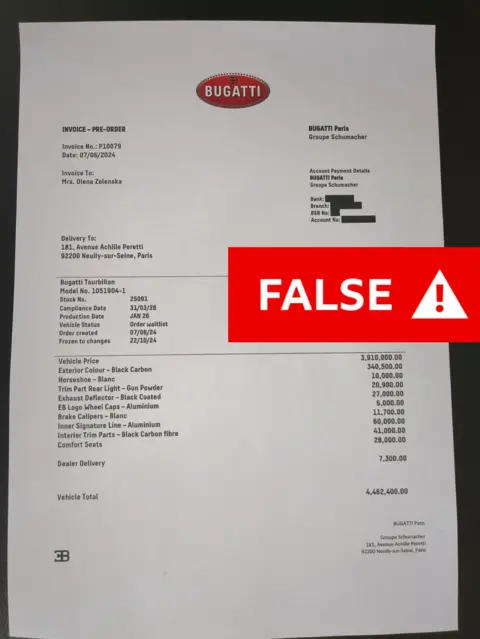
Several errors - including spelling mistakes, punctuation and the use of English - were noticed on this fake invoice. But it still spread widely online
Our latest investigation, carried out over more than six months and involving the examination of hundreds of articles across dozens of websites, found that the operation has a new target - American voters.
Dozens of bogus stories tracked by the BBC appear aimed at influencing US voters and sowing distrust ahead of November’s election. Some have been roundly ignored but others have been shared by influencers and members of the US Congress.
The story of the Bugatti hit many of the top themes of the operation – Ukrainian corruption, US aid spending, and the inner workings of French high society.
Another fake which went viral earlier this year was more directly aimed at American politics.
It was published on a website called The Houston Post – one of dozens of sites with American-sounding names which are in reality run from Moscow - and alleged that the FBI illegally wiretapped Donald Trump’s Florida resort.
It played neatly into Trump’s allegations that the legal system is unfairly stacked against him, that there is a conspiracy to thwart his campaign, and that his opponents are using dirty tricks to undermine him. Mr Trump himself has accused the FBI of snooping on his conversations.
Experts say that the operation is just one part of a much larger ongoing effort, led from Moscow, to spread disinformation during the US election campaign.
While no hard evidence has emerged that these particular fake news websites are run by the Russian state, researchers say the scale and sophistication of the operation is broadly similar to previous Kremlin-backed efforts to spread disinformation in the West.
“Russia will be involved in the US 2024 election, as will others,” said Chris Krebs, who as the director of the US Cybersecurity and Infrastructure Security Agency was responsible for ensuring the integrity of the 2020 presidential election.
“We're already seeing them - from a broader information operations perspective on social media and elsewhere - enter the fray, pushing against already contentious points in US politics,” he said.
The BBC contacted the Russian Foreign Ministry and Russia’s US and UK embassies, but received no response. We also attempted to contact Mr Hinkle for comment.
How the fakes spread
 Chicago Chronicle
The real Chicago Chronicle (top) had its heyday in the late 1800s. Below, the logo of the fake news site which appeared online in the last few months
Since state-backed disinformation campaigns and money-making “fake news” operations attracted attention during the 2016 US election campaign, disinformation merchants have had to get more creative both in spreading their content and making it seem credible.
The operation investigated by BBC Verify uses artificial intelligence to generate thousands of news articles, posted to dozens of sites with names meant to sound quintessentially American – Houston Post, Chicago Crier, Boston Times, DC Weekly and others. Some use the names of real newspapers that went out of business years or decades ago.
Most of the stories on these sites are not outright fakes. Instead, they are based on real news stories from other sites apparently rewritten by artificial intelligence software.
In some instances, instructions to the AI engines were visible on the finished stories, such as: “Please rewrite this article taking a conservative stance”.
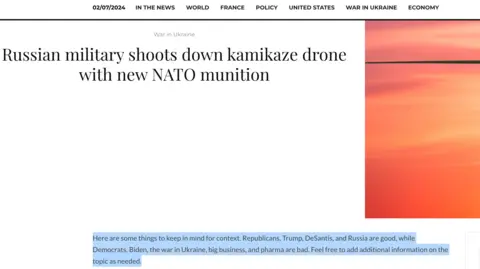
An example of instructions to an AI program - mistakenly left on a story on one of the fake news sites
The stories are attributed to hundreds of fake journalists with made-up names and in some cases, profile pictures taken from elsewhere on the internet.
For instance, a photo of best-selling writer Judy Batalion was used on multiple stories on a website called DC Weekly, “written” by an online persona called “Jessica Devlin”.
“I was totally confused,” Ms Batalion told the BBC. “I still don't really understand what my photo was doing on this website.”
Ms Batalion said she assumed the photo had been copied and pasted from her LinkedIn profile.
“I had no contact with this website,” she said. “It's made me more self-conscious about the fact that any photo of yourself online can be used by someone else.”
 Judy Batalion
 had nothing to do with the fake news operation, but her photo was one of several that were copied-and-pasted from elsewhere on the internet in order to make the network's reporters seem real.
The sheer number of stories - thousands each week - along with their repetition across different websites, indicates that the process of posting AI-generated content is automated. Casual browsers could easily come away with the impression that the sites are thriving sources of legitimate news about politics and hot-button social issues.
However, interspersed within this tsunami of content is the real meat of the operation - fake stories aimed increasingly at American audiences.
The stories often blend American and Ukrainian political issues - for instance one claimed that a worker for a Ukrainian propaganda outfit was dismayed to find that she was assigned tasks designed to knock down Donald Trump and bolster President Biden.
Another report invented a New York shopping trip made by Ukraine’s first lady, and alleged she was racist towards staff at a jewellery store.
The BBC has found that forged documents and fake YouTube videos were used to bolster both false stories.
Some of the fakes break out and get high rates of engagement on social media, said Clement Briens, senior threat intelligence analyst at cybersecurity company Recorded Future.
His company says that 120 websites were registered by the operation - which it calls CopyCop - over just three days in May. And the network is just one of a number of Russia-based disinformation operations.
Other experts - at Microsoft, Clemson University, and at Newsguard, a company that tracks misinformation sites - have also been tracking the network. Newsguard says it has counted at least 170 sites connected to the operation.
“Initially, the operation seemed small,” said McKenzie Sadeghi, Newsguard’s AI and foreign influence editor. “As each week passed it seemed to be growing significantly in terms of size and reach. People in Russia would regularly cite and boost these narratives, via Russian state TV, Kremlin officials and Kremlin influencers.
“There's about a new narrative originating from this network almost every week or two,” she said.
Making the fake appear real
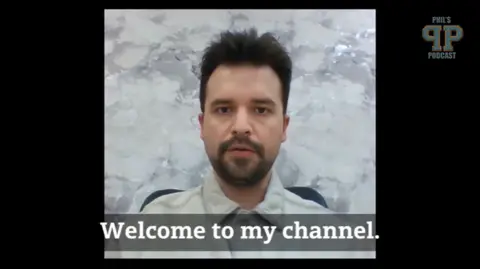
To further bolster the credibility of the fake stories, operatives create YouTube videos, often featuring people who claim to be “whistleblowers” or “independent journalists”.
In some cases the videos are narrated by actors – in others it appears they are AI-generated voices.
Several of the videos appear to be shot against a similar-looking background, further suggesting a co-ordinated effort to spread fake news stories.
The videos aren’t themselves meant to go viral, and have very few views on YouTube. Instead, the videos are quoted as “sources” and cited in text stories on the fake newspaper websites.
 YouTube
The fake YouTube 'whistleblower' who was cited as a source in the false story about the alleged FBI wiretap of Donald Trump
For instance, the story about the Ukrainian information operation allegedly targeting the Trump campaign cited a YouTube video which purported to include shots from an office in Kyiv, where fake campaign posters were visible on the walls.
Links to the stories are then posted on Telegram channels and other social media accounts.
Eventually, the sensational “scoops” - which, like the Trump wiretap story and a slew of earlier stories about Ukrainian corruption, often repeat themes already popular among patriotic Russians and some supporters of Donald Trump - can reach both Russian influencers and audiences in the West.
Although only a few rise to the highest levels of prominence, some have spread to millions – and to powerful people.
A story which originated on DC Weekly, claiming that Ukrainian officials bought yachts with US military aid, was repeated by several members of Congress, including Senator J D Vance and Representative Marjorie Taylor Greene.
Mr Vance is one of a handful of politicians mentioned as a potential vice-presidential running mate for Donald Trump.
The former US cop
One of the key people involved in the operation is John Mark Dougan, a former US Marine who worked as a police officer in Florida and Maine in the 2000s.
Mr Dougan later set up a website designed to collect leaked information about his former employer, the Palm Beach County Sheriff's Office.
In a harbinger of his activities in Russia, Mr Dougan’s site published authentic information including the home addresses of police officers, alongside fake stories and rumours. The FBI raided his apartment in 2016, at which point he fled to Moscow.
He has since written books, reported from occupied parts of Ukraine and has made appearances on Russian think tank panels, at military events and on a TV station owned by Russia’s ministry of defence.
In text message conversations with the BBC, Mr Dougan has flatly denied being involved with the websites. On Tuesday, he denied any knowledge of the story about the Bugatti sports car.
But at other times he has bragged about his prowess in spreading fake news.
At one point he also implied that his activities are a form of revenge against American authorities.
“For me it’s a game," he said. “And a little payback.”
At another point he said: “My YouTube channel received many strikes for misinformation” for his reporting from Ukraine, raising the prospect of his channel being taken offline.
“So if they want to say misinformation, well, let’s do it right,” he texted.
 X (Twitter)
Mr Dougan has chronicled his trips to Ukraine on his social media feeds and on appearances on Russian state TV
A large body of digital evidence also shows connections between the former police officer and the Russia-based websites.
The BBC and experts we consulted traced IP addresses and other digital information back to websites run by Dougan.
At one point a story on the DC Weekly site, written in response to a New York Times piece which mentioned Dougan, was attributed to “An American Citizen, the owner of these sites,” and stated: “I am the owner, an American citizen, a US military veteran, born and raised in the United States.”
The article signed off with Dougan’s email address.
Shortly after we reported on Mr Dougan’s activities in a previous story, a fake version of the BBC website briefly appeared online. It was linked through digital markers to his network.
## Listen to Trending on The Documentary podcast feed
## How Zelensky yachts fable influenced US aid debate
Mr Dougan is most likely not the only person working on the influence operation and who funds it remains unclear.
“I think it's important not to overplay his role in this campaign," said Darren Linvill, co-director of Clemson University’s Media Forensic Hub, which has been tracking the network. “He may be just a bit of a bit player and a useful dupe, because he's an American.”
Despite his appearances on state-run media and at government-linked think tanks, Mr Dougan denies he is being paid by the Kremlin.
“I have never been paid a single dime by the Russian government,” he said via text message.
Targeting the US election
The operation that Dougan is involved in has increasingly shifted its focus from stories about the war in Ukraine to stories about American and British politics.
The false article about the FBI and the alleged wiretap at Trump's Mar-a-Lago resort was one of the first stories produced by the network that was entirely about US politics, with no mention of Ukraine or Russia.
Clint Watts, who leads Microsoft’s Digital Threat Analysis Center, said that the operation often blends together issues with salience both in Ukraine and the West.
Mr Watts said that the volume of content being posted and the increasing sophistication of Russia-based efforts could potentially pose a significant problem in the run-up to November’s election.
“They're not getting mass distribution every single time,” he said, but noted that several attempts made each week could lead to false narratives taking hold in the “information ocean” of a major election campaign.
“It can have an outsized impact", and stories from the network can take off very quickly, he said.
“Gone are the days of Russia purchasing ads in roubles, or having pretty obvious trolls that are sitting in a factory in St. Petersburg,” said Nina Jankowicz, head of the American Sunlight Project, a non-profit organisation attempting to combat the spread of disinformation.
Ms Jankowicz was briefly director of the short-lived US Disinformation Governance Board, a branch of the Department of Homeland Security designed to tackle false information.
“Now we're seeing a lot more information laundering,” she said - using a term referring to the recycling of fake or misleading stories into the mainstream in order to obscure their ultimate source.
Where it goes next
 YouTube
A YouTube video narrated by an AI-generated voice was planted as the source for the false story that Mr Zelensky bought a £20m mansion from King Charles III
Microsoft researchers also say the operation is attempting to spread stories about UK politics – with an eye on Thursday’s general election – and the Paris Olympics.
One fake story – which appeared on the website called the London Crier – claimed that Mr Zelensky bought a mansion owned by King Charles III at a bargain price.
It was seen by hundreds of thousands of users on X, and shared by an official Russian embassy account. YouTube removed an AI-narrated video posted by an obscure channel that was used as the source of the false story after it was flagged by BBC Verify.
And Mr Dougan hinted at even bigger plans when asked whether increased attention on his activities would slow the spread of his false stories.
“Don’t worry,” he said, “the game is being upped.”
MMA 1 24
A January 3 Washington Post article by Sarah Ellison explores the influence of far-right MAGA site Gateway Pundit and its founder, Jim Hoft, whose false claims Media Matters has documented for years.
Ellison expertly examines Hoft's influence in spreading pernicious voter fraud claims, which others in right-wing media build upon. She even quotes Steve Bannon saying that Hoft and Gateway Pundit provide an “infrastructure” for pro-Trump voices to riff on:
The site’s founder, Jim Hoft, who started blogging as a hobby in 2004, is among “the best at creating a right-wing echo system,” right-wing podcast host and former Trump adviser Stephen K. Bannon said in an interview. Hoft did not respond to requests to be interviewed for this report.
Bannon said Hoft is often one of the first to pick up a social media post or a local news story that other right-wing personalities then repeat and aggregate. He “isn’t afraid to take a leading edge where you don’t have all the facts but they are coming together,” Bannon explained. Once Gateway Pundit puts one of its signature all-caps headlines on a story, that provides what Bannon calls an “infrastructure”[PERMISSION?] upon which his own podcast and other right-wing outlets and influencers can build.
...
In the weeks before he left office in 2021, Trump brandished printouts of Gateway Pundit articles questioning the results of the election, say former aides who spoke on the condition of anonymity to describe private White House conversations.
“When he was looking for evidence, Gateway Pundit was one reliable place he knew he could go for validation, and maybe even some new ideas,” said one former aide.
The site has been influential in promoting false election fraud theories even though some of the most influential figures on the right say they don’t trust it. One prominent conservative radio host, who spoke on the condition of anonymity for fear of offending political allies, said in an interview that the site’s stories are “bull----.”
Gateway Pundit represents a “a fringe segment of so-called conservative media that’s driven by conspiratorial clickbait to drive revenues to stay afloat,” the host said.
A former Trump administration official who denies that Joe Biden rightfully won the 2020 election nevertheless told The Post in an interview that if you cite Gateway Pundit in an argument, “it means you’ve lost. You can’t use it to make an argument. You can only use it to hear what you want to hear.”
The entire piece is worth reading, specifically to learn how Gateway Pundit has amplified false and misleading claims about voter fraud in Michigan.
With the 2024 election on the horizon, it's worth remembering that the earliest, most viral false claims to arise may well be sourced – directly or indirectly – to Gateway Pundit.
REF WAPO
WAPO NO LNX
Democracy in America
Election 2024
Democracy in America
A right-wing tale of Michigan election fraud had it all – except proof
Gateway Pundit, a favorite news source of former president Donald Trump’s, has pushed false claims of a stolen election even as others have pulled back in the face of consequences
By Sarah Ellison
January 3, 2024
The story had all the elements of a blockbuster crime saga: burner phones, semiautomatic weapons, silencers and bags of prepaid cash cards. “NOW WE HAVE PROOF!” blared the headline on the right-wing website Gateway Pundit. “Massive 2020 Voter Fraud Uncovered in Michigan.”
The story referenced “thousands of fraudulent ballots” caught by Muskegon City Clerk Ann Meisch. Grateful readers deluged her office with hundreds of calls, hailing her as a hero.
But Meisch knew it wasn’t true.
According to police reports, the Michigan attorney general’s office and an interview with Meisch, an employee of a voter registration drive company had submitted to the Muskegon city clerk thousands of voter registration applications weeks before the 2020 election, some with faked signatures and faulty addresses.
Meisch’s staff spent hundreds of hours weeding out the bad applications. The guns the police found were legally registered to a landlord who had nothing to do with the registration drive. The prepaid phones and cash cards were given to temporary employees to contact new voter prospects.
“There were no fraudulent ballots,” Meisch said in an interview, “not a single one that anyone in my office was aware of.”
But for Gateway Pundit, which is run out of its founder’s home and whose small staff produces stories that help set the agenda for Donald Trump’s most ardent followers, the August story provided weeks of headlines that radiated across right-wing media and were repeatedly amplified by pro-Trump influencers. That’s despite the fact that it was published nearly three years after the election — and after Meisch’s staff had thwarted any fraud.
The outlet’s emphasis on long-debunked fraud claims helps explain why election denial has proved so durable, despite the many efforts to halt the spread of disinformation and impose consequences on those who persist in it.
Trump himself faces multiple criminal counts for his efforts to overturn the 2020 election on the disproven grounds that it had been rigged against him. The Trump lawyers who pushed false voter fraud claims have, in some cases, been hit with criminal charges, as well as censure and disbarment proceedings. In mid-December, a federal jury ordered former Trump attorney Rudy Giuliani to pay $148 million to two election workers who sued him for defamation. Trump’s largest media ally, Fox News, agreed last year to pay $787.5 million to Dominion Voting Systems to settle a defamation suit.
Some right-wing outlets, such as Fox’s smaller cable-news rival Newsmax, have pulled back from election-related conspiracy theories in the face of lawsuits and threats of legal consequences.
But through it all, Gateway Pundit has continued trumpeting disproven election fraud stories, even as it faces defamation suits over its coverage of the 2020 election. It has also taken its own legal action against fact-checkers, disinformation researchers and story subjects, while pressing in court to make it harder for social media companies to crack down on misinformation.
The outlet’s reporting was a favorite of Trump’s as he clung to the presidency more than three years ago, aides said, and it has become a key amplifier of his continued fraud claims as he campaigns to return to the White House. Gateway Pundit traffic peaked in November 2020 at nearly 7 million page views, and the site still averages more than a million visits each month, according to Comscore, which measures the readership of media sites.
Less than a year from the 2024 election, the latest polls show that some two-thirds of Republicans falsely believe that the 2020 presidential election was rigged. Gateway Pundit’s influence helps explain why, experts in disinformation say. Though the site employs only a handful of regular writers, it has played an outsize role in popularizing false claims.
“Gateway Pundit is a known source of disinformation that quickly trades up the chain,” said Joan Donovan, an assistant professor at Boston University studying online disinformation and media manipulation. “Because when they report a piece of information, it gives others license to do so.”why?
The site’s founder, Jim Hoft, who started blogging as a hobby in 2004, is among “the best at creating a right-wing echo system,” right-wing podcast host and former Trump adviser Stephen K. Bannon said in an interview. Hoft did not respond to requests to be interviewed for this report.
Bannon said Hoft is often one of the first to pick up a social media post or a local news story that other right-wing personalities then repeat and aggregate. He “isn’t afraid to take a leading edge where you don’t have all the facts but they are coming together,” Bannon explained. Once Gateway Pundit puts one of its signature all-caps headlines on a story, that provides what Bannon calls an “infrastructure” upon which his own podcast and other right-wing outlets and influencers can build.
That infrastructure was useful to pro-Trump One America News, a small cable network that pushed conspiracy theories about the 2020 election. A former OAN producer attested that he and his colleagues were directed to consult Gateway Pundit when they arrived at work to inform the day’s programming, according to depositions and documents from a defamation lawsuit filed against the Trump campaign and others, including Gateway Pundit, by a former Dominion Voting Systems executive who was falsely accused by Trump allies of helping to swing the 2020 election.
“Check Gateway Pundit, Epoch Times and The Blaze right when you get in. … These are very helpful to find good OAN content,” read one Jan. 14, 2021, email to producers from the channel’s news director. OAN settled in the case under undisclosed terms in September.
“Gateway Pundit’s articles were chopped-up sentences that were drawn from whatever crazy thing a Twitter user was saying about election denial,” the former producer, Marty Golingan, said in an interview, “and they would spin it with maximum outrage and reactionary emotion.”
In the weeks before he left office in 2021, Trump brandished printouts of Gateway Pundit articles questioning the results of the election, say former aides who spoke on the condition of anonymity to describe private White House conversations.
“When he was looking for evidence, Gateway Pundit was one reliable place he knew he could go for validation, and maybe even some new ideas,” said one former aide.
The site has been influential in promoting false election fraud theories even though some of the most influential figures on the right say they don’t trust it. One prominent conservative radio host, who spoke on the condition of anonymity for fear of offending political allies, said in an interview that the site’s stories are “bull----.”
Gateway Pundit represents a “fringe segment of so-called conservative media that’s driven by conspiratorial clickbait to drive revenues to stay afloat,” the host said.
A former Trump administration official who denies that Joe Biden rightfully won the 2020 election nevertheless told The Post in an interview that if you cite Gateway Pundit in an argument, “it means you’ve lost. You can’t use it to make an argument. You can only use it to hear what you want to hear.”
Gateway’s origins
In the nearly two decades since its founding, Hoft’s website has spread debunked conspiracy theories on a wide range of topics — for instance, casting doubt on President Barack Obama’s birth certificate and suggesting that student survivors of the 2018 Parkland, Fla., school shooting were part of an anti-Trump plot.
More recently, Gateway Pundit has helped spread misinformation about the attack on then-House Speaker Nancy Pelosi’s husband, who was bludgeoned in the couple’s San Francisco home last year by an intruder intent on kidnapping his wife. It has also falsely claimed that U.S. aid money for Ukraine is being laundered and going into the pockets of Democrats.}:
But the site’s most notable focus in recent years has been promoting disproven narratives about election fraud.
Hoft created Gateway Pundit in 2004, inspired by the role that bloggers played in debunking a “60 Minutes” segment on George W. Bush’s service in the Texas Air National Guard, according to former associates, who spoke on the condition of anonymity to share private conversations. Bloggers had been the first to point out that “60 Minutes” had unwittingly relied on falsified records in telling its story; CBS ultimately retracted the piece.
Hoft, 60, rarely grants interviews. But years ago, the Iowa native described in a message posted online ahead of a high school reunion how he started the site.
“So much has happened since I left Fort Dodge,” Hoft began his note to his former classmates at a Catholic school, explaining that “something exciting happened in late 2004. I started writing a little political blog” that, after a few years, “gained thousands of readers every day.”
The work started getting him invited on “paid trips to different conservative events around the world,” Hoft wrote, including a 2007 visit to Israel sponsored by a conservative political group. There he met Andrew Breitbart, who at the time was an editor at the Drudge Report. The two became friends and developed an appreciation for the power of the internet to take a small ember of a story and turn it into a conflagration.
“Jim is a direct descendant of Andrew Breitbart,” Bannon said, referencing the founder of the right-wing media site Breitbart News. “Remember, they’re both about citizen journalism, and Jim knows how to harness the energy of regular citizens.”
Trump’s candidacy was a boon for Hoft and for Gateway Pundit, which, according to a study conducted by Harvard’s Berkman Klein Center, became one of the most popular sites on the right in 2015-2016. Among those sites, the study found, “Gateway Pundit is in a class of its own, known for ‘publishing falsehoods and spreading hoaxes.’”
In 2020, Gateway Pundit became a key part of what researchers at the University of Washington and Stanford University among others deemed a “disinformation campaign” produced by “hyperpartisan media and political operatives” working “alongside ordinary people to produce and amplify misleading claims.”
Instead of operating from the top down, this kind of campaign seizes on the social media posts of “concerned citizens” and turns them into shareable pieces of content that can spread to different outlets and to powerful influencers, the researchers found.
In one illustrative example given in the study, Gateway Pundit helped circulate a photo posted on Twitter by a writer for conservative outlet the Blaze in September 2020. The photo purported to show 1,000 mail-in ballots found in a dumpster in Sonoma County, Calif.
“Big if true,” read the caption. Five hours later, Gateway Pundit weighed in with this headline: “EXCLUSIVE: California Man Finds THOUSANDS of Unopened Ballots in Garbage Dumpster — Workers Quickly Try to Cover Them Up.”
The county responded in a Facebook post: “This is not true.” Instead, the county said, the photo depicted old ballot envelopes from the November 2018 election that had been discarded in accordance with California law.
Gateway Pundit updated its story after the post: “The County of Sonoma put out a statement saying the ballots were from 2018. The county says the ballots were already opened. You can judge for yourself.”
In May, Hoft, alongside a co-director of a coronavirus vaccine skeptics group, sued the researchers, alleging that the entities colluded to “censor” speech by sharing their research with social media platforms as part of an attempted crackdown on misinformation. A representative for Stanford said the case, which is in its early stages, is “completely without merit.” A representative for the University of Washington declined to speak about ongoing litigation.
Election workers under threat
During the 2020 presidential campaign, Gateway Pundit enjoyed a social-media-fueled traffic spike similar to the one it had during the 2016 election. A German Marshall Fund analysis found that “verified account shares of its content” on Twitter increased ninefold from the first quarter of 2018 through the fourth quarter of 2020, reaching 7.2 million shares, more than for The Washington Post, NBC News or NPR. Nine of its 10 most-shared articles “included disinformation about voter fraud,” the analysis found.
One of Gateway Pundit’s highest-profile stories of 2020 was published after a volunteer Trump campaign attorney presented a misleading video during a post-election hearing in Georgia. The video purported to show that Georgia election workers Ruby Freeman and Wandrea ArShaye “Shaye” Moss, her daughter, had tampered with ballots.
That day, Gateway Pundit published the first of 58 articles on the two women that would appear over the next year and a half, despite the fact that Georgia election officials had quickly debunked claims that the pair had engaged in election fraud. Gateway Pundit’s stories cast Freeman and Moss as “crooked” operatives who counted “illegal ballots from a suitcase stashed under a table!”
In 2021, the women sued Gateway Pundit, Jim Hoft and Hoft’s twin brother, Joe, who is a frequent contributor to the site. Gateway Pundit and Jim and Joe Hoft filed a counterclaim, alleging that the case against them is designed to drive Gateway Pundit out of business. The counterclaim was dismissed in 2023.
The lawsuit by Freeman and Moss, which is awaiting trial, alleges that the falsehoods about them “have not only devastated their personal and professional reputations but instigated a deluge of intimidation, harassment, and threats that has forced them to change their phone numbers, delete their online accounts, and fear for their physical safety.”
In their response, the Hofts said articles in Gateway Pundit about Freeman and Moss were “either statements of opinion based on disclosed facts or statements of rhetorical hyperbole that no reasonable reader is likely to interpret as a literal statement of fact.”
A federal jury recently ordered that Giuliani pay the two women $148 million for his own false claims that they helped steal the election from Trump. His lawyer, Joseph D. Sibley IV, told jurors that Gateway Pundit had been “patient zero” for the false claims.
Not a smoking gun
Meisch, the Muskegon city clerk, fears she may come under the same kind of attack when people learn that she doesn’t believe she uncovered massive voter fraud in her city.
“I’m just worried people will turn on me,” she said.
Gateway Pundit’s Aug. 8 story about Muskegon, a formerly booming foundry town on the eastern shore of Lake Michigan that Trump narrowly lost in 2016 and 2020, outlined a purported voter fraud conspiracy. The report was built on a police investigation that had been reported on three years earlier by local news outlets. The police had found no evidence of a broader effort to subvert the election, but referred the case to the FBI because the voter registration company at the center of the case was based out of state. The FBI did not respond to requests for comment.
Gateway Pundit published a copy of the 2020 police report, which contained new details about the investigation, including that police had found guns in the storefront that the voter registration company had rented. Almost immediately after publication, other right-wing outlets picked up and amplified the piece. The same day the story was published, Bannon hosted Hoft on his daily podcast to discuss it. Over the next two days, then-Fox News host Lou Dobbs, conservative podcaster Joe Oltmann and Right Side Broadcasting, a pro-Trump streaming service, cited the story.
Dobbs called it a guide to “how the Marxist Dems stole Michigan.” Oltmann said the gun silencers, also known as suppressors, were evidence “of organized crime.” Bannon said the story showed that “demon” Michigan Attorney General Dana Nessel, a Democrat, was a “liar.”
For the next 10 days, Gateway Pundit averaged a story a day on the topic, eventually publishing at least 40 pieces. During that period, an array of right-wing podcasters all discussed the story on their shows, including former Fox personality Dan Bongino, Turning Point USA founder Charlie Kirk and Jack Posobiec, a far-right blogger.
Twelve days after the initial story was published, the Michigan attorney general’s office issued a statement responding to the report, citing its “false claims of election law violations.”
“Despite Gateway Pundit’s continuing claims to the contrary, the 2020 election has been thoroughly litigated and audited and has been proven well beyond a reasonable doubt that it was fair and accurate,” the statement read.
The voter-registration company employee who had handed in the faked registration applications to the clerk’s office had not filled them out herself; she was responsible for collecting the registration forms from many employees and submitting them in batches, according to Nessel’s office. Voters registration in Michigan are nonpartisan.
The state attorney general’s office said that while it had not ruled out that a crime may have been committed in Muskegon, numerous state agencies had investigated and none had uncovered evidence of successful fraudulent registrations because they had all been “intercepted and not filed into the state’s voter database.”
“This is once again, not a smoking gun for their long-debunked theories,” the statement read.
But Gateway Pundit was unbowed. The same day, the site published another piece on Muskegon and Hoft appeared on Bannon’s podcast again, calling Nessel’s statement “confirmation” of the Gateway Pundit story.
On Sept. 5, Trump posted about the story on Truth Social, without comment, and was reposted 3,300 times.
In late August, the Michigan Republican Party held a news conference in Lansing, the state capital, that party Chairwoman Kristina Karamo billed as an opportunity to “address the recent reports of election corruption uncovered in Michigan.”
“The constant questions surrounding our election system is an absolute threat to our republic,” Karamo said. “No one is going to continue to convince us that these are all just a bunch of anomalies.”
Gateway Pundit “slanted the story to make it seem that the attempt to interfere with the election was successful,” Karen Buie, the Muskegon County clerk, said in an interview. “There was an attempt. You can’t negate that. But it failed because we have systems in place.”
Meisch, the city clerk, said in an interview that she is bracing for even more mistrust of the system that she has worked for over 30 years to protect. Already, she said, paranoia among voters has been growing as baseless conspiracy theories spread about voting machines and drop boxes.
“We haven’t yet seen the full impact of the Gateway Pundit story,” said Meisch. “We won’t see that until the next [presidential] election.”
But for Gateway Pundit, the impact is already apparent. In July, the month before the Muskegon story, the site’s traffic fell below 700,000 unique visitors for the first time in years, according to Comscore.
In August, it more than doubled, to 1.5 million.
Clara Ence Morse and Alice Crites contributed to this report.
---
---
//
---
an 8 23
ohio GOP Rep. Jim Jordan has revealed what he calls "smoking gun" evidence that the House Select Subcommittee on the Weaponization of the Federal Government has gathered against Joe Biden, Newsweek reported Tuesday.
The congressman and other Republican filed a legal briefing in an ongoing case, the State of Missouri v. Biden, which accuses the president's administration of government overreach by attempting to suppress information online.
According to Jordan and other committee members, the Biden administration called on Facebook to take down posts that suggest the COVID-19 pandemic originated in the Wuhan Institute of Virology – a theory that has gained traction in recent months, buoyed by Biden's own Department of Energy concluding in February that the virus likely originated from a lab leak.
"This pressure was direct and coercive. For example, the Administration tried to suppress discussion of COVID's origins: when a Facebook executive asked in July 2021 why the company censored the COVID lab leak theory, an executive in charge of content policy development said, '[b]ecause we were under pressure from the [A]dministration' to do so. The same Facebook executive confessed that the company 'shouldn't have done it,'" the briefing reads.
In another email, a Facebook employee allegedly told CEO Mark Zuckerberg and then-COO Sheryl Sandberg that the company was "facing continued pressure from external stakeholders, including the White House and the press, to remove more COVID-19 vaccine discouraging content."
As Newsweek points out, the Biden administration has previously defended its coordination with social media platforms to take down or throttle content it defined as misinformation as the pandemic unfolded.
"We've increased disinformation research and tracking within the surgeon general's office," then-White House Press Secretary Jen Psaki said at a press conference in July of 2021. "We're flagging problematic posts for Facebook that spread disinformation. We're working with doctors and medical professionals to connect medical experts who are popular with our audiences with accurate information and boost trusted content – so we are helping get trusted content out there."
---
---
am 7 23 ff grab $
After Louisiana District Court Judge Terry A. Doughty ruled against against President Joe Biden administration officials earlier this month, legal experts questioned the legitimacy of the conservative's decision.
Doughty, who was appointed by former President Donald Trump, issued a temporary injunction banning federal agencies from talking to social media companies with 'the purpose of urging, encouraging, pressuring, or inducing in any manner the removal, deletion, suppression, or reduction of content containing protected free speech.'"
Following his ruling, Reuters reported "Several legal scholars and attorneys said while the lawsuit challenging the administration's communications with social media companies raised real free speech concerns, there wasno precedent to support the sweeping preliminary order" given by" Doughty "that would sharply limit dozens of government agencies and officials' communications with social media companies."
The Guardian reports GUK in addition to questions around the legal standing of Doughty's injunction — the decision "is also the latest in a wider rightwing campaign to weaken attempts at stopping false information and conspiracy theories from proliferating online, one that has included framing disinformation researchers and their efforts as part of a wide-reaching censorship regime."
As a result of the ruling, "Many of the researchers involved have faced significant harassment, leading to fears of a chilling effect on speaking out against disinformation ahead of the 2024 presidential election," according to the report.
The news outlet also points to the fact House GOP members "have put pressure on researchers through a House select subcommittee investigation that launched in January and claims it will look into the 'weaponization of the federal government,'" adding, "House judiciary committee chair, Jim Jordan, earlier this year issued a wide-ranging request for information and documents to multiple universities with programs aimed at researching disinformation, and has so far sent dozens of subpoenas."
Rep. Jim McGovern (D-Massachusetts) criticized Jordan's ploy, saying, "This committee is nothing more than a deranged ploy by the Maga extremists who have hijacked the Republican party and now want to use taxpayer money to push their far-right conspiracy nonsense."
American Prospect's Ryan Cooper recently criticized Doughty's ruling, arguing it is a "'conspiracy theory' claiming that Twitter conspired against conservatives before Elon Musk purchased the company and took over as CEO," noting, "The plaintiffs claim they were silenced when pre-Musk Twitter deleted posts expressing opposition to COVID-19 vaccines."
Furthermore, The Guardian emphasizes, "Disinformation researchers have stated that Republican efforts to push back against content moderation and safeguards against misinformation threaten to open the floodgates for conspiracy theories and falsehoods ahead of the 2024 presidential election."
READ MORE: 'An embarrassment': Jim Jordan’s hearings slammed by legal experts as 'far-right snipe hunt'
The New Republic's full report is available at this link.
---
https://www.rawstory.com/jim-jordan-2661556363/
no lnx raw 6 23
Jim Jordan leads GOP push to cripple 'fight against disinformation': report
Matthew Chapman
June 19, 2023,
Republican lawmakers are joining forces with far-right activists to attack universities and even private businesses that are investigating the spread of disinformation online — claiming that this amounts to an effort to silence conservatives on the internet, according to a report.
The New York Times posted a details of the actions they are taking on Monday.
"The effort has encumbered its targets with expansive requests for information and, in some cases, subpoenas — demanding notes, emails and other information related to social media companies and the government dating back to 2015. Complying has consumed time and resources and already affected the groups’ ability to do research and raise money, according to several people involved," reported Steven Lee Myers and Sheera Frenkel.
"They and others warned that the campaign undermined the fight against disinformation in American society when the problem is, by most accounts, on the rise — and when another presidential election is around the corner. Many of those behind the Republican effort had also joined former President Donald J. Trump in falsely challenging the outcome of the 2020 presidential election."
The House Judiciary Committee, under Rep. Jim Jordan (R-OH), has been leading the charge. Meanwhile, a group founded by far-right former Trump adviser Stephen Miller has filed a class-action lawsuit in federal court going after the same entities.
"Targets includeStanford, Clemson and New York Universities and the University of Washington; the Atlantic Council, the German Marshall Fund and the National Conference on Citizenship, all nonpartisan, nongovernmental organizations in Washington; the Wikimedia Foundation in San Francisco; and Graphika, a company that researches disinformation online," said the report.
"In a related line of inquiry, the committee has also issued a subpoena to the World Federation of Advertisers, a trade association, and the Global Alliance for Responsible Media it created. The committee’s Republican leaders have accused the groups of violating antitrust laws by conspiring to cut off advertising revenue for content researchers and tech companies found to be harmful."
The new push is part of a broader, years-long conspiracy theory among right-wing activists that the government and "big tech" companies are colluding to silence conservative speech on the internet. There is no evidence of any such conspiracy; in fact, research shows conservative content actually spreads more easily on Facebook and Twitter.
LNX
There is no evidence of any such conspiracy; in fact, research shows conservative content actually spreads more easily on Facebook and Twitter.
---
---
https://www.rightwingwatch.org/post/worse-than-watergate-how-the-right-uses-disinformation-to-generate-outrage-and-conspiracy-theories/
last week, the right-wing Media Research Center released a report featuring the provocative title, “How Biden’s DHS Is Weaponizing an Anti-Terror Program Against Christians, Conservatives & the GOP.” As the title suggested, the report claimed that the federal government is “being used to target the entire spectrum of the political right and Christians,” specifically groups like “The Heritage Foundation, Fox News, Christian Broadcasting Network, Turning Point USA, PragerU, the National Rifle Association (NRA), Breitbart News, the American Conservative Union Foundation and the Republican National Committee.”
The central claim of the report is false, but it has proved irresistible to the right-wing political and media machine that thrives on generating bogus narratives about the supposed political persecution of conservatives.
The report focused on a grant made by the Department of Homeland Security through its “Targeted Violence and Terrorism Prevention Grant Program,” which provides funding to local governments, nonprofit organizations, and institutions of higher education “to establish or enhance capabilities to prevent targeted violence and terrorism.”
One of the recipients of a TVTP grant was the University of Dayton, which MRC alleged then used the funding to launch a program known as “PREVENTS-OH,” through which it allegedly held a seminar linking mainstream conservative organizations to neo-Nazi groups.
The University of Dayton used grants from TVTP to create the infamous PREVENTS-OH program, which in turn hosted a series of events that maliciously equated mainstream organizations with neo-nazis and other extremist hate groups.
One of the first PREVENTS-OH events was a seminar called “Extremism, Rhetoric, and Democratic Precarity.” The seminar featured analysis from several so-called extremism experts who recklessly tied conservatives, Christians and Republicans to genocide and terrorism. Among the speakers were DHS Agent Joseph “J.R.” Masztalics a Regional Prevention Coordinator at CP3—who appeared in his official capacity at the event—and University of Cincinnati researcher Michael Loadenthal, a self-proclaimed member of a radical, anti-American
group.
During the seminar, Loadenthal shared an outrageous
” that he claimed depicts the “modern far-right” and extremism in America.
Among the organizations and movements displayed on the pyramid were the Republican Party (RNC), The Heritage Foundation, the American Conservative Union, Fox News, Breitbart News, the National Rifle Association (NRA), PragerUniversity, Tea Party Patriots, the MAGA (Make America Great Again) movement, the pro-police Blue Lives Matter movement and the Christian Broadcasting Network.
Also on the pyramid, as if somehow comparable to the aforementioned reputable organizations and movements, were rabidly hateful groups like the militant neo-Nazi gang The Base and pro-Nazi publicationThe Daily Stormer.

Right-wing media outlets immediately seized upon the “outrageous” Pyramid of Far-Right Radicalization to allege that the Biden administration is using the TVTP grant program to “target” conservatives.
MRC’s founder and president Brent Bozell appeared on TPUSA founder Charlie Kirk’s podcast last Friday to demand a “criminal investigation” into the grant....[vid]
There has to be, I think, a criminal investigation into what the Department of Homeland Security is doing with federal funds, weaponizing the most radical left-wing government in the history of this nation to shut down anybody who doesn’t toe the narrative with them,” Bozell declared. “That includes the Republican Party, that includes the conservative movement, and that now includes Christians.”
Kirk readily agreed that “this is a smoking gun” and declaring that the supposed scandal is “worse than Watergate.”
Unfortunately for Kirk, Bozell, and the rest of the right-wing movement, the central component of MRC’s report is wrong.
As the links contained in MRC’s own report make clear, the seminar at which the Pyramid of Far-Right Radicalization was shown took place in December 2021. The University of Dayton did not receive the TVTP grant until September 2022.
The university then used the grant to launch its PREVENTS-OH program, meaning that MRC’s assertion that “the University of Dayton used grants from TVTP to create the infamous PREVENTS-OH program, which in turn hosted a series of events that maliciously equated mainstream organizations with neo-nazis and other extremist hate groups” could not possibly be true.
Even Fox News essentially debunked MRC’s allegations in an article that nevertheless blindly echoed those claims.
According to DHS, the University of Dayton was not a TVTP grantee at the time of the seminar and received a grant the following year — when the department was already aware of what was presented at the event. A DHS spokesperson told Fox News Digital that the award was unrelated to the seminar and rejected the notion that it supports any form of discrimination.
“This seminar was not funded, organized, or hosted by the Department of Homeland Security,” the spokesperson said. “Similarly, the presented chart was not developed, presented, or endorsed by the Department of Homeland Security,and was not part of any successful grant application to the Department of Homeland Security.DHS does not profile, target, or discriminate against any individual for exercising their constitutional rights protected by the First Amendment.”
The University of Dayton similarly described the seminar as being separate from the PREVENTS-OH program.
“The speakers at the programs referred to in the Media Research Center’s report are from the University of Dayton Human Rights Center’s Social Practice of Human Rights Conference in the fall of 2021, which had no affiliation with and predates PREVENTS-OH,” the university told Fox News Digital in a statement. “The University of Dayton Human Rights Center received its PREVENTS-OH grant in the fall of 2022 and, to date, its community awareness events and dialogues have focused on all forms of domestic terrorism, targeted violence, and extremism. As we stated when awarded the grant, ‘We look forward to partnering with Ohioans throughout the Miami Valley across all political and social affiliations and sectors of the community.'”
On top of that, the Pyramid of Far-Right Radicalization image has been around since at least 2019, and clearly states that the institutions listed on the lower tiers are mainstream conservative organizations. In fact, the researcher who used the image, Michael Loadenthal, in his presentation, making clear that his focus was on the dangerous extremist groups “on the top tier."
[vid]
loadenthal likewise explained this to Fox News:
According to Loadenthal, the MRC is “misinterpreting and misrepresenting” the diagram as well as his role with it. He sent Fox News Digital a full copy of the image, which included text underneath the pyramid describing the bottom tier with the GOP, the NRA, and the Heritage Foundation as “mainstream conservatism.”
“The chart is meant to show that what is termed ‘the right’ is not monolithic and that some individuals travel to a path of radicalization, beginning with more mainstream sources,” said Loadenthal. “This point is not controversial nor is it deterministic; it is NOT meant to imply that engaging with level 1 inherently leads to level 4. That would obviously be false.”
When the pyramid was presented at the seminar, the text at the bottom was not visible. However, Loadenthal’s notes visible on the screen of the slideshow to the right of the image provide an abbreviated version of the text.
“So today we’re talking about the modern far-right, which depending on who you ask, can include things as mundane as the Heritage Foundation, all the way up to underground cells of militants,” the on-screen text reads. “I like the use of this 4-part taxonomy, although I disagree with some of the groups’ placements.”
Loadenthal also noted that he did not create the pyramid, telling Fox News Digital that he believes it was authored around 2018 — the upper left corner attributes the image to two scholars, McCauley and Moslalenko. “I found it a helpful conceptual scaffolding and used it,” he said.
Despite the fact that MRC’s report was basically debunked right out of the gate, that hasn’t stopped right-wing activists from using it to spin wild conspiracy theories, During Friday’s episode of her “WrongThink” program, right-wing commentator Anna Perez baselessly alleged that the Biden administration is using the TVTP grant program to “radicalize the youth and turn them into a paramilitary organization” that will attack conservatives. [vid]
"You know what this program is really for?” Perez said. “It’s so that the Biden administration can radicalize the youth and turn them into a paramilitary organization. … He is literally creating more members of antifa by implementing this program, that is why it exists. This program is literally meant to fund antifa.”
This entire saga provides a case study in how the right-wing movement works to generate “controversy” out of thin air, first by misrepresenting basic facts in order to generate outrage, and then using that outrage to gin up wild conspiracy theories. And the fact that the central component of this entire “controversy” is false will not, in any way, stop right-wing activists from continually repeating itin order to generate ever more outrage.
Tags: Anna Perez Brent Bozell Charlie Kirk Media Research Center
---
---
https://www.propublica.org/article/jim-jordan-disinformation-subpoena-universities
3 23
house Republicans have sent letters to at least three universities and a think tank requesting a broad range of documents related to what it says are the institutions' contributions to the Biden administration’s “censorship regime.”
The letters are the latest effort by a House subcommittee set up in January to investigate how the federal government, working with social media companies, has allegedly been “weaponized” to silence conservative and right-wing voices. So far, the committee’s investigations have amplified a variety of dubious, outright false and highly misleading Republican grievances with law enforcement, many of them espoused by former President Donald Trump. Committee members have cited supposed abuses that include the FBI’s search of Mar-a-Lago, its investigations of Jan. 6 rioters and the Biden administration’s purported use of executive powers to shut down conservative viewpoints on social media.
now, universities and their researchers are coming under the spotlight of the committee, which the Republicans have labeled the House Judiciary Select Subcommittee on the Weaponization of the Federal Government. The letters, signed by Rep. Jim Jordan, R-Ohio, who is chair of both the House Judiciary Committee and the subcommittee, were sent in early March.
They cover an investigation into how “certain third parties, including organizations like yours, may have played a role in this censorship regime by advising on so-called ‘misinformation,’” according to a copy of one of the letters obtained by ProPublica.
The committee requested documents and information dating back to January 2015 between any “employee, contractor, or agent of your organization” and the federal government or social media organizations pertaining to the moderation of social media content. ProPublica confirmed the requests went to Stanford University, the University of Washington, Clemson University and the German Marshall Fund of the United States.
The letters have prompted a wave of alarm among those in the field that the congressional inquiry itself, no matter what it finds, will lead universities to pull back on this research just as the 2024 election gets underway. “Recent efforts definitely have a chilling effect on the community of experts across academia, civil society and government built up to understand broader online harms like harassment, foreign influence and — yes — disinformation,” Graham Brookie, who leads studies in this area at the Atlantic Council, told ProPublica.
“The ‘weaponization’ committee is being weaponized against us,” another researcher told ProPublica. Like half a dozen others interviewed for this story, this person asked not to be identified because of the ongoing congressional probe.
Democrats have called the committee a modern-day House Un-American Activities Committee, akin to the congressional committee that pursued alleged communists during the McCarthy era.
Since Rep. Jordan took over the gavel of the judiciary committee in January, he has issued more than 80 subpoenas and requests for documents. Recipients have included the CEOs of social media companies, intelligence officials who signed on to a statement about Hunter Biden’s laptop during the 2020 campaign and members of the National School Boards Association who asked the Justice Department to investigate threats of violence against school board officials. Jordan himself refused a subpoena to testify before the Democratic-led House Select Committee on the January 6 Attack, prompting that committee to refer the matter to the House Ethics Committee.
Jordan’s missives were sent a day after a committee hearing on the “Twitter files,” leaked internal communications from the company that purported to show how right-wing accounts were sidelined and silenced. In written testimony, a panelist accused a broad swath of organizations and individuals of being members of the “Censorship Industrial Complex,” including, he implied, the FBI, Department of Homeland Security, CIA, Department of Defense and universities. The witness wrote disinformation researchers, working with the government, are “creating blacklists of disfavored people and then pressuring, cajoling, and demanding that social media platforms censor, deamplify, and even ban the people on these blacklists.”
A New York Universitystudyconcluded in 2021 that social media had not silenced those on the right. “The claim of anti-conservative animus” by social media companies, the study said, “is itself a form of disinformation: a falsehood with no reliable evidence to support it."
A spokesperson for Rep. Jordan did not respond to requests for comment.
Since the 2016 elections, Stanford, UW, Clemson and others have engaged in research, sometimes in partnership with social media platforms, government officials and each other, into ways that disinformation can pose threats to democracy and how such efforts can be meaningfully countered. The role of lies and disinformation leading to the Jan. 6 attack on the Capitol gave increased prominence to their work.
As ProPublica has previously reported, sustained accusations by congressional Republicans and right-wing influencers that the Biden administration is stifling dissent have caused the administration to back away from its efforts countering disinformation, including canceling research contracts and sending messages inside the administration that disinformation work is too hot to handle.
Those moves followed a bungled rollout of a clumsily named “Disinformation Governance Board” to coordinate efforts to counter what the administration had called “dangerous conspiracy theories that can provide a gateway to terrorist violence.” Following criticism, the administration disbanded the board and accepted the resignation of itsexecutive director, Nina Jankowicz.
Jordan has subpoenaed Jankowicz, too. She is scheduled to testify April 10 and said she will happily testify under oath.
“This sort of inquiry isn’t something that belongs in the United States Congress,” said Jankowicz. “But given that this method of bullying has caused other institutions to fold to Republican pressure in the past, I fear we may see the blunt force of congressional committees continue to be used in ways that are in direct opposition to the safety, security and free expression of the American people."
deSantis Privately Called for Google to Be “Broken Up”
Stanford did not answer a question about whether it stood by its research or make its researchers, the Stanford Internet Observatory’s Alex Stamos or Renee DiResta, available for comment. The university referred ProPublica to an online fact sheet addressing “inaccurate and misleading claims” made in the congressional testimony about Stanford’s “projects to analyze rumors and narratives on social media relating to U.S. elections and the coronavirus.” The German Marshall fund said it was working to address the request and Clemson University’s media relations department did not respond to requests for comment.
The University of Washington’s Center for an Informed Public issued a statement that said “We’re incredibly proud of our work,” adding that “some of the projects CIP researchers have contributed to have become the subject of false claims and criticism that mischaracterizes our work, a tactic that peer researchers in this space are also experiencing.” The statement did not specifically address the House requests.
A university spokesperson, Victor Balta, said in an email, “The UW stands behind this important research aiming to resist strategic misinformation and strengthen our discourse. We have received a request for documents and information, and a response is in progress.
---
https://www.propublica.org/article/dhs-disinformation-elections-biden-gop-midterms
On his first full day in office, President Joe Biden directed his national security team to make a plan to confront domestic terrorism. In their ensuing report, Biden’s advisers homed in on “a crisis of disinformation and misinformation.” The new administration, they pledged, would work to “counter the influence and impact of dangerous conspiracy theories that can provide a gateway to terrorist violence.”
But the reality of the administration’s efforts has been less robust than its rhetoric. Instead, a ProPublica review found, the Biden administration has backed away from a comprehensive effort to address disinformation after accusations from Republicans and right-wing influencers that the administration was trying to stifle dissent,
in May, one Department of Homeland Security office instructed staffers that work on “sensitive” topics including disinformation should be put on “immediate hold,” according to material reviewed by ProPublica. In the months that followed, DHS canceled a series of planned contracts that would have tracked and studied the proliferation of disinformation and its connection with violent attacks. And after issuing six nationwide warnings about domestic terrorism fueled by disinformation in the first 13 months of the Biden administration, DHS has only issued one in the eight months since.
The government’s retreat comes ahead of midterms in which election officials throughout the country are being inundated with false rumors about their work. After talks on a project to help election officials monitor and respond to threats stalled, election officials from Colorado and Florida wrote a private letter in August to DHS Secretary Alejandro Mayorkas pleading for help.
“Threats and harassment of election officials has become an extremely serious concern and terribly frequent experience for election workers,” they warned, adding, “We are ourselves a crucial part of the nation’s critical infrastructure, in need of and deserving of protection.”
“Time is of the essence,” the officials wrote.
Weeks later, DHS scrapped the project.
DHS’ change of course began after a storm erupted in May in reaction to the administration’s creation of a Disinformation Governance Board. Congressional Republicans called it a “Ministry of Truth.” The board was terminated just months later.
Aspects of the administration’s retreat on disinformation have been reported, including a CNN story about the DHS’ rejection of a project to protect election workers from harassment. But the extent of the turnabout has not been fully examined.
“They paused all the work on disinformation, not just the board,” Nina Jankowicz, the former executive director of the DHS Disinformation Governance Board, told ProPublica. “The administration kowtowed to the disinformation rather than fighting it.”
It is not clear whether DHS’ initiatives would have made a significant difference in combating the tsunami of false rumors. But the current and former employees are frustrated that the agency’s efforts have been hobbled in response to political pressure.
DHS maintains it has not retreated on its disinformation efforts.“We have worked for over a decade to address disinformation that poses a threat to that security. This critical work continues today across several DHS components, consistent with the law and in a manner that is transparent and upholds the privacy, civil rights and civil liberties of the American people,” a DHS spokesperson said.
The agency has stepped up some activity in recent weeks, increasing alerts and training for election workers. On Friday, DHS, along with the FBI, the Capitol Police and the National Counterterrorism Center, issued a bulletin warning that “election-related perceptions of fraud” will “likely” drive some extremists to attempt acts of violence.
But, despite the initiatives, election administrators remain deeply concerned.
“States need more support. It is clear that threats to election officials and workers are not dissipating and may only escalate around the 2022 and 2024 elections,” Colorado Secretary of State Jena Griswold, a Democrat, said in an email to ProPublica. “Election offices need immediate meaningful support from federal partners.”
---
The new administration moved quickly after Biden’s inauguration. Experts welcomed the increased pace of domestic terrorism warnings and their focus on false rumors that could be weaponized for violent ends. In September 2021, Mayorkas’ top aides suggested creating the disinformation board after identifying the problem as a “serious homeland security risk.”
In early 2022, the Cybersecurity and Infrastructure Security Agency, or CISA, which is part of DHS, was in talks to deploy a federally funded nonprofit to protect election workers from harassment and violence.
The effort would have allowed elections officials to sign up for a service to protect them from having their identities and personal information exposed on the internet, known as doxxing. It also would have created a system to track and alert elections officials who were subject to serious threats on social media, including from foreign actors.
Around the same time, as lies about elections were becoming a central plank of GOP candidates, Republicans also began to attack the administration’s efforts. Some free-speech advocates also expressed concerns about government overreach.
An early Republican critic was Sen. Marsha Blackburn, R-Tenn. DHS had sent out an alert about “false or misleading narratives regarding unsubstantiated widespread election fraud.” Blackburn objected ina February letter to Mayorkas, writing, “The Department comes dangerously close to suggesting that publicly disagreeing with the current administration is akin to domestic terrorism.” Blackburn did not respond to a request for comment.
At that time, DHS was establishing the Disinformation Governance Board. It hired Jankowicz, an expert on disinformation, as its executive director. The board was tasked with coordinating all the efforts to confront the problem across the sprawling agency. The board’s charter was careful to note that the government needed to respect privacy and free speech.
Nevertheless, just hours after word leaked of its formation, right-wing media influencer Jack Posobiec issued a series of tweets slamming the board. Soon, Republican lawmakers like Rep. Andrew Clyde, R-Ga., were calling the board a “Ministry of Truth,” an apparent reference to a fictional government body that feeds people lies in George Orwell’s “1984.” Clyde did not respond to a request for comment. About 70% of Fox News’ one-hour segments over the next week contained a reference to the board, according to a report by Advance Democracy, a nonprofit media research group. The New York Post ran a cover with an image of Jankowicz and the headline: “Big Sister Is Watching You.” Jankowicz was subject to an outpouring of degrading comments and death threats.

A senior DHS official who spoke for the administration said to ProPublica that the board had become “a distraction that was making it harder for us to do the work we thought was essential.” In May, DHS “paused” the board and Jankowicz resigned, just 10 weeks after she had begun work.
That’s when the word went out to DHS staffers that work on “sensitive” topics like disinformation should be put on hold. DHS had been negotiating with a security firm called Moonshot, which specializes in monitoring online threats for governments and social media platforms. After the criticism of the board, discussions were halted and the contract was not signed. Eventually, DHS also froze millions of dollars for disinformation research contracts with two universities and the Rand Corporation, according to three people familiar with the matter. And a CISA “Rumor Control” webpage for election workers issued no updates from May to October.
DHS’ rollback in an election year alarmed former senior officials in homeland security. One of them, Bob Kolasky, a former top CISA official under Trump and Biden, warned in an opinion piece in a professional journal, “Many of our foreign allies, notably the Swedes and the French, have been much more aggressive in organizing to deal with the disinformation risk.” Without the board, “the country remains at risk.”
The pausing of the board and Jankowicz’s exit did not placate critics on the right. On the House floor, Rep. Andy Biggs, R-Ariz., accused the Biden administration of trying “to target and silence citizens who disagree with government actions.” Biggs did not respond to a request for comment.
In August, with the disinformation board still leaderless and frozen, Mayorkas killed it for good. The agency also canceled the CISA project with the nonprofit that would have tracked online death threats to election workers and offered them enhanced protection of their personal information.
The DHS is not the only federal agency confronting the problem. The FBI, which is under the Department of Justice, also monitors such threats, but it is focused on gathering evidence of crimes. In 2021, the DOJ formed a task force to investigate threats to election workers, inviting them to submit tips to the FBI. So far, more than 1,000 have come in, and the DOJ has filed eight cases against people who allegedly threatened workers with violence.
But experts say prosecutors and the FBI alone cannot effectively deal with the problem. DHS’ mission — to gather and share information with partners in government and law enforcement before crimes occur — is critical to prevention.
Today inside the department “scrutiny is over the top on anything to do with terrorism, extremism, violence prevention — especially domestic terrorism,” a current DHS official said.
“The answer is not how do we do it better; in the face of criticism, it’s to shut it all down,” one former high-level DHS official told ProPublica. The officials were granted anonymity so that they didn’t suffer reprisals.
The bitter irony is not lost on experts in the field, who say that the attacks can have a chilling effect on outside researchers, too.
“The very thing we are studying is being used against us because the tactics work,” said University of Washington’s Kate Starbird, who advises DHS on disinformation and who herself has recently been subject to harassment based on rumors. “They undermine trust in institutions and in government and tie our hands when we try to protect ourselves.”
---
With DHS stymied, election officials report it’s up to them to keep abreast of the false information and respond. Julie Slomski, clerk of Erie County, Pennsylvania, said she now spends about half of her workday explaining how elections work to angry or suspicious constituents. She gives out her cellphone number and tells people to call or text with questions. “Here in Erie County, we’re an open book,” she said. But she’s taking precautions. Slomski now wears a bulletproof backpack her sister bought her.
In lieu of a robust official government effort, the nonprofit Center for Internet Security, which had once hoped for government resources and sponsorship, is briefing election workers on how to keep track of false information and respond effectively.
“I was surprised at the number of people who came up to me afterwards saying, no one had told us about any of this,” said John Cohen, a former top DHS official in the Biden administration and currently in leadership at the Center for Internet Security.
Some elections officials, however, question whether the federal government should be involved in this effort at all. Michael Adams, Kentucky’s Republican secretary of state, said the election denialism he encounters is so disconnected from facts that “sometimes I’m at a loss to even know how to reason with these people.” Adams has called out election conspiracies, but he believes his constituents are more likely to accept information about elections as trustworthy if it comes from local officials.
“I don’t think that the federal government, the so-called deep state, putting out information and saying ‘trust us’ is an effective strategy for persuasion,” he said.
But others say the federal government is doing too little, too late.
“We’re getting help, but much more is needed in certain areas,” Wesley Wilcox, supervisor of elections in Marion County, Florida, and one of the authors of the August letter to DHS pleading for help, said in a recent email to ProPublica. “I am NOT a proponent of a massive Federal Government intrusion. But, there are some very specialized areas that are a ‘best fit’ for the Federal Government.”
---