Renee DiResta sio
===
see stanford internet observ RIP benghazied
// scalp disinfo gov bd Jankowicz
sam harris pod with shill
Making Sense #310 - Social Media & Public Trust
A Conversation with Bari Weiss, Michael Shellenberger, and Renee DiResta
Jan 31, 2023 •
,
, and
===
sio looked at lies n voting 2020, vaccines and voting again 2022? did not look at laptop etc
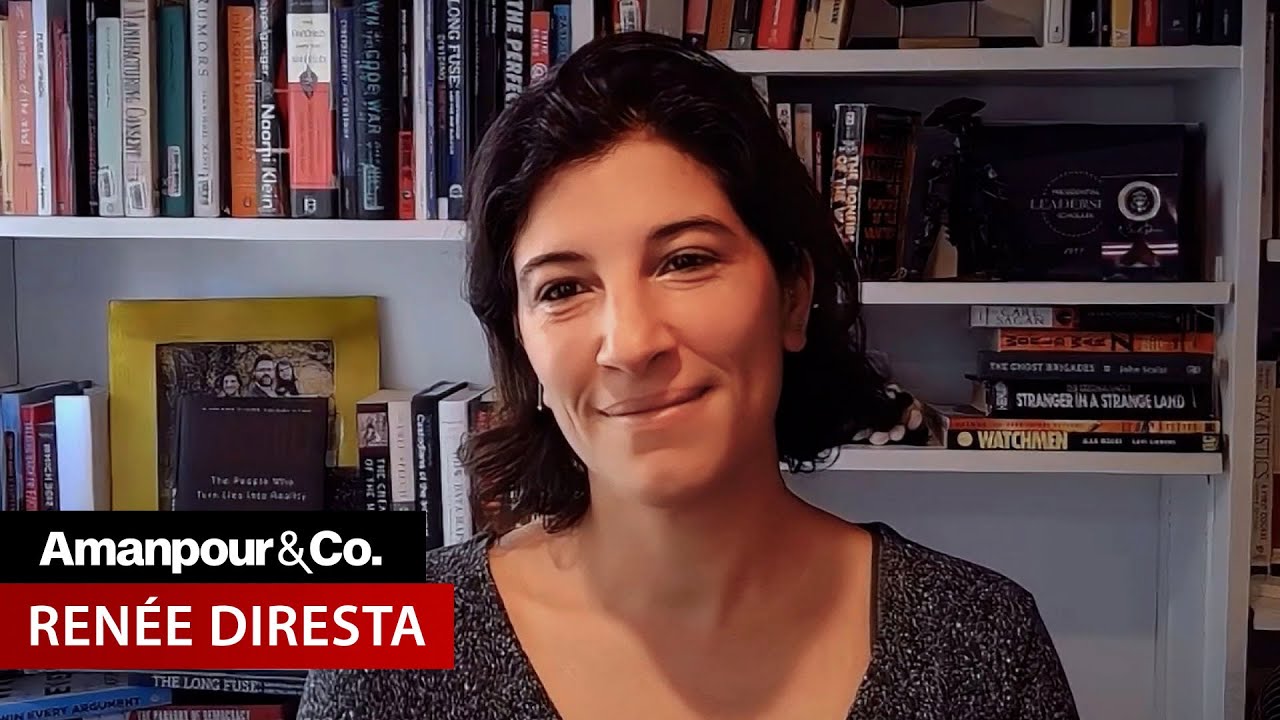
69,623 views Oct 18, 2024 #amanpourpbs
With the risk levels in online communication and public messaging higher than ever, the spread of disinformation online has become a real-world concern. Some 16 Republicans serving as electors for Donald Trump this year deny the 2020 result. To discuss how false information spreads, and how to combat it, Renée DiResta joins the show. Originally aired on October 18, 2024
==-=
-=-=
Aug. 25, 2026,
For 17 months, the State Department has promised to deliver proof of a long-promoted conspiracy theory about its own agency: that its officials routinely censored conservative Americans. This week, it failed that mission, as Under Secretary for Public Diplomacy Sarah Rogers released a trove of documents that proved nothing.
The conspiracy theory has grown during President Donald Trump’s second term, providing the State Department with a rationale for dismantling the offices that once studied and countered foreign disinformation campaigns, for firing officials with decades of experience and for shuttering entire departments.
The effort was first led by acting Under Secretary of State for Public Diplomacy Darren Beattie, a former far-right academic who had been fired from the first Trump administration after he attended a white nationalist conference. Beattie claimed the DOGE-style decimation of the State Department was necessary to rid the agency of officials who were tied to a baseless conspiracy theory known as the “censorship-industrial complex.”
Promoters of the censorship-industrial complex — a secret but somehow sprawling partnership between the Biden government, journalists, academics and civil society groups, aimed at silencing conservative Americans — have repeatedly failed to prove their case, in congressional investigations and in the courts, including the Supreme Court. Still, the theory persists.
Beattie had no evidence for his unfounded claims that the State Department had participated in that conspiracy, but in March 2025, he launched an investigation inside the State Department that he said would reveal all. Beattie requested the files, emails and other communications of State Department officials, including any records with seemingly random keywords like “Black Lives Matter,” “great replacement theory” and “Pepe the Frog,” as well as any communications with figures Beattie believed to be part of the conspiracy. (These included The Atlantic’s Anne Applebaum, Bill Gates, disinformation researcher Nina Jankowicz and some 60 others, including this reporter.)
In the official announcement for the closure of the Counter Foreign Information Manipulation and Interference Hub, formerly known as the Global Engagement Center (GEC), Secretary of State Marco Rubio told Mike Benz, a former pseudonymous racist YouTuber and chief architect of the censorship-industrial complex theory, that a reckoning was coming. It would be driven by evidence, disclosed in the model of the “Twitter Files,” a 2022 dump of internal Twitter records that Elon Musk gave to selected writers to show the alleged censorship of conservatives. (It didn’t.)
Rubio said the job now was to “document what happened.”
“Because one thing is to say it in a broadcast like this, another thing is to actually put it on paper,” he said.
This week, Rogers, Beattie’s replacement, finally had something to share.
According to a series of posts on X, some since deleted, Rogers messaged Jennica Pounds, a self-described analyst who goes by the moniker Data Republican, known for creating massive, if amateur, data troves used to allege government waste, fraud and abuse, which made her a favorite of Musk’s.
Pounds said she thought Rogers was handing documents about Cuba, but got “shoved a bunch of hard copy documents to leak” about the GEC.
“I wanted to give you the option of ‘breaking’ the story as sort of a gift,” Rogers told her, according to a direct message that Pounds posted.
Then things got weird. Pounds has been a reliable vector for the Trump administration to push its narrative that a so-called deep state, or shadow government, was operating in secret and against the best interests of its citizens. But when she received the State Department’s “gift,” Pounds determined that it was a plot by Rogers to entrap her into committing a crime, asserting that releasing or reporting on the documents would be illegal.
Rogers responded “lol” and released the documents herself in a series of 35 posts that borrowed the breathless cadence of the Twitter Files, drawing ominous connections between GEC emails, international projects to combat foreign disinformation, and nongovernmental coalitions. It all implied the existence of a censorship-industrial-complex operation — without proving it. Rogers’ document dump got little attention from right-wing media.
More articles
Team Trump turns on contractor after it failed to bolster election conspiracy theory

Resigning labor secretary falsely claims there was a ‘deep state’ conspiracy against her
“There were State Department employees sharing news articles. Diplomats had communicated with foreign governments. And somewhere in the rubble was a project examining ‘gendered disinformation’ that had been — wait for it — announced at the Summit for Democracy and published on the State Department website,” former senior foreign service officer Orna Blum wrote sarcastically on Substack.
Pounds seemed to agree with the former State Department official.
“The actual documents were nothingburgers,” she posted.
Neither the State Department nor Pounds responded to requests for comment.
The debacle may show that the half-decade of unproven censorship claims has exhausted their audience.
“The under secretary is yet again twisting decontextualized snippets of emails and long-public documents to try to propagate a conspiracy theory,” said Renée DiResta, an associate research professor at Georgetown University. As the former research manager for the Stanford Internet Observatory, DiResta has long been a boogeyman of the censorship-industrial complex theory.
“The mass censorship claims were a hoax,” DiResta said.
Over the weekend, some of the State officials pushed out in last year’s purge lit up Signal chats, commenting on Rogers’ rollout of the long-promised proof of the conspiracy that had cost them their jobs and hollowed out the agency where they had spent their careers. One former senior official, granted anonymity to speak candidly, told MS NOW: “In the end, it’s not the greatest consolation on earth to find out that the people who wrecked 10 years of your work and your career are a bunch of galaxy-level dipshits.”
The release did reveal something, however: an unintentional revelation about an undisclosed relationship between a federal agency and Pounds, a professed independent researcher who has often criticized others, without evidence, of being “a fed.”
In her posts, Pounds alleged that Rogers was trying to threaten her employment, revealing along the way that since July she had been a special government employee of the Department of Defense. Before that, Pounds had been provided credentials as a member of the Pentagon’s hollowed-out press corps.
A Defense Department official confirmed her employment but declined to give further details.

Brandy Zadrozny is a senior enterprise reporter for MS NOW.
===
1 25
Renée DiResta (born 1981)[1] is a professor, writer and former research manager at Stanford Internet Observatory (SIO).[2] DiResta has written about pseudoscience, conspiracy theories, terrorism, and state-sponsored information warfare. She has also served as an advisor to the U.S. Congress on ongoing efforts to prevent online and social media disinformation.
Education and career
DiResta attended Stony Brook University and in 2004 received a Bachelor of Science in Computer Science // Political Science.[3] DiResta has stated that as an undergraduate student she worked as an intern for the CIA, but that her association with that agency ended in 2004.[4]
In 2015, DiResta co-founded Vaccinate California, an organization designed to promote vaccination in California.[5][6] Until June 2024, DiResta was the Technical Research Manager for the Stanford Internet Observatory.[7]
Vaccination misinformation research
DiResta has advised the California State Senate on matters of vaccination misinformation. Following an outbreak of measles in the U.S., DiResta began research into misinformation around vaccines. Along with data scientist, Gilad Lotan, DiResta identified that on Twitter, 25% of anti-vaccine information came from 0.6% of users, in a phenomenon DiResta described as similar to automation. This study additionally identified groups of individuals who would actively create false accounts and "shape public opinion about particular policies". This report was used by Vaccinate California and the California State Senate to demonstrate that the majority of Californians were in favor of removal of vaccine-opt out policies, resulting in California Senate Bill 277 passing into law.[8]
In 2021, the Virality Project, an organization DiResta is a part of, released the report "Memes, Magnets and Microchips: Narrative dynamics around COVID-19 vaccines" advising social media sites and health officials on how to counter COVID-19 and vaccine misinformation.[9]
Social media and disinformation research
DiResta has previously written that social media sites, such as Facebook, Twitter, and Reddit, are used as "useful testing grounds for bad actors". Specifically, she wrote that foreign governments, such as Russia, will pilot memes and false stories online to see what can become popular and sway public opinion.[10] DiResta described it as "the asymmetry of passion" where extremist groups will intentionally attempt to reinforce narratives to "shape the reality" of viewers. This, according to DiResta, can "seep into public policy debates on matters such as vaccines, zoning laws and water fluoridation".[10]
During her ongoing tenure at the Stanford Internet Observatory, DiResta led investigations into the Russian Internet Research Agency's efforts to manipulate United States society and the GRU's efforts to influence the U.S. 2016 Presidential Election.[11] This included a report to the United States Senate Select Committee on Intelligence (SSCI), detailing the means by which the GRU used social media to influence the election and how social media poses an ongoing risk to US politics.[12]
This report further stated that Facebook, Twitter and Alphabet's algorithms were intentionally manipulated in a multi-year effort by the Internet Research Agency, directed by the Russian government, and had successfully created false personas that spread misinformation to an estimated hundreds of thousands of Americans. The identified purpose of this effort was to "deepen political divisions".[13][14]
As of 2022, DiResta is a member of the Council for Responsible Social Media, a project of the campaign reform lobbying group Issue One.[15][16] She has criticized Mark Zuckerberg's controlling share of Meta and Elon Musk's Acquisition of Twitter, calling for greater transparency and accountability for these sites.[17]
DiResta also worked on misinformation about elections such as election fraud in the United States while at Stanford. The effort was work investigating election misinformation and disinformation shut down in 2024 as a result of lawsuits, subpoenas, document requests from right-wing politicians and nonnprofits that cost millions to defend, even when vindicated by the US Supreme Court in June 2024, in addition to threats and online harassment as a result of the spread of disinformation about her work.[18][19][20]
On 8 October 2024, it was announced that she had been appointed to the position of associate research professor at McCourt School of Public Policy at [Georgetown University](https://en.wikipedia.org/wiki/Georgetown_University "Georgetown University").[21]
Recommendations for countering rumors, misinformation and disinformation online
In her 2024 book Invisible Rulers, DiResta argued for these changes to improve the quality of the information environment:[22]
- Changing the defaults on social media. Currently algorithms reward engagement which elevates emotion and conflict, but could instead reward accuracy, civility, and other values.
- More user control to customize their experience on a platform.
3. More friction would give time for fact-checking and context before content goes viral.
4. Education. The Institute for Propaganda Analysis was an education and research effort from 1937-1942 that DiResta found effective and ahead of its time.[23]
Media appearances
DiResta appeared in the 2020 docudrama The Social Dilemma and is a contributor at Wired and The Atlantic.[11]
Books
- Invisible Rulers: The People Who Turn Lies into Reality (2024)[24][25]
- The Hardware Startup: Building your Product, Business, and Brand (2015)[26]
See also
===
ggl 1 25
- Author and Mozilla Fellow in Media
Renée DiResta is a professor, writer and former research manager at Stanford Internet Observatory. Wikipedia
[

Wikipedia
https://en.wikipedia.org › wiki › Renée_DiResta
Renée DiResta - Wikipedia
Renée DiResta (born 1981) [1] is a professor, writer and former research manager at Stanford Internet Observatory (SIO). [2] DiResta has written about pseudoscience, conspiracy theories, terrorism, and state-sponsored information warfare.She has also served as an advisor to the U.S. Congress on ongoing efforts to prevent online and social media disinformation.
- reneediresta.com
[
Renée DiResta
https://www.reneediresta.com › about
About - Renée DiResta
Renée DiResta studies online manipulation, propaganda, and rumors at Stanford Internet Observatory. She has advised world leaders, testified before Congress, and authored a book on the hardware startup industry.
===