Stanford Internet observatory SIO
GENERIC FOR ALL STANFORD DISINFO WORK?
===
SEE ATTACK JIM JORDAN
SEE MILLER MOFO AM 1ST LEGAL
RAGA?
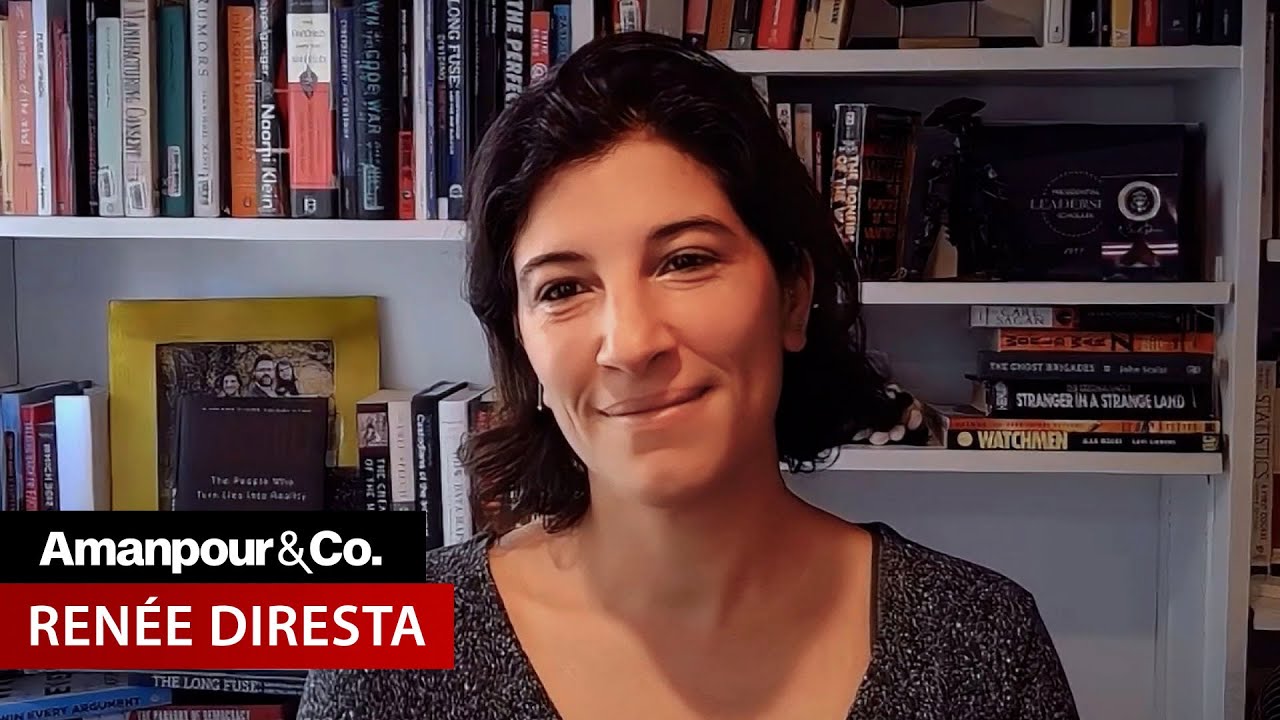
69,623 views Oct 18, 2024 #amanpourpbs
With the risk levels in online communication and public messaging higher than ever, the spread of disinformation online has become a real-world concern. Some 16 Republicans serving as electors for Donald Trump this year deny the 2020 result. To discuss how false information spreads, and how to combat it, Renée DiResta joins the show. Originally aired on October 18, 2024
msn wapo
The Washington Post
500.9K Followers
Stanford’s top disinformation research group collapses under pressure
Story by Joseph Menn
Stanford’s top disinformation research group collapses under pressure
/For The Washington Post
The Stanford Internet Observatory, which published some of the most influential analysis of the spread of false information on social media during elections, has shed most of its staff and may shut down amid political and legal attacks that have cast a pall on efforts to study online misinformation.
Just three staffers remain at the Observatory, and they will either leave or find roles at Stanford’s Cyber Policy Center, which is absorbing what remains of the program, according to eight people familiar with the developments, some of whom spoke on the condition of anonymity to discuss internal matters.
The Election Integrity Partnership, a prominent consortium run by the Observatory and a University of Washington team to identify viral falsehoods about election procedures and outcomes in real time, has updated its webpage to say its work has concluded.
Two ongoing lawsuits and two congressional inquiries into the Observatory have cost Stanford millions of dollars in legal fees, one of the people told The Washington Post. Students and scholars affiliated with the program say they have been worn down by online attacks and harassment amid the heated political climate for misinformation research, as legislators threaten to cut federal funding to universities studying propaganda.
Related video: Stanford will again require SAT, ACT (KTVU FOX 2 San Francisco)
Is joining a growing list of colleges and universities that
Alex Stamos, the former Facebook chief security officer who founded the Observatory five years ago, moved into an advisory role in November. Observatory research manager Renée DiResta’s contract was not renewed in recent weeks.
The collapse of the Observatory is the latest and largest in a series of setbacks for the community of researchers who try to detect propaganda and explain how false narratives are manufactured, gather momentum and become accepted by various groups. It follows Harvard’s dismissal of misinformation expert Joan Donovan, who in a December whistleblower complaint alleged that the university’s close and lucrative ties with Facebook parent Meta led the university to clamp down on her work, which was highly critical of the social media giant’s practices.
“The Stanford Internet Observatory has played a critical role in understanding a range of digital harms,” said Kate Starbird, who led the University of Washington’s work on the Election Integrity Partnership and continues to publish on election misinformation.
Starbird said that while most academic studies of online manipulation look backward from much later, the Observatory’s “rapid analysis” helped people around the world understand what they were seeing on platforms as it happened.
Brown University professor Claire Wardle said the Observatory had created innovative methodology and trained the next generation of experts.
“Closing down a lab like this would always be a huge loss, but doing so now, during a year of global elections, makes absolutely no sense,” said Wardle, who previously led research at the anti-misinformation nonprofit First Draft. “We need universities to use their resources and standing in the community to stand up to criticism and headlines.”
Stanford University spokesperson Dee Mostofi said in a statement that much of the Observatory’s work would continue under new leadership, “including its critical work on child safety and other online harms, its publication of the Journal of Online Trust and Safety, the Trust and Safety Research Conference, and the Trust and Safety Teaching Consortium.”
“Stanford remains deeply concerned about efforts, including lawsuits and congressional investigations, that chill freedom of inquiry and undermine legitimate and much needed academic research — both at Stanford and across academia,” Mostofi added.
The study of misinformation has become increasingly controversial, and Stamos, DiResta and Starbird have been besieged by lawsuits, document requests and threats of physical harm. Leading the charge has been Rep. Jim Jordan (R-Ohio), whose House subcommittee alleges that the Observatory improperly worked with federal officials and social media companies to violate the free-speech rights of conservatives.
Jordan has demanded reams of documents from Stanford, including records of students discussing social media posts as they volunteered to help the Observatory, and Stamos testified before the House Judiciary Committee for eight hours.
“Free speech wins again!” Jordan posted on X on Friday, calling the Observatory part of a “censorship regime.”
Donald Trump adviser Stephen Miller’s law firm filed a First Amendment lawsuit in May 2023 against the Observatory, Stamos, DiResta and others; it is still pending.
In a joint statement, Stamos and DiResta said that their work involved much more than elections and that they had been unfairly maligned.
“The politically motivated attacks against our research on elections and vaccines have no merit, and the attempts by partisan House committee chairs to suppress First Amendment-protected research are a quintessential example of the weaponization of government,” they said.
“We are thankful to Stanford for defending our work, including in front of the U.S. Supreme Court, and are confident that the judicial system will eventually act to protect our speech and the speech of other academics.”
The high court will rule within weeks on a case known as Missouri v. Biden, which includes claims against the Observatory.
The staff cuts were first reported late Thursday by the social media newsletter Platformer.
Stamos founded the Observatory after publicizing that Russia had attempted to influence the 2016 election by sowing division on Facebook, causing a clash with the company’s top executives. Special counsel Robert S. Mueller III later cited the Facebook operation in indicting a Kremlin contractor. At Stanford, Stamos and his team deepened his study of influence operations from around the world, including one it traced to the Pentagon.
Stamos told associates he stepped back from leading the Observatory last year in part because the political pressure had taken a toll. He had raised most of the money for the project, and the remaining faculty members have not been able to replicate his success, as many philanthropic groups shift their focus to artificial intelligence and other, fresher topics.
Major, time-limited grants from the Hewlett Foundation, Pew Charitable Trusts and others have ended, those organizations confirmed to The Post. No comparable new grants have materialized.
Staff hoped Stanford might step in to fund the group through the momentous November election.
In supporting the project further, the university would have risked alienating conservative donors, Silicon Valley figures and members of Congress, who have threatened to stop all federal funding for disinformation research or cut back general support.
The Observatory’s non-election work included developing a curriculum for teaching college students how to handle trust and safety issues on social media platforms, and launching the first peer-reviewed journal dedicated to that field. It also investigated rings that published child sexual exploitation material online and flaws in the U.S. system for reporting it, helping prepare platforms to handle an influx of computer-generated material.
“We hope that Stanford is willing to support the remainder of the SIO team and serve as a safe home for future research into how the internet is used to cause harm against individuals and our democracy,” Stamos and DiResta said in the statement.
===
review BS
the Stanford Internet Observatory’s reign of censorship is finally coming to an end. The group, part of Stanford’s Cyber Policy Center, has been investigating misinformation and social media abuse for five years. Now, it is reportedly being dismantled.
Although the Stanford Internet Observatory, or SIO, pledged its work was to “defend democracy,” it trampled on founding American principles as it sought to implement a censorship regime to quiet those questioning the political establishment. The SIO would likely stay afloat if it had merely been conducting research. However, since the organization’s conception, it has been a key player in divisive government schemes to suppress and limit freedom of speech—ultimately leading to its demise.
The SIO’s role in monitoring and censoring online speech has garnered widespread political and legal scrutiny for stifling protected speech in conjunction with the federal government. The SIO-led so-called Election Integrity Partnership (EIP), composed of the University of Washington, Graphika Inc., and the Atlantic Council’s Digital Forensic Research Lab (DFRLab), silenced anti-mainstream narratives at the height of the 2020 presidential race in blatant disregard of the First Amendment.
Emails from the Department of Homeland Security’s Cybersecurity and Infrastructure Security Agency (CISA) reveal that the federal agency secretly collaborated with the EIP to censor vast amounts of speech deemed “threatening” and “dangerous” to its agenda. Journalist Matt Taibbi’s reporting detailed Stanford’s abandonment of free expression, open discourse, and intellectual diversity as it aided CISA in an unprecedented crackdown against political topics damaging to Democrats and the pro-lockdown left.
CISA and the EIP never cared about democracy. They did not even aim to protect the American public from misinformation, as shown by the dismissal of the Hunter Biden laptop story and COVID-19 origin “conspiracy theories,” later revealed as anything but. Instead, they wanted to dictate a false reality and silence those who dared to question it.
Taibbi’s reporting instead reveals a conspiracy by federal agencies and left-wing non-profits, including MITRE, Omidyar Network, Common Cause, the Democratic National Committee, the Defending Digital Democracy Project, and the NAACP, which provided misinformation reports to Stanford and the EIP. In 2023, a federal district judge found this practice violated the First Amendment in Murthy v. Missouri—a decision now under review by the Supreme Court. These highly partisan organizations, including the Stanford-backed EIP, were given governmental influence and power to decide what “disinformation” was in a campaign to suppress inconvenient truths.
The Stanford students hired by the SIO were complicit in the mass censorship and manipulation of public opinion. Teams of students were asked to use algorithms to flag content on various social media platforms that challenged mainstream narratives; many of Stanford’s tech-focused students were employed to perpetuate a dystopian thought control scheme.
However, as Taibbi’s investigation showed, the EIP is only the tip of the iceberg. Another project called the Virality Project, led by the SIO in collaboration with the Office of the Surgeon General, the CDC, DHS’s CISA, and the State Department's Global Engagement Center, was identified PASSIVE as a pseudo-truth machine weaponized for the suppression of “misinformation.” Project clients included several Facebook contracts, one Project Vox-Google contract, and one NGO contract for COVID-19 hoax tracking. Like the EIP, the Virality Project encouraged social media platforms to take action even against “stories of true vaccine side effects” and “true posts which could fuel hesitancy.”
The Virality Project was more concerned with maintaining control over the public through their narrative rather than promoting free speech and discussion surrounding medical autonomy and concerns over the COVID-19 vaccine’s rapid development. As a result, it did not allow people to read about possible vaccine side effects, such as myocarditis. Even Stanford’s medically qualified dissenting voices, Dr. Jay Bhattacharya and Dr. Scott Atlas, who spoke out against former NIAID Director Anthony Fauci’s pandemic response and lockdowns, were censored by social media platforms for exercising their freedom of speech.
This behavior disproves claims that the SIO was acting out of a genuine desire to prevent the spread of disinformation, but rather to prevent the spread of information that was inconvenient or ran counter to progressive dogma. The SIO’s pathetic response, stating, “it is difficult to rebut all of these inaccurate claims without repeating the falsehoods and contributing to their further spread,” underscores its lack of interest in serving the American people or furthering open discourse. The organization’s total dismissal of concerns about the gravity of their actions exposes these cowards for what they are: a power-hungry bureaucracy aiming to control Americans’ behavior with complete disregard for their liberties.
While the SIO’s collapse is a massive step in the right direction, we must be wary of our government’s continued antagonism toward freedom of speech. With the 2024 election approaching, we cannot be silent about Stanford’s—or any other institution’s— disregard for First Amendment rights. Almost always, such acts are done under the insidious guise of “safety.” Safety without liberty is tyranny with a bike helmet and swim floaties. We must reject this mantra as the evil that it is. Give me liberty, or give me… well, you know the rest.
Ultimately, it does not matter whether the claims censored by the SIO were correct. The First Amendment does not only protect our ability to make accurate statements but to say whatever we want. In America, it is up to each citizen to discern what is true and what is false, not the government.
Our universities ought to be havens of academic freedom, and our government has no right to tell us what we can and cannot say and which opinions we can and cannot hear. It is time for everyone, regardless of political affiliation, to demand that the federal government and universities not trample on our rights. The United States was never meant to be an echo chamber. If we do not push back now, we may lose the very core of our country: freedom.
---
contrast
stanford University officials have denied that the school is shutting down its prominent research group studying online harms, the Stanford Internet Observatory, but acknowledged funding challenges.
“Stanford has not shut down or dismantled SIO as a result of outside pressure,” the university said in a recent statement following reports of its demise.
A June 13 Platformer article alleged Stanford “is quietly dismantling” the SIO. Founding director Alex Stamos left his position in November, the center’s research director, Renee DiResta, left “after her contract was not renewed” recently and other staff members were “told to look for jobs elsewhere,” the article wrote.
In a LinkedIn post Tuesday, DiResta wrote that “it’s unclear what the future holds, but several of us are no longer there.”
Conservative groups and lawmakers have hit the institute with costly lawsuits and congressional investigations. The bulk of the controversy is related to the Election Integrity Partnership, a research project within the observatory and in collaboration with the University of Washington and others that studied disinformation related to the 2020 election. As part of their work, researchers would identify certain social media posts as misleading and refer some to social media companies.
DiResta talked about the lawsuits related to her work at the center in a piece published in The Atlantic earlier this month.
“Meanwhile, conservative groups are suing my former colleagues and me,” DiResta said in the article. “Stanford has run up huge legal bills. SIO’s future is unclear, and its effort to monitor election-related misinformation has been shelved.”
Republican Rep. Jim Jordan has spearheaded right-wing opposition to disinformation efforts, arguing conservatives are being censored when their social media posts are tagged as misinformation and alleging that the observatory is colluding with the government.
“Free speech wins again!” Jordan posted on X (formerly Twitter), after it was reported that the center would supposedly close down.
DiResta has denied that the center, with the Election Integrity Partnership, has the power to take down posts. Social media companies, not the observatory, have the ability to remove posts on their respective platforms.
The partnership, which culminated in an almost-300 page report, continued into the 2022 election. But, according to the EIP’s website, the project “finished its work after the 2022 election and will not be working on the 2024 or future elections.”
“The EIP’s collaborative model was tailored toward a specific event—Election 2020,” the researchers wrote in the report.
Stanford’s Cyber Policy Center said in a statement Monday that the SIO would “continue its important work” under the leadership of faculty director Jeff Hancock.
“SIO will continue its critical work on child safety and other online harms, its publication of the Journal of Online Trust & Safety, the Trust & Safety Research Conference, and the Trust & Safety Teaching Consortium,” its statement read. “Additionally, SIO faculty and staff will continue their work looking into psychological and media research questions associated with misinformation around the 2024 election.”
The center, which launched in 2019 with a $5 million grant from Craig Newman Philanthropies, openly admitted facing funding challenges.
“[The center’s] founding grants will soon be exhausted. As a result, SIO continues to actively seek support for its research and teaching programs under new leadership,” Stanford said.
RELATED ARTICLES
Free press advocates urge DA not to charge Stanford reporter arrested with university protesters
Stanford protest leaves one unimpressed: Letter to the editor
Hundreds of students walk out of Stanford commencement over war in Gaza
=
NPR 6 24
The Stanford Internet Observatory, a prominent research group at Stanford University studying how social media platforms are abused, has lost its top leadership and faces an uncertain future amid a sustained right-wing campaign targeting the study of online falsehoods.
The SIO's founding director, Alex Stamos, left his position in November. In recent weeks, the university did not renew the contract of Renée DiResta, the group's research manager, along with other staffers. Remaining staff have been told to look for other jobs, according to the tech newsletter Platformer, which first reported the news.
The SIO was founded five years ago as a cross-disciplinary program examining some of the thorniest issues raised by the proliferation of the internet, including the way social networks such as Instagram are used for child exploitation and the spread of false and misleading information about elections and vaccines.
Fighting False Election Claims Could Get A Lot Harder In 2024
But in the past year, the work of researchers at SIO and other institutions studying viral falsehoods and their impact on democracy have become the focus of scrutiny by Republicans in the courts and in Congress, who allege their work amounts to censorship.
The Election Integrity Partnership, a joint project SIO ran with the University of Washington to track false and misleading information about the 2020 and 2022 elections, became the focus of conspiracy theories that it was a front for the government to suppress speech it didn't like. (The EIP's website was updated in recent weeks to say it "will not be working on the 2024 or future elections.")
As a result, researchers at Stanford, UW and other institutions have been hit with lawsuits, flooded with subpoenas and document requests, and subjected to online harassment and attacks.
That's added up to millions of dollars in legal fees and significant amounts of time responding to congressional inquiries and lawsuits, which researchers say has been a distraction from their core work. The Washington Post reported on Friday that SIO has struggled to raise money to continue funding its work in an increasingly hostile climate.}:
In response to the news of SIO's pullback, Republican Rep. Jim Jordan of Ohio, who has spearheaded efforts to discredit researchers through his chairmanship of the House Judiciary Committee, posted on X on Friday: "Free speech wins again!" and accused SIO of being part of "the censorship regime."
Stanford University pushed back against the idea that SIO is being dismantled.
"The important work of SIO continues under new leadership, including its critical work on child safety and other online harms, its publication of the Journal of Online Trust and Safety, the Trust and Safety Research Conference, and the Trust and Safety Teaching Consortium," university spokesperson Dee Mostofi said in a statement. "Stanford remains deeply concerned about efforts, including lawsuits and congressional investigations, that chill freedom of inquiry and undermine legitimate and much needed academic research – both at Stanford and across academia."
SIO staff, including Stamos and DiResta, have been targeted by Jordan's Subcommittee on the Weaponization of the Federal Government, which alleges that government agencies, tech companies and academics have colluded to unconstitutionally shut down conservative speech — a claim the accused parties deny. In addition, Stamos and DiResta are named in an ongoing private lawsuit brought by America First Legal, an organization run by former Trump adviser Stephen Miller.
Supreme Court examines whether government can combat disinformation online
The SIO and other academic research groups were also initially named in a lawsuit brought against the Biden administration by the attorneys general of Missouri and Louisiana making similar claims of collusion. The researchers have since been dropped from that case, which the Supreme Court is expected to rule on in the coming weeks.
"The politically motivated attacks against our research on elections and vaccines have no merit, and the attempts by partisan House committee chairs to suppress First Amendment-protected research are a quintessential example of the weaponization of government," Stamos and DiResta said in a statement first given to Platformer.
"We are thankful to Stanford for defending our work, including in front of the US Supreme Court, and are confident that the judicial system will eventually act to protect our speech and the speech of other academics," they wrote. "We hope that Stanford is willing to support the remainder of the SIO team and serve as a safe home for future research into how the internet is used to cause harm against individuals and our democracy."
REF 11 2023
Why countering false election claims may be harder in 2024 : NPR
in Marion County, Fla., elections supervisor Wesley Wilcox has stopped using the word "misinformation."
Not because lies or misleading rumors about elections are any less prevalent in his county than the rest of the country. Wilcox says he regularly interacts with groups that aim to find what they see as rampant fraud in elections.
But Wilcox, who is a Republican, has had to shift his vocabulary to talk about those falsehoods because others in his party see the term as code for censorship of conservatives.
"In Republican circles, 'misinformation' is a dog whistle," Wilcox said. "All of a sudden, man, you got skewered if you even mention the word."
Republican states swore off a voting tool. Now they're scrambling to recreate it
An election partnership that Wilcox helps lead has even stopped advertising a service that allows local officials to report false voting information online, for fear of conservative backlash — a sign of broader concerns of those who work to safeguard elections as America nears another round of presidential voting.
Experts say a campaign of legal and political pressure from the right has cast efforts to combat rumors and conspiracy theories as censorship. And as a result, they say, the tools and partnerships that tried to flag and tamp down on falsehoods in recent election cycles have been scaled back or dismantled. That's even as threats loom from foreign governments and artificial intelligence, and as former President Donald Trump, who still falsely claims to have won the 2020 contest, is likely to use the same tactics again as he pursues the White House in 2024.
Added Wilcox: "Everybody is gun-shy."
"Open season"
As Nina Jankowicz sees it, the opening salvo came in the spring of 2022, when a right-wing campaign quickly snuffed out a Department of Homeland Security initiative called the Disinformation Governance Board.
POLITICS
She joined DHS to fight disinformation. She says she was halted by... disinformation
Jankowicz, who has written books about Russian information operations and online harassment, was tapped to lead the board. The federal government described it as a working group, without "any operational authority or capability," tasked with coordinating efforts to identify false and misleading claims and share facts about security concerns, from elections to natural disasters.
But the combination of the board's ominous-sounding name and DHS's poor efforts to communicate its purpose made it catnip for right-wing influencers, who quickly seized on the board and Jankowicz herself as avatars of a nefarious plot to censor Americans.
"The Biden Administration's decision to stand up a 'Ministry of Truth,' is dystopian in design," said now-House Speaker Mike Johnson, R-La., shortly after the board was announced. "The government has no role whatsoever in determining what constitutes truth or acceptable speech."
Supporters of former President Donald Trump look at merchandise ahead of his rally in Hialeah, Fla., this week. Trump continues to falsely claim he won the 2020 election, fueling conspiracy theories around the voting process.
Ricardo Ardeuengo/AFP via Getty Images
After a barrage of death threats and abuse, Jankowicz resigned, and DHS scrapped the board altogether. Jankowicz told NPR that the timid effort by the federal government to defend her or push back against the allegations sent a clear message.
"That showed ... that it was open season on researchers, on civil servants, on anyone who was working in this space," Jankowicz said.
Amid that furor, in May 2022, the Republican attorneys general of Missouri and Louisiana filed a lawsuit accusing the Biden administration of colluding with social media companies to censor conservative speech, by pressing platforms to take action on misleading posts about COVID-19 and elections.
Supreme Court to hear court ban on government contact with social media companies
This July, a Trump-appointed federal judge ruled the government had likely violated the First Amendment and issued a sweeping injunction blocking agencies' communications with platforms about most content. The injunction was narrowed by an appeals court, before being put on hold last month by the Supreme Court, which is slated to hear the case this term.
Pressure is coming from Congress as well, where the House Judiciary Committee's Select Subcommittee on the Weaponization of the Federal Government, led by GOP Rep. Jim Jordan of Ohio, a Trump ally, is conducting its own probe into alleged collusion between the Biden administration and tech companies to unconstitutionally shut down political speech.
To be sure, there is an open debate about what role the government should take in countering rumors or lies about high-risk subjects like elections and public health, and widespread skepticism about the power social media companies wield over public discourse.
But the government, platforms and researchers say the lawsuit and investigation unfairly mischaracterize their communications. They say that while officials and outside groups flag content they believe may break the social networks' rules, it's ultimately up to the tech companies to decide what action to take.
Rep. Jim Jordan, R-Ohio, center, is leading a congressional investigation into what he and other conservatives describe as a joint effort by the federal government, researchers and tech companies to censor conservative points of view. He's seen here after a March hearing with Rep. Matt Gaetz, R-Fla., left, and now-Speaker Mike Johnson, R-La.
Manuel Balce Ceneta/AP
Jordan is subpoenaing researchers and social media companies, demanding years of email correspondence and conducting hours-long interviews, which his staff has used to make explosive accusations against federal agencies, nonprofit organizations and academic institutions.
"What the federal government could not do directly, it effectively outsourced to the newly emerging censorship-industrial complex," committee staff wrote in a report published this week.
"The Committee's ongoing investigation focuses on the federal government's involvement in speech censorship, and the investigation's purpose is to inform legislative solutions for how to protect free speech," said Nadgey Louis-Charles, a spokesperson for the House Judiciary Committee.
The rise of content moderation, and the backlash
Election misinformation isn't a new phenomenon; there have been false and misleading claims as long as there have been elections.
But efforts by Russia in 2016 to use social media to meddle in the U.S. presidential election were a wake-up call for tech companies and the government about the power of online platforms to amplify rumors, conspiracy theories and lies.
UNTANGLING DISINFORMATION
Meta says Chinese, Russian influence operations are among the biggest it's taken down
Under public pressure, Facebook, Twitter and other social media sites created policies prohibiting false election claims and set up teams devoted to monitoring abuse, from cracking down on posts telling people the wrong day to vote to disrupting coordinated influence operations backed by foreign governments.
At roughly the same time, in January 2017, DHS designated the country's voting systems as critical infrastructure, meaning that keeping local and state systems safe from hostile actors was officially under the federal government's purview.
But it was becoming increasingly clear that foreign adversaries were also targeting the minds of American voters, so the federal government started wading into the thorny world of online information. Ahead of the 2018 midterms, DHS began coordinating with social media companies around election misinformation.
UNTANGLING DISINFORMATION
How the 'Stop the Steal' movement outwitted Facebook ahead of the Jan. 6 insurrection
The tech platforms got more aggressive about policing content, with moderation reaching what some experts argue was a peak in 2020 and 2021, amid the COVID-19 pandemic and the 2020 presidential election. They began labeling false and misleading claims, including, controversially, posts by then-President Trump. After the Jan. 6 attack on the U.S. Capitol, the big platforms all suspended Trump.
The rise of those policies, along with high-profile disputes over how they have been applied, sparked a backlash from conservatives and some disaffected liberals who say platforms went too far in limiting speech.
Efforts to the back burner, and a rebranded 'Rumor Control'
Wilcox, the election administrator in Florida, sits on the executive committee of a nationwide partnership for election officials called the Elections Infrastructure Information Sharing and Analysis Center (EI-ISAC) that was created after the 2016 election.
But he says he's had to downplay that work when talking to voters because the EI-ISAC is funded by DHS, which has become the target of conspiracies. One conspiracy theory info packet viewed by NPR, acquired in a records request in Texas by the transparency group American Oversight, detailed how the EI-ISAC was "likely manipulating our County vote tallies."
"I have to be very careful," Wilcox said. "I can't even go out locally and tell anybody that I sit on this board because DHS is the bad guy."
[Voters cast ballots in Louisville, Ky., this week. In recent years, local election officials have come to rely a variety of mechanisms to share information about rumors and conspiracy theories about elections.
Michael Swensen/Getty Images
One of the functions the EI-ISAC took on around 2020 was to essentially give thousands of election officials across the U.S. somewhere central to report false and misleading information. The group then disseminated that information to researchers at a few universities for narrative tracking and to the tech companies for review to see if it violated their policies, through an effort called the Election Integrity Partnership.
Those efforts, which took place under the Trump administration, have become the subject of claims by Jordan's weaponization subcommittee that they're part of a coordinated push by the government to "conduct censorship by proxy."
Wilcox says today, the EI-ISAC is no longer advertising that service. They're back to focusing strictly on cybersecurity.
"It's still out there, but it's really run back to a back burner," Wilcox said. "[DHS] has kind of shied away from even those types of things, just because of the exposure."
The agency's cybersecurity and infrastructure security arm, CISA, confirmed to NPR that it had no contact on Tuesday's Election Day with any social media companies.
Another feature of DHS's election security work that seems to be fading into the background is a website called "Rumor Control." As votes were being counted in 2020, the site served almost as a live-debunking tool, responding to election misinformation in real time.
Kathy Boockvar oversaw elections in 2020 in Pennsylvania as its secretary of the commonwealth, and she remembers leaning on Rumor Control when she began getting questions from Republican state legislators in her state about a conspiracy theory in Arizona involving Sharpies.
"I remember specifically that CISA had a section on the Rumor Control website to explain that there was no -gate in Sharpiegate," Boockvar said, referring to a rumor that spread on election night 2020 in Arizona that using permanent markers on ballots would bleed through and invalidate votes. "I was actually able to share something that had the credibility of the federal government security agency — and frankly, it was the federal government under President Trump."
Boockvar, who has since started a consulting firm focused on improving elections, noticed during last year's midterm elections that Rumor Control was not being updated as frequently, and seemed to be more limited in its scope. The site has since been rebranded, not to focus on "jurisdiction-specific claims," but instead explaining election processes more broadly.
CNN also reported last year that CISA turned down a multimillion-dollar proposal to protect election officials from harassment ahead of the midterms.
During a background briefing call with reporters on Tuesday, a senior CISA official downplayed concerns from local election officials that CISA was being more hands-off when it comes to misinformation.
"When it comes to foreign influence operations and disinformation, this is an area where we remain committed to ensuring that state and local election officials are provided with the techniques and tactics and procedures that we know foreign adversaries are using so that they have awareness of the threats," the official said. "We continue to amplify election officials as trusted sources of information."
But experts worry that local election officials often don't have the resources or time to combat false information online, especially in a rapidly changing technological environment, in addition to their other responsibilities.
"There is only so much you can ask an election official to do and to do well. And we are nearing capacity on people," Wilcox said. "You want me to be a cybersecurity expert? You want me to be a database expert? Now I've got to be an AI expert. I'm like, I'm sorry. At some point, I got to tap out and say, 'I just don't have it.'"
"Weaponized criticism"
The pressure campaign and the uncertainty caused by the paused legal injunction have also chilled communications between people who track and study the spread of rumors and false narratives and the platforms themselves.
Academics and researchers who participated in the Election Integrity Partnership in 2020 have been targeted by Jordan's probe, as well as a private lawsuit brought by America First Legal, an organization run by former Trump adviser Stephen Miller. Those involved say it's unlikely the partnership will have the same level of information sharing next year.
"The weaponized criticism of research on misinformation is having a negative impact on our ability to understand and address what many of us feel to be a pretty large societal problem," said Kate Starbird, a co-founder of the University of Washington's Center for an Informed Public, one of the members of the EIP. She's been the target of harassment and threats over that work.
"They are limiting our ability just to do the research, because we're spending too much time with our lawyers, but also limiting our ability to have conversations with the people who need our work the most, whether that's election officials or whether that's social media platforms," she said.
Starbird says despite the pressure, her UW team is continuing its work and plans to do rapid response to viral rumors once again in 2024. That means they will be tracking, analyzing and communicating — even if it looks different than in previous cycles.
"How do we make sure people can use our outputs, even people that can't maybe talk to us directly because they're afraid about being given a lawsuit or being tied into the next conspiracy theory?" she said.
Dialogue between the people running elections, researchers and the tech companies is critical, said Eddie Perez, who oversaw Twitter's election integrity work before leaving in September 2022 amid Elon Musk's purchase of the company. He's now a board member at the OSET Institute, a nonprofit focused on election infrastructure.
"There are moments where [the platforms] need to rely on substantive information from subject matter experts," Perez said. He cites the Sharpiegate rumors in 2020 that Boockvar also mentioned and which Rumor Control knocked down.
"It's rare for a social media company to have on board somebody that is that familiar with voting technology, for example, to be able to say, 'Look, here's the real story,'" Perez said. "They have an interest in trying to get the answers really quickly, because by definition, when something is viral, the damage is done very quickly."
Social media platforms step back from the spotlight
[The headquarters of X, formerly Twitter, in San Francisco. The company has largely stopped trying to police viral lies on its site and has dismantled teams that deal with election integrity.
Justin Sullivan/Getty Images
Worsening matters is the pervasive sense that social media platforms are backing off efforts to more aggressively police and counter false and misleading election claims and conspiracy theories. Layoffs in the tech industry have hit teams working on trust and safety, leaving many working on election integrity uncertain about who to talk to.
"[The platforms] would reach out to us all the time. And that's just not happening. It's gone silent," Starbird said.
Meta, the owner of Facebook and Instagram, still has channels for election officials to reach out and teams responsible for different states, according to a person familiar with the company's work.
YouTube said it continues to invest in making the video platform a reliable source for election news and information and prohibits content that misleads people on how to vote or encourages interference in the democratic process.
Both companies declined to comment on their interactions with government officials and researchers.
YouTube will no longer take down false claims about U.S. elections
Elon Musk sues disinformation researchers, claiming they are driving away advertisers
The most drastic pullback has come at X, formerly Twitter, where Musk has eliminated the election integrity team entirely, unwound many of the platform's policies, and made changes that critics say amplify the spread of harmful content. Musk has also made it difficult for researchers to study the platform and even sued a nonprofit research group whose work he objected to.
A press email address for X responded to a request for comment with an auto-reply saying "Busy now, please check back later."
Boockvar said even in 2020, it was difficult enough getting the platforms to respond quickly to bad information as it spread.
"If they're taking a step back, or 10 steps back. ... We're basically empowering the disinformation to spread," she said.
---
===
east bay times
stanford University officials have denied that the school is shutting down its prominent research group studying online harms, the Stanford Internet Observatory, but acknowledged funding challenges.
“Stanford has not shut down or dismantled SIO as a result of outside pressure,” the university said in a recent statement following reports of its demise.
A June 13 Platformer article alleged Stanford “is quietly dismantling” the SIO. Founding director Alex Stamos left his position in November, the center’s research director, Renee DiResta, left “after her contract was not renewed” recently and other staff members were “told to look for jobs elsewhere,” the article wrote.
In a LinkedIn post Tuesday, DiResta wrote that “it’s unclear what the future holds, but several of us are no longer there.”
Conservative groups and lawmakers have hit the institute with costly lawsuits and congressional investigations. The bulk of the controversy is related to the Election Integrity Partnership, a research project within the observatory and in collaboration with the University of Washington and others that studied disinformation related to the 2020 election. As part of their work, researchers would identify certain social media posts as misleading and refer some to social media companies.
DiResta talked about the lawsuits related to her work at the center in a piece published in The Atlantic earlier this month.
“Meanwhile, conservative groups are suing my former colleagues and me,” DiResta said in the article. “Stanford has run up huge legal bills. SIO’s future is unclear, and its effort to monitor election-related misinformation has been shelved.”
Republican Rep. Jim Jordan has spearheaded right-wing opposition to disinformation efforts, arguing conservatives are being censored when their social media posts are tagged as misinformation and alleging that the observatory is colluding with the government.
“Free speech wins again!” Jordan posted on X (formerly Twitter), after it was reported that the center would supposedly close down.
DiResta has denied that the center, with the Election Integrity Partnership, has the power to take down posts. Social media companies, not the observatory, have the ability to remove posts on their respective platforms.
The partnership, which culminated in an almost-300 page report, continued into the 2022 election. But, according to the EIP’s website, the project “finished its work after the 2022 election and will not be working on the 2024 or future elections.”
“The EIP’s collaborative model was tailored toward a specific event—Election 2020,” the researchers wrote in the report.
Stanford’s Cyber Policy Center said in a statement Monday that the SIO would “continue its important work” under the leadership of faculty director Jeff Hancock.
“SIO will continue its critical work on child safety and other online harms, its publication of the Journal of Online Trust & Safety, the Trust & Safety Research Conference, and the Trust & Safety Teaching Consortium,” its statement read. “Additionally, SIO faculty and staff will continue their work looking into psychological and media research questions associated with misinformation around the 2024 election.”
The center, which launched in 2019 with a $5 million grant from Craig Newman Philanthropies, openly admitted facing funding challenges.
“[The center’s] founding grants will soon be exhausted. As a result, SIO continues to actively seek support for its research and teaching programs under new leadership,” Stanford said.
The University of Washington’s Center for an Informed Public will continue work on the 2024 election “along the same trajectory as our work with the Election Integrity Partnership in 2020 and 2022,” read a March post on the CIP website.
Kate Starbird, co-founder and faculty director of the CIP, wrote in a 2023 Seattle Times opinion piece that “[a]t the UW, we’re not buckling and won’t be bullied. Our team plans to continue our rapid research during the 2024 elections.”
“Though we are no longer collaborating on “rapid research” with the original partners in the Election Integrity Partnership, our real-time election research at UW continues and we are forming new collaborations to support and share this work,” Starbird wrote in a recent email to this news organization. “We continue to collaborate with researchers at SIO on work related to online rumoring and misinformation.”
---
MMA 1 24
A January 3 Washington Post article by Sarah Ellison explores the influence of far-right MAGA site Gateway Pundit and its founder, Jim Hoft, whose false claims Media Matters has documented for years.
Ellison expertly examines Hoft's influence in spreading pernicious voter fraud claims, which others in right-wing media build upon. She even quotes Steve Bannon saying that Hoft and Gateway Pundit provide an “infrastructure” for pro-Trump voices to riff on:
The site’s founder, Jim Hoft, who started blogging as a hobby in 2004, is among “the best at creating a right-wing echo system,” right-wing podcast host and former Trump adviser Stephen K. Bannon said in an interview. Hoft did not respond to requests to be interviewed for this report.
Bannon said Hoft is often one of the first to pick up a social media post or a local news story that other right-wing personalities then repeat and aggregate. He “isn’t afraid to take a leading edge where you don’t have all the facts but they are coming together,” Bannon explained. Once Gateway Pundit puts one of its signature all-caps headlines on a story, that provides what Bannon calls an “infrastructure”[PERMISSION?] upon which his own podcast and other right-wing outlets and influencers can build.
...
In the weeks before he left office in 2021, Trump brandished printouts of Gateway Pundit articles questioning the results of the election, say former aides who spoke on the condition of anonymity to describe private White House conversations.
“When he was looking for evidence, Gateway Pundit was one reliable place he knew he could go for validation, and maybe even some new ideas,” said one former aide.
The site has been influential in promoting false election fraud theories even though some of the most influential figures on the right say they don’t trust it. One prominent conservative radio host, who spoke on the condition of anonymity for fear of offending political allies, said in an interview that the site’s stories are “bull----.”
Gateway Pundit represents a “a fringe segment of so-called conservative media that’s driven by conspiratorial clickbait to drive revenues to stay afloat,” the host said.
A former Trump administration official who denies that Joe Biden rightfully won the 2020 election nevertheless told The Post in an interview that if you cite Gateway Pundit in an argument, “it means you’ve lost. You can’t use it to make an argument. You can only use it to hear what you want to hear.”
The entire piece is worth reading, specifically to learn how Gateway Pundit has amplified false and misleading claims about voter fraud in Michigan.
With the 2024 election on the horizon, it's worth remembering that the earliest, most viral false claims to arise may well be sourced – directly or indirectly – to Gateway Pundit.
REF WAPO
WAPO NO LNX
Democracy in America
Election 2024
Democracy in America
A right-wing tale of Michigan election fraud had it all – except proof
Gateway Pundit, a favorite news source of former president Donald Trump’s, has pushed false claims of a stolen election even as others have pulled back in the face of consequences
By Sarah Ellison
January 3, 2024
The story had all the elements of a blockbuster crime saga: burner phones, semiautomatic weapons, silencers and bags of prepaid cash cards. “NOW WE HAVE PROOF!” blared the headline on the right-wing website Gateway Pundit. “Massive 2020 Voter Fraud Uncovered in Michigan.”
The story referenced “thousands of fraudulent ballots” caught by Muskegon City Clerk Ann Meisch. Grateful readers deluged her office with hundreds of calls, hailing her as a hero.
But Meisch knew it wasn’t true.
According to police reports, the Michigan attorney general’s office and an interview with Meisch, an employee of a voter registration drive company had submitted to the Muskegon city clerk thousands of voter registration applications weeks before the 2020 election, some with faked signatures and faulty addresses.
Meisch’s staff spent hundreds of hours weeding out the bad applications. The guns the police found were legally registered to a landlord who had nothing to do with the registration drive. The prepaid phones and cash cards were given to temporary employees to contact new voter prospects.
“There were no fraudulent ballots,” Meisch said in an interview, “not a single one that anyone in my office was aware of.”
But for Gateway Pundit, which is run out of its founder’s home and whose small staff produces stories that help set the agenda for Donald Trump’s most ardent followers, the August story provided weeks of headlines that radiated across right-wing media and were repeatedly amplified by pro-Trump influencers. That’s despite the fact that it was published nearly three years after the election — and after Meisch’s staff had thwarted any fraud.
The outlet’s emphasis on long-debunked fraud claims helps explain why election denial has proved so durable, despite the many efforts to halt the spread of disinformation and impose consequences on those who persist in it.
Trump himself faces multiple criminal counts for his efforts to overturn the 2020 election on the disproven grounds that it had been rigged against him. The Trump lawyers who pushed false voter fraud claims have, in some cases, been hit with criminal charges, as well as censure and disbarment proceedings. In mid-December, a federal jury ordered former Trump attorney Rudy Giuliani to pay $148 million to two election workers who sued him for defamation. Trump’s largest media ally, Fox News, agreed last year to pay $787.5 million to Dominion Voting Systems to settle a defamation suit.
Some right-wing outlets, such as Fox’s smaller cable-news rival Newsmax, have pulled back from election-related conspiracy theories in the face of lawsuits and threats of legal consequences.
But through it all, Gateway Pundit has continued trumpeting disproven election fraud stories, even as it faces defamation suits over its coverage of the 2020 election. It has also taken its own legal action against fact-checkers, disinformation researchers and story subjects, while pressing in court to make it harder for social media companies to crack down on misinformation.
The outlet’s reporting was a favorite of Trump’s as he clung to the presidency more than three years ago, aides said, and it has become a key amplifier of his continued fraud claims as he campaigns to return to the White House. Gateway Pundit traffic peaked in November 2020 at nearly 7 million page views, and the site still averages more than a million visits each month, according to Comscore, which measures the readership of media sites.
Less than a year from the 2024 election, the latest polls show that some two-thirds of Republicans falsely believe that the 2020 presidential election was rigged. Gateway Pundit’s influence helps explain why, experts in disinformation say. Though the site employs only a handful of regular writers, it has played an outsize role in popularizing false claims.
“Gateway Pundit is a known source of disinformation that quickly trades up the chain,” said Joan Donovan, an assistant professor at Boston University studying online disinformation and media manipulation. “Because when they report a piece of information, it gives others license to do so.”why?
The site’s founder, Jim Hoft, who started blogging as a hobby in 2004, is among “the best at creating a right-wing echo system,” right-wing podcast host and former Trump adviser Stephen K. Bannon said in an interview. Hoft did not respond to requests to be interviewed for this report.
Bannon said Hoft is often one of the first to pick up a social media post or a local news story that other right-wing personalities then repeat and aggregate. He “isn’t afraid to take a leading edge where you don’t have all the facts but they are coming together,” Bannon explained. Once Gateway Pundit puts one of its signature all-caps headlines on a story, that provides what Bannon calls an “infrastructure” upon which his own podcast and other right-wing outlets and influencers can build.
That infrastructure was useful to pro-Trump One America News, a small cable network that pushed conspiracy theories about the 2020 election. A former OAN producer attested that he and his colleagues were directed to consult Gateway Pundit when they arrived at work to inform the day’s programming, according to depositions and documents from a defamation lawsuit filed against the Trump campaign and others, including Gateway Pundit, by a former Dominion Voting Systems executive who was falsely accused by Trump allies of helping to swing the 2020 election.
“Check Gateway Pundit, Epoch Times and The Blaze right when you get in. … These are very helpful to find good OAN content,” read one Jan. 14, 2021, email to producers from the channel’s news director. OAN settled in the case under undisclosed terms in September.
“Gateway Pundit’s articles were chopped-up sentences that were drawn from whatever crazy thing a Twitter user was saying about election denial,” the former producer, Marty Golingan, said in an interview, “and they would spin it with maximum outrage and reactionary emotion.”
In the weeks before he left office in 2021, Trump brandished printouts of Gateway Pundit articles questioning the results of the election, say former aides who spoke on the condition of anonymity to describe private White House conversations.
“When he was looking for evidence, Gateway Pundit was one reliable place he knew he could go for validation, and maybe even some new ideas,” said one former aide.
The site has been influential in promoting false election fraud theories even though some of the most influential figures on the right say they don’t trust it. One prominent conservative radio host, who spoke on the condition of anonymity for fear of offending political allies, said in an interview that the site’s stories are “bull----.”
Gateway Pundit represents a “fringe segment of so-called conservative media that’s driven by conspiratorial clickbait to drive revenues to stay afloat,” the host said.
A former Trump administration official who denies that Joe Biden rightfully won the 2020 election nevertheless told The Post in an interview that if you cite Gateway Pundit in an argument, “it means you’ve lost. You can’t use it to make an argument. You can only use it to hear what you want to hear.”
Gateway’s origins
In the nearly two decades since its founding, Hoft’s website has spread debunked conspiracy theories on a wide range of topics — for instance, casting doubt on President Barack Obama’s birth certificate and suggesting that student survivors of the 2018 Parkland, Fla., school shooting were part of an anti-Trump plot.
More recently, Gateway Pundit has helped spread misinformation about the attack on then-House Speaker Nancy Pelosi’s husband, who was bludgeoned in the couple’s San Francisco home last year by an intruder intent on kidnapping his wife. It has also falsely claimed that U.S. aid money for Ukraine is being laundered and going into the pockets of Democrats.}:
But the site’s most notable focus in recent years has been promoting disproven narratives about election fraud.
Hoft created Gateway Pundit in 2004, inspired by the role that bloggers played in debunking a “60 Minutes” segment on George W. Bush’s service in the Texas Air National Guard, according to former associates, who spoke on the condition of anonymity to share private conversations. Bloggers had been the first to point out that “60 Minutes” had unwittingly relied on falsified records in telling its story; CBS ultimately retracted the piece.
Hoft, 60, rarely grants interviews. But years ago, the Iowa native described in a message posted online ahead of a high school reunion how he started the site.
“So much has happened since I left Fort Dodge,” Hoft began his note to his former classmates at a Catholic school, explaining that “something exciting happened in late 2004. I started writing a little political blog” that, after a few years, “gained thousands of readers every day.”
The work started getting him invited on “paid trips to different conservative events around the world,” Hoft wrote, including a 2007 visit to Israel sponsored by a conservative political group. There he met Andrew Breitbart, who at the time was an editor at the Drudge Report. The two became friends and developed an appreciation for the power of the internet to take a small ember of a story and turn it into a conflagration.
“Jim is a direct descendant of Andrew Breitbart,” Bannon said, referencing the founder of the right-wing media site Breitbart News. “Remember, they’re both about citizen journalism, and Jim knows how to harness the energy of regular citizens.”
Trump’s candidacy was a boon for Hoft and for Gateway Pundit, which, according to a study conducted by Harvard’s Berkman Klein Center, became one of the most popular sites on the right in 2015-2016. Among those sites, the study found, “Gateway Pundit is in a class of its own, known for ‘publishing falsehoods and spreading hoaxes.’”
In 2020, Gateway Pundit became a key part of what researchers at the University of Washington and Stanford University among others deemed a “disinformation campaign” produced by “hyperpartisan media and political operatives” working “alongside ordinary people to produce and amplify misleading claims.”
Instead of operating from the top down, this kind of campaign seizes on the social media posts of “concerned citizens” and turns them into shareable pieces of content that can spread to different outlets and to powerful influencers, the researchers found.
In one illustrative example given in the study, Gateway Pundit helped circulate a photo posted on Twitter by a writer for conservative outlet the Blaze in September 2020. The photo purported to show 1,000 mail-in ballots found in a dumpster in Sonoma County, Calif.
“Big if true,” read the caption. Five hours later, Gateway Pundit weighed in with this headline: “EXCLUSIVE: California Man Finds THOUSANDS of Unopened Ballots in Garbage Dumpster — Workers Quickly Try to Cover Them Up.”
The county responded in a Facebook post: “This is not true.” Instead, the county said, the photo depicted old ballot envelopes from the November 2018 election that had been discarded in accordance with California law.
Gateway Pundit updated its story after the post: “The County of Sonoma put out a statement saying the ballots were from 2018. The county says the ballots were already opened. You can judge for yourself.”
In May, Hoft, alongside a co-director of a coronavirus vaccine skeptics group, sued the researchers, alleging that the entities colluded to “censor” speech by sharing their research with social media platforms as part of an attempted crackdown on misinformation. A representative for Stanford said the case, which is in its early stages, is “completely without merit.” A representative for the University of Washington declined to speak about ongoing litigation.
Election workers under threat
During the 2020 presidential campaign, Gateway Pundit enjoyed a social-media-fueled traffic spike similar to the one it had during the 2016 election. A German Marshall Fund analysis found that “verified account shares of its content” on Twitter increased ninefold from the first quarter of 2018 through the fourth quarter of 2020, reaching 7.2 million shares, more than for The Washington Post, NBC News or NPR. Nine of its 10 most-shared articles “included disinformation about voter fraud,” the analysis found.
One of Gateway Pundit’s highest-profile stories of 2020 was published after a volunteer Trump campaign attorney presented a misleading video during a post-election hearing in Georgia. The video purported to show that Georgia election workers Ruby Freeman and Wandrea ArShaye “Shaye” Moss, her daughter, had tampered with ballots.
That day, Gateway Pundit published the first of 58 articles on the two women that would appear over the next year and a half, despite the fact that Georgia election officials had quickly debunked claims that the pair had engaged in election fraud. Gateway Pundit’s stories cast Freeman and Moss as “crooked” operatives who counted “illegal ballots from a suitcase stashed under a table!”
In 2021, the women sued Gateway Pundit, Jim Hoft and Hoft’s twin brother, Joe, who is a frequent contributor to the site. Gateway Pundit and Jim and Joe Hoft filed a counterclaim, alleging that the case against them is designed to drive Gateway Pundit out of business. The counterclaim was dismissed in 2023.
The lawsuit by Freeman and Moss, which is awaiting trial, alleges that the falsehoods about them “have not only devastated their personal and professional reputations but instigated a deluge of intimidation, harassment, and threats that has forced them to change their phone numbers, delete their online accounts, and fear for their physical safety.”
In their response, the Hofts said articles in Gateway Pundit about Freeman and Moss were “either statements of opinion based on disclosed facts or statements of rhetorical hyperbole that no reasonable reader is likely to interpret as a literal statement of fact.”
A federal jury recently ordered that Giuliani pay the two women $148 million for his own false claims that they helped steal the election from Trump. His lawyer, Joseph D. Sibley IV, told jurors that Gateway Pundit had been “patient zero” for the false claims.
Not a smoking gun
Meisch, the Muskegon city clerk, fears she may come under the same kind of attack when people learn that she doesn’t believe she uncovered massive voter fraud in her city.
“I’m just worried people will turn on me,” she said.
Gateway Pundit’s Aug. 8 story about Muskegon, a formerly booming foundry town on the eastern shore of Lake Michigan that Trump narrowly lost in 2016 and 2020, outlined a purported voter fraud conspiracy. The report was built on a police investigation that had been reported on three years earlier by local news outlets. The police had found no evidence of a broader effort to subvert the election, but referred the case to the FBI because the voter registration company at the center of the case was based out of state. The FBI did not respond to requests for comment.
Gateway Pundit published a copy of the 2020 police report, which contained new details about the investigation, including that police had found guns in the storefront that the voter registration company had rented. Almost immediately after publication, other right-wing outlets picked up and amplified the piece. The same day the story was published, Bannon hosted Hoft on his daily podcast to discuss it. Over the next two days, then-Fox News host Lou Dobbs, conservative podcaster Joe Oltmann and Right Side Broadcasting, a pro-Trump streaming service, cited the story.
Dobbs called it a guide to “how the Marxist Dems stole Michigan.” Oltmann said the gun silencers, also known as suppressors, were evidence “of organized crime.” Bannon said the story showed that “demon” Michigan Attorney General Dana Nessel, a Democrat, was a “liar.”
For the next 10 days, Gateway Pundit averaged a story a day on the topic, eventually publishing at least 40 pieces. During that period, an array of right-wing podcasters all discussed the story on their shows, including former Fox personality Dan Bongino, Turning Point USA founder Charlie Kirk and Jack Posobiec, a far-right blogger.
Twelve days after the initial story was published, the Michigan attorney general’s office issued a statement responding to the report, citing its “false claims of election law violations.”
“Despite Gateway Pundit’s continuing claims to the contrary, the 2020 election has been thoroughly litigated and audited and has been proven well beyond a reasonable doubt that it was fair and accurate,” the statement read.
The voter-registration company employee who had handed in the faked registration applications to the clerk’s office had not filled them out herself; she was responsible for collecting the registration forms from many employees and submitting them in batches, according to Nessel’s office. Voters registration in Michigan are nonpartisan.
The state attorney general’s office said that while it had not ruled out that a crime may have been committed in Muskegon, numerous state agencies had investigated and none had uncovered evidence of successful fraudulent registrations because they had all been “intercepted and not filed into the state’s voter database.”
“This is once again, not a smoking gun for their long-debunked theories,” the statement read.
But Gateway Pundit was unbowed. The same day, the site published another piece on Muskegon and Hoft appeared on Bannon’s podcast again, calling Nessel’s statement “confirmation” of the Gateway Pundit story.
On Sept. 5, Trump posted about the story on Truth Social, without comment, and was reposted 3,300 times.
In late August, the Michigan Republican Party held a news conference in Lansing, the state capital, that party Chairwoman Kristina Karamo billed as an opportunity to “address the recent reports of election corruption uncovered in Michigan.”
“The constant questions surrounding our election system is an absolute threat to our republic,” Karamo said. “No one is going to continue to convince us that these are all just a bunch of anomalies.”
Gateway Pundit “slanted the story to make it seem that the attempt to interfere with the election was successful,” Karen Buie, the Muskegon County clerk, said in an interview. “There was an attempt. You can’t negate that. But it failed because we have systems in place.”
Meisch, the city clerk, said in an interview that she is bracing for even more mistrust of the system that she has worked for over 30 years to protect. Already, she said, paranoia among voters has been growing as baseless conspiracy theories spread about voting machines and drop boxes.
“We haven’t yet seen the full impact of the Gateway Pundit story,” said Meisch. “We won’t see that until the next [presidential] election.”
But for Gateway Pundit, the impact is already apparent. In July, the month before the Muskegon story, the site’s traffic fell below 700,000 unique visitors for the first time in years, according to Comscore.
In August, it more than doubled, to 1.5 million.
Clara Ence Morse and Alice Crites contributed to this report.
---
===
evil b/c pervert class action
https://www.rawstory.com/jim-jordan-2661556363/
no lnx raw 6 23
Jim Jordan leads GOP push to cripple 'fight against disinformation': report
Matthew Chapman
June 19, 2023,
Republican lawmakers are joining forces with far-right activists to attack universities and even private businesses that are investigating the spread of disinformation online — claiming that this amounts to an effort to silence conservatives on the internet, according to a report.
The New York Times posted a details of the actions they are taking on Monday.
"The effort has encumbered its targets with expansive requests for information and, in some cases, subpoenas — demanding notes, emails and other information related to social media companies and the government dating back to 2015. Complying has consumed time and resources and already affected the groups’ ability to do research and raise money, according to several people involved," reported Steven Lee Myers and Sheera Frenkel.
"They and others warned that the campaign undermined the fight against disinformation in American society when the problem is, by most accounts, on the rise — and when another presidential election is around the corner. Many of those behind the Republican effort had also joined former President Donald J. Trump in falsely challenging the outcome of the 2020 presidential election."
The House Judiciary Committee, under Rep. Jim Jordan (R-OH), has been leading the charge. Meanwhile, a group founded by far-right former Trump adviser Stephen Miller has filed a class-action lawsuit in federal court going after the same entities.
"Targets include Stanford, Clemson and New York Universities and the University of Washington; the Atlantic Council, the German Marshall Fund and the National Conference on Citizenship, all nonpartisan, nongovernmental organizations in Washington; the Wikimedia Foundation in San Francisco; and Graphika, a company that researches disinformation online," said the report.
"In a related line of inquiry, the committee has also issued a subpoena to the World Federation of Advertisers, a trade association, and the Global Alliance for Responsible Media it created. The committee’s Republican leaders have accused the groups of violating antitrust laws by conspiring to cut off advertising revenue for content researchers and tech companies found to be harmful."
The new push is part of a broader, years-long conspiracy theory among right-wing activists that the government and "big tech" companies are colluding to silence conservative speech on the internet. There is no evidence of any such conspiracy; in fact, research shows conservative content actually spreads more easily on Facebook and Twitter.
:{
}:
LNX
There is no evidence of any such conspiracy; in fact, research shows conservative content actually spreads more easily on Facebook and Twitter.
===
---
ref nyt
bing steal nno lnx
G.O.P. Targets Researchers Who Study Disinformation Ahead of 2024 Election
A legal campaign against universities and think tanks seeks to undermine the fight against false claims about elections, vaccines and other hot political topics.
By Steven Lee Myers and Sheera Frenkel
June 19, 2023
On Capitol Hill and in the courts, Republican lawmakers and activists are mounting a sweeping legal campaign against universities, think tanks and private companies that study the spread of disinformation, accusing them of colluding with the government to suppress conservative speech online.
The effort has encumbered its targets with expansive requests for information and, in some cases, subpoenas — demanding notes, emails and other information related to social media companies and the government dating back to 2015. Complying has consumed time and resources and already affected the groups’ ability to do research and raise money,according to several people involved.
They and others warned that the campaign undermined the fight against disinformation in American society when the problem is, by most accounts, on the rise— and when another presidential election is around the corner. Many of those behind the Republican effort had also joined former President Donald J. Trump in falsely challenging the outcome of the 2020 presidential election.
“I think it’s quite obviously a cynical — and I would say wildly partisan — attempt to chill research,” said Jameel Jaffer, the executive director ofColumbia University’s Knight First Amendment Institute,an organization that works to safeguard freedom of speech and the press.
:{
}:
The House Judiciary Committee, which in January came under Republican majority control, has sent scores of letters and subpoenas to the researchers — only some of which have been made public. It has threatened legal action against those who have not responded quickly or fully enough.
A conservative advocacy group led by Stephen Miller, the former adviser to Mr. Trump, filed a class-action lawsuit last month in U.S. District Court in Louisiana that echoes many of the committee’s accusations and focuses on some of the same defendants.
:{
}:
Targets include Stanford, Clemson and New York Universities and the University of Washington; the Atlantic Council, the German Marshall Fund and the National Conference on Citizenship, all nonpartisan, nongovernmental organizations in Washington; the Wikimedia Foundation in San Francisco; and Graphika, a company that researches disinformation online.
In a related line of inquiry, the committee has also issued a subpoena to the World Federation of Advertisers, a trade association, and the Global Alliance for Responsible Media it created. The committee’s Republican leaders have accused the groups of violating antitrust laws by conspiring to cut off advertising revenue for content researchers and tech companies found to be harmful.
A House subcommittee was created to scrutinize what Republicans have charged is a government effort to silence conservatives. Credit...Kenny Holston/The New York Times
The committee’s chairman, Representative Jim Jordan of Ohio, a close ally of Mr. Trump, has accused the organizations of “censorship of disfavored speech” involving issues that have galvanized the Republican Party: the policies around the Covid-19 pandemic and the integrity of the American political system, including the outcome of the 2020 election.
Much of the disinformation surrounding both issues has come from the right. Many Republicans are convinced that researchers who study disinformation have pressed social media platforms to discriminate against conservative voices.
[The Spread of Misinformation and Falsehoods
The Titanic Truthers of TikTok: On the app, long-established facts about the 1912 disaster are being newly litigated as musty rumors merge with fresh misinformation and manipulated content.
A Global Effort: A group of scholars introduced an international panel to study online misinformation, inspired by the way scientists documented the global effect of carbon emissions.
A Hub for Conspiracy Theories: The Denver airport is a magnet for tall tales inspired by the paranormal — and an experiment into whether, sometimes, institutional fabulism can just be fun.
Climate Lies: In 2021, Google said that it would stop running ads alongside content that denied climate change. But a report shows that one of its platforms, YouTube, has continued to profit from videos pushing misinformation on the topic.]
Those complaints have been fueled by Twitter’s decision under its new owner, Elon Musk, to release selected internal communications between government officials and Twitter employees. The communications show government officials urging Twitter to take action against accounts spreading disinformation but stopping short of ordering them to do, as some critics claimed.
Patrick L. Warren, an associate professor at Clemson University, said researchers at the school have provided documents to the committee, and given some staff members a short presentation. “I think most of this has been spurred by our appearance in the Twitter files, which left people with a pretty distorted sense of our mission and work,” he said.
Last year, theRepublican attorneys general of Missouri and Louisiana sued the Biden administration in U.S. District Court in Louisiana, arguing that government officials effectively cajoled or coerced Twitter, Facebook and other social media platforms by threatening legislative changes. The judge, Terry A. Doughty, rejected a defense motion to dismiss the lawsuit in March.
The current campaign’s focus is not government officials but rather private individuals working for universities or nongovernmental organizations. They have their own First Amendment guarantees of free speech, including their interactions with the social media companies.
The group behind the class action, America First Legal, named as defendants two researchers at the Stanford Internet Observatory, Alex Stamos and Renée DiResta; a professor at the University of Washington, Kate Starbird; an executive of Graphika, Camille François; and the senior director of the Atlantic Council’s Digital Forensic Research Lab, Graham Brookie.
If the lawsuit proceeds, they could face trial and, potentially, civil damages if the accusations are upheld.
Mr. Miller, the president of America First Legal, did not respond to a request for comment. In a statement last month, he said the lawsuit was “striking at the heart of the censorship-industrial complex.”
The researchers, who have been asked by the House committee to submit emails and other records, are also defendants in the lawsuit brought by the attorneys general of Missouri and Louisiana. The plaintiffs include Jill Hines, a director of Health Freedom Louisiana, an organization that has been accused of disinformation, and Jim Hoft, the founder of the Gateway Pundit, a right-wing news site. The court in the Western District of Louisiana has, under Judge Doughty, become a favored venue for legal challenges against the Biden administration.
The attacks use “the same argument that starts with some false premises,” said Jeff Hancock, the founding director of the Stanford Social Media Lab, which is not a party to any of the legal action. “We see it in the media, in the congressional committees and in lawsuits, and it is the same core argument, with a false premise about the government giving some type of direction to the research we do.”
The House Judiciary Committee has focused much of its questioning on two collaborative projects. One was the Election Integrity Partnership, which Stanford and the University of Washington formed before the 2020 electionto identify attempts “to suppress voting, reduce participation, confuse voters or delegitimize election results without evidence.” The other, also organized by Stanford, was called the Virality Project and focused on the spread of disinformation about Covid-19 vaccines.
Both subjects have become political lightning rods, exposing the researchers to partisan attacks online that have become ominously personal at times.
In the case of the Stanford Internet Observatory, the requests for information — including all emails — have even extended to students who volunteered to work as interns for the Election Integrity Partnership.
A central premise of the committee’s investigation — and the other complaints about censorship — is that the researchers or government officials had the power or ability to shut down accounts on social media. They did not, according to former employees at Twitter and Meta, which owns Facebook and Instagram, who said the decision to punish users who violated platform rules belonged solely to the companies.
No evidence has emerged that government officials coerced the companies to take action against accounts, even when the groups flagged problematic content.
“We have not only academic freedom as researchers to conduct this research but freedom of speech to tell Twitter or any other company to look at tweets we might think violate rules,” Mr. Hancock said.
The universities and research organizations have sought to comply with the committee’s requests, though the collection of years of emails has been a time-consuming task complicated by issues of privacy. They face mounting legal costs and questions from directors and donors about the risks raised by studying disinformation. Online attacks have also taken a toll on morale and, in some cases, scared away students.
In May, Mr. Jordan, the committee’s chairman, threatened Stanford with unspecified legal action for not complying with a previously issued subpoena, even though the university’s lawyers have been negotiating with the committee’s lawyers over how to shield students’ privacy. (Several of the students who volunteered are identified in the America First Legal lawsuit.)
The committee declined to discuss details of the investigation, including how many requests or subpoenas it has filed in total. Nor has it disclosed how it expects the inquiry to unfold — whether it would prepare a final report or make criminal referrals and, if so, when. In its statements, though, it appears to have already reached a broad conclusion.
“The Twitter files and information from private litigation show how the federal government worked with social media companies and other entities to silence disfavored speech online,” a spokesman, Russell Dye, said in a statement. “The committee is working hard to get to the bottom of this censorship to protect First Amendment rights for all Americans.”
The partisan controversy is having an effect on not only the researchers but also the social media giants.
:{
}:
Twitter, under Mr. Musk, has made a point of lifting restrictions and restoring accounts that had been suspended, including the Gateway Pundit’s. YouTube recently announced that it would no longer ban videos that advanced “false claims that widespread fraud, errors or glitches occurred in the 2020 and other past U.S. presidential elections.”
Steven Lee Myers covers misinformation for The Times. He has worked in Washington, Moscow, Baghdad and Beijing, where he contributed to the articles that won the Pulitzer Prize for public service in 2021. He is also the author of “The New Tsar: The Rise and Reign of Vladimir Putin.” @stevenleemyers • Facebook
Sheera Frenkel is a prize-winning technology reporter based in San Francisco. In 2021, she and Cecilia Kang published “An Ugly Truth: Inside Facebook's Battle for Domination.” @sheeraf
===
===
68 pp basis for benghazi attack?
https://judiciary.house.gov/sites/evo-subsites/republicans-judiciary.house.gov/files/evo-media-document/shellenberger-testimony.pdf
The Censorship Industrial Complex U.S. Government Support For Domestic Censorship And Disinformation Campaigns, 2016 - 2022 Testimony by Michael Shellenberger to The House Select Committee on the Weaponization of the Federal Government March 9, 2023
---
Executive Summary 4
The Censorship Industrial Complex Today 8
Definition and Mission 8
National Science Foundation Funding 8
Defense Advanced Research Projects Agency (DARPA) Roots 9
Key Organizations 10
Key Individuals 15
The Complex’s Disinformation Campaigns 18
- The Trump-Russian Collusion Conspiracy Theory, 2016 - 19 18
- Delegitimizing the Covid Lab Leak Theory, 2020 – 2021 22
- The Hunter Biden Laptop Conspiracy Theory, 2020–21 22
Ideology, Strategy, And Origins 25
Ideology 25
Strategy 30
Origins 34
Key Events 36
2017 36
New Knowledge runs disinformation campaign against Republican Senate
Candidate in Alabama 36
Former FBI employee web site that falsely accuses ordinary Twitter users of
being Russian bots 38
2018 39
Senate Intelligence Report On Russian Interference 39
2020 40
“Election Integrity Partnership” 40
Aspen Institute Workshop Trains Top Journalists To Pre-Bunk “Hack and Leak” 42
Covid Censorship 45
Lab Leak Theory 45
Mask Skepticism 46
2021 46
DHS Expands Its Censorship Powers 46
Under Pressure From White House, Facebook and Twitter Censor Accurate Vaccine
Information 47
Climate Change and Energy 50
2022 53
U.S. government funds “Disinformation Index” and “News Guard” to drive
advertisers away from disfavored news media 53
Creation of Department Of Homeland Security’s “Disinformation Governance
Board” 54
2023 54
Diresta and Stamos hype “foreign disinformation” threat 55
Recommendations 56
- Defund the Censorship Industrial Complex 56
- Mandate instant reporting of all communications between government
officials and contractors with social media executives relating to content
moderation 56
- Reduce Scope of Section 230 56
===
Shellenberger Testimony March 9, 2022 p. 4
Executive Summary
In his 1961 farewell address, President Dwight Eisenhower warned of
“the acquisition of unwarranted influence… by the military-industrial
complex.” Eisenhower feared that the size and power of the “complex,” or
cluster, of government contractors and the Department of Defense would
“endanger our liberties or democratic processes.” How? Through “domination
of the nation's scholars by Federal employment, project allocations, and the
power of money.” He feared public policy would “become the captive of a
scientific-technological elite.”1
Eisenhower’s fears were well-founded. Today, American taxpayers are
unwittingly financing the growth and power of a censorship-industrial complex
run by America’s scientific and technological elite, which endangers our
liberties and democracy. I am grateful for the opportunity to offer this
testimony and sound the alarm over the shocking and disturbing emergence
of state-sponsored censorship in the United States of America.
The Twitter Files, state attorneys general lawsuits, and investigative
reporters have revealed a large and growing network of government agencies,
academic institutions, and nongovernmental organizations that are actively
censoring American citizens, often without their knowledge, on a range of
issues, including on the origins of COVID2
, COVID vaccines3
, emails relating to
Hunter Biden’s business dealings4
, climate change5
, renewable energy6
, fossil
fuels7
, and many other issues.
I offer some cautions. I do not know how much of the censorship is
coordinated beyond what we have been able to document, and I will not
speculate. I recognize that the law allows Facebook, Twitter, and other private
companies to moderate content on their platforms. And I support the right of
governments to communicate with the public, including to dispute inaccurate
and misleading information.
But government officials have been caught repeatedly pushing social
media platforms to censor disfavored users and content. Often, these acts of
censorship threaten the legal protection social media companies need to exist,
Section 230
Shellenberger Testimony March 9, 2022 p. 5]
“If government officials are directing or facilitating such censorship,”
notes George Washington University law professor Jonathan Turley, “it raises
serious First Amendment questions. It is axiomatic that the government cannot
do indirectly what it is prohibited from doing directly.”8
Moreover, we know that the U.S. government has funded organizations
that pressure advertisers to boycott news media organizations and social
media platforms that a) refuse to censor and/or b) spread disinformation,
including alleged conspiracy theories.
:{The Stanford Internet Observatory, the University of Washington, the
Atlantic Council’s Digital Forensic Research Lab, and Graphika all have
inadequately-disclosed ties to the Department of Defense, the C.I.A., and
other intelligence agencies. They work with multiple U.S. government agencies
to institutionalize censorship research and advocacy within dozens of other
universities and think tanks}:.
It is important to understand how these groups function. They are not
publicly engaging with their opponents in an open exchange of ideas. They
aren’t asking for a national debate over the limits of the First Amendment.
Rather, they are creating blacklists of disfavored people and then pressuring,
cajoling, and demanding that social media platforms censor, deamplify, and
even ban the people on these blacklists.
Who are the censors? They are a familiar type. :{Overly confident in their
ability to discern truth from falsity,}: good intention from bad intention, the
instinct of these hall monitor-types is to complain to the teacher— and, if the
teacher doesn’t comply, to go above them, to the principal. Such an approach
might work in middle school and many elite universities, but it is anathema to
freedom and is an abuse of power.
These organizations and others are also running their own influence
operations, often under the guise of “fact-checking.” The intellectual leaders
of the censorship complex have convinced journalists and social media
executives that accurate information is disinformation, that valid hypotheses
are conspiracy theories, and that greater self-censorship results in more
accurate reporting. NOTE LACK OF EVIDENCE
In many instances, censorship, such as labeling social
[Shellenberger Testimony March 9, 2022 p. 6
media posts, is part of the influence operation aimed at discrediting factual
information.
The censorship industrial complex combines established methods of
psychological manipulation, some developed by the U.S. Military during the
Global War on Terror, with highly sophisticated tools from computer science,
including artificial intelligence. The complex’s leaders are driven by the fear
that the Internet and social media platforms empower populist, alternative,
and fringe personalities and views, which they regard as destabilizing. Federal
government officials, agencies, and contractors have gone from fighting ISIS
recruiters and Russian bots to censoring and deplatforming ordinary Americans
and disfavored public figures.
Importantly, the bar for bringing in military-grade government
monitoring and speech-countering techniques has moved from “countering
terrorism” to “countering extremism” to countering simple misinformation.
The government no longer needs a predicate of calling you a terrorist or
extremist to deploy government resources to counter your political activity.
The only predicate it needs is simply the assertion that the opinion you
expressed on social media is wrong.
These efforts extend to influencing and even directing conventional
news media organizations. Since 1971, when the Washington Post and New
York Times elected to publish classified Pentagon papers about the war in
Vietnam, journalists understood that we have a professional obligation to
report on leaked documents whose contents are in the public interest, even
when they had been stolen. :{And yet, in 2020, the Aspen Institute and
Stanford’s Cyber Policy Center urged journalists to “Break the Pentagon
Papers principle” and not cover leaked information to prevent the spread of
“disinformation.”}:
Government-funded censors frequently invoke the prevention of realworld
harm to justify their demands for censorship, but the censors define
harm far more expansively than the Supreme Court does. The censors have
defined harm so broadly, in fact, that they have justified Facebook censoring
accurate information about COVID vaccines, for example, to prevent “vaccine
hesitancy.” Their goal, clearly, is not protecting the truth but rather persuading
Shellenberger Testimony March 9, 2022 p. 7]
the public. That is the purpose of open debate and the free exchange of ideas.
Persuasion by covert means is censorship.
And, increasingly, the censors say their goal is to restrict information
that “delegitimizes” governmental, industrial, and news media organizations.9
That mandate is so sweeping that it could easily censor criticism of any part of
the status quo from elected officials to institutions to laws. This extreme,
reactionary attitude is, bluntly, un-American.
Congress should immediately cut off funding to the censors and
investigate their activities. :{Second, it should mandate instant reporting of all
conversations between social media executives, government employees, and
contractors concerning content moderation. Third, Congress should limit the
broad permission given to social media platforms to censor, deplatform, and
spread [GUBMINT PRESUMABLY] propaganda.}:
Whatever Congress does, it is incumbent upon the American people to
wake up to the threat of government censorship via behind-the-scenes
pressure on media corporations. “Only an alert and knowledgeable citizenry,”
Eisenhower noted, “can compel the proper meshing of the huge industrial and
military machinery of defense with our peaceful methods and goals so that
security and liberty may prosper together.”
===
p11
Key Organizations
CISA: The Cybersecurity and Infrastructure Security Agency,
an agency within the Department of Homeland Security (DHS). On January 6, 2017, outgoing Obama Administration DHS Secretary Jeh Johnson designated “election infrastructure” as “critical infrastructure,” opening up CISA’s mission to censoring alleged “disinformation.”15 Congress created CISA in November 2018 to defend the U.S. from cybersecurity threats from hostile foreign actors (e.g., Russian hackers).16
Digital Forensics Research (DFR) Lab at the Atlantic Council.
The lab is one of the most established and influential full-time censorship institutions in the world.17 Atlantic Council DFR Lab created the foreign-facing DisinfoPortal in June 2018, working directly with the National Endowment for Democracy (NED) and 23 organizations to censor election narratives leading up to the 2019 elections in Europe.18 In 2018, Facebook named Atlantic Council, an official partner in “countering disinformation” worldwide.19 US taxpayer funding to the Atlantic Council comes from the Defense Department, the US Marines, the US Air Force, the US Navy, the State Department, USAID, the National Endowment for Democracy, as well as energy companies and weapons manufacturers.20
Graphika:a private network analysis firm. Graphika published a report for the Senate Intelligence Committee in December 2018, which claimed to have uncovered “in unusually rich detail the scope of Russia's interference not only in the 2016 U.S. presidential election but also in our day-to-day democratic dialogue.”21 Graphika hired as its director of investigations Ben Nimmo away from DFR lab.22
The Defense Department's Minerva Initiative, which focuses on psychological warfare, and DARPA, both gave grants to Graphika.23 In 2021, the Pentagon awarded nearly $5 million in grants and nearly $2 million in contracts to the organization.24 Last fall, Graphika alleged that cartoons on a fringe website were “suspected Russian actors” that were
p12
Shillenberger Testimony March 9, 2022 p. 11]
Shellenberger Testimony March 9, 2022 p. 12]
“engaged in a renewed effort” to interfere in the 2022 midterm elections.25
The New York Times picked up on the story.26
Moonshot CVE is private firm to redirect right-wing people online away
from radicalism27 but was found to have pushed right-wing people toward an
anarchist leader. “They sent people who were already looking for violence to a
convicted felon with anarchist and anti-Semitic views,” Rep. Morgan Griffith (RVa.)
said to Google’s CEO. “Who is vetting the vetters? We continue to need
more transparency and accountability.”28 Moonshot includes Elizabeth
Neumann, former DHS Asst. Sec. for Counter Terrorism.
FITF: Foreign Influence Task Force, a cyber-regulatory agency
comprised of members of the FBI, DHS, and ODNI
GEC: Global Engagement Center,an analytical division of the U.S. State
Department which systematically launders domestic censorship by working
through “counter-disinformation” NGOs and foreign firms.
Hamilton 68: A dashboard created with U.S. government funding and
the support of New Knowledge claiming to reveal Russian bots on Twitter but
was mocked by Twitter staff because all or almost all belonged to American
citizens
HSIN: Homeland Security Information Network, a portal through which
states and other official bodies can send “flagged” accounts
EIP: Election Integrity Project, a partnership between four government
funded censorship organizations: Stanford Internet Observatory, Graphika,
University of Washington Disinformation Lab, and the Atlantic Council’s Digital
Forensic Research Lab. EIP has served as CISA’s deputized domestic
disinformation flagger
IRA: Internet Research Agency, the infamous Russian “troll farm”
headed by “Putin’s chef,” Yevgheny Prigozhin
MISP: Malware Information Sharing Platform.Used by cyber security
operatives to share malware, tools around bots, coordinated and inauthentic
ops. “When DFR wanted to apply cybersec tools to misinformation,” said a
government disinformation specialist, “they used MISP.”29
NewsGuard and the Global Disinformation Index, both taxpayer-funded,
are urging advertisers to boycott disfavored publications, and direct
their funding to favored ones The organizations have been caught spreading
disinformation, including that the COVID lab leak theory is a debunked
conspiracy theory, and seeking to discredit publications which accurately
reported on Hunter Biden’s laptop, such as the New York Post
Cognitive Security Collaborative and Adversarial Misinformation and
Influence Tactics and Techniques.
These are online platforms for describing
and coordinating disinformation attacks. “It works like other security
operations focused on threat actors,” noted the specialist. “If they have a
threat actor who has launched a coordinated inauthentic information attack,”
said a source, “they would log the threat actor and start mapping the actor
just as they would a cyber attack. They then coordinate social media
takedowns” [removals].30
University of Washington (UW),one of two academic institutions that
DHS worked directly with and had as its partner, to censor information on
social media platforms during the 2020 election.31 It received a $3 million
government grant, shared with Stanford Internet Observatory, from the Biden
Administration in 2021, to continue its “election misinformation” flagging.32
Stanford Internet Observatory (SIO).
One of the four members of the
Election Integrity Project (and later the Virality Project) with UW, Graphika, and
DFR. It was created in June 2019 by director Alex Stamos and research
manager Renee DiResta. SIO monitors social media and promotes Internet
censorship. For the 2020 election, as part of its partnership with CISA, SIO had
50 “misinformation” analysts assigned to monitor social media.33 SIO was
originally funded by Craig Newmark Philanthropies, the Omidyar Network, and
the Charles Koch Foundation.34
Key Individuals
● Graham Brookie, leader of the Atlantic Council’s DFR Lab. Brookie
served in the Obama White House on the National Security Council.35
● Renee DiResta, Stanford Internet Observatory. DiResta was the research
director for the organization caught creating bot accounts and spreading
disinformation about Alabama Republican Senate Candidate Roy
Moore.36 In her 2018 Senate testimony DiResta advocated “legislation
that defines and criminalizes foreign propaganda” and allowing law
enforcement to “prosecute foreign propaganda.”37 According to
recorded remarks by DiResta’s supervisor at Stanford, Alex Stamos, she
had previously “worked for the CIA.”38
● Jen Easterly, CISA Director. A former military intelligence officer and the
National Security Agency (NSA) deputy director for counterterrorism.
“One could argue we’re in the business of critical infrastructure,” said
Easterly in November 2021, ”and the most critical infrastructure is our
cognitive infrastructure, so building that resilience to misinformation and
disinformation, I think, is incredibly important.”39 The month before,
Easterly said during a CISA summit that Chris Krebs's construction of a
“counter-misinformation” complex with the private sector was a high
priority for DHS.40 A U.S. District Court ruled in October of last year that
Easterly could be deposed because of her “first-hand knowledge” of the
CISA “nerve center” around disinformation.41
● Chris Krebs. CISA Director (2018 to 2020). Chair of Aspen Institute
“Commission on Information Disorder,” helped organize DHS’s “whole-of-society”
approach to censorship.42 Krebs administered the federal
side of the 2020 election after DHS effectively nationalized election
security on January 6, 2017, via the declaration of elections as “critical
infrastructure.” Krebs then declared that “misinformation” was an attack
on election security. Krebs said in April 2022 that the Hunter Biden
laptop still looked like Russian disinformation and that what mattered
was that news media did not cover the laptop during the 2020 election
cycle.43 Krebs advocated for censoring critics of government COVID-19
protocols44 and said “misinformation” is the largest threat to election
security.45
● Ben Nimmo, Head of Global Threat Intelligence for Facebook, and thus
one of America’s most important censors. Nimmo was the technical lead
for censorship at the Atlantic Council's Digital Forensics Research Lab,
was employed by Graphika in the fall of 2020 46, and worked in NATO
information operations.47 In 2018, Nimmo publicly reported an
anonymous Twitter account, “Ian56”, as a Russian disinformation bot
account because it expressed left-of-center populist anti-war views when
in reality Ian56 was a real person.48 After Nimmo's report, “Ian56” was
reported to the UK government.49
● Kate Starbird, who runs the University of Washington disinformation lab,
has for years been funded primarily by U.S. government agencies to do
social media narrative analytics of political groups, or insurgency
movements, of interest or concern to U.S. military intelligence or
diplomatic equities. Starbird acknowledged that the censorship focus of
CISA and EIP moved from “foreign, inauthentic” social media users to
“domestic, authentic” social media users between 2016 to 2020.50
Starbird is now the head of CISA’s censorship advisory subcommittee.
Alex Stamos was the senior leader at EIP and VP, which served as the
deputized domestic “disinformation” flagger for DHS via Chris Krebs’
CISA. Stamos in 2020 proposed that DHS centralize government
censorship.51 Stamos was the Chief Security Officer of Facebook and led
Facebook's response to alleged Russian disinformation after the 2016
election. Stamos left Facebook, now Meta, in 2018, after reportedly
conflicting with other Facebook executives over how much to censor.52
Stamos says he favors moving away from a free and open Internet
toward a more controlled “cable news network” model. A huge part of
the problem is “large influencers,” said Stamos.53
● Claire Wardle cofounded and directed, First Draft News. a nonprofit
coalition, in June 2015, to build the censorship complex. “In September
2016, our original coalition expanded to become an international Partner
Network of newsrooms, universities, platforms and civil society
organizations.” In 2017, while at the Shorenstein Center for Media,
Politics and Public Policy at Harvard’s Kennedy School, Wardle helped
develop the “Information Disorder Lab,” a framing that Aspen Institute
would embrace. In June 2022, First Draft closed, but its work lives on at
the Information Futures Lab at Brown University’s School of Public
Health.
The Complex’s Disinformation Campaigns
Many of the leaders and participants in today’s censorship industrial ex
have been involved in spreading disinformation, including conspiracy
theories compl, while discrediting accurate information and alleging that valid
theories were debunked conspiracy theories.
1. The Trump-Russian Collusion Conspiracy Theory, 2016–2019
:{The complex’s first major disinformation campaign was the conspiracy
theory that Donald Trump colluded with Vladimir Putin and the Russian
government to steal the 2016 election.}:
:{There is no evidence that Russia’s social media investments, or its
hacking and leaking of emails, had any impact, much less a decisive one, on
the outcome of the 2016 election}:.54 Most neutral analysts, as well as many
Democratic strategists, believe that they did not.55
:{Two of the four leading censorship organizations, New Knowledge and
Graphika, provided the Senate Intelligence Committee provided the academic
foundation for the claim that the Russians had elected Trump. They pointed to
evidence that ten million people in the U.S. had seen the ads}:.56
“The Russian disinformation operations that affected the 2016 United
States presidential election are by no means over,” wrote DiResta in the New
York Times in December 2018. “Russian interference through social media… is
a chronic, widespread and identifiable condition that we must now
aggressively manage.”57
:{Her findings were widely respected and publicized. Former director of
national intelligence James Clapper called the evidence that Russia had
influenced the election "staggering." University of Pennsylvania
communication professor Kathleen Hall Jamieson pointed to the evidence to
conclude that Trump would not have been president without the Russians.}:58
But there is no evidence that the Russians had any influence on the
2016 campaign, much less that they won it for Trump.Robert Faris, Hal
Roberts and Yochai Benkler of Harvard's Berkman Klein Center for Internet and
Society analyzed millions of articles from 2015 to 2018 using network analysis
to measure how audiences paid attention to media coverage, text analysis to
see which sites wrote about what and when, and wrote detailed case studies of
the most salient issues in the election. “:{The Russians are there,” wrote Benkler.
“They are trying. But in all these cases, American right-wing media did the
heavy lifting to originate and propagate disinformation.”..}:..
===
===
N 11 22
Conspiracy theories and misinformation did not greatly impact the 2022 midterm elections, a new analysis has determined.
According to Axios, many of the far-right election deniers that participated in critical races also lost elections, which signals that the influence of misinformation is not as detrimental as experts feared.
Speaking to the news outlet, Jared Holt, a senior research manager for the Institute for Strategic Dialogue, weighed in with his perspective of misinformation. Although there is still a mass circulation of misinformation, Holt has emphasized that the impact of it is not as apparent.
"Denialism narratives are still out there circulating," Holt said. "The difference here is that they just don't seem to be exciting people like they did in 2020."
"It's hard to say how much of that is attributable to [actions from] tech platforms, and how much is just general public sentiment," Holt said.
Experts also noted that misinformation was more of a driving force in 2020 as opposed to now. The news outlet noted, "Though misinformation remains present in large quantities, this time it had less reach, was more spread out, and was harder to find."
During the Stanford Law School's "Moderated Content" podcast last week, Alex Stamos, director of the Stanford Internet Observatory who also oversees the non-partisan coalition Election Integrity Partnership, also weighed in with similar sentiments.
:{"The amount of content we saw that you could call kind of election disinformation was actually larger than what we saw in 2020 — but overall, the effects were much more muted," Stamos said.
}:
The news outlet also noted that five factors have also helped to diminish the impact of misinformation: De-platforming, too many new apps, an overall rejection of election deniers, defamation fears, more education.
---